EP0189771A2 - (Isoxazol-3-yl)arylmethanones, a process for their preparation and their use as medicaments - Google Patents
(Isoxazol-3-yl)arylmethanones, a process for their preparation and their use as medicaments Download PDFInfo
- Publication number
- EP0189771A2 EP0189771A2 EP86100345A EP86100345A EP0189771A2 EP 0189771 A2 EP0189771 A2 EP 0189771A2 EP 86100345 A EP86100345 A EP 86100345A EP 86100345 A EP86100345 A EP 86100345A EP 0189771 A2 EP0189771 A2 EP 0189771A2
- Authority
- EP
- European Patent Office
- Prior art keywords
- compound
- formula
- pharmaceutically acceptable
- solution
- acid addition
- Prior art date
- Legal status (The legal status is an assumption and is not a legal conclusion. Google has not performed a legal analysis and makes no representation as to the accuracy of the status listed.)
- Withdrawn
Links
- 238000000034 method Methods 0.000 title claims abstract description 13
- 238000002360 preparation method Methods 0.000 title claims description 9
- 239000003814 drug Substances 0.000 title claims 2
- 125000004284 isoxazol-3-yl group Chemical group [H]C1=C([H])C(*)=NO1 0.000 title description 6
- 150000001875 compounds Chemical class 0.000 claims abstract description 96
- 150000003839 salts Chemical class 0.000 claims abstract description 26
- 239000002253 acid Substances 0.000 claims abstract description 22
- 229910052739 hydrogen Inorganic materials 0.000 claims abstract description 21
- 239000001257 hydrogen Substances 0.000 claims abstract description 21
- 150000002431 hydrogen Chemical group 0.000 claims abstract description 8
- 125000004435 hydrogen atom Chemical group [H]* 0.000 claims abstract description 8
- UFHFLCQGNIYNRP-UHFFFAOYSA-N Hydrogen Chemical compound [H][H] UFHFLCQGNIYNRP-UHFFFAOYSA-N 0.000 claims abstract description 6
- 229910052801 chlorine Inorganic materials 0.000 claims abstract description 6
- 229910052731 fluorine Inorganic materials 0.000 claims abstract description 6
- 229910052736 halogen Inorganic materials 0.000 claims abstract description 6
- 150000002367 halogens Chemical group 0.000 claims abstract description 6
- 230000003276 anti-hypertensive effect Effects 0.000 claims abstract description 5
- 230000003287 optical effect Effects 0.000 claims abstract description 5
- 230000000202 analgesic effect Effects 0.000 claims abstract description 4
- 239000008194 pharmaceutical composition Substances 0.000 claims abstract description 3
- 150000001412 amines Chemical class 0.000 claims description 22
- RMVRSNDYEFQCLF-UHFFFAOYSA-N thiophenol Chemical compound SC1=CC=CC=C1 RMVRSNDYEFQCLF-UHFFFAOYSA-N 0.000 claims description 12
- YNAVUWVOSKDBBP-UHFFFAOYSA-N Morpholine Chemical compound C1COCCN1 YNAVUWVOSKDBBP-UHFFFAOYSA-N 0.000 claims description 10
- 239000000460 chlorine Chemical group 0.000 claims description 5
- 230000001590 oxidative effect Effects 0.000 claims description 5
- IATCEKTVHWKWSN-UHFFFAOYSA-N (2,4-dichlorophenyl)-[5-(2-hydroxyethyl)-1,2-oxazol-3-yl]methanone Chemical compound O1C(CCO)=CC(C(=O)C=2C(=CC(Cl)=CC=2)Cl)=N1 IATCEKTVHWKWSN-UHFFFAOYSA-N 0.000 claims description 4
- ZAMOUSCENKQFHK-UHFFFAOYSA-N Chlorine atom Chemical group [Cl] ZAMOUSCENKQFHK-UHFFFAOYSA-N 0.000 claims description 4
- PXGOKWXKJXAPGV-UHFFFAOYSA-N Fluorine Chemical group FF PXGOKWXKJXAPGV-UHFFFAOYSA-N 0.000 claims description 4
- WTYJVAXQHRCESC-UHFFFAOYSA-N [5-(2-hydroxyethyl)-1,2-oxazol-3-yl]-phenylmethanone Chemical compound O1C(CCO)=CC(C(=O)C=2C=CC=CC=2)=N1 WTYJVAXQHRCESC-UHFFFAOYSA-N 0.000 claims description 4
- 239000011737 fluorine Chemical group 0.000 claims description 4
- 125000002496 methyl group Chemical group [H]C([H])([H])* 0.000 claims description 4
- ZCGYQQBNEJVKHK-UHFFFAOYSA-N (4-chlorophenyl)-[5-(4-hydroxybutyl)-1,2-oxazol-3-yl]methanone Chemical compound O1C(CCCCO)=CC(C(=O)C=2C=CC(Cl)=CC=2)=N1 ZCGYQQBNEJVKHK-UHFFFAOYSA-N 0.000 claims description 3
- MWDYUBKPMCCKEV-UHFFFAOYSA-N 2-[3-(4-chlorobenzoyl)-1,2-oxazol-5-yl]propanoic acid Chemical compound O1C(C(C(O)=O)C)=CC(C(=O)C=2C=CC(Cl)=CC=2)=N1 MWDYUBKPMCCKEV-UHFFFAOYSA-N 0.000 claims description 3
- 230000003110 anti-inflammatory effect Effects 0.000 claims description 3
- RTXVRLQGIWOJFU-UHFFFAOYSA-N [5-[(4-benzhydrylpiperazin-1-yl)methyl]-1,2-oxazol-3-yl]-(4-fluorophenyl)methanone Chemical compound C1=CC(F)=CC=C1C(=O)C1=NOC(CN2CCN(CC2)C(C=2C=CC=CC=2)C=2C=CC=CC=2)=C1 RTXVRLQGIWOJFU-UHFFFAOYSA-N 0.000 claims description 2
- QQXJBSYNNDXRQK-UHFFFAOYSA-N [5-[(4-benzhydrylpiperazin-1-yl)methyl]-1,2-oxazol-3-yl]-phenylmethanone Chemical compound C=1C=CC=CC=1C(=O)C(=NO1)C=C1CN(CC1)CCN1C(C=1C=CC=CC=1)C1=CC=CC=C1 QQXJBSYNNDXRQK-UHFFFAOYSA-N 0.000 claims description 2
- 125000003178 carboxy group Chemical group [H]OC(*)=O 0.000 claims 5
- 125000000956 methoxy group Chemical group [H]C([H])([H])O* 0.000 claims 3
- 239000004480 active ingredient Substances 0.000 claims 1
- 239000003937 drug carrier Substances 0.000 claims 1
- 125000000896 monocarboxylic acid group Chemical group 0.000 claims 1
- 239000000730 antalgic agent Substances 0.000 abstract description 3
- 229940121363 anti-inflammatory agent Drugs 0.000 abstract description 3
- 239000002260 anti-inflammatory agent Substances 0.000 abstract description 3
- 239000002220 antihypertensive agent Substances 0.000 abstract description 3
- 229910052794 bromium Inorganic materials 0.000 abstract description 3
- 229910052740 iodine Inorganic materials 0.000 abstract description 3
- 230000002194 synthesizing effect Effects 0.000 abstract description 2
- 239000000243 solution Substances 0.000 description 96
- YMWUJEATGCHHMB-UHFFFAOYSA-N Dichloromethane Chemical compound ClCCl YMWUJEATGCHHMB-UHFFFAOYSA-N 0.000 description 92
- XEKOWRVHYACXOJ-UHFFFAOYSA-N Ethyl acetate Chemical compound CCOC(C)=O XEKOWRVHYACXOJ-UHFFFAOYSA-N 0.000 description 80
- VLKZOEOYAKHREP-UHFFFAOYSA-N n-Hexane Chemical compound CCCCCC VLKZOEOYAKHREP-UHFFFAOYSA-N 0.000 description 42
- RTZKZFJDLAIYFH-UHFFFAOYSA-N Diethyl ether Chemical compound CCOCC RTZKZFJDLAIYFH-UHFFFAOYSA-N 0.000 description 40
- 239000003921 oil Substances 0.000 description 40
- 239000000203 mixture Substances 0.000 description 39
- ZMANZCXQSJIPKH-UHFFFAOYSA-N Triethylamine Chemical compound CCN(CC)CC ZMANZCXQSJIPKH-UHFFFAOYSA-N 0.000 description 38
- 238000004458 analytical method Methods 0.000 description 36
- OKKJLVBELUTLKV-UHFFFAOYSA-N Methanol Chemical compound OC OKKJLVBELUTLKV-UHFFFAOYSA-N 0.000 description 35
- YXFVVABEGXRONW-UHFFFAOYSA-N Toluene Chemical compound CC1=CC=CC=C1 YXFVVABEGXRONW-UHFFFAOYSA-N 0.000 description 33
- WEVYAHXRMPXWCK-UHFFFAOYSA-N Acetonitrile Chemical compound CC#N WEVYAHXRMPXWCK-UHFFFAOYSA-N 0.000 description 27
- 235000019439 ethyl acetate Nutrition 0.000 description 27
- 239000007787 solid Substances 0.000 description 27
- CSCPPACGZOOCGX-UHFFFAOYSA-N Acetone Chemical compound CC(C)=O CSCPPACGZOOCGX-UHFFFAOYSA-N 0.000 description 24
- 239000013078 crystal Substances 0.000 description 21
- XLYOFNOQVPJJNP-UHFFFAOYSA-N water Chemical compound O XLYOFNOQVPJJNP-UHFFFAOYSA-N 0.000 description 21
- WYURNTSHIVDZCO-UHFFFAOYSA-N Tetrahydrofuran Chemical compound C1CCOC1 WYURNTSHIVDZCO-UHFFFAOYSA-N 0.000 description 20
- 239000000047 product Substances 0.000 description 17
- CSNNHWWHGAXBCP-UHFFFAOYSA-L Magnesium sulfate Chemical compound [Mg+2].[O-][S+2]([O-])([O-])[O-] CSNNHWWHGAXBCP-UHFFFAOYSA-L 0.000 description 14
- LFQSCWFLJHTTHZ-UHFFFAOYSA-N Ethanol Chemical compound CCO LFQSCWFLJHTTHZ-UHFFFAOYSA-N 0.000 description 13
- VZCYOOQTPOCHFL-UPHRSURJSA-N maleic acid Chemical compound OC(=O)\C=C/C(O)=O VZCYOOQTPOCHFL-UPHRSURJSA-N 0.000 description 13
- VZCYOOQTPOCHFL-UHFFFAOYSA-N trans-butenedioic acid Natural products OC(=O)C=CC(O)=O VZCYOOQTPOCHFL-UHFFFAOYSA-N 0.000 description 13
- OFOBLEOULBTSOW-UHFFFAOYSA-N Propanedioic acid Natural products OC(=O)CC(O)=O OFOBLEOULBTSOW-UHFFFAOYSA-N 0.000 description 12
- FAPWRFPIFSIZLT-UHFFFAOYSA-M Sodium chloride Chemical compound [Na+].[Cl-] FAPWRFPIFSIZLT-UHFFFAOYSA-M 0.000 description 12
- 239000011976 maleic acid Substances 0.000 description 12
- 238000004128 high performance liquid chromatography Methods 0.000 description 11
- 239000003039 volatile agent Substances 0.000 description 11
- SHFJWMWCIHQNCP-UHFFFAOYSA-M hydron;tetrabutylazanium;sulfate Chemical compound OS([O-])(=O)=O.CCCC[N+](CCCC)(CCCC)CCCC SHFJWMWCIHQNCP-UHFFFAOYSA-M 0.000 description 10
- -1 methoxy, ethoxy, n-propoxy, iso-propoxy, n-butoxy, iso-butoxy, sec-butoxy, t-butoxy Chemical group 0.000 description 10
- 239000002904 solvent Substances 0.000 description 10
- YLQBMQCUIZJEEH-UHFFFAOYSA-N tetrahydrofuran Natural products C=1C=COC=1 YLQBMQCUIZJEEH-UHFFFAOYSA-N 0.000 description 10
- 238000001953 recrystallisation Methods 0.000 description 9
- VEXZGXHMUGYJMC-UHFFFAOYSA-M Chloride anion Chemical compound [Cl-] VEXZGXHMUGYJMC-UHFFFAOYSA-M 0.000 description 8
- CDBYLPFSWZWCQE-UHFFFAOYSA-L Sodium Carbonate Chemical compound [Na+].[Na+].[O-]C([O-])=O CDBYLPFSWZWCQE-UHFFFAOYSA-L 0.000 description 8
- UIIMBOGNXHQVGW-UHFFFAOYSA-M Sodium bicarbonate Chemical compound [Na+].OC([O-])=O UIIMBOGNXHQVGW-UHFFFAOYSA-M 0.000 description 8
- 239000003480 eluent Substances 0.000 description 8
- GOQJMMHTSOQIEI-UHFFFAOYSA-N hex-5-yn-1-ol Chemical compound OCCCCC#C GOQJMMHTSOQIEI-UHFFFAOYSA-N 0.000 description 8
- 229910052943 magnesium sulfate Inorganic materials 0.000 description 8
- KFZMGEQAYNKOFK-UHFFFAOYSA-N Isopropanol Chemical compound CC(C)O KFZMGEQAYNKOFK-UHFFFAOYSA-N 0.000 description 7
- VYPSYNLAJGMNEJ-UHFFFAOYSA-N Silicium dioxide Chemical compound O=[Si]=O VYPSYNLAJGMNEJ-UHFFFAOYSA-N 0.000 description 7
- 239000008346 aqueous phase Substances 0.000 description 7
- KMUONIBRACKNSN-UHFFFAOYSA-N potassium dichromate Chemical compound [K+].[K+].[O-][Cr](=O)(=O)O[Cr]([O-])(=O)=O KMUONIBRACKNSN-UHFFFAOYSA-N 0.000 description 7
- QAOWNCQODCNURD-UHFFFAOYSA-N sulfuric acid Substances OS(O)(=O)=O QAOWNCQODCNURD-UHFFFAOYSA-N 0.000 description 7
- 239000007832 Na2SO4 Substances 0.000 description 6
- PMZURENOXWZQFD-UHFFFAOYSA-L Sodium Sulfate Chemical compound [Na+].[Na+].[O-]S([O-])(=O)=O PMZURENOXWZQFD-UHFFFAOYSA-L 0.000 description 6
- 239000000463 material Substances 0.000 description 6
- 239000012074 organic phase Substances 0.000 description 6
- 229910052938 sodium sulfate Inorganic materials 0.000 description 6
- LVMJQOKJULUOCB-UHFFFAOYSA-N [5-(bromomethyl)-1,2-oxazol-3-yl]-(4-fluorophenyl)methanone Chemical compound C1=CC(F)=CC=C1C(=O)C1=NOC(CBr)=C1 LVMJQOKJULUOCB-UHFFFAOYSA-N 0.000 description 5
- 239000012267 brine Substances 0.000 description 5
- OTJZCIYGRUNXTP-UHFFFAOYSA-N but-3-yn-1-ol Chemical compound OCCC#C OTJZCIYGRUNXTP-UHFFFAOYSA-N 0.000 description 5
- 238000006243 chemical reaction Methods 0.000 description 5
- 230000007935 neutral effect Effects 0.000 description 5
- 238000000746 purification Methods 0.000 description 5
- HPALAKNZSZLMCH-UHFFFAOYSA-M sodium;chloride;hydrate Chemical compound O.[Na+].[Cl-] HPALAKNZSZLMCH-UHFFFAOYSA-M 0.000 description 5
- KPMRXNMLJSQAQE-FLIBITNWSA-N (1z)-2-(4-chlorophenyl)-n-hydroxy-2-oxoethanimidoyl chloride Chemical compound O\N=C(/Cl)C(=O)C1=CC=C(Cl)C=C1 KPMRXNMLJSQAQE-FLIBITNWSA-N 0.000 description 4
- ROSDSFDQCJNGOL-UHFFFAOYSA-N Dimethylamine Chemical compound CNC ROSDSFDQCJNGOL-UHFFFAOYSA-N 0.000 description 4
- 239000002775 capsule Substances 0.000 description 4
- 238000006352 cycloaddition reaction Methods 0.000 description 4
- SOCTUWSJJQCPFX-UHFFFAOYSA-N dichromate(2-) Chemical compound [O-][Cr](=O)(=O)O[Cr]([O-])(=O)=O SOCTUWSJJQCPFX-UHFFFAOYSA-N 0.000 description 4
- NWVNXDKZIQLBNM-UHFFFAOYSA-N diphenylmethylpiperazine Chemical compound C1CNCCN1C(C=1C=CC=CC=1)C1=CC=CC=C1 NWVNXDKZIQLBNM-UHFFFAOYSA-N 0.000 description 4
- 230000000694 effects Effects 0.000 description 4
- 229910000029 sodium carbonate Inorganic materials 0.000 description 4
- 239000000725 suspension Substances 0.000 description 4
- QYLGVSOUVHPGGU-UHFFFAOYSA-N (4-chlorophenyl)-[5-(1-hydroxypropan-2-yl)-1,2-oxazol-3-yl]methanone Chemical compound O1C(C(CO)C)=CC(C(=O)C=2C=CC(Cl)=CC=2)=N1 QYLGVSOUVHPGGU-UHFFFAOYSA-N 0.000 description 3
- NLLGLBINOHTAPY-UHFFFAOYSA-N (4-chlorophenyl)-[5-(2-hydroxyethyl)-1,2-oxazol-3-yl]methanone Chemical compound O1C(CCO)=CC(C(=O)C=2C=CC(Cl)=CC=2)=N1 NLLGLBINOHTAPY-UHFFFAOYSA-N 0.000 description 3
- GGNQXGBCMYONSS-UHFFFAOYSA-N (4-fluorophenyl)-[5-(2-hydroxyethyl)-1,2-oxazol-3-yl]methanone Chemical compound O1C(CCO)=CC(C(=O)C=2C=CC(F)=CC=2)=N1 GGNQXGBCMYONSS-UHFFFAOYSA-N 0.000 description 3
- 0 *C1=C(*)C(*)=*C1 Chemical compound *C1=C(*)C(*)=*C1 0.000 description 3
- QTBSBXVTEAMEQO-UHFFFAOYSA-N Acetic acid Chemical compound CC(O)=O QTBSBXVTEAMEQO-UHFFFAOYSA-N 0.000 description 3
- UHOVQNZJYSORNB-UHFFFAOYSA-N Benzene Chemical compound C1=CC=CC=C1 UHOVQNZJYSORNB-UHFFFAOYSA-N 0.000 description 3
- WVDDGKGOMKODPV-UHFFFAOYSA-N Benzyl alcohol Chemical compound OCC1=CC=CC=C1 WVDDGKGOMKODPV-UHFFFAOYSA-N 0.000 description 3
- 241000124008 Mammalia Species 0.000 description 3
- ZMXDDKWLCZADIW-UHFFFAOYSA-N N,N-Dimethylformamide Chemical compound CN(C)C=O ZMXDDKWLCZADIW-UHFFFAOYSA-N 0.000 description 3
- DNIAPMSPPWPWGF-UHFFFAOYSA-N Propylene glycol Chemical compound CC(O)CO DNIAPMSPPWPWGF-UHFFFAOYSA-N 0.000 description 3
- WCYYRAGEVQKMKS-UHFFFAOYSA-N [5-(2-hydroxyethyl)-1,2-oxazol-3-yl]-(4-methoxyphenyl)methanone Chemical compound C1=CC(OC)=CC=C1C(=O)C1=NOC(CCO)=C1 WCYYRAGEVQKMKS-UHFFFAOYSA-N 0.000 description 3
- JGVAXBNRILPLSH-UHFFFAOYSA-N [5-(2-hydroxyethyl)-1,2-oxazol-3-yl]-(4-methylphenyl)methanone Chemical compound C1=CC(C)=CC=C1C(=O)C1=NOC(CCO)=C1 JGVAXBNRILPLSH-UHFFFAOYSA-N 0.000 description 3
- VXLIHLUPAWYOKH-UHFFFAOYSA-N [5-(bromomethyl)-1,2-oxazol-3-yl]-(4-chlorophenyl)methanone Chemical compound C1=CC(Cl)=CC=C1C(=O)C1=NOC(CBr)=C1 VXLIHLUPAWYOKH-UHFFFAOYSA-N 0.000 description 3
- VHNPHIABRBCIHX-UHFFFAOYSA-N [5-(bromomethyl)-1,2-oxazol-3-yl]-(4-methoxyphenyl)methanone Chemical compound C1=CC(OC)=CC=C1C(=O)C1=NOC(CBr)=C1 VHNPHIABRBCIHX-UHFFFAOYSA-N 0.000 description 3
- QYPRMTMSBAZVKD-UHFFFAOYSA-N [5-(bromomethyl)-1,2-oxazol-3-yl]-phenylmethanone Chemical compound O1C(CBr)=CC(C(=O)C=2C=CC=CC=2)=N1 QYPRMTMSBAZVKD-UHFFFAOYSA-N 0.000 description 3
- 239000012670 alkaline solution Substances 0.000 description 3
- 239000003795 chemical substances by application Substances 0.000 description 3
- 239000007789 gas Substances 0.000 description 3
- 239000007788 liquid Substances 0.000 description 3
- 239000000843 powder Substances 0.000 description 3
- 239000011541 reaction mixture Substances 0.000 description 3
- 239000000377 silicon dioxide Substances 0.000 description 3
- 229910000030 sodium bicarbonate Inorganic materials 0.000 description 3
- NUDRPXPPVRFSFS-UHFFFAOYSA-N (4-fluorophenyl)-[5-[(4-phenylpiperazin-1-yl)methyl]-1,2-oxazol-3-yl]methanone Chemical compound C1=CC(F)=CC=C1C(=O)C1=NOC(CN2CCN(CC2)C=2C=CC=CC=2)=C1 NUDRPXPPVRFSFS-UHFFFAOYSA-N 0.000 description 2
- RYHBNJHYFVUHQT-UHFFFAOYSA-N 1,4-Dioxane Chemical compound C1COCCO1 RYHBNJHYFVUHQT-UHFFFAOYSA-N 0.000 description 2
- CWDFDDRBPWSZKE-UHFFFAOYSA-N 2-(3-benzoyl-1,2-oxazol-5-yl)acetic acid Chemical compound O1C(CC(=O)O)=CC(C(=O)C=2C=CC=CC=2)=N1 CWDFDDRBPWSZKE-UHFFFAOYSA-N 0.000 description 2
- FHLNMLPGKLRRLL-UHFFFAOYSA-N 2-[3-(2,4-dichlorobenzoyl)-1,2-oxazol-5-yl]acetic acid Chemical compound O1C(CC(=O)O)=CC(C(=O)C=2C(=CC(Cl)=CC=2)Cl)=N1 FHLNMLPGKLRRLL-UHFFFAOYSA-N 0.000 description 2
- AWSSWZQBLZWXKZ-UHFFFAOYSA-N 2-[3-(4-chlorobenzoyl)-1,2-oxazol-5-yl]acetic acid Chemical compound O1C(CC(=O)O)=CC(C(=O)C=2C=CC(Cl)=CC=2)=N1 AWSSWZQBLZWXKZ-UHFFFAOYSA-N 0.000 description 2
- ZESRLOUCQRFZAF-UHFFFAOYSA-N 2-[3-(4-fluorobenzoyl)-1,2-oxazol-5-yl]acetic acid Chemical compound O1C(CC(=O)O)=CC(C(=O)C=2C=CC(F)=CC=2)=N1 ZESRLOUCQRFZAF-UHFFFAOYSA-N 0.000 description 2
- RVKNAXOFLZEWTQ-UHFFFAOYSA-N 2-[3-(4-methylbenzoyl)-1,2-oxazol-5-yl]acetic acid Chemical compound C1=CC(C)=CC=C1C(=O)C1=NOC(CC(O)=O)=C1 RVKNAXOFLZEWTQ-UHFFFAOYSA-N 0.000 description 2
- NHQDETIJWKXCTC-UHFFFAOYSA-N 3-chloroperbenzoic acid Chemical compound OOC(=O)C1=CC=CC(Cl)=C1 NHQDETIJWKXCTC-UHFFFAOYSA-N 0.000 description 2
- CIWBSHSKHKDKBQ-JLAZNSOCSA-N Ascorbic acid Chemical compound OC[C@H](O)[C@H]1OC(=O)C(O)=C1O CIWBSHSKHKDKBQ-JLAZNSOCSA-N 0.000 description 2
- HEDRZPFGACZZDS-UHFFFAOYSA-N Chloroform Chemical compound ClC(Cl)Cl HEDRZPFGACZZDS-UHFFFAOYSA-N 0.000 description 2
- PEDCQBHIVMGVHV-UHFFFAOYSA-N Glycerine Chemical compound OCC(O)CO PEDCQBHIVMGVHV-UHFFFAOYSA-N 0.000 description 2
- LRHPLDYGYMQRHN-UHFFFAOYSA-N N-Butanol Chemical compound CCCCO LRHPLDYGYMQRHN-UHFFFAOYSA-N 0.000 description 2
- JUJWROOIHBZHMG-UHFFFAOYSA-N Pyridine Chemical compound C1=CC=NC=C1 JUJWROOIHBZHMG-UHFFFAOYSA-N 0.000 description 2
- CZMRCDWAGMRECN-UGDNZRGBSA-N Sucrose Chemical compound O[C@H]1[C@H](O)[C@@H](CO)O[C@@]1(CO)O[C@@H]1[C@H](O)[C@@H](O)[C@H](O)[C@@H](CO)O1 CZMRCDWAGMRECN-UGDNZRGBSA-N 0.000 description 2
- 229930006000 Sucrose Natural products 0.000 description 2
- WGLPBDUCMAPZCE-UHFFFAOYSA-N Trioxochromium Chemical compound O=[Cr](=O)=O WGLPBDUCMAPZCE-UHFFFAOYSA-N 0.000 description 2
- LCTOXEROWLSDLC-UHFFFAOYSA-N [5-(4-hydroxybutyl)-1,2-oxazol-3-yl]-(4-methylphenyl)methanone Chemical compound C1=CC(C)=CC=C1C(=O)C1=NOC(CCCCO)=C1 LCTOXEROWLSDLC-UHFFFAOYSA-N 0.000 description 2
- HSJGGLJTQPEVLK-UHFFFAOYSA-N [5-(4-hydroxybutyl)-1,2-oxazol-3-yl]-phenylmethanone Chemical compound O1C(CCCCO)=CC(C(=O)C=2C=CC=CC=2)=N1 HSJGGLJTQPEVLK-UHFFFAOYSA-N 0.000 description 2
- 230000036772 blood pressure Effects 0.000 description 2
- 125000004432 carbon atom Chemical group C* 0.000 description 2
- 239000011651 chromium Substances 0.000 description 2
- 239000000796 flavoring agent Substances 0.000 description 2
- 235000003599 food sweetener Nutrition 0.000 description 2
- 239000012535 impurity Substances 0.000 description 2
- HQKMJHAJHXVSDF-UHFFFAOYSA-L magnesium stearate Chemical compound [Mg+2].CCCCCCCCCCCCCCCCCC([O-])=O.CCCCCCCCCCCCCCCCCC([O-])=O HQKMJHAJHXVSDF-UHFFFAOYSA-L 0.000 description 2
- OSWPMRLSEDHDFF-UHFFFAOYSA-N methyl salicylate Chemical compound COC(=O)C1=CC=CC=C1O OSWPMRLSEDHDFF-UHFFFAOYSA-N 0.000 description 2
- 238000007254 oxidation reaction Methods 0.000 description 2
- 239000000546 pharmaceutical excipient Substances 0.000 description 2
- MZDMIHZELDBFNQ-UHFFFAOYSA-N phenyl-[5-[(4-phenylpiperazin-1-yl)methyl]-1,2-oxazol-3-yl]methanone Chemical compound C=1C=CC=CC=1C(=O)C(=NO1)C=C1CN(CC1)CCN1C1=CC=CC=C1 MZDMIHZELDBFNQ-UHFFFAOYSA-N 0.000 description 2
- YZTJYBJCZXZGCT-UHFFFAOYSA-N phenylpiperazine Chemical compound C1CNCCN1C1=CC=CC=C1 YZTJYBJCZXZGCT-UHFFFAOYSA-N 0.000 description 2
- 239000006187 pill Substances 0.000 description 2
- BWHMMNNQKKPAPP-UHFFFAOYSA-L potassium carbonate Chemical compound [K+].[K+].[O-]C([O-])=O BWHMMNNQKKPAPP-UHFFFAOYSA-L 0.000 description 2
- 239000011734 sodium Substances 0.000 description 2
- 239000008174 sterile solution Substances 0.000 description 2
- 238000003756 stirring Methods 0.000 description 2
- 239000005720 sucrose Substances 0.000 description 2
- 239000003765 sweetening agent Substances 0.000 description 2
- 239000006188 syrup Substances 0.000 description 2
- 235000020357 syrup Nutrition 0.000 description 2
- 230000001225 therapeutic effect Effects 0.000 description 2
- GFKRLVIDDWRHPC-UHFFFAOYSA-N (2,4-dichlorophenyl)-[5-(4-hydroxybutyl)-1,2-oxazol-3-yl]methanone Chemical compound O1C(CCCCO)=CC(C(=O)C=2C(=CC(Cl)=CC=2)Cl)=N1 GFKRLVIDDWRHPC-UHFFFAOYSA-N 0.000 description 1
- FPTOLBPOWFRKMS-UHFFFAOYSA-N (4-fluorophenyl)-[5-[[4-(2-hydroxyethyl)piperazin-1-yl]methyl]-1,2-oxazol-3-yl]methanone Chemical compound C1CN(CCO)CCN1CC1=CC(C(=O)C=2C=CC(F)=CC=2)=NO1 FPTOLBPOWFRKMS-UHFFFAOYSA-N 0.000 description 1
- DMMSSCINEXJPPI-UHFFFAOYSA-N (4-fluorophenyl)-[5-[[4-[(2,3,4-trimethoxyphenyl)methyl]piperazin-1-yl]methyl]-1,2-oxazol-3-yl]methanone Chemical compound COC1=C(OC)C(OC)=CC=C1CN1CCN(CC=2ON=C(C=2)C(=O)C=2C=CC(F)=CC=2)CC1 DMMSSCINEXJPPI-UHFFFAOYSA-N 0.000 description 1
- IZEZJSZAQPUBJF-UHFFFAOYSA-N (4-methoxyphenyl)-[5-[[4-[(2,3,4-trimethoxyphenyl)methyl]piperazin-1-yl]methyl]-1,2-oxazol-3-yl]methanone Chemical compound C1=CC(OC)=CC=C1C(=O)C1=NOC(CN2CCN(CC=3C(=C(OC)C(OC)=CC=3)OC)CC2)=C1 IZEZJSZAQPUBJF-UHFFFAOYSA-N 0.000 description 1
- RVGLYXRHHRYPQC-SPIKMXEPSA-N (Z)-but-2-enedioic acid (4-fluorophenyl)-[5-[[4-(2-hydroxyethyl)piperazin-1-yl]methyl]-1,2-oxazol-3-yl]methanone Chemical compound OC(=O)\C=C/C(O)=O.OC(=O)\C=C/C(O)=O.C1CN(CCO)CCN1CC1=CC(C(=O)C=2C=CC(F)=CC=2)=NO1 RVGLYXRHHRYPQC-SPIKMXEPSA-N 0.000 description 1
- VIGLBYOYNWXRJH-SPIKMXEPSA-N (Z)-but-2-enedioic acid (4-fluorophenyl)-[5-[[4-[(2,3,4-trimethoxyphenyl)methyl]piperazin-1-yl]methyl]-1,2-oxazol-3-yl]methanone Chemical compound OC(=O)\C=C/C(O)=O.OC(=O)\C=C/C(O)=O.COC1=C(OC)C(OC)=CC=C1CN1CCN(CC=2ON=C(C=2)C(=O)C=2C=CC(F)=CC=2)CC1 VIGLBYOYNWXRJH-SPIKMXEPSA-N 0.000 description 1
- SWXQBZCYUUJVED-BTJKTKAUSA-N (z)-but-2-enedioic acid;[5-[(dimethylamino)methyl]-1,2-oxazol-3-yl]-(4-fluorophenyl)methanone Chemical compound OC(=O)\C=C/C(O)=O.O1C(CN(C)C)=CC(C(=O)C=2C=CC(F)=CC=2)=N1 SWXQBZCYUUJVED-BTJKTKAUSA-N 0.000 description 1
- SGOBVOKWCLLVIB-UHFFFAOYSA-N 2-[3-(4-methoxybenzoyl)-1,2-oxazol-5-yl]acetic acid Chemical compound C1=CC(OC)=CC=C1C(=O)C1=NOC(CC(O)=O)=C1 SGOBVOKWCLLVIB-UHFFFAOYSA-N 0.000 description 1
- QDLPJHIEFRSZJK-UHFFFAOYSA-N 2-methylbut-3-yn-1-ol Chemical compound OCC(C)C#C QDLPJHIEFRSZJK-UHFFFAOYSA-N 0.000 description 1
- RLQZIECDMISZHS-UHFFFAOYSA-N 2-phenylcyclohexa-2,5-diene-1,4-dione Chemical compound O=C1C=CC(=O)C(C=2C=CC=CC=2)=C1 RLQZIECDMISZHS-UHFFFAOYSA-N 0.000 description 1
- WFCSWCVEJLETKA-UHFFFAOYSA-N 2-piperazin-1-ylethanol Chemical compound OCCN1CCNCC1 WFCSWCVEJLETKA-UHFFFAOYSA-N 0.000 description 1
- XMIIGOLPHOKFCH-UHFFFAOYSA-N 3-phenylpropionic acid Chemical compound OC(=O)CCC1=CC=CC=C1 XMIIGOLPHOKFCH-UHFFFAOYSA-N 0.000 description 1
- FCSKOFQQCWLGMV-UHFFFAOYSA-N 5-{5-[2-chloro-4-(4,5-dihydro-1,3-oxazol-2-yl)phenoxy]pentyl}-3-methylisoxazole Chemical compound O1N=C(C)C=C1CCCCCOC1=CC=C(C=2OCCN=2)C=C1Cl FCSKOFQQCWLGMV-UHFFFAOYSA-N 0.000 description 1
- ZCYVEMRRCGMTRW-UHFFFAOYSA-N 7553-56-2 Chemical compound [I] ZCYVEMRRCGMTRW-UHFFFAOYSA-N 0.000 description 1
- QTBSBXVTEAMEQO-UHFFFAOYSA-M Acetate Chemical compound CC([O-])=O QTBSBXVTEAMEQO-UHFFFAOYSA-M 0.000 description 1
- 241000416162 Astragalus gummifer Species 0.000 description 1
- WKBOTKDWSSQWDR-UHFFFAOYSA-N Bromine atom Chemical compound [Br] WKBOTKDWSSQWDR-UHFFFAOYSA-N 0.000 description 1
- HMIQVTVNOVMBBI-UHFFFAOYSA-N CC(C(CC1=CC=C(C)CC1)c1ccc(C)cc1)O Chemical compound CC(C(CC1=CC=C(C)CC1)c1ccc(C)cc1)O HMIQVTVNOVMBBI-UHFFFAOYSA-N 0.000 description 1
- MJVDDBISDFMMJJ-UHFFFAOYSA-N CC(C1C=CC=CC1)c1ccccc1 Chemical compound CC(C1C=CC=CC1)c1ccccc1 MJVDDBISDFMMJJ-UHFFFAOYSA-N 0.000 description 1
- UJFCXQBMNBHYLX-UHFFFAOYSA-N CC(c(cc1)ccc1F)c(cc1)ccc1P Chemical compound CC(c(cc1)ccc1F)c(cc1)ccc1P UJFCXQBMNBHYLX-UHFFFAOYSA-N 0.000 description 1
- BSZXAFXFTLXUFV-UHFFFAOYSA-N CC(c1ccccc1)c1ccccc1 Chemical compound CC(c1ccccc1)c1ccccc1 BSZXAFXFTLXUFV-UHFFFAOYSA-N 0.000 description 1
- ZNKKYYNWFKHNHZ-UHFFFAOYSA-N CC1C=CC=CC1 Chemical compound CC1C=CC=CC1 ZNKKYYNWFKHNHZ-UHFFFAOYSA-N 0.000 description 1
- KEMNTWWRKQJIFL-UHFFFAOYSA-N COC(CCC=C1OC)=C1OC Chemical compound COC(CCC=C1OC)=C1OC KEMNTWWRKQJIFL-UHFFFAOYSA-N 0.000 description 1
- DRSHXJFUUPIBHX-UHFFFAOYSA-N COc1ccc(cc1)N1N=CC2C=NC(Nc3cc(OC)c(OC)c(OCCCN4CCN(C)CC4)c3)=NC12 Chemical compound COc1ccc(cc1)N1N=CC2C=NC(Nc3cc(OC)c(OC)c(OCCCN4CCN(C)CC4)c3)=NC12 DRSHXJFUUPIBHX-UHFFFAOYSA-N 0.000 description 1
- FKLJPTJMIBLJAV-UHFFFAOYSA-N Compound IV Chemical compound O1N=C(C)C=C1CCCCCCCOC1=CC=C(C=2OCCN=2)C=C1 FKLJPTJMIBLJAV-UHFFFAOYSA-N 0.000 description 1
- XDTMQSROBMDMFD-UHFFFAOYSA-N Cyclohexane Chemical compound C1CCCCC1 XDTMQSROBMDMFD-UHFFFAOYSA-N 0.000 description 1
- KCXVZYZYPLLWCC-UHFFFAOYSA-N EDTA Chemical compound OC(=O)CN(CC(O)=O)CCN(CC(O)=O)CC(O)=O KCXVZYZYPLLWCC-UHFFFAOYSA-N 0.000 description 1
- 108010010803 Gelatin Proteins 0.000 description 1
- WQZGKKKJIJFFOK-GASJEMHNSA-N Glucose Natural products OC[C@H]1OC(O)[C@H](O)[C@@H](O)[C@@H]1O WQZGKKKJIJFFOK-GASJEMHNSA-N 0.000 description 1
- 206010020772 Hypertension Diseases 0.000 description 1
- DGAQECJNVWCQMB-PUAWFVPOSA-M Ilexoside XXIX Chemical compound C[C@@H]1CC[C@@]2(CC[C@@]3(C(=CC[C@H]4[C@]3(CC[C@@H]5[C@@]4(CC[C@@H](C5(C)C)OS(=O)(=O)[O-])C)C)[C@@H]2[C@]1(C)O)C)C(=O)O[C@H]6[C@@H]([C@H]([C@@H]([C@H](O6)CO)O)O)O.[Na+] DGAQECJNVWCQMB-PUAWFVPOSA-M 0.000 description 1
- 206010061218 Inflammation Diseases 0.000 description 1
- GUBGYTABKSRVRQ-QKKXKWKRSA-N Lactose Natural products OC[C@H]1O[C@@H](O[C@H]2[C@H](O)[C@@H](O)C(O)O[C@@H]2CO)[C@H](O)[C@@H](O)[C@H]1O GUBGYTABKSRVRQ-QKKXKWKRSA-N 0.000 description 1
- 241001465754 Metazoa Species 0.000 description 1
- 241000699670 Mus sp. Species 0.000 description 1
- CTQNGGLPUBDAKN-UHFFFAOYSA-N O-Xylene Chemical compound CC1=CC=CC=C1C CTQNGGLPUBDAKN-UHFFFAOYSA-N 0.000 description 1
- QHUIXLVHLJCHFZ-SPIKMXEPSA-N OC(=O)\C=C/C(O)=O.OC(=O)\C=C/C(O)=O.C1=CC(Cl)=CC=C1C(=O)C1=NOC(CN2CCN(CC2)C(C=2C=CC=CC=2)C=2C=CC=CC=2)=C1 Chemical compound OC(=O)\C=C/C(O)=O.OC(=O)\C=C/C(O)=O.C1=CC(Cl)=CC=C1C(=O)C1=NOC(CN2CCN(CC2)C(C=2C=CC=CC=2)C=2C=CC=CC=2)=C1 QHUIXLVHLJCHFZ-SPIKMXEPSA-N 0.000 description 1
- RSJJMLSUFHTWFM-SPIKMXEPSA-N OC(=O)\C=C/C(O)=O.OC(=O)\C=C/C(O)=O.C1=CC(F)=CC=C1C(=O)C1=NOC(CN2CCN(CC2)C(C=2C=CC=CC=2)C=2C=CC=CC=2)=C1 Chemical compound OC(=O)\C=C/C(O)=O.OC(=O)\C=C/C(O)=O.C1=CC(F)=CC=C1C(=O)C1=NOC(CN2CCN(CC2)C(C=2C=CC=CC=2)C=2C=CC=CC=2)=C1 RSJJMLSUFHTWFM-SPIKMXEPSA-N 0.000 description 1
- HGIXQQAIFXPLFH-SPIKMXEPSA-N OC(=O)\C=C/C(O)=O.OC(=O)\C=C/C(O)=O.C1=CC(F)=CC=C1C(C=1C=CC(F)=CC=1)N1CCN(CC=2ON=C(C=2)C(=O)C=2C=CC(Cl)=CC=2)CC1 Chemical compound OC(=O)\C=C/C(O)=O.OC(=O)\C=C/C(O)=O.C1=CC(F)=CC=C1C(C=1C=CC(F)=CC=1)N1CCN(CC=2ON=C(C=2)C(=O)C=2C=CC(Cl)=CC=2)CC1 HGIXQQAIFXPLFH-SPIKMXEPSA-N 0.000 description 1
- CXADVOIHGYTWHA-SPIKMXEPSA-N OC(=O)\C=C/C(O)=O.OC(=O)\C=C/C(O)=O.C1=CC(F)=CC=C1C(C=1C=CC(F)=CC=1)N1CCN(CC=2ON=C(C=2)C(=O)C=2C=CC(F)=CC=2)CC1 Chemical compound OC(=O)\C=C/C(O)=O.OC(=O)\C=C/C(O)=O.C1=CC(F)=CC=C1C(C=1C=CC(F)=CC=1)N1CCN(CC=2ON=C(C=2)C(=O)C=2C=CC(F)=CC=2)CC1 CXADVOIHGYTWHA-SPIKMXEPSA-N 0.000 description 1
- FMOURIQEPGZWKF-SPIKMXEPSA-N OC(=O)\C=C/C(O)=O.OC(=O)\C=C/C(O)=O.C1=CC(OC)=CC=C1C(=O)C1=NOC(CN2CCN(CC=3C(=C(OC)C(OC)=CC=3)OC)CC2)=C1 Chemical compound OC(=O)\C=C/C(O)=O.OC(=O)\C=C/C(O)=O.C1=CC(OC)=CC=C1C(=O)C1=NOC(CN2CCN(CC=3C(=C(OC)C(OC)=CC=3)OC)CC2)=C1 FMOURIQEPGZWKF-SPIKMXEPSA-N 0.000 description 1
- SDWNGCZTXACIFH-SPIKMXEPSA-N OC(=O)\C=C/C(O)=O.OC(=O)\C=C/C(O)=O.C=1C=CC=CC=1C(=O)C(=NO1)C=C1CN(CC1)CCN1C(C=1C=CC=CC=1)C1=CC=CC=C1 Chemical compound OC(=O)\C=C/C(O)=O.OC(=O)\C=C/C(O)=O.C=1C=CC=CC=1C(=O)C(=NO1)C=C1CN(CC1)CCN1C(C=1C=CC=CC=1)C1=CC=CC=C1 SDWNGCZTXACIFH-SPIKMXEPSA-N 0.000 description 1
- 206010030113 Oedema Diseases 0.000 description 1
- 229910019142 PO4 Inorganic materials 0.000 description 1
- 229920001800 Shellac Polymers 0.000 description 1
- XUIMIQQOPSSXEZ-UHFFFAOYSA-N Silicon Chemical compound [Si] XUIMIQQOPSSXEZ-UHFFFAOYSA-N 0.000 description 1
- KEAYESYHFKHZAL-UHFFFAOYSA-N Sodium Chemical compound [Na] KEAYESYHFKHZAL-UHFFFAOYSA-N 0.000 description 1
- 229920002472 Starch Polymers 0.000 description 1
- 229920001615 Tragacanth Polymers 0.000 description 1
- VTCNFPAPNZEXRF-UHFFFAOYSA-N [5-[(4-benzhydrylpiperazin-1-yl)methyl]-1,2-oxazol-3-yl]-(4-chlorophenyl)methanone Chemical compound C1=CC(Cl)=CC=C1C(=O)C1=NOC(CN2CCN(CC2)C(C=2C=CC=CC=2)C=2C=CC=CC=2)=C1 VTCNFPAPNZEXRF-UHFFFAOYSA-N 0.000 description 1
- OVMKLXYCAVDKEG-UHFFFAOYSA-N [5-[(dimethylamino)methyl]-1,2-oxazol-3-yl]-(4-fluorophenyl)methanone Chemical compound O1C(CN(C)C)=CC(C(=O)C=2C=CC(F)=CC=2)=N1 OVMKLXYCAVDKEG-UHFFFAOYSA-N 0.000 description 1
- IDMZCYRJZDWXSJ-UHFFFAOYSA-N [5-[[4-[bis(4-fluorophenyl)methyl]piperazin-1-yl]methyl]-1,2-oxazol-3-yl]-(4-chlorophenyl)methanone Chemical compound C1=CC(F)=CC=C1C(C=1C=CC(F)=CC=1)N1CCN(CC=2ON=C(C=2)C(=O)C=2C=CC(Cl)=CC=2)CC1 IDMZCYRJZDWXSJ-UHFFFAOYSA-N 0.000 description 1
- VEICVPIFWMCFTB-UHFFFAOYSA-N [5-[[4-[bis(4-fluorophenyl)methyl]piperazin-1-yl]methyl]-1,2-oxazol-3-yl]-(4-fluorophenyl)methanone Chemical compound C1=CC(F)=CC=C1C(C=1C=CC(F)=CC=1)N1CCN(CC=2ON=C(C=2)C(=O)C=2C=CC(F)=CC=2)CC1 VEICVPIFWMCFTB-UHFFFAOYSA-N 0.000 description 1
- PXZVDQOKNDSLOD-UHFFFAOYSA-N [5-[[4-[bis(4-fluorophenyl)methyl]piperazin-1-yl]methyl]-1,2-oxazol-3-yl]-(4-methoxyphenyl)methanone Chemical compound C1=CC(OC)=CC=C1C(=O)C1=NOC(CN2CCN(CC2)C(C=2C=CC(F)=CC=2)C=2C=CC(F)=CC=2)=C1 PXZVDQOKNDSLOD-UHFFFAOYSA-N 0.000 description 1
- KXYKDTMOUJXCKS-UHFFFAOYSA-N [5-[[4-[bis(4-fluorophenyl)methyl]piperazin-1-yl]methyl]-1,2-oxazol-3-yl]-phenylmethanone Chemical compound C1=CC(F)=CC=C1C(C=1C=CC(F)=CC=1)N1CCN(CC=2ON=C(C=2)C(=O)C=2C=CC=CC=2)CC1 KXYKDTMOUJXCKS-UHFFFAOYSA-N 0.000 description 1
- 150000001242 acetic acid derivatives Chemical class 0.000 description 1
- 150000001243 acetic acids Chemical class 0.000 description 1
- 150000007513 acids Chemical class 0.000 description 1
- 150000001298 alcohols Chemical class 0.000 description 1
- 235000010443 alginic acid Nutrition 0.000 description 1
- 239000000783 alginic acid Substances 0.000 description 1
- 229920000615 alginic acid Polymers 0.000 description 1
- 229960001126 alginic acid Drugs 0.000 description 1
- 150000004781 alginic acids Chemical class 0.000 description 1
- 125000003545 alkoxy group Chemical group 0.000 description 1
- 125000000217 alkyl group Chemical group 0.000 description 1
- 230000036592 analgesia Effects 0.000 description 1
- 239000003242 anti bacterial agent Substances 0.000 description 1
- 229940030600 antihypertensive agent Drugs 0.000 description 1
- 239000003963 antioxidant agent Substances 0.000 description 1
- 235000006708 antioxidants Nutrition 0.000 description 1
- 150000004945 aromatic hydrocarbons Chemical class 0.000 description 1
- 230000004872 arterial blood pressure Effects 0.000 description 1
- 229960005070 ascorbic acid Drugs 0.000 description 1
- 235000010323 ascorbic acid Nutrition 0.000 description 1
- 239000011668 ascorbic acid Substances 0.000 description 1
- 238000003556 assay Methods 0.000 description 1
- 239000002585 base Substances 0.000 description 1
- 235000019445 benzyl alcohol Nutrition 0.000 description 1
- WQZGKKKJIJFFOK-VFUOTHLCSA-N beta-D-glucose Chemical compound OC[C@H]1O[C@@H](O)[C@H](O)[C@@H](O)[C@@H]1O WQZGKKKJIJFFOK-VFUOTHLCSA-N 0.000 description 1
- 239000011230 binding agent Substances 0.000 description 1
- GDTBXPJZTBHREO-UHFFFAOYSA-N bromine Substances BrBr GDTBXPJZTBHREO-UHFFFAOYSA-N 0.000 description 1
- 239000000872 buffer Substances 0.000 description 1
- 235000010418 carrageenan Nutrition 0.000 description 1
- 229920001525 carrageenan Polymers 0.000 description 1
- 230000003197 catalytic effect Effects 0.000 description 1
- 239000002738 chelating agent Substances 0.000 description 1
- 229940112822 chewing gum Drugs 0.000 description 1
- 235000015218 chewing gum Nutrition 0.000 description 1
- JOPOVCBBYLSVDA-UHFFFAOYSA-N chromium(6+) Chemical class [Cr+6] JOPOVCBBYLSVDA-UHFFFAOYSA-N 0.000 description 1
- 150000001860 citric acid derivatives Chemical class 0.000 description 1
- KRKNYBCHXYNGOX-UHFFFAOYSA-N citric acid group Chemical group C(CC(O)(C(=O)O)CC(=O)O)(=O)O KRKNYBCHXYNGOX-UHFFFAOYSA-N 0.000 description 1
- 238000000576 coating method Methods 0.000 description 1
- 229910052681 coesite Inorganic materials 0.000 description 1
- 238000004040 coloring Methods 0.000 description 1
- 229910052906 cristobalite Inorganic materials 0.000 description 1
- 238000002425 crystallisation Methods 0.000 description 1
- 230000008025 crystallization Effects 0.000 description 1
- 239000008121 dextrose Substances 0.000 description 1
- 239000003085 diluting agent Substances 0.000 description 1
- 238000010790 dilution Methods 0.000 description 1
- 239000012895 dilution Substances 0.000 description 1
- 239000000975 dye Substances 0.000 description 1
- 239000002702 enteric coating Substances 0.000 description 1
- 238000009505 enteric coating Methods 0.000 description 1
- 125000001495 ethyl group Chemical group [H]C([H])([H])C([H])([H])* 0.000 description 1
- 239000010685 fatty oil Substances 0.000 description 1
- 239000000706 filtrate Substances 0.000 description 1
- 238000001914 filtration Methods 0.000 description 1
- 235000019634 flavors Nutrition 0.000 description 1
- 235000013355 food flavoring agent Nutrition 0.000 description 1
- 239000012458 free base Substances 0.000 description 1
- 235000011087 fumaric acid Nutrition 0.000 description 1
- 150000002238 fumaric acids Chemical class 0.000 description 1
- 239000008273 gelatin Substances 0.000 description 1
- 229920000159 gelatin Polymers 0.000 description 1
- 239000007903 gelatin capsule Substances 0.000 description 1
- 235000019322 gelatine Nutrition 0.000 description 1
- 235000011852 gelatine desserts Nutrition 0.000 description 1
- 239000011521 glass Substances 0.000 description 1
- 235000011187 glycerol Nutrition 0.000 description 1
- 229940093915 gynecological organic acid Drugs 0.000 description 1
- 125000004051 hexyl group Chemical group [H]C([H])([H])C([H])([H])C([H])([H])C([H])([H])C([H])([H])C([H])([H])* 0.000 description 1
- 125000003707 hexyloxy group Chemical group [H]C([H])([H])C([H])([H])C([H])([H])C([H])([H])C([H])([H])C([H])([H])O* 0.000 description 1
- 230000001631 hypertensive effect Effects 0.000 description 1
- 239000003701 inert diluent Substances 0.000 description 1
- 230000004054 inflammatory process Effects 0.000 description 1
- 239000004615 ingredient Substances 0.000 description 1
- 150000007529 inorganic bases Chemical class 0.000 description 1
- 239000011630 iodine Substances 0.000 description 1
- 125000000959 isobutyl group Chemical group [H]C([H])([H])C([H])(C([H])([H])[H])C([H])([H])* 0.000 description 1
- 125000001449 isopropyl group Chemical group [H]C([H])([H])C([H])(*)C([H])([H])[H] 0.000 description 1
- 239000008101 lactose Substances 0.000 description 1
- 239000000314 lubricant Substances 0.000 description 1
- 235000019359 magnesium stearate Nutrition 0.000 description 1
- 150000002689 maleic acids Chemical class 0.000 description 1
- 150000002697 manganese compounds Chemical class 0.000 description 1
- STZCRXQWRGQSJD-GEEYTBSJSA-M methyl orange Chemical compound [Na+].C1=CC(N(C)C)=CC=C1\N=N\C1=CC=C(S([O-])(=O)=O)C=C1 STZCRXQWRGQSJD-GEEYTBSJSA-M 0.000 description 1
- 229940012189 methyl orange Drugs 0.000 description 1
- 235000010270 methyl p-hydroxybenzoate Nutrition 0.000 description 1
- 229960001047 methyl salicylate Drugs 0.000 description 1
- 229940016286 microcrystalline cellulose Drugs 0.000 description 1
- 235000019813 microcrystalline cellulose Nutrition 0.000 description 1
- 239000008108 microcrystalline cellulose Substances 0.000 description 1
- 150000007522 mineralic acids Chemical class 0.000 description 1
- 125000004108 n-butyl group Chemical group [H]C([H])([H])C([H])([H])C([H])([H])C([H])([H])* 0.000 description 1
- 125000004123 n-propyl group Chemical group [H]C([H])([H])C([H])([H])C([H])([H])* 0.000 description 1
- 231100000252 nontoxic Toxicity 0.000 description 1
- 230000003000 nontoxic effect Effects 0.000 description 1
- 239000000346 nonvolatile oil Substances 0.000 description 1
- 150000007524 organic acids Chemical class 0.000 description 1
- 235000005985 organic acids Nutrition 0.000 description 1
- 235000006408 oxalic acid Nutrition 0.000 description 1
- 150000002913 oxalic acids Chemical class 0.000 description 1
- 239000007800 oxidant agent Substances 0.000 description 1
- 230000036407 pain Effects 0.000 description 1
- 125000004115 pentoxy group Chemical group [*]OC([H])([H])C([H])([H])C([H])([H])C(C([H])([H])[H])([H])[H] 0.000 description 1
- 125000001147 pentyl group Chemical group C(CCCC)* 0.000 description 1
- VLTRZXGMWDSKGL-UHFFFAOYSA-N perchloric acid Chemical class OCl(=O)(=O)=O VLTRZXGMWDSKGL-UHFFFAOYSA-N 0.000 description 1
- 235000021317 phosphate Nutrition 0.000 description 1
- 150000003013 phosphoric acid derivatives Chemical class 0.000 description 1
- 125000004194 piperazin-1-yl group Chemical group [H]N1C([H])([H])C([H])([H])N(*)C([H])([H])C1([H])[H] 0.000 description 1
- 239000004033 plastic Substances 0.000 description 1
- 229920003023 plastic Polymers 0.000 description 1
- 229920001223 polyethylene glycol Polymers 0.000 description 1
- 229910000027 potassium carbonate Inorganic materials 0.000 description 1
- 239000002244 precipitate Substances 0.000 description 1
- 239000003755 preservative agent Substances 0.000 description 1
- BDERNNFJNOPAEC-UHFFFAOYSA-N propan-1-ol Chemical compound CCCO BDERNNFJNOPAEC-UHFFFAOYSA-N 0.000 description 1
- YORCIIVHUBAYBQ-UHFFFAOYSA-N propargyl bromide Chemical compound BrCC#C YORCIIVHUBAYBQ-UHFFFAOYSA-N 0.000 description 1
- UMJSCPRVCHMLSP-UHFFFAOYSA-N pyridine Natural products COC1=CC=CN=C1 UMJSCPRVCHMLSP-UHFFFAOYSA-N 0.000 description 1
- 239000000376 reactant Substances 0.000 description 1
- 239000012429 reaction media Substances 0.000 description 1
- 239000011347 resin Substances 0.000 description 1
- 229920005989 resin Polymers 0.000 description 1
- CVHZOJJKTDOEJC-UHFFFAOYSA-N saccharin Chemical compound C1=CC=C2C(=O)NS(=O)(=O)C2=C1 CVHZOJJKTDOEJC-UHFFFAOYSA-N 0.000 description 1
- 229940081974 saccharin Drugs 0.000 description 1
- 235000019204 saccharin Nutrition 0.000 description 1
- 239000000901 saccharin and its Na,K and Ca salt Substances 0.000 description 1
- 229920006395 saturated elastomer Polymers 0.000 description 1
- 239000012047 saturated solution Substances 0.000 description 1
- 125000002914 sec-butyl group Chemical group [H]C([H])([H])C([H])([H])C([H])(*)C([H])([H])[H] 0.000 description 1
- 239000004208 shellac Substances 0.000 description 1
- ZLGIYFNHBLSMPS-ATJNOEHPSA-N shellac Chemical compound OCCCCCC(O)C(O)CCCCCCCC(O)=O.C1C23[C@H](C(O)=O)CCC2[C@](C)(CO)[C@@H]1C(C(O)=O)=C[C@@H]3O ZLGIYFNHBLSMPS-ATJNOEHPSA-N 0.000 description 1
- 229940113147 shellac Drugs 0.000 description 1
- 235000013874 shellac Nutrition 0.000 description 1
- 238000000526 short-path distillation Methods 0.000 description 1
- 239000000741 silica gel Substances 0.000 description 1
- 229910002027 silica gel Inorganic materials 0.000 description 1
- 229910052710 silicon Inorganic materials 0.000 description 1
- 239000010703 silicon Substances 0.000 description 1
- 229910052708 sodium Inorganic materials 0.000 description 1
- 239000011780 sodium chloride Substances 0.000 description 1
- KIEOKOFEPABQKJ-UHFFFAOYSA-N sodium dichromate Chemical compound [Na+].[Na+].[O-][Cr](=O)(=O)O[Cr]([O-])(=O)=O KIEOKOFEPABQKJ-UHFFFAOYSA-N 0.000 description 1
- 239000012312 sodium hydride Substances 0.000 description 1
- 229910000104 sodium hydride Inorganic materials 0.000 description 1
- AKHNMLFCWUSKQB-UHFFFAOYSA-L sodium thiosulfate Chemical compound [Na+].[Na+].[O-]S([O-])(=O)=S AKHNMLFCWUSKQB-UHFFFAOYSA-L 0.000 description 1
- 230000002269 spontaneous effect Effects 0.000 description 1
- 238000012289 standard assay Methods 0.000 description 1
- 239000008107 starch Substances 0.000 description 1
- 235000019698 starch Nutrition 0.000 description 1
- 229910052682 stishovite Inorganic materials 0.000 description 1
- 150000003444 succinic acids Chemical class 0.000 description 1
- 239000003826 tablet Substances 0.000 description 1
- LMBFAGIMSUYTBN-MPZNNTNKSA-N teixobactin Chemical compound C([C@H](C(=O)N[C@@H]([C@@H](C)CC)C(=O)N[C@@H](CO)C(=O)N[C@H](CCC(N)=O)C(=O)N[C@H]([C@@H](C)CC)C(=O)N[C@@H]([C@@H](C)CC)C(=O)N[C@@H](CO)C(=O)N[C@H]1C(N[C@@H](C)C(=O)N[C@@H](C[C@@H]2NC(=N)NC2)C(=O)N[C@H](C(=O)O[C@H]1C)[C@@H](C)CC)=O)NC)C1=CC=CC=C1 LMBFAGIMSUYTBN-MPZNNTNKSA-N 0.000 description 1
- 125000000999 tert-butyl group Chemical group [H]C([H])([H])C(*)(C([H])([H])[H])C([H])([H])[H] 0.000 description 1
- 150000003512 tertiary amines Chemical class 0.000 description 1
- 229910052905 tridymite Inorganic materials 0.000 description 1
- 235000012431 wafers Nutrition 0.000 description 1
- 239000008215 water for injection Substances 0.000 description 1
- 239000008096 xylene Substances 0.000 description 1
Classifications
-
- C—CHEMISTRY; METALLURGY
- C07—ORGANIC CHEMISTRY
- C07D—HETEROCYCLIC COMPOUNDS
- C07D261/00—Heterocyclic compounds containing 1,2-oxazole or hydrogenated 1,2-oxazole rings
- C07D261/02—Heterocyclic compounds containing 1,2-oxazole or hydrogenated 1,2-oxazole rings not condensed with other rings
- C07D261/06—Heterocyclic compounds containing 1,2-oxazole or hydrogenated 1,2-oxazole rings not condensed with other rings having two or more double bonds between ring members or between ring members and non-ring members
- C07D261/08—Heterocyclic compounds containing 1,2-oxazole or hydrogenated 1,2-oxazole rings not condensed with other rings having two or more double bonds between ring members or between ring members and non-ring members with only hydrogen atoms, hydrocarbon or substituted hydrocarbon radicals, directly attached to ring carbon atoms
-
- A—HUMAN NECESSITIES
- A61—MEDICAL OR VETERINARY SCIENCE; HYGIENE
- A61P—SPECIFIC THERAPEUTIC ACTIVITY OF CHEMICAL COMPOUNDS OR MEDICINAL PREPARATIONS
- A61P25/00—Drugs for disorders of the nervous system
- A61P25/04—Centrally acting analgesics, e.g. opioids
-
- A—HUMAN NECESSITIES
- A61—MEDICAL OR VETERINARY SCIENCE; HYGIENE
- A61P—SPECIFIC THERAPEUTIC ACTIVITY OF CHEMICAL COMPOUNDS OR MEDICINAL PREPARATIONS
- A61P29/00—Non-central analgesic, antipyretic or antiinflammatory agents, e.g. antirheumatic agents; Non-steroidal antiinflammatory drugs [NSAID]
-
- A—HUMAN NECESSITIES
- A61—MEDICAL OR VETERINARY SCIENCE; HYGIENE
- A61P—SPECIFIC THERAPEUTIC ACTIVITY OF CHEMICAL COMPOUNDS OR MEDICINAL PREPARATIONS
- A61P9/00—Drugs for disorders of the cardiovascular system
- A61P9/12—Antihypertensives
Definitions
- This invention relates to novel compounds of the formula where each X is independently hydrogen, halogen (F, Cl, Br or I), loweralkyl or lowerafkoxy; m is 1 or 2; R' is hydrogen or loweralkyl; and R is 1, 2 or 3, each of R, and R 2 being independently hydrogen or loweralkyl and R 3 being an optical antipode thereof or a pharmaceutically acceptable acid addition salt thereof, which are useful as antihypertensive, analgesic and antiinflammatory agents, methods for synthesizing them, and pharmaceutical compositions comprising an effective amount of such a compound.
- loweralkyl donates a straight or branched alkyl group having from 1 to 6 carbon atoms.
- examples of said loweralkyl include methyl, ethyl, n-propyl, iso-propyl, n-butyl, iso-butyl, sec--butyl, t-butyl and straight- and branched-chain pentyl and hexyl.
- loweralkoxy denotes a straight or branched alkoxy group having from 1 to 6 carbon atoms.
- examples of said loweralkoxy include methoxy, ethoxy, n-propoxy, iso-propoxy, n-butoxy, iso-butoxy, sec-butoxy, t-butoxy and straight- and branched chain pentoxy and hexoxy.
- halogen shall mean fluorine, chlorine, bromine or iodine.
- the compounds of the present invention are prepared by following one or more of the steps described below. Throughout the description of the synthetic steps, the definitions of X, m, R', R, R 1 , R 2 , R, and n are as given above unless otherwise stated or indicated.
- a compound of Formula IV below is prepared by a cyclo-addition reaction between a compound of Formula II and an alcohol of Formula III.
- said cyclo-addition reaction is conducted at a temperature of 100-150°C in a suitable medium such as an excess of said alcohol of Formula III.
- a compound of Formula V below is prepared by oxidizing compound IV with a suitable oxidizing agent including hexavalent chromium compounds such as K 2 Cr 2 C 7 , Na 2 Cr 2 O 7 and CrO 3 , and heptavalent manganese compounds such as KMn0 4 .
- a suitable oxidizing agent including hexavalent chromium compounds such as K 2 Cr 2 C 7 , Na 2 Cr 2 O 7 and CrO 3 , and heptavalent manganese compounds such as KMn0 4 .
- said oxidation reaction is conducted in the presence of pulverized K 2 Cr 2 O 7 , concentrated sulfuric acid and a catalytic amount of Bu 4 NHSO 4 in a suitable solvent such as dichloromethane, chloroform or the like at a temperature of about 0-50°C.
- a suitable solvent such as dichloromethane, chloroform or the like
- a compound of Formula VI is prepared by the cyclo--addition reaction between compound II and a compound of Formula VII.
- said cyclo-addition reaction is conducted in a suitable solvent including aromatic hydrocarbons such as toluene, benzene, xylene or the like at a temperature of about 80-130°C.
- aromatic hydrocarbons such as toluene, benzene, xylene or the like
- a compound of Formula VIII below is prepared by reacting compound VI with phenyl mercaptan.
- Said reaction is usually conducted in the presence of a base such as triethylamine, pyridine, sodium hydride or the like in a suitable solvent including acetone, ethereal compounds such as diethyl ether, tetrahydrofuran, dioxane or the like, and dimethylformamide at a temperature of about 20-60°C.
- a base such as triethylamine, pyridine, sodium hydride or the like
- a suitable solvent including acetone, ethereal compounds such as diethyl ether, tetrahydrofuran, dioxane or the like, and dimethylformamide
- a compound of Formula IX below is prepared by oxidizing compound VII with a suitable peroxy compound such as, for instance, m-chloroperoxybenzoic acid.
- said oxidation reaction is conducted in a suitable solvent such as dichloromethane at a low temperature of from about -80°C to about -60°C.
- a compound of Formula X below is prepared by reacting compound VI with an amine of the formula HNR 1 R 2 .
- the amine gas is bubbled into a suitable solvent including alcohols such as methanol, ethanol and propanol, ethereal compounds such as diethyl ether, tetrahydrofuran and dioxane and mixtures thereof, in order to saturate the solvent with the amine and then the resultant saturated solution is added to a solution of compound VI in a suitable solvent such as those mentioned above.
- a suitable solvent such as those mentioned above.
- a compound of Formula XI below is prepared by reacting compound VI with morpholine.
- a compound of Formula XII below is prepared by reacting compound VI with a compound of Formula XIII.
- the compounds of the present invention are useful as antihypertensive agents due to their ability to depress blood pressure in mammals.
- Antihypertensive activity is measured in the spontaneous hypertensive rat by the indirect tail cuff method described in "Methods in Pharmacology", A. Schwartz, Ed., Vol. I, Appleton-Century Crofts, New York, N.Y., 1971, p. 135. In this procedure a group of five animals are treated orally for three days with the test compound in relation to a control group of the same number. The drop in blood pressure is measured on the third day following administration.
- the antihypertensive activities of some of the compounds expressed as a decrease in mean arterial blood pressure (in mm Hg), are given in Table I along with the activity of a standard compound.
- the compounds of the present invention are also useful as analgesic agents due to their ability to alleviate pain in mammals.
- the activity of the compounds is demonstrated in the 2-phenyl-1,4-benzoquinone-induced writhing test in mice, a standard assay for analgesia [Proc. Soc. Exptl. Biol. Med., 95, 729 ( 1 9 5 7)].
- Table I shows a result of the test of the analgesic activities of some of the compounds of this invention along with the activity of a standard compound.
- the compounds of the present invention are afso useful as antiinflammatory agents due to their ability to suppress inflammation in mammals.
- the activity of the compounds is demonstrated in the carrageenin induced rat paw edema antiinflammatory assay [Proc. Soc. Exptf. Biol. Med., III 544 (1962), J. Pharmacol. Exp., 141 (1963)].
- the results of the antiinflammatory test of some of the compounds of this invention are given in Table I along with a result for a standard compound.
- Effective quantities of the compounds of the invention may be administered to a patient by any of the various methods, for example, orally as in capsules or tablets, parenterally in the form of sterile solutions or suspensions, and in some cases intravenously in the form of sterile solutions.
- the free base final products while effective themselves, may be formulated and administered in the form of their pharmaceutically acceptable acid addition salts for purposes of stability, convenience of crystallization, increased solubility and the like.
- Acids useful for preparing the pharmaceutically acceptable acid addition salts of the invention include inorganic acids such as hydrochloric, hydrobromic, sulfuric, nitric, phosphoric and perchloric acids, as well as organic acids such as tartaric, citric, acetic, succinic, maleic, fumaric and oxalic acids.
- inorganic acids such as hydrochloric, hydrobromic, sulfuric, nitric, phosphoric and perchloric acids
- organic acids such as tartaric, citric, acetic, succinic, maleic, fumaric and oxalic acids.
- the active compounds of the present invention may be orally administered, for example, with an inert diluent or with an edible carrier, or they may be enclosed in gelatin capsules, or they may be compressed into tablets.
- the active compounds of the invention may be incorporated with excipients and used in the form of tablets, troches, capsules, elixirs, suspensions, syrups, wafers, chewing gum and the like. These preparations should contain at least 0.5% of active compound, but may be varied depending upon the particular form and may conventiently be between 4% to about 70% of the weight of the unit The amount of active compound in such compositions is such that a suitable dosage will be obtained.
- Preferred compositions and preparations according to the present invention are prepared so that an oral dosage unit form contains between 1.0-300 milligrams of active compound.
- the tablets, pills, capsules, troches and the like may also contain the following ingredients: a binder such as micro-crystalline cellulose, gum tragacanth or gelatin; an excipient such as starch or lactose, a disintegrating agent such as alginic acid, Primogel, comstarch and the like; a lubricant such as magnesium stearate or Sterotex; a glidant such as colloidal silicon dioxidel; and a sweetening agent such as sucrose or saccharin may be added or a flavoring agent such as pepperment, methyl salicylate, or orange flavoring.
- a binder such as micro-crystalline cellulose, gum tragacanth or gelatin
- an excipient such as starch or lactose, a disintegrating agent such as alginic acid, Primogel, comstarch and the like
- a lubricant such as magnesium stearate or Sterotex
- a glidant such as colloidal silicon dioxidel
- dosage unit forms may contain other various materials which modify the physical form of the dosage unit, for example, as coatings.
- tablets or pills may be coated with sugar, shellac, or other enteric coating agents.
- a syrup may contain, in addition to the active compounds, sucrose as a sweetening agent and certain preservatives, dyes, colorings and flavors. Materials used in preparing these various compositions should be pharmaceutically pure and non-toxic in the amounts used.
- the active compounds of the invention may be incorporated into a solution or suspension. These preparations should contain at least 0.1% of active compound, but may be varied to be between 0.5 and about 30% of the weight thereof. The amount of active compound in such compositions and preparations according to the present invention are prepared so that a parenteral dosage unit contains between 0.5 to 100 milligrams of active compound.
- the solutions or suspension may also include the following components: a sterile diluent such as water for injection, saline solution, fixed oils, polyethylene glycols, glycerine, propylene glycol or other synthetic solvents; antibacterial agents such as benzyl alcohol or methyl parabens; antioxidants such as ascorbic acid or sodium bisutfite; chelating agents such as ethylenediaminetetraacetic acid; buffers such as acetates, citrates or phosphates and agents for the adjustment of tonicity such as sodium chloride or dextrose.
- a sterile diluent such as water for injection, saline solution, fixed oils, polyethylene glycols, glycerine, propylene glycol or other synthetic solvents
- antibacterial agents such as benzyl alcohol or methyl parabens
- antioxidants such as ascorbic acid or sodium bisutfite
- chelating agents such as ethylenediaminetetraacetic acid
- Examples of the compounds of this invention include:
Landscapes
- Health & Medical Sciences (AREA)
- Chemical & Material Sciences (AREA)
- Organic Chemistry (AREA)
- Life Sciences & Earth Sciences (AREA)
- General Health & Medical Sciences (AREA)
- Veterinary Medicine (AREA)
- Chemical Kinetics & Catalysis (AREA)
- General Chemical & Material Sciences (AREA)
- Medicinal Chemistry (AREA)
- Nuclear Medicine, Radiotherapy & Molecular Imaging (AREA)
- Public Health (AREA)
- Pharmacology & Pharmacy (AREA)
- Animal Behavior & Ethology (AREA)
- Engineering & Computer Science (AREA)
- Bioinformatics & Cheminformatics (AREA)
- Pain & Pain Management (AREA)
- Heart & Thoracic Surgery (AREA)
- Cardiology (AREA)
- Rheumatology (AREA)
- Biomedical Technology (AREA)
- Neurology (AREA)
- Neurosurgery (AREA)
- Heterocyclic Carbon Compounds Containing A Hetero Ring Having Nitrogen And Oxygen As The Only Ring Hetero Atoms (AREA)
- Pharmaceuticals Containing Other Organic And Inorganic Compounds (AREA)
Abstract



Description
- This invention relates to novel compounds of the formula


- Unless otherwise stated or indicated, the term loweralkyl donates a straight or branched alkyl group having from 1 to 6 carbon atoms. Examples of said loweralkyl include methyl, ethyl, n-propyl, iso-propyl, n-butyl, iso-butyl, sec--butyl, t-butyl and straight- and branched-chain pentyl and hexyl.
- Unless otherwise stated or indicated, the term loweralkoxy denotes a straight or branched alkoxy group having from 1 to 6 carbon atoms. Examples of said loweralkoxy include methoxy, ethoxy, n-propoxy, iso-propoxy, n-butoxy, iso-butoxy, sec-butoxy, t-butoxy and straight- and branched chain pentoxy and hexoxy.
- Unless otherwise stated or indicated, the term halogen shall mean fluorine, chlorine, bromine or iodine.
- The compounds of the present invention are prepared by following one or more of the steps described below. Throughout the description of the synthetic steps, the definitions of X, m, R', R, R1, R2, R, and n are as given above unless otherwise stated or indicated.
- A compound of Formula IV below is prepared by a cyclo-addition reaction between a compound of Formula II and an alcohol of Formula III.

- Typically, said cyclo-addition reaction is conducted at a temperature of 100-150°C in a suitable medium such as an excess of said alcohol of Formula III.
- A compound of Formula V below is prepared by oxidizing compound IV with a suitable oxidizing agent including hexavalent chromium compounds such as K2Cr2C7, Na2Cr2O7 and CrO3, and heptavalent manganese compounds such as KMn04.

- Typically, said oxidation reaction is conducted in the presence of pulverized K2Cr2O7, concentrated sulfuric acid and a catalytic amount of Bu4NHSO4 in a suitable solvent such as dichloromethane, chloroform or the like at a temperature of about 0-50°C.
- A compound of Formula VI is prepared by the cyclo--addition reaction between compound II and a compound of Formula VII.

- Typically, said cyclo-addition reaction is conducted in a suitable solvent including aromatic hydrocarbons such as toluene, benzene, xylene or the like at a temperature of about 80-130°C.
- A compound of Formula VIII below is prepared by reacting compound VI with phenyl mercaptan.

- Said reaction is usually conducted in the presence of a base such as triethylamine, pyridine, sodium hydride or the like in a suitable solvent including acetone, ethereal compounds such as diethyl ether, tetrahydrofuran, dioxane or the like, and dimethylformamide at a temperature of about 20-60°C.
- A compound of Formula IX below is prepared by oxidizing compound VII with a suitable peroxy compound such as, for instance, m-chloroperoxybenzoic acid.

- Typically, said oxidation reaction is conducted in a suitable solvent such as dichloromethane at a low temperature of from about -80°C to about -60°C.
- A compound of Formula X below is prepared by reacting compound VI with an amine of the formula HNR1R2.

- Typically, when said amine is a gas as in the case of dimethylamine, the amine gas is bubbled into a suitable solvent including alcohols such as methanol, ethanol and propanol, ethereal compounds such as diethyl ether, tetrahydrofuran and dioxane and mixtures thereof, in order to saturate the solvent with the amine and then the resultant saturated solution is added to a solution of compound VI in a suitable solvent such as those mentioned above. When said amine is a liquid, the reaction mixture is prepared simply by dissolving the two reactants in a suitable solvent such as those mentioned above. The reaction is usually conducted at a temperature of about 20-100°C.
- A compound of Formula XI below is prepared by reacting compound VI with morpholine.

- Said reaction is conducted in substantial the same manner as described in STEP F.
- A compound of Formula XII below is prepared by reacting compound VI with a compound of Formula XIII.
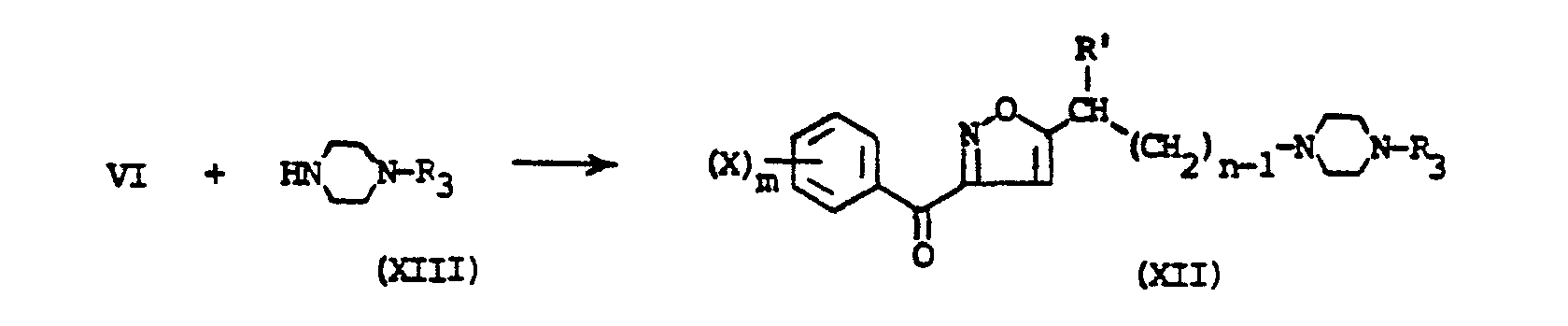
- Said reaction is conducted in substantially the same manner as described in STEP F.
- In conducting the reactions described in STEPS F, G and H above, it is often convenient or advantageous to add a tertiary amine such as triethylamine and an inorganic base such as potassium carbonate or the like to the reaction medium.
- The compounds of the present invention are useful as antihypertensive agents due to their ability to depress blood pressure in mammals. Antihypertensive activity is measured in the spontaneous hypertensive rat by the indirect tail cuff method described in "Methods in Pharmacology", A. Schwartz, Ed., Vol. I, Appleton-Century Crofts, New York, N.Y., 1971, p. 135. In this procedure a group of five animals are treated orally for three days with the test compound in relation to a control group of the same number. The drop in blood pressure is measured on the third day following administration. The antihypertensive activities of some of the compounds, expressed as a decrease in mean arterial blood pressure (in mm Hg), are given in Table I along with the activity of a standard compound.
- The compounds of the present invention are also useful as analgesic agents due to their ability to alleviate pain in mammals. The activity of the compounds is demonstrated in the 2-phenyl-1,4-benzoquinone-induced writhing test in mice, a standard assay for analgesia [Proc. Soc. Exptl. Biol. Med., 95, 729 (1957)]. Table I shows a result of the test of the analgesic activities of some of the compounds of this invention along with the activity of a standard compound.
- The compounds of the present invention are afso useful as antiinflammatory agents due to their ability to suppress inflammation in mammals. The activity of the compounds is demonstrated in the carrageenin induced rat paw edema antiinflammatory assay [Proc. Soc. Exptf. Biol. Med., III 544 (1962), J. Pharmacol. Exp., 141 (1963)]. The results of the antiinflammatory test of some of the compounds of this invention are given in Table I along with a result for a standard compound.


- Effective quantities of the compounds of the invention may be administered to a patient by any of the various methods, for example, orally as in capsules or tablets, parenterally in the form of sterile solutions or suspensions, and in some cases intravenously in the form of sterile solutions. The free base final products, while effective themselves, may be formulated and administered in the form of their pharmaceutically acceptable acid addition salts for purposes of stability, convenience of crystallization, increased solubility and the like.
- Acids useful for preparing the pharmaceutically acceptable acid addition salts of the invention include inorganic acids such as hydrochloric, hydrobromic, sulfuric, nitric, phosphoric and perchloric acids, as well as organic acids such as tartaric, citric, acetic, succinic, maleic, fumaric and oxalic acids.
- The active compounds of the present invention may be orally administered, for example, with an inert diluent or with an edible carrier, or they may be enclosed in gelatin capsules, or they may be compressed into tablets. For the purpose of oral therapeutic administration, the active compounds of the invention may be incorporated with excipients and used in the form of tablets, troches, capsules, elixirs, suspensions, syrups, wafers, chewing gum and the like. These preparations should contain at least 0.5% of active compound, but may be varied depending upon the particular form and may conventiently be between 4% to about 70% of the weight of the unit The amount of active compound in such compositions is such that a suitable dosage will be obtained. Preferred compositions and preparations according to the present invention are prepared so that an oral dosage unit form contains between 1.0-300 milligrams of active compound.
- The tablets, pills, capsules, troches and the like may also contain the following ingredients: a binder such as micro-crystalline cellulose, gum tragacanth or gelatin; an excipient such as starch or lactose, a disintegrating agent such as alginic acid, Primogel, comstarch and the like; a lubricant such as magnesium stearate or Sterotex; a glidant such as colloidal silicon dioxidel; and a sweetening agent such as sucrose or saccharin may be added or a flavoring agent such as pepperment, methyl salicylate, or orange flavoring. When the dosage unit form is a capsule, it may contain, in addition to materials of the above type, a liquid carrier such as a fatty oil. Other dosage unit forms may contain other various materials which modify the physical form of the dosage unit, for example, as coatings. Thus tablets or pills may be coated with sugar, shellac, or other enteric coating agents. A syrup may contain, in addition to the active compounds, sucrose as a sweetening agent and certain preservatives, dyes, colorings and flavors. Materials used in preparing these various compositions should be pharmaceutically pure and non-toxic in the amounts used.
- For the purposes of parenteral therapeutic administration, the active compounds of the invention may be incorporated into a solution or suspension. These preparations should contain at least 0.1% of active compound, but may be varied to be between 0.5 and about 30% of the weight thereof. The amount of active compound in such compositions and preparations according to the present invention are prepared so that a parenteral dosage unit contains between 0.5 to 100 milligrams of active compound.
- The solutions or suspension may also include the following components: a sterile diluent such as water for injection, saline solution, fixed oils, polyethylene glycols, glycerine, propylene glycol or other synthetic solvents; antibacterial agents such as benzyl alcohol or methyl parabens; antioxidants such as ascorbic acid or sodium bisutfite; chelating agents such as ethylenediaminetetraacetic acid; buffers such as acetates, citrates or phosphates and agents for the adjustment of tonicity such as sodium chloride or dextrose. The parenteral preparation can be enclosed in disposable syringes or multiple dose vials made of glass or plastic.
- Examples of the compounds of this invention include:
-
- 2-(3-Benzoylisoxazol-5-yl)ethanol;
- 2-[3-(4-Fluorobenzoyl)isoxazol-5-yl]ethanol;
- 2-[3-(4-Chlorobenzoyl)isoxazol-5-yl]ethanol;
- 2-[3-(4-Toluoyl)isoxazol-5-yl]ethanol;
- 2-[3-(4-Methoxybenzoyl)isoxazol-5-yl]ethanol;
- 2-[3-(2,4-Dichlorobenzoyl)isoxazol-5-yl]ethanol;
- 2-[3-(4-Chlorobenzoyl)isoxazol-5-yl]propan-1-ol;
- 4-(3-Benzoylisoxazol-5-yl)butan-1-ol;
- 4-[3-(4-Chlorobenzoyl)isoxazol-5-yl]butan-1-ol;
- 4-[3-(4-Toluoyl)isoxazol-5-yl]butan-1-ol;
- 4-[3-(2,4-Dichlorobenzoyl)isoxazol-5-yi]butan-1-ol;
- (3-Benzoylisoxazol-5-yl)acetic acid;
- [3-(4-Fluorobenzoyl)isoxazol-5-yl]acetic acid;
- [3-(4-Chlorobenzoyl)isoxazol-5-yl]acetic acid;
- [3-(4-Toluoyl)isoxazol-5-yl]acetic acid;
- [3-(4-Methoxybenzoyl)isoxazol-5-yl]acetic acid;
- [3-(2,4-Dichlorobenzoyl)isoxazol-5-yl]acetic acid;
- 2-[3-(4-Chlorobenzoyl)isoxazol-5-yl]propionic acid;
- 4-Chlorophenyl-[(5-phenylthiomethyl)isoxazol-3-yl]-methanone;
- 4-Chlorophenyl-[(5-phenylsulfinylmethyl)isoxazol-3-yl]-methonone;
- (5-Dimethylaminomethylisoxazol-3-yl)-4--fluorophenylmethanone;
- (5-(Morpholin-4-yl)methylisoxazol-3-yl]-4--fluorophenylmethanone;
- [5-(Morpholin-4-yl)methylisoxazol-3-yi]-4--chlorophenylmethanone;
- [5-(4-beta-Hydroxyethylpiperazin-1-yl)methylisoxazol-3-yl]-4--fluorophenylmethanone;
- [5-[(4-Phenylpiperazin-1-yl)methyl]isoxazol-3-yl]-phenylmethanone;
- [5-(4-Phenylpiperazin-1-yl)methylisoxazol-3-yl]-4--fluorophenylmethanone;
- [5-[4-(2,3,4-Trimethoxybenzyl)piperazin-1-yl]methylisoxazol--3-yl]-4-fluorophenylmethanone;
- [5-[4-(2,3,4-Trimethoxybenzyl)piperazin-1-yl]methylisoxazol--3-yl]-4-methoxyphenylmethanone;
- [5-(4-Benzhydrylpiperazin-1-yl)methylisoxazol-3-yl]-phenylmethanone;
- [5-(4-Benzhydrylpiperazin-1-yl)methylisoxazol-3-yl]-4--fluorophenylmethanone;
- [5-(4-Benzhydrylpiperazin-1-yl)methylisoxazol-3-yl]-4--chlorophenylmethanone;
- [5-(4-Benzhydrylpiperazin-1-yl)methylisoxazol-3-yl]-4--methoxyphenyimethanone;
- [5-[4-(4,4'-Difluorobenzhydryl)piperazin-1-yl]methylisoxazol--3-yl]-phenylmethanone;
- [5-[4-(4,4'-Difluorobenzhydryl)piperazin-1-yl]methylisoxazol--3-yl]-4-fluorophenylmethanone;
- [5-[4-(4,4'-Difluorobenzhydryl)piperazin-1-yl]methylisoxazol--3-yl]-4-chlorophenylmethanone; and
- [5-[4-(4,4'-Difluorobenzhydryl)piperazin-1-yl]methylisoxazol--3-yl]-4-methoxyphenylmethanone.
- The following examples are given for illustrative purposes and are not to be considered as limiting the invention disclosed herein. All temperatures are given in degrees Celcius.
- A solution of 12g of phenylglyoxylohydroxamyl chloride in 30ml of 3-butyn-1-ol was refluxed under N2 for 3 hours. Concentration of the product gave an oil which was purified by high pressure liquid chromatography with 5% ethyl acetate/CH2Cl2 used as an eluent to give 9.6g (67%) of an oil.
-

- A solution of 12.1 g of 4--fluorophenylglyoxylohydroxamyl chloride in 30ml of 3--butyn-1-ol was refluxed under N2 for 2.5 hours. Concentration of the product on a rotovapor under high-vacuum gave 17g of an oil. The residue was purified by high pressure liquid chromatography with 5% ethyl acetate/CH2Cl2 to yield 5.2g (37%) of an oil which solidified on standing, m.p. 42--45°.
-

- A solution of 12g of 4-chlorophenylglyoxylohydroxamyl chloride in 30g of 3-butyn-1-ol was refluxed under N2 for 2.5 hours. Concentration of the product on a rotovapor under high vacuum gave 17g of an oil. Purification by high pressure liquid chromatography with 5% ethyl acetate/CH2Cl2 yielded 11.8g (85%) of an oil which solidified on standing, m.p. 59-62°.
-

- A solution of 10g of 4-tolylglyoxylohydroxamyl chloride in 35ml of 3-butyn-7-ol was refluxed under N2 for 6 hours. Concentration of the product gave an oil which was purified by high pressure liquid chromatograph with 7% ethyl acetate/CH2Cl2 used as an eluent to give 7.7g (67%) of an oil.
-

- A solution of 17.0g of 4--methoxyphenylglyoxylohydroxamyl chloride in 40ml of 3--butyn-1-ol was refluxed under N2 for 4 hours. Concentration of the product on a rotovapor under a high vacuum gave 25g of an oil. The residue was purified by high pressure liquid chromatography with 15% ethyl acetate/CH2Cl2 to yield 14.1 g (71 %) of a oil.
-

- A solution of 25.2g of 2,4--dichlorophenylglyoxylohydroxamyl chloride in 50ml of 3--butyn-1-ol was refluxed under N2 for 4 hours. Concentration of the product on a rotovapor under a high vacuum gave 34g of an oil. The residue was purified by high pressure liquid chromatography with 7% ethyf acetate/CH2Cl2 to yield 19.4g of an oil which solidified on standing. 6.0g of the alcohol was again purified by high pressure liquid chromatography with 5% ethyl acetate/CH2Cl2 to yield 5.1 g (58%) of a solid, m.p. 78-80°.
-

- A solution of 8.7g of 4-chlorophenylglyoxylohydroxamyl chloride in 16.7 g of 2-methyl-3-butyn-1-ol was refluxed under N2 for 3 hours. The resulting mixture was concentrated under reduced pressure to give 13.5g of an oil. This material was purified by high pressure liquid chromatography with 5% ethyl acetate/CH2Cl2 used as an eluent to give 6.3g (59%) of an oil which solidified on standing, m.p. 49-51°.
-

- A solution of 12g of phenylglyoxylohydroxamyl chloride in 30g of 5-hexyn-1-ol was refluxed under N2 for 4 hours. Concentration of the product on a rotovapor under high vacuum gave 16g of an oil. Purification by high pressure liquid chromatography with 5% ethyl acetate/CH2Cl2 used an an eluent yielded 10.0g (62%) of an oil.
-

- A solution of 12g of 4-chlorophenylglyoxylohydroxamyl chloride in 30g of 5-hexyn-1-ol was refluxed under N2 for 2.5 hours. Concentration of the product on a rotovapor under high vacuum gave 18g of an oil. Purification by high pressure liquid chromatography with 5% ethyl acetate/CH2Cl2 used as a eluent yielded 12.0g (78%) of an oil which solidified on standing,m.p. 48-51°.
-

- A solution of 12g of 4-tolylglyoxylohydroxamyl chloride in 30g of 5-hexyn-1-ol was refluxed under N2 for 3 hours. Concentration of the product on a rotovapor under high vacuum gave 20g of an oil. Purification by high pressure liquid chromatography with 5% ethyl acetate/CH2Cl2 used as an eluent yielded 10.8g (68%) of an oil.
-

- A solution of 5.0g of 2,4--dichlorophenylglyoxylohydroxamyl chloride in 20ml of 5--hexyn-1-ol was refluxed for 2.5 hours. The solvent was evaporated in vacuo to give 7.7g of an oil. The residue was flash chromatographed twice with 0-4% ethyl acetate/CH2Cl2 to yield 4.9g (78%) of an oil.
-

- To a mixture of 8.8g of 2-(3-benzoylisoxazol-5-yl)-ethanol, in 1 liter of CH2Cl2, a few crystals of tetra-n--butylammonium hydrogen sulfate and 150ml of 9M H2SO4 was added 11.9g (41 mmol) of pulverized K2Cr2O7. The resulting mixture was stirred at room temperature for 1.5 hour. After allowing the mixture to settle, it was decanted from the unreacted dichromate. The aqueous phase was extracted with CH2Cl2, and the organics were washed with water and brine, and dried over MgS04. Concentration gave a wet solid which was triturated with cyclohexane and collected to give 7.1g of a solid. Recrystallization from toluene gave 4.0g (43%) of a solid, m.p. 108-110°.
-

- To a mixture of 13.5g of 2-[3-(4-fluorobenzoyl)isoxazol--5-yl]ethanol and a few crystals of tetrabutylammonium hydrogen sulfate in 1 liter of CH2Cl2 was added 150ml of 9M H2SO4. To this was added 16.9g of pulverized K2Cr207 and the mixture was stirred at room temperature for 1 hour. The organic phase was separated from the aqueous phase and washed with water. The acid product was extracted from the organic phase using 100ml of 5% NaHCO3. The alkaline solution was washed with CH2Cl2 several times, until all of the neutral impurities were removed, and then acidified slowly with 5% HCI. The precipitated solid was collected, washed with water and dried to yield 6.7g of a powder. Recrystallization from 180ml of 50% toluene/hexane gave 5.9g (41%) of crystals, m.p. 113--115°.
-

- To a mixture of 8.8g of 2-[3-(4-chlorobenzoyl)isoxazol--5-yl]ethanol, 850ml of CH2Cl2, a few crystals of tetra-n--butylammonium hydrogen sulfate and 130m1 of 9M H2SO4 was added 10.3g of pulverized K2Cr2O7. The resulting mixture was stirred at room temperature for 2 hours. After allowing the mixture to settle, it was decanted from the unreacted dichromate. The aqueous phase was extracted with CH2Cl2, and the organics were washed with water and brine, and dried over MgSO4. Concentration gave 5.1g of a solid. Recrystallization from toluene gave 3.0g (32%) of needles, m.p. 126-128°.
-

- To a mixture of 10.7g of 2-[3-(4-toluoyl)isoxazol-5-yl]-ethanol, 1000ml of CH2Cl2, a few crystals of tetra-n--butylammonium hydrogen sulfate and 150ml of 9M H2SO4 was added 13.6g of pulverized K2Cr2O7. The resulting mixture was stirred at room temperature for 1.5 hour. After allowing the mixture to settle, it was decanted from the unreacted dichromate. The aqueous phase was extracted with CH2Cl2, and the organics were washed with water and brine, and dried over MgSO4. Concentration gave 11.0g of an oil which solidified on standing. Recrystallization from toluene gave 4.8g (43%) of a solid, m.p.105-107°.
-

- To a mixture of 24.7g of 2-[3-(4-methoxybenzoyl)-isoxazol-5-yl]ethanol and a few crystals of tetrabutylammonium hydrogen sulfate in 2 liter of CH2Cl2 was added 300ml of 9M H2SO4. To this was added 29.4g of pulverized K2Cr2O7 and the mixture was stirred at room temperature for 15 minutes. The organic phase was separated from the aqueous phase and washed with water. The acid product was extracted from the organic phase using 300ml of 3% NaHCO3. The alkaline solution was washed with CH2Cl2 several times, and the solution was then acidified slowly with 5% HCI until all the acid precipitated. The solid was filtered, washed with water, and dried to give 2.6g of a powder. Recrystallization from 50ml of toluene yielded 2.3g (9%) of needles, m.p.119-121°.
-

- To a mixture of 12.8g of 2-[3-(2,4-dichlorobenzoyl)-isoxazol-5-yl]ethanol and a few crystals of tetra-n--butylammonium hydrogen sulfate in 1000ml of CH2Cl2 was added 150ml of 9M H2SO4. To this was added 13.2g of pulverized K2Cr2O7 and the mixture was stirred at room temperature for 1 hour. The organic phase was separated from the aqueous phase and washed with water. The acid product was extracted from the organic phase using 400ml of 4% NaHCO3. The alkaline solution was washed with CH2Cl2 several times, until all the neutral impurities were removed, and the solution was then acidified slowly with 5% HCI until all the acid precipitated. The solid was filtered, washed with water, and dried to yield 3.9g of a powder. Recrystallization from 100ml of 50% toluene/hexane gave 3.5g (26%) of crystals, m.p. 108-109°.
-

- To a mixture of 11.0g of 2-[3-(4-chlorobenzoyl)--isoxazol-5-yl]propan-1-ol in 1000ml of CH2CI2, a few crystals of tetra-n-butylammonium hydrogen sulfate and 150ml of 9M H,S04 was added 12.3g of pulverized K2Cr2O7. The resutting mixture was stirred at room temperature for 1.5 hour. After allowing the mixture to settle, it was decanted from the unreacted dichromate. The aqueous phase was separated and the organics were washed with water and brine, and dried over MgSO4. Concentration of the product gave 8.0g of a solid. Recrystallization from toluene with norite for decolorizing gave 2.0g of a solid, m.p. 119-123°. A second recrystallization from toluene gave 1.6g (13%) of a solid, m.p. 122.5-124.5°.
-

- A mixture of 32.7g of 4--chlorophenylglyoxylohydroxamyl chloride and 89.3g of 80% propargyl bromide in toluene was refluxed under N2 overnight The volatiles were removed by short-path distillation and the residue was recrystallized from EtOH to give 28g of a crystalline solid, m.p. 85-87.5°. This bromomethyl compound was used as such in the next step.
- A solution of 12ml of Et3N in 35ml of Et2O was added dropwise to a solution consisting of 13g of the bromo compound above, 4.4ml of thiophenol and 120ml of 20% acetone/Et2O. The reaction mixture was stirred at room temperature for 1 hour and allowed to stand at room temperature overnight After dilution with Et2O, the organics were washed with water, 5% aqueous HCI, saturated NaHCO3 and saturated NaCl, and dried over MgSO4. The solution was concentrated to give an oil. Purification by high pressure liquid chromatography using 50% CH2Cl2/hexane yielded 10.9g (48%) of an oil which solidified on standing, m.p. 54-56°.
-

- A solution of 4.45g of m-chloroperoxybenzoic acid, - (85% purity) in 100ml of CH2Cl2 was added dropwise under N2 to a solution of 6.0g of 4-chlorophenyl-[(5--phenylthiomethyl)isoxazol-3-yl]-methanone in 150ml of CH2Cl2 at -70°. After 30 minutes at -70°, the reaction mixture was poured directly into a mixture of 200 ml of 10% aqueous Na2S2O3 and 400ml of Et2O. The organics were washed with saturated NaHCO3 and dried over MgSO4. Concentration of the product gave 5.8g of a solid which was recrystallized from acetone/hexane to yield 3.4g (55%) of a solid, m.p. 118-120°.
-

- A 50% Et2O/MeOH mixture (250ml) was saturated with dimethylamine gas and cooled in an ice-bath. To this was added a solution of 4.5g of (5-bromomethylisoxazol-3-yi)-4--fluorophenylmethanone in 25ml of Et2O. The resulting solution was allowed to warm to room temperature and stirred for two days. The methanol was evaporated in vacuoto give an residue, which was dissovled in 500ml of EtOAc. The solution was washed with water until neutral and with saturated NaCl, dried over Na2SO4, and evaporated to give 3.5g of an oil which solidified on standing.
- A solution of 2.8g of the amine in 30ml of CH2Cl2 was filtered and added dropwise to a solution of 1.74g maleic acid in 400ml of Et2O. The precipitated salt was filtered and recrystallized from 60ml of 2-propanol to yield 3.45g (74%) of crystals, m.p. 134-135°.
-

- A solution of 4.5g of (5-bromomethylisoxazol-3-yl-4--fluorophenylmethanone in 100ml of Et2O was added dropwise to a solution of 7ml of morpholine in 300ml of 50% acetone/Et2O. The resulting mixture was stirred at room temperature for 20 hours. This mixture was filtered and the volatiles evaporated to give a residue which was dissolved in 600ml of Et2O. The organic solution was washed with water until it became neutral and then with saturated NaCl, and dried over Na2SO4 and concentrated in vacuo to give 4.3g of a crystalline solid. A 3.6g sample of the amine was recrystallized from 65ml of 8% toluene/hexane to yield 2.4g (64%) of crystals, m.p. 72-74°.
-

- 7.0ml of morpholine was added to a solution of 6.0g of (5-bromomethylisoxazol-3-yl)-4-chlorophenylmethanone in 100ml of 50% acetone/Et2O. The resulting solution was stirred at room temperature for 2 days. This mixture was filtered and the volatiles evaporated to give a residue which was dissolved in 400ml of Et2O. The organic solution was washed with water until neutral and with saturated NaCl, dried over Na2S04 and concentrated in vacuo to give an oil. The residue was flash chromatographed with 40% hexane/ethyl acetate to give 6.1g of an oil which solidified.
- A solution of the amine in 50ml of Et2O was added dropwise to a solution of 2.6g of maleic acid in 500ml of Et2O. The precipitated salt was filtered and recrystallized from 150ml of EtOH to yield 5.8g (69%) of crystals, m.p. 148-1490.
-

- A solution of 5.7g of (5-bromomethylisoxazol-3-yl)-4--fluorophenylmethanone in 100ml of Et2O was added to a solution of 6.5g of N-beta-hydroxyethylpiperazine in 400ml of 25% acetone/Et2O. The resulting mixture was stirred at room temperature for 24 hours. This mixture was filtered and the solution was concentrated in vacuoto give an oil. The residue was dissolved in 300ml of H20 and shortly thereafter a precipitate formed. The solid was filtered and dried to give 5.2g of crude solid. A solution of 4.3g of the amine in 50ml of 50% ethyl acetate/CH2Cl2 was added dropwise to a solution of excess maleic acid in 600ml of Et2O. The precipitated salt was filtered and recrystallized from 160ml of isopropanol to yield 5.2g (55%) of crystals, m.p.139-140°.
-

- A solution of 3.5g of (5-bromomethylisoxazol-3-yl)--phenylmethanone in 100ml of Et2O was added dropwise to a solution of 8.6g of phenylpiperazine in 375ml of 20% acetone/Et2O. The resulting mixture was stirred at room temperature for 72 hours. This mixture was washed with water and brine, and dried over MgSO4. Concentration of the product gave an oil, which was taken up in 500ml of CH2Cl2 and stirred with 20g of silica gel overnight The silica was removed by filtration and washed with 500ml of CH2Cl2. The combined filtrates were concentrated to give 4.7g of an oil which solidified on standing. Recrystallization from ethanol yielded 3.1g (69%) of platelets, m.p. 100--102°C.
-

- A solution of 3.7g of (5-bromomethylisoxazol-3-yl)-4--fluorophenylmethanone in 100ml of Et2O was added dropwise to a solution of 5.2g of N-phenylpiperazine in 400ml of 20% acetone/Et2O. The resulting mixture was stirred at room temperature for 24 hours. This mixture was filtered and the solution was washed with water (2 x 200ml) and saturated NaCl, and dried over MgSO4. Concentration of the product gave 5.5g of a solid which was dissolved in 100ml of CH2Cl2 and stirred with 5g of SiO2. This mixture was filtered, the silica washed with CH2Cl2 and the organics were evaporated to give 3.7g of a solid. The amine was recrystallized from 135ml of 8% toluene/hexane to yield 2.5g (53%) of needles, m.p. 94-95°.
-

- A solution of 3.1g of (5-bromomethylisoxazol-3-yl)-4--fluorophenylmethanone in 50ml of tetrahydrofuran was added to a solution consisting of 3.5g of N-2,3,4--trimethoxybenrylpiperazine, 1.8ml of triethylamine and 50ml of CH3OH. After stirring at room temperature overnight, the mixture was concentrated to a residue. This material was flash chromatographed, using ethyl acetate as an eluent, to give 3.8g of a solid. A solution of this compound in 30ml of CH2Cl2 was added to a solution of 2.6g of maleic add in 500ml of Et2O. The collected solid was recrystallized from acetonitrile to give 4.4g (57%) of a solid, m.p. 154-155°.
-

- A solution of 3.3g of (5-bromomethylisoxazol-3-yl)-4--methoxyphenylmethanone in 50ml of tetrahydrofuran was added to a solution consisting of 3.5g of N-2,3,4--trimethoxybenrylpiperazine, 1.8ml of triethylamine and 50ml of CH3OH. After stirring at room temperature overnight, the mixture was concentrated to a residue. This material was flash chromatographed, using ethyl acetate as an eluent, to give 4.0g of an oil. A solution of this compound in 30ml of CH2Cl2 was added to a solution of 2.6g of maleic acid in 500ml of Et2O. The collected solid was recrystallized from acetonitrile to give 3.6g (46%) of a solid, m.p. 147-149°.
-

- A solution of 5.0g of N-benzhydrylpiperazine in 100ml of MeOH was added to a solution of 4.0g of (5--bromomethylisoxazol-3-yl)-phenylmethanone in 40ml of Et2O. To this was added 2.8ml of triethylamine and the resultant solution stirred for 20 hours. The volatiles were evaporated to give a solid residue which was dissolved in 100ml of CH2CI2. The organic solution was washed with 5% Na2CO3, water and saturated NaCl, dried over Na2SO4 and concentrated in vacuo to give 8.4g of an oil. The residue was flash chromatographed with 0.4% ethyl acetate/CH2Cl2 to yield 6.2g of amine.
- A solution of the amine in 25ml of CH2Cl2 was added to a solution of 3.6g of maleic acid in 700ml of Et2O. The precipitated salt was filtered and recrystallized from 600ml of isopropanol to yield 7.1g (71%) of crystals, m.p. 174--1760.
-

- A solution of 2.8g of (5-bromomethylisoxazol-3-yl)-4--fluorophenylmethanone in 100ml of tetrahydrofuran was added to a solution consisting of 3.0g of N--benzhydrylpiperazine, 1.7ml of triethylamine and 50ml of MeOH. The resultant solution was stirred at room temperature for 3 days. The volatiles were evaporated to give a residue which was flash chromatographed with 25% ethyl acetate/hexane to give 3.4g of an oil which solidified.
- A solution of the amine in 40ml of CH2Cl2 was added to a solution of 2.0g of maleic acid in 70ml of Et2O. The precipitated salt was filtered and recrystallized from 300ml of acetonitrile to yield 4.8g (70%) of crystals, m.p. 180--1810.
-

- A solution of 4.0g of N-benzhydrylpiperazine in 100ml of MeOH was added to a solution of 3.9g of (5--bromomethylisoxazol-3-yl)-4-chlorophenylmethanone in 30mi of tetrahydrofuran. To this was added 2.2ml of triethylamine and the solution stirred for 20 hours. The volatiles were evaporated to give a residue which was dissolved in 350ml of ethyl acetate. The solution was washed with 5% Na2CO3, water and saturated NaCl, dried over Na2SO4 and concentrated in vacuo to give a solid. The residue was flash chromatographed with 25% ethyl acetate/hexane to yield 5.8g of the amine, m.p. 137-139°.
- A solution of the amine in 40ml of CH2Cl2 was added to a solution of 3.1 g of maleic acid in 600ml of Et2O. The precipitated salt was filtered and recrystallized from 700ml of acetonitrile to yield 7.4g (81%) of crystals, m.p. 185--186°.
-

- A solution of 2.95g of (5-bromomethylisoxazol-3-yl)-4--methoxyphenylmethanone in 30ml of tetrahydrofuran was added to a solution consisting of 3.0g of N--benzhydrylpiperazine, 1.7ml of triethylamine and 70ml of MeOH. The resultant solution was stirred at room temperature for 3 days. The volatiles were evaporated to give a residue which was flash chromatographed with 25% ethyl acetate/hexane to give 4.1 g of an oil.
- A solution of the amine in 30ml of CH2Cl2 was added to a solution of 2.3g of maleic acid in 500ml of Et2O. The precipitated salt was filtered and recrysiallized from 400ml of acetonitrile to yield 5.2g (74%) of crystals, m.p. 174--1760.
-

- A solution of 4.25g of (5-bromomethylisoxazol-3-yl)--phenylmethanone in 40ml of Et2O was added to a solution consisting of 5.8g of N-4,4'-difluorobenzhydrylpiperazine, 2.8ml of triethylamine and 100ml of MeOH. The resultant solution was stirred at room temperature for 16 hours. The volatiles were evaporated to give a residue which was dissolved in 150ml of ethyl acetate. The solution was washed with diluted Na2CO3, water and saturated NaCl, dried over Na2SO4 and concentrated in vacuo to give an oil. The residue was flash chromatographed with 25% ethyl acetate/hexane to give 7.6g of an oil. A solution of the amine in 40ml of Et2O was added to a solution of 4.1 of maleic acid in 700ml of Et2O. The precipitated salt was filtered and recrystallized from 300ml of acetonitrile to yield 6.5g (58%) of crystals, m.p. 175-177°.
-

- A solution of 2.8g of (5-bromomethylisoxazol-3-yi)-4--fluorophenylmethanone in 65ml of tetrahydrofuran was added to a solution consisting of 3.5g of N-4,4'--difluorobenzhydrylpiperazine, 1.7ml of triethylamine and 50ml of MeOH. The resultant solution was stirred at room temperature for 16 hours. The volatiles were evaporated to give a residue which as flash chromatographed with 25% ethyl acetate/hexane to give 4.6g of a resin.
- A solution of the amine in 40ml of CH2Cl2 was added to a solution of 2.6g of maleic acid in 800ml of Et2O. The precipitated salt was filtered and recrystallized from 400ml of acetonitrile to yield 4.5g (62%) of crystals, m.p. 184--186°.
-

- A solution of 3.9ml of (5-bromomethylisoxazol-3-yl)-4--chlorophenylmethanone in 30ml of tetrahydrofuran was added to a solution consisting of 4.6g of N-4,4'--difluorobenzhydrylpiperazine, 2.2ml of triethylamine and 100ml of MeOH. The resultant solution was stirred at room temperature for 16 hours. The volatiles were evaporated to give a residue which was dissolved in 150ml of ethyl acetate. The solution was washed with diluted Na2CO3, water and saturated NaCl, dried over Na2SO4, and concentrated in vacuo to give 9.4g of an oil. The residue was flash chromatographed with 25% ethyl acetate/hexane to give 7.1 g of an oil.
- A solution of the amine in 40ml of CH2Cl2 was added to a solution of 3.2g of maleic acid in 900ml of Et2O. The flocculent salt was filtered and recrystallized from 600ml of acetonitrile to yield 7.1g (74%) of crystals, m.p. 183-184°.
-

- A solution of 2.95g of (5-bromomethylisoxazol-3-yl)-4--methoxyphenylmethanone in 20ml of tetrahydrofuran was added to a solution consisting of 3.5g of N--4,4'difluorobenzhydrylpiperazine, 1.7ml of triethylamine and 50ml of MeOH. The resultant solution was stirred at room temperature for 3 days. The volatiles were evaporated to give a residue which was flash chromatographed with 25% ethyl acetate/hexane to give 3.7g of an oil.
- A solution of the amine in 20ml of CH2Cl2 was added to a solution of 2.3g of maleic acid in 600ml of Et2O. The precipitated salt was filtered and recrystallized from 220ml of acetonitrile to yield 4.5g (61%) of crystals, m.p. 175--176°.
-

Claims (17)


R, is the group


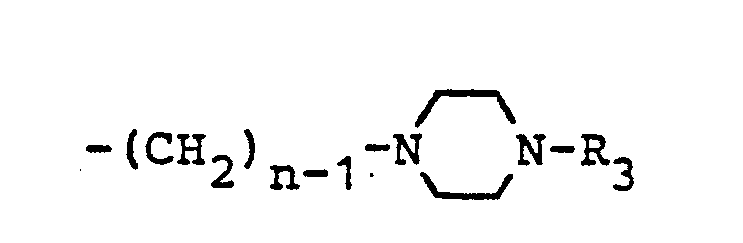


Applications Claiming Priority (2)
| Application Number | Priority Date | Filing Date | Title |
|---|---|---|---|
| US06/693,508 US4562187A (en) | 1985-01-22 | 1985-01-22 | (Isoxazol-3-yl)arylmethanones, compositions and pharmaceutical use |
| US693508 | 2003-10-24 |
Publications (2)
| Publication Number | Publication Date |
|---|---|
| EP0189771A2 true EP0189771A2 (en) | 1986-08-06 |
| EP0189771A3 EP0189771A3 (en) | 1986-10-08 |
Family
ID=24784959
Family Applications (1)
| Application Number | Title | Priority Date | Filing Date |
|---|---|---|---|
| EP86100345A Withdrawn EP0189771A3 (en) | 1985-01-22 | 1986-01-13 | (isoxazol-3-yl)arylmethanones, a process for their preparation and their use as medicaments |
Country Status (3)
| Country | Link |
|---|---|
| US (1) | US4562187A (en) |
| EP (1) | EP0189771A3 (en) |
| JP (1) | JPS61167673A (en) |
Cited By (3)
| Publication number | Priority date | Publication date | Assignee | Title |
|---|---|---|---|---|
| EP0449223A1 (en) * | 1990-03-27 | 1991-10-02 | Warner-Lambert Company | 3,5-di-tertiary-butyl-4-hydroxyphenyl thiazolyl, oxa-zolyl, and imidazolyl methanones and related compounds as antiinflammatory agents |
| US5234937A (en) * | 1990-03-27 | 1993-08-10 | Warner-Lambert Company | 3,5-di-tertiary-butyl-4-hydroxphenyl oxazolyl methanones and related compounds as antiinflammatory agents |
| US5234939A (en) * | 1990-03-27 | 1993-08-10 | Warner-Lambert Company | 3,5-di-tertiary-butyl-4-hydroxyphenyl imidazolyl methanones and related compounds as antiinflammatory agents |
Families Citing this family (11)
| Publication number | Priority date | Publication date | Assignee | Title |
|---|---|---|---|---|
| US4562186A (en) * | 1985-01-22 | 1985-12-31 | Hoechst-Roussel Pharmaceuticals Inc. | (1,2,4-Oxadiazol-3-yl)arylmethanones, compositions and pharmaceutical use |
| DE3643012A1 (en) * | 1986-12-17 | 1988-06-30 | Hoechst Ag | 2,3-DISUBSTITUTED ISOXAZOLIDINE, METHOD FOR THE PRODUCTION THEREOF, THE CONTAINERS THEREOF AND THEIR USE |
| US5656573A (en) * | 1989-09-11 | 1997-08-12 | Rhone-Poulenc Agriculture Ltd. | Herbicidal 4-substituted isoxazoles |
| US5747424A (en) * | 1989-09-11 | 1998-05-05 | Rhone-Poulenc Agriculture Ltd. | Herbicidal 4-substituted isoxazol |
| US5650533A (en) * | 1989-09-11 | 1997-07-22 | Rhone-Poulenc Agriculture Ltd. | Intermediates to herbicidal 4-substituted isoxazoles |
| GB9017539D0 (en) * | 1990-08-10 | 1990-09-26 | Rhone Poulenc Agriculture | New compositions of matter |
| AU4400397A (en) * | 1996-10-11 | 1998-05-11 | Shionogi & Co., Ltd. | Process for producing isoxazole derivatives and intermediates for producing the same |
| JP3789465B1 (en) * | 2005-04-28 | 2006-06-21 | 学校法人立教学院 | Method for producing isoxazole derivative or dihydroisoxazole derivative |
| US8952176B2 (en) | 2005-06-07 | 2015-02-10 | Shionogi & Co., Ltd. | Heterocyclic compound having type I 11 β hydroxysteroid dehydrogenase inhibitory activity |
| US8017638B2 (en) * | 2006-03-30 | 2011-09-13 | Shionogi & Co., Ltd. | Isoxazole derivative and isothiazole derivative having inhibitory activity on 11β-hydroxysteroid dehydrogenase type 1 |
| CA2643924A1 (en) * | 2006-04-17 | 2007-10-25 | Neuromed Pharmaceuticals Ltd. | Isoxazole derivatives as calcium channel blockers |
Family Cites Families (9)
| Publication number | Priority date | Publication date | Assignee | Title |
|---|---|---|---|---|
| NL302496A (en) * | 1962-12-22 | |||
| DE1470261A1 (en) * | 1963-01-24 | 1969-07-17 | Shionogi & Co | 3,5-disubstituted isoxazole derivatives and processes for their preparation |
| GB1067203A (en) * | 1964-02-26 | 1967-05-03 | Shionogi & Co | Improvements in or relating to the production of isoxazole compounds and the products thereof |
| GB1067806A (en) * | 1964-06-23 | 1967-05-03 | Shionogi & Co | Improvements in or relating to the production of isoxazole compounds and the products thereof |
| GB1164510A (en) * | 1967-06-15 | 1969-09-17 | Ici Ltd | Novel Isoxazole Derivatives, the preparation thereof, and Compositions containing the same |
| GB1180268A (en) * | 1967-09-26 | 1970-02-04 | Ici Ltd | Pharmaceutically Active Phenyl-Heterocyclic-Alkanol Derivatives |
| GB1364453A (en) * | 1970-11-06 | 1974-08-21 | Gist Brocades Nv | Penicillanic and cepholosporanic acid derivatives |
| JPS6052713B2 (en) * | 1978-04-11 | 1985-11-20 | 三共株式会社 | 7-Methoxycephalosporin compound, its production method, and antibacterial agent containing the compound as a main ingredient |
| JPS5821616A (en) * | 1981-07-30 | 1983-02-08 | Teijin Ltd | Antiinflammatory agent containing isoxazole derivative |
-
1985
- 1985-01-22 US US06/693,508 patent/US4562187A/en not_active Expired - Fee Related
-
1986
- 1986-01-13 EP EP86100345A patent/EP0189771A3/en not_active Withdrawn
- 1986-01-21 JP JP61009083A patent/JPS61167673A/en active Pending
Cited By (4)
| Publication number | Priority date | Publication date | Assignee | Title |
|---|---|---|---|---|
| EP0449223A1 (en) * | 1990-03-27 | 1991-10-02 | Warner-Lambert Company | 3,5-di-tertiary-butyl-4-hydroxyphenyl thiazolyl, oxa-zolyl, and imidazolyl methanones and related compounds as antiinflammatory agents |
| US5086064A (en) * | 1990-03-27 | 1992-02-04 | Warner-Lambert Company | 3,5-di-tertiary-butyl-4-hydroxyphenyl thiazolyl, oxazolyl, and imidazolyl methanones and related compounds as antiinflammatory agents |
| US5234937A (en) * | 1990-03-27 | 1993-08-10 | Warner-Lambert Company | 3,5-di-tertiary-butyl-4-hydroxphenyl oxazolyl methanones and related compounds as antiinflammatory agents |
| US5234939A (en) * | 1990-03-27 | 1993-08-10 | Warner-Lambert Company | 3,5-di-tertiary-butyl-4-hydroxyphenyl imidazolyl methanones and related compounds as antiinflammatory agents |
Also Published As
| Publication number | Publication date |
|---|---|
| US4562187A (en) | 1985-12-31 |
| JPS61167673A (en) | 1986-07-29 |
| EP0189771A3 (en) | 1986-10-08 |
Similar Documents
| Publication | Publication Date | Title |
|---|---|---|
| KR910002583B1 (en) | Piperazine derivatives or salts thereof, methods for their preparation and pharmaceutical compositions containing them as active ingredients | |
| ES2980505T3 (en) | Procedure for the preparation of a PDE4 inhibitor | |
| RU2161612C2 (en) | Derivatives of azole, pharmaceutical composition based on thereof, intermediate compounds | |
| AU658629B2 (en) | Novel isoxazole derivative and salt thereof | |
| AU2003290280A1 (en) | 4, 5-diarylthiazole derivatives as cb-1 ligands | |
| US4562187A (en) | (Isoxazol-3-yl)arylmethanones, compositions and pharmaceutical use | |
| EP0255710A2 (en) | 1,4-Dihydropyridine derivatives with calcium agonist and alpha-1-antagonist activity | |
| KR20010070442A (en) | Ether and amide compounds and preparation thereof as antidiabetics | |
| FR2566404A1 (en) | NOVEL 1,4-DIHYDROPYRIDINE DERIVATIVES, THEIR SALTS, PROCESS FOR THEIR PREPARATION, AND PHARMACEUTICAL COMPOSITIONS CONTAINING THEM | |
| WO1994001433A1 (en) | Novel thiazolidinedione compound and use thereof | |
| EP0835254B1 (en) | Oxazolidinone derivatives, their preparation and therapeutical use | |
| EP0511031B1 (en) | 3-Aryl-oxazolidinon derivatives, process for their preparation and their use in therapeutics | |
| US4880841A (en) | Process of producing phenethylamine derivatives | |
| KR100312471B1 (en) | Thiazolidinone compounds or therapeutic agents or preventive agents containing them as active ingredients | |
| US5013734A (en) | Novel esters of phenylalkanoic acid | |
| HU219493B (en) | Piperazine derivatives and processes for their preparation can be used to prepare alkyl-trododones | |
| US4562186A (en) | (1,2,4-Oxadiazol-3-yl)arylmethanones, compositions and pharmaceutical use | |
| WO2024078302A1 (en) | Crystal form of ketoamide derivative and preparation method therefor | |
| FR2576900A1 (en) | 2-SUBSTITUTED CYCLOHEPTO-IMIDAZOLE DERIVATIVES, ANTI-ULCEROUS AGENTS AND PROCESS FOR THEIR PREPARATION | |
| CN114195776B (en) | Preparation and application of novel FXR small molecule agonist | |
| JPH0680059B2 (en) | Novel isoxazole derivative | |
| FR2615855A1 (en) | NOVEL METHOXY-5 ALCOHYL AMMONIUM TETRAHYDROFURAN AND TETRAHYDROTHIOPHENES AND PROCESS FOR THEIR PREPARATION | |
| RU2184730C1 (en) | Method of synthesis of 4-methyl-3-[2-(n-propyl- -amino)propionylamino]thiophene-2-carboxylic acid methyl ester hydrochloride | |
| WO2008098396A2 (en) | Oxazolidinones and their use as hypocholesterolemic agents | |
| BE569697A (en) |
Legal Events
| Date | Code | Title | Description |
|---|---|---|---|
| PUAI | Public reference made under article 153(3) epc to a published international application that has entered the european phase |
Free format text: ORIGINAL CODE: 0009012 |
|
| AK | Designated contracting states |
Kind code of ref document: A2 Designated state(s): AT BE CH DE FR GB IT LI NL SE |
|
| PUAL | Search report despatched |
Free format text: ORIGINAL CODE: 0009013 |
|
| AK | Designated contracting states |
Kind code of ref document: A3 Designated state(s): AT BE CH DE FR GB IT LI NL SE |
|
| 17P | Request for examination filed |
Effective date: 19861210 |
|
| 17Q | First examination report despatched |
Effective date: 19880205 |
|
| STAA | Information on the status of an ep patent application or granted ep patent |
Free format text: STATUS: THE APPLICATION IS DEEMED TO BE WITHDRAWN |
|
| 18D | Application deemed to be withdrawn |
Effective date: 19891204 |
|
| RIN1 | Information on inventor provided before grant (corrected) |
Inventor name: DIAMOND, CRAIG J. Inventor name: TEGELER, JOHN J. |