EP0188114B1 - Microporous films - Google Patents
Microporous films Download PDFInfo
- Publication number
- EP0188114B1 EP0188114B1 EP85309249A EP85309249A EP0188114B1 EP 0188114 B1 EP0188114 B1 EP 0188114B1 EP 85309249 A EP85309249 A EP 85309249A EP 85309249 A EP85309249 A EP 85309249A EP 0188114 B1 EP0188114 B1 EP 0188114B1
- Authority
- EP
- European Patent Office
- Prior art keywords
- film
- sub
- films
- electrochemical cell
- polymer
- Prior art date
- Legal status (The legal status is an assumption and is not a legal conclusion. Google has not performed a legal analysis and makes no representation as to the accuracy of the status listed.)
- Expired - Lifetime
Links
- 229910052744 lithium Inorganic materials 0.000 claims abstract description 13
- FYSNRJHAOHDILO-UHFFFAOYSA-N thionyl chloride Chemical compound ClS(Cl)=O FYSNRJHAOHDILO-UHFFFAOYSA-N 0.000 claims abstract description 13
- WHXSMMKQMYFTQS-UHFFFAOYSA-N Lithium Chemical compound [Li] WHXSMMKQMYFTQS-UHFFFAOYSA-N 0.000 claims abstract description 12
- 239000003792 electrolyte Substances 0.000 claims abstract description 8
- ZAMOUSCENKQFHK-UHFFFAOYSA-N Chlorine atom Chemical compound [Cl] ZAMOUSCENKQFHK-UHFFFAOYSA-N 0.000 claims abstract description 5
- PXGOKWXKJXAPGV-UHFFFAOYSA-N Fluorine Chemical compound FF PXGOKWXKJXAPGV-UHFFFAOYSA-N 0.000 claims abstract description 5
- 229910052801 chlorine Inorganic materials 0.000 claims abstract description 5
- 239000000460 chlorine Substances 0.000 claims abstract description 5
- 229910052731 fluorine Inorganic materials 0.000 claims abstract description 5
- 239000011737 fluorine Substances 0.000 claims abstract description 5
- 229920000642 polymer Polymers 0.000 claims description 31
- 229920001577 copolymer Polymers 0.000 claims description 15
- 238000000034 method Methods 0.000 claims description 15
- VGGSQFUCUMXWEO-UHFFFAOYSA-N Ethene Chemical compound C=C VGGSQFUCUMXWEO-UHFFFAOYSA-N 0.000 claims description 11
- 239000005977 Ethylene Substances 0.000 claims description 11
- 229910052751 metal Inorganic materials 0.000 claims description 11
- 239000002184 metal Substances 0.000 claims description 11
- 230000000737 periodic effect Effects 0.000 claims description 5
- XHXFXVLFKHQFAL-UHFFFAOYSA-N phosphoryl trichloride Chemical compound ClP(Cl)(Cl)=O XHXFXVLFKHQFAL-UHFFFAOYSA-N 0.000 claims description 4
- YBBRCQOCSYXUOC-UHFFFAOYSA-N sulfuryl dichloride Chemical compound ClS(Cl)(=O)=O YBBRCQOCSYXUOC-UHFFFAOYSA-N 0.000 claims description 2
- 239000000126 substance Substances 0.000 abstract description 6
- 229910052784 alkaline earth metal Inorganic materials 0.000 abstract description 4
- 239000003513 alkali Substances 0.000 abstract description 2
- 150000001342 alkaline earth metals Chemical class 0.000 abstract description 2
- 229920006254 polymer film Polymers 0.000 abstract description 2
- 239000010408 film Substances 0.000 description 65
- 210000004027 cell Anatomy 0.000 description 30
- 150000003839 salts Chemical class 0.000 description 16
- 229920006355 Tefzel Polymers 0.000 description 13
- QHSJIZLJUFMIFP-UHFFFAOYSA-N ethene;1,1,2,2-tetrafluoroethene Chemical compound C=C.FC(F)=C(F)F QHSJIZLJUFMIFP-UHFFFAOYSA-N 0.000 description 13
- 238000000605 extraction Methods 0.000 description 9
- -1 polyethylene Polymers 0.000 description 8
- 239000011148 porous material Substances 0.000 description 8
- 239000000203 mixture Substances 0.000 description 7
- 239000002904 solvent Substances 0.000 description 7
- 239000000463 material Substances 0.000 description 6
- 229920001780 ECTFE Polymers 0.000 description 5
- XLYOFNOQVPJJNP-UHFFFAOYSA-N water Substances O XLYOFNOQVPJJNP-UHFFFAOYSA-N 0.000 description 5
- KWGKDLIKAYFUFQ-UHFFFAOYSA-M lithium chloride Chemical compound [Li+].[Cl-] KWGKDLIKAYFUFQ-UHFFFAOYSA-M 0.000 description 4
- 238000010128 melt processing Methods 0.000 description 4
- 239000012528 membrane Substances 0.000 description 4
- BQCIDUSAKPWEOX-UHFFFAOYSA-N 1,1-Difluoroethene Chemical compound FC(F)=C BQCIDUSAKPWEOX-UHFFFAOYSA-N 0.000 description 3
- 229920010177 Kynar® 460 Polymers 0.000 description 3
- 239000002033 PVDF binder Substances 0.000 description 3
- 239000002253 acid Substances 0.000 description 3
- 239000003365 glass fiber Substances 0.000 description 3
- 239000007788 liquid Substances 0.000 description 3
- XGZVUEUWXADBQD-UHFFFAOYSA-L lithium carbonate Chemical compound [Li+].[Li+].[O-]C([O-])=O XGZVUEUWXADBQD-UHFFFAOYSA-L 0.000 description 3
- 229910052808 lithium carbonate Inorganic materials 0.000 description 3
- 229910003002 lithium salt Inorganic materials 0.000 description 3
- 159000000002 lithium salts Chemical class 0.000 description 3
- 229910001537 lithium tetrachloroaluminate Inorganic materials 0.000 description 3
- 239000011159 matrix material Substances 0.000 description 3
- 150000002739 metals Chemical class 0.000 description 3
- 239000000178 monomer Substances 0.000 description 3
- 229920000098 polyolefin Polymers 0.000 description 3
- 229920001343 polytetrafluoroethylene Polymers 0.000 description 3
- 239000004810 polytetrafluoroethylene Substances 0.000 description 3
- 229920002981 polyvinylidene fluoride Polymers 0.000 description 3
- IAYPIBMASNFSPL-UHFFFAOYSA-N Ethylene oxide Chemical compound C1CO1 IAYPIBMASNFSPL-UHFFFAOYSA-N 0.000 description 2
- 239000004698 Polyethylene Substances 0.000 description 2
- 150000007513 acids Chemical class 0.000 description 2
- 230000004888 barrier function Effects 0.000 description 2
- 239000003431 cross linking reagent Substances 0.000 description 2
- 230000000694 effects Effects 0.000 description 2
- 238000005868 electrolysis reaction Methods 0.000 description 2
- 238000001125 extrusion Methods 0.000 description 2
- QSHDDOUJBYECFT-UHFFFAOYSA-N mercury Chemical compound [Hg] QSHDDOUJBYECFT-UHFFFAOYSA-N 0.000 description 2
- 229910052753 mercury Inorganic materials 0.000 description 2
- 238000002156 mixing Methods 0.000 description 2
- 229920000573 polyethylene Polymers 0.000 description 2
- 238000002459 porosimetry Methods 0.000 description 2
- 238000010992 reflux Methods 0.000 description 2
- BFKJFAAPBSQJPD-UHFFFAOYSA-N tetrafluoroethene Chemical group FC(F)=C(F)F BFKJFAAPBSQJPD-UHFFFAOYSA-N 0.000 description 2
- SMZOUWXMTYCWNB-UHFFFAOYSA-N 2-(2-methoxy-5-methylphenyl)ethanamine Chemical compound COC1=CC=C(C)C=C1CCN SMZOUWXMTYCWNB-UHFFFAOYSA-N 0.000 description 1
- NIXOWILDQLNWCW-UHFFFAOYSA-N 2-Propenoic acid Natural products OC(=O)C=C NIXOWILDQLNWCW-UHFFFAOYSA-N 0.000 description 1
- BVKZGUZCCUSVTD-UHFFFAOYSA-L Carbonate Chemical compound [O-]C([O-])=O BVKZGUZCCUSVTD-UHFFFAOYSA-L 0.000 description 1
- VEXZGXHMUGYJMC-UHFFFAOYSA-M Chloride anion Chemical compound [Cl-] VEXZGXHMUGYJMC-UHFFFAOYSA-M 0.000 description 1
- IMROMDMJAWUWLK-UHFFFAOYSA-N Ethenol Chemical compound OC=C IMROMDMJAWUWLK-UHFFFAOYSA-N 0.000 description 1
- VEXZGXHMUGYJMC-UHFFFAOYSA-N Hydrochloric acid Chemical compound Cl VEXZGXHMUGYJMC-UHFFFAOYSA-N 0.000 description 1
- DGAQECJNVWCQMB-PUAWFVPOSA-M Ilexoside XXIX Chemical compound C[C@@H]1CC[C@@]2(CC[C@@]3(C(=CC[C@H]4[C@]3(CC[C@@H]5[C@@]4(CC[C@@H](C5(C)C)OS(=O)(=O)[O-])C)C)[C@@H]2[C@]1(C)O)C)C(=O)O[C@H]6[C@@H]([C@H]([C@@H]([C@H](O6)CO)O)O)O.[Na+] DGAQECJNVWCQMB-PUAWFVPOSA-M 0.000 description 1
- CERQOIWHTDAKMF-UHFFFAOYSA-N Methacrylic acid Chemical compound CC(=C)C(O)=O CERQOIWHTDAKMF-UHFFFAOYSA-N 0.000 description 1
- WHNWPMSKXPGLAX-UHFFFAOYSA-N N-Vinyl-2-pyrrolidone Chemical compound C=CN1CCCC1=O WHNWPMSKXPGLAX-UHFFFAOYSA-N 0.000 description 1
- 229910002651 NO3 Inorganic materials 0.000 description 1
- NHNBFGGVMKEFGY-UHFFFAOYSA-N Nitrate Chemical compound [O-][N+]([O-])=O NHNBFGGVMKEFGY-UHFFFAOYSA-N 0.000 description 1
- 239000006057 Non-nutritive feed additive Substances 0.000 description 1
- 229910019142 PO4 Inorganic materials 0.000 description 1
- 229920003171 Poly (ethylene oxide) Polymers 0.000 description 1
- 239000004743 Polypropylene Substances 0.000 description 1
- QAOWNCQODCNURD-UHFFFAOYSA-L Sulfate Chemical compound [O-]S([O-])(=O)=O QAOWNCQODCNURD-UHFFFAOYSA-L 0.000 description 1
- BZHJMEDXRYGGRV-UHFFFAOYSA-N Vinyl chloride Chemical class ClC=C BZHJMEDXRYGGRV-UHFFFAOYSA-N 0.000 description 1
- 125000002947 alkylene group Chemical group 0.000 description 1
- 150000004645 aluminates Chemical class 0.000 description 1
- 239000003963 antioxidant agent Substances 0.000 description 1
- 239000011260 aqueous acid Substances 0.000 description 1
- 239000003125 aqueous solvent Substances 0.000 description 1
- 230000015572 biosynthetic process Effects 0.000 description 1
- 238000000071 blow moulding Methods 0.000 description 1
- 230000015556 catabolic process Effects 0.000 description 1
- 210000003850 cellular structure Anatomy 0.000 description 1
- 238000010382 chemical cross-linking Methods 0.000 description 1
- 239000007795 chemical reaction product Substances 0.000 description 1
- UUAGAQFQZIEFAH-UHFFFAOYSA-N chlorotrifluoroethylene Chemical group FC(F)=C(F)Cl UUAGAQFQZIEFAH-UHFFFAOYSA-N 0.000 description 1
- 150000001875 compounds Chemical class 0.000 description 1
- 238000000748 compression moulding Methods 0.000 description 1
- 238000006731 degradation reaction Methods 0.000 description 1
- 230000001419 dependent effect Effects 0.000 description 1
- 239000012153 distilled water Substances 0.000 description 1
- 238000001035 drying Methods 0.000 description 1
- 239000007772 electrode material Substances 0.000 description 1
- 239000004744 fabric Substances 0.000 description 1
- 239000012530 fluid Substances 0.000 description 1
- 150000004676 glycans Chemical class 0.000 description 1
- 238000007689 inspection Methods 0.000 description 1
- 238000004519 manufacturing process Methods 0.000 description 1
- 238000005259 measurement Methods 0.000 description 1
- 238000002844 melting Methods 0.000 description 1
- 230000008018 melting Effects 0.000 description 1
- 230000003287 optical effect Effects 0.000 description 1
- 238000004806 packaging method and process Methods 0.000 description 1
- 230000003071 parasitic effect Effects 0.000 description 1
- NBIIXXVUZAFLBC-UHFFFAOYSA-K phosphate Chemical compound [O-]P([O-])([O-])=O NBIIXXVUZAFLBC-UHFFFAOYSA-K 0.000 description 1
- 239000010452 phosphate Substances 0.000 description 1
- 230000000704 physical effect Effects 0.000 description 1
- 229920001155 polypropylene Polymers 0.000 description 1
- 229920001282 polysaccharide Polymers 0.000 description 1
- 239000005017 polysaccharide Substances 0.000 description 1
- 230000005855 radiation Effects 0.000 description 1
- 230000009257 reactivity Effects 0.000 description 1
- 230000000717 retained effect Effects 0.000 description 1
- 238000001878 scanning electron micrograph Methods 0.000 description 1
- 238000007789 sealing Methods 0.000 description 1
- 229910052708 sodium Inorganic materials 0.000 description 1
- 239000011734 sodium Substances 0.000 description 1
- 239000003381 stabilizer Substances 0.000 description 1
- 229910001220 stainless steel Inorganic materials 0.000 description 1
- 239000010935 stainless steel Substances 0.000 description 1
- 238000003860 storage Methods 0.000 description 1
- 229910021653 sulphate ion Inorganic materials 0.000 description 1
- 239000010409 thin film Substances 0.000 description 1
- ITMCEJHCFYSIIV-UHFFFAOYSA-M triflate Chemical compound [O-]S(=O)(=O)C(F)(F)F ITMCEJHCFYSIIV-UHFFFAOYSA-M 0.000 description 1
- 238000005406 washing Methods 0.000 description 1
- 239000000080 wetting agent Substances 0.000 description 1
Images

Classifications
-
- C—CHEMISTRY; METALLURGY
- C08—ORGANIC MACROMOLECULAR COMPOUNDS; THEIR PREPARATION OR CHEMICAL WORKING-UP; COMPOSITIONS BASED THEREON
- C08J—WORKING-UP; GENERAL PROCESSES OF COMPOUNDING; AFTER-TREATMENT NOT COVERED BY SUBCLASSES C08B, C08C, C08F, C08G or C08H
- C08J9/00—Working-up of macromolecular substances to porous or cellular articles or materials; After-treatment thereof
- C08J9/26—Working-up of macromolecular substances to porous or cellular articles or materials; After-treatment thereof by elimination of a solid phase from a macromolecular composition or article, e.g. leaching out
-
- H—ELECTRICITY
- H01—ELECTRIC ELEMENTS
- H01M—PROCESSES OR MEANS, e.g. BATTERIES, FOR THE DIRECT CONVERSION OF CHEMICAL ENERGY INTO ELECTRICAL ENERGY
- H01M50/00—Constructional details or processes of manufacture of the non-active parts of electrochemical cells other than fuel cells, e.g. hybrid cells
- H01M50/40—Separators; Membranes; Diaphragms; Spacing elements inside cells
- H01M50/489—Separators, membranes, diaphragms or spacing elements inside the cells, characterised by their physical properties, e.g. swelling degree, hydrophilicity or shut down properties
- H01M50/491—Porosity
-
- C—CHEMISTRY; METALLURGY
- C25—ELECTROLYTIC OR ELECTROPHORETIC PROCESSES; APPARATUS THEREFOR
- C25B—ELECTROLYTIC OR ELECTROPHORETIC PROCESSES FOR THE PRODUCTION OF COMPOUNDS OR NON-METALS; APPARATUS THEREFOR
- C25B13/00—Diaphragms; Spacing elements
- C25B13/04—Diaphragms; Spacing elements characterised by the material
- C25B13/08—Diaphragms; Spacing elements characterised by the material based on organic materials
-
- H—ELECTRICITY
- H01—ELECTRIC ELEMENTS
- H01M—PROCESSES OR MEANS, e.g. BATTERIES, FOR THE DIRECT CONVERSION OF CHEMICAL ENERGY INTO ELECTRICAL ENERGY
- H01M50/00—Constructional details or processes of manufacture of the non-active parts of electrochemical cells other than fuel cells, e.g. hybrid cells
- H01M50/40—Separators; Membranes; Diaphragms; Spacing elements inside cells
- H01M50/409—Separators, membranes or diaphragms characterised by the material
- H01M50/411—Organic material
- H01M50/414—Synthetic resins, e.g. thermoplastics or thermosetting resins
- H01M50/426—Fluorocarbon polymers
-
- C—CHEMISTRY; METALLURGY
- C08—ORGANIC MACROMOLECULAR COMPOUNDS; THEIR PREPARATION OR CHEMICAL WORKING-UP; COMPOSITIONS BASED THEREON
- C08J—WORKING-UP; GENERAL PROCESSES OF COMPOUNDING; AFTER-TREATMENT NOT COVERED BY SUBCLASSES C08B, C08C, C08F, C08G or C08H
- C08J2201/00—Foams characterised by the foaming process
- C08J2201/04—Foams characterised by the foaming process characterised by the elimination of a liquid or solid component, e.g. precipitation, leaching out, evaporation
- C08J2201/044—Elimination of an inorganic solid phase
- C08J2201/0444—Salts
-
- C—CHEMISTRY; METALLURGY
- C08—ORGANIC MACROMOLECULAR COMPOUNDS; THEIR PREPARATION OR CHEMICAL WORKING-UP; COMPOSITIONS BASED THEREON
- C08J—WORKING-UP; GENERAL PROCESSES OF COMPOUNDING; AFTER-TREATMENT NOT COVERED BY SUBCLASSES C08B, C08C, C08F, C08G or C08H
- C08J2201/00—Foams characterised by the foaming process
- C08J2201/04—Foams characterised by the foaming process characterised by the elimination of a liquid or solid component, e.g. precipitation, leaching out, evaporation
- C08J2201/046—Elimination of a polymeric phase
- C08J2201/0464—Elimination of a polymeric phase using water or inorganic fluids
-
- C—CHEMISTRY; METALLURGY
- C08—ORGANIC MACROMOLECULAR COMPOUNDS; THEIR PREPARATION OR CHEMICAL WORKING-UP; COMPOSITIONS BASED THEREON
- C08J—WORKING-UP; GENERAL PROCESSES OF COMPOUNDING; AFTER-TREATMENT NOT COVERED BY SUBCLASSES C08B, C08C, C08F, C08G or C08H
- C08J2323/00—Characterised by the use of homopolymers or copolymers of unsaturated aliphatic hydrocarbons having only one carbon-to-carbon double bond; Derivatives of such polymers
- C08J2323/02—Characterised by the use of homopolymers or copolymers of unsaturated aliphatic hydrocarbons having only one carbon-to-carbon double bond; Derivatives of such polymers not modified by chemical after treatment
- C08J2323/04—Homopolymers or copolymers of ethene
-
- C—CHEMISTRY; METALLURGY
- C08—ORGANIC MACROMOLECULAR COMPOUNDS; THEIR PREPARATION OR CHEMICAL WORKING-UP; COMPOSITIONS BASED THEREON
- C08J—WORKING-UP; GENERAL PROCESSES OF COMPOUNDING; AFTER-TREATMENT NOT COVERED BY SUBCLASSES C08B, C08C, C08F, C08G or C08H
- C08J2327/00—Characterised by the use of homopolymers or copolymers of compounds having one or more unsaturated aliphatic radicals, each having only one carbon-to-carbon double bond, and at least one being terminated by a halogen; Derivatives of such polymers
- C08J2327/02—Characterised by the use of homopolymers or copolymers of compounds having one or more unsaturated aliphatic radicals, each having only one carbon-to-carbon double bond, and at least one being terminated by a halogen; Derivatives of such polymers not modified by chemical after-treatment
- C08J2327/12—Characterised by the use of homopolymers or copolymers of compounds having one or more unsaturated aliphatic radicals, each having only one carbon-to-carbon double bond, and at least one being terminated by a halogen; Derivatives of such polymers not modified by chemical after-treatment containing fluorine atoms
-
- H—ELECTRICITY
- H01—ELECTRIC ELEMENTS
- H01M—PROCESSES OR MEANS, e.g. BATTERIES, FOR THE DIRECT CONVERSION OF CHEMICAL ENERGY INTO ELECTRICAL ENERGY
- H01M2300/00—Electrolytes
- H01M2300/0017—Non-aqueous electrolytes
-
- H—ELECTRICITY
- H01—ELECTRIC ELEMENTS
- H01M—PROCESSES OR MEANS, e.g. BATTERIES, FOR THE DIRECT CONVERSION OF CHEMICAL ENERGY INTO ELECTRICAL ENERGY
- H01M2300/00—Electrolytes
- H01M2300/0017—Non-aqueous electrolytes
- H01M2300/0025—Organic electrolyte
-
- Y—GENERAL TAGGING OF NEW TECHNOLOGICAL DEVELOPMENTS; GENERAL TAGGING OF CROSS-SECTIONAL TECHNOLOGIES SPANNING OVER SEVERAL SECTIONS OF THE IPC; TECHNICAL SUBJECTS COVERED BY FORMER USPC CROSS-REFERENCE ART COLLECTIONS [XRACs] AND DIGESTS
- Y02—TECHNOLOGIES OR APPLICATIONS FOR MITIGATION OR ADAPTATION AGAINST CLIMATE CHANGE
- Y02E—REDUCTION OF GREENHOUSE GAS [GHG] EMISSIONS, RELATED TO ENERGY GENERATION, TRANSMISSION OR DISTRIBUTION
- Y02E60/00—Enabling technologies; Technologies with a potential or indirect contribution to GHG emissions mitigation
- Y02E60/10—Energy storage using batteries
Definitions
- the present invention relates to an electrochemical cell having a separator which is a porous polymer film.
- Microporous films are used in a wide range of applications, generally to provide a selective barrier. For example, they may be used as battery separators, and membranes, electrolysis membranes as well as in breathable fabrics and medical and packaging applications.
- Commonly used polymeric films comprise polyolefins such as polyethylene and polypropylene which can conveniently be made porous by extraction of a soluble component or components (see GB-A-1078895). Such films are chemically inert towards many acids and alkalis and towards many reactive metals. However, there exist a number of solvents with which a polyolefin film cannot be used because of chemical incompatability.
- the maximum operating temperature of polyolefin films is about 120 o C, and their use in cells for high temperature applications is therefore not possible.
- Cell separators for use where the environment is chemically aggressive or in high temperature cells have therefore been made of glass fibre, but such separators are relatively bulky.
- the present invention provides an electrochemical cell in which the separator is a porous polymeric film which comprises a halopolymer of a particular class defined below.
- the separator is a porous polymeric film which comprises a halopolymer of a particular class defined below.
- Such cell separators can be suitable for use in cells that operate at ambient or elevated temperatures and are substantially inert to alkali and alkaline earth metals which are chemically aggressive.
- the invention provides an electrochemical cell which comprises an anode which is a metal of Group I or Group II of the Periodic Table, a cathode, an electrolyte, and a separator positioned between the anode and the cathode which is a film having a porosity of at least 20% by volume and comprising a polymer in which the repeating units are -(C n H 2n )- and -(C m X 2m )- wherein each X independently represents fluorine or chlorine and the values of n and m are greater than one and less than six.
- the film of which the separator is made comprises a copolymer which comprises ethylene and tetrafluoroethylene as the monomer units, although chloroethylenes and fluorochloroethylenes can also be used as the monomer units.
- the film of which the separator is made can comprise a copolymer that comprises longer chain monomer units, for example propylene, butylene and halogenated analogues thereof.
- Particularly preferred halopolymers for use in the invention are those sold under the Trade Marks TEFZEL (ethylene/ tetrafluoroethylene) and HALAR (ethylene/chlorotrifluoroethylene).
- a porous membrane of an ethylene/tetrafluoroethylene copolymer is disclosed in GB-A-2078604, but there is no disclosure that this porous membrane is effective as a separator in a cell where the anode is a metal of Group I or Group II of the Periodic Table.
- TEZEL ethylene/tetrafluoroethylene copolymers
- ethylene/chlorofluoroethylene copolymers on a non-porous jacket on an internal lead of a lithium/thionyl chloride cell to prevent parasitic discharge is disclosed in US-A-4376811, but the cell separator disclosed for use in that cell is of glass fibre.
- a microporous film which is preferably used according to the invention, is a porous film in which the details of pore configuration and/or arrangement are discernable only by microscopic examination.
- the pores or open cells in the films are smaller than those which can be seen using an optical microscope, in which case electron miscroscopy techniques may be used to resolve details of the pore structure.
- the maximum dimension of a substantial number of the pores will be less than 5 micrometers, preferably less than 2 micrometers, measured by mercury intrusion porosimetry according to ASTM D 2873-70.
- the porosity of the films may advantageously be not less than 30%, preferably not less than 40% by volume, for example from 40-50% by volume, measured by mercury intrusion porosimetry, again according to ASTM D 2873-70.
- Microporous films of the halopolymers defined above have chemical and physical properties which are advantageous for use in a variety of high performance applications as battery separators.
- a significant advantage of the microporous film is that it withstands high temperatures, and can be used for example in high temperature electrochemical cells where previously used microporous films cannot function.
- the cell separators described above are chemically inert towards reactive metals commonly used as anodes in electrochemical cells, for example metals of Groups I and II of the Periodic Table. This property of the films is surprising in view of the reactivity towards lithium and sodium (at least) of the well known halogenated polymers polyvinylidene fluoride (PVF2) and polytetrafluoroethylene (PTFE).
- PVF2 polyvinylidene fluoride
- PTFE polytetrafluoroethylene
- the cell separator films can also exhibit chemical inertness towards many aggressive liquids found in electrochemical cells and electrolysis cells.
- the preferred films of the invention are inert towards acids and alkalis, as well as towards reactive fluids such as oxyhalides of elements of Group VA and Group VIA of the Periodic Table (as published in the Condensed Chemical Dictionary, 9th Edition, Van Nostrand Reinhold, 1977), for example thionyl chloride, sulphuryl chloride and phosphoryl chloride.
- the films can therefore be used in many applications where the use of cumbersome non-woven glass fibre mats has previously been unavoidable, and a significant saving in size and weight may also thereby be obtained.
- An example of such an application is as a separator in a lithium/thionyl chloride cell.
- Polymeric films for use as cell separators as aforesaid may be made by a method which comprises providing a film of a polymer composition comprising:
- the polymer composition comprises an extractable salt and an extractable polymer.
- the extractable salt may be present in an amount of from 10 to 150 parts per 100 parts of the halopolymer, preferably from 50 to 120 parts, especially from 95 to 105 parts.
- the extractable polymer may be present in an amount of not more than 60 parts per 100 parts of the halopolymer, preferably from 5 to 30 parts, especially from 20 to 25 parts.
- the proportions of the components of the composition may be varied, depending on such factors as the desired porosity of the film, the desired porosity profile through the thickness of the film, the size of the pores, the nature and chemical compatibilities of the components.
- a high porosity can be achieved using a combination of extractable polymer and salt, and although the reasons for this are not fully understood, it would appear that the extractable polymer makes easier the extraction of the salt from the halopolymer matrix, possibly by acting as a wetting agent. Furthermore, as shown by scanning electron micrographs of a film produced by the preferred method, the presence of the extractable polymer appears to increase the surface porosity of the film compared with the porosity of films prepared by extraction of a salt alone, in which latter films the surface porosity limits performance significantly.
- the method includes the step of deforming the film so as to reduce its thickness prior to extraction of the extractable component.
- the film may be deformed by up to 25%, up to 50%, up to 85% or by more, depending on for example the dimensions of the film, the desired nature of the pores, the nature of the halopolymer and the extractable components.
- the deformation is preferably carried out using rollers, for example nip rollers in line with an extrusion die, although other techniques including stretching of the film may also be used. Deformation of the film can increase the efficiency of the extraction step and can also affect the nature of the pores; for example passing the film though nip rollers can affect the tortuosity of the pores.
- the extractable polymer or the salt or both it will be acceptable for some of the extractable polymer or the salt or both to remain in the halopolymer matrix after extraction. Generally however, it is preferred that substantially all of the polymer and salt are extracted from the matrix, since the porosity is thereby maximised.
- the extractable polymer and the salt are selected to be soluble in one solvent. This makes more convenient the extraction of polymer and salt since significantly fewer extractions need be performed.
- the polymer and salt will be selected to be soluble in an aqueous solvent, such as water or an aqueous acid solution. Other solvents may, however, be selected.
- the extracting solvent may be a liquid with which the film comes into contact when in use, such as for example the electrolyte of an electrochemical cell.
- the extractable polymer is selected to have a solubility in the extracting solvent that is significantly higher than the solubility of the halopolymer.
- the extractable polymer may be selected from the following list (which is not exhaustive):
- Certain naturally occurring polymers such as polysaccharides may also be used as the extractable polymer component in certain applications.
- Particularly preferred materials are ethylene oxide polymers, such as that sold under the Trade Mark Polyox.
- ethylene oxide polymers as the extractable polymer is advantageous since they are water soluble and melt-processable.
- the extractable salt should be selected according to the end use of the porous film, since at least a small amount of the salt is likely to remain in the film after extraction, and any remaining salt must be chemically compatible with other materials with which the film comes into contact when in use. For example, if the film is to be used as a separator in an electrochemical cell which has a reactive metal anode, the extractable salt should be electrochemically compatible with other cell components.
- the salt should be of a metal which is at least as electropositive as the metal of the anode; for example when the film is to be used as a separator in a lithium cell, the salt should be a lithium salt; preferred lithium salts include the carbonate, chloride, phosphate and aluminate, although other lithium salts may be used including the nitrate, sulphate, trifluoromethylsulphonate and tetrafluoroborate.
- antioxidants such as antioxidants, UV stabilisers, processing aids, dispersal aids, cross-linking agents, prorads and/or antirads.
- the components of the film may be blended using conventional polymer blending apparatus such as a twin-screw extruder or a two-roll mill.
- the film is preferably formed as a thin strip of sheet, and it may be made in this form by a melt processing technique, for example by extrusion, although blow and compression moulding techniques are examples of alternative techniques which may be used. Melt processing techniques are preferred since they allow films to be made with consistent properties and permit the production of thin films. Furthermore, melt processing techniques allow a film to be made continuously.
- the film may be extruded onto, or coextruded with, another component with which it will be in contact when in use. Once formed, the film may be cut into pieces of suitable size, or it may be formed into a roll, for ease of transportation and storage.
- the defined halopolymers can be blended with the preferred extractable polymers mentioned above using melt processing techniques, in view of the wide difference between the melting points of the two classes of materials. In some cases, care may be necessary in selecting quantities and mixing conditions to avoid degradation of the extractable polymer and halopolymer.
- cross-link the polymer of the film may be advantageous to cross-link. This may be effected by irradiation, for example by electrons, gamma radiation, or by use of a chemical cross-linking agent.
- the chosen final thickness of the film is dependent on the end use, and factors such as the desired strength, flexibility, barrier properties and so on will generally have to be considered.
- the materials of the film may be produced to a thickness of less than 75 micrometres, preferably less than 50 micrometres. Most preferred films for use as a battery separator have a thickness of less than 35 micrometres, for example between 20 and 30 micrometres.
- An electrode separator suitable for use in an electrochemical cell which comprises a reactive metal anode may be made by a further method which comprises extruding onto, or coextruding with, another component of the cell a film of a polymer composition which comprises a halopolymer in which the repeat units are -(C n H 2n )- and -(C m X 2m )-, where each X independently represents fluorine or chlorine, and the values of n and m are greater than one and less than six.
- the extruded film will contain an extractable component which can be extracted.
- the microporous film may be used to protect sensitive material for greater convenience during handling.
- sensitive electrode material such as reactive metal anodes, for example lithium anodes, as disclosed in EP-A-143562.
- Non-porous samples of ethylene/tetrafluoroethylene copolymer (Tefzel 210), ethylene/chlorotrifluoroethylene copolymer (Halar 300), polyvinylidene fluoride (Kynar 460 - Trade Mark) and polyethylene (Gulf 9606 Trade Mark) were maintained in a 1.9 M solution of LiAlCl4 in SOCl2 under reflux, and the effect on the ultimate elongation of the samples was monitored. The results are shown in Figure 1, expressed in terms of the percentage of the initial ultimate elongation which was retained after the exposures. The measurements were made at room temperature.
- Ethylene/tetrafluoroethylene copolymer (Tefzel 210), lithium carbonate and polyethylene oxide (Polyox WSR 301 - Trade Mark) were compounded using a Baker Perkins twin screw extruder to give a blend containing 100 parts Tefzel, 100 parts lithium carbonate and 22 parts Polyox.
- the compound was further extruded using a Leistritz single screw extruder to produce a film of thickness 0.2 mm which was rolled using rollers at a temperature in the range 140-220°C to produce film having a thickness of approximately 27 micrometres. This thinned film was then treated with concentrated HCl at room temperature (c.
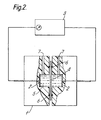
- the electrical resistance of a porous Tefzel film, prepared by the method described in Example 3, was measured in three different electrolytes using a test cell as shown in Figure 2 of the accompanying drawings.
- the cell comprises a container 1 incorporating electrodes 2 of stainless steel connected to a conductance bridge 3.
- a sample 4 to be tested is sealed into the test chamber 5 by sealing gaskets 6, and the necessary conductive liquid is introduced via feed ports 7.
- Tefzel 210 and lithium chloride in the ratio 40:60 were blended using a Leistritz twin screw extruder. The resulting blend was then re-extruded to produce a web having a width 40 cm and thickness 0.5 mm. The thickness of the web was then reduced to 0.15 mm by passing it through the nips of a calendar roller stack. The web was soaked in water to leach out the lithium chloride, and then dried thoroughly. The porosity of the film was found to be 48% by volume.
- the film was used as a separator in a test cell as described above, in which the electrolyte was 1.9 M LiAlCl4 in SOCl2.
- the resistance of the film was measured using a conductivity bridge, and found to be 161 ohm cm2 at room temperature.
Landscapes
- Chemical & Material Sciences (AREA)
- Chemical Kinetics & Catalysis (AREA)
- Electrochemistry (AREA)
- General Chemical & Material Sciences (AREA)
- Organic Chemistry (AREA)
- Engineering & Computer Science (AREA)
- Materials Engineering (AREA)
- Health & Medical Sciences (AREA)
- Metallurgy (AREA)
- Medicinal Chemistry (AREA)
- Polymers & Plastics (AREA)
- Manufacture Of Porous Articles, And Recovery And Treatment Of Waste Products (AREA)
- Cell Separators (AREA)
- Manufacture Of Macromolecular Shaped Articles (AREA)
- Primary Cells (AREA)
- Laminated Bodies (AREA)
Abstract
Description
- The present invention relates to an electrochemical cell having a separator which is a porous polymer film.
- Microporous films are used in a wide range of applications, generally to provide a selective barrier. For example, they may be used as battery separators, and membranes, electrolysis membranes as well as in breathable fabrics and medical and packaging applications. Commonly used polymeric films comprise polyolefins such as polyethylene and polypropylene which can conveniently be made porous by extraction of a soluble component or components (see GB-A-1078895). Such films are chemically inert towards many acids and alkalis and towards many reactive metals. However, there exist a number of solvents with which a polyolefin film cannot be used because of chemical incompatability. Furthermore, the maximum operating temperature of polyolefin films is about 120oC, and their use in cells for high temperature applications is therefore not possible. Cell separators for use where the environment is chemically aggressive or in high temperature cells have therefore been made of glass fibre, but such separators are relatively bulky.
- It is therefore an object of the invention to provide an electrochemical cell having a separator that is resistant to chemically aggressive environments at ambient or elevated temperatures but is of relatively low bulk and can be made with micropores.
- The present invention provides an electrochemical cell in which the separator is a porous polymeric film which comprises a halopolymer of a particular class defined below. Such cell separators can be suitable for use in cells that operate at ambient or elevated temperatures and are substantially inert to alkali and alkaline earth metals which are chemically aggressive.
- In one aspect the invention provides an electrochemical cell which comprises an anode which is a metal of Group I or Group II of the Periodic Table, a cathode, an electrolyte, and a separator positioned between the anode and the cathode which is a film having a porosity of at least 20% by volume and comprising a polymer in which the repeating units are -(CnH2n)- and -(CmX2m)- wherein each X independently represents fluorine or chlorine and the values of n and m are greater than one and less than six.
- Preferably the film of which the separator is made comprises a copolymer which comprises ethylene and tetrafluoroethylene as the monomer units, although chloroethylenes and fluorochloroethylenes can also be used as the monomer units. In another form, the film of which the separator is made can comprise a copolymer that comprises longer chain monomer units, for example propylene, butylene and halogenated analogues thereof. Particularly preferred halopolymers for use in the invention are those sold under the Trade Marks TEFZEL (ethylene/ tetrafluoroethylene) and HALAR (ethylene/chlorotrifluoroethylene).
- The formation of a porous membrane of an ethylene/tetrafluoroethylene copolymer (TEFZEL) is disclosed in GB-A-2078604, but there is no disclosure that this porous membrane is effective as a separator in a cell where the anode is a metal of Group I or Group II of the Periodic Table. The use of ethylene/tetrafluoroethylene copolymers (TEFZEL) and ethylene/chlorofluoroethylene copolymers on a non-porous jacket on an internal lead of a lithium/thionyl chloride cell to prevent parasitic discharge is disclosed in US-A-4376811, but the cell separator disclosed for use in that cell is of glass fibre.
- The term "film" is used to denote a non-fibrous self-supporting sheet. A microporous film, which is preferably used according to the invention, is a porous film in which the details of pore configuration and/or arrangement are discernable only by microscopic examination. Preferably the pores or open cells in the films are smaller than those which can be seen using an optical microscope, in which case electron miscroscopy techniques may be used to resolve details of the pore structure. Generally the maximum dimension of a substantial number of the pores will be less than 5 micrometers, preferably less than 2 micrometers, measured by mercury intrusion porosimetry according to ASTM D 2873-70. The porosity of the films may advantageously be not less than 30%, preferably not less than 40% by volume, for example from 40-50% by volume, measured by mercury intrusion porosimetry, again according to ASTM D 2873-70.
- Microporous films of the halopolymers defined above have chemical and physical properties which are advantageous for use in a variety of high performance applications as battery separators. A significant advantage of the microporous film is that it withstands high temperatures, and can be used for example in high temperature electrochemical cells where previously used microporous films cannot function.
- The cell separators described above are chemically inert towards reactive metals commonly used as anodes in electrochemical cells, for example metals of Groups I and II of the Periodic Table. This property of the films is surprising in view of the reactivity towards lithium and sodium (at least) of the well known halogenated polymers polyvinylidene fluoride (PVF₂) and polytetrafluoroethylene (PTFE).
- The cell separator films can also exhibit chemical inertness towards many aggressive liquids found in electrochemical cells and electrolysis cells. Thus the preferred films of the invention are inert towards acids and alkalis, as well as towards reactive fluids such as oxyhalides of elements of Group VA and Group VIA of the Periodic Table (as published in the Condensed Chemical Dictionary, 9th Edition, Van Nostrand Reinhold, 1977), for example thionyl chloride, sulphuryl chloride and phosphoryl chloride. The films can therefore be used in many applications where the use of cumbersome non-woven glass fibre mats has previously been unavoidable, and a significant saving in size and weight may also thereby be obtained. An example of such an application is as a separator in a lithium/thionyl chloride cell.
- Polymeric films for use as cell separators as aforesaid may be made by a method which comprises providing a film of a polymer composition comprising:
- (a) a halopolymer in which the repeat units are -(Cn H2n)- and -(Cm X2m)-, where each X independently represents fluorine or chlorine and the values of n and m are greater than one and less than six;
- (b) at least one extractable component which is substantially insoluble in the halopolymer;
- The method enables microporous films of halopolymers to be made conveniently. By careful selection of the extractable components, a porosity of not less than 30% by volume, for example not less than 40% can be achieved. Preferably the polymer composition comprises an extractable salt and an extractable polymer. The extractable salt may be present in an amount of from 10 to 150 parts per 100 parts of the halopolymer, preferably from 50 to 120 parts, especially from 95 to 105 parts. The extractable polymer may be present in an amount of not more than 60 parts per 100 parts of the halopolymer, preferably from 5 to 30 parts, especially from 20 to 25 parts. The proportions of the components of the composition may be varied, depending on such factors as the desired porosity of the film, the desired porosity profile through the thickness of the film, the size of the pores, the nature and chemical compatibilities of the components.
- A high porosity can be achieved using a combination of extractable polymer and salt, and although the reasons for this are not fully understood, it would appear that the extractable polymer makes easier the extraction of the salt from the halopolymer matrix, possibly by acting as a wetting agent. Furthermore, as shown by scanning electron micrographs of a film produced by the preferred method, the presence of the extractable polymer appears to increase the surface porosity of the film compared with the porosity of films prepared by extraction of a salt alone, in which latter films the surface porosity limits performance significantly.
- Preferably the method includes the step of deforming the film so as to reduce its thickness prior to extraction of the extractable component. The film may be deformed by up to 25%, up to 50%, up to 85% or by more, depending on for example the dimensions of the film, the desired nature of the pores, the nature of the halopolymer and the extractable components. The deformation is preferably carried out using rollers, for example nip rollers in line with an extrusion die, although other techniques including stretching of the film may also be used. Deformation of the film can increase the efficiency of the extraction step and can also affect the nature of the pores; for example passing the film though nip rollers can affect the tortuosity of the pores.
- For some applications, it will be acceptable for some of the extractable polymer or the salt or both to remain in the halopolymer matrix after extraction. Generally however, it is preferred that substantially all of the polymer and salt are extracted from the matrix, since the porosity is thereby maximised.
- It is particularly preferred that the extractable polymer and the salt are selected to be soluble in one solvent. This makes more convenient the extraction of polymer and salt since significantly fewer extractions need be performed. For convenience, the polymer and salt will be selected to be soluble in an aqueous solvent, such as water or an aqueous acid solution. Other solvents may, however, be selected. In some applications, the extracting solvent may be a liquid with which the film comes into contact when in use, such as for example the electrolyte of an electrochemical cell.
- The extractable polymer is selected to have a solubility in the extracting solvent that is significantly higher than the solubility of the halopolymer. When water or another aqueous based solvent is selected as the solvent, the extractable polymer may be selected from the following list (which is not exhaustive):
- alkylene oxide homo- and copolymers.
- vinyl alcohol homo- and copolymers.
- vinyl pyrrolidone homo- and copolymers.
- acrylic acid homo- and copolymers.
- methacrylic acid homo- and copolymers.
- Certain naturally occurring polymers such as polysaccharides may also be used as the extractable polymer component in certain applications.
- Particularly preferred materials are ethylene oxide polymers, such as that sold under the Trade Mark Polyox. The use of ethylene oxide polymers as the extractable polymer is advantageous since they are water soluble and melt-processable.
- The extractable salt should be selected according to the end use of the porous film, since at least a small amount of the salt is likely to remain in the film after extraction, and any remaining salt must be chemically compatible with other materials with which the film comes into contact when in use. For example, if the film is to be used as a separator in an electrochemical cell which has a reactive metal anode, the extractable salt should be electrochemically compatible with other cell components. Thus the salt should be of a metal which is at least as electropositive as the metal of the anode; for example when the film is to be used as a separator in a lithium cell, the salt should be a lithium salt; preferred lithium salts include the carbonate, chloride, phosphate and aluminate, although other lithium salts may be used including the nitrate, sulphate, trifluoromethylsulphonate and tetrafluoroborate.
- It will be understood that in some circumstances, it will be appropriate to add other components to the polymer composition such as antioxidants, UV stabilisers, processing aids, dispersal aids, cross-linking agents, prorads and/or antirads.
- The components of the film may be blended using conventional polymer blending apparatus such as a twin-screw extruder or a two-roll mill. The film is preferably formed as a thin strip of sheet, and it may be made in this form by a melt processing technique, for example by extrusion, although blow and compression moulding techniques are examples of alternative techniques which may be used. Melt processing techniques are preferred since they allow films to be made with consistent properties and permit the production of thin films. Furthermore, melt processing techniques allow a film to be made continuously. The film may be extruded onto, or coextruded with, another component with which it will be in contact when in use. Once formed, the film may be cut into pieces of suitable size, or it may be formed into a roll, for ease of transportation and storage.
- It is particularly surprising that the defined halopolymers can be blended with the preferred extractable polymers mentioned above using melt processing techniques, in view of the wide difference between the melting points of the two classes of materials. In some cases, care may be necessary in selecting quantities and mixing conditions to avoid degradation of the extractable polymer and halopolymer.
- For certain applications, it may be advantageous to cross-link the polymer of the film. This may be effected by irradiation, for example by electrons, gamma radiation, or by use of a chemical cross-linking agent.
- The chosen final thickness of the film is dependent on the end use, and factors such as the desired strength, flexibility, barrier properties and so on will generally have to be considered. The materials of the film may be produced to a thickness of less than 75 micrometres, preferably less than 50 micrometres. Most preferred films for use as a battery separator have a thickness of less than 35 micrometres, for example between 20 and 30 micrometres.
- An electrode separator suitable for use in an electrochemical cell which comprises a reactive metal anode, may be made by a further method which comprises extruding onto, or coextruding with, another component of the cell a film of a polymer composition which comprises a halopolymer in which the repeat units are -(Cn H2n)- and -(Cm X2m)-, where each X independently represents fluorine or chlorine, and the values of n and m are greater than one and less than six. Preferably the extruded film will contain an extractable component which can be extracted.
- The microporous film may be used to protect sensitive material for greater convenience during handling. For example it may be used to protect sensitive electrode material such as reactive metal anodes, for example lithium anodes, as disclosed in EP-A-143562.
- Non-porous samples of ethylene/tetrafluoroethylene copolymer (Tefzel 210), ethylene/chlorotrifluoroethylene copolymer (Halar 300), polyvinylidene fluoride (Kynar 460 - Trade Mark) and polyethylene (
Gulf 9606 Trade Mark) were maintained in a 1.9 M solution of LiAlCl₄ in SOCl₂ under reflux, and the effect on the ultimate elongation of the samples was monitored. The results are shown in Figure 1, expressed in terms of the percentage of the initial ultimate elongation which was retained after the exposures. The measurements were made at room temperature. - Samples of
Tefzel 210 andHalar 300 were also maintained in a 1.9 M solution of LiAlCl₄ in thionyl chloride (SOCl₂) at room temperature. The effect of the treatment on the mechanical properties of the samples is shown in Table 1, the results being expressed as in Figure 1. -
- (a) 8 weeks at room temperature:

- (b) 32 hours under reflux at 85°C:
- The stability of polytetrafluoroethylene (Zitex G110 - Trade Mark),
Kynar 460,Halar 300 andTefzel 210 towards lithium metal was evaluated at elevated temperature. Samples of the four polymeric materials were dried by placing them in a vacuum oven at 150°C for 8 hours. The samples were then maintained in contact under pressure with lithium in a dry environment at 85°C for 16 days. The following results were obtained on inspection: - Tefzel 210:
- No change in the appearance of lithium or of Tefzel.
- Halar 300:
- Lithium blackened over approximately 80% of the surface which contacted the polymer sample.
- Kynar 460:
- Lithium blackened over approximately 95% of the surface which contacted the polymer sample.
- Zitex G110:
- Lithium blackened over the entire surface which contacted the polymer sample, and bonded weakly to the sample.
- Ethylene/tetrafluoroethylene copolymer (Tefzel 210), lithium carbonate and polyethylene oxide (Polyox WSR 301 - Trade Mark) were compounded using a Baker Perkins twin screw extruder to give a blend containing 100 parts Tefzel, 100 parts lithium carbonate and 22 parts Polyox. The compound was further extruded using a Leistritz single screw extruder to produce a film of thickness 0.2 mm which was rolled using rollers at a temperature in the range 140-220°C to produce film having a thickness of approximately 27 micrometres. This thinned film was then treated with concentrated HCl at room temperature (c. 23°C) to remove the lithium carbonate and Polyox leaving a microporous web of Tefzel. The excess acid and reaction products were removed by washing with distilled water prior to drying of the film. The porosity of the resulting film, determined according to ASTM D2873-70, was found to be 45%.
- The electrical resistance of a porous Tefzel film, prepared by the method described in Example 3, was measured in three different electrolytes using a test cell as shown in Figure 2 of the accompanying drawings. As shown in Figure 2, the cell comprises a container 1 incorporating
electrodes 2 of stainless steel connected to aconductance bridge 3. A sample 4 to be tested is sealed into thetest chamber 5 by sealinggaskets 6, and the necessary conductive liquid is introduced via feed ports 7. - The results are given in Table 3:

-
Tefzel 210 and lithium chloride in the ratio 40:60 were blended using a Leistritz twin screw extruder. The resulting blend was then re-extruded to produce a web having awidth 40 cm and thickness 0.5 mm. The thickness of the web was then reduced to 0.15 mm by passing it through the nips of a calendar roller stack. The web was soaked in water to leach out the lithium chloride, and then dried thoroughly. The porosity of the film was found to be 48% by volume. - The film was used as a separator in a test cell as described above, in which the electrolyte was 1.9 M LiAlCl₄ in SOCl₂. The resistance of the film was measured using a conductivity bridge, and found to be 161 ohm cm² at room temperature.
and subsequently extracting at least some of the extractable component so as to render the film microporous with a porosity of not less than 20%.

Claims (7)
- An electrochemical cell which comprises an anode which is a metal of Group I or Group II of the periodic table, a cathode, an electrolyte, and a separator positioned between the anode and the cathode which is a film having a porosity of at least 20% by volume and comprising a polymer in which the repeating units are -(CnH2n)- and -(CmX2m)- wherein each X independently represents fluorine or chlorine and the values of n and m are greater than one and less than six.
- An electrochemical cell according to Claim 1, wherein the anode comprises lithium.
- An electrochemical cell according to Claim 2, wherein the electrolyte comprises an oxyhalide of an element of group VA or VIA.
- An electrochemical cell according to Claim 3, wherein the electrolyte comprises thionyl chloride, sulfuryl chloride or phosphoryl chloride.
- An electrochemical cell as claimed in any preceding claim, wherein the halopolymer is an ethylene/ chlorotrifluoroethylene copolymer.
- An electrochemical cell as claimed in any preceding claim, wherein the halopolymer is an ethylene/ tetrafluoroethylene copolymer.
- A method of using a electrochemical cell as claimed in any preceding claim which comprises operating the cell at an elevated operating temperature.
Priority Applications (1)
| Application Number | Priority Date | Filing Date | Title |
|---|---|---|---|
| AT85309249T ATE67225T1 (en) | 1984-12-19 | 1985-12-18 | MICROPOROUS FILMS. |
Applications Claiming Priority (2)
| Application Number | Priority Date | Filing Date | Title |
|---|---|---|---|
| GB848432048A GB8432048D0 (en) | 1984-12-19 | 1984-12-19 | Electrochemical cells |
| GB8432048 | 1984-12-19 |
Related Child Applications (2)
| Application Number | Title | Priority Date | Filing Date |
|---|---|---|---|
| EP19900112666 Division EP0397222A3 (en) | 1984-12-19 | 1985-12-18 | Microporous films |
| EP90112666.4 Division-Into | 1990-07-03 |
Publications (3)
| Publication Number | Publication Date |
|---|---|
| EP0188114A2 EP0188114A2 (en) | 1986-07-23 |
| EP0188114A3 EP0188114A3 (en) | 1987-11-11 |
| EP0188114B1 true EP0188114B1 (en) | 1991-09-11 |
Family
ID=10571425
Family Applications (2)
| Application Number | Title | Priority Date | Filing Date |
|---|---|---|---|
| EP85309249A Expired - Lifetime EP0188114B1 (en) | 1984-12-19 | 1985-12-18 | Microporous films |
| EP19900112666 Withdrawn EP0397222A3 (en) | 1984-12-19 | 1985-12-18 | Microporous films |
Family Applications After (1)
| Application Number | Title | Priority Date | Filing Date |
|---|---|---|---|
| EP19900112666 Withdrawn EP0397222A3 (en) | 1984-12-19 | 1985-12-18 | Microporous films |
Country Status (5)
| Country | Link |
|---|---|
| EP (2) | EP0188114B1 (en) |
| JP (1) | JP2575355B2 (en) |
| AT (1) | ATE67225T1 (en) |
| DE (1) | DE3584088D1 (en) |
| GB (1) | GB8432048D0 (en) |
Families Citing this family (11)
| Publication number | Priority date | Publication date | Assignee | Title |
|---|---|---|---|---|
| GB8432048D0 (en) | 1984-12-19 | 1985-01-30 | Raychem Ltd | Electrochemical cells |
| GB2219589A (en) * | 1988-06-13 | 1989-12-13 | Scimat Ltd | Microporous halopolymer films |
| US5198162A (en) * | 1984-12-19 | 1993-03-30 | Scimat Limited | Microporous films |
| GB2168981B (en) * | 1984-12-27 | 1988-07-06 | Asahi Chemical Ind | Porous fluorine resin membrane and process for preparation thereof |
| GB8517571D0 (en) * | 1985-07-11 | 1985-08-14 | Raychem Ltd | Polymer composition |
| US4910106A (en) * | 1988-08-05 | 1990-03-20 | Hoechst Celanese Corporation | Formation of halogenated polymeric microporous membranes having improved strength properties |
| GB2232982A (en) * | 1989-06-13 | 1991-01-02 | Scimat Ltd | Microporous films |
| DE4112248A1 (en) * | 1991-04-15 | 1992-10-22 | Basf Ag | METHOD FOR PRODUCING OPEN-POROUS, FIBROUS PARTS FROM POLYTETRAFLUORETHYLENE BY INJECTION MOLDING OR EXTRUSION |
| US20060134525A1 (en) * | 2002-09-27 | 2006-06-22 | Christian Kleijnen | Rechargeable lithium battery |
| JP2008055404A (en) * | 2006-08-01 | 2008-03-13 | Mitsubishi Electric Corp | Air treatment equipment |
| EP4334534B1 (en) | 2021-05-07 | 2025-11-19 | Shore Defence Limited | Improvements in and relating to ground stabilisation |
Family Cites Families (7)
| Publication number | Priority date | Publication date | Assignee | Title |
|---|---|---|---|---|
| GB682050A (en) * | 1950-02-15 | 1952-11-05 | Ncr Co | Process for making microporous objects form vinyl chloride polymers |
| FR1515826A (en) * | 1963-08-07 | 1968-03-08 | Grace W R & Co | Battery separator and method for its manufacture |
| JPS56159128A (en) * | 1980-05-15 | 1981-12-08 | Asahi Chem Ind Co Ltd | Thermoplastic resin porous film and production thereof |
| US4401736A (en) * | 1981-01-05 | 1983-08-30 | Wilson Greatbatch Ltd. | Anode assembly for lithium-halogen cell |
| US4376811A (en) * | 1981-12-21 | 1983-03-15 | Gte Products Corporation | Electrochemical cell |
| EP0143562A1 (en) | 1983-11-02 | 1985-06-05 | Raychem Limited | Electrode article |
| GB8432048D0 (en) | 1984-12-19 | 1985-01-30 | Raychem Ltd | Electrochemical cells |
-
1984
- 1984-12-19 GB GB848432048A patent/GB8432048D0/en active Pending
-
1985
- 1985-12-18 EP EP85309249A patent/EP0188114B1/en not_active Expired - Lifetime
- 1985-12-18 EP EP19900112666 patent/EP0397222A3/en not_active Withdrawn
- 1985-12-18 AT AT85309249T patent/ATE67225T1/en not_active IP Right Cessation
- 1985-12-18 JP JP60286826A patent/JP2575355B2/en not_active Expired - Lifetime
- 1985-12-18 DE DE8585309249T patent/DE3584088D1/en not_active Expired - Lifetime
Also Published As
| Publication number | Publication date |
|---|---|
| EP0397222A3 (en) | 1991-02-27 |
| ATE67225T1 (en) | 1991-09-15 |
| EP0188114A2 (en) | 1986-07-23 |
| EP0397222A2 (en) | 1990-11-14 |
| EP0188114A3 (en) | 1987-11-11 |
| JP2575355B2 (en) | 1997-01-22 |
| DE3584088D1 (en) | 1991-10-17 |
| GB8432048D0 (en) | 1985-01-30 |
| JPS61145234A (en) | 1986-07-02 |
Similar Documents
| Publication | Publication Date | Title |
|---|---|---|
| US5198162A (en) | Microporous films | |
| EP0188114B1 (en) | Microporous films | |
| EP1824671B1 (en) | A microporous material and a method of making same | |
| US8795923B2 (en) | Reinforced electrolyte membrane for fuel cell, fuel cell membrane-electrode assembly, and solid polymer electrolyte fuel cell comprising the fuel cell membrane-electrode assembly | |
| CA1254613A (en) | Materials for electrical devices | |
| DE2608547C3 (en) | Non-aqueous electrochemical cell | |
| EP0309259A2 (en) | Immobilized electrolyte membrane and method of preparation thereof | |
| JP2003017128A (en) | Gel polymer electrolyte and lithium battery using the same | |
| KR20060101541A (en) | Composite Microporous Membrane and Method of Use and Use thereof | |
| EP0219190B1 (en) | Process for making an electrochemical device separator | |
| CN101608041A (en) | Hybrid proton exchange membrane with rubber for improved mechanical durability | |
| EP1008202B1 (en) | Extrusion of polymer-based cell components | |
| JPWO2018020826A1 (en) | Electrolyte membrane and method for producing the same | |
| CA1293018C (en) | Microporous films | |
| WO2001091207A1 (en) | Separator for zinc bromine secondary cell and method for its preparation | |
| GB2232982A (en) | Microporous films | |
| EP0145231B1 (en) | Electrode article | |
| EP4506397A1 (en) | Ion exchange membrane, polyolefin-based porous membrane, membrane electrode assembly, water electrolysis device, and method for producing polyolefin-based porous membrane | |
| JPS5818880A (en) | Diaphragm for fuel cell | |
| CA1322425C (en) | Microporous films | |
| JP2001345111A (en) | Electrolyte membrane for polymer electrolyte fuel cell and method for producing the same | |
| Sathiyamoorthi et al. | Synthesis and studies of new plasticized PVP: NaClO3 electrolyte system for battery applications | |
| JP3642597B2 (en) | Separator used for battery | |
| WO1989012659A1 (en) | Microporous films | |
| JP3839706B2 (en) | Adhesive porous membranes, polymer gel electrolytes obtained from them, and their applications |
Legal Events
| Date | Code | Title | Description |
|---|---|---|---|
| PUAI | Public reference made under article 153(3) epc to a published international application that has entered the european phase |
Free format text: ORIGINAL CODE: 0009012 |
|
| 17P | Request for examination filed |
Effective date: 19851224 |
|
| AK | Designated contracting states |
Kind code of ref document: A2 Designated state(s): AT BE CH DE FR GB IT LI NL SE |
|
| PUAL | Search report despatched |
Free format text: ORIGINAL CODE: 0009013 |
|
| AK | Designated contracting states |
Kind code of ref document: A3 Designated state(s): AT BE CH DE FR GB IT LI NL SE |
|
| RAP1 | Party data changed (applicant data changed or rights of an application transferred) |
Owner name: SCIMAT LIMITED |
|
| 17Q | First examination report despatched |
Effective date: 19890821 |
|
| GRAA | (expected) grant |
Free format text: ORIGINAL CODE: 0009210 |
|
| AK | Designated contracting states |
Kind code of ref document: B1 Designated state(s): AT BE CH DE FR GB IT LI NL SE |
|
| PG25 | Lapsed in a contracting state [announced via postgrant information from national office to epo] |
Ref country code: IT Free format text: LAPSE BECAUSE OF FAILURE TO SUBMIT A TRANSLATION OF THE DESCRIPTION OR TO PAY THE FEE WITHIN THE PRESCRIBED TIME-LIMIT;WARNING: LAPSES OF ITALIAN PATENTS WITH EFFECTIVE DATE BEFORE 2007 MAY HAVE OCCURRED AT ANY TIME BEFORE 2007. THE CORRECT EFFECTIVE DATE MAY BE DIFFERENT FROM THE ONE RECORDED. Effective date: 19910911 Ref country code: SE Effective date: 19910911 Ref country code: LI Effective date: 19910911 Ref country code: CH Effective date: 19910911 Ref country code: NL Effective date: 19910911 Ref country code: AT Effective date: 19910911 Ref country code: BE Effective date: 19910911 |
|
| REF | Corresponds to: |
Ref document number: 67225 Country of ref document: AT Date of ref document: 19910915 Kind code of ref document: T |
|
| XX | Miscellaneous (additional remarks) |
Free format text: TEILANMELDUNG 90112666.4 EINGEREICHT AM 18/12/85. |
|
| REF | Corresponds to: |
Ref document number: 3584088 Country of ref document: DE Date of ref document: 19911017 |
|
| ET | Fr: translation filed | ||
| REG | Reference to a national code |
Ref country code: CH Ref legal event code: PL |
|
| NLV1 | Nl: lapsed or annulled due to failure to fulfill the requirements of art. 29p and 29m of the patents act | ||
| PLBE | No opposition filed within time limit |
Free format text: ORIGINAL CODE: 0009261 |
|
| STAA | Information on the status of an ep patent application or granted ep patent |
Free format text: STATUS: NO OPPOSITION FILED WITHIN TIME LIMIT |
|
| 26N | No opposition filed | ||
| PGFP | Annual fee paid to national office [announced via postgrant information from national office to epo] |
Ref country code: GB Payment date: 19961211 Year of fee payment: 12 |
|
| PGFP | Annual fee paid to national office [announced via postgrant information from national office to epo] |
Ref country code: FR Payment date: 19970130 Year of fee payment: 12 |
|
| PGFP | Annual fee paid to national office [announced via postgrant information from national office to epo] |
Ref country code: DE Payment date: 19970224 Year of fee payment: 12 |
|
| PG25 | Lapsed in a contracting state [announced via postgrant information from national office to epo] |
Ref country code: GB Free format text: LAPSE BECAUSE OF NON-PAYMENT OF DUE FEES Effective date: 19971218 |
|
| PG25 | Lapsed in a contracting state [announced via postgrant information from national office to epo] |
Ref country code: FR Free format text: THE PATENT HAS BEEN ANNULLED BY A DECISION OF A NATIONAL AUTHORITY Effective date: 19971231 |
|
| GBPC | Gb: european patent ceased through non-payment of renewal fee |
Effective date: 19971218 |
|
| PG25 | Lapsed in a contracting state [announced via postgrant information from national office to epo] |
Ref country code: DE Free format text: LAPSE BECAUSE OF NON-PAYMENT OF DUE FEES Effective date: 19980901 |
|
| REG | Reference to a national code |
Ref country code: FR Ref legal event code: ST |
|
| PG25 | Lapsed in a contracting state [announced via postgrant information from national office to epo] |
Ref country code: FR Free format text: THE PATENT HAS BEEN ANNULLED BY A DECISION OF A NATIONAL AUTHORITY Effective date: 19961231 |