EP0177457B1 - Compositons containing heterocyclic compounds and their use as herbicides - Google Patents
Compositons containing heterocyclic compounds and their use as herbicides Download PDFInfo
- Publication number
- EP0177457B1 EP0177457B1 EP85830214A EP85830214A EP0177457B1 EP 0177457 B1 EP0177457 B1 EP 0177457B1 EP 85830214 A EP85830214 A EP 85830214A EP 85830214 A EP85830214 A EP 85830214A EP 0177457 B1 EP0177457 B1 EP 0177457B1
- Authority
- EP
- European Patent Office
- Prior art keywords
- carbon atoms
- linear
- general formula
- group
- phenyl
- Prior art date
- Legal status (The legal status is an assumption and is not a legal conclusion. Google has not performed a legal analysis and makes no representation as to the accuracy of the status listed.)
- Expired
Links
- 0 *c1n[n]nc1NC(N(*)*)=* Chemical compound *c1n[n]nc1NC(N(*)*)=* 0.000 description 1
Classifications
-
- C—CHEMISTRY; METALLURGY
- C07—ORGANIC CHEMISTRY
- C07D—HETEROCYCLIC COMPOUNDS
- C07D271/00—Heterocyclic compounds containing five-membered rings having two nitrogen atoms and one oxygen atom as the only ring hetero atoms
- C07D271/02—Heterocyclic compounds containing five-membered rings having two nitrogen atoms and one oxygen atom as the only ring hetero atoms not condensed with other rings
- C07D271/08—1,2,5-Oxadiazoles; Hydrogenated 1,2,5-oxadiazoles
-
- A—HUMAN NECESSITIES
- A01—AGRICULTURE; FORESTRY; ANIMAL HUSBANDRY; HUNTING; TRAPPING; FISHING
- A01N—PRESERVATION OF BODIES OF HUMANS OR ANIMALS OR PLANTS OR PARTS THEREOF; BIOCIDES, e.g. AS DISINFECTANTS, AS PESTICIDES OR AS HERBICIDES; PEST REPELLANTS OR ATTRACTANTS; PLANT GROWTH REGULATORS
- A01N47/00—Biocides, pest repellants or attractants, or plant growth regulators containing organic compounds containing a carbon atom not being member of a ring and having no bond to a carbon or hydrogen atom, e.g. derivatives of carbonic acid
- A01N47/08—Biocides, pest repellants or attractants, or plant growth regulators containing organic compounds containing a carbon atom not being member of a ring and having no bond to a carbon or hydrogen atom, e.g. derivatives of carbonic acid the carbon atom having one or more single bonds to nitrogen atoms
- A01N47/28—Ureas or thioureas containing the groups >N—CO—N< or >N—CS—N<
- A01N47/36—Ureas or thioureas containing the groups >N—CO—N< or >N—CS—N< containing the group >N—CO—N< directly attached to at least one heterocyclic ring; Thio analogues thereof
Definitions
- the present invention relates to composition containing heterocyclic compounds having a urea group and having herbicidal activities, to their use in the control and destruction of infestant plants and to the process for preparing them.
- the present invention provides a method for controlling the growth of infestant plants in pre-emergence or post-emergence, characterised in that the infested ground is treated with an effective amount of herbicidal compound or of a composition containing a herbicidal compound, selected from those which can be defined by the general formula in which:
- the invention further provides novel herbicidal compositions comprising one or more adjuvants including diluents, wetting agents and/or solvents with from 5 to 95% by weight of a herbicidal compound having the general formula (I) as above defined wherein R is a linear or branched alkyl group containing from 1 to 6 carbon atoms and wherein X, R 1 and R 2 are as above defined.
- a herbicidal compound having the general formula (I) as above defined wherein R is a linear or branched alkyl group containing from 1 to 6 carbon atoms and wherein X, R 1 and R 2 are as above defined.
- Preferred compounds according to the present invention are those belonging to the general formula (I) above, in which:
- the present invention is based on the discovery that these known compounds and other new compounds falling within the general formula (I) have herbicidal activities with a wide spectrum of action against infestant plants, but are substantially innocuous to man and animals.
- the compounds (I) may be synthesised by the following reaction scheme. or: or or:
- the basic step of the process of the present invention for preparing the compounds having the general formula (1) is consisting of reacting a 3-amine- (4-R-substituted)-furazan (II) with an isocyanate Ri-NCO (III),wherein R and R 1 have the same meaning of the general formula (I), with a (III) to (II) molar ratio from 1:1 to 1.2:1, at a temperature of from 0° to 100° C, for a time of from 1 to 24 hours and of recovering the compound (I) from the reaction mixture by filtration.
- the reaction can be run in an inert organic solvent in which case the preferred solvents are dichloroethane, diethylether or dimethylformamide.
- the compounds(I) according to the present invention heve good herbicidal activities when used both under pre-emergence and post-emergence conditions in doses of from 0.1 kg/hectare up to a maximum of 5kg/hectare. Moreover, the herbicidal activity of the compounds (I) is highly selective with regard to crops belonging to the grass family (gramineae), for example towards wheat and maize, up to doses of 3 kg/hectare; at higher doses the herbicidal activity of the compounds tends to become total.
- the compounds (I) of the present invention are herbicides which interfere both with the seed germination phase and with the subsequent development of the embryo plants. They have good herbicidal activities and may thus be used conveniently both in pre-emergence and post-emergence weed-killing in crops, in accordance with the different degrees of selectivity shown and the biological cycles of the in- festants.
- the compounds (I) of the present invention may be applied by the usual methods, in solution, suspension or emulsion, as powders or as granules, according to the chosen application, as long as the active principle is finely divided.
- compositions of the present invention are typically prepared by the mixture of the active ingredient with an adjuvant including diluents, fillers, extenders and conditioning agents to provide the compositions in the form of finely - divided solid particles, granules, solutions, dispersions or emulsions.
- the active ingredient may thus be used with an adjuvant such as a finely-divided solid, an organic liquid, water, a wetting agent, a dispersing agent or any suitable combination thereof.
- the herbicidal compositions of the present invention particularly liquids or soluble powders, preferably contain one or more surface active agents as conditioning agents in quantities sufficient to render a particular composition readily dispersible in water or oil. The incorporation of a surface active agent in the composition greatly improves its effectiveness.
- surface active agents are meant wetting agents, dispersing agents, suspending agents, and emulsifying agents.
- Anionic, cationic or non-ionic agents may be used equally well.
- Preferred wetting agents are alkylbenzene sulphonates, alkylnaphthalene sulphonates, aliphatic alcohol sulphonates, polyoxyethylene derivatives of alkylphenols (particularly isooctylphenol and nonylphenol.
- Compositions of powders dispersible in water may be made with one or more active ingredients, an inert solid filler and one or more wetting and dispersing agents.
- the solid inert fillers are usually of mineral origin, for example natural clays, diatomaceous earths and synthetic minerals derived from silica. Examples of such fillers comprise kaolin, attapulgite and synthetic magnesium silicate.
- the powders of the present invention which are dispersible in water usually contain about 5 to about 95 parts by weight of the active ingredient, from about 0.25 to about 25 parts by weight of the wetting agent, from about 0.25 to about 25 parts by weight of the dispersing agent and from about 4.5 to about 94.5 parts by weight of the solid inert extender, all the parts being with reference to the total weight of the composition.
- the aqueous suspensions may be prepared by mixing and grinding together an aqueous suspension of the active ingredient which is insoluble in water to obtain a concentrated suspension of very finely divided particles.
- the resulting concentrated aqueous suspension has extremely small particles such that when it is diluted and sprayed the coating is very uniform.
- the emulsifiable oils are generally solutions of the active ingredient in solvents which are immiscible or slightly miscible with water, together with a surfactant active agent.
- Solvents suitable for the active ingredients of the present invention include hydrocarbons and ethers, esters and ketones which are immiscible with water.
- the composition of the emulsifiable oil generally contains from about 5 to about 95 parts by weight of the active ingredient, from about 1 to about 50 parts by weight of surfactant and from about 4 to about 94 parts by weight of solvent, all the parts being based on the total weight of the emulsifiable oil.
- 4-methyl-3-aminofurazan is first prepared from isonitrosoacetone by the general method described in Berichte _13,1328 (1882), followed by cyclization as described in Gazz.Chim.ltal.81.106 (1951).
- the benzene solution is filtered and petroleum ether is added to the filtrate causing the precipitation of a solid which is crystallized from ethanol, giving 2 g of crystals of the title product, with a melting point of 124-125°C (crystallized from ethanol).
- the compound N-(4-methylfurazan-3-yl)-N',N'-dimethylurea is prepared by the general reaction scheme (c'), and has a melting point of 106 ° C (crystallized from cyclohexane).
- All the plants were cultivated in greenhouses in sterilized, fertilized ground at a controlled temperature (20t5 ° C) and with a relative humidity of 60 ⁇ 10%. All the species were also cultivated in plastic containers having a size of 22 x 15 x 6 cm.
- the compounds described in the above examples were formulated as wettable powders, suspension or water-acetone solutions with 10% of the active principle.
- the containers with a suitable number of seeds of each species were treated 24 hours after sowing.
- the treatment was carried out both pre-emergence and post-emergence with 2.5 and 5kg/hectare doses, with the use of an Oxford precision pump at pressures of 5 psi (0.35 bar).
- the evaluation was carried out ten days after treatment for the post-emergence test and 15-20 days after treatment for the pre-emergence test.
- compositions containing the herbicidal compounds of the present invention are given below.
- Ten parts by weight of active principle are dissolved in 80 parts by weight of a mixture of cyclohexanone and xylene (50/50 by volume) under slow, continuous agitation, at a temperature of from ambient (20-25°C) to about 50 ° C.
- the mixture is left under agitation until the whole of the solid has dissolved.
- the solution obtained is filtered through a sintered silica plate filter to remove any insoluble residue and then ten parts by weight of emulsifying agent constituted by a mixture (1:1 by weight) of ionic surfactant and non-ionic surfactant is added at ambient temperature with agitation.
- the ionic surfactant is constituted by the calcium salt of dodecylbenzene sulphonic acid.
- the non-ionic surfactant is constituted by ether/ester of palmitic or oleic acid, condensed with 8-15 moles of ethylene oxide.
- ground active principle To ten parts of weight of ground active principle are added 80 parts by weight of a mixture of inert substances constituted by 60 parts by weight of kaolin, 15 parts by weight of diatomaceous earth and 5 parts by weight of colloidal silica.
- the mixture obtained is thoroughly homogenised in a ball mill, agitation being maintained for 2 hours.
- the product obtained is ground to a grain size of less than 40 microns by grinding in a blade mill, a composition thus being obtained which is suitable for dispersion in water.
- the active principle is dispersed in a base liquid containing a surfactant. More particularly, 40 parts by weight of active principle in the form of a very fine powder, such as that obtained by grinding in a blade mill or micronization in an air jet mill are mixed slowly in a homogenizer with the base liquid constituted by 45 parts by weight of demineralised water, 5 parts by weight of ethylene glycol and 5 parts by weight of surfactant.
- the latter is a calcium salt of dodecylbenzene sulphonic acid mixed with polyoxyethylene monosterarate.
- a paste is thus obtained which may be further refined by passage through a ball mill.
Landscapes
- Chemical & Material Sciences (AREA)
- Organic Chemistry (AREA)
- Life Sciences & Earth Sciences (AREA)
- Dentistry (AREA)
- Pest Control & Pesticides (AREA)
- Plant Pathology (AREA)
- Health & Medical Sciences (AREA)
- Engineering & Computer Science (AREA)
- Agronomy & Crop Science (AREA)
- General Health & Medical Sciences (AREA)
- Wood Science & Technology (AREA)
- Zoology (AREA)
- Environmental Sciences (AREA)
- Agricultural Chemicals And Associated Chemicals (AREA)
- Plural Heterocyclic Compounds (AREA)
- Nitrogen Condensed Heterocyclic Rings (AREA)
Description
- The present invention relates to composition containing heterocyclic compounds having a urea group and having herbicidal activities, to their use in the control and destruction of infestant plants and to the process for preparing them.
- It is known that there is a great need in agriculture for new, alternative herbicidal products which have high activities in the elimination of weeds together with a substantial lack to toxicity to man and animals.
- According to the present invention these requirements are satisfied by means of new herbicidal compounds having a heterocyclic structure and having a urea group attached to the heterocyclic structure.
- Accordingly the present invention provides a method for controlling the growth of infestant plants in pre-emergence or post-emergence, characterised in that the infested ground is treated with an effective amount of herbicidal compound or of a composition containing a herbicidal compound, selected from those which can be defined by the general formula
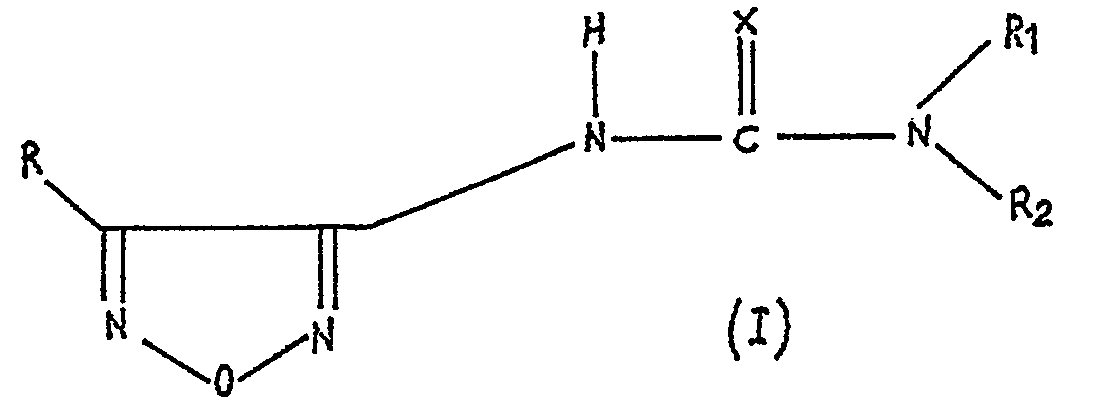
- X is oxygen or sulphur;
- R is a linear or branched alkyl group containing from 1 to 6 carbon atoms;
- - the phenyl group;
- - a phenyl group having a substituent, or several substituents which may be identical or different from each other, selected from the halogens and alkyl (Ci-C4), oxyalkyl (C1-C4), halogenoalkyl (Ci-C4) and nitro groups;
- R1 is a linear or branched alkyl group containing from 1 to 10 carbon atoms;
- - a cycloalkyl group containing from 3 to 8 carbon atoms;
- -the phenyl group;
- - the benzyl group;
- -the naphthyl group; or
- - a phenyl, benzyl or naphthyl group having one or more substituents, which may be identical or different from each other, selected from halogen atoms and (C1-C4) alkyl, (C1-C4) oxyalkyl and, (C1-C4) halogenoalkyl and nitro group;
- R2 is hydrogen;
- - a linear or branched alkyl group containing from 1 to 6 carbon atoms, or
- - the phenyl group;
- or R1 and R2, taken together with the nitrogen atom to which they are connected, form an 8-membered heterocyclic ring.
- The invention further provides novel herbicidal compositions comprising one or more adjuvants including diluents, wetting agents and/or solvents with from 5 to 95% by weight of a herbicidal compound having the general formula (I) as above defined wherein R is a linear or branched alkyl group containing from 1 to 6 carbon atoms and wherein X, R1 and R2 are as above defined.
- In the definitions above, halogen is intended to mean fluorine, chlorine, bromine or iodine.
- Examples of substituents in the general formula (I) given above are:
- R = methyl
- R1 = methyl, n-propyl, isopropyl, cyclohexyl, phenyl, 3-trifluoromethylphenyl, 4-fluorophenyl and naphthyl
- R2 = hydrogen and methyl.
- Preferred compounds according to the present invention are those belonging to the general formula (I) above, in which:
- X is oxygen
- R is methyl
- R1 is linear or branched C1-C5 alkyl, cyclohexyl or phenyl;
- R2 is hydrogen.
- Specific examples of compounds which fall within the general formula (I) above are:
- N-(4-methylfurazan-3-yl)-N'-methylurea;
- N-(4-methylfurazan-3-yl)-N'-n-propylurea;
- N-(4-methylfurazan-3-yl)-N'-isopropylurea;
- N-(4-methylfurazan-3-yl)-N'-tert-butylurea;
- N-(4-methylfurazan-3-yl)-N,N'-dimethylurea;
- N-(4-methylfurazan-3-yl)-N'-cyclohexylurea;
- N-(4-methylfurazan-3-yl)-N'-phenylurea;
- N-(4-methylfurazan-3-yl)-N'-(3-trifluoromethylphenyl)urea;
- N-(4-methylfurazan-3-yl)-N'-(4-fluorophenyl)urea;
- N-(4-methylfurazan-3-yl)-N'-naphthylurea;
- N-(4-methylfurazan-3-yl)-N'-phenylthiourea.
- Same of the compounds represented by the general formula (I) such as
- Urea-N-phenyl-N'-(phenylfurazanyl) Registry Number 49 615-84-1; Urea-N-phenyl-N'-(methyl-furazanyl) Registry Number 63 558-48-5; Thiourea-N-phenyl-N'-(methyl-furazanyl) Registry Number 64 821-98-3;
- are known from the literature which describes their synthesis, their physical and chemical characteristics and, in some cases, their pharmacological properties. In this respect one is referred to the following literature:
- - G. Cusmano and T. Tiberio, Gazz. Chim. Ital. 81, 106 (1951);
- - M. Ruccia, N. Vivona and G. Cusmano, J.C.S. Perkin I (1977), 589;
- - M. Ruccia, N. Vivona and G. Cusmano, J.C.S. Perkin I (1977), 1616;
- - S. African Patent No. 680.779.
- The present invention is based on the discovery that these known compounds and other new compounds falling within the general formula (I) have herbicidal activities with a wide spectrum of action against infestant plants, but are substantially innocuous to man and animals. The compounds (I) may be synthesised by the following reaction scheme.


- In the formulae above, X, R, Ri and R2 have the meaning indicated previously.
- Typically the basic step of the process of the present invention for preparing the compounds having the general formula (1) is consisting of reacting a 3-amine- (4-R-substituted)-furazan (II) with an isocyanate Ri-NCO (III),wherein R and R1 have the same meaning of the general formula (I), with a (III) to (II) molar ratio from 1:1 to 1.2:1, at a temperature of from 0° to 100° C, for a time of from 1 to 24 hours and of recovering the compound (I) from the reaction mixture by filtration.
- The reaction can be run in an inert organic solvent in which case the preferred solvents are dichloroethane, diethylether or dimethylformamide.
- The compounds(I) according to the present invention heve good herbicidal activities when used both under pre-emergence and post-emergence conditions in doses of from 0.1 kg/hectare up to a maximum of 5kg/hectare. Moreover, the herbicidal activity of the compounds (I) is highly selective with regard to crops belonging to the grass family (gramineae), for example towards wheat and maize, up to doses of 3 kg/hectare; at higher doses the herbicidal activity of the compounds tends to become total.
- The compounds (I) of the present invention are herbicides which interfere both with the seed germination phase and with the subsequent development of the embryo plants. They have good herbicidal activities and may thus be used conveniently both in pre-emergence and post-emergence weed-killing in crops, in accordance with the different degrees of selectivity shown and the biological cycles of the in- festants.
- The compounds (I) of the present invention may be applied by the usual methods, in solution, suspension or emulsion, as powders or as granules, according to the chosen application, as long as the active principle is finely divided.
- The compositions of the present invention are typically prepared by the mixture of the active ingredient with an adjuvant including diluents, fillers, extenders and conditioning agents to provide the compositions in the form of finely - divided solid particles, granules, solutions, dispersions or emulsions. The active ingredient may thus be used with an adjuvant such as a finely-divided solid, an organic liquid, water, a wetting agent, a dispersing agent or any suitable combination thereof. The herbicidal compositions of the present invention, particularly liquids or soluble powders, preferably contain one or more surface active agents as conditioning agents in quantities sufficient to render a particular composition readily dispersible in water or oil. The incorporation of a surface active agent in the composition greatly improves its effectiveness. By "surface active agents" are meant wetting agents, dispersing agents, suspending agents, and emulsifying agents. Anionic, cationic or non-ionic agents may be used equally well.
- Preferred wetting agents are alkylbenzene sulphonates, alkylnaphthalene sulphonates, aliphatic alcohol sulphonates, polyoxyethylene derivatives of alkylphenols (particularly isooctylphenol and nonylphenol. Compositions of powders dispersible in water may be made with one or more active ingredients, an inert solid filler and one or more wetting and dispersing agents. The solid inert fillers are usually of mineral origin, for example natural clays, diatomaceous earths and synthetic minerals derived from silica. Examples of such fillers comprise kaolin, attapulgite and synthetic magnesium silicate. The powders of the present invention which are dispersible in water usually contain about 5 to about 95 parts by weight of the active ingredient, from about 0.25 to about 25 parts by weight of the wetting agent, from about 0.25 to about 25 parts by weight of the dispersing agent and from about 4.5 to about 94.5 parts by weight of the solid inert extender, all the parts being with reference to the total weight of the composition.
- The aqueous suspensions may be prepared by mixing and grinding together an aqueous suspension of the active ingredient which is insoluble in water to obtain a concentrated suspension of very finely divided particles. The resulting concentrated aqueous suspension has extremely small particles such that when it is diluted and sprayed the coating is very uniform.
- The emulsifiable oils are generally solutions of the active ingredient in solvents which are immiscible or slightly miscible with water, together with a surfactant active agent. Solvents suitable for the active ingredients of the present invention include hydrocarbons and ethers, esters and ketones which are immiscible with water. The composition of the emulsifiable oil generally contains from about 5 to about 95 parts by weight of the active ingredient, from about 1 to about 50 parts by weight of surfactant and from about 4 to about 94 parts by weight of solvent, all the parts being based on the total weight of the emulsifiable oil.
- The experimental examples which follow are given by way of example.
- 4-methyl-3-aminofurazan is first prepared from isonitrosoacetone by the general method described in Berichte _13,1328 (1882), followed by cyclization as described in Gazz.Chim.ltal.81.106 (1951).
- 10g (about 0.1 moles) of 4-methyl-3-aminofurazan are introduced into a reactor fitted with an agitator, reflux condenser, loading phial and dry ice trap and 12 ml of recently-distilled phenylisocyanate are added through the loading phial. The mixture is heated over an oil bath to a temperature of 100°C for about one hour. The reaction mass, after cooling, is taken up in anhydrous toluene and subsequently filtered and the separated solid is dried. The crude product obtained is crystallized from ethanol and 17.5g of white crystals of the title compound are obtained with a melting point of 215°C.
- 5g (about 0.05 moles)of -4-methyl-3-aminofurazan, 40 ml of anhydrous sym-dichloroethane and, through a loading phial, 7.5 ml of isopropylisocyanate are introducted into a reactor fitted with an agitator and a reflux condenser. The mass is heated under reflux for 24 hours, the reaction being catalysed by traces of anhydrous trifluoroacetic acid. The solvent is then evaporated and the precipitate obtained is washed repeatedly with hot water. The title compound is thus obtained (85% yield with respect to the theoretical value) and, crystallized from ethanol, produces white crystals with a melting point of 199-200°C.
- These are carried out similarly to Example 2 (general reaction scheme (c)), 4-methyl-3-aminofurazan being reacted with suitable isocyanates, and the following compounds are obtained:
- Ex. 3) N-(4-methylfurazan-3-yl)-N'-methylurea; m.p. 217-218°C (crystallized from ethanol-H20)
- Ex. 4) N-(4-methylfurazan-3-yl)-N'-n-propylurea; m.p. 167-168°C (crystallized from ethanol-H20)
- Ex. 5) N-(4-methylfurazan-3-yl)-N'-tert-butylurea; m.p. 161-162°C (crystallized from ethanol-H20)
- Ex. 6) N-(4-methylfurazan-3-yl)-N'-cyclohexylurea; m.p. 200-201°C (crystallized from ethanol-H20)
- These are carried out similarly to Example 1, the following compounds being obtained:
- Ex. 7) N-(4-methylfurazan-3-yl)-N'-(3-trifluoromethylphenyl) urea; m.p. 206-207°C (crystallized from ethanol)
- Ex.8) N-(4-methylfurazan-3-yl)-N'-(4-fluorophenyl)urea; m.p. 214-215°C (crystallized from ethanol)
- Ex. 9) N-(4-methylfurazan-3-yl)-N'-naphthylurea; m.p. 219-220°C (crystallized from ethanol)
- 2.5 g (about 0.025 moles) of 4-methyl-3-aminofurazan, 6 ml di dimethylformamide, 3.4 g of phenylisothiocyanate and traces of hydrochloric acid as a catalyst are loaded into a glass flask fitted with a sealed stopper. The flask is closed and placed in an oven at 30°C for 40 hours. The reaction mixture is poured into cold water under agitation. The precipitate is filtered and dissolved in a little benzene. The benzene solution is filtered and petroleum ether is added to the filtrate causing the precipitation of a solid which is crystallized from ethanol, giving 2 g of crystals of the title product, with a melting point of 124-125°C (crystallized from ethanol).
- The compound N-(4-methylfurazan-3-yl)-N',N'-dimethylurea is prepared by the general reaction scheme (c'), and has a melting point of 106°C (crystallized from cyclohexane).
- The structure of the compounds of Examples 1 to 11 is confirmed by routine spectroscopy (IR, NMR), mass spectrometry and elementary analysis (values within the range ± 3% of the theoretical).
- All the plants were cultivated in greenhouses in sterilized, fertilized ground at a controlled temperature (20t5°C) and with a relative humidity of 60±10%. All the species were also cultivated in plastic containers having a size of 22 x 15 x 6 cm. The compounds described in the above examples were formulated as wettable powders, suspension or water-acetone solutions with 10% of the active principle.
- The containers with a suitable number of seeds of each species were treated 24 hours after sowing.
- The plants were treated when they had reached the stage of 2-3 leaves, about 14 days after sowing.
- The treatment was carried out both pre-emergence and post-emergence with 2.5 and 5kg/hectare doses, with the use of an Oxford precision pump at pressures of 5 psi (0.35 bar).
- The evaluation was carried out ten days after treatment for the post-emergence test and 15-20 days after treatment for the pre-emergence test.
- The effect of the active principle was evaluated according to a scale of from 0 to 4 in which:
- 0 = no damage;
- 1 = 25% damage;
- 2 = 50% damage;
- 3 = 75% damage;
- 4 = 100% damage.
- The results are given in Table 1 below and it may be seen that the herbicidal compounds of the present invention are, in general, active against vegetable species belonging to the dicotyledon family, while having good selectivity towards the grass family (gramineae), that is at lower doses.
- At doses above about 3 kg/hectare there is a general tendency towards a reduction in the selectivity towards grasses.

- Examples of the preparation of compositions containing the herbicidal compounds of the present invention are given below.
- Ten parts by weight of active principle are dissolved in 80 parts by weight of a mixture of cyclohexanone and xylene (50/50 by volume) under slow, continuous agitation, at a temperature of from ambient (20-25°C) to about 50°C. The mixture is left under agitation until the whole of the solid has dissolved. The solution obtained is filtered through a sintered silica plate filter to remove any insoluble residue and then ten parts by weight of emulsifying agent constituted by a mixture (1:1 by weight) of ionic surfactant and non-ionic surfactant is added at ambient temperature with agitation. The ionic surfactant is constituted by the calcium salt of dodecylbenzene sulphonic acid. The non-ionic surfactant is constituted by ether/ester of palmitic or oleic acid, condensed with 8-15 moles of ethylene oxide.
- To ten parts of weight of ground active principle are added 80 parts by weight of a mixture of inert substances constituted by 60 parts by weight of kaolin, 15 parts by weight of diatomaceous earth and 5 parts by weight of colloidal silica. The mixture obtained is thoroughly homogenised in a ball mill, agitation being maintained for 2 hours. The product obtained is ground to a grain size of less than 40 microns by grinding in a blade mill, a composition thus being obtained which is suitable for dispersion in water.
- The active principle is dispersed in a base liquid containing a surfactant. More particularly, 40 parts by weight of active principle in the form of a very fine powder, such as that obtained by grinding in a blade mill or micronization in an air jet mill are mixed slowly in a homogenizer with the base liquid constituted by 45 parts by weight of demineralised water, 5 parts by weight of ethylene glycol and 5 parts by weight of surfactant. The latter is a calcium salt of dodecylbenzene sulphonic acid mixed with polyoxyethylene monosterarate.
- A paste is thus obtained which may be further refined by passage through a ball mill.
Claims (7)


Priority Applications (1)
| Application Number | Priority Date | Filing Date | Title |
|---|---|---|---|
| AT85830214T ATE48934T1 (en) | 1984-08-29 | 1985-08-09 | COMPOSITIONS CONTAINING HETEROCYCLIC COMPOUNDS AND THEIR USE AS HERBICIDES. |
Applications Claiming Priority (2)
| Application Number | Priority Date | Filing Date | Title |
|---|---|---|---|
| IT22450/84A IT1176635B (en) | 1984-08-29 | 1984-08-29 | HEROCICLIC COMPOUNDS WITH HERBICIDE ACTIVITY |
| IT2245084 | 1984-08-29 |
Publications (2)
| Publication Number | Publication Date |
|---|---|
| EP0177457A1 EP0177457A1 (en) | 1986-04-09 |
| EP0177457B1 true EP0177457B1 (en) | 1989-12-27 |
Family
ID=11196458
Family Applications (1)
| Application Number | Title | Priority Date | Filing Date |
|---|---|---|---|
| EP85830214A Expired EP0177457B1 (en) | 1984-08-29 | 1985-08-09 | Compositons containing heterocyclic compounds and their use as herbicides |
Country Status (13)
| Country | Link |
|---|---|
| EP (1) | EP0177457B1 (en) |
| JP (1) | JPS6176407A (en) |
| AR (1) | AR240529A1 (en) |
| AT (1) | ATE48934T1 (en) |
| AU (1) | AU572332B2 (en) |
| BR (1) | BR8504137A (en) |
| CA (1) | CA1254054A (en) |
| DE (1) | DE3574926D1 (en) |
| ES (1) | ES8604535A1 (en) |
| IN (1) | IN162277B (en) |
| IT (1) | IT1176635B (en) |
| PH (1) | PH21894A (en) |
| ZA (1) | ZA856155B (en) |
Family Cites Families (3)
| Publication number | Priority date | Publication date | Assignee | Title |
|---|---|---|---|---|
| JPS5031039A (en) * | 1973-07-27 | 1975-03-27 | ||
| DE3462259D1 (en) * | 1983-07-22 | 1987-03-05 | Bayer Ag | SUBSTITUTED FURAZANS |
| IT1196237B (en) * | 1984-08-29 | 1988-11-16 | Enichimica Secondaria | HEROCICLIC COMPOUNDS WITH HERBICIDE ACTIVITY |
-
1984
- 1984-08-29 IT IT22450/84A patent/IT1176635B/en active
-
1985
- 1985-08-08 CA CA000488341A patent/CA1254054A/en not_active Expired
- 1985-08-09 EP EP85830214A patent/EP0177457B1/en not_active Expired
- 1985-08-09 DE DE8585830214T patent/DE3574926D1/en not_active Expired - Fee Related
- 1985-08-09 AT AT85830214T patent/ATE48934T1/en not_active IP Right Cessation
- 1985-08-12 IN IN624/MAS/85A patent/IN162277B/en unknown
- 1985-08-14 ZA ZA856155A patent/ZA856155B/en unknown
- 1985-08-14 AU AU46176/85A patent/AU572332B2/en not_active Ceased
- 1985-08-20 PH PH32667A patent/PH21894A/en unknown
- 1985-08-23 AR AR30138185A patent/AR240529A1/en active
- 1985-08-27 JP JP60186754A patent/JPS6176407A/en active Granted
- 1985-08-28 BR BR8504137A patent/BR8504137A/en unknown
- 1985-08-28 ES ES546483A patent/ES8604535A1/en not_active Expired
Also Published As
| Publication number | Publication date |
|---|---|
| EP0177457A1 (en) | 1986-04-09 |
| ZA856155B (en) | 1986-05-28 |
| IT8422450A0 (en) | 1984-08-29 |
| ATE48934T1 (en) | 1990-01-15 |
| IT8422450A1 (en) | 1986-03-01 |
| JPS6362484B2 (en) | 1988-12-02 |
| AR240529A1 (en) | 1990-05-31 |
| BR8504137A (en) | 1986-06-17 |
| CA1254054A (en) | 1989-05-16 |
| ES546483A0 (en) | 1986-02-01 |
| AU4617685A (en) | 1986-03-06 |
| JPS6176407A (en) | 1986-04-18 |
| IT1176635B (en) | 1987-08-18 |
| IN162277B (en) | 1988-04-23 |
| ES8604535A1 (en) | 1986-02-01 |
| AU572332B2 (en) | 1988-05-05 |
| PH21894A (en) | 1988-03-25 |
| DE3574926D1 (en) | 1990-02-01 |
Similar Documents
| Publication | Publication Date | Title |
|---|---|---|
| EP0173657B1 (en) | Compositions containing heterocyclic compounds and their use as herbicides | |
| EP0104532B1 (en) | O-halobenzoic acid derivatives, process for their preparation, herbicidal compositions and their use | |
| US5169430A (en) | Benzenesulfonamide derivatives and methods for their production | |
| EP0202929A2 (en) | Substituted tetrazolinones | |
| DE68917617T2 (en) | Triazole compounds, processes for their preparation and herbicidal compositions containing them. | |
| JP2905982B2 (en) | Heterocycle-containing phenylpyrazole derivatives or salts thereof, process for producing the same, and herbicides | |
| JPS591481A (en) | Heterocyclic amines | |
| JP2905981B2 (en) | 3-Substituted phenylpyrazole derivatives or salts thereof, process for producing the same, and herbicides | |
| DE2040580A1 (en) | Thiazole derivatives | |
| EP0120821B1 (en) | Weed-killing heterocyclic compounds | |
| CA1151655A (en) | 5-amino-4-cyano-1-(2,4,6-trichlorophenyl) pyrazole and salts thereof | |
| EP0177457A1 (en) | Compositons containing heterocyclic compounds and their use as herbicides | |
| DE69823191T2 (en) | 1,2,3-THIADIAZOLE DERIVATIVES, MEANS FOR CONTROLLING PLANT DISEASES AND METHOD FOR THE USE THEREOF | |
| GB2103610A (en) | Herbicidal compounds derived from N-sulphonyl-aryloxybenamides and the processes for their preparation and use | |
| US3954837A (en) | Substituted allophanates | |
| KR920004933B1 (en) | Method for preparing pyrazole oxime derivative | |
| US3758481A (en) | Ridine m-(2,4-dichloro - 5-(haloalkoxy)-phenylcarbomoyl)-pyrrolidine or pipe | |
| JP2696252B2 (en) | Cyclohexanecarboxylic acid derivatives and herbicides and plant growth regulators containing the same | |
| JP2618639B2 (en) | Cyclohexenone derivatives and herbicides containing the same as active ingredients | |
| JPS58157771A (en) | Delta2-1,2-4,-triazolin-5-one derivative, its preparation and its use | |
| EP0067718A1 (en) | Urea derivatives, their production and use | |
| US3967951A (en) | Selective herbicides | |
| JPH05286969A (en) | Thienyl-azolyl-oxyacetamide derivative, method for producing the same, and herbicide containing the derivative as an active ingredient | |
| JPH05140124A (en) | Triazole derivative and herbicide | |
| EP0072253A2 (en) | Trifluoromethanesulfonanilides, and their production and use |
Legal Events
| Date | Code | Title | Description |
|---|---|---|---|
| PUAI | Public reference made under article 153(3) epc to a published international application that has entered the european phase |
Free format text: ORIGINAL CODE: 0009012 |
|
| AK | Designated contracting states |
Kind code of ref document: A1 Designated state(s): AT BE CH DE FR GB LI LU NL SE |
|
| 17P | Request for examination filed |
Effective date: 19860317 |
|
| 17Q | First examination report despatched |
Effective date: 19880215 |
|
| RAP1 | Party data changed (applicant data changed or rights of an application transferred) |
Owner name: ENICHEM SYNTHESIS S.P.A. |
|
| GRAA | (expected) grant |
Free format text: ORIGINAL CODE: 0009210 |
|
| AK | Designated contracting states |
Kind code of ref document: B1 Designated state(s): AT BE CH DE FR GB LI LU NL SE |
|
| REF | Corresponds to: |
Ref document number: 48934 Country of ref document: AT Date of ref document: 19900115 Kind code of ref document: T |
|
| ET | Fr: translation filed | ||
| REF | Corresponds to: |
Ref document number: 3574926 Country of ref document: DE Date of ref document: 19900201 |
|
| PGFP | Annual fee paid to national office [announced via postgrant information from national office to epo] |
Ref country code: AT Payment date: 19900709 Year of fee payment: 6 |
|
| PGFP | Annual fee paid to national office [announced via postgrant information from national office to epo] |
Ref country code: GB Payment date: 19900711 Year of fee payment: 6 |
|
| PGFP | Annual fee paid to national office [announced via postgrant information from national office to epo] |
Ref country code: BE Payment date: 19900720 Year of fee payment: 6 |
|
| PGFP | Annual fee paid to national office [announced via postgrant information from national office to epo] |
Ref country code: CH Payment date: 19900723 Year of fee payment: 6 |
|
| PGFP | Annual fee paid to national office [announced via postgrant information from national office to epo] |
Ref country code: LU Payment date: 19900730 Year of fee payment: 6 Ref country code: DE Payment date: 19900730 Year of fee payment: 6 |
|
| PGFP | Annual fee paid to national office [announced via postgrant information from national office to epo] |
Ref country code: SE Payment date: 19900829 Year of fee payment: 6 |
|
| PG25 | Lapsed in a contracting state [announced via postgrant information from national office to epo] |
Ref country code: LU Free format text: LAPSE BECAUSE OF NON-PAYMENT OF DUE FEES Effective date: 19900831 |
|
| PGFP | Annual fee paid to national office [announced via postgrant information from national office to epo] |
Ref country code: NL Payment date: 19900831 Year of fee payment: 6 Ref country code: FR Payment date: 19900831 Year of fee payment: 6 |
|
| PLBE | No opposition filed within time limit |
Free format text: ORIGINAL CODE: 0009261 |
|
| STAA | Information on the status of an ep patent application or granted ep patent |
Free format text: STATUS: NO OPPOSITION FILED WITHIN TIME LIMIT |
|
| 26N | No opposition filed | ||
| PG25 | Lapsed in a contracting state [announced via postgrant information from national office to epo] |
Ref country code: GB Effective date: 19910809 Ref country code: AT Effective date: 19910809 |
|
| PG25 | Lapsed in a contracting state [announced via postgrant information from national office to epo] |
Ref country code: SE Effective date: 19910810 |
|
| PG25 | Lapsed in a contracting state [announced via postgrant information from national office to epo] |
Ref country code: LI Effective date: 19910831 Ref country code: CH Effective date: 19910831 Ref country code: BE Effective date: 19910831 |
|
| BERE | Be: lapsed |
Owner name: ENICHEM SYNTHESIS S.P.A. Effective date: 19910831 |
|
| PG25 | Lapsed in a contracting state [announced via postgrant information from national office to epo] |
Ref country code: NL Effective date: 19920301 |
|
| GBPC | Gb: european patent ceased through non-payment of renewal fee | ||
| NLV4 | Nl: lapsed or anulled due to non-payment of the annual fee | ||
| PG25 | Lapsed in a contracting state [announced via postgrant information from national office to epo] |
Ref country code: FR Effective date: 19920430 |
|
| REG | Reference to a national code |
Ref country code: CH Ref legal event code: PL |
|
| PG25 | Lapsed in a contracting state [announced via postgrant information from national office to epo] |
Ref country code: DE Effective date: 19920501 |
|
| REG | Reference to a national code |
Ref country code: FR Ref legal event code: ST |
|
| EUG | Se: european patent has lapsed |
Ref document number: 85830214.4 Effective date: 19920306 |