EP0176132A1 - Adhesion promoters for metal substrates - Google Patents
Adhesion promoters for metal substrates Download PDFInfo
- Publication number
- EP0176132A1 EP0176132A1 EP85201432A EP85201432A EP0176132A1 EP 0176132 A1 EP0176132 A1 EP 0176132A1 EP 85201432 A EP85201432 A EP 85201432A EP 85201432 A EP85201432 A EP 85201432A EP 0176132 A1 EP0176132 A1 EP 0176132A1
- Authority
- EP
- European Patent Office
- Prior art keywords
- process according
- equal
- carried out
- compounds
- values
- Prior art date
- Legal status (The legal status is an assumption and is not a legal conclusion. Google has not performed a legal analysis and makes no representation as to the accuracy of the status listed.)
- Granted
Links
Classifications
-
- C—CHEMISTRY; METALLURGY
- C07—ORGANIC CHEMISTRY
- C07F—ACYCLIC, CARBOCYCLIC OR HETEROCYCLIC COMPOUNDS CONTAINING ELEMENTS OTHER THAN CARBON, HYDROGEN, HALOGEN, OXYGEN, NITROGEN, SULFUR, SELENIUM OR TELLURIUM
- C07F9/00—Compounds containing elements of Groups 5 or 15 of the Periodic Table
- C07F9/02—Phosphorus compounds
- C07F9/28—Phosphorus compounds with one or more P—C bonds
- C07F9/38—Phosphonic acids [RP(=O)(OH)2]; Thiophosphonic acids ; [RP(=X1)(X2H)2(X1, X2 are each independently O, S or Se)]
- C07F9/40—Esters thereof
- C07F9/4071—Esters thereof the ester moiety containing a substituent or a structure which is considered as characteristic
- C07F9/4075—Esters with hydroxyalkyl compounds
Definitions
- the present invention relates to the preparation of photo-crosslinkable paints obtained by means of the reaction of glycidyl derivatives of acrylic (methacrylic) acid with phosphonoacetic acid, and to their use as adhesion promoters for metal substrates in combination with paints crosslinkable with U.V. or E.B. radiations or with peroxides.
- One method to produce coatings having good adhesion characteristics consists in adding to the paint crosslinkable with U.V. or E.B. radiations or with a peroxide, an ester of general formula (wherein R', R, L, M, N have the meaning as reported in U.K. Patent 1393545) to the purpose of favouring the adhesion between the paint and the metal substrate, in that it is known indeed that the paints crosslikable by means of radiations have a poor adhesion to metals.
- the so-obtained coatings due to the fact that they contain a strongly acidic adhesion promoter, are easily prone to be corroded in a moist environment. Such interface corrosion phenomena are causes of adhesion loss whenever the coated item is exposed to moisture.
- This class of adhesion promoters on the basis of compounds derivatives of phosphonylacetic acid obviate the negative effects typical of the esters of phosphoric acid, e.g., the increase in corrosion sensitivity, in that they combine a lower absolute acidity with the presence of two adjacent acidic hydroxy groups, one inorganic and the other one of organic character, in an arrangement capable of chelating metal ions.
- a second object of the present patent Application is a method for the synthesis of compounds of general formula (I): they are prepared indeed by means of the reaction of glycidyl acrylate (GA) and/or glycidyl methacrylate (GMA) with dihydroxyphosphonoacetic acid (DHPAA).
- GA glycidyl acrylate
- GMA glycidyl methacrylate
- DHPAA dihydroxyphosphonoacetic acid
- the reaction is generally carried out with GA and/or GMA/DHPAA ratios comprised within the range of from 1.20 to 1.85 [1.20 ⁇ GA and/or GMA/DHPAA ⁇ 1.85] and preferably of from 1.35 to 1.60 [1.35 ⁇ GA and/or GMA/DHPAA ⁇ _1.60].
- the reaction does not require catalysts, and can be carried out either in bulk or in solution. When carried out in solution,it is carried out in the presence of a suitable solvent, generally in tetrahydrofuran.
- the reaction temperature is comprised within the range of from 20 to 140°C (20 ⁇ T ⁇ 140°C], preferably of from 60 to 100°C [60 ⁇ T ⁇ 100°C].
- the reaction is preferably carried out by adding GA and/or GMA to DHPAA, with temperature controlling.
- a polymerization inhibitor in amounts ranging from 0.01 to 1% by weight [0.01 ⁇ p ⁇ 1% by weight], preferably of from 0.1 to 0.5% by weight [0.1 ⁇ p ⁇ 0.5% by weight].
- the inhibitor is generally selected from hydroquinone and its derivatives, such as e.g. toluquinone, hydroquinone monomethyl ether and so forth.
- the compounds of general formula (I) are obtained with quantitative yields, they hence do not require any further purifications, if the reaction is carried out in solution, the solvent is however distilled off under reduced pressure and at a temperature lower than 70°C [T ⁇ 70°C], preferably than 40°C [T ⁇ 40°C].
- the product (I) is soluble in the common organic sol vents and also in the acrylic monomers.
- the product (I) can be stored, after its synthesis, either as pure product, or as diluted in acrylic oligomers [10 - 50% by weight relatively to the compound (1)], preferably selected from butanediol diacrylate, hexanediol diacrylate, diethylene glycol diacrylate.
- the metal substrates which are pretreated with the adhesion promoters which are the object of the present pat ent application are preferably on the basis of iron or of alloys thereof, of aluminum or of copper.
- the paints crosslinkable with U.V. or E.B. radiations or with peroxides are selected from
- the compound of formula (I) is generally used in amounts lower than 10% by weight [p ⁇ 10% by weight] relatively to the paint, preferably within the range of from 1 to 5% by weight [1 ⁇ P ⁇ 5% by weight];
- the phosphonic resin obtained is soluble in the usual reactive solvents for crosslinkable paints, and compatib ible with the solventless paints and with the usual acrylic diluents.
- An unsaturated polyester resin was prepared as follows.
- the temperature was reduced to +190°C and maleic anhidride (37.9 g) was added over about 10'.
- the temperature of the bath was increased to + 200 - 205°C, and the reaction was continued until a number of acidity of 10 was reached.
- the bath was cooled to +90°C, benzoquinone (0.49 g) was added and, after having interrupted the heating, a mixture of hexanediol diacrylate (122.5 g) and of diethylene glycol diacrylate (122.5 g) was added.
- the photoiniziator benzoin isopropyl ether, 118 g
- the quite thin resulting paint (920 cps at + 25°C) was coated on a steel plate by means of a K-control bar to the nominal thickness of 35 p , and crosslinked by means of 20 passes at a space speed of. 25 m/sec under nitrogen by means of a mercury vapour lamp of 80 watts/em in power.
- Example N. 1 To two different portions of the paint 3 and 5% by weight of the adhesion promoter as specified in Example N. 1 was added, and two steel plated were then coated and crosslinked under the same conditions as specified above. In both samples a complete adhesion (100%) was achieved when the previously indicated test was repeated.
- the plates which had passed the adhesion test were plunged into demineralized water, at room temperature (+ 25°C) for 24 hours, after having been hemmed with adhesive tape.
- Phosphonoacetic acid triethylester (65.5 g, 0.292 mol) in 35% conc. hydrochloric acid (150 ml) was gently refluxed over 6 hours, at the end of which water and hydrochloric acid were evaporated off at 90 - 100°C under a reduced vacuum (water pump).
- This syrup was diluted in peroxide-free anhydrous THF containing 0.2 g of hydroquinone, and to the mass glycidyl acrylate (40 ml, 44.8 g, 0.347 mol) was added, the addition rate being so adjusted as to keep the temperature comprised within the range of from + 75°C to +90°C.
- This step required a time of 20 - 30', and some care had to be taken to withdraw the reaction heat.
- glycidyl acrylate 5 ml, 5.56 g, 0.04 mol
- An unsaturated polyester polycarbonate resin was prepared as follows:
- the flask was then dipped into a bath at + 200°C, and the stirring was started. The reaction was continued until the development of ethanol and of methanol had ended ( 2 hours); at this time, the bath temperature was decreased down to + 190°C and dibutyltin oxide (0.6 g) and maleic anhydride (37.9 g) was added. The temperature was increased again to + 200 - 250°C, and the reaction was con tinued up to a number of acidity of 8, the bath was cooled down to + 100°C, and hydroquinone monomethyl ether (0.5 g) was added, and the mass was finally diluted to 50% of solids in the following reactive solvents:
- a photosensitizer (4% by weight of Darocur (R) 1173) was added,and the paint was coated to a thickness of 12 p on a plate of common steel.
Landscapes
- Chemical & Material Sciences (AREA)
- Organic Chemistry (AREA)
- Biochemistry (AREA)
- Health & Medical Sciences (AREA)
- General Health & Medical Sciences (AREA)
- Molecular Biology (AREA)
- Life Sciences & Earth Sciences (AREA)
- Macromonomer-Based Addition Polymer (AREA)
- Addition Polymer Or Copolymer, Post-Treatments, Or Chemical Modifications (AREA)
- Paints Or Removers (AREA)
- Manufacturing Of Printed Wiring (AREA)
- Laminated Bodies (AREA)
- Chemically Coating (AREA)
Abstract
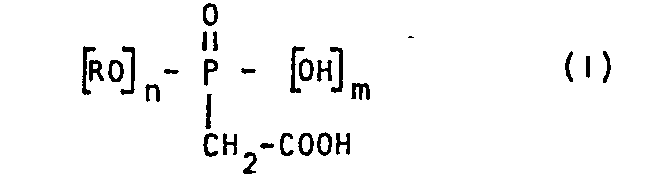
(wherein R, m and n have the meanings which we will specify in the disclosure), obtained by means of the reaction of glycidyl acrylate and/or glycidyl methacrylate with dihyd- rophosphonoacetic acid.
Description
- The present invention relates to the preparation of photo-crosslinkable paints obtained by means of the reaction of glycidyl derivatives of acrylic (methacrylic) acid with phosphonoacetic acid, and to their use as adhesion promoters for metal substrates in combination with paints crosslinkable with U.V. or E.B. radiations or with peroxides.
- One method to produce coatings having good adhesion characteristics consists in adding to the paint crosslinkable with U.V. or E.B. radiations or with a peroxide, an ester of general formula
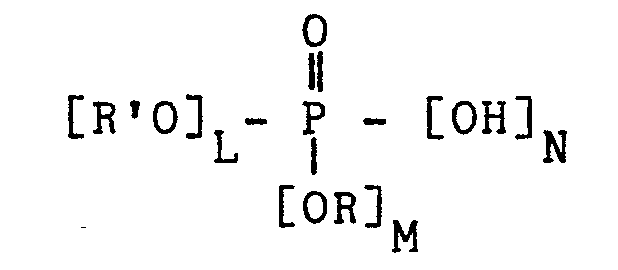
(wherein R', R, L, M, N have the meaning as reported in U.K. Patent 1393545) to the purpose of favouring the adhesion between the paint and the metal substrate, in that it is known indeed that the paints crosslikable by means of radiations have a poor adhesion to metals. However, the so-obtained coatings, due to the fact that they contain a strongly acidic adhesion promoter, are easily prone to be corroded in a moist environment. Such interface corrosion phenomena are causes of adhesion loss whenever the coated item is exposed to moisture. - We have now found a new class of adhesion promoters, which improve the prior state of the art, in that whilst on one side they introduce polar enough groups, suitable to improve the adhesion at the metal-paint interface, on the other they do not increase the corrosion-due phenomena to a very notable extent.
- This class of adhesion promoters on the basis of compounds derivatives of phosphonylacetic acid obviate the negative effects typical of the esters of phosphoric acid, e.g., the increase in corrosion sensitivity, in that they combine a lower absolute acidity with the presence of two adjacent acidic hydroxy groups, one inorganic and the other one of organic character, in an arrangement capable of chelating metal ions.
- It is therefore a first object of the present patent Application a new class of compounds of general formula (I):

wherein:

- R' = H and/or CH 3,
- n = 1 or 2,
- m = 1 or 0.
- A second object of the present patent Application is a method for the synthesis of compounds of general formula (I): they are prepared indeed by means of the reaction of glycidyl acrylate (GA) and/or glycidyl methacrylate (GMA) with dihydroxyphosphonoacetic acid (DHPAA).
- The reaction is generally carried out with GA and/or GMA/DHPAA ratios comprised within the range of from 1.20 to 1.85 [1.20 < GA and/or GMA/DHPAA < 1.85] and preferably of from 1.35 to 1.60 [1.35 < GA and/or GMA/DHPAA < _1.60].
- The reaction does not require catalysts, and can be carried out either in bulk or in solution. When carried out in solution,it is carried out in the presence of a suitable solvent, generally in tetrahydrofuran. The reaction temperature is comprised within the range of from 20 to 140°C (20 < T < 140°C], preferably of from 60 to 100°C [60 < T < 100°C].
- The reaction is preferably carried out by adding GA and/or GMA to DHPAA, with temperature controlling.
- It is preferable to add to the reaction mixture a polymerization inhibitor in amounts ranging from 0.01 to 1% by weight [0.01 < p < 1% by weight], preferably of from 0.1 to 0.5% by weight [0.1 < p < 0.5% by weight]. The inhibitor is generally selected from hydroquinone and its derivatives, such as e.g. toluquinone, hydroquinone monomethyl ether and so forth.
- The compounds of general formula (I) are obtained with quantitative yields, they hence do not require any further purifications, if the reaction is carried out in solution, the solvent is however distilled off under reduced pressure and at a temperature lower than 70°C [T < 70°C], preferably than 40°C [T < 40°C].
- The product (I) is soluble in the common organic sol vents and also in the acrylic monomers.
- The product (I) can be stored, after its synthesis, either as pure product, or as diluted in acrylic oligomers [10 - 50% by weight relatively to the compound (1)], preferably selected from butanediol diacrylate, hexanediol diacrylate, diethylene glycol diacrylate.
- It is a last object of the present patent Application the use of the compounds of general formula (I) as adhesion promoters for metal substrates for paints cross- linkable with U.V. or E.B. radiations, or with peroxides.
- The metal substrates which are pretreated with the adhesion promoters which are the object of the present pat ent application are preferably on the basis of iron or of alloys thereof, of aluminum or of copper. The paints crosslinkable with U.V. or E.B. radiations or with peroxides are selected from
- - acrylate polyester paints
- - maleate polyester paints
- - acrylate acrylic paints
- - acrylate urethane paints
- - diallylphtalate paints
- - acrylate silicone paints.
- The compound of formula (I) is generally used in amounts lower than 10% by weight [p < 10% by weight] relatively to the paint, preferably within the range of from 1 to 5% by weight [1 < P < 5% by weight];
- Inside a 4-neck flask of 250 ml in volume, provided with nitrogen inlet, thermometer, reflux condenser, loading funnel and magnetic bar stirrer, phosphonylacetic acid (30 g, 214.3 mmol) was dissolved in THF (100 ml) containing methylhydroquinone (5 mg) and phenothiazine (5 mg) at the temperature of +65°C. While keeping the solution stirred, from the dropping funnel glycidyl acrylate (35.58 g, 32.5 ml, 282 mmol) was added dropwise over about one hour. As soon as the addition was ended, the temperature of the flask was increased to +80°C, and the stirring was continued for further two hours.
- From the resulting resin THF was removed by the rotary evaporator, at +38°C and under 0.5 torr. It was a very viscous clear oil, with an acidity number of 232 (mg of KOH/g).
- A portion of the material underwent photo-crosslinking, after that to it DAROCUR(R) 1173 (5% by volume) had been added, by exposure to a 450 W U.V. lamp at a distance of 15 cm over 60'. More than 90% of material resulted to be insoluble in methylene chloride.
- The phosphonic resin obtained is soluble in the usual reactive solvents for crosslinkable paints, and compatib ible with the solventless paints and with the usual acrylic diluents.
- An unsaturated polyester resin was prepared as follows.
- Into a 4-neck flask of 1 litre in capacity, provided with nitrogen inlet, mechanical stirrer and 40-cm Vigreux condenser provided with distilling head, ethylene glycol (66.22 g), glycerol (16.1 g), triethylene glycol (15 g), tri-hydroxymethyl-isocyanurate (59 g), dimethyl terephthalate (104.76 g), diethyl carbonate (28.6 g) and dibutyl-tin oxide (0.75 g) were charged. The flask was dipped inside a heating bath at + 200°C, and the reaction was started. After two hours, the development of methanol and of ethanol accompanied by diethyl carbonate had terminated. The bath temperature was then increased to +220°C over 30', the reaction mass being then kept stirred at this temperature for one hour.
- The temperature was reduced to +190°C and maleic anhidride (37.9 g) was added over about 10'. The temperature of the bath was increased to + 200 - 205°C, and the reaction was continued until a number of acidity of 10 was reached.
- The bath was cooled to +90°C, benzoquinone (0.49 g) was added and, after having interrupted the heating, a mixture of hexanediol diacrylate (122.5 g) and of diethylene glycol diacrylate (122.5 g) was added. After the addition of the photoiniziator (benzoin isopropyl ether, 118 g), the quite thin resulting paint (920 cps at + 25°C) was coated on a steel plate by means of a K-control bar to the nominal thickness of 35 p , and crosslinked by means of 20 passes at a space speed of. 25 m/sec under nitrogen by means of a mercury vapour lamp of 80 watts/em in power.
- This coating showed complete lack of adhesion at the adhesion test carried out by crosshatching and adhesive tape peeling (ASTM D 3002).
- To two different portions of the paint 3 and 5% by weight of the adhesion promoter as specified in Example N. 1 was added, and two steel plated were then coated and crosslinked under the same conditions as specified above. In both samples a complete adhesion (100%) was achieved when the previously indicated test was repeated.
- The plates which had passed the adhesion test were plunged into demineralized water, at room temperature (+ 25°C) for 24 hours, after having been hemmed with adhesive tape.
- At the end of this time no blistering was detectable and the adhesion was retained. To comparison purposes, two different samples of the same paint were loaded with 3 and 5% by weight of the acrylate phosphoric ester, and after having been coated onto steel plates, they underwent cross linking under the same conditions as already mentioned. The so-obtained paint passed the adhesion test ( ASTM D 3002), however when the plates were dipped for 24 hours into demineralized water at room temperature (+25°C), blis tering was apparent on the surface, and the adhesion test gave complete failing results (100% of peeling off).
- Phosphonoacetic acid triethylester (65.5 g, 0.292 mol) in 35% conc. hydrochloric acid (150 ml) was gently refluxed over 6 hours, at the end of which water and hydrochloric acid were evaporated off at 90 - 100°C under a reduced vacuum (water pump).
- To the thick liquid obtained, 80/20 (by volume) tolu- ene/ethanol (100 ml) was added, and the mass was stripped at 90-100°C again/on the water pump, to yield 35.5 g of viscous clear syrup, containing 0.5% of chlorine, corresponding to 0.254, moles (86.8% yield) of:
-
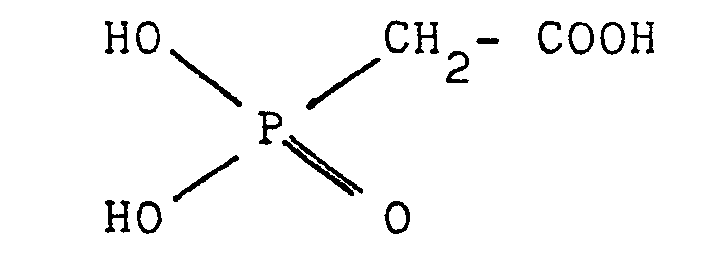
- This syrup was diluted in peroxide-free anhydrous THF containing 0.2 g of hydroquinone, and to the mass glycidyl acrylate (40 ml, 44.8 g, 0.347 mol) was added, the addition rate being so adjusted as to keep the temperature comprised within the range of from + 75°C to +90°C. This step required a time of 20 - 30', and some care had to be taken to withdraw the reaction heat. When the reaction had ended, a further portion of glycidyl acrylate (5 ml, 5.56 g, 0.04 mol) was added, and the reaction was continued for further 30' at + 75°C. Twenty ml of dieth- diacrylate ylene glycol/were then added, and THF was distilled off in vacuo at + 40°C.
- From the flask, 105 g of product were recovered, of which the product of formula (I) constituted about 80%.
- An unsaturated polyester polycarbonate resin was prepared as follows:
- Into a 4-neck flask of 1 litre in volume, equipped with nitrogen inlet, mechanical stirrer and 40-cm long Vigreux condenser provided with distillation head, ethylene glycol (66.22 g), glycerol (16.1 g), triethylene glycol (15 g), trihydroxyethyl isocyanurate (59 g), dimeth ylterephthalate (28.6 g) and titanium isopropoxide (0.85 ml) were loaded.
- The flask was then dipped into a bath at + 200°C, and the stirring was started. The reaction was continued until the development of ethanol and of methanol had ended ( 2 hours); at this time, the bath temperature was decreased down to + 190°C and dibutyltin oxide (0.6 g) and maleic anhydride (37.9 g) was added. The temperature was increased again to + 200 - 250°C, and the reaction was con tinued up to a number of acidity of 8, the bath was cooled down to + 100°C, and hydroquinone monomethyl ether (0.5 g) was added, and the mass was finally diluted to 50% of solids in the following reactive solvents:

- To a portion of said paint, a photosensitizer (4% by weight of Darocur (R) 1173) was added,and the paint was coated to a thickness of 12 p on a plate of common steel.
- The adhesion (tape) test gave complete failure. A similar test, carried out with 2.5% of the resin as of Example N. 3 above described gave a total adhesion.
Claims (16)

wherein

and/or

Priority Applications (1)
| Application Number | Priority Date | Filing Date | Title |
|---|---|---|---|
| AT85201432T ATE40694T1 (en) | 1984-09-20 | 1985-09-10 | ADHAESION PROMOTORS FOR METAL SUBSTRATES. |
Applications Claiming Priority (2)
| Application Number | Priority Date | Filing Date | Title |
|---|---|---|---|
| IT2273484 | 1984-09-20 | ||
| IT22734/84A IT1176731B (en) | 1984-09-20 | 1984-09-20 | ADHESION PROMOTERS FOR METAL SUBSTRATES |
Publications (2)
| Publication Number | Publication Date |
|---|---|
| EP0176132A1 true EP0176132A1 (en) | 1986-04-02 |
| EP0176132B1 EP0176132B1 (en) | 1989-02-08 |
Family
ID=11199815
Family Applications (1)
| Application Number | Title | Priority Date | Filing Date |
|---|---|---|---|
| EP85201432A Expired EP0176132B1 (en) | 1984-09-20 | 1985-09-10 | Adhesion promoters for metal substrates |
Country Status (6)
| Country | Link |
|---|---|
| US (1) | US4743631A (en) |
| EP (1) | EP0176132B1 (en) |
| AT (1) | ATE40694T1 (en) |
| CA (1) | CA1252796A (en) |
| DE (1) | DE3568165D1 (en) |
| IT (1) | IT1176731B (en) |
Cited By (2)
| Publication number | Priority date | Publication date | Assignee | Title |
|---|---|---|---|---|
| EP3144352A1 (en) * | 2015-09-18 | 2017-03-22 | TIGER Coatings GmbH & Co. KG | Powder paint and method of preparing a powder based varnish |
| US10894892B2 (en) | 2017-03-13 | 2021-01-19 | Tiger Coatings Gmbh & Co. Kg | Curable coating material for non-impact printing |
Families Citing this family (9)
| Publication number | Priority date | Publication date | Assignee | Title |
|---|---|---|---|---|
| US5091211A (en) * | 1989-08-17 | 1992-02-25 | Lord Corporation | Coating method utilizing phosphoric acid esters |
| CA2356579A1 (en) * | 2001-08-31 | 2003-02-28 | Micro Optics Design Corporation | Method, apparatus and adhesive composition for ophthalmic lens blocking |
| US20050173046A1 (en) * | 2002-08-26 | 2005-08-11 | Marc Savoie | Method, apparatus and adhesive composition for ophthalmic lens blocking |
| US7340957B2 (en) * | 2004-07-29 | 2008-03-11 | Los Alamos National Security, Llc | Ultrasonic analyte concentration and application in flow cytometry |
| US7835000B2 (en) * | 2006-11-03 | 2010-11-16 | Los Alamos National Security, Llc | System and method for measuring particles in a sample stream of a flow cytometer or the like |
| US8083068B2 (en) * | 2007-04-09 | 2011-12-27 | Los Alamos National Security, Llc | Apparatus for separating particles utilizing engineered acoustic contrast capture particles |
| US7837040B2 (en) * | 2007-04-09 | 2010-11-23 | Los Alamos National Security, Llc | Acoustic concentration of particles in fluid flow |
| US8266951B2 (en) | 2007-12-19 | 2012-09-18 | Los Alamos National Security, Llc | Particle analysis in an acoustic cytometer |
| US8714014B2 (en) | 2008-01-16 | 2014-05-06 | Life Technologies Corporation | System and method for acoustic focusing hardware and implementations |
Citations (1)
| Publication number | Priority date | Publication date | Assignee | Title |
|---|---|---|---|---|
| GB1393545A (en) * | 1971-03-29 | 1975-05-07 | Ppg Industries Inc | Unsaturated phosphate esters useful in forming coatings |
Family Cites Families (8)
| Publication number | Priority date | Publication date | Assignee | Title |
|---|---|---|---|---|
| US2957931A (en) * | 1949-07-28 | 1960-10-25 | Socony Mobil Oil Co Inc | Synthesis of compounds having a carbonphosphorus linkage |
| US2867610A (en) * | 1953-09-22 | 1959-01-06 | Victor Chemical Works | Polymers and copolymers of dialkenyl beta-(carboxyalkyl) alkanephosphonates |
| US3256191A (en) * | 1962-10-18 | 1966-06-14 | Texaco Inc | Alkenoate derivatives |
| US3855364A (en) * | 1973-01-05 | 1974-12-17 | Alcolac Inc | Phosphate esters of hydroxyalkyl acrylates and hydroxyalkyl methacrylates |
| DE2449733A1 (en) * | 1974-10-19 | 1976-04-29 | Hoechst Ag | Unsaturated phosphorous compounds, process for their preparation and their use |
| US3957918A (en) * | 1974-12-31 | 1976-05-18 | Ford Motor Company | Radiation polymerizable coating composition containing an unsaturated phosphoric ester |
| GB1569021A (en) * | 1976-03-17 | 1980-06-11 | Kuraray Co | Adhesive cementing agents containing partial phosphonic orphosphonic acid esters |
| JPS53134037A (en) * | 1977-04-27 | 1978-11-22 | Kuraray Co Ltd | Adhesive for human hard tissue with good adhesiveness |
-
1984
- 1984-09-20 IT IT22734/84A patent/IT1176731B/en active
-
1985
- 1985-09-06 US US06/773,418 patent/US4743631A/en not_active Expired - Fee Related
- 1985-09-10 DE DE8585201432T patent/DE3568165D1/en not_active Expired
- 1985-09-10 CA CA000490382A patent/CA1252796A/en not_active Expired
- 1985-09-10 EP EP85201432A patent/EP0176132B1/en not_active Expired
- 1985-09-10 AT AT85201432T patent/ATE40694T1/en not_active IP Right Cessation
Patent Citations (1)
| Publication number | Priority date | Publication date | Assignee | Title |
|---|---|---|---|---|
| GB1393545A (en) * | 1971-03-29 | 1975-05-07 | Ppg Industries Inc | Unsaturated phosphate esters useful in forming coatings |
Non-Patent Citations (2)
| Title |
|---|
| CHEMICAL ABSTRACTS, vol. 89, no. 14, 2nd October 1978, page 11, no. 110545b, Columbus, Ohio, US; A.P. KHARDIN et al.: "Study of the radical copolymerization of methacrylic derivatives of phosphonic acids", & VYSOKOMOL. SOEDIN. SER. B. 1978, 20(5), 377-80 * |
| JOURNAL OF GENERAL CHEMISTRY OF THE USSR, vol. 54, no. 5, part 2, May 1984, pages 1034-1038, Plenum Pulishing Corp.; A.K. KHARDIN et al.: "Kinetics of the reaction of phenyl hydrogen methylphosphonate with 2,3-epoxypropyl methacrylate" * |
Cited By (10)
| Publication number | Priority date | Publication date | Assignee | Title |
|---|---|---|---|---|
| EP3144352A1 (en) * | 2015-09-18 | 2017-03-22 | TIGER Coatings GmbH & Co. KG | Powder paint and method of preparing a powder based varnish |
| WO2017046296A1 (en) * | 2015-09-18 | 2017-03-23 | Tiger Coatings Gmbh & Co. Kg | Powder paint and method for producing a powder paint |
| CN108112257A (en) * | 2015-09-18 | 2018-06-01 | 老虎涂料有限责任及两合公司 | Powdery paints and the method for being used to prepare powdery paints |
| CN108112257B (en) * | 2015-09-18 | 2020-06-26 | 老虎涂料有限责任及两合公司 | Powder coating and method for producing a powder coating |
| US10731039B2 (en) | 2015-09-18 | 2020-08-04 | Tiger Coatings Gmbh & Co. Kg | Powder coating and method for producing a powder coating |
| US10894892B2 (en) | 2017-03-13 | 2021-01-19 | Tiger Coatings Gmbh & Co. Kg | Curable coating material for non-impact printing |
| US10894893B2 (en) | 2017-03-13 | 2021-01-19 | Tiger Coatings Gmbh & Co. Kg | Curable coating material for non-impact printing |
| US11499061B2 (en) | 2017-03-13 | 2022-11-15 | Tiger Coatings Gmbh & Co. Kg | Curable coating material for non-impact printing |
| US11787960B2 (en) | 2017-03-13 | 2023-10-17 | Tiger Coatings Gmbh & Co. Kg | Curable coating material for non-impact printing |
| US12398280B2 (en) | 2017-03-13 | 2025-08-26 | Tiger Coatings Gmbh & Co. Kg | Curable coating material for non-impact printing |
Also Published As
| Publication number | Publication date |
|---|---|
| US4743631A (en) | 1988-05-10 |
| IT8422734A1 (en) | 1986-03-20 |
| IT1176731B (en) | 1987-08-18 |
| IT8422734A0 (en) | 1984-09-20 |
| EP0176132B1 (en) | 1989-02-08 |
| ATE40694T1 (en) | 1989-02-15 |
| DE3568165D1 (en) | 1989-03-16 |
| CA1252796A (en) | 1989-04-18 |
Similar Documents
| Publication | Publication Date | Title |
|---|---|---|
| US4048141A (en) | Latent catalysts for promoting reaction of epoxides with phenols and/or carboxylic acids | |
| US4683287A (en) | Compositions containing a reactive monomer derived from a lactone | |
| EP0176132A1 (en) | Adhesion promoters for metal substrates | |
| GB1566114A (en) | Radiation curable unsaturated addition products for coatings | |
| EP0104838A2 (en) | Phosphate esters of acrylated epoxides | |
| US4221892A (en) | Photocurable partially esterified polyepoxides | |
| US4411955A (en) | Reactive hardenable binder mixture, process for preparing hardened products and use of the mixture for the preparation of coatings | |
| US4122052A (en) | Emulsion composition | |
| JPH0372075B2 (en) | ||
| EP0650954A1 (en) | Novel lactone-modified diketene(meth)acrylate compound, a process for the preparation thereof, and a (co)polymer | |
| US4524092A (en) | Process and a composition for coating a metallic substrate with a polymeric film | |
| US5100966A (en) | Water-dilutable, crosslinkable binder resin | |
| US4657983A (en) | Phosphate esters of acrylated glycidyl ester copolymers | |
| JP4095380B2 (en) | Method for producing (meth) acrylate compound and method for producing resin composition | |
| EP0108372B1 (en) | Compositions containing a reactive monomer derived from a lactone | |
| US4973392A (en) | Curable coating compositions comprising crosslinked components | |
| JPH03120263A (en) | Preparation of (meth)acrylate compound | |
| JP2000038398A (en) | Phosphinic acid having crosslinkable (meth) acrylic group and method for producing the same | |
| JPH1072404A (en) | Sorbitol (meth) acrylate and process for producing the same | |
| JP3546964B2 (en) | Polyether polyol, production method thereof and resin composition for coating | |
| US5177152A (en) | Water-dilutable, crosslinkable binder resin | |
| EP0151495B1 (en) | Polyfunctional acrylate derivatives of caprolactone-polyols | |
| JPH01221348A (en) | Novel di(meth)acrylate, production and use thereof | |
| JP2519707B2 (en) | Polyester acrylate | |
| KR20040035771A (en) | Hydroxy-Functional Esters Having Terminal Acrylate Groups |
Legal Events
| Date | Code | Title | Description |
|---|---|---|---|
| PUAI | Public reference made under article 153(3) epc to a published international application that has entered the european phase |
Free format text: ORIGINAL CODE: 0009012 |
|
| AK | Designated contracting states |
Kind code of ref document: A1 Designated state(s): AT BE CH DE FR GB LI LU NL SE |
|
| 17P | Request for examination filed |
Effective date: 19860912 |
|
| 17Q | First examination report despatched |
Effective date: 19871002 |
|
| GRAA | (expected) grant |
Free format text: ORIGINAL CODE: 0009210 |
|
| RAP1 | Party data changed (applicant data changed or rights of an application transferred) |
Owner name: ENICHEM SYNTHESIS S.P.A. |
|
| AK | Designated contracting states |
Kind code of ref document: B1 Designated state(s): AT BE CH DE FR GB LI LU NL SE |
|
| REF | Corresponds to: |
Ref document number: 40694 Country of ref document: AT Date of ref document: 19890215 Kind code of ref document: T |
|
| REF | Corresponds to: |
Ref document number: 3568165 Country of ref document: DE Date of ref document: 19890316 |
|
| ET | Fr: translation filed | ||
| PLBE | No opposition filed within time limit |
Free format text: ORIGINAL CODE: 0009261 |
|
| STAA | Information on the status of an ep patent application or granted ep patent |
Free format text: STATUS: NO OPPOSITION FILED WITHIN TIME LIMIT |
|
| 26N | No opposition filed | ||
| PGFP | Annual fee paid to national office [announced via postgrant information from national office to epo] |
Ref country code: SE Payment date: 19910813 Year of fee payment: 7 |
|
| PGFP | Annual fee paid to national office [announced via postgrant information from national office to epo] |
Ref country code: AT Payment date: 19910910 Year of fee payment: 7 |
|
| PGFP | Annual fee paid to national office [announced via postgrant information from national office to epo] |
Ref country code: DE Payment date: 19910917 Year of fee payment: 7 |
|
| PGFP | Annual fee paid to national office [announced via postgrant information from national office to epo] |
Ref country code: BE Payment date: 19910918 Year of fee payment: 7 |
|
| PGFP | Annual fee paid to national office [announced via postgrant information from national office to epo] |
Ref country code: LU Payment date: 19910925 Year of fee payment: 7 |
|
| PGFP | Annual fee paid to national office [announced via postgrant information from national office to epo] |
Ref country code: NL Payment date: 19910930 Year of fee payment: 7 |
|
| EPTA | Lu: last paid annual fee | ||
| PG25 | Lapsed in a contracting state [announced via postgrant information from national office to epo] |
Ref country code: LU Free format text: LAPSE BECAUSE OF NON-PAYMENT OF DUE FEES Effective date: 19920910 Ref country code: AT Effective date: 19920910 |
|
| PG25 | Lapsed in a contracting state [announced via postgrant information from national office to epo] |
Ref country code: SE Effective date: 19920911 |
|
| PG25 | Lapsed in a contracting state [announced via postgrant information from national office to epo] |
Ref country code: BE Effective date: 19920930 |
|
| PGFP | Annual fee paid to national office [announced via postgrant information from national office to epo] |
Ref country code: CH Payment date: 19921222 Year of fee payment: 8 |
|
| BERE | Be: lapsed |
Owner name: ENICHEM SYNTHESIS S.P.A. Effective date: 19920930 |
|
| PG25 | Lapsed in a contracting state [announced via postgrant information from national office to epo] |
Ref country code: NL Effective date: 19930401 |
|
| NLV4 | Nl: lapsed or anulled due to non-payment of the annual fee | ||
| PG25 | Lapsed in a contracting state [announced via postgrant information from national office to epo] |
Ref country code: DE Effective date: 19930602 |
|
| PGFP | Annual fee paid to national office [announced via postgrant information from national office to epo] |
Ref country code: GB Payment date: 19930902 Year of fee payment: 9 |
|
| PGFP | Annual fee paid to national office [announced via postgrant information from national office to epo] |
Ref country code: FR Payment date: 19930923 Year of fee payment: 9 |
|
| PG25 | Lapsed in a contracting state [announced via postgrant information from national office to epo] |
Ref country code: LI Effective date: 19930930 Ref country code: CH Effective date: 19930930 |
|
| REG | Reference to a national code |
Ref country code: CH Ref legal event code: PL |
|
| PG25 | Lapsed in a contracting state [announced via postgrant information from national office to epo] |
Ref country code: GB Effective date: 19940910 |
|
| EUG | Se: european patent has lapsed |
Ref document number: 85201432.3 Effective date: 19930406 |
|
| GBPC | Gb: european patent ceased through non-payment of renewal fee |
Effective date: 19940910 |
|
| PG25 | Lapsed in a contracting state [announced via postgrant information from national office to epo] |
Ref country code: FR Effective date: 19950531 |
|
| REG | Reference to a national code |
Ref country code: FR Ref legal event code: ST |