EP0175669B1 - Rubber/metal composites - Google Patents
Rubber/metal composites Download PDFInfo
- Publication number
- EP0175669B1 EP0175669B1 EP85870114A EP85870114A EP0175669B1 EP 0175669 B1 EP0175669 B1 EP 0175669B1 EP 85870114 A EP85870114 A EP 85870114A EP 85870114 A EP85870114 A EP 85870114A EP 0175669 B1 EP0175669 B1 EP 0175669B1
- Authority
- EP
- European Patent Office
- Prior art keywords
- rubber
- composite according
- adhesion promoter
- metal
- nickel
- Prior art date
- Legal status (The legal status is an assumption and is not a legal conclusion. Google has not performed a legal analysis and makes no representation as to the accuracy of the status listed.)
- Expired
Links
- 229920001971 elastomer Polymers 0.000 title claims abstract description 58
- 239000005060 rubber Substances 0.000 title claims abstract description 57
- 239000002905 metal composite material Substances 0.000 title claims description 3
- 229910052751 metal Inorganic materials 0.000 claims abstract description 28
- 239000002184 metal Substances 0.000 claims abstract description 28
- PXHVJJICTQNCMI-UHFFFAOYSA-N Nickel Chemical group [Ni] PXHVJJICTQNCMI-UHFFFAOYSA-N 0.000 claims abstract description 18
- 229910001369 Brass Inorganic materials 0.000 claims abstract description 11
- 239000010951 brass Substances 0.000 claims abstract description 11
- 150000001875 compounds Chemical class 0.000 claims abstract description 10
- 229910052759 nickel Chemical group 0.000 claims abstract description 9
- 229910017052 cobalt Inorganic materials 0.000 claims abstract description 6
- 239000010941 cobalt Substances 0.000 claims abstract description 6
- GUTLYIVDDKVIGB-UHFFFAOYSA-N cobalt atom Chemical group [Co] GUTLYIVDDKVIGB-UHFFFAOYSA-N 0.000 claims abstract description 6
- 239000002318 adhesion promoter Substances 0.000 claims description 31
- 239000000203 mixture Substances 0.000 claims description 19
- 239000002131 composite material Substances 0.000 claims description 17
- NINIDFKCEFEMDL-UHFFFAOYSA-N Sulfur Chemical compound [S] NINIDFKCEFEMDL-UHFFFAOYSA-N 0.000 claims description 11
- 239000005864 Sulphur Substances 0.000 claims description 10
- 125000004432 carbon atom Chemical group C* 0.000 claims description 8
- 229920001195 polyisoprene Polymers 0.000 claims description 6
- 238000004073 vulcanization Methods 0.000 claims description 6
- 125000002947 alkylene group Chemical group 0.000 claims description 4
- 125000002993 cycloalkylene group Chemical group 0.000 claims description 4
- MHKLKWCYGIBEQF-UHFFFAOYSA-N 4-(1,3-benzothiazol-2-ylsulfanyl)morpholine Chemical compound C1COCCN1SC1=NC2=CC=CC=C2S1 MHKLKWCYGIBEQF-UHFFFAOYSA-N 0.000 claims description 3
- 238000010438 heat treatment Methods 0.000 claims description 2
- CMAUJSNXENPPOF-UHFFFAOYSA-N n-(1,3-benzothiazol-2-ylsulfanyl)-n-cyclohexylcyclohexanamine Chemical group C1CCCCC1N(C1CCCCC1)SC1=NC2=CC=CC=C2S1 CMAUJSNXENPPOF-UHFFFAOYSA-N 0.000 claims description 2
- CWERGRDVMFNCDR-UHFFFAOYSA-M thioglycolate(1-) Chemical compound [O-]C(=O)CS CWERGRDVMFNCDR-UHFFFAOYSA-M 0.000 claims 5
- ZWVMLYRJXORSEP-LURJTMIESA-N (2s)-hexane-1,2,6-triol Chemical compound OCCCC[C@H](O)CO ZWVMLYRJXORSEP-LURJTMIESA-N 0.000 claims 2
- 125000003161 (C1-C6) alkylene group Chemical group 0.000 claims 2
- 125000001989 1,3-phenylene group Chemical group [H]C1=C([H])C([*:1])=C([H])C([*:2])=C1[H] 0.000 claims 1
- 125000001140 1,4-phenylene group Chemical group [H]C1=C([H])C([*:2])=C([H])C([H])=C1[*:1] 0.000 claims 1
- 230000032683 aging Effects 0.000 description 8
- 238000012360 testing method Methods 0.000 description 6
- -1 cobalt naphthenate Chemical class 0.000 description 5
- 239000005977 Ethylene Substances 0.000 description 4
- 229910000831 Steel Inorganic materials 0.000 description 4
- XLOMVQKBTHCTTD-UHFFFAOYSA-N Zinc monoxide Chemical compound [Zn]=O XLOMVQKBTHCTTD-UHFFFAOYSA-N 0.000 description 4
- 239000000654 additive Substances 0.000 description 4
- 125000004956 cyclohexylene group Chemical group 0.000 description 4
- 239000010959 steel Substances 0.000 description 4
- RYGMFSIKBFXOCR-UHFFFAOYSA-N Copper Chemical compound [Cu] RYGMFSIKBFXOCR-UHFFFAOYSA-N 0.000 description 3
- 239000011248 coating agent Substances 0.000 description 3
- 238000000576 coating method Methods 0.000 description 3
- 229910052802 copper Inorganic materials 0.000 description 3
- 239000010949 copper Substances 0.000 description 3
- 150000003839 salts Chemical class 0.000 description 3
- 239000007787 solid Substances 0.000 description 3
- KAKZBPTYRLMSJV-UHFFFAOYSA-N Butadiene Chemical compound C=CC=C KAKZBPTYRLMSJV-UHFFFAOYSA-N 0.000 description 2
- 239000004215 Carbon black (E152) Substances 0.000 description 2
- 229920002943 EPDM rubber Polymers 0.000 description 2
- XEEYBQQBJWHFJM-UHFFFAOYSA-N Iron Chemical compound [Fe] XEEYBQQBJWHFJM-UHFFFAOYSA-N 0.000 description 2
- 229920000877 Melamine resin Polymers 0.000 description 2
- VYPSYNLAJGMNEJ-UHFFFAOYSA-N Silicium dioxide Chemical compound O=[Si]=O VYPSYNLAJGMNEJ-UHFFFAOYSA-N 0.000 description 2
- FAPWRFPIFSIZLT-UHFFFAOYSA-M Sodium chloride Chemical compound [Na+].[Cl-] FAPWRFPIFSIZLT-UHFFFAOYSA-M 0.000 description 2
- PPBRXRYQALVLMV-UHFFFAOYSA-N Styrene Chemical compound C=CC1=CC=CC=C1 PPBRXRYQALVLMV-UHFFFAOYSA-N 0.000 description 2
- 150000001450 anions Chemical class 0.000 description 2
- 239000006229 carbon black Substances 0.000 description 2
- 239000003795 chemical substances by application Substances 0.000 description 2
- 150000001869 cobalt compounds Chemical class 0.000 description 2
- 238000010276 construction Methods 0.000 description 2
- 239000006185 dispersion Substances 0.000 description 2
- 229930195733 hydrocarbon Natural products 0.000 description 2
- 150000002430 hydrocarbons Chemical class 0.000 description 2
- 239000000463 material Substances 0.000 description 2
- 238000002844 melting Methods 0.000 description 2
- 230000008018 melting Effects 0.000 description 2
- 150000002739 metals Chemical class 0.000 description 2
- 238000000034 method Methods 0.000 description 2
- 238000002156 mixing Methods 0.000 description 2
- 239000003921 oil Substances 0.000 description 2
- 230000002787 reinforcement Effects 0.000 description 2
- GHMLBKRAJCXXBS-UHFFFAOYSA-N resorcinol Chemical compound OC1=CC=CC(O)=C1 GHMLBKRAJCXXBS-UHFFFAOYSA-N 0.000 description 2
- GPNLWUFFWOYKLP-UHFFFAOYSA-N s-(1,3-benzothiazol-2-yl)thiohydroxylamine Chemical class C1=CC=C2SC(SN)=NC2=C1 GPNLWUFFWOYKLP-UHFFFAOYSA-N 0.000 description 2
- 239000011787 zinc oxide Substances 0.000 description 2
- 125000004955 1,4-cyclohexylene group Chemical group [H]C1([H])C([H])([H])C([H])([*:1])C([H])([H])C([H])([H])C1([H])[*:2] 0.000 description 1
- 125000004958 1,4-naphthylene group Chemical group 0.000 description 1
- DGXAGETVRDOQFP-UHFFFAOYSA-N 2,6-dihydroxybenzaldehyde Chemical compound OC1=CC=CC(O)=C1C=O DGXAGETVRDOQFP-UHFFFAOYSA-N 0.000 description 1
- NLHHRLWOUZZQLW-UHFFFAOYSA-N Acrylonitrile Chemical compound C=CC#N NLHHRLWOUZZQLW-UHFFFAOYSA-N 0.000 description 1
- 229910000881 Cu alloy Inorganic materials 0.000 description 1
- 239000004606 Fillers/Extenders Substances 0.000 description 1
- VQTUBCCKSQIDNK-UHFFFAOYSA-N Isobutene Chemical group CC(C)=C VQTUBCCKSQIDNK-UHFFFAOYSA-N 0.000 description 1
- 239000004594 Masterbatch (MB) Substances 0.000 description 1
- 235000006679 Mentha X verticillata Nutrition 0.000 description 1
- 240000003321 Mentha requienii Species 0.000 description 1
- 235000002899 Mentha suaveolens Nutrition 0.000 description 1
- 235000001636 Mentha x rotundifolia Nutrition 0.000 description 1
- VVQNEPGJFQJSBK-UHFFFAOYSA-N Methyl methacrylate Chemical compound COC(=O)C(C)=C VVQNEPGJFQJSBK-UHFFFAOYSA-N 0.000 description 1
- 235000021355 Stearic acid Nutrition 0.000 description 1
- HCHKCACWOHOZIP-UHFFFAOYSA-N Zinc Chemical compound [Zn] HCHKCACWOHOZIP-UHFFFAOYSA-N 0.000 description 1
- 229910001297 Zn alloy Inorganic materials 0.000 description 1
- 239000012190 activator Substances 0.000 description 1
- 239000004840 adhesive resin Substances 0.000 description 1
- 229920006223 adhesive resin Polymers 0.000 description 1
- 125000004450 alkenylene group Chemical group 0.000 description 1
- 125000000217 alkyl group Chemical group 0.000 description 1
- 150000001412 amines Chemical class 0.000 description 1
- 125000000732 arylene group Chemical group 0.000 description 1
- QVGXLLKOCUKJST-UHFFFAOYSA-N atomic oxygen Chemical compound [O] QVGXLLKOCUKJST-UHFFFAOYSA-N 0.000 description 1
- KGBXLFKZBHKPEV-UHFFFAOYSA-N boric acid Chemical compound OB(O)O KGBXLFKZBHKPEV-UHFFFAOYSA-N 0.000 description 1
- 239000004327 boric acid Substances 0.000 description 1
- 150000001642 boronic acid derivatives Chemical class 0.000 description 1
- 229920005557 bromobutyl Polymers 0.000 description 1
- 229920005556 chlorobutyl Polymers 0.000 description 1
- 230000003749 cleanliness Effects 0.000 description 1
- 229920001577 copolymer Polymers 0.000 description 1
- 238000005260 corrosion Methods 0.000 description 1
- 230000007797 corrosion Effects 0.000 description 1
- UEZWYKZHXASYJN-UHFFFAOYSA-N cyclohexylthiophthalimide Chemical compound O=C1C2=CC=CC=C2C(=O)N1SC1CCCCC1 UEZWYKZHXASYJN-UHFFFAOYSA-N 0.000 description 1
- 125000004979 cyclopentylene group Chemical group 0.000 description 1
- LRCFXGAMWKDGLA-UHFFFAOYSA-N dioxosilane;hydrate Chemical compound O.O=[Si]=O LRCFXGAMWKDGLA-UHFFFAOYSA-N 0.000 description 1
- 230000000694 effects Effects 0.000 description 1
- 239000000806 elastomer Substances 0.000 description 1
- 125000001495 ethyl group Chemical group [H]C([H])([H])C([H])([H])* 0.000 description 1
- 238000011156 evaluation Methods 0.000 description 1
- 239000000945 filler Substances 0.000 description 1
- 229910052736 halogen Inorganic materials 0.000 description 1
- 150000002367 halogens Chemical class 0.000 description 1
- BHEPBYXIRTUNPN-UHFFFAOYSA-N hydridophosphorus(.) (triplet) Chemical class [PH] BHEPBYXIRTUNPN-UHFFFAOYSA-N 0.000 description 1
- 230000006698 induction Effects 0.000 description 1
- 239000004615 ingredient Substances 0.000 description 1
- 239000003112 inhibitor Substances 0.000 description 1
- 229910052742 iron Inorganic materials 0.000 description 1
- 125000001449 isopropyl group Chemical group [H]C([H])([H])C([H])(*)C([H])([H])[H] 0.000 description 1
- 238000009533 lab test Methods 0.000 description 1
- 239000003446 ligand Substances 0.000 description 1
- 239000000395 magnesium oxide Substances 0.000 description 1
- CPLXHLVBOLITMK-UHFFFAOYSA-N magnesium oxide Inorganic materials [Mg]=O CPLXHLVBOLITMK-UHFFFAOYSA-N 0.000 description 1
- AXZKOIWUVFPNLO-UHFFFAOYSA-N magnesium;oxygen(2-) Chemical compound [O-2].[Mg+2] AXZKOIWUVFPNLO-UHFFFAOYSA-N 0.000 description 1
- 238000012423 maintenance Methods 0.000 description 1
- JDSHMPZPIAZGSV-UHFFFAOYSA-N melamine Chemical compound NC1=NC(N)=NC(N)=N1 JDSHMPZPIAZGSV-UHFFFAOYSA-N 0.000 description 1
- 229910044991 metal oxide Inorganic materials 0.000 description 1
- 150000004706 metal oxides Chemical class 0.000 description 1
- 125000002496 methyl group Chemical group [H]C([H])([H])* 0.000 description 1
- 239000000178 monomer Substances 0.000 description 1
- GEMHFKXPOCTAIP-UHFFFAOYSA-N n,n-dimethyl-n'-phenylcarbamimidoyl chloride Chemical compound CN(C)C(Cl)=NC1=CC=CC=C1 GEMHFKXPOCTAIP-UHFFFAOYSA-N 0.000 description 1
- IUJLOAKJZQBENM-UHFFFAOYSA-N n-(1,3-benzothiazol-2-ylsulfanyl)-2-methylpropan-2-amine Chemical compound C1=CC=C2SC(SNC(C)(C)C)=NC2=C1 IUJLOAKJZQBENM-UHFFFAOYSA-N 0.000 description 1
- DEQZTKGFXNUBJL-UHFFFAOYSA-N n-(1,3-benzothiazol-2-ylsulfanyl)cyclohexanamine Chemical compound C1CCCCC1NSC1=NC2=CC=CC=C2S1 DEQZTKGFXNUBJL-UHFFFAOYSA-N 0.000 description 1
- VIHMZNMSEVOOPY-UHFFFAOYSA-N n-(1,3-benzothiazol-2-ylsulfanyl)propan-2-amine Chemical compound C1=CC=C2SC(SNC(C)C)=NC2=C1 VIHMZNMSEVOOPY-UHFFFAOYSA-N 0.000 description 1
- 150000002815 nickel Chemical class 0.000 description 1
- 150000002816 nickel compounds Chemical class 0.000 description 1
- QIQXTHQIDYTFRH-UHFFFAOYSA-N octadecanoic acid Chemical compound CCCCCCCCCCCCCCCCCC(O)=O QIQXTHQIDYTFRH-UHFFFAOYSA-N 0.000 description 1
- OQCDKBAXFALNLD-UHFFFAOYSA-N octadecanoic acid Natural products CCCCCCCC(C)CCCCCCCCC(O)=O OQCDKBAXFALNLD-UHFFFAOYSA-N 0.000 description 1
- 239000013110 organic ligand Substances 0.000 description 1
- 230000001590 oxidative effect Effects 0.000 description 1
- 229910052760 oxygen Inorganic materials 0.000 description 1
- 239000001301 oxygen Substances 0.000 description 1
- 239000002245 particle Substances 0.000 description 1
- 239000011236 particulate material Substances 0.000 description 1
- ISWSIDIOOBJBQZ-UHFFFAOYSA-N phenol group Chemical group C1(=CC=CC=C1)O ISWSIDIOOBJBQZ-UHFFFAOYSA-N 0.000 description 1
- 230000000704 physical effect Effects 0.000 description 1
- 229920002587 poly(1,3-butadiene) polymer Polymers 0.000 description 1
- 229920001084 poly(chloroprene) Polymers 0.000 description 1
- 229920000642 polymer Polymers 0.000 description 1
- 239000000843 powder Substances 0.000 description 1
- 238000002203 pretreatment Methods 0.000 description 1
- 230000001737 promoting effect Effects 0.000 description 1
- 229960004029 silicic acid Drugs 0.000 description 1
- 239000000377 silicon dioxide Substances 0.000 description 1
- 238000004088 simulation Methods 0.000 description 1
- 239000000344 soap Substances 0.000 description 1
- 239000011780 sodium chloride Substances 0.000 description 1
- 238000007655 standard test method Methods 0.000 description 1
- 239000008117 stearic acid Substances 0.000 description 1
- 239000000126 substance Substances 0.000 description 1
- 238000010998 test method Methods 0.000 description 1
- 150000004764 thiosulfuric acid derivatives Chemical class 0.000 description 1
- 239000011701 zinc Substances 0.000 description 1
Classifications
-
- C—CHEMISTRY; METALLURGY
- C08—ORGANIC MACROMOLECULAR COMPOUNDS; THEIR PREPARATION OR CHEMICAL WORKING-UP; COMPOSITIONS BASED THEREON
- C08J—WORKING-UP; GENERAL PROCESSES OF COMPOUNDING; AFTER-TREATMENT NOT COVERED BY SUBCLASSES C08B, C08C, C08F, C08G or C08H
- C08J5/00—Manufacture of articles or shaped materials containing macromolecular substances
- C08J5/04—Reinforcing macromolecular compounds with loose or coherent fibrous material
- C08J5/10—Reinforcing macromolecular compounds with loose or coherent fibrous material characterised by the additives used in the polymer mixture
-
- C—CHEMISTRY; METALLURGY
- C08—ORGANIC MACROMOLECULAR COMPOUNDS; THEIR PREPARATION OR CHEMICAL WORKING-UP; COMPOSITIONS BASED THEREON
- C08K—Use of inorganic or non-macromolecular organic substances as compounding ingredients
- C08K5/00—Use of organic ingredients
- C08K5/36—Sulfur-, selenium-, or tellurium-containing compounds
- C08K5/37—Thiols
- C08K5/372—Sulfides, e.g. R-(S)x-R'
-
- C—CHEMISTRY; METALLURGY
- C08—ORGANIC MACROMOLECULAR COMPOUNDS; THEIR PREPARATION OR CHEMICAL WORKING-UP; COMPOSITIONS BASED THEREON
- C08K—Use of inorganic or non-macromolecular organic substances as compounding ingredients
- C08K5/00—Use of organic ingredients
- C08K5/36—Sulfur-, selenium-, or tellurium-containing compounds
- C08K5/41—Compounds containing sulfur bound to oxygen
-
- C—CHEMISTRY; METALLURGY
- C08—ORGANIC MACROMOLECULAR COMPOUNDS; THEIR PREPARATION OR CHEMICAL WORKING-UP; COMPOSITIONS BASED THEREON
- C08J—WORKING-UP; GENERAL PROCESSES OF COMPOUNDING; AFTER-TREATMENT NOT COVERED BY SUBCLASSES C08B, C08C, C08F, C08G or C08H
- C08J2321/00—Characterised by the use of unspecified rubbers
-
- Y—GENERAL TAGGING OF NEW TECHNOLOGICAL DEVELOPMENTS; GENERAL TAGGING OF CROSS-SECTIONAL TECHNOLOGIES SPANNING OVER SEVERAL SECTIONS OF THE IPC; TECHNICAL SUBJECTS COVERED BY FORMER USPC CROSS-REFERENCE ART COLLECTIONS [XRACs] AND DIGESTS
- Y10—TECHNICAL SUBJECTS COVERED BY FORMER USPC
- Y10T—TECHNICAL SUBJECTS COVERED BY FORMER US CLASSIFICATION
- Y10T428/00—Stock material or miscellaneous articles
- Y10T428/12—All metal or with adjacent metals
- Y10T428/12493—Composite; i.e., plural, adjacent, spatially distinct metal components [e.g., layers, joint, etc.]
- Y10T428/12535—Composite; i.e., plural, adjacent, spatially distinct metal components [e.g., layers, joint, etc.] with additional, spatially distinct nonmetal component
- Y10T428/12556—Organic component
- Y10T428/12562—Elastomer
-
- Y—GENERAL TAGGING OF NEW TECHNOLOGICAL DEVELOPMENTS; GENERAL TAGGING OF CROSS-SECTIONAL TECHNOLOGIES SPANNING OVER SEVERAL SECTIONS OF THE IPC; TECHNICAL SUBJECTS COVERED BY FORMER USPC CROSS-REFERENCE ART COLLECTIONS [XRACs] AND DIGESTS
- Y10—TECHNICAL SUBJECTS COVERED BY FORMER USPC
- Y10T—TECHNICAL SUBJECTS COVERED BY FORMER US CLASSIFICATION
- Y10T428/00—Stock material or miscellaneous articles
- Y10T428/12—All metal or with adjacent metals
- Y10T428/12493—Composite; i.e., plural, adjacent, spatially distinct metal components [e.g., layers, joint, etc.]
- Y10T428/1266—O, S, or organic compound in metal component
-
- Y—GENERAL TAGGING OF NEW TECHNOLOGICAL DEVELOPMENTS; GENERAL TAGGING OF CROSS-SECTIONAL TECHNOLOGIES SPANNING OVER SEVERAL SECTIONS OF THE IPC; TECHNICAL SUBJECTS COVERED BY FORMER USPC CROSS-REFERENCE ART COLLECTIONS [XRACs] AND DIGESTS
- Y10—TECHNICAL SUBJECTS COVERED BY FORMER USPC
- Y10T—TECHNICAL SUBJECTS COVERED BY FORMER US CLASSIFICATION
- Y10T428/00—Stock material or miscellaneous articles
- Y10T428/249921—Web or sheet containing structurally defined element or component
- Y10T428/249924—Noninterengaged fiber-containing paper-free web or sheet which is not of specified porosity
- Y10T428/249933—Fiber embedded in or on the surface of a natural or synthetic rubber matrix
- Y10T428/249937—Fiber is precoated
-
- Y—GENERAL TAGGING OF NEW TECHNOLOGICAL DEVELOPMENTS; GENERAL TAGGING OF CROSS-SECTIONAL TECHNOLOGIES SPANNING OVER SEVERAL SECTIONS OF THE IPC; TECHNICAL SUBJECTS COVERED BY FORMER USPC CROSS-REFERENCE ART COLLECTIONS [XRACs] AND DIGESTS
- Y10—TECHNICAL SUBJECTS COVERED BY FORMER USPC
- Y10T—TECHNICAL SUBJECTS COVERED BY FORMER US CLASSIFICATION
- Y10T428/00—Stock material or miscellaneous articles
- Y10T428/31504—Composite [nonstructural laminate]
- Y10T428/31678—Of metal
- Y10T428/31707—Next to natural rubber
Definitions
- This invention relates to the bonding of rubber to metal.
- the main adhesion promoters currently used to promote the bonding of brass-coated steel to rubber are cobalt compounds such as cobalt naphthenate, and resorcinol- and/or melamine-formaldehyde resins used in conjunction with hydrated silica. Both of these types of adhesion promoters, which can be employed separately or in combination, have limitations, and alternative rubber/metal adhesion promoters to those currently employed are therefore desirable.
- US-A-3 905 947 entitled "Organo-nickel salts as adhesion promoters for vulcanizable elastomers to metals” discloses promoters of the general formula (Organic Ligand) Nickel (Anion) including a sub-class where the ligand and anion are apparently the same, and are monocarboxylates represented by the general formula (RS(CH2)"COZ) where R has various values, including alkyl containing from 4 to 24 carbon atoms, and n has a value of 1 or 2.
- a rubber/metal composite of the invention comprises a sulphur-vulcanisable rubber composition containing sulphur, a vulcanisation accelerator, a component having a metal surface in contact with the composition and, as a-rubber/metal adhesion promoter, a compound having the formula or a hydrate thereof, where B represents a divalent organic radical and M represents cobalt or nickel.
- the invention also includes a vulcanised rubber article obtained by heating a composite of the invention at vulcanisation temperature to vulcanise the rubber.
- B can be, for example, a straight- or branched-chain alkylene radical containing from 1 to 16, preferably 2, 3, 4 or from 5 to 16 carbon atoms, or an analogous radical containing from 2 to 16, preferably from 4 to 16 carbon atoms and one or more double or triple bonds, for example an alkenylene or alkadienylene radical.
- radicals are ethylene, pentamethylene, hexamethylene, octamethylene, nonamethylene, decamethylene, dodecamethylene, 3-methyl-1,5-pentylene, 1,4-but-2-enylene, 1,6-hex-2-enylene and 1,8-octa-2,6-dienylene.
- B has a structure comprising two or more alkylene units, each containing, for example, from 1 to 20 carbon atoms, pairs of such units being linked through an oxygen or sulphur atom, through a group -50 2 -, -CO- or -COO-, or through an arylene or cycloalkylene radical.
- Representative of such structures are those of the formulae and where each a, a' and c independently represents an integer of from 1 to 20, each b independently represents an integer of from 1 to 10, each d independently represents an integer of from 2 to 20, and Y represents a group ⁇ (CH 2 ) c ⁇ or a group ⁇ (CH 2 CH 2 O).CH 2 CH 2 ⁇ where e represents an integer from 1 to 5.
- Preferred values for a are from 1 to 8, for example 3 to 8, preferred values for a' are from 1 to 6, preferred values for b are 1 to 4, preferred values for c are from 1 to 18, for example from 3 to 12, and preferred values for d are from 2 to 12.
- the alkylene radicals can be straight chain or branched.
- radicals having a pair of alkylene units linked though an arylene radical are those of the formula -CH 2 ArCH 2 - where Ar represents m-phenylene, p-phenylene, 1,4-naphthylene or 1,5-naphthylene.
- B can be a cycloalkylene or alkylenecycloalkylene group.
- the ring is usually cyclopentylene or cyclohexylene.
- the alkylene radical in alkylene-cycloalkylene groups can have, for example, from 1 to 6 carbon atoms arranged in either a straight or branched chain.
- groups in which the ring in cycloalkylene or alkylenecycloalkylene groups carries up to three alkyl substituents, each of which typically has 1-4 carbon atoms, for example methyl, ethyl, or isopropyl.
- Examples of these cycloalkylene and alkylenecycloalkylene groups are 1,4-cyclohexylene; (2'-ethylene)-cyclohexylene groups, e.g. 4(2'-ethylene)cyclohexylene; (2'-ethylene)methylcyclohexylene groups, e.g. 4(2'-ethylene)-3-methyicyclohexylene; (2'-isopropylene)cyclohexylene groups; and (2'-isopropylene) methylcyclohexylene groups, e.g. 2-methyl-5(2'-isopropylene) cyclohexylene.
- the rubber/metal adhesion promoters described above are especially effective in compositions in which the rubber is cis-polyisoprene, either natural or synthetic, and in blends containing at least 25% by weight of cis-polyisoprene with other rubbers.
- the rubber if a blend, contains at least 40% and more preferably at least 60% by weight of cis-polyisoprene.
- Examples of other rubbers which may be blended with cis-polyisoprene include poly-1,3-butadiene, copolymers of 1,3-butadiene with other monomers, for example styrene, acrylonitrile, isobutylene and methyl methacrylate, ethylene-propylene- diene terpolymers, and halogen-containing rubbers such as chlorobutyl, bromobutyl and chloroprene rubbers.
- the essential vulcanising agent is sulphur, but other vulcanising agents such as amine disulphides need not be excluded.
- the amount of sulphur in the compositions is typically from 2 to 6 parts, by weight per 100 parts by weight of rubber, with a preferred range being from 2.5 to 4 parts per 100 parts by weight of rubber.
- An advantage of the adhesion promoters of the invention over the conventionally-used cobalt compounds is that they are effective at lower sulphur levels. The principal significance of this is that over the range of sulphur levels that gives vulcanisates of acceptable physical properties, those vulcanisates prepared using lower levels of sulphur show greater resistance to reversion and oxidative ageing than those prepared using higher levels of sulphur.
- the preferred vulcanisation accelerators for use in the present invention are the benzothiazole-2- sulphenamides for instance N-isopropyl-benzothiazole-2-sulphenamide, N-tert-butyl-benzothiazole-2-sul- phenamide, N-cyclohexylbenzothiazole-2-sulphenamide, N,N-dicydohexytbenzothiazote-2-sutphenamide and 2(morpholinothio)benzothiazole.
- a single accelerator or a mixture of accelerators may be used.
- compositions of the invention are usually used in amounts of from 0.3 to 2, preferably from 0.4 to 1.0 and more preferably from 0.5 to 0.8, parts by weight per 100 parts by weight of rubber.
- the adhesion promoters defined above are very effective in promoting bonding between rubber and brass, for example the bonding between rubber and brass-coated steel.
- the brass typically has a copper content of from 60 to 70% by weight, with the optimum percentage depending on the particular conditions under which the bond is formed.
- the brass coating on brass-coated steel can have a thickness of, for example, from 0.07 to 0.7 micrometre. Rubber can also be bonded effectively to alloys of copper and zinc containing small amounts of one or more other metals, for example cobalt, nickel or iron.
- the amount of adhesion promoter which, as indicated above, may be a single compound or a mixture, employed in the present invention is preferably from 0.5 to 4, for example from 0.5 to 2.5 or from 1 to 3, parts by weight per 100 parts by weight of rubber.
- adhesion promoters used in this invention can be incorporated into rubber by conventional mixing procedures, for example by adding them in a Banbury mixer or by adding them to the rubber on a mill. Ordinarily, with low melting solid additives, no special precautions are necessary for obtaining good dispersions. However, when using higher melting solids it is recommended that they be ground to a fine powder, preferably 70 micrometre particle size or less, to ensure adequate dispersion. In certain instances, it is convenient to add a solid adhesion promoter as a predispersion of particulate material in a rubber- compatible hydrocarbon oil or polymer, for example EPDM rubber.
- additives which are conventionally present in rubber compositions which are to be bonded to metal, are normally used in the vulcanisable compositions of the present invention.
- Such additives include carbon black, usually a carbon black of the N300 series such as N347 or N326, which typically is used in an amount of from 40 to 70 parts by weight per 100 parts by weight of rubber.
- additives are, for example, zinc oxide, which may be used in an amount of, for instance, from 2 to 10 parts by weight per 100 parts by weight of rubber; stearic acid at a level of, for instance, from 0.5 to 2 parts by weight per 100 parts by weight of rubber; hydrocarbon softeners and extender oils; antidegradants, for example N-alkyl-N'-phenyl- p-phenylenediamines; and tackifiers.
- zinc oxide which may be used in an amount of, for instance, from 2 to 10 parts by weight per 100 parts by weight of rubber
- stearic acid at a level of, for instance, from 0.5 to 2 parts by weight per 100 parts by weight of rubber
- hydrocarbon softeners and extender oils hydrocarbon softeners and extender oils
- antidegradants for example N-alkyl-N'-phenyl- p-phenylenediamines
- tackifiers for example, N-alkyl-N'-phenyl- p-phen
- the rubber stocks may also contain metal oxide activators other than zinc oxide, for example magnesium oxide, boric acid and borates, phenolic, resorcinol and/or melamine adhesive resins, and prevulcanisation inhibitors, for instance N-cyclohexylthiophthalimide.
- metal oxide activators other than zinc oxide for example magnesium oxide, boric acid and borates, phenolic, resorcinol and/or melamine adhesive resins, and prevulcanisation inhibitors, for instance N-cyclohexylthiophthalimide.
- prevulcanisation inhibitors for instance N-cyclohexylthiophthalimide.
- Compounds Nos. 1, 2, 3, 6, 7 and 8 are rubber/metal adhesion promoters in accordance with the present invention.
- Compound No. 5 is representative of nickel compounds disclosed as rubber/metal adhesion promoters in US-A-3 905 947 as indicated above, and compound No. 4 is a similar monocarboxylate nickel salt.
- the metal component Two types of typical brass-coated steel tyre cord were used as the metal component.
- the first (Cord A) had the construction 3 + 9 + 15 x 0.175 + 1, each cord having a coating of brass, approximately 0.20 micrometre thick, with an average copper content of 63.5% by weight.
- the second cord (Cord B) had the construction 7 x 4 x 0.175 + 0.15, with a brass coating having an average copper content of 67.5%.
- adhesion blocks are prepared in a similar manner to that specified in ASTM D-2229, but using clamping plates to hold the cords in the mould to maintain alignment during cure, and a frame for pre-loading and uniformly stressing the cord before mould building.
- the adhesion block comprises a strip of rubber having one end each of several uniformly- spaced lengths of cord embedded in one edge of the strip, and a similar array of lengths of cord, each length having one end embedded in the edge of the strip opposite the first edge and in staggered relationship to the cords in the first edge.
- Pullout adhesion is measured on a tensile tester by arranging the adhesion block so that the cords are vertical and the rubber strip horizontal, and by holding two lower wires and pulling out the upper wire between them at a crosshead speed of 5 cm/min.
- the pullout force recorded is the mean of the values for each of the several upper cords except those at each end of the strip, which are not taken into account in order to eliminate possible end effects. Where the pullout force exceeds the breaking load of one or more of the wires in the test procedure, this is signified in the Tables by the symbol >.
Landscapes
- Chemical & Material Sciences (AREA)
- Health & Medical Sciences (AREA)
- Chemical Kinetics & Catalysis (AREA)
- Medicinal Chemistry (AREA)
- Polymers & Plastics (AREA)
- Organic Chemistry (AREA)
- Engineering & Computer Science (AREA)
- Manufacturing & Machinery (AREA)
- Materials Engineering (AREA)
- Compositions Of Macromolecular Compounds (AREA)
- Laminated Bodies (AREA)
- Manufacture Of Macromolecular Shaped Articles (AREA)
- Reinforced Plastic Materials (AREA)
Abstract
Description
- This invention relates to the bonding of rubber to metal.
- Articles in which rubber is bonded to metal have been known for many years, and since the introduction of the steel-belted radial tyre, rubber/metal bonding has been very extensively studied. It is known that certain substances will act as adhesion promoters to improve the initial adhesion level between the rubber and the metal and the maintenance of the adhesion level during accelerated laboratory ageing tests designed to simulate conditions to which the article may be subjected during its service life.
- The main adhesion promoters currently used to promote the bonding of brass-coated steel to rubber are cobalt compounds such as cobalt naphthenate, and resorcinol- and/or melamine-formaldehyde resins used in conjunction with hydrated silica. Both of these types of adhesion promoters, which can be employed separately or in combination, have limitations, and alternative rubber/metal adhesion promoters to those currently employed are therefore desirable.
- US-A-3 905 947 entitled "Organo-nickel salts as adhesion promoters for vulcanizable elastomers to metals" discloses promoters of the general formula (Organic Ligand) Nickel (Anion) including a sub-class where the ligand and anion are apparently the same, and are monocarboxylates represented by the general formula (RS(CH2)"COZ) where R has various values, including alkyl containing from 4 to 24 carbon atoms, and n has a value of 1 or 2.
- We have found that these compounds do indeed act as rubber/metal adhesion promoters so far as the strength of the rubber/metal bond immediately after vulcanisation of the rubber is concerned. However, the strength of the bond has low resistance to ageing under a variety of conditions. We have found that promoters which are dicarboxylate derivatives of the formula given below provide rubber/metal bonds which have appreciably greater resistance to ageing.
- A rubber/metal composite of the invention comprises a sulphur-vulcanisable rubber composition containing sulphur, a vulcanisation accelerator, a component having a metal surface in contact with the composition and, as a-rubber/metal adhesion promoter, a compound having the formula

- The invention also includes a vulcanised rubber article obtained by heating a composite of the invention at vulcanisation temperature to vulcanise the rubber.
- The nature of the divalent organic radical B in the above formula of the adhesion promoter is not critical, and will generally be selected according to the availability and cost of materials required to produce the adhesion promoter. B can be, for example, a straight- or branched-chain alkylene radical containing from 1 to 16, preferably 2, 3, 4 or from 5 to 16 carbon atoms, or an analogous radical containing from 2 to 16, preferably from 4 to 16 carbon atoms and one or more double or triple bonds, for example an alkenylene or alkadienylene radical. Examples of such radicals are ethylene, pentamethylene, hexamethylene, octamethylene, nonamethylene, decamethylene, dodecamethylene, 3-methyl-1,5-pentylene, 1,4-but-2-enylene, 1,6-hex-2-enylene and 1,8-octa-2,6-dienylene.
- In other instances, B has a structure comprising two or more alkylene units, each containing, for example, from 1 to 20 carbon atoms, pairs of such units being linked through an oxygen or sulphur atom, through a group -502-, -CO- or -COO-, or through an arylene or cycloalkylene radical. Representative of such structures are those of the formulae



- Examples of radicals having a pair of alkylene units linked though an arylene radical are those of the formula -CH2ArCH2- where Ar represents m-phenylene, p-phenylene, 1,4-naphthylene or 1,5-naphthylene.
- Alternatively, B can be a cycloalkylene or alkylenecycloalkylene group. In such groups, the ring is usually cyclopentylene or cyclohexylene. The alkylene radical in alkylene-cycloalkylene groups can have, for example, from 1 to 6 carbon atoms arranged in either a straight or branched chain. Also included are groups in which the ring in cycloalkylene or alkylenecycloalkylene groups carries up to three alkyl substituents, each of which typically has 1-4 carbon atoms, for example methyl, ethyl, or isopropyl. Examples of these cycloalkylene and alkylenecycloalkylene groups are 1,4-cyclohexylene; (2'-ethylene)-cyclohexylene groups, e.g. 4(2'-ethylene)cyclohexylene; (2'-ethylene)methylcyclohexylene groups, e.g. 4(2'-ethylene)-3-methyicyclohexylene; (2'-isopropylene)cyclohexylene groups; and (2'-isopropylene) methylcyclohexylene groups, e.g. 2-methyl-5(2'-isopropylene) cyclohexylene.
- The rubber/metal adhesion promoters described above are especially effective in compositions in which the rubber is cis-polyisoprene, either natural or synthetic, and in blends containing at least 25% by weight of cis-polyisoprene with other rubbers. Preferably the rubber, if a blend, contains at least 40% and more preferably at least 60% by weight of cis-polyisoprene. Examples of other rubbers which may be blended with cis-polyisoprene include poly-1,3-butadiene, copolymers of 1,3-butadiene with other monomers, for example styrene, acrylonitrile, isobutylene and methyl methacrylate, ethylene-propylene- diene terpolymers, and halogen-containing rubbers such as chlorobutyl, bromobutyl and chloroprene rubbers.
- In the compositions of the invention the essential vulcanising agent is sulphur, but other vulcanising agents such as amine disulphides need not be excluded. The amount of sulphur in the compositions is typically from 2 to 6 parts, by weight per 100 parts by weight of rubber, with a preferred range being from 2.5 to 4 parts per 100 parts by weight of rubber. An advantage of the adhesion promoters of the invention over the conventionally-used cobalt compounds is that they are effective at lower sulphur levels. The principal significance of this is that over the range of sulphur levels that gives vulcanisates of acceptable physical properties, those vulcanisates prepared using lower levels of sulphur show greater resistance to reversion and oxidative ageing than those prepared using higher levels of sulphur.
- The preferred vulcanisation accelerators for use in the present invention are the benzothiazole-2- sulphenamides for instance N-isopropyl-benzothiazole-2-sulphenamide, N-tert-butyl-benzothiazole-2-sul- phenamide, N-cyclohexylbenzothiazole-2-sulphenamide, N,N-dicydohexytbenzothiazote-2-sutphenamide and 2(morpholinothio)benzothiazole. A single accelerator or a mixture of accelerators may be used. Best results are usually obtained using the benzothiazole-2-sulphenamides which have relatively long induction times, for example N,N-dicyclohexyl benzothiazole-2-sulphenamide and 2(morpholinothio)benzothiazole. In the compositions of the invention, these are usually used in amounts of from 0.3 to 2, preferably from 0.4 to 1.0 and more preferably from 0.5 to 0.8, parts by weight per 100 parts by weight of rubber.
- The adhesion promoters defined above are very effective in promoting bonding between rubber and brass, for example the bonding between rubber and brass-coated steel. The brass typically has a copper content of from 60 to 70% by weight, with the optimum percentage depending on the particular conditions under which the bond is formed. The brass coating on brass-coated steel can have a thickness of, for example, from 0.07 to 0.7 micrometre. Rubber can also be bonded effectively to alloys of copper and zinc containing small amounts of one or more other metals, for example cobalt, nickel or iron.
- Mixtures of different compounds of the above formula can be used as adhesion promoters in a composite of the invention. Moreover, it is possible to use a mixture of a complex of the present invention with one or more of the organic thiosulphates disclosed in European Patent Application 8387 0109.2 and/or with other types of adhesion promoters. These include the metal/phosphorous/boron compounds described in GB-A-2 022 087, and cobalt soaps.
- The amount of adhesion promoter which, as indicated above, may be a single compound or a mixture, employed in the present invention is preferably from 0.5 to 4, for example from 0.5 to 2.5 or from 1 to 3, parts by weight per 100 parts by weight of rubber.
- The adhesion promoters used in this invention can be incorporated into rubber by conventional mixing procedures, for example by adding them in a Banbury mixer or by adding them to the rubber on a mill. Ordinarily, with low melting solid additives, no special precautions are necessary for obtaining good dispersions. However, when using higher melting solids it is recommended that they be ground to a fine powder, preferably 70 micrometre particle size or less, to ensure adequate dispersion. In certain instances, it is convenient to add a solid adhesion promoter as a predispersion of particulate material in a rubber- compatible hydrocarbon oil or polymer, for example EPDM rubber.
- Additives which are conventionally present in rubber compositions which are to be bonded to metal, are normally used in the vulcanisable compositions of the present invention. Such additives include carbon black, usually a carbon black of the N300 series such as N347 or N326, which typically is used in an amount of from 40 to 70 parts by weight per 100 parts by weight of rubber. Other such additives are, for example, zinc oxide, which may be used in an amount of, for instance, from 2 to 10 parts by weight per 100 parts by weight of rubber; stearic acid at a level of, for instance, from 0.5 to 2 parts by weight per 100 parts by weight of rubber; hydrocarbon softeners and extender oils; antidegradants, for example N-alkyl-N'-phenyl- p-phenylenediamines; and tackifiers. Other fillers may be used, for example silica, and the rubber stocks may also contain metal oxide activators other than zinc oxide, for example magnesium oxide, boric acid and borates, phenolic, resorcinol and/or melamine adhesive resins, and prevulcanisation inhibitors, for instance N-cyclohexylthiophthalimide. The metal surface to which the rubber is to be bonded can be subjected to various pretreatments, for example to ensure complete cleanliness or to confer corrosion resistance.
- The following compounds were evaluated as rubber/metal adhesion promoters:

- Compounds Nos. 1, 2, 3, 6, 7 and 8 are rubber/metal adhesion promoters in accordance with the present invention. Compound No. 5 is representative of nickel compounds disclosed as rubber/metal adhesion promoters in US-A-3 905 947 as indicated above, and compound No. 4 is a similar monocarboxylate nickel salt.
- Evaluation of the adhesion promoters was carried out using a vulcanisable rubber composition of a type known as "skimstock" as follows:
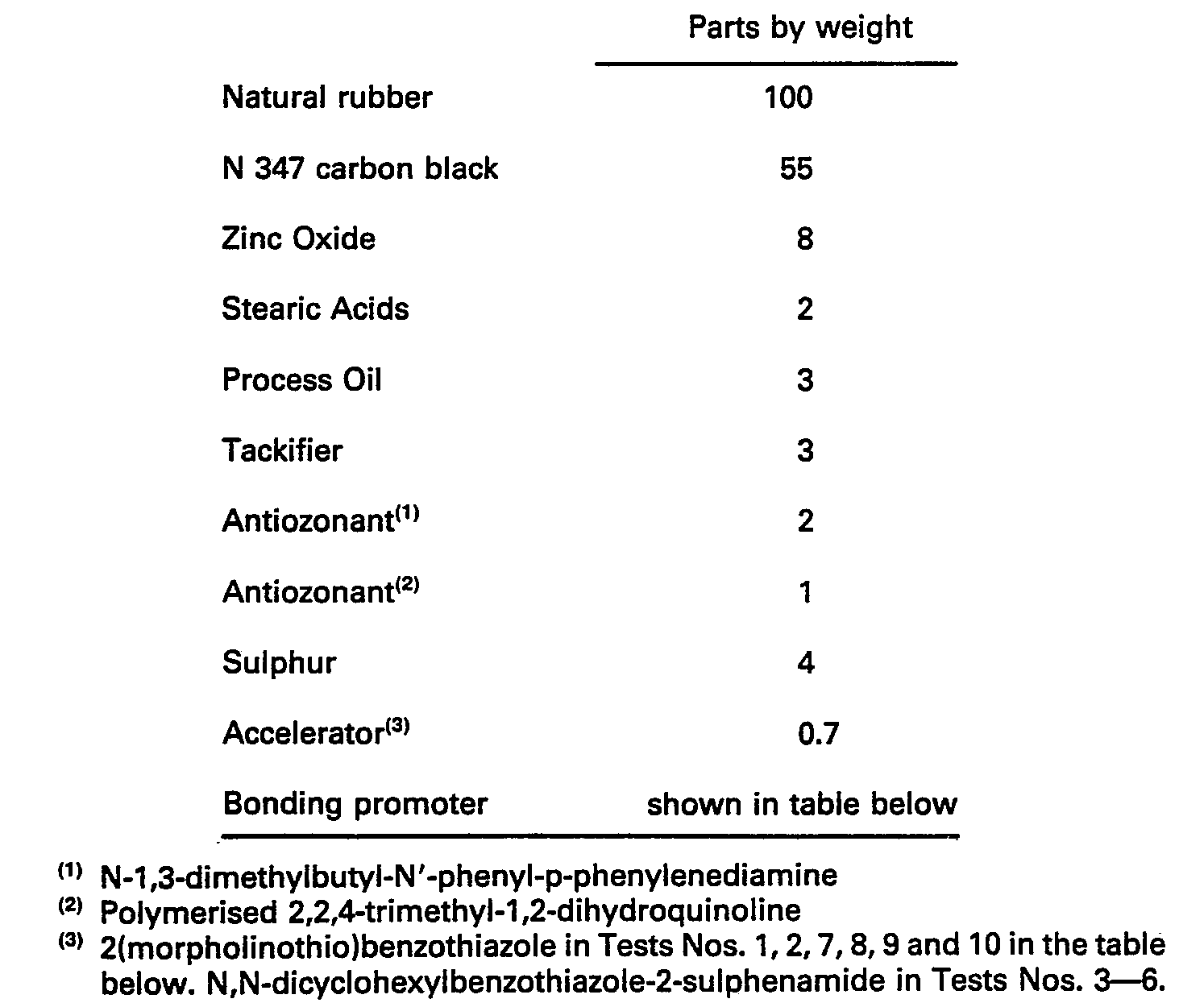
- Mixing of the ingredients except sulphur and accelerator was done in a laboratory scale Banbury mixer having a capacity of 1.57 litre and operating at a filling factor of about 0.8 and a rotor speed of 117 r.p.m., according to the following schedule:

- Two types of typical brass-coated steel tyre cord were used as the metal component. The first (Cord A) had the construction 3 + 9 + 15 x 0.175 + 1, each cord having a coating of brass, approximately 0.20 micrometre thick, with an average copper content of 63.5% by weight. The second cord (Cord B) had the construction 7 x 4 x 0.175 + 0.15, with a brass coating having an average copper content of 67.5%.
- Rubber/metal bond strengths were measured using the adhesion test described by R. C. Ayerst and E. R. Rodger, Rubber Chem. Technol. 45, 1497 (1972). In this method, adhesion blocks are prepared in a similar manner to that specified in ASTM D-2229, but using clamping plates to hold the cords in the mould to maintain alignment during cure, and a frame for pre-loading and uniformly stressing the cord before mould building. The adhesion block comprises a strip of rubber having one end each of several uniformly- spaced lengths of cord embedded in one edge of the strip, and a similar array of lengths of cord, each length having one end embedded in the edge of the strip opposite the first edge and in staggered relationship to the cords in the first edge. Pullout adhesion is measured on a tensile tester by arranging the adhesion block so that the cords are vertical and the rubber strip horizontal, and by holding two lower wires and pulling out the upper wire between them at a crosshead speed of 5 cm/min. The pullout force recorded is the mean of the values for each of the several upper cords except those at each end of the strip, which are not taken into account in order to eliminate possible end effects. Where the pullout force exceeds the breaking load of one or more of the wires in the test procedure, this is signified in the Tables by the symbol >.
- The results given in the tables below under the headings "Initial Adhesion", "Steam Ageing" and "Salt Bath Ageing" were obtained in adhesion blocks were the rubber was cured at 145°C. for Tgo + 5 mintes, "Tgo" being the time in minutes taken for a sample of the same rubber cured in a rheometer (British Standard Test Method 1673 Part 10) to reach 90% of the maximum modulus. Blocks that were "steam aged" were kept in steam under pressure at 120°C. for 8 hours and those that were "salt bath aged" were immersed in a 5% sodium chloride solution at 90°C. for 48 hours after curing and before testing.
- In "Steel Cord: Analysis of Used Truck Tires and Simulation of the Found Phenomena in Laboratory Experiments" an article in "Tire Reinforcement and Tire Performance", ASTM STP 694, R. A. Fleming and D. I. Livingston, Eds, American Society for Testing and Materials, 1979, pp 69―86, C. C. J. de Jong concludes that in evaluating tyres and other composites containing metal and cord reinforcement, attention should be paid to aged adhesion rather than to initial adhesion. The ageing conditions mentioned above are similar to those proposed by de Jong to simulate, at an enhanced level, various conditions which might be encountered during the service life of a tyre.
- The results obtained are set out in the following table. Values in parentheses are for the Adhesion Factor which is the pull-out force with adhesion promoter present divided by the pull-out force with the adhesion promoter absent. In Tests Nos. 1 and 2 the cord was Cord B and in Tests Nos. 3-10 the cord was Cord A. The value of the complexes of the invention as rubber/metal adhesion promoters, especially in improving the resistance of the bond to salt bath ageing, is apparent.

Claims (16)


Priority Applications (1)
| Application Number | Priority Date | Filing Date | Title |
|---|---|---|---|
| AT85870114T ATE41168T1 (en) | 1984-08-23 | 1985-08-12 | RUBBER/METAL COMPOSITES. |
Applications Claiming Priority (2)
| Application Number | Priority Date | Filing Date | Title |
|---|---|---|---|
| GB848421432A GB8421432D0 (en) | 1984-08-23 | 1984-08-23 | Rubber/metal composites |
| GB8421432 | 1984-08-23 |
Publications (3)
| Publication Number | Publication Date |
|---|---|
| EP0175669A2 EP0175669A2 (en) | 1986-03-26 |
| EP0175669A3 EP0175669A3 (en) | 1986-08-27 |
| EP0175669B1 true EP0175669B1 (en) | 1989-03-08 |
Family
ID=10565736
Family Applications (1)
| Application Number | Title | Priority Date | Filing Date |
|---|---|---|---|
| EP85870114A Expired EP0175669B1 (en) | 1984-08-23 | 1985-08-12 | Rubber/metal composites |
Country Status (7)
| Country | Link |
|---|---|
| US (1) | US4605590A (en) |
| EP (1) | EP0175669B1 (en) |
| JP (1) | JPS61116535A (en) |
| AT (1) | ATE41168T1 (en) |
| CA (1) | CA1250120A (en) |
| DE (1) | DE3568588D1 (en) |
| GB (1) | GB8421432D0 (en) |
Families Citing this family (13)
| Publication number | Priority date | Publication date | Assignee | Title |
|---|---|---|---|---|
| GB8400572D0 (en) * | 1984-01-10 | 1984-02-15 | Manchem Ltd | Adhesion of rubber to metals |
| EP0343254B1 (en) * | 1987-10-26 | 1994-06-15 | Sumitomo Electric Industries Limited | Metal and composite material made of the metal with rubber |
| US5196487A (en) * | 1990-06-12 | 1993-03-23 | Kansai Paint Company, Limited | Corrosion preventive resin and photopolymerizable composition incorporating same |
| JPH0497152A (en) * | 1990-08-09 | 1992-03-30 | Kansai Paint Co Ltd | Method for forming pattern from photopolymerizable composition |
| US7138450B2 (en) * | 2002-05-09 | 2006-11-21 | Cph Innovations Corp. | Vulcanized rubber composition with a liquid adhesion promoter containing an adhesive resin and ester |
| US20030220427A1 (en) * | 2002-05-09 | 2003-11-27 | Gary Wentworth | Adhesion promoter for cord-reinforced rubber and metal or polymer substrate/rubber composites |
| US7144937B2 (en) * | 2002-05-09 | 2006-12-05 | Cph Innovations Corp. | Adhesion promoters for sealants |
| US6884832B2 (en) * | 2002-05-09 | 2005-04-26 | The C.P. Hall Company | Adhesion promoter for cord-reinforced rubber and metal or polymer substrate/rubber composites |
| US7122592B2 (en) * | 2002-05-09 | 2006-10-17 | Cph Innovations Corp. | Adhesion promoters for cord-reinforced thermoplastic polymeric materials and substrate/thermoplastic polymeric material composites |
| US7422791B2 (en) * | 2003-11-19 | 2008-09-09 | Hallstar Innovations Corp. | Joint assemblies, methods for installing joint assemblies, and jointing compositions |
| EP2566193A1 (en) | 2011-08-30 | 2013-03-06 | TWO PI Signal Processing Application GmbH | System and method for fitting of a hearing device |
| MY164954A (en) * | 2011-12-30 | 2018-02-28 | Basf Se | Method for purifying organic diphosphite compounds |
| PL3658614T3 (en) | 2017-07-25 | 2026-01-19 | Flexsys Holdings, Inc. | Processes for forming vulcanizable elastomeric formulations and vulcanized elastomeric articles |
Family Cites Families (1)
| Publication number | Priority date | Publication date | Assignee | Title |
|---|---|---|---|---|
| US3905947A (en) * | 1973-10-10 | 1975-09-16 | Ciba Geigy Corp | Organo-nickel salts as adhesion promotors for vulcanizable elastomers to metals |
-
1984
- 1984-08-23 GB GB848421432A patent/GB8421432D0/en active Pending
-
1985
- 1985-08-12 AT AT85870114T patent/ATE41168T1/en not_active IP Right Cessation
- 1985-08-12 EP EP85870114A patent/EP0175669B1/en not_active Expired
- 1985-08-12 DE DE8585870114T patent/DE3568588D1/en not_active Expired
- 1985-08-12 US US06/764,706 patent/US4605590A/en not_active Expired - Fee Related
- 1985-08-22 JP JP60183145A patent/JPS61116535A/en active Pending
- 1985-08-22 CA CA000489242A patent/CA1250120A/en not_active Expired
Also Published As
| Publication number | Publication date |
|---|---|
| CA1250120A (en) | 1989-02-21 |
| JPS61116535A (en) | 1986-06-04 |
| EP0175669A2 (en) | 1986-03-26 |
| EP0175669A3 (en) | 1986-08-27 |
| GB8421432D0 (en) | 1984-09-26 |
| US4605590A (en) | 1986-08-12 |
| DE3568588D1 (en) | 1989-04-13 |
| ATE41168T1 (en) | 1989-03-15 |
Similar Documents
| Publication | Publication Date | Title |
|---|---|---|
| EP0109955B1 (en) | Rubber/metal composites | |
| US4605590A (en) | Rubber/metal composites | |
| EP0714928B1 (en) | Method for adhering rubber to reinforcing materials | |
| US4092455A (en) | Use of methylenebis- and thiobisnaphthols as promoters in tire cord adhesion to rubber | |
| CA2510568C (en) | Rubber compositions and articles thereof having improved metal adhesion and metal adhesion retention with bright steel | |
| EP0900820B1 (en) | A rubber compound containing a hydrated thiosulfate and a bismaleimide | |
| Setua et al. | Short silk fibre reinforced nitrile rubber composites | |
| CA1262727A (en) | Compounds useful as rubber/metal bonding promoters | |
| US4038220A (en) | Method for adhesion of rubber [using N-(substituted oxymethyl)melamines and beta naphthol] to reinforcing materials | |
| US4588766A (en) | Adhesion of rubber to metals | |
| CA1172407A (en) | Cured rubber skim stock compositions containing silanes having improved metal adhesion | |
| US4057529A (en) | Rubber compositions having improved adhesion after thermal aging | |
| EP0160634B1 (en) | Metal complexes useful as rubber/metal bonding promoters | |
| US5283274A (en) | Substituted pyrimidines and substituted triazines as rubber-to-metal adhesion promoters | |
| EP0476310B1 (en) | Rubber compositions containing a hydroxy aryl substituted maleamic acid | |
| US4075159A (en) | Rubber compositions with benzoic acid compounds | |
| US3992334A (en) | Method for adhesion of steel cord to rubber using N-(substituted oxymethyl) melamines and dimethylol urea | |
| US4082909A (en) | Rubber composition containing metal salt of hydroxy benzoic acid | |
| Abou-Kandil et al. | Adhesion of brass plated steel cords to natural rubber: Dynamic and statistical study of adhesion failure | |
| JPH0393843A (en) | Vulcanizable rubber composition containing hydroxyaryl-substituted monomaleimide | |
| JPS6261607B2 (en) | ||
| EP0039769A1 (en) | New compounding formulas for rubber-metal adhesion (use of cobalt propionate) in tines | |
| CA1282199C (en) | Adhesion of brass plated steel to rubber | |
| JPH0565370A (en) | Tire | |
| CA1268476A (en) | Adhesion promoters containing -s-so2r groups |
Legal Events
| Date | Code | Title | Description |
|---|---|---|---|
| PUAI | Public reference made under article 153(3) epc to a published international application that has entered the european phase |
Free format text: ORIGINAL CODE: 0009012 |
|
| AK | Designated contracting states |
Kind code of ref document: A2 Designated state(s): AT BE CH DE FR GB IT LI LU NL |
|
| PUAL | Search report despatched |
Free format text: ORIGINAL CODE: 0009013 |
|
| AK | Designated contracting states |
Kind code of ref document: A3 Designated state(s): AT BE CH DE FR GB IT LI LU NL |
|
| 17P | Request for examination filed |
Effective date: 19870112 |
|
| 17Q | First examination report despatched |
Effective date: 19880420 |
|
| GRAA | (expected) grant |
Free format text: ORIGINAL CODE: 0009210 |
|
| AK | Designated contracting states |
Kind code of ref document: B1 Designated state(s): AT BE CH DE FR GB IT LI LU NL |
|
| PG25 | Lapsed in a contracting state [announced via postgrant information from national office to epo] |
Ref country code: NL Effective date: 19890308 Ref country code: AT Effective date: 19890308 |
|
| REF | Corresponds to: |
Ref document number: 41168 Country of ref document: AT Date of ref document: 19890315 Kind code of ref document: T |
|
| REF | Corresponds to: |
Ref document number: 3568588 Country of ref document: DE Date of ref document: 19890413 |
|
| ET | Fr: translation filed | ||
| ITF | It: translation for a ep patent filed | ||
| NLV1 | Nl: lapsed or annulled due to failure to fulfill the requirements of art. 29p and 29m of the patents act | ||
| PG25 | Lapsed in a contracting state [announced via postgrant information from national office to epo] |
Ref country code: LU Free format text: LAPSE BECAUSE OF NON-PAYMENT OF DUE FEES Effective date: 19890831 |
|
| PLBE | No opposition filed within time limit |
Free format text: ORIGINAL CODE: 0009261 |
|
| STAA | Information on the status of an ep patent application or granted ep patent |
Free format text: STATUS: NO OPPOSITION FILED WITHIN TIME LIMIT |
|
| 26N | No opposition filed | ||
| PGFP | Annual fee paid to national office [announced via postgrant information from national office to epo] |
Ref country code: GB Payment date: 19900529 Year of fee payment: 6 |
|
| PGFP | Annual fee paid to national office [announced via postgrant information from national office to epo] |
Ref country code: FR Payment date: 19900621 Year of fee payment: 6 |
|
| PGFP | Annual fee paid to national office [announced via postgrant information from national office to epo] |
Ref country code: CH Payment date: 19900724 Year of fee payment: 6 |
|
| PGFP | Annual fee paid to national office [announced via postgrant information from national office to epo] |
Ref country code: LU Payment date: 19900726 Year of fee payment: 6 |
|
| PGFP | Annual fee paid to national office [announced via postgrant information from national office to epo] |
Ref country code: BE Payment date: 19900809 Year of fee payment: 6 |
|
| PGFP | Annual fee paid to national office [announced via postgrant information from national office to epo] |
Ref country code: DE Payment date: 19900830 Year of fee payment: 6 |
|
| ITTA | It: last paid annual fee | ||
| PG25 | Lapsed in a contracting state [announced via postgrant information from national office to epo] |
Ref country code: GB Effective date: 19910812 |
|
| PG25 | Lapsed in a contracting state [announced via postgrant information from national office to epo] |
Ref country code: LI Effective date: 19910831 Ref country code: CH Effective date: 19910831 Ref country code: BE Effective date: 19910831 |
|
| BERE | Be: lapsed |
Owner name: S.A. MONSANTO EUROPE Effective date: 19910831 |
|
| GBPC | Gb: european patent ceased through non-payment of renewal fee | ||
| PG25 | Lapsed in a contracting state [announced via postgrant information from national office to epo] |
Ref country code: FR Effective date: 19920430 |
|
| REG | Reference to a national code |
Ref country code: CH Ref legal event code: PL |
|
| PG25 | Lapsed in a contracting state [announced via postgrant information from national office to epo] |
Ref country code: DE Effective date: 19920501 |
|
| REG | Reference to a national code |
Ref country code: FR Ref legal event code: ST |