EP0174717A1 - Benzimidazoles, and their production formulation and use as gastric acid secretion inhibitors - Google Patents
Benzimidazoles, and their production formulation and use as gastric acid secretion inhibitors Download PDFInfo
- Publication number
- EP0174717A1 EP0174717A1 EP85304626A EP85304626A EP0174717A1 EP 0174717 A1 EP0174717 A1 EP 0174717A1 EP 85304626 A EP85304626 A EP 85304626A EP 85304626 A EP85304626 A EP 85304626A EP 0174717 A1 EP0174717 A1 EP 0174717A1
- Authority
- EP
- European Patent Office
- Prior art keywords
- benzenamine
- dimethyl
- benzimidazolylsulphinylmethyl
- alkyl
- group
- Prior art date
- Legal status (The legal status is an assumption and is not a legal conclusion. Google has not performed a legal analysis and makes no representation as to the accuracy of the status listed.)
- Granted
Links
- 230000027119 gastric acid secretion Effects 0.000 title claims abstract description 9
- 238000004519 manufacturing process Methods 0.000 title claims description 11
- 239000000203 mixture Substances 0.000 title abstract description 51
- 238000009472 formulation Methods 0.000 title abstract description 3
- 150000001556 benzimidazoles Chemical class 0.000 title description 3
- 239000003112 inhibitor Substances 0.000 title 1
- 150000001875 compounds Chemical class 0.000 claims abstract description 117
- 125000000217 alkyl group Chemical group 0.000 claims abstract description 56
- 229910052757 nitrogen Inorganic materials 0.000 claims abstract description 54
- 229910052739 hydrogen Inorganic materials 0.000 claims abstract description 46
- 239000001257 hydrogen Substances 0.000 claims abstract description 46
- IJGRMHOSHXDMSA-UHFFFAOYSA-N Atomic nitrogen Chemical compound N#N IJGRMHOSHXDMSA-UHFFFAOYSA-N 0.000 claims abstract description 42
- 125000001997 phenyl group Chemical group [H]C1=C([H])C([H])=C(*)C([H])=C1[H] 0.000 claims abstract description 41
- 238000000034 method Methods 0.000 claims abstract description 36
- 150000003839 salts Chemical class 0.000 claims abstract description 24
- 239000012038 nucleophile Substances 0.000 claims abstract description 15
- 125000004432 carbon atom Chemical group C* 0.000 claims abstract description 14
- 229910052736 halogen Inorganic materials 0.000 claims abstract description 14
- 150000002367 halogens Chemical class 0.000 claims abstract description 14
- 125000001589 carboacyl group Chemical group 0.000 claims abstract description 13
- NINIDFKCEFEMDL-UHFFFAOYSA-N Sulfur Chemical compound [S] NINIDFKCEFEMDL-UHFFFAOYSA-N 0.000 claims abstract description 10
- 239000005864 Sulphur Substances 0.000 claims abstract description 9
- 125000004429 atom Chemical group 0.000 claims abstract description 8
- 125000003178 carboxy group Chemical group [H]OC(*)=O 0.000 claims abstract description 8
- 150000002148 esters Chemical class 0.000 claims abstract description 8
- 125000004435 hydrogen atom Chemical class [H]* 0.000 claims abstract description 8
- 229910052760 oxygen Inorganic materials 0.000 claims abstract description 8
- 125000003545 alkoxy group Chemical group 0.000 claims abstract description 7
- QVGXLLKOCUKJST-UHFFFAOYSA-N atomic oxygen Chemical compound [O] QVGXLLKOCUKJST-UHFFFAOYSA-N 0.000 claims abstract description 7
- 230000000269 nucleophilic effect Effects 0.000 claims abstract description 7
- 239000001301 oxygen Substances 0.000 claims abstract description 7
- 125000000587 piperidin-1-yl group Chemical group [H]C1([H])N(*)C([H])([H])C([H])([H])C([H])([H])C1([H])[H] 0.000 claims abstract description 7
- 150000001408 amides Chemical class 0.000 claims abstract description 6
- 125000003277 amino group Chemical group 0.000 claims abstract description 6
- 125000003118 aryl group Chemical group 0.000 claims abstract description 6
- 125000003709 fluoroalkyl group Chemical group 0.000 claims abstract description 6
- 125000005843 halogen group Chemical group 0.000 claims abstract description 4
- 125000001072 heteroaryl group Chemical group 0.000 claims abstract description 4
- QJGQUHMNIGDVPM-UHFFFAOYSA-N nitrogen group Chemical group [N] QJGQUHMNIGDVPM-UHFFFAOYSA-N 0.000 claims abstract description 4
- XLYOFNOQVPJJNP-UHFFFAOYSA-N water Substances O XLYOFNOQVPJJNP-UHFFFAOYSA-N 0.000 claims description 41
- 150000002431 hydrogen Chemical class 0.000 claims description 31
- 125000004433 nitrogen atom Chemical group N* 0.000 claims description 16
- 238000006243 chemical reaction Methods 0.000 claims description 13
- 125000000753 cycloalkyl group Chemical group 0.000 claims description 13
- 125000002496 methyl group Chemical group [H]C([H])([H])* 0.000 claims description 13
- -1 chloro, methoxy Chemical group 0.000 claims description 12
- 229910052799 carbon Inorganic materials 0.000 claims description 9
- 125000005842 heteroatom Chemical group 0.000 claims description 9
- 125000001424 substituent group Chemical group 0.000 claims description 9
- 229920006395 saturated elastomer Polymers 0.000 claims description 8
- PAYRUJLWNCNPSJ-UHFFFAOYSA-N Aniline Chemical compound NC1=CC=CC=C1 PAYRUJLWNCNPSJ-UHFFFAOYSA-N 0.000 claims description 7
- UFHFLCQGNIYNRP-UHFFFAOYSA-N Hydrogen Chemical compound [H][H] UFHFLCQGNIYNRP-UHFFFAOYSA-N 0.000 claims description 7
- RMVRSNDYEFQCLF-UHFFFAOYSA-N thiophenol Substances SC1=CC=CC=C1 RMVRSNDYEFQCLF-UHFFFAOYSA-N 0.000 claims description 7
- 239000008194 pharmaceutical composition Substances 0.000 claims description 5
- INGIXPMMNAFVHF-UHFFFAOYSA-N 2-(1h-benzimidazol-2-ylsulfinylmethyl)aniline Chemical compound NC1=CC=CC=C1CS(=O)C1=NC2=CC=CC=C2N1 INGIXPMMNAFVHF-UHFFFAOYSA-N 0.000 claims description 4
- 239000002671 adjuvant Substances 0.000 claims description 4
- 239000003085 diluting agent Substances 0.000 claims description 4
- 125000000623 heterocyclic group Chemical group 0.000 claims description 4
- 230000005764 inhibitory process Effects 0.000 claims description 4
- 230000003647 oxidation Effects 0.000 claims description 4
- 238000007254 oxidation reaction Methods 0.000 claims description 4
- LEVJVKGPFAQPOI-UHFFFAOYSA-N phenylmethanone Chemical compound O=[C]C1=CC=CC=C1 LEVJVKGPFAQPOI-UHFFFAOYSA-N 0.000 claims description 4
- 230000002265 prevention Effects 0.000 claims description 4
- 125000004076 pyridyl group Chemical group 0.000 claims description 4
- WJBOXEGAWJHKIM-UHFFFAOYSA-N 1,3-benzoxazole-5-carboxylic acid Chemical compound OC(=O)C1=CC=C2OC=NC2=C1 WJBOXEGAWJHKIM-UHFFFAOYSA-N 0.000 claims description 3
- RKXWERSHBXZXFQ-UHFFFAOYSA-N 2-(1h-benzimidazol-2-ylsulfinylmethyl)-n,n,4-trimethylaniline Chemical compound CN(C)C1=CC=C(C)C=C1CS(=O)C1=NC2=CC=CC=C2N1 RKXWERSHBXZXFQ-UHFFFAOYSA-N 0.000 claims description 3
- PSXUBLNOGFVJRX-UHFFFAOYSA-N 2-(1h-benzimidazol-2-ylsulfinylmethyl)-n,n-diethylaniline Chemical compound CCN(CC)C1=CC=CC=C1CS(=O)C1=NC2=CC=CC=C2N1 PSXUBLNOGFVJRX-UHFFFAOYSA-N 0.000 claims description 3
- JVIHSTYYPRUSFG-UHFFFAOYSA-N 2-(1h-benzimidazol-2-ylsulfinylmethyl)-n,n-dimethylaniline Chemical compound CN(C)C1=CC=CC=C1CS(=O)C1=NC2=CC=CC=C2N1 JVIHSTYYPRUSFG-UHFFFAOYSA-N 0.000 claims description 3
- FMUUELOSEHOAKC-UHFFFAOYSA-N 2-(pyridin-2-ylmethylsulfinyl)-1,3-benzoxazole Chemical compound N=1C2=CC=CC=C2OC=1S(=O)CC1=CC=CC=N1 FMUUELOSEHOAKC-UHFFFAOYSA-N 0.000 claims description 3
- FNCFJTCLEAAISA-UHFFFAOYSA-N 2-[(2-piperidin-1-ylphenyl)methylsulfinyl]-1h-benzimidazole Chemical compound N=1C2=CC=CC=C2NC=1S(=O)CC1=CC=CC=C1N1CCCCC1 FNCFJTCLEAAISA-UHFFFAOYSA-N 0.000 claims description 3
- TWEMZHKJAUWJJH-UHFFFAOYSA-N 2-[(4-methoxy-3,5-dimethylpyridin-2-yl)methylsulfinyl]-1,3-benzoxazole Chemical compound COC1=C(C)C=NC(CS(=O)C=2OC3=CC=CC=C3N=2)=C1C TWEMZHKJAUWJJH-UHFFFAOYSA-N 0.000 claims description 3
- ZHQLBJCPEDGFOR-UHFFFAOYSA-N 2-[(5,6-dimethoxy-1h-benzimidazol-2-yl)sulfinylmethyl]-n,n-dimethylaniline Chemical compound N1C=2C=C(OC)C(OC)=CC=2N=C1S(=O)CC1=CC=CC=C1N(C)C ZHQLBJCPEDGFOR-UHFFFAOYSA-N 0.000 claims description 3
- UXFLGLQFICGPRQ-UHFFFAOYSA-N 2-[(5,6-dimethyl-1h-benzimidazol-2-yl)sulfinylmethyl]-n,n-dimethylaniline Chemical compound CN(C)C1=CC=CC=C1CS(=O)C1=NC2=CC(C)=C(C)C=C2N1 UXFLGLQFICGPRQ-UHFFFAOYSA-N 0.000 claims description 3
- JKHNHRYYQALOLX-UHFFFAOYSA-N 5-chloro-2-(pyridin-2-ylmethylsulfinyl)-1,3-benzoxazole Chemical compound N=1C2=CC(Cl)=CC=C2OC=1S(=O)CC1=CC=CC=N1 JKHNHRYYQALOLX-UHFFFAOYSA-N 0.000 claims description 3
- NNJVFKYNCDFCJR-UHFFFAOYSA-N [2-[[2-(dimethylamino)phenyl]methylsulfinyl]benzimidazol-1-yl]methyl 2,2-dimethylpropanoate Chemical compound CN(C)C1=CC=CC=C1CS(=O)C1=NC2=CC=CC=C2N1COC(=O)C(C)(C)C NNJVFKYNCDFCJR-UHFFFAOYSA-N 0.000 claims description 3
- 150000001412 amines Chemical class 0.000 claims description 3
- 150000001721 carbon Chemical group 0.000 claims description 3
- JAONZDYCQQDNSR-UHFFFAOYSA-N methyl 2-[[2-(dimethylamino)phenyl]methylsulfinyl]-3h-benzimidazole-5-carboxylate Chemical compound N1C2=CC(C(=O)OC)=CC=C2N=C1S(=O)CC1=CC=CC=C1N(C)C JAONZDYCQQDNSR-UHFFFAOYSA-N 0.000 claims description 3
- NEGXXYIOWVTFAE-UHFFFAOYSA-N n,n-dimethyl-2-[(6-methyl-1h-benzimidazol-2-yl)sulfinylmethyl]aniline Chemical compound CN(C)C1=CC=CC=C1CS(=O)C1=NC2=CC=C(C)C=C2N1 NEGXXYIOWVTFAE-UHFFFAOYSA-N 0.000 claims description 3
- XGRCHDMLXIYAQK-UHFFFAOYSA-N n,n-dimethyl-2-[(6-nitro-1h-benzimidazol-2-yl)sulfinylmethyl]aniline Chemical compound CN(C)C1=CC=CC=C1CS(=O)C1=NC2=CC=C([N+]([O-])=O)C=C2N1 XGRCHDMLXIYAQK-UHFFFAOYSA-N 0.000 claims description 3
- DNEGAUHSFSKWMQ-UHFFFAOYSA-N n,n-dimethyl-2-[[6-(4-methylphenyl)sulfonyl-1h-benzimidazol-2-yl]sulfinylmethyl]aniline Chemical compound CN(C)C1=CC=CC=C1CS(=O)C1=NC2=CC=C(S(=O)(=O)C=3C=CC(C)=CC=3)C=C2N1 DNEGAUHSFSKWMQ-UHFFFAOYSA-N 0.000 claims description 3
- QZXDFDNVSLYYJX-UHFFFAOYSA-N 2-(1,3-benzothiazol-2-ylsulfinylmethyl)-n,n-dimethylaniline Chemical compound CN(C)C1=CC=CC=C1CS(=O)C1=NC2=CC=CC=C2S1 QZXDFDNVSLYYJX-UHFFFAOYSA-N 0.000 claims description 2
- OZJSNDNOZJQSAF-UHFFFAOYSA-N 2-(1h-benzimidazol-2-ylsulfanylmethyl)-n-ethyl-n-propylaniline Chemical compound CCCN(CC)C1=CC=CC=C1CSC1=NC2=CC=CC=C2N1 OZJSNDNOZJQSAF-UHFFFAOYSA-N 0.000 claims description 2
- QBAAHEQUQOAJAV-UHFFFAOYSA-N 2-(1h-benzimidazol-2-ylsulfinylmethyl)-n,n,3,4,5-pentamethylaniline Chemical compound CN(C)C1=CC(C)=C(C)C(C)=C1CS(=O)C1=NC2=CC=CC=C2N1 QBAAHEQUQOAJAV-UHFFFAOYSA-N 0.000 claims description 2
- POABVEZFYBAKQS-UHFFFAOYSA-N 2-(1h-benzimidazol-2-ylsulfinylmethyl)-n,n-dimethyl-6-propylaniline Chemical compound CCCC1=CC=CC(CS(=O)C=2NC3=CC=CC=C3N=2)=C1N(C)C POABVEZFYBAKQS-UHFFFAOYSA-N 0.000 claims description 2
- KAXBTEYITOLQEN-UHFFFAOYSA-N 2-(1h-benzimidazol-2-ylsulfinylmethyl)-n-ethyl-n-propylaniline Chemical compound CCCN(CC)C1=CC=CC=C1CS(=O)C1=NC2=CC=CC=C2N1 KAXBTEYITOLQEN-UHFFFAOYSA-N 0.000 claims description 2
- PNPMMMZUPHKGHR-UHFFFAOYSA-N 2-(pyridin-2-ylmethylsulfinyl)-1,3-benzothiazole Chemical compound N=1C2=CC=CC=C2SC=1S(=O)CC1=CC=CC=N1 PNPMMMZUPHKGHR-UHFFFAOYSA-N 0.000 claims description 2
- SOEWTUMDYFLDAT-UHFFFAOYSA-N 2-[(4-methoxy-3,5-dimethylpyridin-2-yl)methylsulfinyl]-1,3-benzothiazole Chemical compound COC1=C(C)C=NC(CS(=O)C=2SC3=CC=CC=C3N=2)=C1C SOEWTUMDYFLDAT-UHFFFAOYSA-N 0.000 claims description 2
- IBFBJBXAXYLOIZ-UHFFFAOYSA-N 2-[(5,6-dichloro-1h-benzimidazol-2-yl)sulfinylmethyl]-n,n-dimethylaniline Chemical compound CN(C)C1=CC=CC=C1CS(=O)C1=NC2=CC(Cl)=C(Cl)C=C2N1 IBFBJBXAXYLOIZ-UHFFFAOYSA-N 0.000 claims description 2
- DCIATVSFFKSSFY-UHFFFAOYSA-N 2-[(6-chloro-1h-benzimidazol-2-yl)sulfinylmethyl]-n,n-dimethylaniline Chemical compound CN(C)C1=CC=CC=C1CS(=O)C1=NC2=CC=C(Cl)C=C2N1 DCIATVSFFKSSFY-UHFFFAOYSA-N 0.000 claims description 2
- YLGSYHWCIQBULW-UHFFFAOYSA-N 2-[[2-(dimethylamino)phenyl]methylsulfinyl]-3h-benzimidazol-5-amine Chemical compound CN(C)C1=CC=CC=C1CS(=O)C1=NC2=CC=C(N)C=C2N1 YLGSYHWCIQBULW-UHFFFAOYSA-N 0.000 claims description 2
- JDQAKUFFZPISEP-UHFFFAOYSA-N 5-(1h-benzimidazol-2-ylsulfinylmethyl)-n,n,2-trimethylpyrimidin-4-amine Chemical compound CN(C)C1=NC(C)=NC=C1CS(=O)C1=NC2=CC=CC=C2N1 JDQAKUFFZPISEP-UHFFFAOYSA-N 0.000 claims description 2
- GLZAMESMPGPUHO-UHFFFAOYSA-N 8-(1h-benzimidazol-2-ylsulfinylmethyl)-1,6-dimethyl-3,4-dihydro-2h-quinoline Chemical compound C1=CC=C2NC(S(=O)CC=3C=C(C)C=C4CCCN(C=34)C)=NC2=C1 GLZAMESMPGPUHO-UHFFFAOYSA-N 0.000 claims description 2
- OKTJSMMVPCPJKN-UHFFFAOYSA-N Carbon Chemical compound [C] OKTJSMMVPCPJKN-UHFFFAOYSA-N 0.000 claims description 2
- 125000003236 benzoyl group Chemical group [H]C1=C([H])C([H])=C(C([H])=C1[H])C(*)=O 0.000 claims description 2
- 125000000484 butyl group Chemical group [H]C([*])([H])C([H])([H])C([H])([H])C([H])([H])[H] 0.000 claims description 2
- UJKHYVFGEVYRDI-UHFFFAOYSA-N ethyl 2-[[2-(dimethylamino)phenyl]methylsulfinyl]benzimidazole-1-carboxylate Chemical compound N=1C2=CC=CC=C2N(C(=O)OCC)C=1S(=O)CC1=CC=CC=C1N(C)C UJKHYVFGEVYRDI-UHFFFAOYSA-N 0.000 claims description 2
- 229910052740 iodine Inorganic materials 0.000 claims description 2
- 125000001160 methoxycarbonyl group Chemical group [H]C([H])([H])OC(*)=O 0.000 claims description 2
- CPRRHERYRRXBRZ-SRVKXCTJSA-N methyl n-[(2s)-1-[[(2s)-1-hydroxy-3-[(3s)-2-oxopyrrolidin-3-yl]propan-2-yl]amino]-4-methyl-1-oxopentan-2-yl]carbamate Chemical compound COC(=O)N[C@@H](CC(C)C)C(=O)N[C@H](CO)C[C@@H]1CCNC1=O CPRRHERYRRXBRZ-SRVKXCTJSA-N 0.000 claims description 2
- GRVDJDISBSALJP-UHFFFAOYSA-N methyloxidanyl Chemical group [O]C GRVDJDISBSALJP-UHFFFAOYSA-N 0.000 claims description 2
- BIEFGFBSFUMSFQ-UHFFFAOYSA-N n,n-dimethyl-2-[[4-(trifluoromethyl)-1h-benzimidazol-2-yl]sulfinylmethyl]aniline Chemical compound CN(C)C1=CC=CC=C1CS(=O)C1=NC2=C(C(F)(F)F)C=CC=C2N1 BIEFGFBSFUMSFQ-UHFFFAOYSA-N 0.000 claims description 2
- OQVZBTLMQOMEJM-UHFFFAOYSA-N n,n-dimethyl-2-[[6-(trifluoromethyl)-1h-benzimidazol-2-yl]sulfinylmethyl]aniline Chemical compound CN(C)C1=CC=CC=C1CS(=O)C1=NC2=CC=C(C(F)(F)F)C=C2N1 OQVZBTLMQOMEJM-UHFFFAOYSA-N 0.000 claims description 2
- GIGZPXDSHMGMRO-UHFFFAOYSA-N n-[2-(1h-benzimidazol-2-ylsulfinyl)ethyl]-n-methylaniline Chemical compound N=1C2=CC=CC=C2NC=1S(=O)CCN(C)C1=CC=CC=C1 GIGZPXDSHMGMRO-UHFFFAOYSA-N 0.000 claims description 2
- 125000002023 trifluoromethyl group Chemical group FC(F)(F)* 0.000 claims description 2
- QTBSBXVTEAMEQO-UHFFFAOYSA-M Acetate Chemical compound CC([O-])=O QTBSBXVTEAMEQO-UHFFFAOYSA-M 0.000 claims 4
- YOFNYPAKMSQNFR-UHFFFAOYSA-N 2-[(4,7-dimethoxy-1h-benzimidazol-2-yl)sulfinylmethyl]-n,n-dimethylaniline Chemical compound N=1C=2C(OC)=CC=C(OC)C=2NC=1S(=O)CC1=CC=CC=C1N(C)C YOFNYPAKMSQNFR-UHFFFAOYSA-N 0.000 claims 2
- IOJUPLGTWVMSFF-UHFFFAOYSA-N benzothiazole Chemical compound C1=CC=C2SC=NC2=C1 IOJUPLGTWVMSFF-UHFFFAOYSA-N 0.000 claims 2
- 125000001495 ethyl group Chemical group [H]C([H])([H])C([H])([H])* 0.000 claims 2
- NEFZJJNRJOAPIW-UHFFFAOYSA-N 2-(1h-benzo[f]benzimidazol-2-ylsulfanylmethyl)-n,n-dimethylaniline Chemical compound CN(C)C1=CC=CC=C1CSC1=NC2=CC3=CC=CC=C3C=C2N1 NEFZJJNRJOAPIW-UHFFFAOYSA-N 0.000 claims 1
- WIDDHMQYEVFDSZ-UHFFFAOYSA-N 2-[(6-chloro-1H-benzimidazol-2-yl)sulfinylmethyl]-3,4-dimethylaniline Chemical compound ClC1=CC2=C(NC(=N2)S(=O)CC2=C(C=CC(=C2C)C)N)C=C1 WIDDHMQYEVFDSZ-UHFFFAOYSA-N 0.000 claims 1
- GSPZMHXGQXAICQ-UHFFFAOYSA-N 4-[2-(1h-benzimidazol-2-ylsulfinylmethyl)phenyl]morpholine Chemical compound N=1C2=CC=CC=C2NC=1S(=O)CC1=CC=CC=C1N1CCOCC1 GSPZMHXGQXAICQ-UHFFFAOYSA-N 0.000 claims 1
- SVVGIYPXCWYLMH-UHFFFAOYSA-N n,n-dimethyl-2-[(1-methylbenzimidazol-2-yl)sulfinylmethyl]aniline Chemical compound CN(C)C1=CC=CC=C1CS(=O)C1=NC2=CC=CC=C2N1C SVVGIYPXCWYLMH-UHFFFAOYSA-N 0.000 claims 1
- 239000003814 drug Substances 0.000 abstract description 3
- XEKOWRVHYACXOJ-UHFFFAOYSA-N Ethyl acetate Chemical compound CCOC(C)=O XEKOWRVHYACXOJ-UHFFFAOYSA-N 0.000 description 99
- YMWUJEATGCHHMB-UHFFFAOYSA-N Dichloromethane Chemical compound ClCCl YMWUJEATGCHHMB-UHFFFAOYSA-N 0.000 description 56
- 239000000047 product Substances 0.000 description 54
- ZMXDDKWLCZADIW-UHFFFAOYSA-N N,N-Dimethylformamide Chemical compound CN(C)C=O ZMXDDKWLCZADIW-UHFFFAOYSA-N 0.000 description 48
- 239000000243 solution Substances 0.000 description 44
- RTZKZFJDLAIYFH-UHFFFAOYSA-N Diethyl ether Chemical compound CCOCC RTZKZFJDLAIYFH-UHFFFAOYSA-N 0.000 description 36
- 229940093499 ethyl acetate Drugs 0.000 description 33
- 235000019439 ethyl acetate Nutrition 0.000 description 33
- LFQSCWFLJHTTHZ-UHFFFAOYSA-N Ethanol Chemical compound CCO LFQSCWFLJHTTHZ-UHFFFAOYSA-N 0.000 description 32
- UIIMBOGNXHQVGW-UHFFFAOYSA-M Sodium bicarbonate Chemical class [Na+].OC([O-])=O UIIMBOGNXHQVGW-UHFFFAOYSA-M 0.000 description 28
- 239000003921 oil Substances 0.000 description 24
- 239000002904 solvent Substances 0.000 description 24
- FYSNRJHAOHDILO-UHFFFAOYSA-N thionyl chloride Chemical compound ClS(Cl)=O FYSNRJHAOHDILO-UHFFFAOYSA-N 0.000 description 24
- CSNNHWWHGAXBCP-UHFFFAOYSA-L Magnesium sulfate Chemical compound [Mg+2].[O-][S+2]([O-])([O-])[O-] CSNNHWWHGAXBCP-UHFFFAOYSA-L 0.000 description 22
- 239000007787 solid Substances 0.000 description 22
- WYURNTSHIVDZCO-UHFFFAOYSA-N Tetrahydrofuran Chemical compound C1CCOC1 WYURNTSHIVDZCO-UHFFFAOYSA-N 0.000 description 21
- HEDRZPFGACZZDS-UHFFFAOYSA-N Chloroform Chemical compound ClC(Cl)Cl HEDRZPFGACZZDS-UHFFFAOYSA-N 0.000 description 20
- 239000012267 brine Substances 0.000 description 20
- HPALAKNZSZLMCH-UHFFFAOYSA-M sodium;chloride;hydrate Chemical compound O.[Na+].[Cl-] HPALAKNZSZLMCH-UHFFFAOYSA-M 0.000 description 20
- BWHMMNNQKKPAPP-UHFFFAOYSA-L potassium carbonate Chemical compound [K+].[K+].[O-]C([O-])=O BWHMMNNQKKPAPP-UHFFFAOYSA-L 0.000 description 18
- 238000003756 stirring Methods 0.000 description 17
- 239000011541 reaction mixture Substances 0.000 description 16
- UHOVQNZJYSORNB-UHFFFAOYSA-N Benzene Chemical compound C1=CC=CC=C1 UHOVQNZJYSORNB-UHFFFAOYSA-N 0.000 description 15
- 229910000030 sodium bicarbonate Inorganic materials 0.000 description 14
- 238000003818 flash chromatography Methods 0.000 description 12
- 235000017557 sodium bicarbonate Nutrition 0.000 description 12
- 229910052943 magnesium sulfate Inorganic materials 0.000 description 11
- 235000019341 magnesium sulphate Nutrition 0.000 description 11
- VEXZGXHMUGYJMC-UHFFFAOYSA-N Hydrochloric acid Chemical compound Cl VEXZGXHMUGYJMC-UHFFFAOYSA-N 0.000 description 9
- OKKJLVBELUTLKV-UHFFFAOYSA-N Methanol Chemical compound OC OKKJLVBELUTLKV-UHFFFAOYSA-N 0.000 description 9
- 238000005481 NMR spectroscopy Methods 0.000 description 9
- HEMHJVSKTPXQMS-UHFFFAOYSA-M Sodium hydroxide Chemical compound [OH-].[Na+] HEMHJVSKTPXQMS-UHFFFAOYSA-M 0.000 description 9
- 229910000027 potassium carbonate Inorganic materials 0.000 description 9
- YLQBMQCUIZJEEH-UHFFFAOYSA-N tetrahydrofuran Natural products C=1C=COC=1 YLQBMQCUIZJEEH-UHFFFAOYSA-N 0.000 description 9
- 239000002585 base Substances 0.000 description 7
- 238000010992 reflux Methods 0.000 description 7
- WFDIJRYMOXRFFG-UHFFFAOYSA-N Acetic anhydride Chemical compound CC(=O)OC(C)=O WFDIJRYMOXRFFG-UHFFFAOYSA-N 0.000 description 6
- JUJWROOIHBZHMG-UHFFFAOYSA-N Pyridine Chemical class C1=CC=NC=C1 JUJWROOIHBZHMG-UHFFFAOYSA-N 0.000 description 6
- YXFVVABEGXRONW-UHFFFAOYSA-N Toluene Chemical compound CC1=CC=CC=C1 YXFVVABEGXRONW-UHFFFAOYSA-N 0.000 description 6
- NHQDETIJWKXCTC-UHFFFAOYSA-N 3-chloroperbenzoic acid Chemical compound OOC(=O)C1=CC=CC(Cl)=C1 NHQDETIJWKXCTC-UHFFFAOYSA-N 0.000 description 5
- 239000010410 layer Substances 0.000 description 5
- 239000003208 petroleum Substances 0.000 description 5
- 239000007858 starting material Substances 0.000 description 5
- YHMYGUUIMTVXNW-UHFFFAOYSA-N 1,3-dihydrobenzimidazole-2-thione Chemical compound C1=CC=C2NC(S)=NC2=C1 YHMYGUUIMTVXNW-UHFFFAOYSA-N 0.000 description 4
- ROSDSFDQCJNGOL-UHFFFAOYSA-N Dimethylamine Chemical compound CNC ROSDSFDQCJNGOL-UHFFFAOYSA-N 0.000 description 4
- OAKJQQAXSVQMHS-UHFFFAOYSA-N Hydrazine Chemical compound NN OAKJQQAXSVQMHS-UHFFFAOYSA-N 0.000 description 4
- OFBQJSOFQDEBGM-UHFFFAOYSA-N Pentane Chemical compound CCCCC OFBQJSOFQDEBGM-UHFFFAOYSA-N 0.000 description 4
- HEDRZPFGACZZDS-MICDWDOJSA-N Trichloro(2H)methane Chemical compound [2H]C(Cl)(Cl)Cl HEDRZPFGACZZDS-MICDWDOJSA-N 0.000 description 4
- 208000025865 Ulcer Diseases 0.000 description 4
- 239000000460 chlorine Substances 0.000 description 4
- QTBSBXVTEAMEQO-UHFFFAOYSA-N Acetic acid Chemical compound CC(O)=O QTBSBXVTEAMEQO-UHFFFAOYSA-N 0.000 description 3
- 101150041968 CDC13 gene Proteins 0.000 description 3
- IAZDPXIOMUYVGZ-UHFFFAOYSA-N Dimethylsulphoxide Chemical compound CS(C)=O IAZDPXIOMUYVGZ-UHFFFAOYSA-N 0.000 description 3
- 208000032843 Hemorrhage Diseases 0.000 description 3
- FEWJPZIEWOKRBE-UHFFFAOYSA-N Tartaric Acid Chemical compound [H+].[H+].[O-]C(=O)C(O)C(O)C([O-])=O FEWJPZIEWOKRBE-UHFFFAOYSA-N 0.000 description 3
- 230000002378 acidificating effect Effects 0.000 description 3
- 239000007864 aqueous solution Substances 0.000 description 3
- 239000003054 catalyst Substances 0.000 description 3
- KRKNYBCHXYNGOX-UHFFFAOYSA-N citric acid Chemical compound OC(=O)CC(O)(C(O)=O)CC(O)=O KRKNYBCHXYNGOX-UHFFFAOYSA-N 0.000 description 3
- 238000007796 conventional method Methods 0.000 description 3
- IXCSERBJSXMMFS-UHFFFAOYSA-N hydrogen chloride Substances Cl.Cl IXCSERBJSXMMFS-UHFFFAOYSA-N 0.000 description 3
- 229910000041 hydrogen chloride Inorganic materials 0.000 description 3
- 238000009115 maintenance therapy Methods 0.000 description 3
- VLKZOEOYAKHREP-UHFFFAOYSA-N n-Hexane Chemical compound CCCCCC VLKZOEOYAKHREP-UHFFFAOYSA-N 0.000 description 3
- UMJSCPRVCHMLSP-UHFFFAOYSA-N pyridine Chemical class COC1=CC=CN=C1 UMJSCPRVCHMLSP-UHFFFAOYSA-N 0.000 description 3
- 239000012279 sodium borohydride Substances 0.000 description 3
- 229910000033 sodium borohydride Inorganic materials 0.000 description 3
- FYWFCRHZXORPFH-UHFFFAOYSA-N (2-sulfanylphenyl)methanol Chemical compound OCC1=CC=CC=C1S FYWFCRHZXORPFH-UHFFFAOYSA-N 0.000 description 2
- FSJSYDFBTIVUFD-SUKNRPLKSA-N (z)-4-hydroxypent-3-en-2-one;oxovanadium Chemical compound [V]=O.C\C(O)=C\C(C)=O.C\C(O)=C\C(C)=O FSJSYDFBTIVUFD-SUKNRPLKSA-N 0.000 description 2
- AUESJGZPPPVYJZ-UHFFFAOYSA-N 2-(chloromethyl)phenol Chemical compound OC1=CC=CC=C1CCl AUESJGZPPPVYJZ-UHFFFAOYSA-N 0.000 description 2
- QNRDKBXSCGZZFV-UHFFFAOYSA-N 2-methoxy-3-propylbenzoic acid Chemical compound CCCC1=CC=CC(C(O)=O)=C1OC QNRDKBXSCGZZFV-UHFFFAOYSA-N 0.000 description 2
- XOKMRXSMOHCNIX-UHFFFAOYSA-N 6-methyl-1,2,3,4-tetrahydroquinoline Chemical compound N1CCCC2=CC(C)=CC=C21 XOKMRXSMOHCNIX-UHFFFAOYSA-N 0.000 description 2
- LUYISICIYVKBTA-UHFFFAOYSA-N 6-methylquinoline Chemical compound N1=CC=CC2=CC(C)=CC=C21 LUYISICIYVKBTA-UHFFFAOYSA-N 0.000 description 2
- IKHGUXGNUITLKF-UHFFFAOYSA-N Acetaldehyde Chemical compound CC=O IKHGUXGNUITLKF-UHFFFAOYSA-N 0.000 description 2
- FGUUSXIOTUKUDN-IBGZPJMESA-N C1(=CC=CC=C1)N1C2=C(NC([C@H](C1)NC=1OC(=NN=1)C1=CC=CC=C1)=O)C=CC=C2 Chemical compound C1(=CC=CC=C1)N1C2=C(NC([C@H](C1)NC=1OC(=NN=1)C1=CC=CC=C1)=O)C=CC=C2 FGUUSXIOTUKUDN-IBGZPJMESA-N 0.000 description 2
- VTYYLEPIZMXCLO-UHFFFAOYSA-L Calcium carbonate Chemical class [Ca+2].[O-]C([O-])=O VTYYLEPIZMXCLO-UHFFFAOYSA-L 0.000 description 2
- QGJOPFRUJISHPQ-UHFFFAOYSA-N Carbon disulfide Chemical compound S=C=S QGJOPFRUJISHPQ-UHFFFAOYSA-N 0.000 description 2
- ZAMOUSCENKQFHK-UHFFFAOYSA-N Chlorine atom Chemical compound [Cl] ZAMOUSCENKQFHK-UHFFFAOYSA-N 0.000 description 2
- GUBGYTABKSRVRQ-QKKXKWKRSA-N Lactose Natural products OC[C@H]1O[C@@H](O[C@H]2[C@H](O)[C@@H](O)C(O)O[C@@H]2CO)[C@H](O)[C@@H](O)[C@H]1O GUBGYTABKSRVRQ-QKKXKWKRSA-N 0.000 description 2
- MZRVEZGGRBJDDB-UHFFFAOYSA-N N-Butyllithium Chemical compound [Li]CCCC MZRVEZGGRBJDDB-UHFFFAOYSA-N 0.000 description 2
- 239000007832 Na2SO4 Substances 0.000 description 2
- 125000000066 S-methyl group Chemical group [H]C([H])([H])S* 0.000 description 2
- PMZURENOXWZQFD-UHFFFAOYSA-L Sodium Sulfate Chemical compound [Na+].[Na+].[O-]S([O-])(=O)=O PMZURENOXWZQFD-UHFFFAOYSA-L 0.000 description 2
- YTPLMLYBLZKORZ-UHFFFAOYSA-N Thiophene Chemical compound C=1C=CSC=1 YTPLMLYBLZKORZ-UHFFFAOYSA-N 0.000 description 2
- GBCUGUWBYDCGFX-UHFFFAOYSA-N [2-[[2-(hydroxymethyl)phenyl]disulfanyl]phenyl]methanol Chemical compound OCC1=CC=CC=C1SSC1=CC=CC=C1CO GBCUGUWBYDCGFX-UHFFFAOYSA-N 0.000 description 2
- UGNHLDLBGHTKAN-UHFFFAOYSA-N acetic acid;1-[2-[(2-sulfanylphenyl)methylsulfinyl]benzimidazol-1-yl]ethanone Chemical compound CC(O)=O.N=1C2=CC=CC=C2N(C(=O)C)C=1S(=O)CC1=CC=CC=C1S UGNHLDLBGHTKAN-UHFFFAOYSA-N 0.000 description 2
- ZQUMSHPRPOQSEN-UHFFFAOYSA-N acetic acid;2-(1h-benzimidazol-2-ylsulfinylmethyl)benzenethiol Chemical compound CC(O)=O.SC1=CC=CC=C1CS(=O)C1=NC2=CC=CC=C2N1 ZQUMSHPRPOQSEN-UHFFFAOYSA-N 0.000 description 2
- PNEYBMLMFCGWSK-UHFFFAOYSA-N aluminium oxide Inorganic materials [O-2].[O-2].[O-2].[Al+3].[Al+3] PNEYBMLMFCGWSK-UHFFFAOYSA-N 0.000 description 2
- RDOXTESZEPMUJZ-UHFFFAOYSA-N anisole Chemical compound COC1=CC=CC=C1 RDOXTESZEPMUJZ-UHFFFAOYSA-N 0.000 description 2
- 229940069428 antacid Drugs 0.000 description 2
- 239000003159 antacid agent Substances 0.000 description 2
- 230000001458 anti-acid effect Effects 0.000 description 2
- 201000009807 aspiration pneumonia Diseases 0.000 description 2
- WPYMKLBDIGXBTP-UHFFFAOYSA-N benzoic acid Chemical compound OC(=O)C1=CC=CC=C1 WPYMKLBDIGXBTP-UHFFFAOYSA-N 0.000 description 2
- UORVGPXVDQYIDP-UHFFFAOYSA-N borane Chemical compound B UORVGPXVDQYIDP-UHFFFAOYSA-N 0.000 description 2
- UWTDFICHZKXYAC-UHFFFAOYSA-N boron;oxolane Chemical compound [B].C1CCOC1 UWTDFICHZKXYAC-UHFFFAOYSA-N 0.000 description 2
- 229910052801 chlorine Inorganic materials 0.000 description 2
- 239000006071 cream Substances 0.000 description 2
- 238000002425 crystallisation Methods 0.000 description 2
- 201000006549 dyspepsia Diseases 0.000 description 2
- 239000000284 extract Substances 0.000 description 2
- 238000001914 filtration Methods 0.000 description 2
- 230000037406 food intake Effects 0.000 description 2
- 210000001035 gastrointestinal tract Anatomy 0.000 description 2
- 239000005457 ice water Substances 0.000 description 2
- 239000000543 intermediate Substances 0.000 description 2
- 239000008101 lactose Substances 0.000 description 2
- 230000003287 optical effect Effects 0.000 description 2
- 239000012044 organic layer Substances 0.000 description 2
- 239000002245 particle Substances 0.000 description 2
- XHXFXVLFKHQFAL-UHFFFAOYSA-N phosphoryl trichloride Chemical compound ClP(Cl)(Cl)=O XHXFXVLFKHQFAL-UHFFFAOYSA-N 0.000 description 2
- 239000002244 precipitate Substances 0.000 description 2
- 239000003755 preservative agent Substances 0.000 description 2
- 238000011321 prophylaxis Methods 0.000 description 2
- 230000000306 recurrent effect Effects 0.000 description 2
- CQRYARSYNCAZFO-UHFFFAOYSA-N salicyl alcohol Chemical compound OCC1=CC=CC=C1O CQRYARSYNCAZFO-UHFFFAOYSA-N 0.000 description 2
- 229910052938 sodium sulfate Inorganic materials 0.000 description 2
- 229940124530 sulfonamide Drugs 0.000 description 2
- 239000000725 suspension Substances 0.000 description 2
- 239000012730 sustained-release form Substances 0.000 description 2
- 239000011975 tartaric acid Substances 0.000 description 2
- 235000002906 tartaric acid Nutrition 0.000 description 2
- CIHOLLKRGTVIJN-UHFFFAOYSA-N tert‐butyl hydroperoxide Chemical compound CC(C)(C)OO CIHOLLKRGTVIJN-UHFFFAOYSA-N 0.000 description 2
- 238000011282 treatment Methods 0.000 description 2
- 231100000397 ulcer Toxicity 0.000 description 2
- 230000036269 ulceration Effects 0.000 description 2
- JMDFNAPYUFCQLZ-UHFFFAOYSA-N (1,6-dimethyl-3,4-dihydro-2h-quinolin-8-yl)methanol Chemical compound CC1=CC(CO)=C2N(C)CCCC2=C1 JMDFNAPYUFCQLZ-UHFFFAOYSA-N 0.000 description 1
- POILWHVDKZOXJZ-ARJAWSKDSA-M (z)-4-oxopent-2-en-2-olate Chemical compound C\C([O-])=C\C(C)=O POILWHVDKZOXJZ-ARJAWSKDSA-M 0.000 description 1
- SCYULBFZEHDVBN-UHFFFAOYSA-N 1,1-Dichloroethane Chemical compound CC(Cl)Cl SCYULBFZEHDVBN-UHFFFAOYSA-N 0.000 description 1
- GMJYXQZCAGQXHT-UHFFFAOYSA-N 1,3-benzothiazole-2-sulfinamide Chemical class C1=CC=C2SC(S(=O)N)=NC2=C1 GMJYXQZCAGQXHT-UHFFFAOYSA-N 0.000 description 1
- WAZXHRCWXXLJTD-UHFFFAOYSA-N 1,6-dimethyl-3,4-dihydro-2h-quinoline Chemical compound CC1=CC=C2N(C)CCCC2=C1 WAZXHRCWXXLJTD-UHFFFAOYSA-N 0.000 description 1
- PZWVKCGSOAAMCL-UHFFFAOYSA-N 1,6-dimethyl-3,4-dihydro-2h-quinoline-8-carbaldehyde Chemical compound CC1=CC(C=O)=C2N(C)CCCC2=C1 PZWVKCGSOAAMCL-UHFFFAOYSA-N 0.000 description 1
- JXVZATODPMOZFU-UHFFFAOYSA-N 1-[2-(dimethylamino)phenyl]ethanol Chemical compound CC(O)C1=CC=CC=C1N(C)C JXVZATODPMOZFU-UHFFFAOYSA-N 0.000 description 1
- 238000005160 1H NMR spectroscopy Methods 0.000 description 1
- YKRNTZGRDSDZOI-UHFFFAOYSA-N 2-(1,3-benzothiazol-2-ylsulfanylmethyl)-n,n-dimethylaniline Chemical compound CN(C)C1=CC=CC=C1CSC1=NC2=CC=CC=C2S1 YKRNTZGRDSDZOI-UHFFFAOYSA-N 0.000 description 1
- TVPPUNRQXVTWBW-UHFFFAOYSA-N 2-(1-methylsulfanylbenzimidazol-2-yl)phenol Chemical compound OC1=C(C=CC=C1)C1=NC2=C(N1SC)C=CC=C2 TVPPUNRQXVTWBW-UHFFFAOYSA-N 0.000 description 1
- WNTKDTLURQSTMQ-UHFFFAOYSA-N 2-(1h-benzimidazol-2-yl)-4-methoxy-n,n-dimethylaniline Chemical compound COC1=CC=C(N(C)C)C(C=2NC3=CC=CC=C3N=2)=C1 WNTKDTLURQSTMQ-UHFFFAOYSA-N 0.000 description 1
- WYWMHALTZXAEKE-UHFFFAOYSA-N 2-(1h-benzimidazol-2-ylsulfanylmethyl)-4-chloro-n,n-dimethylaniline Chemical compound CN(C)C1=CC=C(Cl)C=C1CSC1=NC2=CC=CC=C2N1 WYWMHALTZXAEKE-UHFFFAOYSA-N 0.000 description 1
- QZWTXAQAPGQKQU-UHFFFAOYSA-N 2-(1h-benzimidazol-2-ylsulfanylmethyl)-4-methoxy-n,n,3,5-tetramethylaniline Chemical compound COC1=C(C)C=C(N(C)C)C(CSC=2NC3=CC=CC=C3N=2)=C1C QZWTXAQAPGQKQU-UHFFFAOYSA-N 0.000 description 1
- ZYGIKLACUQZPDX-UHFFFAOYSA-N 2-(1h-benzimidazol-2-ylsulfanylmethyl)-n,n,3,4,5-pentamethylaniline Chemical compound CN(C)C1=CC(C)=C(C)C(C)=C1CSC1=NC2=CC=CC=C2N1 ZYGIKLACUQZPDX-UHFFFAOYSA-N 0.000 description 1
- DLBYSZPUVQPOOH-UHFFFAOYSA-N 2-(1h-benzimidazol-2-ylsulfanylmethyl)-n,n,4-trimethylaniline Chemical compound CN(C)C1=CC=C(C)C=C1CSC1=NC2=CC=CC=C2N1 DLBYSZPUVQPOOH-UHFFFAOYSA-N 0.000 description 1
- MCVNBNZGDZWNML-UHFFFAOYSA-N 2-(1h-benzimidazol-2-ylsulfanylmethyl)-n,n-diethylaniline Chemical compound CCN(CC)C1=CC=CC=C1CSC1=NC2=CC=CC=C2N1 MCVNBNZGDZWNML-UHFFFAOYSA-N 0.000 description 1
- BLKLDWQFHUIMPR-UHFFFAOYSA-N 2-(1h-benzimidazol-2-ylsulfanylmethyl)-n,n-dimethylaniline Chemical compound CN(C)C1=CC=CC=C1CSC1=NC2=CC=CC=C2N1 BLKLDWQFHUIMPR-UHFFFAOYSA-N 0.000 description 1
- ZCWGYSWYLVEHIQ-UHFFFAOYSA-N 2-(1h-benzimidazol-2-ylsulfanylmethyl)-n-cyclohexyl-n-methylaniline Chemical compound C=1C=CC=C(CSC=2NC3=CC=CC=C3N=2)C=1N(C)C1CCCCC1 ZCWGYSWYLVEHIQ-UHFFFAOYSA-N 0.000 description 1
- VIDRTFCKVZQFTK-UHFFFAOYSA-N 2-(1h-benzimidazol-2-ylsulfanylmethyl)aniline Chemical compound NC1=CC=CC=C1CSC1=NC2=CC=CC=C2N1 VIDRTFCKVZQFTK-UHFFFAOYSA-N 0.000 description 1
- LAUUJTISTZENFB-UHFFFAOYSA-N 2-(1h-benzimidazol-2-ylsulfanylmethyl)phenol Chemical compound OC1=CC=CC=C1CSC1=NC2=CC=CC=C2N1 LAUUJTISTZENFB-UHFFFAOYSA-N 0.000 description 1
- USYJWQSSKGRYDP-UHFFFAOYSA-N 2-(1h-benzimidazol-2-ylsulfinyl)-n,n-dimethylethanamine Chemical compound C1=CC=C2NC(S(=O)CCN(C)C)=NC2=C1 USYJWQSSKGRYDP-UHFFFAOYSA-N 0.000 description 1
- WRDJSISQRFSNKZ-UHFFFAOYSA-N 2-(1h-benzimidazol-2-ylsulfinylmethyl)-4-chloro-n,n-dimethylaniline Chemical compound CN(C)C1=CC=C(Cl)C=C1CS(=O)C1=NC2=CC=CC=C2N1 WRDJSISQRFSNKZ-UHFFFAOYSA-N 0.000 description 1
- KOVJVKPHCHSKKJ-UHFFFAOYSA-N 2-(1h-benzimidazol-2-ylsulfinylmethyl)-4-methoxy-n,n,3,5-tetramethylaniline Chemical compound COC1=C(C)C=C(N(C)C)C(CS(=O)C=2NC3=CC=CC=C3N=2)=C1C KOVJVKPHCHSKKJ-UHFFFAOYSA-N 0.000 description 1
- JAHAWNWDZBCURU-UHFFFAOYSA-N 2-(1h-benzimidazol-2-ylsulfinylmethyl)-4-methoxy-n,n-dimethylaniline Chemical compound COC1=CC=C(N(C)C)C(CS(=O)C=2NC3=CC=CC=C3N=2)=C1 JAHAWNWDZBCURU-UHFFFAOYSA-N 0.000 description 1
- WCBYOZYOLUNKFE-UHFFFAOYSA-N 2-(1h-benzimidazol-2-ylsulfinylmethyl)-n-cyclohexyl-n-methylaniline Chemical compound C=1C=CC=C(CS(=O)C=2NC3=CC=CC=C3N=2)C=1N(C)C1CCCCC1 WCBYOZYOLUNKFE-UHFFFAOYSA-N 0.000 description 1
- WSFHITHCVFKISC-UHFFFAOYSA-N 2-(1h-benzimidazol-2-ylsulfinylmethyl)phenol Chemical compound OC1=CC=CC=C1CS(=O)C1=NC2=CC=CC=C2N1 WSFHITHCVFKISC-UHFFFAOYSA-N 0.000 description 1
- XTYWRENDKKTTKV-UHFFFAOYSA-N 2-(1h-benzo[f]benzimidazol-2-ylsulfinylmethyl)-n,n-dimethylaniline Chemical compound CN(C)C1=CC=CC=C1CS(=O)C1=NC2=CC3=CC=CC=C3C=C2N1 XTYWRENDKKTTKV-UHFFFAOYSA-N 0.000 description 1
- FTKHEXIGBDHERJ-UHFFFAOYSA-N 2-(2-methoxy-3-propylphenyl)-4,4-dimethyl-5h-1,3-oxazole Chemical compound CCCC1=CC=CC(C=2OCC(C)(C)N=2)=C1OC FTKHEXIGBDHERJ-UHFFFAOYSA-N 0.000 description 1
- MOAMWFWIEPZLRO-UHFFFAOYSA-N 2-(chloromethyl)-1-oxidopyridin-1-ium Chemical compound [O-][N+]1=CC=CC=C1CCl MOAMWFWIEPZLRO-UHFFFAOYSA-N 0.000 description 1
- JPMRGPPMXHGKRO-UHFFFAOYSA-N 2-(chloromethyl)pyridine hydrochloride Chemical compound Cl.ClCC1=CC=CC=N1 JPMRGPPMXHGKRO-UHFFFAOYSA-N 0.000 description 1
- XICJEXBRMRRJTC-UHFFFAOYSA-N 2-(pyridin-2-ylmethylsulfanyl)-1,3-benzothiazole Chemical compound N=1C2=CC=CC=C2SC=1SCC1=CC=CC=N1 XICJEXBRMRRJTC-UHFFFAOYSA-N 0.000 description 1
- XWBOXAKFPCBUDH-UHFFFAOYSA-N 2-(pyridin-2-ylmethylsulfanyl)-1,3-benzoxazole Chemical compound N=1C2=CC=CC=C2OC=1SCC1=CC=CC=N1 XWBOXAKFPCBUDH-UHFFFAOYSA-N 0.000 description 1
- HBDKFZNDMVLSHM-UHFFFAOYSA-N 2-(pyridin-2-ylmethylsulfinyl)-1h-benzimidazole Chemical class N=1C2=CC=CC=C2NC=1S(=O)CC1=CC=CC=N1 HBDKFZNDMVLSHM-UHFFFAOYSA-N 0.000 description 1
- DVMJQEIKYMPLRN-UHFFFAOYSA-N 2-[(2-piperidin-1-ylphenyl)methylsulfanyl]-1h-benzimidazole Chemical compound N=1C2=CC=CC=C2NC=1SCC1=CC=CC=C1N1CCCCC1 DVMJQEIKYMPLRN-UHFFFAOYSA-N 0.000 description 1
- QZMVWAOUDXZPTO-UHFFFAOYSA-N 2-[(4-methoxy-3,5-dimethylpyridin-2-yl)methylsulfanyl]-1,3-benzothiazole Chemical compound COC1=C(C)C=NC(CSC=2SC3=CC=CC=C3N=2)=C1C QZMVWAOUDXZPTO-UHFFFAOYSA-N 0.000 description 1
- JENIYVDQJQFEBX-UHFFFAOYSA-N 2-[(4-methoxy-3,5-dimethylpyridin-2-yl)methylsulfanyl]-1,3-benzoxazole Chemical compound COC1=C(C)C=NC(CSC=2OC3=CC=CC=C3N=2)=C1C JENIYVDQJQFEBX-UHFFFAOYSA-N 0.000 description 1
- ZVYJFJDNJRUABP-UHFFFAOYSA-N 2-[(5,6-dichloro-1h-benzimidazol-2-yl)sulfanylmethyl]-n,n-dimethylaniline Chemical compound CN(C)C1=CC=CC=C1CSC1=NC2=CC(Cl)=C(Cl)C=C2N1 ZVYJFJDNJRUABP-UHFFFAOYSA-N 0.000 description 1
- ISFKVUHOHVTPNP-UHFFFAOYSA-N 2-[(5,6-dimethoxy-1h-benzimidazol-2-yl)sulfanylmethyl]-n,n-dimethylaniline Chemical compound N1C=2C=C(OC)C(OC)=CC=2N=C1SCC1=CC=CC=C1N(C)C ISFKVUHOHVTPNP-UHFFFAOYSA-N 0.000 description 1
- HFCSXVRDRMPRQB-UHFFFAOYSA-N 2-[(5,6-dimethyl-1h-benzimidazol-2-yl)sulfanylmethyl]-n,n-dimethylaniline Chemical compound CN(C)C1=CC=CC=C1CSC1=NC2=CC(C)=C(C)C=C2N1 HFCSXVRDRMPRQB-UHFFFAOYSA-N 0.000 description 1
- DZVSHNLDUQQNOW-UHFFFAOYSA-N 2-[(6-chloro-1h-benzimidazol-2-yl)sulfanylmethyl]-n,n-dimethylaniline Chemical compound CN(C)C1=CC=CC=C1CSC1=NC2=CC=C(Cl)C=C2N1 DZVSHNLDUQQNOW-UHFFFAOYSA-N 0.000 description 1
- OJWKUPSFTGBJTM-UHFFFAOYSA-N 2-[1-(1h-benzimidazol-2-ylsulfanyl)ethyl]-n,n-dimethylaniline Chemical compound N=1C2=CC=CC=C2NC=1SC(C)C1=CC=CC=C1N(C)C OJWKUPSFTGBJTM-UHFFFAOYSA-N 0.000 description 1
- IYKHSDLFNKMVMG-UHFFFAOYSA-N 2-[1-(1h-benzimidazol-2-ylsulfinyl)ethyl]-n,n-dimethylaniline Chemical compound N=1C2=CC=CC=C2NC=1S(=O)C(C)C1=CC=CC=C1N(C)C IYKHSDLFNKMVMG-UHFFFAOYSA-N 0.000 description 1
- JIPSDUHTLBEVSA-UHFFFAOYSA-N 2-[cyclohexyl(methyl)amino]benzaldehyde Chemical compound C=1C=CC=C(C=O)C=1N(C)C1CCCCC1 JIPSDUHTLBEVSA-UHFFFAOYSA-N 0.000 description 1
- ONMSBNJJCUCYED-UHFFFAOYSA-N 2-bromo-n,n-dimethylaniline Chemical compound CN(C)C1=CC=CC=C1Br ONMSBNJJCUCYED-UHFFFAOYSA-N 0.000 description 1
- ZWDVQMVZZYIAHO-UHFFFAOYSA-N 2-fluorobenzaldehyde Chemical compound FC1=CC=CC=C1C=O ZWDVQMVZZYIAHO-UHFFFAOYSA-N 0.000 description 1
- XSSFVZINJSTKCU-UHFFFAOYSA-N 3-(1h-benzimidazol-2-ylsulfanylmethyl)-n,n-dimethylpyridin-2-amine Chemical compound CN(C)C1=NC=CC=C1CSC1=NC2=CC=CC=C2N1 XSSFVZINJSTKCU-UHFFFAOYSA-N 0.000 description 1
- NJLJXUSCMUWFFJ-UHFFFAOYSA-N 3-(1h-benzimidazol-2-ylsulfinylmethyl)-n,n-dimethylpyridin-2-amine Chemical compound CN(C)C1=NC=CC=C1CS(=O)C1=NC2=CC=CC=C2N1 NJLJXUSCMUWFFJ-UHFFFAOYSA-N 0.000 description 1
- GNFTZDOKVXKIBK-UHFFFAOYSA-N 3-(2-methoxyethoxy)benzohydrazide Chemical compound COCCOC1=CC=CC(C(=O)NN)=C1 GNFTZDOKVXKIBK-UHFFFAOYSA-N 0.000 description 1
- SRMDNMUDJZJTMI-UHFFFAOYSA-N 3-(chloromethyl)-n,n-dimethylpyridin-2-amine Chemical compound CN(C)C1=NC=CC=C1CCl SRMDNMUDJZJTMI-UHFFFAOYSA-N 0.000 description 1
- MCSXGCZMEPXKIW-UHFFFAOYSA-N 3-hydroxy-4-[(4-methyl-2-nitrophenyl)diazenyl]-N-(3-nitrophenyl)naphthalene-2-carboxamide Chemical compound Cc1ccc(N=Nc2c(O)c(cc3ccccc23)C(=O)Nc2cccc(c2)[N+]([O-])=O)c(c1)[N+]([O-])=O MCSXGCZMEPXKIW-UHFFFAOYSA-N 0.000 description 1
- CAWUTASMHSILGQ-UHFFFAOYSA-N 4-[2-(1h-benzimidazol-2-ylsulfanylmethyl)phenyl]morpholine Chemical compound N=1C2=CC=CC=C2NC=1SCC1=CC=CC=C1N1CCOCC1 CAWUTASMHSILGQ-UHFFFAOYSA-N 0.000 description 1
- QHNLOOCCWDACTD-UHFFFAOYSA-N 5-(1h-benzimidazol-2-ylsulfanylmethyl)-n,n,2-trimethylpyrimidin-4-amine Chemical compound CN(C)C1=NC(C)=NC=C1CSC1=NC2=CC=CC=C2N1 QHNLOOCCWDACTD-UHFFFAOYSA-N 0.000 description 1
- VWYLIQWRTAWXRG-UHFFFAOYSA-N 5-(4-methylphenyl)sulfonyl-1,3-dihydrobenzimidazole-2-thione Chemical compound C1=CC(C)=CC=C1S(=O)(=O)C1=CC=C(NC(=S)N2)C2=C1 VWYLIQWRTAWXRG-UHFFFAOYSA-N 0.000 description 1
- DPGJXMAHZIECGL-UHFFFAOYSA-N 5-chloro-2-(pyridin-2-ylmethylsulfanyl)-1,3-benzoxazole Chemical compound N=1C2=CC(Cl)=CC=C2OC=1SCC1=CC=CC=N1 DPGJXMAHZIECGL-UHFFFAOYSA-N 0.000 description 1
- ZCYVEMRRCGMTRW-UHFFFAOYSA-N 7553-56-2 Chemical compound [I] ZCYVEMRRCGMTRW-UHFFFAOYSA-N 0.000 description 1
- SXFKMDFAUDQVML-UHFFFAOYSA-N 8-(chloromethyl)-1,6-dimethyl-3,4-dihydro-2h-quinoline;hydrochloride Chemical compound Cl.CC1=CC(CCl)=C2N(C)CCCC2=C1 SXFKMDFAUDQVML-UHFFFAOYSA-N 0.000 description 1
- GUBGYTABKSRVRQ-XLOQQCSPSA-N Alpha-Lactose Chemical compound O[C@@H]1[C@@H](O)[C@@H](O)[C@@H](CO)O[C@H]1O[C@@H]1[C@@H](CO)O[C@H](O)[C@H](O)[C@H]1O GUBGYTABKSRVRQ-XLOQQCSPSA-N 0.000 description 1
- QGZKDVFQNNGYKY-UHFFFAOYSA-O Ammonium Chemical compound [NH4+] QGZKDVFQNNGYKY-UHFFFAOYSA-O 0.000 description 1
- USFZMSVCRYTOJT-UHFFFAOYSA-N Ammonium acetate Chemical compound N.CC(O)=O USFZMSVCRYTOJT-UHFFFAOYSA-N 0.000 description 1
- 239000005695 Ammonium acetate Substances 0.000 description 1
- 206010002091 Anaesthesia Diseases 0.000 description 1
- 239000005711 Benzoic acid Substances 0.000 description 1
- WVDDGKGOMKODPV-UHFFFAOYSA-N Benzyl alcohol Chemical compound OCC1=CC=CC=C1 WVDDGKGOMKODPV-UHFFFAOYSA-N 0.000 description 1
- XDTMQSROBMDMFD-UHFFFAOYSA-N Cyclohexane Chemical compound C1CCCCC1 XDTMQSROBMDMFD-UHFFFAOYSA-N 0.000 description 1
- FEWJPZIEWOKRBE-JCYAYHJZSA-N Dextrotartaric acid Chemical compound OC(=O)[C@H](O)[C@@H](O)C(O)=O FEWJPZIEWOKRBE-JCYAYHJZSA-N 0.000 description 1
- 239000004150 EU approved colour Substances 0.000 description 1
- 241000792859 Enema Species 0.000 description 1
- 235000004694 Eucalyptus leucoxylon Nutrition 0.000 description 1
- 244000166102 Eucalyptus leucoxylon Species 0.000 description 1
- PXGOKWXKJXAPGV-UHFFFAOYSA-N Fluorine Chemical compound FF PXGOKWXKJXAPGV-UHFFFAOYSA-N 0.000 description 1
- 208000007882 Gastritis Diseases 0.000 description 1
- 208000012671 Gastrointestinal haemorrhages Diseases 0.000 description 1
- 208000009329 Graft vs Host Disease Diseases 0.000 description 1
- 239000007818 Grignard reagent Substances 0.000 description 1
- 206010019663 Hepatic failure Diseases 0.000 description 1
- FYYHWMGAXLPEAU-UHFFFAOYSA-N Magnesium Chemical compound [Mg] FYYHWMGAXLPEAU-UHFFFAOYSA-N 0.000 description 1
- 208000019510 Mendelson syndrome Diseases 0.000 description 1
- 241001465754 Metazoa Species 0.000 description 1
- AFVFQIVMOAPDHO-UHFFFAOYSA-N Methanesulfonic acid Chemical compound CS(O)(=O)=O AFVFQIVMOAPDHO-UHFFFAOYSA-N 0.000 description 1
- XTUVJUMINZSXGF-UHFFFAOYSA-N N-methylcyclohexylamine Chemical compound CNC1CCCCC1 XTUVJUMINZSXGF-UHFFFAOYSA-N 0.000 description 1
- PAMIQIKDUOTOBW-UHFFFAOYSA-N N-methylcyclohexylamine Natural products CN1CCCCC1 PAMIQIKDUOTOBW-UHFFFAOYSA-N 0.000 description 1
- 206010034344 Peptic ulcer haemorrhage Diseases 0.000 description 1
- WTKZEGDFNFYCGP-UHFFFAOYSA-N Pyrazole Chemical compound C=1C=NNC=1 WTKZEGDFNFYCGP-UHFFFAOYSA-N 0.000 description 1
- CZPWVGJYEJSRLH-UHFFFAOYSA-N Pyrimidine Chemical compound C1=CN=CN=C1 CZPWVGJYEJSRLH-UHFFFAOYSA-N 0.000 description 1
- 239000007868 Raney catalyst Substances 0.000 description 1
- NPXOKRUENSOPAO-UHFFFAOYSA-N Raney nickel Chemical compound [Al].[Ni] NPXOKRUENSOPAO-UHFFFAOYSA-N 0.000 description 1
- 229910000564 Raney nickel Inorganic materials 0.000 description 1
- 229920002472 Starch Polymers 0.000 description 1
- 235000021355 Stearic acid Nutrition 0.000 description 1
- RAHZWNYVWXNFOC-UHFFFAOYSA-N Sulphur dioxide Chemical group O=S=O RAHZWNYVWXNFOC-UHFFFAOYSA-N 0.000 description 1
- NDGRHDGMNRMJOP-UHFFFAOYSA-N [2-(chloromethyl)phenyl]-dimethylazanium;chloride Chemical compound Cl.CN(C)C1=CC=CC=C1CCl NDGRHDGMNRMJOP-UHFFFAOYSA-N 0.000 description 1
- IEKOZPFDJSKFHH-UHFFFAOYSA-N [2-(dimethylamino)-3-propylphenyl]methanol Chemical compound CCCC1=CC=CC(CO)=C1N(C)C IEKOZPFDJSKFHH-UHFFFAOYSA-N 0.000 description 1
- HMHBUFYQGHBUHZ-UHFFFAOYSA-N [2-(dimethylamino)pyridin-3-yl]methanol Chemical compound CN(C)C1=NC=CC=C1CO HMHBUFYQGHBUHZ-UHFFFAOYSA-N 0.000 description 1
- RACVYAGEKLOZLN-UHFFFAOYSA-N acetic acid;1-[2-[(2-sulfanylphenyl)methylsulfanyl]benzimidazol-1-yl]ethanone Chemical compound CC(O)=O.N=1C2=CC=CC=C2N(C(=O)C)C=1SCC1=CC=CC=C1S RACVYAGEKLOZLN-UHFFFAOYSA-N 0.000 description 1
- AZAFNCJABQZDFQ-UHFFFAOYSA-N acetic acid;2-(1h-benzimidazol-2-ylsulfanyl)benzenethiol Chemical compound CC(O)=O.SC1=CC=CC=C1SC1=NC2=CC=CC=C2N1 AZAFNCJABQZDFQ-UHFFFAOYSA-N 0.000 description 1
- 125000002777 acetyl group Chemical group [H]C([H])([H])C(*)=O 0.000 description 1
- 239000002253 acid Substances 0.000 description 1
- 239000004480 active ingredient Substances 0.000 description 1
- 150000001299 aldehydes Chemical class 0.000 description 1
- 239000003513 alkali Substances 0.000 description 1
- 229910052784 alkaline earth metal Inorganic materials 0.000 description 1
- 150000001342 alkaline earth metals Chemical class 0.000 description 1
- 125000003282 alkyl amino group Chemical group 0.000 description 1
- CBTVGIZVANVGBH-UHFFFAOYSA-N aminomethyl propanol Chemical compound CC(C)(N)CO CBTVGIZVANVGBH-UHFFFAOYSA-N 0.000 description 1
- 235000019257 ammonium acetate Nutrition 0.000 description 1
- 229940043376 ammonium acetate Drugs 0.000 description 1
- 238000001949 anaesthesia Methods 0.000 description 1
- 230000037005 anaesthesia Effects 0.000 description 1
- NEHMKBQYUWJMIP-UHFFFAOYSA-N anhydrous methyl chloride Natural products ClC NEHMKBQYUWJMIP-UHFFFAOYSA-N 0.000 description 1
- 201000009408 aspiration pneumonitis Diseases 0.000 description 1
- 239000012298 atmosphere Substances 0.000 description 1
- 235000010233 benzoic acid Nutrition 0.000 description 1
- 229960004217 benzyl alcohol Drugs 0.000 description 1
- 230000015572 biosynthetic process Effects 0.000 description 1
- 210000004204 blood vessel Anatomy 0.000 description 1
- 229910000085 borane Inorganic materials 0.000 description 1
- 239000000872 buffer Substances 0.000 description 1
- 239000002775 capsule Substances 0.000 description 1
- 239000000969 carrier Substances 0.000 description 1
- 239000003153 chemical reaction reagent Substances 0.000 description 1
- 239000003795 chemical substances by application Substances 0.000 description 1
- 239000002026 chloroform extract Substances 0.000 description 1
- GGRHYQCXXYLUTL-UHFFFAOYSA-N chloromethyl 2,2-dimethylpropanoate Chemical compound CC(C)(C)C(=O)OCCl GGRHYQCXXYLUTL-UHFFFAOYSA-N 0.000 description 1
- 238000002648 combination therapy Methods 0.000 description 1
- 239000012043 crude product Substances 0.000 description 1
- 239000013078 crystal Substances 0.000 description 1
- 125000004122 cyclic group Chemical group 0.000 description 1
- 229940124569 cytoprotecting agent Drugs 0.000 description 1
- 230000001120 cytoprotective effect Effects 0.000 description 1
- 238000004821 distillation Methods 0.000 description 1
- 239000002552 dosage form Substances 0.000 description 1
- 239000008298 dragée Substances 0.000 description 1
- 230000002183 duodenal effect Effects 0.000 description 1
- 206010013864 duodenitis Diseases 0.000 description 1
- 230000000694 effects Effects 0.000 description 1
- 238000000921 elemental analysis Methods 0.000 description 1
- 238000010828 elution Methods 0.000 description 1
- 239000007920 enema Substances 0.000 description 1
- 229940079360 enema for constipation Drugs 0.000 description 1
- 230000003628 erosive effect Effects 0.000 description 1
- 239000012259 ether extract Substances 0.000 description 1
- VJKNKLLGGNXTFQ-UHFFFAOYSA-N ethyl 2-(dimethylamino)pyridine-3-carboxylate Chemical compound CCOC(=O)C1=CC=CN=C1N(C)C VJKNKLLGGNXTFQ-UHFFFAOYSA-N 0.000 description 1
- PMIMPBYTPPRBGD-UHFFFAOYSA-N ethyl 2-chloropyridine-3-carboxylate Chemical compound CCOC(=O)C1=CC=CN=C1Cl PMIMPBYTPPRBGD-UHFFFAOYSA-N 0.000 description 1
- 239000002024 ethyl acetate extract Substances 0.000 description 1
- UREBWPXBXRYXRJ-UHFFFAOYSA-N ethyl acetate;methanol Chemical compound OC.CCOC(C)=O UREBWPXBXRYXRJ-UHFFFAOYSA-N 0.000 description 1
- 125000004705 ethylthio group Chemical group C(C)S* 0.000 description 1
- 238000001704 evaporation Methods 0.000 description 1
- 230000008020 evaporation Effects 0.000 description 1
- 238000000605 extraction Methods 0.000 description 1
- 239000000796 flavoring agent Substances 0.000 description 1
- 239000011737 fluorine Substances 0.000 description 1
- 229910052731 fluorine Inorganic materials 0.000 description 1
- FIMAYKDZLLQUDW-UHFFFAOYSA-N fluoro(dioxido)borane;trimethyloxidanium Chemical compound C[O+](C)C.C[O+](C)C.[O-]B([O-])F FIMAYKDZLLQUDW-UHFFFAOYSA-N 0.000 description 1
- 210000004211 gastric acid Anatomy 0.000 description 1
- 230000002496 gastric effect Effects 0.000 description 1
- 208000021302 gastroesophageal reflux disease Diseases 0.000 description 1
- 208000024908 graft versus host disease Diseases 0.000 description 1
- 150000004795 grignard reagents Chemical class 0.000 description 1
- 238000000227 grinding Methods 0.000 description 1
- 239000007924 injection Substances 0.000 description 1
- 238000002347 injection Methods 0.000 description 1
- 150000007529 inorganic bases Chemical class 0.000 description 1
- 210000000936 intestine Anatomy 0.000 description 1
- 239000011630 iodine Substances 0.000 description 1
- 239000002085 irritant Substances 0.000 description 1
- 231100000021 irritant Toxicity 0.000 description 1
- 231100001231 less toxic Toxicity 0.000 description 1
- 208000032839 leukemia Diseases 0.000 description 1
- 239000007788 liquid Substances 0.000 description 1
- 239000012280 lithium aluminium hydride Substances 0.000 description 1
- 208000007903 liver failure Diseases 0.000 description 1
- 231100000835 liver failure Toxicity 0.000 description 1
- 229910052749 magnesium Inorganic materials 0.000 description 1
- 239000011777 magnesium Substances 0.000 description 1
- 238000001819 mass spectrum Methods 0.000 description 1
- 239000000155 melt Substances 0.000 description 1
- 238000002844 melting Methods 0.000 description 1
- 230000008018 melting Effects 0.000 description 1
- LULAYUGMBFYYEX-UHFFFAOYSA-N metachloroperbenzoic acid Natural products OC(=O)C1=CC=CC(Cl)=C1 LULAYUGMBFYYEX-UHFFFAOYSA-N 0.000 description 1
- 229910052751 metal Inorganic materials 0.000 description 1
- 239000002184 metal Substances 0.000 description 1
- UZKWTJUDCOPSNM-UHFFFAOYSA-N methoxybenzene Substances CCCCOC=C UZKWTJUDCOPSNM-UHFFFAOYSA-N 0.000 description 1
- TTZJYODIAZHGGF-UHFFFAOYSA-N methyl 2-(pyridin-2-ylmethylsulfanyl)-1,3-benzoxazole-5-carboxylate Chemical compound N=1C2=CC(C(=O)OC)=CC=C2OC=1SCC1=CC=CC=N1 TTZJYODIAZHGGF-UHFFFAOYSA-N 0.000 description 1
- JDKWQFXRXIPPOS-UHFFFAOYSA-N methyl 2-[[2-(dimethylamino)phenyl]methylsulfanyl]-3h-benzimidazole-5-carboxylate Chemical compound N1C2=CC(C(=O)OC)=CC=C2N=C1SCC1=CC=CC=C1N(C)C JDKWQFXRXIPPOS-UHFFFAOYSA-N 0.000 description 1
- HXAUZKXZXYPTOP-UHFFFAOYSA-N methyl 2-methoxy-3-propylbenzoate Chemical compound CCCC1=CC=CC(C(=O)OC)=C1OC HXAUZKXZXYPTOP-UHFFFAOYSA-N 0.000 description 1
- 229940050176 methyl chloride Drugs 0.000 description 1
- 238000003801 milling Methods 0.000 description 1
- 150000007522 mineralic acids Chemical class 0.000 description 1
- 125000004573 morpholin-4-yl group Chemical group N1(CCOCC1)* 0.000 description 1
- NSDYRXAVSQIXBI-UHFFFAOYSA-N n,n-dimethyl-2-[(6-methyl-1h-benzimidazol-2-yl)sulfanylmethyl]aniline Chemical compound CN(C)C1=CC=CC=C1CSC1=NC2=CC=C(C)C=C2N1 NSDYRXAVSQIXBI-UHFFFAOYSA-N 0.000 description 1
- ZXKQRHPBTUSLFR-UHFFFAOYSA-N n,n-dimethyl-2-[(6-nitro-1h-benzimidazol-2-yl)sulfanylmethyl]aniline Chemical compound CN(C)C1=CC=CC=C1CSC1=NC2=CC=C([N+]([O-])=O)C=C2N1 ZXKQRHPBTUSLFR-UHFFFAOYSA-N 0.000 description 1
- NRSDWDTVKZYVIG-UHFFFAOYSA-N n,n-dimethyl-2-[[6-(4-methylphenyl)sulfonyl-1h-benzimidazol-2-yl]sulfanylmethyl]aniline Chemical compound CN(C)C1=CC=CC=C1CSC1=NC2=CC=C(S(=O)(=O)C=3C=CC(C)=CC=3)C=C2N1 NRSDWDTVKZYVIG-UHFFFAOYSA-N 0.000 description 1
- XEOBBFSAIZXEGD-UHFFFAOYSA-N n,n-dimethyl-2-[[6-(trifluoromethyl)-1h-benzimidazol-2-yl]sulfanylmethyl]aniline Chemical compound CN(C)C1=CC=CC=C1CSC1=NC2=CC=C(C(F)(F)F)C=C2N1 XEOBBFSAIZXEGD-UHFFFAOYSA-N 0.000 description 1
- WOXHUUXTKKNAEZ-UHFFFAOYSA-N n-[2-(1h-benzimidazol-2-ylsulfanyl)ethyl]-n-methylaniline Chemical compound N=1C2=CC=CC=C2NC=1SCCN(C)C1=CC=CC=C1 WOXHUUXTKKNAEZ-UHFFFAOYSA-N 0.000 description 1
- ISZVDNUGSFGVIR-UHFFFAOYSA-N n-[2-(1h-benzimidazol-2-ylsulfanylmethyl)phenyl]-2,4,6-trimethylbenzenesulfonamide Chemical compound CC1=CC(C)=CC(C)=C1S(=O)(=O)NC1=CC=CC=C1CSC1=NC2=CC=CC=C2N1 ISZVDNUGSFGVIR-UHFFFAOYSA-N 0.000 description 1
- 239000012299 nitrogen atmosphere Substances 0.000 description 1
- 229940021182 non-steroidal anti-inflammatory drug Drugs 0.000 description 1
- QIQXTHQIDYTFRH-UHFFFAOYSA-N octadecanoic acid Chemical compound CCCCCCCCCCCCCCCCCC(O)=O QIQXTHQIDYTFRH-UHFFFAOYSA-N 0.000 description 1
- OQCDKBAXFALNLD-UHFFFAOYSA-N octadecanoic acid Natural products CCCCCCCC(C)CCCCCCCCC(O)=O OQCDKBAXFALNLD-UHFFFAOYSA-N 0.000 description 1
- 239000003883 ointment base Substances 0.000 description 1
- 229940006093 opthalmologic coloring agent diagnostic Drugs 0.000 description 1
- 150000007524 organic acids Chemical class 0.000 description 1
- 150000007530 organic bases Chemical class 0.000 description 1
- 239000012074 organic phase Substances 0.000 description 1
- 239000007800 oxidant agent Substances 0.000 description 1
- 150000002923 oximes Chemical class 0.000 description 1
- 230000001175 peptic effect Effects 0.000 description 1
- 150000004965 peroxy acids Chemical class 0.000 description 1
- 230000000144 pharmacologic effect Effects 0.000 description 1
- ISWSIDIOOBJBQZ-UHFFFAOYSA-N phenol group Chemical group C1(=CC=CC=C1)O ISWSIDIOOBJBQZ-UHFFFAOYSA-N 0.000 description 1
- 230000004962 physiological condition Effects 0.000 description 1
- 239000000843 powder Substances 0.000 description 1
- 239000002243 precursor Substances 0.000 description 1
- 238000002360 preparation method Methods 0.000 description 1
- 150000003166 prostaglandin E2 derivatives Chemical class 0.000 description 1
- 230000005588 protonation Effects 0.000 description 1
- ILVXOBCQQYKLDS-UHFFFAOYSA-N pyridine N-oxide Chemical compound [O-][N+]1=CC=CC=C1 ILVXOBCQQYKLDS-UHFFFAOYSA-N 0.000 description 1
- 239000012429 reaction media Substances 0.000 description 1
- 238000001953 recrystallisation Methods 0.000 description 1
- 239000011734 sodium Substances 0.000 description 1
- HRZFUMHJMZEROT-UHFFFAOYSA-L sodium disulfite Chemical compound [Na+].[Na+].[O-]S(=O)S([O-])(=O)=O HRZFUMHJMZEROT-UHFFFAOYSA-L 0.000 description 1
- 239000004296 sodium metabisulphite Substances 0.000 description 1
- 235000010262 sodium metabisulphite Nutrition 0.000 description 1
- 230000003019 stabilising effect Effects 0.000 description 1
- 239000003381 stabilizer Substances 0.000 description 1
- 239000008107 starch Substances 0.000 description 1
- 235000019698 starch Nutrition 0.000 description 1
- 239000008117 stearic acid Substances 0.000 description 1
- 239000000126 substance Substances 0.000 description 1
- 238000006467 substitution reaction Methods 0.000 description 1
- FDDDEECHVMSUSB-UHFFFAOYSA-N sulfanilamide Chemical compound NC1=CC=C(S(N)(=O)=O)C=C1 FDDDEECHVMSUSB-UHFFFAOYSA-N 0.000 description 1
- 229910052717 sulfur Inorganic materials 0.000 description 1
- 239000000829 suppository Substances 0.000 description 1
- 239000004094 surface-active agent Substances 0.000 description 1
- 239000003765 sweetening agent Substances 0.000 description 1
- 208000011580 syndromic disease Diseases 0.000 description 1
- 238000003786 synthesis reaction Methods 0.000 description 1
- 239000000454 talc Substances 0.000 description 1
- 229910052623 talc Inorganic materials 0.000 description 1
- 235000012222 talc Nutrition 0.000 description 1
- DLYUQMMRRRQYAE-UHFFFAOYSA-N tetraphosphorus decaoxide Chemical compound O1P(O2)(=O)OP3(=O)OP1(=O)OP2(=O)O3 DLYUQMMRRRQYAE-UHFFFAOYSA-N 0.000 description 1
- 230000001225 therapeutic effect Effects 0.000 description 1
- 150000007970 thio esters Chemical class 0.000 description 1
- 150000003568 thioethers Chemical class 0.000 description 1
- 229930192474 thiophene Natural products 0.000 description 1
- NBOMNTLFRHMDEZ-UHFFFAOYSA-N thiosalicylic acid Chemical compound OC(=O)C1=CC=CC=C1S NBOMNTLFRHMDEZ-UHFFFAOYSA-N 0.000 description 1
- 229940103494 thiosalicylic acid Drugs 0.000 description 1
- 210000002438 upper gastrointestinal tract Anatomy 0.000 description 1
- 125000005287 vanadyl group Chemical group 0.000 description 1
- 238000004073 vulcanization Methods 0.000 description 1
- 238000010792 warming Methods 0.000 description 1
- 239000000080 wetting agent Substances 0.000 description 1
Classifications
-
- C—CHEMISTRY; METALLURGY
- C07—ORGANIC CHEMISTRY
- C07D—HETEROCYCLIC COMPOUNDS
- C07D213/00—Heterocyclic compounds containing six-membered rings, not condensed with other rings, with one nitrogen atom as the only ring hetero atom and three or more double bonds between ring members or between ring members and non-ring members
- C07D213/02—Heterocyclic compounds containing six-membered rings, not condensed with other rings, with one nitrogen atom as the only ring hetero atom and three or more double bonds between ring members or between ring members and non-ring members having three double bonds between ring members or between ring members and non-ring members
- C07D213/04—Heterocyclic compounds containing six-membered rings, not condensed with other rings, with one nitrogen atom as the only ring hetero atom and three or more double bonds between ring members or between ring members and non-ring members having three double bonds between ring members or between ring members and non-ring members having no bond between the ring nitrogen atom and a non-ring member or having only hydrogen or carbon atoms directly attached to the ring nitrogen atom
- C07D213/60—Heterocyclic compounds containing six-membered rings, not condensed with other rings, with one nitrogen atom as the only ring hetero atom and three or more double bonds between ring members or between ring members and non-ring members having three double bonds between ring members or between ring members and non-ring members having no bond between the ring nitrogen atom and a non-ring member or having only hydrogen or carbon atoms directly attached to the ring nitrogen atom with hetero atoms or with carbon atoms having three bonds to hetero atoms with at the most one bond to halogen, e.g. ester or nitrile radicals, directly attached to ring carbon atoms
- C07D213/72—Nitrogen atoms
- C07D213/74—Amino or imino radicals substituted by hydrocarbon or substituted hydrocarbon radicals
-
- C—CHEMISTRY; METALLURGY
- C07—ORGANIC CHEMISTRY
- C07C—ACYCLIC OR CARBOCYCLIC COMPOUNDS
- C07C323/00—Thiols, sulfides, hydropolysulfides or polysulfides substituted by halogen, oxygen or nitrogen atoms, or by sulfur atoms not being part of thio groups
-
- C—CHEMISTRY; METALLURGY
- C07—ORGANIC CHEMISTRY
- C07C—ACYCLIC OR CARBOCYCLIC COMPOUNDS
- C07C65/00—Compounds having carboxyl groups bound to carbon atoms of six—membered aromatic rings and containing any of the groups OH, O—metal, —CHO, keto, ether, groups, groups, or groups
- C07C65/21—Compounds having carboxyl groups bound to carbon atoms of six—membered aromatic rings and containing any of the groups OH, O—metal, —CHO, keto, ether, groups, groups, or groups containing ether groups, groups, groups, or groups
-
- C—CHEMISTRY; METALLURGY
- C07—ORGANIC CHEMISTRY
- C07D—HETEROCYCLIC COMPOUNDS
- C07D213/00—Heterocyclic compounds containing six-membered rings, not condensed with other rings, with one nitrogen atom as the only ring hetero atom and three or more double bonds between ring members or between ring members and non-ring members
- C07D213/02—Heterocyclic compounds containing six-membered rings, not condensed with other rings, with one nitrogen atom as the only ring hetero atom and three or more double bonds between ring members or between ring members and non-ring members having three double bonds between ring members or between ring members and non-ring members
- C07D213/89—Heterocyclic compounds containing six-membered rings, not condensed with other rings, with one nitrogen atom as the only ring hetero atom and three or more double bonds between ring members or between ring members and non-ring members having three double bonds between ring members or between ring members and non-ring members with hetero atoms directly attached to the ring nitrogen atom
-
- C—CHEMISTRY; METALLURGY
- C07—ORGANIC CHEMISTRY
- C07D—HETEROCYCLIC COMPOUNDS
- C07D215/00—Heterocyclic compounds containing quinoline or hydrogenated quinoline ring systems
- C07D215/02—Heterocyclic compounds containing quinoline or hydrogenated quinoline ring systems having no bond between the ring nitrogen atom and a non-ring member or having only hydrogen atoms or carbon atoms directly attached to the ring nitrogen atom
- C07D215/04—Heterocyclic compounds containing quinoline or hydrogenated quinoline ring systems having no bond between the ring nitrogen atom and a non-ring member or having only hydrogen atoms or carbon atoms directly attached to the ring nitrogen atom with only hydrogen atoms or radicals containing only hydrogen and carbon atoms, directly attached to the ring carbon atoms
- C07D215/06—Heterocyclic compounds containing quinoline or hydrogenated quinoline ring systems having no bond between the ring nitrogen atom and a non-ring member or having only hydrogen atoms or carbon atoms directly attached to the ring nitrogen atom with only hydrogen atoms or radicals containing only hydrogen and carbon atoms, directly attached to the ring carbon atoms having only hydrogen atoms, hydrocarbon or substituted hydrocarbon radicals, attached to the ring nitrogen atom
-
- C—CHEMISTRY; METALLURGY
- C07—ORGANIC CHEMISTRY
- C07D—HETEROCYCLIC COMPOUNDS
- C07D215/00—Heterocyclic compounds containing quinoline or hydrogenated quinoline ring systems
- C07D215/02—Heterocyclic compounds containing quinoline or hydrogenated quinoline ring systems having no bond between the ring nitrogen atom and a non-ring member or having only hydrogen atoms or carbon atoms directly attached to the ring nitrogen atom
- C07D215/12—Heterocyclic compounds containing quinoline or hydrogenated quinoline ring systems having no bond between the ring nitrogen atom and a non-ring member or having only hydrogen atoms or carbon atoms directly attached to the ring nitrogen atom with substituted hydrocarbon radicals attached to ring carbon atoms
-
- C—CHEMISTRY; METALLURGY
- C07—ORGANIC CHEMISTRY
- C07D—HETEROCYCLIC COMPOUNDS
- C07D215/00—Heterocyclic compounds containing quinoline or hydrogenated quinoline ring systems
- C07D215/02—Heterocyclic compounds containing quinoline or hydrogenated quinoline ring systems having no bond between the ring nitrogen atom and a non-ring member or having only hydrogen atoms or carbon atoms directly attached to the ring nitrogen atom
- C07D215/12—Heterocyclic compounds containing quinoline or hydrogenated quinoline ring systems having no bond between the ring nitrogen atom and a non-ring member or having only hydrogen atoms or carbon atoms directly attached to the ring nitrogen atom with substituted hydrocarbon radicals attached to ring carbon atoms
- C07D215/14—Radicals substituted by oxygen atoms
-
- C—CHEMISTRY; METALLURGY
- C07—ORGANIC CHEMISTRY
- C07D—HETEROCYCLIC COMPOUNDS
- C07D235/00—Heterocyclic compounds containing 1,3-diazole or hydrogenated 1,3-diazole rings, condensed with other rings
- C07D235/02—Heterocyclic compounds containing 1,3-diazole or hydrogenated 1,3-diazole rings, condensed with other rings condensed with carbocyclic rings or ring systems
-
- C—CHEMISTRY; METALLURGY
- C07—ORGANIC CHEMISTRY
- C07D—HETEROCYCLIC COMPOUNDS
- C07D235/00—Heterocyclic compounds containing 1,3-diazole or hydrogenated 1,3-diazole rings, condensed with other rings
- C07D235/02—Heterocyclic compounds containing 1,3-diazole or hydrogenated 1,3-diazole rings, condensed with other rings condensed with carbocyclic rings or ring systems
- C07D235/04—Benzimidazoles; Hydrogenated benzimidazoles
- C07D235/24—Benzimidazoles; Hydrogenated benzimidazoles with hetero atoms or with carbon atoms having three bonds to hetero atoms with at the most one bond to halogen, e.g. ester or nitrile radicals, directly attached in position 2
- C07D235/28—Sulfur atoms
-
- C—CHEMISTRY; METALLURGY
- C07—ORGANIC CHEMISTRY
- C07D—HETEROCYCLIC COMPOUNDS
- C07D263/00—Heterocyclic compounds containing 1,3-oxazole or hydrogenated 1,3-oxazole rings
- C07D263/02—Heterocyclic compounds containing 1,3-oxazole or hydrogenated 1,3-oxazole rings not condensed with other rings
- C07D263/08—Heterocyclic compounds containing 1,3-oxazole or hydrogenated 1,3-oxazole rings not condensed with other rings having one double bond between ring members or between a ring member and a non-ring member
- C07D263/10—Heterocyclic compounds containing 1,3-oxazole or hydrogenated 1,3-oxazole rings not condensed with other rings having one double bond between ring members or between a ring member and a non-ring member with only hydrogen atoms, hydrocarbon or substituted hydrocarbon radicals, directly attached to ring carbon atoms
-
- C—CHEMISTRY; METALLURGY
- C07—ORGANIC CHEMISTRY
- C07D—HETEROCYCLIC COMPOUNDS
- C07D263/00—Heterocyclic compounds containing 1,3-oxazole or hydrogenated 1,3-oxazole rings
- C07D263/02—Heterocyclic compounds containing 1,3-oxazole or hydrogenated 1,3-oxazole rings not condensed with other rings
- C07D263/08—Heterocyclic compounds containing 1,3-oxazole or hydrogenated 1,3-oxazole rings not condensed with other rings having one double bond between ring members or between a ring member and a non-ring member
- C07D263/10—Heterocyclic compounds containing 1,3-oxazole or hydrogenated 1,3-oxazole rings not condensed with other rings having one double bond between ring members or between a ring member and a non-ring member with only hydrogen atoms, hydrocarbon or substituted hydrocarbon radicals, directly attached to ring carbon atoms
- C07D263/14—Heterocyclic compounds containing 1,3-oxazole or hydrogenated 1,3-oxazole rings not condensed with other rings having one double bond between ring members or between a ring member and a non-ring member with only hydrogen atoms, hydrocarbon or substituted hydrocarbon radicals, directly attached to ring carbon atoms with radicals substituted by oxygen atoms
-
- C—CHEMISTRY; METALLURGY
- C07—ORGANIC CHEMISTRY
- C07D—HETEROCYCLIC COMPOUNDS
- C07D277/00—Heterocyclic compounds containing 1,3-thiazole or hydrogenated 1,3-thiazole rings
- C07D277/60—Heterocyclic compounds containing 1,3-thiazole or hydrogenated 1,3-thiazole rings condensed with carbocyclic rings or ring systems
- C07D277/62—Benzothiazoles
- C07D277/68—Benzothiazoles with hetero atoms or with carbon atoms having three bonds to hetero atoms with at the most one bond to halogen, e.g. ester or nitrile radicals, directly attached in position 2
- C07D277/70—Sulfur atoms
- C07D277/74—Sulfur atoms substituted by carbon atoms
-
- C—CHEMISTRY; METALLURGY
- C07—ORGANIC CHEMISTRY
- C07D—HETEROCYCLIC COMPOUNDS
- C07D401/00—Heterocyclic compounds containing two or more hetero rings, having nitrogen atoms as the only ring hetero atoms, at least one ring being a six-membered ring with only one nitrogen atom
- C07D401/02—Heterocyclic compounds containing two or more hetero rings, having nitrogen atoms as the only ring hetero atoms, at least one ring being a six-membered ring with only one nitrogen atom containing two hetero rings
- C07D401/12—Heterocyclic compounds containing two or more hetero rings, having nitrogen atoms as the only ring hetero atoms, at least one ring being a six-membered ring with only one nitrogen atom containing two hetero rings linked by a chain containing hetero atoms as chain links
-
- C—CHEMISTRY; METALLURGY
- C07—ORGANIC CHEMISTRY
- C07D—HETEROCYCLIC COMPOUNDS
- C07D403/00—Heterocyclic compounds containing two or more hetero rings, having nitrogen atoms as the only ring hetero atoms, not provided for by group C07D401/00
- C07D403/02—Heterocyclic compounds containing two or more hetero rings, having nitrogen atoms as the only ring hetero atoms, not provided for by group C07D401/00 containing two hetero rings
- C07D403/12—Heterocyclic compounds containing two or more hetero rings, having nitrogen atoms as the only ring hetero atoms, not provided for by group C07D401/00 containing two hetero rings linked by a chain containing hetero atoms as chain links
-
- C—CHEMISTRY; METALLURGY
- C07—ORGANIC CHEMISTRY
- C07D—HETEROCYCLIC COMPOUNDS
- C07D413/00—Heterocyclic compounds containing two or more hetero rings, at least one ring having nitrogen and oxygen atoms as the only ring hetero atoms
- C07D413/02—Heterocyclic compounds containing two or more hetero rings, at least one ring having nitrogen and oxygen atoms as the only ring hetero atoms containing two hetero rings
- C07D413/12—Heterocyclic compounds containing two or more hetero rings, at least one ring having nitrogen and oxygen atoms as the only ring hetero atoms containing two hetero rings linked by a chain containing hetero atoms as chain links
-
- C—CHEMISTRY; METALLURGY
- C07—ORGANIC CHEMISTRY
- C07D—HETEROCYCLIC COMPOUNDS
- C07D417/00—Heterocyclic compounds containing two or more hetero rings, at least one ring having nitrogen and sulfur atoms as the only ring hetero atoms, not provided for by group C07D415/00
- C07D417/02—Heterocyclic compounds containing two or more hetero rings, at least one ring having nitrogen and sulfur atoms as the only ring hetero atoms, not provided for by group C07D415/00 containing two hetero rings
- C07D417/12—Heterocyclic compounds containing two or more hetero rings, at least one ring having nitrogen and sulfur atoms as the only ring hetero atoms, not provided for by group C07D415/00 containing two hetero rings linked by a chain containing hetero atoms as chain links
Definitions
- This invention relates to new compounds, methods for their preparation and pharmaceutical formulations containing them.
- benzothiazole-2-sulphinamides are known for use as vulcanisation accelerators, e.g. from US Patents Nos 2,585,155 and 3,541,060, from French Patents Nos 1,003,821 and 2,037,001, and from German OLS 1,949,615.
- a number of 2-(pyridylmethylsulphinyl) benzimidazoles are known for use as pharmaceuticals from European Patent Applications Nos'5129 and 80602 and from British Patent Application No 2,134,523 and a number of 2-(heterocyclicmethylsulphinyl)benzimidazoles are known from Swiss Patent 623,582, West German OLS 2,548,340 and French Patent 2,392,021.
- Rc is a nucleophilic nitrogen, oxygen or sulphur separated from the SO group by 1, 2, 3, 4 or 5 other atoms,
- the oxidation of process a) may be carried out in a solvent which is inert under the reaction conditions, e.g. ethyl acetate, dichloromethane, chloroform.or a.mixture thereof.
- the reaction is preferably carried out at less than room temperature, e.g. -20° to +10°C.
- Suitable oxidising agents for use in the reaction are peracids, e.g. m-chloroperbenzoic acid or t-butylhydroperoxide in the presence of a suitable catalyst, e.g. vanadyl acetyl acetonate.
- the good leaving group may be, for example, halogen and the reaction may be carried out in a solvent which is inert under the reaction conditions, e.g. dimethylformamide, in the presence of a base and at a temperature of from about 15° to 30°C.
- a solvent which is inert under the reaction conditions e.g. dimethylformamide
- the selective reduction may, for example, be carried out chemically under basic conditions, e.g. using hydrazine and Raney nickel, but is preferably carried out catalytically, e.g. using a Pt0 2 catalyst and ethanol as the reaction medium.
- the compounds of formula VI may be made by conventional processes known per se, e.g. by reaction of a compound of formula VII, in which R 1 , R 2 , R 31 R 4 and X are as defined above,, with a compound of formula VIII, in which Rc is as defined above, and Z is a good leaving group, e.g. halogen (chlorine).
- the reaction may be carried out in a suitable sdlvent, e.g. N,N-dimethylformamide, and in the presence of an acid acceptor, e.g. potassium carbonate.
- a suitable sdlvent e.g. N,N-dimethylformamide
- an acid acceptor e.g. potassium carbonate
- the compounds of formulae VII and VIII are either known or may be made from known compounds using conventional techniques known per se.
- the production of the starting materials for the above reactions is more fully described in British Patent Application No 85/09406 from which the present case draws priority.
- Pharmaceutically acceptable salts of the compounds of formula I include salts with suitable organic or inorganic acids, e.g. with a hydrohalic, sulphuric, alkanesulphonic, tartaric or citric acid.
- suitable organic or inorganic bases e.g. ammonium, alkali'metal, alkaline earth metal, alkylamino, etc. salts.
- the benzimidazole nucleus itself is acidic and can form salts with appropriate bases as above.
- the compounds of formula I, and pharmaceutically acceptable salts thereof, are useful because they possess pharmacological activity in animals; in particular they are useful because they prevent or inhibit gastric acid secretion, e.g. in the test set out in Am.J.Physiol., 1982, 243(6), G505-510.
- the compounds of formula I are also useful as intermediates in the synthesis of other chemicals.
- the new compounds are thus indicated for use in the prevention or inhibition of gastric acid secretion, and/or the treatment of conditions normally involving excess gastric acid secretion, e.g. peptic, duodenal, gastric, recurrent or stormal ulceration, dyspepsia, duodenitis, Z ollinger-Ellison syndrome, reflux oesophagitis and the management of haemorrhage, e.g. from erosion of ulcers in the upper gastrointestinal tract, especially when a major blood vessel is not involved.
- conditions normally involving excess gastric acid secretion e.g. peptic, duodenal, gastric, recurrent or stormal ulceration, dyspepsia, duodenitis, Z ollinger-Ellison syndrome, reflux oesophagitis and the management of haemorrhage, e.g. from erosion of ulcers in the upper gastrointestinal tract, especially when a major blood vessel is not involved.
- the compounds may also be used to treat gastritis or dyspepsia associated with administration of non-steroidal anti-inflammatory drugs, in the prophylaxis of gastrointestinal haemorrhage from stress ulceration in seriously ill or burned patientsr in .the prophylaxis of recurrent haemorrhage in patients with bleeding peptic ulcers, before general anaesthesia in patients at risk of acid aspiration syndrome (Mendelson's syndrome) and to reduce the chance of haemorrhage in patients with leukaemia, graft versus host disease or with severe hepatic failure.
- the above conditions may be treated whether or not they are associated with excess gastric acid secretion.
- Patterns of therapeutic use which may be mentioned are:-
- the dosage administered will, of course, vary with the compound employed, the mode of administration and the treatment desired. However, in general, satisfactory results are obtained when the compounds-are administered at a dosage of from 10 -6 M to 10 -4 M in the test set out in Am.J.Physiol, 1982, 243 (6), G505-G510.
- the indicated total daily dosage is in the range of from about lmg to 3,000mg, preferably 5 to 500mg, and more preferably from about 10mg to 200mg, which may be administered in divided doses from 1 to 6 times a day or in sustained release form.
- unit dosage forms suitable for administration comprise from about 1.Omg to 600mg of the compound admixed with a solid or liquid pharmaceutically acceptable diluent, carrier or adjuvant.
- the compounds of formula I, and pharmaceutically acceptable salts thereof have the advantage that they are more readily absorbed, or are less irritant to the GI tract, or have less toxic side effects, or are more active, or are more stable to gastric acid when administered by ingestion than compounds of similar structure.
- the nucleophile which is part of the group Rc is preferably separated from the SO group by 4, or more preferably 3 or 2 atoms and those atoms are preferably carbon atoms.
- the nucleophile which is part of the group Rc is such as to be able to express its nucleophilicity under normal physiological conditions, e.g. at a pH of from about 7.4 to 1, and which in those conditions is more nucleophilic than water.
- the nucleophile is also preferably basic and the degree of protonation of the nucleophile will be related to the pH.' However, there will always be a significant population of unprotonated nucleophile even at a low pH.
- nucleophiles which may be mentioned include the oxygen of pyridine oxide or phenolic OH, the sulphur of a thioether or of a thiophenol or a precursor therefor, e.g. a thioester.
- the nucleophile to be a nitrogen nucleophile (in which the nitrogen atom carries no charge).
- nitrogen nucleophile in which the nitrogen atom carries no charge.
- the amine group may optionally be substituted, e.g. by groups Rg and R 10 as defined below, and is preferably carried on an aromatic ring system, e.g. on a benzene ring.
- Groups Rc which may be mentioned include those of formula -C(R 16 R 17 ) y -(CR 18 R 19 ) z -Rx in which y and z, which may be the same or different, are each 0, 1 or 2 ; R 16 , R 17 , R 18 and R 19 , which may be the same or different, are each hydrogen or alkyl, and Rx is a ring of formula II, III, IV or V, and, when y + z is not 0, Rx may be -NR 9 R 10 ,
- W e prefer at least one of R 1 , R 2 , R 3 and R 4 , and at least one of R 5 , R 6 , R 7 and R 8 to be other than hydrogen.
- R 1 , R 2 , R 3 , R 4 , R 5 , R 6 , R 7 or R 8 is halogen it may be chlorine or fluorine.
- R 1 to R 8 , R, X, R 9 , R 10 , R 11 , R 12 , R 13 , R 14 , R 15 , R 16 , R 17 , R 18 or R 19 represent or contain a carbon containing group we prefer that group to contain up to and including 10 and preferably up to and including 6, carbon atoms.
- each of R 9 and R 10 to contain 1 or 2 carbon atoms.
- the ring may contain a further nitrogen, oxygen and/or sulphur atom.
- ring may be a piperidino or morpholino ring.
- ring A is aromatic.
- ring A which may be mentioned are thiophene, pyrazole and preferably pyrimidine or pyridine.
- R 1 to R 8 represent an ester we prefer it to be with a Cl to 6 alcohol, e.g. with an alkanol.
- R 1 to R 8 represent an amide they may be, for example, an unsubstituted or a mono- or di-alkyl substituted amide.
- y to be 0 and z to be 0 or 1.
- R 16 , R 17 , R 18 and R 19 to be selected from H and methyl, and more preferably for all to be H.
- Rc which may be mentioned are -CH 2 CH 2 N(CH 3 ) 2 and -CH 2 CH 2 N(CH 3 )C 6 H 5 .
- R 5 to R 8 include hydrogen, methyl, chloro, propyl, methoxyl and butyl.
- ring When R 8 and R 10 , together with the nitrogen atom and the carbon atoms of the ring to which they are attached, form a ring, we prefer that ring to be a piperidino ring, e.g. an N-methyl piperidino ring.
- X are NH, O, S, Nacetyl, NCH 2 OCOt-butyl, NCOOethyl and Nmethyl.
- a specific group R 14 is acetyl.
- R 1a , R 2a , R 5a and R 6a which may be the same or different, are each hydrogen, halogen, alkoxy, alkyl, or -COOH or an ester thereof,
- R 1a , R 2a , R 5a and R 6a are as defined above, and
- Certain of the compounds of formula VI are novel and the invention also provides these novel compounds. Of particular interest are compounds of formula VI in which y+z is more than 0 and in particular such compounds in which Rx is a ring of formula III.
- a pharmaceutical composition comprising (preferably a minor proportion of) a compound of formula I, or a pharmaceutically acceptable salt thereof, as active ingredient, in admixture with a pharmaceutically acceptable adjuvant, diluent or carrier.
- suitable adjuvants, diluents or carriers are:- for tablets and dragees; lactose, starch, talc or stearic acid; for capsules, tartaric acid or lactose; for suppositories, natural or hardened oils or wax; and for injections (i.m. or i.v.) or enemas water, surfactants and preservatives.
- the compounds may also be administered transdermally, e.g.
- the compound of formula I, or the pharmaceutically acceptable salt thereof preferably has a mass median diameter of from 0.01 to 10 microns.
- the compound of such particle size may be made by grinding or milling followed if necessary by particle size classification using, for example, a sieve.
- the compositions may also contain suitable preserving, stabilising, and wetting agents, solubilizers, sweetening and colouring agents and flavourings.
- the compositions may, if desired, be formulated in sustained release form.
- the compounds may, if desired, be co-administered, with (e.g. as a mixture with) an antacid buffer.
- compositions which are designed to be taken by ingestion or rectally and to release their contents in the intestine We particularly prefer compositions which will pass through the acidic parts of the gastrointestinal tract unaffected, e.g. enteric coated formulations.
- the compounds of formula I are optically active and may be resolved into their optical isomers using conventional techniques known per se.
- the invention therefore provides the compounds as their optical isomers, or as mixtures, e.g. racemic mixtures, thereof.
- Methyl 2-methoxy-3-propylbenzoate ( 1.9g) was dissolved in methanol (300ml). Sodium hydroxide (16.6g) in water (100ml) was added and the mixture was heated at reflux for three hours. The solvent was evaporated and the mixture acidified with dilute hydrochloric acid. The product was extracted with ethyl acetate (800ml), washed with water, dried over magnesium sulphate and the solvent evaporated. Extraction of the resulting brown oil with hot pentane yielded 25.9g of the sub-title compound as a yellow solid. mp 55-58°.
- step b) The product from step b) (20.4g) was stirred in dry dichloromethane (200ml) and cooled to 0°. Thionyl chloride (17ml) was added and the reaction mixture stirred at room temperature for two hours. The solvent and thionyl chloride were evaporated and the residue was treated with ether. Water was added to the solid and the mixture was basified with dilute sodium hydroxide solution. The product was extracted with ether (500ml), washed with brine (150ml) and dried over magnesium sulphate.
- step d) The product from step d) (17.3g) was heated at reflux in 2M dilute hydrochloric acid (480ml) for 20 hours. The solvent was evaporated and the residue dried over phosphorous pentoxide. This product was then dissolved in dry tetrahydrofuran (500ml), cooled in ice and stirred under N 2 during the addition of borane-tetrahydrofuran (300ml of 1M in tetrahydrofuran). The reaction mixtur. was stirred at room temperature for 68 hours and was thenquenched with methanol. The solvent was evaporated afterthe product was extracted with ethyl acetate, washed with sodium bicarbonate solution (150ml) and with brine and dried over magnesium sulphate. The solvent was evaporated and the product distilled using a Kugelrut apparatus (air bath temperature 156°; l.OmmHg) to yield. the sub-title compound (13.2g) as a pale yellow oil.
- step e) The product from step e) (13.1g) was cooled to in dry dichloromethane (50ml) and stirred during the addition of thionyl chloride (6ml). The mixture was heated at reflux for 1.5 hours. The solvent was evaporated and ethereal HC1 added. The product was collected and then triturated with dry ether to yield of the sub-title compound as a cream solid.
- step f) The product of step f) was converted to the title compound (mp 147-150°) by the method of Example 1 .
- step g The product of step g) was converted to the title compound (mp 145-147.5°) by the method of Example lb.
- 6-Methylquinoline (5.16g; 36mmole) and pyridine/borane complex (13.2ml; 144mmole) in acetic acid (75ml) were stirred at room temperature for 18 hours.
- the product mixture was treated with dilute aqueous HCl (30ml) with stirring and then basified (40% NaOH, then NaHC0 3 to pH 8) and extracted with ethyl acetate (3x).
- the combined organics were washed with water (3x), dried (Na 2 SO 4 ) and evaporated to yield a brown oil which was flash-chromatographed. Petroleum ether (bp 40-60°)/ ether (3/1) yielded the sub-title compound as a low melting solid (4.7g 67%). m/e 147 (base peak).
- 6-Methyltetrahydroquinoline (3.8g; 25.8mmole) in dry methylene chloride (75ml) was treated with trimethyloxonium fluoroborate (5.2g; 3.5mmole) and stirred at room temperature for 20 hours.
- the mixture was poured into saturated aqueous sodium hydrogen carbonate and the organic layer run off.
- the aqueous layer was extracted with CHC1 3 (2x).
- the combined organics were washed with water (2x), dried (Na 2 SO 4 ) and evaporated to give a yellow oil which was flash-chromatographed. Petroleum ether (bp 40-60 0 )/ether (5/1) eluted the sub-titled compound as a pale yellow oil.
- Phosphorylchloride (1.17ml; 1.982g; 12.5mmole) was added dropwise to a solution of the product of step b) (2.1g; 10.3mmole) in dry dimethylformamide (7ml) under N 2 in an ice-bath with stirring.
- the reaction mixture was heated to 120° (momentarily) and then held at 80 0 for 2 hours.
- the mixture was cooled, poured into dilute aqueous NaHCO 3 and extracted with ethyl acetate (3x).
- the combined organics were washed with water (3x), dried (NaSO 4 ) and evaporated to yield the sub-title compound as a yellow oil 960mg (49%).
- step c) Sodium borohydride (300mg; 7.94mmole) was added portionwise to the product of step c) (1.5g; 7.94mmole) in ethanol with stirring at room temperature over 10 minutes. The mixture was stirred for a further 20 minutes, poured into water, and extracted with ethyl acetate (3x). The combined organics were washed with water (2x), dried (Na 2 S0 4 ) and evaporated to give the sub-title compound as a viscous pale yellow oil 1.41g (93%).
- step d) The product of step d) (1.4g; 7.33mole) in dry benzene (10ml) was treated portionwise with thionyl chloride (0.8ml; 1.31g; llmmole) in a cold water-bath with stirring. The mixture was allowed to warm to room temperature (2 hours) and then heated at 50° (1 hour). It was then cooled again and treated with ethereal HC1 (2ml) and evaporated to dryness. The resulting brown solid was triturated with ether and filtered off to yield the sub-title compound as a light brown solid 1.73g (96%).
- step e The product of step e) was converted to the sub-title compound (mp 85-88°d) by the method of Example la).
- step f) The product of step f) was converted to the title compound (mp 112-3°) by the method of Example lb) .
- a Grignard reagent was prepared from 2-bromo-N,N-dimethylaniline (l0.0g) and magnesium (1.4g) in dry ether (60mls) with iodine (1 crystal). The reagent was cooled to 0° and stirred under a nitrogen atmosphere. A solution of acetaldehyde (3.34mls) in dry ether (20 mls) was added dropwise over 30 mins. After stirring at 0° for 1 hour the mixture was allowed to warm to room temperature. After a further 2 hours an aqueous solution of ammonium acetate was added. After 10 mins the layers were allowed to separate.
- step b) A solution of the product of step b) (3g) in ethyl acetate (350mls) was cooled to -20° and a solution of metachloroperbenzoic acid (1.83) in ethylacetate (50mls) was added. After stirring for 1 hour the mixture was concentrated in vacuo. The resulting gum was dissolved in a minimum of dichloromethane and placed on a flash chromatography column. Elution with 1:1 ether/petroleum ether produced recovered starting material 1.5g plus both diastereomers of the title compound: Least polar diastereomer 437mg. mp 119-120°. Most polar diastereomer 298mg. mp 103-105°.
- 2,2'-Dithiobisbenzenemethanol 500mg was cooled in a water bath and thionyl chloride (350 ul) added dropwise. The mixture was agitated occasionally over 45 minutes. The excess thionyl chloride was removed in vacuo and azeotroped with benzene to afford the sub-title compound as a clear yellow gum 570mg NMR (CDCl 3 ) 7.2-7.9m (8H) 4.72s (4H).
- step e) was converted to the title compound (mp 65-8 0 ) by the method of Example lb) .
- step a) The product of step a) was converted to the title compound (mp 99-102°) by the method of Example lb).
- the title compound was obtained as a pale yellow oil (700mg; 38%).
- Lithium aluminium hydride solution (44.2ml of 1M in ether) was added gradually to a solution of the product of step a) (7.8g) in dry tetrahydrofuran (150ml) .at 0° with stirring under N 2 .
- the mixture was heated at reflux for 1.5 hours and then quenched with.ice water.
- the product was extracted with ethyl acetate (500ml), washed with brine (2x100ml), dried over magnesium sulphate and the solvent evaporated.
- the product was distilled using a Kugelruhr apparatus (air bath temperature 105°; 0.4mmHg) to yield 5.65g.of the sub-title compound as a pale yellow oil.
- step c) The product of step c) was converted to the sub-title compound (mp 106-9°) by the method of Example la).
- step d) was converted to the subtitle compound (mp 124-6°) by the method of Example lb).
- step a) The product of step a) was converted to the sub-title compound (mp 148-151°) by the method of Example la).
- step b) The product of step b) was converted to the title compound (mp 183-4°(d)) by the method of Example lb).
- step a) The product of step a) was converted to the sub-title compound (mp 81°) by the method of Example la).
- step b) The product of step b) was converted to the title compound (mp 85°) by the method of Example lb).
- step a) The product of step a) (4.0g) in dry dichloroethane (80ml) was treated with thionyl chloride (1.15ml) at room temperature with stirring. The reaction mixture was stirred for 5 hours, more thionyl chloride,(O.lml) was added and stirring continued overnight. The reaction mixture was then poured into water, and the organic layer separated. The aqueous layer was washed with dichloromethane and the organic solutions combined, dried over magnesium sulphate and the solvent evaporated to give 4.06g of the sub-title compound as a pale yellow oil.
- step b) (4.06g) and l,3-dihydro-2H-benzimidazole-2-thione (1.9g) were stirred with anhydrous potassium carbonate (2.1g) in dry dimethylformamide (70ml) for 3 hours.
- the reaction mixture was poured into water and the precipitated product collected by filtration, washed well with water and dried to give 4.39g of the required product as a buff coloured powder. mp 202-203°.
- step c) The product of step c) (3.87g) and anisole (4.83ml) were treated at room temperature with methanesulphonic acid (29ml) with stirring.
- the deep red reaction mixture was stirred for 27 hours, poured slowly into an excess of aqueous sodium bicarbonate solution and extracted with ethyl acetate, which was then washed with brine and dried.
- the solvent was evaporated and the residue eluted down a flash chromatography column using dichloromethane/ethyl acetate (4:1) as eluant to give 1.43g of the required product as a light brown solid, mp 270° (melts at 139° and resolidifies).
- step d) was oxidised in the same manner as in Example lb, to give, after recrystallisation from ethanol, the title compound as a fluffy colourless solid. mp 177°(d).
- N,N-Dimethyl-2-(5-nitro-lH-2-benzimidazolylsulphinylmet hyl)benzenamine (2.2g) was hydrogenated in ethanol (150) containing Pt0 2 (0.4g) under 1 atmosphere pressure for 24 hours. The catalyst was removed, and solvent evaporated in vacuo. The residue was chromatographed (Si0 2 /1:10 methanol-ethyl acetate) to afford the title compound. mp 156-7°(d).
- o-Fluorobenzaldehyde (8.68g) and N-methylcyclohexylamine (11.9g) were heated under reflux in dimethyl formamide (70ml) containing potassium carbonate (14.49g) with stirring for 5.5 hours.
- the cooled reaction mixture was poured into dilute HC1 and extracted into CHCl 3 .
- the aqueous layer was separated and basified with potassium carbonate and extracted into CHCl 3 , which was then washed with water, dried and evaporated, to afford the sub-title compound (11.8g).
- step a) The product of step a) was reduced by the method of Example 5d) to afford the sub-title compound. MS M + 219 BP 148.
- step b) The product of step b) was converted to the sub-title compound by the method of Example 5. mp 165-166°.
- step c) The product of step c) was converted to the title compound by the method of Example 1b), mp 132-133°. 1000J (ir)/jaa
Landscapes
- Chemical & Material Sciences (AREA)
- Organic Chemistry (AREA)
- Pharmaceuticals Containing Other Organic And Inorganic Compounds (AREA)
- Plural Heterocyclic Compounds (AREA)
Abstract

- R1, R1,R3 and R4, which may be the same or different, are each hydrogen, halogen, alkoxy, alkyl, fluoroalkyl, alkanoyl, RS(O)n-, -NO2, -N(R)2, -NHCOR, or -COOH or an ester or amide thereof,
- or an adjacent pair of R1, R2, R3 and R4 may in addition to the values given above, together form a chain -(CH2)x- or, together with the carbon atoms to which they are attached, form a 6 membered unsaturated carboxylic or nitrogen heterocyclic ring,
- x is 3, 4 or 5,
- n is 0, 1 or 2,
- X is 0, S or NR15,
- R15 is hydrogen, -COR, -COOR or alkyl which latter is optionally substituted by -OCOR,
- R is phenyl, or alkyl optionally substituted by phenyl, the phenyl groups in turn optionally being substituted by alkyl,
provided that i) Rc is not -CH2CH2-morpholino, ii) that when Rc is a nitrogen nucleophile carried on an aryl or heteroaryl group R,5 is not a group -COR in which R is unsubstituted alkyl, iii) when X is NR15 Rc does not comprise an unsaturated nitrogen heterocyclic ring other than such a ring substituted by a either a) a substituted or unsubstituted amino group, or b) an N-oxido group, and iv) when X is NR15 Rc does not comprise an alkyl group substituted by an optionally alkyl or halo substitute piperidino group,
and pharmaceutically acceptable salts thereof.
Description
- This invention relates to new compounds, methods for their preparation and pharmaceutical formulations containing them.
- A variety of benzothiazole-2-sulphinamides are known for use as vulcanisation accelerators, e.g. from US Patents Nos 2,585,155 and 3,541,060, from French Patents Nos 1,003,821 and 2,037,001, and from German OLS 1,949,615. A number of 2-(pyridylmethylsulphinyl) benzimidazoles are known for use as pharmaceuticals from European Patent Applications Nos'5129 and 80602 and from British Patent Application No 2,134,523 and a number of 2-(heterocyclicmethylsulphinyl)benzimidazoles are known from Swiss Patent 623,582, West German OLS 2,548,340 and French Patent 2,392,021.
- According to the invention we provide compounds of formula I,

- R1, R 2, R3 and R4, which may be the same or different, are each hydrogen, halogen, alkoxy, alkyl, fluoroalkyl, alkanoyl, RS(O)n-, -NO2, -N(R)2, -NHCOR, or -COOH or an ester or amide thereof,
- or an adjacent pair of R1, R2, R3 and R4 may in addition to the values given above, together form a chain -(CH2)x- or, together with the carbon atoms to which they are attached, form a 6 membered unsaturated. carbocylic or nitrogen heterocyclic ring,
- x is 3, 4 or 5,
- n is 0, 1 or 2,
- X is 0, S or NR15,
- R15 is hydrogen, -COR, -COOR or alkyl which latter is optionally substituted by -OCOR,
- R is hydrogen, phenyl, or alkyl optionally substituted by phenyl, the phenyl groups in turn optionally being substituted by alkyl,
- We also provide the compounds of formula I without proviso ii) and pharmaceutically acceptable salts thereof, for use as pharmaceuticals, and without provisos i) and ii) for use in the prevention or. inhibition of gastric acid secretion.
- According to the invention we also provide a process for the production of a compound of formula I, or a pharmaceutically acceptable salt thereof, which comprises
- a) selective oxidation of a corresponding compound of formula VI,

- b) production of a compound of formula I in which X is NR15 and R15 is as defined above save that it cannot be hydrogen, by reaction of a corresponding compound of formula I in which R15 is hydrogen with a compound R15Z in which R15 is as defined above save that it cannot be hydrogen, and Z is a good leaving group, or
- c) production of a compound of formula I carrying an -NH2 group by selective reduction of a corresponding compound of formula I carrying an -N02 group,
- The oxidation of process a) may be carried out in a solvent which is inert under the reaction conditions, e.g. ethyl acetate, dichloromethane, chloroform.or a.mixture thereof. The reaction is preferably carried out at less than room temperature, e.g. -20° to +10°C. Suitable oxidising agents for use in the reaction are peracids, e.g. m-chloroperbenzoic acid or t-butylhydroperoxide in the presence of a suitable catalyst, e.g. vanadyl acetyl acetonate.
- In process b) the good leaving group may be, for example, halogen and the reaction may be carried out in a solvent which is inert under the reaction conditions, e.g. dimethylformamide, in the presence of a base and at a temperature of from about 15° to 30°C.
- In process c) the selective reduction may, for example, be carried out chemically under basic conditions, e.g. using hydrazine and Raney nickel, but is preferably carried out catalytically, e.g. using a Pt02 catalyst and ethanol as the reaction medium.
- The compounds of formula VI may be made by conventional processes known per se, e.g. by reaction of a compound of formula VII,


- The reaction may be carried out in a suitable sdlvent, e.g. N,N-dimethylformamide, and in the presence of an acid acceptor, e.g. potassium carbonate.
- The compounds of formulae VII and VIII are either known or may be made from known compounds using conventional techniques known per se. The production of the starting materials for the above reactions is more fully described in British Patent Application No 85/09406 from which the present case draws priority.
- The compounds of formula I, and the intermediates therefor, may be isolated from their reaction mixtures using conventional techniques.
- Pharmaceutically acceptable salts of the compounds of formula I include salts with suitable organic or inorganic acids, e.g. with a hydrohalic, sulphuric, alkanesulphonic, tartaric or citric acid. We also provide, when the compound of formula I carries a -COOH, or other acidic, group, salts with suitable organic or inorganic bases, e.g. ammonium, alkali'metal, alkaline earth metal, alkylamino, etc. salts. The benzimidazole nucleus itself is acidic and can form salts with appropriate bases as above.
- The compounds of formula I, and pharmaceutically acceptable salts thereof, are useful because they possess pharmacological activity in animals; in particular they are useful because they prevent or inhibit gastric acid secretion, e.g. in the test set out in Am.J.Physiol., 1982, 243(6), G505-510. The compounds of formula I are also useful as intermediates in the synthesis of other chemicals.
- The new compounds are thus indicated for use in the prevention or inhibition of gastric acid secretion, and/or the treatment of conditions normally involving excess gastric acid secretion, e.g. peptic, duodenal, gastric, recurrent or stormal ulceration, dyspepsia, duodenitis, Zollinger-Ellison syndrome, reflux oesophagitis and the management of haemorrhage, e.g. from erosion of ulcers in the upper gastrointestinal tract, especially when a major blood vessel is not involved. The compounds may also be used to treat gastritis or dyspepsia associated with administration of non-steroidal anti-inflammatory drugs, in the prophylaxis of gastrointestinal haemorrhage from stress ulceration in seriously ill or burned patientsr in .the prophylaxis of recurrent haemorrhage in patients with bleeding peptic ulcers, before general anaesthesia in patients at risk of acid aspiration syndrome (Mendelson's syndrome) and to reduce the chance of haemorrhage in patients with leukaemia, graft versus host disease or with severe hepatic failure. The above conditions may be treated whether or not they are associated with excess gastric acid secretion.
- Patterns of therapeutic use which may be mentioned are:-
- a) a high dose initially, for say 2-4 weeks, followed by lower-dose maintenance therapy after the condition has improved, e.g. the ulcer has healed,
- b) as in a) above, but the maintenance therapy including a cytoprotective agent, e.g. a PGE2 derivative,
- c) combination therapy, using a low dose of the compound of the invention in association with a low, well-tolerated dose of a cytop-rotectant and/or antacid,
- d) intermittent dosing, e.g. every second day, may be appropriate as maintenance therapy.
- For the above mentioned uses the dosage administered will, of course, vary with the compound employed, the mode of administration and the treatment desired. However, in general, satisfactory results are obtained when the compounds-are administered at a dosage of from 10-6M to 10-4M in the test set out in Am.J.Physiol, 1982, 243 (6), G505-G510. For man the indicated total daily dosage is in the range of from about lmg to 3,000mg, preferably 5 to 500mg, and more preferably from about 10mg to 200mg, which may be administered in divided doses from 1 to 6 times a day or in sustained release form. Thus unit dosage forms suitable for administration comprise from about 1.Omg to 600mg of the compound admixed with a solid or liquid pharmaceutically acceptable diluent, carrier or adjuvant.
- The compounds of formula I, and pharmaceutically acceptable salts thereof, have the advantage that they are more readily absorbed, or are less irritant to the GI tract, or have less toxic side effects, or are more active, or are more stable to gastric acid when administered by ingestion than compounds of similar structure.
- The nucleophile which is part of the group Rc is preferably separated from the SO group by 4, or more preferably 3 or 2 atoms and those atoms are preferably carbon atoms. The nucleophile which is part of the group Rc is such as to be able to express its nucleophilicity under normal physiological conditions, e.g. at a pH of from about 7.4 to 1, and which in those conditions is more nucleophilic than water. The nucleophile is also preferably basic and the degree of protonation of the nucleophile will be related to the pH.' However, there will always be a significant population of unprotonated nucleophile even at a low pH.
- Particular nucleophiles which may be mentioned include the oxygen of pyridine oxide or phenolic OH, the sulphur of a thioether or of a thiophenol or a precursor therefor, e.g. a thioester. However we prefer the nucleophile to be a nitrogen nucleophile (in which the nitrogen atom carries no charge). We particularly prefer the nitrogen nucleophile to be in the form of an oxime, hydrazine, pyridine or most preferably amine group. The amine group may optionally be substituted, e.g. by groups Rg and R10 as defined below, and is preferably carried on an aromatic ring system, e.g. on a benzene ring.
- Groups Rc which may be mentioned include those of formula -C(R16R17)y-(CR18R19)z-Rx in which y and z, which may be the same or different, are each 0, 1 or 2; R16, R17, R18 and R19, which may be the same or different, are each hydrogen or alkyl, and Rx is a ring of formula II, III, IV or V,


- R 5, R6, R7 and R8 are selected from the significances defined above for R1, R2, R3 and R4,
- R9 and R10, which may be the same or different, are each hydrogen, alkyl, phenyl or cycloalkyl each of which may optionally be substituted by phenyl, the phenyl groups in turn optionally being substituted by alkyl,
- or one of R9 and R10 may be as defined above and the other may be -OR11 or -NR12R13, or
- R9 and R10, together with the nitrogen atom to which they are attached may form a saturated or unsaturated 4 to 8 inclusive membered ring which may contain 0, 1 or 2 further hetero atoms, which ring may carry one or more substituents R1, and
- R11, R 12 and R13, which may be the same or different, each represent hydrogen, alkyl optionally substituted by halogen or by =0, cycloalkyl, alkanoyl, phenyl or pyridyl,
- or R9 is as defined above save that it cannot form a ring with R10, and R8 and R10, together with the nitrogen atom and the carbon atoms of the ring to which the nitrogen atom and R8 are attached, form a saturated 4 to 8 inclusive membered ring which may contain 0, 1, or 2 further hetero atoms, which ring may carry one or more substituents Rl,
- A represents a 5 or 6 membered nitrogen or sulphur containing heterocyclic ring which is connected to the rest of the molecule through a ring carbon atom,
- Y is N or C,
- when Y is N, W is O- and when Y is C then W is -OH or -SR14, and
- R14 is hydrogen, phenyl, cycloalkyl, alkanoyl or alkyl optionally substituted by phenyl.
- We prefer at least one of R1, R2, R3 and R4, and at least one of R5, R6, R7 and R8 to be other than hydrogen. When R1, R2, R3, R4, R 5, R6, R7 or R8 is halogen it may be chlorine or fluorine.
- When any of R1 to R8, R, X, R9, R 10, R11, R12, R13, R14, R15, R16, R17, R18 or R19 represent or contain a carbon containing group we prefer that group to contain up to and including 10 and preferably up to and including 6, carbon atoms.
- We particularly prefer each of R9 and R10 to contain 1 or 2 carbon atoms.
- When R9 and R10 together with the nitrogen atom to which they are attached form a ring, the ring may contain a further nitrogen, oxygen and/or sulphur atom. We prefer that ring to be a piperidino or morpholino ring.
- We prefer ring A to be aromatic. Examples of ring A which may be mentioned are thiophene, pyrazole and preferably pyrimidine or pyridine.
- The number of substituents R5 to R7 clearly cannot be more than the number of positions available for substitution on ring A.
- When any of R1 to R8 represent an ester we prefer it to be with a Cl to 6 alcohol, e.g. with an alkanol. When any of R1 to R8 represent an amide they may be, for example, an unsubstituted or a mono- or di-alkyl substituted amide.
- When an adjacent pair of R1 to R4 or R5 to R 8 together form a chain we prefer that chain to be -CH=CH-CH=CH- or -(CH2)4 -.
- Specific groups R1 to R4 include hydrogen, methoxycarbonyl, phenylcarbonyl, methyl, chloro, methoxy, CF3, N02, p-toluenesulphonyl and -NH2 or an adjacent pair of R1 to R4 may together form a -CH=CH-CH=CH- chain.
- We prefer y to be 0 and z to be 0 or 1. We also prefer R16, R17, R18 and R19 to be selected from H and methyl, and more preferably for all to be H.
- Specific non-cyclic groups Rc which may be mentioned are -CH2CH2N(CH3)2 and -CH2CH2N(CH3)C6H5.
- Specific groups R5 to R8 include hydrogen, methyl, chloro, propyl, methoxyl and butyl.
- When R8 and R10, together with the nitrogen atom and the carbon atoms of the ring to which they are attached, form a ring, we prefer that ring to be a piperidino ring, e.g. an N-methyl piperidino ring.
- Specific groups X are NH, O, S, Nacetyl, NCH2OCOt-butyl, NCOOethyl and Nmethyl.
- A specific group R14 is acetyl.
- According to the invention we provide the following specific groups of compounds of formula I,


- in which R1a, R2a, R5a and R6a, are as defined above, and
- R3b and R4b, which may be the same or different, are each hydrogen or alkyl,

- in which R1a, R2a, R5a, R6a, R 3b and R4b, are as defined above, and
- Xc is NH, Nalkyl Cl to 6, 0 or S,

- in which R1d, R2d, R3d and R4d, which may be the same or different, are each hydrogen, halogen, alkoxy, alkyl, fluoroalkyl, alkanoyl, RdS(O)n-, or -COOH or an ester thereof,
- or an adjacent pair of Rld, R2d, R 3d and R 4d may in addition to the values given above, together form a chain -(CH2)x-, -CH=CH-CH=CH- or -N=CH-CH=CH-,
- x, n and Xd are as defined above,
- m is 1 or 2,
- Rd is alkyl optionally substituted by phenyl which in turn is optionally substituted by alkyl,
- R5d and R6d, which may be the same or different, are each hydrogen or alkyl,
- or one of R5d and R6d may be as defined above and the other may be -OR11d or -NR12dR13d, or
- R 5d and R6d, together with the nitrogen atom to which they are attached, may form a saturated or unsaturated 4 to 8 inclusive membered ring which may contain 0, 1 or 2 further hetero atoms, which ring may carry one or more substituents Rld, and
- R11d, R 12d and R13d, which may be the same or different, each represent hydrogen, alkyl optionally substituted by halogen or = 0, cycloalkyl, alkanoyl, phenyl or pyridyl,

- in which R1e, R 2e' R 3e' R4e, R5e R6e, R7e and R8e, which may be the same or different, are each hydrogen, halogen, alkoxy, alkyl, fluoroalkyl, alkanoyl, RdS(O)n-, or -COOH or an ester thereof,
- or an adjacent pair of R1e, R2e, R 3e and R4e and/or an adjacent pair of R5e, R6e, R7e and R8e may in addition to the values given above, together form a chain -(CH2)x-, -CH=CH-CH=CH- or -N=CH-CH=CH-,
- x, n, Xd and Rd are as defined above,
- p is 0, 1 or 2,
- Y is N or C,
- when Y is N, W is O- or -NH-, and when Y is C then W'is -OH or -SR9e, and
- R 9e is hydrogen, alkyl optionally substituted by phenyl, phenyl or cycloalkyl,

- in which R1e, R2e, R 3e' R 4e' R5e, R6e' R7e, R8e, n, p and Xd are as defined above,
- R9f is hydrogen, alkyl or cycloalkyl each of which may optionally be substituted by phenyl, the phenyl in turn optionally being substituted by alkyl,
- or R9f may be -OR11 or -NR 12 R 13'
- R ll' R 12 and R13 are as defined above, and
- R8f and R10f, together with the nitrogen atom and the carbon atoms of the benzene ring to which the nitrogen atom and R8f are attached, form a saturated 4 to 8 inclusive membered ring which may contain 0, 1 or 2 further hetero atoms,
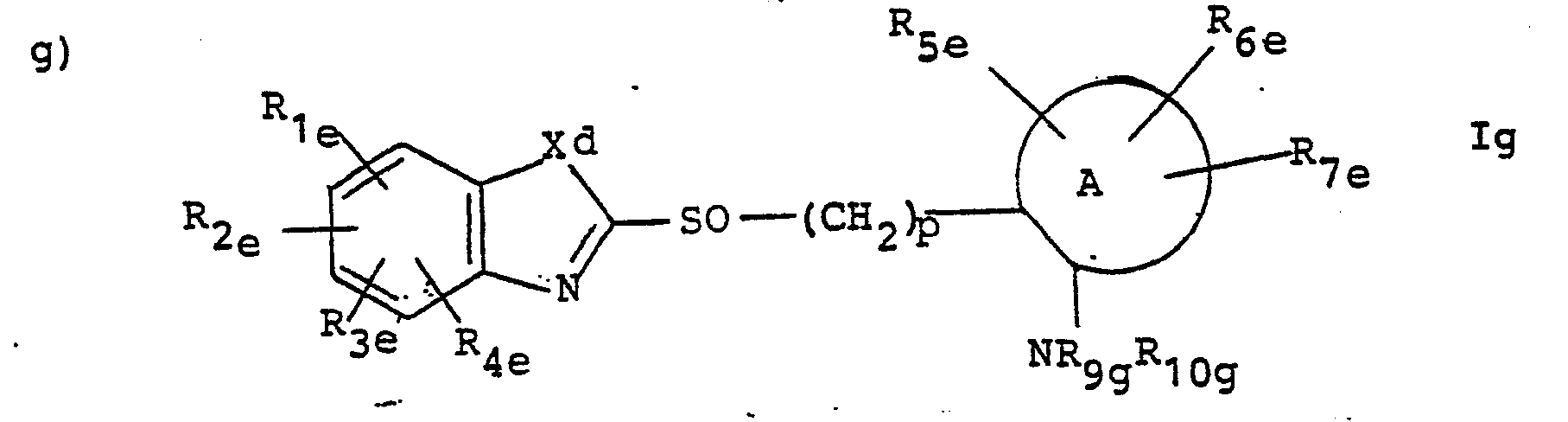
- in which A represents a 5 or 6 membered nitrogen or sulphur containing heterocyclic ring,
- R1e, R2e, R 3e' R4e, R 5e' R 6e' R 7e' Xd and p are as defined above,
- R9g and R10g, which may be the same or different, are each hydrogen, alkyl or cycloalkyl each of which may optionally be substituted by phenyl, the phenyl in turn optionally being substituted by alkyl,
- or one of R9g and R10g may be as defined above and the other may be -OR11 or -NR12R13, or
- R9g and R10g, together with the nitrogen atom to which they are attached, may form a saturated 4 to 8 inclusive membered ring which may contain 0, 1 or 2 further hetero atoms, which ring may carry one or more substituents R1e, and
- R11, R 12 and R13 are as defined above,

- in which R1, R2, R3, R4, X, p and Rx are as defined above save that when an adjacent pair of R1, R2, R3 and R4 and/or an adjacent pair of R5, R6, R7 and R8 together form a chain that chain is

- Certain of the compounds of formula VI are novel and the invention also provides these novel compounds. Of particular interest are compounds of formula VI in which y+z is more than 0 and in particular such compounds in which Rx is a ring of formula III.
- According to our invention we also provide a pharmaceutical composition comprising (preferably a minor proportion of) a compound of formula I, or a pharmaceutically acceptable salt thereof, as active ingredient, in admixture with a pharmaceutically acceptable adjuvant, diluent or carrier. Examples of suitable adjuvants, diluents or carriers are:- for tablets and dragees; lactose, starch, talc or stearic acid; for capsules, tartaric acid or lactose; for suppositories, natural or hardened oils or wax; and for injections (i.m. or i.v.) or enemas water, surfactants and preservatives. The compounds may also be administered transdermally, e.g. in an ointment base. The compound of formula I, or the pharmaceutically acceptable salt thereof, preferably has a mass median diameter of from 0.01 to 10 microns. The compound of such particle size may be made by grinding or milling followed if necessary by particle size classification using, for example, a sieve. The compositions may also contain suitable preserving, stabilising, and wetting agents, solubilizers, sweetening and colouring agents and flavourings. The compositions may, if desired, be formulated in sustained release form.
- The compounds may, if desired, be co-administered, with (e.g. as a mixture with) an antacid buffer.
- We prefer compositions which are designed to be taken by ingestion or rectally and to release their contents in the intestine. We particularly prefer compositions which will pass through the acidic parts of the gastrointestinal tract unaffected, e.g. enteric coated formulations.
- The compounds of formula I are optically active and may be resolved into their optical isomers using conventional techniques known per se. The invention therefore provides the compounds as their optical isomers, or as mixtures, e.g. racemic mixtures, thereof.
- The invention is illustrated, but in no way limited by the following Examples in which temperatures are in degrees centigrade.
- 2-Dimethylaminobenzyl chloride hydrochloride (8.18g) was dissolved in dry. dimethylformamide (100ml), treated with 2-mercaptobenzimidazole (5.4g) and anhydrous potassium carbonate (11.0g) and the resulting mixture stirred.at room temperature overnight. The reaction mixture was poured into water and extracted with ethyl acetate which was washed with water and dried over magnesium sulphate. The solvent was evaporated and the residue recrystallised from toluene to give 5.68g of a cream coloured solid. The product was eluted down a flash chromatography column with dichloromethane/ethyl acetate (9:1) as eluant to give a colourless solid mp 158-160°. Elemental Analysis:
- Found: C, 68.05, H, 6.09, N, 15.1, S, 11.34. C16R17N3S
- Required: C, 67.8, H, 6.01, N, 14.85, S, 11.31%
- 98% m-Chloroperbenzoic acid (0.67g) was added portionwise over a few minutes to a stirred solution of the product of step a) (1.0g) in dichloromethane (30ml) at 0°. The reaction mixture was stirred for 0.5h, washed with aqueous saturated sodium bicarbonate solution then brine and dried. The solvent was evaporated and the residue eluted down a flash chromatography column using dichloromethane/ethyl acetate (7:3) as eluant to give 0.6g of colourless solid mp 120-121 .
- By the method described in Example 1, and using the appropriate starting materials, may be prepared the following compounds:
-
- a) i) 2-(2-Pyridinylmethylthio)benzoxazole mp 46-470.
- ii) 2-(2-Pyridinylmethylsulphinyl)benzoxazole Found: C60.31% H4.02% N10.91% S12.36% C13H10N2O2S requires C60.5% H3.88% N10.9% S12.4%
-
- b) i) 2-(4-Methoxy-3,5-dimethyl-2-pyridinylmethylthio) benzoxazole. mp 127-8°.
- ii) 2-(4-Methoxy-3,5-dimethyl-2-pyridinylmethyl sulphinyl)benzoxazole. mp 103-5°.
-
- c) i) 2-(4-Methoxy-3,5-dimethyl-2-pyridinylmethyl thio)benzothiazole. mp 124-5°.
- ii) 2-(4-Methoxy-3,5-dimethyl-2-pyridinylmethyl sulphinyl)benzothiazole. mp 142-142.5°.
-
- d) i) 5-Chloro-2-(2-pyridinylmethylthio)benzoxazole. mp 84-5°.
- ii) 5-Chloro-2-(2-pyridinylmethylsulphinyl)-benzoxazole. mp 91-3 .
-
- e) i) Methyl 2-(2-pyridinylmethylthio)benzoxazole-5-carboxylate mp 85-7°.
- ii) Methyl 2-(2-pyridinylmethylsulphinyl) benzoxazole-5-carboxylate. mp 87-90°.
-
- f) i) 2-(2-Pyridinylmethylthio)benzothiazole. mp 52-3°.
- ii) 2-(2-Pyridinylmethylsulphinyl)benzothiazole. mp 106-8°.
-
- g) i) N,N-Dimethyl-2-(5,6-dimethyl-1H-2-benzimidazolyl- thiomethyl)benzenamine. mp 144-6°.
- ii) N,N-Dimethyl-2-(5,6-dimethyl-1H-2-benzimidazolyl sulphinylmethyl)benzenamine. mp 141-2°. mp 206-7°.
-
- h) i) 2-(lH-2-Benzimidazolylthiomethyl)-N,N,4-trimethyl -benzenamine. mp 159-161°.
- ii) 2-(lH-2-Benzimidazolylsulphinylmethyl)-N,N,4-trimethyl-benzenamine. mp 133-4°.
-
- i) i) 2-(lH-2-Benzimidazolylthiomethyl)-4-chloro-N,N-dimethyl-benzenamine. mp 148-151°.
- ii) 2-(lH-2-Benzimidazolylsulphinylmethyl)-4-chloro-N ,N-dimethyl-benzenamine. mp 148-151°.
-
- j) i) 2-(5-Chloro-1H-2-benzimidazolylthiomethyl)-N, N-dimethyl-benzenamine. mp 49-52°.
- ii) 2-(5-Chloro-lH-2-benzimidazolylsulphinylmethyl)-N,N-dimethyl-benzenamine. mp 121-123°.
-
- k) i) 2-(5,6-Dichloro-lH-2-benzimidazolylthiomethyl)-N,N-dimethylbenzenamine. mp. 128-130°.
- ii) 2-(5,6-Dichloro-1H-2-benzimidazolylsulphinyl methyl)-N,N-dimethyl-benzenamine. mp. 147-9°.
-
- 1) i) Methyl 2-(2-dimethylaminophenylmethylthio)-lH-benzimidazole-5-carboxylate. mp 127-9°.
- ii) Methyl 2-(2-dimethylaminophenylmethylsulphinyl)-lH-benzimidazole-5-carboxylate. mp 130° (decomp).
-
- m) i) N,N-Dimethyl-2-(5-methyl-lH-2-benzimidazolyl thiomethyl)benzenamine. mp 141-3°.
- ii) N,N-Dimethyl-2-(5-methyl-lH-2-benzimidazolyl sulphinylmethyl)benzenamine. mp 50-2°.
-
- n) i) 2-[2-(l-Piperidyl)-phenylmethylthio]-lH- benzimidazole. mp 171-2°.
- ii) 2-[2-(1-Piperidyl)-phenylmethylsulphinyl]-1H-benzimidazole. mp 160-1°.
-
- o) i) 2-(lH-2-Benzimidazolylthiomethyl)-N,N-diethyl- benzenamine. mp 127-8°.
- ii) 2-(lH-2-Benzimidazolylsulphinylmethyl)-N,N-diethyl-benzenamine. mp 109°.
-
- p) i) 2-[2-(5-Methoxy-1H-benzimidazolyl)thiomethyl]-N,N -dimethyl-benzenamine. MS: M+329.
- ii) 2-[2-(5-Methoxy-lH-benzimidazolyl)sulphinyl methyl]-N,N-dimethyl-benzenamine.
Found: C60.36% H5.81% Nll.89% 59.69% C17H19N3O2S.1/7 CH2Cl2
reqs: C60.30% H5.65% N12.30% S9.38% -
- q) i) 2-(2-Benzothiazolylthiomethyl)-N,N-dimethyl-benzenamine. mp 47-8°.
- ii) 2-(2-Benzothiazolylsulphinylmethyl)-N,N-dimethyl-benzenamine. mp 72-3°.
-
- r) i) 2-(5-Trifluoromethyl-lH-2-benzimidazolylthio methyl)-N,N-dimethyl-benzenamine. mp 50-51°.
- ii) 2-(5-Trifluoromethyl-lH-2-benzimidazolyl sulphinylmethyl)-N,N-dimethyl-benzenamine. mp 50-51°.
-
- s) i) N,N-Dimethyl-2-(5-nitro-lH-2-benzimidazolyl thiomethyl)-benzenamine. mp 146-8°.
- ii) N,N-Dimethyl-2-(5-nitro-lH-2-benzimidazolyl sulphinylmethyl)-benzenamine. mp 105-6° (d).
-
- t) i) [2-(2-N,N-Dimethylaminophenylmethylthio)-lH-5-benzimidazolyl]phenyl methanone. mp 62°.
- ii) [2-(2-N,N-Dimethylaminophepylmethylsulphinyl) -lH-5-benzimidazolyl]phenyl methanone. mp 74°.
-
- u) i) 2-(5,6-Dimethoxy-lH-2-benzimidazolylthiomethyl) -N,N-dimethyl-benzenamine. mp 93-5°.
- ii) 2-(5,6-Dimethoxy-1H-2-benzimidazolylsulphinyl methyl)-N,N-dimethyl-benzenamine. mp 142-144°.
-
- v) i) 5-(lH-2-Benzimidazolylthiomethyl) -N,N,2-trimethyl-4-pyrimidinamine. mp 174.5-176°.
- ii) 5-(lH-2-Benzimidazolylsulphinyl methyl)-N,N,2-trimethyl-4-pyrimidinamine. mp 189-190.5°.
-
- w) i) N,N-Dimethyl-2-(4-trifluoroanethyl-1H-2-benzimidazolylthiomethyl)-benzenamine. mp 93-5°.
- ii) N,N-Dimethyl-2-(4-trifluoromethyl-lH-2-benzimidazolylsulphinylmethyl)-benzenamine. mp 129-130°.
-
- x) i) N-[2-(lH-2-Benzimidazolylthio)ethyl]-N-methyl- benzenamine. mp 115-7°.
- ii) N-[2-(lH-2-Benzimidazolylsulphinyl)ethyl]-N- methyl-benzenamine. mp 148-149.5°.
-
- y) i) N,N-Dimethyl-2-(1H-2-naphtho[2,3-d]imidezolyl thiomethyl)-benzenamine.. mp 178°(d).
- ii) N,N-Dimethyl-2-(1H-2-naphtho[2,3-d]imidazolyl sulphinylmethyl)-benzenamine. mp 129°(d).
- z) 2-(2-(1H-Benzimidazolyl)sulphinyl)benzeneamine mp 202-203° shrinks at 160°.
- Methyl 2-methoxy-3-propylbenzoate ( 1.9g) was dissolved in methanol (300ml). Sodium hydroxide (16.6g) in water (100ml) was added and the mixture was heated at reflux for three hours. The solvent was evaporated and the mixture acidified with dilute hydrochloric acid. The product was extracted with ethyl acetate (800ml), washed with water, dried over magnesium sulphate and the solvent evaporated. Extraction of the resulting brown oil with hot pentane yielded 25.9g of the sub-title compound as a yellow solid. mp 55-58°.
- 2-Methoxy-3-propylbenzoic acid (25.3g) in dry dichloromethane (400ml) was heated at reflux temperature with thionyl chloride (17ml) for three hours and then stirred at room temperature for 14 hours. The solvent was evaporated and the product distilled using a Kugelruhr apparatus (air bath temperature 135°; 0.35mmHg) to yield 24.lg of a pale yellow oil. This oil was dissolved in dry dichloromethane (200ml) and added gradually to a stirred solution of 2-amino-2-methyl propanol (20.2g) in dichloromethane (200ml) at 0° under N2. The reaction mixture was stirred at room temperature for 18 hours. The product was extracted with chloroform (300ml) and washed with dilute hydrochloric acid (150ml), sodium bicarbonate solution (150ml) and brine (100ml) and then. dried over magnesium sulphate. After evaporation of the solvent the sub-title compound was crystallised from cyclohexane as a white solid (20.4g). mp 95-96.5°.
- The product from step b) (20.4g) was stirred in dry dichloromethane (200ml) and cooled to 0°. Thionyl chloride (17ml) was added and the reaction mixture stirred at room temperature for two hours. The solvent and thionyl chloride were evaporated and the residue was treated with ether. Water was added to the solid and the mixture was basified with dilute sodium hydroxide solution. The product was extracted with ether (500ml), washed with brine (150ml) and dried over magnesium sulphate. The solvent was then evaporated and the product purified by flash chromatography, using 10% ethyl acetate/90% petroleum ether as eluant, and by distillation using a Kugelruhr apparatus (air bath temperature 135°; 0.7mmHg) to, yield the sub-title compound (17g) as a colourless oil.
- Dimethylamine (9ml) was added to dry tetrahydrofuran (120ml) and the mixture cooled to -15° and stirred under N2 during the addition of n-butyl lithium solution (81ml of 1.6M in hexane). The reaction mixture was stirred at -16° for 40 minutes. The product from step c) (16g) in dry tetrahydrofuran (100ml) was added and the mixture allowed to warm to room temperature and then stirred for 20 hours. The reaction mixture was quenched with water and the product extracted with ethyl acetate (500ml), washed with brine (100ml) and dried over magnesium sulphate. The solvent was evaporated and the product distilled using a Kugelruhr apparatus (air bath temperature 135°; 0.25mmHg) to yield 16.4g of the sub-title compound as a pale yellow oil.
- The product from step d) (17.3g) was heated at reflux in 2M dilute hydrochloric acid (480ml) for 20 hours. The solvent was evaporated and the residue dried over phosphorous pentoxide. This product was then dissolved in dry tetrahydrofuran (500ml), cooled in ice and stirred under N2 during the addition of borane-tetrahydrofuran (300ml of 1M in tetrahydrofuran). The reaction mixtur. was stirred at room temperature for 68 hours and was thenquenched with methanol. The solvent was evaporated afterthe product was extracted with ethyl acetate, washed with sodium bicarbonate solution (150ml) and with brineand dried over magnesium sulphate. The solvent was evaporated and the product distilled using a Kugelrut apparatus (air bath temperature 156°; l.OmmHg) to yield. the sub-title compound (13.2g) as a pale yellow oil.

- The product from step e) (13.1g) was cooled to in dry dichloromethane (50ml) and stirred during the addition of thionyl chloride (6ml). The mixture was heated at reflux for 1.5 hours. The solvent was evaporated and ethereal HC1 added. The product was collected and then triturated with dry ether to yieldof the sub-title compound as a cream solid.

- Mass spectrum:- m/e 211/213.
- The product of step f) was converted to thetitle compound (mp 147-150°) by the method of Example 1 .

- The product of step g) was converted to the title compound (mp 145-147.5°) by the method of Example lb.
- By the method described in Example 3, and using the appropriate starting materials, may be prepared the following compounds:
-
- a) i) 2-(1H-2-Benzimidazolyl)-4-methoxy -N,N-dimethyl-benzenamine. mp 144-145°.
- ii) 2-(1H-2-Benzimidazolylsulphinylmethyl)-4-methoxy -N,N-dimethyl-benzenamine. mp 130-131°.
-
- b) i) 2- (lH-2-Benzimidazolylthiomethyl) N-ethyl-N-propyl-benzenamine. mp 121°.
- ii) 2-(lH-2-Benzimidazolylsulphinylmethyl)-N-ethyl-N-propyl-benzenamine. mp 114°.
-
- c) i) 2-[2-(4-Morpholinyl)phenylmethylthio]-lH- benzimidazole. mp 170°.
- ii) 2-[2-(4-Morpholinyl)phenylmethylsulphinyl]-lH- benzimidazoie. mp 74-76°.
- 6-Methylquinoline (5.16g; 36mmole) and pyridine/borane complex (13.2ml; 144mmole) in acetic acid (75ml) were stirred at room temperature for 18 hours. The product mixture was treated with dilute aqueous HCl (30ml) with stirring and then basified (40% NaOH, then NaHC03 to pH 8) and extracted with ethyl acetate (3x). The combined organics were washed with water (3x), dried (Na2SO4) and evaporated to yield a brown oil which was flash-chromatographed. Petroleum ether (bp 40-60°)/ ether (3/1) yielded the sub-title compound as a low melting solid (4.7g 67%). m/e 147 (base peak).
- 6-Methyltetrahydroquinoline (3.8g; 25.8mmole) in dry methylene chloride (75ml) was treated with trimethyloxonium fluoroborate (5.2g; 3.5mmole) and stirred at room temperature for 20 hours. The mixture was poured into saturated aqueous sodium hydrogen carbonate and the organic layer run off. The aqueous layer was extracted with CHC13 (2x). The combined organics:were washed with water (2x), dried (Na2SO4) and evaporated to give a yellow oil which was flash-chromatographed. Petroleum ether (bp 40-600)/ether (5/1) eluted the sub-titled compound as a pale yellow oil.
- m/z 161 (MW= base peak), 160, 146, 145, 144, 131, 117, 91, 77.
- Phosphorylchloride (1.17ml; 1.982g; 12.5mmole) was added dropwise to a solution of the product of step b) (2.1g; 10.3mmole) in dry dimethylformamide (7ml) under N2 in an ice-bath with stirring. The reaction mixture was heated to 120° (momentarily) and then held at 800 for 2 hours. The mixture was cooled, poured into dilute aqueous NaHCO3 and extracted with ethyl acetate (3x). The combined organics were washed with water (3x), dried (NaSO4) and evaporated to yield the sub-title compound as a yellow oil 960mg (49%).
- m/z 189 (m.w. = base peak), 172, 160, 144, 132, 117, 105, 91. 1HNMR (CDCl3) aldehyde at10.06

- Sodium borohydride (300mg; 7.94mmole) was added portionwise to the product of step c) (1.5g; 7.94mmole) in ethanol with stirring at room temperature over 10 minutes. The mixture was stirred for a further 20 minutes, poured into water, and extracted with ethyl acetate (3x). The combined organics were washed with water (2x), dried (Na2S04) and evaporated to give the sub-title compound as a viscous pale yellow oil 1.41g (93%).
- m/z (mono TMS derivative) 263 (MW), 248 (base peak), 172, 73.
- The product of step d) (1.4g; 7.33mole) in dry benzene (10ml) was treated portionwise with thionyl chloride (0.8ml; 1.31g; llmmole) in a cold water-bath with stirring. The mixture was allowed to warm to room temperature (2 hours) and then heated at 50° (1 hour). It was then cooled again and treated with ethereal HC1 (2ml) and evaporated to dryness. The resulting brown solid was triturated with ether and filtered off to yield the sub-title compound as a light brown solid 1.73g (96%).
- m/z 209/11 (M.W.), 174 (base peak), 158, 145, 131, 119, 91.
- The product of step e) was converted to the sub-title compound (mp 85-88°d) by the method of Example la).
- The product of step f) was converted to the title compound (mp 112-3°) by the method of Example lb) .
- By the method described in Example 5, and using the appropriate starting materials, may be prepared the following compounds:
-
- a) i) 2-(lH-2-Benzimidazolylthiomethyl)-N,N,3,4,5-pentamethyl-benzenamine. mp 161.5-162.5°.
- ii) 2-(lH-2-Benzimidazolylsulphinylmethyl)-N,N,3,4, 5-pentamethyl-benzenamine. mp 122-3°.
-
- b) i) 2-(lH-2-Benzimidazolylthiomethyl)-4-methoxy-N,N,3,5-tetramethyl-benzenamine. mp 157-158°.
- ii) 2-(lH-2-Benzimidazolylsulphinylmethyl)-4-methoxy-N,N,3,5-tetramethyl-benzenamine. mp 138-9°.
-
- c) i) 2-(lH-2-Benzimidazolylthiomethyl)-N,N-dimethyl-4-(1,1-dimethyrethyl)-benzenamine. mp 166-7°.
- ii) 2-(lH-2-Benzimidazolylsulphinylmethyl)-N,N-dimeth yl-4-(l,l-dimethylethyl)-benzenamine. mp 130°.
- A Grignard reagent was prepared from 2-bromo-N,N-dimethylaniline (l0.0g) and magnesium (1.4g) in dry ether (60mls) with iodine (1 crystal). The reagent was cooled to 0° and stirred under a nitrogen atmosphere. A solution of acetaldehyde (3.34mls) in dry ether (20 mls) was added dropwise over 30 mins. After stirring at 0° for 1 hour the mixture was allowed to warm to room temperature. After a further 2 hours an aqueous solution of ammonium acetate was added. After 10 mins the layers were allowed to separate. The aqueous layer was extracted with ether and the combined ether extracts were washed with water and brine and then dried and evaporated to leave a dark yellow oil 7.5g. Flash chromatography'(1:1 ether/petroleum ether) produced the required product as a clear yellow oil 3.7g.
- NMR (CDCl3)7.2m(4H) 6.8broad (lH) 5.12q(1H) 2.73S(6H) 1.55d(3H)

- A solution of 2-(2=dimethylaminophenyl)-ethanol (3.6g) in dry benzene (50mls) was cooled in an ice bath and thionyl chloride (1.75mls) was added dropwise. After stirring for 1 hour the mixture was warmed to room temperature and stirring continued for 2 hours. The mixture was concentrated in vacuo and azeotroped with benzene. The residue was taken up in dry dimethylformamide (50mls) and stirred. To this solution was added a solution of 2-mercaptobenzimidazole (3.22g) in dry dimethylformamide (30mls), followed by potassium carbonate (7.5g). The mixture was stirred at room temperature for 18 hours and then poured onto water containing brine, and extracted with ethyl acetate. The combined extracts were washed with water and brine and then dried and evaporated to leave a pale brown solid 6.1g. Flash chromatography produced the product as a buff solid 3.4g. -
- NMR (CDC13)7.0-7.7m(8H) 5.22q(lH) 2.95S(6H) 1.80d(3H)

- A solution of the product of step b) (3g) in ethyl acetate (350mls) was cooled to -20° and a solution of metachloroperbenzoic acid (1.83) in ethylacetate (50mls) was added. After stirring for 1 hour the mixture was concentrated in vacuo. The resulting gum was dissolved in a minimum of dichloromethane and placed on a flash chromatography column. Elution with 1:1 ether/petroleum ether produced recovered starting material 1.5g plus both diastereomers of the title compound: Least polar diastereomer 437mg. mp 119-120°. Most polar diastereomer 298mg. mp 103-105°.
- To a stirred ice cooled solution of thiosalicylic acid (3.08g) in dry tetrahydrofuran (20ml) under nitrogen was added a solution of borane tetrahydrofuran complex (40mls of IM in tetrahydrofuran) dropwise over 1 hour. The mixture was stirred at 0° for 1 hour. Methanolic hydrogen chloride was added dropwise until effervescence ceased. The mixture was poured onto water and extracted with ethyl acetate. The ethyl acetate was washed with dilute hydrochloric acid, water and brine and then dried and evaporated to leave the sub-title compound as a yellow oil (2.9g).
- NMR (CDC13)7.1-7.5m (4H) 4.75s(2H) 3.69bs(lH) 2.05bs(lH)

- A solution of 2-hydroxymethylthiophenol (19g) was mechanically stirred with basic alumina (100mls) in ethanol (400mls) whilst oxygen was bubbled through for 48 hours. The alumina was removed by filtration and washed with hot ethanol. The ethanol was filtered and evaporated. The residue was crystallised from ethanol to give the sub-title compound as white prisms 9.33g, mp , 136-8°.
- 2,2'-Dithiobisbenzenemethanol (500mg) was cooled in a water bath and thionyl chloride (350 ul) added dropwise. The mixture was agitated occasionally over 45 minutes. The excess thionyl chloride was removed in vacuo and azeotroped with benzene to afford the sub-title compound as a clear yellow gum 570mg NMR (CDCl3)7.2-7.9m (8H) 4.72s (4H).

- A solution of 2-mercaptobenzimidazole (510mg) in dry dimethylformamide (5mls) was added to a mixture of potassium carbonate (547mg) and 2,2'-dithiobisphenyl methyl chloride (570mg) in dry dimethylformamide (3mls). The mixture was stirred at room temperature for 3 days, poured onto water and the precipitate collected. The solid was washed with water then taken up in dichloromethane. The solution was dried and concentrated in vacuo. Flash column chromatography afforded the sub-title compound as a white solid 260mg NMR (CDC13)7.1-7.6m (16H) 4.60s (4H).

- An ice cooled suspension of 2-(2,2'-dithiobisphenyl- methylthio)-lH-benzimidazole (11.5g) in ethanol (200mls) was stirred whilst sodium borohydride (806mg) was added portionwise over 30 minutes. The mixture was stirred for a further 60 minutes whilst warming to room temperature. The mixture was stirred at room temperature for 2 hours, acidified with ethanolic hydrogen chloride and stirred for 10 minutes. The mixture was then poured onto sodium bicarbonate solution and extracted with ethyl acetate.
- The extracts were washed with water and brine and then dried and concentrated in vacuo. The residue was taken up in dry dimethylformamide (80mls) and sodium bicarbonate (7.5g) added. The mixture was cooled to 0° and acetic anhydride (6.0mls) added slowly. The mixture was allowed to reach room temperature and was left for 18 hours. It was poured onto water and extracted with ethyl acetate. The ethyl acetate was washed with water and brine and then dried and evaporated. Flash chromatography produced crude product 3.1g. Crystallisation from ethyl acetate produced colourless prisms (1.5g) of the'sub-title compound, mp 134-8°.
- The product of step e) was converted to the title compound (mp 65-80) by the method of Example lb) .
- 2- (2,2'-Dithiobisphenylmethylthio)-1H-benzimidazole (lg) was dissolved in ethanol (20mls) and stirred at 0° under N2. Sodium borohydride (70mg) was added and the mixture stirred for 2 hours. The solution was acidified with ethanolic HC1, stirred for 5 minutes, poured onto sodium bicarbonate solution and extracted with ethyl acetate. The ethyl acetate was washed with sodium bicarbonate solution, water and brine and then dried and evaporated. The resulting oil was dissolved in dry dimethylformamide and sodium bicarbonate (1.86g) added. The mixture was stirred under N2 and cooled to 0°. Acetic anhydride (.1.75mls) was added dropwise and the solution stirred at 0° for 1 hour. The mixture was poured onto water and extracted with ethyl acetate. The ethyl acetate was washed with water and brine and then dried and evaporated. Flash chromatography produced the sub-title compound as a colourless solid 370mg. NMR (CDC13)7.7m (3H) 7.25-7.5m (5H) 4.66s (2H) 2.78s (3H) 2.45s (3H).

- The product of step a) was converted to the title compound (mp 99-102°) by the method of Example lb).
- 2-(2-(N, N-Dimethylamino)ethylthio]-3H-benzimidazole (1.7g; 7.7mmole)-, vanadyl (III) acetyl acetonate (200mg) and t-butylhydroperoxide (1.5g of 70% aqueous solution; 1.05g; 11.6mmole) in dry methylene chloride were stirred together under N2 in an ice/water bath for 3 hours. Further aliquots of vanadyl acetyl acetonate (200mg) were added after 40 minutes and two hours. The mixture was evaporated to dryness (rptary evaporator at room temperature) and immediately flash-chromatographed using chloroform/methanol (5/1) as eluant.
- The title compound was obtained as a pale yellow oil (700mg; 38%).
- 'HNMR (CDCl3, 360MH2)7.7 (m,2H); 7.34(m,2H); 3.52 (m, 1H); 3.35 (m,lH); 2.97 (m,lH); 2.81 (m,1H); 2.35 (2,6H).

- Ethyl 2-chloro-3-pyridine carboxylate (14.9g) in dry tetrahydrofuran (100ml) was treated with dimethylamine (15ml) at 0° with stirring. The reaction mixture was then stirred at room temperature for 20 hours. The solvent was evaporated and the product was extracted with ethyl acetate (400ml), washed with aqueous sodium bicarbonate solution (100ml) and with brine (100ml) and dried over magnesium sulphate. The solvent'was evaporated and the product distilled using a Kugelruhr apparatus (air bath temperature 137°; l.lmmHg) to yield 15.4g of the sub-title compound as a pale yellow oil.
- Lithium aluminium hydride solution (44.2ml of 1M in ether) was added gradually to a solution of the product of step a) (7.8g) in dry tetrahydrofuran (150ml) .at 0° with stirring under N2. The mixture was heated at reflux for 1.5 hours and then quenched with.ice water. The product was extracted with ethyl acetate (500ml), washed with brine (2x100ml), dried over magnesium sulphate and the solvent evaporated. The product was distilled using a Kugelruhr apparatus (air bath temperature 105°; 0.4mmHg) to yield 5.65g.of the sub-title compound as a pale yellow oil.
- Thionyl chloride (3.25ml) was added dropwise to a stirred solution of the product of step b) (5.65g) in dry dichloromethane (100ml) at 0° under N2 of nitrogen. The reaction mixture was allowed to warm to room temperature and then heated at reflux for 1.5 hours. The solvent was evaporated and the product was azeotroped with toluene and triturated with ether. The residue, a white solid, was the sub-title compound (7.16g). mp 190-192°.
- The product of step c) was converted to the sub-title compound (mp 106-9°) by the method of Example la).
- The product of step d) was converted to the subtitle compound (mp 124-6°) by the method of Example lb).
- To a stirred ice cold suspension of 2-hydroxy benzyl alcohol (24.8g) in dry benzene (60mls) was added thionyl chloride (l6mls) dropwise over 20 minutes. The solution was allowed to warm to room temperature where it was kept for 1 hour. The mixture was concentrated in vacuo to afford crude 2-chloromethylphenol.
- To a stirred solution of 2-mercaptobenzimidazole (16g) in dry dimethylformamide (200mls) under nitrogen was added potassium carbonate (35g) and the mixture stirred for 20 minutes. The crude 2-chloromethylphenol was dissolved in dry dimethylformamide (80mls) and added to the above mixture. The resulting mixture was stirred at room temperature for 20 hours, poured onto water containing brine and extracted with ethyl acetate. The combined ethyl acetate extracts were washed with water and brine and then dried and evaporated. Flash chromatography produced a white solid 4.5g. Crystallisation from ethyl acetate gave the sub-title compound as colourless prisms 1.5g. NMR (CDCl3)7.46bs (2H) 7.2m (5H) 6.99d (lH) 6.89t (lH) 4.47s (2H).

- To an ice cooled solution of (2-hydroxyphenyl)-methylthio-lH-benzimidazole (100mg) in chloroform (30mls) was added an ice cold solution of m-chloroperbenzoic acid (72mg) in dichloromethane (lOmls). The mixture was stirred at 00 for 1 hour and then allowed to warm to room temperature. After 3 hours the mixture-was diluted with chloroform, washed with sodium bicarbonate solution, sodium metabisulphite solution and water and then concentrated in vacuo to leave the title compound as a colourless solid 75mg. NMR DMSO7.8m (2H) 7.5m (4H) 6.9m (2H) 4.53 dod (2H).
- An aqueous solution of 2-chloromethylpyridine hydrochloride (1.64g) was basified with sodium bicarbonate and extracted with chloroform (2xl5mls). The chloroform was washed with water and brine and then dried and filtered. The solution was stirred under nitrogen and m-chloroperbenzoic acid (1.81g) added portionwise over a period of 20 minutes. After stirring at room temperature for 18 hours the mixture was poured onto saturated sodium bicarbonate solution, extracted with chloroform and the combined chloroform extracts were concentrated in vacuo to afford the sub-title compound as a yellow oil which solidified on standing, 1.31g. NMR (CDCl3)8.3m (1H) 7.7m (1H) 7.3m (2H) 4.86s (2H).

- The product of step a) was converted to the sub-title compound (mp 148-151°) by the method of Example la).
- The product of step b) was converted to the title compound (mp 183-4°(d)) by the method of Example lb).
- A solution of 2-(lH-2-benzimidazolylsulphinylmethyl)-N,N-dimethylbenzeamine (1.5g 5mM) and chloromethylpivalate (lml 6.9mM) in dry dimethylformamide (20ml) containing anhydrous potassium carbonate (1.4g 10,OmM) was stirred at 25° for 16 hours. The mixture was quenched with water (50ml) and extracted with ethyl acetate (3x100ml). The organic phase was washed with brine (2x25ml), dried over magnesium sulphate, filtered and evaporated to leave a yellow oil which was purified by flash chromatography eluting with dichloromethane/ethyl acetate (5:1). The required fractions were evaporated to leave a yellow oil which solidified on standing. The solid was triturated with pentane, filtered and dried under vacuum (1.2g); mp 70-71°.
- Similarly prepared were:-
- 1. Ethyl 2-(2-dimethylaminophenylmethylsulphinyl)-1H-1-benzimidazole carboxylate hemihydrate. mp 75-77°.
- 2. 2-[l-Methyl-(lH-2-benzimidazolylsulphinylmethyl)]-N,N-dimethylbenzeneamine. ms: m/e 313.
- 4-Toluenesulphonylbenzene-1,2-diamirie (2.6g) was dissolved in dimethylformamide (50ml) and treated at 60° with carbon disulphide (6ml) under nitrogen for 18 hours. The cooled solution was poured into ice-water to afford a yellow precipitate of the subtitle compound. mp 200°.
- The product of step a) was converted to the sub-title compound (mp 81°) by the method of Example la).
- The product of step b) was converted to the title compound (mp 85°) by the method of Example lb).
- By a similar method to that of Example 15 the following compounds were prepared:
-
- a) i) 2-(4,7-Dimetboxy-lH-2-benzimidazolylthiomethyl)-N,N-dimethyl-benzenamine. mp 142-144°.
- ii) 2-(4,7-Dimethoxy-lH-2-benzimidazolylsulphinyl methyl)-N.,N-damethyl-benzenamine, mp 61°.
- a solution of (2-([(2,4,6-trimethylphenyl)sulphonyl] amine)benzoic acid (5.0g) in dry tetrahydrofuran (80ml) was stirred in an ice bath under nitrogen and treated with diborane-tetrahydrofuran complex (17.3ml, of a 1 molar solution). The reaction mixture was stirred for 3 hours at room temperature cooled to 0° and more diboran-tetrahydrofuran complex (17.3ml, 1 molar solution) added and stirring continued at room temperature overnight. The reaction was again cooled to 0°, more diboran-tetrahydrofuran complex (17.3ml, 1 molar solution) added and stirring continued at room temperature for 3 hours. Dilute hydrochloric acid was added continuously and the mixture diluted with water and extracted with ethyl acetate which was washed with water and dried over magnesium sulphate.. The solvent was evaporated to give 4.0g of the required product as an oil. The structure was confirmed by nmr and ms.
- The product of step a) (4.0g) in dry dichloroethane (80ml) was treated with thionyl chloride (1.15ml) at room temperature with stirring. The reaction mixture was stirred for 5 hours, more thionyl chloride,(O.lml) was added and stirring continued overnight. The reaction mixture was then poured into water, and the organic layer separated. The aqueous layer was washed with dichloromethane and the organic solutions combined, dried over magnesium sulphate and the solvent evaporated to give 4.06g of the sub-title compound as a pale yellow oil.
- The product of step b) (4.06g) and l,3-dihydro-2H-benzimidazole-2-thione (1.9g) were stirred with anhydrous potassium carbonate (2.1g) in dry dimethylformamide (70ml) for 3 hours. The reaction mixture was poured into water and the precipitated product collected by filtration, washed well with water and dried to give 4.39g of the required product as a buff coloured powder. mp 202-203°.
- The product of step c) (3.87g) and anisole (4.83ml) were treated at room temperature with methanesulphonic acid (29ml) with stirring. The deep red reaction mixture was stirred for 27 hours, poured slowly into an excess of aqueous sodium bicarbonate solution and extracted with ethyl acetate, which was then washed with brine and dried. The solvent was evaporated and the residue eluted down a flash chromatography column using dichloromethane/ethyl acetate (4:1) as eluant to give 1.43g of the required product as a light brown solid, mp 270° (melts at 139° and resolidifies).
- The product of step d) was oxidised in the same manner as in Example lb, to give, after recrystallisation from ethanol, the title compound as a fluffy colourless solid. mp 177°(d).
- N,N-Dimethyl-2-(5-nitro-lH-2-benzimidazolylsulphinylmet hyl)benzenamine (2.2g) was hydrogenated in ethanol (150) containing Pt02(0.4g) under 1 atmosphere pressure for 24 hours. The catalyst was removed, and solvent evaporated in vacuo. The residue was chromatographed (Si02/1:10 methanol-ethyl acetate) to afford the title compound. mp 156-7°(d).
- o-Fluorobenzaldehyde (8.68g) and N-methylcyclohexylamine (11.9g) were heated under reflux in dimethyl formamide (70ml) containing potassium carbonate (14.49g) with stirring for 5.5 hours. The cooled reaction mixture was poured into dilute HC1 and extracted into CHCl3. The aqueous layer was separated and basified with potassium carbonate and extracted into CHCl3, which was then washed with water, dried and evaporated, to afford the sub-title compound (11.8g). MS:M+217 BP 174.
- The product of step a) was reduced by the method of Example 5d) to afford the sub-title compound. MS M+219 BP 148.
- The product of step b) was converted to the sub-title compound by the method of Example 5. mp 165-166°.
- The product of step c) was converted to the title compound by the method of Example 1b), mp 132-133°. 1000J (ir)/jaa
provided that i) Rc is not -CH2CH2-morpholino, ii) that when Rc is a nitrogen nucleophile carried on an aryl or heteroaryl group R15 is not a group -COR in which R is unsubstituted alkyl, iii) when X is NR15 Rc does not comprise an unsaturated nitrogen heterocyclic ring other than such a ring substituted by either a) a substituted or unsubstituted amino group, or b) an N-oxido group, and iv) when X is NR15 Rc does not comprise an alkyl group substituted by an optionally alkyl or halo substituted piperidino group,
and pharmaceutically acceptable salts thereof.
and where desired or necessary converting the resulting compound of formula I to a pharmaceutically acceptable salt thereof, or vice versa.
Claims (20)
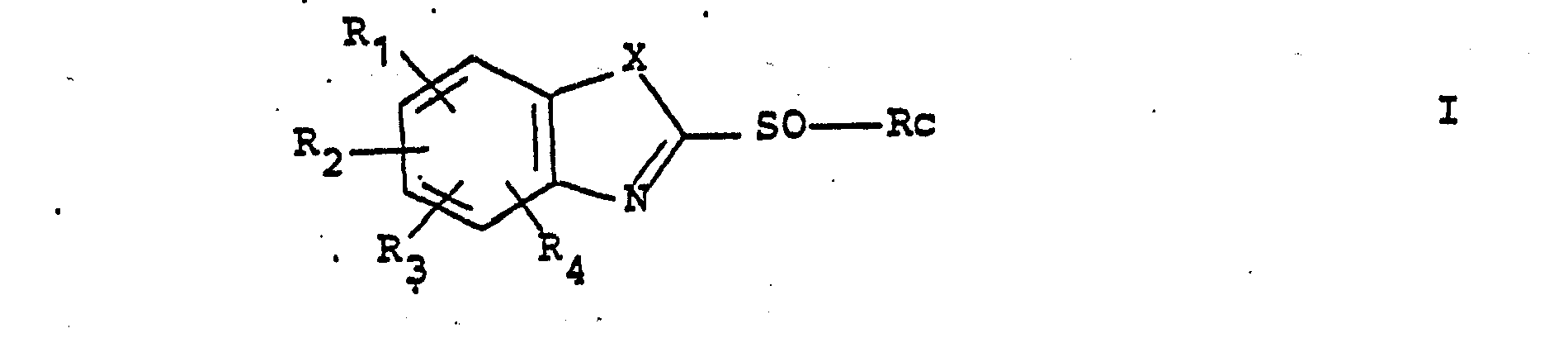

and where desired or necessary converting the resulting compound of formula I to a pharmaceutically acceptable salt thereof, or vice versa.


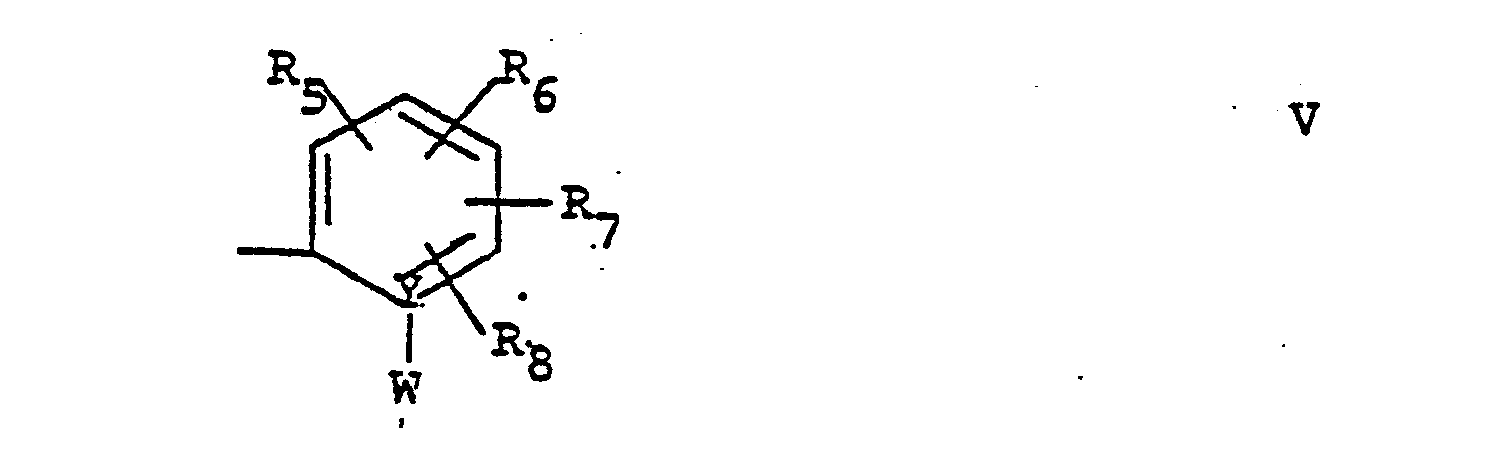
or a pharmaceutically acceptable salt thereof.

and pharmaceutically acceptable salts thereof.


or a pharmaceutically acceptable salt of any one thereof.

and where desired or necessary converting the resulting compound of formula I to a pharmaceutically acceptable salt thereof, or vice versa.
Priority Applications (3)
| Application Number | Priority Date | Filing Date | Title |
|---|---|---|---|
| AT85304626T ATE71942T1 (en) | 1984-07-06 | 1985-06-28 | BENZIMIDAZOLE, AND PROCESS FOR THEIR MANUFACTURE, FORMULATION AND USE AS ANTI-GASTROGENIC ACID SECRETION COMPOUNDS. |
| IT21449/85A IT1201428B (en) | 1984-07-06 | 1985-07-05 | New heterocyclic sulphinyl and thioether cpds. |
| MYPI87001738A MY102895A (en) | 1984-07-06 | 1987-09-18 | Benzimidazoles, benzoxazoles, benzothiazoles and their production, formulation and use gastric acid secretion inhibitors. |
Applications Claiming Priority (18)
| Application Number | Priority Date | Filing Date | Title |
|---|---|---|---|
| GB848417272A GB8417272D0 (en) | 1984-07-06 | 1984-07-06 | Biologically active nitrogen heterocycles |
| GB8417271 | 1984-07-06 | ||
| GB848417271A GB8417271D0 (en) | 1984-07-06 | 1984-07-06 | Biologically active nitrogen heterocycles |
| GB8417272 | 1984-07-06 | ||
| GB848419738A GB8419738D0 (en) | 1984-08-02 | 1984-08-02 | Nitrogen heterocycles |
| GB8419738 | 1984-08-02 | ||
| GB8424346 | 1984-09-26 | ||
| GB8424347 | 1984-09-26 | ||
| GB8424351 | 1984-09-26 | ||
| GB848424350A GB8424350D0 (en) | 1984-09-26 | 1984-09-26 | Nitrogen heterocycles |
| GB8424350 | 1984-09-26 | ||
| GB848424346A GB8424346D0 (en) | 1984-09-26 | 1984-09-26 | Nitrogen heterocycles |
| GB848424347A GB8424347D0 (en) | 1984-09-26 | 1984-09-26 | Nitrogen heterocycles |
| GB848424351A GB8424351D0 (en) | 1984-09-26 | 1984-09-26 | Nitrogen heterocycles |
| GB8430163 | 1984-11-29 | ||
| GB848430163A GB8430163D0 (en) | 1984-11-29 | 1984-11-29 | Biologically active nitrogen heterocycles |
| GB858509406A GB8509406D0 (en) | 1985-04-12 | 1985-04-12 | Nitrogen heterocycles |
| GB8509406 | 1985-04-12 |
Publications (2)
| Publication Number | Publication Date |
|---|---|
| EP0174717A1 true EP0174717A1 (en) | 1986-03-19 |
| EP0174717B1 EP0174717B1 (en) | 1992-01-22 |
Family
ID=27576300
Family Applications (1)
| Application Number | Title | Priority Date | Filing Date |
|---|---|---|---|
| EP85304626A Expired - Lifetime EP0174717B1 (en) | 1984-07-06 | 1985-06-28 | Benzimidazoles, and their production formulation and use as gastric acid secretion inhibitors |
Country Status (15)
| Country | Link |
|---|---|
| EP (1) | EP0174717B1 (en) |
| AU (1) | AU580607B2 (en) |
| CA (1) | CA1341314C (en) |
| CH (1) | CH666265A5 (en) |
| DE (1) | DE3585252D1 (en) |
| DK (1) | DK174021B1 (en) |
| FI (1) | FI89046C (en) |
| FR (1) | FR2567123B1 (en) |
| GR (1) | GR851618B (en) |
| HK (1) | HK60194A (en) |
| IL (1) | IL75687A (en) |
| LU (1) | LU85989A1 (en) |
| NO (1) | NO168355C (en) |
| NZ (1) | NZ212664A (en) |
| PT (1) | PT80783B (en) |
Cited By (17)
| Publication number | Priority date | Publication date | Assignee | Title |
|---|---|---|---|---|
| FR2569691A1 (en) * | 1984-08-31 | 1986-03-07 | Nippon Chemiphar Co | BENZIMIDAZOLE DERIVATIVES, PROCESS FOR THEIR PREPARATION AND ANTI-ULCEROUS AGENTS CONTAINING SAME |
| EP0198583A1 (en) * | 1985-03-05 | 1986-10-22 | Smith Kline & French Laboratories Limited | Heterocyclic compounds |
| EP0213474A2 (en) | 1985-08-24 | 1987-03-11 | Hoechst Aktiengesellschaft | Substituted toluidines, process for their preparation, pharmaceutical compositions containing them and their use as gastric secretion inhibitors |
| WO1987001114A3 (en) * | 1985-08-21 | 1987-04-23 | Byk Gulden Lomberg Chem Fab | New amines, process for their manufacture, their use and medicines containing them |
| EP0239129A2 (en) | 1986-03-28 | 1987-09-30 | Otsuka Pharmaceutical Co., Ltd. | Hydroquinoline compounds, compositions containing same and processes for preparing same |
| EP0251536A1 (en) * | 1986-06-24 | 1988-01-07 | FISONS plc | Benzimidazoles, their production, formulation and use as gastric acid secretion inhibitors |
| EP0287971A3 (en) * | 1987-04-20 | 1989-03-22 | Kyorin Pharmaceutical Co., Ltd. | Benzimidazole derivatives and process for their preparations |
| EP0334818A1 (en) * | 1988-03-25 | 1989-09-27 | DOMPE' FARMACEUTICI S.p.A. | Pharmacologically active alkylthiobenz imidazole derivatives and process for the preparation thereof |
| EP0184322B1 (en) * | 1984-11-02 | 1989-12-20 | Smith Kline & French Laboratories Limited | Benzimidazoles |
| EP0370436A3 (en) * | 1988-11-22 | 1990-10-31 | Meiji Seika Kaisha Ltd. | Novel benzothiazole and benzimidazole derivatives and antiulcer agent containing the same |
| US4996217A (en) * | 1986-12-02 | 1991-02-26 | Tanabe Seiyaku Company, Ltd. | Pyridyl-substituted imidazoles, compositions containing same and methods of use thereof |
| EP0452076A1 (en) * | 1990-04-09 | 1991-10-16 | Meiji Seika Kabushiki Kaisha | Thiazole and imidazole derivatives and antiulcer composition containing same |
| EP0266326B1 (en) * | 1986-10-27 | 1993-03-10 | Aktiebolaget Hässle | Novel derivatives of benzimidazoles active as anti-ulcer agents |
| EP0248634B1 (en) * | 1986-06-02 | 1993-07-21 | Nippon Chemiphar Co., Ltd. | Stabilized benzimidazole derivative and composition |
| US5294629A (en) * | 1988-11-22 | 1994-03-15 | Meiji Seika Kaisha, Ltd. | Benzothiazole and benzimidazole derivatives and antiulcer agent containing the same |
| EP2022789A1 (en) * | 2007-08-06 | 2009-02-11 | Farmaprojects, S.A. | Process for the preparation of a gastric acid secretion inhibitor |
| WO2019023815A1 (en) * | 2017-08-03 | 2019-02-07 | Servicios Científicos Neuroinnovation Limitada | New compounds derived from pyridine methyl sulfinyl benzoxazoles and pyridine methyl sulfinyl benzothiazoles, tagged radioactively or fluorescently, and compositions thereof as specific biomarkers for the diagnosis of neurodegenerative diseases and pathologies involving tau protein |
Families Citing this family (3)
| Publication number | Priority date | Publication date | Assignee | Title |
|---|---|---|---|---|
| JPS62246587A (en) * | 1986-03-17 | 1987-10-27 | ピ−ピ−ジ− インダストリイズ,インコ−ポレイテツド | Substituted benzoxazolone (or benzothiazolone) compound having herbicidal activity |
| AU604771B2 (en) * | 1986-09-27 | 1991-01-03 | Fisons Plc | Pyridinylphenylthio and pyridinylphenylsulphinyl benzimidazone derivatives |
| AU597628B2 (en) * | 1987-03-30 | 1990-06-07 | Higuchi, Yoshinari | Hydroquinoline compounds, compositions containing same and process for preparing same |
Citations (18)
| Publication number | Priority date | Publication date | Assignee | Title |
|---|---|---|---|---|
| US2585155A (en) | 1949-10-29 | 1952-02-12 | Francolor Sa | Benzothiazole-2-dimethylsulfinamide and process for preparing the same |
| FR1003821A (en) | 1947-02-28 | 1952-03-26 | Francolor Sa | Process for obtaining an organic product containing sulfur and oxygen, and its application as a vulcanization accelerator |
| DE1949615A1 (en) | 1968-10-02 | 1970-04-09 | Ugine Kuhlmann | Benzothiazole-2-sulfinic acid derivatives and their preparation |
| US3541060A (en) | 1967-06-01 | 1970-11-17 | Monsanto Chemicals | Accelerating vulcanization with benzothiazole-2-sulfinamides |
| FR2037001A1 (en) | 1969-04-30 | 1970-12-31 | Ugine Kuhlmann | New derivatives of mercaptobenzothiazole |
| FR2392021A1 (en) | 1974-05-16 | 1978-12-22 | Hassie Ab | NEW DERIVATIVES OF BENZIMIDAZOLE AND PROCESS FOR OBTAINING THEIR |
| EP0001279A1 (en) * | 1977-09-19 | 1979-04-04 | F. HOFFMANN-LA ROCHE & CO. Aktiengesellschaft | Imidazole derivatives their synthesis and their pharmaceutical formulations |
| EP0005129A1 (en) | 1978-04-14 | 1979-10-31 | Aktiebolaget Hässle | Substituted pyridylsulfinylbenzimidazoles having gastric acid secretion properties, pharmaceutical preparations containing same, and intermediates for their preparation |
| EP0045200A1 (en) * | 1980-07-28 | 1982-02-03 | The Upjohn Company | Benzimidazoles and their pharmaceutical use |
| EP0080602A1 (en) * | 1981-11-05 | 1983-06-08 | Byk Gulden Lomberg Chemische Fabrik GmbH | Substituted benzimidazoles, process for their preparation, their use and medicaments containing them |
| GB2134523A (en) | 1983-02-11 | 1984-08-15 | Haessle Ab | Novel pharmacologically active compounds |
| GB2141429A (en) | 1983-06-18 | 1984-12-19 | Wyeth John & Brother Ltd | Thiazolo - and thiazino-benzimidazoles |
| EP0130729A2 (en) | 1983-07-01 | 1985-01-09 | The Upjohn Company | Alkylthio- and alkylsulfinyl-benzimidazole derivatives |
| EP0167943A2 (en) | 1984-07-05 | 1986-01-15 | Beecham Group Plc | Benzimidazole derivatives, process for their preparation, and their use as pharmaceuticals |
| SE8504048L (en) | 1984-08-31 | 1986-03-01 | Nippon Chemiphar Co | BENZIMIDAZOLE DERIVATIVES, PROCEDURES FOR PREPARING THEREOF AND ANTIUALS WITH A CONTENT OF THEM |
| EP0173664A2 (en) | 1984-08-10 | 1986-03-05 | Aktiebolaget Hässle | Biologically active benzimidazole compounds and process for their preparation |
| EP0174726A1 (en) | 1984-08-16 | 1986-03-19 | Takeda Chemical Industries, Ltd. | Pyridine derivatives and their production |
| EP0178438A1 (en) | 1984-09-19 | 1986-04-23 | Beecham Group Plc | Novel compounds |
Family Cites Families (4)
| Publication number | Priority date | Publication date | Assignee | Title |
|---|---|---|---|---|
| BE788805A (en) * | 1971-09-22 | 1973-01-02 | Lafon Victor | NEW ANTALGIC DERIVATIVES FROM THE SULFUR ARYLAMINE SERIES |
| JO1406B1 (en) * | 1984-11-02 | 1986-11-30 | سميث كلاين اند فرينش لابوراتوريز ليمتد | Chemical compounds |
| US4738709A (en) * | 1985-01-10 | 1988-04-19 | Ppg Industries, Inc. | Herbicidally active substituted benzisoxazoles |
| DK8600939A (en) * | 1985-03-05 | 1986-09-06 |
-
1985
- 1985-06-28 DE DE8585304626T patent/DE3585252D1/en not_active Expired - Lifetime
- 1985-06-28 EP EP85304626A patent/EP0174717B1/en not_active Expired - Lifetime
- 1985-06-28 CA CA000485915A patent/CA1341314C/en not_active Expired - Fee Related
- 1985-07-01 AU AU44441/85A patent/AU580607B2/en not_active Expired
- 1985-07-01 IL IL75687A patent/IL75687A/en not_active IP Right Cessation
- 1985-07-02 DK DK198503018A patent/DK174021B1/en not_active IP Right Cessation
- 1985-07-02 GR GR851618A patent/GR851618B/el unknown
- 1985-07-03 FI FI852622A patent/FI89046C/en not_active IP Right Cessation
- 1985-07-04 CH CH2873/85A patent/CH666265A5/en not_active IP Right Cessation
- 1985-07-05 LU LU85989A patent/LU85989A1/en unknown
- 1985-07-05 NZ NZ212664A patent/NZ212664A/en unknown
- 1985-07-05 NO NO852729A patent/NO168355C/en not_active IP Right Cessation
- 1985-07-05 PT PT80783A patent/PT80783B/en unknown
- 1985-07-05 FR FR858510337A patent/FR2567123B1/en not_active Expired - Lifetime
-
1994
- 1994-06-23 HK HK60194A patent/HK60194A/en not_active IP Right Cessation
Patent Citations (22)
| Publication number | Priority date | Publication date | Assignee | Title |
|---|---|---|---|---|
| FR1003821A (en) | 1947-02-28 | 1952-03-26 | Francolor Sa | Process for obtaining an organic product containing sulfur and oxygen, and its application as a vulcanization accelerator |
| US2585155A (en) | 1949-10-29 | 1952-02-12 | Francolor Sa | Benzothiazole-2-dimethylsulfinamide and process for preparing the same |
| US3541060A (en) | 1967-06-01 | 1970-11-17 | Monsanto Chemicals | Accelerating vulcanization with benzothiazole-2-sulfinamides |
| DE1949615A1 (en) | 1968-10-02 | 1970-04-09 | Ugine Kuhlmann | Benzothiazole-2-sulfinic acid derivatives and their preparation |
| FR2037001A1 (en) | 1969-04-30 | 1970-12-31 | Ugine Kuhlmann | New derivatives of mercaptobenzothiazole |
| FR2392021A1 (en) | 1974-05-16 | 1978-12-22 | Hassie Ab | NEW DERIVATIVES OF BENZIMIDAZOLE AND PROCESS FOR OBTAINING THEIR |
| CH623582A5 (en) | 1974-05-16 | 1981-06-15 | Haessle Ab | Process for the preparation of benzimidazoles |
| EP0001279A1 (en) * | 1977-09-19 | 1979-04-04 | F. HOFFMANN-LA ROCHE & CO. Aktiengesellschaft | Imidazole derivatives their synthesis and their pharmaceutical formulations |
| EP0005129A1 (en) | 1978-04-14 | 1979-10-31 | Aktiebolaget Hässle | Substituted pyridylsulfinylbenzimidazoles having gastric acid secretion properties, pharmaceutical preparations containing same, and intermediates for their preparation |
| EP0005129B1 (en) * | 1978-04-14 | 1981-04-29 | Aktiebolaget Hässle | Substituted pyridylsulfinylbenzimidazoles having gastric acid secretion properties, pharmaceutical preparations containing same, and intermediates for their preparation |
| EP0045200A1 (en) * | 1980-07-28 | 1982-02-03 | The Upjohn Company | Benzimidazoles and their pharmaceutical use |
| EP0080602A1 (en) * | 1981-11-05 | 1983-06-08 | Byk Gulden Lomberg Chemische Fabrik GmbH | Substituted benzimidazoles, process for their preparation, their use and medicaments containing them |
| GB2134523A (en) | 1983-02-11 | 1984-08-15 | Haessle Ab | Novel pharmacologically active compounds |
| GB2141429A (en) | 1983-06-18 | 1984-12-19 | Wyeth John & Brother Ltd | Thiazolo - and thiazino-benzimidazoles |
| EP0130729A2 (en) | 1983-07-01 | 1985-01-09 | The Upjohn Company | Alkylthio- and alkylsulfinyl-benzimidazole derivatives |
| EP0167943A2 (en) | 1984-07-05 | 1986-01-15 | Beecham Group Plc | Benzimidazole derivatives, process for their preparation, and their use as pharmaceuticals |
| EP0173664A2 (en) | 1984-08-10 | 1986-03-05 | Aktiebolaget Hässle | Biologically active benzimidazole compounds and process for their preparation |
| EP0174726A1 (en) | 1984-08-16 | 1986-03-19 | Takeda Chemical Industries, Ltd. | Pyridine derivatives and their production |
| SE8504048L (en) | 1984-08-31 | 1986-03-01 | Nippon Chemiphar Co | BENZIMIDAZOLE DERIVATIVES, PROCEDURES FOR PREPARING THEREOF AND ANTIUALS WITH A CONTENT OF THEM |
| DE3531487A1 (en) | 1984-08-31 | 1986-03-13 | Nippon Chemiphar Co. Ltd., Tokio/Tokyo | BENZIMIDAZOLE DERIVATIVES |
| NL8502384A (en) | 1984-08-31 | 1986-03-17 | Nippon Chemiphar Co | BENZIMIDAZOLE DERIVATIVES, PHARMACEUTICAL PREPARATIONS WITH AN ACTION AGAINST SILES CONTAINING THEM AND METHODS FOR PREPARING THESE DERIVATIVES |
| EP0178438A1 (en) | 1984-09-19 | 1986-04-23 | Beecham Group Plc | Novel compounds |
Non-Patent Citations (2)
| Title |
|---|
| AM.J.PHYSIOL, vol. 243, no. 6, 1982, pages G505 - G510 |
| AM.J.PHYSIOL., vol. 243, no. 6, 1982, pages G505 - 510 |
Cited By (22)
| Publication number | Priority date | Publication date | Assignee | Title |
|---|---|---|---|---|
| FR2569691A1 (en) * | 1984-08-31 | 1986-03-07 | Nippon Chemiphar Co | BENZIMIDAZOLE DERIVATIVES, PROCESS FOR THEIR PREPARATION AND ANTI-ULCEROUS AGENTS CONTAINING SAME |
| DE3531487A1 (en) * | 1984-08-31 | 1986-03-13 | Nippon Chemiphar Co. Ltd., Tokio/Tokyo | BENZIMIDAZOLE DERIVATIVES |
| EP0184322B1 (en) * | 1984-11-02 | 1989-12-20 | Smith Kline & French Laboratories Limited | Benzimidazoles |
| EP0198583A1 (en) * | 1985-03-05 | 1986-10-22 | Smith Kline & French Laboratories Limited | Heterocyclic compounds |
| WO1987001114A3 (en) * | 1985-08-21 | 1987-04-23 | Byk Gulden Lomberg Chem Fab | New amines, process for their manufacture, their use and medicines containing them |
| EP0213474A3 (en) * | 1985-08-24 | 1987-05-20 | Hoechst Aktiengesellschaft | Substituted toluidines, process for their preparation, pharmaceutical compositions containing them and their use as gastric secretion inhibitors |
| EP0213474A2 (en) | 1985-08-24 | 1987-03-11 | Hoechst Aktiengesellschaft | Substituted toluidines, process for their preparation, pharmaceutical compositions containing them and their use as gastric secretion inhibitors |
| EP0239129A2 (en) | 1986-03-28 | 1987-09-30 | Otsuka Pharmaceutical Co., Ltd. | Hydroquinoline compounds, compositions containing same and processes for preparing same |
| US4963566A (en) * | 1986-03-28 | 1990-10-16 | Otsuka Pharmaceutical Co., Ltd. | Benzimidazolyl-sulfinyl-tetrahydroquinolines |
| EP0248634B1 (en) * | 1986-06-02 | 1993-07-21 | Nippon Chemiphar Co., Ltd. | Stabilized benzimidazole derivative and composition |
| EP0251536A1 (en) * | 1986-06-24 | 1988-01-07 | FISONS plc | Benzimidazoles, their production, formulation and use as gastric acid secretion inhibitors |
| EP0266326B1 (en) * | 1986-10-27 | 1993-03-10 | Aktiebolaget Hässle | Novel derivatives of benzimidazoles active as anti-ulcer agents |
| US4996217A (en) * | 1986-12-02 | 1991-02-26 | Tanabe Seiyaku Company, Ltd. | Pyridyl-substituted imidazoles, compositions containing same and methods of use thereof |
| US5002945A (en) * | 1986-12-02 | 1991-03-26 | Tanabe Seiyaku Co. Ltd. | Imidazole derivatives |
| EP0270091B1 (en) * | 1986-12-02 | 1992-11-11 | Tanabe Seiyaku Co., Ltd. | Imidazole derivatives, processes for the preparation of the same, pharmaceutical compositions comprising the same, the use of the same for the manufacture of medicaments of therapeutic value, and intermediates formed during said processes |
| EP0287971A3 (en) * | 1987-04-20 | 1989-03-22 | Kyorin Pharmaceutical Co., Ltd. | Benzimidazole derivatives and process for their preparations |
| EP0334818A1 (en) * | 1988-03-25 | 1989-09-27 | DOMPE' FARMACEUTICI S.p.A. | Pharmacologically active alkylthiobenz imidazole derivatives and process for the preparation thereof |
| EP0370436A3 (en) * | 1988-11-22 | 1990-10-31 | Meiji Seika Kaisha Ltd. | Novel benzothiazole and benzimidazole derivatives and antiulcer agent containing the same |
| US5294629A (en) * | 1988-11-22 | 1994-03-15 | Meiji Seika Kaisha, Ltd. | Benzothiazole and benzimidazole derivatives and antiulcer agent containing the same |
| EP0452076A1 (en) * | 1990-04-09 | 1991-10-16 | Meiji Seika Kabushiki Kaisha | Thiazole and imidazole derivatives and antiulcer composition containing same |
| EP2022789A1 (en) * | 2007-08-06 | 2009-02-11 | Farmaprojects, S.A. | Process for the preparation of a gastric acid secretion inhibitor |
| WO2019023815A1 (en) * | 2017-08-03 | 2019-02-07 | Servicios Científicos Neuroinnovation Limitada | New compounds derived from pyridine methyl sulfinyl benzoxazoles and pyridine methyl sulfinyl benzothiazoles, tagged radioactively or fluorescently, and compositions thereof as specific biomarkers for the diagnosis of neurodegenerative diseases and pathologies involving tau protein |
Also Published As
| Publication number | Publication date |
|---|---|
| GR851618B (en) | 1985-11-26 |
| DE3585252D1 (en) | 1992-03-05 |
| PT80783A (en) | 1985-08-01 |
| AU4444185A (en) | 1986-01-09 |
| DK301885D0 (en) | 1985-07-02 |
| NO168355C (en) | 1992-02-12 |
| DK174021B1 (en) | 2002-04-22 |
| NZ212664A (en) | 1989-04-26 |
| NO852729L (en) | 1986-01-07 |
| DK301885A (en) | 1986-01-07 |
| FR2567123B1 (en) | 1991-05-31 |
| IL75687A0 (en) | 1985-11-29 |
| FI89046C (en) | 1993-08-10 |
| HK60194A (en) | 1994-07-08 |
| AU580607B2 (en) | 1989-01-19 |
| LU85989A1 (en) | 1986-02-12 |
| NO168355B (en) | 1991-11-04 |
| FI89046B (en) | 1993-04-30 |
| IL75687A (en) | 1990-03-19 |
| FI852622A0 (en) | 1985-07-03 |
| FR2567123A1 (en) | 1986-01-10 |
| EP0174717B1 (en) | 1992-01-22 |
| CA1341314C (en) | 2001-11-06 |
| CH666265A5 (en) | 1988-07-15 |
| FI852622L (en) | 1986-01-07 |
| PT80783B (en) | 1989-10-04 |
Similar Documents
| Publication | Publication Date | Title |
|---|---|---|
| EP0174717A1 (en) | Benzimidazoles, and their production formulation and use as gastric acid secretion inhibitors | |
| US4851419A (en) | Certain 2-pyridinyl-phenylsulfinyl-benzoxazoles, the corresponding benzothiazoles or benzimidazoles having anti-inflammatory or gastric acid secretion inhibition activity | |
| FR2512818A1 (en) | CARBOSYRYL DERIVATIVES, PROCESS FOR THEIR PREPARATION AND CARDIOTONIC COMPOSITION CONTAINING SAME | |
| PL117396B1 (en) | Process for preparing novel derivatives of benzimidazole | |
| JP2564509B2 (en) | Novel compounds and their production method | |
| EP0283504A1 (en) | Compounds | |
| GB2161160A (en) | Heterocyclic sulphinyl compounds | |
| DE3850308T2 (en) | Tetrahydroisoquinolin-2-yl derivatives as thromboxane A2 antagonists. | |
| DE69132082T2 (en) | Pyridine derivatives, process for their preparation and use | |
| CA1256109A (en) | Process for the preparation of derivatives of 4, 5-dihydrooxazoles | |
| US5082943A (en) | Novel imidazole derivatives | |
| US5294629A (en) | Benzothiazole and benzimidazole derivatives and antiulcer agent containing the same | |
| US4157340A (en) | N,N'-[Bis(N-cyanoguanyl)]cystamine derivatives | |
| DE3138121A1 (en) | CHINOLONES, METHOD FOR THE PRODUCTION THEREOF AND THEIR USE IN THERAPEUTIC PREPARATIONS | |
| US5091403A (en) | Sulfinyl imidazole derivatives and antiulcer agents containing the same | |
| DD259401A5 (en) | PROCESS FOR THE PREPARATION OF 2-ALKYLBENZIMIDAZOLE DERIVATIVES | |
| US3922277A (en) | (1-Alkyl-5-nitro-imidazolyl-2-alkyl)-pyridyl compounds | |
| CS197255B2 (en) | Method of producing basicly substituted 2-alkoxycarbonyl-amino-benzimidazol-5/6/-ylphenyl esters and ketones | |
| NZ201696A (en) | 2-arylazo and 2-arylhydrazino-2-thiazoline derivatives and ecto-and endo-parasiticidal compositions | |
| US5180836A (en) | Imidazole derivatives | |
| EP0452076B1 (en) | Thiazole and imidazole derivatives and antiulcer composition containing same | |
| EP0155094A1 (en) | 2-Arylimidazo(4,5-c)pyridines | |
| IE54284B1 (en) | Benzo-fused heterocyclic compounds | |
| KR960008246B1 (en) | Urea derivatives | |
| DE2428640A1 (en) | ANTHELMINTIC COMPOUNDS AND PROCEDURES FOR THEIR PRODUCTION |
Legal Events
| Date | Code | Title | Description |
|---|---|---|---|
| PUAI | Public reference made under article 153(3) epc to a published international application that has entered the european phase |
Free format text: ORIGINAL CODE: 0009012 |
|
| 17P | Request for examination filed |
Effective date: 19850709 |
|
| AK | Designated contracting states |
Kind code of ref document: A1 Designated state(s): AT DE NL SE |
|
| 17Q | First examination report despatched |
Effective date: 19870821 |
|
| GRAA | (expected) grant |
Free format text: ORIGINAL CODE: 0009210 |
|
| DX | Miscellaneous (deleted) | ||
| AK | Designated contracting states |
Kind code of ref document: B1 Designated state(s): AT DE NL SE |
|
| REF | Corresponds to: |
Ref document number: 71942 Country of ref document: AT Date of ref document: 19920215 Kind code of ref document: T |
|
| REF | Corresponds to: |
Ref document number: 3585252 Country of ref document: DE Date of ref document: 19920305 |
|
| PLBE | No opposition filed within time limit |
Free format text: ORIGINAL CODE: 0009261 |
|
| STAA | Information on the status of an ep patent application or granted ep patent |
Free format text: STATUS: NO OPPOSITION FILED WITHIN TIME LIMIT |
|
| 26N | No opposition filed | ||
| EAL | Se: european patent in force in sweden |
Ref document number: 85304626.6 |
|
| PGFP | Annual fee paid to national office [announced via postgrant information from national office to epo] |
Ref country code: NL Payment date: 20040528 Year of fee payment: 20 |
|
| PGFP | Annual fee paid to national office [announced via postgrant information from national office to epo] |
Ref country code: AT Payment date: 20040603 Year of fee payment: 20 |
|
| PGFP | Annual fee paid to national office [announced via postgrant information from national office to epo] |
Ref country code: SE Payment date: 20040621 Year of fee payment: 20 |
|
| PGFP | Annual fee paid to national office [announced via postgrant information from national office to epo] |
Ref country code: DE Payment date: 20040802 Year of fee payment: 20 |
|
| PG25 | Lapsed in a contracting state [announced via postgrant information from national office to epo] |
Ref country code: NL Free format text: LAPSE BECAUSE OF EXPIRATION OF PROTECTION Effective date: 20050628 |
|
| EUG | Se: european patent has lapsed | ||
| NLV7 | Nl: ceased due to reaching the maximum lifetime of a patent |
Effective date: 20050628 |