EP0174697A2 - Vorrichtung zum Ausrichten von Zwiebeln oder anderen Pflanzenzwiebeln - Google Patents
Vorrichtung zum Ausrichten von Zwiebeln oder anderen Pflanzenzwiebeln Download PDFInfo
- Publication number
- EP0174697A2 EP0174697A2 EP85201416A EP85201416A EP0174697A2 EP 0174697 A2 EP0174697 A2 EP 0174697A2 EP 85201416 A EP85201416 A EP 85201416A EP 85201416 A EP85201416 A EP 85201416A EP 0174697 A2 EP0174697 A2 EP 0174697A2
- Authority
- EP
- European Patent Office
- Prior art keywords
- onions
- appliance
- cylinder
- alignment
- groove
- Prior art date
- Legal status (The legal status is an assumption and is not a legal conclusion. Google has not performed a legal analysis and makes no representation as to the accuracy of the status listed.)
- Granted
Links
Images

Classifications
-
- A—HUMAN NECESSITIES
- A23—FOODS OR FOODSTUFFS; TREATMENT THEREOF, NOT COVERED BY OTHER CLASSES
- A23N—MACHINES OR APPARATUS FOR TREATING HARVESTED FRUIT, VEGETABLES OR FLOWER BULBS IN BULK, NOT OTHERWISE PROVIDED FOR; PEELING VEGETABLES OR FRUIT IN BULK; APPARATUS FOR PREPARING ANIMAL FEEDING- STUFFS
- A23N15/00—Machines or apparatus for other treatment of fruits or vegetables for human purposes; Machines or apparatus for topping or skinning flower bulbs
- A23N15/08—Devices for topping or skinning onions or flower bulbs
Definitions
- the invention relates to an appliance for the alignment of onions or other vegetable bulbs.
- Onions intended for consumption must in general be subjected to one or more processes. These processes may be, inter alia: the removal of top and root ends, the removal of the outermost skins and the cutting of the onions into slices. If these processes do not take place by hand but by machine, the onions will have to be presented to the respective processing machine with their axial direction in a particular position. This oriented presentation can of course take place by hand, but this is a labour-intensive, relatively costly job.
- the objective of the invention is to provide an appliance for the alignment of onions or other vegetable bulbs to a position in which the line through the top and the root end takes up a particular position, the onions not undergoing any mechanical damage as a result of the alignment and virtually 100% of the onions to be aligned being oriented to the correct position, even if there are large differences in shape between the onions.
- such an alignment appliance comprises a cyiinder with a helical groove in the outer surface thereof, a roller provided next to the said cylinder and means of driving in order to rotate the grooved cylinder and the roller , both the width of the groove and the minimum distance between the grooved cylinder and the roller being less than the diameter and axial length of the onion to be aligned.
- the appliance is provided with a cylinder with a helical groove on the inside surface thereof and means for rotating the grooved cylinder and in which the width of the groove is less than the diameter and axial length of the onions to be aligned.
- the width of the helical groove must be matched to the dimensions of the onions. If only graded onions whose dimensions lie between fixed narrow limits are oriented, the width of the helical groove can always be the same and the grooved cylinder can consist of a tube in the. inner or outer surface of which the groove is recessed. In general, however, it is preferable if the width of the helical groove can be adjusted and can thus be matched to different onion dimensions.
- An appliance in which the width of the helical groove can easily be adjusted comprises two helical rods of equal diameter which are mounted on a common spindle to be driven in a rotary manner and between which the helical groove is situated, while the axial distance between the helical rods is adjustable.
- the onions must only land in a groove of the desired adjusted width. Between the helical rods there is also a helical groove which is not intended for the orientation of the onions and to prevent the onions landing in this groove use is made of a fill-up helix which extends between two pairs of windings of the said helical rods.
- This fill-up helix will have a diameter in the said first design of the invention which is somewhat larger than the diameter of the helical rods which limit the orientation groove, while in the said second design the fill-up helix will have a diameter which is somewhat less than the diameter of the helical rods which limit the orientation groove.
- a gripping jaw mechanism which preferably consists of a spindle piece to be driven in a rotary manner to which are connected at least one fixed pin and at least one pivotable pin, means being present to pilot the pivotable pin into a gripping position and into an open position with respect to the fixed pin.
- This gripping jaw mechanism conveys the onions, for example through knives which cut off the top and root end.
- a transfer mechanism comprising a spindle to be driven in a rotary manner, two pivotable levers linked to it, means of pivoting the levers away from each other and towards each other and gripping elements at the end of the lever intended for gripping the onions by the axial end parts.
- Onions which are intended to be processed into rings little blocks and similar pieces are usually peeled, i.e. the dry skins and the outermost fleshy skin are removed and the top and root end are cut off them. A peeling toss of approx. 30% is considered acceptable. Onions intended for a drying process do not have to be completely clean, Le. only the dry skins and the top and root end have to be removed, as a result of which the peeling loss may remain limited to approx. 10 - 15%. The peeling off of the layers and the cutting off of-the top and root end is still often done by hand. There exist cutting machines in which onions speared on pins are carried passed rotating knives to cut the tops and root ends off them. The onions damaged by the pins in general exhibit reduced keeping properties.
- An appliance for the peeling of onions whose top and root end have been removed by hand or mechanically is characterised for this purpose by a "pop-out" mechanism formed by two gripping faces which can grip the outermost skin or skins and can give the onions the opportunity of escaping from the outermost skins in the axial direction when pressure is exerted on the gripping faces or a lateral force is exerted on the onions.
- the onions could be brought successively between two moving flexible transport elements, the outermost skins gripped by means of a profiled piece, the onions being pushed out of the gripped skins by a moving or stationary disc or strip projecting between the transport elements.
- the said gripping faces consist of a disc, to some extent flexible, which projects from a fixed support and a pushing strip displaceable towards the flexible strip.
- top and root end pieces should be removed from the onions beforehand, the reason being that the onions leave their outmost skins during the popping out via an opening in the skin formed by the cutting off of the top or root end.
- this cutting off In order to cause this cutting off to take place fully automatically immediately before the popping out, use is made of two knives placed next to each other at a certain distance, the pushing strip having a displacement path which is situated between the knives. It is of importance that the machine is suitable for fairly large and fairly small onions and that the knives always take up the desired position with respect to the top and root ends to be removed.
- the knives are each mounted on an arm, which arms are pivotable laterally against spring action, each arm having a pilot pin to be brought into contact with the onions to cause the pivoting of the arms to a position in which the knives are situated in the correct position with respect to the top and root end parts to be removed.
- a pipe for the supply of steam may extend parallel to and in the vicinity of the alignment transporter.
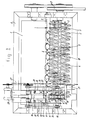
- the onion peeling machine shown in Figures 1 to 3 incl. comprise a) an alignment mechanism for orienting the onions into the processing position, b) means of heat treatment for loosening the outermost skins of the onions, c) a cutting mechanism for the removal of top and root end of the oriented onions, and d) a pop-out mechanism for popping or shooting out the onions axially from the outermost skins.
- the invention is concerned in the first place with the alignment mechanism.
- This mechanism brings the onions into a well oriented position in which the further operations can be carried out without problems. Examples of the operations are the said removal of top and root ends, and the popping of the onions axially out of the outermost skins.
- other facilities may also follow the alignment mechanism, for example a mechanism for notching the onions around the circumference and removing them in the radial direction from the divided outer skins or a mechanism for cutting the onions into slices.
- the alignment appliance now to be described can be used in conjunction with any known or unknown mechanism for which aligned presentation to the mechanism is essential for a good operation.
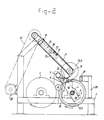
- the alignment mechanism consists of a closed roller 1 and a helical roller formed by two helical rods 2, 3 which are mounted on a spindle 4 by means of plates 5 with a mutually adjustable axial spacing, the spacing thereof being capable of being altered by the screw bolt 6.
- the closed roller 1 and the helical roller 2, 3 are mounted next to each other in a frame 7. They are driven by belts or chains 8 which lead to a common motor (not shown).
- the direction of rotation of the roller 1 and the helical rollers 2, 3 is indicated in Figure 2, but the possibility is not excluded of the rollers 1 or 2, 3 rotating in opposite directions.
- the onions to be peeled are fed through a feed mechanism (not shown) in the direction of the arrow into the gap between the solid roller 1 and the helical roller 2, 3.
- the feed mechanism meters out the onions one by one in a manner such that one onion always lands between the helices at points where the distance between ' them is minimum.
- a metenng feed mechanism is not always necessary.
- the circumferential velocity of the solio roller is chosen somewhat larger than that of the helical roller, which is beneficial but not necessary for orienting the onions in a manner such that top and root end extends parallel to the axial direction of the roller.
- a pipe 9 provided with openings for the supplying of steam to the onions.
- the helical roller transports the aligned onions to the cutting mechanism, and during this transport the onions are subjected to the influence of the steam.
- the outermost fleshy skin is softened as a result of this so that the flesh inside the said soft skin can easily be released therefrom.
- the residence time of the onions in the steam is, for example, 30 seconds. The possibility is not excfuded that the onions are subjected to the heat treatment before they are fed to the aligning, cutting and poppingout mechanism. Certain onions on the whole do not require to be subjected to a heat treatment.
- the onions also undergo the desired alignment effect if they are introduced inside the helices 2, 3, in which case the roller 1 could be omitted and the fill-up spiral 10 would have to have a diameter which is somewhat less than the diameter of the helices 2, 3.
- the helix 2, 3 could be replaced by a cylindrical tube with a helical groove in the outer surface of the jacket
- the alignment appliance shown in the figures in which the onions are aligned between the outer surface of the helices 2, 3 and the roller 1 is, however, to be preferred because the onions can easily be transferred at the end of the alignment path to a processing mechanism (cutting mechanism for top and root end, pop-out mechanism, cutting mechanism for cutting the onions into slices and the like).
- a scooping up mechanism may be fitted consisting of a pushing strip 11 which is mounted on the final plate 5 and to which two carrier pins 12 are welded at a mutual distance.
- a pushing strip 11 which is mounted on the final plate 5 and to which two carrier pins 12 are welded at a mutual distance.
- This mechanism comprises two circular knives 13, 14 each mounted on a spindle, the bearing 15, 16 of which is mounted on an arm 17 or 18.
- Each of the arms is linked by a hinge 19 or 20 to the frame section in a manner such that it can pivot in the lateral direction, tension springs 21 or 22 pulling the arms towards each other.
- tension springs 21 or 22 pulling the arms towards each other.
- these springs are also fixed to a fixed plate 23. Stop elements 30 determine the minimum distance between the arms 17, 18.
- a pilot pin 24 or 25 is fixed which comes into contact with the onions scooped up by a scooping up mechanism 11, 12, as a result of which the arms 17 or 18 are moved apart against the action of the springs 21 or 22 to a position in which the knives 13, 14 mounted on the said arms are located in the correct position with respect to the top and root end to be removed.
- the pilot pins may be fork-shaped.
- the knives driven by a motor 28 via belts 26 and chains 27 cut off the top and root end of the onion.
- the onion is pushed by the assembly of pushing strip 11 and carrier pins 12 to a pop-out mechanism.
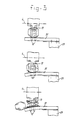
- This comprises an elastic strip 31, consisting, for example, of a stiff rubber or spring steel covered with a rubber layer, mounted on a support 29.
- An onion which is located between the pushing strip 11 and the elastic strip 31 deflected to some extent and pretreated outer skins are gripped by the rough surface of the strip reacts to the pressure exerted by the onion popping out sideways from the outermost skins in the axial direction, and this is illustrated in Figure 3.
- the stn) 31 may be a spring-load stiff pivoting strip. To prevent the strips 11 and 31 damaging each other in the absence of an onion, the stop devices may be encountered.
- the embodiment shown with an elastic strip 31 is simple and cheap.
- the pop-out principle can, however, be applied in many kinds of ways.
- Known mechanisms for the removal of the outermost skins may also follow the alignment appliance, for example a mechanism in which a circumferential cut in the outermost skins is applied with a knife and the onions are driven out of the incised skins in the radial direction (see for example the UK Patent Specification 821,315).
- the onion is exposed to steam or heat treatment before the top ano root end are cut off it The cutting surfaces will then not be impaired.
- flame treatment may be used instead of subjecting the onions to a steam treatment. The possibility exists of carrying out the steam or heat treatment beforehand, i.e. outside the machine described.
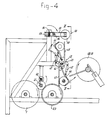
- a spindle 40 to be driven in a rotary manner, which is provided with two fingers 41 situated close to each other which moves an onion from the gap between the roller 1 and the construction 2, 3 upwards in the direction of a gripping jaw mechanism 42.
- This comprises a spindle 43, to be driven in a rotary manner, a piece 44 mounted theron, two pairs of pins 45 permanently mounted on the piece 44 and two pairs of pivotable, hooked-shaped pins 46 mounted on the piece 44.
- hydraulic or pneumatic cylinders 47 the pins 46 can be brought into an open position or a closed gripping position with respect to the pins 45.
- the gripping position is indicated in Figure 4 at the top and bottom of the rotation path by full lines, while the open position (mutual angle between the pins 45, 46 approx. 45°) is indicated by dotted lines.
- the operation of the cylinders 47 takes place by means of microswitches (not shown) which react to certain positions of the rotating piece 44.
- the synchronisation of the rotary movements of the spindles 40 and 43 is such that at the moment when the open jaw 45, 4 6 approaches the helical construction 2, 3 during the downward part of the rotary movement, the fingers 41 push an onion into the jaw, after which the jaw is closed and entrained.
- the gripped onion passes two knives 48, 49 which cut off the top and root end and which are to be compared in terms of operafion with the knives 1 3, 14 of the embodiment according to Figure 2.
- the onion moves with a defined orientation towards a transfer mechansim 50 consisting of two levers 51, 52 which are pivotably mounted on a spindle, to be driven in a rotary manner, the pivoting spindles 54, 55 being perpendicular to the rotation spindle 53.
- a pneumatic or hydraulic cylinder 56 which can pivot the levers away from each other or towards each other.
- a gripping disc 57 or 58 is spring mounted at the end of each lever. An onion can be gripped between these discs if the levers 51, 52 are pivoted towards each other by the cylinder.
- the spindle 53 rotates with twice the speed of the spindle 43.
- the directions of rotation of the spindles 43 and 53 are so synchronised with respect to each other and the operation of the cylinders 47 and 56 are so adjusted to each other by microswitches or the like which react to the angular position of the spindles 43 or 53 that the onion presented by a gripping jaw 45, 46 is taken up by the discs 57, 58 which are caused to grip the flat onion surfaces and are rotated further around the spindle 53.
- the directions of rotation are always indicated by arrows.
- the onion gripped between the discs 57, 58 is passed, for example, to a mechanism (not shown) for the cutting of slices.
- the levers 51, 52 are pushed away from each other as soon as the onion has passed the slice cutting mechanism.
Landscapes
- Life Sciences & Earth Sciences (AREA)
- Chemical & Material Sciences (AREA)
- Engineering & Computer Science (AREA)
- Food Science & Technology (AREA)
- Polymers & Plastics (AREA)
- Apparatuses For Bulk Treatment Of Fruits And Vegetables And Apparatuses For Preparing Feeds (AREA)
- Percussion Or Vibration Massage (AREA)
- Management, Administration, Business Operations System, And Electronic Commerce (AREA)
- Medicines Containing Plant Substances (AREA)
Priority Applications (1)
| Application Number | Priority Date | Filing Date | Title |
|---|---|---|---|
| AT85201416T ATE38928T1 (de) | 1984-09-06 | 1985-09-06 | Vorrichtung zum ausrichten von zwiebeln oder anderen pflanzenzwiebeln. |
Applications Claiming Priority (2)
| Application Number | Priority Date | Filing Date | Title |
|---|---|---|---|
| NL8402721A NL8402721A (nl) | 1984-09-06 | 1984-09-06 | Werkwijze en inrichting voor het schillen van uien. |
| NL8402721 | 1984-09-06 |
Publications (3)
| Publication Number | Publication Date |
|---|---|
| EP0174697A2 true EP0174697A2 (de) | 1986-03-19 |
| EP0174697A3 EP0174697A3 (en) | 1986-07-16 |
| EP0174697B1 EP0174697B1 (de) | 1988-11-30 |
Family
ID=19844425
Family Applications (1)
| Application Number | Title | Priority Date | Filing Date |
|---|---|---|---|
| EP85201416A Expired EP0174697B1 (de) | 1984-09-06 | 1985-09-06 | Vorrichtung zum Ausrichten von Zwiebeln oder anderen Pflanzenzwiebeln |
Country Status (5)
| Country | Link |
|---|---|
| US (1) | US4730554A (de) |
| EP (1) | EP0174697B1 (de) |
| AT (1) | ATE38928T1 (de) |
| DE (1) | DE3566490D1 (de) |
| NL (1) | NL8402721A (de) |
Cited By (4)
| Publication number | Priority date | Publication date | Assignee | Title |
|---|---|---|---|---|
| EP0327146A1 (de) * | 1988-02-02 | 1989-08-09 | Instituut Voor Bewaring En Verwerking Van Landbouwprodukten | Schälmaschine für Zwiebeln oder Knollen- oder Wurzelgewächsen |
| WO1989007400A1 (en) * | 1988-02-16 | 1989-08-24 | Bähnckes Delikatessefabrikker A/S | A method and an apparatus for cutting top and root ends of onions |
| NL9401719A (nl) * | 1993-10-19 | 1995-05-16 | Iwanek Guenter | Inrichting voor het ontwortelen van bloembollen. |
| US5439674A (en) * | 1992-08-14 | 1995-08-08 | Osi Specialties, Inc. | Hair cosmetic material |
Families Citing this family (13)
| Publication number | Priority date | Publication date | Assignee | Title |
|---|---|---|---|---|
| US4831924A (en) * | 1988-04-21 | 1989-05-23 | Ashlock Company, A Division Of Vistan Corporation | Apparatus for aligning articles |
| WO1990004337A1 (en) * | 1988-10-25 | 1990-05-03 | Robert Gough | Peeling machine |
| JP2938109B2 (ja) * | 1990-01-23 | 1999-08-23 | 株式会社長岡精機製作所 | 鱗茎用スリッター |
| US5335792A (en) * | 1992-02-21 | 1994-08-09 | Carter Day International, Inc. | Grain separator |
| US5780088A (en) * | 1997-01-17 | 1998-07-14 | David R. Zittel | Electric motor driven abrasive roller peeler and cleaning machine |
| GB9804833D0 (en) | 1998-03-07 | 1998-04-29 | Rose David | Improvements in alignment techniques |
| AU2002242507A1 (en) * | 2002-03-06 | 2003-09-16 | Richard Wilkinson | Industrial onion peeler |
| US7007449B2 (en) * | 2003-03-31 | 2006-03-07 | Duane Kido | Onion harvester with leaf topper |
| US7029393B2 (en) * | 2003-08-06 | 2006-04-18 | Carter Day International, Inc. | Split inlet seal for grain separators and method |
| WO2005081890A2 (en) * | 2004-02-20 | 2005-09-09 | Henry James D | Archimedean conveyors and combustion engines |
| US7862412B2 (en) * | 2008-06-20 | 2011-01-04 | Carter Day International, Inc. | Seal assemblies for grain separators |
| JP6347715B2 (ja) * | 2014-10-06 | 2018-06-27 | 株式会社ニシザワ | 玉ねぎ類の葉・根連続切除機 |
| JP7118832B2 (ja) * | 2018-09-18 | 2022-08-16 | 株式会社クボタ | 結球野菜の搬送装置及び調製装置 |
Family Cites Families (16)
| Publication number | Priority date | Publication date | Assignee | Title |
|---|---|---|---|---|
| NL90260C (de) * | ||||
| US1581071A (en) * | 1922-02-23 | 1926-04-13 | Mark W Lowe | Tomato washing, scalding, and peeling machine |
| US2332093A (en) * | 1940-04-01 | 1943-10-19 | Mark W Lowe | Conveyer for fruits and vegetables |
| GB821315A (en) * | 1955-10-03 | 1959-10-07 | Edward Sidney Manwaring Wade | Improved method and means for trimming vegetable bulbs, such as onions |
| DE2346191A1 (de) * | 1972-09-21 | 1974-03-28 | Vogelaar Matthijs Pieter | Vorrichtung zum automatischen verarbeiten von zwiebel- und knollengewaechsen |
| NL7513320A (en) * | 1975-11-13 | 1977-05-17 | Catharinus Sinke | Mechanical peeling of onions - with minimal damage and no removal of useful flesh |
| SE436417B (sv) * | 1977-05-10 | 1984-12-10 | Plm Ab | Forflyttningsanordning for hushallsavfall |
| US4237782A (en) * | 1978-11-27 | 1980-12-09 | Starr, Incorporated | Vegetable processing machine with product mobilizer apparatus |
| US4476778A (en) * | 1980-07-21 | 1984-10-16 | Spring Gully Pickles Pty, Limited | Onion peeling |
| US4355572A (en) * | 1981-04-13 | 1982-10-26 | Imdec S.R.L. | Apparatus for separating the pulp from the skin of fruit such as tomatoes |
| JPS5978676A (ja) * | 1982-10-25 | 1984-05-07 | Ogawa Conveyor Kk | 玉葱の皮剥き方法及びその装置 |
| JPS5948987B2 (ja) * | 1982-11-19 | 1984-11-30 | 小川コンベヤ株式会社 | 玉葱皮剥装置 |
| US4481875A (en) * | 1982-12-03 | 1984-11-13 | M.G.I. Co., Ltd. | Bulb peeling apparatus |
| NL8300221A (nl) * | 1983-01-21 | 1984-08-16 | North Invest Finance | Industriele uienschilmachine. |
| US4470345A (en) * | 1983-04-26 | 1984-09-11 | Hiroyuki Miyata | Apparatus for peeling skins off the bulbs of onions |
| US4527438A (en) * | 1983-09-28 | 1985-07-09 | Cortex Research Corporation | Automatic feed system for sampling apparatus |
-
1984
- 1984-09-06 NL NL8402721A patent/NL8402721A/nl not_active Application Discontinuation
-
1985
- 1985-09-05 US US06/772,853 patent/US4730554A/en not_active Expired - Fee Related
- 1985-09-06 AT AT85201416T patent/ATE38928T1/de not_active IP Right Cessation
- 1985-09-06 EP EP85201416A patent/EP0174697B1/de not_active Expired
- 1985-09-06 DE DE8585201416T patent/DE3566490D1/de not_active Expired
Cited By (5)
| Publication number | Priority date | Publication date | Assignee | Title |
|---|---|---|---|---|
| EP0327146A1 (de) * | 1988-02-02 | 1989-08-09 | Instituut Voor Bewaring En Verwerking Van Landbouwprodukten | Schälmaschine für Zwiebeln oder Knollen- oder Wurzelgewächsen |
| US4889046A (en) * | 1988-02-02 | 1989-12-26 | Instituut Voor Bewaring En Verwerking Van Landbouwprodukten | Device for peeling onions or other bulbous or tuberous plants |
| WO1989007400A1 (en) * | 1988-02-16 | 1989-08-24 | Bähnckes Delikatessefabrikker A/S | A method and an apparatus for cutting top and root ends of onions |
| US5439674A (en) * | 1992-08-14 | 1995-08-08 | Osi Specialties, Inc. | Hair cosmetic material |
| NL9401719A (nl) * | 1993-10-19 | 1995-05-16 | Iwanek Guenter | Inrichting voor het ontwortelen van bloembollen. |
Also Published As
| Publication number | Publication date |
|---|---|
| US4730554A (en) | 1988-03-15 |
| ATE38928T1 (de) | 1988-12-15 |
| EP0174697B1 (de) | 1988-11-30 |
| NL8402721A (nl) | 1986-04-01 |
| DE3566490D1 (en) | 1989-01-05 |
| EP0174697A3 (en) | 1986-07-16 |
Similar Documents
| Publication | Publication Date | Title |
|---|---|---|
| US4730554A (en) | Appliance for the alignment of onions or other vegetable bulbs | |
| EP0118963A1 (de) | Vorrichtung zum stückweisen Entfernen des Brustfleisches von Schlachtgeflügel | |
| US5431095A (en) | Pear processing method and apparatus | |
| CN107616525B (zh) | 一种甘蔗加工设备 | |
| CN107373697A (zh) | 一种甘蔗加工方法 | |
| EP3518682A1 (de) | Shrimpschälstation mit einem rotor mit einem drehbaren greifer | |
| US5545422A (en) | Peeling apparatus and method | |
| US4534085A (en) | Fish filleting system | |
| US3075634A (en) | Machine for handling artichokes | |
| CA1306171C (en) | Method and apparatus for pretreating and debarking logs | |
| US3656529A (en) | Processing of contour peeled fruit halves | |
| US4202261A (en) | Method and apparatus for trimming onions or like produce | |
| US5598773A (en) | Melon rind trimming device | |
| US3744408A (en) | Coconut paring machine | |
| GB2077577A (en) | Apparatus for peeling crops, such as bulbs or tubers | |
| US3515193A (en) | Onion orienter and cutter | |
| US6220153B1 (en) | Automated peeler for fruit products | |
| US3451451A (en) | Banana peeler | |
| JPH0970281A (ja) | 棒状野菜の皮むき装置 | |
| US3606917A (en) | Peeling machine | |
| US3894810A (en) | Coconut paring process | |
| NZ247566A (en) | Method and apparatus for continuously producing tubular mantel meat of the cuttlefish | |
| US3378050A (en) | Apparatus for coordinating a fruit processing machine | |
| WO2018060364A1 (en) | Shrimp peeling station comprising a rotor with a rotatable gripper | |
| US2239013A (en) | Fish cleaning and cutting machine |
Legal Events
| Date | Code | Title | Description |
|---|---|---|---|
| PUAI | Public reference made under article 153(3) epc to a published international application that has entered the european phase |
Free format text: ORIGINAL CODE: 0009012 |
|
| AK | Designated contracting states |
Kind code of ref document: A2 Designated state(s): AT BE CH DE FR GB IT LI LU NL SE |
|
| PUAL | Search report despatched |
Free format text: ORIGINAL CODE: 0009013 |
|
| AK | Designated contracting states |
Kind code of ref document: A3 Designated state(s): AT BE CH DE FR GB IT LI LU NL SE |
|
| 17P | Request for examination filed |
Effective date: 19860714 |
|
| 17Q | First examination report despatched |
Effective date: 19870924 |
|
| GRAA | (expected) grant |
Free format text: ORIGINAL CODE: 0009210 |
|
| AK | Designated contracting states |
Kind code of ref document: B1 Designated state(s): AT BE CH DE FR GB IT LI LU NL SE |
|
| REF | Corresponds to: |
Ref document number: 38928 Country of ref document: AT Date of ref document: 19881215 Kind code of ref document: T |
|
| ITF | It: translation for a ep patent filed | ||
| REF | Corresponds to: |
Ref document number: 3566490 Country of ref document: DE Date of ref document: 19890105 |
|
| ET | Fr: translation filed | ||
| PLBE | No opposition filed within time limit |
Free format text: ORIGINAL CODE: 0009261 |
|
| STAA | Information on the status of an ep patent application or granted ep patent |
Free format text: STATUS: NO OPPOSITION FILED WITHIN TIME LIMIT |
|
| 26N | No opposition filed | ||
| ITTA | It: last paid annual fee | ||
| PGFP | Annual fee paid to national office [announced via postgrant information from national office to epo] |
Ref country code: GB Payment date: 19920825 Year of fee payment: 8 |
|
| PGFP | Annual fee paid to national office [announced via postgrant information from national office to epo] |
Ref country code: FR Payment date: 19920909 Year of fee payment: 8 |
|
| PGFP | Annual fee paid to national office [announced via postgrant information from national office to epo] |
Ref country code: AT Payment date: 19920910 Year of fee payment: 8 |
|
| PGFP | Annual fee paid to national office [announced via postgrant information from national office to epo] |
Ref country code: SE Payment date: 19920914 Year of fee payment: 8 |
|
| PGFP | Annual fee paid to national office [announced via postgrant information from national office to epo] |
Ref country code: CH Payment date: 19920918 Year of fee payment: 8 |
|
| PGFP | Annual fee paid to national office [announced via postgrant information from national office to epo] |
Ref country code: DE Payment date: 19920923 Year of fee payment: 8 |
|
| PGFP | Annual fee paid to national office [announced via postgrant information from national office to epo] |
Ref country code: BE Payment date: 19921028 Year of fee payment: 8 |
|
| PGFP | Annual fee paid to national office [announced via postgrant information from national office to epo] |
Ref country code: LU Payment date: 19921204 Year of fee payment: 8 |
|
| EPTA | Lu: last paid annual fee | ||
| PG25 | Lapsed in a contracting state [announced via postgrant information from national office to epo] |
Ref country code: LU Free format text: LAPSE BECAUSE OF NON-PAYMENT OF DUE FEES Effective date: 19930906 Ref country code: GB Effective date: 19930906 Ref country code: AT Effective date: 19930906 |
|
| PG25 | Lapsed in a contracting state [announced via postgrant information from national office to epo] |
Ref country code: SE Effective date: 19930907 |
|
| PG25 | Lapsed in a contracting state [announced via postgrant information from national office to epo] |
Ref country code: LI Effective date: 19930930 Ref country code: CH Effective date: 19930930 Ref country code: BE Effective date: 19930930 |
|
| PGFP | Annual fee paid to national office [announced via postgrant information from national office to epo] |
Ref country code: NL Payment date: 19930930 Year of fee payment: 9 |
|
| BERE | Be: lapsed |
Owner name: INSTITUUT VOOR BEWARING EN VERWERKING VAN LANDBOU Effective date: 19930930 |
|
| GBPC | Gb: european patent ceased through non-payment of renewal fee |
Effective date: 19930906 |
|
| PG25 | Lapsed in a contracting state [announced via postgrant information from national office to epo] |
Ref country code: FR Free format text: LAPSE BECAUSE OF NON-PAYMENT OF DUE FEES Effective date: 19940531 |
|
| REG | Reference to a national code |
Ref country code: CH Ref legal event code: PL |
|
| PG25 | Lapsed in a contracting state [announced via postgrant information from national office to epo] |
Ref country code: DE Effective date: 19940601 |
|
| REG | Reference to a national code |
Ref country code: FR Ref legal event code: ST |
|
| EUG | Se: european patent has lapsed |
Ref document number: 85201416.6 Effective date: 19940410 |
|
| PG25 | Lapsed in a contracting state [announced via postgrant information from national office to epo] |
Ref country code: NL Effective date: 19950401 |
|
| NLV4 | Nl: lapsed or anulled due to non-payment of the annual fee |