EP0173259A2 - Antimicrobial suspensions and antimicrobial hair treatment compositions - Google Patents
Antimicrobial suspensions and antimicrobial hair treatment compositions Download PDFInfo
- Publication number
- EP0173259A2 EP0173259A2 EP85110580A EP85110580A EP0173259A2 EP 0173259 A2 EP0173259 A2 EP 0173259A2 EP 85110580 A EP85110580 A EP 85110580A EP 85110580 A EP85110580 A EP 85110580A EP 0173259 A2 EP0173259 A2 EP 0173259A2
- Authority
- EP
- European Patent Office
- Prior art keywords
- group
- antimicrobial
- carbon atoms
- oxide
- fine particulate
- Prior art date
- Legal status (The legal status is an assumption and is not a legal conclusion. Google has not performed a legal analysis and makes no representation as to the accuracy of the status listed.)
- Granted
Links
- 239000000725 suspension Substances 0.000 title claims abstract description 49
- 239000000203 mixture Substances 0.000 title claims description 73
- 230000000845 anti-microbial effect Effects 0.000 title claims description 34
- 238000011282 treatment Methods 0.000 title claims description 18
- 150000001875 compounds Chemical class 0.000 claims abstract description 76
- 239000002270 dispersing agent Substances 0.000 claims abstract description 24
- 150000003839 salts Chemical class 0.000 claims abstract description 20
- 229920000642 polymer Polymers 0.000 claims abstract description 18
- 239000002736 nonionic surfactant Substances 0.000 claims abstract description 17
- 238000009833 condensation Methods 0.000 claims abstract description 15
- 230000005494 condensation Effects 0.000 claims abstract description 15
- 229910052751 metal Inorganic materials 0.000 claims abstract description 15
- 239000002184 metal Substances 0.000 claims abstract description 15
- 229920003169 water-soluble polymer Polymers 0.000 claims abstract description 15
- YBBJKCMMCRQZMA-UHFFFAOYSA-N pyrithione Chemical compound ON1C=CC=CC1=S YBBJKCMMCRQZMA-UHFFFAOYSA-N 0.000 claims abstract description 13
- 229920000768 polyamine Polymers 0.000 claims abstract description 12
- 229920006317 cationic polymer Polymers 0.000 claims abstract description 11
- 229920000151 polyglycol Polymers 0.000 claims abstract description 10
- 239000010695 polyglycol Substances 0.000 claims abstract description 10
- 229920013821 hydroxy alkyl cellulose Polymers 0.000 claims abstract description 7
- 229910017053 inorganic salt Inorganic materials 0.000 claims abstract description 6
- 150000003973 alkyl amines Chemical class 0.000 claims abstract description 4
- -1 alkenyl ethers Chemical class 0.000 claims description 61
- 125000004432 carbon atom Chemical group C* 0.000 claims description 40
- 125000000217 alkyl group Chemical group 0.000 claims description 35
- 239000000047 product Substances 0.000 claims description 28
- 239000002245 particle Substances 0.000 claims description 22
- 239000002453 shampoo Substances 0.000 claims description 20
- 239000004094 surface-active agent Substances 0.000 claims description 20
- 238000009826 distribution Methods 0.000 claims description 18
- 239000007795 chemical reaction product Substances 0.000 claims description 17
- 125000004435 hydrogen atom Chemical group [H]* 0.000 claims description 14
- 239000004599 antimicrobial Substances 0.000 claims description 13
- 125000002947 alkylene group Chemical group 0.000 claims description 10
- 229920001577 copolymer Polymers 0.000 claims description 9
- 125000002496 methyl group Chemical group [H]C([H])([H])* 0.000 claims description 9
- 239000003795 chemical substances by application Substances 0.000 claims description 7
- WNLRTRBMVRJNCN-UHFFFAOYSA-N adipic acid Chemical compound OC(=O)CCCCC(O)=O WNLRTRBMVRJNCN-UHFFFAOYSA-N 0.000 claims description 6
- RPNUMPOLZDHAAY-UHFFFAOYSA-N Diethylenetriamine Chemical compound NCCNCCN RPNUMPOLZDHAAY-UHFFFAOYSA-N 0.000 claims description 4
- 239000004354 Hydroxyethyl cellulose Substances 0.000 claims description 4
- 229920000663 Hydroxyethyl cellulose Polymers 0.000 claims description 4
- 239000003945 anionic surfactant Substances 0.000 claims description 4
- 235000019447 hydroxyethyl cellulose Nutrition 0.000 claims description 4
- 238000006068 polycondensation reaction Methods 0.000 claims description 4
- 150000003751 zinc Chemical class 0.000 claims description 4
- 229920002153 Hydroxypropyl cellulose Polymers 0.000 claims description 3
- 239000002253 acid Substances 0.000 claims description 3
- 239000001361 adipic acid Substances 0.000 claims description 3
- 235000011037 adipic acid Nutrition 0.000 claims description 3
- 239000002280 amphoteric surfactant Substances 0.000 claims description 3
- 239000003093 cationic surfactant Substances 0.000 claims description 3
- 125000005843 halogen group Chemical group 0.000 claims description 3
- 239000001863 hydroxypropyl cellulose Substances 0.000 claims description 3
- 235000010977 hydroxypropyl cellulose Nutrition 0.000 claims description 3
- HRPVXLWXLXDGHG-UHFFFAOYSA-N Acrylamide Chemical compound NC(=O)C=C HRPVXLWXLXDGHG-UHFFFAOYSA-N 0.000 claims description 2
- 125000001931 aliphatic group Chemical group 0.000 claims description 2
- 239000004359 castor oil Substances 0.000 claims description 2
- 235000019438 castor oil Nutrition 0.000 claims description 2
- 125000001495 ethyl group Chemical group [H]C([H])([H])C([H])([H])* 0.000 claims description 2
- ZEMPKEQAKRGZGQ-XOQCFJPHSA-N glycerol triricinoleate Natural products CCCCCC[C@@H](O)CC=CCCCCCCCC(=O)OC[C@@H](COC(=O)CCCCCCCC=CC[C@@H](O)CCCCCC)OC(=O)CCCCCCCC=CC[C@H](O)CCCCCC ZEMPKEQAKRGZGQ-XOQCFJPHSA-N 0.000 claims description 2
- 125000004430 oxygen atom Chemical group O* 0.000 claims description 2
- PUVAFTRIIUSGLK-UHFFFAOYSA-M trimethyl(oxiran-2-ylmethyl)azanium;chloride Chemical compound [Cl-].C[N+](C)(C)CC1CO1 PUVAFTRIIUSGLK-UHFFFAOYSA-M 0.000 claims 1
- XLYOFNOQVPJJNP-UHFFFAOYSA-N water Substances O XLYOFNOQVPJJNP-UHFFFAOYSA-N 0.000 abstract description 19
- RTZKZFJDLAIYFH-UHFFFAOYSA-N Diethyl ether Chemical compound CCOCC RTZKZFJDLAIYFH-UHFFFAOYSA-N 0.000 description 34
- LYCAIKOWRPUZTN-UHFFFAOYSA-N Ethylene glycol Chemical compound OCCO LYCAIKOWRPUZTN-UHFFFAOYSA-N 0.000 description 30
- 239000006185 dispersion Substances 0.000 description 25
- 235000014113 dietary fatty acids Nutrition 0.000 description 23
- 239000000194 fatty acid Substances 0.000 description 23
- 229930195729 fatty acid Natural products 0.000 description 23
- 238000000034 method Methods 0.000 description 22
- 229920003171 Poly (ethylene oxide) Polymers 0.000 description 21
- 235000002639 sodium chloride Nutrition 0.000 description 21
- 239000000243 solution Substances 0.000 description 17
- 238000013019 agitation Methods 0.000 description 16
- WGCNASOHLSPBMP-UHFFFAOYSA-N hydroxyacetaldehyde Natural products OCC=O WGCNASOHLSPBMP-UHFFFAOYSA-N 0.000 description 15
- LFQSCWFLJHTTHZ-UHFFFAOYSA-N Ethanol Chemical compound CCO LFQSCWFLJHTTHZ-UHFFFAOYSA-N 0.000 description 13
- 125000003342 alkenyl group Chemical group 0.000 description 11
- 238000003860 storage Methods 0.000 description 11
- 239000002585 base Substances 0.000 description 10
- GKQPCPXONLDCMU-CCEZHUSRSA-N lacidipine Chemical compound CCOC(=O)C1=C(C)NC(C)=C(C(=O)OCC)C1C1=CC=CC=C1\C=C\C(=O)OC(C)(C)C GKQPCPXONLDCMU-CCEZHUSRSA-N 0.000 description 10
- IAYPIBMASNFSPL-UHFFFAOYSA-N Ethylene oxide Chemical group C1CO1 IAYPIBMASNFSPL-UHFFFAOYSA-N 0.000 description 8
- PEDCQBHIVMGVHV-UHFFFAOYSA-N Glycerine Chemical class OCC(O)CO PEDCQBHIVMGVHV-UHFFFAOYSA-N 0.000 description 8
- FAPWRFPIFSIZLT-UHFFFAOYSA-M Sodium chloride Chemical compound [Na+].[Cl-] FAPWRFPIFSIZLT-UHFFFAOYSA-M 0.000 description 8
- BRLQWZUYTZBJKN-UHFFFAOYSA-N Epichlorohydrin Chemical compound ClCC1CO1 BRLQWZUYTZBJKN-UHFFFAOYSA-N 0.000 description 7
- 235000015278 beef Nutrition 0.000 description 7
- 239000003240 coconut oil Substances 0.000 description 7
- 235000019864 coconut oil Nutrition 0.000 description 7
- 235000019441 ethanol Nutrition 0.000 description 7
- 150000004665 fatty acids Chemical class 0.000 description 7
- 238000004062 sedimentation Methods 0.000 description 7
- 239000003760 tallow Substances 0.000 description 7
- DGAQECJNVWCQMB-PUAWFVPOSA-M Ilexoside XXIX Chemical compound C[C@@H]1CC[C@@]2(CC[C@@]3(C(=CC[C@H]4[C@]3(CC[C@@H]5[C@@]4(CC[C@@H](C5(C)C)OS(=O)(=O)[O-])C)C)[C@@H]2[C@]1(C)O)C)C(=O)O[C@H]6[C@@H]([C@H]([C@@H]([C@H](O6)CO)O)O)O.[Na+] DGAQECJNVWCQMB-PUAWFVPOSA-M 0.000 description 6
- DNIAPMSPPWPWGF-UHFFFAOYSA-N Propylene glycol Chemical compound CC(O)CO DNIAPMSPPWPWGF-UHFFFAOYSA-N 0.000 description 6
- 239000007864 aqueous solution Substances 0.000 description 6
- KRKNYBCHXYNGOX-UHFFFAOYSA-N citric acid Chemical compound OC(=O)CC(O)(C(O)=O)CC(O)=O KRKNYBCHXYNGOX-UHFFFAOYSA-N 0.000 description 6
- 238000005189 flocculation Methods 0.000 description 6
- 230000016615 flocculation Effects 0.000 description 6
- 238000002360 preparation method Methods 0.000 description 6
- 239000011734 sodium Substances 0.000 description 6
- 229910052708 sodium Inorganic materials 0.000 description 6
- GOOHAUXETOMSMM-UHFFFAOYSA-N Propylene oxide Chemical group CC1CO1 GOOHAUXETOMSMM-UHFFFAOYSA-N 0.000 description 5
- 230000000052 comparative effect Effects 0.000 description 5
- 238000009472 formulation Methods 0.000 description 5
- 239000001257 hydrogen Chemical group 0.000 description 5
- 229910052739 hydrogen Inorganic materials 0.000 description 5
- 239000004615 ingredient Substances 0.000 description 5
- 150000002500 ions Chemical class 0.000 description 5
- 239000006210 lotion Substances 0.000 description 5
- 239000000843 powder Substances 0.000 description 5
- WCUXLLCKKVVCTQ-UHFFFAOYSA-M Potassium chloride Chemical compound [Cl-].[K+] WCUXLLCKKVVCTQ-UHFFFAOYSA-M 0.000 description 4
- QAOWNCQODCNURD-UHFFFAOYSA-N Sulfuric acid Chemical compound OS(O)(=O)=O QAOWNCQODCNURD-UHFFFAOYSA-N 0.000 description 4
- WYURNTSHIVDZCO-UHFFFAOYSA-N Tetrahydrofuran Chemical group C1CCOC1 WYURNTSHIVDZCO-UHFFFAOYSA-N 0.000 description 4
- 239000004480 active ingredient Substances 0.000 description 4
- 229920002678 cellulose Polymers 0.000 description 4
- 235000010980 cellulose Nutrition 0.000 description 4
- 239000003086 colorant Substances 0.000 description 4
- 238000002156 mixing Methods 0.000 description 4
- 239000002304 perfume Substances 0.000 description 4
- FGIUAXJPYTZDNR-UHFFFAOYSA-N potassium nitrate Chemical compound [K+].[O-][N+]([O-])=O FGIUAXJPYTZDNR-UHFFFAOYSA-N 0.000 description 4
- 239000004576 sand Substances 0.000 description 4
- 239000011780 sodium chloride Substances 0.000 description 4
- VWDWKYIASSYTQR-UHFFFAOYSA-N sodium nitrate Chemical compound [Na+].[O-][N+]([O-])=O VWDWKYIASSYTQR-UHFFFAOYSA-N 0.000 description 4
- QGZKDVFQNNGYKY-UHFFFAOYSA-O Ammonium Chemical compound [NH4+] QGZKDVFQNNGYKY-UHFFFAOYSA-O 0.000 description 3
- 208000001840 Dandruff Diseases 0.000 description 3
- KFZMGEQAYNKOFK-UHFFFAOYSA-N Isopropanol Chemical compound CC(C)O KFZMGEQAYNKOFK-UHFFFAOYSA-N 0.000 description 3
- FYYHWMGAXLPEAU-UHFFFAOYSA-N Magnesium Chemical compound [Mg] FYYHWMGAXLPEAU-UHFFFAOYSA-N 0.000 description 3
- QAOWNCQODCNURD-UHFFFAOYSA-L Sulfate Chemical compound [O-]S([O-])(=O)=O QAOWNCQODCNURD-UHFFFAOYSA-L 0.000 description 3
- 238000004220 aggregation Methods 0.000 description 3
- 230000002776 aggregation Effects 0.000 description 3
- 229910052783 alkali metal Inorganic materials 0.000 description 3
- 239000011324 bead Substances 0.000 description 3
- 125000002091 cationic group Chemical group 0.000 description 3
- 238000006243 chemical reaction Methods 0.000 description 3
- 239000007859 condensation product Substances 0.000 description 3
- 238000001816 cooling Methods 0.000 description 3
- 239000011521 glass Substances 0.000 description 3
- 235000011187 glycerol Nutrition 0.000 description 3
- 230000005484 gravity Effects 0.000 description 3
- 150000002430 hydrocarbons Chemical group 0.000 description 3
- 125000002887 hydroxy group Chemical group [H]O* 0.000 description 3
- 229910052749 magnesium Inorganic materials 0.000 description 3
- 239000011777 magnesium Substances 0.000 description 3
- 229910052757 nitrogen Inorganic materials 0.000 description 3
- 125000004433 nitrogen atom Chemical group N* 0.000 description 3
- 229920006395 saturated elastomer Polymers 0.000 description 3
- 229930195734 saturated hydrocarbon Natural products 0.000 description 3
- 229930195735 unsaturated hydrocarbon Natural products 0.000 description 3
- VILCJCGEZXAXTO-UHFFFAOYSA-N 2,2,2-tetramine Chemical compound NCCNCCNCCN VILCJCGEZXAXTO-UHFFFAOYSA-N 0.000 description 2
- NIXOWILDQLNWCW-UHFFFAOYSA-N 2-Propenoic acid Natural products OC(=O)C=C NIXOWILDQLNWCW-UHFFFAOYSA-N 0.000 description 2
- SZIFAVKTNFCBPC-UHFFFAOYSA-N 2-chloroethanol Chemical class OCCCl SZIFAVKTNFCBPC-UHFFFAOYSA-N 0.000 description 2
- UFHFLCQGNIYNRP-UHFFFAOYSA-N Hydrogen Chemical group [H][H] UFHFLCQGNIYNRP-UHFFFAOYSA-N 0.000 description 2
- TWRXJAOTZQYOKJ-UHFFFAOYSA-L Magnesium chloride Chemical compound [Mg+2].[Cl-].[Cl-] TWRXJAOTZQYOKJ-UHFFFAOYSA-L 0.000 description 2
- CSNNHWWHGAXBCP-UHFFFAOYSA-L Magnesium sulfate Chemical compound [Mg+2].[O-][S+2]([O-])([O-])[O-] CSNNHWWHGAXBCP-UHFFFAOYSA-L 0.000 description 2
- WHNWPMSKXPGLAX-UHFFFAOYSA-N N-Vinyl-2-pyrrolidone Chemical compound C=CN1CCCC1=O WHNWPMSKXPGLAX-UHFFFAOYSA-N 0.000 description 2
- GRYLNZFGIOXLOG-UHFFFAOYSA-N Nitric acid Chemical compound O[N+]([O-])=O GRYLNZFGIOXLOG-UHFFFAOYSA-N 0.000 description 2
- NBIIXXVUZAFLBC-UHFFFAOYSA-N Phosphoric acid Chemical compound OP(O)(O)=O NBIIXXVUZAFLBC-UHFFFAOYSA-N 0.000 description 2
- CDBYLPFSWZWCQE-UHFFFAOYSA-L Sodium Carbonate Chemical compound [Na+].[Na+].[O-]C([O-])=O CDBYLPFSWZWCQE-UHFFFAOYSA-L 0.000 description 2
- PMZURENOXWZQFD-UHFFFAOYSA-L Sodium Sulfate Chemical compound [Na+].[Na+].[O-]S([O-])(=O)=O PMZURENOXWZQFD-UHFFFAOYSA-L 0.000 description 2
- 229930006000 Sucrose Natural products 0.000 description 2
- ATJFFYVFTNAWJD-UHFFFAOYSA-N Tin Chemical compound [Sn] ATJFFYVFTNAWJD-UHFFFAOYSA-N 0.000 description 2
- XSQUKJJJFZCRTK-UHFFFAOYSA-N Urea Chemical compound NC(N)=O XSQUKJJJFZCRTK-UHFFFAOYSA-N 0.000 description 2
- HCHKCACWOHOZIP-UHFFFAOYSA-N Zinc Chemical compound [Zn] HCHKCACWOHOZIP-UHFFFAOYSA-N 0.000 description 2
- QCWXUUIWCKQGHC-UHFFFAOYSA-N Zirconium Chemical compound [Zr] QCWXUUIWCKQGHC-UHFFFAOYSA-N 0.000 description 2
- 229940117913 acrylamide Drugs 0.000 description 2
- 150000001340 alkali metals Chemical class 0.000 description 2
- 229910052784 alkaline earth metal Inorganic materials 0.000 description 2
- 150000005215 alkyl ethers Chemical class 0.000 description 2
- VSCWAEJMTAWNJL-UHFFFAOYSA-K aluminium trichloride Chemical compound Cl[Al](Cl)Cl VSCWAEJMTAWNJL-UHFFFAOYSA-K 0.000 description 2
- 150000001413 amino acids Chemical class 0.000 description 2
- 125000004429 atom Chemical group 0.000 description 2
- 229910052788 barium Inorganic materials 0.000 description 2
- DSAJWYNOEDNPEQ-UHFFFAOYSA-N barium atom Chemical compound [Ba] DSAJWYNOEDNPEQ-UHFFFAOYSA-N 0.000 description 2
- 229910052793 cadmium Inorganic materials 0.000 description 2
- BDOSMKKIYDKNTQ-UHFFFAOYSA-N cadmium atom Chemical compound [Cd] BDOSMKKIYDKNTQ-UHFFFAOYSA-N 0.000 description 2
- ZCCIPPOKBCJFDN-UHFFFAOYSA-N calcium nitrate Chemical compound [Ca+2].[O-][N+]([O-])=O.[O-][N+]([O-])=O ZCCIPPOKBCJFDN-UHFFFAOYSA-N 0.000 description 2
- 229910052799 carbon Inorganic materials 0.000 description 2
- 239000001913 cellulose Substances 0.000 description 2
- 239000000460 chlorine Substances 0.000 description 2
- 229910052801 chlorine Inorganic materials 0.000 description 2
- 125000001309 chloro group Chemical group Cl* 0.000 description 2
- XENVCRGQTABGKY-ZHACJKMWSA-N chlorohydrin Chemical compound CC#CC#CC#CC#C\C=C\C(Cl)CO XENVCRGQTABGKY-ZHACJKMWSA-N 0.000 description 2
- 238000005345 coagulation Methods 0.000 description 2
- 230000015271 coagulation Effects 0.000 description 2
- 238000007796 conventional method Methods 0.000 description 2
- 238000007334 copolymerization reaction Methods 0.000 description 2
- PPQREHKVAOVYBT-UHFFFAOYSA-H dialuminum;tricarbonate Chemical compound [Al+3].[Al+3].[O-]C([O-])=O.[O-]C([O-])=O.[O-]C([O-])=O PPQREHKVAOVYBT-UHFFFAOYSA-H 0.000 description 2
- 239000002612 dispersion medium Substances 0.000 description 2
- 239000003792 electrolyte Substances 0.000 description 2
- BXWNKGSJHAJOGX-UHFFFAOYSA-N hexadecan-1-ol Chemical compound CCCCCCCCCCCCCCCCO BXWNKGSJHAJOGX-UHFFFAOYSA-N 0.000 description 2
- 230000002427 irreversible effect Effects 0.000 description 2
- 230000002045 lasting effect Effects 0.000 description 2
- TWNIBLMWSKIRAT-VFUOTHLCSA-N levoglucosan Chemical group O[C@@H]1[C@@H](O)[C@H](O)[C@H]2CO[C@@H]1O2 TWNIBLMWSKIRAT-VFUOTHLCSA-N 0.000 description 2
- 239000007788 liquid Substances 0.000 description 2
- YIXJRHPUWRPCBB-UHFFFAOYSA-N magnesium nitrate Chemical compound [Mg+2].[O-][N+]([O-])=O.[O-][N+]([O-])=O YIXJRHPUWRPCBB-UHFFFAOYSA-N 0.000 description 2
- 239000002609 medium Substances 0.000 description 2
- 229920000609 methyl cellulose Polymers 0.000 description 2
- 239000001923 methylcellulose Substances 0.000 description 2
- 235000010981 methylcellulose Nutrition 0.000 description 2
- 239000000178 monomer Substances 0.000 description 2
- 229910017604 nitric acid Inorganic materials 0.000 description 2
- 230000002093 peripheral effect Effects 0.000 description 2
- 238000012643 polycondensation polymerization Methods 0.000 description 2
- 229920001451 polypropylene glycol Polymers 0.000 description 2
- BWHMMNNQKKPAPP-UHFFFAOYSA-L potassium carbonate Chemical compound [K+].[K+].[O-]C([O-])=O BWHMMNNQKKPAPP-UHFFFAOYSA-L 0.000 description 2
- 239000001103 potassium chloride Substances 0.000 description 2
- 235000011164 potassium chloride Nutrition 0.000 description 2
- 239000004323 potassium nitrate Substances 0.000 description 2
- 235000010333 potassium nitrate Nutrition 0.000 description 2
- 239000003755 preservative agent Substances 0.000 description 2
- YGSDEFSMJLZEOE-UHFFFAOYSA-N salicylic acid Chemical compound OC(=O)C1=CC=CC=C1O YGSDEFSMJLZEOE-UHFFFAOYSA-N 0.000 description 2
- 239000004317 sodium nitrate Substances 0.000 description 2
- 235000010344 sodium nitrate Nutrition 0.000 description 2
- 229910052938 sodium sulfate Inorganic materials 0.000 description 2
- 235000011152 sodium sulphate Nutrition 0.000 description 2
- 239000002904 solvent Substances 0.000 description 2
- 238000001179 sorption measurement Methods 0.000 description 2
- 229910052712 strontium Inorganic materials 0.000 description 2
- CIOAGBVUUVVLOB-UHFFFAOYSA-N strontium atom Chemical compound [Sr] CIOAGBVUUVVLOB-UHFFFAOYSA-N 0.000 description 2
- 238000006467 substitution reaction Methods 0.000 description 2
- 239000005720 sucrose Substances 0.000 description 2
- 230000008961 swelling Effects 0.000 description 2
- 229910052718 tin Inorganic materials 0.000 description 2
- 229910052725 zinc Inorganic materials 0.000 description 2
- 239000011701 zinc Substances 0.000 description 2
- 229910052726 zirconium Inorganic materials 0.000 description 2
- BNGXYYYYKUGPPF-UHFFFAOYSA-M (3-methylphenyl)methyl-triphenylphosphanium;chloride Chemical compound [Cl-].CC1=CC=CC(C[P+](C=2C=CC=CC=2)(C=2C=CC=CC=2)C=2C=CC=CC=2)=C1 BNGXYYYYKUGPPF-UHFFFAOYSA-M 0.000 description 1
- OWWUGIBQWSDKND-UHFFFAOYSA-O 1,2-bis(ethenyl)-4-methyl-1H-imidazol-1-ium Chemical compound CC=1N=C([NH+](C1)C=C)C=C OWWUGIBQWSDKND-UHFFFAOYSA-O 0.000 description 1
- ZIQRJGXRRBOCEI-UHFFFAOYSA-M 1-ethenyl-3-methylimidazol-3-ium;1-ethenylpyrrolidin-2-one;chloride Chemical compound [Cl-].CN1C=C[N+](C=C)=C1.C=CN1CCCC1=O ZIQRJGXRRBOCEI-UHFFFAOYSA-M 0.000 description 1
- BHAYFXKTLWGHHO-UHFFFAOYSA-N 1-ethenylpyrrolidin-2-one;2-methylprop-2-enoic acid Chemical compound CC(=C)C(O)=O.C=CN1CCCC1=O BHAYFXKTLWGHHO-UHFFFAOYSA-N 0.000 description 1
- SMZOUWXMTYCWNB-UHFFFAOYSA-N 2-(2-methoxy-5-methylphenyl)ethanamine Chemical compound COC1=CC=C(C)C=C1CCN SMZOUWXMTYCWNB-UHFFFAOYSA-N 0.000 description 1
- JKNCOURZONDCGV-UHFFFAOYSA-N 2-(dimethylamino)ethyl 2-methylprop-2-enoate Chemical compound CN(C)CCOC(=O)C(C)=C JKNCOURZONDCGV-UHFFFAOYSA-N 0.000 description 1
- HZAXFHJVJLSVMW-UHFFFAOYSA-N 2-Aminoethan-1-ol Chemical compound NCCO HZAXFHJVJLSVMW-UHFFFAOYSA-N 0.000 description 1
- JVTIXNMXDLQEJE-UHFFFAOYSA-N 2-decanoyloxypropyl decanoate 2-octanoyloxypropyl octanoate Chemical compound C(CCCCCCC)(=O)OCC(C)OC(CCCCCCC)=O.C(=O)(CCCCCCCCC)OCC(C)OC(=O)CCCCCCCCC JVTIXNMXDLQEJE-UHFFFAOYSA-N 0.000 description 1
- JEZPQLNCKXYTLX-UHFFFAOYSA-N 3-[2-(2-aminoethylamino)ethyl-(dimethylamino)amino]propan-1-ol;hexanedioic acid Chemical compound OC(=O)CCCCC(O)=O.OCCCN(N(C)C)CCNCCN JEZPQLNCKXYTLX-UHFFFAOYSA-N 0.000 description 1
- LSNNMFCWUKXFEE-UHFFFAOYSA-M Bisulfite Chemical compound OS([O-])=O LSNNMFCWUKXFEE-UHFFFAOYSA-M 0.000 description 1
- WKBOTKDWSSQWDR-UHFFFAOYSA-N Bromine atom Chemical compound [Br] WKBOTKDWSSQWDR-UHFFFAOYSA-N 0.000 description 1
- UXVMQQNJUSDDNG-UHFFFAOYSA-L Calcium chloride Chemical compound [Cl-].[Cl-].[Ca+2] UXVMQQNJUSDDNG-UHFFFAOYSA-L 0.000 description 1
- OKTJSMMVPCPJKN-UHFFFAOYSA-N Carbon Chemical group [C] OKTJSMMVPCPJKN-UHFFFAOYSA-N 0.000 description 1
- 229920002134 Carboxymethyl cellulose Polymers 0.000 description 1
- ZAMOUSCENKQFHK-UHFFFAOYSA-N Chlorine atom Chemical compound [Cl] ZAMOUSCENKQFHK-UHFFFAOYSA-N 0.000 description 1
- 235000013162 Cocos nucifera Nutrition 0.000 description 1
- 244000060011 Cocos nucifera Species 0.000 description 1
- 102000004190 Enzymes Human genes 0.000 description 1
- 108090000790 Enzymes Proteins 0.000 description 1
- VGGSQFUCUMXWEO-UHFFFAOYSA-N Ethene Chemical compound C=C VGGSQFUCUMXWEO-UHFFFAOYSA-N 0.000 description 1
- 239000005977 Ethylene Substances 0.000 description 1
- 229910019142 PO4 Inorganic materials 0.000 description 1
- ZLMJMSJWJFRBEC-UHFFFAOYSA-N Potassium Chemical compound [K] ZLMJMSJWJFRBEC-UHFFFAOYSA-N 0.000 description 1
- VBIIFPGSPJYLRR-UHFFFAOYSA-M Stearyltrimethylammonium chloride Chemical compound [Cl-].CCCCCCCCCCCCCCCCCC[N+](C)(C)C VBIIFPGSPJYLRR-UHFFFAOYSA-M 0.000 description 1
- CZMRCDWAGMRECN-UGDNZRGBSA-N Sucrose Chemical compound O[C@H]1[C@H](O)[C@@H](CO)O[C@@]1(CO)O[C@@H]1[C@H](O)[C@@H](O)[C@H](O)[C@@H](CO)O1 CZMRCDWAGMRECN-UGDNZRGBSA-N 0.000 description 1
- NINIDFKCEFEMDL-UHFFFAOYSA-N Sulfur Chemical compound [S] NINIDFKCEFEMDL-UHFFFAOYSA-N 0.000 description 1
- GSEJCLTVZPLZKY-UHFFFAOYSA-N Triethanolamine Chemical compound OCCN(CCO)CCO GSEJCLTVZPLZKY-UHFFFAOYSA-N 0.000 description 1
- SLINHMUFWFWBMU-UHFFFAOYSA-N Triisopropanolamine Chemical compound CC(O)CN(CC(C)O)CC(C)O SLINHMUFWFWBMU-UHFFFAOYSA-N 0.000 description 1
- 239000006096 absorbing agent Substances 0.000 description 1
- 150000008043 acidic salts Chemical class 0.000 description 1
- 239000013543 active substance Substances 0.000 description 1
- 150000001298 alcohols Chemical class 0.000 description 1
- 150000007824 aliphatic compounds Chemical class 0.000 description 1
- 150000001342 alkaline earth metals Chemical class 0.000 description 1
- 150000008051 alkyl sulfates Chemical class 0.000 description 1
- AZDRQVAHHNSJOQ-UHFFFAOYSA-N alumane Chemical class [AlH3] AZDRQVAHHNSJOQ-UHFFFAOYSA-N 0.000 description 1
- 229910000147 aluminium phosphate Inorganic materials 0.000 description 1
- DIZPMCHEQGEION-UHFFFAOYSA-H aluminium sulfate (anhydrous) Chemical compound [Al+3].[Al+3].[O-]S([O-])(=O)=O.[O-]S([O-])(=O)=O.[O-]S([O-])(=O)=O DIZPMCHEQGEION-UHFFFAOYSA-H 0.000 description 1
- 229940118662 aluminum carbonate Drugs 0.000 description 1
- 125000003368 amide group Chemical group 0.000 description 1
- 150000001412 amines Chemical class 0.000 description 1
- 125000003277 amino group Chemical group 0.000 description 1
- 125000000129 anionic group Chemical group 0.000 description 1
- 150000001450 anions Chemical class 0.000 description 1
- 239000003963 antioxidant agent Substances 0.000 description 1
- 239000012736 aqueous medium Substances 0.000 description 1
- 239000007900 aqueous suspension Substances 0.000 description 1
- 125000003710 aryl alkyl group Chemical group 0.000 description 1
- 125000003118 aryl group Chemical group 0.000 description 1
- QVGXLLKOCUKJST-UHFFFAOYSA-N atomic oxygen Chemical compound [O] QVGXLLKOCUKJST-UHFFFAOYSA-N 0.000 description 1
- 230000001588 bifunctional effect Effects 0.000 description 1
- GDTBXPJZTBHREO-UHFFFAOYSA-N bromine Substances BrBr GDTBXPJZTBHREO-UHFFFAOYSA-N 0.000 description 1
- 229910052794 bromium Inorganic materials 0.000 description 1
- 239000001110 calcium chloride Substances 0.000 description 1
- 229910001628 calcium chloride Inorganic materials 0.000 description 1
- 239000004202 carbamide Substances 0.000 description 1
- 239000001768 carboxy methyl cellulose Substances 0.000 description 1
- 235000010948 carboxy methyl cellulose Nutrition 0.000 description 1
- 239000008112 carboxymethyl-cellulose Substances 0.000 description 1
- 150000001768 cations Chemical group 0.000 description 1
- 229960000541 cetyl alcohol Drugs 0.000 description 1
- XTEGARKTQYYJKE-UHFFFAOYSA-N chloric acid Chemical compound OCl(=O)=O XTEGARKTQYYJKE-UHFFFAOYSA-N 0.000 description 1
- 229940005991 chloric acid Drugs 0.000 description 1
- 239000004927 clay Substances 0.000 description 1
- 239000002734 clay mineral Substances 0.000 description 1
- 239000000701 coagulant Substances 0.000 description 1
- 239000000084 colloidal system Substances 0.000 description 1
- 239000013065 commercial product Substances 0.000 description 1
- 230000003750 conditioning effect Effects 0.000 description 1
- 239000002781 deodorant agent Substances 0.000 description 1
- ZBCBWPMODOFKDW-UHFFFAOYSA-N diethanolamine Chemical compound OCCNCCO ZBCBWPMODOFKDW-UHFFFAOYSA-N 0.000 description 1
- MOTZDAYCYVMXPC-UHFFFAOYSA-N dodecyl hydrogen sulfate Chemical compound CCCCCCCCCCCCOS(O)(=O)=O MOTZDAYCYVMXPC-UHFFFAOYSA-N 0.000 description 1
- 229940043264 dodecyl sulfate Drugs 0.000 description 1
- 230000000694 effects Effects 0.000 description 1
- 239000000839 emulsion Substances 0.000 description 1
- 238000001914 filtration Methods 0.000 description 1
- 238000005187 foaming Methods 0.000 description 1
- 125000000524 functional group Chemical group 0.000 description 1
- 229910052736 halogen Inorganic materials 0.000 description 1
- 150000002367 halogens Chemical group 0.000 description 1
- 210000003128 head Anatomy 0.000 description 1
- 125000000623 heterocyclic group Chemical group 0.000 description 1
- MTNDZQHUAFNZQY-UHFFFAOYSA-N imidazoline Chemical compound C1CN=CN1 MTNDZQHUAFNZQY-UHFFFAOYSA-N 0.000 description 1
- PNDPGZBMCMUPRI-UHFFFAOYSA-N iodine Chemical compound II PNDPGZBMCMUPRI-UHFFFAOYSA-N 0.000 description 1
- 229910001629 magnesium chloride Inorganic materials 0.000 description 1
- 229910052943 magnesium sulfate Inorganic materials 0.000 description 1
- 235000019341 magnesium sulphate Nutrition 0.000 description 1
- 230000014759 maintenance of location Effects 0.000 description 1
- 238000004519 manufacturing process Methods 0.000 description 1
- 150000002739 metals Chemical class 0.000 description 1
- JZMJDSHXVKJFKW-UHFFFAOYSA-N methyl sulfate Chemical compound COS(O)(=O)=O JZMJDSHXVKJFKW-UHFFFAOYSA-N 0.000 description 1
- 150000007522 mineralic acids Chemical class 0.000 description 1
- 230000004048 modification Effects 0.000 description 1
- 238000012986 modification Methods 0.000 description 1
- 150000007530 organic bases Chemical class 0.000 description 1
- 150000002924 oxiranes Chemical class 0.000 description 1
- 229910052760 oxygen Inorganic materials 0.000 description 1
- 239000001301 oxygen Substances 0.000 description 1
- FJKROLUGYXJWQN-UHFFFAOYSA-N papa-hydroxy-benzoic acid Natural products OC(=O)C1=CC=C(O)C=C1 FJKROLUGYXJWQN-UHFFFAOYSA-N 0.000 description 1
- NBIIXXVUZAFLBC-UHFFFAOYSA-K phosphate Chemical compound [O-]P([O-])([O-])=O NBIIXXVUZAFLBC-UHFFFAOYSA-K 0.000 description 1
- 239000010452 phosphate Substances 0.000 description 1
- 229920000058 polyacrylate Polymers 0.000 description 1
- 238000006116 polymerization reaction Methods 0.000 description 1
- 229920001184 polypeptide Polymers 0.000 description 1
- 239000011591 potassium Substances 0.000 description 1
- 229910052700 potassium Inorganic materials 0.000 description 1
- 229910000027 potassium carbonate Inorganic materials 0.000 description 1
- OTYBMLCTZGSZBG-UHFFFAOYSA-L potassium sulfate Chemical compound [K+].[K+].[O-]S([O-])(=O)=O OTYBMLCTZGSZBG-UHFFFAOYSA-L 0.000 description 1
- 229910052939 potassium sulfate Inorganic materials 0.000 description 1
- 235000011151 potassium sulphates Nutrition 0.000 description 1
- 238000001556 precipitation Methods 0.000 description 1
- 102000004196 processed proteins & peptides Human genes 0.000 description 1
- 108090000765 processed proteins & peptides Proteins 0.000 description 1
- 229960004889 salicylic acid Drugs 0.000 description 1
- 238000000926 separation method Methods 0.000 description 1
- 229910000029 sodium carbonate Inorganic materials 0.000 description 1
- 159000000000 sodium salts Chemical class 0.000 description 1
- 230000003068 static effect Effects 0.000 description 1
- 238000003756 stirring Methods 0.000 description 1
- 239000000126 substance Substances 0.000 description 1
- 229910052717 sulfur Inorganic materials 0.000 description 1
- 239000011593 sulfur Substances 0.000 description 1
- 239000004034 viscosity adjusting agent Substances 0.000 description 1
- NWONKYPBYAMBJT-UHFFFAOYSA-L zinc sulfate Chemical compound [Zn+2].[O-]S([O-])(=O)=O NWONKYPBYAMBJT-UHFFFAOYSA-L 0.000 description 1
- 229960001763 zinc sulfate Drugs 0.000 description 1
- 229910000368 zinc sulfate Inorganic materials 0.000 description 1
Images

Classifications
-
- A—HUMAN NECESSITIES
- A61—MEDICAL OR VETERINARY SCIENCE; HYGIENE
- A61K—PREPARATIONS FOR MEDICAL, DENTAL OR TOILETRY PURPOSES
- A61K8/00—Cosmetics or similar toiletry preparations
- A61K8/18—Cosmetics or similar toiletry preparations characterised by the composition
- A61K8/30—Cosmetics or similar toiletry preparations characterised by the composition containing organic compounds
- A61K8/49—Cosmetics or similar toiletry preparations characterised by the composition containing organic compounds containing heterocyclic compounds
- A61K8/4906—Cosmetics or similar toiletry preparations characterised by the composition containing organic compounds containing heterocyclic compounds with one nitrogen as the only hetero atom
- A61K8/4933—Cosmetics or similar toiletry preparations characterised by the composition containing organic compounds containing heterocyclic compounds with one nitrogen as the only hetero atom having sulfur as an exocyclic substituent, e.g. pyridinethione
-
- A—HUMAN NECESSITIES
- A61—MEDICAL OR VETERINARY SCIENCE; HYGIENE
- A61K—PREPARATIONS FOR MEDICAL, DENTAL OR TOILETRY PURPOSES
- A61K8/00—Cosmetics or similar toiletry preparations
- A61K8/02—Cosmetics or similar toiletry preparations characterised by special physical form
- A61K8/04—Dispersions; Emulsions
- A61K8/044—Suspensions
-
- A—HUMAN NECESSITIES
- A61—MEDICAL OR VETERINARY SCIENCE; HYGIENE
- A61K—PREPARATIONS FOR MEDICAL, DENTAL OR TOILETRY PURPOSES
- A61K8/00—Cosmetics or similar toiletry preparations
- A61K8/18—Cosmetics or similar toiletry preparations characterised by the composition
- A61K8/72—Cosmetics or similar toiletry preparations characterised by the composition containing organic macromolecular compounds
- A61K8/84—Cosmetics or similar toiletry preparations characterised by the composition containing organic macromolecular compounds obtained by reactions otherwise than those involving only carbon-carbon unsaturated bonds
-
- A—HUMAN NECESSITIES
- A61—MEDICAL OR VETERINARY SCIENCE; HYGIENE
- A61Q—SPECIFIC USE OF COSMETICS OR SIMILAR TOILETRY PREPARATIONS
- A61Q5/00—Preparations for care of the hair
- A61Q5/02—Preparations for cleaning the hair
Definitions
- This invention relates to aqueous suspensions of antimicrobial agents and antimicrobial hair treatment compositions in which fine particulate polyvalent metal salts of 2-mercaptopyridine-N-oxide (which may be hereinafter referred to simply as Mept compounds) having a specific size distribution are stably dispersed.
- Mept compounds 2-mercaptopyridine-N-oxide
- Polyvalent metal salts of 2-mercaptopyridine-N-oxide are known to be effective as antimicrobials and are widely utilized not only as ordinary antimicrobials, but also as anti-dandruff agents and are incorporated into shampoo compositions, hair rinse compositions and the like.
- the polyvalent metals of the Mept compounds are magnesium, barium, strontium, zinc, cadmium, tin, zirconium and the like. Of these, zinc salts are widely used.
- the zinc salt (hereinafter referred to simply as Zpt compounds) has a solubility in water of 15 ppm at 25°C. Accordingly, when they are incorporated into shampoo or hair rinse compositions, they must be utilized in a form of dispersions.
- Examples of method (i) are a method of adding viscosity increasing polymers such as cross-linked polyacrylates (Japanese Patent Publication No. 49-49117) and a method of adding acrylic acid/acrylate copolymers (Japanese Patent Publication No. 54-16951).
- these methods have the drawback that limitation is placed on the type of surface active agent usable to stably disperse Mept compounds.
- Mept compounds having very small particle size hereinafter referred to as fine particulate Mept compounds
- conventional Mept compounds incorporated into shampoo or hair rinse compositions Japanese Patent Application No. 58-122845, 58-122846 and 59-82690.
- the present inventors made further study in order to obtain stable antimicrobial suspensions making use of thus obtained fine particulate Mept compounds, and found that fine particulate Mept compounds are very sensitive to conditions of liquid media for dispersion and are apt to coagulate, leading to difficulty in keeping the original size distribution. More specifically, the following phenomena were noted.
- Examples of adding a water-soluble polymer to a shampoo composition which incorporates Mept compounds are disclosed in Japanese Patent Publication Nos. 47-20635 and 50-22044, in which cationic polymers are used as a water-soluble polymer in order to enhance the adsorption of Mept compounds to the hair and head skin.
- the cationic polymers function as a coagulating agent for fine particulate Mept compounds having a specific size distribution, and produce considerable coagulation.
- the method of forming colloid layer of cellulose-type water-soluble polymers for protection also has a drawback in that the cellulose polymers coagulate when they form a colloidal adsorption layer on a particle to be protected.
- aqueous solution of hydroxyalkylcellulose or the like which is referred to in Japanese Patent Application Laid-Open Nos. 53-14710, 53-14711, 53-97010 and 57-176906, results in losing the original size distribution, leading to losing the stable dispersability.
- Preparation of hair rinse compositions or hair conditioning compositions is also accompanied by the limitation to viscosity of the composition in the case where fine particulate Mept compounds are incoraliad into the compositions.
- the bases are limited to a highly viscous ones such as of emulsion system or gel.
- the present inventors have further made an earnest study in order to overcome such problems, and have found that when fine particulate Mept compounds are dispersed in water by aid of a specific dispersant, the resulting suspension is excellent in that it is highly stable under the ordinary storage conditions, is superior in resistivity to salts, and, even frozen, can be restored to the state before frozen if only heated to melt.
- this invention consists of a first invention which relates to an antimicrobial suspension characterized by comprising a fine particulate polyvalent metal salt of 2-mercaptopyridine-N-oxide having a size distribution in which particles having a size below 0.2 micron are contained in amounts not smaller than 50 wt% and a dispersant selected from the group consisting of (A), (B) and (C):
- the sole figure is a graph showing relation between particle size of fine particulate Zpt and Amizet 5C.
- M represents a polyvalent metal atom and x represents the atomic value of M.
- Examples of the polyvalent metal atom, M includes magnesium, barium, strontium, zinc, cadmium, tin and zirconium. Of these, zinc salt of 2-mercaptopyridine-N-oxide is preferred.
- the fine particulate Mept compounds to be used in the present invention have a size distribution in which not smaller than 50 wt% of the particles have a size of 0.2 micron or less.
- the fine particulate metal salts have such a size distribution that particles having a size ranging from 0.5 to 1.0 micron are contained in amounts not larger than 15wt%, and particles having a size not smaller than 1.0 micron are contained 2wt% or less.
- the fine particulate Mept compounds having such size distribution can be prepared by any of the following methods:
- the condensation polymers (A) are curable condensation products obtainable from firstly reacting a polyamine compound having from 2 to 10 carbon atoms with an ether of polyoxyalkylene glycol having a terminal halogen or hydroxyl group and having from 2 to 4 carbon atoms in an alkylene unit thereof, further reacting the resulting polyamine reaction product having at least one hydrogen atom joined to a nitrogen atom with a bifunctional aliphatic compound having a functional group selected from the group consisting of epoxide and alpha-halo-beta-hydroxyalkyl.
- the thus obtained condensation product may further be reacted with amines having saturated or unsaturated hydrocarbon group having 10 to 24 carbon atoms thereby obtaining a curable condensation product.
- condensation polymers are mentioned below.
- the ratio of the chlorine atoms to the hydrogen atoms of amino group in the reaction products of (I) to (XIV) is preferred to be in the range of 4:5 to 7:5.
- condensation polymers is the product commercially sold under the trade name of Polyquart H from Henkel Co., Ltd., as a 50% aqueous solution.
- Condensation polymers (A) are preferably incorporated in an amount of 1/100 to 10 times, more preferably 1/100 to 5 times of the fine particulate Mept compounds on the weight basis, and the balance is preferably an aqueous medium such as water or lower alcohol/water.
- fine particulate Mept compounds should be incorporated in an amount of 0.0015 to 60%, and more preferably 0.1 to 50% of the total amount.
- hydroxyalkyl celluloses of dispersant (B) of the invention examples include hydroxyethyl cellulose, hydroxypropyl cellulose and the like.
- Cationic cellulose derivatives obtainable by quaternarizing the hydroxyalkyl celluloses are preferably those represented by the following formula: wherein A l represents a residue of anhydroglucose unit, l represents an integer of from 50 to 20,000, and each R 1 represents a substitutional group represented by the following general formula (2): wherein R', R": alkylene group having 2 or 3 carbon atoms,
- the cation substitution degree of the cationic celluloses preferably ranges from 0.01 to 1, in other words, average value of n per anhydroglucose unit is preferably 0.01 to 1, and more preferably, 0.02 to 0.5. Average value of m+p ranges from 1 to 3. Substitution degree of 0.01 or less is insufficient. On the other hand, that of 1 or more is objectionable in view of the yield of the reaction. Molecular weight of the cationic celluloses usable in the present invention ranges from about 100,000 to 300,000.
- non-ionic surfactants of dispersant (B) are mentioned below.
- Examples of the cationic polymer compounds of dispersant (C) in the invention include the following compounds (a), (b) and (c), and they are used solely or in combination of two or more.
- the inorganic salts usable as a member of dispersant (C) include alkali metal salts, alkaline earth metal salts or aluminum salts of an inorganic acid such as chloric acid, sulfuric acid, nitric acid and the like.
- an inorganic acid such as chloric acid, sulfuric acid, nitric acid and the like.
- especially preferred ones are sodium sulfate, potassium nitrate, sodium nitrate, potassium chloride and sodium chloride.
- the antimicrobial suspensions of the invention may be prepared according to conventional method by adding a powder of fine particulate Mept compounds or suspension thereof to a solution of the above-mentioned dispersants, but preferably be prepared by the following process.
- the suspension is prepared by a method in which a powder of fine particulate Mept compounds is added to a 50% solution of dispersant (A) or a diluted solution thereof and agitated to give a uniform mixture, or by a method in which a dispersion of fine particulate Mept compounds is added to a 50% solution of dispersant (A) or a diluted solution thereof under agitation and further agitated to obtain a uniform mixture.
- the mixing is carried out using ordinary mixers such as propeller agitator apparatus, homogenizer mixers, sand mills and the like.
- dispersant (B) When dispersant (B) is used, the following four ingredients are processed as described below.
- 2) is dissolved in 4), then added with 3), followed by further addition of 1) under agitation until uniform mixture is obtained.
- 2) is dissolved in 4), then added with 1) and mixed well, followed by further addition of 3) under agitation until uniform suspension is obtained.
- the mixing apparatus usable in the process are ordinary ones as described before.
- an aqueous solution comprising 0.1 to 60 wt%, preferably 1 to 50 wt% of a cationic polymer compound and 0.1 to 25 wt%, preferably 1 to 25 wt% of an inorganic salt should firstly be prepared.
- solvents are water or mixture of water and lower alcohol.
- a dispersion comprising 0.1 to 60 wt%, preferably 0.1 to 50 wt% of fine particulate Mept compounds is added and agitated until uniform mixture is obtained.
- the mixing is carried out by a similar apparatus described before.
- the thus obtained antimicrobial suspensions can be used as it is.
- they may be subjected to filtration under pressure, by which step, Mept particles having improved surface are obtainable.
- antimicrobial hair treatment compositions examples include compositions for shampooes, hair rinses, hair lotions and the like. These compositions are prepared by incorporating the above described antimicrobial suspensions into a hair treatment base under agitation and uniformly mixing them. The antimicrobial suspension should be incorporated in such an amount that the amount of fine particulate Mept compounds are 0.01 to 10wt%, especially 0.05 to 5wt% of the total composition.
- the bases for hair treatments are those ordinarily used for these purposes.
- shampoo or hair rinse compositions are preferable in the practice of the invention.
- the bases for shampooes include anionic surfactants, amphoteric surfactants, cationic surfactants and mixtures thereof. Specific examples of these surfactants are mentioned below.
- the counter ions represented by X l to X 6 of these anionic surfactants generally include ions of alkali metals such as sodium, potassium and the like; alkaline earth metals such as magnesium; ammonium ion and alkanolamine bases having 1 to 3 alkanol groups having 2 or 3 carbon atoms such as, for example, monoethanolamine, diethanolamine, triethanolamine, triisopropanolamine and the like.
- Cationic surfactants in which at least one of R 20 , R 21 , R 22 and R 23 represents an alkyl or alkenyl group having 8 to 24 carbon atoms and the other represent an alkyl group having 1 to 5 carbon atoms, and X' represents a halogen atom.
- R 20 , R 21 , R 22 and X' have the same meanings as defined before, respectively.
- R 20 , R 21 and X' have the same meanings as defined before, respectively
- n 3 is an integer of 1 to 20
- R 24 represents an alkylene group having 2 to 3 carbon atoms.
- dispersant (B) requires a non-ionic surfactant as an essential component thereof, but when other dispersants are used, non-ionic surfactants may be incorporated as an arbitrary ingredient.
- non-ionic surfactants include, aside from the before-mentioned polyoxyethylene alkyl or alkenyl ethers, polyoxyethylene alkylphenyl ethers, polyoxypropylene alkyl or alkenyl ethers, polyoxybutylene alkyl or alkenyl ethers, non-ionic surfactants obtainable by adding propyleneoxide or butylene oxide to ethylene oxide, and higher fatty acid alkanolamides or alkylene oxide adducts thereof, the following compounds are mentioned.
- Sucrose fatty acid esters obtainable from fatty acid having 10 to 20 carbon atoms on average and sucrose,
- agents (1), (2), (3), (4), (5), (6), (11), (I) and (II) of (12), (13), (14), (15), polyoxyethylene alkyl or alkenyl ethers and higher fatty acid alkanolamides or alkyleneoxide adducts thereof are preferred.
- These surfactants may be used singly or in combination. Suitable amount of the surfactants is, for example, in the range not less than 5wt%, preferably from 10 to 40wt% in total, of the composition.
- the antimicrobial hair treatment compositions may further comprise, aside from the above-described essential ingredients, any arbitrary ingredients ordinarily used for these purposes.
- arbitrary ingredients include: solubilizers such as propylene glycol, glycerine, urea and the like; viscosity modifiers such as ethyl alcohol, isopropyl alcohol, methyl cellulose, higher alcohols and the like; preservatives; antiseborreheic agents; keratin-soluble or swelling substances such as sulfur, salicylic acid and enzymes; deodorants; pearling agents; lotionizing agents; perfumes; colorants; UV absorbers; antioxidants; preservatives and the like.
- solubilizers such as propylene glycol, glycerine, urea and the like
- viscosity modifiers such as ethyl alcohol, isopropyl alcohol, methyl cellulose, higher alcohols and the like
- preservatives antiseborreheic agents
- the inventive method utilizes fine particulate Mept compounds, thereby obtaining an antimicrobial suspension of very stable dispersion.
- Antimicrobial hair treatment compositions which incorporate fine particulate Mept compounds are excellent in storage stability and in feel on use.
- the size distribution of Zpt in the referential examples or examples was determined by a centrifugal automatic size distribution measuring instrument CAPA-500 (available from K.K. Horiba Seisakusho). Water was used as a medium for dispersion. Density of the composition, viscosity and the specific gravity of Zpt particles were 1, 0.8 cps (30°C), and 1.78, respectively.
- a surfactant was added to water and dissolved to prepare a uniform solution having a final concentration referred to in Table 5.
- An antimicrobial suspension prepared in Example 1 was added to the resulting solution under agitation, further added with perfume and colorant.
- the pH was adjusted to 7 by citric acid, and the viscosity to 800 cps by ethanol, thereby obtaining shampoo compositions shown in Table 2.
- the appearence of the compositions were observed after 30 days storage at room temperature, at 50°C and at 40°C, respectively, and after frozen and re-melted (from -20°C to room temperature) by naked eyes. The results are shown in Table 5.
- the symbols have the same meanings as indicated in Example 1.
- Example 1 The procedure of Example 1 was followed to prepare an anti-dandruff lotion. The lotion was found to be stable over 1 month at room temperature.
- An aqueous antimicrobial was obtained in the same manner as in Example 2.
- the antimicrobial was stable over 1 month and showed good antimicrobial effects when applied to trees.
- Hydroxyethylcellulose was added to ion-exchanged water and heated to dissolve, followed by cooling down to room temperature, adding polyoxyethylene coconut fatty acid monoethanolamide to obtain a uniform mixture. Dispersion of fine particulate Zpt according to Referential Example 2 was added to the resulting mixture, and further agitated to obtain a uniform mixture.
- Comparative products 16 to 20 shown in Table 6 were prepared. Products which were not treated by water-soluble polymer/non-ionic surfactant were flocculated and sedimented. Commercially sold Zpt treated by water-soluble polymer/non-ionic surfactant showed sedimentation. The fine particulate Zpt which was not treated by non-ionic surfactant but was treated only by water-soluble polymer showed sedimentation. The fine particulate Zpt treated by methylcellulose/non- ionic surfactant showed sedimentation. The fine particulate Zpt treated by carboxymethylcellulose/non- ionic surfactant was flocculated and sedimented.
- Zpt suspensions shown in Table 7 were prepared in the same manner as described above. Appearance of the suspension was observed after mixed with sodium alkylether sulfate under the same condition as mentioned above, and after 40 days storage at 25°C, respectively.
- "0", “A”, “F” and “S” denote the following meanings respectively.
- inventive products 19 to 25 which make use of the compound selected from polycondensation product of adipic acid- dimethylaminohydroxypropyl diethylenetriamine, copolymerization product of dimethylamoniethyl methacrylate-vinylpyrrolidone and copolymerization product of dimethyldiallylammoniumchloride-acrylamide, inorganic salt and fine particulate Zpt gave excellent and uniform dispersion while keeping the size of fine particulate Zpt even in the presence of surfactants, and were not sedimented or irreversibly aggregated. On the contrary, comparative products 21 to 27 genarated flocculation or sedimentation, and were not agreeable.
- Example 17 The method of Example 17 was followed to prepare Zpt suspensions shown in Table 8. The suspensions were added to 25% solution of sodium polyoxyethylene(2.5)lauryl sulfate. The apppearence of the dispersion was observed as in Example 17. The results are also shown in Table 8.
- a surfactant, aqueous solution of a surfactant, and water were uniformly mixed, to which Zpt suspension prepared according to Example 17 was added under agitation, followed by further agitation until uniform mixture was obtained.
- the resulting mixture was added with perfume and colorant, adjusted pH to 7 by citric acid, and viscosity to 1,000 - 500 by ethanol.
- inventive shampoo products 41 to 48 gave excellent suspension even after 2 month storages at room temperature, 4.0°C, and 50°C without sedimented or flocculated. Further, after frozen and re-melted, the inventive products were found to restore good suspension. On the contrary, comparative product 28 sedimented without flocculation, and comparative products 29 and 30 sedimented with flocculation.
- hair rinse compositions gave good suspension stability at room temperature, at 40°C, and at 50°C.
Landscapes
- Life Sciences & Earth Sciences (AREA)
- Health & Medical Sciences (AREA)
- Animal Behavior & Ethology (AREA)
- General Health & Medical Sciences (AREA)
- Public Health (AREA)
- Veterinary Medicine (AREA)
- Birds (AREA)
- Epidemiology (AREA)
- Chemical & Material Sciences (AREA)
- Dispersion Chemistry (AREA)
- Cosmetics (AREA)
Abstract
Description
- This invention relates to aqueous suspensions of antimicrobial agents and antimicrobial hair treatment compositions in which fine particulate polyvalent metal salts of 2-mercaptopyridine-N-oxide (which may be hereinafter referred to simply as Mept compounds) having a specific size distribution are stably dispersed.
- Polyvalent metal salts of 2-mercaptopyridine-N-oxide are known to be effective as antimicrobials and are widely utilized not only as ordinary antimicrobials, but also as anti-dandruff agents and are incorporated into shampoo compositions, hair rinse compositions and the like. The polyvalent metals of the Mept compounds are magnesium, barium, strontium, zinc, cadmium, tin, zirconium and the like. Of these, zinc salts are widely used.
- However, these Mept compounds are sparingly soluble in water, for instance, the zinc salt (hereinafter referred to simply as Zpt compounds) has a solubility in water of 15 ppm at 25°C. Accordingly, when they are incorporated into shampoo or hair rinse compositions, they must be utilized in a form of dispersions.
- However, because of the considerable difference between the specific gravities of Zpt compounds (specific gravity = 1.8) and a medium liquid for dispersion, the Zpt compounds are apt to settle and separate as time passes, and thus it was difficult to obtain a stable dispersion system containing Zpt compounds.
- In order to prevent such settlement or separation, the following methods are known:
- (i) Make the static viscosity of the dispersion medium high.
- (ii) Make the particle size of Mept compounds so small that Brownian movement will be dominant in the system.
- By either method, settlement will be made difficult to take place.
- Examples of method (i) are a method of adding viscosity increasing polymers such as cross-linked polyacrylates (Japanese Patent Publication No. 49-49117) and a method of adding acrylic acid/acrylate copolymers (Japanese Patent Publication No. 54-16951). However, these methods have the drawback that limitation is placed on the type of surface active agent usable to stably disperse Mept compounds.
- As for method (ii), since Mept compounds having very small particle size are difficult to be produced, compositions containing fine particulate Mept compounds stably dispersed therein have not been practically obtained.
- Under such conditions, the present inventors formerly made a study and succeeded in manufacturing Mept compounds having very small particle size (hereinafter referred to as fine particulate Mept compounds) compared with conventional Mept compounds incorporated into shampoo or hair rinse compositions (Japanese Patent Application No. 58-122845, 58-122846 and 59-82690).
- The present inventors made further study in order to obtain stable antimicrobial suspensions making use of thus obtained fine particulate Mept compounds, and found that fine particulate Mept compounds are very sensitive to conditions of liquid media for dispersion and are apt to coagulate, leading to difficulty in keeping the original size distribution. More specifically, the following phenomena were noted.
- (1) Fine particulate Mept compounds in a suspension coagulate when electrolytes such as salts are included in the suspension, or when the suspension is got frozen or heated.
- (2) Fine particulate Mept compounds are apt to coagulate when they are incorporated into hair treatment compositions such as shampooes or hair rinses in which surfactants are contained, because the surfactant per se is an electrolyte.
- In order to prevent the coagulation of fine particulate Mept compounds, surface modification or colloidal protection have been proposed.
- Examples of adding a water-soluble polymer to a shampoo composition which incorporates Mept compounds are disclosed in Japanese Patent Publication Nos. 47-20635 and 50-22044, in which cationic polymers are used as a water-soluble polymer in order to enhance the adsorption of Mept compounds to the hair and head skin. However, the cationic polymers function as a coagulating agent for fine particulate Mept compounds having a specific size distribution, and produce considerable coagulation.
- The method of forming colloid layer of cellulose-type water-soluble polymers for protection also has a drawback in that the cellulose polymers coagulate when they form a colloidal adsorption layer on a particle to be protected. For instance, addition of an aqueous solution of hydroxyalkylcellulose or the like, which is referred to in Japanese Patent Application Laid-Open Nos. 53-14710, 53-14711, 53-97010 and 57-176906, results in losing the original size distribution, leading to losing the stable dispersability.
- From this reason, conventional art was directed to make use of cellulose-type water-soluble polymers as a thickner to enhance the viscosity of shampoo base thereby allowing the incorporated fine particulate Mept compounds to settle more slowly, or further incorporating swelling clay or pearling agent in order to give structual viscosity to the system of the shampoo composition, thereby preventing settlement of Mept compounds. Such methods cannot avoid limitations to surfactants to be incorporated into a shampoo base or viscosity of the shampoo base.
- Preparation of hair rinse compositions or hair conditioning compositions is also accompanied by the limitation to viscosity of the composition in the case where fine particulate Mept compounds are incorpoarted into the compositions. Namely, the bases are limited to a highly viscous ones such as of emulsion system or gel.
- In view of the above, the present inventors have further made an earnest study in order to overcome such problems, and have found that when fine particulate Mept compounds are dispersed in water by aid of a specific dispersant, the resulting suspension is excellent in that it is highly stable under the ordinary storage conditions, is superior in resistivity to salts, and, even frozen, can be restored to the state before frozen if only heated to melt. Surprisingly, it was also found that when thus prepapred aqueous dispersion of fine particulate Mept compounds was incorporated into a base of hair treatment compositions such as shampooes, hair rinses and hair lotions, the dispersion state of fine particulate Mept compounds could be maintained stably being free from limitations to storage conditions or to surfactants to be used in combination.
- Accordingly, this invention consists of a first invention which relates to an antimicrobial suspension characterized by comprising a fine particulate polyvalent metal salt of 2-mercaptopyridine-N-oxide having a size distribution in which particles having a size below 0.2 micron are contained in amounts not smaller than 50 wt% and a dispersant selected from the group consisting of (A), (B) and (C):
- (A) A polyglycol/polyamine condensation polymer or a polyglycol/polyamine/alkyl or alkyleneamine condensation polymer;
- (B) At least one water-soluble polymer compound selected from the group consisting of hydroxyalkylcelluloses and partly quaternarized products thereof, and at least one non-ionic surfactant;
- (C) At least one cationic polymer compound and at least one inorganic salt, and a second invention which relates to an antimicrobial hair treatment composition in which a hair treatment base thereof is incorporated with the antimicrobial suspension.
- The sole figure is a graph showing relation between particle size of fine particulate Zpt and Amizet 5C.
- The Mept compounds according to the invention are represented by the following general formula:

wherein M represents a polyvalent metal atom and x represents the atomic value of M. - Examples of the polyvalent metal atom, M includes magnesium, barium, strontium, zinc, cadmium, tin and zirconium. Of these, zinc salt of 2-mercaptopyridine-N-oxide is preferred.
- The fine particulate Mept compounds to be used in the present invention have a size distribution in which not smaller than 50 wt% of the particles have a size of 0.2 micron or less. Preferably, the fine particulate metal salts have such a size distribution that particles having a size ranging from 0.5 to 1.0 micron are contained in amounts not larger than 15wt%, and particles having a size not smaller than 1.0 micron are contained 2wt% or less. The fine particulate Mept compounds having such size distribution can be prepared by any of the following methods:
- (1) Method of utilizing a shear force of rigid body media such as glass beads having a particle size not larger than 0.5 mm, with which Mept compounds are agitated thereby obtaining fine powder (Japanese patent Application No. 58-122845).
- (2) Method of reacting a monovalent water-soluble salt of 2-mercaptopyridine-N-oxide and an water-soluble polyvalent metal salt in the presence of an water-soluble compound having a basic nitrogen atom in a molecular thereof under the condition of pH 3 to 7, or optionally, further proceeding this reaction in the presence of a water-soluble compound having hydroxy group under a temperature of not higher than 0°C (Japanese Patent Application No. 58-122846).
- (3) Method of stirring a dispersion of Mept compounds together with rigid body media having a particle size not larger than 0.2 mm in the presence of a salt of (metha)acrylic acid-stylene sulfonic acid copolymer having an average molecular weight of 10,000 to 1,000,000 (Japanese patent Application No. 59-82690).
- Among the dispersants usable in the present invention, the condensation polymers (A) are curable condensation products obtainable from firstly reacting a polyamine compound having from 2 to 10 carbon atoms with an ether of polyoxyalkylene glycol having a terminal halogen or hydroxyl group and having from 2 to 4 carbon atoms in an alkylene unit thereof, further reacting the resulting polyamine reaction product having at least one hydrogen atom joined to a nitrogen atom with a bifunctional aliphatic compound having a functional group selected from the group consisting of epoxide and alpha-halo-beta-hydroxyalkyl. Alternatively, the thus obtained condensation product may further be reacted with amines having saturated or unsaturated hydrocarbon group having 10 to 24 carbon atoms thereby obtaining a curable condensation product.
- Preferable condensation polymers are mentioned below.
- (I) Reaction product of dipropylenetriamine, bis- chlorohydrin ether of polyoxyethylene glycol having an average molecular weight of about 1,000 and epichlorohydrin.
- (II) Reaction product of dipropylenetriamine, bis- chlorohydrin ether of polyoxyethylene glycol having an average molecular weight of about 1,000, coconut oil fatty acid amine or beef tallow fatty acid amine and epichlorohydrin.
- (III) Reaction product of dipropylenetriamine and bis- chlorohydrin ether of polyoxyethylene glycol having an average molecular weight of about 600.
- (IV) Reaction product of dipropylenetriamine, bis- chlorohydrin ether of polyoxyethylene glycol having an average molecular weight of about 600, coconut oil fatty acid amine or beef tallow fatty acid amine.
- (V) Reaction product of dipropylenetriamine, bis- chlorohydrin ether of polyoxyethylene glycol having an average molecular weight of about 1,000 and bis- chlorohydrin ether of polyoxyethylene glycol having an average molecular weight of about 600.
- (VI) Reaction product of dipropylenetriamine, bis- chlorohydrin ether of polyoxyethylene glycol having an average molecular weight of about 1,000, bis- chlorohydrin ether of polyoxyethylene glycol having an average molecular weight of about 600 and coconut oil fatty acid amine or beef tallow fatty acid amine.
- (VII) Reaction product of diethylenetriamine, ethoxylated ethylene chlorohydrin and epichlorohydrin. (VIII) Reaction product of diethylenetriamine, ethoxylated ethylene chlorohydrin, epichlorohydrin, and coconut oil fatty acid amine or beef tallow fatty acid amine.
- (IX) Reaction product of dipropylenetriamine, ethoxylated glycerine chlorohydrin ether and epichlorohydrin.
- (X) Reaction product of dipropylenetriamine, ethoxylated glycerine chlorohydrin ether, epichlorohydrin and coconut oil fatty acid amine or beef tallow fatty acid amine.
- (XI) Reaction product of triethylenetetramine, bis- chlorohydrin ether of polyoxyethylene glycol having an average molecular weight of about 1,000 and bis- chlorohydrin ether of polyoxyethylene glycol having an average molecular weight of about 600.
- (XII) Reaction product of triethylenetetramine, bis- chlorohydrin ether of polyoxyethylene glycol having an average molecular weight of about 1,000, bis- chlorohydrin ether of polyoxyethylene glycol having an average molecular weight of about 600 and coconut oil fatty acid amine or beef tallow fatty acid amine.
- (XIII) Reaction product of dipropylenetriamine and bis- chlorohydrin ether of polyoxyethylene glycol having an average molecular weight of about 200.
- (XIV) Reaction product of dipropylenetriamine, bis- chlorohydrin ether of polyoxyethylene glycol having an average molecular weight of about 200 and coconut oil fatty acid amine or beef tallow fatty acid amine.
- The ratio of the chlorine atoms to the hydrogen atoms of amino group in the reaction products of (I) to (XIV) is preferred to be in the range of 4:5 to 7:5.
- Typical and preferable example of the condensation polymers is the product commercially sold under the trade name of Polyquart H from Henkel Co., Ltd., as a 50% aqueous solution.
- Condensation polymers (A) are preferably incorporated in an amount of 1/100 to 10 times, more preferably 1/100 to 5 times of the fine particulate Mept compounds on the weight basis, and the balance is preferably an aqueous medium such as water or lower alcohol/water.
- In the case where dispersant (A) is used, fine particulate Mept compounds should be incorporated in an amount of 0.0015 to 60%, and more preferably 0.1 to 50% of the total amount.
- Examples of hydroxyalkyl celluloses of dispersant (B) of the invention include hydroxyethyl cellulose, hydroxypropyl cellulose and the like. Cationic cellulose derivatives obtainable by quaternarizing the hydroxyalkyl celluloses are preferably those represented by the following formula:

wherein Al represents a residue of anhydroglucose unit, ℓ represents an integer of from 50 to 20,000, and each R1 represents a substitutional group represented by the following general formula (2):
wherein R', R": alkylene group having 2 or 3 carbon atoms, - m: integer of from 0 to 10
- n: integer of from 0 to 3
- p: integer of from 0 to 10
- R"': alkylene group or hydroxyalkylene group having 1 to 3 carbon group,
- R'l, R'2, R'3: same or'different with each other
- and independently represent alkyl having up to 10 carbon atoms, aryl or aralkyl group, and may form a heterocyclic ring containing a nitrogen atom of the formula (2).
- x: anion (chlorine, bromine, iodine, sulfuric acid, sulfonic acid, methylsulfuric acid, phosphoric acid, nitric acid etc.)
- The cation substitution degree of the cationic celluloses preferably ranges from 0.01 to 1, in other words, average value of n per anhydroglucose unit is preferably 0.01 to 1, and more preferably, 0.02 to 0.5. Average value of m+p ranges from 1 to 3. Substitution degree of 0.01 or less is insufficient. On the other hand, that of 1 or more is objectionable in view of the yield of the reaction. Molecular weight of the cationic celluloses usable in the present invention ranges from about 100,000 to 300,000.
- Specific examples of the non-ionic surfactants of dispersant (B) are mentioned below.
- (1) Polyoxyethylene alkyl or alkenyl ethers having an alkyl or alkenyl group having 10 to 20 carbon atoms on average and polyoxyethylene group having 1 to 20 units of ethylene oxide.
- (2) Polyoxyethylene alkylphenyl ethers having an alkyl group having 6 to 12 carbon atoms on average and polyoxyethylene group having 1 to 20 units of ethylene oxide.
- (3) Polyoxypropylene alkyl or alkenyl ethers having an alkyl or alkenyl group having 10 to 20 carbon atoms on average and polyoxyprolylene group having 1 to 20 units of propylene oxide.
- (4) Polyoxybutylene alkyl or alkenyl ethers having an alkyl or alkenyl group having 10 to 20 carbon atoms on average and polyoxybutylene group having 1 to 20 units of butylene oxide.
- (5) Nonionic surface active agents having an alkyl or alkenyl group having 10 to 20 carbon atoms on average and added with 1 to 30 moles, in total, of ethylene oxide and propylene oxide or ethylene oxide and butylene oxide (a ratio of ethylene oxide and propylene oxide or butylene oxide is in the range of 0.1/9.9 to 9.9/0.1).
- (6) Higher fatty acid alkanolamides of the following formula or alkylene oxide adducts thereof

wherein R2 represents an alkyl or alkenyl group having 7 to 21 carbon atoms, R3 is a hydrogen atom or a methyl group, n2 is an integer of 1 to 20, and m3 is an integer of 0 to 20, - Examples of the cationic polymer compounds of dispersant (C) in the invention include the following compounds (a), (b) and (c), and they are used solely or in combination of two or more.
- (a) Copolymer-type cationic polymer compounds of dimethyldiallylammonium halide and acryl amide:


wherein R25 and R26 are the same or different with each other and independently represent a hydrogen atom or methyl, x represents a halogen atom, and land m4 are such integers that the sum of ℓ and m4 ranges from 180 to 2,000. - Although the compounds are represented by formula (a) here, they are not necessarily a block-type copolymer, and arrangement of the monomers may be arbitrary changed. Of these, compounds in which x is chlorine are sold under the tradename "Merquat 550" (Merck & Co., Inc./ U.S.A.)
- (b) Polycondensation products of adipic acid and dialkylaminohydroxypropyl diethylenetriamine represented by the following formula and quaternarized products thereof:

wherein R27 and R28 are the same or different with each other and independently represent an alkyl group having from 1 to 18 carbon atoms and n4 represents such integer that will give the molecular weight ranging from 100 to 100,000. - Of these, those whose R27 and R28 are methyl are available from Sandoz Co., Ltd. under the tradename of "Cartaretin F".
- (c) Copolymers represented by the following formula and quaternarized products thereof:

wherein R29 represents a hydrogen atom, methyl group or ethyl group, Z represents an oxygen atom or a group -NH-, R30 represents an alkylene group having 1 to 4 carbon atoms, R31 and R32 are the same or different with each other and independently represent an alkyl group having 1 to 18 carbon atoms, and p and q are such integers that will give a molecular weight ranging from 1,000 to 5,000,000. - Although the compounds are represented by the above formula, they are not necessarily a block-type copolymer, and arrangement of the monomers may be changed arbitrarily. Of these, compounds in which Z is oxygen, R29 is methyl, R30 is ethylene, R31 and R32 are methyl and quaternarized by (C2H5)2SO4 are available from GAF Corporation under the tradenames of "Gafqurt 755" and "Gafqurt 734".
- The inorganic salts usable as a member of dispersant (C) include alkali metal salts, alkaline earth metal salts or aluminum salts of an inorganic acid such as chloric acid, sulfuric acid, nitric acid and the like. Of these inorganic salts are preferred potassium sulfate, sodium sulfate, magnesium sulfate, aluminum sulfate, potassium nitrate, sodium nitrate, magnesium nitrate, calcium nitrate, aluminum nitrate, potassium chloride, sodium chloride, magnesium chloride, calcium chloride, aluminum chloride, potassium carbonate, sodium carbonate, aluminum carbonate. Among them, especially preferred ones are sodium sulfate, potassium nitrate, sodium nitrate, potassium chloride and sodium chloride.
- The antimicrobial suspensions of the invention may be prepared according to conventional method by adding a powder of fine particulate Mept compounds or suspension thereof to a solution of the above-mentioned dispersants, but preferably be prepared by the following process.
- Namely, the suspension is prepared by a method in which a powder of fine particulate Mept compounds is added to a 50% solution of dispersant (A) or a diluted solution thereof and agitated to give a uniform mixture, or by a method in which a dispersion of fine particulate Mept compounds is added to a 50% solution of dispersant (A) or a diluted solution thereof under agitation and further agitated to obtain a uniform mixture. The mixing is carried out using ordinary mixers such as propeller agitator apparatus, homogenizer mixers, sand mills and the like.
- When dispersant (B) is used, the following four ingredients are processed as described below.
- 1) 1 to 10% (as effective amount) of fine particulate Mept compounds,
- 2) Water-soluble polymer compound in an amount of 5 wt% or more of the fine particulate Mept compounds,
- 3) Non-ionic surfactant in an amount of 5 wt% or more of the water-soluble polymer compound,
- 4) inon-exchanged water as balance.
- First, 2) is dissolved in 4), then added with 3), followed by further addition of 1) under agitation until uniform mixture is obtained. Alternatively, 2) is dissolved in 4), then added with 1) and mixed well, followed by further addition of 3) under agitation until uniform suspension is obtained. The mixing apparatus usable in the process are ordinary ones as described before.
- Further, in case where dispersant (C) is used for preparing an antimicrobial*suspension, an aqueous solution comprising 0.1 to 60 wt%, preferably 1 to 50 wt% of a cationic polymer compound and 0.1 to 25 wt%, preferably 1 to 25 wt% of an inorganic salt should firstly be prepared. Examples of solvents are water or mixture of water and lower alcohol. Into the thus obtained aqueous solution, a dispersion comprising 0.1 to 60 wt%, preferably 0.1 to 50 wt% of fine particulate Mept compounds is added and agitated until uniform mixture is obtained. The mixing is carried out by a similar apparatus described before. The thus obtained antimicrobial suspensions can be used as it is. Optionally, they may be subjected to filtration under pressure, by which step, Mept particles having improved surface are obtainable.
- Examples of antimicrobial hair treatment compositions according to the second invention include compositions for shampooes, hair rinses, hair lotions and the like. These compositions are prepared by incorporating the above described antimicrobial suspensions into a hair treatment base under agitation and uniformly mixing them. The antimicrobial suspension should be incorporated in such an amount that the amount of fine particulate Mept compounds are 0.01 to 10wt%, especially 0.05 to 5wt% of the total composition.
- The bases for hair treatments are those ordinarily used for these purposes. Among the hair treatment compositions, shampoo or hair rinse compositions are preferable in the practice of the invention. The bases for shampooes include anionic surfactants, amphoteric surfactants, cationic surfactants and mixtures thereof. Specific examples of these surfactants are mentioned below.
- Anionic surfactants:
- (1) Linear or branched alkylbenzenesulfonates having an alkyl group having 10 to 16 carbon atoms on average.
- (2) Polyoxyalkylene alkyl ether sulfates having a linear or branched alkyl group having 8 to 20 carbon atoms on average and added with 0.5 to 8 moles of ethylene oxide and/or propylene oxide in one molecule thereof on average.
- (3) Alkylsulfates having a linear or branched alkyl group having 10 to 20 carbon atoms on average.
- (4) Olefinsulfonates having 10 to 20 carbon atoms in one molecule thereof on average.
- (5) Alkanesulfonates having 10 to 20 carbon atoms in one molecule thereof on average.
- (6) Fatty acid salts having a linear or branched, saturated or unsaturated hydrocarbon chain having 10 to 20 carbon atoms on average.
- (7) Alkylethoxycarboxylates having a linear or branched alkyl group having 10 to 20 carbon atoms and added with 0.5 to 8 moles of ethylene oxide in one molecule thereof on average.
- (8) Alkyl or alkenylsuccinates having an alkyl or alkenyl group having 6 to 20 carbon atoms on average and partially neutralized salts thereof.
- (9) Phosphate active agents of the formula

in which A represents

- (10) Amino acid surface active agent of the formulae

in which R3 represents an alkyl or alkenyl group having 7 to 21 carbon atoms, X3, X4 and X5 independently represent a hydrogen atom or counter ion. - (11) Acylated polypeptide surface active agents of the formula

in which R4 represents an alkyl or alkenyl group having 7 to 21 carbon atoms, R5, R6 and R7 independently represent a side chain of an amino acid, nl is an integer of 1 to 6, and X6 represents a hydrogen atom or counter ion. - The counter ions represented by Xl to X6 of these anionic surfactants generally include ions of alkali metals such as sodium, potassium and the like; alkaline earth metals such as magnesium; ammonium ion and alkanolamine bases having 1 to 3 alkanol groups having 2 or 3 carbon atoms such as, for example, monoethanolamine, diethanolamine, triethanolamine, triisopropanolamine and the like.
- Amphoteric surfactants:
- (12) Alkylamine oxides (I) and amidoamine oxides (II) of the following formulae


in which R8 represents an alkyl or alkenyl group having 10 to 20 carbon atoms, R9 and R10 independently represent an alkyl group having 1 to 3 carbon atoms, and ml is an integer of 1 to 4. - (13) Alkyl or sulfobetaines (III) and amido or amidosulfobetaines (IV) of the following formulae


in which R11 and R12 independently represent an alkyl group having 1 to 4 carbon atoms, m2 is an integer of 1 to 3, X7 represents a -COOθ or -SO3 θ group, m1 and R8 have the same meanings as defined before, respectively. - (14) Imidazoline amphoteric surface active agents of the following formula

in which R13 is an aliphatic acid residue having 10 to 20 carbon atoms on the average, R14 represents sodium, hydrogen or -CH2COOM2, Zl represents -COOM2, -CH2COOM2 or -CHCH2S03M2 in which M2 represents sodium, hydrogen OH or an organic base, X8 represents a hydroxyl group, an acidic salt, an anionic surface active sulfate or a sulfated product. - (15) Amidoamine amphoteric surface active agents of the formula

in which R15 represents an alkyl or alkenyl group having 6 to 20 carbon atoms, R16 represents hydrogen, -C2H40H or -C2H4OC2H4COOX9, R17 represents -C2H40H, -C2H40C2H4COOX9 or -C2H4COOX9, and R18 represents hydrogen or -C2H4COOX9, X9 represents hydrogen, alkali metal, ammonium or organic ammonium. - Cationic surfactants:

in which at least one of R20, R21, R22 and R23 represents an alkyl or alkenyl group having 8 to 24 carbon atoms and the other represent an alkyl group having 1 to 5 carbon atoms, and X' represents a halogen atom.
in which R20, R21, R22 and X' have the same meanings as defined before, respectively.
in which R20, R21 and X' have the same meanings as defined before, respectively, n3 is an integer of 1 to 20, and R24 represents an alkylene group having 2 to 3 carbon atoms. - It is to be noted that dispersant (B) requires a non-ionic surfactant as an essential component thereof, but when other dispersants are used, non-ionic surfactants may be incorporated as an arbitrary ingredient. Examples of the non-ionic surfactants include, aside from the before-mentioned polyoxyethylene alkyl or alkenyl ethers, polyoxyethylene alkylphenyl ethers, polyoxypropylene alkyl or alkenyl ethers, polyoxybutylene alkyl or alkenyl ethers, non-ionic surfactants obtainable by adding propyleneoxide or butylene oxide to ethylene oxide, and higher fatty acid alkanolamides or alkylene oxide adducts thereof, the following compounds are mentioned.
- (19) Sucrose fatty acid esters obtainable from fatty acid having 10 to 20 carbon atoms on average and sucrose,
- (20) Fatty acid glycerine monoester obtainable from fatty acid having 10 to 20 carbon atoms on average and glycerine.
- Of these surfactants, agents (1), (2), (3), (4), (5), (6), (11), (I) and (II) of (12), (13), (14), (15), polyoxyethylene alkyl or alkenyl ethers and higher fatty acid alkanolamides or alkyleneoxide adducts thereof are preferred. These surfactants may be used singly or in combination. Suitable amount of the surfactants is, for example, in the range not less than 5wt%, preferably from 10 to 40wt% in total, of the composition.
- The antimicrobial hair treatment compositions may further comprise, aside from the above-described essential ingredients, any arbitrary ingredients ordinarily used for these purposes. Examples of such arbitrary ingredients include: solubilizers such as propylene glycol, glycerine, urea and the like; viscosity modifiers such as ethyl alcohol, isopropyl alcohol, methyl cellulose, higher alcohols and the like; preservatives; antiseborreheic agents; keratin-soluble or swelling substances such as sulfur, salicylic acid and enzymes; deodorants; pearling agents; lotionizing agents; perfumes; colorants; UV absorbers; antioxidants; preservatives and the like.
- Action:
- The function of the dispersants to be used in the present invention is not clear but it is considered that the dispersants make the particle surface of the fine particulate Mept compounds improved, thereby aggregation of the particles is prevented.
- Effects of the Invention:
- Several shampooes and hair rinses containing the Mept compounds are put on the market. However, in order to stably incorporate the Mept compounds into shampoo or hair rinse compositions, it is unavoidable to make them highly viscous or to add specific types of polymers or clay minerals. This leads to the disadvantage that the compositions become poor in performance, e.g. with shampooes, the foaming performance becomes poor with objectionable texture of the hair after shampooing.
- Different from conventional method of modifying the viscosity of dispersion medium for improving the dispersion stability of Mept compounds, the inventive method utilizes fine particulate Mept compounds, thereby obtaining an antimicrobial suspension of very stable dispersion. Antimicrobial hair treatment compositions which incorporate fine particulate Mept compounds are excellent in storage stability and in feel on use.
- Examples:
- The present invention is described by way of referential examples and examples.
- The size distribution of Zpt in the referential examples or examples was determined by a centrifugal automatic size distribution measuring instrument CAPA-500 (available from K.K. Horiba Seisakusho). Water was used as a medium for dispersion. Density of the composition, viscosity and the specific gravity of Zpt particles were 1, 0.8 cps (30°C), and 1.78, respectively.
- 0.29 g of hepta hydride salt of zinc sulfate and 99.3 g of mixture of 1% solution of Polyquat H and water/ethanol (65/35) were charged in a reaction vessel and cooled down to -25°C, to which 0.75 g of aqueous 40% solution of sodium salt of 2-mercaptopyridine-N-oxide was charged at a time and reacted. After further 1 minute of agitation at the same temperature, the settled Zpt fine powder was collected. The size distribution of the fine particulate Zpt is shown in Table 1.
-
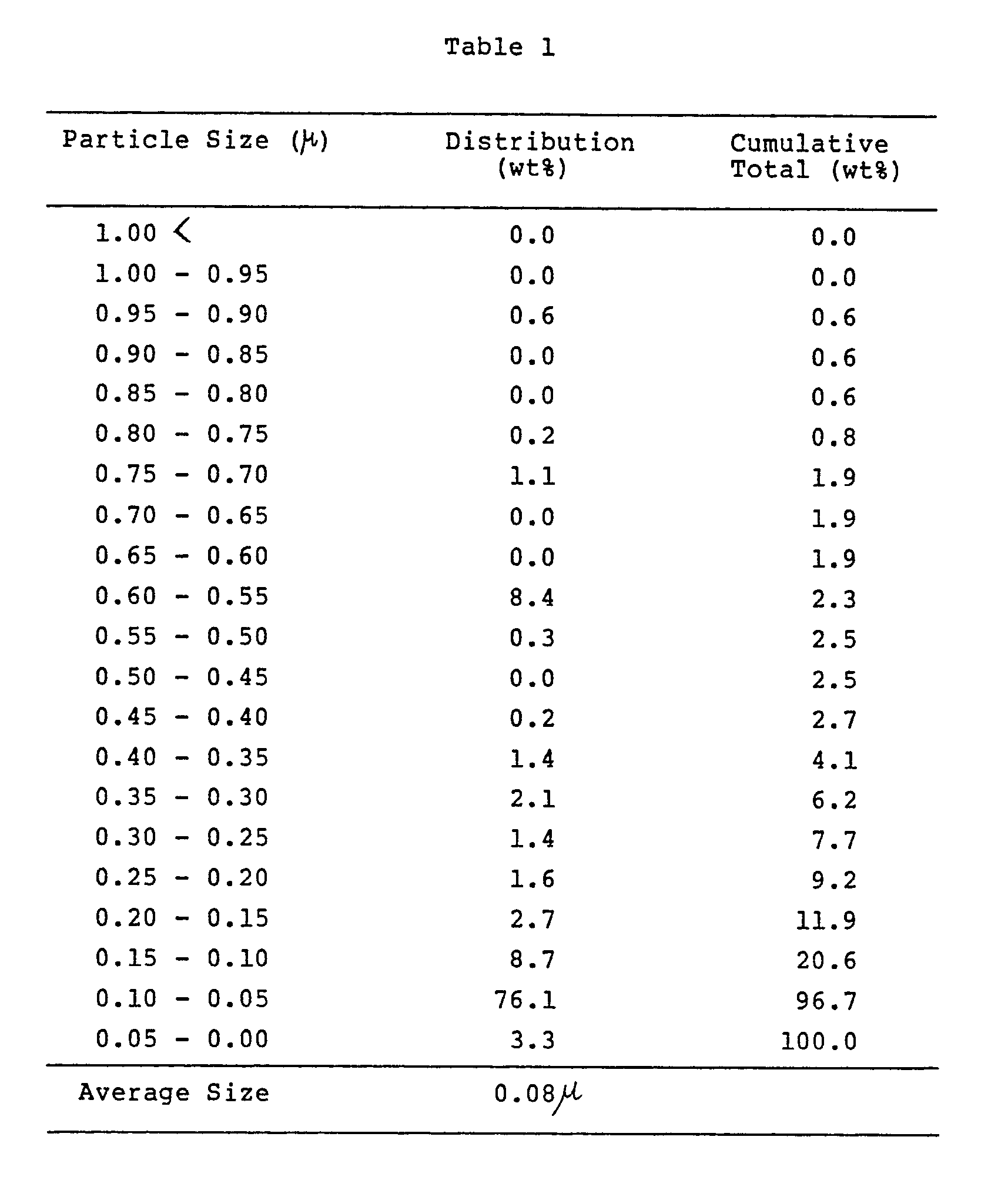
- 70 ml of a commercially available Zpt dispersion (commercial product A having active ingredient of 50 wt%) and 130 ml of glass beads (media) having a size of 44 to 63 microns were mixed (media/dispersion ratio by volume = 65/35) and placed in a 400 ml sand grinder (made by Igarashi Machine Manufacturing Co., Ltd.). Grinder discs were rotated for 3 hours at a peripheral speed of 5 m/sec. The temperature within the grinder was 20 to 25°C. The resulting dispersion was filtered under pressure to obtain 31 ml of fine particulate Zpt. The size distribution of thus obtained fine particulate Zpt is shown in Table 2.

- 23 g of commercially available Zpt powder, 4.5 g of a water-soluble copolymer salt of the formula having a molecular weight of 680,000,

63 g of water, and 187 g of glass beads (media) having a size of 0.1 to 0.2 mm were mixed (media/dispersion ratio by volume = 63/37) and placed in a 400 ml sand grinder (made by Igarashi Machine Manufacturing Co., Ltd.). In the grinder, discs were rotated for 12 hours at a peripheral speed of 6 m/sec. The temperature in the sand grinder was found to be 20 to 25 °C. The content was filtered under pressure to obtain 40 g of fine particulate Zpt dispersion. When the media are washed twice each with 70 g of water, 98% of Zpt could be recovered. The size distribution of thus obtained fine particulate Zpt is shown in Table 3.
- Antimicrobial suspensions as shown in Table 1 were prepared by adding a certain amount of suspension containing Zpt in an amount of 50% to an aqueous solution of a water-soluble polymer of a predetermined concentration, and agitating the mixture. The appearance of the suspensions were observed immediately after the preparation, after 10 days storage at 25°C, after addition of sodium chloride (final concentration = 3%, after 10 days of storage), and after frozen and re-melted (from -20°C to room temperature) by naked eyes. The results are shown in Table 4. In the table, symbols denote the following meanings.
- o: uniform dispersion
- F: flocculation
- S: sedimentation
- A: irreversible aggregation
-


- 4) Polyquart H (Henkel Co., Ltd.)
- 5) Polycondensation product of Adipic acid/Dimethylamino hydroxypropane diethylenetriamine (Cartaretin F, Sandoz Co., Ltd.)
- 6) 1:1 Copolymer of methyldivinylimidazolium/vinylpyrrolidone (Luviquat FC 550, BASF Co., Ltd.)
- 7) Copolymer of vinylpyrrolidone/dimethylaminoethylmethacrylate (Gafquat 755N, GAF Co., Ltd.)
- 8) Average polymerization 1550
- 9) Carbopol 941 (Goodrich Co., Ltd.)
- As shown in Table 4, only inventive products incorporating fine particulate Zpt and condensation polymerization product of polyglycol/polyamine were excellent in lasting uniform suspension without any flocculation or sedimentation taken place under any condition.
- A surfactant was added to water and dissolved to prepare a uniform solution having a final concentration referred to in Table 5. An antimicrobial suspension prepared in Example 1 was added to the resulting solution under agitation, further added with perfume and colorant. The pH was adjusted to 7 by citric acid, and the viscosity to 800 cps by ethanol, thereby obtaining shampoo compositions shown in Table 2. The appearence of the compositions were observed after 30 days storage at room temperature, at 50°C and at 40°C, respectively, and after frozen and re-melted (from -20°C to room temperature) by naked eyes. The results are shown in Table 5. The symbols have the same meanings as indicated in Example 1.
- As shown in Table 5, only inventive shampoo compositions incorporating fine particulate Zpt and condensation polymerization product of polyglycol/polyamine were excellent in lasting stable suspension under any condition.

- Hair Rinse Composition:

- In a uniform solution of (1) and (8) was uniformly dispersed (4) and heated, followed by adding a hot uniform solution of (2) and (3) under agitation, cooling and adding (5), (6) and (7) to obtain a hair rinse composition. Thus obtained hair rinse composition was found to keep good and stable suspension over a long period without being flocculated or settled after heated or frozen and re-melted.
- Anti-dandruff Lotion:

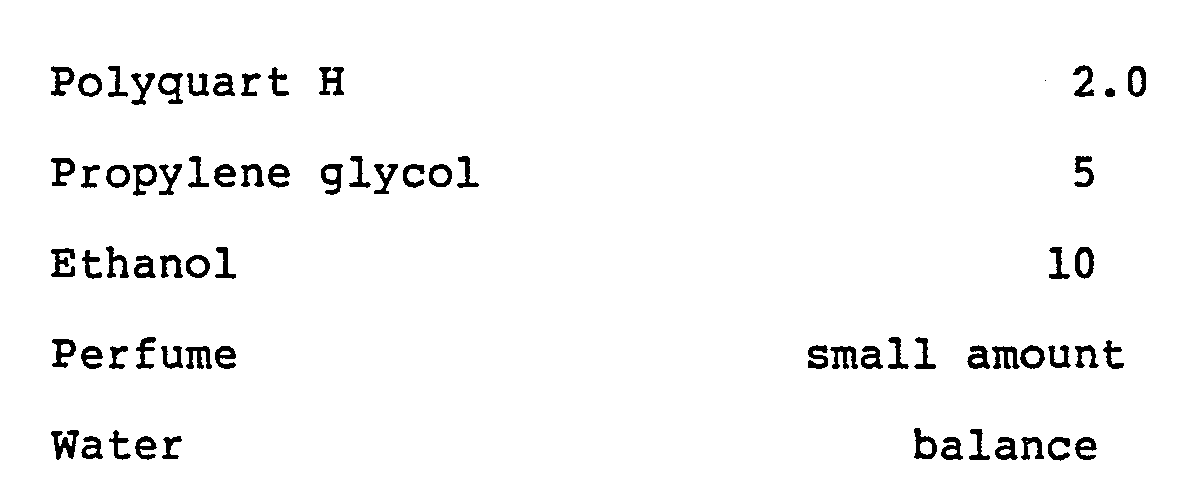
- The procedure of Example 1 was followed to prepare an anti-dandruff lotion. The lotion was found to be stable over 1 month at room temperature.
- On the contrary, when no Polyquart H was used, Zpt was recognized to settle in 3 days.
- Aqueous Antimicrobial:

- An aqueous antimicrobial was obtained in the same manner as in Example 2. The antimicrobial was stable over 1 month and showed good antimicrobial effects when applied to trees.
- An antimicrobial dispersion of fine particulate Zpt of the following formulation was prepared, then diluted by ion-exchanged water and determined the size distribution by the centrifugal precipitation method. The results are shown in the sole Figure.
-

- Hydroxyethylcellulose was added to ion-exchanged water and heated to dissolve, followed by cooling down to room temperature, adding polyoxyethylene coconut fatty acid monoethanolamide to obtain a uniform mixture. Dispersion of fine particulate Zpt according to Referential Example 2 was added to the resulting mixture, and further agitated to obtain a uniform mixture.
- Shampoo Composition:
- (Formulation)
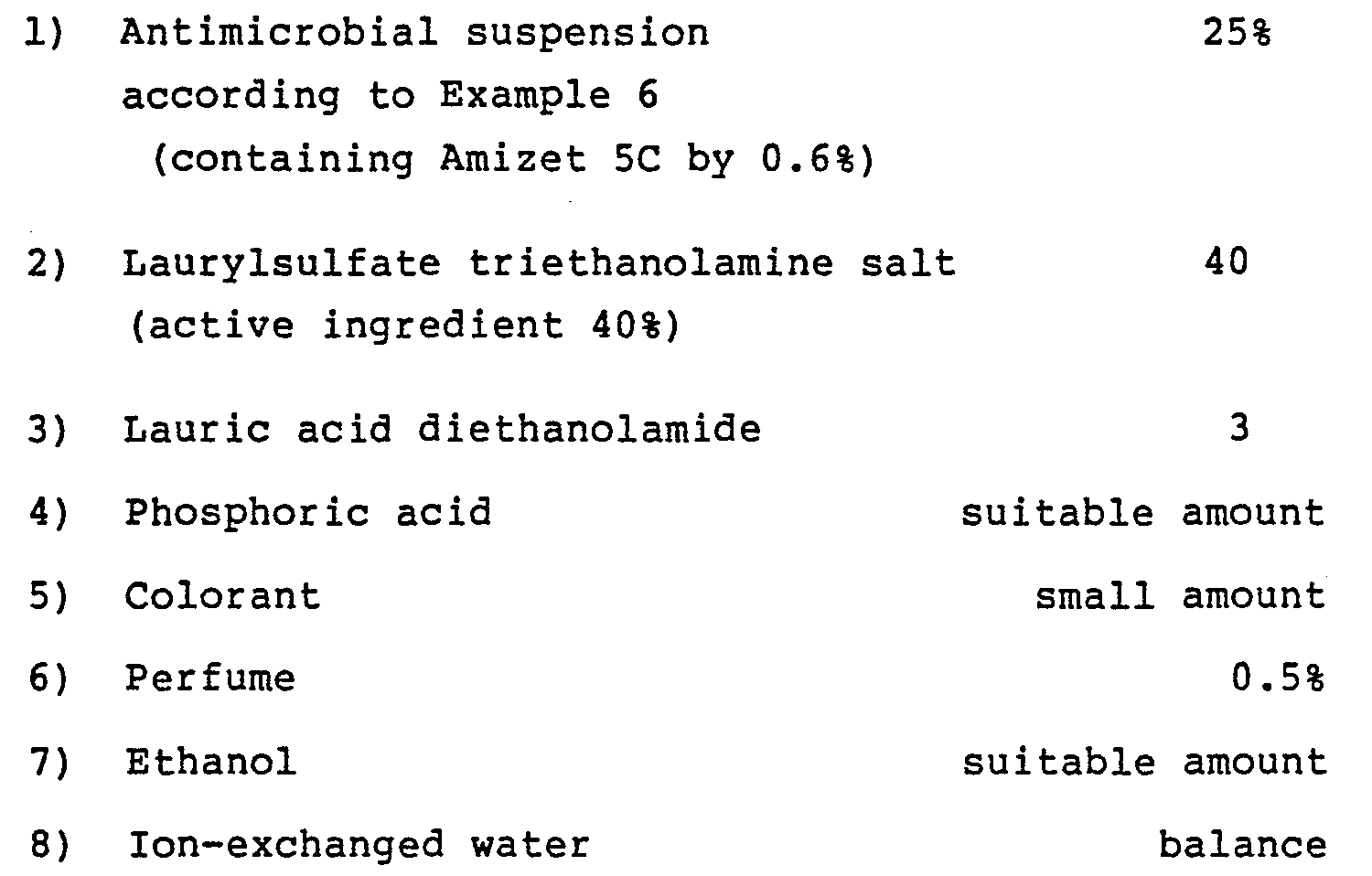
- (Preparation)
- In a uniform solution of 2) and 8) was dispersed 1) under agitation, and 3), 5) and 6) were further added under agitation until uniform mixture was obtained. 4) and 7) were added to the resulting solution in a suitable amount to adjust pH to 7, and viscosity to 200 cp (B-viscometer), thereby obtaining an antidandruff shampoo composition. This composition showed good dispersion after storage for 2 weeks at 40°C.
- Hair Rinse Composition:
- (Formulation)

- (Preparation)
- In a uniform solution of 2) and 8) was dispersed 1) under agitation until uniformly mixed, and 3), 4), 5), 6) and 7) were further added and mixed uniformly to prepare an antidandruff rinse composition. This composition showed good dispersion after storage for 2 weeks at 40°C.
- Shampoo compositions shown in Table 6 were prepared following the methods of Examples 6 and 7. These products showed good dispersion after storage for 2 weeks at 40°C.
- Comparative products 16 to 20 shown in Table 6 were prepared. Products which were not treated by water-soluble polymer/non-ionic surfactant were flocculated and sedimented. Commercially sold Zpt treated by water-soluble polymer/non-ionic surfactant showed sedimentation. The fine particulate Zpt which was not treated by non-ionic surfactant but was treated only by water-soluble polymer showed sedimentation. The fine particulate Zpt treated by methylcellulose/non- ionic surfactant showed sedimentation. The fine particulate Zpt treated by carboxymethylcellulose/non- ionic surfactant was flocculated and sedimented.


- 58 g of water, 15 g of sodium chloride and 17 g of Cartaretin F (active ingredient 30%) were mixed up, followed by adding 10 g of fine particulate Zpt (active ingredient 50%) under agitation, and subjected to further agitation to obtain a suspension of fine particulate Zpt.
- 20 parts by weight (hereinafter simply referred to as parts) of the resulting suspension, which was in gel state, were added to 80 parts of sodium alkylether sulfate (active ingredient 2.5%) under agitation, and further mixed well, thereby obtaining a uniform suspension. It was found to contain particles having as same size as measured prior to the treatment.
- Zpt suspensions shown in Table 7 were prepared in the same manner as described above. Appearance of the suspension was observed after mixed with sodium alkylether sulfate under the same condition as mentioned above, and after 40 days storage at 25°C, respectively. In the Table, "0", "A", "F" and "S" denote the following meanings respectively.
- 0: uniform suspension
- A: Irreversible aggregation
- F: Flocculation
- S: sedimentation
- As shown in Table 7, inventive products 19 to 25 which make use of the compound selected from polycondensation product of adipic acid- dimethylaminohydroxypropyl diethylenetriamine, copolymerization product of dimethylamoniethyl methacrylate-vinylpyrrolidone and copolymerization product of dimethyldiallylammoniumchloride-acrylamide, inorganic salt and fine particulate Zpt gave excellent and uniform dispersion while keeping the size of fine particulate Zpt even in the presence of surfactants, and were not sedimented or irreversibly aggregated. On the contrary, comparative products 21 to 27 genarated flocculation or sedimentation, and were not agreeable.

- The method of Example 17 was followed to prepare Zpt suspensions shown in Table 8. The suspensions were added to 25% solution of sodium polyoxyethylene(2.5)lauryl sulfate. The apppearence of the dispersion was observed as in Example 17. The results are also shown in Table 8.

- Shampoo compositions shown in Table 9 were prepared making use of Zpt suspensions obtained in Example 17.
- A surfactant, aqueous solution of a surfactant, and water were uniformly mixed, to which Zpt suspension prepared according to Example 17 was added under agitation, followed by further agitation until uniform mixture was obtained. The resulting mixture was added with perfume and colorant, adjusted pH to 7 by citric acid, and viscosity to 1,000 - 500 by ethanol.
- *1: necessary amount for adjusting pH to 7
- *2: necessary amount for modifying the viscosity in a range from 1,000 to 500
- *3: Miranol C2M (Miranol Co. Ltd.)
- *4: Rebon 2000 (Sanyo Kasei K.K.)
- As shown in Table 9, inventive shampoo products 41 to 48 gave excellent suspension even after 2 month storages at room temperature, 4.0°C, and 50°C without sedimented or flocculated. Further, after frozen and re-melted, the inventive products were found to restore good suspension. On the contrary, comparative product 28 sedimented without flocculation, and comparative products 29 and 30 sedimented with flocculation.

- Hair rinse Composition:
- (Formulation)

- Into a uniform solution of stearyltrimethyl ammoniumchloride and water was added and suspended a suspension of Inventive product 20 and heated, to which a uniform solution of cetyl alcohol and propylene glycol was added under further agitation. After cooling, perfume, colorant and citirc acid were added to prepare a hair rinse composition.
- Thus obtained hair rinse compositions gave good suspension stability at room temperature, at 40°C, and at 50°C.
and hardened castor oil.
Claims (11)


wherein, R25 and R26 are the same or different with each other and independently represent a hydrogen atom or methyl group, X represents a halogen atom, and ℓ and m4 are such integers that the sum of ℓ and m4 ranges from 180 to 2,000.

wherein, R27 and R28 are the same or different with each other, and independently represent an alkyl group having 1 to 18 carbon atoms, and n4 is such an integer that gives a molecular weight of ranging from 100 to 100,000.

wherein R29 represents a hydrogen atom, methyl group or ethyl group, Z represents an oxygen atom or a group -NH-, R30 represents an alkylene group having 1 to 4 carbon atoms, R31 and R32 are the same or different with each other and independently represent an alkyl group having 1 to 18 carbon atoms, arid p and q independently represent such an integer that gives a molecular weight of ranging from 1,000 to 5,000,000.
Priority Applications (1)
| Application Number | Priority Date | Filing Date | Title |
|---|---|---|---|
| AT85110580T ATE69158T1 (en) | 1984-08-29 | 1985-08-22 | ANTIMICROBIC SUSPENSIONS AND ANTIMICROBIC HAIR TREATMENTS. |
Applications Claiming Priority (6)
| Application Number | Priority Date | Filing Date | Title |
|---|---|---|---|
| JP179978/84 | 1984-08-29 | ||
| JP17997884A JPS6157503A (en) | 1984-08-29 | 1984-08-29 | Suspension of fungicide, and fungicidal hair-treatment composition |
| JP27252984A JPS61151111A (en) | 1984-12-24 | 1984-12-24 | Antimicrobial hair-treatment composition |
| JP272529/84 | 1984-12-24 | ||
| JP276789/84 | 1984-12-27 | ||
| JP27678984A JPS61152627A (en) | 1984-12-27 | 1984-12-27 | Antibacterial agent and antibacterial hair treatment composition containing same |
Publications (3)
| Publication Number | Publication Date |
|---|---|
| EP0173259A2 true EP0173259A2 (en) | 1986-03-05 |
| EP0173259A3 EP0173259A3 (en) | 1986-12-30 |
| EP0173259B1 EP0173259B1 (en) | 1991-11-06 |
Family
ID=27324784
Family Applications (1)
| Application Number | Title | Priority Date | Filing Date |
|---|---|---|---|
| EP85110580A Expired EP0173259B1 (en) | 1984-08-29 | 1985-08-22 | Antimicrobial suspensions and antimicrobial hair treatment compositions |
Country Status (6)
| Country | Link |
|---|---|
| US (1) | US4832950A (en) |
| EP (1) | EP0173259B1 (en) |
| DE (1) | DE3584595D1 (en) |
| HK (1) | HK41593A (en) |
| MY (1) | MY102296A (en) |
| SG (1) | SG14093G (en) |
Cited By (21)
| Publication number | Priority date | Publication date | Assignee | Title |
|---|---|---|---|---|
| AT400515B (en) * | 1986-08-07 | 1996-01-25 | Oreal | PHARMACEUTICAL AGENT FOR PROMOTING AND STIMULATING HAIR GROWTH AND FOR REDUCING HAIR LOSS BASED ON PYRIMIDINE DERIVATIVES, AND USE OF THE AGENT |
| US5723112A (en) * | 1995-07-14 | 1998-03-03 | Chesebrough-Pond's Usa Co., Division Of Conopco, Inc. | Pyrithione containing hair treatment composition |
| EP0983242A4 (en) * | 1997-03-14 | 2001-02-21 | Arch Chem Inc | Method for producing particles of pyrithione salts |
| EP0977484A4 (en) * | 1997-04-28 | 2002-06-12 | Arch Chem Inc | Non-spherical and non-platelet pyrithione salts |
| US6451300B1 (en) | 1999-05-03 | 2002-09-17 | The Procter & Gamble Company | Anti-dandruff and conditioning shampoos containing polyalkylene glycols and cationic polymers |
| WO2003039499A1 (en) | 2001-11-02 | 2003-05-15 | The Procter & Gamble Company | Composition containing a cationic polymer and water insoluble solid material |
| US6649155B1 (en) | 1999-05-03 | 2003-11-18 | The Procter & Gamble Company | Anti-dandruff and conditioning shampoos containing certain cationic polymers |
| US6864314B1 (en) | 1999-05-26 | 2005-03-08 | Dominic Wai-Kwing Yeung | Block polymers, compositions and methods of use for foams, laundry detergents, shower rinses and coagulants |
| US6974569B2 (en) | 1999-05-03 | 2005-12-13 | The Procter & Gamble Company | Shampoos providing a superior combination anti-dandruff efficacy and condition |
| US7241729B2 (en) | 1999-05-26 | 2007-07-10 | Rhodia Inc. | Compositions and methods for using polymeric suds enhancers |
| US7544367B2 (en) | 1999-03-05 | 2009-06-09 | Arch Chemicals, Inc. | Chemical method of making a suspension, emulsion or dispersion of pyrithione particles |
| US7939601B1 (en) | 1999-05-26 | 2011-05-10 | Rhodia Inc. | Polymers, compositions and methods of use for foams, laundry detergents, shower rinses, and coagulants |
| CN106998691A (en) * | 2014-11-14 | 2017-08-01 | 可隆生命科学株式会社 | Antibiotic property water-dispersed composition containing ZPT |
| WO2018041544A1 (en) | 2016-08-30 | 2018-03-08 | Unilever N.V. | A personal care composition |
| WO2018077958A1 (en) | 2016-10-27 | 2018-05-03 | Unilever N.V. | A personal care composition comprising curcuminoids |
| WO2018077602A1 (en) | 2016-10-27 | 2018-05-03 | Unilever N.V. | A personal care composition |
| WO2018172121A1 (en) | 2017-03-23 | 2018-09-27 | Unilever N.V. | Hair care composition |
| WO2018197118A1 (en) | 2017-04-26 | 2018-11-01 | Unilever N.V. | Antidandruff hair care composition comprising pyrithione |
| WO2020229199A1 (en) | 2019-05-14 | 2020-11-19 | Unilever N.V. | 2(1h)-pyridinones and their use to treat inflammatory conditions |
| CN114853399A (en) * | 2022-03-30 | 2022-08-05 | 石家庄市长安育才建材有限公司 | Preparation method of recycled concrete based on construction waste |
| US11826453B2 (en) | 2019-05-14 | 2023-11-28 | Conopco, Inc. | Hair care composition comprising piroctone olamine |
Families Citing this family (12)
| Publication number | Priority date | Publication date | Assignee | Title |
|---|---|---|---|---|
| JPH06164102A (en) * | 1992-11-25 | 1994-06-10 | Nippon Paint Co Ltd | Surface treatment method for electrodeposition type photosensitive resin coating |
| US5334376A (en) * | 1993-08-13 | 1994-08-02 | Colgate-Palmolive Company | Compositions for conditioning hair |
| WO2000060940A1 (en) * | 1999-04-12 | 2000-10-19 | Dow Agrosciences Llc | Aqueous dispersions of agricultural chemicals |
| US20050124738A1 (en) * | 1999-05-26 | 2005-06-09 | The Procter & Gamble Company | Compositions and methods for using zwitterionic polymeric suds enhancers |
| GB0015723D0 (en) * | 2000-06-27 | 2000-08-16 | Unilever Plc | Compositions containing a metal pyrithione |
| WO2004101726A2 (en) * | 2003-05-15 | 2004-11-25 | Greenbridge Environmental Control Limited | Anti-viral and anti-bacterial cleaning composition |
| GB0410968D0 (en) * | 2004-05-17 | 2004-06-16 | Greenbridge Environmental Cont | Skin cleaning composition |
| KR101276386B1 (en) * | 2005-01-05 | 2013-06-19 | 아쿠아세르브 인크 | Enhanced efficacy of fungicides in paper and paperboard |
| EP2962564A1 (en) * | 2005-10-25 | 2016-01-06 | Dow Global Technologies Llc | Antimicrobial composition and method |
| DE102006032505A1 (en) * | 2006-07-12 | 2008-01-17 | Henkel Kgaa | Anti dandruff shampoo |
| WO2017089108A1 (en) | 2015-11-27 | 2017-06-01 | Unilever N.V. | An antimicrobial cleansing composition |
| FR3096580B1 (en) * | 2019-05-27 | 2021-07-02 | Oreal | Cosmetic composition comprising an aqueous phase and solid particles |
Family Cites Families (26)
| Publication number | Priority date | Publication date | Assignee | Title |
|---|---|---|---|---|
| DE1301006B (en) * | 1963-03-15 | 1969-08-14 | Colgate Palmolive Co | Hairdressing products |
| US3236733A (en) * | 1963-09-05 | 1966-02-22 | Vanderbilt Co R T | Method of combatting dandruff with pyridinethiones metal salts detergent compositions |
| US3489686A (en) * | 1965-07-30 | 1970-01-13 | Procter & Gamble | Detergent compositions containing particle deposition enhancing agents |
| GB1202716A (en) * | 1967-02-20 | 1970-08-19 | Revlon | Solubilized metal salts of pyridinethione |
| US3753916A (en) * | 1967-09-27 | 1973-08-21 | Procter & Gamble | Detergent compositions containing particle deposition enhancing agents |
| US3723325A (en) * | 1967-09-27 | 1973-03-27 | Procter & Gamble | Detergent compositions containing particle deposition enhancing agents |
| US3761418A (en) * | 1967-09-27 | 1973-09-25 | Procter & Gamble | Detergent compositions containing particle deposition enhancing agents |
| US3580853A (en) * | 1967-09-27 | 1971-05-25 | Procter & Gamble | Detergent compositions containing particle deposition enhancing agents |
| US3761417A (en) * | 1967-09-27 | 1973-09-25 | Procter & Gamble | Detergent compositions containing particle deposition enhancing agents |
| US3940482A (en) * | 1971-04-21 | 1976-02-24 | Colgate-Palmolive Company | Solubilization of the zinc salt of 1-hydroxy-2-pyridinethione |
| JPS5397010A (en) * | 1977-02-07 | 1978-08-24 | Takeda Chem Ind Ltd | Shampoo containing bis(2-pyridylthio-1-oxide)zing and its preparation |
| DE2748463A1 (en) * | 1977-09-14 | 1979-03-29 | Hoffmann La Roche | COSMETIC PREPARATION |
| EP0007704A3 (en) * | 1978-07-28 | 1980-02-20 | Beecham Group Plc | Method of preparing a hair conditioning product |
| JPS5661308A (en) * | 1979-10-25 | 1981-05-26 | Shiseido Co Ltd | Hair conditioning composition preventing dandruff and itch |
| DE3165895D1 (en) * | 1980-02-07 | 1984-10-18 | Procter & Gamble | Zinc-pyridinethione salts, a process for making thereof and hair care compositions containing them |
| US4345080A (en) * | 1980-02-07 | 1982-08-17 | The Procter & Gamble Company | Pyridinethione salts and hair care compositions |
| US4323683A (en) * | 1980-02-07 | 1982-04-06 | The Procter & Gamble Company | Process for making pyridinethione salts |
| US4379753A (en) * | 1980-02-07 | 1983-04-12 | The Procter & Gamble Company | Hair care compositions |
| DE3163341D1 (en) * | 1980-02-07 | 1984-06-07 | Procter & Gamble | Antidandruff lotion shampoo compositions |
| ZA82301B (en) * | 1981-01-31 | 1982-12-29 | Beecham Group Plc | Medicated conditioner |
| DE3113872A1 (en) * | 1981-04-06 | 1982-10-21 | Rütgerswerke AG, 6000 Frankfurt | Suspensions of the zinc salt of 2-mercaptopyridine-N-oxide |
| CA1197785A (en) * | 1981-09-14 | 1985-12-10 | David A. Glover | Anti-dandruff cream rinse conditioner |
| US4529587A (en) * | 1982-02-19 | 1985-07-16 | Lever Brothers Company | Method of reducing sebum on the hair and skin |
| EP0093541A3 (en) * | 1982-04-29 | 1984-09-12 | Beecham Group Plc | Antidandruff compositions |
| US4557928A (en) * | 1982-07-06 | 1985-12-10 | Amway Corporation | Anti-dandruff cream rinse conditioner |
| DE3472103D1 (en) * | 1983-07-06 | 1988-07-21 | Kao Corp | Finely powdered polyvalent metal salts of 2-mercaptopyridine-n-oxide, method for producing the same, and antibacterial compositions comprising the same |
-
1985
- 1985-08-22 DE DE8585110580T patent/DE3584595D1/en not_active Expired - Fee Related
- 1985-08-22 EP EP85110580A patent/EP0173259B1/en not_active Expired
-
1987
- 1987-03-24 MY MYPI87000369A patent/MY102296A/en unknown
-
1988
- 1988-05-10 US US07/193,186 patent/US4832950A/en not_active Expired - Fee Related
-
1993
- 1993-02-09 SG SG140/93A patent/SG14093G/en unknown
- 1993-04-29 HK HK415/93A patent/HK41593A/en not_active IP Right Cessation
Cited By (29)
| Publication number | Priority date | Publication date | Assignee | Title |
|---|---|---|---|---|
| AT400515B (en) * | 1986-08-07 | 1996-01-25 | Oreal | PHARMACEUTICAL AGENT FOR PROMOTING AND STIMULATING HAIR GROWTH AND FOR REDUCING HAIR LOSS BASED ON PYRIMIDINE DERIVATIVES, AND USE OF THE AGENT |
| US5723112A (en) * | 1995-07-14 | 1998-03-03 | Chesebrough-Pond's Usa Co., Division Of Conopco, Inc. | Pyrithione containing hair treatment composition |
| EP0983242A4 (en) * | 1997-03-14 | 2001-02-21 | Arch Chem Inc | Method for producing particles of pyrithione salts |
| EP0977484A4 (en) * | 1997-04-28 | 2002-06-12 | Arch Chem Inc | Non-spherical and non-platelet pyrithione salts |
| US8709460B2 (en) | 1999-03-05 | 2014-04-29 | Arch Chemicals, Inc. | Chemical method of making a suspension, emulsion or dispersion of pyrithione particles |
| US7544367B2 (en) | 1999-03-05 | 2009-06-09 | Arch Chemicals, Inc. | Chemical method of making a suspension, emulsion or dispersion of pyrithione particles |
| US6649155B1 (en) | 1999-05-03 | 2003-11-18 | The Procter & Gamble Company | Anti-dandruff and conditioning shampoos containing certain cationic polymers |
| US6974569B2 (en) | 1999-05-03 | 2005-12-13 | The Procter & Gamble Company | Shampoos providing a superior combination anti-dandruff efficacy and condition |
| US6451300B1 (en) | 1999-05-03 | 2002-09-17 | The Procter & Gamble Company | Anti-dandruff and conditioning shampoos containing polyalkylene glycols and cationic polymers |
| US8907033B2 (en) | 1999-05-26 | 2014-12-09 | Solvay Usa Inc. | Polymers, compositions and methods of use for foams, laundry detergents, shower rinses and coagulants |
| US6864314B1 (en) | 1999-05-26 | 2005-03-08 | Dominic Wai-Kwing Yeung | Block polymers, compositions and methods of use for foams, laundry detergents, shower rinses and coagulants |
| US7241729B2 (en) | 1999-05-26 | 2007-07-10 | Rhodia Inc. | Compositions and methods for using polymeric suds enhancers |
| US7335700B2 (en) | 1999-05-26 | 2008-02-26 | Rhodia Inc. | Block polymers, compositions and methods of use for foams, laundry detergents, shower rinses and coagulants |
| US7915212B2 (en) | 1999-05-26 | 2011-03-29 | Rhodia Inc. | Block polymers, compositions and methods of use for foams, laundry detergents, shower rinses and coagulants |
| US7939601B1 (en) | 1999-05-26 | 2011-05-10 | Rhodia Inc. | Polymers, compositions and methods of use for foams, laundry detergents, shower rinses, and coagulants |
| US6849584B2 (en) | 2001-11-02 | 2005-02-01 | The Procter & Gamble Company | Composition containing a cationic polymer and water insoluble solid material |
| WO2003039499A1 (en) | 2001-11-02 | 2003-05-15 | The Procter & Gamble Company | Composition containing a cationic polymer and water insoluble solid material |
| CN106998691A (en) * | 2014-11-14 | 2017-08-01 | 可隆生命科学株式会社 | Antibiotic property water-dispersed composition containing ZPT |
| EP3219208A4 (en) * | 2014-11-14 | 2018-05-02 | Kolon Life Science | Antimicrobial water dispersible composition comprising zinc pyrithione |
| WO2018041544A1 (en) | 2016-08-30 | 2018-03-08 | Unilever N.V. | A personal care composition |
| WO2018077958A1 (en) | 2016-10-27 | 2018-05-03 | Unilever N.V. | A personal care composition comprising curcuminoids |
| WO2018077602A1 (en) | 2016-10-27 | 2018-05-03 | Unilever N.V. | A personal care composition |
| WO2018172121A1 (en) | 2017-03-23 | 2018-09-27 | Unilever N.V. | Hair care composition |
| WO2018197118A1 (en) | 2017-04-26 | 2018-11-01 | Unilever N.V. | Antidandruff hair care composition comprising pyrithione |
| WO2020229199A1 (en) | 2019-05-14 | 2020-11-19 | Unilever N.V. | 2(1h)-pyridinones and their use to treat inflammatory conditions |
| US11826453B2 (en) | 2019-05-14 | 2023-11-28 | Conopco, Inc. | Hair care composition comprising piroctone olamine |
| US12215084B2 (en) | 2019-05-14 | 2025-02-04 | Conopco, Inc. | 2(1H)-pyridinones and their use to treat inflammatory conditions |
| CN114853399A (en) * | 2022-03-30 | 2022-08-05 | 石家庄市长安育才建材有限公司 | Preparation method of recycled concrete based on construction waste |
| CN114853399B (en) * | 2022-03-30 | 2023-11-03 | 石家庄市长安育才建材有限公司 | Preparation method of recycled concrete based on construction waste |
Also Published As
| Publication number | Publication date |
|---|---|
| DE3584595D1 (en) | 1991-12-12 |
| MY102296A (en) | 1992-05-28 |
| EP0173259B1 (en) | 1991-11-06 |
| HK41593A (en) | 1993-05-07 |
| US4832950A (en) | 1989-05-23 |
| SG14093G (en) | 1993-04-16 |
| EP0173259A3 (en) | 1986-12-30 |
Similar Documents
| Publication | Publication Date | Title |
|---|---|---|
| US4832950A (en) | Antimicrobial suspensions and antimicrobial hair treatment compositions | |
| US3928251A (en) | Mild shampoo compositions | |
| US6514918B1 (en) | Viscous, mild, and effective cleansing compositions | |
| EP0266111B1 (en) | Personal skin care products containing dimethyl diallyl ammonium chloride/acrylic acid-type polymers | |
| US4235898A (en) | Liquid shampoo composition | |
| JP3819765B2 (en) | Hair cosmetic composition having antidandruff formation effect | |
| NZ210613A (en) | Aqueous-based shaving cream gel containing carboxylic acid salt | |
| WO1994006409A1 (en) | Hair conditioning shampoo | |
| MXPA01000659A (en) | Composition for washing keratin materials, based on weakly ethoxylated sorbitan ester. | |
| EP0671463B1 (en) | Detergent composition | |
| EP0427449B1 (en) | Shampoo suspension containing an amine functional siloxane | |
| JP2004002716A (en) | Viscous, gentle, effective cleaning composition | |
| JPS6157503A (en) | Suspension of fungicide, and fungicidal hair-treatment composition | |
| EP0149175B1 (en) | Dispersions of antifungus agents and antifungal hair treatment compositions | |
| EP0301082A1 (en) | Shampoo | |
| JPH11278000A (en) | Surfactant blend with pearl-like glazing action | |
| NO173123B (en) | FLASH FIGHTING MUSCLE PREPARATION AND SUSPENDING PREPARATION | |
| JPS6411610B2 (en) | ||
| JPS643193B2 (en) | ||
| NZ202922A (en) | Emulsifier compositions containing ethylene oxide polymers | |
| KR20230101858A (en) | solid detergent composition | |
| JP2003147399A (en) | Liquid detergent composition | |
| JP7460795B2 (en) | Methods for enhancing scalp active substance deposition | |
| JPH0449224A (en) | Cleaning agent composition | |
| JPS61152627A (en) | Antibacterial agent and antibacterial hair treatment composition containing same |
Legal Events
| Date | Code | Title | Description |
|---|---|---|---|
| PUAI | Public reference made under article 153(3) epc to a published international application that has entered the european phase |
Free format text: ORIGINAL CODE: 0009012 |
|
| AK | Designated contracting states |
Kind code of ref document: A2 Designated state(s): AT CH DE FR GB IT LI NL |
|
| PUAL | Search report despatched |
Free format text: ORIGINAL CODE: 0009013 |
|
| AK | Designated contracting states |
Kind code of ref document: A3 Designated state(s): AT CH DE FR GB IT LI NL |
|
| 17P | Request for examination filed |
Effective date: 19870116 |
|
| 17Q | First examination report despatched |
Effective date: 19890125 |
|
| GRAA | (expected) grant |
Free format text: ORIGINAL CODE: 0009210 |
|
| AK | Designated contracting states |
Kind code of ref document: B1 Designated state(s): AT CH DE FR GB IT LI NL |
|
| REF | Corresponds to: |
Ref document number: 69158 Country of ref document: AT Date of ref document: 19911115 Kind code of ref document: T |
|
| REF | Corresponds to: |
Ref document number: 3584595 Country of ref document: DE Date of ref document: 19911212 |
|
| ET | Fr: translation filed | ||
| ITF | It: translation for a ep patent filed | ||
| PLBE | No opposition filed within time limit |
Free format text: ORIGINAL CODE: 0009261 |
|
| STAA | Information on the status of an ep patent application or granted ep patent |
Free format text: STATUS: NO OPPOSITION FILED WITHIN TIME LIMIT |
|
| 26N | No opposition filed | ||
| PGFP | Annual fee paid to national office [announced via postgrant information from national office to epo] |
Ref country code: CH Payment date: 19970911 Year of fee payment: 13 |
|
| PGFP | Annual fee paid to national office [announced via postgrant information from national office to epo] |
Ref country code: AT Payment date: 19980813 Year of fee payment: 14 |
|
| PGFP | Annual fee paid to national office [announced via postgrant information from national office to epo] |
Ref country code: NL Payment date: 19980827 Year of fee payment: 14 |
|
| PG25 | Lapsed in a contracting state [announced via postgrant information from national office to epo] |
Ref country code: LI Free format text: LAPSE BECAUSE OF NON-PAYMENT OF DUE FEES Effective date: 19980831 Ref country code: CH Free format text: LAPSE BECAUSE OF NON-PAYMENT OF DUE FEES Effective date: 19980831 |
|
| REG | Reference to a national code |
Ref country code: CH Ref legal event code: PL |
|
| PG25 | Lapsed in a contracting state [announced via postgrant information from national office to epo] |
Ref country code: AT Free format text: LAPSE BECAUSE OF NON-PAYMENT OF DUE FEES Effective date: 19990822 |
|
| PG25 | Lapsed in a contracting state [announced via postgrant information from national office to epo] |
Ref country code: NL Free format text: LAPSE BECAUSE OF NON-PAYMENT OF DUE FEES Effective date: 20000301 |
|
| NLV4 | Nl: lapsed or anulled due to non-payment of the annual fee |
Effective date: 20000301 |
|
| REG | Reference to a national code |
Ref country code: GB Ref legal event code: IF02 |
|
| PGFP | Annual fee paid to national office [announced via postgrant information from national office to epo] |
Ref country code: FR Payment date: 20020808 Year of fee payment: 18 |
|
| PGFP | Annual fee paid to national office [announced via postgrant information from national office to epo] |
Ref country code: GB Payment date: 20020821 Year of fee payment: 18 |
|
| PGFP | Annual fee paid to national office [announced via postgrant information from national office to epo] |
Ref country code: DE Payment date: 20020829 Year of fee payment: 18 |
|
| PG25 | Lapsed in a contracting state [announced via postgrant information from national office to epo] |
Ref country code: GB Free format text: LAPSE BECAUSE OF NON-PAYMENT OF DUE FEES Effective date: 20030822 |
|
| PG25 | Lapsed in a contracting state [announced via postgrant information from national office to epo] |
Ref country code: DE Free format text: LAPSE BECAUSE OF NON-PAYMENT OF DUE FEES Effective date: 20040302 |
|
| GBPC | Gb: european patent ceased through non-payment of renewal fee | ||
| PG25 | Lapsed in a contracting state [announced via postgrant information from national office to epo] |
Ref country code: FR Free format text: LAPSE BECAUSE OF NON-PAYMENT OF DUE FEES Effective date: 20040430 |
|
| REG | Reference to a national code |
Ref country code: FR Ref legal event code: ST |