EP0172988B1 - Optical fibers for infrared transmission - Google Patents
Optical fibers for infrared transmission Download PDFInfo
- Publication number
- EP0172988B1 EP0172988B1 EP85104311A EP85104311A EP0172988B1 EP 0172988 B1 EP0172988 B1 EP 0172988B1 EP 85104311 A EP85104311 A EP 85104311A EP 85104311 A EP85104311 A EP 85104311A EP 0172988 B1 EP0172988 B1 EP 0172988B1
- Authority
- EP
- European Patent Office
- Prior art keywords
- thallium
- fiber
- crystal
- impurities
- bromide
- Prior art date
- Legal status (The legal status is an assumption and is not a legal conclusion. Google has not performed a legal analysis and makes no representation as to the accuracy of the status listed.)
- Expired - Lifetime
Links
Images


Classifications
-
- G—PHYSICS
- G02—OPTICS
- G02B—OPTICAL ELEMENTS, SYSTEMS OR APPARATUS
- G02B6/00—Light guides; Structural details of arrangements comprising light guides and other optical elements, e.g. couplings
- G02B6/10—Light guides; Structural details of arrangements comprising light guides and other optical elements, e.g. couplings of the optical waveguide type
- G02B6/102—Light guides; Structural details of arrangements comprising light guides and other optical elements, e.g. couplings of the optical waveguide type for infrared and ultraviolet radiation
-
- C—CHEMISTRY; METALLURGY
- C03—GLASS; MINERAL OR SLAG WOOL
- C03B—MANUFACTURE, SHAPING, OR SUPPLEMENTARY PROCESSES
- C03B37/00—Manufacture or treatment of flakes, fibres, or filaments from softened glass, minerals, or slags
- C03B37/01—Manufacture of glass fibres or filaments
- C03B37/02—Manufacture of glass fibres or filaments by drawing or extruding, e.g. direct drawing of molten glass from nozzles; Cooling fins therefor
- C03B37/022—Manufacture of glass fibres or filaments by drawing or extruding, e.g. direct drawing of molten glass from nozzles; Cooling fins therefor from molten glass in which the resultant product consists of different sorts of glass or is characterised by shape, e.g. hollow fibres, undulated fibres, fibres presenting a rough surface
- C03B37/023—Fibres composed of different sorts of glass, e.g. glass optical fibres, made by the double crucible technique
-
- C—CHEMISTRY; METALLURGY
- C03—GLASS; MINERAL OR SLAG WOOL
- C03C—CHEMICAL COMPOSITION OF GLASSES, GLAZES OR VITREOUS ENAMELS; SURFACE TREATMENT OF GLASS; SURFACE TREATMENT OF FIBRES OR FILAMENTS MADE FROM GLASS, MINERALS OR SLAGS; JOINING GLASS TO GLASS OR OTHER MATERIALS
- C03C13/00—Fibre or filament compositions
- C03C13/008—Polycrystalline optical fibres
-
- C—CHEMISTRY; METALLURGY
- C30—CRYSTAL GROWTH
- C30B—SINGLE-CRYSTAL GROWTH; UNIDIRECTIONAL SOLIDIFICATION OF EUTECTIC MATERIAL OR UNIDIRECTIONAL DEMIXING OF EUTECTOID MATERIAL; REFINING BY ZONE-MELTING OF MATERIAL; PRODUCTION OF A HOMOGENEOUS POLYCRYSTALLINE MATERIAL WITH DEFINED STRUCTURE; SINGLE CRYSTALS OR HOMOGENEOUS POLYCRYSTALLINE MATERIAL WITH DEFINED STRUCTURE; AFTER-TREATMENT OF SINGLE CRYSTALS OR A HOMOGENEOUS POLYCRYSTALLINE MATERIAL WITH DEFINED STRUCTURE; APPARATUS THEREFOR
- C30B29/00—Single crystals or homogeneous polycrystalline material with defined structure characterised by the material or by their shape
- C30B29/10—Inorganic compounds or compositions
- C30B29/12—Halides
-
- C—CHEMISTRY; METALLURGY
- C30—CRYSTAL GROWTH
- C30B—SINGLE-CRYSTAL GROWTH; UNIDIRECTIONAL SOLIDIFICATION OF EUTECTIC MATERIAL OR UNIDIRECTIONAL DEMIXING OF EUTECTOID MATERIAL; REFINING BY ZONE-MELTING OF MATERIAL; PRODUCTION OF A HOMOGENEOUS POLYCRYSTALLINE MATERIAL WITH DEFINED STRUCTURE; SINGLE CRYSTALS OR HOMOGENEOUS POLYCRYSTALLINE MATERIAL WITH DEFINED STRUCTURE; AFTER-TREATMENT OF SINGLE CRYSTALS OR A HOMOGENEOUS POLYCRYSTALLINE MATERIAL WITH DEFINED STRUCTURE; APPARATUS THEREFOR
- C30B29/00—Single crystals or homogeneous polycrystalline material with defined structure characterised by the material or by their shape
- C30B29/60—Single crystals or homogeneous polycrystalline material with defined structure characterised by the material or by their shape characterised by shape
- C30B29/62—Whiskers or needles
-
- C—CHEMISTRY; METALLURGY
- C30—CRYSTAL GROWTH
- C30B—SINGLE-CRYSTAL GROWTH; UNIDIRECTIONAL SOLIDIFICATION OF EUTECTIC MATERIAL OR UNIDIRECTIONAL DEMIXING OF EUTECTOID MATERIAL; REFINING BY ZONE-MELTING OF MATERIAL; PRODUCTION OF A HOMOGENEOUS POLYCRYSTALLINE MATERIAL WITH DEFINED STRUCTURE; SINGLE CRYSTALS OR HOMOGENEOUS POLYCRYSTALLINE MATERIAL WITH DEFINED STRUCTURE; AFTER-TREATMENT OF SINGLE CRYSTALS OR A HOMOGENEOUS POLYCRYSTALLINE MATERIAL WITH DEFINED STRUCTURE; APPARATUS THEREFOR
- C30B33/00—After-treatment of single crystals or homogeneous polycrystalline material with defined structure
-
- C—CHEMISTRY; METALLURGY
- C03—GLASS; MINERAL OR SLAG WOOL
- C03B—MANUFACTURE, SHAPING, OR SUPPLEMENTARY PROCESSES
- C03B2201/00—Type of glass produced
- C03B2201/80—Non-oxide glasses or glass-type compositions
- C03B2201/84—Halide glasses other than fluoride glasses, i.e. Cl, Br or I glasses, e.g. AgCl-AgBr "glass"
Definitions
- This invention relates to a process for fabricating optical fibers and more particularly, infrared ray-transmittable fibers.
- the optical fibers made according to the process of the invention are particularly suitable for energy transmission such as in laser works and laser scalpels.
- infrared lasers such as a carbon monoxide laser having an oscillation wavelength of 5 to 7 urn are also used.
- carbon dioxide laser having an oscillation wavelength of 10.6 pm other infrared lasers such as a carbon monoxide laser having an oscillation wavelength of 5 to 7 urn are also used.
- Optical fibers for moderate infrared radiations were developed using various materials such as chalcogen compounds, fluorides, metal halides and the like.
- chalcogen compounds and fluorides have drawbacks: chalcogen compounds are not suitable for high power energy transmission; and fluoride compounds involve the problem that infrared beams attenuate at wavelengths over 7 um.
- metal halides have a greast possibility of being applied as an infrared fiber.
- KRS-5 there are known materials, called KRS-5, which are frequently used as optical parts for infrared radiations. These materials are permeable to radiations in the moderate infrared region covering a wavelength of from 0.5 to 30 pm, and have fairly good humidity resistance and mechanical strength.
- the KRS-5 materials are solid solutions of thallium bromide, TIBr, and thallium iodide, TII, typical of which is a composition comprising 38 wt% of thallium bromide.
- These materials are converted to fibers by a procedure which comprises heating the material at temperatures lower by 100 to 200°C than the melting point of the solid solution, KRS-5, and extruding it under high pressure.
- thallium chloride, thallium bromide, and thallium iodide are singly used to be converted to a fiber.
- the optical fibers obtained from these thallium halides have a diameter of from 0.3 to 1 mm.
- the fiber tends to deteriorate within a relatively short period of time, and may be readily melted during use. Thus, high power transmission becomes impossible.
- impurities such as metal oxides and chlorides and also to the size of the impurities contained in starting thallium halides.
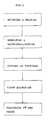
- Fig. 1 illustrates a sequence of steps for fabricating a thallium halide optical fiber.
- first step starting thallium bromide and thallium iodide, each having a purity of 99.9% or higher are dried, weighed in an intended ratio, and melted. The mixture is again melted in an inert gas and recrystallized by a melt zone purification technique to purify the crystals so that the total content of impurities such as oxides and chlorides of Si, Al, Fe, Zn and Mg is reduced to below 10 ppm.
- impurities such as oxides and chlorides of Si, Al, Fe, Zn and Mg is reduced to below 10 ppm.
- the crystals are then cut to a suitable size and subjected to extrusion under conditions of a temperature of 200 to 300°C, an extrusion speed of several centimeters/minute, and a pressure of 7 to 10 tons/cm 2 to obtain a fiber.
- the thus obtained fiber is polished at opposite ends thereof to obtain an optical fiber for infrared transmission.
- Fig. 2 shows an apparatus A for extruding the crystals in the form of a fiber.
- the apparatus A has a die 1 which has a cavity 2, in which a mixed crystal 3 of thallium halides is contained.
- the die 1 has a nozzle or orifice 4 by which the diameter of the fiber is determined.
- the die 1 is surrounded by a heater 5.
- Reference numeral 6 denotes a press ram
- reference numeral 7 denotes a die support
- reference numeral 8 is an extruded fiber.
- the extrusion temperature is first set at a level of 200 to 300°C. After the temperature has been set at a predetermined level, the crystal material 3 in the cavity 2 is compressed under a pressure of 7 to 10 tons/cm at a speed of several centimeters per minute as described before, thereby obtaining a fiber.
- the diameter of the fiber may be arbitrarily controlled using a nozzle whose diameter is from 0.05 to 1 mm.
- Optical fibers are made, in a manner as described above, using mixed crystals of thallium bromide and thallium iodide in different ratios. These fibers are subjected to measurement of a carbon dioxide laser beam transmission efficiency. In this measurement, fibers tested have a diameter of 0.5 mm and a length of 1 m. It will be noted that the transmission efficiency is the transmittance of the laser beam through the optical fiber taking into account various losses, including Fresnel reflection losses at the opposite ends, absorption losses in the fiber, and scattering losses at the interface. The results are shown in Fig. 3. From this figure, it will be seen that no carbon dioxide laser beam transmits through the one meter long fiber when thallium iodide alone is used.
- thallium bromide-thallium iodide crystals have a refractive index as high as 2.3-2.4, whereby the theoretical reflection losses reach 28%, so that a fiber having a transmission efficiency of 70 to 71 % per meter is considered as a good optical fiber.
- Fig. 4 is a graph showing the lattice constant, a, of crystals of thallium bromide and thallium iodide in relation to the crystal composition.
- the content of thallium bromide is from 30 to 100 wt%, the crystal is of a cubic system.
- the lattice constant changes, in relation to the mixing ratio, along the line obtained by connecting the above two values.
- the crystals which contain from 0 to 38 wt% of thallium bromide suffer the influence of the thallium iodide crystalline system which is stable at room temperature. As a result, they have a larger lattice constant than as expected. Although the crystals are of a cubic system, they involve internal strain, so that when such crystals are converted to fibers, the transmittance and high power transmission capacity are adversely influenced. Accordingly, the content of thallium bromide should be 40 wt% or higher.
- the tensile strength of the mixed crystal fiber has a peak when the content of thallium bromide is in the range of from 40 to 45 wt% (except for the fiber of thallium iodide alone).
- the fiber comprising 80 to 90 wt% of thallium bromide has a high tensile strength, plastic deformation starts from the range where when the fiber is bent, it remains as bent and does not return to the original state by elasticity. From this, it will be appreciated that when the content of thallium bromide is in the range of from 40 to 80 wt%, the resulting fiber exhibits elastic deformation and produces repulsion force against bending. No breakage or cracking is produced on bending.
- fibers are produced from compositions having a limited range of the thallium bromide content, i.e. 36 to 50 wt%, in order to determine the critical radius of curvature.
- a plastic sheet having concentrically arranged grooves in the form of a circle. Each fiber is set in the grooves according to the circle diameter in order to determine the radius of curvature at breakage of a tested fiber.
- the results are shown in Fig. 5.
- the critical radius of curvature will be found to be below 4 cm when the content of thallium bromide is in the range of from 40 to 45 wt%, ensuring adequate flexibility as fibers. Lower contents are unfavorable because of the poor transmittance as shown in Fig. 3. Larger amounts result in larger critical radius of cuvature, which means poor flexibility.
- the thallium bromide and thallium iodide compositions which are optimum for use as fibers should comprise 40 to 45 wt% of thallium bromide.
- the fibers obtained from such compositions should perferably have a diameter of from 0.3 to 1 mm.
- optical fibers are prepared from the above compositions, the infrared transmission capacity of such fibers is greatly influenced by the presence of impurities contained in the fiber and the size of the impurities.
- starting materials should have a purity not less than 99.9%.
- Optical fibers for infrared radiations deteriorate or even melt by generation of heat due to the presence of impurities in the fiber.
- the impurities will also bring about crazing and/or voids in the fiber, leading to a lowering of transmittivity.
- optical fibers Even if the above impurity defects are removed, optical fibers have sometimes wale-like defects on the surface thereof. These defects cause the fiber to deteriorate within a short time. To avoid this, the fiber should preferably be finished so that a surface roughness is below 0.2 pm.
- Impurities which are ordinarily contained in thallium halides are oxides of Si, Al, Fe, Zn and Mg. If these impurities having a size of several to several tens um are contained in the fiber, they contribute to absorb laser beams, whereupon heat generates from the said impurities and the fiber will deteriorate and even melt.
- Si0 2 impurity in different amounts is incorporated in a KRS-5 fiber having a diameter of 0.5 mm and a length of 1.5 m, by a procedure in which the impurity is deposited on zone-purified crystals and the crystals are then extruded.
- the fiber is tested to determine a C0 2 laser beam transmission capacity according to the following procedure.
- the C0 2 laser beam is focussed to a diameter of about 0.35 mm using a ZnSe lens and is then transmitted from one polished end of the fiber to another end.
- the output power is measured to a power meter (e.g. 201, by Coherent Co., Ltd.)
- the results are shown in Fig. 6, revealing that when the content of Si0 2 impurity exceeds 10 ppm, the transmission capacity lowers sharply.
- other element impurities are used to determine lowerings of the transmission capacity. The results are shown in the following Table.
- the content of impurities should be limited to a level of 10 ppm or less.
- the X-ray microanalysis of the defect portions reveals that impurities such as metal oxides indicated before exist and that the output power deterioration depends largely on the size of the impurity.
- the relation between the output power and the impurity size is shown in Fig. 7.
- the particles having a size up to 1 pm, preferably up to 0.5 ⁇ m, are acceptable.
- the fibers obtained by the manufacturing process of the present invention are made of a mixed crystal of 40 to 45 wt% of thallium bromide and the balance of thallium iodide, they have a reduced content of impurities, and are free of any impurities having a size not smaller than 1 pm.
- a fiber having a diameter of 0.5 mm and a length of 1.5 mm, which satisfy the above requirements, is made and subjected to a continuous test in which a C0 2 laser beam is focussed using a ZnSe lens having a focal point of 6 cm and passed into the fiber under conditions of 100W for 10 hours, with success.
- a CO laser beam may be used with similar results.
- the optical fiber made by the manufacturing process of the invention has a number of advantages over prior art counterparts, and if this fiber is applied as a laser scalpel, the spot diameter can be reduced to 0.3 mm, whereby enabling the conducting of delicate operations as desired.
Landscapes
- Chemical & Material Sciences (AREA)
- Engineering & Computer Science (AREA)
- Materials Engineering (AREA)
- Organic Chemistry (AREA)
- Crystallography & Structural Chemistry (AREA)
- Metallurgy (AREA)
- Physics & Mathematics (AREA)
- Life Sciences & Earth Sciences (AREA)
- Geochemistry & Mineralogy (AREA)
- Health & Medical Sciences (AREA)
- Chemical Kinetics & Catalysis (AREA)
- General Chemical & Material Sciences (AREA)
- Inorganic Chemistry (AREA)
- General Life Sciences & Earth Sciences (AREA)
- Toxicology (AREA)
- Manufacturing & Machinery (AREA)
- General Physics & Mathematics (AREA)
- Optics & Photonics (AREA)
- Glass Compositions (AREA)
- Optical Fibers, Optical Fiber Cores, And Optical Fiber Bundles (AREA)
- Crystals, And After-Treatments Of Crystals (AREA)
Description
- This invention relates to a process for fabricating optical fibers and more particularly, infrared ray-transmittable fibers. The optical fibers made according to the process of the invention are particularly suitable for energy transmission such as in laser works and laser scalpels.
- In recent years, attempts have been made to utilize laser beams in various fields. For instance, carbon dioxide laser scalpels have been progressively developed in medical fields and effectively utilized. In the field of industrial machinery and tools, efforts have been made to apply laser beams to processing machines for cutting, marking, and trimming.
- Aside from carbon dioxide laser having an oscillation wavelength of 10.6 pm, other infrared lasers such as a carbon monoxide laser having an oscillation wavelength of 5 to 7 urn are also used. In order to effectively utilize these infrared laser beams having high power energy, there is a high demand for optical fibers having good flexibility and capable of transmitting high energy power.
- Optical fibers for moderate infrared radiations were developed using various materials such as chalcogen compounds, fluorides, metal halides and the like. However, chalcogen compounds and fluorides have drawbacks: chalcogen compounds are not suitable for high power energy transmission; and fluoride compounds involve the problem that infrared beams attenuate at wavelengths over 7 um. On the other hand, metal halides have a greast possibility of being applied as an infrared fiber. For instance, there are known materials, called KRS-5, which are frequently used as optical parts for infrared radiations. These materials are permeable to radiations in the moderate infrared region covering a wavelength of from 0.5 to 30 pm, and have fairly good humidity resistance and mechanical strength. The KRS-5 materials are solid solutions of thallium bromide, TIBr, and thallium iodide, TII, typical of which is a composition comprising 38 wt% of thallium bromide.
- These materials are converted to fibers by a procedure which comprises heating the material at temperatures lower by 100 to 200°C than the melting point of the solid solution, KRS-5, and extruding it under high pressure. Aside from the solid solutions, thallium chloride, thallium bromide, and thallium iodide are singly used to be converted to a fiber. In practice, the optical fibers obtained from these thallium halides have a diameter of from 0.3 to 1 mm. However, when high power over 30W is transmitted to the optical fiber, the fiber tends to deteriorate within a relatively short period of time, and may be readily melted during use. Thus, high power transmission becomes impossible. We found that the deterioration was attributed to impurities such as metal oxides and chlorides and also to the size of the impurities contained in starting thallium halides.
- It is accordingly an object of the invention to provide a process for manufacturing thallium halide optical fibers which are able to transmit infrared energy of high power and have long life.
- It is another object of the invention to provide a process for manufacturing thallium halide optical fibers which have good flexibility.
- It is a further object of the invention to provide a process for manufacturing thallium halide optical fibers which are particularly suitable as laser scalpels.
- These objects are achieved by a manufacturing process in accordance with
claim 1. - The fabrication process according to the invention as well as the characteristic properties of the optical fibers obtained by such process are described with reference to the accompanying drawings, in which:
- Fig. 1 is a flowchart showing a process of making an optical fiber for infrared rays according to the invention;
- Fig. 2 is a schematic view of an extruder for thallium halide fibers;
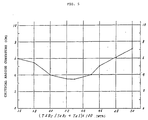
- Fig. 3 is a graph showing the relation between transmission efficiency and content of thallium bromide in a mixed crystal of thallium bromide and thallium iodide;
- Fig. 4 is a graph showing the relation between lattice constant of a mixed crystal of thallium bromide and thallium iodide and content of TIBr in the crystal;
- Fig. 5 is a graph showing the relation between critical curvature radius and content of thallium bromide in a mixed crystal of thallium bromide and thallium iodide;
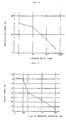
- Fig. 6 is a graph showing the relation between power transmission capacity and content of Si impurity; and
- Fig. 7 is a graph showing the relation between output power and particle size of an impurity.
- Reference is now made to Fig. 1 which illustrates a sequence of steps for fabricating a thallium halide optical fiber. In the first step, starting thallium bromide and thallium iodide, each having a purity of 99.9% or higher are dried, weighed in an intended ratio, and melted. The mixture is again melted in an inert gas and recrystallized by a melt zone purification technique to purify the crystals so that the total content of impurities such as oxides and chlorides of Si, Al, Fe, Zn and Mg is reduced to below 10 ppm. The crystals are then cut to a suitable size and subjected to extrusion under conditions of a temperature of 200 to 300°C, an extrusion speed of several centimeters/minute, and a pressure of 7 to 10 tons/cm2 to obtain a fiber. The thus obtained fiber is polished at opposite ends thereof to obtain an optical fiber for infrared transmission.
- Fig. 2 shows an apparatus A for extruding the crystals in the form of a fiber. The apparatus A has a
die 1 which has acavity 2, in which amixed crystal 3 of thallium halides is contained. The die 1 has a nozzle ororifice 4 by which the diameter of the fiber is determined. The die 1 is surrounded by aheater 5.Reference numeral 6 denotes a press ram,reference numeral 7 denotes a die support, andreference numeral 8 is an extruded fiber. - In operation, the extrusion temperature is first set at a level of 200 to 300°C. After the temperature has been set at a predetermined level, the
crystal material 3 in thecavity 2 is compressed under a pressure of 7 to 10 tons/cm at a speed of several centimeters per minute as described before, thereby obtaining a fiber. The diameter of the fiber may be arbitrarily controlled using a nozzle whose diameter is from 0.05 to 1 mm. - Optical fibers are made, in a manner as described above, using mixed crystals of thallium bromide and thallium iodide in different ratios. These fibers are subjected to measurement of a carbon dioxide laser beam transmission efficiency. In this measurement, fibers tested have a diameter of 0.5 mm and a length of 1 m. It will be noted that the transmission efficiency is the transmittance of the laser beam through the optical fiber taking into account various losses, including Fresnel reflection losses at the opposite ends, absorption losses in the fiber, and scattering losses at the interface. The results are shown in Fig. 3. From this figure, it will be seen that no carbon dioxide laser beam transmits through the one meter long fiber when thallium iodide alone is used. No transmission takes place up to 20 wt% of thallium bromide. The laser beam transmits at a TIBr concentration of 30 wt%. When the content of TIBr reaches 38 wt%, the transmission efficiency is as high as 70%. This efficiency remains substantially unchanged as the content of TIBr further increases. However, the fiber of 100% thallium bromide is very soft, which makes it difficult to polish the fiber at ends thereof. Thus, a correct measurement of transmittance is difficult.
- It is to be noted that thallium bromide-thallium iodide crystals have a refractive index as high as 2.3-2.4, whereby the theoretical reflection losses reach 28%, so that a fiber having a transmission efficiency of 70 to 71 % per meter is considered as a good optical fiber.
- Fig. 4 is a graph showing the lattice constant, a, of crystals of thallium bromide and thallium iodide in relation to the crystal composition. When the content of thallium bromide is from 30 to 100 wt%, the crystal is of a cubic system. With thallium bromide alone, a=3.98 angstrom. Thallium iodide alone is of a cubic system at high temperatures, with a=4.20 angstrom. The lattice constant changes, in relation to the mixing ratio, along the line obtained by connecting the above two values. More particularly, the crystals which contain from 0 to 38 wt% of thallium bromide suffer the influence of the thallium iodide crystalline system which is stable at room temperature. As a result, they have a larger lattice constant than as expected. Although the crystals are of a cubic system, they involve internal strain, so that when such crystals are converted to fibers, the transmittance and high power transmission capacity are adversely influenced. Accordingly, the content of thallium bromide should be 40 wt% or higher.
- The tensile strength of the mixed crystal fiber has a peak when the content of thallium bromide is in the range of from 40 to 45 wt% (except for the fiber of thallium iodide alone). Although the fiber comprising 80 to 90 wt% of thallium bromide has a high tensile strength, plastic deformation starts from the range where when the fiber is bent, it remains as bent and does not return to the original state by elasticity. From this, it will be appreciated that when the content of thallium bromide is in the range of from 40 to 80 wt%, the resulting fiber exhibits elastic deformation and produces repulsion force against bending. No breakage or cracking is produced on bending.
- Next, fibers are produced from compositions having a limited range of the thallium bromide content, i.e. 36 to 50 wt%, in order to determine the critical radius of curvature.
- There is provided a plastic sheet having concentrically arranged grooves in the form of a circle. Each fiber is set in the grooves according to the circle diameter in order to determine the radius of curvature at breakage of a tested fiber. The results are shown in Fig. 5. The critical radius of curvature will be found to be below 4 cm when the content of thallium bromide is in the range of from 40 to 45 wt%, ensuring adequate flexibility as fibers. Lower contents are unfavorable because of the poor transmittance as shown in Fig. 3. Larger amounts result in larger critical radius of cuvature, which means poor flexibility.
- Gathering the foregoing, the thallium bromide and thallium iodide compositions which are optimum for use as fibers should comprise 40 to 45 wt% of thallium bromide.
- In practice, the fibers obtained from such compositions should perferably have a diameter of from 0.3 to 1 mm.
- Even though optical fibers are prepared from the above compositions, the infrared transmission capacity of such fibers is greatly influenced by the presence of impurities contained in the fiber and the size of the impurities.
- In order to impart high transmission power capacity to fibers, it is essential to make crystals which are highly pure and substantially free of any defects. To this end, starting materials should have a purity not less than 99.9%. Optical fibers for infrared radiations deteriorate or even melt by generation of heat due to the presence of impurities in the fiber. The impurities will also bring about crazing and/or voids in the fiber, leading to a lowering of transmittivity.
- Even if the above impurity defects are removed, optical fibers have sometimes wale-like defects on the surface thereof. These defects cause the fiber to deteriorate within a short time. To avoid this, the fiber should preferably be finished so that a surface roughness is below 0.2 pm.
- Turning now to the impurities contained in optical fibers, it is necessary that impurities in the starting materials be reduced and that no impurity particle having a size not smaller than 1 pm exists in the fiber.
- Impurities which are ordinarily contained in thallium halides are oxides of Si, Al, Fe, Zn and Mg. If these impurities having a size of several to several tens um are contained in the fiber, they contribute to absorb laser beams, whereupon heat generates from the said impurities and the fiber will deteriorate and even melt.
- In order to confirm the adverse influences of impurities, Si02 impurity in different amounts is incorporated in a KRS-5 fiber having a diameter of 0.5 mm and a length of 1.5 m, by a procedure in which the impurity is deposited on zone-purified crystals and the crystals are then extruded. The fiber is tested to determine a C02 laser beam transmission capacity according to the following procedure. The C02 laser beam is focussed to a diameter of about 0.35 mm using a ZnSe lens and is then transmitted from one polished end of the fiber to another end. The output power is measured to a power meter (e.g. 201, by Coherent Co., Ltd.) The results are shown in Fig. 6, revealing that when the content of Si02 impurity exceeds 10 ppm, the transmission capacity lowers sharply. Similarly, other element impurities are used to determine lowerings of the transmission capacity. The results are shown in the following Table.

- As will be clear from the above results, the content of impurities should be limited to a level of 10 ppm or less.
- . When a C02 laser beam is passed into a KRS-5 fiber having a diameter of 0.5 mm and a length of 1.5 m and the output power is raised every minute, the fiber melts locally and produced wale-like defects on the fiber surface. These defects lower the transmittivity to a substantial extent. If the power is further raised, the fiber deteriorates completely, making it impossible to transmit the laser beam.
- The X-ray microanalysis of the defect portions reveals that impurities such as metal oxides indicated before exist and that the output power deterioration depends largely on the size of the impurity. The relation between the output power and the impurity size is shown in Fig. 7. As will be clearly seen from the figure, the particles having a size up to 1 pm, preferably up to 0.5 µm, are acceptable.
- Thus, it is important to limit the total amount of impurities and to remove particles, such as metal oxides, having a size not smaller than 1 pm. The limitation of the total impurity content is attained by using starting materials having a purity of 99.9% or higher and by then using a melt zone purification technique during recrystallization. The removal of large-size particles is possible by known techniques such as vacuum distillation or capillary filtration.
- The fibers obtained by the manufacturing process of the present invention are made of a mixed crystal of 40 to 45 wt% of thallium bromide and the balance of thallium iodide, they have a reduced content of impurities, and are free of any impurities having a size not smaller than 1 pm. A fiber having a diameter of 0.5 mm and a length of 1.5 mm, which satisfy the above requirements, is made and subjected to a continuous test in which a C02 laser beam is focussed using a ZnSe lens having a focal point of 6 cm and passed into the fiber under conditions of 100W for 10 hours, with success. Instead of the C02 laser beam, a CO laser beam may be used with similar results.
- The optical fiber made by the manufacturing process of the invention has a number of advantages over prior art counterparts, and if this fiber is applied as a laser scalpel, the spot diameter can be reduced to 0.3 mm, whereby enabling the conducting of delicate operations as desired.
Claims (3)
Applications Claiming Priority (2)
| Application Number | Priority Date | Filing Date | Title |
|---|---|---|---|
| JP16310384A JPS6141105A (en) | 1984-08-02 | 1984-08-02 | Infrared optical fiber |
| JP163103/84 | 1984-08-02 |
Publications (2)
| Publication Number | Publication Date |
|---|---|
| EP0172988A1 EP0172988A1 (en) | 1986-03-05 |
| EP0172988B1 true EP0172988B1 (en) | 1990-01-17 |
Family
ID=15767226
Family Applications (1)
| Application Number | Title | Priority Date | Filing Date |
|---|---|---|---|
| EP85104311A Expired - Lifetime EP0172988B1 (en) | 1984-08-02 | 1985-04-10 | Optical fibers for infrared transmission |
Country Status (4)
| Country | Link |
|---|---|
| US (1) | US4678275A (en) |
| EP (1) | EP0172988B1 (en) |
| JP (1) | JPS6141105A (en) |
| DE (1) | DE3575475D1 (en) |
Families Citing this family (8)
| Publication number | Priority date | Publication date | Assignee | Title |
|---|---|---|---|---|
| IL81690A0 (en) * | 1986-03-15 | 1987-09-16 | Sumitomo Electric Industries | Crystalline optical fiber and its manufacture |
| JP2834290B2 (en) * | 1990-07-26 | 1998-12-09 | 松下電器産業株式会社 | Infrared optical fiber |
| US5169421A (en) * | 1990-09-15 | 1992-12-08 | The Furukawa Electric Co., Ltd. | Method of manufacturing silica glass optical waveguide preform |
| US5796903A (en) * | 1992-07-06 | 1998-08-18 | Infrared Fiber Systems, Inc. | Heavy metal-oxide glass optical fibers for use in laser medical surgery and process of making |
| EP0854119A3 (en) * | 1996-12-20 | 1998-11-18 | Hoya Corporation | Etchant and method for etching chalcogenide glass and optical member having smooth surface |
| US7504154B2 (en) * | 2005-03-23 | 2009-03-17 | Lockheed Martin Corporation | Moisture barrier coatings for infrared salt optics |
| EP1791229A1 (en) * | 2005-11-25 | 2007-05-30 | Lambda Research Optics Europe | Method for reducing thermal effect of a cutting lens |
| US10020235B2 (en) * | 2016-11-01 | 2018-07-10 | Lawrence Livermore National Security, Llc | Selective surface treatment of thallium bromide (TLBR)-based detectors to improve longevity and/or restore operational capacity thereof |
Family Cites Families (5)
| Publication number | Priority date | Publication date | Assignee | Title |
|---|---|---|---|---|
| DE2821642C3 (en) * | 1977-05-24 | 1987-12-03 | Hughes Aircraft Co., Culver City, Calif. | Fiber optic waveguide and method for its manufacture |
| US4253731A (en) * | 1979-04-09 | 1981-03-03 | Honeywell Inc. | Infrared fiber of AgCl clad AgBr and method of fabrication |
| US4293833A (en) * | 1979-11-01 | 1981-10-06 | Hughes Aircraft Company | Millimeter wave transmission line using thallium bromo-iodide fiber |
| JPS6053844B2 (en) * | 1981-01-12 | 1985-11-27 | 住友電気工業株式会社 | Infrared optical fiber and its manufacturing method |
| CA1170805A (en) * | 1981-01-23 | 1984-07-17 | Minoru Yokota | Process for producing infrared light transmitting optical fiber |
-
1984
- 1984-08-02 JP JP16310384A patent/JPS6141105A/en active Pending
-
1985
- 1985-03-26 US US06/716,156 patent/US4678275A/en not_active Expired - Lifetime
- 1985-04-10 DE DE8585104311T patent/DE3575475D1/en not_active Expired - Lifetime
- 1985-04-10 EP EP85104311A patent/EP0172988B1/en not_active Expired - Lifetime
Non-Patent Citations (4)
| Title |
|---|
| Applied Physics Letters - 33(1) - 1 July 1978 - pages 28-29 * |
| Handbook of Fibre Optics; Theory and Applications - Edited by H.F. Wolf, Granada 1979, pages 43-44 * |
| IEEE Journal of Quantum Electronics - Vol. QE.18, No.10 - October 1982 - pages 1432-1450 * |
| Laser Focus - December 1976, pages 47-50 * |
Also Published As
| Publication number | Publication date |
|---|---|
| US4678275A (en) | 1987-07-07 |
| JPS6141105A (en) | 1986-02-27 |
| EP0172988A1 (en) | 1986-03-05 |
| DE3575475D1 (en) | 1990-02-22 |
Similar Documents
| Publication | Publication Date | Title |
|---|---|---|
| EP0149306B1 (en) | Low loss cladded optical fibers from halides and process for making same | |
| US4521073A (en) | Infrared light transmitting fiber and process for producing the same | |
| EP0649392B1 (en) | Heavy metal-oxide glass optical fibers for use in laser medical surgery and process of making | |
| EP0056996B1 (en) | Process for producing infrared light transmitting optical fiber | |
| US4678275A (en) | Optical fiber for infrared transmission consisting essentially of high purity mixed crystal of thallium bromide and thallium iodide | |
| CA1191023A (en) | Infrared fibers | |
| EP0237907B1 (en) | Crystalline optical fiber and its method of manufacture | |
| EP0450645B1 (en) | An infrared optical fiber and a method of manufacturing the same | |
| US4552434A (en) | Crystalline infrared optical fiber with a small gap and a process for the production of same | |
| GB2150928A (en) | Glass material for optical fibers used in infrared region | |
| EP0420239B1 (en) | Method of manufacturing preform for nonoxide glass fiber | |
| CA1164171A (en) | Infrared light transmission fiber | |
| Ikedo et al. | Preparation and characteristics of the TlBr‐TlI fiber for a high power CO2 laser beam | |
| KR920009662B1 (en) | Infrared optical fiber and method of manufacturing same | |
| McNamara et al. | A large core microstructured fluoride glass optical fibre for mid-infrared single-mode transmission | |
| JPH0356443B2 (en) | ||
| Butvina et al. | Silver halide crystalline fibers with optical losses 50 dB/km at the CO2 laser wavelength | |
| JPH01109306A (en) | Manufacturing method of infrared optical fiber | |
| JPH02293347A (en) | fluoride glass optical fiber | |
| Yu | Mid infrared LHS system packaging using flexible waveguides | |
| JPS62102203A (en) | Crystal fiber and its production | |
| JPS6311902A (en) | Crystalline optical fiber and its manufacturing method | |
| JPH0211535B2 (en) | ||
| JPS6350297B2 (en) | ||
| JPS59171905A (en) | Fiber for infrared light |
Legal Events
| Date | Code | Title | Description |
|---|---|---|---|
| PUAI | Public reference made under article 153(3) epc to a published international application that has entered the european phase |
Free format text: ORIGINAL CODE: 0009012 |
|
| AK | Designated contracting states |
Kind code of ref document: A1 Designated state(s): DE FR GB |
|
| 17P | Request for examination filed |
Effective date: 19860717 |
|
| 17Q | First examination report despatched |
Effective date: 19871130 |
|
| GRAA | (expected) grant |
Free format text: ORIGINAL CODE: 0009210 |
|
| AK | Designated contracting states |
Kind code of ref document: B1 Designated state(s): DE FR GB |
|
| REF | Corresponds to: |
Ref document number: 3575475 Country of ref document: DE Date of ref document: 19900222 |
|
| ET | Fr: translation filed | ||
| PLBE | No opposition filed within time limit |
Free format text: ORIGINAL CODE: 0009261 |
|
| STAA | Information on the status of an ep patent application or granted ep patent |
Free format text: STATUS: NO OPPOSITION FILED WITHIN TIME LIMIT |
|
| 26N | No opposition filed | ||
| REG | Reference to a national code |
Ref country code: GB Ref legal event code: 746 Effective date: 19951123 |
|
| REG | Reference to a national code |
Ref country code: FR Ref legal event code: D6 |
|
| PGFP | Annual fee paid to national office [announced via postgrant information from national office to epo] |
Ref country code: GB Payment date: 19970401 Year of fee payment: 13 |
|
| PGFP | Annual fee paid to national office [announced via postgrant information from national office to epo] |
Ref country code: FR Payment date: 19970409 Year of fee payment: 13 |
|
| PGFP | Annual fee paid to national office [announced via postgrant information from national office to epo] |
Ref country code: DE Payment date: 19970418 Year of fee payment: 13 |
|
| PG25 | Lapsed in a contracting state [announced via postgrant information from national office to epo] |
Ref country code: GB Free format text: LAPSE BECAUSE OF NON-PAYMENT OF DUE FEES Effective date: 19980410 |
|
| PG25 | Lapsed in a contracting state [announced via postgrant information from national office to epo] |
Ref country code: FR Free format text: THE PATENT HAS BEEN ANNULLED BY A DECISION OF A NATIONAL AUTHORITY Effective date: 19980430 |
|
| GBPC | Gb: european patent ceased through non-payment of renewal fee |
Effective date: 19980410 |
|
| PG25 | Lapsed in a contracting state [announced via postgrant information from national office to epo] |
Ref country code: DE Free format text: LAPSE BECAUSE OF NON-PAYMENT OF DUE FEES Effective date: 19990202 |
|
| REG | Reference to a national code |
Ref country code: FR Ref legal event code: ST |