EP0170243B1 - Fermentation process for preparation of alkyl esters of carboxylic acids - Google Patents
Fermentation process for preparation of alkyl esters of carboxylic acids Download PDFInfo
- Publication number
- EP0170243B1 EP0170243B1 EP85109501A EP85109501A EP0170243B1 EP 0170243 B1 EP0170243 B1 EP 0170243B1 EP 85109501 A EP85109501 A EP 85109501A EP 85109501 A EP85109501 A EP 85109501A EP 0170243 B1 EP0170243 B1 EP 0170243B1
- Authority
- EP
- European Patent Office
- Prior art keywords
- charcoal
- line
- ester
- ethyl
- peak
- Prior art date
- Legal status (The legal status is an assumption and is not a legal conclusion. Google has not performed a legal analysis and makes no representation as to the accuracy of the status listed.)
- Expired
Links
- 238000000855 fermentation Methods 0.000 title claims description 51
- 230000004151 fermentation Effects 0.000 title claims description 51
- 238000002360 preparation method Methods 0.000 title description 8
- 125000005907 alkyl ester group Chemical group 0.000 title 1
- 150000001735 carboxylic acids Chemical class 0.000 title 1
- 239000003610 charcoal Substances 0.000 claims description 79
- 150000002148 esters Chemical class 0.000 claims description 77
- 238000004821 distillation Methods 0.000 claims description 33
- 238000000034 method Methods 0.000 claims description 16
- 125000002496 methyl group Chemical group [H]C([H])([H])* 0.000 claims description 14
- 150000001413 amino acids Chemical class 0.000 claims description 12
- 239000002002 slurry Substances 0.000 claims description 11
- 239000011203 carbon fibre reinforced carbon Substances 0.000 claims description 10
- 241000178265 Saprochaete suaveolens Species 0.000 claims description 9
- UFHFLCQGNIYNRP-UHFFFAOYSA-N Hydrogen Chemical compound [H][H] UFHFLCQGNIYNRP-UHFFFAOYSA-N 0.000 claims description 8
- 239000001257 hydrogen Substances 0.000 claims description 8
- 229910052739 hydrogen Inorganic materials 0.000 claims description 8
- 239000007788 liquid Substances 0.000 claims description 8
- 125000000217 alkyl group Chemical group 0.000 claims description 6
- CREMABGTGYGIQB-UHFFFAOYSA-N carbon carbon Chemical compound C.C CREMABGTGYGIQB-UHFFFAOYSA-N 0.000 claims description 5
- 229920006395 saturated elastomer Polymers 0.000 claims description 4
- 238000011084 recovery Methods 0.000 claims description 3
- 239000001963 growth medium Substances 0.000 claims 4
- 235000015097 nutrients Nutrition 0.000 claims 2
- 241000159512 Geotrichum Species 0.000 claims 1
- 241000178293 Geotrichum klebahnii Species 0.000 claims 1
- LFQSCWFLJHTTHZ-UHFFFAOYSA-N Ethanol Chemical compound CCO LFQSCWFLJHTTHZ-UHFFFAOYSA-N 0.000 description 68
- 239000000203 mixture Substances 0.000 description 40
- HCRBXQFHJMCTLF-ZCFIWIBFSA-N ethyl (2r)-2-methylbutanoate Chemical compound CCOC(=O)[C@H](C)CC HCRBXQFHJMCTLF-ZCFIWIBFSA-N 0.000 description 36
- 235000019441 ethanol Nutrition 0.000 description 25
- PPXUHEORWJQRHJ-UHFFFAOYSA-N ethyl isovalerate Chemical compound CCOC(=O)CC(C)C PPXUHEORWJQRHJ-UHFFFAOYSA-N 0.000 description 22
- DNIAPMSPPWPWGF-UHFFFAOYSA-N Propylene glycol Chemical compound CC(O)CO DNIAPMSPPWPWGF-UHFFFAOYSA-N 0.000 description 21
- OAPHLAAOJMTMLY-GQCTYLIASA-N Ethyl 2-methylbut-2-enoate Chemical compound CCOC(=O)C(\C)=C\C OAPHLAAOJMTMLY-GQCTYLIASA-N 0.000 description 19
- WQZGKKKJIJFFOK-GASJEMHNSA-N Glucose Natural products OC[C@H]1OC(O)[C@H](O)[C@@H](O)[C@@H]1O WQZGKKKJIJFFOK-GASJEMHNSA-N 0.000 description 19
- 239000001696 ethyl (E)-2-methylbut-2-enoate Substances 0.000 description 19
- 239000001813 ethyl (2R)-2-methylbutanoate Substances 0.000 description 18
- 229940090910 ethyl 2-methylbutyrate Drugs 0.000 description 18
- 239000007789 gas Substances 0.000 description 15
- HEMHJVSKTPXQMS-UHFFFAOYSA-M Sodium hydroxide Chemical compound [OH-].[Na+] HEMHJVSKTPXQMS-UHFFFAOYSA-M 0.000 description 12
- 239000002054 inoculum Substances 0.000 description 12
- AGPKZVBTJJNPAG-WHFBIAKZSA-N L-isoleucine Chemical compound CC[C@H](C)[C@H](N)C(O)=O AGPKZVBTJJNPAG-WHFBIAKZSA-N 0.000 description 11
- 229960000310 isoleucine Drugs 0.000 description 11
- WDAXFOBOLVPGLV-UHFFFAOYSA-N ethyl isobutyrate Chemical compound CCOC(=O)C(C)C WDAXFOBOLVPGLV-UHFFFAOYSA-N 0.000 description 10
- AGPKZVBTJJNPAG-UHFFFAOYSA-N isoleucine Natural products CCC(C)C(N)C(O)=O AGPKZVBTJJNPAG-UHFFFAOYSA-N 0.000 description 10
- QPRQEDXDYOZYLA-UHFFFAOYSA-N 2-methylbutan-1-ol Chemical compound CCC(C)CO QPRQEDXDYOZYLA-UHFFFAOYSA-N 0.000 description 9
- 239000002518 antifoaming agent Substances 0.000 description 9
- 239000008121 dextrose Substances 0.000 description 9
- FKRCODPIKNYEAC-UHFFFAOYSA-N ethyl propionate Chemical compound CCOC(=O)CC FKRCODPIKNYEAC-UHFFFAOYSA-N 0.000 description 9
- 239000000463 material Substances 0.000 description 9
- 229920001296 polysiloxane Polymers 0.000 description 9
- 239000000047 product Substances 0.000 description 9
- 239000007787 solid Substances 0.000 description 8
- 239000012530 fluid Substances 0.000 description 7
- 239000000243 solution Substances 0.000 description 7
- CSCPPACGZOOCGX-UHFFFAOYSA-N Acetone Chemical compound CC(C)=O CSCPPACGZOOCGX-UHFFFAOYSA-N 0.000 description 6
- 0 C[C@]1CC(CCCC2)[C@@]2CCCC[C@](*)CCCC1 Chemical compound C[C@]1CC(CCCC2)[C@@]2CCCC[C@](*)CCCC1 0.000 description 6
- XEKOWRVHYACXOJ-UHFFFAOYSA-N Ethyl acetate Chemical compound CCOC(C)=O XEKOWRVHYACXOJ-UHFFFAOYSA-N 0.000 description 6
- ROHFNLRQFUQHCH-YFKPBYRVSA-N L-leucine Chemical compound CC(C)C[C@H](N)C(O)=O ROHFNLRQFUQHCH-YFKPBYRVSA-N 0.000 description 6
- 229940024606 amino acid Drugs 0.000 description 6
- XLYOFNOQVPJJNP-UHFFFAOYSA-N water Chemical compound O XLYOFNOQVPJJNP-UHFFFAOYSA-N 0.000 description 6
- 229910001868 water Inorganic materials 0.000 description 6
- KWYUFKZDYYNOTN-UHFFFAOYSA-M Potassium hydroxide Chemical compound [OH-].[K+] KWYUFKZDYYNOTN-UHFFFAOYSA-M 0.000 description 5
- 238000007792 addition Methods 0.000 description 5
- 238000005273 aeration Methods 0.000 description 5
- 239000007864 aqueous solution Substances 0.000 description 5
- 229960003136 leucine Drugs 0.000 description 5
- 235000019796 monopotassium phosphate Nutrition 0.000 description 5
- 229920000136 polysorbate Polymers 0.000 description 5
- GNSKLFRGEWLPPA-UHFFFAOYSA-M potassium dihydrogen phosphate Chemical compound [K+].OP(O)([O-])=O GNSKLFRGEWLPPA-UHFFFAOYSA-M 0.000 description 5
- IJGRMHOSHXDMSA-UHFFFAOYSA-N Atomic nitrogen Chemical compound N#N IJGRMHOSHXDMSA-UHFFFAOYSA-N 0.000 description 4
- OKTJSMMVPCPJKN-UHFFFAOYSA-N Carbon Chemical compound [C] OKTJSMMVPCPJKN-UHFFFAOYSA-N 0.000 description 4
- XINCECQTMHSORG-UHFFFAOYSA-N Isoamyl isovalerate Chemical compound CC(C)CCOC(=O)CC(C)C XINCECQTMHSORG-UHFFFAOYSA-N 0.000 description 4
- 239000007836 KH2PO4 Substances 0.000 description 4
- KZSNJWFQEVHDMF-BYPYZUCNSA-N L-valine Chemical compound CC(C)[C@H](N)C(O)=O KZSNJWFQEVHDMF-BYPYZUCNSA-N 0.000 description 4
- ROHFNLRQFUQHCH-UHFFFAOYSA-N Leucine Natural products CC(C)CC(N)C(O)=O ROHFNLRQFUQHCH-UHFFFAOYSA-N 0.000 description 4
- 239000012298 atmosphere Substances 0.000 description 4
- 229910052799 carbon Inorganic materials 0.000 description 4
- 239000013530 defoamer Substances 0.000 description 4
- UTXVCHVLDOLVPC-UHFFFAOYSA-N ethyl 3-methylbut-2-enoate Chemical compound CCOC(=O)C=C(C)C UTXVCHVLDOLVPC-UHFFFAOYSA-N 0.000 description 4
- 239000000284 extract Substances 0.000 description 4
- ZXEKIIBDNHEJCQ-UHFFFAOYSA-N isobutanol Chemical compound CC(C)CO ZXEKIIBDNHEJCQ-UHFFFAOYSA-N 0.000 description 4
- 229910000402 monopotassium phosphate Inorganic materials 0.000 description 4
- 229920005989 resin Polymers 0.000 description 4
- 239000011347 resin Substances 0.000 description 4
- 238000011218 seed culture Methods 0.000 description 4
- 238000003756 stirring Methods 0.000 description 4
- 208000033962 Fontaine progeroid syndrome Diseases 0.000 description 3
- 235000011430 Malus pumila Nutrition 0.000 description 3
- 235000015103 Malus silvestris Nutrition 0.000 description 3
- 238000013019 agitation Methods 0.000 description 3
- 229940041514 candida albicans extract Drugs 0.000 description 3
- 239000002826 coolant Substances 0.000 description 3
- 238000001816 cooling Methods 0.000 description 3
- 238000000605 extraction Methods 0.000 description 3
- 238000002290 gas chromatography-mass spectrometry Methods 0.000 description 3
- 238000011068 loading method Methods 0.000 description 3
- -1 polyoxyethylene Polymers 0.000 description 3
- 239000000523 sample Substances 0.000 description 3
- 239000002904 solvent Substances 0.000 description 3
- 239000006188 syrup Substances 0.000 description 3
- 235000020357 syrup Nutrition 0.000 description 3
- 229960004295 valine Drugs 0.000 description 3
- 239000012138 yeast extract Substances 0.000 description 3
- RXGUIWHIADMCFC-UHFFFAOYSA-N 2-Methylpropyl 2-methylpropionate Chemical compound CC(C)COC(=O)C(C)C RXGUIWHIADMCFC-UHFFFAOYSA-N 0.000 description 2
- KEBDNKNVCHQIJU-UHFFFAOYSA-N 2-Methylpropyl 3-methylbutanoate Chemical compound CC(C)COC(=O)CC(C)C KEBDNKNVCHQIJU-UHFFFAOYSA-N 0.000 description 2
- FZXRXKLUIMKDEL-UHFFFAOYSA-N 2-Methylpropyl propanoate Chemical compound CCC(=O)OCC(C)C FZXRXKLUIMKDEL-UHFFFAOYSA-N 0.000 description 2
- 235000016623 Fragaria vesca Nutrition 0.000 description 2
- 240000009088 Fragaria x ananassa Species 0.000 description 2
- 235000011363 Fragaria x ananassa Nutrition 0.000 description 2
- 244000061176 Nicotiana tabacum Species 0.000 description 2
- 235000002637 Nicotiana tabacum Nutrition 0.000 description 2
- QURFFFCYNQXLCU-UHFFFAOYSA-N Pentyl 3-methylbutanoate Chemical compound CCCCCOC(=O)CC(C)C QURFFFCYNQXLCU-UHFFFAOYSA-N 0.000 description 2
- 235000014443 Pyrus communis Nutrition 0.000 description 2
- PMZURENOXWZQFD-UHFFFAOYSA-L Sodium Sulfate Chemical compound [Na+].[Na+].[O-]S([O-])(=O)=O PMZURENOXWZQFD-UHFFFAOYSA-L 0.000 description 2
- UIIMBOGNXHQVGW-UHFFFAOYSA-M Sodium bicarbonate Chemical compound [Na+].OC([O-])=O UIIMBOGNXHQVGW-UHFFFAOYSA-M 0.000 description 2
- FAPWRFPIFSIZLT-UHFFFAOYSA-M Sodium chloride Chemical compound [Na+].[Cl-] FAPWRFPIFSIZLT-UHFFFAOYSA-M 0.000 description 2
- KZSNJWFQEVHDMF-UHFFFAOYSA-N Valine Natural products CC(C)C(N)C(O)=O KZSNJWFQEVHDMF-UHFFFAOYSA-N 0.000 description 2
- 240000008042 Zea mays Species 0.000 description 2
- 235000005824 Zea mays ssp. parviglumis Nutrition 0.000 description 2
- 235000002017 Zea mays subsp mays Nutrition 0.000 description 2
- 239000003795 chemical substances by application Substances 0.000 description 2
- 239000012809 cooling fluid Substances 0.000 description 2
- 235000005822 corn Nutrition 0.000 description 2
- 239000002979 fabric softener Substances 0.000 description 2
- 239000006260 foam Substances 0.000 description 2
- 238000005187 foaming Methods 0.000 description 2
- 238000005194 fractionation Methods 0.000 description 2
- 238000010438 heat treatment Methods 0.000 description 2
- PHTQWCKDNZKARW-UHFFFAOYSA-N isoamylol Chemical compound CC(C)CCO PHTQWCKDNZKARW-UHFFFAOYSA-N 0.000 description 2
- 238000002156 mixing Methods 0.000 description 2
- 229910052757 nitrogen Inorganic materials 0.000 description 2
- 238000010992 reflux Methods 0.000 description 2
- 150000003839 salts Chemical class 0.000 description 2
- 238000001179 sorption measurement Methods 0.000 description 2
- 238000001228 spectrum Methods 0.000 description 2
- 239000000725 suspension Substances 0.000 description 2
- 239000004474 valine Substances 0.000 description 2
- AJDIZQLSFPQPEY-UHFFFAOYSA-N 1,1,2-Trichlorotrifluoroethane Chemical compound FC(F)(Cl)C(F)(Cl)Cl AJDIZQLSFPQPEY-UHFFFAOYSA-N 0.000 description 1
- ZORQXIQZAOLNGE-UHFFFAOYSA-N 1,1-difluorocyclohexane Chemical compound FC1(F)CCCCC1 ZORQXIQZAOLNGE-UHFFFAOYSA-N 0.000 description 1
- HNAGHMKIPMKKBB-UHFFFAOYSA-N 1-benzylpyrrolidine-3-carboxamide Chemical compound C1C(C(=O)N)CCN1CC1=CC=CC=C1 HNAGHMKIPMKKBB-UHFFFAOYSA-N 0.000 description 1
- OWEGMIWEEQEYGQ-UHFFFAOYSA-N 100676-05-9 Natural products OC1C(O)C(O)C(CO)OC1OCC1C(O)C(O)C(O)C(OC2C(OC(O)C(O)C2O)CO)O1 OWEGMIWEEQEYGQ-UHFFFAOYSA-N 0.000 description 1
- NWZQCEQAPBRMFX-UHFFFAOYSA-N 2-Methylpropyl 2-methylbutanoate Chemical compound CCC(C)C(=O)OCC(C)C NWZQCEQAPBRMFX-UHFFFAOYSA-N 0.000 description 1
- XDEGQMQKHFPBEW-VMPITWQZSA-N 2-methylpropyl (e)-2-methylbut-2-enoate Chemical compound C\C=C(/C)C(=O)OCC(C)C XDEGQMQKHFPBEW-VMPITWQZSA-N 0.000 description 1
- 229920002261 Corn starch Polymers 0.000 description 1
- 229930091371 Fructose Natural products 0.000 description 1
- 239000005715 Fructose Substances 0.000 description 1
- RFSUNEUAIZKAJO-ARQDHWQXSA-N Fructose Chemical compound OC[C@H]1O[C@](O)(CO)[C@@H](O)[C@@H]1O RFSUNEUAIZKAJO-ARQDHWQXSA-N 0.000 description 1
- 229930182844 L-isoleucine Natural products 0.000 description 1
- 239000004395 L-leucine Substances 0.000 description 1
- 235000019454 L-leucine Nutrition 0.000 description 1
- GUBGYTABKSRVRQ-QKKXKWKRSA-N Lactose Natural products OC[C@H]1O[C@@H](O[C@H]2[C@H](O)[C@@H](O)C(O)O[C@@H]2CO)[C@H](O)[C@@H](O)[C@H]1O GUBGYTABKSRVRQ-QKKXKWKRSA-N 0.000 description 1
- CSNNHWWHGAXBCP-UHFFFAOYSA-L Magnesium sulfate Chemical compound [Mg+2].[O-][S+2]([O-])([O-])[O-] CSNNHWWHGAXBCP-UHFFFAOYSA-L 0.000 description 1
- GUBGYTABKSRVRQ-PICCSMPSSA-N Maltose Natural products O[C@@H]1[C@@H](O)[C@H](O)[C@@H](CO)O[C@@H]1O[C@@H]1[C@@H](CO)OC(O)[C@H](O)[C@H]1O GUBGYTABKSRVRQ-PICCSMPSSA-N 0.000 description 1
- 229920003171 Poly (ethylene oxide) Polymers 0.000 description 1
- 240000004808 Saccharomyces cerevisiae Species 0.000 description 1
- VYPSYNLAJGMNEJ-UHFFFAOYSA-N Silicium dioxide Chemical compound O=[Si]=O VYPSYNLAJGMNEJ-UHFFFAOYSA-N 0.000 description 1
- 229930006000 Sucrose Natural products 0.000 description 1
- CZMRCDWAGMRECN-UGDNZRGBSA-N Sucrose Chemical compound O[C@H]1[C@H](O)[C@@H](CO)O[C@@]1(CO)O[C@@H]1[C@H](O)[C@@H](O)[C@H](O)[C@@H](CO)O1 CZMRCDWAGMRECN-UGDNZRGBSA-N 0.000 description 1
- OHVGNSMTLSKTGN-BTVCFUMJSA-N [C].OC[C@@H](O)[C@@H](O)[C@H](O)[C@@H](O)C=O Chemical compound [C].OC[C@@H](O)[C@@H](O)[C@H](O)[C@@H](O)C=O OHVGNSMTLSKTGN-BTVCFUMJSA-N 0.000 description 1
- DHKHKXVYLBGOIT-UHFFFAOYSA-N acetaldehyde Diethyl Acetal Natural products CCOC(C)OCC DHKHKXVYLBGOIT-UHFFFAOYSA-N 0.000 description 1
- 239000003463 adsorbent Substances 0.000 description 1
- 125000000129 anionic group Chemical group 0.000 description 1
- 230000003190 augmentative effect Effects 0.000 description 1
- 238000000998 batch distillation Methods 0.000 description 1
- SRSXLGNVWSONIS-UHFFFAOYSA-N benzenesulfonic acid Chemical compound OS(=O)(=O)C1=CC=CC=C1 SRSXLGNVWSONIS-UHFFFAOYSA-N 0.000 description 1
- 229940092714 benzenesulfonic acid Drugs 0.000 description 1
- 235000013361 beverage Nutrition 0.000 description 1
- 238000009835 boiling Methods 0.000 description 1
- 230000005587 bubbling Effects 0.000 description 1
- OBNCKNCVKJNDBV-UHFFFAOYSA-N butanoic acid ethyl ester Natural products CCCC(=O)OCC OBNCKNCVKJNDBV-UHFFFAOYSA-N 0.000 description 1
- 235000014121 butter Nutrition 0.000 description 1
- PWLNAUNEAKQYLH-UHFFFAOYSA-N butyric acid octyl ester Natural products CCCCCCCCOC(=O)CCC PWLNAUNEAKQYLH-UHFFFAOYSA-N 0.000 description 1
- 125000002091 cationic group Chemical group 0.000 description 1
- 230000010261 cell growth Effects 0.000 description 1
- 229920001429 chelating resin Polymers 0.000 description 1
- 239000007795 chemical reaction product Substances 0.000 description 1
- 230000001055 chewing effect Effects 0.000 description 1
- 235000015218 chewing gum Nutrition 0.000 description 1
- UHZZMRAGKVHANO-UHFFFAOYSA-M chlormequat chloride Chemical compound [Cl-].C[N+](C)(C)CCCl UHZZMRAGKVHANO-UHFFFAOYSA-M 0.000 description 1
- 235000019864 coconut oil Nutrition 0.000 description 1
- 239000003240 coconut oil Substances 0.000 description 1
- 239000008120 corn starch Substances 0.000 description 1
- 239000002537 cosmetic Substances 0.000 description 1
- 239000003599 detergent Substances 0.000 description 1
- 238000010586 diagram Methods 0.000 description 1
- 239000012153 distilled water Substances 0.000 description 1
- 239000003995 emulsifying agent Substances 0.000 description 1
- 230000002708 enhancing effect Effects 0.000 description 1
- 125000001495 ethyl group Chemical group [H]C([H])([H])C([H])([H])* 0.000 description 1
- 238000004508 fractional distillation Methods 0.000 description 1
- 239000008369 fruit flavor Substances 0.000 description 1
- 239000005350 fused silica glass Substances 0.000 description 1
- 239000011521 glass Substances 0.000 description 1
- 239000003676 hair preparation Substances 0.000 description 1
- 239000012535 impurity Substances 0.000 description 1
- 239000004615 ingredient Substances 0.000 description 1
- 238000011081 inoculation Methods 0.000 description 1
- 239000008101 lactose Substances 0.000 description 1
- 238000004519 manufacturing process Methods 0.000 description 1
- 229940126601 medicinal product Drugs 0.000 description 1
- 235000013379 molasses Nutrition 0.000 description 1
- 229940111688 monobasic potassium phosphate Drugs 0.000 description 1
- UUIQMZJEGPQKFD-UHFFFAOYSA-N n-butyric acid methyl ester Natural products CCCC(=O)OC UUIQMZJEGPQKFD-UHFFFAOYSA-N 0.000 description 1
- 239000003921 oil Substances 0.000 description 1
- 235000019198 oils Nutrition 0.000 description 1
- 235000021565 orange beverage Nutrition 0.000 description 1
- 239000002304 perfume Substances 0.000 description 1
- 229920001223 polyethylene glycol Polymers 0.000 description 1
- 229920000642 polymer Polymers 0.000 description 1
- 239000000843 powder Substances 0.000 description 1
- 239000002243 precursor Substances 0.000 description 1
- 238000000746 purification Methods 0.000 description 1
- 230000000391 smoking effect Effects 0.000 description 1
- 235000017557 sodium bicarbonate Nutrition 0.000 description 1
- 229910000030 sodium bicarbonate Inorganic materials 0.000 description 1
- 239000011780 sodium chloride Substances 0.000 description 1
- 239000001593 sorbitan monooleate Substances 0.000 description 1
- 229940035049 sorbitan monooleate Drugs 0.000 description 1
- 235000011069 sorbitan monooleate Nutrition 0.000 description 1
- 241000894007 species Species 0.000 description 1
- 239000000758 substrate Substances 0.000 description 1
- 239000005720 sucrose Substances 0.000 description 1
- 239000000606 toothpaste Substances 0.000 description 1
- 238000010977 unit operation Methods 0.000 description 1
- 229920002554 vinyl polymer Polymers 0.000 description 1
Images


Classifications
-
- C—CHEMISTRY; METALLURGY
- C12—BIOCHEMISTRY; BEER; SPIRITS; WINE; VINEGAR; MICROBIOLOGY; ENZYMOLOGY; MUTATION OR GENETIC ENGINEERING
- C12P—FERMENTATION OR ENZYME-USING PROCESSES TO SYNTHESISE A DESIRED CHEMICAL COMPOUND OR COMPOSITION OR TO SEPARATE OPTICAL ISOMERS FROM A RACEMIC MIXTURE
- C12P7/00—Preparation of oxygen-containing organic compounds
- C12P7/62—Carboxylic acid esters
Definitions
- Our invention relates to a method using fermentation techniques to produce and recover certain naturally-occurring esters found to be useful for their organoleptic properties in augmenting or enhancing the aroma or taste of consumable materials such as foodstuffs, chewing gums, toothpastes, medicinal products, chewing tobaccos, smoking tobaccos, perfume compositions, colognes and perfumed articles, e.g., solid or liquid anionic, cationic, nonionic or zwitterionic detergents, perfumed polymers, fabric softener compositions, fabric softener articles, cosmetic powders, hair preparations and the like which esters are defined according to the structure: wherein R1, R2 and R3 each represent hydrogen or methyl; R' represents C2-C5 lower alkyl; and the dashed line represents a carbon-carbon single bond or a carbon-carbon double bond with the proviso that at least one of R1, R2 and R3 represents methyl.
- esters are produced by means of a fermentation reaction of amino acids defined according to the structure: with a C2-C5 lower alkanol according to the reaction: wherein R is the see as R'.
- R is the see as R'.
- the mixtures resulting from the fermentation contain a number of esters in addition to those defined according to the structure: as will become evident from the detailed description of the invention and the examples set forth, infra.
- reaction is effected as a result of the presence in the reaction mass of certain organisms, for example:
- the reaction takes place by bubbling air through the fermenter which contains one or a mixture of the amino acids defined according to the structure: for example, L-leucine, L-isoleucine or L-valine and carbon sources such as: Dextrose; Maltose; Lactose; Fructose; Sucrose; Black strap molasses; Corn syrup; Corn syrup solids; Corn starch; and Ethyl alcohol.
- L-leucine, L-isoleucine or L-valine and carbon sources such as: Dextrose; Maltose; Lactose; Fructose; Sucrose; Black strap molasses; Corn syrup; Corn syrup solids; Corn starch; and Ethyl alcohol.
- the concentration range of the amino acid or a mixture of amino acids may vary in the fermenter from about 0.1% by weight of the total contents of the fermenter up to about 1.0% by weight.
- the concentration of carbon source in the fermenter based on the weight of total contents of the fermenter is from about 0.5% up to about 8.0%.
- the fermentation reaction takes place at a pH of from about 4.0 up to about 7.5 and at a temperature of from about 20°C up to about 35°C.
- the pH range is 4.75 up to 7.0.
- the temperature range is from about 22°C up to about 28°C.
- the time of fermentation may vary from about 20 hours up to about 100 hours, depending upon the other conditions of the fermentation, e.g., temperature of fermentation, rate of aeration, pH of fermentation broth and rate of addition of carbon source.
- An important aspect of our invention is in the recovery of the ester reaction product defined according to the structure: as it is produced in the fermentation process, to wit: The air that is passed through the fermentation broth during the fermentation, picks up these esters defined according to the structure: and other useful esters as will become apparent from the detailed description of the invention and the examples, infra.
- This air stream containing the esters is then passed through a filter; then a condenser and the cooled air containing the esters is then passed through one or more charcoal beds which pick up the esters defined according to the structure: as well as other useful esters.
- the charcoal When saturated or when near saturation, the charcoal is removed from the containers holding the charcoal beds and admixed with a suitable liquid distillation material.
- the mixture of charcoal and the distillation material is placed, separately or simultaneously into a vessel which is then fitted with a distillation column and overhead condenser. Distillation is carried out whereby the esters are recovered from the resulting charcoal/distillation liquid/ester mixture.
- the resulting ester mixture can be further refined by means of further fractional distillation and/or by means of preparative GLC.
- esters produced according to the process of our invention are:
- Apparatus useful for the present invention typically comprises at least the elements described in claims 3 and 4.
- Figure 1 is a schematic representation of apparatus useful for carrying out the process of the invention.
- the reaction: wherein R1, R2 and R3 each represents hydrogen or methyl; and wherein R represents C2-C5 lower alkyl with the proviso that at least one of R1, R2 and R3 is methyl takes place in fermenter 10 shown in Fig. 1.
- Amino acid having the structure: held in tank 58 is fed through line 60 using pump 62 past valve 64 into vessel 10 .
- Ethyl alcohol held in tank 50 is fed through line 52 past valve 56 by means of pump 54 into fermenter 10 .
- Yeast extract in tank 66 is fed through line 68 past valve 72 using pump 70 into fermenter 10 .
- Dry "salts" or aqueous solutions thereof containing, for example, monobasic potassium phosphate or MgSO4.7 H20 are fed from tank 74 directly, or through line 76 past valve 80 using pump 78 into fermenter 10 .
- Inoculum containing culture for example, a suspension of grown cells of Geotrichum fragrans (ATCC 11247) held in Tank 42 is fed through line 44 using pump 46 past valve 48 into fermenter 10 .
- a suspension of grown cells of Geotrichum fragrans (ATCC 11247) held in Tank 42 is fed through line 44 using pump 46 past valve 48 into fermenter 10 .
- Carbon source e.g., dextrose in aqueous solution is fed from holding tank 34 through line 36 past valve 40 using pump 38 into fermenter 10 .
- the fermenter is stirred using agitator 12 having impellers 14 at a rate of from about 150 rpm up to about 500 rpm. It is preferable to also add to the fermentation batch antifoam prior to the commencement of addition of inoculum from tank 42 .
- Air from vessel 24 is fed through line 28 past valve 26 through filter/manifold 22 . Part of the air is distributed through line 30 past valve 32 through sparger 16a into the fermentation batch 13 . Part of the air is distributed through line 18 past valve 20 through sparger 16b into the fermentation batch 13 which is held at level 11 in the fermenter 10 .
- Overhead gases are withdrawn from the fermentation batch through line 82 past valve 86 using pump (if desired) 84 past air filter 88 through line 90 past the cooling coils 94 through cooler 92 .
- the heat exchanger 92 is operated whereby coolant 96 is passed through line 98 past valve 100 through cooling coils 94 into holding tank 104 through line 102 .
- the gas containing the esters emanates at orifice 122 and passes through headspace 120 into orifice 124 through line 126 past valve 128 using pump 130 (if desired) into charcoal bed 156 and/or charcoal bed 164 .
- the ester fermentation product is passed through line 134 past valve 136 using pump 138 (if desired) and valve 162 is in a closed position so that ester cannot be passed through line 132 .
- the ester is adsorbed on the charcoal in charcoal bed 156 .
- valve 136 is closed and the ester passes through line 132 past valve 162 using pump 160 (if desired).
- the ester may he passed into charcoal bed 156 until saturation thereof; and then into charcoal bed 164 until saturation thereof. While the ester/air mature is being passed into charcoal bed 164 , charcoal bed 156 may he removed from the container thereof 148 and conveyed via solids conveyor 158 / 184 into vessel 196 . During the adsorption of the esters from the ester/air mixture coming into bed 156 though line 134 , non-adsorbed materials and air emanates from the charcoal bed 156 through line 150 past valve 154 into the environment 152 .
- distillation liquid aid e.g., propylene glycol from holding tank 188 through line 190 past valve 194 using pump 192 into vessel 196 .
- distillation liquid aid e.g., propylene glycol may he pre-mixed with the charcoal bed 156 in vessel 148 by placing in said vessel 148 the distillation fluid aid from holding tank 140 through line 142 past valve 144 using pump 146 into vessel 148 .
- the resulting slurry containing charcoal having adsorbed thereon ester and containing the distillation fluid aid is then pumped via slurry conveyor through lines 158 and 184 past valve 207 through orifice 186 and orifice 216 into vessel 196 .
- the charcoal bed 164 having adsorbed thereon ester is admixed with a distillation fluid aid pre-mixing agent held in tank 168 (e.g., propylene glycol) which is passed through valve 170 using pump 172 into vessel 166 .
- a distillation fluid aid pre-mixing agent held in tank 168 e.g., propylene glycol
- the resulting slurry in vessel 166 containing pre-mixing fluid and charcoal having ester adsorbed thereon 164 is then pumped via slurry conveyor through lines 182 and 184 past valve 207 through orifice 186 and orifice 216 into vessel 196 .
- the resulting slurry 208 held in tank 196 is then distilled while being stirred using stirrer 202 driven by stirring motor 200 fitted with impeller 206 and, optionally, using baffles 198 .
- the vessel 196 and contents thereof are heated using heating coil 201 and beater 199 .
- the vessel 196 is fitted with a head 204 which is fitted with a distillation column 218 as well as the agitator 208 and (not shown) a temperature control device.
- the distillation proceeds whereby the ester passes through headspace 210 through line 214 into hatch distillation column 218 through line 220 through cooling heat exchanger 222 through coils 224 (part of the heat exchanger) and then through line 230 where the resulting material may he placed in receiver 238 through line 232 past valve (open) 234 using pump 236 (with valve 242 of line 240 being closed).
- the heat exchanger 222 is cooled by means of coolant passing into the heat exchanger at 228 and out at 226 (via a countercurrent heat exchange unit operation).
- valve 234 may he closed and the resulting ester mixture may he passed through line 240 past valve 242 (open) using pump 244 into fractionation column 246
- the resulting ester mixture may then be fractionated whereby the overhead lighter boiling esters (e.g., ethyl propionate) are passed through line 248 and refluxed using reflux cutter 250 with the refluxing portion heing passed back into the distillation column et the top plate via line 252 and the remainder of the overhead light boilers heing passed through line 254 using pump 260 past valve 262 into holding tank 256 .
- the bottoms from the distillation column 246 are passed through line 258 past valve 266 using pump 264 into holding vessel 268 .
- FIG 2 is a section of the apparatus of Figure 1 in detail showing the condensate trap 112 and the charcoal bed vessels 148 and 166 holding charcoal beds 156 and 164 (without the optional fluid pre-mix agent feeding means for each of the charcoal beds).
- FIG 3 is a section of the apparatus of Figure 1 in detail showing the loading of ester-adsorbed charcoal solids 156 or 164 or a combination thereof into hopper 187 through feeding line 189 connected at orifice 136 through line 191 through orifice 216 into the distillation vessel.
- the slurry 208 is made up by admixing the charcoal bed material 156 and/or 164 with distillation aid fluid from tank 188 which is pumped through line 190 using pump 192 , past valve 194 into the slurry 208 .
- Distillation column 218a is fitted onto head 204a ready for distillation.
- Figure 5 sets forth a preferred apparatus configuration for the carrying out of the process of our invention.
- Fermentation vessel 333 is equipped with baffles 329 and stirrer 328 .
- Sterile dextrose (50% aqueous solution) from holding tank 304 and seed culture from tank 300 are pumped using pump 303 through line 305 past valve 306 (for the sterile dextrose) and through line 301 past valve 302 (for the seed culture) jointly through line 307 past valve 308 into the fermentation vessel 333 .
- 75 Percent aqueous ethyl alcohol is pumped from holding tank 317 through valve 318 using pump 319 through line 320 into fermenter 333 .
- amino acid defined according to the generic structure: (either individually or in admixture) with yeast extract, salts, and emulsifier (e.g., TWEEN® 80) are pumped through line 291 past valve 292 using pump 293 through orifice 294 into the fermentation batch 334 .
- Air is fed from vessel 321 through line 322 through sterile filter 323 through line 324 past valve 325 through sparger 326 and 327 into the fermentation batch 334 (air bubbles indicated by reference numeral "332").
- sodium hydroxide 50% aqueous solution, for example
- pH probe ( 331 ) controlled pump 311 into the fermentation vessel 333
- antifoam e.g., silicone antifoam
- the ester/air gas mixture passes through line 336 through filter 337 and line 338 through heat exchanger 340 (through coils 339 ).
- the heat exchanger is cooled, for example, in a countercurrent fashion by coolant entering at 341 and leaving at 342 .
- the cooled ester-air gas mixture passes through line 343 into condensate trap 344 (from orifice 345 ) where condensate is collected at 347 .
- the ester-air gas is then passed through line 348 (entry point at 346 ) into either charcoal bed 353 (held in vessel 353A ) or charcoal bed 352 (held in vessel bed 352A ).
- valve 351 is closed preventing the ester-air gas mixture from being conveyed through line 351A .
- the ester-air mixture is conveyed through line 349 passed valve 350 into charcoal bed 352 .
- the non-adsorbed gases exit after the ester is adsorbed on the charcoal, at 354 .
- valve 351 When charcoal bed 353 is in use (held in vessel 353A ) then valve 351 is open and valve 350 is closed. Thus, the ester-air mixture passes through line 351A through valve 351 into charcoal bed 353 . The non-adsorbed gases and air exits at 355 .
- the charcoal is removed from the vessels (e.g., vessel 353A and conveyed via 356 (e.g., a solid conveying line) through line 358 into distillation apparatus 359 .
- the charcoal having adsorbed thereon ester 352 is removed from vessel 352A via solid conveyance means 357 through line 358 into vessel 359 .
- distillation fluid aid e.g., propylene glycol
- the distillation vessel in operation is heated using heating coil 362 .
- the ester distillate is passed through line 368 through condenser 369 .
- the condenser is cooled, for example, (in a countercurrent fashion) by adding cooling fluid at 371 and exiting the cooling fluid at 370 .
- the condenser (indicated by reference numerals "369” and "372") is connected to exit line 373 .
- the condensed esters are passed through line 372 past valve 374 (open) using pump 375 into product containment means 376 and then sent on for further purification or fractionation via line 377 .
- the sterile dextrose carbon source may he added, preferably, all at once immediately prior to inoculation of the seed culture from 300 .
- the seed culture from holding tank 300 can be pumped into the fermenter, preferably, through the same pump and lines used for the dextrose addition from tank 304 , that is, pump 303 and the preferable configuration is that which is shown in Figure 5.
- FIG. 6 is a detailed schematic diagram of that section of the apparatus of Figure 5 setting forth the configuration of the charcoal beds 352 and 353 .
- the ester-air mixture is passed either simultaneously into both charcoal beds 352 and 353 through line 349 past valve 350 and line 351A past valve 351 , respectively.
- valve 457 of line 456 and valve 459 of line 458 and the air (without adsorbed ester) passes through lines 354 and 355 past valves 452 and 454 through lines 453 and 455 into the atmosphere at 462 and 463 (valve 451 being closed).
- the charcoal beds 353 and 352 can be operated in series where the ester-air mixture first passes through charcoal bed 352 and then passes through charcoal bed 353 thereby causing the adsorption and entire process to be more efficient.
- valve 351 for example, valve 351 .
- charcoal beds having ester adsorbed thereon, 352 and 353 are removed at 356 and 357 for subsequent slurification and distillation as indicated in Figure 5.
- valves 351 and 459 are closed as is valve 451 .
- the ester-air mixture passes through line 348 and line 349 past valve 350 into bed 352 .
- the remaining gases, mostly unadsorbable gases, and air pass through 354 past valve 452 through line 453 to the atmosphere 462 .
- valve 350 is closed, valve 451 remains closed, valve 457 is closed and valve 351 is open.
- the ester-air mixture passes through line 348 , line 351A into charcoal bed 353 .
- the unadsorbable gases and air pass through line 355 through valve 454 through line 455 to the atmosphere at 463 .
- the agitation rate in the fermenter is 400 rpm and the temperature is set at 25°C.
- the aeration rate is 16 liters per minute.
- the pH is maintained in the range of 5.05 up to 5.25.
- the reaction taking place is basically as follows: Ethanol is added to the reaction mass at a rate of 10 ml per hour (total amount of ethanol 250 ml over a period Of 25 hours).
- the total amount of adsorbent charcoal in charcoal bed 156 is 250 grams.
- ester-adsorbed charcoal was treated with steam and ester-containing condensate is collected. 10 Grams of this ester-containing condensate are admixed with 10 ml of distilled water and then extracted three times with 15 ml of FREON® 11. The combined Freon extracts are dried over anhydrous magnesium sulfate and concentrated by nitrogen stream to 0.5 grams. The resulting concentrated extract is analyzed by GCMS and the results are as follows:
- Figure 7 is the GLC profile of the above mixture (conditions: 400 mm x 0.03 mm glass capillary column (SE-30) programmed at 70-190°C at 2° C per minute).
- SE-30 400 mm x 0.03 mm glass capillary column programmed at 70-190°C at 2° C per minute.
- the peaks indicated as set forth above are also indicated on the GLC profile and these peaks stand for the components identified in the foregoing Table I.
- the resulting product has a fruity, apple, strawberry-like, minty aroma and taste profile at 3 ppm causing it to be useful in apple, pear and strawberry fruit flavors.
- the resulting product was added SUNKIST® orange beverage syrup and a beverage was produced.
- the resulting product has an excellent natural orange aroma and taste profile with apple, pear and strawberry undertones.
- Leucine having the structure is added to the fermentation batch (in order to bring the entire percentage to 0.55% leucine), the working volume of the fermentation batch being 22 liters.
- sterile CERELOSE® in aqueous solution 50%) is added to fermentation vessel 333 in order to create a percentage of CERELOSE® in the fermentation vessel of 6%.
- AMBEREX® is added to the fermentation vessel 333 to create a percentage of 0.1% AMBEREX®; MgSO4.7 H2O in order to bring its level to 0.05%; KH2PO4 in order to bring its level to 0.1% and TWEEN® 80 in order to bring its level to 0.02%.
- the fermenter is agitated at a speed of 400 rpm. Aeration is commenced at a rate of 16 liters per minute.
- Charcoal traps 352 and 353 are set up containing, respectively, 300 grams and 130 grams of charcoal. The pH is maintained with sodium hydroxide from holding vessel 309 at a level of between 5.05 and 5.25. Into holding vessel 363 is placed propylene glycol which will he used to slurry with ester-adsorbed charcoal from charcoal beds 352 and 353 .
- ethyl alcohol is added to the reaction mass whereby the percentage of ethyl alcohol in the reaction mass is maintained at between 0.65% and 0.675%.
- the total amount of ethyl alcohol added to the reaction mass is 500 ml (75% ethanol solution added to fermenter 333 from holding vessel 317 through line 320 ).
- the ester-adsorbed charcoal is admixed with the propylene glycol in batch distillation apparatus 359 and the distillation takes place using condenser 372 .
- the ester mixture collected in the product (together with other materials) is analyzed and the GLC profile is set forth in Figure 8 (conditions: Chromosorb 101, 6' x 0.125" column programmed at 100-250°C at 20°C per minute).
- the peak indicated by reference numeral “ 801 " is the peak for ethyl acetate.
- the peak indicated by reference numeral “802” is the peak for ethanol (unreacted).
- the peak indicated by reference numeral “ 803 " is the peak for ethyl propionate.
- the peak indicated by reference numeral “ 804 " is the peak for ethyl isobutyrate.
- the peak indicated by reference numeral “ 805 “ is the peak for ethyl-2-methyl butyrate.
- the peak indicated by reference numeral “ 806 “ is the peak for ethyl isovalerate.
- the peak indicated by reference numeral “ 807 “ is the peak for isoamyl alcohol.
- the peak indicated by reference numeral “808” is the peak for ethyl senecioate.
- the peak indicated by reference numeral “ 809 " is the peak for ethyl tiglate.
- the majority of the material produced is, however, ethyl isovalerate.
- the ethyl isovalerate has the structure: ethyl senecioate has the structure: and ethyl tiglate has the structure:
- Figure 9 is the GCMS spectrum for ethyl isovalerate.
- Figure 10 is the GCMS spectrum for ethyl senecioate.
- An inoculum is produced in an 1 liter batch over a period of 24 hours by growing Geotrichum fragrans (ATCC 11247).
- the temperature of the fermentation is 25°C.
- the agitation rate is 400 rpm.
- the aeration rate is 0.73 liter per minute per liter.
- the pH range is maintained at the range of from 5.05 up to 5.35.
- the sugar used is CERELOSE® 2001 at a level of 6% in the fermentation batch (using a 50% solution sterilized separately).
- the isoleucine level in the fermenter is 0.55% at the beginning.
- the amount of KH2PO4 in the fermenter initially is 0.1%.
- the amount of MgSO4.7 H2O is 0.05%.
- the amount of TWEEN® 80 initially in the fermenter is 0.02%.
- the amount of silicone antifoam is added periodically to prevent foaming from holding vessel 313 through line 316 into fermenter 333 and the addition of the silicone antifoam is controlled using foam probe 400 .
- 450 ml of 75% ethyl alcohol is added to fermenter 333 in Figure 5 from holding vessel 317 at the rate of 11 ml per hour whereby the percent of ethanol in the fermentation hatch 334 is between 0.49% and 0.82%.
- the esters produced from the fermentation are trapped in charcoal bed 352 held in vessel 352A and in charcoal bed 353 held in vessel 353A .
- the amount of charcoal in vessel 352 is 300 grams (yielding 71.5 grams ester).
- the amount of charcoal in trap 353 is 150 grams (containing 11.7 grams of mixture of ester).
- the ester-adsorbed charcoal batches are placed in distillation vessel 359 at 361 and admixed with propylene glycol (250 ml).
- the resulting slurry is distilled through distillation column 359 using plates 360 through line 368 and condenser 369 / 372 through line 374 into a product holding tank 376 .
- Figure 11 is the GLC profile for the ester mixture thus collected. (Conditions: 50 meter at 0.32 mm fused silica (carbowax 20M column programmed at 75-225°C at 2°C per minute).
- the peak indicated by reference numeral “1101” is the peak for ethyl propionote.
- the peak indicated by reference numeral “1102” is the peak for ethyl isobutyrate.
- the peak indicated by reference numeral “1103” is the peak for the silicone defoamer.
- the peak indicated by reference numeral “1104" is the peak for ethyl butyrate.
- the peak indicated by reference numeral “ 1105 “ is the peak for ethyl-2-methyl butyrate.
- the peak indicated by reference numeral “ 1106 “ is the peak for ethyl isovalerate.
- the peak indicated by reference numeral “ 1107” is the peak for ethyl tiglate.
- the peak indicated by reference numeral “ 1108” is the peak also for silicone antifoam.
- the peak indicated by reference numeral “ 1109” is the peak for 2-methyl-1-butanol.
- the peak indicated by reference number “ 1110 " is the peak for isoamyl isovalerate.
- the peak indicated by reference numeral “ 1111 " is also a peak for the silicone defoamer.
- Figure 11 is the GLC profile for the first ester trap, that is, the ester found in charcoal hatch 352 .
- Figure 12 is the GLC profile for the ester adsorbed on the second charcoal trap, that is, trip 353 . (Same conditions as for GLC profile of Figure 11).
- the peak indicated by reference numeral “ 1201” is the peak for ethyl acetate.
- the peak indicated by reference numeral “ 1202” is the peak for ethanol.
- the peak indicated by reference numeral “ 1203 “ is the peak for ethyl propionate.
- the peak indicated by reference numeral “ 1204 “ is the peak for ethyl isobutyrate.
- the peaks indicated by reference numeral “ 1205 “ are peaks for propionaldehyde propylene glycol acetal.
- the peak indicated by reference numeral “ 1206” is the peak for ethyl isovalerate.
- the peak indicated by reference numeral “ 1205A “ is the peak for ethyl-2-methyl butyrate.
- the peak indicated by reference numeral “ 1207 “ is for the silicone defoamer.
- the peak indicated by reference numeral “ 120 8” is the peak for 2-methyl-1-butanol.
- the peak indicated by reference numeral “ 1209 “ is the peak for ethyl tiglate.
- the peak indicated by reference numeral “ 1210 “ is the peak for isoamyl isovalerate and n-amyl isovalerate.
- the peak indicated by reference numeral “ 1211” is the peak for the silicone defoamer.
- Two resin (polyvinyl benzenesulfonic acid resin) columns 352 and 353 each contain 100 grams of AMBERLITE® XAD-2 resin.
- the fermentation reaction proceeds for a period of three days
- the resin beds are then extracted with FREON® 113 and the freon extracts are wished with 30% sodium bicarbonate and sodium chloride and then dried over anhydrous sodium sulfate.
- the solvent is evaporated under nitrogen yielding 2.04 grams of residue.
- the residue is distilled at atmospheric pressure yielding two fractions: the first fraction contains 62.1% ethyl-2-methyl butyrate and 19.13% ethyl tiglate and the second fraction contains 28.5% ethyl-2-methyl butyrate and 27.4% ethyl tiglate.
- the fermentation is run at 25°C; the stirring rate is 400 rpm and the air rate is 4 liters per minute.
- the pH is controlled and kept at 6.5 using 1 molar potassium hydroxide.
- Ethanol is added over a period of 72 hours in the amount of 40 ml.
- the fermenter is stopped and the 100 gram charcoal traps (jacketed at 10°C throughout the procedure) are stripped with steam until a total of 1000 ml of steam distillate is collected.
- the steam distillate is extracted with FREON® 113 and the extract is dried over anhydrous sodium sulfate. The solvent is removed yielding a total ester content of 1.42 grams containing 81.55% ethyl-2-methyl butyrate and 4.6% ethyl tiglate.
- the contents of the fermenter is transferred to a 5 liter flask and distilled at 32°C and 35 mm/Hg pressure to yield 200 ml of liquid.
- the resulting distillate is extracted with FREON 113 yielding 45 mg of ester mixture.
- the pH is adjusted to 6.5 and inoculum containing 1000 ml of a solution of Geotrichum fragrans (ATCC 11247) is added (the cell growth period is 3 days).
- the pH is maintained in the range or 5 up to 5.5 using 5 molar potassium hydroxide solution.
- the foaming is controlled using silicone antifoam.
- the aerate is 5 liters per minute per liter.
- Ethanol is added to the reaction mass at the rate of 4 ml per hour maintaining the ethanol level in the range of 0.5% up to 0.875% (total ethanol added: 294 ml of 75% ethanol).
- the recycled charcoal yielded 7.48 grams of ester containing 18.8% ethyl-2-methyl butyrate and 15.9% ethyl tiglate.
- the second charcoal trap 353 contained 8.24 grams of ester containing 38.3% ethyl-2-methyl butyrate and 6.93% ethyl tiglate.
- the major product obtained is ethyl isovalerate with a minor amount of ethyl senecioate.
- Geotrichum fragrans At 25°C a 4.5% solution of Geotrichum fragrans (ATCC 24512) is grown over a period of 24 hours.
- a fermentation batch is placed into the apparatus of Figure 5 into fermenter 333 as follows: Ingredient Percentage of Fermentation Batch Valine 4% MgSO4.7 H2O 0.05% KH2PO4 0.1% AMBEREX® 0.1% CERELOSE® 4.5% TWEEN® 80 0.02%
- the fermentation is carried out over a period of 72 hours at the following conditions:
- a total working volume of 22 liters in the fermentation batch is used.
- Figure 13 is the GLC profile for the resulting ester mixture.
- the peak indicated by reference numeral “ 1301” is the peak for ethanol.
- the peak indicated by reference numeral “ 1302” is the peak for ethyl propionate.
- the peak indicated by reference numeral “ 1303 “ is the peak for ethyl isobutyrate.
- the peak indicated by reference numeral “ 1304 “ is the peak for ethyl isovalerate and ethyl-2-methyl butyrate.
- the peak indicated by reference numeral “ 1305 “ is the peak for ethyl tiglate.
- the ethyl tiglate is in the reaction mass because in the inoculum, a small amount of isoleucine was contained.
- the peak containing ethyl-2-methyl butyrate in addition to ethyl isovalerate contained ethyl-2-methyl butyrate because an isoleucine impurity was contained in the inoculum.
- Figure 14 is the GLC profile for the ester mixture thus produced.
- the peak indicated by reference numeral “ 1401” is the peak for isobutyl propionate.
- the peak indicated by reference numeral “ 1402” is the peak for isobutyl isobutyrate.
- the peak indicated by reference numeral “ 1403 " is the peak for isobutyl-2-methyl butyrate and isobutyl isovalerate.
- the peak indicated by reference numeral “ 1404” is the peak for isobutyl tiglate.
Landscapes
- Organic Chemistry (AREA)
- Chemical & Material Sciences (AREA)
- Engineering & Computer Science (AREA)
- Zoology (AREA)
- Life Sciences & Earth Sciences (AREA)
- Wood Science & Technology (AREA)
- Chemical Kinetics & Catalysis (AREA)
- Microbiology (AREA)
- General Chemical & Material Sciences (AREA)
- Biotechnology (AREA)
- Health & Medical Sciences (AREA)
- Biochemistry (AREA)
- Bioinformatics & Cheminformatics (AREA)
- General Engineering & Computer Science (AREA)
- General Health & Medical Sciences (AREA)
- Genetics & Genomics (AREA)
- Preparation Of Compounds By Using Micro-Organisms (AREA)
- Organic Low-Molecular-Weight Compounds And Preparation Thereof (AREA)
Description
- Our invention relates to a method using fermentation techniques to produce and recover certain naturally-occurring esters found to be useful for their organoleptic properties in augmenting or enhancing the aroma or taste of consumable materials such as foodstuffs, chewing gums, toothpastes, medicinal products, chewing tobaccos, smoking tobaccos, perfume compositions, colognes and perfumed articles, e.g., solid or liquid anionic, cationic, nonionic or zwitterionic detergents, perfumed polymers, fabric softener compositions, fabric softener articles, cosmetic powders, hair preparations and the like which esters are defined according to the structure:

wherein R₁, R₂ and R₃ each represent hydrogen or methyl; R' represents C₂-C₅ lower alkyl; and the dashed line represents a carbon-carbon single bond or a carbon-carbon double bond with the proviso that at least one of R₁, R₂ and R₃ represents methyl. These esters are produced by means of a fermentation reaction of amino acids defined according to the structure:
with a C₂-C₅ lower alkanol according to the reaction: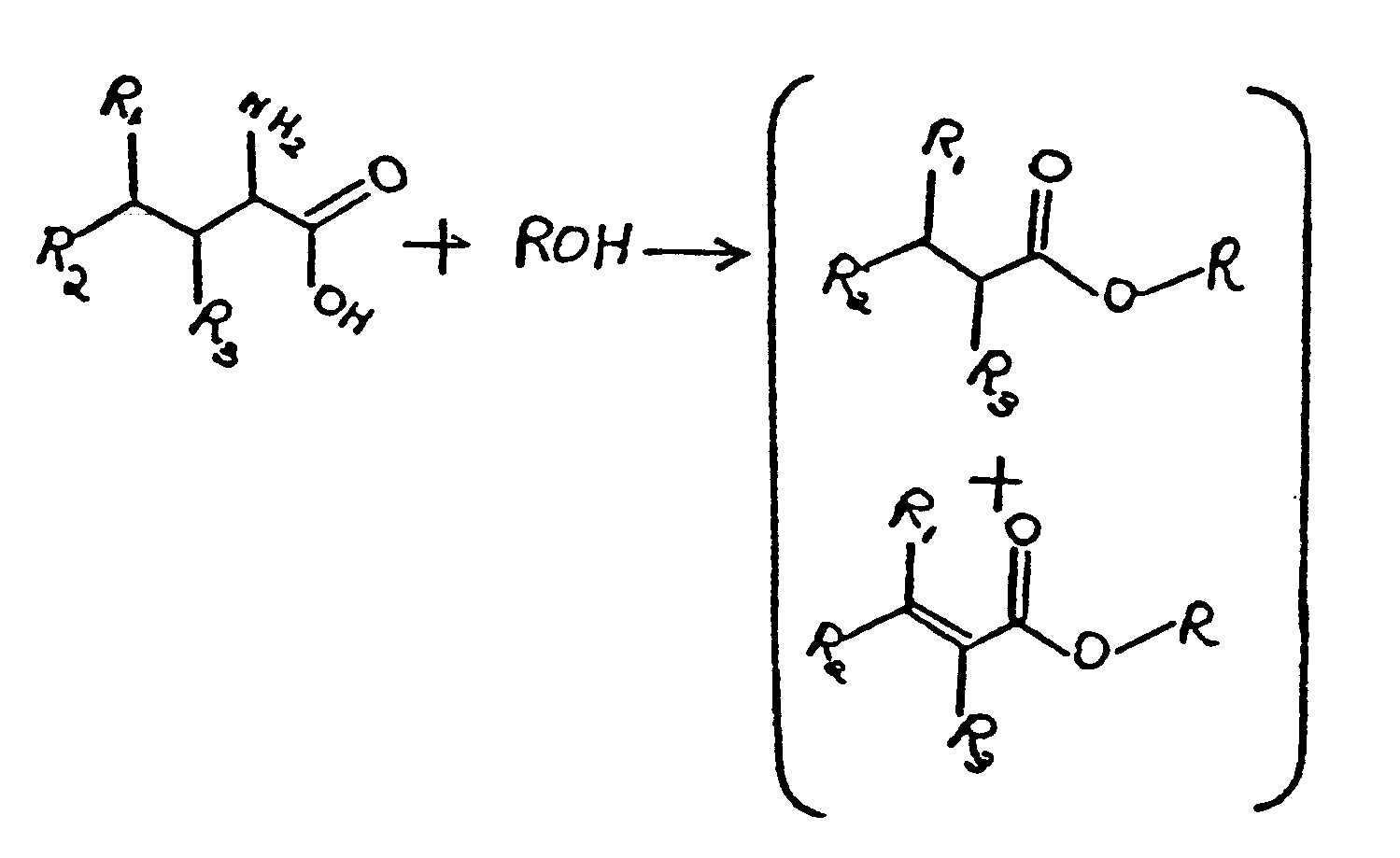
wherein R is the see as R'. Of course, the mixtures resulting from the fermentation contain a number of esters in addition to those defined according to the structure:
as will become evident from the detailed description of the invention and the examples set forth, infra. - The reaction:

is effected as a result of the presence in the reaction mass of certain organisms, for example:
- The reaction takes place by bubbling air through the fermenter which contains one or a mixture of the amino acids defined according to the structure:

for example, L-leucine, L-isoleucine or L-valine and carbon sources such as:
Dextrose;
Maltose;
Lactose;
Fructose;
Sucrose;
Black strap molasses;
Corn syrup;
Corn syrup solids;
Corn starch; and
Ethyl alcohol. - The concentration range of the amino acid or a mixture of amino acids may vary in the fermenter from about 0.1% by weight of the total contents of the fermenter up to about 1.0% by weight.
- The concentration of carbon source in the fermenter based on the weight of total contents of the fermenter is from about 0.5% up to about 8.0%.
- Other substrates which may be employed are:
Isobutanol;
Butter Oil; and
Coconut Oil.
The fermentation reaction takes place at a pH of from about 4.0 up to about 7.5 and at a temperature of from about 20°C up to about 35°C. Preferably, the pH range is 4.75 up to 7.0. Preferably, the temperature range is from about 22°C up to about 28°C. The time of fermentation may vary from about 20 hours up to about 100 hours, depending upon the other conditions of the fermentation, e.g., temperature of fermentation, rate of aeration, pH of fermentation broth and rate of addition of carbon source. For example, it is preferable to add ethanol to the fermentation broth in order for the ethanol concentration to stay at between 0.8% and 0.9% by weight of the overall fermentation broth. - An important aspect of our invention is in the recovery of the ester reaction product defined according to the structure:

as it is produced in the fermentation process, to wit:
The air that is passed through the fermentation broth during the fermentation, picks up these esters defined according to the structure:
and other useful esters as will become apparent from the detailed description of the invention and the examples, infra. This air stream containing the esters is then passed through a filter; then a condenser and the cooled air containing the esters is then passed through one or more charcoal beds which pick up the esters defined according to the structure:
as well as other useful esters. When saturated or when near saturation, the charcoal is removed from the containers holding the charcoal beds and admixed with a suitable liquid distillation material. The mixture of charcoal and the distillation material is placed, separately or simultaneously into a vessel which is then fitted with a distillation column and overhead condenser. Distillation is carried out whereby the esters are recovered from the resulting charcoal/distillation liquid/ester mixture. - The resulting ester mixture can be further refined by means of further fractional distillation and/or by means of preparative GLC.
- Among the various useful naturally occurring esters produced according to the process of our invention are:


- Apparatus useful for the present invention typically comprises at least the elements described in claims 3 and 4.
- The invention will now be further described with reference to the accompanying drawings. Figure 1 is a schematic representation of apparatus useful for carrying out the process of the invention. The reaction:

wherein R₁, R₂ and R₃ each represents hydrogen or methyl; and wherein R represents C₂-C₅ lower alkyl with the proviso that at least one of R₁, R₂ and R₃ is methyl takes place infermenter 10 shown in Fig. 1. - Amino acid having the structure:

held intank 58 is fed throughline 60 usingpump 62past valve 64 intovessel 10. Ethyl alcohol held intank 50 is fed throughline 52past valve 56 by means ofpump 54 intofermenter 10. Yeast extract intank 66 is fed throughline 68past valve 72 usingpump 70 intofermenter 10. - Dry "salts" or aqueous solutions thereof containing, for example, monobasic potassium phosphate or MgSO₄.7 H₂0 are fed from
tank 74 directly, or through line 76past valve 80 usingpump 78 intofermenter 10. - Inoculum containing culture, for example, a suspension of grown cells of Geotrichum fragrans (ATCC 11247) held in
Tank 42 is fed throughline 44 usingpump 46past valve 48 intofermenter 10. - Carbon source, e.g., dextrose in aqueous solution is fed from
holding tank 34 throughline 36past valve 40 usingpump 38 intofermenter 10. - The fermenter is stirred using
agitator 12 having impellers 14 at a rate of from about 150 rpm up to about 500 rpm. It is preferable to also add to the fermentation batch antifoam prior to the commencement of addition of inoculum fromtank 42. Air fromvessel 24 is fed throughline 28past valve 26 through filter/manifold 22. Part of the air is distributed throughline 30past valve 32 through sparger 16a into thefermentation batch 13. Part of the air is distributed throughline 18past valve 20 through sparger 16b into thefermentation batch 13 which is held at level 11 in thefermenter 10. Overhead gases are withdrawn from the fermentation batch throughline 82past valve 86 using pump (if desired) 84past air filter 88 throughline 90 past thecooling coils 94 throughcooler 92. - The
heat exchanger 92 is operated whereby coolant 96 is passed throughline 98past valve 100 throughcooling coils 94 intoholding tank 104 throughline 102. The air coming fromheat exchanger 92 containing the esters including those defined according to the generic structure:
wherein R₁, R₂ and R₃ each represent hydrogen or methyl; wherein the dashed line represents a carbon-carbon single bond or a carbon-carbon double bond; wherein R' represents C₂₋C₅ alkyl with the proviso that at least one of R₁, R₂ and R₃ represents methyl, is passed throughline 106past valve 108 using pump (if desired) 110 to trap 112 where moisture is collected and trapped out of the air in the form ofliquid 118. The gas containing the esters emanates atorifice 122 and passes throughheadspace 120 intoorifice 124 throughline 126past valve 128 using pump 130 (if desired) intocharcoal bed 156 and/orcharcoal bed 164. When being passed only intocharcoal bed 156 the ester fermentation product is passed throughline 134past valve 136 using pump 138 (if desired) andvalve 162 is in a closed position so that ester cannot be passed throughline 132. The ester is adsorbed on the charcoal incharcoal bed 156. In the alternative, when only passing ester intocharcoal 164,valve 136 is closed and the ester passes throughline 132past valve 162 using pump 160 (if desired). The ester may he passed intocharcoal bed 156 until saturation thereof; and then intocharcoal bed 164 until saturation thereof. While the ester/air mature is being passed intocharcoal bed 164,charcoal bed 156 may he removed from thecontainer thereof 148 and conveyed viasolids conveyor 158/184 intovessel 196. During the adsorption of the esters from the ester/air mixture coming intobed 156 thoughline 134, non-adsorbed materials and air emanates from thecharcoal bed 156 throughline 150past valve 154 into theenvironment 152. - After all of the ester from the ester/air mixture passed through
line 132 is adsorbed ontocharcoal bed 164 in holdingvessel 166, thevessel 166 is opened and the charcoal having ester adsorbed thereon is conveyed by means of a solid conveyor vialines vessel 196. - The non-adsorbed gases and air, during the passage of the ester/air mixture through
charcoal bed 164, passes throughline 176past valve 174 into theenvironment 180 throughorifice 178. - When the solid charcoal having ester adsorbed thereon is placed into
vessel 196, admixed therewith is distillation liquid aid, e.g., propylene glycol from holdingtank 188 throughline 190past valve 194 usingpump 192 intovessel 196. In the alternative or simultaneously therewith, distillation liquid aid, e.g., propylene glycol may he pre-mixed with thecharcoal bed 156 invessel 148 by placing in saidvessel 148 the distillation fluid aid from holdingtank 140 throughline 142 past valve 144 usingpump 146 intovessel 148. The resulting slurry containing charcoal having adsorbed thereon ester and containing the distillation fluid aid is then pumped via slurry conveyor throughlines past valve 207 throughorifice 186 andorifice 216 intovessel 196. In the alternative, thecharcoal bed 164 having adsorbed thereon ester is admixed with a distillation fluid aid pre-mixing agent held in tank 168 (e.g., propylene glycol) which is passed throughvalve 170 usingpump 172 intovessel 166. The resulting slurry invessel 166 containing pre-mixing fluid and charcoal having ester adsorbed thereon 164 is then pumped via slurry conveyor throughlines past valve 207 throughorifice 186 andorifice 216 intovessel 196. - The resulting
slurry 208 held intank 196 is then distilled while being stirred usingstirrer 202 driven by stirringmotor 200 fitted withimpeller 206 and, optionally, usingbaffles 198. Thevessel 196 and contents thereof are heated usingheating coil 201 andbeater 199. Thevessel 196 is fitted with ahead 204 which is fitted with adistillation column 218 as well as theagitator 208 and (not shown) a temperature control device. - The distillation proceeds whereby the ester passes through
headspace 210 throughline 214 intohatch distillation column 218 throughline 220 throughcooling heat exchanger 222 through coils 224 (part of the heat exchanger) and then throughline 230 where the resulting material may he placed inreceiver 238 throughline 232 past valve (open) 234 using pump 236 (withvalve 242 ofline 240 being closed). Theheat exchanger 222 is cooled by means of coolant passing into the heat exchanger at 228 and out at 226 (via a countercurrent heat exchange unit operation). In the alternative,valve 234 may he closed and the resulting ester mixture may he passed throughline 240 past valve 242 (open) usingpump 244 intofractionation column 246 The resulting ester mixture may then be fractionated whereby the overhead lighter boiling esters (e.g., ethyl propionate) are passed throughline 248 and refluxed usingreflux cutter 250 with the refluxing portion heing passed back into the distillation column et the top plate vialine 252 and the remainder of the overhead light boilers heing passed throughline 254 usingpump 260past valve 262 into holdingtank 256. By the same token, the bottoms from thedistillation column 246 are passed throughline 258past valve 266 usingpump 264 into holdingvessel 268. - Figure 2 is a section of the apparatus of Figure 1 in detail showing the
condensate trap 112 and thecharcoal bed vessels charcoal beds 156 and 164 (without the optional fluid pre-mix agent feeding means for each of the charcoal beds). - Figure 3 is a section of the apparatus of Figure 1 in detail showing the loading of ester-adsorbed
charcoal solids hopper 187 throughfeeding line 189 connected atorifice 136 throughline 191 throughorifice 216 into the distillation vessel. Theslurry 208 is made up by admixing thecharcoal bed material 156 and/or 164 with distillation aid fluid fromtank 188 which is pumped throughline 190 usingpump 192,past valve 194 into theslurry 208. Distillation column 218a is fitted onto head 204a ready for distillation. - After removal of the
hopper 187 which was used for ester-adsorbed charcoal loading (for loading 156 and/or 164,), the hopper is removed and replaced byline 286 atorifice 186 which has avalve 209 located in said line. The valve is closed and the stirringmotor 200 is engaged wherebyimpeller 206 causes theslurry 208 to become agitated. The distillation takes place through distillation column 218b as shown in Figure 4. At the time of thedistillation valve 194 andvalve 209 are in "closed" position with stirringmotor 200 in operation. - Figure 5 sets forth a preferred apparatus configuration for the carrying out of the process of our invention.
-
Fermentation vessel 333 is equipped withbaffles 329 andstirrer 328. - All additions to fermenter 333 are made through sterile lines.
- Sterile dextrose (50% aqueous solution) from holding
tank 304 and seed culture fromtank 300 are pumped usingpump 303 throughline 305 past valve 306 (for the sterile dextrose) and through line 301 past valve 302 (for the seed culture) jointly throughline 307past valve 308 into thefermentation vessel 333. 75 Percent aqueous ethyl alcohol is pumped from holdingtank 317 throughvalve 318 usingpump 319 throughline 320 intofermenter 333. - From holding
tank 290, amino acid defined according to the generic structure:
(either individually or in admixture) with yeast extract, salts, and emulsifier (e.g., TWEEN® 80) are pumped throughline 291past valve 292 usingpump 293 throughorifice 294 into thefermentation batch 334. Air is fed fromvessel 321 through line 322 throughsterile filter 323 throughline 324past valve 325 throughsparger tank 309past valve 310 using pH probe (331) controlledpump 311 into thefermentation vessel 333 and antifoam (e.g., silicone antifoam) is pumped from holdingtank 313 throughvalve 314 andline 316 using controlledpump 315 controlled viacontrol line 401 andfoam probe 400. During the fermentation the esters formed primarily including those having the formula:
wherein R₁, R₂ and R₃ each represent hydrogen or methyl; wherein the dashed line represents a carbon-carbon double bond or a carbon-carbon single bond; wherein R' is C₂-C₅ alkyl with the proviso that at least one of R₁, R₂ and R₃ represents methyl, is "distilled" from thefermentation mass 334 by mass transfer of the said esters into the air bubbles 332. The ester/air gas mixture passes through line 336 throughfilter 337 andline 338 through heat exchanger 340 (through coils 339). The heat exchanger is cooled, for example, in a countercurrent fashion by coolant entering at 341 and leaving at 342. The cooled ester-air gas mixture passes throughline 343 into condensate trap 344 (from orifice 345) where condensate is collected at 347. The ester-air gas is then passed through line 348 (entry point at 346) into either charcoal bed 353 (held in vessel 353A) or charcoal bed 352 (held in vessel bed 352A). When the ester-air gas is passed throughcharcoal bed 352 alone,valve 351 is closed preventing the ester-air gas mixture from being conveyed through line 351A. Instead, the ester-air mixture is conveyed throughline 349 passedvalve 350 intocharcoal bed 352. The non-adsorbed gases exit after the ester is adsorbed on the charcoal, at 354. - When
charcoal bed 353 is in use (held in vessel 353A) thenvalve 351 is open andvalve 350 is closed. Thus, the ester-air mixture passes through line 351A throughvalve 351 intocharcoal bed 353. The non-adsorbed gases and air exits at 355. - When the charcoal beds are saturated, the charcoal is removed from the vessels (e.g., vessel 353A and conveyed via 356 (e.g., a solid conveying line) through
line 358 intodistillation apparatus 359. In the alternative, the charcoal having adsorbed thereonester 352 is removed from vessel 352A via solid conveyance means 357 throughline 358 intovessel 359. Also added to thedistillation vessel 359 is distillation fluid aid (e.g., propylene glycol) from holdingtank 363 throughline 364 using pump 366 (if desired) throughorifice 367 into thedistillation vessel 359. The distillation vessel in operation is heated usingheating coil 362. The ester distillate is passed throughline 368 throughcondenser 369. The condenser is cooled, for example, (in a countercurrent fashion) by adding cooling fluid at 371 and exiting the cooling fluid at 370. The condenser (indicated by reference numerals "369" and "372") is connected toexit line 373. The condensed esters are passed throughline 372 past valve 374 (open) usingpump 375 into product containment means 376 and then sent on for further purification or fractionation vialine 377. - The sterile dextrose carbon source may he added, preferably, all at once immediately prior to inoculation of the seed culture from 300.
- The seed culture from holding
tank 300 can be pumped into the fermenter, preferably, through the same pump and lines used for the dextrose addition fromtank 304, that is,pump 303 and the preferable configuration is that which is shown in Figure 5. - Neither the ethanol nor pH controlling sodium hydroxide solutions need be sterilized since they are inherently sterile. Nevertheless, the orifice entry points of the sodium hydroxide and the ethanol should he sterile.
- Figure 6 is a detailed schematic diagram of that section of the apparatus of Figure 5 setting forth the configuration of the
charcoal beds - Thus, through
line 348 the ester-air mixture is passed either simultaneously into bothcharcoal beds line 349past valve 350 and line 351Apast valve 351, respectively. When such is the case,valve 457 ofline 456 andvalve 459 ofline 458 and the air (without adsorbed ester) passes throughlines past valves lines valve 451 being closed). In the alternative, thecharcoal beds charcoal bed 352 and then passes throughcharcoal bed 353 thereby causing the adsorption and entire process to be more efficient. Thus, for example,valve 351. is in a closed position andvalve 350 is in an open position.Valve 459 is closed andvalve 457 is open.Valves valve 451 is open. In this manner, the ester-air gas mixture passes throughline 348 throughline 349past valve 350 intocharcoal bed 352 where 70% of the ester, in the ester-air mixture is adsorbed. The remaining ester-air mixture is passed throughlines past valve 451 throughline 355 intocharcoal bed 353 where the remaining ester of the ester-air mixture is adsorbed. The air and unadsorbed gases then passes throughline 456past valve 457 into the atmosphere at 461. - Thereafter, the charcoal beds having ester adsorbed thereon, 352 and 353 are removed at 356 and 357 for subsequent slurification and distillation as indicated in Figure 5.
- In the alternative, the configuration of Figure 6 is even more flexible, in that,
charcoal beds valves valve 451. The ester-air mixture passes throughline 348 andline 349past valve 350 intobed 352. The remaining gases, mostly unadsorbable gases, and air pass through 354past valve 452 throughline 453 to theatmosphere 462. At saturation (that is, then the charcoal bed is saturated with adsorbed ester)valve 350 is closed,valve 451 remains closed,valve 457 is closed andvalve 351 is open. The ester-air mixture passes throughline 348, line 351A intocharcoal bed 353. The unadsorbable gases and air pass throughline 355 throughvalve 454 throughline 455 to the atmosphere at 463. - The following examples are descriptive runs employing the process in accordance with our discovery. Particular amounts of materials or particular types of feedstocks employed, particular species or strains of organisms including yeast should he considered as illustrative and not as limitative of our invention.
- In apparatus of Figure 1, into
fermenter 10 is placed 1 liter of an inoculum of Geotrichum fragrans (ATCC 11247); enough isoleucine to make up a 0.3% solution; 6% aqueous detrose; 0.05% MgSO₄.7 H₂O and 0.02% TWEEN® 80 (polyoxyethylene [20] sorbitan mono-oleate). - The agitation rate in the fermenter is 400 rpm and the temperature is set at 25°C. The aeration rate is 16 liters per minute. The pH is maintained in the range of 5.05 up to 5.25.
- The reaction taking place is basically as follows:

Ethanol is added to the reaction mass at a rate of 10 ml per hour (total amount ofethanol 250 ml over a period Of 25 hours). - The total amount of adsorbent charcoal in
charcoal bed 156 is 250 grams. - The ester-adsorbed charcoal was treated with steam and ester-containing condensate is collected. 10 Grams of this ester-containing condensate are admixed with 10 ml of distilled water and then extracted three times with 15 ml of FREON® 11. The combined Freon extracts are dried over anhydrous magnesium sulfate and concentrated by nitrogen stream to 0.5 grams. The resulting concentrated extract is analyzed by GCMS and the results are as follows:

- Figure 7 is the GLC profile of the above mixture (conditions: 400 mm x 0.03 mm glass capillary column (SE-30) programmed at 70-190°C at 2° C per minute). The peaks indicated as set forth above are also indicated on the GLC profile and these peaks stand for the components identified in the foregoing Table I.
- The resulting product has a fruity, apple, strawberry-like, minty aroma and taste profile at 3 ppm causing it to be useful in apple, pear and strawberry fruit flavors.
- At the rate of 4 ppm, the resulting product was added SUNKIST® orange beverage syrup and a beverage was produced. The resulting product has an excellent natural orange aroma and taste profile with apple, pear and strawberry undertones.
- The foregoing example is repeated with conditions set forth in Table II, infra yielding a percentage of the "main two esters" namely, ethyl tiglate and ethyl-2-methyl butyrate:

-

- Over a period of three days, 1 liter of inoculum suspension of Geotrichum fragrans (ATCC 11247) is grown. The inoculum is added to the
fermenter 333 from holdingtank 300 in Figure 5. - Leucine having the structure:

is added to the fermentation batch (in order to bring the entire percentage to 0.55% leucine), the working volume of the fermentation batch being 22 liters. From holdingvessel 304 sterile CERELOSE® in aqueous solution (50%) is added tofermentation vessel 333 in order to create a percentage of CERELOSE® in the fermentation vessel of 6%. Also added to thefermentation vessel 333 AMBEREX® to create a percentage of 0.1% AMBEREX®; MgSO₄.7 H₂O in order to bring its level to 0.05%; KH₂PO₄ in order to bring its level to 0.1% andTWEEN® 80 in order to bring its level to 0.02%. - The fermenter is agitated at a speed of 400 rpm. Aeration is commenced at a rate of 16 liters per minute. Charcoal traps 352 and 353 are set up containing, respectively, 300 grams and 130 grams of charcoal. The pH is maintained with sodium hydroxide from holding
vessel 309 at a level of between 5.05 and 5.25. Into holdingvessel 363 is placed propylene glycol which will he used to slurry with ester-adsorbed charcoal fromcharcoal beds - Over a period of 24 hours, ethyl alcohol is added to the reaction mass whereby the percentage of ethyl alcohol in the reaction mass is maintained at between 0.65% and 0.675%. The total amount of ethyl alcohol added to the reaction mass is 500 ml (75% ethanol solution added to
fermenter 333 from holdingvessel 317 through line 320). - The ester-adsorbed charcoal is admixed with the propylene glycol in
batch distillation apparatus 359 and the distillation takesplace using condenser 372. The ester mixture collected in the product (together with other materials) is analyzed and the GLC profile is set forth in Figure 8 (conditions: Chromosorb 101, 6' x 0.125" column programmed at 100-250°C at 20°C per minute). - The peak indicated by reference numeral "801" is the peak for ethyl acetate. The peak indicated by reference numeral "802" is the peak for ethanol (unreacted). The peak indicated by reference numeral "803" is the peak for ethyl propionate. The peak indicated by reference numeral "804" is the peak for ethyl isobutyrate. The peak indicated by reference numeral "805" is the peak for ethyl-2-methyl butyrate. The peak indicated by reference numeral "806" is the peak for ethyl isovalerate. The peak indicated by reference numeral "807" is the peak for isoamyl alcohol. The peak indicated by reference numeral "808" is the peak for ethyl senecioate. The peak indicated by reference numeral "809" is the peak for ethyl tiglate. The majority of the material produced is, however, ethyl isovalerate. The ethyl isovalerate has the structure:

ethyl senecioate has the structure:
and ethyl tiglate has the structure:
- Figure 9 is the GCMS spectrum for ethyl isovalerate. Figure 10 is the GCMS spectrum for ethyl senecioate.
-

- An inoculum is produced in an 1 liter batch over a period of 24 hours by growing Geotrichum fragrans (ATCC 11247).
- Using the fermenter of Figure 5 (fermenter 333), an example similar to that is carried out except instead of leucine, isoleucine having the structure:

is used as a precursor. - The temperature of the fermentation is 25°C. The agitation rate is 400 rpm. The aeration rate is 0.73 liter per minute per liter. The pH range is maintained at the range of from 5.05 up to 5.35. The sugar used is CERELOSE® 2001 at a level of 6% in the fermentation batch (using a 50% solution sterilized separately). The isoleucine level in the fermenter is 0.55% at the beginning. The amount of KH₂PO₄ in the fermenter initially is 0.1%. The amount of MgSO₄.7 H₂O is 0.05%. The amount of
TWEEN® 80 initially in the fermenter is 0.02%. The amount of silicone antifoam is added periodically to prevent foaming from holdingvessel 313 throughline 316 intofermenter 333 and the addition of the silicone antifoam is controlled usingfoam probe 400. Over a period of 48 hours, 450 ml of 75% ethyl alcohol is added tofermenter 333 in Figure 5 from holdingvessel 317 at the rate of 11 ml per hour whereby the percent of ethanol in thefermentation hatch 334 is between 0.49% and 0.82%. - The esters produced from the fermentation are trapped in
charcoal bed 352 held in vessel 352A and incharcoal bed 353 held in vessel 353A. The amount of charcoal invessel 352 is 300 grams (yielding 71.5 grams ester). The amount of charcoal intrap 353 is 150 grams (containing 11.7 grams of mixture of ester). - The ester-adsorbed charcoal batches are placed in
distillation vessel 359 at 361 and admixed with propylene glycol (250 ml). The resulting slurry is distilled throughdistillation column 359 usingplates 360 throughline 368 andcondenser 369/372 throughline 374 into aproduct holding tank 376. - Figure 11 is the GLC profile for the ester mixture thus collected. (Conditions: 50 meter at 0.32 mm fused silica (carbowax 20M column programmed at 75-225°C at 2°C per minute).
- The peak indicated by reference numeral "1101" is the peak for ethyl propionote. The peak indicated by reference numeral "1102" is the peak for ethyl isobutyrate. The peak indicated by reference numeral "1103" is the peak for the silicone defoamer. The peak indicated by reference numeral "1104" is the peak for ethyl butyrate. The peak indicated by reference numeral "1105" is the peak for ethyl-2-methyl butyrate. The peak indicated by reference numeral "1106" is the peak for ethyl isovalerate. The peak indicated by reference numeral "1107" is the peak for ethyl tiglate. The peak indicated by reference numeral "1108" is the peak also for silicone antifoam. The peak indicated by reference numeral "1109" is the peak for 2-methyl-1-butanol. The peak indicated by reference number "1110" is the peak for isoamyl isovalerate. The peak indicated by reference numeral "1111" is also a peak for the silicone defoamer.
- Figure 11 is the GLC profile for the first ester trap, that is, the ester found in
charcoal hatch 352. - Figure 12 is the GLC profile for the ester adsorbed on the second charcoal trap, that is,
trip 353. (Same conditions as for GLC profile of Figure 11). - The peak indicated by reference numeral "1201" is the peak for ethyl acetate. The peak indicated by reference numeral "1202" is the peak for ethanol. The peak indicated by reference numeral "1203" is the peak for ethyl propionate. The peak indicated by reference numeral "1204" is the peak for ethyl isobutyrate. The peaks indicated by reference numeral "1205" are peaks for propionaldehyde propylene glycol acetal. The peak indicated by reference numeral "1206" is the peak for ethyl isovalerate. The peak indicated by reference numeral "1205A" is the peak for ethyl-2-methyl butyrate. The peak indicated by reference numeral "1207" is for the silicone defoamer. The peak indicated by reference numeral "1208" is the peak for 2-methyl-1-butanol. The peak indicated by reference numeral "1209" is the peak for ethyl tiglate. The peak indicated by reference numeral "1210" is the peak for isoamyl isovalerate and n-amyl isovalerate. The peak indicated by reference numeral "1211" is the peak for the silicone defoamer.
-

- Over a three
day period 90 ml of an inoculum of Geotrichum fragrans (ATCC 24512) is grown. - Utilizing the apparatus of Figure 5 and the procedure of Example II, into
fermenter 333 is added dextrose in order to achieve a level of 5% dextrose in the fermentation batch (total volume: 3.5 liters). 4 ml Antifoam is added and 40 ml ethanol is added. The aeration is carried out at a level of 2 liters per minute. The fermentation batch is stirred at 400 rpm and the pH is maintained at a level of 6.5-6.7 using 1 molar potassium hydroxide solution. - Two resin (polyvinyl benzenesulfonic acid resin)
columns - 23 gm Isoleucine is added to the fermentation batch.
- The fermentation reaction proceeds for a period of three days The resin beds are then extracted with FREON® 113 and the freon extracts are wished with 30% sodium bicarbonate and sodium chloride and then dried over anhydrous sodium sulfate. The solvent is evaporated under nitrogen yielding 2.04 grams of residue. The residue is distilled at atmospheric pressure yielding two fractions: the first fraction contains 62.1% ethyl-2-methyl butyrate and 19.13% ethyl tiglate and the second fraction contains 28.5% ethyl-2-methyl butyrate and 27.4% ethyl tiglate.
-

- Over a period of 49 hours, 100 ml of inoculum of Geotrichum fragrans (ATCC 11247) is grown.
- Using the apparatus of Figure 5 and the procedure of Example II, 3 liters of a fermentation batch is made up containing 5% dextrose and 0.55% isoleucine.
- The fermentation is run at 25°C; the stirring rate is 400 rpm and the air rate is 4 liters per minute. The pH is controlled and kept at 6.5 using 1 molar potassium hydroxide.
- Ethanol is added over a period of 72 hours in the amount of 40 ml. At the end of 120 hours, the fermenter is stopped and the 100 gram charcoal traps (jacketed at 10°C throughout the procedure) are stripped with steam until a total of 1000 ml of steam distillate is collected. The steam distillate is extracted with FREON® 113 and the extract is dried over anhydrous sodium sulfate. The solvent is removed yielding a total ester content of 1.42 grams containing 81.55% ethyl-2-methyl butyrate and 4.6% ethyl tiglate.
- The contents of the fermenter is transferred to a 5 liter flask and distilled at 32°C and 35 mm/Hg pressure to yield 200 ml of liquid. The resulting distillate is extracted with FREON 113 yielding 45 mg of ester mixture.
- The charcoal traps are then extracted with acetone and the acetone is dried. The solvent is removed yielding 5.38 grams of ester containing 23% ethyl-2-methyl butyrate and 13.7% ethyl tiglate.
-

- Into a 28 liter fermenter (working
volume 22 liters) is added 22 liter of fermentation batch containing 110 grams isoleucine; 22 grams KH₂PO₄; 22 grams yeast extract; 11 grams MgSO₄.7 H₂O; 1100 grams of 50% sterilized solution of dextrose. - The pH is adjusted to 6.5 and inoculum containing 1000 ml of a solution of Geotrichum fragrans (ATCC 11247) is added (the cell growth period is 3 days).
- The pH is maintained in the range or 5 up to 5.5 using 5 molar potassium hydroxide solution. The foaming is controlled using silicone antifoam.
- The aerate is 5 liters per minute per liter.
- Ethanol is added to the reaction mass at the rate of 4 ml per hour maintaining the ethanol level in the range of 0.5% up to 0.875% (total ethanol added: 294 ml of 75% ethanol). Results: the
first charcoal trap 352 on first extraction yielded 108.5 grams of ester containing 26.6% ethyl-2-methyl butyrate and 17.3% ethyl tiglate. The recycled charcoal yielded 7.48 grams of ester containing 18.8% ethyl-2-methyl butyrate and 15.9% ethyl tiglate. Thesecond charcoal trap 353 contained 8.24 grams of ester containing 38.3% ethyl-2-methyl butyrate and 6.93% ethyl tiglate. On recycle 4.9 grams of ester yielded 39.7% ethyl-2-methyl butyrate and 1.7% ethyl tiglate. The first trap, second extraction yielded 7.89 grams ester containing 36.3% ethyl-2-methyl butyrate and 5.7% ethyl tiglate. The second trap on second extraction yielded 5.12 grams ester containing 39.7% ethyl-2-methyl butyrate and 3.12% ethyl tiglate. - In summary, a total of 63.1 grams ester was obtained containing the following:
Distillate Component Percentage Ethyl methyl butyrate 2.5 Ethyl-2-methyl butyrate 43.4 Ethyl isovalerate 16.2 2-Methyl-1-butanol 2.9 Ethyl tiglate 32.0 -

- The same procedure was carried out as was carried out in Example VI with the following exceptions:
- (i) leucine, rather than isoleucine, was used;
- (ii) no antifoam was added;
- (iii) the inoculum volume is 200 ml;
- (iv) the pH is kept at 5; and
- (v) the rpm for the agitation of the fermentation batch is 590 rpm.
- The major product obtained is ethyl isovalerate with a minor amount of ethyl senecioate.
-

- At 25°C a 4.5% solution of Geotrichum fragrans (ATCC 24512) is grown over a period of 24 hours.
- A fermentation batch is placed into the apparatus of Figure 5 into
fermenter 333 as follows:Ingredient Percentage of Fermentation Batch Valine 4% MgSO₄.7 H₂O 0.05% KH₂PO₄ 0.1% AMBEREX® 0.1% CERELOSE® 4.5 % TWEEN® 80 0.02% - The fermentation is carried out over a period of 72 hours at the following conditions:
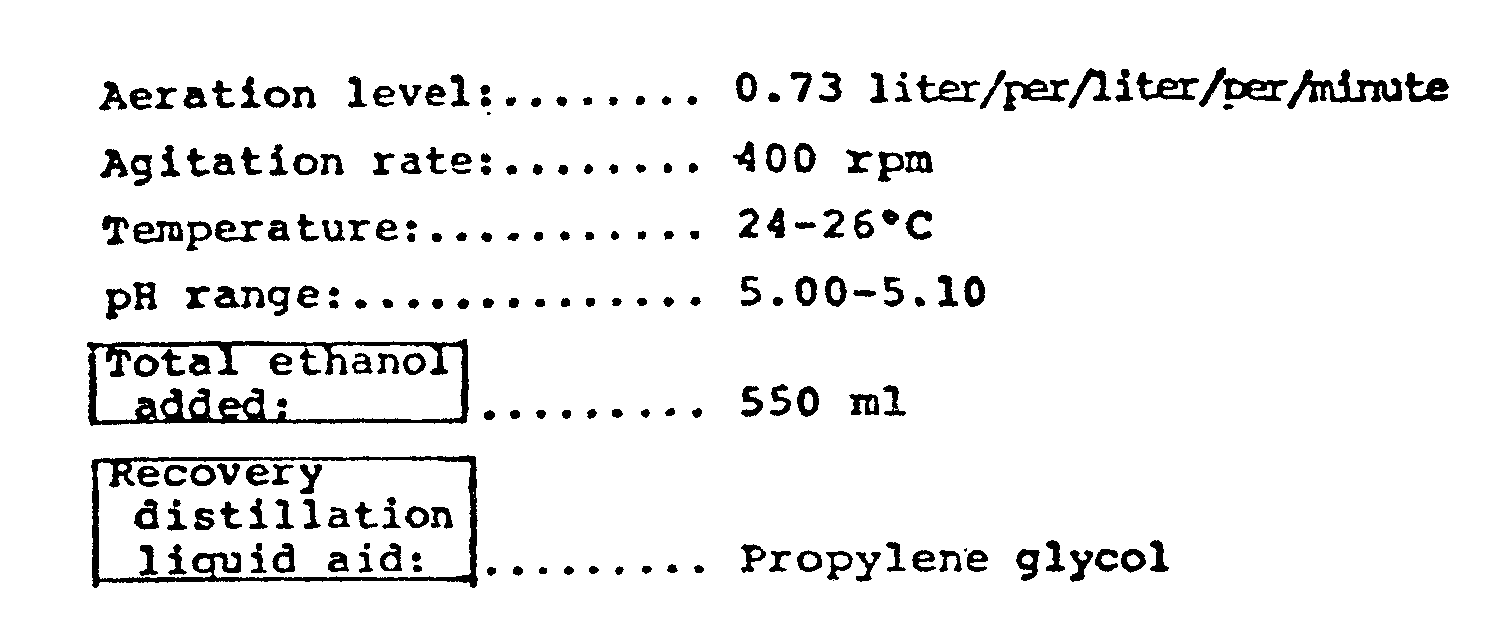
- A total working volume of 22 liters in the fermentation batch is used.
- A total of 74.5 grams of ester product was recovered from the charcoal traps having the following composition:
Ethanol propionate: 10.3% Ethyl isobutyrate: 37.0% Ethyl isovalerate: 28.1% Ethyl tiglate: 4.5% - Figure 13 is the GLC profile for the resulting ester mixture.
- The peak indicated by reference numeral "1301" is the peak for ethanol. The peak indicated by reference numeral "1302" is the peak for ethyl propionate. The peak indicated by reference numeral "1303" is the peak for ethyl isobutyrate. The peak indicated by reference numeral "1304" is the peak for ethyl isovalerate and ethyl-2-methyl butyrate. The peak indicated by reference numeral "1305" is the peak for ethyl tiglate.
- The ethyl tiglate is in the reaction mass because in the inoculum, a small amount of isoleucine was contained. The peak containing ethyl-2-methyl butyrate in addition to ethyl isovalerate contained ethyl-2-methyl butyrate because an isoleucine impurity was contained in the inoculum.
-

- A procedure was carried out as in Example VIII with the following exceptions:
- (i) 165 ml of isobutanol was used in place of ethanol; and
- (ii) the fermentation batch contained 0.45% isoleucine in place of the valine.
- Figure 14 is the GLC profile for the ester mixture thus produced.
- The peak indicated by reference numeral "1401" is the peak for isobutyl propionate. The peak indicated by reference numeral "1402" is the peak for isobutyl isobutyrate. The peak indicated by reference numeral "1403" is the peak for isobutyl-2-methyl butyrate and isobutyl isovalerate. The peak indicated by reference numeral "1404" is the peak for isobutyl tiglate.
Claims (4)
- A process for producing esters defined according to the generic structure:


- The process of claim 1, comprising the step of reacting an amino acid having the structure:

Geotrichum fragrans
Geotrichum penicillatum
Geotrichum suaveolens
and then recovering the resulting esters defined according to the generic structure:
- An apparatus useful for carrying out the process of claim 2 comprising at least the following elements shown in Figure 1:
fermentor (10), for carrying out a reaction of an amino acid having the structure:
- An apparatus useful for carrying out the process of claim 1 comprising at least the following elements shown in Figure 5:
a fermentor (333) for carrying out a reaction of an amino acid having the structure:
Applications Claiming Priority (2)
| Application Number | Priority Date | Filing Date | Title |
|---|---|---|---|
| US636225 | 1984-07-31 | ||
| US06/636,225 US4657862A (en) | 1984-07-31 | 1984-07-31 | Preparation of naturally-occurring C2-C5 alkyl esters of C4-C5 carboxylic acids by means of fermentation of C5-C6 amino acids in the presence of C2-C5 alcohols |
Publications (3)
| Publication Number | Publication Date |
|---|---|
| EP0170243A2 EP0170243A2 (en) | 1986-02-05 |
| EP0170243A3 EP0170243A3 (en) | 1987-08-26 |
| EP0170243B1 true EP0170243B1 (en) | 1992-03-18 |
Family
ID=24550987
Family Applications (1)
| Application Number | Title | Priority Date | Filing Date |
|---|---|---|---|
| EP85109501A Expired EP0170243B1 (en) | 1984-07-31 | 1985-07-29 | Fermentation process for preparation of alkyl esters of carboxylic acids |
Country Status (5)
| Country | Link |
|---|---|
| US (1) | US4657862A (en) |
| EP (1) | EP0170243B1 (en) |
| JP (1) | JPS6153241A (en) |
| CA (1) | CA1249786A (en) |
| DE (2) | DE3585646D1 (en) |
Families Citing this family (4)
| Publication number | Priority date | Publication date | Assignee | Title |
|---|---|---|---|---|
| ATE147945T1 (en) * | 1991-11-12 | 1997-02-15 | Kyowa Hakko Kogyo Kk | METHOD FOR PRODUCING FOOD AND BEVERAGES |
| GB0313173D0 (en) * | 2003-06-07 | 2003-07-16 | Givaudan Sa | Improvements in or related to organic compounds |
| JP4798780B2 (en) * | 2006-08-28 | 2011-10-19 | 宝酒造株式会社 | Method for producing brewed liquor, distilled liquor or sparkling liquor |
| FR3127500B1 (en) * | 2021-09-24 | 2025-06-20 | Univ De La Reunion | GENETICALLY IMPROVED MICROORGANISM STRAIN CAPABLE OF PRODUCING LARGER QUANTITIES OF VOLATILE ORGANIC COMPOUNDS OF INTEREST AND SCREENING METHOD FOR OBTAINING SUCH STRAINS |
Family Cites Families (10)
| Publication number | Priority date | Publication date | Assignee | Title |
|---|---|---|---|---|
| US953025A (en) * | 1908-05-14 | 1910-03-29 | Jean Effront | Process of fermenting organic nitrogenous substances. |
| US1866568A (en) * | 1927-11-08 | 1932-07-12 | Du Pont | Process of producing ethyl acetate, ethyl alcohol and other products by fermentation |
| US3326784A (en) * | 1963-09-06 | 1967-06-20 | Mobil Oil Corp | Electrochemical synthesis of esters |
| US3409506A (en) * | 1965-12-08 | 1968-11-05 | Exxon Research Engineering Co | Microbiological production of esters |
| SE7900826L (en) * | 1979-03-27 | 1980-09-28 | Brodelius P | USE OF IMMOBILIZED MICROBIAL ENZYM / CELL SYSTEMS FOR PREPARING ALFA KETOS ACIDS FROM SIMILAR AMINOS ACIDS |
| DE2930070A1 (en) * | 1979-07-25 | 1981-02-19 | Biotechnolog Forschung Gmbh | METHOD FOR THE CONTINUOUS ENCYMATIC CONVERSION OF WATER-SOLUBLE ALPHA KETOCARBONIC ACIDS INTO THE CORRESPONDING AMINO ACIDS |
| DE3108927A1 (en) * | 1981-03-10 | 1982-09-23 | Haarmann & Reimer Gmbh, 3450 Holzminden | METHOD FOR THE ENZYMATIC PRODUCTION OF ESTERS AND LACONS |
| WO1983001072A1 (en) * | 1981-09-28 | 1983-03-31 | Farbood, Mohamad, I. | Production of gamma-decalactone |
| US4487832A (en) * | 1982-11-18 | 1984-12-11 | Cpc International Inc. | Process for making n-butyl butyrate |
| JPS59227291A (en) * | 1983-06-10 | 1984-12-20 | Akita Konno Shoten:Kk | Enriching of flavor of refined sake |
-
1984
- 1984-07-31 US US06/636,225 patent/US4657862A/en not_active Expired - Lifetime
-
1985
- 1985-06-27 CA CA000485745A patent/CA1249786A/en not_active Expired
- 1985-07-29 DE DE8585109501T patent/DE3585646D1/en not_active Expired - Lifetime
- 1985-07-29 DE DE198585109501T patent/DE170243T1/en active Pending
- 1985-07-29 EP EP85109501A patent/EP0170243B1/en not_active Expired
- 1985-07-31 JP JP60167843A patent/JPS6153241A/en active Granted
Also Published As
| Publication number | Publication date |
|---|---|
| EP0170243A3 (en) | 1987-08-26 |
| JPH0559707B2 (en) | 1993-08-31 |
| US4657862A (en) | 1987-04-14 |
| JPS6153241A (en) | 1986-03-17 |
| CA1249786A (en) | 1989-02-07 |
| DE170243T1 (en) | 1987-02-05 |
| DE3585646D1 (en) | 1992-04-23 |
| EP0170243A2 (en) | 1986-02-05 |
Similar Documents
| Publication | Publication Date | Title |
|---|---|---|
| Tulecke et al. | Production of large amounts of plant tissue by submerged culture | |
| EP1194583B1 (en) | Culture of microorganisms for the synthesis of a polyunsatured fatty acid | |
| JPH0330683A (en) | Production of natural vanillin | |
| AU762656B2 (en) | Method of producing gamma-decalactone | |
| JPH02196780A (en) | Glycosidase-inhibitor sarbostatin and its manufacture | |
| US5879915A (en) | Method for the natural production of formic acid or formate | |
| CA1306967C (en) | Process for the preparation of gamma and delta lactones | |
| CA2719581C (en) | Improved fermentation process for higher yield coefficient of lipase-inhibitor with respect to consumed fatty acid | |
| EP0170243A2 (en) | Fermentation process for preparation of alkyl esters of carboxylic acids | |
| US4686307A (en) | Preparation of naturally-occurring C2 -C5 alkyl esters of C4 -C5 carboxylic acids by means of fermentation of C5 -C6 amino acids in the presence of C2 -C5 alcohols | |
| JP2801966B2 (en) | Continuous production method of natamycin | |
| CN111117893B (en) | Aspergillus terreus strain for producing 4-O-demethylbarbituric acid and application thereof | |
| EP0095862B1 (en) | Fermentation process for production of alpha-isopropylmalic acid | |
| EP0520027A1 (en) | Process for the production of natural long-chain alcohols | |
| CN111116370A (en) | A method for synthesizing methyl 2,4-dihydroxy-3,6-dimethylbenzoate using 4-O-desmethylbarbaric acid | |
| CN105713932B (en) | A kind of method that microbial fermentation prepares 2,3- butanediol | |
| JP4020444B2 (en) | Method for producing liquid composition containing γ-lactone | |
| EP4067339A1 (en) | Branched-chain amino acid crystallization method capable of sustainably cycling ammonia | |
| JP2948870B2 (en) | Method for producing 2-phenyl-5,6-dihydro-γ-pyrone having aroma | |
| EP1435392A1 (en) | Process for producing d-alanine | |
| WO2004005275A1 (en) | Fed batch solid state fermentation for the production of hmg-coa reductase inhibitors | |
| JPH0527385B2 (en) | ||
| MXPA01004081A (en) | METHOD OF PRODUCING&ggr;-DECALACTONE | |
| JPS62257391A (en) | Production of palmitoleic acid by fermentation method | |
| JPH1094398A (en) | Method for producing polyol using microorganism |
Legal Events
| Date | Code | Title | Description |
|---|---|---|---|
| PUAI | Public reference made under article 153(3) epc to a published international application that has entered the european phase |
Free format text: ORIGINAL CODE: 0009012 |
|
| AK | Designated contracting states |
Designated state(s): CH DE FR GB LI NL |
|
| TCNL | Nl: translation of patent claims filed | ||
| EL | Fr: translation of claims filed | ||
| DET | De: translation of patent claims | ||
| PUAL | Search report despatched |
Free format text: ORIGINAL CODE: 0009013 |
|
| AK | Designated contracting states |
Kind code of ref document: A3 Designated state(s): CH DE FR GB LI NL |
|
| 17P | Request for examination filed |
Effective date: 19871103 |
|
| 17Q | First examination report despatched |
Effective date: 19900510 |
|
| GRAA | (expected) grant |
Free format text: ORIGINAL CODE: 0009210 |
|
| AK | Designated contracting states |
Kind code of ref document: B1 Designated state(s): CH DE FR GB LI NL |
|
| REF | Corresponds to: |
Ref document number: 3585646 Country of ref document: DE Date of ref document: 19920423 |
|
| ET | Fr: translation filed | ||
| PLBE | No opposition filed within time limit |
Free format text: ORIGINAL CODE: 0009261 |
|
| STAA | Information on the status of an ep patent application or granted ep patent |
Free format text: STATUS: NO OPPOSITION FILED WITHIN TIME LIMIT |
|
| 26N | No opposition filed | ||
| PGFP | Annual fee paid to national office [announced via postgrant information from national office to epo] |
Ref country code: GB Payment date: 19970630 Year of fee payment: 13 |
|
| PG25 | Lapsed in a contracting state [announced via postgrant information from national office to epo] |
Ref country code: GB Free format text: LAPSE BECAUSE OF NON-PAYMENT OF DUE FEES Effective date: 19980729 |
|
| GBPC | Gb: european patent ceased through non-payment of renewal fee |
Effective date: 19980729 |
|
| PGFP | Annual fee paid to national office [announced via postgrant information from national office to epo] |
Ref country code: NL Payment date: 20000630 Year of fee payment: 16 Ref country code: CH Payment date: 20000630 Year of fee payment: 16 |
|
| PG25 | Lapsed in a contracting state [announced via postgrant information from national office to epo] |
Ref country code: LI Free format text: LAPSE BECAUSE OF NON-PAYMENT OF DUE FEES Effective date: 20010731 Ref country code: CH Free format text: LAPSE BECAUSE OF NON-PAYMENT OF DUE FEES Effective date: 20010731 |
|
| PG25 | Lapsed in a contracting state [announced via postgrant information from national office to epo] |
Ref country code: NL Free format text: LAPSE BECAUSE OF NON-PAYMENT OF DUE FEES Effective date: 20020201 |
|
| REG | Reference to a national code |
Ref country code: CH Ref legal event code: PL |
|
| NLV4 | Nl: lapsed or anulled due to non-payment of the annual fee |
Effective date: 20020201 |
|
| PGFP | Annual fee paid to national office [announced via postgrant information from national office to epo] |
Ref country code: FR Payment date: 20030718 Year of fee payment: 19 |
|
| PGFP | Annual fee paid to national office [announced via postgrant information from national office to epo] |
Ref country code: DE Payment date: 20030731 Year of fee payment: 19 |
|
| PG25 | Lapsed in a contracting state [announced via postgrant information from national office to epo] |
Ref country code: DE Free format text: LAPSE BECAUSE OF NON-PAYMENT OF DUE FEES Effective date: 20050201 |
|
| PG25 | Lapsed in a contracting state [announced via postgrant information from national office to epo] |
Ref country code: FR Free format text: LAPSE BECAUSE OF NON-PAYMENT OF DUE FEES Effective date: 20050331 |
|
| REG | Reference to a national code |
Ref country code: FR Ref legal event code: ST |