EP0170118A2 - 4-Substituted-1,2,4,6-thiatriazine derivatives - Google Patents
4-Substituted-1,2,4,6-thiatriazine derivatives Download PDFInfo
- Publication number
- EP0170118A2 EP0170118A2 EP85108581A EP85108581A EP0170118A2 EP 0170118 A2 EP0170118 A2 EP 0170118A2 EP 85108581 A EP85108581 A EP 85108581A EP 85108581 A EP85108581 A EP 85108581A EP 0170118 A2 EP0170118 A2 EP 0170118A2
- Authority
- EP
- European Patent Office
- Prior art keywords
- formula
- compound
- group
- defined above
- groups
- Prior art date
- Legal status (The legal status is an assumption and is not a legal conclusion. Google has not performed a legal analysis and makes no representation as to the accuracy of the status listed.)
- Withdrawn
Links
- -1 4-Substituted-1,2,4,6-thiatriazine Chemical class 0.000 title claims abstract description 23
- 150000001875 compounds Chemical class 0.000 claims abstract description 121
- 125000000217 alkyl group Chemical group 0.000 claims abstract description 39
- 125000004432 carbon atom Chemical group C* 0.000 claims abstract description 37
- 238000000034 method Methods 0.000 claims abstract description 30
- 125000003118 aryl group Chemical group 0.000 claims abstract description 25
- 125000001424 substituent group Chemical group 0.000 claims abstract description 23
- 125000004435 hydrogen atom Chemical group [H]* 0.000 claims abstract description 19
- LMBFAGIMSUYTBN-MPZNNTNKSA-N teixobactin Chemical compound C([C@H](C(=O)N[C@@H]([C@@H](C)CC)C(=O)N[C@@H](CO)C(=O)N[C@H](CCC(N)=O)C(=O)N[C@H]([C@@H](C)CC)C(=O)N[C@@H]([C@@H](C)CC)C(=O)N[C@@H](CO)C(=O)N[C@H]1C(N[C@@H](C)C(=O)N[C@@H](C[C@@H]2NC(=N)NC2)C(=O)N[C@H](C(=O)O[C@H]1C)[C@@H](C)CC)=O)NC)C1=CC=CC=C1 LMBFAGIMSUYTBN-MPZNNTNKSA-N 0.000 claims abstract description 19
- 150000001412 amines Chemical class 0.000 claims abstract description 17
- 125000000449 nitro group Chemical group [O-][N+](*)=O 0.000 claims abstract description 16
- 125000004093 cyano group Chemical group *C#N 0.000 claims abstract description 15
- 125000004433 nitrogen atom Chemical group N* 0.000 claims abstract description 14
- 125000001997 phenyl group Chemical group [H]C1=C([H])C([H])=C(*)C([H])=C1[H] 0.000 claims abstract description 14
- 125000002023 trifluoromethyl group Chemical group FC(F)(F)* 0.000 claims abstract description 14
- 238000004519 manufacturing process Methods 0.000 claims abstract description 13
- 125000000753 cycloalkyl group Chemical group 0.000 claims abstract description 10
- 125000002496 methyl group Chemical group [H]C([H])([H])* 0.000 claims abstract description 10
- 125000006615 aromatic heterocyclic group Chemical group 0.000 claims abstract description 9
- 125000004104 aryloxy group Chemical group 0.000 claims abstract description 9
- 125000004429 atom Chemical group 0.000 claims abstract description 6
- 150000004985 diamines Chemical class 0.000 claims abstract description 6
- 239000000460 chlorine Substances 0.000 claims abstract description 5
- 229910052801 chlorine Inorganic materials 0.000 claims abstract description 5
- 229910052731 fluorine Inorganic materials 0.000 claims abstract description 5
- ZAMOUSCENKQFHK-UHFFFAOYSA-N Chlorine atom Chemical compound [Cl] ZAMOUSCENKQFHK-UHFFFAOYSA-N 0.000 claims abstract description 4
- PXGOKWXKJXAPGV-UHFFFAOYSA-N Fluorine Chemical compound FF PXGOKWXKJXAPGV-UHFFFAOYSA-N 0.000 claims abstract description 4
- 125000003342 alkenyl group Chemical group 0.000 claims abstract description 4
- 125000000304 alkynyl group Chemical group 0.000 claims abstract description 4
- 125000001246 bromo group Chemical group Br* 0.000 claims abstract description 4
- 239000011737 fluorine Substances 0.000 claims abstract description 4
- 125000005843 halogen group Chemical group 0.000 claims description 15
- BAVYZALUXZFZLV-UHFFFAOYSA-N Methylamine Chemical compound NC BAVYZALUXZFZLV-UHFFFAOYSA-N 0.000 claims description 12
- 229910052757 nitrogen Inorganic materials 0.000 claims description 12
- QGZKDVFQNNGYKY-UHFFFAOYSA-N Ammonia Chemical compound N QGZKDVFQNNGYKY-UHFFFAOYSA-N 0.000 claims description 10
- IJGRMHOSHXDMSA-UHFFFAOYSA-N Atomic nitrogen Chemical compound N#N IJGRMHOSHXDMSA-UHFFFAOYSA-N 0.000 claims description 10
- FYSNRJHAOHDILO-UHFFFAOYSA-N thionyl chloride Chemical compound ClS(Cl)=O FYSNRJHAOHDILO-UHFFFAOYSA-N 0.000 claims description 10
- 239000002904 solvent Substances 0.000 claims description 8
- FCSKOFQQCWLGMV-UHFFFAOYSA-N 5-{5-[2-chloro-4-(4,5-dihydro-1,3-oxazol-2-yl)phenoxy]pentyl}-3-methylisoxazole Chemical compound O1N=C(C)C=C1CCCCCOC1=CC=C(C=2OCCN=2)C=C1Cl FCSKOFQQCWLGMV-UHFFFAOYSA-N 0.000 claims description 7
- 125000003545 alkoxy group Chemical group 0.000 claims description 7
- 239000003085 diluting agent Substances 0.000 claims description 7
- RWRDLPDLKQPQOW-UHFFFAOYSA-N Pyrrolidine Chemical compound C1CCNC1 RWRDLPDLKQPQOW-UHFFFAOYSA-N 0.000 claims description 6
- NINIDFKCEFEMDL-UHFFFAOYSA-N Sulfur Chemical group [S] NINIDFKCEFEMDL-UHFFFAOYSA-N 0.000 claims description 5
- 229910021529 ammonia Inorganic materials 0.000 claims description 5
- QVGXLLKOCUKJST-UHFFFAOYSA-N atomic oxygen Chemical compound [O] QVGXLLKOCUKJST-UHFFFAOYSA-N 0.000 claims description 5
- 125000002795 guanidino group Chemical group C(N)(=N)N* 0.000 claims description 5
- 125000005842 heteroatom Chemical group 0.000 claims description 5
- 229910052760 oxygen Inorganic materials 0.000 claims description 5
- 239000001301 oxygen Substances 0.000 claims description 5
- YNAVUWVOSKDBBP-UHFFFAOYSA-N Morpholine Chemical compound C1COCCN1 YNAVUWVOSKDBBP-UHFFFAOYSA-N 0.000 claims description 4
- NQRYJNQNLNOLGT-UHFFFAOYSA-N Piperidine Chemical compound C1CCNCC1 NQRYJNQNLNOLGT-UHFFFAOYSA-N 0.000 claims description 4
- 150000001732 carboxylic acid derivatives Chemical group 0.000 claims description 4
- 125000002541 furyl group Chemical group 0.000 claims description 4
- 125000002887 hydroxy group Chemical group [H]O* 0.000 claims description 4
- 239000000203 mixture Substances 0.000 claims description 4
- UMADWUIDBAFLKI-UHFFFAOYSA-N 4-methyl-3,5-bis(4-methylphenoxy)-1,2,4,6-thiatriazine 1,1-dioxide Chemical compound N=1S(=O)(=O)N=C(OC=2C=CC(C)=CC=2)N(C)C=1OC1=CC=C(C)C=C1 UMADWUIDBAFLKI-UHFFFAOYSA-N 0.000 claims description 3
- 230000002363 herbicidal effect Effects 0.000 claims description 3
- 125000001544 thienyl group Chemical group 0.000 claims description 3
- PVOAHINGSUIXLS-UHFFFAOYSA-N 1-Methylpiperazine Chemical group CN1CCNCC1 PVOAHINGSUIXLS-UHFFFAOYSA-N 0.000 claims description 2
- 239000000969 carrier Substances 0.000 claims description 2
- 125000002883 imidazolyl group Chemical group 0.000 claims description 2
- 150000007530 organic bases Chemical class 0.000 claims description 2
- 239000000126 substance Substances 0.000 claims description 2
- 125000000335 thiazolyl group Chemical group 0.000 claims description 2
- RSPCKAHMRANGJZ-UHFFFAOYSA-N thiohydroxylamine Chemical compound SN RSPCKAHMRANGJZ-UHFFFAOYSA-N 0.000 claims description 2
- 125000005270 trialkylamine group Chemical group 0.000 claims description 2
- 125000000951 phenoxy group Chemical group [H]C1=C([H])C([H])=C(O*)C([H])=C1[H] 0.000 abstract description 3
- YMWUJEATGCHHMB-UHFFFAOYSA-N Dichloromethane Chemical compound ClCCl YMWUJEATGCHHMB-UHFFFAOYSA-N 0.000 description 42
- WEVYAHXRMPXWCK-UHFFFAOYSA-N Acetonitrile Chemical compound CC#N WEVYAHXRMPXWCK-UHFFFAOYSA-N 0.000 description 27
- RTZKZFJDLAIYFH-UHFFFAOYSA-N Diethyl ether Chemical compound CCOCC RTZKZFJDLAIYFH-UHFFFAOYSA-N 0.000 description 17
- 238000006243 chemical reaction Methods 0.000 description 17
- IAZDPXIOMUYVGZ-WFGJKAKNSA-N Dimethyl sulfoxide Chemical compound [2H]C([2H])([2H])S(=O)C([2H])([2H])[2H] IAZDPXIOMUYVGZ-WFGJKAKNSA-N 0.000 description 12
- ZMANZCXQSJIPKH-UHFFFAOYSA-N Triethylamine Chemical compound CCN(CC)CC ZMANZCXQSJIPKH-UHFFFAOYSA-N 0.000 description 12
- CSNNHWWHGAXBCP-UHFFFAOYSA-L Magnesium sulfate Chemical compound [Mg+2].[O-][S+2]([O-])([O-])[O-] CSNNHWWHGAXBCP-UHFFFAOYSA-L 0.000 description 10
- ATTZFSUZZUNHBP-UHFFFAOYSA-N Piperonyl sulfoxide Chemical compound CCCCCCCCS(=O)C(C)CC1=CC=C2OCOC2=C1 ATTZFSUZZUNHBP-UHFFFAOYSA-N 0.000 description 8
- LFQSCWFLJHTTHZ-UHFFFAOYSA-N Ethanol Chemical compound CCO LFQSCWFLJHTTHZ-UHFFFAOYSA-N 0.000 description 7
- 125000001174 sulfone group Chemical group 0.000 description 7
- HEDRZPFGACZZDS-UHFFFAOYSA-N Chloroform Chemical compound ClC(Cl)Cl HEDRZPFGACZZDS-UHFFFAOYSA-N 0.000 description 6
- HEMHJVSKTPXQMS-UHFFFAOYSA-M Sodium hydroxide Chemical compound [OH-].[Na+] HEMHJVSKTPXQMS-UHFFFAOYSA-M 0.000 description 6
- 229910052943 magnesium sulfate Inorganic materials 0.000 description 5
- 235000019341 magnesium sulphate Nutrition 0.000 description 5
- 239000011541 reaction mixture Substances 0.000 description 5
- 238000001953 recrystallisation Methods 0.000 description 5
- UIIMBOGNXHQVGW-UHFFFAOYSA-M Sodium bicarbonate Chemical compound [Na+].OC([O-])=O UIIMBOGNXHQVGW-UHFFFAOYSA-M 0.000 description 4
- WYURNTSHIVDZCO-UHFFFAOYSA-N Tetrahydrofuran Chemical compound C1CCOC1 WYURNTSHIVDZCO-UHFFFAOYSA-N 0.000 description 4
- 125000001037 p-tolyl group Chemical group [H]C1=C([H])C(=C([H])C([H])=C1*)C([H])([H])[H] 0.000 description 4
- 239000007787 solid Substances 0.000 description 4
- XLYOFNOQVPJJNP-UHFFFAOYSA-N water Substances O XLYOFNOQVPJJNP-UHFFFAOYSA-N 0.000 description 4
- IHMHRHIUJZAQDY-UHFFFAOYSA-N 2H-thiatriazine Chemical class N1SC=CN=N1 IHMHRHIUJZAQDY-UHFFFAOYSA-N 0.000 description 3
- NHQDETIJWKXCTC-UHFFFAOYSA-N 3-chloroperbenzoic acid Chemical compound OOC(=O)C1=CC=CC(Cl)=C1 NHQDETIJWKXCTC-UHFFFAOYSA-N 0.000 description 3
- UHOVQNZJYSORNB-UHFFFAOYSA-N Benzene Chemical compound C1=CC=CC=C1 UHOVQNZJYSORNB-UHFFFAOYSA-N 0.000 description 3
- 0 CC(*)=N[S@@](N=C(NP)O*)=O Chemical compound CC(*)=N[S@@](N=C(NP)O*)=O 0.000 description 3
- DRSHXJFUUPIBHX-UHFFFAOYSA-N COc1ccc(cc1)N1N=CC2C=NC(Nc3cc(OC)c(OC)c(OCCCN4CCN(C)CC4)c3)=NC12 Chemical compound COc1ccc(cc1)N1N=CC2C=NC(Nc3cc(OC)c(OC)c(OCCCN4CCN(C)CC4)c3)=NC12 DRSHXJFUUPIBHX-UHFFFAOYSA-N 0.000 description 3
- ZMXDDKWLCZADIW-UHFFFAOYSA-N N,N-Dimethylformamide Chemical compound CN(C)C=O ZMXDDKWLCZADIW-UHFFFAOYSA-N 0.000 description 3
- KWYUFKZDYYNOTN-UHFFFAOYSA-M Potassium hydroxide Chemical compound [OH-].[K+] KWYUFKZDYYNOTN-UHFFFAOYSA-M 0.000 description 3
- YXFVVABEGXRONW-UHFFFAOYSA-N Toluene Chemical compound CC1=CC=CC=C1 YXFVVABEGXRONW-UHFFFAOYSA-N 0.000 description 3
- 238000001816 cooling Methods 0.000 description 3
- 238000001914 filtration Methods 0.000 description 3
- 239000012458 free base Substances 0.000 description 3
- 230000003647 oxidation Effects 0.000 description 3
- 238000007254 oxidation reaction Methods 0.000 description 3
- 125000000590 4-methylphenyl group Chemical group [H]C1=C([H])C(=C([H])C([H])=C1*)C([H])([H])[H] 0.000 description 2
- QUSNBJAOOMFDIB-UHFFFAOYSA-N Ethylamine Chemical compound CCN QUSNBJAOOMFDIB-UHFFFAOYSA-N 0.000 description 2
- PIICEJLVQHRZGT-UHFFFAOYSA-N Ethylenediamine Chemical compound NCCN PIICEJLVQHRZGT-UHFFFAOYSA-N 0.000 description 2
- MHAJPDPJQMAIIY-UHFFFAOYSA-N Hydrogen peroxide Chemical compound OO MHAJPDPJQMAIIY-UHFFFAOYSA-N 0.000 description 2
- UFWIBTONFRDIAS-UHFFFAOYSA-N Naphthalene Chemical compound C1=CC=CC2=CC=CC=C21 UFWIBTONFRDIAS-UHFFFAOYSA-N 0.000 description 2
- KFSLWBXXFJQRDL-UHFFFAOYSA-N Peracetic acid Chemical compound CC(=O)OO KFSLWBXXFJQRDL-UHFFFAOYSA-N 0.000 description 2
- 239000000010 aprotic solvent Substances 0.000 description 2
- GDTBXPJZTBHREO-UHFFFAOYSA-N bromine Chemical compound BrBr GDTBXPJZTBHREO-UHFFFAOYSA-N 0.000 description 2
- 239000003153 chemical reaction reagent Substances 0.000 description 2
- 238000001035 drying Methods 0.000 description 2
- 230000000694 effects Effects 0.000 description 2
- 125000001495 ethyl group Chemical group [H]C([H])([H])C([H])([H])* 0.000 description 2
- 238000001704 evaporation Methods 0.000 description 2
- 229910052736 halogen Inorganic materials 0.000 description 2
- 150000002367 halogens Chemical class 0.000 description 2
- 239000004009 herbicide Substances 0.000 description 2
- 239000003485 histamine H2 receptor antagonist Substances 0.000 description 2
- 239000000543 intermediate Substances 0.000 description 2
- JJWLVOIRVHMVIS-UHFFFAOYSA-N isopropylamine Chemical compound CC(C)N JJWLVOIRVHMVIS-UHFFFAOYSA-N 0.000 description 2
- 238000002844 melting Methods 0.000 description 2
- 230000008018 melting Effects 0.000 description 2
- AGJSNMGHAVDLRQ-IWFBPKFRSA-N methyl (2s)-2-[[(2s)-2-[[(2s)-2-[[(2r)-2-amino-3-sulfanylpropanoyl]amino]-3-methylbutanoyl]amino]-3-(4-hydroxy-2,3-dimethylphenyl)propanoyl]amino]-4-methylsulfanylbutanoate Chemical compound SC[C@H](N)C(=O)N[C@@H](C(C)C)C(=O)N[C@H](C(=O)N[C@@H](CCSC)C(=O)OC)CC1=CC=C(O)C(C)=C1C AGJSNMGHAVDLRQ-IWFBPKFRSA-N 0.000 description 2
- IWDCLRJOBJJRNH-UHFFFAOYSA-N p-cresol Chemical compound CC1=CC=C(O)C=C1 IWDCLRJOBJJRNH-UHFFFAOYSA-N 0.000 description 2
- 125000006239 protecting group Chemical group 0.000 description 2
- 125000004076 pyridyl group Chemical group 0.000 description 2
- 230000009257 reactivity Effects 0.000 description 2
- 235000017557 sodium bicarbonate Nutrition 0.000 description 2
- 229910000030 sodium bicarbonate Inorganic materials 0.000 description 2
- 239000007858 starting material Substances 0.000 description 2
- 239000000725 suspension Substances 0.000 description 2
- YLQBMQCUIZJEEH-UHFFFAOYSA-N tetrahydrofuran Natural products C=1C=COC=1 YLQBMQCUIZJEEH-UHFFFAOYSA-N 0.000 description 2
- GETQZCLCWQTVFV-UHFFFAOYSA-N trimethylamine Chemical compound CN(C)C GETQZCLCWQTVFV-UHFFFAOYSA-N 0.000 description 2
- XFNJVJPLKCPIBV-UHFFFAOYSA-N trimethylenediamine Chemical compound NCCCN XFNJVJPLKCPIBV-UHFFFAOYSA-N 0.000 description 2
- 238000005406 washing Methods 0.000 description 2
- FMCAFXHLMUOIGG-JTJHWIPRSA-N (2s)-2-[[(2r)-2-[[(2s)-2-[[(2r)-2-formamido-3-sulfanylpropanoyl]amino]-3-methylbutanoyl]amino]-3-(4-hydroxy-2,5-dimethylphenyl)propanoyl]amino]-4-methylsulfanylbutanoic acid Chemical compound O=CN[C@@H](CS)C(=O)N[C@@H](C(C)C)C(=O)N[C@@H](C(=O)N[C@@H](CCSC)C(O)=O)CC1=CC(C)=C(O)C=C1C FMCAFXHLMUOIGG-JTJHWIPRSA-N 0.000 description 1
- RYHBNJHYFVUHQT-UHFFFAOYSA-N 1,4-Dioxane Chemical compound C1COCCO1 RYHBNJHYFVUHQT-UHFFFAOYSA-N 0.000 description 1
- ISFKAWILRLPRGT-UHFFFAOYSA-N 3,5-bis(2-nitrophenoxy)-4-propan-2-yl-1,2,4,6-thiatriazine 1,1-dioxide Chemical compound N=1S(=O)(=O)N=C(OC=2C(=CC=CC=2)[N+]([O-])=O)N(C(C)C)C=1OC1=CC=CC=C1[N+]([O-])=O ISFKAWILRLPRGT-UHFFFAOYSA-N 0.000 description 1
- UYCMDQMFNGLGEH-UHFFFAOYSA-N 3,5-bis(4-methylphenoxy)-4-prop-2-ynyl-1,2,4,6-thiatriazine 1,1-dioxide Chemical compound C1=CC(C)=CC=C1OC(N1CC#C)=NS(=O)(=O)N=C1OC1=CC=C(C)C=C1 UYCMDQMFNGLGEH-UHFFFAOYSA-N 0.000 description 1
- RXYXHFJRVLUKOR-UHFFFAOYSA-N 3,5-bis(4-nitrophenoxy)-4-propan-2-yl-1,2,4,6-thiatriazine 1,1-dioxide Chemical compound N=1S(=O)(=O)N=C(OC=2C=CC(=CC=2)[N+]([O-])=O)N(C(C)C)C=1OC1=CC=C([N+]([O-])=O)C=C1 RXYXHFJRVLUKOR-UHFFFAOYSA-N 0.000 description 1
- LIBFPKXOBBGKDB-UHFFFAOYSA-N 4-ethyl-3,5-bis(4-methylphenoxy)-1,2,4,6-thiatriazine 1,1-dioxide Chemical compound N=1S(=O)(=O)N=C(OC=2C=CC(C)=CC=2)N(CC)C=1OC1=CC=C(C)C=C1 LIBFPKXOBBGKDB-UHFFFAOYSA-N 0.000 description 1
- NFRMVZGHUXCBII-UHFFFAOYSA-N CC(C)=NS/N=C(/N)\NC Chemical compound CC(C)=NS/N=C(/N)\NC NFRMVZGHUXCBII-UHFFFAOYSA-N 0.000 description 1
- KZBUYRJDOAKODT-UHFFFAOYSA-N Chlorine Chemical compound ClCl KZBUYRJDOAKODT-UHFFFAOYSA-N 0.000 description 1
- IAZDPXIOMUYVGZ-UHFFFAOYSA-N Dimethylsulphoxide Chemical compound CS(C)=O IAZDPXIOMUYVGZ-UHFFFAOYSA-N 0.000 description 1
- VEXZGXHMUGYJMC-UHFFFAOYSA-N Hydrochloric acid Chemical compound Cl VEXZGXHMUGYJMC-UHFFFAOYSA-N 0.000 description 1
- CPELXLSAUQHCOX-UHFFFAOYSA-N Hydrogen bromide Chemical compound Br CPELXLSAUQHCOX-UHFFFAOYSA-N 0.000 description 1
- 206010020601 Hyperchlorhydria Diseases 0.000 description 1
- VYPSYNLAJGMNEJ-UHFFFAOYSA-N Silicium dioxide Chemical compound O=[Si]=O VYPSYNLAJGMNEJ-UHFFFAOYSA-N 0.000 description 1
- 208000007107 Stomach Ulcer Diseases 0.000 description 1
- 239000002253 acid Substances 0.000 description 1
- 230000001476 alcoholic effect Effects 0.000 description 1
- 125000003277 amino group Chemical group 0.000 description 1
- 150000004945 aromatic hydrocarbons Chemical class 0.000 description 1
- 239000002585 base Substances 0.000 description 1
- 230000015572 biosynthetic process Effects 0.000 description 1
- 235000010290 biphenyl Nutrition 0.000 description 1
- 239000004305 biphenyl Substances 0.000 description 1
- 125000006267 biphenyl group Chemical group 0.000 description 1
- 229910052794 bromium Inorganic materials 0.000 description 1
- 125000006244 carboxylic acid protecting group Chemical group 0.000 description 1
- 238000004587 chromatography analysis Methods 0.000 description 1
- 229940125890 compound Ia Drugs 0.000 description 1
- ATDGTVJJHBUTRL-UHFFFAOYSA-N cyanogen bromide Chemical compound BrC#N ATDGTVJJHBUTRL-UHFFFAOYSA-N 0.000 description 1
- 125000004802 cyanophenyl group Chemical group 0.000 description 1
- 238000000354 decomposition reaction Methods 0.000 description 1
- 125000005043 dihydropyranyl group Chemical group O1C(CCC=C1)* 0.000 description 1
- 229960001760 dimethyl sulfoxide Drugs 0.000 description 1
- CZZYITDELCSZES-UHFFFAOYSA-N diphenylmethane Chemical compound C=1C=CC=CC=1CC1=CC=CC=C1 CZZYITDELCSZES-UHFFFAOYSA-N 0.000 description 1
- 125000001153 fluoro group Chemical group F* 0.000 description 1
- 230000002496 gastric effect Effects 0.000 description 1
- AGJSNMGHAVDLRQ-HUUJSLGLSA-N methyl (2s)-2-[[(2r)-2-[[(2s)-2-[[(2r)-2-amino-3-sulfanylpropanoyl]amino]-3-methylbutanoyl]amino]-3-(4-hydroxy-2,3-dimethylphenyl)propanoyl]amino]-4-methylsulfanylbutanoate Chemical compound SC[C@H](N)C(=O)N[C@@H](C(C)C)C(=O)N[C@@H](C(=O)N[C@@H](CCSC)C(=O)OC)CC1=CC=C(O)C(C)=C1C AGJSNMGHAVDLRQ-HUUJSLGLSA-N 0.000 description 1
- 125000002816 methylsulfanyl group Chemical group [H]C([H])([H])S[*] 0.000 description 1
- ULWOJODHECIZAU-UHFFFAOYSA-N n,n-diethylpropan-2-amine Chemical compound CCN(CC)C(C)C ULWOJODHECIZAU-UHFFFAOYSA-N 0.000 description 1
- YZMHIEWCHZOHMK-UHFFFAOYSA-N n-methyl-5-(2-nitrophenoxy)-1,1-dioxo-4-propan-2-yl-1,2,4,6-thiatriazin-3-amine Chemical compound CC(C)N1C(NC)=NS(=O)(=O)N=C1OC1=CC=CC=C1[N+]([O-])=O YZMHIEWCHZOHMK-UHFFFAOYSA-N 0.000 description 1
- 125000006501 nitrophenyl group Chemical group 0.000 description 1
- 239000007800 oxidant agent Substances 0.000 description 1
- 150000004965 peroxy acids Chemical class 0.000 description 1
- ZUOUZKKEUPVFJK-UHFFFAOYSA-N phenylbenzene Natural products C1=CC=CC=C1C1=CC=CC=C1 ZUOUZKKEUPVFJK-UHFFFAOYSA-N 0.000 description 1
- 125000005936 piperidyl group Chemical group 0.000 description 1
- 239000012286 potassium permanganate Substances 0.000 description 1
- 238000002360 preparation method Methods 0.000 description 1
- JKANAVGODYYCQF-UHFFFAOYSA-N prop-2-yn-1-amine Chemical compound NCC#C JKANAVGODYYCQF-UHFFFAOYSA-N 0.000 description 1
- 125000000719 pyrrolidinyl group Chemical group 0.000 description 1
- 238000010992 reflux Methods 0.000 description 1
- 150000003839 salts Chemical class 0.000 description 1
- 238000007086 side reaction Methods 0.000 description 1
- 239000000741 silica gel Substances 0.000 description 1
- 229910002027 silica gel Inorganic materials 0.000 description 1
- 229960001922 sodium perborate Drugs 0.000 description 1
- YKLJGMBLPUQQOI-UHFFFAOYSA-M sodium;oxidooxy(oxo)borane Chemical compound [Na+].[O-]OB=O YKLJGMBLPUQQOI-UHFFFAOYSA-M 0.000 description 1
- 238000003756 stirring Methods 0.000 description 1
- 238000003786 synthesis reaction Methods 0.000 description 1
- YBRBMKDOPFTVDT-UHFFFAOYSA-N tert-butylamine Chemical compound CC(C)(C)N YBRBMKDOPFTVDT-UHFFFAOYSA-N 0.000 description 1
- CIHOLLKRGTVIJN-UHFFFAOYSA-N tert‐butyl hydroperoxide Chemical compound CC(C)(C)OO CIHOLLKRGTVIJN-UHFFFAOYSA-N 0.000 description 1
- 125000003718 tetrahydrofuranyl group Chemical group 0.000 description 1
- 125000003944 tolyl group Chemical group 0.000 description 1
- 150000003918 triazines Chemical class 0.000 description 1
Classifications
-
- C—CHEMISTRY; METALLURGY
- C07—ORGANIC CHEMISTRY
- C07D—HETEROCYCLIC COMPOUNDS
- C07D285/00—Heterocyclic compounds containing rings having nitrogen and sulfur atoms as the only ring hetero atoms, not provided for by groups C07D275/00 - C07D283/00
- C07D285/15—Six-membered rings
-
- A—HUMAN NECESSITIES
- A01—AGRICULTURE; FORESTRY; ANIMAL HUSBANDRY; HUNTING; TRAPPING; FISHING
- A01N—PRESERVATION OF BODIES OF HUMANS OR ANIMALS OR PLANTS OR PARTS THEREOF; BIOCIDES, e.g. AS DISINFECTANTS, AS PESTICIDES OR AS HERBICIDES; PEST REPELLANTS OR ATTRACTANTS; PLANT GROWTH REGULATORS
- A01N43/00—Biocides, pest repellants or attractants, or plant growth regulators containing heterocyclic compounds
- A01N43/72—Biocides, pest repellants or attractants, or plant growth regulators containing heterocyclic compounds having rings with nitrogen atoms and oxygen or sulfur atoms as ring hetero atoms
-
- C—CHEMISTRY; METALLURGY
- C07—ORGANIC CHEMISTRY
- C07D—HETEROCYCLIC COMPOUNDS
- C07D513/00—Heterocyclic compounds containing in the condensed system at least one hetero ring having nitrogen and sulfur atoms as the only ring hetero atoms, not provided for in groups C07D463/00, C07D477/00 or C07D499/00 - C07D507/00
- C07D513/02—Heterocyclic compounds containing in the condensed system at least one hetero ring having nitrogen and sulfur atoms as the only ring hetero atoms, not provided for in groups C07D463/00, C07D477/00 or C07D499/00 - C07D507/00 in which the condensed system contains two hetero rings
- C07D513/04—Ortho-condensed systems
Definitions
- the present invention relates to a process for the production of 4-substituted 1,2,4,6-thiatriazine derivatives which are useful, inter alia, in the production of compounds having histamine H 2 -antagonist activity, and also relates to certain of the 4-substituted 1,2,4,6-thiatriazine derivatives per se.
- the present invention provides a process for the production of a compound of formula I in which
- aryl is used herein to denote a radical derived from benzene or from a polynuclear arene, for example, derived from diphenylmethane or naphthalene (see Roberts and Caserio, Basic Principles of Organic Chemistry, W.A. Benjamin, Inc., New York, 1964).
- An aryl group is preferably a phenyl group.
- Carboxylic acid esterifying groups are well known, that is to say, in actual use in the art or described in the literature of the art. For carboxylic acid protecting groups see, for example, McOmie, Protecting Groups in Organic Chemistry, Plenum Press, London 1973, and Greene, Protecting Groups in Organic Synthesis, J. Wiley & Sons Inc. 1981.
- an aromatic or non-aromatic group is, for example, a furyl, tetrahydrofuryl, thienyl, pyridyl, dihydropyranyl, pyrrolidinyl, N-alkyl-pyrrolidinyl or piperidyl group, especially a furyl or pyridyl group.
- An alkyl substituent on a ring nitrogen atom is especially a methyl group.
- the oxidation of a sulphoxide of formula I to the corresponding sulphone may be carried out by means of an oxidising agent, for example, a peracid, for example, peracetic acid or m-chloroperbenzoic acid; hydrogen peroxide; an alkylhydroperoxide, for example, t-butyl hydroperoxide; a permanganate, for example, potassium permanganate; or a perborate, for example, sodium perborate.
- an oxidising agent for example, a peracid, for example, peracetic acid or m-chloroperbenzoic acid
- hydrogen peroxide for example, an alkylhydroperoxide, for example, t-butyl hydroperoxide
- a permanganate for example, potassium permanganate
- a perborate for example, sodium perborate.
- a sulphoxide of formula Ia may be oxidised before reaction with the amine of formula III, or after formation of
- Compound II is preferably reacted with the amine of formula III in a solvent or diluent, for example, an aprotic solvent or diluent that does not react with the amine III, for example, acetonitrile, dichloromethane, dioxane or tetrahydrofuran.
- a solvent or diluent for example, an aprotic solvent or diluent that does not react with the amine III, for example, acetonitrile, dichloromethane, dioxane or tetrahydrofuran.
- the reaction is carried out at a temperature within the range of from 0 to 100°C, prefeably from 20 to 80°C, depending on the nature of any substituent(s) on the phenyl rings.
- one mole of the amine is used per mole of compound II.
- reaction of a compound of formula II with a diamine of formula V that is to say, with 1,2-diaminoethane or 1,3-diaminopropane is generally carried out under the reaction conditions described above for the reaction of compounds II and III, and the reaction of compounds Ia and IV is also generally carried out under those conditions.
- a compound of formula II in which p represents the integer 1 may be produced by reacting a compound of formula VI in which R is as defined above, with thionyl chloride in the presence of an organic base, for example, a trialkylamine, for example, trimethylamine, triethylamine, or diethylisopropylamine.
- the reaction is generally carried out in a solvent or diluent, for example, an aprotic solvent, for example, acetonitrile, chloroform, dichloromethane, diethyl ether or tetrahydrofuran.
- the reaction temperature is generally within the range of from -50 to +30°C.
- a resulting compound of formula II in which p represents the integer 1 may be oxidised to give the corresponding compound of formula II in which p represents the integer 2 using reagents and reaction conditions as described above.
- Particularly useful compounds of formula VI are those in which the aryl groups R are phenyl groups and are each substituted by a methyl, trifluoromethyl, cyano or nitro group, or by a halogen atom, for example, a chlorine, bromine or fluorine atom, especially by a 2-nitro or 4-methyl group.
- a substituent for example, a chlorine, bromine or fluorine atom, especially by a 2-nitro or 4-methyl group.
- the reaction of a resulting compound of formula II (optionally after oxidation), with an amine of formula III or a diamine of formula V may be carried out at a lower temperature than is possible with the corresponding unsubstituted compound II.
- a subsequent reaction of a resulting compound Ia with an amine of formula IV is also facilitated by the presence of a halogen, trifluoromethyl, cyano or nitro (especially 2-nitro) substituent on the phenyl ring R.
- a halogen, trifluoromethyl, nitro or cyano substitutent, especially a 2-nitro substitutent is particularly advantageous when a compound of formula II or Ia is to be reacted with a sterically hindered amine, for example, iso-propylamine or t-butylamine.
- preferred compounds of formulae II are those in which each radical R represents a halogenophenyl, trifluoromethylphenyl, cyanophenyl, methylphenyl or nitrophenyl group, and especially those in which each radical R represents a 2-nitrophenyl or 4-methylphenyl group.
- the process of the present invention is suitable for large-scale manufacturing use.
- the starting materials and reagents are readily available and inexpensive and, in general, the intermediate tetraphenyl-bis-imidocarbonate sulphoxides and sulphones of formula II are stable, highly crystalline compounds and as such are easily isolated from reaction mixtures without the need for chromatography.
- the reactivity of the displaceable phenoxy groups RO- can be controlled by careful selection of the phenyl ring substituents, thus increasing the versatility of the process of the invention to include the use of sterically hindered amines and diamines in the production of a compound of formula I.
- the reactivity of the displaceable phenoxy group RO- can be controlled by the selection and positioning of substituents on the phenyl ring. If two substituents are present on a phenyl ring, these are preferably in the 2- and 4-positions. Generally, it is preferable to have only one substituent. As mentioned above, a nitro group is preferably in the 2-position, and a methyl substituent is preferably in the 4-position.
- a particularly useful compound of formula I is 3,5-bis-(4-methylphenoxy)-4-methyl-1,2,4,6-thiatriazine 1,1-dioxide.
- a compound of formula I produced by the process of the present invention may be used to produce a compound of formula VII in which
- the present invention includes such use of a compound of formula I.
- substituted thiatriazines analogous to compound VII but having different side chains attached to the 5-position of the thiatriazine ring may be prepared analogously to compound VII.
- An example of such a compound is as defined above for compound VII but having as radical A a thiazolyl radical that is substituted by a guanidino group that is itself substituted by one or more alkyl groups, wherein the or each alkyl group may itself be substituted, for example, by a trifluoromethyl group or by a halogen atom.
- the present invention provides the use of a compound of formula I (when produced by the process of the present invention) in the manufacture of a compound of formula XII that is to say, 3-N-[(2-guanidino-4-thiazolyl)methylthio]ethyl]amino-4-meth yl-5-amino-l,2,4,6-thiatriazine 1,1-dioxide.
- the compound of formula XII may be produced by a process which comprises
- Compounds XIII and XIV are generally reacted in a solvent or diluent, preferably an alcohol, dimethylformamide or dimethyl sulphoxide, at a temperature within the range of from 0 to 100°C, preferably from 0 to 60°C.
- the compound of formula XIV should be reacted in the form of the free base, as shown. If it is initially present in the form of an acid addition salt, for example, as the hydrochloride or hydrobromide, this should be converted into the free base during or, preferably, before reaction with compound XIII. Conversion to the free base is carried out using a base, for example, triethylamine, sodium hydroxide or potassium hydroxide.
- reaction of the resulting compound XVI with ammonia is generally carried out in an alcoholic solvent at a temperature from 0 to 60°C.
- the group RO- in the thiatriazine starting material used for the production of compounds VII, XII and analogous compounds is preferably one of the substituted phenyl groups described above, in particular a 2-nitrophenyl group or a 4-methylphenyl group.
- Compounds of formula I as defined above find application as herbicides, and the present invention provides the use of a compound of formula I as defined above as a herbicidal agent.
- the invention also provides a herbicidal composition comprising one or more compounds of formula I as defined above in admixture with one or more substances selected from solvents, diluents and carriers.
- the invention further provides a method of treating plants, especially crops, for example, monocotyledenous plants, which comprises applying to the plants a compound of formula I as defined above, generally in the form of a herbicidal composition as defined above.
- the present invention also provides compounds of formula I as defined above with the exception of those compounds in which
Landscapes
- Chemical & Material Sciences (AREA)
- Organic Chemistry (AREA)
- Life Sciences & Earth Sciences (AREA)
- Dentistry (AREA)
- Wood Science & Technology (AREA)
- Plant Pathology (AREA)
- Health & Medical Sciences (AREA)
- Engineering & Computer Science (AREA)
- Agronomy & Crop Science (AREA)
- General Health & Medical Sciences (AREA)
- Pest Control & Pesticides (AREA)
- Zoology (AREA)
- Environmental Sciences (AREA)
- Nitrogen And Oxygen Or Sulfur-Condensed Heterocyclic Ring Systems (AREA)
- Pharmaceuticals Containing Other Organic And Inorganic Compounds (AREA)
- Nitrogen- Or Sulfur-Containing Heterocyclic Ring Compounds With Rings Of Six Or More Members (AREA)
- Plural Heterocyclic Compounds (AREA)
- Organic Low-Molecular-Weight Compounds And Preparation Thereof (AREA)
- Agricultural Chemicals And Associated Chemicals (AREA)
Abstract
A process for the production of a compound of formula

in which
in which
- R represents an aryl group, especially a phenyl group, which may be unsubstituted or substituted by one or two substituents, which may be the same or different, selected from methyl, trifluoromethyl, nitro and cyano groups, and chlorine, fluorine and bromine atoms;
- R1 represents a hydrogen atom, a straight or branched chain alkyl group having from 1 to 6 carbon atoms or a cycloalkyl group having from 3 to 7 carbon atoms, which alkyl or cycloalkyl group is unsubstituted or substituted, or
- R1 represents a straight or branched chain alkenyl group having from 2 to 6 carbon atoms or a straight or branched chain alkynyl group having from 3 to 6 carbon atoms;
- R represents an aryloxy group, especially a phenoxy group, which is unsubstituted or is substituted as defined above for aryl groups R; or
- R2 represents an -NHR3 group in which R3 represents a hydrogen atom or a straight or branched chain alkyl group having from 1 to 6 carbon atoms that is unsubstituted or substituted, or an aromatic or non-aromatic heterocyclic group as defined above; or
- R2 represents a group NHR3, and R1 and R3, together with the atoms to which they are attached, form a 5- or 6-membered ring containing two nitrogen atoms, and p represents the integer 1 or 2, which comprises (a) reacting a compound of formula II
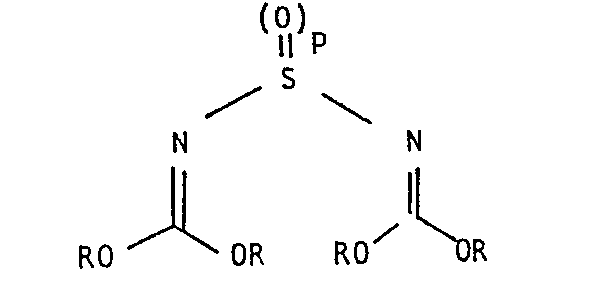
- in which R and p are as defined above, with an amine of formula III
-


- in which R3 is as defined above, to give a compound of formula I in which R2 represents group NHR3; or (c) reacting a compound of formula II as defined above with a diamine of formula V
-

The compounds of formula I are useful in the manufacture of 5-substituted 1, 2, 4, 6-thiatriazines.
Description
- The present invention relates to a process for the production of 4-substituted 1,2,4,6-thiatriazine derivatives which are useful, inter alia, in the production of compounds having histamine H2-antagonist activity, and also relates to certain of the 4-substituted 1,2,4,6-thiatriazine derivatives per se.
- Our UK Patent Specification No. 2 129 426A describes and claims thiatriazine derivatives that have histamine H2-antagonist activity and that are useful in the treatment of gastric hyperacidity and gastric ulcers, and also describes and claims processes for the production of these compounds. These processes utilise certain 4-substituted 1,2,4,6-thiatriazine 1,1-dioxides.
- The present invention provides a process for the production of a compound of formula I
in which -

- R represents a hydrogen atom, a straight or branched chain alkyl group having from 1 to 6 carbon atoms or a cycloalkyl group having from 3 to 7 carbon atoms, which alkyl or cycloalkyl group is unsubstituted or is substituted by one or more substituents, which may be the same or different, for example, by one or two substituents, especially by one substituent, selected from halogen atoms; nitro and cyano groups; -OR4 groups in which R4 represents a hydrogen atom or an alkyl group having from 1 to 4 carbon atoms; cycloalkyl groups having from 3 to 7 carbon atoms; NR5R6 groups in which R 5 and R 6, which may be the same or different, each represents a hydrogen atom or an alkyl group having from 1 to 4 carbon atoms; -COOR7 groups in which R7 represents a hydrogen atom or a carboxylic acid esterifying group; -CONR5R6 groups in which R and R 6 are as defined above; -SO2NR5R6 groups in which R 5 and R6 are as defined above; aromatic and non-aromatic heterocyclic groups having from 5 to 8 ring members and 1 or 2 heteroatoms, which may be the same or different, selected from oxygen, nitrogen and sulphur atoms and optionally having an alkyl group having from 1 to 4 carbon atoms as a substituent on a ring nitrogen atom; and phenyl groups R8 that are unsubstituted or substituted by one or more substituents, which may be the same or different, selected from halogen atoms, trifluoromethyl groups, nitro and cyano groups, alkyl and alkoxy groups having from 1 to 4 carbon atoms, and NR5R6 groups in which R5 and R 6 are as defined above; or
- R1 represents a straight or branched chain alkenyl group having from 2 to 6 carbon atoms or a straight or branched chain alkynyl group having from 3 to 6 carbon atoms;
- R2 represents an aryloxy group which is unsubstituted or is substituted as defined above for aryl groups R; or
- R 2 represents an -NHR 3 group in which R3 represents a hydrogen atom, a straight or branched chain alkyl group having from 1 to 6 carbon atoms that is unsubstituted or is substituted as defined above for alkyl groups R l, or an aromatic or non-aromatic heterocyclic group as defined above; or
- R 2 represents a group NHR3, and R1 and R3, together with the atoms to which they are attached, form a 5- or 6-membered ring containing two nitrogen atoms, and p represents the integer 1 or 2,
which comprises (a) reacting a compound of formula II
- in which R and p are as defined above, with an amine of formula III

- in which R is as defined above to give a compound of formula Ia

- in which R, p and R1 are as defined above, that is to say, a compound of formula I in which R2 represents an optionally substituted aryloxy group and, if desired, (b) reacting the resulting compound of formula Ia with an amine of formula IV

- in which R3 is as defined above, to give a compound of formula Ib

- in which R, p, R1 and R3 are as defined above, that is to say, a compound of formula I in which R2 represents a group -NHR 3 ; or
- (c) reacting a compound of formula II as defined above with a diamine of formula V

- in which n represents 2 or 3 to give a compound of formula Ic

- in which R, p and n are as defined above, that is to say, a compound of formula I in which R2 represents a group NHR 3, and R and R 3, together with the atoms to which they are attached, form a 5- or 6-membered ring containing two nitrogen atoms; and, if desired, at any stage,
- (d) oxidising a resulting compound of formula I in which p represents the integer 1 to give the corresponding compound in which p represents the integer 2.
- The term "aryl" is used herein to denote a radical derived from benzene or from a polynuclear arene, for example, derived from diphenylmethane or naphthalene (see Roberts and Caserio, Basic Principles of Organic Chemistry, W.A. Benjamin, Inc., New York, 1964). An aryl group is preferably a phenyl group. Carboxylic acid esterifying groups are well known, that is to say, in actual use in the art or described in the literature of the art. For carboxylic acid protecting groups see, for example, McOmie, Protecting Groups in Organic Chemistry, Plenum Press, London 1973, and Greene, Protecting Groups in Organic Synthesis, J. Wiley & Sons Inc. 1981.
- In a compound of formula I, an aromatic or non-aromatic group is, for example, a furyl, tetrahydrofuryl, thienyl, pyridyl, dihydropyranyl, pyrrolidinyl, N-alkyl-pyrrolidinyl or piperidyl group, especially a furyl or pyridyl group. An alkyl substituent on a ring nitrogen atom is especially a methyl group.
- The oxidation of a sulphoxide of formula I to the corresponding sulphone may be carried out by means of an oxidising agent, for example, a peracid, for example, peracetic acid or m-chloroperbenzoic acid; hydrogen peroxide; an alkylhydroperoxide, for example, t-butyl hydroperoxide; a permanganate, for example, potassium permanganate; or a perborate, for example, sodium perborate. The oxidation is carried out in a suitable solvent of diluent. A sulphoxide of formula Ia may be oxidised before reaction with the amine of formula III, or after formation of a compound of formula Ib.
- Compound II is preferably reacted with the amine of formula III in a solvent or diluent, for example, an aprotic solvent or diluent that does not react with the amine III, for example, acetonitrile, dichloromethane, dioxane or tetrahydrofuran. Generally the reaction is carried out at a temperature within the range of from 0 to 100°C, prefeably from 20 to 80°C, depending on the nature of any substituent(s) on the phenyl rings. Generally one mole of the amine is used per mole of compound II.
- The reaction of a compound of formula II with a diamine of formula V, that is to say, with 1,2-diaminoethane or 1,3-diaminopropane is generally carried out under the reaction conditions described above for the reaction of compounds II and III, and the reaction of compounds Ia and IV is also generally carried out under those conditions.
- A compound of formula II in which p represents the integer 1 may be produced by reacting a compound of formula VI

in which R is as defined above, with thionyl chloride in the presence of an organic base, for example, a trialkylamine, for example, trimethylamine, triethylamine, or diethylisopropylamine. The reaction is generally carried out in a solvent or diluent, for example, an aprotic solvent, for example, acetonitrile, chloroform, dichloromethane, diethyl ether or tetrahydrofuran. The reaction temperature is generally within the range of from -50 to +30°C. A resulting compound of formula II in which p represents the integer 1 may be oxidised to give the corresponding compound of formula II in which p represents the integer 2 using reagents and reaction conditions as described above. - Many of the compounds of formula VI are unstable, giving triazines on standing, and must be prepared and then reacted immediately with thionyl chloride at low temperatures, for example, from -50 to -20°C to prevent such a side reaction. A simple method for preparing diphenyl imidocarbonates of formula VI and observations on their instability are give by Nef in Annalen 287, 310 (1895).
- Particularly useful compounds of formula VI are those in which the aryl groups R are phenyl groups and are each substituted by a methyl, trifluoromethyl, cyano or nitro group, or by a halogen atom, for example, a chlorine, bromine or fluorine atom, especially by a 2-nitro or 4-methyl group. When such a substituent is present, the reaction of a resulting compound of formula II (optionally after oxidation), with an amine of formula III or a diamine of formula V may be carried out at a lower temperature than is possible with the corresponding unsubstituted compound II. A subsequent reaction of a resulting compound Ia with an amine of formula IV is also facilitated by the presence of a halogen, trifluoromethyl, cyano or nitro (especially 2-nitro) substituent on the phenyl ring R. The presence of a halogen, trifluoromethyl, nitro or cyano substitutent, especially a 2-nitro substitutent, is particularly advantageous when a compound of formula II or Ia is to be reacted with a sterically hindered amine, for example, iso-propylamine or t-butylamine.
- Accordingly, preferred compounds of formulae II are those in which each radical R represents a halogenophenyl, trifluoromethylphenyl, cyanophenyl, methylphenyl or nitrophenyl group, and especially those in which each radical R represents a 2-nitrophenyl or 4-methylphenyl group.
- The process of the present invention is suitable for large-scale manufacturing use. The starting materials and reagents are readily available and inexpensive and, in general, the intermediate tetraphenyl-bis-imidocarbonate sulphoxides and sulphones of formula II are stable, highly crystalline compounds and as such are easily isolated from reaction mixtures without the need for chromatography.
- Moreover, as described above, the reactivity of the displaceable phenoxy groups RO- can be controlled by careful selection of the phenyl ring substituents, thus increasing the versatility of the process of the invention to include the use of sterically hindered amines and diamines in the production of a compound of formula I.
- In a resulting compound of formula I as in the intermediates described above, the reactivity of the displaceable phenoxy group RO- can be controlled by the selection and positioning of substituents on the phenyl ring. If two substituents are present on a phenyl ring, these are preferably in the 2- and 4-positions. Generally, it is preferable to have only one substituent. As mentioned above, a nitro group is preferably in the 2-position, and a methyl substituent is preferably in the 4-position. A particularly useful compound of formula I is 3,5-bis-(4-methylphenoxy)-4-methyl-1,2,4,6-thiatriazine 1,1-dioxide.
- A compound of formula I produced by the process of the present invention may be used to produce a compound of formula VII
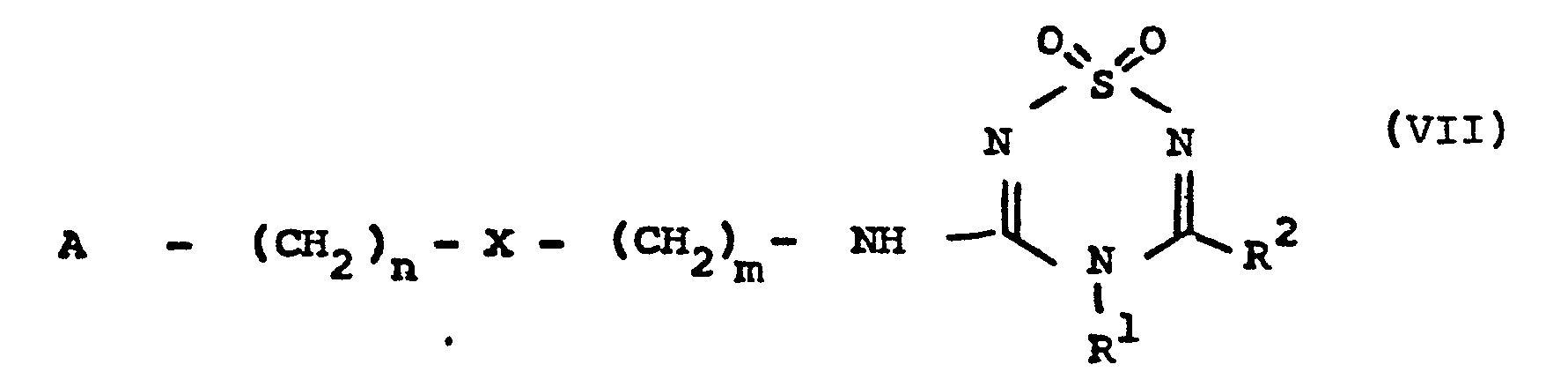
in which - A represents a phenyl, imidazolyl, thiazolyl, furyl, thienyl, or pyridyl radical, which radical may have one or two substitutents, selected from (Cl- C4)alkyl, guanidino, and -CH2NR9 R10 groups, R9 and R10, which may be the same or different, each representing a hydrogen atom or a (Cl- C6)alkyl group, or together with the nitrogen atom to which they are attached, may form a pyrrolidine, piperidine, morpholine, or N-methylpiperazine ring;
- X represents -O- or -S-;
- n represents 0 or 1;
- m represents 2 or 3; and
- R 1 and R 2 are as defined above, by a process which comprises
- (a) reacting a compound of formula I as defined above with a compound of formula VIII
-

-

-


with a compound of formula XI
- in which A is as defined above and L represents a leaving group, for example, a halogen atom, a hydroxy group, an alkoxy group or a sulphonate ester.
- The present invention includes such use of a compound of formula I.
- Further details of this process and of compounds that may be prepared by this process are given in our UK Specification No. 2 129 426A.
- Other substituted thiatriazines analogous to compound VII but having different side chains attached to the 5-position of the thiatriazine ring may be prepared analogously to compound VII. An example of such a compound is as defined above for compound VII but having as radical A a thiazolyl radical that is substituted by a guanidino group that is itself substituted by one or more alkyl groups, wherein the or each alkyl group may itself be substituted, for example, by a trifluoromethyl group or by a halogen atom.
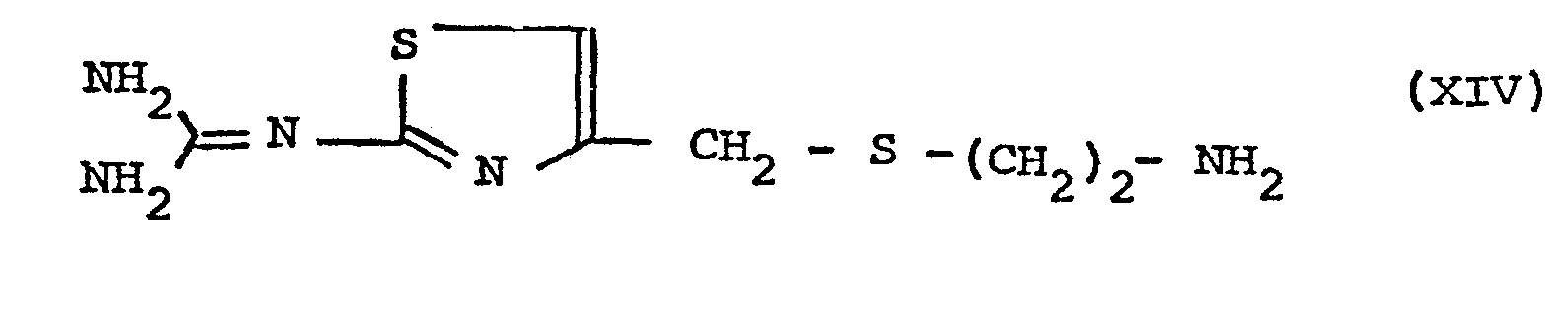
- In particular, the present invention provides the use of a compound of formula I (when produced by the process of the present invention) in the manufacture of a compound of formula XII

that is to say,
3-N-[(2-guanidino-4-thiazolyl)methylthio]ethyl]amino-4-meth yl-5-amino-l,2,4,6-thiatriazine 1,1-dioxide. - The compound of formula XII may be produced by a process which comprises
- (i) reacting a compound of formula XIII obtained by the process of the present invention

in which compound R is defined as above, with a compound of formula XIV -


- with a compound of formula XIV as defined above, and reacting the resulting compound of formula XVI
-

- (iii) reacting a compound of formula I obtained by the process of the present invention with an amino thiol of formula XVII

and reacting the resulting compound of formula XVIII
with a compound of formula XIX
in which L represents a leaving group, for example, a halogen atom, a hydroxy group, an alkoxy group or a sulphonate ester. - Compounds XIII and XIV are generally reacted in a solvent or diluent, preferably an alcohol, dimethylformamide or dimethyl sulphoxide, at a temperature within the range of from 0 to 100°C, preferably from 0 to 60°C. The compound of formula XIV should be reacted in the form of the free base, as shown. If it is initially present in the form of an acid addition salt, for example, as the hydrochloride or hydrobromide, this should be converted into the free base during or, preferably, before reaction with compound XIII. Conversion to the free base is carried out using a base, for example, triethylamine, sodium hydroxide or potassium hydroxide.
- Compound XV is reacted with compound XIV under conditions similar to those described above for the reaction of compounds XIII and XIV, except that generally lower temperatures are preferred in order that the groups RO- may be displaced selectively.
- The reaction of the resulting compound XVI with ammonia is generally carried out in an alcoholic solvent at a temperature from 0 to 60°C.
- In all cases, the group RO- in the thiatriazine starting material used for the production of compounds VII, XII and analogous compounds is preferably one of the substituted phenyl groups described above, in particular a 2-nitrophenyl group or a 4-methylphenyl group.
- A number of compounds of formula XI are known, see for example, UK Specification 2 001 624A; US Patent 3 950 333; US Patent 4 128 658; and Belgian Patents 867 106 and 875 846. Others may be prepared analogously. The preparation of compound XIV is described in UK Specification 2 001 624A.
- Compounds of formula I as defined above find application as herbicides, and the present invention provides the use of a compound of formula I as defined above as a herbicidal agent. The invention also provides a herbicidal composition comprising one or more compounds of formula I as defined above in admixture with one or more substances selected from solvents, diluents and carriers. The invention further provides a method of treating plants, especially crops, for example, monocotyledenous plants, which comprises applying to the plants a compound of formula I as defined above, generally in the form of a herbicidal composition as defined above.
- Compounds of formulae Ic and II are also part of the present invention.
- The present invention also provides compounds of formula I as defined above with the exception of those compounds in which
- (i) R represents a methyl-substituted phenyl group, R represents a methyl or ethyl group, and R2 represents an amino group, and those in which
- (ii) R and R2 both represent methylphenoxy groups and R1 represents a methyl group. The present invention provides, for example, those compounds of formula I in which R2 represents a group NHR3 in which R3 represents an aromatic or non-aromatic heterocyclic group having from 5 to 8 ring members and 1 or 2 heteroatoms, which may be the same or different, selected from oxygen, nitrogen and sulphur atoms, and optionally having an alkyl group having from 1 to 4 carbon atoms as a substituent on a ring nitrogen atoms, for example, as described further above.
- The following Examples illustrate the invention, but are not limiting.
- 24.2 g of di(2-nitrophenyl) imidocarbonate was dissolved in 200 ml of dichloromethane containing 8.8 g of triethylamine, and the solution cooled to 5°C in an ice bath. 4.76 g of thionyl chloride was dissolved in 50 ml of dichloromethane and added dropwise to the stirred imidocarbonate solution over a period of 30 minutes. Ice cooling was discontinued and the reaction solution stirred an additional 60 minutes before washing 3 times with water, drying over magnesium sulphate, and evaporating in vacuo to obtain the title compound as a crystalline solid. Recrystallisation from dichloromethane/toluene gave 20.2 g of the title compound, m.p. 179-180°C. C 26 H 16 N 6 S0 13 requires: C 47.85, H 2.47, N 12.88 found : C 47.87, H 2.56, N 12.80
- 19.6 g of tetra (2-nitrophenyl)-bisimidocarbonate sulphoxide was dissolved in 150 ml of dichloromethane and cooled to 5°C with an ice bath. 8 g of meta-chloroperoxybenzoic acid dissolved in 100 ml of dichloromethane was added dropwise to the stirred sulphoxide solution. When addition was complete, the reaction mixture was stirred for 60 minutes before filtering off the crystalline product, which was then washed thoroughly with ether and dried to give 16.1 g of the title compound, m.p. 200-203°C.
- A second crop of 2.9 g of the title compound was obtained by washing the dichloromethane mother liquors with an aqueous sodium bicarbonate solution, drying over magnesium sulphate, and evaporating in vacuo. A sample recrystallised from chloroform/ether melted sharply at 203°C.
- C 26 H 16 N 6 S0 14 requires: C 46.71, H 2.41, N 12.57 found : C 46.63, H 2.50, N 12.59
- 43.2 g of p-cresol and 18 g of sodium hydroxide were dissolved in 800 ml of water and cooled to 5°C in an ice bath. The mixture was stirred well, and 21.2 g of cyanogen bromide was added portionwise over a period of about 30 minutes. Ice cooling was then discontinued, and the reaction mixture was stirred for a further 60 minutes before filtering off the imidocarbonate, which was then washed thoroughly with water. The moist product was then dissolved in 300 ml of dichloromethane and dried over magnesium sulphate for one hour at 20°C. The filtered dichloromethane solution was then cooled to -40°C and 13.6 g of triethylamine added. 7.32 g of thionyl chloride was then added to the stirred dichloromethane solution at a rate sufficient to maintain the reaction at -40°C with continued cooling. When the addition was complete, the solution was allowed to come to ambient temperature and was then washed three times with water, dried over magnesium sulphate, and evaporated in vacuo. 21 g of the title compound was crystallised from ether, m.p. 130-145°C. A sample recrystallised from ether had a melting point of 135 to 143°C with decompositon.
- C30H28N2SO5 requires: C 68.16, H 5.34, N 5.30 found C 68.10, H 5.38, N 5.26
- 21 g of tetra (4-methylphenyl)-bisimidocarbonate sulphoxide was dissolved in 100 ml of dichloromethane and cooled to 5°C with an ice bath. 8 g of meta-chloroperoxybenzoic acid dissolved in 100 ml of dichloromethane was added dropwise to the stirred sulphoxide solution. When the addition was complete, the reaction mixture was stirred for a further 60 minutes and then washed twice with a 5% aqueous sodium bicarbonate solution, dried over magnesium sulphate, and evaporated in vacuo. The residual crystalline solid was recrystallised from dichloromethane/ether to give 19.9 g of the title compound, m.p. 188-190°C. A recrystallised sample melted at 193-194°C.
- C30H28N2SO6 requires: C 66.16, H 5.18, N 5.14 found : C 66.07, H 5.22, N 5.12
- 1.088 g of tetra (4-methylphenyl)-bisimidocarbonate sulphone was suspended in 30 ml of acetonitrile. This solution was stirred well, and to it was added, at 20°C, 62 mg of methylamine. The clear solution which formed immediately after the addition of the amine was heated to reflux for 16 hours, then evaporated in vacuo to yield the title compound as a crystalline solid, which was recrystallised from acetonitrile/ether to give 592 mg of the title compound, m.p. 282-286°C. Further recrystallisation gave a sample having a melting point of 290-291°C.
- 1H n.m.r. (250MHz) DMSO-d6 δ : 2.34 (6H, s), 3.35 (3H, s), 7.25 (8H, ABq).
- By a proceedure analogous to that described in Example 5, but using ethylamine instead of methylamine, 430 g of the title compound was obtained, m.p. 302-304°C after recrystallisation from ethanol.
- 1H n.m.r. (250MHz) DMSO-d6 δ : 1.45 (3H, t), 2.34 (6H, s), 4.22 (2H, q), 7.27 (8H, ABq).
- By a proceedure analogous to that described in Example 5, but using propargylamine instead of methylamnine, 495 g of the title compound was obtained, m.p. 279-280°C after recrystallisation from ethanol.
- 1H n.m.r. (250MHz) DMSO-d6 δ : 2.35 (6H, s), 3.31 (lH, s), 5.05 (2H, d), 7.27 (8H, ABq).
- 2.68 g of tetra (2-nitrophenyl)-bisimidocarbonate sulphone was suspended in 100 ml of acetonitrile, and 236 mg of isopropylamine added dropwise to the stirred suspension at 20°C. The resulting clear orange solution was stirred for one hour at 20°C and then concentrated to a volume of 20ml in vacuo. The crystalline product was filtered off and recrystallised from acetonitrile to give 890 mg of the title compound, m.p. 259-263°C with decompositon.
- 1H n.m.r. (250MHz) DMSO-d6 δ : 1.67, (6H, d), 5.37 (lH, m), 7.67-8.34 (8H, m).
- 450 mg of 4-isopropyl-3,5-di(4-nitrophenoxy)-1,2,4,6-thiatriazine 1,1-dioxide was suspended in 20 ml of acetonitrile and 32 mg of methylamine was added to the stirred solution at 20°C. The reaction mixture was stirred at 20°C for 16 hours and the solvent evaporated in vacuo to yield a crystalline residue, which was chromatographed on silica gel using chloroform/acetonitrile as eluant. 162 mg of the title compound was obtained after recrystallisation from ethanol, m.p. 242°C.
- 1H n.m.r. (250MHz) DMSO-d6 b : 1.54 (6H, d), 2.80 (3H, s), 4.61 (1H, m), 7.62-8.28 (4H, m), 8.06 (lH, br.s).
- 1.43 g of tetra (2-nitrophenoxy)-bisimidocarbonate sulphone was suspended in 25 ml of acetonitrile and 120 mg of 1,2-diaminoethane added to the stirred suspension at 20°C. After stirring at this temperature for 16 hours, the resulting fine crystalline solid was collected by filtration, washed thoroughly with ether, and dried in vacuo to give 506 mg of the title compound, m.p. 325°C with decomposition.
- 1H n.m.r. (250MHz) DMSO-d6 δ : 3.67 (2H, m) 4.24 (2H, m), 7.63-8.28 (4H, m), 8.98 (1H, br.s).
Claims (16)
1. A process for the production of a compound of formula I

in which 
in which R1 is as defined above to give a compound of formula Ia

in which R and R1 are as defined above and, if desired, (b) reacting the resulting compound of formula Ia in which R2 represents an optionally substituted aryloxy group with an amine of formula IV

in which R3 is as defined above, to give a compound of formula Ib in which R, R1 and R 3 are as defined above; or (c) reacting a compound of formula II as defined above with a diamine of formula V

in which n represents 2 or 3 to give a compound of formula

in which R, p and n are as defined above; and, if desired, (d) oxidising a resulting compound of formula I in which p represents the integer 1 to give the corresponding compound in which p represents the integer 2.
in which
R represents an aryl group, which may be unsubstituted or substituted by one or two substitutents, which may be the same or different, selected from methyl, trifluoromethyl, nitro and cyano groups, and chlorine, fluorine and bromine atoms;
R 1 represents a hydrogen atom, a straight or branched chain alkyl group having from 1 to 6 carbon atoms or a cycloalkyl group having from 3 to 7 carbon atoms, which alkyl or cycloaikyl group is unsubstituted or is substituted by one or more substituents, which may be the same or different, for example, by one or two substituents, especially by one substituent, selected from halogen atoms; nitro and cyano groups; -OR4 groups in which R4 represents a hydrogen atom or an alkyl group having from 1 to 4 carbon atoms; cycloalkyl groups having from 3 to 7 carbon atoms; NR5R6 groups in which R 5 and R 6, which may be the same or different, each represents a hydrogen atom or an alkyl group having from 1 to 4 carbon atoms; -COOR 7 groups in which R7 represents a hydrogen atom or a carboxylic acid esterifying group; -CONR 5 R 6 groups in which R5 and R6 are as defined above; -SO2NR5R6 groups in which R5 and R6 are as defined above; aromatic and non-aromatic heterocyclic groups having from 5 to 8 ring members and 1 or 2 heteroatoms, which may be the same or different, selected from oxygen, nitrogen and sulphur atoms and optionally having an alkyl group having from 1 to 4 carbon atoms as a substituent on a ring nitrogen atom; and phenyl groups R8 that are unsubstituted or substituted by one or more substituents, which may be the same or different, selected from halogen atoms, trifluoromethyl groups, nitro and cyano groups, alkyl and alkoxy groups having from 1 to 4 carbon atoms, and NRSR6 groups in which R5 and R 6 are as defined above;"or
R1 represents a straight or branched chain alkenyl group having from 2 to 6 carbon atoms or a straight or branched chain alkynyl group having from 3 to 6 carbon atoms;
R2 represents an aryloxy group which is unsubstituted or is substituted as defined above for aryl groups R; or
R2 represents an -NHR 3 group in which R 3 represents a hydrogen atom, a straight or branched chain alkyl group having from 1 to 6 carbon atoms that is unsubstituted or is substituted as defined above for alkyl groups R 1, or an aromatic or non-aromatic heterocyclic group as defined above; or
R2 represents a group NHR3, and R and R3, together with the atoms to which they are attached, form a 5- or 6-membered ring containing two nitrogen atoms, and
p represents the integer 1 or 2,
which comprises (a) reacting a compound of formula II

in which R and p are as defined above, with an amine of formula III
2. A process as claimed in claim 1, wherein a compound of formula II in which p represents the integer 2 is produced by oxidising the corresponding compound of formula II in which p represents the integer 1.
3. A process as claimed in claim 1 or claim 2, wherein a compound of formula II in which p represents the integer 1 is produced by reacting a compound of formula VI
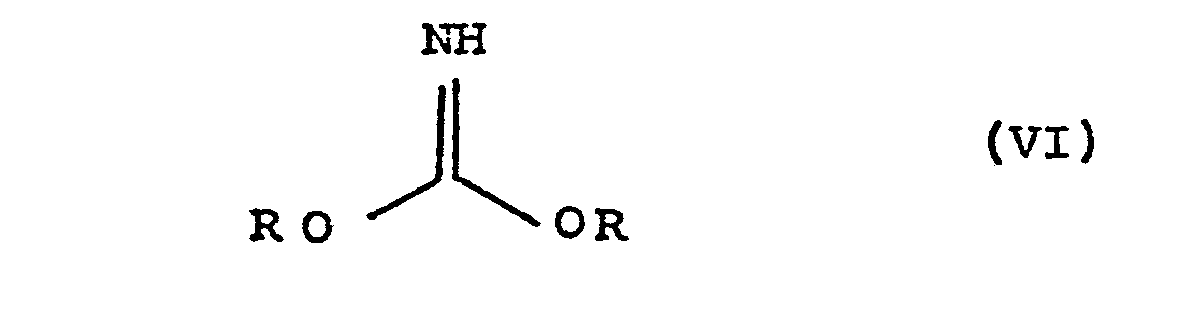
in which R is as defined in claim 1, with thionyl chloride in the presence of an organic base.
4. A process as claimed in claim 3, wherein the base is a trialkylamine.
5. A process as claimed in any one of claims 1 to 4, wherein an aryl ring R in formula II is substituted by a methyl, trifluoromethyl, cyano or nitro group or by a halogen atom, and an aryl group R in formula Ia is substituted by a trifluoromethyl, cyano or nitro group or by a halogen atom.
6. A process as claimed in claim 5, wherein an aryl ring R in formula I is a phenyl group substituted by a 4-methyl or 2-nitro group.
7. A compound of formula I

in which
in which
R represents an aryl group, which may be unsubstituted or substituted by one or two substitutents, which may be the same or different, selected from methyl, trifluoromethyl, nitro and cyano groups, and chlorine, fluorine and bromine atoms;
R represents a hydrogen atom, a straight or branched chain alkyl group having from 1 to 6 carbon atoms or a cycloalkyl group having from 3 to 7 carbon atoms, which alkyl or cycloalkyl group is unsubstituted or is substituted by one or more substituents, which may be the same or different, for example, by one or two substituents, especially by one substituent, selected from halogen atoms; nitro and cyano groups; -OR groups in which R4 represents a hydrogen atom or an alkyl group having from 1 to 4 carbon atoms; cycloalkyl groups having from 3 to 7 carbon atoms; NR5R6 groups in which R 5 and R 6, which may be the same or different, each represents a hydrogen atom or an alkyl group having from 1 to 4 carbon atoms; -COOR7 groups in which R7 represents a hydrogen atom or a carboxylic acid esterifying group; -CONR5R6 groups in which R5 and R6 are as defined above; -S02NR 5 R 6 groups in which R 5 and R 6 are as defined above; aromatic and non-aromatic heterocyclic groups having from 5 to 8 ring members and 1 or 2 heteroatoms, which may be the same or different, selected from oxygen, nitrogen and sulphur atoms and optionally having an alkyl group having from 1 to 4 carbon atoms as a substituent on a ring nitrogen atom; and phenyl groups R8 that are unsubstituted or substituted by one or more substituents, which may be the same or different, selected from halogen atoms, trifluoromethyl groups, nitro and cyano groups, alkyl and alkoxy groups having from 1 to 4 carbon atoms, and NRR groups in which R5 and R 6 are as defined above; or
R1 represents a straight or branched chain alkenyl group having from 2 to 6 carbon atoms or a straight or branched chain alkynyl group having from 3 to 6 carbon atoms;
R2 represents an aryloxy group which is unsubstituted or is substituted as defined above for aryl groups R; or
R2 represents an -NHR 3 group in which R 3 represents a hydrogen atom, a straight or branched chain alkyl group having from 1 to 6 carbon atoms that is unsubstituted or is substituted as defined above for alkyl groups Rl, or an aromatic or non-aromatic heterocyclic group as defined above; or
R2 represents a group NHR 3, and R1 and R3, together with the atoms to which they are attached, form a 5- or 6-membered ring containing two nitrogen atoms, and
p represents the integer 1 or 2.
8. A compound according to claim 7 which is 3,5-Bis-(4-methylphenoxy)-4-methyl-1,2,4,6-thiatriazine-1,1-dioxide.
9. A herbicidal composition which comprises one or more compounds of formula I as defined above in admixture with one or more substances selected from solvents, diluents and carriers .
10. A method of treating plants which comprises applying to plants a compound of formula I as defined above.
11. A process for the production of a compound of formula VIIa

in which 
in which R3 is as defined in claim 1 to obtain a compound of formula VII in which R2 represents an -NHR3 group, or (b) producing a compound of formula I by a process as claimed in claim 1 and reacting the resulting compound of formula I with a compound of formula IX

in which X and m are as defined above and reacting the resulting compound of formula X

with a compound of formula XI

in which A1 is as defined above and L represents a leaving group, for example, a halogen atom, a hydroxy group, an I alkoxy group or a sulphonate ester.
in which
A1 represents a phenyl, imidazolyl, thiazolyl, furyl, thienyl, or pyridyl radical, which radical may have one or two substitutents, selected from (Ci- C4)alkyl, guanidino, and -CH2NR4 R5 groups, R 4 and R5, which may be the same or different, each representing a hydrogen atom or a (Ci- C6)alkyl group, or together with the nitrogen atom to which they are attached, may form a pyrrolidine, piperidine, morpholine, or N-methylpiperazine ring; or
A1 represents a thiazolyl radical that is substituted by a guanidino group that is itself substituted by one or more alkyl groups, and wherein the or each alkyl group may itself be substituted;
X represents -O- or -S-;
n represents 0 or 1;
m represents 2 or 3; and
R1 and R2 are as defined in claim 1, which comprises (a) producing a compound of formula I by a process as claimed in claim 1 and reacting the resulting compound of formula I with a compound of formula VIII

in which A l, X, m and n are as defined above and, if desired, when R2 in a resulting compound VII represents an aryloxy group, reacting that compound VII with an amine of formula IV
with a compound of formula XI
12. A process as claimed in claim 11, wherein a substituted guanidino group has one or more alkyl groups as substitutent(s), and the or each alkyl group is itself substituted by a trifluoromethyl group or,by a halogen atom.
13. A process for the production of a compound of formula XII

or (ii) reacting a compound of formula II as defined above claim 1 with methylamine to give a compound of formula XV
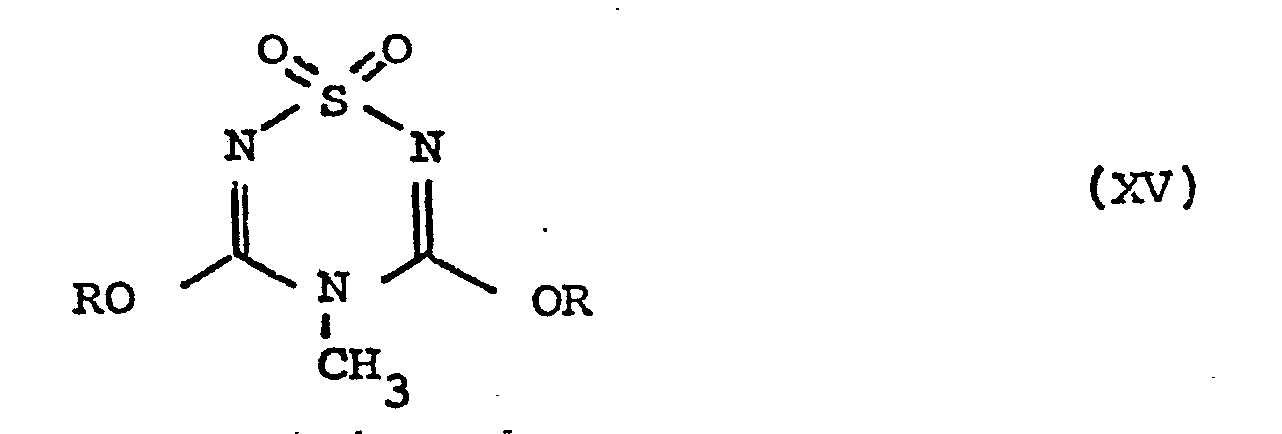
) in which R is as defined above , and reacting the compound of formula XV with a compound of formula XIV as defined above, and reacting the resulting compound of formula XVI 
with ammonia, or
(i) which comprises reacting a compound of formula II as defined above with methylamine 'and reacting the resulting compound with ammonia to give a compound of formula XIII
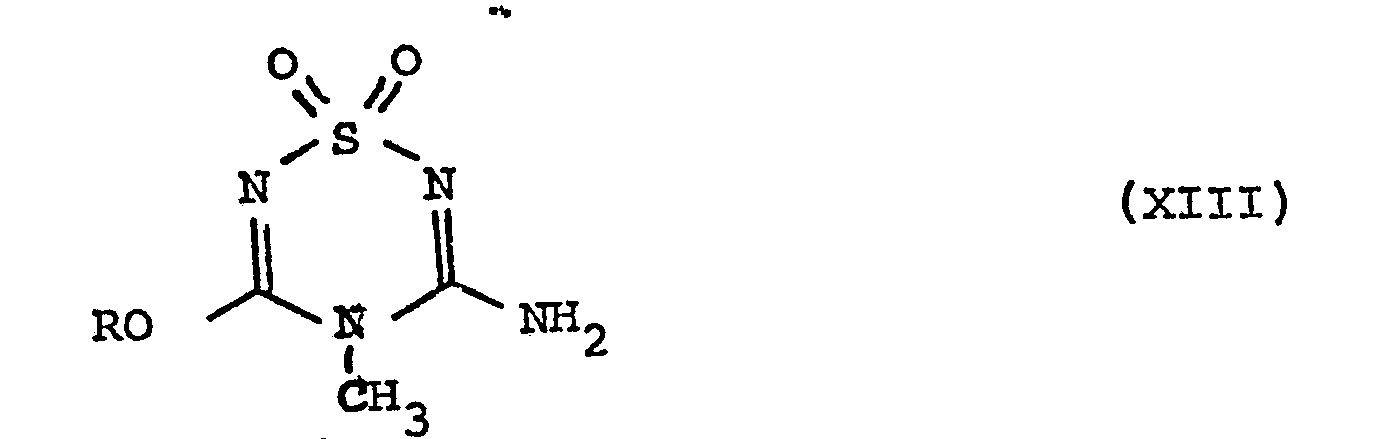
in which R is as defined above, and reacting the compound of formula XIII with a compound of formula XIV
in which R is as defined above, and reacting the compound of formula XIII with a compound of formula XIV
) in which R is as defined above , and reacting the compound of formula XV with a compound of formula XIV as defined above, and reacting the resulting compound of formula XVI
with ammonia, or
(iii) reacting a compound of formula II as defined with methylamine and reacting the resulting compound with ammonia, to obtain a compound of formula XIII

in which R is as defined above, reacting the compound of formula XIII with an amino thiol of formula XVII 
and reacting the resulting compound of formula XVIII 
with a compound of formula XIX 
in which L represents a leaving group, preferably, a halogen atom, a hydroxy group, an alkoxy group or a sulphonate ester.
in which R is as defined above, reacting the compound of formula XIII with an amino thiol of formula XVII
and reacting the resulting compound of formula XVIII
with a compound of formula XIX
in which L represents a leaving group, preferably, a halogen atom, a hydroxy group, an alkoxy group or a sulphonate ester.
14. A compound of formula II

in which R and p are as defined above.
in which R and p are as defined above.
15. A compound of formula Ic

in which R, n and p are as defined above
in which R, n and p are as defined above
16. A compound of formula Id
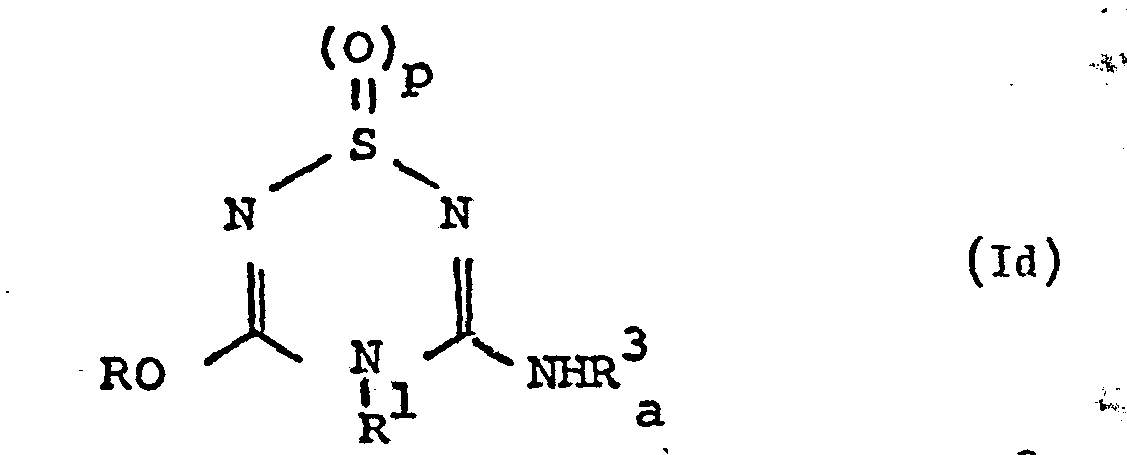
in which R, n and p are as defined above and R3 a represents an aromatic or non-aromatic heterocyclic group having from 5 to 8 ring members and 1 or 2 heteroatoms, which may be the same or different, selected from oxygen, nitrogen and sulphur atoms and optionally having an alkyl group having from 1 to 4 carbon atoms as a substituent on a ring nitrogen atom.
in which R, n and p are as defined above and R3 a represents an aromatic or non-aromatic heterocyclic group having from 5 to 8 ring members and 1 or 2 heteroatoms, which may be the same or different, selected from oxygen, nitrogen and sulphur atoms and optionally having an alkyl group having from 1 to 4 carbon atoms as a substituent on a ring nitrogen atom.
Applications Claiming Priority (2)
| Application Number | Priority Date | Filing Date | Title |
|---|---|---|---|
| GB848419460A GB8419460D0 (en) | 1984-07-31 | 1984-07-31 | 4-substituted-1 2 4 6-thiatriazine derivatives |
| GB8419460 | 1984-07-31 |
Publications (2)
| Publication Number | Publication Date |
|---|---|
| EP0170118A2 true EP0170118A2 (en) | 1986-02-05 |
| EP0170118A3 EP0170118A3 (en) | 1986-12-03 |
Family
ID=10564696
Family Applications (1)
| Application Number | Title | Priority Date | Filing Date |
|---|---|---|---|
| EP85108581A Withdrawn EP0170118A3 (en) | 1984-07-31 | 1985-07-10 | 4-substituted-1,2,4,6-thiatriazine derivatives |
Country Status (8)
| Country | Link |
|---|---|
| US (1) | US4650893A (en) |
| EP (1) | EP0170118A3 (en) |
| JP (1) | JPS6143178A (en) |
| DK (1) | DK314085A (en) |
| ES (2) | ES8701184A1 (en) |
| GB (1) | GB8419460D0 (en) |
| GR (1) | GR851863B (en) |
| PT (1) | PT80882B (en) |
Cited By (1)
| Publication number | Priority date | Publication date | Assignee | Title |
|---|---|---|---|---|
| US8213086B2 (en) | 2006-12-29 | 2012-07-03 | Lg Chem, Ltd. | Coating composition for antireflection with resistance and antireflection characteristic and antireflection film prepared by using the same |
Families Citing this family (1)
| Publication number | Priority date | Publication date | Assignee | Title |
|---|---|---|---|---|
| US20230349922A1 (en) | 2020-08-11 | 2023-11-02 | Université De Strasbourg | H2 Blockers Targeting Liver Macrophages for the Prevention and Treatment of Liver Disease and Cancer |
Family Cites Families (7)
| Publication number | Priority date | Publication date | Assignee | Title |
|---|---|---|---|---|
| DE2026625A1 (en) * | 1970-05-30 | 1971-12-16 | Farbenfabriken Bayer AG, 5090 Le verkusen | Thiatriazine cpds - useful as plant protection agents |
| US4293454A (en) * | 1980-02-04 | 1981-10-06 | Pennwalt Corporation | Process for reacting chloral with nitrogen compositions |
| DE3016825A1 (en) * | 1980-05-02 | 1981-11-05 | Basf Ag, 6700 Ludwigshafen | SUBSTITUTED 6H-1,2,4,6-THIATRIAZINE-1,1-DIOXIDE, HERBICIDES CONTAINING THESE COMPOUNDS, THEIR USE AS HERBICIDES AND METHOD FOR THE PRODUCTION THEREOF |
| DE3134145A1 (en) * | 1981-08-28 | 1983-03-17 | Basf Ag, 6700 Ludwigshafen | 2H-1,2,4,6-THIATRIAZINE-1,1-DIOXIDE, METHOD FOR THE PRODUCTION THEREOF AND THE USE THEREOF FOR CONTROLLING UNWANTED PLANT GROWTH |
| DE3204168A1 (en) * | 1982-02-06 | 1983-08-11 | Basf Ag, 6700 Ludwigshafen | METHOD FOR PRODUCING SULPHONAMIDES |
| EP0104611A3 (en) * | 1982-09-28 | 1985-06-12 | Hoechst Uk Limited | Thiatriazine derivatives |
| EP0156286A3 (en) * | 1984-03-27 | 1986-08-20 | Hoechst Uk Limited | Thiatrizine derivatives |
-
1984
- 1984-07-31 GB GB848419460A patent/GB8419460D0/en active Pending
-
1985
- 1985-07-09 DK DK314085A patent/DK314085A/en not_active Application Discontinuation
- 1985-07-10 EP EP85108581A patent/EP0170118A3/en not_active Withdrawn
- 1985-07-10 US US06/753,890 patent/US4650893A/en not_active Expired - Fee Related
- 1985-07-16 ES ES545280A patent/ES8701184A1/en not_active Expired
- 1985-07-22 JP JP60160408A patent/JPS6143178A/en active Pending
- 1985-07-29 GR GR851863A patent/GR851863B/el unknown
- 1985-07-29 PT PT80882A patent/PT80882B/en unknown
-
1986
- 1986-08-01 ES ES556996A patent/ES8900158A1/en not_active Expired
Cited By (1)
| Publication number | Priority date | Publication date | Assignee | Title |
|---|---|---|---|---|
| US8213086B2 (en) | 2006-12-29 | 2012-07-03 | Lg Chem, Ltd. | Coating composition for antireflection with resistance and antireflection characteristic and antireflection film prepared by using the same |
Also Published As
| Publication number | Publication date |
|---|---|
| ES545280A0 (en) | 1986-11-16 |
| GB8419460D0 (en) | 1984-09-05 |
| DK314085A (en) | 1986-02-01 |
| PT80882B (en) | 1987-03-24 |
| DK314085D0 (en) | 1985-07-09 |
| EP0170118A3 (en) | 1986-12-03 |
| JPS6143178A (en) | 1986-03-01 |
| ES8900158A1 (en) | 1987-12-16 |
| US4650893A (en) | 1987-03-17 |
| GR851863B (en) | 1985-12-02 |
| PT80882A (en) | 1985-08-01 |
| ES8701184A1 (en) | 1986-11-16 |
| ES556996A0 (en) | 1987-12-16 |
Similar Documents
| Publication | Publication Date | Title |
|---|---|---|
| EP0104532B1 (en) | O-halobenzoic acid derivatives, process for their preparation, herbicidal compositions and their use | |
| FR2576305A1 (en) | NOVEL PROCESS FOR THE MANUFACTURE OF A (SUBSTITUTED) ARYL DERIVATIVE -1 DIHYDRO-1,4-OXO-4-NAPHTHYRIDINE, INTERMEDIATE SUBSTANCES USED FOR THIS MANUFACTURE AND METHODS OF MAKING THE INTERMEDIATE SUBSTANCES | |
| DE69128477T2 (en) | BENZOPYRANDERIVAT | |
| KR870001694B1 (en) | Process for preparing thia(oxo) diazole derivatives | |
| RO109147B1 (en) | ERBICIDE COMPOSITIONS | |
| HU176881B (en) | Process for producing derivatives of urea | |
| US5157119A (en) | Process for preparing sulfonylureas | |
| US4358596A (en) | Process for the preparation of 1,2,3-thiadiazol-5-yl ureas | |
| US4650893A (en) | Bis-imido carbonate sulphones | |
| KR910004673B1 (en) | 2,3-diaminoacrylonitrile derivative | |
| US4797482A (en) | Process for the preparation of oxazinobenzothiazine 6,6-dioxide derivatives | |
| EP0052333A1 (en) | 4-Fluoro-5-oxypyrazole derivate and preparation thereof | |
| US4052394A (en) | 2-(dicyanomethylene)-1,3-dithiolo-(4,5-b)pyrazine-5,6-dicarbonitrile | |
| US4496737A (en) | Process for preparing sulfamylamidine antisecretory agents | |
| US6166214A (en) | Process for preparing pyridylmethyl isothiocyanates | |
| US3515726A (en) | 2,2'-bis(pyridyl-n-oxide) dithiolcarbonates and trithiocarbonates | |
| US4872901A (en) | Herbicidal pyrazole sulfonyl Imino-2H-1,2,4-thiadiazolo[2,3-a9 pyrimidines | |
| EP1685098B1 (en) | Ortho-substituted pentafluoride sulfanyl-benzenes, method for the production thereof and the use thereof in the form of valuable synthesis intermediate stages | |
| GB2162521A (en) | Tetra-aryl bisimidocarbonate sulphones and sulphoxides, and their cyclisation to thiatriazines | |
| FR2576020A1 (en) | 5-HALOPYRIDINE-3-CARBOXAMIDES AND THEIR APPLICATIONS | |
| EP0081584B1 (en) | Thiazolinotriazine derivatives | |
| US4057546A (en) | 4-Amino-1,2,4-triazin-5-ones | |
| CS204023B2 (en) | Method of producing derivatives of 2,1,5-thiadiazin-4-on-2,2-dioxide | |
| JPS63192748A (en) | Manufacture of 2-cyano-2-oxyiminoacetamide | |
| EP0842163B1 (en) | Benzene derivatives with a heterocyclic group |
Legal Events
| Date | Code | Title | Description |
|---|---|---|---|
| PUAI | Public reference made under article 153(3) epc to a published international application that has entered the european phase |
Free format text: ORIGINAL CODE: 0009012 |
|
| AK | Designated contracting states |
Designated state(s): AT BE CH DE FR IT LI LU NL SE |
|
| PUAL | Search report despatched |
Free format text: ORIGINAL CODE: 0009013 |
|
| AK | Designated contracting states |
Kind code of ref document: A3 Designated state(s): AT BE CH DE FR IT LI LU NL SE |
|
| STAA | Information on the status of an ep patent application or granted ep patent |
Free format text: STATUS: THE APPLICATION HAS BEEN WITHDRAWN |
|
| 18W | Application withdrawn |
Withdrawal date: 19870522 |
|
| RIN1 | Information on inventor provided before grant (corrected) |
Inventor name: ROSS, BARRY CLIVE, DR. Inventor name: MICHAEL, JEFFREY DANIEL |