EP0169488A2 - Transformer circuit - Google Patents
Transformer circuit Download PDFInfo
- Publication number
- EP0169488A2 EP0169488A2 EP85108921A EP85108921A EP0169488A2 EP 0169488 A2 EP0169488 A2 EP 0169488A2 EP 85108921 A EP85108921 A EP 85108921A EP 85108921 A EP85108921 A EP 85108921A EP 0169488 A2 EP0169488 A2 EP 0169488A2
- Authority
- EP
- European Patent Office
- Prior art keywords
- voltage
- winding
- switch
- switching state
- switches
- Prior art date
- Legal status (The legal status is an assumption and is not a legal conclusion. Google has not performed a legal analysis and makes no representation as to the accuracy of the status listed.)
- Granted
Links
Images


Classifications
-
- G—PHYSICS
- G05—CONTROLLING; REGULATING
- G05F—SYSTEMS FOR REGULATING ELECTRIC OR MAGNETIC VARIABLES
- G05F1/00—Automatic systems in which deviations of an electric quantity from one or more predetermined values are detected at the output of the system and fed back to a device within the system to restore the detected quantity to its predetermined value or values, i.e. retroactive systems
- G05F1/10—Regulating voltage or current
- G05F1/12—Regulating voltage or current wherein the variable actually regulated by the final control device is AC
- G05F1/24—Regulating voltage or current wherein the variable actually regulated by the final control device is AC using bucking or boosting transformers as final control devices
- G05F1/26—Regulating voltage or current wherein the variable actually regulated by the final control device is AC using bucking or boosting transformers as final control devices combined with discharge tubes or semiconductor devices
- G05F1/30—Regulating voltage or current wherein the variable actually regulated by the final control device is AC using bucking or boosting transformers as final control devices combined with discharge tubes or semiconductor devices semiconductor devices only
Definitions
- the invention relates to a transformer circuit according to the preamble of claim 1.
- Such transformer circuits are used, with the aid of at least one actuating unit, which can be brought into different switching states, to change the amplitude of an AC supply voltage emitted by a voltage source, if necessary, before it is applied as a load AC voltage to a consumer.
- Such a transformer circuit is known for example from DE-OS 25 00 065.
- This circuit comprises a single control unit with a transformer, the primary winding of which is fed by the supply voltage emitted by the voltage source.
- Several taps are provided on the secondary winding, which can be optionally connected to the lines leading to the load by means of automatically controllable switches. This ensures that the same AC voltage amplitude is always supplied to the load even when the circuit is connected to voltage sources which emit different AC voltages with respect to the amplitude.
- the invention has for its object to provide a transformer circuit of the type mentioned, with the help of which the amplitude of the supply voltage emitted by the voltage source can be changed in a simple and quick manner and with extremely low energy losses.
- the invention provides the features set out in claim 1.
- the main part of the power of the load is supplied via the first winding of the transformer in a galvanic way, whereby due to the low number of turns of this winding and low frequencies with which high powers are delivered to loads, the inductance of this first winding produces only a very small voltage drop with correspondingly small losses, which moreover occur in an increased manner in the case of conventional transformer circuits.
- the at least one control unit of the transformer circuit can be brought into at least one switching state by applying a control voltage U s to the further winding, in which a voltage .DELTA.U 1 is induced in the first winding of the transformer additional winding with respect to the first winding added to or subtracted from the input voltage, so that the following applies to the output voltage U A, which is different from the input voltage:
- the turn ratio w 1 / w w is here substantially less than 1 and is preferably in the range from 1: 7 to 1: 200.
- the current that flows through the further winding in the first switching state is to be matched to the nominal load current that flows through the first winding of the transformer so that, for a given turns ratio, the fluxes of both windings are approximately the same in amount and such an angular displacement mutually sen that the magnetic flux, which results in the transformer core, leads to the desired induced additive or subtractive voltage drop ⁇ U 1 at the first winding of the transformer. It can be seen that under these conditions the induced voltage drop ⁇ U 1 is largely independent of the load current, so that a constant difference between the input and output voltage of the actuator can be maintained even if the load current fluctuates in relation to its nominal value.
- a major advantage of this arrangement is that the magnetic coupling of the transformer is only the small part of the power that is required for the induced change in amplitude. This significantly reduces the energy losses caused by the inductive energy transfer from one transformer winding to the other.
- the transformer can thus be dimensioned correspondingly smaller and the effort required for cooling the transformer can be reduced.
- the switches which can be used to apply the control voltage to the further winding of the transformer, also result in only a small part of the total power, so that the switches are loaded far less even with frequent switching operations.
- semiconductor switches e.g. Triacs or switches constructed from V-MOS transistors are used which enable switching to be carried out considerably faster than the mechanical switches used in such cases according to the prior art.
- a complete interruption of the energy supply to the load during switching cannot occur in principle, since the galvanic connection between the load and the voltage source is constantly maintained via the first winding of the transformer.
- the switching state in which such an actuating unit is located when the first control voltage U S1 is applied is referred to as the first switching state, which is determined by the above Equations (1) and (2) are described, so when the second control voltage U S2 is applied to the further winding under the same conditions as above, a second switching state results, in which a defined second voltage drop AU2 at the first, largely independent of the load current Winding is induced.
- the output voltage U A the following applies to the output voltage U A :
- ⁇ U 2 depends on the control voltage U S2 also according to equation (2) above.
- the control voltages used are preferably the input voltage U E and the output voltage U A of the actuating unit, to which the further winding is galvanically connected with the aid of the switch, taking into account the sense of the winding, in such a way that the induced voltage ⁇ U 1 is added to the input voltage and the other induced voltage ⁇ U 2 subtracted from the input voltage U E.
- these two inducible voltages ⁇ U 1 and ⁇ U 2 cannot be selected independently of one another. Rather, they are according to the equations and linked to one another if w 1 is the number of turns of the first winding and w is the number of turns of the further winding of the transformer.
- the control unit can be brought into a third switching state in which no voltage is induced in the first winding of the transformer. So that the first winding does not develop a throttle effect with a correspondingly high voltage drop in this third switching state, care must be taken that the magnetization of the transformer core is not essentially caused by the flooding of the first winding alone. This can be done in various ways, as will be explained in more detail below. It is essential that in this third switching state only an extremely low voltage drops at the first winding of the transformer, so that with a good approximation the output voltage of the actuating unit is equal to the input voltage:
- a first possibility for realizing the third switching state is to provide a switch, with the aid of which a further winding can be short-circuited, whereby it is disconnected from all control voltages at the same time.
- each switch In order to make a simultaneous closing of these switches impossible, the switching state of each switch is monitored with the aid of an associated sensor unit and a closing command for a previously open switch is suppressed by a blocking circuit if the output signal of the sensor unit of the other switches indicates that one of these other switches is still closed.
- the output voltage U A of the actuating unit changes as quickly and as “smoothly" as possible, ie without strong fluctuations in the absolute amplitude of the output AC voltage up or down from its old to the new amplitude value.
- the currents that flow in the two antiparallel windings each try to build up a magnetic field in the core of the transformer; however, these fields face each other and essentially cancel each other out.
- the leakage inductance and the ohmic resistance of the first winding through which the load current flows are very small.
- the voltage drop occurring at it is therefore very small and the above equation (8) applies with a good approximation.
- the current flowing through the further winding is correspondingly small, since the further winding has a significantly higher impedance than the first winding of the transformer. As a result, the load current flows practically exclusively through this first winding.
- the third and fourth switches i.e. the two switches with which the two ends of the further winding can be connected to the connecting connecting conductor of the actuating unit, for example themselves each be designed as a current limiting circuit in such a way that they do not let any current through at all in the open state and the current flowing through them in the closed state only oppose a very small, constant resistance as long as this current remains below a predetermined limit value, but prevent the current from rising above this limit value.
- the transition from the first to the second switching state or from the second to the first switching state then takes place simply in such a way that the two switches opened in the previous switching state are also closed, which corresponds to a transition to the third switching state, and only then do the switches opened, which must be open in the new switching state. Because of their current limiting properties, the third and fourth switches prevent impermissibly high short-circuit currents from flowing in the third switching state.
- the third and fourth switches ie the two switches with which the two ends of the further winding can be connected to the connecting connecting conductor of the actuating unit, do not lead directly to this connecting connecting conductor.
- the third and fourth switches are directly electrically connected to one another by a further conductor and a circuit arrangement is provided between this further conductor and the connecting connecting conductor, which on the one hand connects the two conductors in an electrically conductive manner and on the other hand the flow of an impermissibly large current of one of these two conductors prevented on the other.
- this circuit arrangement can be a switch which is always opened when the actuating unit is to be brought into its third switching state, in which an impermissibly high short-circuit current would otherwise flow via this switch.
- switches can only be opened at very specific times, so that the optimum switching speed cannot yet be achieved with them.
- an automatically operating current limiting circuit is preferably used as the circuit arrangement, which opposes the current flowing through it with only a very small, constant resistance, as long as this current is less than a predetermined limit value.
- the current limiting circuit steadily increases its resistance so that the current cannot exceed the predetermined limit.
- this continuous limiting process has the advantage that there are no voltage peaks in the output voltage of the actuator.
- the limit value is chosen so that it is only slightly greater than the current which must flow through the further winding in the first or second switching state and also through the current limiting circuit lying in series with the further winding in these two switching states.
- the transition from the first to the second switching state is preferably carried out here in such a way that first the second switch is closed, which connects the second end of the further winding to the output end of the first winding. Since in the first switching state the first switch is closed, which connects the first end of the further winding with the input-side end of the first winding, and since this first switch initially remains closed, the two windings are temporarily electrically parallel to one another and the actuating unit is located in the third switching state.
- the current limiting circuit prevents an inadmissibly high short-circuit current from flowing through the closed second switch and the fourth switch, which is also still closed and which connects the second end of the further winding to the further conductor and thus also to the connecting connecting conductor.
- the switching process is then continued in such a way that the fourth switch is opened and then the third switch is closed, which connects the first end of the further winding to the further conductor. Even with this switch position, the actuating unit is in the third switching state, since the first and the second switch are still closed. An impermissibly high short-circuit current could now flow through the first and third switches, but this is prevented again by the current limiting circuit. Finally, the first switch is then opened so that the actuating unit changes to the second switching state.
- the current limiting circuit can advantageously be designed in such a way that it can be switched to at least one second current limiting value, which is substantially lower than the first current limiting value, preferably equal to zero. In this way, the further winding lying parallel to the first winding of the transformer is practically completely separated from the input voltage U E and there is no longer any short-circuit current at the connecting connecting conductor.
- An automatically operating current limiting circuit has the advantage over a switch, in addition to the already mentioned avoidance of switching peaks, that it prevents the current flowing through it from exceeding the predetermined limit value without any delay.
- the limit value to which the current limiting circuit limits the current flowing through it not only to and fro between two values switched but can be changed continuously in a predetermined range. This makes it possible, on the one hand, to limit the short-circuit current flowing in the third switching state to an uncritical value and, on the other hand, to control or regulate, if necessary, the currents flowing through the relevant further winding in the first or second switching state.
- an actuating unit comprises a transformer with a single further winding and four switches, of which the first and second are designed as triac and the third and fourth as current limiting circuits, then when switching from the first (second) to the second (first) switching state the to switches open at the start of switching, ie the second (first) and third (fourth) switch are closed immediately and without any delay, as a result of which the actuating unit changes to the third switching state. To get from this into the second (first) switching state, the first (second) and fourth (third) switch must be opened. Since it is assumed here that the first (second) switch is a triac, this is only possible if it is and the short-circuit current flowing through the winding has a zero crossing.
- control unit not only briefly passes through the third switching state during the transition from the first to the second or from the second to the first switching state, but has also been in the third switching state for a long time and is brought into the first or second switching state by the latter should.
- the third (fourth) switch can then be closed with a certain time safety margin and only then is it possible to open the first (second) switch, for which a zero current crossing must again be waited for.
- a waiting time of two half-periods can result in the worst case. If the actuator is held in the third switching state for a long time, the third and fourth switches can be opened. If a transition to the first (or second) switching state is then to take place, the fourth (third) switch must first be closed, which can happen at any time; then the second (first) switch is opened, for which a zero current crossing must again be waited for.
- the invention provides instead of using triacs electronic switches which can not only be closed at any time but also opened again.
- V-MOS transistors are available, of which two each have to be connected in series with their source-drain paths with opposite polarity in order to set up an AC voltage switch. With these switches, there are no waiting times until the next zero current crossing.
- a switching criterion that is independent of the zero crossing of the short-circuit current can be used for the opening processes, which each lead from the third switching state to the first or second switching state, which leads to the smallest possible change in the current in the further winding lying on its control voltage after the switching process .
- the output voltage of the actuating unit has exactly the new amplitude value without voltage peaks or voltage dips.
- a fourth switching state can be produced for an actuating unit, the transformer of which has only a single further winding, in that the switches of the actuating unit are actuated in such a way that the circuit of the further winding has a high resistance value, which, even after being transformed down, on the side of the first Winding provides a high resistance value.
- the entire magnetization of the transformer core is caused by the flooding of the first winding.
- a voltage drop dependent on the size of this flow and thus on the size of the load current then occurs at the first winding.
- This throttling effect of the first winding in the fourth switching state can be used to limit the power supplied to the load to a safe level when a short circuit occurs at the load.
- the transformer can also have two further windings, the flooding and winding conditions for the first winding meet the same conditions as those specified above for the further winding.
- the actuating unit is brought into the first switching state in that a control voltage is only applied to the first further winding; in the second switching state
- the actuating unit is brought about in that a control voltage is applied only to the second further winding.
- the number of turns, the control voltages and the sense of winding of the two further windings with respect to the first winding are chosen so that the amplitudes of the two inducible voltages ⁇ U 1 and ⁇ U 2 are approximately the same size, but the two inducible voltages have opposite signs on the Input voltage U E can be impressed.
- the two equations (4) and (5) above again apply to the first and second switching states.
- the control voltages can indeed be generated in various ways and applied to the further windings.
- the first further winding is preferably directly galvanically connected to the input voltage U E of the actuating unit with the aid of the switches, while in the second switching state the second further winding is directly galvanically connected to the output voltage U A of the actuating unit, so that in both Switching states receives an autotransformer arrangement.
- One of the two further windings is used exclusively as an adding winding and the other is used exclusively as a subtracting winding.
- an additive induced voltage + ⁇ U 1 and a subtractive induced voltage -AU2 are also available.
- this embodiment allows one end of each of the two further windings to be firmly connected and only the other end to be either electrically conductively connected to the input or output voltage or separated from it with the aid of a switch. So fewer switches are needed.
- Such a transformer circuit is particularly advantageous if the voltages to be induced + ⁇ U 1 and - ⁇ U 2 make up only a comparatively small percentage of the input voltage U E.
- the bond ratios w 1 / w w b between w 1 / w w1 and w1 / ww2 are therefore generally less than 1 and are preferably in a range from 1: 3 to 1: 200.
- This second embodiment can also be constructed in different variants, which produce a enable third switching state, in which the output voltage of the actuating unit is practically the same as the input voltage, in different ways.
- a first possibility is that switches are provided, by means of which the two further windings can each be short-circuited.
- special measures must be taken to avoid overloading the transformer, which ensure that the switch or switches used to apply a control voltage are closed only for one of the two further windings.
- each switch is also monitored here with the aid of an associated sensor unit and a closing command for a previously open switch is suppressed by a blocking circuit if the output signal of the sensor unit of the other switches indicates that one this other switch is still closed.
- a transformer which has two further windings, each of which is connected at one of its two ends to the front or rear end of the first winding as seen from the voltage source, one is provided in order to achieve the third switching state these two further windings are connected in series with the first winding in parallel; these two further windings lying in series with one another can be regarded as a single winding which has a continuous winding direction.
- a short-circuited transformer is again obtained with two windings wound antiparallel on the core and connected to the same voltage.
- the currents in these antiparallel windings try to build up opposing magnetic fields in the core of the transformer, which essentially cancel each other out.
- the above equation (8) applies again.
- the current flowing through the two further windings lying in series with one another is very small, since these further windings have a significantly higher impedance than the first winding.
- the load current therefore flows almost exclusively through the first winding.
- the two switches with which the two free ends of the two further windings can be connected to the connection connecting conductor, are likewise connected directly to one another in a galvanically conductive manner by a further conductor, and there is a circuit arrangement between the further conductor and the connecting connecting conductor Provided above under A) type, which is preferably again formed as a current limiting circuit.
- the previously open switch is first closed during the transition from the first to the second switching state or from the second to the first switching state, as a result of which the actuating unit temporarily changes to the third switching state; the current limiting circuit in turn prevents the flow of an impermissibly high short-circuit current.
- the switch which was closed in the previous switching state is opened, as a result of which the control unit changes to the new switching state.
- triacs which, for example, each consist of a series connection of two V-MOS transistors and can be closed and opened at any time.
- the waiting times until the next current zero crossing no longer apply and the switching criterion described above, which is independent of the zero crossing of the short-circuit current, can be used if a switch has to be opened to transition from the third switching state to the first or second switching state.
- a point in time is used as the switching time at which the current which flows through the further winding connected to its control voltage after the switching process has its zero crossing. Since a different current flows through the two further windings in the third switching state than when the corresponding further winding is connected to its control voltage in the new switching state, the time interval between the zero crossing of the last-mentioned current and the zero crossing of the input AC voltage is also in a previous one Period measured and the measured value saved. With the help of this stored value, the above-mentioned favorable switching time can then be determined again.
- the time periods required for the switching processes can also be made extremely short. If the actuating unit is in the first or in the second switching state and a switchover to the second or first switching state is necessary, it can be switched off in the case of V-MOS transistors permitted embodiments carry out the first half of the change occurring in the output voltage immediately at any time and the second half of this change within a half period of the AC voltage to be switched.
- the transformer can indeed have several further windings, each of which can have different numbers of turns. These number of turns can be within the above-mentioned range from 1: 3 to 1: 200, but should only differ from each other to such an extent that if the associated voltage is applied to the further winding with the smallest number of turns, none in the other further windings excessive voltages are induced.
- a corresponding number of switches can be provided, with the aid of which each of these windings can be connected to or disconnected from a control voltage. It is also possible to apply a control voltage to only one or to two or more of the further windings at the same time.
- a preferred possibility, according to the invention, of optionally providing more than three different output voltages in succession at the output of a single actuating unit, is alternatively one of a plurality of control voltages U S1 , ..., to the at least one further winding with the aid of switches.
- US2q anz place u-, which differ at least partially in amplitude from each other.
- Q is any integer greater than 1.
- an AC voltage source is preferably used which has a plurality of taps, between which different tap voltages U X1 , ..., U XP are constantly available and can be tapped off.
- p is also an integer greater than 1 and preferably less than q.
- the change range can only be positive or only negative; ie only the additive or only the subtractive impression of induced voltages AU on the input or supply voltage may be required.
- the general case of a change range ⁇ ⁇ U max that is symmetrical to the change zero (input voltage equals output voltage) is explained.
- any voltage that can be impressed + ⁇ U 2 is an integer multiple of the associated smallest voltage that can be impressed + ⁇ Umin and that 2 can assume all integers between 1 and q.
- the greatest possible inducible voltage in each direction is also the limit of the range of change:
- the range of change can be varied both by choosing the smallest change ⁇ ⁇ U min and thus the step size, and by choosing the number q of cuts.
- an increase in the step size leads to a reduction in the accuracy with which the load voltage U L can be kept constant at a predetermined value, for example when using the transformer circuit according to the invention.
- an increase in q means an increase in the technical outlay.
- the amplitudes of + ⁇ U min and - ⁇ U min are preferably at least approximately the same size, so that the following also applies at least approximately to the other inducible voltages:
- control voltages U S ⁇ to be applied to the further winding are digitally structured in accordance with the invention, ie there is a smallest control voltage U Smin which leads to the impressing of the smallest induced voltage ⁇ U min , and the other control voltages are integral multiples of this smallest control voltage :
- the amplitudes of the tap voltages are graded according to a suitable code so that, with a minimum number of taps (and thus also a minimum number of switches), all required control voltages U S ⁇ can be combined by additively combining several tap voltages, unless they are directly one of the voltages correspond to that between two be neighboring taps are available.
- the smallest control voltage U Smin is available, at least one pair must., Hen be provided for by adjacent taps between which U Xmin U Smin falls from a voltage riffs g. Between the other pairs of adjacent taps, tap voltages can then be at least partially provided, which, according to the code mentioned above, are integer multiples of the smallest tap voltage U Xmin different from 1.
- the cheapest code here is the pure binary code, in which each tap voltage occurs only once, and the tap voltages 1 in succession between successive tap pairs.
- U Xmin etc. fall off.
- alternating voltage source consisting of an additional transformer arrangement having a winding consists, to which an alternating voltage is applied and which is divided into a plurality of winding sections, btell between which the taps to the A of the Abgriffsspannun g en U X1, ... , U XP are brought out
- a code is preferably used here which allows any control voltage required to be tapped from a group of taps which follow one another immediately, unless it can be tapped directly from a single tapping pair.
- the number of turns of the winding sections is preferably selected such that the tap voltage 1 at the section lying at one of the two ends of the row of winding sections.
- U Xmin can be tapped directly, as is the case with the first of the two examples above.
- the code is always selected so that all the required control voltages U S2 are available with a minimum number of winding sections or taps.
- the maximum alternating voltage that can be tapped across the combination of all winding sections should be the same or at least not significantly greater than the maximum required control voltage U Smax .
- the additional transformer arrangement preferably consists of only a single winding which is divided into the different sections and at the extreme ends of which a corresponding AC voltage is applied.
- the input or output voltage of the actuating unit itself can be used.
- the invention further provides that the voltage applied to the load Voltage U L is measured with the aid of a sensor arrangement that a comparator receives the output signal compares the sensor arrangement with a reference value U ref , which represents the nominal value S of the load voltage, and that a switch control is provided which controls the switches on the basis of the difference signal emitted by the comparator arrangement in such a way that those induced in the first winding of the transformer Counteract changes in voltage ⁇ U ⁇ of any fluctuations in the load voltage U L and compensate for these fluctuations.
- the stages connected in series with one another can each consist of a single actuating unit which is designed with one or more, in particular two further windings, and according to one of the embodiments described above, at least into the equations (4), (5) and ( 8) defined three different switching states can be brought.
- stages of such a transformer circuit can also each consist of two actuating units connected in series, which are combined to form a pair of actuating units.
- each of the two actuating units which also have two further windings, one of which is used as an additive and the other as a subtracting winding.
- the two transformers are dimensioned in such a way that each of the two actuating units, both in an adding and in a subtracting manner, is able to effect approximately half of the total voltage change that is to be applied by the actuating pair. For example, if the pair of actuating units should be able to change its input voltage U EP by + ⁇ U P , then each of the two actuating units can change the input voltage of + ⁇ Up / 2 supplied to it on its own. If each of the two actuating units is in its first switching state, this is referred to as the first switching state combination of the actuating unit pair and it applies to the output voltage of the actuating unit pair when U EP is the input voltage of the actuator pair.
- the turn ratios of the two transformers are matched to one another in such a way that the effects of the two actuating units compensate one another when the actuating unit pair is in a third switching state combination;
- this third switching state combination for example, the first actuating unit closer to the supply voltage source is in the first and the second actuating unit in the second switching state. It then applies to the output voltage of the actuator pair
- the fourth switching state combination remains unused for a pair of actuating units, in which the first actuating unit is in the second switching state and the second actuating unit is in the first switching state.
- each of the two control units of the control unit pair can be brought into the third switching state on its own.
- each of the two actuating units is preferably designed such that the one further winding or both further windings can be connected in parallel with the first winding, ie each of the two actuating units can be brought into the third switching state on its own; one sees the current limiting circuit or current limiting circuits mentioned above in each setting unit Before, V-MOS transistor switches can be used to carry out an extraordinarily fast, multi-step switching from each switching state combination of the actuating unit pair to any other switching state combination.
- the third switching state combination has the advantage over the other switching state combination that, if necessary, a transition to the first or the second switching state combination can take place in two equally large change steps, the first of which can be carried out without any delay, that the second or the first actuating unit is brought into its third switching state by closing the switch in question.
- the transition from the first to the second or from the second to the first switching state combination likewise takes place in two steps, of which the first can be carried out immediately and the second at the latest within the next half cycle of the AC voltage.
- the first step consists in bringing both actuating units into their third switching state simultaneously by closing the corresponding switches; in the second step, the the control units are converted into their second or first switching state by opening the corresponding switches.
- transformer circuit consisting of one or more such pairs of actuating units (which can then cause different voltage changes) is used as a voltage regulator or voltage constant, it can also be used to meet the extremely high requirements in terms of switching speed and switching accuracy, such as those used in the Power supply of data processing systems are provided.
- a "+” means that one or both actuating units of a pair are in the first switching state in the relevant stage, so that the amplitude of the supply voltage is increased by 9A%, 3A% or A% while a "-" means a corresponding reduction and "O” symbolizes the third switching state of an individual control unit or the switching state combination 3 (see Table 1) of the relevant control unit pair, in which or in which the amplitude of the input AC voltage is passed on unchanged becomes.
- the right column shows the total changes in amplitude that can be achieved by the respective combination of the switching states of all stages. Only rounded values are given, which do not take into account that the input voltage of the stages closer to the load can change depending on the switching state of the preceding stages.
- a stage is made up of two actuating units that form a pair, as an alternative to the arrangement just explained, only two switching state pairs can be used for each actuating unit pair.
- Combinations are used, for example the switching state combination O, in which the output voltage is equal to the input voltage, and the combination “-”, in which the output voltage is n.
- control unit pairs can also be provided, which can only assume the two switching state combinations O and + n ⁇ A%.
- transformer circuit according to the invention consisting of two, three or more stages does not consist in the fact that nine, twenty-seven or more output voltages should be able to be generated one after the other starting from a fixed supply voltage originating from a voltage source.
- a circuit arrangement comprises, in addition to a transformer circuit with a corresponding number of stages, a sensor arrangement which measures the amplitude of the supply voltage and / or the amplitude of the load voltage, a comparator arrangement which compares the sensor signal or signals with one or more reference values and, in the event of deviations, corresponding difference signals generates, as well as a switch control that compares these difference signals, for example, with a permanently programmed table of difference signal values. From this comparison, the switch control determines the combination n or n of switching states (see Table 2) that is required to compensate for the deviation of the supply voltage from the nominal value, so that the load voltage remains within the specified range S L f%.
- a corresponding integer multiple of A% is subtracted from the supply voltage and the load voltage is thus kept in the desired range S L ⁇ ⁇ %.
- the transition from the nth combination to the (n + 1) - th combination takes place at a certain switching threshold SW n - / (n + 1) - that is to say a fixed amplitude value of the supply voltage. If the positive deviation steadily decreases again, the transition from the (n + 1) th combination to the n th combination of switching states takes place at the same switching threshold in the opposite direction. It is advantageous to separate the last two switching thresholds from one another by means of a small voltage difference. The "hysteresis" achieved in this way prevents an excessive switching cycle in cases in which the supply voltage U V has a value for a long time which is equal to a switching threshold and fluctuates slightly around this value.
- the switching thresholds are preferably set such that when the amplitude of the supply voltage passes the value of the switching threshold in question without a sudden change, the amplitude values U Lvor and U Lnach are symmetrical to the setpoint. It is U Lvor the amplitude of the load voltage before the U mschalt- process and U L after the amplitude of the load voltage by the switching operation. The following should therefore apply with the best possible approximation:
- A ⁇ S. 100.
- the percentage value A is constant, but is not related to the target value S L but to the amplitude of the input voltage of the respective stage. The size of U Lvor and U Lnach therefore depends on which combination of switching states a transition to an adjacent combination takes place.
- A should be as large as possible, so that as few actuators as possible are required to cover a given fluctuation range ⁇ , but on the other hand A should not be chosen too large, because otherwise the desired control accuracy J is not can be observed.
- A is preferably chosen so that it is between 1.6 ⁇ and 1.8 ⁇ .
- the switching thresholds can be used regardless of whether the circuit arrangement works as a voltage constant or as a voltage regulator, i.e. whether the load voltage U L is kept at a setpoint value S L which is equal to the nominal value of the supply voltage emitted by the voltage source or at a target value that differs from this nominal value.
- switching thresholds are also independent of whether the supply voltage or the load voltage is measured with the sensor arrangement.
- the difference between the above switching thresholds and the desired value S L can be contained directly in the table used by the switch control, with which the difference signal supplied by the comparator is compared.
- the switch control In the second case, the switch control must determine from the approximation of the amplitude of the load voltage to one of the values U Lvor and U Lnach and / or knowledge of the currently valid combination of switching states, to which switching threshold the supply voltage is approaching and which switchover must therefore be carried out .
- the sensor arrangement measures the amplitude of the alternating voltages in front of and behind the transformer circuit.
- the changes in both the supply voltage Uv and the load voltage U L are then detected and evaluated in such a way that the switches of the actuating units are controlled in such a way that the amplitude of the voltage supplied to the load is as constant as possible.
- a transformer circuit according to the invention can advantageously be used in multiphase systems with or without a neutral conductor.
- at least one control unit is provided for each phase, the first winding of which lies in the respective phase conductor in such a way that the load current flowing on this phase conductor flows through it, while the connecting connecting conductor of each control unit with the neutral conductor of the multiphase system connected is.
- the multiphase system does not have a neutral conductor leading from the voltage source to consumption, the first windings of the actuating units which are provided for a specific phase are switched back into the phase conductor and all the connecting connecting conductors are connected to one another, thereby creating an artificial zero -Conductor is formed, which can be at any potential.
- the actuating units provided for the different phases can be arranged in a daisy chain.
- FIG. 1 shows an AC voltage source 1, which emits a supply voltage U v , which is fed to the input connections 2, 3 of an actuating unit 4 as an input voltage U E.
- An output voltage U A appears at the output connections 5, 6 of the actuating unit 4 and is supplied to a load 7 as a load voltage U L.
- the control unit 4 comprises a transformer 8, the first winding 9 of which is connected between the input connection 2 and the output connection 5, while the input connection 3 is connected directly to the output connection 6 by means of the connection connecting conductor 10. In this way, seen from the voltage source 1, the first winding 9 is connected in series with the load 7.
- the transformer 8 has a further winding 11 which is magnetically coupled to the first winding 9 via the iron core 12 of the transformer 8. With the two ends 13, 14 of the further winding 11, two switch pairs 15, 16 and a short-circuit switch 17 are connected.
- the actuating unit 4 can be brought into four different switching states.
- the first switching state in which the switch pair 15 is closed and the switches 16, 17 are open, the input voltage U E is applied to the further winding 11.
- the winding direction of the windings 9, 11 defined by the points 19, 20 is selected such that the voltage ⁇ U 1 , which in this first switching state is caused by the further winding 11 in the first winding 9 is induced, added to the input voltage U E.
- the voltage is thus obtained between the output connections 5, 6 of the control unit
- the voltage ⁇ U 2 induced in the second switching state is always somewhat smaller than the voltage ⁇ U 1 induced in the first switching state.
- the increase in output voltage U A that can be achieved with the circuit arrangement according to FIG. 1 in the first switching state compared to the input voltage U E can be achieved with very good accuracy, similar to that which can be achieved in the second switching state
- a third switching state of the actuating unit 4 the two switch pairs 15, 16 are open and the short-circuit switch 17 is closed.
- the circuit, thus short-circuited, further winding 11 has a very small resistance, which, due to the fact that the turns ratio w 1 / ww is significantly smaller than 1, appears to be correspondingly transformed down on the side of the first winding 9.
- the first winding 9 in this switching state represents an extremely small resistor for the load current, to which practically no voltage drops, so that the following applies with very good approximation:
- the two pairs of switches 15 and 16 and the short-circuit switch are actuated by a switch control 23 which, via lines 25, 26 and 27, switches 15, 16 and 17, which can be formed, for example, by triacs. controlled in the required manner. It is ensured that the switches 15, 16 and 17 are never closed at the same time and, on the other hand, the periods in which the switch is made from one switching state to another are kept as short as possible. In the event of a transition from the first or second switching state to the third or vice versa, the switch pairs 15 or 16 must be opened shortly before the time or closed shortly after the time in which the short-circuit switch 17 is closed or opened.
- the transformer 8 in the exemplary embodiment shown in FIG. 1 has its own short-circuit winding 28, which with the aid of of a switch 29, which is parallel to it, can be short-circuited.
- This switch 29 is controlled by the switch controller 23 via a line 30 and is only closed for those periods during which the two switch pairs 15, 16 are temporarily open simultaneously when switching from one switching state to the other.
- FIG. 2 shows a transformer circuit with an actuating unit 34, the structure of which differs from that of the actuating unit 4.
- the function of the Actuating unit 34 is basically the same as that of actuating unit 4.
- the actuating unit 34 in turn comprises a transformer 8, the first winding 9 of which is connected between the input terminal 2 and the output terminal 5, while the other input terminal 3 is directly electrically connected to the other output terminal 6 via the terminal connecting conductor 10.
- the transformer 8 has two further windings 35, 36, one end of which, as an additional winding 35, is firmly connected at one end to the end of the first winding 9 in a galvanically conductive manner, which is directly electrically connected to the input terminal 2, while the other end of the adding winding 35 can be connected to or disconnected from the connecting connecting conductor 10 with the aid of a switch 37.
- the other of the two further windings is fixed as a subtracting further winding 36 with one end and is directly galvanically conductively connected to the end of the first winding 9, which is directly galvanically conductively connected to the output terminal 5 of the actuating unit 34, while the other end of the subtracting another winding 36 can be connected or disconnected from the connecting connecting conductor 10 with the aid of a switch 38.
- the sense of winding of the three windings 9, 35 and 36, which are magnetically coupled to one another via the core 12, is identified by points 19, 20 and 21.
- a short-circuit switch 31, 32 is arranged parallel to each of the two further windings 35, 36, which short-circuits the associated further winding 35 or 36 in the closed state.
- the two short-circuit switches 31, 32 are controlled via a line 33 so that they are always open or closed at the same time.
- the switches 31, 32, 37 and 38 are controlled so that either only the switch 37 or only the switch 38 or only the switches 31, 32 are closed.
- the actuating unit 34 can thus be brought into the same three switching states as described above for the actuating unit 4.
- the actuator can 34 by opening all the switches 31, 32 are brought into a corresponding fourth switching state, 37 and 38, the non-operating state e-called "normal" B is used, but in the case of a load short-circuit for limiting the load-short-circuit current are used can .
- one switch is less required in the exemplary embodiment according to FIG. 2 than in the exemplary embodiment in FIG. 1, whereby the disadvantage of a second further winding is largely compensated for.
- U E + .DELTA.U 1 and U A2 UE - - .DELTA.U 2 also not the embodiment shown in Figure 2 so that here so the two output voltages U A1 offers the possibility ⁇ U 1 independently within certain limits of ⁇ U 2 to choose more necessarily must be symmetrical to the input voltage U E.
- a switch controller 23 which outputs the control signals for the switches 37, 38 and 31, 32 via the lines 25, 26, 27.
- the lines 25, 26, 27 are not connected directly to the switches 37, 38, 31, 32, but are each connected to an input of an AND gate 39, 40, 41, the other inputs of which are controlled by sensor units 42.
- Each of the sensor units 42 has two input connections, with the aid of which it queries the voltage drop across the associated switch 37, 38 or 31.
- the purpose of these sensor units 42 and the AND gates 39, 40, 41 is to ensure that each of the two switches 37, 38 or the two switches 31, 32 can only be closed by a corresponding signal from the switch control 23 if the other switches have been opened beforehand.
- the switch 37 of the actuating unit 34 If, for example, as shown in FIG. 2, the switch 37 of the actuating unit 34 is closed, then no voltage drops across this switch 37. Therefore, the associated sensor unit 42 generates a logic O signal at its output, which blocks the AND gates 40, 41 and prevents a closing signal from switch controller 23 from reaching switches 38 and 31, 32. These switches can therefore only be closed when the switch 37 has been opened, which is indicated by the sensor unit 42 by supplying the AND gates 40, 41 with a logic 1. The same applies in reverse naturally also for querying the closed state of the switches 38 and 31, 32 by the associated sensor units 42 and a corresponding blocking or release of the AND gate 39.
- triacs are used as switches 37, 38, 31, 32, these can of course not be controlled directly by the AND gates 39, 40, 41, but there is one between the output of these AND gates and the gate electrode of the triacs of the usual triac drive circuits is provided, which is omitted in Fig. 2 for the sake of clarity.
- the sensor circuits 42 are described in more detail below with reference to FIG. 3.
- the previously closed switch 37 or 38 must be opened and the previously opened switch 38 or 37 must be closed a short time later will.
- the output voltage U A of the actuating unit 34 should change from the old to the new amplitude value as quickly as possible and without the occurrence of additional voltage peaks or voltage dips. To achieve this, it is expedient to open the previously closed switch 37 or 38 when the current flowing through the associated winding 35 or 36 has a zero crossing.
- a triac is used as switch 37 or 38, this results in the opening of the switch at the right time, that is to say automatically when the current crosses zero by preventing re-ignition in the other direction after the triac has self-extinguished when the current crosses zero.
- a previously opened switch 38 or 37 is preferably closed at such phase angles of the magnetic flux passing through the winding 9, in which the change in this magnetic flux caused by the closing of the switch 38 or 37 is as small as possible.
- the phase angle of the magnetic flux depends on the load current, so that it cannot be given an exact value, but only a range. For the switch 37, this area is in the vicinity of the zero crossing of the magnetic flux, while for the switch 38 it is in the vicinity of the maximum of the absolute value of this magnetic flux.
- the transformer 8 has a fourth winding, which serves as a sensor winding 43.
- a voltage is induced in this sensor winding which has a constant phase shift with respect to the magnetic flux in the winding 9 which is independent of the load. This phase shift is constantly equal to 90 °, so that the switch 37 must always be closed in the area of the absolute maximum of this voltage and the switch 38 in the area of a zero crossing of this voltage. The information required for this is supplied to the switch control 23 from the winding 43 via the lines 44.
- FIG. 3 shows only the two connecting lines to the actuating unit 34, which supply the voltage dropping at the associated switch, for example at the switch 37, from above, and the line which, at the bottom, supplies the control signal for the two AND gates of the other switches, for the AND gates 40, 41 of the switches 38 and 31, 32.
- the AC voltage dropping across the switch 37 in the open state is rectified with the aid of a rectifier 46, the DC voltage outputs of which are connected to one another via a resistor 47 and a photodiode 48 of an optocoupler 49.
- a phototransistor 50 of the optocoupler 49 is connected on the one hand via a resistor 51 to a supply voltage V and on the other hand directly to ground.
- the voltage which can be tapped off from the ground between the collector of the phototransistor 50 and the resistor 51 is fed via a line 52 to an inverter 53, the output of which is connected to the output line leading to the AND gates 40, 41 which carry the closing signals can come, release or block from the switch control 23 via the lines 26, 27.
- the rectifier 46 If the switch 37 is open, the rectifier 46 generates a direct voltage from the alternating voltage then dropping at the switch 37, which causes the diode 48 of the optocoupler 49 to light up.
- the "low” signal then emitted by the phototransistor 50 is inverted by the inverter 53 into a “high” signal, which the AND gates 40, 41 enable.
- FIG. 4 shows two actuating units 54, 54 ', which have an identical structure, which differs from the structure of the actuating unit 34 shown in FIG. 2 only in that the two short-circuit switches 31, 32 are omitted.
- the AND gate 41 from FIG. 2, which controls these two switches 31, 32, and the one of the three sensor units 42, which queries the switching state of the switches 31, 32 are also omitted.
- the two remaining AND gates 39, 40 accordingly only require two instead of three signal inputs. Otherwise, the basic structure of the actuating units 54, 54 'is the same as that of the actuating unit 34 and the corresponding parts are provided with the same reference numerals.
- the two actuating units 54, 54 ' are connected in series with one another, ie the output voltage U A appearing at the output connections 5, 6 of the actuating unit 54 is fed directly to the input connections 2', 3 'of the actuating unit 54' as the input voltage U E ' .
- the input connections 2, 3 of the control unit 54 are supplied with the supply voltage U v output by the voltage source 1 as input voltage and the output voltage output at the output connections 5 ', 6' of the control unit 54 'is applied to the load 7 as the load voltage U L , the first two windings 9, 9 'of the two transformers 8, 8' seen from the voltage source 1 with the load 7 in series.
- the two actuating units 54, 54 'have no short-circuit switches means that each of them can only be brought into three of the four switching states defined above. If the fourth switching state, in which the switches 37, 38, 37 ', 38' are all open, is left aside only for the emergency of a load short circuit, then only operating switching states remain for each of the two actuating units 54, 54 ' the first two switching states in which they can be brought independently of each other.
- each of the two control units 54, 54 ' can only input the input voltage U E or U E to them with a changed amplitude, ie either with an additive or a subtractive voltage change + ⁇ U 1 or - ⁇ U 2 or Pass on + ⁇ U 1 'or - ⁇ U 2 '. Since the turn ratios of the further windings 35, 36 and 35 ', 36' to the associated first winding 9, 9 'can in principle be determined independently of one another, a total of four different load voltages U L can be generated for a given supply voltage Uv.
- these turns ratios to form a pair of actuators are set so that the percentage increase in the output voltage U AP of the pair compared to the input voltage U EP of the pair, which results when the switches 37, 37 'are closed, is equal to the percentage decrease in the output voltage U AP is compared to the input voltage U EP , which results when the switches 38, 38 'are closed, and that the output voltage U AP is, with great accuracy, equal to the input voltage UEP when the switches 37 and 38' are closed, that is to say the front, ie Actuator 54 located closer to voltage source 1 is in the first switching state and rear actuating unit 54 'is in the second switching state.
- the pair of actuating units thus has four combinations of switching states, three of which correspond to the three switching states of the individual actuating units 4 and 34 described above:
- the fourth switching state combination remains unused.
- the function of such a pair of actuating units 54, 54 ' is practically the same as the function of an individual actuating unit 4 or 34.
- a pair of actuators offers the advantage that, given the size of the voltage to be applied and thus the power to be switched, each of the two actuators can only handle half of this switching power must and can therefore be dimensioned accordingly smaller.
- the two transformers 8, 8 'of the actuating unit pair 54, 54' together are only slightly larger and heavier than the one transformer 8 of an actuating unit 4 and 34, respectively, with the same switching capacity.
- a single actuating unit 54 or 54 ' is in any case considerably smaller and lighter than an actuating unit 4 or 34, ie there are smaller and lighter subunits, which has considerable structural advantages in arrangements in which a large number of such actuating units or actuating unit pairs are connected in series brings. Transport is also much easier if you can break down such a system into several smaller and lighter sub-units.
- Two smaller units also have the advantage that they lead to smaller losses than a single unit with the same switching capacity.
- such a pair of actuating units can also be constructed from two actuating units 174, 174 ', as will be described below with reference to FIG. 9.
- FIG. 5 shows a transformer circuit which serves as a single-phase voltage constant for the voltage U L supplied to the load 7.
- a set value S L is specified for the amplitude of the alternating voltage supplied to the load 7, which is set to 100% below, and from which the voltage actually applied to the load 7 may deviate by a maximum of + ⁇ % .
- the stressessspan- supplied from the AC power source 1 is a representation nu ng Uv in its amplitude by A +% of nominal value Vnom U.
- the setpoint S L the load voltage U L is equal to the nominal value U Vnenn of the supply voltage U v or different from this nominal value.
- the transformer circuit according to the invention enables the load voltage U L to be regulated to a desired value S L , which is, for example, at or near the limit of the intended control range.
- S L a desired value
- this is only useful if deviations in the supply voltage can only occur in one direction. If, for example, the supply voltage is generated from a battery arrangement with the aid of an inverter, this requirement is met without further ado, since the direct battery voltage and thus also the amplitude of the alternating voltage generated therefrom only prolonged operation with progressive discharge of the battery arrangement, but not can increase.
- a transformer circuit according to the invention is provided between the voltage source 1 and the load 7, which consists of three stages 55, 56, 57 connected in series with one another, each of which is operated either by an actuating unit 4, 34, 144 or 174 according to FIG. 1 , 2, 8 or 9 or can be formed by a pair of actuating units 54, 54 'according to FIG. 4 or by a pair of actuating units which is constructed from two actuating units 174, 174' according to FIG. 9. Steps 55, 56, 57 are controlled with the aid of a switch control 23, which is connected to each step 55, 56, 57 via a pair of lines 61, 62 connected is.
- an actuating unit 34 an actuating unit 144, an actuating unit 174, an actuating unit pair 54, 54 'or an actuating unit pair 174, 174'
- these line pairs symbolize , lines 25, 26, 27 and 30 (see FIG. 1), lines 25, 26, 27 and 44 (see FIG. 2), lines 158, 159, 160, 161 and 30 (see FIG 8), lines 163, 164, 165 and 30 (see FIG. 9), lines 26, 27, 44, 26 ', 27' and 44 '(see FIG. 4) or twice lines 163, 164, 165 and 30 (see Fig. 9).
- the switch control 23 issues the switching commands to the switches of the stages 55, 56, 57 via the lines 61 and receives the information generated by the sensor windings 43 about the phase position of the magnetic flux in the first windings 9 of the transformers 8 and thus via the lines 62 the favorable closing times and periods for the switches. Furthermore, a first comparator 63 is provided, which receives a reference voltage U ref1 at one of its two inputs, which represents the setpoint S L for the load voltage U L. The other of its two inputs is supplied with the output signal of a first sensor 64, which measures the load voltage U L. Upper line 65, the comparator 63 outputs a differential signal to the switch controller 23, which indicates whether and how far the load voltage U L L S deviates from the setpoint.
- the switch controller 23 changes the switching states of stages 55, 56, 57, which then impress a new amplitude change on the supply voltage U V and thus the load voltage U L within the permissible control range Hold ⁇ ⁇ %.
- a second comparator 66 is provided which r- a nominal value Vnom the U Ve supply voltage Uv corresponding reference voltage U ref2 to the output signal of a second probe 67 compares precisely of this supply voltage U v is measured.
- the differential signal emitted by the second comparator 66 is likewise fed via line 68 to the switch control 23, which can thus operate not only in the control mode but also in the control mode or in a combination of both.
- the switch controller 23 preferably comprises a microprocessor for processing the information coming in via the lines 62, 68 and 65 and for converting this information into corresponding switching commands.
- the stages 55, 56, 57 are constructed in such a way that each stage increases the input voltage supplied to it in a first switching state or in a first switching state combination by a predetermined percentage, in a second switching state or in a second switching state -Combination reduced by approximately the same percentage rate and passed on unchanged in a third switching state or in a third switching state combination.
- switching state combinations also referred to simply as the first, second or third switching state.
- the specified percentages by which the individual stages can change the input voltage supplied in each case differ from stage to stage and are preferably approximately in relation to one another in the form of integer powers of three.
- the last stage 57 which is closest to the load 7, can change the input voltage supplied to it, for example, by + A% or pass it on almost unchanged.
- the middle stage 56 can change the input voltage supplied to it by approx. + 3A% or pass it on almost unchanged and the foremost stage 55 closest to the voltage source 1 can change the input voltage supplied to it by approx. + 9A% or pass it on almost unchanged.
- each stage 55, 56, 57 by an adjusting unit pair 54, 54 'or 174, 174' shown in Table 3 again in greater detail for the case in which + A%% w + 1% is selected so that there is a possible amplitude change of approx. + 3% of the input voltage supplied to this pair for the actuator unit pair of the middle stage 56 and a possible amplitude change of approx. + 9% for the actuator unit pair of the foremost stage 55 results.
- the additive winding of the actuating unit 54 or 174 can effect a change of + 4.5%, while the subtracting winding can bring about a change of - 4.9%, and the additive one or subtracting winding of the actuating unit 54 'or 174' can impress a change of + 4.4% or - 4.2% on the input voltage of this rear actuating unit 54 'or 174' of stage 55.
- level 56 with values that are about 0.02% to 0.03% higher, as can be seen in Table 3 without any problems.
- Table 4 Similar to Table 2 on the left, the twenty-seven switching state combinations are listed again, which can be achieved with a transformer circuit comprising three actuator unit pairs according to FIG. 5, if only three switching state combinations are used for each actuator unit pair.
- Table 4 shows for each actuating unit 54, 54 'of the three actuating unit pairs whether the adding or subtracting winding is connected to the associated input or output voltage.
- a “1” means that the relevant further winding is connected to the associated voltage
- an "O" indicates that the winding can be opened by opening the relevant switch 37, 37 'or 38, 38' from the connecting connecting conductor 10 ( see Fig. 4) separately and therefore not connected to the input or output voltage.
- the number combination 1001 for a pair of actuating units thus means that in the front actuating unit, ie closer to the voltage source 1, the additive winding is switched on and the subtracting winding is switched off, while in the rear actuating unit arranged closer to the load 7, the additive winding switched off and the subtracting winding is switched on.
- a pair of actuators identified in this way is therefore in the third switching state combination defined above, in which the effects of the front and rear actuators virtually cancel each other out, so that the input voltage appears at the output of the actuator pair with an almost unchanged amplitude.
- the switch controller 23 selects this combination when the supply voltage U V has dropped significantly compared to the setpoint.
- the supply voltage U V can have risen to 114.84% of the target value without the load voltage the upper limit exceeds 100.5% of the permissible range.
- stages 55, 56, 57 are formed by a pair of actuating units comprising two actuating units 174, 174 'according to FIG. 9 or by individual actuating units 4, 34 and 144, respectively.
- Fig. 6 shows a modification of the circuit arrangement according to the invention, as it can be used to control the voltage output by a three-phase network.
- a transformer circuit 75, 76, 77 is provided for each of the three phase conductors R, S and T, each of which is constructed in the same way as the transformer circuit in FIG. 5. It therefore exists each of these three transformer circuits 75, 76, 77 from three stages 55, 56, 57 connected in series, each of which here consists of a pair of actuating units 54, 54 'and 174, 174' and can assume four different switching states.
- the AC voltage on each of the three phase conductors R, S and T can thus be subjected to change amounts which are in a ratio of 1: 3: 9 to each other, or the AC input voltage can be passed on unchanged or the load current can be throttled.
- each of the transformer circuits 75, 76, 77 is not only with its associated phase conductor R, S or T, but also with the zero -N conductor connected.
- a three-phase network 80 is used here as the voltage source.
- the voltage amplitudes supplied by the network 80 on the individual phase conductors R, S, T are continuously measured with the aid of a sensor arrangement 81, which supplies the three measurement signals to a comparator arrangement 82. There, the measurement signals are compared with a common reference value U ref . Alternatively, a separate reference value can also be specified for each phase conductor R, S and T.
- the comparator 82 generates a separate difference signal for each of the three phase conductors R, S, T, which is fed to a switch controller 83.
- This controls via the line groups 85, 86, 87, the switches of the stages 55, 56, 57 in each of the transformer circuits 75, 76, 77 in the manner as has been explained in detail above.
- each control unit is connected to the switch control 83 via several lines, as shown in FIGS. 1, 2, 4, 8 and 9. For the sake of simplicity, however, these lines have only been shown in FIG. 6 as a single bidirectional line.
- each transformer circuit 75, 76, 77 is formed by a phase conductor R K , S K or T K ' , the letter "K" indicating that an AC voltage with a constant amplitude is available on these phase conductors.
- These voltages can either be applied together to a single load that requires a three-phase current, or different loads, each of which only has to be operated with a 1-phase alternating current.
- the sensor arrangement 81 can also be designed in a multi-phase system in such a way that it measures the AC voltages supplied to the phase conductors R K , S K , T K of the loads.
- the circuit arrangement according to the invention can also be used in multiphase systems which comprise fewer or more than three phases.
- FIG. 7 shows a further embodiment of a transformer circuit according to the invention, which comprises only a single actuating unit 94.
- a supply voltage U v which comes from a voltage source 1 is also supplied to the input connections 2, 3 of the actuating unit 94 as the input voltage U E.
- An output voltage U A appears at the output connections 5, 6 and is supplied to a load 7 as a load voltage U L.
- the actuating unit 94 comprises a transformer 8, the first winding 9 of which is connected between the input terminal 2 and the output terminal 5, while the other input terminal 3 is directly electrically conductively connected to the second output terminal 6 by means of the connecting connecting conductor 10.
- the transformer 8 also has a further winding 11 which is magnetically coupled to the first winding 9 via the iron core 12 of the transformer 8.
- the actuating unit 94 of the present exemplary embodiment can be brought not only into four but into thirty-four different switching states, so that it is possible to make a total of thirty-two different amplitude differences between the input voltage U E and the output voltage U A to produce the one control unit 94, to make the input voltage U E unchanged at the output connections 5, 6 available or to throttle the load current in the event of a short circuit on the load.
- transformer circuit shown in FIG. 7 to be used as a voltage regulator and / or voltage constant similar to the transformer circuits in FIGS. 5 and 6.
- FIG. 7 shows the use as a voltage regulator, in which the output voltage U A of the actuating unit 94, which here is equal to the load voltage U L, is in turn fed to a sensor arrangement 64 via lines 95, 96.
- the sensor 64 transmits a measurement signal to a comparator 63, which compares this measurement signal with a reference voltage U ref , which corresponds to the target value S L of the load voltage U L.
- the comparator 63 passes a difference signal representing the difference between the measurement signal and the reference voltage U ref to a switch controller 23, which controls a switch group 98 consisting of fourteen switches via lines 97 in order to bring the actuating unit 94 into the different switching states , as will be explained in more detail below.
- the AC voltage source 100 is formed by an additional transformer arrangement 101, which in the present case Case consists of six winding sections 104 to 109 electrically connected in series, which are magnetically coupled to one another via a common transformer core 111.
- the one end of the group consisting of the winding sections 104 to 109 series circuit is electrically directly conductively connected to one pole of the AC voltage source 1, is connected to the well, the input terminal 3 of the actuating unit 94, which via the terminal-Verbindun g s-conductor 10 directly electroplated is conductively connected to the output terminal 6 of the actuating unit 94.
- the other end of the series circuit consisting of the winding sections 104 to 109 is connected via a line 114 to the second output connection 5 of the actuating unit 94.
- the output voltage U A of the actuating unit 94 is present at the series connection of the winding sections 104 to 109.
- the series connection of the winding sections 104 to 109 has seven taps 121 to 127, of which the taps 121 and 127 are connected to the two outer ends of the series connection, while the taps 122 to 126 are each led out between two adjacent winding sections.
- Each of the taps 121 to 127 is connected to a pair of on / off switches from the switch group 98.
- one switch of each pair of switches connects the associated tap to a line 129 which is connected to the lower end of the further winding 11 in FIG. 7.
- the other switch of each pair in the closed state, connects the associated tap to a line 130 which connects to the other end of the further winding 11 in Connection is established.
- the actuating unit can be brought into thirty-two different switching states, sixteen of which are used to additively impress the respectively induced voltages ⁇ U 1 to ⁇ U 31 and sixteen to negatively impress the respectively induced voltage ⁇ U 2 to 4U32 are provided.
- the amplitude of each positively impressed voltage is equal to the amplitude of a corresponding negatively impressed voltage.
- the number of turns of the winding sections 104 to 109 are matched to one another according to a code which is optimized so that on the one hand the smallest possible number of winding sections 104 to 109 and thus also taps 121 to 127 and switches 98 is needed, and that on the other hand, the maximum required control voltage U Smax can be tapped between the most distant taps 121 and 127.
- the winding section 109 has a number of turns such that when the output voltage U A of the actuating unit 94 is applied to the series connection of all the winding sections 104 to 109, a tap voltage 1 of this winding section 109.
- U Xmin can be tapped, which corresponds to the smallest required control voltage U Smin .
- the number of turns of the other winding sections 104 to 108 are selected such that the following tap voltages are available between adjacent taps 121 to 126:
- the optimized code is also characterized here in that 1 times the minimum tapping voltage U Xmin can be tapped at one winding section 109 at the end of the series connection and 2 times U Xmin at the winding section 104 at the other end is.
- the line 114 is not firmly connected to the line 95 at point 140.
- two push-pull switches can be arranged here, with the help of which the end of the line 114 which is remote from the series connection of the windings 104 to 109 via corresponding lines either with the line leading from the output connection 5 to the load 7 or with the line from the voltage source 1 to the input terminal 2 leading line can be connected. These switches are then also controlled by the switch controller 23 in order to apply either the input voltage U E or the output voltage U A of the actuating unit 94 to the series connection of the windings 104 to 109.
- the former preferably takes place when a voltage .DELTA.U 1 ..., .DELTA.U 31 is to be induced in the first winding 9 by a corresponding control voltage U S1 '... U S31 applied to the further winding 11 additively impresses the input voltage U E.
- the line 114 is preferably connected to the output voltage U A when a voltage ⁇ U 2 ... ⁇ U 32 is to be induced in the first winding 9, which is subtractively impressed on the input voltage U E.
- FIG. 8 again shows a single actuating unit 144, which is constructed similarly to the actuating unit 4 from FIG. 1 and is connected in the same way to change the amplitude of an AC voltage between an AC voltage source 1 and a load 7.
- the transformer has only a single further winding 11, which is magnetically coupled to the first winding 9 via the iron core 12 of the transformer 8.
- Two switches 150, 152 and 151, 153 are connected to the two ends 13, 14 of the further winding 11.
- switch 150 If the switch 150 is closed, it connects the end 13 of the further winding 11 to the input terminal 2, to which the one end of the first winding 9 is also connected. If the switch 151 is closed, it connects the other end 14 of the further winding 11 to the output terminal 5, to which the other end of the first winding 9 is connected.
- the switch 152 If the switch 152 is closed, it connects the end 13 of the further winding 11 to a line 155, with which the switch 153 also connects the other end 14 of the further winding 11 in the closed state.
- a circuit arrangement 157 is provided between the line 155 and the connecting connecting conductor 10, which can be a simple controllable off / on switch, but is preferably formed by a current limiting circuit, as will be explained in more detail below with reference to FIG. 10 .
- the actuating unit 144 can be brought into four different switching states.
- the first switching state in which the switches 150 and 153 are closed, the input voltage U E is applied to the further winding 11 and the current limiting circuit 157 lying in series therewith. Since the limit value to which the current limiting circuit 157 limits the current flowing through it is selected to be greater than the current which flows through the further winding 11 in this first switching state, the voltage drop across the current limiting circuit 157 is very small and it is practically the whole Input voltage U E at the further winding 11 as a control voltage.
- the winding direction of the windings 9, 11 defined by the points 19, 20 is selected such that the voltage ⁇ U 1 , which is induced in this first switching state by the further winding 11 in the first winding 9, is added to the input voltage U E.
- the voltage is thus obtained between the output connections 5, 6 of the control unit
- the switches 150 and 153 are open and the switches 151 and 152 are closed, as a result of which the output voltage U A of the actuating unit is connected to the further winding 11 and the current limiting circuit 157 which is in series with it again 144 is laid. Since the current flowing through the further winding 11 in this second switching state is approximately equal to the current flowing through the further winding 11 in the first switching state, this current is also below that
- ⁇ U 2 w 1 U E / (w w + w 1 ) applies to the induced voltage.
- the voltage ⁇ U 2 induced in the second switching state is therefore somewhat smaller than the voltage ⁇ U 1 induced in the first switching state.
- a third switching state of the actuating unit 144 at least the two switches 150 and 151 are closed, so that the further winding 11 with antiparallel winding direction to the first winding 9 and electrically parallel to this first winding 9 is at the same voltage as this.
- the transformer 8 is therefore short-circuited and the currents flowing in the two antiparallel windings 9, 11 each try to build up a magnetic field; however, these fields face each other and almost cancel each other out.
- the leakage inductance of the first winding 9 can be kept so low that the first winding 9 the load current flowing through it in this circuit state only opposes their very small ohmic resistance, whereby the voltage drop occurring at the first winding 9 is very small. This means that applies in this third switching state
- the current limiting circuit 157 can be dispensed with, ie the conductor 155 can be connected directly to the connecting connecting conductor 10 in a galvanically conductive manner.
- the switches 151, 152 must first be opened, and the switches 150 only when these switches are open with certainty , 153-can be closed.
- the actuating unit 144 is first brought into the third switching state, which is done by closing the first switch 150. A short time later, the third switch 152 is then opened and the fourth switch 153 is then closed. The actuating unit remains in the third switching state since the first switch 150 and the second switch 151 are closed during this time. Short-circuiting of the two windings 9 and 11 by the further conductor 155 is avoided in that the two switches 152 and 153 are not closed at the same time.
- the current limiting circuit 157 prevents the flow of an inadmissibly large short-circuit current from the connection 5 or connection 2 to the connection connecting conductor 10 via the simultaneously closed switches 151, 153 or the simultaneously closed switches 150, 152.
- the switch 151 is then opened as the last step of the switching process, as a result of which the actuating unit changes from the third switching state to the first switching state.
- the actuating unit 144 also briefly passes through the third switching state whenever it is intended to change from the first to the second or from the second to the first switching state. If the actuating unit 144 is to be kept in the third switching state for a longer period of time, the switches 152 and / or 153 are opened so that no more currents can flow from the input connection 2 or from the output connection 5 to the connection connecting conductor 10, and the power loss is thus further reduced .
- a fourth switching state all four switches 150 to 153 are open, so that the circuit of the further winding 11 has a high resistance value, which provides a high resistance value even after transformation down on the side of the first winding 9. A voltage drop dependent on the size of the load current thus occurs at the first winding.
- This throttling effect of the first winding 9 in the fourth switching state can be used to limit the power supplied to the load to a safe level at least until a short circuit occurs at the load until further switch-off measures have been taken.
- the switches 150 to 153 are actuated by a switch control 23, which controls the switches via lines 158, 159, 160 and 161.
- the switch controller 23 can obtain the information required for this from a comparator (not shown in FIG. 8), which compares the load voltage U L and / or the supply voltage U v with target values and, in the event of deviations, outputs corresponding differential signals, as described in detail above.
- the transformer 8 of the actuating unit 144 comprises a short-circuit winding 28 which can be short-circuited with the aid of a switch 29 which is parallel to it.
- This switch 29 is also controlled by the switch control 23 via a line 30. According to the invention, this only occurs when certain faults occur in the switches 150 to 153 or in the current limiting circuit 157, as will be explained in more detail below.
- the current limiting circuit 157 in the actuating unit 144 can be omitted without the delays in the switching process mentioned above having to occur.
- the two switches 152, 153 which are then directly connected again to the connecting connecting conductor 10, are each designed as a current limiting circuit, the limit value of which can be switched back and forth between the value zero and a value other than zero . If such a current limiting circuit is switched to the limit value zero, this corresponds to the open state of a switch. If, on the other hand, it is switched to the limit value other than zero, it only opposes the current flowing through it with a very small, constant resistance as long as this current remains significantly below the limit value. This limit becomes so chosen that it is greater than the current that must flow through the further winding 11 and the relevant switch 153 or 152 in the first or in the second switching state.
- the switchover from the first to the second switching state or from the second to the first switching state takes place in such a way that the two previously open switches are closed simultaneously and a short time later the two switches which are open in the new switching state are opened simultaneously have to. If switches 150 and 151 are implemented with the help of triacs, this opening process must be used to wait until the next zero crossing of the current which flows through the relevant switch 150 or 151 before opening.
- the actuating unit can be brought into the fourth switching state by opening all four switches 150 to 153 simultaneously.
- FIG. 9 shows a transformer circuit with an actuating unit 174, the structure of which differs from that of the actuating unit 144, but which in principle has the same functions.
- the actuating unit 174 in turn comprises a transformer 8, the first winding of which is connected between the input connection 2 and the output connection 5, while the other input connection 3 is connected via the on final connecting conductor 10 is directly electrically conductively connected to the other output terminal 6.
- the transformer 8 here also has two further windings 35, 36, of which the one as an additional winding 35 is firmly connected at one end to the end of the first winding 9 in a galvanically conductive manner is directly electrically connected to the input terminal 2, while the other end of the adding winding 35 can be connected or disconnected from a line 185 by means of a switch 180, which in turn is connected to the connecting connecting conductor 10 via a current limiting circuit 157.
- the other of the two windings is fixed as a subtracting further winding 36 with one end and is directly galvanically conductively connected to the end of the first winding 9, which is directly galvanically conductively connected to the output terminal 5 of the actuating unit 174, while the other end of the further subtracting Winding 36 can be connected or disconnected from line 185 by means of a switch 181.
- the sense of winding of the three windings 9, 35 and 36, which are magnetically coupled to one another via the core 12, is identified by points 19, 20 and 21.
- the limit value of the current limiting circuit 157 is selected to be greater than the currents which are generated in the first switching state by the adding winding 35 or in the second switching state by the subtracting one Winding 36 flow.
- a current limiting circuit 157 is again provided here between the conductor 185 and the connecting connecting conductor 10 , which could in principle be replaced by a controllable on / off switch.
- protection times would then have to be introduced and special verification circuits would have to be provided for switching from one switching state to the other, so that it can be excluded with absolute certainty that switches 180 and 181 are operated simultaneously be closed as long as the switch connecting lines 185 and 10 is closed.
- a current limiting circuit is therefore preferably used again as circuit arrangement 157, which automatically and without time delay prevents a further increase in the current flowing through it if this current threatens to exceed a predetermined limit value.
- the actuating unit 174 can also be brought into a fourth switching state, as shown in FIG. 9.
- this switching state the two switches 180 and 181 are opened at the same time, as a result of which a strong throttling action of the first winding 9 occurs again, which can be used to limit the short-circuit current in the event of a load short circuit.
- Switching from the first to the second or from the second to the first switching state also takes place here in such a way that the one of the two switches 180, 181 that was previously open is closed, and only then is the switch closed until then opened.
- the actuating unit 174 therefore also briefly passes through the third switching state with each transition from the first to the second or from the second to the first switching state.
- the current limiting circuit 157 is controlled via two lines 163 by the switch controller 23 so that its limit value is significantly smaller Value, preferably takes the value zero.
- the current limiting circuit 157 then acts. an open switch and practically only the very small short-circuit current flows, which is driven by the small voltage drop across the first winding 9 in the two further windings 35, 36.
- the switches 180, 181 are controlled by the switch controller 23 via the lines 164, 165.
- the transformer 8 of the actuating unit 174 also has a short-circuit winding 28 which can be short-circuited via a switch 29 which is controlled by the switch controller 23 via a line 30.
- a fuse 167 can also be provided in the actuating unit 144 shown in FIG. 8, which is connected in series with the current limiting circuit 157.
- FIG. 10 shows a current limiting circuit 157, as can be used in the actuating units 144, 174 in FIGS. 8 and 9.
- This current limiting circuit has two current connections 187, 188, one of which is connected directly to line 155 or line 185 and the other to the connecting connecting conductor 10 in a directly electrically conductive manner.
- a series circuit is arranged between the two current connections 187, 188 and consists of the source-drain path of a first V-MOS transistor 190, two resistors 192, 193 and the source-drain path of a second V-MOS transistor 191 .
- Parallel to this series connection are between the two power connections 187, 188 two diodes 198, 199 connected in series with one another, whose forward directions are opposite to each other.
- the connection point 196 of the two diodes 198, 199 is electrically connected to the connection point 195 of the two resistors 192, 193.
- each of the two transistors 190, 191 has a diode characteristic, i.e. its blocking effect can only develop in one direction
- the two transistors 190, 191 are arranged so that their forward directions are parallel to the forward direction of the diodes 198 and 199 lying in the parallel branch and thus opposite to each other.
- an alternating current can also be limited in the required manner with the aid of this current limiting circuit 157.
- the diodes 198, 199 are selected so that the voltage drop across them when the rated current flows is smaller than the corresponding voltage drop across the parallel V-MOS transistor 190 and 191, respectively. Since each diode 198 and 199 is not only the one parallel to it V-MOS transistor 190 or 191 but also bypasses its associated series resistor 192 or 193, the half-waves of the alternating current to be limited either flow via diode 198 and further via resistor 193 and V-MOS transistor 191 or via the diode 199 and further via the resistor 192 and the V-MOS transistor 190.
- the alternating current in each half-wave can be limited as required by one of the two V-MOS transistors 190 and 191; on the other hand it is avoided that the half-waves also the second Resistor and the second V-MOS transistor must flow through, which are only necessary for limiting the half-waves with the other sign.
- the power loss occurring in the current limiting circuit 157 can thus be kept particularly small.
- the gate voltage for the two transistors 190, 191 supplied from the switch controller 23 via the two lines 163 is applied between the connection point 195 of the two resistors 192, 193 and the two gate connections of the transistors 190, 191.
- the size of this gate voltage is selected so that the current flowing from one of the two connections 187, 188 to the respective other connection cannot exceed a predetermined limit value.
- the gate voltage supplied via the lines 163 is chosen to be so low that it is below the threshold voltage U TH of the V- MOS transistors 190, 191, which thus practically no longer allow current to flow through their source / drain path.
- switches 150 to 153 or 180 and 181 triacs can be used as switches. However, this means that these switches can only be opened when the current flowing through them passes through a zero crossing. It has already been pointed out that according to the invention, switches which are initially open until then are closed when changing from one switching state to the other. Then Both the actuating unit 144 and the actuating unit 174 are each in their third switching state. The respective short-circuit current then flows through the switches 150, 151 or 152, 153 or 180, 181 and it can only be switched to the subsequent first or second switching state when this short-circuit current passes through a zero crossing.
- the further winding 11 or one of the two further windings 35, 36 is connected to its control voltage U E or U A , which as a rule attempts to force the flow of a current against the current flowing up to that point Short-circuit current is out of phase, that is, at the point in time at which the respective switch is opened, has no zero crossing.
- FIG. 11 shows a diagram of the curve of an oscillation period of the input voltage U E , the short-circuit current I K flowing in the third switching state, the current 1 1 flowing in the first switching state and the current 1 2 flowing in the second switching state.
- the amplitude of the short-circuit current I K is shown greatly enlarged for the sake of clarity.
- switch 151 must be opened in the embodiment according to FIG. 8 and switch 181 in the embodiment according to FIG. 9. Since these switches are traversed by the short-circuit current I K , if they are implemented with the aid of triacs, they can only be opened at the time t 4 at which the short-circuit current I K passes through a zero crossing. It can be seen from FIG.
- the compensation current I G is added to the current driven by the input voltage U, through the further winding 11 or 35. Since the transformer 8 is dimensioned so that the current which normally flows through a further winding connected to its control voltage is just below of the saturation limit, the transformer is driven into saturation by this compensation current I G. This has the consequence that there is a voltage drop in the switching process just described, the leads to the fact that the transition from the old to the new voltage amplitude is not completely smooth, but that voltage peaks are impressed on the first half-wave of the output voltage U following the switching operation.
- switches 150 to 153 and 180, 181 also be constructed with V-MOS transistors instead of triacs, two of which are again connected in series with opposite polarity. These transistors have the advantage that the switch they form can be opened regardless of the size of the current flowing through them. It is therefore no longer necessary to wait for the next zero crossing of the short-circuit current I K , but the transition from the third to the first or second switching state can take place at a much more favorable time.
- the optimal switching times would be the times t 2 or t 3 0 because in them the short-circuit current I K which flows in the other windings in question before the switching is equal to the current which after the switching process in the each additional winding should flow.
- the time intervals ⁇ 1 and ⁇ 2 which have the replacement times t 2 'and t 3 ' from the nearest zero crossing of the input voltage U E , are load-dependent, they cannot be stored once and for all in the switch control 23. Instead, they are measured whenever the actuator 144 or 174 is in the first or second switching state, and the measured values are stored. If the next switch is to be made from the third switching state to the first or second switching state, the switching time t 2 'can be started on the basis of the time that has elapsed since the zero crossing t 1 of the input voltage U E , which is to be followed by the switching process. or the switching time t 3 'can be easily specified.
- a control unit which is equipped with V-MOS transistor switches and a current limiting circuit 157 and which applies a voltage change + AU to its input voltage in the first switching state and causes a voltage change of - ⁇ U in the second switching state, from the first to the second switching state or reversed, the total voltage change 2 ⁇ U that occurs can be carried out in two steps; the first step in which the output voltage is changed by ( ⁇ U) takes place immediately ie simultaneously with the generation of the switchover signal. This is done in that the control unit is switched to the third switching state by closing one or more switches that were open until then. The second half of the required change is then accomplished within a period of time, which in the worst case is equal to half an oscillation period of the input voltage U E. Assuming that U E has an oscillation frequency of 50 Hz, the overall change can be accomplished within a maximum of 10 ms. Then the output voltage U A has a stable new value.
- an actuating unit is to be switched to the first or second switching state after it has been in the third switching state for a long time. Since only one or two switches have to be opened during such a transition, after the changeover signal has been generated it is only necessary to wait until the next favorable switching time t 2 'or t 3 ' occurs. Since each of these points in time is available twice per AC voltage period, a time period corresponding to the length of a half cycle of the AC voltage must therefore be waited in the worst case before switching can take place. Although the change in the output voltage takes place in a single step, the magnitude of this change is only half the size of the total change which is made during the transition from the first to the second or from the second to the first switching state.
- a particularly quick and precise switchover occurs when two of the actuating units 174 described above are connected in series to form a pair of actuating units.
Landscapes
- Engineering & Computer Science (AREA)
- Power Engineering (AREA)
- Physics & Mathematics (AREA)
- Electromagnetism (AREA)
- General Physics & Mathematics (AREA)
- Radar, Positioning & Navigation (AREA)
- Automation & Control Theory (AREA)
- Ac-Ac Conversion (AREA)
- Control Of Electrical Variables (AREA)
Abstract
Zur Verringerung von Verlustleistung, Gewicht und Schaltzeiten umfaßt eine Transformatorschaltung wenigstens eine Stelleinheit (144), bei der die erste Wicklung (9) eines Transformators (8) einen Eingangsanschluß (2) mit einem Ausgangsanschluß (5) verbindet. Durch Schalter (150 bis 153) ist an eine weitere Wicklung (11) des Tranformators entweder die Eingangsspannung oder die Ausgangsspannung der Stelleinheit anlegbar, wodurch auf die Eingangsspannung eine in der ersten Wicklung induzierte Spannung (A U) additiv oder subtraktiv aufgeprägt wird. Die weitere Wicklung kann mit antiparallelem Wicklungssinn zur ersten Wicklung parallelgeschaltet oder kurzgeschlossen werden, wodurch die Ausgangsspannung gleich der Eingangsspannung wird. Wird der kreis der weiteren Wicklung geöffnet, drosselt die erste Wicklung den Laststrom. Für ein schnelles Umschalten werden kurzzeitig alle Schalter gleichzeitig geschlossen, wobei eine Strombegrenzungsschaltung (157) den Kurzschlußstrom begrenzt. V-MOS-Transistoren als Shalter verkürzen die Umschaltzeiten weiter. Zwei oder mehr Stelleinheiten können in Reihe geschaltet werden und dienen mit einer Meßfühleranordnung, einer Komparatoranordnung und einer Schaltersteuerung als Spannungskonstanter oder Spannungsregler.
Description
Die Erfindung betrifft eine Transformatorschaltung gemäß dem Oberbegriff von Anspruch 1.The invention relates to a transformer circuit according to the preamble of
Solche Transformatorschaltungen dienen dazu, mit Hilfe wenigstens einer Stelleinheit, die in verschiedene Schaltzustände bringbar ist, die Amplitude einer von einer Spannungsquelle abgegebenen Versorgungs-Wechselspannung erforderlichenfalls zu verändern, bevor sie als Last-Wechselspannung an einen Verbraucher angelegt wird.Such transformer circuits are used, with the aid of at least one actuating unit, which can be brought into different switching states, to change the amplitude of an AC supply voltage emitted by a voltage source, if necessary, before it is applied as a load AC voltage to a consumer.
Eine derartige Transformatorschaltung ist beispielsweise aus der DE-OS 25 00 065 bekannt. Diese Schaltung umfaßt eine einzige Stelleinheit mit einem Transformator, dessen Primärwicklung von der von der Spannungsquelle abgegebenen Versorgungsspannung gespeist wird. An der Sekundärwicklung sind mehrere Abgriffe vorgesehen, die mit Hilfe von selbsttätig steuerbaren Schaltern wahlweise mit den zur Last führenden Leitungen verbunden werden können. Hierdurch wird sichergestellt, daß der Last auch dann immer die gleiche Wechselspannungsamplitude zugeführt wird, wenn die Schaltung an Spannungsquellen angeschlossen wird, die hinsichtlich der Amplitude unterschiedliche Wechselspannungen abgeben.Such a transformer circuit is known for example from DE-OS 25 00 065. This circuit comprises a single control unit with a transformer, the primary winding of which is fed by the supply voltage emitted by the voltage source. Several taps are provided on the secondary winding, which can be optionally connected to the lines leading to the load by means of automatically controllable switches. This ensures that the same AC voltage amplitude is always supplied to the load even when the circuit is connected to voltage sources which emit different AC voltages with respect to the amplitude.
Diese bekannte Anordnung weist jedoch eine Reihe von Nachteilen auf. So muß die gesamte der Last zugeführte Leistung über das Magnetfeld des Transformators weitergegeben werden. Die Dimensionierung des Transformators muß daher an diese Gesamtleistung angepaßt werden und es ergeben sich entsprechend hohe Verluste. Nimmt die Last sehr hohe Leistungen auf, so muß also der Transformator sehr groß ausgelegt und überdies gekühlt werden, was zu erheblichen Herstellungs- und Betriebskosten führt. Darüber hinaus ist die bekannte Schaltung nicht geeignet, häufig und schnell umzuschalten, um trotz entsprechender Änderungen der Amplitude der Versorgungsspannung die Lastspannung zumindest annähernd konstant zu halten. Würde man die bekannte Anordnung in dieser Weise betreiben, so würden sich erhebliche Probleme auch aus der Tatsache ergeben, daß die gesamte der Last zugeführte Leistung über die Umschalter fließt. Diese Schalter müßten einerseits unter Last betätigt werden und es müßten andererseits besondere Maßnahmen ergriffen werden, um zu verhindern, daß es während des Umschaltens zu Unterbrechungen der Energiezufuhr zur Last kommt.However, this known arrangement has a number of disadvantages. The entire power supplied to the load must be passed on via the magnetic field of the transformer. The dimensioning of the transformer must therefore be adapted to this total power and it there are correspondingly high losses. If the load consumes very high powers, the transformer must be designed very large and moreover cooled, which leads to considerable manufacturing and operating costs. In addition, the known circuit is not suitable for switching frequently and quickly in order to keep the load voltage at least approximately constant despite corresponding changes in the amplitude of the supply voltage. If one were to operate the known arrangement in this way, considerable problems would also arise from the fact that the total power supplied to the load flows through the changeover switches. On the one hand, these switches would have to be operated under load and, on the other hand, special measures would have to be taken to prevent the power supply from being interrupted during the switchover.
Demgegenüber liegt der Erfindung die Aufgabe zugrunde, eine Transformatorschaltung der eingangs genannten Art zu schaffen, mit deren Hilfe die Amplitude der von der Spannungsquelle abgegebenen Versorgungsspannung auf einfache und schnelle Weise und unter außerordentlich geringen Energieverlusten verändert werden kann.In contrast, the invention has for its object to provide a transformer circuit of the type mentioned, with the help of which the amplitude of the supply voltage emitted by the voltage source can be changed in a simple and quick manner and with extremely low energy losses.
Zur Lösung dieser Aufgabe sieht die Erfindung die im - Anspruch 1 niedergelegten Merkmale vor.To achieve this object, the invention provides the features set out in
Diesen Maßnahmen liegt die Überlegung zugrunde, daß in vielen Anwendungsfällen die erforderliche Änderung der Amplitude der von der Spannungsquelle abgegebenen Versorgungsspannung nur einen vergleichsweise kleinen Prozentsatz, beispielsweise von + 25% der Amplitude ausmacht. Daher wird erfindungsgemäß der Hauptteil der Leistung der Last über die erste Wicklung des Transformators auf galvanischem Wege zugeführt, wobei wegen der geringen Windungszahl dieser Wicklung und der niederen Frequenzen, mit denen hohe Leistungen an Lasten abgegeben werden, die Induktivität dieser ersten Wicklung nur einen sehr geringen Spannungsabfall mit entsprechend kleinen Verlusten erzeugt, die bei den herkömmlichen Transformatorschaltungen überdies in erhöhter Weise auftreten.These measures are based on the consideration that in many applications the required change in the amplitude of the supply voltage emitted by the voltage source is only a comparatively small percentage, for example of + 25% of the amplitude. Therefore, according to the invention, the main part of the power of the load is supplied via the first winding of the transformer in a galvanic way, whereby due to the low number of turns of this winding and low frequencies with which high powers are delivered to loads, the inductance of this first winding produces only a very small voltage drop with correspondingly small losses, which moreover occur in an increased manner in the case of conventional transformer circuits.
Gemäß der Erfindung kann die wenigstens eine Stelleinheit der Transformatorschaltung durch das Anlegen einer Steuerspannung Us an die weitere Wicklung in wenigstens einen Schaltzustand gebracht werden, in welchem in der ersten Wicklung des Transformators eine Spannung ΔU1 induziert wird, die sich je nach dem Windungssinn der weiteren Wicklung bezüglich der ersten Wicklung zur Eingangsspannung addiert oder von dieser substrahiert, so daß für die gegenüber der Eingangsspannung veränderte Ausgangsspannung UA gilt:
Dabei ist die relative Größe von ΔU1 bezüglich der Steuerspannung Us durch das Windungsverhältnis w1/ww der ersten Wicklung des Transformators zur weiteren Wicklung gegeben:
Das Windungsverhältnis w1/ww ist hier wesentlich kleiner als 1 und liegt vorzugsweise im Bereich von 1:7 bis 1:200. Außerdem ist der Strom, der im ersten Schaltzustand durch die weitere Wicklung fließt, auf den Nenn-Laststrom, der durch die erste Wicklung des Transformators fließt, so abzustimmen, daß bei gegebenem Windungsverhältnis die Durchflutungen beider Wicklungen dem Betrag nach in etwa gleich groß sind und eine solche Winkelverschiebunq geqeneinander aufweisen, daß der Magnetfluß, der hierdurch im Transformatorkern resultiert, zum gewünschten induzierten additiven oder subtraktiven Spannungsabfall ΔU 1 an der ersten Wicklung des Tranformators führt. Es zeigt sich, daß unter diesen Voraussetzungen der induzierte Spannungabfall Δ U1 vom Laststrom weitgehend unabhängig ist, so daß auch dann, wenn der Laststrom gegenüber seinem Nennwert schwankt, ein gleichbleibender Unterschied zwischen Eingangs- und Ausgangsspannung der Stelleinheit aufrechterhalten werden kann.The turn ratio w 1 / w w is here substantially less than 1 and is preferably in the range from 1: 7 to 1: 200. In addition, the current that flows through the further winding in the first switching state is to be matched to the nominal load current that flows through the first winding of the transformer so that, for a given turns ratio, the fluxes of both windings are approximately the same in amount and such an angular displacement mutually sen that the magnetic flux, which results in the transformer core, leads to the desired induced additive or subtractive voltage drop ΔU 1 at the first winding of the transformer. It can be seen that under these conditions the induced voltage drop Δ U 1 is largely independent of the load current, so that a constant difference between the input and output voltage of the actuator can be maintained even if the load current fluctuates in relation to its nominal value.
Ein wesentlicher Vorteil dieser Anordnung ist, daß über die magnetische Kopplung des Transformators lediglich der geringe Teil der Leistung geht, der für die induzierte Amplitudenänderung erforderlich ist. Damit werden die Energieverluste, die durch die induktive Energieübertragung von einer Transformatorwicklung auf die andere entstehen, in ganz erheblichem Ausmaß verringert. Somit kann der Transformator entsprechend kleiner dimensioniert und der für die Kühlung des Transformators erforderliche Aufwand reduziert werden. Auch über die Schalter, mit deren Hilfe an die weitere Wicklung des Transformators die Steuerspannung anlegbar ist, geht nur ein geringer Teil der Gesamtleistung, so daß die Schalter auch bei häufigen Schaltspielen weit weniger belastet werden. überdies können auch bei sehr großen Lasten Halbleiterschalter, z.B. Triacs oder aus V-MOS-Transistoren aufgebaute Schalter verwendet werden, die ein erheblich schnelleres Schalten ermöglichen, als die in solchen Fällen nach dem Stand der Technik verwendeten mechanischen Schalter. Eine völlige Unterbrechung der Energiezufuhr zur Last beim Schalten kann grundsätzlich nicht auftreten, da die galvanische Verbindung zwischen Last und Spannungsquelle über die erste Wicklung des Transformators ständig aufrechterhalten bleibt.A major advantage of this arrangement is that the magnetic coupling of the transformer is only the small part of the power that is required for the induced change in amplitude. This significantly reduces the energy losses caused by the inductive energy transfer from one transformer winding to the other. The transformer can thus be dimensioned correspondingly smaller and the effort required for cooling the transformer can be reduced. The switches, which can be used to apply the control voltage to the further winding of the transformer, also result in only a small part of the total power, so that the switches are loaded far less even with frequent switching operations. moreover, semiconductor switches, e.g. Triacs or switches constructed from V-MOS transistors are used which enable switching to be carried out considerably faster than the mechanical switches used in such cases according to the prior art. A complete interruption of the energy supply to the load during switching cannot occur in principle, since the galvanic connection between the load and the voltage source is constantly maintained via the first winding of the transformer.
Für eine universelle Verwendbarkeit einer solchen Stelleinheit ist es zweckmäßig, dafür zu sorgen, daß auch in den Zeiträumen, in denen sich die Stelleinheit nicht im ersten Schaltzustand befindet, die Magnetisierung des Transformatorkerns nicht im wesentlichen durch die Durchflutung der ersten Wicklung allein bewirkt wird. Dies kann z.B. durch eine Hilfswicklung erfolgen, die in den Zeiträumen, in denen die weitere Wicklung nicht . an einer Steuerspannung liegt, mit Hilfe von Schaltern z.B. kurzgeschlossen wird. Durch entsprechende Dimensionierung der Windungszahl und des Stromes, der dann durch die Hilfswicklung fließt, kann die Durchflutung dieser Hilfswicklung so eingestellt werden, daß an der ersten Wicklung kein nennenswerter induzierter Spannungsabfall auftritt.For a universal usability of such an actuating unit, it is expedient to ensure that even in the periods in which the actuating unit is not in the first switching state, the magnetization of the transformer core is not essentially caused by the flooding of the first winding alone. This can e.g. done by an auxiliary winding in the periods in which the further winding is not. is connected to a control voltage, with the help of switches e.g. is short-circuited. By appropriately dimensioning the number of turns and the current which then flows through the auxiliary winding, the through-flow of this auxiliary winding can be adjusted so that no significant induced voltage drop occurs at the first winding.
In den Zeiträumen, in denen die Hilfswicklung kurzgeschlossen ist, ist somit die Ausgangsspannung der Stelleinheit in etwa gleich der Eingangsspannung. Allerdings kann diese Gleichheit nur näherungsweise erreicht werden und der hierfür erforderliche apparative Aufwand ist vergleichsweise groß.In the periods in which the auxiliary winding is short-circuited, the output voltage of the actuating unit is approximately equal to the input voltage. However, this equality can only be achieved approximately and the equipment required for this is comparatively large.
Vorzugsweise kann die wenigstens eine Stelleinheit der Transformatorschaltung jedoch durch das Anlegen verschiedener Steuerspannungen an eine oder mehrere weitere Wicklungen in verschiedene Schaltzustände gebracht werden, wie dies im folgenden für verschiedene Ausführungsformen erläutert wird:
- A) Stelleinheit mit einer einzigen weiteren Wicklung, an die zwei Steuerspannungen anlegbar sind.
- A) control unit with a single further winding to which two control voltages can be applied.
Bezeichnet man den Schaltzustand, in dem sich eine solche Stelleinheit beim Anlegen der ersten Steuerspannung US1 befindet, als ersten Schaltzustand, der durch die obigen Gleichungen (1) und (2) beschrieben wird, so ergibt sich beim Anlegen der zweiten Steuerspannung US2 an die weitere Wicklung unter den gleichen Voraussetzungen wie oben ein zweiter Schaltzustand, in welchem ein definierter, vom Laststrom weitgehend unabhängiger zweiter Spannungsabfall AU2 an der ersten Wicklung induziert wird. In diesem Fall gilt für die Ausgangsspannung UA:
Dabei hängt ΔU2 von der Steuerspannung US2 ebenfalls gemäß der obigen Gleichung (2) ab.In this case, ΔU 2 depends on the control voltage U S2 also according to equation (2) above.
Als Steuerspannungen finden vorzugsweise die Eingangsspannung UE und die Ausgangsspannung UA der Stelleinheit Verwendung, an die die weitere Wicklung unter Beachtung des Wicklungssinnes mit Hilfe der Schalter galvanisch unmittelbar so angeschlossen wird, daß sich die eine induzierte Spannung ΔU1 zur Eingangsspannung addiert und sich die andere induzierte Spannung ΔU2 von der Eingangsspannung UE subtrahiert.The control voltages used are preferably the input voltage U E and the output voltage U A of the actuating unit, to which the further winding is galvanically connected with the aid of the switch, taking into account the sense of the winding, in such a way that the induced voltage ΔU 1 is added to the input voltage and the other induced voltage ΔU 2 subtracted from the input voltage U E.
Somit gilt für die Ausgangsspannung UA im ersten Schaltzustand
und im zweiten Schaltzustand
and in the second switching state
Allerdings können diese beiden induzierbaren Spannungen ΔU1 und ΔU2 nicht voneinander unabhängig gewählt werden. Sie sind vielmehr gemäß den Gleichungen
und
miteinander verknüpft, wenn w1 die Windungszahl der ersten Wicklung und w die Windungszahl der weiteren Wicklung des Transformators ist.However, these two inducible voltages ΔU 1 and ΔU 2 cannot be selected independently of one another. Rather, they are according to the equations
and
linked to one another if w 1 is the number of turns of the first winding and w is the number of turns of the further winding of the transformer.
Damit auch eine unveränderte Weitergabe der Amplitude der Eingangsspannung der Stelleinheit an die Ausgangsanschlüsse der Stelleinheit möglich ist, kann die Stelleinheit weiterhin in einen dritten Schaltzustand gebracht werden, in welchem in der ersten Wicklung des Transformators keine Spannung induziert wird. Damit die erste Wicklung in diesem dritten Schaltzustand keine Drosselwirkung mit einem entsprechend hohen Spannungsabfall entfaltet, muß dabei dafür Sorge getragen werden, daß die Magnetisierung des Transformatorkerns nicht im wesentlichen durch die Durchflutung der ersten Wicklung allein bewirkt wird. Dies kann auf verschiedene Weise geschehen, wie im folgenden genauer erläutert wird. Wesentlich ist, daß in diesem dritten Schaltzustand an der ersten Wicklung des Transformators nur eine äußerst geringe Spannung abfällt, so daß mit guter Näherung die Ausgangsspannung der Stelleinheit gleich der Eingangsspannung ist:
Wegen des kleinen Spannungsabfalls an der ersten Wicklung wird auch in der weiteren Wicklung nur eine kleine Spannung induziert, so daß der im Stromkreis der weiteren Wicklung fließende Kurzschlußstrom klein bleibt und nur sehr geringe Leistungsverluste verursacht.Because of the small voltage drop across the first winding, only a small voltage is induced in the further winding, so that the short-circuit current flowing in the circuit of the further winding remains small and causes very little power loss.
Eine erste Möglichkeit zur Realisierung des dritten Schaltzustandes besteht darin, daß man einen Schalter vorsieht, mit dessen Hilfe die eine weitere Wicklung kurzqeschlossen werden kann, wobei sie gleichzeitig von allen Steuerspannungen getrennt wird.A first possibility for realizing the third switching state is to provide a switch, with the aid of which a further winding can be short-circuited, whereby it is disconnected from all control voltages at the same time.
Um den Transformator nicht zu überlasten, muß dabei sichergestellt werden, daß der Kurzschlußschalter nur geschlossen wird, wenn die zum Anlegen der Steuerspannungen dienenden Schalter geöffnet sind. Auch muß dafür gesorgt werden, daß die zum Anlegen der einen Steuerspannung dienenden Schalter nur dann geschlossen werden, wenn die Schalter geöffnet sind, die zum Anlegen der anderen Steuerspannung dienen, und umgekehrt.In order not to overload the transformer, it must be ensured that the short-circuit switch is only closed when the switches used to apply the control voltages are open. It must also be ensured that the switches serving to apply the one control voltage are only closed when the switches which are used to apply the other control voltage are opened, and vice versa.
Um ein gleichzeitiges Schließen dieser Schalter unmöglich zu machen, wird der Schaltzustand eines jeden Schalters mit Hilfe einer zugehörigen Sensoreinheit überwacht und ein Schließbefehl für einen bisher offenen Schalter durch eine Sperrschaltung unterdrückt, wenn das Ausgangssignal der Sensoreinheit der anderen Schalter anzeigt, daß einer dieser anderen Schalter noch geschlossen ist.In order to make a simultaneous closing of these switches impossible, the switching state of each switch is monitored with the aid of an associated sensor unit and a closing command for a previously open switch is suppressed by a blocking circuit if the output signal of the sensor unit of the other switches indicates that one of these other switches is still closed.
Es ist wünschenswert, daß beim Umschalten von einem Schaltzustand in den anderen die Ausgangsspannung UA der Stelleinheit möglichst schnell und möglichst "glatt", d.h. ohne starke Schwankungen des Amplituden-Absolutbetrages der Ausgangswechselspannung nach oben oder nach unten von ihrem alten zum neuen Amplitudenwert übergeht. Dies kann jedoch bei der Ausführungsform, bei der der dritte Schaltzustand durch Kurzschließen der weiteren Wicklung hergestellt wird, nicht in optimaler Weise erreicht werden, da für das Schließen und öffnen der Schalter bestimmte Schaltkriterien beachtet werden müssen, die es unmöglich machen, von einem Amplitudenwert der Ausgangsspannung auf einen anderen so schnell umzuschalten, daß nach weniger als einer vollen Schwingungsperiode der Last-Wechselspannung der Amplitudenwert stabil erreicht ist.It is desirable that when switching from one switching state to the other, the output voltage U A of the actuating unit changes as quickly and as "smoothly" as possible, ie without strong fluctuations in the absolute amplitude of the output AC voltage up or down from its old to the new amplitude value. However, this cannot be optimally achieved in the embodiment in which the third switching state is produced by short-circuiting the further winding, since certain switching criteria must be observed for the closing and opening of the switches, which make it impossible to derive from an amplitude value Switching the output voltage to another so quickly that the amplitude value is reached in a stable manner after less than a full oscillation period of the load AC voltage.
Daher ist vorzugsweise vorgesehen, den dritten Schaltzustand dadurch herzustellen, daß die weitere Wicklung des Transformators zur ersten Wicklung elektrisch so parallelgeschaltet wird, daß man einen kurzgeschlossenen Transformator mit zwei auf seinen Kern antiparallel gewickelten Wicklungen erhält, die an der gleichen Spannung liegen. Die Ströme, die dabei in den beiden antiparallelen Wicklungen fließen, versuchen jeweils im Kern des Transformators ein Magnetfeld aufzubauen; diese Felder sind jedoch einander entgegengerichtet und heben sich im wesentlichen gegenseitig auf. Die Streuinduktivität und der ohm'sche Widerstand der vom Laststrom durchflossenen ersten Wicklung sind sehr klein. Damit ist der an ihr auftretende Spannungsabfall sehr klein und es gilt mit guter Näherung die obige Gleichung (8). Entsprechend klein ist auch der durch die weitere Wicklung fließende Strom, da die weitere Wicklung einen wesentlich größeren Scheinwiderstand besitzt als die erste Wicklung des Transformators. Hierdurch fließt der Laststrom also praktisch ausschließlich durch diese erste Wicklung.It is therefore preferably provided to produce the third switching state by electrically connecting the further winding of the transformer to the first winding in parallel in such a way that a short-circuited transformer is obtained with two windings wound antiparallel to its core and connected to the same voltage. The currents that flow in the two antiparallel windings each try to build up a magnetic field in the core of the transformer; however, these fields face each other and essentially cancel each other out. The leakage inductance and the ohmic resistance of the first winding through which the load current flows are very small. The voltage drop occurring at it is therefore very small and the above equation (8) applies with a good approximation. The current flowing through the further winding is correspondingly small, since the further winding has a significantly higher impedance than the first winding of the transformer. As a result, the load current flows practically exclusively through this first winding.
Prinzipiell genügen bei einem Transformator, der nur eine einzige weitere Wicklung besitzt, vier Schalter, um die betreffende Stelleinheit in die genannten drei verschiedenen Schaltzustände bringen zu können.In principle, four switches are sufficient for a transformer which has only a single additional winding in order to be able to bring the relevant actuating unit into the three different switching states mentioned.
Werden keine weiteren Maßnahmen getroffen, so muß auch in diesem Fall sorgfältig darauf geachtet werden, daß nicht durch gleichzeitiges Schließen entsprechender Schalter die Eingangsspannung und/oder die Ausgangsspannung der Stelleinheit kurzgeschlossen wird, wodurch ein unzulässig hoher Kurzschlußstrom fließen würde. Dies würde allerdings bedeuten, daß auch hier wieder für das öffnen und Schließen der Schalter bestimmte Schaltkriterien beachtet werden müßten, die beim Übergang von einem Schaltzustand in einen anderen das Erreichen des neuen Amplitudenwertes verzögern würden.If no further measures are taken, care must also be taken in this case to ensure that the input voltage and / or the output voltage of the actuating unit is not short-circuited by simultaneous closing of corresponding switches, as a result of which an inadmissibly high short-circuit current would flow. However, this would mean that here again certain switching criteria would have to be observed for the opening and closing of the switches, which would be achieved when changing from one switching state to another would delay the new amplitude value.
Um dies zu vermeiden, ist bei besonders bevorzugten Ausführungsformen der erfindungsgemäßen Stelleinheit die Verwendung einer oder mehrerer Strombegrenzungsschaltungen vorgesehen.To avoid this, the use of one or more current limiting circuits is provided in particularly preferred embodiments of the actuating unit according to the invention.
Bei einem Transformator, der nur eine einzige weitere Wicklung umfaßt, können der dritte und vierte Schalter, d.h. die beiden Schalter, mit denen die beiden Enden der weiteren Wicklung mit dem Anschluß-Verbindungsleiter der Stelleinheit verbindbar sind, beispielsweise selbst jeweils als Strombegrenzungsschaltung in der Weise ausgebildet sein, daß sie im geöffneten Zustand überhaupt keinen Strom durchlassen und im geschlossenen Zustand dem sie durchfließenden Strom nur solange einen sehr kleinen, konstanten Widerstand entgegensetzten, solange dieser Strom unterhalb eines vorgegebenen Grenzwertes bleibt, ein Ansteigen des Stromes über diesen Grenzwert hinaus aber verhindern.In the case of a transformer comprising only a single additional winding, the third and fourth switches, i.e. the two switches with which the two ends of the further winding can be connected to the connecting connecting conductor of the actuating unit, for example themselves each be designed as a current limiting circuit in such a way that they do not let any current through at all in the open state and the current flowing through them in the closed state only oppose a very small, constant resistance as long as this current remains below a predetermined limit value, but prevent the current from rising above this limit value.
Der Übergang vom ersten in den zweiten Schaltzustand oder vom zweiten in den ersten Schaltzustand erfolgt dann einfach in der Weise, daß zunächst auch die beiden im bisherigen Schaltzustand geöffneten Schalter geschlossen werden, was einem Übergang in den dritten Schaltzustand entspricht, und daß erst danach die Schalter geöffnet werden, die im neuen Schaltzustand geöffnet sein müssen. Aufgrund ihrer Strombegrenzungseigenschaften verhindern dabei der dritte und vierte Schalter, daß im dritten Schaltzustand unzulässig hohe Kurzschlußströme fließen.The transition from the first to the second switching state or from the second to the first switching state then takes place simply in such a way that the two switches opened in the previous switching state are also closed, which corresponds to a transition to the third switching state, and only then do the switches opened, which must be open in the new switching state. Because of their current limiting properties, the third and fourth switches prevent impermissibly high short-circuit currents from flowing in the third switching state.
Eine andere Möglichkeit für einen Transformator mit einer einzigen weiteren Wicklung besteht darin, daß der dritte und vierte Schalter, d.h. die beiden Schalter, mit denen die beiden Enden der weiteren Wicklung mit dem Anschluß-Verbindungsleiter der Stelleinheit verbindbar sind, nicht unmittelbar zu diesem Anschluß-Verbindungsleiter führen. Statt dessen sind der dritte und vierte Schalter durch einen weiteren Leiter unmittelbar galvanisch leitend miteinander verbunden und ist zwischen diesem weiteren Leiter und dem Anschluß-Verbindungsleiter eine Schaltungsanordnung vorgesehen, die einerseits die beiden Leiter elektrisch leitend miteinander verbindet und andererseits das Fließen eines unzulässig großen Stroms von einem dieser beiden Leiter auf den anderen verhindert. Diese Schaltungsanordnung kann im einfachsten Fall ein Schalter sein, der immer dann geöffnet wird, wenn die Stelleinheit in ihren dritten Schaltzustand gebracht werden soll, in welchem über diesen Schalter ansonsten ein unzulässig hoher Kurzschlußstrom fließen würde. Allerdings können solche Schalter nur zu ganz bestimmten Zeitpunkten geöffnet werden, so daß hiermit noch nicht die optimale Umschaltgeschwindigkeit erzielbar ist.Another possibility for a transformer with a single further winding is that the third and fourth switches, ie the two switches with which the two ends of the further winding can be connected to the connecting connecting conductor of the actuating unit, do not lead directly to this connecting connecting conductor. Instead, the third and fourth switches are directly electrically connected to one another by a further conductor and a circuit arrangement is provided between this further conductor and the connecting connecting conductor, which on the one hand connects the two conductors in an electrically conductive manner and on the other hand the flow of an impermissibly large current of one of these two conductors prevented on the other. In the simplest case, this circuit arrangement can be a switch which is always opened when the actuating unit is to be brought into its third switching state, in which an impermissibly high short-circuit current would otherwise flow via this switch. However, such switches can only be opened at very specific times, so that the optimum switching speed cannot yet be achieved with them.
Statt dessen wird vorzugsweise als Schaltungsanordnung auch hier eine selbsttätig arbeitende Strombegrenzungsschaltung verwendet, die dem durch sie hindurchfließenden Strom einen nur sehr kleinen, konstanten Widerstand entgegensetzt, solange dieser Strom kleiner als ein vorgegebener Grenzwert ist. Nähert sich der Strom diesem Grenzwert jedoch zu sehr an, so vergrößert die Strombegrenzungsschaltung in stetiger Weise ihren Widerstand, so daß der Strom den vorgegebenen Grenzwert nicht übersteigen kann. Im Gegensatz zu einem einfachen Schalter, der beim öffnen den ihn durchfließenden Strom schlagartig auf den Wert Null begrenzt, hat dieser stetige Begrenzungsvorgang den Vorteil, daß bei ihm keine Spannungsspitzen in der Ausgangsspannung der Stelleinheit auftreten. Der Grenzwert wird so gewählt, daß er nur wenig größer ist, als derjenige Strom, der im ersten oder zweiten Schaltzustand durch die weitere Wicklung und auch über die in diesen beiden Schaltzuständen mit der weiteren Wicklung in Reihe liegende Strombegrenzungsschaltung fließen muß.Instead of this, an automatically operating current limiting circuit is preferably used as the circuit arrangement, which opposes the current flowing through it with only a very small, constant resistance, as long as this current is less than a predetermined limit value. However, if the current approaches this limit too much, the current limiting circuit steadily increases its resistance so that the current cannot exceed the predetermined limit. In contrast to a simple switch that opens when you open it flowing current abruptly limited to zero, this continuous limiting process has the advantage that there are no voltage peaks in the output voltage of the actuator. The limit value is chosen so that it is only slightly greater than the current which must flow through the further winding in the first or second switching state and also through the current limiting circuit lying in series with the further winding in these two switching states.
Da bei dieser Anordnung der weitere Leiter, der den dritten und den vierten Schalter miteinander verbindet, die weitere Wicklung kurzschließen würde, wenn der dritte und der vierte Schalter gleichzeitig geschlossen sind, wird hier der Übergang vom ersten in den zweiten Schaltzustand vorzugsweise so durchgeführt, daß zuerst der zweite Schalter geschlossen wird, derdas zweite Ende der weiteren Wicklung mit dem ausgangsseitigen Ende der ersten Wicklung verbindet. Da im ersten Schaltzustand der erste Schalter geschlossen ist, der das erste Ende der weiteren Wicklung mit dem eingangsseitigen Ende der ersten Wicklung verbindet, und da dieser erste Schalter zunächst geschlossen bleibt, liegen somit die beiden Wicklungen vorübergehend elektrisch zueinander parallel und die Stelleinheit befindet sich im dritten Schaltzustand. Dabei verhindert die Strombegrenzungsschaltung, daß über den geschlossenen zweiten Schalter und den ebenfalls noch geschlossenen vierten Schalter, der das zweite Ende der weiteren Wicklung mit dem weiteren Leiter und damit auch mit dem Anschluß-Verbindungsleiter verbindet, ein unzulässig hoher Kurzschlußstrom fließt. Der Umschaltvorgang wird dann in der Weise fortgesetzt, daß der vierte Schalter geöffnet und danach der dritte Schalter geschlossen wird, der das erste Ende der weiteren Wicklung mit dem weiteren Leiter verbindet. Auch bei dieser Schalterstellung befindet sich die Stelleinheit im dritten Schaltzustand, da der erste und der zweite Schalter noch immer geschlossen sind. Ein unzulässig hoher Kurzschlußstrom könnte jetzt über den ersten und dritten Schalter fließen, was aber wieder durch die Strombegrenzungsschaltung verhindert wird. Schließlich wird dann der erste Schalter geöffnet, so daß die Stelleinheit in den zweiten Schaltzustand übergeht.In this arrangement, since the further conductor, which connects the third and fourth switches to one another, would short-circuit the further winding if the third and fourth switches are closed at the same time, the transition from the first to the second switching state is preferably carried out here in such a way that first the second switch is closed, which connects the second end of the further winding to the output end of the first winding. Since in the first switching state the first switch is closed, which connects the first end of the further winding with the input-side end of the first winding, and since this first switch initially remains closed, the two windings are temporarily electrically parallel to one another and the actuating unit is located in the third switching state. The current limiting circuit prevents an inadmissibly high short-circuit current from flowing through the closed second switch and the fourth switch, which is also still closed and which connects the second end of the further winding to the further conductor and thus also to the connecting connecting conductor. The switching process is then continued in such a way that the fourth switch is opened and then the third switch is closed, which connects the first end of the further winding to the further conductor. Even with this switch position, the actuating unit is in the third switching state, since the first and the second switch are still closed. An impermissibly high short-circuit current could now flow through the first and third switches, but this is prevented again by the current limiting circuit. Finally, the first switch is then opened so that the actuating unit changes to the second switching state.
Entsprechendes gilt für das Umschalten vom zweiten in den ersten Schaltzustand.The same applies to switching from the second to the first switching state.
Soll die Stelleinheit nicht übergangsweise sondern für längere Zeit im dritten Schaltzustand gehalten werden, so kann vorteilhafterweise die Strombegrenzungsschaltung so ausgebildet sein, daß sie auf wenigstens einen zweiten Strombegrenzungswert umgeschaltet werden kann, der wesentlich niedriger als der erste Strombegrenzungswert, vorzugsweise gleich Null ist. Auf diese Weise ist dann praktisch die zur ersten Wicklung des Transformators parallel liegende weitere Wicklung völlig von der Eingangsspannung UE getrennt und es fließt zum Anschluß-Verbindungsleiter überhaupt kein Kurzschlußstrom mehr.If the actuating unit is not to be kept in the third switching state temporarily, but for a longer period of time, the current limiting circuit can advantageously be designed in such a way that it can be switched to at least one second current limiting value, which is substantially lower than the first current limiting value, preferably equal to zero. In this way, the further winding lying parallel to the first winding of the transformer is practically completely separated from the input voltage U E and there is no longer any short-circuit current at the connecting connecting conductor.
Eine selbsttätig arbeitende Strombegrenzungsschaltung hat gegenüber einem Schalter neben der bereits erwähnten Vermeidung von Schaltspitzen den Vorteil, daß sie ohne jegliche Verzögerung verhindert, daß der durch sie hindurchfließende Strom den vorgegebenen Grenzwert übersteigt.An automatically operating current limiting circuit has the advantage over a switch, in addition to the already mentioned avoidance of switching peaks, that it prevents the current flowing through it from exceeding the predetermined limit value without any delay.
Gemäß einer besonders bevorzugten Ausführungsform ist vorgesehen, daß der Grenzwert, auf den die Strombegrenzungsschaltung den sie durchfließenden Strom begrenzt, nicht nur zwischen zwei Werten hin- und hergeschaltet sondern in einem vorgegebenen Bereich kontinuierlich verändert werden kann. Dadurch ist es einerseits möglich den im dritten Schaltzustand fließenden Kurzschlußstrom auf einen unkritischen Wert zu begrenzen und andererseits die Ströme, die im ersten bzw. zweiten Schaltzustand durch die betreffende weitere Wicklung fließen, erforderlichenfalls zu steuern bzw. zu regeln.According to a particularly preferred embodiment, it is provided that the limit value to which the current limiting circuit limits the current flowing through it not only to and fro between two values switched but can be changed continuously in a predetermined range. This makes it possible, on the one hand, to limit the short-circuit current flowing in the third switching state to an uncritical value and, on the other hand, to control or regulate, if necessary, the currents flowing through the relevant further winding in the first or second switching state.
Werden als Schalter Triacs verwendet, die bekanntlich zu beliebigen Zeitpunkten geschlossen aber nur beim Nulldurchgang des sie durchfließenden Stroms geöffnet werden können, so müssen bei den oben beschriebenen Umschaltvorgängen keine besonderen weiteren Kriterien hinsichtlich der Schaltzeitpunkt beachtet werden.If triacs are used as switches, which are known to be closed at any point in time but can only be opened when the current flowing through them is zero, no special additional criteria with regard to the switching point need to be taken into account in the switching processes described above.
Für die verschiedenen Ausführungsformen von erfindungsgemäßen Stelleinheiten mit einem Transformator mit einer einzigen weiteren Wicklung ergeben sich beim Umschalten folgende Zeitabläufe:For the various embodiments of actuating units according to the invention with a transformer with a single further winding, the following time sequences result when switching over:
Umfaßt eine Stelleinheit einen Transformator mit einer einzigen weiteren Wicklung und vier Schalter, von denen der erste und zweite als Triac und der dritten und vierte als Strombegrenzungsschaltung ausgebildet ist, so können beim Umschalten vom ersten (zweiten) in den zweiten (ersten) Schaltzustand die bis zum Schaltbeginn offenen Schalter, d.h. der zweite (erste) und dritte (vierte) Schalter sofort und ohne jede Verzögerung geschlossen werden, wodurch die Stelleinheit in den dritten Schaltzustand übergeht. Um von diesem in den zweiten (ersten) Schaltzustand zu gelangen, müssen der erste (zweite) und vierte (dritte) Schalter geöffnet werden. Da hier angenommen wird, daß der erste (zweite) Schalter ein Triac ist, ist dies nur dann möglich, wenn der ihn und die weitere Wicklung durchfließende Kurzschlußstrom einen Nulldurchgang aufweist. Dies führt zu einer zeitlichen Verzögerung, die im ungünstigsten Fall eine halbe Periode des Wechselstroms betragen kann. Dies gilt in gleicher Weise, wenn die Stelleinheit den dritten Schaltzustand nicht nur beim Übergang vom ersten in den zweiten oder vom zweiten in den ersten Schaltzustand kurzzeitig durchläuft sondern sich längere Zeit im dritten Schaltzustand befunden hat und von diesem in den ersten oder zweiten Schaltzustand gebracht werden soll.If an actuating unit comprises a transformer with a single further winding and four switches, of which the first and second are designed as triac and the third and fourth as current limiting circuits, then when switching from the first (second) to the second (first) switching state the to switches open at the start of switching, ie the second (first) and third (fourth) switch are closed immediately and without any delay, as a result of which the actuating unit changes to the third switching state. To get from this into the second (first) switching state, the first (second) and fourth (third) switch must be opened. Since it is assumed here that the first (second) switch is a triac, this is only possible if it is and the short-circuit current flowing through the winding has a zero crossing. This leads to a time delay, which in the worst case can be half a period of the alternating current. This applies in the same way if the control unit not only briefly passes through the third switching state during the transition from the first to the second or from the second to the first switching state, but has also been in the third switching state for a long time and is brought into the first or second switching state by the latter should.
Auch der folgende Effekt tritt bei allen diesen Übergängen immer dann ein, wenn der dritte Schaltzustand verlassen wird: Nach dem öffnen der Schalter fließt im ersten bzw. zweiten Schaltzustand durch die dann an ihrer Steuerspannung liegende weitere Wicklung ein Strom, der von einer ganz anderen Spannungsquelle als der Kurzschlußstrom, nämlich im ersten Schaltzustand von der Eingangsspannung der Stelleinheit und im zweiten Schaltzustand von der Ausgangsspannung der Stelleinheit getrieben wird; dieser Strom ist in Abhängigkeit vom Laststrom gegen den vor dem öffnen der Schalter fließenden Kurzschlußstrom phasenverschoben, d.h. im Regelfall sind diese beiden Ströme nicht phasengleich. Somit tritt also bei der Verwendung von Triacs beim Übergang vom dritten in den zweiten bzw. ersten Schaltzustand in der dann an der Steuerspannung liegenden weiteren Wicklung eine starke Änderung des durch diese weitere Wicklung hindurchfließenden Stroms auf, was sich in der Ausgangsspannung der Stelleinheit durch eine Spannungsspitze auf der ersten auf das öffnen des betreffenden Schalters folgenden Halbwelle bemerkbar macht. Erst die zweite folgende Halbwelle besitzt dann den exakten neuen Amplitudenwert und weist keinerlei Uberschwinger oder Spannungsspitzen mehr auf. Bei allen diesen Umschaltvorgängen kann sich somit in Verbindung mit der oben erwähnten Wartezeit bis zum Eintreten des nächsten Nulldurchgangs des Kurzschlußstroms eine Gesamtumschaltdauer ergeben, die für bestimmte Anwendungsfälle zu lang ist.The following effect also occurs with all of these transitions whenever the third switching state is exited: After opening the switch, in the first or second switching state, a current flows through the further winding, which is then connected to its control voltage, from a completely different voltage source as the short-circuit current, namely driven in the first switching state by the input voltage of the actuating unit and in the second switching state by the output voltage of the actuating unit; depending on the load current, this current is out of phase with the short-circuit current flowing before the switch opens, ie as a rule these two currents are not in phase. Thus, when using triacs during the transition from the third to the second or first switching state in the further winding which is then connected to the control voltage, there is a strong change in the current flowing through this further winding, which is reflected in the output voltage of the actuating unit by a voltage spike on the first half-wave following the opening of the relevant switch. Only the second following half-wave then has the exact new amplitude value and no longer has any overshoots or voltage peaks. With all of these switching processes, in connection with the above-mentioned waiting time until the next zero crossing of the short-circuit current occurs, a total switching time that is too long for certain applications can result.
Noch etwas ungünstiger ist die Situation bei einer Stelleinheit, bei der der Transformator eine einzige weitere Wicklung aufweist und bei der alle vier Schalter als Triacs ausgebildet sind. Wie oben bereits geschildert, dürfen hier beim Übergang vom ersten (zweiten) Schaltzustand in den zweiten (ersten) Schaltzustand die beiden bis zu Beginn des Umschaltvorganges offenen Schalter, nämlich der zweite (erste) und der dritte (vierte) Schalter nicht gleichzeitig geschlossen werden. Vielmehr darf hier zunächst nur der zweite (erste) Schalter geschlossen werden; dann muß der vierte (dritte) Schalter geöffnet werden, was bei Verwendung von Triacs erst beim nächsten Nulldurchgang des diesen Schalter durchfließenden Stromes möglich ist. Mit einem gewissen zeitlichen Sicherheitsabstand kann dann der dritte (vierte) Schalter geschlossen werden und erst danach ist es möglich, den ersten (zweiten) Schalter zu öffnen, wofür wieder ein Strom-Nulldurchgang abgewartet werden muß. Beim Umschalten vom ersten in den zweiten Schaltzustand oder umgekehrt kann sich hier also im ungünstigsten Fall eine Wartezeit von zwei Halbperioden ergeben. Wird die Stelleinheit längere Zeit im dritten Schaltzustand gehalten, so können der dritte und vierte Schalter geöffnet werden. Soll dann ein Übergang in den ersten (oder zweiten) Schaltzustand erfolgen, so muß zunächst der vierte (dritte) Schalter geschlossen werden, was jederzeit geschehen kann; hierauf wird dann der zweite (erste) Schalter geöffnet, wofür wieder ein Strom-Nulldurchgang abgewartet werden muß.The situation is even more unfavorable for an actuating unit in which the transformer has a single further winding and in which all four switches are designed as triacs. As already described above, when switching from the first (second) switching state to the second (first) switching state, the two switches that were open until the start of the switching process, namely the second (first) and the third (fourth) switch, must not be closed at the same time. Rather, only the second (first) switch may be closed here initially; then the fourth (third) switch must be opened, which is only possible when using triacs at the next zero crossing of the current flowing through this switch. The third (fourth) switch can then be closed with a certain time safety margin and only then is it possible to open the first (second) switch, for which a zero current crossing must again be waited for. When switching from the first to the second switching state or vice versa, a waiting time of two half-periods can result in the worst case. If the actuator is held in the third switching state for a long time, the third and fourth switches can be opened. If a transition to the first (or second) switching state is then to take place, the fourth (third) switch must first be closed, which can happen at any time; then the second (first) switch is opened, for which a zero current crossing must again be waited for.
Da auch in diesen Fällen der Kurzschlußstrom und der Strom, der im neuen Schaltzustand durch die weitere Wicklung fließt, im Regelfall gegeneinander phasenverschoben sind, tritt wiederum die oben beschriebene Spannungsspitze auf der ersten Halbwelle der Ausgangsspannung auf, die auf den letzten Schaltschritt des gesamten Umschaltvorganges folgt. Es ergeben sich also Gesamtumschaltzeiten, die beim Übergang vom dritten in den ersten oder zweiten Schaltzustand genauso lang sind, wie bei der ersten Ausführungsform einer erfindungsgemäßen Stelleinheit, und die beim Übergang vom ersten in den zweiten oder vom zweiten in den ersten Schaltzustand sogar noch länger sind.Since the short-circuit current and the current which flows through the further winding in the new switching state are usually phase-shifted with respect to one another in these cases, the voltage peak described above again occurs on the first half-wave of the output voltage, which follows the last switching step of the entire switching process . This results in total changeover times which are as long in the transition from the third to the first or second switching state as in the first embodiment of an actuating unit according to the invention, and which are even longer in the transition from the first to the second or from the second to the first switching state .
Will man die Umschaltvorgänge bei diesen Ausführungsformen noch schneller gestalten, so ist erfindungsgemäß vorgesehen, statt Triacs elektronische Schalter zu verwenden, die zu beliebigen Zeitpunkten nicht nur geschlossen sondern auch wieder geöffnet werden können. Hierzu bieten sich beispielsweise V-MOS-Transistoren an, von denen jeweils zwei mit ihren Source-Drain-Strecken mit entgegengesetzter Polung in Reihe geschaltet werden müssen, um einen Wechselspannungsschalter aufzubauen. Mit diesen Schaltern entfallen beim öffnen die Wartezeiten bis zum nächsten Strom-Nulldurchgang. Überdies kann für die öffnungsvorgänge,die jeweils aus dem dritten Schaltzustand in den ersten oder zweiten Schaltzustand führen, ein vom Nulldurchgang des Kurzschlußstroms unabhängiges Schaltkriterium angewendet werden, das zu einer möglichst geringen Änderung des Stroms in der nach dem Umschaltvorgang an ihrer Steuerspannung liegenden weiteren Wicklung führt. Verwendet man beispielsweise als Schaltzeitpunkt denjenigen Zeitpunkt, in welchem der Strom, der nach dem Umschaltvorgang durch die an ihrer Steuerspannung liegende weitere Wicklung fließt, seinen Nulldurchgang besitzt, so läßt sich erreichen, daß bereits bei der ersten Halbwelle, die auf diesen Schaltvorgang folgt, die Ausgangsspannung der Stelleinheit ohne Spannungsspitzen oder Spannungseinbrüche exakt den neuen Amplitudenwert besitzt.If you want to make the switching processes even faster in these embodiments, the invention provides instead of using triacs electronic switches which can not only be closed at any time but also opened again. For this purpose, for example, V-MOS transistors are available, of which two each have to be connected in series with their source-drain paths with opposite polarity in order to set up an AC voltage switch. With these switches, there are no waiting times until the next zero current crossing. In addition, a switching criterion that is independent of the zero crossing of the short-circuit current can be used for the opening processes, which each lead from the third switching state to the first or second switching state, which leads to the smallest possible change in the current in the further winding lying on its control voltage after the switching process . If, for example, the point in time at which the current which flows through the further winding connected to its control voltage after the switchover process reaches its zero crossing is used as the switching point in time has, it can be achieved that already in the first half-wave that follows this switching process, the output voltage of the actuating unit has exactly the new amplitude value without voltage peaks or voltage dips.
Da in dem Zwischenzeitraum, in dem sich die Stelleinheit im dritten Schaltzustand befindet, ein anderer Strom durch die weitere Wicklung fließt, als dann, wenn die weitere Wicklung im neuen Schaltzustand an ihrer Steuerspannung liegt, wird erfindungsgemäß der Zeitabstand des Nulldurchganges des zuletzt genannten Stroms vom Nulldurchgang der Eingangs-Wechselspannung zu einem früheren Zeitpunkt gemessen und gespeichert, in dem sich die Stelleinheit in dem betreffenden Schaltzustand befindet. Mit Hilfe dieses gespeicherten Wertes kann dann ausgehend von einem Nulldurchgang der Eingangs- Wechselspannung der oben erwähnte günstige Schaltzeitpunkt bestimmt werden. D a in the intermediate period in which the actuating unit is in the third switching state, a different current flows through the further winding than when the further winding in the new switching state is connected to its control voltage, according to the invention the time interval of the zero crossing of the last-mentioned current measured and stored at an earlier point in time from the zero crossing of the input AC voltage, in which the actuating unit is in the relevant switching state. With the help of this stored value, the above-mentioned favorable switching time can then be determined on the basis of a zero crossing of the input AC voltage.
Somit lassen sich also die Zeiten erheblich verkürzen, die zwischen dem Einleiten eines Umschaltvorganges und dem Zeitpunkt vergehen, in welchem die Ausgangsspannung ihren neuen Amplitudenwert stabil, d.h. ohne aufgeprägte Spannungsspitzen oder Spannungseinbrüche erreicht hat. Befindet sich die Stelleinheit im ersten oder zweiten Schaltzustand und wird ein Umschalten in den zweiten oder ersten Schaltzustand erforderlich, so läßt sich bei den mit V-MOS-Transistoren als Schaltern ausgestatteten Ausführungsformen die erste Hälfte der hierbei in der Ausgangsspannung auftretenden Änderung zu jedem beliebigen Zeitpunkt sofort und die zweite Hälfte dieser Änderung innerhalb einer Halbperiode der zu schaltenden Wechselspannung durchführen.Thus, the times that elapse between the initiation of a switching process and the point in time at which the output voltage stabilizes its new amplitude value, i.e. reached without impressed voltage peaks or dips. If the actuating unit is in the first or second switching state and a switchover to the second or first switching state is necessary, then in the embodiments equipped with V-MOS transistors as switches, the first half of the change occurring in the output voltage can occur at any time immediately and carry out the second half of this change within a half period of the AC voltage to be switched.
Eine solche Änderung bzw. Beeinflussung der Ausgangsspannung in zwei sehr rasch aufeinanderfolgenden Schritten ist außerordentlich vorteilhaft, weil hierdurch dem System trotz der großen Schnelligkeit, mit der der neue Zustand erreicht wird, genügend Zeit bleibt, um ohne Schaltspitzen und Uberschwinger von einem Schaltzustand in den anderen zu wechseln.Such a change or influencing of the output voltage in two very quick successive steps is extremely advantageous, because in spite of the high speed with which the new state is reached, the system has enough time to switch from one switching state to the other without switching peaks and overshoots switch.
Ein vierter Schaltzustand kann für eine Stelleinheit, deren Transformator nur eine einzige weitere Wicklung aufweist, dadurch hergestellt werden, daß die Schalter der Stelleinheit so betätigt werden, daß der Stromkreis der weiteren Wicklung einen hohen Widerstandswert besitzt, der auch nach Heruntertransformation auf der Seite der ersten Wicklung einen hohen Widerstandswert liefert. In diesem Schaltzustand wird die gesamte Magnetisierung des Transformatorkerns von der Durchflutung der ersten Wicklung bewirkt. Es tritt dann an der ersten Wicklung ein von der Größe dieser Durchflutung und damit von der Größe des Laststroms abhängiger Spannungsabfall auf. Diese Drosselwirkung der ersten Wicklung im vierten Schaltzustand kann dazu verwendet werden, beim Auftreten eines Kurzschlusses an der Last die der Last zugeführte Leistung auf ein ungefährliches Maß zu begrenzen.A fourth switching state can be produced for an actuating unit, the transformer of which has only a single further winding, in that the switches of the actuating unit are actuated in such a way that the circuit of the further winding has a high resistance value, which, even after being transformed down, on the side of the first Winding provides a high resistance value. In this switching state, the entire magnetization of the transformer core is caused by the flooding of the first winding. A voltage drop dependent on the size of this flow and thus on the size of the load current then occurs at the first winding. This throttling effect of the first winding in the fourth switching state can be used to limit the power supplied to the load to a safe level when a short circuit occurs at the load.
Gemäß einer zweiten Ausführungsform kann der Transformator aber auch zwei weitere Wicklungen aufweisen, der Durchflutungen und Windungsverhältnisse zur ersten Wicklung denselben Bedingungen genügen, wie sie oben für die eine weitere Wicklung angegeben wurden. In diesem Fall wird die Stelleinheit dadurch in den ersten Schaltzustand gebracht, daß nur an die erste weitere Wicklung eine Steuerspannung angelegt wird; in den zweiten Schaltzustand wird die Stelleinheit demgegenüber dadurch gebracht, daß nur an die zweite weitere Wicklung eine Steuerspannung angelegt wird.According to a second embodiment, however, the transformer can also have two further windings, the flooding and winding conditions for the first winding meet the same conditions as those specified above for the further winding. In this case, the actuating unit is brought into the first switching state in that a control voltage is only applied to the first further winding; in the second switching state In contrast, the actuating unit is brought about in that a control voltage is applied only to the second further winding.
Vorzugsweise werden dabei die Windungszahlen, die Steuerspannungen und der Wicklungssinn der beiden weiteren Wicklungen bezüglich der ersten Wicklung so gewählt, daß die Amplituden der beiden induzierbaren Spannungen ΔU1 und ΔU2 in etwa gleich groß sind, die beiden induzierbaren Spannungen aber mit entgegengesetzten Vorzeichen auf die Eingangsspannung UE aufprägbar sind. In diesem Fall gelten dann wieder die beiden obigen Gleichungen (4) bzw. (5) für den ersten bzw. zweiten Schaltzustand.Preferably, the number of turns, the control voltages and the sense of winding of the two further windings with respect to the first winding are chosen so that the amplitudes of the two inducible voltages ΔU 1 and ΔU 2 are approximately the same size, but the two inducible voltages have opposite signs on the Input voltage U E can be impressed. In this case, the two equations (4) and (5) above again apply to the first and second switching states.
Zwar können die Steuerspannungen auf verschiedene Weise erzeugt und an die weiteren Wicklungen angelegt werden. Vorzugsweise wird jedoch im ersten Schaltzustand die erste weitere Wicklung mit Hilfe der Schalter unmittelbar galvanisch mit der Eingangsspannung UE der Stelleinheit verbunden, während im zweiten Schaltzustand die zweite weitere Wicklung unmittelbar galvanisch mit der Ausgangsspannung UA der Stelleinheit verbunden wird, so daß man in beiden Schaltzuständen eine Spartransformator-Anordnung erhält. Dabei findet die eine der beiden weiteren Wicklungen ausschließlich als addierende Wicklung und die andere ausschließlich als subtrahierende Wicklung Verwendung. Damit stehen zwar ebenfalls nur eine additive induzierte Spannung + ΔU1 und eine subtraktive induzierte Spannung -AU2 zur Verfügung. Diese beiden Spannungen sind aber nicht über die obigen Gleichungen (6) und (7) zwangsweise miteinander verknüpft, da für jede der beiden weiteren Wicklungen eine eigene Windungszahl ww1 bzw. ww2 gewählt werden kann. Für die aufprägbaren induzierten Spannungen gelten hier die Gleichungen:
und
Wählt man ww1 und ww2 beispielsweise so, daß
gilt, so lassen sich zur Eingangsspannung UE genau symmetrisch liegende Ausgangsspannungen UA+ und UA- erzielen. Alternativ hierzu kann aber auch gewünschtenfalls die aus den Gleichungen (9) und (10) ersichtliche Asymmetrie zwischen +ΔU1 und -ΔU2 noch verstärkt werden.The control voltages can indeed be generated in various ways and applied to the further windings. However, in the first switching state, the first further winding is preferably directly galvanically connected to the input voltage U E of the actuating unit with the aid of the switches, while in the second switching state the second further winding is directly galvanically connected to the output voltage U A of the actuating unit, so that in both Switching states receives an autotransformer arrangement. One of the two further windings is used exclusively as an adding winding and the other is used exclusively as a subtracting winding. Thus, only an additive induced voltage + ΔU 1 and a subtractive induced voltage -AU2 are also available. However, these two voltages are not necessarily linked to one another via the above equations (6) and (7), since a separate number of turns w w1 and w w2 can be selected for each of the two further windings. The equations apply here to the impressable induced voltages:
and
If you choose w w1 and w w2, for example, that
applies, output voltages U A + and U A - which are exactly symmetrical to the input voltage U E can be achieved. Alternatively, if desired, the asymmetry between + ΔU 1 and -ΔU 2, which can be seen from equations (9) and (10), can also be increased.
Außerdem erlaubt es diese Ausführungsform, jeweils ein Ende der beiden weiteren Wicklungen fest anzuschließen und nur das jeweils andere Ende mit Hilfe eines Schalters entweder elektrisch leitend an die Eingangs- bzw. Ausgangsspannung zu legen oder von dieser abzutrennen. Es werden also weniger Schalter benötigt.In addition, this embodiment allows one end of each of the two further windings to be firmly connected and only the other end to be either electrically conductively connected to the input or output voltage or separated from it with the aid of a switch. So fewer switches are needed.
Wie bereits erwähnt ist eine solche Transformatorschaltung vor allem dann von Vorteil, wenn die zu induzierenden Spannungen +ΔU1 und - ΔU2 nur einen vergleichsweise kleinen Prozentsatz der Eingangsspannung UE ausmachen. Die Vindungsverhältnisse w1/ww bzw. w 1/w w1 und w1/ww2 sind daher grundsätzlich kleiner 1 und liegen vorzugsweise in einem Bereich von 1 : 3 bis 1 : 200.As already mentioned, such a transformer circuit is particularly advantageous if the voltages to be induced + ΔU 1 and - ΔU 2 make up only a comparatively small percentage of the input voltage U E. The bond ratios w 1 / w w b between w 1 / w w1 and w1 / ww2 are therefore generally less than 1 and are preferably in a range from 1: 3 to 1: 200.
Auch diese zweite Ausführungsform kann in verschiedenen Varianten aufgebaut werden, die die Herstellung eines dritten Schaltzustandes, in dem die Ausgangsspannung der Stelleinheit praktisch gleich der Eingangsspannung ist, auf unterschiedliche Weise ermöglichen.This second embodiment can also be constructed in different variants, which produce a enable third switching state, in which the output voltage of the actuating unit is practically the same as the input voltage, in different ways.
Eine erste Möglichkeit besteht darin, daß Schalter vorgesehen sind, mit deren Hilfe die beiden weiteren Wicklungen jeweils kurzgeschlossen werden können. Auch hier müssen zur Vermeidung einer Überlastung des Transformators besondere Maßnahmen vorgesehen werden, die sicherstellen, daß nur für eine der beiden weiteren Wicklungen der oder die zum Anlegen einer Steuerspannung dienenden Schalter geschlossen sind. Für die bevorzugte Ausführungsform mit zwei weiteren Wicklungen, von denen die eine fest als addierende Wicklung und die andere fest als subtrahierende Wicklung verdrahtet ist, bedeutet dies, daß die beiden Schalter nicht überlappend betrieben werden. Auch muß verhindert werden, daß an eine oder beide weitere Wicklungen eine Steuerspannung angelegt wird, während der zugehörige Kurzschlußschalter geschlossen ist.A first possibility is that switches are provided, by means of which the two further windings can each be short-circuited. Here too, special measures must be taken to avoid overloading the transformer, which ensure that the switch or switches used to apply a control voltage are closed only for one of the two further windings. For the preferred embodiment with two further windings, one of which is hard-wired as an adding winding and the other hard-wired as a subtracting winding, this means that the two switches are not operated overlapping. It must also be prevented that a control voltage is applied to one or both further windings while the associated short-circuit switch is closed.
Um ein gleichzeitiges Schließen der betreffenden Schalter unmöglich zu machen, wird hier ebenfalls der Schaltzustand eines jeden Schalters mit Hilfe einer zugehörigen Sensoreinheit überwacht und ein Schließbefehl für einen bisher offenen Schalter durch eine Sperrschaltung unterdrückt, wenn das Ausgangssignal der Sensoreinheit der anderen Schalter anzeigt, daß einer dieser anderen Schalter noch geschlossen ist.To make simultaneous closing of the switches in question impossible, the switching state of each switch is also monitored here with the aid of an associated sensor unit and a closing command for a previously open switch is suppressed by a blocking circuit if the output signal of the sensor unit of the other switches indicates that one this other switch is still closed.
Damit beim Umschalten von einem Schaltzustand in den anderen möglichst geringe Energieverluste und möglichst kleine Schaltspitzen entstehen, ist es bei dieser Variante erforderlich, die Schalter bei bestimmten Phasenwinkeln bzw. in bestimmten Phasenwinkelbereichen des magnetischen Flusses, der die erste Wicklung des Transformators durchsetzt, zu öffnen bzw. zu schließen. Diese Phasenwinkel bzw. Phasenwinkelbereiche werden dabei so gewählt, daß sich dieser magnetische Fluß durch den öffnungs- bzw. Schließvorgang wenig ändert.So that when switching from one switching state to the other, the lowest possible energy losses and the smallest possible switching peaks occur, it is necessary in this variant to switch the switches at certain phase angles or in certain phase angle ranges of the magnetic River that penetrates the first winding of the transformer to open or close. These phase angles or phase angle ranges are chosen so that this magnetic flux changes little as a result of the opening or closing process.
Dies führt jedoch zu Schaltkriterien, die das Umschalten von einem Schaltzustand in einen anderen so verzögern, daß der neue Amplitudenwert der Ausgangsspannung nicht innerhalb einer Schwingungsperiode der Lastwechselspannung stabil erreicht werden kann.However, this leads to switching criteria that delay the switching from one switching state to another in such a way that the new amplitude value of the output voltage cannot be reached stably within an oscillation period of the load alternating voltage.
Daher ist bei einer zweiten Variante eines Transformators, der zwei weitere Wicklungen aufweist, die jeweils mit einem ihrer beiden Ende mit dem von der Spannungsquelle her gesehen vorderen bzw. hinteren Ende der ersten Wicklung verbunden sind, vorgesehen, daß zur Erzielung des dritten Schaltzustandes eine aus diesen beiden weiteren Wicklungen bestehende Serienschaltung zur ersten Wicklung parallelgeschaltet wird; dabei können diese beiden miteinander in Reihe liegenden weiteren Wicklungen als eine einzige, einen durchgehenden Wicklungssinn aufweisende Wicklung betrachtet werden.Therefore, in a second variant of a transformer, which has two further windings, each of which is connected at one of its two ends to the front or rear end of the first winding as seen from the voltage source, one is provided in order to achieve the third switching state these two further windings are connected in series with the first winding in parallel; these two further windings lying in series with one another can be regarded as a single winding which has a continuous winding direction.
Man erhält wieder einen kurzgeschlossenen Transformator mit zwei auf dem Kern antiparallel gewickelten Wicklungen, die an der gleichen Spannung liegen. Die Ströme in diesen antiparallelen Wicklungen versuchen, im Kern des Transformators einander entgegengerichtete Magnetfelder aufzubauen, die sich im wesentlichen gegenseitig aufheben. Es gilt wieder die obige Gleichung (8). Der durch die beiden miteinander in Serie liegenden weiteren Wicklungen fließende Strom ist sehr klein, da diese weiteren Wicklungen einen wesentlich größeren Scheinwiderstand besitzen als die erste Wicklung. Somit fließt auch hier der Laststrom praktisch ausschließlich durch die erste Wicklung.A short-circuited transformer is again obtained with two windings wound antiparallel on the core and connected to the same voltage. The currents in these antiparallel windings try to build up opposing magnetic fields in the core of the transformer, which essentially cancel each other out. The above equation (8) applies again. The current flowing through the two further windings lying in series with one another is very small, since these further windings have a significantly higher impedance than the first winding. The load current therefore flows almost exclusively through the first winding.
Prinzipiell genügen bei einem solchen Transformator, der zwei weitere Wicklungen in der oben angegebenen Art besitzt, drei Schalter, um die betreffende Stelleinheit in die genannten drei verschiedenen Schaltzustände bringen zu können.In principle, three switches are sufficient in such a transformer, which has two further windings of the type specified above, in order to be able to bring the relevant actuating unit into the three different switching states mentioned.
Werden keine weiteren Maßnahmen getroffen, so muß auch hier sorgfältig darauf geachtet werden, daß nicht durch gleichzeitiges Schließen der Schalter die Eingangsspannung der Stelleinheit an die zur ersten Wicklung parallelgeschalteten weiteren Wicklungen angelegt wird, in denen dann ein unzulässig hoher Kurzschlußstrom fließen würde. Dies würde allerdings bedeuten, daß auch hier wieder für das öffnen und Schließen der Schalter bestimmte Schaltkriterien beachtet werden müßten, die beim Übergang von einem Schaltzustand in einen anderen das Erreichen des neuen Amplitudenwertes verzögern würden.If no further measures are taken, care must also be taken here that the input voltage of the actuating unit is not applied to the further windings connected in parallel with the first winding, in which an impermissibly high short-circuit current would then flow, by simultaneously closing the switches. However, this would mean that here again certain switching criteria would have to be observed for the opening and closing of the switches, which would delay reaching the new amplitude value when changing from one switching state to another.
Um dies zu vermeiden, ist hier vorzugsweise die Verwendung einer Strombegrenzungsschaltung vorgesehen.To avoid this, the use of a current limiting circuit is preferably provided here.
Vorzugsweise sind dabei die beiden Schalter, mit denen die beiden freien Enden der beiden weiteren Wicklungen mit dem Anschluß-Verbindungsleiter verbindbar sind, ebenfalls durch einen weiteren Leiter unmittelbar galvanisch leitend miteinander verbunden, und ist zwischen dem weiteren Leiter und dem Anschluß-Verbindungsleiter eine Schaltungsanordnung der oben unter A) beschriebenen Art vorgesehen, die vorzugsweise wieder als Strombegrenzungsschaltung ausgebildet ist.Preferably, the two switches, with which the two free ends of the two further windings can be connected to the connection connecting conductor, are likewise connected directly to one another in a galvanically conductive manner by a further conductor, and there is a circuit arrangement between the further conductor and the connecting connecting conductor Provided above under A) type, which is preferably again formed as a current limiting circuit.
Auch hier wird beim Übergang vom ersten in den zweiten Schaltzustand oder vom zweiten in den ersten Schaltzustand zuerst der bisher offene Schalter geschlossen, wodurch die Stelleinheit vorübergehend in den dritten Schaltzustand übergeht; die Strombegrenzungsschaltung verhindert dabei wiederum das Fließen eines unzulässig hohen Kurzschlußstroms. Kurze Zeit später wird der im bisherigen Schaltzustand geschlossene Schalter geöffnet, wodurch die Stelleinheit in den neuen Schaltzustand übergeht.Here, too, the previously open switch is first closed during the transition from the first to the second switching state or from the second to the first switching state, as a result of which the actuating unit temporarily changes to the third switching state; the current limiting circuit in turn prevents the flow of an impermissibly high short-circuit current. A short time later, the switch which was closed in the previous switching state is opened, as a result of which the control unit changes to the new switching state.
Das oben unter A) über die vorzugsweise Ausbildung und Ansteuerung der Strombegrenzungsschaltung Gesagte gilt hier in entsprechender Weise.The statements made above under A) about the preferred design and control of the current limiting circuit apply here in a corresponding manner.
Für das Umschalten von einem Schaltzustand in einen anderen ergeben sich bei der vorliegenden Ausführungsform folgende Zeitabläufe:For the switching from one switching state to another, the following time sequences result in the present embodiment:
Bei Verwendung von Triacs als Schalter muß im ungünstigsten Fall ebenfalls eine Halbperiode gewartet werden, bis beim Übergang vom dritten in den ersten oder zweiten Schaltzustand der entsprechende Schalter geöffnet werden kann. Dabei ist es wieder ohne Bedeutung, ob sich die Stelleinheit längere Zeit im dritten Schaltzustand befunden hat oder ihn beim Umschalten vom ersten in den zweiten oder vom zweiten in den ersten Schaltzustand kurzzeitig durchläuft.In the worst case, when using triacs as switches, a half-period must also be waited until the corresponding switch can be opened when changing from the third to the first or second switching state. It is again irrelevant whether the actuating unit has been in the third switching state for a long time or whether it briefly runs through when switching from the first to the second or from the second to the first switching state.
Auch hier ist beim Umschalten in den ersten oder zweiten Schaltzustand der Strom, der nach Beendigung des Umschaltvorganges durch die weitere Wicklung fließt, die im neuen Schaltzustand an ihrer Steuerspannung liegt, gegen den zuvor durch diese Wicklung fließenden Kurzschlußstrom phasenverschoben, so daß sich dieselbe störende Spannungsspitze ergibt wie bei den oben beschriebenen Ausführungsformen.Here, too, when switching to the first or second switching state, the current which flows through the further winding after the switching process has ended, which is due to its control voltage in the new switching state, is phase-shifted with respect to the short-circuit current previously flowing through this winding, so that the same disturbing voltage peak results as in the embodiments described above.
Zur schnelleren Durchführung der Umschaltvorgänge ist es auch hier möglich, statt Triacs elektronische Schalter zu verwenden, die beispielsweise jeweils aus einer Serienschaltung von zwei V-MOS-Transistoren bestehen und zu beliebigen Zeitpunkten geschlossen und geöffnet werden können.To carry out the switching processes more quickly, it is also possible here to use electronic switches instead of triacs, which, for example, each consist of a series connection of two V-MOS transistors and can be closed and opened at any time.
Wieder entfallen beim öffnen die Wartezeiten bis zum nächsten Strom-Nulldurchgang und es kann das oben Beschriebene, vom Nulldurchgang des Kurzschlußstroms unabhängige Schaltkriterium verwendet werden, wenn zum Übergang aus dem dritten Schaltzustand in den ersten oder zweiten Schaltzustand ein Schalter geöffnet werden muß.Again, the waiting times until the next current zero crossing no longer apply and the switching criterion described above, which is independent of the zero crossing of the short-circuit current, can be used if a switch has to be opened to transition from the third switching state to the first or second switching state.
Wieder wird als Schaltzeitpunkt ein Zeitpunkt verwendet, in dem der Strom, der nach dem Umschaltvorgang durch die an ihrer Steuerspannung liegende weitere Wicklung fließt, seinen Nulldurchgang besitzt. Da im dritten Schaltzustand ein anderer Strom durch die beiden weiteren Wicklungen fließt, als dann, wenn im neuen Schaltzustand die entsprechende weitere Wicklung an ihrer Steuerspannung liegt, wird auch hier der Zeitabstand des Nulldurchganges des zuletzt genannten Stroms vom Nulldurchgang der Eingangs-Wechselspannung in einem vorausgehenden Zeitraum gemessen und der Meßwert gespeichert. Mit Hilfe dieses gespeicherten Wertes kann dann wieder der oben genannte günstige Schaltzeitpunkt bestimmt werden.Again, a point in time is used as the switching time at which the current which flows through the further winding connected to its control voltage after the switching process has its zero crossing. Since a different current flows through the two further windings in the third switching state than when the corresponding further winding is connected to its control voltage in the new switching state, the time interval between the zero crossing of the last-mentioned current and the zero crossing of the input AC voltage is also in a previous one Period measured and the measured value saved. With the help of this stored value, the above-mentioned favorable switching time can then be determined again.
Somit lassen sich auch hier die für die Umschaltvorgänge benötigten Zeitspannen außerordentlich kurz gestalten. Befindet sich die Stelleinheit im ersten oder im zweiten Schaltzustand und wird ein Umschalten in den zweiten oder ersten Schaltzustand erforderlich, so läßt sich bei den mit V-MOS-Transistoren als Schaltern ausgestatteten Ausführungsformen die erste Hälfte der hierbei in der Ausgangsspannung auftretenden Änderung zu jedem beliebigen Zeitpunkt sofort und die zweite Hälfte dieser Änderung innerhalb einer Halbperiode der zu schaltenden Wechselspannung durchführen.Thus, the time periods required for the switching processes can also be made extremely short. If the actuating unit is in the first or in the second switching state and a switchover to the second or first switching state is necessary, it can be switched off in the case of V-MOS transistors permitted embodiments carry out the first half of the change occurring in the output voltage immediately at any time and the second half of this change within a half period of the AC voltage to be switched.
Eine solche Änderung bzw. Beeinflussung der Ausgangsspannung in zwei sehr rasch aufeinanderfolgenden Schritten ist außerordentlich vorteilhaft, weil hierdurch dem System trotz der großen Schnelligkeit, mit der der neue Zustand erreicht wird, genügend Zeit bleibt, um ohne Schaltspitzen und Uberschwinger von einem Schaltzustand in den anderen zu wechseln.Such a change or influencing of the output voltage in two very quick successive steps is extremely advantageous, because in spite of the high speed with which the new state is reached, the system has enough time to switch from one switching state to the other without switching peaks and overshoots switch.
Eine solche in zwei Schritten erfolgende Änderung ist allerdings bei einer einzelnen Stelleinheit nicht möglich, wenn diese sich bereits im dritten Schaltzustand befindet und aus diesem heraus in den ersten oder zweiten Schaltzustand gebracht werden soll. Sie ändert dabei zwar die Ausgangsspannung nur um die Hälfte der maximal möglichen Änderung, doch muß diese Hälfte in einem einzigen Schritt bewältigt werden.Such a change, which takes place in two steps, is however not possible with a single actuating unit if it is already in the third switching state and is to be brought out of this into the first or second switching state. Although it only changes the output voltage by half the maximum possible change, this half must be managed in a single step.
Sollen bei gegebener Eingangsspannung der Stelleinheit an den Ausgangsanschlüssen mehr als drei verschiedene Ausgangsspannungen nacheinander wahlweise zur Verfügung stehen, so kann der Transformator zwar mehrere weitere Wicklungen aufweisen, die jeweils unterschiedliche Windungszahlen besitzen können. Diese Windungszahlen können innerhalb des oben erwähnten Bereiches von 1:3 bis 1:200 liegen, sollten sich aber nur soweit voneinander unterscheiden, daß dann, wenn an die weitere Wicklung mit der kleinsten Windungszahl die zugehörige Spannung angelegt ist, in den anderen weiteren Wicklungen keine zu großen Spannungen induziert werden. Es können entsprechend viele Schalter vorgesehen werden, mit deren Hilfe sich jede dieser Wicklungen an eine Steuerspannung anschließen bzw. von dieser trennen läßt. Auch ist es möglich, eine Steuerspannung jeweils nur an eine oder gleichzeitig an zwei oder mehr der weiteren Wicklungen anzulegen.If, for a given input voltage of the control unit, more than three different output voltages are to be optionally available in succession at the output connections, the transformer can indeed have several further windings, each of which can have different numbers of turns. These number of turns can be within the above-mentioned range from 1: 3 to 1: 200, but should only differ from each other to such an extent that if the associated voltage is applied to the further winding with the smallest number of turns, none in the other further windings excessive voltages are induced. A corresponding number of switches can be provided, with the aid of which each of these windings can be connected to or disconnected from a control voltage. It is also possible to apply a control voltage to only one or to two or more of the further windings at the same time.
Eine bevorzugte Möglichkeit, gemäß der Erfindung am Ausgang einer einzigen Stelleinheit nacheinander mehr als drei verschiedene Ausgangsspannungen wahlweise zur Verfügung zu stellen, besteht jedoch darin, an die wenigstens eine weitere Wicklung mit Hilfe von Schaltern alternativ eine von mehreren Steuerspannungen US1, ..., US2q anzu- legen, die sich zumindest teilweise in ihrer Amplitude voneinander unterscheiden. Dabei ist q irgendeine ganze Zahl größer 1.A preferred possibility, according to the invention, of optionally providing more than three different output voltages in succession at the output of a single actuating unit, is alternatively one of a plurality of control voltages U S1 , ..., to the at least one further winding with the aid of switches. US2q anz place u-, which differ at least partially in amplitude from each other. Q is any integer greater than 1.
Zur Erzeugung dieser Steuerspannungen U S1, ..., US2q findet vorzugsweise-eine Wechselspannungsquelle Verwendung, die mehrere Abgriffe aufweist, zwischen denen verschiedene Abgriffsspannungen UX1, ..., UXP ständig zur Verfügung stehen und abgreifbar sind. p ist ebenfalls eine ganze Zahl größer 1 und vorzugsweise kleiner als q. Mit Hilfe von Schaltern können diese Abgriffsspannungen entweder einzeln oder gruppenweise addiert als Steuerspannungen an die weitere Wicklung des Transformators angelegt werden.To generate these control voltages U S1 , ..., U S2q , an AC voltage source is preferably used which has a plurality of taps, between which different tap voltages U X1 , ..., U XP are constantly available and can be tapped off. p is also an integer greater than 1 and preferably less than q. With the help of switches, these tap voltages can be applied either individually or in groups added as control voltages to the further winding of the transformer.
Es ist ein wesentlicher Gesichtspunkt der Erfindung, eine Transformatorschaltung zu schaffen, die in einem vorgebbaren Änderungsbereich + ΔUmax eine digitale Änderung der an eine Last angelegten Spannung und damit auch der an die Last abgegebenen Leistung ermöglicht. Dabei kann in Sonderfällen der Änderungsbereich auch nur positiv oder nur negativ sein; d.h. es kann nur die additive oder nur die subtraktive Aufprägung von induzierten Spannungen A U auf die Eingangs- bzw. Versorgungsspannung erforderlich sein. Im folgenden wird jedoch der allgemeine Fall eines zur Änderung Null (Eingangsspannung gleich Ausgangsspannung) symmetrischen Änderungsbereiches ± ΔUmax erläutert.It is an essential aspect of the invention to provide a transformer circuit which is digital in a predeterminable change range + ΔU max Allows changing the voltage applied to a load and thus the power delivered to the load. In special cases, the change range can only be positive or only negative; ie only the additive or only the subtractive impression of induced voltages AU on the input or supply voltage may be required. In the following, however, the general case of a change range ± ΔU max that is symmetrical to the change zero (input voltage equals output voltage) is explained.
Unter einer digitalen Änderung der Ausgangsspannung in diesem Bereich + ΔUmax wird dabei verstanden, daß es sowohl zur positiven als auch zur negativen Seite hin eine kleinste aufprägbare Spannungsänderung + ΔUmin bzw. - ΔUmin gibt und daß im positiven Teil des Änderungsbereiches q positiv aufprägbare Spannungen - ΔU2 (ν = 1, ..., q) und im negativen Teil des Änderungsbereiches q negative aufprägbare Spannungen - ΔU (ν = 1, ..., q) zur Verfügung stehen, wobei jeweils gilt:
und
and
D.h., daß sowohl im positiven als auch im negativen Teil des Änderungsbereiches jede beliebige aufprägbare Spannung + ΔU2 ein ganzzahliges Vielfaches der zugehörigen kleinsten aufprägbaren Spannung + ΔUmin ist und daß2 alle ganzen Zahlen zwischen 1 und q annehmen kann. Die in jeder Richtung größtmögliche induzierbare Spannung ist gleichzeitig die Grenze des Änderungsbereichens:
Man sieht, daß der Änderungsbereich sowohl durch Wahl der kleinsten Änderung ± ΔUmin und damit der Schrittweite, als auch durch Wahl der Anzahl q der Schnitte variiert werden kann. Eine Vergrößerung der Schrittweite führt allerdings zu einer Verringerung der Genauigkeit, mit der z.B. bei Verwendung der erfindungsgemäßen Transformatorschaltung als Regelvorrichtung die Lastspannung UL auf einem vorgegebenen Wert konstant gehalten werden kann. Andererseits bedeutet eine Vergrößerung von q eine Vergrößerung des technischen Aufwandes. Es muß also bei der Festlegung der Größen q und ± ΔUmin eine auf den jeweiligen Anwendungsfall abgestimmte Optimierung vorgenommen werden.It can be seen that the range of change can be varied both by choosing the smallest change ± ΔU min and thus the step size, and by choosing the number q of cuts. However, an increase in the step size leads to a reduction in the accuracy with which the load voltage U L can be kept constant at a predetermined value, for example when using the transformer circuit according to the invention. On the other hand, an increase in q means an increase in the technical outlay. When defining the quantities q and ± ΔU min, an optimization tailored to the respective application must be carried out.
Vorzugsweise sind die Amplituden von +Δ Umin und - Δ Umin zumindest annähernd gleich groß, so daß also auch für die übrigen induzierbaren Spannungen zumindest näherungsweise gilt:
In entsprechender Weise sind auch die an die weitere Wicklung anzulegenden Steuerspannungen USν gemäß der Erfindung digital strukturiert, d.h. es gibt eine kleinste Steuerspannung USmin, die zur Aufprägung der kleinsten induzierten Spannung ΔUmin führt, und die übrigen Steuerspannungen sind ganzzahlige Vielfache dieser kleinsten Steuerspannung:
wobeiν wieder alle Werte von 1 bis q durchläuft. Um den oben angegebenen symmetrischen Änderungsbereich + ΔUmax mit 2q Schritten überdecken zu können, müssen nur q Steuerspannungen US2 vorgesehen werden, da mit Hilfe der Schalter jede von der Wechselspannungsquelle abgegriffene Spannung auf zwei verschiedene Weisen so an die weitere Wicklung angelegt werden kann, daß in dem einen der beiden Fälle der Wicklungssinn der weiteren Wicklung bezüglich der ersten Wicklung des Transformator" dem Wicklungssinn im anderen Falle gerade entgegengesetzt ist. Hierdurch wird dann die induzierte Spannung ΔU im einen Fall additiv und im anderen Fall subtraktiv auf die Eingangsspannung der Stelleinheit aufgeprägt.whereν again runs through all values from 1 to q. In order to be able to cover the above-mentioned symmetrical change range + ΔU max with 2q steps, only q control voltages U S2 have to be provided, since with the help of the switches each voltage tapped from the AC voltage source can be applied to the further winding in two different ways so that in one of the two cases the winding direction of the further winding with respect to the first winding of the transformer "is just opposite to the winding direction in the other case. As a result, the induced voltage .DELTA.U is in one case additively and in the other case subtractively applied to the input voltage of the actuating unit.
Auch hier besteht wieder die Möglichkeit, die weitere Wicklung kurzzuschließen, so daß die Ausgangsspannung der Stelleinheit gleich der Eingangsspannung ist, oder den Stromkreis der weiteren Wicklung zu unterbrechen, um durch die hieraus resultierende Drosselwirkung der ersten Wicklung den Laststrom zu begrenzen.Here, too, there is again the possibility of short-circuiting the further winding, so that the output voltage of the actuating unit is equal to the input voltage, or to interrupt the circuit of the further winding in order to limit the load current due to the resulting choke effect of the first winding.
Zur Erzeugung der q Steuerspannungen US2 ist es erfindungsgemäß nicht erforderlich, an der Wechselspannungsquelle q+1 Abgriffe so vorzusehen, daß zwischen allen jeweils unmittelbar benachbarten Abgriffen eine der kleinsten Steuerspannung USmin entsprechende Abgriffsspannung UXmin abfällt.To generate the q control voltages U S2 , it is not necessary according to the invention to provide q + 1 taps at the AC voltage source in such a way that a tap voltage U Xmin corresponding to the smallest control voltage U Smin drops between all immediately adjacent taps.
Vielmehr werden die Amplituden der Abgriffsspannungen nach einem geeigneten Kode so gestuft, daß sich bei minimaler Anzahl von Abgriffen (und damit auch minimaler Anzahl von Schaltern) alle benötigten Steuerspannungen USν durch additive Kombination von mehreren Abgriffsspannungen zusammensetzen lassen, soweit sie nicht direkt einer der Spannungen entsprechen, die zwischen zwei benachbarten Abgriffen zur Verfügung stehen. Damit die kleinste Steuerspannung USmin zur Verfügung steht, muß., wenigstens ein Paar von benachbarten Abgriffen vorgese- hen sein, zwischen denen eine Abgriffsspannung UXmin USmin abfällt. Zwischen den übrigen Paaren von benachbarten Abgriffen können dann zumindest teilweise Abgriffsspannungen vorgesehen werden, die gemäß dem oben erwähnten Kode festzulegende, von 1 verschiedene, ganzzahlige Vielfache der kleinsten Abgriffsspannung UXmin sind. Der günstigste Kode ist hier der reine Binärkode, bei dem jede Abgriffsspannung nur einmal vorkommt und zwischen aufeinanderfolgenden Abgriffspaaren der Reihe nach die Abgriffsspannungen 1 . UXmin, 2 . UXmin, 4 . UXmin, 8 . UXmin usw. abfallen.Rather, the amplitudes of the tap voltages are graded according to a suitable code so that, with a minimum number of taps (and thus also a minimum number of switches), all required control voltages U Sν can be combined by additively combining several tap voltages, unless they are directly one of the voltages correspond to that between two be neighboring taps are available. Thus, the smallest control voltage U Smin is available, at least one pair must., Hen be provided for by adjacent taps between which U Xmin U Smin falls from a voltage riffs g. Between the other pairs of adjacent taps, tap voltages can then be at least partially provided, which, according to the code mentioned above, are integer multiples of the smallest tap voltage U Xmin different from 1. The cheapest code here is the pure binary code, in which each tap voltage occurs only once, and the
Die Verwendung dieses Kodes setzt jedoch voraus, daß Abgriffspaare, die für die additive Zusammensetzung einer gerade erforderlichen Steuerspannung USν nicht benötigt werden, ohne weiteres kurzgeschlossen werden können.However, the use of this code assumes that pairs of taps that are not required for the additive composition of a control voltage U Sν that is just required can be short-circuited without further notice.
Bei einer erfindungsgemäß bevorzugten Wechselspannungsquelle, die aus einer Zusatz-Transformatoranordnung mit einer Wicklung besteht, an die eine Wechselspannung angelegt ist und die in eine Vielzahl von Wicklungsabschnitten unterteilt ist, zwischen denen die Abgriffe zum Abgreifen der Abgriffsspannungen UX1, ..., UXP herausgeführt sind, ist die oben erwähnte Bedingung für die Verwendung eines reinen Binärkodes nicht gegeben. Daher wird hier vorzugsweise ein Kode verwendet, der es erlaubt, jede benötigte Steuerspannung von einer Gruppe von unmittelbar aufeinanderfolgenden Abgriffspaaren abzugreifen, soweit sie nicht direkt von einem einzigen Abgriffspaar abgegriffen werden kann. Im allgemeinen bedeutet dies, daß zumindest die kleinste Ab- griffsspannung UXmin' in manchen Fällen aber auch einige der ganzzahligen Vielfachen hiervon mehrfach abgreifbar sein müssen. So können z.B. für die Erzeugung von acht Steuerspannungen
1 .USmin' 2. USmin' ..., 8. USmin
an der Wicklung der Zusatz-Transformatoranordnung vier Wicklungsabschnitte vorgesehen sein, deren Windungszahlen so gewählt sind, daß an den Abgriffen der Reihe nach die Abgriffsspannungen
1 · UXmin, 2 · UXmin, 4 · UXmin, 1 . UXmin
abfallen, wobei UXmin = USmin ist. Man sieht, daß die Steuerspannungen 1 . USmin. 2 . USmin und 4 . USmin direkt am ersten bzw. zweiten bzw. dritten Wicklungsabschnitt (in der obigen Reihe von links gezählt) abgegriffen werden können, während die Steuerspannung 3 . USmin über einer Kombination aus dem ersten und zweiten Wicklungsabschnitt, die Steuerspannung 5 . USmin über einer Kombination aus dem dritten und vierten Wicklungsabschnitt, die Steuerspannung 6 . USmin über einer Kombination aus dem zweiten und dritten Wicklungsabschnitt, die Steuerspannung 7 . USmin über einer Kombination aus dem ersten, zweiten und dritten Wicklungsabschnitt und die Steuerspannung 8 . USmin über der Kombination aus allen vier Wicklungsabschnitten abgegriffen werden können. Der eben als Beispiel angegebene Kode ist aber bei dieser Zahl von benötigten Steuerspannungen und vier zur Verfügung gestellten Wicklungsabschnitten nicht der einzig mögliche. Beispielsweise können alle acht Steuerspannungen auch dann abgegriffen werden, wenn die ganzzahligen Vielfachen der kleinsten Abgriffsspannung dem Kode 1,3,2,2 entsprechen.In a preferred according alternating voltage source, consisting of an additional transformer arrangement having a winding consists, to which an alternating voltage is applied and which is divided into a plurality of winding sections, bgreifen between which the taps to the A of the Abgriffsspannun g en U X1, ... , U XP are brought out, the above-mentioned condition for the use of a pure binary code does not exist. For this reason, a code is preferably used here which allows any control voltage required to be tapped from a group of taps which follow one another immediately, unless it can be tapped directly from a single tapping pair. In space common, this means that at least the smallest waste oltage griffss p U Xmin 'in some cases, but also some of the integral multiples thereof repeatedly need to be tapped. For example, for the generation of eight control voltages
1st U Smin ' 2nd U Smin' ..., 8th U Smin
four winding sections can be provided on the winding of the additional transformer arrangement, the number of turns of which are selected such that the tapping voltages are in turn at the taps
1UXmin , 2UXmin , 4UXmin , 1. U Xmin
drop, where U Xmin = U Smin . M sees that the
Vorzugsweise sind die Windungszahlen der Wicklungsabschnitte so gewählt, daß an dem Abschnitt, der an dem einen der beiden Enden der Wicklungsabschnitts-Reihe liegt, die Abgriffsspannung 1 . UXmin und an dem Abschnitt, der am gegenüberliegenden Ende liegt, die Abgriffsspannung 1 . UXmin direkt abgreifbar sind, wie dies auch beim ersten der beiden obigen Beispiele der Fall ist.The number of turns of the winding sections is preferably selected such that the
Wesentlich ist, daß der Kode immer so gewählt wird, daß bei minimaler Zahl von Wicklungsabschnitten bzw. Abgriffen alle benötigten Steuerspannungen US2 zur Verfügung stehen. Außerdem soll nach Möglichkeit die über der Kombination aller Wicklungsabschnitte abgreifbare maximale Wechselspannung gleich oder zumindest nicht wesentlich größer als die maximale benötigte Steuerspannung USmax sein.It is essential that the code is always selected so that all the required control voltages U S2 are available with a minimum number of winding sections or taps. In addition, if possible, the maximum alternating voltage that can be tapped across the combination of all winding sections should be the same or at least not significantly greater than the maximum required control voltage U Smax .
Vorzugsweise besteht die Zusatz-Transformatoranordnung nur aus einer einzigen, in die verschiedenen Abschnitte unterteilten Wicklung, an deren äußerste Enden eine entsprechende Wechselspannung angelegt ist. Hierzu kann beispielsweise die Eingangs- oder die Ausgangsspannung der Stelleinheit selbst dienen.The additional transformer arrangement preferably consists of only a single winding which is divided into the different sections and at the extreme ends of which a corresponding AC voltage is applied. For this purpose, for example, the input or output voltage of the actuating unit itself can be used.
Um eine Transformatorschaltung, die aus einer einzigen Stelleinheit besteht, an deren weitere Wicklung mit Hilfe von Schaltern in der eben beschriebenen Weise verschiedene Steuerspannungen anlegbar sind, als Spannungskonstanter und/oder Spannungsregler verwenden zu können, ist erfindungsgemäß weiterhin vorgesehen, daß die an die Last angelegte Spannung UL mit Hilfe einer Meßfühleranordnung gemessen wird, daß ein Komparator das Ausgangssignal der Meßfühleranordnung mit einem Referenzwert U ref vergleicht, der den Sollwert S der Lastspannung repräsentiert, und daß eine Schaltersteuerung vorgesehen ist, die anhand des Differenzsignals, das von der Komparatoranordnung abgegeben wird, die Schalter so steuert, daß die in der ersten Wicklung des Transformators induzierten Spannungsänderungen Δ Uν eventuell auftretenden Schwankungen der Lastspannung UL entgegenwirken und diese Schwankungen kompensieren.In order to be able to use a transformer circuit, which consists of a single actuating unit, on the further winding of which different control voltages can be applied with the aid of switches in the manner just described, as voltage constants and / or voltage regulators, the invention further provides that the voltage applied to the load Voltage U L is measured with the aid of a sensor arrangement that a comparator receives the output signal compares the sensor arrangement with a reference value U ref , which represents the nominal value S of the load voltage, and that a switch control is provided which controls the switches on the basis of the difference signal emitted by the comparator arrangement in such a way that those induced in the first winding of the transformer Counteract changes in voltage Δ U ν of any fluctuations in the load voltage U L and compensate for these fluctuations.
Will man bei gegebener Versorgungsspannung Uv mehr als drei verschiedene Lastspannungen nacheinander zur Verfügung stellen können, so ist es alternativ zur eben beschriebenen einstufigen Anordnung vorteilhaft, eine Transformatorschaltung vorzusehen, bei der zwei oder mehr Stufen, von denen jede aus einer oder mehreren Stelleinheiten bestehen kann, so miteinander in Reihe geschaltet sind, daß an der ersten Stufe die Versorgungsspannung Uv als Eingangsspannung UE anliegt, die Ausgangsspannung UA dieser ersten Stufe als Eingangsspannung UE an die zweite Stufe angelegt ist, usw. und daß die Ausgangsspannung der letzten Stufe der Last als Lastspannung UL zugeführt wird. Dabei liegen dann von der Spannungsquelle her gesehen, die ersten Wicklungen der Transformatoren aller Stufen miteinander und mit der Last in Reihe.If it is desired to be able to provide more than three different load voltages in succession for a given supply voltage Uv, it is advantageous, as an alternative to the one-stage arrangement just described, to provide a transformer circuit in which two or more stages, each of which can consist of one or more control units, are connected in series to one another such that at the first stage, the supply voltage U v as an input voltage U e is applied, the output voltage U A is applied to this first stage as an input voltage U e to the second stage, etc., and that the output voltage of the last stage of the Load is supplied as a load voltage U L. Seen from the voltage source, the first windings of the transformers of all stages are in series with each other and with the load.
Die miteinander in Reihe geschalteten Stufen können jeweils aus einer einzelnen Stelleinheit bestehen, die mit einer oder mehreren, insbesondere zwei weiteren Wicklungen ausgestaltet ist, und gemäß einer der oben beschriebenen Ausführungsformen zumindest in die durch die obigen Gleichungen (4), (5) und (8) definierten drei verschiedenen Schaltzustände gebracht werden kann.The stages connected in series with one another can each consist of a single actuating unit which is designed with one or more, in particular two further windings, and according to one of the embodiments described above, at least into the equations (4), (5) and ( 8) defined three different switching states can be brought.
Alternativ hierzu können die Stufen einer solchen Transformatorschaltung aber auch jeweils aus zwei miteinander in Reihe geschalteten Stelleinheiten bestehen, die zu einem Stelleinheiten-Paar zusammengefaßt sind.As an alternative to this, the stages of such a transformer circuit can also each consist of two actuating units connected in series, which are combined to form a pair of actuating units.
Darunter soll folgendes verstanden werden: Es handelt sich hier um zwei Stelleinheiten, die ebenfalls zwei weitere Wicklungen aufweisen, von denen die eine als addierende und die andere als subtrahierende Wicklung Verwendung findet. Die beiden Transformatoren sind so bemessen, daß jede der beiden Stelleinheiten sowohl in addierender als auch in subtrahierender Weise in etwa die Hälfte der Gesamtspannungsänderung zu bewirken vermag, die vom Stelleinheiten-Paar aufgebracht werden soll. Soll z.B. das Stelleinheiten-Paar seine Eingangsspannung UEP um + ΔUP ändern können, so kann jede der beiden Stelleinheiten für sich allein die ihr zugeführte Eingangsspannung von + ΔUp/2 ändern. Befindet sich jede der beiden Stelleinheiten in ihrem ersten Schaltzustand, so wird dies als erste Schaltzustands-Kombination des Stelleinheiten-Paares bezeichnet und es gilt für die Ausgangsspannung des Stelleinheiten-Paares
wenn UEP die Eingangsspannung des Stelleinheiten-Paares ist.This should be understood to mean the following: These are two actuating units, which also have two further windings, one of which is used as an additive and the other as a subtracting winding. The two transformers are dimensioned in such a way that each of the two actuating units, both in an adding and in a subtracting manner, is able to effect approximately half of the total voltage change that is to be applied by the actuating pair. For example, if the pair of actuating units should be able to change its input voltage U EP by + ΔU P , then each of the two actuating units can change the input voltage of + ΔUp / 2 supplied to it on its own. If each of the two actuating units is in its first switching state, this is referred to as the first switching state combination of the actuating unit pair and it applies to the output voltage of the actuating unit pair
when U EP is the input voltage of the actuator pair.
Befindet sich jede der beiden Stelleinheiten in ihrem zweiten Schaltzustand, so wird dies als zweite Schaltzustands-Kombination des Stelleinheiten-Paares bezeichnet,und es gilt
Weiterhin sind die Windungsverhältnisse der beiden Transformatoren so aufeinander abgestimmt, daß die Wirkungen der beiden Stelleinheiten einander kompensieren, wenn sich das Stelleinheiten-Paar in einer dritten Schaltzustands-Kombination befindet; in dieser dritten Schaltzustands-Kombination befindet sich beispielsweise die erste, näher an der Versorgungsspannungsquelle liegende Stelleinheit im ersten und die zweite Stelleinheit im zweiten Schaltzustand. Es gilt dann für die Ausgangsspannung des Stelleinheiten-Paares
Dabei ist von großem Vorteil, daß in allen drei Schaltzustands-Kombinationen die Verluste, die in den Stelleinheiten auftreten, extrem gering sind. Insbesondere erfolgt auch die unveränderte Weitergabe der Eingangsspannung auf den Ausgang des Stelleinheiten-Paares in der dritten Schaltzustands-Kombination praktisch verlustfrei.It is of great advantage that the losses that occur in the control units are extremely low in all three switching state combinations. In particular, the unchanged transmission of the input voltage to the output of the pair of actuators in the third switching state combination is practically loss-free.
Im Vergleich zu einer Stelleinheit, die für sich allein die drei den Gleichungen (4), (5) und (8) entsprechenden Schaltzustände annehmen kann, besitzt ein solches Stelleinheiten-Paar den Vorteil, daß von jeder einzelnen Stelleinheit nur die Hälfte der für die betreffende Stufe vorgesehenen Spannungs- bzw. Leistungsänderung aufgebracht werden muß. Es werden zwar zwei Transformatoren benötigt, doch können diese der halben Leistung entsprechend auch erheblich kleiner und leichter dimensioniert werden. Dies ist insbesondere bei der Herstellung, dem Transport sowie bei der Ersatzteilhaltung von Transformatorschaltungen für große Leistungen von Vorteil.In comparison to an actuating unit, which alone can assume the three switching states corresponding to equations (4), (5) and (8), such an actuating unit pair has the advantage that only half of those for each actuating unit The relevant voltage or power change must be applied. Although two transformers are required, they can also be dimensioned considerably smaller and lighter in accordance with half the power. This is particularly advantageous for the manufacture, transport and spare parts management of transformer circuits for high performance.
Im allgemeinen bleibt für ein Stelleinheiten-Paar die vierte Schaltzustands-Kombination ungenutzt, bei der sich die erste Stelleinheit im zweiten Schaltzustand und die zweite Stelleinheit im ersten Schaltzustand befindet. Die eben gemachten Angaben lassen sich in folgender Tabelle 1 zusammenfassen:

Grundsätzlich ist es hier also nicht erforderlich, daß jede der beiden Stelleinheiten des Stelleinheiten-Paares für sich allein in den dritten Schaltzustand gebracht werden kann.Basically, it is not necessary here that each of the two control units of the control unit pair can be brought into the third switching state on its own.
Vorzugsweise wird jedoch auch bei einem Stelleinheiten-Paar jede der beiden Stelleinheiten so ausgebildet, daß die eine weitere Wicklung oder beide weiteren Wicklungen zur ersten Wicklung parallelgeschaltet werden können, jede der beiden Stelleinheiten also für sich allein in den dritten Schaltzustand gebracht werden kann; sieht man dabei in jeder Stelleinheit die oben erwähnte Strombegrenzungsschaltung bzw. Strombegrenzungsschaltungen vor, so läßt sich mit Hilfe von V-MOS-Transistor-Schaltern ein außerordentlich schnelles, in mehreren Teilschritten erfolgendes Umschalten von jeder Schaltzustands-Kombination des Stelleinheiten-Paares in jede andere Schaltzustands-Kombination durchführen.However, in the case of a pair of actuating units, each of the two actuating units is preferably designed such that the one further winding or both further windings can be connected in parallel with the first winding, ie each of the two actuating units can be brought into the third switching state on its own; one sees the current limiting circuit or current limiting circuits mentioned above in each setting unit Before, V-MOS transistor switches can be used to carry out an extraordinarily fast, multi-step switching from each switching state combination of the actuating unit pair to any other switching state combination.
Soll z.B. das Stelleinheiten-Paar aus der zweiten Schaltzustands-Kombination(UAP2 = UEP - Δ UP) in die dritte Schaltzustands-Kombination (UAP3 = UEP) gebracht werden, so kann dies bei einem solchen Stelleinheiten-Paar ohne Verzögerung dadurch geschehen, daß in beiden Stelleinheiten der Schalter geschlossen wird, durch dessen Schließen die Stelleinheit für sich allein in ihren dritten Schaltzustand gebracht wird, wie dies oben beschrieben wurde. Dadurch ergibt sich eine weitere Schaltzustands-Kombination, die hinsichtlich der Ausgangsspannung UAP des Stelleinheiten-Paares mit der oben beschriebenen dritten Schaltzustands-Kombination äquivalent ist. Es gilt also auch hier UAP3' = UEP. Diese Änderung der Ausgangsspannung um ΔUP kann zu beliebigen Zeitpunkten erfolgen und die Ausgangsspannung geht praktisch unverzögert vom alten Spannungswert UAP2 auf den neuen Spannungswert UAP3' über.For example, if the pair of actuating units is to be moved from the second switching state combination (U AP2 = U EP - Δ U P ) to the third switching state combination (U AP3 = U EP ), this can be done with such a pair of actuating units without delay in that the switch is closed in both actuating units, the closing of which brings the actuating unit by itself into its third switching state, as described above. This results in a further switching state combination which is equivalent to the third switching state combination described above with regard to the output voltage U AP of the pair of actuating units. So UAP3 '= U EP also applies here. This change in the output voltage by ΔU P can take place at any time and the output voltage passes from the old voltage value U AP2 to the new voltage value U AP3 'practically without delay.
Entsprechendes gilt für einen Übergang des Stelleinheiten-Paares aus der ersten Schaltzustands-Kombination (UAP1 =UEP + Δ U P) in die weitere Schaltzustands-Kombination.The same applies to a transition of the pair of actuators from the first switching state combination (U AP1 = U EP + Δ U P ) to the further switching state combination.
Allerdings ist es zweckmäßig, das Stelleinheiten-Paar dann, wenn die Ausgangsspannung UAP längere Zeit gleich der Eingangsspannung UEP bleiben soll, aus dieser weiteren Schaltzustands-Kombination in die oben beschriebene dritte Schaltzustands-Kombination umzuschalten. Dies erfolgt zu den jeweils günstigen Zeitpunkten dadurch, daß durch das öffnen der entsprechenden Schalter die erste Stelleinheit in ihren ersten Schaltzustand und die zweite Stelleinheit in ihren zweiten Schaltzustand gebracht wird. Die Ausgangsspannung des Stelleinheiten-Paares geht dabei von U AP3' = U EP auf U AP3 = U EP über, ändert sich also praktisch nicht.However, if the output voltage U AP is to remain the same as the input voltage U EP for a longer period of time, it is expedient to switch the actuating unit pair from this further switching state combination into the third switching state combination described above. This takes place at the most convenient times in that by opening the corresponding switch, the first actuating unit is brought into its first switching state and the second actuating unit is brought into its second switching state. The output voltage of the pair of actuators changes from U AP3 ' = U EP to U AP3 = U EP , so it practically does not change.
Die dritte Schaltzustands-Kombination hat gegenüber der weiteren Schaltzustands-Kombination den Vorteil, daß aus ihr heraus erforderlichenfalls ein Übergang in die erste oder die zweite Schaltzustands-Kombination in zwei gleich großen Änderungsschritten erfolgen kann, von denen der erste ohne jede Verzögerung dadurch durchführbar ist, daß durch Schließen des betreffenden Schalters die zweite oder die erste Stelleinheit in ihren dritten Schaltzustand gebracht wird. Dadurch geht die Ausgangsspannung des Stelleinheiten-Paares augenblicklich von UAp3 = UE auf UE + ΔUP/2 oder UE -ΔUP/2 über. Zum nächsten günstigen Zeitpunkt, der spätestens innerhalb der nächsten Halbperiode der Wechselspannung eintritt, wird dann die zweite oder die erste Stelleinheit aus dem dritten in den ersten oder den zweiten Schaltzustand gebracht, wodurch das Stelleinheiten-Paar in die erste bzw. zweite Schaltzustands-Kombination übergeht, in der UAp1- UE + ΔUp/2 +ΔUP/2 bzw. U AP2 = UE - ΔUP/2 - ΔUP/2 gilt.The third switching state combination has the advantage over the other switching state combination that, if necessary, a transition to the first or the second switching state combination can take place in two equally large change steps, the first of which can be carried out without any delay, that the second or the first actuating unit is brought into its third switching state by closing the switch in question. As a result, the output voltage of the actuator unit pair instantaneously changes from U Ap3 = U E to U E + ΔU P / 2 or U E -ΔU P / 2. At the next favorable time, which occurs at the latest within the next half cycle of the AC voltage, the second or the first actuating unit is then brought from the third into the first or the second switching state, as a result of which the actuating unit pair changes into the first or second switching state combination , in which U Ap1 - U E + ΔU p / 2 + ΔU P / 2 or U AP2 = UE - ΔU P / 2 - ΔU P / 2 applies.
Der Ubergang von der ersten in die zweite oder von der zweiten in die erste Schaltzustands-Kombination erfolgt ebenfalls in zwei Schritten, von denen der erste sofort und der zweite spätestens innerhalb der nächsten Halbperiode der Wechselspannung durchgeführt werden kann. In diesem Fall besteht der erste Schritt darin, daß beide Stelleinheiten gleichzeitig durch Schließen der entsprechenden Schalter in ihren dritten Schaltzustand gebracht werden; im zweiten Schritt werden dann die beiden Stelleinheiten durch öffnen der entsprechenden Schalter jeweils in ihren zweiten bzw. ihren ersten Schaltzustand übergeführt.The transition from the first to the second or from the second to the first switching state combination likewise takes place in two steps, of which the first can be carried out immediately and the second at the latest within the next half cycle of the AC voltage. In this case, the first step consists in bringing both actuating units into their third switching state simultaneously by closing the corresponding switches; in the second step, the the control units are converted into their second or first switching state by opening the corresponding switches.
Wird eine aus einem oder mehreren solcher Stelleinheiten-Paare (die dann unterschiedliche Spannungsänderungen bewirken können) bestehende Transformator-Schaltung als Spannungsregler oder Spannungskonstanter eingesetzt, so lassen sich mit ihr auch die extrem hohen Anforderungen hinsichtlich der Schaltgeschwindigkeit und Schaltgenauigkeit erfüllen, wie sie beispielsweise bei der Stromversorgung von Datenverarbeitungsanlagen gestellt werden.If a transformer circuit consisting of one or more such pairs of actuating units (which can then cause different voltage changes) is used as a voltage regulator or voltage constant, it can also be used to meet the extremely high requirements in terms of switching speed and switching accuracy, such as those used in the Power supply of data processing systems are provided.
Um einen größeren Bereich von Ausgangsspannungswerten in kleinen Spannungsschritten überdecken zu können, ist es vorteilhaft, mehrere Stufen, die entweder aus einzelnen Stelleinheiten die jeweils für sich in den dritten Schaltzustand gebracht werden können oder aus den oben beschriebenen Stelleinheiten-Paaren bestehenIn order to be able to cover a larger range of output voltage values in small voltage steps, it is advantageous to have several stages which either consist of individual actuating units, each of which can be brought into the third switching state, or consist of the actuating unit pairs described above
(wobei in einer Anordnung auch beide Arten gemischt werden können), seriell hintereinander zu schalten und die Spannungsdifferenzen ± ΔU1, ...,± ΔUn, die n solcher Stufen erzeugen können, voneinander verschieden zu wählen. Besonders vorteilhaft ist es, wenn die Prozentwerte, die sich ergeben, wenn man jede dieser Spannungsdifferenzen durch die durch 100 geteilte Versorgungsspannung dividiert, zueinander im Verhältnis ganzzahliger Dreierpotenzen stehen. Gilt also für die kleinste, durch eine der Stufen erzeugbare Spannungsdifferenz + ΔUmin:
Sind beispielsweise in einer Transformatorschaltung drei Stufen hintereinander geschaltet, und werden für jede Stufe die drei oben genannten Schaltzustände bzw. Schaltzustands-Kombinationen verwendet, so sind für die gesamte Transformatorschaltung siebenundzwanzig Kombinationen von Schaltzuständen möglich, von denen eine die von der Spannungsquelle abgegebene Versorgungsspannung mit nahezu unveränderter Amplitude an die Last gelangen läßt, während dreizehn Kombinationen die Amplitude der Versorgungsspannung in etwa um ganzzahlige Vielfache von A% erhöhen und dreizehn Kombinationen diese Amplitude in etwa um ganzzahlige Vielfache von A% erniedrigen. Dies ist in Tabelle 2 genauer dargestellt.If, for example, three stages are connected in series in a transformer circuit, and if the three switching states or switching state combinations mentioned above are used for each stage, twenty-seven combinations of switching states are possible for the entire transformer circuit, one of which has almost the supply voltage output by the voltage source unchanged amplitude can get to the load, while thirteen combinations increase the amplitude of the supply voltage by approximately integer multiples of A% and thirteen combinations decrease this amplitude by approximately integer multiples of A%. This is shown in more detail in Table 2.
In dieser Tabelle ist in der linken Spalte die laufende Nummer n der jeweiligen Kombination von Schaltzuständen wiedergegeben, wobei durch das hochgestellte Vorzeichen "+" oder "-" angedeutet wird, ob es sich um eine Kombination handelt, die zu einer Vergrößerung ("+") der Amplitude der Versorgungsspannung führt oder um eine Kombination, die die Versorgungsspannung erniedrigt ("-").

Man sieht, daß die Amplitudenänderung mit Hilfe einer solchen erfindungsgemäßen Transformatorschaltung in diskreten Schritten erfolgt, wobei die Schrittweite von einer Schaltzustands-Kombination zur nächstn immer in etwa gleich A% der jeweiligen Versorgungsspannung ist.It can be seen that the amplitude change takes place with the aid of such a transformer circuit according to the invention in discrete steps, the step width from one switching state combination to the next always being approximately equal to A% of the respective supply voltage.
Ist eine Stufe aus zwei Stelleinheiten aufgebaut, die ein Paar bilden, so können alternativ zu der eben erläuterten Anordnung auch von jedem Stelleinheiten-Paar nur zwei Schaltzustands-Kombinationen Verwendung finden, beispielsweise die Schaltzustands-Kombination O, in der die Ausgangsspannung gleich der Eingangsspannung ist, und die Kombination "-", in der die Ausgangsspannung um n.A% niedriger als die Eingangsspannung ist, wobei n für jedes Stelleinheiten-Paar einen anderen ganzzahligen Wert annimmt. Für diesen Verwendungsfall ist es möglich, die Stelleinheiten-Paare so zu konstruieren, daß sie nur diese beiden Schaltzustands-Kombinationen einnehmen können. Dies kann in der Weise geschehen, daß z.B. die vordere Stelleinheit eines jeden Paares eine fest verdrahtete, nicht schaltbare weitere Wicklung aufweist, die permanent beispielsweise eine negativ aufgeprägte Spannung - (n/2)·A% induziert, während die zweite Stelleinheit eine addierende und eine subtrahierende weitere Wicklung besitzt, die alternativ so geschaltet werden können, daß sie entweder eine Spannung von + (n/2).A% oder von - (n/2)'A% induzieren, was in Verbindung mit der induzierten Spannung - (n/2)·A% der vorderen Stelleinheit entweder eine Spannungsänderung O oder - n-A% ergibt. Entsprechend können auch Stelleinheiten-Paare vorgesehen werden, die nur die beiden Schaltzustands-Kombinationen O und + n·A% annehmen können.If a stage is made up of two actuating units that form a pair, as an alternative to the arrangement just explained, only two switching state pairs can be used for each actuating unit pair. Combinations are used, for example the switching state combination O, in which the output voltage is equal to the input voltage, and the combination “-”, in which the output voltage is n. A % lower than the input voltage, where n is one for each pair of actuating units takes another integer value. For this application, it is possible to construct the pairs of actuators so that they can only assume these two switching state combinations. This can be done in such a way that, for example, the front actuating unit of each pair has a hard-wired, non-switchable further winding that permanently induces, for example, a negatively impressed voltage - (n / 2) · A%, while the second actuating unit has an adding and has a subtracting further winding, which can alternatively be switched such that they either induce a voltage of + (n / 2) .A% or of - (n / 2) ' A%, which in connection with the induced voltage - ( n / 2) · A% of the front actuator results in either a change in voltage O or - nA%. Correspondingly, control unit pairs can also be provided, which can only assume the two switching state combinations O and + n · A%.
In allen diesen Fällen erfolgt die Änderung der Ausgangsspannung der gesamten Transformatorschaltung gegenüber der Eingangsspannung nicht nach dem in Tabelle 2 wiedergegebenen Ternär-Kode sondern nach einem Binär-Kode. Zwar werden hier zur überdeckung desselben Spannungsänderungsbereiches mehr Stelleinheiten-Paare als beim Ternär-Kode benötigt; es gibt jedoch Anwendungsfälle, in denen ohnehin die Eingangsspannung ausgehend von einer Gesamtänderung O nur in einer Richtung verändert werden soll und/oder der Spannungsänderungsbereich nicht groß ist. Dann kann der Vorteil einer rein binären Ansteuerung den erhöhten Bedarf an Stelleinheiten unter Umständen überwiegen.In all these cases, the change in the output voltage of the entire transformer circuit with respect to the input voltage does not take place according to the ternary code shown in Table 2, but according to a binary code. To cover the same voltage change range, more actuator pairs are required than with the ternary code; However, there are applications in which the input voltage is to be changed in only one direction based on an overall change O and / or the voltage change range is not large. Then he can The advantage of a purely binary control may outweigh the increased need for control units.
Unabhängig davon, wieviele Stufen hintereinander geschaltet werden und ob ein Binär- oder ein Ternär- oder ein anderer Kode Verwendung findet, ist es ein hervorstechendes Merkmal einer derart aufgebauten erfindungsgemäßen Transformatorschaltung, daß sie eine stufenweise bzw. digitale Beeinflussung auch von sehr großen Leistungen erlaubt. Im Gegensatz zu analog arbeitenden Systemen besitzt sie eine außerordentlich hohe Regel- bzw. Steuerungsgeschwindigkeit. Die jeweils erzielte Genauigkeit hängt dabei im wesentlichen nur von der Zahl der verwendeten Stelleinheiten bzw. Stufen ab.Regardless of how many stages are connected in series and whether a binary or a ternary or another code is used, it is a salient feature of a transformer circuit according to the invention which is constructed in such a way that it allows a gradual or digital influencing even of very large powers. In contrast to analog systems, it has an extraordinarily high regulating or control speed. The accuracy achieved in each case essentially depends only on the number of actuating units or stages used.
Der typische und bevorzugte Anwendungsfall einer aus zwei, drei oder mehr Stufen bestehenden erfindungsgemäßen Transformatorschaltung besteht jedoch nicht darin, daß ausgehend von einer festen, von einer Spannungsquelle stammenden Versorgungsspannung neun, siebenundzwanzig oder mehr Ausgangsspannungen nacheinander wahlweise erzeugbar sein sollen.However, the typical and preferred application of a transformer circuit according to the invention consisting of two, three or more stages does not consist in the fact that nine, twenty-seven or more output voltages should be able to be generated one after the other starting from a fixed supply voltage originating from a voltage source.
Vielmehr ist in einem besonders bevorzugten Anwendungsfall der Einsatz einer solchen Transformatorschaltung als Spannungskonstanter und/oder Spannungsregler vorgesehen. Das bedeutet, daß als Sollwert SL für die der Last zugeführte Spannung entweder der Nennwert der von der Spannungsquelle abgegebenen Versorgungsspannung Uv oder ein anderer Spannungswert gewählt werden können. Allerdings muß ein solcher anderer Sollwert innerhalb des Änderungsbereichs der erfindungsgemäßen Transformator- schaltung liegen. Liegt er sehr nahe an der Grenze dieses Änderungsbereiches, so ist eine Regelung der Lastspannung UL nur bei Abweichungen vom Sollwert S in einer Richtung möglich. Dies ist aber in Fällen, in denen Abweichungen in der anderen Richtung nicht auftreten, völlig ausreichend.Rather, the use of such a transformer circuit as a voltage constant and / or voltage regulator is provided in a particularly preferred application. This means that either the nominal value of the supply voltage Uv emitted by the voltage source or another voltage value can be selected as the target value S L for the voltage supplied to the load. However, such a different setpoint must lie within the change range of the transformer circuit according to the invention. If it is very close to the limit of this change range, the load voltage U L can only be regulated in the case of deviations from the set value S in one direction possible. However, this is completely sufficient in cases where deviations in the other direction do not occur.
Im folgenden wird die Anwendung als symmetrischer Spannungsregler genauer erläutert, mit dessen Hilfe verhindert wird, daß die Amplitude der einer Last zugeführten Lastspannung von einem vorgegebenen Sollwert SL um mehr als + δ % abweicht, der gleich dem Nennwert der Versorgungsspannung UV ist, die in einem wesentlich größeren Bereich, beispielsweise um maximal ± Δ % des Nennwertes schwanken kann.In the following, the application as a symmetrical voltage regulator is explained in more detail, with the aid of which the amplitude of the load voltage supplied to a load is prevented from deviating from a predetermined desired value S L by more than + δ%, which is equal to the nominal value of the supply voltage U V , which can fluctuate in a much larger range, for example by a maximum of ± Δ% of the nominal value.
Zu diesem Zweck umfaßt eine erfindungsgemäße Schaltungsanordnung neben einer Transformatorschaltung mit entsprechend vielen Stufen eine Meßfühleranordnung, die die Amplitude der Versorgungsspannung und/oder die Amplitude der Lastspannung mißt, eine Komparatoranordnung, die das oder die Meßfühlersignale mit einem oder mehreren Referenzwerten vergleicht und bei Abweichungen entsprechende Differenzsignale erzeugt, sowie eine Schaltersteuerung, die diese Differenzsignale beispielsweise mit einer fest einprogrammierten Tabelle von Differenzsignalwerten vergleicht. Aus diesem Vergleich ermittelt die Schaltersteuerung diejenige Kombination n oder n von Schaltzuständen (siehe Tabelle 2), die für eine Kompensation der aufgetretenen Abweichung der Versorgungsspannung vom Nennwert erforderlich ist, so daß die Lastspannung innerhalb des vorgegebenen Bereiches SLf % bleibt.For this purpose, a circuit arrangement according to the invention comprises, in addition to a transformer circuit with a corresponding number of stages, a sensor arrangement which measures the amplitude of the supply voltage and / or the amplitude of the load voltage, a comparator arrangement which compares the sensor signal or signals with one or more reference values and, in the event of deviations, corresponding difference signals generates, as well as a switch control that compares these difference signals, for example, with a permanently programmed table of difference signal values. From this comparison, the switch control determines the combination n or n of switching states (see Table 2) that is required to compensate for the deviation of the supply voltage from the nominal value, so that the load voltage remains within the specified range S L f%.
Es sei nun angenommen, daß die Amplitude der Versorgungsspannung zunächst dem Nennwert und damit auch dem Sollwert SL entspricht, dann aber im Laufe der Zeit von diesem Nennwert in zunehmendem Maße beispielsweise nach oben abweicht: In diesem Fall muß die Schaltersteuerung von der zunächst vorhandenen Schaltzustands-Kombination n = O (siehe Tabelle 2), bei der die Lastspannung UL gleich der Versorgungsspannung Uv ist, rechtzeitig zur Schaltzustands-Kombination n = 1-, bei weiterem Ansteigen zur Kombination n = 2- usw. übergehen. Dadurch wird ein entsprechendes ganzzahliges Vielfaches von A % von der Versorgungsspannung subtrahiert und somit die Lastspannung im gewünschten Bereich SL± δ% gehalten.It is now assumed that the amplitude of the supply voltage initially corresponds to the nominal value and thus also to the nominal value S L , but then increases over time from this nominal value Dimensions deviate upwards, for example: In this case, the switch control must be in time for the switching state combination n = O (see table 2), in which the load voltage U L is equal to the supply voltage U v , in time for the switching state combination n = 1 - , continue to increase to the combination n = 2 - etc. As a result, a corresponding integer multiple of A% is subtracted from the supply voltage and the load voltage is thus kept in the desired range S L ± δ%.
Bei stetig zunehmender positiver Abweichung erfolgt der Übergang von der n--ten Kombination zur (n+1)--ten Kombination jeweils bei einer bestimmten Schaltschwelle SWn- /(n+1)-, d.h. einem festgelegten Amplitudenwert der Versorgungsspannung. Nimmt die positive Abweichung wieder stetig ab, so erfolgt in etwa bei derselben Schaltschwelle in umgekehrter Richtung der übergang von der (n+1) -ten Kombination zur n -ten Kombination von Schaltzuständen. Es ist vorteilhaft, die beiden zuletzt genannten Schaltschwellen durch eine kleine Spannungsdifferenz voneinander zu trennen. Durch die so erzielte "Hysterese" wird ein zu häufiges Schaltspiel in den Fällen verhindert, in denen die Versorgungsspannung UV längere Zeit einen Wert besitzt, der gleich einer Schaltschwelle ist, und um diesen Wert geringfügig schwankt.With a continuously increasing positive deviation, the transition from the nth combination to the (n + 1) - th combination takes place at a certain switching threshold SW n - / (n + 1) - that is to say a fixed amplitude value of the supply voltage. If the positive deviation steadily decreases again, the transition from the (n + 1) th combination to the n th combination of switching states takes place at the same switching threshold in the opposite direction. It is advantageous to separate the last two switching thresholds from one another by means of a small voltage difference. The "hysteresis" achieved in this way prevents an excessive switching cycle in cases in which the supply voltage U V has a value for a long time which is equal to a switching threshold and fluctuates slightly around this value.
Entsprechendes gilt auch für negative Abweichungen der Amplitude der Versorgungsspannung vom Nennwert nur daß hier die Schaltschwellen mit SWn+/(n+1)+ bezeichnet werden, weil in diesem Fall bei zunehmender Abweichung nach unten von der additiven Aufprägung des n-fachen der minimalen Amplitudenänderung A % zur additiven Aufprägung des (n+1)-fachen von A % übergegangen werden muß, um die gewünschte Konstanz der Amplitude der Lastspannung zu erzielen.The same applies to negative deviations in the amplitude of the supply voltage from the nominal value only that the switching thresholds are denoted by SW n + / (n + 1) +, because in this case with increasing deviations downwards from the additive imprint of n times the minimum Amplitude change A% to additively impress (n + 1) times A% above must be gone to achieve the desired constancy of the amplitude of the load voltage.
Bei jedem übergang von einer Kombination von Schaltzuständen zu einer benachbarten Kombination ändert sich die Ampliutude der Lastspannung sprungartig etwa um A %. Vorzugsweise werden die Schaltschwellen so festgelegt, daß dann, wenn die Amplitude der Versorgungsspannung den Wert der betreffenden Schaltschwelle ohne sprungartige Änderung durchläuft, die Amplitudenwerte ULvor und ULnach symmetrisch zum Sollwert liegen. Dabei ist ULvor die Amplitude der Lastspannung vor dem Umschalt- vorgang und ULnach die Amplitude der Lastspannung nach dem Umschaltvorgang. Es soll also mit möglichst guter Näherung gelten:
weiterhin gilt |ULVOR-ULnach| ULnach| = A·S. 100. Der Prozentwert A ist zwar konstant, ist aber nicht auf den Sollwert SLsondern auf die Amplitude der Eingangsspannung der jeweiligen Stufe bezogen. Somit ist die Größe von ULvor und ULnach davon abhängig, von welcher Kombination von Schaltzuständen ein Übergang zu einer benachbarten Kombination erfolgt.With each transition from a combination of switching states to an adjacent combination, the amplitude of the load voltage changes abruptly by approximately A%. The switching thresholds are preferably set such that when the amplitude of the supply voltage passes the value of the switching threshold in question without a sudden change, the amplitude values U Lvor and U Lnach are symmetrical to the setpoint. It is U Lvor the amplitude of the load voltage before the U mschalt- process and U L after the amplitude of the load voltage by the switching operation. The following should therefore apply with the best possible approximation:
| U LVOR -U Lnach | also applies U Lnach | = A · S. 100. The percentage value A is constant, but is not related to the target value S L but to the amplitude of the input voltage of the respective stage. The size of U Lvor and U Lnach therefore depends on which combination of switching states a transition to an adjacent combination takes place.
Die obige Gleichtung (14) kann durch geeignete Wahl der Schaltschwellen SW in jedem Fall eingehalten werden. Auch ist es erfindungsgemäß möglich, durch eine entsprechende Wahl von A sicherzustellen, daß ULvor und ULnach innerhalb des durch die gewünschte Regelgenauigkeit SL+ δ% vorgegebenen Amplitudenbereiches liegen, wobei der Prozentwert auf den Sollwert SL= 100 % bezogen ist.The above equation (14) can be maintained in any case by suitable selection of the switching thresholds SW. It is also possible according to the invention to ensure by a corresponding choice of A that U Lvor and U Lnach lie within the amplitude range specified by the desired control accuracy S L + δ%, the percentage value being related to the setpoint value S L = 100%.
Bei der Festlegung des Wertes von A ist zu berücksichtigen, daß einerseits A möglichst groß sein sollte, damit möglichst wenig Stelleinheiten zur Abdeckung eines gegebenen Schwankungsbereiches Δ erforderlich sind, daß aber andererseits A nicht zu groß gewählt werden darf, weil sonst die gewünschte Regelgenauigkeit J nicht eingehalten werden kann. Erfindungsgemäß wird A vorzugsweise so gewählt, daß es zwischen 1,6 ∫ und 1,8 ƒ liegt.When determining the value of A, it should be taken into account that on the one hand A should be as large as possible, so that as few actuators as possible are required to cover a given fluctuation range Δ, but on the other hand A should not be chosen too large, because otherwise the desired control accuracy J is not can be observed. According to the invention, A is preferably chosen so that it is between 1.6 ∫ and 1.8 ƒ.
Es sei hier nochmals darauf hingewiesen, daß die Schaltschwellen unabhängig davon verwendet werden können, ob die Schaltungsanordnung als Spannungskonstanter oder als Spannungsregler arbeitet, ob also die Lastspannung UL auf einem Sollwert SL gehalten wird, der gleich dem Nennwert der von der Spannungsquelle abgegebenen Versorgungsspannung ist oder auf einem Sollwert, der sich von diesem Nennwert unterscheidet.It should be pointed out again here that the switching thresholds can be used regardless of whether the circuit arrangement works as a voltage constant or as a voltage regulator, i.e. whether the load voltage U L is kept at a setpoint value S L which is equal to the nominal value of the supply voltage emitted by the voltage source or at a target value that differs from this nominal value.
Auch ist die Verwendung dieser Schaltschwellen unabhängig davon, ob mit der Meßfühleranordnung die Versorgungsspannung oder die Lastspannung gemessen wird. Im ersten Fall kann die Differenz der obigen Schaltschwellen zum Sollwert SLunmittelbar in der von der Schaltersteuerung benutzten Tabelle enthalten sein, mit welcher das vom Komparator gelieferte Differenzsignal verglichen wird. Im zweiten Fall muß die Schaltersteuerung aus der Annäherung der Amplitude der Lastspannung an einen der Werte ULvor und ULnach und/oder der Kenntnis der momentan gültigen Kombination von Schaltzuständen ermitteln, an welche Schaltschwelle sich die Versorgungsspannung gerade annähert und welche Umschaltung daher vorgenommen werden muß.The use of these switching thresholds is also independent of whether the supply voltage or the load voltage is measured with the sensor arrangement. In the first case, the difference between the above switching thresholds and the desired value S L can be contained directly in the table used by the switch control, with which the difference signal supplied by the comparator is compared. In the second case, the switch control must determine from the approximation of the amplitude of the load voltage to one of the values U Lvor and U Lnach and / or knowledge of the currently valid combination of switching states, to which switching threshold the supply voltage is approaching and which switchover must therefore be carried out .
Eine weitere Möglichkeit besteht darin, daß die Meßfühleranordnung die Amplitude der Wechselspannungen vor und hinter der Transformatorschaltung mißt. Es werden dann also die Änderungen sowohl der Versorgungsspannung Uv als auch der Lastspannung UL erfaßt und so ausgewertet, daß die Schalter der Stelleinheiten so gesteuert werden, daß sich eine möglichst gute Konstanz der Amplitude der der Last zugeführten Spannung ergibt.Another possibility is that the sensor arrangement measures the amplitude of the alternating voltages in front of and behind the transformer circuit. The changes in both the supply voltage Uv and the load voltage U L are then detected and evaluated in such a way that the switches of the actuating units are controlled in such a way that the amplitude of the voltage supplied to the load is as constant as possible.
Vorteilhafterweise kann eine erfindungsgemäße Transformatorschaltung bei Mehrphasensystemen mit oder ohne Null-Leiter eingesetzt werden. Im ersten Fall ist für jede Phase wenigstens eine Stelleinheit vorgesehen, deren erste Wicklung jeweils so in dem betreffenden Phasenleiter liegt, daß sie von dem auf diesem Phasenleiter fließenden Laststrom durchflossen wird, während der Anschluß-Verbindungsleiter einer jeden Stelleinheit mit dem Null-Leiter des Mehrphasensystems verbunden ist.A transformer circuit according to the invention can advantageously be used in multiphase systems with or without a neutral conductor. In the first case, at least one control unit is provided for each phase, the first winding of which lies in the respective phase conductor in such a way that the load current flowing on this phase conductor flows through it, while the connecting connecting conductor of each control unit with the neutral conductor of the multiphase system connected is.
Weist das Mehrphasensystem keinen von der Spannungsquelle zum Verbrauch führenden Null-Leiter auf, so werden die ersten Wicklungen der Stelleinheiten, die für eine bestimmte Phase vorgesehen sind, wieder in den Phasenleiter geschaltet und es werden sämtliche Anschluß-Verbindungsleiter miteinander verbunden, wodurch ein künstlicher Null-Leiter gebildet wird, der auf einem beliebigen Potential liegen kann.If the multiphase system does not have a neutral conductor leading from the voltage source to consumption, the first windings of the actuating units which are provided for a specific phase are switched back into the phase conductor and all the connecting connecting conductors are connected to one another, thereby creating an artificial zero -Conductor is formed, which can be at any potential.
Schließlich können bei einem Mehrphasensystem ohne Null-leiter die für die verschiedenen Phasen vorgesehenen Stelleinheiten in einer verketteten Schaltung angeordnet werden.Finally, in the case of a multi-phase system without a neutral conductor, the actuating units provided for the different phases can be arranged in a daisy chain.
Die Erfindung wird im folgenden anhand von Ausführungsbeispielen unter Bezugnahme auf die Zeichnung beschrieben; in dieser zeigt:
- Fig. 1 eine Transformatorschaltung, bei der zwischen Spannungsquelle und Last eine Stelleinheit angeordnet ist, die gemäß einer ersten Ausführungsform einen Transformator mit einer einzigen, kurzschließbaren weiteren Wicklung besitzt,
- Fig. 2 eine Transformatorschaltung, bei der zwischen Spannungsquelle und Last eine Stelleinheit angeordnet ist, die gemäß einer zweiten Ausführungsform einen Transformator mit zwei jeweils kurzschließbaren weiteren Wicklungen besitzt,
- Fig. 3 einen Ausschnitt aus Fig. 2, der die Einzelheiten einer Sensoreinheit wiedergibt,
- Fig. 4 zwei miteinander in Reihe geschaltete Stelleinheiten, die ein Stelleinheiten-Paar bilden und von denen jede gemäß einer dritten Ausführungsform einen Transformator mit zwei nicht kurzschließbaren weiteren Wicklungen besitzt,
- Fig. 5 eine als einphasiger Spannungskonstanter aufgebaute Transformatorschaltung mit drei in Reihe geschalteten Stufen,
- Fig. 6 eine weitere Ausführungsform eines Spannungskonstanters für ein 3-Phasen-System,
- Fig. 7 eine Ausführungsform, bei der eine einzige Stelleinheit in eine Vielzahl von Schaltzuständen gebracht werden kann und als Spannungsregler Verwendung findet,
- Fig. 8 eine weitere Ausführungsform einer Stelleinheit für eine Transformatorschaltung gemäß der Erfindung, bei der der Transformator nur eine einzige weitere Wicklung aufweist, die zur ersten Wicklung parallelgeschaltet werden kann,
- Fig. 9 eine Ausführungsform einer Stelleinheit für eine Transformatorschaltung gemäß der Erfindung, bei der der Transformator zwei weitere Wicklungen umfaßt, die miteinander in Reihe zur ersten Wicklung parallelgeschaltet werden können,
- Fig. 10 den Aufbau einer Strombegrenzungsschaltung, wie sie bei den in den Fig. 8 und 9 wiedergegebenen Stelleinheiten Verwendung findet, und
- Fig. 11 ein Diagramm zur Erläuterung der Wahl der günstigsten Schaltzeitpunkte beim Übergang von einem Schaltzustand in einen anderen.
- 1 is a transformer circuit, in which a control unit is arranged between the voltage source and the load, which according to a first embodiment has a transformer with a single, short-circuitable further winding,
- 2 shows a transformer circuit in which an actuating unit is arranged between the voltage source and the load, which according to a second embodiment has a transformer with two further short-circuitable windings,
- 3 shows a detail from FIG. 2, which shows the details of a sensor unit,
- 4 two actuating units connected in series, which form a pair of actuating units and each of which, according to a third embodiment, has a transformer with two further windings which cannot be short-circuited,
- 5 shows a transformer circuit constructed as a single-phase voltage constant with three stages connected in series,
- 6 shows a further embodiment of a voltage constant for a 3-phase system,
- 7 shows an embodiment in which a single actuating unit can be brought into a multiplicity of switching states and is used as a voltage regulator,
- 8 shows a further embodiment of an actuating unit for a transformer circuit according to the invention in which the transformer has only a single further winding which can be connected in parallel with the first winding,
- 9 shows an embodiment of an actuating unit for a transformer circuit according to the invention, in which the transformer comprises two further windings which can be connected in parallel with one another in series with the first winding,
- Fig. 10 shows the structure of a current limiting circuit, as used in the control units shown in Figs. 8 and 9, and
- 11 is a diagram for explaining the selection of the cheapest switching times when changing from one switching state to another.
Fig. 1 zeigt eine Wechselspannungsquelle 1, die eine Versorgungsspannung Uv abgibt, die den Eingangsanschlüssen 2, 3 einer Stelleinheit 4 als Eingangsspannung UE zugeführt wird. An den Ausgangsanschlüssen 5,6 der Stelleinheit 4 erscheint eine Ausgangsspannung UA, die einer Last 7 als Lastspannung UL zugeführt wird.1 shows an
Mit Hilfe der erfindungsgemäßen Stelleinheit 4 ist die Amplitude der Ausgangsspannung UA gegenüber der Amplitude der Eingangsspannung UE veränderbar. Zu diesem Zweck umfaßt die Stelleinheit 4 einen Transformator 8, dessen erste Wicklung 9 zwischen den Eingangsanschluß 2 und den Ausgangsanschluß 5 geschaltet ist, während der Einqanqsanschluß 3 mit dem Ausgangsanschluß 6 vermittels des Anschluß-Verbindungsleiters 10 direkt galvanisch leitend verbunden ist. Auf diese Weise ist von der Spannungsquelle 1 her gesehen die erste Wicklung 9 mit der Last 7 in Reihe geschaltet.With the help of the actuating unit 4 according to the invention, the amplitude of the output voltage U A can be changed compared to the amplitude of the input voltage U E. For this purpose, the control unit 4 comprises a
Der Transformator 8 besitzt eine weitere Wicklung 11, die über den Eisenkern 12 des Transformators 8 mit dessen erster Wicklung 9 magnetisch gekoppelt ist. Mit den beiden Enden 13, 14 der weiteren Wicklung 11 sind zwei Schalterpaare 15, 16 sowie ein Kurzschlußschalter 17 verbunden.The
Mit Hilfe der beiden Schalterpaare 15,16 und des Kurzschlußschalters 17 kann die Stelleinheit 4 in vier verschiedene Schaltzustände gebracht werden. Im ersten Schaltzustand, in welchem das Schalterpaar 15 geschlossen ist und die Schalter 16, 17 geöffnet sind wird an die weitere Wicklung 11 die Eingangsspannung UE angelegt. Der durch die Punkte 19, 20 definierte Wicklungssinn der Wicklungen 9, 11 ist dabei so gewählt, daß sich die Spannung ΔU1, die in diesem ersten Schaltzustand durch die weitere Wicklung 11 in der ersten Wicklung 9 induziert wird, zur Eingangsspannung UE addiert. Zwischen den Ausgangsanschlüssen 5, 6 der Stelleinheit erhält man also die Spannung
Wie bereits erwähnt, ist dabei der Wert, d.h. der Amplituden-Absolutbetrag der induzierten Spannung ΔU1 durch das Windungsverhältnis w1/ww der ersten Wicklung 9 zur weiteren Wicklung 11 nach der Gleichung ΔU1 = wIUE/w w festgelegt.As already mentioned, the value, ie the absolute amplitude of the induced voltage ΔU 1, is determined by the turn ratio w 1 / w w of the first winding 9 to the further winding 11 according to the equation ΔU 1 = w I U E / w w .
Im zweiten Schaltzustand, der in Fig. 1 dargestellt ist, sind die Schalter 15 und 17 geöffnet und ist das Schalterpaar 16 geschlossen, wodurch an die weitere Wicklung 11 die Ausgangsspannung UA der Stelleinheit 4 gelegt wird. Gleichzeitig ist der Wicklungssinn der weiteren Wicklung 11 gegenüber dem ersten Schaltzustand umgekehrt. Dadurch subtrahiert sich die Spannung ΔU2, die in diesem Schaltzustand in der ersten Wicklung 9 des Transformators 8 induziert wird, von der Eingangsspannung UEr so daß man am Ausgang 5, 6 erhält:
Für die induzierte Spannung gilt in diesem Fall ΔU 2 = W1UE/(WW + w1). Da das Windungsverhältnis der ersten Wicklung 9 zur weiteren Wicklung 11 erfindungsgemäß typischerweise kleiner 1 : 7 ist, ist also die im zweiten Schaltzustand induzierte Spannung ΔU2 immer etwas kleiner als die im ersten Schaltzustand induzierte Spannung ΔU1. Allerdings kann in der Praxis die mit der Schaltungsanordnung nach Fig. 1 im ersten Schaltzustand erzielbare Vergrößerung der Ausgangsspannung UA gegenüber der Eingangsspannung UE mit sehr guter Genauigkeit gleich der im zweiten Schaltzustand erzielbarenIn the second switching state, which is shown in FIG. 1, the
In this case, Δ U 2 = W 1 U E / (W W + w 1 ) applies to the induced voltage. Since the turn ratio of the first winding 9 to the further winding 11 is typically less than 1: 7 according to the invention, the voltage ΔU 2 induced in the second switching state is always somewhat smaller than the voltage ΔU 1 induced in the first switching state. In practice, however, the increase in output voltage U A that can be achieved with the circuit arrangement according to FIG. 1 in the first switching state compared to the input voltage U E can be achieved with very good accuracy, similar to that which can be achieved in the second switching state
Spannungsverringerung gesetzt werden, da die erste Wicklung 9 für den von der Spannungsquelle 1 zur Last 7 fließenden Laststrom einen komplexen Widerstand darstellt. Da die erste Wicklung 9 im allgemeinen nur sehr wenige Windungen umfaßt, ist dieser Widerstand zwar gering, doch führt er zu einem gewissen Spannungsabfall, der vom Schaltzustand der Stelleinheit 4 unabhängig ist. Der Wert von UA liegt also in beiden Schaltzuständen etwas unter den Werten, die sich aus den obigen vereinfachten Gleichungen ergeben. Die in den beiden Schaltzuständen erzielbaren Ausgangsspannungen liegen daher mit guter Genauigkeit symmetrisch zur Eingangsspannung:
In einem dritten Schaltzustand der Stelleinheit 4 sind die beiden Schalterpaare 15, 16 geöffnet und ist der Kurzschlußschalter 17 geschlossen. Der aus der somit kurzgeschlossenen weiteren Wicklung 11 bestehende Stromkreis besitzt einen sehr kleinen Widerstand, der aufgrund der Tatsache, daß das Windungsverhältnis w 1/ww wesentlich kleiner als 1 ist, auf der Seite der ersten Wicklung 9 entsprechend heruntertransformiert erscheint. Dadurch stellt die erste Wicklung 9 in diesem Schaltzustand für den Laststrom einen äußerst kleinen Widerstand dar, an dem praktisch keine Spannung abfällt, so daß hier mit sehr guter Näherung gilt:
oder
Wegen des äußerst geringen Spannungsabfalls an der ersten Wicklung 9 wird auch in der weiteren Wicklung 11 nur eine geringe Spannung induziert, so daß trotz des Kurzschlusses nur ein verhältnismäßig kleiner Kurzschlußstrom durch die weitere Wicklung 11 fließt. Die hierbei auftretenden Verluste können weit kleiner als 1% der an die Last 7 abgegebenen Leistung gehalten werden.Because of the extremely low voltage drop across the first winding 9, only a low voltage is induced in the further winding 11, so that despite the short circuit, only a relatively small short-circuit current flows through the further winding 11. The losses that occur here can be kept far below 1% of the power delivered to the load 7.
Da auch in den beiden ersten Schaltzuständen die in der Stelleinheit 4 auftretenden Verluste weit unter 1% der Lastleistung liegen, bildet eine solche Transformatorschaltung eine außerordentlich vorteilhafte Möglichkeit, ausgehend von einer gegebenen Eingangsspannung UE digital drei verschiedene Ausgangsspannungen UA zur Verfügung zu stellen.Since the losses occurring in the actuating unit 4 are also well below 1% of the load power in the first two switching states, such a transformer circuit forms an extraordinarily advantageous possibility of providing three different output voltages U A digitally starting from a given input voltage U E.
In einem vierten Schaltzustand sind alle Schalter 15, 16, 17 geöffnet. Der Stromkreis der weiteren Wicklung 11 besitzt dann einen nahezu unendlich hohen Widerstandswert, der auch nach Heruntertransformation auf der Seite der ersten Wicklung 9 einen hohen Widerstandswert liefert, so daß an der ersten Wicklung ein von der Größe des Laststroms abhängiger Spannungsabfall auftritt. Diese Drosselwirkung der ersten Wicklung 9 im vierten Schaltzustand kann dazu verwendet werden, beim Auftreten eines Kurzschlusses an der Last die der Last zugeführte Leistung zumindest so lange auf ein ungefährliches Maß zu begrenzen, bis weitere Abschaltmaßnahmen getroffen worden sind.In a fourth switching state, all switches 15, 16, 17 are open. The circuit of the further winding 11 then has an almost infinitely high resistance value which, even after step-down transformation on the side of the first winding 9, provides a high resistance value, so that a voltage drop which depends on the magnitude of the load current occurs at the first winding. This throttling effect of the first winding 9 in the fourth switching state can be used to limit the power supplied to the load to a safe level at least until a short circuit occurs at the load until further switch-off measures have been taken.
Die beiden Schalterpaare 15 und 16 sowie der Kurzschlußschalter werden durch eine Schaltersteuerung 23 betätigt, die über die Leitungen 25, 26 und 27 die Schalter 15, 16 und 17, die beispielsweise von Triacs gebildet sein können, in der erforderlichen Weise ansteuert. Dabei wird dafür gesorgt, daß die Schalter 15, 16 und 17 niemals gleichzeitig geschlossen sind und andererseits die Zeiträume, in denen von einem Schaltzustand in einen anderen übergegangen wird, möglichst kurz gehalten werden. Bei einem übergang vom ersten oder zweiten Schaltzustand in den dritten oder umgekehrt müssen die Schalterpaare 15 bzw.16 kurz vor dem Zeitpunkt geöffnet bzw. kurz nach dem Zeitpunkt geschlossen werden, in denen der Kurzschlußscahlter 17 geschlossen bzw. geöffnet wird. Bei einem Übergang vom ersten in den zweiten oder vom zweiten in den ersten Schaltzustand ist ein nahezu gleichzeitiges Schließen und öffnen der Schalter nicht günstig, wie weiter unten genauer erläutert wird. Vielmehr wird zwischen dem öffnen des bisher geschlossenen Schalterpaares und dem Schließen des bisher geöffneten Schalterpaares ein kurzer zeitlicher Abstand eingehalten.The two pairs of
Um zu vermeiden, daß es in diesen kurzen Umschalt-Zeitabständen aufgrund der oben beschriebenen Drosselwirkung der ersten Wicklung 9 zu einem Einbruch der Ausgangsspannung UA kommt, besitzt bei dem in Fig. 1 dargestellten Ausführungsbeispiel der Transformator 8 eine eigene Kurzschlußwicklung 28, die mit Hilfe eines Schalters 29, der zu ihr parallel liegt, kurzgeschlossen werden kann. Dieser Schalter 29 wird von der Schaltersteuerung 23 über eine Leitung 30 angesteuert und nur für diejenigen Zeiträume geschlossen, während derer beim Umschalten von einem Schaltzustand in den anderen die beiden Schalterpaare 15, 16 vorübergehend gleichzeitig geöffnet sind.In order to prevent the output voltage U A from collapsing in these short switching intervals due to the above-described choke effect of the first winding 9, the
In Fig. 2 ist eine Transformatorschaltung mit einer Stelleinheit 34 dargestellt, deren Aufbau sich von dem der Stelleinheit 4 unterscheidet. Die Funktion der Stelleinheit 34 ist aber prinzipiell die gleiche wie die der Stelleinheit 4.FIG. 2 shows a transformer circuit with an
Die Stelleinheit 34 umfaßt wiederum einen Transformator 8, dessen erste Wicklung 9 zwischen den Eingangsanschluß 2 und den Ausgangsanschluß 5 geschaltet ist, während der andere Eingangsanschluß 3 über den Anschluß-Verbindungsleiter 10 direkt galvanisch leitend mit dem anderen Ausgangsanschluß 6 verbunden ist.The actuating
Anders als bei der Stelleinheit 4 aus Fig. 1 besitzt im vorliegenden Fall der Transformator 8 zwei weitere Wicklungen 35, 36, von denen die eine als addierende weitere Wicklung 35 mit ihrem einen Ende fest mit dem Ende der ersten Wicklung 9 galvanisch leitend verbunden ist, das mit dem Eingangsanschluß 2 direkt galvanisch leitend verbunden ist, während das andere Ende der addierenden Wicklung 35 mit Hilfe eines Schalters 37 mit dem Anschluß-Verbindungsleiter 10 verbunden oder von diesem getrennt werden kann. Die andere der beiden weiteren Wicklungen ist als subtrahierende weitere Wicklung 36 mit ihrem einen Ende fest und direkt galvanisch leitend mit dem Ende der ersten Wicklung 9 verbunden, das direkt galvanisch leitend mit dem Ausgangsanschluß 5 der Stelleinheit 34 verbunden ist, während das andere Ende der subtrahierenden weiteren Wicklung 36 mit Hilfe eines 3chalters 38 mit dem Anschluß-Verbindungsleiter 10 verbunden bzw. von diesem getrennt werden kann. Der Wicklungssinn der drei Wicklungen 9, 35 und 36, die über den Kern 12 magnetisch miteinander gekoppelt sind, ist durch die Punkte 19, 20 und 21 gekennzeichnet. Er ist so gewählt, daß sich die Spannung Δ U1, die durch die addierende Wicklung 35 bei geschlossenem Schalter 37 in der ersten Wicklung 9 induziert wird, zur Eingangsspannung UE addiert, und daß sich die Spannung 0 U2, die bei geschlossenem Schalter 38 von der subtrahierenden Wicklung 36 in der ersten Wicklung 9 induziert wird, von der Eingangsspannung UE subtrahiert.In contrast to the actuating unit 4 from FIG. 1, in the present case the
Parallel zu jeder der beiden weiteren Wicklungen 35, 36 ist ein Kurzschlußschalter 31, 32 angeordnet, der im geschlossenen Zustand die zugehörige weitere Wicklung 35 bzw. 36 kurzschließt. Die beiden Kurzschlußschalter 31, 32 werden über eine Leitung 33 gemeinsam so angesteuert, daß sie immer gleichzeitig geöffnet oder geschlossen sind. Die Schalter 31, 32, 37 und 38 werden so angesteuert, daß entweder nur der Schalter 37 oder nur der Schalter 38 oder nur die Schalter 31, 32 geschlossen sind. Damit kann die Stelleinheit 34 in die gleichen drei Schaltzustände gebracht werden, wie sie oben für die Stelleinheit 4 beschrieben wurden. Ebenso kann die Stelleinheit 34 durch öffnen aller Schalter 31, 32, 37 und 38 in einen entsprechenden vierten Schaltzustand gebracht werden, der nicht als "normaler" Be-triebszustand dient, aber im Fall eines Lastkurzschlusses zur Begrenzung des Last-Kurzschlußstroms eingesetzt werden kann.A short-
Grundsätzlich würde es genügen, nur einen Kurzschlußschalter 31 oder 32 vorzusehen und zur Herstellung des dritten Schaltzustandes zu schließen. Schließt man jedoch beide weiteren Wicklungen 35, 36 kurz, so fließt in jederder Wicklungen 35, 36 nur der halbe Kurzschlußstrom, was eine kleinere Dimensionierung ermöglicht. Ob dies den Nachteil eines zweiten Kurzschlußschalters aufwiegt, ist eine im konkreten Einzelfall zu entscheidende Optimierungsfrage.Basically, it would be sufficient to provide only one short-
Auf alle Fälle wird bei dem Ausführungsbeispiel nach Fig. 2 ein Schalter weniger benötigt als beim Ausführungsbeispiel in Fig. 1, wodurch der Nachteil einer zweiten weiteren Wicklung weitgehend ausgeglichen wird.In any case, one switch is less required in the exemplary embodiment according to FIG. 2 than in the exemplary embodiment in FIG. 1, whereby the disadvantage of a second further winding is largely compensated for.
Außerdem bietet die in Fig. 2 dargestellte Ausführungsform die Möglichkeit, Δ U1 innerhalb gewisser Grenzen von Δ U2 unabhängig zu wählen, so daß hier also die beiden Ausgangsspannungen UA1 - U E + ΔU1 und U A2 = UE - ΔU2 nicht mehr notwendigerweise symmetrisch zur Eingangsspannung UE liegen müssen.. U E + .DELTA.U 1 and U A2 = UE - - .DELTA.U 2 also not the embodiment shown in Figure 2 so that here so the two output voltages U A1 offers the possibility Δ U 1 independently within certain limits of Δ U 2 to choose more necessarily must be symmetrical to the input voltage U E.
Auch bei dem vorliegenden Ausführungsbeispiel ist eine Schaltersteuerung 23 vorgesehen, die über die Leitungen 25, 26, 27 die Ansteuersignale für die Schalter 37, 38 und 31, 32 abgibt. Allerdings sind die Leitungen 25, 26, 27 nicht direkt mit den Schaltern 37, 38, 31, 32 verbunden, sondern jeweils an einen Eingang eines UND-Gatters 39, 40, 41 gelegt, dessen andere Eingänge von Sensoreinheiten 42 angesteuert werden. Jede der Sensoreinheiten 42 besitzt zwei Eingangsanschlüsse, mit deren Hilfe sie die über dem zugehörigen Schalter 37, 38 bzw. 31 abfallende Spannung abfragt. Sinn dieser Sensoreinheiten 42 und der UND-Gatter 39, 40, 41 ist es, sicherzustellen, daß jeder der beiden Schalter 37, 38 bzw. die beiden Schalter 31, 32 nur dann durch ein entsprechendes Signal der Schaltersteuerung 23 geschlossen werden können, wenn die jeweils anderen Schalter vorher geöffnet worden sind.In the present exemplary embodiment, too, a
Ist beispielsweise so, wie es in Fig. 2 dargestellt ist, der Schalter 37 der Stelleinheit 34 geschlossen, so fällt über diesem Schalter 37 keine Spannung ab. Daher erzeugt die zugehörige Sensoreinheit 42 an ihrem Ausgang ein logisches O-Signal, das die UND-Gatter 40, 41 blockiert und verhindert, daß von der Schaltersteuerung 23 ein Schließ - Signal an die Schalter 38 und 31, 32 gelangen kann. Diese Schalter können also erst geschlossen werden, wenn der Schalter 37 geöffnet worden ist, was die Sensoreinheit 42 dadurch anzeigt, daß sie den UND-Gattern 40, 41 eine logische 1 zuführt. Gleiches gilt umgekehrt natürlich auch für die Abfrage des Schließzustandes der Schalter 38 bzw. 31, 32 durch die zugehörigen Sensoreinheiten 42 und eine entsprechende Blockierung bzw. Freigabe des UND-Gatters 39.If, for example, as shown in FIG. 2, the
Werden als Schalter 37, 38, 31, 32 Triacs verwendet, so können diese natürlich durch die UND-Gatter 39, 40, 41 nicht unmittelbar angesteuert werden, sondern es ist zwischen dem Ausgang dieser UND-Gatter und der Gate-Elektrode des Triacs eine der üblichen Triac-Ansteuerschaltungen vorgesehen, die in Fig. 2 der Deutlichkeit halber weggelassen ist. Die Sensorschaltungen 42 werden weiter unten unter Bezugnahme auf die Fig. 3 noch genauer beschrieben.If triacs are used as
Soll vom ersten Schaltzustand der in Fig. 2 gezeigten Stelleinheit 34 in den zweiten oder vom zweiten Schaltzustand in den ersten übergegangen werden, so muß der - ―― bisher geschlossene Schalter 37 oder 38 geöffnet und kurze Zeit später der bisher geöffnete Schalter 38 oder 37 geschlossen werden. Dabei soll die Ausgangsspannung UA der Stelleinheit 34 möglichst schnell und ohne das Auftreten von zusätzlichen Spannungsspitzen oder Spannungseinbrüchen von dem alten zum neuen Amplitudenwert übergehen. Um dies zu erreichen, ist es zweckmäßig, den bisher geschlossenen Schalter 37 oder 38 zu öffnen, wenn der die zugehörige Wicklung 35 oder 36 durchfließende Strom einen Nulldurchgang aufweist. Verwendet man als Schalter 37 bzw. 38 einen Triac, so ergibt sich dieses öffnen des Schalters zum richtigen Zeitpunkt, d.h. beim Nulldurchgang des Stromes automatisch dadurch, daß man nach der Selbstlöschung des Triacs beim Strom-Nulldurchgang ein erneutes Zünden in der anderen Richtung verhindert. Das Schließen eines bisher geöffneten Schalters 38 oder 37 erfolgt vorzugsweise bei solchen Phasenwinkeln des die Wicklung 9 durchsetzenden Magnetflusses, bei denen die durch das Schließen des Schalters 38 bzw. 37 bewirkte Änderung dieses Magnetflusses möglichst klein ist. Der Phasenwinkel des Magnetflusses, bei dem dieses Kriterium erfüllt'ist, hängt vom Laststrom ab, so daß sich für ihn kein exakter Wert, sondern nur ein Bereich angeben läßt. Für den Schalter 37 liegt dieser Bereich in der Umgebung des Nulldurchgangs des Magnetflusses, während er für den Schalter 38 in der Umgebung des Maximums des Absolutbetrags dieses Magnetflusses liegt.If the switching
Zur Ermittlung der jeweils günstigsten Schließ-Zeitpunkte für den Schalter 37 bzw. 38 besitzt der Transformator 8 eine vierte Wicklung, die als Sensor-Wicklung 43 dient. In dieser Sensorwicklung wird bei geöffneten Schaltern 37 und 38 eine Spannung induziert, die eine von der Last unabhängige, konstante Phasenverschiebung gegenüber dem Magnetfluß in der Wicklung 9 besitzt. Diese Phasenverschiebung ist konstant gleich 90°, so daß also der Schalter 37 immer im Bereich des Absolutbetrag-Maximums dieser Spannung und der Schalter 38 im Bereich eines Nulldurchgangs dieser Spannung geschlossen werden muß. Die hierfür erforderliche Information wird der Schaltersteuerung 23 von der Wicklung 43 über die Leitungen 44 zugeführt.To determine the most favorable closing times for the
Anhand von Fig. 3 wird im folgenden ein Beispiel für die in Fig. 2 nur schematisch dargestellten Sensoreinheiten 42 erläutert. Dabei sind in Fig. 3 nur die beiden Verbindungsleitungen zur Stelleinheit 34 wiedergegeben, die von oben die am zugehörigen Schalter, beispielsweise am Schalter 37 abfallende Spannung zuführen, sowie die Leitung, die nach unten das Ansteuersignal für die beiden UND-Gatter der anderen Schalter, beispielsweise für die UND-Gatter 40, 41 der Schalter 38 und 31, 32 abgibt.An example of the
Die über dem Schalter 37 im geöffneten Zustand abfallende Wechselspannung wird mit Hilfe eines Gleichrichters 46 gleichgerichtet, dessen Gleichspannungsausgänge über einen Widerstand 47 und eine Fotodiode 48 eines Optokopplers 49 miteinander verbunden sind. Ein Fototransistor 50 des Optokopplers 49 ist einerseits über einen Widerstand 51 mit einer Versorgungsspannung V und andererseits unmittelbar mit Masse verbunden. Die zwischen dem Kollektor des Fototransistors 50 und dem Widerstand 51 gegenüber der Masse abgreifbare Spannung wird über eine Leitung 52 einem Inverter 53 zugeführt, dessen Ausgang mit der zu den UND-Gattern 40, 41 führenden Ausgangsleitung verbunden ist, die die Schließ-Signale, die über die Leitungen 26, 27 von der Schaltersteuerung 23 kommen, freigeben oder blockieren können.The AC voltage dropping across the
Ist der Schalter 37 geöffnet, so erzeugt der Gleichrichter 46 aus der dann am Schalter 37 abfallenden Wechselspannung eine Gleichspannung, die die Diode 48 des Optokopplers 49 zum Leuchten bringt. Das daraufhin vom Fototransistor 50 abgegebene "low"-Signal wird vom Inverter 53 in ein "high"-Signal invertiert, das die UND-Gatter 40, 41 freigibt.If the
Ist dagegen der Schalter 37 geschlossen, so fällt an ihm keine Wechselspannung ab und der Gleichrichter 46 erzeugt keine Gleichspannung. Damit leuchtet die Diode 48 des Optokopplers nicht und der Fototransistor-50 gibt ein "high"-Signal ab, das vom Inverter 53 in ein "low"-Signal zum Sperren der UND-Gatter 40, 41 invertiert wird.In contrast, if the
In Fig. 4 sind zwei Stelleinheiten 54, 54' dargestellt, die einen identischen Aufbau besitzen, der sich vom Aufbau der in Fig. 2 dargestellten Stelleinheit 34 lediglich darin unterscheidet, daß die beiden Kurzschlußschalter 31, 32 weggelassen sind. Als Folge hiervon entfällt auch das UND-Gatter 41 aus Fig. 2, das diese beiden Schalter 31, 32 ansteuert, sowie diejenige der drei Sensoreinheiten 42, die den Schaltzustand der Schalter 31, 32 abfragt. Die beiden verbleibenden UND-Gatter 39, 40 benötigen dementsprechend nur zwei statt drei Signaleingänge. Im übrigen ist der grundsätzliche Aufbau der Stelleinheiten 54, 54' gleich dem der Stelleinheit 34 und es sind die einander entsprechenden Teile mit denselben Bezugszeichen versehen.4 shows two actuating
Die beiden Stelleinheiten 54, 54' sind miteinander in Reihe geschaltet, d.h. die an den Ausgangsanschlüssen 5, 6 der Stelleinheit 54 erscheinende Ausgangsspannung UA wird den Eingangsanschlüssen 2', 3' der Stelleinheit 54' unmittelbar als Eingangsspannung UE' zugeführt. Da überdies den Eingangsanschlüssen 2, 3 der Stelleinheit 54 die von der Spannungsquelle 1 abgegebene Versorgungsspannung Uv als Eingangsspannung zugeführt wird und die an den Ausgangsanschlüssen 5', 6' der Stelleinheit 54' abgegebene Ausgangsspannung als Lastspannung UL an die Last 7 angelegt ist, liegen die beiden ersten Wicklungen 9, 9' der beiden Transformatoren 8, 8' von der Spannungsquelle 1 her gesehen mit der Last 7 in Reihe.The two
Die Tatsache, daß die beiden Stelleinheiten 54, 54' keine Kurzschlußschalter besitzen, bedeutet, daß jede von ihnen nur in drei der oben definierten vier Schaltzustände gebracht werden kann. Läßt man den nur für den Notfall eines Lastkurzschlusses in Frage kommenden vierten Schaltzustand, in dem die Schalter 37, 38, 37', 38' alle geöffnet sind, beiseite, so bleiben für jede der beiden Stelleinheiten 54, 54' als Betriebs-Schaltzustände nur die beiden ersten Schaltzustände, in die sie voneinander unabhängig gebracht werden können.The fact that the two actuating
Dadurch ergeben sich für die in Fig. 4 dargestellte Transformatorschaltung insgesamt vier verschiedene Schaltzustands-Kombination.This results in a total of four different switching state combinations for the transformer circuit shown in FIG. 4.
Wegen des Fehlens des jeweils dritten Schaltzustandes kann jede der beiden Stelleinheiten 54, 54' die ihr zugeführte Eingangsspannung UE bzw. UE, nur mit veränderter Amplitude, d.h. entweder mit einer additiv oder einer subtraktiv aufgeprägten Spannungsänderung + ΔU1 oder - ΔU2 bzw. + ΔU1' oder - ΔU2' weitergeben. Da die Windungsverhältnisse der weiteren Wicklungen 35, 36 und 35', 36' zur jeweils zugehörigen ersten Wicklung 9, 9' prinzipiell voneinander unabhängig festgelegt werden können, lassen sich insgesamt bei gegebener Versorgungsspannung Uv vier verschiedene Lastspannungen UL erzeugen.Due to the absence of the third switching state in each case, each of the two
Vorzugsweise werden jedoch diese Windungsverhältnisse zur Bildung eines Stelleinheiten-Paares so festgelegt, daß die prozentuale Erhöhung der Ausgangsspannung UAP des Paares gegenüber der Eingangsspannung UEP des Paares, die sich bei geschlossenen Schaltern 37, 37' ergibt, gleich der prozentualen Erniedrigung der Ausgangsspannung UAP gegenüber der Eingangsspannung UEP ist, die sich bei geschlossenen Schaltern 38, 38' ergibt, und daß die Ausgangsspannung UAP mit großer Genauigkeit gleich der Eingangsspannung UEP ist, wenn die Schalter 37 und 38' geschlossen sind, sich also die vordere, d.h. näher bei der Spannungsquelle 1 befindliche Stelleinheit 54 im ersten Schaltzustand und die hintere Stelleinheit 54'im zweiten Schaltzustand befindet. Bei dieser speziellen Schaltzustands-Kombination heben sich also die Wirkungen der beiden Stelleinheiten 54 und 54' gegenseitig in etwa auf, so daß an der Last 7 die von der Spannungsquelle 1 abgegebene Wechselspannung praktisch unverändert anliegt. Dabei ist von besonderer Bedeutung, daß diese unveränderte Weitergabe der Eingangsspannung des Stelleinheiten-Paares an den Ausgang nahezu verlustfrei erfolgt, so daß sich auch dann, wenn man mehrere solcher Stelleinheiten-Paare hintereinander schaltet, ein Wirkungsgrad von mehr als 99% erzielen läßt.Preferably, however, these turns ratios to form a pair of actuators are set so that the percentage increase in the output voltage U AP of the pair compared to the input voltage U EP of the pair, which results when the
Das Stelleinheiten-Paar besitzt also vier Schaltzustands-Kombinationen, von denen drei den drei Schaltzuständen der oben beschriebenen einzelnen Stelleinheiten 4 bzw. 34 entsprechen:


Die vierte Schaltzustands-Kombination bleibt dabei ungenutzt. Hinsichtlich der Schaltmöglichkeiten ist die Funktion eines solchen Stelleinheiten-Paares 54, 54' also praktisch gleich der Funktion einer einzelnen Stelleinheit 4 bzw. 34.The fourth switching state combination remains unused. With regard to the switching options, the function of such a pair of actuating
Ein Stelleinheiten-Paar bietet jedoch den Vorteil, daß bei gegebener Größe der aufzuprägenden Spannung und damit der zu schaltenden Leistung jede der beiden Stelleinheiten nur die Hälfte dieser Schaltleistung bewältigen muß und daher entsprechend kleiner dimensioniert werden kann. Man benötigt zwar einen Transformator mehr, doch sind bei gleicher Schaltleistung die beiden Transformatoren 8, 8' des Stelleinheiten-Paares 54, 54' zusammen nur wenig größer und schwerer, als der eine Transformator 8 einer Stelleinheit 4 bzw. 34. Eine einzelne Stelleinheit 54 oder 54' ist auf alle Fälle erheblich kleiner und leichter als eine Stelleinheit 4 oder 34, d.h. es ergeben sich kleinere und leichtere Untereinheiten, was bei Anordnungen, bei denen eine Vielzahl von solchen Stelleinheiten bzw. Stelleinheiten-Paaren hintereinander geschaltet wird, erhebliche konstruktive Vorteile bringt. Auch der Transport gestaltet sich viel einfacher, wenn man eine solche Anlage in mehrere jeweils kleinere und leichtere Untereinheiten zerlegen kann. Zwei kleinere Einheiten bieten überdies den Vorteil, daß sie zu kleineren Verlusten führen als eine einzelne Einheit mit gleicher Schaltleistung.However, a pair of actuators offers the advantage that, given the size of the voltage to be applied and thus the power to be switched, each of the two actuators can only handle half of this switching power must and can therefore be dimensioned accordingly smaller. Although one more transformer is required, the two
Zur Erzielung von besonders hohen Schaltgeschwindigkeiten kann ein solches Stelleinheiten-Paar auch aus zwei Stelleinheiten 174, 174' aufgebaut sein, wie sie weiter unten unter Bezugnahme auf Fig. 9 beschrieben werden.To achieve particularly high switching speeds, such a pair of actuating units can also be constructed from two actuating
In Fig. 5 ist eine Transformatorschaltung dargestellt, die als einphasiger Spannungskonstanter für die der Last 7 zugeführte Spannung UL dient. Dabei wird davon ausgegangen, daß für die-Amplitude der der Last 7 zugeführten Wechselspannung ein Sollwert SL vorgegeben ist, der im folgenden gleich 100% gesetzt wird, und von dem die tatsächlich an die Last 7 angelegte Spannung um maximal + δ % abweichen darf. Weiterhin wird angenommen, daß die von der Wechselspannungsquelle 1 gelieferte Versorgungsspan- nung Uv in ihrer Amplitude um + A % vom Nennwert UVnenn abweichen kann. Dabei kann prinzipiell der Sollwert SL der Lastspannung UL gleich dem Nennwert UVnenn der Versorgungsspannung Uv oder von diesem Nennwert verschieden sein. Es stellt einen besonderen Vorteil der erfindungsgemäßen Transformatorschaltung dar, daß sie es ohne weiteres ermöglicht, die Lastspannung U L auch auf einen Sollwert SL, einzuregeln, der beispielsweise an oder in der Nähe der Grenze des vorgesehenen Regelbereiches liegt. Dies ist allerdings nur dann zweckmäßig, wenn Abweichungen der Versorgungsspannung nur in einer Richtung auftreten können. Wird die Versorgungsspannung z.B. mit Hilfe eines Wechselrichters aus einer Batterie-Anordnung erzeugt, so ist diese Voraussetzung ohne weiteres gegeben, da die Batterie-Gleichspannung und damit auch die Amplitude der hieraus erzeugten Wechselspannung bei längerem Betrieb mit fortschreitender Entladung der Batterie-Anordnung nur ababer nicht zunehmen kann.5 shows a transformer circuit which serves as a single-phase voltage constant for the voltage U L supplied to the load 7. It is assumed that a set value S L is specified for the amplitude of the alternating voltage supplied to the load 7, which is set to 100% below, and from which the voltage actually applied to the load 7 may deviate by a maximum of + δ% . It is further assumed that the Versorgungsspan- supplied from the
Im folgenden wird jedoch der erste Fall (UVnenn = SL) betrachtet und angenommen, daß Δ >> δ ist, so daß eine Regelung der Amplitude der Versorgungsspannung UV auf den Sollwert SL erforderlich ist.In the following, however, the first case (U Vnom = S L ) is considered and assumed that Δ >> δ, so that the amplitude of the supply voltage U V must be regulated to the setpoint S L.
Zu diesem Zweck ist zwischen der Spannungsquelle 1 und der Last 7 eine erfindungsgemäße Transformatorschaltung vorgesehen, die aus drei miteinander in Reihe geschalteten Stufen 55, 56, 57 besteht, von denen jede entweder von einer Stelleinheit 4, 34, 144 oder 174 gemäß Fig. 1, 2, 8 oder 9 oder von einem Stelleinheiten-Paar 54, 54' gemäß Fig. 4 oder von einem Stelleinheiten-Paar gebildet sein kann, das aus zwei Stelleinheiten 174, 174' gemäß Fig. 9 aufgebaut ist. Die Steuerung der Stufen 55, 56, 57 erfolgt mit Hilfe einer Schaltersteuerung 23, die mit jeder Stufe 55, 56, 57 über ein Leitungspaar 61, 62 verbunden ist. Diese Leitungspaare symbolisieren je nachdem, ob die Stufen 55, 56, 57 von einer Stelleinheit 4, einer Stelleinheit 34, einer Stelleinheit 144, einer Stelleinheit 174, einem Stelleinheiten-Paar 54, 54' oder einem Stelleinheiten-Paar 174, 174' gebildet werden, die Leitungen 25, 26, 27 und 30 (s. Fig. 1), die Leitungen 25, 26, 27 und 44 (s. Fig. 2), die Leitungen 158, 159, 160, 161 und 30 (s. Fig. 8), die Leitungen 163, 164, 165 und 30 (s. Fig. 9), die Leitungen 26, 27, 44, 26', 27' und 44' (s. Fig. 4) oder zweimal die Leitungen 163, 164, 165 und 30 (s. Fig. 9).For this purpose, a transformer circuit according to the invention is provided between the
über die Leitungen 61 gibt die Schaltersteuerung 23 die Schaltbefehle an die Schalter der Stufen 55, 56, 57 ab und erhält über die Leitungen 62 die von den Sensorwicklungen 43 erzeugte Information über die Phasenlage des Magnetflusses in den ersten Wicklungen 9 der Transformatoren 8 und damit über die günstigen Schließ-Zeitpunkte bzw. -Zeiträume für die Schalter. Weiterhin ist ein erster Komparator 63 vorgesehen, der an einem seiner beiden Eingänge eine Referenzspannung Uref1 erhält, die den Sollwert SL für die Lastspannung UL darstellt. Dem anderen seiner beiden Eingänge wird das Ausgangssignal eines ersten Meßfühlers 64 zugeführt, der die Lastspannung UL mißt. Ober die Leitung 65 gibt der Komparator 63 ein Differenzsignal an die Schaltersteuerung 23, das anzeigt, ob und wie weit die Lastspannung UL vom Sollwert SL abweicht. Bevor diese Abweichung aus dem zulässigen Bereich + 6 % herausläuft, ändert die Schaltersteuerung 23 die Schaltzustände der Stufen 55, 56, 57, die daraufhin der Versorgungsspannung UV eine neue Amplitudenänderung aufprägen und somit die Lastspannung UL innerhalb des zulässigen Regelbereichs ± δ% halten. Darüber hinaus ist ein zweiter Komparator 66 vorgesehen, der eine dem Nennwert UVnenn der Ver- sorgungsspannung Uv entsprechende Referenzspannung Uref2 mit dem Ausgangssignal eines zweiten Meßfühlers 67 vergleicht, der eben diese Versorgungsspannung Uv mißt. Das vom zweiten Komparator 66 abgegebene Differenzsignal wird über die Leitung 68 ebenfalls der Schaltersteuerung 23 zugeführt, die somit nicht nur im Regelmodus, sondern auch im Steuerungsmodus oder in einer Kombination aus beiden arbeiten kann. Dies bietet den Vorteil, daß bei einem Kurzschluß auf der Lastseite, d.h. bei UL = O, die Schaltersteuerung aus der Tatsache, daß Uv nach wie vor von Null verschieden ist, den Störfall erkennen kann und nicht versucht, die Lastspannung UL hochzuregeln; statt dessen kann sie die Stelleinheiten aller Stufen in den oben definierten vierten Schaltzustand bringen, in dem die ersten Wicklungen 9 aller Transformatoren 8 eine starke Drosselwirkung ausüben und somit den Last-Kurzschlußstrom begrenzen. Zur Verarbeitung der über die Leitungen 62, 68 und 65 eingehenden Information und zur Umsetzung dieser Information in entsprechende Schaltbefehle umfaßt die Schaltersteuerung 23 vorzugsweise einen Mikroprozessor.The
Wie bereits erwähnt, sind die Stufen 55, 56, 57 so aufgebaut, daß jede Stufe die ihr zugeführte Eingangsspannung in einem ersten Schaltzustand bzw. in einer ersten Schaltzustands-Kombination um einen vorgegebenen Prozentsatz erhöht, in einem zweiten Schaltzustand bzw. in einer zweiten Schaltzustands-Kombination in etwa um den gleichen Prozenzsatz erniedrigt und in einem dritten Schaltzustand bzw. in einer dritten Schaltzustands-Kombination in etwa unverändert weitergibt. In diesem Sinn werden im folgenden immer dann, wenn nicht ausdrücklich von Stelleinheiten-Paaren die Rede ist, Schaltzustands-Kombinationen auch vereinfacht als erster, zweiter bzw. dritter Schaltzustand bezeichnet.As already mentioned, the
Die vorgegebenen Prozentsätze, um die die einzelnen Stufen die jeweils zugeführte Eingangsspannung ändern können, sind von Stufe zu Stufe verschieden und stehen vorzugsweise zueinander in etwa im Verhältnis von ganzzahligen Dreierpotenzen. So kann bei dem in Fig. 5 gezeigten Ausführungsbeispiel die letzte Stufe 57, die der Last 7 am nächsten liegt,die ihr zugeführte Eingangsspannung beispielsweise um + A% verändern oder nahezu unverändert weitergeben. Die mittlere Stufe 56 kann die ihr zugeführte Eingangsspannung um ca. + 3A% ändern oder nahezu unverändert weitergeben und die vorderste, der Spannungsquelle 1 am nächsten liegende Stufe 55 kann die ihr zugeführte Eingangsspannung um ca. + 9A% ändern oder nahezu unverändert weitergeben.

Wie man der Tabelle 3 entnimmt, ist es zweckmäßig, zur Erzielung einer möglichst symmetrischen Änderung der jeweiligen Eingangsspannung eines Stelleinheiten-Paares die durch die einzelnen weiteren Wicklungen erzielbaren prozentualen Spannungsänderungen zumindest teilweise unterschiedlich zu wählen.As can be seen from Table 3, in order to achieve a change in the respective input voltage of a pair of actuating units that is as symmetrical as possible, the percentage voltage changes that can be achieved by the individual further windings are selected at least partially differently.
So gilt für das Paar der vordersten Stufe 55, daß die addierende Wicklung der Stelleinheit 54 bzw. 174 eine Änderung von + 4,5% zu bewirken vermag, während die subtrahierende Wicklung eine Änderung von - 4,9% bewirken kann, und die addierende bzw. subtrahierende Wicklung der Stelleinheit 54' bzw. 174' eine Änderung von + 4,4% bzw. - 4,2% auf die Eingangsspannung dieser hinteren Stelleinheit 54' bzw. 174' der Stufe 55 aufprägen können.For the pair of the
Diese Prozentwerte sind durch eine entsprechende Wahl der Windungsverhältnisse so gewählt, daß sich für die drei verwendeten Schaltzustände der ersten Stufe die in Tabelle 3 rechts wiedergegebenen Gesamtänderungen ergeben, die + 9,1%, -8,9% und + 0,1% betragen. Diese drei Werte sind mit 0,1% höher gewählt als die angestrebten + 9%, - 9% und 0%. Hierdurch wird der Spannungsabfall ausgeglichen, der sich beim Fließen des Laststromes aufgrund der verbleibenden Drosselwirkung an den betreffenden ersten Windungen dieser beiden Stelleinheiten 54, 54' bzw. 174, 174' ergibt.These percentage values are selected by a corresponding choice of the turn ratios so that the total changes shown in Table 3 on the right result for the three switching states used in the first stage, which are + 9.1%, -8.9% and + 0.1% . These three values are chosen to be 0.1% higher than the target + 9%, - 9% and 0%. This compensates for the voltage drop that occurs when the load current flows due to the remaining throttle effect on the relevant first turns of these two
Entsprechendes gilt auch für die Stufe 56, mit um ca. 0,02% bis 0,03% höheren Werten, wie man der Tabelle 3 ohne weiteres entnehmen kann.The same applies to
In Tabelle 4 sind, ähnlich wie in Tabelle 2 links nochmals die siebenundzwanzig Schaltzustands-Kombinationen aufgelistet, die sich mit einer drei Stelleinheiten-Paare umfassenden Transformatorschaltung gemäß Fig. 5 erzielen lassen, wenn für jedes Stelleinheiten-Paar nur drei Schaltzustands-Kombinationen benützt werden. Daneben ist in Tabelle 4·für jede Stelleinheit 54, 54' der drei Stelleinheiten-Paare wiedergegeben, ob die addierende oder die subtrahierende Wicklung an die zugehörige Eingangs- bzw. Ausgangsspannung angeschlossen ist. Eine "1" bedeutet, daß die betreffende weitere Wicklung an die zugehörige Spannung angeschlossen ist, während eine "O" anzeigt, daß die Wicklung durch öffnen des betreffenden Schalters 37, 37' bzw. 38, 38' von dem Anschluß-Verbindungsleiter 10 (s. Fig. 4) getrennt und damit nicht an die Eingangs- bzw. Ausgangsspannung angeschlossen ist. Die Zahlenkombination 1001 für ein Stelleinheiten-Paar bedeutet somit, daß in der vorderen, d.h. näher an der Spannungsquelle 1 liegenden Stelleinheit die addierende Wicklung eingeschaltet und die subtrahierende Wicklung ausgeschaltet ist, während bei der hinteren, näher bei der Last 7 angeordneten Stelleinheit die addierende Wicklung ausgeschaltet und die subtrahierende Wicklung eingeschaltet ist. Ein so gekennzeichnetes Stelleinheiten-Paar befindet sich also in der oben definierten dritten Schaltzustands-Kombination, in der sich die Wirkungen der vorderen und der hinteren Stelleinheit praktisch gegenseitig aufheben, so daß am Ausgang des Stelleinheiten-Paares die Eingangsspannung mit nahezu unveränderter Amplitude erscheint.
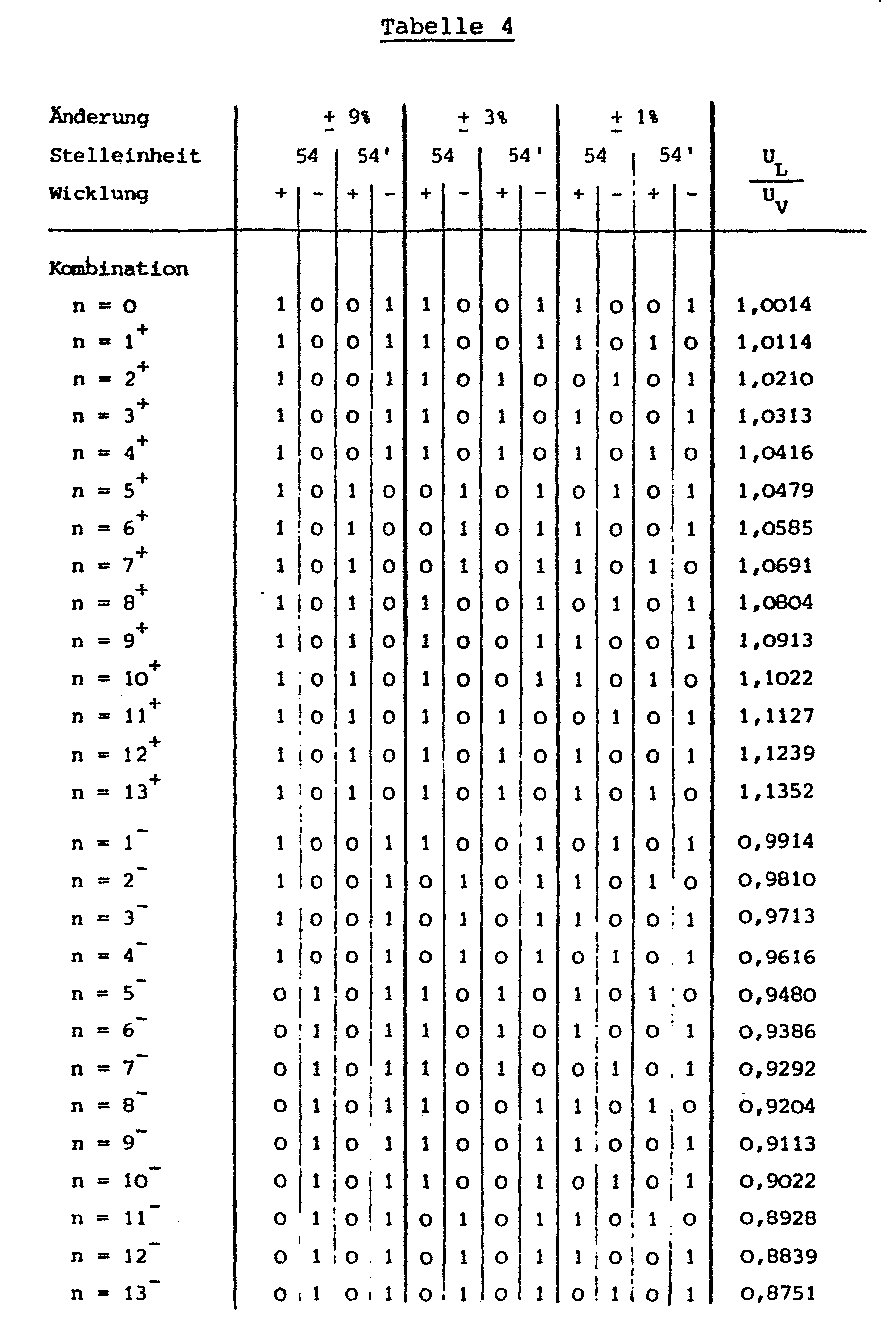
Demgegenüber befinden sich z.B. bei n = 13+ alle drei Stelleinheiten-Paare in einem Zustand, in dem in beiden Stelleinheiten die addierende Wicklung eingeschaltet ist (erste Schaltzustands-Kombination gekennzeichnet durch 1010). Der rechten Spalte entnimmt man, daß hier die Lastspannung UL um 13,52% größer als die Versorgungsspannung Uv ist.In contrast, for example, when n = 13 +, all three pairs of actuating units are in a state in which the adding winding is switched on in both actuating units (first switching state combination identified by 1010). The right column shows that the load voltage U L is 13.52% greater than the supply voltage U v .
Die Schaltersteuerung 23 wählt diese Kombination dann, wenn die Versorgungsspannung UV gegenüber dem Sollwert stark abgefallen ist.The
Nimmt man an, daß die Abweichung % der Lastspannung vom Sollwert S, der hier gleich 100% gesetzt wird, maximal + 0,5% betragen darf, so kann die Versorgungsspannung Uv auf 87,65% dieses Sollwerts abfallen, weil die erfindungsgemäße Transformatorschaltung diese abgesunkene Versorgungsspannung U um 13,52% (bezogen auf UV = 100%) anheben kann; der sich ergebende Wert für die Lastspannung von
liegt an der unteren Grenze von 99,5% (bezogen auf den Sollwert) und somit innerhalb des zulässigen Bereichs. Für die Schaltzustands-Kombination n = 13- gilt entsprechend, daß hier die Versorgungsspannung UV auf 114,84% des Sollwerts angestiegen sein kann, ohne daß die Lastspannung
die obere Grenze 100,5% des zulässigen Bereichs übersteigt.If one assumes that the deviation% of the load voltage from the setpoint S, which is set to 100% here, may not exceed + 0.5%, the supply voltage U v can drop to 87.65% of this setpoint because the transformer circuit according to the invention can raise this reduced supply voltage U by 13.52% (based on U V = 100%); the resulting value for the load voltage of
lies at the lower limit of 99.5% (based on the setpoint) and thus within the permissible range. For the switching state combination n = 13 - it applies accordingly that here the supply voltage U V can have risen to 114.84% of the target value without the load voltage
the upper limit exceeds 100.5% of the permissible range.
Entsprechendes läßt sich für alle übrigen Schaltzustands-Kombinationen n erreichen. Dabei wird vorzugsweise immer bei solchen Werten der Versorgungsspannung Uv von einer Schaltzustands-Kombination zur nächsten übergegangen, bei denen die Amplitude der Lastspannung ULvor vor dem Schalten und die Amplitude der Lastspannung ULnach nach dem Schalten zum Sollwert SLin etwa symmetrisch liegen [siehe obige Gleichung (14)_7. Aus den obigen Werten ergibt sich, daß bei diesem Ausführungsbeispiel Schwankungen der Versorgungsspannung Uv von + Δ = + 14,84% (bezogen auf den Sollwert S = 100%) bis -Δ = - 13,35% (ebenfalls bezogen auf S = 100%) so kompensiert werden können, daß die Lastspannung UL nur innerhalb eines Bereiches von S + 0,5% schwankt.The same can be achieved for all other switching state combinations n. In this case, it is preferable to always switch from one switching state combination to the other at values of the supply voltage U v in which the amplitude of the load voltage U L before switching and the amplitude of the load voltage U L after switching are approximately symmetrical to setpoint value S L [ see equation (14) _7 above. It follows from the above values that, in this exemplary embodiment, fluctuations in the supply voltage U v from + Δ = + 14.84% (based on the setpoint S = 100%) to -Δ = - 13.35% (also based on S = 100%) can be compensated so that the load voltage U L only fluctuates within a range of S + 0.5%.
Entsprechendes -jedoch eingeschränkt- gilt auch, wenn die Stufen 55,56,57 von einem Stelleinheiten-Paar aus zwei Stelleinheiten 174, 174' gemäß Fig. 9 oder von einzelnen Stelleinheiten 4 bzw. 34 bzw. 144 gebildet werden.The same applies, albeit to a limited extent, if the
Soll ein größerer Schwankungsbereich ± Δ % erfaßt werden, muß entweder die minimale Amplitudenänderung A vergrößert werden, was auf Kosten der Regelgenauigkeit δ geht, oder es muß die Anzahl der Stufen vergrößert werden. Dabei kann es zweckmäßig sein, eine Stufe hinzuzufügen, deren Änderungsbereich nicht gleich der nächsten ganzzahligen Dreierpotenz von A, hier also nicht gleich + 27A ist, sondern nur ein ganzzahliges Vielfaches kleiner 27 von A beträgt, das so groß ist, daß dann, wenn alle vier Stufen in derselben Richtung, d.h. alle additiv oder alle subtraktiv wirken, der geforderte Schwankungsbereich + ä gerade überdeckt werden kann.If a larger fluctuation range ± Δ% is to be detected, either the minimum amplitude change A must be increased, which is at the expense of the control accuracy δ, or the number of stages must be increased. It can be useful to add a level whose The change range is not equal to the next integer power of three from A, so here is not equal to + 27A, but is only an integer multiple less than 27 of A, which is so large that if all four stages are in the same direction, i.e. all additive or all act subtractive, the required fluctuation range + ä can just be covered.
Fig. 6 zeigt eine Abwandlung der erfindungsgemäßen Schaltungsanordnung, wie sie zur Steuerung der von einem Drei-Phasen-Netz abgegebenen Spannung Verwendung finden kann.Fig. 6 shows a modification of the circuit arrangement according to the invention, as it can be used to control the voltage output by a three-phase network.
Wie man der Fig. 6 entnimmt, ist für jeden der drei Phasenleiter R, S und T eine erfindungsgemäße Transformatorschaltung 75, 76, 77 vorgesehen, die jeweils in gleicher Weise aufgebaut ist, wie die Transformator- schaltung in Fig. 5. Es besteht also jede dieser drei Transformatorschaltungen 75, 76, 77 aus drei in Reihe geschalteten Stufen 55, 56, 57, von denen hier jede aus einem Stelleinheiten-Paar 54,54' bzw. 174,174' besteht und vier verschiedene Schaltzustände annehmen kann. Somit können der Wechselspannung auf jedem der drei Phasenleiter R, S und T Änderungsbeträge aufgeprägt werden, die zueinander im Verhältnis 1 : 3 : 9 stehen, oder es kann die Eingangs- wechselspannung unverändert weitergegeben werden oder es kann der Laststrom gedrosselt werden.As can be seen from FIG. 6, a
Um die Stufen der Transformatorschaltungen 75, 76, 77 in der erforderlichen Weise in die drei verschiedenen Schaltzustände bringen zu können, ist jede der Transformatorschaltungen 75, 76, 77 nicht nur mit ihrem zugehörigen Phasenleiter R, S bzw. T, sondern auch mit dem Null-Leiter N verbunden. Als Spannungsquelle dient hier ein Drei-Phasen-Netz 80.In order to be able to bring the stages of the
Die auf den einzelnen Phasenleitern R, S, T vom Netz 80 gelieferten Spannungsamplituden werden mit Hilfe einer Meßfühleranordnung 81 ständig gemessen, die die drei Meßsignale einer Komparatoranordnung 82 zuführt. Dort werden die Meßsignale mit einem gemeinsamen Referenzwert Uref verglichen. Alternativ kann auch für jeden Phasenleiter R, S und T ein eigener Referenzwert vorgegeben werden.The voltage amplitudes supplied by the
Der Komparator 82 erzeugt für jeden der drei Phasenleiter R, S, T ein eigenes Differenzsignal, das einer Schaltersteuerung 83 zugeführt wird. Diese steuert über die Leitungsgruppen 85, 86, 87, die Schalter der Stufen 55, 56, 57 in jeder der Transformatorschaltungen 75, 76, 77 in der Weise, wie dies oben ausführlich erläutert wurde. Selbstverständlich ist auch hier jede Stelleinheit über mehrere Leitungen mit der Schaltersteuerung 83 verbunden, wie dies in den Fig. 1,2,4,8 und 9 dargestellt ist. Der Einfachheit halber wurden in Fig. 6 diese Leitungen jedoch nur als eine einzige bidirektionale Leitung dargestellt.The
Den Ausgang einer jeden Transformatorschaltung 75, 76, 77 bildet ein Phasenleiter RK, SK bzw. TK' wobei der Buchstabe "K" andeutet, daß auf diesen Phasenleitern eine Wechselspannung mit konstant gehaltener Amplitude zur Verfügung steht. Diese Spannungen können entweder gemeinsam einer einzigen, einen Drei-Phasen-Strom benötigenden Last oder verschiedenen Lasten zugeführt werden, die jeweils nur mit einem 1-phasigen Wechselstrom betrieben werden müssen.The output of each
Alternativ kann auch bei einem Mehrphasensystem die Meßfühleranordnung 81 so ausgebildet sein, daß sie die auf den Phasenleitern RK, SK, TK der oder den Lasten zugeführten Wechselspannungen mißt.Alternatively, the
Bei größeren Anforderungen an die Regelgenauigkeit oder bei noch größeren Regelbereichen können auch bei den Transformatorschaltungen 75, 76, 77 mehr als drei Stufen vorgesehen werden. Analog zu Fig. 6 kann die erfindungsgemäße Schaltungsanordnung auch bei Mehrphasen-Systemen eingesetzt werden, die weniger odei mehr als drei Phasen umfassen.With greater demands on the control accuracy or with even larger control ranges, more than three stages can also be provided for the
In Fig. 7 ist eine weitere Ausführungsform einer erfindungsgemäßen Transformatorschaltung dargestellt, die nur eine einzige Stelleinheit 94 umfaßt. Wie bei dem in Fig. 1 dargestellten Ausführungsbeispiel wird auch hier den Eingangsanschlüssen 2, 3 der Stelleinheit 94 als Eingangsspannung UE eine Versorgungsspannung Uv zugeführt, die von einer Spannungsquelle 1 stammt. An den Ausgangsanschlüssen 5, 6 erscheint eine Ausgangsspannung UA, die einer Last 7 als Lastspannung UL zugeführt wird. Weiterhin umfaßt die Stelleinheit 94 einen Transformator 8, dessen erste Wicklung 9 zwischen den Eingangsanschluß 2 und den Ausgangsanschluß 5 geschaltet ist, während der andere Eingangsanschluß 3 mit dem zweiten Ausgangsanschluß 6 vermittels des Anschluß-Verbindungsleiters 10 direkt galvanisch leitend verbunden ist. Auch besitzt der Transformator 8 eine weitere Wicklung 11, die über den Eisenkern 12 des Transformators 8 mit der ersten Wicklung 9 magnetisch gekoppelt ist.7 shows a further embodiment of a transformer circuit according to the invention, which comprises only a
Im Gegensatz zum Ausführungsbeispiel in Fig. 1 kann aber die Stelleinheit 94 des vorliegenden Ausführungsbeispiels nicht nur in vier sondern in vierunddreißig verschiedene Schaltzustände gebracht werden, so daß es möglich ist, insgesamt zweiunddreißig verschiedene Amplituden-Differenzen zwischen der Eingangsspannung UE und der Ausgangsspannung UA der einen Stelleinheit 94 zu erzeugen, die Eingangsspannung UE unverändert an den Ausgangsanschlüssen 5, 6 zur Verfügung zu stellen bzw. im Fall eines Kurzschlusses an der Last den Laststrom zu drosseln.In contrast to the exemplary embodiment in FIG. 1, the actuating
Diese große Variationsmöglichkeit erlaubt es, die in Fig. 7 dargestellte Transformatorschaltung ähnlich wie die Transformatorschaltungen in den Fig. 5 und 6 als Spannungsregler und/oder Spannungskonstanter einzusetzen.This great possibility of variation allows the transformer circuit shown in FIG. 7 to be used as a voltage regulator and / or voltage constant similar to the transformer circuits in FIGS. 5 and 6.
In Fig. 7 ist der Verwendungsfall als Spannungsregler dargestellt, bei dem wiederum einer Meßfühleranordnung 64 über Leitungen 95, 96 die Ausgangsspannung UA der Stelleinheit 94, die hier gleich der Lastspannung UL ist, zugeführt wird. Der Meßfühler 64 gibt ein Meßsignal an einen Komparator 63 weiter, der dieses Meßsignal mit einer Referenzspannung Uref vergleicht, die dem Sollwert SL der Lastspannung UL entspricht. Über die Leitung 65 gibt der Komparator 63 ein den Unterschied zwischen dem Meßsignal und der Referenzspannung Uref darstellendes Differenzsignal an eine Schaltersteuerung 23 weiter, die über Leitungen 97 eine aus vierzehn Schaltern bestehende Schaltergruppe 98 ansteuert, um die Stelleinheit 94 in die verschiedenen Schaltzustände zu bringen, wie dies im folgenden noch genauer erläutert wird.FIG. 7 shows the use as a voltage regulator, in which the output voltage U A of the actuating
Um neben den beiden Schaltzuständen, in denen die weitere Wicklung 11 entweder kurzgeschlossen oder völlig offen ist, die Stelleinheit 94 in zweiunddreißig weitere Schaltzustände bringen zu können, müssen an die weitere Wicklung 11 zweiunddreißig Steuerspannungen US1 bis US32 angelegt werden, die gemäß der Erfindung mit Hilfe einer einzigen Wechselspannungsquelle 100 erzeugt werden.In order to be able to bring the
Die Wechselspannungsquelle 100 wird von einer Zusatztransformator-Anordnung 101 gebildet, die im vorliegenden Fall aus sechs elektrisch miteinander in Reihe geschalteten Wicklungsabschnitten 104 bis 109 besteht, die über einen gemeinsamen Transformatorkern 111 magnetisch miteinander gekoppelt sind.The
Das eine Ende der aus den Wicklungsabschnitten 104 bis 109 bestehenden Serienschaltung ist galvanisch direkt leitend mit dem einen Pol der Wechselspannungsquelle 1 verbunden, an den auch der Eingangsanschluß 3 der Stelleinheit 94 angeschlossen ist, der über den Anschluß-Verbindungs-leiter 10 galvanisch direkt leitend mit dem Ausgangsanschluß 6 der Stelleinheit 94 verbunden ist. Das andere Ende der aus den Wicklungsabschnitten 104 bis 109 bestehenden Serienschaltung ist über eine Leitung 114 mit dem zweiten Ausgangsanschluß 5 der Stelleinheit 94 verbunden. Somit liegt an der Serienschaltung der Wicklungsabschnitte 104 bis 109 die Ausgangsspannung UA der Stelleinheit 94 an.The one end of the group consisting of the winding
Die Serienschaltung der Wicklungsabschnitte 104 bis 109 weist sieben Abgriffe 121 bis 127 auf, von denen die Abgriffe 121 und 127 mit den beiden äußeren Enden der Serienschaltung verbunden sind, während die Abgriffe 122 bis 126 jeweils zwischen zwei einander benachbarten Wicklungsabschnitten herausgeführt sind.The series connection of the winding
Jeder der Abgriffe 121 bis 127 ist mit einem Paar von Ein/Aus-Schaltern aus der Schaltergruppe 98 verbunden. Der eine Schalter eines jeden Schalterpaares verbindet im geschlossenen Zustand den zugehörigen Abgriff mit einer Leitung 129, die mit dem in Fig. 7 unteren Ende der weiteren Wicklung 11 verbunden ist. Der andere Schalter eines jeden Paares verbindet im geschlossenen Zustand den zugehörigen Abgriff mit einer Leitung 130, die mit dem anderen Ende der weiteren Wicklung 11 in Verbindung steht. Sämtliche Schalter der Schaltergruppe 98 werden, wie bereits erwähnt, über die Leitungen 97 von der Schaltersteuerung 23 so angesteuert, daß an der weiteren Wicklung 11 immer die gerade erforderliche Steuerspannung US1 bis US32 anliegt, oder daß die beiden Schalter eines beliebigen Paares gleichzeitig geschlossen sind, um die weitere Wicklung 11 kurzzuschließen, oder daß alle Schalter 98 geöffnet sind, um den Laststrom zu drosseln.Each of the
Für eine symmetrische Regelung der Lastspannung UL um den Sollwert SL kann die Stelleinheit in zweiunddreißig verschiedene Schaltzustände gebracht werden, von denen sechzehn zur additiven Aufprägung der jeweils induzierten Spannungen ΔU1 bis ΔU31 und sechzehn zur negativen Aufprägung der jeweils induzierten Spannung ΔU2 bis 4U32 vorgesehen sind. Dabei ist die Amplitude einer jeden positiv aufgeprägten Spannung gleich der Amplitude einer entsprechend negativ aufgeprägten Spannung.For a symmetrical control of the load voltage U L around the target value S L , the actuating unit can be brought into thirty-two different switching states, sixteen of which are used to additively impress the respectively induced voltages ΔU 1 to ΔU 31 and sixteen to negatively impress the respectively induced voltage ΔU 2 to 4U32 are provided. The amplitude of each positively impressed voltage is equal to the amplitude of a corresponding negatively impressed voltage.
Da sich das Vorzeichen der Aufprägung aus dem Wicklungssinn ergibt, mit dem die weitere Wicklung 11 an eine Steuerspannung angeschlossen wird, sind also nur sechzehn Steuerspannungen US1 bis US16 mit verschiedenen Amplituden erforderlich, da die weitere Wicklung 11 mit Hilfe der Schalter 98 mit zwei verschiedenen Richtungen des Wicklungssinns an die verschiedenen Abgriffe 121 bis 127 gelegt werden kann.Since the sign of the stamping results from the winding direction with which the further winding 11 is connected to a control voltage, only sixteen control voltages U S1 to U S16 with different amplitudes are required, since the further winding 11 with the aid of the
Um die sechzehn unterschiedlichen Steuerspannungsamplituden abgreifen zu können, sind die Windungszahlen der Wicklungsabschnitte 104 bis 109 gemäß einem Kode aufeinander abgestimmt, der so optimiert ist, daß einerseits eine möglichst kleine Anzahl von Wicklungsabschnitten 104 bis 109 und damit auch von Abgriffen 121 bis 127 und Schaltern 98 benötigt wird, und daß andererseits die maximale benötigte Steuerspannung USmax zwischen den am weitesten auseinander liegenden Abgriffen 121 uns 127 abgegriffen werden kann.In order to be able to tap the sixteen different control voltage amplitudes, the number of turns of the winding
Gemäß diesem optimierten Kode besitzt der Wicklungsabschnitt 109 eine solche Windungszahl, daß dann, wenn an der Serienschaltung aller Wicklungsabschnitte 104 bis 109 die Ausgangsspannung UA der Stelleinheit 94 anliegt, von diesem Wicklungsabschnitt 109 eine Abgriffsspannung 1 . UXmin abgreifbar ist, die der kleinsten benötigten Steuerspannung USmin entspricht.According to this optimized code, the winding
Durch gleichzeitiges Schließen des in Fig. 7 oberen Schalters des Schalterpaares 132 und des unteren Schalters des Schalterpaares 131 kann also an die weitere Wicklung 11 die kleinste benötigte Steuerspannung USmin so angelegt werden, daß die hierdurch in der ersten Wicklung 9 des Transformators 8 induzierte Spannung ΔUmin auf die Eingangsspannung UE subtraktiv aufgeprägt wird. Werden statt dessen der in Fig. 7 untere Schalter des Paares 132 und der obere Schalter des Paares 131 gleichzeitig geschlossen, so liegt an der weiteren Wicklung 11 dieselbe kleinste Steuerspannung USmin an, doch ist der Wicklungssinn der weiteren Wick- lung 11 gegenüber dem vorausgehenden Fall invertiert, so daß nunmehr die induzierte Spannung ΔUmin auf die Eingangsspannung U, additiv aufgeprägt wird. Entsprechendes gilt auch für die zwischen beliebigen anderen Abgriffen 121 bis 127 abgreifbaren Steuerspannungen.By simultaneously closing the upper switch of the
Gemäß dem optimierten Kode sind die Windungszahlen der übrigen Wicklungsabschnitte 104 bis 108 so gewählt, daß zwischen benachbarten Abgriffen 121 bis 126 jeweils folgende Abgriffsspannungen zur Verfügung stehen:

Zusammen mit der Spannung 1 . UXmin an Abgriffspaar 126, 127 ergibt dies die Möglichkeit, alle Steuerspannungsamplituden von 1 . USmin bis 16 . USmin entweder direkt an unmittelbar benachbarten Abgriffen oder zwischen weiter auseinanderliegenden Abgriffen abzugreifen, wie dies in der folgenden Tabelle 6 dargestellt ist:

Man sieht, daß auch hier der optimierte Kode sich dadurch auszeichnet, daß an dem einen am Ende der Serienschaltung liegenden Wicklungsabschnitt 109 das 1-fache der minimalen Abgriffsspannung UXmin und an dem am anderen Ende liegenden Wicklungsabschnitt 104 das 2-fache von UXmin abgreifbar ist.It can be seen that the optimized code is also characterized here in that 1 times the minimum tapping voltage U Xmin can be tapped at one winding
Um entsprechende Verhältnisse wie bei dem in Fig. 1 dargestellten Ausführungsbeispiel zu erhalten, kann bei dem in Fig. 7 dargestellten Ausführungsbeispiel vorgesehen sein, daß die Leitung 114 im Punkt 140 nicht fest mit der Leitung 95 verbunden ist. Statt dessen können hier zwei im Gegentakt betätigbare Schalter angeordnet werden, mit deren Hilfe das von der Serienschaltung der Wicklungen 104 bis 109 entfernt liegende Ende der Leitung 114 über entsprechende Leitungen entweder mit der vom Ausgangsanschluß 5 zur Last 7 führenden Leitung oder mit der von der Spannungsquelle 1 zum Eingangsanschluß 2 führenden Leitung verbunden werden kann. Diese Schalter werden dann ebenfalls von der Schaltersteuerung 23 angesteuert, um an die Serienschaltung der Wicklungen 104 bis 109 entweder die Eingangsspannung UE oder die Ausgangsspannung UA der Stelleinheit 94 anzulegen. Ersteres findet vorzugsweise dann statt, wenn durch eine entsprechende an die weitere Wicklung 11 angelegte Steuerspannung US1' ....,US31 in der ersten Wicklung 9 eine Spannung ΔU1, ..., ΔU31 induziert werden soll, die sich auf die Eingangsspannung UE additiv aufprägt. An die Ausgangsspannung UA wird die Leitung 114 dagegen vorzugsweise dann angeschlossen, wenn in der ersten Wicklung 9 eine Spannung Δ U2, ... ΔU32 induziert werden soll, die sich auf die Eingangsspannung UE subtraktiv aufprägt.In order to obtain the same conditions as in the embodiment shown in FIG. 1, it can be provided in the embodiment shown in FIG. 7 that the
Fig. 8 zeigt wieder eine einzelne Stelleinheit 144, die ähnlich wie die Stelleinheit 4 aus Fig. 1 aufgebaut und in gleicher Weise zur Veränderung der Amplitude einer Wechselspannung zwischen eine Wechselspannungsquelle 1 und eine Last 7 geschaltet ist. Schaltungsteile in Fig. 8, die in gleicher Weise in Fig. 1 vorhanden sind, tragen wieder dieselben Bezugszeichen. Insbesondere weist auch in Fig. 8 der Transformator nur eine einzige weitere Wicklung 11 auf, die über den Eisenkern 12 des Transformators 8 mit dessen erster Wicklung 9 magnetisch gekoppelt ist. Mit den beiden Enden 13, 14 der weiteren Wicklung 11 sind jeweils zwei Schalter 150, 152 bzw. 151, 153 verbunden.FIG. 8 again shows a
Ist der Schalter 150 geschlossen, so verbindet er das Ende 13 der weiteren Wicklung 11 mit dem Eingangsanschluß 2, mit dem auch das eine Ende der ersten Wicklung 9 verbunden ist. Ist der Schalter 151 geschlossen, so verbindet er das andere Ende 14 der weiteren Wicklung 11 mit dem Ausgangsanschluß 5, mit dem das andere Ende der ersten Wicklung 9 verbunden ist.If the
Ist der Schalter 152 geschlossen, so verbindet er das Ende 13 der weiteren Wicklung 11 mit einer Leitung 155, mit der der Schalter 153 im geschlossenen Zustand auch das andere Ende 14 der weiteren Wicklung 11 verbindet. Zwischen der Leitung 155 und dem Anschluß-Verbindungsleiter 10 ist eine Schaltungsanordnung 157 vorgesehen, die ein einfacher steuerbarer Aus/Ein-Schalter sein kann, vorzugsweise aber von einer Strombegrenzungsschaltung gebildet wird, wie sie weiter unten unter Bezugnahme auf Fig. 10 noch genauer erläutert wird.If the
Mit Hilfe der Schalter 150 bis 153 kann die Stelleinheit 144 in vier verschiedene Schaltzustände gebracht werden. Im ersten Schaltzustand, in dem die Schalter 150 und 153 geschlossen sind, wird an die weitere Wicklung 11 und die mit ihr in Reihe liegende Strombegrenzungsschaltung 157 die Eingangsspannung UE angelegt. Da der Grenzwert, auf den die Strombegrenzungsschaltung 157 den sie durchfließenden Strom begrenzt, größer gewählt ist, als der Strom, der in diesem ersten Schaltzustand durch die weitere Wicklung 11 fließt, ist der Spannungsabfall an der Strombegrenzungsschaltung 157 sehr klein und es liegt praktisch die gesamte Eingangsspannung UE an der weiteren Wicklung 11 als Steuerspannung an. Der durch die Punkte 19, 20 definierte Wicklungssinn der Wicklungen 9, 11 ist so gewählt, daß sich die Spannung Δ U1, die in diesem ersten Schaltzustand durch die weitere Wicklung 11 in der ersten Wicklung 9 induziert wird, zur Eingangsspannung UE addiert. Zwischen den Ausgangsanschlüssen 5, 6 der Stelleinheit erhält man also die Spannung
Der Amplituden-Absolutbetrag der induzierten Spannung ΔU1 ist dabei durch das Windungsverhältnis w1/ww der ersten Wicklung 9 zur weiteren Wicklung 11 nach der Gleichung AU1 = w1UE/ww festgelegt.The absolute amplitude of the induced voltage ΔU 1 is determined by the turns ratio w 1 / w w of the first winding 9 to the further winding 11 according to the equation AU1 = w 1 U E / w w .
Im zweiten Schaltzustand, der in Fig. 8 dargestellt ist, sind die Schalter 150 und 153 geöffnet und sind die Schalter 151 und 152 geschlossen, wodurch an die weitere Wicklung 11 und die mit ihr wieder in Serie liegende Strombegrenzungsschaltung 157 die Ausgangsspannung UA der Stelleinheit 144 gelegt ist. Da der in diesem zweiten Schaltzustand durch die weitere Wicklung 11 fließende Strom in etwa gleich dem Strom ist, der durch die weitere Wicklung 11 im ersten Schaltzustand fließt, liegt auch dieser Strom unter demIn the second switching state, which is shown in FIG. 8, the
Grenzwert der Strombegrenzungsschaltung 157, so daß deren Widerstand auch in diesem zweiten Schaltzustand sehr klein ist und praktisch die gesamte Ausgangsspannung UA an der weiteren Wicklung 11 anliegt. Der Wicklungssinn der weiteren Wicklung 11 ist gegenüber dem ersten Schaltzustand umgekehrt. Dadurch subtrahiert sich die Spannung ΔU2, die in diesem zweiten Schaltzustand in der ersten Wicklung 9 des Transformators 8 induziert wird, von der Eingangsspannung U., so daß man am Ausgang 5, 6 erhält:
Für die induzierte Spannung gilt in diesem Fall ΔU2 = w1UE/(ww+w1). Es ist also die im zweiten Schaltzustand induzierte Spannung ΔU2 etwas kleiner als die im ersten Schaltzustand induzierte Spannung ΔU1.In this case, ΔU 2 = w 1 U E / (w w + w 1 ) applies to the induced voltage. The voltage ΔU 2 induced in the second switching state is therefore somewhat smaller than the voltage ΔU 1 induced in the first switching state.
In einem dritten Schaltzustand der Stelleinheit 144 sind zumindest die beiden Schalter 150 und 151 geschlossen, so daß die weitere Wicklung 11 mit antiparallelem Wicklungssinn zur ersten Wicklung 9 und elektrisch parallel zu dieser ersten Wicklung 9 an der gleichen Spannung wie diese liegt. Der Transformator 8 ist in diesem Schaltzustand also kurzgeschlossen und die Ströme, die in den beiden antiparallelen Wicklungen 9, 11 fließen, versuchen, jeweils ein Magnetfeld aufzubauen; diese Felder sind jedoch einander entgegengerichtet und heben sich nahezu auf.In a third switching state of the
Die Streuinduktivität der ersten Wicklung 9 kann so gering gehalten werden, daß die erste Wicklung 9 dem durch sie hindurchfließenden Laststrom in diesem Schaltzustand nur ihren sehr kleinen ohmschen Widerstand entgegensetzt, wodurch der an der ersten Wicklung 9 auftretende Spannungsabfall sehr klein ist. Dies bedeutet, daß in diesem dritten Schaltzustand gilt
Als treibende Spannung für den durch die weitere Wicklung 11 fließenden Kurzschlußstrom steht nur der geringe Spannungsabfall an der ersten Wicklung 9 zur Verfügung, so daß auch der Kurzschlußstrom durch die weitere Wicklung 11 sehr gering bleibt. Da der Scheinwiderstand der weiteren Wicklung 11 erheblich größer als der der ersten Wicklung 9 ist, fließt der Laststrom praktisch ausschließlich durch die erste Wicklung 9.Only the slight voltage drop across the first winding 9 is available as the driving voltage for the short-circuit current flowing through the further winding 11, so that the short-circuit current through the further winding 11 also remains very low. Since the impedance of the further winding 11 is considerably greater than that of the first winding 9, the load current flows practically exclusively through the first winding 9.
Wenn immer sichergestellt ist, daß die Schalter 152, 153 beide geöffnet sind, wenn die Schalter 150, 151 geschlossen sind, kann auf die Strombegrenzungsschaltung 157 verzichtet, d.h. der Leiter 155 unmittelbar mit dem Anschluß-Verbindungsleiter 10 galvanisch leitend verbunden werden. Dies hat allerdings zur Folge, daß beim Umschalten beispielsweise von dem in der Fig. 8 dargestellten zweiten Schaltzustand in den ersten Schaltzustand zunächst die Schalter 151, 152 geöffnet werden müssen, und daß erst dann, wenn diese Schalter mit Sicherheit offen sind, die Schalter 150, 153-geschlossen werden können. Würden nämlich bei fehlender Strombegrenzungsschaltung 157 alle vier Schalter 150 bis 153 gleichzeitig geschlossen, so wären sowohl die Eingangsspannung UE als auch die Ausgangsspannung UA kurzgeschlossen, was zu unzulässig hohen Kurzschlußströmen und zu einem unerwünschten Zusammenbrechen dieser Spannungen führen würde.If it is always ensured that the
Ohne eine Strombegrenzungsschaltung 157 müßten also beim übergang von einem Schaltzustand in den anderen zunächst die bisher geschlossenen Schalter geöffnet werden, was dann, wenn man als Schalter Triacs verwendet, nur beim Nulldurchgang des durch sie hindurchfließenden Stroms möglich wäre, und es müßten dann die für den neuen Schaltzustand zu schließenden Schalter geschlossen werden, wofür wieder bestimmte Zeitpunkte abgewartet werden müßten, in denen sich durch diesen Umschaltvorgang möglichst geringe Schaltspitzen in der Ausgangsspannung UA ergeben. Dies führt insgesamt dazu, daß frühestens nach eineinhalb bis zwei Perioden der Ausgangswechselspannung UA der neue Amplitudenwert stabil zur Verfügung steht.Without a current limiting
Zur Beschleunigung der Umschaltvorgänge ist es daher vorteilhaft, die Strombegrenzungsschaltung 157 vorzusehen. Sie ermöglicht es, bei einem Umschaltvorgang, durch den die Stelleinheit beispielsweise aus dem in Fig. 8 dargestellten zweiten Schaltzustand in den ersten Schaltzustand umgeschaltet werden soll, die Stelleinheit 144 zuerst in den dritten Schaltzustand zu bringen, was durch Schließen des ersten Schalters 150 geschieht. Kurze Zeit später wird dann der dritte Schalter 152 geöffnet und hierauf der vierte Schalter 153 geschlossen. Dabei bleibt die Stelleinheit im dritten Schaltzustand, da der erste Schalter 150 und der zweite Schalter 151 in dieser Zeit geschlossen sind. Ein Kurzschließen der beiden Wicklungen 9 und 11 durch den weiteren Leiter 155 wird dadurch vermieden, daß die beiden Schalter 152 und 153 nicht gleichzeitig geschlossen sind. Während der gesamten Zeit, in der sich die Stelleinheit 144 im dritten Schaltzustand befindet, verhindert die Strombegrenzungsschaltung 157 das Fließen eines unzulässig großen Kurzschlußstroms vom Anschluß 5 bzw. vom Anschluß 2 zum Anschluß-Verbindungsleiter 10 über die gleichzeitig geschlossenen Schalter 151, 153 bzw. die gleichzeitig geschlossenen Schalter 150, 152. Als letzter Schritt des Umschaltvorganges wird dann der Schalter 151 geöffnet, wodurch die Stelleinheit aus dem dritten Schaltzustand in den ersten Schaltzustand übergeht.To accelerate the switching processes, it is therefore advantageous to provide the current limiting
Entsprechendes gilt auch für einen Umschaltvorgang, der vom ersten in den zweiten Schaltzustand führt.The same also applies to a switching process that leads from the first to the second switching state.
Bei den eben beschriebenen Umschaltvorgängen durchläuft die Stelleinheit 144 also auch immer dann, wenn vom ersten in den zweiten oder vom zweiten in den ersten Schaltzustand übergegangen werden soll, kurzfristig den dritten Schaltzustand. Soll die Stelleinheit 144 längere Zeit im dritten Schaltzustand gehalten werden, werden die Schalter 152 und/oder 153 geöffnet, so daß vom Eingangsanschluß 2 bzw. vom Ausgangsanschluß 5 keine Ströme mehr zum Anschluß-Verbindungsleiter 10 fließen können und somit die Verlustleistung noch weiter reduziert wird.In the switching processes just described, the
In einem vierten Schaltzustand sind alle vier Schalter 150 bis 153 geöffnet, so daß der Stromkreis der weiteren Wicklung 11 einen hohen Widerstandswert besitzt, der auch nach Heruntertransformation auf der Seite der ersten Wicklung 9 einen hohen Widerstandswert liefert. Somit tritt an der ersten Wicklung ein von der Größe des Laststroms abhängiger Spannungsabfall auf. Diese Drosselwirkung der ersten Wicklung 9 im vierten Schaltzustand kann dazu verwendet werden, beim Auftreten eines Kurzschlusses an der Last die der Last zugeführte Leistung zumindest solange auf ein ungefährliches Maß zu begrenzen, bis weitere Abschaltmaßnahmen getroffen worden sind.In a fourth switching state, all four
Die Schalter 150 bis 153 werden durch eine Schaltersteuerung 23 betätigt, die über Leitungen 158, 159, 160 und 161 die Schalter ansteuert. Die hierfür nötigen Informationen kann die Schaltersteuerung 23 von einem in der Fig. 8 nicht wiedergegebenen Komparator erhalten, der die Lastspannung UL und/oder die Versorgungsspannung Uv mit Sollwerten vergleicht und bei Abweichungen entsprechende Differenzsignale abgibt, wie dies oben ausführlich beschrieben ist. Weiterhin umfaßt der Transformator 8 der Stelleinheit 144 eine Kurzschlußwicklung 28, die mit Hilfe eines Schalters 29, der zu ihr parallel liegt, kurzgeschlossen werden kann. Auch dieser Schalter 29 wird von der Schaltersteuerung 23 über eine Leitung 30 angesteuert. Dies erfolgt gemäß der Erfindung nur dann, wenn bei den Schaltern 150 bis 153 bzw. in der Strombegrenzungsschaltung 157 bestimmte Störungen auftreten, wie dies weiter unten noch genauer erläutert wird.The
Alternativ zu der eben beschriebenen Ausführungsform kann die Strombegrenzungsschaltung 157 in der Stelleinheit 144 weggelassen werden, ohne daß es zu den oben erwähnten Verzögerungen im Umschaltvorgang kommen muß. Dies wird dadurch erreicht, das die beiden Schalter 152, 153, die dann wieder unmittelbar mit dem Anschluß-Verbindungsleiter 10 verbunden sind, jeweils als Strombegrenzungsschaltung ausgebildet werden, deren Grenzwert zwischen dem Wert Null und einem von Null verschiedenen Wert hin- und hergeschaltet werden kann. Wird eine solche Strombegrenzungsschaltung auf den Grenzwert Null geschaltet, so entspricht dies dem geöffneten Zustand eines Schalters. Ist sie dagegen auf den von Null verschiedenen Grenzwert geschaltet, so setzt sie dem durch sie hindurchfließenden Strom nur einen sehr kleinen, konstanten Widerstand entgegen, solange dieser Strom deutlich unterhalb des Grenzwertes bleibt. Dabei wird dieser Grenzwert so gewählt, daß er größer ist als der Strom, der im ersten bzw. im zweiten Schaltzustand durch die weitere Wicklung 11 und den betreffenden Schalter 153 bzw. 152 fließen muß.As an alternative to the embodiment just described, the current limiting
Eine Schaltungsanordnung, die die eben beschriebenen Eigenschaften besitzt, wird weiter unten unter Bezugnahme auf Fig.10 noch näher erläutert.A circuit arrangement which has the properties just described is explained in more detail below with reference to FIG. 10.
In dem eben geschilderten Fall erfolgt die Umschaltung vom ersten in den zweiten Schaltzustand oder vom zweiten in den ersten Schaltzustand in der Weise, daß die beiden bisher geöffneten Schalter gleichzeitig geschlossen und kurze Zeit später die beiden Schalter gleichzeitig geöffnet werden, die im neuen Schaltzustand offen sein müssen. Sind die Schalter 150 und 151 mit Hilfe von Triacs realisiert, so muß mit diesem öffnungsvorgang bis zum nächsten Nulldurchgang des Stromes gewartet werden, der vor dem öffnen durch den betreffenden Schalter 150 oder 151 fließt.In the case just described, the switchover from the first to the second switching state or from the second to the first switching state takes place in such a way that the two previously open switches are closed simultaneously and a short time later the two switches which are open in the new switching state are opened simultaneously have to. If
Auch bei dieser Ausführungsform kann die Stelleinheit in den vierten Schaltzustand dadurch gebracht werden, daß alle vier Schalter 150 bis 153 gleichzeitig geöffnet werden.In this embodiment too, the actuating unit can be brought into the fourth switching state by opening all four
In Fig. 9 ist eine Transformatorschaltung mit einer Stelleinheit 174 dargestellt, deren Aufbau sich zwar von dem der Stelleinheit 144 unterscheidet, die aber im Prinzip die gleichen Funktionen aufweist.FIG. 9 shows a transformer circuit with an
Die Stelleinheit 174 umfaßt wiederum einen Transformator 8, dessen erste Wicklung zwischen den Eingangsanschluß 2 und den Ausgangsanschluß 5 geschaltet ist, während der andere Eingangsanschluß 3 über den Anschluß-Verbindungsleiter 10 direkt galvanisch leitend mit dem anderen Ausgangsanschluß 6 verbunden ist.The
Ähnlich wie bei der Stelleinheit 34 in Fig. 2 besitzt hier der Transformator 8 ebenfalls zwei weitere Wicklungen 35, 36, von denen die eine als addierende weitere Wicklung 35 mit ihrem einen Ende fest mit dem Ende der ersten Wicklung 9 galvanisch leitend verbunden ist, das mit dem Eingangsanschluß 2 direkt galvanisch leitend verbunden ist, während das andere Ende der addierenden Wicklung 35 mit Hilfe eines Schalters 180 mit einer Leitung 185 verbunden oder von dieser getrennt werden kann, die ihrerseits über eine Strombegrenzungsschaltung 157 mit dem Anschluß-Verbindungsleiter 10 verbunden ist. Die andere der beiden Wicklungen ist als subtrahierende weitere Wicklung 36 mit ihrem einen Ende fest und direkt galvanisch leitend mit dem Ende der ersten Wicklung 9 verbunden, das direkt galvanisch leitend mit dem Ausgangsanschluß 5 der Stelleinheit 174 verbunden ist, während das andere Ende der subtrahierenden weiteren Wicklung 36 mit Hilfe eines Schalters 181 mit der Leitung 185 verbunden oder von dieser getrennt werden kann. Der Wicklungssinn der drei Wicklungen 9, 35 und 36, die über den Kern 12 magnetisch miteinander gekoppelt sind, ist durch die Punkte 19, 20 und 21 gekennzeichnet. Er ist so gewählt, daß sich die Spannung ΔU1' die durch die weitere Wicklung 35 bei geschlossenem Schalter 180 in der ersten Wicklung 9 induziert wird, zur Eingangsspannung UE addiert (erster Schaltzustand), und daß sich die Spannung ΔU2' die bei geschlossenem Schalter 181 von der weiteren Wicklung 36 in der ersten Wicklung 9 induziert wird, von der Eingangsspannung UE subtrahiert (zweiter Schaltzustand). Auch hier ist der Grenzwert der Strombegrenzungsschaltung 157 größer als die Ströme gewählt, die im ersten Schaltzustand durch die addierende Wicklung 35 bzw. im zweiten Schaltzustand durch die subtrahierende Wicklung 36 fließen. Somit ist in diesen beiden Schaltzuständen der Widerstand der Strombegrenzungsschaltung 157 praktisch vernachläßigbar und es liegt die gesamte Eingangsspannung UE bzw. die gesamte Ausgangsspannung UA an der addierenden Wicklung 35 bzw. an der subtrahierenden Wicklung 36 an.Similar to the
Um diese in Fig. 9 dargestellte Stelleinheit-in den dritten Schaltzustand bringen zu können, ist es erforderlich, die beiden Schalter 180 und 181 gleichzeitig zu schließen, wodurch die beiden weiteren Wicklungen 35, 36 mit gleichem Wicklungssinn miteinander in Reihe geschaltet und mit antiparallelem Wicklungssinn zur ersten Wicklung 9 parallelgeschaltet sind. Da in diesem Schaltzustand die beiden weiteren Wicklungen 35, 36 als eine einzige Wicklung betrachtet werden können, erhält man also den gleichen Schaltzustand, wie er oben als dritter Schaltzustand der Stelleinheit 144 aus Fig. 8 beschrieben wurde und es wird auch hier die Eingangsspannung UE praktisch unverändert an den Ausgang der Stelleinheit weitergegeben.In order to be able to bring this actuating unit shown in FIG. 9 into the third switching state, it is necessary to close the two
Damit in diesem dritten Schaltzustand nicht die Eingangsspannung UE an der im Kurzschlußkreis liegenden weiteren Wicklung 35 anliegt und einen unzulässig hohen Kurzschlußstrom vom Eingangsanschluß 2 zum Eingangsschluß 3 treibt, ist auch hier wieder zwischen dem Leiter 185 und dem Anschluß-Verbindungsleiter 10 eine Strombegrenzungsschaltung 157 vorgesehen, die prinzipiell wieder durch einen steuerbaren Ein/Aus-Schalter ersetzt werden könnte. Allerdings müßten dann für das Umschalten von einem Schaltzustand in den anderen auch hier wieder Schutzzeiten eingeführt und spezielle Uberprüfungsschaltungen vorgesehen werden, damit mit absoluter Sicherheit ausgeschlossen wird, daß die Schalter 180 und 181 gleichzeitig geschlossen werden, solange der die Leitungen 185 und 10 miteinander verbindende Schalter geschlossen ist. Vorzugsweise wird daher als Schaltungsanordnung 157 wieder eine Strombegrenzungsschaltung verwendet, die automatisch und ohne zeitliche Verzögerung ein weiteres Ansteigen des durch sie hindurchfließenden Stroms verhindert, wenn dieser Strom einen vorgegebenen Grenzwert zu übersteigen droht.So that in this third switching state the input voltage U E is not present at the further winding 35 in the short-circuit and drives an impermissibly high short-circuit current from the
Auch die Stelleinheit 174 kann in einen vierten Schaltzustand gebracht werden, wie er in der Fig. 9 dargestellt ist. In diesem Schaltzustand sind die beiden Schalter 180 und 181 gleichzeitig geöffnet, wodurch wieder eine starke Drosselwirkung der ersten Wicklung 9 auftritt, die dazu verwendet werden kann, im Fall eines Lastkurzschlusses den Kurzschlußstrom zu begrenzen.The
Das Umschalten vom ersten in den zweiten oder vom zweiten in den ersten Schaltzustand erfolgt auch hier in der Weise, daß zunächst derjenige der beiden Schalter 180, 181 geschlossen wird, der bis dahin offen war und daß erst danach der bis dahin geschlossene Schalter geöffnet wird. Die Stelleinheit 174 durchläuft also auch hier bei jedem Übergang vom ersten in den zweiten oder vom zweiten in den ersten Schaltzustand kurzfristig den dritten Schaltzustand.Switching from the first to the second or from the second to the first switching state also takes place here in such a way that the one of the two
Damit dann, wenn der dritte Schaltzustand für längere Zeiten aufrechterhalten werden soll, die Verlustleistung besonders klein gehalten werden kann, ist bei dieser Ausführungsform vorgesehen, daß die Strombegrenzungsschaltung 157 über zwei Leitungen 163 von der Schaltersteuerung 23 so angesteuert wird, daß ihr Grenzwert einen wesentlich kleineren Wert, vorzugsweise den Wert Null annimmt. Die Strombegrenzungsschaltung 157 wirkt dann wir. ein geöffneter Schalter und es fließt praktisch nur noch der sehr kleine Kurzschlußstrom, der von dem kleinen Spannungabfall an der ersten Wicklung 9 in den beiden weiteren Wicklungen 35, 36 getrieben wird.So that when the third switching state is to be maintained for longer times, the power loss can be kept particularly small, it is provided in this embodiment that the current limiting
Die Schalter 180, 181 werden von der Schaltersteuerung 23 über die Leitungen 164, 165 angesteuert.The
Auch der Transformator 8 der Stelleinheit 174 weist eine Kurzschlußwicklung 28 auf, die über einen Schalter 29 kurzschließbar ist, der von der Schaltersteuerung 23 über eine Leitung 30 angesteuert wird.The
Aufgrund des erfindungsgemäßen Aufbaus ist es bei bestimmten Störfällen möglich, die Stelleinheit 174 zumindest teilweise funktionsfähig zu erhalten oder sie wenigstens so anzusteuern, daß sie ihre Eingangsspannung unverändert an den Ausgangsanschlüssen 5, 6 abgibt. Bildet die Stelleinheit ein Glied in einer längeren Kette von Stelleinheiten, die insgesamt als Spannungskonstanter eingesetzt werden, so bleiben hierdurch wenigstens die übrigen Stelleinheiten funktionsfähig und die gesamte Transformator- schaltung kann, wenn auch im beschränktem Umfang, ihre Steuerungs- bzw. Regelfunktion aufrechterhalten. Dies wird im folgenden für einige typische Störungsfälle erläutert:
- 1.
Kurzschluß im Schalter 180 oder 181: Ein solcher Kurzschluß bedeutet, daß sich der betreffende Schalter nicht mehr öffnen läßt, die Stelleinheit also dann, wenn sie nicht gemäß der Erfindung ausgebildet wäre, ständig im ersten bzw. zweiten Schaltzustand bleiben würde. Nimmt man an, daß z.B.der Schalter 180 ständig geschlossen ist, so kann aufgrund des Vorhandenseins derStrombegrenzungsschaltung 157 in all den Fällen, in denen keine additive Aufprägung der inder Wicklung 9 induzierten Spannung gewünscht wird, derSchalter 181 geschlossen und dieStrombegrenzungsschaltung 157 auf den kleineren Grenzwert geschaltet werden. Die Stelleinheit geht dann also in den dritten Schaltzustand über und gibt die Eingangsspannung unverändert am Ausgang ab.Wird der Schalter 181 wieder geöffnet und dieStrombegrenzungsschaltung 157 wieder auf den größeren Grenzwert zurückgeschaltet, so geht die Stelleinheit wieder in den ersten Schaltzustand über. Sie kann also trotz der Störung immer noch zwischen dem ersten und dem dritten Schaltzustand hin- und hergeschaltet werden und die Amplitude der Ausgangsspannung UA in entsprechender Weise verändern. Der zweite Schaltzustand kann in einem solchen Fall allerdings nicht mehr hergestellt werden. Entsprechendes gilt, wenn einKurzschluß im Schalter 181 auftritt, derSchalter 180 aber funktionsfähig bleibt. In diesem Fall kann dieStelleinheit 174 zwischen dem zweiten und dritten Schaltzustand hin- und hergeschaltet werden, den ersten Schaltzustand aber nicht mehr einnehmen. - 2. Gleichzeitiger Kurzschluß in
den Schaltern 180 und 181:- In diesem Fall wird die
Strombegrenzungsschaltung 157 auf den kleineren Grenzwert geschaltet und die Stelleinheit bleibt auf Dauer im dritten Schaltzustand, in dem die Ausgangsspannung gleich der Eingangsspannung ist. In den ersten oder zweiten Schaltzustand kann sie dann allerdings nicht mehr gebracht werden.
- In diesem Fall wird die
- 3. Sollte ein Kurzschluß gleichzeitig in
den beiden Schaltern 180 und 181 und inder Strombegrenzungsschaltung 157 auftreten, so würde zunächst ein sehr hoher Kurzschlußstrom vom Anschluß 2zum Anschluß 3 fließen. Für diesen Fall istmit der Strombegrenzungsschaltung 157eine Sicherung 167 in Reihe geschaltet, die dann durchbrennt und somit die Verbindung zwischenden Leitungen 185 und 10 endgültig unterbricht. Wegen des Kurzschlusses inden beiden Schaltern 180 und 181 befindet sich die Stelleinheit dann im dritten Schaltzustand. - 4. Leitungsunterbrechung in der Strombegrenzungsschaltung 157:
Läßt die Strombegrenzungsschaltung 157 aufgrund einer Störung keinen Strom mehr fließen, so werden dieSchalter 180und 181 durch dieSchaltersteuerung 23 permanent geschlossen und dieStelleinheit 174 wird auf Dauer in dem sich so ergebenden dritten Schaltzustand gehalten.
- 5. Leitungsunterbrechung in einem der
Schalter 180 bzw. 181 Läßt sich einer der beidenSchalter der Drossel 9 auftritt, würde ein Spannungskonstanter oder Spannungsregler, in dem eine Stelleinheit diese Störung zeigt, praktisch seine Funktion nicht mehr ausüben können. Um dies zu verhindern, ist dieKurzschlußwicklung 28 vorgesehen,deren Schalter 29 dann geschlossen wird. Damit befindet sich dieStelleinheit 174 wieder im dritten Schaltzustand; sie kann somit weiterhin zwischen dem dritten Schaltzustand und dem einen der beiden anderen Betriebs-Schaltzustände hin- und hergeschaltet werden.
- 1. Short circuit in
switch 180 or 181: Such a short circuit means that the switch in question can no longer be opened, that is to say if the control unit were not designed in accordance with the invention, it would always remain in the first or second switching state. Assuming that, for example, switch 180 is permanently closed, the presence of the current limits may result intion circuit 157 in all cases in which no additive impressions of the voltage induced in the winding 9 is desired, theswitch 181 is closed and the current limitingcircuit 157 is switched to the smaller limit value. The control unit then changes to the third switching state and outputs the input voltage unchanged at the output. If theswitch 181 is opened again and the current limitingcircuit 157 is switched back to the larger limit value, the actuating unit returns to the first switching state. In spite of the fault, it can therefore still be switched back and forth between the first and the third switching state and change the amplitude of the output voltage U A in a corresponding manner. In such a case, however, the second switching state can no longer be established. The same applies if a short circuit occurs in theswitch 181, but theswitch 180 remains functional. In this case, theactuating unit 174 can be switched back and forth between the second and third switching states, but can no longer assume the first switching state. - 2. Simultaneous short circuit in
switches 180 and 181:- In this case, the current limiting
circuit 157 is switched to the smaller limit value and the actuator remains permanently in the third switching state, in which the output voltage is equal to the input voltage. However, it can then no longer be brought into the first or second switching state.
- In this case, the current limiting
- 3. If a short circuit occurs simultaneously in the two
switches circuit 157, a very high short circuit current would initially flow from theconnection 2 to theconnection 3. In this case, afuse 167 is connected in series with the current limitingcircuit 157, which then blows and thus finally interrupts the connection between thelines switches - 4. Line interruption in the current limiting circuit 157:
- If the current limiting
circuit 157 no longer allows current to flow due to a fault, theswitches switch controller 23 and theactuating unit 174 is kept permanently in the third switching state which results in this way.
- If the current limiting
- 5. Line interruption in one of the
switches switches choke 9 in this state, a voltage constant or voltage regulator would be used an actuator shows this malfunction, can practically no longer perform its function. To prevent this, the short-circuit winding 28 is provided, theswitch 29 is then closed. Theactuating unit 174 is thus again in the third switching state; it can thus be switched back and forth between the third switching state and one of the other two operating switching states.
Die eben beschriebenen Störfälle können auch bei der in Fig.8 dargestellten Stelleinheit 144 auftreten und aufgrund ihres erfindungsgemäßen Aufbaus in ähnlicher Weise zum Teil überwunden werden, wie dies eben geschildert wurde. Selbstverständlich kann auch bei der in Fig. 8 dargestellten Stelleinheit 144 eine Sicherung 167 vorgesehen werden, die mit der Strombegrenzungsschaltung 157 in Reihe liegt.The malfunctions just described can also occur in the
In Fig.10 ist eine Strombegrenzungsschaltung 157 dargestellt, wie sie bei den Stelleinheiten 144, 174 in den Fig. 8 und 9 verwendet werden kann.FIG. 10 shows a current limiting
Diese Strombegrenzungsschaltung besitzt zwei Stromanschlüsse 187, 188, von denen der eine mit der Leitung 155 bzw. der Leitung 185 und der andere mit dem Anschluß-Verbindungsleiter 10 direkt galvanisch leitend verbunden ist. Zwischen den beiden Stromanschlüssen 187, 188 ist eine Reihenschaltung angeordnet, die aus der Source- Drain-Strecke eines ersten V-MOS-Transistors 190, zwei Widerständen 192, 193 und der Source-Drain-Strecke eines zweiten V-MOS-Transistors 191 besteht. Parallel zu dieser Reihenschaltung sind zwischen die beiden Stromanschlüsse 187, 188 zwei miteinander in Reihe liegende Dioden 198, 199 geschaltet, deren Durchlaßrichtungen einander entgegengesetzt sind. Der Verbindungspunkt 196 der beiden Dioden 198, 199 ist mit dem Verbindungspunkt 195 der beiden Widerstände 192, 193 galvanisch leitend verbunden.This current limiting circuit has two
Da jeder der beiden Transistoren 190, 191 eine Diodencharakteristik besitzt, d.h. seine Sperrwirkung nur in einer Richtung entfalten kann, sind die beiden Transistoren 190, 191 so angeordnet, daß ihre Durchlaßrichtungen parallel zu der Durchlaßrichtung der im Parallelzweig liegenden Dioden 198 bzw. 199 und somit einander entgegengerichtet sind. Dadurch kann mit Hilfe dieser Strombegrenzungsschaltung 157 auch ein Wechselstrom in der erforderlichen Weise begrenzt werden.Since each of the two
Die Dioden 198, 199 sind so ausgewählt, daß der an ihnen beim Fließen des Nennstroms auftretende Spannungsabfall kleiner ist als der entsprechende Spannungsabfall am parallelen V-MOS-Transistor 190 bzw. 191. Da jede Diode 198 bzw. 199 nicht nur den zu ihr parallelen V-MOS-Transistor 190 bzw. 191 sondern auch dessen zugehörigen Serienwiderstand 192 bzw. 193 überbrückt, fließen die Halbwellen des zu begrenzenden Wechselstroms entweder über die Diode 198 und weiter über den Widerstand 193 und den V-MOS-Transistor 191 oder über die Diode 199 und weiter über den Widerstand 192 und den V-MOS-Transistor 190. Dadurch kann einerseits der Wechselstrom in jeder Halbwelle durch den einen der beiden V-MOS-Transistoren 190 bzw. 191 in der erforderlichen Weise begrenzt werden; andererseits wird vermieden, daß die Halbwellen auch noch den zweiten Widerstand und den zweiten V-MOS-Transistor durchfliessen müssen, die nur für die Begrenzung der Halbwellen mit dem jeweils anderen Vorzeichen erforderlich sind. Somit kann die in der Strombegrenzungsschaltung 157 auftretende Verlustleistung besonders klein gehalten werden.The
Die über die beiden Leitungen 163 von der Schaltersteuerung 23 her zugeführte Gate-Spannung für die beiden Transistoren 190, 191 ist zwischen dem Verbindungspunkt 195 der beiden Widerstände 192, 193 und den beiden Gate-Anschlüssen der Transistoren 190, 191 angelegt. Hierdurch zieht sich die Spannung, die an den Widerständen 192, 193 beim Fließen eines Stroms zwischen den Anschlüssen 187 und 188 abfällt, von der Gate-Spannung ab. Die Größe dieser Gate-Spannung ist so gewählt, daß der Strom, der von einem der beiden Anschlüsse 187, 188 zum jeweils anderen Anschluß fließt, einen vorgegebenen Grenzwert nicht übersteigen kann.The gate voltage for the two
Für den oben beschriebenen Fall, daß die Strombegrenzungsschaltung 157 auf einen zweiten, kleineren Grenzwert geschaltet werden soll, der praktisch gleich Null ist, wird die über die Leitungen 163 zugeführte Gate-Spannung so niedrig gewählt, daß sie unterhalb der Schwellenspannung UTH der V-MOS-Transistoren 190, 191 liegt, die somit praktisch keinen Strom mehr durch ihre Source/Drain-Strecke fließen lassen.In the case described above that the current limiting
Wie bereits erwähnt, können als Schalter 150 bis 153 bzw. 180 und 181 Triacs verwendet werden. Dies bedeutet jedoch, daß diese Schalter nur dann geöffnet werden können, wenn der durch sie hindurchfließende Strom einen Nulldurchgang durchläuft. Es wurde bereits darauf hingewiesen, daß gemäß der Erfindung beim Übergang von einem Schaltzustand in den anderen zunächst bis dahin offene Schalter geschlossen werden. Dann befindet sich sowohl die Stelleinheit 144 als auch die Stelleinheit 174 jeweils in ihrem dritten Schaltzustand. Durch die Schalter 150, 151 bzw. 152, 153 bzw. 180, 181 fließt dann der jeweilige Kurzschlußstrom und es kann in den nachfolgenden ersten oder zweiten Schaltzustand nur dann übergegangen werden, wenn dieser Kurzschlußstrom einen Nulldurchgang durchläuft.As already mentioned,
Wird dann der betreffende Schalter geöffnet, so liegt die weitere Wicklung 11 bzw. eine der beiden weiteren Wicklungen 35, 36 an ihrer Steuerspannung UE bzw. UA, die im Regelfall das Fließen eines Stroms zu erzwingen versucht, der gegen den bis dahin fließenden Kurzschlußstrom phasenverschoben ist, d.h. also in dem Zeitpunkt, in dem der jeweilige Schalter geöffnet wird, keinen Nulldurchgang aufweist.If the switch in question is then opened, the further winding 11 or one of the two
In Fig.11 sind in einem Diagramm der Kurvenverlauf einer Schwingungsperiode der Eingangsspannung UE, des im dritten Schaltzustand fließenden Kurzschlußstroms IK, des im ersten Schaltzustand fließenden Stroms 11 sowie des im zweiten Schaltzustand fließenden Stroms 12 dargestellt. Dabei ist die Amplitude des Kurzschlußstroms IK der Deutlichkeit halber stark vergrößert dargestellt.11 shows a diagram of the curve of an oscillation period of the input voltage U E , the short-circuit current I K flowing in the third switching state, the current 1 1 flowing in the first switching state and the current 1 2 flowing in the second switching state. The amplitude of the short-circuit current I K is shown greatly enlarged for the sake of clarity.
Es sei ausdrücklich darauf hingewiesen, daß die drei Ströme IK, I1 und I2 nicht gleichzeitig fließen können, da sich die Stelleinheit 144 bzw. 174 immer nur in einem der drei Schaltzustände befinden kann.It should be expressly pointed out that the three currents I K , I 1 and I 2 cannot flow at the same time, since the
Für die folgenden Betrachtungen sei nun angenommen, daß sich die Stelleinheit 144 oder 174 im dritten Schaltzustand befindet, von dem während der in Fig.11 dargestellten ersten Halbperiode der Eingangsspannung UE, d.h. also zwischen den Zeitpunkten t1 und t4 in den ersten Schaltzustand übergegangen werden soll. Hierzu muß bei dem Ausführungsbeispiel nach Fig. 8 der Schalter 151 und beim Ausführungsbeispiel nach Fig. 9 der Schalter 181 geöffnet werden. Da diese Schalter vom Kurzschlußstrom IK durchflossen werden, können sie, wenn sie mit Hilfe von Triacs realisiert sind, nur im Zeitpunkt t4 geöffnet werden, in welchem der Kurzschlußstrom IK einen Nulldurchgang durchläuft. Man entnimmt der Fig. 11, daß zu diesem Zeitpunkt der Strom I1, der im unmittelbaren Anschluß an das öffnen der Schalter durch die weitere Wicklung 11 bzw. die weitere Wicklung 35 fließen sollte, einen Wert aufweist, der von dem Nulldurchgangswert des Kurzschlußstroms IK' der vor dem öffnen durch diese weitere Wicklung 11 bzw. 35 geflossen ist, erheblich verschieden ist.For the following considerations it is now assumed that the
Es ist klar, daß der im neuen Schaltzustand durch die weitere Wicklung 11 bzw. 35 fließende Strom nicht sprungartig von Null auf den eigentlich erforderlichen Wert IS ansteigen kann. Statt dessen wird im Transformator ein Kompensationsstrom IG induziert, dessen Wert zunächst gleich -IS ist und der über einen längeren Zeitraum hinweg exponentiell abklingt. Es kann mehrere Schwingungsperioden der Eingangsspannung UE dauern, bis dieser Kompensationsstrom IG vollständig verschwunden ist.It is clear that the current flowing through the further winding 11 or 35 in the new switching state cannot jump abruptly from zero to the actually required value I S. Instead, a compensation current I G is induced in the transformer, the value of which is initially equal to -I S and which decays exponentially over a longer period of time. It can take several oscillation periods of the input voltage U E until this compensation current I G has completely disappeared.
Der Kompensationsstrom IG addiert sich zu dem von der Eingangsspannung U, getriebenen Strom durch die weitere Wicklung 11 bzw. 35. Da der Transformator 8 so dimensioniert ist, daß der Strom, der durch eine an ihrer Steuerspannung liegende weitere Wicklung normalerweise fließt, knapp unterhalb der Sättigungsgrenze liegt, wird der Transformator durch diesen sich addierenden Kompensationsstrom IG in die Sättigung getrieben. Dies hat zur Folge, daß sich bei dem eben beschriebenen Schaltvorgang ein Spannungseinbruch ergibt, der dazu führt, daß der Übergang von der alten auf die neue Spannungsamplitude nicht völlig glatt verläuft, sondern daß auf die erste auf den Schaltvorgang folgende Halbwelle der Ausgangsspannung U Spannungsspitzen aufgeprägt sind.The compensation current I G is added to the current driven by the input voltage U, through the further winding 11 or 35. Since the
Um diesen störenden Effekt zu vermeiden ist erfindungsgemäß vorgesehen, die Schalter 150 bis 153 und 180, 181 statt mit Triacs ebenfalls mit V-MOS-Transistoren aufzubauen, von denen wieder jeweils zwei mit entgegengesetzter Polung hintereinander geschaltet sind. Diese Transistoren haben den Vorteil, das der von ihnen gebildete Schalter unabhängig von der Größe des sie momentan durchfließenden Stroms geöffnet werden kann. Es muß also nicht mehr auf den nächsten Nulldurchgang des Kurzschlußstroms IK gewartet werden, sondern es kann der Übergang vom dritten in den ersten bzw. zweiten Schaltzustand zu einem wesentlich günstigeren Zeitpunkt stattfinden.In order to avoid this disruptive effect, the invention provides that
Wie man der Figur 11 entnimmt, wären die optimalen Umschaltzeitpunkte die Zeitpunkte t2 bzw. t30 weil in ihnen der Kurzschlußstrom IK, der vor dem Umschalten in den betreffenden weiteren Wicklungen fließt, gleich dem Strom ist, der nach dem Umschaltvorgang in der jeweiligen weiteren Wicklung fließen soll.As can be seen from FIG. 11, the optimal switching times would be the times t 2 or t 3 0 because in them the short-circuit current I K which flows in the other windings in question before the switching is equal to the current which after the switching process in the each additional winding should flow.
Da diese idealen Zeitpunkte t2 bzw. t3 meßtechnisch nur sehr schwer zu erfassen sind, können sie näherungsweise durch die Zeitpunkte t2' bzw. t3' ersetzt werden, in denen der Strom, der die weitere Wicklung im ersten bzw. im zweiten Schaltzustand durchfließt, einen Nulldurchgang aufweist. Diese Ersatzzeitpunkte t2' bzw. t3' sind von den idealen Zeitpunkten t2 bzw. t3 nicht allzu weit entfernt. Da, wie bereits erwähnt, die Amplitude von IK in Fig. 11 stark übertrieben dargestellt ist, ist die bei Verwendung der Ersatzzeitpunkte t2' bzw. t3' erforderliche Stromänderung auch nicht besonders groß.Since these ideal times t 2 and t 3 are very difficult to measure from a measurement point of view, they can be approximately replaced by times t 2 'and t 3 ', in which the current which the further winding in the first or in the second Switching state flows through, has a zero crossing. These replacement times t 2 'and t 3 ' are not too far away from the ideal times t 2 and t 3, respectively. Since, as already mentioned, the Amplitude is greatly exaggerated by I K in Fig. 11, is the use of at equivalent time points t 2 'and t 3' required power change also not particularly great.
Da die Zeitabstände τ1 bzw. τ2, die die Ersatzzeitpunkte t2' bzw. t3' vom nächstliegenden Nulldurchgang der Eingangsspannung UE aufweisen, lastabhängig sind, können sie nicht ein für allemal in der Schaltersteuerung 23 gespeichert werden. Statt dessen werden sie immer dann, wenn sich die Stelleinheit 144 bzw. 174 im ersten bzw. zweiten Schaltzustand befindet, gemessen und die Meßwerte werden gespeichert. Soll dann das nächste Mal vom dritten Schaltzustand in den ersten bzw. zweiten Schaltzustand übergegangen werden, so kann ausgehend von der Zeit, die seit dem Nulldurchgang t1 der Eingangsspannung UE verstrichen ist, auf den der Schaltvorgang folgen soll, der Schaltzeitpunkt t2' bzw. der Schaltzeitpunkt t3' ohne weiteres vorgegeben werden.Since the time intervals τ 1 and τ 2 , which have the replacement times t 2 'and t 3 ' from the nearest zero crossing of the input voltage U E , are load-dependent, they cannot be stored once and for all in the
Durch diese Maßnahmen läßt sich erreichen, daß die Ausgangsspannung der Stelleinheit bereits bei der nächsten Halbschwingung den neuen Amplitudenwert in völlig ungestörter Weise durchläuft.These measures make it possible for the output voltage of the actuating unit to pass through the new amplitude value in a completely undisturbed manner at the next half-oscillation.
Soll eine Stelleinheit, die mit V-MOS-Transistor-Schaltern und einer Strombegrenzungsschaltung 157 ausgestattet ist und die im ersten Schaltzustand auf ihre Eingangsspannung eine Spannungsänderung +AU aufprägt und im zweiten Schaltzustand eine Spannungsänderung von -ΔU bewirkt, vom ersten in den zweiten Schaltzustand oder umgekehrt umgeschaltet werden, so läßt sich die dabei insgesamt auftretende Spannungsänderung 2ΔU in zwei Schritten durchführen; der erste Schritt, bei dem die Ausgangsspannung um (ΔU geändert wird, erfolgt sofort d.h. gleichzeitig mit der Erzeugung des Umschaltsignals. Dies geschieht dadurch, daß durch Schließen eines oder mehrerer bis dahin offener Schalter die Stelleinheit in den dritten Schaltzustand übergeführt wird. Die zweite Hälfte der erforderlichen Änderung wird dann innerhalb eines Zeitraumes bewerkstelligt, der im ungünstigsten Fall gleich einer halben Schwingungsperiode der Eingangsspannung UE ist. Nimmt man an, daß UE eine Schwingungsfrequenz von 50 Hz besitzt, so läßt sich also die Gesamtänderung innerhalb von höchstens 10 ms bewerkstelligen. Danach hat die Ausgangsspannung UA stabil ihren neuen Wert.A control unit, which is equipped with V-MOS transistor switches and a current limiting
Entsprechendes gilt auch dann, wenn eine Stelleinheit in den ersten oder zweiten Schaltzustand übergeführt werden soll, nachdem sie sich längere Zeit im dritten Schaltzustand befunden hat. Da bei einem solchen Übergang nur ein bzw. zwei Schalter geöffnet werden müssen, muß nach der Erzeugung des Umschaltsignals lediglich gewartet werden, bis der nächste günstige Schaltzeitpunkt t2' bzw. t3' auftritt. Da jeder dieser Zeitpunkte pro Wechselspannungsperiode zweimal zur Verfügung steht, muß also im ungünstigsten Fall eine Zeitdauer abgewartet werden, die der Länge einer Halbperiode der Wechselspannung entspricht, bis umgeschaltet werden kann. Zwar erfolgt hier die Änderung der Ausgangsspannung in einem einzigen Schritt, doch ist die Größe dieser Änderung auch nur halb so groß wie die Gesamtänderung, die beim Übergang vom ersten in den zweiten oder vom zweiten in den ersten Schaltzustand durchlaufen wird.The same also applies if an actuating unit is to be switched to the first or second switching state after it has been in the third switching state for a long time. Since only one or two switches have to be opened during such a transition, after the changeover signal has been generated it is only necessary to wait until the next favorable switching time t 2 'or t 3 ' occurs. Since each of these points in time is available twice per AC voltage period, a time period corresponding to the length of a half cycle of the AC voltage must therefore be waited in the worst case before switching can take place. Although the change in the output voltage takes place in a single step, the magnitude of this change is only half the size of the total change which is made during the transition from the first to the second or from the second to the first switching state.
Ein besonders schnelles und präzises Umschalten ergibt sich dann, wenn jeweils zwei der oben beschriebenen Stelleinheiten 174 zur Bildung eines Stelleinheiten-Paares miteinander in Reihe geschaltet werden.A particularly quick and precise switchover occurs when two of the actuating
Claims (46)
Priority Applications (1)
| Application Number | Priority Date | Filing Date | Title |
|---|---|---|---|
| AT85108921T ATE68611T1 (en) | 1984-07-24 | 1985-07-16 | TRANSFORMER CIRCUIT. |
Applications Claiming Priority (6)
| Application Number | Priority Date | Filing Date | Title |
|---|---|---|---|
| DE3427291 | 1984-07-24 | ||
| DE3427291 | 1984-07-24 | ||
| DE3502889 | 1985-01-29 | ||
| DE19853502889 DE3502889A1 (en) | 1984-07-24 | 1985-01-29 | Transformer circuit |
| DE19853511182 DE3511182A1 (en) | 1985-03-27 | 1985-03-27 | Transformer circuit |
| DE3511182 | 1985-03-27 |
Publications (3)
| Publication Number | Publication Date |
|---|---|
| EP0169488A2 true EP0169488A2 (en) | 1986-01-29 |
| EP0169488A3 EP0169488A3 (en) | 1987-08-19 |
| EP0169488B1 EP0169488B1 (en) | 1991-10-16 |
Family
ID=27192190
Family Applications (1)
| Application Number | Title | Priority Date | Filing Date |
|---|---|---|---|
| EP85108921A Expired - Lifetime EP0169488B1 (en) | 1984-07-24 | 1985-07-16 | Transformer circuit |
Country Status (3)
| Country | Link |
|---|---|
| US (1) | US4774451A (en) |
| EP (1) | EP0169488B1 (en) |
| DE (1) | DE3584401D1 (en) |
Cited By (2)
| Publication number | Priority date | Publication date | Assignee | Title |
|---|---|---|---|---|
| GB2198561A (en) * | 1986-11-26 | 1988-06-15 | Toshiba Kk | Electric converting circuit with control through photocoupler |
| WO2015015216A1 (en) * | 2013-08-01 | 2015-02-05 | Southern Fox Investments Limited | Apparatus and method for voltage control |
Families Citing this family (11)
| Publication number | Priority date | Publication date | Assignee | Title |
|---|---|---|---|---|
| KR930010265B1 (en) * | 1991-05-14 | 1993-10-16 | 삼성전자 주식회사 | Microwave Drive Circuit |
| DE4431021C1 (en) * | 1994-08-31 | 1995-10-19 | Siemens Ag | Equivalent circuit for several functional units |
| JP2561055B2 (en) * | 1994-11-18 | 1996-12-04 | インターナショナル・ビジネス・マシーンズ・コーポレイション | Information processing apparatus and control method thereof |
| US6351106B1 (en) * | 2000-09-29 | 2002-02-26 | Silicon Power Corporation | Static voltage regulator and controller |
| WO2009058695A2 (en) * | 2007-10-30 | 2009-05-07 | Northrop Grumman Systems Corporation | Cool impact-ionization transistor and method for making same |
| RU2377630C1 (en) * | 2008-09-16 | 2009-12-27 | Лев Залманович Фейгин | Stabiliser of ac voltage with elements of protection and back-up (versions) |
| KR20110114697A (en) * | 2009-02-06 | 2011-10-19 | 에이비비 리써치 리미티드 | Hybrid Distribution Transformer with AC and DC Power Capacities |
| KR20110120967A (en) * | 2009-02-27 | 2011-11-04 | 에이비비 리써치 리미티드 | Hybrid power distribution transformer with integrated voltage source converter |
| ES2679821T3 (en) * | 2011-07-18 | 2018-08-31 | Abb Schweiz Ag | Dry transformer |
| CN112994549A (en) * | 2021-02-25 | 2021-06-18 | 上海交大海洋水下工程科学研究院有限公司 | Stabilizing device, method and medium for full-sea-depth ROV power supply |
| CN113258146B (en) * | 2021-03-29 | 2022-12-30 | 华为数字能源技术有限公司 | Battery system, driving system and energy storage container |
Family Cites Families (8)
| Publication number | Priority date | Publication date | Assignee | Title |
|---|---|---|---|---|
| US3621375A (en) * | 1970-04-16 | 1971-11-16 | Gen Electric | Voltage regulator with zero current static switching between tapped portions of the primary of a regulator transformer |
| US3621374A (en) * | 1970-04-16 | 1971-11-16 | Gen Electric | Voltage regulator with zero current static switching between taps for a regulator transformer |
| DE2233020A1 (en) * | 1971-07-06 | 1973-01-25 | Edward Cooper | AC AC VOLTAGE REGULATOR WITH MULTIPLE SWITCHING OF YOUR TAPS OF THE TRANSFORMER PRIMARY DEVELOPMENT |
| IT1010601B (en) * | 1974-03-11 | 1977-01-20 | Legnaioli L | ELECTRIC MACHINE TO CHANGE THE TRANSFORMATION RATIO OF A VOLTAGE WITH THE AID OF SWITCHES |
| GB1476699A (en) * | 1974-12-24 | 1977-06-16 | Matsushita Electric Industrial Co Ltd | Power supply system |
| US3970918A (en) * | 1975-01-13 | 1976-07-20 | Edward Cooper | High speed, step-switching AC line voltage regulator with half-cycle step response |
| US4178539A (en) * | 1978-08-03 | 1979-12-11 | The Superior Electric Company | Stepping AC line voltage regulator |
| GB2043971B (en) * | 1979-03-13 | 1983-04-07 | Koffler R | Voltage regulators |
-
1985
- 1985-07-16 DE DE8585108921T patent/DE3584401D1/en not_active Expired - Fee Related
- 1985-07-16 EP EP85108921A patent/EP0169488B1/en not_active Expired - Lifetime
- 1985-07-22 US US06/757,831 patent/US4774451A/en not_active Expired - Fee Related
Cited By (4)
| Publication number | Priority date | Publication date | Assignee | Title |
|---|---|---|---|---|
| GB2198561A (en) * | 1986-11-26 | 1988-06-15 | Toshiba Kk | Electric converting circuit with control through photocoupler |
| US4825351A (en) * | 1986-11-26 | 1989-04-25 | Kabushiki Kaisha Toshiba | AC-DC converting apparatus having power factor improving circuit utilizing a photocoupler |
| GB2198561B (en) * | 1986-11-26 | 1991-01-16 | Toshiba Kk | Ac-dc converting apparatus having power factor improving circuit |
| WO2015015216A1 (en) * | 2013-08-01 | 2015-02-05 | Southern Fox Investments Limited | Apparatus and method for voltage control |
Also Published As
| Publication number | Publication date |
|---|---|
| US4774451A (en) | 1988-09-27 |
| DE3584401D1 (en) | 1991-11-21 |
| EP0169488B1 (en) | 1991-10-16 |
| EP0169488A3 (en) | 1987-08-19 |
Similar Documents
| Publication | Publication Date | Title |
|---|---|---|
| DE19524005C2 (en) | Bidirectional DC insulation converter | |
| DE69834981T2 (en) | Phase-shifted full-bridge converter with gentle PWM switching | |
| DE19710319B4 (en) | Circuit for blocking a semiconductor switching device in the event of overcurrent | |
| EP1497910B1 (en) | Switched-mode power supply arrangement | |
| DE3225285C2 (en) | Method for operating a high-voltage direct current transmission system with any number of converter stations | |
| DE1763820A1 (en) | DC-DC converter | |
| EP0396125A2 (en) | Forward conventer | |
| EP0169488A2 (en) | Transformer circuit | |
| DE69703424T2 (en) | AC power control device | |
| EP2384606B1 (en) | Device for controlling a plurality of electrical consumers | |
| DE3912849C2 (en) | ||
| DE1613679A1 (en) | Power converter circuit | |
| DE3511182C2 (en) | ||
| EP0243948B1 (en) | Control circuit for an arc lamp | |
| DE3502889C2 (en) | ||
| WO1998043266A1 (en) | Electromagnetic control device | |
| DE3546614C2 (en) | Transformer circuit | |
| DE725548C (en) | Device for the mutual exchange of power between an alternating and a direct current network through contact converters | |
| DE3338318C2 (en) | ||
| DE2950978C2 (en) | Externally controlled flyback converter designed as a frequency converter | |
| DE19755127A1 (en) | Step-down converter for alternating voltages | |
| DE3833016A1 (en) | CONTROL DEVICE | |
| DE1026850B (en) | Device for connecting circuits of different voltages | |
| WO2023072494A1 (en) | Converter and method for bringing an actual transformation ratio into line with a target transformation ratio | |
| WO1999063651A1 (en) | Symmetry device |
Legal Events
| Date | Code | Title | Description |
|---|---|---|---|
| PUAI | Public reference made under article 153(3) epc to a published international application that has entered the european phase |
Free format text: ORIGINAL CODE: 0009012 |
|
| AK | Designated contracting states |
Designated state(s): AT CH DE FR GB IT LI NL SE |
|
| 17P | Request for examination filed |
Effective date: 19860724 |
|
| PUAL | Search report despatched |
Free format text: ORIGINAL CODE: 0009013 |
|
| AK | Designated contracting states |
Kind code of ref document: A3 Designated state(s): AT CH DE FR GB IT LI NL SE |
|
| RAP1 | Party data changed (applicant data changed or rights of an application transferred) |
Owner name: VOIGT & HAEFFNER GMBH |
|
| 17Q | First examination report despatched |
Effective date: 19890814 |
|
| GRAA | (expected) grant |
Free format text: ORIGINAL CODE: 0009210 |
|
| AK | Designated contracting states |
Kind code of ref document: B1 Designated state(s): AT CH DE FR GB IT LI NL SE |
|
| REF | Corresponds to: |
Ref document number: 68611 Country of ref document: AT Date of ref document: 19911115 Kind code of ref document: T |
|
| REF | Corresponds to: |
Ref document number: 3584401 Country of ref document: DE Date of ref document: 19911121 |
|
| ITF | It: translation for a ep patent filed | ||
| ET | Fr: translation filed | ||
| GBT | Gb: translation of ep patent filed (gb section 77(6)(a)/1977) | ||
| PLBE | No opposition filed within time limit |
Free format text: ORIGINAL CODE: 0009261 |
|
| STAA | Information on the status of an ep patent application or granted ep patent |
Free format text: STATUS: NO OPPOSITION FILED WITHIN TIME LIMIT |
|
| 26N | No opposition filed | ||
| PGFP | Annual fee paid to national office [announced via postgrant information from national office to epo] |
Ref country code: FR Payment date: 19930507 Year of fee payment: 9 |
|
| PGFP | Annual fee paid to national office [announced via postgrant information from national office to epo] |
Ref country code: SE Payment date: 19930514 Year of fee payment: 9 |
|
| PGFP | Annual fee paid to national office [announced via postgrant information from national office to epo] |
Ref country code: GB Payment date: 19930706 Year of fee payment: 9 |
|
| PGFP | Annual fee paid to national office [announced via postgrant information from national office to epo] |
Ref country code: CH Payment date: 19930721 Year of fee payment: 9 |
|
| PGFP | Annual fee paid to national office [announced via postgrant information from national office to epo] |
Ref country code: AT Payment date: 19930730 Year of fee payment: 9 |
|
| PGFP | Annual fee paid to national office [announced via postgrant information from national office to epo] |
Ref country code: NL Payment date: 19930731 Year of fee payment: 9 |
|
| PGFP | Annual fee paid to national office [announced via postgrant information from national office to epo] |
Ref country code: DE Payment date: 19930930 Year of fee payment: 9 |
|
| PG25 | Lapsed in a contracting state [announced via postgrant information from national office to epo] |
Ref country code: GB Effective date: 19940716 Ref country code: AT Effective date: 19940716 |
|
| PG25 | Lapsed in a contracting state [announced via postgrant information from national office to epo] |
Ref country code: SE Effective date: 19940717 |
|
| PG25 | Lapsed in a contracting state [announced via postgrant information from national office to epo] |
Ref country code: LI Effective date: 19940731 Ref country code: CH Effective date: 19940731 |
|
| EUG | Se: european patent has lapsed |
Ref document number: 85108921.9 Effective date: 19950210 |
|
| PG25 | Lapsed in a contracting state [announced via postgrant information from national office to epo] |
Ref country code: NL Effective date: 19950201 |
|
| GBPC | Gb: european patent ceased through non-payment of renewal fee |
Effective date: 19940716 |
|
| NLV4 | Nl: lapsed or anulled due to non-payment of the annual fee | ||
| PG25 | Lapsed in a contracting state [announced via postgrant information from national office to epo] |
Ref country code: FR Effective date: 19950331 |
|
| REG | Reference to a national code |
Ref country code: CH Ref legal event code: PL |
|
| PG25 | Lapsed in a contracting state [announced via postgrant information from national office to epo] |
Ref country code: DE Effective date: 19950401 |
|
| EUG | Se: european patent has lapsed |
Ref document number: 85108921.9 |
|
| REG | Reference to a national code |
Ref country code: FR Ref legal event code: ST |