EP0168902B1 - Leukotriene antagonists - Google Patents
Leukotriene antagonists Download PDFInfo
- Publication number
- EP0168902B1 EP0168902B1 EP85300276A EP85300276A EP0168902B1 EP 0168902 B1 EP0168902 B1 EP 0168902B1 EP 85300276 A EP85300276 A EP 85300276A EP 85300276 A EP85300276 A EP 85300276A EP 0168902 B1 EP0168902 B1 EP 0168902B1
- Authority
- EP
- European Patent Office
- Prior art keywords
- dithia
- phenyl
- nonanedioic acid
- acid
- compound
- Prior art date
- Legal status (The legal status is an assumption and is not a legal conclusion. Google has not performed a legal analysis and makes no representation as to the accuracy of the status listed.)
- Expired
Links
- 239000003199 leukotriene receptor blocking agent Substances 0.000 title description 2
- 150000001875 compounds Chemical class 0.000 claims description 104
- -1 11-dodecynyl Chemical group 0.000 claims description 62
- 239000001257 hydrogen Substances 0.000 claims description 22
- 229910052739 hydrogen Inorganic materials 0.000 claims description 22
- BDJRBEYXGGNYIS-UHFFFAOYSA-N nonanedioic acid Chemical compound OC(=O)CCCCCCCC(O)=O BDJRBEYXGGNYIS-UHFFFAOYSA-N 0.000 claims description 22
- 125000002704 decyl group Chemical group [H]C([H])([H])C([H])([H])C([H])([H])C([H])([H])C([H])([H])C([H])([H])C([H])([H])C([H])([H])C([H])([H])C([H])([H])* 0.000 claims description 18
- 238000002360 preparation method Methods 0.000 claims description 17
- 239000002253 acid Substances 0.000 claims description 15
- 125000000217 alkyl group Chemical group 0.000 claims description 12
- 238000000034 method Methods 0.000 claims description 12
- 229960002255 azelaic acid Drugs 0.000 claims description 11
- 125000004435 hydrogen atom Chemical group [H]* 0.000 claims description 11
- 239000008194 pharmaceutical composition Substances 0.000 claims description 11
- 125000006539 C12 alkyl group Chemical group [H]C([H])([H])C([H])([H])C([H])([H])C([H])([H])C([H])([H])C([H])([H])C([H])([H])C([H])([H])C([H])([H])C([H])([H])C([H])([H])C([H])([H])* 0.000 claims description 10
- 125000003545 alkoxy group Chemical group 0.000 claims description 10
- 150000003839 salts Chemical class 0.000 claims description 9
- 238000011282 treatment Methods 0.000 claims description 8
- 125000001997 phenyl group Chemical group [H]C1=C([H])C([H])=C(*)C([H])=C1[H] 0.000 claims description 7
- 125000000449 nitro group Chemical group [O-][N+](*)=O 0.000 claims description 6
- 125000002023 trifluoromethyl group Chemical group FC(F)(F)* 0.000 claims description 6
- 239000003937 drug carrier Substances 0.000 claims description 5
- 125000002496 methyl group Chemical group [H]C([H])([H])* 0.000 claims description 5
- BZIQJBXFRMPKTR-UHFFFAOYSA-N 3-[1-(2-carboxyethylsulfanyl)-1-(2-undecoxyphenyl)ethyl]sulfanylpropanoic acid Chemical compound CCCCCCCCCCCOC1=CC=CC=C1C(C)(SCCC(O)=O)SCCC(O)=O BZIQJBXFRMPKTR-UHFFFAOYSA-N 0.000 claims description 4
- DHVCRZJQBSNOHZ-UHFFFAOYSA-N 3-[2-carboxyethylsulfanyl-(2-dodec-11-ynylphenyl)methyl]sulfanylpropanoic acid Chemical compound OC(=O)CCSC(SCCC(O)=O)C1=CC=CC=C1CCCCCCCCCCC#C DHVCRZJQBSNOHZ-UHFFFAOYSA-N 0.000 claims description 4
- PEDBVGXUGSZQBG-UHFFFAOYSA-N 3-[2-carboxyethylsulfanyl-(2-dodecylphenyl)methyl]sulfanylpropanoic acid Chemical compound CCCCCCCCCCCCC1=CC=CC=C1C(SCCC(O)=O)SCCC(O)=O PEDBVGXUGSZQBG-UHFFFAOYSA-N 0.000 claims description 4
- MDPYOXSQCZJLPM-UHFFFAOYSA-N 3-[2-carboxyethylsulfanyl-(4-dodecylthiophen-2-yl)methyl]sulfanylpropanoic acid Chemical compound CCCCCCCCCCCCC1=CSC(C(SCCC(O)=O)SCCC(O)=O)=C1 MDPYOXSQCZJLPM-UHFFFAOYSA-N 0.000 claims description 4
- GUJYESGGXFTPEY-UHFFFAOYSA-N 3-[2-carboxyethylsulfanyl-[2-(6-phenylhexoxy)phenyl]methyl]sulfanylpropanoic acid Chemical compound OC(=O)CCSC(SCCC(O)=O)C1=CC=CC=C1OCCCCCCC1=CC=CC=C1 GUJYESGGXFTPEY-UHFFFAOYSA-N 0.000 claims description 4
- HPDCVSUTOBCBFF-UHFFFAOYSA-N 3-[2-carboxyethylsulfanyl-[2-(8-phenyloctyl)phenyl]methyl]sulfanylpropanoic acid Chemical compound OC(=O)CCSC(SCCC(O)=O)C1=CC=CC=C1CCCCCCCCC1=CC=CC=C1 HPDCVSUTOBCBFF-UHFFFAOYSA-N 0.000 claims description 4
- PIIPEHUZGANZAY-UHFFFAOYSA-N 3-[[2-[4-(4-butylphenyl)butyl]phenyl]-(2-carboxyethylsulfanyl)methyl]sulfanylpropanoic acid Chemical compound C1=CC(CCCC)=CC=C1CCCCC1=CC=CC=C1C(SCCC(O)=O)SCCC(O)=O PIIPEHUZGANZAY-UHFFFAOYSA-N 0.000 claims description 4
- JFAPQDFYYCZVAU-UHFFFAOYSA-N 3-[[2-[5-(4-acetyl-3-hydroxy-2-propylphenoxy)pentoxy]phenyl]-(2-carboxyethylsulfanyl)methyl]sulfanylpropanoic acid Chemical compound C1=CC(C(C)=O)=C(O)C(CCC)=C1OCCCCCOC1=CC=CC=C1C(SCCC(O)=O)SCCC(O)=O JFAPQDFYYCZVAU-UHFFFAOYSA-N 0.000 claims description 4
- QMBWVOVSDICIOY-UHFFFAOYSA-N 5-(2-carboxyethylsulfanyl)-5-(2-dodecylphenyl)-4-sulfinylpentanoic acid Chemical compound CCCCCCCCCCCCC1=CC=CC=C1C(SCCC(O)=O)C(CCC(O)=O)=S=O QMBWVOVSDICIOY-UHFFFAOYSA-N 0.000 claims description 4
- 208000026935 allergic disease Diseases 0.000 claims description 4
- 239000003814 drug Substances 0.000 claims description 4
- QXRHBPIFLPGMQO-UHFFFAOYSA-N 3-[(5-bromo-2-undecoxyphenyl)-(2-carboxyethylsulfanyl)methyl]sulfanylpropanoic acid Chemical compound CCCCCCCCCCCOC1=CC=C(Br)C=C1C(SCCC(O)=O)SCCC(O)=O QXRHBPIFLPGMQO-UHFFFAOYSA-N 0.000 claims description 3
- IQQMOAWDVLGISG-UHFFFAOYSA-N 3-[2-carboxyethylsulfanyl-(2-decylphenyl)methyl]sulfanylpropanoic acid Chemical compound CCCCCCCCCCC1=CC=CC=C1C(SCCC(O)=O)SCCC(O)=O IQQMOAWDVLGISG-UHFFFAOYSA-N 0.000 claims description 3
- ZLXWTDJXMMVCPB-UHFFFAOYSA-N 3-[2-carboxyethylsulfanyl-(2-dodec-1-ynylphenyl)methyl]sulfanylpropanoic acid Chemical compound CCCCCCCCCCC#CC1=CC=CC=C1C(SCCC(O)=O)SCCC(O)=O ZLXWTDJXMMVCPB-UHFFFAOYSA-N 0.000 claims description 3
- LZZXFNNYJMJEFL-UHFFFAOYSA-N 3-[2-carboxyethylsulfanyl-(2-nonoxyphenyl)methyl]sulfanylpropanoic acid Chemical compound CCCCCCCCCOC1=CC=CC=C1C(SCCC(O)=O)SCCC(O)=O LZZXFNNYJMJEFL-UHFFFAOYSA-N 0.000 claims description 3
- FDEILESHCBSGDV-UHFFFAOYSA-N 3-[2-carboxyethylsulfanyl-(2-octylphenyl)methyl]sulfanylpropanoic acid Chemical compound CCCCCCCCC1=CC=CC=C1C(SCCC(O)=O)SCCC(O)=O FDEILESHCBSGDV-UHFFFAOYSA-N 0.000 claims description 3
- PNCHHOQSFSFTLA-UHFFFAOYSA-N 3-[2-carboxyethylsulfanyl-(2-undecoxyphenyl)methyl]sulfanylpropanoic acid Chemical compound CCCCCCCCCCCOC1=CC=CC=C1C(SCCC(O)=O)SCCC(O)=O PNCHHOQSFSFTLA-UHFFFAOYSA-N 0.000 claims description 3
- QLCZDHMXLNJXHS-UHFFFAOYSA-N 3-[2-carboxyethylsulfanyl-(2-undecylsulfanylphenyl)methyl]sulfanylpropanoic acid Chemical compound CCCCCCCCCCCSC1=CC=CC=C1C(SCCC(O)=O)SCCC(O)=O QLCZDHMXLNJXHS-UHFFFAOYSA-N 0.000 claims description 3
- YPMZBKQYZDXAAD-UHFFFAOYSA-N 3-[2-carboxyethylsulfanyl-(3-dodecylthiophen-2-yl)methyl]sulfanylpropanoic acid Chemical compound CCCCCCCCCCCCC=1C=CSC=1C(SCCC(O)=O)SCCC(O)=O YPMZBKQYZDXAAD-UHFFFAOYSA-N 0.000 claims description 3
- QXMCPJKVYIEUSQ-UHFFFAOYSA-N 3-[2-carboxyethylsulfanyl-(3-undecoxyphenyl)methyl]sulfanylpropanoic acid Chemical compound CCCCCCCCCCCOC1=CC=CC(C(SCCC(O)=O)SCCC(O)=O)=C1 QXMCPJKVYIEUSQ-UHFFFAOYSA-N 0.000 claims description 3
- CEZOAWAOXBVCPM-UHFFFAOYSA-N 3-[2-carboxyethylsulfanyl-(5-hydroxy-2-undecoxyphenyl)methyl]sulfanylpropanoic acid Chemical compound CCCCCCCCCCCOC1=CC=C(O)C=C1C(SCCC(O)=O)SCCC(O)=O CEZOAWAOXBVCPM-UHFFFAOYSA-N 0.000 claims description 3
- IYWIRJBMFCOWHN-UHFFFAOYSA-N 3-[2-carboxyethylsulfanyl-(5-methoxy-2-undecoxyphenyl)methyl]sulfanylpropanoic acid Chemical compound CCCCCCCCCCCOC1=CC=C(OC)C=C1C(SCCC(O)=O)SCCC(O)=O IYWIRJBMFCOWHN-UHFFFAOYSA-N 0.000 claims description 3
- UBXFQYMXDODOLD-UHFFFAOYSA-N 3-[2-carboxyethylsulfanyl-(5-nitro-2-undecoxyphenyl)methyl]sulfanylpropanoic acid Chemical compound CCCCCCCCCCCOC1=CC=C([N+]([O-])=O)C=C1C(SCCC(O)=O)SCCC(O)=O UBXFQYMXDODOLD-UHFFFAOYSA-N 0.000 claims description 3
- GEZVDUJVSIHSRL-UHFFFAOYSA-N 3-[2-carboxyethylsulfanyl-[2-(12,12,12-trifluorododecyl)phenyl]methyl]sulfanylpropanoic acid Chemical compound OC(=O)CCSC(SCCC(O)=O)C1=CC=CC=C1CCCCCCCCCCCC(F)(F)F GEZVDUJVSIHSRL-UHFFFAOYSA-N 0.000 claims description 3
- DDMDMDIPQGFBED-UHFFFAOYSA-N 3-[2-carboxyethylsulfanyl-[2-(8-cyclohexyloctyl)phenyl]methyl]sulfanylpropanoic acid Chemical compound OC(=O)CCSC(SCCC(O)=O)C1=CC=CC=C1CCCCCCCCC1CCCCC1 DDMDMDIPQGFBED-UHFFFAOYSA-N 0.000 claims description 3
- NHNMQZGEZGQBBW-UHFFFAOYSA-N 3-[2-carboxyethylsulfanyl-[2-(8-phenyloctyl)-5-(trifluoromethyl)phenyl]methyl]sulfanylpropanoic acid Chemical compound OC(=O)CCSC(SCCC(O)=O)C1=CC(C(F)(F)F)=CC=C1CCCCCCCCC1=CC=CC=C1 NHNMQZGEZGQBBW-UHFFFAOYSA-N 0.000 claims description 3
- ZEWCLTWIGFQTFS-UHFFFAOYSA-N 3-[2-carboxyethylsulfanyl-[3-(8-phenyloctyl)phenyl]methyl]sulfanylpropanoic acid Chemical compound OC(=O)CCSC(SCCC(O)=O)C1=CC=CC(CCCCCCCCC=2C=CC=CC=2)=C1 ZEWCLTWIGFQTFS-UHFFFAOYSA-N 0.000 claims description 3
- 125000004001 thioalkyl group Chemical group 0.000 claims description 3
- PNLVUVAWZGCJHS-UHFFFAOYSA-N 3-[2-carboxyethylsulfanyl-(3-nonoxyphenyl)methyl]sulfanylpropanoic acid Chemical compound CCCCCCCCCOC1=CC=CC(C(SCCC(O)=O)SCCC(O)=O)=C1 PNLVUVAWZGCJHS-UHFFFAOYSA-N 0.000 claims description 2
- YTPLMLYBLZKORZ-UHFFFAOYSA-N Divinylene sulfide Natural products C=1C=CSC=1 YTPLMLYBLZKORZ-UHFFFAOYSA-N 0.000 claims description 2
- 230000001590 oxidative effect Effects 0.000 claims description 2
- 238000007911 parenteral administration Methods 0.000 claims description 2
- 229930192474 thiophene Natural products 0.000 claims description 2
- 238000011200 topical administration Methods 0.000 claims description 2
- 238000004519 manufacturing process Methods 0.000 claims 1
- 125000001400 nonyl group Chemical group [H]C([*])([H])C([H])([H])C([H])([H])C([H])([H])C([H])([H])C([H])([H])C([H])([H])C([H])([H])C([H])([H])[H] 0.000 claims 1
- 229940124597 therapeutic agent Drugs 0.000 claims 1
- RTZKZFJDLAIYFH-UHFFFAOYSA-N Diethyl ether Chemical compound CCOCC RTZKZFJDLAIYFH-UHFFFAOYSA-N 0.000 description 74
- VLKZOEOYAKHREP-UHFFFAOYSA-N n-Hexane Chemical compound CCCCCC VLKZOEOYAKHREP-UHFFFAOYSA-N 0.000 description 67
- 239000000243 solution Substances 0.000 description 62
- XEKOWRVHYACXOJ-UHFFFAOYSA-N Ethyl acetate Chemical compound CCOC(C)=O XEKOWRVHYACXOJ-UHFFFAOYSA-N 0.000 description 51
- YMWUJEATGCHHMB-UHFFFAOYSA-N Dichloromethane Chemical compound ClCCl YMWUJEATGCHHMB-UHFFFAOYSA-N 0.000 description 45
- WYURNTSHIVDZCO-UHFFFAOYSA-N Tetrahydrofuran Chemical compound C1CCOC1 WYURNTSHIVDZCO-UHFFFAOYSA-N 0.000 description 42
- 239000000047 product Substances 0.000 description 38
- 239000003921 oil Substances 0.000 description 37
- 235000019198 oils Nutrition 0.000 description 37
- XKRFYHLGVUSROY-UHFFFAOYSA-N Argon Chemical compound [Ar] XKRFYHLGVUSROY-UHFFFAOYSA-N 0.000 description 36
- 239000000203 mixture Substances 0.000 description 35
- 239000011541 reaction mixture Substances 0.000 description 32
- ZMXDDKWLCZADIW-UHFFFAOYSA-N N,N-Dimethylformamide Chemical compound CN(C)C=O ZMXDDKWLCZADIW-UHFFFAOYSA-N 0.000 description 24
- CSNNHWWHGAXBCP-UHFFFAOYSA-L Magnesium sulfate Chemical compound [Mg+2].[O-][S+2]([O-])([O-])[O-] CSNNHWWHGAXBCP-UHFFFAOYSA-L 0.000 description 21
- HEMHJVSKTPXQMS-UHFFFAOYSA-M Sodium hydroxide Chemical compound [OH-].[Na+] HEMHJVSKTPXQMS-UHFFFAOYSA-M 0.000 description 21
- YLQBMQCUIZJEEH-UHFFFAOYSA-N tetrahydrofuran Natural products C=1C=COC=1 YLQBMQCUIZJEEH-UHFFFAOYSA-N 0.000 description 21
- XLYOFNOQVPJJNP-UHFFFAOYSA-N water Substances O XLYOFNOQVPJJNP-UHFFFAOYSA-N 0.000 description 21
- 238000003818 flash chromatography Methods 0.000 description 20
- 239000007787 solid Substances 0.000 description 20
- VEXZGXHMUGYJMC-UHFFFAOYSA-N Hydrochloric acid Chemical compound Cl VEXZGXHMUGYJMC-UHFFFAOYSA-N 0.000 description 19
- CSCPPACGZOOCGX-UHFFFAOYSA-N Acetone Chemical compound CC(C)=O CSCPPACGZOOCGX-UHFFFAOYSA-N 0.000 description 18
- 229910052786 argon Inorganic materials 0.000 description 18
- DKIDEFUBRARXTE-UHFFFAOYSA-N 3-mercaptopropanoic acid Chemical compound OC(=O)CCS DKIDEFUBRARXTE-UHFFFAOYSA-N 0.000 description 15
- OKKJLVBELUTLKV-UHFFFAOYSA-N Methanol Chemical compound OC OKKJLVBELUTLKV-UHFFFAOYSA-N 0.000 description 15
- 150000001299 aldehydes Chemical class 0.000 description 13
- 238000007429 general method Methods 0.000 description 13
- ZMANZCXQSJIPKH-UHFFFAOYSA-N Triethylamine Chemical compound CCN(CC)CC ZMANZCXQSJIPKH-UHFFFAOYSA-N 0.000 description 12
- 239000012267 brine Substances 0.000 description 12
- HPALAKNZSZLMCH-UHFFFAOYSA-M sodium;chloride;hydrate Chemical compound O.[Na+].[Cl-] HPALAKNZSZLMCH-UHFFFAOYSA-M 0.000 description 12
- 239000003039 volatile agent Substances 0.000 description 12
- 239000003610 charcoal Substances 0.000 description 11
- 239000012074 organic phase Substances 0.000 description 11
- KZMGYPLQYOPHEL-UHFFFAOYSA-N Boron trifluoride etherate Chemical compound FB(F)F.CCOCC KZMGYPLQYOPHEL-UHFFFAOYSA-N 0.000 description 10
- FAPWRFPIFSIZLT-UHFFFAOYSA-M Sodium chloride Chemical class [Na+].[Cl-] FAPWRFPIFSIZLT-UHFFFAOYSA-M 0.000 description 10
- HUMNYLRZRPPJDN-UHFFFAOYSA-N benzaldehyde Chemical compound O=CC1=CC=CC=C1 HUMNYLRZRPPJDN-UHFFFAOYSA-N 0.000 description 10
- 229960004132 diethyl ether Drugs 0.000 description 10
- 230000000694 effects Effects 0.000 description 10
- 238000001704 evaporation Methods 0.000 description 10
- 230000008020 evaporation Effects 0.000 description 10
- 239000000706 filtrate Substances 0.000 description 10
- YEESKJGWJFYOOK-IJHYULJSSA-N leukotriene D4 Chemical compound CCCCC\C=C/C\C=C/C=C/C=C/[C@H]([C@@H](O)CCCC(O)=O)SC[C@H](N)C(=O)NCC(O)=O YEESKJGWJFYOOK-IJHYULJSSA-N 0.000 description 10
- BWHMMNNQKKPAPP-UHFFFAOYSA-L potassium carbonate Chemical compound [K+].[K+].[O-]C([O-])=O BWHMMNNQKKPAPP-UHFFFAOYSA-L 0.000 description 10
- SMQUZDBALVYZAC-UHFFFAOYSA-N salicylaldehyde Chemical compound OC1=CC=CC=C1C=O SMQUZDBALVYZAC-UHFFFAOYSA-N 0.000 description 10
- FYYHWMGAXLPEAU-UHFFFAOYSA-N Magnesium Chemical compound [Mg] FYYHWMGAXLPEAU-UHFFFAOYSA-N 0.000 description 9
- VYPSYNLAJGMNEJ-UHFFFAOYSA-N Silicium dioxide Chemical compound O=[Si]=O VYPSYNLAJGMNEJ-UHFFFAOYSA-N 0.000 description 9
- 125000004432 carbon atom Chemical group C* 0.000 description 9
- 239000012044 organic layer Substances 0.000 description 9
- 238000012360 testing method Methods 0.000 description 9
- 239000004480 active ingredient Substances 0.000 description 8
- 239000011777 magnesium Substances 0.000 description 8
- 229910052749 magnesium Inorganic materials 0.000 description 8
- BDAGIHXWWSANSR-UHFFFAOYSA-N methanoic acid Natural products OC=O BDAGIHXWWSANSR-UHFFFAOYSA-N 0.000 description 8
- ZGDUNGBWVZKWGE-UHFFFAOYSA-N 2-(2-methoxyphenyl)-4,4-dimethyl-5h-1,3-oxazole Chemical compound COC1=CC=CC=C1C1=NC(C)(C)CO1 ZGDUNGBWVZKWGE-UHFFFAOYSA-N 0.000 description 7
- 150000002431 hydrogen Chemical group 0.000 description 7
- 239000002243 precursor Substances 0.000 description 7
- 239000000741 silica gel Substances 0.000 description 7
- 229910002027 silica gel Inorganic materials 0.000 description 7
- 239000000725 suspension Substances 0.000 description 7
- NLXLAEXVIDQMFP-UHFFFAOYSA-N Ammonia chloride Chemical compound [NH4+].[Cl-] NLXLAEXVIDQMFP-UHFFFAOYSA-N 0.000 description 6
- MZRVEZGGRBJDDB-UHFFFAOYSA-N N-Butyllithium Chemical compound [Li]CCCC MZRVEZGGRBJDDB-UHFFFAOYSA-N 0.000 description 6
- KDLHZDBZIXYQEI-UHFFFAOYSA-N Palladium Chemical compound [Pd] KDLHZDBZIXYQEI-UHFFFAOYSA-N 0.000 description 6
- 150000002617 leukotrienes Chemical class 0.000 description 6
- 239000007788 liquid Substances 0.000 description 6
- 238000003756 stirring Methods 0.000 description 6
- HJUGFYREWKUQJT-UHFFFAOYSA-N tetrabromomethane Chemical compound BrC(Br)(Br)Br HJUGFYREWKUQJT-UHFFFAOYSA-N 0.000 description 6
- RIOQSEWOXXDEQQ-UHFFFAOYSA-N triphenylphosphine Chemical compound C1=CC=CC=C1P(C=1C=CC=CC=1)C1=CC=CC=C1 RIOQSEWOXXDEQQ-UHFFFAOYSA-N 0.000 description 6
- 229910021595 Copper(I) iodide Inorganic materials 0.000 description 5
- LFQSCWFLJHTTHZ-UHFFFAOYSA-N Ethanol Chemical compound CCO LFQSCWFLJHTTHZ-UHFFFAOYSA-N 0.000 description 5
- 241001465754 Metazoa Species 0.000 description 5
- LSXDOTMGLUJQCM-UHFFFAOYSA-M copper(i) iodide Chemical compound I[Cu] LSXDOTMGLUJQCM-UHFFFAOYSA-M 0.000 description 5
- WVDDGKGOMKODPV-UHFFFAOYSA-N hydroxymethyl benzene Natural products OCC1=CC=CC=C1 WVDDGKGOMKODPV-UHFFFAOYSA-N 0.000 description 5
- INQOMBQAUSQDDS-UHFFFAOYSA-N iodomethane Chemical compound IC INQOMBQAUSQDDS-UHFFFAOYSA-N 0.000 description 5
- QNGNSVIICDLXHT-UHFFFAOYSA-N para-ethylbenzaldehyde Natural products CCC1=CC=C(C=O)C=C1 QNGNSVIICDLXHT-UHFFFAOYSA-N 0.000 description 5
- 229910000027 potassium carbonate Inorganic materials 0.000 description 5
- 239000012279 sodium borohydride Substances 0.000 description 5
- 229910000033 sodium borohydride Inorganic materials 0.000 description 5
- 210000001519 tissue Anatomy 0.000 description 5
- OSWFIVFLDKOXQC-UHFFFAOYSA-N 4-(3-methoxyphenyl)aniline Chemical compound COC1=CC=CC(C=2C=CC(N)=CC=2)=C1 OSWFIVFLDKOXQC-UHFFFAOYSA-N 0.000 description 4
- 241000700199 Cavia porcellus Species 0.000 description 4
- NTYJJOPFIAHURM-UHFFFAOYSA-N Histamine Chemical compound NCCC1=CN=CN1 NTYJJOPFIAHURM-UHFFFAOYSA-N 0.000 description 4
- UFHFLCQGNIYNRP-UHFFFAOYSA-N Hydrogen Chemical compound [H][H] UFHFLCQGNIYNRP-UHFFFAOYSA-N 0.000 description 4
- CDBYLPFSWZWCQE-UHFFFAOYSA-L Sodium Carbonate Chemical compound [Na+].[Na+].[O-]C([O-])=O CDBYLPFSWZWCQE-UHFFFAOYSA-L 0.000 description 4
- QAOWNCQODCNURD-UHFFFAOYSA-N Sulfuric acid Chemical compound OS(O)(=O)=O QAOWNCQODCNURD-UHFFFAOYSA-N 0.000 description 4
- 208000006673 asthma Diseases 0.000 description 4
- 238000006243 chemical reaction Methods 0.000 description 4
- 239000012230 colorless oil Substances 0.000 description 4
- 230000008602 contraction Effects 0.000 description 4
- YNHIGQDRGKUECZ-UHFFFAOYSA-N dichloropalladium;triphenylphosphanium Chemical compound Cl[Pd]Cl.C1=CC=CC=C1[PH+](C=1C=CC=CC=1)C1=CC=CC=C1.C1=CC=CC=C1[PH+](C=1C=CC=CC=1)C1=CC=CC=C1 YNHIGQDRGKUECZ-UHFFFAOYSA-N 0.000 description 4
- 239000000284 extract Substances 0.000 description 4
- 235000019253 formic acid Nutrition 0.000 description 4
- 239000005457 ice water Substances 0.000 description 4
- 230000005764 inhibitory process Effects 0.000 description 4
- 229910052943 magnesium sulfate Inorganic materials 0.000 description 4
- 235000019341 magnesium sulphate Nutrition 0.000 description 4
- NUJOXMJBOLGQSY-UHFFFAOYSA-N manganese dioxide Chemical compound O=[Mn]=O NUJOXMJBOLGQSY-UHFFFAOYSA-N 0.000 description 4
- 239000008024 pharmaceutical diluent Substances 0.000 description 4
- XHXFXVLFKHQFAL-UHFFFAOYSA-N phosphoryl trichloride Chemical compound ClP(Cl)(Cl)=O XHXFXVLFKHQFAL-UHFFFAOYSA-N 0.000 description 4
- 208000024891 symptom Diseases 0.000 description 4
- 239000003981 vehicle Substances 0.000 description 4
- IMSODMZESSGVBE-UHFFFAOYSA-N 2-Oxazoline Chemical compound C1CN=CO1 IMSODMZESSGVBE-UHFFFAOYSA-N 0.000 description 3
- NDOPHXWIAZIXPR-UHFFFAOYSA-N 2-bromobenzaldehyde Chemical compound BrC1=CC=CC=C1C=O NDOPHXWIAZIXPR-UHFFFAOYSA-N 0.000 description 3
- WEVYAHXRMPXWCK-UHFFFAOYSA-N Acetonitrile Chemical compound CC#N WEVYAHXRMPXWCK-UHFFFAOYSA-N 0.000 description 3
- CPELXLSAUQHCOX-UHFFFAOYSA-M Bromide Chemical compound [Br-] CPELXLSAUQHCOX-UHFFFAOYSA-M 0.000 description 3
- DNIAPMSPPWPWGF-UHFFFAOYSA-N Propylene glycol Chemical compound CC(O)CO DNIAPMSPPWPWGF-UHFFFAOYSA-N 0.000 description 3
- 230000002378 acidificating effect Effects 0.000 description 3
- 150000007513 acids Chemical class 0.000 description 3
- 235000019270 ammonium chloride Nutrition 0.000 description 3
- 239000005557 antagonist Substances 0.000 description 3
- YZXBAPSDXZZRGB-DOFZRALJSA-N arachidonic acid Chemical class CCCCC\C=C/C\C=C/C\C=C/C\C=C/CCCC(O)=O YZXBAPSDXZZRGB-DOFZRALJSA-N 0.000 description 3
- 239000002585 base Substances 0.000 description 3
- JFDZBHWFFUWGJE-UHFFFAOYSA-N benzonitrile Chemical compound N#CC1=CC=CC=C1 JFDZBHWFFUWGJE-UHFFFAOYSA-N 0.000 description 3
- AIXAANGOTKPUOY-UHFFFAOYSA-N carbachol Chemical compound [Cl-].C[N+](C)(C)CCOC(N)=O AIXAANGOTKPUOY-UHFFFAOYSA-N 0.000 description 3
- 229960004484 carbachol Drugs 0.000 description 3
- 239000003085 diluting agent Substances 0.000 description 3
- 235000019441 ethanol Nutrition 0.000 description 3
- GNOIPBMMFNIUFM-UHFFFAOYSA-N hexamethylphosphoric triamide Chemical compound CN(C)P(=O)(N(C)C)N(C)C GNOIPBMMFNIUFM-UHFFFAOYSA-N 0.000 description 3
- 238000002955 isolation Methods 0.000 description 3
- GWNVDXQDILPJIG-NXOLIXFESA-N leukotriene C4 Chemical compound CCCCC\C=C/C\C=C/C=C/C=C/[C@H]([C@@H](O)CCCC(O)=O)SC[C@@H](C(=O)NCC(O)=O)NC(=O)CC[C@H](N)C(O)=O GWNVDXQDILPJIG-NXOLIXFESA-N 0.000 description 3
- OTZRAYGBFWZKMX-JUDRUQEKSA-N leukotriene E4 Chemical compound CCCCCC=CCC=C\C=C\C=C\[C@@H](SC[C@H](N)C(O)=O)[C@@H](O)CCCC(O)=O OTZRAYGBFWZKMX-JUDRUQEKSA-N 0.000 description 3
- LTEFPBDFUVJVGU-UHFFFAOYSA-N octa-1,7-diynylbenzene Chemical compound C#CCCCCC#CC1=CC=CC=C1 LTEFPBDFUVJVGU-UHFFFAOYSA-N 0.000 description 3
- NLKNQRATVPKPDG-UHFFFAOYSA-M potassium iodide Chemical compound [K+].[I-] NLKNQRATVPKPDG-UHFFFAOYSA-M 0.000 description 3
- 150000003254 radicals Chemical group 0.000 description 3
- BOFUHEUJGRAHGC-UHFFFAOYSA-N 1-(4-bromobutyl)-4-butylbenzene Chemical compound CCCCC1=CC=C(CCCCBr)C=C1 BOFUHEUJGRAHGC-UHFFFAOYSA-N 0.000 description 2
- PBLNBZIONSLZBU-UHFFFAOYSA-N 1-bromododecane Chemical compound CCCCCCCCCCCCBr PBLNBZIONSLZBU-UHFFFAOYSA-N 0.000 description 2
- IKPSIIAXIDAQLG-UHFFFAOYSA-N 1-bromoundecane Chemical compound CCCCCCCCCCCBr IKPSIIAXIDAQLG-UHFFFAOYSA-N 0.000 description 2
- QZIRCKPSTFRSCC-UHFFFAOYSA-N 2-(8-phenyloctyl)-5-(trifluoromethyl)benzaldehyde Chemical compound O=CC1=CC(C(F)(F)F)=CC=C1CCCCCCCCC1=CC=CC=C1 QZIRCKPSTFRSCC-UHFFFAOYSA-N 0.000 description 2
- JRXDMDTWEUAEFE-UHFFFAOYSA-N 2-(8-phenyloctyl)benzaldehyde Chemical compound O=CC1=CC=CC=C1CCCCCCCCC1=CC=CC=C1 JRXDMDTWEUAEFE-UHFFFAOYSA-N 0.000 description 2
- CZEVAMMETWVBOD-UHFFFAOYSA-N 2-(carboxymethylsulfanylmethylsulfanyl)acetic acid Chemical class OC(=O)CSCSCC(O)=O CZEVAMMETWVBOD-UHFFFAOYSA-N 0.000 description 2
- WWQFMCKPIBAFRI-UHFFFAOYSA-N 2-[carboxymethylsulfanyl-(2-dodecylphenyl)methyl]sulfanylacetic acid Chemical compound CCCCCCCCCCCCC1=CC=CC=C1C(SCC(O)=O)SCC(O)=O WWQFMCKPIBAFRI-UHFFFAOYSA-N 0.000 description 2
- QTPWUSMWWCBLJE-UHFFFAOYSA-N 2-dodec-11-ynylbenzaldehyde Chemical compound O=CC1=CC=CC=C1CCCCCCCCCCC#C QTPWUSMWWCBLJE-UHFFFAOYSA-N 0.000 description 2
- ODUDOTSTODFTPO-UHFFFAOYSA-N 2-undecoxybenzaldehyde Chemical compound CCCCCCCCCCCOC1=CC=CC=C1C=O ODUDOTSTODFTPO-UHFFFAOYSA-N 0.000 description 2
- MSVZNJGVRJXGOY-UHFFFAOYSA-M 3,4,4-trimethyl-5h-1,3-oxazol-3-ium;iodide Chemical compound [I-].C[N+]1=COCC1(C)C MSVZNJGVRJXGOY-UHFFFAOYSA-M 0.000 description 2
- KAHUZKHNNDOJNT-UHFFFAOYSA-N 3-(2-carboxyethylsulfanylmethylsulfanyl)propanoic acid Chemical class OC(=O)CCSCSCCC(O)=O KAHUZKHNNDOJNT-UHFFFAOYSA-N 0.000 description 2
- USNXDIGYHYCXRZ-SDNWHVSQSA-N 3-[2-carboxyethylsulfanyl-[2-[(e)-dodec-1-enyl]phenyl]methyl]sulfanylpropanoic acid Chemical compound CCCCCCCCCC\C=C\C1=CC=CC=C1C(SCCC(O)=O)SCCC(O)=O USNXDIGYHYCXRZ-SDNWHVSQSA-N 0.000 description 2
- NHQDETIJWKXCTC-UHFFFAOYSA-N 3-chloroperbenzoic acid Chemical compound OOC(=O)C1=CC=CC(Cl)=C1 NHQDETIJWKXCTC-UHFFFAOYSA-N 0.000 description 2
- IAVREABSGIHHMO-UHFFFAOYSA-N 3-hydroxybenzaldehyde Chemical compound OC1=CC=CC(C=O)=C1 IAVREABSGIHHMO-UHFFFAOYSA-N 0.000 description 2
- YYROPELSRYBVMQ-UHFFFAOYSA-N 4-toluenesulfonyl chloride Chemical compound CC1=CC=C(S(Cl)(=O)=O)C=C1 YYROPELSRYBVMQ-UHFFFAOYSA-N 0.000 description 2
- XGBMCFCZEKCCDJ-UHFFFAOYSA-N 8-bromooctylbenzene Chemical compound BrCCCCCCCCC1=CC=CC=C1 XGBMCFCZEKCCDJ-UHFFFAOYSA-N 0.000 description 2
- QGZKDVFQNNGYKY-UHFFFAOYSA-N Ammonia Chemical compound N QGZKDVFQNNGYKY-UHFFFAOYSA-N 0.000 description 2
- IJGRMHOSHXDMSA-UHFFFAOYSA-N Atomic nitrogen Chemical compound N#N IJGRMHOSHXDMSA-UHFFFAOYSA-N 0.000 description 2
- 206010006482 Bronchospasm Diseases 0.000 description 2
- 0 C*c1c(C*(C)C)[s]cc1C Chemical compound C*c1c(C*(C)C)[s]cc1C 0.000 description 2
- CURLTUGMZLYLDI-UHFFFAOYSA-N Carbon dioxide Chemical compound O=C=O CURLTUGMZLYLDI-UHFFFAOYSA-N 0.000 description 2
- 241000700198 Cavia Species 0.000 description 2
- HEDRZPFGACZZDS-UHFFFAOYSA-N Chloroform Chemical compound ClC(Cl)Cl HEDRZPFGACZZDS-UHFFFAOYSA-N 0.000 description 2
- FBPFZTCFMRRESA-KVTDHHQDSA-N D-Mannitol Chemical compound OC[C@@H](O)[C@@H](O)[C@H](O)[C@H](O)CO FBPFZTCFMRRESA-KVTDHHQDSA-N 0.000 description 2
- SNRUBQQJIBEYMU-UHFFFAOYSA-N Dodecane Natural products CCCCCCCCCCCC SNRUBQQJIBEYMU-UHFFFAOYSA-N 0.000 description 2
- UEXCJVNBTNXOEH-UHFFFAOYSA-N Ethynylbenzene Chemical group C#CC1=CC=CC=C1 UEXCJVNBTNXOEH-UHFFFAOYSA-N 0.000 description 2
- PEDCQBHIVMGVHV-UHFFFAOYSA-N Glycerine Chemical compound OCC(O)CO PEDCQBHIVMGVHV-UHFFFAOYSA-N 0.000 description 2
- 241000282414 Homo sapiens Species 0.000 description 2
- 206010020751 Hypersensitivity Diseases 0.000 description 2
- 229930195725 Mannitol Natural products 0.000 description 2
- 241000699670 Mus sp. Species 0.000 description 2
- LRHPLDYGYMQRHN-UHFFFAOYSA-N N-Butanol Chemical compound CCCCO LRHPLDYGYMQRHN-UHFFFAOYSA-N 0.000 description 2
- WCUXLLCKKVVCTQ-UHFFFAOYSA-M Potassium chloride Chemical compound [Cl-].[K+] WCUXLLCKKVVCTQ-UHFFFAOYSA-M 0.000 description 2
- JUJWROOIHBZHMG-UHFFFAOYSA-N Pyridine Chemical compound C1=CC=NC=C1 JUJWROOIHBZHMG-UHFFFAOYSA-N 0.000 description 2
- UIIMBOGNXHQVGW-UHFFFAOYSA-M Sodium bicarbonate Chemical compound [Na+].OC([O-])=O UIIMBOGNXHQVGW-UHFFFAOYSA-M 0.000 description 2
- 239000000443 aerosol Substances 0.000 description 2
- 239000000556 agonist Substances 0.000 description 2
- 229910052783 alkali metal Inorganic materials 0.000 description 2
- 150000001350 alkyl halides Chemical class 0.000 description 2
- VSCWAEJMTAWNJL-UHFFFAOYSA-K aluminium trichloride Chemical compound Cl[Al](Cl)Cl VSCWAEJMTAWNJL-UHFFFAOYSA-K 0.000 description 2
- 235000019445 benzyl alcohol Nutrition 0.000 description 2
- 230000007885 bronchoconstriction Effects 0.000 description 2
- OCKPCBLVNKHBMX-UHFFFAOYSA-N butylbenzene Chemical compound CCCCC1=CC=CC=C1 OCKPCBLVNKHBMX-UHFFFAOYSA-N 0.000 description 2
- 229910002092 carbon dioxide Inorganic materials 0.000 description 2
- 239000003054 catalyst Substances 0.000 description 2
- 239000007795 chemical reaction product Substances 0.000 description 2
- 238000004587 chromatography analysis Methods 0.000 description 2
- 229940125898 compound 5 Drugs 0.000 description 2
- 208000037265 diseases, disorders, signs and symptoms Diseases 0.000 description 2
- 238000004821 distillation Methods 0.000 description 2
- 125000003438 dodecyl group Chemical group [H]C([H])([H])C([H])([H])C([H])([H])C([H])([H])C([H])([H])C([H])([H])C([H])([H])C([H])([H])C([H])([H])C([H])([H])C([H])([H])C([H])([H])* 0.000 description 2
- 231100000673 dose–response relationship Toxicity 0.000 description 2
- 229940079593 drug Drugs 0.000 description 2
- 239000012259 ether extract Substances 0.000 description 2
- 238000001914 filtration Methods 0.000 description 2
- 238000004108 freeze drying Methods 0.000 description 2
- GOQJMMHTSOQIEI-UHFFFAOYSA-N hex-5-yn-1-ol Chemical compound OCCCCC#C GOQJMMHTSOQIEI-UHFFFAOYSA-N 0.000 description 2
- CKJWLEMTYAEICI-UHFFFAOYSA-N hex-5-ynyl 4-methylbenzenesulfonate Chemical compound CC1=CC=C(S(=O)(=O)OCCCCC#C)C=C1 CKJWLEMTYAEICI-UHFFFAOYSA-N 0.000 description 2
- ZSIAUFGUXNUGDI-UHFFFAOYSA-N hexan-1-ol Chemical compound CCCCCCO ZSIAUFGUXNUGDI-UHFFFAOYSA-N 0.000 description 2
- 229960001340 histamine Drugs 0.000 description 2
- XMBWDFGMSWQBCA-UHFFFAOYSA-N hydrogen iodide Chemical compound I XMBWDFGMSWQBCA-UHFFFAOYSA-N 0.000 description 2
- 238000000338 in vitro Methods 0.000 description 2
- 238000001727 in vivo Methods 0.000 description 2
- 239000012442 inert solvent Substances 0.000 description 2
- 239000004615 ingredient Substances 0.000 description 2
- 150000002576 ketones Chemical class 0.000 description 2
- 239000010410 layer Substances 0.000 description 2
- MBHQEXPGNCWWBP-UHFFFAOYSA-M magnesium;dodecane;bromide Chemical compound [Mg+2].[Br-].CCCCCCCCCCC[CH2-] MBHQEXPGNCWWBP-UHFFFAOYSA-M 0.000 description 2
- 239000000594 mannitol Substances 0.000 description 2
- 235000010355 mannitol Nutrition 0.000 description 2
- LULAYUGMBFYYEX-UHFFFAOYSA-N metachloroperbenzoic acid Natural products OC(=O)C1=CC=CC(Cl)=C1 LULAYUGMBFYYEX-UHFFFAOYSA-N 0.000 description 2
- 239000006199 nebulizer Substances 0.000 description 2
- CWZWTODCFPWBOK-UHFFFAOYSA-N oct-7-ynylcyclohexane Chemical compound C#CCCCCCCC1CCCCC1 CWZWTODCFPWBOK-UHFFFAOYSA-N 0.000 description 2
- 239000000843 powder Substances 0.000 description 2
- 238000011321 prophylaxis Methods 0.000 description 2
- 230000002685 pulmonary effect Effects 0.000 description 2
- 239000000376 reactant Substances 0.000 description 2
- 238000010992 reflux Methods 0.000 description 2
- 230000004044 response Effects 0.000 description 2
- 229910000029 sodium carbonate Inorganic materials 0.000 description 2
- 239000011780 sodium chloride Substances 0.000 description 2
- JQWHASGSAFIOCM-UHFFFAOYSA-M sodium periodate Chemical compound [Na+].[O-]I(=O)(=O)=O JQWHASGSAFIOCM-UHFFFAOYSA-M 0.000 description 2
- 239000000126 substance Substances 0.000 description 2
- CWERGRDVMFNCDR-UHFFFAOYSA-N thioglycolic acid Chemical compound OC(=O)CS CWERGRDVMFNCDR-UHFFFAOYSA-N 0.000 description 2
- AAAQKTZKLRYKHR-UHFFFAOYSA-N triphenylmethane Chemical compound C1=CC=CC=C1C(C=1C=CC=CC=1)C1=CC=CC=C1 AAAQKTZKLRYKHR-UHFFFAOYSA-N 0.000 description 2
- PXGPLTODNUVGFL-BRIYLRKRSA-N (E,Z)-(1R,2R,3R,5S)-7-(3,5-Dihydroxy-2-((3S)-(3-hydroxy-1-octenyl))cyclopentyl)-5-heptenoic acid Chemical compound CCCCC[C@H](O)C=C[C@H]1[C@H](O)C[C@H](O)[C@@H]1CC=CCCCC(O)=O PXGPLTODNUVGFL-BRIYLRKRSA-N 0.000 description 1
- SCYULBFZEHDVBN-UHFFFAOYSA-N 1,1-Dichloroethane Chemical compound CC(Cl)Cl SCYULBFZEHDVBN-UHFFFAOYSA-N 0.000 description 1
- WSLDOOZREJYCGB-UHFFFAOYSA-N 1,2-Dichloroethane Chemical compound ClCCCl WSLDOOZREJYCGB-UHFFFAOYSA-N 0.000 description 1
- QFMZQPDHXULLKC-UHFFFAOYSA-N 1,2-bis(diphenylphosphino)ethane Chemical compound C=1C=CC=CC=1P(C=1C=CC=CC=1)CCP(C=1C=CC=CC=1)C1=CC=CC=C1 QFMZQPDHXULLKC-UHFFFAOYSA-N 0.000 description 1
- IBODDUNKEPPBKW-UHFFFAOYSA-N 1,5-dibromopentane Chemical compound BrCCCCCBr IBODDUNKEPPBKW-UHFFFAOYSA-N 0.000 description 1
- QGGRBWUQXAFYEC-UHFFFAOYSA-N 1-(2,4-dihydroxy-3-propylphenyl)ethanone Chemical compound CCCC1=C(O)C=CC(C(C)=O)=C1O QGGRBWUQXAFYEC-UHFFFAOYSA-N 0.000 description 1
- BHKKSKOHRFHHIN-MRVPVSSYSA-N 1-[[2-[(1R)-1-aminoethyl]-4-chlorophenyl]methyl]-2-sulfanylidene-5H-pyrrolo[3,2-d]pyrimidin-4-one Chemical compound N[C@H](C)C1=C(CN2C(NC(C3=C2C=CN3)=O)=S)C=CC(=C1)Cl BHKKSKOHRFHHIN-MRVPVSSYSA-N 0.000 description 1
- CGHIBGNXEGJPQZ-UHFFFAOYSA-N 1-hexyne Chemical compound CCCCC#C CGHIBGNXEGJPQZ-UHFFFAOYSA-N 0.000 description 1
- CYVHDUSYCUVADL-UHFFFAOYSA-N 12-[2-(4,4-dimethyl-5h-1,3-oxazol-2-yl)phenyl]dodec-1-ynyl-trimethylsilane Chemical compound CC1(C)COC(C=2C(=CC=CC=2)CCCCCCCCCCC#C[Si](C)(C)C)=N1 CYVHDUSYCUVADL-UHFFFAOYSA-N 0.000 description 1
- UCZFHZNOZDDGME-UHFFFAOYSA-N 12-bromo-1,1,1-trifluorododecane Chemical compound FC(F)(F)CCCCCCCCCCCBr UCZFHZNOZDDGME-UHFFFAOYSA-N 0.000 description 1
- YYKBWYBUCFHYPR-UHFFFAOYSA-N 12-bromododecanoic acid Chemical compound OC(=O)CCCCCCCCCCCBr YYKBWYBUCFHYPR-UHFFFAOYSA-N 0.000 description 1
- GTZDKVMINMEEHS-UHFFFAOYSA-N 2-(12-trimethylsilyldodec-11-ynyl)benzaldehyde Chemical compound C[Si](C)(C)C#CCCCCCCCCCCC1=CC=CC=C1C=O GTZDKVMINMEEHS-UHFFFAOYSA-N 0.000 description 1
- QEPGXIUESAQJRQ-UHFFFAOYSA-M 2-(2-dodecylphenyl)-3,4,4-trimethyl-5h-1,3-oxazol-3-ium;iodide Chemical compound [I-].CCCCCCCCCCCCC1=CC=CC=C1C1=[N+](C)C(C)(C)CO1 QEPGXIUESAQJRQ-UHFFFAOYSA-M 0.000 description 1
- MSVILKWLCBBYFL-UHFFFAOYSA-N 2-(2-dodecylphenyl)-4,4-dimethyl-5h-1,3-oxazole Chemical compound CCCCCCCCCCCCC1=CC=CC=C1C1=NC(C)(C)CO1 MSVILKWLCBBYFL-UHFFFAOYSA-N 0.000 description 1
- MNYOBCBZESZCBI-UHFFFAOYSA-N 2-(5-bromopentoxy)benzaldehyde Chemical compound BrCCCCCOC1=CC=CC=C1C=O MNYOBCBZESZCBI-UHFFFAOYSA-N 0.000 description 1
- MCNALTWNRIHQQX-UHFFFAOYSA-N 2-(6-phenylhexoxy)benzaldehyde Chemical compound O=CC1=CC=CC=C1OCCCCCCC1=CC=CC=C1 MCNALTWNRIHQQX-UHFFFAOYSA-N 0.000 description 1
- VEGQIFXITNIHJG-UHFFFAOYSA-N 2-(8-cyclohexyloct-1-ynyl)benzaldehyde Chemical compound O=CC1=CC=CC=C1C#CCCCCCCC1CCCCC1 VEGQIFXITNIHJG-UHFFFAOYSA-N 0.000 description 1
- AZDWENCZNLMMSA-UHFFFAOYSA-N 2-(8-cyclohexyloctyl)benzaldehyde Chemical compound O=CC1=CC=CC=C1CCCCCCCCC1CCCCC1 AZDWENCZNLMMSA-UHFFFAOYSA-N 0.000 description 1
- FALRKNHUBBKYCC-UHFFFAOYSA-N 2-(chloromethyl)pyridine-3-carbonitrile Chemical compound ClCC1=NC=CC=C1C#N FALRKNHUBBKYCC-UHFFFAOYSA-N 0.000 description 1
- CYXIKYKBLDZZNW-UHFFFAOYSA-N 2-Chloro-1,1,1-trifluoroethane Chemical compound FC(F)(F)CCl CYXIKYKBLDZZNW-UHFFFAOYSA-N 0.000 description 1
- AMXIGQQWAKCGOI-UHFFFAOYSA-N 2-[2-[4-(4-butylphenyl)butyl]phenyl]-4,4-dimethyl-5h-1,3-oxazole Chemical compound C1=CC(CCCC)=CC=C1CCCCC1=CC=CC=C1C1=NC(C)(C)CO1 AMXIGQQWAKCGOI-UHFFFAOYSA-N 0.000 description 1
- CSOBJYGHQOLWOD-UHFFFAOYSA-N 2-bromo-5-(trifluoromethyl)benzaldehyde Chemical compound FC(F)(F)C1=CC=C(Br)C(C=O)=C1 CSOBJYGHQOLWOD-UHFFFAOYSA-N 0.000 description 1
- JRQAAYVLPPGEHT-UHFFFAOYSA-N 2-bromoethylcyclohexane Chemical compound BrCCC1CCCCC1 JRQAAYVLPPGEHT-UHFFFAOYSA-N 0.000 description 1
- DHTNZHWLPYTNNT-UHFFFAOYSA-N 2-dodec-1-ynylbenzaldehyde Chemical compound CCCCCCCCCCC#CC1=CC=CC=C1C=O DHTNZHWLPYTNNT-UHFFFAOYSA-N 0.000 description 1
- WXXNHDGYIVVILR-UHFFFAOYSA-N 2-dodecylbenzaldehyde Chemical compound CCCCCCCCCCCCC1=CC=CC=C1C=O WXXNHDGYIVVILR-UHFFFAOYSA-N 0.000 description 1
- NSMQXAMNTRSELI-UHFFFAOYSA-N 2-undecylsulfanylbenzaldehyde Chemical compound CCCCCCCCCCCSC1=CC=CC=C1C=O NSMQXAMNTRSELI-UHFFFAOYSA-N 0.000 description 1
- HFLKYKLWYRPYAL-UHFFFAOYSA-N 3-(8-phenyloctyl)benzaldehyde Chemical compound O=CC1=CC=CC(CCCCCCCCC=2C=CC=CC=2)=C1 HFLKYKLWYRPYAL-UHFFFAOYSA-N 0.000 description 1
- IOHNQDVEJQLMBW-UHFFFAOYSA-N 3-(carboxymethylsulfanylmethylsulfanyl)propanoic acid Chemical class OC(=O)CCSCSCC(O)=O IOHNQDVEJQLMBW-UHFFFAOYSA-N 0.000 description 1
- SUISZCALMBHJQX-UHFFFAOYSA-N 3-bromobenzaldehyde Chemical compound BrC1=CC=CC(C=O)=C1 SUISZCALMBHJQX-UHFFFAOYSA-N 0.000 description 1
- XCMISAPCWHTVNG-UHFFFAOYSA-N 3-bromothiophene Chemical compound BrC=1C=CSC=1 XCMISAPCWHTVNG-UHFFFAOYSA-N 0.000 description 1
- RFKWIEFTBMACPZ-UHFFFAOYSA-N 3-dodecylthiophene Chemical compound CCCCCCCCCCCCC=1C=CSC=1 RFKWIEFTBMACPZ-UHFFFAOYSA-N 0.000 description 1
- HKFGSESJCHINGM-UHFFFAOYSA-N 3-dodecylthiophene-2-carbaldehyde Chemical compound CCCCCCCCCCCCC=1C=CSC=1C=O HKFGSESJCHINGM-UHFFFAOYSA-N 0.000 description 1
- OEEJDYAQDKSUFB-UHFFFAOYSA-N 4,4-dimethyl-2-[2-(12,12,12-trifluorododecyl)phenyl]-5h-1,3-oxazole Chemical compound CC1(C)COC(C=2C(=CC=CC=2)CCCCCCCCCCCC(F)(F)F)=N1 OEEJDYAQDKSUFB-UHFFFAOYSA-N 0.000 description 1
- MEKLRZDZHAJVIN-UHFFFAOYSA-N 4-(2-carboxyethylsulfanylmethylsulfanyl)butanoic acid Chemical class OC(=O)CCCSCSCCC(O)=O MEKLRZDZHAJVIN-UHFFFAOYSA-N 0.000 description 1
- CQXSYJVVDLNUAJ-UHFFFAOYSA-N 4-(4-butylphenyl)-4-oxobutanoic acid Chemical compound CCCCC1=CC=C(C(=O)CCC(O)=O)C=C1 CQXSYJVVDLNUAJ-UHFFFAOYSA-N 0.000 description 1
- QFHKWCIYNATDDP-UHFFFAOYSA-N 4-(4-butylphenyl)butan-1-ol Chemical compound CCCCC1=CC=C(CCCCO)C=C1 QFHKWCIYNATDDP-UHFFFAOYSA-N 0.000 description 1
- VHBIJXQXRXBVTO-UHFFFAOYSA-N 4-(4-butylphenyl)butanoic acid Chemical compound CCCCC1=CC=C(CCCC(O)=O)C=C1 VHBIJXQXRXBVTO-UHFFFAOYSA-N 0.000 description 1
- IHWJQNJAFYVQGI-UHFFFAOYSA-N 4-dodecylthiophene-2-carbaldehyde Chemical compound CCCCCCCCCCCCC1=CSC(C=O)=C1 IHWJQNJAFYVQGI-UHFFFAOYSA-N 0.000 description 1
- RGHHSNMVTDWUBI-UHFFFAOYSA-N 4-hydroxybenzaldehyde Chemical class OC1=CC=C(C=O)C=C1 RGHHSNMVTDWUBI-UHFFFAOYSA-N 0.000 description 1
- RAOLIGFNQJMMKW-UHFFFAOYSA-N 6-bromohexylbenzene Chemical compound BrCCCCCCC1=CC=CC=C1 RAOLIGFNQJMMKW-UHFFFAOYSA-N 0.000 description 1
- FDXBUMXUJRZANT-UHFFFAOYSA-N 6-phenylhexan-1-ol Chemical compound OCCCCCCC1=CC=CC=C1 FDXBUMXUJRZANT-UHFFFAOYSA-N 0.000 description 1
- JTXZPQIXIXYMDY-UHFFFAOYSA-N 6-phenylhexanoic acid Chemical compound OC(=O)CCCCCC1=CC=CC=C1 JTXZPQIXIXYMDY-UHFFFAOYSA-N 0.000 description 1
- MGIGATOGROSKNW-UHFFFAOYSA-N 8-phenyloctan-1-ol Chemical compound OCCCCCCCCC1=CC=CC=C1 MGIGATOGROSKNW-UHFFFAOYSA-N 0.000 description 1
- 206010027654 Allergic conditions Diseases 0.000 description 1
- 239000005995 Aluminium silicate Substances 0.000 description 1
- 206010002198 Anaphylactic reaction Diseases 0.000 description 1
- 229910052684 Cerium Inorganic materials 0.000 description 1
- 239000004338 Dichlorodifluoromethane Substances 0.000 description 1
- QXNVGIXVLWOKEQ-UHFFFAOYSA-N Disodium Chemical class [Na][Na] QXNVGIXVLWOKEQ-UHFFFAOYSA-N 0.000 description 1
- 239000007818 Grignard reagent Substances 0.000 description 1
- 206010061218 Inflammation Diseases 0.000 description 1
- GUBGYTABKSRVRQ-QKKXKWKRSA-N Lactose Natural products OC[C@H]1O[C@@H](O[C@H]2[C@H](O)[C@@H](O)C(O)O[C@@H]2CO)[C@H](O)[C@@H](O)[C@H]1O GUBGYTABKSRVRQ-QKKXKWKRSA-N 0.000 description 1
- 239000002841 Lewis acid Substances 0.000 description 1
- 102000003820 Lipoxygenases Human genes 0.000 description 1
- 108090000128 Lipoxygenases Proteins 0.000 description 1
- SBDNJUWAMKYJOX-UHFFFAOYSA-N Meclofenamic Acid Chemical compound CC1=CC=C(Cl)C(NC=2C(=CC=CC=2)C(O)=O)=C1Cl SBDNJUWAMKYJOX-UHFFFAOYSA-N 0.000 description 1
- 241000699666 Mus <mouse, genus> Species 0.000 description 1
- 238000010934 O-alkylation reaction Methods 0.000 description 1
- 229910002666 PdCl2 Inorganic materials 0.000 description 1
- 235000019483 Peanut oil Nutrition 0.000 description 1
- 241000700159 Rattus Species 0.000 description 1
- KEAYESYHFKHZAL-UHFFFAOYSA-N Sodium Chemical compound [Na] KEAYESYHFKHZAL-UHFFFAOYSA-N 0.000 description 1
- MSNZYWKIOPOWPF-UHFFFAOYSA-M [Br-].CCCCC1=CC=C(CCCC[Mg+])C=C1 Chemical compound [Br-].CCCCC1=CC=C(CCCC[Mg+])C=C1 MSNZYWKIOPOWPF-UHFFFAOYSA-M 0.000 description 1
- FGABSGXXBXTVNP-UHFFFAOYSA-M [Br-].FC(F)(F)CCCCCCCCCCC[Mg+] Chemical compound [Br-].FC(F)(F)CCCCCCCCCCC[Mg+] FGABSGXXBXTVNP-UHFFFAOYSA-M 0.000 description 1
- CIUQDSCDWFSTQR-UHFFFAOYSA-N [C]1=CC=CC=C1 Chemical compound [C]1=CC=CC=C1 CIUQDSCDWFSTQR-UHFFFAOYSA-N 0.000 description 1
- 230000001154 acute effect Effects 0.000 description 1
- 210000005091 airway smooth muscle Anatomy 0.000 description 1
- 150000001340 alkali metals Chemical class 0.000 description 1
- 239000002168 alkylating agent Substances 0.000 description 1
- 229940100198 alkylating agent Drugs 0.000 description 1
- 125000000304 alkynyl group Chemical group 0.000 description 1
- 230000000172 allergic effect Effects 0.000 description 1
- 235000012211 aluminium silicate Nutrition 0.000 description 1
- 150000001412 amines Chemical class 0.000 description 1
- 229910021529 ammonia Inorganic materials 0.000 description 1
- 239000003708 ampul Substances 0.000 description 1
- 230000036783 anaphylactic response Effects 0.000 description 1
- 208000003455 anaphylaxis Diseases 0.000 description 1
- 230000003042 antagnostic effect Effects 0.000 description 1
- 230000008485 antagonism Effects 0.000 description 1
- 230000003110 anti-inflammatory effect Effects 0.000 description 1
- 230000000890 antigenic effect Effects 0.000 description 1
- 239000003963 antioxidant agent Substances 0.000 description 1
- 239000008346 aqueous phase Substances 0.000 description 1
- 229940114079 arachidonic acid Drugs 0.000 description 1
- 235000021342 arachidonic acid Nutrition 0.000 description 1
- 208000010668 atopic eczema Diseases 0.000 description 1
- 210000003651 basophil Anatomy 0.000 description 1
- 150000003935 benzaldehydes Chemical class 0.000 description 1
- 230000015572 biosynthetic process Effects 0.000 description 1
- SIPUZPBQZHNSDW-UHFFFAOYSA-N bis(2-methylpropyl)aluminum Chemical compound CC(C)C[Al]CC(C)C SIPUZPBQZHNSDW-UHFFFAOYSA-N 0.000 description 1
- 230000003435 bronchoconstrictive effect Effects 0.000 description 1
- 239000000872 buffer Substances 0.000 description 1
- 125000000484 butyl group Chemical group [H]C([*])([H])C([H])([H])C([H])([H])C([H])([H])[H] 0.000 description 1
- 229910052799 carbon Inorganic materials 0.000 description 1
- 239000001569 carbon dioxide Substances 0.000 description 1
- 230000006315 carbonylation Effects 0.000 description 1
- 238000005810 carbonylation reaction Methods 0.000 description 1
- 239000000679 carrageenan Substances 0.000 description 1
- 235000010418 carrageenan Nutrition 0.000 description 1
- 229940113118 carrageenan Drugs 0.000 description 1
- 229920001525 carrageenan Polymers 0.000 description 1
- 238000009903 catalytic hydrogenation reaction Methods 0.000 description 1
- 150000008280 chlorinated hydrocarbons Chemical class 0.000 description 1
- 238000007796 conventional method Methods 0.000 description 1
- 238000001816 cooling Methods 0.000 description 1
- 239000002285 corn oil Substances 0.000 description 1
- 235000005687 corn oil Nutrition 0.000 description 1
- 235000012343 cottonseed oil Nutrition 0.000 description 1
- 239000002385 cottonseed oil Substances 0.000 description 1
- 230000008878 coupling Effects 0.000 description 1
- 238000010168 coupling process Methods 0.000 description 1
- 238000005859 coupling reaction Methods 0.000 description 1
- 239000006071 cream Substances 0.000 description 1
- 239000012043 crude product Substances 0.000 description 1
- 239000013078 crystal Substances 0.000 description 1
- 230000001186 cumulative effect Effects 0.000 description 1
- 230000001627 detrimental effect Effects 0.000 description 1
- PXBRQCKWGAHEHS-UHFFFAOYSA-N dichlorodifluoromethane Chemical compound FC(F)(Cl)Cl PXBRQCKWGAHEHS-UHFFFAOYSA-N 0.000 description 1
- 235000019404 dichlorodifluoromethane Nutrition 0.000 description 1
- KCIDZIIHRGYJAE-YGFYJFDDSA-L dipotassium;[(2r,3r,4s,5r,6r)-3,4,5-trihydroxy-6-(hydroxymethyl)oxan-2-yl] phosphate Chemical class [K+].[K+].OC[C@H]1O[C@H](OP([O-])([O-])=O)[C@H](O)[C@@H](O)[C@H]1O KCIDZIIHRGYJAE-YGFYJFDDSA-L 0.000 description 1
- 201000010099 disease Diseases 0.000 description 1
- 238000006073 displacement reaction Methods 0.000 description 1
- 150000004252 dithioacetals Chemical class 0.000 description 1
- ZVDBUOGYYYNMQI-UHFFFAOYSA-N dodec-1-yne Chemical compound CCCCCCCCCCC#C ZVDBUOGYYYNMQI-UHFFFAOYSA-N 0.000 description 1
- 230000002526 effect on cardiovascular system Effects 0.000 description 1
- 239000007789 gas Substances 0.000 description 1
- 235000011187 glycerol Nutrition 0.000 description 1
- 150000004795 grignard reagents Chemical class 0.000 description 1
- 238000004128 high performance liquid chromatography Methods 0.000 description 1
- 210000003630 histaminocyte Anatomy 0.000 description 1
- 125000002887 hydroxy group Chemical group [H]O* 0.000 description 1
- 230000009610 hypersensitivity Effects 0.000 description 1
- 238000010348 incorporation Methods 0.000 description 1
- 230000004054 inflammatory process Effects 0.000 description 1
- 230000002401 inhibitory effect Effects 0.000 description 1
- 238000002347 injection Methods 0.000 description 1
- 239000007924 injection Substances 0.000 description 1
- 150000007529 inorganic bases Chemical class 0.000 description 1
- 229910052500 inorganic mineral Inorganic materials 0.000 description 1
- 239000000543 intermediate Substances 0.000 description 1
- 210000004731 jugular vein Anatomy 0.000 description 1
- NLYAJNPCOHFWQQ-UHFFFAOYSA-N kaolin Chemical compound O.O.O=[Al]O[Si](=O)O[Si](=O)O[Al]=O NLYAJNPCOHFWQQ-UHFFFAOYSA-N 0.000 description 1
- 239000008101 lactose Substances 0.000 description 1
- VNYSSYRCGWBHLG-AMOLWHMGSA-N leukotriene B4 Chemical compound CCCCC\C=C/C[C@@H](O)\C=C\C=C\C=C/[C@@H](O)CCCC(O)=O VNYSSYRCGWBHLG-AMOLWHMGSA-N 0.000 description 1
- 150000007517 lewis acids Chemical class 0.000 description 1
- 239000006194 liquid suspension Substances 0.000 description 1
- 239000012280 lithium aluminium hydride Substances 0.000 description 1
- 239000000314 lubricant Substances 0.000 description 1
- 210000004072 lung Anatomy 0.000 description 1
- QUPSOZWOBFTHSF-UHFFFAOYSA-M magnesium;octylbenzene;bromide Chemical compound [Mg+2].[Br-].[CH2-]CCCCCCCC1=CC=CC=C1 QUPSOZWOBFTHSF-UHFFFAOYSA-M 0.000 description 1
- 229960003803 meclofenamic acid Drugs 0.000 description 1
- 235000010755 mineral Nutrition 0.000 description 1
- 239000011707 mineral Substances 0.000 description 1
- QMMRZOWCJAIUJA-UHFFFAOYSA-L nickel dichloride Chemical compound Cl[Ni]Cl QMMRZOWCJAIUJA-UHFFFAOYSA-L 0.000 description 1
- 229910052757 nitrogen Inorganic materials 0.000 description 1
- 231100000252 nontoxic Toxicity 0.000 description 1
- 230000003000 nontoxic effect Effects 0.000 description 1
- GYDQHLMWSZGMIC-UHFFFAOYSA-N oct-3-ynylcyclohexane Chemical compound CCCCC#CCCC1CCCCC1 GYDQHLMWSZGMIC-UHFFFAOYSA-N 0.000 description 1
- 239000002674 ointment Substances 0.000 description 1
- 210000000056 organ Anatomy 0.000 description 1
- 150000007530 organic bases Chemical class 0.000 description 1
- 239000007800 oxidant agent Substances 0.000 description 1
- 229910052763 palladium Inorganic materials 0.000 description 1
- 239000000312 peanut oil Substances 0.000 description 1
- 125000004115 pentoxy group Chemical group [*]OC([H])([H])C([H])([H])C([H])([H])C(C([H])([H])[H])([H])[H] 0.000 description 1
- 206010034674 peritonitis Diseases 0.000 description 1
- 230000035699 permeability Effects 0.000 description 1
- 239000003208 petroleum Substances 0.000 description 1
- 239000000825 pharmaceutical preparation Substances 0.000 description 1
- 125000000951 phenoxy group Chemical group [H]C1=C([H])C([H])=C(O*)C([H])=C1[H] 0.000 description 1
- 239000001103 potassium chloride Substances 0.000 description 1
- 235000011164 potassium chloride Nutrition 0.000 description 1
- 229960002816 potassium chloride Drugs 0.000 description 1
- NTTOTNSKUYCDAV-UHFFFAOYSA-N potassium hydride Chemical compound [KH] NTTOTNSKUYCDAV-UHFFFAOYSA-N 0.000 description 1
- 229910000105 potassium hydride Inorganic materials 0.000 description 1
- TYJJADVDDVDEDZ-UHFFFAOYSA-M potassium hydrogencarbonate Chemical compound [K+].OC([O-])=O TYJJADVDDVDEDZ-UHFFFAOYSA-M 0.000 description 1
- 230000003389 potentiating effect Effects 0.000 description 1
- 239000002244 precipitate Substances 0.000 description 1
- 239000003755 preservative agent Substances 0.000 description 1
- 239000003380 propellant Substances 0.000 description 1
- 235000013772 propylene glycol Nutrition 0.000 description 1
- AOHJOMMDDJHIJH-UHFFFAOYSA-N propylenediamine Chemical compound CC(N)CN AOHJOMMDDJHIJH-UHFFFAOYSA-N 0.000 description 1
- 150000003180 prostaglandins Chemical class 0.000 description 1
- 238000000746 purification Methods 0.000 description 1
- 239000012264 purified product Substances 0.000 description 1
- UMJSCPRVCHMLSP-UHFFFAOYSA-N pyridine Natural products COC1=CC=CN=C1 UMJSCPRVCHMLSP-UHFFFAOYSA-N 0.000 description 1
- 238000001953 recrystallisation Methods 0.000 description 1
- 230000009467 reduction Effects 0.000 description 1
- 230000029058 respiratory gaseous exchange Effects 0.000 description 1
- 229920006395 saturated elastomer Polymers 0.000 description 1
- 238000000926 separation method Methods 0.000 description 1
- 239000008159 sesame oil Substances 0.000 description 1
- 235000011803 sesame oil Nutrition 0.000 description 1
- 239000000377 silicon dioxide Substances 0.000 description 1
- 210000003491 skin Anatomy 0.000 description 1
- 235000017557 sodium bicarbonate Nutrition 0.000 description 1
- 229910000030 sodium bicarbonate Inorganic materials 0.000 description 1
- 239000012312 sodium hydride Substances 0.000 description 1
- 229910000104 sodium hydride Inorganic materials 0.000 description 1
- 239000002904 solvent Substances 0.000 description 1
- 239000003381 stabilizer Substances 0.000 description 1
- 238000007920 subcutaneous administration Methods 0.000 description 1
- 229940014800 succinic anhydride Drugs 0.000 description 1
- QHMQWEPBXSHHLH-UHFFFAOYSA-N sulfur tetrafluoride Chemical compound FS(F)(F)F QHMQWEPBXSHHLH-UHFFFAOYSA-N 0.000 description 1
- 239000000375 suspending agent Substances 0.000 description 1
- 238000003786 synthesis reaction Methods 0.000 description 1
- 230000001225 therapeutic effect Effects 0.000 description 1
- 238000004809 thin layer chromatography Methods 0.000 description 1
- 230000000699 topical effect Effects 0.000 description 1
- 210000005092 tracheal tissue Anatomy 0.000 description 1
- MDRLTFRKHMWZBI-UHFFFAOYSA-M trimethyl-[12-[2-(3,4,4-trimethyl-5h-1,3-oxazol-3-ium-2-yl)phenyl]dodec-1-ynyl]silane;iodide Chemical compound [I-].O1CC(C)(C)[N+](C)=C1C1=CC=CC=C1CCCCCCCCCCC#C[Si](C)(C)C MDRLTFRKHMWZBI-UHFFFAOYSA-M 0.000 description 1
- 125000000026 trimethylsilyl group Chemical group [H]C([H])([H])[Si]([*])(C([H])([H])[H])C([H])([H])[H] 0.000 description 1
- CWMFRHBXRUITQE-UHFFFAOYSA-N trimethylsilylacetylene Chemical group C[Si](C)(C)C#C CWMFRHBXRUITQE-UHFFFAOYSA-N 0.000 description 1
- 210000003462 vein Anatomy 0.000 description 1
- 230000002861 ventricular Effects 0.000 description 1
- 239000004034 viscosity adjusting agent Substances 0.000 description 1
- 238000010626 work up procedure Methods 0.000 description 1
- UHVMMEOXYDMDKI-JKYCWFKZSA-L zinc;1-(5-cyanopyridin-2-yl)-3-[(1s,2s)-2-(6-fluoro-2-hydroxy-3-propanoylphenyl)cyclopropyl]urea;diacetate Chemical compound [Zn+2].CC([O-])=O.CC([O-])=O.CCC(=O)C1=CC=C(F)C([C@H]2[C@H](C2)NC(=O)NC=2N=CC(=CC=2)C#N)=C1O UHVMMEOXYDMDKI-JKYCWFKZSA-L 0.000 description 1
Classifications
-
- C—CHEMISTRY; METALLURGY
- C07—ORGANIC CHEMISTRY
- C07D—HETEROCYCLIC COMPOUNDS
- C07D333/00—Heterocyclic compounds containing five-membered rings having one sulfur atom as the only ring hetero atom
- C07D333/02—Heterocyclic compounds containing five-membered rings having one sulfur atom as the only ring hetero atom not condensed with other rings
- C07D333/04—Heterocyclic compounds containing five-membered rings having one sulfur atom as the only ring hetero atom not condensed with other rings not substituted on the ring sulphur atom
- C07D333/06—Heterocyclic compounds containing five-membered rings having one sulfur atom as the only ring hetero atom not condensed with other rings not substituted on the ring sulphur atom with only hydrogen atoms, hydrocarbon or substituted hydrocarbon radicals, directly attached to the ring carbon atoms
- C07D333/14—Radicals substituted by singly bound hetero atoms other than halogen
- C07D333/18—Radicals substituted by singly bound hetero atoms other than halogen by sulfur atoms
-
- C—CHEMISTRY; METALLURGY
- C07—ORGANIC CHEMISTRY
- C07C—ACYCLIC OR CARBOCYCLIC COMPOUNDS
- C07C319/00—Preparation of thiols, sulfides, hydropolysulfides or polysulfides
- C07C319/22—Preparation of thiols, sulfides, hydropolysulfides or polysulfides of hydropolysulfides or polysulfides
-
- A—HUMAN NECESSITIES
- A61—MEDICAL OR VETERINARY SCIENCE; HYGIENE
- A61K—PREPARATIONS FOR MEDICAL, DENTAL OR TOILETRY PURPOSES
- A61K31/00—Medicinal preparations containing organic active ingredients
- A61K31/185—Acids; Anhydrides, halides or salts thereof, e.g. sulfur acids, imidic, hydrazonic or hydroximic acids
- A61K31/19—Carboxylic acids, e.g. valproic acid
-
- A—HUMAN NECESSITIES
- A61—MEDICAL OR VETERINARY SCIENCE; HYGIENE
- A61K—PREPARATIONS FOR MEDICAL, DENTAL OR TOILETRY PURPOSES
- A61K31/00—Medicinal preparations containing organic active ingredients
- A61K31/33—Heterocyclic compounds
- A61K31/38—Heterocyclic compounds having sulfur as a ring hetero atom
-
- C—CHEMISTRY; METALLURGY
- C07—ORGANIC CHEMISTRY
- C07C—ACYCLIC OR CARBOCYCLIC COMPOUNDS
- C07C317/00—Sulfones; Sulfoxides
-
- C—CHEMISTRY; METALLURGY
- C07—ORGANIC CHEMISTRY
- C07C—ACYCLIC OR CARBOCYCLIC COMPOUNDS
- C07C321/00—Thiols, sulfides, hydropolysulfides or polysulfides
-
- C—CHEMISTRY; METALLURGY
- C07—ORGANIC CHEMISTRY
- C07C—ACYCLIC OR CARBOCYCLIC COMPOUNDS
- C07C323/00—Thiols, sulfides, hydropolysulfides or polysulfides substituted by halogen, oxygen or nitrogen atoms, or by sulfur atoms not being part of thio groups
- C07C323/50—Thiols, sulfides, hydropolysulfides or polysulfides substituted by halogen, oxygen or nitrogen atoms, or by sulfur atoms not being part of thio groups containing thio groups and carboxyl groups bound to the same carbon skeleton
- C07C323/51—Thiols, sulfides, hydropolysulfides or polysulfides substituted by halogen, oxygen or nitrogen atoms, or by sulfur atoms not being part of thio groups containing thio groups and carboxyl groups bound to the same carbon skeleton having the sulfur atoms of the thio groups bound to acyclic carbon atoms of the carbon skeleton
- C07C323/56—Thiols, sulfides, hydropolysulfides or polysulfides substituted by halogen, oxygen or nitrogen atoms, or by sulfur atoms not being part of thio groups containing thio groups and carboxyl groups bound to the same carbon skeleton having the sulfur atoms of the thio groups bound to acyclic carbon atoms of the carbon skeleton the carbon skeleton containing six-membered aromatic rings
-
- C—CHEMISTRY; METALLURGY
- C07—ORGANIC CHEMISTRY
- C07C—ACYCLIC OR CARBOCYCLIC COMPOUNDS
- C07C45/00—Preparation of compounds having >C = O groups bound only to carbon or hydrogen atoms; Preparation of chelates of such compounds
- C07C45/27—Preparation of compounds having >C = O groups bound only to carbon or hydrogen atoms; Preparation of chelates of such compounds by oxidation
- C07C45/29—Preparation of compounds having >C = O groups bound only to carbon or hydrogen atoms; Preparation of chelates of such compounds by oxidation of hydroxy groups
- C07C45/298—Preparation of compounds having >C = O groups bound only to carbon or hydrogen atoms; Preparation of chelates of such compounds by oxidation of hydroxy groups with manganese derivatives
-
- C—CHEMISTRY; METALLURGY
- C07—ORGANIC CHEMISTRY
- C07C—ACYCLIC OR CARBOCYCLIC COMPOUNDS
- C07C45/00—Preparation of compounds having >C = O groups bound only to carbon or hydrogen atoms; Preparation of chelates of such compounds
- C07C45/44—Preparation of compounds having >C = O groups bound only to carbon or hydrogen atoms; Preparation of chelates of such compounds by reduction and hydrolysis of nitriles
-
- C—CHEMISTRY; METALLURGY
- C07—ORGANIC CHEMISTRY
- C07C—ACYCLIC OR CARBOCYCLIC COMPOUNDS
- C07C45/00—Preparation of compounds having >C = O groups bound only to carbon or hydrogen atoms; Preparation of chelates of such compounds
- C07C45/56—Preparation of compounds having >C = O groups bound only to carbon or hydrogen atoms; Preparation of chelates of such compounds from heterocyclic compounds
-
- C—CHEMISTRY; METALLURGY
- C07—ORGANIC CHEMISTRY
- C07C—ACYCLIC OR CARBOCYCLIC COMPOUNDS
- C07C45/00—Preparation of compounds having >C = O groups bound only to carbon or hydrogen atoms; Preparation of chelates of such compounds
- C07C45/61—Preparation of compounds having >C = O groups bound only to carbon or hydrogen atoms; Preparation of chelates of such compounds by reactions not involving the formation of >C = O groups
- C07C45/62—Preparation of compounds having >C = O groups bound only to carbon or hydrogen atoms; Preparation of chelates of such compounds by reactions not involving the formation of >C = O groups by hydrogenation of carbon-to-carbon double or triple bonds
-
- C—CHEMISTRY; METALLURGY
- C07—ORGANIC CHEMISTRY
- C07C—ACYCLIC OR CARBOCYCLIC COMPOUNDS
- C07C45/00—Preparation of compounds having >C = O groups bound only to carbon or hydrogen atoms; Preparation of chelates of such compounds
- C07C45/61—Preparation of compounds having >C = O groups bound only to carbon or hydrogen atoms; Preparation of chelates of such compounds by reactions not involving the formation of >C = O groups
- C07C45/67—Preparation of compounds having >C = O groups bound only to carbon or hydrogen atoms; Preparation of chelates of such compounds by reactions not involving the formation of >C = O groups by isomerisation; by change of size of the carbon skeleton
- C07C45/673—Preparation of compounds having >C = O groups bound only to carbon or hydrogen atoms; Preparation of chelates of such compounds by reactions not involving the formation of >C = O groups by isomerisation; by change of size of the carbon skeleton by change of size of the carbon skeleton
-
- C—CHEMISTRY; METALLURGY
- C07—ORGANIC CHEMISTRY
- C07C—ACYCLIC OR CARBOCYCLIC COMPOUNDS
- C07C45/00—Preparation of compounds having >C = O groups bound only to carbon or hydrogen atoms; Preparation of chelates of such compounds
- C07C45/61—Preparation of compounds having >C = O groups bound only to carbon or hydrogen atoms; Preparation of chelates of such compounds by reactions not involving the formation of >C = O groups
- C07C45/67—Preparation of compounds having >C = O groups bound only to carbon or hydrogen atoms; Preparation of chelates of such compounds by reactions not involving the formation of >C = O groups by isomerisation; by change of size of the carbon skeleton
- C07C45/68—Preparation of compounds having >C = O groups bound only to carbon or hydrogen atoms; Preparation of chelates of such compounds by reactions not involving the formation of >C = O groups by isomerisation; by change of size of the carbon skeleton by increase in the number of carbon atoms
-
- C—CHEMISTRY; METALLURGY
- C07—ORGANIC CHEMISTRY
- C07C—ACYCLIC OR CARBOCYCLIC COMPOUNDS
- C07C45/00—Preparation of compounds having >C = O groups bound only to carbon or hydrogen atoms; Preparation of chelates of such compounds
- C07C45/61—Preparation of compounds having >C = O groups bound only to carbon or hydrogen atoms; Preparation of chelates of such compounds by reactions not involving the formation of >C = O groups
- C07C45/67—Preparation of compounds having >C = O groups bound only to carbon or hydrogen atoms; Preparation of chelates of such compounds by reactions not involving the formation of >C = O groups by isomerisation; by change of size of the carbon skeleton
- C07C45/68—Preparation of compounds having >C = O groups bound only to carbon or hydrogen atoms; Preparation of chelates of such compounds by reactions not involving the formation of >C = O groups by isomerisation; by change of size of the carbon skeleton by increase in the number of carbon atoms
- C07C45/70—Preparation of compounds having >C = O groups bound only to carbon or hydrogen atoms; Preparation of chelates of such compounds by reactions not involving the formation of >C = O groups by isomerisation; by change of size of the carbon skeleton by increase in the number of carbon atoms by reaction with functional groups containing oxygen only in singly bound form
- C07C45/71—Preparation of compounds having >C = O groups bound only to carbon or hydrogen atoms; Preparation of chelates of such compounds by reactions not involving the formation of >C = O groups by isomerisation; by change of size of the carbon skeleton by increase in the number of carbon atoms by reaction with functional groups containing oxygen only in singly bound form being hydroxy groups
-
- C—CHEMISTRY; METALLURGY
- C07—ORGANIC CHEMISTRY
- C07C—ACYCLIC OR CARBOCYCLIC COMPOUNDS
- C07C45/00—Preparation of compounds having >C = O groups bound only to carbon or hydrogen atoms; Preparation of chelates of such compounds
- C07C45/61—Preparation of compounds having >C = O groups bound only to carbon or hydrogen atoms; Preparation of chelates of such compounds by reactions not involving the formation of >C = O groups
- C07C45/67—Preparation of compounds having >C = O groups bound only to carbon or hydrogen atoms; Preparation of chelates of such compounds by reactions not involving the formation of >C = O groups by isomerisation; by change of size of the carbon skeleton
- C07C45/68—Preparation of compounds having >C = O groups bound only to carbon or hydrogen atoms; Preparation of chelates of such compounds by reactions not involving the formation of >C = O groups by isomerisation; by change of size of the carbon skeleton by increase in the number of carbon atoms
- C07C45/72—Preparation of compounds having >C = O groups bound only to carbon or hydrogen atoms; Preparation of chelates of such compounds by reactions not involving the formation of >C = O groups by isomerisation; by change of size of the carbon skeleton by increase in the number of carbon atoms by reaction of compounds containing >C = O groups with the same or other compounds containing >C = O groups
-
- C—CHEMISTRY; METALLURGY
- C07—ORGANIC CHEMISTRY
- C07C—ACYCLIC OR CARBOCYCLIC COMPOUNDS
- C07C47/00—Compounds having —CHO groups
- C07C47/52—Compounds having —CHO groups bound to carbon atoms of six—membered aromatic rings
- C07C47/542—Alkylated benzaldehydes
-
- C—CHEMISTRY; METALLURGY
- C07—ORGANIC CHEMISTRY
- C07C—ACYCLIC OR CARBOCYCLIC COMPOUNDS
- C07C47/00—Compounds having —CHO groups
- C07C47/52—Compounds having —CHO groups bound to carbon atoms of six—membered aromatic rings
- C07C47/546—Compounds having —CHO groups bound to carbon atoms of six—membered aromatic rings polycyclic
-
- C—CHEMISTRY; METALLURGY
- C07—ORGANIC CHEMISTRY
- C07C—ACYCLIC OR CARBOCYCLIC COMPOUNDS
- C07C47/00—Compounds having —CHO groups
- C07C47/52—Compounds having —CHO groups bound to carbon atoms of six—membered aromatic rings
- C07C47/548—Compounds having —CHO groups bound to carbon atoms of six—membered aromatic rings having unsaturation outside the six-membered aromatic rings
-
- C—CHEMISTRY; METALLURGY
- C07—ORGANIC CHEMISTRY
- C07C—ACYCLIC OR CARBOCYCLIC COMPOUNDS
- C07C47/00—Compounds having —CHO groups
- C07C47/52—Compounds having —CHO groups bound to carbon atoms of six—membered aromatic rings
- C07C47/55—Compounds having —CHO groups bound to carbon atoms of six—membered aromatic rings containing halogen
-
- C—CHEMISTRY; METALLURGY
- C07—ORGANIC CHEMISTRY
- C07C—ACYCLIC OR CARBOCYCLIC COMPOUNDS
- C07C47/00—Compounds having —CHO groups
- C07C47/52—Compounds having —CHO groups bound to carbon atoms of six—membered aromatic rings
- C07C47/575—Compounds having —CHO groups bound to carbon atoms of six—membered aromatic rings containing ether groups, groups, groups, or groups
-
- C—CHEMISTRY; METALLURGY
- C07—ORGANIC CHEMISTRY
- C07C—ACYCLIC OR CARBOCYCLIC COMPOUNDS
- C07C49/00—Ketones; Ketenes; Dimeric ketenes; Ketonic chelates
- C07C49/76—Ketones containing a keto group bound to a six-membered aromatic ring
- C07C49/86—Ketones containing a keto group bound to a six-membered aromatic ring containing —CHO groups
Definitions
- SRS-A Slow Reacting Substance of Anaphylaxis
- SRS-A has been shown to be a highly potent bronchoconstricting substance which is released primarily from mast cells and basophils on antigenic challenge.
- SRS-A has been proposed as a primary mediator in human asthma.
- SRS-A in addition to its pronounced effects on lung tissue, also produces permeability changes in skin and may be involved in acute cutaneous allergic reactions. Further, SRS-A has been shown to effect depression of ventricular; contraction and potentiation of the cardiovascular effects of histamine.
- SRS-A derived from mouse, rat, guinea pig and man have all been characterized as mixtures of leukotriene-C 4 (LTC 4 ), leukotriene-D 4 (LTD 4 ) and leukotriene-E 4 (LTE 4 ), the structural formulae of which are represented below.
- the compounds and pharmaceutical compositions of the instant invention are valuable in the treatment of diseases in which leukotrienes are a factor, such as asthma.
- the compounds of this invention are represented by the following general structural formula (I) wherein m is 1 or 2; n is 1, 2 or 3; R' is hydrogen or methyl; R is a radical selected from the group consisting of: wherein R 1 is C 8 to C 13 alkyl, C 7 to C 12 alkoxy, C 7 to C 12 thioalkyl, C 10 to C 12 1-alkynyl, 11-dodecynyl, 1-trans-dodecenyl, 5-(4-acetyl-3-hydroxy-2-propylphenoxy)pentoxy, 2(Z),5(Z)undecadienyloxy, phenyl-C 4 to C 10 alkyl, phenyl-C 3 to Cg alkoxy, trifluoromethyl-C 7 to C 12 alkyl, cyclohexyl-C 4 to C 10 alkyl or wherein each q is 0,1,2 2 or 3 but the sum of both q's does not exceed 3, and R 2 is hydrogen,
- a particular class of compounds of this invention are the substituted phenyldioic acid analogs of formula (I) wherein R' is hydrogen and R is the phenyl radical and are represented by the structural formula (II) wherein m, n, R 1 and R 2 are described above.
- Additional members of this first class of compounds are those represented by the structural formula (II) wherein R 1 is hydrogen, R 2 is selected from the group consisting of C 8 to C 13 alkyl, C 7 to C 12 alkoxy, C 7 to C 12 thioalkyl, C 10 to C 12 1-alkynyl, 11-dodecynyl, 1-trans-dodecenyl, 5-(4-acetyl-3-hydroxy-2-propylphenoxy)-pentoxy, 2(Z),(5Z)undecadienyloxy, phenyl-C 4 to C 10 alkyl, phenyl-C 3 to Cg alkoxy, trifluoromethyl-C 7 to C 12 alkyl, cyclohexyl-C 4 to C io alkyl, and and m, n and q are described above.
- a subgeneric class of these compounds are the 4,6-dithianonanedioic acid derivatives represented by the following general structural formula (IV) wherein R 5 is hydrogen, and R 6 is selected from the group consisting of C 8 to C 13 alkyl, C 7 to C 12 alkoxy, C 7 to C 12 thioalkyl, C 10 to C 12 1-alkynyl, 11-dodecynyl, 1-trans-dodecenyl, 5-(4-acetyl-3-hydroxy-2-propyl- phenoxy)-pentoxy, 2(Z),(5Z)undecadienyloxy, phenyl-C 4 to C 10 alkyl, phenyl-C 3 to Cg alkoxy, trifluoromethyl-C 7 to C 12 alkyl, cyclohexyl-C 4 to C 10 alkyl, and and q is described above.
- R 5 is hydrogen
- R 6 is selected from the group consisting of C 8 to C 13 al
- the compounds of the formula (IV) are also exemplified by 4,6-dithia-5-[3-(2(Z),5(Z)-undecadienyloxy)-phenyl]nonanedioic acid and 4,6-dithia-5-[3-(8-phenyloctyl)phenyl]nonanedioic acid.
- a second class of compounds of this invention are the substituted thienyldioic acid analogs of the formula (I) wherein R' is hydrogen and R is the thienyl radical and are represented by the structural formula (V) wherein m, n, R, and R 2 are described above.
- Another class of compounds of this invention are the compounds of the formula (I) wherein R' is methyl. Exemplifying this class of compounds is 4,6-dithia-5-methyl-5-(2-undecyloxyphenyl)nonanedioic acid [formula I wherein m and n are both 2, R' is methyl and R is 2-undecyloxyphenyl].
- a further class of compounds of this invention are the compounds of the formula (I) wherein p is 1. Exemplifying this class of compounds is 5-(2-dodecylphenyl)-4-sulfinyl-6-thianonanedioic acid [formula I wherein m and n are both 2, R' is hydrogen, R is 2-dodecylphenyl and p is 1].
- the compounds of the present invention are acidic and are, therefore, capable of forming salts with pharmaceutically acceptable bases according to procedures well known in the art.
- acceptable bases include organic and inorganic bases, such as ammonia, organic amines and alkali metal bases.
- the compounds of the formula (I) wherein p is 0 are conveniently prepared by forming the dithioacetal derivatives or dithioketal derivatives of the aldehydes or ketones, respectively, of the following structural formula (VI) wherein R and R' are described above, utilizing the appropriate mercaptoalkanoic acids.
- the reaction of the compound of formula (VI) with two equivalents of the mercaptoalkanoic acid is accomplished at low to moderate temperatures under acidic conditions in an inert solvent or excess of the mercaptoalkanoic acid.
- inert solvents include chlorinated hydrocarbons, such as methylene chloride, chloroform and dichloroethane.
- the acidic conditions are produced by mineral acids, such as hydrochloric acid and sulfuric acid, or Lewis acids, such as boron trifluoride etherate.
- the reaction temperatures can range from -40°C to ambient temperatures.
- the compounds of the formulae (III) and (IV) wherein p is 0 are prepared by reacting 3-mercaptopropionic acid with the appropriate aldehyde of the formula (VI). Similarly, employing mercapto- acetic acid, the compounds of the formula (I) wherein both m and n are 1 and p is 0 can be prepared. To prepare the compounds of formula (I) wherein m is not equal to n and p is 0, a mixture of the appropriate mercaptoalkanoic acids is employed followed by separation and isolation of the desired compounds.
- the appropriate dithia acid product is conveniently oxidized with either metachloroperbenzoic acid or, when R 1 or R 2 contains unsaturation, sodium periodate, using one equivalent of either oxidant.
- aldehydes and ketones of the formula (VI) are known or readily prepared utilizing the general procedures described as follows.
- aldehyde precursors to the compounds of the formula (II) wherein R, is, for example, an alkyl radical containing 8 to 13 carbon atoms are prepared from the appropriate 2-methoxyphenyl-4,4-dimethyloxazoline [see Meyers et al. J. Org. Chem., 43 1372 (1978)].
- aldehyde precursors of the compounds of the formula (II) wherein R 1 or R 2 is, for example, an alkoxy radical containing 7 to 12 carbon atoms or a 2(Z),5(Z)-undecadienyloxy radical are prepared by the O-alkylation of the appropriate 2 or 3 hydroxybenzaldehyde with the corresponding alkylating agent.
- the aldehyde precursors to the compounds of the formula (II) wherein R, or R 2 is a 1-alkynyl radical containing 10 to 12 carbon atoms are prepared by coupling a 2 or 3 substituted halobenzaldehyde with the appropriate 1-alkyne in the presence of cuprous iodide and (P ⁇ 3 ) 2 PdCl 2 . [See Hagihara, et al. Synthesis, 627, (1980)]. The catalytic hydrogenation of these alkynyl containing precursors under standard conditions affords the aldehyde precursors of the compounds of the formula (II) wherein R 1 or R 2 is an alkyl or phenylalkyl radical.
- aldehyde precursors to the compounds of the formula (V) wherein R, or R 2 is an alkyl radical containing 8 to 13 carbon atoms are prepared by the carbonylation of the appropriate 3-alkylthiophene with phosphoryl chloride/dimethylformamide.
- the thioalkyl containing aldehyde precursors of the compounds of the formula (II) are prepared by the reaction of the appropriately substituted halothioalkylbenzene with magnesium and dimethylformamide.
- the leukotriene antagonist activity of the compounds of this invention is measured by the ability of the compounds to inhibit the leukotriene induced contraction of guinea pig tracheal tissues in vitro and to inhibit leukotriene induced bronchoconstriction in guinea pigs in vivo.
- the following methodologies were employed: In vitro: Guinea pig (adult male albino Hartley strain) tracheal spiral strips of approximate dimensions 2 to 3 mm cross-sectional width and 3.5 cm length were bathed in modified Krebs buffer in jacketed 10 ml tissue bath and continuously aerated with 95% O 2 /5% C0 2 . The tissues were connected via silk suture to force displacement transducers for recording isometric tension.
- the tissues were equilibrated for 1 hr., pretreated for 15 minutes with meclofenamic acid (1 uM) to remove intrinsic prostaglandin responses, and then pretreated for an additional 30 minutes with either the test compound or vehicle control.
- a cumulative concentration-response curve for LTD 4 on triplicate tissues was generated by successive increases in the bath concentration of the LTD 4 .
- the contractions elicited by LTD 4 were standardized as a percentage of the maximum response obtained to a reference agonist, carbachol (10 ⁇ M).
- the compounds of this invention possess biosignificant antagonist activity against leukotrienes; primarily leukotriene D 4 .
- the antagonist activity of representative compounds of this invention is tabulated below.
- the -log K B values and the R L values were calculated from the above test protocols.
- the specificity of the antagonist activity of a number of the compounds of this invention is demonstrated by relatively low levels of antagonism toward agonists such as potassium chloride, carbachol, histamine and PGF 2a .
- compositions of the present invention comprise a pharmaceutical carrier or diluent and an amount of a compound of the formula (I) or a pharmaceutically acceptable salt, such as an alkali metal salt thereof sufficient to produce the inhibition of the effects of leukotrienes, such as symptoms of asthma and other hypersensitivity diseases.
- a pharmaceutically acceptable salt such as an alkali metal salt thereof sufficient to produce the inhibition of the effects of leukotrienes, such as symptoms of asthma and other hypersensitivity diseases.
- examples of appropriate pharmaceutical carriers or diluents include: for aqueous systems, water; for non-aqueous systems, ethanol, glycerin, propylene glycol, corn oil, cottonseed oil, peanut oil, sesame oil, liquid parafins and mixtures thereof with water; for solid systems, lactose,.kaolin and mannitol; and for aerosol systems, dichlorodifluoromethane, chlorotrifluoroethane and compressed carbon dioxide.
- the instant compositions may include other ingredients such as stabilizers, antioxidants, preservatives, lubricants, suspending agents, viscosity modifiers and the like, provided that the additional ingredients do not have a detrimental effect on the therapeutic action of the instant compositions.
- compositions and the pharmaceutical carrier or diluent will, of course, depend upon the intended route of administration, i.e. parenterally, topically or by inhalation.
- the compositions will be in a form suitable for administration by inhalation.
- the compositions will comprise a suspension or solution of the active ingredient in water for administration by means of a conventional nebulizer.
- the compositions will comprise a suspension or solution of the active ingredient in a conventional liquified propellant or compressed gas to be administered from a pressurized aerosol container.
- the compositions may also comprise the solid active ingredient diluted with a solid diluent for administration from a powder inhalation device.
- the amount of carrier or diluent will vary but preferably will be the major proportion of a suspension or solution of the active ingredient. When the diluent is a solid it may be present in less, equal or greater amounts than the solid active ingredient.
- the pharmaceutical composition will be in the form of a sterile injectable liquid such as an ampul or an aqueous or nonaqueous liquid suspension.
- the pharmaceutical composition will be in the form of a cream or ointment.
- a compound of formula I is administered to an animal subject in a composition comprising a nontoxic amount sufficient to produce an inhibition of the symptoms of an allergic response.
- the dosage of the composition is selected from the range of from 350 mg. to 700 mg. of active ingredient for each administration.
- equal doses will be administered 1 to 4 times daily with the daily dosage regimen being selected from about 350 mg. to about 2800 mg.
- the method of inhibiting the symptoms of an allergic response resulting from a mediator release which comprises administering to an animal subject a therapeutically effective amount for producing said inhibition of a compound of formula I, preferably in the form of a pharmaceutical composition.
- the administration may be carried out in dosage units at suitable intervals or in single doses as needed. Usually this method will be practiced when relief or allergic symptoms is specifically required. However, the method is also usefully carried out as continuous or prophylactic treatment. It is within the skill of the art to determine by routine experimentation the effective dosage to be administered from the dose range set forth above, taking into consideration such factors as the degree of severity. of the allergic condition being treated, and so forth.
- reaction product was extracted into diethyl ether (100 ml) and the organic phase was washed with saturated sodium chloride solution (50 ml) and then dried over anhydrous magnesium sulfate. Evaporation of the organic phase afforded a colorless oil which was purified by flash chromatography over silica gel with 5 percent ethyl acetate in hexane as eluant to afford the desired product as a pale yellow oil.
- Example 2(a) the compound of Example 2(a) (3.62 mmoles) was reacted with 3-mercaptopropionic acid (8.03 mmoles) to yield the desired product as a white crystalline solid (mp 76-78.5°C).
- Example 4(a) (2.26 mmoles) was reacted with mercaptopropionic acid (4.93 mmoles) to yield the desired product as a pale yellow liquid.
- the aqueous layer was extracted with diethyl ether (3 x 25 ml) and the organic phases were combined, washed with water (3 x 25 ml), dried over anhydrous magnesium sulfate and concentrated in vacuo.
- the crude product was purified by distillation in vacuo and then flash chromatography to afford the desired product.
- Example 6(a) the compound of Example 6(a) was reacted with 3-mercaptopropionic acid (11.47 mmoles) to yield the desired product as a white solid (mp 71-74°C).
- the 8-phenyloctyl bromide was prepared from 8-phenyloctanol, carbon tetrabromide and triphenylphosphine in methylene chloride as described in Example 6)a).
- the reaction mixture was similarly worked up to yield 2-[2-(8-phenyloctyl)phenyll-4,4-dimethyloxazoline as an oil.
- a solution of the oxazoline (11.58 mmoles) in methyl iodide (20 ml) was refluxed under argon for 18 hours. Removal of the volatiles afforded the corresponding 3,4,4-trimethyloxazolinium iodide as a white solid (mp 76.5-78°C).
- Example 1(c) To an ice cold solution of the iodide (9.46 mmoles) in methanol (35 ml) was added in portions sodium borohydride (9.20 mmoles). Treatment of the reaction mixture as in Example 1(c) results in the isolation of the desired product as an oil.
- Example 10(a) (4.33 mmoles) was reacted with 3-mercaptopropionic acid (9.52 mmoles) in methylene chloride to yield the desired product as a white solid (mp 61-63.5°C), after chromatography (hexane/ethyl acetate/formic acid).
- Example 12(a) 0.771 mmoles
- mercaptopropionic acid 1.7 mmoles
- Example 13(a) (2.73 mmoles) was reacted with mercaptopropionic acid (6.01 mmoles) to yield the product as a white solid, mp 34 ⁇ 38°C.
- Example 14(a) (2.75 mmoles) was reacted with mercaptopropionic acid (5.97 mmoles) to yield the desired product as a pale yellow liquid. It was converted to the dipotassium salt by dissolving in potassium carbonate solution (15 ml, 0.3 M) and isolated by lyophilization.
- Example 15(a) 2.6 mmoles
- mercaptopropionic acid 5.2 mmoles
- disodium salt by dissolving in sodium carbonate solution (0.5M) and isolated by lyophilization, mp 146-148°C (dec).
- an active ingredient such as the compound of Example 1(d) is dissolved in 25 mM sodium carbonate at a concentration of 0.4 percent and aerosolized from a nebulizer operating at an air flow adjusted to deliver the desired aerosolized weight of drug.
- an active ingredient such as the compound of Example 2(b) is admixed with mannitol at a concentration of 1.0 percent and administered from a powder inhalation device adjusted to deliver the desired weight of drug.
Landscapes
- Chemical & Material Sciences (AREA)
- Organic Chemistry (AREA)
- Health & Medical Sciences (AREA)
- Chemical Kinetics & Catalysis (AREA)
- Epidemiology (AREA)
- Pharmacology & Pharmacy (AREA)
- Medicinal Chemistry (AREA)
- Life Sciences & Earth Sciences (AREA)
- Animal Behavior & Ethology (AREA)
- General Health & Medical Sciences (AREA)
- Public Health (AREA)
- Veterinary Medicine (AREA)
- Acyclic And Carbocyclic Compounds In Medicinal Compositions (AREA)
- Organic Low-Molecular-Weight Compounds And Preparation Thereof (AREA)
- Pharmaceuticals Containing Other Organic And Inorganic Compounds (AREA)
Description
- "Slow Reacting Substance of Anaphylaxis" (SRS-A) has been shown to be a highly potent bronchoconstricting substance which is released primarily from mast cells and basophils on antigenic challenge. SRS-A has been proposed as a primary mediator in human asthma. SRS-A, in addition to its pronounced effects on lung tissue, also produces permeability changes in skin and may be involved in acute cutaneous allergic reactions. Further, SRS-A has been shown to effect depression of ventricular; contraction and potentiation of the cardiovascular effects of histamine.
- The discovery of the naturally occurring leukotrienes and their relationship to SRS-A has reinforced interest in SRS-A and other arachidonate metabolites. SRS-A derived from mouse, rat, guinea pig and man have all been characterized as mixtures of leukotriene-C4 (LTC4), leukotriene-D4 (LTD4) and leukotriene-E4 (LTE4), the structural formulae of which are represented below.

- By antagonizing the effects of LTC4, LTD4 and LTE4 or other pharmacologically active mediators at the end organ, e.g. airway smooth muscle, the compounds and pharmaceutical compositions of the instant invention are valuable in the treatment of diseases in which leukotrienes are a factor, such as asthma.
- The compounds of this invention are represented by the following general structural formula (I)



- A particular class of compounds of this invention are the substituted phenyldioic acid analogs of formula (I) wherein R' is hydrogen and R is the phenyl radical and are represented by the structural formula (II)

- Particular members of this class of compounds are those represented by the structural formula (II) wherein
- R1 is selected from the group consisting of C8 to C13 alkyl, C7 to C12 alkoxy, C7 to C12 thioalkyl, C10 to C12 1-alkynyl, 11-dodecynyl, 1-trans-dodecenyl, 5-(4-acetyl-3-hydroxy-2-propylphenoxy)-pentoxy, 2(Z),5(Z)-undecadienyloxy, phenyl-C4 to C10 alkyl, phenyl-C3 to C9 alkoxy, trifluoromethyl-C7 to C12 alkyl, cyclohexyl-C4 to C10 alkyl, and

- R2 is hydrogen, bromo, chloro, methyl, trifluoromethyl, hydroxy, methoxy, or nitro and m, n and q are described above.
- A subgeneric class of these compounds are the 4,6-dithianonanedioic acid derivatives represented by the following general structural formula (III)

- R3 is selected from the group consisting of Ce to C13 alkyl, C7 to C12 alkoxy, C7 to C12 thioalkyl, C10 to C12 1-alkynyl, 11-dodecynyl, 1-trans-dodecenyl, 5-(4-acetyl-3-hydroxy-2-propylphenoxy)-pentoxy, 2(Z),5(Z)-undecadienyloxy, phenyl-C4 to C10 alkyl, phenyl-C3 to C9 alkoxy, trifluoromethyl-C, to C12 alkyl, cyclohexyl-C4 to C10 alkyl, and
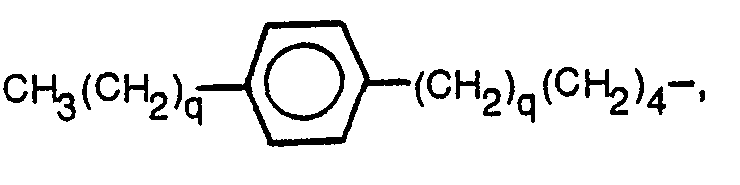
- R4 is hydrogen, bromo, chloro, methyl, trifluoromethyl, hydroxy, mthoxy or nitro and q is described above.
- The compounds of the formula (III) wherein R4 is hydrogen are exemplified by the following classes of compounds:
- (A) where R3 is an alkyl radical containing from 8 to 13 carbon atoms:
- (1) 4,6-dithia-5-(2-dodecylphenyl)nonanedioic acid;
- (2) 4,6-dithia-5-(2-decylphenyl)nonanedioic acid;
- (3) 4,6-dithia-5-(2-octylphenyl)nonanedioic acid;
- (B) where R3 is an alkoxy radical containing from 7 to 12 carbon atoms:
- (1) 4,6-dithia-5-(2-undecyloxyphenyl)nonanedioic acid; and
- (2) 4,6-dithia-5-(2-nonyloxyphenyl)nonanedioic acid;
- (C) where R3 is a thioalkyl radical containing from 7 to 12 carbon atoms or a 1-alkynyl radical containing from 10 to 12 carbon atoms:
- (1) 4,6-dithia-5-(2-undecylthiophenyl)nonanedioic acid; and
- (2) 4,6-dithia-5-[2-(1-dodecyn-1-yl)phenyl]nonanedioic acid;
- (D) where R3 is an 2(Z),5(Z)-undecadienyloxy radical:
- 4,6-dithia-5-[2-(2(Z),5(Z)-undecadienyloxy)phenyl]nonanedioic acid;
- (E) where R3 is a phenyl-C4 to C10 alkyl radical, phenyl-C3 to C2 alkoxy radical or cyclohexyl-C4 to C10 alkyl radical:
- (1) 4,6-dithia-5-[2-(8-phenyloctyl)phenyl]nonanedioic acid;
- (2) 4,6-dithia-5-[2-(6-phenylhexyloxy)phenyl]nonanedioic acid; and
- (3) 4,6-dithia-5-[2-(8-cyclohexyloctyl)phenyl]nonanedioic acid;
- (F) where R3 is a trifluoromethyl-C7 to C12 alkyl radical:
- 4,6-dithia-5-[2-(12,12,12-trifluorododecyl)phenyl]nonanedioic acid;
- (G) where R3 is a

- (H) where R3 is 11-dodecynyl:
- 4,6-dithia-5-[2-(11-dodecynyl)phenyl]nonanedioic acid;
- (I) where R3 is 1-trans-dodecenyl:
- 4,6-dithia-5-[2-(1-trans-dodecenyl)phenyl]nonanedioic acid; and
- (J) where R3 is 5-(4-acetyl-3-hydroxy-2-propylphenoxy)-pentoxy;
- 4,6-dithia-5-[2-(5-(4-acetyl-3-hydroxy-2-propylphenoxy)-pentoxy)phenyl]nonanedioic acid.
- The compounds of the formula (III) wherein R4 is bromo, chloro, methyl, trifluoromethyl, hydroxy, methoxy or nitro are exemplified by the following compounds:
- (A) 4,6-dithia-5-(5-methoxy-2-undecyloxyphenyl)nonanedioic acid;
- (B) 4,6-dithia-5-(5-bromo-2-undecyloxyphenyl)nonanedioic acid;
- (C) 4,6-dithia-5-(5-nitro-2-undecyloxyphenyl)nonanedioic acid;
- (D) 4,6-dithia-5-(5-hydroxy-2-undecyloxyphenyl)nonanedioic acid; and
- (E) 4,6-dithia-5-[2-(8-phenyloctyl)-5-trifluoromethylphenyl]nonanedioic acid.
- Additional illustrations of the compounds of formula (II) are the 3,5-dithiaheptanedioic acid derivatives where both m and n are 1; 4,6-dithiadecanedioic acid derivatives where m is 2 and n is 3; and the 3,5-dithia- octanedioic acid derivatives where m is 1 and n is 2. The 3,5-dithiaheptanedioic acid derivatives of formula (11) are exemplified by 3,5-dithia-4-(2-dodecylphenyl)heptanedioic acid.
- Additional members of this first class of compounds are those represented by the structural formula (II) wherein R1 is hydrogen, R2 is selected from the group consisting of C8 to C13 alkyl, C7 to C12 alkoxy, C7 to C12 thioalkyl, C10 to C12 1-alkynyl, 11-dodecynyl, 1-trans-dodecenyl, 5-(4-acetyl-3-hydroxy-2-propylphenoxy)-pentoxy, 2(Z),(5Z)undecadienyloxy, phenyl-C4 to C10 alkyl, phenyl-C3 to Cg alkoxy, trifluoromethyl-C7 to C12 alkyl, cyclohexyl-C4 to Cio alkyl, and

- A subgeneric class of these compounds are the 4,6-dithianonanedioic acid derivatives represented by the following general structural formula (IV)


- The compounds of formula (IV) wherein R5 is hydrogen are exemplified by the following compounds in which R6 is an alkoxy radical containing from 7 to 12 carbon atoms:
- -(A) 4,6-dithia-5-(3-undecyloxyphenyl)nonanedioic acid; and
- (B) 4,6-dithia-5-(3-nonyloxyphenyl)nonanedioic acid.
- The compounds of the formula (IV) are also exemplified by 4,6-dithia-5-[3-(2(Z),5(Z)-undecadienyloxy)-phenyl]nonanedioic acid and 4,6-dithia-5-[3-(8-phenyloctyl)phenyl]nonanedioic acid.
- A second class of compounds of this invention are the substituted thienyldioic acid analogs of the formula (I) wherein R' is hydrogen and R is the thienyl radical and are represented by the structural formula (V)

- Exemplifying this second class of compounds are 4,6-dithia-5-(3-dodecyl-2-thienyl)nonanedioic acid [formula (V) where m and n are both 2, R, is dodecyl and R2 is hydrogen] and 4,6-dithia-5-(4-dodecyl-2-thienyl)nonanedioic acid [formula (V) where m and n are both 2, R, is hydrogen and R2 is dodecyl].
- Another class of compounds of this invention are the compounds of the formula (I) wherein R' is methyl. Exemplifying this class of compounds is 4,6-dithia-5-methyl-5-(2-undecyloxyphenyl)nonanedioic acid [formula I wherein m and n are both 2, R' is methyl and R is 2-undecyloxyphenyl].
- A further class of compounds of this invention are the compounds of the formula (I) wherein p is 1. Exemplifying this class of compounds is 5-(2-dodecylphenyl)-4-sulfinyl-6-thianonanedioic acid [formula I wherein m and n are both 2, R' is hydrogen, R is 2-dodecylphenyl and p is 1].
- The compounds of the present invention are acidic and are, therefore, capable of forming salts with pharmaceutically acceptable bases according to procedures well known in the art. Such acceptable bases include organic and inorganic bases, such as ammonia, organic amines and alkali metal bases.
- The compounds of the formula (I) wherein p is 0 are conveniently prepared by forming the dithioacetal derivatives or dithioketal derivatives of the aldehydes or ketones, respectively, of the following structural formula (VI)

- The compounds of the formulae (III) and (IV) wherein p is 0 are prepared by reacting 3-mercaptopropionic acid with the appropriate aldehyde of the formula (VI). Similarly, employing mercapto- acetic acid, the compounds of the formula (I) wherein both m and n are 1 and p is 0 can be prepared. To prepare the compounds of formula (I) wherein m is not equal to n and p is 0, a mixture of the appropriate mercaptoalkanoic acids is employed followed by separation and isolation of the desired compounds.
- To prepare the compounds of formula (I) wherein p is 1, the appropriate dithia acid product is conveniently oxidized with either metachloroperbenzoic acid or, when R1 or R2 contains unsaturation, sodium periodate, using one equivalent of either oxidant.
- The aldehydes and ketones of the formula (VI) are known or readily prepared utilizing the general procedures described as follows.
- The aldehyde precursors to the compounds of the formula (II) wherein R, is, for example, an alkyl radical containing 8 to 13 carbon atoms are prepared from the appropriate 2-methoxyphenyl-4,4-dimethyloxazoline [see Meyers et al. J. Org. Chem., 43 1372 (1978)].
- The aldehyde precursors of the compounds of the formula (II) wherein R1 or R2 is, for example, an alkoxy radical containing 7 to 12 carbon atoms or a 2(Z),5(Z)-undecadienyloxy radical are prepared by the O-alkylation of the appropriate 2 or 3 hydroxybenzaldehyde with the corresponding alkylating agent.
- The aldehyde precursors to the compounds of the formula (II) wherein R, or R2 is a 1-alkynyl radical containing 10 to 12 carbon atoms are prepared by coupling a 2 or 3 substituted halobenzaldehyde with the appropriate 1-alkyne in the presence of cuprous iodide and (Pφ3)2PdCl2. [See Hagihara, et al. Synthesis, 627, (1980)]. The catalytic hydrogenation of these alkynyl containing precursors under standard conditions affords the aldehyde precursors of the compounds of the formula (II) wherein R1 or R2 is an alkyl or phenylalkyl radical.
- The aldehyde precursors to the compounds of the formula (V) wherein R, or R2 is an alkyl radical containing 8 to 13 carbon atoms are prepared by the carbonylation of the appropriate 3-alkylthiophene with phosphoryl chloride/dimethylformamide.
- The thioalkyl containing aldehyde precursors of the compounds of the formula (II) are prepared by the reaction of the appropriately substituted halothioalkylbenzene with magnesium and dimethylformamide.
- The leukotriene antagonist activity of the compounds of this invention is measured by the ability of the compounds to inhibit the leukotriene induced contraction of guinea pig tracheal tissues in vitro and to inhibit leukotriene induced bronchoconstriction in guinea pigs in vivo. The following methodologies were employed: In vitro: Guinea pig (adult male albino Hartley strain) tracheal spiral strips of approximate dimensions 2 to 3 mm cross-sectional width and 3.5 cm length were bathed in modified Krebs buffer in jacketed 10 ml tissue bath and continuously aerated with 95% O2/5% C02. The tissues were connected via silk suture to force displacement transducers for recording isometric tension. The tissues were equilibrated for 1 hr., pretreated for 15 minutes with meclofenamic acid (1 uM) to remove intrinsic prostaglandin responses, and then pretreated for an additional 30 minutes with either the test compound or vehicle control. A cumulative concentration-response curve for LTD4 on triplicate tissues was generated by successive increases in the bath concentration of the LTD4. In order to minimize intertissue variability, the contractions elicited by LTD4 were standardized as a percentage of the maximum response obtained to a reference agonist, carbachol (10 µM).
- Calculations: The averages of the triplicate LTD4 concentration-response curves both in the presence and absence of the test compound were plotted on log graph paper. The concentration of LTD4 needed to elicit 30% of the contraction elicited by carbachol was measured and defined as the EC3o. The -log KB value for the test compound was determined by the following equations:


- Calculations: The average of 3-6 animals per treatment was calculated using the % changes in the pulmonary parameters for control and test compound-treated animals. The average % inhibition by the test compound was calculated from the following equation:

- The compounds of this invention possess biosignificant antagonist activity against leukotrienes; primarily leukotriene D4. The antagonist activity of representative compounds of this invention is tabulated below. The -log KB values and the RL values were calculated from the above test protocols.


- The compound 4,6-dithia-5-methyl-5-(2-undecyloxyphenyl)nonanedioic acid exhibited a -log KB of 5.3 and the compound 5-(2-dodecylphenyl)-4-sulfinyl-6-thianonanedioic acid exhibited a -log KB of 5.8.
- The specificity of the antagonist activity of a number of the compounds of this invention is demonstrated by relatively low levels of antagonism toward agonists such as potassium chloride, carbachol, histamine and PGF2a.
- A compound of this invention, namely 4,6-dithia-5-[2-(8-phenyloctyl)phenyl]nonanedioic acid, demonstrated anti-inflammatory activity against arachidonic acid-induced inflammation in mice upon topical, subcutaneous and oral administration (oral ED50 = 104.8 mg/kg). This compound also demonstrated activity against carrageenan peritonitis in mice following oral administration at 100 mg/kg. These results suggest that this compound may also antagonize LTB4 or that it inhibits lipoxygenase activity.
- Pharmaceutical compositions of the present invention comprise a pharmaceutical carrier or diluent and an amount of a compound of the formula (I) or a pharmaceutically acceptable salt, such as an alkali metal salt thereof sufficient to produce the inhibition of the effects of leukotrienes, such as symptoms of asthma and other hypersensitivity diseases.
- When the pharmaceutical composition is employed in the form of a solution or suspension, examples of appropriate pharmaceutical carriers or diluents include: for aqueous systems, water; for non-aqueous systems, ethanol, glycerin, propylene glycol, corn oil, cottonseed oil, peanut oil, sesame oil, liquid parafins and mixtures thereof with water; for solid systems, lactose,.kaolin and mannitol; and for aerosol systems, dichlorodifluoromethane, chlorotrifluoroethane and compressed carbon dioxide. Also, in addition to the pharmaceutical carrier or diluent, the instant compositions may include other ingredients such as stabilizers, antioxidants, preservatives, lubricants, suspending agents, viscosity modifiers and the like, provided that the additional ingredients do not have a detrimental effect on the therapeutic action of the instant compositions.
- The nature of the composition and the pharmaceutical carrier or diluent will, of course, depend upon the intended route of administration, i.e. parenterally, topically or by inhalation.
- In general, particularly for the prophylactic treatment of asthma, the compositions will be in a form suitable for administration by inhalation. Thus the compositions will comprise a suspension or solution of the active ingredient in water for administration by means of a conventional nebulizer. Alternatively the compositions will comprise a suspension or solution of the active ingredient in a conventional liquified propellant or compressed gas to be administered from a pressurized aerosol container. The compositions may also comprise the solid active ingredient diluted with a solid diluent for administration from a powder inhalation device. In the above compositions, the amount of carrier or diluent will vary but preferably will be the major proportion of a suspension or solution of the active ingredient. When the diluent is a solid it may be present in less, equal or greater amounts than the solid active ingredient.
- For parenteral administration the pharmaceutical composition will be in the form of a sterile injectable liquid such as an ampul or an aqueous or nonaqueous liquid suspension.
- For topical administration the pharmaceutical composition will be in the form of a cream or ointment.
- Usually a compound of formula I is administered to an animal subject in a composition comprising a nontoxic amount sufficient to produce an inhibition of the symptoms of an allergic response. When employed in this manner, the dosage of the composition is selected from the range of from 350 mg. to 700 mg. of active ingredient for each administration. For convenience, equal doses will be administered 1 to 4 times daily with the daily dosage regimen being selected from about 350 mg. to about 2800 mg.
- The pharmaceutical preparations thus described are made following the conventional techniques of the pharmaceutical chemist as appropriate to the desired end product.
- Included within the scope of this disclosure is the method of inhibiting the symptoms of an allergic response resulting from a mediator release which comprises administering to an animal subject a therapeutically effective amount for producing said inhibition of a compound of formula I, preferably in the form of a pharmaceutical composition. The administration may be carried out in dosage units at suitable intervals or in single doses as needed. Usually this method will be practiced when relief or allergic symptoms is specifically required. However, the method is also usefully carried out as continuous or prophylactic treatment. It is within the skill of the art to determine by routine experimentation the effective dosage to be administered from the dose range set forth above, taking into consideration such factors as the degree of severity. of the allergic condition being treated, and so forth.
- The following examples illustrate the preparation of the compounds of this invention and their incorporation into pharmaceutical compositions and as such are not to be considered as limiting the invention set forth in the claims appended hereto.
- To freshly prepared dodecylmagnesium bromide (from 30.13 mmoles of dodecyl bromide and 26.20 mmoles of magnesium) in distilled tetrahydrofuran (50 ml) was added 2-(2-methoxyphenyl)-4,4-dimethyloxazoline [A. Meyers et al., J. Org. Chem., 43,1372 (1978)] (17.88 mmoles) in tetrahydrofuran (30 ml). The resultant yellow solution was stirred under argon at ambient temperature for 20 hours. The solution was cooled in an ice water bath and quenched with aqueous ammonium chloride (100 ml). The reaction product was extracted into diethyl ether (100 ml) and the organic phase was washed with saturated sodium chloride solution (50 ml) and then dried over anhydrous magnesium sulfate. Evaporation of the organic phase afforded a colorless oil which was purified by flash chromatography over silica gel with 5 percent ethyl acetate in hexane as eluant to afford the desired product as a pale yellow oil.

- A solution of the compound of Example 1 (a) (17.2 mmoles) in methyl iodide (20 ml) was refluxed under argon for 18 hours. The volatiles were removed under vacuum and the solid residue triturated with ethyl acetate (25 ml) to afford the desired product as white crystals (mp 78-84°C).
- To an ice cold solution of the compound of Example 1(b) (10.0 mmoles) in methanol (50 ml) over a period of 15 minutes was added in small portions sodium borohydride (10.0 mmoles). The reaction mixture was allowed to stir for 30 minutes and was then quenched with 5 percent sodium hydroxide (50 ml). The reaction mixture was extracted with diethyl ether (2 x 50 ml) and the extract was washed with brine (50 ml) and dried over anhydrous magnesium sulfate. Evaporation of the extract afforded an oil which was dissolved in acetone (50 ml) and 3N hydrochloric acid (10 ml) was added. The mixture was flushed with argon and stirred for 16 hours at ambient temperature. The volatiles were removed under vacuum and the residue partitioned between diethyl ether (50 ml) and water (50 ml). The aqueous phase was extracted with more diethyl ether (50 ml). The combined organic phase was washed with brine (50 ml) and dried over anhydrous magnesium sulfate. Evaporation of the organic phase yielded an oil which was purified by flash chromatography over silica gel with 2 percent ethyl acetate in hexane as eluant to afford the desired product as a colorless oil.

- To an ice cold solution of the compound of Example 1(c) (4.23 mmoles) and 3-mercaptopropionic acid (9.3 mmoles) in methylene chloride (25 ml) was added dropwise distilled boron trifluoride etherate (4.23 mmoles). After 15 minutes, the mixture was taken up in diethylether (100 ml) and washed with water (5 x 100 ml). The organic phase was dried over anhydrous magnesium sulfate and after removal of the volatiles under vacuum, the resultant colorless oil was stored under argon in a freezer. It slowly crystallized to afford the desired product as a white solid (mp 34-38°C).

- The following compounds were prepared according to the general method described above from the 2-(2-methoxyphenyl)-4,4-dimethyloxazoline and the appropriate alkyl halide:
- 4,6-dithia-5-(2-decylphenyl)nonanedioic acid (mp 66-69.5°C);
- 4,6-dithia-5-(2-octylphenyl)nonanedioic acid (mp 61-64°C); and
- 3,5-dithia-4-(2-dodecylphenyl)heptanedioic acid (mp 80-81.5=°C).
- Similarly, the following compounds of the formula (II) are prepared utilizing the general method of Example 1 from the appropriate reactants:

- To a stirred suspension of sodium hydride (10.0 mmoles), which was prewashed with petroleum ether, in sieve dried dimethylformamide (10 ml) was added dropwise a solution of salicylaldehyde (10.1 mmoles) in dimethylformamide (1 ml). To the reaction mixture was then added undecyl bromide (10.0 mmoles) and the mixture stirred for 16 hours at ambient temperature under nitrogen. The reaction mixture was taken up in hexane (50 ml) and washed with 10 percent sodium hydroxide (2 x 50 ml) and saturated sodium chloride (50 ml). The organic phase was dried over anhydrous magnesium sulfate and charcoal. Evaporation of the volatiles yielded a colorless liquid which was purified by flash chromatography over silica gel with 2 percent ethyl acetate in hexane as eluant to afford the desired product as an oil.

- Employing the general method of Example 1 (d), the compound of Example 2(a) (3.62 mmoles) was reacted with 3-mercaptopropionic acid (8.03 mmoles) to yield the desired product as a white crystalline solid (mp 76-78.5°C).

- The following compounds were prepared according to the general method described above from the appropriately substituted hydroxybenzaldehyde and the appropriate alkyl halide.
- 4,6-dithia-5-(2-nonyloxyphenyl)nonanedioic acid (mp. 76-78.5°C);
- 4,6-dithia-5[2-(2(Z),5(Z)-undecadienyloxy)phenyl]nonanedioic acid (oil);
- 4,6-dithia-5-(5-methoxy-2-undecyloxyphenyl)nonanedioic acid (mp 55-57°C);
- 4,6-dithia-5-(5-bromo-2-undecyloxyphenyl)nonanedioic acid (mp 79―81°C);
- 4,6-dithia-5-(5-nitro-2-undecyloxyphenyl)nonanedioic acid (mp 99―101°C);
- 4,6-dithia-5-(5-hydroxy-2-undecyloxyphenyl)nonanedioic acid (mp 102―105°C);
- 4,6-dithia-5-(3-undecyloxyphenyl)nonanedioic acid (mp 59―60.5°C);
- 4.6-dithia-5-(3-nonyloxyphenyl)nonanedioic acid (mp 78-79°C) and
- 4,6-dithia-5-[3-(2(Z),5(Z)-undecadienyloxy)phenyl]nonanedioic acid (oil).
- 4,6-Dithia-5-(2-undecylthiophenyl)nonanedioic acid [formula (III) where R3 is―SC11H23 and R4 is H] was prepared from 2-(undecylthio)benzaldehyde and was obtained in the form of an oil.

- The following compound of the formula (I) wherein R' is methyl was prepared according to the general method described above from the appropriate substituted alkoxyacetophenone:
- 4,6-dithia-5-methyl-5-(2-undecyloxyphenyl)nonanedioic acid (amorphous solid).
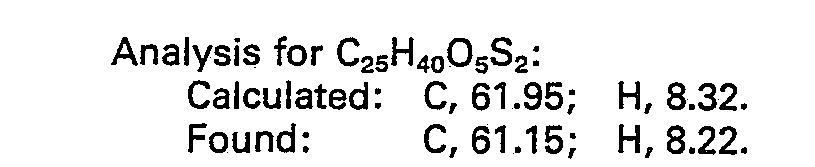
- Similarly, the following compounds of the formula (II) are prepared utilizing the general method of Example 2 from the appropriate reactants.

- A mixture of salicylaldehyde (10.15 moles), undecylbromide (10.3 mmoles) and potassium carbonate (11.7 mmoles) in dimethylformamide (10 ml) is heated to 100°C for 1 hour and then is cooled. The reaction mixture is taken up in hexane and is washed with 5 percent sodium hydroxide and brine. After treatment with anhydrous magnesium sulfate and charcoal, the volatiles are removed under vacuum and the residue is purified by flash chromatography to give the desired product.
- A mixture of 2-bromobenzaldehyde (10.05 mmoles), 1-dodecyne (12.03 mmoles), cuprous iodide (0.11 mmoles) and bis(triphenylphosphine) palladium chloride (0.20 mmoles) in freshly distilled triethylamine (30 ml.) was heated for one hour at reflux producing a white precipitate. The reaction mixture was cooled and filtered. The filtrate was evaporated to dryness at reduced pressure and then dissolved in diethyl ether (50 ml) and washed with brine (50 ml). After treatment with anhydrous magnesium sulfate and charcoal, the solution was evaporated to afford a dark oil, which was purified by flash chromatography (2% Et20/ hexane) to yield the desired product.
- Employing the general method of Example 1(d), the compound of Example 4(a) (2.26 mmoles) was reacted with mercaptopropionic acid (4.93 mmoles) to yield the desired product as a pale yellow liquid.
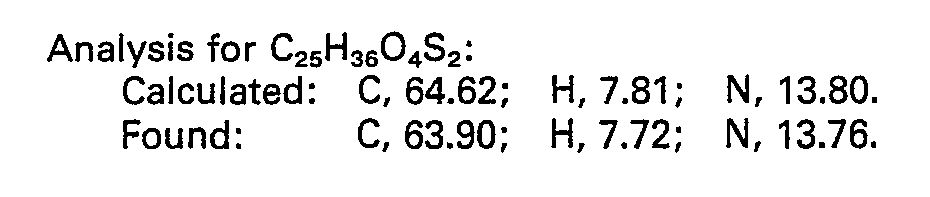
- To a freshly prepared dodecylmagnesium bromide (from 45 mmoles of dodecyl bromide and 45 mmoles of magnesium) in anhydrous diethyl ether (100 ml) was added 3-bromothiophene (45 mmoles) in diethyl ether (25 ml) at ambient temperature under argon and then bis-(1,2-diphenylphosphino)ethane nickel (11) chloride (0.25 g) was added. The reaction mixture was stirred overnight at ambient temperature and then hydrolyzed with ice and saturated aqueous ammonium chloride. The aqueous layer was extracted with diethyl ether (3 x 25 ml) and the organic phases were combined, washed with water (3 x 25 ml), dried over anhydrous magnesium sulfate and concentrated in vacuo. The crude product was purified by distillation in vacuo and then flash chromatography to afford the desired product.
- To a cold solution of phosphoryl chloride (30.3 mmoles) and N,N-dimethylformamide (30.3 mmoles) was added the compound of Example 5(a) (20.2 mmoles) in dimethylformamide (20 ml) under argon with stirring. The mixture was allowed to warm to ambient temperature and then heated at 60°C overnight. The reaction mixture was poured into ice-water (75 ml) and then extracted with diethyl ether (3 x 25 ml). The ether extracts were combined, washed with water (3 x 25 ml), dried over anhydrous magnesium sulfate and concentrated to give a crude mixture of Compounds 5(b)(1) and 5(b)(2) which were purified by preparative high pressure liquid chromatography.
- Employing the general method of Example 1(d), Compound 5(b) (2) (4.6 mmoles) was reacted with 3-mercaptopropionic acid (10.7 mmoles) to yield the desired product, a white crystalline solid (mp 90-92°C).

- Similarly, 4,6-dithia-5-(3-dodecyl-2-thienyl)nonanedioic acid (mp 61-62°C) was prepared from Compound 5(b)(1).

- A solution of 6-phenylhexanoic acid (19.8 mmoles) in sieve dried tetrahydrofuran (5 ml) was reduced with diborane in tetrahydrofuran (30 ml, 29.1 mmoles) at 0°C for 4 hours to give 6-phenylhexanol. To an ice cold solution of the hexanol (ca. 19.8 mmoles) and carbon tetrabromide (21.98 mmoles) in methylene chloride (50 ml) was added triphenylphosphine (22.30 mmoles) in methylene chloride (50 ml) and the resulting solution was stirred for 2.5 hours. The volatiles were evaporated and the residue was taken up in ether (100 ml), cooled in ice, and filtered. The filtrate was evaporated and distilled to afford 6-phenylhexyl bromide as an oil. A mixture of the bromide (8.00 mmoles), salicylaldehyde (8.19 mmoles) and potassium carbonate (9.33 mmoles) in dimethylformamide (10 ml) was heated to 100°C and maintained at that temperature for one hour. The cooled reaction mixture was taken up in hexane (50 ml) and washed with 5% sodium hydroxide (50 ml) and saturated sodium chloride (50 ml). The organic phase was dried over anhydrous magnesium sulfate and charcoal. Evaporation yielded a colorless oil which was purified by flash chromatography over silica gel with 5% ethyl acetate in hexane as eluant to afford the desired product as an oil.
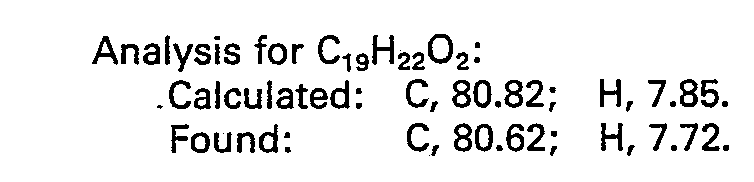
- Employing the general method of Example 1(d), the compound of Example 6(a) (5.35 mmoles) was reacted with 3-mercaptopropionic acid (11.47 mmoles) to yield the desired product as a white solid (mp 71-74°C).

- Following the procedures of Example 1(a), (b) and (c), to 8-phenyloctylmagnesium bromide (from 24.25 mmoles of 8-phenyloctyl bromide and 21.27 mmoles of magnesium) in distilled tetrahydrofuran (40 ml) was added 2-(2-methoxyphenyl)-4,4-dimethyloxazoline (17.10 mmoles) in tetrahydrofuran (20 ml). [The 8-phenyloctyl bromide was prepared from 8-phenyloctanol, carbon tetrabromide and triphenylphosphine in methylene chloride as described in Example 6)a).] After stirring for 24 hours, the reaction mixture was similarly worked up to yield 2-[2-(8-phenyloctyl)phenyll-4,4-dimethyloxazoline as an oil. A solution of the oxazoline (11.58 mmoles) in methyl iodide (20 ml) was refluxed under argon for 18 hours. Removal of the volatiles afforded the corresponding 3,4,4-trimethyloxazolinium iodide as a white solid (mp 76.5-78°C). To an ice cold solution of the iodide (9.46 mmoles) in methanol (35 ml) was added in portions sodium borohydride (9.20 mmoles). Treatment of the reaction mixture as in Example 1(c) results in the isolation of the desired product as an oil.

- A solution of 5-hexynyl alcohol (102 mmoles) in pyridine (150 ml), under argon, was cooled to 0°C and p-toluenesulfonyl chloride (204 mmoles) was added. The reaction mixture was kept at about 4°C for 18 hours, poured into ice-water and then taken up in ether. The ether extract was washed with cold 10% hydrochloric acid, water and brine. The organic layer was dried and concentrated in vacuo to give 5- hexynyl p-toluenesulfonate. A solution of phenylacetylene (97 mmoles) in tetrahydrofuran (200 ml) containing a trace of triphenylmethane was cooled to 0°C and then n-butyl lithium (37.3 ml of 2.6 moles in hexane) was added dropwise. The resulting solution was stirred at 0°C for 10 minutes and hexamethylphosphoramide (21 ml) was added dropwise. After stirring for 10 minutes a solution of 5-hexynyl p-toluenesulfonate (97.1 mmoles) in tetrahydrofuran (200 ml) was added. The reaction mixture was stirred for 18 hours, diluted with ether and the organic layer was washed with water and brine. The dried organic solution was concentrated and the product was purified by flash chromatography to give 1-phenylocta-1,7- diyne. A mixture of this compound (43 mmoles), 2-bromobenzaldehyde (35.8 mmoles), cuprous iodide (0.5 mmoles) and bis(triphenylphosphine) palladium chloride (0.7 mmoles) in triethylamine (100 ml) was heated in an oil bath (95°C) for one hour. The reaction mixture was cooled to 0°C, filtered and the filtrate was concentrated. The residue was dissolved in ether, washed with 10% hydrochloric acid, water and brine. The organic layer was dried and concentrated to give a product which was purified by flash chromatography to yield 2-(8-phenyloctadiyn-1,7-yl)benzaldehyde. A solution of this compound (24.1 mmoles) in ethyl acetate (100 ml) and 10% palladium on charcoal (1 g) was hydrogenated (40 psi of hydrogen) at room temperature for 15 minutes. The catalyst was filtered off and the filtrate concentrated to give the 2-(8-phenyloctyl)benzaidehyde.
- To an ice cold solution of the aldehyde from Example 7(a) or 7(b) (5.94 mmoles) and 3-mercaptopropionic acid (12.97 mmoles) in methylene chloride (32 ml) was added dropwise boron trifluoride etherate (5.94 mmoles). After 15 minutes the reaction mixture was diluted with ether (100 ml) and washed with water (5 x 100 ml). The organic phase was dried over anhydrous magnesium sulfate and charcoal. Evaporation of the volatiles yielded an oil which crystallized to the desired product as a white solid (mp 56-59°C).

- Following the procedures of Example 1 (a), (b) and (c), 12,12,12-trifluorododecylmagnesium bromide (from 29.19 mmoles of 12,12,12-trifluorododecyl bromide and 25.71 mmoles of magnesium) was reacted with 2-(2-methoxyphenyl)-4,4-dimethyloxazoline (20.17 mmoles) in tetrahydrofuran to give 2-[2-(12,12,12-trifluorododecyl)phenyl]-4,4-dimethyloxazoline. The oxazoline (14.39 mmoles) was converted to the methiodide salt and then reduced with sodium borohydride (13.43 mmoles) to yield the desired product as an oil.

- [12,12,12-Trifluorododecyl bromide was obtained by reaction of 12-bromododecanoic acid with an excess of sulfur tetrafluoride under pressure at 125°C for 10 hours.]
- To an ice cold solution of the aldehyde from Example 8(a) (8.65 mmoles) and 3-mercaptopropionic acid (18.93 mmoles) in methylene chloride (40 ml) was added dropwise boron trifluoride etherate (8.62 mmoles). After 15 minutes the reaction mixture was taken up in ether (150 ml) and washed with water (5 x 150mI). The organic phase was dried over anhydrous magnesium sulfate and charcoal, then evaporated to leave an oil which crystallized on cooling to give the desired product as a white solid. Purification by flash chromatography over silica gel with hexane/ethyl acetate/formic acid as eluant afforded the purified product (mp 42-44.5°C).

- A solution of metachloroperbenzoic acid (2.81 mmoles) in methylene chloride (25 ml) was added dropwise over 15 minutes to an ice cold solution of 4,6-dithia-5-(2-dodecylphenyl)nonanedioic acid (2.82 mmoles), prepared as in Example 1 (d), in methylene chloride (25 ml). The solution was stirred at 0°C for 45 minutes, the volatiles were removed by evaporation and the solid residue purified by flash chromatography over silica gel using ethyl acetate/hexane/formic acid as eluant to give the desired product as an oil.

- To an ice cold solution of 1-hexyne (49.6 mmoles) in freshly distilled tetrahydrofuran (50 ml) containing a trace of triphenylmethane was added dropwise n-butyl lithium in hexane (49.5 mmoles). About 10 minutes after the addition was stopped, sieve dried hexamethylphosphoramide (57.5 mmoles) was added and the solution stirred for 10 minutes. A solution of 2-cyclohexylethyl bromide (51.3 mmoles) in tetrahydrofuran (10 ml) was added and the reaction mixture was stirred for about 3 hours as the temperature rose to room temperature. The mixture was taken up in ether (100 ml) and washed with water (3 x 100 ml) and sodium chloride solution (100 ml). The organic phase was dried over magnesium sulfate and evaporated to leave an oil which was purified by flash chromatography to give 1-cyclohexyloct-3-yne. This compound (20.8 mmoles) was treated with potassium hydride (36.8 mmoles) in propylene diamine to obtain the isomeric 8-cyclohexyloct-1-yne as an oil. A mixture of 2-bromobenzaldehyde (12.59 mmoles), 8-cyclohexyloct-1-yne (14.87 mmoles), cuprous iodide (0.17 mmoles) and bis-(triphenylphosphine) palladium chloride (0.26 mmoles) in triethylamine (35 ml) was refluxed under argon for 1.5 hours. The reaction mixture was cooled, filtered and the filtrate evaporated. The resulting residue was dissolved in ether (100 ml), washed with 3 N hydrochloric acid (50 ml) and saturated sodium chloride solution (50 ml) and then dried over anhydrous magnesium sulfate and charcoal. The solution was evaporated to afford an oil which was purified by flash chromatography (2% ether/hexane) to yield 2-(8-cyclohexyl-1-octynyl)benzaldehyde as an oil. This benzaldehyde (10.22 mmoles) was hydrogenated with 10% palladium on charcoal in ethyl acetate to give the desired product as an oil, after chromatography (3% ether/hexane).

- Employing the general method of Example 1(d), the compound of Example 10(a) (4.33 mmoles) was reacted with 3-mercaptopropionic acid (9.52 mmoles) in methylene chloride to yield the desired product as a white solid (mp 61-63.5°C), after chromatography (hexane/ethyl acetate/formic acid).

- Aluminum chloride (0.23 moles) was added in portions over 7 minutes to a mixture of butylbenzene (0.10 moles) and succinic anhydride (0.11 moles) in ethylene chloride (100 ml), cooled to about 13°C. Thirty minutes later the reaction mixture was poured into ice cold 3 N hydrochloric acid (250 ml) and then extracted with ethyl acetate (2 x 100 ml). The extract was washed with saturated sodium chloride (100 ml), dried over magnesium sulfate and evaporated to give 4-(4-butylphenyl)-4-oxobutanoic acid (mp 107-111.5°C). A mixture of this acid (31.63 mmoles), sulfuric acid (0.5 ml) and 10% palladium on charcoal (755 mg) in ethyl acetate (150 ml) was shaken under 50 psi hydrogen for about 15 minutes to yield the reduced product, 4-(4-butylphenyl)butanoic acid (mp 56-58°C). A solution of this acid (27.05 mmoles) in sieve dried tetrahydrofuran (25 ml) was reduced with ice cold diborane in tetrahydrofuran (30 mmoles) for about 1.5 hours to give 4-(4-butylphenyl)butanol as an oil. To an. ice cold solution of the butanol (27 mmoles) and carbon tetrabromide (32.56 mmoles) in methylene chloride (50 ml) was added triphenylphosphine (32.75 mmoles) in methylene chloride (50 ml) over 15 minutes. The reaction mixture was stirred for 45 minutes and then the volatiles were evaporated. The resulting oil was triturated with hexane (2 x 100 ml), filtered, and the filtrate evaporated and chromatographed to leave 4-(4-butylphenyl)butyl bromide as an oil.
- Following the procedures of Example 1(a), (b) and (c), to 4-(4-butylphenyl)butylmagnesium bromide (from 21.47 mmoles of 4-(4-butylphenyl)butyl bromide and 18.96 mmoles of magnesium) in distilled tetrahydrofuran (35 ml) was added 2-(2-methoxyphenyl)-4,4-dimethyloxazoline (16.32 mmoles) in tetrahydrofuran (15 ml). Workup of the reaction mixture furnished 2-[2-(4-(4-butylphenyl)butyl)phenyl]-4,4-dimethyloxazoline as an oil. A solution of the oxazoline (14.41 mmoles) in methyl iodide (20 ml) was refluxed under argon for 18 hours. Removal of the volatiles afforded the corresponding 3,4,4-trimethyloxazolinium iodide as a white solid (mp 91-94°C). To an ice cold solution of the iodide (14.07 mmoles) in methanol was added in portions sodium borohydride (14.30 mmoles). Similar treatment of the reaction mixture resulted in the isolation of the desired benzaldehyde product as an oil.

- To an ice cold solution of the aldehyde from Example 11 (a) (5.03 mmoles) and 3-mercaptopropionic acid (10.90 mmoles) in methylene chloride (30 ml) was added dropwise boron trifluoride etherate (5.04 mmoles). After 7 minutes the reaction mixture was taken up in ether (100 rnf) and washed with water (5 x 100 ml). Treatment with magnesium sulfate and charcoal, followed by evaporation, left an oil which was purified by flash chromatography (silica gel and 2:1 hexane/ethyl acetate 0.5% formic acid as eluant) to give the desired product.

- To a suspension of lithium aluminum hydride (22.2 mmoles) in tetrahydrofuran (30 ml) under argon, cooled to 0°C, was added 2-(1-dodecyn-1-yl) benzaldehyde (11.1 mmoles, prepared as in Example 4a) in tetrahydrofuran (10 ml), dropwise with stirring. After coming to room temperature, the reaction mixture was refluxed for 18 hours. The reaction mixture was then cooled to 0°C, ice was added, followed by ether and dilute hydrochloric acid, and the layers were separated. The organic layer was washed with water and brine. The dried solution was concentrated to give 2-(1-trans-dodecenyl)benzyl alcohol, after recrystallization from acetonitrile. The benzyl alcohol (0.080 mmoles) was dissolved in ethyl acetate (10 ml) under argon and manganese dioxide (12.6 mmoles) was added. The reaction mixture was stirred for 18 hours at room temperature, filtered and the filtrate concentrated to leave an oil which is the desired product.
- Employing the general method of Example 1(d), the compound of Example 12(a) (0.771 mmoles) was reacted with mercaptopropionic acid (1.7 mmoles) to yield the desired product as a white solid, mp 37-40°C.

- To a solution of trimethylsilylacetylene (66.6 mmoles) in tetrahydrofuran (25 ml) cooled to -15°C, under argon, was added dropwise n-butyl lithium (25.6 ml of 2.6 moles in hexane). The resulting solution was stirred for 15 minutes and hexamethylphosphoramide (25 ml) was added. After stirring for 15 minutes the solution was cooled further to -78°C and decyl dibromide (66.6 mmoles) in tetrahydrofuran (150 ml) was added all at once. The reaction mixture was allowed to warm to room temperature and then poured into ice water/ether. The organic layer was washed with water and saturated sodium chloride solution, dried and concentrated. The residual product was purified by flash chromatography (silica column, eluted with hexane) to give trimethylsilyl 11-dodecyny) bromide. This compound (26.15 mmoles) in tetrahydrofuran (50 ml) was added to magnesium turnings (22.35 mmoles) and to the resulting Grignard reagent was added 2-(2-methoxyphenyl)-4,4-dimethyloxazoline (14.9 mmoles) in tetrahydrofuran (30 ml). The solution was stirred under argon at room temperature for 18 hours, cooled and aqueous ammonium chloride was added dropwise. The reaction mixture was diluted with water and ether, and the organic layer was dried and evaporated to leave the product which was purified by flash chromatography to give 2-(trimethylsilyl 11-dodecynylphenyl)-4,4-dimethyloxazoline. A solution of this compound (7.36 mmoles) in methyl iodide. (25 ml) was refluxed for 15 hours. The volatiles were removed under vacuum to leave the semi-solid 2-(trimethylsilyl 11-dodecynylphenyl)-3,4,4-trimethyloxazolinium iodide. To a cooled solution (0°C) of this compound (6.96 mmoles) in methanol (30 ml) was added in portions sodium borohydride (7.30 mmoles). The reaction mixture was stirred for 30 minutes and was then quenched with 5% sodium hydroxide solution. The product was extracted into ether and the dried extract was concentrated to leave an oil which was dissolved in acetone (50 ml). Hydrochloric acid (10 ml, 3N) was added and the mixture was stirred at room temperature for 18 hours. The acetone was removed in vacuo and the residue partitioned between water and ether. The organic layer was dried and concentrated to give the product which was purified by flash chromatography to give as an oil, 2-(trimethylsilyl 11-dodecynyl)benzaldehyde. This compound (2.86 mmoles) was dissolved in methanol (10 ml) under argon, and potassium carbonate (100 mg) was added. The mixture was stirred at room temperature for 18 hours and the solvent removed in vacuo. The residue was dissolved in methylene chloride and the solution washed with 5% sodium bicarbonate solution, water and brine. The dried solution was concentrated to give the desired 2-(11-dodecynyl)benzaldehyde as an oil.
- Employing the general method of Example 1(d), the compound of Example 13(a) (2.73 mmoles) was reacted with mercaptopropionic acid (6.01 mmoles) to yield the product as a white solid, mp 34―38°C.

- To a solution of 2-bromo-5-triflubromethyl benzonitrile (20.16 mmoles) in methylene chloride (50 ml), under argon at room temperature, was added diisobutylaluminum hydride (25 mmoles, 25 ml hexane) dropwise and the resulting solution was stirred for 30 minutes. The reaction mixture was diluted with ether (50 ml), cooled in ice and quenched by the careful addition of hydrochloric acid (50 ml, 3N). The ice bath was removed and the mixture was stirred vigorously for 15 minutes. The organic layer was washed with brine (50 ml), treated with magnesium sulfate-charcoal and evaporated. The resulting oil was purified by distillation to give 2-bromo-5-trifluoromethyl benzaldehyde, bp 50-55°C at 0.05 mm Hg. A mixture of this compound (16.24 mmoles), 1-phenylocta-1,7-diyne (19.54 mmoles, prepared as in Example 7b), cuprous iodide (0.19 mmoles) and bis(triphenylphosphine) palladium chloride (0.34 mmoles) in triethylamine (50 ml) was refluxed under argon for 30 minutes. The reaction mixture was cooled and filtered. The filtrate was evaporated, taken up in ether (100 ml), washed with hydrochloric acid (50 ml, 3N) and sodium chloride, and treated with magnesium sulfate-charcoal. Filtration and evaporation left an oil which was purified by flash chromatography (5% ether/hexane) to yield 2-(8-phenyloctadiyn-1,7-yl)-5-trifluoromethyl benzaldehyde as an oil. A solution of this compound-(13.26 mmoles) in ethyl acetate (100 ml) was treated with charcoal for 30 minutes and then filtered. The solution was then shaken under 50 psi of hydrogen with 10% palladium on charcoal (502 mg) for about 90 minutes. Thin layer chromatography of the reaction mixture indicated about 50% reduction of the aldehyde to the alcohol. To re-oxidize the alcohol, the palladium catalyst was filtered off and manganese dioxide (20 g) was added. This mixture was then stirred at room temperature under argon for 18 hours. Filtration and evaporation gave an oil which was purified by flash chromatography (2% ether/hexane) to afford 2-(8-phenyloctyl)-5-trifluoromethyl benzaldehyde as an oil.
- Employing the general method of Example 1(d), the compound of Example 14(a) (2.75 mmoles) was reacted with mercaptopropionic acid (5.97 mmoles) to yield the desired product as a pale yellow liquid. It was converted to the dipotassium salt by dissolving in potassium carbonate solution (15 ml, 0.3 M) and isolated by lyophilization.
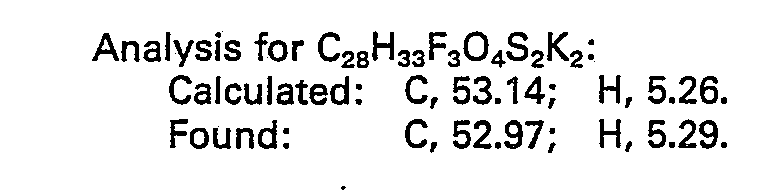
- Similarly, following the procedures of Example 14(a) and (b), 3-bromobenzaldehyde (5.13 mmoles) was reacted with 1-phenylocta-1,7-diyne (6.04 mmoles) to yield 3-(8-phenyloctadiyn-1,7-yl)benzaldehyde which was reduced/oxidized to 3-(8-phenyloctyl)benzaldehyde and the latter (1.87 mmoles) was reacted with mercaptopropionic acid (4.02 mmoles) to give 4,6-dithia-5-[3-(8-phenyloctyl)phenyl]nonanedioic acid, mp 56―60°C.
- A solution of salicylaldehyde (82 mmoles) in acetone (50 ml) was added dropwise to a refluxing solution of 1,5-dibromopentane (90.2 mmoles), potassium carbonate (90.2 mmoles) and potassium iodide (0.4 g) in acetone (200 mi). The mixture was refluxed for 18 hours, filtered and the filtrate concentrated. The residue was dissolved in ether and washed with cold 10% sodium hydroxide solution, water and brine. The organic layer was dried over magnesium sulfate and concentrated. The product was purified by flash chromatography (4% ethyl acetate/hexane) to give 2-(5-bromopentoxy)benzaldehyde. A mixture of this compound (11.1 mmoles), 4-acetyl-3-hydroxy-2-propyl phenol (11.62 mmoles) and potassium carbonate (5.55 mmoles) in acetone (30 ml) was refluxed for 5 days, stirred at room temperature for 2 days and then refluxed for 24 hours. The suspension was cooled to room temperature, filtered and the filtrate concentrated. The residue was dissolved in ethyl acetate and then washed with ice-cold 5% sodium hydroxide solution, water and brine. The dried solution was concentrated and the product flash chromatographed to give the desired product.
- Employing the general procedure of Example 1 (d), the compound of Example 15(a) (2.6 mmoles) was reacted with mercaptopropionic acid (5.2 mmoles) to yield the desired product as a yellow liquid. It was converted to the disodium salt by dissolving in sodium carbonate solution (0.5M) and isolated by lyophilization, mp 146-148°C (dec).

- As a specific embodiment of a composition of this invention, an active ingredient, such as the compound of Example 1(d), is dissolved in 25 mM sodium carbonate at a concentration of 0.4 percent and aerosolized from a nebulizer operating at an air flow adjusted to deliver the desired aerosolized weight of drug.
- As an additional specific embodiment of a composition of this invention, an active ingredient, such as the compound of Example 2(b), is admixed with mannitol at a concentration of 1.0 percent and administered from a powder inhalation device adjusted to deliver the desired weight of drug.
Claims (16)



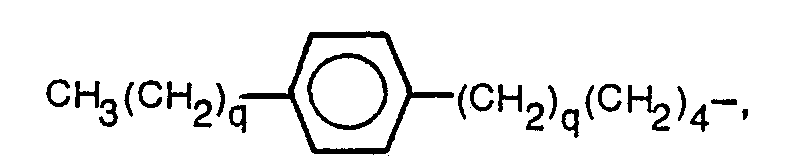
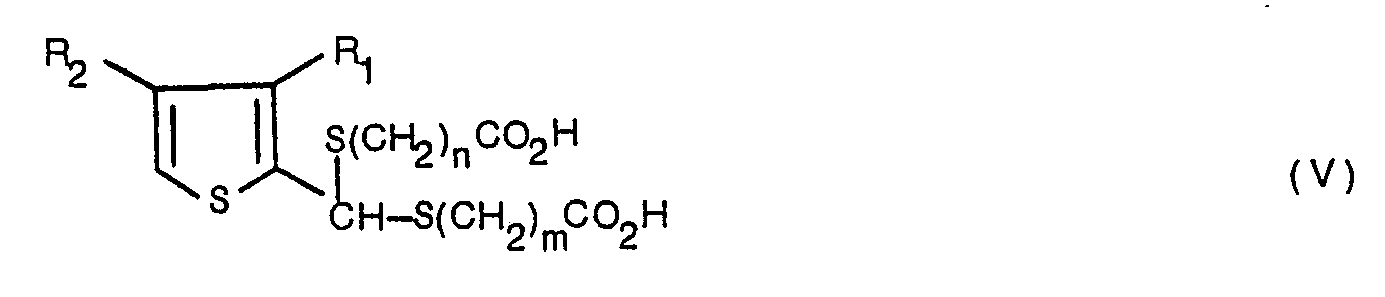

Priority Applications (1)
| Application Number | Priority Date | Filing Date | Title |
|---|---|---|---|
| AT85300276T ATE30018T1 (en) | 1984-01-19 | 1985-01-16 | LEUKOTRIAN ANTAGONISTS. |
Applications Claiming Priority (4)
| Application Number | Priority Date | Filing Date | Title |
|---|---|---|---|
| US57202184A | 1984-01-19 | 1984-01-19 | |
| US572021 | 1984-01-19 | ||
| US63050084A | 1984-07-13 | 1984-07-13 | |
| US630500 | 1984-07-13 |
Publications (2)
| Publication Number | Publication Date |
|---|---|
| EP0168902A1 EP0168902A1 (en) | 1986-01-22 |
| EP0168902B1 true EP0168902B1 (en) | 1987-09-30 |
Family
ID=27075709
Family Applications (1)
| Application Number | Title | Priority Date | Filing Date |
|---|---|---|---|
| EP85300276A Expired EP0168902B1 (en) | 1984-01-19 | 1985-01-16 | Leukotriene antagonists |
Country Status (15)
| Country | Link |
|---|---|
| EP (1) | EP0168902B1 (en) |
| KR (1) | KR900000683B1 (en) |
| AU (1) | AU571635B2 (en) |
| CA (1) | CA1243035A (en) |
| DE (1) | DE3560717D1 (en) |
| DK (1) | DK21085A (en) |
| ES (1) | ES8609230A1 (en) |
| FI (1) | FI79698C (en) |
| GR (1) | GR850106B (en) |
| HU (1) | HU195638B (en) |
| IL (1) | IL74068A (en) |
| NO (1) | NO160576C (en) |
| NZ (1) | NZ210839A (en) |
| PT (1) | PT79835B (en) |
| ZW (1) | ZW1085A1 (en) |
Families Citing this family (2)
| Publication number | Priority date | Publication date | Assignee | Title |
|---|---|---|---|---|
| AU595193B2 (en) * | 1985-04-19 | 1990-03-29 | Smithkline Beckman Corporation | Thio substituted acidic derivatives |
| US4871771A (en) * | 1988-02-04 | 1989-10-03 | Smithkline Beckman Corporation | Leukotriene antagonists |
Family Cites Families (3)
| Publication number | Priority date | Publication date | Assignee | Title |
|---|---|---|---|---|
| BE616326A (en) * | 1961-04-17 | 1900-01-01 | ||
| FR2468362A1 (en) * | 1978-07-12 | 1981-05-08 | Oreal | COSMETIC COMPOSITIONS BASED ON DITHIOETHERS FOR THE TREATMENT OF THE FATTY CONDITION OF HAIR AND SKIN, NEW COMPOUNDS AND PROCESS FOR OBTAINING THEM |
| US4269731A (en) * | 1979-08-27 | 1981-05-26 | Argus Chemical Corporation | Antimony mercaptocarboxylic acid ester stabilizers for polyvinyl chloride resin compositions and process |
-
1985
- 1985-01-14 NO NO850154A patent/NO160576C/en unknown
- 1985-01-14 CA CA000472021A patent/CA1243035A/en not_active Expired
- 1985-01-15 GR GR850106A patent/GR850106B/el unknown
- 1985-01-15 ES ES539566A patent/ES8609230A1/en not_active Expired
- 1985-01-15 NZ NZ210839A patent/NZ210839A/en unknown
- 1985-01-16 IL IL74068A patent/IL74068A/en unknown
- 1985-01-16 DE DE8585300276T patent/DE3560717D1/en not_active Expired
- 1985-01-16 EP EP85300276A patent/EP0168902B1/en not_active Expired
- 1985-01-16 ZW ZW10/85A patent/ZW1085A1/en unknown
- 1985-01-17 HU HU85199A patent/HU195638B/en not_active IP Right Cessation
- 1985-01-17 FI FI850226A patent/FI79698C/en not_active IP Right Cessation
- 1985-01-17 PT PT79835A patent/PT79835B/en unknown
- 1985-01-17 DK DK21085A patent/DK21085A/en unknown
- 1985-01-18 AU AU37779/85A patent/AU571635B2/en not_active Ceased
- 1985-01-19 KR KR1019850000304A patent/KR900000683B1/en not_active Expired
Non-Patent Citations (1)
| Title |
|---|
| CHEMICAL ABSTRACTS, vol. 85, no. 5, 2nd August 1976, Columbus, Ohio, USA; J.J. PESEK et al. "Detection of carbanions in aqueous solution by nuclear magnetic resonance spectroscopy. Hydrogen-deuterium exchange reactions of aromatic mercaptals", page 32188, column 1, abstract no. 32190h * |
Also Published As
| Publication number | Publication date |
|---|---|
| CA1243035A (en) | 1988-10-11 |
| NO160576B (en) | 1989-01-23 |
| DK21085A (en) | 1985-07-20 |
| ES8609230A1 (en) | 1986-07-16 |
| NZ210839A (en) | 1987-10-30 |
| AU3777985A (en) | 1985-08-01 |
| FI79698C (en) | 1990-02-12 |
| KR900000683B1 (en) | 1990-02-03 |
| FI79698B (en) | 1989-10-31 |
| NO160576C (en) | 1989-05-03 |
| ES539566A0 (en) | 1986-07-16 |
| GR850106B (en) | 1985-05-16 |
| IL74068A (en) | 1988-08-31 |
| HUT37748A (en) | 1986-02-28 |
| FI850226L (en) | 1985-07-20 |
| KR850005407A (en) | 1985-08-26 |
| HU195638B (en) | 1988-06-28 |
| NO850154L (en) | 1985-07-22 |
| FI850226A0 (en) | 1985-01-17 |
| AU571635B2 (en) | 1988-04-21 |
| PT79835A (en) | 1985-02-01 |
| EP0168902A1 (en) | 1986-01-22 |
| DK21085D0 (en) | 1985-01-17 |
| PT79835B (en) | 1986-10-28 |
| DE3560717D1 (en) | 1987-11-05 |
| ZW1085A1 (en) | 1985-04-24 |
Similar Documents
| Publication | Publication Date | Title |
|---|---|---|
| EP0154528B1 (en) | Alkene, alkyne or cycloalkylene derivatives | |
| EP0163284B1 (en) | Substituted chromanon-2-yl alkanols and derivatives thereof | |
| EP0104885B1 (en) | Leukotriene antagonists, their production, and compositions containing them | |
| EP0202759B1 (en) | Leukotriene antagonists | |
| JP2554322B2 (en) | 2-Substituted-1-naphthols as 5-lipoxygenase inhibitors | |
| EP0106565B1 (en) | Leukotriene antagonists, their production, and compositions containing them | |
| US4730005A (en) | Leukotriene antagonist | |
| JP2002504537A (en) | Cyclohexanediol derivative | |
| US4874792A (en) | Thiophenyl Alkanoic acids useful as leukotriene antagonists | |
| EP0168902B1 (en) | Leukotriene antagonists | |
| EP0121350B1 (en) | Substituted unsaturated mercaptocarboxylic acids and derivatives as leukotriene antagonists | |
| EP0153009B1 (en) | Leukotriene antagonists | |
| EP0296732A1 (en) | Leukotriene antagonists | |
| US4775662A (en) | Leukotriene antagonists | |
| US5135938A (en) | Leukotriene antagonists | |
| EP0313697B1 (en) | Leukotriene antagonists | |
| AU621337B2 (en) | Leukotriene antagonists | |
| JPH0544450B2 (en) | ||
| CA1225656A (en) | Leukotriene antagonists | |
| EP0168950B1 (en) | Leukotriene antagonists | |
| US5143931A (en) | Leukotriene antagonists containing tetrazolyl groups | |
| US4939279A (en) | Leukotriene antagonists | |
| US4769386A (en) | Imidazolylthioalkenoic acids and -alkenols and leukotriene antagonistic composition containing them |
Legal Events
| Date | Code | Title | Description |
|---|---|---|---|
| PUAI | Public reference made under article 153(3) epc to a published international application that has entered the european phase |
Free format text: ORIGINAL CODE: 0009012 |
|
| 17P | Request for examination filed |
Effective date: 19850128 |
|
| AK | Designated contracting states |
Designated state(s): AT BE CH DE FR GB IT LI LU NL SE |
|
| 17Q | First examination report despatched |
Effective date: 19861218 |
|
| GRAA | (expected) grant |
Free format text: ORIGINAL CODE: 0009210 |
|
| AK | Designated contracting states |
Kind code of ref document: B1 Designated state(s): AT BE CH DE FR GB IT LI LU NL SE |
|
| REF | Corresponds to: |
Ref document number: 30018 Country of ref document: AT Date of ref document: 19871015 Kind code of ref document: T |
|
| ITF | It: translation for a ep patent filed | ||
| REF | Corresponds to: |
Ref document number: 3560717 Country of ref document: DE Date of ref document: 19871105 |
|
| ET | Fr: translation filed | ||
| PLBE | No opposition filed within time limit |
Free format text: ORIGINAL CODE: 0009261 |
|
| STAA | Information on the status of an ep patent application or granted ep patent |
Free format text: STATUS: NO OPPOSITION FILED WITHIN TIME LIMIT |
|
| 26N | No opposition filed | ||
| PGFP | Annual fee paid to national office [announced via postgrant information from national office to epo] |
Ref country code: SE Payment date: 19911230 Year of fee payment: 8 |
|
| PGFP | Annual fee paid to national office [announced via postgrant information from national office to epo] |
Ref country code: GB Payment date: 19921216 Year of fee payment: 9 Ref country code: FR Payment date: 19921216 Year of fee payment: 9 Ref country code: AT Payment date: 19921216 Year of fee payment: 9 |
|
| PGFP | Annual fee paid to national office [announced via postgrant information from national office to epo] |
Ref country code: LU Payment date: 19921231 Year of fee payment: 8 |
|
| PG25 | Lapsed in a contracting state [announced via postgrant information from national office to epo] |
Ref country code: LU Free format text: LAPSE BECAUSE OF NON-PAYMENT OF DUE FEES Effective date: 19930116 |
|
| PG25 | Lapsed in a contracting state [announced via postgrant information from national office to epo] |
Ref country code: SE Effective date: 19930117 |
|
| PGFP | Annual fee paid to national office [announced via postgrant information from national office to epo] |
Ref country code: DE Payment date: 19930127 Year of fee payment: 9 |
|
| ITTA | It: last paid annual fee | ||
| PGFP | Annual fee paid to national office [announced via postgrant information from national office to epo] |
Ref country code: NL Payment date: 19930131 Year of fee payment: 9 |
|
| PGFP | Annual fee paid to national office [announced via postgrant information from national office to epo] |
Ref country code: BE Payment date: 19930212 Year of fee payment: 9 |
|
| EPTA | Lu: last paid annual fee | ||
| PGFP | Annual fee paid to national office [announced via postgrant information from national office to epo] |
Ref country code: CH Payment date: 19930315 Year of fee payment: 9 |
|
| PG25 | Lapsed in a contracting state [announced via postgrant information from national office to epo] |
Ref country code: GB Effective date: 19940116 Ref country code: AT Effective date: 19940116 |
|
| PG25 | Lapsed in a contracting state [announced via postgrant information from national office to epo] |
Ref country code: LI Effective date: 19940131 Ref country code: CH Effective date: 19940131 Ref country code: BE Effective date: 19940131 |
|
| BERE | Be: lapsed |
Owner name: SMITHKLINE BEECHAM CORP. Effective date: 19940131 |
|
| PG25 | Lapsed in a contracting state [announced via postgrant information from national office to epo] |
Ref country code: NL Effective date: 19940801 |
|
| GBPC | Gb: european patent ceased through non-payment of renewal fee |
Effective date: 19940116 |
|
| NLV4 | Nl: lapsed or anulled due to non-payment of the annual fee | ||
| PG25 | Lapsed in a contracting state [announced via postgrant information from national office to epo] |
Ref country code: FR Effective date: 19940930 |
|
| REG | Reference to a national code |
Ref country code: CH Ref legal event code: PL |
|
| PG25 | Lapsed in a contracting state [announced via postgrant information from national office to epo] |
Ref country code: DE Effective date: 19941001 |
|
| REG | Reference to a national code |
Ref country code: FR Ref legal event code: ST |
|
| EUG | Se: european patent has lapsed |
Ref document number: 85300276.4 Effective date: 19930810 |