EP0167934A2 - Tire sealer and inflator - Google Patents
Tire sealer and inflator Download PDFInfo
- Publication number
- EP0167934A2 EP0167934A2 EP85107934A EP85107934A EP0167934A2 EP 0167934 A2 EP0167934 A2 EP 0167934A2 EP 85107934 A EP85107934 A EP 85107934A EP 85107934 A EP85107934 A EP 85107934A EP 0167934 A2 EP0167934 A2 EP 0167934A2
- Authority
- EP
- European Patent Office
- Prior art keywords
- composition
- tire
- inflator
- sealant
- composition according
- Prior art date
- Legal status (The legal status is an assumption and is not a legal conclusion. Google has not performed a legal analysis and makes no representation as to the accuracy of the status listed.)
- Withdrawn
Links
Classifications
-
- B—PERFORMING OPERATIONS; TRANSPORTING
- B29—WORKING OF PLASTICS; WORKING OF SUBSTANCES IN A PLASTIC STATE IN GENERAL
- B29C—SHAPING OR JOINING OF PLASTICS; SHAPING OF MATERIAL IN A PLASTIC STATE, NOT OTHERWISE PROVIDED FOR; AFTER-TREATMENT OF THE SHAPED PRODUCTS, e.g. REPAIRING
- B29C73/00—Repairing of articles made from plastics or substances in a plastic state, e.g. of articles shaped or produced by using techniques covered by this subclass or subclass B29D
- B29C73/16—Auto-repairing or self-sealing arrangements or agents
- B29C73/163—Sealing compositions or agents, e.g. combined with propellant agents
-
- B—PERFORMING OPERATIONS; TRANSPORTING
- B29—WORKING OF PLASTICS; WORKING OF SUBSTANCES IN A PLASTIC STATE IN GENERAL
- B29L—INDEXING SCHEME ASSOCIATED WITH SUBCLASS B29C, RELATING TO PARTICULAR ARTICLES
- B29L2030/00—Pneumatic or solid tyres or parts thereof
-
- Y—GENERAL TAGGING OF NEW TECHNOLOGICAL DEVELOPMENTS; GENERAL TAGGING OF CROSS-SECTIONAL TECHNOLOGIES SPANNING OVER SEVERAL SECTIONS OF THE IPC; TECHNICAL SUBJECTS COVERED BY FORMER USPC CROSS-REFERENCE ART COLLECTIONS [XRACs] AND DIGESTS
- Y10—TECHNICAL SUBJECTS COVERED BY FORMER USPC
- Y10S—TECHNICAL SUBJECTS COVERED BY FORMER USPC CROSS-REFERENCE ART COLLECTIONS [XRACs] AND DIGESTS
- Y10S428/00—Stock material or miscellaneous articles
- Y10S428/912—Puncture healing layer
-
- Y—GENERAL TAGGING OF NEW TECHNOLOGICAL DEVELOPMENTS; GENERAL TAGGING OF CROSS-SECTIONAL TECHNOLOGIES SPANNING OVER SEVERAL SECTIONS OF THE IPC; TECHNICAL SUBJECTS COVERED BY FORMER USPC CROSS-REFERENCE ART COLLECTIONS [XRACs] AND DIGESTS
- Y10—TECHNICAL SUBJECTS COVERED BY FORMER USPC
- Y10T—TECHNICAL SUBJECTS COVERED BY FORMER US CLASSIFICATION
- Y10T152/00—Resilient tires and wheels
- Y10T152/10—Tires, resilient
- Y10T152/10495—Pneumatic tire or inner tube
- Y10T152/10666—Automatic sealing of punctures [e.g., self-healing, etc.]
- Y10T152/10675—Using flowable coating or composition
- Y10T152/10684—On inner surface of tubeless tire
Definitions
- This invention relates to a novel composition useful as a tire sealant and inflator.
- the composition contains a resin, a sealant, a freeze point depressant, a fiber component, a corrosion inhibitor, a foaming agent, and water.
- the composition is useful for temporarily sealing and inflating a punctured automobile tire in combination with a propellant/ inflator.
- a product of this type available in the car, provides assurance that the motorist will not be required to change a flat tire on the road. Further, the driver of a car which is not equipped with a spare tire, can inflate a flat tire sufficiently to safely reach a repair facility without the inconvenience and danger of being stranded on the road or having to use road service.
- U. S. Patent 4,101,494 to Kent et al discloses a tire sealant ccmposition containing water, ethylene glycol, polyvinyl alcohol, asbestos fibers, fiberglass fibers, a wetting agent, and a rust preventative.
- U. S. Patent 4,137,206 and 4,224,208 to Kent disclose sealant compositions containing water, ethylene glycol, amines such as lower alkylamines, lower cycloalkylamines, napthylamines, morpholines, benzothiazoles, and salts thereof, a methyl cellulose or polyvinyl alcohol component, and fiberglass or asbestos fibers.
- amines such as lower alkylamines, lower cycloalkylamines, napthylamines, morpholines, benzothiazoles, and salts thereof, a methyl cellulose or polyvinyl alcohol component, and fiberglass or asbestos fibers.
- U. S. Patent 4,337,322 to Japson discloses a wheel balancing and sealant composition comprising water, ethylene glycol, polyisoprene, process oil, detergent, sodium bicarbonate, and asbestos fibers.
- U. S. Patent 4,426,468 discloses tire sealant compositions comprising butyl rubber, polyisobutylene and/or polybutene, a resin, zinc oxide, carbon black, polystyrene, para-quinone, and benzoyl peroxide
- Japanese patent publication number 57-63374 discloses a tire sealant composition which includes water, a rust preventative, an organic polymer, and a bacterial growth inhibitor.
- a tire sealer and inflator composition In order to be useful under adverse road conditions, a tire sealer and inflator composition must be sufficiently tacky and cohesive to be able to seal a puncture in a tire whether or not the puncturing object remains in the puncture hole.
- the composition must be able to seal a puncture in any position on the tire when applied through the tire's valve stem. Further, the seal must withstand the internal pressure of the tire, as well as the pressure exerted on the tire by the weight of the car.
- the present invention provides a new tire sealer composition which represents an improvement in such compositions and is particularly suitable for use on modern tires.
- a still further object of this invention to provide a tire sealant composition capable of sealing a puncture at any location on the tire surface when the sealant is applied through the valve stem of the tire.
- a still further object of this invention is to provide the motorist with an aerosol can of tire sealer and inflator containing no flammable propellants and thus providing him with a safety feature not found in products of this type which are usually propelled with flammable low molecular weight hydrocarbons.
- the present invention provides a tire sealant and inflator composition comprising the following components combined with a propellant/inflator:
- the composition is applied to a punctured tire with the propellants which also act to inflate the tire.
- the composition is packaged in aerosol containers with the chlorofluorocarbon propellant or chlorofluorocarbon propellant mixture.
- the composition is applied to the tire through the valve stem. Once released into the interior of the tire, the composition forms a fiber containing foam. This foam acts to seal any puncture at any location on the tire. Further, the action of the foam and the propellant inflates the tire sufficiently so that the tire can support the weight of car.
- a tire sealant and inflator composition must have certain specific characteristics in order to be useful, even under the adverse conditions to which it will be subjected when used on a tire.
- an object which punctures a tire on a highway will remain in the tire when the sealant composition is applied.
- the sealant must have sufficient tack and cohesiveness to remain adhered to the object, even while the object shifts back and forth during tire use.
- the sealant composition must be capable of flowing into the remaining hole and sealing it. Further, the seal must withstand the internal pressure of the inflated tire, as well as the pressure placed on the tire by the weight of the tire and the friction of the road when the car is moving.
- the sealer must be able to seal a puncture in any position on the tire when the sealant is applied through the valve stem of the tire. Also, the sealant must have inflation characteristics, and must be able to inflate a tire at substantially 0 psi to a pressure sufficient to support the weight of the car.
- the present invention provides a novel tire sealant and inflator composition contained in a container with a propellant, the composition comprising:
- the sealant composition of this invention when used in conjunction with a suitable propellant, is administered to a punctured tire through the tire's valve stem.
- the composition then forms a fiber containing foam which is capable of sealing a puncture in any location on the tire's surface.
- the propellant which is preferably a chlorofluorocarbon propellant or a chlorofluorocarbon propellant mixture, not only propels the composition into the tire but also inflates the sealed tire to a point sufficient to support the weight of the car.
- the resin component of the novel tire sealant composition is present in an amount from about 20 to 40 wt.%. In a preferred embodiment, the resin is present in an amount from 25-30 wt.%, and most preferably at 27 wt.%.
- suitable resins useful in the practice of the invention include phenolic resins, such as phenolformaldehyde resins and halogenated alkyl phenol resins, and include derivatives of hydrogenated vegetable resins.
- the preferred resin is Foral 85 - 55WKX, obtained from Hercules, Inc., which is a dispersion of glycerol esters of hydrogenated wood rosins. However, any similar natural or synthetic resin or rosin may be used which is compatible with the formulation and performs the required function of the resin.
- the latex sealant component is also present in an amount from about 20-40 wt.%. In a preferred embodiment, the latex sealant is present at 25-30 wt.%, and in the most preferred embodiment, at 27 wt.%.
- the latex used in the present invention may be any suitable polymeric or copolymeric latex, such as polymers and/or copolymers of isoprene, styrene, and butadiene.
- the preferred latex is a styrene/butadiene copolymer, tradename Pliolite 5356, obtained from Goodyear, as Pliolite latex which has a butadiene content greater than 50 percent. This product is a fatty acid emulsified product.
- alkylene glycol is present in the sealant composition in an amount from 2-20 wt.%. In a preferred embodiment, the alkylene glycol is present from 5-10%, and most preferably at 7.5%. Any technical grade alkylene glycol may be used in this invention.
- the alkylene glycol is any suitable glycol containing up to 8 carbon atoms.
- Ethylene glycol is the preferred freeze point depressant. The ethylene glycol acts as a freeze point depressant, and allows the sealant composition to be used at extremely low winter temperatures.
- the fibers are present in the composition in an amount from about 0.1-to 15 wt.%, although in a preferred embodiment they are present in an amount of from 1-5 wt.%, and most preferably 2%.
- the fibers can be any suitable fiber which promotes clotting when the composition is applied to a puncture. Suitable fibers include, but are not limited to, inorganic fibers, such as asbestos and fiberglass, and organic fibers, such as cellulose, polypropylene, and similar natural or synthetic polymeric fibers.
- the preferred fibers are organic fibers and preferably cellulosic fibers, tradename Solka Flok, obtained from Grefco, Inc.
- the addition of the fibers to the composition speed the setting of the latex rising to the puncture of the tire, and hence speed the sealing of the puncture.
- the alkanolamine component is present in an amount from about 0.1-15 wt.%. In the preferred embodiments, the alkanolamine is present in an amount of from 1-4%, and most preferably in an amount of 1.8%.
- the alkanolamine is preferably an alkanolamine of up to 6 carbon atoms in which the amine may contain one or two akyl substituents of up to 5 carbon atoms.
- the preferred alkanolamine is an ethanolamine such as N,N-dimethylethanolamine, which was obtained from Union Carbide. However, any equivalent alkanolamine may be used.
- the alkanolamine provides both vapor and liquid phase rust inhibition. The rust inhibiting property is important since the tire sealing liquid could remain in contact with the wheel rim for extended periods of time.
- the foaming agent is present in an amount from about 0.1-10 wt.%, preferably from .5-2 wt.%, and most preferably at 1 wt.%.
- the foaming agents of this invention are fatty acid derivatives having from 10-25 carbon atoms.
- the preferred foaming agent is an amphoteric surfactant derived from fatty imidazolines, particularly a compound.-containing coconut fatty acid as the fatty acid radical, tradename Miranol C 2 M, obtained from the Miranol Chemical Company. However, any equivalent foaming agent may be used.
- the tire sealant and inflator composition of the invention is prepared by first mixinc the foaming agent and alkanolamine with the water, and then adding the alkalene glycol. The fibers are added and mixed, followed by the latex and resin components. The composition is then stirred until homogeneous.
- the sealant composition is packaged in sealed containers such as aerosol cans mixed with a propellant such as a chlorofluorocarbon propellant, a chlorofluorocarbon propellant mixture, or a similar propellant.
- a propellant such as a chlorofluorocarbon propellant, a chlorofluorocarbon propellant mixture, or a similar propellant.
- the preferred chlorofluorocarbon components are dichlorodifluoromethane, tradename Freon 12, and dichlorotetrafluoroethane, tradename Freon 114, both of which may be obtained commercially from Dupont. However, other chlorofluorocarbons may be used.
- other propellants such as low molecular weight hydrocarbons, e.g., gaseous alkanes, can also be used; however, in this case the non-flammable safety features of the product would be lost.
- the Freon 12 and Freon l14 are present in a 60/40 wt.% mixture.
- the resulting mixture will contain about 30 to 45 wt.% of sealant composition and about 70 to 55 wt.% of propellant. If a hydrocarbon propellant is used, larger amounts of hydrocarbon may be placed in the container under pressure.
- fluorocarbon or hydrocarbon component as a combination propellant for the composition and inflator for the tire.
- this component has a dual function in the composition.
- the sealant mixture contained in the aerosol container, is applied to a punctured tire through the valve stem.
- the container is provided with a suitable known tube and connector for activation of the valve stem.
- the action of the propellant and the foaming agent causes the sealant composition to foam and to coat the interior of the tire surface.
- the composition then sets, thereby sealing any puncture at any location of the tire surface.
- the presence of the organic fibers accelerates the setting time of the resin composition in the sealer.
- the propellant causes the tire to inflate.
- the internal pressure of the tire will be sufficient to support the weight of the car.
- thermal expansion will cause the pressure of the tire to increase 50-100%, thereby bringing the internal tire pressure to within recommended safety standards.
- a tire sealant and inflator composition of the following formula was prepared.
- the N,N-dimethylethanolamine and the Miranol C 2 M were dissolved in the water. After the Miranol dissolved, ethylene glycol was added and mixed until homogeneous. While stirring, the Solka Flok was added and mixed until well dispersed. The Pliolite latex was then added followed by the Foral resin, and the composition was stirred until a uniform, homogenously dispersed product was obtained.
- Example 1 The product of Example 1 was filled into a 20 ounce net weight fill aerosol can with a 50/50 wt.% blend of Freon 12 and Freon 114 as inflator/ propellant.
- An Eldorado Supreme G78-14 tire was punctured with a 5/32 inch nail, 180° opposite the valve stem. This is considered to be the most difficult position to repair because of the distance the foaming sealer must travel from the valve before reaching its destination at the point of puncture.
- the tire had deflated to approximately 0 psi without breaking the bead of the tire.
- the tire was placed in a position with the valve stem at 6 o'clock and the puncture at 12 o'clock, and the sample was applied to the valve stem.
- a 16 ounce net weight fill aerosol can containing the product of Example 1 with the 50/50 Freon 12, Freon 114 mixture as a propellant was prepared.
- the can was tested on a Gillette "Golden Bear” polyester/fiberfill G78-14 size tire.
- Experimental conditions were the same as in Example 2, except the tire was allowed to deflate to 6 psi. This represents a characteristic pressure loss upon the occurrence of a flat tire.
- the tire was inflated with the 16 ounce can, and a pressure of 14 psi was recorded immediately thereafter. The tire was then driven for three miles, and a pressure of 21 psi was recorded. No leaks were detected after the three mile drive, and the tire held pressure during subsequent observation.
- Example 1 In order to achieve higher initial inflation pressures, the product of Example 1 was packaged into 20 ounce net weight aerosol cans with a 60/40 blend of Freon 12 and Freon 114. The product of Example 1 was packaged at a weight percent of 35%, with the Freon propellant at 65%. The 20 ounce can was used to inflate a punctured B. F. Goodrich "Lifesaver XLM" steel belted tire. The test conditions were the same as in Examples 2 and 3. Immediately after inflation, a pressure of 18 psi was observed. After being driven the three mile distance, the tire pressure had increased to 27 psi.
- a one pound net weight aerosol can was prepared with the product of Example 1 and the 60/40 Freon 12/114 propellant mixture.
- the one pound can was used to inflate a B. F. Goodrich steel belted radial P175/75R14 tire, which had been allowed to deflate to 6 psi after being punctured.
- a pressure of 20 psi was obtained.
- the pressure of the tire rose to 30 psi.
- the tire registered a pressure of 25 psi.
- the pressure of the tire again rose to 30 psi.
- the pressure loss is believed to be due to frequent testing with a gauge, since there was no leak detectable at the original point of puncture. Again, the rise of 5 psi when the tire was warmed in the oven for five hours is not considered to be an excessive rise in pressure.
Landscapes
- Engineering & Computer Science (AREA)
- Mechanical Engineering (AREA)
- Sealing Material Composition (AREA)
Abstract
Description
- This invention relates to a novel composition useful as a tire sealant and inflator. The composition contains a resin, a sealant, a freeze point depressant, a fiber component, a corrosion inhibitor, a foaming agent, and water. The composition is useful for temporarily sealing and inflating a punctured automobile tire in combination with a propellant/ inflator.
- The advantages of a portable tire repair kit have long been appreciated. A product of this type, available in the car, provides assurance that the motorist will not be required to change a flat tire on the road. Further, the driver of a car which is not equipped with a spare tire, can inflate a flat tire sufficiently to safely reach a repair facility without the inconvenience and danger of being stranded on the road or having to use road service.
- A number of prior art tire sealant compositions have been described. U. S. Patent 4,101,494 to Kent et al discloses a tire sealant ccmposition containing water, ethylene glycol, polyvinyl alcohol, asbestos fibers, fiberglass fibers, a wetting agent, and a rust preventative.
- U. S. Patent 4,137,206 and 4,224,208 to Kent disclose sealant compositions containing water, ethylene glycol, amines such as lower alkylamines, lower cycloalkylamines, napthylamines, morpholines, benzothiazoles, and salts thereof, a methyl cellulose or polyvinyl alcohol component, and fiberglass or asbestos fibers.
- U. S. Patent 4,337,322 to Japson discloses a wheel balancing and sealant composition comprising water, ethylene glycol, polyisoprene, process oil, detergent, sodium bicarbonate, and asbestos fibers.
- Ornum et al, U. S. Patent 4,426,468 discloses tire sealant compositions comprising butyl rubber, polyisobutylene and/or polybutene, a resin, zinc oxide, carbon black, polystyrene, para-quinone, and benzoyl peroxide, and Japanese patent publication number 57-63374 discloses a tire sealant composition which includes water, a rust preventative, an organic polymer, and a bacterial growth inhibitor.
- In order to be useful under adverse road conditions, a tire sealer and inflator composition must be sufficiently tacky and cohesive to be able to seal a puncture in a tire whether or not the puncturing object remains in the puncture hole. The composition must be able to seal a puncture in any position on the tire when applied through the tire's valve stem. Further, the seal must withstand the internal pressure of the tire, as well as the pressure exerted on the tire by the weight of the car.
- The present invention provides a new tire sealer composition which represents an improvement in such compositions and is particularly suitable for use on modern tires.
- It is accordingly an object of this invention to provide a sealant composition which is capable of sealing a tire puncture with or without the puncturing object still embedded in the tire.
- It is a further object of this invention to provide a sealant composition capable of withstanding the internal inflated pressure of the tire as well as the pressure exerted on the tire by the weight of the car and the friction of the road surface.
- A still further object of this invention to provide a tire sealant composition capable of sealing a puncture at any location on the tire surface when the sealant is applied through the valve stem of the tire.
- It is an even further object of this invention to provide a tire sealant and inflator composition which allows the tire to be inflated from substantially 8 psi to an internal pressure sufficient to support the weight of the car.
- A still further object of this invention is to provide the motorist with an aerosol can of tire sealer and inflator containing no flammable propellants and thus providing him with a safety feature not found in products of this type which are usually propelled with flammable low molecular weight hydrocarbons.
- Other objects and advantages of the invention will become apparent as the description thereof proceeds.
- In satisfaction of the foregoing objects, the present invention provides a tire sealant and inflator composition comprising the following components combined with a propellant/inflator:

- The composition is applied to a punctured tire with the propellants which also act to inflate the tire. In the preferred embodiment, the composition is packaged in aerosol containers with the chlorofluorocarbon propellant or chlorofluorocarbon propellant mixture. The composition is applied to the tire through the valve stem. Once released into the interior of the tire, the composition forms a fiber containing foam. This foam acts to seal any puncture at any location on the tire. Further, the action of the foam and the propellant inflates the tire sufficiently so that the tire can support the weight of car.
- A tire sealant and inflator composition must have certain specific characteristics in order to be useful, even under the adverse conditions to which it will be subjected when used on a tire. In many cases, an object which punctures a tire on a highway, will remain in the tire when the sealant composition is applied. In this case, the sealant must have sufficient tack and cohesiveness to remain adhered to the object, even while the object shifts back and forth during tire use. When the puncturing object is removed from the tire, the sealant composition must be capable of flowing into the remaining hole and sealing it. Further, the seal must withstand the internal pressure of the inflated tire, as well as the pressure placed on the tire by the weight of the tire and the friction of the road when the car is moving. The sealer must be able to seal a puncture in any position on the tire when the sealant is applied through the valve stem of the tire. Also, the sealant must have inflation characteristics, and must be able to inflate a tire at substantially 0 psi to a pressure sufficient to support the weight of the car.
- To provide a product which meets these requirements, the present invention provides a novel tire sealant and inflator composition contained in a container with a propellant, the composition comprising:

- The sealant composition of this invention, when used in conjunction with a suitable propellant, is administered to a punctured tire through the tire's valve stem. The composition then forms a fiber containing foam which is capable of sealing a puncture in any location on the tire's surface. Further, the propellant, which is preferably a chlorofluorocarbon propellant or a chlorofluorocarbon propellant mixture, not only propels the composition into the tire but also inflates the sealed tire to a point sufficient to support the weight of the car.
- The resin component of the novel tire sealant composition is present in an amount from about 20 to 40 wt.%. In a preferred embodiment, the resin is present in an amount from 25-30 wt.%, and most preferably at 27 wt.%. Examples of suitable resins useful in the practice of the invention include phenolic resins, such as phenolformaldehyde resins and halogenated alkyl phenol resins, and include derivatives of hydrogenated vegetable resins. The preferred resin is Foral 85- 55WKX, obtained from Hercules, Inc., which is a dispersion of glycerol esters of hydrogenated wood rosins. However, any similar natural or synthetic resin or rosin may be used which is compatible with the formulation and performs the required function of the resin.
- The latex sealant component is also present in an amount from about 20-40 wt.%. In a preferred embodiment, the latex sealant is present at 25-30 wt.%, and in the most preferred embodiment, at 27 wt.%. The latex used in the present invention may be any suitable polymeric or copolymeric latex, such as polymers and/or copolymers of isoprene, styrene, and butadiene. The preferred latex is a styrene/butadiene copolymer, tradename Pliolite 5356, obtained from Goodyear, as Pliolite latex which has a butadiene content greater than 50 percent. This product is a fatty acid emulsified product.
- An alkylene glycol is present in the sealant composition in an amount from 2-20 wt.%. In a preferred embodiment, the alkylene glycol is present from 5-10%, and most preferably at 7.5%. Any technical grade alkylene glycol may be used in this invention. The alkylene glycol is any suitable glycol containing up to 8 carbon atoms. Ethylene glycol is the preferred freeze point depressant. The ethylene glycol acts as a freeze point depressant, and allows the sealant composition to be used at extremely low winter temperatures.
- The fibers are present in the composition in an amount from about 0.1-to 15 wt.%, although in a preferred embodiment they are present in an amount of from 1-5 wt.%, and most preferably 2%. The fibers can be any suitable fiber which promotes clotting when the composition is applied to a puncture. Suitable fibers include, but are not limited to, inorganic fibers, such as asbestos and fiberglass, and organic fibers, such as cellulose, polypropylene, and similar natural or synthetic polymeric fibers. The preferred fibers are organic fibers and preferably cellulosic fibers, tradename Solka Flok, obtained from Grefco, Inc. The addition of the fibers to the composition speed the setting of the latex rising to the puncture of the tire, and hence speed the sealing of the puncture.
- The alkanolamine component is present in an amount from about 0.1-15 wt.%. In the preferred embodiments, the alkanolamine is present in an amount of from 1-4%, and most preferably in an amount of 1.8%. The alkanolamine is preferably an alkanolamine of up to 6 carbon atoms in which the amine may contain one or two akyl substituents of up to 5 carbon atoms. The preferred alkanolamine is an ethanolamine such as N,N-dimethylethanolamine, which was obtained from Union Carbide. However, any equivalent alkanolamine may be used. The alkanolamine provides both vapor and liquid phase rust inhibition. The rust inhibiting property is important since the tire sealing liquid could remain in contact with the wheel rim for extended periods of time.
- The foaming agent is present in an amount from about 0.1-10 wt.%, preferably from .5-2 wt.%, and most preferably at 1 wt.%. The foaming agents of this invention are fatty acid derivatives having from 10-25 carbon atoms. The preferred foaming agent is an amphoteric surfactant derived from fatty imidazolines, particularly a compound.-containing coconut fatty acid as the fatty acid radical, tradename Miranol C2M, obtained from the Miranol Chemical Company. However, any equivalent foaming agent may be used.
- The tire sealant and inflator composition of the invention is prepared by first mixinc the foaming agent and alkanolamine with the water, and then adding the alkalene glycol. The fibers are added and mixed, followed by the latex and resin components. The composition is then stirred until homogeneous.
- The sealant composition is packaged in sealed containers such as aerosol cans mixed with a propellant such as a chlorofluorocarbon propellant, a chlorofluorocarbon propellant mixture, or a similar propellant. The preferred chlorofluorocarbon components are dichlorodifluoromethane, tradename Freon 12, and dichlorotetrafluoroethane, tradename Freon 114, both of which may be obtained commercially from Dupont. However, other chlorofluorocarbons may be used. In addition, other propellants, such as low molecular weight hydrocarbons, e.g., gaseous alkanes, can also be used; however, in this case the non-flammable safety features of the product would be lost. In the preferred embodiment, the Freon 12 and Freon l14 are present in a 60/40 wt.% mixture. The resulting mixture will contain about 30 to 45 wt.% of sealant composition and about 70 to 55 wt.% of propellant. If a hydrocarbon propellant is used, larger amounts of hydrocarbon may be placed in the container under pressure.
- An important feature of the invention is use of the fluorocarbon or hydrocarbon component as a combination propellant for the composition and inflator for the tire. Thus this component has a dual function in the composition.
- The sealant mixture, contained in the aerosol container, is applied to a punctured tire through the valve stem. The container is provided with a suitable known tube and connector for activation of the valve stem. Upon release into the interior of the tire, the action of the propellant and the foaming agent causes the sealant composition to foam and to coat the interior of the tire surface. The composition then sets, thereby sealing any puncture at any location of the tire surface. The presence of the organic fibers accelerates the setting time of the resin composition in the sealer. Simultaneously, the propellant causes the tire to inflate. When the tire is inflated at ambient temperature, the internal pressure of the tire will be sufficient to support the weight of the car. However, when the tire is driven several miles, thermal expansion will cause the pressure of the tire to increase 50-100%, thereby bringing the internal tire pressure to within recommended safety standards.
- The following examples are presented to illustrate the invention. However, the invention is not to be considered as limited thereto. In the Examples and throughout the specification, parts are by weight unless otherwise indicated.
- A tire sealant and inflator composition of the following formula was prepared.
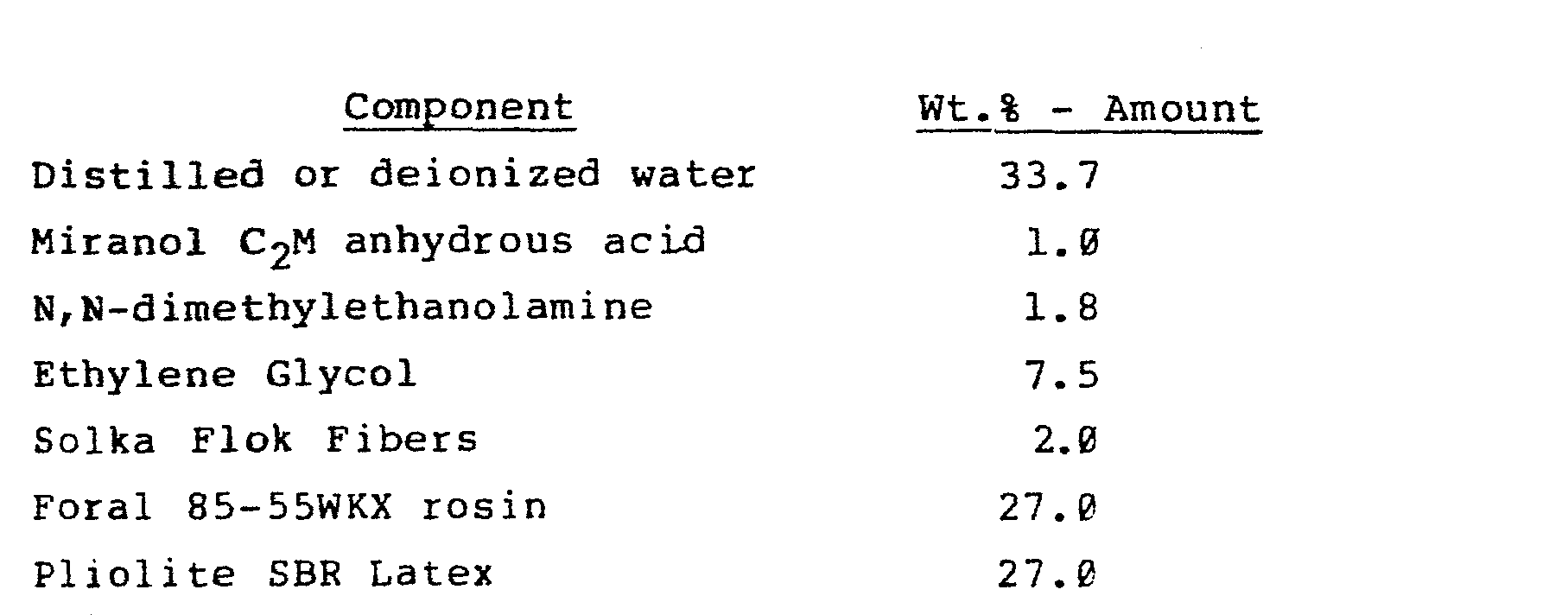
- In forming the composition, the N,N-dimethylethanolamine and the Miranol C2M were dissolved in the water. After the Miranol dissolved, ethylene glycol was added and mixed until homogeneous. While stirring, the Solka Flok was added and mixed until well dispersed. The Pliolite latex was then added followed by the Foral resin, and the composition was stirred until a uniform, homogenously dispersed product was obtained.
- The product of Example 1 was filled into a 20 ounce net weight fill aerosol can with a 50/50 wt.% blend of Freon 12 and Freon 114 as inflator/ propellant. An Eldorado Supreme G78-14 tire was punctured with a 5/32 inch nail, 180° opposite the valve stem. This is considered to be the most difficult position to repair because of the distance the foaming sealer must travel from the valve before reaching its destination at the point of puncture. The tire had deflated to approximately 0 psi without breaking the bead of the tire. The tire was placed in a position with the valve stem at 6 o'clock and the puncture at 12 o'clock, and the sample was applied to the valve stem. The entire contents of the can were released into the interior of the tire. The pressure at this point was checked and found to be 11 psi. A slow leak was detected when soapy water was poured on the tire. The tire was .then driven for approximately three miles and the tire was checked again. Pressure had increased to 22 psi and no leak could be detected. The increase in pressure was due to thermal expansion. The tire held the pressure during several weeks of subsequent observation.
- A 16 ounce net weight fill aerosol can containing the product of Example 1 with the 50/50 Freon 12, Freon 114 mixture as a propellant was prepared. The can was tested on a Gillette "Golden Bear" polyester/fiberfill G78-14 size tire. Experimental conditions were the same as in Example 2, except the tire was allowed to deflate to 6 psi. This represents a characteristic pressure loss upon the occurrence of a flat tire. The tire was inflated with the 16 ounce can, and a pressure of 14 psi was recorded immediately thereafter. The tire was then driven for three miles, and a pressure of 21 psi was recorded. No leaks were detected after the three mile drive, and the tire held pressure during subsequent observation.
- In order to achieve higher initial inflation pressures, the product of Example 1 was packaged into 20 ounce net weight aerosol cans with a 60/40 blend of Freon 12 and Freon 114. The product of Example 1 was packaged at a weight percent of 35%, with the Freon propellant at 65%. The 20 ounce can was used to inflate a punctured B. F. Goodrich "Lifesaver XLM" steel belted tire. The test conditions were the same as in Examples 2 and 3. Immediately after inflation, a pressure of 18 psi was observed. After being driven the three mile distance, the tire pressure had increased to 27 psi.
- To determine whether a further significant rise in pressure would take place when the tire was subjected to a lengthy drive and subsequent rise in temperature, the tire was warmed in an oven to 128°F for a period of five hours. The pressure increased approximately 5 psi, which was not considered to be an excessive rise in pressure.
- A one pound net weight aerosol can was prepared with the product of Example 1 and the 60/40 Freon 12/114 propellant mixture. The one pound can was used to inflate a B. F. Goodrich steel belted radial P175/75R14 tire, which had been allowed to deflate to 6 psi after being punctured. Immediately after inflation, a pressure of 20 psi was obtained. After being driven three miles, the pressure of the tire rose to 30 psi. Upon standing at a temperature of approximately 60°F, the tire registered a pressure of 25 psi. When warmed in an oven at 128°F for approximately five hours, the pressure of the tire again rose to 30 psi. The pressure loss is believed to be due to frequent testing with a gauge, since there was no leak detectable at the original point of puncture. Again, the rise of 5 psi when the tire was warmed in the oven for five hours is not considered to be an excessive rise in pressure.
- The invention has been described herein with reference to certain embodiments. However, as obvious variations thereon will become apparent to those skilled in the art, the invention is not considered to be limited thereto.
Claims (20)
said composition being contained in admixture with a propellant/inflator.
said composition being contained in admixture with at least one chlorofluorocarbon.
in admixture with a propellant/inflator.
said composition being in admixture with a chlorofluorocarbon component as a propellant/inflator component.
Applications Claiming Priority (2)
| Application Number | Priority Date | Filing Date | Title |
|---|---|---|---|
| US625531 | 1984-06-28 | ||
| US06/625,531 US4501825A (en) | 1984-06-28 | 1984-06-28 | Tire sealer and inflator |
Publications (2)
| Publication Number | Publication Date |
|---|---|
| EP0167934A2 true EP0167934A2 (en) | 1986-01-15 |
| EP0167934A3 EP0167934A3 (en) | 1987-12-02 |
Family
ID=24506530
Family Applications (1)
| Application Number | Title | Priority Date | Filing Date |
|---|---|---|---|
| EP85107934A Withdrawn EP0167934A3 (en) | 1984-06-28 | 1985-06-26 | Tire sealer and inflator |
Country Status (4)
| Country | Link |
|---|---|
| US (1) | US4501825A (en) |
| EP (1) | EP0167934A3 (en) |
| JP (1) | JPS6114277A (en) |
| CA (1) | CA1246800A (en) |
Cited By (2)
| Publication number | Priority date | Publication date | Assignee | Title |
|---|---|---|---|---|
| WO1988000882A1 (en) * | 1986-07-30 | 1988-02-11 | Frank Arthur Rogers | Expansible means |
| WO2004048493A1 (en) * | 2002-11-27 | 2004-06-10 | Bridgestone Corporation | Puncture sealing agent |
Families Citing this family (64)
| Publication number | Priority date | Publication date | Assignee | Title |
|---|---|---|---|---|
| US4778329A (en) * | 1986-03-21 | 1988-10-18 | General Motors Corporation | Robot with floating XY plane arm |
| US4937023A (en) * | 1989-04-27 | 1990-06-26 | Garcia Alfredo B | Method for manufacturing masks for fancy dresses or the like |
| US4970242A (en) * | 1989-08-18 | 1990-11-13 | Nationwide Industries, Inc. | Anhydrous, nonflammable tire sealer and inflator |
| US5130191A (en) * | 1990-11-27 | 1992-07-14 | Basf Corporation | Foamed sealant composition for use in mine stoppings and the consolidation of other geological formations |
| US5124395B1 (en) * | 1991-04-25 | 1999-06-22 | Radiator Specialty Company | Non-ozone depleting non-flammable tire sealer and inflator composition |
| AU3618993A (en) * | 1992-02-14 | 1993-09-03 | Specialty Chemical Resources, Inc. | Tire sealant and inflator |
| US5403417A (en) * | 1993-07-22 | 1995-04-04 | Technical Chemical Company | Tire sealing methods and related apparatus |
| US5500456A (en) * | 1994-01-26 | 1996-03-19 | Snap Products, Inc. | Tire sealer and inflator |
| US5772747A (en) * | 1994-08-01 | 1998-06-30 | Peter Chun | Tire sealant composition |
| CA2207301A1 (en) * | 1994-12-09 | 1996-06-13 | Engine Fog, Inc. | Tire inflating and puncture sealing composition |
| US5618912A (en) * | 1995-05-04 | 1997-04-08 | Pennzoil Products Company | Tire sealer and inflator compositions |
| DE19549592C5 (en) | 1995-07-11 | 2006-12-14 | Sumitomo Rubber Industries Ltd., Kobe | Device for sealing and inflating tires in the event of breakdowns |
| US5916931A (en) * | 1995-12-11 | 1999-06-29 | Engine Fog Inc. | Tire inflating and puncture sealing composition |
| US5856376A (en) * | 1996-03-29 | 1999-01-05 | Nch Corporation | Tire puncture sealant |
| DK0938517T3 (en) | 1996-09-19 | 2005-11-07 | Dap Products Inc | Stable, foamed sealant and sealant compositions and methods for their use |
| US6284077B1 (en) | 1997-08-29 | 2001-09-04 | Dap Products Inc. | Stable, foamed caulk and sealant compounds and methods of use thereof |
| US5967012A (en) * | 1996-11-19 | 1999-10-19 | The United States Of America As Represented By The Secretary Of The Navy | Waste aerosol container processor |
| DE19753630B4 (en) * | 1997-12-03 | 2005-09-01 | Michael Stehle | Use of a composition for the subsequent sealing of tires |
| DE19758820C5 (en) * | 1997-12-03 | 2008-03-27 | Michael Stehle | Process for the preparation of an inflatable or inflatable article |
| US6291536B1 (en) | 1998-02-07 | 2001-09-18 | Dap Products Inc. | Foamed caulk and sealant compounds |
| US6121210A (en) * | 1998-03-12 | 2000-09-19 | Dap Products Inc. | Foamable silicone oil compositions and methods of use thereof |
| US6011076A (en) * | 1998-07-09 | 2000-01-04 | Flexible Products Company | Latex foam |
| DE19844177B4 (en) * | 1998-09-25 | 2004-02-19 | Continental Aktiengesellschaft | Means for provisionally sealing pneumatic vehicle tires and its use |
| US5977196A (en) * | 1998-12-15 | 1999-11-02 | Gold Eagle Co. | Sealer and inflator composition |
| EP1200246B1 (en) | 1999-07-14 | 2003-10-01 | Pennzoil-Quaker State Company | Tire sealing and inflating composition and method of use |
| US6510875B2 (en) | 1999-07-14 | 2003-01-28 | Pennzoil | Inflating device and method of use |
| CA2321936C (en) | 2000-06-20 | 2003-04-22 | Michael W. Howe | Tire sealer and inflating composition and method of use |
| US20020112777A1 (en) | 2000-12-15 | 2002-08-22 | Pennzoil-Quaker State Company | Method and apparatus for inflating objects |
| JP2003193029A (en) * | 2001-12-27 | 2003-07-09 | Sumitomo Rubber Ind Ltd | Method for producing puncture sealing agent for tire |
| US6782931B2 (en) * | 2002-01-22 | 2004-08-31 | Stanley Koziatek | Tubeless tire compound and a system and method for retrofitting non-tubeless tires |
| US6789581B2 (en) | 2002-10-31 | 2004-09-14 | Interdynamics, Inc. | Apparatus for sealing, inflating, and repairing tires |
| CN100379834C (en) * | 2002-11-27 | 2008-04-09 | 株式会社普利司通 | tire sealant |
| JP4450611B2 (en) | 2003-12-08 | 2010-04-14 | 株式会社ブリヂストン | Puncture sealant |
| ITTO20040117A1 (en) | 2004-02-27 | 2004-05-27 | Tek Srl | INFLATION AND REPAIR KIT FOR INFLATABLE ITEMS, IN PARTICULAR TIRES |
| JP4673003B2 (en) * | 2004-05-27 | 2011-04-20 | 株式会社ブリヂストン | Puncture sealant |
| JP5500755B2 (en) * | 2004-11-01 | 2014-05-21 | 株式会社ブリヂストン | Puncture sealant |
| US20100154146A1 (en) * | 2008-07-02 | 2010-06-24 | S.C. Johnson & Son, Inc. | Carpet decor and setting solution compositions |
| US7759412B2 (en) * | 2006-02-27 | 2010-07-20 | The Yokohama Rubber Co., Ltd. | Tire puncture sealant |
| JP2007224245A (en) * | 2006-02-27 | 2007-09-06 | Yokohama Rubber Co Ltd:The | Puncture sealing material for tire |
| US8617333B2 (en) * | 2007-09-20 | 2013-12-31 | The Goodyear Tire & Rubber Company | Pneumatic tire having built-in sealant layer and preparation thereof |
| US20090078353A1 (en) * | 2007-09-21 | 2009-03-26 | Ramendra Nath Majumdar | Pneumatic Tire Having Built-In Sealant Layer And Preparation Thereof |
| US20090084482A1 (en) * | 2007-09-28 | 2009-04-02 | Ramendra Nath Majumdar | Pneumatic tire having built-In sealant layer and preparation thereof |
| US8316903B2 (en) | 2007-10-01 | 2012-11-27 | The Goodyear Tire & Rubber Company | Pneumatic tire having built-in sealant layer and preparation thereof |
| JP5604121B2 (en) * | 2010-01-27 | 2014-10-08 | 株式会社ブリヂストン | Method for producing puncture sealant |
| US20110257282A1 (en) | 2010-04-19 | 2011-10-20 | Honeywell International, Inc. | Tire sealer and inflater composition |
| CN102906214B (en) * | 2010-05-27 | 2014-04-30 | 横滨橡胶株式会社 | Liquid coagulant and tire puncture sealing material set |
| US9073269B2 (en) | 2011-07-12 | 2015-07-07 | Plews, Inc. | Tire sealant delivery system |
| FR2987125B1 (en) | 2012-02-16 | 2014-11-07 | Michelin & Cie | METHOD OF TESTING THE RESISTANCE TO A PRESSURE LOSS OF A TIRE |
| US8772370B1 (en) | 2013-03-14 | 2014-07-08 | Illinois Tool Works Inc. | Antifreeze agent for tire sealants |
| JP5729436B2 (en) * | 2013-09-09 | 2015-06-03 | 横浜ゴム株式会社 | Tire puncture sealant |
| DE102014224491A1 (en) | 2014-12-01 | 2016-06-02 | Continental Reifen Deutschland Gmbh | Means for provisionally sealing inflatable or inflatable articles and methods for provisionally sealing inflatable or inflatable articles |
| US10208231B2 (en) | 2014-12-12 | 2019-02-19 | Illinois Tool Works, Inc. | High performance sealant composition for tire repair |
| DE112016001538T5 (en) * | 2015-04-02 | 2017-12-21 | The Yokohama Rubber Co., Ltd. | Tire hole sealing means |
| JP6008011B1 (en) * | 2015-04-02 | 2016-10-19 | 横浜ゴム株式会社 | Tire puncture sealant |
| JP5958595B1 (en) * | 2015-04-15 | 2016-08-02 | 横浜ゴム株式会社 | Tire puncture sealant |
| US9862156B2 (en) | 2015-04-23 | 2018-01-09 | Illinois Tool Works, Inc. | Environmentally friendly aerosolized latex tire sealant |
| GB2534951B (en) * | 2015-06-30 | 2017-06-21 | Holt Lloyd Int Ltd | Tire sealer system and method |
| US10737448B2 (en) | 2015-10-27 | 2020-08-11 | Top Alliance Technology Ltd. | Sealant for tire repairing |
| ES2874495T3 (en) * | 2015-11-06 | 2021-11-05 | Trydel Res Pty Ltd | Sealant composition |
| DE102016209302A1 (en) | 2016-05-30 | 2017-12-14 | Continental Reifen Deutschland Gmbh | Method for sealing and inflating inflatable articles |
| CN110546231B (en) * | 2017-04-18 | 2022-09-02 | 横滨橡胶株式会社 | Tire puncture sealant |
| DE102017217259A1 (en) * | 2017-09-28 | 2019-03-28 | Continental Reifen Deutschland Gmbh | Method for sealing and inflating inflatable articles |
| DE102019219082A1 (en) | 2019-12-06 | 2021-06-10 | Continental Reifen Deutschland Gmbh | Process for recycling pneumatic vehicle tires with a sealant layer |
| US11407883B2 (en) | 2020-02-03 | 2022-08-09 | Illinois Tool Works Inc. | High performing low viscosity tire sealant |
Family Cites Families (13)
| Publication number | Priority date | Publication date | Assignee | Title |
|---|---|---|---|---|
| US3400095A (en) * | 1965-05-06 | 1968-09-03 | Minnesota Mining & Mfg | High solids content elastomer-based aerosol spray adhesive |
| US3843586A (en) * | 1969-11-04 | 1974-10-22 | Aerochem Nv | Process for preparing a foamable material for sealing rubber articles upon pressure reduction thereof |
| GB1359467A (en) * | 1970-06-20 | 1974-07-10 | Dunlop Holdings Ltd | Pneumatic tyre and wheel rim assemblies |
| US4056213A (en) * | 1971-08-04 | 1977-11-01 | Martin Paint And Chemical Corporation | Pressurized dispenser for aqueous emulsion paints |
| US3819119A (en) * | 1972-01-26 | 1974-06-25 | Paint Co H | Sprayer for decorating surfaces |
| US4051884A (en) * | 1974-12-04 | 1977-10-04 | Dunlop Limited | Pneumatic tire containing gel lubricant |
| SE426673B (en) * | 1976-02-13 | 1983-02-07 | Dunlop Ltd | PNEUMATIC DECK WITH INTERNAL LUBRICANT COATING |
| US4101494A (en) * | 1976-08-09 | 1978-07-18 | Wobaco Trust, Ltd. Trustee | Tire sealing and balancing agent |
| US4137206A (en) * | 1977-02-14 | 1979-01-30 | New World Products, Inc. | Tire protection composition |
| GB1599405A (en) * | 1977-08-11 | 1981-09-30 | Dunlop Ltd | Puncture sealants |
| US4426468A (en) * | 1978-10-10 | 1984-01-17 | Rockcor, Inc. | Sealant composition |
| US4224208A (en) * | 1979-01-22 | 1980-09-23 | New World Products, Inc. | Tire protection composition |
| US4337322A (en) * | 1981-09-08 | 1982-06-29 | Jaspon Lawrence E | Tire filling composition |
-
1984
- 1984-06-28 US US06/625,531 patent/US4501825A/en not_active Expired - Fee Related
-
1985
- 1985-06-17 CA CA000484163A patent/CA1246800A/en not_active Expired
- 1985-06-26 EP EP85107934A patent/EP0167934A3/en not_active Withdrawn
- 1985-06-27 JP JP60139224A patent/JPS6114277A/en active Granted
Cited By (2)
| Publication number | Priority date | Publication date | Assignee | Title |
|---|---|---|---|---|
| WO1988000882A1 (en) * | 1986-07-30 | 1988-02-11 | Frank Arthur Rogers | Expansible means |
| WO2004048493A1 (en) * | 2002-11-27 | 2004-06-10 | Bridgestone Corporation | Puncture sealing agent |
Also Published As
| Publication number | Publication date |
|---|---|
| EP0167934A3 (en) | 1987-12-02 |
| US4501825A (en) | 1985-02-26 |
| CA1246800A (en) | 1988-12-13 |
| JPS6114277A (en) | 1986-01-22 |
| JPH0149437B2 (en) | 1989-10-24 |
Similar Documents
| Publication | Publication Date | Title |
|---|---|---|
| US4501825A (en) | Tire sealer and inflator | |
| US5618912A (en) | Tire sealer and inflator compositions | |
| EP0753420B1 (en) | Preparation for sealing punctured tyres and apparatus for the sealing and pumping up of tyres | |
| US5500456A (en) | Tire sealer and inflator | |
| US3843586A (en) | Process for preparing a foamable material for sealing rubber articles upon pressure reduction thereof | |
| US6176285B1 (en) | Preparation for the sealing of tires with punctures, apparatus for the sealing and pumping up of tires and tires with an integrated sealing preparation | |
| US5338776A (en) | Tire sealer and inflator | |
| MXPA97008436A (en) | Novedos compositions for sealing and inflating llan | |
| US4970242A (en) | Anhydrous, nonflammable tire sealer and inflator | |
| US4216812A (en) | Pneumatic tire containing puncture sealants | |
| US4629758A (en) | Adhesive for rubber compounds | |
| JP2000103905A (en) | Sealing material for temporarily sealing pneumatic tire for automobile and sealing of automotive pneumatic tire with the sealing material | |
| JP5019406B2 (en) | Tire sealer and inflatable composition and method for producing the same | |
| JP2002292758A (en) | Object expansion apparatus and method | |
| US5648406A (en) | Tire sealant and inflator | |
| CN106010438A (en) | Long-acting environment-friendly high-low-temperature resistance tire repair liquid and preparation method | |
| US5284895A (en) | Aerosol formulation for a pneumatic tire puncture sealer and inflator which is non-flammable, non-explosive, non-toxic, and without any ozone depleting chemicals | |
| GB1497864A (en) | Compositions for repairing punctures in air tyres | |
| US4213491A (en) | Pneumatic tire containing water-dispersible puncture sealant | |
| JPS6262848A (en) | Rubber composition for inner liner | |
| US9862156B2 (en) | Environmentally friendly aerosolized latex tire sealant | |
| EP0200382A2 (en) | Sealant composition for pneumatic tyres | |
| JPH09241596A (en) | Surface protection sheet | |
| CA2273672C (en) | Water-based tire sealant and inflator composition | |
| CA2217326C (en) | Novel tire sealer and inflator compositions |
Legal Events
| Date | Code | Title | Description |
|---|---|---|---|
| PUAI | Public reference made under article 153(3) epc to a published international application that has entered the european phase |
Free format text: ORIGINAL CODE: 0009012 |
|
| AK | Designated contracting states |
Designated state(s): AT BE CH DE FR GB IT LI LU NL SE |
|
| PUAL | Search report despatched |
Free format text: ORIGINAL CODE: 0009013 |
|
| AK | Designated contracting states |
Kind code of ref document: A3 Designated state(s): AT BE CH DE FR GB IT LI LU NL SE |
|
| 17P | Request for examination filed |
Effective date: 19880212 |
|
| 17Q | First examination report despatched |
Effective date: 19880905 |
|
| STAA | Information on the status of an ep patent application or granted ep patent |
Free format text: STATUS: THE APPLICATION IS DEEMED TO BE WITHDRAWN |
|
| 18D | Application deemed to be withdrawn |
Effective date: 19910825 |
|
| RIN1 | Information on inventor provided before grant (corrected) |
Inventor name: MAGYAR, ARPAD M. Inventor name: SMITH, GERALD G. |