EP0164786A2 - A process for the preparation of p-isononanoyloxybenzenenesulphonate - Google Patents
A process for the preparation of p-isononanoyloxybenzenenesulphonate Download PDFInfo
- Publication number
- EP0164786A2 EP0164786A2 EP85200761A EP85200761A EP0164786A2 EP 0164786 A2 EP0164786 A2 EP 0164786A2 EP 85200761 A EP85200761 A EP 85200761A EP 85200761 A EP85200761 A EP 85200761A EP 0164786 A2 EP0164786 A2 EP 0164786A2
- Authority
- EP
- European Patent Office
- Prior art keywords
- phenolsulphonate
- potassium
- process according
- reactive diluent
- acid chloride
- Prior art date
- Legal status (The legal status is an assumption and is not a legal conclusion. Google has not performed a legal analysis and makes no representation as to the accuracy of the status listed.)
- Granted
Links
Classifications
-
- C—CHEMISTRY; METALLURGY
- C07—ORGANIC CHEMISTRY
- C07C—ACYCLIC OR CARBOCYCLIC COMPOUNDS
- C07C309/00—Sulfonic acids; Halides, esters, or anhydrides thereof
Definitions
- This invention relates to a process for the preparation of p-isononanoyloxybenzenesulphonate.
- p-Isononanoyloxybenzenesulphonate belongs to the group of alkanoyloxybenzenesulphonates, which are disclosed in US patent specification 4,412,934 as bleach activators in bleaching compositions.
- the isononanoyl group of the p-isononanoyloxybenzenesulphonate is derived from the acid 3,5,5-trimethylhexanoic-acid, also called isononanoic acid.
- the acid has the chemical formula
- potassium p-iso- nonancyloxybenzenesulphonate can be prepared in high yields by a process wherein a high degree of potassium p-phenolsulphonate conversion is achieved.
- the invention relates to a process for the preparation of p-isononanoyloxybenzenesulphonate characterized in that isononanoic acid chloride is reacted with potassium p-phenolsulphonate in the presence of a non-reactive diluent at a temperature in the range of from 80 °C to 200 °C. It has also been found that mixtures of potassium and sodium p-phenolsulphonate can be used.
- Diluents which are used in the process according to the invention will not react with any of the reaction components. They can be selected from the aliphatic, cycloaliphatic or aromatic hydrocarbons, although more polar organic diluents such as ethers and ketones may also be employed.
- Suitable diluents are heptane, isooctane, cyclohexane, n-heptane, benzene, toluene, o-, m- and p-xylene, ethylbenzene, p-methylcumene, mesitylene, monochlorobenzene, anisole, diphenylether, methylisobutylketone, higher boiling aromatic solvents such as SHELLSOL/A (registered trademark) or mixtures thereof. Aromatic hydrocarbons are preferred.
- non-reactive diluents which are solvents for the isononanoic acid chloride and moreover at ambient temperatures are nonsolvents for the p-phenolsulphonates and the p-isononanoyloxy- benzenesulphonates.
- the precipitation of p-isononanoyloxybenzenesulphonate can be enhanced by the addition of a different non-reactive diluent, which is a weaker solvent for the end-product. Should this still result in an incomplete recovery of the ultimate product, then this can be remedied by including a distillation step before cooling to remove the bulk of the diluent and replace it with a diluent having less solvent power for the end-product. For reasons of processability it was proven to be advantageous to carry out the reaction in the presence of such an amount of non-reactive diluent that the concentration of p-phenolsulphonate is less than 1 mol/l diluent.
- the temperature at which the reaction between isononanoic acid chloride and.sodium and/or potassiump-phenolsulphonate is carried out is within the range of from 80 °C to 200 °C.
- the reaction is carried out at the reflux temperature of the non-reactive diluent employed since the HC1 is removed from the reaction mixture. It is especially preferred to carry out the reaction in refluxing o-, m- or p-xylene or a mixture of two or three of these isomers.
- the recovered end-product can be washed at ambient or elevated temperature, employing the same non-reactive diluent as used for the reaction or alternatively the end-product may be washed with another suitable diluent such as pentane, to remove any residual isononanoic acid chloride and after subsequent filtration and drying a solid end-product is obtained which can be used in e.g. laundring compositions.
- another suitable diluent such as pentane
- the reactor contents were allowed to cool to ambient temperature and subsequently solids were recovered from the reaction mixture by means of filtration.
- the isolated solids were washed with 50 ml of the diluent used in the preparation and isolated by filtration. This procedure was repeated three times and after the last washing step the solids were dried at a temperature of 100 °C and a pressure of 20 kPa for 3 hours.
- the end-products were analysed to determine the p-isononanoyloxybenzenesulphonate content, employing a two-phase titration according to ISO method 2271 by 1 H or 13 C NMR . The results are given in the Table.
- the comparative example was carried out in the same equipment as used for examples 1-8 and under essentially the same conditions but employing sodium p-phenolsulphonate.
- the final product was analysed by the above-mentioned techniques and the result is given in the Table.
Landscapes
- Chemical & Material Sciences (AREA)
- Organic Chemistry (AREA)
- Organic Low-Molecular-Weight Compounds And Preparation Thereof (AREA)
- Fireproofing Substances (AREA)
Abstract
Description
- This invention relates to a process for the preparation of p-isononanoyloxybenzenesulphonate.
- p-Isononanoyloxybenzenesulphonate belongs to the group of alkanoyloxybenzenesulphonates, which are disclosed in US patent specification 4,412,934 as bleach activators in bleaching compositions.
- The isononanoyl group of the p-isononanoyloxybenzenesulphonate is derived from the acid 3,5,5-trimethylhexanoic-acid, also called isononanoic acid. The acid has the chemical formula

- Compounds of general formula

- In an attempt to synthesize bleach activators containing an isononanoyl group Applicant found that by reacting isononanoic acid chloride with sodium p-phenolsulphonate in the presence of a non-reactive diluent at a temperature in the range of 140-1-5 °C, an end-product having a sodium p-isononanoyloxy- benzenesulphonate content of 84 %wt was obtained, a result which could not be increased by prolonged heating and/or addition of further isononanoic acid chloride. In view of the results obtained in the process according to US patent specification 3,925,016, it could not be expected that the corresponding potassium p-isononanoyloxybenzenesulphonate would give a good result.
- Surprisingly it has now been found that potassium p-iso- nonancyloxybenzenesulphonate can be prepared in high yields by a process wherein a high degree of potassium p-phenolsulphonate conversion is achieved. The invention relates to a process for the preparation of p-isononanoyloxybenzenesulphonate characterized in that isononanoic acid chloride is reacted with potassium p-phenolsulphonate in the presence of a non-reactive diluent at a temperature in the range of from 80 °C to 200 °C. It has also been found that mixtures of potassium and sodium p-phenolsulphonate can be used.
- Alhough the isononanoic acid chloride reacts with the p-phenolsulphonate in an equimolar ratio according to the following reaction scheme:

- Diluents, which are used in the process according to the invention will not react with any of the reaction components. They can be selected from the aliphatic, cycloaliphatic or aromatic hydrocarbons, although more polar organic diluents such as ethers and ketones may also be employed. Examples of suitable diluents are heptane, isooctane, cyclohexane, n-heptane, benzene, toluene, o-, m- and p-xylene, ethylbenzene, p-methylcumene, mesitylene, monochlorobenzene, anisole, diphenylether, methylisobutylketone, higher boiling aromatic solvents such as SHELLSOL/A (registered trademark) or mixtures thereof. Aromatic hydrocarbons are preferred. It may be beneficial to employ those non-reactive diluents which are solvents for the isononanoic acid chloride and moreover at ambient temperatures are nonsolvents for the p-phenolsulphonates and the p-isononanoyloxy- benzenesulphonates. When these conditions are fulfilled it can be expected, upon termination of the reaction and after cooling, that the p-isononanoyloxybenzenesulphonate will precipitate and can be recovered via filtration together with any non-converted phenolsulphonate and any other insoluble matter which may be present, whereas any isononanoic acid chloride will remain in solution. Optionally depending on the nature of the non-reactive diluent employed, the precipitation of p-isononanoyloxybenzenesulphonate can be enhanced by the addition of a different non-reactive diluent, which is a weaker solvent for the end-product. Should this still result in an incomplete recovery of the ultimate product, then this can be remedied by including a distillation step before cooling to remove the bulk of the diluent and replace it with a diluent having less solvent power for the end-product. For reasons of processability it was proven to be advantageous to carry out the reaction in the presence of such an amount of non-reactive diluent that the concentration of p-phenolsulphonate is less than 1 mol/l diluent.
- The temperature at which the reaction between isononanoic acid chloride and.sodium and/or potassiump-phenolsulphonate is carried out is within the range of from 80 °C to 200 °C. Preferably the reaction is carried out at the reflux temperature of the non-reactive diluent employed since the HC1 is removed from the reaction mixture. It is especially preferred to carry out the reaction in refluxing o-, m- or p-xylene or a mixture of two or three of these isomers.
- The recovered end-product can be washed at ambient or elevated temperature, employing the same non-reactive diluent as used for the reaction or alternatively the end-product may be washed with another suitable diluent such as pentane, to remove any residual isononanoic acid chloride and after subsequent filtration and drying a solid end-product is obtained which can be used in e.g. laundring compositions.
- The invention will be further illustrated by the following examples in which various terms are defined as follows:
- SPS: Sodium p-phenolsulphonate. This product had a purity of > 99 %wt as determined by 13C NMR (nuclear magnetic resonance). Prior to use this material was dried at a temperature of 150 °C and a pressure of 20 kPa during 18 hours.
- KPS/S: Potassium p-phenolsulphonate. 800 ml of Bio-Rad 50 WX2 (registered trademark) (100-200 mesh), containing 0.7 meq H/ml was mixed with 2 1 of methanol/water (volume ratio 1/1) and 40 g of SPS. This mixture was stirred at room temperature for 3 hours whereupon the cation-exchange resin was removed by filtration. Subsequently 12 g KOH (as 10 %wt in aqueous solution) was added to neutralize the p-phenolsulphonic acid and the neutralized solution was placed overnight on a waterbath to evaporate water and methanol and the obtained residue dried at a temperature of 150 °C and a pressure of 20 kPa during 18 hours.
- KPS/T: Potassium p-phenolsulphonate, technical grade. This commercially available grade was found to have a potassium p-phenolsulphonate content of approximately 90 Xwt. Prior to use this material was dried at a temperature of 150 °C and a pressure of 20 kPa during 18 hours.
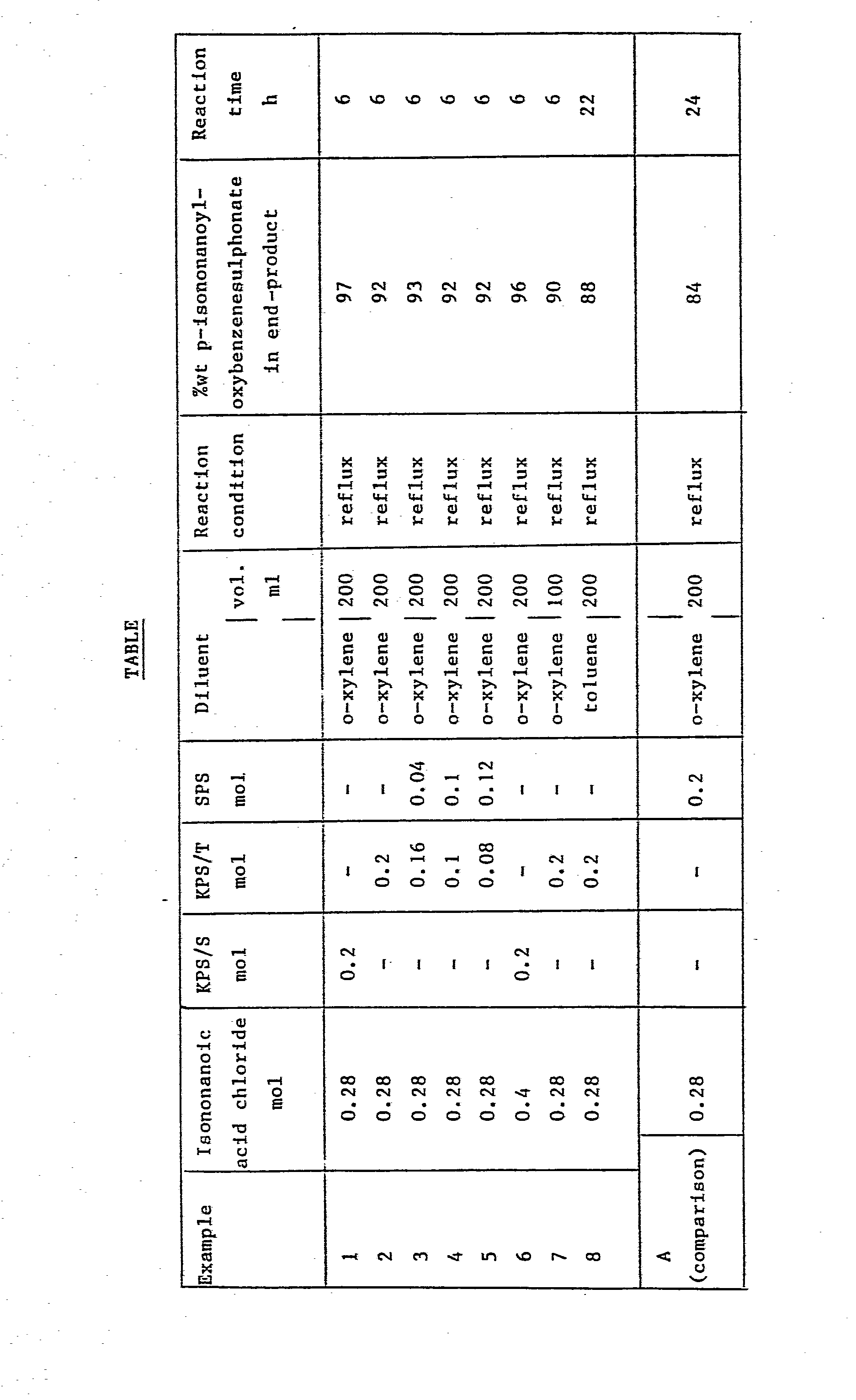
- Into a three-necked 500 ml glass reactor, equipped with a thermometer, a reflux condenser and a mechanical stirrer made from glass, were introduced predried potassium p-phenolsulphonate or a blend of potassium and sodium p-phenolsulphonate, diluent (o-xylene or toluene) and isononanoic acid chloride in amounts given in the Table. While stirring the obtained mixture was heated to reflux temperature (approximately 140-145 °C for o-xylene and 115-120 °C for toluene) in about 30 minutes. Heating was effected by placing the glass reactor in an oilbath. At the end of the reaction time the reactor contents were allowed to cool to ambient temperature and subsequently solids were recovered from the reaction mixture by means of filtration. The isolated solids were washed with 50 ml of the diluent used in the preparation and isolated by filtration. This procedure was repeated three times and after the last washing step the solids were dried at a temperature of 100 °C and a pressure of 20 kPa for 3 hours. The end-products were analysed to determine the p-isononanoyloxybenzenesulphonate content, employing a two-phase titration according to ISO method 2271 by 1 H or 13 C NMR. The results are given in the Table.
- The comparative example was carried out in the same equipment as used for examples 1-8 and under essentially the same conditions but employing sodium p-phenolsulphonate. The final product was analysed by the above-mentioned techniques and the result is given in the Table.
Claims (9)
Applications Claiming Priority (2)
| Application Number | Priority Date | Filing Date | Title |
|---|---|---|---|
| GB8414696 | 1984-06-08 | ||
| GB848414696A GB8414696D0 (en) | 1984-06-08 | 1984-06-08 | P-isononanoyloxybenzenesulphonate |
Publications (3)
| Publication Number | Publication Date |
|---|---|
| EP0164786A2 true EP0164786A2 (en) | 1985-12-18 |
| EP0164786A3 EP0164786A3 (en) | 1986-04-02 |
| EP0164786B1 EP0164786B1 (en) | 1989-06-14 |
Family
ID=10562147
Family Applications (1)
| Application Number | Title | Priority Date | Filing Date |
|---|---|---|---|
| EP19850200761 Expired EP0164786B1 (en) | 1984-06-08 | 1985-05-13 | A process for the preparation of p-isononanoyloxybenzenenesulphonate |
Country Status (6)
| Country | Link |
|---|---|
| EP (1) | EP0164786B1 (en) |
| JP (1) | JPS611655A (en) |
| CA (1) | CA1249300A (en) |
| DE (1) | DE3571028D1 (en) |
| ES (1) | ES8604126A1 (en) |
| GB (1) | GB8414696D0 (en) |
Cited By (15)
| Publication number | Priority date | Publication date | Assignee | Title |
|---|---|---|---|---|
| EP0220826A1 (en) * | 1985-09-28 | 1987-05-06 | Interox Chemicals Limited | Preparation of sulphophenyl esters |
| US4735740A (en) * | 1986-10-03 | 1988-04-05 | The Clorox Company | Diperoxyacid precursors and method |
| EP0270304A1 (en) * | 1986-12-05 | 1988-06-08 | Interox Chemicals Limited | Ester manufacture |
| US4908474A (en) * | 1987-06-02 | 1990-03-13 | Interox Chemicals Limited | Preparation of esters |
| EP0402339A1 (en) * | 1989-06-05 | 1990-12-12 | Monsanto Company | Improved process for the production of carbonate esters |
| US4985180A (en) * | 1988-07-15 | 1991-01-15 | E. I. Du Pont De Nemours And Company | Process for preparing phenyl esters of substituted acids |
| US5069828A (en) * | 1989-06-06 | 1991-12-03 | E. I. Du Pont De Nemours And Company | Process for preparing benzenesulfonate salts |
| US5518650A (en) * | 1991-05-04 | 1996-05-21 | Hoechst Aktiengesellschaft | Imidocarboxylic acid activators and sulfimidocarboxylic acid activators, processes for their preparation and their use |
| EP1285910A3 (en) * | 2001-08-11 | 2003-05-02 | Clariant GmbH | Process for preparing acyloxybenzenesulfonates |
| KR100423965B1 (en) * | 2001-08-18 | 2004-03-22 | 미원상사주식회사 | Production Method of Sodium 4-dodecanoyloxybenzenesulfonate |
| EP1439168A1 (en) * | 2003-01-14 | 2004-07-21 | Clariant GmbH | Process for the preparation of acyloxybenzenesulphonates |
| US6790981B2 (en) | 2002-12-13 | 2004-09-14 | Clariant Finance (Bvi) Limited | Process for the preparation of acyloxybenzenesulfonates |
| US6822113B2 (en) | 2002-07-25 | 2004-11-23 | Clariant Gmbh | Process for preparing acyloxybenzenesulfonates |
| DE102010034244A1 (en) | 2010-08-13 | 2012-02-16 | Clariant International Limited | Process for the preparation of acyloxybenzoic acids |
| DE102010034243A1 (en) | 2010-08-13 | 2012-02-16 | Clariant International Limited | Process for the preparation of acyloxybenzoic acids |
Families Citing this family (1)
| Publication number | Priority date | Publication date | Assignee | Title |
|---|---|---|---|---|
| JPS62162049A (en) * | 1986-01-07 | 1987-07-17 | 中塚工業株式会社 | Apparatus for automatically prescribing wefting position of weft yarn with pattern in loom |
Family Cites Families (1)
| Publication number | Priority date | Publication date | Assignee | Title |
|---|---|---|---|---|
| CH550279B (en) * | 1971-12-21 | 1974-06-14 | Ciba Geigy Ag | PROCESS FOR DYING TEXTILE FIBER MATERIAL FROM POLYACRYLNITRILE |
-
1984
- 1984-06-08 GB GB848414696A patent/GB8414696D0/en active Pending
-
1985
- 1985-05-13 DE DE8585200761T patent/DE3571028D1/en not_active Expired
- 1985-05-13 EP EP19850200761 patent/EP0164786B1/en not_active Expired
- 1985-05-22 CA CA000482088A patent/CA1249300A/en not_active Expired
- 1985-06-05 ES ES543929A patent/ES8604126A1/en not_active Expired
- 1985-06-06 JP JP12164185A patent/JPS611655A/en active Granted
Cited By (24)
| Publication number | Priority date | Publication date | Assignee | Title |
|---|---|---|---|---|
| EP0220826A1 (en) * | 1985-09-28 | 1987-05-06 | Interox Chemicals Limited | Preparation of sulphophenyl esters |
| US4704236A (en) * | 1985-09-28 | 1987-11-03 | Interox Chemicals Ltd. | Preparation of sulphophenyl esters |
| US4735740A (en) * | 1986-10-03 | 1988-04-05 | The Clorox Company | Diperoxyacid precursors and method |
| EP0270304A1 (en) * | 1986-12-05 | 1988-06-08 | Interox Chemicals Limited | Ester manufacture |
| US4867916A (en) * | 1986-12-05 | 1989-09-19 | Interox Chemicals Limited | Ester manufacture |
| US4908474A (en) * | 1987-06-02 | 1990-03-13 | Interox Chemicals Limited | Preparation of esters |
| US4985180A (en) * | 1988-07-15 | 1991-01-15 | E. I. Du Pont De Nemours And Company | Process for preparing phenyl esters of substituted acids |
| EP0402339A1 (en) * | 1989-06-05 | 1990-12-12 | Monsanto Company | Improved process for the production of carbonate esters |
| US5069828A (en) * | 1989-06-06 | 1991-12-03 | E. I. Du Pont De Nemours And Company | Process for preparing benzenesulfonate salts |
| US5518650A (en) * | 1991-05-04 | 1996-05-21 | Hoechst Aktiengesellschaft | Imidocarboxylic acid activators and sulfimidocarboxylic acid activators, processes for their preparation and their use |
| US5610318A (en) * | 1991-05-04 | 1997-03-11 | Hoechst Aktiengesellschaft | Imidocarboxylic acid activators and sulfimidocarboxylic acid activators processes for their preparation and their use |
| US6639096B2 (en) | 2001-08-11 | 2003-10-28 | Clariant Gmbh | Process for the preparation of acyloxybenzenesulfonates |
| EP1285910A3 (en) * | 2001-08-11 | 2003-05-02 | Clariant GmbH | Process for preparing acyloxybenzenesulfonates |
| KR100423965B1 (en) * | 2001-08-18 | 2004-03-22 | 미원상사주식회사 | Production Method of Sodium 4-dodecanoyloxybenzenesulfonate |
| US6822113B2 (en) | 2002-07-25 | 2004-11-23 | Clariant Gmbh | Process for preparing acyloxybenzenesulfonates |
| US6790981B2 (en) | 2002-12-13 | 2004-09-14 | Clariant Finance (Bvi) Limited | Process for the preparation of acyloxybenzenesulfonates |
| EP1439168A1 (en) * | 2003-01-14 | 2004-07-21 | Clariant GmbH | Process for the preparation of acyloxybenzenesulphonates |
| US6864381B2 (en) | 2003-01-14 | 2005-03-08 | Clariant Gmbh | Process for preparing acyloxybenzenesulfonates |
| DE102010034244A1 (en) | 2010-08-13 | 2012-02-16 | Clariant International Limited | Process for the preparation of acyloxybenzoic acids |
| DE102010034243A1 (en) | 2010-08-13 | 2012-02-16 | Clariant International Limited | Process for the preparation of acyloxybenzoic acids |
| WO2012019742A1 (en) | 2010-08-13 | 2012-02-16 | Clariant International Ltd | Method for producing acyloxy benzoic acids |
| WO2012019743A1 (en) | 2010-08-13 | 2012-02-16 | Clariant International Ltd | Method for producing acyloxy benzoic acids |
| US8901342B2 (en) | 2010-08-13 | 2014-12-02 | Clariant International Ltd | Method for producing acyloxy benzoic acids |
| US8907118B2 (en) | 2010-08-13 | 2014-12-09 | Clariant International Ltd. | Method for producing acyloxy benzoic acids |
Also Published As
| Publication number | Publication date |
|---|---|
| ES543929A0 (en) | 1986-01-16 |
| EP0164786B1 (en) | 1989-06-14 |
| JPS611655A (en) | 1986-01-07 |
| EP0164786A3 (en) | 1986-04-02 |
| GB8414696D0 (en) | 1984-07-11 |
| CA1249300A (en) | 1989-01-24 |
| ES8604126A1 (en) | 1986-01-16 |
| JPH0469628B2 (en) | 1992-11-06 |
| DE3571028D1 (en) | 1989-07-20 |
Similar Documents
| Publication | Publication Date | Title |
|---|---|---|
| EP0164786B1 (en) | A process for the preparation of p-isononanoyloxybenzenenesulphonate | |
| EP0126569A1 (en) | Bromination process for preparing decabromodiphenyl ether from diphenyl ether | |
| US4698415A (en) | Method for the preparation of polyarylene sulfide with aqueous polyethylene glycol mixture | |
| US2109929A (en) | Preparation of amino acids | |
| US5274123A (en) | Process for the preparation of cyclic sulphates | |
| US4287357A (en) | Process for the production of 6-hydroxy-2-naphthoic acid | |
| US5302767A (en) | [2.2] paracyclophane and derivatives thereof | |
| US4221734A (en) | Process for the preparation of derivatives of fluoroalkane-carboxylic and perfluoroalkane-sulfinic acids | |
| US4345095A (en) | Process for the production of 6-hydroxy-2-naphthoic acid | |
| KR950004033B1 (en) | Manufacturing method for 2-hydroxy-naphthalene-6-carboxylic acid | |
| EP0053824B2 (en) | Process for the production of 2-hydroxynaphthalene-6-carboxylic acid | |
| EP0419796B1 (en) | 2,4-pentanedionemonosulfonic acid and method for preparing the same | |
| US4987249A (en) | 2,4-pentanedione-1,5-disulfonic acid and method for preparing the same | |
| GB2199828A (en) | Synthesis of 2-(perfluoroalkyl)ethanethiols | |
| US3590104A (en) | Process for preparing 0,0-dialkyl-0-phenyl phosphorothioates | |
| EP0158709B1 (en) | A process for producing a para-substituted phenol derivative | |
| GB1561464A (en) | Oxidation of alkaryl compounds | |
| JPS60132933A (en) | Manufacture of nitrodiarylamine | |
| EP0589621A1 (en) | Substituted styrenes | |
| US4877901A (en) | Process for synthesizing N,N'-dithiobis(sulfonamides) | |
| JPH0529386B2 (en) | ||
| JPH1087560A (en) | Complex, production thereof, and production of p-hydroxybenzoic acid | |
| JP3876933B2 (en) | Method for producing hydrogen sulfate ester | |
| CA1194499A (en) | Process for preparing pinacolone | |
| US3969423A (en) | Continuous preparation of 2,4,4,4-tetrachlorobutanol |
Legal Events
| Date | Code | Title | Description |
|---|---|---|---|
| PUAI | Public reference made under article 153(3) epc to a published international application that has entered the european phase |
Free format text: ORIGINAL CODE: 0009012 |
|
| 17P | Request for examination filed |
Effective date: 19850513 |
|
| AK | Designated contracting states |
Designated state(s): BE CH DE FR GB IT LI NL SE |
|
| PUAL | Search report despatched |
Free format text: ORIGINAL CODE: 0009013 |
|
| AK | Designated contracting states |
Kind code of ref document: A3 Designated state(s): BE CH DE FR GB IT LI NL SE |
|
| 17Q | First examination report despatched |
Effective date: 19880506 |
|
| GRAA | (expected) grant |
Free format text: ORIGINAL CODE: 0009210 |
|
| AK | Designated contracting states |
Kind code of ref document: B1 Designated state(s): BE CH DE FR GB IT LI NL SE |
|
| REF | Corresponds to: |
Ref document number: 3571028 Country of ref document: DE Date of ref document: 19890720 |
|
| ITF | It: translation for a ep patent filed | ||
| ET | Fr: translation filed | ||
| PLBE | No opposition filed within time limit |
Free format text: ORIGINAL CODE: 0009261 |
|
| STAA | Information on the status of an ep patent application or granted ep patent |
Free format text: STATUS: NO OPPOSITION FILED WITHIN TIME LIMIT |
|
| 26N | No opposition filed | ||
| PGFP | Annual fee paid to national office [announced via postgrant information from national office to epo] |
Ref country code: GB Payment date: 19920320 Year of fee payment: 8 Ref country code: FR Payment date: 19920320 Year of fee payment: 8 |
|
| PGFP | Annual fee paid to national office [announced via postgrant information from national office to epo] |
Ref country code: SE Payment date: 19920331 Year of fee payment: 8 |
|
| PGFP | Annual fee paid to national office [announced via postgrant information from national office to epo] |
Ref country code: BE Payment date: 19920525 Year of fee payment: 8 |
|
| ITTA | It: last paid annual fee | ||
| PGFP | Annual fee paid to national office [announced via postgrant information from national office to epo] |
Ref country code: NL Payment date: 19920531 Year of fee payment: 8 |
|
| PGFP | Annual fee paid to national office [announced via postgrant information from national office to epo] |
Ref country code: DE Payment date: 19920610 Year of fee payment: 8 |
|
| PGFP | Annual fee paid to national office [announced via postgrant information from national office to epo] |
Ref country code: CH Payment date: 19920730 Year of fee payment: 8 |
|
| PG25 | Lapsed in a contracting state [announced via postgrant information from national office to epo] |
Ref country code: GB Effective date: 19930513 |
|
| PG25 | Lapsed in a contracting state [announced via postgrant information from national office to epo] |
Ref country code: SE Effective date: 19930514 |
|
| PG25 | Lapsed in a contracting state [announced via postgrant information from national office to epo] |
Ref country code: LI Effective date: 19930531 Ref country code: CH Effective date: 19930531 Ref country code: BE Effective date: 19930531 |
|
| BERE | Be: lapsed |
Owner name: SHELL INTERNATIONALE RESEARCH MAATSCHAPPIJ B.V. Effective date: 19930531 |
|
| PG25 | Lapsed in a contracting state [announced via postgrant information from national office to epo] |
Ref country code: NL Effective date: 19931201 |
|
| GBPC | Gb: european patent ceased through non-payment of renewal fee |
Effective date: 19930513 |
|
| NLV4 | Nl: lapsed or anulled due to non-payment of the annual fee | ||
| PG25 | Lapsed in a contracting state [announced via postgrant information from national office to epo] |
Ref country code: FR Effective date: 19940131 |
|
| REG | Reference to a national code |
Ref country code: CH Ref legal event code: PL |
|
| PG25 | Lapsed in a contracting state [announced via postgrant information from national office to epo] |
Ref country code: DE Effective date: 19940201 |
|
| REG | Reference to a national code |
Ref country code: FR Ref legal event code: ST |
|
| EUG | Se: european patent has lapsed |
Ref document number: 85200761.6 Effective date: 19931210 |