EP0163417B1 - Bleach products - Google Patents
Bleach products Download PDFInfo
- Publication number
- EP0163417B1 EP0163417B1 EP19850302917 EP85302917A EP0163417B1 EP 0163417 B1 EP0163417 B1 EP 0163417B1 EP 19850302917 EP19850302917 EP 19850302917 EP 85302917 A EP85302917 A EP 85302917A EP 0163417 B1 EP0163417 B1 EP 0163417B1
- Authority
- EP
- European Patent Office
- Prior art keywords
- product
- bag
- perborate
- activator
- sodium perborate
- Prior art date
- Legal status (The legal status is an assumption and is not a legal conclusion. Google has not performed a legal analysis and makes no representation as to the accuracy of the status listed.)
- Expired - Lifetime
Links
- 239000007844 bleaching agent Substances 0.000 title claims abstract description 44
- 239000000203 mixture Substances 0.000 claims abstract description 43
- 239000012190 activator Substances 0.000 claims abstract description 35
- 239000000463 material Substances 0.000 claims abstract description 32
- 229960001922 sodium perborate Drugs 0.000 claims abstract description 25
- YKLJGMBLPUQQOI-UHFFFAOYSA-M sodium;oxidooxy(oxo)borane Chemical compound [Na+].[O-]OB=O YKLJGMBLPUQQOI-UHFFFAOYSA-M 0.000 claims abstract description 25
- 150000004682 monohydrates Chemical group 0.000 claims abstract description 24
- 239000011148 porous material Substances 0.000 claims abstract description 15
- PXDLHKPVKLUIJV-UHFFFAOYSA-M sodium;2-octanoyloxybenzenesulfonate Chemical compound [Na+].CCCCCCCC(=O)OC1=CC=CC=C1S([O-])(=O)=O PXDLHKPVKLUIJV-UHFFFAOYSA-M 0.000 claims abstract description 4
- 238000004061 bleaching Methods 0.000 claims description 24
- KFSLWBXXFJQRDL-UHFFFAOYSA-N Peracetic acid Chemical compound CC(=O)OO KFSLWBXXFJQRDL-UHFFFAOYSA-N 0.000 claims description 12
- 239000002245 particle Substances 0.000 claims description 12
- 239000004745 nonwoven fabric Substances 0.000 claims description 6
- 238000006243 chemical reaction Methods 0.000 claims description 5
- SCKXCAADGDQQCS-UHFFFAOYSA-N Performic acid Chemical compound OOC=O SCKXCAADGDQQCS-UHFFFAOYSA-N 0.000 claims description 4
- 150000001732 carboxylic acid derivatives Chemical class 0.000 claims description 4
- 239000011236 particulate material Substances 0.000 claims description 4
- FRPJTGXMTIIFIT-UHFFFAOYSA-N tetraacetylethylenediamine Chemical group CC(=O)C(N)(C(C)=O)C(N)(C(C)=O)C(C)=O FRPJTGXMTIIFIT-UHFFFAOYSA-N 0.000 claims 1
- 239000000843 powder Substances 0.000 abstract description 23
- 239000003599 detergent Substances 0.000 abstract description 16
- 238000005406 washing Methods 0.000 abstract description 11
- 238000011161 development Methods 0.000 abstract description 8
- 239000007788 liquid Substances 0.000 abstract 1
- BGRWYDHXPHLNKA-UHFFFAOYSA-N Tetraacetylethylenediamine Chemical compound CC(=O)N(C(C)=O)CCN(C(C)=O)C(C)=O BGRWYDHXPHLNKA-UHFFFAOYSA-N 0.000 description 26
- 238000012360 testing method Methods 0.000 description 22
- 239000000047 product Substances 0.000 description 16
- 150000004685 tetrahydrates Chemical class 0.000 description 14
- 239000004744 fabric Substances 0.000 description 13
- 239000004615 ingredient Substances 0.000 description 10
- 239000008187 granular material Substances 0.000 description 9
- 239000003381 stabilizer Substances 0.000 description 9
- 239000002585 base Substances 0.000 description 8
- 102000016938 Catalase Human genes 0.000 description 7
- 108010053835 Catalase Proteins 0.000 description 7
- 239000012418 sodium perborate tetrahydrate Substances 0.000 description 7
- IBDSNZLUHYKHQP-UHFFFAOYSA-N sodium;3-oxidodioxaborirane;tetrahydrate Chemical compound O.O.O.O.[Na+].[O-]B1OO1 IBDSNZLUHYKHQP-UHFFFAOYSA-N 0.000 description 7
- 230000008901 benefit Effects 0.000 description 6
- 238000000354 decomposition reaction Methods 0.000 description 6
- 229920000728 polyester Polymers 0.000 description 6
- XSVSPKKXQGNHMD-UHFFFAOYSA-N 5-bromo-3-methyl-1,2-thiazole Chemical compound CC=1C=C(Br)SN=1 XSVSPKKXQGNHMD-UHFFFAOYSA-N 0.000 description 5
- 239000011230 binding agent Substances 0.000 description 5
- 238000000034 method Methods 0.000 description 5
- QVGXLLKOCUKJST-UHFFFAOYSA-N atomic oxygen Chemical compound [O] QVGXLLKOCUKJST-UHFFFAOYSA-N 0.000 description 4
- 230000000052 comparative effect Effects 0.000 description 4
- 229910052760 oxygen Inorganic materials 0.000 description 4
- 239000001301 oxygen Substances 0.000 description 4
- 239000012188 paraffin wax Substances 0.000 description 4
- -1 polyacrylic Polymers 0.000 description 4
- 238000007789 sealing Methods 0.000 description 4
- 239000003760 tallow Substances 0.000 description 4
- XLYOFNOQVPJJNP-UHFFFAOYSA-N water Substances O XLYOFNOQVPJJNP-UHFFFAOYSA-N 0.000 description 4
- QTBSBXVTEAMEQO-UHFFFAOYSA-N Acetic acid Chemical compound CC(O)=O QTBSBXVTEAMEQO-UHFFFAOYSA-N 0.000 description 3
- 102000004190 Enzymes Human genes 0.000 description 3
- 108090000790 Enzymes Proteins 0.000 description 3
- 241001122767 Theaceae Species 0.000 description 3
- 239000011248 coating agent Substances 0.000 description 3
- 238000000576 coating method Methods 0.000 description 3
- 230000009849 deactivation Effects 0.000 description 3
- 238000002474 experimental method Methods 0.000 description 3
- 239000004952 Polyamide Substances 0.000 description 2
- 229910052783 alkali metal Inorganic materials 0.000 description 2
- 150000001340 alkali metals Chemical class 0.000 description 2
- 239000012876 carrier material Substances 0.000 description 2
- 235000014113 dietary fatty acids Nutrition 0.000 description 2
- 150000002148 esters Chemical class 0.000 description 2
- 239000000194 fatty acid Substances 0.000 description 2
- 229930195729 fatty acid Natural products 0.000 description 2
- 150000004665 fatty acids Chemical class 0.000 description 2
- 239000000945 filler Substances 0.000 description 2
- 239000011521 glass Substances 0.000 description 2
- 229910052816 inorganic phosphate Inorganic materials 0.000 description 2
- 238000002844 melting Methods 0.000 description 2
- 230000008018 melting Effects 0.000 description 2
- 230000007935 neutral effect Effects 0.000 description 2
- 229920002647 polyamide Polymers 0.000 description 2
- 230000009467 reduction Effects 0.000 description 2
- 230000001953 sensory effect Effects 0.000 description 2
- 239000013589 supplement Substances 0.000 description 2
- BPSYZMLXRKCSJY-UHFFFAOYSA-N 1,3,2-dioxaphosphepan-2-ium 2-oxide Chemical compound O=[P+]1OCCCCO1 BPSYZMLXRKCSJY-UHFFFAOYSA-N 0.000 description 1
- 229920002972 Acrylic fiber Polymers 0.000 description 1
- QOXXIHPJVWNUIT-UHFFFAOYSA-N C(C)(=O)O.CC(C(=NO)C)=NO Chemical compound C(C)(=O)O.CC(C(=NO)C)=NO QOXXIHPJVWNUIT-UHFFFAOYSA-N 0.000 description 1
- OYPRJOBELJOOCE-UHFFFAOYSA-N Calcium Chemical compound [Ca] OYPRJOBELJOOCE-UHFFFAOYSA-N 0.000 description 1
- ZKQDCIXGCQPQNV-UHFFFAOYSA-N Calcium hypochlorite Chemical compound [Ca+2].Cl[O-].Cl[O-] ZKQDCIXGCQPQNV-UHFFFAOYSA-N 0.000 description 1
- OKTJSMMVPCPJKN-UHFFFAOYSA-N Carbon Chemical compound [C] OKTJSMMVPCPJKN-UHFFFAOYSA-N 0.000 description 1
- 229920000742 Cotton Polymers 0.000 description 1
- RPNUMPOLZDHAAY-UHFFFAOYSA-N Diethylenetriamine Chemical compound NCCNCCN RPNUMPOLZDHAAY-UHFFFAOYSA-N 0.000 description 1
- LFQSCWFLJHTTHZ-UHFFFAOYSA-N Ethanol Chemical compound CCO LFQSCWFLJHTTHZ-UHFFFAOYSA-N 0.000 description 1
- PIICEJLVQHRZGT-UHFFFAOYSA-N Ethylenediamine Chemical compound NCCN PIICEJLVQHRZGT-UHFFFAOYSA-N 0.000 description 1
- FYYHWMGAXLPEAU-UHFFFAOYSA-N Magnesium Chemical compound [Mg] FYYHWMGAXLPEAU-UHFFFAOYSA-N 0.000 description 1
- 239000004677 Nylon Substances 0.000 description 1
- RXTCWPTWYYNTOA-UHFFFAOYSA-N O=P1OCCCCCO1 Chemical compound O=P1OCCCCCO1 RXTCWPTWYYNTOA-UHFFFAOYSA-N 0.000 description 1
- 229910019142 PO4 Inorganic materials 0.000 description 1
- 239000004698 Polyethylene Substances 0.000 description 1
- 239000004743 Polypropylene Substances 0.000 description 1
- 229920000297 Rayon Polymers 0.000 description 1
- HCHKCACWOHOZIP-UHFFFAOYSA-N Zinc Chemical compound [Zn] HCHKCACWOHOZIP-UHFFFAOYSA-N 0.000 description 1
- 239000001083 [(2R,3R,4S,5R)-1,2,4,5-tetraacetyloxy-6-oxohexan-3-yl] acetate Substances 0.000 description 1
- UAOKXEHOENRFMP-ZJIFWQFVSA-N [(2r,3r,4s,5r)-2,3,4,5-tetraacetyloxy-6-oxohexyl] acetate Chemical compound CC(=O)OC[C@@H](OC(C)=O)[C@@H](OC(C)=O)[C@H](OC(C)=O)[C@@H](OC(C)=O)C=O UAOKXEHOENRFMP-ZJIFWQFVSA-N 0.000 description 1
- ZYPMNZKYVVSXOJ-YNEHKIRRSA-N [(2r,3s,4r)-2,3,4-triacetyloxy-5-oxopentyl] acetate Chemical compound CC(=O)OC[C@@H](OC(C)=O)[C@H](OC(C)=O)[C@@H](OC(C)=O)C=O ZYPMNZKYVVSXOJ-YNEHKIRRSA-N 0.000 description 1
- DPXJVFZANSGRMM-UHFFFAOYSA-N acetic acid;2,3,4,5,6-pentahydroxyhexanal;sodium Chemical compound [Na].CC(O)=O.OCC(O)C(O)C(O)C(O)C=O DPXJVFZANSGRMM-UHFFFAOYSA-N 0.000 description 1
- 239000002253 acid Substances 0.000 description 1
- 239000000654 additive Substances 0.000 description 1
- 239000004411 aluminium Substances 0.000 description 1
- 229910052782 aluminium Inorganic materials 0.000 description 1
- XAGFODPZIPBFFR-UHFFFAOYSA-N aluminium Chemical compound [Al] XAGFODPZIPBFFR-UHFFFAOYSA-N 0.000 description 1
- 150000001408 amides Chemical class 0.000 description 1
- 150000001412 amines Chemical class 0.000 description 1
- 239000012298 atmosphere Substances 0.000 description 1
- 229910052791 calcium Inorganic materials 0.000 description 1
- 239000011575 calcium Substances 0.000 description 1
- 239000001768 carboxy methyl cellulose Substances 0.000 description 1
- 150000001735 carboxylic acids Chemical class 0.000 description 1
- 239000001913 cellulose Substances 0.000 description 1
- 229920002678 cellulose Polymers 0.000 description 1
- 229920002301 cellulose acetate Polymers 0.000 description 1
- 239000013065 commercial product Substances 0.000 description 1
- 239000002131 composite material Substances 0.000 description 1
- 150000001875 compounds Chemical class 0.000 description 1
- 239000000470 constituent Substances 0.000 description 1
- 238000001035 drying Methods 0.000 description 1
- 238000010410 dusting Methods 0.000 description 1
- 230000008030 elimination Effects 0.000 description 1
- 238000003379 elimination reaction Methods 0.000 description 1
- 239000002657 fibrous material Substances 0.000 description 1
- 239000006260 foam Substances 0.000 description 1
- 239000012458 free base Substances 0.000 description 1
- 230000036571 hydration Effects 0.000 description 1
- 238000006703 hydration reaction Methods 0.000 description 1
- 229910052749 magnesium Inorganic materials 0.000 description 1
- 239000011777 magnesium Substances 0.000 description 1
- 238000005259 measurement Methods 0.000 description 1
- RTWNYYOXLSILQN-UHFFFAOYSA-N methanediamine Chemical compound NCN RTWNYYOXLSILQN-UHFFFAOYSA-N 0.000 description 1
- 239000002736 nonionic surfactant Substances 0.000 description 1
- 229920001778 nylon Polymers 0.000 description 1
- 150000002894 organic compounds Chemical class 0.000 description 1
- 150000004967 organic peroxy acids Chemical class 0.000 description 1
- 238000004806 packaging method and process Methods 0.000 description 1
- 239000002304 perfume Substances 0.000 description 1
- 230000035699 permeability Effects 0.000 description 1
- 150000004965 peroxy acids Chemical class 0.000 description 1
- 150000002989 phenols Chemical class 0.000 description 1
- 239000010452 phosphate Substances 0.000 description 1
- NBIIXXVUZAFLBC-UHFFFAOYSA-K phosphate Chemical compound [O-]P([O-])([O-])=O NBIIXXVUZAFLBC-UHFFFAOYSA-K 0.000 description 1
- 229920000573 polyethylene Polymers 0.000 description 1
- 229920001155 polypropylene Polymers 0.000 description 1
- 229920000915 polyvinyl chloride Polymers 0.000 description 1
- 239000004800 polyvinyl chloride Substances 0.000 description 1
- 230000002028 premature Effects 0.000 description 1
- 230000008569 process Effects 0.000 description 1
- 230000001681 protective effect Effects 0.000 description 1
- 150000003839 salts Chemical group 0.000 description 1
- 238000012216 screening Methods 0.000 description 1
- 230000008786 sensory perception of smell Effects 0.000 description 1
- 238000007873 sieving Methods 0.000 description 1
- 239000002356 single layer Substances 0.000 description 1
- 235000019812 sodium carboxymethyl cellulose Nutrition 0.000 description 1
- 229920001027 sodium carboxymethylcellulose Polymers 0.000 description 1
- RPQSWSMNPBZEHT-UHFFFAOYSA-M sodium;2-acetyloxybenzenesulfonate Chemical compound [Na+].CC(=O)OC1=CC=CC=C1S([O-])(=O)=O RPQSWSMNPBZEHT-UHFFFAOYSA-M 0.000 description 1
- 241000894007 species Species 0.000 description 1
- 238000000528 statistical test Methods 0.000 description 1
- 239000000126 substance Substances 0.000 description 1
- 229920001169 thermoplastic Polymers 0.000 description 1
- 239000004416 thermosoftening plastic Substances 0.000 description 1
- 229910052725 zinc Inorganic materials 0.000 description 1
- 239000011701 zinc Substances 0.000 description 1
Classifications
-
- C—CHEMISTRY; METALLURGY
- C11—ANIMAL OR VEGETABLE OILS, FATS, FATTY SUBSTANCES OR WAXES; FATTY ACIDS THEREFROM; DETERGENTS; CANDLES
- C11D—DETERGENT COMPOSITIONS; USE OF SINGLE SUBSTANCES AS DETERGENTS; SOAP OR SOAP-MAKING; RESIN SOAPS; RECOVERY OF GLYCEROL
- C11D3/00—Other compounding ingredients of detergent compositions covered in group C11D1/00
- C11D3/39—Organic or inorganic per-compounds
- C11D3/3902—Organic or inorganic per-compounds combined with specific additives
- C11D3/3905—Bleach activators or bleach catalysts
- C11D3/3907—Organic compounds
-
- C—CHEMISTRY; METALLURGY
- C11—ANIMAL OR VEGETABLE OILS, FATS, FATTY SUBSTANCES OR WAXES; FATTY ACIDS THEREFROM; DETERGENTS; CANDLES
- C11D—DETERGENT COMPOSITIONS; USE OF SINGLE SUBSTANCES AS DETERGENTS; SOAP OR SOAP-MAKING; RESIN SOAPS; RECOVERY OF GLYCEROL
- C11D17/00—Detergent materials or soaps characterised by their shape or physical properties
- C11D17/04—Detergent materials or soaps characterised by their shape or physical properties combined with or containing other objects
- C11D17/041—Compositions releasably affixed on a substrate or incorporated into a dispensing means
- C11D17/046—Insoluble free body dispenser
Definitions
- the present invention relates to an improved wash adjunct product in the form of a small closed bag, containing a powdered bleaching composition.
- the bag can be used to improve the bleaching of fabrics washed in a domestic or industrial washing machine.
- the product of the invention contains a bleaching powder including sodium perborate in combination with a so-called bleach activator, that is to say, an organic compound which can react at a relatively low temperature, for example 20 to 60 °C, with the perborate to form an organic peracid.
- GB-A-1 459 973 discloses an article in bag form for bleaching fabrics in the tumble- dryer.
- the article consists of a powdered bleaching composition within a closed flexible receptacle of material, such as foam, polyester or cotton cloth, having relatively large open pores.
- the bleaching composition may contain alkali metal perborates of any degree of hydration, used in combination with an activator, for example, tetraacetyl ethylene diamine (TAED) or 1,3,4,6-tetraacetyl glycouranil (TAGU).
- TAED tetraacetyl ethylene diamine
- TAGU 1,3,4,6-tetraacetyl glycouranil
- the pore size of the receptacle is larger than the particle size of the bleaching composition, so that during tumble-drying the powdered bleaching composition will be delivered through the pores of the receptacle onto the fabric load. It is thus difficult to prevent premature escape (dusting-out) of the bleaching composition during transport and storage, and expensive profile packaging may be required.
- EP 18 678A (Unilever) describes a wash adjunct bleach product in bag form.
- a powdered bleach composition comprising a percompound, for example, an alkali metal perborate, and a bleach activator such as TAED, is contained within a closed water-insoluble but water-permeable bag of fibrous material provided with a protective water-impermeable coating which is removable in water at a temperature of 30 to 75 0 C, preferably 35 to 65 C.
- This bag is thus intended to release its contents only when the wash temperature exceeds this value, in order that catalase present on the soiled wash load should be destroyed, by heat, before the bleach composition enters the wash liquor; this is stated to be necessary in order to prevent deactivation of the perborate by the catalase.
- the bag material used should have a pore size such that, before the coating is applied, there is no appreciable dusting out of the bleach composition in the dry state; the coating, however, completely closes the pores of the bag material.
- the particular hydrate of sodium perborate used in the Examples of EP 18 678A (Unilever) is not stated, except in Examples I and II wherein the tetrahydrate was used.
- GB-A-1 573 406 discloses detergent compositions containing a bleach system consisting of sodium perborate monohydrate and the activator tetraacetyl ethylenediamine (TAED) in granular form, together with detergent-active compounds, detergency builders, enzymes, fluorescers and other usual constituents.
- TAED tetraacetyl ethylenediamine
- the present invention provides a wash adjunct product comprising a particulate bleach composition consisting essentially of sodium perborate and an activator therefor, which activator on reaction with the perborate generates a percarboxylic acid of which the corresponding carboxylic acid is malodorous, the composition being contained within a closed bag of sheet material having pores large enough to render it water-permeable but small enough to confine the particulate bleach composition within the bag, wherein at least 25 mole per cent of the sodium perborate in the particulate bleach composition is in monohydrate form.
- the particle size of the bleach composition and the pore size of the bag are matched so that the bleach composition cannot escape from the bag but yet can be efficiently leached out, in use, by the wash liquor.
- the average particle size of the composition is preferably at least 30 ⁇ m, more preferably at least 50 u.m, and advantageously does not exceed 2000 u.m. A range of 100 to 900 I lm is especially preferred.
- the bags used to form the products of the invention are preferably of the type which remains closed during the washing and bleaching process in the washing machine. They are preferably formed from water-insoluble sheet material which may for example, be in the form of paper or of woven, nonwoven or knitted fabric which should, of course, have sufficient wet strength to survive the washing process without disintegrating.
- the pore size and porosity of the bag material are very important. The pores must be large enough to allow rapid entry of water into the bag to leach out the contents, but also sufficiently small that there is no appreciable leakage of the bleach composition out of the bag in the dry state.
- the porosity to air of the bag material is preferably at least 5000 litres/m 2 /s, more preferably from 7000 to 10000 litres/m 2 /s.
- the porosity of the bag material to the powder contained in the bag.
- the bag porosity should be matched to the powder particle size such that the powder is substantially wholly confined within the bag.
- the bag materials under test were formed into sachets of internal dimensions 4 cm x 4 cm, filled with 5 g of the ballotini, and closed by heat-sealing or with double-sided tape.
- bag materials can be classified on the basis of this test as follows:
- samples (a), (b), (I) and (m) are highly acceptable; samples (c), (g) and (i) are acceptable; and samples (d), (e), (f), (h), (j) and (k) are unacceptable.
- porosity should be sufficient to allow adequate water permeability, otherwise the bag will not deliver its contents sufficiently quickly.
- materials of very low porosity such as samples (I) and (m) may in practice be less preferred than ones of slightly higher porosity, such as samples (a), (b) or (i).
- suitable bag materials include water-permeable paper or nonwoven fabrics of high wet strength.
- the fibres used for the sheet materials may be of natural or synthetic origin and may be used alone or in admixture, for example, polyamide, polyester, polyacrylic, cellulose acetate, polyethylene, polyvinyl chloride, polypropylene or cellulosic fibres. It is preferred to include at least a proportion of thermoplastic fibres, in order to increase the resistance to chemical attack by the bleaching agent, and also to enable the bags to be closed by heat-sealing.
- the bag materials may be treated with a binding agent provided that this does not close its pore structure to an extent that it is rendered impermeable to water. In this case, the discussion of porosity above will relate to the material plus the binding agent.
- Especially preferred bag materials are single-layer or multilayer nonwoven fabrics and wet-strength papers having base weights in the range of from 15 to 250 g/m 2 , especially from 20 to 150 g/m 2.
- the bag materials may advantageously consist of a mixture of polyester and cellulosic fibres.
- the bags are conveniently square or rectangular in shape, although any shape may be used.
- the size of the bag will of course depend on the dosage of bleach composition it contains.
- a rectangular bag intended for a single domestic washload of typical size, and containing perhaps from 10 to 40 g of bleach composition, may conveniently have dimensions of 60-150 mm x 60-150 mm, especially 80-120 mm x 80-120 mm.
- At least 25 mole per cent of the sodium perborate contained in the bag of the present invention is in monohydrate form.
- substantially all of the sodium perborate may be in monohydrate form.
- Sodium perborate in monohydrate form has the additional advantages of greater water-solubility, especially at low temperatures, and of lower molecular weight which allows a smaller dose to be used to deliver the same level of available oxygen, so that a smaller and lighter bag product can be produced.
- the activator used in the bag of the present invention is a material that reacts with the perborate, in the environment of the wash liquor, to yield a percarboxylic acid.
- This is the active bleaching species and is decomposed by the bleaching reaction to give the corresponding carboxylic acid which is a malodorous material.
- the peracid generated is peracetic acid, the decomposition product of which (acetic acid) has an unpleasant vinegary smell.
- bleach activators that react with sodium perborate to yield peracetic acid include the following:
- An example of a bleach activator that does not generate peracetic acid yet can still give malodour problems on short storage when used with sodium perborate tetrahydrate in a bag product is sodium octanoyloxybenzene sulphonate.
- the preferred bleach activator for use in the bag of the present invention is tetraacetyl ethylenediamine (TAED).
- the weight ratio of sodium perborate to activator is within the range of from 35:1 to 1:5, more preferably from 20:1 to 1:5 and advantageously within the range of from 3:1 to 0.8:1.
- detergent powders it is normal to include a large excess of per-compound to allow for mechanical loss and deactivation by catalase, but that has been found not to be essential with the bag of the present invention: the elimination of mechanical losses by the use of a bag product is to be expected, but the lack of deactivation by catalase is more surprising. Use of an excess of activator may be useful if the bag is to supplement a detergent powder containing perborate but no activator.
- the activator for example, TAED
- TAED may conveniently be used in the form of granules obtaining by granulating a suitable inorganic or organic carrier material, for example, inorganic phosphate, nonionic surfactant, fatty acid, hardened tallow, paraffin wax or sodium carboxymethyl cellulose, with activator particles.
- the particle size of the composite granules may conveniently lie within the 200 to 2000 I lm range, the particle size of the activator within the granules being advantageously less than 150 u.m and preferably less than 100 I lm.
- the bag of the invention conveniently contains an amount of sodium perborate suitable for an average- sized single wash operation, together with an appropriate amount of activator.
- smaller bags can each contain an appropriate amount for 1 kilogram of soiled fabrics, and can be used in multiples as required.
- the amount of perborate is suitably within the range of from 0.5 to 30 g, preferably from 1 to 15 g. For use in a commercial or industrial laundry, larger doses will in general be appropriate.
- the preferred quantities of activator can readily be inferred from the preferred perborate to activator ratios given above.
- a stabiliser for the bleach system for example, ethylene diamine tetramethylene phosphonate or diethylene triamine pentamethylene phosphonate.
- the stabiliser can be used in acid or salt form, preferably in calcium, magnesium, zinc or aluminium complex form, as described in GB-A-2 048 930 (Unilever).
- the stabiliser may advantageously be present in an amount of from 0.5 to 5% by weight, more preferably from 1.5 to 2.5% by weight, based on the total weight of sodium perborate, activator and stabiliser. Use of a stabiliser is not, however, essential.
- the bag of the present invention does not contain all the ingredients of a fully formulated detergent composition. It is intended not as a replacement for a conventional detergent composition but for use as a bleach adjunct together with a conventional bleaching or non-bleaching detergent composition.
- the essential components of the bag contents are sodium perborate and an activator: this combination of ingredients represents a complete bleaching system, effective at low or high wash temperatures, and the bag can then be used as an adjunct or supplement when washing with powders containing no bleach system or containing one ineffective at low temperatures, or when extra bleach efficiency is required, for example, when dealing with an especially heavily stained fabric load.
- the bag may, however, contain minor amounts of perfume, bleach stabiliser or other suitable additives. If desired, too, minor amounts of other adjunct materials, or particular ingredients used in detergent compositions, may be included to give specific benefits.
- the bleach activator may of course be in the form of granules which contain quite substantial amounts of carrier material or binding agent.
- a bag product in accordance with the invention was prepared from a porous nonwoven fabric, of average pore size 70 ⁇ m, consisting of 40% polyester fibres and 60% viscose fibres.
- the fabric was coated on one side (the inside of the bag) with a polyamide heat-seal finish.
- the bag was rectangular, had dimensions of 100 x 110 mm, and was closed by heat-sealing. Its contents were as follows:
- a bag product of the invention similar to that of Example 1 but also containing a bleach stabiliser, was prepared from a multilayer nonwoven fabric having a base weight of about 100 g/m 2 and consisting of 40% by weight of acrylic fibres and 60% by weight of mixed polyester/cellulosic fibres (80% polyester, 20% cellulose).
- the bag was rectangular, had dimensions of approximately 100 x 80 mm, and was closed by heat-sealing.
- the bag contained the following ingredients:
- the bleach performance of the bag product of Example 2 was compared with that of a coated bag in accordance with the aforementioned EP 18 678A (Unilever).
- the comparison bag was coated with a paraffin wax having a melting point of 40-42 C, but was otherwise identical to the bag described above.
- Comparative washing tests were carried out in the presence of catalase using fabric loads consisting of test cloths stained with tea or with wine. Bleaching efficiency was compared by means of reflectance measurements. Each wash was carried out using a Vedette (Registered trade Mark) 494 washing machine set to the 45 C wash cycle. In each test a detergent powder, in the recommended dosage of 197 g, was added to the washing machine in the normal manner; the powder contained the usual detergent ingredients, fillers, enzymes, but no bleach ingredients. The bleach bags were placed with the fabric loads at the beginning of the wash cycle.
- Example 3 The procedure of Example 3 was repeated using the higher wash temperature of 60° C. This time the comparison bag was coated with a paraffin wax having a melting point of 55 C. The results were as follows:
- each test 203.5 g of base powder (with filler) was used.
- the powder also contained 18 g of sodium perborate monohydrate and 12 g of TAED granules (65% TAED, 35% inorganic phosphate) and 0.5 g of the stabiliser used in Example 2.
- the powder contained none of these ingredients, and a bag similar to that of Example 2, but containing 18 g of perborate monohydrate instead of 13 g, was placed with the fabrics before the start of the wash cycle.
- Example 5 A bag similar to that of Example 5 was prepared containing sodium perborate tetrahydrate instead of sodium perborate monohydrate. To give the same available oxygen level a dosage of 27 g, as compared with 18 g of monohydrate, was required.
- Example 2 Using a Brandt (Registered Trade Mark) washing machine set to a 60 C cycle, the bag of Example 2, used with a bleach-free base powder, was compared with a typical commercial product containing perborate tetrahydrate (28 g), TAED granules (4.7 g) and the stabiliser used in Example 2 (0.5 g). 200.8 g of base powder (non-bleach) was used in each case. The comparison was carried out in the presence of catalase. The results were as follows:
- a first set of bags as described in Example 1 was prepared.
- a second set of bags was also prepared in which each contained 16.42 g of sodium perborate tetrahydrate (ex Degussa, particle size substantially 100-700 I lm) instead of the monohydrate, but were otherwise identical: the larger amount of tetrahydrate was required to give the same level of available oxygen.
- Each bag was stored in a closed 900 g glass bottle at one of three different temperatures.
- Table 2 shows the number of correct identifications out of 10 for each triad after 1-week, 2-week and 4- week storage periods.
- Table 9 is a summary of these results over all temperatures and storage times.
- the TAED granules used in Example 1 contained phosphate binders. Rapid screening of bags containing TAED granules containing other binding agents (tallow alcohol ethoxylate, hardened tallow fatty acid, hardened tallow, paraffin wax) indicated a similar difference between perborate monohydrate and tetrahydrate.
- Example 8 bags (X) containing sodium perborate of which 100% was in monohydrate form were compared with bags (Y) containing sodium perborate of which 100% was in tetrahydrate form.
- triad test methodology was used to compare bags containing various mixtures of monohydrate and tetrahydrate with bags containing only tetrahydrate.
- the bags used in the test were of the same material and dimensions as that of Example 1, and each contained 15.32 g of the TAED granules used in Example 1.
- the sodium perborate contents of the bags, chosen to give an identical available oxygen level for every bag, were as shown in Table 12.
- a detergent base powder was prepared containing
- a second set of bags (Q) each contained 30 g of a powder composed as follows:
- Table 16 shows the answers to question (ii) on the bags Y.
Landscapes
- Chemical & Material Sciences (AREA)
- Life Sciences & Earth Sciences (AREA)
- Engineering & Computer Science (AREA)
- Chemical Kinetics & Catalysis (AREA)
- Oil, Petroleum & Natural Gas (AREA)
- Wood Science & Technology (AREA)
- Organic Chemistry (AREA)
- Inorganic Chemistry (AREA)
- Detergent Compositions (AREA)
- Physical Or Chemical Processes And Apparatus (AREA)
- Packages (AREA)
- Ultra Sonic Daignosis Equipment (AREA)
- Transducers For Ultrasonic Waves (AREA)
- Length Measuring Devices Characterised By Use Of Acoustic Means (AREA)
- Investigating Or Analyzing Materials By The Use Of Ultrasonic Waves (AREA)
- Cosmetics (AREA)
- Pharmaceuticals Containing Other Organic And Inorganic Compounds (AREA)
- Acyclic And Carbocyclic Compounds In Medicinal Compositions (AREA)
- Seasonings (AREA)
Abstract
Description
- The present invention relates to an improved wash adjunct product in the form of a small closed bag, containing a powdered bleaching composition. The bag can be used to improve the bleaching of fabrics washed in a domestic or industrial washing machine. The product of the invention contains a bleaching powder including sodium perborate in combination with a so-called bleach activator, that is to say, an organic compound which can react at a relatively low temperature, for example 20 to 60 °C, with the perborate to form an organic peracid.
- GB-A-1 459 973 (Procter & Gamble) discloses an article in bag form for bleaching fabrics in the tumble- dryer. The article consists of a powdered bleaching composition within a closed flexible receptacle of material, such as foam, polyester or cotton cloth, having relatively large open pores. The bleaching composition may contain alkali metal perborates of any degree of hydration, used in combination with an activator, for example, tetraacetyl ethylene diamine (TAED) or 1,3,4,6-tetraacetyl glycouranil (TAGU). The pore size of the receptacle is larger than the particle size of the bleaching composition, so that during tumble-drying the powdered bleaching composition will be delivered through the pores of the receptacle onto the fabric load. It is thus difficult to prevent premature escape (dusting-out) of the bleaching composition during transport and storage, and expensive profile packaging may be required.
- EP 18 678A (Unilever) describes a wash adjunct bleach product in bag form. A powdered bleach composition comprising a percompound, for example, an alkali metal perborate, and a bleach activator such as TAED, is contained within a closed water-insoluble but water-permeable bag of fibrous material provided with a protective water-impermeable coating which is removable in water at a temperature of 30 to 750 C, preferably 35 to 65 C. This bag is thus intended to release its contents only when the wash temperature exceeds this value, in order that catalase present on the soiled wash load should be destroyed, by heat, before the bleach composition enters the wash liquor; this is stated to be necessary in order to prevent deactivation of the perborate by the catalase. The bag material used should have a pore size such that, before the coating is applied, there is no appreciable dusting out of the bleach composition in the dry state; the coating, however, completely closes the pores of the bag material. The particular hydrate of sodium perborate used in the Examples of EP 18 678A (Unilever) is not stated, except in Examples I and II wherein the tetrahydrate was used.
- Detergent compositions containing sodium perborate monohydrate have been disclosed in GB-A-1 573 406 (Unilever), EP 98 108A (Unilever) and GB-A-1 321 627 (Henkel). GB-A-1 573 406 discloses detergent compositions containing a bleach system consisting of sodium perborate monohydrate and the activator tetraacetyl ethylenediamine (TAED) in granular form, together with detergent-active compounds, detergency builders, enzymes, fluorescers and other usual constituents. As compared with similar compositions containing sodium perborate tetrahydrate, these compositions exhibit superior storage stability over a four- week period, as illustrated by reduced TAED loss, reduced perborate loss, reduced fluorescer loss and improved enzyme stability.
- The present invention provides a wash adjunct product comprising a particulate bleach composition consisting essentially of sodium perborate and an activator therefor, which activator on reaction with the perborate generates a percarboxylic acid of which the corresponding carboxylic acid is malodorous, the composition being contained within a closed bag of sheet material having pores large enough to render it water-permeable but small enough to confine the particulate bleach composition within the bag, wherein at least 25 mole per cent of the sodium perborate in the particulate bleach composition is in monohydrate form.
- In the bag of the invention, the particle size of the bleach composition and the pore size of the bag are matched so that the bleach composition cannot escape from the bag but yet can be efficiently leached out, in use, by the wash liquor. The average particle size of the composition is preferably at least 30 µm, more preferably at least 50 u.m, and advantageously does not exceed 2000 u.m. A range of 100 to 900 Ilm is especially preferred.
- The bags used to form the products of the invention are preferably of the type which remains closed during the washing and bleaching process in the washing machine. They are preferably formed from water-insoluble sheet material which may for example, be in the form of paper or of woven, nonwoven or knitted fabric which should, of course, have sufficient wet strength to survive the washing process without disintegrating. The pore size and porosity of the bag material are very important. The pores must be large enough to allow rapid entry of water into the bag to leach out the contents, but also sufficiently small that there is no appreciable leakage of the bleach composition out of the bag in the dry state.
- The porosity to air of the bag material is preferably at least 5000 litres/m2/s, more preferably from 7000 to 10000 litres/m2/s.
- Also of major importance is the porosity of the bag material to the powder contained in the bag. As stated previously, the bag porosity should be matched to the powder particle size such that the powder is substantially wholly confined within the bag.
- A simple method was used to estimate the porosity to powder of various bag materials. This involved determining the percentage loss of a standard particulate material after shaking for 5 minutes or 30 minutes. The standard particulate material chosen consisted of spherical glass ballotini (ex Potters) of sieve fraction 90-106 u.m, chosen to be reasonably representative of detergent powder fines (particles smaller than 150 u.m) yet to show no attrition under the conditions of the test. The bag materials under test were formed into sachets of internal dimensions 4 cm x 4 cm, filled with 5 g of the ballotini, and closed by heat-sealing or with double-sided tape. Four sachets at a time were placed on a 20 cm diameter sieve grid of a large mesh size (2.8 mm) that would not impede the passage of any ballotini released during the test, the sieve grid being fitted over a base pan. The sieve was then covered and placed on a Russell Laboratory Finex (Registered Trade Mark) Model 8552 sieving machine, and an intermediate continuous shaking setting (5 on the scale) was selected. The sachet weights were monitored over a total period of 30 minutes.
- Some results of this test are shown in Table 1, which (*) denotes a Registered Trade Mark, duplicate results being shown where these were carried out. Two materials of well-defined pore size (nylon meshes having 118 µm square and 100 µm square apertures) were included in an attempt to relate porosity to pore size: these are samples (n) and (p).
- For the purpose of the present invention, bag materials can be classified on the basis of this test as follows:

- Thus of the materials listed in Table 1, samples (a), (b), (I) and (m) are highly acceptable; samples (c), (g) and (i) are acceptable; and samples (d), (e), (f), (h), (j) and (k) are unacceptable.
- It must also be remembered that the porosity should be sufficient to allow adequate water permeability, otherwise the bag will not deliver its contents sufficiently quickly. Thus materials of very low porosity, such as samples (I) and (m), may in practice be less preferred than ones of slightly higher porosity, such as samples (a), (b) or (i).


- As may be inferred from these various considerations, suitable bag materials include water-permeable paper or nonwoven fabrics of high wet strength. The fibres used for the sheet materials may be of natural or synthetic origin and may be used alone or in admixture, for example, polyamide, polyester, polyacrylic, cellulose acetate, polyethylene, polyvinyl chloride, polypropylene or cellulosic fibres. It is preferred to include at least a proportion of thermoplastic fibres, in order to increase the resistance to chemical attack by the bleaching agent, and also to enable the bags to be closed by heat-sealing. The bag materials may be treated with a binding agent provided that this does not close its pore structure to an extent that it is rendered impermeable to water. In this case, the discussion of porosity above will relate to the material plus the binding agent.
- Especially preferred bag materials are single-layer or multilayer nonwoven fabrics and wet-strength papers having base weights in the range of from 15 to 250 g/m2, especially from 20 to 150 g/m2. The bag materials may advantageously consist of a mixture of polyester and cellulosic fibres.
- The bags are conveniently square or rectangular in shape, although any shape may be used. The size of the bag will of course depend on the dosage of bleach composition it contains. A rectangular bag intended for a single domestic washload of typical size, and containing perhaps from 10 to 40 g of bleach composition, may conveniently have dimensions of 60-150 mm x 60-150 mm, especially 80-120 mm x 80-120 mm.
- According to the invention, at least 25 mole per cent of the sodium perborate contained in the bag of the present invention is in monohydrate form. Advantageously substantially all of the sodium perborate may be in monohydrate form. Sodium perborate in monohydrate form has the additional advantages of greater water-solubility, especially at low temperatures, and of lower molecular weight which allows a smaller dose to be used to deliver the same level of available oxygen, so that a smaller and lighter bag product can be produced.
- As previously explained, an unexpected benefit was found to accrue from the use of sodium perborate at least partially in monohydrate form, when used in conjunction with an activator which on reaction with the perborate generates a percarboxylic acid of which the corresponding carboxylic acid is malodorous. This benefit, of reduced development of malodour on short storage, was first observed with activators that generate peracetic acid; with bags containing tetraacetyl ethylenediamine (TAED) and sodium perborate tetrahydrate, for example, it was found that because the bag contents were open to the atmosphere through the porous bag walls an unpleasant odour could develop even after periods of storage, for example, one week, that were so short that no measurable decomposition of either TAED or perborate could be detected. This problem does not occur when fully formulated detergent compositions containing TAED and sodium perborate tetrahydrate are packed in sachets, but is apparently peculiar to sachets intended for use as wash adjunct products and containing only minor proportions of ingredients other than the bleaching agents.
- Surprisingly, it was found that this problem could be solved by replacing sodium perborate tetrahydrate, at least in part, by the monohydrate. Further experiments indicated that the benefit of reduced malodour on short storage could be observed with other bleach activators whose ultimate decomposition products were malodorous carboxylic acids.
- The activator used in the bag of the present invention is a material that reacts with the perborate, in the environment of the wash liquor, to yield a percarboxylic acid. This is the active bleaching species and is decomposed by the bleaching reaction to give the corresponding carboxylic acid which is a malodorous material. In a preferred embodiment of the invention the peracid generated is peracetic acid, the decomposition product of which (acetic acid) has an unpleasant vinegary smell.
- Examples of bleach activators that react with sodium perborate to yield peracetic acid include the following:
- (a) sugar esters, for example, glucose pentaacetate and xylose tetraacetate;
- (b) esters of phenols, for example, sodium acetoxybenzene sulphonate;
- (c) N-acylated amines and amides, for example, tetraacetyl ethylenediamine, tetraacetyl methylenediamine and tetraacetyl glycouranil;
- (d) acetyl oximes, for example, dimethylglyoxime acetate.
- An example of a bleach activator that does not generate peracetic acid yet can still give malodour problems on short storage when used with sodium perborate tetrahydrate in a bag product is sodium octanoyloxybenzene sulphonate.
- The preferred bleach activator for use in the bag of the present invention is tetraacetyl ethylenediamine (TAED).
- Preferably the weight ratio of sodium perborate to activator is within the range of from 35:1 to 1:5, more preferably from 20:1 to 1:5 and advantageously within the range of from 3:1 to 0.8:1. In detergent powders it is normal to include a large excess of per-compound to allow for mechanical loss and deactivation by catalase, but that has been found not to be essential with the bag of the present invention: the elimination of mechanical losses by the use of a bag product is to be expected, but the lack of deactivation by catalase is more surprising. Use of an excess of activator may be useful if the bag is to supplement a detergent powder containing perborate but no activator.
- The activator, for example, TAED, may conveniently be used in the form of granules obtaining by granulating a suitable inorganic or organic carrier material, for example, inorganic phosphate, nonionic surfactant, fatty acid, hardened tallow, paraffin wax or sodium carboxymethyl cellulose, with activator particles. The particle size of the composite granules may conveniently lie within the 200 to 2000 Ilm range, the particle size of the activator within the granules being advantageously less than 150 u.m and preferably less than 100 Ilm.
- The bag of the invention conveniently contains an amount of sodium perborate suitable for an average- sized single wash operation, together with an appropriate amount of activator. Alternatively, smaller bags can each contain an appropriate amount for 1 kilogram of soiled fabrics, and can be used in multiples as required. In a bag intended for a single domestic washload, the amount of perborate is suitably within the range of from 0.5 to 30 g, preferably from 1 to 15 g. For use in a commercial or industrial laundry, larger doses will in general be appropriate.
- The preferred quantities of activator can readily be inferred from the preferred perborate to activator ratios given above.
- If desired, there may be included in the bag of the invention a stabiliser for the bleach system, for example, ethylene diamine tetramethylene phosphonate or diethylene triamine pentamethylene phosphonate. The stabiliser can be used in acid or salt form, preferably in calcium, magnesium, zinc or aluminium complex form, as described in GB-A-2 048 930 (Unilever). The stabiliser may advantageously be present in an amount of from 0.5 to 5% by weight, more preferably from 1.5 to 2.5% by weight, based on the total weight of sodium perborate, activator and stabiliser. Use of a stabiliser is not, however, essential.
- The bag of the present invention does not contain all the ingredients of a fully formulated detergent composition. It is intended not as a replacement for a conventional detergent composition but for use as a bleach adjunct together with a conventional bleaching or non-bleaching detergent composition. The essential components of the bag contents are sodium perborate and an activator: this combination of ingredients represents a complete bleaching system, effective at low or high wash temperatures, and the bag can then be used as an adjunct or supplement when washing with powders containing no bleach system or containing one ineffective at low temperatures, or when extra bleach efficiency is required, for example, when dealing with an especially heavily stained fabric load.
- The bag may, however, contain minor amounts of perfume, bleach stabiliser or other suitable additives. If desired, too, minor amounts of other adjunct materials, or particular ingredients used in detergent compositions, may be included to give specific benefits. Furthermore, as previously indicated, the bleach activator may of course be in the form of granules which contain quite substantial amounts of carrier material or binding agent.
- The invention will now be illustrated by the following non-limiting Examples.
- A bag product in accordance with the invention was prepared from a porous nonwoven fabric, of average pore size 70µm, consisting of 40% polyester fibres and 60% viscose fibres. The fabric was coated on one side (the inside of the bag) with a polyamide heat-seal finish. The bag was rectangular, had dimensions of 100 x 110 mm, and was closed by heat-sealing. Its contents were as follows:

- A bag product of the invention, similar to that of Example 1 but also containing a bleach stabiliser, was prepared from a multilayer nonwoven fabric having a base weight of about 100 g/m2 and consisting of 40% by weight of acrylic fibres and 60% by weight of mixed polyester/cellulosic fibres (80% polyester, 20% cellulose). The bag was rectangular, had dimensions of approximately 100 x 80 mm, and was closed by heat-sealing. The bag contained the following ingredients:

- The bleach performance of the bag product of Example 2 was compared with that of a coated bag in accordance with the aforementioned EP 18 678A (Unilever). The comparison bag was coated with a paraffin wax having a melting point of 40-42 C, but was otherwise identical to the bag described above.
- Comparative washing tests were carried out in the presence of catalase using fabric loads consisting of test cloths stained with tea or with wine. Bleaching efficiency was compared by means of reflectance measurements. Each wash was carried out using a Vedette (Registered trade Mark) 494 washing machine set to the 45 C wash cycle. In each test a detergent powder, in the recommended dosage of 197 g, was added to the washing machine in the normal manner; the powder contained the usual detergent ingredients, fillers, enzymes, but no bleach ingredients. The bleach bags were placed with the fabric loads at the beginning of the wash cycle.
- The results were as follows:

- It will be seen that although the results on the wine-stained cloth were identical, the uncoated bag gave a much better result (8 reflectance units) on the tea-stained cloth.
- The procedure of Example 3 was repeated using the higher wash temperature of 60° C. This time the comparison bag was coated with a paraffin wax having a melting point of 55 C. The results were as follows:

- It will be seen that at this temperature the uncoated bag gave better results on both types of stain.
- In this Example the low-temperature bleaching performance of a bag according to the invention, used in conjunction with a base powder containing no bleach ingredients, was compared with that of a base powder additionally containing the same levels of perborate and TAED. The tests were carried out in the Vedette 494 washing machine using the 30 C wash cycle, in the presence of catalase, using tea-stained or wine-stained test cloths.
- In each test 203.5 g of base powder (with filler) was used. In the comparative test the powder also contained 18 g of sodium perborate monohydrate and 12 g of TAED granules (65% TAED, 35% inorganic phosphate) and 0.5 g of the stabiliser used in Example 2. In the test according to the invention the powder contained none of these ingredients, and a bag similar to that of Example 2, but containing 18 g of perborate monohydrate instead of 13 g, was placed with the fabrics before the start of the wash cycle.
- The results were as follows:

- On both types of stain the bleaching was substantially more efficient at this temperature when the bleach ingredients were contained in a bag according to the invention.
- A bag similar to that of Example 5 was prepared containing sodium perborate tetrahydrate instead of sodium perborate monohydrate. To give the same available oxygen level a dosage of 27 g, as compared with 18 g of monohydrate, was required.
- The bleaching performance of this bag was compared with that of the bag of Example 5 using the procedure of that Example. The results were as follows:

- The tetrahydrate gave marginally worse results than the monohydrate but comparison with the results of Example 5 shows that both bags were better than the bleach-containing powder.
- Using a Brandt (Registered Trade Mark) washing machine set to a 60 C cycle, the bag of Example 2, used with a bleach-free base powder, was compared with a typical commercial product containing perborate tetrahydrate (28 g), TAED granules (4.7 g) and the stabiliser used in Example 2 (0.5 g). 200.8 g of base powder (non-bleach) was used in each case. The comparison was carried out in the presence of catalase. The results were as follows:

- A first set of bags as described in Example 1 was prepared. A second set of bags was also prepared in which each contained 16.42 g of sodium perborate tetrahydrate (ex Degussa, particle size substantially 100-700 Ilm) instead of the monohydrate, but were otherwise identical: the larger amount of tetrahydrate was required to give the same level of available oxygen.
- The development of malodour by the two types of bag after 1, 2 and 4 weeks' storage under three different sets of conditions was compared by means of a "triad test" involving the sensory perception of smell by the members of a panel. The samples (bags) were grouped in threes or "triads" in which two were the same and the other different, i.e. either one contained monohydrate and two contained tetrahydrate, or vice versa. Each triad was presented to a panellist who was required to attempt to indentify the "odd" sample that was different from the other two. The panellist was next asked:
- (i) whether he preferred the smell of the "odd" sample of that of the other two;
- (ii) whether he found the smell of the "odd" sample stronger or weaker than that of the other two, and
- (iii) whether he found the smell of the "odd" sample pleasant, unpleasant or neutral.
- Only the answers of those panellists who had correctly identified the "odd" sample were analysed further.
- The order of presentation of the samples comprising the triads to the panellists was randomised, each triad being assessed by ten panellists.
- The triad test is described in the Manual on Sensory Testing Methods, ASTM STP 434. Using the "chi- square" statistical test it can be shown that when ten panellists are used, seven out of ten correct indentifications are required for significance at the 95% confidence level.
- Each bag was stored in a closed 900 g glass bottle at one of three different temperatures.
- The results are set out in the following Tables, in which "X" denotes the first set of bags and "Y" the second set.
- Table 2 shows the number of correct identifications out of 10 for each triad after 1-week, 2-week and 4- week storage periods.

- The bracketed result was too low for significance.
- It will be seen that the panellists were readily able to distinguish the two types of bag on a smell basis, ever after a week.
- Further analysis of the significant results is given in Tables 3 to 8, which show the responses to the three questions above by those panellists who had correctly identified the "odd" sample. It will be seen that an overwhelming majority of panellists considered the Y bags to be more strongly smelling than the X bags, after all three storage periods. The high percentage of panellists who found the smell of the Y bags unpleasant but the smell of the X bags neutral will also be noted.
- Table 9 is a summary of these results over all temperatures and storage times.


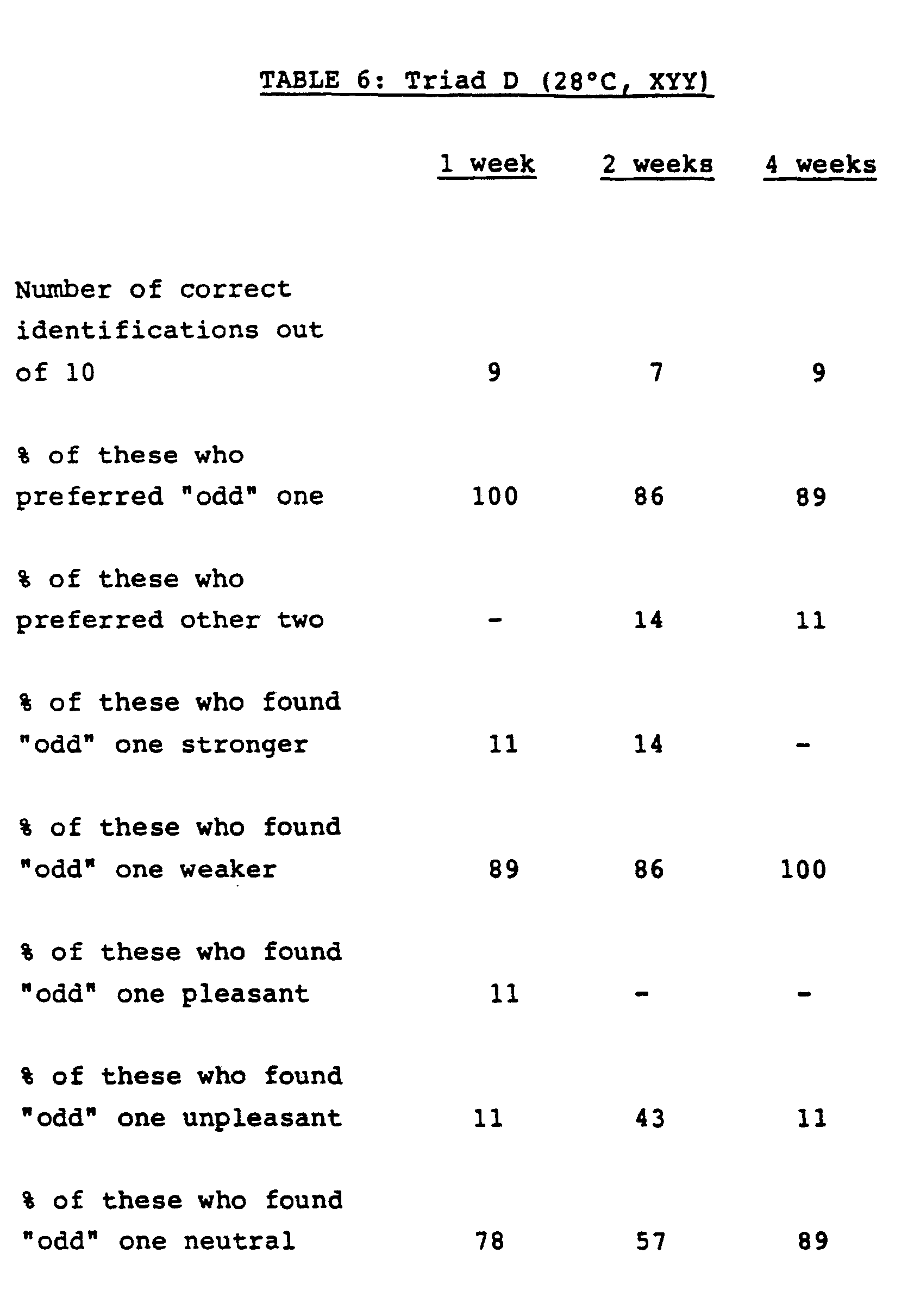


- The contents of the bags were analysed after 1, 2 and 4 weeks for TAED decomposition and perborate decomposition. The results on TAED loss are shown in Table 10.

- These results show that there was no significant TAED loss, and no significant difference between the bags containing perborate monohydrate and the bags containing perborate tetrahydrate.
- The results on perborate loss were as shown in Table 11: for ease of comparison between monohydrate and tetrahydrate these are shown as percentages.

- Although in general slight losses of perborate occurred, there was no significant difference between the two sets of bags.
- Thus the reduced malodour development in the bags containing the monohydrate cannot simply be attributed to reduced decomposition of TAED and perborate as described in GB-A-1 573 406 (Unilever).
- The TAED granules used in Example 1 contained phosphate binders. Rapid screening of bags containing TAED granules containing other binding agents (tallow alcohol ethoxylate, hardened tallow fatty acid, hardened tallow, paraffin wax) indicated a similar difference between perborate monohydrate and tetrahydrate.
- In Example 8 bags (X) containing sodium perborate of which 100% was in monohydrate form were compared with bags (Y) containing sodium perborate of which 100% was in tetrahydrate form. In the following experiment triad test methodology was used to compare bags containing various mixtures of monohydrate and tetrahydrate with bags containing only tetrahydrate.
- The bags used in the test were of the same material and dimensions as that of Example 1, and each contained 15.32 g of the TAED granules used in Example 1. The sodium perborate contents of the bags, chosen to give an identical available oxygen level for every bag, were as shown in Table 12.

- The results of the triad test after 1 week's storage at 37° C are shown in Table 13. It will be seen that 25 mole per cent of monohydrate was sufficient to give a significant reduction in malodour development after 1 week's storage at 37° C.

- The bags tested in Examples 8 and 9 were intended for use as wash adjunct products, and contained only TAED and perborate. The following comparative experiment was carried out in order to determine whether a similar difference between perborate monohydrate and perborate tetrahydrate could be detected in fully formulated detergent powders packed in sachets.
- A detergent base powder was prepared containing
- 16.5% active detergent
- 45.2% builder
- 38.3% other components
- A first set of bags (P), of size and material as described in Example 1, each contained 30 g of a powder composed as follows:

- A second set of bags (Q) each contained 30 g of a powder composed as follows:

- After 1 week's storage, the bags of the two sets were grouped in threes and subjected to the triad test as described in Example 8. The results were as shown in Table 14.

- It will be seen that in all cases the number of correct identifications was below the 7 out of 10 level required for significance. Thus after 1 week's storage there was no significant difference in smell between the two sets of bags; the reduced development of malodour according to the invention is observed only in the adjunct type of product.
- A further sensory test was carried out on bags as described in Example 1 to determine the relative humidity conditions under which malodour development was most pronounced. After 1 week's storage at 28° C under various conditions of relative humidity, the bags were assessed by two trained panellists under "double blind" conditions, that is, neither the presenter nor the panellists knew which sample was which. The panellists were asked to say:
- (i) whether the X or Y bag had the stronger smell, and
- (ii) whether the smell of the bag having the stronger smell was strong or weak.
- The replies to question (i) are summarised in Table 15, from which it may be seen that the monohydrate-containing bags X were never found to be stronger-smelling.

- Table 16 shows the answers to question (ii) on the bags Y.

- These results show that, surprisingly, the development of malodour is most marked under conditions of low relative humidity.
- A further triad test was carried out using bags containing sodium perborate (monohydrate or tetrahydrate) with a different activator, sodium octanoyloxybenzene sulphonate. In each triad the "odd" sample contained the tetrahydrate. The results are shown in Table 17.

- These results show that the malodour reduction benefit obtained by using sodium perborate monohydrate is not restricted to activators that generate peracetic acid.
Claims (19)
Priority Applications (1)
| Application Number | Priority Date | Filing Date | Title |
|---|---|---|---|
| AT85302917T ATE67239T1 (en) | 1984-04-27 | 1985-04-25 | BLEACH PRODUCTS. |
Applications Claiming Priority (2)
| Application Number | Priority Date | Filing Date | Title |
|---|---|---|---|
| GB848410826A GB8410826D0 (en) | 1984-04-27 | 1984-04-27 | Bleach products |
| GB8410826 | 1984-04-27 |
Publications (3)
| Publication Number | Publication Date |
|---|---|
| EP0163417A1 EP0163417A1 (en) | 1985-12-04 |
| EP0163417B1 true EP0163417B1 (en) | 1991-09-11 |
| EP0163417B2 EP0163417B2 (en) | 1996-09-18 |
Family
ID=10560187
Family Applications (1)
| Application Number | Title | Priority Date | Filing Date |
|---|---|---|---|
| EP85302917A Expired - Lifetime EP0163417B2 (en) | 1984-04-27 | 1985-04-25 | Bleach products |
Country Status (13)
| Country | Link |
|---|---|
| US (1) | US5002679A (en) |
| EP (1) | EP0163417B2 (en) |
| JP (1) | JPS61501993A (en) |
| AT (1) | ATE67239T1 (en) |
| AU (1) | AU571332B2 (en) |
| BR (1) | BR8506699A (en) |
| CA (1) | CA1236370A (en) |
| DE (1) | DE3584037D1 (en) |
| ES (1) | ES8705030A1 (en) |
| FR (1) | FR2563529B1 (en) |
| GB (2) | GB8410826D0 (en) |
| WO (1) | WO1985005120A1 (en) |
| ZA (1) | ZA853099B (en) |
Families Citing this family (16)
| Publication number | Priority date | Publication date | Assignee | Title |
|---|---|---|---|---|
| GB8607832D0 (en) * | 1986-03-27 | 1986-04-30 | Caligen Foam Ltd | Fabric treatment products |
| US4875575A (en) * | 1988-01-26 | 1989-10-24 | The Procter & Gamble Company | Pouched laundry wash active dispenser for improved solubility |
| CZ20003918A3 (en) * | 1998-04-27 | 2002-01-16 | The Procter & Gamble Company | Non-particulate, solid detergent product containing bleach activator |
| US6624130B2 (en) | 2000-12-28 | 2003-09-23 | Unilever Home & Personal Care Usa Division Of Conopco, Inc. | Laundry product |
| WO2003044155A1 (en) * | 2001-11-19 | 2003-05-30 | Unilever N.V. | Detergent sachets |
| US20050031530A1 (en) * | 2003-08-07 | 2005-02-10 | Martin Perry L. | Method and apparatus for producing a peroxyacid solution |
| US20060014872A1 (en) * | 2004-07-16 | 2006-01-19 | Martin Roy W | Protective composition that allows in-situ generation of permeation channels therein |
| US20060013750A1 (en) * | 2004-07-16 | 2006-01-19 | Martin Perry L | Solvent-activated reactor |
| GB0416711D0 (en) * | 2004-07-27 | 2004-09-01 | Unilever Plc | A particulate detergent composition and packaging therefore |
| US7709437B2 (en) * | 2006-04-27 | 2010-05-04 | Oci Chemical Corp. | Co-granulates of bleach activator-peroxide compounds |
| US20080060741A1 (en) * | 2006-09-07 | 2008-03-13 | Privitera Marc P | Ultrasonically Bonded Nonwoven Permeable Pouch |
| US8008247B2 (en) | 2008-06-18 | 2011-08-30 | The Clorox Company | Tumble dryer bleach and fabric treatment |
| KR100941601B1 (en) * | 2008-06-26 | 2010-02-11 | 주식회사 아이지테크 | Laundry ball bag and its manufacturing method |
| JP5872219B2 (en) * | 2011-09-01 | 2016-03-01 | アムテック株式会社 | Chlorine gas reducing agent composing base material and composite |
| DE102013004367B4 (en) * | 2013-03-12 | 2018-12-27 | Comtag Ag | Disposable container with additive for water for the treatment of objects |
| WO2019108143A1 (en) | 2017-11-30 | 2019-06-06 | Hayat Kimya Sanayi Anonim Sirketi | Unit dose cleaning product with nonwoven websheet cover |
Family Cites Families (25)
| Publication number | Priority date | Publication date | Assignee | Title |
|---|---|---|---|---|
| GB302416A (en) * | 1927-09-22 | 1928-12-20 | James Beattie Copland | Improvements in and relating to domestic washing appliances |
| GB395211A (en) * | 1932-10-14 | 1933-07-13 | Ernest Gibson | Device for suspending cream-tint blocks used in rinsing clothes |
| GB476564A (en) * | 1935-06-20 | 1937-12-03 | Joseph Sabetay Grassiani | Device for economical and practical use of washing blue |
| US3154495A (en) * | 1961-08-10 | 1964-10-27 | Olin Mathieson | Calcium hypochlorite article and process |
| CA813298A (en) * | 1966-07-08 | 1969-05-20 | Colgate-Palmolive Company | Bleaching packets |
| GB1298454A (en) * | 1969-01-07 | 1972-12-06 | Lantor Ltd | Washing powder bags |
| DE1963898A1 (en) * | 1969-10-13 | 1971-07-15 | Henkel & Cie Gmbh | Powdery to granular detergent containing perborate and process for its production |
| CH565088A5 (en) * | 1973-11-13 | 1975-08-15 | Ciba Geigy Ag | |
| US3945936A (en) * | 1974-01-29 | 1976-03-23 | The Procter & Gamble Company | Bleaching article |
| FI763593A7 (en) * | 1975-12-18 | 1977-06-19 | Unilever Nv | |
| GB1573406A (en) * | 1975-12-18 | 1980-08-20 | Unilever Ltd | Bleaching detergent compositions |
| DE2635257A1 (en) * | 1976-08-05 | 1978-02-09 | Henkel Kgaa | AGENT FOR AFTER-TREATING WASHED LAUNDRY IN THE DRYER |
| US4082678A (en) * | 1976-11-10 | 1978-04-04 | The Procter & Gamble Company | Fabric conditioning articles and process |
| MX151028A (en) * | 1978-11-17 | 1984-09-11 | Unilever Nv | IMPROVEMENTS IN INSOLUBLE BAG BUT PERMEABLE TO WATER THAT HAS A DISPERSIBLE PROTECTIVE LAYER OR SOLUBLE IN WATER, WHICH CONTAINS A PARTICULATE DETERGENT COMPOSITION |
| FR2454477A1 (en) * | 1979-04-20 | 1980-11-14 | Unilever Nv | BLEACHING PRODUCTS CONTAINING PERCOMPOSE AND THEIR USE FOR BLEACHING TISSUES |
| US4254139A (en) * | 1979-12-20 | 1981-03-03 | Colgate-Palmolive Company | Laundry conditioner dispensing article |
| US4260054A (en) * | 1980-02-11 | 1981-04-07 | Lever Brothers Company | Laundry additive pouch |
| US4395342A (en) * | 1980-06-06 | 1983-07-26 | The Procter & Gamble Company | Granular fabric softening composition |
| US4391723A (en) * | 1981-07-13 | 1983-07-05 | The Procter & Gamble Company | Controlled release laundry bleach product |
| US4374035A (en) * | 1981-07-13 | 1983-02-15 | The Procter & Gamble Company | Accelerated release laundry bleach product |
| US4567675A (en) * | 1982-05-20 | 1986-02-04 | Lever Brothers Company | Device for conditioning fabrics in a tumble-dryer |
| GB2124666B (en) * | 1982-06-09 | 1986-01-15 | Procter & Gamble Ltd | Laundry additive products |
| US4539131B1 (en) * | 1982-06-25 | 1990-09-04 | Lever Brothers Ltd | Solid detergent composition containing sodium perborate monohydrate having specified surface area |
| US4412934A (en) * | 1982-06-30 | 1983-11-01 | The Procter & Gamble Company | Bleaching compositions |
| DE3364205D1 (en) * | 1982-10-08 | 1986-07-24 | Procter & Gamble | Bodies containing bleach activators |
-
1984
- 1984-04-27 GB GB848410826A patent/GB8410826D0/en active Pending
-
1985
- 1985-04-24 CA CA000479935A patent/CA1236370A/en not_active Expired
- 1985-04-25 ZA ZA853099A patent/ZA853099B/en unknown
- 1985-04-25 WO PCT/GB1985/000178 patent/WO1985005120A1/en not_active Ceased
- 1985-04-25 BR BR8506699A patent/BR8506699A/en not_active IP Right Cessation
- 1985-04-25 AU AU42922/85A patent/AU571332B2/en not_active Ceased
- 1985-04-25 DE DE8585302917T patent/DE3584037D1/en not_active Expired - Fee Related
- 1985-04-25 AT AT85302917T patent/ATE67239T1/en not_active IP Right Cessation
- 1985-04-25 EP EP85302917A patent/EP0163417B2/en not_active Expired - Lifetime
- 1985-04-25 JP JP60501887A patent/JPS61501993A/en active Granted
- 1985-04-25 GB GB08510524A patent/GB2158113B/en not_active Expired
- 1985-04-26 ES ES542617A patent/ES8705030A1/en not_active Expired
- 1985-04-26 FR FR858506430A patent/FR2563529B1/en not_active Expired - Fee Related
-
1990
- 1990-05-25 US US07/529,671 patent/US5002679A/en not_active Expired - Fee Related
Also Published As
| Publication number | Publication date |
|---|---|
| JPS61501993A (en) | 1986-09-11 |
| GB2158113A (en) | 1985-11-06 |
| FR2563529B1 (en) | 1990-01-05 |
| US5002679A (en) | 1991-03-26 |
| GB2158113B (en) | 1988-01-20 |
| DE3584037D1 (en) | 1991-10-17 |
| JPH0312120B2 (en) | 1991-02-19 |
| ATE67239T1 (en) | 1991-09-15 |
| ZA853099B (en) | 1986-12-30 |
| EP0163417B2 (en) | 1996-09-18 |
| ES542617A0 (en) | 1987-04-16 |
| CA1236370A (en) | 1988-05-10 |
| EP0163417A1 (en) | 1985-12-04 |
| GB8410826D0 (en) | 1984-06-06 |
| ES8705030A1 (en) | 1987-04-16 |
| BR8506699A (en) | 1986-04-15 |
| GB8510524D0 (en) | 1985-05-30 |
| AU4292285A (en) | 1985-11-28 |
| FR2563529A1 (en) | 1985-10-31 |
| WO1985005120A1 (en) | 1985-11-21 |
| AU571332B2 (en) | 1988-04-14 |
Similar Documents
| Publication | Publication Date | Title |
|---|---|---|
| EP0163417B2 (en) | Bleach products | |
| US3945936A (en) | Bleaching article | |
| CA1059267A (en) | Bleaching process | |
| US4770666A (en) | Laundry composition containing peroxyacid bleach and soil release agent | |
| JP4210428B2 (en) | Granular bleach activator | |
| EP0214789B1 (en) | Dry peracid based bleaching product | |
| EP0147191B1 (en) | Perfume and compositions containing perfume | |
| EP0070067B2 (en) | Controlled release laundry bleach product | |
| EP0079674B1 (en) | Controlled release laundry bleach product | |
| JPS59120699A (en) | Detergent composition | |
| JP2595052B2 (en) | Detergent composition containing hectorite clay fabric softener | |
| US4339335A (en) | Free flowing high bulk density particulate detergent-softener | |
| CA2161943C (en) | Granulated bleaching activators and their preparation | |
| PL172300B1 (en) | Detergent agent | |
| CA1100377A (en) | Free flowing high bulk density particulate detergent softener | |
| US6358902B1 (en) | Detergent tablet containing bleach activator of specific particle size | |
| HUT74020A (en) | Detergent compositions | |
| CA1090505A (en) | Bleaching compositions | |
| CA1182074A (en) | Product for treating fabrics in a washing machine | |
| RU2336300C2 (en) | Detergent composition or its component | |
| JPH0649488A (en) | Detergent for soap stain | |
| JPH09500165A (en) | Stabilized bleaching composition | |
| IE840417L (en) | Detergent ingredients |
Legal Events
| Date | Code | Title | Description |
|---|---|---|---|
| PUAI | Public reference made under article 153(3) epc to a published international application that has entered the european phase |
Free format text: ORIGINAL CODE: 0009012 |
|
| AK | Designated contracting states |
Designated state(s): AT BE CH DE FR IT LI NL SE |
|
| 17P | Request for examination filed |
Effective date: 19851122 |
|
| 17Q | First examination report despatched |
Effective date: 19860814 |
|
| D17Q | First examination report despatched (deleted) | ||
| GRAA | (expected) grant |
Free format text: ORIGINAL CODE: 0009210 |
|
| AK | Designated contracting states |
Kind code of ref document: B1 Designated state(s): AT BE CH DE FR IT LI NL SE |
|
| PG25 | Lapsed in a contracting state [announced via postgrant information from national office to epo] |
Ref country code: NL Free format text: LAPSE BECAUSE OF FAILURE TO SUBMIT A TRANSLATION OF THE DESCRIPTION OR TO PAY THE FEE WITHIN THE PRESCRIBED TIME-LIMIT Effective date: 19910911 Ref country code: BE Effective date: 19910911 Ref country code: AT Effective date: 19910911 |
|
| REF | Corresponds to: |
Ref document number: 67239 Country of ref document: AT Date of ref document: 19910915 Kind code of ref document: T |
|
| REF | Corresponds to: |
Ref document number: 3584037 Country of ref document: DE Date of ref document: 19911017 |
|
| RBV | Designated contracting states (corrected) |
Designated state(s): AT BE CH DE IT LI NL SE |
|
| K2C1 | Correction of patent specification (title page) published |
Effective date: 19910911 |
|
| ITF | It: translation for a ep patent filed | ||
| PLBI | Opposition filed |
Free format text: ORIGINAL CODE: 0009260 |
|
| 26 | Opposition filed |
Opponent name: HENKEL KOMMANDITGESELLSCHAFT AUF AKTIEN Effective date: 19911213 |
|
| NLR1 | Nl: opposition has been filed with the epo |
Opponent name: HENKEL KOMMANDITGESELLSCHAFT AUF AKTIEN |
|
| RAP4 | Party data changed (patent owner data changed or rights of a patent transferred) |
Owner name: UNILEVER N.V. |
|
| EAL | Se: european patent in force in sweden |
Ref document number: 85302917.1 |
|
| APAC | Appeal dossier modified |
Free format text: ORIGINAL CODE: EPIDOS NOAPO |
|
| PLAW | Interlocutory decision in opposition |
Free format text: ORIGINAL CODE: EPIDOS IDOP |
|
| PGFP | Annual fee paid to national office [announced via postgrant information from national office to epo] |
Ref country code: SE Payment date: 19960318 Year of fee payment: 12 |
|
| PGFP | Annual fee paid to national office [announced via postgrant information from national office to epo] |
Ref country code: CH Payment date: 19960402 Year of fee payment: 12 |
|
| PG25 | Lapsed in a contracting state [announced via postgrant information from national office to epo] |
Ref country code: SE Free format text: LAPSE BECAUSE OF NON-PAYMENT OF DUE FEES Effective date: 19960426 |
|
| PGFP | Annual fee paid to national office [announced via postgrant information from national office to epo] |
Ref country code: NL Payment date: 19960430 Year of fee payment: 12 |
|
| PUAH | Patent maintained in amended form |
Free format text: ORIGINAL CODE: 0009272 |
|
| STAA | Information on the status of an ep patent application or granted ep patent |
Free format text: STATUS: PATENT MAINTAINED AS AMENDED |
|
| 27A | Patent maintained in amended form |
Effective date: 19960918 |
|
| AK | Designated contracting states |
Kind code of ref document: B2 Designated state(s): AT BE CH DE IT LI NL SE |
|
| REG | Reference to a national code |
Ref country code: CH Ref legal event code: AEN Free format text: MAINTIEN DU BREVET DONT L'ETENDUE A ETE MODIFIEE |
|
| ITF | It: translation for a ep patent filed | ||
| NLR2 | Nl: decision of opposition | ||
| NLV1 | Nl: lapsed or annulled due to failure to fulfill the requirements of art. 29p and 29m of the patents act | ||
| REG | Reference to a national code |
Ref country code: CH Ref legal event code: PL |
|
| PG25 | Lapsed in a contracting state [announced via postgrant information from national office to epo] |
Ref country code: LI Free format text: LAPSE BECAUSE OF FAILURE TO SUBMIT A TRANSLATION OF THE DESCRIPTION OR TO PAY THE FEE WITHIN THE PRESCRIBED TIME-LIMIT Effective date: 19970430 Ref country code: CH Free format text: LAPSE BECAUSE OF FAILURE TO SUBMIT A TRANSLATION OF THE DESCRIPTION OR TO PAY THE FEE WITHIN THE PRESCRIBED TIME-LIMIT Effective date: 19970430 |
|
| PGFP | Annual fee paid to national office [announced via postgrant information from national office to epo] |
Ref country code: DE Payment date: 20020314 Year of fee payment: 18 |
|
| PG25 | Lapsed in a contracting state [announced via postgrant information from national office to epo] |
Ref country code: DE Free format text: LAPSE BECAUSE OF NON-PAYMENT OF DUE FEES Effective date: 20031101 |
|
| APAH | Appeal reference modified |
Free format text: ORIGINAL CODE: EPIDOSCREFNO |