EP0157230A2 - Method and apparatus for optically testing cylindrical surfaces - Google Patents
Method and apparatus for optically testing cylindrical surfaces Download PDFInfo
- Publication number
- EP0157230A2 EP0157230A2 EP85102746A EP85102746A EP0157230A2 EP 0157230 A2 EP0157230 A2 EP 0157230A2 EP 85102746 A EP85102746 A EP 85102746A EP 85102746 A EP85102746 A EP 85102746A EP 0157230 A2 EP0157230 A2 EP 0157230A2
- Authority
- EP
- European Patent Office
- Prior art keywords
- wavefront
- cylindrical
- grating
- cylindrical surface
- blaze
- Prior art date
- Legal status (The legal status is an assumption and is not a legal conclusion. Google has not performed a legal analysis and makes no representation as to the accuracy of the status listed.)
- Withdrawn
Links
Images

Classifications
-
- G—PHYSICS
- G01—MEASURING; TESTING
- G01B—MEASURING LENGTH, THICKNESS OR SIMILAR LINEAR DIMENSIONS; MEASURING ANGLES; MEASURING AREAS; MEASURING IRREGULARITIES OF SURFACES OR CONTOURS
- G01B11/00—Measuring arrangements characterised by the use of optical techniques
- G01B11/30—Measuring arrangements characterised by the use of optical techniques for measuring roughness or irregularity of surfaces
-
- G—PHYSICS
- G01—MEASURING; TESTING
- G01B—MEASURING LENGTH, THICKNESS OR SIMILAR LINEAR DIMENSIONS; MEASURING ANGLES; MEASURING AREAS; MEASURING IRREGULARITIES OF SURFACES OR CONTOURS
- G01B9/00—Measuring instruments characterised by the use of optical techniques
- G01B9/02—Interferometers
- G01B9/02034—Interferometers characterised by particularly shaped beams or wavefronts
- G01B9/02038—Shaping the wavefront, e.g. generating a spherical wavefront
- G01B9/02039—Shaping the wavefront, e.g. generating a spherical wavefront by matching the wavefront with a particular object surface shape
-
- G—PHYSICS
- G01—MEASURING; TESTING
- G01B—MEASURING LENGTH, THICKNESS OR SIMILAR LINEAR DIMENSIONS; MEASURING ANGLES; MEASURING AREAS; MEASURING IRREGULARITIES OF SURFACES OR CONTOURS
- G01B2290/00—Aspects of interferometers not specifically covered by any group under G01B9/02
- G01B2290/30—Grating as beam-splitter
Definitions
- This invention relates to optically testing the quality of cylindrical surfaces and is specifically directed to a method and an apparatus which is capable of analyzing the entire cylindrical surface of an object under test.
- test plates made to test the quality of one axis or the other of a cylindrical surface.
- a relatively narrow spherical test plate can be made which is the standard or gage for judging the cylindrical surface under test. This plate is then placed in contact with the cylindrical surface across its main axis and is moved to various points along the main axis of the cylinder to check optically for errors by forming fringe patterns.
- the entire surface of a cylindrical test plate is brought into contact with the entire surface of the cylinder under test. Errors in the surface under test will show optically as fringe patterns.
- Another possibility for testing cylindrical surfaces is to utilize an output reference cylinder in the path of a collimated beam, such as a laser beam, directed to the cylinder under test.
- a collimated beam such as a laser beam
- the method and apparatus which attains the foregoing object comprises a collimated beam of monochromatic light, such as produced by a laser, and beam expander/ collimator, directed to a variably spaced linear grating which produces two first order cylindrical diffracted wavefronts; one, a converging beam in the blaze direction and, two, a diverging beam in an antiblaze direction.
- the blaze direction beam converges into a line focus and diverges therebeyond.
- the fringe pattern representing the figure quality of the cylindrical surface under test is formed on the screen. Both concave and convex, coated and uncoated, cylindrical surfaces can be tested by this method and apparatus.
- the radius of curvature of the cylinder can be determined.
- a test apparatus 10 for testing cylindrical surfaces which comprises a source 12 for a collimated monochromatic light (laser) beam 14 which is directed to a diffraction grating 16 aligned perpendicular to the incident beam. If an optical flat reference output element, such as 18, is used, the zero order return beam from the grating can be used to align the grating 16 perpendicular to the incident beam 14.
- the diffraction grating 16 is a linear grating ruled into a flat surface with variable spaced grooves blazed to produce a high efficiency first order cylindrical converging wavefront 20 in the blaze direction (+1 diffraction) and a first order cylindrical diverging wavefront 22-in the antiblaze direction (-1 diffraction).
- the wavefront 20 converges into a line focus at 24 then diverges as a cylindrical wavefront 26 to impinge on a test object, such as concave cylindrical surface 30.
- the cylindrical surface 30, whose axis is made coincident with the line focus 24, will return the wavefront to the grating 16 where another first order diffraction occurs.
- This first order diffraction may be returned, as a plane wavefront, to the optical flat reference element 18 of an interferometer for analysis although more energy is lost at the second diffraction and there is a high background of zero order energy which reduces the fringe contrast.
- a much better contrast fringe pattern is obtained by placing a screen 32 to intercept the first order antiblaze diffraction (-1) beam 22. This beam diverges from a virtual image 34 and interferes with the returning wavefront from the line focus via a specular (zero order) reflection by the grating surface to generate the fringe pattern on the screen 32 representative of the figure quality of the concave cylindrical surface 30.
- the screen may be any flat surface which can be viewed from either direction (back or front side of the screen) and used to produce camera interferograms.
- Another aspect of the invention is that, while the main axis of the cylinder test object must be coincident with the line focus 24, the distance from the line focus to the cylinder will depend on the curvature of the test surface. It tlso follows that knowing the distance from the line focus to the cylindrical surface the radius of curvature of the surface can be determined. This can be accomplished by moving the cylinder until its surface is coincident with the line focus and measuring the distance traveled. Detection of a second fringe pattern will signify that the optic is positioned exactly at the line focus.
- Figure 2 shows a similar test apparatus in which a convex cylindrical surface 30a may be tested.
- the convex cylindrical surface 30a is placed ahead of the line focus 24 (not shown) to return the first order wavefront to the diffraction grating.
- the line focus 24 can be, however, some obscuration of the collimated incident beam by the test object as illustrated at 30a. Since all components, except the convex cylinder 30a, in this Figure have the function as similarly numbered components in Figure 1, further description of the components in this Figure is unnecessary.
- a source of monochromatic light such as a laser, a beam expander/collimator, both readily available on the market, and a diffraction grating.
- diffraction grating is an optically reflective planar grating having spaces (gaps) 16a between the rulings 16b which decrease in width from grid side 16c to the opposite grid side 16d to diffract the collimated beam into a cylindrical wavefront.
- the spacing can vary from 150 lines per millimeter beginning at 16c to 950 lines per millimeter on the opposite side 16d.
- the grating is designed with a placement of grooves such that the optical path for rays diffracted from adjacent grooves always changes by one wavelength.
- the spacing across the grating is varied in such a manner as to direct all rays to a common line thereby providing a cylindrical wavefront for testing a right circular cylindrical surface.
- the grating for testing right circular cylindrical test optics is more universal since all that is required is to form the line focus to which the main axis of the test optic can be made coincident therewith so that the rays of the beam strike the surface of the test optic normally.
- the grating In the case of the non-right circular cylindric test surface, the grating must be ruled uniquely to match the returned rays from the test optic so that the focal line or lines can direct the first order rays normal to the test optic surface where they are reflected back along the same path.
Landscapes
- Physics & Mathematics (AREA)
- General Physics & Mathematics (AREA)
- Length Measuring Devices By Optical Means (AREA)
- Testing Of Optical Devices Or Fibers (AREA)
Abstract
Description
- This invention relates to optically testing the quality of cylindrical surfaces and is specifically directed to a method and an apparatus which is capable of analyzing the entire cylindrical surface of an object under test.
- Present day method and apparatus for testing cylindrical surfaces uses test plates made to test the quality of one axis or the other of a cylindrical surface. For example, a relatively narrow spherical test plate can be made which is the standard or gage for judging the cylindrical surface under test. This plate is then placed in contact with the cylindrical surface across its main axis and is moved to various points along the main axis of the cylinder to check optically for errors by forming fringe patterns. In another form of test, the entire surface of a cylindrical test plate is brought into contact with the entire surface of the cylinder under test. Errors in the surface under test will show optically as fringe patterns.
- Another possibility for testing cylindrical surfaces is to utilize an output reference cylinder in the path of a collimated beam, such as a laser beam, directed to the cylinder under test. This system is very expensive and limited in wavefront quality and has not been commercially acceptable.
- It is an object of this invention to provide an improved method and apparatus for testing cylindrical surfaces which is highly efficient, compact, relatively rugged, inexpensive, and produces an excellent contrast fringe pattern without the use of an external interferometer.
- The method and apparatus which attains the foregoing object comprises a collimated beam of monochromatic light, such as produced by a laser, and beam expander/ collimator, directed to a variably spaced linear grating which produces two first order cylindrical diffracted wavefronts; one, a converging beam in the blaze direction and, two, a diverging beam in an antiblaze direction. The blaze direction beam converges into a line focus and diverges therebeyond. By placing the axis of a cylindrically surfaced test object, coincident with the line focus, the test object can be made to return the wavefront to the grating where it interferes with the antiblaze wavefront. By locating a screen of any suitable type so as to be impinged by the antiblaze beam and the specular reflection of the returned wavefront, the fringe pattern representing the figure quality of the cylindrical surface under test is formed on the screen. Both concave and convex, coated and uncoated, cylindrical surfaces can be tested by this method and apparatus.
- Other and additional advantages of this invention will become apparent to those skilled in the art after a study of the drawings and the following Detailed Description. For example, by measuring the distance between the line focus of the blaze beam and the test object, the radius of curvature of the cylinder can be determined.
-
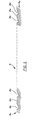
- Figure 1 illustrates the apparatus of the invention for testing concave cylindrical surfaces,
- Figure 2 illustrates the same apparatus as Figure 1 except that a convex cylindrical surface is under test, and
- Figure 3 illustrates a portion of a diffraction grating in cross-section for practicing this invention.
- Turning now to Figure 1 of the drawings, there is disclosed a
test apparatus 10 for testing cylindrical surfaces which comprises asource 12 for a collimated monochromatic light (laser)beam 14 which is directed to a diffraction grating 16 aligned perpendicular to the incident beam. If an optical flat reference output element, such as 18, is used, the zero order return beam from the grating can be used to align thegrating 16 perpendicular to theincident beam 14. - The diffraction grating 16 is a linear grating ruled into a flat surface with variable spaced grooves blazed to produce a high efficiency first order
cylindrical converging wavefront 20 in the blaze direction (+1 diffraction) and a first order cylindrical diverging wavefront 22-in the antiblaze direction (-1 diffraction). Thewavefront 20 converges into a line focus at 24 then diverges as acylindrical wavefront 26 to impinge on a test object, such as concavecylindrical surface 30. Thecylindrical surface 30, whose axis is made coincident with theline focus 24, will return the wavefront to thegrating 16 where another first order diffraction occurs. - This first order diffraction may be returned, as a plane wavefront, to the optical
flat reference element 18 of an interferometer for analysis although more energy is lost at the second diffraction and there is a high background of zero order energy which reduces the fringe contrast. - A much better contrast fringe pattern is obtained by placing a
screen 32 to intercept the first order antiblaze diffraction (-1)beam 22. This beam diverges from avirtual image 34 and interferes with the returning wavefront from the line focus via a specular (zero order) reflection by the grating surface to generate the fringe pattern on thescreen 32 representative of the figure quality of the concavecylindrical surface 30. The screen may be any flat surface which can be viewed from either direction (back or front side of the screen) and used to produce camera interferograms. - Another aspect of the invention is that, while the main axis of the cylinder test object must be coincident with the
line focus 24, the distance from the line focus to the cylinder will depend on the curvature of the test surface. It tlso follows that knowing the distance from the line focus to the cylindrical surface the radius of curvature of the surface can be determined. This can be accomplished by moving the cylinder until its surface is coincident with the line focus and measuring the distance traveled. Detection of a second fringe pattern will signify that the optic is positioned exactly at the line focus. - Figure 2 shows a similar test apparatus in which a convex
cylindrical surface 30a may be tested. In this case, however, the convexcylindrical surface 30a is placed ahead of the line focus 24 (not shown) to return the first order wavefront to the diffraction grating. There can be, however, some obscuration of the collimated incident beam by the test object as illustrated at 30a. Since all components, except theconvex cylinder 30a, in this Figure have the function as similarly numbered components in Figure 1, further description of the components in this Figure is unnecessary. - To practice this invention, it can be seen that all that is required is a source of monochromatic light, such as a laser, a beam expander/collimator, both readily available on the market, and a diffraction grating. One type of diffraction grating as disclosed, is an optically reflective planar grating having spaces (gaps) 16a between the
rulings 16b which decrease in width fromgrid side 16c to theopposite grid side 16d to diffract the collimated beam into a cylindrical wavefront. Typically, the spacing can vary from 150 lines per millimeter beginning at 16c to 950 lines per millimeter on theopposite side 16d. The grating is designed with a placement of grooves such that the optical path for rays diffracted from adjacent grooves always changes by one wavelength. The spacing across the grating is varied in such a manner as to direct all rays to a common line thereby providing a cylindrical wavefront for testing a right circular cylindrical surface. Obviously, however, the grating for testing right circular cylindrical test optics is more universal since all that is required is to form the line focus to which the main axis of the test optic can be made coincident therewith so that the rays of the beam strike the surface of the test optic normally. In the case of the non-right circular cylindric test surface, the grating must be ruled uniquely to match the returned rays from the test optic so that the focal line or lines can direct the first order rays normal to the test optic surface where they are reflected back along the same path. - The art of computerized ray tracing used to rule the grating is setforth in the text entitled "Modern Optical Engineering" by Warren J. Smith, 1966, McGraw-Hill Inc. (Library of Congress, Card No. 66-18214). See the chapters entitled "Optical Computation" discussing computerized ray tracing and "Stops and Apertures" at page 141 discussing gratings.
- In the disclosed method and apparatus, it should be apparent to those skilled in the art, that there is only one diffraction involved so that the efficiency of the apparatus is high and the zero order energy is eliminated from the background which greatly improves the fringe contrast. It also should be apparent that the only equipment required in addition to the equipment listed above are adjustable mounts for the optics to provide a very compact, relatively rugged, and inexpensive system.
Claims (10)
Applications Claiming Priority (2)
| Application Number | Priority Date | Filing Date | Title |
|---|---|---|---|
| US595782 | 1984-04-02 | ||
| US06/595,782 US4606640A (en) | 1984-04-02 | 1984-04-02 | Method and apparatus for optically testing cylindrical surfaces |
Publications (2)
| Publication Number | Publication Date |
|---|---|
| EP0157230A2 true EP0157230A2 (en) | 1985-10-09 |
| EP0157230A3 EP0157230A3 (en) | 1987-05-13 |
Family
ID=24384657
Family Applications (1)
| Application Number | Title | Priority Date | Filing Date |
|---|---|---|---|
| EP85102746A Withdrawn EP0157230A3 (en) | 1984-04-02 | 1985-03-11 | Method and apparatus for optically testing cylindrical surfaces |
Country Status (3)
| Country | Link |
|---|---|
| US (1) | US4606640A (en) |
| EP (1) | EP0157230A3 (en) |
| JP (1) | JPS60225008A (en) |
Families Citing this family (10)
| Publication number | Priority date | Publication date | Assignee | Title |
|---|---|---|---|---|
| US4898470A (en) * | 1988-07-12 | 1990-02-06 | Eastman Kodak Company | Apparatus and method for testing circular cylindrical or conical surfaces |
| US5283690A (en) * | 1989-04-04 | 1994-02-01 | Sharp Kabushiki Kaisha | Optical diffraction grating element |
| US5546186A (en) * | 1991-06-08 | 1996-08-13 | Fuji Photo Optical Co., Ltd. | Apparatus for holographic interferometry suitable for inspection of cylindrical optical surfaces |
| US5379106A (en) * | 1992-04-24 | 1995-01-03 | Forensic Technology Wai, Inc. | Method and apparatus for monitoring and adjusting the position of an article under optical observation |
| US5654798A (en) * | 1995-01-19 | 1997-08-05 | Tropel Corporation | Interferometric measurement of surfaces with diffractive optics at grazing incidence |
| US5793488A (en) * | 1995-07-31 | 1998-08-11 | Tropel Corporation | Interferometer with compound optics for measuring cylindrical objects at oblique incidence |
| US5719676A (en) * | 1996-04-12 | 1998-02-17 | Tropel Corporation | Diffraction management for grazing incidence interferometer |
| US5777738A (en) * | 1997-03-17 | 1998-07-07 | Tropel Corporation | Interferometric measurement of absolute dimensions of cylindrical surfaces at grazing incidence |
| EP2943823B1 (en) * | 2013-01-08 | 2025-05-07 | Snap Inc. | Diffraction gratings and the manufacture thereof |
| EP3502674A1 (en) | 2017-12-19 | 2019-06-26 | Koninklijke Philips N.V. | Testing of curved x-ray gratings |
Family Cites Families (2)
| Publication number | Priority date | Publication date | Assignee | Title |
|---|---|---|---|---|
| US3614235A (en) * | 1969-07-28 | 1971-10-19 | Charles R Munnerlyn | Diffraction grating interferometer |
| US3907438A (en) * | 1973-06-22 | 1975-09-23 | Gen Electric | Contour measuring system for cylinders |
-
1984
- 1984-04-02 US US06/595,782 patent/US4606640A/en not_active Expired - Fee Related
-
1985
- 1985-03-11 EP EP85102746A patent/EP0157230A3/en not_active Withdrawn
- 1985-04-02 JP JP60068628A patent/JPS60225008A/en active Pending
Also Published As
| Publication number | Publication date |
|---|---|
| US4606640A (en) | 1986-08-19 |
| EP0157230A3 (en) | 1987-05-13 |
| JPS60225008A (en) | 1985-11-09 |
Similar Documents
| Publication | Publication Date | Title |
|---|---|---|
| US3829219A (en) | Shearing interferometer | |
| US7072042B2 (en) | Apparatus for and method of measurement of aspheric surfaces using hologram and concave surface | |
| US8345262B2 (en) | Method and apparatus for determining a deviation of an actual shape from a desired shape of an optical surface | |
| US4606640A (en) | Method and apparatus for optically testing cylindrical surfaces | |
| US4744659A (en) | Method of and apparatus for measuring the shape of a wavefront | |
| US3045531A (en) | Optical grating | |
| US5424828A (en) | Method for measuring and analyzing interference fringes using a halographic optical element having two patterns for diffracting a laser beam | |
| JP3784415B2 (en) | Interferometer with composite optical element | |
| US3614235A (en) | Diffraction grating interferometer | |
| JPH0422442B2 (en) | ||
| US4693604A (en) | Interference method and interferometer for testing the surface precision of a parabolic mirror | |
| US3506361A (en) | Optics testing interferometer | |
| EP0158172A2 (en) | Testing of arbitrary optical surfaces | |
| US4563091A (en) | Method for identifying an object and measuring its position and orientation, and device for carrying out the method | |
| US6559948B1 (en) | Method for locating a structure using holograms | |
| WO2005049840A2 (en) | Process and apparatus for measuring the three-dimensional shape of an object | |
| US6717676B2 (en) | Method for measuring magnification of an afocal optical system | |
| EP0137976A2 (en) | Interferometric metrology of surface figures | |
| Middleton | A reflection technique for the survey of the deflection of flat plates: Paper describes a technique by which it is possible to attain required sensitivity between specified values of deflection | |
| JPH051970A (en) | Surface shape measuring device | |
| JP2000097657A (en) | Interferometer | |
| RU2828450C1 (en) | Method for determining angles of rotation of object and two-dimensional autocollimator for its implementation | |
| US4441814A (en) | Spectrograph providing spectral reference marks | |
| RU2054619C1 (en) | Method for determination of curvature of mirror-reflecting surface | |
| Tyson | Measuring phase errors of an array or segmented mirror with a single far-field intensity distribution |
Legal Events
| Date | Code | Title | Description |
|---|---|---|---|
| PUAI | Public reference made under article 153(3) epc to a published international application that has entered the european phase |
Free format text: ORIGINAL CODE: 0009012 |
|
| AK | Designated contracting states |
Designated state(s): DE FR GB IT |
|
| PUAL | Search report despatched |
Free format text: ORIGINAL CODE: 0009013 |
|
| AK | Designated contracting states |
Kind code of ref document: A3 Designated state(s): DE FR GB IT |
|
| 17P | Request for examination filed |
Effective date: 19871104 |
|
| 17Q | First examination report despatched |
Effective date: 19890309 |
|
| STAA | Information on the status of an ep patent application or granted ep patent |
Free format text: STATUS: THE APPLICATION IS DEEMED TO BE WITHDRAWN |
|
| 18D | Application deemed to be withdrawn |
Effective date: 19891020 |
|
| RIN1 | Information on inventor provided before grant (corrected) |
Inventor name: HIRST, GEORGE E. |