EP0156582B1 - Process for the preparation of dl-beta-aryl amino acids - Google Patents
Process for the preparation of dl-beta-aryl amino acids Download PDFInfo
- Publication number
- EP0156582B1 EP0156582B1 EP85301707A EP85301707A EP0156582B1 EP 0156582 B1 EP0156582 B1 EP 0156582B1 EP 85301707 A EP85301707 A EP 85301707A EP 85301707 A EP85301707 A EP 85301707A EP 0156582 B1 EP0156582 B1 EP 0156582B1
- Authority
- EP
- European Patent Office
- Prior art keywords
- hydantoin
- general formula
- process according
- aryl
- sub
- Prior art date
- Legal status (The legal status is an assumption and is not a legal conclusion. Google has not performed a legal analysis and makes no representation as to the accuracy of the status listed.)
- Expired
Links
Classifications
-
- C—CHEMISTRY; METALLURGY
- C07—ORGANIC CHEMISTRY
- C07D—HETEROCYCLIC COMPOUNDS
- C07D233/00—Heterocyclic compounds containing 1,3-diazole or hydrogenated 1,3-diazole rings, not condensed with other rings
- C07D233/54—Heterocyclic compounds containing 1,3-diazole or hydrogenated 1,3-diazole rings, not condensed with other rings having two double bonds between ring members or between ring members and non-ring members
- C07D233/66—Heterocyclic compounds containing 1,3-diazole or hydrogenated 1,3-diazole rings, not condensed with other rings having two double bonds between ring members or between ring members and non-ring members with hetero atoms or with carbon atoms having three bonds to hetero atoms with at the most one bond to halogen, e.g. ester or nitrile radicals, directly attached to ring carbon atoms
- C07D233/72—Two oxygen atoms, e.g. hydantoin
- C07D233/76—Two oxygen atoms, e.g. hydantoin with substituted hydrocarbon radicals attached to the third ring carbon atom
- C07D233/78—Radicals substituted by oxygen atoms
-
- C—CHEMISTRY; METALLURGY
- C07—ORGANIC CHEMISTRY
- C07D—HETEROCYCLIC COMPOUNDS
- C07D233/00—Heterocyclic compounds containing 1,3-diazole or hydrogenated 1,3-diazole rings, not condensed with other rings
- C07D233/54—Heterocyclic compounds containing 1,3-diazole or hydrogenated 1,3-diazole rings, not condensed with other rings having two double bonds between ring members or between ring members and non-ring members
- C07D233/66—Heterocyclic compounds containing 1,3-diazole or hydrogenated 1,3-diazole rings, not condensed with other rings having two double bonds between ring members or between ring members and non-ring members with hetero atoms or with carbon atoms having three bonds to hetero atoms with at the most one bond to halogen, e.g. ester or nitrile radicals, directly attached to ring carbon atoms
- C07D233/72—Two oxygen atoms, e.g. hydantoin
- C07D233/74—Two oxygen atoms, e.g. hydantoin with only hydrogen atoms or radicals containing only hydrogen and carbon atoms, attached to other ring members
Definitions
- This invention relates to a new and improved process for the preparation of DL- ⁇ -aryl-amino acids of the general Formula starting from hydantoin.
- glycine ethyl ester or glycine nitrile is reacted with potassium cyanate, or glycine nitrile or lactic acid nitrile is treated with ammonium carbonate and the hydantoinic acid intermediate thus obtained is converted into hydantoin by acidic cyclization.
- Hydantoin is also formed by melting glycine and urea, and the reaction can also be accomplished with nitrourea in aqueous solution.
- the reaction of various amino acids (e.g. glycine) with urea in aqueous solution in the presence of barium hydroxide has also been studied.
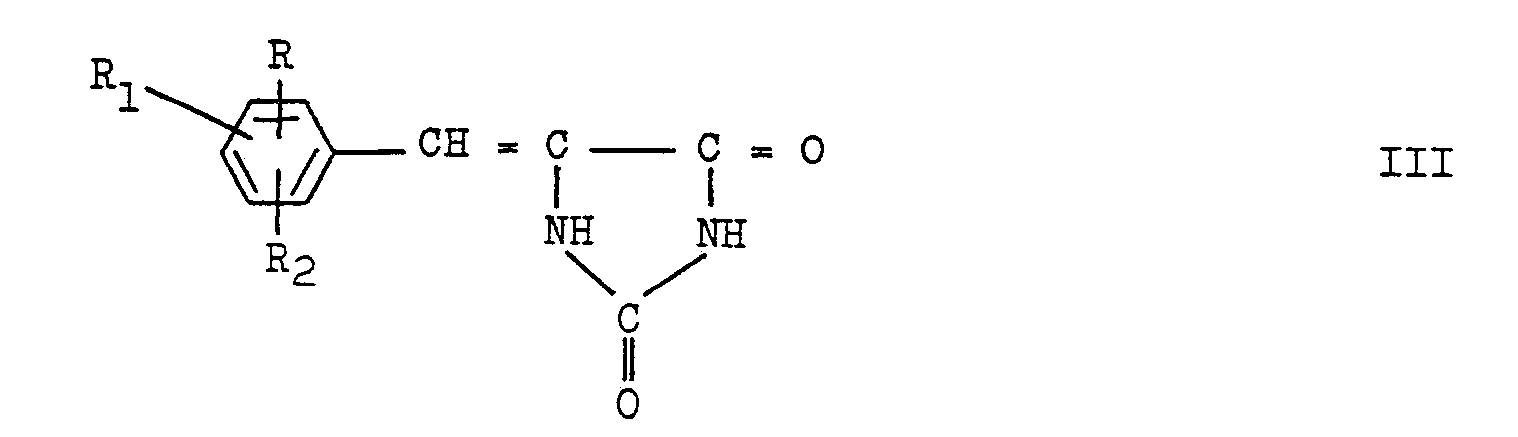
- the first step of the synthesis of ⁇ -aryl amino acids starting from hydantoin is the condensation reaction of the corresponding aromatic aldehyde of the general Formula with hydantoin of the Formula I to yield the corresponding 5-arylidene hydantoin of the general Formula
- condensing agent acetic acid/sodium acetate may be applied or (with pyridine as solvent) secondary amines (e.g. diethylamine, piperidine) can be used [E. Ware: Chem. Rev. 46, 403 (1950); G. Billek: Monatsch. 92, 352 (1961)].
- the condensation reaction can also be carried out in aqueous medium in the presence of ethanolamine (cholamine) - see US Patent No. 2,861,079.
- the said reduction can be carried out with hydrogen iodide/red phosphorus or hydrogen iodide in glacial acetic acid or by catalytic hydrogenation [E. Ware: Chem. Rev. 46, 403 (1950)].
- catalyst palladium/ charcoal or platinum oxide in an alcoholic medium (methanol or ethanol) can be used [M. L. Sethi et al: J. Pharm. Sci. 62,1802 (1973)] or Raney-nickel can be applied in methanolic solution under a pressure of 720 atm. at 85°C [US Patent No. 2,479,065] or in aqueous medium [H. P. Ward: J. Am. Chem. Soc. 74, 4212 (1952)].
- the 5-aryl-methyl-hydantoin of the general Formula IV can be converted by hydrolysis into the corresponding DL-(3-aryl amino acid of the general Formula V.
- the hydantoin ring can be hydrolysed in acidic medium, e.g. by means of 60% sulfuric acid [L. H. Goodson et al: J. Org. Chem. 25, 1920 (1960)] or with the aid of 57% hydrogen iodide/red phosphorus [H. L. Wheelerm, C. Hoffman: Am. Chem. J.: 45, 568 (1911); C. A. 5, 2072].
- Alkaline hydrolysis is however generally much preferred.
- barium hydroxide can be used [H. L. Wheeler, C. Hoffman: Am. Chem. J. 45 568 (1911); CA 5 2072; R. Gaudri: Can. J. Research 26B 773 (1948); H. Finkbeiner: J. Org. Chem. 30 3414 (1965)], or sodium hydroxide can be applied [E. Pierson et al: J. Am. Chem. So. 70 1450 (1948); M. Matsui, M. Nishio: Agr. Biol. Chem. (Tokyo) 28 710 (1964); K. Okubo, Y. lzumi: Bull. Chem. Soc. Jap. 43 1541 (1970); M.
- US Patent 2605282 describes the preparation of beta (3,4-dihydroxyphenyl)alanine by condensation of (I) with an aldehyde in the presence of diethanolamine, followed by hydrogenation in the presence of a palladium catalyst (or using SN/HCI or sodium amalgam) and hydrolysis with hydrobromic acid.
- a trihydroxyphenylalanine is prepared by condensation in the presence of acetic acid and anhydride and sodium acetate and the product is then reduced in the presence of palladium and hydrolysed with barium hydroxide. Hydrolysis with barium hydroxide is also described in JCS, 1949, Part I, pages 181-182.
- L-amino acids can be directly formed by enzymatic hydrolysis of the corresponding racemic 5- substituted hydantoins [US Patent No. 4,016,037; KOKAI Nos. 77-18,837 and 78-34,990; G. Marcel et al: Bull. Soc. Chim. Fr. 1-2 Pt.2 91 (1980)].
- the reaction of glycine and urea seems to be the most preferred industrial scale synthesis of hydantoin.
- the reaction carried out in the melt is unsuitable for industrial scale production because of the low yields and technical problems. It is preferred to carry out the reaction in aqueous medium.
- a comparison with the glacial acetic acid/sodium acetate method shows that the yield is higher and the costs are lower.
- Hydrogenation can be carried out preferably in a diluted sodium hydroxide solution since in this system the solubility conditions are better than in alcohols.
- hydantoin of the Formula I is prepared (in a yield of e.g. 70-75%) by heating to boiling an aqueous solution of glycine and an excess of urea and (preferably without isolating the hydantoin acid intermediate) subjecting the mixture to acidic cyclisation. At the end of the reaction the desired product precipitates in crystalline form and can be directly used in the next step. By evaporating the mother lye and extracting the crystalline residue with methanol a further amount of the product can be obtained.
- the aqueous solution of the hydantoin of the Formula I and e.g. an equimolar amount of an aromatic aldehyde of the general Formula II is heated in the presence of an excess of ethanolamine or morpholine (e.g. for 4 hours) and the corresponding 5-arylidene hydantoin of the general Formula III may be isolated (e.g. after acidification) with a yield of 90%.
- the ethanolamine or morpholine can be recovered by alkalizing the mother lye and distillation; the said amine can be re-introduced into the reaction.
- the 5-aryl methyl hydantoin of the general Formula IV thus obtained can be hydrolysed into the corresponding DL-p-aryl amino acid of the general Formula V in a 20% sodium hydroxide solution with good yields, whereby the corresponding hydantoinic acid is formed only in a negligible amount.
- R, R 1 and R 2 stand for hydrogen, halogen, C 1 - 6 alkyl, C 1 - 6 alkoxy, nitro or C 1 - 4 dialkylamino;
- R and R 1 are hydrogen and R 2 has the same meaning as stated above and can be attached to position 2, 3 or 4 related to the methylene group;
- R is hydrogen and R 1 and R2 have the same meaning as stated above and are attached to positions 2,3; 2,4; 2,5; 2,6; 3,4 or 3,5 related to the methylene group;
- R, R 1 and R 2 have the same meaning as stated above and are attached to positions 2,3,4; 2,3,5; 2,3,6; 3,4,5 or 3,4,6 related to the methylene group.
- a further advantage of the process of the present invention is that the 5-aryl-methyl hydantoin of the general Formula IV are obtained in very high yields and in such a purity that they can be directly converted into the L-amino acids by enzymatic hydrolysis.
- the crude hydantoin thus obtained is sufficiently pure for further reaction. It can be recrystallized from 10 parts of glacial acetic acid, mp.: 220-222°C.
Landscapes
- Chemical & Material Sciences (AREA)
- Organic Chemistry (AREA)
- Organic Low-Molecular-Weight Compounds And Preparation Thereof (AREA)
- Low-Molecular Organic Synthesis Reactions Using Catalysts (AREA)
- Pharmaceuticals Containing Other Organic And Inorganic Compounds (AREA)
- Compounds Of Unknown Constitution (AREA)
- Diaphragms For Electromechanical Transducers (AREA)
- Ultra Sonic Daignosis Equipment (AREA)
- Agricultural Chemicals And Associated Chemicals (AREA)
- Acyclic And Carbocyclic Compounds In Medicinal Compositions (AREA)
- Peptides Or Proteins (AREA)
- Saccharide Compounds (AREA)
Abstract
Description
- This invention relates to a new and improved process for the preparation of DL-β-aryl-amino acids of the general Formula

- Several industrial scale processes are known for the preparation of hydantoin of the Formula

- According to E. Ware [Chem. Rev. 46, 403 (1950)] glycine ethyl ester or glycine nitrile is reacted with potassium cyanate, or glycine nitrile or lactic acid nitrile is treated with ammonium carbonate and the hydantoinic acid intermediate thus obtained is converted into hydantoin by acidic cyclization. Hydantoin is also formed by melting glycine and urea, and the reaction can also be accomplished with nitrourea in aqueous solution. The reaction of various amino acids (e.g. glycine) with urea in aqueous solution in the presence of barium hydroxide has also been studied.
- The first step of the synthesis of β-aryl amino acids starting from hydantoin is the condensation reaction of the corresponding aromatic aldehyde of the general Formula


- The condensation reaction can also be carried out in aqueous medium in the presence of ethanolamine (cholamine) - see US Patent No. 2,861,079.
- In the next step of the synthesis the 5-arylidene-hydantoin of the general Formula III is reduced into the corresponding 5-aryl-methyl-hydantoin of the general Formula:

- The said reduction can be carried out with hydrogen iodide/red phosphorus or hydrogen iodide in glacial acetic acid or by catalytic hydrogenation [E. Ware: Chem. Rev. 46, 403 (1950)]. As catalyst palladium/ charcoal or platinum oxide in an alcoholic medium (methanol or ethanol) can be used [M. L. Sethi et al: J. Pharm. Sci. 62,1802 (1973)] or Raney-nickel can be applied in methanolic solution under a pressure of 720 atm. at 85°C [US Patent No. 2,479,065] or in aqueous medium [H. P. Ward: J. Am. Chem. Soc. 74, 4212 (1952)].
- The 5-aryl-methyl-hydantoin of the general Formula IV can be converted by hydrolysis into the corresponding DL-(3-aryl amino acid of the general Formula V. The hydantoin ring can be hydrolysed in acidic medium, e.g. by means of 60% sulfuric acid [L. H. Goodson et al: J. Org. Chem. 25, 1920 (1960)] or with the aid of 57% hydrogen iodide/red phosphorus [H. L. Wheelerm, C. Hoffman: Am. Chem. J.: 45, 568 (1911); C. A. 5, 2072].
- Alkaline hydrolysis is however generally much preferred. For this purpose barium hydroxide can be used [H. L. Wheeler, C. Hoffman: Am. Chem. J. 45 568 (1911); CA 5 2072; R. Gaudri: Can. J. Research 26B 773 (1948); H. Finkbeiner: J. Org. Chem. 30 3414 (1965)], or sodium hydroxide can be applied [E. Pierson et al: J. Am. Chem. So. 70 1450 (1948); M. Matsui, M. Nishio: Agr. Biol. Chem. (Tokyo) 28 710 (1964); K. Okubo, Y. lzumi: Bull. Chem. Soc. Jap. 43 1541 (1970); M. L. Sethi et al: J. Pharm. Sci. 62 1802 (1973)] in concentrated aqueous solution. Several 5-substituted hydantoin derivatives can be hydrolysed in an autoclave (at 180°C for 90 minutes) to yield the corresponding amino acid in a solution of Na2Mo04 . 2H20 (KOKAI No. 74-116,008).
- US Patent 2605282 describes the preparation of beta (3,4-dihydroxyphenyl)alanine by condensation of (I) with an aldehyde in the presence of diethanolamine, followed by hydrogenation in the presence of a palladium catalyst (or using SN/HCI or sodium amalgam) and hydrolysis with hydrobromic acid. In Helvetica Chimica Acta, Vol 52, Fasc 4,1969, No. 120-121, pages 1095-1097, a trihydroxyphenylalanine is prepared by condensation in the presence of acetic acid and anhydride and sodium acetate and the product is then reduced in the presence of palladium and hydrolysed with barium hydroxide. Hydrolysis with barium hydroxide is also described in JCS, 1949, Part I, pages 181-182.
- L-amino acids can be directly formed by enzymatic hydrolysis of the corresponding racemic 5- substituted hydantoins [US Patent No. 4,016,037; KOKAI Nos. 77-18,837 and 78-34,990; G. Marcel et al: Bull. Soc. Chim. Fr. 1-2 Pt.2 91 (1980)].
- The reaction of glycine and urea seems to be the most preferred industrial scale synthesis of hydantoin. The reaction carried out in the melt is unsuitable for industrial scale production because of the low yields and technical problems. It is preferred to carry out the reaction in aqueous medium. When preparing arylidene hydantoins, it is highly preferred to work in an aqueous medium in the presence of ethanolamine. A comparison with the glacial acetic acid/sodium acetate method shows that the yield is higher and the costs are lower.
- The reduction of 5-arylidene hydantoins can be carried out most advantageously in the presence of a Raney-nickel because the said catalyst is the cheapest and the yields are also higher.
- Hydrogenation can be carried out preferably in a diluted sodium hydroxide solution since in this system the solubility conditions are better than in alcohols.
- The barium hydroxide hydrolysis method suggested as preferable for the splitting of the hydantoin ring has several drawbacks:
- a) a part of the starting material remains unreacted and unchanged;
- b) on removing the barium ions the solution is acidified with sulfuric acid and the finely distributed barium sulfate precipitate formed causes significant losses - due to adsorption.
- Hydrolysis carried out with sodium hydroxide results in certain cases only the corresponding hydantoin acid. Acidic hydrolysis is unsuitable because of the low yields.
- According to the process of the present invention hydantoin of the Formula I is prepared (in a yield of e.g. 70-75%) by heating to boiling an aqueous solution of glycine and an excess of urea and (preferably without isolating the hydantoin acid intermediate) subjecting the mixture to acidic cyclisation. At the end of the reaction the desired product precipitates in crystalline form and can be directly used in the next step. By evaporating the mother lye and extracting the crystalline residue with methanol a further amount of the product can be obtained.
- The aqueous solution of the hydantoin of the Formula I and e.g. an equimolar amount of an aromatic aldehyde of the general Formula II is heated in the presence of an excess of ethanolamine or morpholine (e.g. for 4 hours) and the corresponding 5-arylidene hydantoin of the general Formula III may be isolated (e.g. after acidification) with a yield of 90%. The ethanolamine or morpholine can be recovered by alkalizing the mother lye and distillation; the said amine can be re-introduced into the reaction.
- It has been found that the reduction of the 5-arylidene hydantoins of the general Formula III can be carried out easily and with good yields in a dilute sodium hydroxide solution, with a Raney nickel catalyst, at room temperature, under atmospheric pressure or a pressure of 3-5 bar.
- The 5-aryl methyl hydantoin of the general Formula IV thus obtained can be hydrolysed into the corresponding DL-p-aryl amino acid of the general Formula V in a 20% sodium hydroxide solution with good yields, whereby the corresponding hydantoinic acid is formed only in a negligible amount.
- It is preferred to carry out hydrolysis in the presence of cellosolve since this results in an increase of the yield and the cellosolve can be recovered by distillatio'n. The yield can be further increased by accomplishing hydrolysis in an autoclave (at 140°C), thus the reaction time can also be shortened.
- In the general Formulae
- R, R1 and R2 stand for hydrogen, halogen, C1-6 alkyl, C1-6 alkoxy, nitro or C1-4 dialkylamino; whereby
- in the case of monosubstituted derivatives R and R1 are hydrogen and R2 has the same meaning as stated above and can be attached to position 2, 3 or 4 related to the methylene group;
- in the case of disubstituted derivatives R is hydrogen and R1 and R2 have the same meaning as stated above and are attached to positions 2,3; 2,4; 2,5; 2,6; 3,4 or 3,5 related to the methylene group;
- in the case of trisubstituted derivatives R, R1 and R2 have the same meaning as stated above and are attached to positions 2,3,4; 2,3,5; 2,3,6; 3,4,5 or 3,4,6 related to the methylene group.
- A further advantage of the process of the present invention is that the 5-aryl-methyl hydantoin of the general Formula IV are obtained in very high yields and in such a purity that they can be directly converted into the L-amino acids by enzymatic hydrolysis.
- Further details of the present invention are to be found in the following Examples without limiting the scope of protection to the said Examples.
- The purity of the compounds disclosed in the Examples is checked by physical constants and HPLC methods. The melting points disclosed are non-corrected values. In certain cases the structure of the compounds is confirmed by IR, FT-NMR and MS methods.
- 75 g (1 mole) of glycine and 140 g (2.3 moles) of urea are dissolved in 120 ml of water and the mixture is heated to boiling for 12 hours under stirring. To the reaction mixture 90 ml of concentrated sulfuric acid are added dropwise under cooling with ice-cold water and stirring. The reaction mixture is heated to boiling for an hour and thereafter cooled to 0-5°C. The hydantoin precipitates in crystalline form. The crystals are filtered off, washed with cold water. A further amount of the product can be obtained by evaporating the mother lye. Thus 71 g of the desired compound are obtained, yield 70%, mp.: 223-226°C.
- The crude hydantoin thus obtained is sufficiently pure for further reaction. It can be recrystallized from 10 parts of glacial acetic acid, mp.: 220-222°C.
- 50 g (0.5 mole) of hydantoin, 55 g (52 ml, 0.52 mole) of benzaldehyde and 46 g (45 ml, 0.7 mole) of ethanolamine are admixed in 500 ml of water at 70°C. The temperature is raised to 90°C and the reaction mixture is stirred for 4 hours. The solution is cooled and acidified with concentrated hydrochloric acid (pH 3-4). The mixture is allowed to stand at 10°C for an hour, the product is filtered off, washed with cold water and dried. Thus 84.5 g of the desired compound are obtained, yield 89%. Mp.: 220-222°C.
- On comparing the product with a standard sample of 5-benzylidene-hydantoin by HPLC the purity proved to be 100%.
- 50 g (0.5 mole) of hydantoin, 68.07 g (0.5 mole) of salicylaldehyde-methyl-ether and 46 g (0.7 mole) of ethanolamine are admixed in 500 ml of water at 70°C. The reaction mixture is worked up as described in Example 2. Thus 90.6 g of the desired compound are obtained, yield 83%, mp.: 178°C.
- 50 g (0.5 mole) of hydantoin, 68.07 g (0.5 mole) of 4-methoxy-benzylaldehyde and 46 g (0.7 mole) of ethanolamine are admixed in 500 ml of water at 70°C. The reaction is carried out further on as described in Example 2. Thus 92.7 g of the desired compound are obtained, yield 85%. Mp.: 242-244°C.
- 50 g (0.5 mole) of hydantoin, 98.1 g (0.5 mole) of 3,4,5-trimethoxy-benzaldehyde and 46 g (0.7 mole) of ethanolamine are admixed with 500 ml of water at 70°C. The reaction is carried out further on in accordance with Example 2. Thus 121 g of the desired compound are obtained, yield 87%. Mp.: 266-268°C.
- 190 g (1 mole) of 5-benzylidene-hydantoin are dissolved in 2 I of a N sodium hydroxide solution and 95 g of wet Raney-nickel are added. The hydrogen uptake is terminated after about 6-8 hours (the reaction mixture is shaken at atmospheric pressure). The catalyst is filtered off and washed with N sodium hydroxide. The filtrate is acidified to pH 3 with concentrated hydrochloric acid. The precipitated white crystals are filtered off, dried and washed with cold water. Thus 152 g of the desired compound are obtained, yield 80%. Mp.: 187-189°C.
- 190 g (1 mole) of 5-benzylidene-hydantoin are dissolved in 2 I of a N sodium hydroxide solution and 40 g of 5% palladium/charcoal catalyst are added. The mixture is hydrogenated at room temperature under atmospheric pressure and under shaking for 4 hours. The reaction mixture is worked up according to Example 6. Thus 150.2 g of the desired compound are obtained, yield 79%. Mp.: 187-189°C.
- 218.2 g (1 mole) of 5-(2-methoxy-benzylidene)-hydantoin are dissolved in 2 I of a N sodium hydroxide solution and 70 g of wet Raney-nickel are added. The reaction mixture is worked up according to Example 6. Thus 174 g of the desired compound are obtained, yield 79%. Mp.: 186°C.
- 218.2 g (1 mole) of 5-(4-methoxy-benzylidene)-hydantoin are dissolved in 2 I of a N sodium hydroxide solution and 50 g of wet Raney-nickel are added. The reaction mixture is worked up according to Example 6. Thus 180.6 g of the desired compound are obtained, yield 82%. Mp.: 174°C.
- 278.3 g (1 mole) of 5-(3,4,5-trimethoxy-benzylidene)-hydantoin are dissolved in 2 I of a N sodium hydroxide solution and 40 g of wet Raney-nickel are added. The reaction mixture is worked up according to Example 6. Thus 218.6 g of the desired compound are obtained, yield 78%. Mp.: 180-181°C.
- 95.1 g (0.5 mole) of 5-benzyl-hydantoin are dissolved in a solution of 87 g of sodium hydroxide and 400 ml of water, whereupon 300 ml of cellosolve are added. The reaction mixture is heated to boiling for 48 hours, the water and the cellosolve are distilled off in vacuo (30 Hgmm, 80°C), the solid residue is dissolved in a small amount of water and acidified with concentrated hydrochloric acid (pH 2). The solution is treated with activated charcoal and the pH is adjusted to 6 with a concentrated ammonium hydroxide solution. The mixture is allowed to stand for some hours at 5°C. The precipitated product is filtered off, washed with cold water and cold ethanol. Thus 63.4 g of the desired air-dry compound are obtained, yield 77%, Mp.: 245-255°C. Purity: 97.9% according to HPLC.
- 95.1 g (0.5 mole) of 5-benzyl-hydantoin are heated to boiling in 350 ml of a 20% sodium hydroxide solution for 30 hours. The reaction mixture is clarified with activated charcoal and acidified with concentrated hydrochloric acid (pH 2). The precipitate (hydantoinic acid) is filtered off and the phenyl alanine is precipitated from the filtrate as described in Example 11. Thus 59.5 g of the dry desired compound are obtained, yield 72%. Purity: 97.5% (according to HPLC).
- 110.1 g (0.5 mole) of 5-(2-methoxy-benzyl)-hydantoin are dissolved in a solution of 90 g sodium hydroxide and 400 ml of water. After the addition of 300 ml of cellosolve the reaction mixture is stirred for 50 hours. The reaction mixture is worked up as described in Example 11. Thus 56.6 g of the desired compound are obtained, yield 58%. Mp.: 205-208°C.
- 110.1 g (0.5 mole) of 5-(4-methoxy-benzyl)-hydantoin are dissolved in a solution of sodium hydroxide and 400 ml of water. After the addition of 300 ml of cellosolve the reaction mixture is heated to boiling for 50 hours. The reaction mixture is worked up according to Example 11. Thus 68.3 g of the desired compound are obtained, yield 70%. Mp.: 283-288°C.
- 140.2 g (0.5 mole) of 5-(3,4,5-trimethoxy-benzyl)-hydantoin are dissolved in a solution of 90 g of sodium hydroxide and 400 ml of water. After the addition of 250 ml of cellosolve the reaction mixture is heated to boiling for 48 hours. The reaction mixture is worked up according to Example 11. Thus 94.1 g of the desired compound are obtained, yield 65% (hydrochloride salt). Mp.: 240-243°C (hydrochloride).
Claims (10)



Priority Applications (1)
| Application Number | Priority Date | Filing Date | Title |
|---|---|---|---|
| AT85301707T ATE37177T1 (en) | 1984-03-12 | 1985-03-12 | PROCESSES FOR THE PREPARATION OF DL-BETA-ARYLAMINOS|URES. |
Applications Claiming Priority (2)
| Application Number | Priority Date | Filing Date | Title |
|---|---|---|---|
| HU98184 | 1984-03-12 | ||
| HU84981A HU204026B (en) | 1984-03-12 | 1984-03-12 | Process for producing di-beta-substituted phenylamino acids |
Publications (2)
| Publication Number | Publication Date |
|---|---|
| EP0156582A1 EP0156582A1 (en) | 1985-10-02 |
| EP0156582B1 true EP0156582B1 (en) | 1988-09-14 |
Family
ID=10952297
Family Applications (1)
| Application Number | Title | Priority Date | Filing Date |
|---|---|---|---|
| EP85301707A Expired EP0156582B1 (en) | 1984-03-12 | 1985-03-12 | Process for the preparation of dl-beta-aryl amino acids |
Country Status (18)
| Country | Link |
|---|---|
| US (1) | US4647694A (en) |
| EP (1) | EP0156582B1 (en) |
| JP (1) | JPS60204750A (en) |
| AT (1) | ATE37177T1 (en) |
| AU (1) | AU3968185A (en) |
| BG (1) | BG43688A3 (en) |
| DD (1) | DD232260A5 (en) |
| DE (1) | DE3564938D1 (en) |
| DK (1) | DK109985A (en) |
| ES (1) | ES8601854A1 (en) |
| FI (1) | FI850970A7 (en) |
| HU (1) | HU204026B (en) |
| IL (1) | IL74389A0 (en) |
| NO (1) | NO850943L (en) |
| PL (1) | PL252344A1 (en) |
| RO (1) | RO92676B (en) |
| SU (1) | SU1468409A3 (en) |
| YU (1) | YU39085A (en) |
Families Citing this family (5)
| Publication number | Priority date | Publication date | Assignee | Title |
|---|---|---|---|---|
| US4613691A (en) * | 1984-08-17 | 1986-09-23 | Stauffer Chemical Company | Preparation of amino acids from unsaturated hydantoins |
| DE4137581A1 (en) * | 1991-11-15 | 1993-05-19 | Degussa | METHOD FOR CHEMICALLY RACEMIZING 5-MONO SUBSTITUTED HYDANTOINS, DEVICE FOR CARRYING OUT THE METHOD AND USE OF THE HYDANTOINS |
| FR2735126B1 (en) * | 1995-06-12 | 1997-07-18 | Rhone Poulenc Rorer Sa | PROCESS FOR THE PREPARATION OF THE ENANTIOMERIC FORMS OF AMINO ALKYLAMINOPHENYLPROPANOIC ACID |
| JP4393190B2 (en) * | 2001-09-05 | 2010-01-06 | ソルヴェイ(ソシエテ アノニム) | Process for producing 5- (3-pyridylmethylene) imidazolidine-2,4-dione |
| ES2837489B2 (en) * | 2019-12-31 | 2022-02-28 | Primalchit Solutions S L | MIXTURE OF NON-POLYMERIC ORGANIC COMPONENTS WITH FLAME RETARDANT CAPACITY, METHOD OF PREPARATION AND USE |
Family Cites Families (16)
| Publication number | Priority date | Publication date | Assignee | Title |
|---|---|---|---|---|
| US2479065A (en) * | 1945-09-06 | 1949-08-16 | Du Pont | Preparation of 5-benzylhydantoin |
| US2605282A (en) * | 1949-02-18 | 1952-07-29 | Dow Chemical Co | Process for production of beta-(3, 4-dihydroxyphenyl)-alanine |
| US2861079A (en) * | 1956-06-04 | 1958-11-18 | Dow Chemical Co | Process for making unsaturated hydantoins |
| GB991644A (en) * | 1961-10-30 | 1965-05-12 | Rafa House Biolog Lab Ltd | Manufacture of hydantoin derivatives |
| US3190914A (en) * | 1963-05-27 | 1965-06-22 | Rexall Drug Chemical | Process for the preparation of amino acids |
| US3215736A (en) * | 1964-03-20 | 1965-11-02 | Prod Chim Ind S P C I Soc D | Preparation of amino acids |
| NL128182C (en) * | 1965-11-30 | |||
| CH483397A (en) * | 1966-12-01 | 1969-12-31 | Hoffmann La Roche | Process for the preparation of phenylalanine derivatives |
| GB1310510A (en) * | 1969-06-10 | 1973-03-21 | Zundel J | Preparation of alpha-aminoacids from hydantoins |
| GB1456857A (en) * | 1972-11-24 | 1976-12-01 | Teijin Ltd | Process for the production of hydantoin derivatives |
| US4175198A (en) * | 1976-10-07 | 1979-11-20 | W. R. Grace & Co. | 5-Secondary alkylidene hydantoins |
| JPS54106469A (en) * | 1978-02-09 | 1979-08-21 | Ajinomoto Co Inc | Preparation of 5-aryl-hydantoin |
| JPS54106470A (en) * | 1978-02-09 | 1979-08-21 | Ajinomoto Co Inc | Preparation of 5-aryl-hydantoin |
| JPS54128572A (en) * | 1978-03-25 | 1979-10-05 | Ajinomoto Co Inc | Preparation of 5-arylhydantoin |
| JPS54138559A (en) * | 1978-04-19 | 1979-10-27 | Ajinomoto Co Inc | Preparation of 5-aryl-hydantoin |
| DE3013626C2 (en) * | 1980-04-09 | 1985-06-27 | Degussa Ag, 6000 Frankfurt | Process for the preparation of 5-arylidene hydantoins (A) |
-
1984
- 1984-03-12 HU HU84981A patent/HU204026B/en not_active IP Right Cessation
-
1985
- 1985-02-20 IL IL74389A patent/IL74389A0/en unknown
- 1985-03-08 AU AU39681/85A patent/AU3968185A/en not_active Abandoned
- 1985-03-08 ES ES541070A patent/ES8601854A1/en not_active Expired
- 1985-03-11 NO NO850943A patent/NO850943L/en unknown
- 1985-03-11 SU SU853865852A patent/SU1468409A3/en active
- 1985-03-11 RO RO117934A patent/RO92676B/en unknown
- 1985-03-11 DD DD85274004A patent/DD232260A5/en unknown
- 1985-03-11 BG BG069188A patent/BG43688A3/en unknown
- 1985-03-11 DK DK109985A patent/DK109985A/en not_active Application Discontinuation
- 1985-03-12 YU YU00390/85A patent/YU39085A/en unknown
- 1985-03-12 FI FI850970A patent/FI850970A7/en not_active Application Discontinuation
- 1985-03-12 EP EP85301707A patent/EP0156582B1/en not_active Expired
- 1985-03-12 DE DE8585301707T patent/DE3564938D1/en not_active Expired
- 1985-03-12 PL PL25234485A patent/PL252344A1/en unknown
- 1985-03-12 AT AT85301707T patent/ATE37177T1/en active
- 1985-03-12 US US06/710,838 patent/US4647694A/en not_active Expired - Fee Related
- 1985-03-12 JP JP60047597A patent/JPS60204750A/en active Pending
Also Published As
| Publication number | Publication date |
|---|---|
| DK109985D0 (en) | 1985-03-11 |
| JPS60204750A (en) | 1985-10-16 |
| NO850943L (en) | 1985-09-13 |
| RO92676B (en) | 1987-12-01 |
| BG43688A3 (en) | 1988-07-15 |
| YU39085A (en) | 1987-04-30 |
| DD232260A5 (en) | 1986-01-22 |
| ES541070A0 (en) | 1985-12-01 |
| ES8601854A1 (en) | 1985-12-01 |
| DK109985A (en) | 1985-09-13 |
| SU1468409A3 (en) | 1989-03-23 |
| PL252344A1 (en) | 1985-11-19 |
| US4647694A (en) | 1987-03-03 |
| HU204026B (en) | 1991-11-28 |
| DE3564938D1 (en) | 1988-10-20 |
| ATE37177T1 (en) | 1988-09-15 |
| AU3968185A (en) | 1985-09-19 |
| FI850970L (en) | 1985-09-13 |
| IL74389A0 (en) | 1985-05-31 |
| FI850970A7 (en) | 1985-09-13 |
| HUT39717A (en) | 1986-10-29 |
| RO92676A (en) | 1987-11-30 |
| FI850970A0 (en) | 1985-03-12 |
| EP0156582A1 (en) | 1985-10-02 |
Similar Documents
| Publication | Publication Date | Title |
|---|---|---|
| US4080325A (en) | Synthesis of methotrexate | |
| CZ297631B6 (en) | Process for preparing (S) - (+) - 3- (aminomethyl) -5-methylhexanoic acid and intermediates useful in this preparation | |
| PL164457B1 (en) | - {exo-bicyclo [2.2.1] hept-2-yloxy} -4-methoxyphenyl / glutaric PL PL PL PL PL | |
| IE903090A1 (en) | Process for the preparation of cyclic amino acids, as well as intermediates | |
| HU191960B (en) | Process for preparing substituted 2-mercapto-imidazoles | |
| US4767859A (en) | Process for the preparation of pteridine derivatives | |
| EP0227787B1 (en) | Production of indole alpha-ketoacids from alpha-aminoacid, particularly of indolepyruvic acid | |
| US4647694A (en) | Process for the preparation of D1-β-aryl amino acids | |
| HUP0200839A2 (en) | Novel synthesis and crystallization of piperazine ring-containing compounds and pharmaceutical compositions containing them | |
| EP0322401B1 (en) | Tetrahydrophthalimide derivatives, their production and use | |
| HU200447B (en) | Process for production of 1-alkyl-5-nitro-imidasoles | |
| HU200446B (en) | Process for production of 1-alkyl-5-nitro-imidasoles | |
| US4183865A (en) | Process for the resolution of racemic α-aminonitriles | |
| RU2037494C1 (en) | Derivatives of 2-azabicyclo-[2,2,1]-hept-5-ene-2-acetic acid | |
| FI60858B (en) | NYTT FOERFARANDE FOER FRAMSTAELLNING AV 4-AMINO-3,5-DIHALOGEN-FENYL-ETANOLAMINER | |
| US5126457A (en) | Process for the preparation of 1,4-dihydro-pyridine derivatives | |
| EP0001319A1 (en) | Process for the preparation of hydroxyphenyl hydantoin and of hydroxyphenyl glycine, and compounds thus obtained | |
| KR0163042B1 (en) | Process for the preparation of 4-amino-5-hexenic acids | |
| JP2008503545A (en) | Method for preparing gabapentin | |
| HU194857B (en) | Process for production of 4-amin-6-fluor-cromane-4-carbonic acid and its 2/r/ methilesther | |
| US4277603A (en) | Preparation of 5-deazariboflavins | |
| US3450709A (en) | Process for the preparation of ring-substituted 2-aminoimidazoles | |
| US5565575A (en) | Method for the production of 5-cyclohexylmethylhydantoin derivatives | |
| EP0260102B1 (en) | Chemical process | |
| AU627609B2 (en) | New quinoline derivatives and process for the preparation thereof |
Legal Events
| Date | Code | Title | Description |
|---|---|---|---|
| PUAI | Public reference made under article 153(3) epc to a published international application that has entered the european phase |
Free format text: ORIGINAL CODE: 0009012 |
|
| AK | Designated contracting states |
Designated state(s): AT BE CH DE FR GB IT LI NL SE |
|
| 17P | Request for examination filed |
Effective date: 19860318 |
|
| 17Q | First examination report despatched |
Effective date: 19860904 |
|
| GRAA | (expected) grant |
Free format text: ORIGINAL CODE: 0009210 |
|
| AK | Designated contracting states |
Kind code of ref document: B1 Designated state(s): AT BE CH DE FR GB IT LI NL SE |
|
| REF | Corresponds to: |
Ref document number: 37177 Country of ref document: AT Date of ref document: 19880915 Kind code of ref document: T |
|
| REF | Corresponds to: |
Ref document number: 3564938 Country of ref document: DE Date of ref document: 19881020 |
|
| ET | Fr: translation filed | ||
| ITF | It: translation for a ep patent filed | ||
| PLBE | No opposition filed within time limit |
Free format text: ORIGINAL CODE: 0009261 |
|
| STAA | Information on the status of an ep patent application or granted ep patent |
Free format text: STATUS: NO OPPOSITION FILED WITHIN TIME LIMIT |
|
| 26N | No opposition filed | ||
| ITTA | It: last paid annual fee | ||
| PGFP | Annual fee paid to national office [announced via postgrant information from national office to epo] |
Ref country code: SE Payment date: 19920302 Year of fee payment: 8 |
|
| PGFP | Annual fee paid to national office [announced via postgrant information from national office to epo] |
Ref country code: GB Payment date: 19920306 Year of fee payment: 8 |
|
| PGFP | Annual fee paid to national office [announced via postgrant information from national office to epo] |
Ref country code: CH Payment date: 19920319 Year of fee payment: 8 |
|
| PGFP | Annual fee paid to national office [announced via postgrant information from national office to epo] |
Ref country code: AT Payment date: 19920323 Year of fee payment: 8 |
|
| PGFP | Annual fee paid to national office [announced via postgrant information from national office to epo] |
Ref country code: BE Payment date: 19920325 Year of fee payment: 8 |
|
| PGFP | Annual fee paid to national office [announced via postgrant information from national office to epo] |
Ref country code: FR Payment date: 19920327 Year of fee payment: 8 |
|
| PGFP | Annual fee paid to national office [announced via postgrant information from national office to epo] |
Ref country code: NL Payment date: 19920331 Year of fee payment: 8 |
|
| PGFP | Annual fee paid to national office [announced via postgrant information from national office to epo] |
Ref country code: DE Payment date: 19920430 Year of fee payment: 8 |
|
| PG25 | Lapsed in a contracting state [announced via postgrant information from national office to epo] |
Ref country code: GB Effective date: 19930312 Ref country code: AT Effective date: 19930312 |
|
| PG25 | Lapsed in a contracting state [announced via postgrant information from national office to epo] |
Ref country code: SE Effective date: 19930313 |
|
| PG25 | Lapsed in a contracting state [announced via postgrant information from national office to epo] |
Ref country code: LI Effective date: 19930331 Ref country code: CH Effective date: 19930331 Ref country code: BE Effective date: 19930331 |
|
| BERE | Be: lapsed |
Owner name: ALKALOIDA VEGYESZETI GYAR Effective date: 19930331 |
|
| PG25 | Lapsed in a contracting state [announced via postgrant information from national office to epo] |
Ref country code: NL Effective date: 19931001 |
|
| GBPC | Gb: european patent ceased through non-payment of renewal fee |
Effective date: 19930312 |
|
| NLV4 | Nl: lapsed or anulled due to non-payment of the annual fee | ||
| PG25 | Lapsed in a contracting state [announced via postgrant information from national office to epo] |
Ref country code: FR Effective date: 19931130 |
|
| REG | Reference to a national code |
Ref country code: CH Ref legal event code: PL |
|
| PG25 | Lapsed in a contracting state [announced via postgrant information from national office to epo] |
Ref country code: DE Effective date: 19931201 |
|
| REG | Reference to a national code |
Ref country code: FR Ref legal event code: ST |
|
| EUG | Se: european patent has lapsed |
Ref document number: 85301707.7 Effective date: 19931008 |