EP0156565B1 - Antipruritic compositions and plasters - Google Patents
Antipruritic compositions and plasters Download PDFInfo
- Publication number
- EP0156565B1 EP0156565B1 EP85301597A EP85301597A EP0156565B1 EP 0156565 B1 EP0156565 B1 EP 0156565B1 EP 85301597 A EP85301597 A EP 85301597A EP 85301597 A EP85301597 A EP 85301597A EP 0156565 B1 EP0156565 B1 EP 0156565B1
- Authority
- EP
- European Patent Office
- Prior art keywords
- component
- plaster
- weight
- medicament
- base
- Prior art date
- Legal status (The legal status is an assumption and is not a legal conclusion. Google has not performed a legal analysis and makes no representation as to the accuracy of the status listed.)
- Expired - Lifetime
Links
- 239000003908 antipruritic agent Substances 0.000 title claims description 28
- 230000001139 anti-pruritic effect Effects 0.000 title claims description 26
- 239000000203 mixture Substances 0.000 title description 6
- MPDGHEJMBKOTSU-YKLVYJNSSA-N 18beta-glycyrrhetic acid Chemical compound C([C@H]1C2=CC(=O)[C@H]34)[C@@](C)(C(O)=O)CC[C@]1(C)CC[C@@]2(C)[C@]4(C)CC[C@@H]1[C@]3(C)CC[C@H](O)C1(C)C MPDGHEJMBKOTSU-YKLVYJNSSA-N 0.000 claims description 66
- 239000003814 drug Substances 0.000 claims description 42
- 239000000853 adhesive Substances 0.000 claims description 38
- 239000011505 plaster Substances 0.000 claims description 38
- 230000001070 adhesive effect Effects 0.000 claims description 37
- MPDGHEJMBKOTSU-UHFFFAOYSA-N Glycyrrhetinsaeure Natural products C12C(=O)C=C3C4CC(C)(C(O)=O)CCC4(C)CCC3(C)C1(C)CCC1C2(C)CCC(O)C1(C)C MPDGHEJMBKOTSU-UHFFFAOYSA-N 0.000 claims description 33
- 229960003720 enoxolone Drugs 0.000 claims description 33
- 239000002904 solvent Substances 0.000 claims description 22
- 229920001971 elastomer Polymers 0.000 claims description 19
- WRMNZCZEMHIOCP-UHFFFAOYSA-N 2-phenylethanol Chemical compound OCCC1=CC=CC=C1 WRMNZCZEMHIOCP-UHFFFAOYSA-N 0.000 claims description 14
- 229960000520 diphenhydramine Drugs 0.000 claims description 12
- ZZVUWRFHKOJYTH-UHFFFAOYSA-N diphenhydramine Chemical compound C=1C=CC=CC=1C(OCCN(C)C)C1=CC=CC=C1 ZZVUWRFHKOJYTH-UHFFFAOYSA-N 0.000 claims description 12
- 239000004925 Acrylic resin Substances 0.000 claims description 11
- 229920000178 Acrylic resin Polymers 0.000 claims description 11
- 239000003795 chemical substances by application Substances 0.000 claims description 11
- 150000001875 compounds Chemical class 0.000 claims description 11
- 229960003338 crotamiton Drugs 0.000 claims description 11
- DNTGGZPQPQTDQF-XBXARRHUSA-N crotamiton Chemical compound C/C=C/C(=O)N(CC)C1=CC=CC=C1C DNTGGZPQPQTDQF-XBXARRHUSA-N 0.000 claims description 11
- LPLVUJXQOOQHMX-QWBHMCJMSA-N glycyrrhizinic acid Chemical compound O([C@@H]1[C@@H](O)[C@H](O)[C@H](O[C@@H]1O[C@@H]1C([C@H]2[C@]([C@@H]3[C@@]([C@@]4(CC[C@@]5(C)CC[C@@](C)(C[C@H]5C4=CC3=O)C(O)=O)C)(C)CC2)(C)CC1)(C)C)C(O)=O)[C@@H]1O[C@H](C(O)=O)[C@@H](O)[C@H](O)[C@H]1O LPLVUJXQOOQHMX-QWBHMCJMSA-N 0.000 claims description 11
- 239000005060 rubber Substances 0.000 claims description 11
- LPLVUJXQOOQHMX-UHFFFAOYSA-N glycyrrhetinic acid glycoside Natural products C1CC(C2C(C3(CCC4(C)CCC(C)(CC4C3=CC2=O)C(O)=O)C)(C)CC2)(C)C2C(C)(C)C1OC1OC(C(O)=O)C(O)C(O)C1OC1OC(C(O)=O)C(O)C(O)C1O LPLVUJXQOOQHMX-UHFFFAOYSA-N 0.000 claims description 10
- 229960004949 glycyrrhizic acid Drugs 0.000 claims description 10
- UYRUBYNTXSDKQT-UHFFFAOYSA-N glycyrrhizic acid Natural products CC1(C)C(CCC2(C)C1CCC3(C)C2C(=O)C=C4C5CC(C)(CCC5(C)CCC34C)C(=O)O)OC6OC(C(O)C(O)C6OC7OC(O)C(O)C(O)C7C(=O)O)C(=O)O UYRUBYNTXSDKQT-UHFFFAOYSA-N 0.000 claims description 10
- 235000019410 glycyrrhizin Nutrition 0.000 claims description 10
- RSWGJHLUYNHPMX-UHFFFAOYSA-N Abietic-Saeure Natural products C12CCC(C(C)C)=CC2=CCC2C1(C)CCCC2(C)C(O)=O RSWGJHLUYNHPMX-UHFFFAOYSA-N 0.000 claims description 9
- KHPCPRHQVVSZAH-HUOMCSJISA-N Rosin Natural products O(C/C=C/c1ccccc1)[C@H]1[C@H](O)[C@@H](O)[C@@H](O)[C@@H](CO)O1 KHPCPRHQVVSZAH-HUOMCSJISA-N 0.000 claims description 9
- 229920001083 polybutene Polymers 0.000 claims description 9
- 239000011347 resin Substances 0.000 claims description 9
- 229920005989 resin Polymers 0.000 claims description 9
- KHPCPRHQVVSZAH-UHFFFAOYSA-N trans-cinnamyl beta-D-glucopyranoside Natural products OC1C(O)C(O)C(CO)OC1OCC=CC1=CC=CC=C1 KHPCPRHQVVSZAH-UHFFFAOYSA-N 0.000 claims description 9
- 239000004378 Glycyrrhizin Substances 0.000 claims description 8
- SOYKEARSMXGVTM-UHFFFAOYSA-N chlorphenamine Chemical compound C=1C=CC=NC=1C(CCN(C)C)C1=CC=C(Cl)C=C1 SOYKEARSMXGVTM-UHFFFAOYSA-N 0.000 claims description 8
- 229960003291 chlorphenamine Drugs 0.000 claims description 8
- 239000000806 elastomer Substances 0.000 claims description 8
- 239000003208 petroleum Substances 0.000 claims description 8
- -1 fatty acid esters Chemical class 0.000 claims description 7
- 150000003839 salts Chemical class 0.000 claims description 7
- 235000014113 dietary fatty acids Nutrition 0.000 claims description 6
- 229930195729 fatty acid Natural products 0.000 claims description 6
- 239000000194 fatty acid Substances 0.000 claims description 6
- WVDDGKGOMKODPV-ZQBYOMGUSA-N phenyl(114C)methanol Chemical compound O[14CH2]C1=CC=CC=C1 WVDDGKGOMKODPV-ZQBYOMGUSA-N 0.000 claims description 6
- 244000043261 Hevea brasiliensis Species 0.000 claims description 5
- 229940057995 liquid paraffin Drugs 0.000 claims description 5
- 229920003052 natural elastomer Polymers 0.000 claims description 5
- 229920001194 natural rubber Polymers 0.000 claims description 5
- 229920003048 styrene butadiene rubber Polymers 0.000 claims description 5
- 229920001577 copolymer Polymers 0.000 claims description 4
- 235000010985 glycerol esters of wood rosin Nutrition 0.000 claims description 4
- 229920002545 silicone oil Polymers 0.000 claims description 4
- 235000015112 vegetable and seed oil Nutrition 0.000 claims description 4
- 239000008158 vegetable oil Substances 0.000 claims description 4
- 230000000844 anti-bacterial effect Effects 0.000 claims description 3
- 239000003963 antioxidant agent Substances 0.000 claims description 3
- 230000003078 antioxidant effect Effects 0.000 claims description 2
- 239000003205 fragrance Substances 0.000 claims description 2
- 239000004820 Pressure-sensitive adhesive Substances 0.000 claims 1
- 208000003251 Pruritus Diseases 0.000 description 13
- YXFVVABEGXRONW-UHFFFAOYSA-N Toluene Chemical compound CC1=CC=CC=C1 YXFVVABEGXRONW-UHFFFAOYSA-N 0.000 description 12
- 230000000694 effects Effects 0.000 description 11
- 230000007721 medicinal effect Effects 0.000 description 9
- 150000002342 glycyrrhetinic acids Chemical class 0.000 description 8
- 238000013329 compounding Methods 0.000 description 7
- 238000002360 preparation method Methods 0.000 description 7
- 208000024891 symptom Diseases 0.000 description 7
- WVDDGKGOMKODPV-UHFFFAOYSA-N Benzyl alcohol Chemical compound OCC1=CC=CC=C1 WVDDGKGOMKODPV-UHFFFAOYSA-N 0.000 description 6
- LFQSCWFLJHTTHZ-UHFFFAOYSA-N Ethanol Chemical compound CCO LFQSCWFLJHTTHZ-UHFFFAOYSA-N 0.000 description 6
- 239000000839 emulsion Substances 0.000 description 6
- 239000003921 oil Substances 0.000 description 6
- 235000019198 oils Nutrition 0.000 description 6
- XLYOFNOQVPJJNP-UHFFFAOYSA-N water Substances O XLYOFNOQVPJJNP-UHFFFAOYSA-N 0.000 description 6
- 239000004322 Butylated hydroxytoluene Substances 0.000 description 5
- NLZUEZXRPGMBCV-UHFFFAOYSA-N Butylhydroxytoluene Chemical compound CC1=CC(C(C)(C)C)=C(O)C(C(C)(C)C)=C1 NLZUEZXRPGMBCV-UHFFFAOYSA-N 0.000 description 5
- 235000010354 butylated hydroxytoluene Nutrition 0.000 description 5
- 229940095259 butylated hydroxytoluene Drugs 0.000 description 5
- 239000013078 crystal Substances 0.000 description 5
- HEDRZPFGACZZDS-UHFFFAOYSA-N Chloroform Chemical compound ClC(Cl)Cl HEDRZPFGACZZDS-UHFFFAOYSA-N 0.000 description 4
- SECXISVLQFMRJM-UHFFFAOYSA-N N-Methylpyrrolidone Chemical compound CN1CCCC1=O SECXISVLQFMRJM-UHFFFAOYSA-N 0.000 description 4
- 239000003925 fat Substances 0.000 description 4
- 230000007803 itching Effects 0.000 description 4
- 238000000034 method Methods 0.000 description 4
- 239000002674 ointment Substances 0.000 description 4
- 239000003960 organic solvent Substances 0.000 description 4
- 239000007787 solid Substances 0.000 description 4
- 201000004624 Dermatitis Diseases 0.000 description 3
- YMWUJEATGCHHMB-UHFFFAOYSA-N Dichloromethane Chemical compound ClCCl YMWUJEATGCHHMB-UHFFFAOYSA-N 0.000 description 3
- 208000006877 Insect Bites and Stings Diseases 0.000 description 3
- 239000011248 coating agent Substances 0.000 description 3
- 238000000576 coating method Methods 0.000 description 3
- 238000000151 deposition Methods 0.000 description 3
- XXJWXESWEXIICW-UHFFFAOYSA-N diethylene glycol monoethyl ether Chemical compound CCOCCOCCO XXJWXESWEXIICW-UHFFFAOYSA-N 0.000 description 3
- 229940075557 diethylene glycol monoethyl ether Drugs 0.000 description 3
- 238000001035 drying Methods 0.000 description 3
- 238000004945 emulsification Methods 0.000 description 3
- 150000004665 fatty acids Chemical class 0.000 description 3
- 229930195733 hydrocarbon Natural products 0.000 description 3
- 150000002430 hydrocarbons Chemical class 0.000 description 3
- 229920000126 latex Polymers 0.000 description 3
- 239000004816 latex Substances 0.000 description 3
- 239000004033 plastic Substances 0.000 description 3
- 229920003023 plastic Polymers 0.000 description 3
- 239000004800 polyvinyl chloride Substances 0.000 description 3
- 229920000915 polyvinyl chloride Polymers 0.000 description 3
- 238000010998 test method Methods 0.000 description 3
- NOOLISFMXDJSKH-UTLUCORTSA-N (+)-Neomenthol Chemical compound CC(C)[C@@H]1CC[C@@H](C)C[C@@H]1O NOOLISFMXDJSKH-UTLUCORTSA-N 0.000 description 2
- CIVCELMLGDGMKZ-UHFFFAOYSA-N 2,4-dichloro-6-methylpyridine-3-carboxylic acid Chemical compound CC1=CC(Cl)=C(C(O)=O)C(Cl)=N1 CIVCELMLGDGMKZ-UHFFFAOYSA-N 0.000 description 2
- IJALWSVNUBBQRA-UHFFFAOYSA-N 4-Isopropyl-3-methylphenol Chemical compound CC(C)C1=CC=C(O)C=C1C IJALWSVNUBBQRA-UHFFFAOYSA-N 0.000 description 2
- DBAKFASWICGISY-BTJKTKAUSA-N Chlorpheniramine maleate Chemical compound OC(=O)\C=C/C(O)=O.C=1C=CC=NC=1C(CCN(C)C)C1=CC=C(Cl)C=C1 DBAKFASWICGISY-BTJKTKAUSA-N 0.000 description 2
- NOOLISFMXDJSKH-UHFFFAOYSA-N DL-menthol Natural products CC(C)C1CCC(C)CC1O NOOLISFMXDJSKH-UHFFFAOYSA-N 0.000 description 2
- VTAJIXDZFCRWBR-UHFFFAOYSA-N Licoricesaponin B2 Natural products C1C(C2C(C3(CCC4(C)CCC(C)(CC4C3=CC2)C(O)=O)C)(C)CC2)(C)C2C(C)(C)CC1OC1OC(C(O)=O)C(O)C(O)C1OC1OC(C(O)=O)C(O)C(O)C1O VTAJIXDZFCRWBR-UHFFFAOYSA-N 0.000 description 2
- ISWSIDIOOBJBQZ-UHFFFAOYSA-N Phenol Chemical compound OC1=CC=CC=C1 ISWSIDIOOBJBQZ-UHFFFAOYSA-N 0.000 description 2
- JUJWROOIHBZHMG-UHFFFAOYSA-N Pyridine Chemical compound C1=CC=NC=C1 JUJWROOIHBZHMG-UHFFFAOYSA-N 0.000 description 2
- 229920002125 Sokalan® Polymers 0.000 description 2
- 239000002253 acid Substances 0.000 description 2
- 239000000654 additive Substances 0.000 description 2
- 230000003110 anti-inflammatory effect Effects 0.000 description 2
- 229940088710 antibiotic agent Drugs 0.000 description 2
- 235000006708 antioxidants Nutrition 0.000 description 2
- ISAOCJYIOMOJEB-UHFFFAOYSA-N benzoin Chemical compound C=1C=CC=CC=1C(O)C(=O)C1=CC=CC=C1 ISAOCJYIOMOJEB-UHFFFAOYSA-N 0.000 description 2
- 235000019445 benzyl alcohol Nutrition 0.000 description 2
- 229960004217 benzyl alcohol Drugs 0.000 description 2
- 239000012141 concentrate Substances 0.000 description 2
- 230000007547 defect Effects 0.000 description 2
- 230000008021 deposition Effects 0.000 description 2
- 229960000525 diphenhydramine hydrochloride Drugs 0.000 description 2
- 239000001685 glycyrrhizic acid Substances 0.000 description 2
- 238000010438 heat treatment Methods 0.000 description 2
- NFIDBGJMFKNGGQ-UHFFFAOYSA-N isopropylmethylphenol Natural products CC(C)CC1=CC=CC=C1O NFIDBGJMFKNGGQ-UHFFFAOYSA-N 0.000 description 2
- 239000003589 local anesthetic agent Substances 0.000 description 2
- HCZKYJDFEPMADG-TXEJJXNPSA-N masoprocol Chemical compound C([C@H](C)[C@H](C)CC=1C=C(O)C(O)=CC=1)C1=CC=C(O)C(O)=C1 HCZKYJDFEPMADG-TXEJJXNPSA-N 0.000 description 2
- 239000000463 material Substances 0.000 description 2
- 229940041616 menthol Drugs 0.000 description 2
- 238000002156 mixing Methods 0.000 description 2
- 230000008961 swelling Effects 0.000 description 2
- 229920003051 synthetic elastomer Polymers 0.000 description 2
- 239000005061 synthetic rubber Substances 0.000 description 2
- VZGDMQKNWNREIO-UHFFFAOYSA-N tetrachloromethane Chemical compound ClC(Cl)(Cl)Cl VZGDMQKNWNREIO-UHFFFAOYSA-N 0.000 description 2
- MGSRCZKZVOBKFT-UHFFFAOYSA-N thymol Chemical compound CC(C)C1=CC=C(C)C=C1O MGSRCZKZVOBKFT-UHFFFAOYSA-N 0.000 description 2
- DSSYKIVIOFKYAU-XCBNKYQSSA-N (R)-camphor Chemical compound C1C[C@@]2(C)C(=O)C[C@@H]1C2(C)C DSSYKIVIOFKYAU-XCBNKYQSSA-N 0.000 description 1
- VSKJLJHPAFKHBX-UHFFFAOYSA-N 2-methylbuta-1,3-diene;styrene Chemical compound CC(=C)C=C.C=CC1=CC=CC=C1.C=CC1=CC=CC=C1 VSKJLJHPAFKHBX-UHFFFAOYSA-N 0.000 description 1
- HIQIXEFWDLTDED-UHFFFAOYSA-N 4-hydroxy-1-piperidin-4-ylpyrrolidin-2-one Chemical compound O=C1CC(O)CN1C1CCNCC1 HIQIXEFWDLTDED-UHFFFAOYSA-N 0.000 description 1
- 241000256118 Aedes aegypti Species 0.000 description 1
- VHUUQVKOLVNVRT-UHFFFAOYSA-N Ammonium hydroxide Chemical compound [NH4+].[OH-] VHUUQVKOLVNVRT-UHFFFAOYSA-N 0.000 description 1
- 206010003399 Arthropod bite Diseases 0.000 description 1
- 239000004255 Butylated hydroxyanisole Substances 0.000 description 1
- 229920004939 Cariflex™ Polymers 0.000 description 1
- WJLVQTJZDCGNJN-UHFFFAOYSA-N Chlorhexidine hydrochloride Chemical compound Cl.Cl.C=1C=C(Cl)C=CC=1NC(N)=NC(N)=NCCCCCCN=C(N)N=C(N)NC1=CC=C(Cl)C=C1 WJLVQTJZDCGNJN-UHFFFAOYSA-N 0.000 description 1
- 241000723346 Cinnamomum camphora Species 0.000 description 1
- 102000002322 Egg Proteins Human genes 0.000 description 1
- 108010000912 Egg Proteins Proteins 0.000 description 1
- BIVBRWYINDPWKA-VLQRKCJKSA-L Glycyrrhizinate dipotassium Chemical compound [K+].[K+].O([C@@H]1[C@@H](O)[C@H](O)[C@H](O[C@@H]1O[C@H]1CC[C@]2(C)[C@H]3C(=O)C=C4[C@@H]5C[C@](C)(CC[C@@]5(CC[C@@]4(C)[C@]3(C)CC[C@H]2C1(C)C)C)C(O)=O)C([O-])=O)[C@@H]1O[C@H](C([O-])=O)[C@@H](O)[C@H](O)[C@H]1O BIVBRWYINDPWKA-VLQRKCJKSA-L 0.000 description 1
- 241000238631 Hexapoda Species 0.000 description 1
- 241001562081 Ikeda Species 0.000 description 1
- ILRKKHJEINIICQ-OOFFSTKBSA-N Monoammonium glycyrrhizinate Chemical compound N.O([C@@H]1[C@@H](O)[C@H](O)[C@H](O[C@@H]1O[C@H]1CC[C@]2(C)[C@H]3C(=O)C=C4[C@@H]5C[C@](C)(CC[C@@]5(CC[C@@]4(C)[C@]3(C)CC[C@H]2C1(C)C)C)C(O)=O)C(O)=O)[C@@H]1O[C@H](C(O)=O)[C@@H](O)[C@H](O)[C@H]1O ILRKKHJEINIICQ-OOFFSTKBSA-N 0.000 description 1
- AOMUHOFOVNGZAN-UHFFFAOYSA-N N,N-bis(2-hydroxyethyl)dodecanamide Chemical compound CCCCCCCCCCCC(=O)N(CCO)CCO AOMUHOFOVNGZAN-UHFFFAOYSA-N 0.000 description 1
- 239000002202 Polyethylene glycol Substances 0.000 description 1
- 244000028419 Styrax benzoin Species 0.000 description 1
- 235000000126 Styrax benzoin Nutrition 0.000 description 1
- NINIDFKCEFEMDL-UHFFFAOYSA-N Sulfur Chemical compound [S] NINIDFKCEFEMDL-UHFFFAOYSA-N 0.000 description 1
- 235000008411 Sumatra benzointree Nutrition 0.000 description 1
- 239000005844 Thymol Substances 0.000 description 1
- 239000002250 absorbent Substances 0.000 description 1
- ATMLPEJAVWINOF-UHFFFAOYSA-N acrylic acid acrylic acid Chemical compound OC(=O)C=C.OC(=O)C=C ATMLPEJAVWINOF-UHFFFAOYSA-N 0.000 description 1
- 230000000996 additive effect Effects 0.000 description 1
- 239000002390 adhesive tape Substances 0.000 description 1
- 125000002723 alicyclic group Chemical group 0.000 description 1
- 125000001931 aliphatic group Chemical group 0.000 description 1
- QGZKDVFQNNGYKY-UHFFFAOYSA-N ammonia Natural products N QGZKDVFQNNGYKY-UHFFFAOYSA-N 0.000 description 1
- 230000000202 analgesic effect Effects 0.000 description 1
- 230000001387 anti-histamine Effects 0.000 description 1
- 230000001741 anti-phlogistic effect Effects 0.000 description 1
- 230000002421 anti-septic effect Effects 0.000 description 1
- 239000000739 antihistaminic agent Substances 0.000 description 1
- 239000002246 antineoplastic agent Substances 0.000 description 1
- 229940064004 antiseptic throat preparations Drugs 0.000 description 1
- 208000010668 atopic eczema Diseases 0.000 description 1
- 229960000686 benzalkonium chloride Drugs 0.000 description 1
- UREZNYTWGJKWBI-UHFFFAOYSA-M benzethonium chloride Chemical compound [Cl-].C1=CC(C(C)(C)CC(C)(C)C)=CC=C1OCCOCC[N+](C)(C)CC1=CC=CC=C1 UREZNYTWGJKWBI-UHFFFAOYSA-M 0.000 description 1
- 229960001950 benzethonium chloride Drugs 0.000 description 1
- 229960002130 benzoin Drugs 0.000 description 1
- CADWTSSKOVRVJC-UHFFFAOYSA-N benzyl(dimethyl)azanium;chloride Chemical compound [Cl-].C[NH+](C)CC1=CC=CC=C1 CADWTSSKOVRVJC-UHFFFAOYSA-N 0.000 description 1
- 239000011230 binding agent Substances 0.000 description 1
- 235000019282 butylated hydroxyanisole Nutrition 0.000 description 1
- CZBZUDVBLSSABA-UHFFFAOYSA-N butylated hydroxyanisole Chemical compound COC1=CC=C(O)C(C(C)(C)C)=C1.COC1=CC=C(O)C=C1C(C)(C)C CZBZUDVBLSSABA-UHFFFAOYSA-N 0.000 description 1
- 229940043253 butylated hydroxyanisole Drugs 0.000 description 1
- 229940105847 calamine Drugs 0.000 description 1
- 229960000846 camphor Drugs 0.000 description 1
- 229930008380 camphor Natural products 0.000 description 1
- 229960003333 chlorhexidine gluconate Drugs 0.000 description 1
- YZIYKJHYYHPJIB-UUPCJSQJSA-N chlorhexidine gluconate Chemical compound OC[C@@H](O)[C@@H](O)[C@H](O)[C@@H](O)C(O)=O.OC[C@@H](O)[C@@H](O)[C@H](O)[C@@H](O)C(O)=O.C1=CC(Cl)=CC=C1NC(=N)NC(=N)NCCCCCCNC(=N)NC(=N)NC1=CC=C(Cl)C=C1 YZIYKJHYYHPJIB-UUPCJSQJSA-N 0.000 description 1
- 229940046978 chlorpheniramine maleate Drugs 0.000 description 1
- 229920006026 co-polymeric resin Polymers 0.000 description 1
- 238000001816 cooling Methods 0.000 description 1
- 239000006184 cosolvent Substances 0.000 description 1
- 229960001378 dequalinium chloride Drugs 0.000 description 1
- LTNZEXKYNRNOGT-UHFFFAOYSA-N dequalinium chloride Chemical compound [Cl-].[Cl-].C1=CC=C2[N+](CCCCCCCCCC[N+]3=C4C=CC=CC4=C(N)C=C3C)=C(C)C=C(N)C2=C1 LTNZEXKYNRNOGT-UHFFFAOYSA-N 0.000 description 1
- 229940101029 dipotassium glycyrrhizinate Drugs 0.000 description 1
- 201000010099 disease Diseases 0.000 description 1
- 208000037265 diseases, disorders, signs and symptoms Diseases 0.000 description 1
- 238000004090 dissolution Methods 0.000 description 1
- 229940079593 drug Drugs 0.000 description 1
- HCZKYJDFEPMADG-UHFFFAOYSA-N erythro-nordihydroguaiaretic acid Natural products C=1C=C(O)C(O)=CC=1CC(C)C(C)CC1=CC=C(O)C(O)=C1 HCZKYJDFEPMADG-UHFFFAOYSA-N 0.000 description 1
- 238000011156 evaluation Methods 0.000 description 1
- 238000001704 evaporation Methods 0.000 description 1
- 239000004744 fabric Substances 0.000 description 1
- LHGVFZTZFXWLCP-UHFFFAOYSA-N guaiacol Chemical class COC1=CC=CC=C1O LHGVFZTZFXWLCP-UHFFFAOYSA-N 0.000 description 1
- 235000019382 gum benzoic Nutrition 0.000 description 1
- 230000012447 hatching Effects 0.000 description 1
- 229910052864 hemimorphite Inorganic materials 0.000 description 1
- 239000012943 hotmelt Substances 0.000 description 1
- 239000008311 hydrophilic ointment Substances 0.000 description 1
- CGIGDMFJXJATDK-UHFFFAOYSA-N indomethacin Chemical compound CC1=C(CC(O)=O)C2=CC(OC)=CC=C2N1C(=O)C1=CC=C(Cl)C=C1 CGIGDMFJXJATDK-UHFFFAOYSA-N 0.000 description 1
- 229960000905 indomethacin Drugs 0.000 description 1
- 238000007689 inspection Methods 0.000 description 1
- 238000011835 investigation Methods 0.000 description 1
- 229940031957 lauric acid diethanolamide Drugs 0.000 description 1
- 238000004519 manufacturing process Methods 0.000 description 1
- 229960003951 masoprocol Drugs 0.000 description 1
- HNXNKTMIVROLTK-UHFFFAOYSA-N n,n-dimethyldecanamide Chemical compound CCCCCCCCCC(=O)N(C)C HNXNKTMIVROLTK-UHFFFAOYSA-N 0.000 description 1
- 229920006173 natural rubber latex Polymers 0.000 description 1
- 239000004745 nonwoven fabric Substances 0.000 description 1
- 239000003883 ointment base Substances 0.000 description 1
- 210000004681 ovum Anatomy 0.000 description 1
- 230000035515 penetration Effects 0.000 description 1
- 229960003742 phenol Drugs 0.000 description 1
- 229920001223 polyethylene glycol Polymers 0.000 description 1
- 229920000642 polymer Polymers 0.000 description 1
- UMJSCPRVCHMLSP-UHFFFAOYSA-N pyridine Natural products COC1=CC=CN=C1 UMJSCPRVCHMLSP-UHFFFAOYSA-N 0.000 description 1
- 239000011369 resultant mixture Substances 0.000 description 1
- 230000035945 sensitivity Effects 0.000 description 1
- 229920002379 silicone rubber Polymers 0.000 description 1
- 239000004945 silicone rubber Substances 0.000 description 1
- 208000017520 skin disease Diseases 0.000 description 1
- 238000003892 spreading Methods 0.000 description 1
- 239000003270 steroid hormone Substances 0.000 description 1
- 239000000126 substance Substances 0.000 description 1
- 229910052717 sulfur Inorganic materials 0.000 description 1
- 239000011593 sulfur Substances 0.000 description 1
- 229960005349 sulfur Drugs 0.000 description 1
- 229940124597 therapeutic agent Drugs 0.000 description 1
- 238000009210 therapy by ultrasound Methods 0.000 description 1
- 229920002725 thermoplastic elastomer Polymers 0.000 description 1
- 229960000790 thymol Drugs 0.000 description 1
- 235000014692 zinc oxide Nutrition 0.000 description 1
- 239000011787 zinc oxide Substances 0.000 description 1
- CPYIZQLXMGRKSW-UHFFFAOYSA-N zinc;iron(3+);oxygen(2-) Chemical compound [O-2].[O-2].[O-2].[O-2].[Fe+3].[Fe+3].[Zn+2] CPYIZQLXMGRKSW-UHFFFAOYSA-N 0.000 description 1
Classifications
-
- A—HUMAN NECESSITIES
- A61—MEDICAL OR VETERINARY SCIENCE; HYGIENE
- A61K—PREPARATIONS FOR MEDICAL, DENTAL OR TOILETRY PURPOSES
- A61K9/00—Medicinal preparations characterised by special physical form
- A61K9/70—Web, sheet or filament bases ; Films; Fibres of the matrix type containing drug
- A61K9/7023—Transdermal patches and similar drug-containing composite devices, e.g. cataplasms
- A61K9/703—Transdermal patches and similar drug-containing composite devices, e.g. cataplasms characterised by shape or structure; Details concerning release liner or backing; Refillable patches; User-activated patches
- A61K9/7038—Transdermal patches of the drug-in-adhesive type, i.e. comprising drug in the skin-adhesive layer
- A61K9/7046—Transdermal patches of the drug-in-adhesive type, i.e. comprising drug in the skin-adhesive layer the adhesive comprising macromolecular compounds
- A61K9/7053—Transdermal patches of the drug-in-adhesive type, i.e. comprising drug in the skin-adhesive layer the adhesive comprising macromolecular compounds obtained by reactions only involving carbon to carbon unsaturated bonds, e.g. polyvinyl, polyisobutylene, polystyrene
-
- A—HUMAN NECESSITIES
- A61—MEDICAL OR VETERINARY SCIENCE; HYGIENE
- A61K—PREPARATIONS FOR MEDICAL, DENTAL OR TOILETRY PURPOSES
- A61K9/00—Medicinal preparations characterised by special physical form
- A61K9/70—Web, sheet or filament bases ; Films; Fibres of the matrix type containing drug
- A61K9/7023—Transdermal patches and similar drug-containing composite devices, e.g. cataplasms
- A61K9/703—Transdermal patches and similar drug-containing composite devices, e.g. cataplasms characterised by shape or structure; Details concerning release liner or backing; Refillable patches; User-activated patches
- A61K9/7038—Transdermal patches of the drug-in-adhesive type, i.e. comprising drug in the skin-adhesive layer
- A61K9/7046—Transdermal patches of the drug-in-adhesive type, i.e. comprising drug in the skin-adhesive layer the adhesive comprising macromolecular compounds
- A61K9/7053—Transdermal patches of the drug-in-adhesive type, i.e. comprising drug in the skin-adhesive layer the adhesive comprising macromolecular compounds obtained by reactions only involving carbon to carbon unsaturated bonds, e.g. polyvinyl, polyisobutylene, polystyrene
- A61K9/7061—Polyacrylates
-
- A—HUMAN NECESSITIES
- A61—MEDICAL OR VETERINARY SCIENCE; HYGIENE
- A61K—PREPARATIONS FOR MEDICAL, DENTAL OR TOILETRY PURPOSES
- A61K9/00—Medicinal preparations characterised by special physical form
- A61K9/70—Web, sheet or filament bases ; Films; Fibres of the matrix type containing drug
- A61K9/7023—Transdermal patches and similar drug-containing composite devices, e.g. cataplasms
- A61K9/703—Transdermal patches and similar drug-containing composite devices, e.g. cataplasms characterised by shape or structure; Details concerning release liner or backing; Refillable patches; User-activated patches
- A61K9/7038—Transdermal patches of the drug-in-adhesive type, i.e. comprising drug in the skin-adhesive layer
- A61K9/7076—Transdermal patches of the drug-in-adhesive type, i.e. comprising drug in the skin-adhesive layer the adhesive comprising ingredients of undetermined constitution or reaction products thereof, e.g. rosin or other plant resins
-
- A—HUMAN NECESSITIES
- A61—MEDICAL OR VETERINARY SCIENCE; HYGIENE
- A61L—METHODS OR APPARATUS FOR STERILISING MATERIALS OR OBJECTS IN GENERAL; DISINFECTION, STERILISATION OR DEODORISATION OF AIR; CHEMICAL ASPECTS OF BANDAGES, DRESSINGS, ABSORBENT PADS OR SURGICAL ARTICLES; MATERIALS FOR BANDAGES, DRESSINGS, ABSORBENT PADS OR SURGICAL ARTICLES
- A61L15/00—Chemical aspects of, or use of materials for, bandages, dressings or absorbent pads
- A61L15/16—Bandages, dressings or absorbent pads for physiological fluids such as urine or blood, e.g. sanitary towels, tampons
- A61L15/42—Use of materials characterised by their function or physical properties
- A61L15/44—Medicaments
-
- A—HUMAN NECESSITIES
- A61—MEDICAL OR VETERINARY SCIENCE; HYGIENE
- A61L—METHODS OR APPARATUS FOR STERILISING MATERIALS OR OBJECTS IN GENERAL; DISINFECTION, STERILISATION OR DEODORISATION OF AIR; CHEMICAL ASPECTS OF BANDAGES, DRESSINGS, ABSORBENT PADS OR SURGICAL ARTICLES; MATERIALS FOR BANDAGES, DRESSINGS, ABSORBENT PADS OR SURGICAL ARTICLES
- A61L15/00—Chemical aspects of, or use of materials for, bandages, dressings or absorbent pads
- A61L15/16—Bandages, dressings or absorbent pads for physiological fluids such as urine or blood, e.g. sanitary towels, tampons
- A61L15/42—Use of materials characterised by their function or physical properties
- A61L15/58—Adhesives
- A61L15/585—Mixtures of macromolecular compounds
-
- A—HUMAN NECESSITIES
- A61—MEDICAL OR VETERINARY SCIENCE; HYGIENE
- A61P—SPECIFIC THERAPEUTIC ACTIVITY OF CHEMICAL COMPOUNDS OR MEDICINAL PREPARATIONS
- A61P17/00—Drugs for dermatological disorders
-
- A—HUMAN NECESSITIES
- A61—MEDICAL OR VETERINARY SCIENCE; HYGIENE
- A61L—METHODS OR APPARATUS FOR STERILISING MATERIALS OR OBJECTS IN GENERAL; DISINFECTION, STERILISATION OR DEODORISATION OF AIR; CHEMICAL ASPECTS OF BANDAGES, DRESSINGS, ABSORBENT PADS OR SURGICAL ARTICLES; MATERIALS FOR BANDAGES, DRESSINGS, ABSORBENT PADS OR SURGICAL ARTICLES
- A61L2300/00—Biologically active materials used in bandages, wound dressings, absorbent pads or medical devices
- A61L2300/20—Biologically active materials used in bandages, wound dressings, absorbent pads or medical devices containing or releasing organic materials
- A61L2300/21—Acids
-
- A—HUMAN NECESSITIES
- A61—MEDICAL OR VETERINARY SCIENCE; HYGIENE
- A61L—METHODS OR APPARATUS FOR STERILISING MATERIALS OR OBJECTS IN GENERAL; DISINFECTION, STERILISATION OR DEODORISATION OF AIR; CHEMICAL ASPECTS OF BANDAGES, DRESSINGS, ABSORBENT PADS OR SURGICAL ARTICLES; MATERIALS FOR BANDAGES, DRESSINGS, ABSORBENT PADS OR SURGICAL ARTICLES
- A61L2300/00—Biologically active materials used in bandages, wound dressings, absorbent pads or medical devices
- A61L2300/20—Biologically active materials used in bandages, wound dressings, absorbent pads or medical devices containing or releasing organic materials
- A61L2300/216—Biologically active materials used in bandages, wound dressings, absorbent pads or medical devices containing or releasing organic materials with other specific functional groups, e.g. aldehydes, ketones, phenols, quaternary phosphonium groups
Definitions
- This invention relates to antipruritic plasters containing glycyrrhetinic acids as essential medical component.
- Glycyrrhetinic acid is the hydrolyzed product of glycyrrhizin (glycyrrhizic acid) which is an extract component of Glycyrrhizae Radix; it possesses antiphlogistic activity and antipruritic activity,and is frequently used as therapeutic agent for eczema, dermatitis neurotica, and pruritus cutanea.
- Glycyrrhetinic acid itself is easily soluble in pyridine and somewhat soluble in ethanol and chloroform but is almost insoluble in fats and oils, hydrocarbons, and water, which makes satisfactory preparations thereof difficult to achieve.
- Japanese Patent Publication (OPI) Nos. 15,861/'83; 105,915/'83 and 36,608/'84 describe that glycyrrhetinic acid and similar materials can be widely used as medicaments in specific bases for medicines for external application, but there is no description of practical preparations and the techniques described cannot be applied as they are to glycyrrhetinic acid which is insoluble in water and scarecely soluble in fats and oils.
- GB-A-2045618 discloses a plaster in which medicament (not glycyrrhetinic acid or related compound) is in a base comprising thermoplastic elastomer, oil or higher fatty acid, and tackifying resin (e.g.rosin).
- JP-A-5927978 describes use in an adhesive tape of a minor amount of glycyrrhetinic acid in ethanol solution as penetration assistant for the analgesic and anti-inflammatory dry indometacin in an acrylic resin binder.
- crotamiton which is known to have good compatibility with glycyrrhetinic acid (but was of unknown affinity for plaster base and had never been used for plasters) shows good affinity for plasters using rubber compound adhesive plaster bases or acrylic resins.
- glycyrrhetinic acid is soluble not only in crotamiton but also in benzyl alcohol, phenethyl alcohol, diphenhydramine, and chlorpheniramine at a solubility higher than 10%, and in diethylene glycol monoethyl ether at a solubility higher than 6%, and that when such solution is compounded with a plaster base, the medicament can show good compatibility without deposition of crystals thereof.
- benzyl alcohol, phenethyl alcohol, diphenhydramine, and chlorpheniramine not only increase the affinity of glycyrrhetinic acid with plaster base but also have local anesthetic and antipruritic actions themselves, they have great merit as compounding agents for antipruritic agents.
- the present invention has been accomplished based on the new knowledge about the compatibility of three components - glycyrrhetinic acid, solvent therefor, and plaster base - leading to the provision for the first time of a glycyrrhetinic acid plaster.
- glycyrrhetinic acids herein is to be understood as including not only glycyrrhetinic acid but also glycyrrhizin, and salts of glycyrrhrizin.
- the invention provides an antipruritic plaster comprising a backing having formed on one surface a pressure-sensitive layer containing
- the invention also provides an adhesive medicament mass of components (1), (2) and (3) above.
- the antipruritic plaster of this invention can be a self-adhesive plaster prepared by coating a backing such as flannel, plastics film, nonwoven fabric, etc., with an adhesive mass containing the aforesaid necessary components and can take various forms such as sheet, film, tape, patch, etc.
- the antipruritic plaster of this invention may contain glycyrrhetinic acids as at least one antiflammatory and antipruritic component and can include other antipruritic component(s) and/or other medical effect component(s).
- benzyl alcohol and phenethyl alcohol possess both a local anesthetic and an antipruritic action, and further the antihistamine agents such as diphenhydramine, chlorpheniramine, etc., and crotamiton possess an anti-pruritic action, and hence they can be used with advantage in the present invention.
- medicaments which may be compounded in the antipruritic plasters of this invention in addition to the glycyrrhetinic acids there are those which do not dissolve the latter but do not hinder their compatibility with the plaster base and solvent.
- antihistamic salts of diphenhydramine e. g., diphenhydramine hydrochloride
- salts of chlorpheniramine e.
- chloropheniramine maleate g., chloropheniramine maleate), etc.
- antibacterials such as chlorhexidine gluconate, chlorhexidine dihydrochloride, dequalinium chloride, isopropylmethylphenol, benzalkonium chloride, benzethonium chloride, etc.
- odorants such as menthol, etc., which do not possess an antipruritic effect but may be desired.
- a suitable compounding amount of glycyrrhetinic acids for sufficient anti-inflamatory and antipruritic action is e.g. 0.5 to 10%, preferably 1 to 4%, by weight of the total medicament-containing adhesive mass when the latter contains no other medicament or solvent having medicinal action; and is e.g. 0.1 to 5%, preferably 0.2 to 2%, by weight of said total mass when the latter does contain other medicament and/or solvent having medicinal action.
- the amount of solvent (2) used is suitably 3 to 20 parts by weight per 1 part by weight of glycyrrhetinic acid (for dissolving); it may be e.g. 1 to 20%, preferably 5 to 15%, by weight of the total medicament-containing adhesive mass.
- glycyrrhetinic acids can be dissolved in at least one solvent selected from benzyl alcohol, phenethyl alcohol, diphenhydramine, chlorpheniramine and crotamiton, (optionally with co-solvent N-methyl-2-pyrrolidone, lauric acid diethanolamide or diethylene glycol monoethyl ether) and the solution uniformly kneaded with the plaster base to form a medicament-containing adhesive mass.
- the compounding amount of the total medicament component is e.g. 1.5 to 30%, preferably 3 to 20%, by weight of the total adhesive mass.
- plaster base one containing rubber compound adhesive plaster base, tackifying agent, and softener as the necessary components, or one containing acrylic resin as the necessary component,is used.
- the rubber compound adhesive plaster base there are natural rubber and synthetic rubbers such as styrene-butadiene copolymer elastomer, styrene-isoprene-styrene copolymer elastomer, silicone rubber, etc.
- the tackifying agent or component there are petroleum resins such as Quintons (registered trade name, aliphatic petroleum resin, made by Nihon Zeon K. K.), Alcone (registered trade name, alicyclic petroleum resin, made by Arakawa Chemical Industries Co., Ltd.), etc., rosin, hydrogenated rosin, ester gum etc.
- the softener there are polybutene, liquid paraffin, higher fatty acid esterssuch as isopropyl myristate, etc., silicone oils, vegetable oils etc.
- Optional additives in the adhesive mass of the plasters of this invention include, for example, anti-oxidants such as butylated hydroxyanisole, guaiacol esters, butylated hydroxytoluene (BHT), nordihydroguaiaretic acid, etc.; antiseptics such as thymol, etc.; and diethylene glycol monoethyl ether as a solubilizer.
- anti-oxidants such as butylated hydroxyanisole, guaiacol esters, butylated hydroxytoluene (BHT), nordihydroguaiaretic acid, etc.
- antiseptics such as thymol, etc.
- diethylene glycol monoethyl ether as a solubilizer.
- Polybutene is itself tacky and hence functions as a tackifying component but can be used as a softener since it softens a rubber component without the need for other softener.
- a suitable plaster of this invention can be produced without using the above-described rubber compound adhesive plaster base, tackifying agent, and softener.
- the acrylic resin can be uniformly kneaded with the medicament solution and, if desired, the above-described base component to form a madicament-containing adhesive mass.
- a solvent, hot melts, or emulsion method, etc. is usually used.
- a solution of glycyrrhetinic acid in above-described specific solvent is dissolved in (mixed with) further organic solvent and is mixed with a solution of above-described base in further organic solvent and the mixture is uniformly kneaded.
- the further solvent(s) for dissolving (mixing with) the solution of the glycyrrhetinic acid and dissolving the base an organic solvent which has compatibility with the base and does not deposit crystals when mixed with the solution of the glycyrrhetinic acid is selected. Examples of such an organic solvent are toluene, carbon tetrachloride, chloroform, methylene chloride, etc.
- a method of converting the whole medicament-containing adhesive mass into an emulsion is employed and the emulsion is prepared using a latex emulsion of natural rubber and/or synthetic rubber; a latex emulsion having a rubber content of about 40 to 80% is suitably used.
- the compounding amount of the rubber compound adhesive plaster base is advantageous for the compounding amount of the rubber compound adhesive plaster base to be about 15 to 60% by weight of the total amount of the medicament-containing adhesive mass, that of the tackifying agent about 15 to 60% by weight, and that of the softener 5 to 30% by weight.
- the total amount of base(3) is 75 to 98.5%, particularly 80 to 97%,by weight of the total medicament-containing adhesive mass.
- the compounding amount thereof is e.g. 65 to 98.5%, preferably 70 to 97%,by weight of the total medicament-containing adhesive mass.
- the compounding amount of the solid component When using the base in the form of emulsion, it is appropriate for the compounding amount of the solid component to be within the above ranges.
- the order of adding the medicament(1), any other medical effect component, the solvent, any additive, and the base may be varied as appropriate, and heating or ultrasonic treatment may be applied for accelerating dissolution in the solvent.
- the medicament-containing adhesive mass thus prepared maybe spread on a support or backing and a release film applied on the adhesive mass layer; or the medicament-containing adhesive mass may be spread on a release film and a support or a backing applied thereon.
- the further solvent may be evaporated off, or water removed by drying,after spreading the adhesive mass,
- a material usually used in the field of this art such as plastics film, flannel, unwoven fabric, etc., can be used.
- the release film a suitably treated plastics film is usually used.
- the plaster thus obtained can be fabricated to appropriate form according to the disease and location to be treated, and the various symptoms.
- a patch which is handy to carry and easily applicable is most preferred.
- the present invention provides for the first time antipruritic plasters containing glycyrrhetinic acids as an essential medicinal component; these plasters can exhibit an adequate and durable medical effect without depositing crystals of glycyrrhetinic acid and other medicinal component.
- the antipruritic plaster of this invention can be advantageous for concentrated treatment of a limited location; it need have no unpleasant smell, and does not stain clothes as do ordinary, sticky ointments.
- Test Procedure A (Determination test by medical doctor)
- a tube for blood-sucking containing male imagos of Aedes aegypti in a blood-sucking period after the 2nd generation bred by hatching from the ovum is applied to the inner side of upper arms of 32 male and female healthy adults; the test is applied simultaneously to three such portions of each arm. After blood-sucking for 10 minutes, leaving one portion untreated, two bite portions are treated by applying thereto a commercially available anti-pruritic agent (Muhi R , made by Ikeda Mohando K.
- the medicaments of the plaster of this invention are a combination of glycyrrhetinic acid, diphenhydramine, crotamiton, and isopropylmethylphenol).
- the effect on itching is recorded based on the subjective symptom of the testees, at definite time intervals (0.5, 2, 4, 8, and 24 hours), and compared with the effect of the commercially available antipruritic agent.
- the effect for each symptom is evaluated as follows according to the subjective symptoms of the testees.
- the general determination is performed by ranking from the effect determination for each symptom (in addition, a same effect is in a same rank) and the effect is compared by the percentage of the number of the testees in the 1st rank of the determination results.
- crotamiton In 15.0 g of crotamiton were dissolved 1.5 g of glycyrrhizic acid and 0.1 g of an antioxidant, butylated hydroxytoluene (BHT) and after uniformly mixing the solution with 151.6 g of an acrylic resin emulsion (Primal® N-580-S, trade name, made by Acryl Chemical Co., Ltd., solid component 54.5-55.5%), the mixture was coated on a release liner followed by drying. Thereafter, a polyvinyl chloride film was applied thereto.
- BHT butylated hydroxytoluene
- a mixture of 18.8 g of polybutene, 35.2 g of a petroleum resin (Quintons® U-185, trade name, made by Nihon Zeon K. K.) and 4.9 g of liquid paraffin was heated to 100 to 120 o C to form a solution and after allowing the solution to cool to a temperature of 50-60 o c, the solution was uniformly mixed with a solution of 1.0 g glycyrrhizic acid and 0.1 g of BHT in 5.0 g of N-methyl-2-pyrrolidone.
- the mixture thus formed was further uniformly mixed with 25.5 g (60% solid component) of a styrene-butadiene copolymer latex and 19.5 g (60% solid component) of a natural rubber latex; the resultant mixture was coated on a release liner followed by drying and a polyvinyl chloride film was applied thereto.
Landscapes
- Health & Medical Sciences (AREA)
- Engineering & Computer Science (AREA)
- Bioinformatics & Cheminformatics (AREA)
- Dermatology (AREA)
- Life Sciences & Earth Sciences (AREA)
- Veterinary Medicine (AREA)
- Chemical & Material Sciences (AREA)
- Animal Behavior & Ethology (AREA)
- General Health & Medical Sciences (AREA)
- Public Health (AREA)
- Epidemiology (AREA)
- Medicinal Chemistry (AREA)
- Pharmacology & Pharmacy (AREA)
- Materials Engineering (AREA)
- Hematology (AREA)
- Botany (AREA)
- Chemical Kinetics & Catalysis (AREA)
- General Chemical & Material Sciences (AREA)
- Nuclear Medicine, Radiotherapy & Molecular Imaging (AREA)
- Organic Chemistry (AREA)
- Medicinal Preparation (AREA)
- Acyclic And Carbocyclic Compounds In Medicinal Compositions (AREA)
Description
- This invention relates to antipruritic plasters containing glycyrrhetinic acids as essential medical component.
- Glycyrrhetinic acid is the hydrolyzed product of glycyrrhizin (glycyrrhizic acid) which is an extract component of Glycyrrhizae Radix; it possesses antiphlogistic activity and antipruritic activity,and is frequently used as therapeutic agent for eczema, dermatitis neurotica, and pruritus cutanea.
- Glycyrrhetinic acid itself is easily soluble in pyridine and somewhat soluble in ethanol and chloroform but is almost insoluble in fats and oils, hydrocarbons, and water, which makes satisfactory preparations thereof difficult to achieve.
- In the treatment of pruritus cutanea such as skin disease and insect bites it is necessary to select a form of preparation suitable for the cause of the itching, various skin symptoms etc. However, in solutions, the solvent is evaporated off by the body heat to deposit crystals, whereby the medical effect obtained,and also its durability, are insufficient. On the other hand, in ointments, etc., the deposition of crystals of medicament is unavoidable when the medical component has poor compatibility with the base, and hence the medical effect and its durability are again poor; an ointment also has the defect that it stains clothes due to its stickiness. A plaster may be considered as a form of preparation having no such defects but such a product is not known for the antipruritic agents used in this invention.
- It is known that glycyrrhetinic acid is soluble is crotamiton and fatty acid dialkylamides such as capric acid N,N-dimethylamide, etc., (Japanese Patent Publication Nos. 25,404/'67 and 2,5406/'67),but as preparations of glycyrrhetinic acid, there are presently known only a solution of glycyrrhetinic acid in a volatile solvent such as ethanol, etc., an ointment mainly composed of the acid and polyethylene glycol, and a hydrophilic ointment mainly composed of the acid and a carboxyvinyl polymer (see, for example, Japanese Patent Publication Nos. 25,405/'67 and 25,406/'67; Japanese Patent Publication (OPI) No. 47,520/'74 - "OPI" indicating herein an unexamined published patent application open to public inspection).
- For glycyrrhetinic acid esters and salts thereof having improved water or oil solubility, various forms of preparation are known (Japanese Patent Publication (OPI) Nos. 149,222/'82 and 27,815/'84) but the form of a plaster is not known.
- The percutaneous administration of various medicaments, in particular, steroid hormones, nonsteroidal antiflammatory agents, antibacterials, antitumor agents, etc., has hitherto been attempted. For example, U. S. Patent No. 4,307,717 and European Patent No. 72,251 describe antipruritic agents such as benzoin, calamine, camphor, menthol, phenol, sulfur, etc., and suggest that these antipruritic agents can be used in the form of a flexible liquid-absorbent or an adhesive bandage for antipruritic purposes, but the techniques disclosed therein cannot be applied to water-insoluble glycyrrhetinic acid.
- Japanese Patent Publication (OPI) Nos. 15,861/'83; 105,915/'83 and 36,608/'84 describe that glycyrrhetinic acid and similar materials can be widely used as medicaments in specific bases for medicines for external application, but there is no description of practical preparations and the techniques described cannot be applied as they are to glycyrrhetinic acid which is insoluble in water and scarecely soluble in fats and oils.
- Previously, plasters using glycyrrhetinic acid and related compounds as antipruritics have not been known. GB-A-2045618 discloses a plaster in which medicament (not glycyrrhetinic acid or related compound) is in a base comprising thermoplastic elastomer, oil or higher fatty acid, and tackifying resin (e.g.rosin). JP-A-5927978 describes use in an adhesive tape of a minor amount of glycyrrhetinic acid in ethanol solution as penetration assistant for the analgesic and anti-inflammatory dry indometacin in an acrylic resin binder.
- From investigations on the compatibility of glycyrrhetinic acid with various bases or other medicaments for developing antipruritic plasters containing glycyrrhetinic acid as the antipruritic medical component, we have found that an ordinary ointment base such as a carboxyvinyl polymer has poor affinity for plaster and is difficult to use as it is for the preparation of plaster.
- On the other hand we have found that crotamiton,which is known to have good compatibility with glycyrrhetinic acid (but was of unknown affinity for plaster base and had never been used for plasters) shows good affinity for plasters using rubber compound adhesive plaster bases or acrylic resins.
- Furthermore, we have discovered that glycyrrhetinic acid is soluble not only in crotamiton but also in benzyl alcohol, phenethyl alcohol, diphenhydramine, and chlorpheniramine at a solubility higher than 10%, and in diethylene glycol monoethyl ether at a solubility higher than 6%, and that when such solution is compounded with a plaster base, the medicament can show good compatibility without deposition of crystals thereof.
- Since benzyl alcohol, phenethyl alcohol, diphenhydramine, and chlorpheniramine not only increase the affinity of glycyrrhetinic acid with plaster base but also have local anesthetic and antipruritic actions themselves, they have great merit as compounding agents for antipruritic agents.
- The present invention has been accomplished based on the new knowledge about the compatibility of three components - glycyrrhetinic acid, solvent therefor, and plaster base - leading to the provision for the first time of a glycyrrhetinic acid plaster.
- It has also been found that this new knowledge applies also to glycyrrhizin and monoammonium glycyrrhizinate which show the same medical effect as glycyrrhetinic acid and are insoluble in water, fats, oils, and hydrocarbons,and to dipotassium glycyrrhizinate which has the same medical effect as glycyrrhetinic acid and shows an improved solubility in water but also inferior solubility in fats and oils and hydrocarbons.
- Where the context allows, the term "glycyrrhetinic acids" herein is to be understood as including not only glycyrrhetinic acid but also glycyrrhizin, and salts of glycyrrhrizin.
- The invention provides an antipruritic plaster comprising a backing having formed on one surface a pressure-sensitive layer containing
- (1) at least one medicament selected from glycyrrhetinic acid glycyrrhizin and salts of glycyrrhizin;
- (2) at least one solvent for (1) selected from benzyl alcohol, phenethyl alcohol, diphenhydramine, chlorpheniramine, and crotamiton;
- (3) a base comprising (a) or (b)
- (a) at least one rubber compound adhesive plaster base selected from natural rubber, styrene-butadiene copolymer elastomer, and styrene-isoprene-styrene copolymer elastomer; at least one tackifying agent selected from petroleum resin, rosin, hydrogenated rosin, and ester gum; and at least one softener selected from polybutene, liquid paraffin, higher fatty acid esters, silicone oils and vegetable oils,
or
- (b) acrylic resin.
- (a) at least one rubber compound adhesive plaster base selected from natural rubber, styrene-butadiene copolymer elastomer, and styrene-isoprene-styrene copolymer elastomer; at least one tackifying agent selected from petroleum resin, rosin, hydrogenated rosin, and ester gum; and at least one softener selected from polybutene, liquid paraffin, higher fatty acid esters, silicone oils and vegetable oils,
- The invention also provides an adhesive medicament mass of components (1), (2) and (3) above.
- The antipruritic plaster of this invention can be a self-adhesive plaster prepared by coating a backing such as flannel, plastics film, nonwoven fabric, etc., with an adhesive mass containing the aforesaid necessary components and can take various forms such as sheet, film, tape, patch, etc.
- The antipruritic plaster of this invention may contain glycyrrhetinic acids as at least one antiflammatory and antipruritic component and can include other antipruritic component(s) and/or other medical effect component(s).
- Among the solvents for dissolving glycyrrhetinic acids, benzyl alcohol and phenethyl alcohol possess both a local anesthetic and an antipruritic action, and further the antihistamine agents such as diphenhydramine, chlorpheniramine, etc., and crotamiton possess an anti-pruritic action, and hence they can be used with advantage in the present invention.
- Amongst other medicaments which may be compounded in the antipruritic plasters of this invention in addition to the glycyrrhetinic acids there are those which do not dissolve the latter but do not hinder their compatibility with the plaster base and solvent. Examples are antihistamic salts of diphenhydramine (e. g., diphenhydramine hydrochloride), salts of chlorpheniramine (e. g., chloropheniramine maleate), etc.; antibacterials such as chlorhexidine gluconate, chlorhexidine dihydrochloride, dequalinium chloride, isopropylmethylphenol, benzalkonium chloride, benzethonium chloride, etc.; and odorants such as menthol, etc., which do not possess an antipruritic effect but may be desired.
- A suitable compounding amount of glycyrrhetinic acids for sufficient anti-inflamatory and antipruritic action is e.g. 0.5 to 10%, preferably 1 to 4%, by weight of the total medicament-containing adhesive mass when the latter contains no other medicament or solvent having medicinal action; and is e.g. 0.1 to 5%, preferably 0.2 to 2%, by weight of said total mass when the latter does contain other medicament and/or solvent having medicinal action.
- The amount of solvent (2) used is suitably 3 to 20 parts by weight per 1 part by weight of glycyrrhetinic acid (for dissolving); it may be e.g. 1 to 20%, preferably 5 to 15%, by weight of the total medicament-containing adhesive mass.
- For producing the anti-pruritic plaster of this invention, glycyrrhetinic acids (and optionally other medical effect component or components) can be dissolved in at least one solvent selected from benzyl alcohol, phenethyl alcohol, diphenhydramine, chlorpheniramine and crotamiton, (optionally with co-solvent N-methyl-2-pyrrolidone, lauric acid diethanolamide or diethylene glycol monoethyl ether) and the solution uniformly kneaded with the plaster base to form a medicament-containing adhesive mass.
- The compounding amount of the total medicament component (glycyrrhetinic acid and any other medical effect component or components) is e.g. 1.5 to 30%, preferably 3 to 20%, by weight of the total adhesive mass.
- As the plaster base, one containing rubber compound adhesive plaster base, tackifying agent, and softener as the necessary components, or one containing acrylic resin as the necessary component,is used.
- As the rubber compound adhesive plaster base, there are natural rubber and synthetic rubbers such as styrene-butadiene copolymer elastomer, styrene-isoprene-styrene copolymer elastomer, silicone rubber, etc. As the tackifying agent or component, there are petroleum resins such as Quintons (registered trade name, aliphatic petroleum resin, made by Nihon Zeon K. K.), Alcone (registered trade name, alicyclic petroleum resin, made by Arakawa Chemical Industries Co., Ltd.), etc., rosin, hydrogenated rosin, ester gum etc. As the softener there are polybutene, liquid paraffin, higher fatty acid esterssuch as isopropyl myristate, etc., silicone oils, vegetable oils etc.
- Optional additives in the adhesive mass of the plasters of this invention include, for example, anti-oxidants such as butylated hydroxyanisole, guaiacol esters, butylated hydroxytoluene (BHT), nordihydroguaiaretic acid, etc.; antiseptics such as thymol, etc.; and diethylene glycol monoethyl ether as a solubilizer.
- Polybutene is itself tacky and hence functions as a tackifying component but can be used as a softener since it softens a rubber component without the need for other softener.
- When an acrylic resin such as an acrylic acid-acrylic acid ester series polymer, for example, PrimalR N=580 and ASE60 (trade names, made by Acryl Chemical Co., Ltd.), etc., is used as the base, a suitable plaster of this invention can be produced without using the above-described rubber compound adhesive plaster base, tackifying agent, and softener. In this case, the acrylic resin can be uniformly kneaded with the medicament solution and, if desired, the above-described base component to form a madicament-containing adhesive mass.
- For producing the medicament-containing adhesive mass a solvent, hot melts, or emulsion method, etc., is usually used.
- In one solvent method, a solution of glycyrrhetinic acid in above-described specific solvent is dissolved in (mixed with) further organic solvent and is mixed with a solution of above-described base in further organic solvent and the mixture is uniformly kneaded. As the further solvent(s) for dissolving (mixing with) the solution of the glycyrrhetinic acid and dissolving the base, an organic solvent which has compatibility with the base and does not deposit crystals when mixed with the solution of the glycyrrhetinic acid is selected. Examples of such an organic solvent are toluene, carbon tetrachloride, chloroform, methylene chloride, etc.
- In one emulsion method, a method of converting the whole medicament-containing adhesive mass into an emulsion is employed and the emulsion is prepared using a latex emulsion of natural rubber and/or synthetic rubber; a latex emulsion having a rubber content of about 40 to 80% is suitably used.
- When using rubber compound adhesive plaster base, tackifying agent, and softener as the base, it is advantageous for the compounding amount of the rubber compound adhesive plaster base to be about 15 to 60% by weight of the total amount of the medicament-containing adhesive mass, that of the tackifying agent about 15 to 60% by weight, and that of the softener 5 to 30% by weight.
- Preferably the total amount of base(3) is 75 to 98.5%, particularly 80 to 97%,by weight of the total medicament-containing adhesive mass.
- When using acrylic resin as the base, the compounding amount thereof is e.g. 65 to 98.5%, preferably 70 to 97%,by weight of the total medicament-containing adhesive mass.
- When using the base in the form of emulsion, it is appropriate for the compounding amount of the solid component to be within the above ranges.
- For production of the medicament-containing adhesive mass, the order of adding the medicament(1), any other medical effect component, the solvent, any additive, and the base may be varied as appropriate, and heating or ultrasonic treatment may be applied for accelerating dissolution in the solvent.
- The medicament-containing adhesive mass thus prepared maybe spread on a support or backing and a release film applied on the adhesive mass layer; or the medicament-containing adhesive mass may be spread on a release film and a support or a backing applied thereon. When producing the adhesive medicament mass by the above-described solvent or emulsion method the further solvent may be evaporated off, or water removed by drying,after spreading the adhesive mass,
- As the support or backing, a material usually used in the field of this art, such as plastics film, flannel, unwoven fabric, etc., can be used.
- As the release film, a suitably treated plastics film is usually used.
- The plaster thus obtained can be fabricated to appropriate form according to the disease and location to be treated, and the various symptoms. For example, for dermatitis neurotica such as insect bite, etc., a patch which is handy to carry and easily applicable is most preferred.
- The present invention provides for the first time antipruritic plasters containing glycyrrhetinic acids as an essential medicinal component; these plasters can exhibit an adequate and durable medical effect without depositing crystals of glycyrrhetinic acid and other medicinal component.
- Furthermore, the antipruritic plaster of this invention can be advantageous for concentrated treatment of a limited location; it need have no unpleasant smell, and does not stain clothes as do ordinary, sticky ointments.
- When the plaster is in circular patch form, it is very handy to carry and very advantageous for application to insect bites, etc.
- Tests on antipruritic plasters of this invention and the results thereof are shown below.
- Test for comparing the effects of a product of this invention and of commercially available antipruritic agent for mosquito bite:
- A tube for blood-sucking containing male imagos of Aedes aegypti in a blood-sucking period after the 2nd generation bred by hatching from the ovum is applied to the inner side of upper arms of 32 male and female healthy adults;
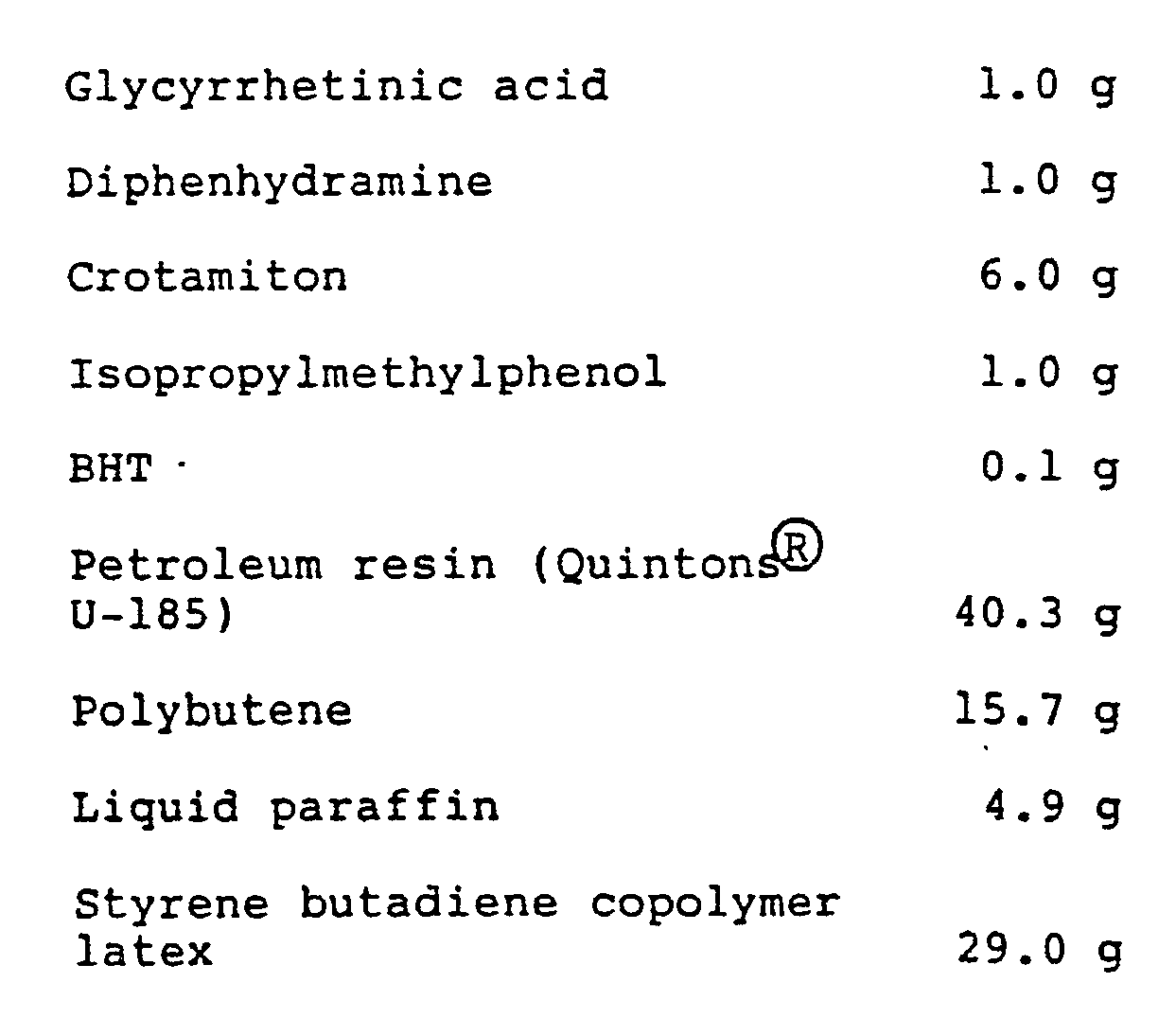
the test is applied simultaneously to three such portions of each arm. After blood-sucking for 10 minutes, leaving one portion untreated, two bite portions are treated by applying thereto a commercially available anti-pruritic agent (MuhiR, made by Ikeda Mohando K. K., a solution for sticky coating having diphenhydramine as main anti-pruritic agent)and a circular plaster (60-100 µm in thickness of the medicament-containing adhesive mass) prepared according to Example 8 of this invention, wherein the combination of the medicaments and the compounding ratio of the medicaments are changed to some extent in the scope of this invention (the medicaments of the plaster of this invention are a combination of glycyrrhetinic acid, diphenhydramine, crotamiton, and isopropylmethylphenol). - The effect on itching is recorded based on the subjective symptom of the testees, at definite time intervals (0.5, 2, 4, 8, and 24 hours), and compared with the effect of the commercially available antipruritic agent.
- The effect for each symptom is evaluated as follows according to the subjective symptoms of the testees.
- 3 ---
- Very itchy (Itch is too severe and they cannot concentrate on their work)
- 2 ---
- Considerably itchy (Itch is strong and they cannot concentrate on their work although they can work)
- 1 ---
- A little itchy (Itch not a hindrance to work)
- 0 ---
- Not itchy
- The general determination is performed by ranking from the effect determination for each symptom (in addition, a same effect is in a same rank) and the effect is compared by the percentage of the number of the testees in the 1st rank of the determination results.
-
- Product of this invention
- 53.8%
- Commercially available product
- 20.5%
- Untreated
- 5.1%
- No difference
- 20.8%
- To 20 volunteers bitten by insects during the period from August to the middle of September, was applied a sensitivity test for determining the effect of the product of this invention and comparing it with that of commercially available products. Answers were obtained from 16 volunteers.
- The determination of the effects was evaluated in three stages of (1) quickly effective, (2) effective, and (3) not effective against itching and (1) suppressing well, (2) suppressing, and (3) not suppressing swelling based on the subjective symptom of the testees.
- The comparison with the commercially available products was made by the feelings of the testees on the relative effects of the product of this invention and the conventional commercially available product.
- The results are shown by the percentage of the testees giving each evaluation:
-
- (a) Itching
- Quickly effective
- 56.2%
- Effective
- 43.8%
- Not effective
- 0
- No answer
- 0
- (b) Swelling
- Suppressing well
- 56.2%
- Suppressing
- 12.5%
- Not suppressing
- 6.3%
- No answer
- 25.0%
- The commercially available products used and the percentage of the number of testees are as follows.
Muhi® (same as Test Procedure A) 45%
Kinkan® (trade name, made by Kinkando K. K.,
antipruritic effective component: aqueous ammonia, solution) 20%
Una Kowa® (trade name, made by Kowa K. K., antipruritic effective component: diphenhydramine hydrochloride, solution) 10%
Makiron® (trade name, made by Yamanouchi Pharmaceutical Co., Ltd., solution containing chlorpheniramine maleate as the antipruritic effective component) 25% -
- Product of this invention
- 60%
- Commercially available product
- 0
- Unable to evaluate
- 40%
- To sufficient amount of toluene were added 8.8 g of polybutene, 47.5 g of a petroleum resin (Quintons® U-185, trade name, made by Nihon Zeon K. K.), and 31.7 g of a styrene-isoprene-styrene copolymer resin (Cariflex® TR-1107, trade name, made by Shell Kagaku Co., Ltd.) and they were dissolved therein under heating; after cooling, a solution of 2.0 g of glycyrrhetinic acid and 2.0 g of diphenhydramine in 8.0 g of benzyl alcohol was uniformly mixed with the above solution. The mixture was coated on a release liner and after evaporating off toluene, a polyvinyl chloride film was applied thereto.
- Plasters having the following adhesive medicament masses were prepared as in Example 1, using toluene as the further solvent which is evaporated after the coating onto the liner.
-

-

-

-


- In 15.0 g of crotamiton were dissolved 1.5 g of glycyrrhizic acid and 0.1 g of an antioxidant, butylated hydroxytoluene (BHT) and after uniformly mixing the solution with 151.6 g of an acrylic resin emulsion (Primal® N-580-S, trade name, made by Acryl Chemical Co., Ltd., solid component 54.5-55.5%), the mixture was coated on a release liner followed by drying. Thereafter, a polyvinyl chloride film was applied thereto.
- Plasters having the following adhesive medicament masses were prepared in the manner of Example 7.
-


-

- A mixture of 18.8 g of polybutene, 35.2 g of a petroleum resin (Quintons® U-185, trade name, made by Nihon Zeon K. K.) and 4.9 g of liquid paraffin was heated to 100 to 120oC to form a solution and after allowing the solution to cool to a temperature of 50-60oc, the solution was uniformly mixed with a solution of 1.0 g glycyrrhizic acid and 0.1 g of BHT in 5.0 g of N-methyl-2-pyrrolidone. The mixture thus formed was further uniformly mixed with 25.5 g (60% solid component) of a styrene-butadiene copolymer latex and 19.5 g (60% solid component) of a natural rubber latex; the resultant mixture was coated on a release liner followed by drying and a polyvinyl chloride film was applied thereto.
- Plasters with the following adhesive medicament masses were prepared in the manner described in the Reference Example.
-

-

-

-


Claims (5)
- An antipruritic plaster comprising a backing having formed on one surface thereof a pressure-sensitive adhesive medicament layer containing(1) at least one medicament selected from glycyrrhetinic acid glycyrrhizin, and salts of glycyrrhizin;(2) at least one solvent for (1) selected from benzyl alcohol, phenethyl alcohol, diphenhydramine, chlorpheniramine and crotamiton; and(3) a base comprising[a] at least one rubber compound adhesive plaster base selected from natural rubber, styrene-butadiene copolymer elastomers, and styrene-isoprene-styrene copolymer elastomers; at least one tackifying agent selected from petroleum resin, rosin, hydrogenated rosin, polybutene, and ester gum; and at least one softener selected from polybutene, liquid paraffin, higher fatty acid esters, silicone oils, and vegetable oils or[b] acrylic resin.
- A plaster according to claim 1 wherein the adhesive medicament layer contains 0.1 to 10% by weight of component (1), 3 to 20% by weight of component (2), together with 75 to 98.5% by weight of component (3) [a] or 65 to 98.5% by weight of component (3) [b].
- A plaster according to claim 1 wherein the adhesive medicament layer contains 0.2 to 4% by weight of component (1), 5 to 15% by weight of component (2), and 70 to 97% by weight of component (3) [b].
- A plaster according to claim 1 wherein the adhesive medicament layer contains glycyrrhetinic acid, diphenhydramine, crotamiton, and an acrylic resin base and optionally at least one of antibacterial, antioxidant and odorant agents.
- An adhesive medicament mass for use in a plaster, the mass containing(1) at least one medicament selected from glycyrrhetinic acid glycyrrhizin, and salts of glycyrrhizin;(2) at least one solvent for (1) selected from benzyl alcohol, phenethyl alcohol, diphenhydramine, chlorpheniramine and crotamiton; and(3) a base comprising[a] at least one rubber compound adhesive plaster base selected from natural rubber, styrene-butadiene copolymer elastomers, and styrene-isoprene-styrene copolymer elastomers; at least one tackifying agent selected from petroleum resin, rosin, hydrogenated rosin, polybutene, and ester gum; and at least one softener selected from polybutene, liquid paraffin, higher fatty acid esters, silicone oils, and vegetable oils or[b] acrylic resin.
Applications Claiming Priority (2)
| Application Number | Priority Date | Filing Date | Title |
|---|---|---|---|
| JP59041994A JPS60188315A (en) | 1984-03-07 | 1984-03-07 | Antipruritic plaster containing glycyrretic acid |
| JP41994/84 | 1984-03-07 |
Publications (3)
| Publication Number | Publication Date |
|---|---|
| EP0156565A2 EP0156565A2 (en) | 1985-10-02 |
| EP0156565A3 EP0156565A3 (en) | 1987-04-01 |
| EP0156565B1 true EP0156565B1 (en) | 1991-07-31 |
Family
ID=12623749
Family Applications (1)
| Application Number | Title | Priority Date | Filing Date |
|---|---|---|---|
| EP85301597A Expired - Lifetime EP0156565B1 (en) | 1984-03-07 | 1985-03-07 | Antipruritic compositions and plasters |
Country Status (4)
| Country | Link |
|---|---|
| US (1) | US4879118A (en) |
| EP (1) | EP0156565B1 (en) |
| JP (1) | JPS60188315A (en) |
| DE (1) | DE3583622D1 (en) |
Families Citing this family (22)
| Publication number | Priority date | Publication date | Assignee | Title |
|---|---|---|---|---|
| JPS63255219A (en) * | 1987-04-11 | 1988-10-21 | Teikoku Seiyaku Kk | Antipruritic plaster |
| US4885154A (en) * | 1988-03-01 | 1989-12-05 | Alza Corporation | Method for reducing sensitization or irritation in transdermal drug delivery and means therefor |
| JP2839164B2 (en) * | 1989-12-25 | 1998-12-16 | 帝國製薬株式会社 | Anti-inflammatory analgesic patch |
| DE69108512T2 (en) * | 1990-05-17 | 1995-08-03 | Hisamitsu Pharmaceutical Co | ESTRADIOL CONTAINING TRANSDERMAL PREPARATION. |
| US5182323A (en) * | 1991-05-28 | 1993-01-26 | Isp Investments Inc. | Water dispersible pressure sensitive hot melts |
| IT1251685B (en) * | 1991-10-11 | 1995-05-19 | Isf Spa | PHARMACEUTICAL COMPOSITIONS CONTAINING A CALCITONIN |
| IT1253431B (en) * | 1991-12-02 | 1995-08-08 | Valetudo S R L | PHARMACEUTICAL PREPARATIONS FOR TOPICAL USE FOR THE TREATMENT OF PSORIASIS AND ATOPIC DERMATITIS |
| GB2273044B (en) * | 1992-12-02 | 1997-04-09 | Pacific Chem Co Ltd | Medicinal patches for percutaneous administration |
| FI962618A7 (en) * | 1993-12-27 | 1996-06-25 | Akzo Nobel Nv | Percutaneously absorbable preparation |
| ES2074402B1 (en) * | 1993-12-31 | 1996-06-16 | Cusi Lab | PHARMACEUTICAL FORMULATION CONTAINING DIFENHYDRAMINE, TALCO, CALAMINE AND OAT EXTRACT, IN AN EMULSIFIED BASE, AND ITS APPLICATIONS. |
| FR2717689B1 (en) * | 1994-03-28 | 1996-07-05 | Lhd Lab Hygiene Dietetique | Transdermal matrix system for the administration of an estrogen and / or a progestin based on a styrene-isoprene-styrene copolymer. |
| US5536263A (en) | 1994-03-30 | 1996-07-16 | Lectec Corporation | Non-occulusive adhesive patch for applying medication to the skin |
| EP0687465A1 (en) * | 1994-05-16 | 1995-12-20 | Uwe Dipl.-Dok. Albrecht | Use of glycyrrhizinic acid and its metabolite (glycyrrhetinic acid)as drug in the preparation of a medicament for the treatment of viral and allergic diseases |
| WO1996013238A1 (en) | 1994-10-28 | 1996-05-09 | Kimberly-Clark Worldwide, Inc. | Self-adhering absorbent article |
| US7150881B2 (en) * | 1997-06-26 | 2006-12-19 | Mylan Technologies, Inc. | Adhesive mixture for transdermal delivery of highly plasticizing drugs |
| DE19833177A1 (en) * | 1998-07-23 | 2000-01-27 | Labtec Gmbh | Rapidly acting plaster preparation for treating irritation due to nettle stings or insect bites, preferably containing menthol and benzocaine |
| AU4842100A (en) * | 1999-12-10 | 2001-06-18 | Teri Buseman | Anti pruritic patch |
| GB0310147D0 (en) * | 2003-05-02 | 2003-06-04 | Almond Julie E | A composition for use in the treatment of a skin condition in a subject |
| KR100552650B1 (en) * | 2003-11-17 | 2006-02-20 | 아이큐어 주식회사 | Pyroxycam-containing anti-inflammatory analgesic plaster |
| EP1870426B1 (en) * | 2005-04-15 | 2010-10-27 | Zhou, Zhengming | Antiallergic production of latex or pvc and method for forming the same |
| WO2009084611A1 (en) * | 2007-12-28 | 2009-07-09 | Zuiko Corporation | Antipruritic sheet |
| JP7399633B2 (en) * | 2019-06-14 | 2023-12-18 | 株式会社大石膏盛堂 | Method for manufacturing transdermal preparations |
Family Cites Families (6)
| Publication number | Priority date | Publication date | Assignee | Title |
|---|---|---|---|---|
| JPS5435831B2 (en) * | 1974-09-21 | 1979-11-06 | ||
| US4307717A (en) * | 1977-11-07 | 1981-12-29 | Lectec Corporation | Sterile improved bandage containing a medicament |
| GB2045618B (en) * | 1979-04-03 | 1983-05-11 | Hisamitsu Pharmaceutical Co | Adhesive plaster |
| JPS5791908A (en) * | 1980-11-29 | 1982-06-08 | Lion Corp | Cosmetic for skin |
| DE3204551A1 (en) * | 1982-02-10 | 1983-08-18 | Boehringer Ingelheim KG, 6507 Ingelheim | METHOD FOR PRODUCING A PHARMACEUTICAL PREPARATION IN THE FORM OF A POLYACRYLATE FILM |
| GB2122893B (en) * | 1982-06-30 | 1985-06-26 | Biorex Laboratories Ltd | Glycyrrhetinic acid compositions |
-
1984
- 1984-03-07 JP JP59041994A patent/JPS60188315A/en active Granted
-
1985
- 1985-03-07 DE DE8585301597T patent/DE3583622D1/en not_active Expired - Fee Related
- 1985-03-07 EP EP85301597A patent/EP0156565B1/en not_active Expired - Lifetime
-
1988
- 1988-03-03 US US07/168,587 patent/US4879118A/en not_active Expired - Fee Related
Also Published As
| Publication number | Publication date |
|---|---|
| JPH0425927B2 (en) | 1992-05-06 |
| US4879118A (en) | 1989-11-07 |
| DE3583622D1 (en) | 1991-09-05 |
| EP0156565A3 (en) | 1987-04-01 |
| JPS60188315A (en) | 1985-09-25 |
| EP0156565A2 (en) | 1985-10-02 |
Similar Documents
| Publication | Publication Date | Title |
|---|---|---|
| US4879118A (en) | Glycyrrhetinic acid-containing plasters | |
| US4455146A (en) | Novel plasters | |
| DE69506157T2 (en) | Transdermal matrix system based on a styrene-isoprene-styrene copolymer for the administration of an estrogen and / or gestagen | |
| US5820878A (en) | Percutaneously absorbable patch | |
| US8114434B2 (en) | Diclofenac sodium patches for topical treatment of pain | |
| JP4422430B2 (en) | External patch containing estrogen and / or progestogen | |
| WO2002043729A1 (en) | Analgesic and anti-inflammatory patches for external use containing 4-biphenylylylacetic acid | |
| BRPI0307777B1 (en) | Transdermal patch | |
| EP0276561A1 (en) | Pharmaceutical tape compositions | |
| DE69524550T2 (en) | Anti-inflammatory analgesic adhesive preparations | |
| JP3226940B2 (en) | Transdermal formulation | |
| WO2018073227A1 (en) | Two-layer topical therapeutic system | |
| JP4648518B2 (en) | Patch containing 4-biphenylacetic acid | |
| JP3668728B2 (en) | External patch and method for inhibiting esterification of drug in external patch | |
| EP2143445B1 (en) | Medicated patch | |
| JP2501671B2 (en) | High release antipruritic patch | |
| CN106692110B (en) | A kind of arylpropionic acid non-steroidal anti-inflammatory drug patch and preparation method thereof | |
| EP1335715B1 (en) | Skin-friendly and drug-containing patches for transdermal administration of hyperemic active ingredients | |
| JPS63255219A (en) | Antipruritic plaster | |
| JPH02124821A (en) | Plaster agent of piroxicam | |
| JP2023092097A (en) | Nonaqueous patch and method for producing the same | |
| AU2011324394B2 (en) | Felbinac-containing external patch | |
| JPH078784B2 (en) | Hydrophilic transdermal preparation | |
| WO2005102306A1 (en) | Anti-inflammatory analgesic adhesive patch | |
| TWI709418B (en) | Patch |
Legal Events
| Date | Code | Title | Description |
|---|---|---|---|
| PUAI | Public reference made under article 153(3) epc to a published international application that has entered the european phase |
Free format text: ORIGINAL CODE: 0009012 |
|
| AK | Designated contracting states |
Designated state(s): DE FR GB IT |
|
| PUAL | Search report despatched |
Free format text: ORIGINAL CODE: 0009013 |
|
| AK | Designated contracting states |
Kind code of ref document: A3 Designated state(s): DE FR GB IT |
|
| 17P | Request for examination filed |
Effective date: 19870930 |
|
| RAP1 | Party data changed (applicant data changed or rights of an application transferred) |
Owner name: YAMANOUCHI PHARMACEUTICAL CO. LTD. |
|
| 17Q | First examination report despatched |
Effective date: 19880804 |
|
| GRAA | (expected) grant |
Free format text: ORIGINAL CODE: 0009210 |
|
| AK | Designated contracting states |
Kind code of ref document: B1 Designated state(s): DE FR GB IT |
|
| ET | Fr: translation filed | ||
| REF | Corresponds to: |
Ref document number: 3583622 Country of ref document: DE Date of ref document: 19910905 |
|
| ITF | It: translation for a ep patent filed | ||
| K2C2 | Correction of patent specification (partial reprint) published |
Effective date: 19910731 |
|
| PLBE | No opposition filed within time limit |
Free format text: ORIGINAL CODE: 0009261 |
|
| STAA | Information on the status of an ep patent application or granted ep patent |
Free format text: STATUS: NO OPPOSITION FILED WITHIN TIME LIMIT |
|
| 26N | No opposition filed | ||
| PGFP | Annual fee paid to national office [announced via postgrant information from national office to epo] |
Ref country code: FR Payment date: 19980227 Year of fee payment: 14 |
|
| PGFP | Annual fee paid to national office [announced via postgrant information from national office to epo] |
Ref country code: GB Payment date: 19980304 Year of fee payment: 14 |
|
| PGFP | Annual fee paid to national office [announced via postgrant information from national office to epo] |
Ref country code: DE Payment date: 19980325 Year of fee payment: 14 |
|
| PG25 | Lapsed in a contracting state [announced via postgrant information from national office to epo] |
Ref country code: GB Free format text: LAPSE BECAUSE OF NON-PAYMENT OF DUE FEES Effective date: 19990307 |
|
| GBPC | Gb: european patent ceased through non-payment of renewal fee |
Effective date: 19990307 |
|
| PG25 | Lapsed in a contracting state [announced via postgrant information from national office to epo] |
Ref country code: FR Free format text: LAPSE BECAUSE OF NON-PAYMENT OF DUE FEES Effective date: 19991130 |
|
| REG | Reference to a national code |
Ref country code: FR Ref legal event code: ST |
|
| PG25 | Lapsed in a contracting state [announced via postgrant information from national office to epo] |
Ref country code: DE Free format text: LAPSE BECAUSE OF NON-PAYMENT OF DUE FEES Effective date: 20000101 |