EP0155928B1 - Mechanical pulp hydrosulfite bleaching - Google Patents
Mechanical pulp hydrosulfite bleaching Download PDFInfo
- Publication number
- EP0155928B1 EP0155928B1 EP85890055A EP85890055A EP0155928B1 EP 0155928 B1 EP0155928 B1 EP 0155928B1 EP 85890055 A EP85890055 A EP 85890055A EP 85890055 A EP85890055 A EP 85890055A EP 0155928 B1 EP0155928 B1 EP 0155928B1
- Authority
- EP
- European Patent Office
- Prior art keywords
- pulp
- pump
- bleaching
- hydrosulfite
- practiced
- Prior art date
- Legal status (The legal status is an assumption and is not a legal conclusion. Google has not performed a legal analysis and makes no representation as to the accuracy of the status listed.)
- Expired
Links
Images

Classifications
-
- D—TEXTILES; PAPER
- D21—PAPER-MAKING; PRODUCTION OF CELLULOSE
- D21D—TREATMENT OF THE MATERIALS BEFORE PASSING TO THE PAPER-MAKING MACHINE
- D21D5/00—Purification of the pulp suspension by mechanical means; Apparatus therefor
- D21D5/26—De-aeration of paper stock
-
- D—TEXTILES; PAPER
- D21—PAPER-MAKING; PRODUCTION OF CELLULOSE
- D21C—PRODUCTION OF CELLULOSE BY REMOVING NON-CELLULOSE SUBSTANCES FROM CELLULOSE-CONTAINING MATERIALS; REGENERATION OF PULPING LIQUORS; APPARATUS THEREFOR
- D21C9/00—After-treatment of cellulose pulp, e.g. of wood pulp, or cotton linters ; Treatment of dilute or dewatered pulp or process improvement taking place after obtaining the raw cellulosic material and not provided for elsewhere
- D21C9/10—Bleaching ; Apparatus therefor
- D21C9/1084—Bleaching ; Apparatus therefor with reducing compounds
- D21C9/1089—Bleaching ; Apparatus therefor with reducing compounds with dithionites
Definitions
- the invention relates to a method of treating a mechanical pulp with hydrosulfite bleaching chemical which (b) is added to the mechanical pulp, substantially free of entrained air, whereupon (c) the pulp is retained at predetermined pH and temperature conditions for a predetermined period of time to effect bleaching thereof.
- hydrosulfite such as sodium hydrosulfite or zinc hydrosulfite.
- hydrosulfite bleaching can achieve the desired decoloration of the mechanical pulp, there are a number of drawbacks associated with its use. Hydrosulfite is oxidized extremely rapidly by air, therefore the entrainment of air in the pulp can negate the bleaching effects of the hydrosulfite. This makes hydrosulfite impractical for use with mechanical pulps having a consistency of much greater than 4% since as the consistency rises the pulp tends to entrain air.
- it is desirable to effect bleaching at the same consistency as for other processing of the pulp e.g. 5-25%, preferably 8-15%), although successive diluting and thickening stages are to be avoided because of the equipment costs and energy expense associated therewith.
- a method of bleaching mechanically-disintegrated wood pulp in accordance with the prior art portion of claim 1 is disclosed by US-A-2 707 146 comprising continuously feeding a watersoluble polyphosphate, in aqueous solution substantially free of entrained air, into a continuously moving stream of mechanically-disintegrated wood pulp, substantially free of entrained air.
- the polyphosphate is fed to the pulp at a point not substantially later than that at which the hydrosulfite is fed to the pulp.
- the mixture of pulp and bleaching chemicals is subjected to vigorous agitation and propulsion, thereby forcing the mixture along a confined, airtight path, including a vertical fluid way, as a streamline, plug flow, until the desired bleaching takes place.
- the consistency of the pulp to be treated may range up to the point where satisfactory mixing is not feasible, e.g. up to 10% or even 15%, by weight, the actual range of consistency for which good results easily can be achieved is between about 2% and 5%.
- a method of treating mechanical pulp that allows reductive bleaching of the pulp in an effective manner at pulp consistencies of about 5-25%, and preferably 8-15%, during the entire treating procedure.
- Simultaneous pumping and degassing of the mechanical pulp is preferably accomplished utilizing a fluidizing centrifugal pump.
- Mixing of the mechanical pulp with an effective charge of hydrosulfite bleaching chemical preferably is accomplished in a fluidizing mixer, with the hydrosulfite bleaching chemical including sequestering, chelating, and buffering agents.
- Atypical charge is 0,5-1,5% hydrosulfite.
- oxidation of the reductive bleaching agent is avoided, a minimal amount of equipment is utilized, and the processing can be done at the desired consistency range of 8-15%.
- the mixer may be eliminated, and the hydrosulfite added directly to the fluidizing pump.
- the chemical may be added to the discharge, or the suction, of the pump.
- the method according to the present invention is applicable to mechanical pulps. That term, as commonly used in the industry and as used in the instant specification and claims, encompasses refiner mechanical pulps (RMP), chemimechanical pulps (CMP), thermomechanical pulps (TMP), chemithermomechanical pulps (CTMP), and stone groundwood pulps.
- RMP refiner mechanical pulps
- CMP chemimechanical pulps
- TMP thermomechanical pulps
- CMP chemithermomechanical pulps
- stone groundwood pulps stone groundwood pulps.
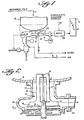
- the mechanical pulp is produced utilizing any desired conventional technique, and then is fed by line 11 to a storage tower 12 or the like. According to the present invention it is preferable to mount a fluidizing centrifugal pump 13 at the bottom of the storage tower 12, to draw the mechanical pump downwardly therefrom.
- the pulp typically has a consistency of about 5-25 percent, and a consistency of 8-15 percent is preferred.
- the fluidizing centrifugal pump 13, and an apparatus and method for controlling the head therefrom, are illustrated and described in Applicant's FR-A-2479 870.
- the pump 13, as illustrated in Figure 2 may comprise an inlet channel 14, a rotor 15 including a plurality of axially extending blades 16 having an interior opening 17 therebetween, and impeller blades 18.
- the blades 18 rotate in a spiral housing section 19, and gas can pass through openings 21, 22 from the housing section 19 to a gas chamber 20, the gas chamber 20 being connected up to a gas discharge line 23.
- Pulp passes from the pump 13 into the discharge line 25, with a throttling valve 26 disposed therein.
- the head of the pump 13 is controlled, by adjusting the throttling valve 26 in a manner explained in the aforementioned FR-A-2479 870 so that a variety of heads within a wide range may be achieved.
- the valve 26 preferably is controlled, according to the present invention, so that the pump head is maximized, to thereby maximize the degassing action of the pump (i.e. maximizing the amount of air withdrawn through conduit 23).
- the pulp is immediately passed to a mixer 28.
- the pulp must be passed to the mixer 28 so that substantially no air introduction occurs, and the mixer 28 must effect mixing without air introduction.
- hydrosulfite bleaching chemical is added from line 29 to the mixer, and is thoroughly mixed with the pulp.
- the mixer 28 preferably comprises a fluidizing mixer such as shown in U.S. Patents 4,093,506 and 4,339,206.
- hydrosulfite bleaching chemical added to provide an effective charge will vary depending upon the properties of the mechanical pulp, the amount of bleaching desired, etc. Typically, however, the sodium hydrosulfite or zinc hydrosulfite would be added so that the total charge was about 0.5-1.5 percent. Buffering, sequestering, and/or chelating agents, such as sodium tripolyphophate and sodium diethylenet- riaminepetaacetate, are also preferably added with the hydrosulfite.
- the pulp After mixing of the hydrosulfite bleaching chemical into the pulp using mixer 28, the pulp, still at the same consistency (i.e. 5-25 percent), is retained at predetermined pH and temperature conditions for a predetermined period of time to effect the desired bleaching.
- This retention may be merely in conduits passing the pulp onto a further processing station, or may be in a vessel particularly designed for that purpose, such as a conventional up-flow bleaching tower 31.
- Typical, although not limiting, conditions are: pH, about 4.5-6.5; temperature, about 35-80°C; retention time, about 0.25-2 hours.
- the bleaching action can be effectively controlled, and the desired amount of bleaching chemical can be added to effect the desired bleaching.
- the degassing action is accomplished, according to the present invention, in a simple and effective manner, and with a minimum amount of equipment.
- the pulp at a consistency of between 5-25 percent, and preferably 8-15 percent, is withdrawn from storage tower 12, simultaneously pumped and degassed by fluidizing centrifugal pump 13, the head of which is controlled by valve 26 to maximize degassing action, immediately passed to fluidizing mixer 28 at which the hydrosulfite bleaching chemical is added via line 29, and subsequently passed to a conventional retention tower 31, or the like, where it is retained at predetermined pH and temperature conditions for a predetermined period of time to effect desired bleaching.
- the hydrosulfite bleaching chemical is added through line 33 directly to the discharge of the pump 13.
- the pulp has been effectively degassed, and when the bleaching chemical is added through a nozzle, or like other introduction structure, due to the turbulence of the pulp at that point, it will become intermixed with the pulp, and effective bleaching will occur.
- the pump 13 is shown with the axis of rotation of the rotor thereof horizontal. This merely illustrates ° that the present invention may be practiced irrespective of the orientation (e.g., horizontal or vertical) of the pump rotor.
- the hydrosulfite bleaching chemical is added via line 35 at the suction of the pump 13. Again, introduction can be accomplished utilizing a suitable nozzle, or the like. While the pulp is not completely degassed at this position, adding the bleaching chemical at the suction provides for complete intermixing of the bleaching chemical with the pulp as it is pumped by the pump 13, and the time from chemical addition at the suction side of the pump, to effective degassing by the pump, is short enough that under most circumstances entrained air will not significantly negate the bleaching effects of the hydrosulfite. However, if entrained air does negate such effects for a particular pulp, then the embodiments of FIGURES 1 and 3 will be utilized instead of the embodiment of FIGURE 4.
Landscapes
- Engineering & Computer Science (AREA)
- Mechanical Engineering (AREA)
- Life Sciences & Earth Sciences (AREA)
- Wood Science & Technology (AREA)
- Paper (AREA)
- Detergent Compositions (AREA)
- Cleaning And De-Greasing Of Metallic Materials By Chemical Methods (AREA)
- Structures Of Non-Positive Displacement Pumps (AREA)
- Catalysts (AREA)
- Low-Molecular Organic Synthesis Reactions Using Catalysts (AREA)
Abstract
Description
- The invention relates to a method of treating a mechanical pulp with hydrosulfite bleaching chemical which (b) is added to the mechanical pulp, substantially free of entrained air, whereupon (c) the pulp is retained at predetermined pH and temperature conditions for a predetermined period of time to effect bleaching thereof.
- With shortages in raw materials for manufacture of paper pulps, mechanical pulping processes have become of more interest. Mechanical pulping processes generally have higher yields than chemical pulping processes. However, since in mechanical pulping processes (including refiner mechanical pulping (RMP), chemimechanical pulping (CMP), thermomechanical pulping (TMP), and chemithermomechanical pulping (CTMP)), most of the lignin and polysaccharides are left in the pulp, rather than being dissolved and modified as in chemical pulping, bleaching must be accomplished by decoloration, instead of by solubilization, as in chemical pulping.
- One major process for bleaching of mechanical pulps is a reductive bleaching process utilizing hydrosulfite, such as sodium hydrosulfite or zinc hydrosulfite. While hydrosulfite bleaching can achieve the desired decoloration of the mechanical pulp, there are a number of drawbacks associated with its use. Hydrosulfite is oxidized extremely rapidly by air, therefore the entrainment of air in the pulp can negate the bleaching effects of the hydrosulfite. This makes hydrosulfite impractical for use with mechanical pulps having a consistency of much greater than 4% since as the consistency rises the pulp tends to entrain air. However, it is desirable to effect bleaching at the same consistency as for other processing of the pulp (e.g. 5-25%, preferably 8-15%), although successive diluting and thickening stages are to be avoided because of the equipment costs and energy expense associated therewith.
- A method of bleaching mechanically-disintegrated wood pulp in accordance with the prior art portion of
claim 1 is disclosed by US-A-2 707 146 comprising continuously feeding a watersoluble polyphosphate, in aqueous solution substantially free of entrained air, into a continuously moving stream of mechanically-disintegrated wood pulp, substantially free of entrained air. The polyphosphate is fed to the pulp at a point not substantially later than that at which the hydrosulfite is fed to the pulp. The mixture of pulp and bleaching chemicals is subjected to vigorous agitation and propulsion, thereby forcing the mixture along a confined, airtight path, including a vertical fluid way, as a streamline, plug flow, until the desired bleaching takes place. Although in that U.S. specification it is mentioned that the consistency of the pulp to be treated may range up to the point where satisfactory mixing is not feasible, e.g. up to 10% or even 15%, by weight, the actual range of consistency for which good results easily can be achieved is between about 2% and 5%. - It is the primary object of the present invention to provide an efficient method of treating a higher- consistency mechanical pulp, and this problem is solved in such a way that in the method of the prior art portion of claim 1 (a) the mechanical pulp at a consistency of about 8-15% is simultaneously pumped and essentially completely degassed, and immediately thereafter, (b) the about 8-15% consistency mechanical pulp is mixed, without substantial air introduction, with an effective charge of hydrosulfite bleaching chemical, followed by step (c), the consistency of 8-15% being maintained throughout the entire treating operation.
- By the present invention, a method of treating mechanical pulp is provided that allows reductive bleaching of the pulp in an effective manner at pulp consistencies of about 5-25%, and preferably 8-15%, during the entire treating procedure. Simultaneous pumping and degassing of the mechanical pulp is preferably accomplished utilizing a fluidizing centrifugal pump. Mixing of the mechanical pulp with an effective charge of hydrosulfite bleaching chemical preferably is accomplished in a fluidizing mixer, with the hydrosulfite bleaching chemical including sequestering, chelating, and buffering agents. Atypical charge is 0,5-1,5% hydrosulfite.
- By practicing the invention oxidation of the reductive bleaching agent is avoided, a minimal amount of equipment is utilized, and the processing can be done at the desired consistency range of 8-15%.
- Alternatively, the mixer may be eliminated, and the hydrosulfite added directly to the fluidizing pump. For instance, the chemical may be added to the discharge, or the suction, of the pump.
- These and other objects of the invention will become clear from the following detailed description with reference to the drawings in which:
- Figure 1 is a schematic view illustrating exemplary apparatus utilized in practicing the method according to the present invention;
- Figure 2 is a schematic detail cross-sectional view of the exemplary fluidizing centrifugal pump illustrated in Figure 1; and
- Figures 3 and 4 are schematic views of two different alternative embodiments of apparatus for practicing the method of the invention.
- The method according to the present invention is applicable to mechanical pulps. That term, as commonly used in the industry and as used in the instant specification and claims, encompasses refiner mechanical pulps (RMP), chemimechanical pulps (CMP), thermomechanical pulps (TMP), chemithermomechanical pulps (CTMP), and stone groundwood pulps.
- Typically, the mechanical pulp is produced utilizing any desired conventional technique, and then is fed by line 11 to a
storage tower 12 or the like. According to the present invention it is preferable to mount a fluidizingcentrifugal pump 13 at the bottom of thestorage tower 12, to draw the mechanical pump downwardly therefrom. The pulp typically has a consistency of about 5-25 percent, and a consistency of 8-15 percent is preferred. - The fluidizing
centrifugal pump 13, and an apparatus and method for controlling the head therefrom, are illustrated and described in Applicant's FR-A-2479 870. Thepump 13, as illustrated in Figure 2, may comprise aninlet channel 14, arotor 15 including a plurality of axially extendingblades 16 having an interior opening 17 therebetween, andimpeller blades 18. Theblades 18 rotate in aspiral housing section 19, and gas can pass throughopenings housing section 19 to agas chamber 20, thegas chamber 20 being connected up to agas discharge line 23. - Pulp passes from the
pump 13 into thedischarge line 25, with athrottling valve 26 disposed therein. The head of thepump 13 is controlled, by adjusting thethrottling valve 26 in a manner explained in the aforementioned FR-A-2479 870 so that a variety of heads within a wide range may be achieved. Thevalve 26 preferably is controlled, according to the present invention, so that the pump head is maximized, to thereby maximize the degassing action of the pump (i.e. maximizing the amount of air withdrawn through conduit 23). - After simultaneous pumping and degassing of the mechanical pulp in the
pump 13, the pulp is immediately passed to amixer 28. The pulp must be passed to themixer 28 so that substantially no air introduction occurs, and themixer 28 must effect mixing without air introduction. At the mixer, hydrosulfite bleaching chemical is added from line 29 to the mixer, and is thoroughly mixed with the pulp. For the practice of the present invention, themixer 28 preferably comprises a fluidizing mixer such as shown in U.S. Patents 4,093,506 and 4,339,206. - The amount of hydrosulfite bleaching chemical added to provide an effective charge will vary depending upon the properties of the mechanical pulp, the amount of bleaching desired, etc. Typically, however, the sodium hydrosulfite or zinc hydrosulfite would be added so that the total charge was about 0.5-1.5 percent. Buffering, sequestering, and/or chelating agents, such as sodium tripolyphophate and sodium diethylenet- riaminepetaacetate, are also preferably added with the hydrosulfite.
- After mixing of the hydrosulfite bleaching chemical into the
pulp using mixer 28, the pulp, still at the same consistency (i.e. 5-25 percent), is retained at predetermined pH and temperature conditions for a predetermined period of time to effect the desired bleaching. This retention may be merely in conduits passing the pulp onto a further processing station, or may be in a vessel particularly designed for that purpose, such as a conventional up-flow bleaching tower 31. Typical, although not limiting, conditions are: pH, about 4.5-6.5; temperature, about 35-80°C; retention time, about 0.25-2 hours. - Since the pulp is essentially completely degassed before mixing with the hydrosulfite bleaching chemical, the bleaching action can be effectively controlled, and the desired amount of bleaching chemical can be added to effect the desired bleaching. The degassing action is accomplished, according to the present invention, in a simple and effective manner, and with a minimum amount of equipment. The pulp, at a consistency of between 5-25 percent, and preferably 8-15 percent, is withdrawn from
storage tower 12, simultaneously pumped and degassed by fluidizingcentrifugal pump 13, the head of which is controlled byvalve 26 to maximize degassing action, immediately passed to fluidizingmixer 28 at which the hydrosulfite bleaching chemical is added via line 29, and subsequently passed to aconventional retention tower 31, or the like, where it is retained at predetermined pH and temperature conditions for a predetermined period of time to effect desired bleaching. - In the exemplary embodiments of the present invention illustrated schematically in FIGURES 3 and 4, the
mixer 28 is eliminated, and instead the hydrosulfite is added directly to the pulp within thepump 13. In the FIGURES 3 and 4 embodiments, the control mechanisms for thepump 13 have not been shown, for clarity of illustration. - In the FIGURE 3 embodiment, the hydrosulfite bleaching chemical is added through
line 33 directly to the discharge of thepump 13. At the discharge of thepump 13, the pulp has been effectively degassed, and when the bleaching chemical is added through a nozzle, or like other introduction structure, due to the turbulence of the pulp at that point, it will become intermixed with the pulp, and effective bleaching will occur. - In the embodiment illustrated in FIGURE 4, the
pump 13 is shown with the axis of rotation of the rotor thereof horizontal. This merely illustrates ° that the present invention may be practiced irrespective of the orientation (e.g., horizontal or vertical) of the pump rotor. - In the FIGURE 4 embodiment, the hydrosulfite bleaching chemical is added via
line 35 at the suction of thepump 13. Again, introduction can be accomplished utilizing a suitable nozzle, or the like. While the pulp is not completely degassed at this position, adding the bleaching chemical at the suction provides for complete intermixing of the bleaching chemical with the pulp as it is pumped by thepump 13, and the time from chemical addition at the suction side of the pump, to effective degassing by the pump, is short enough that under most circumstances entrained air will not significantly negate the bleaching effects of the hydrosulfite. However, if entrained air does negate such effects for a particular pulp, then the embodiments of FIGURES 1 and 3 will be utilized instead of the embodiment of FIGURE 4.
Claims (8)
Priority Applications (1)
| Application Number | Priority Date | Filing Date | Title |
|---|---|---|---|
| AT85890055T ATE38258T1 (en) | 1984-03-05 | 1985-03-04 | HYDROSULPHITE BLEACHING OF MECHANICAL PULP. |
Applications Claiming Priority (2)
| Application Number | Priority Date | Filing Date | Title |
|---|---|---|---|
| US58593884A | 1984-03-05 | 1984-03-05 | |
| US585938 | 1984-03-05 |
Publications (2)
| Publication Number | Publication Date |
|---|---|
| EP0155928A1 EP0155928A1 (en) | 1985-09-25 |
| EP0155928B1 true EP0155928B1 (en) | 1988-10-26 |
Family
ID=24343611
Family Applications (1)
| Application Number | Title | Priority Date | Filing Date |
|---|---|---|---|
| EP85890055A Expired EP0155928B1 (en) | 1984-03-05 | 1985-03-04 | Mechanical pulp hydrosulfite bleaching |
Country Status (7)
| Country | Link |
|---|---|
| EP (1) | EP0155928B1 (en) |
| JP (1) | JPS60209088A (en) |
| AT (1) | ATE38258T1 (en) |
| BR (1) | BR8500938A (en) |
| DE (1) | DE3565870D1 (en) |
| FI (1) | FI77905C (en) |
| NO (1) | NO164310C (en) |
Families Citing this family (6)
| Publication number | Priority date | Publication date | Assignee | Title |
|---|---|---|---|---|
| DE68928632T2 (en) * | 1988-02-26 | 1998-07-30 | Ahlstroem Oy | Process and apparatus for treating pulp |
| US4877368A (en) * | 1988-11-08 | 1989-10-31 | A. Ahlstrom Corporation | Fluidizing centrifugal pump |
| FI94440C (en) * | 1990-08-14 | 1995-09-11 | Ahlstroem Oy | Process and plant for treating air and / or gas-containing liquid or fiber suspension and use of a gas separating pulp pump |
| SE513790C2 (en) | 1999-03-08 | 2000-11-06 | Mo Och Domsjoe Ab | Bleaching of mechanical pulp with reducing bleach |
| EP1375735B1 (en) * | 2002-06-28 | 2005-08-31 | Rohm And Haas Company | Method for brightening pulp with hydrosulfite solution |
| CN116498564A (en) * | 2023-04-24 | 2023-07-28 | 江苏巨浪泵阀有限公司 | Wide-runner pulp pump |
Family Cites Families (8)
| Publication number | Priority date | Publication date | Assignee | Title |
|---|---|---|---|---|
| US2071307A (en) * | 1936-08-11 | 1937-02-16 | Great Western Electro Chemical Co | Bleaching |
| US2707146A (en) * | 1951-08-08 | 1955-04-26 | Scott Paper Co | Method of bleaching mechanically disintegrated wood pulp |
| US2963395A (en) * | 1958-03-31 | 1960-12-06 | Crown Zellerbach Corp | Process of bleaching lignocellulosic pulps |
| US3313678A (en) * | 1962-02-14 | 1967-04-11 | Svenska Cellulose Aktiebolaget | Bleaching of cellulose pulp in towers in completely filled and closed system |
| US4030969A (en) * | 1972-06-13 | 1977-06-21 | Defibrator Ab | Method of dispersing a bleaching agent into a stream of fibrous cellulosic pulp material in a throttling nozzle |
| SE389351B (en) * | 1975-03-14 | 1976-11-01 | Kamyr Ab | METHOD AND DEVICE FOR DISTRIBUTION AND MIXTURE OF GAS AND / OR LIQUID IN MASS CONCENTRATIONS OF HIGH CONCENTRATION. |
| US4435193A (en) * | 1980-04-07 | 1984-03-06 | Kamyr Ab | Controlling operation of a centrifugal pump |
| US4410337A (en) * | 1980-04-07 | 1983-10-18 | A. Ahlstrom Osakeyhtio | Method and an apparatus for separating a gas from a fibre suspension |
-
1985
- 1985-02-22 NO NO850720A patent/NO164310C/en unknown
- 1985-03-01 FI FI850854A patent/FI77905C/en not_active IP Right Cessation
- 1985-03-01 BR BR8500938A patent/BR8500938A/en not_active IP Right Cessation
- 1985-03-04 EP EP85890055A patent/EP0155928B1/en not_active Expired
- 1985-03-04 AT AT85890055T patent/ATE38258T1/en not_active IP Right Cessation
- 1985-03-04 DE DE8585890055T patent/DE3565870D1/en not_active Expired
- 1985-03-05 JP JP60042015A patent/JPS60209088A/en active Pending
Also Published As
| Publication number | Publication date |
|---|---|
| ATE38258T1 (en) | 1988-11-15 |
| EP0155928A1 (en) | 1985-09-25 |
| NO164310C (en) | 1990-09-19 |
| FI850854A0 (en) | 1985-03-01 |
| BR8500938A (en) | 1985-10-22 |
| FI850854L (en) | 1985-09-06 |
| NO850720L (en) | 1985-09-06 |
| JPS60209088A (en) | 1985-10-21 |
| NO164310B (en) | 1990-06-11 |
| FI77905B (en) | 1989-01-31 |
| DE3565870D1 (en) | 1988-12-01 |
| FI77905C (en) | 1989-05-10 |
Similar Documents
| Publication | Publication Date | Title |
|---|---|---|
| CA1043147A (en) | Method and device for distribution and mixing-in of gas and/or liquid in pulp suspensions of high concentration | |
| US6413365B1 (en) | Method of loading a fiber suspension with calcium carbonate | |
| US4909900A (en) | Method for high temperature, high consistency quick bleaching of raw paper pulp | |
| US4160693A (en) | Process for the bleaching of cellulose pulp | |
| CA2007986C (en) | Apparatus and process for the delignification of cellulose pulp | |
| US6241852B1 (en) | Method and device for mixing of a fluid into a pulp-suspension at the lowest pressure of the suspension | |
| CA1120659A (en) | Degassing of pulp | |
| EP0161330B1 (en) | Chip presteaming and air washing | |
| EP0155928A1 (en) | Mechanical pulp hydrosulfite bleaching | |
| US20050150618A1 (en) | Methods of processing lignocellulosic pulp with cavitation | |
| JPH0639755B2 (en) | Apparatus for producing pulp from soot dust and method for treating soot dust | |
| US6673211B2 (en) | Apparatus for loading fibers in a fiber suspension with calcium carbonate | |
| CA1245403A (en) | Mechanical pulp pumping and hydrosulfite bleaching | |
| CA2127654C (en) | Oxygen delignification method incorporating wood pulp mixing apparatus | |
| CA1245089A (en) | Latency removal | |
| JP4465572B2 (en) | Process for the production of bleached mechanical and chemi-thermomechanical pulp | |
| EP0009483A1 (en) | Method of making pulp | |
| US2707146A (en) | Method of bleaching mechanically disintegrated wood pulp | |
| US5772844A (en) | Process distributing fluffed pulp into a static bed reactor for gaseous treatment | |
| EP0207062B1 (en) | Pressurized pulp chlorination, and chlorine introduction in minute bubbles | |
| KR920007531B1 (en) | Method for bleaching wood pulp | |
| AT391628B (en) | Process and plant for the treatment of material/gas mixtures to be pumped | |
| JPS5982487A (en) | Apparatus and method for extracting oxygen from low concentration pulp |
Legal Events
| Date | Code | Title | Description |
|---|---|---|---|
| PUAI | Public reference made under article 153(3) epc to a published international application that has entered the european phase |
Free format text: ORIGINAL CODE: 0009012 |
|
| AK | Designated contracting states |
Designated state(s): AT DE FR SE |
|
| 17P | Request for examination filed |
Effective date: 19860314 |
|
| 17Q | First examination report despatched |
Effective date: 19861107 |
|
| D17Q | First examination report despatched (deleted) | ||
| GRAA | (expected) grant |
Free format text: ORIGINAL CODE: 0009210 |
|
| AK | Designated contracting states |
Kind code of ref document: B1 Designated state(s): AT DE FR SE |
|
| REF | Corresponds to: |
Ref document number: 38258 Country of ref document: AT Date of ref document: 19881115 Kind code of ref document: T |
|
| REF | Corresponds to: |
Ref document number: 3565870 Country of ref document: DE Date of ref document: 19881201 |
|
| ET | Fr: translation filed | ||
| PLBE | No opposition filed within time limit |
Free format text: ORIGINAL CODE: 0009261 |
|
| STAA | Information on the status of an ep patent application or granted ep patent |
Free format text: STATUS: NO OPPOSITION FILED WITHIN TIME LIMIT |
|
| 26N | No opposition filed | ||
| EAL | Se: european patent in force in sweden |
Ref document number: 85890055.8 |
|
| PGFP | Annual fee paid to national office [announced via postgrant information from national office to epo] |
Ref country code: DE Payment date: 19970307 Year of fee payment: 13 |
|
| PGFP | Annual fee paid to national office [announced via postgrant information from national office to epo] |
Ref country code: FR Payment date: 19970313 Year of fee payment: 13 Ref country code: AT Payment date: 19970313 Year of fee payment: 13 |
|
| PGFP | Annual fee paid to national office [announced via postgrant information from national office to epo] |
Ref country code: SE Payment date: 19970319 Year of fee payment: 13 |
|
| PG25 | Lapsed in a contracting state [announced via postgrant information from national office to epo] |
Ref country code: AT Free format text: LAPSE BECAUSE OF NON-PAYMENT OF DUE FEES Effective date: 19980304 |
|
| PG25 | Lapsed in a contracting state [announced via postgrant information from national office to epo] |
Ref country code: SE Free format text: LAPSE BECAUSE OF NON-PAYMENT OF DUE FEES Effective date: 19980305 |
|
| PG25 | Lapsed in a contracting state [announced via postgrant information from national office to epo] |
Ref country code: FR Free format text: THE PATENT HAS BEEN ANNULLED BY A DECISION OF A NATIONAL AUTHORITY Effective date: 19980331 |
|
| PG25 | Lapsed in a contracting state [announced via postgrant information from national office to epo] |
Ref country code: DE Free format text: LAPSE BECAUSE OF NON-PAYMENT OF DUE FEES Effective date: 19981201 |
|
| EUG | Se: european patent has lapsed |
Ref document number: 85890055.8 |
|
| REG | Reference to a national code |
Ref country code: FR Ref legal event code: ST |