EP0155805B1 - Chloroprene copolymer and process for producing the same - Google Patents
Chloroprene copolymer and process for producing the same Download PDFInfo
- Publication number
- EP0155805B1 EP0155805B1 EP85301670A EP85301670A EP0155805B1 EP 0155805 B1 EP0155805 B1 EP 0155805B1 EP 85301670 A EP85301670 A EP 85301670A EP 85301670 A EP85301670 A EP 85301670A EP 0155805 B1 EP0155805 B1 EP 0155805B1
- Authority
- EP
- European Patent Office
- Prior art keywords
- chloroprene
- meth
- amount
- polyether
- hydrogen atom
- Prior art date
- Legal status (The legal status is an assumption and is not a legal conclusion. Google has not performed a legal analysis and makes no representation as to the accuracy of the status listed.)
- Expired
Links
- 229920001577 copolymer Polymers 0.000 title claims description 19
- 238000000034 method Methods 0.000 title claims description 14
- YACLQRRMGMJLJV-UHFFFAOYSA-N chloroprene Chemical compound ClC(=C)C=C YACLQRRMGMJLJV-UHFFFAOYSA-N 0.000 claims description 34
- 239000004721 Polyphenylene oxide Substances 0.000 claims description 28
- 229920000570 polyether Polymers 0.000 claims description 28
- 229920001084 poly(chloroprene) Polymers 0.000 claims description 21
- 229920000642 polymer Polymers 0.000 claims description 20
- NIXOWILDQLNWCW-UHFFFAOYSA-M Acrylate Chemical compound [O-]C(=O)C=C NIXOWILDQLNWCW-UHFFFAOYSA-M 0.000 claims description 18
- 239000000178 monomer Substances 0.000 claims description 18
- 125000004435 hydrogen atom Chemical group [H]* 0.000 claims description 14
- 229920000126 latex Polymers 0.000 claims description 14
- 239000004816 latex Substances 0.000 claims description 14
- 125000004432 carbon atom Chemical group C* 0.000 claims description 13
- 239000000203 mixture Substances 0.000 claims description 10
- 125000002496 methyl group Chemical group [H]C([H])([H])* 0.000 claims description 9
- 238000007720 emulsion polymerization reaction Methods 0.000 claims description 7
- 238000007334 copolymerization reaction Methods 0.000 claims description 6
- 125000000217 alkyl group Chemical group 0.000 claims description 5
- 125000002947 alkylene group Chemical group 0.000 claims description 5
- XLYOFNOQVPJJNP-UHFFFAOYSA-N water Substances O XLYOFNOQVPJJNP-UHFFFAOYSA-N 0.000 claims description 5
- RSWGJHLUYNHPMX-ONCXSQPRSA-N abietic acid Chemical compound C([C@@H]12)CC(C(C)C)=CC1=CC[C@@H]1[C@]2(C)CCC[C@@]1(C)C(O)=O RSWGJHLUYNHPMX-ONCXSQPRSA-N 0.000 claims description 3
- 238000001035 drying Methods 0.000 claims description 3
- 239000003995 emulsifying agent Substances 0.000 claims description 3
- 238000010526 radical polymerization reaction Methods 0.000 claims description 3
- 239000000839 emulsion Substances 0.000 claims description 2
- 229910052751 metal Inorganic materials 0.000 claims description 2
- 239000002184 metal Substances 0.000 claims description 2
- 150000003839 salts Chemical class 0.000 claims description 2
- 150000003254 radicals Chemical class 0.000 claims 2
- 238000006116 polymerization reaction Methods 0.000 description 13
- 239000003921 oil Substances 0.000 description 11
- 230000000704 physical effect Effects 0.000 description 9
- 229920001971 elastomer Polymers 0.000 description 7
- 239000005060 rubber Substances 0.000 description 6
- LYCAIKOWRPUZTN-UHFFFAOYSA-N Ethylene glycol Chemical compound OCCO LYCAIKOWRPUZTN-UHFFFAOYSA-N 0.000 description 5
- 150000001252 acrylic acid derivatives Chemical class 0.000 description 5
- -1 i.e. Chemical compound 0.000 description 5
- 238000012545 processing Methods 0.000 description 5
- 125000003647 acryloyl group Chemical group O=C([*])C([H])=C([H])[H] 0.000 description 4
- 238000009472 formulation Methods 0.000 description 4
- 229920001451 polypropylene glycol Polymers 0.000 description 4
- UHOVQNZJYSORNB-UHFFFAOYSA-N Benzene Chemical compound C1=CC=CC=C1 UHOVQNZJYSORNB-UHFFFAOYSA-N 0.000 description 3
- HEMHJVSKTPXQMS-UHFFFAOYSA-M Sodium hydroxide Chemical compound [OH-].[Na+] HEMHJVSKTPXQMS-UHFFFAOYSA-M 0.000 description 3
- 230000008014 freezing Effects 0.000 description 3
- 238000007710 freezing Methods 0.000 description 3
- 230000000051 modifying effect Effects 0.000 description 3
- 238000012360 testing method Methods 0.000 description 3
- IJGRMHOSHXDMSA-UHFFFAOYSA-N Atomic nitrogen Chemical compound N#N IJGRMHOSHXDMSA-UHFFFAOYSA-N 0.000 description 2
- KAKZBPTYRLMSJV-UHFFFAOYSA-N Butadiene Chemical compound C=CC=C KAKZBPTYRLMSJV-UHFFFAOYSA-N 0.000 description 2
- RTZKZFJDLAIYFH-UHFFFAOYSA-N Diethyl ether Chemical compound CCOCC RTZKZFJDLAIYFH-UHFFFAOYSA-N 0.000 description 2
- LFQSCWFLJHTTHZ-UHFFFAOYSA-N Ethanol Chemical compound CCO LFQSCWFLJHTTHZ-UHFFFAOYSA-N 0.000 description 2
- WOBHKFSMXKNTIM-UHFFFAOYSA-N Hydroxyethyl methacrylate Chemical compound CC(=C)C(=O)OCCO WOBHKFSMXKNTIM-UHFFFAOYSA-N 0.000 description 2
- RRHGJUQNOFWUDK-UHFFFAOYSA-N Isoprene Chemical compound CC(=C)C=C RRHGJUQNOFWUDK-UHFFFAOYSA-N 0.000 description 2
- CERQOIWHTDAKMF-UHFFFAOYSA-N Methacrylic acid Chemical compound CC(=C)C(O)=O CERQOIWHTDAKMF-UHFFFAOYSA-N 0.000 description 2
- BAPJBEWLBFYGME-UHFFFAOYSA-N Methyl acrylate Chemical compound COC(=O)C=C BAPJBEWLBFYGME-UHFFFAOYSA-N 0.000 description 2
- 239000002202 Polyethylene glycol Substances 0.000 description 2
- PPBRXRYQALVLMV-UHFFFAOYSA-N Styrene Chemical compound C=CC1=CC=CC=C1 PPBRXRYQALVLMV-UHFFFAOYSA-N 0.000 description 2
- WYURNTSHIVDZCO-UHFFFAOYSA-N Tetrahydrofuran Chemical compound C1CCOC1 WYURNTSHIVDZCO-UHFFFAOYSA-N 0.000 description 2
- 230000000052 comparative effect Effects 0.000 description 2
- WGCNASOHLSPBMP-UHFFFAOYSA-N hydroxyacetaldehyde Natural products OCC=O WGCNASOHLSPBMP-UHFFFAOYSA-N 0.000 description 2
- DNIAPMSPPWPWGF-UHFFFAOYSA-N monopropylene glycol Natural products CC(O)CO DNIAPMSPPWPWGF-UHFFFAOYSA-N 0.000 description 2
- 229920001223 polyethylene glycol Polymers 0.000 description 2
- 238000011084 recovery Methods 0.000 description 2
- 238000004073 vulcanization Methods 0.000 description 2
- 238000005406 washing Methods 0.000 description 2
- PCPYTNCQOSFKGG-ONEGZZNKSA-N (1e)-1-chlorobuta-1,3-diene Chemical compound Cl\C=C\C=C PCPYTNCQOSFKGG-ONEGZZNKSA-N 0.000 description 1
- 229920002818 (Hydroxyethyl)methacrylate Polymers 0.000 description 1
- ZDQNWDNMNKSMHI-UHFFFAOYSA-N 1-[2-(2-prop-2-enoyloxypropoxy)propoxy]propan-2-yl prop-2-enoate Chemical compound C=CC(=O)OC(C)COC(C)COCC(C)OC(=O)C=C ZDQNWDNMNKSMHI-UHFFFAOYSA-N 0.000 description 1
- WJFKNYWRSNBZNX-UHFFFAOYSA-N 10H-phenothiazine Chemical compound C1=CC=C2NC3=CC=CC=C3SC2=C1 WJFKNYWRSNBZNX-UHFFFAOYSA-N 0.000 description 1
- LIFLRQVHKGGNSG-UHFFFAOYSA-N 2,3-dichlorobuta-1,3-diene Chemical compound ClC(=C)C(Cl)=C LIFLRQVHKGGNSG-UHFFFAOYSA-N 0.000 description 1
- NYYSPVRERVXMLJ-UHFFFAOYSA-N 4,4-difluorocyclohexan-1-one Chemical compound FC1(F)CCC(=O)CC1 NYYSPVRERVXMLJ-UHFFFAOYSA-N 0.000 description 1
- DBCAQXHNJOFNGC-UHFFFAOYSA-N 4-bromo-1,1,1-trifluorobutane Chemical compound FC(F)(F)CCCBr DBCAQXHNJOFNGC-UHFFFAOYSA-N 0.000 description 1
- NLHHRLWOUZZQLW-UHFFFAOYSA-N Acrylonitrile Chemical compound C=CC#N NLHHRLWOUZZQLW-UHFFFAOYSA-N 0.000 description 1
- 244000043261 Hevea brasiliensis Species 0.000 description 1
- CERQOIWHTDAKMF-UHFFFAOYSA-M Methacrylate Chemical compound CC(=C)C([O-])=O CERQOIWHTDAKMF-UHFFFAOYSA-M 0.000 description 1
- VVQNEPGJFQJSBK-UHFFFAOYSA-N Methyl methacrylate Chemical compound COC(=O)C(C)=C VVQNEPGJFQJSBK-UHFFFAOYSA-N 0.000 description 1
- 229920000459 Nitrile rubber Polymers 0.000 description 1
- CBENFWSGALASAD-UHFFFAOYSA-N Ozone Chemical compound [O-][O+]=O CBENFWSGALASAD-UHFFFAOYSA-N 0.000 description 1
- GOOHAUXETOMSMM-UHFFFAOYSA-N Propylene oxide Chemical compound CC1CO1 GOOHAUXETOMSMM-UHFFFAOYSA-N 0.000 description 1
- NINIDFKCEFEMDL-UHFFFAOYSA-N Sulfur Chemical compound [S] NINIDFKCEFEMDL-UHFFFAOYSA-N 0.000 description 1
- 238000012644 addition polymerization Methods 0.000 description 1
- 230000032683 aging Effects 0.000 description 1
- 125000003158 alcohol group Chemical group 0.000 description 1
- 239000012736 aqueous medium Substances 0.000 description 1
- 230000000740 bleeding effect Effects 0.000 description 1
- 238000007664 blowing Methods 0.000 description 1
- 238000012662 bulk polymerization Methods 0.000 description 1
- NTXGQCSETZTARF-UHFFFAOYSA-N buta-1,3-diene;prop-2-enenitrile Chemical compound C=CC=C.C=CC#N NTXGQCSETZTARF-UHFFFAOYSA-N 0.000 description 1
- 230000006866 deterioration Effects 0.000 description 1
- 125000004386 diacrylate group Chemical group 0.000 description 1
- 239000002270 dispersing agent Substances 0.000 description 1
- WNAHIZMDSQCWRP-UHFFFAOYSA-N dodecane-1-thiol Chemical compound CCCCCCCCCCCCS WNAHIZMDSQCWRP-UHFFFAOYSA-N 0.000 description 1
- GVGUFUZHNYFZLC-UHFFFAOYSA-N dodecyl benzenesulfonate;sodium Chemical compound [Na].CCCCCCCCCCCCOS(=O)(=O)C1=CC=CC=C1 GVGUFUZHNYFZLC-UHFFFAOYSA-N 0.000 description 1
- 239000000806 elastomer Substances 0.000 description 1
- 230000032050 esterification Effects 0.000 description 1
- 238000005886 esterification reaction Methods 0.000 description 1
- 125000001033 ether group Chemical group 0.000 description 1
- STVZJERGLQHEKB-UHFFFAOYSA-N ethylene glycol dimethacrylate Substances CC(=C)C(=O)OCCOC(=O)C(C)=C STVZJERGLQHEKB-UHFFFAOYSA-N 0.000 description 1
- 230000002349 favourable effect Effects 0.000 description 1
- NVVZQXQBYZPMLJ-UHFFFAOYSA-N formaldehyde;naphthalene-1-sulfonic acid Chemical compound O=C.C1=CC=C2C(S(=O)(=O)O)=CC=CC2=C1 NVVZQXQBYZPMLJ-UHFFFAOYSA-N 0.000 description 1
- 238000010528 free radical solution polymerization reaction Methods 0.000 description 1
- 229920001519 homopolymer Polymers 0.000 description 1
- 125000002887 hydroxy group Chemical group [H]O* 0.000 description 1
- 229920002681 hypalon Polymers 0.000 description 1
- 238000002156 mixing Methods 0.000 description 1
- 238000000465 moulding Methods 0.000 description 1
- 229920003052 natural elastomer Polymers 0.000 description 1
- 229920001194 natural rubber Polymers 0.000 description 1
- 229920006173 natural rubber latex Polymers 0.000 description 1
- 229910052757 nitrogen Inorganic materials 0.000 description 1
- 229920002857 polybutadiene Polymers 0.000 description 1
- 229920005862 polyol Polymers 0.000 description 1
- 150000003077 polyols Chemical class 0.000 description 1
- 229920005651 polypropylene glycol dimethacrylate Polymers 0.000 description 1
- 238000002360 preparation method Methods 0.000 description 1
- 239000007870 radical polymerization initiator Substances 0.000 description 1
- 239000011541 reaction mixture Substances 0.000 description 1
- 229940080264 sodium dodecylbenzenesulfonate Drugs 0.000 description 1
- 159000000000 sodium salts Chemical class 0.000 description 1
- 239000007787 solid Substances 0.000 description 1
- 229910001220 stainless steel Inorganic materials 0.000 description 1
- 239000010935 stainless steel Substances 0.000 description 1
- 229910052717 sulfur Inorganic materials 0.000 description 1
- 239000011593 sulfur Substances 0.000 description 1
- 238000010557 suspension polymerization reaction Methods 0.000 description 1
- 238000001308 synthesis method Methods 0.000 description 1
- 229920006174 synthetic rubber latex Polymers 0.000 description 1
- YLQBMQCUIZJEEH-UHFFFAOYSA-N tetrahydrofuran Natural products C=1C=COC=1 YLQBMQCUIZJEEH-UHFFFAOYSA-N 0.000 description 1
Classifications
-
- C—CHEMISTRY; METALLURGY
- C08—ORGANIC MACROMOLECULAR COMPOUNDS; THEIR PREPARATION OR CHEMICAL WORKING-UP; COMPOSITIONS BASED THEREON
- C08F—MACROMOLECULAR COMPOUNDS OBTAINED BY REACTIONS ONLY INVOLVING CARBON-TO-CARBON UNSATURATED BONDS
- C08F236/00—Copolymers of compounds having one or more unsaturated aliphatic radicals, at least one having two or more carbon-to-carbon double bonds
- C08F236/02—Copolymers of compounds having one or more unsaturated aliphatic radicals, at least one having two or more carbon-to-carbon double bonds the radical having only two carbon-to-carbon double bonds
- C08F236/04—Copolymers of compounds having one or more unsaturated aliphatic radicals, at least one having two or more carbon-to-carbon double bonds the radical having only two carbon-to-carbon double bonds conjugated
- C08F236/14—Copolymers of compounds having one or more unsaturated aliphatic radicals, at least one having two or more carbon-to-carbon double bonds the radical having only two carbon-to-carbon double bonds conjugated containing elements other than carbon and hydrogen
- C08F236/16—Copolymers of compounds having one or more unsaturated aliphatic radicals, at least one having two or more carbon-to-carbon double bonds the radical having only two carbon-to-carbon double bonds conjugated containing elements other than carbon and hydrogen containing halogen
- C08F236/18—Copolymers of compounds having one or more unsaturated aliphatic radicals, at least one having two or more carbon-to-carbon double bonds the radical having only two carbon-to-carbon double bonds conjugated containing elements other than carbon and hydrogen containing halogen containing chlorine
Definitions
- the present invention relates to a chloroprene copolymer having remarkably improved resistance to oils, weathering, heat and freezing and to a process for producing the same.
- Chloroprene rubber comprising a homopolymer or copolymer of chloroprene, i.e., 2-chloro-1,3-butadiene, has been used as an elastomer having most balanced physical properties in various applications.
- FR-A-1 568 661 discloses easily processable blends of chloroprene polymers comprising (a) a crosslinked chloroprene polymer prepared by polymerising 2-chloro-1,3-butadiene in an aqueous emulsion system in the presence of a dimethacrylate of either a dihydric alcohol having 2 to 6 carbon atoms or a polyether of such a dihydric alcohol having 1 to 3 ether linkages per molecule, and (b) a benzene soluble chloroprene polymer.
- FR-A-1 568 661 gives only four specific examples all of which use ethylene glycol dimethacrylate as the preferred dimethacrylate and FR-A-1 568 661 is solely concerned with providing a blend of chloroprene polymers having greatly improved processing properties as represented by a relatively low "die swell".
- chloroprene rubber has well balanced physical properties means that each of the physical properties reaches the standard level but does not always mean that the individual physical properties are particularly excellent. Therefore, the chloroprene rubber is inferior to butadiene-acrylonitrile copolymer rubber in oil resistance, to ethylene-propylene copolymer rubber in weathering resistance, to chlorosulfonated polyethylene in heat resistance, and to natural rubber and polybutadiene rubber in coldness resistance.
- chloroprene rubber cannot be used or it is giving way to other types of rubbers under the present circumstances.
- R 1 represents a hydrogen atom or a methyl group
- R 2 represents a straight or branched alkylene group having an average number of carbon atoms of 2.5 to 6, a plurality of R z s being the same or not the same
- n represents a number of 4 to 20
- R 3 represents a hydrogen atom, an alkyl group having 1 to 3 carbon atoms. or a arouo of the formula: in which R 4 is a hydrogen atom or methyl group.
- a feature of the present invention resides in the fact that the above described problems encountered in the conventional chloroprene rubbers are successfully overcome by combining a polyether chain with the chloroprene polymer chain.
- a polyether chain is a molecular chain having excellent oil resistance, coldness resistance, weathering resistance and other desirable characteristics.
- the compatibility of the polyether chain with chloroprene rubber is poor. Accordingly, for example, when chloroprene rubber and polypropylene glycol are kneaded in a rubber kneader and vulcanized, no increase in physical property of the chloroprene is observed and, moreover, the strength of the vulcanizate is extremely inferior. Furthermore, a phenomenon of the incorporated polypropylene glycol bleeding on the surface of the vulcanizate occurs.
- the present invention was developed on the basis of the unexpected discovery that even when a polyether molecular chain has poor compatibility with chloroprene rubber, if the polyether molecular chain has an acryloyl or methacryloyl group at one or both ends thereof, such a polyether molecular chain can be incorporated in the chloroprene, and the resultant chloroprene copolymer is remarkably improved in oil resistance, weathering resistance, heat resistance and coldness resistance as compared with the conventional chloroprene rubbers.
- the structural units of the chloroprene copolymer obtained according to the present invention are as follows, and the copolymer of the present invention is comprised of the units A), B) and/or C) and the optional unit D). wherein the symbols have the following meanings:
- the chloroprene copolymer containing the unit C) according to the present invention is obtained when the polyether (meth)acrylate is a di(meth)acrylate and the second (meth)acryloyl groups of the di(meth)acrylate have taken part in the copolymerization. Even if the polyether (meth)acrylate is a di(meth)acrylate, at least a part of the second (meth)acryloyl groups thereof sometimes may not take part in the copolymerization. This is the reason why the chloroprene copolymer according to the present invention is defined to comprise the unit B) "and/or" C).
- the chloroprene copolymer according to the present invention can be prepared by free-radical polymerization of monomers capable of providing the above described monomer units A) through D).
- the free-radical polymerization can be carried out by means of solution polymerization, bulk polymerization, suspension polymerization, emulsion polymerization or other polymerization methods.
- Emulsion polymerization using an aqueous medium is advantageous for industrial purposes.
- the emulsifier used is preferably comprised mainly of a metal salt of disproportionated rosin acid in view of the stability and processing workability of the resulting crude rubber of chloroprene copolymer.
- a dry polymer from the latex obtained by the emulsion polymerization can be recovered by a method conventionally used for the recovery of dry rubber from a natural or synthetic rubber latex, or any method usable for such a purpose.
- One such method comprises freezing the latex to provide a sheet-like article, washing the sheet with water, and blowing hot air onto the sheet to dry it.
- This method comprising drying of the freezed sheet generally produces favourable results.
- the sheet may be partially revived into the latex during the water washing step, whereby the yield is reduced.
- the strength of the vulcanizate may in some cases be reduced, although the object of obtaining improved oil resistance, weathering resistance, heat resistance and coldness resistance according to the present invention is not obstructed.
- the above-mentioned problems can be solved by mixing a latex of benzene-soluble polychloroprene into the latex of the present invention and by applying a polymer recovery method including the above mentioned drying of the freezed sheet to the resultant latex mixture.
- a suitable amount of the latex of benzene-soluble polychloroprene to be mixed is up to 9 times that of the latex of the present invention on the basis of the weight of the polymer. Throughout this specification, quantities expressed by "part" and percent (%) are by weight.
- the chloroprene monomer is used in an amount of 50 to 95% in the polymerization step for the preparation of the polychloroprene. If the amount of the chloroprene monomer is less than 50%, the resultant polymer will no longer have the characteristics of a chloroprene polymer and cannot be subjected to conventional processing and formulation for chloroprenes. If the amount of the chloroprene monomer is more than 95%, the modifying effects of the polyether (meth)-acrylate will not be satisfactory.
- the polyether (meth)acrylate is used in an amount of 5 to 50%. If the amount of the polyether (meth)acrylate is less than 5%, the modifying effects will not be satisfactory. If the amount of the polyether (meth)acrylate is more than 50%, the resultant polymer will no longer have the characteristics of a polychloroprene.
- R 2 is an alkylene group of a straight or branched structure having an average number of carbon atoms of 2.5 to 6. When the average number of carbon atoms is less than 2.5, the resultant polymer exhibits an improved oil resistance and weathering resistance but not a satisfactory improved coldness resistance. When the average number of carbon atoms is more than 6, the resultant polymer does not exhibit a satisfactorily improved oil resistance.
- the recurring number n of the polyether unit is limited to the range of 4 to 20. If the recurring number is less than 4, satisfactory modifying effects may not be obtained. A recurring number exceeding 20 results in a reduction in the strength of the vulcanizate.
- R 3 is a hydrogen atom, an alkyl group having 1 to 3 carbon atoms or a group of the formula: in which R 4 is a hydrogen atom or methyl group.
- the polyether (meth)acrylates may also be added to the polymerization system in the form of a mixture of one or more thereof without any limitation as long as the conditions of the above mentioned structure and total percentage by weight are satisfied.
- polyether (meth)acrylates are marketed. These polyether (meth)acrylates can be synthesized with relative ease.
- the synthesis methods include, for example, esterification of a polyether polyol, such as polypropylene glycol or polytetramethylene glycol, with (meth)acrylic acid, and addition polymerization of a (meth)acrylic ester containing a hydroxyl group in the alcohol residue, such as 2-ethyl- hydroxyl-(meth)acrylate, with propylene oxide, tetrahydrofuran or the like.
- the comonomer other than polyether (meth)acrylates undergoes no limitation as long as the amount thereof is in the range of from 0 to 10%.
- the comonomers which can be used include, for example, a unit derived from the 1,2- or 3,4- addition of chloroprene, 2,3-dichlorobutadiene, 1-chlorobutadiene, butadiene, isoprene, styrene, methyl methacrylate, methyl acrylate, methacrylic acid, acrylonitrile and sulfur.
- the reason why the other comonomer should not exceed 10% is that such a large amount hinders the leveling- up of each characteristic of chloroprene, which is the essence of the present invention.
- the chloroprene copolymer according to the present invention has remarkably improved physical properties with regard to resistance to oil, weathering, heat and coldness. Furthermore, the chloroprene copolymer of the present invention can be subjected to formulation, vulcanization, molding and other processings according to any methods conventionally used for processing chloroprene. Therefore, the chloroprene copolymer of the present invention can be used in the fields of application where conventional chloroprene elastomers could not and cannot be used because of their unsatisfactory physical properties.
- polyether di(meth)acrylates used in each example are indicated by symbols which indicate the following meanings.
- the polymerization was carried out according to the following procedures.
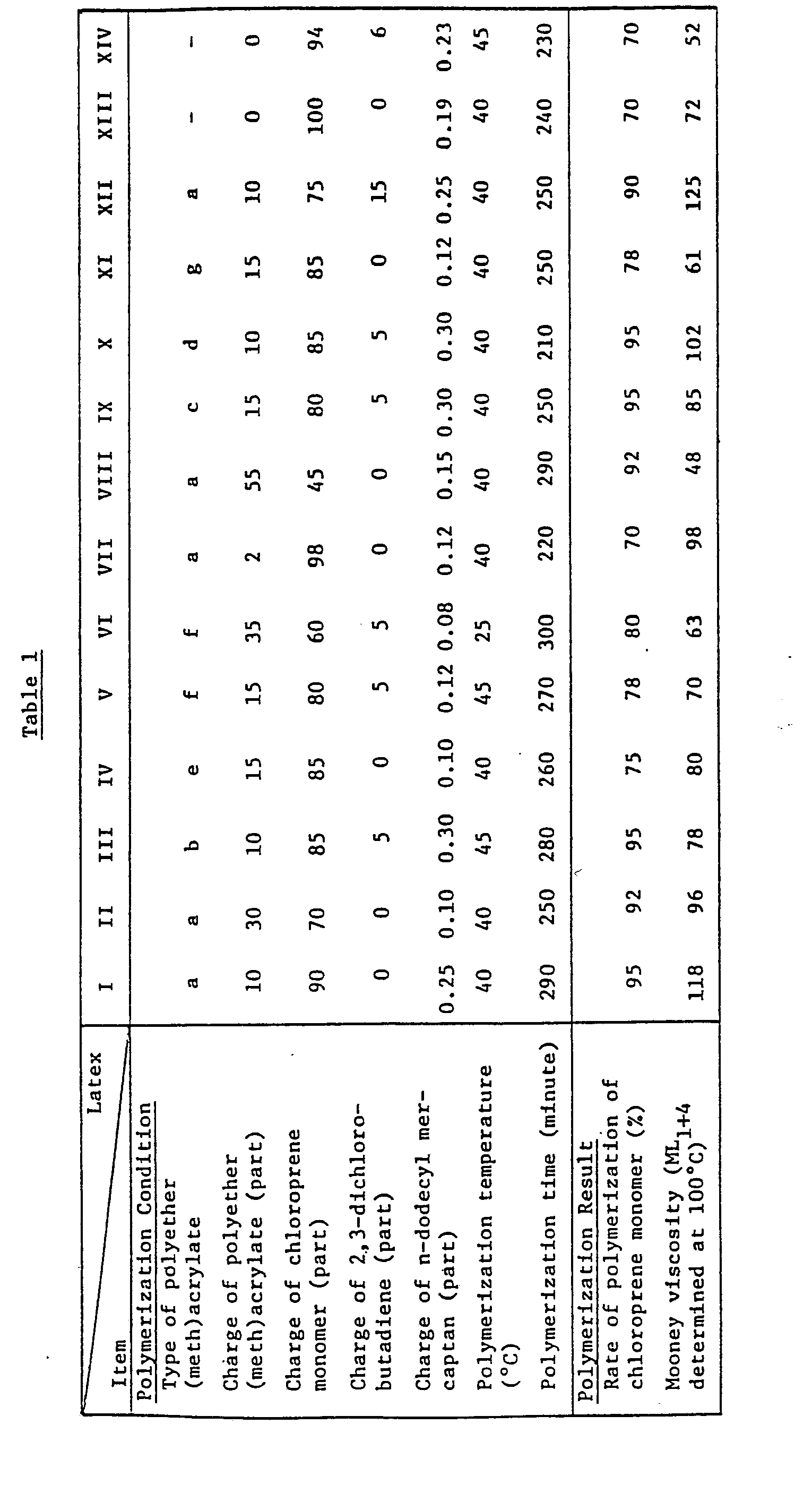
- the polymerization was carried out in a polymerization vessel made of stainless steel and having an internal capacity of 30 liters. That is, the polymerization vessel was charged, in a stream of nitrogen, with 200 parts of water, 5 parts of disproportionated rosin acid as an emulsifier, 3 parts of sodium dodecylbenzene sulfonate, 1.5 parts of the sodium salt of a formaldehyde-naphthalenesulfonic acid condensate as a dispersing agent, and 0.8 part of sodium hydroxide as another polymerization aid. Thereafter, the monomer mixture indicated in Table 1 was added to the polymerization vessel together with n-dodecyl mercaptan.
- the polymerization was carried out under the conditions described in Table 1 by using formamidine sulfinic acid as a radical polymerization initiator.
- Thiodiphenylamine was added to the polymerizer at the time an arbitrary rate of polymerization of the chloroprene monomer was reached so as to stop the polymerization.
- the unreacted chloroprene monomer and a specific amount of water were removed from the reaction mixture by steam stripping to obtain a latex having a solid content of 30%.
- the latex of polychloroprene copolymerized with the polyether (meth)acrylate was, if necessary, mixed with a latex of benzene-soluble polychloroprene according to the content indicated in Table 2.
- a dry polymer was isolated from the resultant latex according to a conventional freeze-coagulating method. The physical properties of the polymer are shown in Table 2.
- the polymer was vulcanized under the following formulation and conditions.
- the physical properties of the vulcanizate was determined.
Landscapes
- Chemical & Material Sciences (AREA)
- Health & Medical Sciences (AREA)
- Chemical Kinetics & Catalysis (AREA)
- Medicinal Chemistry (AREA)
- Polymers & Plastics (AREA)
- Organic Chemistry (AREA)
- Addition Polymer Or Copolymer, Post-Treatments, Or Chemical Modifications (AREA)
- Compositions Of Macromolecular Compounds (AREA)
Description
- The present invention relates to a chloroprene copolymer having remarkably improved resistance to oils, weathering, heat and freezing and to a process for producing the same.
- Chloroprene rubber comprising a homopolymer or copolymer of chloroprene, i.e., 2-chloro-1,3-butadiene, has been used as an elastomer having most balanced physical properties in various applications.
- FR-A-1 568 661, for example, discloses easily processable blends of chloroprene polymers comprising (a) a crosslinked chloroprene polymer prepared by polymerising 2-chloro-1,3-butadiene in an aqueous emulsion system in the presence of a dimethacrylate of either a dihydric alcohol having 2 to 6 carbon atoms or a polyether of such a dihydric alcohol having 1 to 3 ether linkages per molecule, and (b) a benzene soluble chloroprene polymer. FR-A-1 568 661, however, gives only four specific examples all of which use ethylene glycol dimethacrylate as the preferred dimethacrylate and FR-A-1 568 661 is solely concerned with providing a blend of chloroprene polymers having greatly improved processing properties as represented by a relatively low "die swell".
- However, the fact that chloroprene rubber has well balanced physical properties means that each of the physical properties reaches the standard level but does not always mean that the individual physical properties are particularly excellent. Therefore, the chloroprene rubber is inferior to butadiene-acrylonitrile copolymer rubber in oil resistance, to ethylene-propylene copolymer rubber in weathering resistance, to chlorosulfonated polyethylene in heat resistance, and to natural rubber and polybutadiene rubber in coldness resistance.
- For these reasons, in specific fields, chloroprene rubber cannot be used or it is giving way to other types of rubbers under the present circumstances.
- On the other hand, improvements are being rapidly made on polychloroprene itself. For example, there are known DCR-50 as oil resistant polychloroprene, manufactured by Denki Kagaku Kogyo Kabushiki Kaisha, and DCR-34 as heat resistant polychloroprene, manufactured by Denki Kagaku Kogyo Kabushiki Kaisha. Although there are proposed various chloroprenes in which a single property is improved as mentioned above, no chloroprene of the type in which all or most of the properties are improved has been developed. Moreover, improving one of the properties of the chloroprene often leads to a deterioration of the other properties. For example, the low temperature brittle points of the above-mentioned DCR-50 and DCR-34 are rather higher than that of conventional polychloroprene.
- In view of these circumstances, we carried out a study of the problem and, as a result, have discovered that a chloroprene copolymer obtained by radical copolymerizing 50 to 95% of chloroprene, 5 to 50% of at least one polyether (meth)acrylate represented by the formula (I) given below, and 0 to 10% of a monomer copolymerizable with chloroprene, these percentages being by weight and being based on the total amount of the monomers to be copolymerized, exhibits a remarkably improved oil resistance, weathering resistance, heat resistance and coldness resistance. The present invention is based on this finding. By the term "(meth)acrylate" used herein is meant either an acrylate or methacrylate.


- That is, a feature of the present invention resides in the fact that the above described problems encountered in the conventional chloroprene rubbers are successfully overcome by combining a polyether chain with the chloroprene polymer chain.
- A polyether chain is a molecular chain having excellent oil resistance, coldness resistance, weathering resistance and other desirable characteristics. However, the compatibility of the polyether chain with chloroprene rubber is poor. Accordingly, for example, when chloroprene rubber and polypropylene glycol are kneaded in a rubber kneader and vulcanized, no increase in physical property of the chloroprene is observed and, moreover, the strength of the vulcanizate is extremely inferior. Furthermore, a phenomenon of the incorporated polypropylene glycol bleeding on the surface of the vulcanizate occurs.
- The present invention was developed on the basis of the unexpected discovery that even when a polyether molecular chain has poor compatibility with chloroprene rubber, if the polyether molecular chain has an acryloyl or methacryloyl group at one or both ends thereof, such a polyether molecular chain can be incorporated in the chloroprene, and the resultant chloroprene copolymer is remarkably improved in oil resistance, weathering resistance, heat resistance and coldness resistance as compared with the conventional chloroprene rubbers.
- The structural units of the chloroprene copolymer obtained according to the present invention are as follows, and the copolymer of the present invention is comprised of the units A), B) and/or C) and the optional unit D).

- R1 and R4 each represent, independently, a hydrogen atom or a methyl group;
- R2 represents a straight or branched chain alkylene group having an average number of carbon atoms of 2.5 to 6 (a plurality of R2 S may or may not be the same);
- n represents a number of 4 to 20;
- R3 represents a hydrogen atom, an alkyl group having 1 to 3 carbon atoms, or a group of the formula

- X represents a monomer unit copolymerizable with chloroprene and includes a chloroprene unit derived from the 1,2- or 3,4- addition of chloroprene.
- The chloroprene copolymer containing the unit C) according to the present invention is obtained when the polyether (meth)acrylate is a di(meth)acrylate and the second (meth)acryloyl groups of the di(meth)acrylate have taken part in the copolymerization. Even if the polyether (meth)acrylate is a di(meth)acrylate, at least a part of the second (meth)acryloyl groups thereof sometimes may not take part in the copolymerization. This is the reason why the chloroprene copolymer according to the present invention is defined to comprise the unit B) "and/or" C).
- The chloroprene copolymer according to the present invention can be prepared by free-radical polymerization of monomers capable of providing the above described monomer units A) through D). The free-radical polymerization can be carried out by means of solution polymerization, bulk polymerization, suspension polymerization, emulsion polymerization or other polymerization methods. Emulsion polymerization using an aqueous medium is advantageous for industrial purposes. In the case of emulsion polymerization, the emulsifier used is preferably comprised mainly of a metal salt of disproportionated rosin acid in view of the stability and processing workability of the resulting crude rubber of chloroprene copolymer.
- A dry polymer from the latex obtained by the emulsion polymerization can be recovered by a method conventionally used for the recovery of dry rubber from a natural or synthetic rubber latex, or any method usable for such a purpose. One such method comprises freezing the latex to provide a sheet-like article, washing the sheet with water, and blowing hot air onto the sheet to dry it. This method comprising drying of the freezed sheet generally produces favourable results. In the case where the freezing is unsatisfactory or incomplete, the sheet may be partially revived into the latex during the water washing step, whereby the yield is reduced.
- Furthermore, in the case where monomers providing the monomer units B) and/or C), i.e., polyether (meth)acrylate, have a recurring number n of ether unit in the vicinity of the lower limit of the range of 4 to 20, which is within the scope of the present invention, e.g., a recurring number n of 4 to about 10, or the rate of polymerization of the emulsion polymerization is more than 90 to 95%, or R3 in the above given formula (I) is a (meth)acryloyl group, the strength of the vulcanizate may in some cases be reduced, although the object of obtaining improved oil resistance, weathering resistance, heat resistance and coldness resistance according to the present invention is not obstructed. In such a case, the above-mentioned problems can be solved by mixing a latex of benzene-soluble polychloroprene into the latex of the present invention and by applying a polymer recovery method including the above mentioned drying of the freezed sheet to the resultant latex mixture. In this case, a suitable amount of the latex of benzene-soluble polychloroprene to be mixed is up to 9 times that of the latex of the present invention on the basis of the weight of the polymer. Throughout this specification, quantities expressed by "part" and percent (%) are by weight.
- In accordance with the present invention, the chloroprene monomer is used in an amount of 50 to 95% in the polymerization step for the preparation of the polychloroprene. If the amount of the chloroprene monomer is less than 50%, the resultant polymer will no longer have the characteristics of a chloroprene polymer and cannot be subjected to conventional processing and formulation for chloroprenes. If the amount of the chloroprene monomer is more than 95%, the modifying effects of the polyether (meth)-acrylate will not be satisfactory. The polyether (meth)acrylate is used in an amount of 5 to 50%. If the amount of the polyether (meth)acrylate is less than 5%, the modifying effects will not be satisfactory. If the amount of the polyether (meth)acrylate is more than 50%, the resultant polymer will no longer have the characteristics of a polychloroprene.
- The structure of the polyether (meth)acrylate is defined as indicated in the above given formula (I). R2 is an alkylene group of a straight or branched structure having an average number of carbon atoms of 2.5 to 6. When the average number of carbon atoms is less than 2.5, the resultant polymer exhibits an improved oil resistance and weathering resistance but not a satisfactory improved coldness resistance. When the average number of carbon atoms is more than 6, the resultant polymer does not exhibit a satisfactorily improved oil resistance. The recurring number n of the polyether unit is limited to the range of 4 to 20. If the recurring number is less than 4, satisfactory modifying effects may not be obtained. A recurring number exceeding 20 results in a reduction in the strength of the vulcanizate. R3 is a hydrogen atom, an alkyl group having 1 to 3 carbon atoms or a group of the formula:

- The polyether (meth)acrylates may also be added to the polymerization system in the form of a mixture of one or more thereof without any limitation as long as the conditions of the above mentioned structure and total percentage by weight are satisfied.
- A number of polyether (meth)acrylates are marketed. These polyether (meth)acrylates can be synthesized with relative ease. The synthesis methods include, for example, esterification of a polyether polyol, such as polypropylene glycol or polytetramethylene glycol, with (meth)acrylic acid, and addition polymerization of a (meth)acrylic ester containing a hydroxyl group in the alcohol residue, such as 2-ethyl- hydroxyl-(meth)acrylate, with propylene oxide, tetrahydrofuran or the like.
- The comonomer other than polyether (meth)acrylates undergoes no limitation as long as the amount thereof is in the range of from 0 to 10%. The comonomers which can be used include, for example, a unit derived from the 1,2- or 3,4- addition of chloroprene, 2,3-dichlorobutadiene, 1-chlorobutadiene, butadiene, isoprene, styrene, methyl methacrylate, methyl acrylate, methacrylic acid, acrylonitrile and sulfur. The reason why the other comonomer should not exceed 10% is that such a large amount hinders the leveling- up of each characteristic of chloroprene, which is the essence of the present invention.
- The chloroprene copolymer according to the present invention has remarkably improved physical properties with regard to resistance to oil, weathering, heat and coldness. Furthermore, the chloroprene copolymer of the present invention can be subjected to formulation, vulcanization, molding and other processings according to any methods conventionally used for processing chloroprene. Therefore, the chloroprene copolymer of the present invention can be used in the fields of application where conventional chloroprene elastomers could not and cannot be used because of their unsatisfactory physical properties.
- For better understanding of the present invention, examples of the present invention and comparative examples are given hereunder.
- The polyether di(meth)acrylates used in each example are indicated by symbols which indicate the following meanings.
-
- a. Polypropylene glycol dimethacrylate
-


- c. Polyethylene glycol diacrylate

- d. Tripropylene glycol diacrylate

- e. Polypropylene glycol monomethacrylate

- f. Poly-(propylene glycol)-(ethylene glycol)monomethacrylate

- g. Polyethylene glycol monomethacrylate

- The polymerization was carried out according to the following procedures.
- The polymerization was carried out in a polymerization vessel made of stainless steel and having an internal capacity of 30 liters. That is, the polymerization vessel was charged, in a stream of nitrogen, with 200 parts of water, 5 parts of disproportionated rosin acid as an emulsifier, 3 parts of sodium dodecylbenzene sulfonate, 1.5 parts of the sodium salt of a formaldehyde-naphthalenesulfonic acid condensate as a dispersing agent, and 0.8 part of sodium hydroxide as another polymerization aid. Thereafter, the monomer mixture indicated in Table 1 was added to the polymerization vessel together with n-dodecyl mercaptan.
- The polymerization was carried out under the conditions described in Table 1 by using formamidine sulfinic acid as a radical polymerization initiator. Thiodiphenylamine was added to the polymerizer at the time an arbitrary rate of polymerization of the chloroprene monomer was reached so as to stop the polymerization. The unreacted chloroprene monomer and a specific amount of water were removed from the reaction mixture by steam stripping to obtain a latex having a solid content of 30%.
- The latex of polychloroprene copolymerized with the polyether (meth)acrylate was, if necessary, mixed with a latex of benzene-soluble polychloroprene according to the content indicated in Table 2. A dry polymer was isolated from the resultant latex according to a conventional freeze-coagulating method. The physical properties of the polymer are shown in Table 2.
- The polymer was vulcanized under the following formulation and conditions. The physical properties of the vulcanizate was determined.
-

- In Table 2, the polymer Nos. 1 through 9 are examples of the present invention, and the polymers Nos. 10 through 19 are comparative examples.


- *The vulcanizate sheet was cut into test pieces each of 32-mm length, 6.3-mm width, and 2-mm thickness, and the embrittlement point of each piece was determined by means of an impact embrittlement testing machine.
- **The determination was carried out by allowing the vulcanizate sheet to stand in a gear type aging testing machine at 120°C for 4 days.
- ***The determination was carried out by immersing the vulcanizate sheet in ASTM No. 3 oil at 100°C for 96 hours.
- ****The time required for cracks to be generated in the vulcanizate sheet in a 20% stretched state under the
- conditions of an ozone concentration of 50 pphm and a temperature of 50°C, was determined. Note: Since the vulcanizate sheet No. 11 had a tacky surface and was not vulcanized to a satisfactory
- degree, only the ordinary state properties and brittle point were determined.
Claims (4)


Applications Claiming Priority (2)
| Application Number | Priority Date | Filing Date | Title |
|---|---|---|---|
| JP59047935A JPH06866B2 (en) | 1984-03-13 | 1984-03-13 | Polychloroprene elastomer composition and method for producing the same |
| JP47935/84 | 1984-03-13 |
Publications (3)
| Publication Number | Publication Date |
|---|---|
| EP0155805A2 EP0155805A2 (en) | 1985-09-25 |
| EP0155805A3 EP0155805A3 (en) | 1987-07-22 |
| EP0155805B1 true EP0155805B1 (en) | 1990-08-22 |
Family
ID=12789228
Family Applications (1)
| Application Number | Title | Priority Date | Filing Date |
|---|---|---|---|
| EP85301670A Expired EP0155805B1 (en) | 1984-03-13 | 1985-03-11 | Chloroprene copolymer and process for producing the same |
Country Status (4)
| Country | Link |
|---|---|
| US (1) | US4957991A (en) |
| EP (1) | EP0155805B1 (en) |
| JP (1) | JPH06866B2 (en) |
| DE (1) | DE3579245D1 (en) |
Families Citing this family (6)
| Publication number | Priority date | Publication date | Assignee | Title |
|---|---|---|---|---|
| EP0538640B1 (en) * | 1991-09-30 | 1996-09-04 | Nippon Zeon Co., Ltd. | Acrylic copolymer elastomer and vulcanizable composition containing same |
| US5470895A (en) * | 1994-06-13 | 1995-11-28 | General Electric Company | Agglomerating agent latex with bound poly(ethylene oxide) |
| DE4435422A1 (en) * | 1994-10-04 | 1996-04-18 | Basf Ag | Process for the preparation of an aqueous polymer dispersion |
| JP2005220190A (en) * | 2004-02-04 | 2005-08-18 | Denki Kagaku Kogyo Kk | Chloroprene-based elastomer composition for extrusion |
| JP4911227B2 (en) * | 2010-01-08 | 2012-04-04 | パナソニック株式会社 | Vacuum cleaner |
| CN113980181B (en) * | 2021-10-28 | 2023-12-29 | 山纳合成橡胶有限责任公司 | Preparation method of chloroprene and methyl methacrylate copolymer |
Family Cites Families (12)
| Publication number | Priority date | Publication date | Assignee | Title |
|---|---|---|---|---|
| US3431227A (en) * | 1964-11-07 | 1969-03-04 | Basf Ag | Process for preparing rubbery 1,3-diene polymers by polymerizing 1,3-dienes in the presence of a preformed polymer |
| GB1148690A (en) * | 1967-06-17 | 1969-04-16 | Bp Chem Int Ltd | Easily processable blends of chloroprene polymers |
| US3714296A (en) * | 1968-08-01 | 1973-01-30 | Denki Kagaku Kogyo Kk | Polychloroprene elastomer |
| US3876732A (en) * | 1968-08-01 | 1975-04-08 | Denki Kagaku Kogyo Kk | Polychloroprene elastomer |
| JPS5727082B2 (en) * | 1971-08-12 | 1982-06-08 | ||
| JPS5110624B2 (en) * | 1972-06-06 | 1976-04-05 | ||
| JPS5116061B2 (en) * | 1972-06-22 | 1976-05-21 | ||
| JPS5139668B2 (en) * | 1972-07-17 | 1976-10-29 | ||
| US4146592A (en) * | 1972-09-18 | 1979-03-27 | Denki Kagaku Kogyo Kabushiki Kaisha | Polychloroprene elastomer |
| US3933754A (en) * | 1972-09-18 | 1976-01-20 | Denki Kagaku Kogyo Kabushiki Kaisha | Insoluble chloroprene polymer |
| US4054731A (en) * | 1973-05-17 | 1977-10-18 | Denki Kagaku Kogyo Kabushiki Kaisha | Process for curing liquid chloroprene polymer containing xanthate active terminal groups using polyfunctional amines |
| JPS5540715A (en) * | 1978-09-18 | 1980-03-22 | Toyo Soda Mfg Co Ltd | Chloroprene polymer composition |
-
1984
- 1984-03-13 JP JP59047935A patent/JPH06866B2/en not_active Expired - Lifetime
-
1985
- 1985-03-11 DE DE8585301670T patent/DE3579245D1/en not_active Expired - Lifetime
- 1985-03-11 EP EP85301670A patent/EP0155805B1/en not_active Expired
-
1986
- 1986-12-01 US US06/936,382 patent/US4957991A/en not_active Expired - Fee Related
Also Published As
| Publication number | Publication date |
|---|---|
| JPS60192740A (en) | 1985-10-01 |
| EP0155805A3 (en) | 1987-07-22 |
| DE3579245D1 (en) | 1990-09-27 |
| EP0155805A2 (en) | 1985-09-25 |
| JPH06866B2 (en) | 1994-01-05 |
| US4957991A (en) | 1990-09-18 |
Similar Documents
| Publication | Publication Date | Title |
|---|---|---|
| US3497571A (en) | Acrylic ester-cyclic ester elastomeric compositions | |
| US3354108A (en) | Graft blend of diene rubber polymeric compositions having improved toughness | |
| US3655827A (en) | Polychloroprene sol-gel blends | |
| US4957991A (en) | Chloroprene polyether (meth)acrylate copolymer and process for producing same | |
| EP0013141B1 (en) | Vinyl chloride resin composition | |
| US4082818A (en) | Mercaptan activation by acid in the copolymerization of acrylonitrile | |
| CA2020179C (en) | Asphalt blends with chloroprene polymers or copolymers thereof with dichlorobutadiene | |
| US3607981A (en) | Nitrile rubbers | |
| CA2064173A1 (en) | Process for the preparation of rubber-containing graft copolymer particles | |
| US2662876A (en) | Method of terminating the polymerization of monomeric materials in aqueous emulsion and a nonstaing, nondiscoloring composition for use therein | |
| US3222422A (en) | Blend of a diene rubber-based graft copolymer, an emulsion-polymerized styrene-acrylonitrile type interpolymer, and a suspension-polymerized styrene-acrylonitrile type interpolymer | |
| JP3484791B2 (en) | Chloroprene rubber composition and chloroprene rubber composition for vibration damping material | |
| JPH08245841A (en) | Chloroprene rubber composition for vibration damping material and chloroprene rubber molded vulcanizate for vibration damping material | |
| US3917749A (en) | Resinous butadiene/styrene reinforcing copolymers | |
| US4751277A (en) | Amino group-containing diene copolymer | |
| JP3484800B2 (en) | Chloroprene rubber composition and chloroprene rubber composition for vibration damping material | |
| US4599382A (en) | Rubber composition comprising a thermosetting resin and a functional rubber-like copolymer | |
| KR900002532B1 (en) | Polyblends of Aromatic / isopropenyl Aromatic Copolymers and Grafted Rubber Concentrates | |
| GB2131434A (en) | Process for instantaneous peptization chloroprene-sulfur copolymers | |
| US4020128A (en) | Polymerizates of olefinic nitriles and diene rubbers | |
| JPH0153899B2 (en) | ||
| EP0683202B1 (en) | Chloroprene polymer composition and process for its production | |
| GB2090266A (en) | Fluoro monomer-diene-nitrile copolymer rubber | |
| EP0096771A1 (en) | A sulphonated terpolymer | |
| JP3402559B2 (en) | Chloroprene polymer composition and method for producing the same |
Legal Events
| Date | Code | Title | Description |
|---|---|---|---|
| PUAI | Public reference made under article 153(3) epc to a published international application that has entered the european phase |
Free format text: ORIGINAL CODE: 0009012 |
|
| AK | Designated contracting states |
Designated state(s): DE FR GB IT |
|
| PUAL | Search report despatched |
Free format text: ORIGINAL CODE: 0009013 |
|
| AK | Designated contracting states |
Kind code of ref document: A3 Designated state(s): DE FR GB IT |
|
| 17P | Request for examination filed |
Effective date: 19880104 |
|
| 17Q | First examination report despatched |
Effective date: 19890215 |
|
| GRAA | (expected) grant |
Free format text: ORIGINAL CODE: 0009210 |
|
| AK | Designated contracting states |
Kind code of ref document: B1 Designated state(s): DE FR GB IT |
|
| REF | Corresponds to: |
Ref document number: 3579245 Country of ref document: DE Date of ref document: 19900927 |
|
| ET | Fr: translation filed | ||
| ITF | It: translation for a ep patent filed | ||
| ITTA | It: last paid annual fee | ||
| PLBE | No opposition filed within time limit |
Free format text: ORIGINAL CODE: 0009261 |
|
| STAA | Information on the status of an ep patent application or granted ep patent |
Free format text: STATUS: NO OPPOSITION FILED WITHIN TIME LIMIT |
|
| 26N | No opposition filed | ||
| PGFP | Annual fee paid to national office [announced via postgrant information from national office to epo] |
Ref country code: DE Payment date: 20000306 Year of fee payment: 16 |
|
| PGFP | Annual fee paid to national office [announced via postgrant information from national office to epo] |
Ref country code: GB Payment date: 20000308 Year of fee payment: 16 |
|
| PGFP | Annual fee paid to national office [announced via postgrant information from national office to epo] |
Ref country code: FR Payment date: 20000310 Year of fee payment: 16 |
|
| PG25 | Lapsed in a contracting state [announced via postgrant information from national office to epo] |
Ref country code: GB Free format text: LAPSE BECAUSE OF NON-PAYMENT OF DUE FEES Effective date: 20010311 |
|
| GBPC | Gb: european patent ceased through non-payment of renewal fee |
Effective date: 20010311 |
|
| PG25 | Lapsed in a contracting state [announced via postgrant information from national office to epo] |
Ref country code: FR Free format text: LAPSE BECAUSE OF NON-PAYMENT OF DUE FEES Effective date: 20011130 |
|
| REG | Reference to a national code |
Ref country code: FR Ref legal event code: ST |
|
| PG25 | Lapsed in a contracting state [announced via postgrant information from national office to epo] |
Ref country code: DE Free format text: LAPSE BECAUSE OF NON-PAYMENT OF DUE FEES Effective date: 20020101 |