EP0155760A1 - A method for coating food products and food coating compositions for carrying out said method - Google Patents
A method for coating food products and food coating compositions for carrying out said method Download PDFInfo
- Publication number
- EP0155760A1 EP0155760A1 EP85300945A EP85300945A EP0155760A1 EP 0155760 A1 EP0155760 A1 EP 0155760A1 EP 85300945 A EP85300945 A EP 85300945A EP 85300945 A EP85300945 A EP 85300945A EP 0155760 A1 EP0155760 A1 EP 0155760A1
- Authority
- EP
- European Patent Office
- Prior art keywords
- food
- batter
- coating composition
- coating
- breadcrumbs
- Prior art date
- Legal status (The legal status is an assumption and is not a legal conclusion. Google has not performed a legal analysis and makes no representation as to the accuracy of the status listed.)
- Granted
Links
Classifications
-
- A—HUMAN NECESSITIES
- A23—FOODS OR FOODSTUFFS; TREATMENT THEREOF, NOT COVERED BY OTHER CLASSES
- A23P—SHAPING OR WORKING OF FOODSTUFFS, NOT FULLY COVERED BY A SINGLE OTHER SUBCLASS
- A23P20/00—Coating of foodstuffs; Coatings therefor; Making laminated, multi-layered, stuffed or hollow foodstuffs
- A23P20/10—Coating with edible coatings, e.g. with oils or fats
- A23P20/12—Apparatus or processes for applying powders or particles to foodstuffs, e.g. for breading; Such apparatus combined with means for pre-moistening or battering
-
- A—HUMAN NECESSITIES
- A23—FOODS OR FOODSTUFFS; TREATMENT THEREOF, NOT COVERED BY OTHER CLASSES
- A23P—SHAPING OR WORKING OF FOODSTUFFS, NOT FULLY COVERED BY A SINGLE OTHER SUBCLASS
- A23P20/00—Coating of foodstuffs; Coatings therefor; Making laminated, multi-layered, stuffed or hollow foodstuffs
- A23P20/20—Making of laminated, multi-layered, stuffed or hollow foodstuffs, e.g. by wrapping in preformed edible dough sheets or in edible food containers
- A23P20/25—Filling or stuffing cored food pieces, e.g. combined with coring or making cavities
- A23P2020/251—Tempura batter; Leavened or other aerate batter or coating
Definitions
- the present invention relates to food coating compositions, in particular to microwaveable food products coated thereby.
- Battered and breaded food portions which may be fish, seafood, poultry, red meat or vegetables, are commonly-known food products served in the home, in restaurants and in institutions. Traditionally, these items are provided to the customer in a form which is raw, partially- or fully-cooked, battered and/or breaded, and frozen. Such products normally are produced by the application of batters and/or breadings to raw or to raw-frozen or to cooked-frozen substrates, subjecting the battered and/or breaded substrates to a blanch frying treatment, refreezing the portions, and packaging the refrozen products in suitable containers. Such products have been traditionally cooked or heated for consumption in the home, restaurant or institution'by either deep-frying or oven heating. These food products, when reconstituted for consumption by the latter methods, have offered attractively-coloured portions with moist meat and crisp coating textures.
- a food-coating composition suitable for application to a food substrate to provide a battered/breaded food portion which is microwaveable to form, when prepared for final consumption by heating in a microwave oven, a cooked food portion which possesses the desirable combination of textural qualities of moistness in the substrate and crispness in the coating.
- the invention is applicable to any food substrate, including fish, seafood, poultry, red meat, fruit and vegetables.
- the coating systems which are used in this invention effectively control moisture migration between the substrate food and the coating system components.
- Components of the coating adjacent the food portion effectively gel or coagulate during cooking and retard the migration of moisture from the food portion to the breading component while, at the same time, providing a controlled porosity to the exterior of the coated food portion, to permit migration of moisture and moisture vapour through the coating to the external environment.
- This combination of effects permits the formation of a finished food product which possesses the desired level of moistness within the food substrate and the desired level of crispness within the coating.
- the predust layer comprises a finely-divided particulate mixture of components adhered to the surface of the food substrate and assists in adhesion of the batter layer to the food substrate.
- the particulate mixture generally has a particle size such that none of the particles is coarser than 16 mesh and up to about 40% pass an 80 mesh screen.
- the predust mixture contains about 1 to about 10 wt.% of powdered egg albumen or other food binder, for example, gelatin or starch, to provide adhesion for the other components.
- the balance of the predust mixture consists substantially or completely of powdered high density breadcrumbs with or without flour, commonly soft wheat flour.
- the predust contains seasoning, for example, peppers and spices, to provide a desired flavour, but this is not essential.
- the powdered breadcrumbs employed in the predust layer are high density breadcrumbs having a bulk density of about 0.5 to about 0.75 g/cc, preferably about 0.55 to about 0.66 g/cc. These materials have a total absorption of about 375 to about 500, preferably about 425 to about 475, an absorption rate of about 15 to about 60 seconds, and a moisture content of about 6 to about 10 wt.%, preferably about 7 to about 9 wt.%.
- the "absorption rate" for the breadcrumbs is determined by a standard procedure wherein 30 g 'of sample are added to 75 mls of water at room temperature, timing is started, the mixture is stirred for 15 seconds and the time required to absorb all the water is the absorption rate.
- Total Absorption for the breadcrumbs also is determined by a standard procedure wherein 30 g of sample are added to 300 mls of water at room temperature, the mixture is allowed to stand for 6 hours, the excess water is poured off and the total absorption is determined from the relationship:
- the powdered breadcrumbs alone may be used in conjunction with the egg albumen, usually fine flour, preferably soft wheat flour, is used in conjunction with the breadcrumbs,' in an amount up to about 60 wt.% of the predust composition.
- the predust composition comprises a finely-divided mixture of egg albumen, high density breadcrumbs and soft wheat flour.
- the batter layer used in the present invention may be provided by dispersing batter-making components in water in any desired proportions to provide a consistency such as permits a coating to be applied to predusted food. Generally, about 85 to about 125 parts by weight of water are used for 100 parts by weight of batter-forming components.
- the batter-making components comprise flour, corn starch, solid chemical leavening agents which react together when wetted, and heated if necessary, to form carbon dioxide to produce leavening of the batter, and plastic fat (i.e. a fat having plasticity as a result of the presence of liquid), and usually also contains powdered egg albumen.
- plastic fat i.e. a fat having plasticity as a result of the presence of liquid
- the batter-making components often are provided in the form of a dry mix of at least the flour, corn starch and leavening agents, along with powdered egg albumen, if employed. Depending on the form of the plastic fat, this component may be present in the dry mix or may be separately dispersed in the wetted batter.
- the corn starch usually is employed in an amount of about 10 to about 40 wt.% of the batter-forming components while the flour, which may be soft and/or hard wheat flour, usually is employed in an amount of about 40 to about 70 wt.% of the batter-forming components.
- the corn starch is employed in an amount of about 20 to about -30 wt.%
- the flour is employed in an amount of about 50 to about 60 wt.%
- the weight ratio of flour to corn starch is about 2:1.
- the chemical leavening agents usually are present in a total amount of about 1 to about 5 wt.% of the dry mix.
- One chemical leavening agent usually is sodium bicarbonate in an amount of about 0.5 to about 2.5 wt.% while the acidic component, also in an amount of about 0.5 to about 2.5 wt.%, may be anhydrous monocalcium phosphate, sodium aluminum phosphate, sodium aluminum pyrophosphate, or blends of two or more of these materials.
- the plastic fat usually is present in wetted batter in an amount of about 4 to about 10 wt.%.
- the plastic fat may be creamed prior to dispersion in the batter or may be in powdered form in the dry mix.
- the plastic fat may have a wide range of Solid Fat Index (SFI) with values ranging: Values at the low end of these ranges are preferred for creamed fats while values at the upper end of these ranges are preferred for powdered fats.
- SFI Solid Fat Index
- powdered egg albumen When employed in the batter composition, powdered egg albumen usually is present in the dry mix in an amount of up to about 6 wt.% of the dry mix. It is usual to incorporate seasoning in the batter to impart a desired flavour thereto, but the seasoning may be omitted, if desired. Seasoning includes pepper, spices, powdered lemon juice and similar materials. Small amounts of finely-divided protein, for example,- soya flour, also may be present in the batter.
- the outer breading layer applied to the batter layer is formed of low density and coarse breadcrumbs- to provide a crispy or crunchy texture to the reconstituted food product.
- the breadcrumbs used are coarse and usually are sized so that at least about 15 wt.% of the crumb is retained on an 8 mesh screen.
- a preferred particle size distribution is as follows:
- the breadcrumbs used are of low density and usually have a bulk density of about 0.20 to about 0.40 g/cc, preferably about 0.23 to about 0.36 g/cc.
- Tho breadcrumbs may contain small quantities of components to impart colour to the reconstituted food product and/or to affect the browning rate upon reconstitution.
- up to about 0.1 wt.% of caramel colouring agent may be present while up to about 2 wt.% dextrose also may be present as a browning rate control agent.
- salt in varying quantities may be present in the breadcrumbs, usually in a quantity of 0 to about 5 wt.%, preferably about 0.5 to about 1.5 wt.%.
- the breading crumbs employed are preferably oriental-style breading crumbs (otherwise known as Japanese-style or Panko-style breading crumbs), which are characterized by an elongate shape and a coarse splintered appearance.
- the oriental-style breading crumbs are those produced by the procedure described in U.S. Patent No. 4,423,078, aligned to the assignee herein and the disclosure of which is incorporated herein by reference.
- Breading crumbs preferably employed in the present invention are characterized by an amylograph of the following characteristics:
- the amylograph is determined on a Brabender Amylograph unit using 60 g of breading crumbs ground to pass a 30-mesh screen but to be retained on an 80-mesh screen, added to 450 ml of water with a bowl speed of 75 rpm and a sensing head value of 700 cmg.
- the oriental-style breading crumbs produced by the process of the aforementioned U.S. Patent No. 4,423,078 meet these requirements.
- the components of the coating composition are chosen to provide an overall controlled degree of porosity in order to retain some moistness but to release the excess generated during reheating.
- the proportions of the three components of the coating composition required to achieve this result may vary widely, depending on the identity of the food substrate.
- Typical food substrates to which the compositions of the invention may be applied include fish, seafood, poultry, red meat and vegetables.
- the food substrate comprises about 50 to about 75 wt% of the overall composition with the coating compositions comprising the balance of about 25 to about 50 wt% of the composition.
- the coating composition may comprise about 25 to about 35 wt..% of the total food composition, with the predust being about 1 to about 5 wt.%, the wet batter being about 15 to about 20 wt.% and the breading being about 6 to about 10 wt.% of the total food composition.
- the total coating composition may comprise about 40 to about 50 wt.% of the total food composition, with the predust being about 1 to about 5 wt.%, the wet batter being about 25 to about 35 wt.% and the breading being about 10 to about 15 wt.% of the total food composition.
- the total coating composition may ssmprise abate 25 to about 48 wt.% of the total food composition, with the predust being about 1 to about 5 wt.%, the wet batter being about 15 to about. 25 wt.% and the breading being about 6 to about 10 wt.% of the total food composition.
- the totol qoating comporition may comprise about 20 to about 35 wt.% of the total food composition with the predust being about 1 to about 5 wt.%, the wet batter being about 10 to about 20 wt.% and the breading being about 5 to about 10 wt.% of the total food composition.
- the three layers are successively applied to the food substrate, which may be raw or partially or wholly precooked, and the food product then is frozen, after blanch frying or similar treatment, if desired.
- the food products which are produced using the coating composition of the invention are cookable by microwave energy to the desired textures of crispness within the coating and moistness within the food.
- sample food products have been determined to have similar organoleptic properties to infrared reheated breaded food products. This result has not previously been attained for microwave-reconstituted breaded food products.
- the products also resist thermal freezer cycle stress.
- Reheating of the food product for serving is not restricted to microwave reheating but also may be effected by conventional infrared oven heating, if desired.
- the conditions of reheating depend on the ' type and weight of food chosen and the mode of reheating chosen, but are generally those used for other similar food products.
- This Example illustrates the provision of a frozen fish portion having a coating composition applied thereto and the reconstitution thereof.
- Three oz ( 85g) filleted cod portions were cut diagonally in half through the largest plane to create wedge portions. The portions were tempered to eliminate any surface ice glaze.
- a predust composition was first applied by hand to achieve a light coating with no clumps.
- the predusted fish portion was dipped into a batter by hand and partially dried.
- An outer layer of breading crumbs was applied by hand to the battered fish portion.
- the predust used in the application of the coating composition comprised the following components:
- the batter used in the application of the coating composition was prepared by placing 975g of cold tap 5 water in a Hobart mixing bowl and adding 750g dry batter mix.
- the mixing bowl contents were mixed at speed # 1 (low speed) with a mixing paddle to wet the dry ingredients and then mixed at speed # 2 (medium speed) until well blended and lump free, whereupon the mixing speed was decreased to # 1.
- 90g of creamed shortening was gradually added while the batter was continued to be mixed. When all the shortening had been added, the mixing speed was again increased to # 2 until the batter was well blended, smooth and lump free.
- the dry batter mix used to form the batter comprised:
- the creamed shortening was prepared by mixing Biscot shortening, a general purpose vegetable shortening, on a Hobart mixer at epeed # 3 (high speed) for approximately five minutes.
- the specification of the Biscot shortening used was as follows:
- the outer breading crumbs were white splinter-shaped oriental-style breading crumbs with a medium browning rate and very crisp texture.
- the breading crumb had the following characteristics: Screen Specification: Absorption rate: 65 sees Total Absorption: 613
- the coated product was blanch fried for 45 seconds at 390°F (200°C) using a general purpose vegetable oil shortening in a restaurant-style fryer.
- the product was weighed to determine the amount of pick-up, i.e. Final wt-Raw wt x 100, which was 33.6 wt.%, Final wt before being frozen on trays in an upright home freezer run at 2 to 5°F (-16 to -15°C).
- the coated portions were packed in a lidded aluminum foil tray and were held in an upright or chest-style home freezer at 2 to 5°F (-16 to 15°C).
- the frozen product was reconstituted on a microwave browning grill preheated for 4 minutes of high power (700 watts) by adding two of the coated fish portions, and cooking the portions for two minutes on each side at high power. The cooked product was left to stand for 5 minutes prior to serving.
- high power 700 watts
- the product was judged to have a crispy exterior and moist cooked interior fish portions and to be comparable to commercially-available products reconstituted by convection oven heat.
- This Example illustrates the provision of a frozen water-cooked chicken portion having a coating compocition applied thereto and the reoonetitution thereof.
- Chicken thighs (bone-in, skin-on) were employed in this Leat.
- the chicken thighs were placed in water and boiled for 20 minutes.
- the boiled chicken thigha were washed with hot water and repeatedly rineed in gradually decreasing temperature to cold water.
- the cooked chicken thighs were cooled in tap water and drained on paper towelling.
- Example 1 Three successive layers were applied to the water-cooked chicken thighs to provide a coating composition over the exterior surfaces thereof, following the procedure outlined in Example 1.
- the predust composition used was that described in Example 1 and was applied as described therein.
- the batter used in the coating composition was prepared as described in Example 1 from 975g of cold tap water, 750g dry batter mix and 90g of creamed shortening.
- the dry batter mix used in this preparation comprised:
- the outer breading crumbs were brown-coloured splinter-shaped oriental-style breading crumb with a fast browning rate and a crisp texture.
- the breading crumb had the following characteristics:
- the coated product was blanch fried, weighed, frozen, packaged and stored as described in Example 1.
- the frozen product was reconstituted on a microwave browning grill preheated for 4 minutes at high power (700 watts) by adding two chicken thighs, and cooking the portions for two and a half minutes on each aide at high power. The cooked product was left to stand for 5 minutes prior to serving.
- the product was judged to have a crispy exterior and moist cooked chicken thighs and to be comparable to commercially-available products reconstituted by oven heat.
- This Example illustrates the provision of fully fried chicken portions having a coating composition applied thereto.
- Three successive layers comprising a predust layer, a batter layer and a breading layer, were applied to chicken thighs (bone-in, skin-on) to provide a coating composition over the exterior surfaces thereof.
- the predust layer has the composition described in Example 1 and is applied in the manner described therein.
- the batter used in the provision of the coating composition was prepared in the manner described in Example 1 from 650g of cold tap water, 500g dry batter mix, and fOg of creamed shortening.
- the dry batter mix used in this preparation comprised:
- the creamed shortening was prepared as described in Example 1 from Biscot shortening.
- the outer breading crumbs were very white coloured, splinter-shaped oriental-style breading crumb with a very slow browning rate and tender fried texture.
- the breading crumb had the following characteristics: Screen Specification:
- the coated product was fully fried at 350°F (170°C), frozen for 24 hours, packaged and stored as described in Example 1.
- the frozen product was reconstituted on a microwave browning grill, preheated for 4 minutes at high power (700 watts), by adding two thigh portions and cooking the portions for two minutes on each side at high power. The cooked product was left to stand for 5 minutes prior to serving.
- the reconstituted product was judged to have a nice brown colour, a very crispy exterior and moist cooked chicken portions and to be comparable to commercially-available products reconstituted by oven heat.
- This Example illustrates the provision of chicken patties having a coating composition applied thereto.
- Chicken patties having an analysis 66.7 wt.% moisture, 10.4 wt.% fat, 1.5 wt.% salt, and 20.9 wt.% protein with a dextrose equivalent of 0.5 were treated.
- Example 1 Three successive coating layers, namely a predust layer, a batter layer and a breading layer, were applied to the patties to provide a coating composition over the exterior surfaces thereof by the procedure outlined in Example 1.
- the predust composition employed was that described in Example 1 and was applied as described therein.
- the batter used in this procedure was prepared by mixing a dry batter mix with cold water in an ABC Baker Mixer to achieve a Stein cup viscosity of 23 to 24 seconds.
- the batter mix in this case had the shortening included therein, in contrast to Examples 1 to 3.
- the dry batter mix used in this preparation comprised:
- the outer breading crumbs were brown-coloured, splinter-shaped oriental-style breading crumb with a fast browning rate and medium-crisp fried texture.
- the breading crumb had the following characteristics: Screen Specification:
- the coated chicken patties were blanch fried for 31 seconds at temperatures varying from 378° to 390°F (190 to 200°C) using a general purpose vegetable oil shortening in a plant-style fryer.
- the product was weighed after frying to determine the amount of pick-up, which was 39.5 wt.%, before being frozen in a nitrogen freezing tunnel to provide a thin, soft and unfrozen layer in the centre of the patties and then placed in an upright or chest-style home freezer at 2 to 5°F (-16 to -15°C).
- the frozen product was reconstituted on a microwave browning grill, preheated for 4 minutes at high power (700 watts), by adding two coated chicken patties and cooking the portions for two and a half minutes on each side at high power.
- the cooked product was left to stand for 5 minutes prior to serving.
- the reconstituted patties were judged to have an excellent texture (crispness) and appearance.
- This Example illustrates the provision of coated shrimps.
- Frozen butterfly shrimps were coated with three successive layers namely a predust layer, a batter layer and a breading layer, to provide a coating composition over the exterior surfaces thereof.
- the predust composition was applied using a standard breading machine without vibrator or splitter to achieve a light coating with no clumps.
- the batter layer was applied using a standard batter applicator with submerger.
- the outer breading was applied using a Stein J machine.
- the predust used in the coating composition was the same as that used in Example 1.
- the batter used was prepared by the. procedure described in Example 1 from equal parts by weight of cold tap water and dry batter mix.
- the dry batter mix used in this preparation comprised:
- the outer breading crumbs were white-coloured splinter-shaped oriental-style breading crumb with a slow browning rate and a medium-crisp fried texture.
- the breading crumb had the following characteristics:
- the coated shrimps were blanch fried for 43 seconds at a target temperature of 390°F (200°C) using a general purpose vegetable oil shortening in a plant-style fryer.
- the fried product was weighed and the amount of pick-up was determined to be 45 wt.%.
- the fried product was frozen in a freezer tunnel, packed in coated paperboard boxes and placed. in an upright freezer.
- the frozen product was reconstituted on a microwave browning grill, preheated for 3 minutes at high power (700 watts), by adding eight shrimps and cooking the portions for two minutes on one side and one and a half minutes on the other, at high power.
- the cooked product was left to stand for 5 minutes prior to serving.
- the product was found to be overdone slightly, which could be cured by decreasing the cooking time.
- the coating was found to be crisp although slightly doughy.
- Example 1 The procedure described in Example 1 was generally repeated for cod fish portions, except that a slowly absorbant high-density breading was substituted for the oriental-style breading as the outer layer.
- the breading crumbs used were a baked, yeast leavened product having a total absorption of 316 and an absorption rate of 120 sees. After 11 ⁇ 2 weeks storage of the frozen product, reconstitution produced a cooked product in which the coating was found to be soft and unacceptable.
- the present invention provides a novel food coating composition which may be applied to prepared foods for reconstitution by the application of microwave energy.
- the coating composition has a crispy texture while the cooked food has an acceptable moisture level. Modifications are possible within the scope of this invention.
Landscapes
- Chemical & Material Sciences (AREA)
- Oil, Petroleum & Natural Gas (AREA)
- Life Sciences & Earth Sciences (AREA)
- Engineering & Computer Science (AREA)
- Food Science & Technology (AREA)
- Polymers & Plastics (AREA)
- General Preparation And Processing Of Foods (AREA)
- Grain Derivatives (AREA)
- Jellies, Jams, And Syrups (AREA)
- Meat, Egg Or Seafood Products (AREA)
Abstract
Description
- The present invention relates to food coating compositions, in particular to microwaveable food products coated thereby.
- Battered and breaded food portions, which may be fish, seafood, poultry, red meat or vegetables, are commonly-known food products served in the home, in restaurants and in institutions. Traditionally, these items are provided to the customer in a form which is raw, partially- or fully-cooked, battered and/or breaded, and frozen. Such products normally are produced by the application of batters and/or breadings to raw or to raw-frozen or to cooked-frozen substrates, subjecting the battered and/or breaded substrates to a blanch frying treatment, refreezing the portions, and packaging the refrozen products in suitable containers. Such products have been traditionally cooked or heated for consumption in the home, restaurant or institution'by either deep-frying or oven heating. These food products, when reconstituted for consumption by the latter methods, have offered attractively-coloured portions with moist meat and crisp coating textures.
- In recent years, the use of microwave ovens in homes, restaurants and institutions has shown considerable growth, but the variety of foods which can be satisfactorily cooked in microwave ovens is limited. The limitation is most critical for foods which are to present combined textural features, such as both moistness and crispness, within a portion. Such limitations have prevented the availability of a battered and breaded food portion which possesses the desirable crispness within the breading and the desirable moistnocc within the substrate fish, meat or vegetable. Although food products are available in the marketplace which are indicated to be microwaveable, none possess the desirable combination of crispness and moistness in the cooked product.
- This limitation on microwave oven reconstitution or cooking of food arises mainly from very rapid thawing of the ice in the frozen portion to water, the nearly-immediate generation of steam from water within the food portion, and the passage of this steam to and/or through the batter/breading coating, during the microwave application. The rapid release of water and water vapour and their passage to the batter/breading coating before the coating is cooked and made crisp by the microwave heating, results in the formation of a soggy, gummy, tough eating quality which is undesirable.
- These problems and effects do not arise with deep frying and oven heating reconstitution, which is effected by external heating and results in cooking of the batter/breading coating before substantial moisture evaporation occurs within the food portion.
- In accordance with the present invention, there is provided a food-coating composition suitable for application to a food substrate to provide a battered/breaded food portion which is microwaveable to form, when prepared for final consumption by heating in a microwave oven, a cooked food portion which possesses the desirable combination of textural qualities of moistness in the substrate and crispness in the coating.
- By the present invention, therefore, the limitation of microwave reconstitution of battered and breaded food portions is overcome. The invention is applicable to any food substrate, including fish, seafood, poultry, red meat, fruit and vegetables.
- The coating systems which are used in this invention effectively control moisture migration between the substrate food and the coating system components. Components of the coating adjacent the food portion effectively gel or coagulate during cooking and retard the migration of moisture from the food portion to the breading component while, at the same time, providing a controlled porosity to the exterior of the coated food portion, to permit migration of moisture and moisture vapour through the coating to the external environment. This combination of effects permits the formation of a finished food product which possesses the desired level of moistness within the food substrate and the desired level of crispness within the coating.
- The predust layer comprises a finely-divided particulate mixture of components adhered to the surface of the food substrate and assists in adhesion of the batter layer to the food substrate. The particulate mixture generally has a particle size such that none of the particles is coarser than 16 mesh and up to about 40% pass an 80 mesh screen.
- The predust mixture contains about 1 to about 10 wt.% of powdered egg albumen or other food binder, for example, gelatin or starch, to provide adhesion for the other components. The balance of the predust mixture consists substantially or completely of powdered high density breadcrumbs with or without flour, commonly soft wheat flour. Commonly the predust contains seasoning, for example, peppers and spices, to provide a desired flavour, but this is not essential.
- The powdered breadcrumbs employed in the predust layer are high density breadcrumbs having a bulk density of about 0.5 to about 0.75 g/cc, preferably about 0.55 to about 0.66 g/cc. These materials have a total absorption of about 375 to about 500, preferably about 425 to about 475, an absorption rate of about 15 to about 60 seconds, and a moisture content of about 6 to about 10 wt.%, preferably about 7 to about 9 wt.%.
- The "absorption rate" for the breadcrumbs is determined by a standard procedure wherein 30 g 'of sample are added to 75 mls of water at room temperature, timing is started, the mixture is stirred for 15 seconds and the time required to absorb all the water is the absorption rate.
- The "Total Absorption" for the breadcrumbs also is determined by a standard procedure wherein 30 g of sample are added to 300 mls of water at room temperature, the mixture is allowed to stand for 6 hours, the excess water is poured off and the total absorption is determined from the relationship:

- Although the powdered breadcrumbs alone may be used in conjunction with the egg albumen, usually fine flour, preferably soft wheat flour, is used in conjunction with the breadcrumbs,' in an amount up to about 60 wt.% of the predust composition. In a preferred embodiment of the invention, the predust composition comprises a finely-divided mixture of egg albumen, high density breadcrumbs and soft wheat flour.
- The batter layer used in the present invention may be provided by dispersing batter-making components in water in any desired proportions to provide a consistency such as permits a coating to be applied to predusted food. Generally, about 85 to about 125 parts by weight of water are used for 100 parts by weight of batter-forming components.
- The batter-making components comprise flour, corn starch, solid chemical leavening agents which react together when wetted, and heated if necessary, to form carbon dioxide to produce leavening of the batter, and plastic fat (i.e. a fat having plasticity as a result of the presence of liquid), and usually also contains powdered egg albumen. The batter-making components often are provided in the form of a dry mix of at least the flour, corn starch and leavening agents, along with powdered egg albumen, if employed. Depending on the form of the plastic fat, this component may be present in the dry mix or may be separately dispersed in the wetted batter.
- The corn starch usually is employed in an amount of about 10 to about 40 wt.% of the batter-forming components while the flour, which may be soft and/or hard wheat flour, usually is employed in an amount of about 40 to about 70 wt.% of the batter-forming components. Preferably, the corn starch is employed in an amount of about 20 to about -30 wt.%, the flour is employed in an amount of about 50 to about 60 wt.%, and the weight ratio of flour to corn starch is about 2:1.
- The chemical leavening agents usually are present in a total amount of about 1 to about 5 wt.% of the dry mix. One chemical leavening agent usually is sodium bicarbonate in an amount of about 0.5 to about 2.5 wt.% while the acidic component, also in an amount of about 0.5 to about 2.5 wt.%, may be anhydrous monocalcium phosphate, sodium aluminum phosphate, sodium aluminum pyrophosphate, or blends of two or more of these materials.
- The plastic fat usually is present in wetted batter in an amount of about 4 to about 10 wt.%. The plastic fat may be creamed prior to dispersion in the batter or may be in powdered form in the dry mix. The plastic fat may have a wide range of Solid Fat Index (SFI) with values ranging:

- When employed in the batter composition, powdered egg albumen usually is present in the dry mix in an amount of up to about 6 wt.% of the dry mix. It is usual to incorporate seasoning in the batter to impart a desired flavour thereto, but the seasoning may be omitted, if desired. Seasoning includes pepper, spices, powdered lemon juice and similar materials. Small amounts of finely-divided protein, for example,- soya flour, also may be present in the batter.
- The outer breading layer applied to the batter layer is formed of low density and coarse breadcrumbs- to provide a crispy or crunchy texture to the reconstituted food product. The breadcrumbs used are coarse and usually are sized so that at least about 15 wt.% of the crumb is retained on an 8 mesh screen. A preferred particle size distribution is as follows:

- Tho breadcrumbs may contain small quantities of components to impart colour to the reconstituted food product and/or to affect the browning rate upon reconstitution. For example, up to about 0.1 wt.% of caramel colouring agent may be present while up to about 2 wt.% dextrose also may be present as a browning rate control agent.
- Depending on the flavour desired for the end product, salt in varying quantities may be present in the breadcrumbs, usually in a quantity of 0 to about 5 wt.%, preferably about 0.5 to about 1.5 wt.%.
- The breading crumbs employed are preferably oriental-style breading crumbs (otherwise known as Japanese-style or Panko-style breading crumbs), which are characterized by an elongate shape and a coarse splintered appearance. Preferably, the oriental-style breading crumbs are those produced by the procedure described in U.S. Patent No. 4,423,078, aligned to the assignee herein and the disclosure of which is incorporated herein by reference.
- Breading crumbs preferably employed in the present invention are characterized by an amylograph of the following characteristics:

- The components of the coating composition are chosen to provide an overall controlled degree of porosity in order to retain some moistness but to release the excess generated during reheating. The proportions of the three components of the coating composition required to achieve this result may vary widely, depending on the identity of the food substrate. Typical food substrates to which the compositions of the invention may be applied include fish, seafood, poultry, red meat and vegetables. Usually, the food substrate comprises about 50 to about 75 wt% of the overall composition with the coating compositions comprising the balance of about 25 to about 50 wt% of the composition.
- For fish portions, the coating composition may comprise about 25 to about 35 wt..% of the total food composition, with the predust being about 1 to about 5 wt.%, the wet batter being about 15 to about 20 wt.% and the breading being about 6 to about 10 wt.% of the total food composition.
- For small fish pieces or seafood items, e.g. shrimps, the total coating composition may comprise about 40 to about 50 wt.% of the total food composition, with the predust being about 1 to about 5 wt.%, the wet batter being about 25 to about 35 wt.% and the breading being about 10 to about 15 wt.% of the total food composition.
- For chicken patties, the total coating composition may ssmprise abate 25 to about 48 wt.% of the total food composition, with the predust being about 1 to about 5 wt.%, the wet batter being about 15 to about. 25 wt.% and the breading being about 6 to about 10 wt.% of the total food composition.
- For chicken parte, the totol qoating comporition may comprise about 20 to about 35 wt.% of the total food composition with the predust being about 1 to about 5 wt.%, the wet batter being about 10 to about 20 wt.% and the breading being about 5 to about 10 wt.% of the total food composition.
- In the practice of the invention, the three layers are successively applied to the food substrate, which may be raw or partially or wholly precooked, and the food product then is frozen, after blanch frying or similar treatment, if desired.
- The food products which are produced using the coating composition of the invention are cookable by microwave energy to the desired textures of crispness within the coating and moistness within the food. In panel testing, sample food products have been determined to have similar organoleptic properties to infrared reheated breaded food products. This result has not previously been attained for microwave-reconstituted breaded food products. The products also resist thermal freezer cycle stress.
- Reheating of the food product for serving is not restricted to microwave reheating but also may be effected by conventional infrared oven heating, if desired. The conditions of reheating depend on the ' type and weight of food chosen and the mode of reheating chosen, but are generally those used for other similar food products.
- This Example illustrates the provision of a frozen fish portion having a coating composition applied thereto and the reconstitution thereof.
- Three oz ( 85g) filleted cod portions were cut diagonally in half through the largest plane to create wedge portions. The portions were tempered to eliminate any surface ice glaze.
- Three successive layers were applied to each of the cod portions to provide a coating composition over the exterior surfaces thereof. A predust composition was first applied by hand to achieve a light coating with no clumps. The predusted fish portion was dipped into a batter by hand and partially dried. An outer layer of breading crumbs was applied by hand to the battered fish portion.
- The predust used in the application of the coating composition comprised the following components:

- Notes:(1) Biscrum fine is a finely-divided dense breading crumb which has the following typical characteristics: Screen Specification:

- (2) Flour PF-43 is a soft wheat flour with 0.44% ash maximum and 8.0 to 9.0% protein based on 14% moisture
- ) (3) Flour, Pastry Type S is a soft wheat flour with 0.55 to 0.60% ash and 8.5 to 9.5% protein based on 14% moisture
- The batter used in the application of the coating composition was prepared by placing 975g of cold tap 5 water in a Hobart mixing bowl and adding 750g dry batter mix. The mixing bowl contents were mixed at speed # 1 (low speed) with a mixing paddle to wet the dry ingredients and then mixed at speed # 2 (medium speed) until well blended and lump free, whereupon the mixing speed was decreased to # 1. 90g of creamed shortening was gradually added while the batter was continued to be mixed. When all the shortening had been added, the mixing speed was again increased to # 2 until the batter was well blended, smooth and lump free.
- The dry batter mix used to form the batter comprised:

- Notes:(1) Pyran is an anhydrous monobasic calcium phosphate
- (2) Velvet Flour is a soft wheat flour with 0.35 wt.% ash maximum and 7 to 7.5 wt.% protein based on 14 wt.% moisture
- (3) Crisp Film Starch is a modified corn starch supplied by National Starches of Bridgewater, N.J., U.S.A.
- The creamed shortening was prepared by mixing Biscot shortening, a general purpose vegetable shortening, on a Hobart mixer at epeed # 3 (high speed) for approximately five minutes. The specification of the Biscot shortening used was as follows:

- Solid Fat Index

- The outer breading crumbs were white splinter-shaped oriental-style breading crumbs with a medium browning rate and very crisp texture. The breading crumb had the following characteristics: Screen Specification:
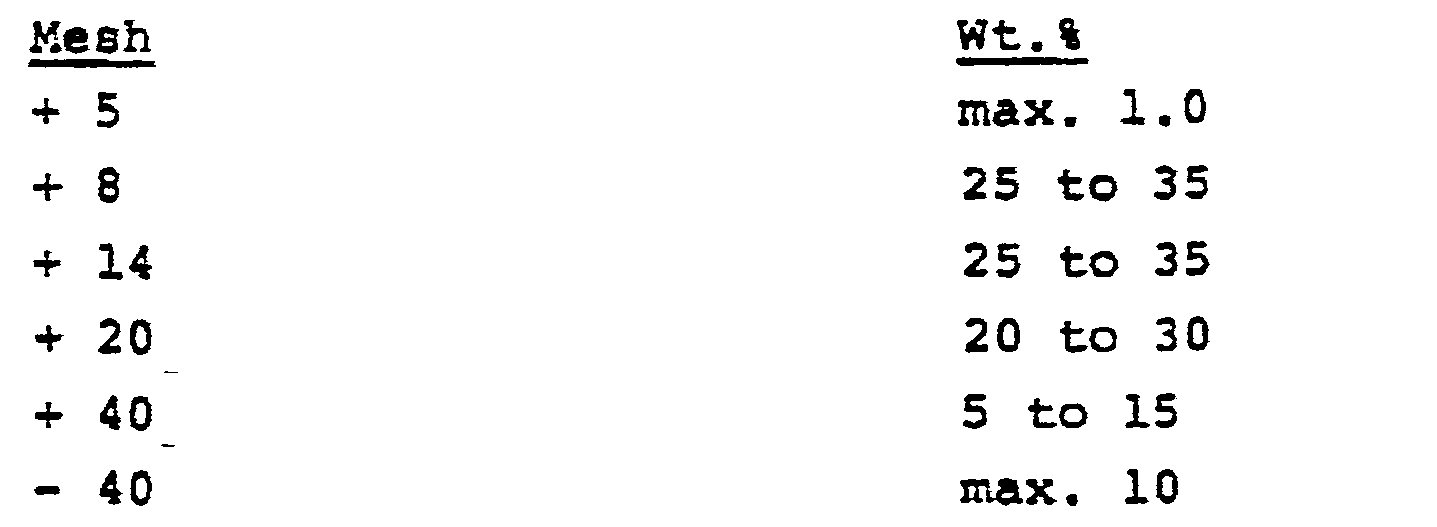

- The coated product was blanch fried for 45 seconds at 390°F (200°C) using a general purpose vegetable oil shortening in a restaurant-style fryer. The product was weighed to determine the amount of pick-up, i.e. Final wt-Raw wt x 100, which was 33.6 wt.%, Final wt before being frozen on trays in an upright home freezer run at 2 to 5°F (-16 to -15°C). Once frozen, the coated portions were packed in a lidded aluminum foil tray and were held in an upright or chest-style home freezer at 2 to 5°F (-16 to 15°C).
- The frozen product was reconstituted on a microwave browning grill preheated for 4 minutes of high power (700 watts) by adding two of the coated fish portions, and cooking the portions for two minutes on each side at high power. The cooked product was left to stand for 5 minutes prior to serving.
- The product was judged to have a crispy exterior and moist cooked interior fish portions and to be comparable to commercially-available products reconstituted by convection oven heat.
- This Example illustrates the provision of a frozen water-cooked chicken portion having a coating compocition applied thereto and the reoonetitution thereof.
- Chicken thighs (bone-in, skin-on) were employed in this Leat. The chicken thighs were placed in water and boiled for 20 minutes. The boiled chicken thigha were washed with hot water and repeatedly rineed in gradually decreasing temperature to cold water. The cooked chicken thighs were cooled in tap water and drained on paper towelling.
- Three successive layers were applied to the water-cooked chicken thighs to provide a coating composition over the exterior surfaces thereof, following the procedure outlined in Example 1.
- The predust composition used was that described in Example 1 and was applied as described therein.
- The batter used in the coating composition was prepared as described in Example 1 from 975g of cold tap water, 750g dry batter mix and 90g of creamed shortening.
- The dry batter mix used in this preparation comprised:

- The outer breading crumbs were brown-coloured splinter-shaped oriental-style breading crumb with a fast browning rate and a crisp texture. The breading crumb had the following characteristics:
- Screen Specification:

- The coated product was blanch fried, weighed, frozen, packaged and stored as described in Example 1.
- The frozen product was reconstituted on a microwave browning grill preheated for 4 minutes at high power (700 watts) by adding two chicken thighs, and cooking the portions for two and a half minutes on each aide at high power. The cooked product was left to stand for 5 minutes prior to serving.
- The product was judged to have a crispy exterior and moist cooked chicken thighs and to be comparable to commercially-available products reconstituted by oven heat.
- This Example illustrates the provision of fully fried chicken portions having a coating composition applied thereto.
- Three successive layers, comprising a predust layer, a batter layer and a breading layer, were applied to chicken thighs (bone-in, skin-on) to provide a coating composition over the exterior surfaces thereof. The predust layer has the composition described in Example 1 and is applied in the manner described therein.
- The batter used in the provision of the coating composition was prepared in the manner described in Example 1 from 650g of cold tap water, 500g dry batter mix, and fOg of creamed shortening.
- The dry batter mix used in this preparation comprised:

- The creamed shortening was prepared as described in Example 1 from Biscot shortening.
- The outer breading crumbs were very white coloured, splinter-shaped oriental-style breading crumb with a very slow browning rate and tender fried texture. The breading crumb had the following characteristics: Screen Specification:

- The coated product was fully fried at 350°F (170°C), frozen for 24 hours, packaged and stored as described in Example 1.
- The frozen product was reconstituted on a microwave browning grill, preheated for 4 minutes at high power (700 watts), by adding two thigh portions and cooking the portions for two minutes on each side at high power. The cooked product was left to stand for 5 minutes prior to serving.
- The reconstituted product was judged to have a nice brown colour, a very crispy exterior and moist cooked chicken portions and to be comparable to commercially-available products reconstituted by oven heat.
- This Example illustrates the provision of chicken patties having a coating composition applied thereto.
- Chicken patties having an analysis 66.7 wt.% moisture, 10.4 wt.% fat, 1.5 wt.% salt, and 20.9 wt.% protein with a dextrose equivalent of 0.5 were treated. The patties weighed 61 to 62 g.
- Three successive coating layers, namely a predust layer, a batter layer and a breading layer, were applied to the patties to provide a coating composition over the exterior surfaces thereof by the procedure outlined in Example 1.
- The predust composition employed was that described in Example 1 and was applied as described therein.
- The batter used in this procedure was prepared by mixing a dry batter mix with cold water in an ABC Baker Mixer to achieve a Stein cup viscosity of 23 to 24 seconds. The batter mix in this case had the shortening included therein, in contrast to Examples 1 to 3.
- The dry batter mix used in this preparation comprised:

- 5 The outer breading crumbs were brown-coloured, splinter-shaped oriental-style breading crumb with a fast browning rate and medium-crisp fried texture. The breading crumb had the following characteristics: Screen Specification:

- The coated chicken patties were blanch fried for 31 seconds at temperatures varying from 378° to 390°F (190 to 200°C) using a general purpose vegetable oil shortening in a plant-style fryer. The product was weighed after frying to determine the amount of pick-up, which was 39.5 wt.%, before being frozen in a nitrogen freezing tunnel to provide a thin, soft and unfrozen layer in the centre of the patties and then placed in an upright or chest-style home freezer at 2 to 5°F (-16 to -15°C).
- The frozen product was reconstituted on a microwave browning grill, preheated for 4 minutes at high power (700 watts), by adding two coated chicken patties and cooking the portions for two and a half minutes on each side at high power. The cooked product was left to stand for 5 minutes prior to serving. The reconstituted patties were judged to have an excellent texture (crispness) and appearance.
- This Example illustrates the provision of coated shrimps.
- Frozen butterfly shrimps were coated with three successive layers namely a predust layer, a batter layer and a breading layer, to provide a coating composition over the exterior surfaces thereof.
- The predust composition was applied using a standard breading machine without vibrator or splitter to achieve a light coating with no clumps. The batter layer was applied using a standard batter applicator with submerger. The outer breading was applied using a Stein J machine.
- The predust used in the coating composition was the same as that used in Example 1.
- The batter used was prepared by the. procedure described in Example 1 from equal parts by weight of cold tap water and dry batter mix. The dry batter mix used in this preparation comprised:

- The outer breading crumbs were white-coloured splinter-shaped oriental-style breading crumb with a slow browning rate and a medium-crisp fried texture. The breading crumb had the following characteristics:

- The coated shrimps were blanch fried for 43 seconds at a target temperature of 390°F (200°C) using a general purpose vegetable oil shortening in a plant-style fryer. The fried product was weighed and the amount of pick-up was determined to be 45 wt.%. The fried product was frozen in a freezer tunnel, packed in coated paperboard boxes and placed. in an upright freezer.
- The frozen product was reconstituted on a microwave browning grill, preheated for 3 minutes at high power (700 watts), by adding eight shrimps and cooking the portions for two minutes on one side and one and a half minutes on the other, at high power. The cooked product was left to stand for 5 minutes prior to serving.
- The product was found to be overdone slightly, which could be cured by decreasing the cooking time. The coating was found to be crisp although slightly doughy.
- The procedure described in Example 1 was generally repeated for cod fish portions, except that a slowly absorbant high-density breading was substituted for the oriental-style breading as the outer layer. The breading crumbs used were a baked, yeast leavened product having a total absorption of 316 and an absorption rate of 120 sees. After 1½ weeks storage of the frozen product, reconstitution produced a cooked product in which the coating was found to be soft and unacceptable.
- In summary of this disclosure, the present invention provides a novel food coating composition which may be applied to prepared foods for reconstitution by the application of microwave energy. The coating composition has a crispy texture while the cooked food has an acceptable moisture level. Modifications are possible within the scope of this invention.
Claims (10)


Applications Claiming Priority (2)
| Application Number | Priority Date | Filing Date | Title |
|---|---|---|---|
| GB848403675A GB8403675D0 (en) | 1984-02-13 | 1984-02-13 | Food coating compositions |
| GB8403675 | 1984-02-13 |
Publications (2)
| Publication Number | Publication Date |
|---|---|
| EP0155760A1 true EP0155760A1 (en) | 1985-09-25 |
| EP0155760B1 EP0155760B1 (en) | 1988-07-13 |
Family
ID=10556486
Family Applications (1)
| Application Number | Title | Priority Date | Filing Date |
|---|---|---|---|
| EP85300945A Expired EP0155760B1 (en) | 1984-02-13 | 1985-02-13 | A method for coating food products and food coating compositions for carrying out said method |
Country Status (7)
| Country | Link |
|---|---|
| US (2) | US4675197A (en) |
| EP (1) | EP0155760B1 (en) |
| JP (1) | JPS60237950A (en) |
| AU (1) | AU587175B2 (en) |
| CA (1) | CA1219763A (en) |
| DE (1) | DE3563676D1 (en) |
| GB (1) | GB8403675D0 (en) |
Cited By (23)
| Publication number | Priority date | Publication date | Assignee | Title |
|---|---|---|---|---|
| WO1987001564A1 (en) * | 1985-09-24 | 1987-03-26 | Bernacchi Donald B | Process for preparing readily reconstituted frozen comestibles and frozen comestibles produced thereby |
| WO1988006007A1 (en) * | 1987-02-20 | 1988-08-25 | Cibus Sa | Microwave cookable batter |
| US4874917A (en) * | 1986-10-23 | 1989-10-17 | The Pillsbury Company | Microwave food product and method of manufacture |
| US4926020A (en) * | 1986-09-02 | 1990-05-15 | The Pillsbury Company | Microwave food products and method of their manufacture |
| US4933196A (en) * | 1987-10-27 | 1990-06-12 | The Pillsbury Company | Controlling the texture of microwave brownies |
| US4988841A (en) * | 1986-09-02 | 1991-01-29 | The Pillsbury Company | Microwave food products and method of their manufacture |
| US5008507A (en) * | 1986-09-02 | 1991-04-16 | The Pillsbury Company | Microwave food products and method of their manufacture |
| EP0327332A3 (en) * | 1988-02-02 | 1991-05-15 | DCA Food Industries, Inc. | Fried pie and method of making the same |
| US5101084A (en) * | 1986-09-02 | 1992-03-31 | The Pillsbury Company | Microwave food products and method of their manufacture and heating |
| US5140121A (en) * | 1986-09-02 | 1992-08-18 | The Pillsbury Company | Microwave food product and methods of their manufacture and heating |
| WO1993003634A1 (en) * | 1991-08-23 | 1993-03-04 | Novus Investments Limited | Microwavable coatings based on starch and cellulose |
| WO1994007369A1 (en) * | 1992-09-30 | 1994-04-14 | The Pillsbury Company | Pre-baked microwaveable pastry systems |
| WO1997029653A1 (en) * | 1996-02-12 | 1997-08-21 | Griffith Laboratories Worldwide, Inc. | Dry composition for batter coating comprising soft wheat flour and leavening system |
| EP0664962A3 (en) * | 1994-02-01 | 1998-01-07 | Nichirei Corporation | Batter comprising oil/fat, water, moisture holding material, a foaming agent and an emulsion stabilizer-multilayer coating comprising said batter |
| CN101331962B (en) * | 2008-07-29 | 2011-10-26 | 泰祥集团技术开发有限公司 | Quick-freezing two-tailed sticks shrimp food and production method thereof |
| US20140087051A1 (en) * | 2011-12-20 | 2014-03-27 | Crisp Sensation Holding S.A. | Crumb manufacture |
| WO2014111402A1 (en) * | 2013-01-21 | 2014-07-24 | Chemische Fabrik Budenheim Kg | Food mass suitable for microwaving |
| US9648900B2 (en) | 2011-01-27 | 2017-05-16 | Crisp Sensation Holding S.A. | Production of microwaveable coated food products |
| US10375983B2 (en) | 2010-01-15 | 2019-08-13 | Crisp Sensation Holding B.V. | Coated stabilized microwave heated foods |
| EP3583856A4 (en) * | 2017-02-17 | 2020-12-09 | Nisshin Foods Inc. | BREAD CRUMBS, BREAD CRUMB MIX AND CONTAINER FOR PACKABLE BREAD CRUMBS |
| US11382934B2 (en) * | 2017-07-18 | 2022-07-12 | Before Brands, Inc. | Methods for making mixed allergen compositions |
| JPWO2023079675A1 (en) * | 2021-11-05 | 2023-05-11 | ||
| US11766477B2 (en) | 2019-01-23 | 2023-09-26 | Societe Des Produits Nestle S.A. | Methods for making mixed allergen compositions |
Families Citing this family (61)
| Publication number | Priority date | Publication date | Assignee | Title |
|---|---|---|---|---|
| GB8403675D0 (en) * | 1984-02-13 | 1984-03-14 | Griffith Laboratories | Food coating compositions |
| US4764386A (en) * | 1985-09-24 | 1988-08-16 | Griffith Laboratories U.S.A., Inc. | Process for preparing storage stable, readily reconstituted frozen comestibles |
| US4943438A (en) * | 1986-07-07 | 1990-07-24 | Conagra, Inc. | Bread crumb coating composition and process for imparting fried-like texture and flavor to food products |
| US4842874A (en) * | 1986-07-08 | 1989-06-27 | National Starch And Chemical Corporation | Composition for preparing freeze-thaw microwaveable pre-fried foodstuffs |
| US4778684A (en) * | 1986-07-08 | 1988-10-18 | National Starch And Chemical Corporation | Process for producing a freeze-thaw stable microwaveable pre-fried foodstuff |
| JPS6344859A (en) * | 1986-08-13 | 1988-02-25 | Ajinomoto Co Inc | Modified starch raw material and processed starch food |
| EP0258957B1 (en) * | 1986-08-22 | 1992-07-08 | DCA Food Industries, Inc. | Method for making a sauce coated food under a batter or batter and breaded coating |
| JP2533545B2 (en) * | 1987-06-18 | 1996-09-11 | マルハ株式会社 | Frozen fried food manufacturing method |
| US4948608A (en) * | 1987-09-03 | 1990-08-14 | International Flavors & Fragrances Inc. | Process for preparing oil-impervious, water retaining silicon oxide derivative-containing food products |
| US5057329A (en) * | 1987-09-03 | 1991-10-15 | International Flavors & Fragrances Inc. | Oil-impervious, water retaining, and flavor-containing coated food articles |
| US4877628A (en) * | 1987-09-03 | 1989-10-31 | International Flavors & Fragrances Inc. | Process for preparing a coated food product |
| US4913918A (en) * | 1987-09-03 | 1990-04-03 | International Flavors & Fragrances Inc. | Oil-impregnated and water-retaining coated food articles |
| US4978541A (en) * | 1987-09-03 | 1990-12-18 | International Flavors & Fragrances Inc. | Oil-impervious, water retaining, silicon oxide derivative-containing food articles |
| US5077066A (en) * | 1987-11-12 | 1991-12-31 | The Clorox Company | Method for preparing frozen comestibles for consumption |
| US4900573A (en) * | 1988-06-17 | 1990-02-13 | The Dow Chemical Company | Method of inhibiting oil adsorption in coated fried foods using hydroxypropyl methyl cellulose |
| US5008124A (en) * | 1988-07-21 | 1991-04-16 | Nabisco Brands, Inc. | Dry mix for preparation of in-situ sauce for foodstuffs |
| US5188855A (en) * | 1989-02-08 | 1993-02-23 | Griffith Laboratories Worldwide, Inc. | Process for making coated expanded snack product |
| US5223289A (en) * | 1989-04-17 | 1993-06-29 | The Pillsbury Company | Process for forming a microwave browning composition |
| US5073392A (en) * | 1989-04-17 | 1991-12-17 | The Pillsbury Company | Process of forming a microwaveable food product having a selected color |
| JP2640538B2 (en) * | 1989-08-28 | 1997-08-13 | ハウス食品株式会社 | Food for microwave oven |
| US5194271A (en) * | 1990-07-20 | 1993-03-16 | The Pillsbury Company | Microwaveable batter-coated, dough-enrobed foodstuff |
| JP2578382B2 (en) * | 1990-09-21 | 1997-02-05 | 理研ビタミン株式会社 | Batter mix for non-fried food |
| CA2052969A1 (en) * | 1990-10-12 | 1992-04-13 | James Zallie | Foods containing soluble high amylose starch |
| US5266339A (en) * | 1991-07-23 | 1993-11-30 | Campbell Soup Company | Process for preparing batter-coated, heated food products |
| US5266340A (en) * | 1991-07-23 | 1993-11-30 | Campbell Soup Company | Process for preparing batter-coated, chilled food products |
| US5368877A (en) * | 1992-01-16 | 1994-11-29 | Pillsbury Company | Method of producing film shelf stable food products |
| US5204135A (en) * | 1992-01-16 | 1993-04-20 | The Pillsbury Co. | Sauces for retortable food products |
| US5384140A (en) * | 1992-12-08 | 1995-01-24 | Dca Food Industries, Inc. | Process for preparing tender, juicy microwaveable meat |
| CA2114204A1 (en) * | 1993-02-23 | 1994-08-24 | Charles Robert Mason | Batter-like coating |
| US5798132A (en) * | 1996-06-17 | 1998-08-25 | Recot, Inc. | Process for applying a flavored coating to a food product |
| DE19624329A1 (en) * | 1996-06-18 | 1998-01-15 | Convenience Food Sys Bv | Breaded fish or meat product that can be crispily heated in a TOP microwave |
| WO2001008513A1 (en) * | 1999-07-29 | 2001-02-08 | Goodman Fielder Milling & Baking New Zealand Limited | Microwaveable food coating |
| GB0000159D0 (en) * | 2000-01-06 | 2000-02-23 | Boc Group Plc | Processing food products |
| US20030039735A1 (en) * | 2000-09-27 | 2003-02-27 | Kazuaki Morii | Gelatinized potato starch breading composition and process for manufacture |
| US6858241B1 (en) | 2001-07-25 | 2005-02-22 | Smtm Group, Llc. | Farinaceous surface product that is toaster reheatable and method |
| JP4723134B2 (en) * | 2001-08-30 | 2011-07-13 | 昭和産業株式会社 | Deep-fried food material and deep-fried food using the same |
| US20040011223A1 (en) * | 2002-07-22 | 2004-01-22 | Odom William J. | Food product with coated skewer and method for manufacturing same |
| US20040018281A1 (en) * | 2002-07-24 | 2004-01-29 | Gregg Dowd | Frozen, fully cooked fish and method of preparing same |
| US20040045202A1 (en) * | 2002-09-09 | 2004-03-11 | Arrendale Thomas A. | Package labeling for a nutritionally enhanced composite food product |
| US20140030389A1 (en) * | 2003-04-25 | 2014-01-30 | A Duda & Sons, Inc. | Stem celery having a hollow petiole |
| US20050202151A1 (en) * | 2004-03-15 | 2005-09-15 | Land O'lakes, Inc. | Method of preparing egg nuggets |
| US7713571B2 (en) * | 2004-03-15 | 2010-05-11 | Michael Foods, Inc. | Egg nuggets |
| US20060121160A1 (en) | 2004-12-03 | 2006-06-08 | Cargill, Incorporated | Egg-filled food product |
| US20060182849A1 (en) * | 2005-02-17 | 2006-08-17 | Janusz Wojciak | Low carb Omega 3 food coating composition and method of making thereof |
| WO2007013314A1 (en) * | 2005-07-27 | 2007-02-01 | Ajinomoto Co., Inc. | Fried food and process for producing the same |
| US20090196958A1 (en) * | 2007-04-25 | 2009-08-06 | Mark Sosebee | Breading and breading mix comprising crunchy corn ingredient, food products created therewith, and methods related thereto |
| US20090285951A1 (en) * | 2007-08-02 | 2009-11-19 | Anthony Karo | Method for the preparation and distribution of breaded seafood products and breading composition |
| GB2461520A (en) | 2008-07-01 | 2010-01-06 | Magsnack Bv | Manufacturing crumb for the coating of food products |
| US9220282B2 (en) | 2009-04-28 | 2015-12-29 | Board Of Trustees Of The University Of Arkansas | Coating composition and process for baked products to impart the attributes of fried products |
| GB201000647D0 (en) | 2010-01-15 | 2010-03-03 | Crisp Sensation Holding Sa | Microwaveable batter |
| EP2589298A4 (en) * | 2010-06-30 | 2013-09-11 | Ajinomoto Kk | Method for producing non-fried food |
| JP5328742B2 (en) * | 2010-10-12 | 2013-10-30 | 日本製粉株式会社 | Mixed powder for frying from non-fried type |
| US9326537B2 (en) | 2011-01-27 | 2016-05-03 | Crisp Sensation Holding S.A. | Microwaveable coated food product, and method and apparatus for the manufacture thereof |
| PT2481294E (en) * | 2011-01-27 | 2014-11-11 | Crisp Sensation Holding Sa | FOOD PRODUCT COATED FOR MICROWAVES, AND METHOD AND APPARATUS FOR THE MANUFACTURE OF THE SAME |
| US20150351434A1 (en) * | 2014-06-09 | 2015-12-10 | Frito-Lay North America, Inc. | Stuffed Fries |
| US20160262430A1 (en) * | 2015-03-09 | 2016-09-15 | Frito-Lay North America, Inc. | Method of producing dual-textured frozen food products |
| US20160262429A1 (en) * | 2015-03-09 | 2016-09-15 | Frito-Lay North America, Inc. | Method of Producing Dual-Textured Frozen Food Products and Products Made Therefrom |
| JP2017038529A (en) * | 2015-08-17 | 2017-02-23 | 王子ホールディングス株式会社 | Bread crumbs |
| ITUB20159321A1 (en) * | 2015-12-15 | 2017-06-15 | Brf Italia S P A | FOOD PRODUCT, APPARATUS FOR OBTAINING SUCH FOOD AND ITS PROCEDURE |
| US12245619B1 (en) * | 2018-07-09 | 2025-03-11 | Tyson Foods, Inc. | Continuous mini corndog production process |
| US20210195929A1 (en) * | 2019-12-31 | 2021-07-01 | Kraft Foods Group Brands Llc | No sugar added multilayer edible products comprising a center and a barrier layer |
Citations (3)
| Publication number | Priority date | Publication date | Assignee | Title |
|---|---|---|---|---|
| US3586512A (en) * | 1969-08-18 | 1971-06-22 | Gen Foods Corp | Imparting fried appearance to baked foodstuffs |
| US4423078A (en) * | 1982-04-14 | 1983-12-27 | The Griffith Laboratories, Limited | Production of oriental-style breading crumbs |
| EP0109226A1 (en) * | 1982-11-01 | 1984-05-23 | General Foods Corporation | Improved product and process for imparting fried taste to baked foodstuffs |
Family Cites Families (11)
| Publication number | Priority date | Publication date | Assignee | Title |
|---|---|---|---|---|
| US2623825A (en) * | 1950-08-01 | 1952-12-30 | Breithaupt | Dry breading and batter mixes |
| US3169069A (en) * | 1961-04-24 | 1965-02-09 | Helen L Hanson | Preparation of pre-cooked frozen poultry products |
| US3656969A (en) * | 1969-11-03 | 1972-04-18 | Horn S Poultry Inc | Breaded vegetable method |
| JPS5128701A (en) * | 1974-09-04 | 1976-03-11 | Nippon Telegraph & Telephone | Washaninshikihoshiki |
| US4068009A (en) * | 1976-09-15 | 1978-01-10 | General Foods Corporation | Bread crumb coating composition and process |
| US4199603A (en) * | 1978-08-14 | 1980-04-22 | Scm Corporation | Production of coated frozen fish or other comestible |
| JPS58129942A (en) * | 1982-01-27 | 1983-08-03 | Nitto Seifun Kk | Making method for food product like fried one |
| US4518618A (en) * | 1982-02-12 | 1985-05-21 | The Clorox Company | Food coating compositions for foods cooked by microwave |
| JPS5917936A (en) * | 1982-07-23 | 1984-01-30 | 日東製粉株式会社 | Production of fried food |
| US4529607A (en) * | 1983-09-14 | 1985-07-16 | National Starch And Chemical Corporation | Process for coating foodstuff with batter containing high amylose flour for microwave cooking |
| GB8403675D0 (en) * | 1984-02-13 | 1984-03-14 | Griffith Laboratories | Food coating compositions |
-
1984
- 1984-02-13 GB GB848403675A patent/GB8403675D0/en active Pending
-
1985
- 1985-02-12 CA CA000474109A patent/CA1219763A/en not_active Expired
- 1985-02-13 EP EP85300945A patent/EP0155760B1/en not_active Expired
- 1985-02-13 US US06/701,162 patent/US4675197A/en not_active Expired - Lifetime
- 1985-02-13 JP JP60024569A patent/JPS60237950A/en active Granted
- 1985-02-13 AU AU38678/85A patent/AU587175B2/en not_active Ceased
- 1985-02-13 DE DE8585300945T patent/DE3563676D1/en not_active Expired
-
1987
- 1987-01-09 US US07/001,957 patent/US4755392A/en not_active Expired - Lifetime
Patent Citations (3)
| Publication number | Priority date | Publication date | Assignee | Title |
|---|---|---|---|---|
| US3586512A (en) * | 1969-08-18 | 1971-06-22 | Gen Foods Corp | Imparting fried appearance to baked foodstuffs |
| US4423078A (en) * | 1982-04-14 | 1983-12-27 | The Griffith Laboratories, Limited | Production of oriental-style breading crumbs |
| EP0109226A1 (en) * | 1982-11-01 | 1984-05-23 | General Foods Corporation | Improved product and process for imparting fried taste to baked foodstuffs |
Non-Patent Citations (1)
| Title |
|---|
| PATENT ABSTRACTS OF JAPAN, vol. 6, no. 266, 25th December 1982, page (C-142) (1144); & JP-A-57-159451 (MEIJI NIYUUGIYOU) 01-10-1982 * |
Cited By (35)
| Publication number | Priority date | Publication date | Assignee | Title |
|---|---|---|---|---|
| WO1987001564A1 (en) * | 1985-09-24 | 1987-03-26 | Bernacchi Donald B | Process for preparing readily reconstituted frozen comestibles and frozen comestibles produced thereby |
| US5008507A (en) * | 1986-09-02 | 1991-04-16 | The Pillsbury Company | Microwave food products and method of their manufacture |
| US5101084A (en) * | 1986-09-02 | 1992-03-31 | The Pillsbury Company | Microwave food products and method of their manufacture and heating |
| US4926020A (en) * | 1986-09-02 | 1990-05-15 | The Pillsbury Company | Microwave food products and method of their manufacture |
| US5140121A (en) * | 1986-09-02 | 1992-08-18 | The Pillsbury Company | Microwave food product and methods of their manufacture and heating |
| US4988841A (en) * | 1986-09-02 | 1991-01-29 | The Pillsbury Company | Microwave food products and method of their manufacture |
| US4874917A (en) * | 1986-10-23 | 1989-10-17 | The Pillsbury Company | Microwave food product and method of manufacture |
| WO1988006007A1 (en) * | 1987-02-20 | 1988-08-25 | Cibus Sa | Microwave cookable batter |
| US4933196A (en) * | 1987-10-27 | 1990-06-12 | The Pillsbury Company | Controlling the texture of microwave brownies |
| EP0327332A3 (en) * | 1988-02-02 | 1991-05-15 | DCA Food Industries, Inc. | Fried pie and method of making the same |
| WO1993003634A1 (en) * | 1991-08-23 | 1993-03-04 | Novus Investments Limited | Microwavable coatings based on starch and cellulose |
| WO1994007369A1 (en) * | 1992-09-30 | 1994-04-14 | The Pillsbury Company | Pre-baked microwaveable pastry systems |
| US5576036A (en) * | 1992-09-30 | 1996-11-19 | The Pillsbury Company | Pre-baked microwaveable pastry systems |
| AU676185B2 (en) * | 1992-09-30 | 1997-03-06 | Pillsbury Company, The | Pre-baked microwaveable pastry systems |
| EP0664962A3 (en) * | 1994-02-01 | 1998-01-07 | Nichirei Corporation | Batter comprising oil/fat, water, moisture holding material, a foaming agent and an emulsion stabilizer-multilayer coating comprising said batter |
| AU712513B2 (en) * | 1996-02-12 | 1999-11-11 | Griffith Laboratories Worldwide, Inc. | Dry composition for batter coating comprising soft wheat flour and leavening system |
| US6335041B1 (en) | 1996-02-12 | 2002-01-01 | Griffith Laboratories Worldwide Inc. | Dry composition for batter coating comprising soft wheat flour and leavening system |
| WO1997029653A1 (en) * | 1996-02-12 | 1997-08-21 | Griffith Laboratories Worldwide, Inc. | Dry composition for batter coating comprising soft wheat flour and leavening system |
| CN101331962B (en) * | 2008-07-29 | 2011-10-26 | 泰祥集团技术开发有限公司 | Quick-freezing two-tailed sticks shrimp food and production method thereof |
| US10375983B2 (en) | 2010-01-15 | 2019-08-13 | Crisp Sensation Holding B.V. | Coated stabilized microwave heated foods |
| US9648900B2 (en) | 2011-01-27 | 2017-05-16 | Crisp Sensation Holding S.A. | Production of microwaveable coated food products |
| US20140087051A1 (en) * | 2011-12-20 | 2014-03-27 | Crisp Sensation Holding S.A. | Crumb manufacture |
| US10667548B2 (en) | 2011-12-20 | 2020-06-02 | Crisp Sensation Holding S.A. | Dried crumb manufacture |
| WO2014111402A1 (en) * | 2013-01-21 | 2014-07-24 | Chemische Fabrik Budenheim Kg | Food mass suitable for microwaving |
| RU2663059C1 (en) * | 2013-01-21 | 2018-08-01 | Хемише Фабрик Буденхайм Кг | Food mixture suitable for microwave processing |
| EP3583856A4 (en) * | 2017-02-17 | 2020-12-09 | Nisshin Foods Inc. | BREAD CRUMBS, BREAD CRUMB MIX AND CONTAINER FOR PACKABLE BREAD CRUMBS |
| AU2018222305B2 (en) * | 2017-02-17 | 2022-12-15 | Nisshin Seifun Welna Inc. | Bread crumbs, bread crumb mix, and container for shake-out-type bread crumbs |
| US11606964B2 (en) | 2017-02-17 | 2023-03-21 | Nisshin Seifun Welna Inc. | Bread crumb-coated food item and methods of making |
| US11382934B2 (en) * | 2017-07-18 | 2022-07-12 | Before Brands, Inc. | Methods for making mixed allergen compositions |
| IL272033B1 (en) * | 2017-07-18 | 2023-05-01 | Before Brands Inc | Methods for making mixed allergen compositions |
| IL272033B2 (en) * | 2017-07-18 | 2023-09-01 | Before Brands Inc | Methods for making mixed allergen compositions |
| US12090178B2 (en) | 2017-07-18 | 2024-09-17 | Societe Des Produits Nestle S.A. | Methods for making mixed allergen compositions |
| US11766477B2 (en) | 2019-01-23 | 2023-09-26 | Societe Des Produits Nestle S.A. | Methods for making mixed allergen compositions |
| JPWO2023079675A1 (en) * | 2021-11-05 | 2023-05-11 | ||
| WO2023079675A1 (en) * | 2021-11-05 | 2023-05-11 | 日清製粉株式会社 | Coating material for fried food |
Also Published As
| Publication number | Publication date |
|---|---|
| JPH0379975B2 (en) | 1991-12-20 |
| AU587175B2 (en) | 1989-08-10 |
| GB8403675D0 (en) | 1984-03-14 |
| DE3563676D1 (en) | 1988-08-18 |
| EP0155760B1 (en) | 1988-07-13 |
| US4755392A (en) | 1988-07-05 |
| JPS60237950A (en) | 1985-11-26 |
| CA1219763A (en) | 1987-03-31 |
| AU3867885A (en) | 1985-08-22 |
| US4675197A (en) | 1987-06-23 |
Similar Documents
| Publication | Publication Date | Title |
|---|---|---|
| EP0155760B1 (en) | A method for coating food products and food coating compositions for carrying out said method | |
| EP0238542B1 (en) | Process for preparing readily reconstituted frozen comestibles and frozen comestibles produced thereby | |
| US5492707A (en) | Process for preparing low-fat fried-type or baked food products | |
| EP0650671B1 (en) | Cereal-based batter comprising milk proteins for coating food products | |
| US4693899A (en) | Method for preparing filled cooked dough product | |
| US5576036A (en) | Pre-baked microwaveable pastry systems | |
| US4948603A (en) | Process for preparing storage stable, readily reconstituted frozen comestibles and frozen comestibles produced thereby | |
| US4764386A (en) | Process for preparing storage stable, readily reconstituted frozen comestibles | |
| US3656969A (en) | Breaded vegetable method | |
| US4487786A (en) | Starch enrobing process for coating frozen food | |
| WO2001008513A1 (en) | Microwaveable food coating | |
| US5008121A (en) | Storage stable, readily reconstituted comestible | |
| US3669674A (en) | Composition for producing fried coated comestibles | |
| US3514294A (en) | Method for producing fried coated comestibles | |
| GB2154851A (en) | Filled cooked dough product, its frozen counterpart and method of reheating same | |
| JPS58190365A (en) | Preparation of frozen food similar to fried food | |
| JPS58205473A (en) | Preparation of fried and frozen chicken without coat | |
| JPH0618509B2 (en) | Fly ground powder | |
| HK1012212B (en) | Pre-baked microwaveable pastry systems |
Legal Events
| Date | Code | Title | Description |
|---|---|---|---|
| PUAI | Public reference made under article 153(3) epc to a published international application that has entered the european phase |
Free format text: ORIGINAL CODE: 0009012 |
|
| AK | Designated contracting states |
Designated state(s): DE FR GB |
|
| 17P | Request for examination filed |
Effective date: 19860305 |
|
| 17Q | First examination report despatched |
Effective date: 19861127 |
|
| D17Q | First examination report despatched (deleted) | ||
| GRAA | (expected) grant |
Free format text: ORIGINAL CODE: 0009210 |
|
| AK | Designated contracting states |
Kind code of ref document: B1 Designated state(s): DE FR GB |
|
| REF | Corresponds to: |
Ref document number: 3563676 Country of ref document: DE Date of ref document: 19880818 |
|
| ET | Fr: translation filed | ||
| PLBE | No opposition filed within time limit |
Free format text: ORIGINAL CODE: 0009261 |
|
| STAA | Information on the status of an ep patent application or granted ep patent |
Free format text: STATUS: NO OPPOSITION FILED WITHIN TIME LIMIT |
|
| 26N | No opposition filed | ||
| PGFP | Annual fee paid to national office [announced via postgrant information from national office to epo] |
Ref country code: GB Payment date: 19910201 Year of fee payment: 7 |
|
| PGFP | Annual fee paid to national office [announced via postgrant information from national office to epo] |
Ref country code: FR Payment date: 19910222 Year of fee payment: 7 |
|
| PGFP | Annual fee paid to national office [announced via postgrant information from national office to epo] |
Ref country code: DE Payment date: 19910228 Year of fee payment: 7 |
|
| PG25 | Lapsed in a contracting state [announced via postgrant information from national office to epo] |
Ref country code: GB Effective date: 19920213 |
|
| GBPC | Gb: european patent ceased through non-payment of renewal fee | ||
| PG25 | Lapsed in a contracting state [announced via postgrant information from national office to epo] |
Ref country code: FR Effective date: 19921030 |
|
| PG25 | Lapsed in a contracting state [announced via postgrant information from national office to epo] |
Ref country code: DE Effective date: 19921103 |
|
| REG | Reference to a national code |
Ref country code: FR Ref legal event code: ST |