EP0154795B1 - Electroplating device for locally applying a metal deposit to an elongate metal tape or the like - Google Patents
Electroplating device for locally applying a metal deposit to an elongate metal tape or the like Download PDFInfo
- Publication number
- EP0154795B1 EP0154795B1 EP85101019A EP85101019A EP0154795B1 EP 0154795 B1 EP0154795 B1 EP 0154795B1 EP 85101019 A EP85101019 A EP 85101019A EP 85101019 A EP85101019 A EP 85101019A EP 0154795 B1 EP0154795 B1 EP 0154795B1
- Authority
- EP
- European Patent Office
- Prior art keywords
- roller
- tape
- rotation
- guide surface
- axis
- Prior art date
- Legal status (The legal status is an assumption and is not a legal conclusion. Google has not performed a legal analysis and makes no representation as to the accuracy of the status listed.)
- Expired
Links
- 239000002184 metal Substances 0.000 title claims abstract description 30
- 229910052751 metal Inorganic materials 0.000 title claims abstract description 30
- 238000009713 electroplating Methods 0.000 title claims abstract description 5
- 239000008151 electrolyte solution Substances 0.000 claims abstract description 7
- 230000001154 acute effect Effects 0.000 claims abstract description 3
- 238000006073 displacement reaction Methods 0.000 abstract 1
- 239000010410 layer Substances 0.000 description 8
- 239000003792 electrolyte Substances 0.000 description 6
- 239000010970 precious metal Substances 0.000 description 5
- 239000011248 coating agent Substances 0.000 description 4
- 238000000576 coating method Methods 0.000 description 4
- 239000000463 material Substances 0.000 description 3
- 230000002411 adverse Effects 0.000 description 2
- 230000006835 compression Effects 0.000 description 2
- 238000007906 compression Methods 0.000 description 2
- 230000000694 effects Effects 0.000 description 2
- 239000012530 fluid Substances 0.000 description 2
- 238000011282 treatment Methods 0.000 description 2
- 239000011358 absorbing material Substances 0.000 description 1
- 230000008878 coupling Effects 0.000 description 1
- 238000010168 coupling process Methods 0.000 description 1
- 238000005859 coupling reaction Methods 0.000 description 1
- 239000013013 elastic material Substances 0.000 description 1
- -1 for example Substances 0.000 description 1
- PCHJSUWPFVWCPO-UHFFFAOYSA-N gold Chemical compound [Au] PCHJSUWPFVWCPO-UHFFFAOYSA-N 0.000 description 1
- 239000010931 gold Substances 0.000 description 1
- 229910052737 gold Inorganic materials 0.000 description 1
- 238000007654 immersion Methods 0.000 description 1
- 238000003780 insertion Methods 0.000 description 1
- 230000037431 insertion Effects 0.000 description 1
- 238000004519 manufacturing process Methods 0.000 description 1
- 238000001465 metallisation Methods 0.000 description 1
- 230000000284 resting effect Effects 0.000 description 1
- 238000007789 sealing Methods 0.000 description 1
- 239000000126 substance Substances 0.000 description 1
- 239000002344 surface layer Substances 0.000 description 1
- 229920003002 synthetic resin Polymers 0.000 description 1
- 239000000057 synthetic resin Substances 0.000 description 1
Images



Classifications
-
- C—CHEMISTRY; METALLURGY
- C25—ELECTROLYTIC OR ELECTROPHORETIC PROCESSES; APPARATUS THEREFOR
- C25D—PROCESSES FOR THE ELECTROLYTIC OR ELECTROPHORETIC PRODUCTION OF COATINGS; ELECTROFORMING; APPARATUS THEREFOR
- C25D5/00—Electroplating characterised by the process; Pretreatment or after-treatment of workpieces
- C25D5/02—Electroplating of selected surface areas
-
- C—CHEMISTRY; METALLURGY
- C25—ELECTROLYTIC OR ELECTROPHORETIC PROCESSES; APPARATUS THEREFOR
- C25D—PROCESSES FOR THE ELECTROLYTIC OR ELECTROPHORETIC PRODUCTION OF COATINGS; ELECTROFORMING; APPARATUS THEREFOR
- C25D7/00—Electroplating characterised by the article coated
- C25D7/06—Wires; Strips; Foils
- C25D7/0614—Strips or foils
- C25D7/0621—In horizontal cells
-
- C—CHEMISTRY; METALLURGY
- C25—ELECTROLYTIC OR ELECTROPHORETIC PROCESSES; APPARATUS THEREFOR
- C25D—PROCESSES FOR THE ELECTROLYTIC OR ELECTROPHORETIC PRODUCTION OF COATINGS; ELECTROFORMING; APPARATUS THEREFOR
- C25D7/00—Electroplating characterised by the article coated
- C25D7/06—Wires; Strips; Foils
- C25D7/0614—Strips or foils
- C25D7/0671—Selective plating
Definitions
- the invention relates to an electroplating device for locally applying a metal deposit to an elongate metal tape or to metal objects united in an elongate tape orthe like in which the tape is guided along a roller adapted to rotate about an axis of rotation during operation and being dipped at least partly in an electrolyte solution, whilst the tape is displaced parallel to said axis of rotation of the roller in a mannersuch,thatthe area ofthetape to be provided with the metal deposit come into contact with the roller and whereby the device comprises a guide surface which is immovable during operation in the direction of transportation of the tape, along which surface the tape is displaced during operation, and a guide rim extending parallel to the axis of rotation of the roller and protruding out of the guide surface for guiding the edge of the elongated tape remote from the roller.
- Such a device is known from US-A-3,966,581 and is used for locally applying a film of metal, generally precious metal to, for example parts used in the electronic industry as switching or connecting elements. On the one hand a satisfactory deposit of precious metal is required, whereas on the other hand for reasons of costs the consumption of the precious metals for the application of the metal layer has to be minimized.
- the tape supporting said products is guided between two guide rims protruding out of the guide surface.
- the device embodying the invention comprises wheels having their axes of rotation at an angle with a line which is perpendicular to said direction of transportation and extends in the transverse sense from an edge of the guide surface not having a guide rim to the edge of the guide surface provided with the guide rim, the arrangement being such, that the edge of the elongate tape is pressed with the aid of wheels against the guide surface and the guide rim.
- U.S. patent specification 4,010,083 describes a device, in which a cylinder partly dipped in an electrolyte solution, is provided at one end with a narrow, protruding rim. Along this rim a metal tape to be plated with precious metal is guided parallel to the rotary axis of the cylinder.
- a first disadvantage of this device is, that there is a very short period of contact between the cylinder and the area of the tape to be plated, unless the tape is transported with an unacceptable low speed with regard to the required production capacity.
- a second disadvantage is that the tape is not guided so, that due to its contact with the cylinder the tape will vibrate transversely of its direction of length, which will strongly reduce the desired accuracy of the application of the metal deposit.
- the electroplating device embodying the invention comprises an elongate, channel-section reservoir 1. To the ends of the reservoir are fastened U-shaped brackets 2 located between adjustment nuts 3 and 4fastened onto stub shafts 5. The lower ends of the stubs 5 are screwed into nuts 6 welded to a supporting frame 7', which may also serve to support further devices (not shown) with the aid of which the tape to be plated in the device embodying the invention, may be subjected to further treatments.
- the reservoir 1 is adjustable in a direction of height.
- a plate 7 extending parallel to the bottom of the reservoir and having passages 8. Above the plate 7 the reservoir has an anode 9.
- a length of pipe 10 is welded, extending downwards from said bottom and having its lower end arranged in a feed pipe 11 attached to the frame.
- the lower end of the length of pipe 10 is sealed with respect to the inner wall of the length of pipe 11 with the aid of a sealing ring 12.
- a semi-circular covering hood 13 which laterally conducts the electrolyte, fed to the reservoir 1, so that this electrolyte spreads throughout the length of the reservoir 1 below the plate 7 before it flows through the openings 8 to the upper part of the reservoir. Electrolyte flowing across the top rims of the reservoir can be conducted away through an outlet pipe 14 connected with the frame 7'.
- a roller 15 is arranged, rotatable about a horizontal axis of rotation 16.
- the roller 15 comprises a central shaft 17 to which two aligned, cylindrical bodies 18 and 19 are fastened.
- the outer circumference of the roller is formed by an over-layer 20 applied to said cylindrical bodies 18 and 19 and made from moisture-absorbing material.
- the disposition of the roller is such that, as will be apparent in particularfrom Fig. 4, the lower partofthe roller is dipped in the electrolyte contained in the reservoir 1.
- the electrolyte can be carried upwards by the moisture-absorbing layer 20.
- the ends of the shaft 17 are provided with stubs 21 and 22 which are rotatably positioned in bearings 23 and 24 supported by plates 25 and 26 respectively attached to the frame 7'.
- One end of the stub shaft 22 has attached to it a toothed belt pulley 27, which is coupled through a toothed belt 28 with a toothed belt pulley 29 which can be rotated by a driving motor 30.
- a pressure roller 31 is arranged parallel to and, as viewed in Fig. 5, behind the roller 15 in a manner such that the axis of rotation of the roller 31 is located in the same horizontal plane as the axis of rotation 16 of the roller 15.
- the ends of the roller 31 are provided with stub shafts 32 with the aid of which the roller 31 is freely rotatable about is axis of rotation and positioned in supporting strips 33, which are supported by plates 25 and 26 in a manner such that these supporting strips are adjustable in a horizontal direction and at right angles to the axis of rotation of the roller 31.
- the supporting strips are coupled with one another by means of a rod 34 extending parallel to the roller 31.
- the rod 34 is adjustably connected with the aid of a coupling rod 35 with the lower end of an arm 36, the top end of which is fixed to a shaft 37 extending parallel to the rod 34 and being rotatably positioned in the plates 25 and 26.
- a coupling rod 35 with the lower end of an arm 36, the top end of which is fixed to a shaft 37 extending parallel to the rod 34 and being rotatably positioned in the plates 25 and 26.
- an upwardly extending arm 38 is coupled which is provided with a locking knob 39 which can be used for fixing the shaft 37 in a given position, to engage one of a plurality of locking openings 40 in the plate 25 located on an are of a circle concentric with the centre line of the shaft 37.
- an elongate supporting block 41 extends parallel to the roller, to which block a guide member 42 is fastened for guiding the elongate tape to be plated.
- the supporting block 41 is connected with the aid of two adjustment bolts 43 extending normal to the direction of length of the supporting block with a supporting rod 44 so that with the aid of the bolts 43 the supporting block is adjustable with respect to the supporting rod 44.
- the ends of the supporting rod 44 are rotatably positioned in the supporting plates 25 and 26 so that the supporting block is pivotable about a pivotal axis parallel to the axis of rotation of the roller 15.
- Fig. 4 furthermore shows that recesses 45 are provided in the supporting block at right angles to the direction of length of the adjustment bolts 43 for receiving pins 46, whose ends, protruding out of the supporting block, are in contact with stops 47 fastened to the plates 25 and 26.
- the recesses 45 furthermore hold compression springs 48 loading the pins 46 and being enclosed between the ends of the pins and covering plates 49 fastened to the supporting block and covering the recesses 45.
- the ends of adjustment bolts 50 rest, which are screwed into tapped holes in brackets 51 attached to the supporting plates 25 and 26.
- the guide member 42 has a stepped top surface, a face 52 which, extending parallel to the axis of rotation of roller 15 constitutes a guide face for the elongate tape to be transported through the device and a rim 53 at right angles to said face, which constitutes an upper guide rim for the elongate tape.
- each housing 57 is pivotally connected to a supporting piece 59 with the aid of a horizontal pivot pin 58 extending at right angles to the shaft 56.
- the supporting piece 59 is connected with the supporting block 41 with the aid of a spring-loaded bolt 60 crossing the shafts 56 and 58 at right angles and can be fixed in various positions with respect to said supporting block by means of a clamping bolt 61.
- the shaft 56 of the wheel 55 is revolving in a sleeve 64 arranged in the housing 57 and being adjustable in the direction of length of the shaft 56 with respect to the housing 57 and fixable in the desired position by means of a guard bolt 65.
- the plates 25 and 26 supporting the supporting block 41 and the parts fastened thereto and the two rollers 15 and 31 are clamped tight to supporting strips 67 fastened to the frame 7' with the aid of bolts 68 and 69 passed through vertical slots in the strips 69.
- the bolts 68 are passed through sleeves 70 fastened to the lower ends of vertical stubs 71.
- the stubs are passed through holes in supporting plates 72 fastened to the frame 7', whilst nuts 73 are screwed onto the ends of the stubs located above the supporting plates 72.
- the device is particularly intended for the local appliction of a metal coating to tape-shaped material to be passed through the device.
- a potential embodiment of such an elongate tape is shown in Fig. 1.
- the elongate tape comprises a plurality of elongate metal contact parts 74 punched from strip-shaped material and adhering to one another by bridges 75 integral with said contact parts.
- one end 76 of the contact part 74 is curved; it may be desired, for example, to provide the convex side 77 of this curved part 76 with a metal coating, for example, of gold or similar material.
- the tape is passed through the device described above so that the ends of the elongate objects 75 remote from the curved parts 76 are guided along the guide face 52 and thus urged against this guide face by the wheels 55.
- the housings 75 supporting the wheels 55 will arrive by turning about the bolts 60 at a position in which the axes of rotation of the wheels 55 are upwardly inclined to the left (Fig. 3). Therefore, the freely rotating wheels 55, which urge the endlesss tape, as stated above, against the guide face 52 of the guide member 42, will also tend to displace the tape upwards, as viewed in Fig. 3, so that the ends of the elongate objects are pressed against the guide rim 53. It will be obvious that in this way an accurate positioning of the elongate tape with respect to the guide member 42 is obtained.
- the correct position of the guide member 42 with respect to the roller 15 can be ensured prior to starting the treatment of the metal tape by correct adjustment of the supporting block with the aid of the adjustment bolts 43 so that the guide rim 53 extends parallel to the axis of rotation of the roller 15 and with the aid of the adjustment bolts 50 so that the guide face 52 is also parallel to the axis of rotation of the roller face 15 and the curved parts 76 come just into contact by their curved faces 77 with the fluid-absorbing layer 20 of the roller 15 during operation.
- the anode is arranged at a relatively large distance from the curved surface 77 so that substances which may be set free at the anode and which might have an adverse effect on the metal deposition to be obtained will not come into contact with the metal tape.
- a tape may, as an alternative, be passed from right to left through the device, as viewed in Fig. 3, in which case the wheels 55 are diposed so that, as shown in Fig. 3, the axes of rotation of said wheels 55 are upwardly inclined to the right.
Landscapes
- Chemical & Material Sciences (AREA)
- Engineering & Computer Science (AREA)
- Chemical Kinetics & Catalysis (AREA)
- Electrochemistry (AREA)
- Materials Engineering (AREA)
- Metallurgy (AREA)
- Organic Chemistry (AREA)
- Electroplating Methods And Accessories (AREA)
Abstract
Description
- The invention relates to an electroplating device for locally applying a metal deposit to an elongate metal tape or to metal objects united in an elongate tape orthe like in which the tape is guided along a roller adapted to rotate about an axis of rotation during operation and being dipped at least partly in an electrolyte solution, whilst the tape is displaced parallel to said axis of rotation of the roller in a mannersuch,thatthe area ofthetape to be provided with the metal deposit come into contact with the roller and whereby the device comprises a guide surface which is immovable during operation in the direction of transportation of the tape, along which surface the tape is displaced during operation, and a guide rim extending parallel to the axis of rotation of the roller and protruding out of the guide surface for guiding the edge of the elongated tape remote from the roller.
- Such a device is known from US-A-3,966,581 and is used for locally applying a film of metal, generally precious metal to, for example parts used in the electronic industry as switching or connecting elements. On the one hand a satisfactory deposit of precious metal is required, whereas on the other hand for reasons of costs the consumption of the precious metals for the application of the metal layer has to be minimized.
- In said known device the tape supporting said products is guided between two guide rims protruding out of the guide surface.
- Further from US-A-4,119,499 is known a device wherein an elongate tape is guided between two endless belts along the roller. A first problem involved herein is the correct insertion of the elongate tape in between the cooperating belt systems. In the known device a sprocket wheel is used for this purpose, the pins of which engage with pilot holes provided in the elongatetape. Pilot holes solely serving to guide the tape will increase the costs, whilst it will not always be possible to make such pilot holes. The assembly of the two endless belts with the elongate tape to be processed, sandwiched between said belts, is passed through a slot in a supporting member arranged near the roller. Apart from the frictional forces involved, giving rise to heavy wear of the belts, it will usually not be possible to avoid slight reciprocatory movements of the elongate tape transverse to the direction of length thereof, which will adversely effect the correct application of the precious metal deposit or the like, to the elongate tape.
- The device embodying the invention comprises wheels having their axes of rotation at an angle with a line which is perpendicular to said direction of transportation and extends in the transverse sense from an edge of the guide surface not having a guide rim to the edge of the guide surface provided with the guide rim, the arrangement being such, that the edge of the elongate tape is pressed with the aid of wheels against the guide surface and the guide rim.
- By using the design according the invention a simple structure of the device can be obtained, whilst during the transportation the elongate tape is constantly pressed against a stationary guide rim, so that correct positioning of the elongate tape with respect to the roller rotating about its axis of rotation and hence correct positioning of the metal deposit to be applied with respect to the elongate tape are invariably ensured.
- It is noted that U.S. patent specification 4,010,083 describes a device, in which a cylinder partly dipped in an electrolyte solution, is provided at one end with a narrow, protruding rim. Along this rim a metal tape to be plated with precious metal is guided parallel to the rotary axis of the cylinder. A first disadvantage of this device is, that there is a very short period of contact between the cylinder and the area of the tape to be plated, unless the tape is transported with an unacceptable low speed with regard to the required production capacity. A second disadvantage is that the tape is not guided so, that due to its contact with the cylinder the tape will vibrate transversely of its direction of length, which will strongly reduce the desired accuracy of the application of the metal deposit.
- The invention will be described more fully hereinafter with reference to the accompanying drawing showing a potential embodiment of a device in accordance with the invention.
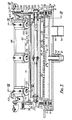
- Fig. 1 is an elevational view of part of a potential embodiment of an elongate metal tape comprising a plurality of objects to be locally plated with a metal layer.
- Fig. 2 is a side elevation of the embodiment of Fig. 1.
- Fig. 3 shows an embodiment of a device in accordance with the invention partly in an elevational view and partly in a sectional view taken on the line III-III in Fig. 4, in which the wheels pressing the elongate tape to be processed against the guide surface and the guide rim, are disposed so that their rotary axes are at least substantially vertical to the intended direction of transport of the elongate tape through the device.
- Fig. 4 is a sectional view of the embodiment of Fig. 3 taken on the line IV-IV in Fig. 3.
- Fig. 5 is a sectional view of the embodiment of Fig. 4 taken on the line V-V in Fig. 4.
- Fig. 6 is a sectional view of part of Fig. 3 taken on the line VI-VI in Fig. 3.
- Fig. 7 is a sectional viewtaken on the lineVil-Vil in Fig. 3.
- The electroplating device embodying the invention comprises an elongate, channel-
section reservoir 1. To the ends of the reservoir are fastened U-shaped brackets 2 located between adjustment nuts 3 and 4fastened ontostub shafts 5. The lower ends of thestubs 5 are screwed intonuts 6 welded to a supporting frame 7', which may also serve to support further devices (not shown) with the aid of which the tape to be plated in the device embodying the invention, may be subjected to further treatments. - It will be obvious that by turning the set nuts 3 and 4 the
reservoir 1 is adjustable in a direction of height. At a given distance from the bottom of thereservoir 1 there is arranged aplate 7 extending parallel to the bottom of the reservoir and havingpassages 8. Above theplate 7 the reservoir has ananode 9. - To the bottom of the reservoir 1 a length of
pipe 10 is welded, extending downwards from said bottom and having its lower end arranged in afeed pipe 11 attached to the frame. The lower end of the length ofpipe 10 is sealed with respect to the inner wall of the length ofpipe 11 with the aid of a sealingring 12. - Above the outlet of the
feed pipe 10 in thereservoir 1 there is arranged asemi-circular covering hood 13, which laterally conducts the electrolyte, fed to thereservoir 1, so that this electrolyte spreads throughout the length of thereservoir 1 below theplate 7 before it flows through theopenings 8 to the upper part of the reservoir. Electrolyte flowing across the top rims of the reservoir can be conducted away through anoutlet pipe 14 connected with the frame 7'. - Above the reservoir 1 a
roller 15 is arranged, rotatable about a horizontal axis ofrotation 16. Theroller 15 comprises acentral shaft 17 to which two aligned,cylindrical bodies cylindrical bodies reservoir 1. Thus when theroller 15 is rotated in operation the electrolyte can be carried upwards by the moisture-absorbinglayer 20. - The ends of the
shaft 17 are provided with stubs 21 and 22 which are rotatably positioned inbearings plates - One end of the stub shaft 22 has attached to it a
toothed belt pulley 27, which is coupled through atoothed belt 28 with atoothed belt pulley 29 which can be rotated by a drivingmotor 30. - A
pressure roller 31 is arranged parallel to and, as viewed in Fig. 5, behind theroller 15 in a manner such that the axis of rotation of theroller 31 is located in the same horizontal plane as the axis ofrotation 16 of theroller 15. The ends of theroller 31 are provided withstub shafts 32 with the aid of which theroller 31 is freely rotatable about is axis of rotation and positioned in supportingstrips 33, which are supported byplates roller 31. The supporting strips are coupled with one another by means of arod 34 extending parallel to theroller 31. Therod 34 is adjustably connected with the aid of acoupling rod 35 with the lower end of anarm 36, the top end of which is fixed to ashaft 37 extending parallel to therod 34 and being rotatably positioned in theplates shaft 37 an upwardly extendingarm 38 is coupled which is provided with alocking knob 39 which can be used for fixing theshaft 37 in a given position, to engage one of a plurality oflocking openings 40 in theplate 25 located on an are of a circle concentric with the centre line of theshaft 37. It will be obvious that by turning thearm 38 theroller 31, as viewed in Fig. 4, can be shifted in a horizontal direction to the left or the right so that it can be pressed more or less tightly against the moisture-absorbing surface layer 22 of theroller 15 in order to expel more or less excess fluid from this surface. - Above and, as viewed in Fig. 4, on the righthand side of the
roller 15 an elongate supportingblock 41 extends parallel to the roller, to which block aguide member 42 is fastened for guiding the elongate tape to be plated. - The supporting
block 41 is connected with the aid of twoadjustment bolts 43 extending normal to the direction of length of the supporting block with a supportingrod 44 so that with the aid of thebolts 43 the supporting block is adjustable with respect to the supportingrod 44. The ends of the supportingrod 44 are rotatably positioned in the supportingplates roller 15. - Fig. 4 furthermore shows that
recesses 45 are provided in the supporting block at right angles to the direction of length of theadjustment bolts 43 for receivingpins 46, whose ends, protruding out of the supporting block, are in contact with stops 47 fastened to theplates recesses 45 furthermore holdcompression springs 48 loading thepins 46 and being enclosed between the ends of the pins and covering plates 49 fastened to the supporting block and covering therecesses 45. On these covering plates, the ends ofadjustment bolts 50 rest, which are screwed into tapped holes in brackets 51 attached to the supportingplates - From the Figures it will furthermore be apparent that the
guide member 42 has a stepped top surface, aface 52 which, extending parallel to the axis of rotation ofroller 15 constitutes a guide face for the elongate tape to be transported through the device and arim 53 at right angles to said face, which constitutes an upper guide rim for the elongate tape. - On
guide face 52 are resting threerings 54 of elastic material, for example, rubber or a synthetic resin, which form the outer circumference ofpressure wheels 55. Thesewheels 55 are fastened to the ends ofshafts 56 position in supportinghousings 57. Eachhousing 57 is pivotally connected to a supporting piece 59 with the aid of ahorizontal pivot pin 58 extending at right angles to theshaft 56. The supporting piece 59 is connected with the supportingblock 41 with the aid of a spring-loadedbolt 60 crossing theshafts - A
compression spring 62 arranged between thehousing 57 and the supporting member 59 the bias tension of which spring is adjustable with the aid of anadjustment bolt 63, tends to turn thehousing 57 in anti-clockwise direction, as viewed in Fig. 6, about thepivotal shaft 58 and hence to firmly press thering 54 forming the outer circumference of thewheel 55 against theguide face 52. - It will be furthermore apparent from Fig. 6 that the
shaft 56 of thewheel 55 is revolving in asleeve 64 arranged in thehousing 57 and being adjustable in the direction of length of theshaft 56 with respect to thehousing 57 and fixable in the desired position by means of aguard bolt 65. - The
plates block 41 and the parts fastened thereto and the tworollers strips 67 fastened to the frame 7' with the aid ofbolts strips 69. Thebolts 68 are passed throughsleeves 70 fastened to the lower ends ofvertical stubs 71. The stubs are passed through holes in supportingplates 72 fastened to the frame 7', whilstnuts 73 are screwed onto the ends of the stubs located above the supportingplates 72. It will be obvious that after thestubs plates set nuts 73 so that the extent of immersion of theroller 15 in the fluid contained in thereservoir 1 can be controlled, whilst the position of the supportingblock 41 with the parts supported thereby relative to theroller 15 is not varied. - As stated above, the device is particularly intended for the local appliction of a metal coating to tape-shaped material to be passed through the device. A potential embodiment of such an elongate tape is shown in Fig. 1. In this embodiment the elongate tape comprises a plurality of elongate
metal contact parts 74 punched from strip-shaped material and adhering to one another bybridges 75 integral with said contact parts. In the embodiment shown oneend 76 of thecontact part 74 is curved; it may be desired, for example, to provide theconvex side 77 of thiscurved part 76 with a metal coating, for example, of gold or similar material. For this purpose the tape is passed through the device described above so that the ends of theelongate objects 75 remote from thecurved parts 76 are guided along theguide face 52 and thus urged against this guide face by thewheels 55. - If, as shown in Fig. 3, the elongate tape is passed from left to right through the device, the
housings 75 supporting thewheels 55 will arrive by turning about thebolts 60 at a position in which the axes of rotation of thewheels 55 are upwardly inclined to the left (Fig. 3). Therefore, the freely rotatingwheels 55, which urge the endlesss tape, as stated above, against theguide face 52 of theguide member 42, will also tend to displace the tape upwards, as viewed in Fig. 3, so that the ends of the elongate objects are pressed against theguide rim 53. It will be obvious that in this way an accurate positioning of the elongate tape with respect to theguide member 42 is obtained. The correct position of theguide member 42 with respect to theroller 15 can be ensured prior to starting the treatment of the metal tape by correct adjustment of the supporting block with the aid of theadjustment bolts 43 so that theguide rim 53 extends parallel to the axis of rotation of theroller 15 and with the aid of theadjustment bolts 50 so that theguide face 52 is also parallel to the axis of rotation of theroller face 15 and thecurved parts 76 come just into contact by theircurved faces 77 with the fluid-absorbinglayer 20 of theroller 15 during operation. - It will be obvious that the curved faces 77 to be provided with a metal layer will brush past the fluid-absorbing
layer 20 during operation so that these parts of the tape acting as a cathode will be provided in the desived manner with a metal coating. - Since the fluid-absorbing
layer 20 constantly supplies fresh electrolyte, the objects can be satisfactorily coated. The anode is arranged at a relatively large distance from thecurved surface 77 so that substances which may be set free at the anode and which might have an adverse effect on the metal deposition to be obtained will not come into contact with the metal tape. - In the embodiment shown a tape may, as an alternative, be passed from right to left through the device, as viewed in Fig. 3, in which case the
wheels 55 are diposed so that, as shown in Fig. 3, the axes of rotation of saidwheels 55 are upwardly inclined to the right. - It will be obvious that flat objects united in a tape or flat metal tapes rather than objects having convex contact areas may also be worked by means of the device embodying the invention. By disposing the axis of
rotation 16 of theroller 15 at an acute angle to the longitudinal axis of the metal tape, the width of that part of the tape which has to be provided with a coating can be made larger than in the case in which the axis ofrotation 16 is parallel to the longitudinal axis of the tape. - The figures used in the claims are only meant to explain more clearly the intention of the invention and are not supposed to be any restriction concerning the interpretation of the invention.
Claims (12)
Priority Applications (1)
| Application Number | Priority Date | Filing Date | Title |
|---|---|---|---|
| AT85101019T ATE41956T1 (en) | 1984-02-09 | 1985-01-31 | DEVICE FOR SELECTIVE ELECTROPLATING OF A STRIP. |
Applications Claiming Priority (2)
| Application Number | Priority Date | Filing Date | Title |
|---|---|---|---|
| US578581 | 1984-02-09 | ||
| US06/578,581 US4618407A (en) | 1984-02-09 | 1984-02-09 | Galvano-technical device for locally applying a metal layer to an elongate metal tape or the like |
Publications (3)
| Publication Number | Publication Date |
|---|---|
| EP0154795A2 EP0154795A2 (en) | 1985-09-18 |
| EP0154795A3 EP0154795A3 (en) | 1986-12-17 |
| EP0154795B1 true EP0154795B1 (en) | 1989-04-05 |
Family
ID=24313469
Family Applications (1)
| Application Number | Title | Priority Date | Filing Date |
|---|---|---|---|
| EP85101019A Expired EP0154795B1 (en) | 1984-02-09 | 1985-01-31 | Electroplating device for locally applying a metal deposit to an elongate metal tape or the like |
Country Status (5)
| Country | Link |
|---|---|
| US (1) | US4618407A (en) |
| EP (1) | EP0154795B1 (en) |
| JP (1) | JPS60187697A (en) |
| AT (1) | ATE41956T1 (en) |
| DE (1) | DE3569268D1 (en) |
Families Citing this family (1)
| Publication number | Priority date | Publication date | Assignee | Title |
|---|---|---|---|---|
| DE3839223C2 (en) * | 1988-11-19 | 1994-10-20 | Degussa | Selective electroplating device |
Family Cites Families (6)
| Publication number | Priority date | Publication date | Assignee | Title |
|---|---|---|---|---|
| US3539490A (en) * | 1967-11-28 | 1970-11-10 | Sylvania Electric Prod | Plating of stripes on longitudinal electrically conductive material |
| US3661752A (en) * | 1970-06-23 | 1972-05-09 | Amp Inc | Belt plating apparatus |
| NL7401595A (en) * | 1974-01-21 | 1975-07-23 | Galentan Ag | DEVICE FOR THE QUEEN APPLICATION OF STRIP, RIBBON OR SPOT SHAPED COVERINGS. |
| US3966581A (en) * | 1974-10-16 | 1976-06-29 | Auric Corporation | Selective plating apparatus |
| US4078982A (en) * | 1976-03-15 | 1978-03-14 | Dixie Plating, Inc. | Apparatus for continuous contact plating |
| US4220504A (en) * | 1979-04-16 | 1980-09-02 | Burton Silverplating Company | Selective electroplating |
-
1984
- 1984-02-09 US US06/578,581 patent/US4618407A/en not_active Expired - Fee Related
-
1985
- 1985-01-31 AT AT85101019T patent/ATE41956T1/en not_active IP Right Cessation
- 1985-01-31 EP EP85101019A patent/EP0154795B1/en not_active Expired
- 1985-01-31 DE DE8585101019T patent/DE3569268D1/en not_active Expired
- 1985-02-08 JP JP60022097A patent/JPS60187697A/en active Pending
Also Published As
| Publication number | Publication date |
|---|---|
| EP0154795A3 (en) | 1986-12-17 |
| JPS60187697A (en) | 1985-09-25 |
| DE3569268D1 (en) | 1989-05-11 |
| EP0154795A2 (en) | 1985-09-18 |
| ATE41956T1 (en) | 1989-04-15 |
| US4618407A (en) | 1986-10-21 |
Similar Documents
| Publication | Publication Date | Title |
|---|---|---|
| US4119499A (en) | Continuous contact plater product | |
| JPS6376898A (en) | Apparatus for electrolytic treatment of plate body | |
| US4431500A (en) | Selective electroplating apparatus | |
| US4483106A (en) | Weld sander | |
| US5501735A (en) | Apparatus for processing printed circuit board substrates | |
| US4264416A (en) | Method for continuous application of strip ribbon or patch-shaped coatings to a metal tape | |
| EP0154795B1 (en) | Electroplating device for locally applying a metal deposit to an elongate metal tape or the like | |
| US3185130A (en) | Multiple roller coating apparatus | |
| US4843764A (en) | Glass plate grinding apparatus | |
| US4132617A (en) | Apparatus for continuous application of strip-, ribbon- or patch-shaped coatings to a metal tape | |
| KR100923476B1 (en) | Device for carrying circuit board as flexible planar material | |
| US5656086A (en) | Coating device for applying thin wet films | |
| KR880002017B1 (en) | Local coating device by electroplating | |
| US4353775A (en) | Apparatus for applying gasket-forming material to workpieces | |
| KR890003967B1 (en) | Plate Glass Grinding Device | |
| US4064019A (en) | Continuous contact plater method | |
| US4220504A (en) | Selective electroplating | |
| US5107788A (en) | Device for applying adhesive material to sheets of packing material | |
| US20180327190A1 (en) | Return Idler Trainer | |
| JP2645201B2 (en) | Point-like coating forming apparatus and coated member | |
| US3643278A (en) | Printed circuit panel scrubbing apparatus | |
| US4036725A (en) | Wheel selective jet plating system | |
| GB2104025A (en) | Improvements in or relating to electro-plating machines | |
| US4582583A (en) | Continuous stripe plating apparatus | |
| JPS6338032Y2 (en) |
Legal Events
| Date | Code | Title | Description |
|---|---|---|---|
| PUAI | Public reference made under article 153(3) epc to a published international application that has entered the european phase |
Free format text: ORIGINAL CODE: 0009012 |
|
| AK | Designated contracting states |
Designated state(s): AT BE CH DE FR GB IT LI LU NL SE |
|
| PUAL | Search report despatched |
Free format text: ORIGINAL CODE: 0009013 |
|
| AK | Designated contracting states |
Kind code of ref document: A3 Designated state(s): AT BE CH DE FR GB IT LI LU NL SE |
|
| 17P | Request for examination filed |
Effective date: 19870122 |
|
| 17Q | First examination report despatched |
Effective date: 19871217 |
|
| GRAA | (expected) grant |
Free format text: ORIGINAL CODE: 0009210 |
|
| AK | Designated contracting states |
Kind code of ref document: B1 Designated state(s): AT BE CH DE FR GB IT LI LU NL SE |
|
| PG25 | Lapsed in a contracting state [announced via postgrant information from national office to epo] |
Ref country code: SE Effective date: 19890405 Ref country code: NL Effective date: 19890405 Ref country code: LI Effective date: 19890405 Ref country code: IT Free format text: LAPSE BECAUSE OF FAILURE TO SUBMIT A TRANSLATION OF THE DESCRIPTION OR TO PAY THE FEE WITHIN THE PRESCRIBED TIME-LIMIT;WARNING: LAPSES OF ITALIAN PATENTS WITH EFFECTIVE DATE BEFORE 2007 MAY HAVE OCCURRED AT ANY TIME BEFORE 2007. THE CORRECT EFFECTIVE DATE MAY BE DIFFERENT FROM THE ONE RECORDED. Effective date: 19890405 Ref country code: FR Free format text: THE PATENT HAS BEEN ANNULLED BY A DECISION OF A NATIONAL AUTHORITY Effective date: 19890405 Ref country code: CH Effective date: 19890405 Ref country code: BE Effective date: 19890405 Ref country code: AT Effective date: 19890405 |
|
| REF | Corresponds to: |
Ref document number: 41956 Country of ref document: AT Date of ref document: 19890415 Kind code of ref document: T |
|
| REF | Corresponds to: |
Ref document number: 3569268 Country of ref document: DE Date of ref document: 19890511 |
|
| REG | Reference to a national code |
Ref country code: CH Ref legal event code: PL |
|
| EN | Fr: translation not filed | ||
| NLV1 | Nl: lapsed or annulled due to failure to fulfill the requirements of art. 29p and 29m of the patents act | ||
| PG25 | Lapsed in a contracting state [announced via postgrant information from national office to epo] |
Ref country code: LU Free format text: LAPSE BECAUSE OF NON-PAYMENT OF DUE FEES Effective date: 19900131 |
|
| PGFP | Annual fee paid to national office [announced via postgrant information from national office to epo] |
Ref country code: GB Payment date: 19900131 Year of fee payment: 6 |
|
| PLBE | No opposition filed within time limit |
Free format text: ORIGINAL CODE: 0009261 |
|
| STAA | Information on the status of an ep patent application or granted ep patent |
Free format text: STATUS: NO OPPOSITION FILED WITHIN TIME LIMIT |
|
| PGFP | Annual fee paid to national office [announced via postgrant information from national office to epo] |
Ref country code: DE Payment date: 19900312 Year of fee payment: 6 |
|
| 26N | No opposition filed | ||
| PG25 | Lapsed in a contracting state [announced via postgrant information from national office to epo] |
Ref country code: GB Effective date: 19910131 |
|
| GBPC | Gb: european patent ceased through non-payment of renewal fee | ||
| PG25 | Lapsed in a contracting state [announced via postgrant information from national office to epo] |
Ref country code: DE Effective date: 19911001 |