EP0154768B1 - Process for the preparation of polyurethanes, polyurethanes having aromatic amino terminal groups and their use - Google Patents
Process for the preparation of polyurethanes, polyurethanes having aromatic amino terminal groups and their use Download PDFInfo
- Publication number
- EP0154768B1 EP0154768B1 EP85100113A EP85100113A EP0154768B1 EP 0154768 B1 EP0154768 B1 EP 0154768B1 EP 85100113 A EP85100113 A EP 85100113A EP 85100113 A EP85100113 A EP 85100113A EP 0154768 B1 EP0154768 B1 EP 0154768B1
- Authority
- EP
- European Patent Office
- Prior art keywords
- nco
- polyurethanes
- groups
- polyurethane
- chain
- Prior art date
- Legal status (The legal status is an assumption and is not a legal conclusion. Google has not performed a legal analysis and makes no representation as to the accuracy of the status listed.)
- Expired
Links
- 239000004814 polyurethane Substances 0.000 title claims description 124
- 229920002635 polyurethane Polymers 0.000 title claims description 112
- 238000000034 method Methods 0.000 title claims description 25
- 230000008569 process Effects 0.000 title claims description 24
- 238000002360 preparation method Methods 0.000 title claims description 7
- 239000005056 polyisocyanate Substances 0.000 claims description 40
- 229920001228 polyisocyanate Polymers 0.000 claims description 40
- 150000004985 diamines Chemical class 0.000 claims description 29
- 125000003277 amino group Chemical group 0.000 claims description 23
- 150000001875 compounds Chemical class 0.000 claims description 23
- 125000003118 aryl group Chemical group 0.000 claims description 19
- 239000003795 chemical substances by application Substances 0.000 claims description 16
- 239000007787 solid Substances 0.000 claims description 16
- 239000002904 solvent Substances 0.000 claims description 15
- -1 R3 represents H Chemical group 0.000 claims description 13
- 150000004984 aromatic diamines Chemical class 0.000 claims description 12
- 238000004519 manufacturing process Methods 0.000 claims description 11
- 238000000576 coating method Methods 0.000 claims description 10
- 229920000768 polyamine Polymers 0.000 claims description 9
- 125000004432 carbon atom Chemical group C* 0.000 claims description 8
- 229910052736 halogen Inorganic materials 0.000 claims description 8
- 150000002367 halogens Chemical class 0.000 claims description 8
- 230000009257 reactivity Effects 0.000 claims description 8
- 125000000217 alkyl group Chemical group 0.000 claims description 7
- 125000004435 hydrogen atom Chemical group [H]* 0.000 claims description 7
- 239000000853 adhesive Substances 0.000 claims description 6
- 230000001070 adhesive effect Effects 0.000 claims description 6
- 239000011248 coating agent Substances 0.000 claims description 6
- 125000001424 substituent group Chemical group 0.000 claims description 6
- 125000004169 (C1-C6) alkyl group Chemical group 0.000 claims description 5
- 125000002496 methyl group Chemical group [H]C([H])([H])* 0.000 claims description 4
- 238000003541 multi-stage reaction Methods 0.000 claims description 4
- 239000000376 reactant Substances 0.000 claims description 2
- 239000000243 solution Substances 0.000 description 73
- WYURNTSHIVDZCO-UHFFFAOYSA-N Tetrahydrofuran Chemical compound C1CCOC1 WYURNTSHIVDZCO-UHFFFAOYSA-N 0.000 description 53
- 238000006243 chemical reaction Methods 0.000 description 35
- YLQBMQCUIZJEEH-UHFFFAOYSA-N tetrahydrofuran Natural products C=1C=COC=1 YLQBMQCUIZJEEH-UHFFFAOYSA-N 0.000 description 26
- 238000004132 cross linking Methods 0.000 description 24
- 239000000203 mixture Substances 0.000 description 20
- LYCAIKOWRPUZTN-UHFFFAOYSA-N Ethylene glycol Chemical compound OCCO LYCAIKOWRPUZTN-UHFFFAOYSA-N 0.000 description 18
- WERYXYBDKMZEQL-UHFFFAOYSA-N butane-1,4-diol Chemical compound OCCCCO WERYXYBDKMZEQL-UHFFFAOYSA-N 0.000 description 16
- 239000004970 Chain extender Substances 0.000 description 12
- XLYOFNOQVPJJNP-UHFFFAOYSA-N water Substances O XLYOFNOQVPJJNP-UHFFFAOYSA-N 0.000 description 12
- 229920000728 polyester Polymers 0.000 description 11
- RNLHGQLZWXBQNY-UHFFFAOYSA-N 3-(aminomethyl)-3,5,5-trimethylcyclohexan-1-amine Chemical compound CC1(C)CC(N)CC(C)(CN)C1 RNLHGQLZWXBQNY-UHFFFAOYSA-N 0.000 description 10
- XEKOWRVHYACXOJ-UHFFFAOYSA-N Ethyl acetate Chemical compound CCOC(C)=O XEKOWRVHYACXOJ-UHFFFAOYSA-N 0.000 description 9
- 125000005442 diisocyanate group Chemical group 0.000 description 8
- 150000002009 diols Chemical class 0.000 description 8
- 125000002887 hydroxy group Chemical group [H]O* 0.000 description 8
- 229920005862 polyol Polymers 0.000 description 8
- 150000003077 polyols Chemical class 0.000 description 8
- 125000001931 aliphatic group Chemical group 0.000 description 7
- 229920000515 polycarbonate Polymers 0.000 description 7
- 239000004417 polycarbonate Substances 0.000 description 7
- 238000012545 processing Methods 0.000 description 7
- JXKCXZZWQAMWAH-UHFFFAOYSA-N 5-[(4-aminocyclohexyl)methyl]-2-methylaniline Chemical compound C1=C(N)C(C)=CC=C1CC1CCC(N)CC1 JXKCXZZWQAMWAH-UHFFFAOYSA-N 0.000 description 6
- 239000004971 Cross linker Substances 0.000 description 6
- WNLRTRBMVRJNCN-UHFFFAOYSA-N adipic acid Chemical compound OC(=O)CCCCC(O)=O WNLRTRBMVRJNCN-UHFFFAOYSA-N 0.000 description 6
- 238000010790 dilution Methods 0.000 description 6
- 239000012895 dilution Substances 0.000 description 6
- 229920000642 polymer Polymers 0.000 description 6
- 239000000047 product Substances 0.000 description 6
- 238000003860 storage Methods 0.000 description 6
- UPMLOUAZCHDJJD-UHFFFAOYSA-N 4,4'-Diphenylmethane Diisocyanate Chemical compound C1=CC(N=C=O)=CC=C1CC1=CC=C(N=C=O)C=C1 UPMLOUAZCHDJJD-UHFFFAOYSA-N 0.000 description 5
- 239000000654 additive Substances 0.000 description 5
- 150000001414 amino alcohols Chemical class 0.000 description 5
- 239000012948 isocyanate Substances 0.000 description 5
- 150000002513 isocyanates Chemical class 0.000 description 5
- 239000010985 leather Substances 0.000 description 5
- 239000007858 starting material Substances 0.000 description 5
- RUELTTOHQODFPA-UHFFFAOYSA-N toluene 2,6-diisocyanate Chemical compound CC1=C(N=C=O)C=CC=C1N=C=O RUELTTOHQODFPA-UHFFFAOYSA-N 0.000 description 5
- YPFDHNVEDLHUCE-UHFFFAOYSA-N 1,3-propanediol Substances OCCCO YPFDHNVEDLHUCE-UHFFFAOYSA-N 0.000 description 4
- HZAXFHJVJLSVMW-UHFFFAOYSA-N 2-Aminoethan-1-ol Chemical compound NCCO HZAXFHJVJLSVMW-UHFFFAOYSA-N 0.000 description 4
- OAKJQQAXSVQMHS-UHFFFAOYSA-N Hydrazine Chemical compound NN OAKJQQAXSVQMHS-UHFFFAOYSA-N 0.000 description 4
- UKLDJPRMSDWDSL-UHFFFAOYSA-L [dibutyl(dodecanoyloxy)stannyl] dodecanoate Chemical compound CCCCCCCCCCCC(=O)O[Sn](CCCC)(CCCC)OC(=O)CCCCCCCCCCC UKLDJPRMSDWDSL-UHFFFAOYSA-L 0.000 description 4
- 230000008859 change Effects 0.000 description 4
- 239000007795 chemical reaction product Substances 0.000 description 4
- 239000012975 dibutyltin dilaurate Substances 0.000 description 4
- MTHSVFCYNBDYFN-UHFFFAOYSA-N diethylene glycol Chemical compound OCCOCCO MTHSVFCYNBDYFN-UHFFFAOYSA-N 0.000 description 4
- 230000000694 effects Effects 0.000 description 4
- ACCCMOQWYVYDOT-UHFFFAOYSA-N hexane-1,1-diol Chemical compound CCCCCC(O)O ACCCMOQWYVYDOT-UHFFFAOYSA-N 0.000 description 4
- XXMIOPMDWAUFGU-UHFFFAOYSA-N hexane-1,6-diol Chemical compound OCCCCCCO XXMIOPMDWAUFGU-UHFFFAOYSA-N 0.000 description 4
- 239000000543 intermediate Substances 0.000 description 4
- XNGIFLGASWRNHJ-UHFFFAOYSA-N phthalic acid Chemical compound OC(=O)C1=CC=CC=C1C(O)=O XNGIFLGASWRNHJ-UHFFFAOYSA-N 0.000 description 4
- 229920000570 polyether Polymers 0.000 description 4
- 239000004753 textile Substances 0.000 description 4
- ZWEHNKRNPOVVGH-UHFFFAOYSA-N 2-Butanone Chemical compound CCC(C)=O ZWEHNKRNPOVVGH-UHFFFAOYSA-N 0.000 description 3
- JOYRKODLDBILNP-UHFFFAOYSA-N Ethyl urethane Chemical compound CCOC(N)=O JOYRKODLDBILNP-UHFFFAOYSA-N 0.000 description 3
- WSFSSNUMVMOOMR-UHFFFAOYSA-N Formaldehyde Chemical compound O=C WSFSSNUMVMOOMR-UHFFFAOYSA-N 0.000 description 3
- PEDCQBHIVMGVHV-UHFFFAOYSA-N Glycerine Chemical compound OCC(O)CO PEDCQBHIVMGVHV-UHFFFAOYSA-N 0.000 description 3
- UFHFLCQGNIYNRP-UHFFFAOYSA-N Hydrogen Chemical compound [H][H] UFHFLCQGNIYNRP-UHFFFAOYSA-N 0.000 description 3
- OFOBLEOULBTSOW-UHFFFAOYSA-N Malonic acid Chemical compound OC(=O)CC(O)=O OFOBLEOULBTSOW-UHFFFAOYSA-N 0.000 description 3
- ZMXDDKWLCZADIW-UHFFFAOYSA-N N,N-Dimethylformamide Chemical compound CN(C)C=O ZMXDDKWLCZADIW-UHFFFAOYSA-N 0.000 description 3
- MUBZPKHOEPUJKR-UHFFFAOYSA-N Oxalic acid Chemical compound OC(=O)C(O)=O MUBZPKHOEPUJKR-UHFFFAOYSA-N 0.000 description 3
- YXFVVABEGXRONW-UHFFFAOYSA-N Toluene Chemical compound CC1=CC=CC=C1 YXFVVABEGXRONW-UHFFFAOYSA-N 0.000 description 3
- ZJCCRDAZUWHFQH-UHFFFAOYSA-N Trimethylolpropane Chemical compound CCC(CO)(CO)CO ZJCCRDAZUWHFQH-UHFFFAOYSA-N 0.000 description 3
- 239000002253 acid Substances 0.000 description 3
- 239000001361 adipic acid Substances 0.000 description 3
- 235000011037 adipic acid Nutrition 0.000 description 3
- OHJMTUPIZMNBFR-UHFFFAOYSA-N biuret Chemical compound NC(=O)NC(N)=O OHJMTUPIZMNBFR-UHFFFAOYSA-N 0.000 description 3
- 239000003431 cross linking reagent Substances 0.000 description 3
- 230000004048 modification Effects 0.000 description 3
- 238000012986 modification Methods 0.000 description 3
- 239000000049 pigment Substances 0.000 description 3
- 125000002924 primary amino group Chemical group [H]N([H])* 0.000 description 3
- 239000000758 substrate Substances 0.000 description 3
- DNIAPMSPPWPWGF-VKHMYHEASA-N (+)-propylene glycol Chemical compound C[C@H](O)CO DNIAPMSPPWPWGF-VKHMYHEASA-N 0.000 description 2
- ARXKVVRQIIOZGF-UHFFFAOYSA-N 1,2,4-butanetriol Chemical compound OCCC(O)CO ARXKVVRQIIOZGF-UHFFFAOYSA-N 0.000 description 2
- QRMPKOFEUHIBNM-UHFFFAOYSA-N 1,4-dimethylcyclohexane Chemical compound CC1CCC(C)CC1 QRMPKOFEUHIBNM-UHFFFAOYSA-N 0.000 description 2
- QWGRWMMWNDWRQN-UHFFFAOYSA-N 2-methylpropane-1,3-diol Chemical compound OCC(C)CO QWGRWMMWNDWRQN-UHFFFAOYSA-N 0.000 description 2
- VPWNQTHUCYMVMZ-UHFFFAOYSA-N 4,4'-sulfonyldiphenol Chemical class C1=CC(O)=CC=C1S(=O)(=O)C1=CC=C(O)C=C1 VPWNQTHUCYMVMZ-UHFFFAOYSA-N 0.000 description 2
- PAYRUJLWNCNPSJ-UHFFFAOYSA-N Aniline Chemical compound NC1=CC=CC=C1 PAYRUJLWNCNPSJ-UHFFFAOYSA-N 0.000 description 2
- 229930185605 Bisphenol Natural products 0.000 description 2
- 0 CC(*)(C(*)C/C=C1)/C=C/*1N Chemical compound CC(*)(C(*)C/C=C1)/C=C/*1N 0.000 description 2
- LFQSCWFLJHTTHZ-UHFFFAOYSA-N Ethanol Chemical compound CCO LFQSCWFLJHTTHZ-UHFFFAOYSA-N 0.000 description 2
- PIICEJLVQHRZGT-UHFFFAOYSA-N Ethylenediamine Chemical compound NCCN PIICEJLVQHRZGT-UHFFFAOYSA-N 0.000 description 2
- VZCYOOQTPOCHFL-OWOJBTEDSA-N Fumaric acid Chemical compound OC(=O)\C=C\C(O)=O VZCYOOQTPOCHFL-OWOJBTEDSA-N 0.000 description 2
- 239000005057 Hexamethylene diisocyanate Substances 0.000 description 2
- 239000005058 Isophorone diisocyanate Substances 0.000 description 2
- LRHPLDYGYMQRHN-UHFFFAOYSA-N N-Butanol Chemical compound CCCCO LRHPLDYGYMQRHN-UHFFFAOYSA-N 0.000 description 2
- ALQSHHUCVQOPAS-UHFFFAOYSA-N Pentane-1,5-diol Chemical compound OCCCCCO ALQSHHUCVQOPAS-UHFFFAOYSA-N 0.000 description 2
- 239000004721 Polyphenylene oxide Substances 0.000 description 2
- 229920002396 Polyurea Polymers 0.000 description 2
- KKEYFWRCBNTPAC-UHFFFAOYSA-N Terephthalic acid Chemical compound OC(=O)C1=CC=C(C(O)=O)C=C1 KKEYFWRCBNTPAC-UHFFFAOYSA-N 0.000 description 2
- YIMQCDZDWXUDCA-UHFFFAOYSA-N [4-(hydroxymethyl)cyclohexyl]methanol Chemical compound OCC1CCC(CO)CC1 YIMQCDZDWXUDCA-UHFFFAOYSA-N 0.000 description 2
- 150000001298 alcohols Chemical class 0.000 description 2
- 125000002947 alkylene group Chemical group 0.000 description 2
- 150000001412 amines Chemical class 0.000 description 2
- 230000008901 benefit Effects 0.000 description 2
- IISBACLAFKSPIT-UHFFFAOYSA-N bisphenol A Chemical compound C=1C=C(O)C=CC=1C(C)(C)C1=CC=C(O)C=C1 IISBACLAFKSPIT-UHFFFAOYSA-N 0.000 description 2
- 229910052794 bromium Inorganic materials 0.000 description 2
- OWBTYPJTUOEWEK-UHFFFAOYSA-N butane-2,3-diol Chemical compound CC(O)C(C)O OWBTYPJTUOEWEK-UHFFFAOYSA-N 0.000 description 2
- BVKZGUZCCUSVTD-UHFFFAOYSA-N carbonic acid Chemical class OC(O)=O BVKZGUZCCUSVTD-UHFFFAOYSA-N 0.000 description 2
- 150000001735 carboxylic acids Chemical class 0.000 description 2
- 229910052801 chlorine Inorganic materials 0.000 description 2
- 230000000052 comparative effect Effects 0.000 description 2
- JQVDAXLFBXTEQA-UHFFFAOYSA-N dibutylamine Chemical compound CCCCNCCCC JQVDAXLFBXTEQA-UHFFFAOYSA-N 0.000 description 2
- 238000001035 drying Methods 0.000 description 2
- 229910052731 fluorine Inorganic materials 0.000 description 2
- 125000000623 heterocyclic group Chemical group 0.000 description 2
- RRAMGCGOFNQTLD-UHFFFAOYSA-N hexamethylene diisocyanate Chemical compound O=C=NCCCCCCN=C=O RRAMGCGOFNQTLD-UHFFFAOYSA-N 0.000 description 2
- NAQMVNRVTILPCV-UHFFFAOYSA-N hexane-1,6-diamine Chemical compound NCCCCCCN NAQMVNRVTILPCV-UHFFFAOYSA-N 0.000 description 2
- 150000002430 hydrocarbons Chemical group 0.000 description 2
- 229910052739 hydrogen Inorganic materials 0.000 description 2
- 239000001257 hydrogen Substances 0.000 description 2
- 238000005984 hydrogenation reaction Methods 0.000 description 2
- 239000012442 inert solvent Substances 0.000 description 2
- NIMLQBUJDJZYEJ-UHFFFAOYSA-N isophorone diisocyanate Chemical compound CC1(C)CC(N=C=O)CC(C)(CN=C=O)C1 NIMLQBUJDJZYEJ-UHFFFAOYSA-N 0.000 description 2
- QQVIHTHCMHWDBS-UHFFFAOYSA-N isophthalic acid Chemical compound OC(=O)C1=CC=CC(C(O)=O)=C1 QQVIHTHCMHWDBS-UHFFFAOYSA-N 0.000 description 2
- 150000002596 lactones Chemical class 0.000 description 2
- 238000002156 mixing Methods 0.000 description 2
- SLCVBVWXLSEKPL-UHFFFAOYSA-N neopentyl glycol Chemical compound OCC(C)(C)CO SLCVBVWXLSEKPL-UHFFFAOYSA-N 0.000 description 2
- BDJRBEYXGGNYIS-UHFFFAOYSA-N nonanedioic acid Chemical compound OC(=O)CCCCCCCC(O)=O BDJRBEYXGGNYIS-UHFFFAOYSA-N 0.000 description 2
- WLJVNTCWHIRURA-UHFFFAOYSA-N pimelic acid Chemical compound OC(=O)CCCCCC(O)=O WLJVNTCWHIRURA-UHFFFAOYSA-N 0.000 description 2
- 229920006149 polyester-amide block copolymer Polymers 0.000 description 2
- 229920006324 polyoxymethylene Polymers 0.000 description 2
- 229920000166 polytrimethylene carbonate Polymers 0.000 description 2
- KIDHWZJUCRJVML-UHFFFAOYSA-N putrescine Chemical compound NCCCCN KIDHWZJUCRJVML-UHFFFAOYSA-N 0.000 description 2
- CXMXRPHRNRROMY-UHFFFAOYSA-N sebacic acid Chemical compound OC(=O)CCCCCCCCC(O)=O CXMXRPHRNRROMY-UHFFFAOYSA-N 0.000 description 2
- TYFQFVWCELRYAO-UHFFFAOYSA-N suberic acid Chemical compound OC(=O)CCCCCCC(O)=O TYFQFVWCELRYAO-UHFFFAOYSA-N 0.000 description 2
- 239000000126 substance Substances 0.000 description 2
- DVKJHBMWWAPEIU-UHFFFAOYSA-N toluene 2,4-diisocyanate Chemical compound CC1=CC=C(N=C=O)C=C1N=C=O DVKJHBMWWAPEIU-UHFFFAOYSA-N 0.000 description 2
- VZCYOOQTPOCHFL-UHFFFAOYSA-N trans-butenedioic acid Natural products OC(=O)C=CC(O)=O VZCYOOQTPOCHFL-UHFFFAOYSA-N 0.000 description 2
- ZIBGPFATKBEMQZ-UHFFFAOYSA-N triethylene glycol Chemical compound OCCOCCOCCO ZIBGPFATKBEMQZ-UHFFFAOYSA-N 0.000 description 2
- 239000013638 trimer Substances 0.000 description 2
- XSQUKJJJFZCRTK-UHFFFAOYSA-N urea group Chemical group NC(=O)N XSQUKJJJFZCRTK-UHFFFAOYSA-N 0.000 description 2
- ZWVMLYRJXORSEP-UHFFFAOYSA-N 1,2,6-Hexanetriol Chemical compound OCCCCC(O)CO ZWVMLYRJXORSEP-UHFFFAOYSA-N 0.000 description 1
- DIIIISSCIXVANO-UHFFFAOYSA-N 1,2-Dimethylhydrazine Chemical compound CNNC DIIIISSCIXVANO-UHFFFAOYSA-N 0.000 description 1
- RYHBNJHYFVUHQT-UHFFFAOYSA-N 1,4-Dioxane Chemical compound C1COCCO1 RYHBNJHYFVUHQT-UHFFFAOYSA-N 0.000 description 1
- PXGZQGDTEZPERC-UHFFFAOYSA-N 1,4-cyclohexanedicarboxylic acid Chemical compound OC(=O)C1CCC(C(O)=O)CC1 PXGZQGDTEZPERC-UHFFFAOYSA-N 0.000 description 1
- ALQLPWJFHRMHIU-UHFFFAOYSA-N 1,4-diisocyanatobenzene Chemical compound O=C=NC1=CC=C(N=C=O)C=C1 ALQLPWJFHRMHIU-UHFFFAOYSA-N 0.000 description 1
- SBJCUZQNHOLYMD-UHFFFAOYSA-N 1,5-Naphthalene diisocyanate Chemical compound C1=CC=C2C(N=C=O)=CC=CC2=C1N=C=O SBJCUZQNHOLYMD-UHFFFAOYSA-N 0.000 description 1
- VZXPHDGHQXLXJC-UHFFFAOYSA-N 1,6-diisocyanato-5,6-dimethylheptane Chemical compound O=C=NC(C)(C)C(C)CCCCN=C=O VZXPHDGHQXLXJC-UHFFFAOYSA-N 0.000 description 1
- RTBFRGCFXZNCOE-UHFFFAOYSA-N 1-methylsulfonylpiperidin-4-one Chemical compound CS(=O)(=O)N1CCC(=O)CC1 RTBFRGCFXZNCOE-UHFFFAOYSA-N 0.000 description 1
- KJXMXCRSMLOXBM-UHFFFAOYSA-N 2,3-diethylbutanedioic acid Chemical compound CCC(C(O)=O)C(CC)C(O)=O KJXMXCRSMLOXBM-UHFFFAOYSA-N 0.000 description 1
- VOZKAJLKRJDJLL-UHFFFAOYSA-N 2,4-diaminotoluene Chemical compound CC1=CC=C(N)C=C1N VOZKAJLKRJDJLL-UHFFFAOYSA-N 0.000 description 1
- PISLZQACAJMAIO-UHFFFAOYSA-N 2,4-diethyl-6-methylbenzene-1,3-diamine Chemical compound CCC1=CC(C)=C(N)C(CC)=C1N PISLZQACAJMAIO-UHFFFAOYSA-N 0.000 description 1
- YIFFAEJYCUTZAO-UHFFFAOYSA-N 2-(4-propylphenoxy)ethanol Chemical compound CCCC1=CC=C(OCCO)C=C1 YIFFAEJYCUTZAO-UHFFFAOYSA-N 0.000 description 1
- LCZVSXRMYJUNFX-UHFFFAOYSA-N 2-[2-(2-hydroxypropoxy)propoxy]propan-1-ol Chemical compound CC(O)COC(C)COC(C)CO LCZVSXRMYJUNFX-UHFFFAOYSA-N 0.000 description 1
- RDFQSFOGKVZWKF-UHFFFAOYSA-N 3-hydroxy-2,2-dimethylpropanoic acid Chemical compound OCC(C)(C)C(O)=O RDFQSFOGKVZWKF-UHFFFAOYSA-N 0.000 description 1
- YBRVSVVVWCFQMG-UHFFFAOYSA-N 4,4'-diaminodiphenylmethane Chemical compound C1=CC(N)=CC=C1CC1=CC=C(N)C=C1 YBRVSVVVWCFQMG-UHFFFAOYSA-N 0.000 description 1
- DLYLVPHSKJVGLG-UHFFFAOYSA-N 4-(cyclohexylmethyl)cyclohexane-1,1-diamine Chemical compound C1CC(N)(N)CCC1CC1CCCCC1 DLYLVPHSKJVGLG-UHFFFAOYSA-N 0.000 description 1
- DZIHTWJGPDVSGE-UHFFFAOYSA-N 4-[(4-aminocyclohexyl)methyl]cyclohexan-1-amine Chemical compound C1CC(N)CCC1CC1CCC(N)CC1 DZIHTWJGPDVSGE-UHFFFAOYSA-N 0.000 description 1
- AFFHCRYULPEZSS-UHFFFAOYSA-N 5-[(cyclohexylamino)methyl]-2-methylaniline Chemical compound C1=C(N)C(C)=CC=C1CNC1CCCCC1 AFFHCRYULPEZSS-UHFFFAOYSA-N 0.000 description 1
- 241000209761 Avena Species 0.000 description 1
- 235000007319 Avena orientalis Nutrition 0.000 description 1
- DKPFZGUDAPQIHT-UHFFFAOYSA-N Butyl acetate Natural products CCCCOC(C)=O DKPFZGUDAPQIHT-UHFFFAOYSA-N 0.000 description 1
- FBPFZTCFMRRESA-FSIIMWSLSA-N D-Glucitol Natural products OC[C@H](O)[C@H](O)[C@@H](O)[C@H](O)CO FBPFZTCFMRRESA-FSIIMWSLSA-N 0.000 description 1
- FBPFZTCFMRRESA-JGWLITMVSA-N D-glucitol Chemical compound OC[C@H](O)[C@@H](O)[C@H](O)[C@H](O)CO FBPFZTCFMRRESA-JGWLITMVSA-N 0.000 description 1
- IAYPIBMASNFSPL-UHFFFAOYSA-N Ethylene oxide Chemical compound C1CO1 IAYPIBMASNFSPL-UHFFFAOYSA-N 0.000 description 1
- 238000005684 Liebig rearrangement reaction Methods 0.000 description 1
- FXHOOIRPVKKKFG-UHFFFAOYSA-N N,N-Dimethylacetamide Chemical compound CN(C)C(C)=O FXHOOIRPVKKKFG-UHFFFAOYSA-N 0.000 description 1
- OPKOKAMJFNKNAS-UHFFFAOYSA-N N-methylethanolamine Chemical compound CNCCO OPKOKAMJFNKNAS-UHFFFAOYSA-N 0.000 description 1
- KYIMHWNKQXQBDG-UHFFFAOYSA-N N=C=O.N=C=O.CCCCCC Chemical compound N=C=O.N=C=O.CCCCCC KYIMHWNKQXQBDG-UHFFFAOYSA-N 0.000 description 1
- 239000000020 Nitrocellulose Substances 0.000 description 1
- QVHMSMOUDQXMRS-UHFFFAOYSA-N PPG n4 Chemical compound CC(O)COC(C)COC(C)COC(C)CO QVHMSMOUDQXMRS-UHFFFAOYSA-N 0.000 description 1
- YGYAWVDWMABLBF-UHFFFAOYSA-N Phosgene Chemical compound ClC(Cl)=O YGYAWVDWMABLBF-UHFFFAOYSA-N 0.000 description 1
- WUGQZFFCHPXWKQ-UHFFFAOYSA-N Propanolamine Chemical compound NCCCO WUGQZFFCHPXWKQ-UHFFFAOYSA-N 0.000 description 1
- GOOHAUXETOMSMM-UHFFFAOYSA-N Propylene oxide Chemical compound CC1CO1 GOOHAUXETOMSMM-UHFFFAOYSA-N 0.000 description 1
- AWMVMTVKBNGEAK-UHFFFAOYSA-N Styrene oxide Chemical compound C1OC1C1=CC=CC=C1 AWMVMTVKBNGEAK-UHFFFAOYSA-N 0.000 description 1
- KDYFGRWQOYBRFD-UHFFFAOYSA-N Succinic acid Natural products OC(=O)CCC(O)=O KDYFGRWQOYBRFD-UHFFFAOYSA-N 0.000 description 1
- 239000012963 UV stabilizer Substances 0.000 description 1
- 229920002433 Vinyl chloride-vinyl acetate copolymer Polymers 0.000 description 1
- ISKQADXMHQSTHK-UHFFFAOYSA-N [4-(aminomethyl)phenyl]methanamine Chemical compound NCC1=CC=C(CN)C=C1 ISKQADXMHQSTHK-UHFFFAOYSA-N 0.000 description 1
- LNWBFIVSTXCJJG-UHFFFAOYSA-N [diisocyanato(phenyl)methyl]benzene Chemical compound C=1C=CC=CC=1C(N=C=O)(N=C=O)C1=CC=CC=C1 LNWBFIVSTXCJJG-UHFFFAOYSA-N 0.000 description 1
- 150000007513 acids Chemical class 0.000 description 1
- 150000001252 acrylic acid derivatives Chemical class 0.000 description 1
- 150000001299 aldehydes Chemical class 0.000 description 1
- LHIJANUOQQMGNT-UHFFFAOYSA-N aminoethylethanolamine Chemical compound NCCNCCO LHIJANUOQQMGNT-UHFFFAOYSA-N 0.000 description 1
- JFCQEDHGNNZCLN-UHFFFAOYSA-N anhydrous glutaric acid Natural products OC(=O)CCCC(O)=O JFCQEDHGNNZCLN-UHFFFAOYSA-N 0.000 description 1
- 239000003963 antioxidant agent Substances 0.000 description 1
- QVGXLLKOCUKJST-UHFFFAOYSA-N atomic oxygen Chemical compound [O] QVGXLLKOCUKJST-UHFFFAOYSA-N 0.000 description 1
- 230000001588 bifunctional effect Effects 0.000 description 1
- 230000015572 biosynthetic process Effects 0.000 description 1
- RAWLWIIFTCHXQX-UHFFFAOYSA-N butane-1,1-diol;ethane-1,2-diol Chemical compound OCCO.CCCC(O)O RAWLWIIFTCHXQX-UHFFFAOYSA-N 0.000 description 1
- KDYFGRWQOYBRFD-NUQCWPJISA-N butanedioic acid Chemical compound O[14C](=O)CC[14C](O)=O KDYFGRWQOYBRFD-NUQCWPJISA-N 0.000 description 1
- 150000001244 carboxylic acid anhydrides Chemical class 0.000 description 1
- 150000001733 carboxylic acid esters Chemical class 0.000 description 1
- 230000015556 catabolic process Effects 0.000 description 1
- 239000003054 catalyst Substances 0.000 description 1
- 238000006555 catalytic reaction Methods 0.000 description 1
- 239000001913 cellulose Substances 0.000 description 1
- 229920002678 cellulose Polymers 0.000 description 1
- 230000015271 coagulation Effects 0.000 description 1
- 238000005345 coagulation Methods 0.000 description 1
- 238000009833 condensation Methods 0.000 description 1
- 230000005494 condensation Effects 0.000 description 1
- 238000006482 condensation reaction Methods 0.000 description 1
- 239000004035 construction material Substances 0.000 description 1
- 229920006037 cross link polymer Polymers 0.000 description 1
- XXKOQQBKBHUATC-UHFFFAOYSA-N cyclohexylmethylcyclohexane Chemical compound C1CCCCC1CC1CCCCC1 XXKOQQBKBHUATC-UHFFFAOYSA-N 0.000 description 1
- 230000009849 deactivation Effects 0.000 description 1
- 238000006731 degradation reaction Methods 0.000 description 1
- 230000001419 dependent effect Effects 0.000 description 1
- 239000002274 desiccant Substances 0.000 description 1
- 229940113088 dimethylacetamide Drugs 0.000 description 1
- ROORDVPLFPIABK-UHFFFAOYSA-N diphenyl carbonate Chemical compound C=1C=CC=CC=1OC(=O)OC1=CC=CC=C1 ROORDVPLFPIABK-UHFFFAOYSA-N 0.000 description 1
- CZZYITDELCSZES-UHFFFAOYSA-N diphenylmethane Chemical compound C=1C=CC=CC=1CC1=CC=CC=C1 CZZYITDELCSZES-UHFFFAOYSA-N 0.000 description 1
- QFTYSVGGYOXFRQ-UHFFFAOYSA-N dodecane-1,12-diamine Chemical compound NCCCCCCCCCCCCN QFTYSVGGYOXFRQ-UHFFFAOYSA-N 0.000 description 1
- 239000000975 dye Substances 0.000 description 1
- 150000002148 esters Chemical class 0.000 description 1
- 150000002170 ethers Chemical class 0.000 description 1
- 238000002474 experimental method Methods 0.000 description 1
- 230000002349 favourable effect Effects 0.000 description 1
- 239000000835 fiber Substances 0.000 description 1
- 239000000945 filler Substances 0.000 description 1
- DYDNPESBYVVLBO-UHFFFAOYSA-N formanilide Chemical compound O=CNC1=CC=CC=C1 DYDNPESBYVVLBO-UHFFFAOYSA-N 0.000 description 1
- 239000001530 fumaric acid Substances 0.000 description 1
- 239000011521 glass Substances 0.000 description 1
- 150000002334 glycols Chemical class 0.000 description 1
- FUZZWVXGSFPDMH-UHFFFAOYSA-N hexanoic acid Chemical compound CCCCCC(O)=O FUZZWVXGSFPDMH-UHFFFAOYSA-N 0.000 description 1
- 229930195733 hydrocarbon Natural products 0.000 description 1
- 230000006872 improvement Effects 0.000 description 1
- ZFSLODLOARCGLH-UHFFFAOYSA-N isocyanuric acid Chemical group OC1=NC(O)=NC(O)=N1 ZFSLODLOARCGLH-UHFFFAOYSA-N 0.000 description 1
- 239000004611 light stabiliser Substances 0.000 description 1
- 239000000314 lubricant Substances 0.000 description 1
- VZCYOOQTPOCHFL-UPHRSURJSA-N maleic acid Chemical compound OC(=O)\C=C/C(O)=O VZCYOOQTPOCHFL-UPHRSURJSA-N 0.000 description 1
- 239000011976 maleic acid Substances 0.000 description 1
- 239000000155 melt Substances 0.000 description 1
- CRVGTESFCCXCTH-UHFFFAOYSA-N methyl diethanolamine Chemical compound OCCN(C)CCO CRVGTESFCCXCTH-UHFFFAOYSA-N 0.000 description 1
- HDZGCSFEDULWCS-UHFFFAOYSA-N monomethylhydrazine Chemical compound CNN HDZGCSFEDULWCS-UHFFFAOYSA-N 0.000 description 1
- 230000006855 networking Effects 0.000 description 1
- 229920001220 nitrocellulos Polymers 0.000 description 1
- OEIJHBUUFURJLI-UHFFFAOYSA-N octane-1,8-diol Chemical compound OCCCCCCCCO OEIJHBUUFURJLI-UHFFFAOYSA-N 0.000 description 1
- 235000006408 oxalic acid Nutrition 0.000 description 1
- 150000002924 oxiranes Chemical class 0.000 description 1
- 229910052760 oxygen Inorganic materials 0.000 description 1
- 239000001301 oxygen Substances 0.000 description 1
- WXZMFSXDPGVJKK-UHFFFAOYSA-N pentaerythritol Chemical compound OCC(CO)(CO)CO WXZMFSXDPGVJKK-UHFFFAOYSA-N 0.000 description 1
- 229920003023 plastic Polymers 0.000 description 1
- 239000004033 plastic Substances 0.000 description 1
- 239000002798 polar solvent Substances 0.000 description 1
- 229920001223 polyethylene glycol Polymers 0.000 description 1
- 229920006389 polyphenyl polymer Polymers 0.000 description 1
- 229920001296 polysiloxane Polymers 0.000 description 1
- 229920000909 polytetrahydrofuran Polymers 0.000 description 1
- 239000004800 polyvinyl chloride Substances 0.000 description 1
- 229920000915 polyvinyl chloride Polymers 0.000 description 1
- 238000001556 precipitation Methods 0.000 description 1
- 230000002035 prolonged effect Effects 0.000 description 1
- 230000004044 response Effects 0.000 description 1
- 238000007086 side reaction Methods 0.000 description 1
- 239000000600 sorbitol Substances 0.000 description 1
- 238000003756 stirring Methods 0.000 description 1
- 150000005846 sugar alcohols Polymers 0.000 description 1
- 230000008961 swelling Effects 0.000 description 1
- 238000012360 testing method Methods 0.000 description 1
- UWHCKJMYHZGTIT-UHFFFAOYSA-N tetraethylene glycol Chemical compound OCCOCCOCCOCCO UWHCKJMYHZGTIT-UHFFFAOYSA-N 0.000 description 1
- 230000001960 triggered effect Effects 0.000 description 1
- 150000004072 triols Chemical class 0.000 description 1
- 235000021122 unsaturated fatty acids Nutrition 0.000 description 1
- 150000004670 unsaturated fatty acids Chemical class 0.000 description 1
- AVWRKZWQTYIKIY-UHFFFAOYSA-N urea-1-carboxylic acid Chemical compound NC(=O)NC(O)=O AVWRKZWQTYIKIY-UHFFFAOYSA-N 0.000 description 1
- PAPBSGBWRJIAAV-UHFFFAOYSA-N ε-Caprolactone Chemical compound O=C1CCCCCO1 PAPBSGBWRJIAAV-UHFFFAOYSA-N 0.000 description 1
Classifications
-
- C—CHEMISTRY; METALLURGY
- C08—ORGANIC MACROMOLECULAR COMPOUNDS; THEIR PREPARATION OR CHEMICAL WORKING-UP; COMPOSITIONS BASED THEREON
- C08G—MACROMOLECULAR COMPOUNDS OBTAINED OTHERWISE THAN BY REACTIONS ONLY INVOLVING UNSATURATED CARBON-TO-CARBON BONDS
- C08G18/00—Polymeric products of isocyanates or isothiocyanates
- C08G18/06—Polymeric products of isocyanates or isothiocyanates with compounds having active hydrogen
- C08G18/08—Processes
- C08G18/10—Prepolymer processes involving reaction of isocyanates or isothiocyanates with compounds having active hydrogen in a first reaction step
-
- Y—GENERAL TAGGING OF NEW TECHNOLOGICAL DEVELOPMENTS; GENERAL TAGGING OF CROSS-SECTIONAL TECHNOLOGIES SPANNING OVER SEVERAL SECTIONS OF THE IPC; TECHNICAL SUBJECTS COVERED BY FORMER USPC CROSS-REFERENCE ART COLLECTIONS [XRACs] AND DIGESTS
- Y10—TECHNICAL SUBJECTS COVERED BY FORMER USPC
- Y10S—TECHNICAL SUBJECTS COVERED BY FORMER USPC CROSS-REFERENCE ART COLLECTIONS [XRACs] AND DIGESTS
- Y10S528/00—Synthetic resins or natural rubbers -- part of the class 520 series
- Y10S528/905—Polymer prepared from isocyanate reactant has adhesive property
Definitions
- the invention further relates to the polyurethanes obtainable by the process with a content of terminal aromatic amino groups of 0,2 0.2 equivalents of terminal aromatic NH 2 per 1,000 g of polyurethane and a lower limit of at least 0.001 equivalents.
- Another object of the invention is the use of the polyurethanes mentioned in two-component polyurethane systems with the addition of more than difunctional polyisocyanates for the production of easily crosslinking adhesives and coatings on textiles and leather.
- crosslinking agents are added to the polyurethane solutions before application, for example polyisocyanates, which only produce a crosslinked polyurethane with the desired properties on the substrate.
- a disadvantage of this procedure is that certain conditions which are often difficult to comply with in practice must be fulfilled in order to achieve optimal properties which result from high crosslinking.
- An important condition is, for example, compliance with low amounts of moisture in the PU solutions, which in some circumstances necessitates complex drying of the solvents used and the additives, such as pigments, which often contain water adsorptively, or the addition of drying agents, which may also be disadvantageous Can exert influence.
- polyurethane solutions and the polyisocyanate crosslinkers must also be sufficiently stable in storage or stable during the processing phase. Therefore, such polyurethane solutions, such as those obtained by reacting NCO prepolymers with excess amounts of aliphatic diamines, hydrazine or polyhydrazide compounds, e.g. B. according to DE-C 1 157 386, not suitable for the intended crosslinking application, since they react almost instantaneously when mixed with polyisocyanates. It has also been proposed to use chain terminators such as amino alcohols or diolamines.
- Such compounds react quickly with their primary or secondary (aliphatic) amino group, but the remaining hydroxyl groups from the termination reaction are again very unreactive and require increased crosslinking temperatures and / or increased amounts of crosslinker and often lead to inadequately crosslinked products since side reactions then occur the NCO groups, e.g. B. with water. can have a determining influence.
- the object of the invention is therefore to provide suitable polyurethane solutions which the above
- the essential improvement for the production of easily crosslinkable polyurethanes results from the fact that the polyurethanes are first constructed on the basis of customary starting materials, but that a chain termination reaction with certain diamines without an essential increase in molecular weight takes place only in a relatively high molecular reaction state, as a result of which aromatic amino end groups enter the Polyurethanes are introduced, on which further crosslinking reactions can then proceed easily and safely.
- the polyurethanes according to the invention contain certain amounts of aromatic amino end groups (associated with the polymer).
- the invention further provides crosslinkable polyurethanes which are easier to crosslink by the process described above, characterized in that the polyurethanes have aromatically bonded amino end groups in an amount of ⁇ 0.2 equivalents of aromatic amino end groups per 1,000 g of polyurethane solid, preferably 0,1 0.1 equivalents and particularly preferably ⁇ 0.033 Equivalents included, the preferred minimum content being ⁇ 0.01 equivalents.
- Another object of the invention is the use of the polyurethanes with aromatic amino end groups accessible by the claimed process as the polyurethane component in two-component systems with the addition of 1 to 30% by weight, based on polyurethane, of polyisocyanates and, if appropriate, conventional auxiliaries and additives, in adhesive preparations or Textile and leather coating preparations, preferably solutions.
- the process according to the invention brings about a rapid chain termination reaction without substantial change in viscosity after the desired viscosity of the polyurethane solutions in the build-up reaction, but additionally provides the advantage that the polyurethanes are simultaneously provided with different types of reactive NH 2 groups.
- the polyisocyanates added subsequently as crosslinkers usually in an amount of 1-30% by weight, based on polyurethane, enable the rapid and intensive crosslinking which is very important for use as a coating or adhesives.
- the end group modification according to the invention facilitates crosslinking in an outstanding and targeted manner with the preferably aromatic polyisocyanates added to the two-component polyurethanes as crosslinkers, but without, owing to the very small amounts of modification diamines D) - the other way - by starting components A) to C) and the build-up processes for to change the polyurethane - defined structure of the polyurethanes to be crosslinked.
- the reactivity of the polyurethanes modified according to the invention is now matched to the crosslinking polyisocyanates by the choice of the stoppers diamines D) in such a way that processing mixtures of polyurethanes and polyisocyanate crosslinking agents can be produced with sufficient storage stability or as stable for the processing time.
- those chain terminators are used which give aliphatic amino groups or hydrazide end groups, the polyisocyanate crosslinking agents can react practically instantaneously with the solution being squeezed.
- polyurethane with amino or hydrazide end groups is built up by reacting NCO prepolymers with a small excess of aliphatic diamines or dihydrazide compounds.
- the relatively rapid reaction even with aliphatic diisocyanates was used accordingly to build up higher molecular weight polyurethanes in solution (DE-PS 1 157 386).
- polyurethanes to be reacted according to the invention which have terminal NCO groups and have a molecular weight of at least 10,000, corresponding to an NCO content of 0,8 0.84% or an end group equivalent of 0,2 0.2 equivalents of NCO end groups per kg of polyurethane, to be converted to the chain-breaking agents based on known processes in a one- or multi-stage reaction from the usual starting materials, preferably in solution.
- Suitable organic polyisocyanates are essentially difunctional diisocyanates, e.g. B. aliphatic, cycloaliphatic, araliphatic, aromatic or heterocyclic polyisocyanates with an NCO functionality of preferably 2, as described by W. Siefken, Liebigs Annalen 562, 75 (1948) and how they are preferably used as diisocyanate components in DE-A 2 929 501 are listed.
- Preferred polyisocyanates are diphenylmethane 4-4'- and / or -2,4'- and / or -2,2'-diisocyanate, tolylene-2,4- and / or -2,6-diisocyanate, paraphenylene diisocyanate, 3, 3'-dimethyl-diphenyl-4,4'-diisocyanate, mono- to tetra-C 1 -C 4 -alkyl-substituted diphenylmethane-4,4'-diisocyanates, naphthalene-1,5-diisocyanate, and aliphatic or cycloaliphatic diisocyanates such as Hexamethylene diisocyanate, trimethylhexamethylene diisocyanate, lysine methyl ester diisocyanate, dicyclohexylmethane 4,4'-, -2,4'- undi or -2,2'-diisocyan
- higher-functional isocyanates can be used, such as.
- polyhydroxyl compounds As higher molecular weight, essentially difunctional polyhydroxyl compounds with molecular weights of 400 to 6,000, all higher molecular weight polyhydroxyl compounds can be used, as are usually used in the manufacture of polyurethane.
- Typical representatives are listed, for example, in DE-A-2 920 501 and are, for example, higher molecular weight polyesters, polyester amides, polyethers, polyacetals and polycarbonates, preferably with molecular weights of 800 to 3000 and compounds with about two hydroxyl groups per higher molecular weight polyhydroxyl compound of the stated molecular weight ranges.
- Polyesters containing hydroxyl groups are, for example, reaction products of polyhydric, preferably dihydric alcohols with polyhydric, preferably dihydric, carboxylic acids. Carboxylic acid esters and / or carboxylic anhydrides. Hydroxycarboxylic acids or lactones such as e.g. B. Caprolactone. Usable polyesters are also described, for example, in Houben-Weyl, Volume XIV / 2, pp. 12 to 29, Thieme Verlag, Stuttgart 1963.
- the polycarboxylic acids can be aliphatic, cycloaliphatic, aromatic or heterocyclic in nature.
- carboxylic acids and their derivatives are: oxalic acid. Malonic acid, succinic acid, glutaric acid, adipic acid, pimelic acid, suberic acid, azelaic acid, sebacic acid, maleic acid, fumaric acid, phthalic acid, isophthalic acid, terephthalic acid, diethyl succinic acid and 1,4-cyclohexanedicarboxylic acid.
- higher-functional polyols such as glycerol, trimethylolpropane, 1,2,6-hexanetriol, 1,2,4-butanetriol, pentaerythritol or sorbitol can also be used.
- polyesters with partial double or triple bonds from unsaturated fatty acids as well as polyesters or mixed polyesters from lactones such as. B. c-caprolactone or from hydroxycarboxylic acids such as. B. w-hydroxycaproic acid.
- Polyesteramides which can be used for the process described are formed when the dihydric alcohol of the polyesters is partially replaced by amino alcohols, diamines or polyamines. Ethanolamine or ethylenediarnine are preferred.
- linear or weakly branched polyethers can also serve as higher molecular weight polyhydroxy compounds, e.g. B. tetrahydrofuran polymers or addition products from alkylene oxides to starter compounds.
- suitable alkylene oxides are ethylene oxide, propylene oxide, butylene oxide, styrene oxide and epihalohydrins.
- Compounds with mobile H atoms, such as water, are used as starter components.
- Alcohols, amines e.g. B. ethylene glycol, 1,2- and 1,3-propylene glycol, 2,2-bis (4-hydroxyphenyl) propane and aniline.
- Polyacetals can also be used as polyhydroxyl compounds, the z. B. by condensation of formaldehyde or another aldehyde with polyhydric alcohols of the type described.
- Polycarbonates of the type known per se which, for. B. from the aforementioned diol components, especially based on 1,6-hexanediol, with z. B. diphenyl carbonate or phosgene can be produced.
- Particularly suitable for this purpose are low molecular weight diols, but also amino alcohols or diamines or mixtures of the chain extenders or a step-wise reaction with different chain extenders.
- Chain extenders suitable according to the invention are diols or mixtures thereof, such as, for. B. ethylene glycol, 1,2- and 1,3-propanediol, 1,4-, 1,3-, 1,2- and 2,3-butanediol, 1,5-pentanediol, 1,6-hexanediol. Neopentyl glycol, 1,4-bis (hydroxymethyl) cyclohexane. 2-methyl-1,3-propanediol. Di-, tri- or tetraethylene glycol.
- higher-functional polyols can also be used, e.g. B. Trimethylolpropane.
- Amino alcohols such as ethanolamine, N-methyldiethanolamine or 3-aminopropanol can also be used.
- aliphatic or cycloaliphatic diamines such as ethylenediamine, tetramethylenediamine, 1,6-hexamethylenediamine, 1,12-dodecamethylenediamine, 1-amino-3-aminomethyl-3,5,5-trimethylcyclohexane, 2,4- and 2,6-hexahydrotoluenediamine , 2,4'- and 4,4'-diaminodicyclohexylmethane, 1-amino-2-aminomethyl-3,3,5 (3,5,5) -trimethylcyclopentane, toluenediamine, p-xylylenediamine, 4,4'-diaminodiphenyimethane, Hydrazine, methylhydrazine, N, N'-dimethylhydrazine and their homologues.
- aliphatic or cycloaliphatic diamines such as ethylenediamine, tetramethylenediamine, 1,6-hexam
- Aromatic diamines or water are not preferred as the sole chain extender since they give rise to relatively quickly discolouring polyurethanes due to the influence of oxygen and light.
- DE-A-2 854 384 lists detailed examples of these starting materials according to the invention (polyisocyanates, higher molecular weight polyhydroxyl compounds and low molecular weight polyhydroxyl compounds and low molecular chain extenders, and, if appropriate, catalysts, auxiliaries and additives).
- the polyurethane solutions are preferably prepared by the process according to the invention in such a way that the polyisocyanates are added to the solution of the higher molecular weight polyols and / or low molecular weight chain extenders in part of the solvent. As the reaction progresses and the viscosity increases, it can then be further diluted in portions until the required final concentration, the reaction products being carried out until the polyurethane containing at least 0.2 equivalent of NCO / 1,000 g is formed, which is then stopped according to the invention and converted into polyurethanes with aromatic amino end groups becomes.
- reaction temperatures are about 30 to 130 ° C, preferably 50 to 100 ° C.
- the higher molecular weight polyols and optionally low molecular weight diols can be reacted with the diisocyanates in a melt or, if appropriate, in (part of) the solvent (s) in a two-stage reaction.
- the polymer chain is subsequently lengthened and the viscosity increased using the low molecular weight chain extension agents mentioned; if necessary, the mixture is diluted to the required final concentration as described.
- the higher molecular weight polyols are first reacted with an excess of the polyisocyanate to form an NCO prepolymer, which is then reacted with glycols, e.g. B. 1,4-butanediol and / or (stepwise) with diamines, e.g. B. isophoronediamine or N- (ß-hydroxyethyl) ethylenediamine is extended until the desired polyurethane is obtained which still contains NCO groups and which is to be subjected to the termination reaction according to the invention.
- glycols e.g. B. 1,4-butanediol and / or (stepwise) with diamines, e.g. B. isophoronediamine or N- (ß-hydroxyethyl) ethylenediamine
- the polyurethanes or polyureas produced in this way should have an average molecular weight above 10,000.
- the average molecular weight is calculated using the formula f means the functionality of the polyurethane, which is preferably around 2.
- the functionality can be approximately larger or somewhat smaller than 2.
- the overall functionality of the polyurethane can be between about 2.2 and 1.95, preferably within narrower limits, i. H. 2.05 to 1.98 and particularly preferably 2.
- the functionality of the polyurethane solution is calculated from the components using a formula as specified in DE-A 3227679 as a preliminary remark in the example section.
- the functionality of the polyurethane is limited in that the NCO group-containing intermediate polyurethane in any case still remains soluble in the solvents for the polyurethane in the desired concentration ranges.
- the functionality can be varied in the order of magnitude specified.
- the concentration and viscosity are preferably brought to the order of magnitude desired later for the application, or solutions of higher concentration are prepared, which are then diluted to the processing viscosity in use.
- NCO content in the NCO-containing polyurethane intermediates is said to be prior to that of the invention
- Chain termination reaction ⁇ 0.84% NCO, based on PU solids content, corresponding to ⁇ 0.2 equivalents of NCO per 1,000 g of polyurethane solid (calculated for the functionality 2.0), is preferably ⁇ 0.42% NCO corresponding to ⁇ 0.1 Equivalent NCO per 1 000 g PU and particularly preferably ⁇ 0.14% NCO corresponding to ⁇ 0.033 equivalents NCO per 1 000 g polyurethane.
- the lower limit of the NCO content of the PU intermediate is about 0.00466% NCO, corresponding to ⁇ 0.001 equivalent of NCO per kg of polyurethane, but is preferably higher, corresponding to ⁇ 0.014% NCO corresponding to ⁇ 0.0033 equivalent per 1,000 g of polyurethane, preferably ⁇ 0.028% NCO corresponding to ⁇ 0.0066 equivalents per 1,000 g of polyurethane, or often also ⁇ 0.01 equivalents of NCO per 1,000 g of polyurethane.
- the solvents used for the polyurethanes are the customary inert solvents known for the polyurethane reactions, such as, for. B. tetrahydrofuran, dioxane, ethyl acetate, methyl ethyl ketone, butyl acetate, toluene, and also the more polar solvents such as dimethylformamide or dimethyl acetamide.
- the volatile ethers or esters or hydrocarbons of the type mentioned are preferred.
- chain terminating agents D are polyamines in which one NH 2 group is significantly more reactive than the other aromatically bound amino groups, preferably diamines from the group the araliphatic diamines and / or aromatic diamines or aromatic diamines with different reactive NH 2 groups.
- the different reactivity of the aromatic diamines is caused by steric shielding of one amino group or deactivation by electron-withdrawing substituents.
- reaction of the higher molecular weight polyurethane still carrying NCO groups in the stated amounts in the form of its solutions with the chain terminators D) takes place in a ratio of 1: to 1: 1.66, preferably 1: 2.5 to 1: 1.95 and particularly preferably with the arithmetically equivalent amounts 1: 2.
- Polyurethanes with terminal aromatic amino groups are formed, the amount of which corresponds approximately to the terminal NCO groups in the already higher molecular weight polyurethane of the minimum molecular weight 10,000.
- the high molecular weight polyurethanes thus obtained after the chain termination reaction contain aromatic end groups in amounts which correspond to the previously existing NCO groups and, if appropriate, very small amounts of the excess diamines, to the extent that excesses have been used. Nevertheless, the solutions are stable in viscosity and do not suffer degradation, as can be the case with aliphatic amines.
- the polyurethanes thus produced containing aromatic amino end groups, essentially show the properties of the polyurethanes which correspond to the structural components A), B) and C). Their very minor amount has practically no influence on the light resistance of the polyurethanes. whereby the introduction of the aromatic amino end groups provides crosslinkability and linkage with the polyisocyanates which are important for use and act as crosslinkers.
- the usual additives such as UV stabilizers, antioxidants, light stabilizers, additives, lubricants, fillers, dyes, silicone derivatives or other soluble polymers or pigments or short fibers can of course be added to the solutions.
- the aromatic amino-terminated polyurethanes according to the process of the invention can be used as one-component polyurethane in conventional processing, e.g. B. as a coating.
- their preferred use is in two-component polyurethane systems, in which amounts of 1 to 30 or 2 to 25% by weight, based on polyurethane, of more than two-functional polyisocyanates are added.
- Such polyisocyanates are aliphatic or cycloaliphatic, preferably aromatic polyisocyanates with a functionality of more than 2.5, preferably from - 3 z.
- polymers can also be added to the two-component polyurethane solutions, e.g. B. cellulose acetobutyrates, nitrocellulose, hydroxyl-containing vinyl chloride-vinyl acetate copolymers, hydroxyl-containing acrylates or polyvinyl chloride, or also other modifying polyurethane reaction components such as higher-functional hydroxypolyesters or other aromatic polyamines, such as 4,4'-diaminodiphenylmethane, 4,4'-diamino 3,5-diisopropyldiphenylmethane or 2,4-diamino-3,5-diethyltoluene.
- crosslinking polyisocyanates mentioned can be stirred into the solutions without any appreciable increase in viscosity occurring within a processing time of hours or possibly a few days.
- the polyisocyanates can optionally also be mixed in continuously in the intended mixing ratio in the intended mixing ratio shortly before the application point.
- a desired crosslinking occurs, which is relatively insensitive to traces of water in the solvents and to securely link the amino-end group-containing polyurethanes to the other crosslinking polyisocyanates and their reaction products, which are e.g. B. result from reaction with humidity, leads.
- the necessary crosslinking temperatures are significantly reduced compared to hydroxyl-end-containing polyurethanes or the crosslinking density and the properties dependent thereon are improved.
- Networking occurs after removal. the solvent and prolonged storage even at room temperature.
- the crosslinking effects are overall significantly more favorable than in the case of the known hydroxyl-terminated polyurethanes.
- Such polyurethane preparations are therefore preferably used for coating textile underlays (woven, knitted or nonwoven), in particular heat-sensitive textile underlays or leather or as adhesives, in particular for heat-sensitive plastic substrates.
- the 20% solution has a viscosity of 250 mPa.s at 25 ° C and pastes after standing for 1 week at room temperature, so does not show the desired storage stability.
- 1,000 g of a polyester of adipic acid and 1,4-butanediol (OH number 50.0, acid number 0.8) are dewatered for one hour at 100 ° C. in a water jet vacuum.
- 66.1 g of ethylene glycol and 4,260 g of tetrahydrofuran 670 g of 4,4-diisocyanatodiphenylmethane are added at 40 to 45 ° C.
- the reaction allowed the temperature to rise to 55 ° C.
- the residual NCO value is determined and the solution is stopped. The mixture is then diluted to 20% solids with THF.
- the solution is extended to 34% of the NCO content with 1.65 g of isophoronediamine, the viscosity increasing from 1000 mPa.s at 28 ° C to 16,000 mPa.s at 43 ° C. It is stopped with 8.15 g (3-amino-4-methylbenzyl) cyclohexylamine. After dilution to 20% solids, a stable solution with a viscosity of 3,950 mPa.s.
- 1 100 g of the prepolymer are extended by 25% by adding 0.72 g of isophoronediamine, the viscosity increasing directly from 4,000 mPa.s at 24 ° C to 12,000 mPa.s at 46 ° C. It is stopped by adding 5.6 g of 4- (3-amino-4-methylbenzyl) cyclohexylamine. After dilution with tetrahydrofuran to 20% solids, a stable solution with a viscosity of 2,100 mPa.s.
- 331 g of a hexanediol polycarbonate having an OH number of 160 are at 60 ° C. with 89.2 g of a mixture 65% 2,4- and 35% 2,6-tolylene diisocyanate in 180 g of ethyl acetate reacted.
- a prepolymer with a stable NCO value of 0.45% is obtained.
- the prepolymer is quenched with 14.0 g of 4- (3-amino-4-methylbenzyl) cyclohexylamine and diluted to 50% solids.
- Films were drawn on glass plates using a 1,000 ⁇ m doctor blade. The films were measured after one week of storage under normal conditions.
Landscapes
- Chemical & Material Sciences (AREA)
- Health & Medical Sciences (AREA)
- Chemical Kinetics & Catalysis (AREA)
- Medicinal Chemistry (AREA)
- Polymers & Plastics (AREA)
- Organic Chemistry (AREA)
- Polyurethanes Or Polyureas (AREA)
- Treatment And Processing Of Natural Fur Or Leather (AREA)
- Treatments For Attaching Organic Compounds To Fibrous Goods (AREA)
Description
Es wird ein Verfahren zur Herstellung von vernetzungsfähigen, überwiegend linearen Polyurethanen mit H-aktiven, gegenüber NCO reaktiven Endgruppen, aus Polyisocyanaten, höhermolekularen Polyhydroxylverbindungen und/oder im wesentlichen difunktionellen Kettenverlängerungsmitteln und Kettenabbruchsmitteln in Lösungsmitteln unter ein- oder mehrstufiger Reaktionsführung, dadurch gekennzeichnet, daß man zunächst ein noch endständige NCO-Gruppen aufweisendes Polyurethan mit einem Molekulargewicht von mindestens 10000 aufbaut und anschließend als Kettenabbruchsmittel unterschiedlich reaktive Diamine, ausgewählt aus der Reihe von araliphatischen Diaminen und/oder aromatischen Diaminen mit unterschiedlich reaktiven Aminogruppen in einem NCO/NH-Verhältnis von 1 : 5 bis 1 : 1,66 unter Bildung von Polyurethanen mit endständigen aromatischen Aminogruppen umsetzt, beansprucht.There is a process for the preparation of crosslinkable, predominantly linear polyurethanes with H-active, NCO-reactive end groups, from polyisocyanates, higher molecular weight polyhydroxyl compounds and / or essentially difunctional chain extenders and chain terminators in solvents with one or more stages of reaction, characterized in that first builds up a terminal NCO group with a molecular weight of at least 10,000 and then as chain terminator differently reactive diamines, selected from the series of araliphatic diamines and / or aromatic diamines with differently reactive amino groups in an NCO / NH ratio of 1: 5 to 1: 1.6 6 to form polyurethanes with terminal aromatic amino groups, claimed.
Gegenstand der Erfindung sind ferner die nach dem Verfahren zugängigen Polyurethane mit einem Gehalt an endständigen aromatischen Aminogrupen von ≤ 0,2 Äquivalenten endständiges aromatisches NH2 pro 1 000 g Polyurethan und einer Untergrenze von mindestens 0,001 Äquivalenten. Weiterer Erfindungsgegenstand ist die Verwendung der genannten Polyurethane in Zweikomponenten-Polyurethansystemen unter Zusatz von mehr als difunktionellen Polyisocyanaten zur Herstellung leicht vernetzender Klebstoffe und Beschichtungen auf Textilien und Leder.The invention further relates to the polyurethanes obtainable by the process with a content of terminal aromatic amino groups of 0,2 0.2 equivalents of terminal aromatic NH 2 per 1,000 g of polyurethane and a lower limit of at least 0.001 equivalents. Another object of the invention is the use of the polyurethanes mentioned in two-component polyurethane systems with the addition of more than difunctional polyisocyanates for the production of easily crosslinking adhesives and coatings on textiles and leather.
Die Herstellung von hochmolekularen Polyurethanen in Lösung ist seit langem bekannt und die Produkte haben sich aufgrund ihrer ausgezeichneten Eigenschaften auf dem Klebstoff, Beschichtungs und Lackgebiet einen bedeutenden Markt erobert.The production of high molecular weight polyurethanes in solution has been known for a long time and the products have conquered an important market due to their excellent properties in the field of adhesives, coatings and coatings.
Die rationelle Herstellung solcher Polyurethanlösung wird in vielfacher Abwandlung und in vielen Patenten, z.B. DE-A 2500921, beschrieben, wobei zur Erzielung lagerstabiler Lösungen auf einem möglichst rationellen Produktionsverfahren die verschiedensten Wege eingeschlagen werden. Allen Veröffentlichungen liegt die Problematik zugrunde, Isocyanatüberschüsse in der fertigen Lösung unter unkontrollierbarer Veränderung der Lösung zu vermeiden, andererseits aber gezielt und rasch eine gewünschte Höhe der Lösungsviskosität der Polyurethane einzustellen, wie sie für die Anwendung der Polyurethane gefordert wird.The rational production of such a polyurethane solution is in numerous modifications and in many patents, e.g. DE-A 2500921, described, in order to achieve storage-stable solutions in a production process that is as rational as possible, a wide variety of routes are followed. All publications are based on the problem of avoiding excess isocyanate in the finished solution with an uncontrollable change in the solution, but on the other hand to quickly and specifically set a desired level of solution viscosity of the polyurethanes, as is required for the use of the polyurethanes.
Wenn man ein Gemisch von H-reaktiven Verbindungen (Zerewitinoff-aktiven Verbindungen) mit gegenüber NCO reaktiven Gruppen, stufenweise mit Polyisocyanaten bis zur gewünschten Viskosität, jedoch unter Vermeidung von Isocyanatüberschüssen, umsetzt, erhält man zwar lagerstabile PUR-Lösungen. Das Verfahren ist jedoch für den Produktionsbereich wegen der langen Reaktionszeiten. insbesondere bei Verwendung von Polyolen, gegen Ende der Reaktion wenig interessant. Weniger zeitaufwendig und daher für eine rationellere Fertigung brauchbar, ist ein Verfahren, das geringe Isocyanatüberschüsse beinhaltet, die bei Erreichen der gewünschten Viskosität mit einem Überschuß an Diolen, Alkanolaminen (GB-A 13 51 773), Alkanolaminen und anschließend Epoxiden (DE-A 25 01 987), Monoalkoholen (CA-A 888 781), Monoaminen (DE-A 19 06 555) oder Monooximen (DE-A 31 42 706) zur Reaktion gebracht werden, um lagerstabile Lösungen zu erhalten. Bei Verwendung von Aminen müssen allerdings die evtl. überschüssigen Aminogruppen abreagiert werden, z. B. mit Monoisocyanaten entsprechend DE-A2502921, da andernfalls instabile Lösungen entstehen. Derartige Polyurethanprodukte werden aus Lösung zur Beschichtung durch Auftrocknung oder durch Koagulation eingesetzt. (Sogenannte Einkomponentenpolyurethane).If a mixture of H-reactive compounds (Zerewitinoff-active compounds) with groups which are reactive towards NCO is reacted step by step with polyisocyanates to the desired viscosity, but avoiding excess isocyanate, storage-stable PUR solutions are obtained. However, the process is for the production area because of the long response times. not particularly interesting when using polyols towards the end of the reaction. Less time-consuming and therefore usable for a more efficient production is a process which contains small excesses of isocyanate which, when the desired viscosity is reached, with an excess of diols, alkanolamines (GB-A 13 51 773), alkanolamines and then epoxides (DE-A 25 01 987), monoalcohols (CA-A 888 781), monoamines (DE-A 19 06 555) or monooximes (DE-A 31 42 706) are reacted in order to obtain storage-stable solutions. If amines are used, however, any excess amino groups must be reacted, e.g. B. with monoisocyanates according to DE-A2502921, since otherwise unstable solutions arise. Such polyurethane products are used from solution for coating by drying or by coagulation. (So-called one-component polyurethanes).
Werden jedoch besondere Eigenschaften wie Lösungsmittelfestigkeit, Oberflächenhärte oder Temperaturbeständigkeit gewünscht, so werden den Polyurethanlösungen vor der Applikation Vernetzer zugegeben, beispielsweise Polyisocyanate, die erst auf dem Substrat ein vernetztes Polyurethan mit den gewünschten Eigenschaften erzeugen. Nachteilig bei dieser Vorgehensweise ist, daß bestimmte in der Praxis oft schlecht einzuhaltende Bedingungen erfüllt sein müssen, um optimale Eigenschaften, welche aus hoher Vernetzung resultieren, zu erzielen. Eine wesentliche Bedingung ist beispielsweise die Einhaltung niedriger Feuchtigkeitsmengen in den PU-Lösungen, was unter Umständen eine aufwendige Trocknung der verwendeten Lösungsmittel und der oftmals Wasser adsorptiv enthaltenden Zuschläge wie Pigmente etc, notwendig macht oder den Zusatz von Trockenmitteln erfordert, die unter Umständen auch einen nachteiligen Einfluß ausüben können. Die Mischung von Polyurethanlösungen und den Polyisocyanatvernetzern muß auch hinreichend lagerstabil, bzw. während der Verarbeitungsphase stabil sein. Daher sind solche Polyurethanlösungen, wie sie durch Umsetzung von NCO-Prepolymeren mit überschüssigen Mengen an aliphatischen Diaminen, Hydrazin oder Polyhydrazid-Verbindungen, z. B. nach DE-C 1 157 386 entstehen, für die beabsichtigte Vernetzungsanwendung nicht geeignet, da sie beim Versetzen mit Polyisocyanaten praktisch augenblicklich reagieren. Es wurde auch schon vorgeschlagen, Kettenabbruchmittel wie Aminoalkohole oder Diolamine einzusetzen. Derartige Verbindungen, wie Aminoalkohole reagieren zwar schnell mit ihrer primären oder sekundären (aliphatischen) Aminogruppe, doch sind die verbleibenden Hydroxylgruppen aus der Abbruchsreaktion wieder sehr wenig reaktiv und erfordern erhöhte Vernetzungstemperaturen und/oder erhöhte Vernetzermengen und führen oft zu unzureichend vernetzten Produkten, da dann Nebenreaktionen der NCO-Gruppen, z. B. mit Wasser. bestimmenden Einfluß bekommen können.However, if special properties such as solvent resistance, surface hardness or temperature resistance are desired, crosslinking agents are added to the polyurethane solutions before application, for example polyisocyanates, which only produce a crosslinked polyurethane with the desired properties on the substrate. A disadvantage of this procedure is that certain conditions which are often difficult to comply with in practice must be fulfilled in order to achieve optimal properties which result from high crosslinking. An important condition is, for example, compliance with low amounts of moisture in the PU solutions, which in some circumstances necessitates complex drying of the solvents used and the additives, such as pigments, which often contain water adsorptively, or the addition of drying agents, which may also be disadvantageous Can exert influence. The mixture of polyurethane solutions and the polyisocyanate crosslinkers must also be sufficiently stable in storage or stable during the processing phase. Therefore, such polyurethane solutions, such as those obtained by reacting NCO prepolymers with excess amounts of aliphatic diamines, hydrazine or polyhydrazide compounds, e.g. B. according to DE-C 1 157 386, not suitable for the intended crosslinking application, since they react almost instantaneously when mixed with polyisocyanates. It has also been proposed to use chain terminators such as amino alcohols or diolamines. Such compounds, such as amino alcohols, react quickly with their primary or secondary (aliphatic) amino group, but the remaining hydroxyl groups from the termination reaction are again very unreactive and require increased crosslinking temperatures and / or increased amounts of crosslinker and often lead to inadequately crosslinked products since side reactions then occur the NCO groups, e.g. B. with water. can have a determining influence.
Aufgabe der Erfindung ist es daher, geeignete Polyurethanlösungen bereitzustellen, welche die obenThe object of the invention is therefore to provide suitable polyurethane solutions which the above
erwähnten Nachteile nicht aufweisen, insbesondere mit Polyisocyanaten auch bei hohen Feuchtigkeitsgehalten der Lösung sicher vernetzende Polyurethane ergeben. Die Vernetzungsreaktion soll insbesondere auch bereits bei Raumtemperatur oder relativ niedrigen Vernetzungstemperaturen leicht ablaufen. insbesondere in den lösemittelfreien Polyurethan-/Polyisocyanatvernetzergemischen. Weitere Vorteile der Erfindung ergeben sich in der folgenden Diskussion in der Beschreibung bzw. aus den Ergebnissen der Beispiele.Do not have the disadvantages mentioned, especially with polyisocyanates, even when the moisture content of the solution is high, give reliably crosslinking polyurethanes. The crosslinking reaction should in particular also run easily at room temperature or relatively low crosslinking temperatures. especially in the solvent-free polyurethane / polyisocyanate crosslinker mixtures. Further advantages of the invention result in the following discussion in the description or from the results of the examples.
Die wesentliche Verbesserung zur Herstellsung leicht vernetzungsfähiger Polyurethane ergibt sich daraus, daß zunächst der Aufbau der Polyurethane auf der Basis von üblichen Ausgangsstoffen vorgenommen wird, daß aber erst in einem relativ hochmolekularen Reaktionszustand eine Kettenabbruchsreaktion mit bestimmten Diaminen ohne wesenltiche Molekulargewichtserhöhung erfolgt, wodurch aromatische Aminoendgruppen in die Polyurethane eingeführt werden, an denen dann weitere Vernetzungsreaktionen leicht und sicher ablaufen können. Die erfindungsgemäßen Polyurethane enthalten bestimmte Mengen an (mit dem Polymeren verbundenen) aromatischen Aminoendgruppen.The essential improvement for the production of easily crosslinkable polyurethanes results from the fact that the polyurethanes are first constructed on the basis of customary starting materials, but that a chain termination reaction with certain diamines without an essential increase in molecular weight takes place only in a relatively high molecular reaction state, as a result of which aromatic amino end groups enter the Polyurethanes are introduced, on which further crosslinking reactions can then proceed easily and safely. The polyurethanes according to the invention contain certain amounts of aromatic amino end groups (associated with the polymer).
Gegenstand der vorliegenden Erfindung ist somit ein Verfahren zur Herstellung von vernetzungsfähigen, überwiegend linearen Polyurethanen mit gegenüber NCO reaktiven Endgruppen, aus
- A) organischen, im wesentlichen difunktionellen Polyisocyanaten,
- B) höhermolekularen, im wesentlichen difunktionellen Polyhydroxylverbindungen mit Molekulargewichten von 400 bis 6000 und/oder
- C) im wesentlichen difunktionellen, gegebenenfalls unterschiedlichen Kettenverlängerungsmitteln, mit Molekulargewichten von 18 bis 399, und
- D) Kettenabbruchsmiteln mit gegenüber NCO-Gruppeñ unterschiedlich reaktiven Wasserstoffatomen, in
- E) im wesentlichen inerten Lösungsmitteln für die Reaktionsteilnehmer, in ein- oder mehrstufiger Umsetzung der Komponenten, dadurch gekennzeichnet, daß man die Komponenten A) mit den Komponenten B) und/oder C) in einem NCO/reaktive H-Atome-Verhältnis von 1,45:1 bis 1,02:1, vorzugsweise 1,15:1 bis 1,02:1 zu einem noch endständige NCO-Gruppen aufweisenden Polyurethan mit einem Molekulargewicht von mindestens 10000 und einem NCO-Gehalt von < 0,2 Äquivalenten NCO/1 000 g Polyurethan umsetzt und anschließend als Kettenabbruchsmittel D) unterschiedlich reaktive Polyamine mit einer reaktiveren Aminogruppe, vorzugsweise unterschiedlich reaktive Diamine, ausgewählt aus der Reihe von araliphatischen Diaminen und/oder aromatischen Diaminen mit unterschiedlich reaktiven Aminogruppen in einem NCO/NH2-Verhältnis von 1 : 5 bis 1 : 1,66 zu Polyurethanen mit aromatischen Aminoendgruppen umsetzt..
- A) organic, essentially difunctional polyisocyanates,
- B) higher molecular weight, essentially difunctional polyhydroxyl compounds with molecular weights of 400 to 6000 and / or
- C) essentially difunctional, optionally different chain extenders, with molecular weights from 18 to 399, and
- D) chain terminating agents with hydrogen atoms which react differently with respect to the NCO group, in
- E) essentially inert solvents for the reactants, in a one- or multi-stage reaction of the components, characterized in that components A) with components B) and / or C) in an NCO / reactive H atom ratio of 1 , 45: 1 to 1.02: 1, preferably 1.15: 1 to 1.02: 1 to form a polyurethane which still has terminal NCO groups and has a molecular weight of at least 10,000 and an NCO content of <0.2 equivalents of NCO / 1,000 g of polyurethane and then reacted as chain terminator D) differently reactive polyamines with a more reactive amino group, preferably differently reactive diamines, selected from the series of araliphatic diamines and / or aromatic diamines with differently reactive amino groups in an NCO / NH 2 ratio of 1: 5 to 1: 1.66 to give polyurethanes with aromatic amino end groups.
Weiterer Gegenstand der Erfindung sind erleichtert vernetzbare Polyurethane nach dem vorbeschriebenen Verfahren, dadurch gekennzeichnet, daß die Polyurethane aromatisch gebundene Aminoendgruppen in einer Menge von ≤ 0,2 Äquivalenten aromatischer Aminoendgruppen pro 1 000 g Polyurethanfeststoff, bevorzugt ≤ 0,1 Äquivalente und besonders bevorzugt < 0,033 Äquivalente enthalten, wobei der bevorzugte Mindestgehalt ≤ 0,01 Äquivalente beträgt.The invention further provides crosslinkable polyurethanes which are easier to crosslink by the process described above, characterized in that the polyurethanes have aromatically bonded amino end groups in an amount of ≤ 0.2 equivalents of aromatic amino end groups per 1,000 g of polyurethane solid, preferably 0,1 0.1 equivalents and particularly preferably <0.033 Equivalents included, the preferred minimum content being ≤ 0.01 equivalents.
Weiterer Erfindungsgegenstand ist die Verwendung der nach dem beanspruchten Verfahren zugänglichen Polyurethane mit aromatischen Aminoendgruppen als Polyurethankomponente in Zweikomponentensystemen unter Zusatz von 1 bis 30 Gew.-%., bezogen auf Polyurethan, an Polyisocyanaten und gegebenenfalls üblichen Hilfs- und Zusatzstoffen, in Klebstoff-Zubereitungen bzw. Textil- und Lederbeschichtungs-Zubereitungen, vorzugsweise Lösungen.Another object of the invention is the use of the polyurethanes with aromatic amino end groups accessible by the claimed process as the polyurethane component in two-component systems with the addition of 1 to 30% by weight, based on polyurethane, of polyisocyanates and, if appropriate, conventional auxiliaries and additives, in adhesive preparations or Textile and leather coating preparations, preferably solutions.
Das erfindungsgemäße Verfahren bringt einerseits nach Erreichen der erwünschten Viskosität der Polyurethanlösungen in der Aufbaureaktion eine rasche Kettenabbruchsreaktion ohne wesentliche Veränderung der Viskosität, liefert aber zusätzlich den Vorteil, daß die Polyurethane gleichzeitig auch mit andersartigen, reaktiven NH2-Gruppen versehen werden. Über diese aromatischen Aminoendgruppen ermöglichen die als Vernetzer nachträglich, gewöhnlich in einer Menge von 1-30 Gew.% bezogen auf Polyurethan, zugefügten Polyisocyanate die für die Verwendung als Beschichtung oder Klebstoffe sehr wichtige schnelle und intensive Vernetzung. Dabei sind die entsprechenden Lösungen hinreichend lagerstabil bzw. in den Zeiträumen der Verarbeitung stabil und die Vernetzungstemperaturen bei der Polyisocyanatvernetzungsreaktion liegen wesentlich niedriger; Vernetzungen können selbst bei Raumtemperatur eintreten, wenn man die Lösungsmittel-freien Beschichtungen länger stehen läßt. Diese intensive Vernetzung tritt bei niedrigen Temperaturen nicht ein, wenn man Polyurethane mit den üblichen Hydroxylendgruppen zur Umsetzung mit den Polyisocyanaten bringt. In diesem Falle läuft vielfach die NCO-Wasserreaktion, die durch vorhandene Wasserspuren in den Lösungsmitteln den'Pigmenten oderdurch die Luftfeuchtigkeit ausgelöst wird, schneller ab. Dadurch tritt die gleichzeitige Verknüpfung der verbliebenen Hydroxylendgruppen der Polyurethane nur unzureichend ein.On the one hand, the process according to the invention brings about a rapid chain termination reaction without substantial change in viscosity after the desired viscosity of the polyurethane solutions in the build-up reaction, but additionally provides the advantage that the polyurethanes are simultaneously provided with different types of reactive NH 2 groups. Via these aromatic amino end groups, the polyisocyanates added subsequently as crosslinkers, usually in an amount of 1-30% by weight, based on polyurethane, enable the rapid and intensive crosslinking which is very important for use as a coating or adhesives. The corresponding solutions are sufficiently stable in storage or stable in the processing times and the crosslinking temperatures in the polyisocyanate crosslinking reaction are significantly lower; Crosslinking can occur even at room temperature if the solvent-free coatings are left to stand for longer. This intensive crosslinking does not occur at low temperatures if polyurethanes with the usual hydroxyl end groups are reacted with the polyisocyanates. In this case, the NCO-water reaction, which is triggered by traces of water in the solvent or the pigments or by the air humidity, runs faster. As a result, the simultaneous linking of the remaining hydroxyl end groups of the polyurethanes occurs only inadequately.
Durch Abstoppung mit monofunktionellen Verbindungen wie z. B. Butanol oder Dibutylamin werden nach dem Stand der Technik zwar ebenfalls die Viskositäten der Lösungen stabilisiert, jedoch enthalten die Polyurethane dann nicht reaktive Endgruppen, z. B. Urethan- oder Harnstoffgruppen. In diesem letzteren Falle läßt sich eine Vernetzung dann nur über die Anwendung hoher Temperaturen erzwingen. um die sehr viel weniger reaktiven Urethan- und/oder Harnstoffgruppen noch über Allophanat oder Biuretreaktionen einzubeziehen. Derartig hohe Temperaturen sind unwirtschaftlich, schädigen zum Teil die Polyurethane oder das zu beschichtende Substrat (z. B. Leder oder Spaltleder).By stopping with monofunctional connections such. As butanol or dibutylamine, the viscosities of the solutions are also stabilized according to the prior art, but the polyurethanes then contain non-reactive end groups, for. B. urethane or urea groups. In this latter case, crosslinking can only be enforced by using high temperatures. to include the much less reactive urethane and / or urea groups via allophanate or biuret reactions. Such high temperatures are uneconomical and sometimes damage the polyurethane or the substrate to be coated (e.g. leather or split leather).
Die erfindungsgemäße Endgruppenmodifizierung erleichtert einerseits in hervorragender Weise und gezielt eine Vernetzung mit den als Vernetzer den Zweikomponentenpolyurethanen zugesetzten, vorzugsweise aromatischen Pöiyisocyanaten, ohne jedoch infolge der sehr geringen Mengen an Modifizierungsdiaminen D) - den anderweitig - durch Ausgangskomponenten A) bis C) und die Aufbauverfahren für das Polyurethan - festgelegten Aufbau der zu vernetzenden Polyurethane zu verändern.The end group modification according to the invention, on the one hand, facilitates crosslinking in an outstanding and targeted manner with the preferably aromatic polyisocyanates added to the two-component polyurethanes as crosslinkers, but without, owing to the very small amounts of modification diamines D) - the other way - by starting components A) to C) and the build-up processes for to change the polyurethane - defined structure of the polyurethanes to be crosslinked.
Die erfindungsgemäß modifizierten Polyurethane sind nunmehr gegenüber den Vernetzerpolyisocyanaten in ihrer Reaktivität durch die Wahl der Abstopper-Diamine D) so abgestimmt, daß sich Verarbeitungsmischungen aus Polyurethanen und Polyisocyanatvernetzer hinreichend lagerstabil bzw. als für die Verarbeitungszeit stabil herstellen lassen. Verwendet man dagegen entsprechend dem Stand der Technik solche Kettenabbrecher, welche aliphatische Aminogruppen oder Hydrazidendgruppen ergeben, so kann mit den Polyisocyanatvernetzern praktisch augenblickliche Reaktion unter Verquallung der Lösung eintreten. Dasselbe gilt, wenn man das Polyurethan mit Amino- oder Hydrazidendgruppen dadurch aufbaut, daß man NCO-Prepolymere mit einem geringen Überschuß an aliphatischen Diaminen oder Dihydrazidverbindungen umsetzt. Die relativ schnell eintretende Reaktion selbst mit aliphatischen Diisocyanaten wurde entsprechend zum Aufbau von höhermolekularen Polyurethanen in Lösung benutzt (DE-PS 1 157 386).The reactivity of the polyurethanes modified according to the invention is now matched to the crosslinking polyisocyanates by the choice of the stoppers diamines D) in such a way that processing mixtures of polyurethanes and polyisocyanate crosslinking agents can be produced with sufficient storage stability or as stable for the processing time. On the other hand, if, according to the prior art, those chain terminators are used which give aliphatic amino groups or hydrazide end groups, the polyisocyanate crosslinking agents can react practically instantaneously with the solution being squeezed. The same applies if the polyurethane with amino or hydrazide end groups is built up by reacting NCO prepolymers with a small excess of aliphatic diamines or dihydrazide compounds. The relatively rapid reaction even with aliphatic diisocyanates was used accordingly to build up higher molecular weight polyurethanes in solution (DE-PS 1 157 386).
Durch die erfindungsgemäße Umsetzung von bereits höhermolekularen Polyurethanen mit NCO-Endgruppen und Molgewichten > 10 000 mit den erfindungsgemäßen Kettenabbruchsmitteln auf der Basis von vorzugsweise araliphatischen Diaminen oder aromatischen Diaminen mit Aminogruppen unterschiedlicher Reaktivität, werden auch Polyurethanlösungen erhalten, welche in Lösung stabil sind und nicht eine schnelle Verpastung oder ein Ausfallen aus den Lösungsmitteln zeigen. Aminoendgruppenhaltige Verbindungen mit Molekulargewichten bis 6 000, wie sie durch Umsetzung von niedermolekularen NCO-Gruppen haltigen Voraddukten mit überschüssigen Diaminen entstehen (DE-B 16 94 152, Spalte 3 und 4) sind in Lösungsmitteln nicht ausreichend stabil und werden daher entsprechend der genannten Auslegeschrift anderweitig verwendet.The inventive reaction of already higher molecular weight polyurethanes with NCO end groups and molecular weights> 10,000 with the chain terminators according to the invention based on preferably araliphatic diamines or aromatic diamines with amino groups of different reactivity also gives polyurethane solutions which are stable in solution and not a quick one Show pasting or precipitation from the solvents. Compounds containing amino end groups with molecular weights of up to 6,000, such as those formed by reacting pre-adducts containing low molecular weight NCO groups with excess diamines (DE-B 16 94 152, columns 3 and 4) are not sufficiently stable in solvents and are therefore otherwise used in accordance with the abovementioned specification used.
Nach dem erfindungsgemäßen Verfahren werden die Polyadditionsreaktionen zum Aufbau von Polyurethanen oberhalb eines Molekulargewichts von 10000 durch Zusatz der erfindungsgemäßen Kettenabbruchsmittel beendet. Oberhalb der genannten Grenze ist es jedoch möglich, Polyurethane mit gleicher Bruttozusammensetzung, entsprechend der Ausgangskomponenten, jedoch unterschiedlicher Kettenlänge (unterschiedlichem Molekulargewicht oberhalb von Molekulargewichten 10 000) und daraus resultierenden unterschiedlichen Eigenschaften herzustellen. Prinzipiell lassen sich Lösungen mit Konzentrationewvon z. B. 10 bis 70 Gew.-% mit beliebigen Viskositäten zwischen 500 und 80 000 mPa.s bei Raumtemperatur, vorzugsweise Viskositäten von 2 000 bis 60 000 mPa.s, aufbauen. Bevorzugt werden jedoch solche Polyurethanlösungen, welche Konzentrationen zwischen 20 und 60 Gewichts % und Viskositäten zwischen 2 000 und 50 000 mPa.s aufweisen.In the process according to the invention, the polyaddition reactions for the formation of polyurethanes above a molecular weight of 10,000 are ended by adding the chain terminators according to the invention. Above the limit mentioned, however, it is possible to produce polyurethanes with the same gross composition, corresponding to the starting components, but with different chain lengths (different molecular weights above 10,000 molecular weights) and the resulting different properties. In principle, solutions with concentrations of z. B. 10 to 70 wt .-% with any viscosities between 500 and 80,000 mPa.s at room temperature, preferably viscosities of 2,000 to 60,000 mPa.s, build up. However, preference is given to those polyurethane solutions which have concentrations between 20 and 60% by weight and viscosities between 2,000 and 50,000 mPa.s.
Die erfindungsgemäß die den Kettenabbvruchsmitteln umzusetzenden, noch endständige NCO-Gruppen aufweisenden Polyurethane mit einem Molekulargewicht von mindestens 10000, entsprechend einem NCO-Gehalt von ≤ 0,84 % bzw. einem Endgruppenäquivalent von ≤ 0,2 Äquivalenten NCO-Endgruppen pro kg Polyurethan, werden nach prinzipiell bekannten Verfahren in ein- oder mehrstufiger Reaktionsweise aus den üblichen Ausgangsstoffen, vorzugsweise in Lösung, aufgebaut.The polyurethanes to be reacted according to the invention, which have terminal NCO groups and have a molecular weight of at least 10,000, corresponding to an NCO content of 0,8 0.84% or an end group equivalent of 0,2 0.2 equivalents of NCO end groups per kg of polyurethane, to be converted to the chain-breaking agents based on known processes in a one- or multi-stage reaction from the usual starting materials, preferably in solution.
Als organische Polyisocyanate kommen im wesentlichen difunktionelle Diisocyanate in Beträcht, z. B. aliphatische, cycloaliphatische, araliphatische, aromatische oder heterocyclische Polyisocyanate mit einer NCO-Funktionalität von vorzugsweise 2, wie sie bei W. Siefken, Liebigs Annalen 562, 75 (1948) beschrieben werden und wie sie vorzugsweise als Diisocyanatkomponenten in der DE-A 2 929 501 aufgeführt sind. Bevorzugte Polyisocyanate sind Diphenylmethan-4-4'- und/oder -2,4'- und/oder -2,2'-diisocyanat, Toluylen-2,4- und/oder -2,6-diisocyanat, Paraphenylendiisocyanat, 3,3'-Dimethyl-diphenyl-4,4'-diisocyanat, Mono- bis-tetra-C1-C4-alkylsubstituierte Diphenylmethan-4,4'-diisocyanate, Naphthalin-1,5-diisocyanat, sowie aliphatische oder cycloaliphatische Diisocyanate wie Hexamethylendiisocyanat, Trimethylhexamethylendiisocyanat, Lysinmethylesterdiisocyanat, Dicyclohexylmethan-4,4'-, -2,4'- undi oder -2,2'-diisocyanat, die Hexahydrotoluylendiisocyanate, Dicyclohexyldiisocyanate, sowie das Isophorondiisocyanat.Suitable organic polyisocyanates are essentially difunctional diisocyanates, e.g. B. aliphatic, cycloaliphatic, araliphatic, aromatic or heterocyclic polyisocyanates with an NCO functionality of preferably 2, as described by W. Siefken, Liebigs Annalen 562, 75 (1948) and how they are preferably used as diisocyanate components in DE-A 2 929 501 are listed. Preferred polyisocyanates are diphenylmethane 4-4'- and / or -2,4'- and / or -2,2'-diisocyanate, tolylene-2,4- and / or -2,6-diisocyanate, paraphenylene diisocyanate, 3, 3'-dimethyl-diphenyl-4,4'-diisocyanate, mono- to tetra-C 1 -C 4 -alkyl-substituted diphenylmethane-4,4'-diisocyanates, naphthalene-1,5-diisocyanate, and aliphatic or cycloaliphatic diisocyanates such as Hexamethylene diisocyanate, trimethylhexamethylene diisocyanate, lysine methyl ester diisocyanate, dicyclohexylmethane 4,4'-, -2,4'- undi or -2,2'-diisocyanate, the hexahydrotoluylene diisocyanates, dicyclohexyl diisocyanates and the isophorone diisocyanate.
Gegebenenfalls können kleine Anteile, ≤ 5 Mol-% an höherfunktionellen Isocyanaten mitverwendet werden, wie'z. B. Benzoi-1,3,5-triisocyanat, Polyphenyl-polymethylen-polyisocyanate, wie sie z. B. in den GB-A-874430 und 848671 beschrieben werden, Biuretgruppen aufweisende Polyisocyanate, Urethangruppenaufweisende Polyisocyanate, Isocyanuratgruppen aufweisende Polyisocyanate oder durch Umsetzung von tri- oder höherfunktionellen niedermolekularen Polyolen mit überschüssigen Mengen an Diisocyanaten hergestellte höherpolyfunktionelle Polyisocyanate.If necessary, small proportions, ≤ 5 mol% of higher-functional isocyanates can be used, such as. B. Benzoi-1,3,5-triisocyanate, polyphenyl polymethylene polyisocyanates, such as z. B. be described in GB-A-874430 and 848671, biuret group-containing polyisocyanates, urethane group-containing polyisocyanates, isocyanurate group-containing polyisocyanates or by reacting trifunctional or higher-functional low molecular weight polyols with excess amounts of diisocyanates higher polyfunctional polyisocyanates.
Als höhermolekulare, im wesentlichen difunktionellen Polyhydroxylverbindungen mit Molekulargewichten von 400 bis 6 000, können alle höhermolekularen Polyhydroxylverbindungen eingesetzt werden, wie sie üblicherweise bei der Polyurethanherstellung verwendet werden. Typische Vertreter werden beispielsweise in der DE-A-2 920 501 aufgeführt und sind' beispielsweise höhermolekulare Polyester, Polyesteramide, Polyether, Polyacetale und Pölycarbonate, vorzugsweise mit Molekulargewichten von 800 bis 3000 und Verbindungen mit etwa zwei Hydroxylgruppen pro höhermolekularer Polyhydroxylverbindung der genannten Molekulargewichtsbereiche. Die für das erfindungsgemäße Verfahren geeigneten, Hydroxylgruppen enthaltenden Polyester sind beispielsweise Umsetzungsprodukte von mehrwertigen, vorzugsweise zweiwertigen Alkoholen mit mehrwertigen, vorzugsweise zweiwertigen Carbonsäuren. Carbonsäureestern und/oder Carbonsäureanhydriden. Gleichfalls verwendet werden können Hydroxycarbonsäuren oder Lactone wie z. B. Caprolacton. Verwendbare Polyester werden beispielsweise auch in Houben-Weyl, Band XIV/2, S. 12 bis 29, Thieme Verlag, Stuttgart 1963, beschrieben.As higher molecular weight, essentially difunctional polyhydroxyl compounds with molecular weights of 400 to 6,000, all higher molecular weight polyhydroxyl compounds can be used, as are usually used in the manufacture of polyurethane. Typical representatives are listed, for example, in DE-A-2 920 501 and are, for example, higher molecular weight polyesters, polyester amides, polyethers, polyacetals and polycarbonates, preferably with molecular weights of 800 to 3000 and compounds with about two hydroxyl groups per higher molecular weight polyhydroxyl compound of the stated molecular weight ranges. Suitable for the process according to the invention Polyesters containing hydroxyl groups are, for example, reaction products of polyhydric, preferably dihydric alcohols with polyhydric, preferably dihydric, carboxylic acids. Carboxylic acid esters and / or carboxylic anhydrides. Hydroxycarboxylic acids or lactones such as e.g. B. Caprolactone. Usable polyesters are also described, for example, in Houben-Weyl, Volume XIV / 2, pp. 12 to 29, Thieme Verlag, Stuttgart 1963.
Die Polycarbonsäuren können aliphatischer, cycloaliphatischer, aromatischer oder heterocyclischer Natur sein. Als Beispiele für solche Carbonsäuren und deren Derivate seien genannt : Oxalsäure. Malonsäure, Bernsteinsäure, Glutarsäure, Adipinsäure, Pimelinsäure, Korksäure, Azelainsäure, Sebacinsäure, Maleinsäure, Fumarsäure, Phthalsäure, Isophthalsäure, Terephthalsäure, Diethylbernsteinsäure und 1,4-Cyclohexandicarbonsäure.The polycarboxylic acids can be aliphatic, cycloaliphatic, aromatic or heterocyclic in nature. Examples of such carboxylic acids and their derivatives are: oxalic acid. Malonic acid, succinic acid, glutaric acid, adipic acid, pimelic acid, suberic acid, azelaic acid, sebacic acid, maleic acid, fumaric acid, phthalic acid, isophthalic acid, terephthalic acid, diethyl succinic acid and 1,4-cyclohexanedicarboxylic acid.
Als Alkoholkomponenten können beispielsweise Ethylenglykol, Diethylenglykol, Triethylenglykol. 1,2- und 1,3-Propandiol, 1,4-, 1,3-, 1,2- und 2,3-Butandiol, 1,5-Pentandiol, 1,6-Hexandiol, 1,8-Octandiol, Neopentylglykol, 1,4-Bis-(hydroxymethyl)-cyclohexan, 2-Methyl-1,3-propandiol und alkoxylierte Bisphenole oder deren Hydrierungsprodukte der allgemeinen Formel


- X : F1―C―R2 ; S02 ; N-R3
- n und m = 2-6
- R : H, CH3 R1 gleich oder ungleich R2, aber auch mit X einen cycloaliphatischen Kohlenwasserstoffring mit 5 bis 6 C-Atomen darstellen kann, Wasserstoff oder Alkylreste mit 1 bis 6 C-Atomen, symbolisiert verwendet werden.
- X: F 1 ―C ― R 2 ; S0 2 ; NR 3
- n and m = 2-6
- R: H, CH 3 R 1 identical or not equal to R 2 , but also with X can represent a cycloaliphatic hydrocarbon ring with 5 to 6 C atoms, hydrogen or alkyl radicals with 1 to 6 C atoms, symbolized.
In untergeordneten Maße (≤ etwa 5 Mol-%) lassen sich auch höherfunktionelle Polyole wie beispielsweise Glycerin, Trimethylolpropan, 1,2,6-Hexantriol, 1,2,4-Butantriol, Pentaerythrit oder Sorbit verwenden. Es sind auch Polyester mit anteiligen Doppel- oder Dreifachbindungen aus ungesättigten Fettsäuren einsetzbar, ebenso Polyester oder Mischpolyester aus Lactonen wie z. B. c-Caprolacton oder aus Hydroxycarbonsäuren wie z. B. w-Hydroxycapronsäure.To a lesser extent (≤ about 5 mol%), higher-functional polyols such as glycerol, trimethylolpropane, 1,2,6-hexanetriol, 1,2,4-butanetriol, pentaerythritol or sorbitol can also be used. There are also polyesters with partial double or triple bonds from unsaturated fatty acids, as well as polyesters or mixed polyesters from lactones such as. B. c-caprolactone or from hydroxycarboxylic acids such as. B. w-hydroxycaproic acid.
Für das beschriebene Verfahren verwendbare Polyesteramide entstehen bei anteiligem Ersatz des zweiwertigen Alkohols der Polyester durch Aminoalkohole, Diamine oder Polyamine. Bevorzugt werden dabei Ethanolamin oder Ethylendiarnin.Polyesteramides which can be used for the process described are formed when the dihydric alcohol of the polyesters is partially replaced by amino alcohols, diamines or polyamines. Ethanolamine or ethylenediarnine are preferred.
Als höhermolekulare Polyhydroxyverbindungen können erfindungsgemäß auch lineare oder schwach verzweigte, vorzugsweise zwei Hydroxylgruppen aufweisende Polyether dienen, z. B. Tetrahydrofuran-polymerisate oder Additionsprodukte aus Alkylenoxiden an Starterverbindungen. Als Alkylenoxide eignen sich beispielsweise Ethylenoxid, Propylenoxid, Butylenoxid, Styroloxid und Epihalogenhydrine. Als Starterkomponenten werden Verbindungen mit beweglichen H-Atomen eingesetzt, wie Wasser. Alkohole, Amine, z. B. Ethylenglykol, 1,2- und 1,3-Propylenglykol, 2,2-Bis-(4-hydroxyphenyl)-propan und Anilin.According to the invention, linear or weakly branched polyethers, preferably having two hydroxyl groups, can also serve as higher molecular weight polyhydroxy compounds, e.g. B. tetrahydrofuran polymers or addition products from alkylene oxides to starter compounds. Examples of suitable alkylene oxides are ethylene oxide, propylene oxide, butylene oxide, styrene oxide and epihalohydrins. Compounds with mobile H atoms, such as water, are used as starter components. Alcohols, amines, e.g. B. ethylene glycol, 1,2- and 1,3-propylene glycol, 2,2-bis (4-hydroxyphenyl) propane and aniline.
Als Polyhydroxylverbindungen sind ebenfalls Polyacetale einsetzbar, die z. B. durch Kondensation von Formaldehyd oder eines anderen Aldehyds mit mehrwertigen Alkoholen der beschriebenen Art entstehen.Polyacetals can also be used as polyhydroxyl compounds, the z. B. by condensation of formaldehyde or another aldehyde with polyhydric alcohols of the type described.
Besonders bevorzugt sind Polycarbonate der an sich bekannten Art, die z. B. aus den zuvor genannten Diolkomponenten, insbesondere auf Hexandiol-1,6-Basis, mit z. B. Diphenylcarbonat oder Phosgen hergestellt werden können.Polycarbonates of the type known per se, which, for. B. from the aforementioned diol components, especially based on 1,6-hexanediol, with z. B. diphenyl carbonate or phosgene can be produced.
Als niedermolekulare Kettenverlängerungsmittel mit beweglichen Wasserstoffatomen (Zerewitinoff-aktiven H-Atomen) werden solche Verbindungen verwendet, die in etwa bifunktionell mit Isocyanaten reagieren und Molekulargewichte von 18 sowie 32 bis 399, vorzugsweise 62 bis 254, aufweisen.Those compounds which react approximately bifunctionally with isocyanates and have molecular weights of 18 and 32 to 399, preferably 62 to 254, are used as low-molecular chain extenders with mobile hydrogen atoms (Zerewitinoff-active H atoms).
Insbesondere sind für diesen Zweck niedermolekulare Diole aber auch Aminoalkohole oder Diamine oder Mischungen der Kettenverlängerungsmittel bzw. eine stufenweise Reaktion mit unterschiedlichen Kettenverlängerungsmitteln, geeignet.Particularly suitable for this purpose are low molecular weight diols, but also amino alcohols or diamines or mixtures of the chain extenders or a step-wise reaction with different chain extenders.
Erfindungsgemäß geeignete Kettenverlängerungsmittel sind Diole oder deren Gemische wie z. B. Ethylenglykol, 1,2- und 1,3-Propandiol, 1,4-, 1,3-, 1,2- und 2,3-Butandiol, 1,5-Pentandiol, 1,6-Hexandiol. Neopentylglykol, 1,4-Bis(hydroxymethyl)-cyclohexan. 2-Methyl-1.3-propandiol. Di-, Tri- oder Tetraethylenglykol. Di-, Tri- oder Tetrapropylenglykol, alkoxylierte Bisphenole oder deren Hydrierungsprodukte, wie sie vorstehend bereits als Diolkomponenten zur Herstellung von Polyestern beschrieben wurden oder Esterdiole, z. B. Hydroxypivalinsäure/Neopentylglykolester.Chain extenders suitable according to the invention are diols or mixtures thereof, such as, for. B. ethylene glycol, 1,2- and 1,3-propanediol, 1,4-, 1,3-, 1,2- and 2,3-butanediol, 1,5-pentanediol, 1,6-hexanediol. Neopentyl glycol, 1,4-bis (hydroxymethyl) cyclohexane. 2-methyl-1,3-propanediol. Di-, tri- or tetraethylene glycol. Di-, tri- or tetrapropylene glycol, alkoxylated bisphenols or their hydrogenation products, such as they have already been described above as diol components for the production of polyesters or ester diols, e.g. B. hydroxypivalic acid / neopentyl glycol ester.
In anteiligen Mengen, vorzugsweise -- 5 Mol% können auch höherfunktionelle Polyole mitverwendet werden, z. B. Trimethylolpropan.In proportionate amounts, preferably - 5 mol%, higher-functional polyols can also be used, e.g. B. Trimethylolpropane.
Ferner sind Aminoalkohole wie Ethanolamin, N-Methyldiethanolamin oder 3-Aminopropanol einsetzbar.Amino alcohols such as ethanolamine, N-methyldiethanolamine or 3-aminopropanol can also be used.
Ebenso eignen sich aliphatische oder cycloaliphatische Diamine wie Ethylendiamin, Tetramethylendiamin, 1,6-Hexamethylendiamin, 1,12-Dodecamethylendiamin, 1-Amino-3-aminomethyl-3,5,5-trimethylcyclohexan, 2,4- und 2,6-Hexahydrotoluylendiamin, 2,4'- und 4,4'-Diaminodicyclohexylmethan, 1-Amino-2-aminomethyl-3,3,5(3,5,5)-trimethylcyclopentan, Toluylendiamin, p-Xylylendiamin, 4,4'-Diaminodiphenyimethan, Hydrazin, Methylhydrazin, N,N'-Dimethylhydrazin und deren Homologe.Also suitable are aliphatic or cycloaliphatic diamines such as ethylenediamine, tetramethylenediamine, 1,6-hexamethylenediamine, 1,12-dodecamethylenediamine, 1-amino-3-aminomethyl-3,5,5-trimethylcyclohexane, 2,4- and 2,6-hexahydrotoluenediamine , 2,4'- and 4,4'-diaminodicyclohexylmethane, 1-amino-2-aminomethyl-3,3,5 (3,5,5) -trimethylcyclopentane, toluenediamine, p-xylylenediamine, 4,4'-diaminodiphenyimethane, Hydrazine, methylhydrazine, N, N'-dimethylhydrazine and their homologues.
Aromatische Diamine oder Wasser sind als alleinige Kettenverlängerungsmittel nicht bevorzugt, da sie durch Sauerstoff- und Lichteinfluß relativ schnell verfärbende Polyurethane ergeben.Aromatic diamines or water are not preferred as the sole chain extender since they give rise to relatively quickly discolouring polyurethanes due to the influence of oxygen and light.
Ausführliche Beispiele für diese erfindungsgemäßen Ausgangsmaterialien (Polyisocyanate, höhermolekulare Polyhydroxylverbindungen und niedermolekulare Polyhydroxylverbindungen und niedermolekulare Kettenverlängerungsmittel, sowie gegebenenfalls Katalysatoren, Hilfs- und Zusatzstoffe) werden in der DE-A-2 854 384 aufgeführt.DE-A-2 854 384 lists detailed examples of these starting materials according to the invention (polyisocyanates, higher molecular weight polyhydroxyl compounds and low molecular weight polyhydroxyl compounds and low molecular chain extenders, and, if appropriate, catalysts, auxiliaries and additives).
Die Polyurethanlösungen werden nach dem erfindungsgemäßen Verfahren vorzugsweise so hergestellt, daß man zur Lösung der höhermolekularen Polyole und/oder niedermolekularen Kettenverlängerungsmittel in einem Teil des Lösungsmittels die Polyisocyanate zugibt. Mit fortschreitender Umsetzung und steigender Viskosität kann dann portionsweise bis zur erforderlichen Endkonzentration nachverdünnt werden, wobei die Umsetzungsprodukte bis zur Bildung des noch mindestens 0,2 Äquivalente NCO/1 000 g enthaltenden Polyurethans geführt wird, das dann erfindungsgemäß abgestoppt und in Polyurethane mit aromatischen Aminoendgruppen überführt wird.The polyurethane solutions are preferably prepared by the process according to the invention in such a way that the polyisocyanates are added to the solution of the higher molecular weight polyols and / or low molecular weight chain extenders in part of the solvent. As the reaction progresses and the viscosity increases, it can then be further diluted in portions until the required final concentration, the reaction products being carried out until the polyurethane containing at least 0.2 equivalent of NCO / 1,000 g is formed, which is then stopped according to the invention and converted into polyurethanes with aromatic amino end groups becomes.
Die Reaktionstemperaturen liegen etwa bei 30 bis 130 °C, vorzugsweise bei 50 bis 100°C.The reaction temperatures are about 30 to 130 ° C, preferably 50 to 100 ° C.
Alternativ dazu kann man in einer Zweistufenreaktion zunächst die höhermolekularen Polyole und gegebenenfalls niedermolekularen Diole mit den Diisocyanaten in Schmelze oder gegebenenfalls in (einem Teil des) Lösungsmittel(s) umsetzen. Nachfolgend wird mit den genannten niedermolekularen Kettenverlängerungsmitteln die Polymerkette verlängert und die Viskosität erhöht ; man verdünnt gegebenenfalls, wie beschrieben auf die erforderliche Endkonzentration.Alternatively, the higher molecular weight polyols and optionally low molecular weight diols can be reacted with the diisocyanates in a melt or, if appropriate, in (part of) the solvent (s) in a two-stage reaction. The polymer chain is subsequently lengthened and the viscosity increased using the low molecular weight chain extension agents mentioned; if necessary, the mixture is diluted to the required final concentration as described.
In einem bevorzugten Verfahren werden die höhermolekularen Polyole mit einem Überschuß des Polyisocyanats zunächst zu einem NCO-Prepolymeren umgesetzt, das dann mit Glykolen, z. B. Butandiol-1,4 und/oder (stufenweise) mit Diaminen, z. B. Isophorondiamin oder N-(ß-Hydroxyethyl)-ethylendiamin verlängert wird, bis das gewünschte, noch NCO-Gruppen enthaltende Polyurethan erhalten wird, das der erfindungsgemäßen Abbruchsreaktion unterworfen werden soll.In a preferred process, the higher molecular weight polyols are first reacted with an excess of the polyisocyanate to form an NCO prepolymer, which is then reacted with glycols, e.g. B. 1,4-butanediol and / or (stepwise) with diamines, e.g. B. isophoronediamine or N- (ß-hydroxyethyl) ethylenediamine is extended until the desired polyurethane is obtained which still contains NCO groups and which is to be subjected to the termination reaction according to the invention.
Es ist ein besonders bevorzugtes Verfahren, zunächst höhermolekularer Polyhydroxylverbindung, Polyisocyanat und Diolkettenverlängerer und gegebenenfalls Lösungsmittel ein- oder mehrstufig, d. h. direkt oder über NCO-Prepolymere, zu einem bereits relativ hochmolekularen Polyurethan mit endständigen NCO-Gruppen und somit bis zu einer bereits relativ hochviskosen PU-Lösung umzusetzen (der Anteil der Diol-Kettenverlängerungsmittel beträgt hierbei > 80 % der Gesamtkettenverlängerer). Durch Zugabe von (cyclo)-aliphatischen Diaminen in geringen Mengen kann eine schnelle Viskositätserhöhung in der Lösung auf die gewünschte Höhe der.Viskosität vorgenommen werden, wobei das noch NCO-Gruppen aufweisende Polyurethan mit Molgewichten -- 10 000 erhalten wird, das dann der erfindungsgemäßen Abstopperreaktion unterworfen wird.It is a particularly preferred process, first of all high molecular weight polyhydroxyl compound, polyisocyanate and diol chain extender and optionally solvents in one or more stages, i. H. directly or via NCO prepolymers, to an already relatively high molecular weight polyurethane with terminal NCO groups and thus to an already relatively highly viscous PU solution (the proportion of diol chain extenders here is> 80% of the total chain extenders). By adding small amounts of (cyclo) aliphatic diamines, a rapid increase in viscosity in the solution to the desired level of viscosity can be carried out, the polyurethane with molecular weights - 10,000 still having NCO groups being obtained, which is then that of the invention Stopper reaction is subjected.
Die so hergestellten, noch NCO-Gruppen aufweisenden Polyurethane oder Polyharnstoffe sollen ein mittleres Molekulargewicht oberhalb von 10000 aufweisen. Das mittlere Molekulargewicht berechnet sich nach der Formel
Die Gesamtfunktionalität des Polyurethans kann dabei zwischen etwa 2,2 und 1,95, bevorzugt innerhalb engerer Grenzen, d. h. 2,05 bis 1,98 und besonders bevorzugt bei 2 liegen. Die Funktionalität der Polyurethanlösung berechnet sich aus den Komponenten mit Hilfe einer Formel, wie sie in der DE-A 3227679 als Vorbemerkung im Beispielteil angegeben ist. Die Funktionalität des Polyurethans ist dadurch begrenzt, daß die NCO-Gruppenhaltige Polyurethanzwischenstufe in jedem Fall noch in den Lösungsmitteln für das Polyurethan in den gewünschten Konzentrationsbereichen löslich bleibt. Je nach Konzentration und eingestellter Viskosität der Lösungen kann die Funktionalität in den angegebenen Größenordnungen variiert werden. Bei der Herstellung der NCO-Endgruppen-haltigen Polyurethanzwischenstufen werden vorzugsweise Konzentration und Viskosität in die bereits später für die Anwendung erwünschte Größenordnung gebracht bzw. höherkonzentrierte Lösungen hergestellt, die dann auf Verarbeitungsviskosität bei der Verwendung verdünnt werden.The overall functionality of the polyurethane can be between about 2.2 and 1.95, preferably within narrower limits, i. H. 2.05 to 1.98 and particularly preferably 2. The functionality of the polyurethane solution is calculated from the components using a formula as specified in DE-A 3227679 as a preliminary remark in the example section. The functionality of the polyurethane is limited in that the NCO group-containing intermediate polyurethane in any case still remains soluble in the solvents for the polyurethane in the desired concentration ranges. Depending on the concentration and set viscosity of the solutions, the functionality can be varied in the order of magnitude specified. In the production of the polyurethane intermediate stages containing NCO end groups, the concentration and viscosity are preferably brought to the order of magnitude desired later for the application, or solutions of higher concentration are prepared, which are then diluted to the processing viscosity in use.
Der NCO-Gehalt in den NCO-haltigen Polyurethanzwischenstufen soll vor der erfindungsgemäßen Kettenabbruchsreaktion ≤ 0,84 % NCO, bezogen auf PU-Feststoffgehalt, entsprechend ≤ 0,2 Äquivalente NCO pro 1 000 g Polyurethanfeststoff (bei der Funktionalität = 2,0 berechnet) betragen, liegt vorzugsweise bei ≤ 0.42 % NCO entprechend ≤ 0,1 Äquivalent NCO pro 1 000 g PU und besonders bevorzugt ≤ 0,14 % NCO entsprechend ≤ 0,033 Äquivalente NCO pro 1 000 g Polyurethan. Die Untergrenze des NCO-Gehaltes der PU-Zwischenstufe liegt bei etwa 0,00466 % NCO, entsprechend ≥ 0,001 Äquivalent NCO pro kg Polyurethan, ist aber bevorzugt höher, entsprechend ≥ 0,014 % NCO entsprechend ≥ 0,0033 Äquivalente pro 1 000 g Polyurethan, bevorzugt ≥ 0,028 % NCO entsprechend ≥ 0,0066 Äquivalente pro 1 000 g Polyurethan, oder oft auch ≥ 0,01 Äquivalente NCO pro 1 000 g Polyurethan.The NCO content in the NCO-containing polyurethane intermediates is said to be prior to that of the invention Chain termination reaction ≤ 0.84% NCO, based on PU solids content, corresponding to ≤ 0.2 equivalents of NCO per 1,000 g of polyurethane solid (calculated for the functionality = 2.0), is preferably ≤ 0.42% NCO corresponding to ≤ 0.1 Equivalent NCO per 1 000 g PU and particularly preferably ≤ 0.14% NCO corresponding to ≤ 0.033 equivalents NCO per 1 000 g polyurethane. The lower limit of the NCO content of the PU intermediate is about 0.00466% NCO, corresponding to ≥ 0.001 equivalent of NCO per kg of polyurethane, but is preferably higher, corresponding to ≥ 0.014% NCO corresponding to ≥ 0.0033 equivalent per 1,000 g of polyurethane, preferably ≥ 0.028% NCO corresponding to ≥ 0.0066 equivalents per 1,000 g of polyurethane, or often also ≥ 0.01 equivalents of NCO per 1,000 g of polyurethane.
Als Lösungsmittel für die Polyurethane dienen dabei die üblichen für die Polyurethanreaktionen bekannten inerten Lösungsmittel, wie z. B. Tetrahydrofuran, Dioxan, Ethylacetat, Methylethylketon, Butylacetat, Toluol, sowie auch die polareren Lösungsmittel wie Dimethylformamid oder Dimehtylacetamid. Die leicht flüchtigen Ether oder Ester bzw. Kohlenwasserstoffe der genannten Art sind jedoch bevorzugt.The solvents used for the polyurethanes are the customary inert solvents known for the polyurethane reactions, such as, for. B. tetrahydrofuran, dioxane, ethyl acetate, methyl ethyl ketone, butyl acetate, toluene, and also the more polar solvents such as dimethylformamide or dimethyl acetamide. However, the volatile ethers or esters or hydrocarbons of the type mentioned are preferred.
Zur erfindungsgemäßen Umsetzung der genannten noch geringe Mengen an NCO-Gruppen enthaltenden, bereits höhermolekularen Polyurethane mit den kettenabbruchmitteln werden als Kettenabbruchmittel D) Polyamine, in denen eine NH2-Gruppe deutlich reaktiver ist als die anderen aromatisch gebundenen Aminogruppen, vorzugsweise werden Diamine aus der Gruppe der araliphatischen Diamine und/oder aromatischen Diaminen oder aromatische Diamine mit unterschiedlich reaktiven NH2-Gruppen verwendet. Die unterschiedliche Reaktivität der aromatischen Diamine wird dabei durch sterische Abschirmung der einen Aminogruppe bzw. Desaktivierung durch Elektronen-abziehende Substituenten hervorgerufen.For the reaction according to the invention of the already relatively high molecular weight polyurethanes containing even small amounts of NCO groups with the chain terminating agents, chain terminating agents D) are polyamines in which one NH 2 group is significantly more reactive than the other aromatically bound amino groups, preferably diamines from the group the araliphatic diamines and / or aromatic diamines or aromatic diamines with different reactive NH 2 groups. The different reactivity of the aromatic diamines is caused by steric shielding of one amino group or deactivation by electron-withdrawing substituents.
Als Kettenabbruchsmittel werden beispielsweise araliphatische Polyamine, vorzugsweise Diamine vom Formeltyp I und/oder und II verwendet :


- (―S)m―, ―SO2, -0-, bevorzugt Z = ―CH2― und ―C(CH3)2―
- R1 gegebenenfalls verzweigtes C1-C13-Alkyl,

- R2 H, gegebenenfalls verzweigtes C1-C6-Alkyl,
- R3 H, Aryl, gegebenenfalls verzweigtes Cl-C6-Alkyl,
- R4 gegebenenfalls verzweigtes C1-C6-Alkyl,
- m 0, 1, 2 oder 3,
- p 0 oder 1
- wobei für Formel (I) gilt : (m + p) = 0, 1, 2, 3 oder 4 ;
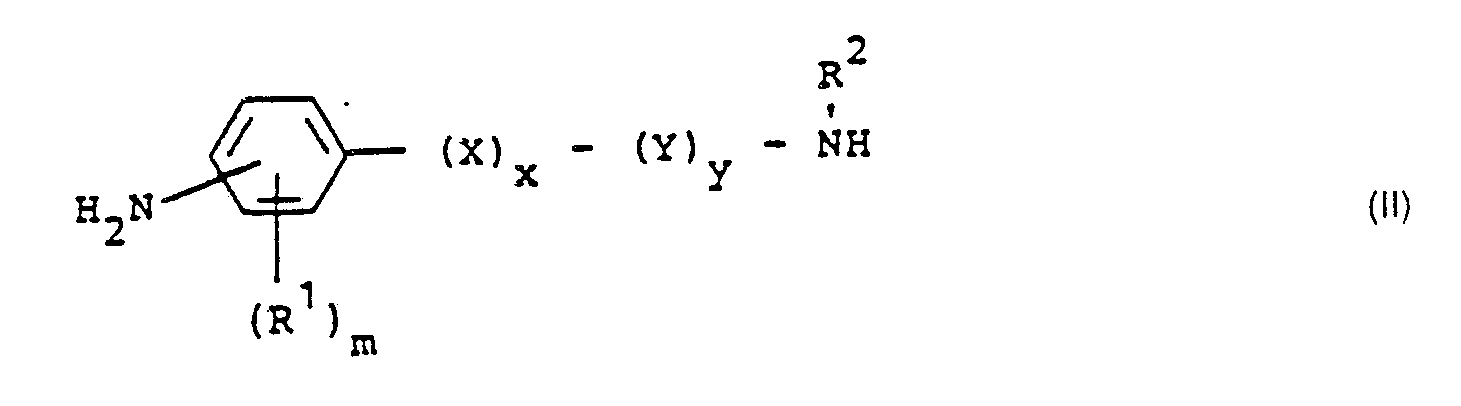
- X ―CH2―CH2―CH2―, -NH-, (dabei muß y ≠ Null sein), -NR4-, (dabei muß y ≠ Null sein), -0-, (dabei muß y ≠ Null sein), -S-, (dabei muß y ≠ Null sein),
- x 0 oder 1,
- Y

- Z = Null oder ganze Zahlen von 1 bis 6,
- p = Null oder ganze Zahlen von 1 bis 6,
- y 0 oder 1 und
- R5 H oder Methyl bedeutet.
- (―S) m -, ―SO 2 , -0-, preferably Z = ―CH 2 - and ―C (CH 3 ) 2 -
- R 1 optionally branched C 1 -C 13 alkyl,
- R 2 H, optionally branched C 1 -C 6 alkyl,
- R 3 H, aryl, optionally branched C 1 -C 6 alkyl,
- R 4 optionally branched C 1 -C 6 alkyl,
- m 0, 1, 2 or 3,
- p 0 or 1
- where for formula (I) applies: (m + p) = 0, 1, 2, 3 or 4;
- X ―CH 2 ―CH 2 ―CH 2 -, -NH-, (where y ≠ must be zero), -NR 4- , (where y ≠ must be zero), -0-, (where y ≠ must be zero ), -S-, (where y ≠ must be zero),
- x 0 or 1,
- Y
- Z = zero or integers from 1 to 6,
- p = zero or integers from 1 to 6,
- y 0 or 1 and
- R 5 denotes H or methyl.
Weiterhin sind aromatische Polyamine der Formeln (III) oder (IV), vorzugsweise aromatische Diamine mit unterschiedlicher Reaktivität der Aminogruppen (aus sterischen Gründen oder Substituenteneffekten) geeignet :

- R6 = Cl-C3-Alkyl, jedoch nicht in Nachbarschaft sur NH2-Gruppe,
- m = 0, 1, 2 oder 3,
- p = 0 oder 1, wobei (m + p) = 1, 2, 3 oder 4 sein muß,
- q = 0 oder 1, wobei (m + p) ―q 1 sein muß ;
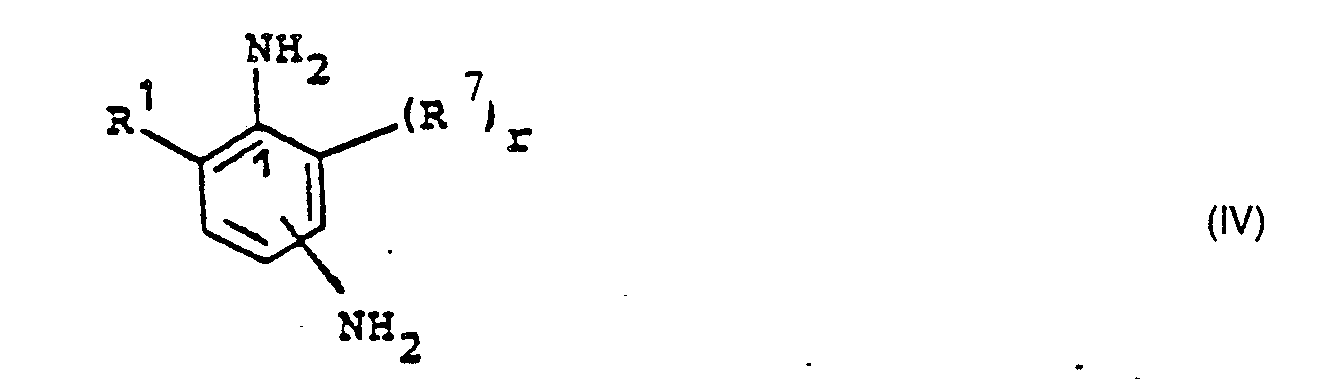
- (Die zweite NH2-Gruppe ist in meta- oder para-Stellung zur ersten Aminogruppe ; mindestens eine Nachbarstellung zu der zweiten Aminogruppe muß unsubstituiert bleiben)
- R7 = C2-C4-Alkyl, gegebenenfalls verzweigt,
- r = 0 oder 1, wobei im Falle von R' = COOR4 r = Null sein kann.
- Durch die Wahl der Substituenten R1 und R4 und/oder durch die Summe von p und m kann die Aktivität der weniger reaktiven aromatischen (primären) Aminogruppe in weiten Grenzen variiert werden.

- R 6 = C 1 -C 3 alkyl, but not in the vicinity of the NH 2 group,
- m = 0, 1, 2 or 3,
- p = 0 or 1, where (m + p) = 1, 2, 3 or 4,
- q = 0 or 1, where (m + p) ―q must be 1;
- (The second NH 2 group is in the meta or para position to the first amino group; at least one neighboring position to the second amino group must remain unsubstituted)
- R 7 = C 2- C 4 alkyl, optionally branched,
- r = 0 or 1, where in the case of R '= COOR 4 r = zero.
- The activity of the less reactive aromatic (primary) amino group can be varied within wide limits by the choice of the substituents R 1 and R 4 and / or by the sum of p and m.
Bevorzugte aromatische Diamine mit underschiedlich reaktiven Aminogruppen sind solche der Formel VI :
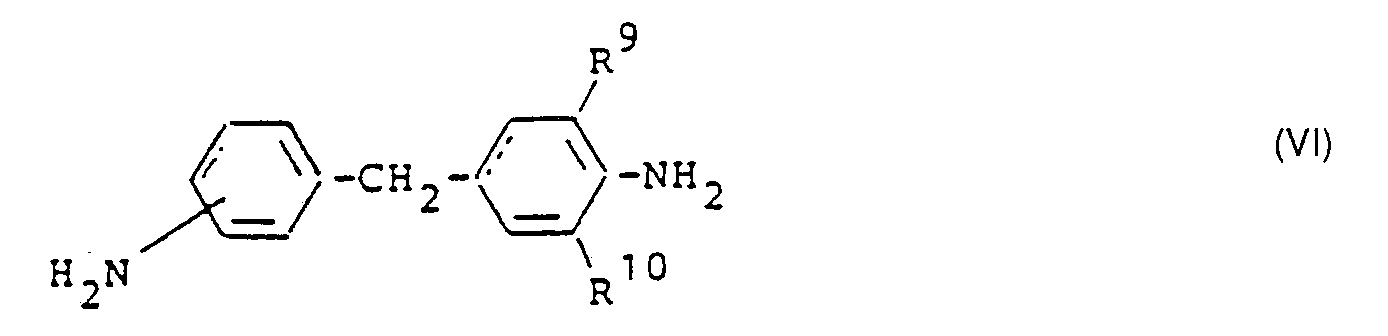
- R9 lineare oder gegebenenfalls verzweigte Alkylgruppen mit 1 bis 4 C-Atomen, ―CO2R4 oder Halogen (F, Cl, Br oder J)
- und
- R10 lineare oder gegebenenfalls verzweigte Alkylgruppen mit 1 bis 4 C-Atomen oder Halogen sind.
- R 9 linear or optionally branched alkyl groups with 1 to 4 carbon atoms, ―CO 2 R 4 or halogen (F, Cl, Br or J)
- and
- R 10 are linear or optionally branched alkyl groups with 1 to 4 carbon atoms or halogen.
In der Formeln (II) bis (VI) haben die nicht genannten Substituenten die gleiche Bedeutung wie in Formel (I) ; für den Fall, daß die Substituenten am aromatischen Kern entfallen, so steht an dieser Stelle ein Wasserstoff, was nicht besonders gekennzeichnet wird.In formulas (II) to (VI), the substituents not mentioned have the same meaning as in formula (I); in the event that the substituents on the aromatic nucleus are omitted, there is a hydrogen at this point, which is not particularly marked.
Neben den Verbindungen der Formeln (I) bis (VI) sind weitere, ausgewählte Verbindungen geeignet, wie sie in der folgenden Aufzählung enthalten sind :
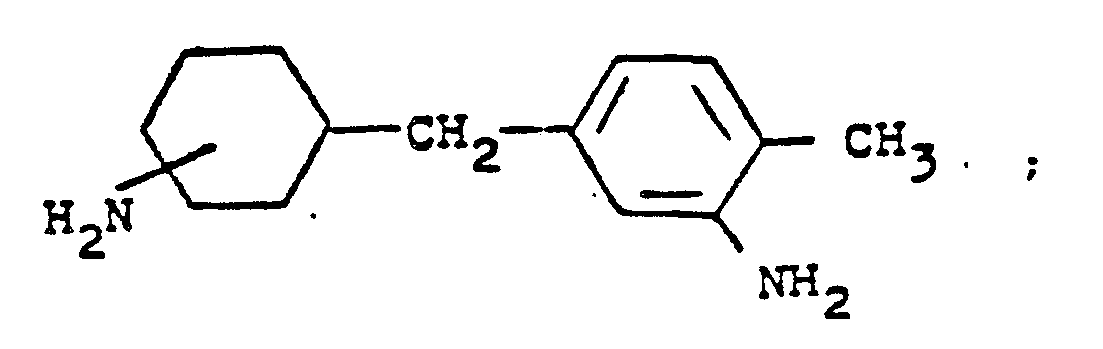

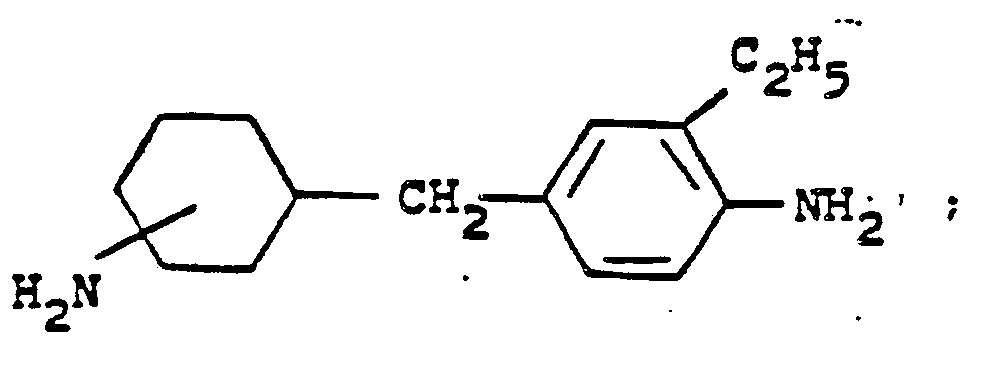


Die Umsetzung des noch NCO-Gruppen in den angegebenen Mengen tragenden, höhermolekularen Polyurethans in Form seiner Lösungen mit den Kettenabbruchsmitteln D) erfolgt in einem Verhältnis von 1 : bis 1 : 1,66, vorzugsweise 1 : 2,5 bis 1 : 1,95 und besonders bevorzugt mit den rechnerisch äquivalenten Mengen 1 : 2. Hierbei bilden sich Polyurethane mit endständigen aromatischen Aminogruppen, welche in der Menge etwa den endständigen NCO-Gruppen im berreits höhermolekularen Polyurethan des Mindestmolekulargewichts 10000 entsprechen.The reaction of the higher molecular weight polyurethane still carrying NCO groups in the stated amounts in the form of its solutions with the chain terminators D) takes place in a ratio of 1: to 1: 1.66, preferably 1: 2.5 to 1: 1.95 and particularly preferably with the arithmetically equivalent amounts 1: 2. Polyurethanes with terminal aromatic amino groups are formed, the amount of which corresponds approximately to the terminal NCO groups in the already higher molecular weight polyurethane of the minimum molecular weight 10,000.
Bei Umsetzungen im Molverhältnis zwischen 1 : 1,6
Die so nach Kettenabbruchsreaktion erhaltenen hochmolekularen Polyurethane enthalten aromatische Endgruppen in Mengen, die den vorher vorhandenen NCO-Gruppen entsprechen und gegebenenfalls sehr geringe Mengen an den überschüssigen Diaminen, soweit Überschüsse eingesetzt wurden. Trotzdem sind die Lösungen viskositätsstabil und erleiden keinen Abbau, wie dies bei aliphatischen Aminen der Fall sein kann.The high molecular weight polyurethanes thus obtained after the chain termination reaction contain aromatic end groups in amounts which correspond to the previously existing NCO groups and, if appropriate, very small amounts of the excess diamines, to the extent that excesses have been used. Nevertheless, the solutions are stable in viscosity and do not suffer degradation, as can be the case with aliphatic amines.
Die so hergestellten, aromatische Aminoendgruppen enthaltenden Polyurethane zeigen im wesentlichen die Eigenschaften der Polyurethane, wie sie den Baukomponenten A), B) und C) entsprechen. Ihre sehr untergeordnete Menge hat praktisch keinen Einfluß auf die Lichtbeständigkeit der Polyurethane. wodurch die Einführung der aromatischen Aminoendgruppen die Vernetzbarkeit und Verknüpfung mit den für die Verwendung wichtigen, als Vernetzer wirksamen Polyisocyanaten gegeben ist.The polyurethanes thus produced, containing aromatic amino end groups, essentially show the properties of the polyurethanes which correspond to the structural components A), B) and C). Their very minor amount has practically no influence on the light resistance of the polyurethanes. whereby the introduction of the aromatic amino end groups provides crosslinkability and linkage with the polyisocyanates which are important for use and act as crosslinkers.
Den Lösungen können selbstverständlich die üblichen Zusatzstoffe wie UV-Stabilisatoren, Antioxidantien, Lichtschutzmittel, Additive, Gleitmittel, Füllstoffe, Farbstoffe, Siliconderivate oder weitere lösliche Polymere bzw. Pigmente oder Kurzfasern beigemischt werden. Die aromatischen Aminoendgruppen aufweisenden Polyurethane nach dem Verfahren der Erfindung können als Einkomponentenpolyurethan einer üblichen Verarbeitung, z. B. als Beschichtung, zugeführt werden. Die bevorzugte Verwendung finden sie jedoch in Zweikomponentenpolyurethansystemen, indem sie mit Mengen von 1 bis 30, bzw. 2 bis 25 Gew.% bezogen auf Polyurethan, an mehr als zweifunktionellen Polyisocyanaten versetzt werden. Derartige Polyisocyanate sind aliphatische oder cycloaliphatische, bevorzugt aromatische Polyisocyanate mit einer Funktionalität über 2,5, vorzugsweise von - 3 z. B. Biurettriisocyanate oder Trimerisate des Hexamethylendiisocyanats oder Isophorondiisocyanats, trimeres Toluylen-2,4-diisocyanat, Mischtrimere aus Hexandiisocyanat und Toluyendiisocyanat, Umsetzungsprodukte von Toluylen-2,4-diisocyanat mit Triolen oder Polyolen, z. B. mit Trimethylolpropan, oder polyfunktionelle Mehrkernpolyisocyanate auf Basis von Polyaminen aus der Anilin-Formaldehyd-Kondensationsreaktion.The usual additives such as UV stabilizers, antioxidants, light stabilizers, additives, lubricants, fillers, dyes, silicone derivatives or other soluble polymers or pigments or short fibers can of course be added to the solutions. The aromatic amino-terminated polyurethanes according to the process of the invention can be used as one-component polyurethane in conventional processing, e.g. B. as a coating. However, their preferred use is in two-component polyurethane systems, in which amounts of 1 to 30 or 2 to 25% by weight, based on polyurethane, of more than two-functional polyisocyanates are added. Such polyisocyanates are aliphatic or cycloaliphatic, preferably aromatic polyisocyanates with a functionality of more than 2.5, preferably from - 3 z. B. biuret triisocyanates or trimer of hexamethylene diisocyanate or isophorone diisocyanate, trimeric tolylene-2,4-diisocyanate, mixed trimers of hexane diisocyanate and toluyene diisocyanate, reaction products of toluene-2,4-diisocyanate with triols or polyols, e.g. B. with trimethylolpropane, or polyfunctional multi-core polyisocyanates based on polyamines from the aniline-formaldehyde condensation reaction.
Sollen bei der Vernetzung der erfindungsgemäß zugänglichen Polyurethane besondere Effekte gewünscht werden, können den Zweikomponentenpolyurethanlösungen noch andere Polymere zugesetzt werden, z. B. Zelluloseacetobutyrate, Nitrozellulose, hydroxygruppenhaltige VinylchloridNinylacetat-Copolymerisate, hydroxygruppenhaltige Acrylate oder Polyvinylchlorid, oder auch weitere modifizierende Polyurethan-Reaktions-komponenten wie höherfunktionelle Hydroxypolyester oder auch weitere aromatische Polyamine, wie beispielsweise 4,4'-Diaminodiphenylmethan, 4,4'-Diamino-3,5-diisopropyldi- phenylmethan oder 2,4-Diamino-3,5-diethyltoluol.If special effects are desired in the crosslinking of the polyurethanes accessible according to the invention, other polymers can also be added to the two-component polyurethane solutions, e.g. B. cellulose acetobutyrates, nitrocellulose, hydroxyl-containing vinyl chloride-vinyl acetate copolymers, hydroxyl-containing acrylates or polyvinyl chloride, or also other modifying polyurethane reaction components such as higher-functional hydroxypolyesters or other aromatic polyamines, such as 4,4'-diaminodiphenylmethane, 4,4'-diamino 3,5-diisopropyldiphenylmethane or 2,4-diamino-3,5-diethyltoluene.
Die genannten Vernetzer-Polyisocyanate können den Lösungen untergerührt werden, ohne daß ein nennenswerter Viskositätsanstieg innerhalb einer Verarbeitungszeit von Stunden oder gegebenenfalls wenigen Tagen eintritt. Die Polyisocyanate können gegebenenfalls aber auch bei kontinuierlichen Beschichtungsvorgängen in dem beabsichtigten Mischungsverhältnis kontinuierlich kurz vor der Applikationsstelle untergemischt werden.The crosslinking polyisocyanates mentioned can be stirred into the solutions without any appreciable increase in viscosity occurring within a processing time of hours or possibly a few days. However, the polyisocyanates can optionally also be mixed in continuously in the intended mixing ratio in the intended mixing ratio shortly before the application point.
Nach oder während der Entfernung der Lösungsmittel tritt eine gewünschte Vernetzung ein, die relativ unempfindlich gegenüber Wasserspuren in den Lösungsmitteln ist und zu einer sicheren Verknüpfung der Aminoendgruppen-haltigen Polyurethane mit den übrigen Vernetzerpolyisocyanaten und deren Reaktionsprodukten, die sich z. B. durch Reaktion mit Luftfeuchtigkeit ergeben, führt. Die notwendigen Vernetzungstemperaturen sind gegenüber Hydroxylendgruppen-haltigen Polyurethanen deutlich vermindert bzw. die Vernetzungsdichte und die davon abhängigen Eigenschaften verbessert. Eine Vernetzung tritt nach Entfernung. der Lösungsmittel und längerem Lagern auch bereits bei Raumtemperatur ein. Die Vernetzungseffekte sind insgesamt deutlich günstiger als bei den vorbekannten Hydroxylendgruppen-tragenden Polyurethanen. Daher finden derartige Polyurethanzubereitungen bevorzugten Einsatz zur Beschichtung von textilien Unterlagen (Geweben, Gewirken oder Vliesen), insbesondere wärmesensiblen textilen Unterlagen oder Leder oder als Klebstoffe, insbesondere für wärmesensible Kunststoffsubstrate.After or during the removal of the solvents, a desired crosslinking occurs, which is relatively insensitive to traces of water in the solvents and to securely link the amino-end group-containing polyurethanes to the other crosslinking polyisocyanates and their reaction products, which are e.g. B. result from reaction with humidity, leads. The necessary crosslinking temperatures are significantly reduced compared to hydroxyl-end-containing polyurethanes or the crosslinking density and the properties dependent thereon are improved. Networking occurs after removal. the solvent and prolonged storage even at room temperature. The crosslinking effects are overall significantly more favorable than in the case of the known hydroxyl-terminated polyurethanes. Such polyurethane preparations are therefore preferably used for coating textile underlays (woven, knitted or nonwoven), in particular heat-sensitive textile underlays or leather or as adhesives, in particular for heat-sensitive plastic substrates.
1 241 g eines Polyesters aus Adipinsäure und Butandiol-1,4 der OH-Zahl : 122 und einer Säurezahl von < 0,9 werden 1 Stunde bei 100 °C im Wasserstrahlvakuum entwässert. Es werden 4900 g Tetrahydrofuran zugegeben. Nach Zugabe von 121,5 g Butandiol-1,4 werden 737,3 g 4,4'-Diisocyanatodiphenylmethan zugegeben. Nach Katalyse mit 12,5 ppm (bezogen auf Polyester) Dibutylzinndilaurat wird die Reaktion bei 50 bis 55 °C bis zu einem konstanten NCO-Wert (0,22 % in der Lösung nach 19 Stunden - entsprechend 0,73 % NCO in der PU-Festsubstanz).1 241 g of a polyester of adipic acid and 1,4-butanediol with an OH number of 122 and an acid number of <0.9 are dewatered for 1 hour at 100 ° C. in a water jet vacuum. 4900 g of tetrahydrofuran are added. After adding 121.5 g of 1,4-butanediol, 737.3 g of 4,4'-diisocyanatodiphenylmethane are added. After catalysis with 12.5 ppm (based on polyester) of dibutyltin dilaurate, the reaction at 50 to 55 ° C to a constant NCO value (0.22% in the solution after 19 hours - corresponding to 0.73% NCO in the PU -Solid substance).
Jeweils 600 des NCO-Prepolymeren werden mit einer 10%igen Lösung von 1-Amino-3.3,5-trimethyl-5-aminomethylcyclohexan in Tetrahydrofuran zu 75 % der Theorie kettenverlängert. Man erhält Lösungen mit einer Viskosität von 30 000 mPa.s bei 25 °C und einem NCO-Gehalt von 0,055 % bezogen auf PU-Lösung, entsprechend 0,183% NCO, bezogen auf PU-Festsubstanz. Dies entspricht nach der angegebenen Formel einem mittleren Molekulargewicht von etwa 45 000.In each case 600% of the NCO prepolymer are chain-extended to 75% of theory with a 10% strength solution of 1-amino-3,3,5-trimethyl-5-aminomethylcyclohexane in tetrahydrofuran. Solutions with a viscosity of 30,000 mPa.s at 25 ° C. and an NCO content of 0.055% based on PU solution, corresponding to 0.183% NCO based on PU solid substance, are obtained. According to the formula given, this corresponds to an average molecular weight of approximately 45,000.
Die Lösungen wurden mit verschiedenen Abstoppern (siehe Tabelle 1) versetzt (erfindungsgemäß und Vergleichsversuche) und auf 20 % Feststoff mit Tetrahydrofuran verdünnt.

Anstatt 737,3 g werden 747,3 g Diisocyanatodiphenylmethan verwendet. Man erhält einen (stabilen) NCO-Endwert der PU-Lösung von 0,31 %, der einem mittleren Molekulargewicht von nur ca. 8 100 entspricht. 600 g des Prepolymers werden mit 9,65 g des araliphatischen Diamins

Die 20 %ige Lösung hat eine Viskosität von 250 mPa.s bei 25 °C und verpastet nach 1-wöchigem Stehen bei Raumtemperatur, zeigt also nicht die gewünschte Lagerstabilität.The 20% solution has a viscosity of 250 mPa.s at 25 ° C and pastes after standing for 1 week at room temperature, so does not show the desired storage stability.
1 281 g Polytetramethylenetherglykol (Polymeg 1 000 Quaker Oats) der OH-Zahl 112,2 wurden 1 h bei 100 °C im Wasserstrahlvakuum entwässert. 4 900 g Tetrahydrofuran (THF) wurden zugegeben. 115,3 g Butandiol-1,4 wurden bei 40 °C eingerührt, gefolgt von 703,2 g 4,4'-Diisocyanatodiphenylmethan. Nach Zugabe von 12.5 ppm Dibutylzinndilaurat (bezogen auf Polyether) wurde die Reaktion bei 50 bis 55 °C bis zum Erreichen eines konstanten NCO-Wertes von 0,26 % in der Lösung weitergeführt (5 Stunden).1,281 g of polytetramethylene ether glycol (Polymeg 1,000 Quaker Oats) with OH number 112.2 were dewatered at 100 ° C. in a water jet vacuum. 4,900 g of tetrahydrofuran (THF) were added. 115.3 g 1,4-butanediol were stirred in at 40 ° C., followed by 703.2 g 4,4'-diisocyanatodiphenylmethane. After adding 12.5 ppm of dibutyltin dilaurate (based on polyether), the reaction was continued at 50 to 55 ° C. until a constant NCO value of 0.26% was reached in the solution (5 hours).
Jeweils 600 g des NCO-haltigen, bereits höhermolekularen Prepolymeren wurde zu 45 % der Theorie der NCO-Gruppen mit Isophorondiamin verlängert, was einem mittleren Molekulargewicht des NCO-Endgruppen-haltigen Polyurethans von ca. 17500 entspricht.Each 600 g of the NCO-containing, already higher molecular weight prepolymer was extended to 45% of the theory of the NCO groups with isophoronediamine, which corresponds to an average molecular weight of the NCO-end group-containing polyurethane of about 17500.
Die Lösungen wurden abgestoppt (erfindungsgemäß oder Vergleichsversuche) und mit Tetrahydrofuran (THF) auf 20 % Feststoffgehalt verdünnt.

Anstatt 703,2 g 4.4'-Diisocyanatodiphenylmethan werden 725 g verwendet. Man erhält einen stabilen NCO-Wert von 0,32 % in der PU-Lösung (mittleres Molekulargewicht des NCO-Endgruppen-haltigen « Polyurethans ca. 8 000).Instead of 703.2 g of 4,4'-diisocyanatodiphenylmethane, 725 g are used. A stable NCO value of 0.32% is obtained in the PU solution (average molecular weight of the polyurethane containing NCO end groups approx. 8,000).
1 100 g des Prepolymeren werden mit 18,3 g des Diamins
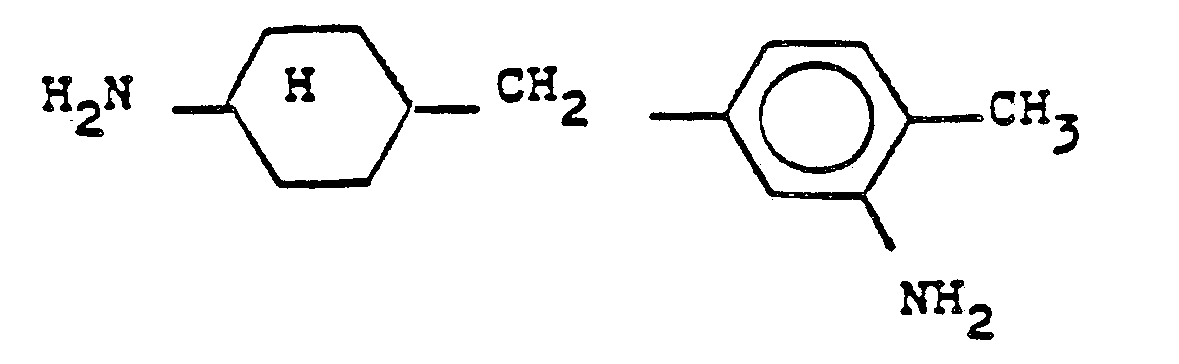
1 000 g eines Polyesters aus Adipinsäure und Butandiol-1,4 (OH-Zahl 50,0, Säurezahl 0,8) werden für eine Stunde bei 100 °C im Wasserstrahlvakuum entwässert. Nach Zugabe von 96 g Butandiol-1,4, 66,1 g Ethylenglykol und 4 260 g Tetrahydrofuran werden bei 40 bis 45 °C 670 g 4,4-Diisocyanatodiphenylmethan zugegeben. Die Reaktion läßt die Temperatur auf 55 °C ansteigen.1,000 g of a polyester of adipic acid and 1,4-butanediol (OH number 50.0, acid number 0.8) are dewatered for one hour at 100 ° C. in a water jet vacuum. After adding 96 g of 1,4-butanediol, 66.1 g of ethylene glycol and 4,260 g of tetrahydrofuran, 670 g of 4,4-diisocyanatodiphenylmethane are added at 40 to 45 ° C. The reaction allowed the temperature to rise to 55 ° C.
Nach Erreichen einer Viskosität von ca. 30 000 mPa.s bei 25 °C wird der Rest-NCO-Wert ermittelt und die Lösung abgestoppt. Anschließend wird mit THF auf 20 % Feststoff verdünnt.

Zur einer Lösung von 266,1 g einer Mischung von 65 % 2,4- und 35 % 2,6-Toluylendiisocyanat in 800 g Tetrahydrofuran (THF) werden eine Lösung von 66,58 g Butandiol-1,4 und 87,29 g Hexandiol-1,6 in 180 g THF derart eingetropft, daß die exotherme Reaktion die Temperatur bei 55 bis 60 °C hält. Nach 8 Stunden bei 50 bis 55 °C wird ein konstanter NCO-Wert von 0,17 % in der PU-Lösung erhalten.To a solution of 266.1 g of a mixture of 65% 2,4- and 35% 2,6-tolylene diisocyanate in 800 g tetrahydrofuran (THF) are a solution of 66.58 g 1,4-butanediol and 87.29 g Hexanediol-1.6 added dropwise in 180 g of THF in such a way that the exothermic reaction maintains the temperature at 55 to 60 ° C. After 8 hours at 50 to 55 ° C, a constant NCO value of 0.17% is obtained in the PU solution.
Die Lösung wird zu 34 % des NCO-Gehaltes mit 1,65 g Isophorondiamin verlängert, wobei die Viskosität von 1000mPa.s bei 28 °C auf 16 000 mPa.s bei 43 °C ansteigt. Mit 8,15 g (3-Amino-4-methylbenzyl)-cyclohexylamin wird abgestoppt. Man erhält nach Verdünnen auf 20 % Feststoff eine stabile Lösung mit einer Viskosität von 3 950 mPa.s.The solution is extended to 34% of the NCO content with 1.65 g of isophoronediamine, the viscosity increasing from 1000 mPa.s at 28 ° C to 16,000 mPa.s at 43 ° C. It is stopped with 8.15 g (3-amino-4-methylbenzyl) cyclohexylamine. After dilution to 20% solids, a stable solution with a viscosity of 3,950 mPa.s.
325 g eines Phthalsäure/Adipinsäure-Ethylenglykolesters (MG 1 750) und 75 g Ethylenglykol-Butandiolpolyadipats (MG 2 000) werden mit 46,0 g einer Mischung von 65 % 2,4- und 35 % 2,6-Toluylendiisocyanat bei 80 °C verrührt. Mit zunehmender Viskosität werden 192 g Ethylacetat zugetropft. Nach 12 Stunden erhält man einen NCO-Wert von 0,54 % (entspricht einem mittleren MG von 10 900).325 g of a phthalic acid / adipic acid ethylene glycol ester (MW 1 750) and 75 g of ethylene glycol butanediol polyadipate (MW 2 000) are mixed with 46.0 g of a mixture of 65% 2,4- and 35% 2,6-tolylene diisocyanate at 80 ° C stirred. With increasing viscosity, 192 g of ethyl acetate are added dropwise. After 12 hours, an NCO value of 0.54% is obtained (corresponds to an average MW of 10,900).
Mit 18,2 g

Man erhält eine stabile Lösung der Viskosität 14 000 mPa.s bei 25 °C.A stable solution with a viscosity of 14,000 mPa.s at 25 ° C. is obtained.
254 g eines Hexandiolpolycarbonats der OH-Zahl 271,5 werden in 980 g Tetrahydrofuran gelöst. Nach Zugabe von 166,1 g 4,4'-Diisocyanatodiphenyimethan steigt die Temperatur langsam auf 56 °C. Nach Abklingen der leicht exothermen Reaktion wird die Lösung noch 4 Stunden bei 50 bis 60 °C gehalten.254 g of a hexanediol polycarbonate with an OH number of 271.5 are dissolved in 980 g of tetrahydrofuran. After adding 166.1 g of 4,4'-diisocyanatodiphenyimethane, the temperature slowly rises to 56 ° C. After the slightly exothermic reaction has subsided, the solution is kept at 50 to 60 ° C. for a further 4 hours.
Man erhält einen stabilen NCO-Wert mit einem NCO-Gehalt von 0,13 % in der PU-Lösung.A stable NCO value with an NCO content of 0.13% in the PU solution is obtained.
1 100 g des Prepolymeren werden durch Zugabe von 0,72 g Isophorondiamin zu 25 % verlängert, wobei die Viskosität von 4 000 mPa.s bei 24 °C direkt auf 12 000 mPa.s bei 46 °C ansteigt. Durch Zugabe von 5,6 g 4-(3-Amino-4-methylbenzyl)-cyclohexylamin wird abgestoppt. Nach Verdünnen mit Tetrahydrofuran auf 20 % Feststoff erhält man eine stabile Lösung mit einer Viskosität von 2 100 mPa.s.1 100 g of the prepolymer are extended by 25% by adding 0.72 g of isophoronediamine, the viscosity increasing directly from 4,000 mPa.s at 24 ° C to 12,000 mPa.s at 46 ° C. It is stopped by adding 5.6 g of 4- (3-amino-4-methylbenzyl) cyclohexylamine. After dilution with tetrahydrofuran to 20% solids, a stable solution with a viscosity of 2,100 mPa.s.
366 g eines 1,4-Dimethylcyclohexanpolycarbonats der OH-Zahl 56,1 werden in 980 g Tetrahydrofuran mit 53,8 g 4,4'-Diisocyanatodiphenylmethan versetzt. Nach 6 Stunden bei 55 °C erhält man ein stabiles Prepolymer mit einem NCO-Gehalt von 0,16 % in der NCO-Lösung.366 g of a 1,4-dimethylcyclohexane polycarbonate having an OH number of 56.1 are mixed with 53.8 g of 4,4'-diisocyanatodiphenylmethane in 980 g of tetrahydrofuran. After 6 hours at 55 ° C., a stable prepolymer with an NCO content of 0.16% in the NCO solution is obtained.
1 100 g des Prepolymeren werden mit einer Mischung von 0,66 Isophorondiamin und 0,015 g N-Methylethanolamin verlängert, wobei die Viskosität von 4300 mPa.s bei 31 °C schnell auf 16400 mPa.s bei 44 °C ansteigt.1 100 g of the prepolymer are extended with a mixture of 0.66 isophoronediamine and 0.015 g of N-methylethanolamine, the viscosity rapidly increasing from 4300 mPa.s at 31 ° C to 16400 mPa.s at 44 ° C.
Durch Zugabe von 7,37 g 4-(3-Amino-4-methylbenzyl)-cyclohexylamin wird abgestoppt. Nach Verdünnen mit Tetrahydrofuran auf 20% Feststoffgehalt erhält man eine stabile Lösung der Viskosität 2 800 mPa.s.It is stopped by adding 7.37 g of 4- (3-amino-4-methylbenzyl) cyclohexylamine. After dilution with tetrahydrofuran to a solids content of 20%, a stable solution with a viscosity of 2,800 mPa.s.
265 g 2,2-Bis-(4-(2-hydroxy-ethoxy)-phenyl-propan werden in 980 g Tetrahydrofuran mit 154,7 g eines Gemisches aus 65 % 2,4- und 35 % 2,6-Toluylendiisocyanat versetzt. Nach Zugabe von 0,5 ml einer 1 %igen Dibutylzinndilaurat-Lösung in THF wird die Lösung 28 h auf 50 bis 60 °C erwärmt. Man erhält ein Prepolymer mit einem konstanten NCO-Wert von 0,44 % bezogen auf PU-Lösung.154.7 g of a mixture of 65% 2,4- and 35% 2,6-tolylene diisocyanate are added to 265 g 2,2-bis (4- (2-hydroxy-ethoxy) phenyl propane in 980 g tetrahydrofuran After adding 0.5 ml of a 1% dibutyltin dilaurate solution in THF, the solution is heated for 28 hours at 50 to 60 ° C. A prepolymer is obtained with a constant NCO value of 0.44% based on the PU solution .
955 g des Prepolymeren werden mit 6,8 g Isophorondiamin verlängert, wobei die Viskosität von 500 mPa.s bei 21 °C direkt auf 18 000 mPa.s bei 29 °C ansteigt.955 g of the prepolymer are extended with 6.8 g of isophoronediamine, the viscosity increasing directly from 500 mPa.s at 21 ° C. to 18,000 mPa.s at 29 ° C.
Mit 4,36 g 4-(3-Amino-4-methylbenzyl)-cyclohexylamin wird abgestoppt. Man erhält nach Verdünnen mit THF auf 20 % Feststoff eine stabile Lösung der Viskosität 3 000 mPa.s.The mixture is stopped with 4.36 g of 4- (3-amino-4-methylbenzyl) cyclohexylamine. After dilution with THF to 20% solids, a stable solution with a viscosity of 3,000 mPa.s.
331 g eines Hexandiolpolycarbonats der OH-Zahl 160 werden bei 60 °C mit 89,2 g einer Mischung von 65 % 2,4- und 35 % 2,6-Toluylendiisocyanat in 180 g Ethylacetat zur Reaktion gebracht. Man erhält ein Prepolymer mit einem stabilen NCO-Wert von 0,45 %. Das Prepolymer wird mit 14,0 g 4-(3-Amino-4-methylbenzyl)-cyclohexylamin abgestoppt und auf 50 % Feststoff verdünnt. Man erhält eine stabile Lösung der Viskosität 2500 mPa.s.331 g of a hexanediol polycarbonate having an OH number of 160 are at 60 ° C. with 89.2 g of a mixture 65% 2,4- and 35% 2,6-tolylene diisocyanate in 180 g of ethyl acetate reacted. A prepolymer with a stable NCO value of 0.45% is obtained. The prepolymer is quenched with 14.0 g of 4- (3-amino-4-methylbenzyl) cyclohexylamine and diluted to 50% solids. A stable solution with a viscosity of 2500 mPa.s.
116,8 eines Hexandiolpolycarbonats der OH-Zahl 56 in 980 g Tehydrofuran werden bei 50° mit 216,7 g eines Gemisches aus 65 % 2,4- und 35 % 2,6-Toluylendiisocyanat vermischt. Nach Zugabe von 12,5 ppm (bezogen auf Polyether) Dibutylzinndilaurat werden 30 Minuten nachgerührt. Anschließend werden eine Mischung von 51,23 g Butandiol-1,4 und 35,3 g Ethylenglykol eingetropft. Nach 30 Stunden bei 55-60 °C erhält man einen konstanten NCO-Wert von 0,17 %. 1 100 g des Prepolymeren werden zu 75 % d. Th. mit Isophorondiamin verlängert wobei die Viskosität von 1 000 mPas bei 24 °C auf 16.000 mPas bei 31 °C ansteigt. Durch Angabe von 2,21 g 4-(3-Amino-4-Methylbenzyl)-cyclohexylamin wird abgestoppt. Nach Verdünnen mit THF hat die Lösung eine Viskosität von 2760 mPas.116.8 of a hexanediol polycarbonate of OH number 56 in 980 g of tehydrofuran are mixed at 50 ° with 216.7 g of a mixture of 65% 2,4- and 35% 2,6-tolylene diisocyanate. After adding 12.5 ppm (based on polyether) of dibutyltin dilaurate, stirring is continued for 30 minutes. A mixture of 51.23 g of 1,4-butanediol and 35.3 g of ethylene glycol are then added dropwise. After 30 hours at 55-60 ° C, a constant NCO value of 0.17% is obtained. 1 100 g of the prepolymer are 75% of theory. Th. With isophoronediamine, the viscosity increasing from 1,000 mPas at 24 ° C to 16,000 mPas at 31 ° C. Stopping 2.21 g of 4- (3-amino-4-methylbenzyl) cyclohexylamine. After dilution with THF, the solution has a viscosity of 2760 mPas.
292 g eines Hexandiol-polycarbonats der OH-Zahl 105,8 in 980 g Tetrahydrofuran werden bei 50 °C mit 115,7 g 4,4'-Diisocyanatodiphenylmethan gemischt. Nach 30 Minuten werden 8,12 g Hexandiol-1,6 und 4,27 g Ethylenglycol als Mischung eingetropft. Nach 6 Stunden bei 50-55 °C erhält man einen konstanten NCO-Wert von 0,17 %. 1 100 g des Prepolymeren werden zu 10 % d. Th. mit Isophorondiamin verlängert, wobei die Viskosität von 6 800 mPas bei 24 °C auf 16.000 mPas bei 44 °C ansteigt. Durch Zugabe von 8,75 g 4-(3-Amino-4-methylbenzyl)-cyclohexylamin wird abgestoppt. Nach Verdünnen mit THF auf einen Feststoffgehalt von 20 % besitzt die Lösung eine Viskosität von 2 800 mPas.292 g of a hexanediol polycarbonate with an OH number of 105.8 in 980 g of tetrahydrofuran are mixed at 5 0 ° C with 115.7 g of 4,4'-diisocyanatodiphenylmethane. After 30 minutes, 8.12 g of 1,6-hexanediol and 4.27 g of ethylene glycol are added dropwise as a mixture. After 6 hours at 50-55 ° C, a constant NCO value of 0.17% is obtained. 1 100 g of the prepolymer are 10% d. Th. With isophoronediamine, the viscosity increasing from 6,800 mPas at 24 ° C to 16,000 mPas at 44 ° C. It is stopped by adding 8.75 g of 4- (3-amino-4-methylbenzyl) cyclohexylamine. After dilution with THF to a solids content of 20%, the solution has a viscosity of 2,800 mPas.
Die Lösungen wurden mit Wasser versetzt, so daß ein Wassergehalt von 0,5 % resultierte und auf 100 g 20 %ige Polymerlösung wurden 5 eines Polyisocyanates (Desmodur L-75 der Bayer AG) eingerührt.The solutions were mixed with water so that a water content of 0.5% resulted and 5 of a polyisocyanate (Desmodur L-75 from Bayer AG) were stirred into 100 g of 20% polymer solution.
Mit einem 1 000 µm-Rakel wurden Filme auf Glasplatten gezogen. Die Filme wurden nach einer Woche Lagern unter Normalbedingungen vermessen.Films were drawn on glass plates using a 1,000 µm doctor blade. The films were measured after one week of storage under normal conditions.
Zur Bestimmung des Vernetzungsgrades wurden gewogene Filmstücke eine Stunde in THF gelagert und die Volumenquellung bestimmt und anschließend getrocknet und die Gewichtsänderung festgestellt. Die Werte sind in der nachfolgenden Tabelle aufgeführt.
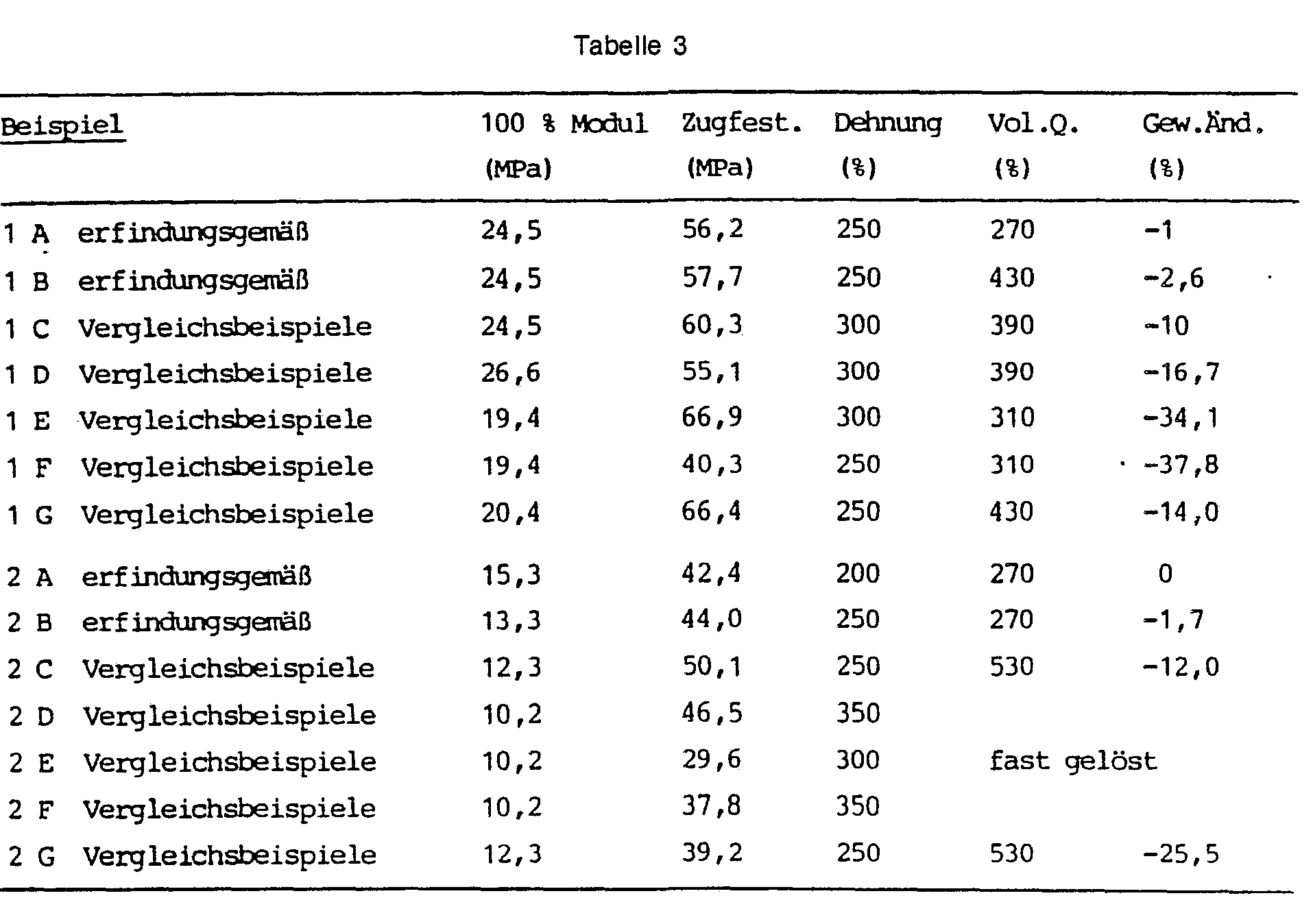

Claims (15)


Applications Claiming Priority (2)
| Application Number | Priority Date | Filing Date | Title |
|---|---|---|---|
| DE3401753 | 1984-01-19 | ||
| DE19843401753 DE3401753A1 (en) | 1984-01-19 | 1984-01-19 | METHOD FOR THE PRODUCTION OF POLYURETHANES, POLYURETHANES WITH AROMATIC AMINO END GROUPS AND THE USE THEREOF |
Publications (2)
| Publication Number | Publication Date |
|---|---|
| EP0154768A1 EP0154768A1 (en) | 1985-09-18 |
| EP0154768B1 true EP0154768B1 (en) | 1988-05-25 |
Family
ID=6225362
Family Applications (1)
| Application Number | Title | Priority Date | Filing Date |
|---|---|---|---|
| EP85100113A Expired EP0154768B1 (en) | 1984-01-19 | 1985-01-07 | Process for the preparation of polyurethanes, polyurethanes having aromatic amino terminal groups and their use |
Country Status (4)
| Country | Link |
|---|---|
| US (1) | US4574147A (en) |
| EP (1) | EP0154768B1 (en) |
| JP (1) | JPS60161418A (en) |
| DE (2) | DE3401753A1 (en) |
Families Citing this family (23)
| Publication number | Priority date | Publication date | Assignee | Title |
|---|---|---|---|---|
| US4912861A (en) * | 1988-04-11 | 1990-04-03 | Huang Ing Chung | Removable pressure-adjustable shock-absorbing cushion device with an inflation pump for sports goods |
| DE4015302A1 (en) * | 1990-05-12 | 1991-11-14 | Bayer Ag | Amine prods. contg. urethane and urea gps. prepn. |
| EP0552420A3 (en) * | 1992-01-24 | 1993-09-15 | H.B. Fuller Licensing & Financing, Inc. | Water dispersed polyurethane polymer for improved coatings and adhesives |
| US5610232A (en) * | 1993-09-24 | 1997-03-11 | H.B. Fuller Licensing & Financing, Inc. | Aqueous non-gelling, anionic polyurethane dispersions and process for their manufacture |
| US5703158A (en) * | 1993-09-24 | 1997-12-30 | H.B. Fuller Licensing & Financing, Inc. | Aqueous anionic poly (urethane/urea) dispersions |
| US5608000A (en) * | 1993-09-24 | 1997-03-04 | H. B. Fuller Licensing & Financing, Inc. | Aqueous polyurethane dispersion adhesive compositions with improved heat resistance |
| DE4428458A1 (en) * | 1994-08-11 | 1996-02-15 | Bayer Ag | Cycloaliphatic thermoplastic polyurethane elastomers |
| US5872182A (en) * | 1994-09-09 | 1999-02-16 | H. B. Fuller Licensing & Financing, Inc. | Water-based polyurethanes for footwear |
| US6018005A (en) * | 1996-06-28 | 2000-01-25 | Tektronix, Inc. | Phase change ink formulation using urethane isocyanate-derived resins and a polyethylene wax |
| US6235094B1 (en) | 1996-06-28 | 2001-05-22 | Xerox Corporation | Phase change ink formulations, colorant formulations, and methods of forming colorants |
| US6028138A (en) * | 1996-06-28 | 2000-02-22 | Tektronix, Inc. | Phase change ink formulation using urethane isocyanate-derived resins, a polyethylene wax and toughening agent |
| US5717025A (en) * | 1996-09-16 | 1998-02-10 | H. B. Fuller Licensing & Financing, Inc. | Melamine-formaldehyde resin based adhesive compositions |
| US6017998A (en) * | 1998-06-17 | 2000-01-25 | H.B. Fuller Licensing & Financing,Inc. | Stable aqueous polyurethane dispersions |
| DE19914293A1 (en) | 1999-03-30 | 2000-10-05 | Bayer Ag | Polyurethane solutions with amino functional heterocyclic stoppers |
| DE19914879A1 (en) | 1999-04-01 | 2000-10-05 | Bayer Ag | Polyurethane solution for coating plastics, leather or textiles and other applications, contains polyurethane made with a chain stopper containing alkoxysilane groups and isocyanate-reactive groups |
| US6309453B1 (en) | 1999-09-20 | 2001-10-30 | Xerox Corporation | Colorless compounds, solid inks, and printing methods |
| JP4616977B2 (en) * | 2000-09-11 | 2011-01-19 | 東レ・オペロンテックス株式会社 | Method for producing polyurethane resin solution |
| US7838617B2 (en) * | 2003-05-05 | 2010-11-23 | Invista North America S.àr.l. | Dyeable spandex |
| JP5506398B2 (en) * | 2007-12-27 | 2014-05-28 | ミドリホクヨー株式会社 | Top coat |
| DE102008032779A1 (en) * | 2008-07-11 | 2010-01-14 | Bayer Materialscience Ag | Polyurethaneurea solutions |
| KR102725547B1 (en) | 2018-11-21 | 2024-11-04 | 피피지 어드밴스드 서피스 테크놀로지스, 엘엘씨 | Polymer sheets and related methods useful for application to the topography of articles |
| EP3947496B1 (en) * | 2019-04-01 | 2026-01-07 | Stratasys Ltd. | Additive manufacturing of an object made of a polyurea material |
| WO2026042801A1 (en) * | 2024-08-20 | 2026-02-26 | セーレン株式会社 | Crosslinked polyurethane-urea resin and synthetic leather in which same is used |
Family Cites Families (14)
| Publication number | Priority date | Publication date | Assignee | Title |
|---|---|---|---|---|
| CA888781A (en) * | 1971-12-21 | Sommer Erwin | Production of a linear polyurethane | |
| DE1122254B (en) * | 1960-07-05 | 1962-01-18 | Bayer Ag | Process for the preparation of higher molecular weight compounds containing primary amino and urea groups |
| FR1314686A (en) * | 1961-02-09 | 1963-01-11 | Bayer Ag | Polyurethane plastics |
| GB1044482A (en) * | 1963-02-22 | 1966-09-28 | Dainippon Ink & Chemicals | Production of polyurethane elastomer |
| DE1240654B (en) * | 1965-05-14 | 1967-05-18 | Bayer Ag | Process for the production of crosslinked plastics using the isocyanate polyaddition process |
| US3948847A (en) * | 1968-04-29 | 1976-04-06 | Imperial Chemical Industries Limited | Process for the manufacture of polymer solutions |
| DE1903740A1 (en) * | 1969-01-25 | 1970-08-13 | Bayer Ag | Polyurethane elastomers and a process for their manufacture |
| BE786329A (en) * | 1971-07-16 | 1973-01-15 | Ici Ltd | POLYURETHANNES PREPARATION PROCESS |
| DE2500921C3 (en) * | 1975-01-11 | 1986-10-23 | Basf Ag, 6700 Ludwigshafen | Process for the production of polyurethane solutions |
| DE2501987A1 (en) * | 1975-01-18 | 1976-07-22 | Basf Ag | LINKABLE THERMOPLASTIC POLYURETHANE |
| DE2546536A1 (en) * | 1975-10-17 | 1977-04-28 | Bayer Ag | HIGH MOLECULAR POLYAMINE AND THE PROCESS FOR THEIR PRODUCTION |
| DE3142706A1 (en) * | 1981-10-28 | 1983-05-05 | Bayer Ag, 5090 Leverkusen | METHOD FOR PRODUCING VISCOSITY-STABLE POLYURETHANE SOLUTIONS |
| DE3231911A1 (en) * | 1982-08-27 | 1984-03-01 | Bayer Ag, 5090 Leverkusen | DIAMINES OR DIAMINE MIXTURES, AND A METHOD FOR THE PRODUCTION THEREOF |
| DE3231912A1 (en) * | 1982-08-27 | 1984-03-01 | Bayer Ag, 5090 Leverkusen | DIAMINES OR DIAMINE MIXTURES, AND A METHOD FOR THE PRODUCTION THEREOF |
-
1984
- 1984-01-19 DE DE19843401753 patent/DE3401753A1/en not_active Withdrawn
-
1985
- 1985-01-07 DE DE8585100113T patent/DE3562920D1/en not_active Expired
- 1985-01-07 EP EP85100113A patent/EP0154768B1/en not_active Expired
- 1985-01-15 US US06/691,593 patent/US4574147A/en not_active Expired - Fee Related
- 1985-01-18 JP JP60006040A patent/JPS60161418A/en active Pending
Also Published As
| Publication number | Publication date |
|---|---|
| EP0154768A1 (en) | 1985-09-18 |
| US4574147A (en) | 1986-03-04 |
| DE3401753A1 (en) | 1985-08-01 |
| DE3562920D1 (en) | 1988-06-30 |
| JPS60161418A (en) | 1985-08-23 |
Similar Documents
| Publication | Publication Date | Title |
|---|---|---|
| EP0154768B1 (en) | Process for the preparation of polyurethanes, polyurethanes having aromatic amino terminal groups and their use | |
| EP0000381B1 (en) | Process for the preparation of isocyanate polyaddition products containing lateral hydroxyl groups and products obtained by this process | |
| DE3151802C2 (en) | ||
| DE2637115C3 (en) | Process for the production of polyurethane ureas | |
| DE2446440C3 (en) | Process for the preparation of aqueous dispersions of polyurethanes containing sulfonate groups | |
| EP0135111B1 (en) | Thermoplastic polyurethanes having a high thermostability based on naphthylene diisocyanate, process for their preparation and their use | |
| EP2143746B1 (en) | Polyurethane urea solutions | |
| DE69227245T2 (en) | SINGLE COMPONENT, THERMOPLASTIC POLYURETHANE PLASTIC INSOLATION | |
| DE2141807C2 (en) | Self-emulsified aqueous polyurethane urea or polyurea latex and its use for the production of films | |
| EP0071898B1 (en) | Heterogeneous one-component systems having an extended pot-life from polyol/diphenylmethane-uretdione diisocyanates, process for their preparation and their use in the synthesis of high-molecular polyurethanes | |
| DE3831170A1 (en) | WAESSED DISPERSIONS | |
| DE69722500T2 (en) | Polyurethane resins containing carbodiimides | |
| DE3831169A1 (en) | WAESSED DISPERSIONS | |
| EP0000568B1 (en) | Process for the preparation of aqueous dispersions or solutions of isocyanate polyaddition products; use of these dispersions or solutions in the preparation of coatings and films | |
| DE3426875C2 (en) | Process for the production of polyurethanes with outstanding hydrolysis resistance | |
| DE1519432B2 (en) | POLYURETHANE COATING COMPOUNDS | |
| DE2719720C2 (en) | Process for the production of bonds | |
| DE2248382A1 (en) | THERMOPLASTIC POLYURETHANE | |
| DE1922626A1 (en) | Process for the production of storage-stable, one-component systems based on polyurethane, which dry quickly with atmospheric moisture | |
| EP0103174A2 (en) | Process for the manufacture of dispersions of cross-linked polyurethane ionomers | |
| DE2744544A1 (en) | Aqueous UREA-URETHANE DISPERSIONS | |
| DE2633396A1 (en) | PROCESS FOR THE PREPARATION OF ANIONIC Aqueous POLYURETHANE EMULSION | |
| DE1150517B (en) | Process for the preparation of polymers containing urethane and semicarbazide groups | |
| EP0077989A1 (en) | Process for the production of polyurethane solutions with stable viscosity | |
| DE19512789A1 (en) | Polyurethane resin with a wide elastomeric range for fibres prodn. |
Legal Events
| Date | Code | Title | Description |
|---|---|---|---|
| PUAI | Public reference made under article 153(3) epc to a published international application that has entered the european phase |
Free format text: ORIGINAL CODE: 0009012 |
|
| 17P | Request for examination filed |
Effective date: 19850107 |
|
| AK | Designated contracting states |
Designated state(s): DE FR GB |
|
| 17Q | First examination report despatched |
Effective date: 19870212 |
|
| GRAA | (expected) grant |
Free format text: ORIGINAL CODE: 0009210 |
|
| AK | Designated contracting states |
Kind code of ref document: B1 Designated state(s): DE FR GB |
|
| GBT | Gb: translation of ep patent filed (gb section 77(6)(a)/1977) | ||
| REF | Corresponds to: |
Ref document number: 3562920 Country of ref document: DE Date of ref document: 19880630 |
|
| ET | Fr: translation filed | ||
| PLBE | No opposition filed within time limit |
Free format text: ORIGINAL CODE: 0009261 |
|
| STAA | Information on the status of an ep patent application or granted ep patent |
Free format text: STATUS: NO OPPOSITION FILED WITHIN TIME LIMIT |
|
| 26N | No opposition filed | ||
| PGFP | Annual fee paid to national office [announced via postgrant information from national office to epo] |
Ref country code: DE Payment date: 19901221 Year of fee payment: 7 |
|
| PGFP | Annual fee paid to national office [announced via postgrant information from national office to epo] |
Ref country code: FR Payment date: 19901228 Year of fee payment: 7 |
|
| PGFP | Annual fee paid to national office [announced via postgrant information from national office to epo] |
Ref country code: GB Payment date: 19910102 Year of fee payment: 7 |
|
| PG25 | Lapsed in a contracting state [announced via postgrant information from national office to epo] |
Ref country code: GB Effective date: 19920107 |
|
| GBPC | Gb: european patent ceased through non-payment of renewal fee | ||
| PG25 | Lapsed in a contracting state [announced via postgrant information from national office to epo] |
Ref country code: FR Effective date: 19920930 |
|
| PG25 | Lapsed in a contracting state [announced via postgrant information from national office to epo] |
Ref country code: DE Effective date: 19921001 |
|
| REG | Reference to a national code |
Ref country code: FR Ref legal event code: ST |