EP0149862B1 - Process for re-refining spent lubeoils - Google Patents
Process for re-refining spent lubeoils Download PDFInfo
- Publication number
- EP0149862B1 EP0149862B1 EP84201692A EP84201692A EP0149862B1 EP 0149862 B1 EP0149862 B1 EP 0149862B1 EP 84201692 A EP84201692 A EP 84201692A EP 84201692 A EP84201692 A EP 84201692A EP 0149862 B1 EP0149862 B1 EP 0149862B1
- Authority
- EP
- European Patent Office
- Prior art keywords
- process according
- film
- product
- film evaporator
- condensate
- Prior art date
- Legal status (The legal status is an assumption and is not a legal conclusion. Google has not performed a legal analysis and makes no representation as to the accuracy of the status listed.)
- Expired
Links
- 239000010687 lubricating oil Substances 0.000 title claims abstract description 32
- 238000000034 method Methods 0.000 title claims abstract description 24
- 238000007670 refining Methods 0.000 title claims abstract description 5
- 238000001704 evaporation Methods 0.000 claims abstract description 11
- 230000008020 evaporation Effects 0.000 claims abstract description 11
- 239000012535 impurity Substances 0.000 claims abstract description 11
- 238000004821 distillation Methods 0.000 claims abstract description 10
- 238000009833 condensation Methods 0.000 claims abstract description 6
- 230000005494 condensation Effects 0.000 claims abstract description 6
- 239000003921 oil Substances 0.000 claims abstract description 6
- XLYOFNOQVPJJNP-UHFFFAOYSA-N water Substances O XLYOFNOQVPJJNP-UHFFFAOYSA-N 0.000 claims abstract description 6
- 239000010802 sludge Substances 0.000 claims abstract description 4
- 239000000203 mixture Substances 0.000 claims description 11
- 239000000463 material Substances 0.000 claims description 5
- 239000007788 liquid Substances 0.000 claims description 2
- 238000009903 catalytic hydrogenation reaction Methods 0.000 claims 2
- 239000000047 product Substances 0.000 description 28
- 239000001257 hydrogen Substances 0.000 description 11
- 229910052739 hydrogen Inorganic materials 0.000 description 11
- 229930195733 hydrocarbon Natural products 0.000 description 9
- 150000002430 hydrocarbons Chemical class 0.000 description 9
- UFHFLCQGNIYNRP-UHFFFAOYSA-N Hydrogen Chemical compound [H][H] UFHFLCQGNIYNRP-UHFFFAOYSA-N 0.000 description 8
- 239000004215 Carbon black (E152) Substances 0.000 description 5
- 239000002199 base oil Substances 0.000 description 4
- 230000003197 catalytic effect Effects 0.000 description 4
- 238000005194 fractionation Methods 0.000 description 4
- 230000001050 lubricating effect Effects 0.000 description 4
- 239000002283 diesel fuel Substances 0.000 description 3
- 239000007789 gas Substances 0.000 description 3
- 150000002431 hydrogen Chemical class 0.000 description 3
- 238000005984 hydrogenation reaction Methods 0.000 description 3
- 239000003054 catalyst Substances 0.000 description 2
- 230000002349 favourable effect Effects 0.000 description 2
- 238000002156 mixing Methods 0.000 description 2
- 238000010992 reflux Methods 0.000 description 2
- 238000004523 catalytic cracking Methods 0.000 description 1
- 230000000694 effects Effects 0.000 description 1
- 238000001914 filtration Methods 0.000 description 1
- 239000012467 final product Substances 0.000 description 1
- 238000009434 installation Methods 0.000 description 1
Images


Classifications
-
- C—CHEMISTRY; METALLURGY
- C10—PETROLEUM, GAS OR COKE INDUSTRIES; TECHNICAL GASES CONTAINING CARBON MONOXIDE; FUELS; LUBRICANTS; PEAT
- C10M—LUBRICATING COMPOSITIONS; USE OF CHEMICAL SUBSTANCES EITHER ALONE OR AS LUBRICATING INGREDIENTS IN A LUBRICATING COMPOSITION
- C10M175/00—Working-up used lubricants to recover useful products ; Cleaning
- C10M175/0025—Working-up used lubricants to recover useful products ; Cleaning by thermal processes
Definitions
- the invention relates to a process for re-fining spent lubeoils, wherein a spent lubeoil, freed from water and sludge forming impurities is subjected to a pre-distillation at reduced pressure and with a short residence time of the oil in the distillation column and is subsequently subjected to film evaporation under vacuum, the liquid film being maintained in turbulent motion by wiping and the overhead product obtained with the film evaporation is subjected to an after-treatment after condensation.
- the process can also be used for re-refining spent heavy lubeoils by using two wiped film evaporators, the bottom product of the first evaporator being used as feed for the second one and the bottom product of the second film evaporator being at least partially recirculated to the entrance of said second film evaporator.
- the amount of bottom product which is recirculated to the entrance of said film evaporator generally varies between 5 and 30% of the total amount of overhead product, depending on the quality of the spent lubeoil which is used as feed material.
- said percentage is preferably between 5 and 15%.
- spent lubeoils it is preferably 10-25%. With such a degree of recirculation the result is optimum.
- the overhead fraction coming from the wiped film evaporator(s), is preferably condensed at a temperature of 150-250°C, whereafter the condensate is subjected to a "hot-soak" (keeping the condensate during some time at increased temperature).
- a hot-soak keeping the condensate during some time at increased temperature.
- the condensate is kept at the condensation temperature as this has the best effect.
- the hot-soak treatment preferably takes 1-30 hours.
- a hot-soak of less than 1 h does not result in a practically important improvement and a hot-soak of more than 30 hours does not give a further improvement of quality.
- the optimum duration within said range depend on the quality of the used spent lubeoil.
- the product coming from the "hot-soak” is subjected to a, catalytic treatment with hydrogen
- the "hot-soak” product is preferably combined with the light components which are separated during the pre-distillation under reduced pressure.
- Said light components form a gas oil of bad quality which if it is hydrogenated together, with the hot-soak product provides a final product, from which by fractionated distillation, beside a lubeoilbase with favourable properties also a diesel oil having excellent properties can be recovered, a product which cannot be obtained from the gas oil of the pre-distillation.
- Example I is described with the aid of figure 1 which shows a flow sheet of a preferred embodiment of the invention.
- Example II is described with the aid of figure 2, which shows a second embodiment of the invention wherein two film evaporators are used.
- equal components are indicated with the same reference numerals.
- spent lubeoil which first has been freed from sludge forming impurities and water and light components (gasoline by which the lubeoil is contaminated) e.g. by filtration in a mechanical or mechanical/magnetic filter and flash evaporation, in the way described in Dutch patent 166,060.
- Spent lubeoil freed from sludge-forming impurities and from water and light components is fed via conduit 1 to a predistillation column 2, together with an amount of the bottom from this predistillation column which is recycled through conduit 11.
- a gasoil of low grade is separated by fractionation from the lubeoil.
- the gasoil vapors escape through conduit 6, are condensed in heat exchanger 7 and are partly recycled as a reflux through conduit 8.
- Spent lubeoil freed from gasoil leaves column 2 as a bottoms stream through conduit 3, and is pressed through a heat exchanger 5 by means of a pump 4, where this stream is preheated.
- Part of the preheated bottoms stream is recycled through conduit 11 and mixed with the dry spent lubeoil in conduit 1 as afore described.
- the remainder of the preheated bottoms stream flows through conduit 12 to a wiped film evaporator 15.
- the bottoms stream before arriving in the film evaporator 15 is mixed with part of the bottom product coming from said film evaporator which is cycled in conduit 13 by means of pump 16.
- the remainder of the bottom product from the film evaporator 15 is discharged through conduit 17.
- conduit 12 With the bottoms stream in conduit 12 also a heavy fraction, to be described hereinunder, is mixed, which is fed as a blow-off (drain) stream from a hot-soak via conduit 14.
- the condensate in vessel 21 from which impurities have been separated as a heavy fraction, is discharged after the hot-soak via conduit 22 and pump 23, is mixed with the gasoil fraction which was formed in the predistillation and, after having been mixed with hydrogen, is passed via conduit 24 and heat exchanger 25 to a reactor 26 filled with hydrogenation catalyst, where the mixture is hydrogenated.
- the product stream from the hydrogenation reactor is passed through conduit 27 to a separator 28 in which the residual hydrogen is separated and is discharged through conduit 29, in order that after increasing the pressure in compressor 30 and mixing with replenishing (make up) hydrogen which is fed through conduit 31, it is recycled via conduit 32 and is mixed with the mixture of hydrocarbons fed through conduit 24.
- the hydrogenated hydrocarbon mixture is discharged from the bottom of the separator 28 and is passed via conduit 33 to a fractionation column 34, in which this mixture of hydrocarbons is separated into a diesel oil fraction 35 which leaves the column at the top, a light lubricating baseoil fraction 36 leaving the column as a middle fraction and a heavy lubricating baseoil fraction 37.
- spent lubeoil freed from sludge-forming impurities and from water and light components is fed via conduit 1 to a predistillation column 2, together with an amount of the bottoms from this predistillation column which is recycled through conduit 11.
- a predistillation column 2 under reduced pressure, a low grade gasoil is separated by fractionation, from the lubeoil.
- the gasoil vapors escape through conduit 6, are condensed in heat exchanger 7 and are partly recycled as a reflux through conduit 8.
- Spent lubeoil freed from gasoil leaves the column 2 as a bottoms stream through conduit 3 and is pressed through a heat exchanger 5 by means of a pump 4 where this stream is preheated.
- Part of the preheated bottoms stream is recycled through conduit 11 and mixed with dry spent lubeoil in conduit 1, as afore described.
- the residue of the preheated bottoms stream is passed through conduit 12 to a wiped film evaporator 38.
- wiped film evaporator 38 which operates under vacuum, the lighter components of the lubeoil are evaporated; the vapors escape via conduit 41 and condense in the heat exchanger 42, whereupon the condensate is pumped to the hot-soak tank 21 by means of pump 43.
- the bottom product from this first, wiped film evaporator 38 is pumped to a second wiped film evaporator 15 by pump 39 and via conduit 40.
- this bottom product of the first film evaporator 38 is mixed with an amount of bottom product from the second wiped film evaporator 15 and also with a blow-off (drain) stream from the hot-soak tank 21.
- the bottom product from the film evaporator 15 whcih is recycled in this way, is only part of the total bottom product from the second film evaporator 15.
- This total bottom product is pumped-off from the bottom of the film evaporator 15 by pump 16; part is recycled via conduit 13 to conduit 40 and the residue is discharged as such via conduit 17.
- the heavier lubeoil components are evaporated. They escape at the top via conduit 18 and condense in the heat exchanger 19, whereupon they are transported to the hoat-soak tank 21 by means of pump 20.
- the light and heavy lubeoil components undergo a hot soak in the hot-soak tank 21, by which heavy impurities are separated and are passed as a blow-off (drain) stream via conduit 14 to the second wiped film evaporator 15.
- the temperature in the hot soak tank 21 is maintained at a value close to the condensation temperature of the heat exchangers 42 and 19.
- the condensate in vessel 21 from which impurities have been separated as a heavy fraction, is discharged after the hot-soak via conduit 22 and pump 23, is mixed with the gasoil fraction which was formed in the predistillation and, after having been mixed with hydrogen, is passed via conduit 24 and heat exchanger 25 to a reactor 26 filled with hydrogenating catalyst, where the mixture is hydrogenated.
- the product stream from the hydrogenation reactor 26 is passed through conduit 27 to a separator 28, in which the residual hydrogen is separated which hydrogen is discharged through conduit 29 and after increasing the pressure in compressor 30 and mixing with replenishing (make up) hydrogen which is fed through conduit 31, is recycled via conduit 32 and is mixed with the mixture of hydrocarbons fed through conduit 24.
- the hydrogenated hydrocarbon mixture is discharged from the bottom of the separator 28 and is passed to a fractionation column 34 via conduit 33, in which this mixture of hydrocarbons is separated into a dieseloil fraction 35 which leaves the column at the top, a light lubricating baseoil fraction 36 which leaves the column as a middle fraction and a heavy lubricating baseoil fraction 37.
Landscapes
- Chemical & Material Sciences (AREA)
- Organic Chemistry (AREA)
- Engineering & Computer Science (AREA)
- Combustion & Propulsion (AREA)
- Chemical Kinetics & Catalysis (AREA)
- General Chemical & Material Sciences (AREA)
- Oil, Petroleum & Natural Gas (AREA)
- Physics & Mathematics (AREA)
- Thermal Sciences (AREA)
- Production Of Liquid Hydrocarbon Mixture For Refining Petroleum (AREA)
- Lubricants (AREA)
- Electrical Discharge Machining, Electrochemical Machining, And Combined Machining (AREA)
- Fats And Perfumes (AREA)
- Organic Low-Molecular-Weight Compounds And Preparation Thereof (AREA)
- Vaporization, Distillation, Condensation, Sublimation, And Cold Traps (AREA)
- Metal Extraction Processes (AREA)
- Inorganic Compounds Of Heavy Metals (AREA)
- Forging (AREA)
Abstract
Description
- The invention relates to a process for re-fining spent lubeoils, wherein a spent lubeoil, freed from water and sludge forming impurities is subjected to a pre-distillation at reduced pressure and with a short residence time of the oil in the distillation column and is subsequently subjected to film evaporation under vacuum, the liquid film being maintained in turbulent motion by wiping and the overhead product obtained with the film evaporation is subjected to an after-treatment after condensation.
- From Dutch patent 166060 such a process is known, wherein the spent lubeoil after a pre-distillation under a pressure of in practice 3.33-9.33 kPa, wherein light components are separated, is subjected to film evaporation in two wiped film evaporators in series, which are operated at a pressure of the order of., 13.3-266 Pa. the bottom product of the first film evaporator being fed as feed material to the second one.
- Said process makes it possible, to use a catalytic treatment with hydrogen as after-treatment, as is known per se from "Hydrocarbon Processing" 1973 (9), 134 and thus gives products of good quality which are suitable as lubeoil base and it can easily be adapted to variations in the composition of the feed.
- It was now found, that during the film evaporation which takes place under comparable conditions of temperature and pressure, in at least an equally good yield an overhead product of generally better quality is obtained, which cannot only be converted into an excellent lubeoil base by means of a current aftertreatment, e.g. a catalytic treatment with hydrogen according to Hydrocarbon Processing I.c., but which can also be used as feed for modern catalytic cracking processes in the fluidized phase (FCC- processes: vide e.g. Oil and Gas Journal, May 17, 1976), if the film evaporation takes place in one or more wiped film evaporators and the heavy bottom product (residue product) of at least one film evaporator is at least partially recirculated to the entrance of the same film evaporator, from which it is withdrawn.
- In U.S. patent specification 4,360,420 a process is described for re-refining spent lubeoils, wherein use is made of a wiped film evaporator, and a fraction which is separated in the film evaporators is partially recirculated. In contradiction with the invention however, this is a light fraction which is separated as vapour in the film evaporator.
- It is not quite clear what is the cause, that with the measure according to the invention in general, in an equally good yield a product of better quality is obtained; a possible explanation is, that because of the recycled bottom product the composition of the total material which enters the film evaporator is changed to such an extent, that said material better moistens the wall of the film evaporator and therefore causes a better heat transfer and evaporation.
- Except when treating spent heavy lubeoil, one can generally obtain the above mentioned result with one single wiped film evaporator.
- With respect to the process according to Dutch patent 166,060 this also means a considerable saving of the costs of installation and of operation cost.
- Thanks the measure according to the invention, the process can also be used for re-refining spent heavy lubeoils by using two wiped film evaporators, the bottom product of the first evaporator being used as feed for the second one and the bottom product of the second film evaporator being at least partially recirculated to the entrance of said second film evaporator.
- The amount of bottom product which is recirculated to the entrance of said film evaporator, generally varies between 5 and 30% of the total amount of overhead product, depending on the quality of the spent lubeoil which is used as feed material.
- For heavy lubeoil said percentage is preferably between 5 and 15%.
- For the other lighter, spent lubeoils it is preferably 10-25%. With such a degree of recirculation the result is optimum.
- The overhead fraction coming from the wiped film evaporator(s), is preferably condensed at a temperature of 150-250°C, whereafter the condensate is subjected to a "hot-soak" (keeping the condensate during some time at increased temperature). This has a favourable influence on the quality of the condensate so that the after-treatment, e.g. the catalytic treatment with hydrogen according to Hydrocarbon Processing I.c. and the quality of the lubeoilbase obtained herewith are favourably influenced. The product of the "hot-soak" is furthermore also suitable as feed for a FCC treatment.
- Preferably during the hotsoak the condensate is kept at the condensation temperature as this has the best effect. The hot-soak treatment preferably takes 1-30 hours.
- A hot-soak of less than 1 h does not result in a practically important improvement and a hot-soak of more than 30 hours does not give a further improvement of quality. The optimum duration within said range depend on the quality of the used spent lubeoil.
- If with the process according to the invention, the product coming from the "hot-soak" is subjected to a, catalytic treatment with hydrogen, the "hot-soak" product is preferably combined with the light components which are separated during the pre-distillation under reduced pressure. Said light components form a gas oil of bad quality which if it is hydrogenated together, with the hot-soak product provides a final product, from which by fractionated distillation, beside a lubeoilbase with favourable properties also a diesel oil having excellent properties can be recovered, a product which cannot be obtained from the gas oil of the pre-distillation.
- The invention is elucidated in the following examples. Example I is described with the aid of figure 1 which shows a flow sheet of a preferred embodiment of the invention. Example II is described with the aid of figure 2, which shows a second embodiment of the invention wherein two film evaporators are used. In said figures equal components are indicated with the same reference numerals.
- In both examples spent lubeoil is used which first has been freed from sludge forming impurities and water and light components (gasoline by which the lubeoil is contaminated) e.g. by filtration in a mechanical or mechanical/magnetic filter and flash evaporation, in the way described in Dutch patent 166,060.
- Spent lubeoil freed from sludge-forming impurities and from water and light components is fed via conduit 1 to a predistillation column 2, together with an amount of the bottom from this predistillation column which is recycled through
conduit 11. In the predistillation column 2, under reduced pressure, a gasoil of low grade is separated by fractionation from the lubeoil. The gasoil vapors escape throughconduit 6, are condensed in heat exchanger 7 and are partly recycled as a reflux throughconduit 8. Spent lubeoil freed from gasoil leaves column 2 as a bottoms stream throughconduit 3, and is pressed through aheat exchanger 5 by means of a pump 4, where this stream is preheated. Part of the preheated bottoms stream is recycled throughconduit 11 and mixed with the dry spent lubeoil in conduit 1 as afore described. The remainder of the preheated bottoms stream flows throughconduit 12 to a wipedfilm evaporator 15. The bottoms stream before arriving in thefilm evaporator 15 is mixed with part of the bottom product coming from said film evaporator which is cycled inconduit 13 by means ofpump 16. The remainder of the bottom product from thefilm evaporator 15 is discharged throughconduit 17. - With the bottoms stream in
conduit 12 also a heavy fraction, to be described hereinunder, is mixed, which is fed as a blow-off (drain) stream from a hot-soak viaconduit 14. - In the film evaporator, which operates under vacuum, light lubeoil components are evaporated. These vapors escape through
conduit 18 and are condensed in theheat exchanger 19, the temperature being maintained as high as possible. The condensate is pumped bypump 20 into avessel 21, where this condensate undergoes a hot-soak. In this hot-soak treatment impurities present in the condensate are separated as a heavy fraction; this heavy fraction is recycled as a blow off (drain) stream viaconduit 14 and as afore described, is mixed with the preheated bottoms stream inconduit 12. - The condensate in
vessel 21 from which impurities have been separated as a heavy fraction, is discharged after the hot-soak viaconduit 22 andpump 23, is mixed with the gasoil fraction which was formed in the predistillation and, after having been mixed with hydrogen, is passed viaconduit 24 andheat exchanger 25 to areactor 26 filled with hydrogenation catalyst, where the mixture is hydrogenated. The product stream from the hydrogenation reactor is passed throughconduit 27 to aseparator 28 in which the residual hydrogen is separated and is discharged throughconduit 29, in order that after increasing the pressure incompressor 30 and mixing with replenishing (make up) hydrogen which is fed throughconduit 31, it is recycled viaconduit 32 and is mixed with the mixture of hydrocarbons fed throughconduit 24. - The hydrogenated hydrocarbon mixture is discharged from the bottom of the
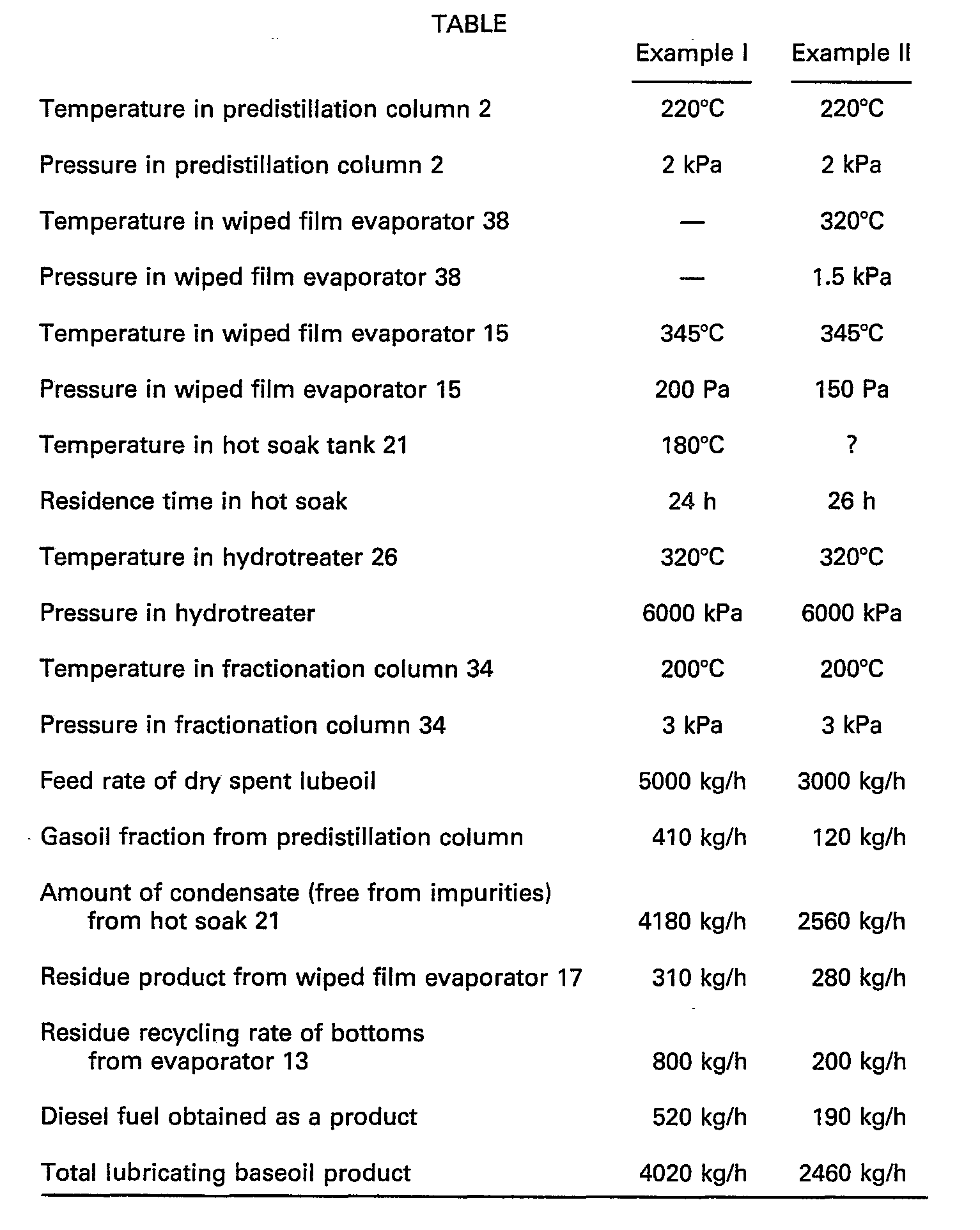
separator 28 and is passed viaconduit 33 to afractionation column 34, in which this mixture of hydrocarbons is separated into adiesel oil fraction 35 which leaves the column at the top, a light lubricatingbaseoil fraction 36 leaving the column as a middle fraction and a heavylubricating baseoil fraction 37. - The conditions applied and results achieved are listed in the following table.
- Just as in the process of example I spent lubeoil freed from sludge-forming impurities and from water and light components is fed via conduit 1 to a predistillation column 2, together with an amount of the bottoms from this predistillation column which is recycled through
conduit 11. In the predistillation column 2, under reduced pressure, a low grade gasoil is separated by fractionation, from the lubeoil. The gasoil vapors escape throughconduit 6, are condensed in heat exchanger 7 and are partly recycled as a reflux throughconduit 8. Spent lubeoil freed from gasoil leaves the column 2 as a bottoms stream throughconduit 3 and is pressed through aheat exchanger 5 by means of a pump 4 where this stream is preheated. Part of the preheated bottoms stream is recycled throughconduit 11 and mixed with dry spent lubeoil in conduit 1, as afore described. The residue of the preheated bottoms stream is passed throughconduit 12 to a wipedfilm evaporator 38. - In this first, wiped
film evaporator 38, which operates under vacuum, the lighter components of the lubeoil are evaporated; the vapors escape viaconduit 41 and condense in theheat exchanger 42, whereupon the condensate is pumped to the hot-soak tank 21 by means ofpump 43. The bottom product from this first, wipedfilm evaporator 38 is pumped to a second wipedfilm evaporator 15 bypump 39 and viaconduit 40. - Before it enters the
film evaporator 15, this bottom product of thefirst film evaporator 38 is mixed with an amount of bottom product from the second wipedfilm evaporator 15 and also with a blow-off (drain) stream from the hot-soak tank 21. The bottom product from thefilm evaporator 15 whcih is recycled in this way, is only part of the total bottom product from thesecond film evaporator 15. This total bottom product is pumped-off from the bottom of thefilm evaporator 15 bypump 16; part is recycled viaconduit 13 toconduit 40 and the residue is discharged as such viaconduit 17. - in the second wiped
evaporator 15, which also operates under vacuum, the heavier lubeoil components are evaporated. They escape at the top viaconduit 18 and condense in theheat exchanger 19, whereupon they are transported to the hoat-soak tank 21 by means ofpump 20. - The light and heavy lubeoil components undergo a hot soak in the hot-
soak tank 21, by which heavy impurities are separated and are passed as a blow-off (drain) stream viaconduit 14 to the second wipedfilm evaporator 15. The temperature in thehot soak tank 21 is maintained at a value close to the condensation temperature of theheat exchangers residue product 17. - The condensate in
vessel 21 from which impurities have been separated as a heavy fraction, is discharged after the hot-soak viaconduit 22 andpump 23, is mixed with the gasoil fraction which was formed in the predistillation and, after having been mixed with hydrogen, is passed viaconduit 24 andheat exchanger 25 to areactor 26 filled with hydrogenating catalyst, where the mixture is hydrogenated. The product stream from thehydrogenation reactor 26 is passed throughconduit 27 to aseparator 28, in which the residual hydrogen is separated which hydrogen is discharged throughconduit 29 and after increasing the pressure incompressor 30 and mixing with replenishing (make up) hydrogen which is fed throughconduit 31, is recycled viaconduit 32 and is mixed with the mixture of hydrocarbons fed throughconduit 24. - The hydrogenated hydrocarbon mixture is discharged from the bottom of the
separator 28 and is passed to afractionation column 34 viaconduit 33, in which this mixture of hydrocarbons is separated into adieseloil fraction 35 which leaves the column at the top, a lightlubricating baseoil fraction 36 which leaves the column as a middle fraction and a heavylubricating baseoil fraction 37. - The conditions applied and the results achieved are listed in the following table.
Claims (12)
Priority Applications (1)
| Application Number | Priority Date | Filing Date | Title |
|---|---|---|---|
| AT84201692T ATE26461T1 (en) | 1983-11-23 | 1984-11-22 | PROCESS FOR REFINING Spent LUBRICATION OILS. |
Applications Claiming Priority (2)
| Application Number | Priority Date | Filing Date | Title |
|---|---|---|---|
| NL8304023 | 1983-11-23 | ||
| NL8304023A NL8304023A (en) | 1983-11-23 | 1983-11-23 | METHOD FOR PURIFYING FINISHED LUBRICATING OIL. |
Publications (2)
| Publication Number | Publication Date |
|---|---|
| EP0149862A1 EP0149862A1 (en) | 1985-07-31 |
| EP0149862B1 true EP0149862B1 (en) | 1987-04-08 |
Family
ID=19842760
Family Applications (1)
| Application Number | Title | Priority Date | Filing Date |
|---|---|---|---|
| EP84201692A Expired EP0149862B1 (en) | 1983-11-23 | 1984-11-22 | Process for re-refining spent lubeoils |
Country Status (12)
| Country | Link |
|---|---|
| US (1) | US4941967A (en) |
| EP (1) | EP0149862B1 (en) |
| JP (1) | JPS60133093A (en) |
| AT (1) | ATE26461T1 (en) |
| DE (1) | DE3463060D1 (en) |
| DK (1) | DK162107C (en) |
| ES (1) | ES8601293A1 (en) |
| GR (1) | GR81017B (en) |
| IE (1) | IE58444B1 (en) |
| NL (1) | NL8304023A (en) |
| NO (1) | NO162972C (en) |
| PT (1) | PT79541B (en) |
Families Citing this family (25)
| Publication number | Priority date | Publication date | Assignee | Title |
|---|---|---|---|---|
| DE3861646D1 (en) * | 1987-07-23 | 1991-02-28 | Uop Inc | TREATMENT OF A TEMPERATURE-SENSITIVE ALTOEL CURRENT CONTAINING NON-DISTILLABLE COMPONENTS. |
| US5032249A (en) * | 1990-08-28 | 1991-07-16 | Conoco Inc. | Fractionation process for petroleum wax |
| DE4205884C2 (en) * | 1992-02-26 | 1994-08-25 | Bernd Ing Grad Meinken | Process and apparatus for separating waste oil into medium mineral oils, heavy mineral oils and solids |
| US5527449A (en) * | 1993-03-25 | 1996-06-18 | Stanton D. Brown | Conversion of waste oils, animal fats and vegetable oils |
| US5362381A (en) * | 1993-03-25 | 1994-11-08 | Stanton D. Brown | Method and apparatus for conversion of waste oils |
| EP1219259B1 (en) * | 1993-04-22 | 2003-07-16 | Image Guided Technologies, Inc. | System for locating relative positions of objects |
| US6106699A (en) * | 1997-04-29 | 2000-08-22 | Probex | Process for de-chlorinating and de-fouling oil |
| US6117309A (en) * | 1997-09-08 | 2000-09-12 | Probex Corporation | Method of rerefining waste oil by distillation and extraction |
| NZ332331A (en) * | 1998-10-15 | 2000-03-27 | Craig Nazzer | Continuous process for removing solids from miscible liquid mixture; lower boiling point liquid(s) removed by flashing or boiling |
| DE19852007C2 (en) * | 1998-11-11 | 2002-06-13 | Mineraloel Raffinerie Dollberg | Process for the reprocessing of waste oils |
| FR2787118A1 (en) * | 1998-12-09 | 2000-06-16 | Richard Deutsch | Process for the recycling of used lubricating oil from automobiles, comprises the removal of contaminant metals followed by low temperature vacuum distillation stages |
| DE60211041T2 (en) | 2002-07-15 | 2006-12-07 | Sener Grupo de Ingenieria, S.A., Tres Cantos | METHOD FOR THE REGENERATION OF OLD OILS BY SOLVENT EXTRACTION |
| CA2396206A1 (en) | 2002-07-30 | 2004-01-30 | Nouredine Fakhri | Process for the treatment of waste oils |
| US8366912B1 (en) | 2005-03-08 | 2013-02-05 | Ari Technologies, Llc | Method for producing base lubricating oil from waste oil |
| RU2326934C2 (en) * | 2006-06-20 | 2008-06-20 | Государственное образовательное учреждение высшего профессионального образования "Кузбасский государственный технический университет" (ГУ КузГТУ) | Method of spent industrial oils regeneration and device for its implementation |
| CN101831348B (en) * | 2010-05-20 | 2013-01-09 | 佛山汉维机电科技有限公司 | Method for separating and recovering product oil from waste lubricating oil and device thereof |
| US9243191B1 (en) * | 2010-07-16 | 2016-01-26 | Delta Technologies LLC | Re-refining used motor oil |
| FI20106252A0 (en) | 2010-11-26 | 2010-11-26 | Upm Kymmene Corp | Process and system for the production of fuel components |
| US10280371B2 (en) | 2011-07-15 | 2019-05-07 | Delta Technologies LLC | Distillation of used motor oil with distillate vapors |
| US20140257000A1 (en) | 2013-03-07 | 2014-09-11 | Verolube, Inc. | Method for producing base lubricating oil from oils recovered from combustion engine service |
| MX2016005893A (en) * | 2013-11-08 | 2016-08-17 | Sener Ing & Sist | Method for increasing the yield of lubricating bases in the regeneration of used oils. |
| CN106350112B (en) * | 2015-07-14 | 2017-12-15 | 新疆聚力环保科技有限公司 | A kind of waste mineral oil pretreatment-the method for hydrogenation reclaimed lubricating oil base oil |
| FI129867B (en) | 2017-12-29 | 2022-10-14 | Neste Oyj | Method for reducing fouling in catalytic cracking |
| CN109233988A (en) * | 2018-08-06 | 2019-01-18 | 天津大学 | The clean high-valued recycling and reusing method and apparatus of waste lubricating oil |
| AT521642B1 (en) | 2018-09-13 | 2021-08-15 | Blue Danube Robotics Gmbh | Method of making a pad |
Family Cites Families (22)
| Publication number | Priority date | Publication date | Assignee | Title |
|---|---|---|---|---|
| US2076498A (en) * | 1928-09-10 | 1937-04-06 | Sf Bowser & Co Inc | Film-forming means in vacuum system for removing impurities from oils |
| US2062933A (en) * | 1930-01-11 | 1936-12-01 | Sf Bowser & Co Inc | Process of purifying insulating and lubricating oils |
| US2095470A (en) * | 1932-10-14 | 1937-10-12 | Sf Bowser & Co Inc | Method and apparatus for purifying liquids |
| US3402124A (en) * | 1966-03-16 | 1968-09-17 | Universal Oil Prod Co | Plural stage distillation with bottoms stream and side stream column heat exchange |
| US3625881A (en) * | 1970-08-31 | 1971-12-07 | Berks Associates Inc | Crank case oil refining |
| US3702817A (en) * | 1970-10-06 | 1972-11-14 | Texaco Inc | Production of lubricating oils including hydrofining an extract |
| US3852207A (en) * | 1973-03-26 | 1974-12-03 | Chevron Res | Production of stable lubricating oils by sequential hydrocracking and hydrogenation |
| US3923643A (en) * | 1974-06-14 | 1975-12-02 | Shell Oil Co | Removal of lead and other suspended solids from used hydrocarbon lubricating oil |
| US4033859A (en) * | 1975-04-24 | 1977-07-05 | Witco Chemical Corporation | Thermal treatment of used petroleum oils |
| US4028226A (en) * | 1975-11-12 | 1977-06-07 | The Lubrizol Corporation | Method of rerefining oil with recovery of useful organic additives |
| US4247389A (en) * | 1979-11-07 | 1981-01-27 | Phillips Petroleum Company | De-ashing lubricating oils |
| NL166060C (en) * | 1977-10-14 | 1981-06-15 | Kinetics Technology | METHOD FOR PURIFYING FINISHED LUBRICATING OIL. |
| JPS6035000B2 (en) * | 1979-06-06 | 1985-08-12 | 株式会社日立製作所 | Waste oil treatment method and equipment |
| CS209612B1 (en) * | 1979-11-10 | 1981-12-31 | Alexander Tkac | Method of treating the spent motor oils |
| US4287049A (en) * | 1980-02-05 | 1981-09-01 | Phillips Petroleum Co. | Reclaiming used lubricating oils with ammonium salts and polyhydroxy compounds |
| US4342645A (en) * | 1980-10-28 | 1982-08-03 | Delta Central Refining, Inc. | Method of rerefining used lubricating oil |
| US4360420A (en) * | 1980-10-28 | 1982-11-23 | Delta Central Refining, Inc. | Distillation and solvent extraction process for rerefining used lubricating oil |
| US4432865A (en) * | 1982-01-25 | 1984-02-21 | Norman George R | Process for treating used motor oil and synthetic crude oil |
| JPS5912996A (en) * | 1982-07-12 | 1984-01-23 | デルタ・セントラル・リフアイニング・インコ−ポレ−テツド | Repurification of used lubricating oil |
| US4431524A (en) * | 1983-01-26 | 1984-02-14 | Norman George R | Process for treating used industrial oil |
| CH657867A5 (en) * | 1983-09-21 | 1986-09-30 | Buss Ag | METHOD FOR REPROCESSING ALTOEL AND DISTILLATION DEVICE FOR IMPLEMENTING THE METHOD. |
| US4606816A (en) * | 1984-12-31 | 1986-08-19 | Mobil Oil Corporation | Method and apparatus for multi-component fractionation |
-
1983
- 1983-11-23 NL NL8304023A patent/NL8304023A/en not_active Application Discontinuation
-
1984
- 1984-11-21 NO NO844632A patent/NO162972C/en unknown
- 1984-11-22 GR GR81017A patent/GR81017B/en unknown
- 1984-11-22 DK DK555684A patent/DK162107C/en not_active IP Right Cessation
- 1984-11-22 EP EP84201692A patent/EP0149862B1/en not_active Expired
- 1984-11-22 AT AT84201692T patent/ATE26461T1/en not_active IP Right Cessation
- 1984-11-22 DE DE8484201692T patent/DE3463060D1/en not_active Expired
- 1984-11-22 ES ES537871A patent/ES8601293A1/en not_active Expired
- 1984-11-22 JP JP59246397A patent/JPS60133093A/en active Granted
- 1984-11-22 IE IE298984A patent/IE58444B1/en not_active IP Right Cessation
- 1984-11-23 PT PT79541A patent/PT79541B/en not_active IP Right Cessation
-
1987
- 1987-01-27 US US07/009,085 patent/US4941967A/en not_active Expired - Lifetime
Also Published As
| Publication number | Publication date |
|---|---|
| US4941967A (en) | 1990-07-17 |
| DK162107C (en) | 1992-02-17 |
| NO844632L (en) | 1985-05-24 |
| PT79541B (en) | 1986-09-15 |
| ES537871A0 (en) | 1985-10-16 |
| GR81017B (en) | 1985-03-15 |
| JPS60133093A (en) | 1985-07-16 |
| NO162972C (en) | 1990-03-14 |
| DK555684D0 (en) | 1984-11-22 |
| DE3463060D1 (en) | 1987-05-14 |
| PT79541A (en) | 1984-12-01 |
| NL8304023A (en) | 1985-06-17 |
| ATE26461T1 (en) | 1987-04-15 |
| DK555684A (en) | 1985-05-24 |
| NO162972B (en) | 1989-12-04 |
| IE58444B1 (en) | 1993-09-22 |
| DK162107B (en) | 1991-09-16 |
| ES8601293A1 (en) | 1985-10-16 |
| JPH0317000B2 (en) | 1991-03-06 |
| IE842989L (en) | 1985-05-23 |
| EP0149862A1 (en) | 1985-07-31 |
Similar Documents
| Publication | Publication Date | Title |
|---|---|---|
| EP0149862A1 (en) | Process for re-refining spent lubeoils | |
| US3625881A (en) | Crank case oil refining | |
| US4360420A (en) | Distillation and solvent extraction process for rerefining used lubricating oil | |
| US4366049A (en) | Process for recycling of used lubricating oils | |
| US4342645A (en) | Method of rerefining used lubricating oil | |
| US1827915A (en) | Process for treating hydrocarbons | |
| US2801211A (en) | Purification of ethanol | |
| US2748061A (en) | Thermal treatment and separation process | |
| US2050772A (en) | Process of refining mineral oil | |
| US2130988A (en) | Treatment of hydrocarbon oils | |
| US2050847A (en) | Process of treating hydrocarbon oils | |
| US2356952A (en) | Conversion of petroleum oils | |
| US1833691A (en) | Process for preparing crude oil for distillation into lubricating oils | |
| US1974301A (en) | Treatment of hydrocarbon oils | |
| RU2773466C1 (en) | Waste oil recycling method | |
| US2052812A (en) | Process of refining oil | |
| US1756153A (en) | Manufacture of lubricating oils | |
| US1688830A (en) | Process of cracking oil | |
| US1756155A (en) | Refining hydrocarbon oils | |
| US1698076A (en) | Manufacturing of lubricating oil | |
| US2009128A (en) | Treatment of hydrocarbon oils | |
| US1896345A (en) | Process and apparatus for cracking and separating gasoling stock from petroleum oils | |
| US1746916A (en) | Manufacture of lubricating oil | |
| US1756154A (en) | Refining hydrocarbon oils | |
| US2123194A (en) | Treatment of hydrocarbon oil |
Legal Events
| Date | Code | Title | Description |
|---|---|---|---|
| PUAI | Public reference made under article 153(3) epc to a published international application that has entered the european phase |
Free format text: ORIGINAL CODE: 0009012 |
|
| AK | Designated contracting states |
Designated state(s): AT BE CH DE FR GB IT LI LU NL SE |
|
| 17P | Request for examination filed |
Effective date: 19850716 |
|
| 17Q | First examination report despatched |
Effective date: 19860319 |
|
| GRAA | (expected) grant |
Free format text: ORIGINAL CODE: 0009210 |
|
| AK | Designated contracting states |
Kind code of ref document: B1 Designated state(s): AT BE CH DE FR GB IT LI LU NL SE |
|
| REF | Corresponds to: |
Ref document number: 26461 Country of ref document: AT Date of ref document: 19870415 Kind code of ref document: T |
|
| ITF | It: translation for a ep patent filed | ||
| REF | Corresponds to: |
Ref document number: 3463060 Country of ref document: DE Date of ref document: 19870514 |
|
| ET | Fr: translation filed | ||
| PLBE | No opposition filed within time limit |
Free format text: ORIGINAL CODE: 0009261 |
|
| STAA | Information on the status of an ep patent application or granted ep patent |
Free format text: STATUS: NO OPPOSITION FILED WITHIN TIME LIMIT |
|
| 26N | No opposition filed | ||
| ITTA | It: last paid annual fee | ||
| EPTA | Lu: last paid annual fee | ||
| EAL | Se: european patent in force in sweden |
Ref document number: 84201692.5 |
|
| PGFP | Annual fee paid to national office [announced via postgrant information from national office to epo] |
Ref country code: LU Payment date: 19961001 Year of fee payment: 13 |
|
| PGFP | Annual fee paid to national office [announced via postgrant information from national office to epo] |
Ref country code: GB Payment date: 19961014 Year of fee payment: 13 |
|
| PGFP | Annual fee paid to national office [announced via postgrant information from national office to epo] |
Ref country code: CH Payment date: 19961023 Year of fee payment: 13 |
|
| PGFP | Annual fee paid to national office [announced via postgrant information from national office to epo] |
Ref country code: SE Payment date: 19961024 Year of fee payment: 13 |
|
| PGFP | Annual fee paid to national office [announced via postgrant information from national office to epo] |
Ref country code: AT Payment date: 19961025 Year of fee payment: 13 |
|
| PG25 | Lapsed in a contracting state [announced via postgrant information from national office to epo] |
Ref country code: LU Free format text: LAPSE BECAUSE OF NON-PAYMENT OF DUE FEES Effective date: 19971122 Ref country code: GB Free format text: LAPSE BECAUSE OF NON-PAYMENT OF DUE FEES Effective date: 19971122 Ref country code: AT Free format text: LAPSE BECAUSE OF NON-PAYMENT OF DUE FEES Effective date: 19971122 |
|
| PG25 | Lapsed in a contracting state [announced via postgrant information from national office to epo] |
Ref country code: SE Free format text: LAPSE BECAUSE OF NON-PAYMENT OF DUE FEES Effective date: 19971123 |
|
| PG25 | Lapsed in a contracting state [announced via postgrant information from national office to epo] |
Ref country code: LI Free format text: LAPSE BECAUSE OF NON-PAYMENT OF DUE FEES Effective date: 19971130 Ref country code: CH Free format text: LAPSE BECAUSE OF NON-PAYMENT OF DUE FEES Effective date: 19971130 |
|
| GBPC | Gb: european patent ceased through non-payment of renewal fee |
Effective date: 19971122 |
|
| REG | Reference to a national code |
Ref country code: CH Ref legal event code: PL |
|
| EUG | Se: european patent has lapsed |
Ref document number: 84201692.5 |
|
| PGFP | Annual fee paid to national office [announced via postgrant information from national office to epo] |
Ref country code: FR Payment date: 20031013 Year of fee payment: 20 |
|
| PGFP | Annual fee paid to national office [announced via postgrant information from national office to epo] |
Ref country code: NL Payment date: 20031118 Year of fee payment: 20 |
|
| PGFP | Annual fee paid to national office [announced via postgrant information from national office to epo] |
Ref country code: DE Payment date: 20031128 Year of fee payment: 20 |
|
| PGFP | Annual fee paid to national office [announced via postgrant information from national office to epo] |
Ref country code: BE Payment date: 20031219 Year of fee payment: 20 |
|
| PG25 | Lapsed in a contracting state [announced via postgrant information from national office to epo] |
Ref country code: NL Free format text: LAPSE BECAUSE OF EXPIRATION OF PROTECTION Effective date: 20041122 |
|
| BE20 | Be: patent expired |
Owner name: *KINETICS TECHNOLOGY INTERNATIONAL B.V. Effective date: 20041122 |
|
| NLV7 | Nl: ceased due to reaching the maximum lifetime of a patent |
Effective date: 20041122 |