EP0149494A2 - Method for preparing positive electrode for non-aqueous electrolyte cell - Google Patents
Method for preparing positive electrode for non-aqueous electrolyte cell Download PDFInfo
- Publication number
- EP0149494A2 EP0149494A2 EP85100462A EP85100462A EP0149494A2 EP 0149494 A2 EP0149494 A2 EP 0149494A2 EP 85100462 A EP85100462 A EP 85100462A EP 85100462 A EP85100462 A EP 85100462A EP 0149494 A2 EP0149494 A2 EP 0149494A2
- Authority
- EP
- European Patent Office
- Prior art keywords
- positive electrode
- aqueous electrolyte
- electrolyte cell
- preparing
- cell
- Prior art date
- Legal status (The legal status is an assumption and is not a legal conclusion. Google has not performed a legal analysis and makes no representation as to the accuracy of the status listed.)
- Granted
Links
Images

Classifications
-
- H—ELECTRICITY
- H01—ELECTRIC ELEMENTS
- H01M—PROCESSES OR MEANS, e.g. BATTERIES, FOR THE DIRECT CONVERSION OF CHEMICAL ENERGY INTO ELECTRICAL ENERGY
- H01M4/00—Electrodes
- H01M4/02—Electrodes composed of, or comprising, active material
- H01M4/62—Selection of inactive substances as ingredients for active masses, e.g. binders, fillers
- H01M4/621—Binders
-
- H—ELECTRICITY
- H01—ELECTRIC ELEMENTS
- H01M—PROCESSES OR MEANS, e.g. BATTERIES, FOR THE DIRECT CONVERSION OF CHEMICAL ENERGY INTO ELECTRICAL ENERGY
- H01M4/00—Electrodes
- H01M4/02—Electrodes composed of, or comprising, active material
- H01M4/06—Electrodes for primary cells
- H01M4/08—Processes of manufacture
-
- Y—GENERAL TAGGING OF NEW TECHNOLOGICAL DEVELOPMENTS; GENERAL TAGGING OF CROSS-SECTIONAL TECHNOLOGIES SPANNING OVER SEVERAL SECTIONS OF THE IPC; TECHNICAL SUBJECTS COVERED BY FORMER USPC CROSS-REFERENCE ART COLLECTIONS [XRACs] AND DIGESTS
- Y02—TECHNOLOGIES OR APPLICATIONS FOR MITIGATION OR ADAPTATION AGAINST CLIMATE CHANGE
- Y02E—REDUCTION OF GREENHOUSE GAS [GHG] EMISSIONS, RELATED TO ENERGY GENERATION, TRANSMISSION OR DISTRIBUTION
- Y02E60/00—Enabling technologies; Technologies with a potential or indirect contribution to GHG emissions mitigation
- Y02E60/10—Energy storage using batteries
Definitions
- This invention relates to a method for preparing a positive electrode for a non-aqueous electrolyte cell.
- the positive electrode for the non-aqueous electrolyte cell has been prepared by first adding a dispersion of polytetrafluoroethylene as a binder to a mixture of a positive electrode-active material and an electrically conductive agent, kneading these components, applying them on a supporting material, and drying it.
- the positive electrode plate for the non-aqueous electrolyte cell is to be dried at a temperature of about 250°C before the manufacture of the cell. Therefore, if employed as the positive electrode-active material, the manganese dioxide will react with methyl cellulose or carboxymethyl cellulose, so that the oxidation number of the manganese dioxide will be lowered. When the positive electrode plate which contains the manganese dioxide having such a less oxidation number is used to prepare the non-aqueous electrolyte cell, the discharge capacity of the prepared cell will decrease.
- an object of this invention is to provide a method for preparing a positive electrode which has a uniform thickness and which can prevent the deterioration in the oxidation number of manganese dioxide at drying of the electrode, and this method comprises adding a dispersion of polytetrafluoroethylene, polyacrylic acid and water to a mixture of a positive electrode-active material and an electrically conductive agent, kneading these components to prepare a paste for the positive electrode, and applying the paste on one side or both sides of a supporting material.
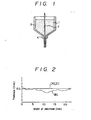
- Figure 1 is a sectional view of the main portion of an electrode-manufacturing device for applying a positive electrode paste on a supporting material
- reference numeral 1 in the drawing is a positive electrode paste which is prepared by adding an electrically conductive agent, a binder and the like to an active material such as manganese dioxide or carbon fluoride, and kneading them.
- Numerals 2, 3 and 4 are a supporting material for the electrode, a hopper and a slit, respectively.
- the application of the positive electrode paste on the opposite sides of the supporting material is carried out by causing the electrode supporting material 2 to pass through the positive electrode paste 1 from above, and drawing the supporting material 2 through the slit 4 provided at the lower portion of the hopper 3. Afterward, the applied supporting material 2 is dried to prepare a desired electrode.
- the positive electrode paste is carrried only one side of the supporting material.
- the positive electrode terminal obtained by applying a positive electrode paste on one side of a supporting material may preferably be used by providing a three- layer structure, in which ionomer resin pieces are disposed on the opposite sides of a polyethylene piece or an ethylene copolymer piece, between the positive electrode terminal and a negative electrode terminal.
- manganese dioxide may be preferably be used, in an amount of 40 wt.%.
- an electrically conductive agent there may be employed graphite or acetylene black, and graphite may preferably be used in an amount of 5 wt.%.
- As a binder there may be used polytetrafluoroethylene (PTFE) or tetrafluoro- ethylenehexafluoropropylene copolymer, and polytetrafluoroethylene (PTFE) may preferably be used in an amount of 1 wt.%.
- PTFE polytetrafluoroethylene
- Polyacrylic acid may be added in an amount of 1 wt.%.
- Water may be added in an amount of 53 wt.%.
- the scatter of thickness of electrode was wide, but in the cases of the samples (A) and (C) in which water-soluble high polymers such as polyacrylic acid and methyl cellulose were further added thereto, the thickness thereof was uniform respectively.
- the water-soluble high polymer of, for example, polyacrylic acid or methyl cellulose is in an amount of 0.1 wt.% or more, preferably in an amount of 1 wt.%, the electrode having the uniform thickness can be manufactured, though the proper content of the high polymer depends on an amount of polytetrafluoroethylene.
- a semisynthetic water-soluble high polymer such as methyl cellulose or carboxymethyl cellulose will react with manganese dioxide at a temperature of about 200°C or more to chemically reduce manganese dioxide grains on the surfaces thereof.
- the oxidation number of manganese dioxide will be lowered, and if a cell is manufactured by the use of such an electrode, the discharge capacity of the manufactured cell will deteriorate.
- polyacrylic acid of the semisynthetic water-soluble high polymer and the dispersion of polytetrafluoroethylene as the binders permits preparing the electrode plate having a uniform thickness and obtaining the positive electrode which can prevent the oxidation number of manganese dioxide from lowering at the time of drying, whereby if the positive electrode plate is used in the preparation of the cell, the deterioration in the discharge capacity can be prevented.
- FIG. 3 shows a coin-shaped non-aqueous electrolyte cell manufactured by using the positive electrode which was prepared in accordance with this invention.
- reference numeral 2 is a supporting material
- 5 is a positive electrode container having simultaneously the function as a positive electrode terminal
- numeral 6 is a negative electrode sealing plate having simultaneously the function as a negative electrode terminal.
- Numeral 2 is a supporting material
- 7 is positive electrode
- 8 is a negative electrode
- 9 is a separator interposed between the positive and negative electrodes
- 10 is an insulating packing.
- the positive electrode 7 is was prepared according to the following steps: Manganese dioxide which was heated at 460°C for 5 hours was mixed with graphite which was an electrically conductive agent.
- polyacrylic acid which was a synthetic water-soluble high polymer, water and the dispersion of polytetrafluoroethylene were then added, and mixing and kneading of them were carried out to prepare a paste.
- the thus prepared paste was applied on a supporting material having simultaneously the function as a current collector. Predrying was carried out at a temperature of 100 to 150°C for 2 to 3 hours in order to remove water therefrom, and the supporting material was punched into members each having a predetermined diameter, followed by final drying at about 250°C for 5 to 10 hours.
- FIG. 4 further shows a discharge curve of a conventional cell (B) in which no polyacrylic acid was added, and a curve of another conventional cell (C) in which methyl cellulose of the semisynthetic water-soluble high polymer was added in an amount of 1 wt.%.
- the oxidation numbers of manganese dioxides in the respective cells (A), (B) and (C) were inspected, and it was found that the oxidation number of the cell (C) was lower by 12% than the cells (A) and (B). Such a decrease in the oxidation number would be attributable to the reaction of methyl cellulose of the added semisynthetic water-soluble high polymer with manganese dioxide.
- the cell in which the positive electrode plate prepared in accordance with the method of this invention is used can be concluded to have an excellent quality on the ground that the scatter is narrow and the discharge capacity is not lowered.
- the electrode plate prepared in accordance with this invention contains polytetrafluoroethylene and thus is flexible. Therefore, this electrode plate may be applied to a cell for a wound electrode and flat cell, in addition to the coin-shaped cell employed in the above-mentioned example.
Landscapes
- Chemical & Material Sciences (AREA)
- Chemical Kinetics & Catalysis (AREA)
- Electrochemistry (AREA)
- General Chemical & Material Sciences (AREA)
- Engineering & Computer Science (AREA)
- Manufacturing & Machinery (AREA)
- Battery Electrode And Active Subsutance (AREA)
Abstract
Description
- This invention relates to a method for preparing a positive electrode for a non-aqueous electrolyte cell.
- Heretofore, the positive electrode for the non-aqueous electrolyte cell has been prepared by first adding a dispersion of polytetrafluoroethylene as a binder to a mixture of a positive electrode-active material and an electrically conductive agent, kneading these components, applying them on a supporting material, and drying it.
- However, the use of dispersion of polytetrafluoroethylene as the binder will cause to become a fibrous state at the process where kneading is carried out to obtain a paste mixture, and at this time, masses of the fibrous material are partially produced in the paste mixture. If the paste mixture containing such masses is applied on the corematerial, it will be impossible to obtain the positive electrode in which the active material is homogeneously distributed and the thickness is uniform. If such an ununiformed positive electrode is used to prepare the cell, the scatter of a discharge capacity will be wide and the prepared cell will thus be poor in quality. For the purpose of overcoming such a drawback, it has been suggested that a semisynthetic water-soluble high polymer such as methyl cellulose or carboxymethyl cellulose is added to the above-mentioned paste, whereby the positive electrode having a uniform thickness can be obtained. However, the positive electrode plate for the non-aqueous electrolyte cell is to be dried at a temperature of about 250°C before the manufacture of the cell. Therefore, if employed as the positive electrode-active material, the manganese dioxide will react with methyl cellulose or carboxymethyl cellulose, so that the oxidation number of the manganese dioxide will be lowered. When the positive electrode plate which contains the manganese dioxide having such a less oxidation number is used to prepare the non-aqueous electrolyte cell, the discharge capacity of the prepared cell will decrease.
- In order to eliminate the above drawbacks, the present inventors have made extensive studies for preparing a positive electrode for non-aqueous electrolyte cell and have accomplished the present invention.
- Namely, an object of this invention is to provide a method for preparing a positive electrode which has a uniform thickness and which can prevent the deterioration in the oxidation number of manganese dioxide at drying of the electrode, and this method comprises adding a dispersion of polytetrafluoroethylene, polyacrylic acid and water to a mixture of a positive electrode-active material and an electrically conductive agent, kneading these components to prepare a paste for the positive electrode, and applying the paste on one side or both sides of a supporting material.
-
- Figure 1 is a sectional view of the main portion of an electrode-manufacturing device;
- Figure 2 is a graph showing the variation in thickness of positive electrodes manufactured by the device in Figure 1;
- Figure 3 is a sectional view of a coin-shaped non-aqueous electrolyte cell in one embodiment of this invention; and
- Figure 4 shows discharge curves of the respective cells.
- Now, this invention will be described in reference to accompanying drawings.
- Figure 1 is a sectional view of the main portion of an electrode-manufacturing device for applying a positive electrode paste on a supporting material, and reference numeral 1 in the drawing is a positive electrode paste which is prepared by adding an electrically conductive agent, a binder and the like to an active material such as manganese dioxide or carbon fluoride, and kneading them.
Numerals electrode supporting material 2 to pass through the positive electrode paste 1 from above, and drawing the supportingmaterial 2 through theslit 4 provided at the lower portion of thehopper 3. Afterward, the applied supportingmaterial 2 is dried to prepare a desired electrode. - In cases where the supporting material posesses both functions of a positive electrode terminal and a current collector, the positive electrode paste is carrried only one side of the supporting material.
- The positive electrode terminal obtained by applying a positive electrode paste on one side of a supporting material may preferably be used by providing a three- layer structure, in which ionomer resin pieces are disposed on the opposite sides of a polyethylene piece or an ethylene copolymer piece, between the positive electrode terminal and a negative electrode terminal.
- Of the above-mentioned manganese dioxide or carbon fluoride as an active material, manganese dioxide may be preferably be used, in an amount of 40 wt.%. As an electrically conductive agent, there may be employed graphite or acetylene black, and graphite may preferably be used in an amount of 5 wt.%. As a binder, there may be used polytetrafluoroethylene (PTFE) or tetrafluoro- ethylenehexafluoropropylene copolymer, and polytetrafluoroethylene (PTFE) may preferably be used in an amount of 1 wt.%. Polyacrylic acid may be added in an amount of 1 wt.%. Water may be added in an amount of 53 wt.%.
- By the use of the electrode-manufacturing device shown in Figure 1, the following samples (A), (B) and (C) were manufactured:
- Sample (A): An electrode of this invention in which a dispersion of polytetrafluoroethylene and polyacrylic acid were used as binders.
- Sample (B): A conventional electrode in which a paste comprising a dispersion of polytetrafluoroethylene alone was used as a binder.
- Sample (C): A conventional electrode in which a paste prepared by adding a semisynthetic water-soluble high polymer of methyl cellulose to polytetrafluoroethylene was employed.
- For these electrodes, the variation in thickness was measured, and the results are represented by curves in Figure 2.
- As seen from Figure 2, in the case of the sample (B) in which the dispersion of polytetrafluoroethylene was used as the binder, the scatter of thickness of electrode was wide, but in the cases of the samples (A) and (C) in which water-soluble high polymers such as polyacrylic acid and methyl cellulose were further added thereto, the thickness thereof was uniform respectively. In this connection, if the water-soluble high polymer of, for example, polyacrylic acid or methyl cellulose is in an amount of 0.1 wt.% or more, preferably in an amount of 1 wt.%, the electrode having the uniform thickness can be manufactured, though the proper content of the high polymer depends on an amount of polytetrafluoroethylene.
- It should be noted that at drying of the electrode, a semisynthetic water-soluble high polymer such as methyl cellulose or carboxymethyl cellulose will react with manganese dioxide at a temperature of about 200°C or more to chemically reduce manganese dioxide grains on the surfaces thereof. As a result, the oxidation number of manganese dioxide will be lowered, and if a cell is manufactured by the use of such an electrode, the discharge capacity of the manufactured cell will deteriorate. However, as in this invention, using polyacrylic acid of the semisynthetic water-soluble high polymer and the dispersion of polytetrafluoroethylene as the binders permits preparing the electrode plate having a uniform thickness and obtaining the positive electrode which can prevent the oxidation number of manganese dioxide from lowering at the time of drying, whereby if the positive electrode plate is used in the preparation of the cell, the deterioration in the discharge capacity can be prevented.
- Figure 3 shows a coin-shaped non-aqueous electrolyte cell manufactured by using the positive electrode which was prepared in accordance with this invention. In this drawing,
reference numeral 2 is a supporting material, 5 is a positive electrode container having simultaneously the function as a positive electrode terminal, andnumeral 6 is a negative electrode sealing plate having simultaneously the function as a negative electrode terminal.Numeral 2 is a supporting material, 7 is positive electrode, 8 is a negative electrode, 9 is a separator interposed between the positive and negative electrodes, and 10 is an insulating packing. In this case, thepositive electrode 7 is was prepared according to the following steps: Manganese dioxide which was heated at 460°C for 5 hours was mixed with graphite which was an electrically conductive agent. To the resulting mixture, polyacrylic acid which was a synthetic water-soluble high polymer, water and the dispersion of polytetrafluoroethylene were then added, and mixing and kneading of them were carried out to prepare a paste. By the use of the electrode-manufacturing device shown in Figure 1, the thus prepared paste was applied on a supporting material having simultaneously the function as a current collector. Predrying was carried out at a temperature of 100 to 150°C for 2 to 3 hours in order to remove water therefrom, and the supporting material was punched into members each having a predetermined diameter, followed by final drying at about 250°C for 5 to 10 hours. - To confirm effects of the positive electrode prepared in accordance with the method of this invention, there was manufactured a JIS specification CR 2016 type cell havi.ng the structure shown in Figure 3 and the size of 20 mm in external diameter and 1.6 mm in height. In this cell, the positive electrode was utilized which was-prepared in the above-mentioned manner of this invention and in which polyacrylic acid was used in an amount of 1 wt.% based on the weight of the paste for the positive electrode. The used negative electrode-active material, separator and electrolyte were lithium, a polypropylene non-woven fabric and a solution of lithium perchlorate in a mixed solvent of 1,2-dimethoxyethane, respectively. For the thus manufactured cell, a constant load discharge of 30 KΩ was carried out, and a measured discharge curve is represented by (A) in Figure 4. For comparison, Figure 4 further shows a discharge curve of a conventional cell (B) in which no polyacrylic acid was added, and a curve of another conventional cell (C) in which methyl cellulose of the semisynthetic water-soluble high polymer was added in an amount of 1 wt.%.
- The results in Figure 4 indicate that the curve of the cell (A) using the positive electrode of this invention therein in which polyacrylic acid was used has about the same discharge capacity as in the conventional cell (B) using no polyacrylic acid therein, but the curve of the cell (B) has a wide scatter and is thus poorer in quality as compared with the other cells (A) and (C). Further, in the conventional cell (C), the scatter of the discharge capacity is narrower than in the cells (A) and (B), but the cell (C) is inferior in a value of the discharge capacity to the others and thus is poor in quality. Therefore, it is apparent that in the cell (A) having the positive electrode therein which was prepared in accordance with the method of this invention, the discharge capacity is great and the discharge scatter is narrow.
- Further, the oxidation numbers of manganese dioxides in the respective cells (A), (B) and (C) were inspected, and it was found that the oxidation number of the cell (C) was lower by 12% than the cells (A) and (B). Such a decrease in the oxidation number would be attributable to the reaction of methyl cellulose of the added semisynthetic water-soluble high polymer with manganese dioxide.
- As understood from the foregoing, the cell in which the positive electrode plate prepared in accordance with the method of this invention is used can be concluded to have an excellent quality on the ground that the scatter is narrow and the discharge capacity is not lowered.
- The electrode plate prepared in accordance with this invention contains polytetrafluoroethylene and thus is flexible. Therefore, this electrode plate may be applied to a cell for a wound electrode and flat cell, in addition to the coin-shaped cell employed in the above-mentioned example.
Claims (8)
Applications Claiming Priority (2)
| Application Number | Priority Date | Filing Date | Title |
|---|---|---|---|
| JP59006933A JPS60160563A (en) | 1984-01-18 | 1984-01-18 | Manufacture of positive electrode for nonaqueous electrolyte battery |
| JP6933/84 | 1984-01-18 |
Publications (3)
| Publication Number | Publication Date |
|---|---|
| EP0149494A2 true EP0149494A2 (en) | 1985-07-24 |
| EP0149494A3 EP0149494A3 (en) | 1986-10-08 |
| EP0149494B1 EP0149494B1 (en) | 1990-09-05 |
Family
ID=11652049
Family Applications (1)
| Application Number | Title | Priority Date | Filing Date |
|---|---|---|---|
| EP85100462A Expired EP0149494B1 (en) | 1984-01-18 | 1985-01-17 | Method for preparing positive electrode for non-aqueous electrolyte cell |
Country Status (4)
| Country | Link |
|---|---|
| US (1) | US4601919A (en) |
| EP (1) | EP0149494B1 (en) |
| JP (1) | JPS60160563A (en) |
| DE (1) | DE3579467D1 (en) |
Cited By (1)
| Publication number | Priority date | Publication date | Assignee | Title |
|---|---|---|---|---|
| EP0246844A1 (en) * | 1986-05-20 | 1987-11-25 | Mixalloy Limited | Production of flat products from particulate material |
Families Citing this family (14)
| Publication number | Priority date | Publication date | Assignee | Title |
|---|---|---|---|---|
| JPS62160656A (en) * | 1986-01-08 | 1987-07-16 | Nippon Telegr & Teleph Corp <Ntt> | Manufacture of positive electrode for nonaqueous electrolyte battery |
| JPS62200659A (en) * | 1986-02-27 | 1987-09-04 | Toshiba Battery Co Ltd | Manufacturing method of positive electrode for non-aqueous electrolyte battery |
| US4853305A (en) * | 1986-03-24 | 1989-08-01 | W. R. Grace & Co.-Conn. | Cathodic electrode |
| US4731310A (en) * | 1986-08-15 | 1988-03-15 | W. R. Grace & Co. | Cathodic electrode |
| US5143805A (en) * | 1986-03-24 | 1992-09-01 | W. R. Grace & Co.-Conn: | Cathodic electrode |
| US5166008A (en) * | 1988-03-31 | 1992-11-24 | Canon Kabushiki Kaisha | Polymer gel-coated conductor, method of producing the same, and electric cell making use of the same |
| CA2002348A1 (en) * | 1989-11-06 | 1991-05-06 | Klaus Tomantschger | Zinc anodes for alkaline galvanic cells and cells containing them |
| USH1334H (en) | 1991-06-10 | 1994-07-05 | The United States Of America As Represented By The Secretary Of The Army | Method of making a teflon bonded cathode for use in a high temperature cell and high temperature cell including said cathode |
| DE69226513T2 (en) * | 1991-10-09 | 1998-12-10 | Yuasa Battery Co Ltd | USE OF A MACROMOLECULAR COMPOUND FOR PRODUCING A DEPOLARIZING MIXTURE |
| US5272186A (en) * | 1992-05-01 | 1993-12-21 | E. I. Du Pont De Nemours And Company | Concentration of fluoropolymer dispersions using acrylic polymers of high acid content |
| US6019802A (en) * | 1994-10-27 | 2000-02-01 | Fuji Photo Film Co., Ltd. | Nonaqueous secondary battery and process for producing the same using a dispersion aid |
| US5543249A (en) * | 1995-03-01 | 1996-08-06 | Wilson Greatbatch Ltd. | Aqueous blended electrode material for use in electrochemical cells and method of manufacture |
| US6489062B1 (en) * | 1998-12-24 | 2002-12-03 | Seiko Instruments Inc. | Non-aqueous electrolyte secondary battery having heat-resistant electrodes |
| US7718319B2 (en) | 2006-09-25 | 2010-05-18 | Board Of Regents, The University Of Texas System | Cation-substituted spinel oxide and oxyfluoride cathodes for lithium ion batteries |
Family Cites Families (8)
| Publication number | Priority date | Publication date | Assignee | Title |
|---|---|---|---|---|
| US2747009A (en) * | 1954-01-20 | 1956-05-22 | Kellogg M W Co | Stable voltaic cells |
| GB1464603A (en) * | 1974-07-31 | 1977-02-16 | Heller H | Substituted organic photochromic compounds and processes for their preparation |
| JPS5446344A (en) * | 1977-09-20 | 1979-04-12 | Sanyo Electric Co | Method of producing positive plate for nonnaqueous battery |
| FR2440086A1 (en) * | 1978-10-27 | 1980-05-23 | Comp Generale Electricite | ELECTRODE FOR LEAD ACCUMULATOR |
| JPS576227A (en) * | 1980-06-13 | 1982-01-13 | Matsushita Electric Works Ltd | Oil storage tank |
| US4327166A (en) * | 1980-09-29 | 1982-04-27 | Union Carbide Corporation | Nonaqueous cell having a MNO2 /poly-carbon fluoride cathode |
| US4385103A (en) * | 1981-09-29 | 1983-05-24 | Union Carbide Corporation | Nonaqueous cell having an antimony trisulfide cathode |
| US4416915A (en) * | 1982-02-04 | 1983-11-22 | Combustion Engineering, Inc. | Method of making chalcogenide cathodes |
-
1984
- 1984-01-18 JP JP59006933A patent/JPS60160563A/en active Pending
-
1985
- 1985-01-17 DE DE8585100462T patent/DE3579467D1/en not_active Expired - Lifetime
- 1985-01-17 US US06/692,188 patent/US4601919A/en not_active Expired - Lifetime
- 1985-01-17 EP EP85100462A patent/EP0149494B1/en not_active Expired
Cited By (1)
| Publication number | Priority date | Publication date | Assignee | Title |
|---|---|---|---|---|
| EP0246844A1 (en) * | 1986-05-20 | 1987-11-25 | Mixalloy Limited | Production of flat products from particulate material |
Also Published As
| Publication number | Publication date |
|---|---|
| EP0149494B1 (en) | 1990-09-05 |
| US4601919A (en) | 1986-07-22 |
| DE3579467D1 (en) | 1990-10-11 |
| EP0149494A3 (en) | 1986-10-08 |
| JPS60160563A (en) | 1985-08-22 |
Similar Documents
| Publication | Publication Date | Title |
|---|---|---|
| US4601919A (en) | Method for preparing positive electrode for non-aqueous electrolyte cell | |
| EP1307934B1 (en) | Particulate electrode including electrolyte for a rechargeable lithium battery | |
| US4980250A (en) | Secondary battery | |
| CN100438193C (en) | Anhydrous electrolyte battery | |
| EP2232615B1 (en) | Lithium cell | |
| KR101160779B1 (en) | High discharge capacity lithium battery | |
| US4740433A (en) | Nonaqueous battery with special separator | |
| DE60038470T2 (en) | secondary battery | |
| KR19990037490A (en) | Solid electrolyte cell and manufacturing method thereof | |
| US4579796A (en) | Organic cell | |
| US4060668A (en) | Primary electrochemical cell | |
| DE69006407T2 (en) | Non-aqueous alkaline metal battery with improved cathode. | |
| WO1997044841A1 (en) | Improved electrode compositions | |
| EP0162923B1 (en) | Organic electrolyte battery | |
| US5667910A (en) | Electrochemical cell having a cathode comprising differing active formulations and method | |
| DE19542608C2 (en) | Secondary element with organic electrolyte | |
| US5698147A (en) | Fabrication methods for low impedance lithium polymer electrodes | |
| US4118334A (en) | Primary electrochemical cell | |
| US4352768A (en) | Fiber reinforced cathode for electrochemical cell | |
| Ahn | High Capacity, High Rate Lithium‐Ion Battery Electrodes Utilizing Fibrous Conductive Additives | |
| US4228228A (en) | Electrode structure for energy cells | |
| US6290878B1 (en) | Solid polymer electrolyte based on polyacrylonitrile | |
| JP4750929B2 (en) | Non-aqueous electrolyte secondary battery | |
| JPH0381270B2 (en) | ||
| CA1082306A (en) | Binder for pressed nickel electrodes |
Legal Events
| Date | Code | Title | Description |
|---|---|---|---|
| PUAI | Public reference made under article 153(3) epc to a published international application that has entered the european phase |
Free format text: ORIGINAL CODE: 0009012 |
|
| AK | Designated contracting states |
Designated state(s): CH DE FR GB LI |
|
| PUAL | Search report despatched |
Free format text: ORIGINAL CODE: 0009013 |
|
| AK | Designated contracting states |
Kind code of ref document: A3 Designated state(s): CH DE FR GB LI |
|
| 17P | Request for examination filed |
Effective date: 19870318 |
|
| 17Q | First examination report despatched |
Effective date: 19880229 |
|
| GRAA | (expected) grant |
Free format text: ORIGINAL CODE: 0009210 |
|
| AK | Designated contracting states |
Kind code of ref document: B1 Designated state(s): CH DE FR GB LI |
|
| REF | Corresponds to: |
Ref document number: 3579467 Country of ref document: DE Date of ref document: 19901011 |
|
| ET | Fr: translation filed | ||
| PLBE | No opposition filed within time limit |
Free format text: ORIGINAL CODE: 0009261 |
|
| STAA | Information on the status of an ep patent application or granted ep patent |
Free format text: STATUS: NO OPPOSITION FILED WITHIN TIME LIMIT |
|
| 26N | No opposition filed | ||
| PGFP | Annual fee paid to national office [announced via postgrant information from national office to epo] |
Ref country code: GB Payment date: 19960105 Year of fee payment: 12 |
|
| PGFP | Annual fee paid to national office [announced via postgrant information from national office to epo] |
Ref country code: FR Payment date: 19960124 Year of fee payment: 12 |
|
| PGFP | Annual fee paid to national office [announced via postgrant information from national office to epo] |
Ref country code: CH Payment date: 19960125 Year of fee payment: 12 |
|
| PGFP | Annual fee paid to national office [announced via postgrant information from national office to epo] |
Ref country code: DE Payment date: 19960227 Year of fee payment: 12 |
|
| PG25 | Lapsed in a contracting state [announced via postgrant information from national office to epo] |
Ref country code: GB Effective date: 19970117 |
|
| PG25 | Lapsed in a contracting state [announced via postgrant information from national office to epo] |
Ref country code: LI Effective date: 19970131 Ref country code: CH Effective date: 19970131 |
|
| GBPC | Gb: european patent ceased through non-payment of renewal fee |
Effective date: 19970117 |
|
| REG | Reference to a national code |
Ref country code: CH Ref legal event code: PL |
|
| PG25 | Lapsed in a contracting state [announced via postgrant information from national office to epo] |
Ref country code: FR Effective date: 19970930 |
|
| PG25 | Lapsed in a contracting state [announced via postgrant information from national office to epo] |
Ref country code: DE Effective date: 19971001 |
|
| REG | Reference to a national code |
Ref country code: FR Ref legal event code: ST |