EP0147915B1 - New azulene derivatives useful as anti-ulcerative and anti-flammatory agents - Google Patents
New azulene derivatives useful as anti-ulcerative and anti-flammatory agents Download PDFInfo
- Publication number
- EP0147915B1 EP0147915B1 EP84305775A EP84305775A EP0147915B1 EP 0147915 B1 EP0147915 B1 EP 0147915B1 EP 84305775 A EP84305775 A EP 84305775A EP 84305775 A EP84305775 A EP 84305775A EP 0147915 B1 EP0147915 B1 EP 0147915B1
- Authority
- EP
- European Patent Office
- Prior art keywords
- sodium
- isopropyl
- azulene
- azulene sulfonate
- sulfonate
- Prior art date
- Legal status (The legal status is an assumption and is not a legal conclusion. Google has not performed a legal analysis and makes no representation as to the accuracy of the status listed.)
- Expired
Links
Classifications
-
- C—CHEMISTRY; METALLURGY
- C07—ORGANIC CHEMISTRY
- C07C—ACYCLIC OR CARBOCYCLIC COMPOUNDS
- C07C309/00—Sulfonic acids; Halides, esters, or anhydrides thereof
- C07C309/01—Sulfonic acids
- C07C309/28—Sulfonic acids having sulfo groups bound to carbon atoms of six-membered aromatic rings of a carbon skeleton
- C07C309/45—Sulfonic acids having sulfo groups bound to carbon atoms of six-membered aromatic rings of a carbon skeleton containing nitrogen atoms, not being part of nitro or nitroso groups, bound to the carbon skeleton
- C07C309/47—Sulfonic acids having sulfo groups bound to carbon atoms of six-membered aromatic rings of a carbon skeleton containing nitrogen atoms, not being part of nitro or nitroso groups, bound to the carbon skeleton having at least one of the sulfo groups bound to a carbon atom of a six-membered aromatic ring being part of a condensed ring system
-
- A—HUMAN NECESSITIES
- A61—MEDICAL OR VETERINARY SCIENCE; HYGIENE
- A61K—PREPARATIONS FOR MEDICAL, DENTAL OR TOILETRY PURPOSES
- A61K31/00—Medicinal preparations containing organic active ingredients
- A61K31/21—Esters, e.g. nitroglycerine, selenocyanates
- A61K31/255—Esters, e.g. nitroglycerine, selenocyanates of sulfoxy acids or sulfur analogues thereof
-
- A—HUMAN NECESSITIES
- A61—MEDICAL OR VETERINARY SCIENCE; HYGIENE
- A61P—SPECIFIC THERAPEUTIC ACTIVITY OF CHEMICAL COMPOUNDS OR MEDICINAL PREPARATIONS
- A61P1/00—Drugs for disorders of the alimentary tract or the digestive system
- A61P1/04—Drugs for disorders of the alimentary tract or the digestive system for ulcers, gastritis or reflux esophagitis, e.g. antacids, inhibitors of acid secretion, mucosal protectants
-
- A—HUMAN NECESSITIES
- A61—MEDICAL OR VETERINARY SCIENCE; HYGIENE
- A61P—SPECIFIC THERAPEUTIC ACTIVITY OF CHEMICAL COMPOUNDS OR MEDICINAL PREPARATIONS
- A61P29/00—Non-central analgesic, antipyretic or antiinflammatory agents, e.g. antirheumatic agents; Non-steroidal antiinflammatory drugs [NSAID]
-
- C—CHEMISTRY; METALLURGY
- C07—ORGANIC CHEMISTRY
- C07C—ACYCLIC OR CARBOCYCLIC COMPOUNDS
- C07C309/00—Sulfonic acids; Halides, esters, or anhydrides thereof
Definitions
- This invention relates to new azulene derivatives having valuable therapeutic properties and methods of synthesizing them.
- Azulene derivatives have been well known as having anti-gastric ulcer, anti-gastritis and anti-inflammatory activities. However, because of their instability to light and heat, an improved stable and potent derivative has been long desired.
- the present invention provides novel compounds having advantageous pharmaceutical properties, pharmaceutical compositions useful as anti-peptic ulcerative agents, pharmaceutical compositions useful as anti-inflammatory agents and new sodium azulene derivatives sulphonates and a method for the manufacture thereof.
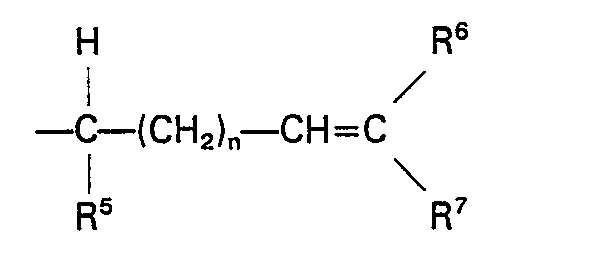
- R 1 is a lower alkyl group, a group of the general formula or a benzyl group, R 5 , R 6 and R 7 each representing H or a lower alkyl group and n being 1 or 2;
- Compounds of the Formula I possess potent anti-gastric ulcer and anti-inflammatory activities and therefore, they are regarded as therapeutically useful.
- the compounds of this invention are more potent and chemically stable than sodium guaiazulene-3-sulfonate, which has heretofore been used on account of its anti-gastric ulcer and anti-inflammatory activities.
- lower alkyl group in relation to R 1 , R 2 , R 3 , R 4 , R 5 , R 6 and R 7 in Formula (I), is meant a straight chain alkyl group or a branched alkyl group having from 1 to 6 carbon atoms.
- the positions of R 3 and R 4 are selected from the 4, 6 and 7 positions on the 7- membered ring.
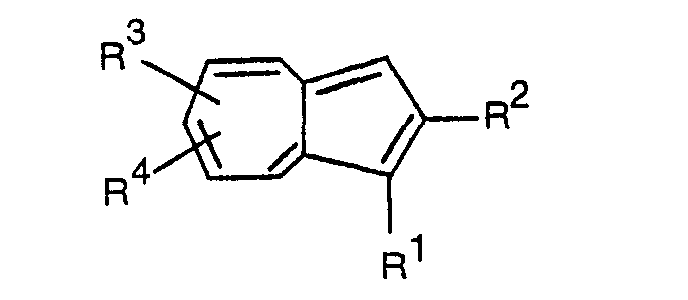
- the new azulene derivatives of the general Formula (I) may be obtained by sulfonation of a compound of the general Formula (II) below and converting the sulfonic acid produced to a sodium or aluminium salt
- R 1 , R 2 , R 3 and R 4 are as defined above.
- the pre-sulfonated compounds of Formula (II) may be prepared by any of several methods i) to iv) as described below.
- the compounds obtained as described above may be purified by distillation under reduced pressure or column chromatography and then submitted to sulfonation.
- Sulfonation is generally carried out in acetic anhydride by adding sulfuric acid in cooling condition, also in other cases, sulfuric anhydride-pyridine complex can be utilized.
- the resulting sulfonated compound is converted to its sodium salt with a solution of sodium hydroxide or sodium ethylate and then recrystallized from an alcohol.
- aluminium salts sodium sulfonates are converted by aluminium salt solutions, for example, an aqueous solution of AI(OH) 3 , AICI 3 or aluminium propoxide.
- the compounds of this invention thus obtained posses improved stability to light and heat and some of these compounds have excellent anti-peptic and anti-gastric ulcer activities and are promising for therapeutic use.
- the compounds of the present invention are administered to animals and human perorally, parenterally or rectally as active ingredients in customary dosage unit composition, that is, compositions in dosage unit form consisting essentially of an inert pharmaceutical carrier and one effective dosage unit of the active ingredient, such as tablets, granules, capsules, suspensions and the like.
- One effective dosage unit of the compounds according to the present invention is from 2 mg to 60 mg, 3 times a day for an adult.
- Anti-peptic activity of the compounds according to the invention is tested in vitro according to V.K. Thiemer (Arznei-Forsch 22 (6), PP.1086, 1972), using bovine serum albumine as a substrate and commercially available pepsine.
- Activity is expressed as % inhibition to the control value (no inhibitor added) as shown in Table 1. Also ID 50 (50% inhibiting dose) is obtained graphically.
- the acute toxicity of Compound 3 is determined by the Litchfield & Wilcoxon method using SD rats.
- the LD 50 values of the compound is shown below.
- the following data show the stability of Compound 3.
- the data are expressed in % residue of their original compounds after storage in each condition.
- Granules were prepared from the following ingredients
- the ingredients were intimately mixed with each other and the mixture was granulated in a conventional manner.
- the granules were prepared from the following ingredients
- Granules were prepared from the following ingredients
- Granules were prepared from the following ingredients
- Granules were prepared from the following ingredients
- Granules were prepared from the following ingredients
- Granules were prepared from the following ingredients
- Granules were prepared from the following ingredients
- Granules were prepared from the following ingredients
- the starting compound, 1-methyl azulene may be prepared as illustrated below according to Yasunami et al (Chemistry Letters, pp579-582, 1980).
- Step 1 1-methyl-3-carboxymethyl azulene (B).
- Acetic anhydride of 10 ml was added to 1-methyl-azulene of 1.0 g, in cooling condition with ice-water, sulfuric acid of 3.4 g was added dropwise and the reaction mixture was stirred for 4 hours at 0°C. Then, the reaction mixture was made alkaline to pH8-9 by adding 40% of sodium hydroxide solution and the generated solid was collected and dried. The product was recrystallized from 95% ethanol to give 1.1 g of the desired compound.
- Compound 3 was prepared by following the procedures of Example 1, using 5-isopropyl-substituted derivative of oxazulene as a starting material instead of oxazulene (A) and n-butyradldehyde instead of propionaldehyde. The sulfonation is carried out according to the procedure of Step 3 of Example 1.
- Compound 5 was prepared according to Example 1, using d.1-citronellal instead of propione aldehyde in Example 1.
- Compound 7 was prepared according to Example 1, using 3-(1-pirrolidinyl)-2-pentene instead of propionaldehyde and morpholine in Step 1 of Example 1.
- Compound 8 was prepared according to Example 1, using d-citronellal instead of proprionaldehyde in Step 1 of Example 1.
- Compound 9 was prepared according to Example 1, using 1-citronellal instead of propionaldehyde in Step 1 of Example 1.
Landscapes
- Chemical & Material Sciences (AREA)
- Health & Medical Sciences (AREA)
- Organic Chemistry (AREA)
- Life Sciences & Earth Sciences (AREA)
- Veterinary Medicine (AREA)
- Public Health (AREA)
- General Health & Medical Sciences (AREA)
- Medicinal Chemistry (AREA)
- Animal Behavior & Ethology (AREA)
- Pharmacology & Pharmacy (AREA)
- General Chemical & Material Sciences (AREA)
- Nuclear Medicine, Radiotherapy & Molecular Imaging (AREA)
- Chemical Kinetics & Catalysis (AREA)
- Emergency Medicine (AREA)
- Epidemiology (AREA)
- Rheumatology (AREA)
- Pain & Pain Management (AREA)
- Engineering & Computer Science (AREA)
- Bioinformatics & Cheminformatics (AREA)
- Organic Low-Molecular-Weight Compounds And Preparation Thereof (AREA)
- Acyclic And Carbocyclic Compounds In Medicinal Compositions (AREA)
- Pharmaceuticals Containing Other Organic And Inorganic Compounds (AREA)
Description
- This invention relates to new azulene derivatives having valuable therapeutic properties and methods of synthesizing them.
- Azulene derivatives have been well known as having anti-gastric ulcer, anti-gastritis and anti- inflammation activities. However, because of their instability to light and heat, an improved stable and potent derivative has been long desired.
- It will be understood from the description below that the present invention provides novel compounds having advantageous pharmaceutical properties, pharmaceutical compositions useful as anti-peptic ulcerative agents, pharmaceutical compositions useful as anti-inflammatory agents and new sodium azulene derivatives sulphonates and a method for the manufacture thereof.
- According to the invention, there are provided new compounds of the general formula (1)


- R2 and R3 each representing H or a lower alkyl group;
- R4 is H or an alkoxy group; and
- X is Na or Al(OH)2-
- Compounds of the Formula I possess potent anti-gastric ulcer and anti-inflammatory activities and therefore, they are regarded as therapeutically useful. The compounds of this invention are more potent and chemically stable than sodium guaiazulene-3-sulfonate, which has heretofore been used on account of its anti-gastric ulcer and anti-inflammatory activities.
- In this specification by "lower alkyl group", in relation to R1, R2, R3, R4, R5, R6 and R7 in Formula (I), is meant a straight chain alkyl group or a branched alkyl group having from 1 to 6 carbon atoms. In compunds of the formula I desirably the positions of R3 and R4 are selected from the 4, 6 and 7 positions on the 7- membered ring.
- The following compounds according to the invention are of particular interest.
-
- 1) Sodium 3-methyl-azulene sulfonate
- 2) Sodium 3-ethyl-azulene sulfonate
- 3) Sodium 3-ethyl-7-isopropyl-azulene sulfonate
- 4) Sodium 3-ethyl-6-isopropyl-azulene sulfonate
- 5) Sodium 3-(1 '-R, S-1', 5'-dimethyl-4'-hexane) azulene sulfonate
- 6) Sodium 3-n-butyl-azulene sulfonte
- 7) Sodium 3-methyl-2-ethyl-azulene sulfonate
- 8) Sodium 3-(1'-S-1', 5'-dimethyl-4'-hexene)-azulene sulfonate
- 9) Sodium 3-(1'―R―1', 5'-dimethyl-4'-hexene)-azulene sulfonate
- 10) Sodium 3-(1'―S―1', 5'-dimethyl-4'-hexene)-7-isopropyl-azulene sulfonate
- 11) Sodium 3-(1'-R-1', 5'-dimethyl-4'-hexene)-7-isopropyl-azulene sulfonate
- 12) Sodium 3-propyl-azulene sulfonate
- 13) Sodium 3-methyl-7-isopropyl-azulene sulfonate
- 14) Sodium 3-n-butyl-azulene sulfonate
- 15) Sodium 3-n-pentyl-azulene sulfonate
- 16) Sodium 5-isopropyl-azulene sulfonate
- 17) Sodium 7-isopropyl-3-n-propyl-azulene sulfonate
- 18) Sodium 7-isopropyl-3-n-butyl-azulene sulfonate
- 19) Sodium 7-isopropyl-3-pentyl-azulene sulfonate
- 20) Sodium 7-isopropyl-3-(1'-R, S-1', 5'-dimethyl-4'-hexene)-azulene sulfonate
- 21) Sodium 7-isopropyl-3-(1'-R-1', 5'-dimethyl-4'-hexene)-azulene sulfonate
- 22) Sodium 7-isopropyl-3-(1'―S―1', 5'-dimethyl-4'-hexene)-azulene sulfonate
- 23) Sodium 7-isopropyl-3-benzyl-azulene sulfonate
- 24) Sodium 4-methoxy-3-methyl-azulene sulfonate
- 25) Sodium 4-methoxy-3-ethyl-azulene sulfonate
- 26) Sodium 4-methoxy-3-propyl-azulene sulfonate
- 27) Sodium 4-methoxy-3-butyl-azulene sulfonate
- 28) Sodium 4-methoxy-3-pentyl-azulene sulfonate
- 29) Sodium 4-methozy-3-hexyl-azulene sulfonate
- 30) Sodium 7-isopropyl-4-methoxy-3-methyl-azulene sulfonate
- 31) Sodium 7-isopropyl-4-methoxy-3-ethyl-azulene sulfonate
- 32) Sodium 7-isopropyl-4-methoxy-3-propyl-azulene sulfonate
- 33) Sodium 7-isopropyl-4-methoxy-3-buytl-azulene sulfonate
- 34) Sodium 7-isopropyl-4-methoxy-3-pentyl-azulene sulfonate
- 35) 3-methyl-azulene sulfonic acid aluminium salt
- 36) 3-ethyl-azulene acid aluminium salt
- 37) 7-isopropyl-3-methyl-azulene sulfonic acid aluminium salt
- 38) 7-isopropyl-3-ethyl-azulene sulfonic acid aluminium salt
- The above-mentioned compounds numbered from 1 to 38, are referred to hereinafter as Compound 1 to Compound 38, respectively.
- The new azulene derivatives of the general Formula (I) may be obtained by sulfonation of a compound of the general Formula (II) below and converting the sulfonic acid produced to a sodium or aluminium salt

- In the Formula (II), R1, R2, R3 and R4 are as defined above.
- The pre-sulfonated compounds of Formula (II) may be prepared by any of several methods i) to iv) as described below.
- i) Compounds of Formula (II) where R1 and R3 are each H or a lower alkyl and R2 is H may be obtained by the method according to L. T. Scott (J. Am Chem. Soc. 102 6311p 1980) or m. Yasunami (Chemistry Letters 579p 1980).
- ii) Where R1 is


- iii) Compounds of Formula (II) in which both R1 and R2 are lower alkyl groups may be obtained by the process (ii) above except that an enamine obtained from a ketone

- iv) Other compounds of the Formula (II) may also be prepared according to M. Yasunami (Chem. Lett. 589p 1980).
- The compounds obtained as described above may be purified by distillation under reduced pressure or column chromatography and then submitted to sulfonation. Sulfonation is generally carried out in acetic anhydride by adding sulfuric acid in cooling condition, also in other cases, sulfuric anhydride-pyridine complex can be utilized. The resulting sulfonated compound is converted to its sodium salt with a solution of sodium hydroxide or sodium ethylate and then recrystallized from an alcohol.
- To obtain aluminium salts, sodium sulfonates are converted by aluminium salt solutions, for example, an aqueous solution of AI(OH)3, AICI3 or aluminium propoxide.
- The compounds of this invention thus obtained posses improved stability to light and heat and some of these compounds have excellent anti-peptic and anti-gastric ulcer activities and are promising for therapeutic use.
- For pharmaceutical purpose, the compounds of the present invention are administered to animals and human perorally, parenterally or rectally as active ingredients in customary dosage unit composition, that is, compositions in dosage unit form consisting essentially of an inert pharmaceutical carrier and one effective dosage unit of the active ingredient, such as tablets, granules, capsules, suspensions and the like. One effective dosage unit of the compounds according to the present invention is from 2 mg to 60 mg, 3 times a day for an adult.
- The following examples show the biological activity of the compounds of the invention as compared with sodium guaiazulene-3-sulfonate (GAS) as a standard, the preparation of typical compositions of the present invention and preparation of the compounds of the invention.
- Anti-peptic activity of the compounds according to the invention is tested in vitro according to V.K. Thiemer (Arznei-Forsch 22 (6), PP.1086, 1972), using bovine serum albumine as a substrate and commercially available pepsine.
- Activity is expressed as % inhibition to the control value (no inhibitor added) as shown in Table 1. Also ID50 (50% inhibiting dose) is obtained graphically.

- In order to ascertain the ani-ulcerative activity in vitro, Shay's rat (Gastro enterology 26, P.906) is selected. Rats are fasted for 48 hours and pylorus ligation is carried out under light anesthesia. The compound to be tests is given perorally. 16 hours after ligation the animals are sacrificed and the stomach is removed. The induced erosion is measured in area and scored as ulcer index (U.I.). The data are expressed as % inhibition to the control valve from the equation described below.


- The acute toxicity of Compound 3 is determined by the Litchfield & Wilcoxon method using SD rats.
- The LD50 values of the compound is shown below.

- It should be emphasized that stability of Compound 3 is greatly improved compared with that of sodium guaiazulene sulfonate which has hitherto been used clinically.
- Because the instability of sodium guaiazulene sulfonate has limited its pharmaceutical utility, the improved stability of the compounds of this invention is meritorious.
- The following data show the stability of Compound 3. The data are expressed in % residue of their original compounds after storage in each condition.

- The following examples illustrate typical pharmaceutical dosage unit compositions comprising a compound of the present invention as an active ingredient and represent the modes contemplated for putting the invention into practical use.
- Granules were prepared from the following ingredients

- Preparation
- In this example and the following pharmaceutical examples, the ingredients were intimately mixed with each other and the mixture was granulated in a conventional manner.
- The granules were prepared from the following ingredients
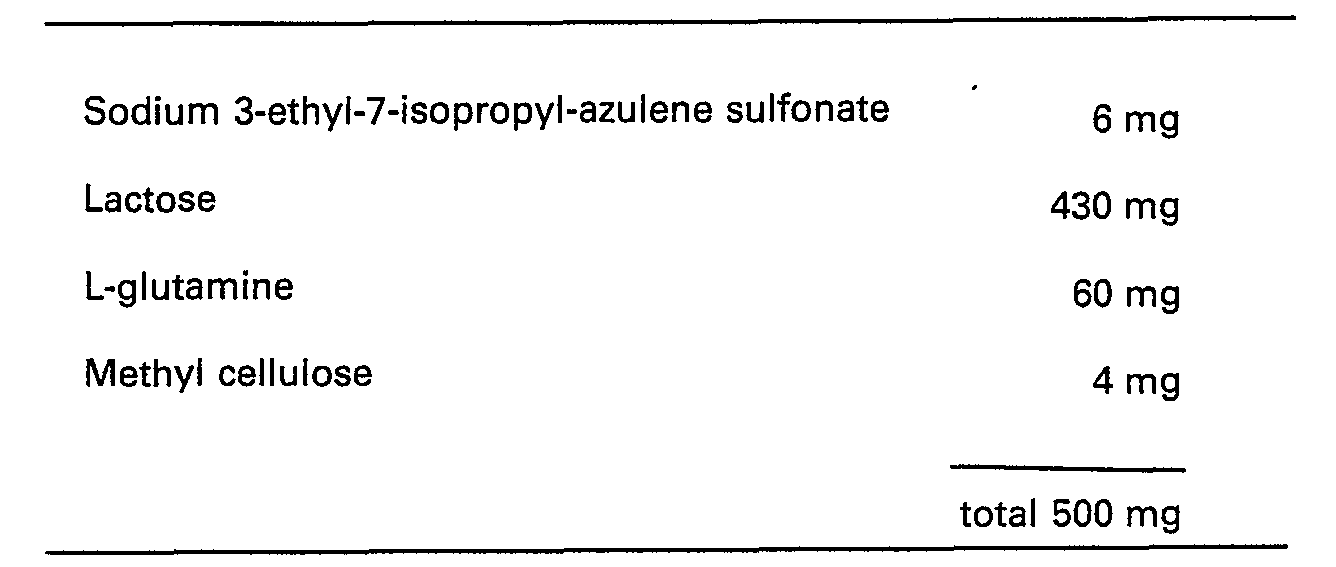
- Granules were prepared from the following ingredients

- Granules were prepared from the following ingredients

- Granules were prepared from the following ingredients

- Granules were prepared from the following ingredients

- Granules were prepared from the following ingredients

- Granules were prepared from the following ingredients

- Granules were prepared from the following ingredients

- Anyone of the other compounds of t-ormula I may be substituted for the particular active ingredient in the above pharmaceutical Examples 1 to 9. Likewise, the amount of active ingredient in these illustrative pharmaceutical examples may be varied to achieve the dosage unit range set forth above, and the amounts and nature of the inert pharmaceutical carrier ingredients may be varied to meet particular requirements.
- The following examples illustrate the preparation of compounds according to the invention.
- The starting compound, 1-methyl azulene, may be prepared as illustrated below according to Yasunami et al (Chemistry Letters, pp579-582, 1980).

- A solution of oxazulene (A) 6 g, propyl aldehyde 5.22 g and morpholine 7.84 g in 120 mg of EtOH was refluxed for 4 hours. The mixture was cooled and the organic solvent was removed under reduced pressure. The residue was extracted with benzene and organic layer was washed with water and dried.
- After removal of benzene, the residue was applied to silica gel column chromatography using benzene as eluent to give 5.9 g of solid product after removal of solvent.
- Yield: 5.9 g (98.5%) m.p. 69―71°C
- ir: 2950, 1690, 1450, 1440, 1421, 1202, 1027, 774, 746 (cm-1)
- 'H-NMR: (CDCI3) 2.58 (3H, S, Me), 3.92 (3H, S, OMe), 7.28 (1 H, dd, J=9.6,9.6, H-5), 7.37 (1 H, dd, J=9.6, 9.6, H-7), 7.67 (1H, dd, J=9.6, 9.6, H-6), 8.14 (1H, S, H-2), 8.24 (1H, dd, J=9.6, 1.4, H-4), 9.49 (1H, dd, J=9.6, 1.4, H-8)
- 5.91 g of compound B was dissolved in 60 ml of phosphoric acid and the mixture was heated (90―90°C) on a water bath for 15 minutes. After cooling the mixture was poured to 300 ml of ice-water and extracted with n-hexane. The organic layer was separated, washed with water, dried over anhydrous sodium sulfonate and fractionated by silica gel column chromatography using benzene as eluent to give 3.72 g (90.1%) of the desired compound.
- ir: 3012, 2930, 1577, 1510, 1455, 1396, 947, 880 (cm-1)
- 1H-NMR: (CDCI3) 2.58 (3H, S, Me), 3.92 (3H, S, OMe), 7.28 (1 H, dd, J=9.6, 9.6, H-5), 7.37 (1 H, dd, J=9.6, 9.6, H-7), 7.67 (1 H, dd, J=9.6, 9.6, H-6), 8.14 (1H, S, H-2), 8.24 (1 H, dd, 1=9.6, 1.4, H-4), 9.49 (1 H, dd, J=9.6, 1.4, H-8),
- Acetic anhydride of 10 ml was added to 1-methyl-azulene of 1.0 g, in cooling condition with ice-water, sulfuric acid of 3.4 g was added dropwise and the reaction mixture was stirred for 4 hours at 0°C. Then, the reaction mixture was made alkaline to pH8-9 by adding 40% of sodium hydroxide solution and the generated solid was collected and dried. The product was recrystallized from 95% ethanol to give 1.1 g of the desired compound.
- m.p.: 35-38°C
- ir: 1630, 1420, 1220, 750 (cm-1)
- Compounds 2-34 were obtained by the same sulfonating procedure as in the above-described Step 3 from the corresponding starting materials which are disclosed in the literature (M. Yasunami, Chem. lett., P.579, 1980).
- Compound 2 is obtained by using n-butylaldehyde instead of propionaldehyde in Step 1 of Example 1. m.p.: 28-30°C
- ir: 1630, 1452, 1400, 1220, 850 (cm-1)
- Compound 3 was prepared by following the procedures of Example 1, using 5-isopropyl-substituted derivative of oxazulene as a starting material instead of oxazulene (A) and n-butyradldehyde instead of propionaldehyde. The sulfonation is carried out according to the procedure of Step 3 of Example 1.
- m.p.: 85-88°C
- ir: 1650, 1640, 1564, 1418, 1180, 1050 (cm-1)
- 1H-NMR (DMSO): 1.30 (3H, t, J=J7.4, CH3), 1.33 (6H, d, J=6.6, (CH3)2-), 3.00 (2H, q, J=7.4, CH2), 3.50 (1H, sept, J=6.6, ―CH―(CH3)2), 4.10 (1H, bs, H20), 7.20 (1H, d, J=10, H-7), 7.90 (1H, s, H-2), 8.23 (1H, d, J=10, H-4), 9.17 (1H, s, H-8)
-
- m.p.: 55-58°C
- ir: 1640, 1580, 1410, 1190, 1060 (cm-1)
- 1H-NMR (DMSO): 1.27 (3H, t, J=7.4, CH3), 1.30 (6H, d, J=6.6, (CH3)2-), 2.96 (1 H, sept, J=6.6, isopropyl), 3.02 (2H, q, J=7.4, CH2), 7.17 (2H, d, J=10, H-5.7), 7.70 (1 H, s, H-2), 8.20 (1H, d, J=10, H-8), 8.90 (1 H, d, J=10, H-4)
- Compound 5 was prepared according to Example 1, using d.1-citronellal instead of propione aldehyde in Example 1.
- m.p.: 78―81°C
- ir: 1630, 1560, 1420, 1400, 1190, 1120, 1050, 750 (cm-1)
-
- m.p.: 83-85°C
- ir: 1630, 1420, 1400, 1220, 750 (cm-1)
- Compound 7 was prepared according to Example 1, using 3-(1-pirrolidinyl)-2-pentene instead of propionaldehyde and morpholine in Step 1 of Example 1.
- m.p.: 280-283°C
- ir: 1640, 1560, 1420, 1190, 1040, 740 (cm-1)
- Compound 8 was prepared according to Example 1, using d-citronellal instead of proprionaldehyde in Step 1 of Example 1.
- m.p.: 78―81°C
- ir: 1630, 1560, 1420, 1400, 1190, 1120, 1050, 750 (cm-1)
- Compound 9 was prepared according to Example 1, using 1-citronellal instead of propionaldehyde in Step 1 of Example 1.
- m.p.: 78-81°C
- ir: 1630, 1560, 1420, 1400, 1190, 1120, 1050, 750 (cm-1)
-
- m.p.: 108―110°C
- ir: 1630, 1560, 1420, 1220, 1050 (cm-1)
-
- m.p.: 108-110°C
- ir: 1630, 1560, 1420, 1220, 1050 (cm-1)
-
- m.p.: 210-215°C (decomp.)
- ("decomp." stands for decomposition point, hereinafter.)
- ir: 3400, 2940, 2850, 1580, 1420, 1400, 1200, 1090, 1020, 960, 880, 750, 740, 670 (cm-1)
-
- m.p.: 91-93°C
- ir: 3450, 2950, 1640, 1250, 1070, 1010, 790 (cm-1)
-
- m.p.: 215-220°C (decomposition point)
- ir: 3450, 2900, 1570, 1390, 1190 (cm-1)
-
- m.p.: 217-220°C (decomp.)
- ir: 3450, 2900, 1570, 1390, 1190 (cm-1)
-
- m.p.: 241-248°C
- ir: 3450, 2950, 1640, 1200, 1050 (cm-1)
-
- m.p.: 138-143°C
- ir: 3450, 2950, 1630, 1575, 1470, 1415, 1390, 1220, 1050, 930 (cm-1)
-
- m.p.: 150―152°C
- ir: 3450, 2950, 1640, 1575, 1465 (cm-1)
-
- m.p.: 168-170°C
- ir: 3400, 2950, 2930, 2860, 1620, 1580, 1470, 1440, 1390, 1190, 1060 (cm-1)
-
- m.p.: 113-116°C
- ir: 3450, 2950, 1640, 1380, 1240, 1180 (cm-1)
-
- m.p.: 114-117°C
- ir: 3450, 2950, 1640, 1380, 1240, 1180 (cm-1)
-
- m.p.: 115-1180C
- ir: 3450, 2950, 1640, 1380, 1240, 1180 (cm-1)
-
- m.p.: 250°C (decomp.)
- ir: 3450, 2950, 1640, 1560, 1530, 1460, 1420 (cm-1)
-
- m.p.: 186-188°C (decomp.)
- ir: 3400, 1600, 1570, 1540, 1460, 1370, 1270 (cm-1)
-
- m.p.: 60°C
- ir: 3400, 2950, 1600, 1570, 1540, 1450, 1370, 1270 (cm-1)
-
- m.p.: 108-110°C
- ir: 3450, 2910, 2850, 1600, 1570, 1530 (cm-1)
-
- m.p.: 188-190°C (decomp.)
- ir: 3450, 2950, 1600, 1570, 1530, 1460 (cm-1)
-
- m.p.: 189-192°C (decomp.)
- ir: 3450, 2950, 1600, 1560, 1530, 1450 (cm-1)
-
- m.p.: 225―228°C (decomp.)
- ir: 3450, 2900, 1650, 1560, 1520, 1460 (cm-1)
-
- m.p.: 95-97°C
- ir: 3450, 2950, 1650, 1540, 1280, 1180 (cm-1)
-
- m.p.: 108-110°C
- ir: 3450, 2950, 1650, 1540,1260, 1180 (cm-1)
-
- m.p.: 188-190°C
- ir: 3450, 2950, 1640, 1560, 1530 (cm-1)
-
- m.p.: 166-168°C
- ir: 3450, 2950, 1640, 1560, 1530, 1470 (cm-1)
-
- m.p.: 123-125°C
- ir: 3450, 2950, 1650, 1520, 1260, 1010 (cm-1)
- 5 g of sodium 3-methyl azulene sulfonate was dissolved in water. To this solution, 2.73 g of AICI in 10 ml of water after filtration of the residue was added and stirred for 30 minutes at room temperature. The reaction mixture was adjusted to pH 4-4.5 by adding 10% NaOH. The precipitates formed were collected by filtration and washed with water and dried.
- m.p.: over 250°C
- ir: 3400, 1630, 1580, 1395, 1140, 1040, 740 (cm-1)
- AI content: 13.96%
- The following compounds (Compounds 36-38) were prepared in the same manner as described in Example 35, from the corresponding sodium sulfonate derivatives.
-
- m.p.: over 250°C
- ir: 3400, 2950, 1580, 1400, 1150, 1050, 750 (cm-1)
- AI content: 13.00%
-
- m.p.: over 250°C
- ir: 3400, 2950, 1420, 1150, 1040 (cm-1)
- AI content: 9.46%
-
- m.p.: over 250°C
- ir: 3400, 2950, 1580, 1420, 1390, 1150 (cm-1)
- AI content: 10.58%
Claims (16)


Priority Applications (1)
| Application Number | Priority Date | Filing Date | Title |
|---|---|---|---|
| AT84305775T ATE26976T1 (en) | 1983-08-24 | 1984-08-23 | AZULENE DERIVATES USED AS ANTIULCUS AND ANTI-INFLAMMATORY AGENTS. |
Applications Claiming Priority (4)
| Application Number | Priority Date | Filing Date | Title |
|---|---|---|---|
| JP15318783A JPS6048960A (en) | 1983-08-24 | 1983-08-24 | Azulene derivative, its preparation, and antitumor agent containing it as active ingredient |
| JP153187/83 | 1983-08-24 | ||
| JP14028/84 | 1984-01-28 | ||
| JP1402884A JPS60158160A (en) | 1984-01-28 | 1984-01-28 | Azulene derivative sulfonate, antiulcer and anti-inflammatory agent and preparation thereof |
Publications (2)
| Publication Number | Publication Date |
|---|---|
| EP0147915A1 EP0147915A1 (en) | 1985-07-10 |
| EP0147915B1 true EP0147915B1 (en) | 1987-05-06 |
Family
ID=26349908
Family Applications (1)
| Application Number | Title | Priority Date | Filing Date |
|---|---|---|---|
| EP84305775A Expired EP0147915B1 (en) | 1983-08-24 | 1984-08-23 | New azulene derivatives useful as anti-ulcerative and anti-flammatory agents |
Country Status (13)
| Country | Link |
|---|---|
| US (1) | US4595694A (en) |
| EP (1) | EP0147915B1 (en) |
| KR (1) | KR920000956B1 (en) |
| AR (1) | AR240554A1 (en) |
| AU (1) | AU571554B2 (en) |
| CA (1) | CA1228862A (en) |
| DE (1) | DE3463502D1 (en) |
| DK (1) | DK169870B1 (en) |
| ES (1) | ES8506607A1 (en) |
| HU (1) | HU195478B (en) |
| NO (1) | NO158673C (en) |
| PT (1) | PT79119B (en) |
| SU (1) | SU1311618A3 (en) |
Families Citing this family (10)
| Publication number | Priority date | Publication date | Assignee | Title |
|---|---|---|---|---|
| US5081152A (en) * | 1989-07-05 | 1992-01-14 | Kotobuki Seiyaku Co., Ltd. | Azulene derivatives as thromboxane a2 and prostaglandin endoperoxide receptor antagonist |
| EP0887077A1 (en) * | 1997-06-27 | 1998-12-30 | Boehringer Mannheim Gmbh | Use of azulene derivatives as metalloprotease inhibitors |
| US6420435B1 (en) | 1999-11-01 | 2002-07-16 | Joe S. Wilkins, Jr. | Method for treating gastrointestinal disorders |
| AU2002322720B2 (en) | 2001-07-25 | 2008-11-13 | Raptor Pharmaceutical Inc. | Compositions and methods for modulating blood-brain barrier transport |
| US7041706B2 (en) * | 2002-04-19 | 2006-05-09 | Wilkins Jr Joe S | Method for treating crohn's disease |
| CN102379684B (en) | 2005-04-28 | 2014-11-19 | 普罗透斯数字保健公司 | Pharma-informatics system |
| KR20090071598A (en) | 2006-09-18 | 2009-07-01 | 랩터 파마슈티컬 인코포레이티드 | Treatment of liver disease by administration of receptor binding protein (RAP) -conjugates |
| EP2398500B1 (en) | 2009-02-20 | 2019-03-13 | 2-BBB Medicines B.V. | Glutathione-based drug delivery system |
| ES2942923T3 (en) | 2009-05-06 | 2023-06-07 | Laboratory Skin Care Inc | Dermal delivery compositions comprising complexes of active agent-calcium phosphate particles and methods of use thereof |
| US20120077778A1 (en) | 2010-09-29 | 2012-03-29 | Andrea Bourdelais | Ladder-Frame Polyether Conjugates |
Family Cites Families (5)
| Publication number | Priority date | Publication date | Assignee | Title |
|---|---|---|---|---|
| DE1227896B (en) * | 1965-12-02 | 1966-11-03 | Degussa | Process for the preparation of water-soluble stable salts of azulene sulfonic acid amides |
| US3816612A (en) * | 1967-03-23 | 1974-06-11 | Degussa | Process for the production of basically reacting pharmaceuticals |
| US3974299A (en) * | 1974-07-08 | 1976-08-10 | Dynapol | Ionic sweetener |
| US4224240A (en) * | 1979-04-13 | 1980-09-23 | Scm Corporation | Preparation of para-menth-1-ene-7-sulfonate salts and corresponding acids |
| US4283347A (en) * | 1979-04-13 | 1981-08-11 | Scm Corporation | Para-menth-1-ene-7-sulfonic acid and salts thereof |
-
1984
- 1984-08-01 AU AU31396/84A patent/AU571554B2/en not_active Expired
- 1984-08-03 DK DK377984A patent/DK169870B1/en not_active IP Right Cessation
- 1984-08-15 CA CA000461108A patent/CA1228862A/en not_active Expired
- 1984-08-17 US US06/642,043 patent/US4595694A/en not_active Expired - Lifetime
- 1984-08-23 PT PT79119A patent/PT79119B/en unknown
- 1984-08-23 DE DE8484305775T patent/DE3463502D1/en not_active Expired
- 1984-08-23 KR KR1019840005107A patent/KR920000956B1/en not_active Expired
- 1984-08-23 AR AR29767884A patent/AR240554A1/en active
- 1984-08-23 HU HU843172A patent/HU195478B/en not_active IP Right Cessation
- 1984-08-23 EP EP84305775A patent/EP0147915B1/en not_active Expired
- 1984-08-23 ES ES535381A patent/ES8506607A1/en not_active Expired
- 1984-08-23 SU SU3785251A patent/SU1311618A3/en active
- 1984-08-23 NO NO843377A patent/NO158673C/en unknown
Also Published As
| Publication number | Publication date |
|---|---|
| ES535381A0 (en) | 1985-07-16 |
| ES8506607A1 (en) | 1985-07-16 |
| NO158673C (en) | 1988-10-19 |
| AR240554A1 (en) | 1990-05-31 |
| NO843377L (en) | 1985-02-25 |
| DE3463502D1 (en) | 1987-06-11 |
| DK169870B1 (en) | 1995-03-20 |
| PT79119B (en) | 1986-07-17 |
| KR850001731A (en) | 1985-04-01 |
| SU1311618A3 (en) | 1987-05-15 |
| NO158673B (en) | 1988-07-11 |
| AU571554B2 (en) | 1988-04-21 |
| DK377984D0 (en) | 1984-08-03 |
| DK377984A (en) | 1985-02-25 |
| AU3139684A (en) | 1985-02-28 |
| EP0147915A1 (en) | 1985-07-10 |
| HUT37393A (en) | 1985-12-28 |
| HU195478B (en) | 1988-05-30 |
| KR920000956B1 (en) | 1992-01-31 |
| CA1228862A (en) | 1987-11-03 |
| US4595694A (en) | 1986-06-17 |
| PT79119A (en) | 1984-09-01 |
Similar Documents
| Publication | Publication Date | Title |
|---|---|---|
| EP0002895B1 (en) | Enzyme inhibitory phthalazin-4-ylacetic acid derivatives, pharmaceutical compositions thereof, and process for their manufacture | |
| DE2814556C2 (en) | Substituted phenylacetic acid derivatives, processes for their preparation and pharmaceutical compositions containing them | |
| US4110337A (en) | Triazolobenzodiazepines | |
| EP0011111B1 (en) | 5-(4-pyridyl)-6-(4-fluorophenyl)-2,3-dihydroimidazo-(2,1-b)-thiazole, process for its preparation and medical composition | |
| EP0050326B1 (en) | Benzo(b)thiophenes | |
| JPH0314315B2 (en) | ||
| US4595694A (en) | Azulene derivatives, processes of their synthesis and their uses as anti-ulcerative and anti-inflammatory agents | |
| EP0120558B1 (en) | Antihypertensive n-piperazinylalkanoylanilides | |
| US4282360A (en) | 7-Methylthio or methylsulfinyl-5-oxo-5H-thiazolo[2,3-b]quinazoline-2-carboxylic acid | |
| EP0078241A2 (en) | Furanes | |
| US4496568A (en) | Antiinflammatory thieno [2,3-c]pyridine derivatives | |
| US4127667A (en) | Substituted thiopyrano(4,3-b)pyrans | |
| US4362891A (en) | Alkanoic acid derivatives | |
| US3506658A (en) | 2-(10-methyl-2-phenoxazinyl)propionic acid | |
| US4968708A (en) | Imidazo[2,1-B]benzothiazole compounds and antiulcer compositions containing the same | |
| JPS5849369A (en) | Novel imidazole compound, manufacture and analgesic antipuretic antiinflammatory drug containing same as major component | |
| US3929833A (en) | Organic compounds | |
| EP0045602B1 (en) | Novel polycyclic indole derivatives | |
| US3450698A (en) | Phenthiazine derivatives | |
| NO743135L (en) | ||
| EP0058009A1 (en) | Novel benzanilide derivatives and pharmaceutical compositions containing them | |
| EP0032821B1 (en) | Substituted benzopyranotriazoles | |
| US4812467A (en) | N-(imidazolylmethyl)diphenylazomethines and compositions containing them | |
| EP0168181B1 (en) | Cyclic amides | |
| NO121502B (en) |
Legal Events
| Date | Code | Title | Description |
|---|---|---|---|
| PUAI | Public reference made under article 153(3) epc to a published international application that has entered the european phase |
Free format text: ORIGINAL CODE: 0009012 |
|
| AK | Designated contracting states |
Designated state(s): AT BE CH DE FR GB IT LI LU NL SE |
|
| 17P | Request for examination filed |
Effective date: 19851204 |
|
| 17Q | First examination report despatched |
Effective date: 19860521 |
|
| GRAA | (expected) grant |
Free format text: ORIGINAL CODE: 0009210 |
|
| AK | Designated contracting states |
Kind code of ref document: B1 Designated state(s): AT BE CH DE FR GB IT LI LU NL SE |
|
| REF | Corresponds to: |
Ref document number: 26976 Country of ref document: AT Date of ref document: 19870515 Kind code of ref document: T |
|
| ITF | It: translation for a ep patent filed | ||
| REF | Corresponds to: |
Ref document number: 3463502 Country of ref document: DE Date of ref document: 19870611 |
|
| ET | Fr: translation filed | ||
| PLBE | No opposition filed within time limit |
Free format text: ORIGINAL CODE: 0009261 |
|
| STAA | Information on the status of an ep patent application or granted ep patent |
Free format text: STATUS: NO OPPOSITION FILED WITHIN TIME LIMIT |
|
| 26N | No opposition filed | ||
| ITTA | It: last paid annual fee | ||
| EPTA | Lu: last paid annual fee | ||
| EAL | Se: european patent in force in sweden |
Ref document number: 84305775.3 |
|
| REG | Reference to a national code |
Ref country code: GB Ref legal event code: IF02 |
|
| PGFP | Annual fee paid to national office [announced via postgrant information from national office to epo] |
Ref country code: SE Payment date: 20030806 Year of fee payment: 20 |
|
| PGFP | Annual fee paid to national office [announced via postgrant information from national office to epo] |
Ref country code: FR Payment date: 20030808 Year of fee payment: 20 |
|
| PGFP | Annual fee paid to national office [announced via postgrant information from national office to epo] |
Ref country code: AT Payment date: 20030813 Year of fee payment: 20 |
|
| PGFP | Annual fee paid to national office [announced via postgrant information from national office to epo] |
Ref country code: GB Payment date: 20030820 Year of fee payment: 20 |
|
| PGFP | Annual fee paid to national office [announced via postgrant information from national office to epo] |
Ref country code: LU Payment date: 20030825 Year of fee payment: 20 |
|
| PGFP | Annual fee paid to national office [announced via postgrant information from national office to epo] |
Ref country code: CH Payment date: 20030829 Year of fee payment: 20 |
|
| PGFP | Annual fee paid to national office [announced via postgrant information from national office to epo] |
Ref country code: NL Payment date: 20030831 Year of fee payment: 20 |
|
| PGFP | Annual fee paid to national office [announced via postgrant information from national office to epo] |
Ref country code: DE Payment date: 20030904 Year of fee payment: 20 |
|
| PGFP | Annual fee paid to national office [announced via postgrant information from national office to epo] |
Ref country code: BE Payment date: 20031009 Year of fee payment: 20 |
|
| PG25 | Lapsed in a contracting state [announced via postgrant information from national office to epo] |
Ref country code: LI Free format text: LAPSE BECAUSE OF EXPIRATION OF PROTECTION Effective date: 20040822 Ref country code: GB Free format text: LAPSE BECAUSE OF EXPIRATION OF PROTECTION Effective date: 20040822 Ref country code: CH Free format text: LAPSE BECAUSE OF EXPIRATION OF PROTECTION Effective date: 20040822 |
|
| PG25 | Lapsed in a contracting state [announced via postgrant information from national office to epo] |
Ref country code: NL Free format text: LAPSE BECAUSE OF EXPIRATION OF PROTECTION Effective date: 20040823 Ref country code: LU Free format text: LAPSE BECAUSE OF EXPIRATION OF PROTECTION Effective date: 20040823 Ref country code: AT Free format text: LAPSE BECAUSE OF EXPIRATION OF PROTECTION Effective date: 20040823 |
|
| BE20 | Be: patent expired |
Owner name: *KOTOBUKI SEIYAKU CO. LTD Effective date: 20040823 |
|
| REG | Reference to a national code |
Ref country code: GB Ref legal event code: PE20 |
|
| EUG | Se: european patent has lapsed | ||
| REG | Reference to a national code |
Ref country code: CH Ref legal event code: PL |
|
| NLV7 | Nl: ceased due to reaching the maximum lifetime of a patent |