EP0147868B1 - Light-sensitive silver halide emulsions - Google Patents
Light-sensitive silver halide emulsions Download PDFInfo
- Publication number
- EP0147868B1 EP0147868B1 EP84116446A EP84116446A EP0147868B1 EP 0147868 B1 EP0147868 B1 EP 0147868B1 EP 84116446 A EP84116446 A EP 84116446A EP 84116446 A EP84116446 A EP 84116446A EP 0147868 B1 EP0147868 B1 EP 0147868B1
- Authority
- EP
- European Patent Office
- Prior art keywords
- silver
- silver halide
- light
- core
- halide emulsion
- Prior art date
- Legal status (The legal status is an assumption and is not a legal conclusion. Google has not performed a legal analysis and makes no representation as to the accuracy of the status listed.)
- Expired
Links
- 239000000839 emulsion Substances 0.000 title claims description 105
- -1 silver halide Chemical class 0.000 title claims description 105
- 229910052709 silver Inorganic materials 0.000 title claims description 101
- 239000004332 silver Substances 0.000 title claims description 101
- JKFYKCYQEWQPTM-UHFFFAOYSA-N 2-azaniumyl-2-(4-fluorophenyl)acetate Chemical compound OC(=O)C(N)C1=CC=C(F)C=C1 JKFYKCYQEWQPTM-UHFFFAOYSA-N 0.000 claims description 42
- 229910021612 Silver iodide Inorganic materials 0.000 claims description 42
- 229940045105 silver iodide Drugs 0.000 claims description 42
- ZUNKMNLKJXRCDM-UHFFFAOYSA-N silver bromoiodide Chemical compound [Ag].IBr ZUNKMNLKJXRCDM-UHFFFAOYSA-N 0.000 claims description 40
- 238000000034 method Methods 0.000 claims description 34
- SQGYOTSLMSWVJD-UHFFFAOYSA-N silver(1+) nitrate Chemical compound [Ag+].[O-]N(=O)=O SQGYOTSLMSWVJD-UHFFFAOYSA-N 0.000 claims description 18
- 239000013078 crystal Substances 0.000 claims description 16
- ADZWSOLPGZMUMY-UHFFFAOYSA-M silver bromide Chemical compound [Ag]Br ADZWSOLPGZMUMY-UHFFFAOYSA-M 0.000 claims description 13
- 229910001961 silver nitrate Inorganic materials 0.000 claims description 9
- 150000004820 halides Chemical class 0.000 claims description 7
- 239000002904 solvent Substances 0.000 claims description 2
- XMBWDFGMSWQBCA-UHFFFAOYSA-N hydrogen iodide Chemical compound I XMBWDFGMSWQBCA-UHFFFAOYSA-N 0.000 claims 1
- 235000013339 cereals Nutrition 0.000 description 64
- 239000000975 dye Substances 0.000 description 35
- 239000000463 material Substances 0.000 description 23
- 239000000203 mixture Substances 0.000 description 21
- 238000009826 distribution Methods 0.000 description 18
- 239000010410 layer Substances 0.000 description 17
- 239000000243 solution Substances 0.000 description 16
- 108010010803 Gelatin Proteins 0.000 description 13
- 238000011161 development Methods 0.000 description 13
- 239000008273 gelatin Substances 0.000 description 13
- 229920000159 gelatin Polymers 0.000 description 13
- 235000019322 gelatine Nutrition 0.000 description 13
- 235000011852 gelatine desserts Nutrition 0.000 description 13
- 239000007864 aqueous solution Substances 0.000 description 11
- 229910052736 halogen Inorganic materials 0.000 description 10
- 150000002367 halogens Chemical class 0.000 description 10
- 150000003839 salts Chemical class 0.000 description 10
- 150000001875 compounds Chemical class 0.000 description 8
- DZVCFNFOPIZQKX-LTHRDKTGSA-M merocyanine Chemical compound [Na+].O=C1N(CCCC)C(=O)N(CCCC)C(=O)C1=C\C=C\C=C/1N(CCCS([O-])(=O)=O)C2=CC=CC=C2O\1 DZVCFNFOPIZQKX-LTHRDKTGSA-M 0.000 description 8
- 206010070834 Sensitisation Diseases 0.000 description 7
- BQCADISMDOOEFD-UHFFFAOYSA-N Silver Chemical compound [Ag] BQCADISMDOOEFD-UHFFFAOYSA-N 0.000 description 7
- 239000003795 chemical substances by application Substances 0.000 description 7
- 239000000084 colloidal system Substances 0.000 description 7
- 230000008313 sensitization Effects 0.000 description 7
- 238000004040 coloring Methods 0.000 description 6
- 238000012545 processing Methods 0.000 description 6
- ANRHNWWPFJCPAZ-UHFFFAOYSA-M thionine Chemical compound [Cl-].C1=CC(N)=CC2=[S+]C3=CC(N)=CC=C3N=C21 ANRHNWWPFJCPAZ-UHFFFAOYSA-M 0.000 description 6
- XLYOFNOQVPJJNP-UHFFFAOYSA-N water Chemical compound O XLYOFNOQVPJJNP-UHFFFAOYSA-N 0.000 description 6
- 239000007844 bleaching agent Substances 0.000 description 5
- 230000035945 sensitivity Effects 0.000 description 5
- XEEYBQQBJWHFJM-UHFFFAOYSA-N Iron Chemical compound [Fe] XEEYBQQBJWHFJM-UHFFFAOYSA-N 0.000 description 4
- 239000002253 acid Substances 0.000 description 4
- 238000004458 analytical method Methods 0.000 description 4
- IOLCXVTUBQKXJR-UHFFFAOYSA-M potassium bromide Chemical compound [K+].[Br-] IOLCXVTUBQKXJR-UHFFFAOYSA-M 0.000 description 4
- 230000001235 sensitizing effect Effects 0.000 description 4
- NINIDFKCEFEMDL-UHFFFAOYSA-N Sulfur Chemical compound [S] NINIDFKCEFEMDL-UHFFFAOYSA-N 0.000 description 3
- 239000002250 absorbent Substances 0.000 description 3
- 230000002745 absorbent Effects 0.000 description 3
- 230000015572 biosynthetic process Effects 0.000 description 3
- 238000011088 calibration curve Methods 0.000 description 3
- KRKNYBCHXYNGOX-UHFFFAOYSA-N citric acid Chemical compound OC(=O)CC(O)(C(O)=O)CC(O)=O KRKNYBCHXYNGOX-UHFFFAOYSA-N 0.000 description 3
- 238000005259 measurement Methods 0.000 description 3
- NLKNQRATVPKPDG-UHFFFAOYSA-M potassium iodide Chemical compound [K+].[I-] NLKNQRATVPKPDG-UHFFFAOYSA-M 0.000 description 3
- 238000000634 powder X-ray diffraction Methods 0.000 description 3
- 239000003381 stabilizer Substances 0.000 description 3
- 229910052717 sulfur Inorganic materials 0.000 description 3
- 239000011593 sulfur Substances 0.000 description 3
- QGZKDVFQNNGYKY-UHFFFAOYSA-N Ammonia Chemical compound N QGZKDVFQNNGYKY-UHFFFAOYSA-N 0.000 description 2
- KCXVZYZYPLLWCC-UHFFFAOYSA-N EDTA Chemical compound OC(=O)CN(CC(O)=O)CCN(CC(O)=O)CC(O)=O KCXVZYZYPLLWCC-UHFFFAOYSA-N 0.000 description 2
- QIGBRXMKCJKVMJ-UHFFFAOYSA-N Hydroquinone Chemical compound OC1=CC=C(O)C=C1 QIGBRXMKCJKVMJ-UHFFFAOYSA-N 0.000 description 2
- 239000004372 Polyvinyl alcohol Substances 0.000 description 2
- 238000002441 X-ray diffraction Methods 0.000 description 2
- 239000003513 alkali Substances 0.000 description 2
- 150000001412 amines Chemical class 0.000 description 2
- JEHKKBHWRAXMCH-UHFFFAOYSA-N benzenesulfinic acid Chemical compound O[S@@](=O)C1=CC=CC=C1 JEHKKBHWRAXMCH-UHFFFAOYSA-N 0.000 description 2
- IOJUPLGTWVMSFF-UHFFFAOYSA-N benzothiazole Chemical class C1=CC=C2SC=NC2=C1 IOJUPLGTWVMSFF-UHFFFAOYSA-N 0.000 description 2
- 150000001565 benzotriazoles Chemical class 0.000 description 2
- 239000001913 cellulose Substances 0.000 description 2
- 229920002678 cellulose Polymers 0.000 description 2
- 235000010980 cellulose Nutrition 0.000 description 2
- 239000011248 coating agent Substances 0.000 description 2
- 238000000576 coating method Methods 0.000 description 2
- 229910017052 cobalt Inorganic materials 0.000 description 2
- 239000010941 cobalt Substances 0.000 description 2
- GSOLWAFGMNOBSY-UHFFFAOYSA-N cobalt Chemical compound [Co][Co][Co][Co][Co][Co][Co][Co] GSOLWAFGMNOBSY-UHFFFAOYSA-N 0.000 description 2
- 239000010949 copper Substances 0.000 description 2
- 239000006185 dispersion Substances 0.000 description 2
- 239000012153 distilled water Substances 0.000 description 2
- 238000005562 fading Methods 0.000 description 2
- LNTHITQWFMADLM-UHFFFAOYSA-N gallic acid Chemical class OC(=O)C1=CC(O)=C(O)C(O)=C1 LNTHITQWFMADLM-UHFFFAOYSA-N 0.000 description 2
- 150000002460 imidazoles Chemical class 0.000 description 2
- 239000003112 inhibitor Substances 0.000 description 2
- 229910052742 iron Inorganic materials 0.000 description 2
- 229910052751 metal Inorganic materials 0.000 description 2
- 239000002184 metal Substances 0.000 description 2
- 150000002739 metals Chemical class 0.000 description 2
- 229910000510 noble metal Inorganic materials 0.000 description 2
- 150000002916 oxazoles Chemical class 0.000 description 2
- 229920000642 polymer Polymers 0.000 description 2
- 229920002451 polyvinyl alcohol Polymers 0.000 description 2
- 239000000047 product Substances 0.000 description 2
- 230000001681 protective effect Effects 0.000 description 2
- 239000011241 protective layer Substances 0.000 description 2
- 238000011160 research Methods 0.000 description 2
- KIWUVOGUEXMXSV-UHFFFAOYSA-N rhodanine Chemical compound O=C1CSC(=S)N1 KIWUVOGUEXMXSV-UHFFFAOYSA-N 0.000 description 2
- 230000003595 spectral effect Effects 0.000 description 2
- 125000005504 styryl group Chemical group 0.000 description 2
- 239000000126 substance Substances 0.000 description 2
- 150000003568 thioethers Chemical class 0.000 description 2
- UMGDCJDMYOKAJW-UHFFFAOYSA-N thiourea Chemical compound NC(N)=S UMGDCJDMYOKAJW-UHFFFAOYSA-N 0.000 description 2
- BJEPYKJPYRNKOW-REOHCLBHSA-N (S)-malic acid Chemical compound OC(=O)[C@@H](O)CC(O)=O BJEPYKJPYRNKOW-REOHCLBHSA-N 0.000 description 1
- WBYWAXJHAXSJNI-VOTSOKGWSA-M .beta-Phenylacrylic acid Natural products [O-]C(=O)\C=C\C1=CC=CC=C1 WBYWAXJHAXSJNI-VOTSOKGWSA-M 0.000 description 1
- XBYRMPXUBGMOJC-UHFFFAOYSA-N 1,2-dihydropyrazol-3-one Chemical class OC=1C=CNN=1 XBYRMPXUBGMOJC-UHFFFAOYSA-N 0.000 description 1
- AIGNCQCMONAWOL-UHFFFAOYSA-N 1,3-benzoselenazole Chemical class C1=CC=C2[se]C=NC2=C1 AIGNCQCMONAWOL-UHFFFAOYSA-N 0.000 description 1
- YXIWHUQXZSMYRE-UHFFFAOYSA-N 1,3-benzothiazole-2-thiol Chemical class C1=CC=C2SC(S)=NC2=C1 YXIWHUQXZSMYRE-UHFFFAOYSA-N 0.000 description 1
- BCMCBBGGLRIHSE-UHFFFAOYSA-N 1,3-benzoxazole Chemical class C1=CC=C2OC=NC2=C1 BCMCBBGGLRIHSE-UHFFFAOYSA-N 0.000 description 1
- YHMYGUUIMTVXNW-UHFFFAOYSA-N 1,3-dihydrobenzimidazole-2-thione Chemical class C1=CC=C2NC(S)=NC2=C1 YHMYGUUIMTVXNW-UHFFFAOYSA-N 0.000 description 1
- ODIRBFFBCSTPTO-UHFFFAOYSA-N 1,3-selenazole Chemical class C1=C[se]C=N1 ODIRBFFBCSTPTO-UHFFFAOYSA-N 0.000 description 1
- 150000005208 1,4-dihydroxybenzenes Chemical class 0.000 description 1
- GGZHVNZHFYCSEV-UHFFFAOYSA-N 1-Phenyl-5-mercaptotetrazole Chemical compound SC1=NN=NN1C1=CC=CC=C1 GGZHVNZHFYCSEV-UHFFFAOYSA-N 0.000 description 1
- IXPNQXFRVYWDDI-UHFFFAOYSA-N 1-methyl-2,4-dioxo-1,3-diazinane-5-carboximidamide Chemical compound CN1CC(C(N)=N)C(=O)NC1=O IXPNQXFRVYWDDI-UHFFFAOYSA-N 0.000 description 1
- YGDWUQFZMXWDKE-UHFFFAOYSA-N 1-oxido-1,3-thiazole Chemical class [O-]S1=CN=C=C1 YGDWUQFZMXWDKE-UHFFFAOYSA-N 0.000 description 1
- JAAIPIWKKXCNOC-UHFFFAOYSA-N 1h-tetrazol-1-ium-5-thiolate Chemical class SC1=NN=NN1 JAAIPIWKKXCNOC-UHFFFAOYSA-N 0.000 description 1
- HAZJTCQWIDBCCE-UHFFFAOYSA-N 1h-triazine-6-thione Chemical class SC1=CC=NN=N1 HAZJTCQWIDBCCE-UHFFFAOYSA-N 0.000 description 1
- 150000001473 2,4-thiazolidinediones Chemical class 0.000 description 1
- QTLHLXYADXCVCF-UHFFFAOYSA-N 2-(4-amino-n-ethyl-3-methylanilino)ethanol Chemical compound OCCN(CC)C1=CC=C(N)C(C)=C1 QTLHLXYADXCVCF-UHFFFAOYSA-N 0.000 description 1
- WFXLRLQSHRNHCE-UHFFFAOYSA-N 2-(4-amino-n-ethylanilino)ethanol Chemical compound OCCN(CC)C1=CC=C(N)C=C1 WFXLRLQSHRNHCE-UHFFFAOYSA-N 0.000 description 1
- UOMQUZPKALKDCA-UHFFFAOYSA-K 2-[2-[bis(carboxylatomethyl)amino]ethyl-(carboxymethyl)amino]acetate;iron(3+) Chemical compound [Fe+3].OC(=O)CN(CC([O-])=O)CCN(CC([O-])=O)CC([O-])=O UOMQUZPKALKDCA-UHFFFAOYSA-K 0.000 description 1
- CDAWCLOXVUBKRW-UHFFFAOYSA-N 2-aminophenol Chemical class NC1=CC=CC=C1O CDAWCLOXVUBKRW-UHFFFAOYSA-N 0.000 description 1
- PHPYXVIHDRDPDI-UHFFFAOYSA-N 2-bromo-1h-benzimidazole Chemical class C1=CC=C2NC(Br)=NC2=C1 PHPYXVIHDRDPDI-UHFFFAOYSA-N 0.000 description 1
- AYPSHJCKSDNETA-UHFFFAOYSA-N 2-chloro-1h-benzimidazole Chemical class C1=CC=C2NC(Cl)=NC2=C1 AYPSHJCKSDNETA-UHFFFAOYSA-N 0.000 description 1
- KRTDQDCPEZRVGC-UHFFFAOYSA-N 2-nitro-1h-benzimidazole Chemical class C1=CC=C2NC([N+](=O)[O-])=NC2=C1 KRTDQDCPEZRVGC-UHFFFAOYSA-N 0.000 description 1
- UGWULZWUXSCWPX-UHFFFAOYSA-N 2-sulfanylideneimidazolidin-4-one Chemical class O=C1CNC(=S)N1 UGWULZWUXSCWPX-UHFFFAOYSA-N 0.000 description 1
- RVBUGGBMJDPOST-UHFFFAOYSA-N 2-thiobarbituric acid Chemical class O=C1CC(=O)NC(=S)N1 RVBUGGBMJDPOST-UHFFFAOYSA-N 0.000 description 1
- JSIAIROWMJGMQZ-UHFFFAOYSA-N 2h-triazol-4-amine Chemical class NC1=CNN=N1 JSIAIROWMJGMQZ-UHFFFAOYSA-N 0.000 description 1
- OCVLSHAVSIYKLI-UHFFFAOYSA-N 3h-1,3-thiazole-2-thione Chemical class SC1=NC=CS1 OCVLSHAVSIYKLI-UHFFFAOYSA-N 0.000 description 1
- XBTWVJKPQPQTDW-UHFFFAOYSA-N 4-n,4-n-diethyl-2-methylbenzene-1,4-diamine Chemical compound CCN(CC)C1=CC=C(N)C(C)=C1 XBTWVJKPQPQTDW-UHFFFAOYSA-N 0.000 description 1
- QNGVNLMMEQUVQK-UHFFFAOYSA-N 4-n,4-n-diethylbenzene-1,4-diamine Chemical compound CCN(CC)C1=CC=C(N)C=C1 QNGVNLMMEQUVQK-UHFFFAOYSA-N 0.000 description 1
- FFAJEKUNEVVYCW-UHFFFAOYSA-N 4-n-ethyl-4-n-(2-methoxyethyl)-2-methylbenzene-1,4-diamine Chemical compound COCCN(CC)C1=CC=C(N)C(C)=C1 FFAJEKUNEVVYCW-UHFFFAOYSA-N 0.000 description 1
- UTMDJGPRCLQPBT-UHFFFAOYSA-N 4-nitro-1h-1,2,3-benzotriazole Chemical class [O-][N+](=O)C1=CC=CC2=NNN=C12 UTMDJGPRCLQPBT-UHFFFAOYSA-N 0.000 description 1
- JSTCPNFNKICNNO-UHFFFAOYSA-N 4-nitrosophenol Chemical compound OC1=CC=C(N=O)C=C1 JSTCPNFNKICNNO-UHFFFAOYSA-N 0.000 description 1
- 125000002373 5 membered heterocyclic group Chemical group 0.000 description 1
- GIQKIFWTIQDQMM-UHFFFAOYSA-N 5h-1,3-oxazole-2-thione Chemical compound S=C1OCC=N1 GIQKIFWTIQDQMM-UHFFFAOYSA-N 0.000 description 1
- 125000004070 6 membered heterocyclic group Chemical group 0.000 description 1
- 102000009027 Albumins Human genes 0.000 description 1
- 108010088751 Albumins Proteins 0.000 description 1
- KHBQMWCZKVMBLN-UHFFFAOYSA-N Benzenesulfonamide Chemical compound NS(=O)(=O)C1=CC=CC=C1 KHBQMWCZKVMBLN-UHFFFAOYSA-N 0.000 description 1
- WKBOTKDWSSQWDR-UHFFFAOYSA-N Bromine atom Chemical compound [Br] WKBOTKDWSSQWDR-UHFFFAOYSA-N 0.000 description 1
- KAKZBPTYRLMSJV-UHFFFAOYSA-N Butadiene Chemical class C=CC=C KAKZBPTYRLMSJV-UHFFFAOYSA-N 0.000 description 1
- OKTJSMMVPCPJKN-UHFFFAOYSA-N Carbon Chemical compound [C] OKTJSMMVPCPJKN-UHFFFAOYSA-N 0.000 description 1
- 229920002134 Carboxymethyl cellulose Polymers 0.000 description 1
- 229920002284 Cellulose triacetate Polymers 0.000 description 1
- JPVYNHNXODAKFH-UHFFFAOYSA-N Cu2+ Chemical compound [Cu+2] JPVYNHNXODAKFH-UHFFFAOYSA-N 0.000 description 1
- FEWJPZIEWOKRBE-JCYAYHJZSA-N Dextrotartaric acid Chemical compound OC(=O)[C@H](O)[C@@H](O)C(O)=O FEWJPZIEWOKRBE-JCYAYHJZSA-N 0.000 description 1
- VTLYFUHAOXGGBS-UHFFFAOYSA-N Fe3+ Chemical compound [Fe+3] VTLYFUHAOXGGBS-UHFFFAOYSA-N 0.000 description 1
- 229920000663 Hydroxyethyl cellulose Polymers 0.000 description 1
- 239000004354 Hydroxyethyl cellulose Substances 0.000 description 1
- 229920000881 Modified starch Polymers 0.000 description 1
- 108091005804 Peptidases Proteins 0.000 description 1
- 102000035195 Peptidases Human genes 0.000 description 1
- 229920002845 Poly(methacrylic acid) Polymers 0.000 description 1
- 108010059712 Pronase Proteins 0.000 description 1
- WTKZEGDFNFYCGP-UHFFFAOYSA-N Pyrazole Chemical compound C=1C=NNC=1 WTKZEGDFNFYCGP-UHFFFAOYSA-N 0.000 description 1
- 229910021607 Silver chloride Inorganic materials 0.000 description 1
- 229920002125 Sokalan® Polymers 0.000 description 1
- QAOWNCQODCNURD-UHFFFAOYSA-N Sulfuric acid Chemical class OS(O)(=O)=O QAOWNCQODCNURD-UHFFFAOYSA-N 0.000 description 1
- YSMRWXYRXBRSND-UHFFFAOYSA-N TOTP Chemical compound CC1=CC=CC=C1OP(=O)(OC=1C(=CC=CC=1)C)OC1=CC=CC=C1C YSMRWXYRXBRSND-UHFFFAOYSA-N 0.000 description 1
- FEWJPZIEWOKRBE-UHFFFAOYSA-N Tartaric acid Natural products [H+].[H+].[O-]C(=O)C(O)C(O)C([O-])=O FEWJPZIEWOKRBE-UHFFFAOYSA-N 0.000 description 1
- ZMZDMBWJUHKJPS-UHFFFAOYSA-M Thiocyanate anion Chemical compound [S-]C#N ZMZDMBWJUHKJPS-UHFFFAOYSA-M 0.000 description 1
- XSQUKJJJFZCRTK-UHFFFAOYSA-N Urea Natural products NC(N)=O XSQUKJJJFZCRTK-UHFFFAOYSA-N 0.000 description 1
- NNLVGZFZQQXQNW-ADJNRHBOSA-N [(2r,3r,4s,5r,6s)-4,5-diacetyloxy-3-[(2s,3r,4s,5r,6r)-3,4,5-triacetyloxy-6-(acetyloxymethyl)oxan-2-yl]oxy-6-[(2r,3r,4s,5r,6s)-4,5,6-triacetyloxy-2-(acetyloxymethyl)oxan-3-yl]oxyoxan-2-yl]methyl acetate Chemical compound O([C@@H]1O[C@@H]([C@H]([C@H](OC(C)=O)[C@H]1OC(C)=O)O[C@H]1[C@@H]([C@@H](OC(C)=O)[C@H](OC(C)=O)[C@@H](COC(C)=O)O1)OC(C)=O)COC(=O)C)[C@@H]1[C@@H](COC(C)=O)O[C@@H](OC(C)=O)[C@H](OC(C)=O)[C@H]1OC(C)=O NNLVGZFZQQXQNW-ADJNRHBOSA-N 0.000 description 1
- SJOOOZPMQAWAOP-UHFFFAOYSA-N [Ag].BrCl Chemical compound [Ag].BrCl SJOOOZPMQAWAOP-UHFFFAOYSA-N 0.000 description 1
- XMLURCXOGUKIGZ-UHFFFAOYSA-N [Na].OC1=NC=NC=N1.ClN1NC=CC(=N1)Cl Chemical compound [Na].OC1=NC=NC=N1.ClN1NC=CC(=N1)Cl XMLURCXOGUKIGZ-UHFFFAOYSA-N 0.000 description 1
- DHKHKXVYLBGOIT-UHFFFAOYSA-N acetaldehyde Diethyl Acetal Natural products CCOC(C)OCC DHKHKXVYLBGOIT-UHFFFAOYSA-N 0.000 description 1
- 150000001241 acetals Chemical class 0.000 description 1
- 150000007513 acids Chemical class 0.000 description 1
- 125000001931 aliphatic group Chemical group 0.000 description 1
- 229910001513 alkali metal bromide Inorganic materials 0.000 description 1
- 229910001516 alkali metal iodide Inorganic materials 0.000 description 1
- BJEPYKJPYRNKOW-UHFFFAOYSA-N alpha-hydroxysuccinic acid Natural products OC(=O)C(O)CC(O)=O BJEPYKJPYRNKOW-UHFFFAOYSA-N 0.000 description 1
- AOPRFYAPABFRPU-UHFFFAOYSA-N amino(imino)methanesulfonic acid Chemical compound NC(=N)S(O)(=O)=O AOPRFYAPABFRPU-UHFFFAOYSA-N 0.000 description 1
- 229910021529 ammonia Inorganic materials 0.000 description 1
- 125000002029 aromatic hydrocarbon group Chemical group 0.000 description 1
- 125000003118 aryl group Chemical group 0.000 description 1
- 125000003289 ascorbyl group Chemical class [H]O[C@@]([H])(C([H])([H])O*)[C@@]1([H])OC(=O)C(O*)=C1O* 0.000 description 1
- XNSQZBOCSSMHSZ-UHFFFAOYSA-K azane;2-[2-[bis(carboxylatomethyl)amino]ethyl-(carboxymethyl)amino]acetate;iron(3+) Chemical compound [NH4+].[Fe+3].[O-]C(=O)CN(CC([O-])=O)CCN(CC([O-])=O)CC([O-])=O XNSQZBOCSSMHSZ-UHFFFAOYSA-K 0.000 description 1
- 239000000987 azo dye Substances 0.000 description 1
- 150000001556 benzimidazoles Chemical class 0.000 description 1
- KXNQKOAQSGJCQU-UHFFFAOYSA-N benzo[e][1,3]benzothiazole Chemical class C1=CC=C2C(N=CS3)=C3C=CC2=C1 KXNQKOAQSGJCQU-UHFFFAOYSA-N 0.000 description 1
- WMUIZUWOEIQJEH-UHFFFAOYSA-N benzo[e][1,3]benzoxazole Chemical class C1=CC=C2C(N=CO3)=C3C=CC2=C1 WMUIZUWOEIQJEH-UHFFFAOYSA-N 0.000 description 1
- 150000008366 benzophenones Chemical class 0.000 description 1
- 239000011230 binding agent Substances 0.000 description 1
- IISBACLAFKSPIT-UHFFFAOYSA-N bisphenol A Chemical class C=1C=C(O)C=CC=1C(C)(C)C1=CC=C(O)C=C1 IISBACLAFKSPIT-UHFFFAOYSA-N 0.000 description 1
- GDTBXPJZTBHREO-UHFFFAOYSA-N bromine Substances BrBr GDTBXPJZTBHREO-UHFFFAOYSA-N 0.000 description 1
- 229910052794 bromium Inorganic materials 0.000 description 1
- 244000309464 bull Species 0.000 description 1
- 150000001661 cadmium Chemical class 0.000 description 1
- 125000001951 carbamoylamino group Chemical group C(N)(=O)N* 0.000 description 1
- 229910052799 carbon Inorganic materials 0.000 description 1
- 125000004432 carbon atom Chemical group C* 0.000 description 1
- 239000001768 carboxy methyl cellulose Substances 0.000 description 1
- 235000010948 carboxy methyl cellulose Nutrition 0.000 description 1
- 239000008112 carboxymethyl-cellulose Substances 0.000 description 1
- 239000005018 casein Substances 0.000 description 1
- BECPQYXYKAMYBN-UHFFFAOYSA-N casein, tech. Chemical compound NCCCCC(C(O)=O)N=C(O)C(CC(O)=O)N=C(O)C(CCC(O)=N)N=C(O)C(CC(C)C)N=C(O)C(CCC(O)=O)N=C(O)C(CC(O)=O)N=C(O)C(CCC(O)=O)N=C(O)C(C(C)O)N=C(O)C(CCC(O)=N)N=C(O)C(CCC(O)=N)N=C(O)C(CCC(O)=N)N=C(O)C(CCC(O)=O)N=C(O)C(CCC(O)=O)N=C(O)C(COP(O)(O)=O)N=C(O)C(CCC(O)=N)N=C(O)C(N)CC1=CC=CC=C1 BECPQYXYKAMYBN-UHFFFAOYSA-N 0.000 description 1
- 235000021240 caseins Nutrition 0.000 description 1
- 238000006243 chemical reaction Methods 0.000 description 1
- JOPOVCBBYLSVDA-UHFFFAOYSA-N chromium(6+) Chemical compound [Cr+6] JOPOVCBBYLSVDA-UHFFFAOYSA-N 0.000 description 1
- 235000013985 cinnamic acid Nutrition 0.000 description 1
- 229930016911 cinnamic acid Natural products 0.000 description 1
- 235000015165 citric acid Nutrition 0.000 description 1
- 239000011280 coal tar Substances 0.000 description 1
- 239000012141 concentrate Substances 0.000 description 1
- 238000000354 decomposition reaction Methods 0.000 description 1
- 230000006866 deterioration Effects 0.000 description 1
- 238000001035 drying Methods 0.000 description 1
- 230000000694 effects Effects 0.000 description 1
- 150000002148 esters Chemical class 0.000 description 1
- 150000002170 ethers Chemical class 0.000 description 1
- 230000001747 exhibiting effect Effects 0.000 description 1
- 238000002474 experimental method Methods 0.000 description 1
- 230000006870 function Effects 0.000 description 1
- PCHJSUWPFVWCPO-UHFFFAOYSA-N gold Chemical compound [Au] PCHJSUWPFVWCPO-UHFFFAOYSA-N 0.000 description 1
- 229910052737 gold Inorganic materials 0.000 description 1
- 239000010931 gold Substances 0.000 description 1
- 229920000578 graft copolymer Polymers 0.000 description 1
- 229940093915 gynecological organic acid Drugs 0.000 description 1
- 125000000623 heterocyclic group Chemical group 0.000 description 1
- 150000002429 hydrazines Chemical class 0.000 description 1
- ZMZDMBWJUHKJPS-UHFFFAOYSA-N hydrogen thiocyanate Natural products SC#N ZMZDMBWJUHKJPS-UHFFFAOYSA-N 0.000 description 1
- 229920001480 hydrophilic copolymer Polymers 0.000 description 1
- 229920001477 hydrophilic polymer Polymers 0.000 description 1
- AKCUHGBLDXXTOM-UHFFFAOYSA-N hydroxy-oxo-phenyl-sulfanylidene-$l^{6}-sulfane Chemical compound SS(=O)(=O)C1=CC=CC=C1 AKCUHGBLDXXTOM-UHFFFAOYSA-N 0.000 description 1
- 235000019447 hydroxyethyl cellulose Nutrition 0.000 description 1
- RKJUIXBNRJVNHR-UHFFFAOYSA-N indolenine group Chemical group N1=CCC2=CC=CC=C12 RKJUIXBNRJVNHR-UHFFFAOYSA-N 0.000 description 1
- 150000002475 indoles Chemical class 0.000 description 1
- 230000002401 inhibitory effect Effects 0.000 description 1
- 229940079865 intestinal antiinfectives imidazole derivative Drugs 0.000 description 1
- PNDPGZBMCMUPRI-UHFFFAOYSA-N iodine Chemical compound II PNDPGZBMCMUPRI-UHFFFAOYSA-N 0.000 description 1
- 229910052741 iridium Inorganic materials 0.000 description 1
- 150000002503 iridium Chemical class 0.000 description 1
- 150000002505 iron Chemical class 0.000 description 1
- 230000001678 irradiating effect Effects 0.000 description 1
- 239000007788 liquid Substances 0.000 description 1
- 235000011090 malic acid Nutrition 0.000 description 1
- 239000001630 malic acid Substances 0.000 description 1
- 238000004519 manufacturing process Methods 0.000 description 1
- 150000002736 metal compounds Chemical class 0.000 description 1
- 125000001434 methanylylidene group Chemical group [H]C#[*] 0.000 description 1
- WBYWAXJHAXSJNI-UHFFFAOYSA-N methyl p-hydroxycinnamate Natural products OC(=O)C=CC1=CC=CC=C1 WBYWAXJHAXSJNI-UHFFFAOYSA-N 0.000 description 1
- 235000019426 modified starch Nutrition 0.000 description 1
- 150000004957 nitroimidazoles Chemical class 0.000 description 1
- 150000002832 nitroso derivatives Chemical class 0.000 description 1
- 150000007524 organic acids Chemical class 0.000 description 1
- 235000005985 organic acids Nutrition 0.000 description 1
- 150000002918 oxazolines Chemical class 0.000 description 1
- 229910052763 palladium Inorganic materials 0.000 description 1
- 230000000737 periodic effect Effects 0.000 description 1
- 150000004965 peroxy acids Chemical class 0.000 description 1
- JRKICGRDRMAZLK-UHFFFAOYSA-L persulfate group Chemical group S(=O)(=O)([O-])OOS(=O)(=O)[O-] JRKICGRDRMAZLK-UHFFFAOYSA-L 0.000 description 1
- 150000002989 phenols Chemical class 0.000 description 1
- 150000004986 phenylenediamines Chemical class 0.000 description 1
- 229910052697 platinum Inorganic materials 0.000 description 1
- 229920000191 poly(N-vinyl pyrrolidone) Polymers 0.000 description 1
- 229920002006 poly(N-vinylimidazole) polymer Polymers 0.000 description 1
- 229920000233 poly(alkylene oxides) Polymers 0.000 description 1
- 229920002401 polyacrylamide Polymers 0.000 description 1
- 239000004584 polyacrylic acid Substances 0.000 description 1
- 238000002360 preparation method Methods 0.000 description 1
- 230000002265 prevention Effects 0.000 description 1
- 235000018102 proteins Nutrition 0.000 description 1
- 108090000623 proteins and genes Proteins 0.000 description 1
- 102000004169 proteins and genes Human genes 0.000 description 1
- NDGRWYRVNANFNB-UHFFFAOYSA-N pyrazolidin-3-one Chemical class O=C1CCNN1 NDGRWYRVNANFNB-UHFFFAOYSA-N 0.000 description 1
- 150000003222 pyridines Chemical class 0.000 description 1
- HBCQSNAFLVXVAY-UHFFFAOYSA-N pyrimidine-2-thiol Chemical class SC1=NC=CC=N1 HBCQSNAFLVXVAY-UHFFFAOYSA-N 0.000 description 1
- 150000003233 pyrroles Chemical class 0.000 description 1
- 150000003236 pyrrolines Chemical class 0.000 description 1
- 150000003248 quinolines Chemical class 0.000 description 1
- 150000004053 quinones Chemical class 0.000 description 1
- 150000003283 rhodium Chemical class 0.000 description 1
- 230000005070 ripening Effects 0.000 description 1
- 239000013049 sediment Substances 0.000 description 1
- 238000000926 separation method Methods 0.000 description 1
- 229910000077 silane Inorganic materials 0.000 description 1
- HKZLPVFGJNLROG-UHFFFAOYSA-M silver monochloride Chemical compound [Cl-].[Ag+] HKZLPVFGJNLROG-UHFFFAOYSA-M 0.000 description 1
- 239000000661 sodium alginate Substances 0.000 description 1
- 235000010413 sodium alginate Nutrition 0.000 description 1
- 229940005550 sodium alginate Drugs 0.000 description 1
- 159000000000 sodium salts Chemical class 0.000 description 1
- AKHNMLFCWUSKQB-UHFFFAOYSA-L sodium thiosulfate Chemical compound [Na+].[Na+].[O-]S([O-])(=O)=S AKHNMLFCWUSKQB-UHFFFAOYSA-L 0.000 description 1
- 235000019345 sodium thiosulphate Nutrition 0.000 description 1
- 238000001228 spectrum Methods 0.000 description 1
- 230000000087 stabilizing effect Effects 0.000 description 1
- 229910001220 stainless steel Inorganic materials 0.000 description 1
- 239000010935 stainless steel Substances 0.000 description 1
- PJANXHGTPQOBST-UHFFFAOYSA-N stilbene Chemical class C=1C=CC=CC=1C=CC1=CC=CC=C1 PJANXHGTPQOBST-UHFFFAOYSA-N 0.000 description 1
- 238000003860 storage Methods 0.000 description 1
- DHCDFWKWKRSZHF-UHFFFAOYSA-N sulfurothioic S-acid Chemical compound OS(O)(=O)=S DHCDFWKWKRSZHF-UHFFFAOYSA-N 0.000 description 1
- 239000006228 supernatant Substances 0.000 description 1
- 235000002906 tartaric acid Nutrition 0.000 description 1
- 239000011975 tartaric acid Substances 0.000 description 1
- 150000003536 tetrazoles Chemical class 0.000 description 1
- 150000003475 thallium Chemical class 0.000 description 1
- JJJPTTANZGDADF-UHFFFAOYSA-N thiadiazole-4-thiol Chemical class SC1=CSN=N1 JJJPTTANZGDADF-UHFFFAOYSA-N 0.000 description 1
- 150000003557 thiazoles Chemical class 0.000 description 1
- 150000003549 thiazolines Chemical class 0.000 description 1
- 125000005323 thioketone group Chemical group 0.000 description 1
- 150000004886 thiomorpholines Chemical class 0.000 description 1
- 150000003918 triazines Chemical class 0.000 description 1
- 150000003672 ureas Chemical class 0.000 description 1
- 150000003673 urethanes Chemical class 0.000 description 1
- 229920002554 vinyl polymer Polymers 0.000 description 1
- 230000004304 visual acuity Effects 0.000 description 1
- 238000005406 washing Methods 0.000 description 1
- 235000020985 whole grains Nutrition 0.000 description 1
- 150000003751 zinc Chemical class 0.000 description 1
Images


Classifications
-
- G—PHYSICS
- G03—PHOTOGRAPHY; CINEMATOGRAPHY; ANALOGOUS TECHNIQUES USING WAVES OTHER THAN OPTICAL WAVES; ELECTROGRAPHY; HOLOGRAPHY
- G03C—PHOTOSENSITIVE MATERIALS FOR PHOTOGRAPHIC PURPOSES; PHOTOGRAPHIC PROCESSES, e.g. CINE, X-RAY, COLOUR, STEREO-PHOTOGRAPHIC PROCESSES; AUXILIARY PROCESSES IN PHOTOGRAPHY
- G03C1/00—Photosensitive materials
- G03C1/005—Silver halide emulsions; Preparation thereof; Physical treatment thereof; Incorporation of additives therein
- G03C1/035—Silver halide emulsions; Preparation thereof; Physical treatment thereof; Incorporation of additives therein characterised by the crystal form or composition, e.g. mixed grain
-
- G—PHYSICS
- G03—PHOTOGRAPHY; CINEMATOGRAPHY; ANALOGOUS TECHNIQUES USING WAVES OTHER THAN OPTICAL WAVES; ELECTROGRAPHY; HOLOGRAPHY
- G03C—PHOTOSENSITIVE MATERIALS FOR PHOTOGRAPHIC PURPOSES; PHOTOGRAPHIC PROCESSES, e.g. CINE, X-RAY, COLOUR, STEREO-PHOTOGRAPHIC PROCESSES; AUXILIARY PROCESSES IN PHOTOGRAPHY
- G03C1/00—Photosensitive materials
- G03C1/005—Silver halide emulsions; Preparation thereof; Physical treatment thereof; Incorporation of additives therein
- G03C1/035—Silver halide emulsions; Preparation thereof; Physical treatment thereof; Incorporation of additives therein characterised by the crystal form or composition, e.g. mixed grain
- G03C2001/03535—Core-shell grains
-
- G—PHYSICS
- G03—PHOTOGRAPHY; CINEMATOGRAPHY; ANALOGOUS TECHNIQUES USING WAVES OTHER THAN OPTICAL WAVES; ELECTROGRAPHY; HOLOGRAPHY
- G03C—PHOTOSENSITIVE MATERIALS FOR PHOTOGRAPHIC PURPOSES; PHOTOGRAPHIC PROCESSES, e.g. CINE, X-RAY, COLOUR, STEREO-PHOTOGRAPHIC PROCESSES; AUXILIARY PROCESSES IN PHOTOGRAPHY
- G03C1/00—Photosensitive materials
- G03C1/005—Silver halide emulsions; Preparation thereof; Physical treatment thereof; Incorporation of additives therein
- G03C1/035—Silver halide emulsions; Preparation thereof; Physical treatment thereof; Incorporation of additives therein characterised by the crystal form or composition, e.g. mixed grain
- G03C2001/0357—Monodisperse emulsion
Definitions
- This invention relates to silver halide emulsions having improved sensitivity, contrast, and graininess.
- photographic silver halide emulsions have been required having improved photographic properties including high sensitivity, high contrast and excellent graininess.
- the inventors have measured the halogen composition of individual grains of a silver iodobromide emulsion using an X-ray microanalizer and have established that there is a large discrepancy in the halogen composition of individual silver halide grains, which reduces the photographic properties.
- GB-A-2095853 discloses a light-sensitive silver halide emulsion comprising silver halide grains composed of cores consisting essentially of silver halide containing silver iodode and shells covering said cores and consisting essentially of silver bromide, silver chloride or silver chlorobromide, each of said shells having a thickness of from 0.01 to 0.1 pm.
- FR-A-2108386 discloses a silver halide emulsion comprising silver iodobromide having a silver iodide content of 10 to 50 mol %.
- the object of this invention is to provide silver halide emulsions having high sensitivity, high contrast and excellent graininess.
- a light-sensitive silver iodobromide emulsion containing core/shell silver iodobromide grains having a core substantially comprising silver iodobromide containing at least 5 mol % of silver iodide, and a shell characterized in that said shell is selected from the group consisting of (a) a shell comprising silver iodobromide having a lower silver iodide content than the silver iodobromide of the core and (b) a shell comprising silver bromide, wherein the relative standard deviation of the silver iodide content of the individual grains of said silver halide emulsion is lower than 20%.
- the core of the silver iodobromide grains is composed of silver iodobromide containing at least 5 mol%, preferably 10 to 45 mol% and more preferably 20 to 45 mol% of silver iodide
- the shell covering the core is composed of silver iodobromide having a lower silver iodide content than the silver iodobromide of the core or a shell substantially comprising silver bromide.
- the core may contain homogeneous silver iodobromide or may have a multilayer structure with each layer being composed of a phase having a different silver iodide content.
- the silver iodide content of the phase having the highest content of silver iodide is at least 5 mol%, preferably 10 to 45 mol% and more preferably 20 to 45 mol%, and the silver iodide content of the shell is lower than that of the highest silver iodide content phase of the core.
- the terms "comprising silver iodide” and “comprising silver iodobromide” mean that the silver halide grains are mainly composed of silver iodide and iodobromide, respectively, but may contain less than 1 mol% of other silver halides than silver iodide and iodobromide, respectively.
- a preferred embodiment of the core/shell type silver halide emulsion of this invention contains silver halide grains exhibiting two diffraction maxima, one being the diffraction peak corresponding to the core portion and the other being the diffraction peak corresponding to the shell portion, and one minimum peak between the two peaks, in which the diffraction strength corresponding to the core portion is 1/10 to 3/1 of that of the shell portion, when the curve of diffraction strength to diffraction angle of the (220) plane of the silver halide is obtained using the K ⁇ line of Cu in the diffraction angle (2 ⁇ ) range of 38 to 42°.
- the diffraction strength ratio is 1/5 to 3/1, and more particularly 1/3 to 3/1.
- the silver iodide content at the surface of the emulsion grains measured using an X-ray photoelectric spectrograph (XPS) is lower than the mean silver iodide content of the emulsion grains measured by, for example, a fluorescent X-ray method.
- XPS X-ray photoelectric spectrograph
- the emulsion be a mono-dispersed type emulsion.
- the term "monodispersion” means that at least 95% of the emulsion grains have grain sizes within ⁇ 40% of the mean grain size by weight or grain number. Also, while there is no restriction of crystal habit, a normal crystal is more preferred than a twin crystal.
- the relative standard deviation of the silver iodide content of individual grains of the silver iodobromide emulsion is less than 20%, more preferably less than 12% and most preferably 0 to 8%.
- the silver iodide content of individual emulsion grains can be measured by analyzing the composition of individual grains.
- the relative standard deviation of the silver iodide content of individual grains is meant a value obtained by dividing the standard deviation of the silver iodide content obtained by measuring the silver halide content of at least 100 emulsion grains (for example, using an X-ray microanalyzer) by the mean silver iodide content and multiplying by 100.
- a practical method of measuring the silver iodide content of the individual grains is as follows. First, a sample emulsion is diluted to five times its volume with distilled water and after adding a proteolytic enzyme such as pronase, the mixture is maintained at 40°C for 3 h to decompose the gelatin. Then, the sample is subjected to centrifugal separation to sediment the emulsion grains and after removing the supernatant, the emulsion grains are re-dispersed in distilled water. After repeating the washing procedure twice, the sample is dispersed on a sample table.
- a proteolytic enzyme such as pronase
- the same measurement is performed on emulsion grains of known silver iodide content to prepare a calibration curve as shown in Fig. 1, and the silver iodide content then may be calculated from the calibration curve.
- the silver iodobromide emulsion of this invention can be formed by first forming silver iodobromide grains as the core and then coating the core with silver iodobromide or silver bromide.
- an aqueous solution of silver nitrate is added to an aqueous solution of a mixture of an alkali metal iodide and an alkali metal bromide in the presence of a protective colloid by a double jet method as described in, for example, U.S. Patent 4,150,994 and U.K. Patents 1,337,607 and 1,335,925.
- pAg during the addition of the foregoing solution is maintained constant in the range of 7.0 to 10.0, and preferably 8.0 to 9.0 as described in, for example, U.S. Patent 4,063,951.
- the supersaturation of the solutions during the addition thereof should be as high as possible and it is effective to the solutions while increasing the density of the addition solutions so that the growing rate of the crystals becomes 30 to 100% of the crystal growing rate of the crystal as described in, for example, U.S. Patent No. 4,242,445.
- the addition of the solutions be performed in the presence of a proper amount of a silver halide solvent such as ammonia, a thiocyanate, or a thioether compound as described in, for example, U.S. Patents 3,790,387, 3,574,628 and 4,046,576 and U.K. Patent 1,413,748.
- a silver halide solvent such as ammonia, a thiocyanate, or a thioether compound as described in, for example, U.S. Patents 3,790,387, 3,574,628 and 4,046,576 and U.K. Patent 1,413,748.
- the silver iodobromide emulsion grains of this invention it is necessary to coat the core formed by the foregoing method with silver bromide or silver iodobromide as homogeneously as possible.
- an aqueous solution of silver nitrate and an aqueous solution of an alkali halide or alkali halides are added to the emulsion containing the core grains by a double jet method while maintaining the pAg at a constant value in the range of 6.0 to 10.0.
- the formation of silver halide grains or the physical ripening of silver halide grains may be performed in the presence of a cadmium salt, a zinc salt, a lead salt, a thallium salt, an iridium salt or complex salt thereof, a rhodium salt or complex salt thereof, or an iron salt or complex salt thereof in an amount of 10- 8 to 10- 3 mol/AgX.
- the silver iodide content of the core portion is at least 5 mole%, but it is preferred that the silver iodide content of the whole grain is from 2.5 to 25 mol% and more preferably 5.0 to 20 mol%.
- the silver halide emulsions of this invention are chemically sensitized.
- the chemical sensitization can be performed by the method described in, for example, H. Frieser (ed), Die Grundlagen der Photographischen mit Silberhalogeniden, 675-734 (Akademische Verlagsgesellschaft 1968).
- a sulfur sensitization method using a sulfur-containing compound capable of reacting with active gelatin and silver e.g., a thiosulfate, a thiourea, a mercapto compound or a rhodanine
- a reduction sensitization method using a reducing material e.g., a stannous salt, an amine, a hydrazine derivative, formamidinesulfonic acid or a silane compound
- a noble metal sensitization method using a noble metal compound e.g., a gold complex salt, complex salts of metals belonging to group VIII of the periodic table, such as Pt, Ir or Pd
- a noble metal compound e.g., a gold complex salt, complex salts of metals belonging to group VIII of the periodic table, such as Pt, Ir or Pd
- gelatin As a protective colloid for use in the preparation of the silver halide emulsions of this invention and as a binder for other hydrophilic colloid layers, gelatin is advantageously used but other hydrophilic colloids may be used, such as, for example, gelatin derivatives; graft polymers of gelatin and other polymers; proteins such as albumin and casein; cellulose derivatives such as hydroxyethyl cellulose, carboxymethyl cellulose and cellulose sulfuric acid esters; sugar derivatives such as sodium alginate and starch derivatives; and various synthetic hydrophilic polymers or copolymers such as polyvinyl alcohol, partial acetal of polyvinyl alcohol, poly-N-vinylpyrrolidone, polyacrylic acid, polymethacrylic acid, polyacrylamide, polyvinyl imidazole and polyvinyl pyrazole.
- hydrophilic colloids such as, for example, gelatin derivatives; graft polymers of gelatin and other polymers; proteins such as albumin and casein
- lime-processed gelatin as well as acid-processed gelatin, and enzyme-processed gelatin as described in Bull.Soc. Sci. Phot. Japan, No. 16, page 30 (1966) may be used, as well as the hydrolyzed products and enzyme-decomposition products of gelatin.
- To the silver halide photographic emulsions of this invention can be added various compounds for stabilizing the photographic properties of the emulsions and preventing the formation of fog during the production, storage, or processing of the photographic materials containing the silver halide emulsions.
- antifoggants and stabilizers examples include benzothiazolium salts; nitroimidazoles; nitro- benzimidazoles; chlorobenzimidazoles; bromobenzimidazoles, mercaptothiazoles; mercaptobenzothiazoles; mercaptobenzimidazoles; mercaptothiadiazoles; aminotriazoles; benzotriazoles; nitro- benzotriazoles; mercaptotetrazoles (in particular, 1-phenyl-5-mercaptotetrazole); mercaptopyrimidines; mercaptotriazines; thioketo compounds such as oxazolinethione; azaindenes such as triazaindenes, tetraazaindenes (in particular, 4-hydroxy-substituted (1,3,3a,7)tetraazaindenes), pentaazaindens; benzene- thiosulfonic acid; benzenes
- the silver halide photographic emulsions of this invention may further contain polyalkylene oxides or the derivatives thereof, such as the ethers, esters, amines, thereof; thioether compounds; thiomorpholines; quaternary ammonium salt compounds; urethane derivatives, urea derivatives, imidazole derivatives; anc 3-pyrazolidone derivatives for increasing sensitivity and contrast or for accelerating the development of the photographic materials containing the silver halide emulsions.
- polyalkylene oxides or the derivatives thereof such as the ethers, esters, amines, thereof; thioether compounds; thiomorpholines; quaternary ammonium salt compounds; urethane derivatives, urea derivatives, imidazole derivatives; anc 3-pyrazolidone derivatives for increasing sensitivity and contrast or for accelerating the development of the photographic materials containing the silver halide emulsions.
- polyalkylene oxides or the derivatives thereof such as the ether
- the silver halide photographic emulsions of this invention may be spectrally sensitized by methine dyes, including cyanine dyes, merocyanine dyes, complex cyanine dyes, complex merocyanine dyes, holopolar cyanine dyes, hemicyanine dyes, styryl dyes, and hemioxonol dyes.
- methine dyes including cyanine dyes, merocyanine dyes, complex cyanine dyes, complex merocyanine dyes, holopolar cyanine dyes, hemicyanine dyes, styryl dyes, and hemioxonol dyes.
- Particularly useful dyes are cyanine dyes, merocyanine dyes, and complex merocyanine dyes.
- conventional cyanine dye nuclei such as basic heterocyclic nuclei can be used, including a pyrroline nucleus, an oxazoline nucleus, a thiazoline nucleus, a pyrrole nucleus, an oxazole nucleus, a thiazole nucleus, a selenazole nucleus, an imidazole nucleus, a tetrazole nucleus and a pyridine nucleus; the foregoing nuclei having fused thereto aliphatic hydrocarbon rings; and the foregoing nuclei having fused thereto aromatic hydrocarbon rings, such as an indolenine nucleus, a benzindolenine nucleus, an indole nucleus, a benzoxazole nucleus, a naphthoxazole nucleus, a benzothiazole nucleus, a naphthothiazole nucleus, a benzos
- a 5- or 6-membered heterocyclic nucleus having a ketomethylene structure such as a pyrazolin-5-one nucleus, a thiohydantoin nucleus, a 2-thiooxazolidine-2,4-dione nucleus, a thiazolidine-2,4-dione nucleus, rhodanine nucleus or thiobarbituric acid nucleus can be used as a nucleus for the merocyanine dyes or complex merocyanine dyes.
- sensitizing dyes may be used alone or in combination, and a combination of sensitizing dyes is frequently used for supersensitization.
- the silver halide photographic emulsions of this invention may further contain dyes having a spectral sensitizing action or materials which do not substantially absorb visible light but which exhibit a supersensitizing effect when used together with the foregoing sensitizing dyes.
- the photographic materials using the silver halide emulsions of this invention may contain watersoluble dyes as filter dyes or for various purposes such as irradiation prevention, in the hydrophilic colloid layers thereof.
- watersoluble dyes are oxonol dyes, hemioxonol dyes, styryl dyes, merocyanine dyes, cyanine dyes, and azo dyes.
- oxonol dyes, hemioxonol dyes and merocyanine dyes are useful.
- the photographic materials containing the silver halide emulsions of this invention may contain stilbene series, triazine series, oxazole series, or cumarine series whitening agents in the silver halide emulsion layers and other hydrophilic colloid layers. These materials may be water soluble or water insoluble and in the latter case, they may be used as dispersions.
- Known fading preventing agents may be used along with color image stabilizers in this invention, alone or in combination.
- Examples of the fading preventing agents include the hydroquinone described in, for example, U.S. Patent Nos. 2,360,290, 2,418,613, 2,675,314, 2,701,197, 2,704,713, 2,728,659, 2,732,300, 2,735,765, 2,710,801 and 2,816,028, and U.K. Patent No. 1,363,921; the gallic acid derivatives described in, for example, U.S. Patent Nos. 3,457,079 and 3,069,262; the p-alkoxyphenols described in U.S. Patent Nos. 2,735,765 and 3,698,909, Japanese Patent Publication Nos.
- the photographic materials using the silver halide emulsions of this invention may further contain hydroquinone derivatives, aminophenol derivatives, gallic acid derivatives and ascorbic acid derivatives, as color fogging preventing agents.
- the silver halide photographic emulsions of this invention can be used for both black and white photographic materials and multilayer multicolor photographic materials and are particularly preferably used for high-speed photographic materials.
- a multilayer natural color photographic material ordinarily has at least one red-sensitive silver halide emulsion layer, at least one green-sensitive emulsion layer and at least one blue-sensitive silver halide emulsion layer on a support.
- the red-sensitive emulsion layer usually contains a cyan dye-forming coupler
- the green-sensitive emulsion layer contains a magenta dye-forming coupler
- the blue-sensitive emulsion layer contains a yellow dye-forming coupler, but if desired, other combinations may be employed.
- yellow coloring couplers known closed chain ketomethylenic couplers can be used, including benzoylacetoanilide series compounds and pivaloylacetoanilide series compounds.
- Practical examples of the yellow coloring couplers for use in the emulsion of this invention are described in U.S. Patent Nos. 2,875,057, 3,265,506, 3,408,194, 3,551,155, 3,582,322, 3,725,072 and 3,891,445, West German Patent No. 1,547,868, West German Patent Publication (OLS) Nos. 2,219,917, 2,261,361, and 2,414,006, U.K. Patent No. 1,425,020, Japanese Patent Publication No. 10783/76, Japanese Patent Application (OPI) Nos. 26,133/72, 73,147/73, 102,636/73, 6341/75, 123,342/75, 130442/75, 21827/76, 87650/75, 82424/77 and 115219/77.
- magenta coloring couplers As magenta coloring couplers, pyrazolone series compounds, indazolone series compounds and cyanoacetyl compounds can be used and pyrazolone series compounds are particularly useful. Practical examples of the magenta coloring couplers are described in U.S. Patent Nos. 2,600,788, 2,983,608, 3,062,653, 3,127,269, 3,311,476, 3,419,391, 3,519,429, 3,558,319, 3,582,322, 3,615,506, 3,834,908, 3,891,445, West German Patent No. 1,810,464, West German Patent Publication (OLS) Nos. 2,408,665, 2,417,945, 2,418,959, 2,424,467, Japanese Patent Publication No.
- phenolic compounds and naphtholic compounds can be used, including those described in U.S. Patent Nos. 2,369,929, 2,434,272, 2,474,293, 2,521,908, 2,895,826, 3,034,892, 3,311,476, 3,458,315, 3,476,563, 3,583,971, 3,591,383, 3,767,411 and 4,004,929, West German Patent Publication (OLS) Nos. 2,414,830 and 2,454,329, Japanese Patent Application (OPI) Nos. 59838/73, 26034/76, 5055/73, 146828/76, 69624/77, and 90932/77.
- OLS West German Patent Publication
- OPS Japanese Patent Application
- couplers having a ureido group as described in Japanese Patent Application (OPI) Nos. 204545/82, 65134/81, 33252/83 and 33249/83 can be preferably used.
- Colored couplers can be also used in the photographic materials using the silver halide emulsions of this invention, including those described in, for example, U.S. Patent Nos. 3,476,560, 2,521,908 and 3,034,892, Japanese Patent Publication Nos. 2016/69, 22335/63, 11304/67 and 32,461/69, Japanese Patent Application (OPI) Nos. 26034/76, 42121/77 and West German Patent Publication (OLS) No. 2,418,959.
- DIR couplers development inhibitor releasing couplers
- OLS West German Patent Publication
- OLS West German Patent Publication
- OPI Japanese Patent Application
- the photographic materials using the silver halide emulsions of this invention may contain compounds capable of releasing development inhibitors (apart from DIR couplers) with the progress of the development, such as those described in, for example, U.S. Patent Nos. 3,297,445 and 3,379,529, West German Patent Publication (OLS) Nos. 2,417,914, Japanese Patent Application (OPI) Nos. 15271/77 and 9116/78.
- couplers capable of releasing development accelerators or fogging agents with the process of development as described in Japanese Patent Application (OPI) No. 150845/82 can be preferably used in the photographic materials.
- couplers are incorporated in the silver halide emulsions in an amount of 2 x 10- 3 mol to 5 x 10 -1 mol, preferably 1 x 10- 2 mole to 5 x 10 -1 mol.
- the photographic materials containing the silver halide emulsions of this invention may contain ultraviolet absorbents in the hydrophilic colloid layers, such as aryl group-substituted benzotriazole compounds described in, for example, U.S. Patent No. 3,533,794; 4-thiazolidone compounds described in U.S. Patent Nos. 3,314,794 and 3,352,681; benzophenone compounds described in Japanese Patent Application (OPI) No. 2784/71, cinnamic acid ester compounds described in U.S. Patent Nos. 3,705,805 and 3,707,375, butadiene compounds described in U.S. Patent No. 4,045,229, and benzoxydol compounds described in U.S. Patent No.
- ultraviolet absorbents in the hydrophilic colloid layers such as aryl group-substituted benzotriazole compounds described in, for example, U.S. Patent No. 3,533,794; 4-thiazolidone compounds described in U.S. Patent No
- ultraviolet absorbents described in U.S. Patent No. 3,499,762 and Japanese Patent Application (OPI) No. 48535/79 can be used in the photographic materials.
- ultraviolet absorbing couplers e.g., a-naphtholic cyan dye-forming couplers
- ultraviolet absorbing polymers may be used. These ultraviolet absorbents may be mordanted in specific layers of the photographic materials.
- processing the photographic materials containing the silver halide emulsions of this invention known processes and known processing solutions can be used.
- the processing temperatures are usually in the range of 18°C to 50°C but may be lower than 18°C or higher than 50°C.
- a development process forming silver image (black and white development process) or color photographic process composed of development process for forming dye images can be used for developing the photographic materials.
- the color developer which is used for developing the photographic materials is generally composed of an alkaline aqueous solution containing a color developing agent.
- Color developing agents include aromatic primary amino color developing agents such as phenylenediamines (e.g., 4-amino-N,N-diethylaniline, 3-methyl-4-amino-N,N-diethylaniline, 4-amino-N-ethyl-N- ⁇ -hydroxyethylaniline, 3-methyl-4-amino-N-ethyl-N- ⁇ -hydroxyethylaniline, 3-methyl-4-amino-N-ethyl-N- ⁇ -methanesulfoamidoethylaniline and 4-amino-3-methyl-N-ethyl-N- ⁇ -methoxyethylaniline).
- the silver halide photographic emulsion layers are usually bleached after color development.
- the bleach process may be performed simultaneously with a fix process or separately from the fix process.
- Bleaching agents include compounds of multivalent metals such as iron(III), cobalt(lll), chromium(VI) and copper(II); peracids; quinones and nitroso compounds such as ferricyanides; dichromates; organic complex salts of iron(lll) or cobalt(lll); aminopolycarboxylic acids such as ethylenediaminetetraacetic acid, nitrotriacetic acid and d 1,3-diamino-2-propanoltetraacetic acid; complex salts of organic acids such as citric acid, tartaric acid and malic acid; persulfates; permanganates and nitrosophenol.
- potassium ferricyanide, ethylenediaminetetraacetic acid iron(lll) sodium salt and ethylenediaminetetraacetic acid iron(III) ammonium salt are particularly useful.
- the ethylenediaminetetraacetic acid iron(III) complex salts are useful for a bleach solution and for a blix solution.
- the pAg of the system was kept at 8.6 for the first 10 min, 8.0 for the subsequent 80 min, and 7.3 for the final 20 min.
- the silver iodobromide emulsion thus obtained was designated EM-1.
- Example 2 Following the same procedure as in Example 1, a core/shell type silver iodobromide emulsion was prepared. In this example, however, the pAg of the system was kept at 8.6 for the first 10 min, 7.03 for the subsequent 80 min, and 7.3 for the final 20 min.
- the silver iodobromide emulsion thus obtained was designated EM-2.
- a core/shell type silver iodobromide emulsion was prepared in the same manner as in Example 1. In this case, however, the pAg of the system during the addition of solutions was kept at 8.6 for the first 10 min, 6.5 for the subsequent 80 min, and at 7.3 for the final 20 min.
- the silver iodobromide emulsion thus obtained was designated EM-3.
- Each of the silver halide emulsion EM-1, EM-2 and EM-3 had a core composed of silver iodobromide containing about 10 mol% silver iodide and a shell composed of silver bromide. This was confirmed by a powder X-ray diffraction analysis and an X-ray analysis of EM-1 disclosed two peaks as shown in Fig. 2, in which the x-axis shows the diffraction angle (20) and the y-axis shows the diffraction X-ray intensity.
- a surface composition analysis of EM-1 by an X-ray photoelectric spectrum resembled silver bromide as shown in Fig. 3, wherein Fig. 3-1 illustrates the peak profile of EM-1, Fig.
- Fig. 3 ⁇ 4 illustrates the peak profile of AgBr grains.
- the x-axis shows the bond energy of the photoelectrons and the y-axis shows the intensity pf photoelectrons.
- each of the emulsions EM-1, EM-2 and EM-3 were measured using a coal tar counter and the distribution of the silver iodide content between silver halide grains was also measured for each emulsion using X-ray microanalyzer.
- Table 3 The results obtained by the examination of 100 grains are shown in Table 3.
- the grain size and the grain size distribution almost the same in emulsions EM-1, EM-2 and EM-3 but the silver iodide content distribution between grains became broader in the order of EM-1, EM-2 and EM-3, i.e., it was broadest in EM-3.
- Each of the emulsions EM-1, EM-2 and EM-3 was desalted by an ordinary manner, washed with water, and after adjusting the pH to 6.5 and 9.0 and the pAg at 63°C, was chemically ripened for 60 min at 63°C with the addition of 3.5 ml of an aqueous solution of 0.1 % chloroauric acid and 6.8 ml of an aqueous solution of 0.1% sodium thiosulfate per mol of the silver halide of each emulsion. Thereafter, the silver halide emulsion layer and the protective layer shown below were coated on a triacetyl cellulose film having a subbing layer.
- Silver halide emulsion layer Silver halide emulsion layer:
- each sample was exposed for sensitometry and then subjected to the following color development process.
- the density of the sample thus processed was measured using a green filter.
- the development process was as follows and performed at 38°C.
- the compositions of the processing liquids used for the foregoing processings were as follows.
- Stabilizer The results of the sensitometry and the measurement of granularity are shown in Table 5.
- the silver halide emulsions of this invention are excellent in gradation and graininess as compared to the comparison example.
Landscapes
- Chemical & Material Sciences (AREA)
- Crystallography & Structural Chemistry (AREA)
- Chemical Kinetics & Catalysis (AREA)
- Engineering & Computer Science (AREA)
- Materials Engineering (AREA)
- Physics & Mathematics (AREA)
- General Physics & Mathematics (AREA)
- Silver Salt Photography Or Processing Solution Therefor (AREA)
Description
- This invention relates to silver halide emulsions having improved sensitivity, contrast, and graininess.
- Recently, photographic silver halide emulsions have been required having improved photographic properties including high sensitivity, high contrast and excellent graininess.
- It is known that for attaining good photographic properties such as high sensitivity, high contrast and excellent graininess, mono-dispersed silver halide emulsions having a narrow grain size distribution as described in, for example, U.S. Patent 4,184,877 corresponding to Japanese Patent Application (OPI) No. 153428/77 are advantageous (The term "OPI" as used herein refers to a "published unexamined Japanese patent application"). It is also useful to increase the utilization efficiency of incident light by using core/shell type silver halide emulsion grains having a silver halide phase of a different composition in the inside of the emulsion grain so that the functions involved in the procedure of from the receipt of light to the image formation can be shared by the core portion and the shell portion of the emulsion grain as completely as possible such that the core portion can catch positive holes to prevent them from combining with photoelectrons, thereby inhibiting the development and preventing the deterioration of graininess, while the shell portion can concentrate photoelectrons therein and form latent images (silver nuclei) efficiently, as described in, for example, Research Disclosure 163 p.45-46 (November 1977), J. Photo. Sci. 26 p.189 (1978), U.S. Patents 3,317,322, 3,850,637 and 3,206,313, Research Disclosure 108 p.4 (April 1973) and ibid. 113 p.57 (September 1973), and Phot. Sci. & Eng. 19 p.344 (1975).
- Furthermore, in order to obtain silver halide emulsions of high contrast it is preferred to narrow the distribution of the silver halide composition between silver grains.
- In order to evaluate the distribution of the halogen composition of silver halide grains, the known powder X-ray diffraction method described in, for example, U.S. Patent 4,349,622 corresponding to Japanese Patent Application (OPI) No. 110926/81 can be used. However, since the method is insufficient in resolving power, it is difficult to evaluate the distribution of the halogen composition between silver halide grains. Also, since the distribution of the halogen composition between individual silver halide grains cannot be distinguished from the general distribution of the halogen composition in the silver halide grains using this method, it is impossible to evaluate the distribution of the halogen composition between silver halide grains having the particular distribution of halogen composition required in the core/shell type silver halide emulsions for use in this invention. Therefore, although silver halide emulsions having a controlled distribution of halogen composition in the inside of silver halide grains by mono-dispersing the grain size distribution of the grains in the emulsion have widely been investigated, it is actually impossible to prepare silver halide emulsions meeting such practical requirements of narrow distribution of the halogen composition between silver halide grains. Practical methods of preparing such silver halide emulsions have not yet been disclosed.
- The inventors have measured the halogen composition of individual grains of a silver iodobromide emulsion using an X-ray microanalizer and have established that there is a large discrepancy in the halogen composition of individual silver halide grains, which reduces the photographic properties.
- GB-A-2095853 discloses a light-sensitive silver halide emulsion comprising silver halide grains composed of cores consisting essentially of silver halide containing silver iodode and shells covering said cores and consisting essentially of silver bromide, silver chloride or silver chlorobromide, each of said shells having a thickness of from 0.01 to 0.1 pm. FR-A-2108386 discloses a silver halide emulsion comprising silver iodobromide having a silver iodide content of 10 to 50 mol %.
- The object of this invention is to provide silver halide emulsions having high sensitivity, high contrast and excellent graininess.
- Said object is achieved by a light-sensitive silver iodobromide emulsion containing core/shell silver iodobromide grains having a core substantially comprising silver iodobromide containing at least 5 mol % of silver iodide, and a shell characterized in that said shell is selected from the group consisting of (a) a shell comprising silver iodobromide having a lower silver iodide content than the silver iodobromide of the core and (b) a shell comprising silver bromide, wherein the relative standard deviation of the silver iodide content of the individual grains of said silver halide emulsion is lower than 20%.
-
- Fig. 1 is a graph showing a calibration curve for measuring the silver iodide content of silver iodobromide grains by an X-ray microanalyzer;
- Fig. 2 is a graph showing the X-ray diffraction peak profile of the silver halide emulsion, EM-1 in the example, and
- Fig. 3 shows the peak profiles of iodine, bromine, and silver in the surface composition analysis of silver halide grains by an X-ray photoelectric spectrograph.
- In the light-sensitive silver halide emulsions of this invention, the core of the silver iodobromide grains is composed of silver iodobromide containing at least 5 mol%, preferably 10 to 45 mol% and more preferably 20 to 45 mol% of silver iodide, and the shell covering the core is composed of silver iodobromide having a lower silver iodide content than the silver iodobromide of the core or a shell substantially comprising silver bromide. The core may contain homogeneous silver iodobromide or may have a multilayer structure with each layer being composed of a phase having a different silver iodide content. In the latter case, the silver iodide content of the phase having the highest content of silver iodide is at least 5 mol%, preferably 10 to 45 mol% and more preferably 20 to 45 mol%, and the silver iodide content of the shell is lower than that of the highest silver iodide content phase of the core. The terms "comprising silver iodide" and "comprising silver iodobromide" mean that the silver halide grains are mainly composed of silver iodide and iodobromide, respectively, but may contain less than 1 mol% of other silver halides than silver iodide and iodobromide, respectively.
- A preferred embodiment of the core/shell type silver halide emulsion of this invention contains silver halide grains exhibiting two diffraction maxima, one being the diffraction peak corresponding to the core portion and the other being the diffraction peak corresponding to the shell portion, and one minimum peak between the two peaks, in which the diffraction strength corresponding to the core portion is 1/10 to 3/1 of that of the shell portion, when the curve of diffraction strength to diffraction angle of the (220) plane of the silver halide is obtained using the Kβ line of Cu in the diffraction angle (2θ) range of 38 to 42°.
- In a particularly preferred embodiment of this invention, the diffraction strength ratio is 1/5 to 3/1, and more particularly 1/3 to 3/1.
- In an emulsion containing grains having the core/shell structure described above, the silver iodide content at the surface of the emulsion grains measured using an X-ray photoelectric spectrograph (XPS) is lower than the mean silver iodide content of the emulsion grains measured by, for example, a fluorescent X-ray method. Also, when emulsion grains having the foregoing core/shell structure are measured by a powder X-ray diffraction method using the K line of Cu, two diffraction peaks of the index of plane (220) of the silver iodobromide crystals or silver bromide crystals generally appear, or if only one diffraction peak appears, the half value width of the peak is larger than A20 = 0.2°.
- There is fundamentally no restriction of grain size distribution of the silver halide emulsion of this invention, but it is preferred that the emulsion be a mono-dispersed type emulsion. The term "monodispersion" means that at least 95% of the emulsion grains have grain sizes within ±40% of the mean grain size by weight or grain number. Also, while there is no restriction of crystal habit, a normal crystal is more preferred than a twin crystal.
- In another preferred embodiment of this invention, the relative standard deviation of the silver iodide content of individual grains of the silver iodobromide emulsion is less than 20%, more preferably less than 12% and most preferably 0 to 8%. The silver iodide content of individual emulsion grains can be measured by analyzing the composition of individual grains. By the term "the relative standard deviation of the silver iodide content of individual grains" is meant a value obtained by dividing the standard deviation of the silver iodide content obtained by measuring the silver halide content of at least 100 emulsion grains (for example, using an X-ray microanalyzer) by the mean silver iodide content and multiplying by 100.
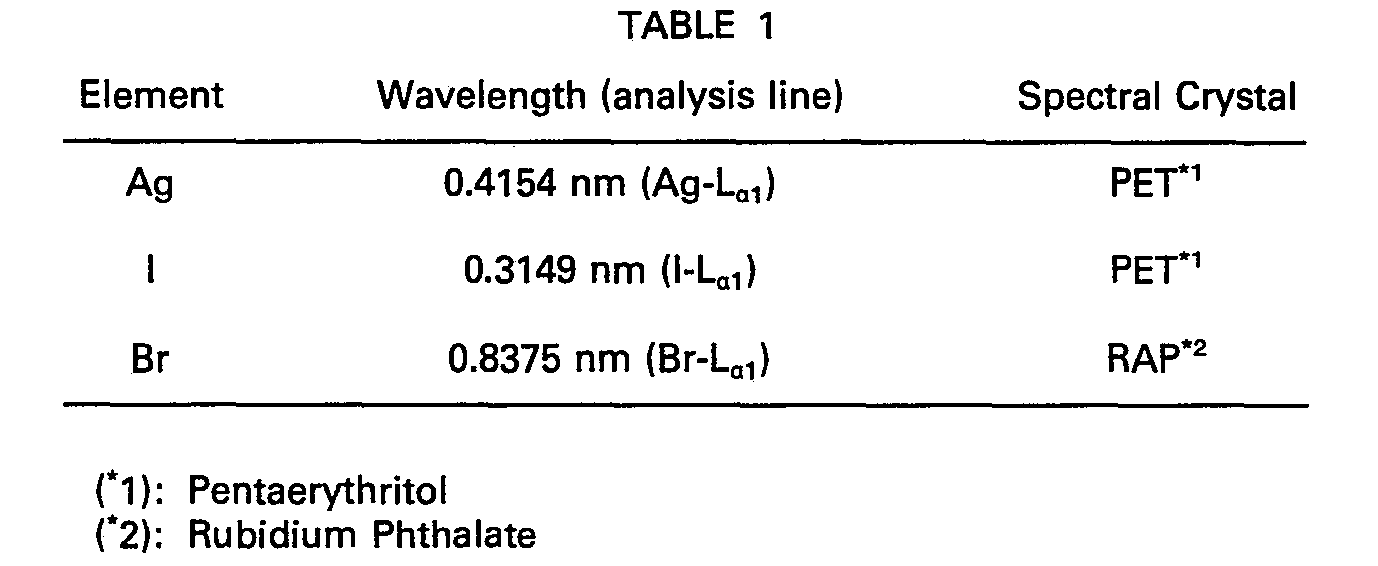
- A practical method of measuring the silver iodide content of the individual grains is as follows. First, a sample emulsion is diluted to five times its volume with distilled water and after adding a proteolytic enzyme such as pronase, the mixture is maintained at 40°C for 3 h to decompose the gelatin. Then, the sample is subjected to centrifugal separation to sediment the emulsion grains and after removing the supernatant, the emulsion grains are re-dispersed in distilled water. After repeating the washing procedure twice, the sample is dispersed on a sample table. After drying, carbon is vapor-deposited on the sample grains and then the sample is measured by an ordinary commercially available X-ray microanalyzer, such as the X-ray microanalyzer EMX-SM, made by Shimazu Corporation used in our experiments. The measurement is made by irradiating the grains with electrons and measuring the characteristic X-ray intensity of each element in the grain excited by the electrons using a long wavelength dispersion type X-ray detector. The spectral crystals used for the analysis of each element and the wavelength of the characteristic X-ray of each element are shown in Table 1. For determining the silver iodide content of the emulsion grains from the characteristic X-ray intensity of each element, the same measurement is performed on emulsion grains of known silver iodide content to prepare a calibration curve as shown in Fig. 1, and the silver iodide content then may be calculated from the calibration curve.
- The silver iodobromide emulsion of this invention can be formed by first forming silver iodobromide grains as the core and then coating the core with silver iodobromide or silver bromide.
- In order to make the silver iodide content distribution of individual grains of the silver halide emulsion as uniform as possible, it is necessary to keep the size and the crystal habit of the silver halide grains which become the core, and the silver halide content of individual grains in the core as completely uniform as possible. For this purpose, an aqueous solution of silver nitrate is added to an aqueous solution of a mixture of an alkali metal iodide and an alkali metal bromide in the presence of a protective colloid by a double jet method as described in, for example, U.S. Patent 4,150,994 and U.K. Patents 1,337,607 and 1,335,925. In order to narrowing the differences in silver iodide content among grains, it is particularly important that pAg during the addition of the foregoing solution is maintained constant in the range of 7.0 to 10.0, and preferably 8.0 to 9.0 as described in, for example, U.S. Patent 4,063,951. Furthermore, the supersaturation of the solutions during the addition thereof should be as high as possible and it is effective to the solutions while increasing the density of the addition solutions so that the growing rate of the crystals becomes 30 to 100% of the crystal growing rate of the crystal as described in, for example, U.S. Patent No. 4,242,445. Also, it is preferred that the addition of the solutions be performed in the presence of a proper amount of a silver halide solvent such as ammonia, a thiocyanate, or a thioether compound as described in, for example, U.S. Patents 3,790,387, 3,574,628 and 4,046,576 and U.K. Patent 1,413,748.
- For forming the silver iodobromide emulsion grains of this invention, it is necessary to coat the core formed by the foregoing method with silver bromide or silver iodobromide as homogeneously as possible. For this purpose, an aqueous solution of silver nitrate and an aqueous solution of an alkali halide or alkali halides are added to the emulsion containing the core grains by a double jet method while maintaining the pAg at a constant value in the range of 6.0 to 10.0.
- To obtain a particularly uniform coating, it is preferred to add the solution at relatively high supersaturation so that the growing rate of the crystals becomes 30 to 100% of the critical growing rate of the crystals. By this method, a silver halide emulsion having a narrow silver halide content distribution between grains is obtained.
- The formation of silver halide grains or the physical ripening of silver halide grains may be performed in the presence of a cadmium salt, a zinc salt, a lead salt, a thallium salt, an iridium salt or complex salt thereof, a rhodium salt or complex salt thereof, or an iron salt or complex salt thereof in an amount of 10-8 to 10-3 mol/AgX.
- One of the features of this invention is that the silver iodide content of the core portion is at least 5 mole%, but it is preferred that the silver iodide content of the whole grain is from 2.5 to 25 mol% and more preferably 5.0 to 20 mol%.
- The silver halide emulsions of this invention are chemically sensitized. The chemical sensitization can be performed by the method described in, for example, H. Frieser (ed), Die Grundlagen der Photographischen Prozesse mit Silberhalogeniden, 675-734 (Akademische Verlagsgesellschaft 1968).
- That is, a sulfur sensitization method using a sulfur-containing compound capable of reacting with active gelatin and silver (e.g., a thiosulfate, a thiourea, a mercapto compound or a rhodanine); a reduction sensitization method using a reducing material (e.g., a stannous salt, an amine, a hydrazine derivative, formamidinesulfonic acid or a silane compound); or a noble metal sensitization method using a noble metal compound (e.g., a gold complex salt, complex salts of metals belonging to group VIII of the periodic table, such as Pt, Ir or Pd) can be used alone or in combination.
- Practical examples of chemical sensitization methods which can be used in this invention are described in, for example, U.S. Patent Nos. 1,574,944, 2,410,689, 2,278,947, 2,728,668 and 3,656,955; of the sulfur sensitization method, in, for example, U.S. Patent Nos. 2,983,609, 2,419,974 and 4,054,458; and of the reduction sensitization method in, for example, U.S. Patent Nos. 2,399,083 and 2,448,060 and U.K. Patent No. 618,061.
- As a protective colloid for use in the preparation of the silver halide emulsions of this invention and as a binder for other hydrophilic colloid layers, gelatin is advantageously used but other hydrophilic colloids may be used, such as, for example, gelatin derivatives; graft polymers of gelatin and other polymers; proteins such as albumin and casein; cellulose derivatives such as hydroxyethyl cellulose, carboxymethyl cellulose and cellulose sulfuric acid esters; sugar derivatives such as sodium alginate and starch derivatives; and various synthetic hydrophilic polymers or copolymers such as polyvinyl alcohol, partial acetal of polyvinyl alcohol, poly-N-vinylpyrrolidone, polyacrylic acid, polymethacrylic acid, polyacrylamide, polyvinyl imidazole and polyvinyl pyrazole.
- As gelatin, lime-processed gelatin as well as acid-processed gelatin, and enzyme-processed gelatin as described in Bull.Soc. Sci. Phot. Japan, No. 16, page 30 (1966) may be used, as well as the hydrolyzed products and enzyme-decomposition products of gelatin.
- To the silver halide photographic emulsions of this invention can be added various compounds for stabilizing the photographic properties of the emulsions and preventing the formation of fog during the production, storage, or processing of the photographic materials containing the silver halide emulsions. Examples of antifoggants and stabilizers include benzothiazolium salts; nitroimidazoles; nitro- benzimidazoles; chlorobenzimidazoles; bromobenzimidazoles, mercaptothiazoles; mercaptobenzothiazoles; mercaptobenzimidazoles; mercaptothiadiazoles; aminotriazoles; benzotriazoles; nitro- benzotriazoles; mercaptotetrazoles (in particular, 1-phenyl-5-mercaptotetrazole); mercaptopyrimidines; mercaptotriazines; thioketo compounds such as oxazolinethione; azaindenes such as triazaindenes, tetraazaindenes (in particular, 4-hydroxy-substituted (1,3,3a,7)tetraazaindenes), pentaazaindens; benzene- thiosulfonic acid; benzenesulfinic acid; benzenesulfonic acid amide. They are described in, for example, U.S. Patent Nos. 3,954,474 and 3,982,947 and Japanese Patent Publication No. 28660/77.
- The silver halide photographic emulsions of this invention may further contain polyalkylene oxides or the derivatives thereof, such as the ethers, esters, amines, thereof; thioether compounds; thiomorpholines; quaternary ammonium salt compounds; urethane derivatives, urea derivatives, imidazole derivatives; anc 3-pyrazolidone derivatives for increasing sensitivity and contrast or for accelerating the development of the photographic materials containing the silver halide emulsions. These compounds are described in, for example, U.S. Patent Nos. 2,400,532, 2,423,549, 2,716,062, 3,617,280, 3,772,021 and 3,808,003 and U.K. Patent No. 1,488,991.
- The silver halide photographic emulsions of this invention may be spectrally sensitized by methine dyes, including cyanine dyes, merocyanine dyes, complex cyanine dyes, complex merocyanine dyes, holopolar cyanine dyes, hemicyanine dyes, styryl dyes, and hemioxonol dyes. Particularly useful dyes are cyanine dyes, merocyanine dyes, and complex merocyanine dyes. For these dyes, conventional cyanine dye nuclei such as basic heterocyclic nuclei can be used, including a pyrroline nucleus, an oxazoline nucleus, a thiazoline nucleus, a pyrrole nucleus, an oxazole nucleus, a thiazole nucleus, a selenazole nucleus, an imidazole nucleus, a tetrazole nucleus and a pyridine nucleus; the foregoing nuclei having fused thereto aliphatic hydrocarbon rings; and the foregoing nuclei having fused thereto aromatic hydrocarbon rings, such as an indolenine nucleus, a benzindolenine nucleus, an indole nucleus, a benzoxazole nucleus, a naphthoxazole nucleus, a benzothiazole nucleus, a naphthothiazole nucleus, a benzoselenazole nucleus, a benzimidazole nucleus and a quinoline nucleus. These nuclei may be further substituted at the carbon atoms.
- A 5- or 6-membered heterocyclic nucleus having a ketomethylene structure such as a pyrazolin-5-one nucleus, a thiohydantoin nucleus, a 2-thiooxazolidine-2,4-dione nucleus, a thiazolidine-2,4-dione nucleus, rhodanine nucleus or thiobarbituric acid nucleus can be used as a nucleus for the merocyanine dyes or complex merocyanine dyes.
- These sensitizing dyes may be used alone or in combination, and a combination of sensitizing dyes is frequently used for supersensitization.
- Practical examples of these dyes are described in, for example, U.S. Patent Nos. 2,688,545, 2,977,229, 3,397,060, 3,522,052, 3,527,641, 3,617,293, 3,628,964, 3,666,480, 3,672,898, 3,679,428, 3,703,377, 3,769,301, 3,814,609, 3,837,862 and 4,026,707; U.K. Patent Nos. 1,344,281 and 1,507,803; Japanese Patent Publication Nos. 4936/78 and 12375/87; and Japanese Patent Application (OPI) Nos. 110618/77 and 109925/77.
- The silver halide photographic emulsions of this invention may further contain dyes having a spectral sensitizing action or materials which do not substantially absorb visible light but which exhibit a supersensitizing effect when used together with the foregoing sensitizing dyes.
- The photographic materials using the silver halide emulsions of this invention may contain watersoluble dyes as filter dyes or for various purposes such as irradiation prevention, in the hydrophilic colloid layers thereof. Examples of such dyes are oxonol dyes, hemioxonol dyes, styryl dyes, merocyanine dyes, cyanine dyes, and azo dyes. Among these dyes, oxonol dyes, hemioxonol dyes and merocyanine dyes are useful.
- The photographic materials containing the silver halide emulsions of this invention may contain stilbene series, triazine series, oxazole series, or cumarine series whitening agents in the silver halide emulsion layers and other hydrophilic colloid layers. These materials may be water soluble or water insoluble and in the latter case, they may be used as dispersions.
- Known fading preventing agents may be used along with color image stabilizers in this invention, alone or in combination.
- Examples of the fading preventing agents include the hydroquinone described in, for example, U.S. Patent Nos. 2,360,290, 2,418,613, 2,675,314, 2,701,197, 2,704,713, 2,728,659, 2,732,300, 2,735,765, 2,710,801 and 2,816,028, and U.K. Patent No. 1,363,921; the gallic acid derivatives described in, for example, U.S. Patent Nos. 3,457,079 and 3,069,262; the p-alkoxyphenols described in U.S. Patent Nos. 2,735,765 and 3,698,909, Japanese Patent Publication Nos. 20977/74 and 6623/77; the p-oxyphenol derivatives described in U.S. Patent Nos. 3,432,300, 3,573,050, 3,574,627, 3,764,337, Japanese Patent Application (OPI) Nos. 35633/77, 147,434/77 and 152225/77; and the bisphenol derivatives described in U.S. Patent No. 3,700,455.
- The photographic materials using the silver halide emulsions of this invention may further contain hydroquinone derivatives, aminophenol derivatives, gallic acid derivatives and ascorbic acid derivatives, as color fogging preventing agents.
- The silver halide photographic emulsions of this invention can be used for both black and white photographic materials and multilayer multicolor photographic materials and are particularly preferably used for high-speed photographic materials.
- A multilayer natural color photographic material ordinarily has at least one red-sensitive silver halide emulsion layer, at least one green-sensitive emulsion layer and at least one blue-sensitive silver halide emulsion layer on a support. The red-sensitive emulsion layer usually contains a cyan dye-forming coupler, the green-sensitive emulsion layer contains a magenta dye-forming coupler, and the blue-sensitive emulsion layer contains a yellow dye-forming coupler, but if desired, other combinations may be employed.
- As the yellow coloring couplers, known closed chain ketomethylenic couplers can be used, including benzoylacetoanilide series compounds and pivaloylacetoanilide series compounds. Practical examples of the yellow coloring couplers for use in the emulsion of this invention are described in U.S. Patent Nos. 2,875,057, 3,265,506, 3,408,194, 3,551,155, 3,582,322, 3,725,072 and 3,891,445, West German Patent No. 1,547,868, West German Patent Publication (OLS) Nos. 2,219,917, 2,261,361, and 2,414,006, U.K. Patent No. 1,425,020, Japanese Patent Publication No. 10783/76, Japanese Patent Application (OPI) Nos. 26,133/72, 73,147/73, 102,636/73, 6341/75, 123,342/75, 130442/75, 21827/76, 87650/75, 82424/77 and 115219/77.
- As magenta coloring couplers, pyrazolone series compounds, indazolone series compounds and cyanoacetyl compounds can be used and pyrazolone series compounds are particularly useful. Practical examples of the magenta coloring couplers are described in U.S. Patent Nos. 2,600,788, 2,983,608, 3,062,653, 3,127,269, 3,311,476, 3,419,391, 3,519,429, 3,558,319, 3,582,322, 3,615,506, 3,834,908, 3,891,445, West German Patent No. 1,810,464, West German Patent Publication (OLS) Nos. 2,408,665, 2,417,945, 2,418,959, 2,424,467, Japanese Patent Publication No. 6301/65, and Japanese Patent Application (OPI) Nos. 20826/76, 58922/77, 129538/74, 74027/74, 159336/75, 42121/77, 74028/74, 60233/77, 26541/76 and 55122/78.
- As cyan coloring couplers, phenolic compounds and naphtholic compounds can be used, including those described in U.S. Patent Nos. 2,369,929, 2,434,272, 2,474,293, 2,521,908, 2,895,826, 3,034,892, 3,311,476, 3,458,315, 3,476,563, 3,583,971, 3,591,383, 3,767,411 and 4,004,929, West German Patent Publication (OLS) Nos. 2,414,830 and 2,454,329, Japanese Patent Application (OPI) Nos. 59838/73, 26034/76, 5055/73, 146828/76, 69624/77, and 90932/77.
- As cyan coloring couplers, couplers having a ureido group as described in Japanese Patent Application (OPI) Nos. 204545/82, 65134/81, 33252/83 and 33249/83 can be preferably used.
- Colored couplers can be also used in the photographic materials using the silver halide emulsions of this invention, including those described in, for example, U.S. Patent Nos. 3,476,560, 2,521,908 and 3,034,892, Japanese Patent Publication Nos. 2016/69, 22335/63, 11304/67 and 32,461/69, Japanese Patent Application (OPI) Nos. 26034/76, 42121/77 and West German Patent Publication (OLS) No. 2,418,959.
- DIR couplers (development inhibitor releasing couplers) can be used in the photographic materials and 'they are described in, for example, U.S. Patent Nos. 3,227,554, 3,617,291, 3,701,783, 3,790,384 and 3,632,345, West German Patent Publication (OLS) Nos. 2,414,006, 2,454,301, 2,454,329, U.K. Patent No. 953,454, Japanese Patent Application (OPI) Nos. 69624/77 and 122335/74 and Japanese Patent Publication No. 16141/76.
- . The photographic materials using the silver halide emulsions of this invention may contain compounds capable of releasing development inhibitors (apart from DIR couplers) with the progress of the development, such as those described in, for example, U.S. Patent Nos. 3,297,445 and 3,379,529, West German Patent Publication (OLS) Nos. 2,417,914, Japanese Patent Application (OPI) Nos. 15271/77 and 9116/78.
- Also, couplers capable of releasing development accelerators or fogging agents with the process of development as described in Japanese Patent Application (OPI) No. 150845/82 can be preferably used in the photographic materials.
- These couplers are incorporated in the silver halide emulsions in an amount of 2 x 10⁻³ mol to 5 x 10⁻¹ mol, preferably 1 x 10⁻² mole to 5 x 10⁻¹ mol.
- The photographic materials containing the silver halide emulsions of this invention may contain ultraviolet absorbents in the hydrophilic colloid layers, such as aryl group-substituted benzotriazole compounds described in, for example, U.S. Patent No. 3,533,794; 4-thiazolidone compounds described in U.S. Patent Nos. 3,314,794 and 3,352,681; benzophenone compounds described in Japanese Patent Application (OPI) No. 2784/71, cinnamic acid ester compounds described in U.S. Patent Nos. 3,705,805 and 3,707,375, butadiene compounds described in U.S. Patent No. 4,045,229, and benzoxydol compounds described in U.S. Patent No. 3,700,455. In addition, the ultraviolet absorbents described in U.S. Patent No. 3,499,762 and Japanese Patent Application (OPI) No. 48535/79 can be used in the photographic materials. Still further, ultraviolet absorbing couplers (e.g., a-naphtholic cyan dye-forming couplers) and ultraviolet absorbing polymers may be used. These ultraviolet absorbents may be mordanted in specific layers of the photographic materials.
- For processing the photographic materials containing the silver halide emulsions of this invention, known processes and known processing solutions can be used. The processing temperatures are usually in the range of 18°C to 50°C but may be lower than 18°C or higher than 50°C. According to the purposes, a development process forming silver image (black and white development process) or color photographic process composed of development process for forming dye images can be used for developing the photographic materials.
- The color developer which is used for developing the photographic materials is generally composed of an alkaline aqueous solution containing a color developing agent. Color developing agents include aromatic primary amino color developing agents such as phenylenediamines (e.g., 4-amino-N,N-diethylaniline, 3-methyl-4-amino-N,N-diethylaniline, 4-amino-N-ethyl-N-β-hydroxyethylaniline, 3-methyl-4-amino-N-ethyl-N-β-hydroxyethylaniline, 3-methyl-4-amino-N-ethyl-N-β-methanesulfoamidoethylaniline and 4-amino-3-methyl-N-ethyl-N-β-methoxyethylaniline).
- The silver halide photographic emulsion layers are usually bleached after color development. The bleach process may be performed simultaneously with a fix process or separately from the fix process. Bleaching agents include compounds of multivalent metals such as iron(III), cobalt(lll), chromium(VI) and copper(II); peracids; quinones and nitroso compounds such as ferricyanides; dichromates; organic complex salts of iron(lll) or cobalt(lll); aminopolycarboxylic acids such as ethylenediaminetetraacetic acid, nitrotriacetic acid and
d 1,3-diamino-2-propanoltetraacetic acid; complex salts of organic acids such as citric acid, tartaric acid and malic acid; persulfates; permanganates and nitrosophenol. Among these materials, potassium ferricyanide, ethylenediaminetetraacetic acid iron(lll) sodium salt and ethylenediaminetetraacetic acid iron(III) ammonium salt are particularly useful. The ethylenediaminetetraacetic acid iron(III) complex salts are useful for a bleach solution and for a blix solution. - The invention is explained in more detail with reference to the following examples. Unless otherwise indicated, all parts, percents and ratios are by weight.
- In a 4 I stainless steel reaction vessel were placed 60 g of gelatin and 900 ml of water and while maintaining the mixture at 60°C, an aqueous solution of silver nitrate and an aqueous solution of a mixture of potassium bromide and potassium iodide were added continuously to the mixture in equivalent amounts, to prepare a silver iodobromide emulsion as the core. Afterward the core was coated with silver bromide by continuously adding to the solution an aqueous solution of silver nitrate and an aqueous solution of potassium bromide in equivalent amounts, to produce a core/shell type silver iodobromide emulsion.
- The time when each solution was added and the concentrations of the solutions are shown in Table 2.

- During the addition of the solutions, the pAg of the system was kept at 8.6 for the first 10 min, 8.0 for the subsequent 80 min, and 7.3 for the final 20 min.
- The silver iodobromide emulsion thus obtained was designated EM-1.
- Following the same procedure as in Example 1, a core/shell type silver iodobromide emulsion was prepared. In this example, however, the pAg of the system was kept at 8.6 for the first 10 min, 7.03 for the subsequent 80 min, and 7.3 for the final 20 min.
- The silver iodobromide emulsion thus obtained was designated EM-2.
- A core/shell type silver iodobromide emulsion was prepared in the same manner as in Example 1. In this case, however, the pAg of the system during the addition of solutions was kept at 8.6 for the first 10 min, 6.5 for the subsequent 80 min, and at 7.3 for the final 20 min.
- The silver iodobromide emulsion thus obtained was designated EM-3.
- Each of the silver halide emulsion EM-1, EM-2 and EM-3 had a core composed of silver iodobromide containing about 10 mol% silver iodide and a shell composed of silver bromide. This was confirmed by a powder X-ray diffraction analysis and an X-ray analysis of EM-1 disclosed two peaks as shown in Fig. 2, in which the x-axis shows the diffraction angle (20) and the y-axis shows the diffraction X-ray intensity. A surface composition analysis of EM-1 by an X-ray photoelectric spectrum resembled silver bromide as shown in Fig. 3, wherein Fig. 3-1 illustrates the peak profile of EM-1, Fig. 3-2 illustrates the peak profile of AgBrl (I = 10 mol%) of homogeneous structure, Fig. 3-3 illustrates the peak profile of AgBrl (I = 5 mol%) of homogeneous structure, and Fig. 3―4 illustrates the peak profile of AgBr grains. In Fig. 3, the x-axis shows the bond energy of the photoelectrons and the y-axis shows the intensity pf photoelectrons.
- Furthermore, the grain sizes and grain size distribution of each of the emulsions EM-1, EM-2 and EM-3 were measured using a coal tar counter and the distribution of the silver iodide content between silver halide grains was also measured for each emulsion using X-ray microanalyzer. The results obtained by the examination of 100 grains are shown in Table 3. As is clear from the results, the grain size and the grain size distribution almost the same in emulsions EM-1, EM-2 and EM-3 but the silver iodide content distribution between grains became broader in the order of EM-1, EM-2 and EM-3, i.e., it was broadest in EM-3.

- Each of the emulsions EM-1, EM-2 and EM-3 was desalted by an ordinary manner, washed with water, and after adjusting the pH to 6.5 and 9.0 and the pAg at 63°C, was chemically ripened for 60 min at 63°C with the addition of 3.5 ml of an aqueous solution of 0.1 % chloroauric acid and 6.8 ml of an aqueous solution of 0.1% sodium thiosulfate per mol of the silver halide of each emulsion. Thereafter, the silver halide emulsion layer and the protective layer shown below were coated on a triacetyl cellulose film having a subbing layer.
- Silver halide emulsion layer:
- Silver halide emulsion:
- EM-1, 2 or 3 shown in Table 3 (silver 2.1 x 10⁻² mol/m2)
- Coupler having the following formula: (1.5 x 10⁻³ mol/m 2)

- Tricresyl phosphate: (1.10 g/m2)
- Gelatin: (2.30 g/m2).
-
- Protective layer:
- 2,4-Dichlorotriazine-6-hydroxy-s-triazine sodium salt: (0.08 g/m2)
- Gelatin: (1.80 g/m2)
- After allowing each sample thus obtained to stand for 14 h at 40°C and 70% relative humidity, each sample was exposed for sensitometry and then subjected to the following color development process.
- The density of the sample thus processed was measured using a green filter.
- The development process was as follows and performed at 38°C.

- Color developer:

- Bleach solution:

- Fix solution:

- Stabilizer:


- As is clear from the results shown in Table 5, the silver halide emulsions of this invention are excellent in gradation and graininess as compared to the comparison example.
Claims (16)
Applications Claiming Priority (2)
| Application Number | Priority Date | Filing Date | Title |
|---|---|---|---|
| JP58248473A JPS60254032A (en) | 1983-12-29 | 1983-12-29 | Photosensitive silver halide emulsion |
| JP248473/83 | 1983-12-29 |
Publications (3)
| Publication Number | Publication Date |
|---|---|
| EP0147868A2 EP0147868A2 (en) | 1985-07-10 |
| EP0147868A3 EP0147868A3 (en) | 1988-03-02 |
| EP0147868B1 true EP0147868B1 (en) | 1990-04-04 |
Family
ID=17178666
Family Applications (1)
| Application Number | Title | Priority Date | Filing Date |
|---|---|---|---|
| EP84116446A Expired EP0147868B1 (en) | 1983-12-29 | 1984-12-28 | Light-sensitive silver halide emulsions |
Country Status (4)
| Country | Link |
|---|---|
| US (1) | US4728602A (en) |
| EP (1) | EP0147868B1 (en) |
| JP (1) | JPS60254032A (en) |
| DE (1) | DE3481865D1 (en) |
Families Citing this family (50)
| Publication number | Priority date | Publication date | Assignee | Title |
|---|---|---|---|---|
| JPS61132943A (en) * | 1984-11-30 | 1986-06-20 | Konishiroku Photo Ind Co Ltd | Silver halide photosensitive material |
| JPS61245151A (en) * | 1985-04-23 | 1986-10-31 | Konishiroku Photo Ind Co Ltd | Silver halide photographic sensitive material |
| US5310641A (en) * | 1985-04-23 | 1994-05-10 | Konica Corporation | Negative type silver halide photographic material comprising silver halide grains of core-shell structure |
| JPS6235341A (en) * | 1985-08-09 | 1987-02-16 | Konishiroku Photo Ind Co Ltd | Silver halide photographic sensitive material |
| JPS6219843A (en) * | 1985-07-19 | 1987-01-28 | Fuji Photo Film Co Ltd | Silver halide color reverse photographic sensitive material |
| DE3688224T2 (en) * | 1985-09-03 | 1993-07-29 | Konishiroku Photo Ind | LIGHT-SENSITIVE COLOR PHOTOGRAPHIC SILVER HALOGENIDE MATERIAL. |
| JPS6261046A (en) * | 1985-09-12 | 1987-03-17 | Fuji Photo Film Co Ltd | Silver halide photographic emulsion |
| WO1987001824A1 (en) * | 1985-09-17 | 1987-03-26 | Konishiroku Syashin Kogyo Kabushiki Kaisha | Thermally developable photographic material |
| AU591540B2 (en) * | 1985-12-28 | 1989-12-07 | Konishiroku Photo Industry Co., Ltd. | Method of processing light-sensitive silver halide color photographic material |
| JP2603066B2 (en) * | 1986-01-20 | 1997-04-23 | コニカ株式会社 | Silver halide photographic material |
| JPH0766157B2 (en) * | 1986-02-03 | 1995-07-19 | 富士写真フイルム株式会社 | Photosensitive silver halide emulsion |
| JP2514325B2 (en) * | 1986-02-21 | 1996-07-10 | コニカ株式会社 | Silver halide photographic light-sensitive material with improved graininess and storability |
| JPH0711679B2 (en) * | 1986-03-06 | 1995-02-08 | 富士写真フイルム株式会社 | Method for producing silver halide emulsion |
| JPS63151618A (en) * | 1986-12-16 | 1988-06-24 | Fuji Photo Film Co Ltd | Silver halide emulsion |
| JPH07101292B2 (en) * | 1986-07-04 | 1995-11-01 | 富士写真フイルム株式会社 | Silver halide photographic light-sensitive material |
| US4937178A (en) * | 1986-07-10 | 1990-06-26 | Konica Corporation | Processing method for silver halide color photographic light-sensitive material and color developer used therein |
| JPS63106745A (en) * | 1986-10-24 | 1988-05-11 | Fuji Photo Film Co Ltd | Silver halide photographic sensitive material |
| JPS63285534A (en) * | 1987-05-18 | 1988-11-22 | Konica Corp | Silver halide photographic sensitive material having high sensitivity and graininess |
| JP2645367B2 (en) * | 1987-06-25 | 1997-08-25 | 富士写真フイルム株式会社 | Silver halide color photographic light-sensitive material and processing method thereof |
| US4963467A (en) * | 1987-07-15 | 1990-10-16 | Konica Corporation | Silver halide photographic emulsion |
| JP2681172B2 (en) * | 1987-12-28 | 1997-11-26 | コニカ株式会社 | Silver halide photographic material |
| JPH0769580B2 (en) * | 1988-08-04 | 1995-07-31 | 富士写真フイルム株式会社 | Silver halide photographic emulsion |
| JPH01259350A (en) * | 1988-04-11 | 1989-10-17 | Konica Corp | Silver halide photographic sensitive material containing novel silver halide emulsion |
| JPH028832A (en) * | 1988-06-28 | 1990-01-12 | Konica Corp | Silver halide photographic sensitive material having high sensitivity and excellent preservable property with age |
| US4973548A (en) * | 1988-08-05 | 1990-11-27 | Eastman Kodak Company | Photographic silver bromoiodide emulsions, elements and processes |
| JPH0830884B2 (en) * | 1988-08-31 | 1996-03-27 | 富士写真フイルム株式会社 | Photothermographic material and image forming method using the same |
| JPH07111549B2 (en) * | 1988-09-02 | 1995-11-29 | 富士写真フイルム株式会社 | Method for producing silver halide emulsion |
| JPH07111554B2 (en) * | 1988-11-04 | 1995-11-29 | 富士写真フイルム株式会社 | Silver halide photographic light-sensitive material |
| JPH0769581B2 (en) * | 1988-11-08 | 1995-07-31 | 富士写真フイルム株式会社 | Silver halide photographic emulsion |
| JP2736450B2 (en) * | 1989-10-27 | 1998-04-02 | コニカ株式会社 | Silver halide photographic material with high sensitivity, high image quality and excellent gradation |
| JP2896465B2 (en) * | 1989-12-26 | 1999-05-31 | 富士写真フイルム株式会社 | Silver halide photographic material |
| JPH03293662A (en) * | 1990-04-12 | 1991-12-25 | Fuji Photo Film Co Ltd | Silver halide color photographic sensitive material |
| JP2664284B2 (en) * | 1990-11-16 | 1997-10-15 | 富士写真フイルム株式会社 | Silver halide emulsion and photographic light-sensitive material using the same |
| US5268264A (en) * | 1991-04-10 | 1993-12-07 | Eastman Kodak Company | Spectrally sensitized octahedral emulsions with buried shell sensitization |
| JPH05210188A (en) * | 1992-01-31 | 1993-08-20 | Konica Corp | Production of silver halide emulsion and silver halide color photographic sensitive material |
| EP0562476B1 (en) | 1992-03-19 | 2000-10-04 | Fuji Photo Film Co., Ltd. | Method for preparing a silver halide photographic emulsion |
| EP0563708B1 (en) | 1992-03-19 | 2000-06-21 | Fuji Photo Film Co., Ltd. | Process for preparing a silver halide photographic emulsion |
| EP0574090A1 (en) | 1992-06-12 | 1993-12-15 | Eastman Kodak Company | One equivalent couplers and low pKa release dyes |
| JP3155102B2 (en) * | 1992-12-03 | 2001-04-09 | コニカ株式会社 | Silver halide photographic emulsion |
| DE69426066T2 (en) * | 1994-04-21 | 2001-05-10 | Tulalip Consultoria Comercial Sociedade Unipessoal S.A., Funchal | Silver bromoiodide emulsion from core-shell grains |
| EP0692796B1 (en) * | 1994-07-12 | 1998-09-02 | Imation Corp. | Antistatic X-ray intensifying screen comprising sulfonyl methide and sulfonyl imide lithium salts |
| JPH09152696A (en) | 1995-11-30 | 1997-06-10 | Fuji Photo Film Co Ltd | Silver halide color photographic sensitive material |
| US5750327A (en) * | 1996-06-20 | 1998-05-12 | Eastman Kodak Company | Mixed ripeners for silver halide emulsion formation |
| DE69933857D1 (en) | 1999-05-25 | 2006-12-14 | Ferrania Technologies Spa | Silver bromoiodide emulsion made from core-shell grains |
| US6245497B1 (en) | 1999-12-20 | 2001-06-12 | Eastman Kodak Company | Performance of high speed emulsions for color film |
| US6593073B1 (en) | 1999-12-20 | 2003-07-15 | Eastman Kodak Company | Core/shell emulsions with enhanced photographic response |
| ITSV20000026A1 (en) | 2000-06-21 | 2001-12-21 | Ferrania Spa | COLOR PHOTOGRAPHIC ELEMENT |
| ITSV20020034A1 (en) * | 2002-07-29 | 2002-10-28 | Ferrania Spa | EMULSION OF BRAIDED SILVER (CORE-SHELL) GRANULES (CORE-SHELL). |
| US6770428B2 (en) | 2002-11-15 | 2004-08-03 | Eastman Kodak Company | Photothermographic materials containing high iodide core-shell emulsions |
| US6942960B2 (en) * | 2003-08-12 | 2005-09-13 | Eastman Kodak Company | Photothermographic materials containing doped high iodide emulsions |
Family Cites Families (11)
| Publication number | Priority date | Publication date | Assignee | Title |
|---|---|---|---|---|
| BE636801A (en) * | 1962-09-01 | |||
| US3695888A (en) * | 1970-05-28 | 1972-10-03 | Eastman Kodak Co | Photographic supersensitized silver halide emulsions |
| JPS4921657B1 (en) * | 1970-09-24 | 1974-06-03 | ||
| US3761276A (en) * | 1971-03-10 | 1973-09-25 | Eastman Kodak Co | Photographic element containing monodispersed unfogged silver halide grains chemically sensitized internally and externally |
| BE795745A (en) * | 1972-02-21 | 1973-08-21 | Eastman Kodak Co | PROCESS FOR PREPARING A PHOTOGRAPHIC EMULSION WITH HOMODISPERSE SILVER HALOGENIDES |
| JPS57154232A (en) * | 1981-02-18 | 1982-09-24 | Konishiroku Photo Ind Co Ltd | Photosensitive silver halide emulsion |
| JPS57182730A (en) * | 1981-05-06 | 1982-11-10 | Konishiroku Photo Ind Co Ltd | Photosensitive silver halide emulsion |
| US4433048A (en) * | 1981-11-12 | 1984-02-21 | Eastman Kodak Company | Radiation-sensitive silver bromoiodide emulsions, photographic elements, and processes for their use |
| US4477564A (en) * | 1982-04-01 | 1984-10-16 | Minnesota Mining And Manufacturing Company | Photographic silver halide emulsions, process for preparing the same and their use in color reversal films |
| US4504570A (en) * | 1982-09-30 | 1985-03-12 | Eastman Kodak Company | Direct reversal emulsions and photographic elements useful in image transfer film units |
| JPS59152438A (en) * | 1983-02-19 | 1984-08-31 | Konishiroku Photo Ind Co Ltd | Silver halide emulsion |
-
1983
- 1983-12-29 JP JP58248473A patent/JPS60254032A/en active Granted
-
1984
- 1984-12-28 EP EP84116446A patent/EP0147868B1/en not_active Expired
- 1984-12-28 DE DE8484116446T patent/DE3481865D1/en not_active Expired - Lifetime
-
1986
- 1986-10-07 US US06/918,672 patent/US4728602A/en not_active Expired - Lifetime
Also Published As
| Publication number | Publication date |
|---|---|
| DE3481865D1 (en) | 1990-05-10 |
| JPS60254032A (en) | 1985-12-14 |
| US4728602A (en) | 1988-03-01 |
| EP0147868A3 (en) | 1988-03-02 |
| JPH0578024B2 (en) | 1993-10-27 |
| EP0147868A2 (en) | 1985-07-10 |
Similar Documents
| Publication | Publication Date | Title |
|---|---|---|
| US4728602A (en) | Light-sensitive silver halide emulsions | |
| US4668614A (en) | Silver halide photographic light sensitive materials | |
| US4276374A (en) | Silver halide photographic emulsion with thioether sensitizer | |
| US4983508A (en) | Method for manufacturing a light-sensitive silver halide emulsion | |
| US4198240A (en) | Silver halide photographic emulsion | |
| EP0144091B1 (en) | Silver halide photographic emulsion | |
| JPH0253773B2 (en) | ||
| US4791053A (en) | Silver halide photographic material | |
| JPH0372974B2 (en) | ||
| US4581329A (en) | Silver halide photographic light-sensitive material | |
| JPS60170853A (en) | Color photosensitive material | |
| US4594317A (en) | Silver halide photographic light-sensitive material | |
| US4801524A (en) | Process for preparing silver halide emulsion and photographic light-sensitive material containing said emulsion | |
| JPH0677130B2 (en) | Silver halide photographic light-sensitive material | |
| JP2729537B2 (en) | Silver halide photographic material | |
| US4546074A (en) | Silver halide color light-sensitive materials | |
| EP0301508B1 (en) | Method for producing a silver halide photographic emulsion | |
| JPH02196236A (en) | Production of silver halide photographic emulsion | |
| US4617259A (en) | Silver halide color photographic material | |
| JPH0431101B2 (en) | ||
| US4608334A (en) | Silver halide color light-sensitive material | |
| EP0278510B1 (en) | Silver halide photographic materials spectrally sensitized with luminous dye | |
| JPH0687121B2 (en) | Method for producing photographic silver halide emulsion | |
| US4556633A (en) | Silver halide color light-sensitive materials | |
| US5183733A (en) | Silver halide photographic materials |
Legal Events
| Date | Code | Title | Description |
|---|---|---|---|
| PUAI | Public reference made under article 153(3) epc to a published international application that has entered the european phase |
Free format text: ORIGINAL CODE: 0009012 |
|
| AK | Designated contracting states |
Designated state(s): DE GB |
|
| PUAL | Search report despatched |
Free format text: ORIGINAL CODE: 0009013 |
|
| AK | Designated contracting states |
Kind code of ref document: A3 Designated state(s): DE GB |
|
| 17P | Request for examination filed |
Effective date: 19880427 |
|
| 17Q | First examination report despatched |
Effective date: 19881110 |
|
| GRAA | (expected) grant |
Free format text: ORIGINAL CODE: 0009210 |
|
| AK | Designated contracting states |
Kind code of ref document: B1 Designated state(s): DE GB |
|
| REF | Corresponds to: |
Ref document number: 3481865 Country of ref document: DE Date of ref document: 19900510 |
|
| PLBE | No opposition filed within time limit |
Free format text: ORIGINAL CODE: 0009261 |
|
| STAA | Information on the status of an ep patent application or granted ep patent |
Free format text: STATUS: NO OPPOSITION FILED WITHIN TIME LIMIT |
|
| 26N | No opposition filed | ||
| REG | Reference to a national code |
Ref country code: GB Ref legal event code: IF02 |
|
| PGFP | Annual fee paid to national office [announced via postgrant information from national office to epo] |
Ref country code: GB Payment date: 20031224 Year of fee payment: 20 |
|
| PGFP | Annual fee paid to national office [announced via postgrant information from national office to epo] |
Ref country code: DE Payment date: 20040108 Year of fee payment: 20 |
|
| PG25 | Lapsed in a contracting state [announced via postgrant information from national office to epo] |
Ref country code: GB Free format text: LAPSE BECAUSE OF EXPIRATION OF PROTECTION Effective date: 20041227 |
|
| REG | Reference to a national code |
Ref country code: GB Ref legal event code: PE20 |
|
| REG | Reference to a national code |
Ref country code: GB Ref legal event code: 732E |