EP0147594B1 - Melt-moldable fluorine-containing resin composition - Google Patents
Melt-moldable fluorine-containing resin composition Download PDFInfo
- Publication number
- EP0147594B1 EP0147594B1 EP84113708A EP84113708A EP0147594B1 EP 0147594 B1 EP0147594 B1 EP 0147594B1 EP 84113708 A EP84113708 A EP 84113708A EP 84113708 A EP84113708 A EP 84113708A EP 0147594 B1 EP0147594 B1 EP 0147594B1
- Authority
- EP
- European Patent Office
- Prior art keywords
- fluorine
- copolymer
- containing resin
- composition
- potassium
- Prior art date
- Legal status (The legal status is an assumption and is not a legal conclusion. Google has not performed a legal analysis and makes no representation as to the accuracy of the status listed.)
- Expired
Links
- 229910052731 fluorine Inorganic materials 0.000 title claims description 33
- YCKRFDGAMUMZLT-UHFFFAOYSA-N Fluorine atom Chemical compound [F] YCKRFDGAMUMZLT-UHFFFAOYSA-N 0.000 title claims description 28
- 239000011737 fluorine Substances 0.000 title claims description 28
- 239000011342 resin composition Substances 0.000 title claims description 18
- 239000000835 fiber Substances 0.000 claims description 69
- 229920005989 resin Polymers 0.000 claims description 40
- 239000011347 resin Substances 0.000 claims description 40
- NJLLQSBAHIKGKF-UHFFFAOYSA-N dipotassium dioxido(oxo)titanium Chemical compound [K+].[K+].[O-][Ti]([O-])=O NJLLQSBAHIKGKF-UHFFFAOYSA-N 0.000 claims description 30
- 229920001577 copolymer Polymers 0.000 claims description 26
- 239000000203 mixture Substances 0.000 claims description 20
- -1 poly(chlorotrifluoroethylene) Polymers 0.000 claims description 15
- BQCIDUSAKPWEOX-UHFFFAOYSA-N 1,1-Difluoroethene Chemical compound FC(F)=C BQCIDUSAKPWEOX-UHFFFAOYSA-N 0.000 claims description 14
- 239000000178 monomer Substances 0.000 claims description 12
- ZLMJMSJWJFRBEC-UHFFFAOYSA-N Potassium Chemical compound [K] ZLMJMSJWJFRBEC-UHFFFAOYSA-N 0.000 claims description 10
- 239000011591 potassium Substances 0.000 claims description 10
- 229910052700 potassium Inorganic materials 0.000 claims description 10
- 150000001875 compounds Chemical class 0.000 claims description 7
- 229920002493 poly(chlorotrifluoroethylene) Polymers 0.000 claims description 6
- 229920001519 homopolymer Polymers 0.000 claims description 5
- BFKJFAAPBSQJPD-UHFFFAOYSA-N tetrafluoroethene Chemical group FC(F)=C(F)F BFKJFAAPBSQJPD-UHFFFAOYSA-N 0.000 claims description 5
- 229910006095 SO2F Inorganic materials 0.000 claims description 4
- 229920000840 ethylene tetrafluoroethylene copolymer Polymers 0.000 claims description 4
- JMGNVALALWCTLC-UHFFFAOYSA-N 1-fluoro-2-(2-fluoroethenoxy)ethene Chemical compound FC=COC=CF JMGNVALALWCTLC-UHFFFAOYSA-N 0.000 claims description 3
- 239000002033 PVDF binder Substances 0.000 claims description 3
- 125000003178 carboxy group Chemical group [H]OC(*)=O 0.000 claims description 3
- XUCNUKMRBVNAPB-UHFFFAOYSA-N fluoroethene Chemical compound FC=C XUCNUKMRBVNAPB-UHFFFAOYSA-N 0.000 claims description 3
- 229920002981 polyvinylidene fluoride Polymers 0.000 claims description 3
- 229920001780 ECTFE Polymers 0.000 claims description 2
- 239000008188 pellet Substances 0.000 description 11
- 238000012360 testing method Methods 0.000 description 10
- ZMXDDKWLCZADIW-UHFFFAOYSA-N N,N-Dimethylformamide Chemical compound CN(C)C=O ZMXDDKWLCZADIW-UHFFFAOYSA-N 0.000 description 9
- 238000000034 method Methods 0.000 description 9
- 238000000465 moulding Methods 0.000 description 9
- 238000002347 injection Methods 0.000 description 7
- 239000007924 injection Substances 0.000 description 7
- 229920000049 Carbon (fiber) Polymers 0.000 description 6
- 239000004917 carbon fiber Substances 0.000 description 6
- VNWKTOKETHGBQD-UHFFFAOYSA-N methane Chemical compound C VNWKTOKETHGBQD-UHFFFAOYSA-N 0.000 description 6
- 238000005452 bending Methods 0.000 description 5
- 238000001125 extrusion Methods 0.000 description 5
- 238000006116 polymerization reaction Methods 0.000 description 5
- 239000000126 substance Substances 0.000 description 5
- UUAGAQFQZIEFAH-UHFFFAOYSA-N chlorotrifluoroethylene Chemical group FC(F)=C(F)Cl UUAGAQFQZIEFAH-UHFFFAOYSA-N 0.000 description 4
- 239000003365 glass fiber Substances 0.000 description 4
- 238000001746 injection moulding Methods 0.000 description 4
- 229920000642 polymer Polymers 0.000 description 4
- 238000005299 abrasion Methods 0.000 description 3
- 229920001973 fluoroelastomer Polymers 0.000 description 3
- 230000003014 reinforcing effect Effects 0.000 description 3
- 239000004065 semiconductor Substances 0.000 description 3
- 238000001721 transfer moulding Methods 0.000 description 3
- RTZKZFJDLAIYFH-UHFFFAOYSA-N Diethyl ether Chemical compound CCOCC RTZKZFJDLAIYFH-UHFFFAOYSA-N 0.000 description 2
- KKEYFWRCBNTPAC-UHFFFAOYSA-N Terephthalic acid Chemical compound OC(=O)C1=CC=C(C(O)=O)C=C1 KKEYFWRCBNTPAC-UHFFFAOYSA-N 0.000 description 2
- RTAQQCXQSZGOHL-UHFFFAOYSA-N Titanium Chemical compound [Ti] RTAQQCXQSZGOHL-UHFFFAOYSA-N 0.000 description 2
- 239000000654 additive Substances 0.000 description 2
- 230000000996 additive effect Effects 0.000 description 2
- 239000011248 coating agent Substances 0.000 description 2
- 238000000576 coating method Methods 0.000 description 2
- 239000013078 crystal Substances 0.000 description 2
- 230000000694 effects Effects 0.000 description 2
- 150000002170 ethers Chemical class 0.000 description 2
- 229920001343 polytetrafluoroethylene Polymers 0.000 description 2
- 239000004810 polytetrafluoroethylene Substances 0.000 description 2
- 239000012783 reinforcing fiber Substances 0.000 description 2
- 239000000565 sealant Substances 0.000 description 2
- 229910000077 silane Inorganic materials 0.000 description 2
- XLYOFNOQVPJJNP-UHFFFAOYSA-N water Substances O XLYOFNOQVPJJNP-UHFFFAOYSA-N 0.000 description 2
- URXYEXLEZZBAIX-UHFFFAOYSA-N 1,1,1,2,2,3,3,4,4-nonafluoro-4-(1,1,2,3,3-pentafluoroprop-2-enoxy)butane Chemical compound FC(F)=C(F)C(F)(F)OC(F)(F)C(F)(F)C(F)(F)C(F)(F)F URXYEXLEZZBAIX-UHFFFAOYSA-N 0.000 description 1
- KHXKESCWFMPTFT-UHFFFAOYSA-N 1,1,1,2,2,3,3-heptafluoro-3-(1,2,2-trifluoroethenoxy)propane Chemical compound FC(F)=C(F)OC(F)(F)C(F)(F)C(F)(F)F KHXKESCWFMPTFT-UHFFFAOYSA-N 0.000 description 1
- GWTYBAOENKSFAY-UHFFFAOYSA-N 1,1,1,2,2-pentafluoro-2-(1,2,2-trifluoroethenoxy)ethane Chemical compound FC(F)=C(F)OC(F)(F)C(F)(F)F GWTYBAOENKSFAY-UHFFFAOYSA-N 0.000 description 1
- RJYJDEJAFADMLE-UHFFFAOYSA-N 1-chloro-1,1,2,3,3,3-hexafluoro-2-(1,1,2,3,3-pentafluoroprop-2-enoxy)propane Chemical compound FC(F)=C(F)C(F)(F)OC(F)(C(F)(F)F)C(F)(F)Cl RJYJDEJAFADMLE-UHFFFAOYSA-N 0.000 description 1
- BJELTSYBAHKXRW-UHFFFAOYSA-N 2,4,6-triallyloxy-1,3,5-triazine Chemical compound C=CCOC1=NC(OCC=C)=NC(OCC=C)=N1 BJELTSYBAHKXRW-UHFFFAOYSA-N 0.000 description 1
- 239000005995 Aluminium silicate Substances 0.000 description 1
- BVKZGUZCCUSVTD-UHFFFAOYSA-L Carbonate Chemical compound [O-]C([O-])=O BVKZGUZCCUSVTD-UHFFFAOYSA-L 0.000 description 1
- VGGSQFUCUMXWEO-UHFFFAOYSA-N Ethene Chemical compound C=C VGGSQFUCUMXWEO-UHFFFAOYSA-N 0.000 description 1
- 239000005977 Ethylene Substances 0.000 description 1
- 229920006369 KF polymer Polymers 0.000 description 1
- 229920004428 Neoflon® PCTFE Polymers 0.000 description 1
- 239000004721 Polyphenylene oxide Substances 0.000 description 1
- 239000006087 Silane Coupling Agent Substances 0.000 description 1
- VYPSYNLAJGMNEJ-UHFFFAOYSA-N Silicium dioxide Chemical compound O=[Si]=O VYPSYNLAJGMNEJ-UHFFFAOYSA-N 0.000 description 1
- 239000004809 Teflon Substances 0.000 description 1
- 229920006362 Teflon® Polymers 0.000 description 1
- 239000000853 adhesive Substances 0.000 description 1
- 230000001070 adhesive effect Effects 0.000 description 1
- 235000012211 aluminium silicate Nutrition 0.000 description 1
- 238000012662 bulk polymerization Methods 0.000 description 1
- 239000006229 carbon black Substances 0.000 description 1
- 239000003086 colorant Substances 0.000 description 1
- 238000005260 corrosion Methods 0.000 description 1
- 230000007797 corrosion Effects 0.000 description 1
- 239000007822 coupling agent Substances 0.000 description 1
- 239000003431 cross linking reagent Substances 0.000 description 1
- 210000003298 dental enamel Anatomy 0.000 description 1
- 238000013461 design Methods 0.000 description 1
- 239000006185 dispersion Substances 0.000 description 1
- 239000000839 emulsion Substances 0.000 description 1
- 238000007720 emulsion polymerization reaction Methods 0.000 description 1
- 229920006351 engineering plastic Polymers 0.000 description 1
- 239000003822 epoxy resin Substances 0.000 description 1
- 125000001153 fluoro group Chemical group F* 0.000 description 1
- 238000010528 free radical solution polymerization reaction Methods 0.000 description 1
- 239000012760 heat stabilizer Substances 0.000 description 1
- HCDGVLDPFQMKDK-UHFFFAOYSA-N hexafluoropropylene Chemical group FC(F)=C(F)C(F)(F)F HCDGVLDPFQMKDK-UHFFFAOYSA-N 0.000 description 1
- XLYOFNOQVPJJNP-UHFFFAOYSA-M hydroxide Chemical compound [OH-] XLYOFNOQVPJJNP-UHFFFAOYSA-M 0.000 description 1
- 150000002500 ions Chemical class 0.000 description 1
- NLYAJNPCOHFWQQ-UHFFFAOYSA-N kaolin Chemical compound O.O.O=[Al]O[Si](=O)O[Si](=O)O[Al]=O NLYAJNPCOHFWQQ-UHFFFAOYSA-N 0.000 description 1
- 239000000463 material Substances 0.000 description 1
- 238000002844 melting Methods 0.000 description 1
- 230000008018 melting Effects 0.000 description 1
- 238000012856 packing Methods 0.000 description 1
- 229920000647 polyepoxide Polymers 0.000 description 1
- 229920000570 polyether Polymers 0.000 description 1
- 239000000843 powder Substances 0.000 description 1
- 230000001737 promoting effect Effects 0.000 description 1
- 239000012744 reinforcing agent Substances 0.000 description 1
- 238000009877 rendering Methods 0.000 description 1
- 238000007493 shaping process Methods 0.000 description 1
- 238000010557 suspension polymerization reaction Methods 0.000 description 1
- 239000000454 talc Substances 0.000 description 1
- 229910052623 talc Inorganic materials 0.000 description 1
- 238000009864 tensile test Methods 0.000 description 1
- 229920002803 thermoplastic polyurethane Polymers 0.000 description 1
- GWEVSGVZZGPLCZ-UHFFFAOYSA-N titanium dioxide Inorganic materials O=[Ti]=O GWEVSGVZZGPLCZ-UHFFFAOYSA-N 0.000 description 1
- 238000012546 transfer Methods 0.000 description 1
Classifications
-
- C—CHEMISTRY; METALLURGY
- C08—ORGANIC MACROMOLECULAR COMPOUNDS; THEIR PREPARATION OR CHEMICAL WORKING-UP; COMPOSITIONS BASED THEREON
- C08K—Use of inorganic or non-macromolecular organic substances as compounding ingredients
- C08K7/00—Use of ingredients characterised by shape
- C08K7/02—Fibres or whiskers
- C08K7/04—Fibres or whiskers inorganic
- C08K7/08—Oxygen-containing compounds
Definitions
- This invention relates to a melt-moldable fluorine-containing resin composition which comprises at least one fluorine-containing resin and potassium titanate fibers in an amount of 5 to 40% by weight based on the total amount of the fibers and the resin, the resin composition having excellent properties, in particular excellent resistance to creep, excellent mechanical properties, a small shrinkage and gives a molded product having a very good appearance due to an excellent surface-smoothness and gloss.
- a fluorine-containing resin is a synthetic high molecular compound which contains fluorine atom in the molecule.
- a typical resin is polytetrafluoroethylene.
- the flourine-containing resin has excellent resistances to heat, chemicals and weather as well as non-tacking and low abrasion properties compared with other high molecular resins.
- the fluorine-containing resin is generally molded without reinforcing fiber into parts such as a valve and tool for preparing a semi-conductor.
- the former one relates to a coating material containing a fluorine-containing resin and potassium titanate fibers.
- the fluorine-containing resin is used in the form of a dispersion, emulsion or enamel and is unsuited for melt-molding.
- the latter one relates to a fluoro-elastomer sealant containing therein non-woven radially oriented fibers such as fibrous potassium titanate and acicular rutile.
- the fluoroelastomers described therein contain 40 to 55 wt% of hexafluoropropylene, tetrafluoroethylene or like fluoroolefin and no more than 60 wt% of vinylidene fluoride in its examples in order to use for a sealant such as 0-ring.
- the fluoroelastomers described therein cannot be melt-molded and cannot be shaped by injection molding, extrusion, transfer molding.
- the object of the present invention is to provide a fluorine-containing resin-composition which can be melt-molded into complicated or small, thin-walled parts having a small shrinkage, excellent mechanical properties and resistance to creep and which gives a molded product having a very good appearance due to an excellent surface-smoothness and gloss.
- melt-moldable fluorine-containing resin composition which comprises 1 to 40% by weight of potassium titanate fibers and at least one fluorine-containing resin
- the melt-moldable fluorine-containing resin composition being characterized in that the fluorine-containing resin is selected from poly(chlorotrifluoroethylene), chlorotrifluoroethylene - ethylene copolymer, tetrafluoroethylene - ethylene copolymer, polyvinylidene fluoride, copolymer of tetrafluoroethylene and a copolymerizable monomer (a), the copolymerizable monomer (a) being selected from a fluoro-olefin of the formula a fluorovinyl ether of the formula a perfluoroalkyl vinyl ether of the formulae and a perfluoroallyloxy compound of the formula wherein
- the resin composition as defined above can be used for melt-molding and can be shaped by injection molding, extrusion and transfer molding. In particular, it can be melt-molded into complicated or small, thin-walled parts having a small shrinkage, excellent mechanical properties and resistance to creep and it gives a molded product having a very good appearance due to an excellent surface-smoothness and gloss.
- the potassium titanate fibers have an average fiber diameter of 0,1 to 2 pm, an average fiber length of 5 to 100 pm, and a ratio of average fiber length to average fiber diameter (aspect ratio) of 10 to 200.
- the number average molecular weight of the fluorine-containing resin of the clamped composition preferably is in the range of 10 5 to 10'.
- the homopolymer and copolymer of vinylidene fluoride have a polymerization degree of n inh of 0,5 to 2,0.
- the potassium titanate fibers are potassium tetratitanate, potassium hexatitanate and/or potassium octatitanate fibers.
- Examples of useful fluorine-containing resins are poly(chlorotrifluoroethylene) which is a homopolymer of chlorotrifluoroethylene, copolymers of tetrafluoroethylnee (hereinafter referred to as "TFE") and a copolymerizable monomer, homopolymer of vinylidene fluoride, copolymers of vinylidene fluoride and a copolymerizable monomer.
- TFE tetrafluoroethylnee
- Typical examples of copolymers of TFE are as follows:
- fluoro-olefins are hexafluoropropylene, and perfluoropentene-1. These fluoro-olefins are usually copolymerized in an amount of 5 to 30%.
- a typical example of the copolymer is TFE-hexafluoropropylene copolymer.
- the ethers are perfluoroethyl perfluorovinyl ether and perfluoropropyl perfluorovinyl ether.
- a copolymer of TFE and a perfluoroalkyl vinyl ether the ether being at least one compound selected from fluorovinyl polyether of the formula (III) and the isomers thereof of the formula (IV) wherein X and n are same as above, wherein Y is CI, -S0 2 F, -COF, -C0 2 H, -CO 2 R 1 , -CF 2 CO 2 R 1 , -(CF 2 ) x R 1 , R 1 being F or CF 3 , x is 1 to 6.
- ethers (III) and (IV) are usually copolymerized in an amount of several %.
- Examples of the compounds are perfluoro-3-(butoxy)propene and 1 - (1,1,1,2,3,3 - hexafluoro - 3 - chloro - 2 - propoxy)pentafluoro - 2 - propene. These compounds are usually copolymerized in an amount of about 0.1 to 55%, preferably 1 to 10%.
- a copolymer of TFE or chlorotrifluoroethylene and 35 to 65 mole% 'of ethylene is a copolymer of TFE or chlorotrifluoroethylene and 35 to 65 mole% 'of ethylene.
- Vinylidene fluoride copolymer contains at least 90 mole% of vinylidene fluoride.
- useful monomers which are copolymerizable with vinylidene fluoride are TFE, hexafluoropropylene, chlorotrifluoroethylene and, vinyl fluoride.
- a homopolymer and copolymer of vinylidene fluoride (hereinafter referred to as "vinylidene fluoride resin”) have a polymerization degree which is indicated in terms of intrinsic viscosity ninh of 0.5 to 2.0, preferably 0.8 to 1.5.
- ninh is represented by the following equation, wherein c is a concentration of a polymer in dimethylformamide (0.4 g/dl), n is a viscosity of a polymer in dimethylformamide and no is a viscosity of dimethylformamide, each measured at 30°C.
- ninh of less than 0.5 the vinylidene fluoride resin is poor in mechanical property. While with ninh of more than 2.0, moldability of the resin become poor due to a high melt viscosity, hence undesirable.
- fluorine-containing resins can be used which are prepared in any method such as suspension polymerization, emulsion polymerization, solution polymerization or bulk polymerization. These resins may be used in mixture of at least two of them according to a contemplated purpose.
- the fluorine-containing resin has a number average molecular weight of preferably 10 5 to 10 7 and more preferably 10 5 to 10 6 .
- Potassium titanate fiber used in the invention is a single crystal represented by the formula wherein I is an integer of 2 to 8. Examples thereof are potassium tetratitanate fiber, potassium hexatitanate fiber and potassium octatitanate fiber, and these are used singly or in mixture.
- the titanate fiber has an average fiber diameter of preferably 0.1 to 2 pm, average fiber length of preferably 5 to 100 ⁇ m and a ratio of average fiber length to average fiber diameter (aspect ratio) of preferably 10 to 200.
- potassium hexatitanate fiber is most preferable for use in preparing tool for preparing a semi-conductor (wafer basket) which requires a very high resistance to chemicals.
- average fiber diameter and average fiber length of potassium titanate fiber are each average of values which were measured in at least 5 sights and at least 10 fibers in each sight, with use of a scanning-type electron microscope.
- An aspect ratio is a divisor of average fiber length by average fiber diameter.
- average fiber length and aspect ratio for example, more than 1 ⁇ m in average fiber diameter, less than 5 pm ion average fiber length, namely when aspect ratio is below 5 (less than 10), reinforcing effect is small, hence undesirable.
- fibers having an extremely small length of below 0.1 ⁇ m or having a long length of more than 100 ⁇ m are difficult to prepare industrially and have little practical use.
- potassium titanate fiber is added in an amount of 5 to 40% of total amounts of the fluorine-containing resin and the potassium titanate fiber.
- potassium titanate fiber is added in preferably 5 to 30%, more preferably 10 to 30%. With less than 5%, reinforcing effect is low. While, with more than 40%, properties are not so improved in proportion to the amount of fiber and molding is difficult due to high melt viscosity, hence undesirable.
- potassium titanate fiber can be used as it is but is preferably surface-treated with silane coupling agent, titanate coupling agent, epoxy resin and epoxy-urethane resin to improve a wettability with the fluorine-containing resin.
- the resin composition of the invention can be prepared by various methods, for example,
- the third method is most practically employed.
- an additive such as hydroxide and carbonate of Ca, Ba, Zn and Mg and like heat-stabilizer, terephthalic acid, kaolin, talc, kieselguhr and like crystal growth promoting nucleus, tripropargyl cyanurate and like crosslinking agent, carbon black and like coloring agent in a range without affecting the effects of the present invention.
- the resin composition of the invention is melt-moldable and can be shaped by injection molding, extrusion, transfer molding and like methods having excellent productivity.
- the resin composition of the invention has incorporated therein, as a reinforcing agent, potassium titanate fiber which is about 1/10 to 1/100 in size compared with conventional glass fiber or carbon fiber, the mechanical property is extremely improved in the invention. Further, the resin composition can be molded into thin-wall parts by a simple method, and has an improved creep characteristics, thus having an excellent economical and practical values.
- the resin composition can be molded into complicated or small, thin-wall parts, because the composition has an excellent dimensional accuracy due to a small anisotropy.
- the composition provides a molded product having a very good appearance due to the excellent surface-smoothness and gloss compared with those reinforced with glass fiber or carbon fiber.
- the invention also gives a molded product reinforced with potassium titanate fiber which hardly injures an other article in combination, because of a low Mohs hardness of the fiber of 4.
- the resin composition of the invention has the above excellent characteristics which is not obtained in those reinforced with glass fiber or carbon fiber.
- the resin composition of the invention has a wide use for injection molded articles such as a pump, valve, packing, tool for preparing semi-conductor, extrusion articles such as a tube, round rod, coated electric wire, transfer molded articles such as a large valve, large pump, blow molded thin-wall articles such as a bottle, container.
- the composition is also applied to a corrosion resistant lining or coating of a reactor or piping or adhesive.
- the pellets were injection molded at an injection temperature of 300°C, mold temperature of 120°C and injection pressure of 800 kg/cm 2 to prepare a test specimens.
- a test specimens for comparison was prepared in the same manner as above with use of pellets obtained without use of potassium titanate fiber. The following properties were measured with use of the specimens and the results were given in Table 1.
- Shrinkage in longitudinal direction was measured with a micrometer by use of specimens for the tensile test (200 mm long by 3.2 mm thick).
- pellets were prepared in the same manner as in Example 1 with the exception of using poly(chlorotrifluoroethylene) (Daiflon®CTFE M-300P, a product of Daikin Industries Ltd.), TFE-hexafluoropropylene copolymer (Neoflon® FEP NP-30, a product of Daikin Industries Ltd.) and TFE-perfluoroalkyl vinyl ether copolymer (Teflon° PFA 340J, a product of Mitsui Fluorochemical Co., Ltd.) in amounts listed in Table 2.
- a pellet was prepared for comparison without use of potassium titanate fiber.
- the injection molding was conducted in the same conditions as in Example 1 except that poly(chlorotrifluoroethylene) was injected at 260°C and each ofTFE-hexafluoropropylene copolymer and TFE - perfluoroalkyl vinyl ether copolymer was injected at 360 to 380°C. The results were shown in Table 2.
- potassium titanate fiber exhibts an excellent reinforcing effect, lowers molding shrinkage and enhances dimensional accuracy in combination with poly(chlorotrifluoroethylene) as well as polytetrafluoroethylene copolymer such as TFE - hexafluoropropylene copolymer and TFE-perfluoroalkyl vinyl ether copolymer.
- the pellets were injection molded at an injection temperature of 220°C, mold temperature of 90°C and injection pressure of 800 kg/cm 2 to prepare test specimens.
- a test speicmens for comparison was prepared in the same manner as above with use of pellets obtained without use of potassium titanate fiber. The following properties were measured with use of the specimens and and the results were given in Table 3
- Shrinkage in longitudinal and latitudinal directions was measured with a micrometer by use of three sidegate samples 60 mm long by 50 mm wide by 3 mm height.
- potassium titanate fiber is effective in an amount of 5 to 40%. While it is difficult to improve properties in a great extent in an amount of more than 40%.
- the resin compositions of the invention exhibits a greater improvement in properties than those reinforced with carbon fiber.
- the composition of the invention is extremely low in anisotropy of molding shrinkage and thus the mold can be easily designed and the molded product has a small inner strain.
Landscapes
- Chemical & Material Sciences (AREA)
- Health & Medical Sciences (AREA)
- Chemical Kinetics & Catalysis (AREA)
- Medicinal Chemistry (AREA)
- Polymers & Plastics (AREA)
- Organic Chemistry (AREA)
- Compositions Of Macromolecular Compounds (AREA)
Description
- This invention relates to a melt-moldable fluorine-containing resin composition which comprises at least one fluorine-containing resin and potassium titanate fibers in an amount of 5 to 40% by weight based on the total amount of the fibers and the resin, the resin composition having excellent properties, in particular excellent resistance to creep, excellent mechanical properties, a small shrinkage and gives a molded product having a very good appearance due to an excellent surface-smoothness and gloss.
- A fluorine-containing resin is a synthetic high molecular compound which contains fluorine atom in the molecule. A typical resin is polytetrafluoroethylene. The flourine-containing resin has excellent resistances to heat, chemicals and weather as well as non-tacking and low abrasion properties compared with other high molecular resins.
- However, most of the fluorine-containing resins have high melting points and have a necessity to be highly increased in molecular weight to obtain practical excellent properties, rendering the resin very high in melt viscosity. Thus, it is quite difficult to subject the resin to melt molding with adding to the resin glass fiber, carbon fiber and like reinforcing fiber.
- In particular, it is impossible to mold the above reinforced resin into parts having a very small thickness. Accordingly, the fluorine-containing resin is generally molded without reinforcing fiber into parts such as a valve and tool for preparing a semi-conductor.
- However, the use of fluorine-containing resins in natural, namely without use of any additive, results in the following disadvantages:
- 1) Shrinkage is large on shaping;
- 2) The flourine-containing resin is low in mechanical strength compared with other engineering plastics. Thus, it is necessary to mold the resin into mechanical parts having large thickness in despite of very expensive cost of the resin. Alternatively, the molded parts must be reinforced by use of rib or the like, hence uneconomical;
- 3) The fluorine-containing resin is excellent in heat resistance and usually used at a high temperature of 100 to 200°C, but is insufficient in creep resistance;
- 4) Although small in abrasion coefficient, abrasion resistance is low.
- This is also valid for the fluorine-containing resins disclosed in JP-A-58-198 573 (Chemical Abstracts 101(6/8-84), page 78, No. 39961t) and US-A-3 879 044.
- The former one relates to a coating material containing a fluorine-containing resin and potassium titanate fibers. The fluorine-containing resin is used in the form of a dispersion, emulsion or enamel and is unsuited for melt-molding.
- The latter one relates to a fluoro-elastomer sealant containing therein non-woven radially oriented fibers such as fibrous potassium titanate and acicular rutile. The fluoroelastomers described therein contain 40 to 55 wt% of hexafluoropropylene, tetrafluoroethylene or like fluoroolefin and no more than 60 wt% of vinylidene fluoride in its examples in order to use for a sealant such as 0-ring. However, the fluoroelastomers described therein cannot be melt-molded and cannot be shaped by injection molding, extrusion, transfer molding.
- The object of the present invention is to provide a fluorine-containing resin-composition which can be melt-molded into complicated or small, thin-walled parts having a small shrinkage, excellent mechanical properties and resistance to creep and which gives a molded product having a very good appearance due to an excellent surface-smoothness and gloss.
- This object of the invention can be achieved by a melt-moldable fluorine-containing resin composition which comprises 1 to 40% by weight of potassium titanate fibers and at least one fluorine-containing resin, the melt-moldable fluorine-containing resin composition being characterized in that the fluorine-containing resin is selected from poly(chlorotrifluoroethylene), chlorotrifluoroethylene - ethylene copolymer, tetrafluoroethylene - ethylene copolymer, polyvinylidene fluoride, copolymer of tetrafluoroethylene and a copolymerizable monomer (a), the copolymerizable monomer (a) being selected from a fluoro-olefin of the formula


- X is F or H,
- m is 0 to 9,
- n is 0 to 7,
- Y is Cl, -SO2F, -COF, -CO2H, -CO2R1, -CF2CO2R1 or-(CF2)xR1, R1 being For CF3 and x being 1 to 6,
- Z is CI or F.

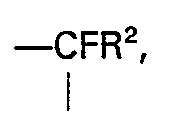
- D is -CF2R2 or CF3, R2 being F, CI, -SO2F, -COF, -C02H, -CO2R1, -CF2CO2R1 or (CF2)xR1,
- E is F, -CF3, -CF2CO2R1 or -CF2CI and G is F or CF3,
- and copolymer of vinylidene fluoride and a copolymerizable monomer (b), containing at least 90 mole% of vinylidene fluoride, the copolymerizable monomer (b) selected from tetrafluoroethylene, hexafluoropropylene, chlorotrifluoroethylene and vinyl fluoride.
- The resin composition as defined above can be used for melt-molding and can be shaped by injection molding, extrusion and transfer molding. In particular, it can be melt-molded into complicated or small, thin-walled parts having a small shrinkage, excellent mechanical properties and resistance to creep and it gives a molded product having a very good appearance due to an excellent surface-smoothness and gloss.
- According to a preferred embodiment of the present invention the potassium titanate fibers have an average fiber diameter of 0,1 to 2 pm, an average fiber length of 5 to 100 pm, and a ratio of average fiber length to average fiber diameter (aspect ratio) of 10 to 200.
- The number average molecular weight of the fluorine-containing resin of the clamped composition preferably is in the range of 105 to 10'.
- According to a further preferred embodiment of the present invention the homopolymer and copolymer of vinylidene fluoride have a polymerization degree of ninh of 0,5 to 2,0.
- Preferably, the potassium titanate fibers are potassium tetratitanate, potassium hexatitanate and/or potassium octatitanate fibers.
- Examples of useful fluorine-containing resins are poly(chlorotrifluoroethylene) which is a homopolymer of chlorotrifluoroethylene, copolymers of tetrafluoroethylnee (hereinafter referred to as "TFE") and a copolymerizable monomer, homopolymer of vinylidene fluoride, copolymers of vinylidene fluoride and a copolymerizable monomer.
- Typical examples of copolymers of TFE are as follows:
- A copolymer of TFE and a fluoro-olefin of the formula

- A copolymer of TFE and a fluorovinyl ether of the formula

- A copolymer of TFE and a perfluoroalkyl vinyl ether, the ether being at least one compound selected from fluorovinyl polyether of the formula (III) and the isomers thereof of the formula (IV)


- These ethers (III) and (IV) are usually copolymerized in an amount of several %.
- A copolymer of TFE and a polyfluoroallyloxy compound of the formula


- A copolymer of TFE or chlorotrifluoroethylene and 35 to 65 mole% 'of ethylene.
- Vinylidene fluoride copolymer contains at least 90 mole% of vinylidene fluoride. Examples of useful monomers which are copolymerizable with vinylidene fluoride are TFE, hexafluoropropylene, chlorotrifluoroethylene and, vinyl fluoride.
- A homopolymer and copolymer of vinylidene fluoride (hereinafter referred to as "vinylidene fluoride resin") have a polymerization degree which is indicated in terms of intrinsic viscosity ninh of 0.5 to 2.0, preferably 0.8 to 1.5.
- ninh is represented by the following equation,

- With ninh of less than 0.5, the vinylidene fluoride resin is poor in mechanical property. While with ninh of more than 2.0, moldability of the resin become poor due to a high melt viscosity, hence undesirable.
- These fluorine-containing resins can be used which are prepared in any method such as suspension polymerization, emulsion polymerization, solution polymerization or bulk polymerization. These resins may be used in mixture of at least two of them according to a contemplated purpose.
- The fluorine-containing resin has a number average molecular weight of preferably 105 to 107 and more preferably 105 to 10 6.
- Potassium titanate fiber used in the invention is a single crystal represented by the formula

- In the invention, average fiber diameter and average fiber length of potassium titanate fiber are each average of values which were measured in at least 5 sights and at least 10 fibers in each sight, with use of a scanning-type electron microscope. An aspect ratio is a divisor of average fiber length by average fiber diameter.
- With outside of the above ranges of average fiber diameter, average fiber length and aspect ratio, for example, more than 1 µm in average fiber diameter, less than 5 pm ion average fiber length, namely when aspect ratio is below 5 (less than 10), reinforcing effect is small, hence undesirable.
- Further, fibers having an extremely small length of below 0.1 µm or having a long length of more than 100 µm are difficult to prepare industrially and have little practical use.
- In general, potassium titanate fiber is added in an amount of 5 to 40% of total amounts of the fluorine-containing resin and the potassium titanate fiber. In case of TFE-hexafluoropropylene copolymer and TFE-perfluoroalkyl vinyl ether copolymer which are high in melt viscosity, potassium titanate fiber is added in preferably 5 to 30%, more preferably 10 to 30%. With less than 5%, reinforcing effect is low. While, with more than 40%, properties are not so improved in proportion to the amount of fiber and molding is difficult due to high melt viscosity, hence undesirable.
- Although potassium titanate fiber can be used as it is but is preferably surface-treated with silane coupling agent, titanate coupling agent, epoxy resin and epoxy-urethane resin to improve a wettability with the fluorine-containing resin.
- The resin composition of the invention can be prepared by various methods, for example,
- CD a method in which potassium titanate fiber is added to a system of polymerization of tetrafluoroethylene or like monomer,
- ⓐa a method in which potassium-titanate fiber is added to the polymerization system in the middle of the polymerization, or to the take-out process of the polymer,
- @ a method in which potassium titanate fiber is added to the fluorine-containing resin polymer, the mixture was extruded by use of an extruder, cooled and then cut to prepare pellets.
- The third method is most practically employed.
- To the resin composition of the invention may be added an additive such as hydroxide and carbonate of Ca, Ba, Zn and Mg and like heat-stabilizer, terephthalic acid, kaolin, talc, kieselguhr and like crystal growth promoting nucleus, tripropargyl cyanurate and like crosslinking agent, carbon black and like coloring agent in a range without affecting the effects of the present invention.
- The resin composition of the invention is melt-moldable and can be shaped by injection molding, extrusion, transfer molding and like methods having excellent productivity.
- Although the resin composition of the invention has incorporated therein, as a reinforcing agent, potassium titanate fiber which is about 1/10 to 1/100 in size compared with conventional glass fiber or carbon fiber, the mechanical property is extremely improved in the invention. Further, the resin composition can be molded into thin-wall parts by a simple method, and has an improved creep characteristics, thus having an excellent economical and practical values.
- It was difficult to design a mold and to shape the fluorine-containing resin into minute parts due to a large molding shrinkage of the resin, but the shrinkage is lowered by the composition of the invention with the addition of potassium titanate fiber without affecting the moldability of the resin.
- The resin composition can be molded into complicated or small, thin-wall parts, because the composition has an excellent dimensional accuracy due to a small anisotropy. The composition provides a molded product having a very good appearance due to the excellent surface-smoothness and gloss compared with those reinforced with glass fiber or carbon fiber. The invention also gives a molded product reinforced with potassium titanate fiber which hardly injures an other article in combination, because of a low Mohs hardness of the fiber of 4.
- The resin composition of the invention has the above excellent characteristics which is not obtained in those reinforced with glass fiber or carbon fiber.
- The resin composition of the invention has a wide use for injection molded articles such as a pump, valve, packing, tool for preparing semi-conductor, extrusion articles such as a tube, round rod, coated electric wire, transfer molded articles such as a large valve, large pump, blow molded thin-wall articles such as a bottle, container. The composition is also applied to a corrosion resistant lining or coating of a reactor or piping or adhesive.
- The invention will be described in more detail with reference to Examples.
- To pellets of ethylene-tetrafluoroethylene copolymer (Neoflon0l ETFE EP-520, a product of Daikin Industries Ltd.) was added potassium titanate fiber treated with epoxy-silane (Tismo°-D102, average fiber diameter 0.3 um, average fiber length 15 um, a product of Otsuka Kagaku KK) in an amount of 5 to 40% based on the composition as listed in Table 1. The mixture was weighed, mixed uniformly and then melted in an extruder (45 mm, single axis) at a temperature of 300°C. The molten mixture was cooled with water and made into pellets. The pellets were injection molded at an injection temperature of 300°C, mold temperature of 120°C and injection pressure of 800 kg/cm2 to prepare a test specimens. A test specimens for comparison was prepared in the same manner as above with use of pellets obtained without use of potassium titanate fiber. The following properties were measured with use of the specimens and the results were given in Table 1.
- Measured according to ASTM D638 with use of Type I specimens (3.2 mm thick). Distance between grips. 100 mm. Speed of testing: 10 mm/min.
- Measured according to ASTM D790 with use of a Test specimens, 150 mm long, 13 mm wide and 6.4 mm height. Crosshead rate: 5 mm/min., support span: 100 mm.
- Shrinkage in longitudinal direction was measured with a micrometer by use of specimens for the tensile test (200 mm long by 3.2 mm thick).
- Measured according to ASTM D648 with use of a Test specimens, 150 mm long by 6.4 mm wide by 13 mm height. Bending stress: 18.6 kg/cm2, temperature elevation: 2°C/min.
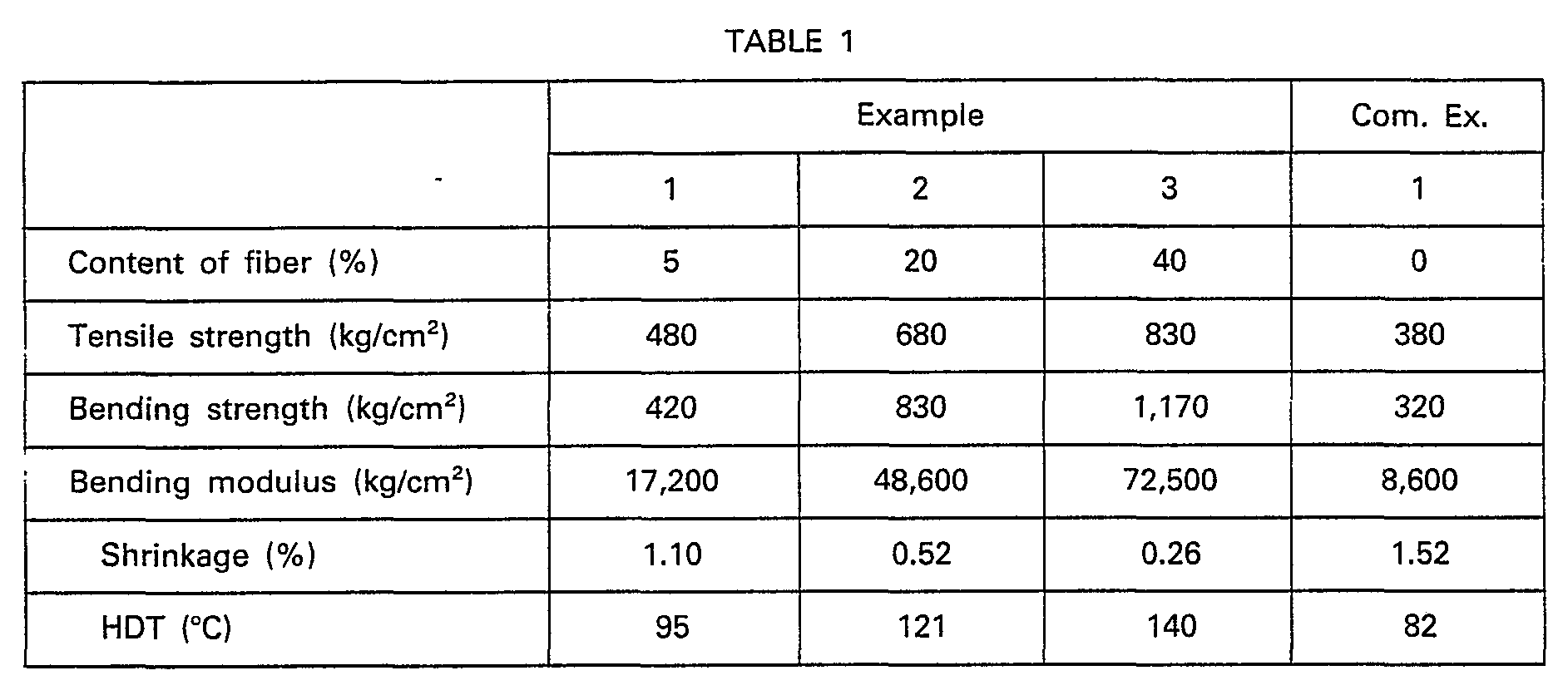
- As apparent from Table 1, it is presumed that effect of potassium titanate fiber is small in an amount of less than 5%, which is clear from the results of content of 5 to 40%. While it is very difficult to prepare pellets by extrusion in an amount of more than 40%, hence impractical.
- Three kinds of pellets were prepared in the same manner as in Example 1 with the exception of using poly(chlorotrifluoroethylene) (Daiflon®CTFE M-300P, a product of Daikin Industries Ltd.), TFE-hexafluoropropylene copolymer (Neoflon® FEP NP-30, a product of Daikin Industries Ltd.) and TFE-perfluoroalkyl vinyl ether copolymer (Teflon° PFA 340J, a product of Mitsui Fluorochemical Co., Ltd.) in amounts listed in Table 2. A pellet was prepared for comparison without use of potassium titanate fiber. The injection molding was conducted in the same conditions as in Example 1 except that poly(chlorotrifluoroethylene) was injected at 260°C and each ofTFE-hexafluoropropylene copolymer and TFE - perfluoroalkyl vinyl ether copolymer was injected at 360 to 380°C. The results were shown in Table 2.

- As apparent from Table 2, potassium titanate fiber exhibts an excellent reinforcing effect, lowers molding shrinkage and enhances dimensional accuracy in combination with poly(chlorotrifluoroethylene) as well as polytetrafluoroethylene copolymer such as TFE - hexafluoropropylene copolymer and TFE-perfluoroalkyl vinyl ether copolymer.
- To a powder of polyvinylidene fluoride (KF polymer@ #1000, a product of Kureha Chemical Industry Co., Ltd., ninh=1.00) was added potassium titanate fiber treated with epoxy-silane (Tismo®-D102, average fiber diameter 0.3 pm, average fiber length 15 µm, a product of Otsuka Kagaku KK) in an amount of 5 to 40% based on the composition as listed in Table 3. The mixture was weighed, mixed uniformly and then melted in an extruder (45 mm, single axis) at a temperature of 230°C. The molten mixture was cooled with water and made into pellets. The pellets were injection molded at an injection temperature of 220°C, mold temperature of 90°C and injection pressure of 800 kg/cm2 to prepare test specimens. A test speicmens for comparison was prepared in the same manner as above with use of pellets obtained without use of potassium titanate fiber. The following properties were measured with use of the specimens and and the results were given in Table 3
- Measured according to JIS K7113 with use of Type I specimens (4 mm thick). Distance between grips: 100 mm, Speed of testing: 10 mm/min.
- Measured according to JIS K7203 with use of a Test specimens, 185 mm long, 10 mm wide and 4 mm height. Crosshead rate: 5 mm/min., support span: 60 mm.
- Shrinkage in longitudinal and latitudinal directions was measured with a micrometer by use of three sidegate samples 60 mm long by 50 mm wide by 3 mm height.
- Surface smoothness was observed with the unaided eye.

- As apparent from Table 3, it is clear that potassium titanate fiber is effective in an amount of 5 to 40%. While it is difficult to improve properties in a great extent in an amount of more than 40%.
- Four kinds of resin compositions were prepared in the same manner as in Examples 8 to 12 except that carbon fiber having an average fiber diameter of 12.5 pm and an averrage fiber length of 3 mm (Kureca chop®C-103, a product of Kuhera Chemical Industry Co., Ltd). was used in amounts of 5 to 30% as listed in Table 4 in place of potassium titanate fiber. Test specimens were also prepared in the same manner as in Examples 8 to 12 with use of the above compositions and properties thereof were measured. The results were given in Table 4.

- It is apparent from Tables 3 and 4, the resin compositions of the invention exhibits a greater improvement in properties than those reinforced with carbon fiber. The composition of the invention is extremely low in anisotropy of molding shrinkage and thus the mold can be easily designed and the molded product has a small inner strain.
Claims (5)


Applications Claiming Priority (2)
| Application Number | Priority Date | Filing Date | Title |
|---|---|---|---|
| JP58243147A JPS60135446A (en) | 1983-12-22 | 1983-12-22 | Melt-moldable fluororesin composition |
| JP243147/83 | 1983-12-22 |
Publications (2)
| Publication Number | Publication Date |
|---|---|
| EP0147594A1 EP0147594A1 (en) | 1985-07-10 |
| EP0147594B1 true EP0147594B1 (en) | 1989-02-15 |
Family
ID=17099485
Family Applications (1)
| Application Number | Title | Priority Date | Filing Date |
|---|---|---|---|
| EP84113708A Expired EP0147594B1 (en) | 1983-12-22 | 1984-11-13 | Melt-moldable fluorine-containing resin composition |
Country Status (5)
| Country | Link |
|---|---|
| US (1) | US4590234A (en) |
| EP (1) | EP0147594B1 (en) |
| JP (1) | JPS60135446A (en) |
| CA (1) | CA1257438A (en) |
| DE (1) | DE3476762D1 (en) |
Families Citing this family (19)
| Publication number | Priority date | Publication date | Assignee | Title |
|---|---|---|---|---|
| JP2577207B2 (en) * | 1986-02-14 | 1997-01-29 | 三菱電線工業株式会社 | Flame-retardant flexible fluorine rubber composition |
| JP2867262B2 (en) * | 1989-02-03 | 1999-03-08 | エヌオーケー株式会社 | Fluoro rubber composition |
| DE3941849A1 (en) * | 1989-12-19 | 1991-06-20 | Hoechst Ag | METHOD FOR POWDER COATING WITH FLUORT THERMOPLASTICS |
| WO1993006159A1 (en) * | 1991-09-27 | 1993-04-01 | Allied-Signal Inc. | Barrier film |
| US6225399B1 (en) | 1995-10-27 | 2001-05-01 | Daikin Industries, Ltd. | Resin composition, molded article produced from same and method for producing molded article |
| IT1284112B1 (en) * | 1996-07-05 | 1998-05-08 | Ausimont Spa | FLUORINATED COPOLYMERS OF ETHYLENE |
| US6159192A (en) | 1997-12-04 | 2000-12-12 | Fowles; Thomas A. | Sliding reconstitution device with seal |
| JP2975921B2 (en) * | 1998-02-25 | 1999-11-10 | 大塚化学株式会社 | Fine conductive fiber, resin composition containing conductive fiber, and conductive yarn |
| US20050137566A1 (en) | 2003-12-23 | 2005-06-23 | Fowles Thomas A. | Sliding reconstitution device for a diluent container |
| US7074216B2 (en) | 1998-09-15 | 2006-07-11 | Baxter International Inc. | Sliding reconstitution device for a diluent container |
| US6022339A (en) * | 1998-09-15 | 2000-02-08 | Baxter International Inc. | Sliding reconstitution device for a diluent container |
| US7358505B2 (en) | 1998-09-15 | 2008-04-15 | Baxter International Inc. | Apparatus for fabricating a reconstitution assembly |
| AR021220A1 (en) | 1998-09-15 | 2002-07-03 | Baxter Int | CONNECTION DEVICE FOR ESTABLISHING A FLUID COMMUNICATION BETWEEN A FIRST CONTAINER AND A SECOND CONTAINER. |
| US7641851B2 (en) | 2003-12-23 | 2010-01-05 | Baxter International Inc. | Method and apparatus for validation of sterilization process |
| JP6635790B2 (en) * | 2012-12-28 | 2020-01-29 | エージーシー ケミカルズ アメリカズ,インコーポレイテッド | Layered tube for hose assembly |
| JP7385357B2 (en) | 2015-12-15 | 2023-11-22 | エージーシー ケミカルズ アメリカズ,インコーポレイテッド | Layered tubes, and the layers used in layered tubes |
| EP3284762A1 (en) * | 2016-08-17 | 2018-02-21 | 3M Innovative Properties Company | Fluoropolymers comprising tetrafluoroethene and one or more perfluorinated alkyl allyl ether comonomers |
| US11028198B2 (en) * | 2016-08-17 | 2021-06-08 | 3M Innovative Properties Company | Tetrafluoroethylene and perfluorinated allyl ether copolymers |
| JP2025124959A (en) * | 2022-07-25 | 2025-08-27 | Agc株式会社 | Resin composition and molded article thereof |
Family Cites Families (7)
| Publication number | Priority date | Publication date | Assignee | Title |
|---|---|---|---|---|
| JPS5143506B2 (en) * | 1972-11-09 | 1976-11-22 | ||
| US3879044A (en) * | 1973-06-13 | 1975-04-22 | Du Pont | Reinforced elastomeric o-ring with improved compression set |
| DE2454221C2 (en) * | 1974-11-15 | 1985-03-21 | Bayer Ag, 5090 Leverkusen | New reinforced plastics and methods of making them |
| JPS5835273B2 (en) * | 1976-08-19 | 1983-08-01 | ニチアス株式会社 | Diaphragm and its manufacturing method |
| JPS5575440A (en) * | 1978-12-01 | 1980-06-06 | Asahi Glass Co Ltd | Melt-moldable fluorine-containing resin composition |
| JPS58198573A (en) * | 1982-05-13 | 1983-11-18 | Otsuka Chem Co Ltd | Wear resistant coating material |
| JPS6047048A (en) * | 1983-08-23 | 1985-03-14 | Toray Ind Inc | Fluororesin composition and paper separating pawl composed of the same for use in duplicator |
-
1983
- 1983-12-22 JP JP58243147A patent/JPS60135446A/en active Pending
-
1984
- 1984-11-09 CA CA000467512A patent/CA1257438A/en not_active Expired
- 1984-11-09 US US06/669,989 patent/US4590234A/en not_active Expired - Lifetime
- 1984-11-13 DE DE8484113708T patent/DE3476762D1/en not_active Expired
- 1984-11-13 EP EP84113708A patent/EP0147594B1/en not_active Expired
Also Published As
| Publication number | Publication date |
|---|---|
| CA1257438A (en) | 1989-07-11 |
| US4590234A (en) | 1986-05-20 |
| EP0147594A1 (en) | 1985-07-10 |
| DE3476762D1 (en) | 1989-03-23 |
| JPS60135446A (en) | 1985-07-18 |
Similar Documents
| Publication | Publication Date | Title |
|---|---|---|
| US4590234A (en) | Melt-moldable fluorine-containing resin composition | |
| US6653379B2 (en) | Fluoropolymers resistant to stress cracking | |
| US6048939A (en) | Process aid for melt processible polymers | |
| EP0132094B2 (en) | Aromatic polysulfone resin composition | |
| CN106661163B (en) | Processing aids | |
| US20030069343A1 (en) | Melt-processible poly(tetrafluoroethylene) | |
| CN1317020A (en) | Melt-processible poly(tetrafluoroethylene) | |
| JP2019210420A (en) | Hot-melt fluororesin composition and injection molded article composed of the same | |
| CA2197226A1 (en) | Melt-processable fluoroplastic | |
| EP0460689B1 (en) | Sliding material composition | |
| WO2009097374A1 (en) | Fluoropolymers of tetrafluoroethylene and 3,3,3-trifluoropropylene | |
| US6153681A (en) | Tetrafluoroethylene and n-alkyl-trifluorovinyl ether copolymer compositions having discreet elastomeric and crystalline sections | |
| US7060772B2 (en) | Fluoropolymers from tetrafluoroethylene and perfluoro(alkoxyalkyl vinyl) ether | |
| US6780944B1 (en) | Resin composition | |
| EP1328562B1 (en) | Fluoropolymer | |
| JPH11210941A (en) | tube | |
| JPH04224853A (en) | Molten fluororesin composition | |
| JPH032383B2 (en) | ||
| JPH05117475A (en) | Molten fluororesin composition | |
| JP2002114884A (en) | Fluororesin composition and method for producing the same | |
| JPH0129379B2 (en) | ||
| JP2025016815A (en) | Fluororesin composition | |
| US20240110051A1 (en) | Fluoropolymer composition | |
| JPH05295260A (en) | Thermoplastic resin composition | |
| JPH04234609A (en) | Glass fiber reinforcing fluoropolymer composition |
Legal Events
| Date | Code | Title | Description |
|---|---|---|---|
| PUAI | Public reference made under article 153(3) epc to a published international application that has entered the european phase |
Free format text: ORIGINAL CODE: 0009012 |
|
| AK | Designated contracting states |
Designated state(s): DE FR GB IT |
|
| 17P | Request for examination filed |
Effective date: 19851002 |
|
| 17Q | First examination report despatched |
Effective date: 19860723 |
|
| GRAA | (expected) grant |
Free format text: ORIGINAL CODE: 0009210 |
|
| AK | Designated contracting states |
Kind code of ref document: B1 Designated state(s): DE FR GB IT |
|
| REF | Corresponds to: |
Ref document number: 3476762 Country of ref document: DE Date of ref document: 19890323 |
|
| ET | Fr: translation filed | ||
| ITF | It: translation for a ep patent filed | ||
| PLBE | No opposition filed within time limit |
Free format text: ORIGINAL CODE: 0009261 |
|
| STAA | Information on the status of an ep patent application or granted ep patent |
Free format text: STATUS: NO OPPOSITION FILED WITHIN TIME LIMIT |
|
| 26N | No opposition filed | ||
| ITTA | It: last paid annual fee | ||
| PGFP | Annual fee paid to national office [announced via postgrant information from national office to epo] |
Ref country code: GB Payment date: 19981110 Year of fee payment: 15 |
|
| PGFP | Annual fee paid to national office [announced via postgrant information from national office to epo] |
Ref country code: FR Payment date: 19981126 Year of fee payment: 15 |
|
| PGFP | Annual fee paid to national office [announced via postgrant information from national office to epo] |
Ref country code: DE Payment date: 19990114 Year of fee payment: 15 |
|
| PG25 | Lapsed in a contracting state [announced via postgrant information from national office to epo] |
Ref country code: GB Free format text: LAPSE BECAUSE OF NON-PAYMENT OF DUE FEES Effective date: 19991113 |
|
| GBPC | Gb: european patent ceased through non-payment of renewal fee |
Effective date: 19991113 |
|
| PG25 | Lapsed in a contracting state [announced via postgrant information from national office to epo] |
Ref country code: FR Free format text: LAPSE BECAUSE OF NON-PAYMENT OF DUE FEES Effective date: 20000731 |
|
| PG25 | Lapsed in a contracting state [announced via postgrant information from national office to epo] |
Ref country code: DE Free format text: LAPSE BECAUSE OF NON-PAYMENT OF DUE FEES Effective date: 20000901 |
|
| REG | Reference to a national code |
Ref country code: FR Ref legal event code: ST |