EP0146266A2 - Enzyme-resistant immunomodulatory peptides - Google Patents
Enzyme-resistant immunomodulatory peptides Download PDFInfo
- Publication number
- EP0146266A2 EP0146266A2 EP84307968A EP84307968A EP0146266A2 EP 0146266 A2 EP0146266 A2 EP 0146266A2 EP 84307968 A EP84307968 A EP 84307968A EP 84307968 A EP84307968 A EP 84307968A EP 0146266 A2 EP0146266 A2 EP 0146266A2
- Authority
- EP
- European Patent Office
- Prior art keywords
- amino acid
- resin
- peptide
- percent
- asp
- Prior art date
- Legal status (The legal status is an assumption and is not a legal conclusion. Google has not performed a legal analysis and makes no representation as to the accuracy of the status listed.)
- Granted
Links
- 108090000765 processed proteins & peptides Proteins 0.000 title claims abstract description 162
- 102000004196 processed proteins & peptides Human genes 0.000 title abstract description 49
- 102000004190 Enzymes Human genes 0.000 title description 5
- 108090000790 Enzymes Proteins 0.000 title description 5
- 230000002519 immonomodulatory effect Effects 0.000 title description 3
- 239000000203 mixture Substances 0.000 claims abstract description 40
- 238000000034 method Methods 0.000 claims abstract description 33
- 230000000694 effects Effects 0.000 claims abstract description 13
- 239000011347 resin Substances 0.000 claims description 111
- 229920005989 resin Polymers 0.000 claims description 111
- 150000001413 amino acids Chemical class 0.000 claims description 59
- 125000006239 protecting group Chemical group 0.000 claims description 9
- 150000003839 salts Chemical class 0.000 claims description 9
- ISWSIDIOOBJBQZ-UHFFFAOYSA-N phenol group Chemical group C1(=CC=CC=C1)O ISWSIDIOOBJBQZ-UHFFFAOYSA-N 0.000 claims description 7
- 125000003277 amino group Chemical group 0.000 claims description 6
- 150000001412 amines Chemical class 0.000 claims description 4
- 239000003937 drug carrier Substances 0.000 claims description 4
- 210000000987 immune system Anatomy 0.000 claims description 4
- 239000008194 pharmaceutical composition Substances 0.000 claims description 4
- 125000001424 substituent group Chemical group 0.000 claims description 4
- 239000002253 acid Substances 0.000 claims description 3
- 125000000217 alkyl group Chemical group 0.000 claims description 3
- 230000001105 regulatory effect Effects 0.000 claims description 3
- YKPQUSLRUFLVDA-UHFFFAOYSA-N $l^{2}-azanylmethane Chemical compound [NH]C YKPQUSLRUFLVDA-UHFFFAOYSA-N 0.000 claims description 2
- 201000001322 T cell deficiency Diseases 0.000 claims description 2
- 238000004519 manufacturing process Methods 0.000 claims description 2
- 229920000642 polymer Polymers 0.000 claims description 2
- 125000003275 alpha amino acid group Chemical group 0.000 claims 3
- 125000002924 primary amino group Chemical group [H]N([H])* 0.000 claims 3
- QGZKDVFQNNGYKY-UHFFFAOYSA-N Ammonia Chemical compound N QGZKDVFQNNGYKY-UHFFFAOYSA-N 0.000 claims 2
- 229910021529 ammonia Inorganic materials 0.000 claims 1
- 230000007515 enzymatic degradation Effects 0.000 abstract description 8
- 230000001965 increasing effect Effects 0.000 abstract description 7
- 230000004957 immunoregulator effect Effects 0.000 abstract 2
- YMWUJEATGCHHMB-UHFFFAOYSA-N Dichloromethane Chemical compound ClCCl YMWUJEATGCHHMB-UHFFFAOYSA-N 0.000 description 210
- ZMXDDKWLCZADIW-UHFFFAOYSA-N N,N-Dimethylformamide Chemical compound CN(C)C=O ZMXDDKWLCZADIW-UHFFFAOYSA-N 0.000 description 111
- 239000000243 solution Substances 0.000 description 86
- 239000000047 product Substances 0.000 description 70
- XEKOWRVHYACXOJ-UHFFFAOYSA-N Ethyl acetate Chemical compound CCOC(C)=O XEKOWRVHYACXOJ-UHFFFAOYSA-N 0.000 description 67
- RTZKZFJDLAIYFH-UHFFFAOYSA-N ether Substances CCOCC RTZKZFJDLAIYFH-UHFFFAOYSA-N 0.000 description 59
- 239000007787 solid Substances 0.000 description 58
- 229910001868 water Inorganic materials 0.000 description 52
- KRKNYBCHXYNGOX-UHFFFAOYSA-N citric acid Chemical compound OC(=O)CC(O)(C(O)=O)CC(O)=O KRKNYBCHXYNGOX-UHFFFAOYSA-N 0.000 description 51
- 235000001014 amino acid Nutrition 0.000 description 48
- QTBSBXVTEAMEQO-UHFFFAOYSA-N Acetic acid Chemical compound CC(O)=O QTBSBXVTEAMEQO-UHFFFAOYSA-N 0.000 description 46
- XLYOFNOQVPJJNP-UHFFFAOYSA-N water Substances O XLYOFNOQVPJJNP-UHFFFAOYSA-N 0.000 description 43
- DTQVDTLACAAQTR-UHFFFAOYSA-N Trifluoroacetic acid Chemical compound OC(=O)C(F)(F)F DTQVDTLACAAQTR-UHFFFAOYSA-N 0.000 description 40
- 150000001875 compounds Chemical class 0.000 description 38
- WFDIJRYMOXRFFG-UHFFFAOYSA-N Acetic anhydride Chemical compound CC(=O)OC(C)=O WFDIJRYMOXRFFG-UHFFFAOYSA-N 0.000 description 36
- JGFZNNIVVJXRND-UHFFFAOYSA-N N,N-Diisopropylethylamine (DIPEA) Chemical compound CCN(C(C)C)C(C)C JGFZNNIVVJXRND-UHFFFAOYSA-N 0.000 description 36
- 229920005654 Sephadex Polymers 0.000 description 32
- 239000012507 Sephadex™ Substances 0.000 description 32
- RDOXTESZEPMUJZ-UHFFFAOYSA-N anisole Chemical compound COC1=CC=CC=C1 RDOXTESZEPMUJZ-UHFFFAOYSA-N 0.000 description 30
- QOSSAOTZNIDXMA-UHFFFAOYSA-N Dicylcohexylcarbodiimide Chemical compound C1CCCCC1N=C=NC1CCCCC1 QOSSAOTZNIDXMA-UHFFFAOYSA-N 0.000 description 29
- 239000002904 solvent Substances 0.000 description 28
- OKKJLVBELUTLKV-UHFFFAOYSA-N Methanol Chemical compound OC OKKJLVBELUTLKV-UHFFFAOYSA-N 0.000 description 27
- 238000004458 analytical method Methods 0.000 description 27
- 210000004027 cell Anatomy 0.000 description 27
- VHYFNPMBLIVWCW-UHFFFAOYSA-N 4-Dimethylaminopyridine Chemical compound CN(C)C1=CC=NC=C1 VHYFNPMBLIVWCW-UHFFFAOYSA-N 0.000 description 26
- 235000019439 ethyl acetate Nutrition 0.000 description 25
- VYPSYNLAJGMNEJ-UHFFFAOYSA-N Silicium dioxide Chemical compound O=[Si]=O VYPSYNLAJGMNEJ-UHFFFAOYSA-N 0.000 description 23
- UIIMBOGNXHQVGW-UHFFFAOYSA-M Sodium bicarbonate Chemical class [Na+].OC([O-])=O UIIMBOGNXHQVGW-UHFFFAOYSA-M 0.000 description 23
- 238000004809 thin layer chromatography Methods 0.000 description 23
- 238000010511 deprotection reaction Methods 0.000 description 22
- 238000010168 coupling process Methods 0.000 description 21
- 238000005859 coupling reaction Methods 0.000 description 21
- CKLJMWTZIZZHCS-REOHCLBHSA-N L-aspartic acid Chemical compound OC(=O)[C@@H](N)CC(O)=O CKLJMWTZIZZHCS-REOHCLBHSA-N 0.000 description 20
- 230000008878 coupling Effects 0.000 description 20
- 229910004373 HOAc Inorganic materials 0.000 description 19
- SJRJJKPEHAURKC-UHFFFAOYSA-N N-Methylmorpholine Chemical compound CN1CCOCC1 SJRJJKPEHAURKC-UHFFFAOYSA-N 0.000 description 19
- NPZTUJOABDZTLV-UHFFFAOYSA-N hydroxybenzotriazole Substances O=C1C=CC=C2NNN=C12 NPZTUJOABDZTLV-UHFFFAOYSA-N 0.000 description 19
- OUYCCCASQSFEME-QMMMGPOBSA-N L-tyrosine Chemical compound OC(=O)[C@@H](N)CC1=CC=C(O)C=C1 OUYCCCASQSFEME-QMMMGPOBSA-N 0.000 description 17
- 239000000898 Thymopoietin Substances 0.000 description 17
- 238000010532 solid phase synthesis reaction Methods 0.000 description 17
- 102400000159 Thymopoietin Human genes 0.000 description 16
- 239000000706 filtrate Substances 0.000 description 16
- YEDUAINPPJYDJZ-UHFFFAOYSA-N 2-hydroxybenzothiazole Chemical compound C1=CC=C2SC(O)=NC2=C1 YEDUAINPPJYDJZ-UHFFFAOYSA-N 0.000 description 15
- HEMHJVSKTPXQMS-UHFFFAOYSA-M Sodium hydroxide Chemical compound [OH-].[Na+] HEMHJVSKTPXQMS-UHFFFAOYSA-M 0.000 description 15
- 239000000463 material Substances 0.000 description 15
- UZKWTJUDCOPSNM-UHFFFAOYSA-N methoxybenzene Substances CCCCOC=C UZKWTJUDCOPSNM-UHFFFAOYSA-N 0.000 description 15
- 238000006386 neutralization reaction Methods 0.000 description 15
- 239000000284 extract Substances 0.000 description 14
- 239000011541 reaction mixture Substances 0.000 description 14
- FAPWRFPIFSIZLT-UHFFFAOYSA-M Sodium chloride Chemical class [Na+].[Cl-] FAPWRFPIFSIZLT-UHFFFAOYSA-M 0.000 description 13
- 210000001744 T-lymphocyte Anatomy 0.000 description 13
- 238000003556 assay Methods 0.000 description 13
- 238000006243 chemical reaction Methods 0.000 description 13
- 239000011521 glass Substances 0.000 description 13
- 238000005406 washing Methods 0.000 description 13
- RYHBNJHYFVUHQT-UHFFFAOYSA-N 1,4-Dioxane Chemical compound C1COCCO1 RYHBNJHYFVUHQT-UHFFFAOYSA-N 0.000 description 12
- BFSVOASYOCHEOV-UHFFFAOYSA-N 2-diethylaminoethanol Chemical compound CCN(CC)CCO BFSVOASYOCHEOV-UHFFFAOYSA-N 0.000 description 12
- -1 D-GLU Chemical compound 0.000 description 12
- KFZMGEQAYNKOFK-UHFFFAOYSA-N Isopropanol Chemical compound CC(C)O KFZMGEQAYNKOFK-UHFFFAOYSA-N 0.000 description 12
- USFZMSVCRYTOJT-UHFFFAOYSA-N Ammonium acetate Chemical compound N.CC(O)=O USFZMSVCRYTOJT-UHFFFAOYSA-N 0.000 description 11
- 101710163560 Lamina-associated polypeptide 2, isoform alpha Proteins 0.000 description 11
- 101710189385 Lamina-associated polypeptide 2, isoforms beta/gamma Proteins 0.000 description 11
- CSNNHWWHGAXBCP-UHFFFAOYSA-L Magnesium sulfate Chemical compound [Mg+2].[O-][S+2]([O-])([O-])[O-] CSNNHWWHGAXBCP-UHFFFAOYSA-L 0.000 description 11
- 238000004128 high performance liquid chromatography Methods 0.000 description 11
- 239000010410 layer Substances 0.000 description 11
- 239000012044 organic layer Substances 0.000 description 11
- 229910000030 sodium bicarbonate Inorganic materials 0.000 description 11
- 238000003756 stirring Methods 0.000 description 11
- ASOKPJOREAFHNY-UHFFFAOYSA-N 1-Hydroxybenzotriazole Chemical compound C1=CC=C2N(O)N=NC2=C1 ASOKPJOREAFHNY-UHFFFAOYSA-N 0.000 description 10
- 229960000549 4-dimethylaminophenol Drugs 0.000 description 10
- VHUUQVKOLVNVRT-UHFFFAOYSA-N Ammonium hydroxide Chemical compound [NH4+].[OH-] VHUUQVKOLVNVRT-UHFFFAOYSA-N 0.000 description 10
- 210000003719 b-lymphocyte Anatomy 0.000 description 10
- IJKVHSBPTUYDLN-UHFFFAOYSA-N dihydroxy(oxo)silane Chemical compound O[Si](O)=O IJKVHSBPTUYDLN-UHFFFAOYSA-N 0.000 description 10
- 150000002148 esters Chemical class 0.000 description 10
- 230000006698 induction Effects 0.000 description 10
- 229920006395 saturated elastomer Polymers 0.000 description 10
- JKMHFZQWWAIEOD-UHFFFAOYSA-N 2-[4-(2-hydroxyethyl)piperazin-1-yl]ethanesulfonic acid Chemical compound OCC[NH+]1CCN(CCS([O-])(=O)=O)CC1 JKMHFZQWWAIEOD-UHFFFAOYSA-N 0.000 description 9
- VEXZGXHMUGYJMC-UHFFFAOYSA-N Hydrochloric acid Chemical compound Cl VEXZGXHMUGYJMC-UHFFFAOYSA-N 0.000 description 9
- LRHPLDYGYMQRHN-UHFFFAOYSA-N N-Butanol Chemical compound CCCCO LRHPLDYGYMQRHN-UHFFFAOYSA-N 0.000 description 9
- 235000011054 acetic acid Nutrition 0.000 description 9
- 239000000872 buffer Substances 0.000 description 9
- 238000004587 chromatography analysis Methods 0.000 description 9
- RLSSMJSEOOYNOY-UHFFFAOYSA-N m-cresol Chemical compound CC1=CC=CC(O)=C1 RLSSMJSEOOYNOY-UHFFFAOYSA-N 0.000 description 9
- 239000000376 reactant Substances 0.000 description 9
- 239000000725 suspension Substances 0.000 description 9
- CNBUSIJNWNXLQQ-NSHDSACASA-N (2s)-3-(4-hydroxyphenyl)-2-[(2-methylpropan-2-yl)oxycarbonylamino]propanoic acid Chemical compound CC(C)(C)OC(=O)N[C@H](C(O)=O)CC1=CC=C(O)C=C1 CNBUSIJNWNXLQQ-NSHDSACASA-N 0.000 description 8
- 239000002244 precipitate Substances 0.000 description 8
- 102000005962 receptors Human genes 0.000 description 8
- 108020003175 receptors Proteins 0.000 description 8
- 238000002390 rotary evaporation Methods 0.000 description 8
- 239000000741 silica gel Substances 0.000 description 8
- 229910002027 silica gel Inorganic materials 0.000 description 8
- 102100025218 B-cell differentiation antigen CD72 Human genes 0.000 description 7
- 101710129514 B-cell differentiation antigen CD72 Proteins 0.000 description 7
- 108091003079 Bovine Serum Albumin Proteins 0.000 description 7
- 241001465754 Metazoa Species 0.000 description 7
- 230000004069 differentiation Effects 0.000 description 7
- 238000001035 drying Methods 0.000 description 7
- YBYRMVIVWMBXKQ-UHFFFAOYSA-N phenylmethanesulfonyl fluoride Chemical compound FS(=O)(=O)CC1=CC=CC=C1 YBYRMVIVWMBXKQ-UHFFFAOYSA-N 0.000 description 7
- 238000002360 preparation method Methods 0.000 description 7
- 238000000746 purification Methods 0.000 description 7
- 238000006467 substitution reaction Methods 0.000 description 7
- 238000012360 testing method Methods 0.000 description 7
- 230000004071 biological effect Effects 0.000 description 6
- 230000007812 deficiency Effects 0.000 description 6
- LOKCTEFSRHRXRJ-UHFFFAOYSA-I dipotassium trisodium dihydrogen phosphate hydrogen phosphate dichloride Chemical compound P(=O)(O)(O)[O-].[K+].P(=O)(O)([O-])[O-].[Na+].[Na+].[Cl-].[K+].[Cl-].[Na+] LOKCTEFSRHRXRJ-UHFFFAOYSA-I 0.000 description 6
- 229910052943 magnesium sulfate Inorganic materials 0.000 description 6
- 239000003921 oil Substances 0.000 description 6
- 239000002953 phosphate buffered saline Substances 0.000 description 6
- 210000001541 thymus gland Anatomy 0.000 description 6
- UHPQFNXOFFPHJW-UHFFFAOYSA-N (4-methylphenyl)-phenylmethanamine Chemical compound C1=CC(C)=CC=C1C(N)C1=CC=CC=C1 UHPQFNXOFFPHJW-UHFFFAOYSA-N 0.000 description 5
- ZDXPYRJPNDTMRX-VKHMYHEASA-N L-glutamine Chemical compound OC(=O)[C@@H](N)CCC(N)=O ZDXPYRJPNDTMRX-VKHMYHEASA-N 0.000 description 5
- PMZURENOXWZQFD-UHFFFAOYSA-L Sodium Sulfate Chemical compound [Na+].[Na+].[O-]S([O-])(=O)=O PMZURENOXWZQFD-UHFFFAOYSA-L 0.000 description 5
- 101710195641 Splenin Proteins 0.000 description 5
- 229920004890 Triton X-100 Polymers 0.000 description 5
- 239000013504 Triton X-100 Substances 0.000 description 5
- MLKWIQODPVLVLN-SHVFRELUSA-N ac1q1oa8 Chemical compound C([C@@H](C(=O)N[C@@H](CC(C)C)C(=O)N[C@@H](CCC(N)=O)C(=O)NCC(=O)N[C@@H](CC(C)C)C(=O)N[C@@H]([C@@H](C)O)C(=O)N[C@@H](C)C(=O)NCC(=O)NCC(=O)NCC(O)=O)NC(=O)[C@H](CC(C)C)NC(=O)[C@H](CCC(O)=O)NC(=O)[C@@H](NC(=O)[C@H](CC=1C=CC(O)=CC=1)NC(=O)[C@@H](NC(=O)CNC(=O)[C@H](CCCCN)NC(=O)[C@H](CCCNC(N)=N)NC(=O)CNC(=O)[C@H](CCC(O)=O)NC(=O)CNC(=O)[C@H](C)NC(=O)[C@H]1N(CCC1)C(=O)[C@H](CC(C)C)NC(=O)[C@@H](NC(=O)[C@@H](NC(=O)[C@H](CC(N)=O)NC(=O)[C@H](CC(N)=O)NC(=O)[C@H](C)NC(=O)[C@@H](NC(=O)[C@H](CC(C)C)NC(=O)[C@H](CCC(O)=O)NC(=O)[C@H](CO)NC(=O)[C@H](CCCCN)NC(=O)[C@H](CC(C)C)NC(=O)[C@H](CCCCN)NC(=O)[C@H](CCC(N)=O)NC(=O)[C@H](CCCCN)NC(=O)[C@@H](NC(=O)[C@H](CC(C)C)NC(=O)[C@@H](NC(=O)CNC(=O)[C@H]1N(CCC1)C(=O)CNC(=O)[C@H](CCC(O)=O)NC(=O)CNC(=O)CNC(=O)CNC(=O)CN)C(C)C)[C@@H](C)O)C(C)C)C(C)C)[C@@H](C)O)C(C)C)C(C)C)C1=CC=C(O)C=C1 MLKWIQODPVLVLN-SHVFRELUSA-N 0.000 description 5
- 235000018102 proteins Nutrition 0.000 description 5
- 102000004169 proteins and genes Human genes 0.000 description 5
- 108090000623 proteins and genes Proteins 0.000 description 5
- HPALAKNZSZLMCH-UHFFFAOYSA-M sodium;chloride;hydrate Chemical class O.[Na+].[Cl-] HPALAKNZSZLMCH-UHFFFAOYSA-M 0.000 description 5
- 230000001225 therapeutic effect Effects 0.000 description 5
- YNJBWRMUSHSURL-UHFFFAOYSA-N trichloroacetic acid Chemical compound OC(=O)C(Cl)(Cl)Cl YNJBWRMUSHSURL-UHFFFAOYSA-N 0.000 description 5
- HIXDQWDOVZUNNA-UHFFFAOYSA-N 2-(3,4-dimethoxyphenyl)-5-hydroxy-7-methoxychromen-4-one Chemical compound C=1C(OC)=CC(O)=C(C(C=2)=O)C=1OC=2C1=CC=C(OC)C(OC)=C1 HIXDQWDOVZUNNA-UHFFFAOYSA-N 0.000 description 4
- 239000004475 Arginine Substances 0.000 description 4
- LFQSCWFLJHTTHZ-UHFFFAOYSA-N Ethanol Chemical compound CCO LFQSCWFLJHTTHZ-UHFFFAOYSA-N 0.000 description 4
- 102000002704 Leucyl aminopeptidase Human genes 0.000 description 4
- 108010004098 Leucyl aminopeptidase Proteins 0.000 description 4
- BAVYZALUXZFZLV-UHFFFAOYSA-N Methylamine Chemical compound NC BAVYZALUXZFZLV-UHFFFAOYSA-N 0.000 description 4
- 239000007832 Na2SO4 Substances 0.000 description 4
- KDLHZDBZIXYQEI-UHFFFAOYSA-N Palladium Chemical compound [Pd] KDLHZDBZIXYQEI-UHFFFAOYSA-N 0.000 description 4
- JUJWROOIHBZHMG-UHFFFAOYSA-N Pyridine Chemical compound C1=CC=NC=C1 JUJWROOIHBZHMG-UHFFFAOYSA-N 0.000 description 4
- 239000012980 RPMI-1640 medium Substances 0.000 description 4
- 101150052863 THY1 gene Proteins 0.000 description 4
- 150000003862 amino acid derivatives Chemical class 0.000 description 4
- 150000008064 anhydrides Chemical class 0.000 description 4
- 230000015572 biosynthetic process Effects 0.000 description 4
- 229940098773 bovine serum albumin Drugs 0.000 description 4
- 239000003054 catalyst Substances 0.000 description 4
- 238000001514 detection method Methods 0.000 description 4
- 238000006073 displacement reaction Methods 0.000 description 4
- 125000001495 ethyl group Chemical group [H]C([H])([H])C([H])([H])* 0.000 description 4
- 238000010348 incorporation Methods 0.000 description 4
- BDAGIHXWWSANSR-UHFFFAOYSA-N methanoic acid Natural products OC=O BDAGIHXWWSANSR-UHFFFAOYSA-N 0.000 description 4
- 239000000843 powder Substances 0.000 description 4
- 239000011780 sodium chloride Substances 0.000 description 4
- 229910052938 sodium sulfate Inorganic materials 0.000 description 4
- 239000006228 supernatant Substances 0.000 description 4
- 238000003786 synthesis reaction Methods 0.000 description 4
- 238000005303 weighing Methods 0.000 description 4
- LIFNDDBLJFPEAN-YTAPOSPOSA-N (2s)-4-amino-2-[[(2s)-2-[[2-[[2-[[(2s)-5-amino-2-[[2-[[(2s)-6-amino-2-[[(2s)-2-[[(2s)-5-oxopyrrolidine-2-carbonyl]amino]propanoyl]amino]hexanoyl]amino]-3-hydroxypropanoyl]amino]-5-oxopentanoyl]amino]acetyl]amino]acetyl]amino]-3-hydroxypropanoyl]amino]-4-o Chemical compound NC(=O)C[C@@H](C(O)=O)NC(=O)[C@H](CO)NC(=O)CNC(=O)CNC(=O)[C@H](CCC(N)=O)NC(=O)C(CO)NC(=O)[C@H](CCCCN)NC(=O)[C@H](C)NC(=O)[C@@H]1CCC(=O)N1 LIFNDDBLJFPEAN-YTAPOSPOSA-N 0.000 description 3
- SQBOHUPUUWHQTP-ONTIZHBOSA-N (3S)-3-amino-4-[[(2S)-1-[[(2S)-3-(4-hydroxyphenyl)-1-oxo-1-phenylmethoxypropan-2-yl]amino]-3-methyl-1-oxobutan-2-yl]amino]-4-oxobutanoic acid Chemical compound C([C@H](NC(=O)[C@@H](NC(=O)[C@@H](N)CC(O)=O)C(C)C)C(=O)OCC=1C=CC=CC=1)C1=CC=C(O)C=C1 SQBOHUPUUWHQTP-ONTIZHBOSA-N 0.000 description 3
- MFNXWZGIFWJHMI-UHFFFAOYSA-N 2-methyl-2-[(2-methylpropan-2-yl)oxycarbonylamino]propanoic acid Chemical compound CC(C)(C)OC(=O)NC(C)(C)C(O)=O MFNXWZGIFWJHMI-UHFFFAOYSA-N 0.000 description 3
- YOETUEMZNOLGDB-UHFFFAOYSA-N 2-methylpropyl carbonochloridate Chemical compound CC(C)COC(Cl)=O YOETUEMZNOLGDB-UHFFFAOYSA-N 0.000 description 3
- 208000010543 22q11.2 deletion syndrome Diseases 0.000 description 3
- CSCPPACGZOOCGX-UHFFFAOYSA-N Acetone Chemical compound CC(C)=O CSCPPACGZOOCGX-UHFFFAOYSA-N 0.000 description 3
- WEVYAHXRMPXWCK-UHFFFAOYSA-N Acetonitrile Chemical compound CC#N WEVYAHXRMPXWCK-UHFFFAOYSA-N 0.000 description 3
- 239000000275 Adrenocorticotropic Hormone Substances 0.000 description 3
- JGLWFWXGOINXEA-YDHLFZDLSA-N Asp-Val-Tyr Chemical compound OC(=O)C[C@H](N)C(=O)N[C@@H](C(C)C)C(=O)N[C@H](C(O)=O)CC1=CC=C(O)C=C1 JGLWFWXGOINXEA-YDHLFZDLSA-N 0.000 description 3
- 108010003422 Circulating Thymic Factor Proteins 0.000 description 3
- 102400000739 Corticotropin Human genes 0.000 description 3
- 101800000414 Corticotropin Proteins 0.000 description 3
- 108010022152 Corticotropin-Releasing Hormone Proteins 0.000 description 3
- 102000012289 Corticotropin-Releasing Hormone Human genes 0.000 description 3
- 239000000055 Corticotropin-Releasing Hormone Substances 0.000 description 3
- 208000000398 DiGeorge Syndrome Diseases 0.000 description 3
- OFOBLEOULBTSOW-UHFFFAOYSA-N Malonic acid Chemical compound OC(=O)CC(O)=O OFOBLEOULBTSOW-UHFFFAOYSA-N 0.000 description 3
- 241000283973 Oryctolagus cuniculus Species 0.000 description 3
- MUBZPKHOEPUJKR-UHFFFAOYSA-N Oxalic acid Chemical compound OC(=O)C(O)=O MUBZPKHOEPUJKR-UHFFFAOYSA-N 0.000 description 3
- 239000002202 Polyethylene glycol Substances 0.000 description 3
- KWYUFKZDYYNOTN-UHFFFAOYSA-M Potassium hydroxide Chemical compound [OH-].[K+] KWYUFKZDYYNOTN-UHFFFAOYSA-M 0.000 description 3
- DBMJMQXJHONAFJ-UHFFFAOYSA-M Sodium laurylsulphate Chemical compound [Na+].CCCCCCCCCCCCOS([O-])(=O)=O DBMJMQXJHONAFJ-UHFFFAOYSA-M 0.000 description 3
- ZMANZCXQSJIPKH-UHFFFAOYSA-N Triethylamine Chemical compound CCN(CC)CC ZMANZCXQSJIPKH-UHFFFAOYSA-N 0.000 description 3
- 239000012131 assay buffer Substances 0.000 description 3
- 230000033228 biological regulation Effects 0.000 description 3
- IDLFZVILOHSSID-OVLDLUHVSA-N corticotropin Chemical compound C([C@@H](C(=O)N[C@@H](CO)C(=O)N[C@@H](CCSC)C(=O)N[C@@H](CCC(O)=O)C(=O)N[C@@H](CC=1NC=NC=1)C(=O)N[C@@H](CC=1C=CC=CC=1)C(=O)N[C@@H](CCCNC(N)=N)C(=O)N[C@@H](CC=1C2=CC=CC=C2NC=1)C(=O)NCC(=O)N[C@@H](CCCCN)C(=O)N1[C@@H](CCC1)C(=O)N[C@@H](C(C)C)C(=O)NCC(=O)N[C@@H](CCCCN)C(=O)N[C@@H](CCCCN)C(=O)N[C@@H](CCCNC(N)=N)C(=O)N[C@@H](CCCNC(N)=N)C(=O)N1[C@@H](CCC1)C(=O)N[C@@H](C(C)C)C(=O)N[C@@H](CCCCN)C(=O)N[C@@H](C(C)C)C(=O)N[C@@H](CC=1C=CC(O)=CC=1)C(=O)N1[C@@H](CCC1)C(=O)N[C@@H](CC(N)=O)C(=O)NCC(=O)N[C@@H](C)C(=O)N[C@@H](CCC(O)=O)C(=O)N[C@@H](CC(O)=O)C(=O)N[C@@H](CCC(O)=O)C(=O)N[C@@H](CO)C(=O)N[C@@H](C)C(=O)N[C@@H](CCC(O)=O)C(=O)N[C@@H](C)C(=O)N[C@@H](CC=1C=CC=CC=1)C(=O)N1[C@@H](CCC1)C(=O)N[C@@H](CC(C)C)C(=O)N[C@@H](CCC(O)=O)C(=O)N[C@@H](CC=1C=CC=CC=1)C(O)=O)NC(=O)[C@@H](N)CO)C1=CC=C(O)C=C1 IDLFZVILOHSSID-OVLDLUHVSA-N 0.000 description 3
- 229960000258 corticotropin Drugs 0.000 description 3
- 125000004122 cyclic group Chemical group 0.000 description 3
- UAOMVDZJSHZZME-UHFFFAOYSA-N diisopropylamine Chemical compound CC(C)NC(C)C UAOMVDZJSHZZME-UHFFFAOYSA-N 0.000 description 3
- 238000010828 elution Methods 0.000 description 3
- 238000000605 extraction Methods 0.000 description 3
- 239000012091 fetal bovine serum Substances 0.000 description 3
- 238000003818 flash chromatography Methods 0.000 description 3
- 230000036039 immunity Effects 0.000 description 3
- 238000011534 incubation Methods 0.000 description 3
- 230000001939 inductive effect Effects 0.000 description 3
- 239000007788 liquid Substances 0.000 description 3
- 125000002496 methyl group Chemical group [H]C([H])([H])* 0.000 description 3
- 150000002772 monosaccharides Chemical class 0.000 description 3
- 210000002966 serum Anatomy 0.000 description 3
- 239000002002 slurry Substances 0.000 description 3
- 229940083575 sodium dodecyl sulfate Drugs 0.000 description 3
- 235000019333 sodium laurylsulphate Nutrition 0.000 description 3
- 239000000126 substance Substances 0.000 description 3
- ZQEBQGAAWMOMAI-ZETCQYMHSA-N (2s)-1-[(2-methylpropan-2-yl)oxycarbonyl]pyrrolidine-2-carboxylic acid Chemical compound CC(C)(C)OC(=O)N1CCC[C@H]1C(O)=O ZQEBQGAAWMOMAI-ZETCQYMHSA-N 0.000 description 2
- SOHLZANWVLCPHK-LBPRGKRZSA-N (2s)-2-[(2-methylpropan-2-yl)oxycarbonylamino]-4-oxo-4-phenylmethoxybutanoic acid Chemical compound CC(C)(C)OC(=O)N[C@H](C(O)=O)CC(=O)OCC1=CC=CC=C1 SOHLZANWVLCPHK-LBPRGKRZSA-N 0.000 description 2
- HZAXFHJVJLSVMW-UHFFFAOYSA-N 2-Aminoethan-1-ol Chemical compound NCCO HZAXFHJVJLSVMW-UHFFFAOYSA-N 0.000 description 2
- KDSNLYIMUZNERS-UHFFFAOYSA-N 2-methylpropanamine Chemical compound CC(C)CN KDSNLYIMUZNERS-UHFFFAOYSA-N 0.000 description 2
- OSWFIVFLDKOXQC-UHFFFAOYSA-N 4-(3-methoxyphenyl)aniline Chemical compound COC1=CC=CC(C=2C=CC(N)=CC=2)=C1 OSWFIVFLDKOXQC-UHFFFAOYSA-N 0.000 description 2
- HVBSAKJJOYLTQU-UHFFFAOYSA-N 4-aminobenzenesulfonic acid Chemical compound NC1=CC=C(S(O)(=O)=O)C=C1 HVBSAKJJOYLTQU-UHFFFAOYSA-N 0.000 description 2
- 229920000936 Agarose Polymers 0.000 description 2
- 101710105077 Agglutinin-1 Proteins 0.000 description 2
- 239000005695 Ammonium acetate Substances 0.000 description 2
- 208000023275 Autoimmune disease Diseases 0.000 description 2
- 241000283690 Bos taurus Species 0.000 description 2
- IAZDPXIOMUYVGZ-WFGJKAKNSA-N Dimethyl sulfoxide Chemical compound [2H]C([2H])([2H])S(=O)C([2H])([2H])[2H] IAZDPXIOMUYVGZ-WFGJKAKNSA-N 0.000 description 2
- ROSDSFDQCJNGOL-UHFFFAOYSA-N Dimethylamine Chemical compound CNC ROSDSFDQCJNGOL-UHFFFAOYSA-N 0.000 description 2
- VZCYOOQTPOCHFL-OWOJBTEDSA-N Fumaric acid Chemical compound OC(=O)\C=C\C(O)=O VZCYOOQTPOCHFL-OWOJBTEDSA-N 0.000 description 2
- CEAZRRDELHUEMR-URQXQFDESA-N Gentamicin Chemical compound O1[C@H](C(C)NC)CC[C@@H](N)[C@H]1O[C@H]1[C@H](O)[C@@H](O[C@@H]2[C@@H]([C@@H](NC)[C@@](C)(O)CO2)O)[C@H](N)C[C@@H]1N CEAZRRDELHUEMR-URQXQFDESA-N 0.000 description 2
- 229930182566 Gentamicin Natural products 0.000 description 2
- AEMRFAOFKBGASW-UHFFFAOYSA-N Glycolic acid Chemical compound OCC(O)=O AEMRFAOFKBGASW-UHFFFAOYSA-N 0.000 description 2
- 241000282412 Homo Species 0.000 description 2
- 101000711455 Homo sapiens Kinetochore protein Spc25 Proteins 0.000 description 2
- 229930182816 L-glutamine Natural products 0.000 description 2
- ROHFNLRQFUQHCH-YFKPBYRVSA-N L-leucine Chemical group CC(C)C[C@H](N)C(O)=O ROHFNLRQFUQHCH-YFKPBYRVSA-N 0.000 description 2
- 108090001090 Lectins Proteins 0.000 description 2
- 102000004856 Lectins Human genes 0.000 description 2
- 108010090054 Membrane Glycoproteins Proteins 0.000 description 2
- 102000012750 Membrane Glycoproteins Human genes 0.000 description 2
- 208000037581 Persistent Infection Diseases 0.000 description 2
- NBIIXXVUZAFLBC-UHFFFAOYSA-N Phosphoric acid Chemical compound OP(O)(O)=O NBIIXXVUZAFLBC-UHFFFAOYSA-N 0.000 description 2
- LCTONWCANYUPML-UHFFFAOYSA-N Pyruvic acid Chemical compound CC(=O)C(O)=O LCTONWCANYUPML-UHFFFAOYSA-N 0.000 description 2
- 235000004443 Ricinus communis Nutrition 0.000 description 2
- 240000000528 Ricinus communis Species 0.000 description 2
- 102100023776 Signal peptidase complex subunit 2 Human genes 0.000 description 2
- QAOWNCQODCNURD-UHFFFAOYSA-N Sulfuric acid Chemical compound OS(O)(=O)=O QAOWNCQODCNURD-UHFFFAOYSA-N 0.000 description 2
- 102400000160 Thymopentin Human genes 0.000 description 2
- 101800001703 Thymopentin Proteins 0.000 description 2
- DTQVDTLACAAQTR-UHFFFAOYSA-M Trifluoroacetate Chemical compound [O-]C(=O)C(F)(F)F DTQVDTLACAAQTR-UHFFFAOYSA-M 0.000 description 2
- 102400000757 Ubiquitin Human genes 0.000 description 2
- 108090000848 Ubiquitin Proteins 0.000 description 2
- 108010046516 Wheat Germ Agglutinins Proteins 0.000 description 2
- 125000002777 acetyl group Chemical group [H]C([H])([H])C(*)=O 0.000 description 2
- 230000021736 acetylation Effects 0.000 description 2
- 238000006640 acetylation reaction Methods 0.000 description 2
- 230000000961 alloantigen Effects 0.000 description 2
- 235000019257 ammonium acetate Nutrition 0.000 description 2
- 229940043376 ammonium acetate Drugs 0.000 description 2
- RWZYAGGXGHYGMB-UHFFFAOYSA-N anthranilic acid Chemical compound NC1=CC=CC=C1C(O)=O RWZYAGGXGHYGMB-UHFFFAOYSA-N 0.000 description 2
- 239000012298 atmosphere Substances 0.000 description 2
- 239000011324 bead Substances 0.000 description 2
- 230000037396 body weight Effects 0.000 description 2
- 239000002775 capsule Substances 0.000 description 2
- 239000000969 carrier Substances 0.000 description 2
- 230000015556 catabolic process Effects 0.000 description 2
- 230000007969 cellular immunity Effects 0.000 description 2
- 239000012043 crude product Substances 0.000 description 2
- MQYQOVYIJOLTNX-UHFFFAOYSA-N dichloromethane;n,n-dimethylformamide Chemical compound ClCCl.CN(C)C=O MQYQOVYIJOLTNX-UHFFFAOYSA-N 0.000 description 2
- XBDQKXXYIPTUBI-UHFFFAOYSA-N dimethylselenoniopropionate Natural products CCC(O)=O XBDQKXXYIPTUBI-UHFFFAOYSA-N 0.000 description 2
- 201000010099 disease Diseases 0.000 description 2
- 208000037265 diseases, disorders, signs and symptoms Diseases 0.000 description 2
- 238000011067 equilibration Methods 0.000 description 2
- OAYLNYINCPYISS-UHFFFAOYSA-N ethyl acetate;hexane Chemical compound CCCCCC.CCOC(C)=O OAYLNYINCPYISS-UHFFFAOYSA-N 0.000 description 2
- 238000001914 filtration Methods 0.000 description 2
- 239000006260 foam Substances 0.000 description 2
- 235000019253 formic acid Nutrition 0.000 description 2
- 239000012634 fragment Substances 0.000 description 2
- 238000004108 freeze drying Methods 0.000 description 2
- 229910052739 hydrogen Inorganic materials 0.000 description 2
- 230000001900 immune effect Effects 0.000 description 2
- 239000012535 impurity Substances 0.000 description 2
- 238000000338 in vitro Methods 0.000 description 2
- 239000000411 inducer Substances 0.000 description 2
- 239000003112 inhibitor Substances 0.000 description 2
- NOESYZHRGYRDHS-UHFFFAOYSA-N insulin Chemical compound N1C(=O)C(NC(=O)C(CCC(N)=O)NC(=O)C(CCC(O)=O)NC(=O)C(C(C)C)NC(=O)C(NC(=O)CN)C(C)CC)CSSCC(C(NC(CO)C(=O)NC(CC(C)C)C(=O)NC(CC=2C=CC(O)=CC=2)C(=O)NC(CCC(N)=O)C(=O)NC(CC(C)C)C(=O)NC(CCC(O)=O)C(=O)NC(CC(N)=O)C(=O)NC(CC=2C=CC(O)=CC=2)C(=O)NC(CSSCC(NC(=O)C(C(C)C)NC(=O)C(CC(C)C)NC(=O)C(CC=2C=CC(O)=CC=2)NC(=O)C(CC(C)C)NC(=O)C(C)NC(=O)C(CCC(O)=O)NC(=O)C(C(C)C)NC(=O)C(CC(C)C)NC(=O)C(CC=2NC=NC=2)NC(=O)C(CO)NC(=O)CNC2=O)C(=O)NCC(=O)NC(CCC(O)=O)C(=O)NC(CCCNC(N)=N)C(=O)NCC(=O)NC(CC=3C=CC=CC=3)C(=O)NC(CC=3C=CC=CC=3)C(=O)NC(CC=3C=CC(O)=CC=3)C(=O)NC(C(C)O)C(=O)N3C(CCC3)C(=O)NC(CCCCN)C(=O)NC(C)C(O)=O)C(=O)NC(CC(N)=O)C(O)=O)=O)NC(=O)C(C(C)CC)NC(=O)C(CO)NC(=O)C(C(C)O)NC(=O)C1CSSCC2NC(=O)C(CC(C)C)NC(=O)C(NC(=O)C(CCC(N)=O)NC(=O)C(CC(N)=O)NC(=O)C(NC(=O)C(N)CC=1C=CC=CC=1)C(C)C)CC1=CN=CN1 NOESYZHRGYRDHS-UHFFFAOYSA-N 0.000 description 2
- 238000007912 intraperitoneal administration Methods 0.000 description 2
- JVTAAEKCZFNVCJ-UHFFFAOYSA-N lactic acid Chemical compound CC(O)C(O)=O JVTAAEKCZFNVCJ-UHFFFAOYSA-N 0.000 description 2
- 239000002523 lectin Substances 0.000 description 2
- 210000004698 lymphocyte Anatomy 0.000 description 2
- 230000003526 lymphopoietic effect Effects 0.000 description 2
- 230000014759 maintenance of location Effects 0.000 description 2
- 230000003278 mimic effect Effects 0.000 description 2
- 230000004048 modification Effects 0.000 description 2
- 238000012986 modification Methods 0.000 description 2
- FEMOMIGRRWSMCU-UHFFFAOYSA-N ninhydrin Chemical compound C1=CC=C2C(=O)C(O)(O)C(=O)C2=C1 FEMOMIGRRWSMCU-UHFFFAOYSA-N 0.000 description 2
- 239000012074 organic phase Substances 0.000 description 2
- 125000001151 peptidyl group Chemical group 0.000 description 2
- VLTRZXGMWDSKGL-UHFFFAOYSA-N perchloric acid Chemical compound OCl(=O)(=O)=O VLTRZXGMWDSKGL-UHFFFAOYSA-N 0.000 description 2
- 229920001223 polyethylene glycol Polymers 0.000 description 2
- 239000002243 precursor Substances 0.000 description 2
- 238000000159 protein binding assay Methods 0.000 description 2
- UMJSCPRVCHMLSP-UHFFFAOYSA-N pyridine Natural products COC1=CC=CN=C1 UMJSCPRVCHMLSP-UHFFFAOYSA-N 0.000 description 2
- YBBJKCMMCRQZMA-UHFFFAOYSA-N pyrithione Chemical compound ON1C=CC=CC1=S YBBJKCMMCRQZMA-UHFFFAOYSA-N 0.000 description 2
- 238000001953 recrystallisation Methods 0.000 description 2
- 235000017557 sodium bicarbonate Nutrition 0.000 description 2
- 239000007790 solid phase Substances 0.000 description 2
- 238000000527 sonication Methods 0.000 description 2
- 210000000952 spleen Anatomy 0.000 description 2
- 239000012086 standard solution Substances 0.000 description 2
- 239000007858 starting material Substances 0.000 description 2
- 210000000130 stem cell Anatomy 0.000 description 2
- 235000000346 sugar Nutrition 0.000 description 2
- ZMZDMBWJUHKJPS-UHFFFAOYSA-N thiocyanic acid Chemical compound SC#N ZMZDMBWJUHKJPS-UHFFFAOYSA-N 0.000 description 2
- PSWFFKRAVBDQEG-YGQNSOCVSA-N thymopentin Chemical compound NC(N)=NCCC[C@H](N)C(=O)N[C@@H](CCCCN)C(=O)N[C@@H](CC(O)=O)C(=O)N[C@@H](C(C)C)C(=O)N[C@H](C(O)=O)CC1=CC=C(O)C=C1 PSWFFKRAVBDQEG-YGQNSOCVSA-N 0.000 description 2
- 229960004517 thymopentin Drugs 0.000 description 2
- VZCYOOQTPOCHFL-UHFFFAOYSA-N trans-butenedioic acid Natural products OC(=O)C=CC(O)=O VZCYOOQTPOCHFL-UHFFFAOYSA-N 0.000 description 2
- OUYCCCASQSFEME-UHFFFAOYSA-N tyrosine Natural products OC(=O)C(N)CC1=CC=C(O)C=C1 OUYCCCASQSFEME-UHFFFAOYSA-N 0.000 description 2
- SIFCHNIAAPMMKG-UHFFFAOYSA-N (2,5-dioxopyrrolidin-1-yl) acetate Chemical compound CC(=O)ON1C(=O)CCC1=O SIFCHNIAAPMMKG-UHFFFAOYSA-N 0.000 description 1
- ZQEBQGAAWMOMAI-SSDOTTSWSA-N (2r)-1-[(2-methylpropan-2-yl)oxycarbonyl]pyrrolidine-2-carboxylic acid Chemical compound CC(C)(C)OC(=O)N1CCC[C@@H]1C(O)=O ZQEBQGAAWMOMAI-SSDOTTSWSA-N 0.000 description 1
- LAZYTVMVPRJVQW-GTNSWQLSSA-N (2s)-1-[(2s)-2-amino-5-(diaminomethylideneamino)-2-(2-methylbutan-2-yloxycarbonyl)pentanoyl]pyrrolidine-2-carboxylic acid Chemical compound NC(N)=NCCC[C@@](N)(C(=O)OC(C)(C)CC)C(=O)N1CCC[C@H]1C(O)=O LAZYTVMVPRJVQW-GTNSWQLSSA-N 0.000 description 1
- QJCNLJWUIOIMMF-YUMQZZPRSA-N (2s,3s)-3-methyl-2-[(2-methylpropan-2-yl)oxycarbonylamino]pentanoic acid Chemical compound CC[C@H](C)[C@@H](C(O)=O)NC(=O)OC(C)(C)C QJCNLJWUIOIMMF-YUMQZZPRSA-N 0.000 description 1
- RWGNFIOAILSHPL-HXGLWFSVSA-N (3S)-3-[[(2S)-1-[(2S)-2-amino-4-[(diaminomethylideneamino)methyl]-5-oxohexanoyl]pyrrolidine-2-carbonyl]amino]-4-[[(2S)-1-[[(2S)-1-amino-3-(4-hydroxyphenyl)-1-oxopropan-2-yl]amino]-3-methyl-1-oxobutan-2-yl]amino]-4-oxobutanoic acid Chemical compound C(C)(=O)C(C[C@H](N)C(=O)N1[C@H](C(=O)N[C@@H](CC(O)=O)C(=O)N[C@@H](C(C)C)C(=O)N[C@@H](CC2=CC=C(C=C2)O)C(=O)N)CCC1)CNC(N)=N RWGNFIOAILSHPL-HXGLWFSVSA-N 0.000 description 1
- KHEXLYCTHFITRW-UKZPJPPHSA-N (3s)-3-[[(2s)-1-[(2r)-2-acetyl-2-amino-5-(diaminomethylideneamino)pentanoyl]pyrrolidine-2-carbonyl]amino]-4-[[(2s)-1-[[(1s)-1-carboxy-2-(4-hydroxyphenyl)ethyl]amino]-1-oxo-3-phenylpropan-2-yl]amino]-4-oxobutanoic acid Chemical compound NC(=N)NCCC[C@@](N)(C(=O)C)C(=O)N1CCC[C@H]1C(=O)N[C@@H](CC(O)=O)C(=O)N[C@H](C(=O)N[C@@H](CC=1C=CC(O)=CC=1)C(O)=O)CC1=CC=CC=C1 KHEXLYCTHFITRW-UKZPJPPHSA-N 0.000 description 1
- ODIMDGHZLNYLID-CBTXZLNQSA-N (3s)-3-[[(2s)-1-[(2r)-2-acetyl-2-amino-5-(diaminomethylideneamino)pentanoyl]pyrrolidine-2-carbonyl]amino]-4-[[(2s)-1-[[(2s)-1-[(2-amino-2-oxoethyl)amino]-3-(4-hydroxyphenyl)-1-oxopropan-2-yl]amino]-3-methyl-1-oxobutan-2-yl]amino]-4-oxobutanoic acid Chemical compound N([C@@H](CC(O)=O)C(=O)N[C@@H](C(C)C)C(=O)N[C@@H](CC=1C=CC(O)=CC=1)C(=O)NCC(N)=O)C(=O)[C@@H]1CCCN1C(=O)[C@@](N)(CCCNC(N)=N)C(C)=O ODIMDGHZLNYLID-CBTXZLNQSA-N 0.000 description 1
- RSHLYOLFECFXTJ-AZYIEOIKSA-N (3s)-3-[[(2s)-1-[(2r)-2-acetyl-2-amino-5-(diaminomethylideneamino)pentanoyl]pyrrolidine-2-carbonyl]amino]-4-[[(2s,3s)-1-[[(1s)-1-carboxy-2-(4-hydroxyphenyl)ethyl]amino]-3-methyl-1-oxopentan-2-yl]amino]-4-oxobutanoic acid Chemical compound N([C@@H](CC(O)=O)C(=O)N[C@@H]([C@@H](C)CC)C(=O)N[C@@H](CC=1C=CC(O)=CC=1)C(O)=O)C(=O)[C@@H]1CCCN1C(=O)[C@@](N)(CCCNC(N)=N)C(C)=O RSHLYOLFECFXTJ-AZYIEOIKSA-N 0.000 description 1
- FESDLLLEEVUCJB-KFIPGFKJSA-N (3s)-3-[[(2s)-1-[(2r)-2-amino-5-(diaminomethylideneamino)-2-formylpentanoyl]pyrrolidine-2-carbonyl]amino]-4-[[(2s)-1-[[(1s)-1-carboxy-2-(4-hydroxyphenyl)ethyl]amino]-3-methyl-1-oxobutan-2-yl]amino]-4-oxobutanoic acid Chemical compound N([C@@H](CC(O)=O)C(=O)N[C@@H](C(C)C)C(=O)N[C@@H](CC=1C=CC(O)=CC=1)C(O)=O)C(=O)[C@@H]1CCCN1C(=O)[C@@](N)(CCCNC(N)=N)C=O FESDLLLEEVUCJB-KFIPGFKJSA-N 0.000 description 1
- XRINEMBPMOMXGL-RNJULWCASA-N (3s)-3-[[(2s)-1-[(2s)-2-acetyl-2-amino-5-(diaminomethylideneamino)pentanoyl]pyrrolidine-2-carbonyl]amino]-4-[[(2s)-1-[[(2s)-1-amino-3-(4-hydroxyphenyl)-1-oxopropan-2-yl]amino]-3-methyl-1-oxobutan-2-yl]amino]-4-oxobutanoic acid Chemical compound N([C@@H](CC(O)=O)C(=O)N[C@@H](C(C)C)C(=O)N[C@@H](CC=1C=CC(O)=CC=1)C(N)=O)C(=O)[C@@H]1CCCN1C(=O)[C@](N)(CCCNC(N)=N)C(C)=O XRINEMBPMOMXGL-RNJULWCASA-N 0.000 description 1
- HJMMCTZLXOVMFB-LBPRGKRZSA-N (4-nitrophenyl) (2s)-5-amino-2-[(2-methylpropan-2-yl)oxycarbonylamino]-5-oxopentanoate Chemical compound CC(C)(C)OC(=O)N[C@@H](CCC(N)=O)C(=O)OC1=CC=C([N+]([O-])=O)C=C1 HJMMCTZLXOVMFB-LBPRGKRZSA-N 0.000 description 1
- DEFGHEXJWLEWBF-YAWKVHODSA-N (4s)-4-[[(2s)-2-[[(2s)-1-[(2r)-2-acetyl-2-amino-5-(diaminomethylideneamino)pentanoyl]pyrrolidine-2-carbonyl]amino]-3-carboxypropanoyl]amino]-5-[[(1s)-1-carboxy-2-(4-hydroxyphenyl)ethyl]amino]-5-oxopentanoic acid Chemical compound NC(=N)NCCC[C@@](N)(C(=O)C)C(=O)N1CCC[C@H]1C(=O)N[C@@H](CC(O)=O)C(=O)N[C@@H](CCC(O)=O)C(=O)N[C@H](C(O)=O)CC1=CC=C(O)C=C1 DEFGHEXJWLEWBF-YAWKVHODSA-N 0.000 description 1
- FFJCNSLCJOQHKM-CLFAGFIQSA-N (z)-1-[(z)-octadec-9-enoxy]octadec-9-ene Chemical compound CCCCCCCC\C=C/CCCCCCCCOCCCCCCCC\C=C/CCCCCCCC FFJCNSLCJOQHKM-CLFAGFIQSA-N 0.000 description 1
- WBYWAXJHAXSJNI-VOTSOKGWSA-M .beta-Phenylacrylic acid Natural products [O-]C(=O)\C=C\C1=CC=CC=C1 WBYWAXJHAXSJNI-VOTSOKGWSA-M 0.000 description 1
- NWUYHJFMYQTDRP-UHFFFAOYSA-N 1,2-bis(ethenyl)benzene;1-ethenyl-2-ethylbenzene;styrene Chemical compound C=CC1=CC=CC=C1.CCC1=CC=CC=C1C=C.C=CC1=CC=CC=C1C=C NWUYHJFMYQTDRP-UHFFFAOYSA-N 0.000 description 1
- WORJRXHJTUTINR-UHFFFAOYSA-N 1,4-dioxane;hydron;chloride Chemical compound Cl.C1COCCO1 WORJRXHJTUTINR-UHFFFAOYSA-N 0.000 description 1
- 238000005160 1H NMR spectroscopy Methods 0.000 description 1
- WFIYPADYPQQLNN-UHFFFAOYSA-N 2-[2-(4-bromopyrazol-1-yl)ethyl]isoindole-1,3-dione Chemical compound C1=C(Br)C=NN1CCN1C(=O)C2=CC=CC=C2C1=O WFIYPADYPQQLNN-UHFFFAOYSA-N 0.000 description 1
- GHCZTIFQWKKGSB-UHFFFAOYSA-N 2-hydroxypropane-1,2,3-tricarboxylic acid;phosphoric acid Chemical compound OP(O)(O)=O.OC(=O)CC(O)(C(O)=O)CC(O)=O GHCZTIFQWKKGSB-UHFFFAOYSA-N 0.000 description 1
- ZOOGRGPOEVQQDX-UUOKFMHZSA-N 3',5'-cyclic GMP Chemical compound C([C@H]1O2)OP(O)(=O)O[C@H]1[C@@H](O)[C@@H]2N1C(N=C(NC2=O)N)=C2N=C1 ZOOGRGPOEVQQDX-UUOKFMHZSA-N 0.000 description 1
- BMYNFMYTOJXKLE-UHFFFAOYSA-N 3-azaniumyl-2-hydroxypropanoate Chemical compound NCC(O)C(O)=O BMYNFMYTOJXKLE-UHFFFAOYSA-N 0.000 description 1
- OTLNPYWUJOZPPA-UHFFFAOYSA-M 4-nitrobenzoate Chemical compound [O-]C(=O)C1=CC=C([N+]([O-])=O)C=C1 OTLNPYWUJOZPPA-UHFFFAOYSA-M 0.000 description 1
- ZCYVEMRRCGMTRW-UHFFFAOYSA-N 7553-56-2 Chemical compound [I] ZCYVEMRRCGMTRW-UHFFFAOYSA-N 0.000 description 1
- QGZKDVFQNNGYKY-UHFFFAOYSA-O Ammonium Chemical compound [NH4+] QGZKDVFQNNGYKY-UHFFFAOYSA-O 0.000 description 1
- ATRRKUHOCOJYRX-UHFFFAOYSA-N Ammonium bicarbonate Chemical compound [NH4+].OC([O-])=O ATRRKUHOCOJYRX-UHFFFAOYSA-N 0.000 description 1
- 229910000013 Ammonium bicarbonate Inorganic materials 0.000 description 1
- DRCNRVYVCHHIJP-AQBORDMYSA-N Arg-Lys-Glu-Val-Tyr Chemical compound NC(N)=NCCC[C@H](N)C(=O)N[C@@H](CCCCN)C(=O)N[C@@H](CCC(O)=O)C(=O)N[C@@H](C(C)C)C(=O)N[C@H](C(O)=O)CC1=CC=C(O)C=C1 DRCNRVYVCHHIJP-AQBORDMYSA-N 0.000 description 1
- 102400000748 Beta-endorphin Human genes 0.000 description 1
- 101800005049 Beta-endorphin Proteins 0.000 description 1
- BVKZGUZCCUSVTD-UHFFFAOYSA-M Bicarbonate Chemical compound OC([O-])=O BVKZGUZCCUSVTD-UHFFFAOYSA-M 0.000 description 1
- BTBUEUYNUDRHOZ-UHFFFAOYSA-N Borate Chemical compound [O-]B([O-])[O-] BTBUEUYNUDRHOZ-UHFFFAOYSA-N 0.000 description 1
- 101000753841 Bos taurus Splenin Proteins 0.000 description 1
- 0 CC(C(C)(C)*)NC Chemical compound CC(C(C)(C)*)NC 0.000 description 1
- QYOVMAREBTZLBT-KTKRTIGZSA-N CCCCCCCC\C=C/CCCCCCCCOCCOCCOCCOCCOCCOCCOCCOCCOCCOCCO Chemical compound CCCCCCCC\C=C/CCCCCCCCOCCOCCOCCOCCOCCOCCOCCOCCOCCOCCO QYOVMAREBTZLBT-KTKRTIGZSA-N 0.000 description 1
- 102000003670 Carboxypeptidase B Human genes 0.000 description 1
- 108090000087 Carboxypeptidase B Proteins 0.000 description 1
- 102000000496 Carboxypeptidases A Human genes 0.000 description 1
- 108010080937 Carboxypeptidases A Proteins 0.000 description 1
- 102000005572 Cathepsin A Human genes 0.000 description 1
- 108010059081 Cathepsin A Proteins 0.000 description 1
- WBYWAXJHAXSJNI-SREVYHEPSA-N Cinnamic acid Chemical compound OC(=O)\C=C/C1=CC=CC=C1 WBYWAXJHAXSJNI-SREVYHEPSA-N 0.000 description 1
- 206010010356 Congenital anomaly Diseases 0.000 description 1
- ODKSFYDXXFIFQN-SCSAIBSYSA-N D-arginine Chemical compound OC(=O)[C@H](N)CCCNC(N)=N ODKSFYDXXFIFQN-SCSAIBSYSA-N 0.000 description 1
- KCXVZYZYPLLWCC-UHFFFAOYSA-N EDTA Chemical compound OC(=O)CN(CC(O)=O)CCN(CC(O)=O)CC(O)=O KCXVZYZYPLLWCC-UHFFFAOYSA-N 0.000 description 1
- 102000005593 Endopeptidases Human genes 0.000 description 1
- 108010059378 Endopeptidases Proteins 0.000 description 1
- 102000018389 Exopeptidases Human genes 0.000 description 1
- 108010091443 Exopeptidases Proteins 0.000 description 1
- 206010017533 Fungal infection Diseases 0.000 description 1
- 230000005526 G1 to G0 transition Effects 0.000 description 1
- 102400000321 Glucagon Human genes 0.000 description 1
- 108060003199 Glucagon Proteins 0.000 description 1
- 108010051696 Growth Hormone Proteins 0.000 description 1
- 102000018997 Growth Hormone Human genes 0.000 description 1
- UFHFLCQGNIYNRP-UHFFFAOYSA-N Hydrogen Chemical compound [H][H] UFHFLCQGNIYNRP-UHFFFAOYSA-N 0.000 description 1
- 102000004877 Insulin Human genes 0.000 description 1
- 108090001061 Insulin Proteins 0.000 description 1
- 239000007836 KH2PO4 Substances 0.000 description 1
- 206010024229 Leprosy Diseases 0.000 description 1
- 108010052285 Membrane Proteins Proteins 0.000 description 1
- 101000985214 Mus musculus 4-hydroxyphenylpyruvate dioxygenase Proteins 0.000 description 1
- 206010028470 Mycoplasma infections Diseases 0.000 description 1
- 208000031888 Mycoses Diseases 0.000 description 1
- OVRNDRQMDRJTHS-UHFFFAOYSA-N N-acelyl-D-glucosamine Natural products CC(=O)NC1C(O)OC(CO)C(O)C1O OVRNDRQMDRJTHS-UHFFFAOYSA-N 0.000 description 1
- OVRNDRQMDRJTHS-FMDGEEDCSA-N N-acetyl-beta-D-glucosamine Chemical compound CC(=O)N[C@H]1[C@H](O)O[C@H](CO)[C@@H](O)[C@@H]1O OVRNDRQMDRJTHS-FMDGEEDCSA-N 0.000 description 1
- MBLBDJOUHNCFQT-LXGUWJNJSA-N N-acetylglucosamine Natural products CC(=O)N[C@@H](C=O)[C@@H](O)[C@H](O)[C@H](O)CO MBLBDJOUHNCFQT-LXGUWJNJSA-N 0.000 description 1
- 229910017974 NH40H Inorganic materials 0.000 description 1
- GRYLNZFGIOXLOG-UHFFFAOYSA-N Nitric acid Chemical compound O[N+]([O-])=O GRYLNZFGIOXLOG-UHFFFAOYSA-N 0.000 description 1
- JEIPUZRERNAIQJ-UHFFFAOYSA-N OC1=CC=CC2=C1N=NN2.C1CCCCC1N=C=NC1CCCCC1 Chemical compound OC1=CC=CC2=C1N=NN2.C1CCCCC1N=C=NC1CCCCC1 JEIPUZRERNAIQJ-UHFFFAOYSA-N 0.000 description 1
- 102000007079 Peptide Fragments Human genes 0.000 description 1
- 108010033276 Peptide Fragments Proteins 0.000 description 1
- 229920003171 Poly (ethylene oxide) Polymers 0.000 description 1
- 229920002594 Polyethylene Glycol 8000 Polymers 0.000 description 1
- GLEOIKLQBZNKJZ-WDSKDSINSA-N Pro-Asp Chemical compound OC(=O)C[C@@H](C(O)=O)NC(=O)[C@@H]1CCCN1 GLEOIKLQBZNKJZ-WDSKDSINSA-N 0.000 description 1
- ONIBWKKTOPOVIA-UHFFFAOYSA-N Proline Natural products OC(=O)C1CCCN1 ONIBWKKTOPOVIA-UHFFFAOYSA-N 0.000 description 1
- 102000056251 Prolyl Oligopeptidases Human genes 0.000 description 1
- 101710178372 Prolyl endopeptidase Proteins 0.000 description 1
- 101710129873 Prolyl endopeptidase FAP Proteins 0.000 description 1
- 102000005157 Somatostatin Human genes 0.000 description 1
- 108010056088 Somatostatin Proteins 0.000 description 1
- 229920002472 Starch Polymers 0.000 description 1
- KDYFGRWQOYBRFD-UHFFFAOYSA-N Succinic acid Natural products OC(=O)CCC(O)=O KDYFGRWQOYBRFD-UHFFFAOYSA-N 0.000 description 1
- 229930006000 Sucrose Natural products 0.000 description 1
- CZMRCDWAGMRECN-UGDNZRGBSA-N Sucrose Chemical compound O[C@H]1[C@H](O)[C@@H](CO)O[C@@]1(CO)O[C@@H]1[C@H](O)[C@@H](O)[C@H](O)[C@@H](CO)O1 CZMRCDWAGMRECN-UGDNZRGBSA-N 0.000 description 1
- 239000004809 Teflon Substances 0.000 description 1
- 229920006362 Teflon® Polymers 0.000 description 1
- 239000007983 Tris buffer Substances 0.000 description 1
- GLNADSQYFUSGOU-GPTZEZBUSA-J Trypan blue Chemical compound [Na+].[Na+].[Na+].[Na+].C1=C(S([O-])(=O)=O)C=C2C=C(S([O-])(=O)=O)C(/N=N/C3=CC=C(C=C3C)C=3C=C(C(=CC=3)\N=N\C=3C(=CC4=CC(=CC(N)=C4C=3O)S([O-])(=O)=O)S([O-])(=O)=O)C)=C(O)C2=C1N GLNADSQYFUSGOU-GPTZEZBUSA-J 0.000 description 1
- 208000036142 Viral infection Diseases 0.000 description 1
- WQWUGIHSWPPNPX-UIOOFZCWSA-N [(2-bromophenyl)methoxycarbonyl-[(2S)-3-(4-hydroxyphenyl)-1-(2-methylpropylamino)-1-oxopropan-2-yl]amino] (2S)-3-methyl-2-[(2-methylpropan-2-yl)oxycarbonylamino]butanoate Chemical compound C(C(C)C)NC([C@@H](N(C(=O)OCC1=C(C=CC=C1)Br)OC([C@@H](NC(=O)OC(C)(C)C)C(C)C)=O)CC1=CC=C(C=C1)O)=O WQWUGIHSWPPNPX-UIOOFZCWSA-N 0.000 description 1
- DGEZNRSVGBDHLK-UHFFFAOYSA-N [1,10]phenanthroline Chemical compound C1=CN=C2C3=NC=CC=C3C=CC2=C1 DGEZNRSVGBDHLK-UHFFFAOYSA-N 0.000 description 1
- 230000002159 abnormal effect Effects 0.000 description 1
- 239000008351 acetate buffer Substances 0.000 description 1
- 238000005903 acid hydrolysis reaction Methods 0.000 description 1
- 150000007513 acids Chemical class 0.000 description 1
- 239000004480 active ingredient Substances 0.000 description 1
- 230000001154 acute effect Effects 0.000 description 1
- 125000002252 acyl group Chemical group 0.000 description 1
- 230000001464 adherent effect Effects 0.000 description 1
- 150000001298 alcohols Chemical class 0.000 description 1
- 229910000147 aluminium phosphate Inorganic materials 0.000 description 1
- 125000000539 amino acid group Chemical group 0.000 description 1
- 235000012538 ammonium bicarbonate Nutrition 0.000 description 1
- 239000001099 ammonium carbonate Substances 0.000 description 1
- VZTDIZULWFCMLS-UHFFFAOYSA-N ammonium formate Chemical compound [NH4+].[O-]C=O VZTDIZULWFCMLS-UHFFFAOYSA-N 0.000 description 1
- 239000000908 ammonium hydroxide Substances 0.000 description 1
- 239000006286 aqueous extract Substances 0.000 description 1
- ODKSFYDXXFIFQN-UHFFFAOYSA-N arginine Natural products OC(=O)C(N)CCCNC(N)=N ODKSFYDXXFIFQN-UHFFFAOYSA-N 0.000 description 1
- 150000004982 aromatic amines Chemical class 0.000 description 1
- 235000003704 aspartic acid Nutrition 0.000 description 1
- 125000001797 benzyl group Chemical group [H]C1=C([H])C([H])=C(C([H])=C1[H])C([H])([H])* 0.000 description 1
- OQFSQFPPLPISGP-UHFFFAOYSA-N beta-carboxyaspartic acid Natural products OC(=O)C(N)C(C(O)=O)C(O)=O OQFSQFPPLPISGP-UHFFFAOYSA-N 0.000 description 1
- WOPZMFQRCBYPJU-NTXHZHDSSA-N beta-endorphin Chemical compound C([C@@H](C(=O)N[C@@H](CCCCN)C(=O)N[C@@H](CC(N)=O)C(=O)N[C@@H](C)C(=O)N[C@@H]([C@@H](C)CC)C(=O)N[C@@H]([C@@H](C)CC)C(=O)N[C@@H](CCCCN)C(=O)N[C@@H](CC(N)=O)C(=O)N[C@@H](C)C(=O)N[C@@H](CC=1C=CC(O)=CC=1)C(=O)N[C@@H](CCCCN)C(=O)N[C@@H](CCCCN)C(=O)NCC(=O)N[C@@H](CCC(N)=O)C(O)=O)NC(=O)[C@H](CC(C)C)NC(=O)[C@@H](NC(=O)[C@@H](NC(=O)[C@H](CC(C)C)NC(=O)[C@H]1N(CCC1)C(=O)[C@@H](NC(=O)[C@H](CCC(N)=O)NC(=O)[C@H](CO)NC(=O)[C@H](CCCCN)NC(=O)[C@H](CCC(N)=O)NC(=O)[C@H](CO)NC(=O)[C@@H](NC(=O)[C@H](CCSC)NC(=O)[C@H](CC=1C=CC=CC=1)NC(=O)CNC(=O)CNC(=O)[C@@H](N)CC=1C=CC(O)=CC=1)[C@@H](C)O)[C@@H](C)O)C(C)C)[C@@H](C)O)C1=CC=CC=C1 WOPZMFQRCBYPJU-NTXHZHDSSA-N 0.000 description 1
- 230000027455 binding Effects 0.000 description 1
- 239000011230 binding agent Substances 0.000 description 1
- 102000023732 binding proteins Human genes 0.000 description 1
- 108091008324 binding proteins Proteins 0.000 description 1
- 230000031018 biological processes and functions Effects 0.000 description 1
- KDYFGRWQOYBRFD-NUQCWPJISA-N butanedioic acid Chemical compound O[14C](=O)CC[14C](O)=O KDYFGRWQOYBRFD-NUQCWPJISA-N 0.000 description 1
- 125000004432 carbon atom Chemical group C* 0.000 description 1
- 239000011545 carbonate/bicarbonate buffer Substances 0.000 description 1
- 239000003153 chemical reaction reagent Substances 0.000 description 1
- 239000003795 chemical substances by application Substances 0.000 description 1
- 230000001684 chronic effect Effects 0.000 description 1
- 235000013985 cinnamic acid Nutrition 0.000 description 1
- 229930016911 cinnamic acid Natural products 0.000 description 1
- 238000003776 cleavage reaction Methods 0.000 description 1
- 239000003086 colorant Substances 0.000 description 1
- 238000013329 compounding Methods 0.000 description 1
- 238000013270 controlled release Methods 0.000 description 1
- 238000012937 correction Methods 0.000 description 1
- 210000000172 cytosol Anatomy 0.000 description 1
- 238000006731 degradation reaction Methods 0.000 description 1
- 238000000432 density-gradient centrifugation Methods 0.000 description 1
- 238000011033 desalting Methods 0.000 description 1
- KJOZJSGOIJQCGA-UHFFFAOYSA-N dichloromethane;2,2,2-trifluoroacetic acid Chemical compound ClCCl.OC(=O)C(F)(F)F KJOZJSGOIJQCGA-UHFFFAOYSA-N 0.000 description 1
- ZBCBWPMODOFKDW-UHFFFAOYSA-N diethanolamine Chemical compound OCCNCCO ZBCBWPMODOFKDW-UHFFFAOYSA-N 0.000 description 1
- 230000029087 digestion Effects 0.000 description 1
- KZNICNPSHKQLFF-UHFFFAOYSA-N dihydromaleimide Natural products O=C1CCC(=O)N1 KZNICNPSHKQLFF-UHFFFAOYSA-N 0.000 description 1
- 229940043279 diisopropylamine Drugs 0.000 description 1
- 239000003085 diluting agent Substances 0.000 description 1
- 239000012153 distilled water Substances 0.000 description 1
- 125000006575 electron-withdrawing group Chemical group 0.000 description 1
- 230000002255 enzymatic effect Effects 0.000 description 1
- 150000002169 ethanolamines Chemical class 0.000 description 1
- SRCZQMGIVIYBBJ-UHFFFAOYSA-N ethoxyethane;ethyl acetate Chemical compound CCOCC.CCOC(C)=O SRCZQMGIVIYBBJ-UHFFFAOYSA-N 0.000 description 1
- 238000001704 evaporation Methods 0.000 description 1
- 230000007717 exclusion Effects 0.000 description 1
- 238000002474 experimental method Methods 0.000 description 1
- 239000012847 fine chemical Substances 0.000 description 1
- 239000000796 flavoring agent Substances 0.000 description 1
- 235000013355 food flavoring agent Nutrition 0.000 description 1
- 125000002485 formyl group Chemical group [H]C(*)=O 0.000 description 1
- 239000001530 fumaric acid Substances 0.000 description 1
- 230000002538 fungal effect Effects 0.000 description 1
- MASNOZXLGMXCHN-ZLPAWPGGSA-N glucagon Chemical compound C([C@@H](C(=O)N[C@H](C(=O)N[C@@H](CCC(N)=O)C(=O)N[C@@H](CC=1C2=CC=CC=C2NC=1)C(=O)N[C@@H](CC(C)C)C(=O)N[C@@H](CCSC)C(=O)N[C@@H](CC(N)=O)C(=O)N[C@@H]([C@@H](C)O)C(O)=O)C(C)C)NC(=O)[C@H](CC(O)=O)NC(=O)[C@H](CCC(N)=O)NC(=O)[C@H](C)NC(=O)[C@H](CCCNC(N)=N)NC(=O)[C@H](CCCNC(N)=N)NC(=O)[C@H](CO)NC(=O)[C@H](CC(O)=O)NC(=O)[C@H](CC(C)C)NC(=O)[C@H](CC=1C=CC(O)=CC=1)NC(=O)[C@H](CCCCN)NC(=O)[C@H](CO)NC(=O)[C@H](CC=1C=CC(O)=CC=1)NC(=O)[C@H](CC(O)=O)NC(=O)[C@H](CO)NC(=O)[C@@H](NC(=O)[C@H](CC=1C=CC=CC=1)NC(=O)[C@@H](NC(=O)CNC(=O)[C@H](CCC(N)=O)NC(=O)[C@H](CO)NC(=O)[C@@H](N)CC=1NC=NC=1)[C@@H](C)O)[C@@H](C)O)C1=CC=CC=C1 MASNOZXLGMXCHN-ZLPAWPGGSA-N 0.000 description 1
- 229960004666 glucagon Drugs 0.000 description 1
- 239000003979 granulating agent Substances 0.000 description 1
- 239000000122 growth hormone Substances 0.000 description 1
- 230000003394 haemopoietic effect Effects 0.000 description 1
- 238000010438 heat treatment Methods 0.000 description 1
- 125000004051 hexyl group Chemical group [H]C([H])([H])C([H])([H])C([H])([H])C([H])([H])C([H])([H])C([H])([H])* 0.000 description 1
- 238000000265 homogenisation Methods 0.000 description 1
- 239000001257 hydrogen Substances 0.000 description 1
- 238000005984 hydrogenation reaction Methods 0.000 description 1
- 150000002463 imidates Chemical class 0.000 description 1
- 230000028993 immune response Effects 0.000 description 1
- 230000016784 immunoglobulin production Effects 0.000 description 1
- 238000001727 in vivo Methods 0.000 description 1
- 239000004615 ingredient Substances 0.000 description 1
- 238000002347 injection Methods 0.000 description 1
- 239000007924 injection Substances 0.000 description 1
- 150000007529 inorganic bases Chemical class 0.000 description 1
- 239000002198 insoluble material Substances 0.000 description 1
- 229940125396 insulin Drugs 0.000 description 1
- 230000026045 iodination Effects 0.000 description 1
- 238000006192 iodination reaction Methods 0.000 description 1
- 229910052740 iodine Inorganic materials 0.000 description 1
- 239000011630 iodine Substances 0.000 description 1
- 239000003456 ion exchange resin Substances 0.000 description 1
- 229920003303 ion-exchange polymer Polymers 0.000 description 1
- 125000001449 isopropyl group Chemical group [H]C([H])([H])C([H])(*)C([H])([H])[H] 0.000 description 1
- 239000004310 lactic acid Substances 0.000 description 1
- 235000014655 lactic acid Nutrition 0.000 description 1
- 238000011068 loading method Methods 0.000 description 1
- 239000000314 lubricant Substances 0.000 description 1
- VZCYOOQTPOCHFL-UPHRSURJSA-N maleic acid Chemical compound OC(=O)\C=C/C(O)=O VZCYOOQTPOCHFL-UPHRSURJSA-N 0.000 description 1
- 239000011976 maleic acid Substances 0.000 description 1
- 239000012528 membrane Substances 0.000 description 1
- HOVAGTYPODGVJG-VOQCIKJUSA-N methyl beta-D-galactoside Chemical compound CO[C@@H]1O[C@H](CO)[C@H](O)[C@H](O)[C@H]1O HOVAGTYPODGVJG-VOQCIKJUSA-N 0.000 description 1
- WBYWAXJHAXSJNI-UHFFFAOYSA-N methyl p-hydroxycinnamate Natural products OC(=O)C=CC1=CC=CC=C1 WBYWAXJHAXSJNI-UHFFFAOYSA-N 0.000 description 1
- 230000003228 microsomal effect Effects 0.000 description 1
- 150000007522 mineralic acids Chemical class 0.000 description 1
- 229910000402 monopotassium phosphate Inorganic materials 0.000 description 1
- PSHKMPUSSFXUIA-UHFFFAOYSA-N n,n-dimethylpyridin-2-amine Chemical compound CN(C)C1=CC=CC=N1 PSHKMPUSSFXUIA-UHFFFAOYSA-N 0.000 description 1
- 229950006780 n-acetylglucosamine Drugs 0.000 description 1
- 230000002232 neuromuscular Effects 0.000 description 1
- 229910017604 nitric acid Inorganic materials 0.000 description 1
- 230000009871 nonspecific binding Effects 0.000 description 1
- 238000000655 nuclear magnetic resonance spectrum Methods 0.000 description 1
- 230000003287 optical effect Effects 0.000 description 1
- 239000006186 oral dosage form Substances 0.000 description 1
- 150000007524 organic acids Chemical class 0.000 description 1
- 235000005985 organic acids Nutrition 0.000 description 1
- 150000007530 organic bases Chemical class 0.000 description 1
- 235000006408 oxalic acid Nutrition 0.000 description 1
- 235000011837 pasties Nutrition 0.000 description 1
- 239000008188 pellet Substances 0.000 description 1
- 125000001147 pentyl group Chemical group C(CCCC)* 0.000 description 1
- 238000010647 peptide synthesis reaction Methods 0.000 description 1
- 239000012071 phase Substances 0.000 description 1
- 125000001997 phenyl group Chemical group [H]C1=C([H])C([H])=C(*)C([H])=C1[H] 0.000 description 1
- 239000008363 phosphate buffer Substances 0.000 description 1
- 239000004033 plastic Substances 0.000 description 1
- 229920003023 plastic Polymers 0.000 description 1
- 229920001184 polypeptide Polymers 0.000 description 1
- GNSKLFRGEWLPPA-UHFFFAOYSA-M potassium dihydrogen phosphate Chemical compound [K+].OP(O)([O-])=O GNSKLFRGEWLPPA-UHFFFAOYSA-M 0.000 description 1
- 238000004321 preservation Methods 0.000 description 1
- 239000003755 preservative agent Substances 0.000 description 1
- 235000019260 propionic acid Nutrition 0.000 description 1
- 125000001501 propionyl group Chemical group O=C([*])C([H])([H])C([H])([H])[H] 0.000 description 1
- 125000001436 propyl group Chemical group [H]C([*])([H])C([H])([H])C([H])([H])[H] 0.000 description 1
- 238000010926 purge Methods 0.000 description 1
- 229940107700 pyruvic acid Drugs 0.000 description 1
- IUVKMZGDUIUOCP-BTNSXGMBSA-N quinbolone Chemical compound O([C@H]1CC[C@H]2[C@H]3[C@@H]([C@]4(C=CC(=O)C=C4CC3)C)CC[C@@]21C)C1=CCCC1 IUVKMZGDUIUOCP-BTNSXGMBSA-N 0.000 description 1
- 230000002285 radioactive effect Effects 0.000 description 1
- 239000000700 radioactive tracer Substances 0.000 description 1
- 238000003127 radioimmunoassay Methods 0.000 description 1
- 230000035484 reaction time Effects 0.000 description 1
- 230000000717 retained effect Effects 0.000 description 1
- 206010039073 rheumatoid arthritis Diseases 0.000 description 1
- XMVJITFPVVRMHC-UHFFFAOYSA-N roxarsone Chemical group OC1=CC=C([As](O)(O)=O)C=C1[N+]([O-])=O XMVJITFPVVRMHC-UHFFFAOYSA-N 0.000 description 1
- 229930195734 saturated hydrocarbon Natural products 0.000 description 1
- 230000007017 scission Effects 0.000 description 1
- 238000000926 separation method Methods 0.000 description 1
- 238000013207 serial dilution Methods 0.000 description 1
- FQENQNTWSFEDLI-UHFFFAOYSA-J sodium diphosphate Chemical compound [Na+].[Na+].[Na+].[Na+].[O-]P([O-])(=O)OP([O-])([O-])=O FQENQNTWSFEDLI-UHFFFAOYSA-J 0.000 description 1
- 229940048086 sodium pyrophosphate Drugs 0.000 description 1
- POECFFCNUXZPJT-UHFFFAOYSA-M sodium;carbonic acid;hydrogen carbonate Chemical compound [Na+].OC(O)=O.OC([O-])=O POECFFCNUXZPJT-UHFFFAOYSA-M 0.000 description 1
- 239000012265 solid product Substances 0.000 description 1
- 238000005063 solubilization Methods 0.000 description 1
- 230000007928 solubilization Effects 0.000 description 1
- 239000012453 solvate Substances 0.000 description 1
- NHXLMOGPVYXJNR-ATOGVRKGSA-N somatostatin Chemical compound C([C@H]1C(=O)N[C@H](C(N[C@@H](CO)C(=O)N[C@@H](CSSC[C@@H](C(=O)N[C@@H](CCCCN)C(=O)N[C@@H](CC(N)=O)C(=O)N[C@@H](CC=2C=CC=CC=2)C(=O)N[C@@H](CC=2C=CC=CC=2)C(=O)N[C@@H](CC=2C3=CC=CC=C3NC=2)C(=O)N[C@@H](CCCCN)C(=O)N[C@H](C(=O)N1)[C@@H](C)O)NC(=O)CNC(=O)[C@H](C)N)C(O)=O)=O)[C@H](O)C)C1=CC=CC=C1 NHXLMOGPVYXJNR-ATOGVRKGSA-N 0.000 description 1
- 229960000553 somatostatin Drugs 0.000 description 1
- 230000009870 specific binding Effects 0.000 description 1
- 108010032486 splenopentin Proteins 0.000 description 1
- 238000010561 standard procedure Methods 0.000 description 1
- 235000019698 starch Nutrition 0.000 description 1
- 239000008223 sterile water Substances 0.000 description 1
- 230000004936 stimulating effect Effects 0.000 description 1
- 230000000638 stimulation Effects 0.000 description 1
- KDYFGRWQOYBRFD-UHFFFAOYSA-L succinate(2-) Chemical compound [O-]C(=O)CCC([O-])=O KDYFGRWQOYBRFD-UHFFFAOYSA-L 0.000 description 1
- 229960002317 succinimide Drugs 0.000 description 1
- 239000005720 sucrose Substances 0.000 description 1
- 150000008163 sugars Chemical class 0.000 description 1
- 229950000244 sulfanilic acid Drugs 0.000 description 1
- 239000010414 supernatant solution Substances 0.000 description 1
- 239000000375 suspending agent Substances 0.000 description 1
- 208000011580 syndromic disease Diseases 0.000 description 1
- 201000000596 systemic lupus erythematosus Diseases 0.000 description 1
- 239000003826 tablet Substances 0.000 description 1
- DYHSDKLCOJIUFX-UHFFFAOYSA-N tert-butoxycarbonyl anhydride Chemical compound CC(C)(C)OC(=O)OC(=O)OC(C)(C)C DYHSDKLCOJIUFX-UHFFFAOYSA-N 0.000 description 1
- 235000019818 tetrasodium diphosphate Nutrition 0.000 description 1
- 239000001577 tetrasodium phosphonato phosphate Substances 0.000 description 1
- 230000002992 thymic effect Effects 0.000 description 1
- ABNUIHVJBBDMOA-VSTQVDAASA-N thysplenin Chemical compound C([C@@H](C(=O)N[C@@H](CC(C)C)C(=O)N[C@H](C(=O)N[C@@H](C)C(=O)N[C@@H](CC(C)C)C(=O)N[C@@H](CCCCN)C(=O)N[C@@H](CCCNC(N)=N)C(O)=O)[C@@H](C)O)NC(=O)[C@H](CCC(N)=O)NC(=O)[C@H](CC(C)C)NC(=O)[C@H](CC=1C=CC(O)=CC=1)NC(=O)[C@H](CC(C)C)NC(=O)[C@H](CCC(O)=O)NC(=O)[C@@H](NC(=O)[C@H](CC=1C=CC(O)=CC=1)NC(=O)[C@@H](NC(=O)[C@H](CCC(O)=O)NC(=O)[C@H](CCCCN)NC(=O)[C@H](CCCNC(N)=N)NC(=O)[C@H](CCC(N)=O)NC(=O)[C@H](CCC(O)=O)NC(=O)CNC(=O)[C@H](C)NC(=O)[C@H]1N(CCC1)C(=O)[C@H](CC(C)C)NC(=O)[C@@H](NC(=O)[C@@H](NC(=O)[C@H](CC(N)=O)NC(=O)[C@H](CC(N)=O)NC(=O)[C@H](C)NC(=O)[C@@H](NC(=O)[C@H](CC(C)C)NC(=O)[C@H](CCC(O)=O)NC(=O)[C@H](CO)NC(=O)[C@H](CCCCN)NC(=O)[C@H](CC(C)C)NC(=O)[C@H](CCCCN)NC(=O)[C@H](CCC(O)=O)NC(=O)[C@H](CCCCN)NC(=O)[C@@H](NC(=O)[C@H](CC(C)C)NC(=O)[C@@H](NC(=O)[C@H](CO)NC(=O)[C@H]1N(CCC1)C(=O)[C@H](CC(O)=O)NC(=O)[C@H](CCC(O)=O)NC(=O)[C@H](CC(C)C)NC(=O)[C@H](CC=1C=CC=CC=1)NC(=O)[C@H](CCC(O)=O)NC(=O)[C@H]1NCCC1)C(C)C)[C@@H](C)O)C(C)C)C(C)C)[C@@H](C)O)C(C)C)C(C)C)C1=CN=CN1 ABNUIHVJBBDMOA-VSTQVDAASA-N 0.000 description 1
- 210000001519 tissue Anatomy 0.000 description 1
- 125000002088 tosyl group Chemical group [H]C1=C([H])C(=C([H])C([H])=C1C([H])([H])[H])S(*)(=O)=O 0.000 description 1
- 125000005270 trialkylamine group Chemical group 0.000 description 1
- LENZDBCJOHFCAS-UHFFFAOYSA-N tris Chemical compound OCC(N)(CO)CO LENZDBCJOHFCAS-UHFFFAOYSA-N 0.000 description 1
- GPRLSGONYQIRFK-MNYXATJNSA-N triton Chemical compound [3H+] GPRLSGONYQIRFK-MNYXATJNSA-N 0.000 description 1
- 230000001810 trypsinlike Effects 0.000 description 1
- 201000008827 tuberculosis Diseases 0.000 description 1
- 230000009385 viral infection Effects 0.000 description 1
- 238000010792 warming Methods 0.000 description 1
- 239000011534 wash buffer Substances 0.000 description 1
Classifications
-
- C—CHEMISTRY; METALLURGY
- C07—ORGANIC CHEMISTRY
- C07K—PEPTIDES
- C07K5/00—Peptides containing up to four amino acids in a fully defined sequence; Derivatives thereof
- C07K5/04—Peptides containing up to four amino acids in a fully defined sequence; Derivatives thereof containing only normal peptide links
- C07K5/10—Tetrapeptides
-
- C—CHEMISTRY; METALLURGY
- C07—ORGANIC CHEMISTRY
- C07K—PEPTIDES
- C07K14/00—Peptides having more than 20 amino acids; Gastrins; Somatostatins; Melanotropins; Derivatives thereof
- C07K14/435—Peptides having more than 20 amino acids; Gastrins; Somatostatins; Melanotropins; Derivatives thereof from animals; from humans
- C07K14/575—Hormones
- C07K14/66—Thymopoietins
- C07K14/662—Thymopoietins at least 1 amino acid in D-form
-
- A—HUMAN NECESSITIES
- A61—MEDICAL OR VETERINARY SCIENCE; HYGIENE
- A61P—SPECIFIC THERAPEUTIC ACTIVITY OF CHEMICAL COMPOUNDS OR MEDICINAL PREPARATIONS
- A61P37/00—Drugs for immunological or allergic disorders
-
- A—HUMAN NECESSITIES
- A61—MEDICAL OR VETERINARY SCIENCE; HYGIENE
- A61P—SPECIFIC THERAPEUTIC ACTIVITY OF CHEMICAL COMPOUNDS OR MEDICINAL PREPARATIONS
- A61P5/00—Drugs for disorders of the endocrine system
-
- C—CHEMISTRY; METALLURGY
- C07—ORGANIC CHEMISTRY
- C07K—PEPTIDES
- C07K14/00—Peptides having more than 20 amino acids; Gastrins; Somatostatins; Melanotropins; Derivatives thereof
- C07K14/435—Peptides having more than 20 amino acids; Gastrins; Somatostatins; Melanotropins; Derivatives thereof from animals; from humans
- C07K14/575—Hormones
- C07K14/66—Thymopoietins
-
- A—HUMAN NECESSITIES
- A61—MEDICAL OR VETERINARY SCIENCE; HYGIENE
- A61K—PREPARATIONS FOR MEDICAL, DENTAL OR TOILETRY PURPOSES
- A61K38/00—Medicinal preparations containing peptides
-
- Y—GENERAL TAGGING OF NEW TECHNOLOGICAL DEVELOPMENTS; GENERAL TAGGING OF CROSS-SECTIONAL TECHNOLOGIES SPANNING OVER SEVERAL SECTIONS OF THE IPC; TECHNICAL SUBJECTS COVERED BY FORMER USPC CROSS-REFERENCE ART COLLECTIONS [XRACs] AND DIGESTS
- Y10—TECHNICAL SUBJECTS COVERED BY FORMER USPC
- Y10S—TECHNICAL SUBJECTS COVERED BY FORMER USPC CROSS-REFERENCE ART COLLECTIONS [XRACs] AND DIGESTS
- Y10S930/00—Peptide or protein sequence
- Y10S930/01—Peptide or protein sequence
- Y10S930/18—Thymus derived hormone or factor; related peptides
Definitions
- This invention relates generally to new immunomodulatory peptides and particularly to such peptides which have improved resistance to enzymatic degradation in the body.
- United States Patents 4,190,646 and 4,261,886 disclose various pentapeptides having activity similar to the long chain polypeptide known as thymopoietin described in United States Patents 4,002,740 and 4,077,949.
- the above patents are all incorporated herein by reference.
- the biological activity of certain of these peptides is described in an article by M.E. Weksler, et al., J. Exp. Med. 148:996-1006 (1978). This article is also incorporated herein by reference.
- Published European Patent Application 25,897 and United States Patent 4,361,673 also disclose various peptides asserted to have activity similar to thymopoietin.
- Thymopoietin III also known as "splenin” is a similar peptide isolated from bovine spleen. Audhya, et al., Biochemistry, 20, 6195-6200 (1981). This material stimulates induction of both T cells and B cells.
- the present invention provides peptides and peptide compositions which are more resistant than the prior art peptides to enzymatic degradation in the body and hence are more therapeutically useful materials.
- the present invention relates to novel peptides having the following formula: or a pharmaceutically-acceptable acid- or base-addition salt thereof; wherein R is H, NH 2 , acyl-NH, CH 3 NH or pyro-GLU-NH; W is PRO, dehydro PRO, or
- V may occur in D or L form. Both D and L forms of Z are also included within the present invention. If A and B are different, optical isomers are possible for this value of W; both the D- and L-isomer are included in the present invention, although the L-isomer is preferred.
- compositions containing the subject peptides and methods for treatment of humans and animals by administration of these peptides and the compositions are also provided by the present invention.
- the subject peptides possess thymopoietin-like or splenin-like activity and, because of the presence of the W group at position 2, are resistant to attack by endo- and exopeptidases and trypsin-like enzymes in serum.
- this invention is concerned with new peptides having thymopoietin-like or splenin-like activity, therapeutic compositions containing these peptides, and methods for use thereof.
- the present invention provides peptides having the following formula: or a pharmaceutically-acceptable acid- or base-addition salt thereof wherein R, V, W, X, Y, Z, and R' are as defined above.
- Preferred peptides of the present invention are those of formula I wherein R is acyl-NH and W is P RO or AIB . More preferred peptides are those of formula I wherein R-V is acyl-ARG, W is PRO or AIB, X is ASP or GLU, Y is GLY or an L amino acid as previously defined, Z is TYR or D-substituted TYR, and R 1 is OH or NH 2 .
- Still more preferred peptides are those of formula I wherein R-V is acetyl-ARG, W is PRO or AIB, X is ASP or GLU, Y is GLY or an L amino acid as previously defined, Z is TYR or D-substituted TYR, and R l is NH 2 .
- the most preferred peptide is N-acetyl-ARG-PRO-ASP-VAL-TYR-NH 2 .
- lower alkyl includes branched and straight-chain saturated hydrocarbons having from one to six carbon atoms, such as methyl, ethyl, propyl, isopropyl, pentyl, hexyl, and the like.
- acyl includes formyl and loweralkyl carbonyl radicals such as acetyl, propionyl, succinoyl, and the like.
- D substituents which increase the acidity of the phenol porton of the Z amino acid residue are, for example, 3-chloro and 3-nitro.
- Those skilled in the peptide art would recognize that other electron withdrawing groups, especially at the 3-position of the phenyl ring of Z, would increase the acidity of the phenol proton, as would groups which stablize the phenoxide ion resulting from donation of the phenol proton.
- acids which are able to form salts with these peptides there may be mentioned inorganic acids such as hydrochloric acid, hydrobromic acid, perchloric acid, nitric acid, thiocyanic acid, sulfuric acid, phosphoric acid, and the like, and organic acids such as formic acid, acetic acid, propionic acid, glycolic acid, lactic acid, pyruvic acid, oxalic acid, malonic acid, succinic acid, maleic acid, fumaric acid, anthranilic acid, cinnamic acid, napthalene- sulfonic acid, sulfanilic acid, or the like.
- inorganic acids such as hydrochloric acid, hydrobromic acid, perchloric acid, nitric acid, thiocyanic acid, sulfuric acid, phosphoric acid, and the like
- organic acids such as formic acid, acetic acid, propionic acid, glycolic acid, lactic acid, pyruvic acid, oxalic
- bases which are able to form salts with these peptides are included inorganic bases such as sodium hydroxide, ammonium hydroxide, potassium hydroxide, and the like and organic bases such as mono-, di- and tri-alkyl and aryl amines (e.g., triethylamine, diisopropylamine, methylamine, dimethylamine, and the like) and optionally substituted ethanolamines (e.g., ethanolamine, diethanolamine, and the like).
- inorganic bases such as sodium hydroxide, ammonium hydroxide, potassium hydroxide, and the like
- organic bases such as mono-, di- and tri-alkyl and aryl amines (e.g., triethylamine, diisopropylamine, methylamine, dimethylamine, and the like) and optionally substituted ethanolamines (e.g., ethanolamine, diethanolamine, and the like).
- dehydroPRO includes 2,3-dehydroPRO, 3,4-dehydroPRO, and 4,5-dehydroPRO; 3,4-dehydroPRO is preferred.
- the peptides of the invention may generally be prepared following known techniques. Conveniently, the peptides may be prepared following the solid-phase synthetic technique initially described by Merrifield in Journal of the American Chemical Society, 85, 2149-2154 (1963). Such methods are also disclosed in certain of the prior art patents referred to above. Other techniques may be found, for example, in M. Bodansky, et al., Peptide Synthesis, John Wiley & Sons, second edition, 1976. Appropriate protective groups usable in such syntheses and their abbreviations will be found. in this text, as well as in "Protective Groups in Organic Chemistry", J.F.W. McOmie, Editor, Plenum Press, New York, 1973, both of which books are incorporated herein by reference.
- the common protective groups used herein are t-butyloxycarbonyl(BOC), benzyl(BZL), t-amyloxycarbonyl(AOC), tosyl(TOS), o-bromo- phenylmethoxycarbonyl(BrZ), and 26-dichlorobenzyl(Bz1Cl 2 ).
- X is ASP or D-ASP
- X is GLU or D -GL U
- the compounds of the invention were tested following the induction assay procedure set out in Scheid, et al., J. Exp. Med. 147: 1727-1743 (1978) and also following a receptor assay procedure designed to measure displacement of radiolabelled thymopoeitin from a receptor site by the test peptides.
- a positive result on the induction assay indicates the ability of the test peptide to mimic the ability of thymopoeitin or splenin to induce precursor cells to immunocompetent T cells or T cells and B cells, respectively.
- a positive result on the receptor assay indicates the ability of the test peptide to bind to the thymopoeitin receptor site and thus to mimic thymopoeitin activity.
- the subject peptides are positive in the induction assay, while those in which X is ASP or D-ASP are also positive in the receptor assay.
- the peptides of the invention wherein X is ASP or D-ASP are characterized by their ability to induce the selective differentiation of Thy-l + T cells (but not Lyb-2 + B cells).
- Thy-1 is a differentiation alloantigen present on T cells but not B cells
- Lyb-2 is a differentiation alloantigen present on B cells but not T cells.
- Studies of these peptides in the induction assay in vitro show them to have the same induction specificity as thymopoietin. That is, they induced the differentiation of Thy-1- cells to Thy-l + T cells, but did not induce the differentiation of Lyb-2- cells to Lyb-2 + B cells.
- the peptides of the invention wherein X is GLU or D-GLU are characterized by their ability to induce the differentiation of Thy-1 - cells to Thy-1 + T cells and also Lyb-2- cells to Lyb-2 + B cells.
- thymopoeitin and splenin suffer from very rapid enzymatic breakdown in the animal or human to whom they are administered. It has been determined that the half-life of thymopentin (thymopoeitin fragment 32-36) in serum is approximately one minute. Splenopentin (the corresponding fragment of splenin) is also highly susceptible to enzymatic degradation. The subject peptides, however, exhibit a substantially increased resistance to enzymatic degradation, up to 1000-fold better than thymopentin.
- the subject peptides are therapeutically useful in the treatment of humans and animals since they have the capability for inducing the differentiation of lymphopoietic stem cell originating in the haemopoietic tissues into thymus-derived cells (T cells) which are capable of involvement in the immune response of the body.
- T cells thymus-derived cells
- the subject peptides are considered to have multiple therapeutic uses.
- the compounds have the capability of carrying out certain of the indicated functions of the thymus, they have application in various thymic function and immunity areas.
- One such application is in the treatment of D iGeorge Syndrome, a condition in which there is a congenital absence of thymus. Injection of one of the subject peptides will overcome this deficiency. Because of the resistance of the subject peptides to enzymatic degradation, they are more therapeutically effective than prior art peptides having thymopoietin-like activity.
- the subject peptides are considered useful in assisting the collective immunity of the body, in that they will increase or assist in therapeutic stimulation of cellular immunity and thereby are useful in the treatment of diseases involving chronic infection, such as fungal or mycoplasma infections, ' tuberculosis, leprosy, acute and chronic and viral infections and the like.
- the subject compounds are generally considered to be useful in any area in which cellular immunity is an issue and particularly where there are deficiencies in immunity such as in the DiGeorge syndrome mentioned above.
- the subject peptides can correct this condition by stimulating T cell production.
- they are expected to be of therapeutic use in certain autoimmune diseases in which damaging antibodies are produced, such as systemic lupus erythematosis, rheumatoid arthritis, or the like.
- the subject compounds are useful for regulating the immune system of a subject, human or animal, in need of such regulation.
- the term "regulate” means that the subject compounds cause the immune system to return from an abnormal, diseased state to a normal, balanced state. While this regulation may well find great application in the correction of immunological deficiencies (e.g., DiGeorge syndrome), it is also applicable to correct conditions of excess immunological activity (e.g., autoimmune diseases).
- the present invention therefore includes methods for regulating the immune system of a subject in need of such regulation which comprises administering to said subject an immunoregulatorally- effective amount of one of the subject compounds, as well as pharmaceutical compositions for practicing these methods.
- the present invention provides a method for treatment of conditions resulting from relative or absolute T cell deficiencies in a subject (human or animal) having such a condition which comprises administering to the subject a therapeutically-effective amount of a peptide of formula (I).
- the invention also provides a method for treatment of conditions resulting from relative or absolute deficiencies of the thymus of a subject which comprises administering to said subject a therapeutically-effective amount of a peptide of formula (I).
- therapeutically-effective amount means an amount which is effective to treat conditions resulting from T cell deficiencies or deficiencies of the thymus, respectively.
- the invention also provides a method for inducing lymphopoietic stem cells of a subject to develop the characteristics of thymus-derived lymphocytes which comprises administering to the subject an effective inducing amount of a peptide of formula (I).
- the invention further provided pharmaceutical compositions for practicing those methods.
- a peptide of formula I or a base or acid addition salt thereof is combined as the active ingredient in intimate admixture with a pharmaceutical carrier according to conventional pharmaceutical compounding techniques.
- This carrier may take a wide variety of forms depending on the form of preparation desired for administration, e.g., sublingual, rectal, nasal, oral, or parenteral.
- any of the usual pharmaceutical media may be employed, such as for example, water, oils, alcohols, flavoring agents, preservatives, coloring agents and the like in the case or oral liquid preparation (e.g., suspensions, elixirs, and solutions) or carriers such as starches, sugars, diluents, granulating agents, lubricants, binders, disintegrating agents, and the like in the case of oral solid preparations (e.g., powders, capsules, and tablets). Controlled release forms may also be used. Because of their ease in administration, tablets and capsules represent the most advantageous oral dosage unit form, in which case solid pharmaceutical carriers are obviously employed. If desired, tablets may be sugar coated or enteric coated by standard techniques.
- the carrier will usually comprise sterile water, although other ingredients to aid solubility or for preservation purposes (for example) may be included.
- injectable suspensions may also be prepared, in which case appropriate liquid carriers, suspending agents, and the like may be employed.
- the subject peptides are generally active when administered in amounts above about 10 ⁇ g/kg of body weight.
- the peptides may be administered at a rate of about 10 to about 100 ug/kg body weight.
- the same range of dosage amounts may be used in treatment of the other diseases or conditions mentioned.
- the peptide was cleaved from the resin with 60 ml liquid HF containing 6 ml m-cresol at O° for 75 minutes. The HF was removed under reduced pressure. The residue was washed with ethyl acetate and ether, then the peptide extracted from the resin with 100 ml 5 percent acetic acid. The lyophilized extract weighed 1.042 g.
- the peptide was prepared by the solid phase method, starting with BOC-Tyr(OBzlCl 2 ) resin ester (2536-138, 0.32 meg/g, 3.2 g). The following standard routines were used:
- the resin was cleaved in HF/anisole (30 ml/6 ml) for 60 min at O°C.
- the cleaved resin residue was quenched with Et 2 O, filtered and the solids extracted with 100 ml 8 percent HOAc for 30 min. After filtering, the filtrate was lyophilized to give 3219-69HF, 1.23 g.
- the resin was coupled once with BOC-Val, twice with BOC ⁇ -Bzl ⁇ -Asp, and once each with BOC-Pro, AOC ⁇ -Tos g -Arg and-p-Anisyl succinate.
- the resin was cleaved in HF/anisole (30 ml/7 ml) for 1 h at O°C. The resin residue was quenched with Et 2 0 and filtered. The solids were extracted with 1 percent NH 4 OH (100 ml) for 1 h, filtered and the extract lyophilized to give 0.88 g 3219-72HF, as a colorless brittle foam.
- the resin was coupled once with BOC-Val, BOC ⁇ -Bzl ⁇ -Asp, BOC-Pro, and AOCa-Tosg-Arg.
- the resin was then deprotected, neutralized and formylated with p-nitrophenyl formate (RC, 1.0 g), dimethylaminopyridine (0.3 g) in CH 2 Cl 2 for 16 h.
- the resin was washed, air-dried and cleaved with HF/anisole (30 ml/5 ml) for 1 h at O°C.
- the resin residue was quenched with Et 2 O and filtered.
- the solids were extracted with 1% NH 4 OH (100 ml) and lyophilized to give 1.54g of crude peptide.
- the resin was acylated with A C2 0 (1.8 ml) and DMAP (0.3 g) in DMF (15 ml) for 2 h.
- the resin was washed, air-dried and cleaved in HF/anisole (30 ml/4 ml) for 1 h at 0°C.
- the solution was chilled to 5° and 0.61 ml diisopropylethylamine, 0.30 g 1-hydroxybenzotriazole, and 0.58 g dicycohexylcarbodiimide were added. The mixture was stirred at 5° for 30 minutes, then let stand at ambient temperature 16 hours. The reaction mixture was filtered and the solvent removed by rotary evaporation. To the residue was added ethyl acetate and water. The layers were separated and the organic layer extracted with 10 percent citric acid solution, saturated sodium bicarbonate solution, and saturated sodium chloride solution. Solvent removal left a glass which was crystallized from ethyl acetate--pet ether. The product came out of solution as a gum, but solidified to a white powder when triturated with pet ether. The product weighed 1.84 g.
- a 0.87 g portion of the protected pentapeptide was treated with 20 ml of 50 percent trifluoroacetic acid in methylene chloride for 30 minutes. Solvent removal and addition of ether to the residue produced a solid. The product was dissolved in 10 ml dimethylformamide, 0.15 ml diisopropylethylamine was added, followed by 0.5 ml acetic anhydride and 0.1 g 4-dimethylamino pyridine, and the mixture stirred 45 minutes. Most of the solvent was evaporated. To the residue was added 0.5 N sodium bicarbonate solution; a creamy suspension resulted. Ethyl acetate was added and the organic layer extracted with water, 10 percent citric acid solution, and saturated sodium chloride solution.
- the 0.69 g protected peptide was placed in a teflon reaction vessel. M-cresol, 3 ml, and 30 ml H F were added and the mixture stirred at 0° for one hour. The HF was removed with vacuum. The peptide was precipitated with ethyl acetate-ether and washed with this solvent. The peptide was dissolved in 3 percent acetic acid and lyophilized. The product weighed 276 mg.
- the peptide was purified by chromatography on a 1.6 x 60 cm column of DEAE-Sephadex eluted with 0.10 N ammonium bicarbonate pH 8.0, collecting 120 drop fractions. The major component eluted with peak centered at fraction 82. The later half of the peak contained an impurity as shown by HPLC. Fractions 77-82 were combined and lyophilized. The product weighed 65 mg.
- the peptide resin was treated with 30 ml HF and 3 ml m-cresol at 0 for 50 minutes. After evaporating the HF, the product was washed with ethyl acetate and ether. The peptide was extracted with 100 ml 5 percent acetic acid. The filtered solution was lyophilized yielding 798 mg crude product.
- the peptide was purified by chromatography on a 2:6 x 90 cm column of DEAE-Sephadex eluted with 1.2L 0.10M ammonium bicarbnate pH 8.0, then 0.20M pH 8 buffer. The fractions of the major peak (X 278 nm) which were clean by HPLC were combined and lyophilized. The product weighed 388 mg.
- Chloromethylated polymer (0.88 meq/g; 1.13 g; 1 mmol) and anhydrous K F (0.17 g; 3 mmol) were added to a solution of Boc-D-Tyr(2BrZ) (0.74 g; 1.5 mmol) in 4 ml of D M F in a round bottom flask equipped with an overhead stirrer. The reaction mixture was stirred at 50°C for 24 hours. The resin was filtered and washed with DMF (3 x 25 ml), 50 percent DMF/H 2 0 (3 x 25 ml), 50 percent EtOH/H 2 0 (3 x 25 ml) and EtOH (3 x 25 ml). The substitution of Boc-D-Tyr(2BrZ) on the resin was 0.35 mmol per gram of resin based on amino acid analysis.
- Aoc-Arg(Tos)-Pro-Asp(OBzl)-Val-D-Tyr(2BrZ)-O-C H 2 -Resin was synthesized manually by solid phase methodology.
- the amino acid derivatives and D CC were used in three fold excess with one equivalent of HOBt added for the following couplings: Aoc-Arg(Tos), Boc-Pro, Boc-Asp(OBzl) and Boc-Val.
- symmetrical anhydride couplings had to be preformed to insure complete reaction for Boc-Val and Boc-Asp(OBzl).
- the anhydrides were formed prior to coupling by the addition of 1.5 eq DCC to 3 eq of the amino acid derivative at O° for 1 hour. DCC was filtered off before addition to the resin-peptide. The following synthesis program was employed:
- the A oc group of Arg was removed with 50 percent TA/CH 2 Cl 2 prior to acetylation.
- Leucine Amino Peptidase (LAP) Degradation Asp, 0.00; Pro, 0.00; Val, 0.00; Tyr, 0.00; Arg, 0.00; (0.00 means no liberated amino acids were detected).
- the resin was coupled once each with Boc-Val, BOC-Bzl ⁇ -Asp, and BOC-Pro. Half the resin was stored and the remainder coupled with Aoc ⁇ -Tos g -Arg. After deprotection, the resin peptide was acylated once with 10% Ac 2 O in 1:1 DMF:CH 2 C1 2 (30 ml) and DMAP (400 mg) for 60 min. The resin was washed, air-dried and cleaved in HF/anisole (30ml/8ml) for 1 h at O°C.
- the crude peptide was purified on QAE Sephadex (2.6x88cm column, 41, 0.05 to 0.3 M NH 4 HCO 3 gradient, pH 7.2; 100 ml/h, 9 ml/fraction, 278 nm detector). Fractions 120-140 were pooled and lyophilized. The residue peptide was desalted on G-10 Sephadex (2.6x85 cm column, 1 % HOAc as elutent). The lyophilized acetyl pentapeptide, weighed 830 mg.
- the peptide was purified by chromatography on a 2.6 x 95 cm column of DEAE-Sephadex. Some material that did not dissolve in 0.25M NH 4 HCO 3 pH 8.0 was filtered and the filtrate loaded onto the column. The column was eluted with this buffer at 100 ml/hour, collecting 10 ml fractions. The major component was collected in fractions 142-156. The lyophilized product weighed 634 mg.
- TLC silica gel GF, 250 micron
- the protected pentapeptide product G (1.34 g) was cleaved with HF/anisole (30 ml/6 ml) for 1 h at 0°. The residue was quenched with Et 2 O and ' extracted once with 10 percent HOAc (100 ml) and once with 1 percent NH 4 OH (100 ml). The aqueous extracts were combined and lyophilized to give a yellow solid, 0.65 g.
- the resin was coupled once with BOC-Ala, BOC ⁇ -Bzl ⁇ -Asp, BOC-Pro, and AOC ⁇ -Tos g -Arg. After deprotection. the resin peptide was acylated twice with 14 percent Ac 2 O in CH 2 Cl 2 and DMAP (60 mg) for 30 min.
- the resin was cleaved with HF/anisole (40 ml/10 ml) for 1 h at O°C. The resin residue was quenched with Et 2 0 and filtered. The solids were extracted in 100 ml 10 percent HOAc for 1 h, filtered and the filtrate lyophilized to give crude product 1.08 g.
- the crude peptide was purified on a DEAE Sephadex (2.6 x 90 cm column, 0.1M NH 4 HCO 3 pH 7.8 as elutent, 70 ml/hr flow rate, 6.5 ml/fraction, 280 nm detection). Fractions 175-220 were collected and lyophilized to give the title compound, 650 mg, 55 percent.
- the free amine was obtained from 2.10 g (B-Bzl)Asp-Val- T yrOBzl trifluoroacetate by neutralization with aqueous base and extraction into ethyl acetate. Solvent removal gave 1.90g solid which was dissolved in 25ml methylene chloride with the addition of 0.49g 1-hydroxybenzotriazole in 5ml DMF. The solution was chilled to 5° and 0.65g N-t-butyloxycarbonyl- ⁇ -aminoisobutyric acid was added, followed by 0.66g dicylohexylcarbodiimide. The mixture was stirred at 5° thirty minutes, then let stand at ambient temperature 16 hours.
- reaction mixture was filtered and the filtrate extracted with water, then diluted with methylene chloride and extracted twice with saturated sodium bicarbonate solution. After drying over anhydrous magnesium sulfate, solvent removal left an oil which was purified by flash chromatography on silica gel 60 eluted first with 1 percent methanol in methylene chloride, then 5 percent MeOH-CH 2 C1 2 .
- the tetrapeptide was dissolved in 10ml methylene chloride and added to a solution of 1.27g N ⁇ , ⁇ , ⁇ -tribenzyloxycarbonyl-arginine and 0.34g 1-hydroxybenzotriazole in 5 ml DMF.
- the solution was cooled in an ice bath and a solution of 0.45g dicylohexylcarbodiimide in 5 ml CH 2 C1 2 was added.
- the mixture was stirred in the ice bath for 30 minutes, then at room temperature for 3 1/2 hours.
- the reaction mixture was diluted with methylene chloride and filtered. The filtrate was extracted with water, twice with saturated sodium bicarbonate solution, 10 percent citric acid solution, and saturated sodium chloride solution.
- the 1.75g protected pentapeptide was hydrogenated with 40 psi hydrogen over 10 percent palladium on carbon, using 9:1 methanol-lN aqueous acetic acid as the solvent. After shaking 18 hours on a Parr apparatus, the mixture was filtered, and the catalyst was washed with water. The methanol was removed from the filtrate with reduced pressure. The residue was diluted with 5 percent acetic acid and lyophilized. The product weighed 687 mg.
- the peptide was purified by chromatography on a 2.6 x 90 cm column of SP-Sephadex eluted with 0.10 N ammonium acetate pH 5. Some material that was insoluble in this buffer was filtered before loading the solution onto the column. The major component eluted in fractions 70-92 (10ml each). The H P LC pure fractions, 78-92, were combined and lyophilized yielding 725 mg of the title compound.
- the title compound was prepared by the solid phase method, starting with p-methylbenzhydrylamine resin (U.S. Biochemical 31578, 4.0 g, 0.25 meg/g). The following standard routines were used:
- the resin was coupled once with BOC-Val, BOC-Bzl ⁇ -Glu, BOC-Pro, and AOC a- Tos g- Arg.
- the resin peptide was acylated once with 10 percent A C2 0 in 1:1 DMF:CH 2 C1 2 and DMAP (60 mg) for 60 min.
- the resin was washed, air-dried and cleaved in HF/anisole (30 ml/8ml) for 1 h at O°C.
- the crude peptide was first purified on SPC25 Sephadex (2.6x83cm column, 0.03M pH 4.5 NH 4 OAc, 75 ml/h, 10 ml/fraction, 278 nm detector). Fractions 140-172 were pooled and lyophilized to give a lyophilate.
- the title peptide was synthesized by the solid phase method on a Beckman 990B Automatic Peptide Synthesizer. The synthesis was started with 4.00 g p-methylbenzhydrylamine resin, substitution level 0.25 mmol per gram. Fifty per cent trifluoroacetic acid in methylene chloride was used in the deprotection step, 5 percent diisopropylethylamine in CH 2 Cl 2 in the neutralization step, and DCC-HOBt in the coupling step.
- the peptide was cleaved from the resin with 50 ml HF containing 5 ml m-cresol at 0° for one hour. After vacuum removal of the HF, the residue was washed with ethyl acetate and ether. The peptide was extracted with 100 ml 5 percent aqueous acetic acid. The extract was lyophilized, yielding 658 mg crude peptide.
- the peptide was purified by chromatographing twice on ion exchange resin. The first elution was on a 2.6x100 c-n column of DEAE-Sephadex with 0.05 M NH 4 HC0 3 pH 8.0. Fractions 57-66 (10 ml each) were combined and lyophilized. The 572 mg product was loaded onto 2.6x90 cm column of SP-Sephadex and eluted with 0.02 M NH 4 OAc pH 4.6. Fractions of 7.5 ml were collected. The major peak was divided into three cuts: fractions 190-215, 216-240, and 241-285. The lyophilized yield and purity (HPLC) of these cuts were: 48 mg (98.8 percent), 107 mg (98.4 percent), 232 mg (97.3 percent).
- the title compound was prepared by the solid phase method, starting with p-methylbenzhydrylamine resin (U.S. Biochemical 31578, 6.83 g, 0.3 meq/g). The following standard routines were used:
- the resin was coupled once with B O C-Val, BOC-Bzl ⁇ - Asp, B O C-Aib, and twice with AOC ⁇ -Tos g -Arg.
- half of the resin peptide was acylated once with 10 percent A C2 0 in 1:1 DMF:CH 2 Cl 2 (30 ml) and DMAP (400 mg) for 60 min.
- the resin was washed, air-dried and cleaved in HF/anisole (30ml/8ml) for 1 h at O°C.
- the title compound was prepared by the solid phase method as described in Example XVIII. The remaining resin was washed, air-dried and cleaved in HF/anisole (30ml/8ml) for 1 h at O°C.
- the crude peptide was purified on CM Sephadex (2.6x80cm column, 21 0.10M unbuffered, NH 4 OAc then 0.2M NH 4 0Ac, 75 ml/h, 12 ml/fraction, 278 nm detector).
- the peptide was synthesized on a (p-methyl)benzhydrylamine-resin (2 g resin; substitution of 0.25 mmoles of NH 2 of g resin) by solid-phase method.
- the incorporation of BOC-Tyr-(Bzl), BOC-Val, BOC-3,4-dehydro-Pro and Aoc-Arg(Tos) was carried out via DCC-coupling. The coupling was monitored by qualitative ninhydrin test.
- the acetylation of arginine was carried out with 50 percent acetic anhydride/pyridine (15 ml) and DMAP (15 mg). The peptidyl resin was then washed thoroughly with DMF and CH 2 Cl 2 and dried.
- the dried peptidyl resin (2 g) was cleaved with HF/anisole (20 ml; 9:1) at 0°C for 1 h.
- the peptide - resin mixture was washed with ether (3 x 20 ml).
- the peptide was applied onto a Sephadex SPC-25 column (50 cm x 0.9 cm) and equilibrated with 0.02 M NH 4 OAc; pH 4.6.
- the flow rate was 80 ml/hr and fractions of 12 ml were collected.
- the product was eluted between tubes 22-39, which were pooled and lyophilized.
- the lyophilized material was purified again on Sephadex SPC-25 column (60 cm x 2.5 cm) equilibrated with 0.02 M NH 4 OAc; pH 4.5 -6.8 under the same condition as described above.
- the peptide was eluted between tubes 55-75, which were pooled and lyophilized to give 80 mg of the title product.
- the peptide was 99.7 percent pure and has a retention time of 14.3 min.
- the peptide has a retention time of 6.3 min and was 99.5 percent pure.
- the resin was coupled once each with Boc-Val, Boc (Bzl) ⁇ -Asp, Boc-Aib, and Aoc ⁇ -Tos g -Arg.
- the resin was recoupled once with Aoc a- Tos g- Arg symmetric anhydride.
- the resin peptide was acylated once with 10% Ac 2 O in 1:1 DMF:CH 2 Cl 2 (20 ml) and DMAP (300 mg) for 60 min.
- the resin was washed, air-dried and cleaved in HF/anisole (30 ml/8 ml) for 60 min at O°C.
- Procedure 2 - 8.0 mmol of the protected amino acid was dissolved in 40 ml CH 2 C1 2 and 1 ml DMF and cooled to 0°C. DCC (0.83 g) was then added and the reaction stirred for 30 min. The solids were filtered, the filtrate added to the resin and agitated for 3 h.
- Procedure 3 - 5.0 mmol of the protected amino acid active ester and HOBT (0..77 g) were dissolved in 20 ml DMF and 20 ml CH 2 C1 2 .. This solution was added to the resin and agitated for 24 h.
- Procedure 4 - 5.0 mmol of the protected amino acid active ester and DMAP (0.5 g) were dissolved in 20 ml DMF and 20 ml CH 2 Cl 2 . This solution was added to the resin and agitated 68 h.
- the resin was coupled once with Boc-Cle via procedure 1, Z 3 -Arg-ONp via procedure 3, recoupling once with Aoc a- Tos g- Arg via procedure 2, and finally with Z 3 -Arg-ONg via procedure 4.
- the resin was washed, air-dried and cleaved in HF/anisole (30 ml/8 ml) for 60 min at 0°C.
- the crude peptide was purified on DEAE Sephadex (2.6 x 85 cm column, 0.12 M NH 4 HCO 3 , unbuffered; 100 ml/h flow rate, 12.5 ml/fraction, 206 nm detector). Fractions 317-370 were pooled and lyophilized to give the desired material. The peptide was desalted on G-10 Sephadex (2.6 x 83 cm, column, 1% HOAc as elutent, 3 ml/h flow rate, 4 ml/fraction, 277 nm detector). Fraction 78-105 were pooled and lyophilized to give the title compound, 395 mg.
- the title compound was prepared by the solid phase method, starting with p-methylbenzhydrylamine resin (U.S. Biochemical 31578, 4.2 g, 0.25 meq/g). The following standard routines were used:
- the resin was coupled once with BOC-Gly, BOC-Tyr (BrZ), BOC-Val, BOC-Bzl ⁇ -Asp, BOC-Pro, and AOC a- Tos g- Arg.
- the resin peptide was acylated once with 10 percent Ac 2 O in 1:1 DMF:CH 2 Cl 2 (18 ml) and DMA P (0.3 g) for 60 min.
- the resin was washed, air-dried and cleaved in HF/anisole (30ml/8ml) for 1 h at O°C.
- Prothymocytes (Thy-l-) and pro-Lyb-2 cells were co- enriched from B6-lyb-2.1 congenic mouse spleen by BS A density gradient centrifugation (Pathocyte 5, Miles Laboratories, lot 35, 1 ml of 35:29:26:23:18:12%). The 26:23 and 23:28 interface layers were combined, and Thy-1 + and Lyb-2 + cells removed by reaction with monoclonal Thy-1.2 and Lyb-2.1 antibodies and adherence to plates coated with affinity-purified rabbit anti mouse F(ab) 2 . The washed non-adherent cells were used for both assays.
- This starting population contains 30-40% prothymocytes and 30-40% pro-Lyb-2 cells (known to represent separate committed precursor populations).
- Five x 10 6 cells/0.5 ml RPMI 1640 were incubated in 5 nl plastic tubes with equal volumes of inducer in serial dilution in RPMI 1640 in a humidified 5% C0 2 atmosphere for 3 hrs. The cells were then assayed separately for T hy-1 and Lyb-2.1 expression with monoclonal antibodies in optimal concentration by the Protein-A-SRBC method of Scheid and Triglia, Immunogenet., 9, 423-433 (1979) (controls without inducer register ⁇ 5% induced cells).
- the subject peptides stimulate induction of Thy-1 + cells (T cells) and thus are designated as possessing biological activity.
- T cells Thy-1 + cells
- the subject peptides wherein X is GLU or D-GLU also stimulate induction of Lyb-2.1 + cells (B cells), as well as T cells.
- B cells Lyb-2.1 + cells
- a control peptide NH 2 -TYR-ARG-LYS-ASP-VAL-OH stimulated no induction of either T cells or B cells.
- PB S phosphate-buffered saline
- TCA trichloroacetic acid
- SDS sodium dodecylsulfate
- Con A concanavil-in A
- T P thymo p oietin
- PEG polyethylene glycol
- BSA bovine serum albumin
- I.?. intraperitoneal
- PMSF phenyl methyl sulfonyl fluoride
- FTS facteur thymique serique
- CRF corticotropin-releasing factor
- ACTH adrenocorticotropic hormone
- Hepes N-2-hydroxyethylpiperazine N -2-ethane-sulfonic acid.
- Cyclic Nucleotide Assavs - The CEM cell line was grown for different periods of time and was harvested as described below. The cells were washed three times in PBS, resuspended in.RPMI-1640 at a concentration of 3.12 x 10 7 cells/ml and allowed to equilibrate at 37°C for 30 min before the addition of 100 ng bovine thymopoietin (25 ⁇ l; 4.0 p g/ml) to 1 ml of cells. The incubation was continued for 4-5 min in a shaking water bath and was then terminated by the addition of 1 ml ice-cold 10 percent TCA with homogenization and sonication to release the cyclic nucleotides.
- the suspension was centrifuged at 3000 x g for 20 min at 4°C.
- the precipitate was dissolved in 0.1 N NaOH, and the protein content determined by the method of Cadman, et al., Anal Biochem, 96,21-23.
- TCA was removed from the supernatant by extracting four times with 5 ml of water saturated diethyl ether. After the final extraction, the remaining traces of ether were removed by heating for 10 min in a 50°C water bath.
- the sample was lyophilized and reconstituted in 50 mM acetate buffer, pH 6.2, for radioimmunoassay of cyclic nucleotides.
- Membrane glycoproteins were prepared by a modification of the technique of Hedo, et al., Biochem, 20, 3385-3393. The cells were washed once with PBS and were suspended in 40 percent sucrose, 50 50 mM Hepes, 1 percent EDTA, 0.1 percent O-phenanthroline, and 1 mM PMSF (in methanol), pH 7.8, and homogenized in a glass homogenizer at room temperature. The total suspension was then subjected to sonication by a cell disruptor sonicator with a cup horn attachment (Model W-225R) at 35°C for 10 min.
- a cell disruptor sonicator with a cup horn attachment
- the suspension was centrifuged at 600 x g for 10 min at 4°C in a Sorval GLC-3 centrifuge, and the supernatant was recentrifuged at 20,000 x g in a Sorval 5B centrifuge at 4°C for 3 min.
- the crude membrane fraction obtained from this pellet was suspended in 50 mM Hepes, 10 mM MgS0 4 , and 1 mM PMSF, pH 7.8, at a final protein concentration of 5 mg/ml. Solubilization of protein was performed by stirring the suspension for 2 h at 25°C in the presence of 1 percent Triton X-100 (final concentration) and 0.1 percent brij-96 (polyoxyethylene 10, oleyl ether) (final concentration).
- Soluble protein concentration was measured according to the technique of Cadman, et al., using BSA as a standard and buffer as a control.
- Wheat germ agglutinin or ricinus communis agglutinin-I was used for purification of the receptor protein. All lectin beads were stored at 4°C with their corresponding monosaccharide inhibitors (300. mM).
- nl of lectin-agarose was packed into a 1 cm diameter column and washed at room temperature with 25 ml of 0.15 M NaCl, 50 mM Hepes, 0.1 percent Triton X-1 and 0.01 percent SDS, pH 7.8.
- Monosaccharide inhibitors at a concentration of 400 mM in 3 ml washing buffer, were used for individual column elutions; N-acetyl glucosamine for wheat germ agglutinin and ⁇ -methyl D -galactoside for ricinus communis agglutinin-I.
- the monosaccharides were applied to the column, which was stopped for 30-40 min to permit equilibration and then eluted further.
- the protein eluate was dialyzed against 500 ml of 50 mM Hepes, 10 mM MgSO 4 and 0.1 percent Triton X-100, pH 7.8, at 4°C.
- Methyl 3,5 di[ 125 I]iodohydroxybenzimi- date (4000 Ci/mM) was obtained at a concentration of 5.5 mCi/ml in methanol and was evaporated to dryness.
- the iodinated imidoester (1.4 nM) was reacted with protected thymopoietin (5 ⁇ g; 0.9 nM) according to the method of Wood, et al., Anal. Biochem., 69, 339-349, with the following modifications.
- the reaction was carried out in 500 ul of 0.16 M borate buffer, pH 9.1, for 24 h at 4°C.
- the reaction was stopped by the addition of 500 ⁇ l of 2 M citrate phosphate buffer, pH 5.5, at 4°C.
- the sample was chromatographed on a Biogel P-10 column in sodium pyrophosphate, pH 7.5 (15 drops/fraction), at 4°C to separate the free iodine.
- the iodinated peptide was dissolved in water and treated with 2-pyridinethiol 1-oxide (10:1 moles) for 5 h at room temperature to remove the protecting groups.
- the labelled peptide was purified on a Biogel P-10 column. Three radioactive peaks were obtained, the first two of which were immunoactive with rabbit anti-thymopoietin antibody. The first peak was then applied to a 1 x 60 cm column of DEAE-Sephadex A-25 that had been equilibrated with 50 mM Tris buffer, pH 7.0.
- the iodination mixture was eluted with this buffer using a linear gradient of increasing ionic strength from the equilibration concentration up to 1.0 M.
- the radioactivity of each fraction was determined using an LKB 1280 Ultra gamma spectrometer.
- Iodinated thymopoietin retained biological activity as determined by assessing its effect in a neuromuscular assay (Goldstein, Nature, 247, 11-14 (1974)) and its effect on the synthesis of cyclic GM P by CEM cells.
- Binding Assay - The assay buffer was prepared by adding 12 g Hepes, 1.2 g MgSO 4 and 1.2 g BSA to 1000 ml of glass distilled water. A pH of 7.65 was obtained using 1 N NaOH. The stock standard solution was made using assay buffer and was used for one week. The assay was performed in 12 x 75 mm glass test tubes by the addition of 100 ⁇ l of standard solution, 25 ⁇ l of receptor protein (150-200 ⁇ g/ml), 25 ⁇ l 125 I-TP (80,000 cpm)) 20 ⁇ l of 1 percent Triton X-100, and the volume was made up to 200 ul with assay buffer.
- peptides such as insulin, glucagon, growth hormone, somatostatin, ⁇ -endorphin, FTS, ACTH, CRF, and ubiquitin caused no detectable displacement.
Landscapes
- Health & Medical Sciences (AREA)
- Chemical & Material Sciences (AREA)
- Organic Chemistry (AREA)
- Life Sciences & Earth Sciences (AREA)
- Medicinal Chemistry (AREA)
- General Health & Medical Sciences (AREA)
- Biochemistry (AREA)
- Biophysics (AREA)
- Proteomics, Peptides & Aminoacids (AREA)
- Molecular Biology (AREA)
- Genetics & Genomics (AREA)
- Endocrinology (AREA)
- Toxicology (AREA)
- Gastroenterology & Hepatology (AREA)
- Zoology (AREA)
- Chemical Kinetics & Catalysis (AREA)
- General Chemical & Material Sciences (AREA)
- Nuclear Medicine, Radiotherapy & Molecular Imaging (AREA)
- Veterinary Medicine (AREA)
- Public Health (AREA)
- Bioinformatics & Cheminformatics (AREA)
- Engineering & Computer Science (AREA)
- Animal Behavior & Ethology (AREA)
- Pharmacology & Pharmacy (AREA)
- Diabetes (AREA)
- Immunology (AREA)
- Medicines That Contain Protein Lipid Enzymes And Other Medicines (AREA)
- Peptides Or Proteins (AREA)
- Vibration Dampers (AREA)
- Preparation Of Compounds By Using Micro-Organisms (AREA)
Abstract
Description
- This invention relates generally to new immunomodulatory peptides and particularly to such peptides which have improved resistance to enzymatic degradation in the body.
- United States Patents 4,190,646 and 4,261,886 disclose various pentapeptides having activity similar to the long chain polypeptide known as thymopoietin described in United States Patents 4,002,740 and 4,077,949. The above patents are all incorporated herein by reference. The biological activity of certain of these peptides is described in an article by M.E. Weksler, et al., J. Exp. Med. 148:996-1006 (1978). This article is also incorporated herein by reference. Published European Patent Application 25,897 and United States Patent 4,361,673 also disclose various peptides asserted to have activity similar to thymopoietin. Thymopoietin III, also known as "splenin", is a similar peptide isolated from bovine spleen. Audhya, et al., Biochemistry, 20, 6195-6200 (1981). This material stimulates induction of both T cells and B cells.
- Reference is made to the above-described patents, patent application, and articles for a discussion of other background material and the biological processes involved in the present invention.
- Although these known peptides are useful for their immunomodulatory activity, they have been found to be rapidly destroyed by enzymes both in vitro and in vivo after administration to an animal or human recipient. See, for example, Int. J. Pept. and Protein Res., 14, 479-484 (1979); ibid, 22:187-193 (1983).
- The present invention provides peptides and peptide compositions which are more resistant than the prior art peptides to enzymatic degradation in the body and hence are more therapeutically useful materials.
- The present invention relates to novel peptides having the following formula:


- A individually is loweralkyl;
- B individually is H if A is C4-C6 loweralkyl and is otherwise Cl-C3 loweralkyl;
- A and B taken together are -(CH2)4- or -(CH2)5-;
- X is D-ASP, ASP, D-GLU, or GLU;
- Y is GLY, VAL, LEU, nor-LEU, PHE, ILE, LYS, GLN, GLU, ALA, D-VAL, D-LEU, D- nor LEU, D-PHE, D-ILE, D-LYS, D-GLN, D-GLU, or D-ALA;

- D is H or 1 or 2 substituents which increase or do not substantially decrease the acidity of the phenol proton;
- E is H or C1-C3 loweralkyl;
- R' is OH, NHR",

and - R" and R"' are individually H or lower alkyl;
- Whenever R is other than H, V may occur in D or L form. Both D and L forms of Z are also included within the present invention. If A and B are different, optical isomers are possible for this value of W; both the D- and L-isomer are included in the present invention, although the L-isomer is preferred.
- Also provided by the present invention are therapeutic compositions containing the subject peptides and methods for treatment of humans and animals by administration of these peptides and the compositions.
- It has been surprisingly found that the subject peptides possess thymopoietin-like or splenin-like activity and, because of the presence of the W group at position 2, are resistant to attack by endo- and exopeptidases and trypsin-like enzymes in serum.
- As indicated above, this invention is concerned with new peptides having thymopoietin-like or splenin-like activity, therapeutic compositions containing these peptides, and methods for use thereof.
- In its broadest scope, the present invention provides peptides having the following formula:

- Preferred peptides of the present invention are those of formula I wherein R is acyl-NH and W is PRO or AIB. More preferred peptides are those of formula I wherein R-V is acyl-ARG, W is PRO or AIB, X is ASP or GLU, Y is GLY or an L amino acid as previously defined, Z is TYR or D-substituted TYR, and R1 is OH or NH2. Still more preferred peptides are those of formula I wherein R-V is acetyl-ARG, W is PRO or AIB, X is ASP or GLU, Y is GLY or an L amino acid as previously defined, Z is TYR or D-substituted TYR, and Rl is NH2. The most preferred peptide is N-acetyl-ARG-PRO-ASP-VAL-TYR-NH2.
- As used herein the term "lower alkyl" includes branched and straight-chain saturated hydrocarbons having from one to six carbon atoms, such as methyl, ethyl, propyl, isopropyl, pentyl, hexyl, and the like. The term "acyl" includes formyl and loweralkyl carbonyl radicals such as acetyl, propionyl, succinoyl, and the like.
- Representative D substituents which increase the acidity of the phenol porton of the Z amino acid residue are, for example, 3-chloro and 3-nitro. Those skilled in the peptide art would recognize that other electron withdrawing groups, especially at the 3-position of the phenyl ring of Z, would increase the acidity of the phenol proton, as would groups which stablize the phenoxide ion resulting from donation of the phenol proton.
- As acids which are able to form salts with these peptides there may be mentioned inorganic acids such as hydrochloric acid, hydrobromic acid, perchloric acid, nitric acid, thiocyanic acid, sulfuric acid, phosphoric acid, and the like, and organic acids such as formic acid, acetic acid, propionic acid, glycolic acid, lactic acid, pyruvic acid, oxalic acid, malonic acid, succinic acid, maleic acid, fumaric acid, anthranilic acid, cinnamic acid, napthalene- sulfonic acid, sulfanilic acid, or the like.
- As bases which are able to form salts with these peptides are included inorganic bases such as sodium hydroxide, ammonium hydroxide, potassium hydroxide, and the like and organic bases such as mono-, di- and tri-alkyl and aryl amines (e.g., triethylamine, diisopropylamine, methylamine, dimethylamine, and the like) and optionally substituted ethanolamines (e.g., ethanolamine, diethanolamine, and the like).
- Throughout this disclosure, the amino acid components of the peptides and certain materials used in their preparation are identified by abbreviations for convenience. These abbreviations are as follows:


- The term "dehydroPRO" includes 2,3-dehydroPRO, 3,4-dehydroPRO, and 4,5-dehydroPRO; 3,4-dehydroPRO is preferred.
- The peptides of the invention may generally be prepared following known techniques. Conveniently, the peptides may be prepared following the solid-phase synthetic technique initially described by Merrifield in Journal of the American Chemical Society, 85, 2149-2154 (1963). Such methods are also disclosed in certain of the prior art patents referred to above. Other techniques may be found, for example, in M. Bodansky, et al., Peptide Synthesis, John Wiley & Sons, second edition, 1976. Appropriate protective groups usable in such syntheses and their abbreviations will be found. in this text, as well as in "Protective Groups in Organic Chemistry", J.F.W. McOmie, Editor, Plenum Press, New York, 1973, both of which books are incorporated herein by reference. The common protective groups used herein are t-butyloxycarbonyl(BOC), benzyl(BZL), t-amyloxycarbonyl(AOC), tosyl(TOS), o-bromo- phenylmethoxycarbonyl(BrZ), and 26-dichlorobenzyl(Bz1Cl2).
- The peptides of this invention wherein X is ASP or D-ASP have been found to exhibit biological activity similar to thymopoietin, as disclosed in the above-referenced United States patents and articles, while those wherein X is GLU or D-GLU have been found to exhibit biological activity similar to splenin. The compounds of the invention were tested following the induction assay procedure set out in Scheid, et al., J. Exp. Med. 147: 1727-1743 (1978) and also following a receptor assay procedure designed to measure displacement of radiolabelled thymopoeitin from a receptor site by the test peptides. A positive result on the induction assay indicates the ability of the test peptide to mimic the ability of thymopoeitin or splenin to induce precursor cells to immunocompetent T cells or T cells and B cells, respectively. A positive result on the receptor assay indicates the ability of the test peptide to bind to the thymopoeitin receptor site and thus to mimic thymopoeitin activity. The subject peptides are positive in the induction assay, while those in which X is ASP or D-ASP are also positive in the receptor assay.
- The peptides of the invention wherein X is ASP or D-ASP are characterized by their ability to induce the selective differentiation of Thy-l+ T cells (but not Lyb-2+ B cells).. Thy-1 is a differentiation alloantigen present on T cells but not B cells, whereas Lyb-2 is a differentiation alloantigen present on B cells but not T cells. Studies of these peptides in the induction assay in vitro show them to have the same induction specificity as thymopoietin. That is, they induced the differentiation of Thy-1- cells to Thy-l+ T cells, but did not induce the differentiation of Lyb-2- cells to Lyb-2+ B cells. The peptides of the invention wherein X is GLU or D-GLU are characterized by their ability to induce the differentiation of Thy-1- cells to Thy-1+ T cells and also Lyb-2- cells to Lyb-2+ B cells.
- As noted above, it has been found that the prior art peptide fragments of thymopoeitin and splenin and their analogs suffer from very rapid enzymatic breakdown in the animal or human to whom they are administered. It has been determined that the half-life of thymopentin (thymopoeitin fragment 32-36) in serum is approximately one minute. Splenopentin (the corresponding fragment of splenin) is also highly susceptible to enzymatic degradation. The subject peptides, however, exhibit a substantially increased resistance to enzymatic degradation, up to 1000-fold better than thymopentin. This substantially increased stability of the subject peptides is evidenced against isolated enzymes of animal origin (e.g., leucine aminopeptidase of both cytosol and microsomal origin and carboxypeptidase A, B, and C) and against human serum. Illustrative stability data are shown in the following Tables.
- Stability of Peptides Against Leucine Aminopeptidase


- Because of these characteristics of the subject peptides, they are therapeutically useful in the treatment of humans and animals since they have the capability for inducing the differentiation of lymphopoietic stem cell originating in the haemopoietic tissues into thymus-derived cells (T cells) which are capable of involvement in the immune response of the body. As a result, the subject peptides are considered to have multiple therapeutic uses. Primarily, since the compounds have the capability of carrying out certain of the indicated functions of the thymus, they have application in various thymic function and immunity areas. One such application is in the treatment of DiGeorge Syndrome, a condition in which there is a congenital absence of thymus. Injection of one of the subject peptides will overcome this deficiency. Because of the resistance of the subject peptides to enzymatic degradation, they are more therapeutically effective than prior art peptides having thymopoietin-like activity.
- Additionally, the subject peptides are considered useful in assisting the collective immunity of the body, in that they will increase or assist in therapeutic stimulation of cellular immunity and thereby are useful in the treatment of diseases involving chronic infection, such as fungal or mycoplasma infections,' tuberculosis, leprosy, acute and chronic and viral infections and the like.
- The subject compounds are generally considered to be useful in any area in which cellular immunity is an issue and particularly where there are deficiencies in immunity such as in the DiGeorge syndrome mentioned above. Thus, where there is an excess of antibody production due to unbalanced T cells and B cells, the subject peptides can correct this condition by stimulating T cell production. Thus, they are expected to be of therapeutic use in certain autoimmune diseases in which damaging antibodies are produced, such as systemic lupus erythematosis, rheumatoid arthritis, or the like.
- In their broadest-application, the subject compounds are useful for regulating the immune system of a subject, human or animal, in need of such regulation. As used herein, the term "regulate" means that the subject compounds cause the immune system to return from an abnormal, diseased state to a normal, balanced state. While this regulation may well find great application in the correction of immunological deficiencies (e.g., DiGeorge syndrome), it is also applicable to correct conditions of excess immunological activity (e.g., autoimmune diseases). The present invention therefore includes methods for regulating the immune system of a subject in need of such regulation which comprises administering to said subject an immunoregulatorally- effective amount of one of the subject compounds, as well as pharmaceutical compositions for practicing these methods.
- The present invention provides a method for treatment of conditions resulting from relative or absolute T cell deficiencies in a subject (human or animal) having such a condition which comprises administering to the subject a therapeutically-effective amount of a peptide of formula (I). The invention also provides a method for treatment of conditions resulting from relative or absolute deficiencies of the thymus of a subject which comprises administering to said subject a therapeutically-effective amount of a peptide of formula (I). As used herein, the term "therapeutically-effective amount" means an amount which is effective to treat conditions resulting from T cell deficiencies or deficiencies of the thymus, respectively. The invention also provides a method for inducing lymphopoietic stem cells of a subject to develop the characteristics of thymus-derived lymphocytes which comprises administering to the subject an effective inducing amount of a peptide of formula (I). The invention further provided pharmaceutical compositions for practicing those methods.
- To prepare the pharmaceutical compositions of the present invention, a peptide of formula I or a base or acid addition salt thereof is combined as the active ingredient in intimate admixture with a pharmaceutical carrier according to conventional pharmaceutical compounding techniques. This carrier may take a wide variety of forms depending on the form of preparation desired for administration, e.g., sublingual, rectal, nasal, oral, or parenteral. In preparing the compositions in oral dosage form, any of the usual pharmaceutical media may be employed, such as for example, water, oils, alcohols, flavoring agents, preservatives, coloring agents and the like in the case or oral liquid preparation (e.g., suspensions, elixirs, and solutions) or carriers such as starches, sugars, diluents, granulating agents, lubricants, binders, disintegrating agents, and the like in the case of oral solid preparations (e.g., powders, capsules, and tablets). Controlled release forms may also be used. Because of their ease in administration, tablets and capsules represent the most advantageous oral dosage unit form, in which case solid pharmaceutical carriers are obviously employed. If desired, tablets may be sugar coated or enteric coated by standard techniques.
- For parenteral products, the carrier will usually comprise sterile water, although other ingredients to aid solubility or for preservation purposes (for example) may be included. Injectable suspensions may also be prepared, in which case appropriate liquid carriers, suspending agents, and the like may be employed. The subject peptides are generally active when administered in amounts above about 10 µg/kg of body weight. For treatment of DiGeorge Syndrome, the peptides may be administered at a rate of about 10 to about 100 ug/kg body weight. Generally, the same range of dosage amounts may be used in treatment of the other diseases or conditions mentioned.
- The following examples are presented to illustrate the invention without intending specifically limiting the invention thereto. In the examples and throughout the specification, parts are by weight unless otherwise indicated.
- N 4-acetyl-Arginyl-Prolyl-Aspartyl-Valyl-Tyrosine amide:
- The peptide was synthesized by the solid phase method. The synthesis was begun with 4.16 g p-methylbenzhydrylamine resin, substitution level 0.39 mmol per gram, and the following amino acid derivatives were coupled stepwise with dicyclohexylcarbodiimide-hydroxybenzotriazole: BOC(BrZ)Tyr, BOC-Val, BOC-(β-Bzl)Asp, BOC-Pro, and AOC-(Ng-tosyl)Arg. The tyrosine was recoupled. The amyloxycarbonyl group was removed with trifluoroacetic acid, the resin was neutralized with diisopropylethylamine, and the amine acetylated with 15 percent acetic anhydride in dimethylformamide. After washing and drying, the resin weighed 6.08 g.
- The peptide was cleaved from the resin with 60 ml liquid HF containing 6 ml m-cresol at O° for 75 minutes. The HF was removed under reduced pressure. The residue was washed with ethyl acetate and ether, then the peptide extracted from the resin with 100 ml 5 percent acetic acid. The lyophilized extract weighed 1.042 g.
- A 475 mg portion of the crude peptide was purified by chromatography on a 2.6 x 100 cm column of SP-Sephadex eluted with 0.05 M ammonium acetate pH 5 at 50 ml per hour. Fractions 98-122 (10 ml each) were combined and lyophilized to yield 462 mg product, greater than 99 percent pure.
-
- Rf 0.26 3:1:1 n-BuOH:HOAc:H2O
- Rf 0.43 15:3:12:10 n-BuOH:HOAc:H2O:pyr
- Rf_0.64 1:1 TFE:NH4OH
- Asp, 0.99; Pro, 1.00; Val, 1.00; Tyr, 0.99; Arg, 1.01; 70 percent peptide.
- The peptide was prepared by the solid phase method, starting with BOC-Tyr(OBzlCl2) resin ester (2536-138, 0.32 meg/g, 3.2 g). The following standard routines were used:
- Deprotection - 15 ml 50 percent TFA/CH2Cl2 for 1 min, then 15 ml 50 percent TFA/CH2Cl2 for 30 min;
- Washing - 15 ml CH2C12 twice for 1 min each, followed by 15 ml iPrOH for 1 min, then 15 ml CH2C12 twice for 1 min each;
- Neutralization - 15 ml 5 percent DIEA/CH2Cl2 twice for 2.5 min each;
- Coupling - 3.0 mmol of the protected amino acid (0.46 g) and HOBT were dissolved in 2 ml DMF and then diluted with 13 ml CH2Cl2. DCC (0.62 g) was dissolved in 3 ml CH2Cl2. Reaction time was 2 h.
- One coupling each was required for BOCα-Bzlγ-Glu, BOCα-Bzlβ-Asp, BOC-Pro, and AOCα-Tosg-Arg. After a final deprotection, the resin peptide was acetylated for 60 min using 10 percent (v/v) Ac2O in 15 ml DMF and DMAP (300 mg).
- The resin was cleaved in HF/anisole (30 ml/6 ml) for 60 min at O°C. The cleaved resin residue was quenched with Et2O, filtered and the solids extracted with 100 ml 8 percent HOAc for 30 min. After filtering, the filtrate was lyophilized to give 3219-69HF, 1.23 g.
- The crude peptide was purified on Sephadex DEAE (2.6 x 90 cm column, 3 L 0.2M pH 7.8 NH4HCO3 followed by 2 L 0.33M pH 7.8 NH4HCO3, as elutent, 75 ml/n flow rate, l3ml/ fractions, 277 nm detection). Fractions 214-236 were collected and lyophilized to give the desired compound as a colorless solid, 450 mg, 53 percent.
-

- Thin Layer Chromatography: Silica Gel G, 250 µ

- N a-Succinoyl-Arginyl-prolyl-Aspartyl-Valyl-Tyrosine:
- The peptide was prepared by the solid phase method, starting with BOC-Tyr-(BzlCl2) resin ester (0.32 meg/g, 3.2 g). The following standard routines were used:
- Deprotection - 15 ml 50 percent TFA/CH2C12 for 1 min, then 15 ml 50 percent TFA/CH2Cl2 for 30 min;
- Washing - 15 ml CH2Cl2 twice for 1 min each, followed by 15 ml iPrOH for 1 min, then 15 ml CH2Cl2 twice for 1 min each;
- Neutralization - 15 ml 5 percent DIEA/CH2Cl2 twice for 2.5 min each;
- Coupling - 3.0 mmol of the protected amino acid (0.46 g) and HOBT were dissolved in 2 ml DMF and then diluted with 13 ml CH2Cl2. DCC (0.62 g) was dissolved in 3 ml CH2Cl2. The reaction mixture was agitated for 2 h.
- In sequence, the resin was coupled once with BOC-Val, twice with BOCα-Bzlβ-Asp, and once each with BOC-Pro, AOCα-Tosg-Arg and-p-Anisyl succinate.
- The resin was cleaved in HF/anisole (30 ml/7 ml) for 1 h at O°C. The resin residue was quenched with Et20 and filtered. The solids were extracted with 1 percent NH4OH (100 ml) for 1 h, filtered and the extract lyophilized to give 0.88 g 3219-72HF, as a colorless brittle foam.
- The crude peptide was purified on DEAE Sephadex (2.6 x 90 cm column, 0.33M NH4HCO3, pH 7.8 as elutent, 75 ml/h, 13 ml/ fraction, 276 nm detector). Fractions 103-122 were pooled and lyophilized to give the desired compound as a colorless solid, 710 mg, 78 percent.
- Amino Acid Analysis:

- Thin Layer Chromatography: Silica Gel G, 250µ

- The title compound was prepared by the solid phase method starting with BOC-Tyr(BzlCl2) resin ester (0.32 meg/g, 4.7g). The following standard routines were used:
- Deprotection - 25ml 50 percent TFA/CH2Cl2 for 1 min, then 25 ml 50 percent TFA/CH2Cl2 for 30 min;
- Washing - 25ml CH2Cl2 twice for 1 min. each, followed by 25 ml iPrOH for 1 min., then 25ml CH2C12 twice for 1 min. each;
- Neutralization - 25 ml 5 percent DIEA/CH2C12 twice for 2.5 min each;
- Coupling - 4.5 mmol of the protected amino acid (0.69g) and HOBT (0.46g) were dissolved in 3ml DMF and the diluted with 25 ml CH2C12 DCC (0.93g) was dissolved in 5 ml CH2Cl2, added to the mixture of reactants and resin and agitated for 2 hr.
- In sequence, the resin was coupled once with BOC-Val, BOCα-Bzlβ-Asp, BOC-Pro, and AOCa-Tosg-Arg. The resin was then deprotected, neutralized and formylated with p-nitrophenyl formate (RC, 1.0 g), dimethylaminopyridine (0.3 g) in CH2Cl2 for 16 h.
- The resin was washed, air-dried and cleaved with HF/anisole (30 ml/5 ml) for 1 h at O°C. The resin residue was quenched with Et2O and filtered. The solids were extracted with 1% NH4OH (100 ml) and lyophilized to give 1.54g of crude peptide.
- The crude peptide was purified on DEAE Sephadex (2.6 x 85 cm column, O.lM NH4HCO3, pH 7.5 as elutent, 100 ml/h flow rate, 13 ml fraction, 280 nm detection). Fractions 136-170 were collected and lyophilized to give the desired compound, 725 mg, 71%.
-


- The title compound was prepared by the solid phase method, starting with BOC-Tyr(BzlCl2) resin ester (0.32 meg/g, 2.4 g). The following standard routines were used:
- Deprotection - 20 ml 50 percent TFA/CH2Cl2 for 1 min, the 20 ml 50 percent TFA/CH Cl for 30 min;
- Washing - 20 ml CH2C12 twice for 1 min each, followed by 20 ml iPrOH for 1 min, then 20 ml CH2Cl2 twice for 1 min each;
- Neutralization - 20 ml 5 percent DIEA/CH2Cl2 twice for 2.5 min each;
- Coupling - 3.0 mmol of the protected amino acid (0.46 g) and HOBT were dissolved in 2 ml DMF and then diluted with 13 ml CH2Cl2. DCC (0.62 g) was dissolved in 3 ml CH2Cl2, added to the mixture of reactants and resin and agitated for2 h.
- After deprotection, the resin was acylated with AC20 (1.8 ml) and DMAP (0.3 g) in DMF (15 ml) for 2 h. The resin was washed, air-dried and cleaved in HF/anisole (30 ml/4 ml) for 1 h at 0°C.
- The resin residue was quenched in Et20 and filtered. The solids were extracted with 1 percent NH4OH (100 ml) for 1 h, filtered and the extract lyophilized to give 2.1 g 3219-87 HF as a colorless solid.
- The crude peptide was purified on DEAE Sephadex (2.6 x 85 cm column, O.lM NH4HCO3, pH 7.5, 80 ml/h, 11 ml/fraction, 278 nm detector). Fractions 135-160 were pooled and lyophilized twice to give the desired compound as a colorless solid, 432 mg, 65 percent yield.
-

- Thin Layer Chromatography: 250u, Silica Gel G

- Na-Acetyl-D-Arginyl-Prolyl-Aspartyl-Valyl-Tyrosine:
- The title compound was prepared as follows:
- N-t-butyloxycarbonyl-Prolyl-(6-benzyl)Aspartyl-Valyl-Tyrosine benzyl ester
- Into 100 ml methylene chloride and 50 ml saturated sodium bicarbonate solution was added 9.40 g (β-Bzl)Asp-Val-TyrOBzl trifluoroacetate. A small amount of dimethylformamide was added to dissolve the peptide. The layers were separated and the organic layer extracted with saturated sodium bicarbonate solution. The organic layer was dried over anhydrous sodium sulfate, then reduced in volume to about 50 ml by rotary evaporation. This solution was added to 2.80g N-t-butyloxycarbonyl-Proline. The solution was chilled to 5° and 2.70 g dicylohexylcarbodiimide in 15 ml methylene chloride was added. The mixture was stirred at 5° for one hour, then let stand at 15° for 16 hours. The reaction mixture was reduced to a small volume by rotary evaporation. Ethyl acetate, 150 ml, was added to the residue and the mixture filtered. The filtrate was extracted with water, 10 per cent citric acid solution, and saturated sodium bicarbonate solution. After drying, solvent removal left 10.97 g of a glass. The product was crystallized from ethyl acetate-hexane yielding 8.85 g, m.p. 74-76°. Recrystallization from ethyl acetate--pet ether with only slight warming gave 7.73 g m.p. 75-78°. TLC, silica gel 60: Rf 0.68 with 9:1 CH2Cl2: MeOH.
- N a-t-butyloxycarbonyl-(Ng-Tosyl)-D-Arginyl-Prolyl-(β-benzyl) Aspartyl-Valyl-Tyrosine benzyl-ester
- To 2.31 g BOC-Pro-(O-Bzl)Asp-Val-TyrOBzl was added 20 ml 4.0 N HCL in dioxane. After stirring one hour most of the solvent was removed by rotary evaporation. Addition of ether to the residue produced a solid which was filtered and washed with ether. The salt was combined with 1.20 g N=t-butyloxycarbonyl-(Ng-tosyl)-D-Arginine in 20 ml 3:1 methylene chloride-dimethylformamide. The solution was chilled to 5° and 0.61 ml diisopropylethylamine, 0.30 g 1-hydroxybenzotriazole, and 0.58 g dicycohexylcarbodiimide were added. The mixture was stirred at 5° for 30 minutes, then let stand at ambient temperature 16 hours. The reaction mixture was filtered and the solvent removed by rotary evaporation. To the residue was added ethyl acetate and water. The layers were separated and the organic layer extracted with 10 percent citric acid solution, saturated sodium bicarbonate solution, and saturated sodium chloride solution. Solvent removal left a glass which was crystallized from ethyl acetate--pet ether. The product came out of solution as a gum, but solidified to a white powder when triturated with pet ether. The product weighed 1.84 g.
- Nα-Acetyl-(Ng-tosyl)-D-Arginyl-Prolyl-(β-benzyl) Aspartyl-Valyl-Tyrosine benzyl ester
- A 0.87 g portion of the protected pentapeptide was treated with 20 ml of 50 percent trifluoroacetic acid in methylene chloride for 30 minutes. Solvent removal and addition of ether to the residue produced a solid. The product was dissolved in 10 ml dimethylformamide, 0.15 ml diisopropylethylamine was added, followed by 0.5 ml acetic anhydride and 0.1 g 4-dimethylamino pyridine, and the mixture stirred 45 minutes. Most of the solvent was evaporated. To the residue was added 0.5 N sodium bicarbonate solution; a creamy suspension resulted. Ethyl acetate was added and the organic layer extracted with water, 10 percent citric acid solution, and saturated sodium chloride solution. Solvent removal gave a gum weighing 0.69 g. This material was deprotected without purification. solvent was removed by rotary evaporation. Addition of ether to the residue produced a solid which was filtered and washed with ether. The salt was combined with 1.20 g N-t-butyloxycarbonyl-(Ng-tosyl)-D-Arginine in 20 ml 3:1 methylene chloride-dimethylformamide. The solution was chilled to 5° and 0.61 ml diisopropylethylamine, 0.30 g 1-hydroxybenzotriazole, and 0.58 g dicycohexylcarbodiimide were added. The mixture was stirred at 5° for 30 minutes, then let stand at ambient temperature 16 hours. The reaction mixture was filtered and the solvent removed by rotary evaporation. To the residue was added ethyl acetate and water. The layers were separated and the organic layer extracted with 10 percent citric acid solution, saturated sodium bicarbonate solution, and saturated sodium chloride solution. Solvent removal left a glass which was crystallized from ethyl acetate--pet ether. The product came out of solution as a gum, but solidified to a white powder when triturated with pet ether. The product weighed 1.84 g.
- N°-Acetyl-(N9-tosyl)-D-Arginyl-Prolyl-(P-benzyl) Aspartyl-valyl-Tyrosine benzyl ester
- A 0.87 g portion of the protected pentapeptide was treated with 20 ml of 50 percent trifluoroacetic acid in methylene chloride for 30 minutes. Solvent removal and addition of ether to the residue produced a solid. The product was dissolved in 10 ml dimethylformamide, 0.15 ml diisopropylethylamine was added, followed by 0.5 ml acetic anhydride and 0.1 g 4-dimethylamino pyridine, and the mixture stirred 45 minutes. Most of the solvent was evaporated. To the residue was added 0.5 N sodium bicarbonate solution; a creamy suspension resulted. Ethyl acetate was added and the organic layer extracted with water, 10 percent citric acid solution, and saturated sodium chloride solution. Solvent removal gave a gum weighing 0.69 g. This material was deprotected without purification.
- The 0.69 g protected peptide was placed in a teflon reaction vessel. M-cresol, 3 ml, and 30 ml HF were added and the mixture stirred at 0° for one hour. The HF was removed with vacuum. The peptide was precipitated with ethyl acetate-ether and washed with this solvent. The peptide was dissolved in 3 percent acetic acid and lyophilized. The product weighed 276 mg.
- The peptide was purified by chromatography on a 1.6 x 60 cm column of DEAE-Sephadex eluted with 0.10 N ammonium bicarbonate pH 8.0, collecting 120 drop fractions. The major component eluted with peak centered at fraction 82. The later half of the peak contained an impurity as shown by HPLC. Fractions 77-82 were combined and lyophilized. The product weighed 65 mg.
- HPLC, Whatman C18-Porasil: rt = 8.8 min with 8 percent CH3CN-0.01M NH40Ac pH 5 at 1.5 ml/min.
-

-
- Asp, 1.01; Pro, 0.99; Val, 0.99; Tyr, 1.01; Arg, 1.02; 100 percent peptide.
- Nα-acetyl-Arginyl-prolyl-Aspartyl-Phenylalanyl-Tyrosine:
- The peptide was synthesized by the solid phase method on a Beckman 990B Automatic Peptide Synthesizer. Fifty percent trifluoroacetic acid-methylene chloride was used for deprotection, 5 percent diisopropylethylamine in CH2C12 for neutralization, and dicyclohexylcarbodiimide/l- hydroxybenzotriazole for coupling. The following starting materials were used: 2.00 g BOC-(Cl2Bzl) Tyr-resin ester, 0.32 meq/g, 0.51 g BOC-Phe, 2 x 0.62 g BOC-(β-Bzl)Asp, 0.42 g BOC-Pro, and 0.85 g AOC-(Ng-tosyl)Arg. After incorporation of Arg the resin was deprotected, neutralized, and reacted with 5 ml acetic anhydride in 20 ml dimethylformamide for 20 minutes. The resin was washed and dried; the weight was 2.73 g.
- The peptide resin was treated with 30 ml HF and 3 ml m-cresol at 0 for 50 minutes. After evaporating the HF, the product was washed with ethyl acetate and ether. The peptide was extracted with 100 ml 5 percent acetic acid. The filtered solution was lyophilized yielding 798 mg crude product.
- A 389 mg portion of the crude peptide was purified by chromatography on a 1.6 x 60 cm column of DEAE-Sephadex eluted with 0.10 N NH4HCO3 pH 8.0. Fractions of 150 drops each were collected. Fractions 75-86 were combined and lyophilized. The product weighed 171 mg. HPLC showed only a trace of impurity, rt 8.2 min with 12.5 percent CH3CN-0.01M NH4OAc pH 5 at 2.0 ml per min on Whatman C18- Porasil analytical column.
- TLC, silica gel 60:

-
- Asp, 0.96; Pro, 1.00; Tyr, 1.01; Phe, 1.01; Arg, 1.02; 100 percent peptide.
- Na-acetyl-Arginyl-Prolyl-Aspartyl-Glutaminyl-Tyrosine:
- The peptide was synthesized by the solid phase method. The resin was deprotected with 50 percent trifluroacetic acid in methylene chloride, neutralized with 5 percent diisopropylethylamine in methylene chloride, and coupled with dicyclohexylcarbodiimide and 1-hydroxybenzotriazole except for Gln which was incorporated via its p-nitrophenyl ester. The following starting materials were used: 2.00 g N-t-butyloxycarbonyl-(0-dichlorobenzyl) Tyrosine resin ester, 0.32 mequiv./g, 0.94 g N-t-butyloxycarbonyl-Glutamine p-nitrophenyl ester, 0.62 g N-t-butyloxycarbonyl-(S-benzyl)Aspartic acid, 0.41g N-t-butyloxycarbonyl-Proline, and 0.85 g Na-t-butyloxycarbonyl-(Ng-tosyl)-Arginine. Gln and Asp were recoupled. After incorporation of Arg, the resin was deprotected, neutralized, and reacted with 5 ml acetic anhydride and 1.25 ml diisopropylethylamine in 20 ml dimethyl formamide for 20 minutes. After washing, the resin was vacuum dried to give 2.75 g.
- The peptide was purified by chromatography on a 2:6 x 90 cm column of DEAE-Sephadex eluted with 1.2L 0.10M ammonium bicarbnate pH 8.0, then 0.20M pH 8 buffer. The fractions of the major peak (X 278 nm) which were clean by HPLC were combined and lyophilized. The product weighed 388 mg.
-

-
- Asp, 0.99; Glx, 0.99; Pro, 1.03; Tyr, 0.98; Arg, 1.01; 100 percent peptide.
-
- The title compound was prepared as follows:
- Chloromethylated polymer (0.88 meq/g; 1.13 g; 1 mmol) and anhydrous KF (0.17 g; 3 mmol) were added to a solution of Boc-D-Tyr(2BrZ) (0.74 g; 1.5 mmol) in 4 ml of DMF in a round bottom flask equipped with an overhead stirrer. The reaction mixture was stirred at 50°C for 24 hours. The resin was filtered and washed with DMF (3 x 25 ml), 50 percent DMF/H20 (3 x 25 ml), 50 percent EtOH/H20 (3 x 25 ml) and EtOH (3 x 25 ml). The substitution of Boc-D-Tyr(2BrZ) on the resin was 0.35 mmol per gram of resin based on amino acid analysis.
- Aoc-Arg(Tos)-Pro-Asp-(OBzl)-Val-D-Tyr(2BrZ)-O-Ch2-Resin
- Aoc-Arg(Tos)-Pro-Asp(OBzl)-Val-D-Tyr(2BrZ)-O-C H2-Resin was synthesized manually by solid phase methodology. The amino acid derivatives and DCC were used in three fold excess with one equivalent of HOBt added for the following couplings: Aoc-Arg(Tos), Boc-Pro, Boc-Asp(OBzl) and Boc-Val. In addition to the DCC/HOBt couplings, symmetrical anhydride couplings had to be preformed to insure complete reaction for Boc-Val and Boc-Asp(OBzl). The anhydrides were formed prior to coupling by the addition of 1.5 eq DCC to 3 eq of the amino acid derivative at O° for 1 hour. DCC was filtered off before addition to the resin-peptide. The following synthesis program was employed:
- 1. 50 percent TFA/CH2Cl2 (2 min., 15 min.)
- 2. CH2C12 (2 x 2 min.)
- 3. 50 percent TFA/CH2C12 (25 min.)
- 4. CH2Cl2 (3 x 2 min.)
- 5. isopropanol (2 x 1 min.)
- 6. CH2Cl2 (4 x 2 min.)
- 7. 7 percent DiEA/CH2Cl2 (1 x 3 min.); 2nd treatment (2 min., 5 min.)
- 8. CH2Cl2 (2 x 2 min.)
- 9. 7 percent DIEA/CH2Cl2 (3 min., 4 min.)
- 10. CH2C12 (5 x 2 min.)
- 11. Couple next amino acid in CH2Cl2.
- 12. Mix 5 min.
- 13. Add DCC and HOBt in CH2Cl2/DMF (10:1)
- 14. Mix overnight
- 15. CH2Cl2(6 x 2 min.)
- 16. Ninhydrin test (If incomplete reaction repeat steps 7-16)
- The Aoc group of Arg was removed with 50 percent TA/CH2Cl2 prior to acetylation.
- Ac-Arg(Tos)-Pro-Asp(OBzl)-Val-D-Tyr(2BrZ)-O-CH2-Resin
- TFA Arg (Tos)-Pro-Asp(OBzl)-Val-D-Tyr(2BrZ)-O-CH2- R (~ 1 mmol) was stirred in a round bottomed flask with acetic anhydride (1.02 g; 10 mmol) for two hours at room temperature in 1:1 DMF/pyridine solution. The acetylated peptide-resin was transferred to a sintered glass funnel and washed with DMF. The product was dried in vacuo to yield 1.17 g of crude acetylated peptide-resin.
- Ac-Arg(Tos)-Pro-Asp(OBzl)-Val-D-Tyr(2BrZ)-O-CH2-Resin (1.17 g) was cleaved with 12 ml of.HF in the presence of 10 percent anisole at 0°C for 1 hour. The peptide resin was transferred into a sintered glass funnel and washed with ether thoroughly. The peptide was extracted with 10 percent HOAc/H2O (5 x 10 ml) and then with H20 and lyophilized to give 210 mg of peptide.
- The crude Ac-Arg-Pro-Asp-Val-D-Tyr was chromatographed on a Sephadex SPC-25 column (2.5 cm x 100 cm) equilibrated with 0.05 M NH4OAc (pH 4.5). The flow rate was 61 ml/hr and fractions of 12 ml/tube were collected. The UV monitor was set at λ=277 nm. The desired product eluted between tubes 23-28. The fractions were pooled and lyophilized to yield 140 mg of peptide (25 percent peptide).
- Since repeated lyophilization of the purified Ac-Arg-Pro-Asp-Val-D-Tyr failed to increase the peptide content, a Sephadex G-10 column (2.5 cm x 100 cm) was used to desalt the peptide. The column was equilibrated in H2O and was run with a flow rate of 30 ml/hr. Fractions of 10 ml/tube were collected with the UV monitor set at 207 nm for detection of the product. The peptide eluted between fractions 21-37. These fractions were pooled and lyophilized to yield 130 mg of a very hygroscopic material (33 percent peptide).
- Thin layer chromatography (Silica Gel F60; 200 microns)
- Rf 0.43 (n-BuOH/HOAc/H2O/pyr - 15:3:12:10) Rf 0.60 (n-BuOH/HOAc/H2O/EtOAC - 1:1:1:1)
- Amino acid analysis:
- Acid hydrolysis Asp, 0.99; Pro, 0.98; Val, 1.03; Tyr, 0.97; Arg, 1.02.
- Leucine Amino Peptidase (LAP) Degradation Asp, 0.00; Pro, 0.00; Val, 0.00; Tyr, 0.00; Arg, 0.00; (0.00 means no liberated amino acids were detected).
- The title compound was prepared by the solid phase method, starting with Boc-Tyr(BzlCl2) resin ester (6.50 g, 0.32 meq/g). The following standard routines were used:
- Deprotection - 40 ml 50 % TFA/CH2Cl2 for 1 min, then 40 ml 50% TFA/CH Cl for 30 min;
- Washing - 40 ml CH2C12 twice for 1 min each, followed by 40 ml iPrOH for 1 min, then 40 ml CH2Cl2 twice for 1 min each;
- Neutralization - 40 ml 5 % DIEA/CH2C12 twice for 2.5 min each;
- Coupling - 6.0 mmol of the protected amino acid (0.92 g) and HOBT were dissolved in 3 ml DMF and then diluted with 27 ml CH2C12. DCC (1.24 g) was dissolved in 5 ml CH2Cl2, added to the mixture of reactants and resin and agitated for 2 h.
- In sequence, the resin was coupled once each with Boc-Val, BOC-Bzlβ-Asp, and BOC-Pro. Half the resin was stored and the remainder coupled with Aocα-Tosg-Arg. After deprotection, the resin peptide was acylated once with 10% Ac2O in 1:1 DMF:CH2C12 (30 ml) and DMAP (400 mg) for 60 min. The resin was washed, air-dried and cleaved in HF/anisole (30ml/8ml) for 1 h at O°C.
- The resin residue was quenched in Et20 and filtered. The solids were extracted with 10 % HOAc (100 ml) for 1 h, filtered, and the extract lyophilized to give the product as a colorless solid.
- The crude peptide was purified on QAE Sephadex (2.6x88cm column, 41, 0.05 to 0.3 M NH4HCO3 gradient, pH 7.2; 100 ml/h, 9 ml/fraction, 278 nm detector). Fractions 120-140 were pooled and lyophilized. The residue peptide was desalted on G-10 Sephadex (2.6x85 cm column, 1 % HOAc as elutent). The lyophilized acetyl pentapeptide, weighed 830 mg.
-

- Thin Layer Chromatography 250µ Silica Gel G

-
- The title compound was prepared as follows:
- To 4.00 g TFA (S-Bzl)Asp-Val-Tyr-OBzl (containing 15 percent excess TFA) was added 40 ml methylene chloride and 40 ml saturated sodium bicarbonate solution. The mixture was stirred vigorously, then the layers separated. The organic layer was extracted with bicarbonate solution, then dried. Solvent removal left a white solid. This material was dissolved in 45 ml 8:1 CH2Cl2:DMF. To the solution was added 1.08 g N-t-butyloxycarbonyl-D-Proline (Peninsula) and 0.1 g 1-hydroxybenzotriazole. The solution was chilled in an ice bath and 1.03 g dicyclohexylcarbodiimide was added. The mixture was stirred in the ice bath for 90 minutes and 90 minutes at ambient temperature. The precipitate was filtered. The filtrate was extracted with 10 percent citric acid solution, water and saturated sodium bicarbonate solution. Solvent removal left a glass which was crystallized from ethyl acetate-hexane. The product weighed 3.33 g, m.p. 82-88° (d).
- To 3.31 g of the above protected tetrapeptide was added 40 ml 50 percent trifluoroacetic acid in methylene chloride. After stirring 30 min, the solvent was evaporated and ether added to the residue. The solid product was dissolved in ethyl acetate with addition of a small amount of methanol. The solution was extracted twice with saturated sodium bicarbonate solution. The solid from removal of the solvent from the organic layer was dissolved in 10 ml DMF and added to a solution of 2..77 g tribenzyloxycarbonyl-arginine (Bachem) in 5 ml DMF. The solution was chilled in an ice bath and 0.66 g 1-hydroxybenzotriazole was added, followed by 0.89 g dicyclohexylcarbodiimide. The reaction mixture was stirred at ambient temperature for 16 hours. Most of the solvent was removed with vacuum. Ethyl acetate was added to the residue and the insolubles filtered. The filtrate was extracted with 10 percent citric acid solution and twice with saturated sodium bicarbonate solution. Drying and solvent removal produced a thick oil product. This material was chromatographed on silica gel 60 with a gradient'of 3-10 percent methanol in methylene chloride. A colorless glass product was obtained weighing 4.14 g.
- A 1.66 g portion of the protected pentapeptide was hydrogenated with 1 ml formic acid in 20 ml methanol over 0.5 g palladium black. After 4 hours of vigorous stirring, the catalyst was filtered and the solvent removed from the filtrate by rotary evaporation. The residue was dissolved in 5 percent aqueous acetic acid and lyophilized. The product weighed 889 mg.
- The peptide was purified by chromatography on a 2.6 x 95 cm column of DEAE-Sephadex. Some material that did not dissolve in 0.25M NH4HCO3 pH 8.0 was filtered and the filtrate loaded onto the column. The column was eluted with this buffer at 100 ml/hour, collecting 10 ml fractions. The major component was collected in fractions 142-156. The lyophilized product weighed 634 mg.
- HPLC: rt - 6.5 min with 8 percent CH3CN - 0.01M NH4OAc pH 5 at 1.5 ml/min on Whatman C18 - Porasil.
- TLC: silica gel GF, 250 micron
-

- Amino acid analysis:
- Asp, 0.99; Pro, 0.93; Val, 1.01; Tyr, 1.00; Arg, 1.03; 94 percent peptide.
- Na-Acetyl-Arginyl-Prolyl-Aspartyl-Valyl-Tyrosine-N-Isobutylamide;
- The title compound was prepared as follows:
- A. To a stirring solution of pro-OCH3·HCl (55.2 g,
- 33.3 mmol), Aocα-Tosg-Arg (89.6 percent, 16.4 g,
- 33.3 mmol and 1-hydroxybenzotriazole (HOBT, 5.10 g,
- 33.3 mmol) in DMF (15 ml) and CH2Cl2 (50 ml) at O°C was added N-methylmorpholine (NMM, 385 ml, 1.1 eq). A solution of DCC (6.88 g, 1.0 eq) in CH2C12 (10 ml) was then added dropwise. After 5 min, the reaction was warmed to room temperature and stirred for 90 min. The resulting solids were filtered off and the filtrate evaporated to leave a yellow oil. This was suspended in EtOAc (200 ml) and refiltered. The solution was washed twice with saturated aqueous NaHCO3, once with H2O, once with 10 percent citric acid and once with saturated brine. The organic layer was dried over Na2SO4, filtered, and evaporated to give 17.90 g of a colorless foam. The reaction mixture was purified in 3 equal batches by flash chromatography (5 x 15 cm column, 5:3 CH2Cl2:acetone as elutent) to give methyl Ng-Tosyl-Na-t-amyloxycarbonyl-arginyl- prolinate (product A) as a colorless glass, 13.41 g, 73 percent.
- B. To a stirring solution of product A (5.54 g, 10.0 mmol) in CH30H (25 ml) at 5°C was added chilled H20 (20ml) and 2.00M NaOH (aq) (5.00 ml, 10.0 mmol). The resulting colorless solution was maintained at 5-10°C for 18 h, and then warmed to room temperature for 1 h. The solution was evaporated to ca. 25 ml, the solution adjusted to pH 9.8 and extracted once with Et20. The aqueous residue was treated with solid citric acid to pH 2.8 and then saturated with NaCl. After extracting three times with EtOAc, the organic layers were combined, back-washed once with saturated brine, dried over Na2SO4, filtered and evaporated to give Ng-Tosyl-Nα-t-amyloxycarbonyl-arginyl-proline (product B) as a colorless solid, 5.30 g, 98 percent, mp 114-1150C.
- C. To a stirring solution of BOC-Tyr(BrZ) (4.94 g, 10.0 mmol) in EtOAc (40 ml) was added N-methylmorpholine (NMM, 1.21 ml, 1.1 eq). The solution was cooled to -20°C and iBuOCOCl (1.33 ml, 1.02 eq) was added dropwise. After 20 min, isobutylamine (1.00 ml, 1.1 eq) was added. A thick, unstirrable mass formed after ca. 10 min. The reaction was warmed to room temperature, diluted with EtOAc (150 ml) and washed once with HZO, once with 10 percent citric acid, once with H2O, once with saturated aqueous NaHC03 and once with saturated brine. The organic layer was dried over MgSO4, filtered and evaporated to give N-t-butyloxycarbonyl-0-(2-bromobenzyloxycarbonyl)-tyrosine-N-isobutylamide (product C) as a colorless solid sufficiently pure for further use, 5.10 g, 93 percent.
- D. To product C (4.19 g, 7.63 mmol) was added 50 percent TFA/CH2C12 (14 ml). After stirring 40 min, the solution was evaporated at less than 30°C and evacuated overnight to give product Dl as a yellow oil, 5.65 g.
- To a stirring solution of BOC-Val (1.66, 1.00 eq) in EtOAc (24 ml) at -20°C was added NMM (0.92 ml, 1.1 eq) and then, dropwise, iBuOCOCl (1.00 ml, 1.02 eq). After 20 min, a solution of product Dl and NMM (1.97 ml) in EtOAc (5 ml) was added and the reaction warmed to -5°C. After 30 min, a copious precipitate had formed. The reaction was quenched with H2O and extracted three times with EtOAc. The oganic extracts were combined and washed once with saturated aqueous NaHCO3, once with H20, once with 10 percent citric acid, and once with saturated brine. After drying over MgSO4, the extract was filtered and evaporated. The resulting solid was triturated with hot Et2O, filtered and dried to give N-t-butyloxycarbonyl-valyl-O-(2-bromobenzyloxycarbonyl)-tyrosine-N-isobutylamide (product D) as a colorless solid, 4.21 g, 85 percent, m.p. 175-176°C.
- E. To product D (1.95 g, 3.00 mmol) was added 4.5M HCl in dioxane (5 ml). After 1 h the solution was evaporated and the residue lyophilized from dioxane to give 1.60 g of a flocculant solid, product El.
- To a stirred solution of Nα-BOC-β-Bzl-Asp (0.884 g, 1.0 eq) in DMF (5 ml) at -15°C was added NMM (0.33 ml) and then iBuOCOCl (0.36 ml). After 15 min, a solution of product El and NMM (0.3 ml) in DMF (2 ml) was added, the reaction mixture was stirred and allowed to warm to room temperature. The tripeptide was precipitated with saturated aqueous NaHCO3, washed with H20 and filtered.
- Recrystallization from EtOAc gave Na-t-butyloxycarbonyl-β-benzyl-aspartyl-valyl-O-(2-bromobenyloxycarbonyl)-tyrosine-N-isobutyl amide (product E) as a colorless solid, 1.90 g, 74 percent.
- F. To product E (1.71 g, 2.00 mmol) was added 4.5M HC1 in dioxane (3 ml). After 1 h, the solution was evaporated and the residue lyophilized from dioxane to give 1.46 g of a colorless solid. This was slurried in DMF (3 ml) and diisopropylethylamine (DIEA, 0.34 ml) , HOBT (0.28 g) and Aocα-Tasg-Arg-Pro (product B) (0.98 g) were added. DCC (0.38 g) was then added and the reaction stirred for 2 h. The slurry was filtered and the filtrate quenched with half-saturated aqueous NaHC03 (50 ml). The resulting solids were filtered, taken up in EtOAc and washed with H20, 10 percent citric acid and saturated brine. The organic phase was dried over Na2SO4, filtered and evaporated to give Nα-t-amyloxycarbonyl-Ng-tosyl- arginyl-prolyl-β-benzyl-aspartyl valyl-O-(2-bromobenzyloxycarbonyl)-tyrosine-N-isobutylamide (product F) as a pale yellow solid, 1.91 g, 75 percent.
- G. To product F (1.85 g, 1.45 mmal) was added 50 percent TFA/CH2Cl2 (4 ml). After 30 min, the solution was evaporated in the cold and triturated with Et2O to give a colorless solid, 2.35 g. To this solid was added NMM (0.64 ml), DMAP (0.12 g) and DMF (5 ml). Ac2O (0.5 ml) was then added and the resulting deep yellow solution was stirred for 1 h. The reaction was quenched with half-saturated NaHC03 solution. The resulting tan precipitate was collected, washed with 10 percent citric acid, H20, and air-dried to give Na-acetyl-Ng-tosyl-arginyl-prolyl-β-benzyl-aspartyl-valyl-O-(2-bromobenzyloxycarbonyl)-tyrosine-N-isobutyl amide (product G) 1.34 g, 77 percent.
- H. The protected pentapeptide product G (1.34 g) was cleaved with HF/anisole (30 ml/6 ml) for 1 h at 0°. The residue was quenched with Et2O and' extracted once with 10 percent HOAc (100 ml) and once with 1 percent NH4OH (100 ml). The aqueous extracts were combined and lyophilized to give a yellow solid, 0.65 g.
- The crude peptide was purified on SPC25 Sephadex (2.6 x 90 cm column, 0.8M pH 4.8 Et3NHOAc elutent, 70 ml/hr flow rate, 8 ml/fraction, 278 nm detector). Fractions 91-114 were collected and lyophilized to give the title compound 285 mg as a colorless solid.
- Amino Acid Analysis:

- Thin Layer Layer Chromatography: Silica Gel G, 250o

- The title compound was prepared by the solid phase method, starting with BOC-Tyr(BzlCl2) resin ester (0.32 meq/g, 3.2 g). The following standard routines were used:
- Deprotection - 15 ml 50 percent TFA/CH2C12 for 1 min, then 15 m 50 percent TFA/CH2C12 for 30 min;
- Washing - 15 ml CH2Cl2 twice for 1 min each, followed by 15 ml iPrOH for 1 min, then 15 ml CH2Cl2 twice for 1 min each;
- Neutralization - 15 ml 5 percent DIEA/CH2Cl2 twice for 2.5 min each;
- Coupling - 3.0 mmol of the protected amino acid (0.46 g) and HOBT were dissolved in 2 ml DMF and then diluted with 13 ml CH2C12. DCC (0.62 g) was dissolved in 3 ml CH2Cl2, added to the mixture of reactants and resin and agitated for 2 h.
- In sequence, the resin was coupled once with BOC-Ala, BOCα-Bzlβ-Asp, BOC-Pro, and AOCα-Tosg-Arg. After deprotection. the resin peptide was acylated twice with 14 percent Ac2O in CH2Cl2 and DMAP (60 mg) for 30 min.
- The resin was cleaved with HF/anisole (40 ml/10 ml) for 1 h at O°C. The resin residue was quenched with Et20 and filtered. The solids were extracted in 100 ml 10 percent HOAc for 1 h, filtered and the filtrate lyophilized to give crude product 1.08 g.
- The crude peptide was purified on a DEAE Sephadex (2.6 x 90 cm column, 0.1M NH4HCO3 pH 7.8 as elutent, 70 ml/hr flow rate, 6.5 ml/fraction, 280 nm detection). Fractions 175-220 were collected and lyophilized to give the title compound, 650 mg, 55 percent.
- Amino Acid Analysis:

- Thin Layer Layer Chromatography: Silica Gel G, 250µ

- Arginyl-a-aminoisobutyryl-Aspartyl-Valyl-Tyrosine:
- The title product was prepared as follows:
- N-t-butyloxycarbonyl-α-aminoisobutyryl-(β-benzyl)-Asparytl-Valyl-Tyrosine benzyl ester
- The free amine was obtained from 2.10 g (B-Bzl)Asp-Val- TyrOBzl trifluoroacetate by neutralization with aqueous base and extraction into ethyl acetate. Solvent removal gave 1.90g solid which was dissolved in 25ml methylene chloride with the addition of 0.49g 1-hydroxybenzotriazole in 5ml DMF. The solution was chilled to 5° and 0.65g N-t-butyloxycarbonyl-α-aminoisobutyric acid was added, followed by 0.66g dicylohexylcarbodiimide. The mixture was stirred at 5° thirty minutes, then let stand at ambient temperature 16 hours. The reaction mixture was filtered and the filtrate extracted with water, then diluted with methylene chloride and extracted twice with saturated sodium bicarbonate solution. After drying over anhydrous magnesium sulfate, solvent removal left an oil which was purified by flash chromatography on silica gel 60 eluted first with 1 percent methanol in methylene chloride, then 5 percent MeOH-CH2C12. The major product, a colorless glass, weighed 1.75 g.
- Nα,δ,ω-tribenzyloxycarbonyl-Arginyl-α-aminoisobutyryl-(β-benzyl-Aspartyl-Valyl-Tyrosine benzyl ester
- To 1.75 g BOC-Aib-(B-Bzl)-Asp-Val-TyrOBzl was added 25 ml 4.5N HC1 in dioxane and the solution was stirred 50 minutes. The volume was reduced by rotary evaporation and ether was added to the residue. The precipitate was filtered and washed with ether. The free amine was obtained from the salt by neutralization with aqueous base and extraction into methylene chloride. Solvent removal left 1.36g colorless glass.
- The tetrapeptide was dissolved in 10ml methylene chloride and added to a solution of 1.27g Nα,δ,ω-tribenzyloxycarbonyl-arginine and 0.34g 1-hydroxybenzotriazole in 5 ml DMF. The solution was cooled in an ice bath and a solution of 0.45g dicylohexylcarbodiimide in 5 ml CH2C12 was added. The mixture was stirred in the ice bath for 30 minutes, then at room temperature for 3 1/2 hours. The reaction mixture was diluted with methylene chloride and filtered. The filtrate was extracted with water, twice with saturated sodium bicarbonate solution, 10 percent citric acid solution, and saturated sodium chloride solution. After drying, the solvent was evaporated leaving an oil. The product was purified by flash chromatography on silica gel 60 with 98:2 CH2C12:MeOH elution. The major product was a gum weighing 2.06g. The NMR spectrum was correct for Z3-Arg-Aib-(6-Bzl)-Asp-Val TyrOBzl and indicated the product to be a DMF solvate, 3 mols per mol of peptide.
- The 1.75g protected pentapeptide was hydrogenated with 40 psi hydrogen over 10 percent palladium on carbon, using 9:1 methanol-lN aqueous acetic acid as the solvent. After shaking 18 hours on a Parr apparatus, the mixture was filtered, and the catalyst was washed with water. The methanol was removed from the filtrate with reduced pressure. The residue was diluted with 5 percent acetic acid and lyophilized. The product weighed 687 mg.
- The peptide was purified by chromatography on a 2.6 x 90 cm column of SP-Sephadex eluted with 0.10 N ammonium acetate pH 5. Some material that was insoluble in this buffer was filtered before loading the solution onto the column. The major component eluted in fractions 70-92 (10ml each). The HPLC pure fractions, 78-92, were combined and lyophilized yielding 725 mg of the title compound.
- TLC, silica gel 60:

- Amino acid analysis:
- Asp, 0.99; Val, 1.01; Tyr, 1.00; Arg, 1.02; Aib, 1.01; 57.7 percent peptide.
- The title compound was prepared as follows:
- A. Boc-Val-Tyr-NHCH3.
- A 500 ml 3-necked round-bottomed flask was fitted with a gas-inlet tube and a dry-ice-cooled cold finger condenser with drying tube. The flask was charged with Boc-Val-Tyr-OBzl (6.95 g, 14.8 mmol) and Et20 (250 ml). Methylamine (ca. 20 g) was bubbled into the stirred slurry. A colorless solution quickly formed. After 1 h, the flask was stoppered and stored at room temperature for 101 h. The resulting solids were filtered, and the supernatant solution evaporated to dryness. The combined solids were trituated in hot EtOAc, filtered and air-dried to give Boc-Val-Tyr-NHCH3, (product A) 5.03 g, 86%.
- B. Boc-(Bzlβ)Asp-Val-Tyr-NHCH3.
- To a stirred solution of 4.5 M HCl-dioxane (7 ml) was added product A (2.75 g, 7.00 mmol). After 1 h, the solution was evaporated at reduced pressure. The residue was dissolved in H20 and lyophilized to give HCl·Val-Tyr-NHCH3 (product Bl) 2.28 g, 99%.
- To a stirred solution of product Bl (2.28 g, 6.91 mmol) and Boc-(Bzlβ)-Asp succinimide ester (2.90 g,
- 6.90 mmol) in DMF (5 ml) was added N-methylmorpholine (NMM, 0.85 ml). The resulting faintly yellow solution was stirred 24 h and then quenched with 5% citric acid (150 ml). The solids were collected, washed with saturated aqueous NaHCO3, H20 and Et2O. The light yellow solid was air-dried and recrystallized from EtOAc/CH30H to give product B 3.45 g, 84%.
- C. Boc-Pro-(Bzlβ)Asp-Val-Tyr-NHCH3. To a stirred solution of 4.5 M HC1 in dioxane (10 ml) was added product B (2.80 g, 4.68 mmol). After 1 h, the solution was evaporated at reduced pressure. The residue was dissolved in H2O and lyophilized to give HCl·(Bzlβ) Asp-Val-Tyr-NHCH3, (product Cl) 2.36 g, 92%.
- To a stirred solution of product Cl (2.31 g, 4.32 mmol) and Boc-Pro-hydroxysuccinimide ester (1.35g, 4.32 mmol) in DMF (10 ml) was added NMM (0.55 ml). This solution was stirred 22 h and then quenched with saturated aqueous NaHC03. The solids were collected, washed with H20, 10% citric acid and H20. The light yellow solid was air-dried and recrystallized from EtOAc to give product C 2.32 g, 77%.
- D. HCl·(

- To a stirred solution of 4.5 M HCl. dioxane (5 ml) was added product C (2.02 g, 2.90 mmol). A precipitate formed after about 10 min. After 1 h, the slurry was evaporated at reduced pressure. The residue was dissolved in H2O and lyophilized to give HCl·Pro-(Bzlβ)Asp-Val-Tyr-NHCH3, (product Dl) 1.75 g, 95%, as a colorless powder.
- To a stirred solution of product Dl (1.73 g, 2.74 mmol), (BOCα-


- To a stirred solution of 4.5 M HC1 in dioxane (5 ml) was added product D2 (1.92 g). After 1 h, the pasty reaction mixture was evaporated at reduced pressure. The residue was dissolved in H20 and lyophilized to give product D, 1.64 g, 92%.
- E. Acα-Arg-Pro-Asp-Val-Tyr-NHCH3.
- To a stirred solution of product D (1.61 g, 1.93 mmol) and N-acetoxy-succinimide (0.33 g) in DMF (5 ml) was added DIEA (0.71 ml). After 3 h, the mixture was evaporated under reduced pressure. After treating the residue with H20 and decanting, the resulting solid was dissolved in 50% aqueous HOAc (100 ml). After purging the solution with N2, 0.5 g 10% Pd/C was added and the mixture subjected to hydrogenation on a Parr apparatus (500 ml vessel, PO=47.0 psig). After 68 h, the reaction mixture was filtered through a Micropore filter, evaporated at reduced pressure, dissolved in H20 and lyophilized. The resulting crude residue (product El) weighed 1.21 g.
- The crude acetylated pentapeptide was initially purified on Sephadex SPC-25 (2.6 x 85 cm column, 0.05 M NH40Ac, pH 4.5, 100 ml/h flow rate, 10 ml/fraction). Fractions 38-75 were pooled and lyophilized to give 3219-18201, 600 mg. Because of low purity (92% by HPLC), half of this was re-chromatographed on Sephadex DEAE (2.6 x 81 cm column, 0.03 M NH4HCO3, pH 8.9, 100 ml/h flow rate, 10 ml/fraction). Fractions 40-50 were pooled and lyophilized to give the title compound, 375 mg, 49%.
- Amino Acid Analysis:

- Thin Layer Chromatography:

- Na-Acetyl-Arginyl-Prolyl-Glutamyl-Valyl-Tyrosine amide:
- The title compound was prepared by the solid phase method, starting with p-methylbenzhydrylamine resin (U.S. Biochemical 31578, 4.0 g, 0.25 meg/g). The following standard routines were used:
- Deprotection - 30 ml 50% TFA/CH2Cl2 for 1 min, then 30 ml 50% TFA/CH Cl for 30 min;
- Washing - 30 ml CH2C12 twice for 1 min each, followed by 30 ml iPrOH for 1 min, then 30 ml CH2Cl2 twice for 1 min each;
- Neutralization - 30 ml 5% DIEA/CH2Cl2 twice for 2.5 min each;
- Coupling - 3.0 mmol of the protected amino acid (0.46 g) and HOBT were dissolved in 3 ml DMF and then diluted with 27 ml CH2Cl2. DCC (0.62 g) was dissolved in 5 ml CH2Cl2, added to the mixture of reactants and resin and agitated for 2 h.
- In sequence, the resin was coupled once with BOC-Val, BOC-Bzlγ-Glu, BOC-Pro, and AOCa-Tosg-Arg. After deprotection, the resin peptide was acylated once with 10 percent AC20 in 1:1 DMF:CH2C12 and DMAP (60 mg) for 60 min. The resin was washed, air-dried and cleaved in HF/anisole (30 ml/8ml) for 1 h at O°C.
- The resin residue was quenched in Et20 and filtered. The solids were extracted with 0.3% NH4OH (100 ml) for 1 h, filtered, and the extract lyophilized to give crude peptide as a colorless solid, 378 mg.
- The crude peptide was first purified on SPC25 Sephadex (2.6x83cm column, 0.03M pH 4.5 NH4OAc, 75 ml/h, 10 ml/fraction, 278 nm detector). Fractions 140-172 were pooled and lyophilized to give a lyophilate.
- The lyophilate was re-chromatographed on DEAE Sephedex (2.6 x 89 cm column, 0.03M pH 8.9 NH4OAc, 75 ml/h, 10 ml/fraction, 278 nm detector). Fractions 36-46 were pooled and lyophilized to give the title compound 210 mg.
- Amino Acid Analysis
-

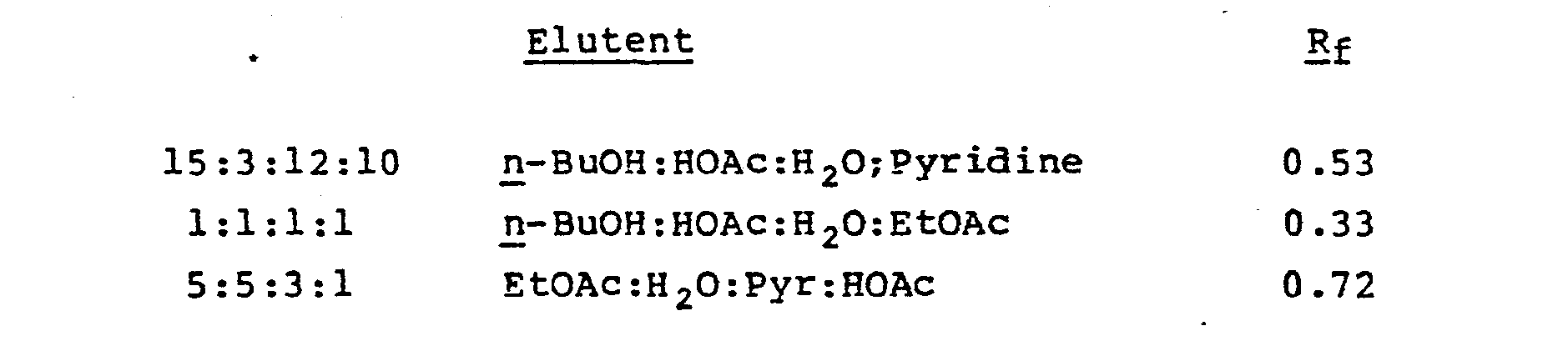
- Nα-acetyl-D-Arginyl-Prolyl-Aspartyl-Valyl-Tyrosine Amide
- The title peptide was synthesized by the solid phase method on a Beckman 990B Automatic Peptide Synthesizer. The synthesis was started with 4.00 g p-methylbenzhydrylamine resin, substitution level 0.25 mmol per gram. Fifty per cent trifluoroacetic acid in methylene chloride was used in the deprotection step, 5 percent diisopropylethylamine in CH2Cl2 in the neutralization step, and DCC-HOBt in the coupling step. The following amino acid derivatives were sequencially coupled to the resin: BOC-Tyr(BrZ), BOC-Val, BOC-Asp(β-Bzl), BOC-Pro, and BOC-D-Arg (Ng-tosyl). After incorporation of D-Arg, the resin was deprotected, neutralized, and reacted with acetic anhydride in dimethylformamide with 4-dimethylpyridine as a catalyst. The resin was washed and dried with vacuum. The dried resin weighted 5.15 g.
- The peptide was cleaved from the resin with 50 ml HF containing 5 ml m-cresol at 0° for one hour. After vacuum removal of the HF, the residue was washed with ethyl acetate and ether. The peptide was extracted with 100 ml 5 percent aqueous acetic acid. The extract was lyophilized, yielding 658 mg crude peptide.
- The peptide was purified by chromatographing twice on ion exchange resin. The first elution was on a 2.6x100 c-n column of DEAE-Sephadex with 0.05 M NH4HC03 pH 8.0. Fractions 57-66 (10 ml each) were combined and lyophilized. The 572 mg product was loaded onto 2.6x90 cm column of SP-Sephadex and eluted with 0.02 M NH4OAc pH 4.6. Fractions of 7.5 ml were collected. The major peak was divided into three cuts: fractions 190-215, 216-240, and 241-285. The lyophilized yield and purity (HPLC) of these cuts were: 48 mg (98.8 percent), 107 mg (98.4 percent), 232 mg (97.3 percent).
- TLC, silica gel 60:

- Asp, 0.99; Pro, 1.02; Val, 1.03; Tyr, 0.96; Arg, 1.01; 80.5 percent peptide
- The title compound was prepared by the solid phase method, starting with p-methylbenzhydrylamine resin (U.S. Biochemical 31578, 6.83 g, 0.3 meq/g). The following standard routines were used:
- Deprotection - 50 ml 50% TFA/CH2Cl2 for 1 min, then 50 ml 50% TFA/CH Cl for 30 min;
- Washing - 50 ml CH2Cl2 twice for 1 min each, followed by 50 ml iPrOH for 1 min, then 50 ml CH2Cl2 twice for 1 min each;
- Neutralization - 50 ml 5% DIEA/CH2Cl2 twice for 2.5 min each;
- Coupling - 5.0 mmol of the protected amino acid and HOBT (0.77 g) were dissolved in 4 ml DMF and then diluted with 41 ml CH2Cl2. DCC (1.03 g) was dissolved in 5 ml CH2Cl2, added to the mixture of reactants and resin and agitated for 2 h.
- In sequence, the resin was coupled once with BOC-Val, BOC-Bzlβ-Asp, BOC-Aib, and twice with AOCα-Tosg-Arg. After deprotection, half of the resin peptide was acylated once with 10 percent AC20 in 1:1 DMF:CH2Cl2 (30 ml) and DMAP (400 mg) for 60 min. The resin was washed, air-dried and cleaved in HF/anisole (30ml/8ml) for 1 h at O°C.
- The resin residue was quenched in Et20 and filtered. The solids were extracted with 1% NH4OH (100 ml) for 1 h, filtered, and the extract lyophilized to give crude peptide as a colorless solid, 425 mg.
- The crude peptide was purified on DEAE Sephadex (2.6x85cm column, 0.03M NH4HCO3, unbuffered; 75 ml/h, 7 ml/fraction, 278 nm detector). Fractions 79-95 were pooled and lyophilized to give the title compound, 260 mg.
-

- Thin Layer Chromatography 250µ Silica Gel G

- Arginyl-α-Aminoisobutyryl-Aspartyl-Valyl-Tyrosine amide
- The title compound was prepared by the solid phase method as described in Example XVIII. The remaining resin was washed, air-dried and cleaved in HF/anisole (30ml/8ml) for 1 h at O°C.
- The resin residue was quenched in Et2O and filtered. The solids were extracted with 10% HOAc (100 ml) filtered, and the extract lyophilized to give crude peptide as a colorless solid, 385 mg.
- The crude peptide was purified on CM Sephadex (2.6x80cm column, 21 0.10M unbuffered, NH4OAc then 0.2M NH40Ac, 75 ml/h, 12 ml/fraction, 278 nm detector).
- Fractions 62-99 were pooled and lyophilized to give the title compound, 435 ml, 50% yield.
-

- Thin Layer Chromatography 250µ Silica Gel G

- The title compound was prepared as follows:
- 3,4-dehydro-pro (200 mg; 1.76 mmoles) was dissolved in dioxane /H2O (8 ml; 2:1). To this solution, 1 N NaOH (1.8 ml) and di-t-butyldicarbonate (436 mg; 2 mmoles) were added at 0°C with stirring. The mixture was then stirred at room temperature overnight. Dioxane was removed and to the remaining water phase, ethyl acetate (20 ml) was added. The mixture was cooled in an ice bath, acidified to pH 2.0 with 0.5 N HC1 and transferred into separation funnel. The oganic layer was separated and the aqueous layer was extracted twice with EtOAc (2 x 20 ml). The combined organic phase was dried over Na2SO4 and filtered. The solvent was removed and the remaining residue was dried and used without further purification.
- The peptide was synthesized on a (p-methyl)benzhydrylamine-resin (2 g resin; substitution of 0.25 mmoles of NH2 of g resin) by solid-phase method. The incorporation of BOC-Tyr-(Bzl), BOC-Val, BOC-3,4-dehydro-Pro and Aoc-Arg(Tos) was carried out via DCC-coupling. The coupling was monitored by qualitative ninhydrin test. The acetylation of arginine was carried out with 50 percent acetic anhydride/pyridine (15 ml) and DMAP (15 mg). The peptidyl resin was then washed thoroughly with DMF and CH2Cl2 and dried. The dried peptidyl resin (2 g) was cleaved with HF/anisole (20 ml; 9:1) at 0°C for 1 h. The peptide - resin mixture was washed with ether (3 x 20 ml). After lyophilization, the peptide was applied onto a Sephadex SPC-25 column (50 cm x 0.9 cm) and equilibrated with 0.02 M NH4OAc; pH 4.6. The flow rate was 80 ml/hr and fractions of 12 ml were collected. The product was eluted between tubes 22-39, which were pooled and lyophilized.
- The lyophilized material was purified again on Sephadex SPC-25 column (60 cm x 2.5 cm) equilibrated with 0.02 M NH4OAc; pH 4.5 -6.8 under the same condition as described above. The peptide was eluted between tubes 55-75, which were pooled and lyophilized to give 80 mg of the title product.
- Rf 0.45 (n-BuOH/HOAc/H20/Pyr 15:3:12:10; Silica Gel F60) Rf 0.27 (n-BuOH/HOAc/H2O 3:1:1 ; Silica Gel F60)
- Amino Acid Analysis:
- Asp, 1.04; Val, 1.00; Tyr, 0.85; Arg, 0.96; 3,4-dehydro- Pro, 1.08 Peptide content: 72 percent; hygroscopic material 3,4-dehydro-Pro eluted next to Asp-residue in the Analysis and has a very low KF - value.
- HPLC: Whatman Partisil - ODS column 10 percent CH3CN/0.02 M NH40Ac; pH 4.6 Flow rate: 2 ml/min
- The peptide was 99.7 percent pure and has a retention time of 14.3 min.
- The title compound was prepared as follows:
- To a solution of HC1 Pro-Asp(OBzl)-Val-Tyr-NH2 (0.5 g; 0.7 mmoles) in DMF (15 ml) , DIEA (0.14 ml; 0.7 mmoles) and Z-Arg(Z,Z)-ONp (0.7 g; 1 mmoles) were added at 0°C with stirring. The mixture was stirred at room temperature over weekend. The solvent was removed on rotavapor. The residue was triturated with ether and filtered. The solid was recrystallized from CH30H and CH2Cl2/ether/pet ether mixture to give 0.59 g of product; Rf 0.78 (n-BuOH/HOAc/H2O = 3:1:1; Silica Gel; 200 microns); 1H-NMR (DMSO-d6) indicated the presence of Z-Arg (Z,Z)-moeity.
- Z-Arg(Z,Z)-Pro-Asp(OBzl)-Val-Tyr-NH2 (0.5 g) was hydrogenated with Pd-black (0.5 g) and ammonium formate (0.5 g) in CH30H (40 ml) overnight. The catalyst was filtered and the filtrate was removed on rotary evaporator. The residue was dissolved in H2O and lyophilized. The crude peptide was then placed on a Sephadex DEAE column (60 cm x 2.5 cm) and eluted with 0.01 M NH4HCO3; pH 7.9. The flow rate was 90 ml/hr and fractions of 10 ml were collected. The peptide was eluted between tubes 17-29, which were pooled and lyophilized to give 290 mg of the title product.
- RfI = 0.32 (n-BuOH/HOAc/H2O/Pyr = 15:3:12:10; Silica Gel F60)
- RfII = 0.05 (n-BuOH/HOAc/H2O = 3:1:1; Silica Gel F60)
- Amino Acid Analysis:
- Arg, 1.01; Pro, 1.01; Asp, 1.00; Val, 1.01; Tyr, 0.97 Peptide Content: 71 percent
- HPLC: Whatman Partisil - ODS column 10 percent CH3CN/0.02 M KH2PO4 Buffer (pH 3.5) Flow rate: 3 ml/min
- The peptide has a retention time of 6.3 min and was 99.5 percent pure.
- The title compound was prepared by the solid phase method, starting with Boc(BrZ)Tyr benzyl ester resin (4.56 g. 0.44 meq/g). The following standard routines were used:
- Deprotection - 50 ml 50% TFA/CH2Cl2 for 5 min, then 50 ml 50% TFA/CH2Cl2 for 20 min;
- Washing - 50 ml CH2Cl2 twice for 1 min each, followed by 50 ml iPrOH for 1 min, then 50 ml CH2Cl2 twice for 1 min each;
- Neutralization - 50 ml 5% DIEA/CH2Cl2 twice for 2.5 min each;
- Normal Coupling - 6 mmol of the protected amino acid and HOBT (0.92 g) were dissolved in 4 ml DMF and then diluted with 41 ml CH2Cl2. DCC (1.24 g) was dissolved in 5 ml CH2Cl2, added to the mixture of reactants and resin and agitated for 2 h.
- Symmetrical Anhydride Coupling - 6 mmol of the protected amino acid was dissolved in 20:1 CH2Cl2:DMF (21 ml) and cooled to 0°C. DCC (0.83 g) was then added and the reaction mixture stirred for 30 min. After filtering, the filtrate was added to the resin and agitated for 20 h.
- In sequence, the resin was coupled once each with Boc-Val, Boc (Bzl)β-Asp, Boc-Aib, and Aocα-Tosg-Arg. The resin was recoupled once with Aoca-Tosg-Arg symmetric anhydride.
- After deprotection, the resin peptide was acylated once with 10% Ac2O in 1:1 DMF:CH2Cl2 (20 ml) and DMAP (300 mg) for 60 min. The resin was washed, air-dried and cleaved in HF/anisole (30 ml/8 ml) for 60 min at O°C.
- The resin residue was quenched in Et2O and filtered. The solids were extracted with 1% NH4OH (100 ml) for 1 h, filtered, and the extract lyophilized to give crude peptide as a colored solid, 600 mg.
- The crude peptide was purified on DEAE Sephadex (2.6 x 86 cm column, 0.15 M NH4HCO3, unbuffered; 100 ml/h flow rate, 12.5 ml/fraction, 277 nm detector). Fractions 109-119 were pooled and lyophilized to give the title compound, 230 mg.
-


- The title compound was prepared by the solid phase method, starting with Boc(Bzl)8Asp-Val-Tyr(BrZ) benzylester resin (2.65 g, ca. 1.0 meq). The following standard routines were used:
- Deprotection - 40 ml 50% TFA/CH2Cl2 for 5 min, then 40 ml 50% TFA/CH2C12 for 20 min;
- Washing - 40 ml CH2Cl2 twice for 1 min each, followed by 40 ml iPrOH for 1 min, then 40 ml CH2Cl2 twice for 1 min each; Neutralization - 40 ml 5% DIEA/CH2Cl2 twice for 2.5 min each;
- Coupling Procedure 1: - 5.0 mmol of the protected amino acid and HOBT (0.77 g) were dissolved in 4 ml DMF and then diluted with 36 ml CH2Cl2. DCC (1.03 g) was dissolved in 5 ml CH2Cl2, added to the mixture of reactants and resin and agitated for 16 h.
- Procedure 2: - 8.0 mmol of the protected amino acid was dissolved in 40 ml CH2C12 and 1 ml DMF and cooled to 0°C. DCC (0.83 g) was then added and the reaction stirred for 30 min. The solids were filtered, the filtrate added to the resin and agitated for 3 h.
- Procedure 3: - 5.0 mmol of the protected amino acid active ester and HOBT (0..77 g) were dissolved in 20 ml DMF and 20 ml CH2C12.. This solution was added to the resin and agitated for 24 h.
- Procedure 4: - 5.0 mmol of the protected amino acid active ester and DMAP (0.5 g) were dissolved in 20 ml DMF and 20 ml CH2Cl2. This solution was added to the resin and agitated 68 h.
- In sequence, the resin was coupled once with Boc-Cle via procedure 1, Z3-Arg-ONp via procedure 3, recoupling once with Aoca-Tosg-Arg via procedure 2, and finally with Z3-Arg-ONg via procedure 4. After deprotection, the resin was washed, air-dried and cleaved in HF/anisole (30 ml/8 ml) for 60 min at 0°C.
- The resin residue was quenched in Et2O and filtered. The solids were extracted with 1% NH4OH (100 ml) for 1 h, filtered, adjusted to pH 6 with HOAc and the extract lyophilized to give crude peptide as a colorless solid, 720 mg.
- The crude peptide was purified on DEAE Sephadex (2.6 x 85 cm column, 0.12 M NH4HCO3, unbuffered; 100 ml/h flow rate, 12.5 ml/fraction, 206 nm detector). Fractions 317-370 were pooled and lyophilized to give the desired material. The peptide was desalted on G-10 Sephadex (2.6 x 83 cm, column, 1% HOAc as elutent, 3 ml/h flow rate, 4 ml/fraction, 277 nm detector). Fraction 78-105 were pooled and lyophilized to give the title compound, 395 mg.
-

- Thin Layer Chromatography 250P micron, Silica Gel G

- Nα-Acetyl-Arginyl-Prolyl-Aspartyl-Valyl-Tyrosyl-Glycine amide
- The title compound was prepared by the solid phase method, starting with p-methylbenzhydrylamine resin (U.S. Biochemical 31578, 4.2 g, 0.25 meq/g). The following standard routines were used:
- Deprotection - 40 ml 50% TFA/CH2C12 for 1 min, then 50 ml 40% TFA/CH2Cl2 for 30 min;
- Washing - 40 ml CH2C12 twice for 1 min each, followed by 40 ml iprOH for 1 min, then 40 ml CH2Cl2 twice for 1 min each;
- Neutralization - 40 ml 5% DIEA/CH2Cl2 twice for 2.5 min each;
- Coupling - 3.0 mmol of the protected amino acid and HOBT (0.46 g) were dissolved in 2 ml DMF and then diluted with 28 ml CH2Cl2. DCC (0.62 g) was dissolved in 5 ml CH2Cl2, added to the mixture of reactants and resin and agitated for 2 h.
- In sequence, the resin was coupled once with BOC-Gly, BOC-Tyr (BrZ), BOC-Val, BOC-Bzlβ-Asp, BOC-Pro, and AOCa- Tosg-Arg. After deprotection, the resin peptide was acylated once with 10 percent Ac2O in 1:1 DMF:CH2Cl2 (18 ml) and DMAP (0.3 g) for 60 min. The resin was washed, air-dried and cleaved in HF/anisole (30ml/8ml) for 1 h at O°C.
- The resin residue was quenched in Et2O and filtered. The solids were extracted with 0.3% NH40H (100 ml) for 1 h, filtered, and the extract lyophilized to give crude peptide as a colorless solid, 720 mg.
- The crude peptide was purified on DEAE Sephadex (2.6x89cm column, 0.03M NH4HCO3, unbuffered; 75ml/h, 7ml/fraction, 278 nm detector). Fractions 42-52 were pooled and lyophilized to give the title compound, 425 mg.
- Amino Acid Analvsis

- Thin Layer Chromatography 250 Silica Gel G
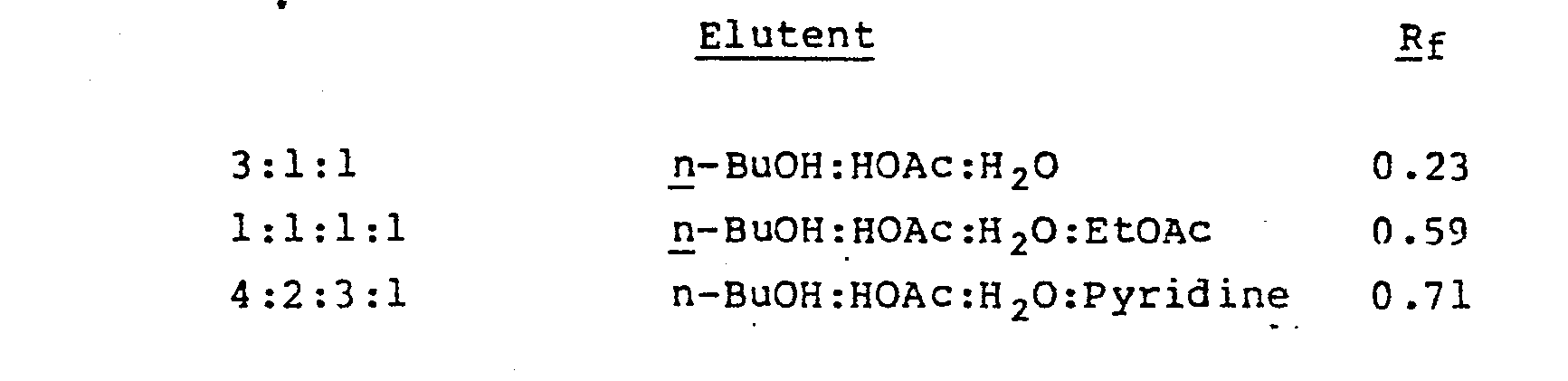
- Following peptide preparation methods similar to those employed in Examples I-XXIV, there were prepared the following:
- A. N-a-Acetyl-Arginyl-Prolyl-Aspartyl-Valyl-N-a-methyl-Tyrosine, solvated
- Amino acid analysis: Arg-1.02; Pro-1.00; Asp-1.00; Val-1.04; 73.5% peptide content
- Thin Layer Chromatography Silica Gel G 250 F hard surface

- B. Arginyl-4-methyl-leucyl-Aspartyl-Valyl-Tyrosine, Solvated
- Amino Acid Analysis: Asp-1.00; Val-1.00; Tyr-0.96; Arg-1.00; 4-Me-Leu-0.96; 93.0% peptide content
- Thin Layer Chromatography Silica Gel 60

- Prothymocytes (Thy-l-) and pro-Lyb-2 cells were co- enriched from B6-lyb-2.1 congenic mouse spleen by BSA density gradient centrifugation (Pathocyte 5, Miles Laboratories, lot 35, 1 ml of 35:29:26:23:18:12%). The 26:23 and 23:28 interface layers were combined, and Thy-1+ and Lyb-2+ cells removed by reaction with monoclonal Thy-1.2 and Lyb-2.1 antibodies and adherence to plates coated with affinity-purified rabbit anti mouse F(ab)2. The washed non-adherent cells were used for both assays. This starting population contains 30-40% prothymocytes and 30-40% pro-Lyb-2 cells (known to represent separate committed precursor populations). Five x 106 cells/0.5 ml RPMI 1640 were incubated in 5 nl plastic tubes with equal volumes of inducer in serial dilution in RPMI 1640 in a humidified 5% C02 atmosphere for 3 hrs. The cells were then assayed separately for Thy-1 and Lyb-2.1 expression with monoclonal antibodies in optimal concentration by the Protein-A-SRBC method of Scheid and Triglia, Immunogenet., 9, 423-433 (1979) (controls without inducer register <5% induced cells). The subject peptides stimulate induction of Thy-1+ cells (T cells) and thus are designated as possessing biological activity. The subject peptides wherein X is GLU or D-GLU also stimulate induction of Lyb-2.1+ cells (B cells), as well as T cells. For comparison, a control peptide NH2-TYR-ARG-LYS-ASP-VAL-OH stimulated no induction of either T cells or B cells.
- Materials - CEM cell lines were obtained from the American Type Culture Collection. 3-Nitro-2-pyridine sulfonyl chloride and 2-pyridinethiol 1-oxide were provided by Dr. Rei Matsueda, Sanyo Laboratories, Tokyo. RPM1-1640, fetal bovine serum and L-glutamine were obtained from Gibco, gentamycin from Schering, and lectin-coupled agarose beads from Vector Laboratories. Sephadex was purchased from Pharmacia Fine Chemicals, rabbit anti-thymopoietin antibody from Accurate Chemical Scientific Corp., ubiquitin from Peninsula Laboratory, and human IgG from Miles Laboratories. All other chemicals were purchased from common commercial sources and were of reagent grade.
- The abbreviations used are: PBS, phosphate-buffered saline; TCA, trichloroacetic acid; SDS, sodium dodecylsulfate; Con A, concanavil-in A; TP, thymopoietin; PEG, polyethylene glycol; BSA, bovine serum albumin; I.?., intraperitoneal; PMSF, phenyl methyl sulfonyl fluoride; FTS, facteur thymique serique; CRF, corticotropin-releasing factor; ACTH, adrenocorticotropic hormone; Hepes, N-2-hydroxyethylpiperazine N-2-ethane-sulfonic acid.
- Cyclic Nucleotide Assavs - The CEM cell line was grown for different periods of time and was harvested as described below. The cells were washed three times in PBS, resuspended in.RPMI-1640 at a concentration of 3.12 x 10⁷ cells/ml and allowed to equilibrate at 37°C for 30 min before the addition of 100 ng bovine thymopoietin (25 µl; 4.0 pg/ml) to 1 ml of cells. The incubation was continued for 4-5 min in a shaking water bath and was then terminated by the addition of 1 ml ice-cold 10 percent TCA with homogenization and sonication to release the cyclic nucleotides. The suspension was centrifuged at 3000 x g for 20 min at 4°C. The precipitate was dissolved in 0.1 N NaOH, and the protein content determined by the method of Cadman, et al., Anal Biochem, 96,21-23. TCA was removed from the supernatant by extracting four times with 5 ml of water saturated diethyl ether. After the final extraction, the remaining traces of ether were removed by heating for 10 min in a 50°C water bath. The sample was lyophilized and reconstituted in 50 mM acetate buffer, pH 6.2, for radioimmunoassay of cyclic nucleotides.
- Preparation of Membrane Glycoprotein - The CEM human lymphoid cell line was cultured in RPMI-1640 supplemented with 10 percent heat-inactivated fetal bovine serum, 2 mM fetal bovine serum, 2 mM L-glutamine and 50 µg/ml gentamycin at 37°C in a humid atmosphere containing 5 percent CO2, to a final density of 3-4 x 10⁶ cells/ml. At this concentration, cells were in the early stationary phase of the growth curve and were judged greater than 90 percent viable by trypan blue exclusion.
- Membrane glycoproteins were prepared by a modification of the technique of Hedo, et al., Biochem, 20, 3385-3393. The cells were washed once with PBS and were suspended in 40 percent sucrose, 50 50 mM Hepes, 1 percent EDTA, 0.1 percent O-phenanthroline, and 1 mM PMSF (in methanol), pH 7.8, and homogenized in a glass homogenizer at room temperature. The total suspension was then subjected to sonication by a cell disruptor sonicator with a cup horn attachment (Model W-225R) at 35°C for 10 min. The suspension was centrifuged at 600 x g for 10 min at 4°C in a Sorval GLC-3 centrifuge, and the supernatant was recentrifuged at 20,000 x g in a Sorval 5B centrifuge at 4°C for 3 min. The crude membrane fraction obtained from this pellet was suspended in 50 mM Hepes, 10 mM MgS04, and 1 mM PMSF, pH 7.8, at a final protein concentration of 5 mg/ml. Solubilization of protein was performed by stirring the suspension for 2 h at 25°C in the presence of 1 percent Triton X-100 (final concentration) and 0.1 percent brij-96 (polyoxyethylene 10, oleyl ether) (final concentration). The suspension was centrifuged at 2,000 x g for 2 h at 4°C, and the supernatant was stored at -70°C. Soluble protein concentration was measured according to the technique of Cadman, et al., using BSA as a standard and buffer as a control.
- Wheat germ agglutinin or ricinus communis agglutinin-I was used for purification of the receptor protein. All lectin beads were stored at 4°C with their corresponding monosaccharide inhibitors (300. mM).
- For each purification 2 nl of lectin-agarose was packed into a 1 cm diameter column and washed at room temperature with 25 ml of 0.15 M NaCl, 50 mM Hepes, 0.1 percent Triton X-1 and 0.01 percent SDS, pH 7.8.
- The columns were washed with 200 ml of 0.15 M NaCl, 50 mM Hepes and 0.1 percent Triton X-100, pH 7.8, followed by a final wash of this buffer containing 10 mM MgSO4. PMSF (1 mM) was added to all the buffer systems. Solubilized membrane proteins (- 10 mg) were recycled five times through individual columns. The column was then washed with 100 ml of 0.15 M NaCl, 50 mM Hepes, 10 mM MgSO and 0.1 percent Triton X-100, pH 7.8, at 4°C. Monosaccharide inhibitors, at a concentration of 400 mM in 3 ml washing buffer, were used for individual column elutions; N-acetyl glucosamine for wheat germ agglutinin and β-methyl D-galactoside for ricinus communis agglutinin-I. The monosaccharides were applied to the column, which was stopped for 30-40 min to permit equilibration and then eluted further. The protein eluate was dialyzed against 500 ml of 50 mM Hepes, 10 mM MgSO4 and 0.1 percent Triton X-100, pH 7.8, at 4°C.
- Preparation of Radiolabelled Thymopoietin - Thymopoietin was dissolved in 2.0 M sodium carbonate-bicarbonate buffer, pH 9.8, to obtain free amino groups. 3-nitro-2-pyridine sulfonyl chloride in dioxane (10:1 moles) was added to the thymopoietin solution and stirred for 5 h at 20°C. After the addition of water the insoluble material was centrifuged. The protected peptide was purified using Sephadex G-25 chromatography followed by digestion with post-proline cleaving enzyme to remove the NH2-terminal blocked proline. Methyl 3,5 di[125I]iodohydroxybenzimi- date (4000 Ci/mM) was obtained at a concentration of 5.5 mCi/ml in methanol and was evaporated to dryness. The iodinated imidoester (1.4 nM) was reacted with protected thymopoietin (5 µg; 0.9 nM) according to the method of Wood, et al., Anal. Biochem., 69, 339-349, with the following modifications. The reaction was carried out in 500 ul of 0.16 M borate buffer, pH 9.1, for 24 h at 4°C. The reaction was stopped by the addition of 500 µl of 2 M citrate phosphate buffer, pH 5.5, at 4°C. The sample was chromatographed on a Biogel P-10 column in sodium pyrophosphate, pH 7.5 (15 drops/fraction), at 4°C to separate the free iodine.
- The iodinated peptide was dissolved in water and treated with 2-pyridinethiol 1-oxide (10:1 moles) for 5 h at room temperature to remove the protecting groups. The labelled peptide was purified on a Biogel P-10 column. Three radioactive peaks were obtained, the first two of which were immunoactive with rabbit anti-thymopoietin antibody. The first peak was then applied to a 1 x 60 cm column of DEAE-Sephadex A-25 that had been equilibrated with 50 mM Tris buffer, pH 7.0. The iodination mixture was eluted with this buffer using a linear gradient of increasing ionic strength from the equilibration concentration up to 1.0 M. The radioactivity of each fraction was determined using an LKB 1280 Ultra gamma spectrometer.
- Fractions with peak radioactivity from each purification scheme were analyzed for binding with excess anti-thymopoietin antibody. Fractions from peak II (fractions 35-45) of the DEAE-Sephedex A-25 column showed the highest specific binding and were used subsequently in the radioreceptor assay.
- Iodinated thymopoietin retained biological activity as determined by assessing its effect in a neuromuscular assay (Goldstein, Nature, 247, 11-14 (1974)) and its effect on the synthesis of cyclic GMP by CEM cells.
- Binding Assay - The assay buffer was prepared by adding 12 g Hepes, 1.2 g MgSO4 and 1.2 g BSA to 1000 ml of glass distilled water. A pH of 7.65 was obtained using 1 N NaOH. The stock standard solution was made using assay buffer and was used for one week. The assay was performed in 12 x 75 mm glass test tubes by the addition of 100 µl of standard solution, 25 µl of receptor protein (150-200 µg/ml), 25 µl 125I-TP (80,000 cpm)) 20 µl of 1 percent Triton X-100, and the volume was made up to 200 ul with assay buffer. After incubation for 18 h at 4°C, 200 µl of human IgG (1.5 mg/ml) (as carrier) and 200 ul of 35 percent PEG-8000 in PBS, pH 7.56, were added, mixed, and incubated for 30 min on ice. The tubes were centrifuged and the residue was washed with 10 percent PEG in PBS, pH 7.3, and counted in an LKB-gamma counter.
- The radioactivity in the precipitate in the presence of 1 mg/ml nonradioactive thymopoietin was taken to represent nonspecific binding. TCA was added to the supernatant (final concentration 5 percent) and precipitable radioactivity was measured. At all times this exceeded 95 percent, indicating minimal release of free 125 I from the tracer.
- Competition Experiments - Following the above binding assay procedure, 2.3 x 10⁻¹⁰ M of 125I-TP was incubated with 4 g of binding protein and test peptide. The incubation was continued for 12 h and free and bound 125I-TP was determined as above. The following representative compounds of the invention caused displacement at least least 50% of that caused by thymopoietin self-displacement at equivalent concentrations:

- For comparison, other peptides such as insulin, glucagon, growth hormone, somatostatin, β-endorphin, FTS, ACTH, CRF, and ubiquitin caused no detectable displacement.
- The above Examples have been provided to illustrate the subject invention but not to limit its scope, which scope is set out only in the appended claims.
Claims (12)
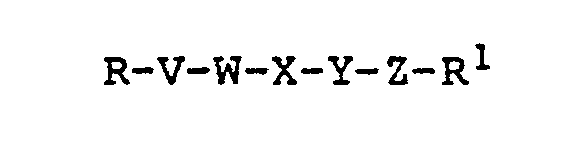


Priority Applications (1)
| Application Number | Priority Date | Filing Date | Title |
|---|---|---|---|
| AT84307968T ATE63748T1 (en) | 1983-11-18 | 1984-11-16 | ENZYME RESISTANT IMMUNOMODULATORY PEPTIDES. |
Applications Claiming Priority (2)
| Application Number | Priority Date | Filing Date | Title |
|---|---|---|---|
| US553281 | 1983-11-18 | ||
| US06/553,281 US4505853A (en) | 1983-11-18 | 1983-11-18 | Enzyme-resistant immunomodulatory peptides |
Publications (3)
| Publication Number | Publication Date |
|---|---|
| EP0146266A2 true EP0146266A2 (en) | 1985-06-26 |
| EP0146266A3 EP0146266A3 (en) | 1987-08-12 |
| EP0146266B1 EP0146266B1 (en) | 1991-05-22 |
Family
ID=24208835
Family Applications (1)
| Application Number | Title | Priority Date | Filing Date |
|---|---|---|---|
| EP84307968A Expired - Lifetime EP0146266B1 (en) | 1983-11-18 | 1984-11-16 | Enzyme-resistant immunomodulatory peptides |
Country Status (14)
| Country | Link |
|---|---|
| US (1) | US4505853A (en) |
| EP (1) | EP0146266B1 (en) |
| JP (2) | JPH0753752B2 (en) |
| KR (1) | KR940001007B1 (en) |
| AT (1) | ATE63748T1 (en) |
| AU (1) | AU579595B2 (en) |
| CA (1) | CA1269498A (en) |
| DE (1) | DE3484616D1 (en) |
| DK (1) | DK167928B1 (en) |
| FI (1) | FI86860C (en) |
| IL (1) | IL73533A (en) |
| NO (1) | NO166943C (en) |
| NZ (1) | NZ210194A (en) |
| ZA (1) | ZA848973B (en) |
Cited By (5)
| Publication number | Priority date | Publication date | Assignee | Title |
|---|---|---|---|---|
| WO1986004334A1 (en) * | 1985-01-18 | 1986-07-31 | MERCK Patent Gesellschaft mit beschränkter Haftung | Immunoregulatory peptides |
| EP0166612A3 (en) * | 1984-06-27 | 1987-08-05 | Ortho Pharmaceutical Corporation | Potent thymopentin analogs |
| US5011825A (en) * | 1986-06-11 | 1991-04-30 | Hoechst Aktiengesellschaft | Peptides influencing diuresis and natriuresis, a process for their preparation, agents containing them, and their use |
| EP0668770A4 (en) * | 1991-04-24 | 1995-09-27 | ||
| US5639729A (en) * | 1993-08-26 | 1997-06-17 | Immunobiology Research Institute, Inc. | Tripeptides useful in immune and CNS therapy |
Families Citing this family (34)
| Publication number | Priority date | Publication date | Assignee | Title |
|---|---|---|---|---|
| DE3401545A1 (en) * | 1983-08-03 | 1985-02-14 | Hoechst Ag, 6230 Frankfurt | NEW PEPTIDES WITH IMMUNE-STIMULATING EFFECT, METHOD FOR THE PRODUCTION AND THEIR USE |
| IT1216908B (en) * | 1987-03-19 | 1990-03-14 | Eniricerche Spa | BACK-REVERSE ANALOGUES OF THYOPENTINE AND ITS FRAGMENTS, THE METHOD FOR THEIR SYNTHESIS AND THEIR USE FOR THE PREPARATION OF PHARMACEUTICAL COMPOSITIONS. |
| US5200506A (en) * | 1987-03-19 | 1993-04-06 | Eniricerche S.P.A. | Process for preparing new thymopentin retro-inverso analogs and fragments thereof and the intermediates obtained therein |
| US5656601A (en) * | 1987-06-19 | 1997-08-12 | Berlin-Chemie Ag | Acylated splenopentins, methods for their synthesis and their use |
| RU2023448C1 (en) * | 1987-07-30 | 1994-11-30 | Сентро Насьональ Де Биопрепарадос | Method for manufacturing vaccine against various pathogenic serotypes of group b neisser's meningitis |
| US5728680A (en) | 1987-12-30 | 1998-03-17 | Cytoven J.V. | Methods for normalizing numbers of lymphocytes |
| US5807830A (en) * | 1987-12-30 | 1998-09-15 | Cytoven J.V. | Method for treatment of purulent inflammatory diseases |
| GB8807427D0 (en) * | 1988-03-28 | 1988-05-05 | National Biological Standards Board | Peptides |
| WO1989009229A1 (en) * | 1988-03-31 | 1989-10-05 | Immunobiology Research Institute, Inc. | Treatment of hiv viremic patients with thymopentin |
| NZ229004A (en) * | 1988-05-19 | 1993-09-27 | Immunobiology Res Inst Inc | Tetrapeptides having t cell helper acitivity |
| HU201095B (en) * | 1988-06-14 | 1990-09-28 | Richter Gedeon Vegyeszet | New peptides inhibiting the activity of the immune system and pharmaceutical compositions comprising same, as well as process for producing these peptides and compositions |
| IT1226552B (en) * | 1988-07-29 | 1991-01-24 | Ellem Ind Farmaceutica | IMMUNOSTIMULANT PEPTIDES. |
| US5225400A (en) * | 1988-07-29 | 1993-07-06 | Ellem Industria Farmaceutica S.R.L. | Immunostimulating peptides, a process for their preparation and pharmaceutical compositions containing them |
| WO1990003180A1 (en) * | 1988-09-30 | 1990-04-05 | Immunobiology Research Institute, Inc. | Peptides having t cell suppressor activity |
| DE3833936C1 (en) * | 1988-10-05 | 1989-09-21 | Henning Berlin Gmbh Chemie- Und Pharmawerk, 1000 Berlin, De | |
| US5811399A (en) * | 1988-12-14 | 1998-09-22 | Cytran, Inc. | Pharmaceutical dipeptide compositions and methods of use thereof: immunodepressants |
| IT1227908B (en) * | 1988-12-23 | 1991-05-14 | Eniricerche S P A Milano Sclav | NEW RETRO-REVERSE ANALOGUES OF THYOPENTINE, THE METHOD FOR THEIR SYNTHESIS AND THEIR USE FOR THE PREPARATION OF PHARMACEUTICAL COMPOSITIONS |
| US5218089A (en) * | 1988-12-23 | 1993-06-08 | Sclavo S.P.A. | Retro-inverso analogues of thymopentin and the method for their synthesis |
| US5036050A (en) * | 1989-01-12 | 1991-07-30 | Immunobiology Research Institute, Inc. | Compositions containing thymopentin for topical treatment of skin disorders |
| US5770576A (en) * | 1989-08-30 | 1998-06-23 | Cytran, Inc. | Pharmaceutical dipeptide compositions and methods of use thereof: systemic toxicity |
| JP2745351B2 (en) * | 1991-02-14 | 1998-04-28 | 富士写真フイルム株式会社 | Peptide derivatives and their uses |
| DK53291D0 (en) * | 1991-03-25 | 1991-03-25 | Carlbiotech Ltd As | SMALL PEPTIDES AND PEPTID RELATED SUBSTANCES AND PHARMACEUTICAL PREPARATIONS CONTAINING SUCH COMPOUNDS |
| US5215964A (en) * | 1991-06-03 | 1993-06-01 | Immunobiology Research Institute, Inc. | Peptides useful in regulating the immune and nervous systems |
| US6100380A (en) * | 1991-10-28 | 2000-08-08 | Cytran, Inc. | Immunomodulating peptides and methods of use |
| US6066622A (en) | 1991-10-28 | 2000-05-23 | Cytran, Inc. | Immunomodulating peptides and methods of use |
| US5952465A (en) * | 1993-04-23 | 1999-09-14 | Virginia Commonwealth University | Polypeptides that include conformation-constraining groups which flank a protein-protein interaction site |
| AU6770794A (en) * | 1993-04-23 | 1994-11-21 | Herbert J. Evans | Polypeptides that include conformation-constraining groups which flank a protein-protein interaction site |
| US6258550B1 (en) | 1993-04-23 | 2001-07-10 | Virginia Commonwealth University | Polypeptides that include conformation-constraining groups which flank a protein-protein interaction site |
| US5965698A (en) * | 1993-04-23 | 1999-10-12 | Virginia Commonwealth University | Polypeptides that include conformation-constraining groups which flank a protein--protein interaction site |
| US5928896A (en) * | 1993-04-23 | 1999-07-27 | Virginia Commonwealth University | Polypeptides that include conformation-constraining groups which flank a protein--protein interaction site |
| US6084066A (en) * | 1993-10-29 | 2000-07-04 | Virginia Commonwealth University | Polypetides that include conformation-constraining groups which flank a protein-protein interaction site |
| US6849712B1 (en) * | 1998-01-22 | 2005-02-01 | Regents Of The University Of Minnesota | Peptides with β1 integrin subunit dependent cell adhesion modulating activity |
| CN1927879B (en) * | 2006-09-25 | 2010-11-24 | 吉林大学 | Thymopentin active isomer and its application in medicine preparation |
| CN101168560B (en) * | 2006-10-23 | 2012-09-05 | 江苏正大天晴药业股份有限公司 | N-substituted peptide amide, pharmaceutical composition and use thereof |
Citations (6)
| Publication number | Priority date | Publication date | Assignee | Title |
|---|---|---|---|---|
| US4002740A (en) | 1975-08-21 | 1977-01-11 | Gideon Goldstein | Tridecapeptide compositions and methods |
| US4077949A (en) | 1973-12-28 | 1978-03-07 | Sloan-Kettering Institute For Cancer Research | Polypeptide hormones of the thymus |
| US4190646A (en) | 1975-11-11 | 1980-02-26 | Sloan-Kettering Institute For Cancer Research | Polypeptide compositions and methods |
| EP0025897A2 (en) | 1979-09-22 | 1981-04-01 | Hoechst Aktiengesellschaft | Peptides and process for their preparation |
| US4261886A (en) | 1980-03-13 | 1981-04-14 | Ortho Pharmaceutical Corporation | Peptides having thymopoietin-like activity |
| US4361673A (en) | 1980-09-19 | 1982-11-30 | American Home Products Corporation | Polypeptide compositions |
Family Cites Families (6)
| Publication number | Priority date | Publication date | Assignee | Title |
|---|---|---|---|---|
| ZA802170B (en) * | 1979-04-12 | 1981-11-25 | Ortho Pharma Corp | Peptides having thymopoietin-like activity |
| CA1157466A (en) * | 1979-04-12 | 1983-11-22 | Gideon Goldstein | Peptides having thymopoietin-like activity |
| US4309340A (en) * | 1980-03-31 | 1982-01-05 | American Home Products Corporation | Polypeptide compositions |
| US4369137A (en) * | 1980-06-17 | 1983-01-18 | Ortho Pharmaceutical Corporation | N-Protected pentapeptides useful as intermediates in the preparation of thymopoietin pentapeptide |
| US4298523A (en) * | 1980-06-17 | 1981-11-03 | Ortho Pharmaceutical Corporation | Methods and compositions for preparation of H-ARG-X-Z-Y-TYR-R |
| US4305852A (en) * | 1980-10-20 | 1981-12-15 | American Home Products Corporation | Polypeptide compositions |
-
1983
- 1983-11-18 US US06/553,281 patent/US4505853A/en not_active Expired - Lifetime
-
1984
- 1984-11-12 NZ NZ210194A patent/NZ210194A/en unknown
- 1984-11-14 CA CA000467773A patent/CA1269498A/en not_active Expired - Lifetime
- 1984-11-16 FI FI844510A patent/FI86860C/en not_active IP Right Cessation
- 1984-11-16 NO NO844579A patent/NO166943C/en not_active IP Right Cessation
- 1984-11-16 JP JP59242206A patent/JPH0753752B2/en not_active Expired - Lifetime
- 1984-11-16 EP EP84307968A patent/EP0146266B1/en not_active Expired - Lifetime
- 1984-11-16 ZA ZA848973A patent/ZA848973B/en unknown
- 1984-11-16 DE DE8484307968T patent/DE3484616D1/en not_active Expired - Lifetime
- 1984-11-16 AT AT84307968T patent/ATE63748T1/en not_active IP Right Cessation
- 1984-11-16 IL IL73533A patent/IL73533A/en not_active IP Right Cessation
- 1984-11-16 DK DK545584A patent/DK167928B1/en not_active IP Right Cessation
- 1984-11-17 KR KR1019840007210A patent/KR940001007B1/en not_active Expired - Fee Related
- 1984-11-19 AU AU35652/84A patent/AU579595B2/en not_active Ceased
-
1994
- 1994-09-22 JP JP6254375A patent/JP2633481B2/en not_active Expired - Lifetime
Patent Citations (6)
| Publication number | Priority date | Publication date | Assignee | Title |
|---|---|---|---|---|
| US4077949A (en) | 1973-12-28 | 1978-03-07 | Sloan-Kettering Institute For Cancer Research | Polypeptide hormones of the thymus |
| US4002740A (en) | 1975-08-21 | 1977-01-11 | Gideon Goldstein | Tridecapeptide compositions and methods |
| US4190646A (en) | 1975-11-11 | 1980-02-26 | Sloan-Kettering Institute For Cancer Research | Polypeptide compositions and methods |
| EP0025897A2 (en) | 1979-09-22 | 1981-04-01 | Hoechst Aktiengesellschaft | Peptides and process for their preparation |
| US4261886A (en) | 1980-03-13 | 1981-04-14 | Ortho Pharmaceutical Corporation | Peptides having thymopoietin-like activity |
| US4361673A (en) | 1980-09-19 | 1982-11-30 | American Home Products Corporation | Polypeptide compositions |
Non-Patent Citations (12)
| Title |
|---|
| "Protective Groups in Organic Chemistry", 1973, PLENUM PRESS |
| AUDHYA ET AL., BIOCHEMISTRY, vol. 20, 1981, pages 6195 - 6200 |
| CADMAN ET AL., ANAL BIOCHEM, vol. 96, pages 21 - 23 |
| GOLDSTEIN, NATURE, vol. 247, 1974, pages 11 - 14 |
| HEDO ET AL., BIOCHEM, vol. 20, pages 3385 - 3393 |
| INT. J. PEPT. AND PROTEIN RES., vol. 14,22, 1979, pages 479 - 484 |
| M. BODANSKY ET AL.: "Peptide Synthesis", 1976, JOHN WILEY & SONS |
| M.E. WEKSLER ET AL., J. EXP. MED., vol. 148, 1978, pages 996 - 1006 |
| MERRIFIELD, JOURNAL OF THE AMERICAN CHEMICAL SOCIETY, vol. 85, 1963, pages 2149 - 2154 |
| SCHEID ET AL., J. EXP. MED., vol. 147, 1978, pages 1727 - 1743 |
| SCHEID; TRIGLIA, IMMUNOGENET, vol. 9, 1979, pages 423 - 433 |
| WOOD ET AL., ANAL. BIOCHEM., vol. 69, pages 339 - 349 |
Cited By (6)
| Publication number | Priority date | Publication date | Assignee | Title |
|---|---|---|---|---|
| EP0166612A3 (en) * | 1984-06-27 | 1987-08-05 | Ortho Pharmaceutical Corporation | Potent thymopentin analogs |
| USRE34165E (en) * | 1984-06-27 | 1993-01-19 | Ortho Pharmaceutical Corporation | Potent thymopentin analogs |
| WO1986004334A1 (en) * | 1985-01-18 | 1986-07-31 | MERCK Patent Gesellschaft mit beschränkter Haftung | Immunoregulatory peptides |
| US5011825A (en) * | 1986-06-11 | 1991-04-30 | Hoechst Aktiengesellschaft | Peptides influencing diuresis and natriuresis, a process for their preparation, agents containing them, and their use |
| EP0668770A4 (en) * | 1991-04-24 | 1995-09-27 | ||
| US5639729A (en) * | 1993-08-26 | 1997-06-17 | Immunobiology Research Institute, Inc. | Tripeptides useful in immune and CNS therapy |
Also Published As
| Publication number | Publication date |
|---|---|
| DE3484616D1 (en) | 1991-06-27 |
| FI86860C (en) | 1992-10-26 |
| FI844510A0 (en) | 1984-11-16 |
| CA1269498A (en) | 1990-05-22 |
| IL73533A (en) | 1988-06-30 |
| NZ210194A (en) | 1988-11-29 |
| ZA848973B (en) | 1986-06-25 |
| NO166943B (en) | 1991-06-10 |
| DK545584A (en) | 1985-05-19 |
| JPH07165791A (en) | 1995-06-27 |
| FI86860B (en) | 1992-07-15 |
| JPS60123498A (en) | 1985-07-02 |
| AU579595B2 (en) | 1988-12-01 |
| FI844510L (en) | 1985-05-19 |
| KR850004594A (en) | 1985-07-25 |
| EP0146266A3 (en) | 1987-08-12 |
| NO844579L (en) | 1985-05-20 |
| AU3565284A (en) | 1985-05-23 |
| KR940001007B1 (en) | 1994-02-08 |
| ATE63748T1 (en) | 1991-06-15 |
| DK167928B1 (en) | 1994-01-03 |
| JPH0753752B2 (en) | 1995-06-07 |
| EP0146266B1 (en) | 1991-05-22 |
| IL73533A0 (en) | 1985-02-28 |
| DK545584D0 (en) | 1984-11-16 |
| JP2633481B2 (en) | 1997-07-23 |
| NO166943C (en) | 1991-09-18 |
| US4505853A (en) | 1985-03-19 |
Similar Documents
| Publication | Publication Date | Title |
|---|---|---|
| EP0146266B1 (en) | Enzyme-resistant immunomodulatory peptides | |
| USRE34165E (en) | Potent thymopentin analogs | |
| US4547489A (en) | Conformationally restricted thymopentin-like compounds | |
| AU625598B2 (en) | Peptides having t cell helper activity | |
| US4190646A (en) | Polypeptide compositions and methods | |
| US4261886A (en) | Peptides having thymopoietin-like activity | |
| US4395404A (en) | Synthetic thymosin β3 and β4 analogues | |
| US4002740A (en) | Tridecapeptide compositions and methods | |
| EP0016611B1 (en) | Tripeptides, process for their preparation, therapeutic compositions containing them and methods for their use | |
| EP0016612B1 (en) | Peptides having ubiquitin-like activity, process for their preparation, therapeutic compositions containing them and their use | |
| EP0018182B1 (en) | Peptides having thymopoietin-like activity, therapeutic compositions containing them, and process for their preparation | |
| US4397842A (en) | Peptides having thymopoietin-like activity | |
| CA1105925A (en) | Pentapeptide compositions and methods | |
| AU627781B2 (en) | Peptides having t cell suppressor activity | |
| IE47611B1 (en) | Polypeptides comprising a tetrapeptide segment,pharmaceutical compositions thereof,and processes for the preparation thereof | |
| JPH0137400B2 (en) | ||
| US4258152A (en) | Pentapeptide modified resin |
Legal Events
| Date | Code | Title | Description |
|---|---|---|---|
| PUAI | Public reference made under article 153(3) epc to a published international application that has entered the european phase |
Free format text: ORIGINAL CODE: 0009012 |
|
| AK | Designated contracting states |
Designated state(s): AT BE CH DE FR GB IT LI LU NL SE |
|
| PUAL | Search report despatched |
Free format text: ORIGINAL CODE: 0009013 |
|
| AK | Designated contracting states |
Kind code of ref document: A3 Designated state(s): AT BE CH DE FR GB IT LI LU NL SE |
|
| 17P | Request for examination filed |
Effective date: 19880115 |
|
| 17Q | First examination report despatched |
Effective date: 19891129 |
|
| GRAA | (expected) grant |
Free format text: ORIGINAL CODE: 0009210 |
|
| AK | Designated contracting states |
Kind code of ref document: B1 Designated state(s): AT BE CH DE FR GB IT LI LU NL SE |
|
| REF | Corresponds to: |
Ref document number: 63748 Country of ref document: AT Date of ref document: 19910615 Kind code of ref document: T |
|
| ITF | It: translation for a ep patent filed | ||
| REF | Corresponds to: |
Ref document number: 3484616 Country of ref document: DE Date of ref document: 19910627 |
|
| ET | Fr: translation filed | ||
| PLBE | No opposition filed within time limit |
Free format text: ORIGINAL CODE: 0009261 |
|
| STAA | Information on the status of an ep patent application or granted ep patent |
Free format text: STATUS: NO OPPOSITION FILED WITHIN TIME LIMIT |
|
| 26N | No opposition filed | ||
| EPTA | Lu: last paid annual fee | ||
| EAL | Se: european patent in force in sweden |
Ref document number: 84307968.2 |
|
| PGFP | Annual fee paid to national office [announced via postgrant information from national office to epo] |
Ref country code: SE Payment date: 20001106 Year of fee payment: 17 |
|
| PGFP | Annual fee paid to national office [announced via postgrant information from national office to epo] |
Ref country code: LU Payment date: 20001109 Year of fee payment: 17 |
|
| PGFP | Annual fee paid to national office [announced via postgrant information from national office to epo] |
Ref country code: FR Payment date: 20001110 Year of fee payment: 17 |
|
| PGFP | Annual fee paid to national office [announced via postgrant information from national office to epo] |
Ref country code: AT Payment date: 20001113 Year of fee payment: 17 |
|
| PGFP | Annual fee paid to national office [announced via postgrant information from national office to epo] |
Ref country code: GB Payment date: 20001115 Year of fee payment: 17 |
|
| PGFP | Annual fee paid to national office [announced via postgrant information from national office to epo] |
Ref country code: NL Payment date: 20001130 Year of fee payment: 17 |
|
| PG25 | Lapsed in a contracting state [announced via postgrant information from national office to epo] |
Ref country code: LU Free format text: LAPSE BECAUSE OF NON-PAYMENT OF DUE FEES Effective date: 20011116 Ref country code: GB Free format text: LAPSE BECAUSE OF NON-PAYMENT OF DUE FEES Effective date: 20011116 Ref country code: AT Free format text: LAPSE BECAUSE OF NON-PAYMENT OF DUE FEES Effective date: 20011116 |
|
| PG25 | Lapsed in a contracting state [announced via postgrant information from national office to epo] |
Ref country code: SE Free format text: LAPSE BECAUSE OF NON-PAYMENT OF DUE FEES Effective date: 20011117 |
|
| REG | Reference to a national code |
Ref country code: GB Ref legal event code: IF02 |
|
| PGFP | Annual fee paid to national office [announced via postgrant information from national office to epo] |
Ref country code: BE Payment date: 20020123 Year of fee payment: 18 |
|
| PG25 | Lapsed in a contracting state [announced via postgrant information from national office to epo] |
Ref country code: NL Free format text: LAPSE BECAUSE OF NON-PAYMENT OF DUE FEES Effective date: 20020601 |
|
| EUG | Se: european patent has lapsed |
Ref document number: 84307968.2 |
|
| PG25 | Lapsed in a contracting state [announced via postgrant information from national office to epo] |
Ref country code: FR Free format text: LAPSE BECAUSE OF NON-PAYMENT OF DUE FEES Effective date: 20020730 |
|
| NLV4 | Nl: lapsed or anulled due to non-payment of the annual fee |
Effective date: 20020601 |
|
| REG | Reference to a national code |
Ref country code: FR Ref legal event code: ST |
|
| REG | Reference to a national code |
Ref country code: FR Ref legal event code: ST |
|
| PG25 | Lapsed in a contracting state [announced via postgrant information from national office to epo] |
Ref country code: BE Free format text: LAPSE BECAUSE OF NON-PAYMENT OF DUE FEES Effective date: 20021130 |
|
| BERE | Be: lapsed |
Owner name: *ORTHO PHARMACEUTICAL CORP. Effective date: 20021130 |
|
| PGFP | Annual fee paid to national office [announced via postgrant information from national office to epo] |
Ref country code: CH Payment date: 20031118 Year of fee payment: 20 |
|
| PGFP | Annual fee paid to national office [announced via postgrant information from national office to epo] |
Ref country code: DE Payment date: 20031127 Year of fee payment: 20 |
|
| PG25 | Lapsed in a contracting state [announced via postgrant information from national office to epo] |
Ref country code: LI Free format text: LAPSE BECAUSE OF EXPIRATION OF PROTECTION Effective date: 20041115 Ref country code: CH Free format text: LAPSE BECAUSE OF EXPIRATION OF PROTECTION Effective date: 20041115 |
|
| REG | Reference to a national code |
Ref country code: CH Ref legal event code: PL |