EP0143639B1 - Separation of methanol from mixtures containing it - Google Patents
Separation of methanol from mixtures containing it Download PDFInfo
- Publication number
- EP0143639B1 EP0143639B1 EP84308198A EP84308198A EP0143639B1 EP 0143639 B1 EP0143639 B1 EP 0143639B1 EP 84308198 A EP84308198 A EP 84308198A EP 84308198 A EP84308198 A EP 84308198A EP 0143639 B1 EP0143639 B1 EP 0143639B1
- Authority
- EP
- European Patent Office
- Prior art keywords
- mixture
- methanol
- salt
- methyl
- acrylate
- Prior art date
- Legal status (The legal status is an assumption and is not a legal conclusion. Google has not performed a legal analysis and makes no representation as to the accuracy of the status listed.)
- Expired
Links
- OKKJLVBELUTLKV-UHFFFAOYSA-N Methanol Chemical compound OC OKKJLVBELUTLKV-UHFFFAOYSA-N 0.000 title claims description 133
- 239000000203 mixture Substances 0.000 title claims description 43
- 238000000926 separation method Methods 0.000 title description 6
- 150000003839 salts Chemical class 0.000 claims description 29
- BAPJBEWLBFYGME-UHFFFAOYSA-N Methyl acrylate Chemical compound COC(=O)C=C BAPJBEWLBFYGME-UHFFFAOYSA-N 0.000 claims description 26
- 150000002148 esters Chemical class 0.000 claims description 24
- 238000000034 method Methods 0.000 claims description 24
- 150000002894 organic compounds Chemical class 0.000 claims description 22
- 239000003960 organic solvent Substances 0.000 claims description 19
- NIXOWILDQLNWCW-UHFFFAOYSA-M Acrylate Chemical compound [O-]C(=O)C=C NIXOWILDQLNWCW-UHFFFAOYSA-M 0.000 claims description 15
- 125000002496 methyl group Chemical group [H]C([H])([H])* 0.000 claims description 15
- XLYOFNOQVPJJNP-UHFFFAOYSA-N water Substances O XLYOFNOQVPJJNP-UHFFFAOYSA-N 0.000 claims description 15
- KWGKDLIKAYFUFQ-UHFFFAOYSA-M lithium chloride Chemical group [Li+].[Cl-] KWGKDLIKAYFUFQ-UHFFFAOYSA-M 0.000 claims description 14
- 239000008240 homogeneous mixture Substances 0.000 claims description 11
- CSCPPACGZOOCGX-UHFFFAOYSA-N Acetone Chemical compound CC(C)=O CSCPPACGZOOCGX-UHFFFAOYSA-N 0.000 claims description 10
- LFQSCWFLJHTTHZ-UHFFFAOYSA-N Ethanol Chemical compound CCO LFQSCWFLJHTTHZ-UHFFFAOYSA-N 0.000 claims description 9
- 238000004821 distillation Methods 0.000 claims description 9
- 238000009835 boiling Methods 0.000 claims description 8
- 239000008241 heterogeneous mixture Substances 0.000 claims description 7
- 229910017053 inorganic salt Inorganic materials 0.000 claims description 6
- FVAUCKIRQBBSSJ-UHFFFAOYSA-M sodium iodide Chemical compound [Na+].[I-] FVAUCKIRQBBSSJ-UHFFFAOYSA-M 0.000 claims description 6
- NLHHRLWOUZZQLW-UHFFFAOYSA-N Acrylonitrile Chemical compound C=CC#N NLHHRLWOUZZQLW-UHFFFAOYSA-N 0.000 claims description 5
- VVQNEPGJFQJSBK-UHFFFAOYSA-N Methyl methacrylate Chemical compound COC(=O)C(C)=C VVQNEPGJFQJSBK-UHFFFAOYSA-N 0.000 claims description 4
- 239000003054 catalyst Substances 0.000 claims description 4
- AMXOYNBUYSYVKV-UHFFFAOYSA-M lithium bromide Chemical compound [Li+].[Br-] AMXOYNBUYSYVKV-UHFFFAOYSA-M 0.000 claims description 4
- HSZCZNFXUDYRKD-UHFFFAOYSA-M lithium iodide Chemical compound [Li+].[I-] HSZCZNFXUDYRKD-UHFFFAOYSA-M 0.000 claims description 4
- 238000005809 transesterification reaction Methods 0.000 claims description 4
- SCYULBFZEHDVBN-UHFFFAOYSA-N 1,1-Dichloroethane Chemical compound CC(Cl)Cl SCYULBFZEHDVBN-UHFFFAOYSA-N 0.000 claims description 3
- UXVMQQNJUSDDNG-UHFFFAOYSA-L Calcium chloride Chemical compound [Cl-].[Cl-].[Ca+2] UXVMQQNJUSDDNG-UHFFFAOYSA-L 0.000 claims description 3
- -1 aliphatic chlorinated hydrocarbons Chemical class 0.000 claims description 3
- 125000001931 aliphatic group Chemical group 0.000 claims description 3
- 239000001110 calcium chloride Substances 0.000 claims description 3
- 229910001628 calcium chloride Inorganic materials 0.000 claims description 3
- 150000001338 aliphatic hydrocarbons Chemical class 0.000 claims description 2
- 229910052784 alkaline earth metal Inorganic materials 0.000 claims description 2
- 150000004945 aromatic hydrocarbons Chemical class 0.000 claims description 2
- 125000003118 aryl group Chemical group 0.000 claims description 2
- 125000004432 carbon atom Chemical group C* 0.000 claims description 2
- 235000009518 sodium iodide Nutrition 0.000 claims description 2
- 230000015572 biosynthetic process Effects 0.000 claims 1
- 150000001735 carboxylic acids Chemical class 0.000 claims 1
- 239000012454 non-polar solvent Substances 0.000 claims 1
- 238000000605 extraction Methods 0.000 description 9
- 150000001875 compounds Chemical class 0.000 description 8
- CTQNGGLPUBDAKN-UHFFFAOYSA-N O-Xylene Chemical compound CC1=CC=CC=C1C CTQNGGLPUBDAKN-UHFFFAOYSA-N 0.000 description 6
- VLKZOEOYAKHREP-UHFFFAOYSA-N n-Hexane Chemical compound CCCCCC VLKZOEOYAKHREP-UHFFFAOYSA-N 0.000 description 6
- 239000008096 xylene Substances 0.000 description 6
- 238000006243 chemical reaction Methods 0.000 description 5
- FAPWRFPIFSIZLT-UHFFFAOYSA-M Sodium chloride Chemical compound [Na+].[Cl-] FAPWRFPIFSIZLT-UHFFFAOYSA-M 0.000 description 4
- ZWEHNKRNPOVVGH-UHFFFAOYSA-N 2-Butanone Chemical compound CCC(C)=O ZWEHNKRNPOVVGH-UHFFFAOYSA-N 0.000 description 3
- QTBSBXVTEAMEQO-UHFFFAOYSA-N Acetic acid Chemical compound CC(O)=O QTBSBXVTEAMEQO-UHFFFAOYSA-N 0.000 description 3
- CERQOIWHTDAKMF-UHFFFAOYSA-M Methacrylate Chemical compound CC(=C)C([O-])=O CERQOIWHTDAKMF-UHFFFAOYSA-M 0.000 description 3
- CERQOIWHTDAKMF-UHFFFAOYSA-N Methacrylic acid Chemical compound CC(=C)C(O)=O CERQOIWHTDAKMF-UHFFFAOYSA-N 0.000 description 3
- 229930195733 hydrocarbon Natural products 0.000 description 3
- 150000002430 hydrocarbons Chemical class 0.000 description 3
- 238000000746 purification Methods 0.000 description 3
- 238000005185 salting out Methods 0.000 description 3
- CSNNHWWHGAXBCP-UHFFFAOYSA-L Magnesium sulfate Chemical compound [Mg+2].[O-][S+2]([O-])([O-])[O-] CSNNHWWHGAXBCP-UHFFFAOYSA-L 0.000 description 2
- UEEJHVSXFDXPFK-UHFFFAOYSA-N N-dimethylaminoethanol Chemical compound CN(C)CCO UEEJHVSXFDXPFK-UHFFFAOYSA-N 0.000 description 2
- 239000002253 acid Substances 0.000 description 2
- 150000008280 chlorinated hydrocarbons Chemical class 0.000 description 2
- 238000010960 commercial process Methods 0.000 description 2
- 229960002887 deanol Drugs 0.000 description 2
- 125000004985 dialkyl amino alkyl group Chemical group 0.000 description 2
- DOIRQSBPFJWKBE-UHFFFAOYSA-N dibutyl phthalate Chemical compound CCCCOC(=O)C1=CC=CC=C1C(=O)OCCCC DOIRQSBPFJWKBE-UHFFFAOYSA-N 0.000 description 2
- 239000003792 electrolyte Substances 0.000 description 2
- JHJLBTNAGRQEKS-UHFFFAOYSA-M sodium bromide Chemical compound [Na+].[Br-] JHJLBTNAGRQEKS-UHFFFAOYSA-M 0.000 description 2
- 239000011780 sodium chloride Substances 0.000 description 2
- 239000002904 solvent Substances 0.000 description 2
- DPBJAVGHACCNRL-UHFFFAOYSA-N 2-(dimethylamino)ethyl prop-2-enoate Chemical compound CN(C)CCOC(=O)C=C DPBJAVGHACCNRL-UHFFFAOYSA-N 0.000 description 1
- GOXQRTZXKQZDDN-UHFFFAOYSA-N 2-Ethylhexyl acrylate Chemical compound CCCCC(CC)COC(=O)C=C GOXQRTZXKQZDDN-UHFFFAOYSA-N 0.000 description 1
- 239000004215 Carbon black (E152) Substances 0.000 description 1
- RJUFJBKOKNCXHH-UHFFFAOYSA-N Methyl propionate Chemical compound CCC(=O)OC RJUFJBKOKNCXHH-UHFFFAOYSA-N 0.000 description 1
- CYTYCFOTNPOANT-UHFFFAOYSA-N Perchloroethylene Chemical group ClC(Cl)=C(Cl)Cl CYTYCFOTNPOANT-UHFFFAOYSA-N 0.000 description 1
- 125000000217 alkyl group Chemical group 0.000 description 1
- 239000007864 aqueous solution Substances 0.000 description 1
- KGBXLFKZBHKPEV-UHFFFAOYSA-N boric acid Chemical compound OB(O)O KGBXLFKZBHKPEV-UHFFFAOYSA-N 0.000 description 1
- 239000004327 boric acid Substances 0.000 description 1
- 238000007796 conventional method Methods 0.000 description 1
- 230000018044 dehydration Effects 0.000 description 1
- 238000006297 dehydration reaction Methods 0.000 description 1
- 229960002380 dibutyl phthalate Drugs 0.000 description 1
- QYDYPVFESGNLHU-UHFFFAOYSA-N elaidic acid methyl ester Natural products CCCCCCCCC=CCCCCCCCC(=O)OC QYDYPVFESGNLHU-UHFFFAOYSA-N 0.000 description 1
- 150000002170 ethers Chemical class 0.000 description 1
- 125000001495 ethyl group Chemical group [H]C([H])([H])C([H])([H])* 0.000 description 1
- 238000000895 extractive distillation Methods 0.000 description 1
- 150000004820 halides Chemical class 0.000 description 1
- JMMWKPVZQRWMSS-UHFFFAOYSA-N isopropyl acetate Chemical class CC(C)OC(C)=O JMMWKPVZQRWMSS-UHFFFAOYSA-N 0.000 description 1
- 239000003350 kerosene Substances 0.000 description 1
- 239000007788 liquid Substances 0.000 description 1
- 229910052943 magnesium sulfate Inorganic materials 0.000 description 1
- 235000019341 magnesium sulphate Nutrition 0.000 description 1
- 239000000463 material Substances 0.000 description 1
- RGKUKMROHWBUNQ-UHFFFAOYSA-N methanol;methyl prop-2-enoate Chemical compound OC.COC(=O)C=C RGKUKMROHWBUNQ-UHFFFAOYSA-N 0.000 description 1
- QYDYPVFESGNLHU-KHPPLWFESA-N methyl oleate Chemical compound CCCCCCCC\C=C/CCCCCCCC(=O)OC QYDYPVFESGNLHU-KHPPLWFESA-N 0.000 description 1
- 229940073769 methyl oleate Drugs 0.000 description 1
- 229940017219 methyl propionate Drugs 0.000 description 1
- 238000002156 mixing Methods 0.000 description 1
- 238000005191 phase separation Methods 0.000 description 1
- 239000011541 reaction mixture Substances 0.000 description 1
- 239000011369 resultant mixture Substances 0.000 description 1
- 229920006395 saturated elastomer Polymers 0.000 description 1
- 238000001577 simple distillation Methods 0.000 description 1
- 239000002002 slurry Substances 0.000 description 1
- 238000000638 solvent extraction Methods 0.000 description 1
Classifications
-
- C—CHEMISTRY; METALLURGY
- C07—ORGANIC CHEMISTRY
- C07C—ACYCLIC OR CARBOCYCLIC COMPOUNDS
- C07C29/00—Preparation of compounds having hydroxy or O-metal groups bound to a carbon atom not belonging to a six-membered aromatic ring
- C07C29/74—Separation; Purification; Use of additives, e.g. for stabilisation
- C07C29/88—Separation; Purification; Use of additives, e.g. for stabilisation by treatment giving rise to a chemical modification of at least one compound
Definitions
- Methanol can usually be separated from a mixture containing it and another organic compound by simple distillation. However, methanol forms azeotropes with some organic compounds and so ordinary distillation cannot separate it from mixtures with such compounds. Examples of such compounds are methyl acrylate or methacrylate and other low molecular weight esters, acetone, acrylonitrile and dichloroethane.
- An important commercial process is the catalysed transesterification reaction of an alkanol with excess methyl (meth)acrylateto form a higher boiling ester.
- the product of this reaction is the higher boiling ester (e.g. dialkylamino alkyl ester of (meth)acrylic acid) together with methanol and unreacted methyl acrylate or methacrylate.
- the high boiling ester can be recovered by conventional techniques and this leaves a mixture of methanol and methyl (meth)acrylate. Burning this mixture is wasteful and it is desirable to reuse the ester in the reaction. If the separation is conducted in conventional manner by adding water it is necessary to dehydrate the resultant ester phase as otherwise the water that would be carried into the reaction with the ester will deactivate the catalyst.
- Calcium chloride is used in the separation of an aqueous mixture of alcohol and ester in FR-A-1505547, and it is used, preferably in aqueous solution, in the separation of C l - 3 alkanols from ethers in GB-A-2056970.
- azeotropes of water and organic solvents can be separated by salting out the organic compound by addition of an electrolyte.
- an electrolyte For instance in Industrial and Engineering Chemistry September 1944 pages 816 to 820 the effectiveness of various electrolytes, including lithium chloride and sodium chloride, is examined for separating water from methylethyl ketone.
- the salt Upon addition of the salt to the aqueous-organic mixture the mixture separates into two phases, which may then be separated. Since salting out is a specific property of aqueous-organic systems, it is of no relevance to the problem of separating methanol from methyl acrylate or methacrylate or other azeotrope forming compound in the absence of water.
- a method according to the invention comprises dissolving into the mixture an inorganic salt that forms a complex with methanol and thereby forming a homogeneous mixture comprising the organic compound and the complex, adding an organic solvent that is miscible with the organic compound and immiscible with the complex and thereby forming a heterogeneous mixture, and separating the phases.
- the organic compound can be recovered from one phase and the methanol from the other phase.
- a salt is added but instead of this causing a heterogeneous mixture, as'in conventional salting out techniques, this forms a homogeneous mixture and the organic compound is then extracted from the homogeneous mixture by adding an organic solvent that converts the mixture into a heterogeneous mixture.
- the inorganic salt must dissolve into the mixture of methanol and organic compound to form a homogeneous mixture containing sufficient of the salt to give useful separation during the extraction stage of the process.
- the salt must be one that is soluble in the mixture and forms a complex with methanol. It is generally a salt of a group I or group II metal, and is generally a halide.
- the preferred inorganic salt is lithium chloride but others that are useful include lithium bromide, lithium iodide, sodium iodide and calcium chloride. Other salts, such as sodium chloride, sodium bromide and magnesium sulphate, generally have rather poor solubility and so may give poor results.
- the process is preferably conducted in the substantial absence of water. However, a very small amount may be tolerated and in some instances improves the extraction by the organic solvent.
- the amount of water is generally not more than 5%, and preferably below 1 %, by weight of the mixture of not more than 6 mols, and usually nor more than 1 mol, per mol inorganic salt. If the salt exists as a hydrate the amount of water is generally not more than the amount contained in such a hydrate, and the salt may be added in the form of this hydrate. Generally, however, the salt is added in anhydrous form.
- the amount of salt will depend on the salt being used and on the components and proportions of the mixture being separated. Usually, the amount is from 1 to 100 grams, most preferably 5 to 40 grams, per 100 grams mixture. If the amount is too low, then it may not be possible to form a heterogeneous mixture upon addition of an appropriate organic solvent and so there will be no extraction. If the amount is too high, it may not dissolve into the mixture to form a homogeneous mixture.
- the organic compound that is to be separated from methanol may be, for instance, acetone, acrylonitrile, dichlorethane but preferably it is a low molecular weight ester generally between a C ' - 4 alkanol and a saturated or vinylic carboxylic acid, usually a C l - 5 acid. Often the ester is between a C 2 - 3 acid and a C ' - 4 alkanol. Suitable compounds are methyl, ethyl and isopropyl acetates and methyl propionate but the preferred compounds are methyl acrylate and methyl methacrylate.
- the compound is generally a non-polar compound.
- the organic solvent that is used as the extractant for the organic compound is usually non-polar and is preferably a hydrocarbon or chlorinated hydrocarbon.
- Suitable hydrocarbons are aromatic or aliphatic hydrocarbons containing 5 to 12, preferably 6 to 8, carbon atoms, most preferably hexane or xylene.
- Commercial blends of hydrocarbons are suitable, examples include white spirit, kerosene, the blend sold as Pale Oil 60 and the blend sold as SBP 11.
- Suitable chlorinated hydrocarbons are aliphatic materials such as perchloroethylene.
- Other suitable non-polar liquids include aliphatic esters such as methyl oleate and aromatic esters such as dibutylphthalate.
- the process can be conducted simply by mixing the salt into the mixture of methanol and organic compound, generally at ambient temperature, either batch-wise or continuously, and then extracting this mixture with the organic solvent.
- This extraction can be conducted by means conventional for organic extraction processes, either batch-wise or continuously.
- the organic compound can be recovered from the extract by, for instance, distillation and similarly methanol can be recovered from the raffinate by distillation, which will not only remove free methanol but will also release methanol from the complex.
- the distillation residue will consist mainly of a slurry or cake of the salt, and this can be reused.
- the organic compound obtained from the extract is sufficiently pure that it can be used without further purification, but the amount of organic compound with the methanol-containing distillate may be sufficiently high that further purification is desirable.
- lithium chloride or other salt can be added to form a homogeneous mixture, and the mixture extracted with organic solvent as before.
- the salt and extracting solvent are normally recycled with little or no loss of salt or solvent, and so the process can be operated substantially continously as a substantially closed loop system.
- the invention is of particular value in those processes where methyl (meth)acrylate is reacted with an alcohol in the presence of excess methyl (meth)acrylate and a transesterification catalyst (that is generally water sensitive) to form a mixture of a higher boiling ester, methyl (meth)acrylate and methanol.
- the higher boiling ester may be any ester that boils at a higher temperature than methyl methacrylate.
- the alcohol is a C 4-18 alkanol, thus forming a C 4 - 18 alkyl (meth)acrylate, such as 2-ethylhexyl acrylate.
- the alcohol may be a dialkylamino alcohol such as dimethylamino ethanol, thereby forming a corresponding dialkylamino alkyl (meth)acrylate.
- this reaction is conducted in a first circuit and the resultant mixture of the higher boiling ester, methyl (meth)acrylate and methanol is separated by distillation into the higher boiling ester and a mixture of methyl (meth)acrylate and methanol and this mixture is separated in a second circuit by the process of the invention into methyl (meth)acrylate and methanol, the methanol is collected and the methyl (meth)acrylate is recycled to the first circuit.
- the phase containing organic solvent and ester is usually distilled to separate the ester and the organic solvent.
- the ester is recycled to the first circuit and the organic solvent is recycled within the second circuit.
- the phase containing the methanol complex is distilled to separate the methanol and the salt.
- the separated methanol may be recycled within the second circuit to effect further purification, before it is finally removed, and the salt is recycled in the second circuit.
- the combined extract contained 96.5% of the total methyl acrylate and 12.1% methanol.
- the raffinate contained 87.9% of the methanol and only 3.5% of the original methyl acrylate.
- excess methyl acrylate is reacted with dimethylamino ethanol in the presence of a transesterification catalyst to form a reaction mixture containing dimethylaminoethyl acrylate, methyl acrylate and methanol.
- a blend of methyl acrylate and methanol is separated from this mixture by distillation and is then separated, in accordance with the detailed process described above, in a second circuit.
- the methyl acrylate separated in this second circuit is recycled to the reaction in the first circuit, the methanol is removed, and the lithium chloride and xylene are both recycled within the second circuit for reuse.
Landscapes
- Chemical & Material Sciences (AREA)
- Organic Chemistry (AREA)
- Chemical Kinetics & Catalysis (AREA)
- General Chemical & Material Sciences (AREA)
- Organic Low-Molecular-Weight Compounds And Preparation Thereof (AREA)
- Extraction Or Liquid Replacement (AREA)
Description
- Methanol can usually be separated from a mixture containing it and another organic compound by simple distillation. However, methanol forms azeotropes with some organic compounds and so ordinary distillation cannot separate it from mixtures with such compounds. Examples of such compounds are methyl acrylate or methacrylate and other low molecular weight esters, acetone, acrylonitrile and dichloroethane.
- In British Patent Specification No. 980 053 an extractive distillation technique is described; in British Patent Specification No. 812 498 boric acid is reacted with the alcohol before distillation. Recently in British Patent Specification No. 1 422 694 a solvent extraction process has been described in which methanol is extracted into a methacrylic acid/acetic acid/water mixture while simultaneously methacrylic acid is separated.
- It is well known that an azeotrope of an alcohol and an ester can be separated into two phases by addition of water, but both phases are then contaminated with water.
- An important commercial process is the catalysed transesterification reaction of an alkanol with excess methyl (meth)acrylateto form a higher boiling ester. The product of this reaction is the higher boiling ester (e.g. dialkylamino alkyl ester of (meth)acrylic acid) together with methanol and unreacted methyl acrylate or methacrylate. The high boiling ester can be recovered by conventional techniques and this leaves a mixture of methanol and methyl (meth)acrylate. Burning this mixture is wasteful and it is desirable to reuse the ester in the reaction. If the separation is conducted in conventional manner by adding water it is necessary to dehydrate the resultant ester phase as otherwise the water that would be carried into the reaction with the ester will deactivate the catalyst.
- Calcium chloride is used in the separation of an aqueous mixture of alcohol and ester in FR-A-1505547, and it is used, preferably in aqueous solution, in the separation of Cl-3 alkanols from ethers in GB-A-2056970.
- It is known that azeotropes of water and organic solvents can be separated by salting out the organic compound by addition of an electrolyte. For instance in Industrial and Engineering Chemistry September 1944 pages 816 to 820 the effectiveness of various electrolytes, including lithium chloride and sodium chloride, is examined for separating water from methylethyl ketone. Upon addition of the salt to the aqueous-organic mixture the mixture separates into two phases, which may then be separated. Since salting out is a specific property of aqueous-organic systems, it is of no relevance to the problem of separating methanol from methyl acrylate or methacrylate or other azeotrope forming compound in the absence of water.
- There is therefore a need for a method of separating methanol from a substantially anhydrous mixture with a low molecular weight ester or other organic compound with which it forms an azeotrope and that does not involve the compound becoming contaminated with water and that does not necessitate complicated distillation or dehydration steps.
- A method according to the invention comprises dissolving into the mixture an inorganic salt that forms a complex with methanol and thereby forming a homogeneous mixture comprising the organic compound and the complex, adding an organic solvent that is miscible with the organic compound and immiscible with the complex and thereby forming a heterogeneous mixture, and separating the phases. The organic compound can be recovered from one phase and the methanol from the other phase.
- Thus, in the invention a salt is added but instead of this causing a heterogeneous mixture, as'in conventional salting out techniques, this forms a homogeneous mixture and the organic compound is then extracted from the homogeneous mixture by adding an organic solvent that converts the mixture into a heterogeneous mixture.
- The inorganic salt must dissolve into the mixture of methanol and organic compound to form a homogeneous mixture containing sufficient of the salt to give useful separation during the extraction stage of the process. The salt must be one that is soluble in the mixture and forms a complex with methanol. It is generally a salt of a group I or group II metal, and is generally a halide. The preferred inorganic salt is lithium chloride but others that are useful include lithium bromide, lithium iodide, sodium iodide and calcium chloride. Other salts, such as sodium chloride, sodium bromide and magnesium sulphate, generally have rather poor solubility and so may give poor results.
- The process is preferably conducted in the substantial absence of water. However, a very small amount may be tolerated and in some instances improves the extraction by the organic solvent. The amount of water is generally not more than 5%, and preferably below 1 %, by weight of the mixture of not more than 6 mols, and usually nor more than 1 mol, per mol inorganic salt. If the salt exists as a hydrate the amount of water is generally not more than the amount contained in such a hydrate, and the salt may be added in the form of this hydrate. Generally, however, the salt is added in anhydrous form.
- The amount of salt will depend on the salt being used and on the components and proportions of the mixture being separated. Usually, the amount is from 1 to 100 grams, most preferably 5 to 40 grams, per 100 grams mixture. If the amount is too low, then it may not be possible to form a heterogeneous mixture upon addition of an appropriate organic solvent and so there will be no extraction. If the amount is too high, it may not dissolve into the mixture to form a homogeneous mixture.
- The organic compound that is to be separated from methanol may be, for instance, acetone, acrylonitrile, dichlorethane but preferably it is a low molecular weight ester generally between a C'-4 alkanol and a saturated or vinylic carboxylic acid, usually a Cl-5 acid. Often the ester is between a C2-3 acid and a C'-4 alkanol. Suitable compounds are methyl, ethyl and isopropyl acetates and methyl propionate but the preferred compounds are methyl acrylate and methyl methacrylate. The compound is generally a non-polar compound.
- The organic solvent that is used as the extractant for the organic compound is usually non-polar and is preferably a hydrocarbon or chlorinated hydrocarbon. Suitable hydrocarbons are aromatic or aliphatic hydrocarbons containing 5 to 12, preferably 6 to 8, carbon atoms, most preferably hexane or xylene. Commercial blends of hydrocarbons are suitable, examples include white spirit, kerosene, the blend sold as Pale Oil 60 and the blend sold as SBP 11. Suitable chlorinated hydrocarbons are aliphatic materials such as perchloroethylene. Other suitable non-polar liquids include aliphatic esters such as methyl oleate and aromatic esters such as dibutylphthalate.
- The process can be conducted simply by mixing the salt into the mixture of methanol and organic compound, generally at ambient temperature, either batch-wise or continuously, and then extracting this mixture with the organic solvent. This extraction can be conducted by means conventional for organic extraction processes, either batch-wise or continuously.
- The organic compound can be recovered from the extract by, for instance, distillation and similarly methanol can be recovered from the raffinate by distillation, which will not only remove free methanol but will also release methanol from the complex. The distillation residue will consist mainly of a slurry or cake of the salt, and this can be reused.
- Either or both of the distillates may be subjected again to the separation process of the invention. Generally, the organic compound obtained from the extract is sufficiently pure that it can be used without further purification, but the amount of organic compound with the methanol-containing distillate may be sufficiently high that further purification is desirable. Thus lithium chloride or other salt can be added to form a homogeneous mixture, and the mixture extracted with organic solvent as before.
- The salt and extracting solvent are normally recycled with little or no loss of salt or solvent, and so the process can be operated substantially continously as a substantially closed loop system.
- The invention is of particular value in those processes where methyl (meth)acrylate is reacted with an alcohol in the presence of excess methyl (meth)acrylate and a transesterification catalyst (that is generally water sensitive) to form a mixture of a higher boiling ester, methyl (meth)acrylate and methanol. The higher boiling ester may be any ester that boils at a higher temperature than methyl methacrylate. Often the alcohol is a C4-18 alkanol, thus forming a C4-18 alkyl (meth)acrylate, such as 2-ethylhexyl acrylate. Alternatively the alcohol may be a dialkylamino alcohol such as dimethylamino ethanol, thereby forming a corresponding dialkylamino alkyl (meth)acrylate. In the invention this reaction is conducted in a first circuit and the resultant mixture of the higher boiling ester, methyl (meth)acrylate and methanol is separated by distillation into the higher boiling ester and a mixture of methyl (meth)acrylate and methanol and this mixture is separated in a second circuit by the process of the invention into methyl (meth)acrylate and methanol, the methanol is collected and the methyl (meth)acrylate is recycled to the first circuit. Within the second circuit, after adding the organic solvent and effecting phase separation, the phase containing organic solvent and ester is usually distilled to separate the ester and the organic solvent. The ester is recycled to the first circuit and the organic solvent is recycled within the second circuit. The phase containing the methanol complex is distilled to separate the methanol and the salt. The separated methanol may be recycled within the second circuit to effect further purification, before it is finally removed, and the salt is recycled in the second circuit.
- In the following examples, the performance of the various salts and extractants was assessed by computing the Distribution Coefficient (D) and the Selectivity (S) where


- Various salts were added to the ester/alcohol mixture (13.5 kg MeOH, 31.5 kg methyl acrylate) and using xylene as extractant, values of D and S were obtained using GLC. The results are given in Table 1.

- Satisfactory values of D and S can be obtained when the methyl acrylate is replaced by methyl methacrylate.
- When hexane was used as extractant and CaC12 as the salt at addition rates of 10 and 20 g/100 gm mixture of ester and alcohol, the values of D and S, were 1.03 and 73.6, and 0.85 and 81.7 respectively.
- A large-scale multistage extraction was carried out using 20 g LiCI/100 gm methyl acrylate-methanol mixture used previously and 100 gm xylene as extractant. Further extraction of the raffinate produced the following results:-
-
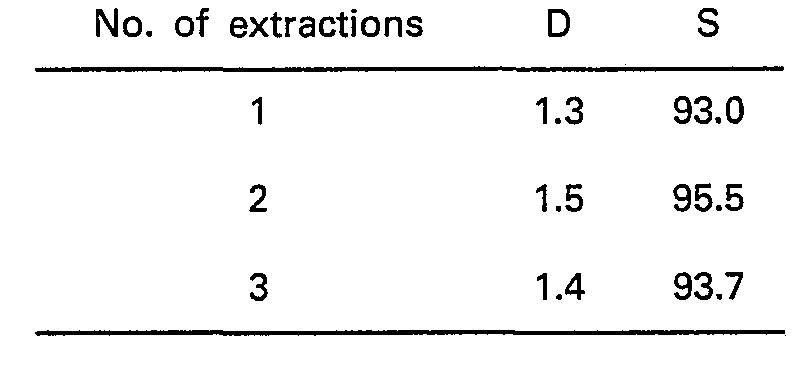
- Following the three extractions the combined extract contained 96.5% of the total methyl acrylate and 12.1% methanol. The raffinate contained 87.9% of the methanol and only 3.5% of the original methyl acrylate.
- In a typical commercial process incorporating this example, excess methyl acrylate is reacted with dimethylamino ethanol in the presence of a transesterification catalyst to form a reaction mixture containing dimethylaminoethyl acrylate, methyl acrylate and methanol. A blend of methyl acrylate and methanol is separated from this mixture by distillation and is then separated, in accordance with the detailed process described above, in a second circuit. The methyl acrylate separated in this second circuit is recycled to the reaction in the first circuit, the methanol is removed, and the lithium chloride and xylene are both recycled within the second circuit for reuse.
- To 100 g of the azeotrope of methanol and acrylonitrile, whose composition was 61.3% and 38.7% respectively, was added 12.3 g of anhydrous lithium chloride. A homogeneous mixture was obtained which was then extracted with 100 g of xylene. The two layers were separated, weighed and analysed for methanol and acrylonitrile. D=0.833 and S=74.2%.
- To 100 g of the azeotrope of methanol and acetone, whose composition was 12% and 88%, was added 2.1 g of anhydrous lithium chloride. A homogeneous mixture was obtained which was then extracted with 100 g of xylene. The two layers were separated, weighed and analysed for methanol and acetone. D=0.992 and S=94.7%.
Claims (11)
Applications Claiming Priority (2)
| Application Number | Priority Date | Filing Date | Title |
|---|---|---|---|
| GB8331707 | 1983-11-28 | ||
| GB838331707A GB8331707D0 (en) | 1983-11-28 | 1983-11-28 | Separation of methanol from mixtures |
Publications (3)
| Publication Number | Publication Date |
|---|---|
| EP0143639A2 EP0143639A2 (en) | 1985-06-05 |
| EP0143639A3 EP0143639A3 (en) | 1986-06-04 |
| EP0143639B1 true EP0143639B1 (en) | 1988-11-17 |
Family
ID=10552462
Family Applications (1)
| Application Number | Title | Priority Date | Filing Date |
|---|---|---|---|
| EP84308198A Expired EP0143639B1 (en) | 1983-11-28 | 1984-11-27 | Separation of methanol from mixtures containing it |
Country Status (6)
| Country | Link |
|---|---|
| US (1) | US4556728A (en) |
| EP (1) | EP0143639B1 (en) |
| JP (1) | JPS60132925A (en) |
| CA (1) | CA1232290A (en) |
| DE (1) | DE3475186D1 (en) |
| GB (1) | GB8331707D0 (en) |
Families Citing this family (5)
| Publication number | Priority date | Publication date | Assignee | Title |
|---|---|---|---|---|
| DE19930721C2 (en) * | 1999-07-05 | 2001-12-20 | Roehm Gmbh | Process for the production and process inhibition of isobornyl methacrylate |
| DE10127941A1 (en) | 2001-06-08 | 2002-05-29 | Basf Ag | Production of (meth)acrylate esters by transesterification comprises recycling by-product alcohol to the production of the starting (meth)acrylate |
| DE10127939A1 (en) | 2001-06-08 | 2002-05-29 | Basf Ag | Production of (meth)acrylate esters, e.g. dialkylaminoethyl (meth)acrylates, by catalytic transesterification involves four-stage distillation |
| KR101436428B1 (en) * | 2013-05-15 | 2014-09-01 | 고려대학교 산학협력단 | Method for biodiesel from sludge and equipment comprising the same |
| JP6865135B2 (en) * | 2017-08-14 | 2021-04-28 | 株式会社 東邦アーステック | How to treat the composition |
Family Cites Families (7)
| Publication number | Priority date | Publication date | Assignee | Title |
|---|---|---|---|---|
| US2179991A (en) * | 1937-01-09 | 1939-11-14 | Eastman Kodak Co | Process for the separation of methanol and acetone mixtures |
| US2406561A (en) * | 1943-12-27 | 1946-08-27 | Nasa | Azeotropic distillation of methanol from admixture with acrylic esters |
| US3574712A (en) * | 1967-12-11 | 1971-04-13 | Universal Oil Prod Co | Preparation of esters |
| US4322565A (en) * | 1979-08-23 | 1982-03-30 | Columbian Chemicals Company | Process for purifying ethers |
| IT1151087B (en) * | 1979-08-23 | 1986-12-17 | Columbian Chem | PROCEDURE FOR THE SEPARATION OF ALCANOLS FROM ETHERS |
| JPS57206639A (en) * | 1981-06-11 | 1982-12-18 | Toho Tennen Gas Kk | Preparation of acrylic or methacrylic ester |
| US4508929A (en) * | 1983-01-03 | 1985-04-02 | The United States Of America As Represented By The Secretary Of The Army | Recovery of alcohol from a fermentation source by separation rather than distillation |
-
1983
- 1983-11-28 GB GB838331707A patent/GB8331707D0/en active Pending
-
1984
- 1984-11-27 EP EP84308198A patent/EP0143639B1/en not_active Expired
- 1984-11-27 DE DE8484308198T patent/DE3475186D1/en not_active Expired
- 1984-11-27 CA CA000468750A patent/CA1232290A/en not_active Expired
- 1984-11-28 JP JP59252803A patent/JPS60132925A/en active Pending
- 1984-11-28 US US06/675,501 patent/US4556728A/en not_active Expired - Fee Related
Also Published As
| Publication number | Publication date |
|---|---|
| EP0143639A3 (en) | 1986-06-04 |
| CA1232290A (en) | 1988-02-02 |
| JPS60132925A (en) | 1985-07-16 |
| EP0143639A2 (en) | 1985-06-05 |
| GB8331707D0 (en) | 1984-01-04 |
| US4556728A (en) | 1985-12-03 |
| DE3475186D1 (en) | 1988-12-22 |
Similar Documents
| Publication | Publication Date | Title |
|---|---|---|
| US2198600A (en) | Glycerol dichlorohydrin | |
| US5283376A (en) | Method of phenol extraction from phenol tar | |
| MXPA04005328A (en) | Extraction process for removal of impurities from mother liquor in the synthesis of carboxylic acid. | |
| CA2289482C (en) | Treatment of formaldehyde-containing mixtures | |
| GB2305664A (en) | Process for purifying acetic acid | |
| EP0010953B1 (en) | Process for the preparation of methacrylic acid esters | |
| US4556728A (en) | Separation of methanol from mixtures containing it | |
| US4645570A (en) | Distillation of higher alcohols of 6-20 carbon atoms containing water and methanol | |
| US2470222A (en) | Distillation of alcohols containing impurities less soluble in water | |
| EP0506240A2 (en) | Process for the recovery of acetic acid from compositions comprising acetic acid and water | |
| CA1190175A (en) | Method for separating mixtures of paraffin or paraffins with 6-14c-atoms and alcohol or alcohols with 4-8c-atoms | |
| US5488141A (en) | Removal of carbonyl impurities from αβ unsaturated carboxylic acid esters | |
| US3956406A (en) | Purification of trimethylolpropane | |
| US6494996B2 (en) | Process for removing water from aqueous methanol | |
| EP0134650B1 (en) | High boiling solvent system for recovery of acetic acid from aqueous solutions | |
| US2584036A (en) | Azeotropic dehydration of aqueous chloral mixtures | |
| JP2582127B2 (en) | Purification method of methyl methacrylate | |
| JP2636680B2 (en) | Purification method of 2,3-dichloro-1-propanol | |
| JP3310773B2 (en) | Separation method of aliphatic carboxylic acid by extraction | |
| JPH09316034A (en) | Method for recovering lower alkyl alcohol in production of (meth) acrylic acid lower alkyl ester and method for producing the ester | |
| US4091039A (en) | Hydrolysis of ethylene glycol acetates | |
| JPS6236022B2 (en) | ||
| US2042218A (en) | Recovery of organic acid esters | |
| US3712917A (en) | Process for separating unsaturated fatty acids | |
| KR830001516B1 (en) | Process for preparing methacrylic acid ester |
Legal Events
| Date | Code | Title | Description |
|---|---|---|---|
| PUAI | Public reference made under article 153(3) epc to a published international application that has entered the european phase |
Free format text: ORIGINAL CODE: 0009012 |
|
| AK | Designated contracting states |
Designated state(s): BE DE FR GB IT NL SE |
|
| PUAL | Search report despatched |
Free format text: ORIGINAL CODE: 0009013 |
|
| AK | Designated contracting states |
Kind code of ref document: A3 Designated state(s): BE DE FR GB IT NL SE |
|
| 17P | Request for examination filed |
Effective date: 19860819 |
|
| 17Q | First examination report despatched |
Effective date: 19870715 |
|
| GRAA | (expected) grant |
Free format text: ORIGINAL CODE: 0009210 |
|
| AK | Designated contracting states |
Kind code of ref document: B1 Designated state(s): BE DE FR GB IT NL SE |
|
| ITF | It: translation for a ep patent filed | ||
| REF | Corresponds to: |
Ref document number: 3475186 Country of ref document: DE Date of ref document: 19881222 |
|
| ET | Fr: translation filed | ||
| PLBE | No opposition filed within time limit |
Free format text: ORIGINAL CODE: 0009261 |
|
| STAA | Information on the status of an ep patent application or granted ep patent |
Free format text: STATUS: NO OPPOSITION FILED WITHIN TIME LIMIT |
|
| 26N | No opposition filed | ||
| PGFP | Annual fee paid to national office [announced via postgrant information from national office to epo] |
Ref country code: SE Payment date: 19891109 Year of fee payment: 6 |
|
| PGFP | Annual fee paid to national office [announced via postgrant information from national office to epo] |
Ref country code: NL Payment date: 19891130 Year of fee payment: 6 |
|
| PGFP | Annual fee paid to national office [announced via postgrant information from national office to epo] |
Ref country code: BE Payment date: 19891201 Year of fee payment: 6 |
|
| PG25 | Lapsed in a contracting state [announced via postgrant information from national office to epo] |
Ref country code: SE Effective date: 19901128 |
|
| PG25 | Lapsed in a contracting state [announced via postgrant information from national office to epo] |
Ref country code: BE Effective date: 19901130 |
|
| BERE | Be: lapsed |
Owner name: ALLIED COLLOIDS LTD Effective date: 19901130 |
|
| PG25 | Lapsed in a contracting state [announced via postgrant information from national office to epo] |
Ref country code: NL Effective date: 19910601 |
|
| NLV4 | Nl: lapsed or anulled due to non-payment of the annual fee | ||
| ITTA | It: last paid annual fee | ||
| PGFP | Annual fee paid to national office [announced via postgrant information from national office to epo] |
Ref country code: FR Payment date: 19921109 Year of fee payment: 9 |
|
| PGFP | Annual fee paid to national office [announced via postgrant information from national office to epo] |
Ref country code: GB Payment date: 19921116 Year of fee payment: 9 |
|
| PGFP | Annual fee paid to national office [announced via postgrant information from national office to epo] |
Ref country code: DE Payment date: 19921212 Year of fee payment: 9 |
|
| PG25 | Lapsed in a contracting state [announced via postgrant information from national office to epo] |
Ref country code: GB Effective date: 19931127 |
|
| GBPC | Gb: european patent ceased through non-payment of renewal fee |
Effective date: 19931127 |
|
| PG25 | Lapsed in a contracting state [announced via postgrant information from national office to epo] |
Ref country code: FR Effective date: 19940729 |
|
| PG25 | Lapsed in a contracting state [announced via postgrant information from national office to epo] |
Ref country code: DE Effective date: 19940802 |
|
| REG | Reference to a national code |
Ref country code: FR Ref legal event code: ST |
|
| EUG | Se: european patent has lapsed |
Ref document number: 84308198.5 Effective date: 19910705 |