EP0142731B1 - Carrier of developer electrophotographic copying machines - Google Patents
Carrier of developer electrophotographic copying machines Download PDFInfo
- Publication number
- EP0142731B1 EP0142731B1 EP84112747A EP84112747A EP0142731B1 EP 0142731 B1 EP0142731 B1 EP 0142731B1 EP 84112747 A EP84112747 A EP 84112747A EP 84112747 A EP84112747 A EP 84112747A EP 0142731 B1 EP0142731 B1 EP 0142731B1
- Authority
- EP
- European Patent Office
- Prior art keywords
- carrier
- developer
- magnetization
- toner
- intensity
- Prior art date
- Legal status (The legal status is an assumption and is not a legal conclusion. Google has not performed a legal analysis and makes no representation as to the accuracy of the status listed.)
- Expired
Links
- 230000005415 magnetization Effects 0.000 claims description 26
- 239000011347 resin Substances 0.000 claims description 13
- 229920005989 resin Polymers 0.000 claims description 13
- PPBRXRYQALVLMV-UHFFFAOYSA-N Styrene Chemical compound C=CC1=CC=CC=C1 PPBRXRYQALVLMV-UHFFFAOYSA-N 0.000 claims description 6
- 239000000203 mixture Substances 0.000 claims description 5
- JEIPFZHSYJVQDO-UHFFFAOYSA-N iron(III) oxide Inorganic materials O=[Fe]O[Fe]=O JEIPFZHSYJVQDO-UHFFFAOYSA-N 0.000 claims description 4
- 125000001153 fluoro group Chemical group F* 0.000 claims description 2
- 239000007787 solid Substances 0.000 description 17
- 239000000969 carrier Substances 0.000 description 15
- UQSXHKLRYXJYBZ-UHFFFAOYSA-N Iron oxide Chemical compound [Fe]=O UQSXHKLRYXJYBZ-UHFFFAOYSA-N 0.000 description 8
- 230000005684 electric field Effects 0.000 description 7
- 239000012050 conventional carrier Substances 0.000 description 4
- 239000002245 particle Substances 0.000 description 4
- 239000000654 additive Substances 0.000 description 3
- 230000000996 additive effect Effects 0.000 description 3
- 238000004519 manufacturing process Methods 0.000 description 3
- 239000000843 powder Substances 0.000 description 3
- 230000000717 retained effect Effects 0.000 description 3
- 229910000859 α-Fe Inorganic materials 0.000 description 3
- 239000011248 coating agent Substances 0.000 description 2
- 238000000576 coating method Methods 0.000 description 2
- 230000006866 deterioration Effects 0.000 description 2
- 238000002347 injection Methods 0.000 description 2
- 239000007924 injection Substances 0.000 description 2
- 239000002002 slurry Substances 0.000 description 2
- XEEYBQQBJWHFJM-UHFFFAOYSA-N Iron Chemical compound [Fe] XEEYBQQBJWHFJM-UHFFFAOYSA-N 0.000 description 1
- 229910001308 Zinc ferrite Inorganic materials 0.000 description 1
- 238000013459 approach Methods 0.000 description 1
- 238000010586 diagram Methods 0.000 description 1
- 230000000694 effects Effects 0.000 description 1
- 230000002349 favourable effect Effects 0.000 description 1
- 239000010419 fine particle Substances 0.000 description 1
- 239000008187 granular material Substances 0.000 description 1
- 238000010438 heat treatment Methods 0.000 description 1
- KFZAUHNPPZCSCR-UHFFFAOYSA-N iron zinc Chemical compound [Fe].[Zn] KFZAUHNPPZCSCR-UHFFFAOYSA-N 0.000 description 1
- 239000012256 powdered iron Substances 0.000 description 1
- 229920006395 saturated elastomer Polymers 0.000 description 1
- 230000003313 weakening effect Effects 0.000 description 1
- 239000011701 zinc Substances 0.000 description 1
Images
Classifications
-
- G—PHYSICS
- G03—PHOTOGRAPHY; CINEMATOGRAPHY; ANALOGOUS TECHNIQUES USING WAVES OTHER THAN OPTICAL WAVES; ELECTROGRAPHY; HOLOGRAPHY
- G03G—ELECTROGRAPHY; ELECTROPHOTOGRAPHY; MAGNETOGRAPHY
- G03G9/00—Developers
- G03G9/08—Developers with toner particles
- G03G9/10—Developers with toner particles characterised by carrier particles
- G03G9/107—Developers with toner particles characterised by carrier particles having magnetic components
- G03G9/1075—Structural characteristics of the carrier particles, e.g. shape or crystallographic structure
-
- G—PHYSICS
- G03—PHOTOGRAPHY; CINEMATOGRAPHY; ANALOGOUS TECHNIQUES USING WAVES OTHER THAN OPTICAL WAVES; ELECTROGRAPHY; HOLOGRAPHY
- G03G—ELECTROGRAPHY; ELECTROPHOTOGRAPHY; MAGNETOGRAPHY
- G03G9/00—Developers
- G03G9/08—Developers with toner particles
- G03G9/10—Developers with toner particles characterised by carrier particles
Definitions
- the present invention relates to a developer for electrophotographic copying machines, and more particularly, to a carrier of two-component developer for electrophotographic copying machines.
- Iron powder, ferrite powder, or the like have been used as carriers of two-component developer for electrophotographic copying machines. These carriers usually have a specific resistance of about 10 6 ⁇ . cm, representing the conductive characteristic, and of about 10120 . cm, representing the dielectric characteristic.
- solid black portion means a solid black area of an original document to be copied. In the above cases, however, there has sometimes occurred undesirably white lines within the solid black portion causing poor reproduction of a thin line.
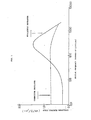
- the relationship between the developing electric field and the spatial frequency, i.e., number of lines/mm, is as shown in Fig. 1.
- the maximum value of the developing electric field is within the density region of 1.0 to 10 lines/mm, which means that the reproducibility of a thin line is very excellent.
- the electricfield for development becomes too weak, however, because the injection of electric charge from the developing roll is not effected in the solid black portion and an electric charge with a polarity opposite to the polarity of the toner is retained on the carrier on the surface of the dielectric developer layer after development.
- a dielectric carrier therefore, has the disadvantage of a so-called edge effect whereby the toner density at the central portion of the solid black portion is reduced in comparison with that at the edge portion.
- GB-A-2 075 209 (Example 10) describes a developer comprising an iron-zinc ferrite having a saturated magnetization of 44 emu/g.
- the movability of such known developers has not yet been completely satisfactory as will be explained in greater detail in connection with Fig. 2.
- An object of the present invention is a carrierfor a developer which maintains good reproducibility of a thin line particularly obtained by a dielectric developer; which improves the toner density within the central area of a reproduction of a solid black area; and which has a long useful life.
- a carrier for a developer wherein said carrier is represented by the general formula (MO)x(Fez03)y where X/Y is the mole ratio and M is Cu, and, if wanted, Zn and wherein said carrier is composed of
- the invention concerns a developer comprising a mixture of a toner and a carrier as defined above.
- Fig. 2 is an diagram showing the magnetization characteristics of a few types of carriers.
- the magnetization a denotes the characteristic of a conventional powder of iron oxide and b denotes the magnetization characteristic of a conventional ferrite carrier.
- the connecting force acting between the carriers is increased by the magnetic field on the developing roll so that only the toner on the surface of the developing layer serves the development.
- a reverse electrical charge is, as mentioned hereinbefore, retained on the carrier on the surface of the developer layer causing the electric field for development to be weakened so as not to produce a copied image with high density. It may be possible to increase the density of the copied image by increasing the rotation speed of the developing roll. Atoner image formed on a photosensitive body, however, is scraped by the carriers strongly connected with each other to produce deterioration of the quality of the copied image.
- the damage to the copied image normally takes the form of a white area in the copied image and of dotted lines extending in the direction perpendicular to the advance direction of the photosensitive body.
- the reproducibility of a solid black portion in a copied image produced by a developing device using a magnetic brush was studied in connection with the present invention.
- the developer that was used comprised a toner mixed with a carrier that included ferrite as a main component.
- the reproducibility of such a solid black portion was also studied in conjunction with carriers having different magnetization characteristics. As a result it was found that good reproducibility of the solid black portion is obtained by the characteristics represented by the hatched region in Fig. 3 showing the relationship between the intensity of the magnetic field on the developing pole and the magnetization intensity of the carrier.
- the region in Fig. 3 is defined by the magnetic field having an intensity in the range of 450-1000 Oe and the magnetization having an intensity in the range of 10-30 emu/g.
- the magnetization intensity of the carrier is below 10 emu/g, the amount of the carrier deposited on the photosensitive body increases resulting in insufficient toner density.
- the curves c and d of the magnetization characteristics of the carrier in Fig. 2 correspond to the points c' and d' in Fig. 3, respectively.
- the connecting force due to the magnetic field, effected between the carriers is weakened, so that movement of the developer on the development roll is easily made in the direction of thickness of the developing layer.
- the toner located within the inner portion of the developing layer may be used in the development. It is also possible to quickly remove the electric charge from the toner retained on the carrier on the surface of the developing layer, and to remove the toner together with the carrier, from the surface of the photosentive body. As a result, a favorable copied image with high density can be obtained without weakening the developing electric field.
- the high density copied image also has uniform quality because the connection force acting between the carriers is not so strong as to cause the deterioration mentioned above.
- Another advantage derived from the present invention using the carrier with the magnetization intensity 10-30 emu/g at the intensity of magnetic field of 35810 to 79577 A/m (450-1000 Oe), is to increase the life of the developer remarkably. It is known that the life of a two-component developer composed of toner and carrier is shortened by the fact that the toner, or an additive included in the toner, adheres to the surfaces of particles of the carrier thereby reducing the charging capacity of electric charge of the carrier. It is also known that the more the connecting force acting between the carriers due to the magnetic field is increased, the more additive that becomes attached to the surface of the carrier.
- the adhesion of the toner or the additive to the surface of the carrier is remarkably reduced.
- the life of the developer is extended by an amount equal to about ten times the life of a conventional carrier powder composed of iron oxide.
- the range of magnetization intensity of 10-30 emu/g in the magnetic field of 35'810 to 79577 A/ m (450-1000 Oe) is realized by selecting the composition of the carrier. It is desirable to set the bulk density (A. D.) of the carrier in the range of 1.8 g/cm 3- 3.4 g/cm 3 , because if the carrier is made excessively porous, the mechanical strength of the carrier is undesirably reduced. Moreover, in the case of using the carrier coated with resin, it is difficult to coat the carrier with resin because the resin soaks through the porous carrier. On the other hand, if the bulk density is excessively large, the carrier is apt to fly and the developing machine must have an undesirably large torque.
- the mole ratio X/Y must be below 0.85 so that a magnetization intensity in the range of 10-30 emu/g can be maintained on the developing roll when the intensity of the magnetic field is in the range of 35810 to 79577 A/M (450-1000 Oe).
- a predetermined value for the bulk density of the carrier is obtained by effecting the final heating process at about 1000°C to eliminate bubbles in the carrier particles.
- the carrier is made by combining the (MO) with the (Fe 2 0 3 ) such that the mole ratio X/Y is below 0.85.
- the mixture is then ground and mixed for more than one hour by using a wet-type ball mill or a wet-type vibration ball mill.
- the slurry thus obtained is dried, further ground and then calcined at a temperature of 700-1200°C.
- the calcined product is further ground to prepare fine particles having sizes of less than 20 um, and preferably less than 5 pm, and is then granulated.
- the granules thus prepared are kept at a temperature of 1000-1500°C for 1-24 hours.
- the sintered product may be further reduced and the surface thereof may be re-oxidized at a lower temperature, if necessary.
- a desirable specific resistance of the carrier can be obtained by coating the carrier with a resin, for example with a styrene resin, a fluoro resin, or the like.
- the resin used for the coating is selected in accordance with the toner used.
- the above-mentioned manufacturing method produces an ideal carrier for a developer.
- the above-mentioned manufacturing method is, however, merely an example and, therefore, the present invention is not limited to the manufacturing method.
- the carrier is obtained as follows.
- CuO 0.23 mol %, ZnO 0.07 mol %, and Fe 2 0 3 0.7 mol % were ground and mixed for ten hours by using a wet-type ball mill, and then dried and calcined at a temperature of 900°C for four hours.
- the product was further ground by using the wet-type ball mill to form particles with sizes of less than 5 um.
- the slurry thus obtained was formed in particle size, dried, and then meshed in a mesh of 80-180.
- the su rface of the resultant carrier was coated with a styrene resin.
- the carrier has a magnetization characteristic as shown by curve f in Fig. 4, and the magnetization intensity is 33 emu/g when the intensity of the magnetic field is 79577 A/m (1000 Oe).
- the magnetization intensity is 20 emu/g when the intensity of the magnetic field is 500 Oe.
- the bulk density of the carrier is 2.4 g/c m 3 .
- the curves e and g denote the magnetization characteristics of carriers having the magnetization intensity of 10 emu/g and 30 emu/g, respectively, in a magnetic field of 39788 A/ m (500 Oe).
- the curves h and i denote a magnetic intensity of 40 emu/g and 50 emu/g, respectively, in a similar magnetic field.
- the carriers shown in the curves e and g obtained good reproducibility for solid black portions as shown in Fig. 5.
- the carriers shown in the curves h and i obtained an insufficient reproducibility at the points h and i.
- the dotted line in Fig. 5 denotes a boundary line for conditions producing good reproducibility for a solid black portion from conditions producing poor reproducibility.
- a continuous copying test was conducted to compare the life of the carrier of the present invention to conventional carriers.
- the life of the conventional carrier with iron oxide was approximately 20,000 copies per 1 Kg unit of toner.
- the carrier of the present invention gave satisfactory performance through approximately 250,000 copies per 1 Kg unit of toner.
- the reproducibility of thin lines which are inherently provided on the dielectric developer, can be maintained at a high level with the developer of the present invention. Moreover, the toner density of solid black areas is increased and the useful life of the developer is remarkably improved when compared to prior art developers.
Landscapes
- Physics & Mathematics (AREA)
- General Physics & Mathematics (AREA)
- Chemical & Material Sciences (AREA)
- Crystallography & Structural Chemistry (AREA)
- Developing Agents For Electrophotography (AREA)
- Compounds Of Iron (AREA)
Description
- The present invention relates to a developer for electrophotographic copying machines, and more particularly, to a carrier of two-component developer for electrophotographic copying machines.
- Iron powder, ferrite powder, or the like have been used as carriers of two-component developer for electrophotographic copying machines. These carriers usually have a specific resistance of about 106Ω. cm, representing the conductive characteristic, and of about 10120 . cm, representing the dielectric characteristic.
- When using a conductive carrier having a specific resistance of about 106Q - cm, an injection of electric charge from a developing roll is effected and the actual developing electric field is enlarged, so that a solid black portion can be developed with high intensity. The term "solid black portion" means a solid black area of an original document to be copied. In the above cases, however, there has sometimes occurred undesirably white lines within the solid black portion causing poor reproduction of a thin line.
- On the other hand, when using a dielectric carrier having a specific resistance of about 10120. cm, the relationship between the developing electric field and the spatial frequency, i.e., number of lines/mm, is as shown in Fig. 1. The maximum value of the developing electric field is within the density region of 1.0 to 10 lines/mm, which means that the reproducibility of a thin line is very excellent. The electricfield for development becomes too weak, however, because the injection of electric charge from the developing roll is not effected in the solid black portion and an electric charge with a polarity opposite to the polarity of the toner is retained on the carrier on the surface of the dielectric developer layer after development. A dielectric carrier, therefore, has the disadvantage of a so-called edge effect whereby the toner density at the central portion of the solid black portion is reduced in comparison with that at the edge portion.
- GB-A-2 075 209 (Example 10) describes a developer comprising an iron-zinc ferrite having a saturated magnetization of 44 emu/g. However, the movability of such known developers has not yet been completely satisfactory as will be explained in greater detail in connection with Fig. 2.
- An object of the present invention is a carrierfor a developer which maintains good reproducibility of a thin line particularly obtained by a dielectric developer; which improves the toner density within the central area of a reproduction of a solid black area; and which has a long useful life.
- These and other objects, features, and advantages are achieved by a carrier for a developer wherein said carrier is represented by the general formula (MO)x(Fez03)y where X/Y is the mole ratio and M is Cu, and, if wanted, Zn and wherein said carrier is composed of
-

- Finally, the invention concerns a developer comprising a mixture of a toner and a carrier as defined above.
- The manner in which the above and other objects, features and advantages of the present invention are achieved will be more clear from the following description with reference to the accompanying drawings, in which:
- Fig. 1 is a graph showing the relationship between a developing electric field and a spatial frequency with respect to a conventional conductive carrier and a dielectric carrier of the present invention;
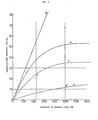
- Fig. 2 is a graph showing the relationship between the intensity of a magnetic field and the magnetization intensity with respect to a conventional carrier and the carrier of the present invention;
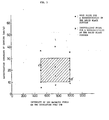
- Fig. 3 is a graph showing a region of good reproducibility for a solid black portion,
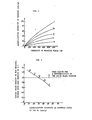
- Fig. 4 is a graph showing the magnetization characteristics of a carrier of the present invention and another carrier; and
- Fig. 5 is a graph showing the reproducibility of a solid black portion for carriers having the magnetization characteristics shown in Fig. 4.
- Referring to Figs. 2 to 5, an embodiment of the present invention is explained. Fig. 2 is an diagram showing the magnetization characteristics of a few types of carriers. In Fig. 2, the magnetization a denotes the characteristic of a conventional powder of iron oxide and b denotes the magnetization characteristic of a conventional ferrite carrier.
- In the case of using powdered iron oxide having the magnetization characteristic as shown in the curve a of Fig. 2, the connecting force acting between the carriers is increased by the magnetic field on the developing roll so that only the toner on the surface of the developing layer serves the development. Also, a reverse electrical charge is, as mentioned hereinbefore, retained on the carrier on the surface of the developer layer causing the electric field for development to be weakened so as not to produce a copied image with high density. It may be possible to increase the density of the copied image by increasing the rotation speed of the developing roll. Atoner image formed on a photosensitive body, however, is scraped by the carriers strongly connected with each other to produce deterioration of the quality of the copied image. The damage to the copied image normally takes the form of a white area in the copied image and of dotted lines extending in the direction perpendicular to the advance direction of the photosensitive body.
- The reproducibility of a solid black portion in a copied image produced by a developing device using a magnetic brush was studied in connection with the present invention. In the developing device, the developer that was used comprised a toner mixed with a carrier that included ferrite as a main component. The reproducibility of such a solid black portion was also studied in conjunction with carriers having different magnetization characteristics. As a result it was found that good reproducibility of the solid black portion is obtained by the characteristics represented by the hatched region in Fig. 3 showing the relationship between the intensity of the magnetic field on the developing pole and the magnetization intensity of the carrier.
- The region in Fig. 3 is defined by the magnetic field having an intensity in the range of 450-1000 Oe and the magnetization having an intensity in the range of 10-30 emu/g. When the magnetization intensity of the carrier is below 10 emu/g, the amount of the carrier deposited on the photosensitive body increases resulting in insufficient toner density. The curves c and d of the magnetization characteristics of the carrier in Fig. 2 correspond to the points c' and d' in Fig. 3, respectively.
- According to the carrier of the present invention having the magnetization characteristics as shown by the curves c and d in Fig. 2, the connecting force due to the magnetic field, effected between the carriers is weakened, so that movement of the developer on the development roll is easily made in the direction of thickness of the developing layer. The toner located within the inner portion of the developing layer may be used in the development. It is also possible to quickly remove the electric charge from the toner retained on the carrier on the surface of the developing layer, and to remove the toner together with the carrier, from the surface of the photosentive body. As a result, a favorable copied image with high density can be obtained without weakening the developing electric field. The high density copied image also has uniform quality because the connection force acting between the carriers is not so strong as to cause the deterioration mentioned above.
- Another advantage derived from the present invention using the carrier with the magnetization intensity 10-30 emu/g at the intensity of magnetic field of 35810 to 79577 A/m (450-1000 Oe), is to increase the life of the developer remarkably. It is known that the life of a two-component developer composed of toner and carrier is shortened by the fact that the toner, or an additive included in the toner, adheres to the surfaces of particles of the carrier thereby reducing the charging capacity of electric charge of the carrier. It is also known that the more the connecting force acting between the carriers due to the magnetic field is increased, the more additive that becomes attached to the surface of the carrier.
- According to the carrier having a small connecting force acting between carriers, the adhesion of the toner or the additive to the surface of the carrier is remarkably reduced. The life of the developer is extended by an amount equal to about ten times the life of a conventional carrier powder composed of iron oxide.
- The range of magnetization intensity of 10-30 emu/g in the magnetic field of 35'810 to 79577 A/ m (450-1000 Oe) is realized by selecting the composition of the carrier. It is desirable to set the bulk density (A. D.) of the carrier in the range of 1.8 g/cm3-3.4 g/cm3, because if the carrier is made excessively porous, the mechanical strength of the carrier is undesirably reduced. Moreover, in the case of using the carrier coated with resin, it is difficult to coat the carrier with resin because the resin soaks through the porous carrier. On the other hand, if the bulk density is excessively large, the carrier is apt to fly and the developing machine must have an undesirably large torque.
- As the mole ratio X/Y in the formula (MO)x(Fe203),. approaches 1 from 0.85, the magnetization is likely to become large. The mole ratio X/Y must be below 0.85 so that a magnetization intensity in the range of 10-30 emu/g can be maintained on the developing roll when the intensity of the magnetic field is in the range of 35810 to 79577 A/M (450-1000 Oe).
- A predetermined value for the bulk density of the carrier is obtained by effecting the final heating process at about 1000°C to eliminate bubbles in the carrier particles.
- The carrier is made by combining the (MO) with the (Fe203) such that the mole ratio X/Y is below 0.85. The mixture is then ground and mixed for more than one hour by using a wet-type ball mill or a wet-type vibration ball mill. The slurry thus obtained is dried, further ground and then calcined at a temperature of 700-1200°C. The calcined product is further ground to prepare fine particles having sizes of less than 20 um, and preferably less than 5 pm, and is then granulated.
- The granules thus prepared are kept at a temperature of 1000-1500°C for 1-24 hours. The sintered product may be further reduced and the surface thereof may be re-oxidized at a lower temperature, if necessary. A desirable specific resistance of the carrier can be obtained by coating the carrier with a resin, for example with a styrene resin, a fluoro resin, or the like. In this case, the resin used for the coating is selected in accordance with the toner used.
- The above-mentioned manufacturing method produces an ideal carrier for a developer. The above-mentioned manufacturing method is, however, merely an example and, therefore, the present invention is not limited to the manufacturing method.
- Referring now to a specific example of the carrier of the present invention, the carrier is obtained as follows.
- CuO 0.23 mol %, ZnO 0.07 mol %, and
Fe 2030.7 mol % were ground and mixed for ten hours by using a wet-type ball mill, and then dried and calcined at a temperature of 900°C for four hours. The product was further ground by using the wet-type ball mill to form particles with sizes of less than 5 um. The slurry thus obtained was formed in particle size, dried, and then meshed in a mesh of 80-180. The su rface of the resultant carrier was coated with a styrene resin. - The carrier has a magnetization characteristic as shown by curve f in Fig. 4, and the magnetization intensity is 33 emu/g when the intensity of the magnetic field is 79577 A/m (1000 Oe). The magnetization intensity is 20 emu/g when the intensity of the magnetic field is 500 Oe. The bulk density of the carrier is 2.4 g/cm 3.
- According to a copy test using the two-component developer composed of the toner and the carrier, and a conventional magnetic brush developing device, an original image having a solid black portion with a gray density of 0.7 was copied with image density of 1.1 even in the central portion of the solid black portion.
- Several carriers having different magnetization characteristic curves as shown in Fig. 4 were similarly tested. The curves e and g denote the magnetization characteristics of carriers having the magnetization intensity of 10 emu/g and 30 emu/g, respectively, in a magnetic field of 39788 A/ m (500 Oe). The curves h and i denote a magnetic intensity of 40 emu/g and 50 emu/g, respectively, in a similar magnetic field.
- As a result of the test, the carriers shown in the curves e and g obtained good reproducibility for solid black portions as shown in Fig. 5. The carriers shown in the curves h and i obtained an insufficient reproducibility at the points h and i. The dotted line in Fig. 5 denotes a boundary line for conditions producing good reproducibility for a solid black portion from conditions producing poor reproducibility.
- A continuous copying test was conducted to compare the life of the carrier of the present invention to conventional carriers. The life of the conventional carrier with iron oxide was approximately 20,000 copies per 1 Kg unit of toner. On the other hand, the carrier of the present invention gave satisfactory performance through approximately 250,000 copies per 1 Kg unit of toner.
- As mentioned above, the reproducibility of thin lines, which are inherently provided on the dielectric developer, can be maintained at a high level with the developer of the present invention. Moreover, the toner density of solid black areas is increased and the useful life of the developer is remarkably improved when compared to prior art developers.
- Although a preferred embodiment of the invention has been described, it should be understood that the preferred embodiment of the present invention, as described herein, may be changed or modidifed without departing from the scope of the invention as hereinafter claimed.
Claims (6)

Applications Claiming Priority (2)
| Application Number | Priority Date | Filing Date | Title |
|---|---|---|---|
| JP197500/83 | 1983-10-24 | ||
| JP58197500A JPS6090345A (en) | 1983-10-24 | 1983-10-24 | Developer carrier for electrophotographic copying machine |
Publications (2)
| Publication Number | Publication Date |
|---|---|
| EP0142731A1 EP0142731A1 (en) | 1985-05-29 |
| EP0142731B1 true EP0142731B1 (en) | 1988-04-06 |
Family
ID=16375501
Family Applications (1)
| Application Number | Title | Priority Date | Filing Date |
|---|---|---|---|
| EP84112747A Expired EP0142731B1 (en) | 1983-10-24 | 1984-10-23 | Carrier of developer electrophotographic copying machines |
Country Status (4)
| Country | Link |
|---|---|
| US (1) | US4898801A (en) |
| EP (1) | EP0142731B1 (en) |
| JP (1) | JPS6090345A (en) |
| DE (1) | DE3470350D1 (en) |
Families Citing this family (30)
| Publication number | Priority date | Publication date | Assignee | Title |
|---|---|---|---|---|
| JPH0723975B2 (en) * | 1984-08-13 | 1995-03-15 | 富士電気化学株式会社 | Method of manufacturing ferrite carrier for electrostatic copying |
| JPH0658546B2 (en) * | 1985-08-23 | 1994-08-03 | 富士通株式会社 | Developer composition |
| DE3678117D1 (en) * | 1985-12-17 | 1991-04-18 | Konishiroku Photo Ind | METHOD FOR DEVELOPING ELECTROSTATIC LATEN IMAGES. |
| JPS62184470A (en) * | 1986-02-08 | 1987-08-12 | Fuji Elelctrochem Co Ltd | Ferrite carrier material for positive electrostatic charge toner |
| US4937629A (en) * | 1986-11-18 | 1990-06-26 | Fuji Xerox Co., Ltd. | Composite image recording apparatus |
| US4882247A (en) * | 1986-11-18 | 1989-11-21 | Fuji Xerox Co., Ltd. | Electrophotographic image recording method |
| DE3727383A1 (en) * | 1987-08-17 | 1989-03-02 | Basf Ag | CARRIER FOR REPROGRAPHY AND METHOD FOR PRODUCING THIS CARRIER |
| JP2794291B2 (en) * | 1988-04-28 | 1998-09-03 | キヤノン株式会社 | Electrophotographic coated carrier |
| JP2560085B2 (en) * | 1988-07-22 | 1996-12-04 | 花王株式会社 | Developer for electrostatic image development |
| US5108862A (en) * | 1989-02-21 | 1992-04-28 | Toda Kogyo Corp. | Composite carrier particles for electrophotography and process for producing the same |
| US5021315A (en) * | 1989-06-07 | 1991-06-04 | Olin Hunt Sub I Corp. | Method for making magnetic particles having improved conductivity and their use in electrostatographic printing applications |
| DE69129529T2 (en) * | 1990-12-28 | 1998-11-26 | Kawamura, Takao, Sakai, Osaka | Electrophotographic electroconductive magnetic carrier particles, developers with such particles and imaging processes |
| EP0580135B1 (en) * | 1992-07-22 | 1997-04-16 | Canon Kabushiki Kaisha | Carrier for use in electrophotography, two component-type developer and image forming method |
| DE69308424T2 (en) * | 1992-07-28 | 1997-08-14 | Canon Kk | Carrier particles for electrophotography, two-component developers and imaging processes |
| US5525752A (en) * | 1993-01-25 | 1996-06-11 | Canon Kabushiki Kaisha | Developing apparatus |
| US5798198A (en) * | 1993-04-09 | 1998-08-25 | Powdertech Corporation | Non-stoichiometric lithium ferrite carrier |
| US5422216A (en) * | 1994-03-01 | 1995-06-06 | Steward | Developer composition and method of preparing the same |
| JP3238006B2 (en) * | 1994-06-07 | 2001-12-10 | パウダーテック株式会社 | Ferrite carrier for electrophotographic developer and developer using the carrier |
| EP0689100B1 (en) * | 1994-06-22 | 2000-10-11 | Canon Kabushiki Kaisha | Carrier for electrophotography, two component type developer, and image forming method |
| US5641600A (en) * | 1994-08-05 | 1997-06-24 | Canon Kabushiki Kaisha | Magnetic toner and image forming method |
| JPH08194340A (en) * | 1995-01-20 | 1996-07-30 | Hitachi Metals Ltd | Carrier for magnetic developer and image forming method |
| JP3641728B2 (en) * | 1995-07-03 | 2005-04-27 | コニカミノルタホールディングス株式会社 | Novel developer for electrophotography and developing method using the same |
| JP2776408B2 (en) * | 1995-07-31 | 1998-07-16 | 富士通株式会社 | Image forming device |
| JP3261946B2 (en) * | 1995-10-12 | 2002-03-04 | ミノルタ株式会社 | Carrier for developing electrostatic images |
| US5876893A (en) * | 1996-03-01 | 1999-03-02 | Hitachi Metals, Ltd. | Ferrite carrier, two-component developer and electrostatic imaging method using the developer |
| US6294304B1 (en) | 1998-01-23 | 2001-09-25 | Powdertech Corporation | Environmentally benign high conductivity ferrite carrier with widely variable magnetic moment |
| DE60030190T2 (en) * | 1999-03-15 | 2007-07-19 | Canon K.K. | Resin-coated carrier, two-component type developer, and image forming method |
| US6143456A (en) * | 1999-11-24 | 2000-11-07 | Xerox Corporation | Environmentally friendly ferrite carrier core, and developer containing same |
| US20030044711A1 (en) * | 2001-08-24 | 2003-03-06 | Powdertech International Corp. | Irregular shaped ferrite carrier for conductive magnetic brush development |
| JP2010164829A (en) * | 2009-01-16 | 2010-07-29 | Fuji Xerox Co Ltd | Electrostatic image developing carrier, electrostatic image developer, process cartridge, image forming method, and image forming apparatus |
Family Cites Families (26)
| Publication number | Priority date | Publication date | Assignee | Title |
|---|---|---|---|---|
| US3918968A (en) * | 1971-01-28 | 1975-11-11 | Ibm | Electrophotographic process utilizing carrier particles coated with a fluoropolymer in development |
| BE785913A (en) * | 1971-07-08 | 1973-01-08 | Xerox Corp | PROCESS FOR THE PRODUCTION OF FERRITE MATERIALS IN THE FORM OF SPHERICAL PEARLS AND NEW PRODUCTS THUS OBTAINED |
| US3740335A (en) * | 1971-08-12 | 1973-06-19 | Owens Illinois Inc | Ferrimagnetic ceramics |
| US3929657A (en) * | 1973-09-05 | 1975-12-30 | Xerox Corp | Stoichiometric ferrite carriers |
| US4147834A (en) * | 1975-07-11 | 1979-04-03 | International Business Machines Corporation | Fluorinated polymer coated carrier particles |
| US4248954A (en) * | 1977-09-07 | 1981-02-03 | Am International, Inc. | Coated carrier particles for use in electrophotographic process |
| US4297427A (en) * | 1978-01-26 | 1981-10-27 | Xerox Corporation | Polyblend coated carrier materials |
| JPS6036082B2 (en) * | 1978-10-27 | 1985-08-19 | ティーディーケイ株式会社 | Ferrite powder for electrophotographic magnetic toner and method for producing the same |
| NL8006065A (en) * | 1980-04-24 | 1981-11-16 | Indiana General Corp | ELECTROPHOTOGRAPHIC COMPOSITE CARRIER WITH SELF-CLEANING OPERATION DURING USE IN A COPIER. |
| JPS5883859A (en) * | 1981-11-13 | 1983-05-19 | Tohoku Metal Ind Ltd | Electrophotographic developing carrier and its manufacture |
| DE3248533C2 (en) * | 1981-12-29 | 1987-04-02 | Daikin Kogyo Co., Ltd., Osaka | Cobalt-modified iron oxide particles and processes for their preparation |
| JPS58123549A (en) * | 1982-01-19 | 1983-07-22 | Hitachi Metals Ltd | Electrophotographic developing carrier |
| JPS58123555A (en) * | 1982-01-19 | 1983-07-22 | Hitachi Metals Ltd | Electrophotographic developing carrier |
| JPS58123554A (en) * | 1982-01-19 | 1983-07-22 | Hitachi Metals Ltd | Electrophotographic developing carrier |
| JPS58123553A (en) * | 1982-01-19 | 1983-07-22 | Hitachi Metals Ltd | Electrophotographic developing carrier |
| JPS58123551A (en) * | 1982-01-19 | 1983-07-22 | Hitachi Metals Ltd | Electrophotographic developing carrier |
| JPS58123550A (en) * | 1982-01-19 | 1983-07-22 | Hitachi Metals Ltd | Electrophotographic developing carrier |
| JPS58123552A (en) * | 1982-01-19 | 1983-07-22 | Hitachi Metals Ltd | Electrophotographic developing carrier |
| JPS58123548A (en) * | 1982-01-19 | 1983-07-22 | Hitachi Metals Ltd | Electrophotographic developing carrier |
| JPS58145622A (en) * | 1982-02-12 | 1983-08-30 | Tdk Corp | Magnetic carrier particle |
| JPS58145621A (en) * | 1982-02-12 | 1983-08-30 | Tdk Corp | Magnetic carrier particle |
| EP0086445B1 (en) * | 1982-02-12 | 1987-09-09 | TDK Corporation | Magnetic carrier powder |
| JPS58145625A (en) * | 1982-02-12 | 1983-08-30 | Tdk Corp | Magnetic carrier particle |
| JPS58202456A (en) * | 1982-04-07 | 1983-11-25 | Hitachi Metals Ltd | Electrophotographic ferrite carrier |
| JPS5948774A (en) * | 1982-09-13 | 1984-03-21 | Nippon Teppun Kk | Carrier for electrophotographic development |
| JP2893751B2 (en) * | 1989-09-30 | 1999-05-24 | 株式会社島津製作所 | Stone crushing equipment |
-
1983
- 1983-10-24 JP JP58197500A patent/JPS6090345A/en active Granted
-
1984
- 1984-10-23 EP EP84112747A patent/EP0142731B1/en not_active Expired
- 1984-10-23 DE DE8484112747T patent/DE3470350D1/en not_active Expired
-
1987
- 1987-10-19 US US07/111,137 patent/US4898801A/en not_active Expired - Lifetime
Also Published As
| Publication number | Publication date |
|---|---|
| DE3470350D1 (en) | 1988-05-11 |
| EP0142731A1 (en) | 1985-05-29 |
| JPH0419546B2 (en) | 1992-03-30 |
| US4898801A (en) | 1990-02-06 |
| JPS6090345A (en) | 1985-05-21 |
Similar Documents
| Publication | Publication Date | Title |
|---|---|---|
| US4898801A (en) | Magnetic carrier of developer for electrophotographic copying machines composed of ferrite and a selected metal oxide | |
| US4855205A (en) | Interdispersed two-phase ferrite composite and carrier therefrom | |
| EP0296072B1 (en) | Electrostatic magnetic carrier particles | |
| US2846333A (en) | Method of developing electrostatic images | |
| US4598034A (en) | Ferrite carriers for electrophotographic development | |
| US5104761A (en) | Interdispersed three-phase ferrite composite and electrographic magnetic carrier particles therefrom | |
| JPH0347502B2 (en) | ||
| EP1156376B1 (en) | Magnetic carrier particles | |
| EP1840660A2 (en) | Ferromagnetic material powder, carrier for electrophotographic developer, process for producing them and electrophotographic developer | |
| US4663262A (en) | Carrier for use in electrophotographic developers | |
| EP1156374B1 (en) | Magnetic carrier particles | |
| US6294304B1 (en) | Environmentally benign high conductivity ferrite carrier with widely variable magnetic moment | |
| JP2003034533A (en) | Ferromagnetic material powder and carrier of developing agent for electronic photograph | |
| JP2000233930A (en) | Environmentally harmless high conductivity ferrite carrier core composition having magnetic moment adjustable over wide range and its particles | |
| JPH0715598B2 (en) | Ferrite carrier for electrophotographic development | |
| US6306552B1 (en) | Carrier having specified bet specific surface area and dynamic current value and two-component developer thereof | |
| JP2000172017A (en) | Method for producing ferrite carrier core for electrophotographic development | |
| KR900001468B1 (en) | Developer Carrier for Electrophotographic Copiers | |
| JPH0648393B2 (en) | Ferrite carrier material for electrostatic copying | |
| JP2009244788A (en) | Carrier core material for electrophotographic developer and method of manufacturing the same, carrier for electrophotographic developer, and electrophotographic developer | |
| JPH0449942B2 (en) | ||
| JP3060126B2 (en) | Carrier for two-component developer | |
| JP2005504345A (en) | Electrophotographic carrier core magnetite powder | |
| US20030073022A1 (en) | Electrophotographic carrier core magnetite powder | |
| JPS6238476A (en) | Ferrite carrier |
Legal Events
| Date | Code | Title | Description |
|---|---|---|---|
| PUAI | Public reference made under article 153(3) epc to a published international application that has entered the european phase |
Free format text: ORIGINAL CODE: 0009012 |
|
| AK | Designated contracting states |
Designated state(s): DE GB |
|
| 17P | Request for examination filed |
Effective date: 19850812 |
|
| 17Q | First examination report despatched |
Effective date: 19861023 |
|
| GRAA | (expected) grant |
Free format text: ORIGINAL CODE: 0009210 |
|
| AK | Designated contracting states |
Kind code of ref document: B1 Designated state(s): DE GB |
|
| REF | Corresponds to: |
Ref document number: 3470350 Country of ref document: DE Date of ref document: 19880511 |
|
| PLBE | No opposition filed within time limit |
Free format text: ORIGINAL CODE: 0009261 |
|
| STAA | Information on the status of an ep patent application or granted ep patent |
Free format text: STATUS: NO OPPOSITION FILED WITHIN TIME LIMIT |
|
| 26N | No opposition filed | ||
| REG | Reference to a national code |
Ref country code: GB Ref legal event code: IF02 |
|
| PGFP | Annual fee paid to national office [announced via postgrant information from national office to epo] |
Ref country code: GB Payment date: 20031022 Year of fee payment: 20 |
|
| PGFP | Annual fee paid to national office [announced via postgrant information from national office to epo] |
Ref country code: DE Payment date: 20031030 Year of fee payment: 20 |
|
| PG25 | Lapsed in a contracting state [announced via postgrant information from national office to epo] |
Ref country code: GB Free format text: LAPSE BECAUSE OF EXPIRATION OF PROTECTION Effective date: 20041022 |
|
| REG | Reference to a national code |
Ref country code: GB Ref legal event code: PE20 |