EP0142670B1 - A process for the preparation of known herbicidally active phenyl carbamates - Google Patents
A process for the preparation of known herbicidally active phenyl carbamates Download PDFInfo
- Publication number
- EP0142670B1 EP0142670B1 EP84111244A EP84111244A EP0142670B1 EP 0142670 B1 EP0142670 B1 EP 0142670B1 EP 84111244 A EP84111244 A EP 84111244A EP 84111244 A EP84111244 A EP 84111244A EP 0142670 B1 EP0142670 B1 EP 0142670B1
- Authority
- EP
- European Patent Office
- Prior art keywords
- carbamate
- isocyanate
- hydroxyphenyl
- reaction
- water
- Prior art date
- Legal status (The legal status is an assumption and is not a legal conclusion. Google has not performed a legal analysis and makes no representation as to the accuracy of the status listed.)
- Expired
Links
- 0 OC1=CCCC(N*=O)=C1 Chemical compound OC1=CCCC(N*=O)=C1 0.000 description 2
Classifications
-
- A—HUMAN NECESSITIES
- A01—AGRICULTURE; FORESTRY; ANIMAL HUSBANDRY; HUNTING; TRAPPING; FISHING
- A01N—PRESERVATION OF BODIES OF HUMANS OR ANIMALS OR PLANTS OR PARTS THEREOF; BIOCIDES, e.g. AS DISINFECTANTS, AS PESTICIDES OR AS HERBICIDES; PEST REPELLANTS OR ATTRACTANTS; PLANT GROWTH REGULATORS
- A01N43/00—Biocides, pest repellants or attractants, or plant growth regulators containing heterocyclic compounds
- A01N43/64—Biocides, pest repellants or attractants, or plant growth regulators containing heterocyclic compounds having rings with three nitrogen atoms as the only ring hetero atoms
- A01N43/707—1,2,3- or 1,2,4-triazines; Hydrogenated 1,2,3- or 1,2,4-triazines
-
- A—HUMAN NECESSITIES
- A01—AGRICULTURE; FORESTRY; ANIMAL HUSBANDRY; HUNTING; TRAPPING; FISHING
- A01N—PRESERVATION OF BODIES OF HUMANS OR ANIMALS OR PLANTS OR PARTS THEREOF; BIOCIDES, e.g. AS DISINFECTANTS, AS PESTICIDES OR AS HERBICIDES; PEST REPELLANTS OR ATTRACTANTS; PLANT GROWTH REGULATORS
- A01N47/00—Biocides, pest repellants or attractants, or plant growth regulators containing organic compounds containing a carbon atom not being member of a ring and having no bond to a carbon or hydrogen atom, e.g. derivatives of carbonic acid
- A01N47/08—Biocides, pest repellants or attractants, or plant growth regulators containing organic compounds containing a carbon atom not being member of a ring and having no bond to a carbon or hydrogen atom, e.g. derivatives of carbonic acid the carbon atom having one or more single bonds to nitrogen atoms
- A01N47/10—Carbamic acid derivatives, i.e. containing the group —O—CO—N<; Thio analogues thereof
- A01N47/22—O-Aryl or S-Aryl esters thereof
Definitions
- the present invention relates to an advantageous process for the preparation of a class of known herbicidally active phenyl carbamates.
- the herbicidal activity is observed in both pre-emergence and post-emergence teatments, thus allowing preparations containing said compounds A to be applied by whichever method is desired.
- the herbicidal activity is also observed when compounds A are applied on the leaves of established weeds, and the compounds are especially useful in combating weeds in beet fields, especially as post-emergence herbicides in sugar beet fields.
- An especially preferred compound of the general formula A is methyl (3-(3-tolyl-carba- moyloxy)phenyl)carbamate which has later been given the common name phenmedipham.
- Another especially preferred compound is ethyl (3-phenyl-carbamoyloxyphenyl)carbamate which has later been given the common name desmedipham.
- Methyl (3-(3-tolylcarbamoyloxy)phenyl)carbamate is commercially available under the trade mark Betanal and is used especially as post-emergence herbicide for the weeding of beet crops, in particular sugar beet, at an application rate of 1 kg. a.i./200-300 liters/ha.
- compounds A may be prepared, e.g., by the following processes:
- reaction a) and reaction b) are carried out in organic solvents such as tetrahydrofuran or anhydrous pyridine in order to avoid the influence of water on the isocyanate.
- British Patent No. 1,173,753 discloses herbicidally active compounds having a formula closely related to formula A above, i.e., compounds of the general formula B in whichRA represents an alkyl or alkenyl group of at the most 5 carbon atoms, an alkynyl group of 3 or 4 carbon atoms, a cycloalkyl group of 3-6 carbon atoms, a phenyl group, a benzyl group or a methoxyethyl group, R B represents an alkyl group of 1-8 carbon atoms, an alkenyl group of 2-4 carbon atoms, a cycloalkyl group of 3-6 carbon atoms, an optionally by halogen substituted phenyl group, a methoxyphenyl group, a methylphenyl group or a chloroethyl group, R c represents hydrogen or an alkyl group of 1-3 carbon atoms, or R B and R c together with the nitrogen atom to which they
- Tetrahydrofuran, pyridine and many other organic solvents are known to be hazardous to the health.
- the use of organic solvents demands separation thereof from the effluents, and from an economical point of view it is necessary to re-use organic solvents.
- N-hydroxyphenyl carbamates required as starting products may be prepared by N-acylation of 3-aminophenol with the appropriate chloroformic acid esters, for example, in a mixture of ethyl acetate and water in the presence of magnesium oxide.
- the effect of ethyl acetate is to dissolve the carbamate as it is formed, and the water dissolves the magnesium chloride formed.
- 3-Aminophenol is not dissolved by ethyl acetate, and the reaction medium thus contains 3-aminophenol and magnesium oxide suspended therein. Excess magnesium oxide can be dissolved in dilute HCI, thus yielding two liquid phases.
- the isolation and purification of the product is rather complicated due to the character of the two-phase medium, the organic medium comprising the N-hydroxyphenyl carbamate dissolved therein.
- the phases are separated, and the organic phase is washed neutral with water and then with dilute potassium bicarbonate solution. After drying and evaporation of the organic phase, the crude product is redissolved in ether and precipitated with light petroleum.
- the yield of the N-hydroxyphenyl carbamate is stated to be 83%, based on the starting material 3-aminophenol. The loss is probably due to the loss of 3-aminophenol in the form of hydrochloride. Due to the contents of MgC1 21 the aqueous phase cannot be used in the next batch and hence, it is necessary to extract 3-aminophenol which, however, is only slightly soluble in common organic water-immiscible solvents.
- the known methods for the preparation of the starting materials are disadvantageous from an economic point of view as a loss of starting material of 17% is unsatisfactory, and the isolation and purification is complicated, and the process for the preparation of the end products, the substituted phenyl carbamates, is disadvantageous in being carried out in solvents which are hazardous to the health.
- the present invention relates to a process for the preparation of phenmedipham or desmedipham of the formulae 1a and 1b, respectively which comprises reacting N-hydroxyphenyl carbamates of the general formula II wherein R I is CH 3 and C 2 H 5 , respectively, with an isocyanate of the general formula IV wherein R 1. is 3-tolyl and phenyl, respectively, wherein the reaction is performed with a minimum loss of isocyanate IV and the reaction comprises the following steps:
- Japanese Patent No. 48(1973)-7422 (to Mitsubishi Industries) teaches about a process for the preparation of carbamate derivatives by reacting an aromatic hydroxy compound and/or its salt with an isocyanate in an aqueous medium. According to the examples, the ratio between the aromatic hydroxy compound and the isocyanate is about 1:1-3.
- the process according to the instant invention is a refined process which can be used industrially as it is performed with a minimum loss of the isocyanate starting product and, hence, without a detrimental amount of the undesirable side-product in the commercialized compound.
- aqueous medium designates media in which at least 90% and preferably 100% of the solvent is water.
- the other liquid components therein may be water- miscible or water-immiscible solvents selected from the group of solvents which do not react with the starting materials such as acetone, benzene or xylene.
- the pH in the aqueous medium should be an alkaline pH, that is at least pH 8, in order to promote formation of the anion of the compound II as it is the anion which is able to react with the isocyanate IV.
- the pH in the reaction medium should, however, be at the most 10. According to the invention pH in the aqueous medium is about 9.
- the alkaline pH may be maintained during the process by adding base, e.g. by the use of a pH-stat.
- the medium may also be kept at pH about 9 by means of an added buffer. At the end of the reaction, it may be necessary to add an acid in order to keep the pH in the alkaline range.
- the base may be any suitable organic or inorganic base such as a tertiary amine, e.g. triethylamine, an alkali metal hydroxide such as sodium hydroxide, etc. If an acid is to be added, a mineral acid such as HCI is preferred.
- a side reaction may occur, i.e. a reaction between water and isocyanate yielding N,N'-di-(R')-urea according to the following equation:
- the isocyanate IV should be used in an amount of at the most equimolar in relation to the carbamate; it is preferred that the molar ratio of the carbamate to the isocyanate is in the range of 2:1 to 1:1.
- the isocyanate should be added to the reaction medium containing the N-hydroxyphenyl carbamate under vigorous stirring or agitation in order to accelerate the contact between the isocyanate and the N-hydroxyphenyl carbamate and, hence, to prevent the side reaction between isocyanate and water.
- vigorous stirring or agitation may be achieved e.g. by means of an impeller, and furthermore the contents of the reaction vessel may be agitated by circulation in a circulation pipe by means of a circulating pump. It is especially advantageous to supply the isocyanate into a circulation pipe, e.g. by means of a nozzie, thereby obtaining an intimate contact between droplets of the isocyanate and the carbamate intermediate in the aqueous medium.
- the reaction should be carried out at 10-30 0 C, preferably at 10-20 0 C.
- the solubility of the product I is considerably lower than that of the intermediate II thus giving the risk of having particles of intermediate II "trapped” in particles of I.
- the "trapping" of II seems to be minimized by using more diluted reaction mixtures. If reactants II and IV are reacted in equimolar amounts, it is preferred to carry out the reaction at a concentration of 0.1-0.4 moles/liter of each of the reactants, preferably at about 0.1-0.3 moles/liter, more preferably at about 0.2-0.3 moles/liter, especially at about 0.25-0.30 moles/liter.
- a slurry of the phenyl carbamate intermediate in which the liquid phase consists of a saturated solution of the phenyl carbamate intermediate with the isocyanate or the carbamic acid chloride, the amount of isocyanate added being less than the stoichiometric amount.
- the amount of isocyanate added being less than the stoichiometric amount.
- the reaction product which is very heavily soluble in water, may either be isolated and purified in a conventional manner, e.g., by filtration and washing with water followed by drying, or be removed from the aqueous phase by extraction with an organic solvent (or solvent mixture) which is substantially water-immiscible or miscible with. water to only a minor extent.
- Solvent extraction is a preferred method of isolating the desired end product as solvent extraction equipment is less expensive than filtering and drying equipment.
- the extracting solvent is the same solvent (or solvent mixture) which is used in the later formulation of commercial liquid compositions containing the compounds I, for example ketones such as isophorone.
- a density-increasing agent e.g. sodium chloride.
- the pH in the reaction medium it is preferred to adjust the pH in the reaction medium on an acidic pH before the addition of the organic extraction solvent, or the solution of I in the organic solvent (or solvent mixture) may be washed with water at acid pH (e.g. about 2) and containing a density-increasing agent such as sodium chloride.
- the phase separation may be carried out by centrifugation or by simple gravity separation. After the phase separation the organic solution of compound I may then be used in the formulation of compositions.
- the organic phase may, if necessary, be dried with a dessicant, e.g. Na 2 SO 4 -After the preparation, the end product dissolved in the extraction solvent may be formulated directly into liquid concentrates in a very simple manner as all of the components for the formulation of the liquid composition are then in liquid form.
- a preferred embodiment of the invention is a process wherein methyl N-(3-hydroxyphenyl)carbamate is reacted in water with 3-tolyl isocyanate to yield methyl (3-(3-tolyl-carbamoyloxy)phenyl)carbamate, and a process wherein ethyl N-(3-hydroxyphenyl)carbamate is reacted in water with phenyl isocyanate to yield ethyl (3-phenyl-carbamoyloxyphenyl)carbamate.
- N-hydroxyphenyl carbamates of the general formula II used as starting materials can be prepared by reaction of 3-aminophenol with a chloroformate of the general formula III wherein R 2 is as defined above, which process can be performed in an aqueous medium in the presence of an acid receptor.
- the carbamate is formed with simultaneous liberation of HCI. If the HCI is not removed, it will react with the amino group in 3-aminophenol and inactivate the amino group. Therefore, an acid receptor is required.
- the acid receptor is preferably a water-soluble base.
- the water-soluble base may be an organic base such as pyridine or an inorganic base such as alkali metal hydroxides, carbonates and hydrocarbonates, alkali metal phosphates and borates such as sodium hydroxide, sodium carbonate, disodium hydrogen phosphate, borax, etc.
- An especially preferred water-soluble base is sodium hydroxide.
- the aqueous medium comprises at least 70%, preferably at least 90%, most preferably 100% of water.
- the other liquid components therein may be water- miscible or water-immiscible solvents selected from the group of solvents which do.not react with the starting materials such as acetone, benzene or xylene..
- the process for the preparation of the N-hydroxyphenyl carbamate is preferably performed at pH 2-7, most preferably at pH 4.3 ⁇ 6.3, more preferably at pH 5-6, especially at pH 5-5.5, e.g. about pH 5.3.
- a side reaction comprising reaction of the chloroformate III with the hydroxy group in the 3-aminophenol may occur. Said reaction does not take place, at least not to a significant extent, if the reaction medium comprises unreacted amino groups and is acidic.
- the chloroformate is added to the aqueous medium comprising the 3-aminophenol at the rate at which it is reacted. It is possible to carry out the reaction using a large molar excess of 3-aminophenol, but this implies the necessity of recovering large amounts of 3-aminophenol after completion of the reaction. It is preferred that the molar ratio of 3-aminophenol to chloroformate is 2:1-1:1, especially 1:1.
- the amount of reactants in the aqueous medium is suitably at the most 1 mole per liter, preferably about 0.5 moles per liter.
- the reaction temperature is suitably below 50°C, preferably below 25°C, especially o-15°C, advantageously at about 10°C.
- the reaction mixture may be cooled by supplying ice directly into the reaction vessel.
- the pH in the medium may be lowered to less than 3, especially less than 2, in order to dissolve remaining parts of the aminophenol in the aqueous phase as an acid addition salt thereof, preferably by means of hydrochloric acid, said removal of aminophenol being desirable if aminophenol has been used in a molar excess.
- the mother liquor plus the washings may be used as part of the reaction medium for the next batch.
- a preferred compound of formula II methyl N-(3-hydroxyphenyl)-carbamate, can be transferred to the next reaction stage in melted form as it may be melted at 50-55°C when covered with the aqueous washing phase as it has been found that, when covered with water, the product melts at a lower temperature than the melting point of the crystalline material.
- the oily product may be washed by agitation with water, and after renewed separation of the phases the phenyl carbamate intermediate may be used in the next reaction step.
- a preferred aspect of the invention is directed to a two-stage synthesis process for the preparation of phenmedipham or desmedipham, which process is characterized in that
- Another preferred aspect of the invention is directed to a one-pot synthesis process for the preparation of phenmedipham or desmedipham, which process is characterized in that step A and thereafter step C as explained above are performed in one reaction vessel, thus leaving out step B.
- phenmedipham or desmedipham may be prepared by a process which is characterized in that
- This one-pot synthesis is performed in such a manner that substantially equimolar amounts of 3-aminophenol and the chloroformate of the general formula III are reacted in an aqueous medium, the pH being adjusted to the range of 2-7, preferably 4.3-6.3, more preferably 5-6, especially 5-5.5, e.g. 5.3 by preliminary addition of an acid and simultaneous addition of a base solution.
- the pH is lowered to about 5 ⁇ 5.5, e.g. to about 5.3, before the addition of the chloroformate, no side reaction with the hydroxy group occurs.
- the excess of chloroformate, if any, will be decomposed in the next reaction step.
- a minor excess of chloroformate is used, the molar ratio of 3-aminophenol to chloroformate being 1:1-1.5, preferably 1:1-1.1, most preferably 1:1.01-1:1.05.
- the pH is increased to about 9 by addition of a further amount of a base solution.
- the resulting product is reacted in situ with the isocyanate which is added dropwise for the formation of the desired substituted phenyl carbamate.
- equimolar amounts of reactants are reacted.
- cooling is performed by adding ice to the reaction vessel during step 1, which also leads to an advantageous dilution of the reaction mixture for step 2.
- reaction slurry obtained in step 2 is subjected to extraction with a solvent (or solvent mixture) as explained above.
- methyl (3-(3-tolyl- carbamoyloxy)phenyl)carbamate is prepared by reacting equimolar amounts of 3-aminophenol with methyl chloroformate in water, the temperature being maintained at about 10°C by addition of ice and pH being maintained in the range of 4.3-6.3, preferably 5-6, especially 5-5.5, e.g. to about 5.3, by addition of a base solution, adjusting pH to about 9 in situ by addition of further base solution, and reacting the methyl N-(3-hydroxyphenyl)carbamate formed in situ with 3-tolyl isocyanate in the same reaction vessel.
- the resulting slurry is preferably subjected to solvent extraction with a water-immiscible solvent in which methyl (3-(3-tolyl-carbamoyloxy)-phenyl)carbamate is soluble.
- substituted phenyl carbamates prepared according to the invention may be used either alone or in admixture with one another and/or other herbicides and/or other substances, for example fertilizers, for combating weeds.
- compositions for dilution with water at the site of use, the compositions, e.g., being of the types commonly used for combating weeds, for example wettable powders or dispersions, using liquid and/or solid carriers or diluents and dispersing agents and surfactants.
- compositions may be made by methods normally used for the preparation of such herbicidal compositions.
- the biological activity of substituted phenyl carbamates is advantageously high when the phenyl carbamates are "activated" by being presented in the form of suspensions of the compounds in finely ground state in liquid phases comprising one or several oily components and one or several surfactants, the liquid phase being able to form an oil-in-water emulsion or a microemulsion when mixed with water at the site of use for making the final preparation ready for use.
- the oily component is suitably a water-insoluble substance selected from the group consisting of mineral oils, vegetable oils, liquid synthetic lower carboxylic acid esters of monoalcohols or of dihydric, trihydric or other lower (e.g. 4-6 hydroxy functions) polyalcohols, chlorinated oils, ethers, water-insoluble alcohols, ketones and polyglycols, and mixtures thereof.
- the oily component and the surfactant may be so selected that they are mutually soluble to form a stable solution which is capable of effectively suspending finely divided phenyl carbamates la and/or Ib and so that the surfactant will effectively emulsify the oil when water is added to form the final preparation ready for use.
- the surfactant may also contribute to effectively wet the sprayed surface with the preparation.
- the oily component and the detergent and the relative amounts thereof may also be so selected that they are capable of forming a microemulsion when mixed with an equal amount of water or up to a ten times as high amount of water (a microemulsion is characterized by comprising oil, emulsifier (surfactant) and water in a finely divided state and by being clear and translucent).
- a microemulsion is stable and cannot normally be separated by centrifugation).
- the advantage of selecting the oily component and the surfactant in such a manner that they form a microemulsion is, inter alia, that the phenyl carbamates la and/or Ib may be added to the oily component/surfactant in wet state, i.e. it is not necessary to completely dry the phenyl carbamate obtained in the process according to the invention before it is combined with the oily component/surfactant.
- Another advantage of selecting the oily component and the surfactant in such a manner that they are capable of forming a microemulsion is that the microemulsion, due to its inherent stability, tends to keep the suspension of the phenyl carbamate stable during transportation and handling of the composition, thus avoiding sedimentation problems.
- a further advantage connected to compositions in microemulsion form is that the dilution with water for the preparation of solutions ready for use takes place without problems such as lump-forming, etc.
- the content of dry material will normally be about 65-70% after centrifugation. It is possible to use this material slurried in the oil/detergent mixture whereby the water becomes incorporated in the mixture so that the liquid phase comprises a stable microemulsion which can be further ground in the ball mill.
- the herbicidally active compound or compounds in the form of an aqueous slurry may be ground to comminute the compound or compounds to a size suitable for being incorporated in the final composition, optionally with addition of a surfactant, whereafter the liquid comprising one or more oily components and one or more surfactants is added, or the components which when mixed would constitute said liquid are added separately.
- the resulting liquid phase will thereby form an emulsion or microemulsion.
- Ranges of application of the order of about 0.3 kg of active substance per hectare have been found to be adequate for the selective combating of weeds when two or more applications are performed in the growth season, or when the active substance is sprayed via a band spraying equipment. In other instances, an application rate of about 1 kg of active substance per hectare is normally adequate.
- 3-Aminophenol (10.9 g, 0.10 mole) in water (100 ml) was placed in a 250 ml beaker equipped with a stirrer, a thermometer and a pH electrode. The suspension was stirred and cooled to 10°C by external cooling.
- methyl chloroformate 9.45 g, 0.10 mole was added to the suspension over a period of 1 hour with continuous stirring, and the temperature was maintained at 8-12°C. During the addition of the ester, the pH was adjusted to 5.3 by simultaneous addition of a 50% NaOH solution.
- 3-Aminophenol (27.3 g, 0.25 mole) in water (250 ml) was placed in a 500 ml beaker equipped with a stirrer, a thermometer and a pH electrode. The suspension was stirred and cooled to 20°C by external cooling.
- methyl chloroformate (3.6 g, 0.25 mole) was added to the suspension over a period of 1 hour with continuous stirring, and the temperature was maintained at 20°C. During the addition of the ester, the pH was adjusted to 5.3 by simultaneous addition of a 50% NaOH solution.
- Methyl N-(3-hydroxyphenyl)carbamate (8.35 g, 0.05 mole) (prepared as described in Example 1) in water (75 ml) was placed in a 150 ml beaker equipped with a stirrer, and the mixture was stirred. Triethylamine (0.25 ml) was added, and over a period of 3/4 hour 3-tolyl isocyanate (6.65 g, 0.05 mole) was added by means of a separatory funnel without any adjustment of temperature or pH.
- HPLC-Analysis showed a purity of 95%, the remaining 5% being methyl N-(3-hydroxyphenyl)-carbamate and a by-product, N,N'-di-3-tolylurea.
- Methyl N-(3-hydroxyphenyl)carbamate (83.5 g, 0.50 mole) (prepared as described in Example 1) in water (500 ml) was palced in a 1 I beaker equipped with a stirrer, and the mixture was stirred and cooled to 10°C.
- Triethylamine (2.5 ml) was added, and over a period of 1/2 hour 3-tolyl isocyanate (66.5 g, 0.50 mole) was added by means of a separatory funnel without any adjustment of pH, while the temperature was maintained at 10°C.
- HPLC-Analysis showed a purity of 96.1%, the remaining 3.9% being methyl N-(3-hydroxyphenyl)-carbamate and a by-product, N,N'-di-3-tolylurea.
- Methyl N-(3-hydroxyphenyl)carbamate (8.35 g, 0.05 mole) (prepared as described in Example 1) in water (75 ml) was placed in a 150 ml beaker equipped with a stirrer, and the mixture was stirred. Over a period of 3/4 hour 3-tolyl isocyanate (6.65 g, 0.05 mole) was added by means of a separatory funnel without any adjustment of temperature. During the addition pH was maintained at 9.5 by simultaneous addition of 50% NaOH solution.
- Methyl N-(3-hydroxyphenyl)carbamate (8.35 g, 0.05 mole) (prepared as described in Example 1) in water (75 ml) was placed in a 150 ml beaker equipped with a stirrer, and the mixture was stirred.
- Borax 2.0 g was added, and over a period of 3/4 hour 3-tolyl isocyanate (5.3 g, 0.04 mole) was added by means of a separatory funnel without any adjustment of temperature. The pH value was 9.2 during the reaction time.
- HPLC-Analysis showed a purity of 95.2%, the remaining 4.8% being methyl N-(3-hydroxyphenyl)-carbamate and a by-product, N,N'-di-3-tolylurea.
- 3-Aminophenol in water (1 mole/I) was placed in a reaction vessel equipped with a stirrer, a thermometer and a pH electrode.
- the suspension was stirred and cooled to 10°C by addition of ice.
- the pH in the suspension was adjusted to 5.3 by initial addition of HCI.
- methyl chloroformate (in stoichiometric amount) was added to the suspension over a period of 1 hour with continued stirring, and the temperature was maintained below 10°C. During the addition of the ester, the pH was maintained at 5.3 by simultaneous addition of a 50% NaOH solution.
- the pH in the reaction mixture was adjusted to 2 by addition of hydrochloric acid, and sodium chloride (100 g) was dissolved in the slurry. Isophorone (300 g) was added with stirring and the stirring was continued until the solid had dissolved.
- the isophorone phase was separated and dried by means of sodium sulfate.
- the sodium sulfate was filtered off and acetic acid anhydride (5.0 g) was added.
- a solution of methyl (3-(3-tolylcarbamoyloxy)phenyl)carbamate in isophorone was prepared as described in Example 8 and divided into 4 equal parts.
- the samples were subjected to storage tests as described in the table below, with or without addition of acetic acid anhydride, optionally after drying with sodium sulfate. The tests were performed after 24 hours/25°C, 26 days/25°C, and 25 days/70°C, respectively.
- 3-Aminophenol (10.9 g, 0.10 mole) in water (100 ml) was placed in a 250 ml beaker equipped with a stirrer; a thermometer and a pH electrode. The suspension was stirred and cooled to 10°C by external cooling.
- ethyl chloroformate 10.85 g, 0.10 mole was added to the suspension over a period of 1 hour with continuous stirring, and the temperature was maintained at 8-12°C. During the addition of the ester, the pH was adjusted to 5.3 by simultaneous addition of a 50% NaOH solution.
Landscapes
- Life Sciences & Earth Sciences (AREA)
- Agronomy & Crop Science (AREA)
- Pest Control & Pesticides (AREA)
- Plant Pathology (AREA)
- Health & Medical Sciences (AREA)
- Engineering & Computer Science (AREA)
- Dentistry (AREA)
- General Health & Medical Sciences (AREA)
- Wood Science & Technology (AREA)
- Zoology (AREA)
- Environmental Sciences (AREA)
- Organic Low-Molecular-Weight Compounds And Preparation Thereof (AREA)
- Agricultural Chemicals And Associated Chemicals (AREA)
Description
- The present invention relates to an advantageous process for the preparation of a class of known herbicidally active phenyl carbamates.
- British patent specification No. 1,127,050 (claiming priority from German Patent Application No. Sch. 36854 IVb/12o dated 9th April, 1965) (to Schering) discloses substituted phenylcarbamates of the general formula A

- An especially preferred compound of the general formula A is methyl (3-(3-tolyl-carba- moyloxy)phenyl)carbamate which has later been given the common name phenmedipham. Another especially preferred compound is ethyl (3-phenyl-carbamoyloxyphenyl)carbamate which has later been given the common name desmedipham. Methyl (3-(3-tolylcarbamoyloxy)phenyl)carbamate is commercially available under the trade mark Betanal and is used especially as post-emergence herbicide for the weeding of beet crops, in particular sugar beet, at an application rate of 1 kg. a.i./200-300 liters/ha. It has been reported (Pesticide Manual, A World Compendium, The British Crop Protection Council, 6th Edition, 1979) that the compound acts through the leaves with little action via the soil and roots. In the soil there was, in three months, a 71-86% degradation of the a.i. (active ingredient) detected one day after treatment.
- According to the British patent specification, compounds A may be prepared, e.g., by the following processes:
- When R2 represents a hydrogen atom, by reacting N-hydroxyphenyl carbamates of the general formula

- (a) isocyanates of the general formula

- b) carbamic acid chlorides of the general formula
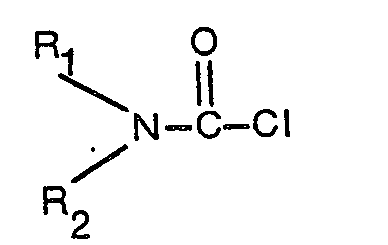
- (a) isocyanates of the general formula
- According to the above-mentioned British patent specification, both reaction a) and reaction b) are carried out in organic solvents such as tetrahydrofuran or anhydrous pyridine in order to avoid the influence of water on the isocyanate.
- British Patent No. 1,173,753 (to Schering) discloses herbicidally active compounds having a formula closely related to formula A above, i.e., compounds of the general formula B

- According to the examples in British Patent Specification No. 1,173,753, the preparation of the 3-(carbamoyloxy)carbanilates is performed in organic solvents such as ether, ethyl acetate, benzene, etc.
- Tetrahydrofuran, pyridine and many other organic solvents are known to be hazardous to the health. The use of organic solvents demands separation thereof from the effluents, and from an economical point of view it is necessary to re-use organic solvents.
- The above-mentioned British patent specification No. 1,127,050 also discloses that the N-hydroxyphenyl carbamates required as starting products may be prepared by N-acylation of 3-aminophenol with the appropriate chloroformic acid esters, for example, in a mixture of ethyl acetate and water in the presence of magnesium oxide. The effect of ethyl acetate is to dissolve the carbamate as it is formed, and the water dissolves the magnesium chloride formed. 3-Aminophenol is not dissolved by ethyl acetate, and the reaction medium thus contains 3-aminophenol and magnesium oxide suspended therein. Excess magnesium oxide can be dissolved in dilute HCI, thus yielding two liquid phases. The isolation and purification of the product is rather complicated due to the character of the two-phase medium, the organic medium comprising the N-hydroxyphenyl carbamate dissolved therein. The phases are separated, and the organic phase is washed neutral with water and then with dilute potassium bicarbonate solution. After drying and evaporation of the organic phase, the crude product is redissolved in ether and precipitated with light petroleum. The yield of the N-hydroxyphenyl carbamate is stated to be 83%, based on the starting material 3-aminophenol. The loss is probably due to the loss of 3-aminophenol in the form of hydrochloride. Due to the contents of MgC121 the aqueous phase cannot be used in the next batch and hence, it is necessary to extract 3-aminophenol which, however, is only slightly soluble in common organic water-immiscible solvents.
- Hence, the known methods for the preparation of the starting materials are disadvantageous from an economic point of view as a loss of starting material of 17% is unsatisfactory, and the isolation and purification is complicated, and the process for the preparation of the end products, the substituted phenyl carbamates, is disadvantageous in being carried out in solvents which are hazardous to the health.
- It has now been found that the preparation of a valuable class of herbicidally active substituted phenyl carbamates which are encompassed by the general formula A above can be performed in an aqueous medium, giving a high yield with excellent purity.
- From an environmental point of view it is of course desirable to carry out chemical reactions in non-toxic solvents and it is always most desirable to carry out the reactions in aqueous media.
- Accordingly, the present invention relates to a process for the preparation of phenmedipham or desmedipham of the formulae 1a and 1b, respectively


- a) taking the N-hydroxyphenyl carbamate up in an aqueous medium comprising at least 90% of water at pH about 9 and a temperature of 10-30°C, the N-hydroxyphenyl carbamate being present in an amount of between 0.1 and 0.66 mol/liter,
- b) adding seed crystals of the desired end product,
- c) adding the isocyanate IV during vigorous stirring or agitation of the aqueous phase comprising the N-hydroxyphenyl carbamate, at the rate in which it reacts with the N-hydroxyphenyl carbamate, the total amount of isocyanate IV added being at the most the stoichiometric amount, and
- d) isolating the end product formed.
- Japanese Patent No. 48(1973)-7422 (to Mitsubishi Industries) teaches about a process for the preparation of carbamate derivatives by reacting an aromatic hydroxy compound and/or its salt with an isocyanate in an aqueous medium. According to the examples, the ratio between the aromatic hydroxy compound and the isocyanate is about 1:1-3.
- When isocyanates are added to water, a normal reaction is the formation of an amine and the liberation of carbon dioxide. The amine formed is a very rapidly reacting reagent which on reaction with more isocyanate will form a disubstituted urea. This reaction between isocyanate and water does normally exclude reactions with isocyanates in aqueous medium. However, both the Japanese patent and the instant invention are based on the fact that when the reaction partner for the isocyanate is an aromatic hydroxy compound, the reaction between the aromatic hydroxy compound and the isocyanate in question will proceed so rapidly that it is not excluded to perform the reaction in an aqueous medium. According to the state of the art (the Japanese patent), more isocyanate than equimolar in relation to the aromatic hydroxy compound is used, which can be taken as evidence that the inventors of the prior art method calculated on a loss of isocyanate. According to the example, which is closest to the present invention, the ratio between the aromatic hydroxy compound and isocyanate was 1:1.5. The surplus of isocyanate will, by reaction with water, form an insoluble product, i.e. a disubstituted urea, which will be isolated together with the desired end product. A large content of impurity, which in the preparation of phenmedipham would be ditolyl urea, is not acceptable when the end product is to be commercialized.
- The process according to the instant invention is a refined process which can be used industrially as it is performed with a minimum loss of the isocyanate starting product and, hence, without a detrimental amount of the undesirable side-product in the commercialized compound.
- The term "aqueous medium" designates media in which at least 90% and preferably 100% of the solvent is water.
- When the medium is a mixture comprising water, the other liquid components therein may be water- miscible or water-immiscible solvents selected from the group of solvents which do not react with the starting materials such as acetone, benzene or xylene.
- It is especially preferred to perform the process in substantially 100% of water, i.e., substantially without any other liquid components present.
- In the reaction of N-hydroxyphenyl carbamates II and isocyanates IV, the pH in the aqueous medium should be an alkaline pH, that is at least pH 8, in order to promote formation of the anion of the compound II as it is the anion which is able to react with the isocyanate IV. The pH in the reaction medium should, however, be at the most 10. According to the invention pH in the aqueous medium is about 9. The alkaline pH may be maintained during the process by adding base, e.g. by the use of a pH-stat. The medium may also be kept at pH about 9 by means of an added buffer. At the end of the reaction, it may be necessary to add an acid in order to keep the pH in the alkaline range.
- When the pH in the reaction medium is kept at about 9 by addition of a base, the base may be any suitable organic or inorganic base such as a tertiary amine, e.g. triethylamine, an alkali metal hydroxide such as sodium hydroxide, etc. If an acid is to be added, a mineral acid such as HCI is preferred.
- In the reaction medium, a side reaction may occur, i.e. a reaction between water and isocyanate yielding N,N'-di-(R')-urea according to the following equation:

- In order to suppress the loss of isocyanate due to the side reaction, the isocyanate IV should be used in an amount of at the most equimolar in relation to the carbamate; it is preferred that the molar ratio of the carbamate to the isocyanate is in the range of 2:1 to 1:1.
- The isocyanate should be added to the reaction medium containing the N-hydroxyphenyl carbamate under vigorous stirring or agitation in order to accelerate the contact between the isocyanate and the N-hydroxyphenyl carbamate and, hence, to prevent the side reaction between isocyanate and water. On an industrial scale, vigorous stirring or agitation may be achieved e.g. by means of an impeller, and furthermore the contents of the reaction vessel may be agitated by circulation in a circulation pipe by means of a circulating pump. It is especially advantageous to supply the isocyanate into a circulation pipe, e.g. by means of a nozzie, thereby obtaining an intimate contact between droplets of the isocyanate and the carbamate intermediate in the aqueous medium.
- As the medium in which the reaction is performed mainly consists of water, and as a low temperature suppresses the formation of by-products, the reaction should be carried out at 10-300C, preferably at 10-200C.
- The solubility of the product I is considerably lower than that of the intermediate II thus giving the risk of having particles of intermediate II "trapped" in particles of I. The "trapping" of II seems to be minimized by using more diluted reaction mixtures. If reactants II and IV are reacted in equimolar amounts, it is preferred to carry out the reaction at a concentration of 0.1-0.4 moles/liter of each of the reactants, preferably at about 0.1-0.3 moles/liter, more preferably at about 0.2-0.3 moles/liter, especially at about 0.25-0.30 moles/liter.
- It is preferred to react a slurry of the phenyl carbamate intermediate in which the liquid phase consists of a saturated solution of the phenyl carbamate intermediate, with the isocyanate or the carbamic acid chloride, the amount of isocyanate added being less than the stoichiometric amount. During the reaction in which dissolved phenyl carbamate intermediate is removed as reaction product, further amounts of phenyl carbamate dissolve.
- After the completion of the reaction, the reaction product, which is very heavily soluble in water, may either be isolated and purified in a conventional manner, e.g., by filtration and washing with water followed by drying, or be removed from the aqueous phase by extraction with an organic solvent (or solvent mixture) which is substantially water-immiscible or miscible with. water to only a minor extent.
- Solvent extraction is a preferred method of isolating the desired end product as solvent extraction equipment is less expensive than filtering and drying equipment.
- Normally, a drying process leads to a slight degradation of the end product, and therefore, omission of the drying step is advantageous.
- Suitably, the extracting solvent (or solvent mixture) is the same solvent (or solvent mixture) which is used in the later formulation of commercial liquid compositions containing the compounds I, for example ketones such as isophorone. In order to facilitate the separation of the solvent phase and the aqueous phase it may be advantageous to add a density-increasing agent to the aqueous phase, e.g. sodium chloride. As the end product I is more stable at acidic conditions, it is preferred to adjust the pH in the reaction medium on an acidic pH before the addition of the organic extraction solvent, or the solution of I in the organic solvent (or solvent mixture) may be washed with water at acid pH (e.g. about 2) and containing a density-increasing agent such as sodium chloride.
- The phase separation may be carried out by centrifugation or by simple gravity separation. After the phase separation the organic solution of compound I may then be used in the formulation of compositions. The organic phase may, if necessary, be dried with a dessicant, e.g. Na2SO4-After the preparation, the end product dissolved in the extraction solvent may be formulated directly into liquid concentrates in a very simple manner as all of the components for the formulation of the liquid composition are then in liquid form.
- The process of the invention has several advantages over the above-mentioned prior art, vis:
- i) no organic solvents are to be handled;
- ii) the process is more simple as the resulting product is simply isolated by filtration, which means that additional precipitation is avoided, or the resulting product is removed by solvent-extraction as explained above.
- A preferred embodiment of the invention is a process wherein methyl N-(3-hydroxyphenyl)carbamate is reacted in water with 3-tolyl isocyanate to yield methyl (3-(3-tolyl-carbamoyloxy)phenyl)carbamate, and a process wherein ethyl N-(3-hydroxyphenyl)carbamate is reacted in water with phenyl isocyanate to yield ethyl (3-phenyl-carbamoyloxyphenyl)carbamate.
- The N-hydroxyphenyl carbamates of the general formula II used as starting materials can be prepared by reaction of 3-aminophenol with a chloroformate of the general formula III

- In this reaction, the carbamate is formed with simultaneous liberation of HCI. If the HCI is not removed, it will react with the amino group in 3-aminophenol and inactivate the amino group. Therefore, an acid receptor is required. According to the invention, the acid receptor is preferably a water-soluble base. The water-soluble base may be an organic base such as pyridine or an inorganic base such as alkali metal hydroxides, carbonates and hydrocarbonates, alkali metal phosphates and borates such as sodium hydroxide, sodium carbonate, disodium hydrogen phosphate, borax, etc. An especially preferred water-soluble base is sodium hydroxide.
- The aqueous medium comprises at least 70%, preferably at least 90%, most preferably 100% of water.
- When the solvent is a mixture comprising water, the other liquid components therein may be water- miscible or water-immiscible solvents selected from the group of solvents which do.not react with the starting materials such as acetone, benzene or xylene..
- The process for the preparation of the N-hydroxyphenyl carbamate is preferably performed at pH 2-7, most preferably at pH 4.3―6.3, more preferably at pH 5-6, especially at pH 5-5.5, e.g. about pH 5.3.
- If the pH is high, i.e. about 7, a side reaction comprising reaction of the chloroformate III with the hydroxy group in the 3-aminophenol may occur. Said reaction does not take place, at least not to a significant extent, if the reaction medium comprises unreacted amino groups and is acidic. In a preferred embodiment of this process, the chloroformate is added to the aqueous medium comprising the 3-aminophenol at the rate at which it is reacted. It is possible to carry out the reaction using a large molar excess of 3-aminophenol, but this implies the necessity of recovering large amounts of 3-aminophenol after completion of the reaction. It is preferred that the molar ratio of 3-aminophenol to chloroformate is 2:1-1:1, especially 1:1.
- It is preferred to adjust the pH in the starting solution of 3-aminophenol to about 5-5.5 such as 5.3 before the addition of chloroformate III in order to avoid an initial reaction with the hydroxy group in the 3-aminophenol. Said pH-adjustment may be performed by means of e.g. HCI.
- The amount of reactants in the aqueous medium is suitably at the most 1 mole per liter, preferably about 0.5 moles per liter.
- The reaction temperature is suitably below 50°C, preferably below 25°C, especially o-15°C, advantageously at about 10°C. The reaction mixture may be cooled by supplying ice directly into the reaction vessel.
- After the reaction between 3-aminophenol and the chloroformate, the pH in the medium may be lowered to less than 3, especially less than 2, in order to dissolve remaining parts of the aminophenol in the aqueous phase as an acid addition salt thereof, preferably by means of hydrochloric acid, said removal of aminophenol being desirable if aminophenol has been used in a molar excess.
- After isolation of the N-hydroxyphenyl carbamates II and washing thereof with water, the mother liquor plus the washings may be used as part of the reaction medium for the next batch.
- A preferred compound of formula II, methyl N-(3-hydroxyphenyl)-carbamate, can be transferred to the next reaction stage in melted form as it may be melted at 50-55°C when covered with the aqueous washing phase as it has been found that, when covered with water, the product melts at a lower temperature than the melting point of the crystalline material. This yields a two-phase system, the lower oily phase being the carbamate in liquid form, and the upper phase being the aqueous phase containing unreacted-3-aminophenol in the form of its acid addition salt. After separation of the phases, the oily product may be washed by agitation with water, and after renewed separation of the phases the phenyl carbamate intermediate may be used in the next reaction step.
- This preferred aspect of the invention in which the starting material is prepared in aqueous solution has several advantages over the prior art, i.e.
- i) liberated HCI is neutralized as non-toxic NaCI by the inexpensive product sodium hydroxide;
- ii) the yield of the process is high, i.e. at least about 95% and often substantially 100%, thus reducing the amount of 3-aminophenol to be recovered;
- iii) process equipment is less expensive as no organic solvents have to be handled, and the process per se is simple;
- iv) the product may be melted when covered with water and is consequently easy to purify by washing with water and to pump to the next stage in the reaction.
- A preferred aspect of the invention is directed to a two-stage synthesis process for the preparation of phenmedipham or desmedipham, which process is characterized in that
- A) 3-aminophenol is reacted with a chloroformate of the general formula III

- B) the product of the general formula II

- C) the product of the general formula II is reacted with an isocyanate of the general formula IV

- a) taking the N-hydroxypheny) carbamate up in an aqeuous medium comprising at least 90% of water at pH about 9 and a temperature of 10-300C, the N-hydroxyphenyl carbamate being present in an amount of between 0.1 and 0.66 mol/liter,
- b) adding seed crystals of the desired end product,
- c) adding the isocyanate IV during vigorous stirring or agitation of the aqueous phase comprising the N-hydroxyphenyl carbamate, at the rate in which it reacts with the N-hydroxyphenyl carbamate, the total amount of isocyanate IV added being at the most the stoichiometric amount, and
- d) isolating the end product formed.
- Another preferred aspect of the invention is directed to a one-pot synthesis process for the preparation of phenmedipham or desmedipham, which process is characterized in that step A and thereafter step C as explained above are performed in one reaction vessel, thus leaving out step B.
- Hence, phenmedipham or desmedipham may be prepared by a process which is characterized in that
- 1) 3-aminophenol is reacted with chloroformate of the general formula III

- 2) the resulting product is reacted in situ, without isolation, with an isocyanate of the general formula IV

- a) adjusting the pH in the aqueous medium to pH about 9 and a temperature of 10-30°C, and, if necessary, adjusting the amount of water so as to obtain a concentration of N-hydroxyphenyl carbamate of between 0.1 and 0.66 mol/liter,
- b) adding seed crystals of the desired end product, and
- c) adding the iosocyanate IV during vigorous stirring or agitation of the aqueous phase comprising the N-hydroxyphenyl carbamate, at the rate in which it reacts with the N-hydroxyphenyl carbamate, the total amount of isocyanate IV added being at the most the stoichiometric amount, the process steps 1) and 2) being carried out as subsequent steps in the same reaction vessel.
- This one-pot synthesis is performed in such a manner that substantially equimolar amounts of 3-aminophenol and the chloroformate of the general formula III are reacted in an aqueous medium, the pH being adjusted to the range of 2-7, preferably 4.3-6.3, more preferably 5-6, especially 5-5.5, e.g. 5.3 by preliminary addition of an acid and simultaneous addition of a base solution. When the pH is lowered to about 5―5.5, e.g. to about 5.3, before the addition of the chloroformate, no side reaction with the hydroxy group occurs. Hence, it is possible to use a slight excess of chloroformate in order to make sure that all the 3-aminophenol is reacted. The excess of chloroformate, if any, will be decomposed in the next reaction step. Preferably a minor excess of chloroformate is used, the molar ratio of 3-aminophenol to chloroformate being 1:1-1.5, preferably 1:1-1.1, most preferably 1:1.01-1:1.05. When the reaction is complete, the pH is increased to about 9 by addition of a further amount of a base solution. The resulting product is reacted in situ with the isocyanate which is added dropwise for the formation of the desired substituted phenyl carbamate. In the second reaction step, equimolar amounts of reactants are reacted. In a preferred embodiment, cooling is performed by adding ice to the reaction vessel during step 1, which also leads to an advantageous dilution of the reaction mixture for step 2.
- In another preferred embodiment the reaction slurry obtained in step 2 is subjected to extraction with a solvent (or solvent mixture) as explained above.
- In an especially preferred embodiment of this aspect of the invention, methyl (3-(3-tolyl- carbamoyloxy)phenyl)carbamate is prepared by reacting equimolar amounts of 3-aminophenol with methyl chloroformate in water, the temperature being maintained at about 10°C by addition of ice and pH being maintained in the range of 4.3-6.3, preferably 5-6, especially 5-5.5, e.g. to about 5.3, by addition of a base solution, adjusting pH to about 9 in situ by addition of further base solution, and reacting the methyl N-(3-hydroxyphenyl)carbamate formed in situ with 3-tolyl isocyanate in the same reaction vessel.
- It is especially preferred to carry out the reaction in the second step at a concentration of about 0.1-0.4 moles/liter, preferably at about 0.2-0.3 moles/liter and more preferably at about 0.25-0.3 moles/liter.
- The resulting slurry is preferably subjected to solvent extraction with a water-immiscible solvent in which methyl (3-(3-tolyl-carbamoyloxy)-phenyl)carbamate is soluble.
- The substituted phenyl carbamates prepared according to the invention may be used either alone or in admixture with one another and/or other herbicides and/or other substances, for example fertilizers, for combating weeds.
- They may be used in the form of concentrated compositions for dilution with water at the site of use, the compositions, e.g., being of the types commonly used for combating weeds, for example wettable powders or dispersions, using liquid and/or solid carriers or diluents and dispersing agents and surfactants.
- The compositions may be made by methods normally used for the preparation of such herbicidal compositions.
- As an interesting alternative to the solutions of phenmedipham and/or desmedipham in isophorone, it has been found that the biological activity of substituted phenyl carbamates is advantageously high when the phenyl carbamates are "activated" by being presented in the form of suspensions of the compounds in finely ground state in liquid phases comprising one or several oily components and one or several surfactants, the liquid phase being able to form an oil-in-water emulsion or a microemulsion when mixed with water at the site of use for making the final preparation ready for use. The oily component is suitably a water-insoluble substance selected from the group consisting of mineral oils, vegetable oils, liquid synthetic lower carboxylic acid esters of monoalcohols or of dihydric, trihydric or other lower (e.g. 4-6 hydroxy functions) polyalcohols, chlorinated oils, ethers, water-insoluble alcohols, ketones and polyglycols, and mixtures thereof.
- The oily component and the surfactant may be so selected that they are mutually soluble to form a stable solution which is capable of effectively suspending finely divided phenyl carbamates la and/or Ib and so that the surfactant will effectively emulsify the oil when water is added to form the final preparation ready for use. The surfactant may also contribute to effectively wet the sprayed surface with the preparation. The oily component and the detergent and the relative amounts thereof may also be so selected that they are capable of forming a microemulsion when mixed with an equal amount of water or up to a ten times as high amount of water (a microemulsion is characterized by comprising oil, emulsifier (surfactant) and water in a finely divided state and by being clear and translucent). A microemulsion is stable and cannot normally be separated by centrifugation). The advantage of selecting the oily component and the surfactant in such a manner that they form a microemulsion is, inter alia, that the phenyl carbamates la and/or Ib may be added to the oily component/surfactant in wet state, i.e. it is not necessary to completely dry the phenyl carbamate obtained in the process according to the invention before it is combined with the oily component/surfactant. Another advantage of selecting the oily component and the surfactant in such a manner that they are capable of forming a microemulsion is that the microemulsion, due to its inherent stability, tends to keep the suspension of the phenyl carbamate stable during transportation and handling of the composition, thus avoiding sedimentation problems. A further advantage connected to compositions in microemulsion form is that the dilution with water for the preparation of solutions ready for use takes place without problems such as lump-forming, etc.
- When the substituted phenyl carbamate prepared in aqueous solution is isolated as a wet paste, the content of dry material will normally be about 65-70% after centrifugation. It is possible to use this material slurried in the oil/detergent mixture whereby the water becomes incorporated in the mixture so that the liquid phase comprises a stable microemulsion which can be further ground in the ball mill. In another embodiment, the herbicidally active compound or compounds in the form of an aqueous slurry may be ground to comminute the compound or compounds to a size suitable for being incorporated in the final composition, optionally with addition of a surfactant, whereafter the liquid comprising one or more oily components and one or more surfactants is added, or the components which when mixed would constitute said liquid are added separately. In either case, the resulting liquid phase will thereby form an emulsion or microemulsion. This is considered to be an advantageous method of utilizing the aqueous slurry obtained in the water phase synthesis described above.
- Ranges of application of the order of about 0.3 kg of active substance per hectare have been found to be adequate for the selective combating of weeds when two or more applications are performed in the growth season, or when the active substance is sprayed via a band spraying equipment. In other instances, an application rate of about 1 kg of active substance per hectare is normally adequate.
- 3-Aminophenol (10.9 g, 0.10 mole) in water (100 ml) was placed in a 250 ml beaker equipped with a stirrer, a thermometer and a pH electrode. The suspension was stirred and cooled to 10°C by external cooling.
- By means of a separatory funnel methyl chloroformate (9.45 g, 0.10 mole) was added to the suspension over a period of 1 hour with continuous stirring, and the temperature was maintained at 8-12°C. During the addition of the ester, the pH was adjusted to 5.3 by simultaneous addition of a 50% NaOH solution.
- After the addition of the ester, the stirring and the pH adjusting was continued for 1/2 hour while the temperature was allowed to increase to room temperature. Subsequently, the pH was lowered to 1.9 with 4N HCI for 1/4 hour to dissolve unreacted 3-aminophenol as its hydrochloride.
- The product, which was a fine, suspended powder, was filtered, washed with icewater (2 x 25 ml) and dried to yield methyl N-(3-hydroxyphenyl)carbamate (15.0 g, 90%), m.p. 94-95°C. Titration of the hydroxy group with 0.5N NaOH showed a purity of 98%.
- 3-Aminophenol (27.3 g, 0.25 mole) in water (250 ml) was placed in a 500 ml beaker equipped with a stirrer, a thermometer and a pH electrode. The suspension was stirred and cooled to 20°C by external cooling.
- By means of a separatory funnel methyl chloroformate (23.6 g, 0.25 mole) was added to the suspension over a period of 1 hour with continuous stirring, and the temperature was maintained at 20°C. During the addition of the ester, the pH was adjusted to 5.3 by simultaneous addition of a 50% NaOH solution.
- After the addition of the ester, the stirring and the pH adjusting was continued for 1/2 hour while the temperature was allowed to increase to room temperature. Subsequently, the pH was lowered to 1.9 with 4N HCI for 1/4 hour to dissolve unreacted 3-aminophenol as its hydrochloride.
- The product, which was a fine, suspended powder, was filtered, washed with icewater (2 x 50 ml) and dried to yield methyl N-(3-hydroxyphenyl)carbamate (36.4 g, 87.2%), m.p. 96.0-96.5°C. Titration of the hydroxy group with 0.5N NaOH showed a purity of 99.4%.
- Methyl N-(3-hydroxyphenyl)carbamate (8.35 g, 0.05 mole) (prepared as described in Example 1) in water (75 ml) was placed in a 150 ml beaker equipped with a stirrer, and the mixture was stirred. Triethylamine (0.25 ml) was added, and over a period of 3/4 hour 3-tolyl isocyanate (6.65 g, 0.05 mole) was added by means of a separatory funnel without any adjustment of temperature or pH.
- After the addition of the 3-tolyl isocyanate, the stirring was continued for 1 hour. Subsequently the product.-which was a very fine, suspended powder, was filtered and dried to yield the title product (13.9 g, 93%), m.p. 139-143°C..
- HPLC-Analysis showed a purity of 95%, the remaining 5% being methyl N-(3-hydroxyphenyl)-carbamate and a by-product, N,N'-di-3-tolylurea.
- Methyl N-(3-hydroxyphenyl)carbamate (83.5 g, 0.50 mole) (prepared as described in Example 1) in water (500 ml) was palced in a 1 I beaker equipped with a stirrer, and the mixture was stirred and cooled to 10°C. Triethylamine (2.5 ml) was added, and over a period of 1/2 hour 3-tolyl isocyanate (66.5 g, 0.50 mole) was added by means of a separatory funnel without any adjustment of pH, while the temperature was maintained at 10°C.
- After the addition of the 3-tolyl isocyanate, the stirring was continued for 1 hour. Subsequently the product, which was a very fine, suspended powder, was filtered and dried to yield the title product (147.9 g, 98.6%), m.p. 141-144°C.
- HPLC-Analysis showed a purity of 96.1%, the remaining 3.9% being methyl N-(3-hydroxyphenyl)-carbamate and a by-product, N,N'-di-3-tolylurea.
- Methyl N-(3-hydroxyphenyl)carbamate (8.35 g, 0.05 mole) (prepared as described in Example 1) in water (75 ml) was placed in a 150 ml beaker equipped with a stirrer, and the mixture was stirred. Over a period of 3/4 hour 3-tolyl isocyanate (6.65 g, 0.05 mole) was added by means of a separatory funnel without any adjustment of temperature. During the addition pH was maintained at 9.5 by simultaneous addition of 50% NaOH solution.
- After the addition of the 3-tolyl isocyanate, the stirring was continued for 1 hour. Subsequently the product, which was a very fine, suspended powder, was filtered and dried to yield the title product (14.0 g, 93.3%), m.p. 139-143°C.
- HPLC-Analysis showed a purity of 94.1 %, the remaining 5.9% being methyl N-(3-hydroxphenyl)-carbamate and a by-product, N,N'-di-3-tolylurea.
- Methyl N-(3-hydroxyphenyl)carbamate (8.35 g, 0.05 mole) (prepared as described in Example 1) in water (75 ml) was placed in a 150 ml beaker equipped with a stirrer, and the mixture was stirred. Borax (2.0 g) was added, and over a period of 3/4 hour 3-tolyl isocyanate (5.3 g, 0.04 mole) was added by means of a separatory funnel without any adjustment of temperature. The pH value was 9.2 during the reaction time.
- After the addition of the 3-tolyl isocyanate, the stirring was continued for 1 hour. Subsequently the product, which was a very fine, suspended powder, was filtered, washed and dried to yield the title product (12.0 g, 100% calculated on the isocyanate intermediate), m.p. 139.8-141.8°C.
- HPLC-Analysis showed a purity of 95.2%, the remaining 4.8% being methyl N-(3-hydroxyphenyl)-carbamate and a by-product, N,N'-di-3-tolylurea.
- 3-Aminophenol in water (1 mole/I) was placed in a reaction vessel equipped with a stirrer, a thermometer and a pH electrode. The suspension was stirred and cooled to 10°C by addition of ice. The pH in the suspension was adjusted to 5.3 by initial addition of HCI.
- By means of a separatory funnel methyl chloroformate (in stoichiometric amount) was added to the suspension over a period of 1 hour with continued stirring, and the temperature was maintained below 10°C. During the addition of the ester, the pH was maintained at 5.3 by simultaneous addition of a 50% NaOH solution.
- After the addition of the ester, the stirring and the pH adjusting was continued for 1/2 hour whereafter pH was raised to 9.2. After the addition of water (so that the concentration was 0.5 mole/l), borax and a small amount of the title product (seed) 3-tolyl isocyanate (in stoichiometric amount) was added by means of a separatory funnel without any adjustment of temperature. The pH value was 9.2 during the reaction time.
- After the addition of the 3-tolyl isocyanate, the stirring was continued for 1 hour. Subsequently the product, which was a very fine, suspended powder, was filtered, washed and dried to yield the title product in 100% yield, m.p. 140-1420C.
- HPLC-Analysis showed a purity of 95%.
- 1 liter of a reaction mixture containing about 88 g of methyl (3-(3-tolylcarbamoyloxy)phenyl)carbamate was prepared as described in Example 7, but the powder was not filtered off. Analysis of the end product formed showed a purity of 94%.
- The pH in the reaction mixture was adjusted to 2 by addition of hydrochloric acid, and sodium chloride (100 g) was dissolved in the slurry. Isophorone (300 g) was added with stirring and the stirring was continued until the solid had dissolved.
- The isophorone phase was separated and dried by means of sodium sulfate. The sodium sulfate was filtered off and acetic acid anhydride (5.0 g) was added.
- Analysis showed a content of 21.6% of methyl (3-(3-tolylcarbamoyloxy)-phenyl)carbamate.
- A solution of methyl (3-(3-tolylcarbamoyloxy)phenyl)carbamate in isophorone was prepared as described in Example 8 and divided into 4 equal parts. The samples were subjected to storage tests as described in the table below, with or without addition of acetic acid anhydride, optionally after drying with sodium sulfate. The tests were performed after 24 hours/25°C, 26 days/25°C, and 25 days/70°C, respectively.

- 3-Aminophenol (10.9 g, 0.10 mole) in water (100 ml) was placed in a 250 ml beaker equipped with a stirrer; a thermometer and a pH electrode. The suspension was stirred and cooled to 10°C by external cooling.
- By means of a separatory funnel ethyl chloroformate (10.85 g, 0.10 mole) was added to the suspension over a period of 1 hour with continuous stirring, and the temperature was maintained at 8-12°C. During the addition of the ester, the pH was adjusted to 5.3 by simultaneous addition of a 50% NaOH solution.
- After the addition of the ester, the stirring and the pH adjusting was continued for 1/2 hour while the temperature was allowed to increase to room temperature. Subsequently, the pH was lowered to 1.9 with 4N HCI for 1/4 hour to dissolve unreacted m-aminophenol as its hydrochloride.
- The product, which was a fine, suspended powder, was filtered, washed with icewater (2 x 25 ml) and dried to yield ethyl N-(3-hydroxyphenyl)carbamate (16.7 g, 92%), m.p. 98.0-99.5°C. Titration of the hydroxy group with 0.5N NaOH showed a purity of 98%.
- Ethyl N-(3-hydroxyphenyl)carbamate (18.1 g, 0.10 mole) (prepared as described in Example 8) in water (100 ml) was placed in a 250 ml beaker equipped with a stirrer, and the mixture was stirred. Borax (1.0 g) was added, and over a period of 3/4 hour phenyl isocyanate (11.9 g, 0.10 mole) was added by means of a separatory funnel without any adjustment of temperature. The pH value was 9.2 during the reaction time.
- After the addition of the phenyl isocyanate, the stirring was continued for 1 hour. Subsequently the product, which was a very fine, suspended powder, was filtered, washed and dried to yield the title product (29.1 g, 96.9%).
Claims (15)


Priority Applications (1)
| Application Number | Priority Date | Filing Date | Title |
|---|---|---|---|
| AT84111244T ATE53012T1 (en) | 1983-09-20 | 1984-09-20 | PROCESS FOR THE PREPARATION OF KNOWN HERBICIDES PHENYLCARBAMATS. |
Applications Claiming Priority (6)
| Application Number | Priority Date | Filing Date | Title |
|---|---|---|---|
| DK429483A DK429483D0 (en) | 1983-09-20 | 1983-09-20 | PROCEDURE FOR THE PREPARATION OF HERBICIDALLY EFFECTIVE RELATIONSHIPS |
| DK4294/83 | 1983-09-20 | ||
| DK148684A DK148684D0 (en) | 1984-02-29 | 1984-02-29 | PROCEDURE FOR PREPARING HERBICIDALLY EFFECTIVE RELATIONSHIPS |
| DK1486/84 | 1984-02-29 | ||
| DK297884A DK297884D0 (en) | 1984-06-18 | 1984-06-18 | PROCEDURE FOR PREPARING HERBICIDALLY EFFECTIVE RELATIONSHIPS |
| DK2978/84 | 1984-06-18 |
Related Child Applications (1)
| Application Number | Title | Priority Date | Filing Date |
|---|---|---|---|
| EP87108213.7 Division-Into | 1987-06-05 |
Publications (3)
| Publication Number | Publication Date |
|---|---|
| EP0142670A2 EP0142670A2 (en) | 1985-05-29 |
| EP0142670A3 EP0142670A3 (en) | 1985-09-04 |
| EP0142670B1 true EP0142670B1 (en) | 1990-05-23 |
Family
ID=27221306
Family Applications (1)
| Application Number | Title | Priority Date | Filing Date |
|---|---|---|---|
| EP84111244A Expired EP0142670B1 (en) | 1983-09-20 | 1984-09-20 | A process for the preparation of known herbicidally active phenyl carbamates |
Country Status (11)
| Country | Link |
|---|---|
| US (1) | US4748265A (en) |
| EP (1) | EP0142670B1 (en) |
| DE (1) | DE3482321D1 (en) |
| ES (1) | ES8604495A1 (en) |
| FI (1) | FI78681C (en) |
| HU (1) | HU195477B (en) |
| PL (1) | PL141436B1 (en) |
| RO (1) | RO93742B (en) |
| TR (1) | TR23041A (en) |
| WO (1) | WO1985001286A1 (en) |
| YU (2) | YU45662B (en) |
Cited By (1)
| Publication number | Priority date | Publication date | Assignee | Title |
|---|---|---|---|---|
| US6486200B1 (en) | 1999-07-08 | 2002-11-26 | The University Of North Carolina At Chapel Hill | Prodrugs for antimicrobial amidines |
Families Citing this family (11)
| Publication number | Priority date | Publication date | Assignee | Title |
|---|---|---|---|---|
| FR2596618B1 (en) * | 1986-04-02 | 1988-07-15 | Rhone Poulenc Agrochimie | BISCARBAMATE HERBICIDE COMPOSITIONS AND THE HERBICIDE TREATMENT METHOD USING THE SAME |
| DK191386D0 (en) * | 1986-04-24 | 1986-04-24 | Koege Kemisk Vaerk | emulsifier |
| US5268352A (en) * | 1989-11-22 | 1993-12-07 | American Cyanamid Company | Herbicidal emulsifiable suspension concentrate compositions |
| DE4114801A1 (en) * | 1990-07-06 | 1992-01-09 | Bayer Ag | HERBICIDES BASED ON A COMBINATION OF METAMITRON / ETHOFUMESATE / PHENMEDIPHAM / DESMEDIPHAM |
| DK284890D0 (en) * | 1990-11-30 | 1990-11-30 | Kvk Agro As | STABILIZED HERBICIDE COMPOSITIONS |
| DK284990D0 (en) | 1990-11-30 | 1990-11-30 | Kvk Agro As | HERBICIDE COMPOSITIONS |
| DE4329974A1 (en) | 1993-09-04 | 1995-03-09 | Stefes Pflanzenschutz Gmbh | Aqueous herbicidal suspension concentrates |
| US5413615A (en) * | 1994-05-02 | 1995-05-09 | Chevron Chemical Company | Polyalkyl hydroxy and amino aromatic carbamates and fuel compositions containing the same |
| DE19605786A1 (en) * | 1996-02-16 | 1997-08-21 | Hoechst Schering Agrevo Gmbh | Oil suspension concentrates |
| DE19963381A1 (en) | 1999-12-28 | 2001-07-12 | Aventis Cropscience Gmbh | Surfactant / solvent systems |
| EP2090166A1 (en) | 2008-02-14 | 2009-08-19 | Bayer CropScience AG | Liquid herbicidal preparations |
Family Cites Families (32)
| Publication number | Priority date | Publication date | Assignee | Title |
|---|---|---|---|---|
| DE127091C (en) * | ||||
| US2651658A (en) * | 1948-03-23 | 1953-09-08 | Columbia Southern Chem Corp | Production of compounds of phosgene |
| US3404975A (en) * | 1964-12-18 | 1968-10-08 | Fmc Corp | m-(carbamoyloxy)-carbanilates as herbicides |
| DE1567151C3 (en) * | 1965-04-09 | 1974-02-21 | Schering Ag, 1000 Berlin Und 4619 Bergkamen | Diurethanes, processes for the preparation of these compounds and herbicidal compositions containing them |
| IL26406A (en) * | 1965-09-01 | 1970-07-19 | Stauffer Chemical Co | Alkanamidophenyl carbamates and herbicidal compositions containing them |
| US3450745A (en) * | 1966-01-18 | 1969-06-17 | Union Carbide Corp | Alkyl and aryl 4-(methylcarbamoyloxy) carbanilates |
| DE1568138B2 (en) * | 1966-07-06 | 1976-07-01 | Basf Ag, 6700 Ludwigshafen | DIURETHANES AND HERBICIDALS CONTAINING THEM |
| US3551477A (en) * | 1966-07-06 | 1970-12-29 | Basf Ag | Novel biscarbamates |
| US3535101A (en) * | 1966-09-07 | 1970-10-20 | Schering Ag | Herbicide and algicide means |
| DE1567164C2 (en) * | 1966-09-10 | 1985-03-07 | Schering AG, 1000 Berlin und 4709 Bergkamen | Herbicidal agents based on N-carbamoyloxyphenyl carbamates |
| SE313694B (en) * | 1968-01-10 | 1969-08-18 | Basf Ag | |
| US3836570A (en) * | 1968-04-08 | 1974-09-17 | Stauffer Chemical Co | M-amidophenylcarbamates |
| DE1903817C3 (en) * | 1969-01-22 | 1981-06-25 | Schering Ag Berlin Und Bergkamen, 1000 Berlin | Stabilized liquid herbicide concentrates based on carbamate |
| DE2020729C2 (en) * | 1970-04-23 | 1983-04-21 | Schering Ag, 1000 Berlin Und 4619 Bergkamen | Herbicidal agents based on N- (3- (N'-aryl-carbamoyloxy) -phenyl) -carbamates |
| US3671571A (en) * | 1970-07-17 | 1972-06-20 | Basf Ag | Biscarbamates |
| DE2045907C3 (en) * | 1970-09-17 | 1978-11-16 | Basf Ag | Biscarbamates and herbicides which they contain as active ingredients |
| DE2334787A1 (en) * | 1973-07-09 | 1975-02-06 | Basf Ag | HERBICIDE |
| DE2341079C2 (en) * | 1973-08-10 | 1982-05-06 | Schering Ag, 1000 Berlin Und 4619 Bergkamen | m-Diurethanes and selective herbicidal agents containing these compounds as active ingredients |
| IE40090B1 (en) * | 1973-11-03 | 1979-03-14 | Fisons Ltd | Combating weeds |
| DE2453255C3 (en) * | 1974-11-09 | 1981-08-13 | Basf Ag, 6700 Ludwigshafen | Herbicidal suspension based on 1-phenyl-4-amino-5-halogen-pyridazon- (6) |
| DE2547968A1 (en) * | 1975-10-27 | 1977-05-05 | Basf Ag | HERBICIDE |
| IE43966B1 (en) * | 1975-11-12 | 1981-07-15 | Fisons Ltd | Aqueous suspensions of substituted benzofuran herbicides |
| GR66157B (en) * | 1976-08-28 | 1981-01-20 | Basf Ag | |
| IT1163687B (en) * | 1979-07-27 | 1987-04-08 | Montedison Spa | SOLUTIONS AND FORMULATIONS OF PASTA CARBAMATES STABLE OVER TIME AND THAT RESIST TO LOW AND HIGH TEMPERATURES |
| HU177590B (en) * | 1979-10-26 | 1981-11-28 | Chinoin Gyogyszer Es Vegyeszet | Stable liquid herbicide preparation |
| FR2510994A1 (en) * | 1981-08-10 | 1983-02-11 | Rhone Poulenc Agrochimie | PROCESS FOR THE PREPARATION OF PHENMEDIPHAM HERBICIDE |
| BE892864A (en) * | 1982-04-15 | 1982-08-02 | Basf Ag | Stabilised bis:carbamate herbicide concentrates - contg. formic or aromatic acid as stabiliser |
| HU191184B (en) * | 1982-07-09 | 1987-01-28 | Chinoin Gyogyszer Es Vegyeszeti Termekek Gyara Rt,Hu | Stabilized herbicide suspension |
| DE3225705A1 (en) * | 1982-07-09 | 1984-01-12 | A. Nattermann & Cie GmbH, 5000 Köln | METHOD FOR APPLYING PLANT PROTECTION AGENT SPLASHES BY SPRAYING AND PACKING UNIT FOR CONCENTRATES |
| DE3225703C1 (en) * | 1982-07-09 | 1984-01-19 | A. Nattermann & Cie GmbH, 5000 Köln | Phospholipid concentrate and its use as an adjuvant for the manufacture and discharge of spray broths containing crop protection agents |
| GR78909B (en) * | 1982-08-13 | 1984-10-02 | Sipcam Spa | |
| DE3247050A1 (en) * | 1982-12-20 | 1984-06-20 | Bayer Ag, 5090 Leverkusen | HERBICIDAL AGENTS |
-
1984
- 1984-09-19 YU YU161184A patent/YU45662B/en unknown
- 1984-09-19 ES ES536050A patent/ES8604495A1/en not_active Expired
- 1984-09-20 US US06/652,610 patent/US4748265A/en not_active Expired - Fee Related
- 1984-09-20 WO PCT/DK1984/000092 patent/WO1985001286A1/en not_active Ceased
- 1984-09-20 TR TR6226/84A patent/TR23041A/en unknown
- 1984-09-20 DE DE8484111244T patent/DE3482321D1/en not_active Expired - Lifetime
- 1984-09-20 EP EP84111244A patent/EP0142670B1/en not_active Expired
- 1984-09-20 HU HU844227A patent/HU195477B/en not_active IP Right Cessation
- 1984-09-20 PL PL1984249667A patent/PL141436B1/en unknown
-
1985
- 1985-05-20 RO RO118807A patent/RO93742B/en unknown
- 1985-05-20 FI FI852010A patent/FI78681C/en not_active IP Right Cessation
-
1990
- 1990-08-15 YU YU156690A patent/YU47681B/en unknown
Cited By (3)
| Publication number | Priority date | Publication date | Assignee | Title |
|---|---|---|---|---|
| US6486200B1 (en) | 1999-07-08 | 2002-11-26 | The University Of North Carolina At Chapel Hill | Prodrugs for antimicrobial amidines |
| US6503940B2 (en) | 1999-07-08 | 2003-01-07 | The University Of North Carolina At Chapel Hill | Prodrugs for antimicrobial amidines |
| US6649652B2 (en) | 1999-07-08 | 2003-11-18 | The University Of North Carolina At Chapel Hill | Prodrugs for antimicrobial amidines |
Also Published As
| Publication number | Publication date |
|---|---|
| EP0142670A2 (en) | 1985-05-29 |
| FI78681C (en) | 1992-04-22 |
| FI852010L (en) | 1985-05-20 |
| TR23041A (en) | 1989-02-13 |
| HU195477B (en) | 1988-05-30 |
| DE3482321D1 (en) | 1990-06-28 |
| PL249667A1 (en) | 1985-12-17 |
| FI852010A0 (en) | 1985-05-20 |
| WO1985001286A1 (en) | 1985-03-28 |
| HUT37118A (en) | 1985-11-28 |
| PL141436B1 (en) | 1987-07-31 |
| YU156690A (en) | 1993-05-28 |
| RO93742A (en) | 1988-03-30 |
| YU45662B (en) | 1992-07-20 |
| RO93742B (en) | 1988-04-01 |
| FI78681B (en) | 1989-05-31 |
| YU161184A (en) | 1987-12-31 |
| US4748265A (en) | 1988-05-31 |
| ES8604495A1 (en) | 1986-02-01 |
| YU47681B (en) | 1996-01-08 |
| EP0142670A3 (en) | 1985-09-04 |
| ES536050A0 (en) | 1986-02-01 |
Similar Documents
| Publication | Publication Date | Title |
|---|---|---|
| RU2015962C1 (en) | Valineamide derivatives as racemate or as r(+) configuration of l-isomer having fungicidal activity | |
| EP0001514B1 (en) | Herbicidal sulfonamides, and preparation and use thereof | |
| US4748265A (en) | Process for the preparation of herbicidally active phenyl carbamates | |
| US4767448A (en) | Herbicidal compositions comprising phenyl carbamates and other herbicides | |
| GB2176786A (en) | A method for optical resolution of phenylacetic acid derivative | |
| US4818271A (en) | Pyridinylurea compounds and agricultural uses | |
| NO140268B (en) | 6-AMINO-S-TRIAZINONDE DERIVATIVES WITH HERBICID EFFECT AND A PROCEDURE FOR THE MANUFACTURE | |
| US5246912A (en) | Herbicidal compositions of phenmedipham and desmedipham | |
| US4107377A (en) | Process for producing 3-trichloromethyl-5-loweralkylamino-1,2,4-thiadiazole | |
| US4375546A (en) | Substituted pyridinyl esters of 2-(1-oxoalkyloxy)ethyl carbamic acid | |
| US4051130A (en) | 4(3H)-oxobenzo-2,1,3-thiadiazine-2,2-dioxides and derivatives thereof | |
| US4297493A (en) | Manufacture of 4-amino-5-chloro-1-phenylpyridaz-6-one using aqueous phenol-4-sulfonic acid | |
| US4352806A (en) | Selected 2-trichloromethyl-4-pyrimidinyl carboxylic esters and their use as fungicides | |
| US4116672A (en) | 4(3H)-Oxobenzo-2,1,3-thiadiazine-2,2-dioxides and derivatives thereof | |
| US3516816A (en) | Herbicidal compositions and methods utilizing alkyleneiminourea compounds | |
| NO139220B (en) | SUBSTITUTED BUTYRAMIDS AND AUTOMATIC BUTYRATE MEALS | |
| US4207089A (en) | Thiolcarbamate derivatives of 3-trihalomethyl-1,2,4-thiadiazoles and their use as herbicides | |
| SU1604155A3 (en) | Method of producing substituted carbamates | |
| US4348411A (en) | Combating bacteria with halogenomethylsulphonylphenyl-phthalamic acids | |
| KR820000777B1 (en) | Process for preparing n-ethylcarbanilic acid (3-methoxycarbonylamino) phenylester | |
| US4496483A (en) | N-Hexamethyleneimino thiolcarbamate compounds | |
| DK159653B (en) | Process for preparing phenmedipham or desmedipham | |
| US4353908A (en) | Selected 2-trichloromethyl-4-pyrimidinyl carbonates and their use as fungicides | |
| US3933851A (en) | Preparation of aromatic 2-imino-1,3-dithietanes | |
| US4228289A (en) | Thiolcarbamate derivatives of 3-trihalomethyl-1,2,4-thiadiazoles |
Legal Events
| Date | Code | Title | Description |
|---|---|---|---|
| PUAI | Public reference made under article 153(3) epc to a published international application that has entered the european phase |
Free format text: ORIGINAL CODE: 0009012 |
|
| 17P | Request for examination filed |
Effective date: 19840920 |
|
| AK | Designated contracting states |
Designated state(s): AT BE DE FR GB IT NL SE |
|
| PUAL | Search report despatched |
Free format text: ORIGINAL CODE: 0009013 |
|
| AK | Designated contracting states |
Designated state(s): AT BE DE FR GB IT NL SE |
|
| D17P | Request for examination filed (deleted) | ||
| R17P | Request for examination filed (corrected) |
Effective date: 19860224 |
|
| 17Q | First examination report despatched |
Effective date: 19861010 |
|
| RAP1 | Party data changed (applicant data changed or rights of an application transferred) |
Owner name: BEROL NOBEL (SUISSE) S.A. |
|
| GRAA | (expected) grant |
Free format text: ORIGINAL CODE: 0009210 |
|
| AK | Designated contracting states |
Kind code of ref document: B1 Designated state(s): AT BE DE FR GB IT NL SE |
|
| REF | Corresponds to: |
Ref document number: 53012 Country of ref document: AT Date of ref document: 19900615 Kind code of ref document: T |
|
| REF | Corresponds to: |
Ref document number: 3482321 Country of ref document: DE Date of ref document: 19900628 |
|
| ITF | It: translation for a ep patent filed | ||
| ET | Fr: translation filed | ||
| PLBE | No opposition filed within time limit |
Free format text: ORIGINAL CODE: 0009261 |
|
| STAA | Information on the status of an ep patent application or granted ep patent |
Free format text: STATUS: NO OPPOSITION FILED WITHIN TIME LIMIT |
|
| 26N | No opposition filed | ||
| PGFP | Annual fee paid to national office [announced via postgrant information from national office to epo] |
Ref country code: FR Payment date: 19910828 Year of fee payment: 8 |
|
| PGFP | Annual fee paid to national office [announced via postgrant information from national office to epo] |
Ref country code: GB Payment date: 19910909 Year of fee payment: 8 |
|
| PGFP | Annual fee paid to national office [announced via postgrant information from national office to epo] |
Ref country code: BE Payment date: 19910912 Year of fee payment: 8 |
|
| PGFP | Annual fee paid to national office [announced via postgrant information from national office to epo] |
Ref country code: SE Payment date: 19910916 Year of fee payment: 8 |
|
| PGFP | Annual fee paid to national office [announced via postgrant information from national office to epo] |
Ref country code: AT Payment date: 19910925 Year of fee payment: 8 |
|
| ITTA | It: last paid annual fee | ||
| PGFP | Annual fee paid to national office [announced via postgrant information from national office to epo] |
Ref country code: NL Payment date: 19910930 Year of fee payment: 8 |
|
| PGFP | Annual fee paid to national office [announced via postgrant information from national office to epo] |
Ref country code: DE Payment date: 19911030 Year of fee payment: 8 |
|
| PG25 | Lapsed in a contracting state [announced via postgrant information from national office to epo] |
Ref country code: GB Effective date: 19920920 Ref country code: AT Effective date: 19920920 |
|
| PG25 | Lapsed in a contracting state [announced via postgrant information from national office to epo] |
Ref country code: SE Effective date: 19920921 |
|
| PG25 | Lapsed in a contracting state [announced via postgrant information from national office to epo] |
Ref country code: BE Effective date: 19920930 |
|
| BERE | Be: lapsed |
Owner name: S.A. BEROL NOBEL (SUISSE) Effective date: 19920930 |
|
| PG25 | Lapsed in a contracting state [announced via postgrant information from national office to epo] |
Ref country code: NL Effective date: 19930401 |
|
| NLV4 | Nl: lapsed or anulled due to non-payment of the annual fee | ||
| GBPC | Gb: european patent ceased through non-payment of renewal fee |
Effective date: 19920920 |
|
| PG25 | Lapsed in a contracting state [announced via postgrant information from national office to epo] |
Ref country code: FR Effective date: 19930528 |
|
| PG25 | Lapsed in a contracting state [announced via postgrant information from national office to epo] |
Ref country code: DE Effective date: 19930602 |
|
| REG | Reference to a national code |
Ref country code: FR Ref legal event code: ST |
|
| EUG | Se: european patent has lapsed |
Ref document number: 84111244.4 Effective date: 19930406 |