EP0142157B1 - Improved adsorption separation cycle - Google Patents
Improved adsorption separation cycle Download PDFInfo
- Publication number
- EP0142157B1 EP0142157B1 EP84113673A EP84113673A EP0142157B1 EP 0142157 B1 EP0142157 B1 EP 0142157B1 EP 84113673 A EP84113673 A EP 84113673A EP 84113673 A EP84113673 A EP 84113673A EP 0142157 B1 EP0142157 B1 EP 0142157B1
- Authority
- EP
- European Patent Office
- Prior art keywords
- water
- bed
- adsorption
- feedstock
- purge gas
- Prior art date
- Legal status (The legal status is an assumption and is not a legal conclusion. Google has not performed a legal analysis and makes no representation as to the accuracy of the status listed.)
- Expired
Links
- 238000001179 sorption measurement Methods 0.000 title claims abstract description 69
- 238000000926 separation method Methods 0.000 title claims abstract description 11
- 238000010926 purge Methods 0.000 claims abstract description 45
- 239000012808 vapor phase Substances 0.000 claims abstract description 7
- XLYOFNOQVPJJNP-UHFFFAOYSA-N water Substances O XLYOFNOQVPJJNP-UHFFFAOYSA-N 0.000 claims description 137
- LFQSCWFLJHTTHZ-UHFFFAOYSA-N Ethanol Chemical compound CCO LFQSCWFLJHTTHZ-UHFFFAOYSA-N 0.000 claims description 68
- 239000003463 adsorbent Substances 0.000 claims description 52
- 238000000034 method Methods 0.000 claims description 43
- 230000008569 process Effects 0.000 claims description 40
- 238000011068 loading method Methods 0.000 claims description 23
- 239000010457 zeolite Substances 0.000 claims description 22
- 229910021536 Zeolite Inorganic materials 0.000 claims description 20
- HNPSIPDUKPIQMN-UHFFFAOYSA-N dioxosilane;oxo(oxoalumanyloxy)alumane Chemical group O=[Si]=O.O=[Al]O[Al]=O HNPSIPDUKPIQMN-UHFFFAOYSA-N 0.000 claims description 20
- 239000007788 liquid Substances 0.000 claims description 19
- 239000000203 mixture Substances 0.000 claims description 19
- 239000002808 molecular sieve Substances 0.000 claims description 16
- URGAHOPLAPQHLN-UHFFFAOYSA-N sodium aluminosilicate Chemical compound [Na+].[Al+3].[O-][Si]([O-])=O.[O-][Si]([O-])=O URGAHOPLAPQHLN-UHFFFAOYSA-N 0.000 claims description 16
- 239000002156 adsorbate Substances 0.000 claims description 10
- 238000001816 cooling Methods 0.000 claims description 9
- 239000011148 porous material Substances 0.000 claims description 8
- 239000007791 liquid phase Substances 0.000 claims description 7
- 239000012071 phase Substances 0.000 claims description 7
- 238000009833 condensation Methods 0.000 claims description 6
- 230000005494 condensation Effects 0.000 claims description 6
- KFZMGEQAYNKOFK-UHFFFAOYSA-N Isopropanol Chemical compound CC(C)O KFZMGEQAYNKOFK-UHFFFAOYSA-N 0.000 claims description 4
- JYIMWRSJCRRYNK-UHFFFAOYSA-N dialuminum;disodium;oxygen(2-);silicon(4+);hydrate Chemical group O.[O-2].[O-2].[O-2].[O-2].[O-2].[O-2].[Na+].[Na+].[Al+3].[Al+3].[Si+4] JYIMWRSJCRRYNK-UHFFFAOYSA-N 0.000 claims description 3
- 229910052680 mordenite Inorganic materials 0.000 claims description 3
- 125000004432 carbon atom Chemical group C* 0.000 claims description 2
- 150000003138 primary alcohols Chemical class 0.000 claims description 2
- 238000004064 recycling Methods 0.000 claims description 2
- 239000013078 crystal Substances 0.000 claims 1
- 238000011069 regeneration method Methods 0.000 abstract description 33
- 230000008929 regeneration Effects 0.000 abstract description 32
- 239000000047 product Substances 0.000 abstract description 30
- 238000003795 desorption Methods 0.000 abstract description 13
- 239000012264 purified product Substances 0.000 abstract description 3
- 239000007789 gas Substances 0.000 description 40
- IJGRMHOSHXDMSA-UHFFFAOYSA-N Atomic nitrogen Chemical compound N#N IJGRMHOSHXDMSA-UHFFFAOYSA-N 0.000 description 27
- 239000012530 fluid Substances 0.000 description 17
- 229910052757 nitrogen Inorganic materials 0.000 description 14
- 239000006096 absorbing agent Substances 0.000 description 13
- 238000001035 drying Methods 0.000 description 11
- 239000000470 constituent Substances 0.000 description 9
- UHOVQNZJYSORNB-UHFFFAOYSA-N Benzene Chemical compound C1=CC=CC=C1 UHOVQNZJYSORNB-UHFFFAOYSA-N 0.000 description 6
- 230000000274 adsorptive effect Effects 0.000 description 6
- IDGUHHHQCWSQLU-UHFFFAOYSA-N ethanol;hydrate Chemical compound O.CCO IDGUHHHQCWSQLU-UHFFFAOYSA-N 0.000 description 4
- 230000006872 improvement Effects 0.000 description 4
- ZWEHNKRNPOVVGH-UHFFFAOYSA-N 2-Butanone Chemical compound CCC(C)=O ZWEHNKRNPOVVGH-UHFFFAOYSA-N 0.000 description 3
- RTZKZFJDLAIYFH-UHFFFAOYSA-N Diethyl ether Chemical compound CCOCC RTZKZFJDLAIYFH-UHFFFAOYSA-N 0.000 description 3
- XEKOWRVHYACXOJ-UHFFFAOYSA-N Ethyl acetate Chemical compound CCOC(C)=O XEKOWRVHYACXOJ-UHFFFAOYSA-N 0.000 description 3
- YXFVVABEGXRONW-UHFFFAOYSA-N Toluene Chemical compound CC1=CC=CC=C1 YXFVVABEGXRONW-UHFFFAOYSA-N 0.000 description 3
- 238000004821 distillation Methods 0.000 description 3
- 239000011800 void material Substances 0.000 description 3
- CURLTUGMZLYLDI-UHFFFAOYSA-N Carbon dioxide Chemical compound O=C=O CURLTUGMZLYLDI-UHFFFAOYSA-N 0.000 description 2
- JUJWROOIHBZHMG-UHFFFAOYSA-N Pyridine Chemical compound C1=CC=NC=C1 JUJWROOIHBZHMG-UHFFFAOYSA-N 0.000 description 2
- DKGAVHZHDRPRBM-UHFFFAOYSA-N Tert-Butanol Chemical compound CC(C)(C)O DKGAVHZHDRPRBM-UHFFFAOYSA-N 0.000 description 2
- WYURNTSHIVDZCO-UHFFFAOYSA-N Tetrahydrofuran Chemical compound C1CCOC1 WYURNTSHIVDZCO-UHFFFAOYSA-N 0.000 description 2
- 238000003915 air pollution Methods 0.000 description 2
- 235000013405 beer Nutrition 0.000 description 2
- 230000015572 biosynthetic process Effects 0.000 description 2
- BTANRVKWQNVYAZ-UHFFFAOYSA-N butan-2-ol Chemical compound CCC(C)O BTANRVKWQNVYAZ-UHFFFAOYSA-N 0.000 description 2
- WDAXFOBOLVPGLV-UHFFFAOYSA-N ethyl isobutyrate Chemical compound CCOC(=O)C(C)C WDAXFOBOLVPGLV-UHFFFAOYSA-N 0.000 description 2
- VNWKTOKETHGBQD-UHFFFAOYSA-N methane Chemical compound C VNWKTOKETHGBQD-UHFFFAOYSA-N 0.000 description 2
- BDAGIHXWWSANSR-UHFFFAOYSA-N methanoic acid Natural products OC=O BDAGIHXWWSANSR-UHFFFAOYSA-N 0.000 description 2
- TZIHFWKZFHZASV-UHFFFAOYSA-N methyl formate Chemical compound COC=O TZIHFWKZFHZASV-UHFFFAOYSA-N 0.000 description 2
- 150000002894 organic compounds Chemical class 0.000 description 2
- 239000011368 organic material Substances 0.000 description 2
- 238000000746 purification Methods 0.000 description 2
- 238000005057 refrigeration Methods 0.000 description 2
- 239000007787 solid Substances 0.000 description 2
- 238000002336 sorption--desorption measurement Methods 0.000 description 2
- WSLDOOZREJYCGB-UHFFFAOYSA-N 1,2-Dichloroethane Chemical compound ClCCCl WSLDOOZREJYCGB-UHFFFAOYSA-N 0.000 description 1
- RYHBNJHYFVUHQT-UHFFFAOYSA-N 1,4-Dioxane Chemical compound C1COCCO1 RYHBNJHYFVUHQT-UHFFFAOYSA-N 0.000 description 1
- OSWFIVFLDKOXQC-UHFFFAOYSA-N 4-(3-methoxyphenyl)aniline Chemical compound COC1=CC=CC(C=2C=CC(N)=CC=2)=C1 OSWFIVFLDKOXQC-UHFFFAOYSA-N 0.000 description 1
- ZAFNJMIOTHYJRJ-UHFFFAOYSA-N Diisopropyl ether Chemical compound CC(C)OC(C)C ZAFNJMIOTHYJRJ-UHFFFAOYSA-N 0.000 description 1
- RJUFJBKOKNCXHH-UHFFFAOYSA-N Methyl propionate Chemical compound CCC(=O)OC RJUFJBKOKNCXHH-UHFFFAOYSA-N 0.000 description 1
- XBDQKXXYIPTUBI-UHFFFAOYSA-M Propionate Chemical compound CCC([O-])=O XBDQKXXYIPTUBI-UHFFFAOYSA-M 0.000 description 1
- KFNNIILCVOLYIR-UHFFFAOYSA-N Propyl formate Chemical compound CCCOC=O KFNNIILCVOLYIR-UHFFFAOYSA-N 0.000 description 1
- 239000002250 absorbent Substances 0.000 description 1
- 230000002745 absorbent Effects 0.000 description 1
- KXKVLQRXCPHEJC-UHFFFAOYSA-N acetic acid trimethyl ester Natural products COC(C)=O KXKVLQRXCPHEJC-UHFFFAOYSA-N 0.000 description 1
- 230000002411 adverse Effects 0.000 description 1
- 125000005233 alkylalcohol group Chemical group 0.000 description 1
- JYIBXUUINYLWLR-UHFFFAOYSA-N aluminum;calcium;potassium;silicon;sodium;trihydrate Chemical compound O.O.O.[Na].[Al].[Si].[K].[Ca] JYIBXUUINYLWLR-UHFFFAOYSA-N 0.000 description 1
- 239000012080 ambient air Substances 0.000 description 1
- ADCOVFLJGNWWNZ-UHFFFAOYSA-N antimony trioxide Chemical compound O=[Sb]O[Sb]=O ADCOVFLJGNWWNZ-UHFFFAOYSA-N 0.000 description 1
- 230000008901 benefit Effects 0.000 description 1
- -1 benzene Chemical class 0.000 description 1
- UNYSKUBLZGJSLV-UHFFFAOYSA-L calcium;1,3,5,2,4,6$l^{2}-trioxadisilaluminane 2,4-dioxide;dihydroxide;hexahydrate Chemical compound O.O.O.O.O.O.[OH-].[OH-].[Ca+2].O=[Si]1O[Al]O[Si](=O)O1.O=[Si]1O[Al]O[Si](=O)O1 UNYSKUBLZGJSLV-UHFFFAOYSA-L 0.000 description 1
- 239000001569 carbon dioxide Substances 0.000 description 1
- 229910002092 carbon dioxide Inorganic materials 0.000 description 1
- 125000002091 cationic group Chemical group 0.000 description 1
- 150000001768 cations Chemical group 0.000 description 1
- 229910052676 chabazite Inorganic materials 0.000 description 1
- 238000006243 chemical reaction Methods 0.000 description 1
- 229910001603 clinoptilolite Inorganic materials 0.000 description 1
- 239000000571 coke Substances 0.000 description 1
- 150000001875 compounds Chemical class 0.000 description 1
- 230000006835 compression Effects 0.000 description 1
- 238000007906 compression Methods 0.000 description 1
- 239000000498 cooling water Substances 0.000 description 1
- 230000006378 damage Effects 0.000 description 1
- 230000018044 dehydration Effects 0.000 description 1
- 238000006297 dehydration reaction Methods 0.000 description 1
- 238000010586 diagram Methods 0.000 description 1
- 230000003467 diminishing effect Effects 0.000 description 1
- 238000005265 energy consumption Methods 0.000 description 1
- 229910052675 erionite Inorganic materials 0.000 description 1
- 238000001704 evaporation Methods 0.000 description 1
- 230000008020 evaporation Effects 0.000 description 1
- 230000007717 exclusion Effects 0.000 description 1
- 238000000895 extractive distillation Methods 0.000 description 1
- 238000000855 fermentation Methods 0.000 description 1
- 230000004151 fermentation Effects 0.000 description 1
- 235000019253 formic acid Nutrition 0.000 description 1
- 238000007710 freezing Methods 0.000 description 1
- 230000008014 freezing Effects 0.000 description 1
- 239000001307 helium Substances 0.000 description 1
- 229910052734 helium Inorganic materials 0.000 description 1
- SWQJXJOGLNCZEY-UHFFFAOYSA-N helium atom Chemical compound [He] SWQJXJOGLNCZEY-UHFFFAOYSA-N 0.000 description 1
- 239000001257 hydrogen Substances 0.000 description 1
- 229910052739 hydrogen Inorganic materials 0.000 description 1
- 125000004435 hydrogen atom Chemical class [H]* 0.000 description 1
- 230000000977 initiatory effect Effects 0.000 description 1
- 229910052500 inorganic mineral Inorganic materials 0.000 description 1
- 150000002605 large molecules Chemical class 0.000 description 1
- 238000012886 linear function Methods 0.000 description 1
- 229920002521 macromolecule Polymers 0.000 description 1
- 238000004519 manufacturing process Methods 0.000 description 1
- 239000000463 material Substances 0.000 description 1
- 229940017219 methyl propionate Drugs 0.000 description 1
- 239000011707 mineral Substances 0.000 description 1
- 150000002829 nitrogen Chemical class 0.000 description 1
- 239000002245 particle Substances 0.000 description 1
- 239000008188 pellet Substances 0.000 description 1
- 238000011112 process operation Methods 0.000 description 1
- 238000011027 product recovery Methods 0.000 description 1
- UMJSCPRVCHMLSP-UHFFFAOYSA-N pyridine Natural products COC1=CC=CN=C1 UMJSCPRVCHMLSP-UHFFFAOYSA-N 0.000 description 1
- 230000009467 reduction Effects 0.000 description 1
- 229920006395 saturated elastomer Polymers 0.000 description 1
- 238000001577 simple distillation Methods 0.000 description 1
- 239000007921 spray Substances 0.000 description 1
- YLQBMQCUIZJEEH-UHFFFAOYSA-N tetrahydrofuran Natural products C=1C=COC=1 YLQBMQCUIZJEEH-UHFFFAOYSA-N 0.000 description 1
- 239000010409 thin film Substances 0.000 description 1
- 238000005292 vacuum distillation Methods 0.000 description 1
- 239000002699 waste material Substances 0.000 description 1
Images
Classifications
-
- B—PERFORMING OPERATIONS; TRANSPORTING
- B01—PHYSICAL OR CHEMICAL PROCESSES OR APPARATUS IN GENERAL
- B01D—SEPARATION
- B01D53/00—Separation of gases or vapours; Recovering vapours of volatile solvents from gases; Chemical or biological purification of waste gases, e.g. engine exhaust gases, smoke, fumes, flue gases, aerosols
- B01D53/26—Drying gases or vapours
- B01D53/261—Drying gases or vapours by adsorption
-
- B—PERFORMING OPERATIONS; TRANSPORTING
- B01—PHYSICAL OR CHEMICAL PROCESSES OR APPARATUS IN GENERAL
- B01D—SEPARATION
- B01D53/00—Separation of gases or vapours; Recovering vapours of volatile solvents from gases; Chemical or biological purification of waste gases, e.g. engine exhaust gases, smoke, fumes, flue gases, aerosols
- B01D53/02—Separation of gases or vapours; Recovering vapours of volatile solvents from gases; Chemical or biological purification of waste gases, e.g. engine exhaust gases, smoke, fumes, flue gases, aerosols by adsorption, e.g. preparative gas chromatography
- B01D53/04—Separation of gases or vapours; Recovering vapours of volatile solvents from gases; Chemical or biological purification of waste gases, e.g. engine exhaust gases, smoke, fumes, flue gases, aerosols by adsorption, e.g. preparative gas chromatography with stationary adsorbents
- B01D53/047—Pressure swing adsorption
-
- C—CHEMISTRY; METALLURGY
- C07—ORGANIC CHEMISTRY
- C07C—ACYCLIC OR CARBOCYCLIC COMPOUNDS
- C07C29/00—Preparation of compounds having hydroxy or O-metal groups bound to a carbon atom not belonging to a six-membered aromatic ring
- C07C29/74—Separation; Purification; Use of additives, e.g. for stabilisation
- C07C29/76—Separation; Purification; Use of additives, e.g. for stabilisation by physical treatment
-
- B—PERFORMING OPERATIONS; TRANSPORTING
- B01—PHYSICAL OR CHEMICAL PROCESSES OR APPARATUS IN GENERAL
- B01D—SEPARATION
- B01D2253/00—Adsorbents used in seperation treatment of gases and vapours
- B01D2253/10—Inorganic adsorbents
- B01D2253/106—Silica or silicates
- B01D2253/108—Zeolites
-
- B—PERFORMING OPERATIONS; TRANSPORTING
- B01—PHYSICAL OR CHEMICAL PROCESSES OR APPARATUS IN GENERAL
- B01D—SEPARATION
- B01D2253/00—Adsorbents used in seperation treatment of gases and vapours
- B01D2253/30—Physical properties of adsorbents
- B01D2253/302—Dimensions
- B01D2253/308—Pore size
-
- B—PERFORMING OPERATIONS; TRANSPORTING
- B01—PHYSICAL OR CHEMICAL PROCESSES OR APPARATUS IN GENERAL
- B01D—SEPARATION
- B01D2257/00—Components to be removed
- B01D2257/70—Organic compounds not provided for in groups B01D2257/00 - B01D2257/602
-
- B—PERFORMING OPERATIONS; TRANSPORTING
- B01—PHYSICAL OR CHEMICAL PROCESSES OR APPARATUS IN GENERAL
- B01D—SEPARATION
- B01D2257/00—Components to be removed
- B01D2257/70—Organic compounds not provided for in groups B01D2257/00 - B01D2257/602
- B01D2257/702—Hydrocarbons
-
- B—PERFORMING OPERATIONS; TRANSPORTING
- B01—PHYSICAL OR CHEMICAL PROCESSES OR APPARATUS IN GENERAL
- B01D—SEPARATION
- B01D2257/00—Components to be removed
- B01D2257/80—Water
-
- B—PERFORMING OPERATIONS; TRANSPORTING
- B01—PHYSICAL OR CHEMICAL PROCESSES OR APPARATUS IN GENERAL
- B01D—SEPARATION
- B01D2259/00—Type of treatment
- B01D2259/40—Further details for adsorption processes and devices
- B01D2259/40011—Methods relating to the process cycle in pressure or temperature swing adsorption
- B01D2259/40043—Purging
- B01D2259/4005—Nature of purge gas
- B01D2259/40052—Recycled product or process gas
-
- B—PERFORMING OPERATIONS; TRANSPORTING
- B01—PHYSICAL OR CHEMICAL PROCESSES OR APPARATUS IN GENERAL
- B01D—SEPARATION
- B01D2259/00—Type of treatment
- B01D2259/40—Further details for adsorption processes and devices
- B01D2259/40011—Methods relating to the process cycle in pressure or temperature swing adsorption
- B01D2259/40043—Purging
- B01D2259/4005—Nature of purge gas
- B01D2259/40056—Gases other than recycled product or process gas
-
- B—PERFORMING OPERATIONS; TRANSPORTING
- B01—PHYSICAL OR CHEMICAL PROCESSES OR APPARATUS IN GENERAL
- B01D—SEPARATION
- B01D2259/00—Type of treatment
- B01D2259/40—Further details for adsorption processes and devices
- B01D2259/40011—Methods relating to the process cycle in pressure or temperature swing adsorption
- B01D2259/40058—Number of sequence steps, including sub-steps, per cycle
- B01D2259/4006—Less than four
-
- B—PERFORMING OPERATIONS; TRANSPORTING
- B01—PHYSICAL OR CHEMICAL PROCESSES OR APPARATUS IN GENERAL
- B01D—SEPARATION
- B01D2259/00—Type of treatment
- B01D2259/40—Further details for adsorption processes and devices
- B01D2259/40011—Methods relating to the process cycle in pressure or temperature swing adsorption
- B01D2259/40077—Direction of flow
- B01D2259/40081—Counter-current
-
- B—PERFORMING OPERATIONS; TRANSPORTING
- B01—PHYSICAL OR CHEMICAL PROCESSES OR APPARATUS IN GENERAL
- B01D—SEPARATION
- B01D2259/00—Type of treatment
- B01D2259/65—Employing advanced heat integration, e.g. Pinch technology
Definitions
- the present process relates in general to the bulk separation of mixtures by selective adsorption of at least one principal constituant thereof using crystalline molecular sieve adsorbents. More particularly the process concerns the vapor phase drying of water-organic azeotropes or near azeotropes, such as water- ethanol mixtures, by size-selective adsorption of the water constituent on an appropriate molecular sieve using a fixed-bed adsorption system, an adorption-desorption cycle which utilizes the water heat of adsorption of the adsorption stage in the desorption stage, and a purge desorption/regeneration procedure in which the purge gas is partially dehydrated between passes through the adsorption bed by intimate contact with a portion of the purified product.
- water-organic azeotropes or near azeotropes such as water- ethanol mixtures
- the major energy requirement for such an adsorption process is the regeneration step, where a regeneration fluid must be heated to provide the energy for the endothermic desorption of water, the energy required to raise the adsorbent temperature, the energy required to heat the carrier fluid in the voids, and the energy required to heat up the portion of the vessel in contact with the adsorbent. Because regenerations must be carried out more frequently for high water concentrations, the inefficiencies of energy consumption of an adsorptive process are thus more pronounced compared to alternative processes. These constraints generally limit the applicability of adsorptive drying process to small concentrations of water or to unique applications where alternatives are not feasible for other reasons.
- Crossover concerns the relative positions in an adsorbent bed of a mass transfer front and a heat front.
- a position ahead of heat front or a mass transfer front means a position between the front and the egress end of the bed with respect to the direction of movement of the fluid stream through the bed which generates the particular front involved.
- a position behind such a front is a position between the front and the ingress end of the bed.
- the heat front is created by the heat of adsorption of water. For zeolite adsorbents, about 1,800 BTU's are liberated for every pound of water adsorbed.
- the heat is generated in the water mass-transfer front which is the interfacial region in an adsorption column between water-saturated adsorbent and activated (or partially activated) adsorbent.
- the heat generated in the front is carried out and ahead of the front by the carrier fluid which is moving at a much higher velocity than the water adsorption front in the bed. This may cause the product fluid to be slightly warmer than the feed fluid but does not affect the adsorption dynamics within the mass transfer front.
- the heat front generated can coincide with the mass transfer front or be positioned behind the mass transfer front.
- the rate at which heat is generated by the adsorption exotherm is greater than the rate that it is carried out of the mass transfer front by the carrier fluid, i.e., the mass transfer front "crosses over" the heat front. Thereafter, adsorption is being carried out at a higher temperature than the feed temperature and reduces the efficiency of the adsorbent for water removal by both lowering the effective water equilibrium capacity and elongating the mass-transfer front, which can cause early breakthrough of water into the product.
- the mass transfer front is unstable and its behavior is highly unpredictable for design purposes.
- the process of the aforesaid U.S.P. 4,373,935, of which the process of this invention is an improvement comprises drying an organic feedstock containing at least 2.5 weight percent water by passing it through a fixed bed of an absorbent having pores small enough to substantially exclude the organic constituent.
- the passage of the feedstock is through the bed and the residual water loading on the adsorbent are controlled in a manner that the heat front generated coincides with, or trails behind, the water adsorption mass transfer front.
- Countercurrent regeneration of the bed is begun prior to breakthrough of either the heat front or the water mass transfer front in order to utilize the heat energy still within the bed in the desorption of water.
- a relatively large volume of purge gas must be passed through the adsorbent bed during the desorption/regeneration step following the adsorption-purification step.
- the total volume of purge gas required can be minimized by employing a closed-loop regeneration cycle. In such a cycle the non-sorbable purge gas is passed through the water-loaded bed in a direction counter-current to the direction of flow in the previous adsorption step.
- the initial effluent gas stream from the bed contains a high concentration of water vapor, and since the purge gas is at least somewhat above ambient temperature, a substantial portion of this water vapor can be removed by cooling the effluent stream to below its dew point in a knock-out vessel to form liquid water which is readily removed from the system.
- the remaining gas phase is then heated and again passed through the adsorbent bed being regenerated and the cycle repeated as many times as required.
- the closed-loop type of regeneration has also been proposed as an element of one embodiment of the prior known process of U.S.P. 4,373,935.
- Inherent in such an embodiment is a limitation on the degree of dehydration, i.e., purity of the organic product.
- the water content of the product is a function of the temperature and pressure of the adsorption-purification step and of the residual water loading on the molecular sieve adsorbent at the effluent (with respect to the product stream) end of the bed.
- the lowest water concentration to which the starting water-organic mixture can be dried is that fugacity which is in equilibrium with this residual water loading.
- the residual water loading is in turn established by the water saturation temperature of the knock-out vessel and by the temperature and pressure of the gas phase from the knock-out vessel which is recycled to the bed.
- the lowest residual water loading to which the bed can be stripped during regeneration is that loading which is in equilibrium with the water fugacity of the gas phase from the knock-out vessel. Accordingly, since the bed is regenerated counter-current to adsorption in order to prevent breakthrough of the heat front and since the adsorption outlet temperature and pressure are essentially the same as the desorption inlet temperature and pressure by design, the mol fraction of water vapor in the product organic species cannot be less than the mol fraction of water vapor in the regeneration purge gas. It follows, therefore, that the temperature to which the regeneration gas can be cooled determines the lowest water concentration that can be achieved in the product at a given system pressure.
- a 199 proof ethanol product requires an operating pressure of at least 2.735 bar (25 psig), but an anhydrous grade commercial ethanol product (containing not more than 0.1 wt.% water) cannot be made in a tower water-cooled system at any reasonable operating pressure. Even if the tower water is further chilled using refrigeration apparatus, a reasonable lower temperature limit is about 4.4°C (40°F) in view of the need to avoid freezing of the condensing water. At 4.4°C (40°F), anhydrous grade ethanol can be produced, but only if the system pressure is greater than 3.424 bar (35 psig). Of course a chilled-water system is much more costly and energy consumptive than cooling tower systems.
- the mass transfer front is the fluid concentration or adsorbent loading profile of the adsorbable component over the mass transfer zone.
- the adsorbate loading through the transfer zone is essentially a linear function of the fluid phase concentration of the adsorbable component.
- the heat front is the temperature profile of the adsorbent generated by the heat of adsorption of the adsorbable component - in the present case, water. Breakthrough is said to occur when the leading edge of the mass transfer front or the heat front reaches the effluent end of the bed. Breakthrough is, however, arbitrarily defined, and can be taken as either the minimum detectable concentration or temperature increase in the effluent product or as the maximum allowable increase in these parameters. In the present process, the latter criterion is applied.
- crystalline molecular sieve employed is not a narrowly critical factor. In all events, however, it should be capable of adsorbing more than 2, preferably more than 5 weight percent water under the process conditions of temperature and pressure, and to substantialy exclude from adsorption essentially all of the other constituents of the feedstock under those conditions.
- a zeolitic molecular sieve is employed.
- the significant adsorption of such materials other than water can be disruptive of the process by, for example, the creation of secondary mass transfer and heat fronts or by partially decomposing on the zeolite and diminishing its adsorptive capacity through coke formation.
- a zeolite having an effective pore diameter of about 3 Angstroms such as the potasium cation form of the type A zeolite, is suitable for all feedstocks within the present process, but where the organic constituent is a relatively large molecule, such as benzene, any of the so-called small pore zeolites such as the various cationic forms of zeolite A, zeolite F, zeolite D, zeolite W, zeolite alpha, zeolite phi, mordenite, erionite, clinoptilolite and chabazite can be suitably employed.
- a comprehensive listing of both synthetic and naturally occurring zeolites is set forth in "Zeolite Molecular Sieves", by D.
- a zeolite species of universal applicability in treating the feedstocks of the present process is the potassium-exchanged form of zeolite A in which the pores are about 3 Angstroms in diameter.
- the type A zeolite structure moreover, has a very large capacity for the adsorption of water.
- small pore mordenite particularly the mineral form, such as is commercially available under the Union Carbide Corporation designation AW-300, is also highly effective and is a preferred adsorbent.
- feedstocks suitably treated are any mixtures of water with one or more organic compounds which contain at least 2.5 weight percent water.
- Preferred feedstocks are those which cannot be dried by conventional distillation techniques, i.e., are either aqueous azeotropes or can form azeotropic mixtures by appropriate changes in the relative proportions of their constituents.
- Such mixtures include those wherein the organic constituent is one or a mixture of two or more of ethanol, isopropanol, sec-butanol, tert- butanol, alkyl alcohol, benzene, tetrahydrofuran, dioxane, toluene, diethyl ether, di-iso-propyl ether, ethylene chloride, n-propyl formate, methyl acetate, ethyl acetate, methyl propionate, ethyl-iso-butyrate, n-propyl nitrate, methyl ethyl ketone, formic acid, methyl formate and pyridine.
- Particularly preferred feedstocks are mixtures of one or more primary alcohols having from 2 to 5 carbon atoms inclusive with water in which the water content is from 2.5 to about 20 weight percent. Above about 20 weight percent water the adsorption-desorption cycle times become undesirably short and heat rise peaks in the bed are also higher than preferred.
- An especially preferred feedstock is an ethanol-water mixture containing from about 3.5 to 11.9 volume-% (4.4 to 14.3 weight-%) water.
- the temperature and pressure conditions for the adsorption step must be selected to maintain the feedstock in the vapor phrase and prevent capillary condensation of the organic constituent in the adsorbent. It is preferred that the feedstock temperature be within the range of about 93.3°C (200°F) to 232.2°C (450°F) and at appropriate corresponding pressure within the range of about 1.013 bar (absolute) up to about 7.9 bar. At higher pressures it is possible for the density of the feedstock to be sufficiently high to force the heat front ahead of the water mass-transfer front.
- the temperature of the non-sorbable purge gas entering the bed can be from about 93.3°C (200°F) to 246.2°C (475°F), and is preferably within 13.9°C (25°F) of the temperature of the feedstock stream during adsorption.
- the adsorption-desorption cycle is preferably isobaric or nearly isobaric.
- the purge gas utilized in the desorption/regeneration stages of the process can be any vapor phase compound which is not harmful to the zeolite adsorbent, does not appreciably react with the feedstock constituents under the imposed conditions and which is not appreciably adsorbed by the zeolite.
- the non- adsorbability of the purge gas can be due either to molecular size exclusion or to a weak adsorptive attraction between it and zeolite.
- purified product from a previous adsorption step can be used or, and preferably, a normally gaseous extraneous medium such as nitrogen, hydrogen, helium, carbon dioxide or methane.
- At least that portion of the regenerated bed which is contacted with the water mass transfer front during the subsequent adsorption step contains at least about 2, and preferably at least about 5 weight percent water. Accordingly, it is not essential that the entire bed have a level loading of water and in fact as a practical matter it will not.
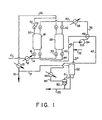
- the adsorption beds 18 and 28 are each packed with 2985 kg (6580 pounds) of 3.17 mm (5"); pellets of Type 3A zeolite, which under the process conditions utilized herein, are capable of dehydrating (1860 kg/hour) (4100 pounds/hour) of 190 proof ethanol (7.58 weight percent water) feedstock to an anhydrous grade ( ⁇ 1000 ppm water, weight basis) ethanol.
- Feedstock 190 proof ethanol is fed into the system at the rate of 45 kg moles per hour (99.4 pound moles per hour) through line 10 and heater 12 where the temperature is raised to 148.9°C (300°F), and thereafter through line 14, valve 16 and thence into bed 18.
- the adsorbent in bed 18 contains a residual water loading of 11.5 weight percent.
- the pressure throughout the system is approximately 3.77 bar (40 psia).
- bed 18 the water of the feedstock is adsorbed and forms a mass transfer front which moves upward therethrough.
- the water loading behind the mass transfer front is about 17 weight percent, and as a consequence a significant heat rise of approximately 100°F occurs resulting in the formation of a heat front which slightly trails the water mass transfer front.
- the adsorption step in bed 18 is continued for about 15 minutes during which period an anhydrous grade ethanol product 37.3 Kg mols/hr (82.2 pound mols/hr) ethanol and 0.09 Kg mol/hr (0.21 pound mol/hr water) is obtained as the bed effluent.
- the ethanol product passes through line 20, valve 22, line 24, line 26, and water cooler 15 wherein it is condensed to the liquid phase at a temperature of 35°C (95°F).
- the major proportion (60%) of the liquid ethanol product is removed from the system through line 19, and the remaining proportion 14.9 Kg moles/hr (32.0 pound mols/hr) ethanol and 0.36 Kg mol/hr (0.08 pound mol/hr) water is diverted through line 17 and utilized in drying the purge regeneration gas stream as described hereinafter.
- the feedstock is diverted to bed 28 through line 14 and valve 30.
- Bed 18 is thereupon regenerated in the same manner as bed 28 was during the previous 15-minute period.
- the bed was in the same condition as bed 18 is at this point.
- the regeneration is accomplished using nitrogen as a purge gas introduced into the system through line 32.
- Line 32 also serves as the means to introduce make-up purge gas into the operating system as required.
- the purge gas is forced at a rate of 298 Kg mols/hr (658 pound mols/hr), and at a pressure of 40 psia by blower 34 through heat exchanger 46, line 36, heater 38 where its temperature is raised to 148.9°C (300°F), line 40, valve 42 into bed 28 in a flow direction counter- current to the direction of flow of the feedstock stream thereinto.
- the initial action of the nitrogen purge gas stream is to flush the void space of the bed and thereafter to partially desorb the water from the zeolite adsorbent.
- Purge gas and desorbed water leave the bed 28 through valve 43, line 44, line 45, heat exchanger 46, line 47 and are passed through cooler 48 wherein the temperature is lowered to 35°C (95°F) and then passed through line 49 to knock-out pot 50 wherein 11.6 pound mols/hr ethanol and 8.07 pound mols/hr water are condensed and recovered through line 53 as a recycle feed in combination with the effluent from absorber 52, infra.
- This recycle feed comprises 14.9 kg mols/hr (32.9 pound mols/hr) ethanol and 7.74 kg mols/hr (17.07 pound mols/hr) water.
- the effluent gas phase from knock-out pot 50 comprises 298 kg mols/hr (658 pound mols/hr) nitrogen, 12.1 kg mols/hr (26.6 pound mols/hr) ethanol and 4.83 kg mols/hr (10.66 pound mols/hr) water and is passed through line 51 to the bottom of absorber 52.
- the preferred type of absorber, and the one employed herein, is a trayed column, but other equipment such as spray columns, wetted wall columns, thin-film contractors and packed towers are satisfactory for specific applications.
- the 40 percent portion of dried ethanol product which was diverted through line 17 is at a temperature of about 35°C (95°F) and is passed to the top of absorber 52.
- the flow rate of the liquid ethanol downward through the absorber is 1.25 times the minimum amount required to dry the purge gas passing upward through the absorber in contact with the dry ethanol to the desired level.
- the spent liquid leaves the column bottom enriched in water.
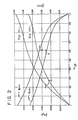
- the trayed absorber column, 52 was designed using the vapor/liquid equilibrium data of Fig. 2 of the drawings. The vapor and liquid leaving each theoretical tray are taken to be in equilibrium. The absorber is assumed to be isothermal.
- the liquid ethanol flow rate is 1.25 times the minimum required to accomplish the separation.
- the column then, requires 6 and a partial theoretical stages.
- the tower would have a 0.91 m (3-foot) ID with 38.1 cm (15-inch) minimum tray spacing.
- the resulting tray-by-tray compositions are set forth in Table 1 below.
- the feedstock to the process is the product of a separation process such as distillation where major water removal is accomplished to achieve near azeotropic composition
- the liquids from the knock-out vessel 50 and the absorber 52 can be combined and recycled to the appropriate point for water rejection.
- the combined stream can be pumped to the "beer” well or introduced as liquid onto the "beer” still tray which most nearly approximates the water concentration.
- the knock-out pot liquid, or the overflow of liquid from the absorber bottom tray, whichever is richer in water may be the means of rejecting water from the system.
- the stream which is leaner in water is recycled to adsorber 18 for further water removal.
- the dried regeneration gas flowing from the top of absorber 52 comprises 298 kg mols/hr (658 pound mols/hr) nitrogen, 17.3 kg mols/ hr (38.2 pound mols/hr) ethanol and 0.79 kg mols/hr (1.74 pound mols/hr) water and is passed through line 54 to blower 34, thus completing the cycle.
- the blower can be used at any point in the closed-loop recycle.
- the preferred placement is as shown, so that the heat of compression can reduce the amount of heat added to achieve the adsorber 28 influent temperature.) Because the purge gas is much drier (about one order of magnitude) as a result of the treatment in absorber 52 than would be the case if it were treated in knock-out 50, it produces a substantially lower residual water loading on the molecular sieve when the gas regenerates adsorber 28.
- the present process provides another significant advantage over prior known processes. It is to be noted that after the regeneration step is complete in adsorber 28, there remains isolated in the head space, inter-particle voids and macropore voids of the bed a considerable amount of nitrogen. For beds of the size employed in the foregoing example, this amount of nitrogen would be conservatively, about 2.8 m 3 (100 cu ft). Since one bed is regenerated every 15 minutes, at least 11.3 m 3 (400 cu ft/hr) of nitrogen would be lost if it were merely flushed from the bed during the next adsorption-separation stroke. If, moreover, this nitrogen stream is vented to the atmosphere, it could create an air pollution problem because of its ethanol content. There is also the disadvantage of losing the valuable ethanol.
- the non-condensible purge gas which is forced from the adsorption bed in admixture with product ethanol during the adsorption stroke can readily be diverted from the product ethanol stream along with that portion of product ethanol which is used to dry the regeneration gas stream in absorber 52 and be recycled along with the bulk of the regeneration gas as hereinabove described.
- the ethanol-water mixture which is in the bed void space behind the water mass transfer zone at the end of an adsorption step, can also be recovered.
- the first portion of nitrogen entering the bed through valve 42 serves to purge the ethanol and water out through valve 30 and line 14, and can then be directed through valve 16 along with feedstock entering the system through line 10.
- the effluent nitrogen purge steam is then directed through valve 43 and the recycle purge begun as described hereinabove.
Landscapes
- Chemical & Material Sciences (AREA)
- Organic Chemistry (AREA)
- Chemical Kinetics & Catalysis (AREA)
- Analytical Chemistry (AREA)
- General Chemical & Material Sciences (AREA)
- Oil, Petroleum & Natural Gas (AREA)
- Engineering & Computer Science (AREA)
- Separation Of Gases By Adsorption (AREA)
- Drying Of Gases (AREA)
- Steroid Compounds (AREA)
- Treatment Of Liquids With Adsorbents In General (AREA)
- Organic Low-Molecular-Weight Compounds And Preparation Thereof (AREA)
- Filtration Of Liquid (AREA)
Priority Applications (1)
| Application Number | Priority Date | Filing Date | Title |
|---|---|---|---|
| AT84113673T ATE40798T1 (de) | 1983-11-16 | 1984-11-13 | Adsorptionstrennungszyklus. |
Applications Claiming Priority (2)
| Application Number | Priority Date | Filing Date | Title |
|---|---|---|---|
| US06/552,337 US4487614A (en) | 1983-11-16 | 1983-11-16 | Adsorption separation cycle |
| US552337 | 1983-11-16 |
Publications (3)
| Publication Number | Publication Date |
|---|---|
| EP0142157A2 EP0142157A2 (en) | 1985-05-22 |
| EP0142157A3 EP0142157A3 (en) | 1986-12-30 |
| EP0142157B1 true EP0142157B1 (en) | 1989-02-15 |
Family
ID=24204916
Family Applications (1)
| Application Number | Title | Priority Date | Filing Date |
|---|---|---|---|
| EP84113673A Expired EP0142157B1 (en) | 1983-11-16 | 1984-11-13 | Improved adsorption separation cycle |
Country Status (8)
| Country | Link |
|---|---|
| US (1) | US4487614A (enExample) |
| EP (1) | EP0142157B1 (enExample) |
| JP (1) | JPS60118206A (enExample) |
| AT (1) | ATE40798T1 (enExample) |
| BR (1) | BR8405811A (enExample) |
| CA (1) | CA1239596A (enExample) |
| DE (1) | DE3476739D1 (enExample) |
| PH (1) | PH20968A (enExample) |
Families Citing this family (31)
| Publication number | Priority date | Publication date | Assignee | Title |
|---|---|---|---|---|
| US4726818A (en) * | 1984-12-20 | 1988-02-23 | Union Carbide Corporation | Bulk removal of water from organic liquids |
| US4689054A (en) * | 1986-01-07 | 1987-08-25 | Vara International, Inc. | Process for the removal an disposal of airborne contaminants from paint booths and the like |
| GB8601081D0 (en) * | 1986-01-17 | 1986-02-19 | Distillers Co Carbon Dioxide | Removing water from ethanol |
| DE3842299A1 (de) * | 1988-12-16 | 1990-06-21 | Kali Chemie Ag | Verfahren zur trennung von alkohol/wasser-gemischen |
| US4902310A (en) * | 1989-05-16 | 1990-02-20 | Vara International, Inc. | Process for removing halogenated hydrocarbons from solvent streams |
| US4919692A (en) * | 1988-12-19 | 1990-04-24 | Vara International, Inc. | Process for removing solvents and other contaminants from an inlet solvent laden air path |
| US4963168A (en) * | 1989-07-21 | 1990-10-16 | Allied-Signal Inc. | Apparatus for recovering solvent from solvent laden process air streams |
| US4971606A (en) * | 1989-11-06 | 1990-11-20 | Air Products And Chemicals, Inc. | Closed-loop thermal regeneration of adsorbents containing reactive adsorbates |
| US5147419A (en) * | 1990-07-19 | 1992-09-15 | Schoofs Gregory R | Apparatus and method for air drying with reduced oxygen enrichment |
| US5271762A (en) * | 1992-09-29 | 1993-12-21 | Schoofs Gregory R | Apparatus and method for air drying with reduced oxygen enrichment |
| US5281258A (en) * | 1992-12-21 | 1994-01-25 | Uop | Removal of mercury impurity from natural gas |
| US5281259A (en) * | 1992-12-21 | 1994-01-25 | Uop | Removal and recovery of mercury from fluid streams |
| US5256173A (en) * | 1993-03-19 | 1993-10-26 | Uop | Process for removing light alcohols from gas streams |
| US5614000A (en) * | 1995-10-04 | 1997-03-25 | Air Products And Chemicals, Inc. | Purification of gases using solid adsorbents |
| US7507273B1 (en) * | 2005-06-20 | 2009-03-24 | 6Solutions, Llc | Chromatographic rectification of ethanol |
| CN100341830C (zh) * | 2005-09-02 | 2007-10-10 | 钟娅玲 | 一种多吸附塔错步内循环生产无水乙醇方法 |
| BRPI0816673A8 (pt) * | 2007-09-11 | 2016-01-19 | Tetravitae Bioscience Inc | Processo para produção de solventes utilizando adsorção em fase líquida. |
| US8734570B2 (en) * | 2010-10-13 | 2014-05-27 | Wintek Corporation | Pressure and vacuum swing adsorption separation processes |
| US8680344B2 (en) | 2011-01-25 | 2014-03-25 | Zeochem Llc | Molecular sieve adsorbent blends and uses thereof |
| CN104470877B (zh) * | 2012-07-26 | 2016-10-26 | 巴杰许可有限责任公司 | 芳族化合物的烷基化方法 |
| CN105392545B (zh) | 2012-12-28 | 2017-11-17 | 科莱恩国际有限公司 | 用于获得香料的方法 |
| FR3011915B1 (fr) * | 2013-10-10 | 2018-10-12 | L'air Liquide, Societe Anonyme Pour L'etude Et L'exploitation Des Procedes Georges Claude | Procede et appareil de separation d'air par distillation cryogenique pour la production d'azote gazeux |
| US20160003532A1 (en) * | 2014-07-03 | 2016-01-07 | Pioneer Energy Inc | Systems and methods for recovering carbon dioxide from industrially relevant waste streams, especially ethanol fermentation processes, for application in food and beverage production |
| EP3197859B1 (de) | 2014-09-24 | 2019-02-06 | Basf Se | Verfahren zur herstellung von terephthalsäurediestern mit rückalkohol-entwässerung |
| EP3197858B1 (de) | 2014-09-24 | 2019-02-06 | Basf Se | Verfahren zur herstellung von terephthalsäurediestern mit umwälzung des reaktionsgemisches |
| RU2665579C1 (ru) | 2014-09-24 | 2018-08-31 | Басф Се | Способ получения сложных диэфиров терефталевой кислоты с обогащением возвратным спиртом |
| CA2962105A1 (en) | 2014-09-24 | 2016-03-31 | Basf Se | Method for producing diesters of terephthalic acid |
| CA3033644C (en) * | 2016-08-31 | 2019-11-05 | Exxonmobil Upstream Research Company | Process to decouple regeneration gas compressor from regeneration gas treating |
| CN107267188A (zh) * | 2017-05-11 | 2017-10-20 | 蚌埠市荣强压缩机制造有限公司 | 一种加油站油气回收装置 |
| WO2019197175A1 (de) | 2018-04-09 | 2019-10-17 | Basf Se | Verfahren zur herstellung eines gemisches von mono- und dibenzoaten |
| CN112843766B (zh) * | 2020-12-29 | 2022-06-14 | 复榆(张家港)新材料科技有限公司 | 变压吸附分离溶剂水二元共沸物的吸附分离工艺 |
Family Cites Families (11)
| Publication number | Priority date | Publication date | Assignee | Title |
|---|---|---|---|---|
| US2137605A (en) * | 1937-03-24 | 1938-11-22 | Aluminum Co Of America | Method of drying alcohol |
| US3343916A (en) * | 1965-02-19 | 1967-09-26 | Exxon Research Engineering Co | Cyclic gas separation process and system |
| US4066423A (en) * | 1976-09-27 | 1978-01-03 | Ht Management Company | Adsorption-absorption vapor recovery system |
| US4331456A (en) * | 1979-06-08 | 1982-05-25 | John Zink Company | Process for recovering hydrocarbons with air-hydrocarbon vapor mixtures |
| US4273621A (en) * | 1980-05-05 | 1981-06-16 | The Lummus Company | Process for dehydrating ethanol and for the production of gasohol therefrom |
| IT1062296B (it) * | 1980-08-08 | 1984-06-26 | Massimo Sacchetti | Processo e apparecchiatura per eliminare e recuperare sostanze organiche volatili dai gas di scarico industriali |
| US4276058A (en) * | 1980-08-26 | 1981-06-30 | John Zink Company | Process and apparatus for recovering hydrocarbons from air-hydrocarbon vapor mixtures |
| BR8103970A (pt) * | 1980-10-20 | 1982-08-24 | Ad Ind Inc | Processo para remocao de vapor de agua de etanol gasoso |
| AU546133B2 (en) * | 1980-11-07 | 1985-08-15 | Lohamnn G.m.b.H. + Co. Kg | Recovery of solvents |
| US4351732A (en) * | 1980-12-12 | 1982-09-28 | The C. M. Kemp Manufacturing Co. | Dehydration of ethanol |
| US4373935A (en) * | 1981-05-01 | 1983-02-15 | Union Carbide Corporation | Adsorption separation cycle |
-
1983
- 1983-11-16 US US06/552,337 patent/US4487614A/en not_active Expired - Fee Related
-
1984
- 1984-11-09 CA CA000467468A patent/CA1239596A/en not_active Expired
- 1984-11-13 BR BR8405811A patent/BR8405811A/pt not_active IP Right Cessation
- 1984-11-13 DE DE8484113673T patent/DE3476739D1/de not_active Expired
- 1984-11-13 EP EP84113673A patent/EP0142157B1/en not_active Expired
- 1984-11-13 AT AT84113673T patent/ATE40798T1/de active
- 1984-11-15 PH PH31448A patent/PH20968A/en unknown
- 1984-11-15 JP JP59239610A patent/JPS60118206A/ja active Granted
Also Published As
| Publication number | Publication date |
|---|---|
| CA1239596A (en) | 1988-07-26 |
| BR8405811A (pt) | 1985-09-17 |
| ATE40798T1 (de) | 1989-03-15 |
| JPH0357803B2 (enExample) | 1991-09-03 |
| PH20968A (en) | 1987-06-10 |
| EP0142157A2 (en) | 1985-05-22 |
| DE3476739D1 (en) | 1989-03-23 |
| US4487614A (en) | 1984-12-11 |
| JPS60118206A (ja) | 1985-06-25 |
| EP0142157A3 (en) | 1986-12-30 |
Similar Documents
| Publication | Publication Date | Title |
|---|---|---|
| EP0142157B1 (en) | Improved adsorption separation cycle | |
| US4373935A (en) | Adsorption separation cycle | |
| EP0205582B1 (en) | Bulk removal of water from organic liquids | |
| EP0862936B9 (en) | The use of zeolites and alumina in adsorption processes | |
| EP0128580B1 (en) | Process for drying gas streams | |
| US3211644A (en) | Liquid phase sulfur removal from hydrocarbons with zeolite | |
| Weitkamp et al. | Removal of thiophene impurities from benzene by selective adsorption in zeolite ZSM-5 | |
| CA1178539A (en) | Liquid adsorption process and apparatus | |
| US3078637A (en) | Process for the removal of carbon dioxide from ethylene | |
| US3208157A (en) | Regeneration of adsorbents | |
| US3266219A (en) | Removal of acid constituents from gas mixtures | |
| US3375639A (en) | Extraction of acidic constituents from gas mixtures with gammabutyrolactone | |
| US4359592A (en) | Multi-stage, adsorption process for separating organic liquids from water | |
| WO1999004883A9 (en) | Method for ammonia production | |
| EP1430262B1 (en) | A process and apparatus for purifying hydrogen bromide | |
| US3242644A (en) | Process for removing acid constituents from gaseous mixtures | |
| US3242646A (en) | Process for removing acid constituents from gaseous mixtures | |
| Tihmillioglu et al. | Use of clinoptilolite in ethanol dehydration | |
| US2656010A (en) | Removal of nitrogen from natural gas | |
| CA1195258A (en) | Vapor phase adsorption process for concentration of ethanol from dilute aqueous mixtures thereof | |
| US2974179A (en) | Separation of straight chain hydrocarbons with zeolitic molecular sieves and h2s desorbent | |
| CA1197476A (en) | Gas separation process | |
| US4056471A (en) | Adsorption arrangement | |
| US3335547A (en) | Process for the purification of ethylene oxide | |
| US3067271A (en) | Olefin recovery process |
Legal Events
| Date | Code | Title | Description |
|---|---|---|---|
| PUAI | Public reference made under article 153(3) epc to a published international application that has entered the european phase |
Free format text: ORIGINAL CODE: 0009012 |
|
| AK | Designated contracting states |
Designated state(s): AT BE CH DE FR GB IT LI LU NL SE |
|
| PUAL | Search report despatched |
Free format text: ORIGINAL CODE: 0009013 |
|
| AK | Designated contracting states |
Kind code of ref document: A3 Designated state(s): AT BE CH DE FR GB IT LI LU NL SE |
|
| 17P | Request for examination filed |
Effective date: 19870202 |
|
| 17Q | First examination report despatched |
Effective date: 19880204 |
|
| GRAA | (expected) grant |
Free format text: ORIGINAL CODE: 0009210 |
|
| AK | Designated contracting states |
Kind code of ref document: B1 Designated state(s): AT BE CH DE FR GB IT LI LU NL SE |
|
| REF | Corresponds to: |
Ref document number: 40798 Country of ref document: AT Date of ref document: 19890315 Kind code of ref document: T |
|
| ITF | It: translation for a ep patent filed | ||
| REF | Corresponds to: |
Ref document number: 3476739 Country of ref document: DE Date of ref document: 19890323 |
|
| ET | Fr: translation filed | ||
| PG25 | Lapsed in a contracting state [announced via postgrant information from national office to epo] |
Ref country code: LU Free format text: LAPSE BECAUSE OF NON-PAYMENT OF DUE FEES Effective date: 19891130 |
|
| PLBE | No opposition filed within time limit |
Free format text: ORIGINAL CODE: 0009261 |
|
| STAA | Information on the status of an ep patent application or granted ep patent |
Free format text: STATUS: NO OPPOSITION FILED WITHIN TIME LIMIT |
|
| 26N | No opposition filed | ||
| PGFP | Annual fee paid to national office [announced via postgrant information from national office to epo] |
Ref country code: LU Payment date: 19901130 Year of fee payment: 7 |
|
| EPTA | Lu: last paid annual fee | ||
| PGFP | Annual fee paid to national office [announced via postgrant information from national office to epo] |
Ref country code: SE Payment date: 19911030 Year of fee payment: 8 |
|
| PGFP | Annual fee paid to national office [announced via postgrant information from national office to epo] |
Ref country code: GB Payment date: 19911101 Year of fee payment: 8 |
|
| PGFP | Annual fee paid to national office [announced via postgrant information from national office to epo] |
Ref country code: FR Payment date: 19911107 Year of fee payment: 8 |
|
| PGFP | Annual fee paid to national office [announced via postgrant information from national office to epo] |
Ref country code: AT Payment date: 19911112 Year of fee payment: 8 |
|
| PGFP | Annual fee paid to national office [announced via postgrant information from national office to epo] |
Ref country code: CH Payment date: 19911121 Year of fee payment: 8 |
|
| PGFP | Annual fee paid to national office [announced via postgrant information from national office to epo] |
Ref country code: DE Payment date: 19911129 Year of fee payment: 8 |
|
| ITTA | It: last paid annual fee | ||
| PGFP | Annual fee paid to national office [announced via postgrant information from national office to epo] |
Ref country code: NL Payment date: 19911130 Year of fee payment: 8 |
|
| PGFP | Annual fee paid to national office [announced via postgrant information from national office to epo] |
Ref country code: BE Payment date: 19920107 Year of fee payment: 8 |
|
| PG25 | Lapsed in a contracting state [announced via postgrant information from national office to epo] |
Ref country code: GB Effective date: 19921113 Ref country code: AT Effective date: 19921113 |
|
| PG25 | Lapsed in a contracting state [announced via postgrant information from national office to epo] |
Ref country code: SE Effective date: 19921114 |
|
| PG25 | Lapsed in a contracting state [announced via postgrant information from national office to epo] |
Ref country code: LI Effective date: 19921130 Ref country code: CH Effective date: 19921130 Ref country code: BE Effective date: 19921130 |
|
| BERE | Be: lapsed |
Owner name: UNION CARBIDE CORP. Effective date: 19921130 |
|
| PG25 | Lapsed in a contracting state [announced via postgrant information from national office to epo] |
Ref country code: NL Effective date: 19930601 |
|
| GBPC | Gb: european patent ceased through non-payment of renewal fee |
Effective date: 19921113 |
|
| NLV4 | Nl: lapsed or anulled due to non-payment of the annual fee | ||
| PG25 | Lapsed in a contracting state [announced via postgrant information from national office to epo] |
Ref country code: FR Effective date: 19930730 |
|
| REG | Reference to a national code |
Ref country code: CH Ref legal event code: PL |
|
| PG25 | Lapsed in a contracting state [announced via postgrant information from national office to epo] |
Ref country code: DE Effective date: 19930803 |
|
| REG | Reference to a national code |
Ref country code: FR Ref legal event code: ST |
|
| EUG | Se: european patent has lapsed |
Ref document number: 84113673.2 Effective date: 19930610 |