EP0138504B1 - Steroid derivatives - Google Patents
Steroid derivatives Download PDFInfo
- Publication number
- EP0138504B1 EP0138504B1 EP84306715A EP84306715A EP0138504B1 EP 0138504 B1 EP0138504 B1 EP 0138504B1 EP 84306715 A EP84306715 A EP 84306715A EP 84306715 A EP84306715 A EP 84306715A EP 0138504 B1 EP0138504 B1 EP 0138504B1
- Authority
- EP
- European Patent Office
- Prior art keywords
- sup
- formula
- hydrogen
- carbon atoms
- mixture
- Prior art date
- Legal status (The legal status is an assumption and is not a legal conclusion. Google has not performed a legal analysis and makes no representation as to the accuracy of the status listed.)
- Expired
Links
- 0 C*1C=CC(N=C=N)=CC=C1 Chemical compound C*1C=CC(N=C=N)=CC=C1 0.000 description 3
Classifications
-
- C—CHEMISTRY; METALLURGY
- C07—ORGANIC CHEMISTRY
- C07J—STEROIDS
- C07J51/00—Normal steroids with unmodified cyclopenta(a)hydrophenanthrene skeleton not provided for in groups C07J1/00 - C07J43/00
-
- A—HUMAN NECESSITIES
- A61—MEDICAL OR VETERINARY SCIENCE; HYGIENE
- A61P—SPECIFIC THERAPEUTIC ACTIVITY OF CHEMICAL COMPOUNDS OR MEDICINAL PREPARATIONS
- A61P5/00—Drugs for disorders of the endocrine system
-
- C—CHEMISTRY; METALLURGY
- C07—ORGANIC CHEMISTRY
- C07C—ACYCLIC OR CARBOCYCLIC COMPOUNDS
- C07C309/00—Sulfonic acids; Halides, esters, or anhydrides thereof
-
- C—CHEMISTRY; METALLURGY
- C07—ORGANIC CHEMISTRY
- C07C—ACYCLIC OR CARBOCYCLIC COMPOUNDS
- C07C53/00—Saturated compounds having only one carboxyl group bound to an acyclic carbon atom or hydrogen
- C07C53/15—Saturated compounds having only one carboxyl group bound to an acyclic carbon atom or hydrogen containing halogen
- C07C53/19—Acids containing three or more carbon atoms
- C07C53/21—Acids containing three or more carbon atoms containing fluorine
-
- C—CHEMISTRY; METALLURGY
- C07—ORGANIC CHEMISTRY
- C07F—ACYCLIC, CARBOCYCLIC OR HETEROCYCLIC COMPOUNDS CONTAINING ELEMENTS OTHER THAN CARBON, HYDROGEN, HALOGEN, OXYGEN, NITROGEN, SULFUR, SELENIUM OR TELLURIUM
- C07F7/00—Compounds containing elements of Groups 4 or 14 of the Periodic Table
- C07F7/02—Silicon compounds
- C07F7/08—Compounds having one or more C—Si linkages
- C07F7/18—Compounds having one or more C—Si linkages as well as one or more C—O—Si linkages
- C07F7/1804—Compounds having Si-O-C linkages
-
- C—CHEMISTRY; METALLURGY
- C07—ORGANIC CHEMISTRY
- C07F—ACYCLIC, CARBOCYCLIC OR HETEROCYCLIC COMPOUNDS CONTAINING ELEMENTS OTHER THAN CARBON, HYDROGEN, HALOGEN, OXYGEN, NITROGEN, SULFUR, SELENIUM OR TELLURIUM
- C07F9/00—Compounds containing elements of Groups 5 or 15 of the Periodic Table
- C07F9/02—Phosphorus compounds
- C07F9/28—Phosphorus compounds with one or more P—C bonds
- C07F9/54—Quaternary phosphonium compounds
- C07F9/5407—Acyclic saturated phosphonium compounds
-
- C—CHEMISTRY; METALLURGY
- C07—ORGANIC CHEMISTRY
- C07J—STEROIDS
- C07J1/00—Normal steroids containing carbon, hydrogen, halogen or oxygen, not substituted in position 17 beta by a carbon atom, e.g. estrane, androstane
- C07J1/0051—Estrane derivatives
- C07J1/0066—Estrane derivatives substituted in position 17 beta not substituted in position 17 alfa
- C07J1/007—Estrane derivatives substituted in position 17 beta not substituted in position 17 alfa the substituent being an OH group free esterified or etherified
-
- C—CHEMISTRY; METALLURGY
- C07—ORGANIC CHEMISTRY
- C07J—STEROIDS
- C07J1/00—Normal steroids containing carbon, hydrogen, halogen or oxygen, not substituted in position 17 beta by a carbon atom, e.g. estrane, androstane
- C07J1/0051—Estrane derivatives
- C07J1/0081—Substituted in position 17 alfa and 17 beta
- C07J1/0088—Substituted in position 17 alfa and 17 beta the substituent in position 17 alfa being an unsaturated hydrocarbon group
- C07J1/0096—Alkynyl derivatives
-
- C—CHEMISTRY; METALLURGY
- C07—ORGANIC CHEMISTRY
- C07J—STEROIDS
- C07J17/00—Normal steroids containing carbon, hydrogen, halogen or oxygen, having an oxygen-containing hetero ring not condensed with the cyclopenta(a)hydrophenanthrene skeleton
-
- C—CHEMISTRY; METALLURGY
- C07—ORGANIC CHEMISTRY
- C07J—STEROIDS
- C07J31/00—Normal steroids containing one or more sulfur atoms not belonging to a hetero ring
- C07J31/006—Normal steroids containing one or more sulfur atoms not belonging to a hetero ring not covered by C07J31/003
-
- C—CHEMISTRY; METALLURGY
- C07—ORGANIC CHEMISTRY
- C07J—STEROIDS
- C07J41/00—Normal steroids containing one or more nitrogen atoms not belonging to a hetero ring
- C07J41/0033—Normal steroids containing one or more nitrogen atoms not belonging to a hetero ring not covered by C07J41/0005
- C07J41/0072—Normal steroids containing one or more nitrogen atoms not belonging to a hetero ring not covered by C07J41/0005 the A ring of the steroid being aromatic
-
- C—CHEMISTRY; METALLURGY
- C07—ORGANIC CHEMISTRY
- C07J—STEROIDS
- C07J41/00—Normal steroids containing one or more nitrogen atoms not belonging to a hetero ring
- C07J41/0033—Normal steroids containing one or more nitrogen atoms not belonging to a hetero ring not covered by C07J41/0005
- C07J41/0094—Normal steroids containing one or more nitrogen atoms not belonging to a hetero ring not covered by C07J41/0005 containing nitrile radicals, including thiocyanide radicals
Definitions
- This invention relates to new steroid derivatives which possess antioestrogenic activity.
- oestradiol derivatives which bear a carboxyalkyl substituent at the 7a-position. These have been used, when bound via the carboxy group to polyacrylamide resin or to agarose, for the purification of oestrogen receptors (Journal of Biological Chemistry, 1978, 253, 8221); and, when conjugated with bovine serum albumin, for the preparation of antigens (United Kingdom Specification No. 1,478,356).
- aromatic ring A may optionally bear one or two halogen or alkyl substituents
- R 3 is hydrogen or alkyl, alkanoyl, alkoxycarbonyl, carboxyalkanoyl or aroyl each of up to 10 carbon atoms;
- R 16 is hydrogen, alkyl of up to 6 carbon atoms which is preferably in the ⁇ -configuration, or hydroxy which is preferably in the a-configuration;
- R 17 in the ⁇ -configuration
- R 27 in the a-configuration
- R 17 is hydroxy or alkanoyloxy, carboxyalkanoyloxy or aroyloxy each of up to 10 carbon atoms
- R 27 in the a-configuration
- R 17 is hydrogen or alkyl, alkenyl or alkynyl each of up to 6 carbon atoms
- R 18 is alkyl of up to 6 carbon atoms
- A is straight- or branched-chain alkylene, alkenylene or alkynylene each of from 3 to 14 carbon atoms, which may have one or more hydrogen atoms replaced by fluorine atoms, or has the formula
- A' and A" are each alkylene or alkenylene, optionally fluorinated, having together a total of 2 to 13 carbon atoms and Y is -0-, -S-, -SO-, -S0 2 -, -CO- or -NR- wherein R is hydrogen or alkyl of up to 3 carbon atoms; or
- a 1 is alkylene or alkenylene, optionally fluorinated
- a 11 is a direct link or alkylene or alkenylene, optionally fluorinated, such that A' and A" together have a total of 1 to 12 carbon atoms
- Y is -NRCO-, -CONR-, -COO-, -OCO- or phenylene wherein R has the meaning stated above;
- R 1 is hydrogen, or alkyl, alkenyl, cycloalkyl, halogenoalkyl, carboxyalkyl, alkoxycarbonylalkyl, aryl or arylalkyl each of up to 10 carbon atoms, or dialkylaminoalkyl wherein each alkyl is of up to 6 carbon atoms, or R' is joined to R 2 as defined below; and
- X is ⁇ CONR 2 ⁇ , -CSNR 2- , ⁇ NR 12 ⁇ CO ⁇ ⁇ NR 12 ⁇ CS ⁇ ⁇ NR 12 ⁇ CONR 2 ⁇ , ⁇ SO 2 NR 2 ⁇ or -CO-; or, when R 1 is not hydrogen, is -0-, ⁇ NR 2 ⁇ , -(NO)R 2- , -(PO)R 2- , ⁇ NR 12 ⁇ COO ⁇ ⁇ NR 12 ⁇ SO 2 ⁇ , ⁇ S ⁇ , -SO- or ⁇ SO 2 ⁇ ;
- R is hydrogen or alkyl of up to 6 carbon atoms, or R 1 and R 2 together form alkylene or halogenoalkylene such that, with the adjacent nitrogen atom, they form a heterocyclic ring of 5 to 7 ring atoms, one of which atoms may be a second heterocyclic atom selected from oxygen, sulphur and nitrogen;
- R 12 is hydrogen or alkyl of up to 6 carbon atoms
- R 22 is hydrogen, cyano or nitro; or a salt thereof when appropriate.
- a suitable value for the halogen or alkyl substituent in ring A is, for example, fluoro, chloro, bromo, iodo, methyl or ethyl.
- a suitable value for R 3 when it is alkyl, alkanoyl, alkoxycarbonyl, carboxyalkanoyl or aroyl is, for example, methyl, ethyl, acetyl, propionyl, butyryl, pivalyl, decanoyl, isopropoxycarbonyl, succinyl or benzoyl.
- R 3 is preferably hydrogen or alkanoyl or alkoxycarbonyl each of up to 5 carbon atoms.
- R 16 when it is alkyl is, for example, methyl or ethyl.
- R 16 is preferably hydrogen.
- a suitable value for R 17 when it is alkanoyloxy, carboxyalkanoyloxy or aroyloxy is, for example, acetoxy, propionyloxy, succinyloxy or benzoyloxy.
- R 17 is preferably hydroxy.
- R 27 when it is alkyl, alkenyl or alkynyl is, for example, ethyl, vinyl or ethynyl.
- R 27 is preferably hydrogen.
- a suitable value for R 18 is methyl or ethyl, especially methyl.
- the group ST- is preferably oestra-1,3,5(10)-triene-3,17(3-diol, 3-hydroxyoestra-1,3,5(10)-trien-17-one or 17a-ethynyloestra-1,3;5(10)-triene-3,17(3-diol, all of which bear the ⁇ A ⁇ X ⁇ R 1 substituent in the 7a-position, or a 3-alkanoyl ester thereof.
- One preferred value for the group -A- is a straight-chain alkylene group of the formula wherein n is an integer of from 3 to 14, especially from 7 to 11, which may have one of the hydrogen atoms replaced by fluorine, for example to provide the group ⁇ (CH 2 ) 8 CHFCH 2 ⁇ .
- A may also be a branched-chain alkylene group, for example the group -(CH 2 ) 6 CH(CH 3 )-, or a straight-chain alkenylene group, for example of the formula wherein m is an integer from 0 to 10, especially from 3 to 7.
- a second preferred value for the group A is a group of the formula wherein A' is straight-chain alkylene or alkenylene each of 2 to 9 carbon atoms, especially alkylene of 4 to 6 carbon atoms, -Y- is phenylene (ortho, meta- or, especially, para-) and All is a direct link, ethylene or vinylene, especially ethylene.
- a suitable value for R' when it is alkyl, alkenyl or cycloalkyl is, for example, methyl, ethyl, n-propyl, isopropyl, n-butyl, isobutyl, t-butyl, n-pentyl, t-pentyl, 2,2-dimethylpropyl, 1-methylbutyl, 2-methylbutyl, 3-methylbutyl, n-hexyl, 1,1-dimethylbutyl, 1,3-dimethylbutyl, n-heptyl, n-nonyl, n-decyl, allyl, cyclopentyl or cyclohexyl.
- a suitable value for R' when it is aryl or arylalkyl is, for example, phenyl, 2-ethylphenyl, p-fluorophenyl, p-chlorophenyl, m-chlorophenyl, p-cyanophenyl, p-methoxyphenyl, benzyl, a-methylbenzyl, p-chlorobenzyl, p-fluorophenethyl or p-chlorophenethyl.
- a suitable value for R' when it is halogenoalkyl, carboxyalkyl, alkoxycarbonylalkyl or dialkylaminoalkyl is, for example, 2-chloro-2,2-difluoroethyl, 2,2,2-trifluoroethyl, 2,2,3,3,3-pentafluoropropyl, 3-chloropropyl, 2,2-difluorobutyl, 4,4,4-trifluorobutyl, 1H,1H-heptafluorobutyl, 4,4,5,5,5-pentafluoropentyl, 4,4,5,5,6,6,6- heptafluorohexyl, 1H,1H-tridecafluoroheptyl, 5-carboxypentyl, 5-methoxycarbonylpentyl or 3-dimethylaminopropyl.
- a suitable value for the heterocyclic ring -NR'R 2 is, for example, pyrrolidino, piperidino, 4-methylpiperidino, 4-ethylpiperidino, 3-methylpiperidino, 3,3-dimethylpiperidino, 4-chloropiperidino, morpholino or 4-methylpiperazino.
- a suitable value for R 2 or R 12 when it is alkyl is, for example, methyl, ethyl or n-butyl.
- One appropriate salt is an acid-addition salt of a steroid derivative which possesses an amino function, for example a compound.
- Y is ⁇ NR ⁇
- X is -NR 2- or R' is dialkylaminoalkyl.
- a suitable acid-addition salt is, for example, a hydrochloride, hydrobromide, acetate, citrate, oxalate or tartrate.
- Another appropriate salt is a base-addition salt of a steroid derivative which possesses a carboxy function, for example a compound wherein R' is carboxyalkyl.
- a suitable base-addition salt is, for example, a sodium, potassium, ammonium or cyclohexylamine salt.
- a preferred steroid derivative of the invention has the formula:- wherein R 17 is hydroxy and R 27 is hydrogen or ethynyl, or R 17 and R 17 together form oxo; wherein -A- is -(CH 2 ) n , wherein n is an integer from 3 to 14, especially from 7 to 11, or ⁇ A ⁇ is
- m is an integer from 2 to 9, especially from 4 to 6, and p is 0 to 2, especially 0 or 2;
- R' is alkyl, fluoroalkyl or cycloalkyl each of up to 10 carbon atoms, or phenyl, chlorophenyl or benzyl, or is linked to R 2 as stated below;
- X is ⁇ CONR 2 ⁇ , ⁇ NR 12 CO ⁇ , ⁇ S ⁇ , ⁇ SO ⁇ or ⁇ SO 2 ⁇ , wherein R 2 is hydrogen or alkyl of up to 3 carbon atoms or together with R 1 forms alkylene of 5 or 6 carbon atoms, and wherein R 12 is hydrogen or alkyl of up to 3 carbon atoms.
- a particularly preferred steroid derivative of the invention has the last-mentioned formula wherein the number of carbon atoms in the two groups A and R' adds up to between 12 and 16, inclusive, especially 14 if neither R 1 nor A contains a phenyl or phenylene group, and 16 if there is a phenylene group in -A- or a phenyl group in R 1 .
- a process for the manufacture of a steroid derivative of the invention wherein X has the formula ⁇ CONR 2 ⁇ , -CSNR 2- or -S0 2 NR 2- comprises the reaction of a compound of the formula ST 1 -A-Z 1 , wherein A has the meaning stated above, wherein ST 1 either has the same meaning as stated above for ST, or is an equivalent 7a-linked steroid nucleus which bears one or more protecting groups for functional derivatives, and wherein Z 1 is an activated group derived from a carboxylic, thiocarboxylic or sulphonic acid, with an amine of the formula HNR 1 R 2 , wherein R 1 and R have the meanings stated above, whereafter any protecting group in ST 1 is removed by conventional means.
- a suitable activated group Z 1 is, for example, a mixed anhydride, for example an anhydride formed by reaction of the acid with a chloroformate such as isobutyl chloroformate.
- a suitable protecting group in ST 1 is, for example, an alkyl or aralkyl ether, for example the methyl or benzyl ether, of the 3-hydroxy function, or a tetrahydropyranyl ether of the 17 ⁇ -hydroxy function.
- a process for the manufacture of a steroid derivative of the invention wherein X has the formula ⁇ CO ⁇ comprises the reaction of an acid of the formula ST'-A-COOH, wherein ST 1 and A have the meanings stated above, with an organometallic compound of the formula R'-M, wherein R 1 has the meaning stated above and M is a metal group, for example the lithium group, whereafter any protecting group in ST 1 is removed by conventional means.
- a process for the manufacture of a steroid derivative of the invention wherein X has the formula -S-, ⁇ O ⁇ , ⁇ NR 2 ⁇ or ⁇ (PO)R 2 ⁇ comprises the reaction of a compound of the formula ST 1 ⁇ A ⁇ Z 2 , wherein ST 1 and A have the meanings stated above and wherein Z 2 is a displaceable group, with a compound of the formula R'SH, R'OH, HNR 1 R 2 or R 1 R 2 P-C 6 H 5 wherein R' and R 2 have the meanings stated above, whereafter any protecting group in ST 1 is removed by conventional means, and whereafter a phosphonium salt is hydrolysed to the phosphinyl compound.
- a suitable value for Z 2 is, for example, a halogen atom or a sulphonyloxy group, for example the methanesulphonyloxy or toluene-p-sulphonyloxy group.
- a process for the manufacture of a steroid derivative of the invention wherein X has the formula ⁇ NR 12 CO ⁇ , ⁇ NR 12 CS ⁇ , ⁇ NR 12 CONR 2 ⁇ , ⁇ NR 12 COO ⁇ or ⁇ NR 12 SO 2 ⁇ comprises the reaction of a compound of the formula ST 1 ⁇ A ⁇ NHR 12 , wherein ST 1 , A and R 12 have the meanings stated above, with an acylating agent derived from an acid of the formula R'COOH, R'CSOH, R 1 OCOOH or R 1 SO 2 OH; or, for the manufacture of a urea, with an isocyanate of the formula R'NCO; or, for the manufacture of a guanidine, with a cyanamide of the formula R'NR 2- CN, whereafter any protecting group in ST 1 is removed by conventional means.
- a suitable acylating agent is, for example, an acyl chloride or acyl anhydride.
- the starting materials for use in all the abovementioned processes may be obtained by reacting a steroid derivative of the formula wherein R 16 and R 18 have the meanings stated above and wherein R 37 is an acyl group, for example the acetyl group, with a compound of the formula wherein A 2 either has the same meaning as stated above for A, or wherein ⁇ A 2 ⁇ CH 2 ⁇ has th
- the starting material for the fourth process of the invention described above may be obtained by using the third process of the invention described above except that an amine of the formula R 12 NH 2 is used in place of an amine of the formula HNR 1 R 2 .
- the intermediate of the formula ST 1 ⁇ A 2 ⁇ CH 2 OH may be oxidised to an aldehyde of the formula ST'-A 2- CHO which may then be used, by reaction with an appropriately-substituted hydrocarbyl- triphenylphosphonium salt or hydrocarbyltriethylphosphonate, to prepare a starting material wherein -A- is alkenylene.
- the reaction may be carried out in solution in dimethyl sulphoxide in the presence of dimsyl sodium.
- the steroidal aldehyde starting material when -A 3- is ⁇ A 2 ⁇ as defined above may be obtained by oxidation of the corresponding alcohol as described above.
- the steroidal aldehyde starting material wherein -A 3- is a direct link may be obtained from the 3-keto- ⁇ 4,6 -inital steroidal starting material described above by reaction with cyanide to give the 3-keto- ⁇ 4 -7 ⁇ -cyano compound, aromatisation, suitable protection and then reduction of the cyano group to the formyl group.
- the phosphonium starting material may be obtained by reaction of triphenylphosphine with a bromide of the formula
- a steroid derivative of the invention wherein ST is a 17 ⁇ -hydroxy-steroid derivative may be converted by conventional reactions into the corresponding 17-keto steroid derivative, and thence to the corresponding 17 ⁇ -hydroxy-17 ⁇ -hydrocarbyl steroid derivative (that is, a steroid derivative of the invention wherein R 27 is alkyl, alkenyl or alkynyl).
- a steroid derivative of the invention wherein R 3 and/or R 17 are other than hydrogen may be obtained from the corresponding compounds wherein R 3 and/or R 17 are hydrogen by conventional etherification or esterification processes, and these may also be used in reverse to prepare the corresponding hydroxy compounds.
- a steroid derivative of the invention wherein A is alkenylene may be hydrogenated to provide the corresponding compound wherein A is alkylene.
- a steroid derivative of the invention wherein -X- is ⁇ CH 2 NR 2 ⁇ or ⁇ NR 2 CH 2 ⁇ may be obtained by the reduction, for example with borane, of the corresponding compound wherein -X- is -CONR 2 or -NR 2 CO-.
- a steroid derivative of the invention wherein -X- is -CSNH- or -NHCS- may be obtained by the reaction of the corresponding compound wherein X is -CONH- or -NHCO- with 2,4-bis-(4-methoxyphenyl)-1,3-dithia-2,4-diphosphetane-2,4-disulphide.
- a steroid derivative of the invention wherein X is ⁇ (NO)R 2 , ⁇ SO ⁇ or ⁇ SO 2 ⁇ may be obtained by the oxidation of the corresponding compound wherein X is -NRZ- or -S-.
- the conditions for the oxidation will be chosen to provide the desired product; for example aqueous sodium metaperiodate will oxidise the sulphur group to sulphinyl, and m-chloroperbenzoic acid in chloroform solution will oxidise the sulphur group to sulphonyl or the amine to its oxide.
- a steroid derivative of the invention possesses antioestrogenic activity. This may be demonstrated by its effect in antagonising the increase in weight of the uterus of an immature female rat produced by administering oestradiol benzoate to said rat.
- a steroid derivative of the invention and oestradiol benzoate are co-administered for 3 days to such a rat, a smaller increase in uterine weight is produced than the substantial increase which would be produced by the administration of oestradiol benzoate without the steroid derivative of the invention.
- a preferred steroid derivative of the invention produces an antioestrogenic effect at a dose which produces no partial agonist effect, unlike the known antioestrogens tamoxifen and clomiphene.
- a preferred steroid is coadministered with oestradiol benzoate to a rat as described above, no increase in uterine weight whatsoever is observed at a suitable dose.
- a compound with the above pharmacological properties is of value in the treatment of the same conditions in which tamoxifen is beneficial, in particular, in the treatment of anovulatory infertility and in the treatment of breast tumours. It is also of value in the treatment of menstrual disorders.
- a typical daily dose is from 0.1 to 25 mg/kg administered orally or by injection, In man this is equivalent to an oral dose of from 5 to 1250 mg/day.
- a steroid derivative of the invention is most conveniently administered to man in the form of a pharmaceutical composition.
- a pharmaceutical composition comprising a steroid derivative of the invention together with a pharmaceutically acceptable diluent or carrier.
- the composition may be in a form suitable for oral or parenteral administration.
- a tablet or capsule is a particularly convenient form for oral administration and such a composition may be made by conventional methods and contain conventional excipients.
- a table could contain diluents, for example mannitol or maize starch, disintegrating agents, for example alginic acid, binding agents, for example methyl-cellulose, and lubricating agents, for example magnesium stearate.
- composition may contain, in addition to the steroid derivative of the invention, one or more antiandrogenic agents or antiprogestational agents.
- a composition for oral administration may conveniently contain from 5 to 500 mg of a steroid derivative of the invention.
- N-Methylmorpholine (0.24 ml) and isobutyl chloroformate (0.288 ml) were successively added to a stirred solution of 11-(1713-acetoxy-3-benzoyloxyoestra-1,3,5(10)-trien-7a-yl)undecanoic acid (1.0 g) in methylene chloride (17 ml) which was cooled to -10°C, and after 30 minutes n-butylamine (0.29 ml) was added and the mixture was stirred at laboratory temperature for 15 minutes. Saturated aqueous sodium bicarbonate solution (20 ml) was added and the mixture was extracted four times with methylene chloride (50 ml each time).
- Aqueous N-sodium hydroxide solution (8 ml) was added to a stirred solution of the above amide (1.06 g) in a mixture of methanol (16 ml) and tetrahydrofuran (8 ml) and the mixture was stirred at laboratory temperature for 18 hours, neutralised with aqueous N-hydrochloric acid and the organic solvents were removed by evaporation. Water (40 ml) was added and the mixture was extracted four times with methylene chloride (60 ml each time).
- Cuprous iodide (19.05 g, dried at 100°C immediately before use) was added, the mixture was vigorously stirred for 10 minutes and a solution of 6-dehyro-19-nortestosterone acetate (15.48 g) in tetrahydrofuran (50 ml) was added. The mixture was stirred for 40 minutes, acetic acid (12 ml) was added and the mixture was evaporated to dryness. Water (150 ml) was added to the residue, and the mixture was extracted four times with diethyl ether (300 ml each time).
- Aqueous N-sodium hydroxide solution (8 ml) was added to a stirred solution of the 17p-acetoxy-7a-(11-acetoxyundecyl)oestra-1,3,5(10)-trien-3-ol thus obtained (2.8 g) in methanol (54 ml) and the mixture was stirred at laboratory temperature for 70 minutes, neutralised with aqueous N-hydrochloric acid and the methanol was removed by evaporation. The residue was extracted four times with ethyl acetate (60 ml each time) and the combined extracts were washed with water (20 ml), dried and evaporated to dryness. The residue was purified by chromatography on a silica gel column using a 7:3 v/v mixture of toluene and ethyl acetate as eluant.
- Aqueous N-sodium hydroxide solution (6 ml) and benzoyl chloride (0.93 ml) were added to a stirred solution of the 17 ⁇ -acetoxy-7 ⁇ -(11-hydroxy-undecyl)oestra-1,3,5(10)-trien-3-ol thus obtained (1.94 g) in acetone (20 ml) which was cooled to 0°C, and the mixture was stirred for 20 minutes and then poured into a mixture of ice-water (200 ml) and saturated aqueous sodium bicarbonate solution (50 ml).
- the mixture was extracted four times with diethyl ether (120 ml each time) and the combined extracts were washed twice with saturated aqueous sodium bicarbonate solution (15 ml each time) and then with water (20 ml), dried and evaporated to dryness.
- the residue was purified by chromatography on a silica gel column using a 7:3 v/v mixture of toluene and ethyl acetate as eluant.
- Example 2 The process described in Example 1 was repeated using the appropriate amine in place of n-butylamine. There were thus obtained the compounds described in the following table, all of which were oils the structures of which were confirmed by proton magnetic resonance and mass spectroscopy:-
- Example 2 The process described in Example 1 was repeated except that the appropriate (17 ⁇ -acetoxy-3-hydroxyoestra-1,3,5-(10)trien-7a-yl)alkenoic acid and the appropriate amine were used as starting materials. There were thus obtained the compounds described in the following table, all of which were oils the structures of which were confirmed by proton magnetic resonance and mass spectroscopy:-
- the initial compounds obtained are (1713-acetoxy-3-isobutyloxycarbonyloestra-1,3,5(10)-trien-7a-yl)alkenamides, the hydroxy group at the 3-position being converted into the carbonate during the first stage of the amide-forming reaction by the isobutyl chloroformate.
- the alkenoic acids used as starting materials were prepared by a process exemplified by the following preparation of 8-(17(3-acetoxy-3-hydroxy-oestra-1,3,5(10)-trien-7a-yl)octa-5-enoic acid:-The process described in the first paragraph of Example 1 relating to the preparation of starting materials was repeated except that dimethyl-t-butylsilyl chloride was reacted with 3-bromopropanol instead of 11-bromoundecanol. The Grignard reagent from this was reacted with 6-dehydro-19- nortestosterone, and the sequence of reactions described in the succeeding five paragraphs of Example 1 was repeated. There was thus obtained 17 ⁇ -acetoxy-3-benzoyloxy-7a-(3-hydroxypropyl)oestra-1,3,5(10)-triene.
- Finely powdered (4-carboxybutyl)triphenylphosphonium bromide (1.4 g) was degassed by heating in vacuo at 100°C for 1 hour and was then dissolved in dimethyl-sulphoxide (5 ml) under an atmosphere of a nitrogen.
- a 2-molar solution of methanesulphinylmethyl sodium in dimethyl sulphoxide (3.8 ml) was added dropwise, and a solution of the above aldehyde (0.25 g) in toluene (2 ml) was then added. The mixture was stirred for 1 hour and then evaporated to dryness under reduced pressure at a temperature not exceeding 40°C.
- deca-7-enoic, trideca-10-enoic and pentadeca-12-enoic acids were obtained by using (6-carboxyhexyl)-, (9-carboxynonyl)- or (11-carboxyundecyl)triphenylphosphonium bromide in place of (4-carboxybutyl)triphenylphosphonium bromide.
- Example 1 The process described in Example 1 was repeated except that either 3,17 ⁇ -dihydroxyoestra-1,3,5(101- trien-7a-yl)pent-2-enoic acid or 3,17(3-dihydroxyoestra-1,3,5(10)-trien-7a-yl)pentanoic acid, and the appropriate amine, were used as starting materials. There were thus obtained as oils the compounds described in the following tables, the structures of which were confirmed by proton magnetic resonance and mass spectroscopy.
- amidoalkylamines used as starting materials for the compounds described in Table 2 were obtained as follows:-
- Triethylamine (3.7 ml) and ethyl chloroformate (2.5 ml) were successively added to a stirred solution of the 4-(N-benzyloxycarbonyl-N-methylamino)butyric acid thus obtained (6.0 g) in ethyl acetate (100 ml) which was cooled to -20°C, and the mixture was stirred at that temperature for 15 minutes.
- N-Methylmorpholine (0.028 ml) and isobutyl chloroformate (0.038 ml) were successively added to a stirred solution of 11-(3-benzyioxy-17p-hydroxyoestra-1,3,5(10)-trien-7a-yi)undec-10-enoic acid (0.109 g) in tetrahydrofuran (3 ml) which was cooled to -10°C. The mixture was stirred at -10°C for 30 minutes, N-methylisobutylamine (0.05 ml) was added and the mixture was stirred at laboratory temperature for 2 hours.
- the undecenoic acid used as starting material was obtained as follows:-
- Diisobutyl aluminium hydride (3.1 ml of a 1.5 molar solution in toluene) was added to a stirred solution of the above compound (0.68 g) in toluene (10 ml) and the mixture was stirred at laboratory temperature for 150 minutes.
- Dimsyl sodium (4 ml of a 2-molar solution in dimethyl sulphoxide) was added dropwise to a solution of finely powdered (9-carboxynonyl)triphenylphosphonium bromide (1.94 g) in dimethyl sulphoxide (10 ml) which was maintained under an atmosphere of nitrogen, and a solution of the above aldehyde (0.3 g) in a mixture of toluene (2 ml) and dimethyl sulphoxide (2 ml) was then added. The mixture was stirred at laboratory temperature for 1 hour and then evaporated to dryness under reduced pressure, and the residue was shaken with water (5 ml) and diethyl ether (5 ml).
- the aqueous solution was separated, acidified to pH 3 with aqueous 2N-oxalic acid solution and extracted three times with diethyl ether (10 ml each time).
- the combined extracts were washed with water, dried and evaporated to dryness and the residue was purified by chromatography on a silica gel column using an 11:9 v/v mixture of toluene and ethyl acetate as eluant. There was thus obtained 11-(3-benzyloxy-17 ⁇ -hydroxyoestra-1,3,5(10)-trien-7 ⁇ -yl)undec-10-enoic acid.
- Example 6 The process described in Example 6 was repeated using the appropriate ⁇ -(3-benzyloxy-17 ⁇ -hydroxyoestra-1,3,5(10-trien-7a-yl)alkenoic acid and the appropriate amine as starting materials. There were thus obtained the compounds described in the following table, all of which were oils the structures of which were confirmed by proton magnetic resonance and mass spectroscopy:-
- the steroidal starting materials were prepared as described in the second part of Example 6 except that the appropriate (w-carboxyalkyl)triphenylphosphonium bromide was used as intermediate.
- the starting material for the last-mentioned compound, marked with an asterisk * is unusual in that during the reaction of the steroidal-7a-carboxaldehyde with (9-carboxy-8,8-difluorononyl)triphenylphosphonium bromide a molecule of hydrogen fluoride is eliminated and the starting material is the steroidal-7a-yl-3-fluoroundeca-2,10-dienoic acid.
- Triphenylphosphine (0.565 g) was added to a solution of the above acid (0.61 g) in acetonitrile (5 ml) and the mixture was heated under reflux for 18 hours and then evaporated to dryness. There was thus obtained as residual oil (9-carboxy-8,8-difluorononyi)triphenylphosphonium bromide which was used without further purification.
- N-Methylmorpholine (0.107 ml) and isobutyl chloroformate (0.133 ml) were successively added to a stirred solution of p-[4-(17(3-hydroxy-3-methoxyoestra-1,3,5(10)-trien-7a-yl)but-1-enyl]cinnamic acid (0.17 g) in methylene chloride (10 ml) which was cooled to -30°C under an atmosphere of argon, and the mixture was allowed to warm up to laboratory temperature.
- the cinnamic acid used as starting material was obtained as follows:-
- Example 1 The process described in the first paragraph of Example 1 relating to the preparation of starting materials was repeated except that dimethyl-t-butylsilyl chloride was reacted with 3-bromopropanol instead of 11-bromoundecanol.
- the Grignard reagent from this was reacted with 6-dehydro-19- nortestosterone, and the sequence of reactions described in the succeeding two paragraphs of Example 1 was repeated. There was thus obtained 17(3-acetoxy-7a-(3-acetoxypropyl)-oestra-1,3,5(10)-trien-3-ol.
- Methyl iodide (6 ml) and potassium carbonate (6 g) were added to a stirred solution of the above diacetate (5 g) in acetone (80 ml), and the mixture was stirred and heated under reflux for 16 hours, cooled and filtered and the filtrate was evaporated to dryness.
- a solution of the residual 17 ⁇ -acetoxy-7 ⁇ -(3-acetoxypropyl)-3-methoxyoestra-1,3,5(10)-triene (4.7 g) in methanol (50 ml) was cooled to 0°C, potassium carbonate (2.5 g) was added and the mixture was stirred at 0°C for 3 hours and then filtered.
- n-Butyl-lithium (0.67 ml of a 1.5 molar solution in hexane) was added to a stirred solution of diisopropylamine (0.14 ml) in tetrahydrofuran (30 ml) which was cooled to 0°C under an atmosphere of argon. After 10 minutes the mixture was cooled to -78°C and a solution of ethyl p-(diethylphosphonyl- methyl)cinnamate (0.33 g; b.p.
- Aqueous 2N-sodium hydroxide solution (1 ml) was added to a stirred solution of the above cinnamate (0.2 g) in a mixture of methanol (1 ml) and tetrahydrofuran (1 ml), and the mixture was stirred at laboratory temperature for 3 hours, acidified with aqueous 2N-hydrochloric acid (2 ml) and extracted three times with ethyl acetate (10 ml each time). The combined extracts were washed with water, dried over magnesium sulphate and evaporated to dryness. There was thus obtained as residual gum p-[4-(17p-hydroxy-3-methoxyoestra-1,3,5(10)-trien-7a-yl)but-1-enyl]cinnamic acid.
- Example 8 The process described in Example 8 was repeated using the appropriate amine and the appropriate w-(17a-hydroxy-3-methoxyoestra-1,3,5(10)-trien-7a-yl)alk-1-enylcinnamic acid or benzoic acid as starting materials. There were thus obtained the compounds described in the following table, all of which were oils the structures of which were confirmed by proton magnetic resonance and mass spectroscopy: ⁇
- the steroidal starting material wherein A3 is -(CH 2 ) 4 - was prepared by a similar process to that described in Example 8 except that in the third paragraph thereof 5-bromopentanol was used in place of 3-bromopropanol.
- the phosphonate intermediates were prepared from the appropriate ethyl bromomethylcinnamate or ethyl bromomethylbenzoate and triethylphosphite.
- Example 9 The hydrogenation described in Example 9 was repeated using the appropriate unsaturated compound, described in Example 11, as starting material. There were thus obtained the compounds described in the following table, all of which were oils the structures of which were confirmed by proton magnetic resonance and mass spectroscopy:
- Example 8 The process described in Example 8 was repeated using p[2 - (3 - benzyloxy - 17 ⁇ - hydroxyoestra - 1,3,5(10) - trien - 7a - yl)ethenyl]cinnamic acid and n-octylamine as starting materials. There was thus obtained, as an oil p - [2 - (3 - benzyloxy -17 ⁇ - hydroxyoestra -1,3,5(10) - trien - 7 ⁇ - yl)ethenyl] - N - n - octylcinnamide.
- the cinnamic acid used as starting material was obtained from 3 - benzyloxy - 17 ⁇ - hydroxyoestra - 1,3,5(10) - trien - 7a - carboxaldehyde (described in the sixth paragraph of Example 6) and ethyl p - (diethylphosphonylmethyl)cinnamate by a similar process to that described in the sixth and seventh paragraphs of Example 8.
- Aqueous N-sodium hydroxide solution (0.15 mi.) and benzoyl chloride (0.023 ml.) were successively added at 0°C to a stirred solution of N - n - butyl - N - methyl -11 - (3,17 ⁇ - dihydroxyoestra -1,3,5(10) - trien - 7a - yl)undecanamide (Example 2; 0.06 g.) in acetone (1 ml.) and the mixture was stirred at 0°C. for 30 minutes and poured into saturated aqueous sodium bicarbonate solution (10 ml.). The mixture was extracted three times with diethyl ether (15 ml.
- Acetic anhydride (0.2 ml.) was added to a stirred solution of N - n - butyl - 11 - (3,17 ⁇ - dihydroxyoestra - 1,3,5(10) - trien - 7a - yl) - N - methylundecanamide (Example 2; 0.052 g.) in pyridine (0.5 ml.) and the mixture was stirred at laboratory temperature for 16 hours. Water (0.1 ml.) was added and 'then toluene was added and distilled off until the mixture was free of acetic acid.
- Lithium acetylide-ethylenediamine complex (0.097 g.) was added to a solution of N - n - butyl - N - methyl - 11 - (3 - hydroxy - 17 - oxooestra - 1,3,5(10) - trien - 7a - yl)undecanamide (Example 17; 0.138 g.) in dimethyl sulphoxide and the mixture was kept at laboratory temperature for 4 hours.
- Example 2 The process described in Example 1 was repeated except that 11 - (17a - ethynyl - 3,17 ⁇ - dihydroxyoestra - 1,3,5(10) - trien - 7a - yl)undecanoic acid and N - methyl - 1 H,1 H - heptafluorobutylamine were used as starting materials.
- the undecanoic acid used as starting material was obtained as follows:
- Example 17 The process described in Example 17 was repeated except that the corresponding undecanoic acid was used in place of the undecananamide, and that a 1:1 v/v mixture of toluene and ethyl acetate was used as eluant in the chromatographic purification.
- Example 2 The process described in the first two paragraphs of Example 1 was repeated except that 11 - (17 ⁇ - acetoxy - 3 - hydroxyoestra - 1,3,5(10),6 - tetraen - 7 - yl)undecanoic acid and N-methyl-N-butylamine were used as starting materials. There was thus obtained as an oil N - n - butyl - N - methyl - 11 - (3,17 ⁇ - dihydroxyoestra - 1,3,5(10),6 - tetraen - 7 - yl)undecanamide, the structure of which was confirmed by proton magnetic resonance and mass spectroscopy.
- the oestra-tetraene used as starting material was obtained as follows:
- Butyl-lithium (0.8 ml. of a 1.6 molar solution in hexane) was added dropwise to a stirred solution of [9 - (N - n - butyl - N - methylcarbamoyl)nonyl]triphenylphosphonium bromide (1.2 g.) in a mixture of dimethyl sulphoxide (2 ml.) and tetrahydrofuran (18 mI.), a solution of 3 - benzyloxy - 17 ⁇ - hydroxyoestra - 1,3,5(10),6,8(9),14(15) - hexaene - 7 - carboxaldehyde (0.05 g.) in tetrahydrofuran (2 ml.) was then added and the mixture was stirred at laboratory temperature for 1 hour and then evaporated to dryness under reduced pressure.
- the phosphonium bromide used as starting material was obtained as follows:
- Triethylamine (6.5 mi.) and N-methyl-N-n-butylamine (5.5 ml.) were successively added to a stirred solution of 10-bromodecanoyl chloride (13 g.) in diethyl ether (100 ml.) which was maintained at 0°C. and the mixture was stirred at that temperature for 2 hours. Water (20 ml.) was added and the ethereal layer was separated, dried and evaporated to dryness.
- Triphenylphosphine (10.95 g.) was added to a stirred solution of the 10-bromo-N-n-butyl-N-methyldecanamide thus obtained (12.2 g.) in acetonitrile (125 ml.) and the mixture was stirred and heated under reflux for 16 hours and then evaporated to dryness under reduced pressure. The residue was dissolved in methylene chloride (50 ml.), diethyl ether (200 ml.) was added and the solvent was decanted off. There was thus obtained as solid residue [9 - (N - n - butyl - N - methylcarbamoyl)nonyl] - triphenylphosphonium bromide which was used without further purification.
- the steroidal carboxaldehyde used as starting material was obtained as follows:
- Example 6 paragraph 4 17 ⁇ -Acetoxy-6-bromo-7 ⁇ -cyanooestra-1,3,5(10-trien-3-ol (Example 6, paragraph 4) was converted to the 3-benzyloxy derivative thereof by a similar process to that described in paragraph 5 of Example 6, and this compound was purified by chromatography on a silica gel column using a 19:1 v/v mixture of toluene and ethyl acetate as eluant.
- 2,3-Dichloro-5,6-dicyano-1,4-benzoquinone (1.03 g.) was added to a stirred solution of the above 3-benzyloxy compound (0.51 g.) in toluene (25 ml.) and the mixture was stirred and heated under reflux for 1 hour, cooled, diluted with diethyl ether (40 ml.) and washed three times with saturated aqueous sodium bicarbonate solution and once with water (50 ml. each time).
- the tetrahydropyranyloxy-undecanamide used as starting material was obtained as follows:
- Triethylamine (0.053 g.) and methanesulphonyl chloride (0.44 g.) were successively added to a stirred solution of 17 ⁇ - acetoxy - 3 - benzoyloxy - 7a - (11 - hydroxyundecyl)oestra - 1,3,5(10) - triene (penultimate paragraph of Example 1; 0.206 g.) in methylene chloride (3 ml.) at -10°C., and the mixture was stirred for 30 minutes and then shaken with diethyl ether (30 ml.) and saturated aqueous sodium bicarbonate solution.
- the (8-hexanamidooctyl)triphenylphosphonium bromide used as starting material was obtained as follows:
- Triethylamine (0.35 ml.) and hexanoyl chloride (0.35 ml.) were successively added to a stirred solution of 8-bromooctylamine (0.5 g.) in diethyl ether (5 ml.) and the mixture was stirred at laboratory temperature for 1 hour.
- Saturated aqueous sodium bicarbonate solution (5 ml.) was added, the ethereal layer was separated and the aqueous layer was extracted three times with diethyl ether (5 ml. each time). The combined ethereal solutions were washed with water (2 ml.), dried and evaporated to dryness.
- Triphenylphosphine (0.331 g.) was added to a stirred solution of the above N-(8-bromoethyl)hexanamide (0.385 g.) in acetonitrile (10 m.) and the mixture was stirred and heated under reflux for 16 hours and then evaporated to dryness. The residue was stirred with diethyl ether and the ethereal solution was decanted off. There was thus obtained as residual gum (8-hexanamidooctyl)triphenylphosphonium bromide which was used without further purification.
- Example 6 The procedure described in the last paragraph of Example 6 was repeated except that (7 - N - methylcarbamoylheptyl)triphenylphosphonium bromide (prepared from 8-bromo-N-methyloctanamide and triphenylphosphine by a similar process to that described in the last part of Example 22) was used in place of (9-carboxynonyl)triphenylphosphonium bromide.
- Hexanoyl chloride (0.5 ml.) was added to a solution of 7a - (9 - methylaminononyl)oestra - -1,3,5(10) - trien - 3,17 ⁇ - diol (Example 28; 0.037 g.) in pyridine (5 ml.) and the mixture was kept at laboratory temperture for 16 hours and then extracted with ethyl acetate (20 ml.). The extract was washed successively with aqueous 2N-hydrochloric acid (5 mi.), saturated aqueous sodium bicarbonate solution (5 ml.) and water (2 ml.), dried and evaporated to dryness.
- N-Methylmorpholine (0.028 ml.) and isobutyl chloroformate (0.038 ml.) were successively added to a stirred solution of 7a - (9 - methylaminononyl)oestra -1,3,5(10) trien - 3,17 ⁇ - diol (Example 28; 0.08 g.) in tetrahydrofuran (3 mi.) and the mixture was stirred at laboratory temperature for 150 minutes. Saturated aqueous sodium bicarbonate solution (2 ml.) was added and the mixture was extracted three times with methylene chloride (10 ml. each time).
- Example 25 The process described in Example 25 was repeated except that 17 ⁇ -acetoxy - 3 - methoxy - 7a - (9 - methanesulphonyloxynonyl)oestra - 1,3,5(10) - triene was reacted with ammonia, and that the resulting 9-aminononyl compound was reacted with n-butyl isocyanate.
- the 17 ⁇ -acetoxy group was removed by hydrolysis with aqueous methanolic sodium hydroxide solution, and the 3-methoxy group was converted to a hydroxy group with boron tribromide by a similar process to that described in the second paragraph of Example 8.
- the steroidal starting material was prepared by a similar process to that described in Examples 1 and 24, except that 9-bromononanol was used in place of 11-bromoundecanol in the third paragraph of Example 1, and that the benzoylation step described in the eighth paragraph of Example 1 was replaced by the methylation step described in the fourth paragraph of Example 8.
- m-Chloroperbenzoic acid (0.026 g.) was added to a solution of 7a - (11 - n - butylthioundecyl)oestra - 1,3,5(10) - triene - 3,17 ⁇ - diol (Example 32; 0.035 g.) in chloroform (1 ml.) and the mixture was kept for 2 hours at laboratory temperature and then evaporated to dryness. The residue was shaken with water (2 ml.) and the mixture extracted three times with ethyl acetate (10 ml. each time). The combined extracts were washed with saturated aqueous sodium bicarbonate solution and then with water, dried and evaporated to dryness.
- Example 32 The process described in Example 32, 33 and 34 was repeated using the appropriate thiol and the appropriate 7a-(w-methanesulphonyloxyalkyl)-steroidal derivative as initial starting materials in the process of Example 32. There were thus obtained as oils the compounds described in the following table:
- the 7a-(w-methanesulphonyloxyalkyl-steroidal derivatives used as starting materials were obtained as described in Example 24 from the corresponding 7a-(w-hydroxyalkyl)-steroidal derivatives which in turn were obtained as described in Example 1 using the appropriate w-(dimethyl-t-butylsilyloxy)alkyl bromide in place of 11-(dimethyl-t-butylsilyloxy)undecyl bromide as intermediate.
- the phosphonium bromide used as starting material was obtained as follows:
- Triethylamine (0.65 ml.) and n-heptylamine (0.68 mi.) were successively added to a solution of the 4-iodobutanesulphonyl chloride thus obtained (1.3 g.) in diethyl ether (30 ml.) and the mixture was kept at laboratory temperature for 2 hours and then evaporated to dryness. The residue was dissolved in ethyl acetate and the solution was washed twice with water (5 ml. each time), dried and evaporated to dryness. The residue was purified by chromatography on a silica gel column using methylene chloride as eluant, and there was thus obtained N-heptyl-4-iodobutanesulphonamide.
- n-Butyl-lithium (0.27 ml. of a 1.5 molar solution in diethyl ether) was added to a stirred solution of 11 - (17 ⁇ - acetoxy - 3 - hydroxyoestra - 1,3,5(10) - trien - 7a - yl)undecanoic acid (Example 2; 0.046 g.) in tetrahydrofuran (1 ml.) and the mixture was stirred at laboratory temperature for 2 hours. Saturated aqueous sodium hydrogen tartrate solution (2 ml.) was added and the mixture was extracted three times with ethyl acetate (5 ml. each time).
- n-Butyl-lithium 0.341 ml. of a 1.6 molar solution in hexane was added to a stirred solution of 2-oxotridecylphosphonate (0.193 g.) in tetrahydrofuran (10 ml.) which was maintained at -70°C. and the mixture was stirred at that temperature for 40 minutes.
- Example 26 The process described in Example 26 was repeated using [3 - (5 - N - n - butyl - N - methylcarbamoyl pentyloxy)propyl]triphenylphosphonium bromide and 3 - benzoyloxy - 17(3 - hydroxyoestra -1,3,5(10) -triene -7a carboxaldehyde (Example 6) as starting materials.
- triphenylphosphonium bromide used as starting material was obtained from 6-bromohexanoic acid by reaction with oxalyl chloride and N-methyl-n-butylamine to form the amide, then with 1,3-trimethylene glycol and sodium hydride in dimethylformamide to . form the 6-(3-hydroxypropoxy)hexanamide, followed by conversion of the 3-hydroxy group to a 3-bromo group with bromine and triphenylphosphine in dimethylformamide and finally reaction with triphenylphosphine in toluene.
- the 7a-mesyloxydecyl-oestradiol used as starting material was obtained from 3 - benzyloxy - 17a - hydroxyoestra - 1,3,5(10) - triene - 7a - carboxaldehyde (described in Example 6) by reaction with 9-(dimethyl-t-butylsilyloxynonyl)triphenylphosphonium bromide (prepared from 9-bromononanol, dimethyl-t-butylsilyl chloride and triphenylphosphine) by a similar process to that described in the last paragraph of Example 6, followed by acid hydrolysis of the silyl group, mesylation of the decenol thus obtained and simultaneous hydrogenation of the mesyloxydecene side-chain to a mesyloxydecane side-chain and hydrogenolysis of the 3-benzyloxy group.
- m-Chloroperbenzoic acid (0.02 g.) was added to a solution of 7a - (10 - N - methylhexylaminodecyl)oestra - 1,3,5(10) - triene - 3,17(3 - diol (Example 41; 0.047 g.) in methylene chloride (8 ml.) and the mixture was kept at laboratory temperature for 2.5 hours. Methylene chloride (20 ml.) was added and the solution was washed successively with saturated aqueous sodium sulphite solution, saturated aqueous sodium bicarbonate solution and water (5 ml. each time), dried and evaported to dryness.
- Example 32 The process described in Example 32 was repeated using 7a - (7 - mesyloxyheptyl)oestra -1,3,5(10) - triene - 3,17 ⁇ - diol (obtained as described in Example 41 using initially 6-(dimethyl-t-butylsilyloxy)hexyl- triphenylphonium bromide) and 2-n-pentylthio-ethanol (obtained from pentanethiol and 2-bromoethanol) as starting materials.
- Example 32 The process described in Example 32 was repeated using 7a-(6-mesyloxyhexyl)oestra-l,3,5(10)-triene-3,17 ⁇ -diol (obtained as described in Example 41 using initially 5-(dimethyl-t-butylsilyloxy)pentyltriphenyl- phosphonium bromide and 3-n-pentylthiopropanethiol (obtained from trimethylene-1,3-dithiol and pentyl bromide) as starting materials.
- Example 2 The process described in Example 1 was repeated using N - methyl - n - butylamine and 3 - [7 - (3,17(3 - dihydroxyoestra - 1,3,5(10) - triene - 7a - yl) - heptylthio]propionic acid as starting materials. There was thus obtained as an oil 3 - [7 - (3,17 ⁇ - dihydroxyoestra - 1,3,5(10) - triene - 7a - yl)heptylthio] - N - n - butyl - N - methylpropionamide, the structure of which was confirmed by proton magnetic resonance and mass spectroscopy.
- the propionic acid used as starting material was obtained by the reaction of 7a - (7 - mesyloxyheptyl)-oestra - 1,3,5(10) - triene - 3,17 ⁇ - diol (obtained as described in Example 41 using initially 6-(dimethyl - t - butylsilyloxy)hexyltriphenylphosphonium bromide) with methyl 3-mercaptopropionate, followed by alkaline hydrolysis of the methyl ester.
- oils a less polar substance 7a - (10 - butylphenylphosphinyldecyl)oestra - 1,3,5(10) - triene - 3,17(3 - diol and a more polar substance 7a - (10 - methylphenylphosphinyldecyl)oestra- - 1, - 3, - 5 - (10)-triene-3,17 ⁇ - diol, the structures of both of which were confirmed by proton magnetic resonance and mass spectroscopy.
Landscapes
- Chemical & Material Sciences (AREA)
- Organic Chemistry (AREA)
- Health & Medical Sciences (AREA)
- General Health & Medical Sciences (AREA)
- Life Sciences & Earth Sciences (AREA)
- Toxicology (AREA)
- Molecular Biology (AREA)
- Biochemistry (AREA)
- Medicinal Chemistry (AREA)
- Public Health (AREA)
- Chemical Kinetics & Catalysis (AREA)
- Nuclear Medicine, Radiotherapy & Molecular Imaging (AREA)
- Pharmacology & Pharmacy (AREA)
- Endocrinology (AREA)
- Animal Behavior & Ethology (AREA)
- General Chemical & Material Sciences (AREA)
- Veterinary Medicine (AREA)
- Diabetes (AREA)
- Bioinformatics & Cheminformatics (AREA)
- Engineering & Computer Science (AREA)
- Steroid Compounds (AREA)
- Pharmaceuticals Containing Other Organic And Inorganic Compounds (AREA)
- Acyclic And Carbocyclic Compounds In Medicinal Compositions (AREA)
Abstract
Description
- This invention relates to new steroid derivatives which possess antioestrogenic activity.
- Various oestradiol derivatives are known which bear a carboxyalkyl substituent at the 7a-position. These have been used, when bound via the carboxy group to polyacrylamide resin or to agarose, for the purification of oestrogen receptors (Journal of Biological Chemistry, 1978, 253, 8221); and, when conjugated with bovine serum albumin, for the preparation of antigens (United Kingdom Specification No. 1,478,356).
- We have now found that certain 7a-substituted derivatives of oestradiol and related steroids possess potent antioestrogenic activity.
- According to the invention there is provided a steroid derivative of the formula:-

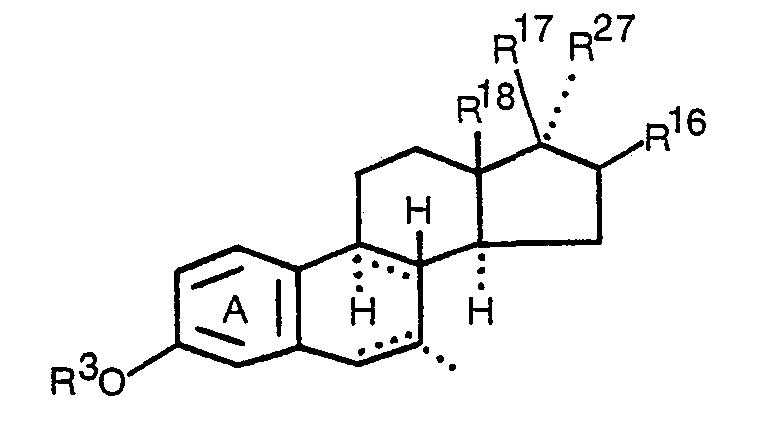
- wherein the dotted lines between carbon atoms 6 and 7, and carbon atoms 8 and 9, of the steroid nucleus indicate that there is an optional double bond between carbon atoms 6 and 7, or that there are two optional double bonds between carbon atoms 6 and 7 and carbon atoms 8 and 9;
- wherein the aromatic ring A may optionally bear one or two halogen or alkyl substituents;
- wherein R3 is hydrogen or alkyl, alkanoyl, alkoxycarbonyl, carboxyalkanoyl or aroyl each of up to 10 carbon atoms;
- wherein R16 is hydrogen, alkyl of up to 6 carbon atoms which is preferably in the β-configuration, or hydroxy which is preferably in the a-configuration;
- wherein either R17 (in the β-configuration) is hydroxy or alkanoyloxy, carboxyalkanoyloxy or aroyloxy each of up to 10 carbon atoms; and R27 (in the a-configuration) is hydrogen or alkyl, alkenyl or alkynyl each of up to 6 carbon atoms;
- or R17 and R27 together form oxo (=O);
- wherein R18 is alkyl of up to 6 carbon atoms;
- wherein A is straight- or branched-chain alkylene, alkenylene or alkynylene each of from 3 to 14 carbon atoms, which may have one or more hydrogen atoms replaced by fluorine atoms, or has the formula

- wherein A' and A" are each alkylene or alkenylene, optionally fluorinated, having together a total of 2 to 13 carbon atoms and Y is -0-, -S-, -SO-, -S02-, -CO- or -NR- wherein R is hydrogen or alkyl of up to 3 carbon atoms; or
- A1 is alkylene or alkenylene, optionally fluorinated, and A11 is a direct link or alkylene or alkenylene, optionally fluorinated, such that A' and A" together have a total of 1 to 12 carbon atoms, and Y is -NRCO-, -CONR-, -COO-, -OCO- or phenylene wherein R has the meaning stated above;
- wherein R1 is hydrogen, or alkyl, alkenyl, cycloalkyl, halogenoalkyl, carboxyalkyl, alkoxycarbonylalkyl, aryl or arylalkyl each of up to 10 carbon atoms, or dialkylaminoalkyl wherein each alkyl is of up to 6 carbon atoms, or R' is joined to R2 as defined below; and
- wherein X is ―CONR2―, -CSNR2-, ―NR12―CO― ―NR12―CS― ―NR12―CONR2―,

- wherein R is hydrogen or alkyl of up to 6 carbon atoms, or R1 and R2 together form alkylene or halogenoalkylene such that, with the adjacent nitrogen atom, they form a heterocyclic ring of 5 to 7 ring atoms, one of which atoms may be a second heterocyclic atom selected from oxygen, sulphur and nitrogen;
- wherein R12 is hydrogen or alkyl of up to 6 carbon atoms; and
- wherein R22 is hydrogen, cyano or nitro; or a salt thereof when appropriate.
- A suitable value for the halogen or alkyl substituent in ring A is, for example, fluoro, chloro, bromo, iodo, methyl or ethyl.
- A suitable value for R3 when it is alkyl, alkanoyl, alkoxycarbonyl, carboxyalkanoyl or aroyl is, for example, methyl, ethyl, acetyl, propionyl, butyryl, pivalyl, decanoyl, isopropoxycarbonyl, succinyl or benzoyl. R3 is preferably hydrogen or alkanoyl or alkoxycarbonyl each of up to 5 carbon atoms.
- A suitable value for R16 when it is alkyl is, for example, methyl or ethyl. R16 is preferably hydrogen.
- A suitable value for R17 when it is alkanoyloxy, carboxyalkanoyloxy or aroyloxy is, for example, acetoxy, propionyloxy, succinyloxy or benzoyloxy. R17 is preferably hydroxy.
- A suitable value for R27 when it is alkyl, alkenyl or alkynyl is, for example, ethyl, vinyl or ethynyl. R27 is preferably hydrogen.
- A suitable value for R18 is methyl or ethyl, especially methyl.
- The group ST- is preferably oestra-1,3,5(10)-triene-3,17(3-diol, 3-hydroxyoestra-1,3,5(10)-trien-17-one or 17a-ethynyloestra-1,3;5(10)-triene-3,17(3-diol, all of which bear the ―A―X―R1 substituent in the 7a-position, or a 3-alkanoyl ester thereof.
- One preferred value for the group -A- is a straight-chain alkylene group of the formula


- A second preferred value for the group A is a group of the formula

- A suitable value for R' when it is alkyl, alkenyl or cycloalkyl is, for example, methyl, ethyl, n-propyl, isopropyl, n-butyl, isobutyl, t-butyl, n-pentyl, t-pentyl, 2,2-dimethylpropyl, 1-methylbutyl, 2-methylbutyl, 3-methylbutyl, n-hexyl, 1,1-dimethylbutyl, 1,3-dimethylbutyl, n-heptyl, n-nonyl, n-decyl, allyl, cyclopentyl or cyclohexyl.
- A suitable value for R' when it is aryl or arylalkyl is, for example, phenyl, 2-ethylphenyl, p-fluorophenyl, p-chlorophenyl, m-chlorophenyl, p-cyanophenyl, p-methoxyphenyl, benzyl, a-methylbenzyl, p-chlorobenzyl, p-fluorophenethyl or p-chlorophenethyl.
- A suitable value for R' when it is halogenoalkyl, carboxyalkyl, alkoxycarbonylalkyl or dialkylaminoalkyl is, for example, 2-chloro-2,2-difluoroethyl, 2,2,2-trifluoroethyl, 2,2,3,3,3-pentafluoropropyl, 3-chloropropyl, 2,2-difluorobutyl, 4,4,4-trifluorobutyl, 1H,1H-heptafluorobutyl, 4,4,5,5,5-pentafluoropentyl, 4,4,5,5,6,6,6- heptafluorohexyl, 1H,1H-tridecafluoroheptyl, 5-carboxypentyl, 5-methoxycarbonylpentyl or 3-dimethylaminopropyl.
- A suitable value for the heterocyclic ring -NR'R2 is, for example, pyrrolidino, piperidino, 4-methylpiperidino, 4-ethylpiperidino, 3-methylpiperidino, 3,3-dimethylpiperidino, 4-chloropiperidino, morpholino or 4-methylpiperazino.
- A suitable value for R2 or R12 when it is alkyl is, for example, methyl, ethyl or n-butyl.
- One appropriate salt is an acid-addition salt of a steroid derivative which possesses an amino function, for example a compound. whereinY is ―NR―, X is -NR2- or R' is dialkylaminoalkyl. A suitable acid-addition salt is, for example, a hydrochloride, hydrobromide, acetate, citrate, oxalate or tartrate.
- Another appropriate salt is a base-addition salt of a steroid derivative which possesses a carboxy function, for example a compound wherein R' is carboxyalkyl. A suitable base-addition salt is, for example, a sodium, potassium, ammonium or cyclohexylamine salt.
- A preferred steroid derivative of the invention has the formula:-


- wherein m is an integer from 2 to 9, especially from 4 to 6, and p is 0 to 2, especially 0 or 2;
- wherein R' is alkyl, fluoroalkyl or cycloalkyl each of up to 10 carbon atoms, or phenyl, chlorophenyl or benzyl, or is linked to R2 as stated below;
- wherein X is ―CONR2―, ―NR12CO―, ―S―, ―SO― or ―SO2―, wherein R2 is hydrogen or alkyl of up to 3 carbon atoms or together with R1 forms alkylene of 5 or 6 carbon atoms, and wherein R12 is hydrogen or alkyl of up to 3 carbon atoms.
- A particularly preferred steroid derivative of the invention has the last-mentioned formula wherein the number of carbon atoms in the two groups A and R' adds up to between 12 and 16, inclusive, especially 14 if neither R1 nor A contains a phenyl or phenylene group, and 16 if there is a phenylene group in -A- or a phenyl group in R1.
- Specific steroid derivatives of the invention are hereinafter described in the Examples. Of these, particularly preferred compounds are:
- N-n-butyl-N-methyl-, N-2,2,3,3,4,4,4-heptafluorobutyl-N-methyl- and N,N-(3-methylpentamethylene)-11-(3,17β-dihydroxyoestra-1,3,5(10)-trien-7a-yl)undecanamide;
- N-n-butyl- and N-2,2,3,3,4,4,4-heptafluorobutyl-3-p-[4-(3,17[3-dihydroxyoestra-1,3,5(10)-trien-7a-yl)butyl]phenylpropionamide;
- 7α-(10-p-chlorophenylthiodecyl)-, 7α-(10 p-chlorophenylsulphinyldecyl)-, 7a-[9-(4,4,5,5,5-pentafluoro- pentylsulphinyl)nonyl]-, 7α-[10-(4,4,4-trifluorobutylsulphinyl)-decyl]- and 7a-[10-(p-chlorobenzylsulphinyl)-decyl]oestra-1,3,5(10)-triene-3,17β-diol; and
- 7a-(9-n-heptylsulphinylnonyl)oestra-1,3,5(10)-triene-3,17[3-diol.
- A process for the manufacture of a steroid derivative of the invention wherein X has the formula ―CONR2―, -CSNR2- or -S02NR2- comprises the reaction of a compound of the formula ST1-A-Z1, wherein A has the meaning stated above, wherein ST1 either has the same meaning as stated above for ST, or is an equivalent 7a-linked steroid nucleus which bears one or more protecting groups for functional derivatives, and wherein Z1 is an activated group derived from a carboxylic, thiocarboxylic or sulphonic acid, with an amine of the formula HNR1R2, wherein R1 and R have the meanings stated above, whereafter any protecting group in ST1 is removed by conventional means.
- A suitable activated group Z1 is, for example, a mixed anhydride, for example an anhydride formed by reaction of the acid with a chloroformate such as isobutyl chloroformate.
- A suitable protecting group in ST1 is, for example, an alkyl or aralkyl ether, for example the methyl or benzyl ether, of the 3-hydroxy function, or a tetrahydropyranyl ether of the 17β-hydroxy function.
- A process for the manufacture of a steroid derivative of the invention wherein X has the formula ―CO― comprises the reaction of an acid of the formula ST'-A-COOH, wherein ST1 and A have the meanings stated above, with an organometallic compound of the formula R'-M, wherein R1 has the meaning stated above and M is a metal group, for example the lithium group, whereafter any protecting group in ST1 is removed by conventional means.
- A process for the manufacture of a steroid derivative of the invention wherein X has the formula -S-, ―O―, ―NR2― or ―(PO)R2― comprises the reaction of a compound of the formula ST1―A―Z2, wherein ST1 and A have the meanings stated above and wherein Z2 is a displaceable group, with a compound of the formula R'SH, R'OH, HNR1R2 or R1R2P-C6H5 wherein R' and R2 have the meanings stated above, whereafter any protecting group in ST1 is removed by conventional means, and whereafter a phosphonium salt is hydrolysed to the phosphinyl compound.
- A suitable value for Z2 is, for example, a halogen atom or a sulphonyloxy group, for example the methanesulphonyloxy or toluene-p-sulphonyloxy group.
- A process for the manufacture of a steroid derivative of the invention wherein X has the formula ―NR12CO―, ―NR12CS―, ―NR12CONR2―,
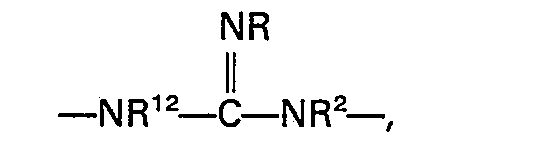
- A suitable acylating agent is, for example, an acyl chloride or acyl anhydride.
- The starting materials for use in all the abovementioned processes may be obtained by reacting a steroid derivative of the formula


- The starting material for the fourth process of the invention described above may be obtained by using the third process of the invention described above except that an amine of the formula R12NH2 is used in place of an amine of the formula HNR1R2.
- The intermediate of the formula ST1―A2―CH2OH may be oxidised to an aldehyde of the formula ST'-A2-CHO which may then be used, by reaction with an appropriately-substituted hydrocarbyl- triphenylphosphonium salt or hydrocarbyltriethylphosphonate, to prepare a starting material wherein -A- is alkenylene.
- An alternative process for the manufacture of a steroid derivative of the invention wherein -A- is alkenylene of the formula ―A―CH=CH―A4― wherein A3 is a direct link or alkylene and A4 is alkylene, comprises the reaction of a compound of the formula:-


- The reaction may be carried out in solution in dimethyl sulphoxide in the presence of dimsyl sodium.
- The steroidal aldehyde starting material when -A3- is ―A2―as defined above may be obtained by oxidation of the corresponding alcohol as described above. The steroidal aldehyde starting material wherein -A3- is a direct link may be obtained from the 3-keto-Δ4,6-inital steroidal starting material described above by reaction with cyanide to give the 3-keto-Δ4-7α-cyano compound, aromatisation, suitable protection and then reduction of the cyano group to the formyl group.
- The phosphonium starting material may be obtained by reaction of triphenylphosphine with a bromide of the formula
-

- A steroid derivative of the invention wherein ST is a 17β-hydroxy-steroid derivative may be converted by conventional reactions into the corresponding 17-keto steroid derivative, and thence to the corresponding 17β-hydroxy-17α-hydrocarbyl steroid derivative (that is, a steroid derivative of the invention wherein R27 is alkyl, alkenyl or alkynyl). Similarly, a steroid derivative of the invention wherein R3 and/or R17 are other than hydrogen may be obtained from the corresponding compounds wherein R3 and/or R17 are hydrogen by conventional etherification or esterification processes, and these may also be used in reverse to prepare the corresponding hydroxy compounds.
- A steroid derivative of the invention wherein A is alkenylene may be hydrogenated to provide the corresponding compound wherein A is alkylene.
- A steroid derivative of the invention wherein -X- is ―CH2NR2― or ―NR2CH2― may be obtained by the reduction, for example with borane, of the corresponding compound wherein -X- is -CONR2 or -NR2CO-.
- A steroid derivative of the invention wherein -X- is -CSNH- or -NHCS- may be obtained by the reaction of the corresponding compound wherein X is -CONH- or -NHCO- with 2,4-bis-(4-methoxyphenyl)-1,3-dithia-2,4-diphosphetane-2,4-disulphide.
- A steroid derivative of the invention wherein X is ―(NO)R2, ―SO― or ―SO2― may be obtained by the oxidation of the corresponding compound wherein X is -NRZ- or -S-. The conditions for the oxidation will be chosen to provide the desired product; for example aqueous sodium metaperiodate will oxidise the sulphur group to sulphinyl, and m-chloroperbenzoic acid in chloroform solution will oxidise the sulphur group to sulphonyl or the amine to its oxide.
- As stated above, a steroid derivative of the invention possesses antioestrogenic activity. This may be demonstrated by its effect in antagonising the increase in weight of the uterus of an immature female rat produced by administering oestradiol benzoate to said rat. Thus, when a steroid derivative of the invention and oestradiol benzoate are co-administered for 3 days to such a rat, a smaller increase in uterine weight is produced than the substantial increase which would be produced by the administration of oestradiol benzoate without the steroid derivative of the invention.
- In particular, a preferred steroid derivative of the invention produces an antioestrogenic effect at a dose which produces no partial agonist effect, unlike the known antioestrogens tamoxifen and clomiphene. When a preferred steroid is coadministered with oestradiol benzoate to a rat as described above, no increase in uterine weight whatsoever is observed at a suitable dose.
- A compound with the above pharmacological properties is of value in the treatment of the same conditions in which tamoxifen is beneficial, in particular, in the treatment of anovulatory infertility and in the treatment of breast tumours. It is also of value in the treatment of menstrual disorders.
- When used to produce an anti-oestrogenic effect in warm-blooded animals, a typical daily dose is from 0.1 to 25 mg/kg administered orally or by injection, In man this is equivalent to an oral dose of from 5 to 1250 mg/day. A steroid derivative of the invention is most conveniently administered to man in the form of a pharmaceutical composition.
- According to a further feature of the invention, there is provided a pharmaceutical composition comprising a steroid derivative of the invention together with a pharmaceutically acceptable diluent or carrier.
- The composition may be in a form suitable for oral or parenteral administration. A tablet or capsule is a particularly convenient form for oral administration and such a composition may be made by conventional methods and contain conventional excipients. Thus a table could contain diluents, for example mannitol or maize starch, disintegrating agents, for example alginic acid, binding agents, for example methyl-cellulose, and lubricating agents, for example magnesium stearate.
- The composition may contain, in addition to the steroid derivative of the invention, one or more antiandrogenic agents or antiprogestational agents.
- A composition for oral administration may conveniently contain from 5 to 500 mg of a steroid derivative of the invention.
- The invention is illustrated but not limited by the following Examples:-
- N-Methylmorpholine (0.24 ml) and isobutyl chloroformate (0.288 ml) were successively added to a stirred solution of 11-(1713-acetoxy-3-benzoyloxyoestra-1,3,5(10)-trien-7a-yl)undecanoic acid (1.0 g) in methylene chloride (17 ml) which was cooled to -10°C, and after 30 minutes n-butylamine (0.29 ml) was added and the mixture was stirred at laboratory temperature for 15 minutes. Saturated aqueous sodium bicarbonate solution (20 ml) was added and the mixture was extracted four times with methylene chloride (50 ml each time). The combined extracts were washed with water (10 ml), dried and evaporated to dryness. There was thus obtained as residue 11-(17β-acetoxy-3-benzoyloxy-N-n-butyloestra-1,3,5(10)-trien-7a-yl)undecanamide as an oil.
- Aqueous N-sodium hydroxide solution (8 ml) was added to a stirred solution of the above amide (1.06 g) in a mixture of methanol (16 ml) and tetrahydrofuran (8 ml) and the mixture was stirred at laboratory temperature for 18 hours, neutralised with aqueous N-hydrochloric acid and the organic solvents were removed by evaporation. Water (40 ml) was added and the mixture was extracted four times with methylene chloride (60 ml each time). The combined extracts were washed with water (10 ml), dried and evaporated to dryness and the residue was purified by chromatography on a silica gel (Merck Kieselgel 60) column using a 13:7 v/v mixture of ethyl acetate and toluene as eluant. There was thus obtained N-n-butyl-11-(3,97(i-dihydroxyoestra-1,3,5(10)trien-7a-yl)undecanamide as an oil which was characterised by the following data:-Proton magnetic resonance spectrum (in CDCI3)

- M+ = 511.4039 (C33H53O3N requires 511.4024)
- M - H20 = 493
- M - (CH2CONHC4H9) = 397
- Thin layer chromatography (silica gel plates using a 7.3 v/v mixture of ethyl acetate and toluene)
- RF = 0.3
- The 11-(17β-acetoxy-3-benzoyloxyoestra-1,3,5(10)-trien-7a-yl)-undecanoic acid used as starting material was obtained as follows:-
- A solution of dimethyl-t-butylsilyl chloride (37.3 g) in tetrahydrofuran (40 ml) was added to a solution of 11-bromoundecanol (50.18 g) and imidazole (28.95 g) in tetrahydrofuran (120 ml) and the mixture was kept at laboratory temperature for 1.75 hours, diluted with diethyl ether (300 ml) and filtered. The filtrate was evaporated to dryness and the residue purified by chromatography on silica gel using a 4:1 v/v mixture of petroleum ether (b.p. 60-80°C) and toluene as eluant.
- A solution of the 11-(dimethyl-t-butylsilyloxy)undecyl bromide thus obtained (73.1 g) in tetrahydrofuran (200 ml) was added during 2 hours to a stirred suspension of magnesium turnings (4.8 g) in tetrahydrofuran (20 ml) under normal conditions for preparation of a Grignard reagent, and the mixture was heated under reflux for 2 hours, diluted with tetrahydrofuran (100 ml) and cooled to -30°C. Cuprous iodide (19.05 g, dried at 100°C immediately before use) was added, the mixture was vigorously stirred for 10 minutes and a solution of 6-dehyro-19-nortestosterone acetate (15.48 g) in tetrahydrofuran (50 ml) was added. The mixture was stirred for 40 minutes, acetic acid (12 ml) was added and the mixture was evaporated to dryness. Water (150 ml) was added to the residue, and the mixture was extracted four times with diethyl ether (300 ml each time). The combined extracts were washed with water (50 ml), dried and evaporated to dryness, and the residue was purified by chromatography on a silica gel column using a 24:1 v/v mixture of toluene and ethyl acetate as eluant.
- A mixture of 17(3-acetoxy-7a-[11-(dimethyl-t-butylsilyloxy)undecyl]oestr-4-ene-3-one thus obtained (11.2 g), acetic acid (62 ml), water (31 ml) and tetrahydrofuran (56 ml) was stirred at 50°C for 2.75 hours and was then evaporated to dryness. A solution of the residue in pyridine (56 ml) and acetic anhydride (28 ml) was kept at laboratory temperature for 18 hours, cooled to 0°C, water (10 ml) was added and the mixture was stirred for 45 minutes and then evaporated to dryness. The residue was dissolved in diethyl ether (400 ml) and the solution was washed with saturated aqueous sodium bicarbonate solution (20 ml) and then with water (20 ml), dried and evaporated to dryness.
- A solution of the 17(3-acetoxy-7a-(11-acetoxyundecyl)oestr-4-ene-3-one thus obtained (8.98 g) in acetonitrile (50 ml) was added rapidly to a vigorously stirred suspension of cupric bromide (7.75 g) and lithium bromide (1.52 g) in acetonitrile (120 ml) which was heated under reflux under an atmosphere of argon, and the mixture was stirred and heated for 30 minutes and then cooled. Saturated aqueous sodium bicarbonate solution (200 ml) was added and the mixture was extracted four times with ethyl acetate (200 ml each time). The combined extracts were washed with water (50 ml), dried and evaporated to dryness, and the residue was purified by chromatography on a silica gel column using a 9:1 v/v mixture of toluene and ethyl acetate as eluant.
- Aqueous N-sodium hydroxide solution (8 ml) was added to a stirred solution of the 17p-acetoxy-7a-(11-acetoxyundecyl)oestra-1,3,5(10)-trien-3-ol thus obtained (2.8 g) in methanol (54 ml) and the mixture was stirred at laboratory temperature for 70 minutes, neutralised with aqueous N-hydrochloric acid and the methanol was removed by evaporation. The residue was extracted four times with ethyl acetate (60 ml each time) and the combined extracts were washed with water (20 ml), dried and evaporated to dryness. The residue was purified by chromatography on a silica gel column using a 7:3 v/v mixture of toluene and ethyl acetate as eluant.
- Aqueous N-sodium hydroxide solution (6 ml) and benzoyl chloride (0.93 ml) were added to a stirred solution of the 17β-acetoxy-7α-(11-hydroxy-undecyl)oestra-1,3,5(10)-trien-3-ol thus obtained (1.94 g) in acetone (20 ml) which was cooled to 0°C, and the mixture was stirred for 20 minutes and then poured into a mixture of ice-water (200 ml) and saturated aqueous sodium bicarbonate solution (50 ml). The mixture was extracted four times with diethyl ether (120 ml each time) and the combined extracts were washed twice with saturated aqueous sodium bicarbonate solution (15 ml each time) and then with water (20 ml), dried and evaporated to dryness. The residue was purified by chromatography on a silica gel column using a 7:3 v/v mixture of toluene and ethyl acetate as eluant.
- Jones's reagent (8N-chromic acid solution, 2.3 ml) was added to a solution of the 17p-acetoxy-3-benzoyloxy-7a-(11-hydroxyundecyl)oestra-1,3,5(10)-triene thus obtained (2.17 g) in acetone (37 ml) which was cooled to 0°C. After 15 minutes isopropanol (0.5 ml) was added and the mixture was evaporated to dryness. Water (40 ml) was added and the mixture was extracted three times with methylene chloride (60 ml each time). The combined extracts were washed twice with water (10 ml each time), dried and evaporated to dryness, and the residue was purified by chromatography on a silica gel column using a 7:3 v/v mixture of toluene and ethyl acetate as eluant. There was thus obtained 11-(17p-acetoxy=3-benzoyloxyoestra-1,3,5(10)-trien-7a-yl)undecanoic acid.
- The process described in Example 1 was repeated using the appropriate amine in place of n-butylamine. There were thus obtained the compounds described in the following table, all of which were oils the structures of which were confirmed by proton magnetic resonance and mass spectroscopy:-
-


- The 17(3-acetoxy-7a-(11-acetoxyundecyl)oestr-4-ene-3-one, prepared as described in the 5th paragraph of Example 1, was hydrolysed to the corresponding 11-hydroxyundecyl compound as described in the 7th paragraph of Example 1, and this product was purified by chromatography on a silica gel column using a 3:2 v/v mixture of toluene and ethyl acetate as eluant. It was then oxidised to the corresponding undecanoic acid as described in the 9th paragraph of Example 1, and this product was purified by chromatography on a silica gel column using a 19:1 v/v mixture of methylene chloride and methanol as eluant. The undecanoic acid was aromatised as described in the 6th paragraph of Example 1, except that the pH of the reaction mixture was adjusted to 3 before extraction into ethyl acetate. The product was purified by chromatography on a silica gel column using a 3:1 v/v mixture of diethyl ether and petroleum ether (b.p. 60-800C) as eluant. There was thus obtained, as an oil, 11-(17(3-acetoxy-3-hydroxyoestra-1,3,5(10)-trien-7a-yl)undecanoic acid.
- The process described in Example 1 was repeated except that the appropriate (17β-acetoxy-3-hydroxyoestra-1,3,5-(10)trien-7a-yl)alkenoic acid and the appropriate amine were used as starting materials. There were thus obtained the compounds described in the following table, all of which were oils the structures of which were confirmed by proton magnetic resonance and mass spectroscopy:-
-


- The initial compounds obtained are (1713-acetoxy-3-isobutyloxycarbonyloestra-1,3,5(10)-trien-7a-yl)alkenamides, the hydroxy group at the 3-position being converted into the carbonate during the first stage of the amide-forming reaction by the isobutyl chloroformate.
- The alkenoic acids used as starting materials were prepared by a process exemplified by the following preparation of 8-(17(3-acetoxy-3-hydroxy-oestra-1,3,5(10)-trien-7a-yl)octa-5-enoic acid:-The process described in the first paragraph of Example 1 relating to the preparation of starting materials was repeated except that dimethyl-t-butylsilyl chloride was reacted with 3-bromopropanol instead of 11-bromoundecanol. The Grignard reagent from this was reacted with 6-dehydro-19- nortestosterone, and the sequence of reactions described in the succeeding five paragraphs of Example 1 was repeated. There was thus obtained 17β-acetoxy-3-benzoyloxy-7a-(3-hydroxypropyl)oestra-1,3,5(10)-triene.
- Pyridinium chlorochromate (0.427 g) was added to a stirred solution of this oestratriene (0.629 g) in methylene chloride (13 m) and the mixture was stirred for 2 hours, diluted with diethyl ether (50 ml) and filtered through a filter-aid. The filtrate was evaporated to dryness and the residue was purified by chromatography on a silica gel column using a 19:1 v/v mixture of toluene and ethyl acetate as eluant. There was thus obtained 3-(17β-acetoxy-3-benzoyloxyoestra-1,3,5(10)-trien-7a-yl)propionaldehyde.
- Finely powdered (4-carboxybutyl)triphenylphosphonium bromide (1.4 g) was degassed by heating in vacuo at 100°C for 1 hour and was then dissolved in dimethyl-sulphoxide (5 ml) under an atmosphere of a nitrogen. A 2-molar solution of methanesulphinylmethyl sodium in dimethyl sulphoxide (3.8 ml) was added dropwise, and a solution of the above aldehyde (0.25 g) in toluene (2 ml) was then added. The mixture was stirred for 1 hour and then evaporated to dryness under reduced pressure at a temperature not exceeding 40°C. The residue was shaken with water (5 ml) and diethyl ether (10 ml) and the aqueous solution was separated, acidified to pH 3.5 with aqueous 2N-oxalic acid solution and extracted four times with ethyl acetate (10 ml each time). The combined extracts were washed with water, dried and evaporated to dryness and the residue was purified by chromatography on a silica gel column using a 1:1 v/v mixture of toluene and ethyl acetate as eluant. There was thus obtained 8-(17(3-acetoxy-3-hydroxyoestra-1,3,5-(10)-trien-7a-yl)octa-5-enoic acid.
- The corresponding deca-7-enoic, trideca-10-enoic and pentadeca-12-enoic acids were obtained by using (6-carboxyhexyl)-, (9-carboxynonyl)- or (11-carboxyundecyl)triphenylphosphonium bromide in place of (4-carboxybutyl)triphenylphosphonium bromide.
- 5% Palladium-on-charcoal catalyst (0.025 g) was added to a solution of N-n-butyl-8-(3,1713-dihydroxyoestra-1,3,5(10)-trien-7a-yl)oct-5-enamide (Example 3; 0.05 g) in ethyl acetate (2.5 ml) and the mixture was stirred at laboratory temperature under an atmosphere of hydrogen for 1 hour and then filtered. The filtrate was evaporated to dryness and there was thus obtained as oily residue N-n-butyl-8-(3,17β-dihydroxyoestra-1,3,5(10)-trien-7a-yl)octanamide, the structure of which was confirmed by spectroscopic means.
- The process described above was repeated using the appropriate alkenamide described in Example 3 and there were thus obtained as oils the compounds described in the following table, the structure of al.1 of which were confirmed by spectroscopic means;
-


- The process described in Example 1 was repeated except that either 3,17β-dihydroxyoestra-1,3,5(101- trien-7a-yl)pent-2-enoic acid or 3,17(3-dihydroxyoestra-1,3,5(10)-trien-7a-yl)pentanoic acid, and the appropriate amine, were used as starting materials. There were thus obtained as oils the compounds described in the following tables, the structures of which were confirmed by proton magnetic resonance and mass spectroscopy.


- The pentenoic and pentanoic acids used as starting materials were obtained as follows:-
- Sodium hydride (0.069 g) was added to a stirred solution of triethylphosphonoacetate (0.413 g) in tetrahydrofuran (10 ml) which was maintained at 0°C, and the mixture was stirred at that temperature for 1 hour. A solution of 3-(17β-acetoxy-3-benzoyloxyoestra-1,3,5(10)-trien-7a-yl)propionaldehyde (Example 3, second paragraph relating to preparation of starting materials, 0.25 g) in tetrahydrofuran (5 ml) was added and the mixture was stirred at laboratory temperature for 30 minutes, neutralised with acetic acid and evaporated to dryness. The residue was shaken with water (15 ml), the mixture was extracted three times with ethyl acetate (30 ml each time) and the combined extracts were washed with water, dried and evaporated to dryness. There was thus obtained as residue ethyl 5-(17(3-acetoxy-3-benzoyloxy-oestra-1,3,5(10-trien-7a-yl)pent-2-enoate. Part of this was hydrolysed to the corresponding pent-2-enoic acid with aqueous sodium hydroxide solution for use as one starting material, and part of it was hydrogenated by a similar process to that described in Example 4, and the ethyl 5-(17β-acetoxy-3-benzoyloxyoestra-1,3,5-(10)-trien-7a-yl)pentanoate thus obtained was hydrolysed to the corresponding dihydroxypentanoic acid with aqueous sodium hydroxide solution for use as the other starting material.
- The amidoalkylamines used as starting materials for the compounds described in Table 2 were obtained as follows:-
- A solution of 1-methylpyrrolidin-2-one (5 g) in aqueous 6N-sodium hydroxide solution (50 ml) containing methanol (0.1 ml) was heated under reflux for 3 hours, cooled to 0°C and benzyl chloroformate (9.5 g) was added dropwise. The mixture was kept at 0°C for 12 hours and then poured onto a mixture of equal volumes of ice and concentrated aqueous hydrochloric acid. The mixture was extracted with ethyl acetate and the extract was washed with water, dried and evaporated to dryness.
- Triethylamine (3.7 ml) and ethyl chloroformate (2.5 ml) were successively added to a stirred solution of the 4-(N-benzyloxycarbonyl-N-methylamino)butyric acid thus obtained (6.0 g) in ethyl acetate (100 ml) which was cooled to -20°C, and the mixture was stirred at that temperature for 15 minutes. A solution of n-hexylamine (3.2 ml) in ethyl acetate (30 ml) was added and the mixture was allowed to warm up to laboratory temperature and stirred at that temperature for 16 hours, then washed successively with dilute aqueous hydrochloric acid, saturated aqueous sodium bicarbonate solution and saturated aqueous sodium chloride solution, dried and evaporated to dryness.
- A solution of the 4-(N-benzyloxycarbonyl-N-methylamino)-N-n-hexylbutyramide thus obtained (6.6 g) in ethanol (100 ml) was shaken with hydrogen in the presence of a 10% palladium-on-charcoal catalyst (0.6 g) for 18 hours, filtered and evaporated to dryness. There was thus obtained as residual oil N-n-hexyl-4-methylaminobutyramide.
- As above but using N-n-hexyl-N-methylamine in place of n-hexylamine.
- As above from glycine and benzyl chloroformate (N-benzyloxycarbonylglycine has m.p. 119-121°C), then triethylamine, ethyl chloroformate and n-heptylamine.
- As above using a-alanine in place of glycine and n-hexylamine in place of n-heptylamine.
- As above using 4-aminobutyric acid in place of glycine and n-hexylamine in place of n-heptylamine.
- N-Methylmorpholine (0.028 ml) and isobutyl chloroformate (0.038 ml) were successively added to a stirred solution of 11-(3-benzyioxy-17p-hydroxyoestra-1,3,5(10)-trien-7a-yi)undec-10-enoic acid (0.109 g) in tetrahydrofuran (3 ml) which was cooled to -10°C. The mixture was stirred at -10°C for 30 minutes, N-methylisobutylamine (0.05 ml) was added and the mixture was stirred at laboratory temperature for 2 hours. Saturated aqueous sodium bicarbonate solution (5 ml) was added and the mixture was extracted 3 times with methylene chloride (10 ml each time). The combined extracts were washed with water (2 ml), dried and evaporated to dryness, and there was thus obtained as oily residue N-isobutyl-N-methyl-11-(3-benzyloxy-17(3-hydroxyoestra-1,3,5(10)-trien-7a-yl)undec-10-enamide.
- A 10% palladium-on-charcoal catalyst (0.03 g) was added to a solution of the above compound (0.105 g) in ethyl acetate (10 ml) and the mixture was stirred at laboratory temperature under an atmosphere of hydrogen for 5 hours, and then filtered. The filtrate was evaporated to dryness and there was thus obtained as oily residue N-isobutyl-N-methyl-11-(3,17β-dihydroxyoestra-1,3,5(10)-trien-7α-yl)-undecanamide, the structure of which was confirmed by proton magnetic resonance spectroscopy and elemental analysis.
- The undecenoic acid used as starting material was obtained as follows:-
- Diethyl aluminium cyanide (100 ml of a 1.2 molar solution in toluene) was added to a stirred solution of 6-dehydro-19-nortestosterone acetate (9 g) in tetrahydrofuran (400 ml) and the mixture was stirred at laboratory temperature for 1 hour and then poured into a mixture of ice (1000 ml) and aqueous 2N-sodium hydroxide solution (500 m). The mixture was extracted 3 times with methylene chloride (300 ml each time) and the combined extracts were washed with water (100 ml), dried and evaporated to dryness. The residue was stirred with petroleum ether (b.p. 40-60°C; 100 ml) and there was thus obtained 17p-acetoxy-7a-cyano-oestr-4-ene-3-one, m.p. 183-186°C.
- A solution of the above compound (3.38 g) in acetonitrile (15 ml) was added rapidly to a vigorously stirred suspension of cupric bromide (4.46 g) and lithium bromide (0.85 g) in acetonitrile (30 ml) which was heated under reflux under an atmosphere of argon. The mixture was stirred and heated under reflux for 10 minutes and then cooled, and saturated aqueous sodium bicarbonate solution (50 ml) was added. The mixture was extracted 3 times with ethyl acetate (50 ml each time) and the combined extracts were washed with water (20 ml), dried and evaporated to dryness. The residue was purified by chromatography on a silica gel column using a 17:3 v/v mixture of toluene and ethyl acetate as eluant, and there was thus obtained 17(3-acetoxy-7a-cyanooestra-1,3,5(10)-trien-3-ol. Early fractions eluted from the column contained 17β-acetoxy-6-bromo-7α-cyano-oestra-1,3,5(10)-trien-3-ol which was used in Example 22.
- A stirred mixture of the above compound (0.69 g), benzyl bromide (0.29 ml), potassium carbonate (0.325 g) and acetone (20 ml) was heated under reflux for 16 hours, cooled and filtered and the filtrate was evaporated to dryness. The residue was purified by chromatography on a silica gel column using a 9:1 v/v mixture of toluene and ethyl acetate as eluant, and there was thus obtained 17a-acetoxy-3-benzyloxy-7a-cyano-oestra-1,3,5(10)-triene.
- Diisobutyl aluminium hydride (3.1 ml of a 1.5 molar solution in toluene) was added to a stirred solution of the above compound (0.68 g) in toluene (10 ml) and the mixture was stirred at laboratory temperature for 150 minutes. Methanol (2 ml) and then aqueous 2N-hydrochloric acid (5 ml) were added and the mixture was stirred for 15 minutes and then extracted three times with ethyl acetate (10 ml each time). The combined extracts were washed with water (5 ml), dried and evaporated to dryness. The residue was purified by chromatography on a silica gel column using a 4:1 v/v mixture of toluene and ethyl acetate as eluant. There was thus obtained 3-benzyloxy-17(3-hydroxyoestra-1,3,5(10)-triene-7a-carboxaldehyde.
- Dimsyl sodium (4 ml of a 2-molar solution in dimethyl sulphoxide) was added dropwise to a solution of finely powdered (9-carboxynonyl)triphenylphosphonium bromide (1.94 g) in dimethyl sulphoxide (10 ml) which was maintained under an atmosphere of nitrogen, and a solution of the above aldehyde (0.3 g) in a mixture of toluene (2 ml) and dimethyl sulphoxide (2 ml) was then added. The mixture was stirred at laboratory temperature for 1 hour and then evaporated to dryness under reduced pressure, and the residue was shaken with water (5 ml) and diethyl ether (5 ml). The aqueous solution was separated, acidified to pH 3 with aqueous 2N-oxalic acid solution and extracted three times with diethyl ether (10 ml each time). The combined extracts were washed with water, dried and evaporated to dryness and the residue was purified by chromatography on a silica gel column using an 11:9 v/v mixture of toluene and ethyl acetate as eluant. There was thus obtained 11-(3-benzyloxy-17β-hydroxyoestra-1,3,5(10)-trien-7α-yl)undec-10-enoic acid.
- The process described in Example 6 was repeated using the appropriate ω-(3-benzyloxy-17β-hydroxyoestra-1,3,5(10-trien-7a-yl)alkenoic acid and the appropriate amine as starting materials. There were thus obtained the compounds described in the following table, all of which were oils the structures of which were confirmed by proton magnetic resonance and mass spectroscopy:-
-
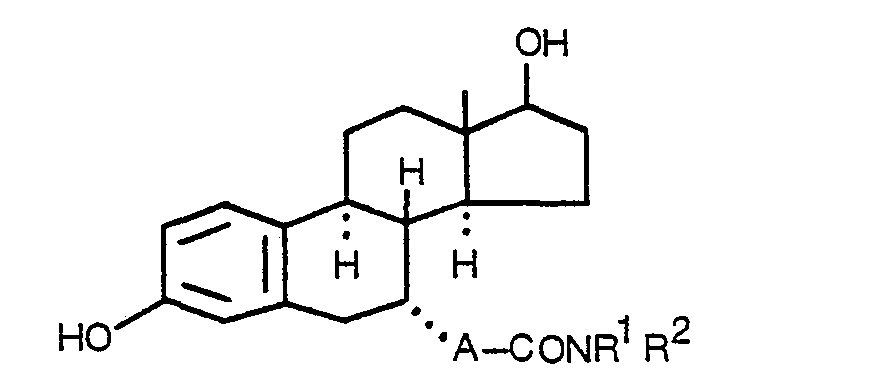

- The steroidal starting materials were prepared as described in the second part of Example 6 except that the appropriate (w-carboxyalkyl)triphenylphosphonium bromide was used as intermediate. The starting material for the last-mentioned compound, marked with an asterisk*, is unusual in that during the reaction of the steroidal-7a-carboxaldehyde with (9-carboxy-8,8-difluorononyl)triphenylphosphonium bromide a molecule of hydrogen fluoride is eliminated and the starting material is the steroidal-7a-yl-3-fluoroundeca-2,10-dienoic acid.
- The (9-carboxy-8,8-difluorononyl)triphenylphosphonium bromide used as intermediate was obtained as follows:-
- A solution of 8-bromooctanoyl chloride (1.2 g) in methylene chloride (5 ml) was added to a stirred solution of 2,2-dimethyl-1,3-dioxane-4,6-dione (0.72 g) and pyridine (0.8 ml) in methylene chloride (20 ml) which was kept at 5°C, and the mixture was stirred at that temperature for 1 hour and then at laboratory temperature for 90 minutes, washed successively with aqueous N-hydrochloric acid (20 ml) and water (20 ml), dried and evaporated to dryness. The residue was heated under reflux with methanol (20 ml) for 16 hours, the excess of methanol was removed by evaporation and the residue was distilled under reduced pressure. There was thus obtained methyl 10-bromo-3-oxodecanoate, b.p. 135-144°C/145 Pa (1 mm Hg).
- A mixture of the above ester (4.4 g) and sulphur tetrafluoride (10 g) was heated at 60°C for 6 hours in a sealed bomb (Hastelloy C) and the resulting tar was extracted with methylene chloride (150 ml). The extract was washed with saturated aqueous sodium carbonate solution (50 ml) and then with water (20 ml), dried and evaporated to dryness. The residue was distilled under reduced pressure and there was thus obtained methyl 10-bromo-3,3-difluorodecanoate, b.p. 175°C/29 Pa (0.2 mm Hg).
- A mixture of the above ester (1.1 g), acetic acid (1 ml) and 48% aqueous hydrobromic acid (1 ml) was heated under reflux for 2 hours and then poured into ice-water (20 ml). The mixture was extracted three times with ethyl acetate (10 ml each time) and the combined extracts were washed with water, dried and evaporated to dryness. The residue was distilled under reduced pressure and there was thus obtained 10-bromo-3,3-difluorodecanoic acid, b.p. 200°C/22 Pa (0.15 mm Hg).
- Triphenylphosphine (0.565 g) was added to a solution of the above acid (0.61 g) in acetonitrile (5 ml) and the mixture was heated under reflux for 18 hours and then evaporated to dryness. There was thus obtained as residual oil (9-carboxy-8,8-difluorononyi)triphenylphosphonium bromide which was used without further purification.
- N-Methylmorpholine (0.107 ml) and isobutyl chloroformate (0.133 ml) were successively added to a stirred solution of p-[4-(17(3-hydroxy-3-methoxyoestra-1,3,5(10)-trien-7a-yl)but-1-enyl]cinnamic acid (0.17 g) in methylene chloride (10 ml) which was cooled to -30°C under an atmosphere of argon, and the mixture was allowed to warm up to laboratory temperature. n-Hexylamine (0.06 ml) was added, the mixture was stirred at laboratory temperature for 30 minutes, aqueous 2N-hydrochloric acid (10 ml) was added and the mixture was extracted three times with diethyl ether (20 ml each time). The combined extracts were washed with water, dried over magnesium sulphate and evaporated to dryness under reduced pressure. There was thus obtained, as an oil, N-n-hexyl-p-[4-(17(3-hydroxy-3-methoxyoestra-1,3,5(10)-trien-7a-yl)but-1-enyl]cinnamide, the structure of which was confirmed by proton magnetic resonance spectroscopy and mass spectroscopy.
- Boron tribromide (0.5 ml) was added to a stirred solution of the above amide (0.12 g) in methylene chloride (10 ml) which was cooled to -78°C under an atmosphere of argon, and the mixture was allowed to warm up to -10°C and was kept at that temperature for 4 hours. Saturated aqueous sodium bicarbonate solution (10 ml) was added, the mixture was extracted three times with methylene chloride (15 ml each time) and the combined extracts were washed with water, dried over magnesium sulphate and evaporated to dryness. There was thus obtained, as an oil, p-[4-(3,17a-dihydroxyoestra-1,3,5(10)-trien-7a-yl)but-1-enyl]-N-n-hexyl-cinnamide, the structure of which was confirmed by nuclear magnetic resonance and mass spectroscopy.
- The cinnamic acid used as starting material was obtained as follows:-
- The process described in the first paragraph of Example 1 relating to the preparation of starting materials was repeated except that dimethyl-t-butylsilyl chloride was reacted with 3-bromopropanol instead of 11-bromoundecanol. The Grignard reagent from this was reacted with 6-dehydro-19- nortestosterone, and the sequence of reactions described in the succeeding two paragraphs of Example 1 was repeated. There was thus obtained 17(3-acetoxy-7a-(3-acetoxypropyl)-oestra-1,3,5(10)-trien-3-ol.
- Methyl iodide (6 ml) and potassium carbonate (6 g) were added to a stirred solution of the above diacetate (5 g) in acetone (80 ml), and the mixture was stirred and heated under reflux for 16 hours, cooled and filtered and the filtrate was evaporated to dryness. A solution of the residual 17β-acetoxy-7α-(3-acetoxypropyl)-3-methoxyoestra-1,3,5(10)-triene (4.7 g) in methanol (50 ml) was cooled to 0°C, potassium carbonate (2.5 g) was added and the mixture was stirred at 0°C for 3 hours and then filtered. The filtrate was evaporated to dryness and the residue was purified by chromatography on a silica gel column (Merck 9385) using a 4:1 v/v mixture of toluene and ethyl acetate as eluant. There was thus obtained 17p-acetoxy-7a-(3-hydroxypropyl)-3-methoxyoestra-1,3,5(10)-triene as an oil.
- Pyridinium chlorochromate (3.6 g) was added to a stirred solution of this oestratriene (3.2 g) in methylene chloride (100 ml) and the mixture was stirred for 2 hours and then filtered. The filtrate was evaporated to dryness and the residue was purified by chromatography on a silica gel column (Merck 9385) using a 9:1 v/v mixture of toluene and ethyl acetate as eluant. There was thus obtained 3-(17p-acetoxy-3-methoxyoestra-1,3,5(10)-trien-7a-yl)propionaldehyde.
- n-Butyl-lithium (0.67 ml of a 1.5 molar solution in hexane) was added to a stirred solution of diisopropylamine (0.14 ml) in tetrahydrofuran (30 ml) which was cooled to 0°C under an atmosphere of argon. After 10 minutes the mixture was cooled to -78°C and a solution of ethyl p-(diethylphosphonyl- methyl)cinnamate (0.33 g; b.p. 175°C/2.2 kPa (15 mm Hg); prepared by heating ethyl p-bromomethylcinnamate with triethylphosphite at 120°C for 2 hours) in tetrahydrofuran (2 ml) was added dropwise. A solution of the above propionaldehyde (0.19 g) in tetrahydrofuran (1 ml) was added and the mixture was allowed to warm up to laboratory temperature and was stirred at that temperature for 16 hours. Aqueous 2N-hydrochloric acid was added and the mixture was extracted three times with diethyl ether (15 ml each time). The combined extracts were washed with water (20 ml) and then with saturated aqueous sodium chloride solution (20 ml), dried over magnesium sulphate and evaporated to dryness. The residue was purified by chromatography on a silica gel column (Merck 9385) using a 17:3 v/v mixture of toluene and ethyl acetate as eluant. There was thus obtained ethyl p-[4-(17p-acetoxy-3-methoxyoestra-1,3,5(10)-trien-7α-yl)but-1-enyl]cinnamate.
- Aqueous 2N-sodium hydroxide solution (1 ml) was added to a stirred solution of the above cinnamate (0.2 g) in a mixture of methanol (1 ml) and tetrahydrofuran (1 ml), and the mixture was stirred at laboratory temperature for 3 hours, acidified with aqueous 2N-hydrochloric acid (2 ml) and extracted three times with ethyl acetate (10 ml each time). The combined extracts were washed with water, dried over magnesium sulphate and evaporated to dryness. There was thus obtained as residual gum p-[4-(17p-hydroxy-3-methoxyoestra-1,3,5(10)-trien-7a-yl)but-1-enyl]cinnamic acid.
- A solution of p-[4-(4-(3,17β-dihydroxyoestra-1,3,5(10)-trien-7α-yl)but-1-enyl]-N-n-hexylcinnamide (Example 8; 0.05 g) in a mixture of ethyl acetate (10 ml) and ethanol (2 ml) was stirred with a 20% palladium-on-charcoal catalyst (0.01 g) under an atmosphere of hydrogen at laboratory temperature and atmospheric pressure for 2 hours, and the mixture was then filtered and evaporated to dryness. There was thus obtained 3-p-[4-(3,17p-dihydroxyoestra-1,3,5(10)-trien-7a-yl)butyllphenyl-N-n-hexylpropionamide, the structure of which was confined by proton magnetic resonance and mass spectroscopy.
- The processes described in Examples 8 and 9 were repeated using the appropriate amine in place of n-hexylamine as starting material in Example 8. There were thus obtained the compounds described in the following table, all of which were oils the structures of which were confirmed by proton magnetic resonance and mass spectroscopy:-
-


- The process described in Example 8 was repeated using the appropriate amine and the appropriate w-(17a-hydroxy-3-methoxyoestra-1,3,5(10)-trien-7a-yl)alk-1-enylcinnamic acid or benzoic acid as starting materials. There were thus obtained the compounds described in the following table, all of which were oils the structures of which were confirmed by proton magnetic resonance and mass spectroscopy:―
-


- The steroidal starting material wherein A3 is -(CH2)4- was prepared by a similar process to that described in Example 8 except that in the third paragraph thereof 5-bromopentanol was used in place of 3-bromopropanol. The phosphonate intermediates were prepared from the appropriate ethyl bromomethylcinnamate or ethyl bromomethylbenzoate and triethylphosphite.
- The hydrogenation described in Example 9 was repeated using the appropriate unsaturated compound, described in Example 11, as starting material. There were thus obtained the compounds described in the following table, all of which were oils the structures of which were confirmed by proton magnetic resonance and mass spectroscopy:


- The process described in Example 8 was repeated using p[2 - (3 - benzyloxy - 17β - hydroxyoestra - 1,3,5(10) - trien - 7a - yl)ethenyl]cinnamic acid and n-octylamine as starting materials. There was thus obtained, as an oil p - [2 - (3 - benzyloxy -17β - hydroxyoestra -1,3,5(10) - trien - 7α - yl)ethenyl] - N - n - octylcinnamide.
- The hydrogenation process described in the second paragraph of Example 6 was repeated using the above compound as starting material, and there was thus obtained as an oil 3 - p - [2 - (3,17β - dihydroxyoestra - 1,3,5(10) - trien - 7a - yl)ethyl]phenyl - N - n - octylpropionamide, the structure of which was confirmed by proton magnetic resonance and mass spectroscopy.
- The cinnamic acid used as starting material was obtained from 3 - benzyloxy - 17β - hydroxyoestra - 1,3,5(10) - trien - 7a - carboxaldehyde (described in the sixth paragraph of Example 6) and ethyl p - (diethylphosphonylmethyl)cinnamate by a similar process to that described in the sixth and seventh paragraphs of Example 8.
- Aqueous N-sodium hydroxide solution (0.15 mi.) and benzoyl chloride (0.023 ml.) were successively added at 0°C to a stirred solution of N - n - butyl - N - methyl -11 - (3,17β - dihydroxyoestra -1,3,5(10) - trien - 7a - yl)undecanamide (Example 2; 0.06 g.) in acetone (1 ml.) and the mixture was stirred at 0°C. for 30 minutes and poured into saturated aqueous sodium bicarbonate solution (10 ml.). The mixture was extracted three times with diethyl ether (15 ml. each time) and the combined extracts were washed with water (3 ml.), dried and evaporated to dryness. The residue was purified by chromatography on a silica gel column using a 3:2 v/v mixture of toluene and ethyl acetate as eluant. There was thus obtained as an oil N - n - butyl - N - methyl - 11 - (3 - benzoyloxy - 17β - hydroxyoestra - 1,3,5(10) - trien - 7a - yl)undecanamide, the structure of which was confirmed by proton magnetic resonance and mass spectroscopy.
- Sodium hydride (0.005 g. of a 50% dispersion in mineral oil) was added to a stirred solution of N - n - butyl - 11 - (3,17(3 - dihydroxyoestra - 1,3,5(10) - trien - 7a - yl) - N - ethylundecanamide (Example 2; 0.052 g.) in tetrahydrofuran (2 ml.) and the mixture was stirred at laboratory temperature for 3.5 hours. Butyryl chloride (0.014 ml.) was added and the mixture was stirred at laboratory temperature for 16 hours, diluted with ethyl acetate (30 ml.) and filtered. The filtrate was washed with water, dried and evaporated to dryness. The residue was purified by chromatography on a silica gel column using a 1:1 v/v mixture of ethyl acetate and toluene as eluant. There was thus obtained as an oil N - n - butyl - 11 - (3 - butyryloxy - 17β - hydroxyoestra - 1,3,5(10) - trien - 7a - yl) - N - methylundecanamide, the structure of which was confirmed by proton magnetic resonance and mass spectroscopy.
- The process described above was repeated using the appropriate acid chloride or acyl anhydride in place of butyryl chloride, and there were thus obtained the corresponding:
- 3-acetyl
- 3-propionyl
- 3-pivalyl
- 3-decanoyl
- 3-isopropoxycarbonyl
- Acetic anhydride (0.2 ml.) was added to a stirred solution of N - n - butyl - 11 - (3,17β - dihydroxyoestra - 1,3,5(10) - trien - 7a - yl) - N - methylundecanamide (Example 2; 0.052 g.) in pyridine (0.5 ml.) and the mixture was stirred at laboratory temperature for 16 hours. Water (0.1 ml.) was added and 'then toluene was added and distilled off until the mixture was free of acetic acid. The residue was purified by chromatography on a silica gel column using a 4:1 v/v mixture of toluene and ethyl acetate as eluant, and there was thus obtained as an oil N - n - butyl - 11 - (3,17β - diacetoxyoestra - 1,3,5 - (10) - trien - 7a - yl) - N - methylundecanamide, the structure of which was confirmed by proton magnetic resonance and mass spectroscopy.
- The process described above was repeated using succinic anhydride in place of acetic anhydride, and there were thus obtained as oils N - n - butyl - 11 - [3,17β - di - ((3 - carboxypropionyl)oestra - 1,3,5(10) - trien - 7a - yl] - N - methylundecanamide and N - n - butyl - 11 - [17(3 - (β - carboxypropionyl) - 3 - hydroxyoestra - 1,3,5(10) - trien - 7a - yl] - N - methylundecanamide, which were separated one from the other during the chromatographic purification procedure, and the structures of which were confirmed as above.
- Jones' Reagent (8N-chromic acid solution; 0.15 ml.) was added to a stirred solution of N - n - butyl - N - methyl - 11 - (3,17(3 - dihydroxyoestra - 1,3,5 - (10) - trien - 7a - yl) - undecanamide (Example 2; 0.262 g.) in acetone (15 ml.) at 0°C., and after 15 minutes isopropanol (0.1 ml.) was added and the mixture was evaporated to dryness. Water (15 ml.) was added and the mixture was adjusted to pH 8 with aqueous sodium bicarbonate solution and then extracted three times with methylene chloride (30ml. each time). The combined extracts were washed with water (15 ml.), dried and evaporated to dryness, and the residue was purified by chromatography on a silica gel column using a 7:3 v/v mixture of toluene and ethyl acetate as eluant. There was thus obtained N - n - butyl - N - methyl - 11 - (3 - hydroxy - 17 - oxooestra - 1,3,5(10) - trien - 7a - yl)undecanamide as an oil, the structure of which was confirmed by proton magnetic resonance and mass spectroscopy.
- Lithium acetylide-ethylenediamine complex (0.097 g.) was added to a solution of N - n - butyl - N - methyl - 11 - (3 - hydroxy - 17 - oxooestra - 1,3,5(10) - trien - 7a - yl)undecanamide (Example 17; 0.138 g.) in dimethyl sulphoxide and the mixture was kept at laboratory temperature for 4 hours. Water (0.1 ml.) was added, the mixture was evaporated to dryness and the residue was purified by chromatography on a silica gel column using a 7:3 v/v mixture of toluene and ethyl acetate as eluant. There was thus obtained N - n - butyl - N - methyl - 11 - (17a - ethynyl - 3,17β - dihydroxyoestra - 1,3,5(10) - trien - 7a - yl)undecanamide as an oil, the structure of which was confirmed by proton magnetic resonance and mass spectroscopy.
- The process described in Example 1 was repeated except that 11 - (17a - ethynyl - 3,17β - dihydroxyoestra - 1,3,5(10) - trien - 7a - yl)undecanoic acid and N - methyl - 1 H,1 H - heptafluorobutylamine were used as starting materials. There was thus obtained 11 - (17a - ethynyl - 3,17β - dihydroxyoestra - 1,3,5(10) - trien - 7a - yl) - dN - (1H,1H - heptafluorobutyl) - N - methylundecanamide as an oil, the structure of which was confirmed by proton magnetic resonance and mass spectroscopy.
- The undecanoic acid used as starting material was obtained as follows:
- The process described in Example 17 was repeated except that the corresponding undecanoic acid was used in place of the undecananamide, and that a 1:1 v/v mixture of toluene and ethyl acetate was used as eluant in the chromatographic purification. To a solution of the 11 - (3 - hydroxy - 17 - oxooestra - 1,3,5(10) trien - -7α yl)undecanoic acid thus obtained (0.075 g.) in dimethyl sulphoxide (1 ml.) was added a 2-molar solution of dimsyl sodium in dimethyl sulphoxide (2 ml.) which had been saturated with acetylene gas, and the mixture was kept at laboratory temperature for 18 hours, diluted with water (15 ml., ) acidified to pH 1 with aqueous N-hydrochloric acid, and extracted three times with ethyl acetate (10 ml. each time). The combined extracts were washed with water, dried and evaporated to dryness and the residue was purified by chromatography on a silica gel column using a 1:1 v/v mixture of toluene and ethyl acetate as eluant. There was thus obtained the desired 11 - (17a - ethynyl - 3,17β - dihydroxyoestra - 1,3,5(10)trien - 7a - yl)undecanoic acid.
- A stirred mixture of cupric acetate (0.027 g.), iodine (0.038 g.), N - n - butyl - N - methyl - 11 - (3,17β - dihydroxyoestra -1,3,5(10) -trien -7α yl)undecanamide (Example 2; 0.052 g.) and acetic acid (2 ml.) was heated at 55°C. for 18 hours and then poured into a mixture of ice (10 m.) and saturated aqueous sodium bicarbonate solution (5 ml.). The mixture was extracted three times with ethyl acetate (15 ml. each time) and the combined extracts were washed with water, dried and evaporated to dryness. The residue was purified by chromatography on a silica gel column using a 3:2 v/v mixture of toluene and ethyl acetate as eluants and there were thus separately obtained N - n - butyl - N - methyl - 11 - (3,17β - dihydroxy - 2 - iodooestra - 1,3,5(10) - trien - 7a - yl)undecanamide (eluted first) and N - n - butyl - N - methyl - 11 - (3,17β - dihydroxy - 4 - iodooestra - 1,3,5(10) - trien - 7a - yl)undecanamide (eluted second).
- The process described in the first two paragraphs of Example 1 was repeated except that 11 - (17β - acetoxy - 3 - hydroxyoestra - 1,3,5(10),6 - tetraen - 7 - yl)undecanoic acid and N-methyl-N-butylamine were used as starting materials. There was thus obtained as an oil N - n - butyl - N - methyl - 11 - (3,17β - dihydroxyoestra - 1,3,5(10),6 - tetraen - 7 - yl)undecanamide, the structure of which was confirmed by proton magnetic resonance and mass spectroscopy.
- The oestra-tetraene used as starting material was obtained as follows:
- A solution of bromine (0.114 ml.) in acetic acid (2 ml.) was added dropwise to a stirred solution of 11 - (1713 - acetoxy - 3 - oxo - oestra - 4 - en - 7a - yl)undecanoic acid (Example 2; 0.5 g.) in a mixture of diethyl ether (5 ml.) and acetic acid (2 ml.) which was cooled to 15°C. and the mixture was stirred at that temperature for 30 minutes and then poured into water (50 ml.). The mixture was extracted three times with methylene chloride (30 ml. each time) and the combined extracts were washed with water, dried and rapidly evaporated to dryness under reduced pressure at a bath temperature below 20°C. A solution of the residue, which consisted of 11 - (17β - acetoxy - 2,6 - dibromo - 3 - oxooestr - 4 - en - 7a - yl)undecanoic acid in dimethylformamide (3 ml.) was immediately added to a stirred mixture of lithium bromide (1.0 g.), lithium carbonate (1.0 g.) and dimethylformamide (10 ml.) which was heated under reflux, and the mixture was stirred and heated under reflux for 30 minutes and then evaporated to dryness under reduced pressure. Water (20 ml.) was added to the residue and the mixture was acidified to pH 1 with aqueous N-hydrochloric acid and extracted three times with methylene chloride (20 ml. each time). The combined extracts were washed with water, dried and evaporated to dryness and the residue was purified by chromatography on a silica gel column using a 7:3 v/v mixture of toluene and ethyl acetate as eluant. There was thus obtained as an oil 11 - (17β - acetoxy - 3 - hydroxyoestra - 1,3,5(10),6 - tetraen - 7 - yl)-undecanoic acid.
- Butyl-lithium (0.8 ml. of a 1.6 molar solution in hexane) was added dropwise to a stirred solution of [9 - (N - n - butyl - N - methylcarbamoyl)nonyl]triphenylphosphonium bromide (1.2 g.) in a mixture of dimethyl sulphoxide (2 ml.) and tetrahydrofuran (18 mI.), a solution of 3 - benzyloxy - 17β - hydroxyoestra - 1,3,5(10),6,8(9),14(15) - hexaene - 7 - carboxaldehyde (0.05 g.) in tetrahydrofuran (2 ml.) was then added and the mixture was stirred at laboratory temperature for 1 hour and then evaporated to dryness under reduced pressure. Water (15 mI.) was added and the mixture was extracted three times with ethyl acetate (10 ml. each time) and the combined extracts were washed with water, dried and evaporated to dryness. The residue was purified by chromatography on a silica gel column using a 3:1 v/v mixture of petroleum ether (b.p. 60-80°C.) and acetone as eluant. There was thus obtained as an oil 11 - (3 - benzyloxy - 17β - hydroxyoestra - 1,3,5(10),6,8(9),14(15) - hexaen - 7 - yl) - N - n - butyl - N - methylundec - 10 - enamide.
- The above compound was hydrogenated by a similar process to that described in Example 4 and there was thus obtained as an oil N - n - butyl - N - methyl - 11 - (3,17β - dihydroxyoestra - 1,3,5(10),6,8(9) - pentaen - 7 - yI)undecanamide, the structure of which was confirmed by proton magnetic resonance and mass spectroscopy.
- The phosphonium bromide used as starting material was obtained as follows:
- Triethylamine (6.5 mi.) and N-methyl-N-n-butylamine (5.5 ml.) were successively added to a stirred solution of 10-bromodecanoyl chloride (13 g.) in diethyl ether (100 ml.) which was maintained at 0°C. and the mixture was stirred at that temperature for 2 hours. Water (20 ml.) was added and the ethereal layer was separated, dried and evaporated to dryness. Triphenylphosphine (10.95 g.) was added to a stirred solution of the 10-bromo-N-n-butyl-N-methyldecanamide thus obtained (12.2 g.) in acetonitrile (125 ml.) and the mixture was stirred and heated under reflux for 16 hours and then evaporated to dryness under reduced pressure. The residue was dissolved in methylene chloride (50 ml.), diethyl ether (200 ml.) was added and the solvent was decanted off. There was thus obtained as solid residue [9 - (N - n - butyl - N - methylcarbamoyl)nonyl] - triphenylphosphonium bromide which was used without further purification.
- The steroidal carboxaldehyde used as starting material was obtained as follows:
- 17β-Acetoxy-6-bromo-7α-cyanooestra-1,3,5(10-trien-3-ol (Example 6, paragraph 4) was converted to the 3-benzyloxy derivative thereof by a similar process to that described in paragraph 5 of Example 6, and this compound was purified by chromatography on a silica gel column using a 19:1 v/v mixture of toluene and ethyl acetate as eluant.
- 2,3-Dichloro-5,6-dicyano-1,4-benzoquinone (1.03 g.) was added to a stirred solution of the above 3-benzyloxy compound (0.51 g.) in toluene (25 ml.) and the mixture was stirred and heated under reflux for 1 hour, cooled, diluted with diethyl ether (40 ml.) and washed three times with saturated aqueous sodium bicarbonate solution and once with water (50 ml. each time). The organic layer was dried and evaporated to dryness and the residue was purified by chromatography on a silica gel column using a 19:1 v/v mixture of toluene and ethyl acetate as eluant. There was thus obtained 17β - acetoxy - 3 - benzyloxyoestra - 1,3,5(10),6,8(9),14(15) - hexaene - 7 - carbonitrile, which was reduced to the corresponding 7-carboxaldehyde by a similar process to that described in paragraph 6 of Example 6.
- 2,4-Bis-(p-methoxyphenyl) - 1,3 - dithia - 2,4 - diphosphetane - 2,4 - disulphide (Lawesson's Reagent; 0.375 g.) was added to a stirred solution of N - n - butyl - 11 - (3 - methoxy - 17β - tetrahydro- pyranyloxyoestra -1,3,5(10) -trien -7a -yl)undecanamide (0.25 g.) in xylene (14 ml.) and the mixture was stirred and heated at 130°C. for 5 hours and then evaporated to dryness under reduced pressure. The residue was dissolved in a mixture of tetrahydrofuran (2 ml.), water (2 ml.) and acetic acid (4 ml.) and the solution was stirred at laboratory temperature for 16 hours and then evaporated to dryness under reduced pressure. The residue was purified by chromatography on a silica gel column using a 4:1 v/v mixture of toluene and ethyl acetate as eluant, and there was thus obtained as an oil N - n - butyl - 11 - (17β - hydroxy - 3 - methoxyoestra - 1,3,5(10) - trien - 7a - yl)thioundecanamide.
- Boron tribromide (0.5 ml.) was added to a stirred solution of the above thioamide (0.061 g.) in methylene chloride (3 ml.) which was cooled to -20°C., and the mixture was stirred at that temperature for 4 hours and then poured into saturated aqueous sodium bicarbonate solution (2 ml.). The mixture was extracted three times with methylene chloride (2 ml. each time) and the combined extracts were washed with water, dried and evaporated to dryness. The residue was purified by chromatography as described above and there was thus obtained as an oil N - n - butyl - 11 - (3,17β - dihydroxyoestra - 1,3,5(10) - trien - 7a - yl)thioundecanamide, the structure of which was confirmed by proton magnetic resonance and mass spectroscopy.
- The tetrahydropyranyloxy-undecanamide used as starting material was obtained as follows:
- The procedure described in the third, fourth, fifth and sixth paragraphs of example 6 was repeated except that methyl iodide was used in place of benzylbromide in the fifth paragraph. There was thus obtained 17β - hydroxy - 3 - methoxyoestra - 1,3,5(10) - trien - 7a - carboxaldehyde. Dihydropyran (2.4 ml.) and p-toluenesulphonic acid (4.46 ml. of an 0.1 molar solution in tetrahydrofuran) were successively added to a stirred solution of this aldehyde (2.8 g.) in methylene chloride (50 ml. ) which was kept at 0°C., and after 5 minutes pyridine (0.2 ml.) was added and the mixture was washed with saturated aqueous sodium bicarbonate solution (5 ml.), dried and evaporated to dryness. The residue was purified by chromatography on a silica gel column using a 9:1 v/v mixture of toluene and ethyl acetate as eluant.
- The 3-methoxy-17β-tetrahydropyranyloxyoestra-1,3,5(10)-trien-7a-carboxaldehyde thus obtained was then converted to the desired amide by a similar procedure to that described in the last paragraph of Example 6 [reaction with (9-carboxynonyl)triphenylphosphonium bromide] followed by that described in the first paragraph of Example 6, except that n-butylamine was used in place of N-methylisobutylamine.
- Triethylamine (0.053 g.) and methanesulphonyl chloride (0.44 g.) were successively added to a stirred solution of 17β - acetoxy - 3 - benzoyloxy - 7a - (11 - hydroxyundecyl)oestra - 1,3,5(10) - triene (penultimate paragraph of Example 1; 0.206 g.) in methylene chloride (3 ml.) at -10°C., and the mixture was stirred for 30 minutes and then shaken with diethyl ether (30 ml.) and saturated aqueous sodium bicarbonate solution. The layers were separated, the aqueous layer was extracted with diethyl ether (30 ml.) and the combined ethereal solutions were washed with water (5 ml.), dried and evaporated to dryness. A mixture of the 11-methanesulphonyloxyundecyl compound thus obtained (0.228 g.) and diethylamine (4 ml.) was heated under reflux for 16 hours and evaporated to dryness. The residue was purified by chromatography on a silica gel column (Kieselgel 60) using a 4% v/v solution of triethylamine in toluene as eluant. There was thus obtained as an oil 17(3 - acetoxy - 3 - benzoyloxy - 7a - (11 - diethylaminoundecyl)oestra - 1,3,5(10) - triene, the structure of which was confirmed by proton magnetic resonance and mass spectroscopy.
- The above compound was hydrolysed by a similar process to that described in the second part of Example 1. There was thus obtained as an oil 7a - (11 - diethylaminoundecyl)oestra - 1,3,5(10) - triene - 3,17β - diol, the structure of which was confirmed by proton magnetic resonance and mass spectroscopy.
- A mixture of 17β - acetoxy - 3 - benzoyloxy - 7a - (11 - methanesulphonyloxyundecyl)oestra - 1,3,5(10) triene (Example 24; 0.1 g.) and saturated methanolic ammonia solution (10 ml.) was heated in a sealed tube at 100°C. for 16 hours and was then evaporated to dryness. Butyryl chloride (0.2 ml.) was added to a stirred solution of the residue in pyridine (1 ml.) and the mixture was stirred at laboratory temperature for 16 hours, and then poured into water (10 ml.). The mixture was extracted three times with diethyl ether (10 ml. each time) and the combined extracts were washed with water (2 ml.), dried and evaporated to dryness. Aqueous N-sodium hydroxide solution (1 mi.) was added to a solution of the residue in methanol (5 ml.) and the mixture was kept at laboratory temperature for 18 hours, neutralised with aqueous N-hydrochloric acid and extracted three times with ethyl acetate (10 ml. each time). The combined extracts were washed with water (5 ml.), dried and evaporated to dryness and the residue was purified by chromatography on a silica gel column using a 1:1 v.v. mixture of toluene and ethyl acetate as eluant. There was thus obtained as an oil N - [N - (3,17β - dihydroxyoestra - 1,3,5(10) - trien - 7a - yl)undecyl]-butyramide, the structure of which was confirmed by proton magnetic resonance and mass spectroscopy.
- The process described in the last paragraph of Example 6 was repeated except that (8-hexanamidooctyl)triphenylphosphonium bromide was used in place of (9-carboxynonyl)-triphenylphosphonium bromide. The hydrogenation process described in the second paragraph of Example 6 was then repeated using the N - [9 - (3 - benzyloxy - 17β - hydroxyoestra - 1,3,5(10) - trien - 7a yl)non - 8 - enyl]hexanamide thus obtained as starting material, and there was thus obtained as an oil N - [9 - (3,17β - dihydroxyoestra - 1,3,5(10) - trien - 7a - yl)nonyl]hexanamide, the structure of which was confirmed by proton magnetic resonance and mass spectroscopy.
- The (8-hexanamidooctyl)triphenylphosphonium bromide used as starting material was obtained as follows:
- Triethylamine (0.35 ml.) and hexanoyl chloride (0.35 ml.) were successively added to a stirred solution of 8-bromooctylamine (0.5 g.) in diethyl ether (5 ml.) and the mixture was stirred at laboratory temperature for 1 hour. Saturated aqueous sodium bicarbonate solution (5 ml.) was added, the ethereal layer was separated and the aqueous layer was extracted three times with diethyl ether (5 ml. each time). The combined ethereal solutions were washed with water (2 ml.), dried and evaporated to dryness. Triphenylphosphine (0.331 g.) was added to a stirred solution of the above N-(8-bromoethyl)hexanamide (0.385 g.) in acetonitrile (10 m.) and the mixture was stirred and heated under reflux for 16 hours and then evaporated to dryness. The residue was stirred with diethyl ether and the ethereal solution was decanted off. There was thus obtained as residual gum (8-hexanamidooctyl)triphenylphosphonium bromide which was used without further purification.
- The procedure described in the last paragraph of Example 6 was repeated except that (7 - N - methylcarbamoylheptyl)triphenylphosphonium bromide (prepared from 8-bromo-N-methyloctanamide and triphenylphosphine by a similar process to that described in the last part of Example 22) was used in place of (9-carboxynonyl)triphenylphosphonium bromide. The hydrogenation process described in the second paragraph of Example 6 was then repeated using the 9 - (3 - benzyloxy - 17β - hydroxyoestra - 1,3,5(10)trien - 7a - yl) - N - methylnon - 8 - enamide thus obtained as starting material, and there was thus obtained as an oil 9 - (13,17β - dihydroxyoestra - 1,3,5(10) - trien - 7a - yl) - N - methylnonamide, the structure of which was confirmed by proton magnetic resonance and mass spectroscopy.
- A mixture of 9 - (3,17β - dihydroxyoestra - 1,3,5(10) - trien - 7a - yl) - N - methyinonanamide (Example 27; 0.047 g.) and a molar solution of borane in tetrahydrofuran (5 ml.) was heated under reflux for 2 hours, cooled and concentrated aqueous hydrochloric acid (2 ml.) was added. The tetrahydrofuran was removed by evaporation and the residue was basified with aqueous 5N-sodium hydroxide solution and extracted three times with ethyl acetate (10 ml. each time). The combined extracts were washed with water (2 ml.), dried and evaporated to dryness. There was thus obtained as an oil 7a - (9 - methylamino- nonyl)oestra - 1,3,5(10) - triene - 3,17β - diol, the structure of which was confirmed by proton magnetic resonance and mass spectroscopy.
- Hexanoyl chloride (0.5 ml.) was added to a solution of 7a - (9 - methylaminononyl)oestra - -1,3,5(10) - trien - 3,17β - diol (Example 28; 0.037 g.) in pyridine (5 ml.) and the mixture was kept at laboratory temperture for 16 hours and then extracted with ethyl acetate (20 ml.). The extract was washed successively with aqueous 2N-hydrochloric acid (5 mi.), saturated aqueous sodium bicarbonate solution (5 ml.) and water (2 ml.), dried and evaporated to dryness. The residue was purified by chromatography on a silica gel column using a 9:1 v/v mixture of toluene and ethyl acetate as eluant, and there was thus obtained N - [9 - (3,17β - dihexanoyloxyoestra - 1,3,5(10) - trien - 7a - yl)nonyl] - N - methylhexanamide. A solution of this compound (0.027 g.) in methanol (5 ml.) and aqueous 2N-sodium hydroxide solution (2 m.) were stirred at laboratory temperature for 16 hours and the mixture was then extracted three times with ethyl acetate (10 ml. each time). The combined extracts were washed with water, dried and evaporated to dryness and there was thus obtained as residual oil N - [9 - (3,17β - dihydroxyoestra - 1,3,5(10) - trien - 7a - yl)nonyl] - N - methylhexanamide, the structure of which was confirmed by proton magnetic resonance and mass spectroscopy.
- N-Methylmorpholine (0.028 ml.) and isobutyl chloroformate (0.038 ml.) were successively added to a stirred solution of 7a - (9 - methylaminononyl)oestra -1,3,5(10) trien - 3,17β - diol (Example 28; 0.08 g.) in tetrahydrofuran (3 mi.) and the mixture was stirred at laboratory temperature for 150 minutes. Saturated aqueous sodium bicarbonate solution (2 ml.) was added and the mixture was extracted three times with methylene chloride (10 ml. each time). The combined extracts were washed with water (5 ml.), dried and evaporated to dryness and there was thus obtained as residual oil isobutyl N - [9 - (3,17β - dihydroxyoestra - 1,3,5(10) - trien - 7a - yl)nonyl] - N - methylcarbamoate.
- The process described in Example 25 was repeated except that 17β-acetoxy - 3 - methoxy - 7a - (9 - methanesulphonyloxynonyl)oestra - 1,3,5(10) - triene was reacted with ammonia, and that the resulting 9-aminononyl compound was reacted with n-butyl isocyanate. The 17β-acetoxy group was removed by hydrolysis with aqueous methanolic sodium hydroxide solution, and the 3-methoxy group was converted to a hydroxy group with boron tribromide by a similar process to that described in the second paragraph of Example 8. There was thus obtained N1 - n - butyl - N3 - [9 - (3,17β- dihydroxyoestra -1,3,5(10) -trien - 7a - yl)nonyl]urea, the structure of which was confirmed by proton magnetic resonance and mass spectroscopy.
- The steroidal starting material was prepared by a similar process to that described in Examples 1 and 24, except that 9-bromononanol was used in place of 11-bromoundecanol in the third paragraph of Example 1, and that the benzoylation step described in the eighth paragraph of Example 1 was replaced by the methylation step described in the fourth paragraph of Example 8.
- A solution of sodium thiobutoxide [generated from butanethiol (0.045 g.) and a 60% dispersion of sodium hydride in mineral oil (0.02 g.)] in tetrahydrofuran (2 ml.) was added to a solution of 17β - actoxy - 3 - benzoyloxy - 7a - (11 - methanesulphonyloxyundecyl)oestra - 1,3,5(10) - triene (Example 24; 0.078 g.) in tetrahydrofuran (1 ml.) and the mixture was kept for 1 hour at laboratory temperature, neutralised with aqueous N-hydrochloric acid and extracted three times with ethyl acetate (10 ml. each time). The combined extracts were washed with water (3 ml.), dried and evaporated to dryness, and the residue was dissolved in methanol (3 ml.). Aqueous N-sodium hydroxide solution (1 ml.) was added and the mixture was kept at laboratory temperature for 18 hours, neutralised with aqueous N-hydrochloric acid and extracted three times with ethyl acetate (10 ml. each time). The combined extracts were washed with water (10 ml.), dried and evaporated to dryness and the residue was purified by chromatography on a silica gel column using a 4:1 v/v mixture of toluene and ethyl acetate as eluant. There was thus obtained as an oil 7a - (11 - n - butylthioundecyl)oestra - 1,3,5(10) - triene - 3,17β - diol, the structure of which was confirmed by proton magnetic resonance and mass spectroscopy.
- A solution of sodium metaperiodate (0.016 g.) in water (0.5 ml.) was added to a solution of 7a - (11 - n -butylthioundecyl)oestra -1,3,5(10) -triene -3,17β diol (Example32; 0.035 g.) in methanol (1 ml.) and the mixture was stirred at laboratory temperature for 18 hours, evaporated to dryness and evaporated from toluene to remove the last traces of water. The residue was extracted three times with acetone and the combined extracts were evaporated to dryness. There was thus obtained as an oil 7a - (11 - n - butylsulphinylundecyl)oestra - 1,3,5(10) - triene - 3,17β - diol, the structure of which was confirmed by proton magnetic resonance and mass spectroscopy.
- m-Chloroperbenzoic acid (0.026 g.) was added to a solution of 7a - (11 - n - butylthioundecyl)oestra - 1,3,5(10) - triene - 3,17β - diol (Example 32; 0.035 g.) in chloroform (1 ml.) and the mixture was kept for 2 hours at laboratory temperature and then evaporated to dryness. The residue was shaken with water (2 ml.) and the mixture extracted three times with ethyl acetate (10 ml. each time). The combined extracts were washed with saturated aqueous sodium bicarbonate solution and then with water, dried and evaporated to dryness. There was thus obtained as residual oil 7a - (11 - n - butylsulphonylundecyl)oestra - 1,3,5(10) - triene - 3,17β - diol, the structure of which was confirmed by proton magnetic resonance and mass spectroscopy.
- The process described in Example 32, 33 and 34 was repeated using the appropriate thiol and the appropriate 7a-(w-methanesulphonyloxyalkyl)-steroidal derivative as initial starting materials in the process of Example 32. There were thus obtained as oils the compounds described in the following table:


- The 7a-(w-methanesulphonyloxyalkyl-steroidal derivatives used as starting materials were obtained as described in Example 24 from the corresponding 7a-(w-hydroxyalkyl)-steroidal derivatives which in turn were obtained as described in Example 1 using the appropriate w-(dimethyl-t-butylsilyloxy)alkyl bromide in place of 11-(dimethyl-t-butylsilyloxy)undecyl bromide as intermediate.
- The process described in the penultimate paragraph of Example 3 was repeated except that [4 - (N - heptylsulphamoyl)butyl]triphenylphosphonium bromide was used in place of (4 - carboxybutyl)triphenylphosphonium bromide. There was thus obtained as an oil N - heptyl - 7 - (3,17(3 - dihydroxyoestra - 1,3,5(10) - trien - 7a - yl)hept - 4 - enesulphonamide, the structure of which was confirmed by proton magnetic resonance and mass spectroscopy. Both the 3-benzoyl and 17-acetyl groups were removed during the reaction, by contrast with Example 3 wherein only the 3-benzoyl group was removed.
- The phosphonium bromide used as starting material was obtained as follows:
- Sodium iodide (1.1 g.) was added to a solution of 1,4-butanesultone (1.0 g.) in acetone (10 ml) and the mixture was heated under reflux for 1 hour, cooled and filtered. Dimethylformamide (0.05 ml.) and oxalyl chloride (0.475 ml.) were successively added to a stirred solution of the sodium 4-iodobutanesulphonate thus obtained (1.32 g.) in toluene (20 ml.) and the mixture was stirred at laboratory temperature for 3 hours, filtered and the filtrate was evaporated to dryness.
- Triethylamine (0.65 ml.) and n-heptylamine (0.68 mi.) were successively added to a solution of the 4-iodobutanesulphonyl chloride thus obtained (1.3 g.) in diethyl ether (30 ml.) and the mixture was kept at laboratory temperature for 2 hours and then evaporated to dryness. The residue was dissolved in ethyl acetate and the solution was washed twice with water (5 ml. each time), dried and evaporated to dryness. The residue was purified by chromatography on a silica gel column using methylene chloride as eluant, and there was thus obtained N-heptyl-4-iodobutanesulphonamide.
- A mixture of the above sulphonamide (0.25 g.), triphenylphosphine (0.18 g.) and toluene (10 ml.) was heated under reflux for 2 hours and then cooled, and the toluene solution was decanded off the oil which formed. The oil was washed with more toluene, and then used without further purification. It consisted of 4-(N-heptylsulphamoyl)butyl]triphenylphosphonium bromide.
- A solution of N - heptyl - 7 - (3,17(3 - dihydroxyoestra - 1,3,5(10) - trien - 7a - yl)hept - 4 - enesulphonamide (Example 36; 0.04 g.) in ethyl acetate (10 ml.) was stirred with a 10% palladium-on-charcoal catalyst (0.01 g.) at laboratory temperature for 90 minutes and then filtered, and the filtrate was evaporated to dryness. There was thus obtained as residual oil N - heptyl - 7 - (3,17β - dihydroxyoestra - 1,3,5(10) - trien - 7a - yl) - heptanesulphonamide, the structure of which was confirmed by proton magnetic resonance and mass spectroscopy.
- n-Butyl-lithium (0.27 ml. of a 1.5 molar solution in diethyl ether) was added to a stirred solution of 11 - (17β - acetoxy - 3 - hydroxyoestra - 1,3,5(10) - trien - 7a - yl)undecanoic acid (Example 2; 0.046 g.) in tetrahydrofuran (1 ml.) and the mixture was stirred at laboratory temperature for 2 hours. Saturated aqueous sodium hydrogen tartrate solution (2 ml.) was added and the mixture was extracted three times with ethyl acetate (5 ml. each time). The combined extracts were washed with water, dried and evaporated to dryness and the residue was purified by chromatography on a silica gel column using a 17:3 v/v mixture of toluene and ethyl acetate as eluant. There was thus obtained as an oil 15 - (3,1713 - dihydroxyoestra - 1,3,5(10) trien - 7a - yl)pendadecan - 5 - one, the structure of which was confirmed by proton magnetic resonance and mass spectroscopy.
- n-Butyl-lithium (0.341 ml. of a 1.6 molar solution in hexane) was added to a stirred solution of 2-oxotridecylphosphonate (0.193 g.) in tetrahydrofuran (10 ml.) which was maintained at -70°C. and the mixture was stirred at that temperature for 40 minutes. A solution of 3 - (17β - acetoxy - 3 - benzoyloxyoestra - 1,3,5(10) - trien - 7a - yl)propionaldehyde (Example 3; 0.2 g.) in tetrahydrofuran (10 ml.) was added and the mixture was allowed to warm up to laboratory temperature and was stirred at that temperature for 4.5 hours. Acetic acid was added until the mixture was acidic and the mixture was evaporated to dryness. Water (10 ml.) was added and the mixture was extracted three times with ethyl acetate (30 ml. each time). The combined extracts were washed with water, dried and evaporated to dryness and there was thus obtained as residual oil 1 - (17β - acetoxy - 3 - benzoyloxyoestra - 1,3,5(10) - trien - 7a - yl)hexadec - 3 - en - 5 - one.
- The above compound was hydrogenated by a similar process to that described in Example 4, and there was thus obtained as an oil 1 - (1713 - acetoxy - 3 - benzoyloxyoestra - 1,3,5(10) - trien - 7a - yl)hexadecan - 5 - one.
- The above compound was hydrolysed by a similar process to that described in the second paragraph of Example 1, and there was thus obtained 1 - (3,1713 - dihydroxyoestra - 1,3,5(10) - trien - 7a - yl)hexadecan - 5 - one, which was purified by chromatography on a silica gel column using a 4:1 v/v mixture of toluene and ethyl acetate as eluant.
- The process described in Example 26 was repeated using [3 - (5 - N - n - butyl - N - methylcarbamoyl pentyloxy)propyl]triphenylphosphonium bromide and 3 - benzoyloxy - 17(3 - hydroxyoestra -1,3,5(10) -triene -7a carboxaldehyde (Example 6) as starting materials. There was thus obtained after simultaneous hydrogenolysis and hydrogenation, as an oil, 6 - [4 - (3,17β - dihydroxyoestra -1,3,5(10) -triene -7a -yl)butoxy] -N -n -butyl -N -methylhexanamide, the structure of which was confirmed by proton magnetic resonance and mass spectroscopy.
- The triphenylphosphonium bromide used as starting material was obtained from 6-bromohexanoic acid by reaction with oxalyl chloride and N-methyl-n-butylamine to form the amide, then with 1,3-trimethylene glycol and sodium hydride in dimethylformamide to . form the 6-(3-hydroxypropoxy)hexanamide, followed by conversion of the 3-hydroxy group to a 3-bromo group with bromine and triphenylphosphine in dimethylformamide and finally reaction with triphenylphosphine in toluene.
- A mixture of 7α-(10)mesyloxydecyl)oestra-1,3,5(10)-triene-3,17β-diol (0.07 g.) and N-methylhexylamine (0.5 ml.) was heated at 75°C. for 2 hours and the excess of N-methylhexylamine was removed by evaporation. The residue was purified by chromatography on a silica gel column using a 24:1 v/v mixture of ethyl acetate and triethylamine as eluant, and there was thus obtained as an oil 7a - (10 - N - methylhexylaminodecyl) - oestra - 1,3,5(10) - trien - 3,17β - diol, the structure of which was confirmed by proton magnetic resonance and mass spectroscopy.
- The process described above was repeated using N-methyl-4,4,5,5,6,6,6-heptafluorohexylamine or N-methyl-p-chlorophenethylamine in place of N-methylhexylamine, and there were thus obtained respectively 7a - [10 - (N - methyl - 4,4,5,5,6,6,6 - heptafluorohexylamino)decyl) - and 7a - (10 - N - methyl - p - chlorophenethylaminodecyl) - oestra - 1,3,5(10) - trien - 3,17β - diol.
- The 7a-mesyloxydecyl-oestradiol used as starting material was obtained from 3 - benzyloxy - 17a - hydroxyoestra - 1,3,5(10) - triene - 7a - carboxaldehyde (described in Example 6) by reaction with 9-(dimethyl-t-butylsilyloxynonyl)triphenylphosphonium bromide (prepared from 9-bromononanol, dimethyl-t-butylsilyl chloride and triphenylphosphine) by a similar process to that described in the last paragraph of Example 6, followed by acid hydrolysis of the silyl group, mesylation of the decenol thus obtained and simultaneous hydrogenation of the mesyloxydecene side-chain to a mesyloxydecane side-chain and hydrogenolysis of the 3-benzyloxy group.
- m-Chloroperbenzoic acid (0.02 g.) was added to a solution of 7a - (10 - N - methylhexylaminodecyl)oestra - 1,3,5(10) - triene - 3,17(3 - diol (Example 41; 0.047 g.) in methylene chloride (8 ml.) and the mixture was kept at laboratory temperature for 2.5 hours. Methylene chloride (20 ml.) was added and the solution was washed successively with saturated aqueous sodium sulphite solution, saturated aqueous sodium bicarbonate solution and water (5 ml. each time), dried and evaported to dryness. The residue was purified by chromatography on a silica gel column using a 7:2:1 v/v/v mixture of ethyl acetate, methanol and triethylamine as eluant. There was thus obtained as an oil 7a - (10 - N - methyl - N - hexylaminodecyl)oestra - 1,3,5(10) - triene - 3,17β - diol - N - oxide, the structure of which was confirmed by proton magnetic resonance and mass spectroscopy.
- The N-oxides of 7a - [10 - (N - methyl - 4,4,5,5,6,6,6 - heptafluorohexylamino)decyl]- and 7a - (10 - N-methyl - p - chlorophenethylaminodecyl)oestra - 1,3,5(10) - triene - 3,17β - diol (also described in Example 41) were similarly obtained by oxidation with m-chlorobenzoic acid.
- The process described in Example 32 was repeated using 7a - (7 - mesyloxyheptyl)oestra -1,3,5(10) - triene - 3,17β - diol (obtained as described in Example 41 using initially 6-(dimethyl-t-butylsilyloxy)hexyl- triphenylphonium bromide) and 2-n-pentylthio-ethanol (obtained from pentanethiol and 2-bromoethanol) as starting materials. There was thus obtained as an oil 7a - [7 - (2 - n - pentylthioethoxy)heptyl]oestra - 1,3,5(10) - triene - 3,17β - diol, the structure of which was confirmed by proton magnetic resonance and mass spectroscopy.
- The above compound was oxidised with sodium metaperiodate by a similar process to that described in Example 33, and there was thus obtained 7a - [7 - (2 - n - pentylsulphinylethoxy)heptyl]oestra - 1,3,5(10) - triene - 3,17β - diol.
- The process described in Example 32 was repeated using 7a-(6-mesyloxyhexyl)oestra-l,3,5(10)-triene-3,17β-diol (obtained as described in Example 41 using initially 5-(dimethyl-t-butylsilyloxy)pentyltriphenyl- phosphonium bromide and 3-n-pentylthiopropanethiol (obtained from trimethylene-1,3-dithiol and pentyl bromide) as starting materials. There was thus obtained as an oil 7a - [6 - (3 - n - pentylthiopropylthio)-hexyl] - oestra - 1,3,5(10)triene - 3,17β - diol, the structure of which was confirmed by proton magnetic resonance and mass spectroscopy.
- The above compound was oxidised with sodium metaperiodate by a similar process to that described in Example 33, and there was thus obtained 7a - [6 - (3 - n - pentylsulphinylpropyl- sulphinyl)hexyl]oestra - 1,3,5(10) - triene - 3,17β - diol.
- The process described in Example 1 was repeated using N - methyl - n - butylamine and 3 - [7 - (3,17(3 - dihydroxyoestra - 1,3,5(10) - triene - 7a - yl) - heptylthio]propionic acid as starting materials. There was thus obtained as an oil 3 - [7 - (3,17β - dihydroxyoestra - 1,3,5(10) - triene - 7a - yl)heptylthio] - N - n - butyl - N - methylpropionamide, the structure of which was confirmed by proton magnetic resonance and mass spectroscopy.
- The propionic acid used as starting material was obtained by the reaction of 7a - (7 - mesyloxyheptyl)-oestra - 1,3,5(10) - triene - 3,17β - diol (obtained as described in Example 41 using initially 6-(dimethyl - t - butylsilyloxy)hexyltriphenylphosphonium bromide) with methyl 3-mercaptopropionate, followed by alkaline hydrolysis of the methyl ester.
- A mixture of 7a-(10-mesyloxydecyl)oestra-1,3,5(10)-triene-3,17(3-diol (Example 41; 0.1 g.), sodium iodide (0.034 g.), butylmethylphenylphosphine (0.039 ml.) and acetonitrile (5 ml.) was heated under reflux for 16 hours, evaporated to dryness and the residue was dissolved in methylene chloride (20 ml.). The mixture was filtered and the filtrate was diluted with diethyl ether (100 ml.). The mixture was filtered and the solid residue, which consisted of butyl[10 - (3,17(3 - dihydroxyoestra - 1,3,5(10) - triene - 7a - yl)decyl]methylphenylphosphonium iodide, was dissolved in a mixture of tetrahydrofuran (6 ml.) and dimethyl sulphoxide (1 ml.). n-Butyl-lithium (0.5 ml. of a 1.6M molar solution in hexane) was added and the mixture was stirred at laboratory temperature for 90 minutes. Water (10 ml.) was added and the mixture was extracted three times with ethyl acetate (10 ml. each time). The combined extracts were washed with water, dried and evaporated to dryness and the residue was purified by chromatography on a silica gel column using a 97:3 v/v mixture of methylene chloride and methanol as eluant. There were thus obtained as oils a less polar substance 7a - (10 - butylphenylphosphinyldecyl)oestra - 1,3,5(10) - triene - 3,17(3 - diol and a more polar substance 7a - (10 - methylphenylphosphinyldecyl)oestra- - 1, - 3, - 5 - (10)-triene-3,17β - diol, the structures of both of which were confirmed by proton magnetic resonance and mass spectroscopy.
- A mixture of butyl[10 - (3,17β - dihydroxyoestra - 1,3,5(10) - triene - 7a - yl)decyl]methylphenyl- phosphonium iodide (Example 46; 0.05 g.), tetrahydrofuran (5 ml.) and aqueous 30% sodium hydroxide solution (2 ml.) was stirred at laboratory temperature for 18 hours, diluted with water (10 ml.) and extracted three times with ethyl acetate (1 ml. each time). The combined extracts were washed with water, dried and evaporated to dryness and the residue was purified by chromatography on a silica gel column using a 25:1 v/v mixture of methylene chloride and methanol as eluant. There was thus obtained as an oil 7a - (10 - butylmethylphosphinyldecyl)oestra - 1,3,5(10) - triene - 3,17β - diol, the structure of which was confirmed by proton magnetic resonance and mass spectroscopy.
esters of N - n - butyl - 11 - (3,17(3 - dihydroxyoestra - 1,3,5(10) - trien - 7a - yl) - N - methylundecanamide.
Claims (9)


R1 has the meaning stated above and M is a metal group; or


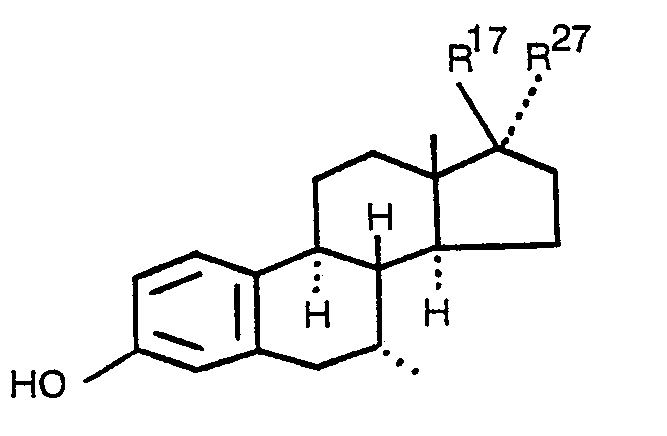


Applications Claiming Priority (2)
| Application Number | Priority Date | Filing Date | Title |
|---|---|---|---|
| GB8327256 | 1983-10-12 | ||
| GB838327256A GB8327256D0 (en) | 1983-10-12 | 1983-10-12 | Steroid derivatives |
Publications (3)
| Publication Number | Publication Date |
|---|---|
| EP0138504A2 EP0138504A2 (en) | 1985-04-24 |
| EP0138504A3 EP0138504A3 (en) | 1986-03-12 |
| EP0138504B1 true EP0138504B1 (en) | 1988-07-20 |
Family
ID=10550053
Family Applications (1)
| Application Number | Title | Priority Date | Filing Date |
|---|---|---|---|
| EP84306715A Expired EP0138504B1 (en) | 1983-10-12 | 1984-10-02 | Steroid derivatives |
Country Status (8)
| Country | Link |
|---|---|
| US (1) | US4659516A (en) |
| EP (1) | EP0138504B1 (en) |
| JP (1) | JPS6097995A (en) |
| AT (1) | ATE35814T1 (en) |
| DE (2) | DE3472792D1 (en) |
| GB (1) | GB8327256D0 (en) |
| LU (1) | LU91068I2 (en) |
| NL (1) | NL300158I2 (en) |
Cited By (2)
| Publication number | Priority date | Publication date | Assignee | Title |
|---|---|---|---|---|
| EP1916254A2 (en) | 2001-11-27 | 2008-04-30 | Bayer Schering Pharma Aktiengesellschaft | 17alpha-alkyl-17beta-oxy-estratriene and intermediates for its production, use of 17alpha-alkyl-17beta-oxy-estratriene for manufacturing medicine and pharmaceutical preparations |
| EP2258375A1 (en) | 2009-06-04 | 2010-12-08 | Bayer Schering Pharma Aktiengesellschaft | 17B-alkyl-17alpha-oxy-estratrienes |
Families Citing this family (163)
| Publication number | Priority date | Publication date | Assignee | Title |
|---|---|---|---|---|
| DE3733478A1 (en) * | 1987-10-01 | 1989-04-13 | Schering Ag | ANTIGESTAGEN AND ANTIOOTROGENIC COMPOUNDS FOR THE INTRODUCTION OF BIRTH AND PREGNANCY, AND THE TREATMENT OF GYNAECOLOGICAL DISORDER AND HORMONE-RELATED TUMORS |
| EP0310542B1 (en) * | 1987-10-01 | 1994-06-08 | Schering Aktiengesellschaft | Antigestagenic and antioestrogenic compounds for the treatment of hormone-dependent tumours |
| US4895715A (en) * | 1988-04-14 | 1990-01-23 | Schering Corporation | Method of treating gynecomastia |
| GB8813353D0 (en) * | 1988-06-06 | 1988-07-13 | Ici Plc | Therapeutic product |
| US5393785A (en) * | 1988-10-31 | 1995-02-28 | Endorecherche, Inc. | Therapeutic antiestrogens |
| HU208150B (en) * | 1988-10-31 | 1993-08-30 | Endorecherche Inc | Process for producing new estrogen derivatives having steroid hormone inhibitor activity and pharmaceutical compositions comprising such derivatives |
| US5686465A (en) * | 1988-10-31 | 1997-11-11 | Endorecherche Inc. | Sex steroid activity inhibitors |
| US5204337A (en) * | 1988-10-31 | 1993-04-20 | Endorecherche Inc. | Estrogen nucleus derivatives for use in inhibition of sex steroid activity |
| US5395842A (en) * | 1988-10-31 | 1995-03-07 | Endorecherche Inc. | Anti-estrogenic compounds and compositions |
| FR2643638B1 (en) * | 1989-02-24 | 1991-06-14 | Roussel Uclaf | NOVEL 19-NOR STEROIDS HAVING IN THE 11BETA POSITION A CARBON CHAIN COMPRISING AN AMIDE OR CARBAMATE FUNCTION, THEIR PREPARATION METHOD AND INTERMEDIATES THEREOF, THEIR APPLICATION AS MEDICAMENTS AND THE PHARMACEUTICAL COMPOSITIONS CONTAINING THEM |
| US5372996A (en) * | 1989-03-10 | 1994-12-13 | Endorecherche, Inc. | Method of treatment of androgen-related diseases |
| US5364847A (en) * | 1989-03-10 | 1994-11-15 | Endorecherche | Inhibitors of sex steroid biosynthesis and methods for their production and use |
| EP0462189B1 (en) * | 1989-03-10 | 1995-09-27 | Endorecherche Inc. | Combination therapy for treatment of estrogen sensitive diseases |
| ES2189784T3 (en) * | 1989-07-07 | 2003-07-16 | Endorech Inc | PROCEDURE FOR THE TREATMENT OF DISEASES RELATED TO ADROGENS. |
| AU5856090A (en) * | 1989-07-07 | 1991-02-06 | Endorecherche Inc. | Androgen derivatives for use in the inhibition of sex steroid activity |
| DE3925507A1 (en) * | 1989-07-28 | 1991-01-31 | Schering Ag | 14,17 (ALPHA) ETHENO AND ETHANOESTRATRIA, METHOD FOR PRODUCING THESE COMPOUNDS, AND THEIR USE FOR PRODUCING MEDICINAL PRODUCTS |
| FR2654337B1 (en) * | 1989-11-15 | 1994-08-05 | Roussel Uclaf | NOVEL BIODEGRADABLE INJECTABLE MICROSPHERES PREPARATION METHOD AND INJECTABLE SUSPENSIONS CONTAINING THEM. |
| ZA924811B (en) * | 1991-06-28 | 1993-12-29 | Endorecherche Inc | Controlled release systems and low dose androgens |
| US6060503A (en) * | 1991-12-02 | 2000-05-09 | Endorecherche, Inc. | Benzopyran-containing compounds and method for their use |
| JPH07506575A (en) * | 1992-05-21 | 1995-07-20 | アンドルシェルシュ・インコーポレイテッド | Inhibitor of testosterone 5α-reductase activity |
| DE19622457A1 (en) | 1996-05-24 | 1997-11-27 | Schering Ag | 7alpha- (5-methylaminopentyl) estratrienes, process for their preparation, pharmaceutical preparations which contain these 7alpha- (5-methylaminopentyl) estratrienes and their use for the manufacture of medicaments |
| US5866560A (en) * | 1996-08-20 | 1999-02-02 | Schering Ag | 7α-(ξ-aminoalkyl)-estratrienes, process for their production, pharmaceutical preparations which contain these 7α-(ξ-aminoalkyl)-estratrienes as well as their use for the production of pharmaceutical agents |
| DE19635525A1 (en) * | 1996-08-20 | 1998-02-26 | Schering Ag | New 7-alpha-(xi-aminoalkyl)- oestratriene derivatives |
| US6355630B1 (en) | 1997-10-23 | 2002-03-12 | American Home Products Corporation | Estra-1,3,5(10)-triene-7α-thioethers |
| CA2308773A1 (en) * | 1997-10-23 | 1999-04-29 | Ivo Jirkovsky | Estra-1,3,5(10)-triene-7alpha-thioethers |
| AR015500A1 (en) * | 1997-12-23 | 2001-05-02 | Schering Ag | 11 BETA-HALOGEN-STRATRIENS REPLACED IN 7 ALPHA, PROCEDURE FOR PREPARING PHARMACEUTICAL PREPARATIONS THAT CONTAIN SUCH 11 BETA-HALOGEN-STRATRIENS REPLACED IN 7 ALPHA, AS WELL AS USED IN THE PREPARATION OF MEDICINES. |
| DE19807791A1 (en) | 1998-02-19 | 1999-08-26 | Schering Ag | Combination preparation of estrogen with 7-aminoalkyl-estratriene antiestrogen, useful in hormone replacement therapy, e.g. for treatment osteoporosis, Alzheimer's disease and hot flushes |
| ATE473759T1 (en) | 1998-05-22 | 2010-07-15 | Univ Leland Stanford Junior | BIFUNCTIONAL MOLECULES AND THERAPIES BASED THERAPIES. |
| GB0000313D0 (en) | 2000-01-10 | 2000-03-01 | Astrazeneca Uk Ltd | Formulation |
| DE10027887A1 (en) * | 2000-05-31 | 2001-12-13 | Jenapharm Gmbh | Compounds with a sulfonamide group and pharmaceutical compositions containing these compounds |
| AU2001267904A1 (en) | 2000-06-30 | 2002-01-14 | Chugai Seiyaku Kabushiki Kaisha | Novel antiandrogenic agent |
| GB0025221D0 (en) * | 2000-10-14 | 2000-11-29 | Astrazeneca Ab | New process |
| US20050084908A1 (en) * | 2000-11-06 | 2005-04-21 | Chugai Seiyaku Kabushiki Kaisha | Methods for detecting binding of low-molecular-weight compound and its binding partner molecule |
| LT2762140T (en) | 2001-02-19 | 2017-06-26 | Novartis Ag | Treatment of solid brain tumours with a rapamycin derivative |
| BR0209647A (en) | 2001-05-16 | 2004-07-27 | Novartis Ag | A combination comprising n- {5- [4- (4-methyl-piperazine-methyl) -benzoylamido] -2-methyl-phenyl} -4- (3-pyridyl) -2-pyrimidine-amine and a chemotherapeutic agent |
| GB0123961D0 (en) * | 2001-10-05 | 2001-11-28 | Astrazeneca Ab | Process and intermediates |
| GB0128510D0 (en) * | 2001-11-28 | 2002-01-23 | Novartis Ag | Organic compounds |
| CA2483594C (en) | 2002-05-16 | 2011-02-15 | Novartis Ag | Use of edg receptor binding agents in cancer |
| NZ536475A (en) * | 2002-05-24 | 2008-06-30 | Schering Corp | Neutralizing human anti-igfr antibody |
| PE20050928A1 (en) * | 2003-11-21 | 2005-11-08 | Schering Corp | THERAPEUTIC COMBINATIONS OF ANTI-IGFR1 ANTIBODY |
| RS52545B (en) | 2004-04-07 | 2013-04-30 | Novartis Ag | INHIBITORI PROTEIN APOPTOZE (IAP) |
| CN100395259C (en) * | 2004-04-28 | 2008-06-18 | 江苏豪森药业股份有限公司 | Steroid derivatives |
| US20050277625A1 (en) * | 2004-05-21 | 2005-12-15 | Ralf Wyrwa | Estriol and estetrol prodrugs |
| US7534780B2 (en) * | 2004-05-21 | 2009-05-19 | Bayer Schering Pharma Aktiengesellschaft | Estradiol prodrugs |
| GB0512324D0 (en) | 2005-06-16 | 2005-07-27 | Novartis Ag | Organic compounds |
| EP1771462B1 (en) * | 2004-07-27 | 2010-09-29 | Sicor Inc. | A process for the preparation of 7-alpha-alkylated 19-norsteroids |
| CA2594477C (en) | 2005-01-21 | 2016-07-12 | Astex Therapeutics Limited | Pharmaceutical compounds |
| US20060233810A1 (en) * | 2005-04-15 | 2006-10-19 | Yaolin Wang | Methods and compositions for treating or preventing cancer |
| CN102379684B (en) | 2005-04-28 | 2014-11-19 | 普罗透斯数字保健公司 | Pharma-informatics system |
| GB0510390D0 (en) | 2005-05-20 | 2005-06-29 | Novartis Ag | Organic compounds |
| US9062126B2 (en) | 2005-09-16 | 2015-06-23 | Raptor Pharmaceuticals Inc. | Compositions comprising receptor-associated protein (RAP) variants specific for CR-containing proteins and uses thereof |
| CA2623034A1 (en) | 2005-09-27 | 2007-04-05 | Novartis Ag | Carboxyamine compounds and their use in the treatment of hdac dependent diseases |
| MX2007006653A (en) * | 2005-10-05 | 2009-02-17 | Sicor Inc | Separation of fulvestrant isomers. |
| EP2275103B1 (en) | 2005-11-21 | 2014-04-23 | Novartis AG | mTOR inhibitors in the treatment of endocrine tumors |
| US20070197488A1 (en) * | 2005-11-29 | 2007-08-23 | Olaf Peters | Prodrugs of ERbeta-selective substances, process for their production, and pharmaceutical compositions that contain these compounds |
| US20070123500A1 (en) * | 2005-11-29 | 2007-05-31 | Gerd Mueller | Prodrugs of ERbeta-selective substances, processes for their preparation and pharmaceutical compositions comprising these compounds |
| US20070135399A1 (en) * | 2005-11-30 | 2007-06-14 | Ralf Wyrwa | Heteroaromatic sulphonamide prodrugs |
| US20070135375A1 (en) * | 2005-11-30 | 2007-06-14 | Ralf Wyrwa | Sulfamoyl sulfonate prodrugs |
| GB0605120D0 (en) | 2006-03-14 | 2006-04-26 | Novartis Ag | Organic Compounds |
| CN102861338A (en) | 2006-04-05 | 2013-01-09 | 诺瓦提斯公司 | Combinations of comprising a bcr-abl, c-kit and pdgf-r tyrosine kinase inhibitor used for treating cancer |
| JP2009532503A (en) | 2006-04-05 | 2009-09-10 | ノバルティス アクチエンゲゼルシャフト | Combination of therapeutic agents for treating cancer |
| US20090317489A1 (en) | 2006-05-09 | 2009-12-24 | Hanspeter Nick | Combination Comprising an Iron Chelator and an Anti-Neoplastic Agent and Use Thereof |
| KR20090073121A (en) | 2006-09-29 | 2009-07-02 | 노파르티스 아게 | Pyrazolopyrimidines as PI3 'Lipid Kinase Inhibitors |
| WO2008044041A1 (en) | 2006-10-12 | 2008-04-17 | Astex Therapeutics Limited | Pharmaceutical combinations |
| WO2008044045A1 (en) | 2006-10-12 | 2008-04-17 | Astex Therapeutics Limited | Pharmaceutical combinations |
| EP2491923A3 (en) | 2007-02-15 | 2012-12-26 | Novartis AG | Combinations of therapeutic agents for treating cancer |
| WO2009039700A1 (en) * | 2007-09-24 | 2009-04-02 | Xi'an Libang Pharmaceutical Co., Ltd. | Process for the manufacture of 7-alpha-[9-(4,4,5,5,5-penta fluoropentvlsulphinvl) nonvllestra-l,3,5-(10)- triene-3,17-beta-diol |
| US20090082323A1 (en) * | 2007-09-25 | 2009-03-26 | Protia, Llc | Deuterium-enriched fulvestrant |
| SG185311A1 (en) | 2007-10-16 | 2012-11-29 | Repros Therapeutics Inc | Trans-clomiphene for metabolic syndrome |
| EP2070941A1 (en) | 2007-12-14 | 2009-06-17 | Bayer Schering Pharma Aktiengesellschaft | Stereoselective synthesis of selective estrogen receptor down-regulators |
| CA2716576A1 (en) | 2008-03-07 | 2009-09-11 | Nageswara R. Palepu | Fulvestrant formulations |
| AU2009228765B2 (en) | 2008-03-24 | 2012-05-31 | Novartis Ag | Arylsulfonamide-based matrix metalloprotease inhibitors |
| PT2260020E (en) | 2008-03-26 | 2014-10-28 | Novartis Ag | Hydroxamate-based inhibitors of deacetylases b |
| US8063249B1 (en) | 2008-04-25 | 2011-11-22 | Olema Pharmaceuticals, Inc. | Substituted triphenyl butenes |
| WO2010043404A1 (en) * | 2008-10-15 | 2010-04-22 | Synthon B.V. | Processes and intermediates for the production of fulvestrant |
| WO2010083617A1 (en) | 2009-01-21 | 2010-07-29 | Oncalis Ag | Pyrazolopyrimidines as protein kinase inhibitors |
| PL2391366T3 (en) | 2009-01-29 | 2013-04-30 | Novartis Ag | Substituted benzimidazoles for the treatment of astrocytomas |
| EP2398500B1 (en) | 2009-02-20 | 2019-03-13 | 2-BBB Medicines B.V. | Glutathione-based drug delivery system |
| ES2942923T3 (en) | 2009-05-06 | 2023-06-07 | Laboratory Skin Care Inc | Dermal delivery compositions comprising complexes of active agent-calcium phosphate particles and methods of use thereof |
| WO2010151133A1 (en) | 2009-06-25 | 2010-12-29 | Erasmus University Medical Center Rotterdam | Methods for establishing and predicting resistance to endocrine therapy using an mirna profile |
| MA33451B1 (en) | 2009-06-26 | 2012-07-03 | Novartis Ag | 1,3-DISUBSTITUTED IMIDAZOLIDIN-2-ONE DERIVATIVES AS CYP INHIBITORS 17 |
| US8389526B2 (en) | 2009-08-07 | 2013-03-05 | Novartis Ag | 3-heteroarylmethyl-imidazo[1,2-b]pyridazin-6-yl derivatives |
| EA201200260A1 (en) | 2009-08-12 | 2012-09-28 | Новартис Аг | HETEROCYCLIC HYDRAZONES AND THEIR APPLICATION FOR THE TREATMENT OF CANCER AND INFLAMMATION |
| MX2012002179A (en) | 2009-08-20 | 2012-03-16 | Novartis Ag | Heterocyclic oxime compounds. |
| AU2010288534A1 (en) | 2009-08-26 | 2012-03-15 | Novartis Ag | Tetra-substituted heteroaryl compounds and their use as MDM2 and/or MDM4 modulators |
| AU2010294209A1 (en) | 2009-09-10 | 2012-03-29 | Irm Llc | Ether derivatives of bicyclic heteroaryls |
| MY156209A (en) | 2009-11-04 | 2016-01-29 | Novartis Ag | Heterocyclic sulfonamide derivatives useful mek inhibitors |
| WO2011064211A1 (en) | 2009-11-25 | 2011-06-03 | Novartis Ag | Benzene-fused 6-membered oxygen-containing heterocyclic derivatives of bicyclic heteroaryls |
| JP5456908B2 (en) | 2009-12-08 | 2014-04-02 | ノバルティス アーゲー | Heterocyclic sulfonamide derivatives |
| AU2012265844A1 (en) | 2009-12-08 | 2013-05-02 | Novartis Ag | Heterocyclic sulfonamide derivatives |
| US8440693B2 (en) | 2009-12-22 | 2013-05-14 | Novartis Ag | Substituted isoquinolinones and quinazolinones |
| CU24130B1 (en) | 2009-12-22 | 2015-09-29 | Novartis Ag | ISOQUINOLINONES AND REPLACED QUINAZOLINONES |
| EP2582681A1 (en) | 2010-06-17 | 2013-04-24 | Novartis AG | Piperidinyl substituted 1,3-dihydro-benzoimidazol-2-ylideneamine derivatives |
| CN102947274A (en) | 2010-06-17 | 2013-02-27 | 诺瓦提斯公司 | Biphenyl substituted 1,3-dihydro-benzimidazol-2-ylideneamine derivatives |
| DE102010030538A1 (en) | 2010-06-25 | 2011-12-29 | Bayer Schering Pharma Aktiengesellschaft | 6,7-Dihydro-5H-benzo [7] annulene derivatives, process for their preparation, pharmaceutical preparations containing them and their use for the preparation of medicaments |
| UA112517C2 (en) | 2010-07-06 | 2016-09-26 | Новартіс Аг | TETRAHYDROPYRIDOPYRIMIDINE DERIVATIVES |
| JP2013537210A (en) | 2010-09-16 | 2013-09-30 | ノバルティス アーゲー | 17α-hydroxylase / C17,20-lyase inhibitor |
| BR112013018534B1 (en) | 2011-01-20 | 2021-04-06 | Board Of Regents, The University Of Texas System | CONTRAST AGENT, ITS PREPARATION METHODS, AND COMBINATION PRODUCT |
| JP2014505088A (en) | 2011-02-10 | 2014-02-27 | ノバルティス アーゲー | [1,2,4] Triazolo [4,3-b] pyridazine compounds as C-MET tyrosine kinase inhibitors |
| CN103492390A (en) | 2011-03-08 | 2014-01-01 | 诺瓦提斯公司 | Fluorophenyl bicyclic heteroaryl compounds |
| EA023064B1 (en) | 2011-04-28 | 2016-04-29 | Новартис Аг | 17α-HYDROXYLASE/C17,20-LYASE INHIBITORS |
| US8859535B2 (en) | 2011-06-20 | 2014-10-14 | Novartis Ag | Hydroxy substituted isoquinolinone derivatives |
| EP2721007B1 (en) | 2011-06-20 | 2015-04-29 | Novartis AG | Cyclohexyl isoquinolinone compounds |
| CA2840315A1 (en) | 2011-06-27 | 2013-01-03 | Novartis Ag | Solid forms and salts of tetrahydro-pyrido-pyrimidine derivatives |
| UY34329A (en) | 2011-09-15 | 2013-04-30 | Novartis Ag | TRIAZOLOPIRIDINE COMPOUNDS |
| US8969341B2 (en) | 2011-11-29 | 2015-03-03 | Novartis Ag | Pyrazolopyrrolidine compounds |
| DE102011087987A1 (en) | 2011-12-08 | 2013-06-13 | Bayer Intellectual Property Gmbh | 6,7-Dihydro-5H-benzo [7] annulene derivatives, process for their preparation, pharmaceutical preparations containing them and their use for the preparation of medicaments |
| EP2791128A4 (en) | 2011-12-16 | 2015-04-22 | Olema Pharmaceuticals Inc | Novel benzopyran compounds, compositions and uses thereof |
| WO2013093850A1 (en) | 2011-12-22 | 2013-06-27 | Novartis Ag | Quinoline derivatives |
| MY170922A (en) | 2011-12-22 | 2019-09-18 | Novartis Ag | Dihydro-benzo-oxazine and dihydro-pyrido-oxazine derivatives |
| US9126979B2 (en) | 2011-12-23 | 2015-09-08 | Novartis Ag | Compounds for inhibiting the interaction of BCL2 with binding partners |
| CN104125955A (en) | 2011-12-23 | 2014-10-29 | 诺华股份有限公司 | Compounds for inhibiting interaction of bcl2 with binding partners |
| CN104125953A (en) | 2011-12-23 | 2014-10-29 | 诺华股份有限公司 | Compounds for inhibiting interaction of bcl2 with binding partners |
| CN104136429A (en) | 2011-12-23 | 2014-11-05 | 诺华股份有限公司 | Compounds for inhibiting the interaction of bcl2 with binding partners |
| AU2012355615A1 (en) | 2011-12-23 | 2014-07-10 | Novartis Ag | Compounds for inhibiting the interaction of BCL2 with binding partners |
| JO3357B1 (en) | 2012-01-26 | 2019-03-13 | Novartis Ag | Imidazopyrrolidinone compounds |
| KR20140117457A (en) | 2012-01-31 | 2014-10-07 | 노파르티스 아게 | Combination of a rtk inhibitor with an anti - estrogen and use thereof for the treatment of cancer |
| US20150031656A1 (en) | 2012-02-29 | 2015-01-29 | Repros Therapeutics Inc. | Combination therapy for treating androgen deficiency |
| US11179468B2 (en) | 2012-04-09 | 2021-11-23 | Eagle Pharmaceuticals, Inc. | Fulvestrant formulations |
| JP6171003B2 (en) | 2012-05-24 | 2017-07-26 | ノバルティス アーゲー | Pyrrolopyrrolidinone compounds |
| BR112015007083A2 (en) | 2012-10-02 | 2017-07-04 | Epitherapeutics Aps | histone demethylase inhibitors |
| JP2016027000A (en) * | 2012-10-09 | 2016-02-18 | 学校法人早稲田大学 | Steroid compound and pharmaceutical containing the same |
| EP2909224B1 (en) | 2012-10-22 | 2020-03-18 | Intas Pharmaceuticals Limited | An improved process for the preparation of fulvestrant |
| TW201422625A (en) | 2012-11-26 | 2014-06-16 | Novartis Ag | Solid form of dihydro-pyrido-oxazine derivative |
| US9403827B2 (en) | 2013-01-22 | 2016-08-02 | Novartis Ag | Substituted purinone compounds |
| US9556180B2 (en) | 2013-01-22 | 2017-01-31 | Novartis Ag | Pyrazolo[3,4-d]pyrimidinone compounds as inhibitors of the P53/MDM2 interaction |
| WO2014128612A1 (en) | 2013-02-20 | 2014-08-28 | Novartis Ag | Quinazolin-4-one derivatives |
| PE20151667A1 (en) | 2013-02-27 | 2015-11-27 | Epitherapeutics Aps | HISTONE DESMETILASE INHIBITORS |
| CN104936971B (en) * | 2013-04-18 | 2017-10-13 | 西安力邦医药科技有限责任公司 | 7‑α‑[9‑(4,4,5,5,5‑pentafluoropentylsulfinyl)nonyl]‑estra‑1,3,5(10)‑triene‑ with anticancer activity 3, ester derivatives of 17β-diol and preparation method thereof |
| US20150018376A1 (en) | 2013-05-17 | 2015-01-15 | Novartis Ag | Pyrimidin-4-yl)oxy)-1h-indole-1-carboxamide derivatives and use thereof |
| WO2014203132A1 (en) | 2013-06-19 | 2014-12-24 | Olema Pharmaceuticals, Inc. | Substituted benzopyran compounds, compositions and uses thereof |
| WO2014203129A1 (en) | 2013-06-19 | 2014-12-24 | Olema Pharmaceuticals, Inc. | Combinations of benzopyran compounds, compositions and uses thereof |
| UY35675A (en) | 2013-07-24 | 2015-02-27 | Novartis Ag | SUBSTITUTED DERIVATIVES OF QUINAZOLIN-4-ONA |
| WO2015022663A1 (en) | 2013-08-14 | 2015-02-19 | Novartis Ag | Compounds and compositions as inhibitors of mek |
| US9227969B2 (en) | 2013-08-14 | 2016-01-05 | Novartis Ag | Compounds and compositions as inhibitors of MEK |
| WO2015022664A1 (en) | 2013-08-14 | 2015-02-19 | Novartis Ag | Compounds and compositions as inhibitors of mek |
| EP3046921A4 (en) | 2013-09-22 | 2017-02-22 | Calitor Sciences, LLC | Substituted aminopyrimidine compounds and methods of use |
| EP3094340A1 (en) | 2014-01-15 | 2016-11-23 | Novartis AG | Pharmaceutical combinations |
| JP6517319B2 (en) | 2014-03-28 | 2019-05-22 | キャリター・サイエンシーズ・リミテッド・ライアビリティ・カンパニーCalitor Sciences, Llc | Substituted heteroaryl compounds and methods of use |
| EP3126345A1 (en) | 2014-03-31 | 2017-02-08 | Gilead Sciences, Inc. | Inhibitors of histone demethylases |
| CN103980336B (en) * | 2014-05-21 | 2016-10-05 | 天津孚音生物科技发展有限公司 | A kind of synthetic method of new fulvestrant |
| CN103965280B (en) * | 2014-05-21 | 2016-04-20 | 天津孚音生物科技发展有限公司 | A kind of preparation method of fulvestrant intermediate |
| WO2015181116A1 (en) | 2014-05-26 | 2015-12-03 | Crystal Pharma, S.A.U. | Process and intermediades for the preparation of 7-alkylated steroids |
| EA201790154A1 (en) | 2014-08-27 | 2017-08-31 | Джилид Сайэнс, Инк. | COMPOUNDS AND METHODS FOR INHIBITING HISTONAL DEMETYLASES |
| EP3347097B1 (en) | 2015-09-11 | 2021-02-24 | Sunshine Lake Pharma Co., Ltd. | Substituted aminopyrimidine derivatives as modulators of the kinases jak, flt3 and aurora |
| DK3355884T3 (en) | 2015-10-01 | 2021-08-02 | Olema Pharmaceuticals Inc | TETRAHYDRO-1H-PYRIDO [3,4-B] INDOL ANTIOSTROGEN MEDICINES |
| EP3373967B9 (en) | 2015-11-10 | 2023-10-04 | Paracrine Therapeutics AB | Treatment of er-negative breast cancer with an pdgf-cc inhibitor and an anti estrogen |
| ES2935125T3 (en) | 2015-12-09 | 2023-03-01 | Univ Illinois | Benzothiophene-based selective downregulators of estrogen receptors |
| WO2018017410A1 (en) | 2016-07-22 | 2018-01-25 | Eli Lilly And Company | Combination therapy of abemaciclib and a pi3 kinase/mtor dual inhibitor for use in the treatment of breast cancer |
| WO2018081168A2 (en) | 2016-10-24 | 2018-05-03 | The Board Of Trustees Of The University Of Illinois | Benzothiophene-based selective mixed estrogen receptor downregulators |
| AR110728A1 (en) | 2017-01-06 | 2019-04-24 | G1 Therapeutics Inc | COMBINED THERAPY FOR TREATMENT OF CANCER |
| WO2019099311A1 (en) | 2017-11-19 | 2019-05-23 | Sunshine Lake Pharma Co., Ltd. | Substituted heteroaryl compounds and methods of use |
| AU2017444054B2 (en) | 2017-12-21 | 2021-10-07 | Hefei Institutes Of Physical Science, Chinese Academy Of Sciences | Class of pyrimidine derivative kinase inhibitors |
| US10751339B2 (en) | 2018-01-20 | 2020-08-25 | Sunshine Lake Pharma Co., Ltd. | Substituted aminopyrimidine compounds and methods of use |
| CA3144791A1 (en) | 2019-07-07 | 2021-01-14 | Olema Pharmaceuticals, Inc. | Regimens of estrogen receptor antagonists |
| US20220395553A1 (en) | 2019-11-14 | 2022-12-15 | Cohbar, Inc. | Cxcr4 antagonist peptides |
| US20230119759A1 (en) | 2020-03-10 | 2023-04-20 | Chia Tai Tianqing Pharmaceutical Group Co., Ltd. | Pharmaceutical combination comprising pyridino[1,2-a]pyrimidinone compound |
| IT202100003176A1 (en) | 2021-02-12 | 2022-08-12 | Farmabios Spa | PROCESS FOR THE PREPARATION OF FULVESTRANT |
| CN114716496B (en) * | 2022-04-29 | 2024-04-02 | 香港中文大学(深圳) | Fulvestrant derivative, preparation method and application thereof |
| CN117534720A (en) * | 2022-08-01 | 2024-02-09 | 香港中文大学(深圳) | Cyclopentane polyhydrophenanthrene derivative, and preparation method and application thereof |
| CN116041412A (en) * | 2023-01-13 | 2023-05-02 | 香港中文大学(深圳) | Fulvestrant derivative and its preparation method, application and medicine for treating breast cancer |
| CN117050132A (en) * | 2023-04-28 | 2023-11-14 | 香港中文大学(深圳) | Steroid derivatives, preparation methods, applications and drugs for treating breast cancer |
| CN116535454A (en) * | 2023-04-28 | 2023-08-04 | 香港中文大学(深圳) | Fulvestrant compound and preparation method and application thereof |
Family Cites Families (4)
| Publication number | Priority date | Publication date | Assignee | Title |
|---|---|---|---|---|
| CH537915A (en) * | 1969-02-27 | 1973-06-15 | Ciba Geigy Ag | Process for the preparation of a new estratriol |
| FR2235949B1 (en) * | 1973-06-18 | 1978-03-17 | Roussel Uclaf | |
| YU243975A (en) * | 1974-10-14 | 1982-06-30 | Schering Ag | Process for obtaining 7-hydroxyestradiols |
| GB8311678D0 (en) * | 1983-04-28 | 1983-06-02 | Ici Plc | Phenol derivatives |
-
1983
- 1983-10-12 GB GB838327256A patent/GB8327256D0/en active Pending
-
1984
- 1984-10-01 US US06/656,466 patent/US4659516A/en not_active Expired - Lifetime
- 1984-10-02 AT AT84306715T patent/ATE35814T1/en active
- 1984-10-02 DE DE8484306715T patent/DE3472792D1/en not_active Expired
- 1984-10-02 DE DE200412000011 patent/DE122004000011I2/en active Active
- 1984-10-02 LU LU91068C patent/LU91068I2/en unknown
- 1984-10-02 EP EP84306715A patent/EP0138504B1/en not_active Expired
- 1984-10-12 JP JP59212766A patent/JPS6097995A/en active Granted
-
2004
- 2004-08-17 NL NL300158C patent/NL300158I2/en unknown
Cited By (3)
| Publication number | Priority date | Publication date | Assignee | Title |
|---|---|---|---|---|
| EP1916254A2 (en) | 2001-11-27 | 2008-04-30 | Bayer Schering Pharma Aktiengesellschaft | 17alpha-alkyl-17beta-oxy-estratriene and intermediates for its production, use of 17alpha-alkyl-17beta-oxy-estratriene for manufacturing medicine and pharmaceutical preparations |
| EP2258375A1 (en) | 2009-06-04 | 2010-12-08 | Bayer Schering Pharma Aktiengesellschaft | 17B-alkyl-17alpha-oxy-estratrienes |
| WO2010139411A2 (en) | 2009-06-04 | 2010-12-09 | Bayer Schering Pharma Aktiengesellschaft | 17β-ALKYL-17α-OXY-ESTRATRIENES |
Also Published As
| Publication number | Publication date |
|---|---|
| JPH0216759B2 (en) | 1990-04-18 |
| EP0138504A2 (en) | 1985-04-24 |
| NL300158I2 (en) | 2004-11-01 |
| ATE35814T1 (en) | 1988-08-15 |
| GB8327256D0 (en) | 1983-11-16 |
| LU91068I2 (en) | 2004-04-02 |
| DE122004000011I1 (en) | 2004-08-12 |
| DE3472792D1 (en) | 1988-08-25 |
| US4659516A (en) | 1987-04-21 |
| DE122004000011I2 (en) | 2005-04-07 |
| EP0138504A3 (en) | 1986-03-12 |
| JPS6097995A (en) | 1985-05-31 |
Similar Documents
| Publication | Publication Date | Title |
|---|---|---|
| US4659516A (en) | Steroid derivatives | |
| CA1289944C (en) | 11 .beta.-(4-ISOPREPENYLPHENYL)ESTRA-4,9-DIENES, THEIR PRODUCTION, AND PHARMACEUTICAL PREPARATIONS CONTAINING SAME | |
| KR100341169B1 (en) | 17-spiromethylene steroid | |
| KR880001870B1 (en) | Method for preparing 3-keto Δ 4,9,19-nor steroid derivative | |
| US6072068A (en) | 16-hydroxy-11-(substituted phenyl)-estra-4,9-diene derivatives | |
| KR100287513B1 (en) | 17-spirofuran-3'-ylidene steroid | |
| SU1715205A3 (en) | Method for the synthesis of steroid, substituted with spirane cycle | |
| AU640664B2 (en) | 11B-aryl-4-estrenes, process for their preparation as well as their use as pharmaceutical agents | |
| JPH0559918B2 (en) | ||
| MX2008015972A (en) | INDUSTRIAL PROCESS FOR THE SYNTHESIS OF 17alpha-ACETOXY-11beta-[4-(N,N -DIMETHYL-AMINO)- PHENYL]-19-NORPREGNA-4,9-DIENE-3,20-DIONE AND NEW INTERMEDIATES OF THE PROCESS. | |
| HU196825B (en) | Process for producing 10-substituted steroids and pharmaceutical compositions comprising the same | |
| US5093507A (en) | 10β,11β-bridged steroids | |
| EP0709394B1 (en) | Steroids with a 17-spiromethylene lactone or lactol group | |
| HU208151B (en) | Process for producing 11beta-phenyl-14beta-steroids and pharmaceutical compositions comprising same | |
| US5478956A (en) | 8-En-19 11 β-bridged steroids, their production and pharmaceutical preparations containing them | |
| JP3048636B2 (en) | 14β-H-, 14- and 15-ene-11β-aryl-4-estrene | |
| JP3181589B2 (en) | 6,7-modified 11β-aryl-4-esterene | |
| US5519027A (en) | D-homo-(16-ene)-11β-aryl-4-estrenes, process for their production as well as their use as pharmaceutical agents | |
| US4420428A (en) | 16-Ketoandrostene-17-dithioketals | |
| IE48803B1 (en) | New process for the preparation of 17beta-hydroxy-3-oxo-17alpha-pregnene and pregnadiene-21-carboxylic acid epsilon-lactones | |
| US4488995A (en) | Androstene-17β-alkylthiomethyl ethers | |
| FI110688B (en) | New 11-beta-aryl-4-estrene(s) - exhibiting anti-glucocorticoidal activity and useful for treatment of glaucoma and cushings syndrome |
Legal Events
| Date | Code | Title | Description |
|---|---|---|---|
| PUAI | Public reference made under article 153(3) epc to a published international application that has entered the european phase |
Free format text: ORIGINAL CODE: 0009012 |
|
| AK | Designated contracting states |
Designated state(s): AT BE CH DE FR GB IT LI LU NL SE |
|
| PUAL | Search report despatched |
Free format text: ORIGINAL CODE: 0009013 |
|
| AK | Designated contracting states |
Kind code of ref document: A3 Designated state(s): AT BE CH DE FR GB IT LI LU NL SE |
|
| 17P | Request for examination filed |
Effective date: 19860818 |
|
| 17Q | First examination report despatched |
Effective date: 19870720 |
|
| GRAA | (expected) grant |
Free format text: ORIGINAL CODE: 0009210 |
|
| AK | Designated contracting states |
Kind code of ref document: B1 Designated state(s): AT BE CH DE FR GB IT LI LU NL SE |
|
| ITF | It: translation for a ep patent filed | ||
| REF | Corresponds to: |
Ref document number: 35814 Country of ref document: AT Date of ref document: 19880815 Kind code of ref document: T |
|
| REF | Corresponds to: |
Ref document number: 3472792 Country of ref document: DE Date of ref document: 19880825 |
|
| ET | Fr: translation filed | ||
| REG | Reference to a national code |
Ref country code: AT Ref legal event code: UEP Ref document number: 84306715 Country of ref document: AT Kind code of ref document: T |
|
| PLBE | No opposition filed within time limit |
Free format text: ORIGINAL CODE: 0009261 |
|
| STAA | Information on the status of an ep patent application or granted ep patent |
Free format text: STATUS: NO OPPOSITION FILED WITHIN TIME LIMIT |
|
| 26N | No opposition filed | ||
| REG | Reference to a national code |
Ref country code: GB Ref legal event code: 732E |
|
| ITTA | It: last paid annual fee | ||
| EPTA | Lu: last paid annual fee | ||
| REG | Reference to a national code |
Ref country code: CH Ref legal event code: PUE Owner name: ZENECA LIMITED |
|
| ITPR | It: changes in ownership of a european patent |
Owner name: CESSIONE;ZENECA LIMITED |
|
| NLS | Nl: assignments of ep-patents |
Owner name: ZENECA LIMITED TE LONDEN, GROOT-BRITTANNIE. |
|
| REG | Reference to a national code |
Ref country code: FR Ref legal event code: TP |
|
| EAL | Se: european patent in force in sweden |
Ref document number: 84306715.8 |
|
| REG | Reference to a national code |
Ref country code: GB Ref legal event code: 732E |
|
| BECA | Be: change of holder's address |
Free format text: 20001129 *ASTRAZENECA A.B.:151 85 SUEDERTALJE |
|
| REG | Reference to a national code |
Ref country code: CH Ref legal event code: NV Representative=s name: A. BRAUN, BRAUN, HERITIER, ESCHMANN AG PATENTANWAE Ref country code: CH Ref legal event code: PUE Owner name: ZENECA LIMITED TRANSFER- ASTRAZENECA AB |
|
| REG | Reference to a national code |
Ref country code: GB Ref legal event code: IF02 |
|
| PGFP | Annual fee paid to national office [announced via postgrant information from national office to epo] |
Ref country code: AT Payment date: 20030915 Year of fee payment: 20 Ref country code: GB Payment date: 20030915 Year of fee payment: 20 |
|
| PGFP | Annual fee paid to national office [announced via postgrant information from national office to epo] |
Ref country code: NL Payment date: 20030916 Year of fee payment: 20 |
|
| PGFP | Annual fee paid to national office [announced via postgrant information from national office to epo] |
Ref country code: FR Payment date: 20031003 Year of fee payment: 20 |
|
| PGFP | Annual fee paid to national office [announced via postgrant information from national office to epo] |
Ref country code: SE Payment date: 20031006 Year of fee payment: 20 |
|
| PGFP | Annual fee paid to national office [announced via postgrant information from national office to epo] |
Ref country code: DE Payment date: 20031031 Year of fee payment: 20 |
|
| PGFP | Annual fee paid to national office [announced via postgrant information from national office to epo] |
Ref country code: BE Payment date: 20031203 Year of fee payment: 20 |
|
| PGFP | Annual fee paid to national office [announced via postgrant information from national office to epo] |
Ref country code: CH Payment date: 20031219 Year of fee payment: 20 |
|
| PGFP | Annual fee paid to national office [announced via postgrant information from national office to epo] |
Ref country code: LU Payment date: 20040226 Year of fee payment: 20 |
|
| REG | Reference to a national code |
Ref country code: FR Ref legal event code: CP Free format text: PRODUCT NAME: FULVESTRANT; REGISTRATION NO/DATE: EU/1/03/269/001 20040310 Spc suppl protection certif: 04C0006 Filing date: 20040402 |
|
| REG | Reference to a national code |
Ref country code: SE Ref legal event code: SPCF Free format text: PRODUCT NAME: FULVESTRANT ELLER EN FARMACEUTISKT GODTAGBART SALT DAERAV; NAT REG. NO/DATE: EG EU/1/03/269/001 20040310; FIRST REG.: EG EU/1/03/269/001 20040310 Spc suppl protection certif: 04900056.L Ref country code: SE Ref legal event code: SPCF Free format text: 0490005-6, 20040310 Spc suppl protection certif: 0490005-6 Filing date: 20040310 |
|
| REG | Reference to a national code |
Ref country code: GB Ref legal event code: CTFF Free format text: SPC/GB04/009: 20040324 Spc suppl protection certif: SPC/GB04/009 Filing date: 20040324 |
|
| REG | Reference to a national code |
Ref country code: FR Ref legal event code: CR Free format text: 04C0006, 20040402 Spc suppl protection certif: 04C0006 Filing date: 20040402 |
|
| REG | Reference to a national code |
Ref country code: LU Ref legal event code: CCP Free format text: 91068, EXPIRES: 20091002 Spc suppl protection certif: 91068 Expiry date: 20091002 |
|
| REG | Reference to a national code |
Ref country code: FR Ref legal event code: CP |
|
| NLS | Nl: assignments of ep-patents |
Owner name: ASTRAZENECA UK LIMITED |
|
| NLT1 | Nl: modifications of names registered in virtue of documents presented to the patent office pursuant to art. 16 a, paragraph 1 |
Owner name: SYNGENTA LIMITED |
|
| PG25 | Lapsed in a contracting state [announced via postgrant information from national office to epo] |
Ref country code: GB Free format text: LAPSE BECAUSE OF EXPIRATION OF PROTECTION Effective date: 20041001 Ref country code: CH Free format text: LAPSE BECAUSE OF EXPIRATION OF PROTECTION Effective date: 20041001 Ref country code: LI Free format text: LAPSE BECAUSE OF EXPIRATION OF PROTECTION Effective date: 20041001 |
|
| PG25 | Lapsed in a contracting state [announced via postgrant information from national office to epo] |
Ref country code: NL Free format text: LAPSE BECAUSE OF EXPIRATION OF PROTECTION Effective date: 20041002 Ref country code: LU Free format text: LAPSE BECAUSE OF EXPIRATION OF PROTECTION Effective date: 20041002 Ref country code: AT Free format text: LAPSE BECAUSE OF EXPIRATION OF PROTECTION Effective date: 20041002 |
|
| REG | Reference to a national code |
Ref country code: FR Ref legal event code: CY Free format text: 04C0006, 20040402, EXPIRES: 20091001 Spc suppl protection certif: 04C0006 Filing date: 20040402 |
|
| REG | Reference to a national code |
Ref country code: SE Ref legal event code: SPCG Spc suppl protection certif: 04900056.L |
|
| REG | Reference to a national code |
Ref country code: GB Ref legal event code: PE20 |
|
| REG | Reference to a national code |
Ref country code: CH Ref legal event code: PL |
|
| BE20 | Be: patent expired |
Owner name: *ASTRAZENECA A.B. Effective date: 20041002 |
|
| REG | Reference to a national code |
Ref country code: NL Ref legal event code: KC1 Free format text: 300158, 20041002, EXPIRES: 20091001 Spc suppl protection certif: 300158 Filing date: 20041002 Expiry date: 20091001 Ref country code: NL Ref legal event code: AC1 Spc suppl protection certif: 300158 Filing date: 20040817 |
|
| EUG | Se: european patent has lapsed | ||
| NLV7 | Nl: ceased due to reaching the maximum lifetime of a patent |
Effective date: 20041002 |
|
| REG | Reference to a national code |
Ref country code: GB Ref legal event code: CTFG Free format text: SPC/GB04/009: 20041119, EXPIRES: 20091001 Spc suppl protection certif: SPC/GB04/009 Filing date: 20041119 Expiry date: 20091001 Ref country code: AT Ref legal event code: ESZA Ref document number: 35814 Country of ref document: AT Kind code of ref document: T Free format text: PRODUCT NAME: ''FULVESTRANT'' ODER EIN PHARMAZEUTISCH VERTRAEGLICHES SALZ DAVON Spc suppl protection certif: SZ 17/2004 Filing date: 20040811 |
|
| REG | Reference to a national code |
Ref country code: AT Ref legal event code: EELA Ref document number: 35814 Country of ref document: AT Kind code of ref document: T |
|
| REG | Reference to a national code |
Ref country code: GB Ref legal event code: CTFE Free format text: SPC/GB04/009: 20050219, EXPIRES: 20091001 Spc suppl protection certif: SPC/GB04/009 Filing date: 20050219 Expiry date: 20091001 |
|
| REG | Reference to a national code |
Ref country code: FR Ref legal event code: TP |
|
| REG | Reference to a national code |
Ref country code: AT Ref legal event code: EEZF Ref document number: 35814 Country of ref document: AT Kind code of ref document: T Free format text: PRODUCT NAME: ''FULVESTRANT'' ODER EIN PHARMAZEUTISCH VERTRAEGLICHES SALZ DAVON Spc suppl protection certif: SZ 17/2004 Filing date: 20040811 Extension date: 20091002 Effective date: 20060116 |
|
| REG | Reference to a national code |
Ref country code: CH Ref legal event code: SPCN Free format text: FORMER REPRESENTATIVE: A. BRAUN, BRAUN, HERITIER, ESCHMANN AG PATENTANWAELTE, CH Spc suppl protection certif: C00138504/01 Representative=s name: BOHEST AG, CH |
|
| REG | Reference to a national code |
Ref country code: CH Ref legal event code: SPCL Spc suppl protection certif: C00138504/01 |
|
| REG | Reference to a national code |
Ref country code: GB Ref legal event code: SPCE Free format text: PRODUCT NAME: FULVESTRANT OR A PHARMACEUTICALLY ACCEPTABLE SALT THEREOF.; REGISTERED: UK EU/1/03/269/001 20040310 Spc suppl protection certif: SPC/GB04/009 Filing date: 20040324 Expiry date: 20050219 Extension date: 20091001 |
|
| REG | Reference to a national code |
Ref country code: BE Ref legal event code: CCRE Free format text: PRODUCT NAME: FULVESTRANT; REGISTRATION NO/DATE: EU/1/03/269/001 20040311 Spc suppl protection certif: 2004C/004 Filing date: 20040325 Expiry date: 20041002 Extension date: 20091002 |