EP0137582B1 - Cementiferous compositions - Google Patents
Cementiferous compositions Download PDFInfo
- Publication number
- EP0137582B1 EP0137582B1 EP84304163A EP84304163A EP0137582B1 EP 0137582 B1 EP0137582 B1 EP 0137582B1 EP 84304163 A EP84304163 A EP 84304163A EP 84304163 A EP84304163 A EP 84304163A EP 0137582 B1 EP0137582 B1 EP 0137582B1
- Authority
- EP
- European Patent Office
- Prior art keywords
- admixture
- copolymer
- monomer
- compositions
- results
- Prior art date
- Legal status (The legal status is an assumption and is not a legal conclusion. Google has not performed a legal analysis and makes no representation as to the accuracy of the status listed.)
- Expired
Links
- 239000000203 mixture Substances 0.000 title claims abstract description 73
- 239000000654 additive Substances 0.000 claims abstract description 30
- 229920001577 copolymer Polymers 0.000 claims abstract description 29
- 230000000996 additive effect Effects 0.000 claims abstract description 19
- 239000000178 monomer Substances 0.000 claims abstract description 14
- 239000004014 plasticizer Substances 0.000 claims abstract description 14
- 150000003839 salts Chemical class 0.000 claims abstract description 6
- 239000007864 aqueous solution Substances 0.000 claims abstract description 5
- 125000002887 hydroxy group Chemical group [H]O* 0.000 claims abstract description 5
- GSEJCLTVZPLZKY-UHFFFAOYSA-N Triethanolamine Chemical compound OCCN(CCO)CCO GSEJCLTVZPLZKY-UHFFFAOYSA-N 0.000 claims description 27
- XLYOFNOQVPJJNP-UHFFFAOYSA-N water Substances O XLYOFNOQVPJJNP-UHFFFAOYSA-N 0.000 claims description 26
- 239000002253 acid Substances 0.000 claims description 9
- -1 hydroxy ester Chemical class 0.000 claims description 6
- 150000001732 carboxylic acid derivatives Chemical class 0.000 claims description 5
- 150000003567 thiocyanates Chemical class 0.000 claims description 2
- 239000004567 concrete Substances 0.000 description 28
- 238000013461 design Methods 0.000 description 22
- PSZYNBSKGUBXEH-UHFFFAOYSA-N naphthalene-1-sulfonic acid Chemical class C1=CC=C2C(S(=O)(=O)O)=CC=CC2=C1 PSZYNBSKGUBXEH-UHFFFAOYSA-N 0.000 description 14
- 230000000694 effects Effects 0.000 description 12
- 239000004568 cement Substances 0.000 description 11
- 238000011161 development Methods 0.000 description 8
- 229920000642 polymer Polymers 0.000 description 6
- 230000009467 reduction Effects 0.000 description 6
- 150000007513 acids Chemical class 0.000 description 5
- NIXOWILDQLNWCW-UHFFFAOYSA-N acrylic acid group Chemical group C(C=C)(=O)O NIXOWILDQLNWCW-UHFFFAOYSA-N 0.000 description 5
- 230000009286 beneficial effect Effects 0.000 description 5
- 238000009472 formulation Methods 0.000 description 5
- SMZOUWXMTYCWNB-UHFFFAOYSA-N 2-(2-methoxy-5-methylphenyl)ethanamine Chemical compound COC1=CC=C(C)C=C1CCN SMZOUWXMTYCWNB-UHFFFAOYSA-N 0.000 description 4
- UFWIBTONFRDIAS-UHFFFAOYSA-N Naphthalene Chemical compound C1=CC=CC2=CC=CC=C21 UFWIBTONFRDIAS-UHFFFAOYSA-N 0.000 description 4
- VYPSYNLAJGMNEJ-UHFFFAOYSA-N Silicium dioxide Chemical compound O=[Si]=O VYPSYNLAJGMNEJ-UHFFFAOYSA-N 0.000 description 4
- FAPWRFPIFSIZLT-UHFFFAOYSA-M Sodium chloride Chemical compound [Na+].[Cl-] FAPWRFPIFSIZLT-UHFFFAOYSA-M 0.000 description 4
- VGTPCRGMBIAPIM-UHFFFAOYSA-M sodium thiocyanate Chemical compound [Na+].[S-]C#N VGTPCRGMBIAPIM-UHFFFAOYSA-M 0.000 description 4
- STCOOQWBFONSKY-UHFFFAOYSA-N tributyl phosphate Chemical compound CCCCOP(=O)(OCCCC)OCCCC STCOOQWBFONSKY-UHFFFAOYSA-N 0.000 description 4
- UXVMQQNJUSDDNG-UHFFFAOYSA-L Calcium chloride Chemical compound [Cl-].[Cl-].[Ca+2] UXVMQQNJUSDDNG-UHFFFAOYSA-L 0.000 description 3
- 235000008733 Citrus aurantifolia Nutrition 0.000 description 3
- HEMHJVSKTPXQMS-UHFFFAOYSA-M Sodium hydroxide Chemical compound [OH-].[Na+] HEMHJVSKTPXQMS-UHFFFAOYSA-M 0.000 description 3
- 235000011941 Tilia x europaea Nutrition 0.000 description 3
- 239000001110 calcium chloride Substances 0.000 description 3
- 229910001628 calcium chloride Inorganic materials 0.000 description 3
- 239000003795 chemical substances by application Substances 0.000 description 3
- 239000004571 lime Substances 0.000 description 3
- 238000000034 method Methods 0.000 description 3
- XXROGKLTLUQVRX-UHFFFAOYSA-N allyl alcohol Chemical compound OCC=C XXROGKLTLUQVRX-UHFFFAOYSA-N 0.000 description 2
- 239000003638 chemical reducing agent Substances 0.000 description 2
- DOIRQSBPFJWKBE-UHFFFAOYSA-N dibutyl phthalate Chemical compound CCCCOC(=O)C1=CC=CC=C1C(=O)OCCCC DOIRQSBPFJWKBE-UHFFFAOYSA-N 0.000 description 2
- 125000005395 methacrylic acid group Chemical group 0.000 description 2
- 238000007589 penetration resistance test Methods 0.000 description 2
- 239000004576 sand Substances 0.000 description 2
- 239000011780 sodium chloride Substances 0.000 description 2
- RPACBEVZENYWOL-XFULWGLBSA-M sodium;(2r)-2-[6-(4-chlorophenoxy)hexyl]oxirane-2-carboxylate Chemical compound [Na+].C=1C=C(Cl)C=CC=1OCCCCCC[C@]1(C(=O)[O-])CO1 RPACBEVZENYWOL-XFULWGLBSA-M 0.000 description 2
- 238000012360 testing method Methods 0.000 description 2
- BYDRTKVGBRTTIT-UHFFFAOYSA-N 2-methylprop-2-en-1-ol Chemical compound CC(=C)CO BYDRTKVGBRTTIT-UHFFFAOYSA-N 0.000 description 1
- GNSFRPWPOGYVLO-UHFFFAOYSA-N 3-hydroxypropyl 2-methylprop-2-enoate Chemical compound CC(=C)C(=O)OCCCO GNSFRPWPOGYVLO-UHFFFAOYSA-N 0.000 description 1
- QZPSOSOOLFHYRR-UHFFFAOYSA-N 3-hydroxypropyl prop-2-enoate Chemical compound OCCCOC(=O)C=C QZPSOSOOLFHYRR-UHFFFAOYSA-N 0.000 description 1
- GAWIXWVDTYZWAW-UHFFFAOYSA-N C[CH]O Chemical group C[CH]O GAWIXWVDTYZWAW-UHFFFAOYSA-N 0.000 description 1
- 235000019738 Limestone Nutrition 0.000 description 1
- 229920000877 Melamine resin Polymers 0.000 description 1
- CERQOIWHTDAKMF-UHFFFAOYSA-N Methacrylic acid Chemical compound CC(=C)C(O)=O CERQOIWHTDAKMF-UHFFFAOYSA-N 0.000 description 1
- CNCOEDDPFOAUMB-UHFFFAOYSA-N N-Methylolacrylamide Chemical compound OCNC(=O)C=C CNCOEDDPFOAUMB-UHFFFAOYSA-N 0.000 description 1
- 239000002202 Polyethylene glycol Substances 0.000 description 1
- OFOBLEOULBTSOW-UHFFFAOYSA-N Propanedioic acid Natural products OC(=O)CC(O)=O OFOBLEOULBTSOW-UHFFFAOYSA-N 0.000 description 1
- 230000001133 acceleration Effects 0.000 description 1
- GTZCVFVGUGFEME-UHFFFAOYSA-N aconitic acid Chemical class OC(=O)CC(C(O)=O)=CC(O)=O GTZCVFVGUGFEME-UHFFFAOYSA-N 0.000 description 1
- 230000002411 adverse Effects 0.000 description 1
- 239000012615 aggregate Substances 0.000 description 1
- 150000001298 alcohols Chemical class 0.000 description 1
- SOIFLUNRINLCBN-UHFFFAOYSA-N ammonium thiocyanate Chemical compound [NH4+].[S-]C#N SOIFLUNRINLCBN-UHFFFAOYSA-N 0.000 description 1
- 239000002518 antifoaming agent Substances 0.000 description 1
- 229920005551 calcium lignosulfonate Polymers 0.000 description 1
- 239000000470 constituent Substances 0.000 description 1
- 238000005260 corrosion Methods 0.000 description 1
- 230000007797 corrosion Effects 0.000 description 1
- 239000002270 dispersing agent Substances 0.000 description 1
- 238000005516 engineering process Methods 0.000 description 1
- 150000002148 esters Chemical class 0.000 description 1
- 235000013312 flour Nutrition 0.000 description 1
- IVJISJACKSSFGE-UHFFFAOYSA-N formaldehyde;1,3,5-triazine-2,4,6-triamine Chemical compound O=C.NC1=NC(N)=NC(N)=N1 IVJISJACKSSFGE-UHFFFAOYSA-N 0.000 description 1
- 150000004675 formic acid derivatives Chemical class 0.000 description 1
- 238000005227 gel permeation chromatography Methods 0.000 description 1
- 230000036571 hydration Effects 0.000 description 1
- 238000006703 hydration reaction Methods 0.000 description 1
- 125000002768 hydroxyalkyl group Chemical group 0.000 description 1
- 229910052500 inorganic mineral Inorganic materials 0.000 description 1
- 230000001788 irregular Effects 0.000 description 1
- 239000006028 limestone Substances 0.000 description 1
- VZCYOOQTPOCHFL-UPHRSURJSA-N maleic acid Chemical compound OC(=O)\C=C/C(O)=O VZCYOOQTPOCHFL-UPHRSURJSA-N 0.000 description 1
- 239000011976 maleic acid Substances 0.000 description 1
- 239000000463 material Substances 0.000 description 1
- 238000005259 measurement Methods 0.000 description 1
- 239000011707 mineral Substances 0.000 description 1
- 239000004570 mortar (masonry) Substances 0.000 description 1
- UUORTJUPDJJXST-UHFFFAOYSA-N n-(2-hydroxyethyl)prop-2-enamide Chemical compound OCCNC(=O)C=C UUORTJUPDJJXST-UHFFFAOYSA-N 0.000 description 1
- 150000002823 nitrates Chemical class 0.000 description 1
- 150000002826 nitrites Chemical class 0.000 description 1
- 239000004033 plastic Substances 0.000 description 1
- 229920003023 plastic Polymers 0.000 description 1
- 229920001223 polyethylene glycol Polymers 0.000 description 1
- BITYAPCSNKJESK-UHFFFAOYSA-N potassiosodium Chemical compound [Na].[K] BITYAPCSNKJESK-UHFFFAOYSA-N 0.000 description 1
- 239000000377 silicon dioxide Substances 0.000 description 1
- 159000000000 sodium salts Chemical class 0.000 description 1
- 239000007787 solid Substances 0.000 description 1
- 239000008030 superplasticizer Substances 0.000 description 1
- VZCYOOQTPOCHFL-UHFFFAOYSA-N trans-butenedioic acid Natural products OC(=O)C=CC(O)=O VZCYOOQTPOCHFL-UHFFFAOYSA-N 0.000 description 1
Classifications
-
- C—CHEMISTRY; METALLURGY
- C04—CEMENTS; CONCRETE; ARTIFICIAL STONE; CERAMICS; REFRACTORIES
- C04B—LIME, MAGNESIA; SLAG; CEMENTS; COMPOSITIONS THEREOF, e.g. MORTARS, CONCRETE OR LIKE BUILDING MATERIALS; ARTIFICIAL STONE; CERAMICS; REFRACTORIES; TREATMENT OF NATURAL STONE
- C04B24/00—Use of organic materials as active ingredients for mortars, concrete or artificial stone, e.g. plasticisers
- C04B24/24—Macromolecular compounds
- C04B24/26—Macromolecular compounds obtained by reactions only involving carbon-to-carbon unsaturated bonds
-
- C—CHEMISTRY; METALLURGY
- C04—CEMENTS; CONCRETE; ARTIFICIAL STONE; CERAMICS; REFRACTORIES
- C04B—LIME, MAGNESIA; SLAG; CEMENTS; COMPOSITIONS THEREOF, e.g. MORTARS, CONCRETE OR LIKE BUILDING MATERIALS; ARTIFICIAL STONE; CERAMICS; REFRACTORIES; TREATMENT OF NATURAL STONE
- C04B28/00—Compositions of mortars, concrete or artificial stone, containing inorganic binders or the reaction product of an inorganic and an organic binder, e.g. polycarboxylate cements
- C04B28/02—Compositions of mortars, concrete or artificial stone, containing inorganic binders or the reaction product of an inorganic and an organic binder, e.g. polycarboxylate cements containing hydraulic cements other than calcium sulfates
Definitions
- This invention relates to cementiferous compositions and to additives for use in such compositions, which additives improve the physical characteristics of the cementiferous compositions for various purposes such as enhancement of flow and workability, acceleration of early strength gain and reduced water content.
- the cementiferous compositions with which this invention is concerned include concretes which comprises cement, coarse and fine aggregates and water; cement pastes which comprise cement and water, and mortars which comprise cement, sand and water; lime, sand and water, or mixtures containing both lime and cement.
- the invention is also applicable to steam-cured concretes comprising cement, aggregate and water; lime or limestone and siliceous maetrials such as silica flour and water.
- plasticisers for concrete which comprise copolymers of an ethylenically polymerisable carboxylic acid and a hydroxy alkyl ester of an ethylenically polymerisable carboxylic acid. These compositions are excellent plasticisers for concrete, but in applications where an early gain of compressive strength is desirable these compositions are not wholly satisfactory.
- accelerators for concretes are known but their effectiveness varies widely. Some accelerators are known to have positive disadvantages in concrete compositions.
- Known accelerators include calcium chloride, soluble formates, nitrates and nitrites and alkanolamines such as triethanolamine.
- the present invention provides a plasticiser additive composition
- a plasticiser additive composition comprising an aqueous solution of a copolymer, or soluble salt thereof, comprising an ethylenically polymerisable carboxylic acid and an ethylenically unsaturated monomer having a hydroxyl functional group which monomer is copolymerisable with said acid, the copolymer having a molecular weight in the range 1000 to 15000 and from 5 to 90% by weight of the copolymer of an accelerator additive selected from triethanolamine and salts thereof and water-soluble thiocyanates.
- Suitable polymerisable acids include acrylic, methacrylic, crotonic, maleic, fumaric, itaconic, citraconic and/or aconitic acids and like ethylenically unsaturated acids.
- the preferred acids are acrylic, methacrylic and maleic acid with acrylic or methacrylic acids being most preferred.
- Suitable ethylenically unsaturated monomers having a hydroxyl functional group include allyl alcohol, 2-methyl-allyl alcohol, 2-methyl-(1-butene-3- 0 1), hydroxy ethyl, hydroxy propyl and like esters of the above acids.
- hydroxy alkyl acrylamides such as n-methylol acrylamide and n-(2-hydroxy ethyl)acrylamide can also be used.
- the copolymer comprises 50 to 95 mol% of the acid and 5 to 50 mol% of the monomer, which monomer is a hydroxy ester.
- Absolute molecular weight of the copolymers of this invention have not been determined. However, apparent molecular weights as calculated relative to polyethylene glycol standards have been determined, using gel permeation chromatography. The apparent molecular weight of the copolymer may be varied over a wide range, the preferred range being 1000 to 15000, more preferably 1000-9000.
- the preferred viscosity is less than 30 mPa.s (30 cps) as a 15% by weight aqueous solution in 1 molar NaCl.
- Accelerators useful in this invention include sodium potassium and ammonium thiocyanate and triethanolamine and salts thereof.
- the preferred accelerator is triethanolamine.
- the preferred proportion of these accelerators is 15 to 35% by weight of the copolymer.
- the additives may also conveniently contain an anti-foaming agent alternatively known as an air detraining agent.
- Suitable agents include tributyl phosphate, dibutyl phthalate, various water-insoluble alcohols and silicon derivatives and mixtures thereof.
- additives may also contain known dispersants such as lignosulphanates, naphthalene sulphonates and water-soluble melamine formaldehyde polymers.
- Air entraining agents may also be added for specific uses.
- Suitable copolymers may be made by the copolymerisation of the carboxylic acid and the monomer having the hydroxyl function using methods known in polymerisation technology.
- the resultant copolymer may be neutralised with a suitable base such as sodium hydroxide or other soluble base and diluted with water to the required concentration for use in the plasticiser additive provided by this invention.
- the aggregate is placed in the mixer, approximately half the mixing water added and mixed for 30 seconds. The remaining water (containing the admixture) is added and mixed for a further 3 minutes.
- Plastic density and compressive strength were determined according to BS 1881. Workability of flowing concrete was measured using the German DIN 1048 Flow Table method and the slump test (BS 1881).
- a 35% aqueous solution of a polymeric naphthalene sulphonate A 35% aqueous solution of a polymeric naphthalene sulphonate.
- accelerators such as calcium chloride are only effective at comparatively high dosage levels.
- Formulations were prepared such that a fixed dosage of the Admixture (0.36% bwc) was added to a concrete mix, but a variable dosage of the accelerating additive could be added.
- Triethanolamine is shown-at a low dosage-to offset retardation characteristics of the polymer system.
- Calcium chloride apart from the obvious limitations in relation to corrosion produces good early strength but has an adverse effect on plasticising performance.
- TSA triethanolamine
- NaSCN additives were re-evaluated in Admixture C to compare the rate of early strength gain.
- Admixture 1 is shown to produce better 1 day compressive strength with less effect on plasticising properties than Admixture 2.
- Admixtures with increasing triethanolamine concentration showed an improvement in 1 day compressive strength, but with a reduction in plasticising effect.
- a further copolymer was prepared comprising 2.5/1 mole AA/HPMA (acrylic acid/hydroxy propyl methacrylate-5.1 cps at 15% solids in 1 M aqueous NaCl) and was formulated into the following compositions:
- compositions of the invention were compared at various dosage levels with a commercial polymeric naphthalene sulphonate (Admixture B) in the following mix design:
- compositions of the invention are shown to be significantly more dose effective than the commercial polymeric naphthalene sulphonate in terms of plasticising efficiency.
- Admixture D produces mineral extension of initial and final set at the lower dosage level.
- Admixture D and F behave similarly, and show less set retardation than the polymeric naphthalene sulphonate, Admixture B.
- copolymers were formulated into the following admixture compositions.
- compositions of the invention were formulated with triethanolamine.
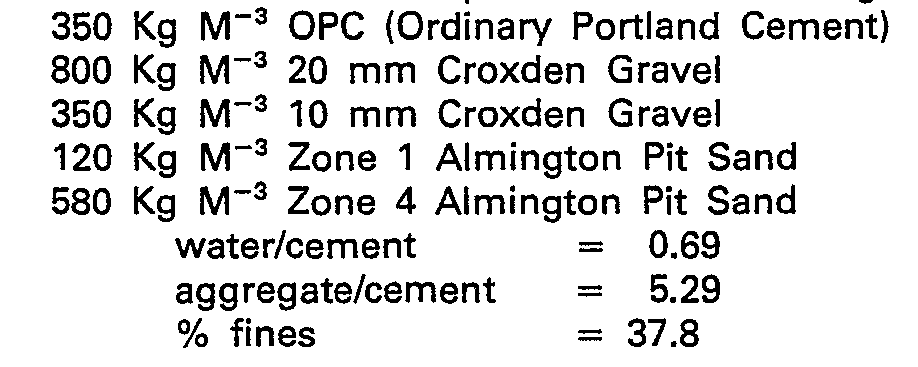
- compositions as described were evaluated in a concrete mix of the following design:
- Admixtures of the invention are clearly shown to produce superior compressive strength development in water reduced concrete over that produced using the polymeric naphthalene sulphonate.
- This polymeric naphthalene sulphonate is shown to produce minimal set retardation at the two dosage levels used (0.8, 1.5% bwc).
- the two admixture compositions of this invention show some set retardation, which is dosage related. This property can offer substantial lengths where the workability of the concrete needs to be maintained for a period of time, yet not suffer from the disadvantage of retarded early rate of strength gain.
- Admixture F produces the best results in terms of workability and 1 day compressive strength development.
- composition of the invention-Admixture F- was compared in detail with a commercial polymeric naphthalene sulphonate-Admixture B-in a range of applicational situations.
- Admixtures F and B were compared in three mix designs to determine the effect on workability and strength development.
- Admixture F to perform as an efficient superplasticiser over a range of cement contents at much lower dosages than Admixture B.
- Admixture F was compared with Admixture B and a commercial calcium lignosulphonate (Admixture J) at three cement contents, using the mix designs shown in 1.1. Results are shown in Table XV.
- Admixture F As a high range water reducing agent.
- Admixtures F and B were used to produce flowing concrete in the following concrete mixes.
- Admixture F is shown to function very effectively in comparison with B, in terms of dose effectiveness and development of early compressive strength.
- Admixtures F and B were compared as water reducing agents in 300 and 400 Kg M- 3 SRC mix designs. Results are shown in Table XVII.
- Admixture F in the 300 Kg M- 3 SRC mix design performs significantly better at much lower dosage levels than "B" particularly in terms of 1 day compressive strength.
- Both Admixtures F and B show slight retardation of 1 day compressive strength compared with the OPC/Pfa control mix. At 28 days both the OPC/Pfa control, and superplasticised OPC/Pfa mixes attained the OPC control mix compressive strengths over the range of cement contents.
- Admixtures F and B were used to effect high range water reductions.
- Admixture F was compared with the commercial naphthalene sulphonate (Admixture B) and with Admixture K-a commercial accelerating admixture based on naphthalene sulphonate-in water reduced concrete to determine compressive strength at early ages.
- Results are shown in Table XX-a standard 300 Kg M- 3 OPC mix design was used.
- Admixture B is more efficient in terms of compressive strength development during the very early ages of hydration (up to 7 hours).
- Admixture F is as efficient as B and thereafter shows superior compressive strength development over the conventional polymeric naphthalene sulphonates.
- Admixtures F and B were evaluated in both SRC and OPC concrete mix designs to determine their effect on extension of workability.
- Admixture F at 0.6% bwc gives much better workability extension than Admixture B at 1.5% bwc both in OPC and SRC.
- SRC workability
Landscapes
- Chemical & Material Sciences (AREA)
- Engineering & Computer Science (AREA)
- Ceramic Engineering (AREA)
- Chemical Kinetics & Catalysis (AREA)
- Materials Engineering (AREA)
- Structural Engineering (AREA)
- Organic Chemistry (AREA)
- Inorganic Chemistry (AREA)
- Curing Cements, Concrete, And Artificial Stone (AREA)
- Compositions Of Macromolecular Compounds (AREA)
Abstract
Description
- This invention relates to cementiferous compositions and to additives for use in such compositions, which additives improve the physical characteristics of the cementiferous compositions for various purposes such as enhancement of flow and workability, acceleration of early strength gain and reduced water content.
- The cementiferous compositions with which this invention is concerned include concretes which comprises cement, coarse and fine aggregates and water; cement pastes which comprise cement and water, and mortars which comprise cement, sand and water; lime, sand and water, or mixtures containing both lime and cement. The invention is also applicable to steam-cured concretes comprising cement, aggregate and water; lime or limestone and siliceous maetrials such as silica flour and water.
- In co-pending European Patent Application No. 0 097 513 plasticisers for concrete have been claimed which comprise copolymers of an ethylenically polymerisable carboxylic acid and a hydroxy alkyl ester of an ethylenically polymerisable carboxylic acid. These compositions are excellent plasticisers for concrete, but in applications where an early gain of compressive strength is desirable these compositions are not wholly satisfactory.
- A wide range of accelerators for concretes is known but their effectiveness varies widely. Some accelerators are known to have positive disadvantages in concrete compositions.
- Known accelerators include calcium chloride, soluble formates, nitrates and nitrites and alkanolamines such as triethanolamine.
- It has now been found that only two types of accelerator have generally beneficial properties when used with these copolymer additives.
- Accordingly, the present invention provides a plasticiser additive composition comprising an aqueous solution of a copolymer, or soluble salt thereof, comprising an ethylenically polymerisable carboxylic acid and an ethylenically unsaturated monomer having a hydroxyl functional group which monomer is copolymerisable with said acid, the copolymer having a molecular weight in the range 1000 to 15000 and from 5 to 90% by weight of the copolymer of an accelerator additive selected from triethanolamine and salts thereof and water-soluble thiocyanates.
- Suitable polymerisable acids include acrylic, methacrylic, crotonic, maleic, fumaric, itaconic, citraconic and/or aconitic acids and like ethylenically unsaturated acids. The preferred acids are acrylic, methacrylic and maleic acid with acrylic or methacrylic acids being most preferred.
- Suitable ethylenically unsaturated monomers having a hydroxyl functional group include allyl alcohol, 2-methyl-allyl alcohol, 2-methyl-(1-butene-3-01), hydroxy ethyl, hydroxy propyl and like esters of the above acids. In addition, hydroxy alkyl acrylamides such as n-methylol acrylamide and n-(2-hydroxy ethyl)acrylamide can also be used.
- Preferably the copolymer comprises 50 to 95 mol% of the acid and 5 to 50 mol% of the monomer, which monomer is a hydroxy ester. Absolute molecular weight of the copolymers of this invention have not been determined. However, apparent molecular weights as calculated relative to polyethylene glycol standards have been determined, using gel permeation chromatography. The apparent molecular weight of the copolymer may be varied over a wide range, the preferred range being 1000 to 15000, more preferably 1000-9000.
- Precise molecular weights have not been determined for all the copolymers used but in some cases viscosity determinations have been carried out. The preferred viscosity is less than 30 mPa.s (30 cps) as a 15% by weight aqueous solution in 1 molar NaCl.
- Accelerators useful in this invention include sodium potassium and ammonium thiocyanate and triethanolamine and salts thereof. The preferred accelerator is triethanolamine. The preferred proportion of these accelerators is 15 to 35% by weight of the copolymer.
- The additives may also conveniently contain an anti-foaming agent alternatively known as an air detraining agent. Suitable agents include tributyl phosphate, dibutyl phthalate, various water-insoluble alcohols and silicon derivatives and mixtures thereof.
- In addition the additives may also contain known dispersants such as lignosulphanates, naphthalene sulphonates and water-soluble melamine formaldehyde polymers.
- Air entraining agents may also be added for specific uses.
- Suitable copolymers may be made by the copolymerisation of the carboxylic acid and the monomer having the hydroxyl function using methods known in polymerisation technology. The resultant copolymer may be neutralised with a suitable base such as sodium hydroxide or other soluble base and diluted with water to the required concentration for use in the plasticiser additive provided by this invention.
- Unless otherwise specified a uniform mixing procedure was adopted in all the examples quoted here.
- The aggregate is placed in the mixer, approximately half the mixing water added and mixed for 30 seconds. The remaining water (containing the admixture) is added and mixed for a further 3 minutes.
- The same materials were used throughout, i.e.:
- 20 mm Croxden gravel (rounded)
- 10 mm Croxden gravel (irregular/rounded)
- Zone 4 Almington Pit Sand Zone 3 Almington Pit Sand
- Zone 1 Almington Pit Sand
- Classified according to British Standard 882.

- Plastic density and compressive strength were determined according to BS 1881. Workability of flowing concrete was measured using the German DIN 1048 Flow Table method and the slump test (BS 1881).
- Using a copolymer as described in European Patent Specification No. 0 097 513 as the base constituent, various formulations were prepared using known accelerating additives.
-
- 27.0% Sodium salt of 2.5/1 molar (acrylic acid/hydroxypropyl acrylate (AA/HPA) copolymer
- 62.8% Water
- 0.2% TBP
- 10.0% Accelerating additive
- The formulations were evaluated in a concrete mix in comparison with a commercial polymeric naphthalene sulphonate (Admixture B) and the above formulation with no additive to determine the effect on early strength gain in the following mix design.
- A 35% aqueous solution of a polymeric naphthalene sulphonate.
-


- These results show triethanolamine (TEA) and sodium thiocyanate (NaSCN) to be successful additives in this formulation.
- It is well known that accelerators such as calcium chloride are only effective at comparatively high dosage levels.
- Formulations were prepared such that a fixed dosage of the Admixture (0.36% bwc) was added to a concrete mix, but a variable dosage of the accelerating additive could be added.
-

-

-


- Triethanolamine is shown-at a low dosage-to offset retardation characteristics of the polymer system. Calcium chloride, apart from the obvious limitations in relation to corrosion produces good early strength but has an adverse effect on plasticising performance.
- The other accelerating additives shown here confer no significant advantages to the plasticiser component.
- The triethanolamine (TEA) and NaSCN additives were re-evaluated in Admixture C to compare the rate of early strength gain.
-

-

-

- At the additive levels used here both TEA and NaSCN affect the flow properties of the admixture compositions but retardation of 1 day compressive strength is shown to be eliminated.
- Admixture 1 is shown to produce better 1 day compressive strength with less effect on plasticising properties than Admixture 2.
- To further show the beneficial effect/specificity of TEA to this polymer system the effect of different alkanolamine types on the Admixture C composition are shown below:
- 90% Admixture C
- 10% Alkanolamine
-

- Results are shown below in Table IV.

- Various levels of TEA were incorporated into the plasticiser component to demonstrate the concentration dependence of the accelerating additives in a polymer composition.
-

-
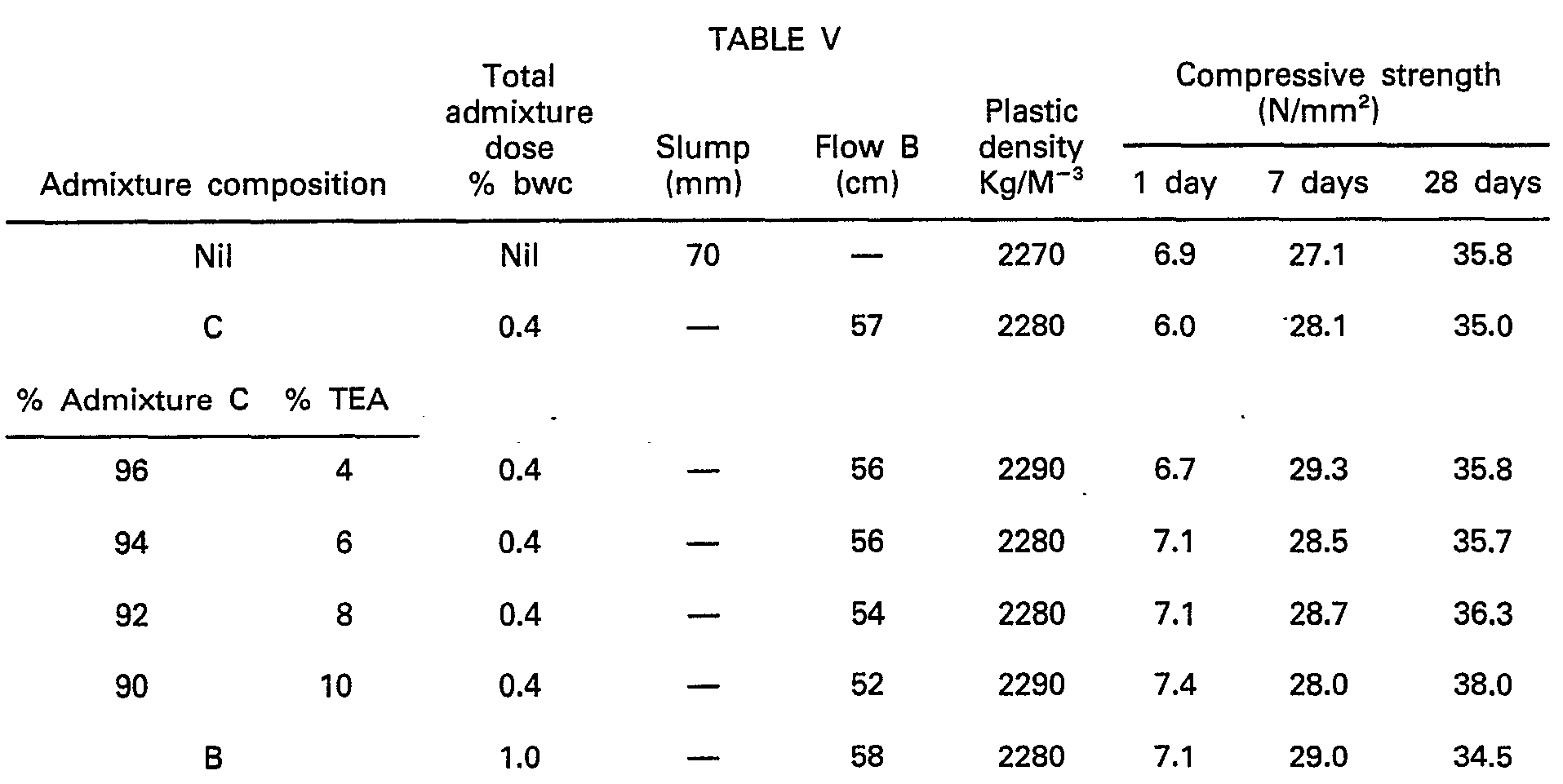
- Admixtures with increasing triethanolamine concentration showed an improvement in 1 day compressive strength, but with a reduction in plasticising effect.
- A level of 6% triethanolamine in the Admixture C composition was shown to produce the optimum effect with respect to both parameters.
- To further demonstrate the effect of triethanolamine a further series of concrete mixes were performed using a 6% additive level in Admixture C.
-
- 94% w/w Admixture C
- 6% w/w triethanolamine.
-

- Results are shown in Table VI.

- These results confirm the beneficial effect of triethanolamine addition to the composition over a range of admixture dosage levels.
- A further copolymer was prepared comprising 2.5/1 mole AA/HPMA (acrylic acid/hydroxy propyl methacrylate-5.1 cps at 15% solids in 1 M aqueous NaCl) and was formulated into the following compositions:
-
- 30% w/w 2.5/l mole AA/HPMA copolymer as Na salt
- 69.75% w/w water
- 0.25% w/w Tri-n-butyl phosphate
-
- 94% w/w Admixture E
- 6% w/w Triethanolamine
- The beneficial effect of triethanolamine addition was demonstrated in the following concrete mix design:
- Mix design

- Results are shown in Table VII.

- These results show that a 6% addition of triethanolamine to Admixture E significantly improves the early compressive strength development without affecting plasticising performance.
- Two preferred compositions of the invention were compared at various dosage levels with a commercial polymeric naphthalene sulphonate (Admixture B) in the following mix design:

- Results are-shown in Table VIII.

- The compositions of the invention are shown to be significantly more dose effective than the commercial polymeric naphthalene sulphonate in terms of plasticising efficiency.
- 1 day compressive strength is also demonstrated to be significantly improved over control and the polymeric naphthalene sulphonate (Admixture B).
- Penetration resistance tests using the Procter Needle Apparatus according to ASTM No C-403-80 were carried out in order to compare Admixtures D and F with the polymeric naphthalene sulphonate (Admixture B).
-

- Results are shown in Table IX.

- Admixture D produces mineral extension of initial and final set at the lower dosage level.
- At performance equivalent dosages Admixture D and F behave similarly, and show less set retardation than the polymeric naphthalene sulphonate, Admixture B.
- To illustrate the preferred mole ratios of the ethylenically unsaturated acids and hydroxy ester copolymers a range of copolymers of acrylic acid and hydroxy propyl methacrylate have been evaluated.
- These are shown below:
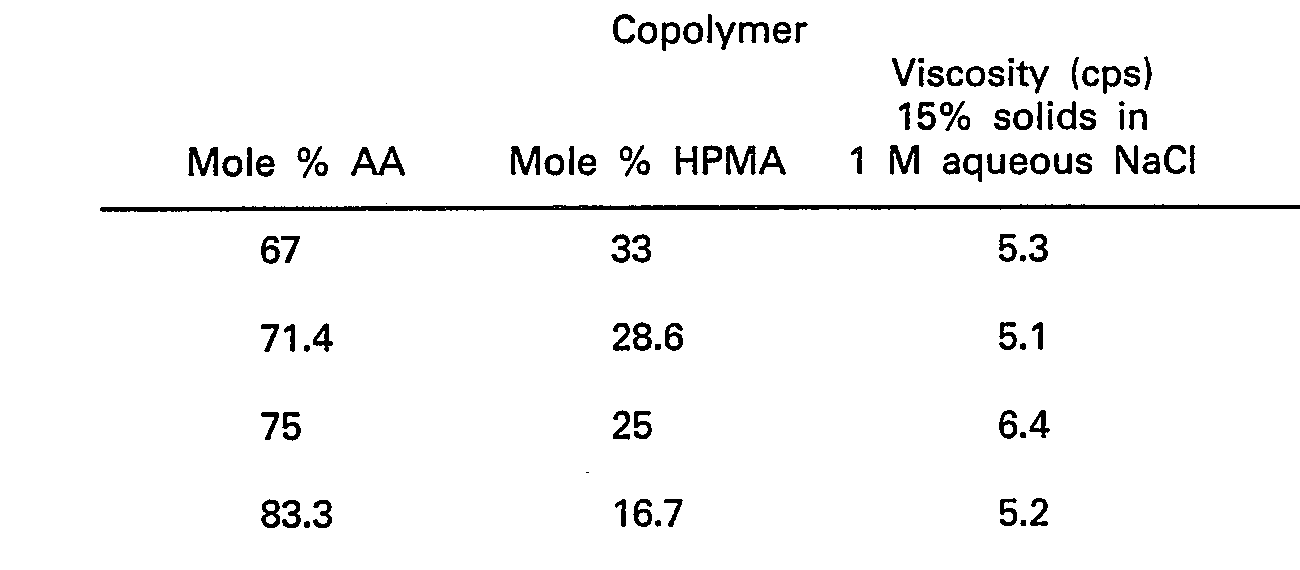
- The copolymers were formulated into the following admixture compositions.
-
- 30% w/w copolymer as Na salt
- 69.75% w/w water
- 0.25% w/w tri-n-butyl phosphate
- To further demonstrate the effect of triethanolamine in admixture compositions of the invention the above compositions were formulated with triethanolamine.
-
- 94% w/w copolymer composition as above
- 6% w/w triethanolamine
- The compositions as described were evaluated in a concrete mix of the following design:
- Mix design

- The admixture compositions were evaluated using a dosage level of 0.4% bwc. Results are shown in Table X.

- These results show the beneficial effect of the addition of triethanolamine to these copolymers in that 1 day compressive strengths are significantly improved.
- Further, the addition of 6% triethanolamine to the AA/HPMA copolymers does not affect plasticising performance.
- It is also shown that the monomer mole ratios significantly affect plasticising performance, 60-75 mole % AA being the preferred range.
- Two admixture compositions of this invention were compared with a polymeric naphthalene sulphonate to affect water reduction whilst maintaining the same workability as a concrete mix without admixture.

- Results are shown in Table XI.

- Admixtures of the invention are clearly shown to produce superior compressive strength development in water reduced concrete over that produced using the polymeric naphthalene sulphonate.
- Penetration resistance tests were carried out using the Procter Needle Apparatus, according to ASTM No C-403-80, on the water reduced concretes described.
- Results are shown in Table XII.

- This polymeric naphthalene sulphonate is shown to produce minimal set retardation at the two dosage levels used (0.8, 1.5% bwc).
- The two admixture compositions of this invention show some set retardation, which is dosage related. This property can offer substantial lengths where the workability of the concrete needs to be maintained for a period of time, yet not suffer from the disadvantage of retarded early rate of strength gain.
- To demonstrate the effectiveness and show a preferred polymer type of the invention, three polymers were compared with a polymeric naphthalene sulphonate.
-

-

-

- Results are shown in Table XIII using the following mix design:


- These results show Admixture F produces the best results in terms of workability and 1 day compressive strength development.
- The preferred composition of the invention-Admixture F-was compared in detail with a commercial polymeric naphthalene sulphonate-Admixture B-in a range of applicational situations.
- Admixtures F and B were compared in three mix designs to determine the effect on workability and strength development.
- Results are shown in Table XIV.


- These results show Admixture F to perform as an efficient superplasticiser over a range of cement contents at much lower dosages than Admixture B.
- Admixture F was compared with Admixture B and a commercial calcium lignosulphonate (Admixture J) at three cement contents, using the mix designs shown in 1.1. Results are shown in Table XV.
-


- Significant improvements in compressive strengths are shown using Admixture F as a high range water reducing agent.
- Admixtures F and B were used to produce flowing concrete in the following concrete mixes.
-

- Results are shown in Table XVI.
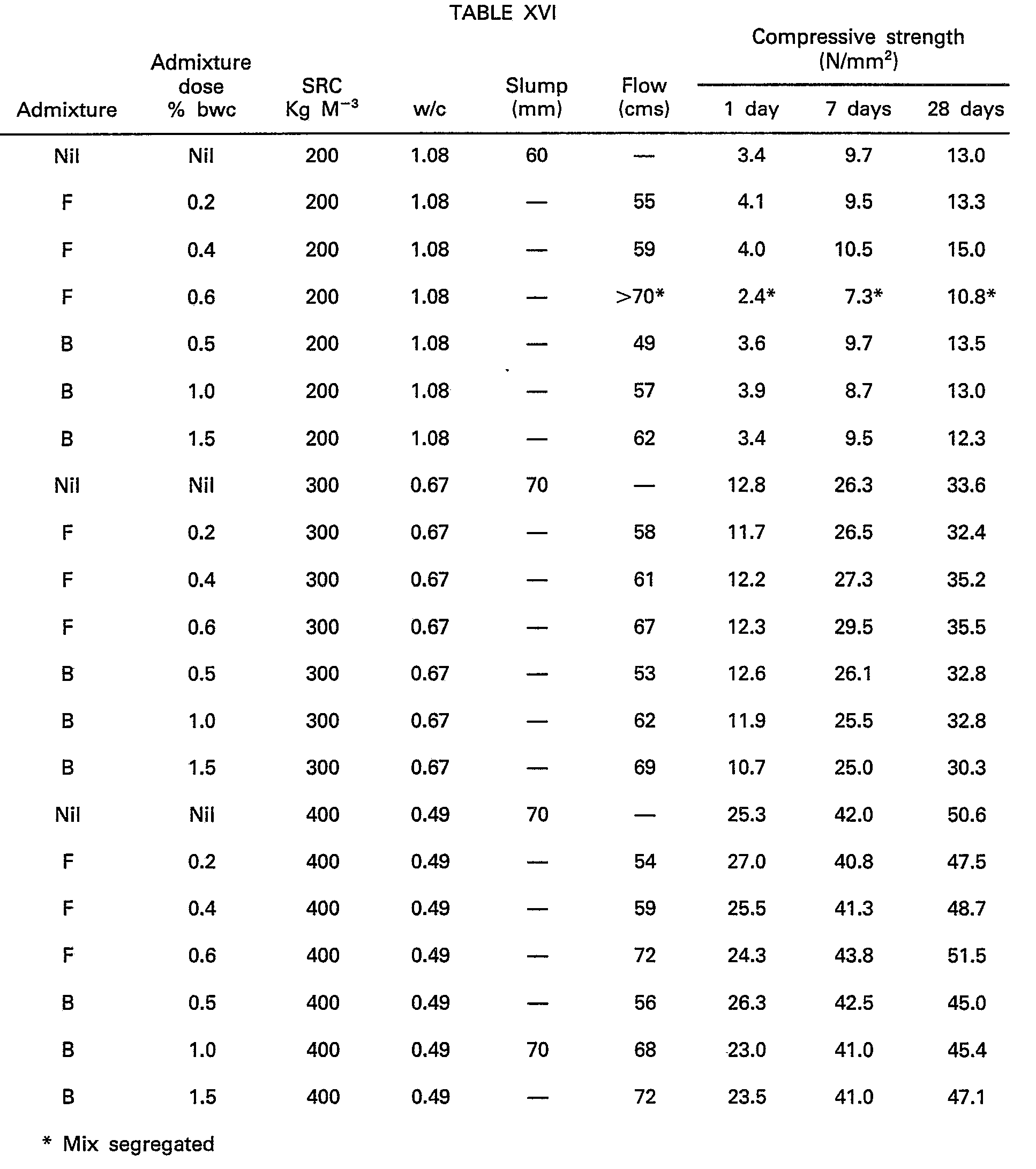
- Admixture F is shown to function very effectively in comparison with B, in terms of dose effectiveness and development of early compressive strength.
- Admixtures F and B were compared as water reducing agents in 300 and 400 Kg M-3 SRC mix designs. Results are shown in Table XVII.

- Admixture F in the 300 Kg M-3 SRC mix design performs significantly better at much lower dosage levels than "B" particularly in terms of 1 day compressive strength.
- Mix designs based on a 30% replacement of Pfa for OPC were used to compare Admixtures F and B. Three cement contents 200, 300, 400 Kg M-3 were evaluated.
-

- Results are shown in Table XVIII.

- Both Admixtures F and B show slight retardation of 1 day compressive strength compared with the OPC/Pfa control mix. At 28 days both the OPC/Pfa control, and superplasticised OPC/Pfa mixes attained the OPC control mix compressive strengths over the range of cement contents.
- Using mix designs as shown in 3.1 Admixtures F and B were used to effect high range water reductions.
- Results are shown in Table XIX.

- 1 day compressive strengths are shown to match those of the OPC control mixes and to be superior to those of the OPC/Pfa mixes at 28 days the water reduced mixes are shown to give significantly improved compressive strengths over those of the control mixes.
- Admixture F was compared with the commercial naphthalene sulphonate (Admixture B) and with Admixture K-a commercial accelerating admixture based on naphthalene sulphonate-in water reduced concrete to determine compressive strength at early ages.
- Results are shown in Table XX-a standard 300 Kg M-3 OPC mix design was used.

- These results show Admixture B to be more efficient in terms of compressive strength development during the very early ages of hydration (up to 7 hours). At later ages (e.g. 10 hours) Admixture F is as efficient as B and thereafter shows superior compressive strength development over the conventional polymeric naphthalene sulphonates.
- Admixtures F and B were evaluated in both SRC and OPC concrete mix designs to determine their effect on extension of workability.
- A standard 300 Kg M-3 cement content mix design was used in both sets of tests.
- The results are shown in Tables XXI and XXII.


- Slump measurements in mm.
- From these results it can be seen that Admixture F at 0.6% bwc gives much better workability extension than Admixture B at 1.5% bwc both in OPC and SRC. The point to note in its effect with SRC is that the workability remains constant for a long period (2-3 hours) before eventually stiffening.
Claims (6)
Priority Applications (1)
| Application Number | Priority Date | Filing Date | Title |
|---|---|---|---|
| AT84304163T ATE26826T1 (en) | 1983-06-21 | 1984-06-20 | CEMENT COMPOSITIONS. |
Applications Claiming Priority (2)
| Application Number | Priority Date | Filing Date | Title |
|---|---|---|---|
| GB8316819 | 1983-06-21 | ||
| GB838316819A GB8316819D0 (en) | 1983-06-21 | 1983-06-21 | Cementiferous compositions |
Publications (2)
| Publication Number | Publication Date |
|---|---|
| EP0137582A1 EP0137582A1 (en) | 1985-04-17 |
| EP0137582B1 true EP0137582B1 (en) | 1987-04-29 |
Family
ID=10544550
Family Applications (1)
| Application Number | Title | Priority Date | Filing Date |
|---|---|---|---|
| EP84304163A Expired EP0137582B1 (en) | 1983-06-21 | 1984-06-20 | Cementiferous compositions |
Country Status (14)
| Country | Link |
|---|---|
| US (1) | US4524163A (en) |
| EP (1) | EP0137582B1 (en) |
| JP (1) | JPS6016852A (en) |
| AT (1) | ATE26826T1 (en) |
| AU (1) | AU555129B2 (en) |
| BR (1) | BR8403007A (en) |
| CA (1) | CA1247779A (en) |
| DE (1) | DE3463372D1 (en) |
| ES (1) | ES8606446A1 (en) |
| GB (1) | GB8316819D0 (en) |
| IE (1) | IE57928B1 (en) |
| MX (1) | MX168359B (en) |
| PT (1) | PT78766B (en) |
| ZA (1) | ZA844672B (en) |
Families Citing this family (12)
| Publication number | Priority date | Publication date | Assignee | Title |
|---|---|---|---|---|
| US5047087A (en) * | 1986-04-03 | 1991-09-10 | National Starch And Chemical Investment Holding Corporation | Cementiferous composition and additives for use in such compositions |
| US4968734A (en) * | 1986-07-01 | 1990-11-06 | W. R. Grace & Co.-Conn. | Cement admixture |
| US4792360A (en) * | 1987-06-30 | 1988-12-20 | The Dow Chemical Company | Workable cement composition of low water content containing a hydroxyalkyl (meth)acrylate polymer |
| JP2811336B2 (en) * | 1989-11-06 | 1998-10-15 | 株式会社エヌエムビー | New cement dispersant |
| US4976316A (en) * | 1990-02-20 | 1990-12-11 | Atlantic Richfield Company | Method of accelerating set of cement by washover fluid containing alkanolamine |
| WO1994005606A1 (en) * | 1992-09-01 | 1994-03-17 | W.R. Grace & Co.-Conn. | Hydraulic cement bughole-reducing admixtures and method for using same |
| US5703174A (en) * | 1995-06-21 | 1997-12-30 | W. R. Grace & Co.-Conn. | Air controlling superplasticizers |
| MY114306A (en) | 1995-07-13 | 2002-09-30 | Mbt Holding Ag | Cement dispersant method for production thereof and cement composition using dispersant |
| US5614017A (en) * | 1996-03-26 | 1997-03-25 | Arco Chemical Technology, L.P. | Cement additives |
| US5670578A (en) * | 1996-12-10 | 1997-09-23 | Arco Chemical Technology, L.P. | Cement additives |
| WO2009060405A1 (en) * | 2007-11-06 | 2009-05-14 | Umkomaas Lignin (Proprietary) Limited T/A Lignotech Sa | Cement compositions |
| CN108623745B (en) * | 2018-06-08 | 2020-03-06 | 科之杰新材料集团有限公司 | Phosphorus-containing polycarboxylate superplasticizer and preparation method thereof |
Family Cites Families (12)
| Publication number | Priority date | Publication date | Assignee | Title |
|---|---|---|---|---|
| US3892704A (en) * | 1969-11-26 | 1975-07-01 | Mitsubishi Rayon Co | Process for producing hardened cement material |
| DE2011150A1 (en) * | 1970-03-10 | 1971-09-30 | Ludwig Horlmg Fabrik chemischer Baustoffe GmbH, 3283 Lugde | Organic additives for the rapid setting of concrete |
| GB1484454A (en) * | 1973-08-21 | 1977-09-01 | Nat Res Dev | Poly-(carboxylate)cements |
| EP0006279B1 (en) * | 1978-02-22 | 1982-01-27 | Imperial Chemical Industries Plc | Cementitious composition, a method to prepare it and shaped article derived therefrom |
| GB2023124B (en) * | 1978-06-14 | 1982-07-07 | Grace W R Ltd | Method of making flexible materials |
| US4243762A (en) * | 1979-02-28 | 1981-01-06 | National Distillers And Chemical Corp. | Alkanolamine processing aid for ethylene-vinyl ester interpolymer particles present in aqueous dispersions thereof |
| NL7904551A (en) * | 1979-06-11 | 1980-12-15 | Akzo Nv | EXCIPIENT FOR OBTAINING FASTER BINDING AND / OR HARDENING OF A HYDRAULIC CEMENT. |
| US4398957A (en) * | 1981-02-13 | 1983-08-16 | Polysar International S.A. | Mortar latex mix |
| US4373956A (en) * | 1981-09-14 | 1983-02-15 | Martin Marietta Corporation | Additive for hydraulic cement mixes |
| US4419138A (en) * | 1981-09-18 | 1983-12-06 | Sandor Popovics | Accelerator additive for cementitious compositions |
| US4405372A (en) * | 1982-03-08 | 1983-09-20 | W. R. Grace & Co. | Gypsum-free cement compositions |
| IE55483B1 (en) * | 1982-06-21 | 1990-09-26 | Nat Starch Chem Corp | Cementiferous compositions |
-
1983
- 1983-06-21 GB GB838316819A patent/GB8316819D0/en active Pending
-
1984
- 1984-06-11 US US06/619,209 patent/US4524163A/en not_active Expired - Fee Related
- 1984-06-18 AU AU29466/84A patent/AU555129B2/en not_active Ceased
- 1984-06-19 BR BR8403007A patent/BR8403007A/en not_active IP Right Cessation
- 1984-06-20 CA CA000457032A patent/CA1247779A/en not_active Expired
- 1984-06-20 AT AT84304163T patent/ATE26826T1/en not_active IP Right Cessation
- 1984-06-20 JP JP59127262A patent/JPS6016852A/en active Granted
- 1984-06-20 ZA ZA844672A patent/ZA844672B/en unknown
- 1984-06-20 DE DE8484304163T patent/DE3463372D1/en not_active Expired
- 1984-06-20 IE IE1552/84A patent/IE57928B1/en not_active IP Right Cessation
- 1984-06-20 EP EP84304163A patent/EP0137582B1/en not_active Expired
- 1984-06-20 PT PT78766A patent/PT78766B/en unknown
- 1984-06-20 ES ES533606A patent/ES8606446A1/en not_active Expired
- 1984-06-21 MX MX201742A patent/MX168359B/en unknown
Also Published As
| Publication number | Publication date |
|---|---|
| IE57928B1 (en) | 1993-05-19 |
| PT78766B (en) | 1986-10-21 |
| ZA844672B (en) | 1986-02-26 |
| PT78766A (en) | 1984-07-01 |
| AU555129B2 (en) | 1986-09-11 |
| DE3463372D1 (en) | 1987-06-04 |
| ATE26826T1 (en) | 1987-05-15 |
| ES8606446A1 (en) | 1986-04-01 |
| JPS6016852A (en) | 1985-01-28 |
| JPH031258B2 (en) | 1991-01-10 |
| US4524163A (en) | 1985-06-18 |
| IE841552L (en) | 1984-12-21 |
| ES533606A0 (en) | 1986-04-01 |
| BR8403007A (en) | 1985-08-20 |
| MX168359B (en) | 1993-05-19 |
| AU2946684A (en) | 1985-01-03 |
| GB8316819D0 (en) | 1983-07-27 |
| EP0137582A1 (en) | 1985-04-17 |
| CA1247779A (en) | 1988-12-28 |
Similar Documents
| Publication | Publication Date | Title |
|---|---|---|
| CA1277999C (en) | Hydraulic cement additives and hydraulic cement compositions containing same | |
| US4814014A (en) | Hydraulic cement additives and hydraulic cement compositions containing same | |
| US6008275A (en) | Cementitious mixture containing high pozzolan cement replacement and compatabilizing admixtures therefor | |
| JP3995264B2 (en) | Improved cement mix product | |
| AU640545B2 (en) | Additive composition for cement admixture | |
| KR0125566B1 (en) | Cement admixture composition | |
| CA2605186C (en) | Concrete and mortar admixture | |
| US20030144384A1 (en) | Superplasticizer for concrete and self-leveling compounds | |
| JP2002003256A (en) | Cement-dispersible polymer for high-flow, high-strength and self-binding concrete | |
| WO1997015535A1 (en) | Nitrogenous strength enhancers for portland cement | |
| US4473406A (en) | Cementiferous compositions | |
| EP0097513B1 (en) | Cementiferous compositions | |
| WO1999065841A1 (en) | Air entrainment with polyoxyalkylene copolymers for concrete treated with oxyalkylene sra | |
| EP1919843A1 (en) | Ultrarapid hardening cement composition and dispersant for ultrarapid hardening cement composition | |
| US4524163A (en) | Cementiferous compositions | |
| EP0537872A1 (en) | Corrosion inhibiting hydraulic cement additives and compositions containing same | |
| AU2014255949A1 (en) | Use of comb polymers for controlling the rheology of mineral binder compositions | |
| JP3342526B2 (en) | Cement dispersant composition | |
| US5047087A (en) | Cementiferous composition and additives for use in such compositions | |
| GB2279655A (en) | Additives for cement compositions | |
| CA1325863C (en) | Cementiferous compositions and additives for use in such compositions | |
| JPH05306152A (en) | Cement dispersant composition | |
| JPH06100346A (en) | Admixture for concrete | |
| JPH0328149A (en) | Hydraulic cement composition | |
| JPH09241062A (en) | Concrete composition |
Legal Events
| Date | Code | Title | Description |
|---|---|---|---|
| PUAI | Public reference made under article 153(3) epc to a published international application that has entered the european phase |
Free format text: ORIGINAL CODE: 0009012 |
|
| AK | Designated contracting states |
Designated state(s): AT BE CH DE FR GB IT LI NL SE |
|
| 17P | Request for examination filed |
Effective date: 19841220 |
|
| 17Q | First examination report despatched |
Effective date: 19860212 |
|
| GRAA | (expected) grant |
Free format text: ORIGINAL CODE: 0009210 |
|
| AK | Designated contracting states |
Kind code of ref document: B1 Designated state(s): AT BE CH DE FR GB IT LI NL SE |
|
| PG25 | Lapsed in a contracting state [announced via postgrant information from national office to epo] |
Ref country code: NL Effective date: 19870429 Ref country code: BE Effective date: 19870429 Ref country code: AT Effective date: 19870429 |
|
| REF | Corresponds to: |
Ref document number: 26826 Country of ref document: AT Date of ref document: 19870515 Kind code of ref document: T |
|
| PG25 | Lapsed in a contracting state [announced via postgrant information from national office to epo] |
Ref country code: SE Effective date: 19870430 |
|
| REF | Corresponds to: |
Ref document number: 3463372 Country of ref document: DE Date of ref document: 19870604 |
|
| ITF | It: translation for a ep patent filed | ||
| ET | Fr: translation filed | ||
| NLV1 | Nl: lapsed or annulled due to failure to fulfill the requirements of art. 29p and 29m of the patents act | ||
| PLBE | No opposition filed within time limit |
Free format text: ORIGINAL CODE: 0009261 |
|
| STAA | Information on the status of an ep patent application or granted ep patent |
Free format text: STATUS: NO OPPOSITION FILED WITHIN TIME LIMIT |
|
| 26N | No opposition filed | ||
| ITTA | It: last paid annual fee | ||
| PGFP | Annual fee paid to national office [announced via postgrant information from national office to epo] |
Ref country code: FR Payment date: 19950609 Year of fee payment: 12 |
|
| PGFP | Annual fee paid to national office [announced via postgrant information from national office to epo] |
Ref country code: CH Payment date: 19950614 Year of fee payment: 12 |
|
| PGFP | Annual fee paid to national office [announced via postgrant information from national office to epo] |
Ref country code: DE Payment date: 19950617 Year of fee payment: 12 |
|
| PG25 | Lapsed in a contracting state [announced via postgrant information from national office to epo] |
Ref country code: LI Effective date: 19960630 Ref country code: CH Effective date: 19960630 |
|
| REG | Reference to a national code |
Ref country code: CH Ref legal event code: PL |
|
| PG25 | Lapsed in a contracting state [announced via postgrant information from national office to epo] |
Ref country code: FR Effective date: 19970228 |
|
| PG25 | Lapsed in a contracting state [announced via postgrant information from national office to epo] |
Ref country code: DE Effective date: 19970301 |
|
| REG | Reference to a national code |
Ref country code: FR Ref legal event code: ST |
|
| PGFP | Annual fee paid to national office [announced via postgrant information from national office to epo] |
Ref country code: GB Payment date: 20010620 Year of fee payment: 18 |
|
| REG | Reference to a national code |
Ref country code: GB Ref legal event code: IF02 |
|
| PG25 | Lapsed in a contracting state [announced via postgrant information from national office to epo] |
Ref country code: GB Free format text: LAPSE BECAUSE OF NON-PAYMENT OF DUE FEES Effective date: 20020620 |
|
| GBPC | Gb: european patent ceased through non-payment of renewal fee |
Effective date: 20020620 |