EP0137234B1 - Physiologically active compositions - Google Patents
Physiologically active compositions Download PDFInfo
- Publication number
- EP0137234B1 EP0137234B1 EP84109773A EP84109773A EP0137234B1 EP 0137234 B1 EP0137234 B1 EP 0137234B1 EP 84109773 A EP84109773 A EP 84109773A EP 84109773 A EP84109773 A EP 84109773A EP 0137234 B1 EP0137234 B1 EP 0137234B1
- Authority
- EP
- European Patent Office
- Prior art keywords
- hormone
- antibody
- vertebrate
- antibodies
- formulation
- Prior art date
- Legal status (The legal status is an assumption and is not a legal conclusion. Google has not performed a legal analysis and makes no representation as to the accuracy of the status listed.)
- Expired
Links
Images


Classifications
-
- C—CHEMISTRY; METALLURGY
- C07—ORGANIC CHEMISTRY
- C07K—PEPTIDES
- C07K16/00—Immunoglobulins [IG], e.g. monoclonal or polyclonal antibodies
- C07K16/18—Immunoglobulins [IG], e.g. monoclonal or polyclonal antibodies against material from animals or humans
- C07K16/26—Immunoglobulins [IG], e.g. monoclonal or polyclonal antibodies against material from animals or humans against hormones ; against hormone releasing or inhibiting factors
-
- C—CHEMISTRY; METALLURGY
- C07—ORGANIC CHEMISTRY
- C07K—PEPTIDES
- C07K14/00—Peptides having more than 20 amino acids; Gastrins; Somatostatins; Melanotropins; Derivatives thereof
- C07K14/435—Peptides having more than 20 amino acids; Gastrins; Somatostatins; Melanotropins; Derivatives thereof from animals; from humans
- C07K14/575—Hormones
- C07K14/61—Growth hormone [GH], i.e. somatotropin
- C07K14/615—Extraction from natural sources
-
- A—HUMAN NECESSITIES
- A61—MEDICAL OR VETERINARY SCIENCE; HYGIENE
- A61K—PREPARATIONS FOR MEDICAL, DENTAL OR TOILETRY PURPOSES
- A61K38/00—Medicinal preparations containing peptides
-
- A—HUMAN NECESSITIES
- A61—MEDICAL OR VETERINARY SCIENCE; HYGIENE
- A61K—PREPARATIONS FOR MEDICAL, DENTAL OR TOILETRY PURPOSES
- A61K39/00—Medicinal preparations containing antigens or antibodies
Definitions
- This invention relates to hormone activity in vertebrate species.
- hormone has been defined as encompassing any substance released from one part of the body and acting selectively on at least one other, distant, part. Many such substances are secreted by one of the endocrine glands, an example being the secretion of growth hormone from the pituitary gland.
- the basis for the selectivity for a given target tissue or tissues is the presence or absence in the tissue of receptors which bind the substance specifically.
- the protein hormones such as insulin
- the receptors are on the cell surface. Interferon has been implicated in the defence of mammalian cells against viral attack. It is not secreted by an endocrine gland and does not have the specificity of target tissue that, say, growth hormone has.
- tumour necrosis factor and lymphokines such as interleukins.
- hormone is used to embrace all such protein or polypeptide entities (optionally glycosylated) and the like having a cell-surface receptor.
- one aspect of the present invention provides a formulation comprising antibodies to a hormone, the epitope specificity of at least some of the antibodies being so chosen that the formulation will potentiate or mimic, when administered to a vertebrate, the administration of the hormone in that vertebrate.
- a second aspect of the invention provides a formulation comprising complexes of (a) a hormone and (b) at leat one type of antibody to that hormone, the epitope specificity of at least some of the antibodies being so chosen that the formulation will potentiate or mimic, when administered to a vertebrate, the administration of the hormone in that vertebrate.
- a third aspect of the invention provides a method of potentiating or mimicking hormone administration in a "normal" vertebrate (as herein defined) by administering to the vertebrate a formulation comprising antibodies to the hormone, the epitope specificity of at least some of the antibodies being so chosen that the formulation will potentiate or mimic, when administered to a vertebrate, the administration of the hormone in that vertebrate.
- normal is used herein to indicate an individual having sufficient endogenous amount of the hormone in question for normal functioning of the tissues regulated by that hormone.
- a fourth aspect of the invention provides a method of potentiating or mimicking hormone administration in a "normal" vertebrate (as herein defined) by administering to the vertebrate a formulation comprising complexes of (a) the hormone and (b) at least one type of antibody to that hormone, the epitope specificity of at least some of the antibodies being so chosen that the formulation will potentiate or mimic, when administered to the vertebrate, the administration of the hormone in that vertebrate.
- a fifth aspect provides a method of treating a human or other vertebrate having abnormally low hormone-regulated tissue function by administering to the vertebrate a pharmaceutical formulation comprising antibodies to the hormone in question, the epitope specificity of at least some or the antibodies being so chosen that the formulation will potentiate or minic, when administered to the vertebrate, the administration of the hormone in that vertebrate.
- a sixth aspect provides a method of treating a vertebrate having an abnormally low hormone-regulated tissue function by administering to the human or animal a pharmaceutical formulation comprising complexes of (a) the hormone in question and (b) at least one type of antibody to that hormone, the epitope specificity of at least some of the antibodies being so chosen that the formulation will potentiate or mimic, when administered to a vertebrate, the administration of the hormone in that vertebrate.
- the potentiation of mimicry of the administration of growth hormone, insulin, thyroid stimulating hormone and interferon are particularly preferred aspects of the invention.
- antibody to a particular hormone, we mean an antibody which will bind to that hormone.
- the antibody need not have been created in response to that specific hormone.
- GH growth hormone
- CS chorionic somatomammotropin
- the antibodies need not necessarily be to the specific hormone of the species to which the formulation or method of the invention is being applied. Preferably, however, they are. It has been found that not all antibodies to the hormone will potentiate or mimic the administration of that hormone; instead, the ability of an antibody to act in accordance with the invention appears to depend on the specific determinant (i.e. antigenic site) for the antibody on the hormone. It will therefore readily be appreciated that polyclonal antibodies (that is to say, a collection of antibodies having a range of determinant specificities) are less suitable for use in formulations or methods in accordance with the invention, than are monoclonal antibodies.
- a monoclonal antibody effective in carrying out the invention.
- Mixtures of suitable monoclonal antibodies may in some circumstances be used. However, it is nevertheless possible to use animal or human antisera raised by 'conventional' immunization provided that the epitope specificity of the antibodies is as described.
- Particularly preferred monoclonal antibodies for growth hormone (GH) and chorionic somatomammotropin (CS) are EB01 and EB02.
- Antibody QB01 is preferred for prolactin (PRL).
- the antibody instead of preparing the antibody outside the animal, it is possible to raise antibodies of the appropriate specificity by injecting the animal with a preselected fragment of a suitable growth hormone molecule in combination with an adjuvant.
- the fragment will be so chosen as to comprise only the epitope or epitopes to which one or more of the hormone-potentiating antibodies are specific and may be derived by cleaving the hormone appropriately, or by synthesising a peptide fragment (or an analogue to such a fragment).
- portions of the hormone rich in hydrophilic residues one is more likely to be creating or selecting a fragment (an "antigenic determinant") which is on the surface of the complete hormone molecule and which will therefore cross-react with the complete molecule.
- the fragment should not contain the site of the hormone which binds to the cell-surface receptor, nor any site which binds a third agent which causes a conformational change such that receptor binding is inhibited. Otherwise, the antibodies produced are likely to inhibit, rather than potentiate, the action of the hormone.
- a polyclonal collection of antibodies of narrow specificity is created within the animal in question, thus enabling less frequent injection of the animal than would be the case if exogenous antibodies were passively administered.
- a functional fragment could be used, in which the undesirable epitopes of the molecule are present but are shielded from antibody access in some way.
- fragment is used in this specification to cover actual and functional fragments.
- the present invention also provides a method of increasing a hormone-regulated response of a vertebrate by administering to the vertebrate a preparation comprising at least one pre- selected "fragment" (as herein defined) of an appropriate hormone, optionally in combination with an adjuvant.
- the invention also encompasses such a preparation and methods of making such a preparation by conventional means.
- immunological carriers are frequently used to enhance the immunogenicity of the antigen, for example keyhole limpet haemocyanin or tetanus toxoid.
- adjuvants are often included to stimulate the immune system, for example aluminium hydroxide, saponin or muramyl dipeptide.
- about 0.001 to 10 pmoles of antigen should be present in a unit dose, preferably about 0.01 to 0.05 pmoles, although the selection of a suitable amount of the antigen is well within the capabilities of one skilled in the art.
- approximately 10 4- 10 7 , preferably 10 5- 10 6 ABT 60 units of antibodies should be administered in any suitable sterile medium, such as saline, to give a dose of 0.01 to 10 ml, preferably about 0.5 ml.
- formulations and/or methods in accordance with the invention may offer significant cost-saving and labour-saving advantages in comparison with the use of the hormone alone, not least because the potentiation of the hormone action is expected to result in fewer administrations being needed. Furthermore, a reduction of possibly harmful residues in the meat or milk of treated animals may be expected. Finally, because farmed animals are frequently routinely injected with other vaccines, for example against foot and mouth disease, it would be extremely convenient to incorporate in such a vaccine a formulation in accordance with the present invention.
- Arithmetic means and standard deviation values were calculated using conventional methods. Differences between groups were assessed by unpaired Student's t-test.
- the antibodies employed in this study are available from Wellcome Diagnostics, Temple Hill, Dartford, Kent, U.K. and have been characterized extensively (Ivanyi, 1982 a b, Aston and Ivanyo, 1983).
- BALB/c mouse spleen cells were fused with NSI myeloma cells and cloned by standard techniques (Ivanyi and Davis, 1980, 1981
- the antibodies derived were all of the IgG, isotype and were non-precipitating when examined by double diffusion in agar.
- Four determinants have been defined on hGH by competition assays (QA68, NA71, EB01 and EB02) of which two are completely shared with hCS (EB01 and EB02).
- Ascitic globulin (5 mg/ml) of EB01 was affinity purified on hGH (100 mg) immobilized on CNBr- activated Sepharose. Retained material was eluted with glycine-HCr buffer pH 2.3 and tubes containing protein material were immediately adjusted to pH 7.5 with NaOH (1 M). The purified antibody was concentrated to 20 mglml (2 ml) and dialysed against sodium phosphate buffer (0.5 M, pH 8.0) containing cysteine (0.01 M) and EDTA (.002 M).
- This material was digested with 0.4 mg of papain (BDH) for 4 hours at 37°C followed by dialysis against PBS to remove the cysteine and EDTA.
- the dialysate was applied to a column of DEAE cellulose (20 cmx1.2 cm) and eluted with a linear gradient consisting of sodium phosphate buffer (0.005 M-o.3 M, pH 8.0).
- the first peak to be eluted from the column contained no antibody heavy chain as determined by SDS-PAGE and retained an activity of 10- 3 x ABT 50 .
- hGH Human growth hormone employed for injection was derived from stocks of outdated clinical grade material obtained by special agreement with the Institute of Child Health, London, whereas hormone used in assays was of >99% purity.
- hGH is available from RIA (UK) Ltd., Washington, Co. Durham U.K. Radioiodination of hGH was performed with lactoperoxidase resulting in a tracer of high specific activity (80x10 6 cpm/g) (Linde et al, 1981).
- Monomeric 125l-hGH was separated from any aggregated material prior to assay by Ultrogel column chromatography. Ultrogel is a trade mark of LKB Ltd., Cambridge, U.K.
- Antibody-hormone complexes for administration into animals were prepared by mixing the solutions for 1 hour prior to injection. In chronic experiments, where injections were given for several weeks, the complexes were prepared in batches enough for 1 week and stored at ⁇ 4°C.
- a soluble extract was prepared from the marmoset pituitary gland by homogenizing the tissue in 0.05 M sodium bicarbonate 2 mM PMSF pH 8.6. The resulting homogenate was centrifuged at 10,000 g for 20 minutes and the supernatant (20 ml) was tested.
- Dwarf mice were bred from normal animals heterozygous for the dw gene or from a heterozygous female mouse and a male homozygous dwarf mouse treated with thyroxine.
- the dwarf mice weighing 9.1 ⁇ 0.4 g, were allocated at random to treatment groups of six animals and then distributed among several small cages each containing one representative of each treatment group.
- Hormones were injected subcutaneously in the back in 0.1 ml, for the periods indicated. Weights were measured at the onset, during and sometimes after treatment. Weight gains in short-term experiments or the cumulative weight gains over several days of study were expressed as relative values (%) related to initial whole body weights or as net weights (g). Tail lengths were measured by the method of Hughes and Tanner (1970).
- mice Over a three week period, control mice, treated with phosphate-buffered saline (PBS), increased their relative weight gains by about 15% (Figure 1). Mice treated with 10 ⁇ g hGH gained 22% over starting weight over the same period. However, hGH-EB01 complexes raised the cumulative weight gain to 34%, which corresponds to an additional 12% increment over that achieved from treatment with hGH only.
- PBS phosphate-buffered saline
- Dwarf mice within a relatively narrow weight range were randomized by use of tables of random numbers (Fisher and Yates, 1957) and injected with a dose of 35 SO 4 2- related to body weight (0.5 Ci/g body weight) 24 h after the final hormone injection (Herbai, 1970).
- Mice were killed 20 h later when rib cages were removed, placed in boiling water for 20 min, soaked overnight in saturated sodium sulphate and washed in tap water for 2 h and distilled water for 1 h. The bony portion of ribs together with about 1 mm of adjacent rib cartilage (costochondral junction) was then cut away leaving the costal cartilages attached to the sternum.
- complexes of EB01 with equimolar quantities of hGH and hCS also did not increase the degree of potentiation.
- Such complexes would comprise mainly the species hGH-EB01-hCS which would be expected to have decreased activity if bivalency was necessary, since hCS has only 10% somatotropic activity of hGH.
- the EB01-hCS complex resulted in significantly lower growth activity than the corresponding complex with hGH.
- mice Since the stimulation of growth in dwarf mice is exercised over a background of very slow activity, it was of interest to ascertain if the antibody mediated potentiation effect could be demonstrated in normally, i.e. rapidly, growing juvenile mice.
- Three weeks old BALB/c mice weighing between 7-10 g were randomized and injected as described above for dwarf mice. Weights were taken 3 times/week in chronic experiments. Group 1 received PBS twice weekly throughout; Group 2 had 160 pg hGH three times over 1 week and Group 3 the same thrice weekly for 4 weeks; Groups 4 and 5 had complexed 160 pg hGH/200 pg EB01 thrice weekly for 1 or 4 weeks respectively; and Group 6 had daily injections of the said complex for 4 weeks.
- Human growth hormone produces significant lactogenic activity as measured by its effects on pigeon crop-sac or mammary tissue in vivo and by its ability to displace 125
- the pigeon crop-sac bioassay procedure measures the lactogenic activity of hormones and is analogous to other mammotropic assays involving either mammary gland or corpus luteum of rats or mice.
- Hormones, complexes or control solutions were administered (0.1 ml) from coded vials intradermally adjacent to each hemicrop, there being five birds in each group.
- the injection protocol was either one administration on day 1 only (2x10⁴ ABT 50 ) or three over 36 hours (each of 2x 10 3 ABT 50 ) or combined with two further injections on day 2. Birds were killed on day 3 and the wet weight of the crop-sac mucosa of 2.5 cm diameter was determined (Nicoll, 1967). By administering the complex or free hormone intradermally, adjacent to each of the two individual hemicrops, the potentiation effect has been examined under conditions which excluded systemic hormone distribution. The weight of the crop-sac mucosa following the injection of 100 ⁇ g of hGH in three doses was about 100 mg, whereas the control (PBS or antibody only treated) mucosa weighed 10-13 mg ( Figure 3).
- Example D The pigeon crop sac assay of Example D was repeated with 1 pg of highly purified (prep. L) or 3 ⁇ g of QB01-MAB affinity purified (prep. R) hPRL alone or in complex with a constant dose, 2500 ABT 50 of monoclonal antibodies.
- the preparation of QB01 antibodies was analogous to that described in Example 1 above and has been published (Ivanyi & Davies, 1981).
- mice Dwarf (dw/dw) mice were divided into three groups of eighteen and fed on 100%, 75% or 50% of the usual ad lib consumption for 10 days. Within each diet, six mice were treated with saline, six with hGH (40 milliunits) and six with hGH/EB01 (10 4 ABT 50 of antibody) complex. The mice were assessed for overall growth ( 35 50 4 uptake into intercostal cartilage, sulphate injected at day nine), fat content, weight change and length of tail. The results are presented in Tables 4 to 7.
- hormone/antibody complex can compensate for a reduced diet and can also reduce the proportion of fat in an animal by preferentially causing growth of muscle, the latter advantage being even more marked with a reduced diet.
- results are expressed as disintegrations per minute per milligram of tissue; mean ⁇ S.E.
- Figures are amounts of fat in milligrams.
- Example C The experiment of Example C was repeated, with the assay being for 35 SO 4 uptake into intercostal cartilage rather than weight gain.
- Cartilage was removed 24 h later.
- the results are given in Table 8 and shown significantly increased growth with the complexes (p ⁇ 0.0005 for the oldest mice).
- a 7 K (7000 Daltons) fragment was cleaved from the C-terminal of hGH with subtilisin followed by chromatography under denaturing conditions (Aston & Ivanyi 1983). Two mice were each injected with 50 ⁇ g of the fragment emulsified with Freund's complete adjuvant but without a carrier and 21 days later received a further 50 ⁇ g without any adjuvant. Serum was taken 10 days after the second challenge, complexed with hGH (10 ⁇ g) and injected into dwarf mice. The subsequent growth of mice was assayed by measuring 35 SO 4 uptake as above. The results (Table 9) show that the polyclonal antiserum potentiated growth.
- ovine growth hormone i.e. sheep growth hormone (oGH) were prepared in an analogous way to the method of Example 1, and are available from the Department of Experimental Immunobiology, Wellcome Research Laboratories, Langley Court, Beckenham, Kent, BR3 3BS, UK.
- Dwarf mice which respond to oGH, were divided into groups of six and treated with 50 ⁇ g of the hormone, either alone or complexed with one of four such antibodies, on two consecutive days prior to injection with 35 SO 4 . Intercostal cartilage was removed 24 hours later, dissolved in formic acid and the radioactivity counted. The results are given in Table 1:
- Example K was repeated additionally using a different monoclonal antibody, 1D11 H9, and groups of five sheep, mean weight 24 kg. The results are given in Table 12:
- TSH thyroid stimulating hormone
- TSH is a glycoprotein produced by the pituitary gland and activating the thyroid gland in vertebrates.
- a deficiency of TSH causes involution of the thyroid gland and flattening of the epithelium. In humans, such a deficiency can be responsible for cretinism, simple goitre and the panoply of abnormal conditions known collectively as myxedema. It may be treated with iodine compounds or thyroid gland extracts. Dwarf mice are hypopituitary and the thyroid gland is involuted. Treatment with TSH raises the serum T 4 levels and causes some histological repair of the thyroid.
- a monoclonal antibody (GC73) to TSH was prepared analogously to those of Example 1 above and is available from the same address as in Example J.
- GC73 is specific for the P-chain of TSH.
- Dwarf mice were randomly divided into groups of five and treated accordingly to the regimes of Table 13 on five consecutive days before analysis of the serum for T 4 level by radioimmunoassay, and microscopic histological inspection of thyroid tissue, fixed in 10% formalin in saline solution and then embedded in wax or plastic.
- the T 4 data are given in Table 13; the results were confirmed by microscopic examination.
Landscapes
- Health & Medical Sciences (AREA)
- Chemical & Material Sciences (AREA)
- Organic Chemistry (AREA)
- Life Sciences & Earth Sciences (AREA)
- Endocrinology (AREA)
- Biophysics (AREA)
- Biochemistry (AREA)
- General Health & Medical Sciences (AREA)
- Genetics & Genomics (AREA)
- Medicinal Chemistry (AREA)
- Molecular Biology (AREA)
- Proteomics, Peptides & Aminoacids (AREA)
- Immunology (AREA)
- Toxicology (AREA)
- Zoology (AREA)
- Gastroenterology & Hepatology (AREA)
- Medicines Containing Antibodies Or Antigens For Use As Internal Diagnostic Agents (AREA)
- Medicines That Contain Protein Lipid Enzymes And Other Medicines (AREA)
Description
- This invention relates to hormone activity in vertebrate species.
- The term "hormone" has been defined as encompassing any substance released from one part of the body and acting selectively on at least one other, distant, part. Many such substances are secreted by one of the endocrine glands, an example being the secretion of growth hormone from the pituitary gland. The basis for the selectivity for a given target tissue or tissues is the presence or absence in the tissue of receptors which bind the substance specifically. In the case of the protein hormones, such as insulin, the receptors are on the cell surface. Interferon has been implicated in the defence of mammalian cells against viral attack. It is not secreted by an endocrine gland and does not have the specificity of target tissue that, say, growth hormone has. Nevertheless, it is a large glycosylated protein molecule and binds to specific cell surface receptors. There are also certain similar substances which influence the activity of cell by binding to specific receptors on the cell surface, for example tumour necrosis factor and lymphokines such as interleukins. In this specification, the term "hormone" is used to embrace all such protein or polypeptide entities (optionally glycosylated) and the like having a cell-surface receptor.
- It has been shown that certain antibodies against insulin and against epidermal growth factor (EGF) potentiate or mimic the activity of those hormones in vitro (Y. Schechter et al, Proc. Nat. Acad. Sic. 76(6), 2720, (1979) and Y. Schechter et al, Nature 278, 835, (1979)). It is thought that this occurs because the antibodies, being bivalent, cause an aggregation of the hormone-receptor complexes on the cell-surface, such aggregation being involved in activating the second messenger within the cell; monovalent Fab fragments of antibodies do not cause such potentiation or mimicry. These studies have solely been concerned with characterising the insulin and EGF receptors and in identifying the mode of action of such hormones. Furthermore, not all such studies have demonstrated such potentiation (de Pirro et al, Diabetologia 19,118 (1980) and Schechter et al, Proc. Nat. Acad. Sci, 75(12), 5788 (1978)). There has been no suggestion that such potentiation would occur in vivo or that the phenomenon is more widely applicable. Indeed, the generation of antibodies against insulin and other hormones in vivo was thought to be highly undesirable since the hormone-antibody complexes would be cleared by the body's immune system and, far from being potentiated, the action of the hormone would be negated-see for example Schwartz J., Endocrinology, 107(4), 877; Fraisier, Endocrine Reviews 4(2), 155 and Gause et al, Endocrinology 112(5), 1559 on growth hormone, and Blake & Kelch, Endocrinology, 109(6),2175 on luteinising hormone releasing hormone.
- It has now surprisingly been found that the administration of certain specific antibodies to hormones can potentiate or mimic the activity of the hormone, provided that the epitope specificity of the antibody is chosen appropriately.
- Accordingly, one aspect of the present invention provides a formulation comprising antibodies to a hormone, the epitope specificity of at least some of the antibodies being so chosen that the formulation will potentiate or mimic, when administered to a vertebrate, the administration of the hormone in that vertebrate.
- A second aspect of the invention provides a formulation comprising complexes of (a) a hormone and (b) at leat one type of antibody to that hormone, the epitope specificity of at least some of the antibodies being so chosen that the formulation will potentiate or mimic, when administered to a vertebrate, the administration of the hormone in that vertebrate.
- A third aspect of the invention provides a method of potentiating or mimicking hormone administration in a "normal" vertebrate (as herein defined) by administering to the vertebrate a formulation comprising antibodies to the hormone, the epitope specificity of at least some of the antibodies being so chosen that the formulation will potentiate or mimic, when administered to a vertebrate, the administration of the hormone in that vertebrate. g.
- The term "normal" is used herein to indicate an individual having sufficient endogenous amount of the hormone in question for normal functioning of the tissues regulated by that hormone.
- A fourth aspect of the invention provides a method of potentiating or mimicking hormone administration in a "normal" vertebrate (as herein defined) by administering to the vertebrate a formulation comprising complexes of (a) the hormone and (b) at least one type of antibody to that hormone, the epitope specificity of at least some of the antibodies being so chosen that the formulation will potentiate or mimic, when administered to the vertebrate, the administration of the hormone in that vertebrate.
- A fifth aspect provides a method of treating a human or other vertebrate having abnormally low hormone-regulated tissue function by administering to the vertebrate a pharmaceutical formulation comprising antibodies to the hormone in question, the epitope specificity of at least some or the antibodies being so chosen that the formulation will potentiate or minic, when administered to the vertebrate, the administration of the hormone in that vertebrate.
- A sixth aspect provides a method of treating a vertebrate having an abnormally low hormone-regulated tissue function by administering to the human or animal a pharmaceutical formulation comprising complexes of (a) the hormone in question and (b) at least one type of antibody to that hormone, the epitope specificity of at least some of the antibodies being so chosen that the formulation will potentiate or mimic, when administered to a vertebrate, the administration of the hormone in that vertebrate.
- The potentiation of mimicry of the administration of growth hormone, insulin, thyroid stimulating hormone and interferon are particularly preferred aspects of the invention.
- The clinical abnormalities which result from a deficiency of a given hormone are in many cases well characterised and will not be listed here. However, examples include (from a deficiency of growth hormone) pituitary dwarfism. Turner's syndrome and cachexia, (from a deficiency of insulin) diabetes and (from a deficiency of thyroid stimulating hormone) cretinism, simple goitre and myxedema.
- By antibody "to" a particular hormone, we mean an antibody which will bind to that hormone. Thus, the antibody need not have been created in response to that specific hormone. For example several antibodies raised against growth hormone (GH) will cross-react with chorionic somatomammotropin (CS) because of the extensive sequence homology between the two hormones. Furthermore, it may be possible to raise antibodies to a synthetic analogue or hormone of a portion of it.
- It is to be noted that the antibodies need not necessarily be to the specific hormone of the species to which the formulation or method of the invention is being applied. Preferably, however, they are. It has been found that not all antibodies to the hormone will potentiate or mimic the administration of that hormone; instead, the ability of an antibody to act in accordance with the invention appears to depend on the specific determinant (i.e. antigenic site) for the antibody on the hormone. It will therefore readily be appreciated that polyclonal antibodies (that is to say, a collection of antibodies having a range of determinant specificities) are less suitable for use in formulations or methods in accordance with the invention, than are monoclonal antibodies. The man skilled in the art will readily, having read this specification, be able by means of routine experimentation to select a monoclonal antibody effective in carrying out the invention. Mixtures of suitable monoclonal antibodies may in some circumstances be used. However, it is nevertheless possible to use animal or human antisera raised by 'conventional' immunization provided that the epitope specificity of the antibodies is as described. Particularly preferred monoclonal antibodies for growth hormone (GH) and chorionic somatomammotropin (CS) are EB01 and EB02. Antibody QB01 is preferred for prolactin (PRL).
- It has been found that the presence of the hormone in the animal is necessary for the antibody (when administered alone) to act in the manner described. Thus, in the case of "normal" individuals, administration of the selected antibody alone will have the described effect but, for example, in individuals without endogenous GH, such as pituitary dwarf human children, GH must be administered as well as, but not necessarily simultaneously with, the antibody.
- Instead of preparing the antibody outside the animal, it is possible to raise antibodies of the appropriate specificity by injecting the animal with a preselected fragment of a suitable growth hormone molecule in combination with an adjuvant. The fragment will be so chosen as to comprise only the epitope or epitopes to which one or more of the hormone-potentiating antibodies are specific and may be derived by cleaving the hormone appropriately, or by synthesising a peptide fragment (or an analogue to such a fragment). By choosing portions of the hormone rich in hydrophilic residues, one is more likely to be creating or selecting a fragment (an "antigenic determinant") which is on the surface of the complete hormone molecule and which will therefore cross-react with the complete molecule. Equally, the fragment should not contain the site of the hormone which binds to the cell-surface receptor, nor any site which binds a third agent which causes a conformational change such that receptor binding is inhibited. Otherwise, the antibodies produced are likely to inhibit, rather than potentiate, the action of the hormone. Thus, in a successful immunisation of this type, a polyclonal collection of antibodies of narrow specificity is created within the animal in question, thus enabling less frequent injection of the animal than would be the case if exogenous antibodies were passively administered. It will be appreciated that, instead of an actual fragment, a functional fragment could be used, in which the undesirable epitopes of the molecule are present but are shielded from antibody access in some way. The term "fragment" is used in this specification to cover actual and functional fragments.
- Accordingly, the present invention also provides a method of increasing a hormone-regulated response of a vertebrate by administering to the vertebrate a preparation comprising at least one pre- selected "fragment" (as herein defined) of an appropriate hormone, optionally in combination with an adjuvant.
- The invention also encompasses such a preparation and methods of making such a preparation by conventional means. In such conventional vaccines, immunological carriers are frequently used to enhance the immunogenicity of the antigen, for example keyhole limpet haemocyanin or tetanus toxoid. Similarly, adjuvants are often included to stimulate the immune system, for example aluminium hydroxide, saponin or muramyl dipeptide. Generally, about 0.001 to 10 pmoles of antigen should be present in a unit dose, preferably about 0.01 to 0.05 pmoles, although the selection of a suitable amount of the antigen is well within the capabilities of one skilled in the art.
- In the case of passive transfer of antibodies to a vertebrate, approximately 104-107, preferably 105-106 ABT60 units of antibodies should be administered in any suitable sterile medium, such as saline, to give a dose of 0.01 to 10 ml, preferably about 0.5 ml.
- To take only three hormones as an example, namely GH, CS and PRL, formulations or methods in accordance with the invention are believed to offer potential in:
- (a) accelerating the attainment of full growth of industrially important (i.e. farmed) animals such as cattle, pigs and poultry or achieving such growth on reduced amounts of feed;
- (b) increasing the growth of such animals beyond the normal maximum;
- (c) increasing the duration or extent of lactation in mammals, for example to obtain a greater milk yield from cattle or to enable a human mother to breast-feed an infant;
- (d) increasing the proportion of lean meat to fat in farmed animals;
- (e) increasing the growth of fleece, fur or other useful surface products of animals, for example sheep;
- (f) treating a GH-deficient individual, for example a dwarf child, to enable normal growth to occur.
- In all cases, it is believed that the use of formulations and/or methods in accordance with the invention may offer significant cost-saving and labour-saving advantages in comparison with the use of the hormone alone, not least because the potentiation of the hormone action is expected to result in fewer administrations being needed. Furthermore, a reduction of possibly harmful residues in the meat or milk of treated animals may be expected. Finally, because farmed animals are frequently routinely injected with other vaccines, for example against foot and mouth disease, it would be extremely convenient to incorporate in such a vaccine a formulation in accordance with the present invention.
- The invention will now be described by way of the following non-limiting Examples.
-

- Arithmetic means and standard deviation values were calculated using conventional methods. Differences between groups were assessed by unpaired Student's t-test.
-
- Figure 1 relates to Example A and shows weight gain in dwarf mice with compositions in accordance with the invention;
- Figure 2 relates to Example C and shows corresponding weight gain in normal mice;
- Figure 3 relates to Example D and shows the weight gain of the pigeon crop sac; and
- Figure 4 relates to Example E and shows the weight gain of marmosets.
- The antibodies employed in this study are available from Wellcome Diagnostics, Temple Hill, Dartford, Kent, U.K. and have been characterized extensively (Ivanyi, 1982 a b, Aston and Ivanyo, 1983). BALB/c mouse spleen cells were fused with NSI myeloma cells and cloned by standard techniques (Ivanyi and Davis, 1980, 1981 The antibodies derived were all of the IgG, isotype and were non-precipitating when examined by double diffusion in agar. Four determinants have been defined on hGH by competition assays (QA68, NA71, EB01 and EB02) of which two are completely shared with hCS (EB01 and EB02). However, none of the antibodies cross-reacted with human prolactin. Antibody concentrations have been expressed as ABT50 values which correspond to the reciprocal antibody titre required to give 50 percent binding of 125|- hGH by RIA (Ivanyi, 1982a). Binding studies with proteolytically modified forms of hGH suggest that all four determinants are located in the first 1-139 residues with the EB01 determinant also represented in the sequence region 146-191 (Aston and Ivanyi, 1983).
- Ascitic globulin (5 mg/ml) of EB01 was affinity purified on hGH (100 mg) immobilized on CNBr- activated Sepharose. Retained material was eluted with glycine-HCr buffer pH 2.3 and tubes containing protein material were immediately adjusted to pH 7.5 with NaOH (1 M). The purified antibody was concentrated to 20 mglml (2 ml) and dialysed against sodium phosphate buffer (0.5 M, pH 8.0) containing cysteine (0.01 M) and EDTA (.002 M).
- This material was digested with 0.4 mg of papain (BDH) for 4 hours at 37°C followed by dialysis against PBS to remove the cysteine and EDTA.
- Subsequently, the dialysate was applied to a column of DEAE cellulose (20 cmx1.2 cm) and eluted with a linear gradient consisting of sodium phosphate buffer (0.005 M-o.3 M, pH 8.0). The first peak to be eluted from the column contained no antibody heavy chain as determined by SDS-PAGE and retained an activity of 10-3x ABT50.
- Human growth hormone employed for injection was derived from stocks of outdated clinical grade material obtained by special agreement with the Institute of Child Health, London, whereas hormone used in assays was of >99% purity. hGH is available from RIA (UK) Ltd., Washington, Co. Durham U.K. Radioiodination of hGH was performed with lactoperoxidase resulting in a tracer of high specific activity (80x106 cpm/g) (Linde et al, 1981). Monomeric 125l-hGH was separated from any aggregated material prior to assay by Ultrogel column chromatography. Ultrogel is a trade mark of LKB Ltd., Cambridge, U.K. Antibody-hormone complexes for administration into animals were prepared by mixing the solutions for 1 hour prior to injection. In chronic experiments, where injections were given for several weeks, the complexes were prepared in batches enough for 1 week and stored at ±4°C.
- A soluble extract was prepared from the marmoset pituitary gland by homogenizing the tissue in 0.05 M sodium bicarbonate 2 mM PMSF pH 8.6. The resulting homogenate was centrifuged at 10,000 g for 20 minutes and the supernatant (20 ml) was tested.
- Dwarf mice were bred from normal animals heterozygous for the dw gene or from a heterozygous female mouse and a male homozygous dwarf mouse treated with thyroxine. The dwarf mice, weighing 9.1±0.4 g, were allocated at random to treatment groups of six animals and then distributed among several small cages each containing one representative of each treatment group. Hormones were injected subcutaneously in the back in 0.1 ml, for the periods indicated. Weights were measured at the onset, during and sometimes after treatment. Weight gains in short-term experiments or the cumulative weight gains over several days of study were expressed as relative values (%) related to initial whole body weights or as net weights (g). Tail lengths were measured by the method of Hughes and Tanner (1970).
- Over a three week period, control mice, treated with phosphate-buffered saline (PBS), increased their relative weight gains by about 15% (Figure 1). Mice treated with 10 µg hGH gained 22% over starting weight over the same period. However, hGH-EB01 complexes raised the cumulative weight gain to 34%, which corresponds to an additional 12% increment over that achieved from treatment with hGH only.
- Raising the hGH dose in the complex from 10 pg to 160 pg, increased the weight gains to 44% of the initial body weight. It is apparent (Figure 1) that the differences between treated groups and controls progressively increased over the 21 day test period. Whilst hGH-MAB complexes produced a significant increment within 48 h, the difference between the group treated with hGH only and the PBS-injected control group was not apparent until day 7.
- In order to assess whether the bivalency of EB01 antibody was a pre-requisite for growth potentiation, complexes of EB01-Fab'-hGH were examined for their effects on 35SO4 2- uptake in dwarf mice.
- Dwarf mice within a relatively narrow weight range (.7-10 g) were randomized by use of tables of random numbers (Fisher and Yates, 1957) and injected with a dose of 35SO4 2- related to body weight (0.5 Ci/g body weight) 24 h after the final hormone injection (Herbai, 1970). Mice were killed 20 h later when rib cages were removed, placed in boiling water for 20 min, soaked overnight in saturated sodium sulphate and washed in tap water for 2 h and distilled water for 1 h. The bony portion of ribs together with about 1 mm of adjacent rib cartilage (costochondral junction) was then cut away leaving the costal cartilages attached to the sternum. All adhering soft tissue was removed and the five longest costal cartilages which articulated directly with the sternum were detached whole from each side of the rib cage and combined for each animal. Each pool of ten costal cartilages was then dried at room temperature overnight, weighed and processed for the measurement of 35SO4 2-. The uptake of 35SO4 2- by costal cartilage was expressed as disintegrations per minute per mg of cartilage.
- The levels of sulphate uptake by cartilage potentiated by EB01 or EB01-Fab' were not significantly different when comparing the antibody and fragments at the same ABTso dose (Table 1). However, the growth observed in the presence of hGH alone was significantly less than that observed for Fab'-hGH. Increasing the valency of the Fab' fragment by including a "second" either monoclonal anti-light chain antibody (TC187) or polyclonal anti-mouse Ig antibody did not significantly alter the 35SO4 2- uptake. Furthermore, Fab' fragments did not competitively inhibit the potentiating effect of EB01 antibody. Preparation of complexes of EB01 with equimolar quantities of hGH and hCS also did not increase the degree of potentiation. Such complexes would comprise mainly the species hGH-EB01-hCS which would be expected to have decreased activity if bivalency was necessary, since hCS has only 10% somatotropic activity of hGH. Indeed, the EB01-hCS complex resulted in significantly lower growth activity than the corresponding complex with hGH.
-

- Since the stimulation of growth in dwarf mice is exercised over a background of very slow activity, it was of interest to ascertain if the antibody mediated potentiation effect could be demonstrated in normally, i.e. rapidly, growing juvenile mice. Three weeks old BALB/c mice weighing between 7-10 g were randomized and injected as described above for dwarf mice. Weights were taken 3 times/week in chronic experiments.
Group 1 received PBS twice weekly throughout; Group 2 had 160 pg hGH three times over 1 week and Group 3 the same thrice weekly for 4 weeks; Groups 4 and 5 had complexed 160 pg hGH/200 pg EB01 thrice weekly for 1 or 4 weeks respectively; andGroup 6 had daily injections of the said complex for 4 weeks.Groups 5 and 6 grew by 31% and 37% more than PBS injected controls (Figure 2). A significant weight gain effect of hGH-EB01 complexes was apparent as early as 48 hours after administration (Table 2). Animals receiving 10,40 or 160 pg of hGH in the presence of EB01 demonstrated a significant weight gain increment when compared with hGH only. -

- Three week old mice (Wto=8.0±1.0) were injected. at
time 0 and 24 h. Weight gains, expressed as % of body weight, were determined at 48 h. - Human growth hormone produces significant lactogenic activity as measured by its effects on pigeon crop-sac or mammary tissue in vivo and by its ability to displace 125|-hPRL from binding to mammary gland receptors. The pigeon crop-sac bioassay procedure measures the lactogenic activity of hormones and is analogous to other mammotropic assays involving either mammary gland or corpus luteum of rats or mice. Hormones, complexes or control solutions were administered (0.1 ml) from coded vials intradermally adjacent to each hemicrop, there being five birds in each group. The injection protocol was either one administration on
day 1 only (2x10⁴ ABT50) or three over 36 hours (each of2x 103 ABT50) or combined with two further injections on day 2. Birds were killed on day 3 and the wet weight of the crop-sac mucosa of 2.5 cm diameter was determined (Nicoll, 1967). By administering the complex or free hormone intradermally, adjacent to each of the two individual hemicrops, the potentiation effect has been examined under conditions which excluded systemic hormone distribution. The weight of the crop-sac mucosa following the injection of 100 µg of hGH in three doses was about 100 mg, whereas the control (PBS or antibody only treated) mucosa weighed 10-13 mg (Figure 3). - Treatment with 10 pg of hormone alone produced a mucosa of 48 mg, but in the presence of EB01 or EB02 the mucosal weight increased to 108 mg and 80 mg respectively. As in dwarf mice, NA71 was without potentiating activity whereas QA68 significantly depressed the mucosal secretion. Furthermore, EB01 potentiated the lactogenic effects proportionally by the same extent whether the hormone was administered in one or three doses. However, EB01 failed to potentiate the lactogenic effect of saturating doses of hGH. Since EB01 binds equally to hCS, we also examined the potentiation of the lactogenic activity of this hormone. The results show that antibody complexes with 10 ug hCS had doubled the weight of the crop-sac mucosa in comparison with controls receiving the hormone alone.
- The potentiation effect in either murine growth or pigeon crop-sac responses was dependent on the administration of exogenous hGH since none of the antibodies described here cross-reacted with the rodent growth hormone. However, we discovered that EB01 antibody did bind to marmoset growth hormone when tested by immunoblot assay. This observation enabled the assessment of EB01 potentiation of marmoset growth in the absence of any exogenously administered hormone (Figure 4). Sixteen animals, randomised on a weight basis, were divided into four groups receiving 0.4 mg hGH only, hGH (0.4 mg)+EB01 (2 mg), EB01 (2 mg) only or PBS three times per week. Two sister animals had to be removed from the experiment after 1 week due to continuous weight loss. Animals treated for 44 days with PBS increased their weight by 68 g, whereas the group receiving EB01 only demonstrated a mean weight increase of about 103 g. Groups receiving hormone only or complex had weight gains intermediate to those observed with EB01 only and the control group. The relative weight gain (% over initial body weight) of animals receiving antibody was 89% whilst the control group increased their body weights by only 61 %. Despite continuous administration of heterologous antibody to the marmosets for 6 weeks, side effects, possibly of anaphylactic origin, have so far not been observed.
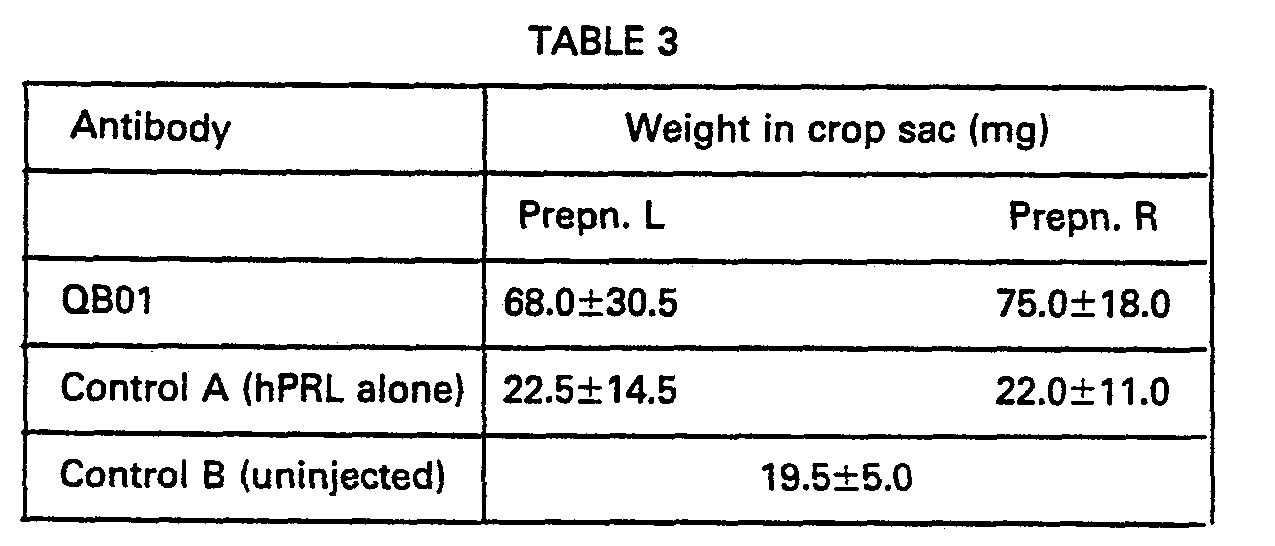
- The pigeon crop sac assay of Example D was repeated with 1 pg of highly purified (prep. L) or 3 µg of QB01-MAB affinity purified (prep. R) hPRL alone or in complex with a constant dose, 2500 ABT50 of monoclonal antibodies. The preparation of QB01 antibodies was analogous to that described in Example 1 above and has been published (Ivanyi & Davies, 1981).
- The results, given in Table 3, show strong potentiation for antibody QB01, for both preparation of hPRL. The figures represent mean values for six crops per group=one standard deviation.
- Dwarf (dw/dw) mice were divided into three groups of eighteen and fed on 100%, 75% or 50% of the usual ad lib consumption for 10 days. Within each diet, six mice were treated with saline, six with hGH (40 milliunits) and six with hGH/EB01 (104 ABT50 of antibody) complex. The mice were assessed for overall growth (35504 uptake into intercostal cartilage, sulphate injected at day nine), fat content, weight change and length of tail. The results are presented in Tables 4 to 7.
- It is apparent that the use of a hormone/antibody complex can compensate for a reduced diet and can also reduce the proportion of fat in an animal by preferentially causing growth of muscle, the latter advantage being even more marked with a reduced diet.

- The results are expressed as disintegrations per minute per milligram of tissue; mean ±S.E.

- Figures are amounts of fat in milligrams.

- Figure expressed as mean ±S.E.

- Figure expressed as mean ±S.E.
- The experiment of Example C was repeated, with the assay being for 35SO4 uptake into intercostal cartilage rather than weight gain. Mice aged 4 weeks (weight 10 g), 6 weeks (14 g) and 9 weeks (19 g) were used and injected subcutaneously with 0.1 ml of either saline, hGH (100 µg) or hGH-EB01 complexes (100 pg/104 ABT50) two days before administration of 35SO4. Cartilage was removed 24 h later. The results are given in Table 8 and shown significantly increased growth with the complexes (p<0.0005 for the oldest mice).

- Units: counts/min/mg. cartilage.
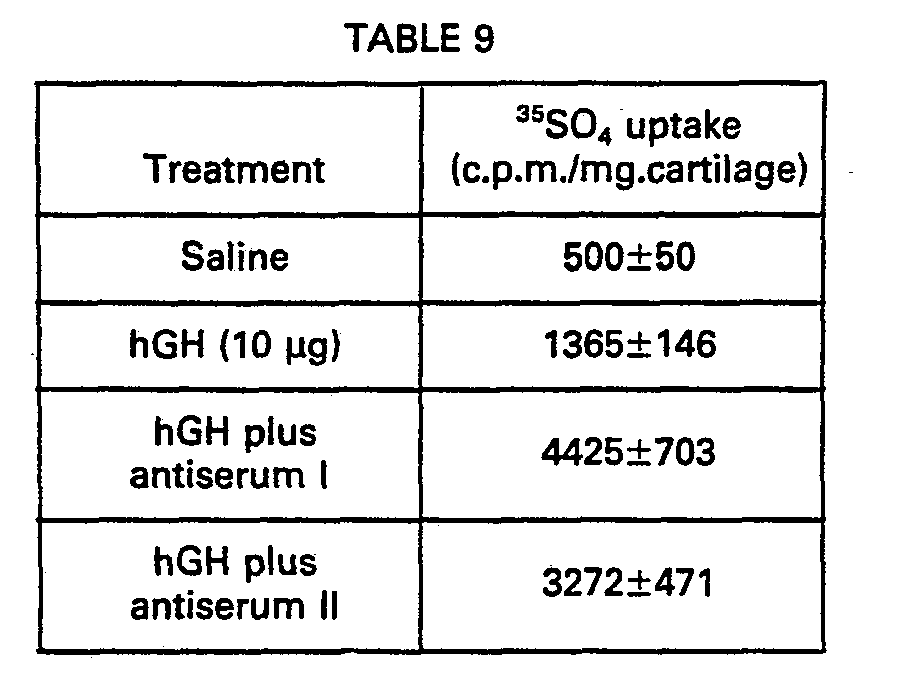
- A 7 K (7000 Daltons) fragment was cleaved from the C-terminal of hGH with subtilisin followed by chromatography under denaturing conditions (Aston & Ivanyi 1983). Two mice were each injected with 50 µg of the fragment emulsified with Freund's complete adjuvant but without a carrier and 21 days later received a further 50 µg without any adjuvant. Serum was taken 10 days after the second challenge, complexed with hGH (10 µg) and injected into dwarf mice. The subsequent growth of mice was assayed by measuring35SO4 uptake as above. The results (Table 9) show that the polyclonal antiserum potentiated growth.
-
- Aston, R. and Ivanyi, J. The EMBO Journal 2 493-497 (1983).
- Fisher, R. A. and F. Yates (Ed.) "Statistical tables for biological, agricultural and medical research" Oliver ° Boyd (1957).
- Herbai, G. Acta. Physiol. Scandinavica 80 (1970) 470-491.
- Hughes, P. C. R. and Tanner, J. M. J. Anatomy 106 (1970) 349-370.
- Ivanyi J. In: Monoclonal Hybridoma Antibodies: Techniques and Applications (Edited by Hussell, J. G. R.) CRC Press, Cleveland, Ohio (1982) pp. 59-79.
- Ivanyi J. Mol. Immunol. 19 (1982) 1611-1618.
- Ivanyi J. and P. Davis. Mol. Immunol. 17 (1980) 287-290.
- Ivanyi J. and P. Davis. Protides of the Biological Fluids 29th Colloquium 1981.
- Ed. H. Peeters Pergamon Press, Oxford and New York, 1982, 855-860.
- Linde, S., B. Hausen, A. Lernmark. Analyt Biochem 107 (1980) 165-176.
- Nicoll, C. S.
Endocrinology 80 641-655 (1967). - Monoclonal antibodies to ovine (i.e. sheep) growth hormone (oGH) were prepared in an analogous way to the method of Example 1, and are available from the Department of Experimental Immunobiology, Wellcome Research Laboratories, Langley Court, Beckenham, Kent, BR3 3BS, UK. Dwarf mice, which respond to oGH, were divided into groups of six and treated with 50 µg of the hormone, either alone or complexed with one of four such antibodies, on two consecutive days prior to injection with 35SO4. Intercostal cartilage was removed 24 hours later, dissolved in formic acid and the radioactivity counted. The results are given in Table 1:

- Groups of two sheep (mean weight 17 kg) were treated with differing doses of anti-oGH antibody 2B11 1 (see Example J) or, as a control, mouse globulin, on two consecutive days before intraperitoneal injection of 35SO4 (146 pCi/kg). Quadruplicate samples of intercostal cartilage were removed from each site 24 hours later and analysed as above. The results are in given Table 11:

- These results, which are highly significant by variance analysis, show that formulations in accordance with the invention can potentiate the action of endogenous GH in an economically important species.
- Example K was repeated additionally using a different monoclonal antibody, 1D11 H9, and groups of five sheep, mean weight 24 kg. The results are given in Table 12:

- Significantly (p<0.05) increased growth is seen with the MAB-treated groups.
- TSH is a glycoprotein produced by the pituitary gland and activating the thyroid gland in vertebrates. A deficiency of TSH causes involution of the thyroid gland and flattening of the epithelium. In humans, such a deficiency can be responsible for cretinism, simple goitre and the panoply of abnormal conditions known collectively as myxedema. It may be treated with iodine compounds or thyroid gland extracts. Dwarf mice are hypopituitary and the thyroid gland is involuted. Treatment with TSH raises the serum T4 levels and causes some histological repair of the thyroid.
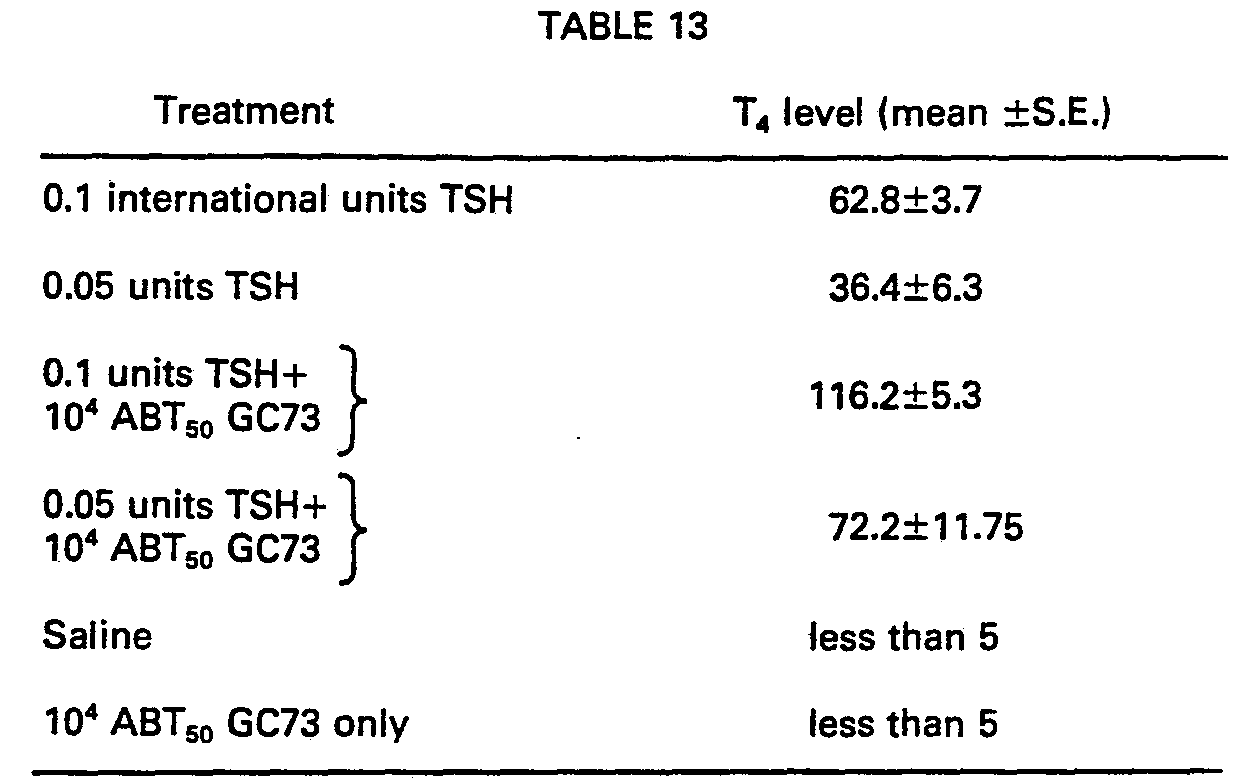
- A monoclonal antibody (GC73) to TSH was prepared analogously to those of Example 1 above and is available from the same address as in Example J. GC73 is specific for the P-chain of TSH. Dwarf mice were randomly divided into groups of five and treated accordingly to the regimes of Table 13 on five consecutive days before analysis of the serum for T4 level by radioimmunoassay, and microscopic histological inspection of thyroid tissue, fixed in 10% formalin in saline solution and then embedded in wax or plastic. The T4 data are given in Table 13; the results were confirmed by microscopic examination.
Claims (14)
Priority Applications (1)
| Application Number | Priority Date | Filing Date | Title |
|---|---|---|---|
| AT84109773T ATE57303T1 (en) | 1983-08-17 | 1984-08-16 | PHYSIOLOGICALLY ACTIVE COMPOSITIONS. |
Applications Claiming Priority (4)
| Application Number | Priority Date | Filing Date | Title |
|---|---|---|---|
| GB8322115 | 1983-08-17 | ||
| GB838322115A GB8322115D0 (en) | 1983-08-17 | 1983-08-17 | Physiologically active compositions |
| GB838322826A GB8322826D0 (en) | 1983-08-25 | 1983-08-25 | Physiologically active compositions |
| GB8322826 | 1983-08-25 |
Publications (3)
| Publication Number | Publication Date |
|---|---|
| EP0137234A2 EP0137234A2 (en) | 1985-04-17 |
| EP0137234A3 EP0137234A3 (en) | 1987-08-19 |
| EP0137234B1 true EP0137234B1 (en) | 1990-10-10 |
Family
ID=26286770
Family Applications (1)
| Application Number | Title | Priority Date | Filing Date |
|---|---|---|---|
| EP84109773A Expired EP0137234B1 (en) | 1983-08-17 | 1984-08-16 | Physiologically active compositions |
Country Status (9)
| Country | Link |
|---|---|
| EP (1) | EP0137234B1 (en) |
| JP (1) | JPH06293661A (en) |
| CA (1) | CA1259923A (en) |
| DE (1) | DE3483385D1 (en) |
| DK (1) | DK173435B1 (en) |
| HU (1) | HU192989B (en) |
| IE (1) | IE57497B1 (en) |
| NZ (1) | NZ209246A (en) |
| PH (1) | PH26708A (en) |
Families Citing this family (11)
| Publication number | Priority date | Publication date | Assignee | Title |
|---|---|---|---|---|
| EP0467416A1 (en) * | 1983-09-01 | 1992-01-22 | Hybritech Incorporated | Antibody compositions of therapeutic agents having an extended serum half-life |
| GB2148299B (en) * | 1983-09-01 | 1988-01-06 | Hybritech Inc | Antibody compositions of therapeutic agents having an extended serum half-life |
| EP0153871A3 (en) * | 1984-03-01 | 1987-07-01 | Centocor, Inc. | Antibody enhancement of immunogenicity of antigen |
| US5210180A (en) * | 1989-10-27 | 1993-05-11 | American Cyanamid Company | Enhancement of porcine somatotropin activity |
| US6165465A (en) * | 1990-05-15 | 2000-12-26 | American Cyanamid Company | Immunologic enhancement of the somatogenic effect of somatotropin with an antibody |
| WO1998024896A2 (en) * | 1996-12-06 | 1998-06-11 | F. Hoffmann-La Roche Ag | Muteins of obese protein |
| US6197582B1 (en) * | 1998-03-18 | 2001-03-06 | The Trustees Of Columbia University In The City Of New York | Development of human monoclonal antibodies and uses thereof |
| US7060802B1 (en) | 2000-09-18 | 2006-06-13 | The Trustees Of Columbia University In The City Of New York | Tumor-associated marker |
| CA2387198C (en) * | 2001-05-31 | 2007-02-13 | Pfizer Products Inc. | Method for treating hair loss using thyromimetic compounds |
| WO2008003750A2 (en) | 2006-07-07 | 2008-01-10 | Novo Nordisk Health Care Ag | New protein conjugates and methods for their preparation |
| FR2967676B1 (en) * | 2010-11-19 | 2014-09-19 | Agronomique Inst Nat Rech | LUTEINIZING HORMONE LIGAND AND LIGAND-GONADOTROPHINE COMPLEX |
-
1984
- 1984-08-16 PH PH31112A patent/PH26708A/en unknown
- 1984-08-16 EP EP84109773A patent/EP0137234B1/en not_active Expired
- 1984-08-16 IE IE2114/84A patent/IE57497B1/en not_active IP Right Cessation
- 1984-08-16 HU HU843112A patent/HU192989B/en unknown
- 1984-08-16 CA CA000461152A patent/CA1259923A/en not_active Expired
- 1984-08-16 DE DE8484109773T patent/DE3483385D1/en not_active Expired - Lifetime
- 1984-08-16 NZ NZ209246A patent/NZ209246A/en unknown
- 1984-08-16 DK DK198403940A patent/DK173435B1/en not_active IP Right Cessation
-
1993
- 1993-09-30 JP JP5245381A patent/JPH06293661A/en active Pending
Also Published As
| Publication number | Publication date |
|---|---|
| PH26708A (en) | 1992-09-15 |
| JPH06293661A (en) | 1994-10-21 |
| NZ209246A (en) | 1989-04-26 |
| IE842114L (en) | 1985-02-17 |
| DK394084D0 (en) | 1984-08-16 |
| HUT35529A (en) | 1985-07-29 |
| AU564783B2 (en) | 1987-08-27 |
| DK394084A (en) | 1985-02-18 |
| HU192989B (en) | 1987-08-28 |
| IE57497B1 (en) | 1993-03-24 |
| DK173435B1 (en) | 2000-10-23 |
| CA1259923A (en) | 1989-09-26 |
| EP0137234A3 (en) | 1987-08-19 |
| DE3483385D1 (en) | 1990-11-15 |
| EP0137234A2 (en) | 1985-04-17 |
| AU3200084A (en) | 1985-02-28 |
Similar Documents
| Publication | Publication Date | Title |
|---|---|---|
| GROESBECK et al. | Highly improved precision of the hypophysectomized female rat body weight gain bioassay for growth hormone by increased frequency of injections, avoidance of antibody formation, and other simple modifications | |
| CA1259923A (en) | Physiologically active compositions | |
| EP0216454A2 (en) | Method of promoting animal growth | |
| DE3851455T2 (en) | Biologically active molecules. | |
| Deckert et al. | The antigenicity of pig insulin | |
| JPH04503663A (en) | Contraceptive methods and their composition | |
| WO1988000056A1 (en) | Composition and method for immunological castration and spaying | |
| JPH03503403A (en) | biologically active molecules | |
| CA1288341C (en) | Physiologically active compositions | |
| DE3852588T2 (en) | Biologically active molecules. | |
| JPS63214667A (en) | Monochronal antibody effective for growth promotion | |
| US5401829A (en) | Biologically active molecules | |
| NO177858B (en) | Peptide | |
| JP2000508293A (en) | Novel peptide useful for promoting FSH action | |
| US6723556B1 (en) | Nucleic acid encoding a fragment of bovine luteinizing hormone/chorionic gonadotropin receptor | |
| JPS60120824A (en) | Hormonal blend | |
| AU7642387A (en) | Composition and method for immunological castration and spaying | |
| US6165465A (en) | Immunologic enhancement of the somatogenic effect of somatotropin with an antibody | |
| Croker et al. | The immunization of ewes against steroids as a means of increasing prolificacy in a mediterranean environment | |
| JPH11502844A (en) | Peptides with growth promoting properties | |
| Beattie et al. | Immunological manipulation of body composition |
Legal Events
| Date | Code | Title | Description |
|---|---|---|---|
| PUAI | Public reference made under article 153(3) epc to a published international application that has entered the european phase |
Free format text: ORIGINAL CODE: 0009012 |
|
| AK | Designated contracting states |
Designated state(s): AT BE CH DE FR GB IT LI LU NL SE |
|
| PUAL | Search report despatched |
Free format text: ORIGINAL CODE: 0009013 |
|
| AK | Designated contracting states |
Kind code of ref document: A3 Designated state(s): AT BE CH DE FR GB IT LI LU NL SE |
|
| 17P | Request for examination filed |
Effective date: 19871013 |
|
| 17Q | First examination report despatched |
Effective date: 19890503 |
|
| RAP1 | Party data changed (applicant data changed or rights of an application transferred) |
Owner name: THE WELLCOME FOUNDATION LIMITED |
|
| ITF | It: translation for a ep patent filed | ||
| RAP3 | Party data changed (applicant data changed or rights of an application transferred) |
Owner name: THE WELLCOME FOUNDATION LIMITED |
|
| GRAA | (expected) grant |
Free format text: ORIGINAL CODE: 0009210 |
|
| AK | Designated contracting states |
Kind code of ref document: B1 Designated state(s): AT BE CH DE FR GB IT LI LU NL SE |
|
| REF | Corresponds to: |
Ref document number: 57303 Country of ref document: AT Date of ref document: 19901015 Kind code of ref document: T |
|
| REF | Corresponds to: |
Ref document number: 3483385 Country of ref document: DE Date of ref document: 19901115 |
|
| ET | Fr: translation filed | ||
| PLBI | Opposition filed |
Free format text: ORIGINAL CODE: 0009260 |
|
| ITTA | It: last paid annual fee | ||
| 26 | Opposition filed |
Opponent name: ELF FRANCE Effective date: 19910710 |
|
| NLR1 | Nl: opposition has been filed with the epo |
Opponent name: ELF FRANCE |
|
| PLAB | Opposition data, opponent's data or that of the opponent's representative modified |
Free format text: ORIGINAL CODE: 0009299OPPO |
|
| R26 | Opposition filed (corrected) |
Opponent name: PEPTIDE TECHNOLOGY LIMITED Effective date: 19910710 |
|
| NLXE | Nl: other communications concerning ep-patents (part 3 heading xe) |
Free format text: PAT.BUL.21/91 CORR.:PEPTIDE TECHNOLOGY LIMITED |
|
| EPTA | Lu: last paid annual fee | ||
| PLBN | Opposition rejected |
Free format text: ORIGINAL CODE: 0009273 |
|
| STAA | Information on the status of an ep patent application or granted ep patent |
Free format text: STATUS: OPPOSITION REJECTED |
|
| 27O | Opposition rejected |
Effective date: 19940709 |
|
| NLR2 | Nl: decision of opposition | ||
| EAL | Se: european patent in force in sweden |
Ref document number: 84109773.6 |
|
| REG | Reference to a national code |
Ref country code: GB Ref legal event code: IF02 |
|
| PGFP | Annual fee paid to national office [announced via postgrant information from national office to epo] |
Ref country code: NL Payment date: 20030801 Year of fee payment: 20 Ref country code: AT Payment date: 20030801 Year of fee payment: 20 |
|
| PGFP | Annual fee paid to national office [announced via postgrant information from national office to epo] |
Ref country code: GB Payment date: 20030813 Year of fee payment: 20 |
|
| PGFP | Annual fee paid to national office [announced via postgrant information from national office to epo] |
Ref country code: FR Payment date: 20030820 Year of fee payment: 20 |
|
| PGFP | Annual fee paid to national office [announced via postgrant information from national office to epo] |
Ref country code: SE Payment date: 20030821 Year of fee payment: 20 |
|
| PGFP | Annual fee paid to national office [announced via postgrant information from national office to epo] |
Ref country code: CH Payment date: 20030825 Year of fee payment: 20 |
|
| PGFP | Annual fee paid to national office [announced via postgrant information from national office to epo] |
Ref country code: LU Payment date: 20030902 Year of fee payment: 20 |
|
| PGFP | Annual fee paid to national office [announced via postgrant information from national office to epo] |
Ref country code: BE Payment date: 20030911 Year of fee payment: 20 |
|
| PGFP | Annual fee paid to national office [announced via postgrant information from national office to epo] |
Ref country code: DE Payment date: 20030930 Year of fee payment: 20 |
|
| PG25 | Lapsed in a contracting state [announced via postgrant information from national office to epo] |
Ref country code: LI Free format text: LAPSE BECAUSE OF EXPIRATION OF PROTECTION Effective date: 20040815 Ref country code: GB Free format text: LAPSE BECAUSE OF EXPIRATION OF PROTECTION Effective date: 20040815 Ref country code: CH Free format text: LAPSE BECAUSE OF EXPIRATION OF PROTECTION Effective date: 20040815 |
|
| PG25 | Lapsed in a contracting state [announced via postgrant information from national office to epo] |
Ref country code: NL Free format text: LAPSE BECAUSE OF EXPIRATION OF PROTECTION Effective date: 20040816 Ref country code: LU Free format text: LAPSE BECAUSE OF EXPIRATION OF PROTECTION Effective date: 20040816 Ref country code: AT Free format text: LAPSE BECAUSE OF EXPIRATION OF PROTECTION Effective date: 20040816 |
|
| BE20 | Be: patent expired |
Owner name: THE *WELLCOME FOUNDATION LTD Effective date: 20040816 |
|
| REG | Reference to a national code |
Ref country code: GB Ref legal event code: PE20 |
|
| REG | Reference to a national code |
Ref country code: CH Ref legal event code: PL |
|
| EUG | Se: european patent has lapsed | ||
| NLV7 | Nl: ceased due to reaching the maximum lifetime of a patent |