EP0136989A2 - Device in connection with a tractive vehicle - Google Patents
Device in connection with a tractive vehicle Download PDFInfo
- Publication number
- EP0136989A2 EP0136989A2 EP84850260A EP84850260A EP0136989A2 EP 0136989 A2 EP0136989 A2 EP 0136989A2 EP 84850260 A EP84850260 A EP 84850260A EP 84850260 A EP84850260 A EP 84850260A EP 0136989 A2 EP0136989 A2 EP 0136989A2
- Authority
- EP
- European Patent Office
- Prior art keywords
- pulling means
- carrier
- plate
- ground
- hydraulic
- Prior art date
- Legal status (The legal status is an assumption and is not a legal conclusion. Google has not performed a legal analysis and makes no representation as to the accuracy of the status listed.)
- Withdrawn
Links
Images

Classifications
-
- B—PERFORMING OPERATIONS; TRANSPORTING
- B60—VEHICLES IN GENERAL
- B60D—VEHICLE CONNECTIONS
- B60D1/00—Traction couplings; Hitches; Draw-gear; Towing devices
- B60D1/24—Traction couplings; Hitches; Draw-gear; Towing devices characterised by arrangements for particular functions
- B60D1/42—Traction couplings; Hitches; Draw-gear; Towing devices characterised by arrangements for particular functions for being adjustable
- B60D1/46—Traction couplings; Hitches; Draw-gear; Towing devices characterised by arrangements for particular functions for being adjustable vertically
- B60D1/465—Traction couplings; Hitches; Draw-gear; Towing devices characterised by arrangements for particular functions for being adjustable vertically comprising a lifting mechanism, e.g. for coupling while lifting
-
- B—PERFORMING OPERATIONS; TRANSPORTING
- B60—VEHICLES IN GENERAL
- B60D—VEHICLE CONNECTIONS
- B60D1/00—Traction couplings; Hitches; Draw-gear; Towing devices
- B60D1/24—Traction couplings; Hitches; Draw-gear; Towing devices characterised by arrangements for particular functions
- B60D1/36—Traction couplings; Hitches; Draw-gear; Towing devices characterised by arrangements for particular functions for facilitating connection, e.g. hitch catchers
Definitions
- the invention concerns a device in connection with a tractive vehicle equipped with a tow hook, a draw pin, or some corresponding pulling means. More specifically, the invention concerns an assembly in connection with the carrier for the pulling means, comprising inter alia motive organs for this carrier.
- the invention includes inter alia the use of these motive organs not only to connect or disconnect a trailer or some other pulled unit but also to lift the rear wheels in connection with wheel changing or change of chains.
- the purpose of the invention is to eliminate the disadvantages and limitations enumerated above.
- it is intended to make it possible for the driver to observe and predict the position of the draw hook during its entire movement, which will facilitate the entry of the draw hook or some corresponding pulling means into a draw bar eyelet or the like.
- Another object of the invention is provide a device, which may be mounted on ordinary tractors, which are equipped with traditional draft links.
- an object of the invention is to provide a device for maneuvering the pulling means without having to involve the links, which makes it possible to use the links for other purposes, such as holding or handling auxiliary equipment, while simultaneously connecting or disconnecting a trailing vehicle.
- Another purpose of the invention is to provide a device which may also be used to raise the rear wheels of the tractive vehicle off the ground.
- the motive organs for the draw hook are designed with the purpose of making possible the use of the same motive organs together with a carrier for the pulling means for this lifting movement also.
- the pulling means is mounted on a carrier, motive organs being arranged to be able to raise and lower the carrier with the pulling means along a straight line.
- This line extends from an upper end position, which is determined by a stationary locking device which interacts with the pulling means and locks the eye bar or corresponding element of the trailing vehicle, down to and past a level which may be below the level of the ground, so that said motive organs by pressing down a press plate or the like against the ground or some other firm support may lift the rear wheels of the vehicle off the ground. It is suitable to let the straight line slope from said upper end position downward-rearward at an angle of between 3 and 20 , preferably between 5° and 15°, and suitably at about 10 0 from the vertical plane.
- Said press plate preferably constitutes said carrier, the pulling means extending upward from the top side of the plate, preferably from a point close to the rear edge of the.plate.
- the bottom side of the plate is horizontal irrespective of the position of the plate along its line of movement and has a comparatively large surface to distribute the surface pressure, making it possible by pressing the plate against the ground or against some support to raise the rear wheels from the ground.
- the fact that the bottom side of the plate is horizontal naturally does not exclude the possibility of it being profiled to prevent gliding on the ground.
- the motive organs comprise two assemblies of hydraulic equipment.
- the carrier for the pulling means is mounted between these two assemblies, each of which comprises both a hydraulic cylinder and a hydraulic piston with a piston rod.
- a first part is fixed to a mounting on the vehicle, and another part, which is mobile with respect to the first part, is attached to said carrier.
- the piston and piston rod constitute that part which is connected to the mounting on the vehicle, while the cylinder which is mobile relative to this stationary part is attached to the carrier for the pulling means.
- the hydraulic cylinder be double-acting, and the piston rod provided with channels, which open into the hydraulic chambers on each side of the piston.
- each piston rod is connected to the mounting by a capped casing, coaxial with the hydraulic cylinder, said casing both guiding the mobile cylinder and bracing the hydraulic assembly.
- a mounting located at the rear of a tractor is designated 1.
- the mounting in a manner previously known consists of an anchor plate 2 and two vertical plates or brackets 3 and 4, extending from the anchor plate.
- the anchor plate is secured to the rear of the tractor by a number of screws 5.
- a horizontal locking plate 6 for an eye bar Close to the lower edges of the brackets 3 and 4 is mounted a horizontal locking plate 6 for an eye bar, said locking plate extending between the brackets 3 and 4.
- a hub 7 for a PTO shaft 8 In the anchor plate 2 there is in a conventional manner a hub 7 for a PTO shaft 8.
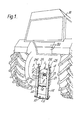
- a draw hook has been designated 10. It consists of a short bar which extends upward from the top side of a plate 11 which is the carrier for the draw hook 10.
- the plate 11 may be raised and lowered along a straight line from an upper position, in which the hook 10 abuts against the bottom side of the locking plate 6, down to a position about 5 cm above the ground.
- the reason for limiting the downward movement to a small distance above the ground is a desire to minimize the risk of the plate 11 running into some obstacle if the tractor is moved with the plate in its lower position. If the tractor is to be lifted, a support is put under the plate 11.
- Fig. 2 is a section along the axis of the hydraulic assembly 12.
- the design of assembly 13 is identical.
- the assembly comprises a hydraulic cylinder 14, a piston 15, and a piston rod 16.
- a partition floor 17 is arranged inside the cylinder 14 and delimits a lower hydraulic chamber (plus chamber) 18.
- An upper chamber is designated 19.
- the cylinder 14 extends beyond the floor 17 and is welded to the carrier plate 11.
- the piston rod 16 is screwed to a double lid 20 on a casing 21, the inner diameter of which is slightly larger than the outer diameter of the cylinder 14.
- the cylinder 14 may be displaced inside the casing 21, which functions as a guide for the cylinder 14 and as a brace for the entire hydraulic assembly 12.
- the piston rod 16 consists of a pipe. Inside this pipe there is another pipe 22. The latter pipe opens into the lower hydraulic chamber 18, while the pipe which constitutes the piston rod 16 forms a channel 27, which communicates with the upper hydraulic chamber 19 via conduit 23.
- the connection conduits for hydraulic fluid to the chambers 18 and 19 are designated 24 and 25, respectively, and are connected to the extension of piston rod 16 immediately above the lid 20.
- the casing 21 is welded to the bracket 3 along its entire length.
- the arrangement described has the advantage of obviating hydraulic conduits to the lower parts of the hydraulic assemblies, which would impair seriously the functioning of the device. Further, the device becomes very stable and a high power output is made possible.
- the strong forces which may be exerted by the pistons 15, putting the cylinders 14 in motion, are transferred to the plate 11, so that the plate 11 may be used not only to raise and lower the draw hook 10, but also to press so strongly against a support on the ground that the rear wheels of the vehicle may be lifted. Therefore, the plate 11 is arranged to be horizontal.
- the plate consists of a flat sturdy steel plate. To prevent the plate 11 from sliding on the supporting surface, when the wheels are to be lifted, the bottom side of the plate may be profiled in a suitable way.
- each of the centre axes 27 of the hydraulic assemblies slants slightly forward, or in other words in such a way that the assemblies extend downward-rearward.
- the angle of inclination a to prefer may vary between vehicles, but in a normal case a suitable inclination angle a may be about 10°.
- the devices illustrated may also be equipped with organs or details known as such.
- organs or details known as such.
- locking organs in the form of latches 32 and snap locks 33 as depicted in Fig. 3 may be provided, which will automatically lock the plate in its upper position, and which may be released by the driver when the plate is to be lowered again.
- Other complements or modifications are also feasible within the spirit and scope of the invention.
Landscapes
- Engineering & Computer Science (AREA)
- Transportation (AREA)
- Mechanical Engineering (AREA)
- Agricultural Machines (AREA)
- Handcart (AREA)
Abstract
A draw hook or a corresponding pulling means of a tractor or other tractive vehicle is mounted on a carrier, which is designed to be raised and lowered along a straight line. The straight line extends from an upper end position, determined by a fixed locking organ (6), interacting with the pulling means, locking the eye bar or corresponding element of the trailing unit, to the ground level or immediately thereabove, so that motive organs (12,13) by pressing down a press plate or corresponding element (11) against the ground or against some other firm support may raise the rear wheels of the vehicle off the ground. According to a chosen embodiment the press plate (111 is also the carrier for the draw hook (101.
Description
- The invention concerns a device in connection with a tractive vehicle equipped with a tow hook, a draw pin, or some corresponding pulling means. More specifically, the invention concerns an assembly in connection with the carrier for the pulling means, comprising inter alia motive organs for this carrier. The invention includes inter alia the use of these motive organs not only to connect or disconnect a trailer or some other pulled unit but also to lift the rear wheels in connection with wheel changing or change of chains.
- It is well known and conventional to use the draft links or a tractor to raise or lower a draw hook on a carrier when connecting or disconnecting for example an eye bar. These known devices have certain disadvantages and limitations. The draw hook of these devices for example moves arcuately downward-forward when lowered, the tractor rear blocking it from the driver's field of vision. This of course makes it more difficult for the driver to direct the hook correctly in relation to the eyelet. Normally, the driver will need an assistant, directing this operation, or will have to get off the tractor once or several times to check the position. Another drawback of these devices is that they block the use of the draft links of the tractor, prohibiting the use of these for carrying auxiliary equipment while the draw hook is being connected to the eye bar.
- Another known practice is to equip tractive vehicles with hydraulic cylinders to raise the vehicle from the ground. It is for example standard practice to equip such tractors and other vehicles as are intended especially for digging with such hydraulic cylinders. These known devices have this sole purpose, however, and cannot be used to assist for example a draw hook.
- The purpose of the invention is to eliminate the disadvantages and limitations enumerated above. In particular, it is intended to make it possible for the driver to observe and predict the position of the draw hook during its entire movement, which will facilitate the entry of the draw hook or some corresponding pulling means into a draw bar eyelet or the like.
- Another object of the invention is provide a device, which may be mounted on ordinary tractors, which are equipped with traditional draft links. In particular, an object of the invention is to provide a device for maneuvering the pulling means without having to involve the links, which makes it possible to use the links for other purposes, such as holding or handling auxiliary equipment, while simultaneously connecting or disconnecting a trailing vehicle.
- Another purpose of the invention is to provide a device which may also be used to raise the rear wheels of the tractive vehicle off the ground. Particularly, the motive organs for the draw hook are designed with the purpose of making possible the use of the same motive organs together with a carrier for the pulling means for this lifting movement also. According to the invention, the pulling means is mounted on a carrier, motive organs being arranged to be able to raise and lower the carrier with the pulling means along a straight line. This line, according to one aspect of the invention, extends from an upper end position, which is determined by a stationary locking device which interacts with the pulling means and locks the eye bar or corresponding element of the trailing vehicle, down to and past a level which may be below the level of the ground, so that said motive organs by pressing down a press plate or the like against the ground or some other firm support may lift the rear wheels of the vehicle off the ground. It is suitable to let the straight line slope from said upper end position downward-rearward at an angle of between 3 and 20 , preferably between 5° and 15°, and suitably at about 100 from the vertical plane.
- Said press plate preferably constitutes said carrier, the pulling means extending upward from the top side of the plate, preferably from a point close to the rear edge of the.plate. The bottom side of the plate is horizontal irrespective of the position of the plate along its line of movement and has a comparatively large surface to distribute the surface pressure, making it possible by pressing the plate against the ground or against some support to raise the rear wheels from the ground. The fact that the bottom side of the plate is horizontal naturally does not exclude the possibility of it being profiled to prevent gliding on the ground.
- In the preferred embodiment the motive organs comprise two assemblies of hydraulic equipment. The carrier for the pulling means is mounted between these two assemblies, each of which comprises both a hydraulic cylinder and a hydraulic piston with a piston rod. Of these parts, a first part is fixed to a mounting on the vehicle, and another part, which is mobile with respect to the first part, is attached to said carrier. More specifically, it is suitable to let the piston and piston rod constitute that part which is connected to the mounting on the vehicle, while the cylinder which is mobile relative to this stationary part is attached to the carrier for the pulling means. It is suitable to let the hydraulic cylinder be double-acting, and the piston rod provided with channels, which open into the hydraulic chambers on each side of the piston. Further, it is suitable that each piston rod is connected to the mounting by a capped casing, coaxial with the hydraulic cylinder, said casing both guiding the mobile cylinder and bracing the hydraulic assembly.
- Further characteristics and advantages of the invention will be apparent from the attached claims and the following description of a preferred embodiment.
- In the following description of a preferred embodiment reference will be made to the attached drawings, of which
- Fig. 1 is a perspective view of the device according to the invention;
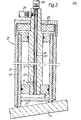
- Fig. 2 is a sectional elevation of a hydraulic assembly which is part of the device; and
- Fig. 3 is a side elevation of the device.
- In the drawings only such details are depicted as are important to the understanding of the principles of the invention, such details being omitted as belong to conventional technique or are otherwise without bearing on the principles of the invention, in order to bring out the significant features.
- Referring at first to Fig. 1, a mounting located at the rear of a tractor is designated 1. The mounting in a manner previously known consists of an
anchor plate 2 and two vertical plates or brackets 3 and 4, extending from the anchor plate. The anchor plate is secured to the rear of the tractor by a number ofscrews 5. Close to the lower edges of the brackets 3 and 4 is mounted a horizontal locking plate 6 for an eye bar, said locking plate extending between the brackets 3 and 4. In theanchor plate 2 there is in a conventional manner a hub 7 for a PTO shaft 8. - A draw hook has been designated 10. It consists of a short bar which extends upward from the top side of a plate 11 which is the carrier for the
draw hook 10. The plate 11 may be raised and lowered along a straight line from an upper position, in which thehook 10 abuts against the bottom side of the locking plate 6, down to a position about 5 cm above the ground. To accomplish these movements upward and downward there are twohydraulic assemblies - Fig. 2 is a section along the axis of the
hydraulic assembly 12. The design ofassembly 13 is identical. The assembly comprises ahydraulic cylinder 14, apiston 15, and apiston rod 16. Apartition floor 17 is arranged inside thecylinder 14 and delimits a lower hydraulic chamber (plus chamber) 18. An upper chamber is designated 19. Thecylinder 14 extends beyond thefloor 17 and is welded to the carrier plate 11. - The
piston rod 16 is screwed to adouble lid 20 on acasing 21, the inner diameter of which is slightly larger than the outer diameter of thecylinder 14. Thecylinder 14 may be displaced inside thecasing 21, which functions as a guide for thecylinder 14 and as a brace for the entirehydraulic assembly 12. - The
piston rod 16 consists of a pipe. Inside this pipe there is anotherpipe 22. The latter pipe opens into the lowerhydraulic chamber 18, while the pipe which constitutes thepiston rod 16 forms achannel 27, which communicates with the upper hydraulic chamber 19 viaconduit 23. The connection conduits for hydraulic fluid to thechambers 18 and 19 are designated 24 and 25, respectively, and are connected to the extension ofpiston rod 16 immediately above thelid 20. Thecasing 21 is welded to the bracket 3 along its entire length. - The arrangement described has the advantage of obviating hydraulic conduits to the lower parts of the hydraulic assemblies, which would impair seriously the functioning of the device. Further, the device becomes very stable and a high power output is made possible. The strong forces which may be exerted by the
pistons 15, putting thecylinders 14 in motion, are transferred to the plate 11, so that the plate 11 may be used not only to raise and lower thedraw hook 10, but also to press so strongly against a support on the ground that the rear wheels of the vehicle may be lifted. Therefore, the plate 11 is arranged to be horizontal. According to the embodiment, the plate consists of a flat sturdy steel plate. To prevent the plate 11 from sliding on the supporting surface, when the wheels are to be lifted, the bottom side of the plate may be profiled in a suitable way. - In order that the driver may observe the
draw hook 10 whatever its vertical position through the rearlower windows 30 of thecab 31, thecasings 21 of thehydraulic assemblies - The devices illustrated may also be equipped with organs or details known as such. For example, locking organs in the form of
latches 32 and snaplocks 33 as depicted in Fig. 3 may be provided, which will automatically lock the plate in its upper position, and which may be released by the driver when the plate is to be lowered again. Other complements or modifications are also feasible within the spirit and scope of the invention.
Claims (8)
1. Device in connection with a tractive vehicle with a draw hook, draw pin, or corresponding pulling means, characterized in that the pulling means (10) is mounted on a carrier (11), and in that motive organs (12, 13, 14) are arranged to raise and lower the carrier with the pulling means along a straight line.
2. Device according to claim 1, characterized in that the straight line extends from an upper end position, determined by a fixed locking organ (6), said locking organ interacting with the pulling means (10) and locking the eye bar or corresponding element of the trailing unit, down to and past a chosen level, which is preferably no higher than 10 cm above the ground level and suitably no lower than 5 cm above the ground level, enabling said motive organs to lift the rear wheels of the vehicle off the ground by pressing a press plate (11) or some corresponding member down against the ground or down against some other firm support.
3. Device according to claim 2, characterized in that the straight line extends from said upper end position slantingly downward-rearward at an angle of between 3 and 20 , preferably between 5 and 150, and suitably of about 100 from the vertical plane.
4. Device according to claim 2 or 3, characterized in that said press plate constitutes said carrier, that the pulling means extends upward from the top side of the plate, preferably from a point close to the rear edge of the plate, and in that the bottom side of the plate is horizontal irrespective of the position of the plate along its line of displacement and has a comparatively large surface area to distribute the surface pressure, enabling the lifting of the rear wheels from the ground by pressing the plate against the ground or against a firm support.
5. Device according to claim 1, characterized in that the motive organs comprise two hydraulic assemblies (12, 13) and that the carrier for the pulling means is mounted between the two hydraulic assemblies, each of which comprising both a hydraulic cylinder (14) and a piston (15) with a piston rod (16), of which parts one first part is permanently affixed to a mounting (2,3,4) on the vehicle, and the other, second part, which is mobile with respect to the first part, is attached to said carrier (11).
6. Device according to claim 5, characterized in that said first part, which is permanently affixed to the mounting on the tractive vehicle, is the piston rod (16) and the piston (15), while the cylinder (14), which is mobile with respect to said fixed part, is attached to the carrier for the pulling means.
7. Device according to claim 6, characterized in that the piston rod is attached to the mounting by a capped casing (21), which is coaxial with the hydraulic assembly and both functions as a guide for the moving cylinder (14) and as a bracing for the assembly.
8. Device according to claim 5, characterized in that the hydraulic assembly is double-acting, and that the piston rod (16) is provided with channels (22,27) for delivering and evacuating hydraulic fluid to and from, respectively, the hydraulic chambers (18,19) on each side of the piston (15).
Applications Claiming Priority (2)
| Application Number | Priority Date | Filing Date | Title |
|---|---|---|---|
| SE8305008 | 1983-09-19 | ||
| SE8305008A SE451046B (en) | 1983-09-19 | 1983-09-19 | DEVICE FOR Raising and lowering a carrier with a towing organ in a towing vehicle |
Publications (2)
| Publication Number | Publication Date |
|---|---|
| EP0136989A2 true EP0136989A2 (en) | 1985-04-10 |
| EP0136989A3 EP0136989A3 (en) | 1985-10-16 |
Family
ID=20352533
Family Applications (1)
| Application Number | Title | Priority Date | Filing Date |
|---|---|---|---|
| EP84850260A Withdrawn EP0136989A3 (en) | 1983-09-19 | 1984-09-07 | Device in connection with a tractive vehicle |
Country Status (5)
| Country | Link |
|---|---|
| EP (1) | EP0136989A3 (en) |
| DK (1) | DK444884A (en) |
| FI (1) | FI843578L (en) |
| NO (1) | NO843638L (en) |
| SE (1) | SE451046B (en) |
Cited By (2)
| Publication number | Priority date | Publication date | Assignee | Title |
|---|---|---|---|---|
| EP1810561A1 (en) * | 2006-01-18 | 2007-07-25 | Josef Scharmüller | Towing device |
| DE102014207788A1 (en) | 2014-04-25 | 2015-10-29 | Rockinger Agriculture Gmbh | Pick-up Hitch with direct application of force |
Family Cites Families (7)
| Publication number | Priority date | Publication date | Assignee | Title |
|---|---|---|---|---|
| DE1065281B (en) * | ||||
| DE1059297B (en) * | 1957-10-23 | 1959-06-11 | Kloeckner Humboldt Deutz Ag | Coupling device for tractor |
| FR1229306A (en) * | 1959-07-03 | 1960-09-06 | Coupling and lifting device of a semi-trailer boom carried by a tractor with raised bridge and reduction gear | |
| GB1483588A (en) * | 1973-11-30 | 1977-08-24 | Mann & Son Ltd J | Towing coupling device |
| US3865406A (en) * | 1974-05-31 | 1975-02-11 | Truck Specialist Inc | Quick change hitch for trailer or mobile homes |
| US4057265A (en) * | 1976-11-24 | 1977-11-08 | Grace Bud W | Towing apparatus |
| FR2469300A1 (en) * | 1979-11-13 | 1981-05-22 | Budin Rene | VEHICLE HITCHING DEVICE |
-
1983
- 1983-09-19 SE SE8305008A patent/SE451046B/en not_active IP Right Cessation
-
1984
- 1984-09-07 EP EP84850260A patent/EP0136989A3/en not_active Withdrawn
- 1984-09-12 FI FI843578A patent/FI843578L/en not_active Application Discontinuation
- 1984-09-14 NO NO843638A patent/NO843638L/en unknown
- 1984-09-18 DK DK444884A patent/DK444884A/en not_active Application Discontinuation
Cited By (3)
| Publication number | Priority date | Publication date | Assignee | Title |
|---|---|---|---|---|
| EP1810561A1 (en) * | 2006-01-18 | 2007-07-25 | Josef Scharmüller | Towing device |
| DE102014207788A1 (en) | 2014-04-25 | 2015-10-29 | Rockinger Agriculture Gmbh | Pick-up Hitch with direct application of force |
| EP2939856A2 (en) | 2014-04-25 | 2015-11-04 | Rockinger Agriculture GmbH | Pickup hitch with direct force introduction |
Also Published As
| Publication number | Publication date |
|---|---|
| DK444884A (en) | 1985-03-20 |
| SE8305008D0 (en) | 1983-09-19 |
| FI843578A7 (en) | 1985-03-20 |
| NO843638L (en) | 1985-03-20 |
| FI843578A0 (en) | 1984-09-12 |
| SE8305008L (en) | 1985-03-20 |
| FI843578L (en) | 1985-03-20 |
| EP0136989A3 (en) | 1985-10-16 |
| DK444884D0 (en) | 1984-09-18 |
| SE451046B (en) | 1987-08-31 |
Similar Documents
| Publication | Publication Date | Title |
|---|---|---|
| US5353530A (en) | Quick mounting snow plow assembly | |
| CA2155242C (en) | Towing arrangement | |
| US4451193A (en) | Wheel lift apparatus | |
| US5289880A (en) | Towable road tender | |
| US4861221A (en) | Vehicle lifting and towing attachment | |
| US4869002A (en) | Vehicle attachment for accommodating tool | |
| AU674632B2 (en) | Grab hook and gooseneck assembly for hauling vehicles | |
| US4318658A (en) | Tilting deck vehicle | |
| CA1248058A (en) | Loader device for a tractor | |
| US4815915A (en) | Under-vehicle towing apparatus | |
| US4418713A (en) | Concrete pump tractor trailer assembly | |
| IL46798A (en) | Means for changing the position of a load-carrying component of a transport unit | |
| US20200170170A1 (en) | Tractor system and method | |
| US3145857A (en) | Mobile lift crane and vehicle tow hoist | |
| US4513987A (en) | Self-contained lifting apparatus for low-boy trailers | |
| US4640662A (en) | Fork lift attachment for tractor | |
| FI78646B (en) | TILL KOPPLINGSANORDNING FOER ANSLUTNING AV ETT DRAGET FORDON TILL ETT DRAGANDE FORDON. | |
| US3908842A (en) | Tow truck | |
| US5257797A (en) | Tractor hitch | |
| US5772230A (en) | Towing apparatus | |
| EP0390983A2 (en) | A connector and method of connection between a road making machine and the fifth wheel of a tractor | |
| EP0136989A2 (en) | Device in connection with a tractive vehicle | |
| US4487544A (en) | Towing vehicle | |
| US4899831A (en) | Frontal connection apparatus for tractors | |
| FI65527C (en) | FORDONSBUREN BAERARE FOER SKOGSBRUKSREDSKAP |
Legal Events
| Date | Code | Title | Description |
|---|---|---|---|
| PUAI | Public reference made under article 153(3) epc to a published international application that has entered the european phase |
Free format text: ORIGINAL CODE: 0009012 |
|
| AK | Designated contracting states |
Designated state(s): AT BE CH DE FR GB IT LI LU NL SE |
|
| PUAL | Search report despatched |
Free format text: ORIGINAL CODE: 0009013 |
|
| AK | Designated contracting states |
Designated state(s): AT BE CH DE FR GB IT LI LU NL SE |
|
| 17P | Request for examination filed |
Effective date: 19860306 |
|
| 17Q | First examination report despatched |
Effective date: 19870211 |
|
| STAA | Information on the status of an ep patent application or granted ep patent |
Free format text: STATUS: THE APPLICATION IS DEEMED TO BE WITHDRAWN |
|
| 18D | Application deemed to be withdrawn |
Effective date: 19891013 |
|
| RIN1 | Information on inventor provided before grant (corrected) |
Inventor name: PIHLGREN, INGEMAR |