EP0136552B1 - Impact modifier and thermoplastic resin compositions using the same - Google Patents
Impact modifier and thermoplastic resin compositions using the same Download PDFInfo
- Publication number
- EP0136552B1 EP0136552B1 EP84110350A EP84110350A EP0136552B1 EP 0136552 B1 EP0136552 B1 EP 0136552B1 EP 84110350 A EP84110350 A EP 84110350A EP 84110350 A EP84110350 A EP 84110350A EP 0136552 B1 EP0136552 B1 EP 0136552B1
- Authority
- EP
- European Patent Office
- Prior art keywords
- layer
- weight
- thermoplastic resin
- parts
- monomer
- Prior art date
- Legal status (The legal status is an assumption and is not a legal conclusion. Google has not performed a legal analysis and makes no representation as to the accuracy of the status listed.)
- Expired
Links
- 229920005992 thermoplastic resin Polymers 0.000 title claims description 22
- 239000004609 Impact Modifier Substances 0.000 title claims description 21
- 239000011342 resin composition Substances 0.000 title claims description 16
- 229920000578 graft copolymer Polymers 0.000 claims description 55
- 239000000203 mixture Substances 0.000 claims description 55
- 239000000178 monomer Substances 0.000 claims description 50
- 229920001577 copolymer Polymers 0.000 claims description 38
- -1 alkyl methacrylates Chemical class 0.000 claims description 31
- 229920000642 polymer Polymers 0.000 claims description 28
- KAKZBPTYRLMSJV-UHFFFAOYSA-N butadiene group Chemical group C=CC=C KAKZBPTYRLMSJV-UHFFFAOYSA-N 0.000 claims description 18
- 239000002253 acid Substances 0.000 claims description 15
- BZHJMEDXRYGGRV-UHFFFAOYSA-N Vinyl chloride Chemical compound ClC=C BZHJMEDXRYGGRV-UHFFFAOYSA-N 0.000 claims description 14
- 239000003431 cross linking reagent Substances 0.000 claims description 14
- 238000000465 moulding Methods 0.000 claims description 13
- 229920005989 resin Polymers 0.000 claims description 13
- 239000011347 resin Substances 0.000 claims description 13
- 125000005250 alkyl acrylate group Chemical group 0.000 claims description 10
- 229920002554 vinyl polymer Polymers 0.000 claims description 10
- 238000007720 emulsion polymerization reaction Methods 0.000 claims description 6
- 150000008360 acrylonitriles Chemical class 0.000 claims description 5
- 230000009477 glass transition Effects 0.000 claims description 5
- 229920005668 polycarbonate resin Polymers 0.000 claims description 4
- 239000004431 polycarbonate resin Substances 0.000 claims description 4
- 125000000391 vinyl group Chemical group [H]C([*])=C([H])[H] 0.000 claims description 4
- 238000007334 copolymerization reaction Methods 0.000 claims description 3
- 239000011521 glass Substances 0.000 claims description 2
- ADFPJHOAARPYLP-UHFFFAOYSA-N methyl 2-methylprop-2-enoate;styrene Chemical compound COC(=O)C(C)=C.C=CC1=CC=CC=C1 ADFPJHOAARPYLP-UHFFFAOYSA-N 0.000 claims description 2
- 239000004645 polyester resin Substances 0.000 claims description 2
- 229920001225 polyester resin Polymers 0.000 claims description 2
- 229920001519 homopolymer Polymers 0.000 claims 1
- 229920000126 latex Polymers 0.000 description 37
- 239000004816 latex Substances 0.000 description 34
- 239000004800 polyvinyl chloride Substances 0.000 description 32
- 229920000915 polyvinyl chloride Polymers 0.000 description 32
- 238000006116 polymerization reaction Methods 0.000 description 21
- 230000000694 effects Effects 0.000 description 19
- 239000007787 solid Substances 0.000 description 14
- 229920001971 elastomer Polymers 0.000 description 13
- 238000000034 method Methods 0.000 description 11
- 238000002156 mixing Methods 0.000 description 11
- 239000003607 modifier Substances 0.000 description 11
- VVQNEPGJFQJSBK-UHFFFAOYSA-N Methyl methacrylate Chemical compound COC(=O)C(C)=C VVQNEPGJFQJSBK-UHFFFAOYSA-N 0.000 description 10
- PPBRXRYQALVLMV-UHFFFAOYSA-N Styrene Chemical compound C=CC1=CC=CC=C1 PPBRXRYQALVLMV-UHFFFAOYSA-N 0.000 description 10
- 239000000806 elastomer Substances 0.000 description 10
- CQEYYJKEWSMYFG-UHFFFAOYSA-N butyl acrylate Chemical compound CCCCOC(=O)C=C CQEYYJKEWSMYFG-UHFFFAOYSA-N 0.000 description 7
- 238000004040 coloring Methods 0.000 description 7
- 238000002360 preparation method Methods 0.000 description 7
- KOMNUTZXSVSERR-UHFFFAOYSA-N 1,3,5-tris(prop-2-enyl)-1,3,5-triazinane-2,4,6-trione Chemical compound C=CCN1C(=O)N(CC=C)C(=O)N(CC=C)C1=O KOMNUTZXSVSERR-UHFFFAOYSA-N 0.000 description 6
- 235000014113 dietary fatty acids Nutrition 0.000 description 6
- 229930195729 fatty acid Natural products 0.000 description 6
- 239000000194 fatty acid Substances 0.000 description 6
- 239000000463 material Substances 0.000 description 6
- 239000011259 mixed solution Substances 0.000 description 6
- XLYOFNOQVPJJNP-UHFFFAOYSA-N water Substances O XLYOFNOQVPJJNP-UHFFFAOYSA-N 0.000 description 6
- BJELTSYBAHKXRW-UHFFFAOYSA-N 2,4,6-triallyloxy-1,3,5-triazine Chemical compound C=CCOC1=NC(OCC=C)=NC(OCC=C)=N1 BJELTSYBAHKXRW-UHFFFAOYSA-N 0.000 description 5
- NIXOWILDQLNWCW-UHFFFAOYSA-N acrylic acid group Chemical group C(C=C)(=O)O NIXOWILDQLNWCW-UHFFFAOYSA-N 0.000 description 5
- 150000001875 compounds Chemical class 0.000 description 5
- 239000003999 initiator Substances 0.000 description 5
- 239000000843 powder Substances 0.000 description 5
- FBCQUCJYYPMKRO-UHFFFAOYSA-N prop-2-enyl 2-methylprop-2-enoate Chemical compound CC(=C)C(=O)OCC=C FBCQUCJYYPMKRO-UHFFFAOYSA-N 0.000 description 5
- GOXQRTZXKQZDDN-UHFFFAOYSA-N 2-Ethylhexyl acrylate Chemical compound CCCCC(CC)COC(=O)C=C GOXQRTZXKQZDDN-UHFFFAOYSA-N 0.000 description 4
- NLHHRLWOUZZQLW-UHFFFAOYSA-N Acrylonitrile Chemical compound C=CC#N NLHHRLWOUZZQLW-UHFFFAOYSA-N 0.000 description 4
- IJGRMHOSHXDMSA-UHFFFAOYSA-N Atomic nitrogen Chemical compound N#N IJGRMHOSHXDMSA-UHFFFAOYSA-N 0.000 description 4
- QAOWNCQODCNURD-UHFFFAOYSA-N Sulfuric acid Chemical compound OS(O)(=O)=O QAOWNCQODCNURD-UHFFFAOYSA-N 0.000 description 4
- 239000003995 emulsifying agent Substances 0.000 description 4
- 238000011156 evaluation Methods 0.000 description 4
- USHAGKDGDHPEEY-UHFFFAOYSA-L potassium persulfate Chemical compound [K+].[K+].[O-]S(=O)(=O)OOS([O-])(=O)=O USHAGKDGDHPEEY-UHFFFAOYSA-L 0.000 description 4
- XWGJFPHUCFXLBL-UHFFFAOYSA-M rongalite Chemical compound [Na+].OCS([O-])=O XWGJFPHUCFXLBL-UHFFFAOYSA-M 0.000 description 4
- 239000000344 soap Substances 0.000 description 4
- 239000004094 surface-active agent Substances 0.000 description 4
- 239000003760 tallow Substances 0.000 description 4
- CIHOLLKRGTVIJN-UHFFFAOYSA-N tert‐butyl hydroperoxide Chemical compound CC(C)(C)OO CIHOLLKRGTVIJN-UHFFFAOYSA-N 0.000 description 4
- FRIBMENBGGCKPD-UHFFFAOYSA-N 3-(2,3-dimethoxyphenyl)prop-2-enal Chemical compound COC1=CC=CC(C=CC=O)=C1OC FRIBMENBGGCKPD-UHFFFAOYSA-N 0.000 description 3
- JIGUQPWFLRLWPJ-UHFFFAOYSA-N Ethyl acrylate Chemical compound CCOC(=O)C=C JIGUQPWFLRLWPJ-UHFFFAOYSA-N 0.000 description 3
- CERQOIWHTDAKMF-UHFFFAOYSA-N Methacrylic acid Chemical group CC(=C)C(O)=O CERQOIWHTDAKMF-UHFFFAOYSA-N 0.000 description 3
- 125000004432 carbon atom Chemical group C* 0.000 description 3
- 239000012986 chain transfer agent Substances 0.000 description 3
- 230000000052 comparative effect Effects 0.000 description 3
- 230000001771 impaired effect Effects 0.000 description 3
- 239000000314 lubricant Substances 0.000 description 3
- 238000004519 manufacturing process Methods 0.000 description 3
- ANISOHQJBAQUQP-UHFFFAOYSA-N octyl prop-2-enoate Chemical compound CCCCCCCCOC(=O)C=C ANISOHQJBAQUQP-UHFFFAOYSA-N 0.000 description 3
- 239000002245 particle Substances 0.000 description 3
- PNJWIWWMYCMZRO-UHFFFAOYSA-N pent‐4‐en‐2‐one Natural products CC(=O)CC=C PNJWIWWMYCMZRO-UHFFFAOYSA-N 0.000 description 3
- 239000000243 solution Substances 0.000 description 3
- 238000003756 stirring Methods 0.000 description 3
- 238000012360 testing method Methods 0.000 description 3
- MYRTYDVEIRVNKP-UHFFFAOYSA-N 1,2-Divinylbenzene Chemical compound C=CC1=CC=CC=C1C=C MYRTYDVEIRVNKP-UHFFFAOYSA-N 0.000 description 2
- VZSRBBMJRBPUNF-UHFFFAOYSA-N 2-(2,3-dihydro-1H-inden-2-ylamino)-N-[3-oxo-3-(2,4,6,7-tetrahydrotriazolo[4,5-c]pyridin-5-yl)propyl]pyrimidine-5-carboxamide Chemical compound C1C(CC2=CC=CC=C12)NC1=NC=C(C=N1)C(=O)NCCC(N1CC2=C(CC1)NN=N2)=O VZSRBBMJRBPUNF-UHFFFAOYSA-N 0.000 description 2
- SMZOUWXMTYCWNB-UHFFFAOYSA-N 2-(2-methoxy-5-methylphenyl)ethanamine Chemical compound COC1=CC=C(C)C=C1CCN SMZOUWXMTYCWNB-UHFFFAOYSA-N 0.000 description 2
- JAHNSTQSQJOJLO-UHFFFAOYSA-N 2-(3-fluorophenyl)-1h-imidazole Chemical group FC1=CC=CC(C=2NC=CN=2)=C1 JAHNSTQSQJOJLO-UHFFFAOYSA-N 0.000 description 2
- NIXOWILDQLNWCW-UHFFFAOYSA-M Acrylate Chemical compound [O-]C(=O)C=C NIXOWILDQLNWCW-UHFFFAOYSA-M 0.000 description 2
- 239000004908 Emulsion polymer Substances 0.000 description 2
- 229920009204 Methacrylate-butadiene-styrene Polymers 0.000 description 2
- BAPJBEWLBFYGME-UHFFFAOYSA-N Methyl acrylate Chemical compound COC(=O)C=C BAPJBEWLBFYGME-UHFFFAOYSA-N 0.000 description 2
- 229920003171 Poly (ethylene oxide) Polymers 0.000 description 2
- ZLMJMSJWJFRBEC-UHFFFAOYSA-N Potassium Chemical compound [K] ZLMJMSJWJFRBEC-UHFFFAOYSA-N 0.000 description 2
- 235000021355 Stearic acid Nutrition 0.000 description 2
- 125000000217 alkyl group Chemical group 0.000 description 2
- ROOXNKNUYICQNP-UHFFFAOYSA-N ammonium persulfate Chemical compound [NH4+].[NH4+].[O-]S(=O)(=O)OOS([O-])(=O)=O ROOXNKNUYICQNP-UHFFFAOYSA-N 0.000 description 2
- 230000001112 coagulating effect Effects 0.000 description 2
- LDHQCZJRKDOVOX-NSCUHMNNSA-N crotonic acid Chemical group C\C=C\C(O)=O LDHQCZJRKDOVOX-NSCUHMNNSA-N 0.000 description 2
- 239000006185 dispersion Substances 0.000 description 2
- 150000002148 esters Chemical class 0.000 description 2
- 150000004665 fatty acids Chemical class 0.000 description 2
- 238000001879 gelation Methods 0.000 description 2
- LVHBHZANLOWSRM-UHFFFAOYSA-N methylenebutanedioic acid Chemical group OC(=O)CC(=C)C(O)=O LVHBHZANLOWSRM-UHFFFAOYSA-N 0.000 description 2
- 229910052757 nitrogen Inorganic materials 0.000 description 2
- QIQXTHQIDYTFRH-UHFFFAOYSA-N octadecanoic acid Chemical compound CCCCCCCCCCCCCCCCCC(O)=O QIQXTHQIDYTFRH-UHFFFAOYSA-N 0.000 description 2
- OQCDKBAXFALNLD-UHFFFAOYSA-N octadecanoic acid Natural products CCCCCCCC(C)CCCCCCCCC(O)=O OQCDKBAXFALNLD-UHFFFAOYSA-N 0.000 description 2
- 150000001451 organic peroxides Chemical class 0.000 description 2
- JRKICGRDRMAZLK-UHFFFAOYSA-L persulfate group Chemical group S(=O)(=O)([O-])OOS(=O)(=O)[O-] JRKICGRDRMAZLK-UHFFFAOYSA-L 0.000 description 2
- 239000003505 polymerization initiator Substances 0.000 description 2
- 229910052700 potassium Inorganic materials 0.000 description 2
- 239000011591 potassium Substances 0.000 description 2
- HXHFZINLHDNRTP-YFKPBYRVSA-N propan-2-yl (2r)-2-amino-3-sulfanylpropanoate Chemical compound CC(C)OC(=O)[C@@H](N)CS HXHFZINLHDNRTP-YFKPBYRVSA-N 0.000 description 2
- 238000011084 recovery Methods 0.000 description 2
- 150000003839 salts Chemical class 0.000 description 2
- 239000008117 stearic acid Substances 0.000 description 2
- 150000003440 styrenes Chemical class 0.000 description 2
- LDHQCZJRKDOVOX-UHFFFAOYSA-N trans-crotonic acid Chemical group CC=CC(O)=O LDHQCZJRKDOVOX-UHFFFAOYSA-N 0.000 description 2
- WBYWAXJHAXSJNI-VOTSOKGWSA-M .beta-Phenylacrylic acid Chemical group [O-]C(=O)\C=C\C1=CC=CC=C1 WBYWAXJHAXSJNI-VOTSOKGWSA-M 0.000 description 1
- IDKAGOSUVYZZNM-UHFFFAOYSA-N 1,6-dibromo-3-methylhex-1-ene Chemical compound C(CCC(C)C=CBr)Br IDKAGOSUVYZZNM-UHFFFAOYSA-N 0.000 description 1
- LCPVQAHEFVXVKT-UHFFFAOYSA-N 2-(2,4-difluorophenoxy)pyridin-3-amine Chemical compound NC1=CC=CN=C1OC1=CC=C(F)C=C1F LCPVQAHEFVXVKT-UHFFFAOYSA-N 0.000 description 1
- OEPOKWHJYJXUGD-UHFFFAOYSA-N 2-(3-phenylmethoxyphenyl)-1,3-thiazole-4-carbaldehyde Chemical compound O=CC1=CSC(C=2C=C(OCC=3C=CC=CC=3)C=CC=2)=N1 OEPOKWHJYJXUGD-UHFFFAOYSA-N 0.000 description 1
- SBYMUDUGTIKLCR-UHFFFAOYSA-N 2-chloroethenylbenzene Chemical compound ClC=CC1=CC=CC=C1 SBYMUDUGTIKLCR-UHFFFAOYSA-N 0.000 description 1
- RUMACXVDVNRZJZ-UHFFFAOYSA-N 2-methylpropyl 2-methylprop-2-enoate Chemical compound CC(C)COC(=O)C(C)=C RUMACXVDVNRZJZ-UHFFFAOYSA-N 0.000 description 1
- CFVWNXQPGQOHRJ-UHFFFAOYSA-N 2-methylpropyl prop-2-enoate Chemical compound CC(C)COC(=O)C=C CFVWNXQPGQOHRJ-UHFFFAOYSA-N 0.000 description 1
- 125000003903 2-propenyl group Chemical group [H]C([*])([H])C([H])=C([H])[H] 0.000 description 1
- 239000004342 Benzoyl peroxide Substances 0.000 description 1
- OMPJBNCRMGITSC-UHFFFAOYSA-N Benzoylperoxide Chemical compound C=1C=CC=CC=1C(=O)OOC(=O)C1=CC=CC=C1 OMPJBNCRMGITSC-UHFFFAOYSA-N 0.000 description 1
- WBYWAXJHAXSJNI-SREVYHEPSA-N Cinnamic acid Chemical group OC(=O)\C=C/C1=CC=CC=C1 WBYWAXJHAXSJNI-SREVYHEPSA-N 0.000 description 1
- 239000004641 Diallyl-phthalate Substances 0.000 description 1
- PEDCQBHIVMGVHV-UHFFFAOYSA-N Glycerol Natural products OCC(O)CO PEDCQBHIVMGVHV-UHFFFAOYSA-N 0.000 description 1
- YIVJZNGAASQVEM-UHFFFAOYSA-N Lauroyl peroxide Chemical compound CCCCCCCCCCCC(=O)OOC(=O)CCCCCCCCCCC YIVJZNGAASQVEM-UHFFFAOYSA-N 0.000 description 1
- GYCMBHHDWRMZGG-UHFFFAOYSA-N Methylacrylonitrile Chemical compound CC(=C)C#N GYCMBHHDWRMZGG-UHFFFAOYSA-N 0.000 description 1
- 229910019142 PO4 Inorganic materials 0.000 description 1
- 239000004698 Polyethylene Substances 0.000 description 1
- ULUAUXLGCMPNKK-UHFFFAOYSA-N Sulfobutanedioic acid Chemical class OC(=O)CC(C(O)=O)S(O)(=O)=O ULUAUXLGCMPNKK-UHFFFAOYSA-N 0.000 description 1
- LSNNMFCWUKXFEE-UHFFFAOYSA-N Sulfurous acid Chemical class OS(O)=O LSNNMFCWUKXFEE-UHFFFAOYSA-N 0.000 description 1
- XTXRWKRVRITETP-UHFFFAOYSA-N Vinyl acetate Chemical compound CC(=O)OC=C XTXRWKRVRITETP-UHFFFAOYSA-N 0.000 description 1
- 125000005396 acrylic acid ester group Chemical group 0.000 description 1
- 229920000800 acrylic rubber Polymers 0.000 description 1
- 229920001893 acrylonitrile styrene Polymers 0.000 description 1
- 239000000654 additive Substances 0.000 description 1
- 150000005215 alkyl ethers Chemical class 0.000 description 1
- 150000008051 alkyl sulfates Chemical class 0.000 description 1
- XYLMUPLGERFSHI-UHFFFAOYSA-N alpha-Methylstyrene Chemical compound CC(=C)C1=CC=CC=C1 XYLMUPLGERFSHI-UHFFFAOYSA-N 0.000 description 1
- 229910001870 ammonium persulfate Inorganic materials 0.000 description 1
- 125000000129 anionic group Chemical group 0.000 description 1
- 239000003963 antioxidant agent Substances 0.000 description 1
- 230000003078 antioxidant effect Effects 0.000 description 1
- 239000007864 aqueous solution Substances 0.000 description 1
- RVEDSNKPFDBZRK-UHFFFAOYSA-N benzenesulfonyl dodecanoate;sodium Chemical compound [Na].CCCCCCCCCCCC(=O)OS(=O)(=O)C1=CC=CC=C1 RVEDSNKPFDBZRK-UHFFFAOYSA-N 0.000 description 1
- 235000019400 benzoyl peroxide Nutrition 0.000 description 1
- QUDWYFHPNIMBFC-UHFFFAOYSA-N bis(prop-2-enyl) benzene-1,2-dicarboxylate Chemical compound C=CCOC(=O)C1=CC=CC=C1C(=O)OCC=C QUDWYFHPNIMBFC-UHFFFAOYSA-N 0.000 description 1
- QNRMTGGDHLBXQZ-UHFFFAOYSA-N buta-1,2-diene Chemical compound CC=C=C QNRMTGGDHLBXQZ-UHFFFAOYSA-N 0.000 description 1
- WWNGFHNQODFIEX-UHFFFAOYSA-N buta-1,3-diene;methyl 2-methylprop-2-enoate;styrene Chemical compound C=CC=C.COC(=O)C(C)=C.C=CC1=CC=CC=C1 WWNGFHNQODFIEX-UHFFFAOYSA-N 0.000 description 1
- CJZGTCYPCWQAJB-UHFFFAOYSA-L calcium stearate Chemical compound [Ca+2].CCCCCCCCCCCCCCCCCC([O-])=O.CCCCCCCCCCCCCCCCCC([O-])=O CJZGTCYPCWQAJB-UHFFFAOYSA-L 0.000 description 1
- 239000008116 calcium stearate Substances 0.000 description 1
- 235000013539 calcium stearate Nutrition 0.000 description 1
- 239000003054 catalyst Substances 0.000 description 1
- 125000002091 cationic group Chemical group 0.000 description 1
- 229930016911 cinnamic acid Chemical group 0.000 description 1
- 235000013985 cinnamic acid Nutrition 0.000 description 1
- 238000004132 cross linking Methods 0.000 description 1
- 238000000354 decomposition reaction Methods 0.000 description 1
- 238000011161 development Methods 0.000 description 1
- UQLDLKMNUJERMK-UHFFFAOYSA-L di(octadecanoyloxy)lead Chemical compound [Pb+2].CCCCCCCCCCCCCCCCCC([O-])=O.CCCCCCCCCCCCCCCCCC([O-])=O UQLDLKMNUJERMK-UHFFFAOYSA-L 0.000 description 1
- 125000004386 diacrylate group Chemical group 0.000 description 1
- 229920003244 diene elastomer Polymers 0.000 description 1
- VVYDVQWJZWRVPE-UHFFFAOYSA-L dimethyltin(2+);diiodide Chemical compound C[Sn](C)(I)I VVYDVQWJZWRVPE-UHFFFAOYSA-L 0.000 description 1
- 238000001035 drying Methods 0.000 description 1
- 238000010556 emulsion polymerization method Methods 0.000 description 1
- SUPCQIBBMFXVTL-UHFFFAOYSA-N ethyl 2-methylprop-2-enoate Chemical compound CCOC(=O)C(C)=C SUPCQIBBMFXVTL-UHFFFAOYSA-N 0.000 description 1
- 230000002349 favourable effect Effects 0.000 description 1
- 235000011187 glycerol Nutrition 0.000 description 1
- 238000010559 graft polymerization reaction Methods 0.000 description 1
- 238000010438 heat treatment Methods 0.000 description 1
- LNMQRPPRQDGUDR-UHFFFAOYSA-N hexyl prop-2-enoate Chemical compound CCCCCCOC(=O)C=C LNMQRPPRQDGUDR-UHFFFAOYSA-N 0.000 description 1
- 239000008240 homogeneous mixture Substances 0.000 description 1
- 230000007062 hydrolysis Effects 0.000 description 1
- 238000006460 hydrolysis reaction Methods 0.000 description 1
- 238000002347 injection Methods 0.000 description 1
- 239000007924 injection Substances 0.000 description 1
- 238000001746 injection moulding Methods 0.000 description 1
- OCWMFVJKFWXKNZ-UHFFFAOYSA-L lead(2+);oxygen(2-);sulfate Chemical compound [O-2].[O-2].[O-2].[Pb+2].[Pb+2].[Pb+2].[Pb+2].[O-]S([O-])(=O)=O OCWMFVJKFWXKNZ-UHFFFAOYSA-L 0.000 description 1
- 230000014759 maintenance of location Effects 0.000 description 1
- FPYJFEHAWHCUMM-UHFFFAOYSA-N maleic anhydride Chemical group O=C1OC(=O)C=C1 FPYJFEHAWHCUMM-UHFFFAOYSA-N 0.000 description 1
- 238000005259 measurement Methods 0.000 description 1
- 229910052751 metal Inorganic materials 0.000 description 1
- 239000002184 metal Substances 0.000 description 1
- 125000005397 methacrylic acid ester group Chemical group 0.000 description 1
- 125000005395 methacrylic acid group Chemical class 0.000 description 1
- WBYWAXJHAXSJNI-UHFFFAOYSA-N methyl p-hydroxycinnamate Chemical group OC(=O)C=CC1=CC=CC=C1 WBYWAXJHAXSJNI-UHFFFAOYSA-N 0.000 description 1
- 238000003801 milling Methods 0.000 description 1
- 229940065472 octyl acrylate Drugs 0.000 description 1
- 239000003002 pH adjusting agent Substances 0.000 description 1
- 235000021317 phosphate Nutrition 0.000 description 1
- 150000003013 phosphoric acid derivatives Chemical class 0.000 description 1
- 239000004014 plasticizer Substances 0.000 description 1
- 229920000058 polyacrylate Polymers 0.000 description 1
- 229920002857 polybutadiene Polymers 0.000 description 1
- 229920000573 polyethylene Polymers 0.000 description 1
- 230000000379 polymerizing effect Effects 0.000 description 1
- SCUZVMOVTVSBLE-UHFFFAOYSA-N prop-2-enenitrile;styrene Chemical compound C=CC#N.C=CC1=CC=CC=C1 SCUZVMOVTVSBLE-UHFFFAOYSA-N 0.000 description 1
- QTECDUFMBMSHKR-UHFFFAOYSA-N prop-2-enyl prop-2-enoate Chemical compound C=CCOC(=O)C=C QTECDUFMBMSHKR-UHFFFAOYSA-N 0.000 description 1
- HJWLCRVIBGQPNF-UHFFFAOYSA-N prop-2-enylbenzene Chemical compound C=CCC1=CC=CC=C1 HJWLCRVIBGQPNF-UHFFFAOYSA-N 0.000 description 1
- BOQSSGDQNWEFSX-UHFFFAOYSA-N propan-2-yl 2-methylprop-2-enoate Chemical compound CC(C)OC(=O)C(C)=C BOQSSGDQNWEFSX-UHFFFAOYSA-N 0.000 description 1
- NHARPDSAXCBDDR-UHFFFAOYSA-N propyl 2-methylprop-2-enoate Chemical compound CCCOC(=O)C(C)=C NHARPDSAXCBDDR-UHFFFAOYSA-N 0.000 description 1
- PNXMTCDJUBJHQJ-UHFFFAOYSA-N propyl prop-2-enoate Chemical compound CCCOC(=O)C=C PNXMTCDJUBJHQJ-UHFFFAOYSA-N 0.000 description 1
- 229920006395 saturated elastomer Polymers 0.000 description 1
- CHQMHPLRPQMAMX-UHFFFAOYSA-L sodium persulfate Substances [Na+].[Na+].[O-]S(=O)(=O)OOS([O-])(=O)=O CHQMHPLRPQMAMX-UHFFFAOYSA-L 0.000 description 1
- 239000003381 stabilizer Substances 0.000 description 1
- 150000005846 sugar alcohols Polymers 0.000 description 1
- LSNNMFCWUKXFEE-UHFFFAOYSA-L sulfite Chemical class [O-]S([O-])=O LSNNMFCWUKXFEE-UHFFFAOYSA-L 0.000 description 1
- SJMYWORNLPSJQO-UHFFFAOYSA-N tert-butyl 2-methylprop-2-enoate Chemical compound CC(=C)C(=O)OC(C)(C)C SJMYWORNLPSJQO-UHFFFAOYSA-N 0.000 description 1
- 150000004764 thiosulfuric acid derivatives Chemical class 0.000 description 1
- 230000000007 visual effect Effects 0.000 description 1
Classifications
-
- C—CHEMISTRY; METALLURGY
- C08—ORGANIC MACROMOLECULAR COMPOUNDS; THEIR PREPARATION OR CHEMICAL WORKING-UP; COMPOSITIONS BASED THEREON
- C08L—COMPOSITIONS OF MACROMOLECULAR COMPOUNDS
- C08L1/00—Compositions of cellulose, modified cellulose or cellulose derivatives
-
- C—CHEMISTRY; METALLURGY
- C08—ORGANIC MACROMOLECULAR COMPOUNDS; THEIR PREPARATION OR CHEMICAL WORKING-UP; COMPOSITIONS BASED THEREON
- C08F—MACROMOLECULAR COMPOUNDS OBTAINED BY REACTIONS ONLY INVOLVING CARBON-TO-CARBON UNSATURATED BONDS
- C08F285/00—Macromolecular compounds obtained by polymerising monomers on to preformed graft polymers
-
- C—CHEMISTRY; METALLURGY
- C08—ORGANIC MACROMOLECULAR COMPOUNDS; THEIR PREPARATION OR CHEMICAL WORKING-UP; COMPOSITIONS BASED THEREON
- C08L—COMPOSITIONS OF MACROMOLECULAR COMPOUNDS
- C08L101/00—Compositions of unspecified macromolecular compounds
-
- C—CHEMISTRY; METALLURGY
- C08—ORGANIC MACROMOLECULAR COMPOUNDS; THEIR PREPARATION OR CHEMICAL WORKING-UP; COMPOSITIONS BASED THEREON
- C08L—COMPOSITIONS OF MACROMOLECULAR COMPOUNDS
- C08L51/00—Compositions of graft polymers in which the grafted component is obtained by reactions only involving carbon-to-carbon unsaturated bonds; Compositions of derivatives of such polymers
-
- Y—GENERAL TAGGING OF NEW TECHNOLOGICAL DEVELOPMENTS; GENERAL TAGGING OF CROSS-SECTIONAL TECHNOLOGIES SPANNING OVER SEVERAL SECTIONS OF THE IPC; TECHNICAL SUBJECTS COVERED BY FORMER USPC CROSS-REFERENCE ART COLLECTIONS [XRACs] AND DIGESTS
- Y10—TECHNICAL SUBJECTS COVERED BY FORMER USPC
- Y10S—TECHNICAL SUBJECTS COVERED BY FORMER USPC CROSS-REFERENCE ART COLLECTIONS [XRACs] AND DIGESTS
- Y10S525/00—Synthetic resins or natural rubbers -- part of the class 520 series
- Y10S525/902—Core-shell
Definitions
- This invention relates to an impact modifier capable of affording to resins high impact resistance as well as excellent molding workability, and thermoplastic resin compositions containing said modifier and provided with high impact resistance and excellent molding workability.
- Thermoplastic resins especially vinyl chloride resins (hereinafter referred to as PVC), are widely used as a general-purpose resin, but they are not entirely satisfactory in mechanical properties. For instance, PVC is poor in impact strength, especially in notched impact strength, and a variety of methods have been proposed for improving such impact strength of PVC.
- the most effective method is to mix in PVC a graft copolymer obtained by graft-polymerizing a monomer or monomers such as styrene, methyl methacrylate, acrylonitrile and the like on a conjugated diene elastomer.
- graft copolymers are already commercially available as an impact modifier for PVC and they contribute greatly to the expansion of the range of use of PVC molded products.
- these graft copolymers are poor in weather resistance and unsuited for outdoor uses since they contain many double bonds in the main chain of the elastomer.
- Various resin compositions improved in weather resistance have been proposed in which a saturated polyalkyl acrylate is used as elastomer and a copolymer prepared by graft-polymerizing an alkyl methacrylate, an aromatic vinyl compound or a vinyl cyanide compound on said elastomer is blended with PVC.
- EP-A-137 268 which is not a pre-published document describes an impact modifier comprising a blend of a graft copolymer obtained by graft polymerizing alkyl acrylates, alkyl methacrylates, aromatic vinyl compounds and vinyl cyanide compounds on an elastomer mainly composed of an acrylic elastomer and/or butadiene and a specific copolymer mainly composed of an unsaturated acid monomer, which can give a uniform dispersion when blended with PVC.
- graft copolymers are uniformly dispersed in PVC to provide an excellent impact resistance when thay are worked at high temperatures or when the amount of the lubricant used is relatively small, but such graft copolymers tend to coagulate in PVC and fail to show any significant impact resistance improving effect when they are working at low temperatures or when a large amount of lubricant is used.
- the present invention provides an impact modifier comprising a blend of 100 parts by weight of a multi-layer graft copolymer (1) obtained by emulsion polymerization of monomers selected from the group consisting of alkyl acrylates, alkyl methacrylates, aromatic vinyl compounds, vinyl cyanide compounds and butadienes and having a multi-layer structure consisting of an least three layers (A), (B) and (C) in which the outermost layer (A) is constituted by a polymer composed of 95 to 100% by weight of at least one monomer selected from said monomer group so that the glass transistion temperature of the polymer constituting said layer (A) will become O°C or below and 0 to 5% by weight of a polyfunctional crosslinking agent, said outermost layer (A) constituting to 50% by weight of the multi-layer graft copolymer; the second layer (B) from said outermost layer (A) is constituted by a polymer composed of at least one monomer selected from said monomer group so that the glass transition temperature of the
- the impact modifier of this invention is a blend of said multi-layer graft copolymer (1) and copolymer (2), and it is essential that said graft copolymer (1) has a multi-layer structure consisting of at least three layers formed by conducting polymerization in at least three stages.
- the multi-layer structure may consist of four layers in which the fourth layer counted from the outermost layer is composed of a polymer having Tg of 60°C or above, or may consist of five layers in which the fifth layer counted from the outermost layer is composed of a polymer having Tg of 0°C or below. In any of these cases, the same impact resistance improving effect is provided.
- the group of monomers constituting the multilayer graft copolymer (1) consists of alkyl acrylates, alkyl methacrylats, aromatic vinyl compounds, vinyl cyanide compounds and butadienes.
- the alkyl acrylates are preferably those having 2 to 10 carbon atoms in the alkyl group, such as ethyl acrylate, propyl acrylate, n-butyl acrylate, isobutyl acrylate, hexyl acrylate, octyl acrylate and 2-ethylhexyl acrylate.
- the alkyl methacrylates are preferably those having 1 to 4 carbon atoms in the alkyl group, such as methyl methacrylate, ethyl methacrylate, propyl methacrylate, isopropyl methacrylate, t-butyl methacrylate and isobutyl methacrylate.
- methyl methacrylate is preferred in view of compatibility with PVC.
- styrene is preferred, but it is also possible to use a-substituted styrene, nuclear-substituted styrene and their derivatives such as a-methylstyrene, chlorostyrene, vinyltoluene.
- vinyl cyanide compound there may be used acrylonitrile, methacrylonitrile.
- 1,2-butadiene and 1,3-butadiene may be cited as examples of the butadiene usable as monomer in this invention.
- the component of the outermost layer (A) of the multi-layer graft copolymer (1) is selected from said group of monomers such that Tg of the outermost layer (A) itself will become 0°C or below.
- the compositional ratios of the monomers used for the outermost layer (A) are typically as follows: 0-100% by weight of an alkyl acrylate, 0-40% by weight of an alkyl methacrylate, 0-40% by weight of an aromatic vinyl compound, 0-20% by weight of a vinyl cyanide compound and 0-100% by weight of a butadiene.
- Tg of the outermost layer (A) itself is higher than 0°C, the layer (A) portion of the finally obtained modifier proves to be sluggish to melt, when it is blended with PVC to obtain the molded product, and the desired impact resistance improving effect is hardly obtainable.
- Alkyl acrylates are preferred to butadienes as normal pressure polymerization is possible in the case of the former.
- the outermost layer (A) preferably constitutes 10 to 50% by weight of the whole multi-layer graft copolymer. If this ratio is less than 10% by weight, the impact resistance improving effect provided is insufficient while if the ratio exceeds 50% by weight, there results poor molding workability of the modifier-PVC blend.
- the component of the second layer (B) is selected from said monomer group such that this layer will have Tg of 60°C or above. Accordingly, it is suggested that the monomer be used in this layer (B) in the following ratios 0-100% by weight of an alkyl methacrylate, 0-100% by weight of an aromatic vinyl compound, 0-30% by weight of a vinyl cyanide compound and 0-20% by weight of an arlkyl acrylate. If Tg of the layer (B) is below 60°C, the resulting multi-layer graft copolymers is apt to coagulate in PVC and the product proves poor in impact resistance.
- An alkyl methacrylate, especially methyl methacrylate is preferred as the layer (B) component in case the resulting modifier is blended with PVC.
- An aromatic vinyl compound improves fluidity in blending and molding of the modifier with PVC, but use of this compound in an excess amount worsens the compatibility with PVC, resulting in a reduced impact strength of the product.
- a vinyl cyanide compound serves to promote gelation of the modifier-PVC blend, but use of this compound in an excess amount tends to cause coloring in the course of molding and impairs the molding workability.
- the layer (B) preferably constitutes 20 to 60% by weight of the whole multi-layer graft copolymer. If this ratio is less than 20% by weight, there results poor molding workability of the modifier-PVC blends, while if said ratio exceeds 60% by weight, the ratio of the elastomer in the whole multi-layer graft copolymer becomes too small to produce an desired impact resistance improving effect.
- the component of the third layer (C) is selected from said monomer group such that this layer (C) will have Tg of 0°C or below.
- the compositional ratios of the monomers in the layer (C) are therefore suggested to be as follows: 0-100% by weight of an alkyl acrylate, 0-40% by weight of an alkyl methacrylate, 0.40% by weight of an aromatic vinyl compound, 0-20% by weight of a vinyl cyanide compound and 0-100% by weight of a butadiene. If Tg of the layer (C) is higher than 0°C, the elastic properties of the layer (C) itself are impaired, making it hard to obtain the desired impact resistance improving effect.
- the proportion that they layer (C) takes in the whole multi-layer graft copolymer is preferably 10 to 60% by weight. If this ratio is less than 10% by weight, the impact resistance improving effect obtained is small, and if the ratio exceeds 60% by weight, poor molding workability of the modifier-PVC blend results.
- the polyfunctional crosslinking agent used in this invention serves not only for facilitating the graft cross-linkage in the production of said multi-layer graft copolymer but also for greatly improving the coagulating characteristic of the emulsion polymer latex.
- the polyfunctional crosslinking agent in this invention there can be used divinylbenzene, esters of acrylic or methacrylic acids and polyhydric alcohols such as diacrylic or dimethacrylic acid esters, triallyl cyanurate, triallyl isocyanurate, allyl acrylate, allyl methacrylate, diallyl itaconate, diallyl phthalate.
- these crosslinking agents those having an allyl group are preferred in view of their graft crosslinking characteristic.
- the ratio of the polyfunctional crosslinking agent in each layer should be in the range of 0 to 5% by weight. If the ratio exceeds 5% by weight, the elastic'properties of the outermost layer (A) and/or layer (C), both being an elastomer layer, are too much impaired, while the layer (B), which is a resin layer, is deteriorated in compatibility with PVC. These lead to a reduction of the impact resistance improving effect.
- the ratio of the polyfunctional crosslinking agent in each layer is in the range of 0.1 to 3% by weight.
- the multi-layer graft copolymer in this invention is preferably produced by an ordinary emulsion polymerization method.
- anionic surface active agents such as fatty acid salts, alkylsulfates, alkylbenzenesulfonate, alyl phosphates, dialkyl sulfosuccinates, nonionic surface active agents such as polyoxyethylene alkyl ethers, polyoxyethylene fatty acid esters, sorbitan fatty acid esters, glycerin fatty acid esters, and cationic surface active agents such as alkylamine salts.
- anionic surface active agents such as fatty acid salts, alkylsulfates, alkylbenzenesulfonate, alyl phosphates, dialkyl sulfosuccinates
- nonionic surface active agents such as polyoxyethylene alkyl ethers, polyoxyethylene fatty acid esters, sorbitan fatty acid esters, glycerin fatty acid esters, and cationic surface active agents such as alkylamine salts.
- surface active agents can be used singly or in combination
- polymerization initiator commonly employed inorganic initiators such as persulfates or the organic peroxides, azo compounds, can be used. These compounds may be used either singly or in combination with other compounds such as sulfites, hydrogensulfites, thiosulfates, primary metal salts, sodium formaldehyde sulfoxylate to form a redox type initiator.
- Preferred persulfates for use as initiator in this invention are sodium persulfate, potassium persulfate, ammonium persulfate.
- organic peroxides usable as initiator in this invention are t-butyl hydroperoxide, cumene hydroperoxide, benzoyl peroxide, lauroyl peroxide.
- a chain transfer agent can be used for adjusting the.molecular weight of the polymer, and as such chain transfer agent, alkylmercaptans having 5 to 20 carbon atoms can be used.
- the polymerization can be carried out at a temperature above the decomposition temperature of the initiator used and under the ordinary emulsion polymerization conditions in such as way that at least the outermost layer (A), second layer (B) and third layer (C) will respectively have the structures such as set forth above.
- the polymerization of any stage can be conducted by adding the whole amount of the monomer or monomer mixture at one time or by continuously supplying the whole amount or a part of the monomer or monomer mixture.
- it is preferred to carry out the polymerization by continuously supplying the whole amount or a part of the monomer or monomer mixture.
- the copolymer (2) constituting another component of the impact modifier of this invention is a copolymer obtained by copolymerizing 3 to 30% by weight of an unsaturated acid monomer and 97 to 70% by weight of a vinyl monomer copolymerizable therewith, by employing preferably the emulsion polymerization techniques.
- the unsaturated acid monomer there can be used the monomers containing acid groups such as acrylic acid, methacrylic acid, crotonic acid, itaconic acid, cinnamic acid, maleic anhydride, butene- carboxylic acid. If the amount of the unsaturated acid monomer in the copolymer (2) is less than 3% by weight, no satisfactory impact resistance improving effect is provided to the impact modifier produced by blending the copolymer (2) with the afore-described multi-layer graft copolymer (1).
- acid groups such as acrylic acid, methacrylic acid, crotonic acid, itaconic acid, cinnamic acid, maleic anhydride, butene- carboxylic acid.
- the copolymer latex obtained by emulsion polymerization becomes unstable, and also when it is blended with the latex of said multi-layer graft copolymer (1), the latex stability is worsened.
- the blend may be also deteriorated in its workability.
- alkyl acrylates alkyl methacrylates
- aromatic vinyl compounds alkyl cyanide compounds, these compounds being usable either singly or in admixture.
- copolymer (2) In case of producing the copolymer (2) according to emulsion polymerization, it is possible to use the same emulsifier, polymerization initiator and chain transfer agent as used for the production of the multi- layer graft copolymer (1), and also the copolymerization can be accomplished by the same method as used for the preparation of said multi-layer graft copolymer (1).
- the impact modifier of this invention is a blend of said multi-layer graft copolymer (1) and copolymer (2), the blending ratio being 0.1 to 20 parts by weight of the copolymer (2) to 100 parts by weight of the multilayer graft copolymer (1). If the amount of the copolymer (2) blended is less than 0.1 part by weight, no satisfactory impact resistance improving effect is provided, while if said amount of excess 20 parts by weight, the latex blend obtained by blending said both copolymers in the form of latex becomes unstable. Also, when the produced modifer is blended with PVC, the resulting blend may prove poor in workability.
- the present invention is practiced by blending said multi-layer graft copolymer (1) and copolymer (2) in the form of latex in the ratio defined above in terms of solid matter, and this latex blend is usually coagulated by salt or acid filtered, washed with water and recovered in the form of powder, or the blend may be spray-dried or freeze-dried for recovering in the form of powder.
- the recovery can be achieved by using the method disclosed in Japanese Patent Kokai (Laid-Open) No. 187322/82 ( * EP-A-66104). It is also possible to employ a method in which both multi-layer graft copolymer (1) and copolymer (2) are first worked into powders and blended later. The most preferred method is one in which both copolymers are prepared into a latex blend as said above.
- the impact modifier of this invention is mixed in various types of thermoplastic resins to provide them with high impact resistance and excellent workability while bettering the visual appearance of the molded products of these resins. Further, the graft copolymer containing no butadiene shows an excellent weather resistance, too.
- the ratio in which the impact modifier of this invention is blended in a thermoplastic resin is preferably in the range of 3 to 50 parts by weight to 100 parts by weight of thermoplastic resin. If the ratio is less than 3 parts by weight, no satisfactory impact resistance improving effect is provided, while if said ratio exceeds 50 parts by weight, the innate mechanical properties of thermoplastic resin may be impaired.
- the thermoplastic resins in which the impact modifier of this invention can be blended to produce the desired effect include PVC, polycarbonate resins, polyester resins, acrylonitrile-styrene resins, methyl methacrylate-styrene resins.
- PVC includes, beside polyvinyl chloride, those vinyl chloride copolymers in which vinyl chloride constitutes at least 70% by weight of the whole composition.
- the monomers copolymerized with vinyl chloride there can be used ethylene, propylene, vinyl bromide, vinylidene chloride, vinyl acetate, acrylic acid esters, methacrylic acid esters.
- Blending of the impact modifier of this invention and thermoplastic resins is preferably conducted in the form of powder by using a suitable mixing machine such as ribbon blender, Henschel mixer, mixing rolls, banbury mixer, and the blend can be molded by using known molding means such as extruder, injection molding machine. If necessary, known additives such as stabilizer, plasticizer, lubricant, coloring matter, may be properly added in the blend.
- the impact modifier of this invention which contains a specific copolymer having a specific unsaturated acid monomer or monomers as essential component, can produce more excellent effect than the conventional impact modifiers.
- polymer latex To the thus obtained polymer latex was added 0.2 part of potassium persulfate dissolved in 10 parts of water, followed by dropwise addition thereto of a mixture consisting of 29.8 parts of n-butyl acrylate and 0.2 part of triallyl isocyanurate, which are to form the layer (A), over a period of 90 minutes while maintaining the temperature at 70°C.
- the mixed solution was allowed to stand as it was for one hour to complete the polymerization.
- the rate of polymerization was 99.3%.
- the resulting graft copolymer had an average particle size of 0.25 Ilm.
- Example 1 A description of this polymer is given in Table 1.
- the impact resistance improving effect of the modifier is increased by blending the copolymer (2) in certain specified amounts
- a rubber elastomer (C) was synthesized from the following materials:
- a mixture of the above composition was polymerized at 50°C in a pressure autoclave. The polymerization was completed in 15 hours. The resultantly obtained rubber elastomer had an average particle size of 0.16 ⁇ m.
- Tg of the butadiene elastomer (C) was -85°C
- Tg of the layer (B) was 105°C
- Tg of the layer (A) was -54°C.
- Example 1-(b) To 100 parts (as solid matter) of this latex was blended 2 parts (as solid matter) ofthe copolymer (2) latex obtained in Example 1-(b), and the blend was treated in accordance with Example 1-(c) and (d) to obtain a vinyl chloride composition. Its impact resistance as measured in the same way as in Example 1 is shown in Table 2. Similar vinyl chloride resin compositions were prepared by changing the amount of the copolymer (2) latex added, and their impact resistance determined in the same way was also shown in Table 2.
- a multi-layer graft copolymer (1) latex was obtained by following the same process as in Example 1-(a) except that 39.75 parts of 2-ethylhexyl acrylate and 0.25 parts of allyl methacrylate were used for forming the layer (C), 27.9 parts of methyl methacrylate, 11.9 parts of styrene and 0.2 part of allyl methacrylate were used for forming the layer (B) and 19.85 parts of 2-ethylhexyl acrylate and 0.15 part of allyl methacrylate were used for forming the layer (A).
- Example 1-(d) Impact resistance of this composition as determined by the method of Example 1-(d) is shown in Table 3.
- multi-layer graft copolymer (1) latices were prepared in the same way as in Example 1 except that the type and amount of the monomer (or monomers) and crosslinking agent of each of the layers (C), (B) and (A) were changed, and to 100 parts (as solid matter) of these multi-layer graft copolymer (1) latices was added 4 parts (as solid matter) of the coplymer (2) latex obtained in Example 1-(b) and the blends were treated according to Example 1-(c) and (d) to obtain the vinyl chloride resin compositions.
- Their impact resistance was determined by the same evaluation method as described above, the results being also shown in Table 3.
- a copolymer (2) latex was obtained by treating a mixture consisting of 85 parts of butyl acrylate and 15 parts of acrylic acid according to Example 1-(b). 3 parts (as solid matter) of this copolymer (2) latex was blended in 100 parts (as solid matter) of the multi-layer graft copolymer (1) latex obtained in Example 1-(a), and the blend was treated according to Example 1-(c) and (d) to obtain a vinyl chloride composition. Impact resistance of this composition is shown in Table 4. Also shown in Table 4 are the evaluation results of the composition obtained in the same way as said above by changing the composition and amount of the copolymer (2) latex used.
- a multi-layer copolymer (1) latex was obtained by following the same process as in Example 1-(a) except that sodium lauroylbenzene sulfonate was used as emulsifier, sodium formaldehyde sulfoxylate was used as catalyst, 29.8 parts of n-butyl acrylate, 0.2 part of triallyl cyanurate and 0.15 part of t-butyl hydroperoxide were used for forming the layer (C), 36.8 parts of methyl methacrylate, 3 parts of acrylonitrile, 0.2 part of triallyl cyanurate and 0.15 part of t-butyl hydroperoxide were used for forming the layer (B), and 29.8 parts of n-octyl acrylate, 0.2 part fo triallyl cyanurate and 0.15 part of t-butyl hydroperoxide were used for forming the layer (A).
- Example 1 20 parts of the modifier obtained according to Example 1-(a)-(c), 80 parts of a polycarbonate resin, 0.2 part of an antioxidant and 0.1 part of calcium stearate were mixed by a Henschel mixer, and the resulting mixture was pelletized by a 30 mm ⁇ extruder set at cylinder temperature of 240°C. After drying the pelletized product, a test piece was prepared therefrom by an injection molder and its impact strength was measured, the result being shown in Table 6. Also shown in Table 6 are the results obtained with the similarly prepared test pieces but differing in the amount of the copolymer (2).
- the modifier compositions according to this invention show an excellent impact resistance improving effect for polycarbonate resin.
- Methyl methacrylate-butadiene-styrene resin (MBS resin), polyethylene chloride (CIPE), both being a commercially available PVC modifier, and the modifier obtained in Example 1-1 were treated according to Example 1-(d) to obtain the corresponding PVC compositions.
- Weather resistance of these compositions is shown in Table 7. Weather resistance is here represented by Izod impact strength and degree of coloring after an accelerated exposure treatment by a weathermeter.
Landscapes
- Chemical & Material Sciences (AREA)
- Health & Medical Sciences (AREA)
- Chemical Kinetics & Catalysis (AREA)
- Medicinal Chemistry (AREA)
- Polymers & Plastics (AREA)
- Organic Chemistry (AREA)
- Compositions Of Macromolecular Compounds (AREA)
- Graft Or Block Polymers (AREA)
Description
- This invention relates to an impact modifier capable of affording to resins high impact resistance as well as excellent molding workability, and thermoplastic resin compositions containing said modifier and provided with high impact resistance and excellent molding workability.
- Thermoplastic resins, especially vinyl chloride resins (hereinafter referred to as PVC), are widely used as a general-purpose resin, but they are not entirely satisfactory in mechanical properties. For instance, PVC is poor in impact strength, especially in notched impact strength, and a variety of methods have been proposed for improving such impact strength of PVC.
- Among these proposals, the most effective method is to mix in PVC a graft copolymer obtained by graft-polymerizing a monomer or monomers such as styrene, methyl methacrylate, acrylonitrile and the like on a conjugated diene elastomer. Such graft copolymers are already commercially available as an impact modifier for PVC and they contribute greatly to the expansion of the range of use of PVC molded products.
- On the other hand, these graft copolymers are poor in weather resistance and unsuited for outdoor uses since they contain many double bonds in the main chain of the elastomer. Various resin compositions improved in weather resistance have been proposed in which a saturated polyalkyl acrylate is used as elastomer and a copolymer prepared by graft-polymerizing an alkyl methacrylate, an aromatic vinyl compound or a vinyl cyanide compound on said elastomer is blended with PVC.
- EP-A-137 268 which is not a pre-published document describes an impact modifier comprising a blend of a graft copolymer obtained by graft polymerizing alkyl acrylates, alkyl methacrylates, aromatic vinyl compounds and vinyl cyanide compounds on an elastomer mainly composed of an acrylic elastomer and/or butadiene and a specific copolymer mainly composed of an unsaturated acid monomer, which can give a uniform dispersion when blended with PVC.
- in preparation of profile shapes from resins, there are the cases where the material must be molded under the conditions where milling of the material is difficult because of extremely high lubricity, and in such cases, a composition with high impact strength is required. However, there is yet available no impact modifier which is capable of affording a well satisfactory impact strength to the resin compositions. The graft copolymers prepared by graft-polymerizing certain materials having good compatibility with PVC on an elastomer are known as impact modifier. These graft copolymers are uniformly dispersed in PVC to provide an excellent impact resistance when thay are worked at high temperatures or when the amount of the lubricant used is relatively small, but such graft copolymers tend to coagulate in PVC and fail to show any significant impact resistance improving effect when they are working at low temperatures or when a large amount of lubricant is used.
- The present inventors have noted that the uniform dispersion of said graft copolymer in PVC contributes greatly to the development of impact strength, and as a result, found that a graft copolymer having a multi-layer structure consisting of at least three layers of which the outermost layer has a glass transition temperature (hereinafter referred to as Tg) of 0°C or below, the second layer (as counted from said outermost layer) has Tg of 60°C or above and the third layer has Tg of 0°C or below, it quite effective as an impact modifier for thermoplastic resins, that is such multi-layer graft copolymer, when for instance blended with PVC, is easily and quickly melted to promote gelation of the PVC composition and produce a very favourable state even under a condition of high lubricity and low shear stress, and further such a PVC composition is provided with a high impact strength in a wide range of molding conditions, from a condition of low lubricity and high shear stress to a condition of high lubricity and low shear stress as mentioned above. The further studies by the present inventors have led to the finding that an even more excellent impact modifier is provided by blending in said multi-layer graft copolymer a specified amount of a specified copolymer having a specified unsaturated acid monomer or monomers as essential component. Further, such graft copolymer blend is excellent in workability and capable of providing good surface gloss to the moldings and moreover if no butadiene is contained, such blended graft copolymer also shows an excellent weather resistance. The present invention has attained on the basis of such novel finding.
- Thus, the present invention provides an impact modifier comprising a blend of 100 parts by weight of a multi-layer graft copolymer (1) obtained by emulsion polymerization of monomers selected from the group consisting of alkyl acrylates, alkyl methacrylates, aromatic vinyl compounds, vinyl cyanide compounds and butadienes and having a multi-layer structure consisting of an least three layers (A), (B) and (C) in which the outermost layer (A) is constituted by a polymer composed of 95 to 100% by weight of at least one monomer selected from said monomer group so that the glass transistion temperature of the polymer constituting said layer (A) will become O°C or below and 0 to 5% by weight of a polyfunctional crosslinking agent, said outermost layer (A) constituting to 50% by weight of the multi-layer graft copolymer; the second layer (B) from said outermost layer (A) is constituted by a polymer composed of at least one monomer selected from said monomer group so that the glass transition temperature of the polymer constituting said layer (B) will become 60°C or above, and 0 to 5% by weight of a polyfunctional crosslinking agent, said second layer (B) constituting 20 to 60% by weight of the multi-layer graft copolymer, and the third layer (C) from said outermost layer (A) is constituted by a polymer composed of at least one monomer selected from said monomer group so that the glass transition temperature of the polymer constituting said layer (C) will become 0°C or below and 0 to 5% by weight of a polyfunctional crosslinking agent, said layer (C) constituting to 10 to 60% by weight of the multi-layer graft copolymer, and 0.1 to 20 parts by weight of a copolymer (2) obtained by emulsion-copolymerization of 3 to 30% by weight of an unsaturated acid monomer and 97 to 70% by weight of the vinyl monomer copolymerizable therewith.
- The impact modifier of this invention is a blend of said multi-layer graft copolymer (1) and copolymer (2), and it is essential that said graft copolymer (1) has a multi-layer structure consisting of at least three layers formed by conducting polymerization in at least three stages. The multi-layer structure may consist of four layers in which the fourth layer counted from the outermost layer is composed of a polymer having Tg of 60°C or above, or may consist of five layers in which the fifth layer counted from the outermost layer is composed of a polymer having Tg of 0°C or below. In any of these cases, the same impact resistance improving effect is provided.
- The group of monomers constituting the multilayer graft copolymer (1) consists of alkyl acrylates, alkyl methacrylats, aromatic vinyl compounds, vinyl cyanide compounds and butadienes.
- The alkyl acrylates are preferably those having 2 to 10 carbon atoms in the alkyl group, such as ethyl acrylate, propyl acrylate, n-butyl acrylate, isobutyl acrylate, hexyl acrylate, octyl acrylate and 2-ethylhexyl acrylate.
- The alkyl methacrylates are preferably those having 1 to 4 carbon atoms in the alkyl group, such as methyl methacrylate, ethyl methacrylate, propyl methacrylate, isopropyl methacrylate, t-butyl methacrylate and isobutyl methacrylate. Among them, methyl methacrylate is preferred in view of compatibility with PVC.
- As the aromatic vinyl compound used in this invention, styrene is preferred, but it is also possible to use a-substituted styrene, nuclear-substituted styrene and their derivatives such as a-methylstyrene, chlorostyrene, vinyltoluene.
- As the vinyl cyanide compound, there may be used acrylonitrile, methacrylonitrile.
- 1,2-butadiene and 1,3-butadiene may be cited as examples of the butadiene usable as monomer in this invention.
- The component of the outermost layer (A) of the multi-layer graft copolymer (1) is selected from said group of monomers such that Tg of the outermost layer (A) itself will become 0°C or below. The compositional ratios of the monomers used for the outermost layer (A) are typically as follows: 0-100% by weight of an alkyl acrylate, 0-40% by weight of an alkyl methacrylate, 0-40% by weight of an aromatic vinyl compound, 0-20% by weight of a vinyl cyanide compound and 0-100% by weight of a butadiene. If Tg of the outermost layer (A) itself is higher than 0°C, the layer (A) portion of the finally obtained modifier proves to be sluggish to melt, when it is blended with PVC to obtain the molded product, and the desired impact resistance improving effect is hardly obtainable. Alkyl acrylates are preferred to butadienes as normal pressure polymerization is possible in the case of the former.
- The outermost layer (A) preferably constitutes 10 to 50% by weight of the whole multi-layer graft copolymer. If this ratio is less than 10% by weight, the impact resistance improving effect provided is insufficient while if the ratio exceeds 50% by weight, there results poor molding workability of the modifier-PVC blend.
- The component of the second layer (B) is selected from said monomer group such that this layer will have Tg of 60°C or above. Accordingly, it is suggested that the monomer be used in this layer (B) in the following ratios 0-100% by weight of an alkyl methacrylate, 0-100% by weight of an aromatic vinyl compound, 0-30% by weight of a vinyl cyanide compound and 0-20% by weight of an arlkyl acrylate. If Tg of the layer (B) is below 60°C, the resulting multi-layer graft copolymers is apt to coagulate in PVC and the product proves poor in impact resistance. An alkyl methacrylate, especially methyl methacrylate is preferred as the layer (B) component in case the resulting modifier is blended with PVC. An aromatic vinyl compound improves fluidity in blending and molding of the modifier with PVC, but use of this compound in an excess amount worsens the compatibility with PVC, resulting in a reduced impact strength of the product. A vinyl cyanide compound serves to promote gelation of the modifier-PVC blend, but use of this compound in an excess amount tends to cause coloring in the course of molding and impairs the molding workability.
- The layer (B) preferably constitutes 20 to 60% by weight of the whole multi-layer graft copolymer. If this ratio is less than 20% by weight, there results poor molding workability of the modifier-PVC blends, while if said ratio exceeds 60% by weight, the ratio of the elastomer in the whole multi-layer graft copolymer becomes too small to produce an desired impact resistance improving effect.
- The component of the third layer (C) is selected from said monomer group such that this layer (C) will have Tg of 0°C or below. The compositional ratios of the monomers in the layer (C) are therefore suggested to be as follows: 0-100% by weight of an alkyl acrylate, 0-40% by weight of an alkyl methacrylate, 0.40% by weight of an aromatic vinyl compound, 0-20% by weight of a vinyl cyanide compound and 0-100% by weight of a butadiene. If Tg of the layer (C) is higher than 0°C, the elastic properties of the layer (C) itself are impaired, making it hard to obtain the desired impact resistance improving effect.
- The proportion that they layer (C) takes in the whole multi-layer graft copolymer is preferably 10 to 60% by weight. If this ratio is less than 10% by weight, the impact resistance improving effect obtained is small, and if the ratio exceeds 60% by weight, poor molding workability of the modifier-PVC blend results.
- The polyfunctional crosslinking agent used in this invention serves not only for facilitating the graft cross-linkage in the production of said multi-layer graft copolymer but also for greatly improving the coagulating characteristic of the emulsion polymer latex. As the polyfunctional crosslinking agent in this invention, there can be used divinylbenzene, esters of acrylic or methacrylic acids and polyhydric alcohols such as diacrylic or dimethacrylic acid esters, triallyl cyanurate, triallyl isocyanurate, allyl acrylate, allyl methacrylate, diallyl itaconate, diallyl phthalate. Among these crosslinking agents, those having an allyl group are preferred in view of their graft crosslinking characteristic.
- The ratio of the polyfunctional crosslinking agent in each layer should be in the range of 0 to 5% by weight. If the ratio exceeds 5% by weight, the elastic'properties of the outermost layer (A) and/or layer (C), both being an elastomer layer, are too much impaired, while the layer (B), which is a resin layer, is deteriorated in compatibility with PVC. These lead to a reduction of the impact resistance improving effect. In view of the coagulating characteristic of the emulsion polymer latex in the production of multi-layer graft copolymer and the impact resistance improving effect for the obtained multi-layer graft copolymer, it is preferred that the ratio of the polyfunctional crosslinking agent in each layer is in the range of 0.1 to 3% by weight.
- The multi-layer graft copolymer in this invention is preferably produced by an ordinary emulsion polymerization method.
- As emulsifier, one can use anionic surface active agents such as fatty acid salts, alkylsulfates, alkylbenzenesulfonate, alyl phosphates, dialkyl sulfosuccinates, nonionic surface active agents such as polyoxyethylene alkyl ethers, polyoxyethylene fatty acid esters, sorbitan fatty acid esters, glycerin fatty acid esters, and cationic surface active agents such as alkylamine salts. These surface active agents can be used singly or in combination. In case pH of the polymerization system shifts to the alkaline side according to the type of the emulsifier used, an appropriate pH adjuster may be used for preventing the hydrolysis of the alkyl acrylate.
- As polymerization initiator, commonly employed inorganic initiators such as persulfates or the organic peroxides, azo compounds, can be used. These compounds may be used either singly or in combination with other compounds such as sulfites, hydrogensulfites, thiosulfates, primary metal salts, sodium formaldehyde sulfoxylate to form a redox type initiator. Preferred persulfates for use as initiator in this invention are sodium persulfate, potassium persulfate, ammonium persulfate. Examples of the organic peroxides usable as initiator in this invention are t-butyl hydroperoxide, cumene hydroperoxide, benzoyl peroxide, lauroyl peroxide.
- A chain transfer agent can be used for adjusting the.molecular weight of the polymer, and as such chain transfer agent, alkylmercaptans having 5 to 20 carbon atoms can be used.
- The polymerization can be carried out at a temperature above the decomposition temperature of the initiator used and under the ordinary emulsion polymerization conditions in such as way that at least the outermost layer (A), second layer (B) and third layer (C) will respectively have the structures such as set forth above. In this invention, the polymerization of any stage can be conducted by adding the whole amount of the monomer or monomer mixture at one time or by continuously supplying the whole amount or a part of the monomer or monomer mixture. However, in view of stability of polymerization and removal of polymerization reaction heat, it is preferred to carry out the polymerization by continuously supplying the whole amount or a part of the monomer or monomer mixture.
- The copolymer (2) constituting another component of the impact modifier of this invention is a copolymer obtained by copolymerizing 3 to 30% by weight of an unsaturated acid monomer and 97 to 70% by weight of a vinyl monomer copolymerizable therewith, by employing preferably the emulsion polymerization techniques.
- As the unsaturated acid monomer, there can be used the monomers containing acid groups such as acrylic acid, methacrylic acid, crotonic acid, itaconic acid, cinnamic acid, maleic anhydride, butene- carboxylic acid. If the amount of the unsaturated acid monomer in the copolymer (2) is less than 3% by weight, no satisfactory impact resistance improving effect is provided to the impact modifier produced by blending the copolymer (2) with the afore-described multi-layer graft copolymer (1). On the other hand, if the amount of said unsaturated acid monomer exceeds 30% by weight, the copolymer latex obtained by emulsion polymerization becomes unstable, and also when it is blended with the latex of said multi-layer graft copolymer (1), the latex stability is worsened. The blend may be also deteriorated in its workability.
- As the vinyl monomer- copolymerizable with said unsaturated acid monomer, one may use alkyl acrylates, alkyl methacrylates, aromatic vinyl compounds and vinyl cyanide compounds, these compounds being usable either singly or in admixture.
- In case of producing the copolymer (2) according to emulsion polymerization, it is possible to use the same emulsifier, polymerization initiator and chain transfer agent as used for the production of the multi- layer graft copolymer (1), and also the copolymerization can be accomplished by the same method as used for the preparation of said multi-layer graft copolymer (1).
- The impact modifier of this invention is a blend of said multi-layer graft copolymer (1) and copolymer (2), the blending ratio being 0.1 to 20 parts by weight of the copolymer (2) to 100 parts by weight of the multilayer graft copolymer (1). If the amount of the copolymer (2) blended is less than 0.1 part by weight, no satisfactory impact resistance improving effect is provided, while if said amount of excess 20 parts by weight, the latex blend obtained by blending said both copolymers in the form of latex becomes unstable. Also, when the produced modifer is blended with PVC, the resulting blend may prove poor in workability.
- The present invention is practiced by blending said multi-layer graft copolymer (1) and copolymer (2) in the form of latex in the ratio defined above in terms of solid matter, and this latex blend is usually coagulated by salt or acid filtered, washed with water and recovered in the form of powder, or the blend may be spray-dried or freeze-dried for recovering in the form of powder. The recovery can be achieved by using the method disclosed in Japanese Patent Kokai (Laid-Open) No. 187322/82 (* EP-A-66104). It is also possible to employ a method in which both multi-layer graft copolymer (1) and copolymer (2) are first worked into powders and blended later. The most preferred method is one in which both copolymers are prepared into a latex blend as said above.
- The impact modifier of this invention is mixed in various types of thermoplastic resins to provide them with high impact resistance and excellent workability while bettering the visual appearance of the molded products of these resins. Further, the graft copolymer containing no butadiene shows an excellent weather resistance, too.
- The ratio in which the impact modifier of this invention is blended in a thermoplastic resin is preferably in the range of 3 to 50 parts by weight to 100 parts by weight of thermoplastic resin. If the ratio is less than 3 parts by weight, no satisfactory impact resistance improving effect is provided, while if said ratio exceeds 50 parts by weight, the innate mechanical properties of thermoplastic resin may be impaired. The thermoplastic resins in which the impact modifier of this invention can be blended to produce the desired effect include PVC, polycarbonate resins, polyester resins, acrylonitrile-styrene resins, methyl methacrylate-styrene resins. PVC includes, beside polyvinyl chloride, those vinyl chloride copolymers in which vinyl chloride constitutes at least 70% by weight of the whole composition. As the monomers copolymerized with vinyl chloride, there can be used ethylene, propylene, vinyl bromide, vinylidene chloride, vinyl acetate, acrylic acid esters, methacrylic acid esters.
- Blending of the impact modifier of this invention and thermoplastic resins is preferably conducted in the form of powder by using a suitable mixing machine such as ribbon blender, Henschel mixer, mixing rolls, banbury mixer, and the blend can be molded by using known molding means such as extruder, injection molding machine. If necessary, known additives such as stabilizer, plasticizer, lubricant, coloring matter, may be properly added in the blend.
- The impact modifier of this invention, which contains a specific copolymer having a specific unsaturated acid monomer or monomers as essential component, can produce more excellent effect than the conventional impact modifiers.
- The present invention will be described in further detail below by way of the examples thereof. In the Examples shown below, all "parts" and "%" are by weight unless otherwise noted. Tg of the copolymers was determined from the Fox's formula.
- In 190 parts of ion-exchanged water, which had been treated with nitrogen to replace the air and placed in a reactor, were dissolved 1.2 part of half-hardened tallow fatty acid soap and 0.6 part of potassium persulfate. Into this solution maintained at 70°C was added dropwise over a period of one hour a mixture consisting of 19.85 parts of n-butyl acrylate and 0.15 part of triallyl isocyanurate as materials for forming the layer (C). After this one-hour dropwise addition, the mixed solution was maintained at the same temperature (70°C) for additional one hour to complete the polymerization. The rate of polymerization was 99.0%.
- To this polymer latex maintained at 70°C was further added dropwise over a period of 2 hours a mixture consisting of 49.7 parts of methyl methacrylate and 0.3 parts of triallyl isocyanurate which form the layer (B), and the resulting mixed solution was allowed to stand as it was for one hour to complete the polymerization. The rate of polymerization was 99.5%.
- To the thus obtained polymer latex was added 0.2 part of potassium persulfate dissolved in 10 parts of water, followed by dropwise addition thereto of a mixture consisting of 29.8 parts of n-butyl acrylate and 0.2 part of triallyl isocyanurate, which are to form the layer (A), over a period of 90 minutes while maintaining the temperature at 70°C. The mixed solution was allowed to stand as it was for one hour to complete the polymerization. The rate of polymerization was 99.3%. The resulting graft copolymer had an average particle size of 0.25 Ilm.
- Into 200 parts of ion-exchanged water, which had undergone nitrogen replacement and was placed in a reactor, were dissolved 3 parts of half-hardened tallow fatty acid soap and 0.6 part of potassium persulfate, followed by 4-hour dropwise addition of a mixture consisting of 90 parts of ethyl acrylate and 10 parts of methacrylic acid while maintaining the temperature at 70°C. The mixed solution was allowed to stand for 3 hours to accomplish the polymerization, obtaining a copolymer (2) latex. The rate of polymerization was over 99.9%.
- 100 parts (calcd. in terms of solid matter) of the multi-layer graft copolymer (1) latex was supplied into a reactor equipped with a stirrer, followed by 10- second addition thereto of 2 parts (as solid matter) of the copolymer (2) latex under stirring, the stirring being further continued for 15 minutes.
- The resulting latex mixture was added with an aqueous solution of sulfuric acid and this solution was coagulated by sulfuric acid, washed, dehydrated and then dried to recover the polymer in the form of powder (Example 1-1). A description of this polymer is given in Table 1.
- The polymers obtained in the same way but by changing the amount of the copolymer (2) added are also shown in Table 1.
- To 100 parts of a vinyl chloride resin having an average polymerization degree of 1,100 were added 1.0 part of tribasic lead sulfate, 0.3 part fo dibasic stearic acid, 2.4 parts of lead stearate, 0.3 part of stearic acid, 0.3 part of polyethylene wax and 10 parts of the respective polymers (modifiers) obtained in (c) above, and the materials were mixed in a Henschel mixer by heating to 115°C to obtain a homogeneous mixture. Each of the thus prepared vinyl chloride resin compositions was molded into a square bar by a 30 mm single- screw extruder under the following conditions:


- As seen from the above results, the impact resistance improving effect of the modifier is increased by blending the copolymer (2) in certain specified amounts
- A rubber elastomer (C) was synthesized from the following materials:

- A mixture of the above composition was polymerized at 50°C in a pressure autoclave. The polymerization was completed in 15 hours. The resultantly obtained rubber elastomer had an average particle size of 0.16 µm.
- To 30 parts (calcd. in terms of solid matter of polymer) of the rubber latex obtained in (a) above was added a solution prepared by dissolving 0.6 part of half-hardened tallow potassium soap and 0.2 part of sodium formaldehyde sulfoxylate in 120 parts of water, and the mixture was heated to 70°C under stirring. To this latex maintained at 70°C was added dropwise over a period of 2.5 hours a mixture consisting of 39.8 parts of methyl methacrylate, 0.2 parts of triallyl isocyanurate and 0.15 part of cumene hydroperoxide for forming the layer (B). After this dropwise addition, the mixed solution was left as it was for one hour to complete the first-stage graft polymerization. The rate of polymerization was 99.8%.
- To the obtained polymer latex were added 0.3 part of half-hardened tallow potassium soap and 0.2 part of sodium formaldehyde sulfoxylate dissolved in 20 parts of water, followed by 2-hour dropwise addition of a mixture consisting of 29.8 parts of n-butyl acrylate, 0.2 parts of triallyl isocyanurate and 0.15 part of cumene hydroperoxide for forming the layer (a) while maintaining the temperature at 70°C. The mixed solution was allowed to stand as it was for one hour to complete the polymerization. The rate of polymerization was 99.6%, and the final graft copolymer had an average particle size of 0.21 itm. In the thus obtained multi-layer graft copolymer (1), Tg of the butadiene elastomer (C) was -85°C, Tg of the layer (B) was 105°C and Tg of the layer (A) was -54°C.
-

- A multi-layer graft copolymer (1) latex was obtained by following the same process as in Example 1-(a) except that 39.75 parts of 2-ethylhexyl acrylate and 0.25 parts of allyl methacrylate were used for forming the layer (C), 27.9 parts of methyl methacrylate, 11.9 parts of styrene and 0.2 part of allyl methacrylate were used for forming the layer (B) and 19.85 parts of 2-ethylhexyl acrylate and 0.15 part of allyl methacrylate were used for forming the layer (A). To 100 parts (as solid matter) of this multi-layer graft copolymer (1) latex was blended 4 parts (as solid matter) of the copolymer (2) latex obtained in Example 1-(b), and the blend was treated according to Example 1-(c) to recover the polymer. This polymer was processed according to Example 1-(d) to obtain a vinyl chloride resin composition. Impact resistance of this composition as determined by the method of Example 1-(d) is shown in Table 3. Also, multi-layer graft copolymer (1) latices were prepared in the same way as in Example 1 except that the type and amount of the monomer (or monomers) and crosslinking agent of each of the layers (C), (B) and (A) were changed, and to 100 parts (as solid matter) of these multi-layer graft copolymer (1) latices was added 4 parts (as solid matter) of the coplymer (2) latex obtained in Example 1-(b) and the blends were treated according to Example 1-(c) and (d) to obtain the vinyl chloride resin compositions. Their impact resistance was determined by the same evaluation method as described above, the results being also shown in Table 3.


- The abbreviations used in Table 3 are as follows. The same applied hereinafter.
- 2EHA: 2-ethylhexyl acrylate
- MMA: methyl methacrylate
- St: styrene
- AN: acrylonitrile
- AMA: allyl methacrylate
- As noted from the results of Comparative Examples 5 and 6, the impact resistance improving effect is small when Tg of the layer (C) component of layer (A) component is high. As noted from the results of Comparative Example 7, the power condition is bad when Tg of the layer (B) component is low.
- A copolymer (2) latex was obtained by treating a mixture consisting of 85 parts of butyl acrylate and 15 parts of acrylic acid according to Example 1-(b). 3 parts (as solid matter) of this copolymer (2) latex was blended in 100 parts (as solid matter) of the multi-layer graft copolymer (1) latex obtained in Example 1-(a), and the blend was treated according to Example 1-(c) and (d) to obtain a vinyl chloride composition. Impact resistance of this composition is shown in Table 4. Also shown in Table 4 are the evaluation results of the composition obtained in the same way as said above by changing the composition and amount of the copolymer (2) latex used.

- The abbreviations used in Table 4 are as follows. The same applies hereinafter.
- BA: n-butyl acrylate
- AA: acrylic acid
- IA: itaconic acid
- EA: ethyl acrylate
- MA: methyl acrylate
- MAA: methacrylic acid
- CA: crotonic acid
- The above results show that an excessively small content of unsaturated acid in the copolymer (2) results in a low impact resistance improving effect while an excessively large content of unsaturated acid deteriorates the latex stability after blending.
- A multi-layer copolymer (1) latex was obtained by following the same process as in Example 1-(a) except that sodium lauroylbenzene sulfonate was used as emulsifier, sodium formaldehyde sulfoxylate was used as catalyst, 29.8 parts of n-butyl acrylate, 0.2 part of triallyl cyanurate and 0.15 part of t-butyl hydroperoxide were used for forming the layer (C), 36.8 parts of methyl methacrylate, 3 parts of acrylonitrile, 0.2 part of triallyl cyanurate and 0.15 part of t-butyl hydroperoxide were used for forming the layer (B), and 29.8 parts of n-octyl acrylate, 0.2 part fo triallyl cyanurate and 0.15 part of t-butyl hydroperoxide were used for forming the layer (A).
- In 100 parts (as solid matter) of this multi-layer graft copolymer (1) latex was blended 2 parts (as solid matter) of the copolymer (2) latex of Example 1-(b), and the blend was treated according to Example 1-(c) to recover the polymer. This polymer was treated according to Example 1-(d) to obtain a vinyl chloride resin composition. Impact resistance of this composition was determined by the method of Example 1-(d), the results being shown in Table 5. Similar compositions were also prepared by changing the amount of cross- linking agent and the ratio of monomers alone in each layer, and the evaluation results of their impact resistance were also shown in Table 5.

- The abbreviations used in Table 5, other than those mentioned before, are as follows:
- TAC: triallyl cyanurate
- OA: n-octyl acrylate
- As seen from Table 5, a large amount of cross-linking agent in each layer composition results in a small impact resistance improving effect.
- 20 parts of the modifier obtained according to Example 1-(a)-(c), 80 parts of a polycarbonate resin, 0.2 part of an antioxidant and 0.1 part of calcium stearate were mixed by a Henschel mixer, and the resulting mixture was pelletized by a 30 mm¢ extruder set at cylinder temperature of 240°C. After drying the pelletized product, a test piece was prepared therefrom by an injection molder and its impact strength was measured, the result being shown in Table 6. Also shown in Table 6 are the results obtained with the similarly prepared test pieces but differing in the amount of the copolymer (2).
-

- As appreciated from the above results, the modifier compositions according to this invention show an excellent impact resistance improving effect for polycarbonate resin.
- Methyl methacrylate-butadiene-styrene resin (MBS resin), polyethylene chloride (CIPE), both being a commercially available PVC modifier, and the modifier obtained in Example 1-1 were treated according to Example 1-(d) to obtain the corresponding PVC compositions. Weather resistance of these compositions is shown in Table 7. Weather resistance is here represented by Izod impact strength and degree of coloring after an accelerated exposure treatment by a weathermeter.
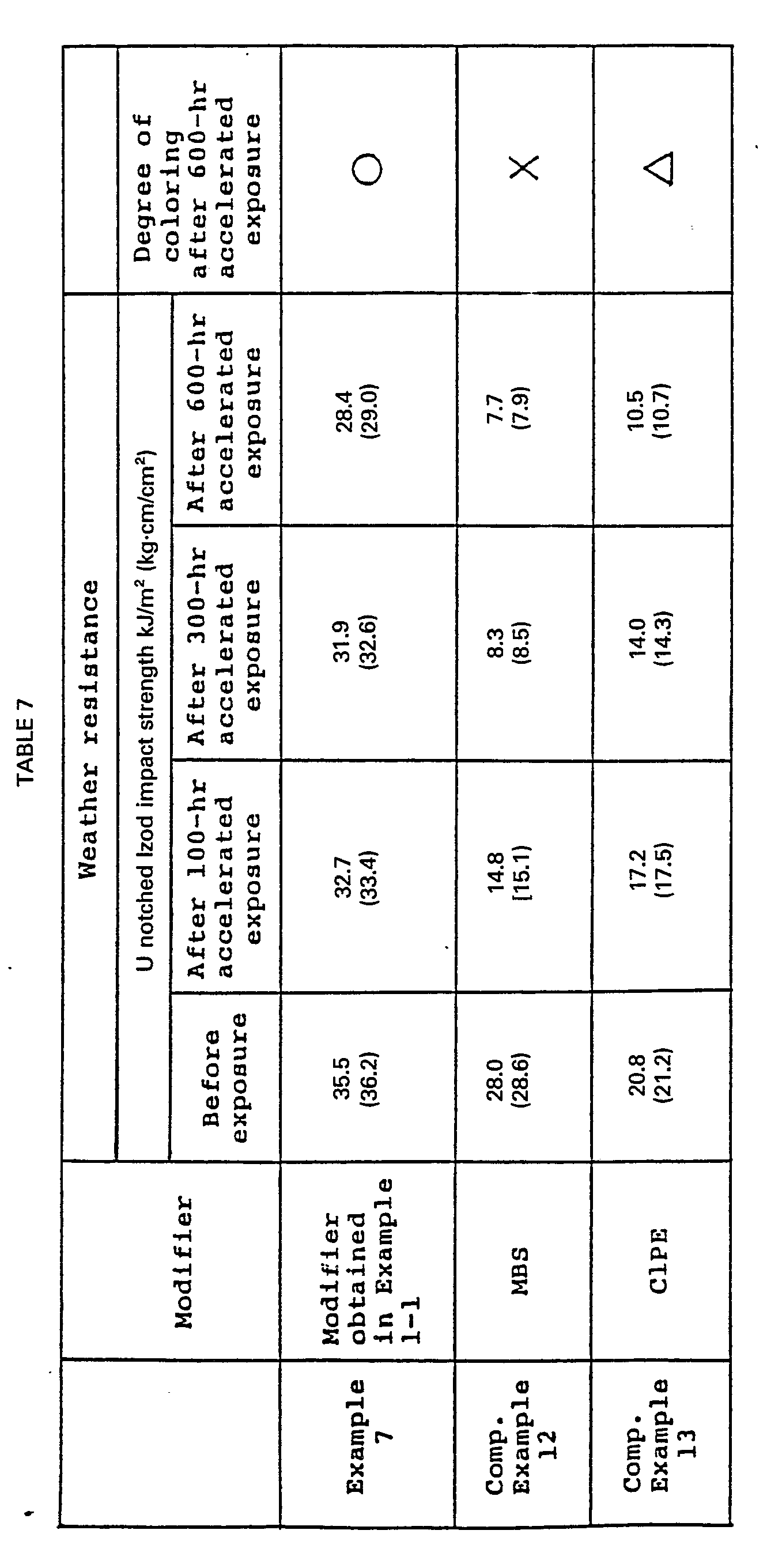
- The degree of coloring in Table 7 was indicated according to the following rating:
- 0: Almost no coloring occurred. (Good)
- Δ: Slight coloring occurred. (Undesirable)
- x: Evident coloring occurred. (Bad)
- The results of Table 7 indicate very excellent weather resistance (initial impact retention and color fastness) of the modifier according to this invention in comparison with commercial MBS and CIPE.
Claims (7)
Applications Claiming Priority (4)
| Application Number | Priority Date | Filing Date | Title |
|---|---|---|---|
| JP159350/83 | 1983-08-31 | ||
| JP58159350A JPS6051737A (en) | 1983-08-31 | 1983-08-31 | Impact resistance modifier and thermoplastic resin composition containing same |
| JP174878/83 | 1983-09-21 | ||
| JP58174878A JPS6065053A (en) | 1983-09-21 | 1983-09-21 | Impact resistance modifier and thermoplastic resin composition using the same |
Publications (3)
| Publication Number | Publication Date |
|---|---|
| EP0136552A2 EP0136552A2 (en) | 1985-04-10 |
| EP0136552A3 EP0136552A3 (en) | 1986-08-06 |
| EP0136552B1 true EP0136552B1 (en) | 1989-11-02 |
Family
ID=26486182
Family Applications (1)
| Application Number | Title | Priority Date | Filing Date |
|---|---|---|---|
| EP84110350A Expired EP0136552B1 (en) | 1983-08-31 | 1984-08-30 | Impact modifier and thermoplastic resin compositions using the same |
Country Status (7)
| Country | Link |
|---|---|
| US (1) | US4564653A (en) |
| EP (1) | EP0136552B1 (en) |
| CA (1) | CA1235544A (en) |
| DE (1) | DE3480347D1 (en) |
| ES (1) | ES8607346A1 (en) |
| IE (1) | IE57758B1 (en) |
| PT (1) | PT79160B (en) |
Cited By (1)
| Publication number | Priority date | Publication date | Assignee | Title |
|---|---|---|---|---|
| EP1910464B2 (en) † | 2005-07-08 | 2017-08-23 | Arkema France | Multi-layer composition |
Families Citing this family (36)
| Publication number | Priority date | Publication date | Assignee | Title |
|---|---|---|---|---|
| CA1232387A (en) * | 1983-08-25 | 1988-02-02 | Kazuo Ueda | Impact modifier and thermoplastic resin composition using the same |
| US4863977A (en) * | 1983-11-16 | 1989-09-05 | Dentsply Research & Development Corp. | Process for preparing interpenetrating polymer network objects employing rubber-modified polymers |
| US4711913A (en) * | 1983-11-16 | 1987-12-08 | Dentsply International Inc. | Interpenetrating polymer network compositions employing rubber-modified polymers |
| US5210109A (en) * | 1983-11-16 | 1993-05-11 | Dentsply Research & Development Corp. | Interpenetrating polymer network compositions employing rubber-modified polymers |
| US4659767A (en) * | 1985-01-10 | 1987-04-21 | Allied Corporation | Impact modified polyester blends |
| US4717750A (en) * | 1985-07-29 | 1988-01-05 | The Dow Chemical Company | Structure reinforced latex particles |
| JPS62230841A (en) * | 1985-11-29 | 1987-10-09 | Mitsubishi Rayon Co Ltd | Impact resistant methacrylic resin composition |
| JPS62181312A (en) * | 1986-02-06 | 1987-08-08 | Mitsubishi Rayon Co Ltd | Method for producing graft copolymer resin with excellent impact resistance, weather resistance, and moldability |
| CA1332992C (en) * | 1986-08-27 | 1994-11-08 | Susan Marie Liwak | Impact-strength modifiers for thermoplastic polymers |
| DE3733838A1 (en) * | 1987-10-07 | 1989-04-20 | Basf Ag | GLASS FIBER AMPLIFIED THERMOPLASTIC MOLDINGS BASED ON POYESTERS AND POLYMERPROPYLENE |
| US5106908A (en) * | 1988-11-14 | 1992-04-21 | General Electric Company | Polyorganosiloxane/polyvinyl-based graft (meth)acrylate polymers |
| US5079293A (en) * | 1988-11-14 | 1992-01-07 | General Electric Company | Thermoplastic compositions containing combined modifiers |
| US5047472A (en) * | 1988-11-14 | 1991-09-10 | General Electric Company | Polyphenylene ether or polyphenylene ether/polystyrene with polyorganosiloxane/polyvinyl-based graft polymer modifiers |
| US5087662A (en) * | 1988-11-14 | 1992-02-11 | General Electric Company | Polyester, polycarbonate and/or polyphenylene ether with polyorganosiloxane/polyvinyl-based graft (meth) acrylate polymers |
| US5025066A (en) * | 1988-11-14 | 1991-06-18 | General Electric Company | Polycarbonate and polyester blends modified with polyorganosiloxane graft polymers combined with diene rubber-based graft polymers |
| US5045595A (en) * | 1988-11-14 | 1991-09-03 | General Electric Company | Polyorganosiloxane/polyvinyl-based graft polymers, process and thermoplastic compositions containing the same |
| GB2228942B (en) * | 1989-02-17 | 1992-03-04 | Asahi Chemical Ind | Multilayer structure polymer and resin composition |
| DE4106909A1 (en) * | 1991-03-05 | 1992-09-10 | Basf Ag | MULTI-STAGE GRAFT COPOLYMER AND ITS USE FOR THE PRODUCTION OF TRANSPARENT PVC MOLDS |
| US5457146A (en) * | 1993-10-20 | 1995-10-10 | The Dow Chemical Company | Blends of polyurethane and chlorinated polyethylene |
| US5424341A (en) * | 1993-10-20 | 1995-06-13 | The Dow Chemical Company | Blends of polycarbonate and chlorinated polyethylene |
| DE19503545A1 (en) * | 1995-02-03 | 1996-08-08 | Basf Ag | Particulate graft copolymers and thermoplastic molding compositions containing them with improved colorability |
| DE19511492A1 (en) * | 1995-03-29 | 1996-10-02 | Basf Ag | Particulate graft polymers and thermoplastic molding compositions containing them with improved low-temperature toughness |
| US5777036A (en) * | 1996-02-01 | 1998-07-07 | Basf Aktiengesellschaft | Particulate graft copolymers and thermoplastic molding materials containing them and having improved colorability |
| DE19623416A1 (en) * | 1996-06-12 | 1997-12-18 | Basf Ag | Particulate graft copolymers and thermoplastic molding compositions containing them with improved colorability |
| US6031047A (en) * | 1996-12-30 | 2000-02-29 | Rohm And Haas Company | Impact-modified poly(vinyl chloride) exhibiting improved low-temperature fusion |
| CA2233150A1 (en) * | 1997-03-31 | 1998-09-30 | Kuraray Co., Ltd. | Resinous composition for dental use |
| JP3664575B2 (en) | 1997-08-19 | 2005-06-29 | 株式会社カネカ | Methacrylic ester resin composition and film formed by molding the same |
| JP3631360B2 (en) * | 1997-12-04 | 2005-03-23 | 株式会社カネカ | Vinyl chloride resin composition |
| DE69943227D1 (en) | 1998-09-09 | 2011-04-07 | Rohm & Haas | A method of making a core cup impact modified emulsion |
| WO2001081465A1 (en) * | 2000-04-20 | 2001-11-01 | Mitsubishi Rayon Co., Ltd. | Impact modifier, process for producing the same, and thermoplastic resin composition containing the same |
| JP5210479B2 (en) * | 2001-09-28 | 2013-06-12 | 株式会社カネカ | Vinyl chloride resin composition |
| KR100484722B1 (en) * | 2002-01-25 | 2005-04-20 | 주식회사 엘지화학 | Acrylic impact modifier prepared by multi-stage polymerization and method for preparing the same |
| EP1997854A4 (en) * | 2006-03-16 | 2010-04-14 | Kaneka Corp | Thermoplastic resin composition |
| WO2007125805A1 (en) * | 2006-04-26 | 2007-11-08 | Kaneka Corporation | Thermoplastic resin composition and process for production thereof |
| FR3038611B1 (en) | 2015-07-09 | 2020-01-31 | Arkema France | POLYMER COMPOSITION CONTAINING A FILLER, PROCESS FOR THE PREPARATION THEREOF AND THE USE THEREOF |
| FR3038612B1 (en) * | 2015-07-09 | 2020-03-27 | Arkema France | POLYMER COMPOSITION, PROCESS FOR PREPARING THE SAME, AND USE THEREOF |
Family Cites Families (7)
| Publication number | Priority date | Publication date | Assignee | Title |
|---|---|---|---|---|
| JPS6021705B2 (en) * | 1979-08-15 | 1985-05-29 | ダイセル化学工業株式会社 | Molding resin composition |
| US4387138A (en) * | 1980-10-29 | 1983-06-07 | Plaskolite, Inc. | Acrylate material comprising sequentially polymerized four composition particle having radially graduated transitional properties |
| JPS57102940A (en) * | 1980-12-18 | 1982-06-26 | Mitsubishi Rayon Co Ltd | Polyvinyl chloride resin composition |
| CA1193036A (en) * | 1981-10-09 | 1985-09-03 | Kazuo Kishida | Process for producing impact resistant graft resins including an agglomerated rubber |
| US4481330A (en) * | 1981-12-08 | 1984-11-06 | Teijin Chemicals, Ltd. | Polycarbonate resin composition |
| DE3210284A1 (en) * | 1982-03-20 | 1983-09-29 | Bayer Ag, 5090 Leverkusen | POLYCARBONATE MIXTURES |
| CA1233590A (en) * | 1982-10-28 | 1988-03-01 | Kazuo Kishida | Delustering thermoplastic resin composition |
-
1984
- 1984-08-27 IE IE2188/84A patent/IE57758B1/en not_active IP Right Cessation
- 1984-08-28 CA CA000461984A patent/CA1235544A/en not_active Expired
- 1984-08-29 US US06/645,358 patent/US4564653A/en not_active Expired - Fee Related
- 1984-08-30 PT PT79160A patent/PT79160B/en not_active IP Right Cessation
- 1984-08-30 ES ES535521A patent/ES8607346A1/en not_active Expired
- 1984-08-30 EP EP84110350A patent/EP0136552B1/en not_active Expired
- 1984-08-30 DE DE8484110350T patent/DE3480347D1/en not_active Expired
Cited By (1)
| Publication number | Priority date | Publication date | Assignee | Title |
|---|---|---|---|---|
| EP1910464B2 (en) † | 2005-07-08 | 2017-08-23 | Arkema France | Multi-layer composition |
Also Published As
| Publication number | Publication date |
|---|---|
| DE3480347D1 (en) | 1989-12-07 |
| CA1235544A (en) | 1988-04-19 |
| ES8607346A1 (en) | 1986-05-16 |
| IE842188L (en) | 1985-02-28 |
| PT79160A (en) | 1984-09-01 |
| IE57758B1 (en) | 1993-03-24 |
| EP0136552A3 (en) | 1986-08-06 |
| US4564653A (en) | 1986-01-14 |
| EP0136552A2 (en) | 1985-04-10 |
| PT79160B (en) | 1986-08-19 |
| ES535521A0 (en) | 1986-05-16 |
Similar Documents
| Publication | Publication Date | Title |
|---|---|---|
| US4564653A (en) | Impact modifier and thermoplastic resin composition using the same | |
| US7173082B2 (en) | Acrylic impact modifier prepared by multi-stage polymerization and method for preparing the same | |
| US5183858A (en) | Core-shell polymer, production and use thereof | |
| CA1336927C (en) | Weather resistant impact modifiers for thermoplastic resins and blends containing the same | |
| EP0137268B1 (en) | Impact modifier and thermoplastic resin composition using the same | |
| EP0533442A1 (en) | Methacrylate-butadiene-styrene graft polymers and PVC blends | |
| EP0390146B1 (en) | Core-shell polymer, production and use thereof | |
| JP2515014B2 (en) | Vinyl chloride resin composition | |
| JPS602335B2 (en) | Blend composition of thermoplastic polymer and multiphase acrylic composite polymer | |
| JPH0535173B2 (en) | ||
| EP2882806A1 (en) | Polymer mixtures with optimized toughness/stiffness ratio and optical properties | |
| US20040039110A1 (en) | Coagulation of particles from emulsions by the insitu formation of a coagulating agent | |
| JPH0742341B2 (en) | Thermoplastic resin composition | |
| JPH0774306B2 (en) | Thermoplastic resin composition | |
| JPH0442420B2 (en) | ||
| JPH0665703B2 (en) | Impact modifier for thermoplastics | |
| JPH0745609B2 (en) | Thermoplastic resin composition | |
| JPH06240086A (en) | Production of vinyl chloride resin composition | |
| JPH0436184B2 (en) | ||
| JPH0436183B2 (en) | ||
| JPH06192536A (en) | Thermoplastic resin composition | |
| JPH06192534A (en) | Thermoplastic resin composition | |
| JPH0361697B2 (en) | ||
| JPS6047052A (en) | Impact resistance modifier and thermoplastic resin composition containing the same |
Legal Events
| Date | Code | Title | Description |
|---|---|---|---|
| PUAI | Public reference made under article 153(3) epc to a published international application that has entered the european phase |
Free format text: ORIGINAL CODE: 0009012 |
|
| AK | Designated contracting states |
Designated state(s): BE DE FR GB NL |
|
| PUAL | Search report despatched |
Free format text: ORIGINAL CODE: 0009013 |
|
| AK | Designated contracting states |
Kind code of ref document: A3 Designated state(s): BE DE FR GB NL |
|
| 17P | Request for examination filed |
Effective date: 19861103 |
|
| 17Q | First examination report despatched |
Effective date: 19880128 |
|
| GRAA | (expected) grant |
Free format text: ORIGINAL CODE: 0009210 |
|
| AK | Designated contracting states |
Kind code of ref document: B1 Designated state(s): BE DE FR GB NL |
|
| REF | Corresponds to: |
Ref document number: 3480347 Country of ref document: DE Date of ref document: 19891207 |
|
| ET | Fr: translation filed | ||
| PLBE | No opposition filed within time limit |
Free format text: ORIGINAL CODE: 0009261 |
|
| STAA | Information on the status of an ep patent application or granted ep patent |
Free format text: STATUS: NO OPPOSITION FILED WITHIN TIME LIMIT |
|
| 26N | No opposition filed | ||
| PGFP | Annual fee paid to national office [announced via postgrant information from national office to epo] |
Ref country code: FR Payment date: 19940809 Year of fee payment: 11 |
|
| PGFP | Annual fee paid to national office [announced via postgrant information from national office to epo] |
Ref country code: GB Payment date: 19940822 Year of fee payment: 11 |
|
| PGFP | Annual fee paid to national office [announced via postgrant information from national office to epo] |
Ref country code: DE Payment date: 19940823 Year of fee payment: 11 |
|
| PGFP | Annual fee paid to national office [announced via postgrant information from national office to epo] |
Ref country code: NL Payment date: 19940831 Year of fee payment: 11 |
|
| PGFP | Annual fee paid to national office [announced via postgrant information from national office to epo] |
Ref country code: BE Payment date: 19941012 Year of fee payment: 11 |
|
| PG25 | Lapsed in a contracting state [announced via postgrant information from national office to epo] |
Ref country code: GB Effective date: 19950830 |
|
| PG25 | Lapsed in a contracting state [announced via postgrant information from national office to epo] |
Ref country code: BE Effective date: 19950831 |
|
| BERE | Be: lapsed |
Owner name: MITSUBISHI RAYON CO. LTD Effective date: 19950831 |
|
| PG25 | Lapsed in a contracting state [announced via postgrant information from national office to epo] |
Ref country code: NL Effective date: 19960301 |
|
| PG25 | Lapsed in a contracting state [announced via postgrant information from national office to epo] |
Ref country code: FR Effective date: 19960430 |
|
| GBPC | Gb: european patent ceased through non-payment of renewal fee |
Effective date: 19950830 |
|
| NLV4 | Nl: lapsed or anulled due to non-payment of the annual fee |
Effective date: 19960301 |
|
| PG25 | Lapsed in a contracting state [announced via postgrant information from national office to epo] |
Ref country code: DE Effective date: 19960501 |
|
| REG | Reference to a national code |
Ref country code: FR Ref legal event code: ST |