EP0136397B1 - Process for the production of expandable spherical hollow bodies from solidified alkali metal silicate solutions - Google Patents
Process for the production of expandable spherical hollow bodies from solidified alkali metal silicate solutions Download PDFInfo
- Publication number
- EP0136397B1 EP0136397B1 EP84104141A EP84104141A EP0136397B1 EP 0136397 B1 EP0136397 B1 EP 0136397B1 EP 84104141 A EP84104141 A EP 84104141A EP 84104141 A EP84104141 A EP 84104141A EP 0136397 B1 EP0136397 B1 EP 0136397B1
- Authority
- EP
- European Patent Office
- Prior art keywords
- solution
- alkali metal
- hardener
- metal silicate
- hollow
- Prior art date
- Legal status (The legal status is an assumption and is not a legal conclusion. Google has not performed a legal analysis and makes no representation as to the accuracy of the status listed.)
- Expired
Links
Classifications
-
- C—CHEMISTRY; METALLURGY
- C04—CEMENTS; CONCRETE; ARTIFICIAL STONE; CERAMICS; REFRACTORIES
- C04B—LIME, MAGNESIA; SLAG; CEMENTS; COMPOSITIONS THEREOF, e.g. MORTARS, CONCRETE OR LIKE BUILDING MATERIALS; ARTIFICIAL STONE; CERAMICS; REFRACTORIES; TREATMENT OF NATURAL STONE
- C04B30/00—Compositions for artificial stone, not containing binders
-
- C—CHEMISTRY; METALLURGY
- C04—CEMENTS; CONCRETE; ARTIFICIAL STONE; CERAMICS; REFRACTORIES
- C04B—LIME, MAGNESIA; SLAG; CEMENTS; COMPOSITIONS THEREOF, e.g. MORTARS, CONCRETE OR LIKE BUILDING MATERIALS; ARTIFICIAL STONE; CERAMICS; REFRACTORIES; TREATMENT OF NATURAL STONE
- C04B18/00—Use of agglomerated or waste materials or refuse as fillers for mortars, concrete or artificial stone; Treatment of agglomerated or waste materials or refuse, specially adapted to enhance their filling properties in mortars, concrete or artificial stone
- C04B18/02—Agglomerated materials, e.g. artificial aggregates
- C04B18/027—Lightweight materials
-
- Y—GENERAL TAGGING OF NEW TECHNOLOGICAL DEVELOPMENTS; GENERAL TAGGING OF CROSS-SECTIONAL TECHNOLOGIES SPANNING OVER SEVERAL SECTIONS OF THE IPC; TECHNICAL SUBJECTS COVERED BY FORMER USPC CROSS-REFERENCE ART COLLECTIONS [XRACs] AND DIGESTS
- Y10—TECHNICAL SUBJECTS COVERED BY FORMER USPC
- Y10T—TECHNICAL SUBJECTS COVERED BY FORMER US CLASSIFICATION
- Y10T428/00—Stock material or miscellaneous articles
- Y10T428/29—Coated or structually defined flake, particle, cell, strand, strand portion, rod, filament, macroscopic fiber or mass thereof
- Y10T428/2982—Particulate matter [e.g., sphere, flake, etc.]
- Y10T428/2991—Coated
- Y10T428/2993—Silicic or refractory material containing [e.g., tungsten oxide, glass, cement, etc.]
Definitions
- the present invention relates to a process for producing inflatable, spherical hollow bodies from solidified alkali metal silicate solutions, an alkali metal silicate solution being introduced dropwise into a hardener solution.
- Solidified alkali metal silicate solutions are understood to mean products which result from the implementation of alkali metal silicate solutions with so-called hardeners.
- hardeners are in particular carboxylic acids and their derivatives, such as the corresponding esters, chlorides and amides.
- the hardening process can be controlled by the choice of hardener. Slow reactions are mainly achieved with the carboxylic acid derivatives and with hexafluorosilicates. Rapid solidification occurs when mineral acids and salts of multivalent metals are used.
- Foam bodies made of water glass or porous bodies containing granules which are of interest because of their low density as fillers and insulating materials, have also been produced in this way.
- DE-A-2 520 220 relates to a process for producing silicate foam particles which are distinguished by a fine-celled pore structure and consequently have high mechanical strength.
- drops are generated from an aqueous alkali metal silicate solution, these preformed drops are solidified in a precipitation bath to form gel particles containing blowing agents, and the resulting solid blowing agent-containing gel particles are foamed.
- Suitable precipitation baths are inorganic and organic gelling agents, in particular water-soluble salts of divalent or polyvalent cations or organic solvents, inorganic or organic acids or mixtures of such gelling agents. Water is preferably used as the blowing agent.
- the most favorable foaming temperatures are preferably above 200 ° C, for example 250 to 300 ° C.
- DE-A-1 961 971 describes a process for the preparation of expandable granules containing water of crystallization, in which an aqueous solution of at least one salt of a divalent or trivalent metal is brought together with an aqueous silicate solution. This precipitation process is carried out, for example, at 80 ° C. The granules obtained are then rinsed with water and dried slowly. The dried granulate can now be processed directly on an expanding material. The granules are heated to at least 400 ° C, producing hard, foam-like silicate balls.
- the particles formed remain in the precipitation bath for a relatively long time, are then separated off and air-dried. If desired, the products obtained can also be subjected to a temperature treatment in the range from 300 to 400 ° C.
- the object of the present invention is to develop a method for producing inflatable, spherical hollow bodies from solidified alkali metal silicate solutions.
- the thermal treatment is preferably carried out in a boiling hardener solution in the temperature range from 110 to 115 ° C.
- the density of the alkali metal silicate solution relative to the density of the hardener solution is preferably between 1.02 and 1.1.
- Sodium, potassium or lithium silicates are suitable as alkali metal silicates.
- Mixtures of alkali metal silicate solutions can also be used.
- products are used whose content of Si0 2 in the alkali metal silicate solution is 25 to 34 percent by weight.
- the outer diameter of the hollow spheres described by the above method is determined by the drop size, that is, within small deviations, the diameter of the hollow sphere is identical to that of the drop from which it was produced. The deviations result primarily from the shape of the drops.
- the volumes are therefore more exact comparison variables.
- Hollow spheres with an outer diameter of 1 to 5 mm can be produced without difficulty.
- the wall thickness of the spherical hollow bodies are preferably regulated by the silicate content of the alkali metal silicate formation. With commercially available alkali metal silicate solutions (water glass solutions) wall thicknesses of 0.2 to 0.6 mm are obtained. When using modified alkali metal silicate solutions, other values can also be set.
- the upper limit of the Si0 2 content is primarily determined by the viscosity. Viscosity ranges between 50 and 2 500 mPa.s are particularly suitable for the present process. With regard to the limits for the concentration of the hardener solution, the two stages of the manufacturing process must be considered separately.
- the hardener solution has a high density, which should be only slightly less than the density of the alkali metal silicate solution. Solutions are therefore used in which the density of the alkali metal silicate solution and the density of the hardener solution are in the range already mentioned between 1.02 and 1.2, preferably 1.02 to 1.1.
- the second stage the solidification of the hollow spheres, requires not only the hardening effect of the solution, but also that the solution has a sufficiently high boiling point.
- a sufficient boiling point increase is achieved especially at high salt concentrations.
- the boiling point of the solutions should accordingly be between 103 and 120 ° C, preferably in the range from 110 to 115 ° C.
- the volume ratio of hardener solution: alkali metal silicate solution must be selected for the first stage so that at the end of the dropping, the drops are completely wetted by the hardener solution. For this reason, ratios from about 1: 1 are particularly suitable.
- the hollow spherical layer floating on the hardener solution should on average not be thicker than a three-layer. Under these conditions, it is ensured that there is a constant change of place during boiling and that each ball is adequately wetted.
- a large surface of the hardener solution is required.
- the lower limit of the volume ratio hardener solution: alkali metal silicate solution should be about 2: 1. Adequate hardening can also be achieved under other volume ratios by technical measures, such as mechanical circulation of the hollow balls.
- Aqueous solutions of calcium salts such as, in particular, calcium chloride and nitrate, have proven useful as hardener solutions.
- hardener solutions which contain calcium chloride are preferred. These can be used both in the first and in the second process stage. However, other compounds may also be considered, as can be seen from the examples below or Table 1.
- Preferred further hardener solutions are those which contain lower carboxylic acids, preferably acetic acid, or their derivatives.
- stage 2 of the claimed process can not only be that different compounds are used as hardeners, but also the concentration, for example of calcium chloride, can be different in the first and second stage of the process.
- the spherical hollow body is formed over several intermediate stages, since the surface skin is first stabilized and spheres filled with liquid water glass are formed as an intermediate product.
- the hardening is accelerated and after sufficient heating the hollow spheres are completely solidified.
- M 2 0 alkali metal oxide
- Si0 2 : Na 2 0 of 3.4 hollow spheres with a weight ratio Si0 2 : Na 2 0 of 5.2 are obtained.
- other weight ratios can also be set.
- Important influencing factors are the Si0 2 : Na 2 0 ratio of the alkali metal silicate solution used, the duration of the thermal treatment and the pH of the hardener solution.
- the process according to the invention thus allows the production of hollow spheres which are composed as follows with respect to the main constituents: (in percent by weight) Si0 2 : 55 to 75, M 2 0: 10 to 15, H 2 0: 10 to 30.
- Spherical hollow bodies obtained in the process according to the invention can be characterized, for example, by the following features: Products of the general formula M 2 0 .x Si0 2 , where M 2 0 means sodium or potassium oxide and x has a value greater than 3.6 and less than 12; the outer diameter of the hollow body is 1 to 5 mm and the thickness of the spherical shells 0.2 to 0.6 mm; the water content is 10 to 30 percent by weight and the solids content is at least 70 percent by weight; the spherical shells have a higher M 2 O content in the inner region than in the outer region.
- spherical hollow bodies obtained by the process according to the invention is recommended wherever a closed ball with low density is required instead of compact solidified water glass or porous foam granules.
- Typical areas of application are, for example, the uniform filling of narrow cavities and the covering of liquids with floatable, possibly surface-active, silicate materials.
- While the method of operation according to the invention enables a variety of modification options with regard to the hardener and the thermal aftertreatment, it is also easy to produce blown products.
- Processes that use the water content of the solidified alkali metal silicate as a gas dispenser for the blowing process are suitable for the production of these expanded balls.
- a suitable method for this is, for example, brief heating to temperatures of 200 to 400 ° C.
- the process can also be varied such that modifying substances, such as acids, salt solutions or dispersions, are added by wetting or enveloping the spherical hollow bodies obtained according to the invention with one or more modifying components before the expansion process.
- the shape and dimensions of the hollow body favor the application of the modifying substance, an excellent, uniform distribution of the modifying substance on the surface of the hollow body can be achieved without great technical effort.
- the advantages over other initial forms are, moreover, that the spherical shape remains unchanged during the expansion process and all spheres experience approximately the same expansion.
- the end product also has a very low bulk density.
- the balls obtained had a hard shell with a rough surface.
- the average ball diameter was 3.5 mm, the wall thickness of the bowl was approximately 0.5 mm.
- the inside of the sphere was free of water glass solution.
- Tables 1 to 3 below show individual variations with regard to the alkali metal silicate solutions and the hardener solutions.
- sodium silicate solutions of a commercial type under the type designation 37/40 were used.
- the sodium silicate solutions had a density (g / cm 3 ) of 1.35 and a viscosity range of 50 to 100 mPa.s and a solids content of 26.9 percent by weight Si0 2 and 8 percent by weight Na 2 0.
- 100 ml of 4.1 m CaC1 2 solution were always presented as hardener solution 1. 10 ml of the respective water glass solution were then added dropwise to this.
- the boiling time in the thermal aftertreatment in hardener solution 2 was 30 minutes.
- a few drops of a surfactant solution were added to 300 ml of a 4 m Ca (NO 3 ) 2 solution.
- 30 ml of the water glass solution used in Example 2 were added dropwise to this hardener solution.
- the solution was heated and, after a boiling time of 20 minutes, 30 ml of a 2 M acetic acid were added. It was then cooked for 15 minutes.
- Example 5 The procedure was as in Example 5 above, with the difference that the acetic acid was added after only 5 minutes of boiling time. Under these conditions, very hard hollow spheres were created, which were still about half filled with water glass solution.
- Example 2 The procedure was as in Example 2, but with a boiling time reduced to 15 minutes.
- the hollow spheres were then skimmed off with a sieve and annealed at 120 ° C. in a glycerol bath to which 10% of water had been added for 5 minutes.
- the volume of the hollow spheres increased by about 50% during this thermal treatment.
- Example 3 In 0.7 l of a 4 m CaCl 2 solution, 0.2 l of the water glass solution used in Example 3 was added dropwise at room temperature. The solution was heated and then kept at boiling temperature for 30 minutes. The hollow spheres were then filtered off, washed and air-dried. The yield was 130 g. The hollow spheres had an average diameter of 3.5 mm, wall thicknesses between 0.4 and 0.6 mm and a bulk density of 0.54 g / cm 3 .
- the hollow spheres were subjected to various blowing processes. The results are listed in Table 4. In rows a) to c) the hollow spheres were annealed at 300, 400 and 600 ° C for 15 minutes. Spherical foam bodies with a loose, partially porous surface formed.
- Examples d) to h) explain the addition of modifying substances. They were varied in composition and quantity. The modifying substances were applied by constantly circulating the hollow spheres, so that a uniform coating was ensured. The hollow spheres were placed in large bowls in a preheated oven and annealed for 15 minutes. As expanded products again spherical foam bodies were created, but with a dense surface and high strength. They are water-resistant and floatable.
Landscapes
- Engineering & Computer Science (AREA)
- Chemical & Material Sciences (AREA)
- Ceramic Engineering (AREA)
- Organic Chemistry (AREA)
- Materials Engineering (AREA)
- Structural Engineering (AREA)
- Civil Engineering (AREA)
- Manufacturing Of Micro-Capsules (AREA)
- Silicates, Zeolites, And Molecular Sieves (AREA)
- Glass Compositions (AREA)
- Processing Of Solid Wastes (AREA)
- Curing Cements, Concrete, And Artificial Stone (AREA)
- Solid-Sorbent Or Filter-Aiding Compositions (AREA)
- Aftertreatments Of Artificial And Natural Stones (AREA)
- Medicinal Preparation (AREA)
Abstract
Description
Gegenstand der vorliegenden Erfindung ist ein Verfahren zur Herstellung von aufblähbaren, kugelförmigen Hohlkörpern aus verfestigten Alkalimetallsilikatlösungen wobei man eine Alkalimetallsilikatlösung tropfenweise in eine Härterlösung einträgt.The present invention relates to a process for producing inflatable, spherical hollow bodies from solidified alkali metal silicate solutions, an alkali metal silicate solution being introduced dropwise into a hardener solution.
Unter verfestigten Alkalimetallsilikatlösungen werden Produkte verstanden, die bei der Umsetzung von Alkalimetallsilikatlösungen mit sogenannten Härtern entstehen. Bekannte Härter sind insbesondere Carbonsäuren und deren Derivate, wie die entsprechenden Ester, Chloride und Amide. Weiterhin sind zu nennen: Ammoniumsalze und Salze von mehrwertigen Metallen, Mineralsäuren und deren saure Salze sowie Hexafluorosilikate.Solidified alkali metal silicate solutions are understood to mean products which result from the implementation of alkali metal silicate solutions with so-called hardeners. Known hardeners are in particular carboxylic acids and their derivatives, such as the corresponding esters, chlorides and amides. The following should also be mentioned: ammonium salts and salts of polyvalent metals, mineral acids and their acid salts and hexafluorosilicates.
Der Vorgang der Verfestigung kann durch die Wahl der Härter gesteuert werden. Langsam ablaufende Reaktionen werden vor allem mit den Carbonsäurederivaten und mit Hexafluorosilikaten erzielt. Eine rasche Verfestigung tritt ein bei Anwendung von Mineralsäuren und Salzen mehrwertiger Metalle.The hardening process can be controlled by the choice of hardener. Slow reactions are mainly achieved with the carboxylic acid derivatives and with hexafluorosilicates. Rapid solidification occurs when mineral acids and salts of multivalent metals are used.
Diese Verfahren sind in der Literatur wiederholt beschrieben. Auch hat man schon auf diesem Wege Schaumkörper aus Wasserglas oder poröse granulathaltige Körper, die wegen ihrer geringen Dichte als Füll-und Isolierstoffe von Interesse sind, hergestellt.These processes have been described repeatedly in the literature. Foam bodies made of water glass or porous bodies containing granules, which are of interest because of their low density as fillers and insulating materials, have also been produced in this way.
Gegenstand der DE-A-2 520 220 ist ein Verfahren zur Herstellung von silikatischen Schaumstoffpartikeln, die sich durch eine feinzellige Porenstruktur auszeichnen und demzufolge eine hohe mechanische Festigkeit aufweisen. Hierbei werden aus einer wäßrigen Alkalimetallsilikatlösung Tropfen erzeugt, diese vorgeformten Tropfen in einem Fällbad zu Treibmittel enthaltenden Gelpartikeln verfestigt und die so entstandenen festen treibmittelhaltigen Gelpartikel aufgeschäumt. Als Fällbad kommen anorganische und organische Geliermittel, insbesondere wasserlösliche Salze von zwei- oder mehrwertigen Kationen beziehungsweise organische Lösungsmittel, anorganische oder organische Säuren oder Gemische derartiger Geliermittel in Frage. Als Treibmittel dient vorzugsweise Wasser. Die günstigsten Schäumtemperaturen liegen vorzugsweise über 200°C, beispielsweise bei 250 bis 300° C.DE-A-2 520 220 relates to a process for producing silicate foam particles which are distinguished by a fine-celled pore structure and consequently have high mechanical strength. In this process, drops are generated from an aqueous alkali metal silicate solution, these preformed drops are solidified in a precipitation bath to form gel particles containing blowing agents, and the resulting solid blowing agent-containing gel particles are foamed. Suitable precipitation baths are inorganic and organic gelling agents, in particular water-soluble salts of divalent or polyvalent cations or organic solvents, inorganic or organic acids or mixtures of such gelling agents. Water is preferably used as the blowing agent. The most favorable foaming temperatures are preferably above 200 ° C, for example 250 to 300 ° C.
In der DE-A-1 961 971 wird ein Verfahren zur Herstellung eines kristallwasserhaltigen blähbaren Granulats beschrieben, wobei man eine wäßrige Lösung mindestens eines Salzes eines zwei- oder dreiwertigen Metalles mit einer wäßrigen Silikatlösung zusammenbringt. Dieser Fällvorgang wird beispielsweise bei 80° C vorgenommen. Anschließend spült man das erhaltene Granulat mit Wasser und trocknet es langsam. Das getrocknete Granulat kann nun unmittelbar auf ein Blähmaterial weiterverarbeitet werden. Hierbei erhitzt man das Granulat auf mindestens 400° C, wobei harte, schaumartige Silikatkugeln entstehen.DE-A-1 961 971 describes a process for the preparation of expandable granules containing water of crystallization, in which an aqueous solution of at least one salt of a divalent or trivalent metal is brought together with an aqueous silicate solution. This precipitation process is carried out, for example, at 80 ° C. The granules obtained are then rinsed with water and dried slowly. The dried granulate can now be processed directly on an expanding material. The granules are heated to at least 400 ° C, producing hard, foam-like silicate balls.
Gemäß der US-A-2 284 248 erhält man feste, unterschiedlich geformte Partikel aus Alkalimetallsilikaten. Bei dem hier beschriebenen Verfahren wird eine konzentrierte wäßrige Alkalimetallsilikatlösung in ein dehydratisierendes Fällbad - insbesondere in eine konzentrierte wäßrige Elektrolytlösung oder eine organische Flüssigkeit - vorzugsweise bei Raumtemperatur eingetropft.According to US Pat. No. 2,284,248, solid, differently shaped particles of alkali metal silicates are obtained. In the process described here, a concentrated aqueous alkali metal silicate solution is dropped into a dehydrating precipitation bath - in particular into a concentrated aqueous electrolyte solution or an organic liquid - preferably at room temperature.
Nach dem Fällvorgang verbleiben die gebildeten Partikel längere Zeit im Fällbad, werden dann abgetrennt und an der Luft getrocknet. Sofern erwünscht, können die erhaltenen Produkte noch einer Temperaturbehandlung im Bereich von 300 bis 400° C unterzogen werden.After the precipitation process, the particles formed remain in the precipitation bath for a relatively long time, are then separated off and air-dried. If desired, the products obtained can also be subjected to a temperature treatment in the range from 300 to 400 ° C.
Die Aufgabe der vorliegenden Erfindung ist es demgegenüber, ein Verfahren zur Herstellung von aufblähbaren, kugelförmigen Hohlkörpern aus verfestigten Alkalimetallsilikatlösungen zu entwickeln.In contrast, the object of the present invention is to develop a method for producing inflatable, spherical hollow bodies from solidified alkali metal silicate solutions.
Gegenstand der Erfindung ist dementsprechend ein Verfahren zur Herstellung von aufblähbaren, kugelförmigen Hohlkörpern aus Alkalimetallsilikaten und Härtern, wobei man eine Alkalimetallsilikatlösung tropfenweise in eine Härterlösung einträgt, welches dadurch gekennzeichnet ist, daß man
- a) die Dichte der Alkalimetallsilikatlösung zur Dichte der Härterlösung auf ein Verhältnis im Bereich von (1,02 bis 1,2) : 1 einstellt,
- b) anschließend das erhaltene Produkt in der verwendeten oder einer anderen, siedenden Härterlösung einer thermischen Behandlung im Temperaturbereich von 103 bis 120°C unterwirft und
- c) die gebildeten Hohlkugeln aus der Lösung abtrennt.
- a) the density of the alkali metal silicate solution to the density of the hardener solution is set to a ratio in the range from (1.02 to 1.2): 1,
- b) the product obtained is then subjected to a thermal treatment in the temperature range from 103 to 120 ° C. in the used or another boiling hardener solution and
- c) separating the hollow spheres formed from the solution.
Vorzugsweise wird die thermische Behandlung in einer siedenden Härterlösung im Temperaturbereich von 110 bis 115° C vorgenommen.The thermal treatment is preferably carried out in a boiling hardener solution in the temperature range from 110 to 115 ° C.
Es hat sich als vorteilhaft erwiesen, so zu arbeiten, daß die Dichte der Alkalimetallsilikatlösung zur Dichte der Härterlösung vorzugsweise zwischen 1,02 und 1,1 liegt. Als Alkalimetallsilikate kommen Natrium-, Kalium- oder Lithiumsilikate in Betracht. Auch können Gemische aus Alkalimetallsilikatlösungen Verwendung finden. Insbesondere werden Produkte verwendet, deren Gehalt an Si02 in der Alkalimetallsilikatlösung 25 bis 34 Gewichtsprozent beträgt.It has proven advantageous to work in such a way that the density of the alkali metal silicate solution relative to the density of the hardener solution is preferably between 1.02 and 1.1. Sodium, potassium or lithium silicates are suitable as alkali metal silicates. Mixtures of alkali metal silicate solutions can also be used. In particular, products are used whose content of Si0 2 in the alkali metal silicate solution is 25 to 34 percent by weight.
Der Außendurchmesser der nach dem obigen Verfahren beschriebenen Hohlkugeln wird durch die Tropfengröße bestimmt, daß heißt innerhalb kleiner Abweichungen ist der Durchmesser der Hohlkugel identisch mit dem des Tropfens, aus dem diese erzeugt wurde. Die Abweichungen resultieren vor allem aus der Form der Tropfen. Exaktere Vergleichsgrößen sind demnach die Volumina (Kugelvolumen und Tropfenvolumen).The outer diameter of the hollow spheres described by the above method is determined by the drop size, that is, within small deviations, the diameter of the hollow sphere is identical to that of the drop from which it was produced. The deviations result primarily from the shape of the drops. The volumes (spherical volume and droplet volume) are therefore more exact comparison variables.
Es lassen sich ohne Schwierigkeiten Hohlkugeln von 1 bis 5 mm Außendurchmesser herstellen. Die Wandstärke der kugelförmigen Hohlkörper werden bevorzugt durch den Silikatgehalt der Alkalimetallsilikatbildung reguliert. Mit handelsüblichen Alkalimetallsilikatlösungen (Wasserglaslösungen) werden Wandstärken von 0,2 bis 0,6 mm erhalten. Bei Verwendung modifizierter Alkalimetallsilikatlösungen sind auch andere Werte einstellbar. Die obere Grenze des Si02-Gehaltes wird im übrigen in erster Linie durch die Viskosität bestimmt. Für das vorliegende Verfahren kommen insbesondere Viskositätsbereiche zwischen 50 und 2 500 mPa.s in Betracht. Bezüglich der Grenzen für die Konzentration der Härterlösung müssen die beiden Stufen des Herstellungsprozesses getrennt betrachtet werden. Bei der ersten Stufe der Tropfenbildung und Stabilisierung kommt es darauf an, das neben der härtenden Wirkung die Härterlösung eine hohe Dichte aufweist, die nur wenig geringer als die Dichte der Alkalimetallsilikatlösung sein sollte. Es werden daher Lösungen verwendet, bei denen die Dichte der Alkalimetallsilikatlösung zur Dichte der Härterlösung in dem bereits angegebenen Bereich zwischen 1,02 und 1,2, vorzugsweise 1,02 bis 1,1, liegen.Hollow spheres with an outer diameter of 1 to 5 mm can be produced without difficulty. The wall thickness of the spherical hollow bodies are preferably regulated by the silicate content of the alkali metal silicate formation. With commercially available alkali metal silicate solutions (water glass solutions) wall thicknesses of 0.2 to 0.6 mm are obtained. When using modified alkali metal silicate solutions, other values can also be set. The upper limit of the Si0 2 content is primarily determined by the viscosity. Viscosity ranges between 50 and 2 500 mPa.s are particularly suitable for the present process. With regard to the limits for the concentration of the hardener solution, the two stages of the manufacturing process must be considered separately. In the first stage of droplet formation and stabilization, it is important that, in addition to the hardening effect, the hardener solution has a high density, which should be only slightly less than the density of the alkali metal silicate solution. Solutions are therefore used in which the density of the alkali metal silicate solution and the density of the hardener solution are in the range already mentioned between 1.02 and 1.2, preferably 1.02 to 1.1.
Bei großen Tropfen sind kleine Werte für das Dichteverhältnis von Vorteil, da so eine Deformation des Tropfens vermieden werden kann. Kleine Tropfen sind leichter zu stabilisieren und können demnach auch bei größeren Dichteunterschieden erhalten werden. Die notwendigen Dichten werden durch hohe Salzkonzentrationen in den Härterlösungen erreicht. Für die Härtung selbst sind diese Konzentrationen stets ausreichend.In the case of large drops, small values for the density ratio are advantageous, since deformation of the drop can be avoided in this way. Small drops are easier to stabilize and can therefore be obtained even with larger differences in density. The necessary densities are achieved through high salt concentrations in the hardener solutions. These concentrations are always sufficient for the hardening itself.
Die zweite Stufe, die Verfestigung der Hohlkugelbildung, erfordert neben der härtenden Wirkung der Lösung auch, daß diese einen genügend hohen Siedepunkt hat. Eine ausreichende Siedepunkterhöhung wird insbesondere bei hohen Salzkonzentrationen erzielt. Der Siedepunkt der Lösungen sollte demgemäß zwischen 103 und 120°C liegen, vorzugsweise im Bereich von 110 bis 115°C.The second stage, the solidification of the hollow spheres, requires not only the hardening effect of the solution, but also that the solution has a sufficiently high boiling point. A sufficient boiling point increase is achieved especially at high salt concentrations. The boiling point of the solutions should accordingly be between 103 and 120 ° C, preferably in the range from 110 to 115 ° C.
Das Volumenverhältnis Härterlösung: Alkalimetallsilikatlösung muß für die erste Stufe so gewählt werden, daß am Ende des Eintropfens die Tropfen noch vollständig von der Härterlösung benetzt werden. Daher kommen insbesondere auch Verhältnisse ab etwa 1 : 1 in Betracht.The volume ratio of hardener solution: alkali metal silicate solution must be selected for the first stage so that at the end of the dropping, the drops are completely wetted by the hardener solution. For this reason, ratios from about 1: 1 are particularly suitable.
In der zweiten Stufe ist die gleichmäßige Benetzung ebenfalls eine wichtige Voraussetzung für die Verfestigung. Die Benetzung kann durch das Aufschwimmen der Hohlkugeln erschwert werden. In einem solchen Falle sollte die auf der Härterlösung schwimmende Hohlkugelschicht im Mittel nicht dicker als eine Dreierschicht sein. Unter diesen Bedingungen ist gewährleistet, daß beim Sieden ein ständiger Platzwechsel erfolgt und jede Kugel ausreichend benetzt wird. Um ein günstiges Volumenverhältnis Härterlösung: Hohlkugeln zu erzielen, ist eine große Oberfläche der Härterlösung erforderlich. Bei der Verwendung weiter Gefäße und geringer Füllhöhe sollte die untere Grenze des Volumenverhältnisses Härterlösung: Alkalimetallsilikatlösung bei etwa 2 : 1 liegen. Durch technische Maßnahmen, wie zum Beispiel mechanisches Umwälzen der Hohlkugeln, kann eine ausreichende Härtung auch unter anderen Volumenverhältnissen erreicht werden.In the second stage, uniform wetting is also an important prerequisite for solidification. The wetting of the hollow spheres can make wetting difficult. In such a case, the hollow spherical layer floating on the hardener solution should on average not be thicker than a three-layer. Under these conditions, it is ensured that there is a constant change of place during boiling and that each ball is adequately wetted. In order to achieve a favorable volume ratio of hardener solution: hollow spheres, a large surface of the hardener solution is required. When using large vessels and a low filling level, the lower limit of the volume ratio hardener solution: alkali metal silicate solution should be about 2: 1. Adequate hardening can also be achieved under other volume ratios by technical measures, such as mechanical circulation of the hollow balls.
Da während der Verfestigung der Hohlkugeln aus diesen Na20 an die Härterlösung abgegeben wird und diese damit im pH-Wert steigt, ist insbesondere bei kleinen Werten der oben genannten Volumenverhältnisse die Zugabe von Säuren erforderlich. Dabei sollte ein Bereich von pH 4 bis pH 10 eingehalten werden.Since during the solidification of the hollow spheres from these Na 2 0 are released to the hardener solution and this thus increases in pH, the addition of acids is necessary, especially in the case of small values of the volume ratios mentioned above. A range from pH 4 to pH 10 should be maintained.
Als Härterlösungen haben sich wäßrige Lösungen von Calciumsalzen, wie insbesondere Calciumchlorid und -nitrat bewährt. Im Sinne der Erfindung sind Härterlösungen, die Calciumchlorid enthalten, bevorzugt. Diese können sowohl in der ersten als auch in der zweiten Verfahrensstufe Verwendung finden. Gegebenenfalls kommen aber auch andere Verbindungen in Betracht, wie aus den nachstehenden Beispielen beziehungsweise der Tabelle 1 hervorgeht. Somit ist es bei einer Ausführungsform des erfindungsgemäßen Verfahrens bevorzugt, in der thermischen Behandlungslösung der zweiten Verfahrensstufe einen anderen Härter als in der ersten Verfahrensstufe zu verwenden. Als weitere Härterlösungen sind solche bevorzugt, die niedere Carbonsäuren, vorzugsweise Essigsäure, oder deren Derivate enthalten.Aqueous solutions of calcium salts, such as, in particular, calcium chloride and nitrate, have proven useful as hardener solutions. For the purposes of the invention, hardener solutions which contain calcium chloride are preferred. These can be used both in the first and in the second process stage. However, other compounds may also be considered, as can be seen from the examples below or Table 1. Thus, in one embodiment of the process according to the invention, it is preferred to use a different hardener in the thermal treatment solution of the second process stage than in the first process stage. Preferred further hardener solutions are those which contain lower carboxylic acids, preferably acetic acid, or their derivatives.
Die Modifizierung der Stufe 2 des beanspruchten Verfahrens kann nicht nur darin liegen, daß unterschiedliche Verbindungen als Härter Verwendung finden, sondern es kann auch die Konzentration, beispielsweise des Calciumchlorids, in der ersten und zweiten Verfahrensstufe unterschiedlich sein.The modification of stage 2 of the claimed process can not only be that different compounds are used as hardeners, but also the concentration, for example of calcium chloride, can be different in the first and second stage of the process.
Praktisch verläuft die Bildung des kugelförmigen Hohlkörpers über mehrere Zwischenstufen, da zunächst die Oberflächenhaut stabilisiert wird und als Zwischenprodukt mit flüssigem Wasserglas gefüllte Kugeln sich bilden. Durch Aufheizen der Lösungen im Siedebereich wird das Aushärten beschleunigt und nach hinreichend langer Erwärmung die Hohlkugeln vollständig verfestigt.In practice, the spherical hollow body is formed over several intermediate stages, since the surface skin is first stabilized and spheres filled with liquid water glass are formed as an intermediate product. By heating the solutions in the boiling range, the hardening is accelerated and after sufficient heating the hollow spheres are completely solidified.
Kennzeichnend für das erfindungsgemäße Verfahren ist die Zunahme des Si02 : M20-Verhältnisses (M20 = Alkalimetalloxid) in den verfestigten Hohlkugeln im Vegleich zur eingesetzten Alkalimetallsilikatlösung. Wie das Beispiel 2 erläutert, werden bei der Verwendung von Natronwasserglas mit einem Gewichtsverhältnis Si02: Na20 von 3,4 Hohlkugeln mit einem Gewichtsverhältnis Si02 : Na20 von 5,2 erhalten. Es können jedoch auch andere Gewichtsverhältnisse eingestellt werden. Wichtige Einflußgrößen sind dabei das Si02: Na20-Verhältnis der eingesetzten Alkalimetallsilikatlösung, die Dauer der thermischen Behandlung und der pH-Wert der Härterlösung. So erlaubt das erfindungsgemäße Verfahren die Herstellung von Hohlkugeln, die hinsichtlich der Hauptbestandteile wie folgt zusammengesetzt sind: (in Gewichtsprozent) Si02 : 55 bis 75, M20 : 10 bis 15, H20 : 10 bis 30.Characteristic of the process according to the invention is the increase in the Si0 2 : M 2 0 ratio (M 2 0 = alkali metal oxide) in the solidified hollow spheres in comparison to the alkali metal silicate solution used. As explained in Example 2, when using sodium silicate with a weight ratio Si0 2 : Na 2 0 of 3.4 hollow spheres with a weight ratio Si0 2 : Na 2 0 of 5.2 are obtained. However, other weight ratios can also be set. Important influencing factors are the Si0 2 : Na 2 0 ratio of the alkali metal silicate solution used, the duration of the thermal treatment and the pH of the hardener solution. The process according to the invention thus allows the production of hollow spheres which are composed as follows with respect to the main constituents: (in percent by weight) Si0 2 : 55 to 75, M 2 0: 10 to 15, H 2 0: 10 to 30.
Kugelförmige Hohlkörper, die beim erfindungsgemäßen Verfahren anfallen, lassen sich beispielsweise durch folgende Merkmale kennzeichnen: Produkte der allgemeinen Formel M20 .x Si02, wobei M20 Natrium- oder Kaliumoxid bedeutet und x einen Wert größer als 3,6 und kleiner als 12 darstellt; der Außendurchmesser der Hohlkörper beträgt 1 bis 5 mm und die Dicke der Kugelschalen 0,2 bis 0,6 mm; der Wassergehalt beträgt 10 bis 30 Gewichtsprozent und der Feststoffgehalt mindestens 70 Gewichtsprozent; die Kugelschalen weisen im inneren Bereich einen höheren Gehalt an M20 auf als im äußeren Bereich.Spherical hollow bodies obtained in the process according to the invention can be characterized, for example, by the following features: Products of the general formula M 2 0 .x Si0 2 , where M 2 0 means sodium or potassium oxide and x has a value greater than 3.6 and less than 12; the outer diameter of the hollow body is 1 to 5 mm and the thickness of the spherical shells 0.2 to 0.6 mm; the water content is 10 to 30 percent by weight and the solids content is at least 70 percent by weight; the spherical shells have a higher M 2 O content in the inner region than in the outer region.
Wie Elementverteilungsbilder, die im Rasterelektronenmikroskop mit Hilfe von Röntgenfluoreszenzmethoden gewonnen werden, nachweisen, ist das Alkalimetalloxid nicht gleichmäßig in der Kugelschale der Hohlkörper verteilt. Vielmehr nimmt der M20-Gehalt stets von innen nach außen ab. In welchem Maß die Verarmung an M20 in der äußeren Schicht der Kugelschale erfolgt, hängt von der Behandlung in der Härterlösung ab. Bei längerem Erhitzen in sauren Härterlösungen werden Hohlkugeln erhalten, deren Oberflächenschicht frei von M20 ist. Die so behandelten Hohlkugeln zeigen eine gute Resistenz gegen Feuchtigkeit.Like element distribution images taken in a scanning electron microscope using X-ray fluorescence methods obtained, demonstrate, the alkali metal oxide is not evenly distributed in the spherical shell of the hollow body. Rather, the M 2 0 content always decreases from the inside out. The degree of depletion of M 2 0 in the outer layer of the spherical shell depends on the treatment in the hardener solution. When heated for longer periods in acidic hardener solutions, hollow spheres are obtained whose surface layer is free of M 2 0. The hollow spheres treated in this way show good resistance to moisture.
Weiterhin empfiehlt sich die Verwendung der nach dem erfindungsgemäßen Verfahren erhaltenen kugelförmigen Hohlkörper überall dort, wo eine geschlossene Kugel mit geringer Dichte anstelle von kompaktem verfestigtem Wasserglas oder porösem Schaumgranulat gefragt ist. Typische Anwendungsbereiche sind beispielsweise das gleichmäßige Verfüllen von engen Hohlräumen und das Abdecken von Flüssigkeiten durch schwimmfähige gegebenenfalls oberflächenaktive silicatische Materialien.Furthermore, the use of the spherical hollow bodies obtained by the process according to the invention is recommended wherever a closed ball with low density is required instead of compact solidified water glass or porous foam granules. Typical areas of application are, for example, the uniform filling of narrow cavities and the covering of liquids with floatable, possibly surface-active, silicate materials.
Während die erfindungsgemäße Arbeitsweise eine Vielfalt von Modifizierungsmöglichkeiten hinsichtlich der Härter und der thermischen Nachbehandlung ermöglicht, so können auch geblähte Produkte leicht hergestellt werden. Für die Herstellung dieser geblähten Kugeln eignen sich Verfahren, die den Wassergehalt des verfestigten Alkalimetallsilikats als Gasspender für den Blähvorgang nutzen. Ein hierfür geeignetes Verfahren ist beispielsweise das kurzzeitige Erhitzen auf Temperaturen von 200 bis 400°C. Das Verfahren kann auch dahingehend variiert werden, daß ein Zusatz von modifizierenden Stoffen, wie Säuren, Salzlösungen oder Dispersionen, erfolgt, indem die erfindungsgemäß gewonnenen kugelförmige Hohlkörper vor dem Blähprozeß mit einer oder mehreren modifizierenden Komponenten benetzt beziehungsweise umhüllt werden. Da die Form und die Dimensionen des Hohlkörpers das Aufbringen des modifizierenden Stoffes begünstigen, kann ohne großen technischen Aufwand eine ausgezeichnete gleichmäßige Verteilung des modifizierenden Stoffes auf der Oberfläche der Hohlkörper erzielt werden. Die Vorteile gegenüber anderen Ausgangsformen bestehen im übrigen darin, daß beim Blähprozeß die Kugelform unverändert erhalten bleibt und alle Kugeln etwa die gleiche Ausdehnung erfahren. Das Endprodukt weist im übrigen ein sehr geringes Schüttgewicht auf.While the method of operation according to the invention enables a variety of modification options with regard to the hardener and the thermal aftertreatment, it is also easy to produce blown products. Processes that use the water content of the solidified alkali metal silicate as a gas dispenser for the blowing process are suitable for the production of these expanded balls. A suitable method for this is, for example, brief heating to temperatures of 200 to 400 ° C. The process can also be varied such that modifying substances, such as acids, salt solutions or dispersions, are added by wetting or enveloping the spherical hollow bodies obtained according to the invention with one or more modifying components before the expansion process. Since the shape and dimensions of the hollow body favor the application of the modifying substance, an excellent, uniform distribution of the modifying substance on the surface of the hollow body can be achieved without great technical effort. The advantages over other initial forms are, moreover, that the spherical shape remains unchanged during the expansion process and all spheres experience approximately the same expansion. The end product also has a very low bulk density.
Der Anmeldungsgegenstand wird noch durch die nachstehenden Beispiele erläutert, ohne hierauf beschränkt zu sein.The subject matter of the application is illustrated by the examples below, without being limited thereto.
931 g CaCl2 · 6 H20 und 176 g NaCI wurden in 2,5 I Wasser gelöst. In diese Lösung wurden innerhalb von 10 Minuten 100 ml einer Wasserglaslösung eingetropft, die 8,2 Gewichtsprozent Na20 und 26,9 Gewichtsprozent Si02 enthielt. Die Lösung wurde anschließend zum Sieden erhitzt. Nach 30 Minuten wurden die auf der Lösung schwimmenden Hohlkugeln mit einem Sieb abgeschöpft und mit Wasser gewaschen.931 g CaCl 2 .6 H 2 0 and 176 g NaCl were dissolved in 2.5 l water. 100 ml of a water glass solution containing 8.2% by weight of Na 2 0 and 26.9% by weight of Si0 2 were added dropwise to this solution within 10 minutes. The solution was then heated to boiling. After 30 minutes, the hollow spheres floating on the solution were skimmed off with a sieve and washed with water.
Die erhaltenen Kugeln hatten eine harte Schale mit einer rauhen Oberfläche. Der Kugeldurchmesser betrug im Mittel 3,5 mm, die Wandstärke der Schale circa 0,5 mm. Das Innere der Kugel war frei von Wasserglaslösung.The balls obtained had a hard shell with a rough surface. The average ball diameter was 3.5 mm, the wall thickness of the bowl was approximately 0.5 mm. The inside of the sphere was free of water glass solution.
In einem Becherglas wurden 400 ml einer 4 m CaCl2-Lösung vorgelegt, zu der 40 ml einer handelsüblichen Wasserglaslösung mit circa 27 Gewichtsprozent Si02 und circa 8 Gewichtsprozent Na20 getropft wurde. Die Lösung wurde in 10 Minuten zum Sieden erhitzt und 35 Minuten lang auf Siedetemperatur gehalten. Danach wurde abfiltriert und gewaschen. Die Analyse der lufttrockenen Hohlkugeln ergab für die Bestandteile folgende Werte in Gewichtsprozent: Si02 = 68,7; Na20 = 13,2; CaO = 1; NaCI = 0,7; H2O = 17,3.400 ml of a 4 m CaCl 2 solution were placed in a beaker, to which 40 ml of a commercially available water glass solution containing approximately 27% by weight Si0 2 and approximately 8% by weight Na 2 0 was added dropwise. The solution was heated to boiling in 10 minutes and kept at boiling temperature for 35 minutes. It was then filtered off and washed. The analysis of the air-dry hollow spheres gave the following values in percent by weight for the constituents: Si0 2 = 68.7; Na 2 0 = 13.2; CaO = 1; NaCI = 0.7; H 2 O = 17.3.
In ein Becherglas mit einem Siebeinsatz, das mit 200 ml einer 4,1 m CaCl2-Lösung gefüllt war, wurden aus einer Pipette 20 ml einer Wasserglaslösung getropft, die 350 g Si02/1 enthielt und ein Molverhältnis von Si02/INa20 = 3,46 aufwies. Auf dem Boden des Siebeinsatzes sammelten sich die Tropfen mit einer stabilisierenden Oberflächenhaut. Die Tropfen wurden mit Hilfe des Siebeinsatzes in ein zweites Becherglas gebracht, das 200 ml einer Lösung aus 1,7 Mol CaC12 und 1,2 Mol NaCI pro Liter enthielt, und dort 30 Minuten lang gekocht. Es bildeten sich harte Kugeln, die mit dem Siebeinsatz der Lösung entnommen und mit Wasser gewaschen wurden. Nach dem Trocknen bei 120°C blieben 12,3 g Hohlkugeln zurück.In a beaker with a sieve, the ml with 200 of a 4.1 m CaCl 2 solution was filled, a water-glass solution, the 350 g Si0 2/1, from a pipette, 20 mL, containing, and a molar ratio of Si0 2 / INa 2 0 = 3.46. The drops with a stabilizing surface skin collected on the bottom of the sieve insert. Using the sieve insert, the drops were placed in a second beaker containing 200 ml of a solution of 1.7 mol of CaCl 2 and 1.2 mol of NaCl per liter and boiled there for 30 minutes. Hard balls formed, which were removed from the solution with the sieve insert and washed with water. After drying at 120 ° C, 12.3 g of hollow spheres remained.
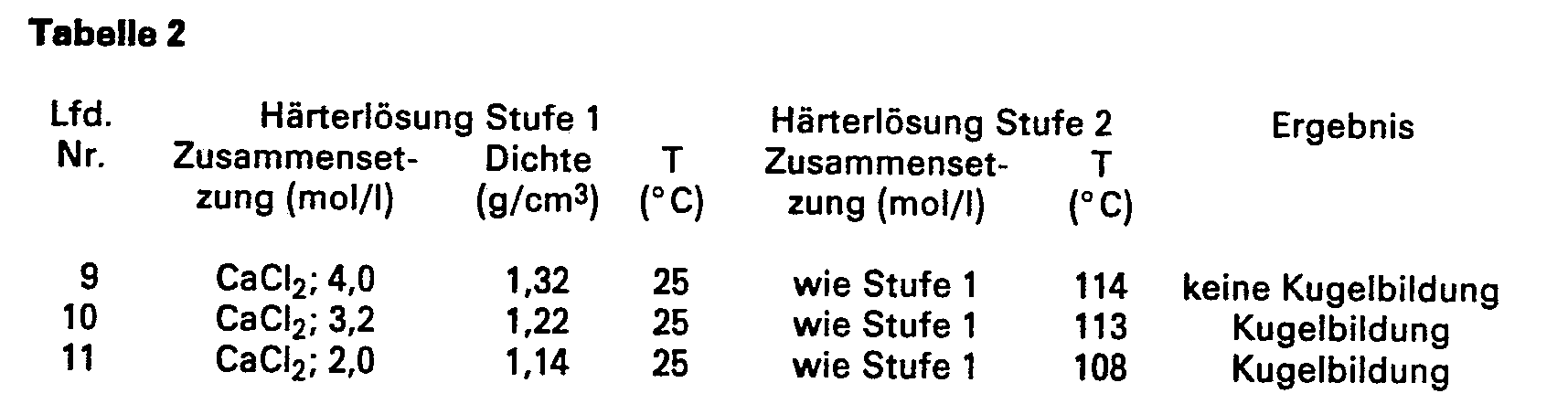
In den nachstehenden Tabellen 1 bis 3 werden einzelne Variationsmöglichkeiten hinsichtlich der Alkalimetallsilikatlösungen und der Härterlösungen aufgezeigt. Bei den in der Tabelle 1 aufgeführten Versuchen wurden Natriumsilikatlösungen handelsüblicher Art unter der Typenbezeichnung 37/40 verwendet. Die Natriumsilikatlösungen hatten eine Dichte (g/cm3) von 1,35 und einen Viskositätsbereich von 50 bis 100 mPa.s sowie einen Feststoffgehalt von 26,9 Gewichtsprozent Si02 und 8 Gewichtsprozent Na20. Im ersten Teilschritt des Verfahrens - soweit nichts anderes angegeben ist - wurden stets 100 ml 4,1 m CaC12-Lösung als Härterlösung 1 vorgelegt. Zu dieser wurden dann 10 ml der jeweiligen Wasserglaslösung zugetropft. Die Siedezeit bei der thermischen Nachbehandlung in der Härterlösung 2 betrug 30 Minuten. In der Tabelle 1 sind unter "Härterlösung Stufe 1" die Zusammensetzung der Härterlösung sowie die Dichte und die Arbeitstemperatur angegeben. Die Spalte "Härterlösung Stufe 2" zeigt die dortige Arbeitsweise an. Dabei wurde angegeben, ob die gleichen oder auch andere Härter wie in Stufe 1 verwendet wurden. Schließlich sind in der Tabelle 1, rechte Spalte Angaben über den Außendurchmesser sowie die Oberflächenqualität der Hohlkugeln aufgenommen.Tables 1 to 3 below show individual variations with regard to the alkali metal silicate solutions and the hardener solutions. In the experiments listed in Table 1, sodium silicate solutions of a commercial type under the type designation 37/40 were used. The sodium silicate solutions had a density (g / cm 3 ) of 1.35 and a viscosity range of 50 to 100 mPa.s and a solids content of 26.9 percent by weight Si0 2 and 8 percent by weight Na 2 0. In the first part of the process - if nothing other is indicated - 100 ml of 4.1 m CaC1 2 solution were always presented as hardener solution 1. 10 ml of the respective water glass solution were then added dropwise to this. The boiling time in the thermal aftertreatment in hardener solution 2 was 30 minutes. In Table 1, the composition of the hardener solution as well as the density and the working temperature are given under "Hardener solution level 1". The "Hardener solution level 2" column shows how it works. It was indicated whether the same or different hardeners as in stage 1 were used. Finally, in Table 1, right column, information about the outside diameter and the surface quality of the hollow spheres are included.
Bei den in Tabelle 2 angeführten Versuchen 9 bis 11 wurden Natriumsilikatlösungen verwendet, die einen Feststoffgehalt von 22,3 Gewichtsprozent Si02 und 5,8 Gewichtsprozent Na20 bei einer Dichte von 1,26 und einen Viskositätsbereich von 10 bis 30 mPa.s aufwiesen. Bei dem Versuch 9 ist die Dichte der Härterlösung 1 (1,32) größer als die Dichte der Alkalimetallsilikatlösung (1,26). Es erfolgte keine Kugelbildung. Hingegen kann man bei entsprechend abgeänderten Bedingungen, wie die Versuche 10 und 11 zeigen, zu den erwünschten Produkten gelangen.In experiments 9 to 11 listed in Table 2, sodium silicate solutions were used which had a solids content of 22.3 percent by weight Si0 2 and 5.8 percent by weight Na 2 0 at a density of 1.26 and a viscosity range of 10 to 30 mPa.s . In experiment 9, the density of hardener solution 1 (1.32) is greater than the density of the alkali metal silicate solution (1.26). There was no ball formation. On the other hand, if conditions are changed accordingly, as experiments 10 and 11 show, the desired products can be obtained.
300 ml einer 4 m Ca(N03)2-Lösung wurden wenige Tropfen einer Tensidlösung zugesetzt. In diese Härterlösung wurden 30 ml der in Beispiel 2 verwendeten Wasserglaslösung eingetropft. Die Lösung wurde erhitzt und nach einer Siedezeit von 20 Minuten mit 30 ml einer 2 m Essigsäure versetzt. Anschließend wurde 15 Minuten lang gekocht.A few drops of a surfactant solution were added to 300 ml of a 4 m Ca (NO 3 ) 2 solution. 30 ml of the water glass solution used in Example 2 were added dropwise to this hardener solution. The solution was heated and, after a boiling time of 20 minutes, 30 ml of a 2 M acetic acid were added. It was then cooked for 15 minutes.
Es bildeten sich sehr harte Hohlkugeln mit einer Platten Oberfläche.Very hard hollow spheres with a plate surface formed.
Es wurde wie im vorhergenannten Beispiel 5 verfahren, mit dem Unterschied, daß die Zugabe der Essigsäure schon nach 5 Minuten Siedezeit erfolgte. Unter diesen Bedingungen entstanden wiederum sehr harte Hohlkugeln, die etwa zur Hälfte noch mit Wasserglaslösung gefüllt waren.The procedure was as in Example 5 above, with the difference that the acetic acid was added after only 5 minutes of boiling time. Under these conditions, very hard hollow spheres were created, which were still about half filled with water glass solution.
Es wurde wie im Beispiel 2 verfahren, jedoch mit einer auf 15 Minuten verkürzten Siedezeit. Die Hohlkugeln wurden dann mit einem Sieb abgeschöpft und bei 120° C in einem Glycerinbad dem 10 % Wasser zugesetzt war, 5 Minuten lang getempert. Das Volumen der Hohlkugeln nahm bei dieser thermischen Behandlung um circa 50 % zu.The procedure was as in Example 2, but with a boiling time reduced to 15 minutes. The hollow spheres were then skimmed off with a sieve and annealed at 120 ° C. in a glycerol bath to which 10% of water had been added for 5 minutes. The volume of the hollow spheres increased by about 50% during this thermal treatment.
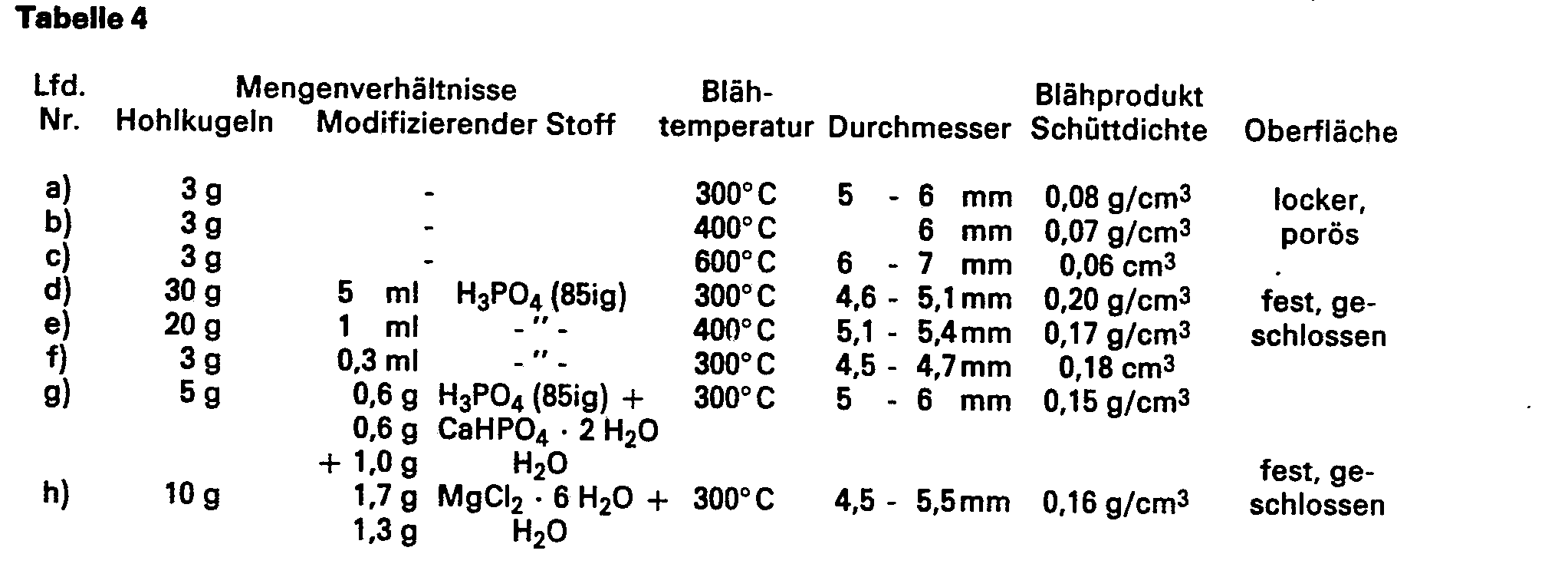
In 0,7 I einer 4 m CaCl2-Lösung wurden 0,2 I der in Beispiel 3 verwendeten Wasserglaslösung bei Raumtemperatur zugetropft. Die Lösung wurde erhitzt und anschließend 30 Minuten lang auf Siedetemperatur gehalten. Danach wurden die Hohlkugeln abfiltriert, gewaschen und an der Luft getrocknet. Die Ausbeute betrug 130 g. Die Hohlkugeln hatten einen mittleren Durchmesser von 3,5 mm, Wandstärken zwischen 0,4 und 0,6 mm und eine Schüttdichte von 0,54 g/cm3.In 0.7 l of a 4 m CaCl 2 solution, 0.2 l of the water glass solution used in Example 3 was added dropwise at room temperature. The solution was heated and then kept at boiling temperature for 30 minutes. The hollow spheres were then filtered off, washed and air-dried. The yield was 130 g. The hollow spheres had an average diameter of 3.5 mm, wall thicknesses between 0.4 and 0.6 mm and a bulk density of 0.54 g / cm 3 .
Die Hohlkugeln wurden verschiedenen Blähprozessen unterworfen. Die Ergebnisse sind in Tabelle 4 aufgelistet. In der Reihe a) bis c) wurden die Hohlkugeln bei 300, 400 und 600°C 15 Minuten lang getempert. Es bildeten sich kugelförmige Schaumkörper mit lockerer, teilweise poröser Oberfläche.The hollow spheres were subjected to various blowing processes. The results are listed in Table 4. In rows a) to c) the hollow spheres were annealed at 300, 400 and 600 ° C for 15 minutes. Spherical foam bodies with a loose, partially porous surface formed.
Die Beispiele d) bis h) erläutern den Zusatz von modifizierenden Stoffen. Sie wurden hinsichtlich Zusammensetzung und Menge variiert. Das Aufbringen der modifizierenden Stoffe erfolgte unter ständigem Umwälzen der Hohlkugeln, so daß eine gleichmäßige Umhüllung gewährleistet war. Die Hohlkugeln wurden in weiten Schalen in einen vorgeheizten Ofen gebracht und 15 Minuten lang getempert. Als Blähprodukte entstanden wiederum kugelförmige Schaumkörper, jedoch mit dichter Oberfläche und hoher Festigkeit. Sie sind wasserbeständig und schwimmfähig.


Claims (9)
Priority Applications (1)
| Application Number | Priority Date | Filing Date | Title |
|---|---|---|---|
| AT84104141T ATE40816T1 (en) | 1983-04-20 | 1984-04-12 | PROCESS FOR THE PRODUCTION OF INFLATABLE, SPHERE-SHAPED HOLLOW BODIES FROM CONSOLIDATED ALKALI METAL SILICATE SOLUTIONS. |
Applications Claiming Priority (2)
| Application Number | Priority Date | Filing Date | Title |
|---|---|---|---|
| DE3314259 | 1983-04-20 | ||
| DE19833314259 DE3314259A1 (en) | 1983-04-20 | 1983-04-20 | Hollow body made of solidified alkali silicate |
Publications (3)
| Publication Number | Publication Date |
|---|---|
| EP0136397A2 EP0136397A2 (en) | 1985-04-10 |
| EP0136397A3 EP0136397A3 (en) | 1986-02-05 |
| EP0136397B1 true EP0136397B1 (en) | 1989-02-15 |
Family
ID=6196842
Family Applications (1)
| Application Number | Title | Priority Date | Filing Date |
|---|---|---|---|
| EP84104141A Expired EP0136397B1 (en) | 1983-04-20 | 1984-04-12 | Process for the production of expandable spherical hollow bodies from solidified alkali metal silicate solutions |
Country Status (10)
| Country | Link |
|---|---|
| US (1) | US4528149A (en) |
| EP (1) | EP0136397B1 (en) |
| JP (1) | JPS59225734A (en) |
| AT (1) | ATE40816T1 (en) |
| BR (1) | BR8401821A (en) |
| DE (2) | DE3314259A1 (en) |
| DK (1) | DK158901C (en) |
| ES (1) | ES531703A0 (en) |
| MX (1) | MX159573A (en) |
| NO (1) | NO161729C (en) |
Families Citing this family (6)
| Publication number | Priority date | Publication date | Assignee | Title |
|---|---|---|---|---|
| IT1252682B (en) * | 1991-11-13 | 1995-06-23 | Vomm Impianti & Processi Srl | PRODUCT IN HIGH SPECIFIC WEIGHT GRANULES, PARTICULARLY AS A POWDER DETERGENT ADDITIVE AND METHOD FOR ITS OBTAINING |
| US5531822A (en) * | 1993-03-01 | 1996-07-02 | Morizane; Toshinori | Modifier for porous materials and method of modifying porous materials |
| JPH0710750B2 (en) * | 1993-03-01 | 1995-02-08 | 敏倫 森実 | Porous material modifier, modification method and modified material |
| US5545360A (en) * | 1993-06-08 | 1996-08-13 | Industrial Technology Research Institute | Process for preparing powders with superior homogeneity from aqueous solutions of metal nitrates |
| JP2001139320A (en) * | 1999-11-05 | 2001-05-22 | Asahi Glass Co Ltd | Manufacturing method of spherical silica gel |
| UA113844C2 (en) * | 2011-03-05 | 2017-03-27 | THE BINDING ELEMENT, THE BINDING MATRIX AND THE COMPOSITION MATERIAL HAVING THE BINDING ELEMENT AND THE METHOD OF MANUFACTURING THEREOF |
Family Cites Families (12)
| Publication number | Priority date | Publication date | Assignee | Title |
|---|---|---|---|---|
| US2284248A (en) * | 1939-02-16 | 1942-05-26 | Philadelphia Quartz Co | Manufacture of shaped particles of hydrous alkali metal silicates |
| NL232500A (en) * | 1957-10-22 | |||
| US3458332A (en) * | 1966-03-25 | 1969-07-29 | Emerson & Cuming Inc | Microsphere glass agglomerates and method for making them |
| US3699050A (en) * | 1967-08-02 | 1972-10-17 | Emerson & Cuming Inc | Spray dried product for feed in the manufacture of hollow glass spheres and process for forming said spray dried product |
| DE1961971A1 (en) * | 1968-12-12 | 1970-07-09 | Western Trade Trust | Thermally expandable granules contg - water-of-crystallisation |
| US3838998A (en) * | 1971-01-07 | 1974-10-01 | R Carson | Process for forming hollow glass micro-spheres from admixed high and low temperature glass formers |
| IT983478B (en) * | 1973-02-23 | 1974-10-31 | Agip Spa | PROCEDURE FOR CHECKING THE GEOMETRIC PROPHRIET OF CELL PARTS OF CERAMIC MATERIALS |
| DE2520220A1 (en) * | 1975-05-07 | 1976-11-25 | Basf Ag | Process for the production of silicate foam particles |
| GB1556993A (en) * | 1975-07-17 | 1979-12-05 | Sovitec Sa | Gas-expansible bodies |
| US4162166A (en) * | 1975-08-27 | 1979-07-24 | Walls Mycelo Jose | Porous, lightweight, particulate aggregates and process of manufacture |
| US4336338A (en) * | 1980-08-15 | 1982-06-22 | The United States Of America As Represented By The United States Department Of Energy | Hollow microspheres of silica glass and method of manufacture |
| WO1983001068A1 (en) * | 1981-09-23 | 1983-03-31 | Baker, Alfred, George | Hollow, bilayered silicate microspheres |
-
1983
- 1983-04-20 DE DE19833314259 patent/DE3314259A1/en not_active Withdrawn
- 1983-12-15 MX MX199761A patent/MX159573A/en unknown
- 1983-12-30 US US06/567,400 patent/US4528149A/en not_active Expired - Fee Related
-
1984
- 1984-02-24 DK DK099684A patent/DK158901C/en not_active IP Right Cessation
- 1984-03-26 NO NO841183A patent/NO161729C/en unknown
- 1984-04-12 DE DE8484104141T patent/DE3476749D1/en not_active Expired
- 1984-04-12 EP EP84104141A patent/EP0136397B1/en not_active Expired
- 1984-04-12 AT AT84104141T patent/ATE40816T1/en not_active IP Right Cessation
- 1984-04-17 JP JP59075911A patent/JPS59225734A/en active Pending
- 1984-04-17 ES ES531703A patent/ES531703A0/en active Granted
- 1984-04-18 BR BR8401821A patent/BR8401821A/en not_active IP Right Cessation
Also Published As
| Publication number | Publication date |
|---|---|
| DE3476749D1 (en) | 1989-03-23 |
| MX159573A (en) | 1989-07-06 |
| EP0136397A2 (en) | 1985-04-10 |
| DK99684D0 (en) | 1984-02-24 |
| DK99684A (en) | 1984-10-21 |
| DE3314259A1 (en) | 1984-10-25 |
| DK158901B (en) | 1990-07-30 |
| US4528149A (en) | 1985-07-09 |
| NO161729C (en) | 1989-09-20 |
| EP0136397A3 (en) | 1986-02-05 |
| NO841183L (en) | 1984-10-22 |
| JPS59225734A (en) | 1984-12-18 |
| ATE40816T1 (en) | 1989-03-15 |
| ES8502067A1 (en) | 1984-12-16 |
| DK158901C (en) | 1990-12-31 |
| ES531703A0 (en) | 1984-12-16 |
| BR8401821A (en) | 1984-11-27 |
| NO161729B (en) | 1989-06-12 |
Similar Documents
| Publication | Publication Date | Title |
|---|---|---|
| DE3305854C1 (en) | Process for the production of porous sintered glass with a large open pore volume | |
| DE1496573C3 (en) | Process for the production of hollow glass particles with a diameter between 5 and 300 µm and a true particle density between 0.05 and 1.2 g / cm 3, which are characterized by high strength | |
| DE3100655C2 (en) | Process for making a rigid inorganic foam product | |
| DE4209878C2 (en) | Gas-generating grain with a water-based coating and process for its preparation | |
| DE1667627C3 (en) | Process for the production of active clay or one-part silica | |
| DE3040754A1 (en) | CERAMIC FILTER MATERIAL | |
| DE2317455B2 (en) | Chromatographic packing material | |
| DE69631093T2 (en) | INORGANIC, POROUS SUPPORT FOR A FILTRATION MEMBRANE AND PRODUCTION METHOD | |
| DE4417617B4 (en) | Desiccant for HFC-32 and HFC-152a | |
| EP0813864A1 (en) | Effervescent system for effervescent tablets and granulates and processes for preparing the effervescent system | |
| EP0136397B1 (en) | Process for the production of expandable spherical hollow bodies from solidified alkali metal silicate solutions | |
| DE1596628A1 (en) | Process for the production of cell bodies | |
| DE2429252A1 (en) | METHOD OF MANUFACTURING WOOL ASTONITE | |
| DE2322123A1 (en) | PROCESS FOR THE MANUFACTURING OF FREE FLOWING, PARTICULATE DETERGENTS FROM SILICATED SODIUM CARBONATE | |
| DE69908078T2 (en) | Fine nickel powder and process for its production | |
| DE3129468C2 (en) | ||
| DE1104930B (en) | Process for the production of hot-pressable stabilized boron nitride | |
| DE2153658A1 (en) | Process for the production of molded bodies from aluminum oxide | |
| DE2917313C2 (en) | ||
| DE2150284A1 (en) | Process for the production of expanded vermiculite | |
| DE3721767A1 (en) | METHOD FOR THE PRODUCTION OF FINE-PARTICLE BARIUM HEXAFERRITE PIGMENTS FROM HALOGENID MELTS AND THE USE OF THIS PRODUCED BARIUM HEXAFERRITE PIGMENTS | |
| DE2908762C2 (en) | ||
| DE1533320A1 (en) | Process for the production of porous metal structures | |
| DE2604793C3 (en) | Process for the production of a foam ceramic element | |
| DE666148C (en) | Manufacture of composite titanium pigments |
Legal Events
| Date | Code | Title | Description |
|---|---|---|---|
| PUAI | Public reference made under article 153(3) epc to a published international application that has entered the european phase |
Free format text: ORIGINAL CODE: 0009012 |
|
| AK | Designated contracting states |
Designated state(s): AT BE CH DE FR GB IT LI NL SE |
|
| PUAL | Search report despatched |
Free format text: ORIGINAL CODE: 0009013 |
|
| AK | Designated contracting states |
Designated state(s): AT BE CH DE FR GB IT LI NL SE |
|
| 17P | Request for examination filed |
Effective date: 19860717 |
|
| 17Q | First examination report despatched |
Effective date: 19870805 |
|
| GRAA | (expected) grant |
Free format text: ORIGINAL CODE: 0009210 |
|
| AK | Designated contracting states |
Kind code of ref document: B1 Designated state(s): AT BE CH DE FR GB IT LI NL SE |
|
| REF | Corresponds to: |
Ref document number: 40816 Country of ref document: AT Date of ref document: 19890315 Kind code of ref document: T |
|
| REF | Corresponds to: |
Ref document number: 3476749 Country of ref document: DE Date of ref document: 19890323 |
|
| ET | Fr: translation filed | ||
| GBT | Gb: translation of ep patent filed (gb section 77(6)(a)/1977) | ||
| ITF | It: translation for a ep patent filed | ||
| PLBE | No opposition filed within time limit |
Free format text: ORIGINAL CODE: 0009261 |
|
| STAA | Information on the status of an ep patent application or granted ep patent |
Free format text: STATUS: NO OPPOSITION FILED WITHIN TIME LIMIT |
|
| 26N | No opposition filed | ||
| PGFP | Annual fee paid to national office [announced via postgrant information from national office to epo] |
Ref country code: CH Payment date: 19910322 Year of fee payment: 8 |
|
| PGFP | Annual fee paid to national office [announced via postgrant information from national office to epo] |
Ref country code: DE Payment date: 19910327 Year of fee payment: 8 |
|
| PGFP | Annual fee paid to national office [announced via postgrant information from national office to epo] |
Ref country code: AT Payment date: 19910328 Year of fee payment: 8 |
|
| PGFP | Annual fee paid to national office [announced via postgrant information from national office to epo] |
Ref country code: GB Payment date: 19910403 Year of fee payment: 8 |
|
| PGFP | Annual fee paid to national office [announced via postgrant information from national office to epo] |
Ref country code: SE Payment date: 19910411 Year of fee payment: 8 |
|
| PGFP | Annual fee paid to national office [announced via postgrant information from national office to epo] |
Ref country code: FR Payment date: 19910426 Year of fee payment: 8 |
|
| ITTA | It: last paid annual fee | ||
| PGFP | Annual fee paid to national office [announced via postgrant information from national office to epo] |
Ref country code: NL Payment date: 19910430 Year of fee payment: 8 |
|
| PGFP | Annual fee paid to national office [announced via postgrant information from national office to epo] |
Ref country code: BE Payment date: 19910529 Year of fee payment: 8 |
|
| PG25 | Lapsed in a contracting state [announced via postgrant information from national office to epo] |
Ref country code: GB Effective date: 19920412 Ref country code: AT Effective date: 19920412 |
|
| PG25 | Lapsed in a contracting state [announced via postgrant information from national office to epo] |
Ref country code: SE Effective date: 19920413 |
|
| PG25 | Lapsed in a contracting state [announced via postgrant information from national office to epo] |
Ref country code: LI Effective date: 19920430 Ref country code: CH Effective date: 19920430 Ref country code: BE Effective date: 19920430 |
|
| BERE | Be: lapsed |
Owner name: HENKEL K.G.A.A. Effective date: 19920430 |
|
| PG25 | Lapsed in a contracting state [announced via postgrant information from national office to epo] |
Ref country code: NL Effective date: 19921101 |
|
| GBPC | Gb: european patent ceased through non-payment of renewal fee | ||
| NLV4 | Nl: lapsed or anulled due to non-payment of the annual fee | ||
| PG25 | Lapsed in a contracting state [announced via postgrant information from national office to epo] |
Ref country code: FR Effective date: 19921230 |
|
| REG | Reference to a national code |
Ref country code: CH Ref legal event code: PL |
|
| PG25 | Lapsed in a contracting state [announced via postgrant information from national office to epo] |
Ref country code: DE Effective date: 19930101 |
|
| REG | Reference to a national code |
Ref country code: FR Ref legal event code: ST |
|
| EUG | Se: european patent has lapsed |
Ref document number: 84104141.1 Effective date: 19921108 |