EP0134156A1 - Spray suppressant mud flap - Google Patents
Spray suppressant mud flap Download PDFInfo
- Publication number
- EP0134156A1 EP0134156A1 EP84305699A EP84305699A EP0134156A1 EP 0134156 A1 EP0134156 A1 EP 0134156A1 EP 84305699 A EP84305699 A EP 84305699A EP 84305699 A EP84305699 A EP 84305699A EP 0134156 A1 EP0134156 A1 EP 0134156A1
- Authority
- EP
- European Patent Office
- Prior art keywords
- fingers
- flap
- base
- spray
- base surface
- Prior art date
- Legal status (The legal status is an assumption and is not a legal conclusion. Google has not performed a legal analysis and makes no representation as to the accuracy of the status listed.)
- Granted
Links
- 239000007921 spray Substances 0.000 title claims abstract description 29
- 239000000463 material Substances 0.000 claims abstract description 35
- 239000012530 fluid Substances 0.000 claims abstract description 21
- 230000009975 flexible effect Effects 0.000 claims abstract description 19
- QNRATNLHPGXHMA-XZHTYLCXSA-N (r)-(6-ethoxyquinolin-4-yl)-[(2s,4s,5r)-5-ethyl-1-azabicyclo[2.2.2]octan-2-yl]methanol;hydrochloride Chemical group Cl.C([C@H]([C@H](C1)CC)C2)CN1[C@@H]2[C@H](O)C1=CC=NC2=CC=C(OCC)C=C21 QNRATNLHPGXHMA-XZHTYLCXSA-N 0.000 claims abstract description 7
- 239000004033 plastic Substances 0.000 claims description 3
- 229920003023 plastic Polymers 0.000 claims description 3
- 238000010276 construction Methods 0.000 claims description 2
- 239000000835 fiber Substances 0.000 claims 1
- 239000012783 reinforcing fiber Substances 0.000 claims 1
- 230000015572 biosynthetic process Effects 0.000 abstract 1
- 238000009825 accumulation Methods 0.000 description 3
- 239000003595 mist Substances 0.000 description 3
- 239000004698 Polyethylene Substances 0.000 description 2
- 230000009977 dual effect Effects 0.000 description 2
- 230000014509 gene expression Effects 0.000 description 2
- -1 polyethylene Polymers 0.000 description 2
- 229920000573 polyethylene Polymers 0.000 description 2
- 239000007787 solid Substances 0.000 description 2
- 239000006185 dispersion Substances 0.000 description 1
- 230000008014 freezing Effects 0.000 description 1
- 238000007710 freezing Methods 0.000 description 1
- 239000008187 granular material Substances 0.000 description 1
- 230000005484 gravity Effects 0.000 description 1
- 238000004519 manufacturing process Methods 0.000 description 1
- 230000008018 melting Effects 0.000 description 1
- 238000002844 melting Methods 0.000 description 1
- 230000001629 suppression Effects 0.000 description 1
- XLYOFNOQVPJJNP-UHFFFAOYSA-N water Substances O XLYOFNOQVPJJNP-UHFFFAOYSA-N 0.000 description 1
Images
Classifications
-
- B—PERFORMING OPERATIONS; TRANSPORTING
- B62—LAND VEHICLES FOR TRAVELLING OTHERWISE THAN ON RAILS
- B62D—MOTOR VEHICLES; TRAILERS
- B62D25/00—Superstructure or monocoque structure sub-units; Parts or details thereof not otherwise provided for
- B62D25/08—Front or rear portions
- B62D25/16—Mud-guards or wings; Wheel cover panels
- B62D25/18—Parts or details thereof, e.g. mudguard flaps
- B62D25/188—Mud-guard flaps for utility vehicles
Definitions
- the present invention relates to improvements . in suppression of spray produced by motor vehicles, and particularly to a mud flap having a spray suppressant surface configuration.
- a motor vehicle for example a large truck
- its wheels pick up fluid from the roadway surface, and such fluid is thrown out by the tires in the form of spray.
- Such fluid, and the splashing and spray resulting therefrom may originate as rainwater, slush from snow, melting ice, mud, and the like.
- this spray When this spray is thrown against a solid surface on the vehicle, it may be deflected or spattered into smaller droplets. As droplets rebound from solid surfaces on the vehicle they are likely to be caught by turbulent air surrounding the vehicle, to be carried in various directions, to be splashed against nearby vehicles, or to be suspended as mist, producing annoying or dangerous conditions of poor visibility in the immediate vicinity of such a vehicle.
- Such splash and spray produced by a large moving vehicle is annoying to vehicles following or alongside, and may impede the vision of the drivers of such vehicles or obscure the other vehicles from the driver of such a large vehicle, often leading to collisions between vehicles.
- the present invention as claimed provides a spray-suppressant material for use on a vehicle to reduce the amount of spray produced by such a vehicle during operation on a wet roadway, comprising:
- a spray-suppressant flap for mounting on a motor vehicle behind the road wheels thereof, comprises:
- FIG. 1 a semi-trailer truck 10 is equipped with vertically hanging flaps 12 and horizontally disposed sheets 14 of spray-suppressant material positioned, respectively, behind and above the vehicle wheels 16 to receive and conglomerate spray droplets thrown from the wheels 16 as the vehicle 10 moves in rain or on a wet or slush- covered roadway surface 18.
- the flaps 12 are suspended from suitable hangers provided on the vehicle 10 to hang generally vertically from a position of attachment rearward of the wheels, and to extend close to the ground behind the wheels, ending, for example, within 4 to 6 inches (10-15 cm) above the ground.
- the flaps 12 embodying the present invention may be manufactured of a moldable flexible material such as rubber.
- a moldable flexible material such as rubber.
- granules of reclaimed tire rubber may be vulcanized and molded into the preferred form.
- a suitable flexible and resilient plastics material such as a moldable polyethylene which has an adhesion-resistant surface, is usable for manufacture of the flaps 12.
- a flap 12 in accordance with the present invention preferably has a base sheet 19. As shown at a larger scale in FIG. 2, the flap 12 includes a top margin 20 and lateral margins 22, which have a generally flat surface on the side of the flap 12 which ordinarily faces toward the wheels 16. A lower marginal area 23 is also provided and will be described more fully subsequently.
- a central portion 24, whose outline is indicated by a broken line, may optionally also have a generally flat surface aligned with the space between dual wheels if the vehicle 10 is so equipped. Additionally, raised ribs 25 may be provided in the central portion 24 and in the lateral margins 22, extending generally vertically along the flap 12 and being, for example, generally semicylindrical, with a radius of approximately 3/8 inch (0.9 cm).
- Such a pattern consists preferably of a plurality of diamond-shaped or rhombic groups 30, each including eight fingers 28. Vertically adjacent diamond-shaped groups 30 overlap one another, so that one finger 28 is the end of each of two adjacent groups 30.
- the pattern of the groups 30 may also be thought of as being single fingers 28 located respectively between vertically adjacent hexagonal groups of six fingers 28.
- the adjacent overlapping rhombic groups 30 of fingers 28 define parallel rows 32 of groups 30. Between the rows 32 are channels 34, the groups 30 in each row 32 being staggered longitudinally with respect to the groups 30 in adjacent rows 32 so that the channels 34 are of a zig-zag, rather than straight, configuration, as may be seen in FIGS. 2 and 3.
- the channels 34 thus extend generally vertically along the spray-suppressing area 26 of the flap 12 when it is hanging as shown in FIG. 1, suspended by attachment of the top margin 18 to the semi-trailer truck 10. This orientation of the flap 12 permits the droplets of fluid which has impinged upon the flap 12 to conglomerate and flow generally downward through the channels 34 as indicated by the arrows 36 in FIG. 3.
- each splash-suppressing area 36 a more open pattern of fingers 28 is provided, giving additional area of base surface 29 between the fingers 28.
- Such a lower marginal portion 23 may extend over the bottom 3 inches (7.6 cm) of the flap 12, for example, and is provided in order to enhance shedding of snow or ice where its accumulation is otherwise likely to be heaviest.
- the individual fingers 28 are tapered and generally circular in cross section, and also that they are inclined, although in parallel with one another, at an angle of a few degrees away from being perpendicular to the generally planar base surface 29 of the flap 12 between the fingers 28. Ordinarily this inclination away from the perpendicular is directed downward, so that the central axis 38 of each finger extends at an angle 39 of about 2-15° below the horizontal, when the flap 12 is hanging vertically.
- Each finger 28 is tapered, for example, from a diameter 40 (at its base) of approximately 3/16 of an inch (0.47 cm) to a tip diameter 42 of approximately 1/8 inch (0.3175 cm), with the tip 44 being generally hemispherical.
- Each finger 28 is preferably inclined slightly downward.
- the central axis 38 of each finger is about 8° below the horizontal when the flap 12 is hanging vertically.
- the frustoconical outer surface of each finger defines an angle of about 4° relative to the central axis 38, resulting in the slope of the uppermost surface of each finger preferably being inclined at an angle 46 approximately 12° below horizontal, while the lowermost surface defines an angle 49 of approximately 4° below horizontal.
- Each finger 28 has a height 47 which is preferably at least about two-and-a-half times as great as its diameter 40 at its base, so that it is independently flex-ible along its height, in order to promote shedding of ice and provide additional surface area beyond that of a flat flap of the same size as the flap 12.
- the fingers 28 may preferably be about 1/2 inch (1.27 cm) in height. The flexibility provided in this construction permits the fingers 28 to individually absorb some of the kinetic energy of fluid droplets contributing to reduction of the amount of spray associated with a vehicle 10 equipped with flaps 12.
- the distance 48 between the central axes 38 of the closest adjacent fingers 28 of each group 30 is preferably about 1/4 inch (0.6 cm), giving each diamond-shaped group 30 a width of 1/2 inch (1.27 cm) between the central axes of the corner fingers 28, and each channel 34 preferably has the same width.
- spray droplets impinging upon the spray-suppressant portion 26 of the flap 12 are likely to encounter the surface of one of the fingers 28 initially, or to be splattered against one of the fingers 28 if they first impinge upon a portion of the flat base surface 29. Such droplets will thereafter agglomerate and be blown or drawn by gravity into one of the channels 34 and drain downward along the channels 34 in the direction indicated by the arrows 36. The fluid can then drain from the lower margin 23 of the flap with a reduced likelihood of being suspended in the air as spray or mist.
- the flap 12 When the vehicle 10 is moving forward, creating a considerable amount of relative wind against the forward face of the flap 12, as shown in FIG. 6, the flap 12 is deflected into a rearwardly and downwardly sloping attitude. As a result, the individual fingers 28 are then even more downwardly inclined than when the flap 12 is hanging vertically, presenting more of the surface of the fingers 28 across the predominant paths of movement, indicated by arrows 50, of spray droplets toward the flap 12. Most fluid is deflected or blown toward the base of each finger 28, flowing along the surfaces of the fingers 28 until it reaches the flat base surface 29 and can thereafter drain downwardly through the channels 34.
- the flat central portion 24 and the lateral margins 22 act as wide channels for fluid flow, in the area where there is likely to be least impingement of spray from the tires of a vehicle such as the semi-trailer truck 10 when it is equipped with side by side dual wheels.
- the tapered shape and flexibility of the fingers 28 enable an accumulation of snow or ice to fall free from the fingers 28 of its own weight. Because the fingers 28 are more widely separated, the arrangement of fingers 28 in the lower margin 23 helps to shed snow and ice more efficiently from that portion of the flap 12 where it is otherwise most likely to accumulate.
- the flap 12 is made of a plastics material which has a generally adhesion-resistant surface such as a molded polyethylene and the like there is even less likelihood of snow, slush, ice, or water sticking to the surface and accumulating.
- droplets thrown from the wheels 16 are relatively unobstructed in their paths 50 toward the base surface 29, or impinge upon the surfaces of the fingers 28 at shallow angles. However, when such droplets reach the base surface 29, if they are splattered off it, rebounding onto the surfaces of the fingers 28, they can coalesce and flow along the fingers 28, and then flow downward through the channels 34.
- the spray- or splash-suppressant material of the invention may also be provided as sheets 14 located 5 above the wheels 16, oriented horizontally as shown in FIG. 1, with the fingers 28 of such sheets 14 extending downward and being rearward of vertical, so that the generally rearward direction of the relative wind as the vehicle 10 moves forward aids in directing the flow of fluid rearwardly through the channels 34, for eventual downward flow along the flaps 12.
Landscapes
- Engineering & Computer Science (AREA)
- Chemical & Material Sciences (AREA)
- Combustion & Propulsion (AREA)
- Transportation (AREA)
- Mechanical Engineering (AREA)
- Nozzles (AREA)
Abstract
Description
- The present invention relates to improvements . in suppression of spray produced by motor vehicles, and particularly to a mud flap having a spray suppressant surface configuration.
- As a motor vehicle, for example a large truck, travels on a wet roadway surface, its wheels pick up fluid from the roadway surface, and such fluid is thrown out by the tires in the form of spray. Such fluid, and the splashing and spray resulting therefrom, may originate as rainwater, slush from snow, melting ice, mud, and the like. When this spray is thrown against a solid surface on the vehicle, it may be deflected or spattered into smaller droplets. As droplets rebound from solid surfaces on the vehicle they are likely to be caught by turbulent air surrounding the vehicle, to be carried in various directions, to be splashed against nearby vehicles, or to be suspended as mist, producing annoying or dangerous conditions of poor visibility in the immediate vicinity of such a vehicle. Thus such splash and spray produced by a large moving vehicle is annoying to vehicles following or alongside, and may impede the vision of the drivers of such vehicles or obscure the other vehicles from the driver of such a large vehicle, often leading to collisions between vehicles.
- With increasing numbers of vehicles present on the highways, and with highways having greater roadway width, the total amount of fluids likely to be present on the roadway surface and available to be dispersed as spray has increased. This makes the resultant limitations of visibility an increasingly dangerous problem for drivers.
- In order to reduce the amount of such splash and spray produced or thrown up in the way of following vehicles, large vehicles are required to have mudflaps hanging behind their wheels. Conventional mudflaps, however, have a relatively hard, generally planar surface facing toward the wheels of a vehicle. Such a large planar surface generally merely deflects and splatters streams of impinging droplets thrown from the wheels of the vehicle, allowing such droplets and spray to be suspended in the air and blown about, and the droplets continue to contribute to mist and spray in the turbulent air surrounding the vehicle.
- An improved type of spray-reducing flap is disclosed in Reddaway U.S. patent No. 3,899,192, which teaches the provision of a plurality of elongate, resilient blade elements distributed over the surface of a flap. The blade elements project outwardly from the flap, extending generally toward the wheels of a vehicle in random, angular, crossing relationship to each other, to present a tangled mass of such blade elements for the purpose of absorbing and draining away fluid which strikes the flap.
- Such a tangled mass of blade elements, however, has been found to retain mud, snow, and ice to an undesirable degree, and once appreciable amounts of mud or ice have been trapped in such a surface it has a much lower efficiency for reducing the amount of spray in the vicinity of the wheel.
- It is therefore a primary objective of the present invention to provide for use on a motor vehicle a flap which has an improved capability to receive spray emanating from a vehicle and to convert the spray into a relatively confined fluid stream, rather than a large volume of spray.
- It is another principal objective of the present invention to provide an improved spray-suppressant material which is less likely than previously known spray-suppressant materials for vehicle flaps to retain mud, snow, and ice during use.
- In one aspect, the present invention as claimed provides a spray-suppressant material for use on a vehicle to reduce the amount of spray produced by such a vehicle during operation on a wet roadway, comprising:
- (a) a base of flexible material, including a generally flat base surface;
- (b) a plurality of generally parallel elongate flexible fingers extending outwardly from said base surface, each said finger having a height at least about 2-1/2 times as great as its thickness at its base, said fingers being located on and distributed over said base surface, so as to present an increased area in the paths of fluid droplets travelling toward said spray-suppressant material, each of said fingers extending from said base in a non-perpendicular direction with the central axis of each said finger defining an angle in the range from about about 2° to about 15° from perpendicular to said base surface.
- Also, according to the invention, a spray-suppressant flap for mounting on a motor vehicle behind the road wheels thereof, comprises:
- (a) a base of flexible material; (b) a generally flat surface located on said base; (c) a plurality of generally parallel fingers of flexible material extending outwardly from said base surface and generally parallel with one another, each said finger having a height at least about 2-1/2 times as great as its greatest thickness, said fingers being located on and distributed over said base surface so as to present an increased area in the paths of fluid droplets travelling toward said spray-suppressant material, each of said fingers extending from said base in a nonperpendicular direction;
- (d) supporting means for hangingly attaching said flap to a vehicle in a location rearward of said wheels with said base generally vertical and said fingers extending generally toward the road wheels of said vehicle; and (e) said fingers being arranged on said base surface so as to define channels in which said base surface is free from said fingers, said channels extending generally vertically along said base surface when said flap is hangingly supported with said base extending generally vertically.
- It is a principal feature of preferred embodiments of the present invention that there is included a pattern of groups of tapered flexible fingers arranged upon a generally planar base surface, in which the adjacent groups of such flexible fingers define channels along the base surface for carrying away fluid and allowing the fluid to drop upon a road surface, rather than being blown into the air surrounding the vehicle as spray.
- It is another feature in preferred embodiments of the present invention that there is provided a pattern of flexible fingers extending from a base surface toward a source of spray and presenting a relatively large surface area upon which spray can impinge at an angle which will result in a minimized amount of fluid rebounding into the air as spray.
- It is an important advantage of the present invention that it provides splash suppressing flaps, and materials for use in constructing such flaps, which are less likely than previously known splash-suppressing flaps to retain an accumulation of mud, snow, or ice.
- The foregoing and other objectives, features and advantages of the present invention will be more readily understood upon consideration of the following detailed description of the invention taken in conjunction with the accompanying drawings.
-
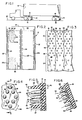
- FIG.1 is a side elevational view of a semi-trailer truck equipped with spray-suppressant flaps which include an exemplary embodiment of the present invention.
- FIG. 2 is a front elevational view of an exemplary spray-suppressant flap such as those shown on the semi-trailer truck shown in FIG. 1, at an enlarged scale.
- FIG. 3 is a front elevational view of a portion of the spray-suppressant material of the flap shown in FIG. 2, at a further enlarged scale.
- FIG. 4 is a front elevational detail view of the flap material shown in FIG. 3 at a yet further enlarged scale.
- FIG. 5 is a sectional side view of the spray-suppressant flap material shown in FIG. 4, taken along line 5-5.
- FIG. 6 is a sectional side view similar to that of FIG. 5, but showing the spray-suppressant material inclined rearwardly and showing the manner in which the material performs to control the dispersion of spray received from the wheels of a vehicle.
- Referring now to the drawings, in FIG. 1 a
semi-trailer truck 10 is equipped with vertically hangingflaps 12 and horizontally disposedsheets 14 of spray-suppressant material positioned, respectively, behind and above thevehicle wheels 16 to receive and conglomerate spray droplets thrown from thewheels 16 as thevehicle 10 moves in rain or on a wet or slush- coveredroadway surface 18. Theflaps 12 are suspended from suitable hangers provided on thevehicle 10 to hang generally vertically from a position of attachment rearward of the wheels, and to extend close to the ground behind the wheels, ending, for example, within 4 to 6 inches (10-15 cm) above the ground. - Preferably the
flaps 12 embodying the present invention may be manufactured of a moldable flexible material such as rubber. For example, granules of reclaimed tire rubber may be vulcanized and molded into the preferred form. Alternatively, a suitable flexible and resilient plastics material, such as a moldable polyethylene which has an adhesion-resistant surface, is usable for manufacture of theflaps 12. - A
flap 12 in accordance with the present invention preferably has abase sheet 19. As shown at a larger scale in FIG. 2, theflap 12 includes atop margin 20 andlateral margins 22, which have a generally flat surface on the side of theflap 12 which ordinarily faces toward thewheels 16. A lowermarginal area 23 is also provided and will be described more fully subsequently. Acentral portion 24, whose outline is indicated by a broken line, may optionally also have a generally flat surface aligned with the space between dual wheels if thevehicle 10 is so equipped. Additionally, raisedribs 25 may be provided in thecentral portion 24 and in thelateral margins 22, extending generally vertically along theflap 12 and being, for example, generally semicylindrical, with a radius of approximately 3/8 inch (0.9 cm).Such ribs 25 may be desired to add stiffness to theflap 12, should it be made of a very flexible material. A spray-suppressingarea 26, which may be divided into twosubareas central portion 24 or arib 25, includes a plurality of flex-ible fingers 28 extending from a generallyflat base surface 29 and arranged preferably in a pattern such as that shown in FIG. 3. Such a pattern consists preferably of a plurality of diamond-shaped orrhombic groups 30, each including eightfingers 28. Vertically adjacent diamond-shaped groups 30 overlap one another, so that onefinger 28 is the end of each of twoadjacent groups 30. (The pattern of thegroups 30 may also be thought of as beingsingle fingers 28 located respectively between vertically adjacent hexagonal groups of sixfingers 28.) The adjacent overlappingrhombic groups 30 offingers 28 defineparallel rows 32 ofgroups 30. Between therows 32 arechannels 34, thegroups 30 in eachrow 32 being staggered longitudinally with respect to thegroups 30 inadjacent rows 32 so that thechannels 34 are of a zig-zag, rather than straight, configuration, as may be seen in FIGS. 2 and 3. Thechannels 34 thus extend generally vertically along the spray-suppressingarea 26 of theflap 12 when it is hanging as shown in FIG. 1, suspended by attachment of thetop margin 18 to thesemi-trailer truck 10. This orientation of theflap 12 permits the droplets of fluid which has impinged upon theflap 12 to conglomerate and flow generally downward through thechannels 34 as indicated by thearrows 36 in FIG. 3. - In the lower
marginal portion 23 of each splash-suppressingarea 36, a more open pattern offingers 28 is provided, giving additional area ofbase surface 29 between thefingers 28. Such a lowermarginal portion 23 may extend over the bottom 3 inches (7.6 cm) of theflap 12, for example, and is provided in order to enhance shedding of snow or ice where its accumulation is otherwise likely to be heaviest. - Referring now additionally to FIGS. 4, 5, and 6, it will be appreciated that the
individual fingers 28 are tapered and generally circular in cross section, and also that they are inclined, although in parallel with one another, at an angle of a few degrees away from being perpendicular to the generallyplanar base surface 29 of theflap 12 between thefingers 28. Ordinarily this inclination away from the perpendicular is directed downward, so that thecentral axis 38 of each finger extends at anangle 39 of about 2-15° below the horizontal, when theflap 12 is hanging vertically. - Each
finger 28 is tapered, for example, from a diameter 40 (at its base) of approximately 3/16 of an inch (0.47 cm) to atip diameter 42 of approximately 1/8 inch (0.3175 cm), with thetip 44 being generally hemispherical. Eachfinger 28 is preferably inclined slightly downward. For example, thecentral axis 38 of each finger is about 8° below the horizontal when theflap 12 is hanging vertically. The frustoconical outer surface of each finger defines an angle of about 4° relative to thecentral axis 38, resulting in the slope of the uppermost surface of each finger preferably being inclined at anangle 46 approximately 12° below horizontal, while the lowermost surface defines anangle 49 of approximately 4° below horizontal. - Each
finger 28 has aheight 47 which is preferably at least about two-and-a-half times as great as itsdiameter 40 at its base, so that it is independently flex-ible along its height, in order to promote shedding of ice and provide additional surface area beyond that of a flat flap of the same size as theflap 12. For example, thefingers 28 may preferably be about 1/2 inch (1.27 cm) in height. The flexibility provided in this construction permits thefingers 28 to individually absorb some of the kinetic energy of fluid droplets contributing to reduction of the amount of spray associated with avehicle 10 equipped with flaps 12. - The
distance 48 between thecentral axes 38 of the closestadjacent fingers 28 of eachgroup 30 is preferably about 1/4 inch (0.6 cm), giving each diamond-shaped group 30 a width of 1/2 inch (1.27 cm) between the central axes of thecorner fingers 28, and eachchannel 34 preferably has the same width. As a result, spray droplets impinging upon the spray-suppressant portion 26 of theflap 12 are likely to encounter the surface of one of thefingers 28 initially, or to be splattered against one of thefingers 28 if they first impinge upon a portion of theflat base surface 29. Such droplets will thereafter agglomerate and be blown or drawn by gravity into one of thechannels 34 and drain downward along thechannels 34 in the direction indicated by thearrows 36. The fluid can then drain from thelower margin 23 of the flap with a reduced likelihood of being suspended in the air as spray or mist. - When the
vehicle 10 is moving forward, creating a considerable amount of relative wind against the forward face of theflap 12, as shown in FIG. 6, theflap 12 is deflected into a rearwardly and downwardly sloping attitude. As a result, theindividual fingers 28 are then even more downwardly inclined than when theflap 12 is hanging vertically, presenting more of the surface of thefingers 28 across the predominant paths of movement, indicated by arrows 50, of spray droplets toward theflap 12. Most fluid is deflected or blown toward the base of eachfinger 28, flowing along the surfaces of thefingers 28 until it reaches theflat base surface 29 and can thereafter drain downwardly through thechannels 34. The flatcentral portion 24 and thelateral margins 22 act as wide channels for fluid flow, in the area where there is likely to be least impingement of spray from the tires of a vehicle such as thesemi-trailer truck 10 when it is equipped with side by side dual wheels. - When freezing conditions prevail, the tapered shape and flexibility of the
fingers 28 enable an accumulation of snow or ice to fall free from thefingers 28 of its own weight. Because thefingers 28 are more widely separated, the arrangement offingers 28 in thelower margin 23 helps to shed snow and ice more efficiently from that portion of theflap 12 where it is otherwise most likely to accumulate. When theflap 12 is made of a plastics material which has a generally adhesion-resistant surface such as a molded polyethylene and the like there is even less likelihood of snow, slush, ice, or water sticking to the surface and accumulating. - Because the
fingers 28 on theflap 12 are aligned parallel with one another, droplets thrown from thewheels 16 are relatively unobstructed in their paths 50 toward thebase surface 29, or impinge upon the surfaces of thefingers 28 at shallow angles. However, when such droplets reach thebase surface 29, if they are splattered off it, rebounding onto the surfaces of thefingers 28, they can coalesce and flow along thefingers 28, and then flow downward through thechannels 34. - The spray- or splash-suppressant material of the invention may also be provided as
sheets 14 located 5 above thewheels 16, oriented horizontally as shown in FIG. 1, with thefingers 28 ofsuch sheets 14 extending downward and being rearward of vertical, so that the generally rearward direction of the relative wind as thevehicle 10 moves forward aids in directing the flow of fluid rearwardly through thechannels 34, for eventual downward flow along theflaps 12. - The terms and expressions which have been employed in the foregoing specification are used therein as terms of description and not of limitation, and there is no intention, in the use of such terms and expressions, of excluding equivalents of the features shown and described or portions thereof, it being recognized that the scope of the invention is defined and limited only by the claims which follow.
Claims (13)
Applications Claiming Priority (2)
| Application Number | Priority Date | Filing Date | Title |
|---|---|---|---|
| US526436 | 1983-08-25 | ||
| US06/526,436 US4564204A (en) | 1983-08-25 | 1983-08-25 | Spray-suppressant mud flap |
Publications (2)
| Publication Number | Publication Date |
|---|---|
| EP0134156A1 true EP0134156A1 (en) | 1985-03-13 |
| EP0134156B1 EP0134156B1 (en) | 1989-04-26 |
Family
ID=24097335
Family Applications (1)
| Application Number | Title | Priority Date | Filing Date |
|---|---|---|---|
| EP84305699A Expired EP0134156B1 (en) | 1983-08-25 | 1984-08-22 | Spray suppressant mud flap |
Country Status (4)
| Country | Link |
|---|---|
| US (1) | US4564204A (en) |
| EP (1) | EP0134156B1 (en) |
| CA (1) | CA1228882A (en) |
| DE (1) | DE3477909D1 (en) |
Cited By (10)
| Publication number | Priority date | Publication date | Assignee | Title |
|---|---|---|---|---|
| EP0192344A1 (en) * | 1985-01-23 | 1986-08-27 | Millwood Rubber Company Limited | Anti-spray flap for a vehicle wheel |
| DE3636909A1 (en) * | 1986-05-12 | 1987-11-19 | Josef Lunak | Dirt and water collector for motor vehicles |
| EP0202059A3 (en) * | 1985-05-03 | 1988-07-13 | Patrick F. Sullivan | Spray suppression material and devices for road vehicles |
| FR2618118A1 (en) * | 1987-07-16 | 1989-01-20 | Gilardini Spa | FENDER FOR MOTOR VEHICLES |
| GB2224251A (en) * | 1988-10-28 | 1990-05-02 | Metalplast | Mudflap for road vehicles |
| EP0396873A1 (en) * | 1989-05-10 | 1990-11-14 | KÖVER GMBH & CO. KG Metall- und Kunststoffverarbeitung | Mud flap |
| EP0791525A1 (en) * | 1996-02-22 | 1997-08-27 | Team Spatz Limited | Mudguard with spray suppression device |
| EP0903285A1 (en) * | 1997-09-22 | 1999-03-24 | Fichet S.A. | Mudguard flap for motor vehicles |
| EP2100800A1 (en) | 2008-03-12 | 2009-09-16 | Fichet S.A. | Anti-projections mud flap for a commercial vehicle |
| RU220736U1 (en) * | 2023-08-16 | 2023-09-29 | Общество С Ограниченной Ответственностью "Производственное Объединение "Автомастер" | SPLASH PROOF SHIELD WITH MIST CLOUD REDUCTION FUNCTION |
Families Citing this family (12)
| Publication number | Priority date | Publication date | Assignee | Title |
|---|---|---|---|---|
| GB8511307D0 (en) * | 1985-05-03 | 1985-06-12 | Sullivan P F | Spray suppression material & devices |
| US4796905A (en) * | 1985-05-03 | 1989-01-10 | Sullivan Patrick F | Spray-suppressant surface configuration |
| US5375882A (en) * | 1993-01-11 | 1994-12-27 | Koch, Iii; Stanley G. | Mist suppressant panels for a vehicle and a method of suppressing mist |
| US5736472A (en) * | 1995-03-29 | 1998-04-07 | Specialty Adhesive Film Co. | Marking SBR and natural rubber products |
| US5869168A (en) * | 1997-01-10 | 1999-02-09 | Mahn, Jr.; John | Reflective heat activated transfer |
| US7097208B2 (en) * | 2001-08-07 | 2006-08-29 | Richard Maurer | Reinforced splash guard |
| US8146949B2 (en) | 2009-09-02 | 2012-04-03 | Tarun Natwarlal Surti | Mud flap |
| US8616571B2 (en) | 2011-08-23 | 2013-12-31 | Paccar Inc | Vehicle splash guards and adaptors therefor |
| MX2013006298A (en) | 2012-06-05 | 2013-12-16 | Fleet Engineers Inc | Aerodynamic mud flap. |
| US9284000B1 (en) * | 2014-10-17 | 2016-03-15 | Paccar Inc | Vehicle splash guard |
| CN105346603A (en) * | 2015-11-06 | 2016-02-24 | 黄俊柳 | Rubber mud guard for car |
| US11992749B2 (en) | 2022-04-28 | 2024-05-28 | Alexander Rhoades | Portable bowling system and method of use |
Citations (4)
| Publication number | Priority date | Publication date | Assignee | Title |
|---|---|---|---|---|
| GB1101143A (en) * | 1964-01-22 | 1968-01-31 | Karl Dahl Andersen | Improvements in or relating to splashboards |
| GB2084094A (en) * | 1980-09-11 | 1982-04-07 | Typrod Ltd | A spray reducing device for a vehicle |
| DE3102805A1 (en) * | 1981-01-28 | 1982-09-02 | Dunlop Ag, 6450 Hanau | Device for eliminating the troublesome formation of spray water by vehicle tyres |
| US4398739A (en) * | 1980-11-10 | 1983-08-16 | National Rubber Company, Limited | Splash guard |
Family Cites Families (4)
| Publication number | Priority date | Publication date | Assignee | Title |
|---|---|---|---|---|
| US2782053A (en) * | 1955-04-04 | 1957-02-19 | Daniel S Long | Splash guard flap for automotive vehicles |
| US3899192A (en) * | 1974-04-19 | 1975-08-12 | Walter W Reddaway | Splash and spray reducing device for a vehicle |
| GB2050272B (en) * | 1979-05-23 | 1983-05-18 | Goodall Maurice Holdings | Spray-inhibiting means for use on a road vehicle |
| US4382606A (en) * | 1981-02-02 | 1983-05-10 | Lancaster Colony Corporation | Spray controlling system and splash guard for automotive vehicles |
-
1983
- 1983-08-25 US US06/526,436 patent/US4564204A/en not_active Expired - Fee Related
-
1984
- 1984-08-22 DE DE8484305699T patent/DE3477909D1/en not_active Expired
- 1984-08-22 EP EP84305699A patent/EP0134156B1/en not_active Expired
- 1984-08-24 CA CA000461831A patent/CA1228882A/en not_active Expired
Patent Citations (4)
| Publication number | Priority date | Publication date | Assignee | Title |
|---|---|---|---|---|
| GB1101143A (en) * | 1964-01-22 | 1968-01-31 | Karl Dahl Andersen | Improvements in or relating to splashboards |
| GB2084094A (en) * | 1980-09-11 | 1982-04-07 | Typrod Ltd | A spray reducing device for a vehicle |
| US4398739A (en) * | 1980-11-10 | 1983-08-16 | National Rubber Company, Limited | Splash guard |
| DE3102805A1 (en) * | 1981-01-28 | 1982-09-02 | Dunlop Ag, 6450 Hanau | Device for eliminating the troublesome formation of spray water by vehicle tyres |
Cited By (14)
| Publication number | Priority date | Publication date | Assignee | Title |
|---|---|---|---|---|
| EP0192344A1 (en) * | 1985-01-23 | 1986-08-27 | Millwood Rubber Company Limited | Anti-spray flap for a vehicle wheel |
| EP0202059A3 (en) * | 1985-05-03 | 1988-07-13 | Patrick F. Sullivan | Spray suppression material and devices for road vehicles |
| DE3636909A1 (en) * | 1986-05-12 | 1987-11-19 | Josef Lunak | Dirt and water collector for motor vehicles |
| GB2208160B (en) * | 1987-07-16 | 1991-07-31 | Gilardini Spa | Motor vehicle mudflap |
| FR2618118A1 (en) * | 1987-07-16 | 1989-01-20 | Gilardini Spa | FENDER FOR MOTOR VEHICLES |
| GB2208160A (en) * | 1987-07-16 | 1989-03-08 | Gilardini Spa | Spray-suppression device |
| BE1002304A4 (en) * | 1987-07-16 | 1990-11-27 | Gilardini Spa | FENDERS FOR MOTOR VEHICLES. |
| GB2224251A (en) * | 1988-10-28 | 1990-05-02 | Metalplast | Mudflap for road vehicles |
| EP0396873A1 (en) * | 1989-05-10 | 1990-11-14 | KÖVER GMBH & CO. KG Metall- und Kunststoffverarbeitung | Mud flap |
| EP0791525A1 (en) * | 1996-02-22 | 1997-08-27 | Team Spatz Limited | Mudguard with spray suppression device |
| EP0903285A1 (en) * | 1997-09-22 | 1999-03-24 | Fichet S.A. | Mudguard flap for motor vehicles |
| FR2768688A1 (en) * | 1997-09-22 | 1999-03-26 | Fichet Sa | ANTI-SPLASH GUARD FOR ROAD VEHICLES |
| EP2100800A1 (en) | 2008-03-12 | 2009-09-16 | Fichet S.A. | Anti-projections mud flap for a commercial vehicle |
| RU220736U1 (en) * | 2023-08-16 | 2023-09-29 | Общество С Ограниченной Ответственностью "Производственное Объединение "Автомастер" | SPLASH PROOF SHIELD WITH MIST CLOUD REDUCTION FUNCTION |
Also Published As
| Publication number | Publication date |
|---|---|
| EP0134156B1 (en) | 1989-04-26 |
| CA1228882A (en) | 1987-11-03 |
| US4564204A (en) | 1986-01-14 |
| DE3477909D1 (en) | 1989-06-01 |
Similar Documents
| Publication | Publication Date | Title |
|---|---|---|
| US4564204A (en) | Spray-suppressant mud flap | |
| USRE44755E1 (en) | Mud flap | |
| US4921276A (en) | Spray controlling fender | |
| US4382606A (en) | Spray controlling system and splash guard for automotive vehicles | |
| US5257822A (en) | Vehicle tire water spray control system components | |
| US5375882A (en) | Mist suppressant panels for a vehicle and a method of suppressing mist | |
| US4796906A (en) | Spray-suppressant surface configuration | |
| WO2008052036A2 (en) | Spray suppression device for vehicles | |
| EP1332951B1 (en) | Vehicle wheel shield | |
| EP0112694A1 (en) | Vehicle spray inhibitor | |
| US5269547A (en) | Spray suppressant apparatus | |
| US5080397A (en) | Vehicle tire water spray control system | |
| US6851717B1 (en) | Mud flap | |
| US4796905A (en) | Spray-suppressant surface configuration | |
| EP0150588A1 (en) | Suppression of spray from motor verhicles | |
| CA1156293A (en) | Trailer undercarriage fairings | |
| US4398739A (en) | Splash guard | |
| US4325563A (en) | Vehicle spray reduction | |
| EP0074953B1 (en) | Vehicle mudflap | |
| US4585243A (en) | Spray controlling vehicle splash guard | |
| US5022680A (en) | Spray-suppressant splash guard for vehicles | |
| EP0266228B1 (en) | Spray suppression material and devices for road vehicles | |
| GB2084094A (en) | A spray reducing device for a vehicle | |
| CA2068370A1 (en) | Mudflap for vehicles | |
| WO1982003829A1 (en) | Device for reducing splash and spray from vehicles |
Legal Events
| Date | Code | Title | Description |
|---|---|---|---|
| PUAI | Public reference made under article 153(3) epc to a published international application that has entered the european phase |
Free format text: ORIGINAL CODE: 0009012 |
|
| AK | Designated contracting states |
Designated state(s): BE CH DE FR GB IT LI NL SE |
|
| 17P | Request for examination filed |
Effective date: 19851112 |
|
| 17Q | First examination report despatched |
Effective date: 19860620 |
|
| D17Q | First examination report despatched (deleted) | ||
| GRAA | (expected) grant |
Free format text: ORIGINAL CODE: 0009210 |
|
| ITF | It: translation for a ep patent filed | ||
| AK | Designated contracting states |
Kind code of ref document: B1 Designated state(s): BE CH DE FR GB IT LI NL SE |
|
| PG25 | Lapsed in a contracting state [announced via postgrant information from national office to epo] |
Ref country code: SE Effective date: 19890426 Ref country code: NL Effective date: 19890426 Ref country code: FR Free format text: LAPSE BECAUSE OF NON-PAYMENT OF DUE FEES Effective date: 19890426 Ref country code: BE Effective date: 19890426 |
|
| REF | Corresponds to: |
Ref document number: 3477909 Country of ref document: DE Date of ref document: 19890601 |
|
| REG | Reference to a national code |
Ref country code: CH Ref legal event code: PL |
|
| PG25 | Lapsed in a contracting state [announced via postgrant information from national office to epo] |
Ref country code: GB Effective date: 19890822 |
|
| ITTA | It: last paid annual fee | ||
| PG25 | Lapsed in a contracting state [announced via postgrant information from national office to epo] |
Ref country code: LI Free format text: LAPSE BECAUSE OF NON-PAYMENT OF DUE FEES Effective date: 19890831 Ref country code: CH Free format text: LAPSE BECAUSE OF NON-PAYMENT OF DUE FEES Effective date: 19890831 |
|
| EN | Fr: translation not filed | ||
| NLV1 | Nl: lapsed or annulled due to failure to fulfill the requirements of art. 29p and 29m of the patents act | ||
| PLBI | Opposition filed |
Free format text: ORIGINAL CODE: 0009260 |
|
| 26 | Opposition filed |
Opponent name: DUNLOP GMBH Effective date: 19900125 |
|
| GBPC | Gb: european patent ceased through non-payment of renewal fee | ||
| PG25 | Lapsed in a contracting state [announced via postgrant information from national office to epo] |
Ref country code: DE Effective date: 19900501 |
|
| RDAG | Patent revoked |
Free format text: ORIGINAL CODE: 0009271 |
|
| STAA | Information on the status of an ep patent application or granted ep patent |
Free format text: STATUS: PATENT REVOKED |
|
| REG | Reference to a national code |
Ref country code: CH Ref legal event code: PL |
|
| 27W | Patent revoked |
Effective date: 19910502 |
|
| PLAB | Opposition data, opponent's data or that of the opponent's representative modified |
Free format text: ORIGINAL CODE: 0009299OPPO |