EP0133503B1 - Color photographic light-sensitive material - Google Patents
Color photographic light-sensitive material Download PDFInfo
- Publication number
- EP0133503B1 EP0133503B1 EP84108625A EP84108625A EP0133503B1 EP 0133503 B1 EP0133503 B1 EP 0133503B1 EP 84108625 A EP84108625 A EP 84108625A EP 84108625 A EP84108625 A EP 84108625A EP 0133503 B1 EP0133503 B1 EP 0133503B1
- Authority
- EP
- European Patent Office
- Prior art keywords
- group
- silver halide
- sensitive material
- photographic light
- color photographic
- Prior art date
- Legal status (The legal status is an assumption and is not a legal conclusion. Google has not performed a legal analysis and makes no representation as to the accuracy of the status listed.)
- Expired
Links
- 0 CC*Oc1ccc(C)cc1* Chemical compound CC*Oc1ccc(C)cc1* 0.000 description 9
Classifications
-
- G—PHYSICS
- G03—PHOTOGRAPHY; CINEMATOGRAPHY; ANALOGOUS TECHNIQUES USING WAVES OTHER THAN OPTICAL WAVES; ELECTROGRAPHY; HOLOGRAPHY
- G03C—PHOTOSENSITIVE MATERIALS FOR PHOTOGRAPHIC PURPOSES; PHOTOGRAPHIC PROCESSES, e.g. CINE, X-RAY, COLOUR, STEREO-PHOTOGRAPHIC PROCESSES; AUXILIARY PROCESSES IN PHOTOGRAPHY
- G03C7/00—Multicolour photographic processes or agents therefor; Regeneration of such processing agents; Photosensitive materials for multicolour processes
- G03C7/30—Colour processes using colour-coupling substances; Materials therefor; Preparing or processing such materials
- G03C7/32—Colour coupling substances
- G03C7/36—Couplers containing compounds with active methylene groups
- G03C7/38—Couplers containing compounds with active methylene groups in rings
- G03C7/384—Couplers containing compounds with active methylene groups in rings in pyrazolone rings
-
- G—PHYSICS
- G03—PHOTOGRAPHY; CINEMATOGRAPHY; ANALOGOUS TECHNIQUES USING WAVES OTHER THAN OPTICAL WAVES; ELECTROGRAPHY; HOLOGRAPHY
- G03C—PHOTOSENSITIVE MATERIALS FOR PHOTOGRAPHIC PURPOSES; PHOTOGRAPHIC PROCESSES, e.g. CINE, X-RAY, COLOUR, STEREO-PHOTOGRAPHIC PROCESSES; AUXILIARY PROCESSES IN PHOTOGRAPHY
- G03C7/00—Multicolour photographic processes or agents therefor; Regeneration of such processing agents; Photosensitive materials for multicolour processes
- G03C7/30—Colour processes using colour-coupling substances; Materials therefor; Preparing or processing such materials
- G03C7/32—Colour coupling substances
- G03C7/36—Couplers containing compounds with active methylene groups
- G03C7/38—Couplers containing compounds with active methylene groups in rings
Definitions
- the present invention relates to a silver halide color photographic light-sensitive material wherein the dye forming efficiency in the color development step is high, photographic properties are not influenced by variations in the pH of the color development bath, and the color images are fast to heat or light.
- magenta couplers Various pyrazolone derivatives have been known as magenta color image-forming couplers (referred to hereinafter simply as “magenta couplers").
- magenta couplers generally have low color forming efficiency (ratio of conversion of the coupler into a dye) when contained in photographic light-sensitive materials, and so-called 4-equivalent couplers, in which the coupling active position is not substituted, usually form only mol of dye per mol of the coupler.
- magenta couplers in which a substituent is introduced into the coupling active position of a pyrazolone type magenta coupler, and the substituent splits off in the color development step.
- Examples of such couplers are disclosed, for instance, in U.S. Patents 3,311,476, 3,419,391, 3,617,291 and 3,926,631.
- magenta couplers in which a substituent is connected to the coupling active position through a sulfur atom are described in U.S. Patent 3,214,437 (a thiocyano group), U.S. Patent 4,032,346 (an acylthio group or a thioacylthio group), U.S.
- Patents 3,227,554 and 3,701,783 and Japanese Patent Publication No. 34044/78 an arylthio group or a heterocyclic thio group
- Patents 3,227,554 and 3,701,783 and Japanese Patent Publication No. 34044/78 an arylthio group or a heterocyclic thio group
- OLS West German Patent Application
- 2,944,601 an alkylthio group
- magenta couplers which release an arylthio group as described in Japanese Patent Publication No. 34044/78 are used in a color photographic light-sensitive material and color images are formed, the light fastness of the color images is insufficient.
- Magenta couplers which release an arylthio group as described in Japanese Patent Application (OPI) No. 35858/82 (corresponding to U.S. Patent 4,351,897) (the term “OPI” as used herein refers to a "published unexamined Japanese patent application”) overcome these known defects described above.
- EP-A-0081768 discloses a silver halide color photographic light-sensitive material comprising a support having coated thereon at least one silver halide emulsion layer, the color photographic light-sensitive material having at least one layer containing at least one kind of 5-pyrazolone type 2-equivalent magenta coupler having an arylthio group at the coupling position thereof.
- magenta couplers having an arylthio group as a splitting-off group as described above are disadvantageous in that the color forming property thereof is decreased when photographic light-sensitive materials containing such magenta couplers are processed in a color developing solution containing a salt of alkaline earth metal, such as calcium or magnesium.
- a salt of alkaline earth metal such as calcium or magnesium.
- This can be a fatal defect where the processing solution is prepared using water containing a large amount of salt to alkaline earth metal, that is, hard water.
- soft water can be used at color photographic processing laboratories in most parts of the world, and hard water is thus employed as the base water for processing solutions in most cases.
- color photographic light-sensitive materials containing these heretofore known magenta couplers having an arylthio group as a splitting-off group can be subjected to development processing only at specific color laboratories wherein hard water is not used, even though they do have several desirable properties.
- an object of the present invention is to provide a color photographic light-sensitive material containing a novel 2-equivalent magenta coupler which has an excellent color forming property even when it is processed in a color developing solution containing a salt of alkaline earth metal.
- Another object of the present invention is to provide a color photographic light-sensitive material which forms color images having a good light-fastness.
- Still another object of the present invention is to provide a color photographic light-sensitive material in which photographic properties are less influenced by variations in the pH of the color developing solution.
- a further object of the present invention is to provide a color photographic light-sensitive material containing a low cost 2-equivalent magenta coupler by a simple production process.
- a still further object of the present invention is to provide a low cost color photographic light-sensitive material having reduced coupler content and reduced silver halide content.
- a silver halide color photographic light-sensitive material comprising a support having coated thereon at least one silver halide emulsion layer, the color photographic light-sensitive material having a photographic layer containing at least one kind of magenta coupler of 5-pyrazolone type having an arylthio group at the coupling position thereof, the arylthio group having an alkoxy group or an aryloxy group at the ortho position to the sulfur atom thereof and the alkoxy group and the aryloxy group being substituted with a cyano group, a halogen atom, a sulfonyl group, a sulfinyl group, a phosphonyl group, or an group, wherein A represents a chemical bond, an alkylene group (which may be saturated or unsaturated), an arylene group, an oxygen atom, a sulfur atom, or an imino group; and B represents a hydroxy group, an alkoxy group,
- magenta couplers which can be used in the color photographic light-sensitive material of the present invention are novel couplers belonging to a group of 2-equivalent magenta couplers having an arylthio group at the coupling active position of a pyrazolone.
- magenta couplers used in the color photographic light-sensitive material of the present invention do not only have superior properties such as the magenta couplers having an arylthio group as a splitting-off group as described in Japanese Patent Application (OPI) No. 35858/82 have, but also have the very significant feature that the color forming property is not reduced even when they are processed in processing solutions using hard water as the base water. This property could not at all be expected from the heretofore known couplers having an arylthio group as a splitting-off group.
- Magenta couplers used according to the present invention are preferably represented by formula (I) wherein Ar represents a phenyl group substituted with at least one halogen atom, an alkyl group, an alkoxy group, an alkoxycarbonyl group, or a cyano group; R represents an alkyl group or an aryl group each being substituted with a cyano group, a halogen atom, a sulfonyl group, a sulfinyl group, a phosphonyl group, or an group (wherein A and B each has the same meaning as defined above or is a divalent group connected to another coupler skeleton); R, represents a hydrogen atom, a halogen atom, a hydroxy group, an alkyl group, an alkoxy group, an aryl group, an amino group, an acylamino group, an alkylureido group, an alkoxycarbonylamino group, an imido group, a s
- the amount of coupler to be added is from 2 x 10- 3 mol to 5 x 10 -1 mol, and preferably from 1 x 10- 2 to 5 x 10-' mol, per mol of silver.
- R, R 1 , m, and Ar each has the same meaning as defined for formula (I);
- X represents a halogen atom or an alkoxy group;
- R 2 represents a hydrogen atom, a halogen atom, an alkyl group, an alkoxy group, an acylamino group, a sulfonamido group, a sulfamoyl group, a carbamoyl group, a diacylamino group, an alkoxycarbonyl group, an alkoxysulfonyl group, an aryloxysulfonyl group, an alkanesulfonyl group, an arylsulfonyl group, an alkylthio group, an arylthio group, an alkyloxycarbonylamino group, an alkylureido group, an acyl group, a nitro group, a carboxy
- Magenta couplers represented by formula (II) are described in more detail below.
- Ar is a substituted phenyl group.
- Substituents for the phenyl group include a halogen atom (for example, a chlorine atom, a bromine atom or a fluorine atom), an alkyl group having from 1 to 22 carbon atoms (for example, a methyl group, an ethyl group, a tetradecyl group or a tert-butyl group), an alkoxy group having from 1 to 22 carbon atoms (for example, a methoxy group, an ethoxy group, an octyloxy group or a dodecyloxy group), an alkoxycarbonyl group having from 2 to 23 carbon atoms (for example, a methoxycarbonyl group, an ethoxycarbonyl group or a tetradecyloxycarbonyl group), or a cyano group.
- a halogen atom for example, a chlorine atom, a bromine atom
- X in formula (II) represents a halogen atom (for example, a chlorine atom, a bromine atom or a fluorine atom) or an alkoxy group having from 1 to 22 carbon atoms (for example, a methoxy group, an octyloxy group or a dodecyloxy group).
- a halogen atom for example, a chlorine atom, a bromine atom or a fluorine atom
- an alkoxy group having from 1 to 22 carbon atoms for example, a methoxy group, an octyloxy group or a dodecyloxy group.
- R 2 in formula (11) represents a hydrogen atom, a halogen atom (for example, a chlorine atom, a bromine atom or a fluorine atom), an alkyl group (including a straight chain or branched chain alkyl group, an aralkyl group, an alkenyl group, a cycloalkyl group, and a cycloalkenyl group, for example, a tert-butyl group, a tert-octyl group, a tetradecyl group, a benzyl group, an allyl group, a cyclopentyl group or a cyclohexenyl group), an alkoxy group (for example, a methoxy group, an ethoxy group, a 2-ethylhexyloxy group or a tetradecyloxy group), an acylamino group (for example, an acetamido group, a benzamido group
- R, in formula (II) can represent a hydrogen atom, a hydroxy group, an aryl group (for example, a phenyl group, an a- or ⁇ -naphthyl group, a 2-chlorophenyl group, a 4-acetamidophenyl group, a 4-tert-butylphenyl group or a 4-cyanophenyl group), an amino group (including an N-alkylamino group, an N,N-dialkylamino group and an anilino group; examples of the N-alkylamino group including an N-butylamino group, an N-(2-methoxyethyl)amino group, an N-(2-methanesulfonylethyl)amino group and an N-(3-acetamidopropyl)amino group; examples of the N,N-dialkylamino group including an N,N-dibutylamino group,
- R in formula (II) represents an alkyl group or an aryl group each having a substituent selected from a cyano group, a halogen atom, a sulfonyl group, a sulfinyl group, a phosphonyl group, and an group (wherein A and B each has the same meaning as defined above), and preferably an alkyl group or an aryl group each having a substituent selected from wherein R 3 represents a hydrogen atom, an alkyl group, an aryl group or a heterocyclic group; R 4 and R s independently represent a hydrogen atom, an alkyl group, an aryl group or a heterocyclic group, or may be bonded to each other to form a 5-membered, 6-membered, or 7-membered nitrogen-containing heterocyclic ring; R 6 represents a hydrogen atom or an alkyl group; R 7 represents an alkyl group, an alkoxy group, an aryl group, or an aryl
- Particularly preferred groups for R include an alkyl group having a substituent selected from a carbonyl group, a sulfonyl group, and a phosphonyl group, as described above.
- magenta couplers used in the material according to the present invention are set forth below.
- magenta couplers used in the material according to the present invention can be synthesized by a combination of the methods as described in Japanese Patent Application (OPI) No. 35858/82 (corresponding to U.S. Patent 4,351,897).
- Coupler (1) was synthesized along the reaction scheme as illustrated below.
- the reaction mixture was poured into a mixture of 110 ml of concentrated sulfuric acid and 500 g of ice (at 0°C), and stirred while maintaining the temperature below 10°C. 175 g of zinc powder was added to the mixture, divided into several parts, while controlling the temperature below 40°C. After the completion of the addition of all zinc powder, the mixture was heated at a temperature of 70 to 75°C and stirred with heating for 1.5 h. Then, the mixture was cooled, an excess zinc powder was removed by filtration, 1,000 ml of ethyl acetate was added to the reaction mixture for extraction, followed by washing repeatedly with water. The ethyl acetate layer was dried with anhydrous sodium sulfate and, then, the solvent was distilled off. The residual oily product was almost pure Intermediate B (205 g).
- Coupler (1) was crystallized from a solvent mixture of hexane and benzene (100 ml:50 ml) to obtain 28 g (yield: 56.9%) of Coupler (1) as colorless crystals having a melting point of 133 to 136°C.
- Coupler (2) having a melting point of 162 to 165°C was obtained in a yield of 60.3% in an analogous manner as described in Synthesis Example 1.
- Coupler (25) was synthesized using the reaction scheme as illustrated below.
- the red-orange colored oily product obtained by removing the solvent was added to 150 ml of a dimethylformamide solution containing 32.6 g of 1-(2,4,6-trichlorophenyl)-3-(2-chloro-5-tetradecanamido- anilino)-5-pyrazolone, and the mixture was heated at 50°C for 2 h with stirring. After the completion of the reaction, the reaction mixture was extracted with ethyl acetate, washed with water, concentrated and crystallized from a solvent mixture of hexane and ethyl acetate (5:1 by volume) to obtain 10 g of Coupler (34) having a melting point of 113 to 116°C.
- couplers which can be employed in the present invention in addition to the couplers used in the material according to the present invention include dye forming couplers as described below, that is, compounds capable of color forming upon oxidative coupling with an aromatic primary amine developing agent (e.g., phenylenediamine derivatives or aminophenol derivatives) in color development processing. More specifically, suitable examples of magenta couplers which can be used include conventional 5-pyrazolone couplers, pyrazolobenzimidazole couplers, cyanoacetylcumarone couplers and open-chain acylacetonitrile couplers.
- yellow color image-forming couplers which can be used include acylacetamide couplers (e.g., benzoylacetanilides pivaloylacetanilides).
- cyan color image-forming couplers which can be used include naphthol couplers and phenol couplers.
- couplers those which are non-diffusible by means of containing a hydrophobic group referred to as a ballast group in the molecule thereof, or polymeric couplers, are preferably employed.
- These couplers may be either 4-equivalent or 2-equivalent per silver ion.
- colored couplers having a color correction effect, or couplers capable of releasing a development inhibitor with the advance of development (the so-called DIR couplers) can be employed.
- non-color forming DIR coupling compounds which can provide colorless products upon coupling reaction and release development inhibitors can be employed other than DIR couplers.
- Couplers Two or more kinds of the above-described couplers can be incorporated together in the same layer for the purpose of satisfying characteristics required to the light-sensitive material, or the same coupler compound may be added to two or more layers, depending upon the particular characteristics desired.
- the coupler is dissolved in an organic solvent having a high boiling point (more than 150°C), for example, phthalic acid alkyl esters (e.g., dibutyl phthalate or dioctyl phthalate, phosphoric acid esters (e.g., diphenyl phosphate, triphenyl phosphate, tricresyl phosphate or dioctylbutyl phosphate), citric acid esters (e.g., tributyl acetylcitrate), benzoic acid esters (e.g., octylbenzoate), alkylamides (e.g., diethyllaurylamide), fatty acid esters (e.g., dibutoxyethyl succinate or diethyl azel
- dispersing methods utilizing a polymeric material e.g., as described in Japanese Patent Publication No. 39853/76 and Japanese Patent Application (OPI) No. 59943/76 can also be employed.
- the coupler contains an acid group such as a carboxylic acid group or a sulfonic acid group, it is incorporated into a hydrophilic colloid in the form of an alkaline aqueous solution.
- cyan dyes formed from cyan couplers exhibit their maximum absorption bands in the wavelength range from 600 nm to 720 nm
- magenta dyes formed from magenta couplers exhibit their maximum absorption bands in the wavelength range from 500 nm to 580 nm
- yellow dyes formed from yellow couplers exhibit their maximum absorption bands in the wavelength range from 400 nm to 480 nm.
- the light-sensitive material prepared using the present invention may contain, as a color fog preventing agent, hydroquinone derivatives, aminophenol derivatives, gallic acid derivatives or ascorbic acid derivatives.
- a color fog preventing agent which can be used include those described in U.S. Patents 2,360,290, 2,336,327, 2,403,721, 2,418,613, 2,675,314, 2,701,197, 2,704,713, 2,728,659, 2,732,300 and 2,735,765, Japanese Patent Application (OPI) Nos. 92988/75, 92989/75, 93928/75, 110337/75 and 146235/77 and Japanese Patent Publication No. 23813/75.
- the light-sensitive material of the present invention may contain an ultraviolet ray absorbing agent in a hydrophilic colloid layer thereof.
- an ultraviolet ray absorbing agent include benzotriazole compounds substituted with an aryl group (e.g., those described in U.S. Patent 3,533,794) 4-thiazolidone compounds (e.g., those described in U.S. Patents 3,314,794 and 3,352,681), benzophenone compounds (e.g., those described in Japanese Patent Application (OPI) No. 2784/71), cinnamic acid ester compounds (e.g., those described in U.S. Patents 3,705,805 and 3,707,375), butadiene compounds (e.g., those described in U.S.
- Patent 4,045,229) or benzoxazole compounds e.g., those described in U.S. Patent 3,700,455).
- those described in U.S. Patent 3,499,762 and those described in Japanese Patent Application (OPI) No. 48535/79 can also be employed.
- couplers which have ultraviolet ray absorbing abilities e.g., a-naphthol type cyan dye forming couplers
- polymers which have ultraviolet ray absorbing abilities may be employed. These ultraviolet ray absorbing agents may be mordanted in a specific layer(s).
- the light-sensitive material of the present invention may contian a water-soluble dye in a hydrophilic colloid layer thereof as a filter dye or for the purpose of preventing irradiation or other various purposes.
- a water-soluble dye in a hydrophilic colloid layer thereof as a filter dye or for the purpose of preventing irradiation or other various purposes.
- Suitable examples of such a dye include oxonol dyes, hemioxonol dyes, styryl dyes, merocyanine dyes, cyanine dyes and azo dyes. Of these dyes, oxonol dyes, hemioxonol dyes and merocyanine dyes are useful. Specific examples of the dye which can be used include those described in British Patents 584,609 and 1,177,429, Japanese Patent Application (OPI) Nos.
- the photographic emulsion which can be used in the present invention may be spectrally sensitized with methine dyes or other dyes.
- Suitable dyes which can be used include cyanine dyes, merocyanine dyes, complex cyanine dyes, complex merocyanine dyes, holopolar cyanine dyes, hemicyanine dyes, styryl dyes and hemioxonol dyes. Of these dyes, especially useful dyes are those belonging to cyanine dyes, merocyanine dyes or complex merocyanine dyes. Any nucleus which is conventionally used in cyanine dyes as a basic heterocyclic nucleus is applicable to those dyes.
- the merocyanine dyes and the complex merocyanine dyes can contain 5- or 6-membered heterocyclic nuclei such as a pyrazolin-5-one nucleus, a thiohydantoin nucleus, a 2-thioxazolidin-2,4-dione nucleus, a thiazolidin-2,4-dione nucleus, a rhodanine nucleus or a thiobarbituric acid nucleus, as a nucleus having a ketomethylene structure.
- useful sensitizing dyes include those decribed in German Patent 929,080, U.S. Patents 2,231,658, 2,493,748, 2,503,776, 2,519,001, 2,912,329, 3,656,959, 3,672,897, 3,694,217, 4,025,349 and 4,046,572, British Patent 1,242,588, Japanese Patent Publication Nos. 14030/69 and 24844/77.
- the sensitizing dyes can be employed individually or in combination. Combinations of sensitizing dyes are often employed for the purpose of supersensitization. Typical examples of supersensitizing combinations are described in U.S. Patents 2,688,545, 2,977,229, 3,397,060, 3,522,052, 3,527,641, 3,617,293, 3,628,964, 3,666,480, 3,672,898, 3,679,428, 3,703,377, 3,769,301, 3,814,609, 3,837,862 and 4,026,707, British Patents 1,344,281 and 1,507,803, Japanese Patent Publication Nos. 4936/68 and 12375/78, Japanese Patent Application (OPI) Nos. 110618n7 and 109925/77.
- the sensitizing dye can be used in the emulsion together with dyes which themselves do not have a spectrally sensitizing function but exhibit a supersensitizing effect, or materials which do not substantially absorb visible light but exhibit a supersensitizing effect.
- aminostilbene compounds substituted with a nitrogen-containing heterocyclic group e.g., those described in U.S. Patents 2,933,390 and 3,635,721
- aromatic organic acid-formaldehyde condensates e.g, those described in U.S. Patent 3,743,510
- cadmium salts or azaindene compounds can be used.
- Particularly useful combinations are those disclosed in U.S. Patents 3,615,613, 3,615,641, 3,617,295 and 3,635,721.
- Photographic processing of the light-sensitive material according to the present invention can be carried out using any of known methods. Further, known processing solutions can be used.
- the processing temperature is generally selected from a range of 18°C to 50°C, but temperatures lower than 18°C or higher than 50°C may be employed.
- Either a development processing for forming silver images (black-and-white photographic processing) or a color photographic processing comprising a development processing for forming dye images may be employed depending upon the purpose.
- a color developing solution is generally an alkaline aqueous solution containing a color developing agent.
- a color developing agent known primary aromatic amine developing agents such as phenylenediamines (e.g., 4-amino-N,N-diethylaniline, 3-methyl-4-amino-N,N-diethylaniline, 4-amino-N-ethyl-N- ⁇ -hydroxyethylaniline, 3-methyl-4-amino-N-ethyl-N-(3-hydroxyethylaniline, 3-methyl-4-amino-N-ethyl- ⁇ -methanesulfonamidoethylaniline or 4-amino-3-methyl-N-ethyl-N- ⁇ -methoxyethylaniline) can be used.
- the color developing solution can also contain pH buffering agents such as sulfites, carbonates, borates or phosphates of alkali metals; development restrainers or antifogging agents such as bromides, iodides or organic antifogging agents.
- pH buffering agents such as sulfites, carbonates, borates or phosphates of alkali metals
- development restrainers or antifogging agents such as bromides, iodides or organic antifogging agents.
- the color developing solution may contain water softeners; preservatives such as hydroxyamine; organic solvents such as benzyl alcohol or diethylene glycol; development accelerators such as polyethylene glycol, quaternary ammonium salts or amines; dye forming couplers; competing couplers; fogging agents such as sodium borohydride; auxiliary developing agents such as 1-phenyl-3-pyrazolidone; viscosity imparting agents; chelating agents of polycarboxylic acid type as described in U.S. Patent 4,083,723; antioxidants as described in West German Patent Application (OLS) No. 2,622,950.
- water softeners preservatives such as hydroxyamine
- organic solvents such as benzyl alcohol or diethylene glycol
- development accelerators such as polyethylene glycol, quaternary ammonium salts or amines
- dye forming couplers such as sodium borohydride
- auxiliary developing agents such as 1-phenyl-3-pyrazolidone
- viscosity imparting agents
- the photographic emulsion layers are generally subjected to a bleach processing.
- Bleach processing can be carried out simultaneously with fixing or separately therefrom.
- Suitable examples of the bleaching agents which can be used include compounds of polyvalent metals such as iron (111), cobalt (III), chromium (IV) or copper (II), peracids, quinones or nitroso compounds.
- ferricyanides include ferricyanides; bichromates; organic complex salts of iron (III) or cobalt (III) with aminopolycarboxylic acids such as ethylenediaminetetraacetic acid, nitrilotriacetic acid or 1,3-diamino-2-propanol-tetraacetic acid, or organic acids such as citric acid, tartaric acid or malic acid; persulfates; permanganates; or nitrosophenol.
- potassium ferricyanide, sodium ethylenediaminetetraacetato iron (III) and ammonium ethylenediaminetetraacetato iron (III) are particularly useful.
- Ethylenediaminetetraacetato iron (III) complex salts are useful both in a bleaching solution and in a mono- bath bleach-fixing solution.
- bleaching accelerators as described in U.S. Patents 3,042,520, and 3,241,966.
- Japanese Patent Publication Nos. 8506/70 and 8836/70; thiol compounds as described in Japanese Patent Application (OPI) No. 65732/78, and other various additives can be added.
- the silver halide emulsion used in the present invention is prepared generally by mixing a solution of a water-soluble silver salt (e.g., silver nitrate) with a solution of a water-soluble halide (e.g., potassium bromide) in the presence of a solution of a water-soluble polymer (e.g., gelatin).
- a water-soluble silver salt e.g., silver nitrate
- a water-soluble halide e.g., potassium bromide
- silver halide which can be used includes does not only silver chloride and silver bromide, but also mixed silver halide such as silver chlorobromide, silver iodobromide or silver chloroiodobromide.
- a mean grain size of sivler halide grains produced (the grain size refers to the diameter of a grain when it is spherical or similar spherical in the shape, or the edge length when it is cubic, and the mean grain size is determined on the basis of the projected areas) is preferably 2 ⁇ m or less, and more preferably 0.4 ⁇ m or less.
- the distribution of the grain size can be either narrow or broad.
- substantially light-insensitive fine grain silver halide emulsion may be incorporated into a light-sensitive layer, an intermediate layer or a protective layer.
- These silver halide grains may have a crystal form of cube, a crystal form of an octahedron or a composite form thereof.
- a silver halide emulsion in which at least 50% of the total projected area of the silver halide grains is tabular silver halide grains (for example, tabular silver halide grains having a length-to-thickness ratio of 5 or more and preferably 8 or more) may be employed.
- two or more silver halide photographic emulsions which are produced separately may be used in the form of mixture.
- silver halide grains having a uniform crystal structure, silver halide grains in which the inner portion and the outer portion have different layer structures, or silver halide grains of the so-called conversion type as described in British Patent 635,841, U.S. Patent 3,622,318, may be employed.
- either silver halide grains in which a latent image is predominantly formed at the surface thereof or grains in which a latent image is predominantly formed inner portion thereof can be used.
- Such photographic emulsions are described in C. E. K. Mees, The Theory of the Photographic Process, Macmillan Co., P. Glafkides, Chimie Photographique, Paul Montel Co.
- photographic emulsions can be prepared using the methods as described, e.g. in P. Glafkides, Chimie et Physique Photographique, Paul Montel Co. (1967), G. F. Duffin, Photographic Emulsion Chemistry, The Focal Press (1966), V. L. Zelikman et al., Making and Coating Photographic Emulsion, The Focal Press (1966). Namely, any of an acidic process, a neutral process, or an ammonia process, may be used for the preparation of the photographic emulsions. Suitable methods for reacting a water-soluble silver salt with a water-soluble halide include, e.g. a single jet method, a double jet method, or a combination thereof.
- a method in which silver halide grains are formed in the presence of an excess of silver ions can be employed in the present invention.
- the so-called controlled double jet method in which the pAg in a liquid phase wherein silver halide grains are formed is maintained at a constant value, may be also employed. According to this method, a silver halide emulsion having a regular crystal form and substantially uniform grain sizes can be obtained.
- a mixture of two or more kinds of silver halide emulsions prepared separately may be employed.
- cadmium salts zinc salts, lead salts, thallium salts, iridium salts or complex salts thereof, rhodium salts or complex salts thereof or iron salts or complex salts thereof, may be present.
- Removal of the soluble salts from the silver halide emulsion is, in general, carried out after the formation of the silver halide grains or after physical ripening.
- the removal can be effected using the noodle washing method which has been known from old times and comprises gelling the gelatin, or using a flocculation process using a polyvalent anion-containing inorganic salt (e.g., sodium sulfate), an anionic surface active agent, an anionic polymer (e.g., polystyrenesulfonic acid), or a gelatin derivative (e.g., an aliphatic acylated gelatin, an aromatic acylated gelatin or an aromatic carbamoylated gelatin).
- a polyvalent anion-containing inorganic salt e.g., sodium sulfate
- an anionic surface active agent e.g., polystyrenesulfonic acid
- a gelatin derivative e.g., an aliphatic acylated ge
- the silver halide emulsion used in the present invention can be the so-called primitive emulsion without application of chemical sensitization. However, it is usually chemically sensitized. Chemical sensitization can be carried out using the methods as described in P. Glafkides, supra, V. L. Zelikman et al., supra, or H. Frieser, Die Unen der Photographischen Too mit Silberhalogeniden, Akademische Verlagsgesellschaft (1968).
- the photographic emulsion layers and other hydrophilic colloid layers which constitute the light-sensitive material according to the present invention may contain various kinds of surface active agents as coating aids or for other various purposes, for example, prevention of charging improvement of slipping property, emulsifying dispersion, prevention of adhesion or improvement of photographic characteristics (e.g., acceleration of development, high contrast or sensitization.
- suitable surface active agents include nonionic surface active agents, for example, saponin (steroid type), alkylene oxide derivatives (e.g., polyethyelne glycol, polyethylene gIy ⁇ oIIpoIy- propyleneglycol condensates, polyethylene glycol alkyl ethers or polyethylene glycol alkylaryl ethers, polyethylene glycol esters, polyethylene glycol sorbitan esters, polyalkylene glycol alkylamines or amides or polyethylene oxide adducts of silicones), glycidol derivatives (e.g., alkenylsuccinic acid polyglycerides or alkylphenol polyglycerides), fatty acid esters of polyhydric alcohols or alkyl esters of sugar; anionic surface active agents containing acidic groups such as a carboxy group, a sulfo group, a phospho group, a sulfuric acid ester group or a phosphoric acid group, for example,
- Magenta Coupler (1) 0.008 mol was dissolved in a mixture of 20 ml of tricresyl phosphate and 20 ml of ethyl acetate. The resulting solution was added to a 10% aqueous gelatin solution containing 0.4 g of sodium dodecylbenzenesulfonate, and the mixture was stirred and dispersed by means of a homogenizer rotating at a high speed to prepare a dispersion.
- the dispersion thus-prepared was mixed with 150 g of a silver chlorobromide emulsion (containing 8.8 g of silver, and having a bromide content of 50 mol%), and sodium dodecylbenzenesulfonate was added thereto as a coating aid and 2-oxy-4,6-dichloro-s-triazine as a hardener.
- the mixture was coated on a paper support both surfaces of which were laminated with polyethylene at a silver coated amount of 0.165 g/m 2 to form an emulsion layer. Further, a gelatin protective layer was coated on the emulsion layer to prepare Sample 1.
- Samples 2 to 5 were prepared in the same manner as described in Sample 1 except using Magenta Couplers (2), (4), (7) and (25) instead of Magenta Coupler (1), respectively. Furthermore, for comparison, Samples 6 to 8 were prepared in the same manner as described in Sample 1 except using Magenta Couplers (A), (B) and (C) which are comparative couplers instead of Magenta Coupler (1), respectively.
- composition of the bleach-fixing solution were as follows.
- a coating solution for the first layer was prepared in the following manner. That is, 100 g of the yellow coupler shown in Table 2 above was dissolved in a mixture of 50 ml of dibutyl phthalate and 100 ml of ethyl acetate. The resulting solution was dispersed in 800 g of a 10% aqueous gelatin solution containing 80 ml of a 1% aqueous solution of sodium dodecylbenzenesulfonate. The dispersion thus-prepared was mixed with 2.9 kg of a blue-sensitive silver chlorobromide emulsion (containing 133 g of silver and having a bromide content of 80 mol%) to prepare the coating solution. Coating solutions for other layers were prepared in the same manner as described for the first layer. As a hardener, sodium 2-oxy-4,6-dichloro-s-triazine was used in each layer.
- Samples 10 to 16 were prepared in the same manner as described in Sample 9 except that, in the third layer, the amount of silver coated was changed to 165 mg/m 2 and the kind of the magenta coupler and the coupler coated amount were changed as shown in Table 3 below.
Landscapes
- Physics & Mathematics (AREA)
- General Physics & Mathematics (AREA)
- Silver Salt Photography Or Processing Solution Therefor (AREA)
Description
- The present invention relates to a silver halide color photographic light-sensitive material wherein the dye forming efficiency in the color development step is high, photographic properties are not influenced by variations in the pH of the color development bath, and the color images are fast to heat or light.
- Various pyrazolone derivatives have been known as magenta color image-forming couplers (referred to hereinafter simply as "magenta couplers"). However, these pyrazolone derivatives generally have low color forming efficiency (ratio of conversion of the coupler into a dye) when contained in photographic light-sensitive materials, and so-called 4-equivalent couplers, in which the coupling active position is not substituted, usually form only mol of dye per mol of the coupler.
- To improve color forming efficiency, so-called 2-equivalent magenta couplers have been known, in which a substituent is introduced into the coupling active position of a pyrazolone type magenta coupler, and the substituent splits off in the color development step. Examples of such couplers are disclosed, for instance, in U.S. Patents 3,311,476, 3,419,391, 3,617,291 and 3,926,631. Further, magenta couplers in which a substituent is connected to the coupling active position through a sulfur atom are described in U.S. Patent 3,214,437 (a thiocyano group), U.S. Patent 4,032,346 (an acylthio group or a thioacylthio group), U.S. Patents 3,227,554 and 3,701,783 and Japanese Patent Publication No. 34044/78 (an arylthio group or a heterocyclic thio group), and West German Patent Application (OLS) No. 2,944,601 (an alkylthio group).
- It has been found that when couplers having an arylthio group at the coupling active position among the magenta couplers described in U.S. Patents 3,227,554 and 3,701,783 are used in a color photographic light-sensitive material and color images are formed, the light fastness of the color images does not completely satisfy the desired ever-advancing improvement in the properties of the color photographic light-sensitive materials.
- Also, it has been found that when magenta couplers which release an arylthio group as described in Japanese Patent Publication No. 34044/78 are used in a color photographic light-sensitive material and color images are formed, the light fastness of the color images is insufficient.
- Magenta couplers which release an arylthio group as described in Japanese Patent Application (OPI) No. 35858/82 (corresponding to U.S. Patent 4,351,897) (the term "OPI" as used herein refers to a "published unexamined Japanese patent application") overcome these known defects described above.
- EP-A-0081768 discloses a silver halide color photographic light-sensitive material comprising a support having coated thereon at least one silver halide emulsion layer, the color photographic light-sensitive material having at least one layer containing at least one kind of 5-pyrazolone type 2-equivalent magenta coupler having an arylthio group at the coupling position thereof.
- However, these known magenta couplers having an arylthio group as a splitting-off group as described above are disadvantageous in that the color forming property thereof is decreased when photographic light-sensitive materials containing such magenta couplers are processed in a color developing solution containing a salt of alkaline earth metal, such as calcium or magnesium. This can be a fatal defect where the processing solution is prepared using water containing a large amount of salt to alkaline earth metal, that is, hard water. In fact, it is rarely the case that soft water can be used at color photographic processing laboratories in most parts of the world, and hard water is thus employed as the base water for processing solutions in most cases. For this reason color photographic light-sensitive materials containing these heretofore known magenta couplers having an arylthio group as a splitting-off group can be subjected to development processing only at specific color laboratories wherein hard water is not used, even though they do have several desirable properties.
- Therefore, an object of the present invention is to provide a color photographic light-sensitive material containing a novel 2-equivalent magenta coupler which has an excellent color forming property even when it is processed in a color developing solution containing a salt of alkaline earth metal.
- Another object of the present invention is to provide a color photographic light-sensitive material which forms color images having a good light-fastness.
- Still another object of the present invention is to provide a color photographic light-sensitive material in which photographic properties are less influenced by variations in the pH of the color developing solution.
- A further object of the present invention is to provide a color photographic light-sensitive material containing a low cost 2-equivalent magenta coupler by a simple production process.
- A still further object of the present invention is to provide a low cost color photographic light-sensitive material having reduced coupler content and reduced silver halide content.
- The above-described objects of the present invention can be attained by a silver halide color photographic light-sensitive material comprising a support having coated thereon at least one silver halide emulsion layer, the color photographic light-sensitive material having a photographic layer containing at least one kind of magenta coupler of 5-pyrazolone type having an arylthio group at the coupling position thereof, the arylthio group having an alkoxy group or an aryloxy group at the ortho position to the sulfur atom thereof and the alkoxy group and the aryloxy group being substituted with a cyano group, a halogen atom, a sulfonyl group, a sulfinyl group, a phosphonyl group, or an


- The magenta couplers which can be used in the color photographic light-sensitive material of the present invention are novel couplers belonging to a group of 2-equivalent magenta couplers having an arylthio group at the coupling active position of a pyrazolone.
- The magenta couplers used in the color photographic light-sensitive material of the present invention do not only have superior properties such as the magenta couplers having an arylthio group as a splitting-off group as described in Japanese Patent Application (OPI) No. 35858/82 have, but also have the very significant feature that the color forming property is not reduced even when they are processed in processing solutions using hard water as the base water. This property could not at all be expected from the heretofore known couplers having an arylthio group as a splitting-off group.
- Magenta couplers used according to the present invention are preferably represented by formula (I)


- The amount of coupler to be added is from 2 x 10⁻³ mol to 5 x 10⁻¹ mol, and preferably from 1 x 10⁻² to 5 x 10-' mol, per mol of silver.
- Of the compounds represented by formula (I), more preferred compounds are those represented by formula (II)

- Magenta couplers represented by formula (II) are described in more detail below.
- In formula (II), Ar is a substituted phenyl group. Substituents for the phenyl group include a halogen atom (for example, a chlorine atom, a bromine atom or a fluorine atom), an alkyl group having from 1 to 22 carbon atoms (for example, a methyl group, an ethyl group, a tetradecyl group or a tert-butyl group), an alkoxy group having from 1 to 22 carbon atoms (for example, a methoxy group, an ethoxy group, an octyloxy group or a dodecyloxy group), an alkoxycarbonyl group having from 2 to 23 carbon atoms (for example, a methoxycarbonyl group, an ethoxycarbonyl group or a tetradecyloxycarbonyl group), or a cyano group.
- X in formula (II) represents a halogen atom (for example, a chlorine atom, a bromine atom or a fluorine atom) or an alkoxy group having from 1 to 22 carbon atoms (for example, a methoxy group, an octyloxy group or a dodecyloxy group).
- R2 in formula (11) represents a hydrogen atom, a halogen atom (for example, a chlorine atom, a bromine atom or a fluorine atom), an alkyl group (including a straight chain or branched chain alkyl group, an aralkyl group, an alkenyl group, a cycloalkyl group, and a cycloalkenyl group, for example, a tert-butyl group, a tert-octyl group, a tetradecyl group, a benzyl group, an allyl group, a cyclopentyl group or a cyclohexenyl group), an alkoxy group (for example, a methoxy group, an ethoxy group, a 2-ethylhexyloxy group or a tetradecyloxy group), an acylamino group (for example, an acetamido group, a benzamido group, a butanamido group, a tetradecanamido group, an a-(2,4-di-tert-amylphenoxy)acetamido group, an a-(2,4-di-tert-amylphenoxy)butyramido group, an a-(3-pentadecylphenoxy)hexanamido group, an a-(4-hydroxy-3-tert-butylphenoxy)tetradecanamido group, a 2-oxopyrrolidin-1-yl group, a 2-oxo-5-tetradecylpyrrolidin-1-yl group or an N-methyltetradecanamido group), a sulfonamido group (for example, a methanesulfon- amido group, a benzenesulfonamido group, a p-toluenesulfonamido group, an octanesulfonamido group, a p-dodecylbenzenesulfonamido group or an N-methyltetradecanesulfonamido group, a sulfamoyl group (for example, an N-methylsulfamoyl group, an N-hexadecylsulfamoyl group, an N-[3-(dodecyloxy)propyl]-sulfamoyl group, an N-[4-(2,4-di-tert-amylphenoxy)butyl]sulfamoyl group or an N-methyl-N-tetradecyl- sulfamoyl group), a carbamoyl group (for example, an N-methylcarbamoyl group, an N-octadecyl- carbamoyl group, an N-[4-(2,4-di-tert-amylphenoxy)butyl]carbamoyl group or an N-methyl-N-tetradecyl- carbamoyl group), a diacylamino group (for example, an N-succinimido group, an N-phthalimido group, a 2,5-dioxo-1-oxazolidinyl group, a 3-dodeεyI-2,5-dioxo-1-hydantoinyI group or a 3-(N-acetyl-N-dodecylamino)succinimido group), an alkoxycarbonyl group (for example, a methoxycarbonyl group, a tetradecyloxycarbonyl group or a benzyloxycarbonyl group), an alkoxysulfonyl group (for example, a methoxy- sulfonyl group, an octyloxysulfonyl group or a tetradecyloxysulfonyl group), an aryloxysulfonyl group (for example, a phenoxysulfonyl group or a 2,4-di-tert-amylphenoxysulfonyl group), an alkanesulfonyl group (for example, a methanesulfonyl group, an octanesulfonyl group, a 2-ethylhexanesulfonyl group or a hexa- decanesulfonyl group), an arylsulfonyl group (for example, a benzenesulfonyl group or a 4-nonylbenzene- sulfonyl group), an alkylthio group (for example, an ethylthio group, a hexylthio group, a benzylthio group, a tetradecylthio group or a 2-(2,4-di-tert-amylphenoxy)ethylthio group), an arylthio group (for example a phenylthio group or a p-tolylthio group), an alkyloxycarbonylamino group (for example, an ethyloxy- carbonylamino group, a benzyloxycarbonylamino group or a hexadecyloxycarbonylamino group), an alkylureido group (for example, an N-methylureido group, an N,N-dimethylureido group, an N-methyl-N-dodecylureido group, an N-hexadecylureido group or an N,N-dioctadecylureido group), an acyl group (for example, an acetyl group, a benzoyl group, an octadecanoyl group or a p-dodecanamidobenzoyl group), a nitro group, a carboxy group, or a trichloromethyl group. In the above-described substituents, the alkyl moieties thereof preferably have from 1 to 36 carbon atoms, and the aryl moieties thereof preferably have from 6 to 38 carbon atoms.
- The halogen atom, the alkyl group, the alkoxy group, the acylamino group, the alkylureido group, the alkoxycarbonylamino group, the imido group (same as diacylamino group), the sulfonamido group, the sulfamoyl group, the alkoxycarbonyl group, the carbamoyl group and the alkylthio group represented by R, each has the same meaning as defined for R2. In addition to these groups, R, in formula (II) can represent a hydrogen atom, a hydroxy group, an aryl group (for example, a phenyl group, an a- or β-naphthyl group, a 2-chlorophenyl group, a 4-acetamidophenyl group, a 4-tert-butylphenyl group or a 4-cyanophenyl group), an amino group (including an N-alkylamino group, an N,N-dialkylamino group and an anilino group; examples of the N-alkylamino group including an N-butylamino group, an N-(2-methoxyethyl)amino group, an N-(2-methanesulfonylethyl)amino group and an N-(3-acetamidopropyl)amino group; examples of the N,N-dialkylamino group including an N,N-dibutylamino group, an N,N-dihexylamino group, an N,N-bis(2-ethylhexyl)amino group, an N,N-bis(2-hexanesulfonylethyl)amino group, an N-ethyl-N-dodecylamino group, an N,N-bis(3-phenoxypropyl)amino group, an N-ethyl-N-[2-(2,4-di-tert-amylphenoxy)ethyl]amino group and an N,N-bis{2-[(4-tert-butylphenoxy)acetamido]ethyl}amino group; examples of the anilino group including a phenylamino group, a 4-methoxyphenylamino group, an N-ethyl-N-phenylamino group, a 2,4-di-tert-amylphenylamino group, a 3-methanesulfonamidophenylamino group and a 2-chlorophenyl- amino group), a sulfamoylamino group (for example, an N,N-dibutylsulfamoylamino group, an N-ethyl-N-dodecylsulfamoylamino group, an N-ethyl-N-anilinosulfamoylamino group or an N,N-bis(2-butanesulfonylethyl)sulfamoylamino group), a nitro group, an acyl group (for example, an acetyl group, a benzoyl group, a hexanoyl group, a 2,4-di-tert-butylbenzoyl group, a 2-hydroxybenzoyl group or a decyloxyacetyl group) or a cyano group.
- R in formula (II) represents an alkyl group or an aryl group each having a substituent selected from a cyano group, a halogen atom, a sulfonyl group, a sulfinyl group, a phosphonyl group, and an


- Particularly preferred groups for R include an alkyl group having a substituent selected from a carbonyl group, a sulfonyl group, and a phosphonyl group, as described above.
- Specific examples of the magenta couplers used in the material according to the present invention are set forth below.
-


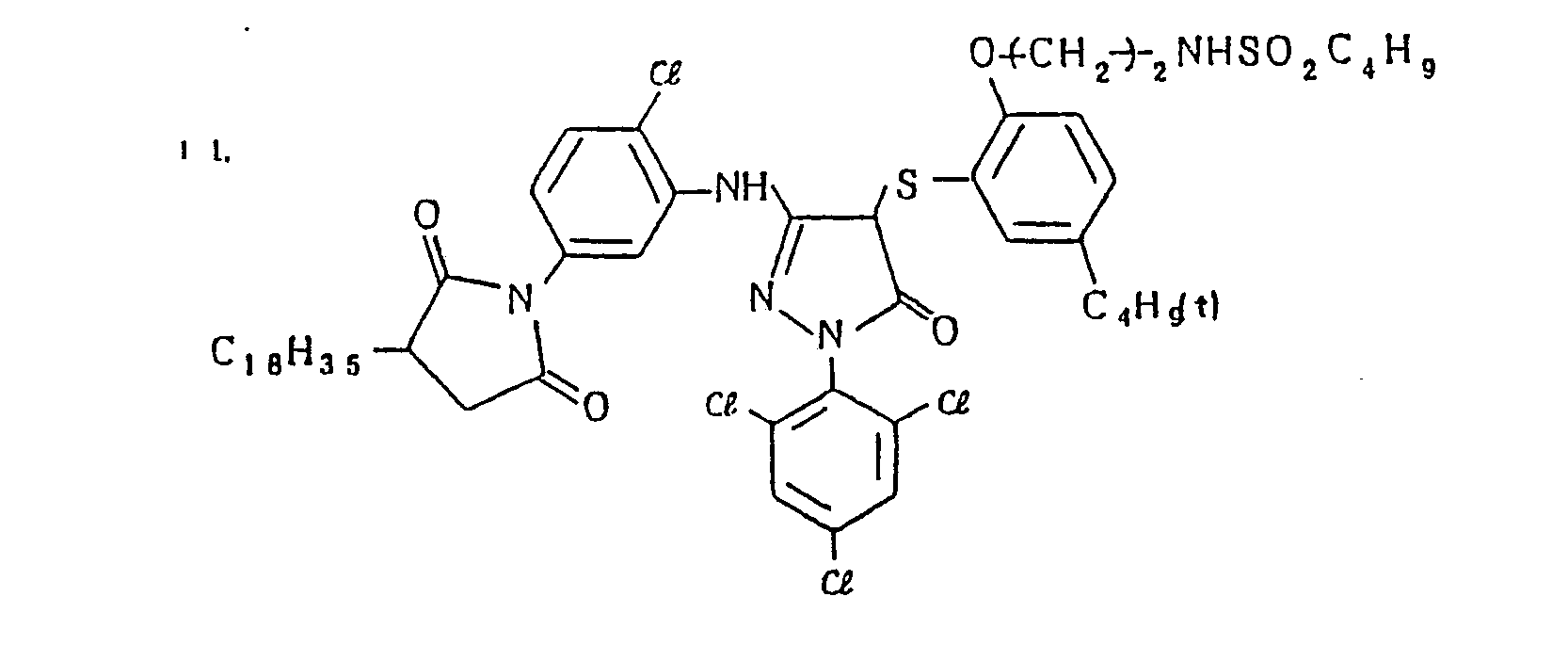


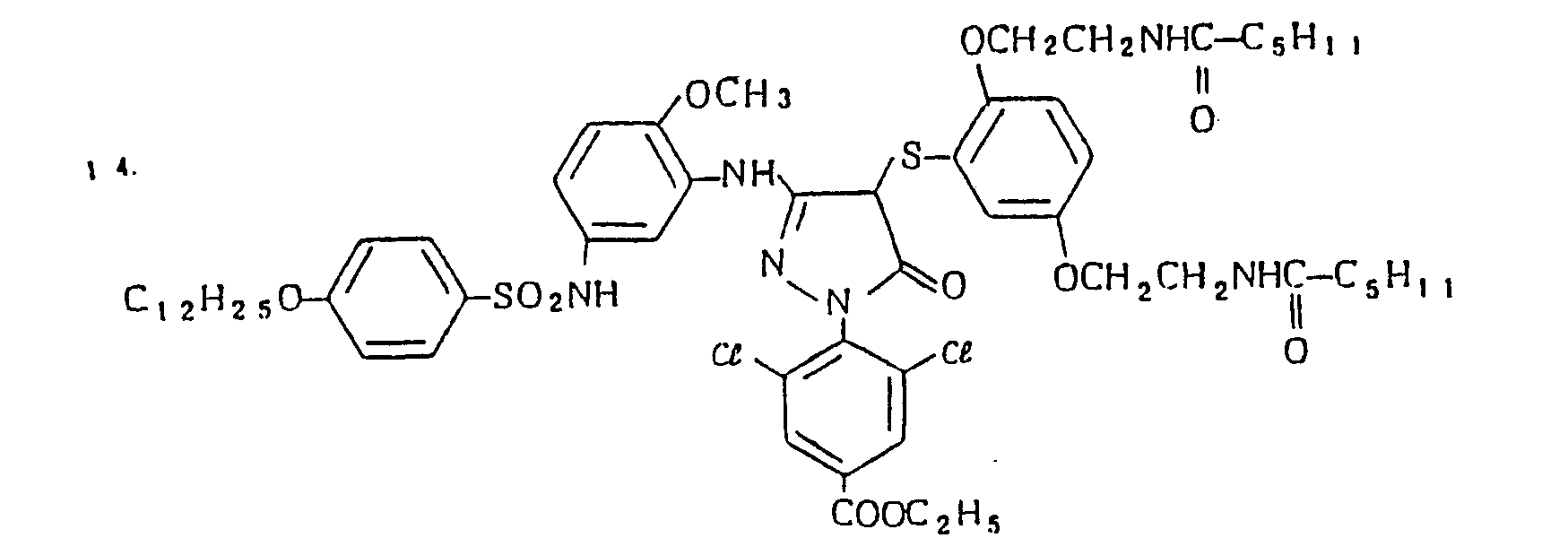

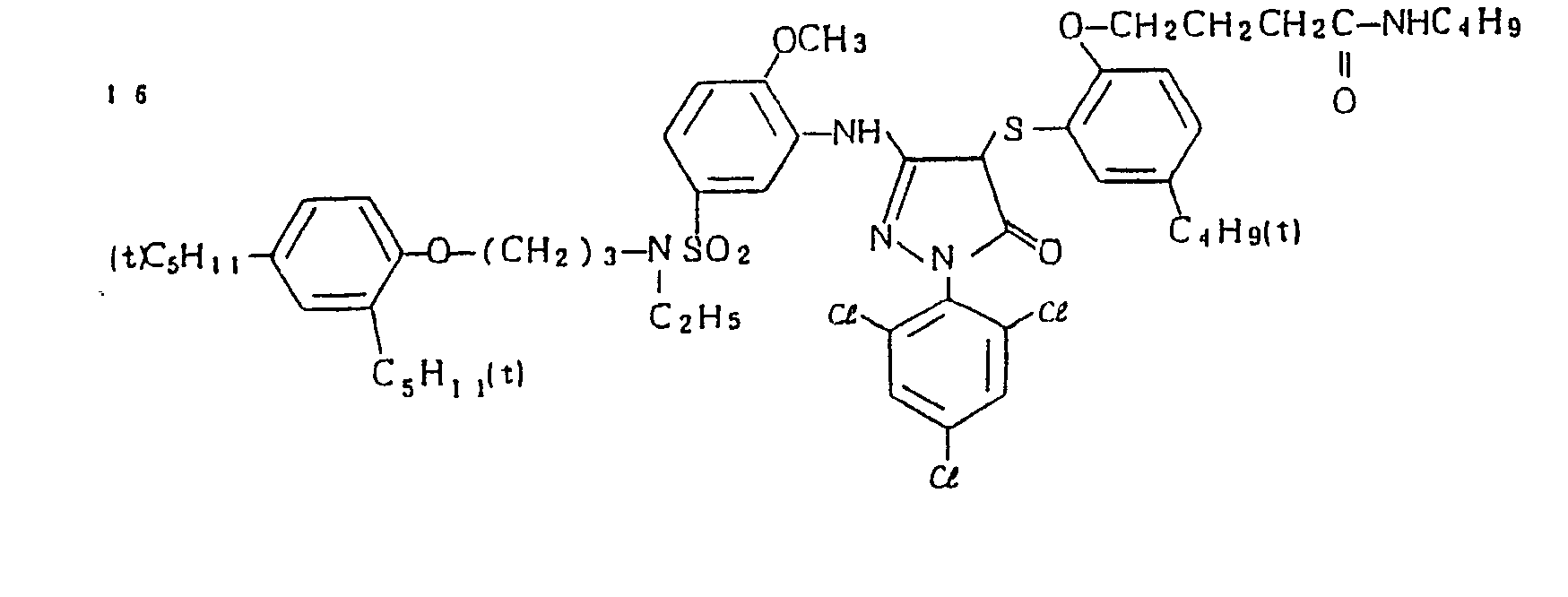


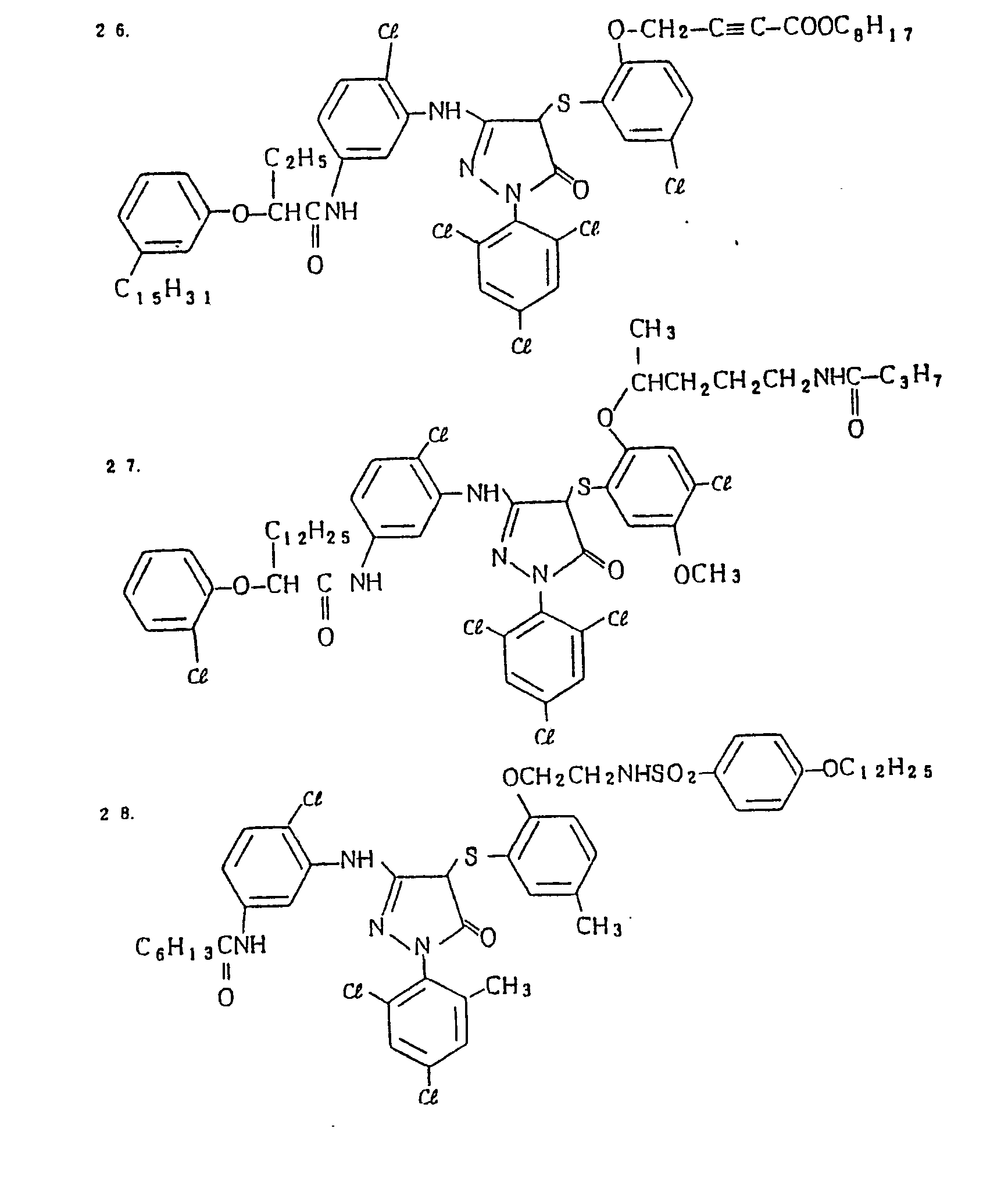


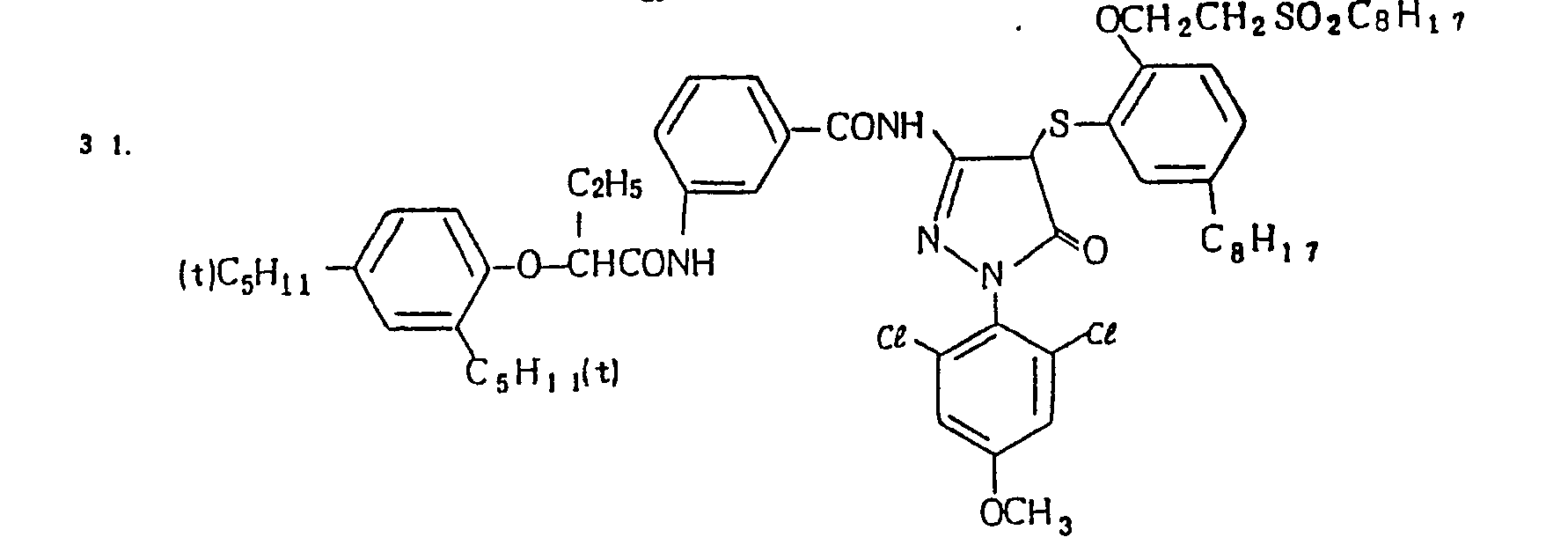

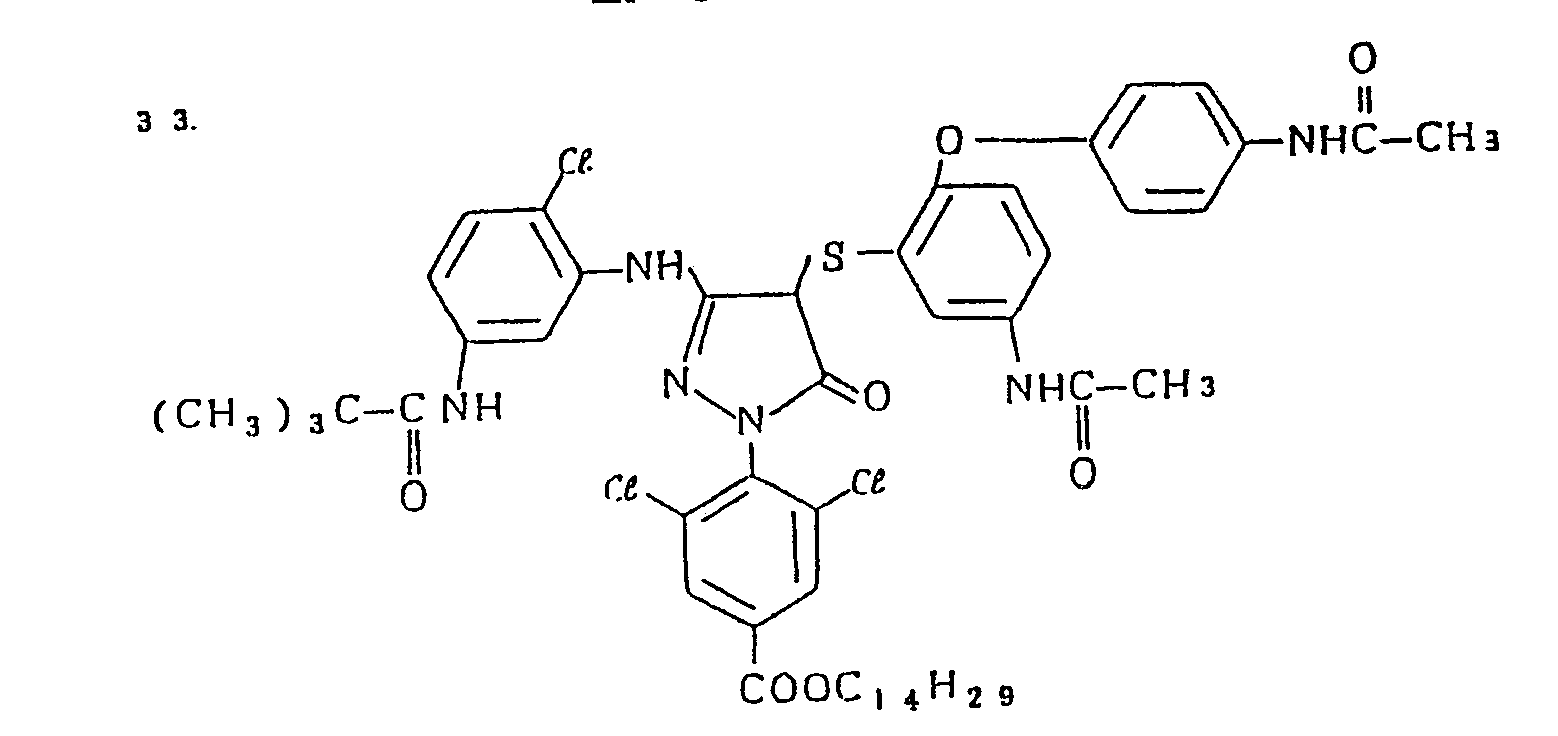

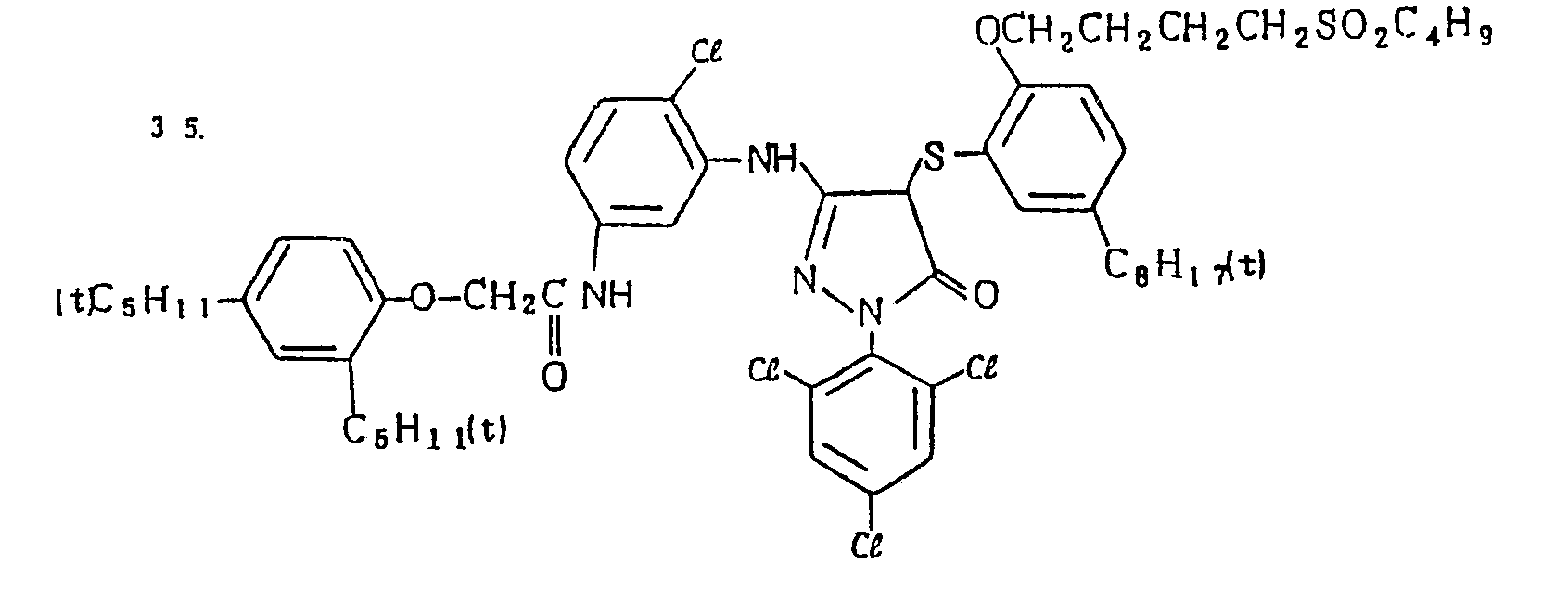


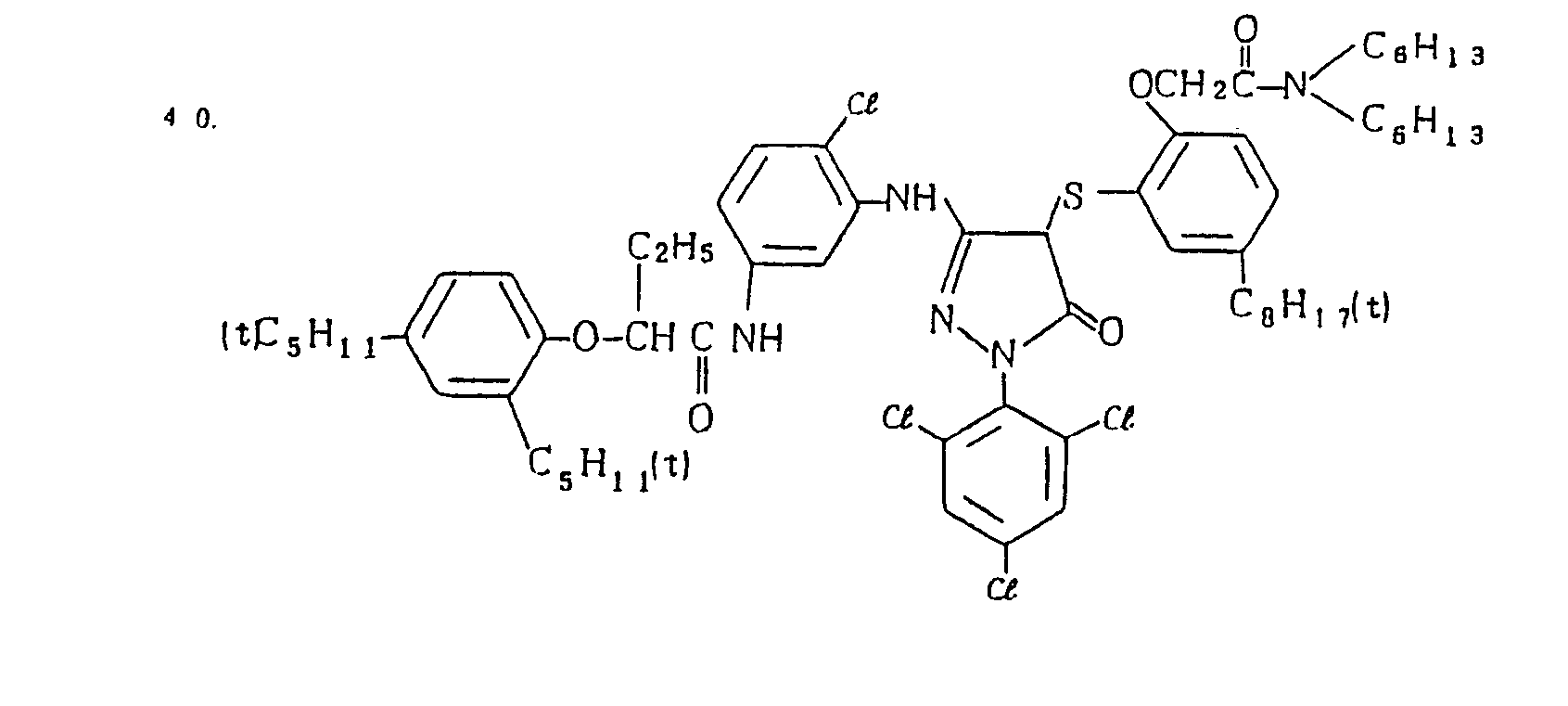


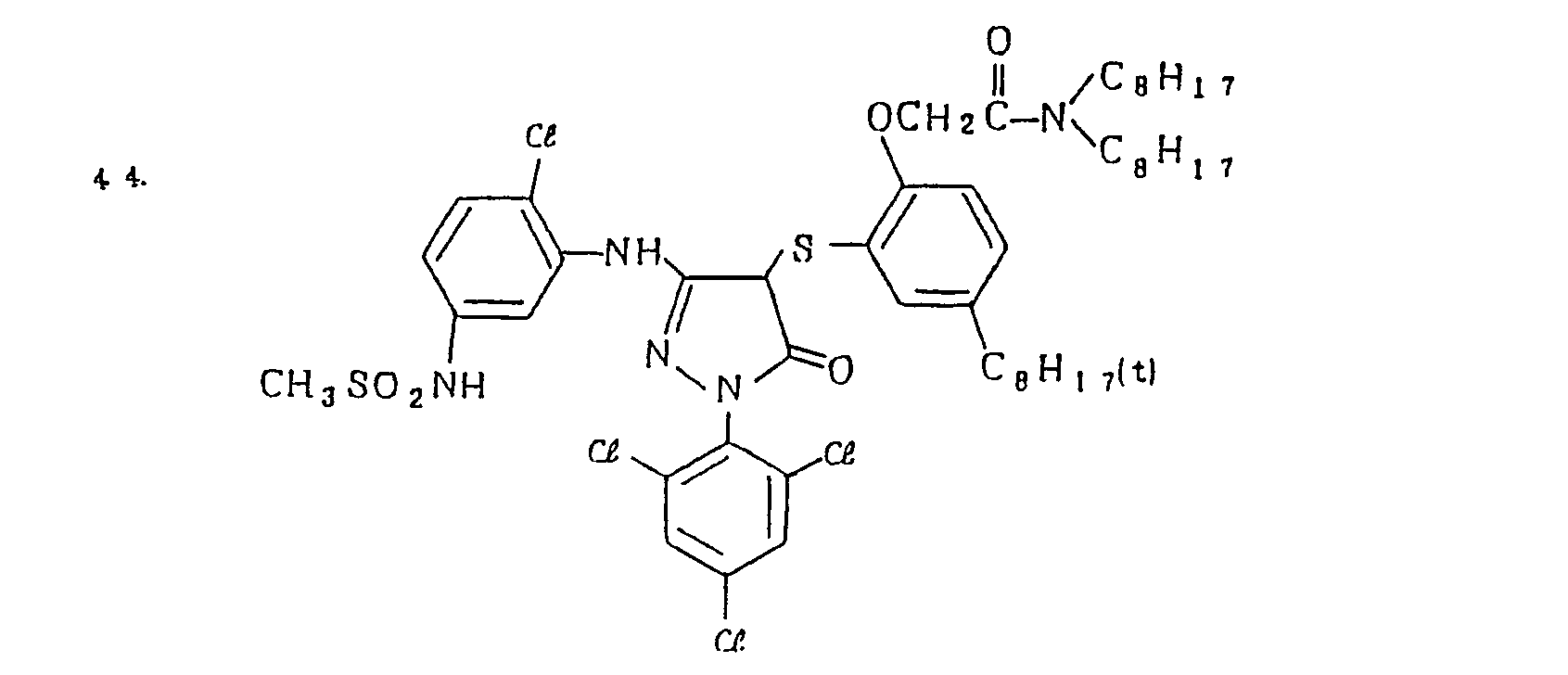


- The magenta couplers used in the material according to the present invention can be synthesized by a combination of the methods as described in Japanese Patent Application (OPI) No. 35858/82 (corresponding to U.S. Patent 4,351,897).
- Specific examples of synthesizing magenta couplers are set forth below.
- Coupler (1) was synthesized along the reaction scheme as illustrated below.

- 206 g (1 mol) of tert-octylphenol, 276 g (2 mol) of anhydrous potassium carbonate, 60 ml of polyethylene glycol 400 were added to 600 ml of acetonitrile and the mixture was heated to 50°C with stirring. 213.8 g (1.5 mol) of 2-methanesulfonylethyl chloride (synthesized from 2-methanesulfonylethanol and thionyl chloride using a known method as illustrated in the reaction scheme above) was added dropwise to the mixture over a period of 30 min and the mixture was further refluxed by heating for 5 h. After the completion of the reaction, the reaction mixture was cooled, the inorganic solids were removed by filtration, and the filtrate was concentrated under reduced pressure. The residual oily product thus-obtained was crystallized from 500 ml of a solvent mixture of methanol and water (4:1 by volume) to obtain 217.5 g (yield 69.7%) of Intermediate A as colorless crystals having a melting point of 68 to 71°C.
- 217.5 g of Intermediate A described above was dissolved in 550 ml of methylene chloride and the solution was cooled to 5°C. 61.5 ml of anhydrous chlorosulfonic acid was added dropwise to the mixture and the mixture was stirred while maintaining the reaction temperature at 10°C ± 3°C (the period for the dropwise addition was 1 h). 120 ml of acetonitrile, 300 ml of dimethylacetamide, and 128 ml of phosphorus oxychloride were added in order to the mixture, and the mixture was stirred at 40°C for 1 h. After the completion of the reaction, the reaction mixture was poured into a mixture of 110 ml of concentrated sulfuric acid and 500 g of ice (at 0°C), and stirred while maintaining the temperature below 10°C. 175 g of zinc powder was added to the mixture, divided into several parts, while controlling the temperature below 40°C. After the completion of the addition of all zinc powder, the mixture was heated at a temperature of 70 to 75°C and stirred with heating for 1.5 h. Then, the mixture was cooled, an excess zinc powder was removed by filtration, 1,000 ml of ethyl acetate was added to the reaction mixture for extraction, followed by washing repeatedly with water. The ethyl acetate layer was dried with anhydrous sodium sulfate and, then, the solvent was distilled off. The residual oily product was almost pure Intermediate B (205 g).
- 17.2 g (0.05 mol) of Intermediate B was dissolved in 20 ml of methylene chloride, 4.0 ml (0.05 mol) of sulfonyl chloride was added to the solution whle stirring at room temperature, and the mixture was further stirred for 30 min. The reaction solution was concentrated under reduced pressure to obtain Intermediate C as a red-orange'colored oily product.
- 33.2 g (0.047 mol) of 1-(2,4,6-trichlorophenyl)-3-{2-chloro-5-[a-(2,4-di-tert-amylphenoxy)butyramido]-anilino}-5-pyrazolone was dissolved in 100 ml of dimethylformamide and the solution was heated at 40°C with stirring. The above-described Intermediate C was rapidly added to the solution and the mixture was heated at 50°C for 2 h with stirring. 200 ml of ethyl acetate was added to the mixture, extracted and washed repeatedly with water. The ethyl acetate layer was dried with anhydrous potassium carbonate and concentrated to obtain an oily residue. The oily residue was crystallized from a solvent mixture of hexane and benzene (100 ml:50 ml) to obtain 28 g (yield: 56.9%) of Coupler (1) as colorless crystals having a melting point of 133 to 136°C.
- Elemental Analysis:

- Using the 4-equivalent coupler 1-(2,4,6-trichlorophenyl)-3-(2-chloro-5-tetradecanamidoanilino)-5-pyrazolone and Intermediate C synthesized in Synthesis Example 1, Coupler (2) having a melting point of 162 to 165°C was obtained in a yield of 60.3% in an analogous manner as described in Synthesis Example 1.
- Elemental Analvsis:

- Coupler (25) was synthesized using the reaction scheme as illustrated below.


- 156 g (2.0 mol) of 2-mercaptoethanol was dissolved in 400 ml of methanol, 442.2 ml of a 28% methanol solution of sodium methylate (SM-28) was added to the solution under nitrogen atmosphere and the mixture was heated at 90°C with stirring. 363 g (2.2 mol) of hexyl bromide was added to the mixture and the mixture was stirred at the same temperature for 2 h. The reaction mixture was cooled and acetic acid was added thereto to adjust the mixture to a pH of 5 to 6. 1,000 ml of ethyl acetate was then added, and extraction conducted, followed by washing repeatedly with water. The ethyl acetate layer was dried with anhydrous sodium sulfate and solvent was removed. The oily residue was then distilled under reduced pressure to obtain 282 g (yield: 87.0%) of the fraction having a boiling point of 128 to 132°C/2133 Pa (16 mmHg).
- A mixture of 233 g of Intermediate D described above, 400 ml of ethanol, 400 ml of water and 5 g of Na2WO4.2H20 as catalyst was stirred at room temperature, and 280 g of a 30% aqueous hydrogen peroxide was gradually added dropwise to the mixture. The temperature of the reaction mixture rose to 70°C with the progress of the dropwise addition. The mixture was further reacted at 80°C for 2 h. After cooling, 500 ml of water was added to the mixture, followed by thorough stirring. The crystals thus-deposited were collected by filtration, washed with water and dried. The weight of the crystals after dryng was 215 g (yield: 77.1%).
- 200 g of the crystals thus-obtained were dissolved in a solvent mixture of 100 ml of pyridine and 1,000 ml of benzene and the solution was stirred at room temperature. To the solution 87.6 ml of thionyl chloride was added dropwise and the mixture was heated at 50 to 55°C with stirring. After cooling, 1,500 ml of ethyl acetate was added to the reaction mixture, and the ethyl acetate layer was repeatedly washed with water and a saturated aqueous sodium hydrogen carbonate solution, and dried with anhydrous sodium sulfate. After drying, the solvent was distilled off to obtain 218 g of Intermediate E as an almost pure oily product.
- A mixture of 136 g of tert-octylphenol, 138 g of anhydrous potassium carbonate, 65 ml of polyethylene glycol 400 and 650 ml of acetonitrile was heated at 50°C with stirring. 218 g of Intermediate E described above was gradually added dropwise to the mixture and the mixture was refluxed by heating for 7 h. After cooling, the inorganic substance was removed by filtration. The filtrate was concentrated under reduced pressure to one half of the original volume and cooled with ice. The crystals thus-deposited were collected by filtration and dried to obtain 130 g of Intermediate F as colorless crystals having a melting point of 81 to 82°C.
- 130 g of Intermediate F described above was dissolved in 200 ml of methylene chloride, the solution was cooled at 0°C with stirring to which was added dropwise 30.1 ml of chlorosulfonic acid and the mixture was stirred at 5°C for 1 h. 50 ml of acetonitrile, 150 ml dimethylacetamide and 62.5 ml of phosphorus oxychloride were added in order to the mixture and the mixture was stirred at 40°C for 1 h. After the completion of the reaction, the reaction mixture was poured into a mixture of 48 ml of concentrated sulfuric acid and 200 g of ice and vigorously stirred. 75 g of zinc powder divided into several parts was added to the mixture while maintaining the inner temperature below 10°C. After completion of the addition, the mixture was heated at a temperature of 50 to 60°C for 1.5 h with stirring. Ethyl acetate was added to the reaction mixture and extraction conducted. The ethyl acetate layer was washed with water and concentrated and the residue was crystallized from a mixture of methanol and water (5/1 by volume) to obtain 100 g of Intermediate G having a melting point of 52 to 53°C.
- In an analogous manner to that described in Synthesis Example 1,21.7 g of Intermediate G described above was transferred into sulfenyl chloride, and was then reacted with 30.7 g of 1-(2,4,6-trichlorophenyl)-3-(2-chloro-5-tetradecanamidoanilino)-5-pyrazolone to obtain 28 g of Coupler (25) having a melting point of 155 to 157°C.
- Elemental Analysis:

- 20 g of 2-(2-methanesulfonamidoethyloxy)-5-tert-octylthiophenol (having a melting point of 79 to 80°C) synthesized by the same method as described in Synthesis Example 1 or 3, which corresponds to a splitting-off group, was dissolved in 30 ml of methylene chloride, and 4.48 ml of sulfonyl chloride was added to the solution while stirring at room temperature, after which the mixture was stirred further for 30 min. The red-orange colored oily product obtained by removing the solvent was added to 150 ml of a dimethylformamide solution containing 32.6 g of 1-(2,4,6-trichlorophenyl)-3-(2-chloro-5-tetradecanamido- anilino)-5-pyrazolone, and the mixture was heated at 50°C for 2 h with stirring. After the completion of the reaction, the reaction mixture was extracted with ethyl acetate, washed with water, concentrated and crystallized from a solvent mixture of hexane and ethyl acetate (5:1 by volume) to obtain 10 g of Coupler (34) having a melting point of 113 to 116°C.
- Elemental Analysis:

- Other representative couplers used in the material according to the present invention were synthesized in an analogous manner to that described in Synthesis Examples 1 to 4. The melting points thereof are set forth below.

- Conventional couplers which can be employed in the present invention in addition to the couplers used in the material according to the present invention include dye forming couplers as described below, that is, compounds capable of color forming upon oxidative coupling with an aromatic primary amine developing agent (e.g., phenylenediamine derivatives or aminophenol derivatives) in color development processing. More specifically, suitable examples of magenta couplers which can be used include conventional 5-pyrazolone couplers, pyrazolobenzimidazole couplers, cyanoacetylcumarone couplers and open-chain acylacetonitrile couplers. Suitable examples of yellow color image-forming couplers ("yellow couplers") which can be used include acylacetamide couplers (e.g., benzoylacetanilides pivaloylacetanilides). Suitable examples of cyan color image-forming couplers ("cyan couplers") which can be used include naphthol couplers and phenol couplers. Among these couplers, those which are non-diffusible by means of containing a hydrophobic group referred to as a ballast group in the molecule thereof, or polymeric couplers, are preferably employed. These couplers may be either 4-equivalent or 2-equivalent per silver ion. Further, colored couplers having a color correction effect, or couplers capable of releasing a development inhibitor with the advance of development (the so-called DIR couplers) can be employed.
- Furthermore, non-color forming DIR coupling compounds which can provide colorless products upon coupling reaction and release development inhibitors can be employed other than DIR couplers.
- Two or more kinds of the above-described couplers can be incorporated together in the same layer for the purpose of satisfying characteristics required to the light-sensitive material, or the same coupler compound may be added to two or more layers, depending upon the particular characteristics desired.
- In order to incorporate the coupler into a silver halide emulsion layer, known methods, e.g. the method as described in U.S. Patent 2,322,027, can be employed. Specifically, the coupler is dissolved in an organic solvent having a high boiling point (more than 150°C), for example, phthalic acid alkyl esters (e.g., dibutyl phthalate or dioctyl phthalate, phosphoric acid esters (e.g., diphenyl phosphate, triphenyl phosphate, tricresyl phosphate or dioctylbutyl phosphate), citric acid esters (e.g., tributyl acetylcitrate), benzoic acid esters (e.g., octylbenzoate), alkylamides (e.g., diethyllaurylamide), fatty acid esters (e.g., dibutoxyethyl succinate or diethyl azelate), or trimesic acid esters (e.g., tributyl trimesate), or in an organic solvent having a low boiling point of 30°C to 150°C, for example, lower alkyl acetates (e.g., ethyl acetate or butyl acetate), ethyl propionate, secondary butyl alcohol, methyl isobutyl ketone, (3-ethoxyethyl acetate or methyl cellosolve acetate, and then the solution is dispersed into a hydrophilic colloid. The above-described organic solvents having a high boiling point and above-described organic solvents having a low boiling point may be used together as mixtures.
- Furthermore, dispersing methods utilizing a polymeric material, e.g., as described in Japanese Patent Publication No. 39853/76 and Japanese Patent Application (OPI) No. 59943/76 can also be employed.
- When the coupler contains an acid group such as a carboxylic acid group or a sulfonic acid group, it is incorporated into a hydrophilic colloid in the form of an alkaline aqueous solution.
- It is advantageous to select photographic color couplers to be used so as to provide images of medium scale. It is preferred that cyan dyes formed from cyan couplers exhibit their maximum absorption bands in the wavelength range from 600 nm to 720 nm, magenta dyes formed from magenta couplers exhibit their maximum absorption bands in the wavelength range from 500 nm to 580 nm, and yellow dyes formed from yellow couplers exhibit their maximum absorption bands in the wavelength range from 400 nm to 480 nm.
- The light-sensitive material prepared using the present invention may contain, as a color fog preventing agent, hydroquinone derivatives, aminophenol derivatives, gallic acid derivatives or ascorbic acid derivatives. Specific examples of the color fog preventing agent which can be used include those described in U.S. Patents 2,360,290, 2,336,327, 2,403,721, 2,418,613, 2,675,314, 2,701,197, 2,704,713, 2,728,659, 2,732,300 and 2,735,765, Japanese Patent Application (OPI) Nos. 92988/75, 92989/75, 93928/75, 110337/75 and 146235/77 and Japanese Patent Publication No. 23813/75. Further, in the photographic light-sensitive material containing the couplers the color fog preventing agents as described in Japanese Patent Application (OPI) Nos. 102231/83 and 105147/83, Japanese Patent Application (OPI) No. 126530/83 and Japanese Patent Application No. 92082/83 (corresponding to U.S. Patent Application Serial No. 614,091, filed on May 25, 1984 and European Patent Application No. 84 106 000.7, filed on May 25, 1984) are particularly effectively used.
- The light-sensitive material of the present invention may contain an ultraviolet ray absorbing agent in a hydrophilic colloid layer thereof. Suitable examples of such an ultraviolet ray absorbing agent include benzotriazole compounds substituted with an aryl group (e.g., those described in U.S. Patent 3,533,794) 4-thiazolidone compounds (e.g., those described in U.S. Patents 3,314,794 and 3,352,681), benzophenone compounds (e.g., those described in Japanese Patent Application (OPI) No. 2784/71), cinnamic acid ester compounds (e.g., those described in U.S. Patents 3,705,805 and 3,707,375), butadiene compounds (e.g., those described in U.S. Patent 4,045,229) or benzoxazole compounds (e.g., those described in U.S. Patent 3,700,455). In addition, those described in U.S. Patent 3,499,762 and those described in Japanese Patent Application (OPI) No. 48535/79 can also be employed. Further, couplers which have ultraviolet ray absorbing abilities (e.g., a-naphthol type cyan dye forming couplers), and polymers which have ultraviolet ray absorbing abilities may be employed. These ultraviolet ray absorbing agents may be mordanted in a specific layer(s).
- The light-sensitive material of the present invention may contian a water-soluble dye in a hydrophilic colloid layer thereof as a filter dye or for the purpose of preventing irradiation or other various purposes. Suitable examples of such a dye include oxonol dyes, hemioxonol dyes, styryl dyes, merocyanine dyes, cyanine dyes and azo dyes. Of these dyes, oxonol dyes, hemioxonol dyes and merocyanine dyes are useful. Specific examples of the dye which can be used include those described in British Patents 584,609 and 1,177,429, Japanese Patent Application (OPI) Nos. 85130/73, 99620/74, 114420/74 and 108115/77, U.S. Patents 2,274,782, 2,533,472, 2,956,879, 3,148,187, 3,177,078, 3,247,127, 3,540,887, 3,575,704, 3,653,905, 3,718,472, 4,071,312 and 4,070,352.
- The photographic emulsion which can be used in the present invention may be spectrally sensitized with methine dyes or other dyes. Suitable dyes which can be used include cyanine dyes, merocyanine dyes, complex cyanine dyes, complex merocyanine dyes, holopolar cyanine dyes, hemicyanine dyes, styryl dyes and hemioxonol dyes. Of these dyes, especially useful dyes are those belonging to cyanine dyes, merocyanine dyes or complex merocyanine dyes. Any nucleus which is conventionally used in cyanine dyes as a basic heterocyclic nucleus is applicable to those dyes. That is, a pyrroline nucleus, an oxazoline nucleus, a thiazoline nucleus, a pyrrole nucleus, an oxazole nucleus, a thiazole nucleus, a selenazole nucleus, an imidazole nucleus, a tetrazole nucleus or a pyridine nucleus, and further, nuclei formed by condensing alicyclic hydrocarbon rings with these nuclei and nuclei formed by condensing aromatic hydrocarbon rings with these nuclei, that is, an indolenine nucleus, a benzindolenine nucleus, an indole nucleus, a benzoxazole nucleus, a naphthoxazole nucleus, a benzothiazole nucleus, a naphthothiazole nucleus, a benzoselenazole nucleus, a benzimidazole nucleus or a quinoline nucleus, are appropriate. The carbon atoms of these nuclei can also be substituted.
- The merocyanine dyes and the complex merocyanine dyes can contain 5- or 6-membered heterocyclic nuclei such as a pyrazolin-5-one nucleus, a thiohydantoin nucleus, a 2-thioxazolidin-2,4-dione nucleus, a thiazolidin-2,4-dione nucleus, a rhodanine nucleus or a thiobarbituric acid nucleus, as a nucleus having a ketomethylene structure.
- Specific examples of useful sensitizing dyes include those decribed in German Patent 929,080, U.S. Patents 2,231,658, 2,493,748, 2,503,776, 2,519,001, 2,912,329, 3,656,959, 3,672,897, 3,694,217, 4,025,349 and 4,046,572, British Patent 1,242,588, Japanese Patent Publication Nos. 14030/69 and 24844/77.
- The sensitizing dyes can be employed individually or in combination. Combinations of sensitizing dyes are often employed for the purpose of supersensitization. Typical examples of supersensitizing combinations are described in U.S. Patents 2,688,545, 2,977,229, 3,397,060, 3,522,052, 3,527,641, 3,617,293, 3,628,964, 3,666,480, 3,672,898, 3,679,428, 3,703,377, 3,769,301, 3,814,609, 3,837,862 and 4,026,707, British Patents 1,344,281 and 1,507,803, Japanese Patent Publication Nos. 4936/68 and 12375/78, Japanese Patent Application (OPI) Nos. 110618n7 and 109925/77.
- The sensitizing dye can be used in the emulsion together with dyes which themselves do not have a spectrally sensitizing function but exhibit a supersensitizing effect, or materials which do not substantially absorb visible light but exhibit a supersensitizing effect. For example, aminostilbene compounds substituted with a nitrogen-containing heterocyclic group (e.g., those described in U.S. Patents 2,933,390 and 3,635,721), aromatic organic acid-formaldehyde condensates (e.g, those described in U.S. Patent 3,743,510), cadmium salts or azaindene compounds, can be used. Particularly useful combinations are those disclosed in U.S. Patents 3,615,613, 3,615,641, 3,617,295 and 3,635,721.
- Photographic processing of the light-sensitive material according to the present invention can be carried out using any of known methods. Further, known processing solutions can be used. The processing temperature is generally selected from a range of 18°C to 50°C, but temperatures lower than 18°C or higher than 50°C may be employed. Either a development processing for forming silver images (black-and-white photographic processing) or a color photographic processing comprising a development processing for forming dye images may be employed depending upon the purpose.
- A color developing solution is generally an alkaline aqueous solution containing a color developing agent. As a color developing agent, known primary aromatic amine developing agents such as phenylenediamines (e.g., 4-amino-N,N-diethylaniline, 3-methyl-4-amino-N,N-diethylaniline, 4-amino-N-ethyl-N-α-hydroxyethylaniline, 3-methyl-4-amino-N-ethyl-N-(3-hydroxyethylaniline, 3-methyl-4-amino-N-ethyl-β-methanesulfonamidoethylaniline or 4-amino-3-methyl-N-ethyl-N-β-methoxyethylaniline) can be used.
- In addition, those described in L. F. A. Mason, Photographic Processing Chemistry, pages 226 to 229, Focal Press (1966), U.S. Patents 2,193,015 and 2,592,364, Japanese Patent Application (OPI) No. 64933/73, can be used.
- The color developing solution can also contain pH buffering agents such as sulfites, carbonates, borates or phosphates of alkali metals; development restrainers or antifogging agents such as bromides, iodides or organic antifogging agents. In addition, if desired, the color developing solution may contain water softeners; preservatives such as hydroxyamine; organic solvents such as benzyl alcohol or diethylene glycol; development accelerators such as polyethylene glycol, quaternary ammonium salts or amines; dye forming couplers; competing couplers; fogging agents such as sodium borohydride; auxiliary developing agents such as 1-phenyl-3-pyrazolidone; viscosity imparting agents; chelating agents of polycarboxylic acid type as described in U.S. Patent 4,083,723; antioxidants as described in West German Patent Application (OLS) No. 2,622,950.
- After color development, the photographic emulsion layers are generally subjected to a bleach processing. Bleach processing can be carried out simultaneously with fixing or separately therefrom. Suitable examples of the bleaching agents which can be used include compounds of polyvalent metals such as iron (111), cobalt (III), chromium (IV) or copper (II), peracids, quinones or nitroso compounds. Specific examples include ferricyanides; bichromates; organic complex salts of iron (III) or cobalt (III) with aminopolycarboxylic acids such as ethylenediaminetetraacetic acid, nitrilotriacetic acid or 1,3-diamino-2-propanol-tetraacetic acid, or organic acids such as citric acid, tartaric acid or malic acid; persulfates; permanganates; or nitrosophenol. Of these compounds, potassium ferricyanide, sodium ethylenediaminetetraacetato iron (III) and ammonium ethylenediaminetetraacetato iron (III) are particularly useful. Ethylenediaminetetraacetato iron (III) complex salts are useful both in a bleaching solution and in a mono- bath bleach-fixing solution.
- To a bleaching solution of a bleach-fixing solution, bleaching accelerators as described in U.S. Patents 3,042,520, and 3,241,966. Japanese Patent Publication Nos. 8506/70 and 8836/70; thiol compounds as described in Japanese Patent Application (OPI) No. 65732/78, and other various additives can be added.
- The silver halide emulsion used in the present invention is prepared generally by mixing a solution of a water-soluble silver salt (e.g., silver nitrate) with a solution of a water-soluble halide (e.g., potassium bromide) in the presence of a solution of a water-soluble polymer (e.g., gelatin). Silver halide which can be used includes does not only silver chloride and silver bromide, but also mixed silver halide such as silver chlorobromide, silver iodobromide or silver chloroiodobromide. A mean grain size of sivler halide grains produced (the grain size refers to the diameter of a grain when it is spherical or similar spherical in the shape, or the edge length when it is cubic, and the mean grain size is determined on the basis of the projected areas) is preferably 2 µm or less, and more preferably 0.4 µm or less. The distribution of the grain size can be either narrow or broad.
- Further, for the purpose of preventing contamination of developing solution or accelerating development, substantially light-insensitive fine grain silver halide emulsion may be incorporated into a light-sensitive layer, an intermediate layer or a protective layer.
- These silver halide grains may have a crystal form of cube, a crystal form of an octahedron or a composite form thereof.
- Further, a silver halide emulsion in which at least 50% of the total projected area of the silver halide grains is tabular silver halide grains (for example, tabular silver halide grains having a length-to-thickness ratio of 5 or more and preferably 8 or more) may be employed.
- Also, two or more silver halide photographic emulsions which are produced separately may be used in the form of mixture. Further, silver halide grains having a uniform crystal structure, silver halide grains in which the inner portion and the outer portion have different layer structures, or silver halide grains of the so-called conversion type as described in British Patent 635,841, U.S. Patent 3,622,318, may be employed. Moreover, either silver halide grains in which a latent image is predominantly formed at the surface thereof or grains in which a latent image is predominantly formed inner portion thereof can be used. Such photographic emulsions are described in C. E. K. Mees, The Theory of the Photographic Process, Macmillan Co., P. Glafkides, Chimie Photographique, Paul Montel Co. (1957). These photographic emulsions can be prepared using the methods as described, e.g. in P. Glafkides, Chimie et Physique Photographique, Paul Montel Co. (1967), G. F. Duffin, Photographic Emulsion Chemistry, The Focal Press (1966), V. L. Zelikman et al., Making and Coating Photographic Emulsion, The Focal Press (1966). Namely, any of an acidic process, a neutral process, or an ammonia process, may be used for the preparation of the photographic emulsions. Suitable methods for reacting a water-soluble silver salt with a water-soluble halide include, e.g. a single jet method, a double jet method, or a combination thereof.
- Also, a method in which silver halide grains are formed in the presence of an excess of silver ions (the so-called reversal mixing method) can be employed in the present invention. Further, the so-called controlled double jet method, in which the pAg in a liquid phase wherein silver halide grains are formed is maintained at a constant value, may be also employed. According to this method, a silver halide emulsion having a regular crystal form and substantially uniform grain sizes can be obtained.
- A mixture of two or more kinds of silver halide emulsions prepared separately may be employed.
- In a process of forming silver halide grains and physical ripening thereof, cadmium salts, zinc salts, lead salts, thallium salts, iridium salts or complex salts thereof, rhodium salts or complex salts thereof or iron salts or complex salts thereof, may be present.
- Removal of the soluble salts from the silver halide emulsion is, in general, carried out after the formation of the silver halide grains or after physical ripening. The removal can be effected using the noodle washing method which has been known from old times and comprises gelling the gelatin, or using a flocculation process using a polyvalent anion-containing inorganic salt (e.g., sodium sulfate), an anionic surface active agent, an anionic polymer (e.g., polystyrenesulfonic acid), or a gelatin derivative (e.g., an aliphatic acylated gelatin, an aromatic acylated gelatin or an aromatic carbamoylated gelatin). The removal of the soluble salts from the silver halide emulsion may be omitted.
- The silver halide emulsion used in the present invention can be the so-called primitive emulsion without application of chemical sensitization. However, it is usually chemically sensitized. Chemical sensitization can be carried out using the methods as described in P. Glafkides, supra, V. L. Zelikman et al., supra, or H. Frieser, Die Grundlagen der Photographischen Prozesse mit Silberhalogeniden, Akademische Verlagsgesellschaft (1968).
- The photographic emulsion layers and other hydrophilic colloid layers which constitute the light-sensitive material according to the present invention may contain various kinds of surface active agents as coating aids or for other various purposes, for example, prevention of charging improvement of slipping property, emulsifying dispersion, prevention of adhesion or improvement of photographic characteristics (e.g., acceleration of development, high contrast or sensitization.
- Examples of suitable surface active agents include nonionic surface active agents, for example, saponin (steroid type), alkylene oxide derivatives (e.g., polyethyelne glycol, polyethylene gIyαoIIpoIy- propyleneglycol condensates, polyethylene glycol alkyl ethers or polyethylene glycol alkylaryl ethers, polyethylene glycol esters, polyethylene glycol sorbitan esters, polyalkylene glycol alkylamines or amides or polyethylene oxide adducts of silicones), glycidol derivatives (e.g., alkenylsuccinic acid polyglycerides or alkylphenol polyglycerides), fatty acid esters of polyhydric alcohols or alkyl esters of sugar; anionic surface active agents containing acidic groups such as a carboxy group, a sulfo group, a phospho group, a sulfuric acid ester group or a phosphoric acid group, for example, alkylcarboxylates, alkylsulfonates, alkylbenzenesulfonates, alkylnaphthalenesulfonates, alkylsulfuric acid esters, alkylphosphoric acid esters, N-acyl-N-alkyltaurines, sulfosuccinic acid esters, sulfoalkyl-polyoxyethylene alkylphenyl ethers or polyoxyethylene alkylphosphoric acid esters; amphoteric surface active agents, for example, amino acids, aminoalkylsulfonic acids, aminoalkylsulfuric acid esters, aminoalkylphosphoric acid esters, alkylbetaines or amine oxides; and cationic surface active agents, for example, alkylamine salts, aliphatic or aromatic quaternary ammonium salts, heterocyclic quaternary ammonium salts (e.g., pyridinium or imidazolium), aliphatic or heterocyclic phosphonium or sulfonium salts.
- The present invention will be explained in greater detail with reference to the following examples.
- 0.008 mol of Magenta Coupler (1) was dissolved in a mixture of 20 ml of tricresyl phosphate and 20 ml of ethyl acetate. The resulting solution was added to a 10% aqueous gelatin solution containing 0.4 g of sodium dodecylbenzenesulfonate, and the mixture was stirred and dispersed by means of a homogenizer rotating at a high speed to prepare a dispersion. The dispersion thus-prepared was mixed with 150 g of a silver chlorobromide emulsion (containing 8.8 g of silver, and having a bromide content of 50 mol%), and sodium dodecylbenzenesulfonate was added thereto as a coating aid and 2-oxy-4,6-dichloro-s-triazine as a hardener. The mixture was coated on a paper support both surfaces of which were laminated with polyethylene at a silver coated amount of 0.165 g/m2 to form an emulsion layer. Further, a gelatin protective layer was coated on the emulsion layer to prepare Sample 1.
- Samples 2 to 5 were prepared in the same manner as described in Sample 1 except using Magenta Couplers (2), (4), (7) and (25) instead of Magenta Coupler (1), respectively. Furthermore, for comparison, Samples 6 to 8 were prepared in the same manner as described in Sample 1 except using Magenta Couplers (A), (B) and (C) which are comparative couplers instead of Magenta Coupler (1), respectively.
-

-

-
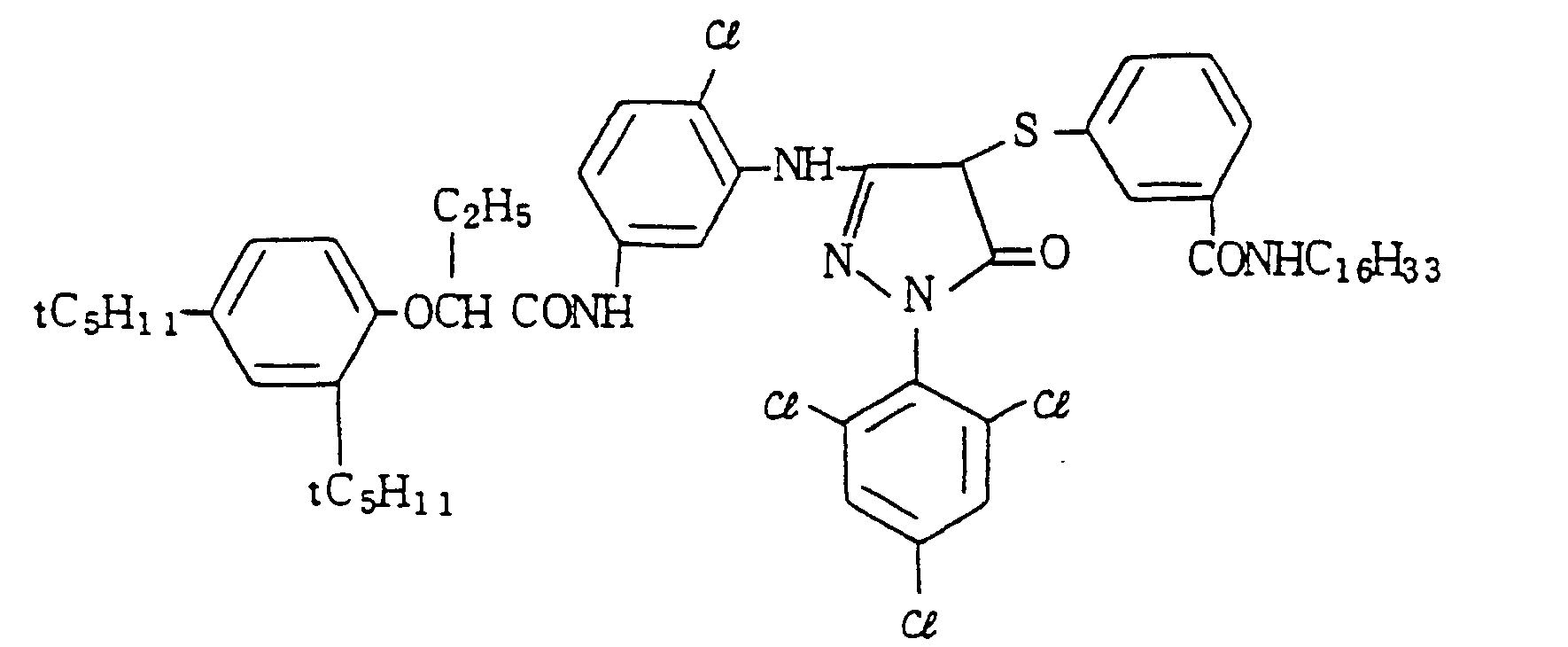

- Two kinds of color developing solutions illustrated below were employed.
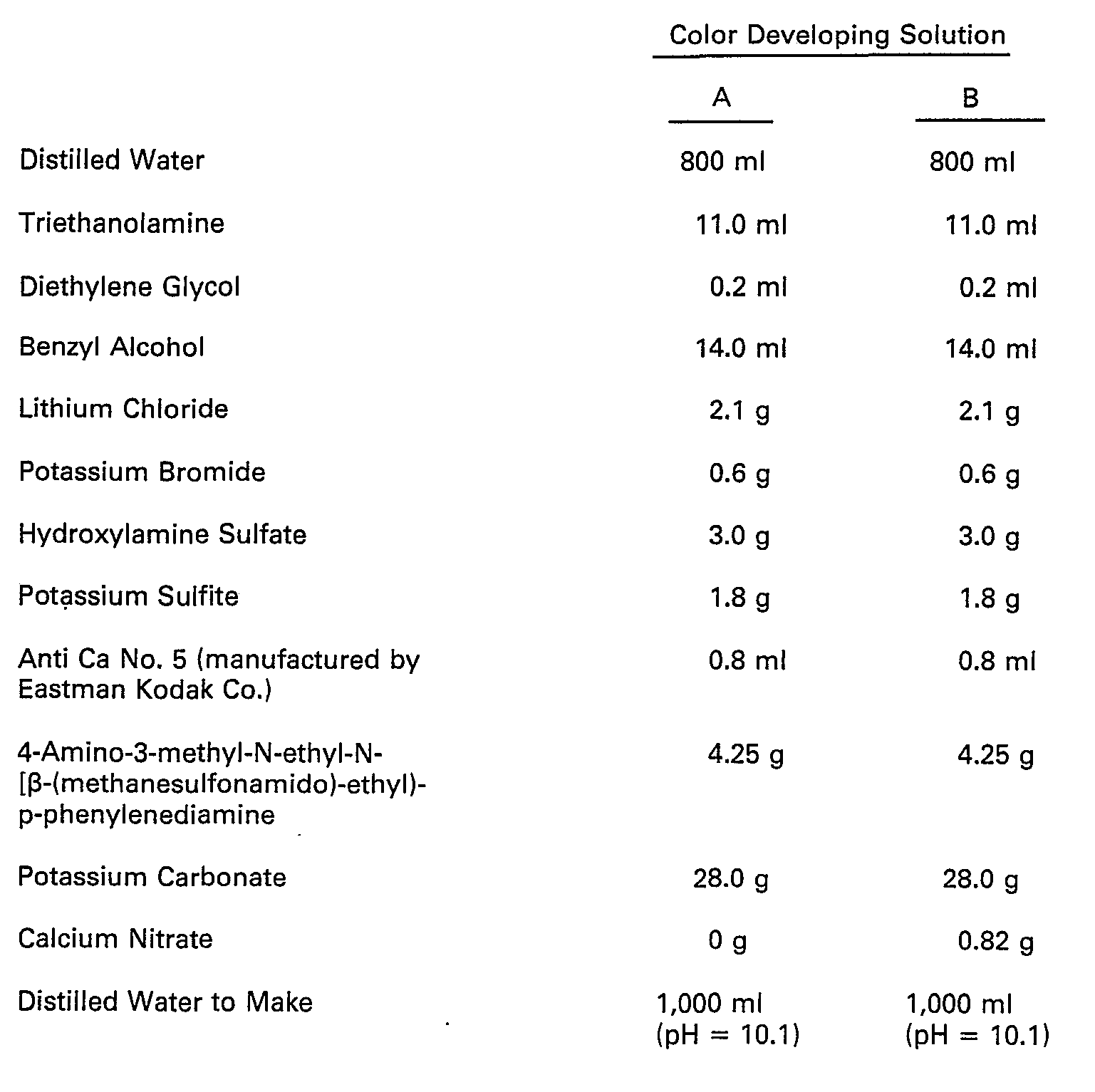
- The composition of the bleach-fixing solution were as follows.
-

- The green-light reflective densities of the magenta dye images thus-obtained were measured and the maximum densities (Dmax) were determined. The results are shown in Table 1 below.

- It is apparent from the results shown in Table 1 above that Samples 1 to 5 containing the magenta couplers used in the material according to the present invention exhibit the same color forming properties both with Color Developing Solution A which does not containing calcium nitrate and with Color Developing Solution B containing calcium nitrate. On the contrary, it is recognized that the color forming properties of Samples 6 to 8 containing the comparative magenta couplers are remarkably decreased when they are processed in Color Developing Solution B.
- On a paper support both surfaces of which were laminated with polyethylene were coated a first layer to a sixth layer as shown in Table 2 below to prepare Sample 9. In Table 2 below the coating amounts are set forth in mg/m 2.

- A coating solution for the first layer was prepared in the following manner. That is, 100 g of the yellow coupler shown in Table 2 above was dissolved in a mixture of 50 ml of dibutyl phthalate and 100 ml of ethyl acetate. The resulting solution was dispersed in 800 g of a 10% aqueous gelatin solution containing 80 ml of a 1% aqueous solution of sodium dodecylbenzenesulfonate. The dispersion thus-prepared was mixed with 2.9 kg of a blue-sensitive silver chlorobromide emulsion (containing 133 g of silver and having a bromide content of 80 mol%) to prepare the coating solution. Coating solutions for other layers were prepared in the same manner as described for the first layer. As a hardener, sodium 2-oxy-4,6-dichloro-s-triazine was used in each layer.
- Further, Samples 10 to 16 were prepared in the same manner as described in Sample 9 except that, in the third layer, the amount of silver coated was changed to 165 mg/m2 and the kind of the magenta coupler and the coupler coated amount were changed as shown in Table 3 below.
- These samples were exposed stepwise using a green filter, SP-2 (manufactured by Fuji Photo Film Co., Ltd.) and then subjected to the same processing as described in Example 1 (using Color Developing Solutions A and B). The green-light reflective densities of the magenta dye images thus-obtained were measured and the maximum densities (Dmax) were determined. The results are shown in Table 3 below.


- It is apparent from the results shown in Table 3 above that Samples 10 to 13 containing the magenta couplers of the material according to the present invention exhibit excellent color forming properties in comparison with Sample 9 containing the comparative 4-equivalent Magenta Coupler (D) in spite of reducing the coated amount of silver in Samples 10 to 13 to one half of that in Sample 9. Further, it is also apparent that the decrease in color forming properties is not observed in Samples 10 to 13 in comparison with Samples 14 to 16 containing the comparative arylthio-releasing type 2-equivalent Magenta Couplers (A), (B) and (C), respectively, even when they are processed using Color Developing Solution B containing calcium nitrate.
- Furthermore, the samples processed in the same manner as described above using Color Developing Solution A were subjected to a fading test for 5 days using a xenon fading tester (200,000 lux). The results obtained are shown in Table 4 below.

- It is apparent from the results shown in Table 4 above that Samples 10 to 13 containing the magenta couplers of the material according to the present invention have an excellent light-fastness in that the decrease in the magenta color density and the yellow coloration of the white background due to the xenon irradiation are small in comparison with Samples 9 and 14 to 16 containing the comparative couplers.
Claims (14)
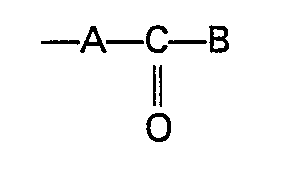


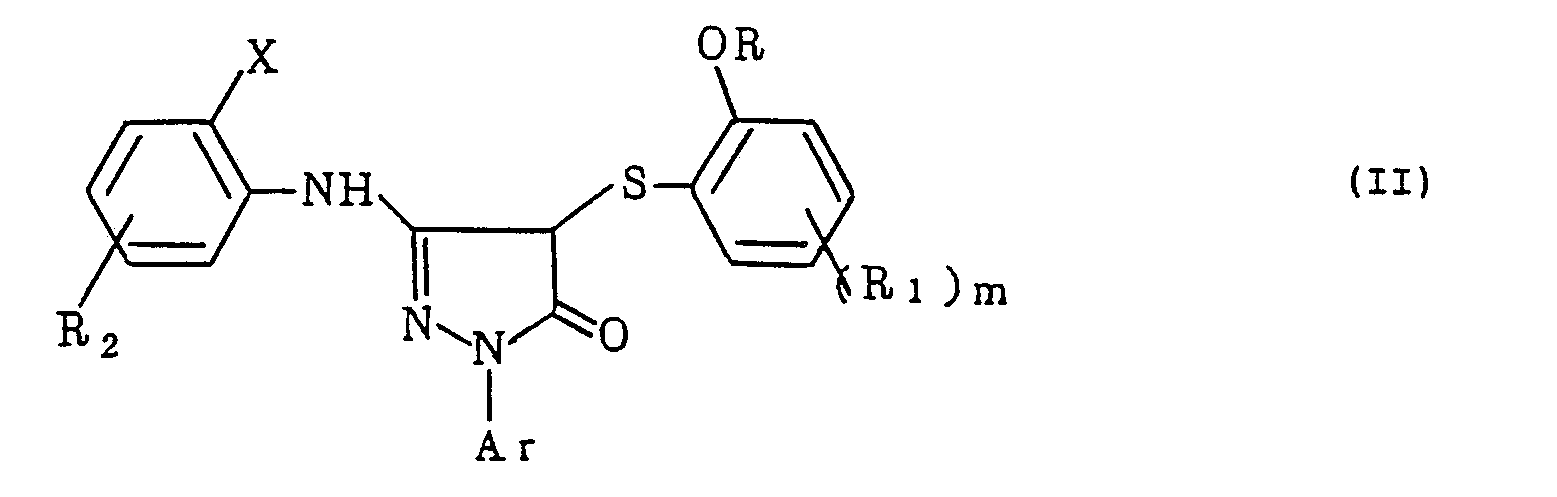


Applications Claiming Priority (2)
| Application Number | Priority Date | Filing Date | Title |
|---|---|---|---|
| JP58132134A JPS6023855A (en) | 1983-07-20 | 1983-07-20 | Color photographic sensitive material |
| JP132134/83 | 1983-07-20 |
Publications (3)
| Publication Number | Publication Date |
|---|---|
| EP0133503A2 EP0133503A2 (en) | 1985-02-27 |
| EP0133503A3 EP0133503A3 (en) | 1987-01-21 |
| EP0133503B1 true EP0133503B1 (en) | 1989-10-04 |
Family
ID=15074169
Family Applications (1)
| Application Number | Title | Priority Date | Filing Date |
|---|---|---|---|
| EP84108625A Expired EP0133503B1 (en) | 1983-07-20 | 1984-07-20 | Color photographic light-sensitive material |
Country Status (4)
| Country | Link |
|---|---|
| US (1) | US4595650A (en) |
| EP (1) | EP0133503B1 (en) |
| JP (1) | JPS6023855A (en) |
| DE (1) | DE3480032D1 (en) |
Families Citing this family (8)
| Publication number | Priority date | Publication date | Assignee | Title |
|---|---|---|---|---|
| JPS60256142A (en) * | 1984-06-01 | 1985-12-17 | Fuji Photo Film Co Ltd | Color photographic sensitive material |
| JPS62186262A (en) * | 1986-02-12 | 1987-08-14 | Fuji Photo Film Co Ltd | Color image forming method |
| DE3622007C2 (en) * | 1986-07-01 | 1996-01-25 | Agfa Gevaert Ag | Color photographic recording material with 2-equivalent magenta couplers |
| DE3625616A1 (en) * | 1986-07-29 | 1988-02-11 | Agfa Gevaert Ag | COLOR PHOTOGRAPHIC RECORDING MATERIAL WITH 2-EQUIVALENT PURPLE COUPLERS |
| US4853319A (en) * | 1986-12-22 | 1989-08-01 | Eastman Kodak Company | Photographic silver halide element and process |
| JP2676217B2 (en) * | 1988-03-25 | 1997-11-12 | コニカ株式会社 | Silver halide color photographic materials |
| US5256528A (en) * | 1992-04-23 | 1993-10-26 | Eastman Kodak Company | Magenta image-dye couplers of improved hue |
| EP0711804A3 (en) | 1994-11-14 | 1999-09-22 | Ciba SC Holding AG | Latent light stabilizers |
Citations (1)
| Publication number | Priority date | Publication date | Assignee | Title |
|---|---|---|---|---|
| EP0081768A2 (en) * | 1981-12-16 | 1983-06-22 | Fuji Photo Film Co., Ltd. | Color photographic light-sensitive material |
Family Cites Families (7)
| Publication number | Priority date | Publication date | Assignee | Title |
|---|---|---|---|---|
| JPS5735858A (en) * | 1980-08-12 | 1982-02-26 | Fuji Photo Film Co Ltd | Color photographic sensitive material |
| JPS57204037A (en) * | 1981-06-10 | 1982-12-14 | Fuji Photo Film Co Ltd | Color photographic sensitive material |
| JPS57211147A (en) * | 1981-06-23 | 1982-12-24 | Fuji Photo Film Co Ltd | Treatment of silver halide color photosensitive material |
| JPS587632A (en) * | 1981-07-07 | 1983-01-17 | Fuji Photo Film Co Ltd | Color photosensitive silver halide material |
| JPS5957240A (en) * | 1982-09-09 | 1984-04-02 | Konishiroku Photo Ind Co Ltd | Formation of color photographic image |
| JPS59116656A (en) * | 1982-12-03 | 1984-07-05 | Konishiroku Photo Ind Co Ltd | Preparation of magenta coupler |
| JPS60262161A (en) * | 1984-06-08 | 1985-12-25 | Fuji Photo Film Co Ltd | Treatment of silver halide color photosensitive material |
-
1983
- 1983-07-20 JP JP58132134A patent/JPS6023855A/en active Granted
-
1984
- 1984-07-20 EP EP84108625A patent/EP0133503B1/en not_active Expired
- 1984-07-20 US US06/632,738 patent/US4595650A/en not_active Expired - Lifetime
- 1984-07-20 DE DE8484108625T patent/DE3480032D1/en not_active Expired
Patent Citations (1)
| Publication number | Priority date | Publication date | Assignee | Title |
|---|---|---|---|---|
| EP0081768A2 (en) * | 1981-12-16 | 1983-06-22 | Fuji Photo Film Co., Ltd. | Color photographic light-sensitive material |
Also Published As
| Publication number | Publication date |
|---|---|
| EP0133503A2 (en) | 1985-02-27 |
| JPS6023855A (en) | 1985-02-06 |
| EP0133503A3 (en) | 1987-01-21 |
| DE3480032D1 (en) | 1989-11-09 |
| US4595650A (en) | 1986-06-17 |
| JPH0311458B2 (en) | 1991-02-18 |
Similar Documents
| Publication | Publication Date | Title |
|---|---|---|
| US4500630A (en) | Method for forming magenta color image | |
| US4556630A (en) | Color photographic light-sensitive material | |
| EP0119860B1 (en) | Pyrazolo magenta couplers used in silver halide photography | |
| US4254212A (en) | Photographic silver halide light-sensitive material and color image-forming process | |
| US4585732A (en) | Silver halide photographic light-sensitive material | |
| US4584266A (en) | Color photographic light-sensitive material | |
| JPS6322571B2 (en) | ||
| US4565777A (en) | Silver halide color photographic light-sensitive materials | |
| EP0084100A1 (en) | Colour-photographic light-sensitive materials | |
| US4503141A (en) | Silver halide color photographic light-sensitive materials containing couplers with a hydroxyl substituted aromatic heterocyclic sulfonyl group in the ballast group | |
| JPH0316011B2 (en) | ||
| US4585728A (en) | Color photographic light-sensitive material | |
| JPS589942B2 (en) | Genzo Yokusei Zai Hoshi Yutsugata Coupler | |
| US4383027A (en) | Silver halide color photographic light-sensitive material and method for developing thereof | |
| US4170479A (en) | Multi-layer color light-sensitive material | |
| US4072525A (en) | Silver halide photographic material containing two-equivalent color coupler | |
| US4310623A (en) | Color photographic light-sensitive material | |
| EP0176804B1 (en) | Silver halide color photograhic materials | |
| US4430423A (en) | Color photographic light-sensitive material | |
| EP0127162B1 (en) | Color photographic light-sensitive material | |
| US4579813A (en) | Silver halide color photographic materials | |
| EP0133503B1 (en) | Color photographic light-sensitive material | |
| US4557999A (en) | Silver halide color photographic light-sensitive material | |
| US4477558A (en) | Silver halide color photographic light-sensitive material | |
| US4454225A (en) | Color photographic light-sensitive material |
Legal Events
| Date | Code | Title | Description |
|---|---|---|---|
| PUAI | Public reference made under article 153(3) epc to a published international application that has entered the european phase |
Free format text: ORIGINAL CODE: 0009012 |
|
| AK | Designated contracting states |
Designated state(s): BE CH DE FR GB IT LI NL |
|
| PUAL | Search report despatched |
Free format text: ORIGINAL CODE: 0009013 |
|
| AK | Designated contracting states |
Kind code of ref document: A3 Designated state(s): BE CH DE FR GB IT LI NL |
|
| 17P | Request for examination filed |
Effective date: 19870603 |
|
| 17Q | First examination report despatched |
Effective date: 19880114 |
|
| GRAA | (expected) grant |
Free format text: ORIGINAL CODE: 0009210 |
|
| AK | Designated contracting states |
Kind code of ref document: B1 Designated state(s): BE CH DE FR GB IT LI NL |
|
| REF | Corresponds to: |
Ref document number: 3480032 Country of ref document: DE Date of ref document: 19891109 |
|
| ET | Fr: translation filed | ||
| ITF | It: translation for a ep patent filed | ||
| PLBE | No opposition filed within time limit |
Free format text: ORIGINAL CODE: 0009261 |
|
| STAA | Information on the status of an ep patent application or granted ep patent |
Free format text: STATUS: NO OPPOSITION FILED WITHIN TIME LIMIT |
|
| 26N | No opposition filed | ||
| ITTA | It: last paid annual fee | ||
| REG | Reference to a national code |
Ref country code: GB Ref legal event code: IF02 |
|
| PGFP | Annual fee paid to national office [announced via postgrant information from national office to epo] |
Ref country code: FR Payment date: 20020709 Year of fee payment: 19 |
|
| PGFP | Annual fee paid to national office [announced via postgrant information from national office to epo] |
Ref country code: GB Payment date: 20020717 Year of fee payment: 19 |
|
| PGFP | Annual fee paid to national office [announced via postgrant information from national office to epo] |
Ref country code: DE Payment date: 20020724 Year of fee payment: 19 |
|
| PGFP | Annual fee paid to national office [announced via postgrant information from national office to epo] |
Ref country code: NL Payment date: 20020730 Year of fee payment: 19 |
|
| PGFP | Annual fee paid to national office [announced via postgrant information from national office to epo] |
Ref country code: CH Payment date: 20020802 Year of fee payment: 19 |
|
| PGFP | Annual fee paid to national office [announced via postgrant information from national office to epo] |
Ref country code: BE Payment date: 20020916 Year of fee payment: 19 |
|
| PG25 | Lapsed in a contracting state [announced via postgrant information from national office to epo] |
Ref country code: GB Free format text: LAPSE BECAUSE OF NON-PAYMENT OF DUE FEES Effective date: 20030720 |
|
| PG25 | Lapsed in a contracting state [announced via postgrant information from national office to epo] |
Ref country code: LI Free format text: LAPSE BECAUSE OF NON-PAYMENT OF DUE FEES Effective date: 20030731 Ref country code: CH Free format text: LAPSE BECAUSE OF NON-PAYMENT OF DUE FEES Effective date: 20030731 Ref country code: BE Free format text: LAPSE BECAUSE OF NON-PAYMENT OF DUE FEES Effective date: 20030731 |
|
| BERE | Be: lapsed |
Owner name: *FUJI PHOTO FILM CO. LTD Effective date: 20030731 |
|
| PG25 | Lapsed in a contracting state [announced via postgrant information from national office to epo] |
Ref country code: NL Free format text: LAPSE BECAUSE OF NON-PAYMENT OF DUE FEES Effective date: 20040201 |
|
| PG25 | Lapsed in a contracting state [announced via postgrant information from national office to epo] |
Ref country code: DE Free format text: LAPSE BECAUSE OF NON-PAYMENT OF DUE FEES Effective date: 20040203 |
|
| GBPC | Gb: european patent ceased through non-payment of renewal fee |
Effective date: 20030720 |
|
| REG | Reference to a national code |
Ref country code: CH Ref legal event code: PL |
|
| PG25 | Lapsed in a contracting state [announced via postgrant information from national office to epo] |
Ref country code: FR Free format text: LAPSE BECAUSE OF NON-PAYMENT OF DUE FEES Effective date: 20040331 |
|
| NLV4 | Nl: lapsed or anulled due to non-payment of the annual fee |
Effective date: 20040201 |
|
| REG | Reference to a national code |
Ref country code: FR Ref legal event code: ST |