EP0132026B1 - Antibacterial cyclic ethers of 9-deoxo-9a-aza-9a-homoerythromycin a and intermediates therefor - Google Patents
Antibacterial cyclic ethers of 9-deoxo-9a-aza-9a-homoerythromycin a and intermediates therefor Download PDFInfo
- Publication number
- EP0132026B1 EP0132026B1 EP19840303295 EP84303295A EP0132026B1 EP 0132026 B1 EP0132026 B1 EP 0132026B1 EP 19840303295 EP19840303295 EP 19840303295 EP 84303295 A EP84303295 A EP 84303295A EP 0132026 B1 EP0132026 B1 EP 0132026B1
- Authority
- EP
- European Patent Office
- Prior art keywords
- formula
- compound
- aza
- deoxo
- homoerythromycin
- Prior art date
- Legal status (The legal status is an assumption and is not a legal conclusion. Google has not performed a legal analysis and makes no representation as to the accuracy of the status listed.)
- Expired
Links
- 0 CC(C*[C@]1O)OC1O Chemical compound CC(C*[C@]1O)OC1O 0.000 description 6
Classifications
-
- C—CHEMISTRY; METALLURGY
- C07—ORGANIC CHEMISTRY
- C07H—SUGARS; DERIVATIVES THEREOF; NUCLEOSIDES; NUCLEOTIDES; NUCLEIC ACIDS
- C07H17/00—Compounds containing heterocyclic radicals directly attached to hetero atoms of saccharide radicals
Definitions
- This invention relates to novel derivatives of 9-deoxo-9a-aza-9a-homoerythromycin A and of its 4"- epimer useful as antibacterial agents, to intermediates therefor, and to processes for preparation of said derivatives and said intermediates. More particularly it relates to cyclic ether derivatives of 9-deoxo-9a-aza-9a-homoerythromycin A and of its 4"-epimer, to pharmaceutically acceptable acid addition salts thereof and the use of said compounds as antibacterial agents, to intermediates therefor, and to processes for their preparation.
- Erythromycin A is a macrolide antibiotic produced by fermentation and described in U.S. Patent No. 2,653,899. Numerous derivatives of erythromycin A have been prepared in efforts to modify its biological and/or pharmacodynamic properties. Erythromycin A esters with mono- and dicarboxylic acids are reported in Antibiotics Annual, 1953-1954, Proc. Symposium Antibiotics (Washington, D.C.), pages 500-513 and 514-521, respectively. U.S. Patent No.3,417,077 describes the cyclic carbonate ester of erythromycin A, the reaction product of erythromycin A and ethylene carbonate, as an active antibacterial agent.
- cyclic ethers of 9-deoxo-9a-aza-9a-homoerythromycin A and of its 4"-epimer are effective antibacterial agents against Gram-positive and Gram-negative bacteria.
- the compounds have the formula (I) wherein n is 1, 2 or 3 ; and the wavy line at the 4"-position is generic to and embracive of both epimer forms, provided that when n is 1, the 4"-hydroxy group possesses the equatorial configuration.
- n is 2 or 3
- the epimeric forms of said compound differ structurally only in the configuration of the chiral center at the 4"-position ; i. e., the 4" ⁇ OH group is either axial or equatorial.
- the axial configuration is represented by a solid or wedged shape line and the equatorial by a broken line of attachment of the OH group to the 4"-position.
- the terms « axial and « equatorial as used herein refer to the two possible chiral epimers at C-4" with respect to the 4"-hydroxyl and hydrogen.
- compositions (I) compounds are also included in this invention, and useful for the same purpose as formula (I) compounds. Included among said salts, but by no means limited to said salts, are those enumerated below : hydrochloride, hydrobromide, sulfate, phosphate, formate, acetate, propionate, butyrate, citrate, glycolate, lactate, tartrate, malate, maleate, fumarate, gluconate, stearate, mandelate, pamoate, benzoate. succinate, lactate. p-toluenesulfonate and aspartate.
- the present invention also embraces processes and intermediates useful for the preparation of compounds of formula (I).
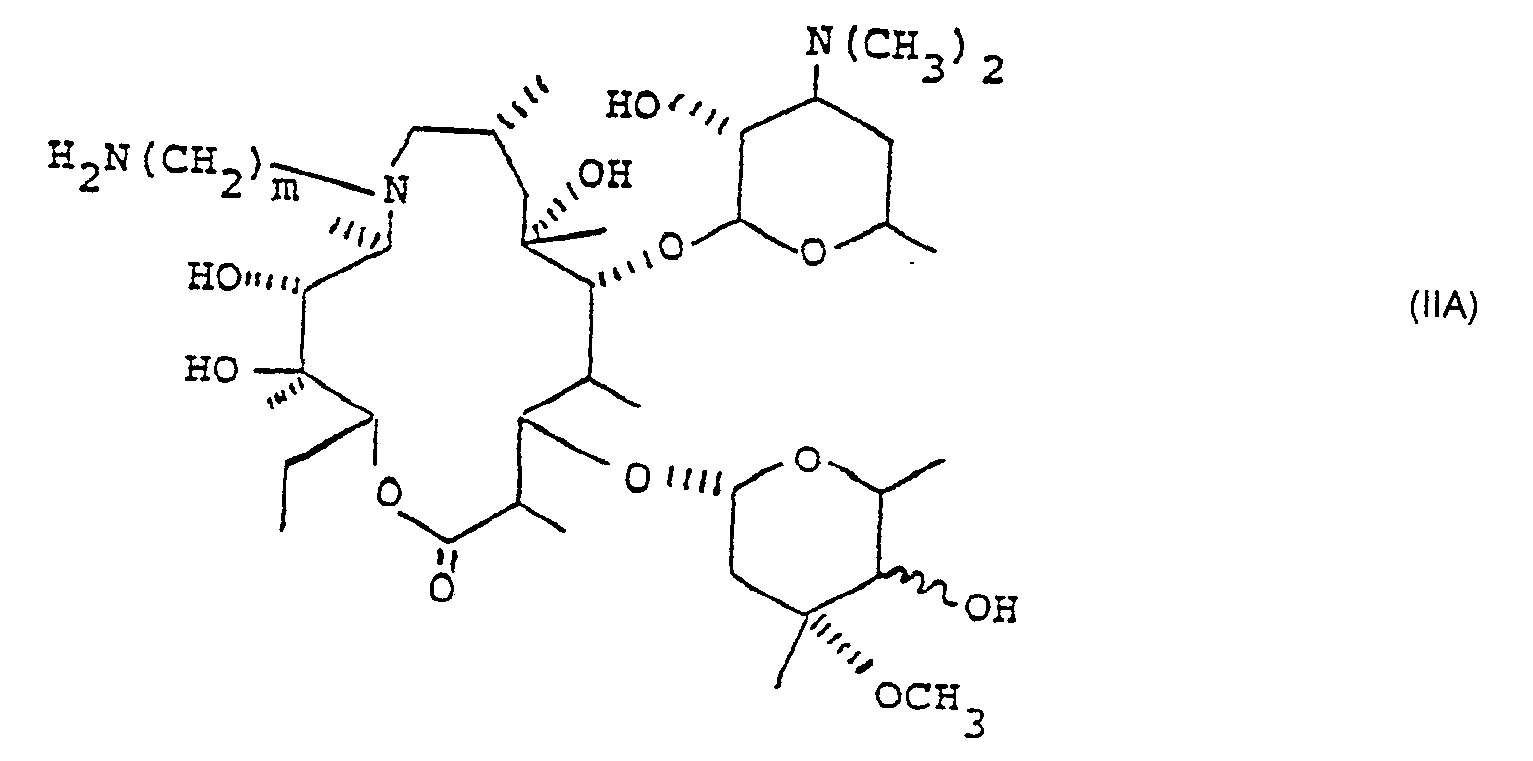
- the intermediates are represented by formulae (II) and (lit) below : wherein R 1 is -(CH 2 ) p CN or -(CH 2 ) m NH 2 ; p is 1 or 2 and m is 2 or 3 : and wherein the wavy line at the 4"-position of each of formulae II and III represents both epimers ; i. e., the axial and equatorial configurations, at said position.
- Compounds of formulae (I), (II) and (IV) and pharmaceutically acceptable acid addition salts thereof are effective antibacterial agents against Gram-positive microorganisms, e. g. Staphylococcus aureus and Streptococcus pyogenes, and against Gram-negative microorganisms, e. g. Pasturella multocida and Neisseria sicca in vitro. Additionally, compounds of formula (I) exhibit significant activity against Neisseria gonorrhea and Haemophilus in vitro and against many Gram-positive and Gram-negative microorganisms in vivo.
- formula (I) compounds are like 9-deoxo-9a-methyl-9a-aza-9a-homoerythromycin A, and quite unlike the corresponding 9a-desmethyl compound 9- deoxo-9a-aza-9a-homoerythromycin A which exhibits no practical oral activity in vivo.
- the compounds of formula (I) wherein n is 3 are prepared by cyanoethylation of the appropriate 9- deoxo-9a-aza-9a-homoerythromycin A epimers.
- An excess of acrylonitrile serves as both reactant and solvent.
- the reaction is generally carried out at the reflux temperature of the acrylonitrile solvent, about 77 °C until reaction is complete. Lower temperatures, e. g. 50°C can be used but are avoided because of the longer reaction periods required. Higher temperatures can be used by using a solvent other than excess acrylonitrile and which is reaction-inert: i. e., does not enter into reaction with reactants and/or products so as to adversely affect the yield of the desired cyanoethyl derivative.
- a reaction-inert solvent can, of course, be used at whatever temperature the reaction is run.
- Suitable solvents are C 1-4 alcohols, ether (cyclic and acylic) such as dioxan, tetrahydrofuran, diethyl ether, diethylene glycol, dimethyl ether, aromatic hydrocarbons such as benzene, toluene and xylene.
- the preferred method comprises the use of excess acrylonitrile as solvent.
- TLC thin layer chromatography
- the product is recovered by evaporation of the solvent as an off-white foam. It can be, and for convenience is, used directly in the next step of the process as is.
- TLC indicates the product is principally the desired monocyanoethylated product. Trace amounts of more polar products were detected on TLC.
- the 9a-cyanoethyl derivative (II) thus produced is converted to the corresponding 9a-(gamma-aminopropyl) derivative (II) by means of hydrogenation over Raney nickel according to the procedure described herein. It is converted to the corresponding 7-membered ring cyclic ether by reaction of at least stoichiometric amounts of each of isoamyl nitrite and glacial acetic acid according to the procedure described herein.
- the compound of formula (IV), the corresponding 9a-(gamma-acetoxypropyl) derivative is produced as by-product.
- Suitable solvents are chlorinated hydrocarbons such as methylene chloride, chloroform, aromatic hydrocarbons such as benzene, toluene, xylene, ethers such as diethylene glycol dimethyl ether, dioxan, tetrahydrofuran, diethyl ether.
- the reaction is carried out in the presence of an acid acceptor, e. g. an organic base such as a C 1-4 trialkylamine, pyridine or an inorganic base such as an alkali metal carbonate or bicarbonate.
- an acid acceptor e. g. an organic base such as a C 1-4 trialkylamine, pyridine or an inorganic base such as an alkali metal carbonate or bicarbonate.
- the acid acceptor is used in equimolar proportion to the bromoacetonitrile which is generally used in excess to ensure optimum conversion of the macrolide reactant to product.
- the 9a-cyanomethyl derivative [formula (II)] thus produced is reduced to the corresponding 9a-(beta-aminoethyl) derivative (II) by means of sodium borohydride in the presence of cobaltous chloride in hydroxylic or non-hydroxylic solvents at room temperature.
- Molar ratios of CoCI 2 to NaBH 4 of about 1 : 5 are favored for this reduction.
- an excess of NaBH 4 is used ; e. g. up to 10 moles of NaBH 4 per mole of substrate.
- Representative solvents are halogenated hydrocarbons such as methylene chloride, chloroform and carbon tetrachloride.
- the critical feature of the reaction is the use of relatively low reaction temperature.
- the reaction is readily conducted from about 15°C to 30 °C, preferably from 20 °C-25 °C.
- the reaction if conducted at elevated temperatures, e. g. reflux temperature, affords the 9a-methyl derivative ; i. e., reductive methylation occurs.
- elevated temperatures e. g. above about 50 °C, methylation occurs exclusively.
- cyclic ether formation occurs between the 11 beta-OH and the 9a-aza groups.
- mixed esters e. g. 2'-acetyl-4"-propionyl-
- acylating the 4"-ester (R 3 propionyl) with acetic anhydride in a reaction-inert solvent in the presence of potassium carbonate according to the procedure for mixed esters described by Jones et al. (loc. cit.).
- Acid addition salts of the compounds of this invention are readily prepared by treating compounds having formulae I-IV with at least an equimolar amount of the appropriate acid in a reaction-inert solvent or, in the case of the hydrochloride salts, with pyridinium hydrochloride. Since more than one basic group is present in a compound of formula I or II, the addition of sufficient acid to satisfy each basic group permits formation of polyacid addition salts.
- acid addition salts of formulae I-IV compounds wherein the 2' -OH is acylated isopropanol is used as solvent to avoid solvolysis of the alkanoyl group.
- the acid addition salts are recovered by filtration if they are insoluble in the reaction-inert solvent, by precipitation by addition of a non-solvent for the acid addition salt, or by evaporation of the solvent.
- a variety of gram-positive microorganisms and certain gram-negative microorganisms, such as those of spherical or ellipsoidal shape (cocci), are susceptible to compounds of formulae (I), (II) and (IV).
- Their in vitro activity is readily demonstrated by in vitro tests against various microorganisms in a brain-heart infusion medium by the usual two-fold serial dilution technique.
- Their in vitro activity renders them useful for topical application in the form of ointments, creams and the like, for sterilization purposes, e. g. sick- room utensils ; and as industrial antimicrobials, for example, in water treatment, slime control, paint and wood preservation.
- the selected product For in vitro use, e. g. for topical application, it will often be convenient to compound the selected product by methods well known in the pharmacist's art into lotions, salves, ointments, creams or gels. For such purposes, it will generally be acceptable to employ concentrations of active ingredient of from 0.01 percent up to 10 percent by weight based on total composition.
- the dosage form is applied at the site of infection ad libitum, generally at least once a day.
- formula (I) compounds of this invention are active versus Gram-positive and certain Gram-negative microorganisms in vivo via the oral and/or parenteral routes of administration in animals, including man.
- Their in vivo activity is more limited as regards susceptible organisms and is determined by the usual procedure which comprises infecting mice of substantially uniform weight with the test organism and subsequently treating them orally or subcutaneously with the test compound.
- the mice e. g. 10, are given an intraperitoneal inoculation of suitably diluted cultures containing approximately 1 to 10 times the LD 100 (the lowest concentration of organisms required to produce 100 % deaths).
- mice receive inoculum of lower dilutions as a check on possible variation in virulence of the test organism.
- the test compound is administered 0.5 hour post-inoculation, and is repeated 4, 24 and 48 hours later. Surviving mice are held for 4 days after the last treatment and the number of survivors is noted.
- these novel compounds can be administered orally or parenterally, e. g. by subcutaneous or intramuscular injection, at a dosage of from 1 mg/kg to 200 mg/kg of body weight per day.
- the favored dosage range is from 5 mg/kg to 100 mg/kg of body weight per day and the preferred range from 5 mg/kg to 50 mg/kg of body weight per day.
- Vehicles suitable for parenteral injection may be either aqueous such as water, isotonic saline, isotonic dextrose, Ringer's solution or non-aqueous such as fatty oils of vegetable origin (cotton seed, peanut oil, corn, sesame), dimethylsulfoxide and other non-aqueous vehicles which will not interfere with therapeutic efficiency of the preparation and are non-toxic in the volume or proportion used (glycerol, propylene glycol, sorbitol). Additionally, compositions suitable for extemporaneous preparation of solutions prior to administration may advantageously be made.
- compositions may include liquid diluents ; for example, propylene glycol, diethyl carbonate, glycerol or sorbitol ; buffering agents, hyaluronidase, local anesthetics and inorganic salts to afford desirable pharmacological properties.
- liquid diluents for example, propylene glycol, diethyl carbonate, glycerol or sorbitol ; buffering agents, hyaluronidase, local anesthetics and inorganic salts to afford desirable pharmacological properties.
- inert carriers including solid diluents, aqueous vehicles, non-toxic organic solvents in the form of capsules, tablets, lozenges, troches, dry mixes, suspensions, solutions, elixirs and parenteral solutions or suspensions.
- the compounds are used in various dosage forms at concentration levels ranging from 0.5 percent to 90 percent by weight of the total composition.
- vanillinlethanol/H 3 PO 4 spray and « vanillin/H 3 PO 4 spray refer to a solution of 1.0 g of vanillin, 100 ml of ethanol and 100 ml of H 3 P0,.
- the catalyst was filtered and the filtrate concentrated in vacuo to a foam.
- the crude product was dissolved in ca. 100 ml of methylene chloride. The solution was shaken with an equal volume of saturated aqueous sodium bicarbonate, the organic phase separated, dried with sodium sulfate, and concentrated in vacuo to an ivory foam (10.5 g). The entire sample was crystallized from warm ether, yielding 4.0 g, mp 135 °C (dec.).
- Formamide-treated silica gel was prepared by adding 120 ml of formamide to a well-stirred 300 g silica gel (230-240 mesh)/600 ml acetone slurry ; and then rotoevaporating solvent until a free-flowing powder was obtained.
- 9-deoxo-9a-aza-9a-homoerythromycin A (1.0 g) was dissolved in 10.0 ml of acrylonitrile. The mixture was refluxed for 6 hours ; then stirred overnight at ambient temperature. The mixture was then concentrated in vacuo to a tan foam.
- Formamide-treated silica gel was prepared by adding 360 ml of formamide to a well-stirred 900 g silica gel (230-400 mesh)/1 800 ml acetone slurry ; and then rotoevaporating solvent until a free-flowing powder was obtained.
- the 5 ml fractions collected were tic inspected utilizing the system described above.
- Example 7 The title product of Example 7 (1.0 g), 10 ml of ethanol and 0.25 g of 5 % Pd on carbon was charged into a 50 ml Parr flask and the flask repeatedly purged with nitrogen. It was then charged with hydrogen to 10 psi (0.70 kg/cm 2 ) and hydrogenation carried out over a 4.5 hour period at room temperature. The reaction was removed from the flask, filtered and concentrated in vacuo to a foam. The foam was taken up in 100 ml of methylene chloride. 100 ml water added and the pH.brought to 9.5 by addition of 6N NaOH.
- the aqueous phase was separated, 25 ml of methylene chloride added and the pH adjusted to 9.5 by means of 1 N NaOH.
- the organic phase was then separated, an equal volume of water added and the pH brought to 2.0 by addition of 1 N HCI. Again the aqueous phase was separated, 25 ml methylene chloride added, and the pH raised to 9.5 by addition of 1N NaOH.
- the organic phase was separated, dried (Na 2 S0 4 ) and concentrated under reduced-pressure to a white foam (1.15 g) of crude title product.
- 4"-Epi-erythromycin A 50 g. 0.0646 mole was dissolved in 265 ml pyridine. Hydroxylamine hydrochloride (112.2 g, 1.615 mole) was added and the slurry stirred 16 hours. The reaction mixture was stripped to a thick slurry, diluted with 300 ml isopropanol, stirred well and filtered with 3 x 100 ml isopropanol for wash.
- the aqueous layer was separated, washed with two additional portions of CH 2 Cl 2 and then adjusted to pH 9.5 with 6N NaOH.
- the basic solution was extracted 2 x fresh CH 2 Cl 2 , 1 x ethyl acetate and 1 x ether.
- the pH 9.5 CH 2 CI 2 layer was combined with 500 ml fresh H 2 O for repetition of the sequence.
- the pH 9.5 CH 2 CI 2 layer was dried (Na 2 SO 4 ) and stripped to yield crude title product as a foam, 34 g, which was crystallized from 150 ml hot isopropyl ether, cooled and diluted with 300 ml of pentane, affording purified title product, 25.8 g ; white crystals ; tlc R f 0.5 (9 : 1 CHCl 3 : diethylamine) : R f 0.1 (90 : 10 : 1 CH 2 Cl 2 : CH 3 0H : concentrated NH 4 OH), mp 170-180° : 1 H-nmr (CDCl 3 ) delta 2.26 [6H, s.
Landscapes
- Chemical & Material Sciences (AREA)
- Organic Chemistry (AREA)
- Health & Medical Sciences (AREA)
- Life Sciences & Earth Sciences (AREA)
- Engineering & Computer Science (AREA)
- Biochemistry (AREA)
- Biotechnology (AREA)
- General Health & Medical Sciences (AREA)
- Genetics & Genomics (AREA)
- Molecular Biology (AREA)
- Saccharide Compounds (AREA)
- Pharmaceuticals Containing Other Organic And Inorganic Compounds (AREA)
Description
- This invention relates to novel derivatives of 9-deoxo-9a-aza-9a-homoerythromycin A and of its 4"- epimer useful as antibacterial agents, to intermediates therefor, and to processes for preparation of said derivatives and said intermediates. More particularly it relates to cyclic ether derivatives of 9-deoxo-9a-aza-9a-homoerythromycin A and of its 4"-epimer, to pharmaceutically acceptable acid addition salts thereof and the use of said compounds as antibacterial agents, to intermediates therefor, and to processes for their preparation.
- Erythromycin A is a macrolide antibiotic produced by fermentation and described in U.S. Patent No. 2,653,899. Numerous derivatives of erythromycin A have been prepared in efforts to modify its biological and/or pharmacodynamic properties. Erythromycin A esters with mono- and dicarboxylic acids are reported in Antibiotics Annual, 1953-1954, Proc. Symposium Antibiotics (Washington, D.C.), pages 500-513 and 514-521, respectively. U.S. Patent No.3,417,077 describes the cyclic carbonate ester of erythromycin A, the reaction product of erythromycin A and ethylene carbonate, as an active antibacterial agent.
- U.S. Patent 4,328,334, issued May 4, 1982 describes 9-deoxo-9a-aza-9a-homoerythromycin A and refers to it by the name 11-aza-10-deoxo-10-dihydroerythromycin A. Since said compound is a ring expanded (homo) derivative of erythromycin A, nitrogen (aza) being the additional atom of the ring system, the nomenclature 9-deoxo-9a-aza-9a-homoerythromycin A is preferred for the parent ring system of the compounds of this invention.
- Belgian Patent 892,357, published July 1, 1982, and its British counterpart, Application 2,094,293A, published September 15, 1982, disclose the N-methyl derivative of 9-deoxo-9a-aza-9a-homoerythromycin A, as does my U.S. Patent No.4,474,768, filed November 15, 1982, which claims priority from U.S. application Serial No. 399,401, filed July 19, 1982. The 4"-epimer of said N-methyl derivative is the subject . of my U.S. Patent No. 4.526.889. filed November 15, 1982. U.S. Patent 4,382,085, issued May 3, 1983 describes 4"-epi erythromycin A : i. e., the 4" -OH group has the axial configuration. The 4" -OH in erythromycin A has the equatorial configuration.
- It has now been found that certain cyclic ethers of 9-deoxo-9a-aza-9a-homoerythromycin A and of its 4"-epimer are effective antibacterial agents against Gram-positive and Gram-negative bacteria. The compounds have the formula (I)

- Also included in this invention, and useful for the same purpose as formula (I) compounds, are the pharmaceutically acceptable acid addition salts thereof. Included among said salts, but by no means limited to said salts, are those enumerated below : hydrochloride, hydrobromide, sulfate, phosphate, formate, acetate, propionate, butyrate, citrate, glycolate, lactate, tartrate, malate, maleate, fumarate, gluconate, stearate, mandelate, pamoate, benzoate. succinate, lactate. p-toluenesulfonate and aspartate.
- The present invention also embraces processes and intermediates useful for the preparation of compounds of formula (I). The intermediates are represented by formulae (II) and (lit) below :


- Also included in this invention are the compounds of formula (IV) which are formed as by-products in preparation of formula (I) compounds wherein n is 3 :

- Compounds of formulae (I), (II) and (IV) and pharmaceutically acceptable acid addition salts thereof are effective antibacterial agents against Gram-positive microorganisms, e. g. Staphylococcus aureus and Streptococcus pyogenes, and against Gram-negative microorganisms, e. g. Pasturella multocida and Neisseria sicca in vitro. Additionally, compounds of formula (I) exhibit significant activity against Neisseria gonorrhea and Haemophilus in vitro and against many Gram-positive and Gram-negative microorganisms in vivo. In their oral anti-infective activity the formula (I) compounds are like 9-deoxo-9a-methyl-9a-aza-9a-homoerythromycin A, and quite unlike the corresponding 9a-desmethyl compound 9- deoxo-9a-aza-9a-homoerythromycin A which exhibits no practical oral activity in vivo.
- The compounds of formula (I) wherein n is 3 are prepared by cyanoethylation of the appropriate 9- deoxo-9a-aza-9a-homoerythromycin A epimers. An excess of acrylonitrile serves as both reactant and solvent. The reaction is generally carried out at the reflux temperature of the acrylonitrile solvent, about 77 °C until reaction is complete. Lower temperatures, e. g. 50°C can be used but are avoided because of the longer reaction periods required. Higher temperatures can be used by using a solvent other than excess acrylonitrile and which is reaction-inert: i. e., does not enter into reaction with reactants and/or products so as to adversely affect the yield of the desired cyanoethyl derivative. A reaction-inert solvent can, of course, be used at whatever temperature the reaction is run. Suitable solvents are C1-4 alcohols, ether (cyclic and acylic) such as dioxan, tetrahydrofuran, diethyl ether, diethylene glycol, dimethyl ether, aromatic hydrocarbons such as benzene, toluene and xylene. However, the preferred method comprises the use of excess acrylonitrile as solvent.
- The progress of the reaction is monitored by thin layer chromatography (TLC) on silica gel plates and elution thereof with CH2Cl2/CH3OH/concentrated NH4OH (6/1/0.1) and development of the plates with a spray of vanillinlethanol/H3PO4 and heat.
- The product is recovered by evaporation of the solvent as an off-white foam. It can be, and for convenience is, used directly in the next step of the process as is. TLC indicates the product is principally the desired monocyanoethylated product. Trace amounts of more polar products were detected on TLC.
- The 9a-cyanoethyl derivative (II) thus produced is converted to the corresponding 9a-(gamma-aminopropyl) derivative (II) by means of hydrogenation over Raney nickel according to the procedure described herein. It is converted to the corresponding 7-membered ring cyclic ether by reaction of at least stoichiometric amounts of each of isoamyl nitrite and glacial acetic acid according to the procedure described herein. The compound of formula (IV), the corresponding 9a-(gamma-acetoxypropyl) derivative is produced as by-product.
- The formula I compounds wherein n is 2 are prepared by alkylation of the appropriate 4" -OH epimer of 9-deoxo-9-aza-9a-hydroxy-9a-homoerythromyci A 3'-N-oxide in a reaction-inert solvent with preferably an excess of bromoacetonitrile at from 20 °C to 100 °C and preferably at room temperature. Suitable solvents are chlorinated hydrocarbons such as methylene chloride, chloroform, aromatic hydrocarbons such as benzene, toluene, xylene, ethers such as diethylene glycol dimethyl ether, dioxan, tetrahydrofuran, diethyl ether.
- The reaction is carried out in the presence of an acid acceptor, e. g. an organic base such as a C1-4 trialkylamine, pyridine or an inorganic base such as an alkali metal carbonate or bicarbonate. The acid acceptor is used in equimolar proportion to the bromoacetonitrile which is generally used in excess to ensure optimum conversion of the macrolide reactant to product.
- Catalytic hydrogenation of (III) over Pd/C in a reaction-inert solvent such as ethanol achieves removal of the 9a- and 3'-oxide groups to yield the cyanomethyl compound of formula (II) wherein p is 1.
- The 9a-cyanomethyl derivative [formula (II)] thus produced is reduced to the corresponding 9a-(beta-aminoethyl) derivative (II) by means of sodium borohydride in the presence of cobaltous chloride in hydroxylic or non-hydroxylic solvents at room temperature. Molar ratios of CoCI2 to NaBH4 of about 1 : 5 are favored for this reduction. In practice an excess of NaBH4 is used ; e. g. up to 10 moles of NaBH4 per mole of substrate. Reaction of the 9a-(beta-aminoethyl) derivative with at least stoichiometric amounts of each of isoamylnitrite/glacial acetic acid affords the corresponding 6-membered ring cyclic ether.
- The 5-membered ring cyclic ether of formula I (n = 1,4"―OH = equatorial configuration) is prepared by reacting 9-deoxo-9a-aza-9a-homoerythromycin A with from 1-4 equivalents each of formaldehyde, conveniently as 37 % aqueous solution, and formic acid, in a reaction-inert solvent, preferably at ambient temperature. Representative solvents are halogenated hydrocarbons such as methylene chloride, chloroform and carbon tetrachloride.
- The critical feature of the reaction is the use of relatively low reaction temperature. The reaction is readily conducted from about 15°C to 30 °C, preferably from 20 °C-25 °C. The reaction, if conducted at elevated temperatures, e. g. reflux temperature, affords the 9a-methyl derivative ; i. e., reductive methylation occurs. At elevated temperatures, e. g. above about 50 °C, methylation occurs exclusively. However, under the conditions of the present process cyclic ether formation occurs between the 11 beta-OH and the 9a-aza groups.
- Compounds of formulae (I), (III) and (IV) and of formula (II) wherein R, is ―(CH2)pCN wherein the 2' and/or 4"-hydroxy groups are acylated to give corresponding C2.3 alkanoyl derivatives are conveniently prepared by standard acylation procedures such as those described by Jones et al., J. Med. Chem. 15, 631 (1972). and by Banaszek et al., Rocy. Chem. 43. 763 (1969). The 2'- and 4"-hydroxy groups are acylated by means of the appropriate acid anhydride [e. g. (R2CO)20] in pyridine. Solvolysis of the 2', 4"-ester with methanol produces the 4"-ester.
- Formation of mixed esters, e. g. 2'-acetyl-4"-propionyl-, is readily achieved by acylating the 4"-ester (R3 = propionyl) with acetic anhydride in a reaction-inert solvent in the presence of potassium carbonate according to the procedure for mixed esters described by Jones et al. (loc. cit.).
- Acid addition salts of the compounds of this invention are readily prepared by treating compounds having formulae I-IV with at least an equimolar amount of the appropriate acid in a reaction-inert solvent or, in the case of the hydrochloride salts, with pyridinium hydrochloride. Since more than one basic group is present in a compound of formula I or II, the addition of sufficient acid to satisfy each basic group permits formation of polyacid addition salts. When preparing acid addition salts of formulae I-IV compounds wherein the 2' -OH is acylated, isopropanol is used as solvent to avoid solvolysis of the alkanoyl group. The acid addition salts are recovered by filtration if they are insoluble in the reaction-inert solvent, by precipitation by addition of a non-solvent for the acid addition salt, or by evaporation of the solvent.
- A variety of gram-positive microorganisms and certain gram-negative microorganisms, such as those of spherical or ellipsoidal shape (cocci), are susceptible to compounds of formulae (I), (II) and (IV). Their in vitro activity is readily demonstrated by in vitro tests against various microorganisms in a brain-heart infusion medium by the usual two-fold serial dilution technique. Their in vitro activity renders them useful for topical application in the form of ointments, creams and the like, for sterilization purposes, e. g. sick- room utensils ; and as industrial antimicrobials, for example, in water treatment, slime control, paint and wood preservation.
- For in vitro use, e. g. for topical application, it will often be convenient to compound the selected product by methods well known in the pharmacist's art into lotions, salves, ointments, creams or gels. For such purposes, it will generally be acceptable to employ concentrations of active ingredient of from 0.01 percent up to 10 percent by weight based on total composition. The dosage form is applied at the site of infection ad libitum, generally at least once a day.
- Additionally, formula (I) compounds of this invention are active versus Gram-positive and certain Gram-negative microorganisms in vivo via the oral and/or parenteral routes of administration in animals, including man. Their in vivo activity is more limited as regards susceptible organisms and is determined by the usual procedure which comprises infecting mice of substantially uniform weight with the test organism and subsequently treating them orally or subcutaneously with the test compound. In practice, the mice, e. g. 10, are given an intraperitoneal inoculation of suitably diluted cultures containing approximately 1 to 10 times the LD100 (the lowest concentration of organisms required to produce 100 % deaths). Control tests are simultaneously run in which mice receive inoculum of lower dilutions as a check on possible variation in virulence of the test organism. The test compound is administered 0.5 hour post-inoculation, and is repeated 4, 24 and 48 hours later. Surviving mice are held for 4 days after the last treatment and the number of survivors is noted.
- When used in vivo, these novel compounds can be administered orally or parenterally, e. g. by subcutaneous or intramuscular injection, at a dosage of from 1 mg/kg to 200 mg/kg of body weight per day. The favored dosage range is from 5 mg/kg to 100 mg/kg of body weight per day and the preferred range from 5 mg/kg to 50 mg/kg of body weight per day. Vehicles suitable for parenteral injection may be either aqueous such as water, isotonic saline, isotonic dextrose, Ringer's solution or non-aqueous such as fatty oils of vegetable origin (cotton seed, peanut oil, corn, sesame), dimethylsulfoxide and other non-aqueous vehicles which will not interfere with therapeutic efficiency of the preparation and are non-toxic in the volume or proportion used (glycerol, propylene glycol, sorbitol). Additionally, compositions suitable for extemporaneous preparation of solutions prior to administration may advantageously be made. Such compositions may include liquid diluents ; for example, propylene glycol, diethyl carbonate, glycerol or sorbitol ; buffering agents, hyaluronidase, local anesthetics and inorganic salts to afford desirable pharmacological properties. These compounds may also be combined with various pharmaceutically-acceptable inert carriers including solid diluents, aqueous vehicles, non-toxic organic solvents in the form of capsules, tablets, lozenges, troches, dry mixes, suspensions, solutions, elixirs and parenteral solutions or suspensions. In general, the compounds are used in various dosage forms at concentration levels ranging from 0.5 percent to 90 percent by weight of the total composition.
- In the examples presented herein, no effort was made to recover the maximum amount of product produced or to optimize the yield of a given product. The Examples are merely illustrative of the process and of the products obtainable thereby.
- In all examples, the terms « vanillinlethanol/H3PO4 spray and « vanillin/H3PO4 spray refer to a solution of 1.0 g of vanillin, 100 ml of ethanol and 100 ml of H3P0,.
- 4"-Epi-9-deoxo-9a-aza-9a-homoerythromycin A (11.6 g, 15.8 mmoles) was dissolved in 100 ml of acrylonitrile. The solution was refluxed for 19 hours, and then concentrated in vacuo, affording an ivory foam. Tic inspection (silica gel plates ; elution with CH2Cl2/CH3OH/concentrated NH4OH = 6/1/0.1 : vanillin/H3P04 spray with heat : Rt = 0.51) revealed a single (less polar) dominant product with only trace amounts of (more polar) impurities. The crude product was used in the next step without further purification,
- 13C-nmr [CDCl3, (CH3)4Si internal standard] ppm 177.92 (lactone >C=0), 118.86 (―C≡N). 102.49 (C-1'), 96.04 (C-1"), 40.25 [(CH3)2N-].
- A solution of 12.8 g (16.2 mmoles) of 4"-epi-9-deoxo-9a-(beta-cyanoethyl)-9a-aza-9a-homoerythromy- cin A in 250 ml of absolute ethanol was combined with 12.8 g of Raney-Ni catalyst (50 % water-wet) and hydrogenated on a Parr apparatus at 50 psi (3.52 kg/cm2) for 19 hours. Tic monitoring (silica gel plates ; elution with CHCl3/CH3OH/concentrated NH4OH = 6/1/0.1 ; vanillin/H3PO4 spray with heat ; Rf = 0.13) showed complete reaction. The catalyst was filtered and the filtrate concentrated in vacuo to a foam. The crude product was dissolved in ca. 100 ml of methylene chloride. The solution was shaken with an equal volume of saturated aqueous sodium bicarbonate, the organic phase separated, dried with sodium sulfate, and concentrated in vacuo to an ivory foam (10.5 g). The entire sample was crystallized from warm ether, yielding 4.0 g, mp 135 °C (dec.).
- 13C-nmr [CDCl3, (CH3)4 internal standard] ppm 177,07 (lactone >=C=O), 102.22 (C-1'), 95.77 (C―1"), 40.30 [(CH3)zN-].
- To a solution of 4"-epi-9-deoxo-9a-(gamma-amino-propyl)-9a-aza-9a-homoerythromycin A (3.37 g, 4.3 mmoles) in 20 ml of chloroform, 574 mg (0.66 ml ; 4.9 mmole) of isoamyl nitrite and 511 mg (8.52 mmoles) of glacial acetic acid were added, and the mixture was vigorously refluxed for one hour. Tic examination showed complete reaction and the presence of two major components (silica gel tcl plates momentarily immersed in a formamide/acetone solution and then air-dried ; elution with CHCl3/acetone = 1/1 ; vanillin/H3P04 spray with heat). The reaction mixture was shaken with 50 ml of 10 % aqueous potassium carbonate. The organic phase was then separated, washed with 50 ml of saturated brine solution, dried over sodium sulfate, and concentrated in vacuo to a colorless foam (3.17 g).
- Formamide-treated silica gel was prepared by adding 120 ml of formamide to a well-stirred 300 g silica gel (230-240 mesh)/600 ml acetone slurry ; and then rotoevaporating solvent until a free-flowing powder was obtained. The crude product was chromatographed on 300 g of formamide-impregnated silica gel, eluting with CHCl3/hexane = 98/2 and monitoring collected fractions by tic (utilizing the above- described tic system). Thus the two components produced in the reaction - the (less polar) title compound (344 mg, 10% yield), and 4"-epi-9-deoxo-9a-(gamma-acetoxypropyl)-9a-aza-9a-homoerythromycin A (400 mg ; 11 % yield) - were isolated as colorless amorphous solids.
- In a second analogous run the chromatographed title compound (162 mg) was crystallized from acetone/water (yielding 94 mg, m. p. 139-141 °C).
- 4"-Epi-9,11-deoxo-11 beta, 9a-(epoxypropano)-9a-aza-9a-homoerythromycin A : 1H-nmr (CDCl3) delta 2.28 [6H, s, (CH3)2N-], 3.28 (3H, s, cladinose CH3O-) ; 13C-nmr [CDCl3, (CH3)4Si internal standard] ppm 176.28 (lactone >C=O), 102.36 (C―1'). 96.18 (C-1"), 40.26 [(CH3)2―N―] ; mass spectrum (m/e) 774 (molecular ion), 616.4, 599.4, 458.3, 442.3, 158.2, 127.1.
- 4"-Epi-9-deoxo-9a-(gamma-acetoxypropyl)-9a-aza-9a-homoerythromycin A: 1H-nmr (CDCl3) delta 2.02 (3H, s, CH3―C―). 2.27 [6H, s, (CH3)2N-], 3.28 (3H, s, cladinose CH30-). O
- 9-deoxo-9a-aza-9a-homoerythromycin A (1.0 g) was dissolved in 10.0 ml of acrylonitrile. The mixture was refluxed for 6 hours ; then stirred overnight at ambient temperature. The mixture was then concentrated in vacuo to a tan foam. Chromatography of the crude product on silica gel (40 g ; 70-230 mesh), eluting with a CH2Cl2/CH3OH/concentrated NH4OH = 10/1/0.01 solvent mixture and monitoring fractions by tic (silica gel plates ; CH2Cl2/CH3OH/concentrated NH4OH = 6/1/0.1 eluting system; vanillin/H3P04 spray indicator with heat ; Rf = 0.57), afforded 605 mg (56 % yield) of the title compound as a colorless foam.
- 1H-nmr (CDCl3) delta 2.34 [6H, s, (CH3)2N-], 3.33 (3H, s, cladinose CH30-) ; 13C-nmr [CDCl3, (CH3)4Si internal standard] ppm 177.62 (lactone >C=O), 118.85 (-C≡N), 103.01 (C-1'), 95.91 (C-1"), 40.33 [(CH3)2N-].
- A solution of 47 g (59.6 mmoles) of 9-deoxo-9a-(beta-cyanoethyl)-9a-aza-9a-homoerythromycin A in 520 ml of ethanol was combined with 47 g of Raney-Ni catalyst (50 % water-wet) and hydrogenated on a Parr apparatus at 50 psi for 2.75 hours. Tic inspection (silica gel plates; elution with CHCl3/CH3OH/concentrated NH4OH = 6/1/0.01 ; vanillin/H3PO4 spray with heat) showed the reaction to be incomplete. The mixture was charged with 25 g of fresh catalyst, and hydrogenation at 50 psi (3.52 kg/cm2) was continued for an additional 1.25 hours. The catalyst was filtered and the filtrate was concentrated in vacuo to a colorless foam. The crude product was dissolved in 600 ml of ethyl acetate. The solution was stirred with 800 ml of water and the pH was adjusted to 9.5 with 6N sodium hydroxide. The organic phase was dried over sodium sulfate and concentrated in vacuo to a foam. Chromatography on silica gel (800 g, 70-230 mesh) eluting with CHCl3/CH3OH/concentrated NH4OH = 6/1/0.05 ; R, = 0.15. afforded 14.7 g (31 % yield) of the pure title compound as a colorless foam.
- Crystallization of a 1.1 g sample from diethyl ether gave 545 mg of colorless crystals ; mp 180-183 °C.
- 1H-nmr (CDCl3) delta 2.30 [6H, s, (CH3)2N-], 3.32 (3H, s, cladinose CH30-) ; 13C-nmr [CDCl3, (CH3)4Si internal standard] ppm 177.01 (lactone >C=O), 102.69 (C―1'). 95.27 (C-1"), 40.33 [(CH3)2N-].
- To a solution of 9-deoxo-9a-(gamma-aminopropyl)-9a-aza-9a-homoerythromycin A (6.24 g, 7.90 mmoles) in 128 ml of chloroform, 1.01 g (1.16 ml ; 8.63 mmoles) of isoamyl nitrite and 0.97 g (0.92 ml ; 16.2 mmoles) of glacial acetic acid were added, and the mixture was vigorously refluxed for one hour. The mixture was stirred with 150 ml of water, and the pH adjusted to 8.0 with saturated aqueous sodium bicarbonate. The organic phase was separated and washed with an equal volume of water, dried over sodium sulfate, and concentrated in vacuo to a yellow foam. Tlc examination showed two components in the crude product (silica gel plates momentarily immersed in a 15 : 85 formamide/acetone solution and then air-dried ; elution with CHC13/acetone = 1/1 ; vanillin/H3PO4 spray with heat).
- Formamide-treated silica gel was prepared by adding 360 ml of formamide to a well-stirred 900 g silica gel (230-400 mesh)/1 800 ml acetone slurry ; and then rotoevaporating solvent until a free-flowing powder was obtained. The crude product (5.8 g) was chromatographed on the 900 g of formamide-impregnated silica gel, eluting first with 2 liters of CHCl3/hexane = 7/3 ; and then with 3 liters of CHCl3/hexane = 8/2. The 5 ml fractions collected were tic inspected utilizing the system described above. Thus the two components produced in the reaction -the (less polar) title compound (0.79 g, 13 % yield), and 9-deoxo-9a-(gamma-acetoxypropyl)-9a-aza-9a-homoerythromycin A (0.76 g, 12 % yield) - were isolated as colorless amorphous solids.
- 9,11-Deoxo-llbeta,9a-(epoxypropano)-9a-aza-9a-homoerythromycin A: 1H-nmr (CDCl3) delta 2.30 [6H, s, (CH3)2N-], 3.33 (3H, s, cladinose CH3O―) 13C-nmr (CDCl3) ppm 176.3 (lactone >C=O), 103.2 (C-1'), 96.2 (C―1"), 40.4 [(CH3)2N-] ; mass spectrum (m/e) 616, 599, 458, 442, 158, 127.
- 9-Deoxo-9a-(gamma-acetoxypropyl)-9a-aza-9a-homoerythromycin A : U1H-nmr (CDCl3) delta 2.01 (3H, s. CH3―C―). 2.29 [3H, s. (CH3)2-N-], 3.31 (3H, s, cladinose CH3O―) ; mass spectrum (m/e) 834.6.
- To a solution of 9-deoxo-9a-hydroxy-9a-aza-9a-homoerythromycin A 3'-N-oxide (11.0 g, 14.4 mmoles) in 138 ml of chloroform, 79 g (0.57 mole) of anhydrous potassium carbonate and 69 g (0.58 mole) of bromoacetonitrile were added. The mixture was stirred at ambient temperature for 5.25 hours. Tlc inspection [silica gel plates, elution with CHCl3/CH3OH/concentrated NH4OH = 6/1/0.1 ; vanillin/H3P04 spray with heat) showed consumption of starting material and formation of a (less polar) product (Rf = 0.28) with only trace amounts of impurities. The reaction was filtered and the filtrate was concentrated in vacuo to a viscous oil. The oil was stirred with 600 ml of diethyl ether - affording a colorless granular solid which was filtered and washed with 100 ml of ether prior to air-drying. The title compound thus obtained (10.4 g, 89.9 % yield, of colorless granular solid) was used as is in the following Example.
- The title product of Example 7 (1.0 g), 10 ml of ethanol and 0.25 g of 5 % Pd on carbon was charged into a 50 ml Parr flask and the flask repeatedly purged with nitrogen. It was then charged with hydrogen to 10 psi (0.70 kg/cm2) and hydrogenation carried out over a 4.5 hour period at room temperature. The reaction was removed from the flask, filtered and concentrated in vacuo to a foam. The foam was taken up in 100 ml of methylene chloride. 100 ml water added and the pH.brought to 9.5 by addition of 6N NaOH. The methylene chloride layer was separated, dried (Na2SO4) and evaporated to dryness in vacuo to give 700 mg of a foam. Chromatography on silica gel (21 g, 70-230 mesh), and elution with CH2CI2/MeOH/concentrated NH40H, 18/1/0.05 and evaporation of the eluate afforded the title product (135 mg).
- R, [silica gel plates, elution system CHCl3/CH3OH/concentrated NH4OH = 6/1/0.1 ; vanillin/H3P04 spray with heat] = 0.61.
- 1H-nmr (CDCl3) delta 2.26 [6H, s, (CH3)2N-], 3.28 (3H, s, cladinose CH3O―) ; 13C-nmr [CDC13, (CH3)4Si internal standard] ppm 178.0 (lactone >C=O), 116.76 (―C≡N), 102.78 (C-1'), 95.16 (C-1"), 40.30 [(CH3)2N-].
- Sodium borohydride (1.17 g, 0.0309 mole) was added to a mixture of 9-deoxo-9a-cyanomethyl-9a-aza-9a-homoerythromycin A (2.4 g, 3.1 mmoles), 72 ml of methanol and anhydrous cobaltous chloride (0.792 g, 6.1 mmoles) at room temperature. An exothermic reaction with much foaming occurred. The mixture was stirred at room temperature for two hours and was then concentrated under reduced pressure (aspirator) to a black oily residue. The residue was taken up in 50 ml of 1 : 1 water : methylene chloride solution, the pH adjusted to 2.5 by means of 1N HCI and the mixture stirred for ten minutes. The aqueous phase was separated, 25 ml of methylene chloride added and the pH adjusted to 9.5 by means of 1 N NaOH. The organic phase was then separated, an equal volume of water added and the pH brought to 2.0 by addition of 1 N HCI. Again the aqueous phase was separated, 25 ml methylene chloride added, and the pH raised to 9.5 by addition of 1N NaOH. The organic phase was separated, dried (Na2S04) and concentrated under reduced-pressure to a white foam (1.15 g) of crude title product.
- Purification was accomplished by column chromatography of 1.05 g of crude product on 30 g of 70-230 mesh silica gel and elution with CHCl3 : CH30H : NH40H (6 : 1 : 0.1) and collection of 5 ml fractions. Fractions 80-150 contained the desired (more polar) material. They were combined and concentrated to small volume under reduced pressure. The concentrate was washed with saturated aqueous sodium bicarbonate solution, dried (Na2S04) and evaporated in vacuo to a foam ; 75 mg of title product.
- A mixture of 9-deoxo-9a-(beta-aminoethyl)-9a-aza-9a-homoerythromycin A (0.38 g, 0.488 mmole), chloroform (4 ml), isoamyl nitrite (0.072 ml, 0.536 mmole) and glacial acetic acid (0.056 ml, 0.976 mmole) was heated to reflux for one hour. The addition of isoamyl nitrite and glacial acetic acid was repeated and the mixture refluxed for two hours. It was cooled, added to a mixture of 10 ml chloroform and 15 ml of saturated aqueous sodium bicarbonate solution, and the pH adjusted to 9.5 by addition of IN NaOH. The organic phase was separated, dried (Na2SO4) and concentrated at reduced pressure to give 0.37 g of a tan foam. Column chromatography on 55 g of formamide-treated silica gel (prepared as in Example 3) using chloroform : hexane (90 : 10) as eluting agent and collection of 5 ml fractions afforded the title product in fractions 81-130. The combined fractions were washed with water, dried (Na2S04) and concentrated under reduced pressure to a white solid. The solid was taken up in methylene chloride, the solution filtered and evaporated in vacuo to give 26.5 mg of product as a white solid.
- 13C-nmr [CDCl3, chloroform internal standard] ppm 177.71 (lactone carbonyl), 103.36 (C-1'), 95.97 (C-1"). 40.40 [(CH3)2N―]; mass spectrum (m/e) 602, 444, 428.
- A solution consisting of 10.0 g (13.64 mmole) of 9-deoxo-9a-aza-9a-homoerythromycin A, 1.19 g (1.10 ml. 14.0 mmoles) of 37 % aqueous formaldehyde, and 0.488 g (0.40 ml, 0.01 mole) of formic acid in 150 ml of chloroform was stirred at ambient temperature (ca. 25 °C) for 70 hours. Tic inspection (silica gel plates: eluting with CH2Cl2/CH3OH/concentrated NH4OH = 6 : 1 : 0.1 : vanillin/H3PO4, spray with heat) showed a complex mixture of at least five components. The mixture was stirred with saturated aqueous sodium bicarbonate (400 ml), and the pH of the aqueous layer was adjusted to 9.5 with 6N sodium hydroxide. The organic phase was separated, dried over sodium sulfate, and concentrated in vacuo to a colorless foam. The crude product was chromatographed on silica gel (405 g : 70-230 mesh ; eluting with CH2CI2/CH30H/concentrated NH4OH = 12/1/0.05), thus affording 563 mg (5.5 % yield) of the pure title compound as a colorless foam. R1 (silica gel plates ; CH2Cl2/CH3OH/concentrated NH40H = 6/1/0.1) = 0.5.
- 13C-nmr [CDCl3, (CH3)4Si internal standard] ppm 173.37 (lactone >C=0), 103.48 (C―1'). 97.07 (C-1"), 83.31 (C-5), 81.01 (―O―CH2―N―). 78.01, 76.11, 75.56. 40.24 [(CH3)2N―] ; mass spectrum (m/e) 588, 571, 430, 414, 158, 127.
- Following the procedures of Examples 7, 8 and 9, but using the appropriate starting materials, the compounds tabulated below are prepared.

- R1 4" -OH
- CH2CN axial and its 3',9a-bis-N-oxide
- CH2CH2NH2 axial
- Repetition of the procedure of Example 3 but using the 9a-beta-aminoethyl derivative of Example 12 as reactant affords the 6-membered ring ether derivative wherein the 4"-OH group has the axial configuration.
- To a solution of 9-deoxo-9a-aza-9a-homoerythromycin A (10.0 g) in 40 ml of methanol, a total of 50 rnl of 30 % aqueous hydrogen peroxide was added dropwise while stirring over a 5-10 minute period. After stirring overnight at ambient temperature, the reaction mixture was poured onto a stirred slurry of ice (200 g), ethyl acetate (200 ml), and water (100 ml). Excess hydrogen peroxide was quenched by cautious dropwise addition of saturated aqueous sodium sulfite until a negative starch-iodine test was indicated. The layers were separated ; and the aqueous layer was washed twice with 200 ml portions of ethyl acetate. The three organic extracts were combined, dried over anhydrous sodium sulfate, and evaporated to afford crude 9-deoxo-9a-aza-9a-hydroxy-9a-homoerythromycin A 3'-N-oxide as a colorless foam (8.6 g).
- While the crude product proved satisfactory for use in the preparative procedure described below. purification was readily achieved by silica gel chromatography, eluting with a methylene chloride : methanol : concentrated ammonium hydroxide system (12 : 1 : 0.1). Progress of the column was followed by thin layer chromatography on silica gel plates using the system methylene chloride : methanol : concentrated ammonium hydroxide (9 : 1 : 0.1). The plates were developed with a vanillin spray [ethanol (50 ml) : 85 % H3P04 (50 ml) : vanillin (1.0 g)] indicator with heat. 1H-nmr (CDCl3) delta 3.21 [6H, s, (CH3)2N→O], 3.39 (3H, s, cladinose CH30-). MS : major peaks at m/e 576 (ion from desosamine fragmentation), 418 (aglycone ion-minus both sugars). Both peaks are diagnostic for -N-OH moiety within aglycone.
- 4"-Epi-erythromycin A (50 g. 0.0646 mole) was dissolved in 265 ml pyridine. Hydroxylamine hydrochloride (112.2 g, 1.615 mole) was added and the slurry stirred 16 hours. The reaction mixture was stripped to a thick slurry, diluted with 300 ml isopropanol, stirred well and filtered with 3 x 100 ml isopropanol for wash. The filtrate and washes were combined, stripped to a water-soluble foam, and triturated with ether to yield crude title product as the hydrochloride salt (100 g), The latter was purified by distributing between CH2Cl2 and aqueous NaHCO3 adjusted to pH 9.5 with dilute NaOH. The aqueous layer was separated and washed with ethyl acetate and then ether. All organic layers were combined, dried (Na2SO4) and stripped to yield title product as a white foam, 59.5 g ; tic Rf 0.5 (60 : 10 : 1 CH2Cl2 : CH30H : concentrated NH40H) ; 1H-nmr (CDCl3) delta 2.31 [6H, s, (CH3)2N-], 3.32 (3H, s. cladinose CH3O―).
- The title product of Preparation B (59.2 g, 0.078 7 mole) was dissolved in 400 ml acetone. A slurry of NaHC03 (60 g) in 225 ml H20 was added. Methanesulfonyl chloride (36.3 g, 24.5 ml) in 50 ml acetone was added portionwise over 10 minutes, while maintaining the temperature less than 30° by means of a cooling bath. The mixture was stirred 4.5 hours, stripped of acetone. CH2Cl2 (400 ml) added to the aqueous residue, and the pH adjusted to 5.6 with 6N HCI. The aqueous layer was separated, washed with two additional portions of CH2Cl2 and then adjusted to pH 9.5 with 6N NaOH. The basic solution was extracted 2 x fresh CH2Cl2, 1 x ethyl acetate and 1 x ether. The basic organic extracts were combined, dried (Na2S04) and stripped to yield title product as an ivory foam, 41 g; tic R1 0.4 (60 : 10 : 1 CH2Cl2 : CH3OH : concentrated NH4OH) ; 1H-nmr (CDCl3) delta 2.27 [6H, s, (CH3)2N-], 3.29 (3H, s, cladinose CH3O―) : 13C-nmr [CDCl3, (CH3)4Si internal standard] ppm 177.24 (lactone >C=O), 163.53 (amide >C=0), 102.29 and 95.24 (C-3, C-5), 40.22 [(CH3)2N-].
- The title product of Preparation C (40 g) was dissolved 600 ml CH3OH. NaBH4 (45 g) was added over 45 minutes maintaining temperature less than 38°. The reaction mixture was stirred 64 hours, then stripped to a thick slurry containing excess borohydride and boron ester complex of product. The latter was distributed between 500 ml each CH2CI2 and H20, and the following sequence was repeated 3 times : The pH was adjusted with stirring to constant pH 2.5 with dilute HCI ; the mixture was stirred vigorously 25 minutes ; and the H20 layer was separated, combined with 500 ml fresh CH2Cl2, adjusted to pH 9.5 with dilute NaOH and the CH2Cl2 layer separated. The pH 9.5 CH2CI2 layer was combined with 500 ml fresh H2O for repetition of the sequence. On the third pass, the pH 9.5 CH2CI2 layer was dried (Na2SO4) and stripped to yield crude title product as a foam, 34 g, which was crystallized from 150 ml hot isopropyl ether, cooled and diluted with 300 ml of pentane, affording purified title product, 25.8 g ; white crystals ; tlc Rf 0.5 (9 : 1 CHCl3 : diethylamine) : Rf 0.1 (90 : 10 : 1 CH2Cl2 : CH30H : concentrated NH4OH), mp 170-180° : 1H-nmr (CDCl3) delta 2.26 [6H, s. (CH3)2N-], 3.29 (3H, s, cladinose CH3O―) ; 13C-nmr [CDCl3, (CH3)4Si internal standard] ppm 179.44 (lactone >C=O), 103.57 and 96.70 (C-3, C―5): 41.50 [(CH3)2-N-].
- Stirring under N2, title product of Preparation D (3.0 g) was dissolved in 15 ml of 1 : 1 THF : CH30H. Thirty percent H202 (5 ml) was added. After 0.5 hour. additional 30 % H2O2 (2.5 ml) was added. After a further 0.5 hour, the reaction mixture was cautiously poured into 1 : 1 CH2Cl2: H2O containing excess Na2SO3 (exothermic). The pH was 9. The aqueous layer was washed with fresh CH2Cl2 and then ethyl acetate. The organic layers were combined, dried (Na2SO4) and stripped to yield title product, 2.7 g, tic Rf 0.15 (60 : 10 : 1 CH2Cl2 : CH3OH : concentrated NH40H) ; 1H-nmr (CDCl3) delta 3.21 [6H, s, (CH3)2N→O], 3.38 (3H, s, cladinose CH3O―) ; MS : major peaks at m/e 576 (ion from desosamine fragmentation at C-5). 418 (N-hydroxyaglycone ion-minus both sugars). Both peaks diagnostic for -N-OH moiety with aglycone.
Claims (12)


(See formula page 12)



Applications Claiming Priority (4)
| Application Number | Priority Date | Filing Date | Title |
|---|---|---|---|
| US49747383A | 1983-05-23 | 1983-05-23 | |
| US497473 | 1983-05-23 | ||
| US555221 | 1983-11-25 | ||
| US06/555,221 US4492688A (en) | 1983-11-25 | 1983-11-25 | Antibacterial cyclic ethers of 9-deoxo-9a-aza-9a-homoerythromycin A and intermediates therefor |
Publications (2)
| Publication Number | Publication Date |
|---|---|
| EP0132026A1 EP0132026A1 (en) | 1985-01-23 |
| EP0132026B1 true EP0132026B1 (en) | 1986-12-30 |
Family
ID=27052516
Family Applications (1)
| Application Number | Title | Priority Date | Filing Date |
|---|---|---|---|
| EP19840303295 Expired EP0132026B1 (en) | 1983-05-23 | 1984-05-16 | Antibacterial cyclic ethers of 9-deoxo-9a-aza-9a-homoerythromycin a and intermediates therefor |
Country Status (5)
| Country | Link |
|---|---|
| EP (1) | EP0132026B1 (en) |
| DE (1) | DE3461803D1 (en) |
| DK (1) | DK158473C (en) |
| GR (1) | GR82038B (en) |
| IE (1) | IE57509B1 (en) |
Families Citing this family (1)
| Publication number | Priority date | Publication date | Assignee | Title |
|---|---|---|---|---|
| HRP930014A2 (en) * | 1993-01-08 | 1994-08-31 | Pliva Pharm & Chem Works | 9-deoxo-9a-aza-11-deoxy-9a-homoeritromycin a 9a, 11-cyclic carbamates |
Family Cites Families (3)
| Publication number | Priority date | Publication date | Assignee | Title |
|---|---|---|---|---|
| SI7910768A8 (en) * | 1979-04-02 | 1996-06-30 | Pliva Pharm & Chem Works | Process for pripering 11-aza-4-0-cladinosyl-6-0-desosaminyl-15-ethyl- 7,13,14-trihydroxy-3,5,7,9,12,14-hexamethyl- oxacyclopentadecane-2-one and their derivatives |
| SI8110592A8 (en) * | 1981-03-06 | 1996-06-30 | Pliva Pharm & Chem Works | Process for preparing of n-methyl-11-aza-10-deoxo-10-dihydroerythromycine a and derivatives thereof |
| US4474768A (en) * | 1982-07-19 | 1984-10-02 | Pfizer Inc. | N-Methyl 11-aza-10-deoxo-10-dihydro-erytromycin A, intermediates therefor |
-
1984
- 1984-05-16 DE DE8484303295T patent/DE3461803D1/en not_active Expired
- 1984-05-16 EP EP19840303295 patent/EP0132026B1/en not_active Expired
- 1984-05-22 GR GR74795A patent/GR82038B/el unknown
- 1984-05-22 IE IE127284A patent/IE57509B1/en not_active IP Right Cessation
- 1984-05-22 DK DK249984A patent/DK158473C/en not_active IP Right Cessation
Also Published As
| Publication number | Publication date |
|---|---|
| IE57509B1 (en) | 1992-10-07 |
| DE3461803D1 (en) | 1987-02-05 |
| GR82038B (en) | 1984-12-12 |
| DK249984A (en) | 1984-12-19 |
| DK249984D0 (en) | 1984-05-22 |
| DK158473B (en) | 1990-05-21 |
| IE841272L (en) | 1984-11-23 |
| DK158473C (en) | 1990-10-08 |
| EP0132026A1 (en) | 1985-01-23 |
Similar Documents
| Publication | Publication Date | Title |
|---|---|---|
| US4474768A (en) | N-Methyl 11-aza-10-deoxo-10-dihydro-erytromycin A, intermediates therefor | |
| EP0109253B1 (en) | Epimeric azahomoerythromycin a derivative and intermediates therefor | |
| DK172636B1 (en) | 6-o-methylerythromycin a derivative | |
| US4492688A (en) | Antibacterial cyclic ethers of 9-deoxo-9a-aza-9a-homoerythromycin A and intermediates therefor | |
| US4526889A (en) | Epimeric azahomoerythromycin A derivative, intermediates and method of use | |
| EP0087905B1 (en) | 4"-epi erythromycin a and derivatives thereof as useful antibacterial agents | |
| EP0132944B1 (en) | Antibacterial homoerythromycin a derivatives and intermediates therefor | |
| US4382086A (en) | 9-Dihydro-11,12-ketal derivatives of erythromycin A and epi-erythromycin A | |
| US4585759A (en) | Antibacterial derivatives of a neutral macrolide | |
| EP0114486B1 (en) | Alkylation of oleandomycin | |
| EP0132026A1 (en) | Antibacterial cyclic ethers of 9-deoxo-9a-aza-9a-homoerythromycin A and intermediates therefor | |
| KR850000963B1 (en) | Method for preparing N-methyl 11-aza-10-deoxo-10-dihydro erythromycin A and its intermediates | |
| US4363803A (en) | 3",4"-Oxyallylene erythromycin and oleandomycin, composition and method of use | |
| EP0087915B1 (en) | Semi-synthetic oleandomycins and erythromycins | |
| EP0037241A1 (en) | Process for the preparation of erythromycylamine 11,12-carbonate | |
| CA1202619A (en) | Intermediates for the preparation of n-methyl 11-aza- 10-deoxo-10-dihydroerythromycin a | |
| CA1250284A (en) | Antibacterial epimeric azahomoerythromycin a derivative and production thereof | |
| HU196823B (en) | Process for producing n-hydroxy-11-aza-10-deoxo-10-dihydro-erythromycin-a-n'-oxide | |
| CN1197075A (en) | New secomacrolides from class of erythromycins and process for their preparation | |
| JPH0149356B2 (en) | ||
| CS241099B2 (en) | Process for the preparation of 4 "-epi-9-deoxo-9a-methyl-9a-aza-9a-bomoerythromycin A |
Legal Events
| Date | Code | Title | Description |
|---|---|---|---|
| PUAI | Public reference made under article 153(3) epc to a published international application that has entered the european phase |
Free format text: ORIGINAL CODE: 0009012 |
|
| 17P | Request for examination filed |
Effective date: 19840521 |
|
| AK | Designated contracting states |
Designated state(s): AT BE CH DE FR GB IT LI LU NL SE |
|
| 17Q | First examination report despatched |
Effective date: 19860122 |
|
| GRAA | (expected) grant |
Free format text: ORIGINAL CODE: 0009210 |
|
| AK | Designated contracting states |
Kind code of ref document: B1 Designated state(s): BE DE FR GB IT LU NL |
|
| REF | Corresponds to: |
Ref document number: 3461803 Country of ref document: DE Date of ref document: 19870205 |
|
| ET | Fr: translation filed | ||
| ITF | It: translation for a ep patent filed | ||
| PLBE | No opposition filed within time limit |
Free format text: ORIGINAL CODE: 0009261 |
|
| STAA | Information on the status of an ep patent application or granted ep patent |
Free format text: STATUS: NO OPPOSITION FILED WITHIN TIME LIMIT |
|
| 26N | No opposition filed | ||
| ITTA | It: last paid annual fee | ||
| EPTA | Lu: last paid annual fee | ||
| REG | Reference to a national code |
Ref country code: GB Ref legal event code: IF02 |
|
| PGFP | Annual fee paid to national office [announced via postgrant information from national office to epo] |
Ref country code: LU Payment date: 20030331 Year of fee payment: 20 |
|
| PGFP | Annual fee paid to national office [announced via postgrant information from national office to epo] |
Ref country code: GB Payment date: 20030401 Year of fee payment: 20 |
|
| PGFP | Annual fee paid to national office [announced via postgrant information from national office to epo] |
Ref country code: NL Payment date: 20030403 Year of fee payment: 20 |
|
| PGFP | Annual fee paid to national office [announced via postgrant information from national office to epo] |
Ref country code: FR Payment date: 20030505 Year of fee payment: 20 |
|
| PGFP | Annual fee paid to national office [announced via postgrant information from national office to epo] |
Ref country code: DE Payment date: 20030530 Year of fee payment: 20 |
|
| PGFP | Annual fee paid to national office [announced via postgrant information from national office to epo] |
Ref country code: BE Payment date: 20030617 Year of fee payment: 20 |
|
| PG25 | Lapsed in a contracting state [announced via postgrant information from national office to epo] |
Ref country code: GB Free format text: LAPSE BECAUSE OF EXPIRATION OF PROTECTION Effective date: 20040515 |
|
| PG25 | Lapsed in a contracting state [announced via postgrant information from national office to epo] |
Ref country code: NL Free format text: LAPSE BECAUSE OF EXPIRATION OF PROTECTION Effective date: 20040516 Ref country code: LU Free format text: LAPSE BECAUSE OF NON-PAYMENT OF DUE FEES Effective date: 20040516 |
|
| BE20 | Be: patent expired |
Owner name: *PFIZER INC. Effective date: 20040516 |
|
| REG | Reference to a national code |
Ref country code: GB Ref legal event code: PE20 |
|
| NLV7 | Nl: ceased due to reaching the maximum lifetime of a patent |
Effective date: 20040516 |