EP0131908B1 - Salt free phosphobetaines - Google Patents
Salt free phosphobetaines Download PDFInfo
- Publication number
- EP0131908B1 EP0131908B1 EP84108153A EP84108153A EP0131908B1 EP 0131908 B1 EP0131908 B1 EP 0131908B1 EP 84108153 A EP84108153 A EP 84108153A EP 84108153 A EP84108153 A EP 84108153A EP 0131908 B1 EP0131908 B1 EP 0131908B1
- Authority
- EP
- European Patent Office
- Prior art keywords
- mixture
- carbon atoms
- experiment
- parts
- phosphobetaines
- Prior art date
- Legal status (The legal status is an assumption and is not a legal conclusion. Google has not performed a legal analysis and makes no representation as to the accuracy of the status listed.)
- Expired
Links
- 150000003839 salts Chemical class 0.000 title description 2
- 125000004432 carbon atom Chemical group C* 0.000 claims abstract description 45
- 125000000217 alkyl group Chemical group 0.000 claims abstract description 16
- 125000003545 alkoxy group Chemical group 0.000 claims abstract description 14
- 150000001875 compounds Chemical class 0.000 claims abstract description 13
- 125000003342 alkenyl group Chemical group 0.000 claims abstract description 12
- 125000002877 alkyl aryl group Chemical group 0.000 claims abstract description 12
- 125000005020 hydroxyalkenyl group Chemical group 0.000 claims abstract description 12
- 125000002768 hydroxyalkyl group Chemical group 0.000 claims abstract description 12
- 125000003118 aryl group Chemical group 0.000 claims abstract description 11
- 229910052739 hydrogen Inorganic materials 0.000 claims abstract description 5
- 239000001257 hydrogen Substances 0.000 claims abstract description 5
- 229910052783 alkali metal Inorganic materials 0.000 claims abstract description 4
- 150000001340 alkali metals Chemical class 0.000 claims abstract description 4
- 229910052784 alkaline earth metal Inorganic materials 0.000 claims abstract description 4
- 150000001412 amines Chemical group 0.000 claims abstract description 4
- 150000001342 alkaline earth metals Chemical group 0.000 claims abstract description 3
- 125000002947 alkylene group Chemical group 0.000 claims abstract description 3
- 125000004430 oxygen atom Chemical group O* 0.000 claims abstract description 3
- 125000004435 hydrogen atom Chemical class [H]* 0.000 claims abstract 4
- 239000000203 mixture Substances 0.000 claims description 71
- 125000001183 hydrocarbyl group Chemical group 0.000 claims description 19
- 125000000753 cycloalkyl group Chemical group 0.000 claims description 9
- 125000002887 hydroxy group Chemical group [H]O* 0.000 claims description 7
- 125000005248 alkyl aryloxy group Chemical group 0.000 claims description 2
- 125000000956 methoxy group Chemical group [H]C([H])([H])O* 0.000 claims 2
- 229920006395 saturated elastomer Polymers 0.000 claims 2
- 229930195734 saturated hydrocarbon Natural products 0.000 claims 2
- 229930195735 unsaturated hydrocarbon Natural products 0.000 claims 2
- 239000000376 reactant Substances 0.000 abstract description 67
- -1 alkaline earth metal salts Chemical class 0.000 abstract description 5
- 125000002636 imidazolinyl group Chemical group 0.000 abstract description 5
- 239000003752 hydrotrope Substances 0.000 abstract description 3
- 239000004094 surface-active agent Substances 0.000 abstract description 3
- XBDQKXXYIPTUBI-UHFFFAOYSA-N dimethylselenoniopropionate Natural products CCC(O)=O XBDQKXXYIPTUBI-UHFFFAOYSA-N 0.000 abstract 6
- 235000019260 propionic acid Nutrition 0.000 abstract 2
- IUVKMZGDUIUOCP-BTNSXGMBSA-N quinbolone Chemical compound O([C@H]1CC[C@H]2[C@H]3[C@@H]([C@]4(C=CC(=O)C=C4CC3)C)CC[C@@]21C)C1=CCCC1 IUVKMZGDUIUOCP-BTNSXGMBSA-N 0.000 abstract 2
- 125000004400 (C1-C12) alkyl group Chemical group 0.000 abstract 1
- QLNJFJADRCOGBJ-UHFFFAOYSA-N propionamide Chemical compound CCC(N)=O QLNJFJADRCOGBJ-UHFFFAOYSA-N 0.000 abstract 1
- 229940080818 propionamide Drugs 0.000 abstract 1
- FVSKHRXBFJPNKK-UHFFFAOYSA-N propionitrile Chemical compound CCC#N FVSKHRXBFJPNKK-UHFFFAOYSA-N 0.000 abstract 1
- HEMHJVSKTPXQMS-UHFFFAOYSA-M Sodium hydroxide Chemical compound [OH-].[Na+] HEMHJVSKTPXQMS-UHFFFAOYSA-M 0.000 description 103
- 238000002474 experimental method Methods 0.000 description 102
- 239000000047 product Substances 0.000 description 82
- MTNDZQHUAFNZQY-UHFFFAOYSA-N imidazoline Chemical compound C1CN=CN1 MTNDZQHUAFNZQY-UHFFFAOYSA-N 0.000 description 26
- XLYOFNOQVPJJNP-UHFFFAOYSA-N water Substances O XLYOFNOQVPJJNP-UHFFFAOYSA-N 0.000 description 22
- 238000013019 agitation Methods 0.000 description 19
- BAPJBEWLBFYGME-UHFFFAOYSA-N Methyl acrylate Chemical compound COC(=O)C=C BAPJBEWLBFYGME-UHFFFAOYSA-N 0.000 description 18
- 229920000137 polyphosphoric acid Polymers 0.000 description 18
- DLYUQMMRRRQYAE-UHFFFAOYSA-N tetraphosphorus decaoxide Chemical compound O1P(O2)(=O)OP3(=O)OP1(=O)OP2(=O)O3 DLYUQMMRRRQYAE-UHFFFAOYSA-N 0.000 description 16
- 238000006243 chemical reaction Methods 0.000 description 14
- 239000002253 acid Substances 0.000 description 13
- 239000007788 liquid Substances 0.000 description 10
- WWZKQHOCKIZLMA-UHFFFAOYSA-N octanoic acid Chemical compound CCCCCCCC(O)=O WWZKQHOCKIZLMA-UHFFFAOYSA-N 0.000 description 10
- 239000003795 chemical substances by application Substances 0.000 description 9
- NIXOWILDQLNWCW-UHFFFAOYSA-M Acrylate Chemical compound [O-]C(=O)C=C NIXOWILDQLNWCW-UHFFFAOYSA-M 0.000 description 8
- FBUKVWPVBMHYJY-UHFFFAOYSA-N nonanoic acid Chemical compound CCCCCCCCC(O)=O FBUKVWPVBMHYJY-UHFFFAOYSA-N 0.000 description 8
- NBIIXXVUZAFLBC-UHFFFAOYSA-N Phosphoric acid Chemical group OP(O)(O)=O NBIIXXVUZAFLBC-UHFFFAOYSA-N 0.000 description 7
- 150000002462 imidazolines Chemical class 0.000 description 7
- XDOFQFKRPWOURC-UHFFFAOYSA-N 16-methylheptadecanoic acid Chemical compound CC(C)CCCCCCCCCCCCCCC(O)=O XDOFQFKRPWOURC-UHFFFAOYSA-N 0.000 description 6
- NIXOWILDQLNWCW-UHFFFAOYSA-N 2-Propenoic acid Natural products OC(=O)C=C NIXOWILDQLNWCW-UHFFFAOYSA-N 0.000 description 6
- SMZOUWXMTYCWNB-UHFFFAOYSA-N 2-(2-methoxy-5-methylphenyl)ethanamine Chemical compound COC1=CC=C(C)C=C1CCN SMZOUWXMTYCWNB-UHFFFAOYSA-N 0.000 description 5
- 239000005635 Caprylic acid (CAS 124-07-2) Substances 0.000 description 5
- 230000007797 corrosion Effects 0.000 description 5
- 238000005260 corrosion Methods 0.000 description 5
- 229960002446 octanoic acid Drugs 0.000 description 5
- 230000000865 phosphorylative effect Effects 0.000 description 5
- HRPVXLWXLXDGHG-UHFFFAOYSA-N Acrylamide Chemical compound NC(=O)C=C HRPVXLWXLXDGHG-UHFFFAOYSA-N 0.000 description 4
- 239000005643 Pelargonic acid Substances 0.000 description 4
- 235000021355 Stearic acid Nutrition 0.000 description 4
- LHIJANUOQQMGNT-UHFFFAOYSA-N aminoethylethanolamine Chemical compound NCCNCCO LHIJANUOQQMGNT-UHFFFAOYSA-N 0.000 description 4
- 150000005690 diesters Chemical class 0.000 description 4
- 238000010438 heat treatment Methods 0.000 description 4
- 239000000314 lubricant Substances 0.000 description 4
- QIQXTHQIDYTFRH-UHFFFAOYSA-N octadecanoic acid Chemical compound CCCCCCCCCCCCCCCCCC(O)=O QIQXTHQIDYTFRH-UHFFFAOYSA-N 0.000 description 4
- OQCDKBAXFALNLD-UHFFFAOYSA-N octadecanoic acid Natural products CCCCCCCC(C)CCCCCCCCC(O)=O OQCDKBAXFALNLD-UHFFFAOYSA-N 0.000 description 4
- 239000008117 stearic acid Substances 0.000 description 4
- JIGUQPWFLRLWPJ-UHFFFAOYSA-N Ethyl acrylate Chemical compound CCOC(=O)C=C JIGUQPWFLRLWPJ-UHFFFAOYSA-N 0.000 description 3
- OKKJLVBELUTLKV-UHFFFAOYSA-N Methanol Chemical compound OC OKKJLVBELUTLKV-UHFFFAOYSA-N 0.000 description 3
- 150000007513 acids Chemical class 0.000 description 3
- 229910000147 aluminium phosphate Inorganic materials 0.000 description 3
- 230000007062 hydrolysis Effects 0.000 description 3
- 238000006460 hydrolysis reaction Methods 0.000 description 3
- 239000003112 inhibitor Substances 0.000 description 3
- PNJWIWWMYCMZRO-UHFFFAOYSA-N pent‐4‐en‐2‐one Natural products CC(=O)CC=C PNJWIWWMYCMZRO-UHFFFAOYSA-N 0.000 description 3
- 238000010992 reflux Methods 0.000 description 3
- 0 CC(*)(*)C1=NCCN1* Chemical compound CC(*)(*)C1=NCCN1* 0.000 description 2
- VEXZGXHMUGYJMC-UHFFFAOYSA-N Hydrochloric acid Chemical compound Cl VEXZGXHMUGYJMC-UHFFFAOYSA-N 0.000 description 2
- FAPWRFPIFSIZLT-UHFFFAOYSA-M Sodium chloride Chemical compound [Na+].[Cl-] FAPWRFPIFSIZLT-UHFFFAOYSA-M 0.000 description 2
- WQDUMFSSJAZKTM-UHFFFAOYSA-N Sodium methoxide Chemical compound [Na+].[O-]C WQDUMFSSJAZKTM-UHFFFAOYSA-N 0.000 description 2
- 230000015572 biosynthetic process Effects 0.000 description 2
- 239000002270 dispersing agent Substances 0.000 description 2
- 239000003792 electrolyte Substances 0.000 description 2
- 239000012530 fluid Substances 0.000 description 2
- 238000005187 foaming Methods 0.000 description 2
- 230000005764 inhibitory process Effects 0.000 description 2
- 229910052751 metal Inorganic materials 0.000 description 2
- 239000002184 metal Substances 0.000 description 2
- 230000026731 phosphorylation Effects 0.000 description 2
- 238000006366 phosphorylation reaction Methods 0.000 description 2
- 241000894007 species Species 0.000 description 2
- KTLIZDDPOZZHCD-UHFFFAOYSA-N 3-(2-aminoethylamino)propan-1-ol Chemical compound NCCNCCCO KTLIZDDPOZZHCD-UHFFFAOYSA-N 0.000 description 1
- 235000013162 Cocos nucifera Nutrition 0.000 description 1
- 244000060011 Cocos nucifera Species 0.000 description 1
- LFQSCWFLJHTTHZ-UHFFFAOYSA-N Ethanol Chemical compound CCO LFQSCWFLJHTTHZ-UHFFFAOYSA-N 0.000 description 1
- IAYPIBMASNFSPL-UHFFFAOYSA-N Ethylene oxide Chemical compound C1CO1 IAYPIBMASNFSPL-UHFFFAOYSA-N 0.000 description 1
- PIICEJLVQHRZGT-UHFFFAOYSA-N Ethylenediamine Chemical compound NCCN PIICEJLVQHRZGT-UHFFFAOYSA-N 0.000 description 1
- CWYNVVGOOAEACU-UHFFFAOYSA-N Fe2+ Chemical compound [Fe+2] CWYNVVGOOAEACU-UHFFFAOYSA-N 0.000 description 1
- UFHFLCQGNIYNRP-UHFFFAOYSA-N Hydrogen Chemical compound [H][H] UFHFLCQGNIYNRP-UHFFFAOYSA-N 0.000 description 1
- GOOHAUXETOMSMM-UHFFFAOYSA-N Propylene oxide Chemical compound CC1CO1 GOOHAUXETOMSMM-UHFFFAOYSA-N 0.000 description 1
- WYURNTSHIVDZCO-UHFFFAOYSA-N Tetrahydrofuran Chemical compound C1CCOC1 WYURNTSHIVDZCO-UHFFFAOYSA-N 0.000 description 1
- 238000010521 absorption reaction Methods 0.000 description 1
- 150000001252 acrylic acid derivatives Chemical class 0.000 description 1
- 150000001298 alcohols Chemical class 0.000 description 1
- 230000001166 anti-perspirative effect Effects 0.000 description 1
- 239000003213 antiperspirant Substances 0.000 description 1
- 239000002216 antistatic agent Substances 0.000 description 1
- 238000004061 bleaching Methods 0.000 description 1
- 239000004359 castor oil Substances 0.000 description 1
- 235000019438 castor oil Nutrition 0.000 description 1
- 239000007795 chemical reaction product Substances 0.000 description 1
- 239000002537 cosmetic Substances 0.000 description 1
- 239000006071 cream Substances 0.000 description 1
- 239000010730 cutting oil Substances 0.000 description 1
- 125000004122 cyclic group Chemical class 0.000 description 1
- 239000002781 deodorant agent Substances 0.000 description 1
- 238000009990 desizing Methods 0.000 description 1
- 239000003599 detergent Substances 0.000 description 1
- 235000014113 dietary fatty acids Nutrition 0.000 description 1
- 238000005553 drilling Methods 0.000 description 1
- 238000004043 dyeing Methods 0.000 description 1
- 230000000694 effects Effects 0.000 description 1
- 230000001804 emulsifying effect Effects 0.000 description 1
- 239000000839 emulsion Substances 0.000 description 1
- 238000007720 emulsion polymerization reaction Methods 0.000 description 1
- 150000002148 esters Chemical class 0.000 description 1
- 239000002979 fabric softener Substances 0.000 description 1
- 239000000194 fatty acid Substances 0.000 description 1
- 229930195729 fatty acid Natural products 0.000 description 1
- 150000004665 fatty acids Chemical class 0.000 description 1
- 239000000835 fiber Substances 0.000 description 1
- 239000012467 final product Substances 0.000 description 1
- 239000006260 foam Substances 0.000 description 1
- 238000009472 formulation Methods 0.000 description 1
- 239000002816 fuel additive Substances 0.000 description 1
- 238000009963 fulling Methods 0.000 description 1
- 239000003254 gasoline additive Substances 0.000 description 1
- ZEMPKEQAKRGZGQ-XOQCFJPHSA-N glycerol triricinoleate Natural products CCCCCC[C@@H](O)CC=CCCCCCCCC(=O)OC[C@@H](COC(=O)CCCCCCCC=CC[C@@H](O)CCCCCC)OC(=O)CCCCCCCC=CC[C@H](O)CCCCCC ZEMPKEQAKRGZGQ-XOQCFJPHSA-N 0.000 description 1
- KWIUHFFTVRNATP-UHFFFAOYSA-N glycine betaine Chemical class C[N+](C)(C)CC([O-])=O KWIUHFFTVRNATP-UHFFFAOYSA-N 0.000 description 1
- 239000000118 hair dye Substances 0.000 description 1
- 239000012456 homogeneous solution Substances 0.000 description 1
- XPXMKIXDFWLRAA-UHFFFAOYSA-N hydrazinide Chemical compound [NH-]N XPXMKIXDFWLRAA-UHFFFAOYSA-N 0.000 description 1
- 230000003165 hydrotropic effect Effects 0.000 description 1
- 230000002401 inhibitory effect Effects 0.000 description 1
- 239000006210 lotion Substances 0.000 description 1
- 230000001050 lubricating effect Effects 0.000 description 1
- 239000000463 material Substances 0.000 description 1
- 150000002739 metals Chemical class 0.000 description 1
- 238000005555 metalworking Methods 0.000 description 1
- 239000006082 mold release agent Substances 0.000 description 1
- 239000003921 oil Substances 0.000 description 1
- 239000003973 paint Substances 0.000 description 1
- 239000003208 petroleum Substances 0.000 description 1
- 229910052698 phosphorus Inorganic materials 0.000 description 1
- 239000011574 phosphorus Substances 0.000 description 1
- 239000000049 pigment Substances 0.000 description 1
- 239000004033 plastic Substances 0.000 description 1
- 229920003023 plastic Polymers 0.000 description 1
- 239000002243 precursor Substances 0.000 description 1
- 238000004537 pulping Methods 0.000 description 1
- 238000011084 recovery Methods 0.000 description 1
- 238000009877 rendering Methods 0.000 description 1
- 239000011347 resin Substances 0.000 description 1
- 229920005989 resin Polymers 0.000 description 1
- WBHHMMIMDMUBKC-XLNAKTSKSA-N ricinelaidic acid Chemical compound CCCCCC[C@@H](O)C\C=C\CCCCCCCC(O)=O WBHHMMIMDMUBKC-XLNAKTSKSA-N 0.000 description 1
- 229960003656 ricinoleic acid Drugs 0.000 description 1
- FEUQNCSVHBHROZ-UHFFFAOYSA-N ricinoleic acid Natural products CCCCCCC(O[Si](C)(C)C)CC=CCCCCCCCC(=O)OC FEUQNCSVHBHROZ-UHFFFAOYSA-N 0.000 description 1
- 239000010731 rolling oil Substances 0.000 description 1
- 239000002453 shampoo Substances 0.000 description 1
- 239000011780 sodium chloride Substances 0.000 description 1
- 230000003381 solubilizing effect Effects 0.000 description 1
- 239000007921 spray Substances 0.000 description 1
- 125000005480 straight-chain fatty acid group Chemical group 0.000 description 1
- 238000010557 suspension polymerization reaction Methods 0.000 description 1
- 238000003786 synthesis reaction Methods 0.000 description 1
- 229940066765 systemic antihistamines substituted ethylene diamines Drugs 0.000 description 1
- 239000004753 textile Substances 0.000 description 1
- 238000005406 washing Methods 0.000 description 1
- 238000009736 wetting Methods 0.000 description 1
- 239000000080 wetting agent Substances 0.000 description 1
- 239000002023 wood Substances 0.000 description 1
Classifications
-
- A—HUMAN NECESSITIES
- A61—MEDICAL OR VETERINARY SCIENCE; HYGIENE
- A61K—PREPARATIONS FOR MEDICAL, DENTAL OR TOILETRY PURPOSES
- A61K8/00—Cosmetics or similar toiletry preparations
- A61K8/18—Cosmetics or similar toiletry preparations characterised by the composition
- A61K8/30—Cosmetics or similar toiletry preparations characterised by the composition containing organic compounds
- A61K8/55—Phosphorus compounds
-
- A—HUMAN NECESSITIES
- A61—MEDICAL OR VETERINARY SCIENCE; HYGIENE
- A61Q—SPECIFIC USE OF COSMETICS OR SIMILAR TOILETRY PREPARATIONS
- A61Q19/00—Preparations for care of the skin
-
- C—CHEMISTRY; METALLURGY
- C07—ORGANIC CHEMISTRY
- C07D—HETEROCYCLIC COMPOUNDS
- C07D233/00—Heterocyclic compounds containing 1,3-diazole or hydrogenated 1,3-diazole rings, not condensed with other rings
- C07D233/04—Heterocyclic compounds containing 1,3-diazole or hydrogenated 1,3-diazole rings, not condensed with other rings having one double bond between ring members or between a ring member and a non-ring member
- C07D233/20—Heterocyclic compounds containing 1,3-diazole or hydrogenated 1,3-diazole rings, not condensed with other rings having one double bond between ring members or between a ring member and a non-ring member with substituted hydrocarbon radicals, directly attached to ring carbon atoms
- C07D233/26—Radicals substituted by carbon atoms having three bonds to hetero atoms
-
- C—CHEMISTRY; METALLURGY
- C07—ORGANIC CHEMISTRY
- C07F—ACYCLIC, CARBOCYCLIC OR HETEROCYCLIC COMPOUNDS CONTAINING ELEMENTS OTHER THAN CARBON, HYDROGEN, HALOGEN, OXYGEN, NITROGEN, SULFUR, SELENIUM OR TELLURIUM
- C07F9/00—Compounds containing elements of Groups 5 or 15 of the Periodic Table
- C07F9/02—Phosphorus compounds
- C07F9/547—Heterocyclic compounds, e.g. containing phosphorus as a ring hetero atom
- C07F9/645—Heterocyclic compounds, e.g. containing phosphorus as a ring hetero atom having two nitrogen atoms as the only ring hetero atoms
- C07F9/6503—Five-membered rings
- C07F9/6506—Five-membered rings having the nitrogen atoms in positions 1 and 3
-
- C—CHEMISTRY; METALLURGY
- C07—ORGANIC CHEMISTRY
- C07F—ACYCLIC, CARBOCYCLIC OR HETEROCYCLIC COMPOUNDS CONTAINING ELEMENTS OTHER THAN CARBON, HYDROGEN, HALOGEN, OXYGEN, NITROGEN, SULFUR, SELENIUM OR TELLURIUM
- C07F9/00—Compounds containing elements of Groups 5 or 15 of the Periodic Table
- C07F9/02—Phosphorus compounds
- C07F9/547—Heterocyclic compounds, e.g. containing phosphorus as a ring hetero atom
- C07F9/6558—Heterocyclic compounds, e.g. containing phosphorus as a ring hetero atom containing at least two different or differently substituted hetero rings neither condensed among themselves nor condensed with a common carbocyclic ring or ring system
- C07F9/65583—Heterocyclic compounds, e.g. containing phosphorus as a ring hetero atom containing at least two different or differently substituted hetero rings neither condensed among themselves nor condensed with a common carbocyclic ring or ring system each of the hetero rings containing nitrogen as ring hetero atom
-
- C—CHEMISTRY; METALLURGY
- C09—DYES; PAINTS; POLISHES; NATURAL RESINS; ADHESIVES; COMPOSITIONS NOT OTHERWISE PROVIDED FOR; APPLICATIONS OF MATERIALS NOT OTHERWISE PROVIDED FOR
- C09K—MATERIALS FOR MISCELLANEOUS APPLICATIONS, NOT PROVIDED FOR ELSEWHERE
- C09K23/00—Use of substances as emulsifying, wetting, dispersing, or foam-producing agents
- C09K23/14—Derivatives of phosphoric acid
-
- C—CHEMISTRY; METALLURGY
- C11—ANIMAL OR VEGETABLE OILS, FATS, FATTY SUBSTANCES OR WAXES; FATTY ACIDS THEREFROM; DETERGENTS; CANDLES
- C11D—DETERGENT COMPOSITIONS; USE OF SINGLE SUBSTANCES AS DETERGENTS; SOAP OR SOAP-MAKING; RESIN SOAPS; RECOVERY OF GLYCEROL
- C11D1/00—Detergent compositions based essentially on surface-active compounds; Use of these compounds as a detergent
- C11D1/88—Ampholytes; Electroneutral compounds
- C11D1/90—Betaines
Definitions
- the present invention relates to the novel compositions of matter consisting of specific betaine derivatives referred to hereinafter as phosphobetaines.
- the products of this invention are "salt free” and in addition to this characteristic, exhibit unusual foaming, wetting, cleansing, detergency, antistatic, viscosity building, solubilizing, emulsifying, lubricating and corrosion inhibiting properties.
- they are excellent hydrotropes in high electrolyte systems, with the ability to increase the cloud point of the system to temperatures as high as 80°C.
- Such high cloud points are not achieveable with the phosphobetaines of US-PS-42 15 064 and EP-A-00 137 13.
- novel phosphobetaine compounds of the invention may be represented by the following general formulae.
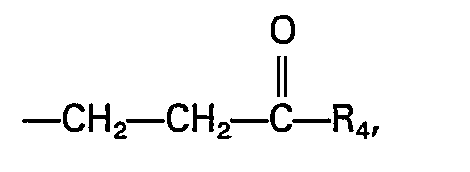
- a and B are selected from OH and OM, in which M is an alkali metal, an alkaline earth metal or an amine, R, is hydrogen or the group R 4 is OH, CN, NH 2 , alkoxy with 1-12 C-atoms, alkylaryloxy or alkoxycycloaliphatic, or OM, R 3 is alkyl, alkenyl, alkoxy, hydroxyalkyl or hydroxyalkenyl of 2 to 20 carbon atoms each or R 3 is aryl or alkylaryl or cycloalkyl of up to 20 carbon atoms each and Y is alkylene of 2 to 12 carbon atoms optionally interrupted by up to 3 oxygen atoms.
- the imidazolines can be prepared from a variety of acids having 4 to 22 C-atoms. They may be normal straight chain fatty acids or acids with additional groups such as hydroxy. They may also be alkylaryl or alkylcycloaliphatic acids.
- the amines are derived from substituted ethylene-diamines. Examples of amines r but not limited to these, would be N-hydroxyethyl ethylene diamine, N-hydroxypropyl ethylene diamine, N-hydroxybutyl ethylene diamine, etc.
- the resulting imidazolines can be alkoxylated with ethylene oxide, propylene oxide, butylene oxide etc. to yield polyalkoxylated products.
- the desired products are obtained by reacting the imidazoline moiety with a phosphorylating agent to produce the phosphoric acid products of this invention.
- phosphorylating agents including phosphoric acid, polyphosphoric acid, phosphorus pentoxide and various phosphorus halides
- preferred agents used in preparing the product of this invention are phosphorus pentoxide and polyphosphoric acid.
- imidazolines per se are quite sensitive to moisture and that hydrolysis readily occurs even at room temperature. This results in formation of the open chain amino amide.
- Reactant A 894 grams of Reactant A were charged to a 2 liter, 3-necked, round bottom flask equipped with an agitator, thermometer, reflux condenser and heating mantle.
- 106 grams of anhydrous phosphorus pentoxide was slowly added while maintaining vigorous agitation and gradually raising the temperature to 85-100°C. After the addition is completed the temperature is maintained at 85-100°C for several hours to ensure completion of the reaction.
- the resulting product is represented by the following formula:
- Reactant E To 873 parts of Reactant D is added, under good agitation, 127 parts of anhydrous phosphorous pentoxide. The mixture is heated to 85-100°C for several hours until the acid values remain essentially unchanged. The resulting product consists of mono- and di - phosphate esters of Reactant D, and is designated Reactant E.
- Reactant E To 594 grams of water are added 334 grams of Reactant E, the mixture is agitated and 72 grams of 50% sodium hydroxide are then added. The reactants are heated to 90-100°C until 1 part product is clear in 9 parts of 20% sodium hydroxide. The product is a clear amber liquid.
- Reactant F To 853 parts of Reactant D are added 147 parts of 115% polyphosphoric acid under good agitation. The mixture is then heated to 85-100°C for several hours until the acid values remain unchanged. The resulting product consists of mono- and di-phosphate esters of Reactant D, and is designated Reactant F.
- Reactant G To 1067 parts of Reactant G at R.T. are added slowly and under good agitation 137 parts of 115% polyphosphoric acid (PPA). The mixture is allowed to exotherm from R.T. to 70°C to facilitate mixing and promote reaction. Once all the PPA is added the temperature is raised to 90-95°C and reacted for a few hours until the acid values remain essentially unchanged. This is Reactant H.
- PPA polyphosphoric acid
- Reactant G 927 parts of Reactant G are mixed and heated with 73 parts of 115% polyphosphoric acid in the same fashion as in Experiment 12. This mixture is then heated with 50% sodium hydroxide in water to produce a mixture as described in Experiment 13. This yields a 35% active product.
- Reactant J 895 parts of Reactant I are heated to 80°C and 105 parts of phosphorus pentoxide are added slowly under good agitation, taking care to avoid any sudden exotherm. Once all the P 2 0 3 has been added the mixture is heated to 90-95°C for several hours until the acid values remain essentially unchanged. This is Reactant J.
- Reactant K To 818 parts of reactant I are added 182 parts of ethyl acrylate, the mixture is heated and refluxed at 95-100°C for several hours until an unsaturation value reveals a minimum of 85% Reaction by residual acrylate. This is Reactant K.
- Reactant K To 913 parts of Reactant K are added 87 parts of phosphorous pentoxide under good agitation and heated to 80°C. Once all of the P 2 0 5 has been added, the batch is heated to 95-100°C and held for several hours until the AV 2 and AV at pH 7 remain essentially unchanged. The product is a heavy viscous liquid. This is Reactant L.
- Reactant K To 898 parts of Reactant K are added 102 parts of 115% polyphosphoric acid and heated in the same fashion as in Experiment 19 yielding also a comparable structure to reactant L. This is Reactant M.
- Reactant N To 878 parts of Reactant I are added 122 parts of 115% polyphosphoric acid and heated in the same fashion as in Experiment 16 yielding a comparable structure to Reactant J. This is Reactant N.
- Reactant P To 910 parts of Reactant 0 are added 90 parts of phosphorous pentoxide, and the mixture is treated as in Experiment 2. This is Reactant P.
- Experiment 26 and 27 can be repeated using the proper amounts of Reactant O (2.7 moles), of 115% polyphosphoric acid (1 mole) and then the needed amount of sodium hydroxide and water to yield a comparable product to that obtained in Experiment 27.
- Reactant Q To 810 parts of Reactant 0 are added 190 parts of 115% polyphosphoric acid, the mixture is heated in the same fashion as Experiment 12. This is Reactant Q.
- Reactant S 847 parts of Reactant Rare heated to 90°C and 153 parts of 115% polyphosphoric acid are added slowly under good agitation allowing the temperature to drop down to 75°C. Once all the polyphosphoric acid has been added the mixture is heated to 95°C for several hours until the acid values remain essentially unchanged.
- the resulting product consists of mono- and di-phosphate esters of Reactant R, and is designated Reactant S.
- Reactant S To 330 parts of Reactant S are added 598 parts of water, and the mixture is heated to 55°C and agitated to produce a homogeneous solution. To the solution 72 parts of 50% sodium hydroxide are added under good agitation and the total mixture is then heated to 90°C, making sure to control foam in the reaction vessel. The mixture is heated for two hours or until 1 part product is clear in 9 parts of 20% sodium hydroxide. The resulting product is a clear, yellow liquid.
- Reactant U 877 parts of Reactant T are heated to 80°C and 123 parts of 115% polyphosphoric acid are added slowly under good agitation. The mixture is then heated to 90-95°C until the acid values remain essentially unchanged. The resulting product consists of mono- and di-phosphate esters of Reactant T, and is designated Reactant U.
- Reactant T 895 parts of Reactant T are heated to 80-85°C and 105 parts of anhydrous phosphorous pentoxide are added slowly over a one hour period under good agitation. The mixture is then heated to 95°C for several hours until the acid values remain essentially unchanged.
- This product exhibits a structure similar to that of Experiment 52. This is reactant V.
- Reactant W To 290 parts of Reactant W are added 36 parts of anhydrous phosphorous pentoxide at 80-85°C over a ⁇ one hour period. The mixture is then heated at 95°C for several hours in the same fashion as Reactant V. To this then is added 591 parts of water and the mixture is agitated at 35°C until it is homogeneous. Then 82 parts of 50% sodium hydroxide are added and the mixture is heated at 95°C unti 1 part product is clear in 9 parts of 30% sodium hydroxide. Product exhibits a similar structure to that of Experiment 53. Uses.
- the products of this invention exhibit a wide range of surfactant properties thus rendering these materials useful in a wide range of applications; these include:
Landscapes
- Chemical & Material Sciences (AREA)
- Organic Chemistry (AREA)
- Health & Medical Sciences (AREA)
- Life Sciences & Earth Sciences (AREA)
- General Health & Medical Sciences (AREA)
- Engineering & Computer Science (AREA)
- Animal Behavior & Ethology (AREA)
- Public Health (AREA)
- Veterinary Medicine (AREA)
- Biochemistry (AREA)
- Molecular Biology (AREA)
- Epidemiology (AREA)
- Birds (AREA)
- Dermatology (AREA)
- Chemical Kinetics & Catalysis (AREA)
- Oil, Petroleum & Natural Gas (AREA)
- Wood Science & Technology (AREA)
- Materials Engineering (AREA)
- Pharmaceuticals Containing Other Organic And Inorganic Compounds (AREA)
- Compositions Of Macromolecular Compounds (AREA)
- Cosmetics (AREA)
- Emulsifying, Dispersing, Foam-Producing Or Wetting Agents (AREA)
- Liquid Carbonaceous Fuels (AREA)
- Lubricants (AREA)
Abstract
Description
- The present invention relates to the novel compositions of matter consisting of specific betaine derivatives referred to hereinafter as phosphobetaines.
- Application number 965,461, now U.S. Patent 4,215,064 discloses novel types of phosphobetaines possessing many unusual properties. Further the European Application 0013713 discloses novel phosphobetaines for use as surface active agents.
- The products of U.S. Patent 4,215,064 and EP-A-00 137 13 suffer one disadvantage, namely that they contain varying amounts of sodium chloride which is disadvantageous for many applications.
- The products of this invention, on the other hand, are "salt free" and in addition to this characteristic, exhibit unusual foaming, wetting, cleansing, detergency, antistatic, viscosity building, solubilizing, emulsifying, lubricating and corrosion inhibiting properties. For example they are excellent hydrotropes in high electrolyte systems, with the ability to increase the cloud point of the system to temperatures as high as 80°C. Such high cloud points are not achieveable with the phosphobetaines of US-PS-42 15 064 and EP-A-00 137 13.
- The novel phosphobetaine compounds of the invention may be represented by the following general formulae.


- The synthesis of hydroxy substituted imidazolines is well documented in the literature and need not be reviewed here (US Patent 2,267,965 + 2,528,378). The reaction of these imidazolines with phosphorylating agents generally leads to dark brown to black products possessing poor water solubility and generally lacking in desirable surface active properties.
- It has been discovered, however, that when an imidazoline is first reacted with an appropriate acrylate which may include acrylic acid, acrylamide and acrylate esters the resulting product can readily be phosphorylated to produce products with extremely interesting surface active properties.
- Although the exact composition of this reaction product has not been established we believe it is essentially that indicated in the invention disclosure.
- It has been found that these imidazolines can be reacted with either one or two moles of the acrylic derivative to give either a mono- or di-substituted product as follows.

- The imidazolines can be prepared from a variety of acids having 4 to 22 C-atoms. They may be normal straight chain fatty acids or acids with additional groups such as hydroxy. They may also be alkylaryl or alkylcycloaliphatic acids.
- The amines are derived from substituted ethylene-diamines. Examples of aminesrbut not limited to these, would be N-hydroxyethyl ethylene diamine, N-hydroxypropyl ethylene diamine, N-hydroxybutyl ethylene diamine, etc. In addition the resulting imidazolines can be alkoxylated with ethylene oxide, propylene oxide, butylene oxide etc. to yield polyalkoxylated products.
- The desired products are obtained by reacting the imidazoline moiety with a phosphorylating agent to produce the phosphoric acid products of this invention.
- Although there are various phosphorylating agents including phosphoric acid, polyphosphoric acid, phosphorus pentoxide and various phosphorus halides the preferred agents used in preparing the product of this invention are phosphorus pentoxide and polyphosphoric acid.
- In carrying out these phosphorylations with the aforesaid agents a mixture of esters is obtained. These are mono and diesters with the relative ratios of mono to diester, being a function of the ratio of imidazoline derivative to the phosphorylating agent. Due to the strong dehydrating effects of the phosphorylating agent, products of this invention are limited to ratios of approximately 1:1 to 4:1 with the preferred ratio depending to a great extent on the end use of the product and the ratio of mono to diester desired.
- In view of this, all products represent a mixture of mono and diesters as represented by the basic structures as hereinbefore defined.
- It should be noted that imidazolines per se are quite sensitive to moisture and that hydrolysis readily occurs even at room temperature. This results in formation of the open chain amino amide.
- Although it would be expected that the imidazoline ring would remain intact during the acrylate reaction and the phosphorylation, hydrolysis might be expected to occur during the final reaction step.
- To our surprise however this hydrolysis did not occur and the imidazoline ring remains intact as measured by ultraviolet absorption at 230-240 nanometers.
- The surprising stability of this ring system would appear to account for some of the unusual properties of these products. For example these products have been found to be not only soluble but indefinitely stable in a 25% concentration of hydrochloric acid and a 40% concentration of sodium hydroxide. This is particularly unexpected since the unphosphated precursors do not exhibit this stability but rather decompose in a period of time of hours to a few days.
- The following examples are presented for purposes of illustration only and not to imply limitations of the invention.
- 620 grams of a hydroxy containing imidazoline prepared by reacting coconut fatty acid with hydroxyethyl ethylene diamine were charged to a 2 liter round bottom, 3-necked flask equipped with agitation, thermometer, reflux condenser and heating mantle. 348 grams of methyl acrylate was then added with good agitation followed by 32 grams of acrylic acid. The mixture was heated at 100―110°Cfor approximately four hours, or until an 85% conversion of the acrylate has occurred as determined by the analysis of unreacted acrylate. The product has the following probable structure:

- This is Reactant A.
- 894 grams of Reactant A were charged to a 2 liter, 3-necked, round bottom flask equipped with an agitator, thermometer, reflux condenser and heating mantle. To this product 106 grams of anhydrous phosphorus pentoxide was slowly added while maintaining vigorous agitation and gradually raising the temperature to 85-100°C. After the addition is completed the temperature is maintained at 85-100°C for several hours to ensure completion of the reaction. The resulting product is represented by the following formula:
-


- To 585 parts of water, 335 parts of Reactant B and 80 parts of 50% sodium hydroxide are added under good agitation. The mixture is then heated to 85-100°C for 1 hour or until 1 part of product is clear in 9 parts of 40% sodium hydroxide. The resulting product is represented by the following formula:


- To 877 parts of reactant A are added 123 parts of 115% polyphosphoric acid. The mixture is then heated to 85-100°C for several hours until the acid values remain unchanged. This product has the following probable structure:
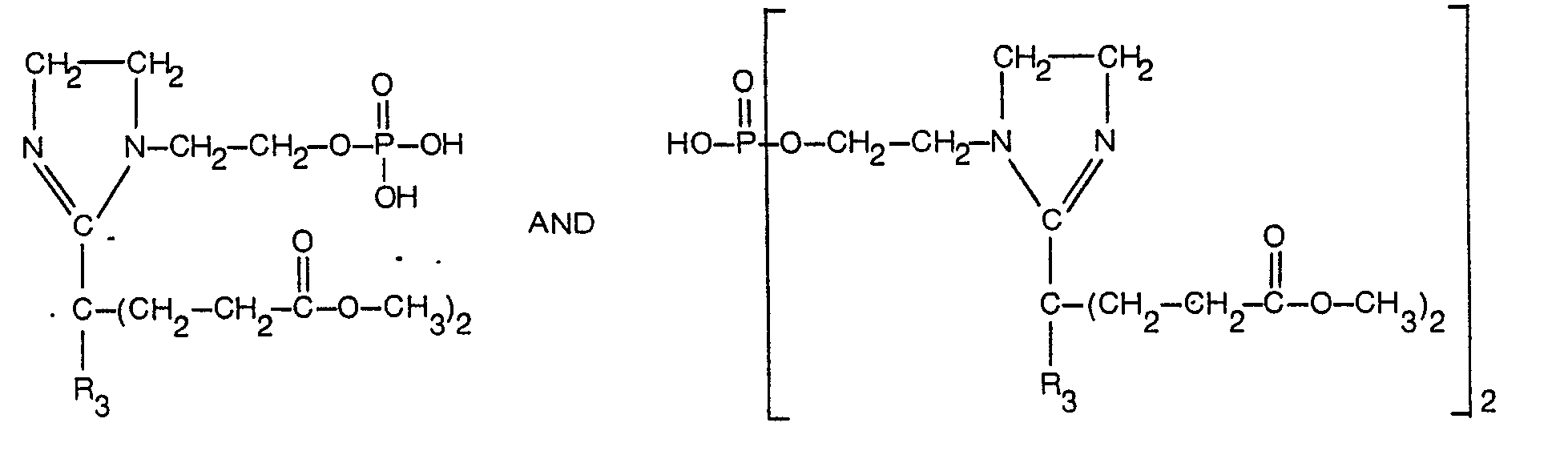
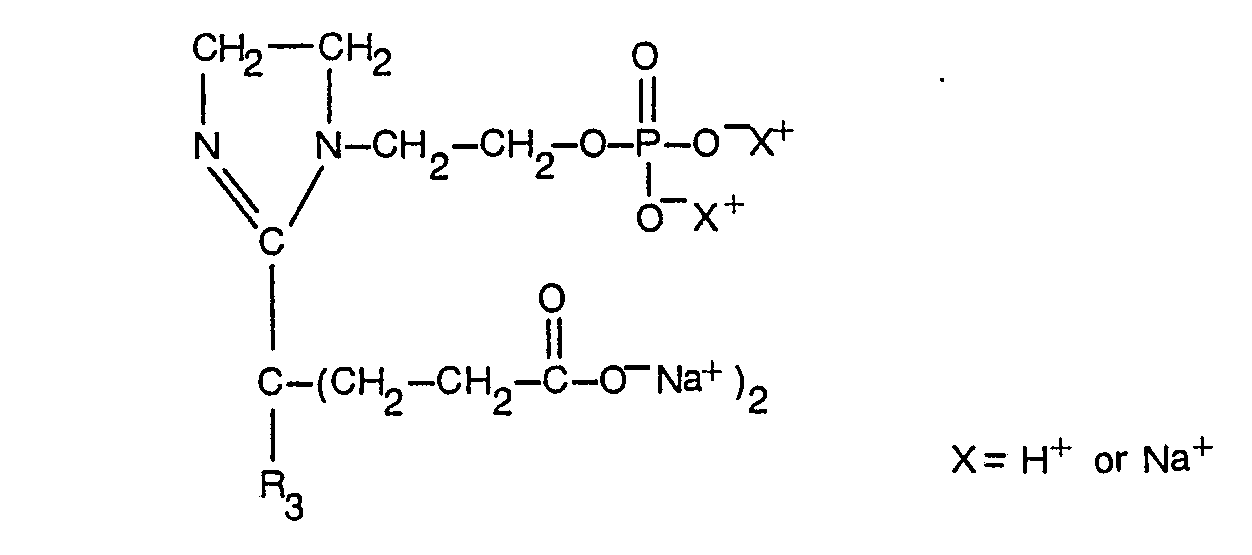
- To 586 parts of water are added 335 parts of reactant C and 78 parts of 50% sodium hydroxide under good agitation. The mixture is then heated to 85-100°C for a few hours until 1 part of product is clear in 9 parts of 40% sodium hydroxide. This product has the following probable structures:

- To 762 grams of coco derived imidazoline are added 238 grams of methyl acrylate. The reactants are then heated in a suitable vessel, equipped with stirrer, thermometer, reflux condenser and heating mantles, to 90-105°C for four hours, or until a minimum of 85% reaction is obtained as determined by unsaturation analysis on the acrylate. This product has the following probable structure:

- To 873 parts of Reactant D is added, under good agitation, 127 parts of anhydrous phosphorous pentoxide. The mixture is heated to 85-100°C for several hours until the acid values remain essentially unchanged. The resulting product consists of mono- and di-phosphate esters of Reactant D, and is designated Reactant E.
- To 594 grams of water are added 334 grams of Reactant E, the mixture is agitated and 72 grams of 50% sodium hydroxide are then added. The reactants are heated to 90-100°C until 1 part product is clear in 9 parts of 20% sodium hydroxide. The product is a clear amber liquid.
- To 853 parts of Reactant D are added 147 parts of 115% polyphosphoric acid under good agitation. The mixture is then heated to 85-100°C for several hours until the acid values remain unchanged. The resulting product consists of mono- and di-phosphate esters of Reactant D, and is designated Reactant F.
- To 595 parts of water are added 334 parts of Reactant F, then 70 parts of 50% sodium hydroxide are added and the reactants heated to 90-100°C until 1 part product is clear in 25% sodium hydroxide. The product is a clear amber liquid.
- To 266 parts of imidazoline derived from caprylic acid and aminoethylethanolamine are added 475 parts of an ethoxylated alcohol of the general formula R-O-(CHz-CH20)xH; Where R = a hydrocarbon chain with 10 carbon atoms and X = 6. The mixture is agitated and .4 parts of a 25% solution of NaOCH3 in alcohol are added. Then 251 parts of ethyl acrylate are added slowly under agitation so that the temperature does not exceed 45°C. Once all the acrylate is added the mixture is held at 40-45°C for 2 hrs or until a reaction of 85% minimum is reached as determined by an unsaturation test. This then is Reactant G where R3 = a hydrocarbon chain of 6 carbon atoms and Y = C2H4.
- To 1067 parts of Reactant G at R.T. are added slowly and under good agitation 137 parts of 115% polyphosphoric acid (PPA). The mixture is allowed to exotherm from R.T. to 70°C to facilitate mixing and promote reaction. Once all the PPA is added the temperature is raised to 90-95°C and reacted for a few hours until the acid values remain essentially unchanged. This is Reactant H.
- To 570 parts of water are added 341 parts of Reactant H, the charge is homogenized and 88 parts of 50% sodium hydroxide are added under good agitation. The batch is allowed to exotherm from R.T. to 50°C, but once all the sodium hydroxide is added the batch is heated to 90-95°C for several hours or until the product remains clear at R.T. The pH is then adjusted to 6-7 as is with 85% phosphoric acid. The product is a clear amber liquid.
- 927 parts of Reactant G are mixed and heated with 73 parts of 115% polyphosphoric acid in the same fashion as in Experiment 12. This mixture is then heated with 50% sodium hydroxide in water to produce a mixture as described in Experiment 13. This yields a 35% active product.
- To 801 parts of imidazoline derived from ricinoleic acid and aminoethylethanolamine are added 10 parts of 25% NaOCH3 in methanol, the mixture is homogenized and 189 parts of methyl acrylate are added slowly under good agitation, keeping the batch temp. at 45°C max. Once all the acrylate is added the batch is heated for 3 hours at 40-45°C or until 85% min. reaction is obtained via unsaturation test. The product is a clear amber liquid. This is Reactant I where R3 = hydrocarbon chain of 16 carbon atoms containing an hydroxyl group and a double bond. Y = CZH4.
- 895 parts of Reactant I are heated to 80°C and 105 parts of phosphorus pentoxide are added slowly under good agitation, taking care to avoid any sudden exotherm. Once all the P203 has been added the mixture is heated to 90-95°C for several hours until the acid values remain essentially unchanged. This is Reactant J.
- To 603 parts of water are added 337 parts of Reactant J, the mixture is agitated and then 60 parts of 50% sodium hydroxide are added. Some exotherm develops. Once all the sodium hydroxide has been added the batch was heated to 90-95°C for a few hours or until the pH remains unchanged. The batch is cooled to R.T. and adjusted with 50% sodium hydroxide to a pH of 9.5-9.8. The product is a clear liquid.
- To 818 parts of reactant I are added 182 parts of ethyl acrylate, the mixture is heated and refluxed at 95-100°C for several hours until an unsaturation value reveals a minimum of 85% Reaction by residual acrylate. This is Reactant K.
- To 913 parts of Reactant K are added 87 parts of phosphorous pentoxide under good agitation and heated to 80°C. Once all of the P205 has been added, the batch is heated to 95-100°C and held for several hours until the AV2 and AV at pH 7 remain essentially unchanged. The product is a heavy viscous liquid. This is Reactant L.
- To 593 parts of water are added 340 parts of Reactant L, and the mixture is agitated while heating to 60°C to homogenize. Once the mixture is clear and homogeneous 6.69 parts of 50% sodium hydroxide are added and the product refluxed for 2 hours or until 1 part product is clear in 9 parts of 25% sodium hydroxide and the pH of a 10% solution is 8-9.0. The product is a clear liquid.
- To 898 parts of Reactant K are added 102 parts of 115% polyphosphoric acid and heated in the same fashion as in Experiment 19 yielding also a comparable structure to reactant L. This is Reactant M.
- To 594 parts of water are added 340 parts of Reactant M and 66 parts of 50% sodium hydroxide. The mixture is heated in the same fashion as in Experiment20 to yield a comparable compound chemically and physically.
- To 878 parts of Reactant I are added 122 parts of 115% polyphosphoric acid and heated in the same fashion as in Experiment 16 yielding a comparable structure to Reactant J. This is Reactant N.
- To 604 parts of water are added 337 parts of reactant N and 58 parts of 50% sodium hydroxide, the mixture is heated in the same fashion as in Experiment 17 yielding a comparable product.
- To 683 parts of castor oil derived imidazoline are added 290 parts of methyl acrylate and 27 parts of acrylic acid. The mixture is then heated and reacted in the same fashion as in Experiment 1 yielding a comparable product. This is Reactant 0 where R3 is a hydrocarbon chain of 16 carbon atoms containing a hydroxyl group and a double bond. Y = C2H4.
- To 910 parts of Reactant 0 are added 90 parts of phosphorous pentoxide, and the mixture is treated as in Experiment 2. This is Reactant P.
- To 595 parts of water are added 337 parts of Reactant P and 68 parts of 50% sodium hydroxide, the mixture is then heated in the same fashion as Experiment 3.
- Experiment 26 and 27 can be repeated using the proper amounts of Reactant O (2.7 moles), of 115% polyphosphoric acid (1 mole) and then the needed amount of sodium hydroxide and water to yield a comparable product to that obtained in Experiment 27.
- To 810 parts of Reactant 0 are added 190 parts of 115% polyphosphoric acid, the mixture is heated in the same fashion as Experiment 12. This is Reactant Q.
- To 554 parts of water are added 328 parts of Reactant Q and 118 parts of 50% sodium hydroxide. The mixture is heated in the same fashion as Experiment 13 yielding a clear amber liquid.
- 1 mole of low molecular weight imidazoline (MW = 203) is mixed with an equivalent molar amount of methyl acrylate as in Experiment 6 to yield a comparable product. R = hydrocarbon chain of 3 to 7 carbon atoms. Y = C2H4.
- 1 mole of isostearic acid derived imidazoline is treated with an equivalent molar amount of methyl acrylate as in Experiment 6to yield a comparable product. This product is treated as in Experiment 9 using 115% polyphosphoric acid, and then hydrolyzed as in Experiment 10. R3 = a hydrocarbon chain of 16 carbon atoms. Y = C3H6.
- To 1 mole of isostearic derived imidazoline are added equivalent mole ratios of methyl acrylate and acrylic acid as in Experiment 1. To this an equivalent molar ratio of phosphorous pentoxide is added as in Experiment 2 and the mixture treated in the same fashion. This product is then converted to the final species by adding the needed amount of water and 50% sodium hydroxide to obtain a 35% active product of the same general formula. R3 = a hydrocarbon chain of 16 carbon atoms. Y = CZH4.
- To 1 mole of isostearic acid derived imidazoline is aded an equivalent mole ratio of methyl acrylate and treated in the same fashion as in Experiment 6. To this is added the molar equivalent of phosphorous pentoxide to prepare and react as per Experiment 7. This product is then converted to the final species by adding the necessary water and 50% sodium hydroxide to prepare a 35% active solution as Experiment 8 yielding a product with the same general structure. R3 = a hydrocarbon chain of 16 carbon atoms. Y = C2H4.
- To 1 mole of isostearic acid derived imidazoline are added equivalent mole ratios of methyl acrylate and acrylic acid as in Experiment 1. To this is added the molar equivalent of 115% polyphosphoric acid to react as per Experiment 4. This intermediate is then converted to the final product by adding the necessary water and 50% sodium hydroxide to prepare a 35% active product as in Experiment 5, yielding a product with the same general structure.
- 1 mole of stearic acid derived imidazoline is treated in the same fashion as Experiment 32, yielding a product of the same general formula.
- 1 mole of stearic acid derived imidazoline is treated in the same fashion as Experiment 33, to yield a product of the same general formula.
- 1 mole of stearic acid derived imidazoline is treated in the same fashion as Experiment 34, to yield a product of the same general formula.
- 1 mole of stearic acid derived imidazoline is treated in the same fashion as Experiment 35, to yield a product of the same general formula.
- 1 mole of pelargonic acid derived imidazoline is treated in the same fashion as Experiment 32, to yield the desired product. R3 = hydrocarbon-chain of 7 carbon atoms, Y = C3H6.
- 1 mole of pelargonic acid derived imidazoline is treated in the same fashion as Experiment 33, to yield the desired product. R3 = hydrocarbon chain of 7 carbon atoms, Y = C2H4.
- 1 mole of pelargonic acid derived imidazoline is treated in the same fashion as Experiment 34, to yield the desired product. R3 = hydrocarbon chain of 7 carbon atoms, Y = C2H40C2H4.
- 1 mole of pelargonic acid derived imidazoline is treated in the same fashion as Experiment35, to yield the desired product. R3 = hydrocarbon chain of 7 carbon atoms, Y = C2H4.
- 1 mole of caprylic acid derived imidazoline is treated in the same fashion as Experiment 32, to yield the desired product. R3 = hydrocarbon chain of 6 carbon atoms, Y = C2H4.
- 1 mole of caprylic acid derived imidazoline is treated in the same fashion as Experiment 33, to yield the desired product. R3 = hydrocarbon chain of 6 carbon atoms, Y = C2H4OC2H4.
- 1 mole of caprylic acid derived imidazoline is treated in the same fashion as Experiment 34, to yield the desired product. R3 = hydrocarbon chain of 6 carbon atoms, Y = C3H6.
- 1 mole of caprylic acid derived imidazoline is treated in the same fashion as Experiment 35, to yield the desired product. R3 = hydrocarbon chain of 6 carbon atoms, Y = C2H4.
- To 795 parts of coco derived imidazoline, are added 205 parts of acrylamide. The mixture is heated to 95°C for several hours until 85% reaction is achieved as determined by an unsaturation test. The product exhibits the following probable structure:

- 847 parts of Reactant Rare heated to 90°C and 153 parts of 115% polyphosphoric acid are added slowly under good agitation allowing the temperature to drop down to 75°C. Once all the polyphosphoric acid has been added the mixture is heated to 95°C for several hours until the acid values remain essentially unchanged. The resulting product consists of mono- and di-phosphate esters of Reactant R, and is designated Reactant S.
- To 330 parts of Reactant S are added 598 parts of water, and the mixture is heated to 55°C and agitated to produce a homogeneous solution. To the solution 72 parts of 50% sodium hydroxide are added under good agitation and the total mixture is then heated to 90°C, making sure to control foam in the reaction vessel. The mixture is heated for two hours or until 1 part product is clear in 9 parts of 20% sodium hydroxide. The resulting product is a clear, yellow liquid.
- To 617 parts of coco-derived imidazoline are added 224 parts of ethyl acrylate and 159 parts of acrylamide. The mixture is heated to 90-95°C for several hours until 85% reaction is obtained as determined by an unsaturation test. The product exhibits the following structure:

- 877 parts of Reactant T are heated to 80°C and 123 parts of 115% polyphosphoric acid are added slowly under good agitation. The mixture is then heated to 90-95°C until the acid values remain essentially unchanged. The resulting product consists of mono- and di-phosphate esters of Reactant T, and is designated Reactant U.
- To 587 parts of water are added 335 parts of Reactant 0. The mixture is heated to 60°C to homogenize and then 80 parts of 50% sodium hydroxide are added under good agitation. The mixture is then heated to 95-100°C until 1 part product is clear in 9 parts of 35% sodium hydoxide. The resulting product is a clear, yellow liquid.
- 895 parts of Reactant T are heated to 80-85°C and 105 parts of anhydrous phosphorous pentoxide are added slowly over a one hour period under good agitation. The mixture is then heated to 95°C for several hours until the acid values remain essentially unchanged. This product exhibits a structure similar to that of Experiment 52. This is reactant V.
- To 577 parts of water are added 343 parts of Reactant V, the mixture is heated to 55°C to homogenize and then 80 parts of 50% sodium hydroxide are added under good agitation. The mixture is heated at 90-95°C for several hours until 1 part product is clear in 9 parts of 35% sodium hydroxide. Product exhibits a structure similar to that of Experiment 53.
- To 660 parts of coco-derived imidazoline are added 340 parts of acrylamide. The mixture is heated to 95°C and reacted for several hours until at least 85% reaction is achieved as determined by an unsaturation test. The product exhibits the following probable structure:

- To 285 parts of Reactant Ware added 43 parts of 115% polyphosphoric acid, and the mixture is treated as in Experiment 52. To this then is added 592 parts of water and homogenized at 45°C, then 81 parts of 50% sodium hydroxide are added and heated at 95°C until 1 part product is clear in 9 parts of 30% sodium hydroxide. Product exhibits a similar structure to that of Experiment 53.
- To 290 parts of Reactant W are added 36 parts of anhydrous phosphorous pentoxide at 80-85°C over a· one hour period. The mixture is then heated at 95°C for several hours in the same fashion as Reactant V. To this then is added 591 parts of water and the mixture is agitated at 35°C until it is homogeneous. Then 82 parts of 50% sodium hydroxide are added and the mixture is heated at 95°C unti 1 part product is clear in 9 parts of 30% sodium hydroxide. Product exhibits a similar structure to that of Experiment 53. Uses.
- The products of this invention exhibit a wide range of surfactant properties thus rendering these materials useful in a wide range of applications; these include:
- Cosmetics: formulation of shampoos, bubble baths, deodorants, antiperspirant sticks, creams and lotions, hair conditioners, foaming bath oils, hair dyes, hair dressings, corrosion inhibitors and skin care products.
- Textiles: laundry detergents, fabric softeners, rug and upholstery cleaners, fiber lubricants, antistats, dyeing assistants, fulling agents, bleaching, desizing, mercerizing.
- Metal Cleaners: ferrous and nonferrous metals, alkaline cleaners, acid cleaners, soak tank cleaners, spray cleaners, degreasers, aircraft cleaners, railroad car cleaners, truck and bus cleaners, car washes.
- Metal Working Fluids: cutting oils, rolling oils, drawing compounds, chain lubricants, grinding compounds, burnishing compounds, corrosion inhibition and extreme pressure lubricants.
- Petroleum: secondary, tertiary and recovery emulsion breakers, drilling fluids, corrosion inhibitors, gasoline and fuel additives, scale inhibition.
- Paper: wood pulping, pitch dispersants, de-inking, rewetting, felt washing, pigment dispersing, antistatic and levelling agents.
- Paints: dispersants, wetting agents, defoamers, corrosion inhibitors.
- Plastics and Resins: emulsion polymerization, suspension polymerization, antistatic agents, mold release agents, lubricants.
- In addition to the high solubility and stability exhibited by these novel products in acid and alkaline systems they function as excellent hydrotropes in high electrolyte systems as shown by the following examples.
-


Claims (23)

Priority Applications (1)
| Application Number | Priority Date | Filing Date | Title |
|---|---|---|---|
| AT84108153T ATE39929T1 (en) | 1983-07-11 | 1984-07-11 | SALT-FREE PHOSPHORBETAINES. |
Applications Claiming Priority (2)
| Application Number | Priority Date | Filing Date | Title |
|---|---|---|---|
| US06/512,757 US4490536A (en) | 1983-07-11 | 1983-07-11 | Salt free phosphobetaines |
| US512757 | 1983-07-11 |
Publications (3)
| Publication Number | Publication Date |
|---|---|
| EP0131908A2 EP0131908A2 (en) | 1985-01-23 |
| EP0131908A3 EP0131908A3 (en) | 1985-08-07 |
| EP0131908B1 true EP0131908B1 (en) | 1989-01-11 |
Family
ID=24040427
Family Applications (1)
| Application Number | Title | Priority Date | Filing Date |
|---|---|---|---|
| EP84108153A Expired EP0131908B1 (en) | 1983-07-11 | 1984-07-11 | Salt free phosphobetaines |
Country Status (6)
| Country | Link |
|---|---|
| US (1) | US4490536A (en) |
| EP (1) | EP0131908B1 (en) |
| JP (1) | JPS60105689A (en) |
| AT (1) | ATE39929T1 (en) |
| CA (1) | CA1232279A (en) |
| DE (1) | DE3476066D1 (en) |
Families Citing this family (11)
| Publication number | Priority date | Publication date | Assignee | Title |
|---|---|---|---|---|
| US4713183A (en) * | 1986-03-12 | 1987-12-15 | Dresser Industries, Inc. | Oil based drilling fluid reversion |
| US4820450A (en) * | 1986-06-26 | 1989-04-11 | E And R Investments | Composition for precipitating dirt and other contaminants from wash water and method of cleaning |
| US5458698A (en) * | 1987-06-01 | 1995-10-17 | Henkel Corporation | Aqueous lubricant and surface conditioner for formed metal surfaces |
| US5476601A (en) * | 1987-06-01 | 1995-12-19 | Henkel Corporation | Aqueous lubricant and surface conditioner for formed metal surfaces |
| PL180724B1 (en) * | 1993-07-13 | 2001-03-30 | Henkel Corp | Water grease, and surface defect remover for shaped metal surfaces |
| US5378379A (en) * | 1993-07-13 | 1995-01-03 | Henkel Corporation | Aqueous lubricant and surface conditioner, with improved storage stability and heat resistance, for metal surfaces |
| DE4342560A1 (en) * | 1993-12-14 | 1995-06-22 | Marbert Gmbh | Use of 1,4,5,6-tetra:hydro-4-pyrimidine carboxylic acid derivs. in cosmetics |
| NL1002167C2 (en) * | 1996-01-24 | 1997-07-25 | Efka Chemicals Bv | Dispersant. |
| EP0856577B1 (en) * | 1997-02-03 | 2004-05-06 | The Procter & Gamble Company | Liquid aqueous cleaning compositions |
| EP0908510A1 (en) * | 1997-10-08 | 1999-04-14 | The Procter & Gamble Company | Liquid bleaching compositions with improved safety to fabrics and colors |
| US6316400B1 (en) | 1997-10-08 | 2001-11-13 | The Procter & Gamble Co. | Liquid bleaching composition with improved safety to fabrics and colors |
Family Cites Families (3)
| Publication number | Priority date | Publication date | Assignee | Title |
|---|---|---|---|---|
| US4215064A (en) * | 1978-11-30 | 1980-07-29 | Johnson & Johnson | Phosphobetaines |
| US4283542A (en) * | 1978-11-30 | 1981-08-11 | Mona Industries | Process for the preparation of phosphobetaines |
| DE2966896D1 (en) * | 1978-11-30 | 1984-05-17 | Mona Industries Inc | Phosphorus containing surface active agents and their preparation |
-
1983
- 1983-07-11 US US06/512,757 patent/US4490536A/en not_active Expired - Fee Related
-
1984
- 1984-07-09 CA CA000458435A patent/CA1232279A/en not_active Expired
- 1984-07-11 JP JP59142508A patent/JPS60105689A/en active Pending
- 1984-07-11 AT AT84108153T patent/ATE39929T1/en not_active IP Right Cessation
- 1984-07-11 EP EP84108153A patent/EP0131908B1/en not_active Expired
- 1984-07-11 DE DE8484108153T patent/DE3476066D1/en not_active Expired
Also Published As
| Publication number | Publication date |
|---|---|
| CA1232279A (en) | 1988-02-02 |
| ATE39929T1 (en) | 1989-01-15 |
| US4490536A (en) | 1984-12-25 |
| EP0131908A2 (en) | 1985-01-23 |
| JPS60105689A (en) | 1985-06-11 |
| DE3476066D1 (en) | 1989-02-16 |
| EP0131908A3 (en) | 1985-08-07 |
Similar Documents
| Publication | Publication Date | Title |
|---|---|---|
| US5643864A (en) | Anionic surfactants having multiple hydrophobic and hydrophilic groups | |
| US5914310A (en) | Amphoteric surfactants having multiple hydrophobic and hydrophilic groups | |
| EP0486510B1 (en) | Cyclic amidocarboxy surfactants, synthesis and use thereof | |
| US5091493A (en) | Silicone phosphobetaines | |
| US4490536A (en) | Salt free phosphobetaines | |
| HK1006839B (en) | Cyclic amidocarboxy surfactants, synthesis and use thereof | |
| US4153561A (en) | Conditioning agent | |
| EP0510565B1 (en) | Surface-active agents derived from sulfosuccinic esters | |
| CA1038766A (en) | Amphoteric surface active agents | |
| US3389145A (en) | Fatty oxazoline surfactants and a process for their preparation | |
| US5846923A (en) | Polyamphoteric phosphate ester surfactants | |
| US4395373A (en) | Phosphated amine oxides | |
| US4107096A (en) | Low foaming beta-amino propionic acid surface active agents | |
| US4009211A (en) | Beta,beta-dialkylethylmercaptoethoxylate as new compounds | |
| US2541260A (en) | Di-n-alkoxy substituted piperazine derivatives and method of preparing same | |
| AU2002310250B2 (en) | Compositions of alkanolamine salts of alkyl phosphate esters | |
| US4110358A (en) | Ampholytic quaternary ammonium compounds and methods for their preparation | |
| US2421707A (en) | Mono-substituted dialkanol piperazines | |
| US6121222A (en) | Anionic surfactants having multiple hydrophobic and hydrophilic groups | |
| US2693482A (en) | Preparation of alkene phosphonous acids | |
| US2781378A (en) | Detergent sulphonic acid and sulphate salts of certain amphoteric detergents | |
| US4956116A (en) | Surface-active, saturated sulfophosphoric acid-(partial)-alkyl esters | |
| US5274101A (en) | Polymeric phospholipid polymers | |
| US5041597A (en) | Surface-active sulfophosphoric-acid-(partial)-alkyl-esters | |
| US4983750A (en) | Phosphobetaines, methods for their synthesis and their use especially for industrial purposes |
Legal Events
| Date | Code | Title | Description |
|---|---|---|---|
| PUAI | Public reference made under article 153(3) epc to a published international application that has entered the european phase |
Free format text: ORIGINAL CODE: 0009012 |
|
| AK | Designated contracting states |
Designated state(s): AT BE CH DE FR GB IT LI LU NL SE |
|
| PUAL | Search report despatched |
Free format text: ORIGINAL CODE: 0009013 |
|
| AK | Designated contracting states |
Designated state(s): AT BE CH DE FR GB IT LI LU NL SE |
|
| 17P | Request for examination filed |
Effective date: 19850920 |
|
| 17Q | First examination report despatched |
Effective date: 19861118 |
|
| RAP3 | Party data changed (applicant data changed or rights of an application transferred) |
Owner name: MONA INDUSTRIES, INC. |
|
| GRAA | (expected) grant |
Free format text: ORIGINAL CODE: 0009210 |
|
| AK | Designated contracting states |
Kind code of ref document: B1 Designated state(s): AT BE CH DE FR GB IT LI LU NL SE |
|
| REF | Corresponds to: |
Ref document number: 39929 Country of ref document: AT Date of ref document: 19890115 Kind code of ref document: T |
|
| ITF | It: translation for a ep patent filed | ||
| REF | Corresponds to: |
Ref document number: 3476066 Country of ref document: DE Date of ref document: 19890216 |
|
| ET | Fr: translation filed | ||
| PGFP | Annual fee paid to national office [announced via postgrant information from national office to epo] |
Ref country code: DE Payment date: 19890717 Year of fee payment: 6 |
|
| PLBE | No opposition filed within time limit |
Free format text: ORIGINAL CODE: 0009261 |
|
| STAA | Information on the status of an ep patent application or granted ep patent |
Free format text: STATUS: NO OPPOSITION FILED WITHIN TIME LIMIT |
|
| 26N | No opposition filed | ||
| PG25 | Lapsed in a contracting state [announced via postgrant information from national office to epo] |
Ref country code: DE Effective date: 19910403 |
|
| ITTA | It: last paid annual fee | ||
| EPTA | Lu: last paid annual fee | ||
| PGFP | Annual fee paid to national office [announced via postgrant information from national office to epo] |
Ref country code: LU Payment date: 19941101 Year of fee payment: 12 |
|
| EAL | Se: european patent in force in sweden |
Ref document number: 84108153.2 |
|
| PGFP | Annual fee paid to national office [announced via postgrant information from national office to epo] |
Ref country code: SE Payment date: 19950811 Year of fee payment: 12 Ref country code: NL Payment date: 19950811 Year of fee payment: 12 Ref country code: GB Payment date: 19950811 Year of fee payment: 12 |
|
| PGFP | Annual fee paid to national office [announced via postgrant information from national office to epo] |
Ref country code: CH Payment date: 19950814 Year of fee payment: 12 |
|
| PGFP | Annual fee paid to national office [announced via postgrant information from national office to epo] |
Ref country code: FR Payment date: 19950821 Year of fee payment: 12 |
|
| PGFP | Annual fee paid to national office [announced via postgrant information from national office to epo] |
Ref country code: BE Payment date: 19950823 Year of fee payment: 12 |
|
| PGFP | Annual fee paid to national office [announced via postgrant information from national office to epo] |
Ref country code: AT Payment date: 19950919 Year of fee payment: 12 |
|
| PG25 | Lapsed in a contracting state [announced via postgrant information from national office to epo] |
Ref country code: LU Free format text: LAPSE BECAUSE OF NON-PAYMENT OF DUE FEES Effective date: 19960711 Ref country code: GB Effective date: 19960711 Ref country code: AT Effective date: 19960711 |
|
| PG25 | Lapsed in a contracting state [announced via postgrant information from national office to epo] |
Ref country code: SE Effective date: 19960712 |
|
| PG25 | Lapsed in a contracting state [announced via postgrant information from national office to epo] |
Ref country code: LI Effective date: 19960731 Ref country code: CH Effective date: 19960731 Ref country code: BE Effective date: 19960731 |
|
| BERE | Be: lapsed |
Owner name: MONA INDUSTRIES INC. Effective date: 19960731 |
|
| PG25 | Lapsed in a contracting state [announced via postgrant information from national office to epo] |
Ref country code: NL Effective date: 19970201 |
|
| GBPC | Gb: european patent ceased through non-payment of renewal fee |
Effective date: 19960711 |
|
| REG | Reference to a national code |
Ref country code: CH Ref legal event code: PL |
|
| PG25 | Lapsed in a contracting state [announced via postgrant information from national office to epo] |
Ref country code: FR Effective date: 19970328 |
|
| NLV4 | Nl: lapsed or anulled due to non-payment of the annual fee |
Effective date: 19970201 |
|
| EUG | Se: european patent has lapsed |
Ref document number: 84108153.2 |
|
| REG | Reference to a national code |
Ref country code: FR Ref legal event code: ST |