EP0131485B1 - Solid pharmaceutical formulations for slow, zero order release via controlled surface erosion : expanded range - Google Patents
Solid pharmaceutical formulations for slow, zero order release via controlled surface erosion : expanded range Download PDFInfo
- Publication number
- EP0131485B1 EP0131485B1 EP84401152A EP84401152A EP0131485B1 EP 0131485 B1 EP0131485 B1 EP 0131485B1 EP 84401152 A EP84401152 A EP 84401152A EP 84401152 A EP84401152 A EP 84401152A EP 0131485 B1 EP0131485 B1 EP 0131485B1
- Authority
- EP
- European Patent Office
- Prior art keywords
- pharmaceutical composition
- tablet
- pharmaceutically acceptable
- oral compositions
- compound
- Prior art date
- Legal status (The legal status is an assumption and is not a legal conclusion. Google has not performed a legal analysis and makes no representation as to the accuracy of the status listed.)
- Expired - Lifetime
Links
- 239000008194 pharmaceutical composition Substances 0.000 title claims abstract description 28
- 230000003628 erosive effect Effects 0.000 title claims abstract description 22
- 239000007787 solid Substances 0.000 title claims abstract description 5
- 239000000203 mixture Substances 0.000 claims abstract description 56
- 239000004480 active ingredient Substances 0.000 claims abstract description 22
- XLYOFNOQVPJJNP-UHFFFAOYSA-N water Substances O XLYOFNOQVPJJNP-UHFFFAOYSA-N 0.000 claims abstract description 21
- 239000003795 chemical substances by application Substances 0.000 claims abstract description 17
- 150000001875 compounds Chemical class 0.000 claims abstract description 17
- 239000011230 binding agent Substances 0.000 claims abstract description 9
- 239000000314 lubricant Substances 0.000 claims abstract description 8
- 238000001727 in vivo Methods 0.000 claims abstract description 7
- 238000004519 manufacturing process Methods 0.000 claims abstract description 7
- 239000004094 surface-active agent Substances 0.000 claims abstract description 7
- 239000004615 ingredient Substances 0.000 claims description 34
- KBOPZPXVLCULAV-UHFFFAOYSA-N mesalamine Chemical compound NC1=CC=C(O)C(C(O)=O)=C1 KBOPZPXVLCULAV-UHFFFAOYSA-N 0.000 claims description 14
- 229960004963 mesalazine Drugs 0.000 claims description 14
- FAPWRFPIFSIZLT-UHFFFAOYSA-M Sodium chloride Chemical compound [Na+].[Cl-] FAPWRFPIFSIZLT-UHFFFAOYSA-M 0.000 claims description 10
- 230000035515 penetration Effects 0.000 claims description 8
- 239000000546 pharmaceutical excipient Substances 0.000 claims description 8
- GUBGYTABKSRVRQ-QKKXKWKRSA-N Lactose Natural products OC[C@H]1O[C@@H](O[C@H]2[C@H](O)[C@@H](O)C(O)O[C@@H]2CO)[C@H](O)[C@@H](O)[C@H]1O GUBGYTABKSRVRQ-QKKXKWKRSA-N 0.000 claims description 7
- 238000009505 enteric coating Methods 0.000 claims description 7
- 239000002702 enteric coating Substances 0.000 claims description 7
- 239000008101 lactose Substances 0.000 claims description 7
- GUBGYTABKSRVRQ-XLOQQCSPSA-N Alpha-Lactose Chemical compound O[C@@H]1[C@@H](O)[C@@H](O)[C@@H](CO)O[C@H]1O[C@@H]1[C@@H](CO)O[C@H](O)[C@H](O)[C@H]1O GUBGYTABKSRVRQ-XLOQQCSPSA-N 0.000 claims description 6
- 239000012190 activator Substances 0.000 claims description 6
- 229920000036 polyvinylpyrrolidone Polymers 0.000 claims description 5
- 235000013855 polyvinylpyrrolidone Nutrition 0.000 claims description 5
- 239000011780 sodium chloride Substances 0.000 claims description 5
- 150000005846 sugar alcohols Polymers 0.000 claims description 5
- FBPFZTCFMRRESA-FSIIMWSLSA-N D-Glucitol Natural products OC[C@H](O)[C@H](O)[C@@H](O)[C@H](O)CO FBPFZTCFMRRESA-FSIIMWSLSA-N 0.000 claims description 4
- FBPFZTCFMRRESA-KVTDHHQDSA-N D-Mannitol Chemical compound OC[C@@H](O)[C@@H](O)[C@H](O)[C@H](O)CO FBPFZTCFMRRESA-KVTDHHQDSA-N 0.000 claims description 4
- FBPFZTCFMRRESA-JGWLITMVSA-N D-glucitol Chemical compound OC[C@H](O)[C@@H](O)[C@H](O)[C@H](O)CO FBPFZTCFMRRESA-JGWLITMVSA-N 0.000 claims description 4
- FYYHWMGAXLPEAU-UHFFFAOYSA-N Magnesium Chemical compound [Mg] FYYHWMGAXLPEAU-UHFFFAOYSA-N 0.000 claims description 4
- 229930195725 Mannitol Natural products 0.000 claims description 4
- 229910019142 PO4 Inorganic materials 0.000 claims description 4
- DBMJMQXJHONAFJ-UHFFFAOYSA-M Sodium laurylsulphate Chemical compound [Na+].CCCCCCCCCCCCOS([O-])(=O)=O DBMJMQXJHONAFJ-UHFFFAOYSA-M 0.000 claims description 4
- 150000001413 amino acids Chemical class 0.000 claims description 4
- CJZGTCYPCWQAJB-UHFFFAOYSA-L calcium stearate Chemical compound [Ca+2].CCCCCCCCCCCCCCCCCC([O-])=O.CCCCCCCCCCCCCCCCCC([O-])=O CJZGTCYPCWQAJB-UHFFFAOYSA-L 0.000 claims description 4
- 239000008187 granular material Substances 0.000 claims description 4
- 239000011777 magnesium Substances 0.000 claims description 4
- 229910052749 magnesium Inorganic materials 0.000 claims description 4
- 239000000594 mannitol Substances 0.000 claims description 4
- 235000010355 mannitol Nutrition 0.000 claims description 4
- NBIIXXVUZAFLBC-UHFFFAOYSA-K phosphate Chemical compound [O-]P([O-])([O-])=O NBIIXXVUZAFLBC-UHFFFAOYSA-K 0.000 claims description 4
- 235000019333 sodium laurylsulphate Nutrition 0.000 claims description 4
- 239000000600 sorbitol Substances 0.000 claims description 4
- RGHNJXZEOKUKBD-SQOUGZDYSA-M D-gluconate Chemical compound OC[C@@H](O)[C@@H](O)[C@H](O)[C@@H](O)C([O-])=O RGHNJXZEOKUKBD-SQOUGZDYSA-M 0.000 claims description 3
- JVTAAEKCZFNVCJ-UHFFFAOYSA-M Lactate Chemical compound CC(O)C([O-])=O JVTAAEKCZFNVCJ-UHFFFAOYSA-M 0.000 claims description 3
- QAOWNCQODCNURD-UHFFFAOYSA-L Sulfate Chemical compound [O-]S([O-])(=O)=O QAOWNCQODCNURD-UHFFFAOYSA-L 0.000 claims description 3
- 239000008116 calcium stearate Substances 0.000 claims description 3
- 235000013539 calcium stearate Nutrition 0.000 claims description 3
- 229940050410 gluconate Drugs 0.000 claims description 3
- 239000000463 material Substances 0.000 claims description 3
- 229920000642 polymer Polymers 0.000 claims description 3
- 239000001267 polyvinylpyrrolidone Substances 0.000 claims description 3
- 229920003109 sodium starch glycolate Polymers 0.000 claims description 3
- 229940079832 sodium starch glycolate Drugs 0.000 claims description 3
- 239000008109 sodium starch glycolate Substances 0.000 claims description 3
- 239000007916 tablet composition Substances 0.000 claims description 3
- 239000001993 wax Substances 0.000 claims description 3
- VEXZGXHMUGYJMC-UHFFFAOYSA-M Chloride anion Chemical compound [Cl-] VEXZGXHMUGYJMC-UHFFFAOYSA-M 0.000 claims description 2
- DGAQECJNVWCQMB-PUAWFVPOSA-M Ilexoside XXIX Chemical compound C[C@@H]1CC[C@@]2(CC[C@@]3(C(=CC[C@H]4[C@]3(CC[C@@H]5[C@@]4(CC[C@@H](C5(C)C)OS(=O)(=O)[O-])C)C)[C@@H]2[C@]1(C)O)C)C(=O)O[C@H]6[C@@H]([C@H]([C@@H]([C@H](O6)CO)O)O)O.[Na+] DGAQECJNVWCQMB-PUAWFVPOSA-M 0.000 claims description 2
- ZLMJMSJWJFRBEC-UHFFFAOYSA-N Potassium Chemical compound [K] ZLMJMSJWJFRBEC-UHFFFAOYSA-N 0.000 claims description 2
- 239000011324 bead Substances 0.000 claims description 2
- FNAQSUUGMSOBHW-UHFFFAOYSA-H calcium citrate Chemical compound [Ca+2].[Ca+2].[Ca+2].[O-]C(=O)CC(O)(CC([O-])=O)C([O-])=O.[O-]C(=O)CC(O)(CC([O-])=O)C([O-])=O FNAQSUUGMSOBHW-UHFFFAOYSA-H 0.000 claims description 2
- 239000001354 calcium citrate Substances 0.000 claims description 2
- 239000004227 calcium gluconate Substances 0.000 claims description 2
- 235000013927 calcium gluconate Nutrition 0.000 claims description 2
- 239000001527 calcium lactate Substances 0.000 claims description 2
- 235000011086 calcium lactate Nutrition 0.000 claims description 2
- 239000001506 calcium phosphate Substances 0.000 claims description 2
- 235000011010 calcium phosphates Nutrition 0.000 claims description 2
- 150000002642 lithium compounds Chemical class 0.000 claims description 2
- 235000012771 pancakes Nutrition 0.000 claims description 2
- 239000002831 pharmacologic agent Substances 0.000 claims description 2
- 239000010452 phosphate Substances 0.000 claims description 2
- 239000011591 potassium Substances 0.000 claims description 2
- 229910052700 potassium Inorganic materials 0.000 claims description 2
- 239000011734 sodium Substances 0.000 claims description 2
- 229910052708 sodium Inorganic materials 0.000 claims description 2
- KDYFGRWQOYBRFD-UHFFFAOYSA-L succinate(2-) Chemical compound [O-]C(=O)CCC([O-])=O KDYFGRWQOYBRFD-UHFFFAOYSA-L 0.000 claims description 2
- 235000013337 tricalcium citrate Nutrition 0.000 claims description 2
- LSNNMFCWUKXFEE-UHFFFAOYSA-M Bisulfite Chemical compound OS([O-])=O LSNNMFCWUKXFEE-UHFFFAOYSA-M 0.000 claims 2
- YYRMJZQKEFZXMX-UHFFFAOYSA-L calcium bis(dihydrogenphosphate) Chemical compound [Ca+2].OP(O)([O-])=O.OP(O)([O-])=O YYRMJZQKEFZXMX-UHFFFAOYSA-L 0.000 claims 2
- 150000001732 carboxylic acid derivatives Chemical class 0.000 claims 2
- 238000001035 drying Methods 0.000 claims 1
- 229910017053 inorganic salt Inorganic materials 0.000 claims 1
- 238000002156 mixing Methods 0.000 claims 1
- 238000009472 formulation Methods 0.000 abstract description 20
- 230000007246 mechanism Effects 0.000 abstract description 2
- 239000003826 tablet Substances 0.000 description 36
- 239000003814 drug Substances 0.000 description 32
- 229940079593 drug Drugs 0.000 description 30
- 238000000034 method Methods 0.000 description 19
- 238000004090 dissolution Methods 0.000 description 15
- 230000000694 effects Effects 0.000 description 8
- 238000005469 granulation Methods 0.000 description 8
- 230000003179 granulation Effects 0.000 description 8
- LFQSCWFLJHTTHZ-UHFFFAOYSA-N Ethanol Chemical compound CCO LFQSCWFLJHTTHZ-UHFFFAOYSA-N 0.000 description 6
- -1 glycerol fatty acid esters Chemical class 0.000 description 5
- 239000007935 oral tablet Substances 0.000 description 5
- 239000000843 powder Substances 0.000 description 5
- SRBFZHDQGSBBOR-IOVATXLUSA-N D-xylopyranose Chemical compound O[C@@H]1COC(O)[C@H](O)[C@H]1O SRBFZHDQGSBBOR-IOVATXLUSA-N 0.000 description 4
- WQZGKKKJIJFFOK-GASJEMHNSA-N Glucose Natural products OC[C@H]1OC(O)[C@H](O)[C@@H](O)[C@@H]1O WQZGKKKJIJFFOK-GASJEMHNSA-N 0.000 description 4
- WQZGKKKJIJFFOK-VFUOTHLCSA-N beta-D-glucose Chemical compound OC[C@H]1O[C@@H](O)[C@H](O)[C@@H](O)[C@@H]1O WQZGKKKJIJFFOK-VFUOTHLCSA-N 0.000 description 4
- 238000007906 compression Methods 0.000 description 4
- 230000006835 compression Effects 0.000 description 4
- 238000013268 sustained release Methods 0.000 description 4
- 239000012730 sustained-release form Substances 0.000 description 4
- ZFXYFBGIUFBOJW-UHFFFAOYSA-N theophylline Chemical compound O=C1N(C)C(=O)N(C)C2=C1NC=N2 ZFXYFBGIUFBOJW-UHFFFAOYSA-N 0.000 description 4
- CSCPPACGZOOCGX-UHFFFAOYSA-N Acetone Chemical compound CC(C)=O CSCPPACGZOOCGX-UHFFFAOYSA-N 0.000 description 3
- CZMRCDWAGMRECN-UGDNZRGBSA-N Sucrose Chemical compound O[C@H]1[C@H](O)[C@@H](CO)O[C@@]1(CO)O[C@@H]1[C@H](O)[C@@H](O)[C@H](O)[C@@H](CO)O1 CZMRCDWAGMRECN-UGDNZRGBSA-N 0.000 description 3
- 229930006000 Sucrose Natural products 0.000 description 3
- 238000000576 coating method Methods 0.000 description 3
- 230000001276 controlling effect Effects 0.000 description 3
- 238000005516 engineering process Methods 0.000 description 3
- 238000007619 statistical method Methods 0.000 description 3
- 239000005720 sucrose Substances 0.000 description 3
- OWEGMIWEEQEYGQ-UHFFFAOYSA-N 100676-05-9 Natural products OC1C(O)C(O)C(CO)OC1OCC1C(O)C(O)C(O)C(OC2C(OC(O)C(O)C2O)CO)O1 OWEGMIWEEQEYGQ-UHFFFAOYSA-N 0.000 description 2
- 229930091371 Fructose Natural products 0.000 description 2
- RFSUNEUAIZKAJO-ARQDHWQXSA-N Fructose Chemical compound OC[C@H]1O[C@](O)(CO)[C@@H](O)[C@@H]1O RFSUNEUAIZKAJO-ARQDHWQXSA-N 0.000 description 2
- 239000005715 Fructose Substances 0.000 description 2
- PEDCQBHIVMGVHV-UHFFFAOYSA-N Glycerol Natural products OCC(O)CO PEDCQBHIVMGVHV-UHFFFAOYSA-N 0.000 description 2
- WHXSMMKQMYFTQS-UHFFFAOYSA-N Lithium Chemical compound [Li] WHXSMMKQMYFTQS-UHFFFAOYSA-N 0.000 description 2
- GUBGYTABKSRVRQ-PICCSMPSSA-N Maltose Natural products O[C@@H]1[C@@H](O)[C@H](O)[C@@H](CO)O[C@@H]1O[C@@H]1[C@@H](CO)OC(O)[C@H](O)[C@H]1O GUBGYTABKSRVRQ-PICCSMPSSA-N 0.000 description 2
- WHNWPMSKXPGLAX-UHFFFAOYSA-N N-Vinyl-2-pyrrolidone Chemical compound C=CN1CCCC1=O WHNWPMSKXPGLAX-UHFFFAOYSA-N 0.000 description 2
- 229920002472 Starch Polymers 0.000 description 2
- TVXBFESIOXBWNM-UHFFFAOYSA-N Xylitol Natural products OCCC(O)C(O)C(O)CCO TVXBFESIOXBWNM-UHFFFAOYSA-N 0.000 description 2
- 238000010521 absorption reaction Methods 0.000 description 2
- 230000002411 adverse Effects 0.000 description 2
- WQZGKKKJIJFFOK-PHYPRBDBSA-N alpha-D-galactose Chemical compound OC[C@H]1O[C@H](O)[C@H](O)[C@@H](O)[C@H]1O WQZGKKKJIJFFOK-PHYPRBDBSA-N 0.000 description 2
- PYMYPHUHKUWMLA-UHFFFAOYSA-N arabinose Natural products OCC(O)C(O)C(O)C=O PYMYPHUHKUWMLA-UHFFFAOYSA-N 0.000 description 2
- SRBFZHDQGSBBOR-UHFFFAOYSA-N beta-D-Pyranose-Lyxose Natural products OC1COC(O)C(O)C1O SRBFZHDQGSBBOR-UHFFFAOYSA-N 0.000 description 2
- GUBGYTABKSRVRQ-QUYVBRFLSA-N beta-maltose Chemical compound OC[C@H]1O[C@H](O[C@H]2[C@H](O)[C@@H](O)[C@H](O)O[C@@H]2CO)[C@H](O)[C@@H](O)[C@@H]1O GUBGYTABKSRVRQ-QUYVBRFLSA-N 0.000 description 2
- 150000001720 carbohydrates Chemical class 0.000 description 2
- 235000014633 carbohydrates Nutrition 0.000 description 2
- 150000001735 carboxylic acids Chemical class 0.000 description 2
- ZPUCINDJVBIVPJ-LJISPDSOSA-N cocaine Chemical compound O([C@H]1C[C@@H]2CC[C@@H](N2C)[C@H]1C(=O)OC)C(=O)C1=CC=CC=C1 ZPUCINDJVBIVPJ-LJISPDSOSA-N 0.000 description 2
- 239000008121 dextrose Substances 0.000 description 2
- 239000007884 disintegrant Substances 0.000 description 2
- 238000007922 dissolution test Methods 0.000 description 2
- 238000012377 drug delivery Methods 0.000 description 2
- 239000000945 filler Substances 0.000 description 2
- 229930182830 galactose Natural products 0.000 description 2
- 210000001035 gastrointestinal tract Anatomy 0.000 description 2
- 239000008103 glucose Substances 0.000 description 2
- 229910052500 inorganic mineral Inorganic materials 0.000 description 2
- 229910052744 lithium Inorganic materials 0.000 description 2
- 239000002609 medium Substances 0.000 description 2
- HEBKCHPVOIAQTA-UHFFFAOYSA-N meso ribitol Natural products OCC(O)C(O)C(O)CO HEBKCHPVOIAQTA-UHFFFAOYSA-N 0.000 description 2
- 235000010755 mineral Nutrition 0.000 description 2
- 239000011707 mineral Substances 0.000 description 2
- 150000002772 monosaccharides Chemical class 0.000 description 2
- QIQXTHQIDYTFRH-UHFFFAOYSA-N octadecanoic acid Chemical class CCCCCCCCCCCCCCCCCC(O)=O QIQXTHQIDYTFRH-UHFFFAOYSA-N 0.000 description 2
- 239000008363 phosphate buffer Substances 0.000 description 2
- 229920001223 polyethylene glycol Polymers 0.000 description 2
- 235000020004 porter Nutrition 0.000 description 2
- 229940069328 povidone Drugs 0.000 description 2
- YGSDEFSMJLZEOE-UHFFFAOYSA-N salicylic acid Chemical compound OC(=O)C1=CC=CC=C1O YGSDEFSMJLZEOE-UHFFFAOYSA-N 0.000 description 2
- 150000003839 salts Chemical class 0.000 description 2
- 210000002966 serum Anatomy 0.000 description 2
- 210000000813 small intestine Anatomy 0.000 description 2
- 239000008247 solid mixture Substances 0.000 description 2
- 235000010356 sorbitol Nutrition 0.000 description 2
- 239000007921 spray Substances 0.000 description 2
- 229940032147 starch Drugs 0.000 description 2
- 239000008107 starch Substances 0.000 description 2
- 235000019698 starch Nutrition 0.000 description 2
- 238000003860 storage Methods 0.000 description 2
- 150000003460 sulfonic acids Chemical class 0.000 description 2
- 239000000454 talc Substances 0.000 description 2
- 229910052623 talc Inorganic materials 0.000 description 2
- 229960000278 theophylline Drugs 0.000 description 2
- 230000001988 toxicity Effects 0.000 description 2
- 231100000419 toxicity Toxicity 0.000 description 2
- 239000000811 xylitol Substances 0.000 description 2
- 235000010447 xylitol Nutrition 0.000 description 2
- HEBKCHPVOIAQTA-SCDXWVJYSA-N xylitol Chemical compound OC[C@H](O)[C@@H](O)[C@H](O)CO HEBKCHPVOIAQTA-SCDXWVJYSA-N 0.000 description 2
- 229960002675 xylitol Drugs 0.000 description 2
- GJHKWLSRHNWTAN-UHFFFAOYSA-N 1-ethoxy-4-(4-pentylcyclohexyl)benzene Chemical compound C1CC(CCCCC)CCC1C1=CC=C(OCC)C=C1 GJHKWLSRHNWTAN-UHFFFAOYSA-N 0.000 description 1
- CDOUZKKFHVEKRI-UHFFFAOYSA-N 3-bromo-n-[(prop-2-enoylamino)methyl]propanamide Chemical compound BrCCC(=O)NCNC(=O)C=C CDOUZKKFHVEKRI-UHFFFAOYSA-N 0.000 description 1
- WUBBRNOQWQTFEX-UHFFFAOYSA-N 4-aminosalicylic acid Chemical compound NC1=CC=C(C(O)=O)C(O)=C1 WUBBRNOQWQTFEX-UHFFFAOYSA-N 0.000 description 1
- FDQGNLOWMMVRQL-UHFFFAOYSA-N Allobarbital Chemical compound C=CCC1(CC=C)C(=O)NC(=O)NC1=O FDQGNLOWMMVRQL-UHFFFAOYSA-N 0.000 description 1
- 241000416162 Astragalus gummifer Species 0.000 description 1
- OYPRJOBELJOOCE-UHFFFAOYSA-N Calcium Chemical compound [Ca] OYPRJOBELJOOCE-UHFFFAOYSA-N 0.000 description 1
- 229920000623 Cellulose acetate phthalate Polymers 0.000 description 1
- KRKNYBCHXYNGOX-UHFFFAOYSA-K Citrate Chemical compound [O-]C(=O)CC(O)(CC([O-])=O)C([O-])=O KRKNYBCHXYNGOX-UHFFFAOYSA-K 0.000 description 1
- 206010009900 Colitis ulcerative Diseases 0.000 description 1
- 229920000742 Cotton Polymers 0.000 description 1
- 208000011231 Crohn disease Diseases 0.000 description 1
- XUIIKFGFIJCVMT-GFCCVEGCSA-N D-thyroxine Chemical compound IC1=CC(C[C@@H](N)C(O)=O)=CC(I)=C1OC1=CC(I)=C(O)C(I)=C1 XUIIKFGFIJCVMT-GFCCVEGCSA-N 0.000 description 1
- FEWJPZIEWOKRBE-JCYAYHJZSA-N Dextrotartaric acid Chemical compound OC(=O)[C@H](O)[C@@H](O)C(O)=O FEWJPZIEWOKRBE-JCYAYHJZSA-N 0.000 description 1
- 229920003134 Eudragit® polymer Polymers 0.000 description 1
- 108010010803 Gelatin Proteins 0.000 description 1
- DHCLVCXQIBBOPH-UHFFFAOYSA-N Glycerol 2-phosphate Chemical compound OCC(CO)OP(O)(O)=O DHCLVCXQIBBOPH-UHFFFAOYSA-N 0.000 description 1
- 235000010643 Leucaena leucocephala Nutrition 0.000 description 1
- 240000007472 Leucaena leucocephala Species 0.000 description 1
- FWJKNZONDWOGMI-UHFFFAOYSA-N Metharbital Chemical compound CCC1(CC)C(=O)NC(=O)N(C)C1=O FWJKNZONDWOGMI-UHFFFAOYSA-N 0.000 description 1
- VVQNEPGJFQJSBK-UHFFFAOYSA-N Methyl methacrylate Chemical compound COC(=O)C(C)=C VVQNEPGJFQJSBK-UHFFFAOYSA-N 0.000 description 1
- 229920000881 Modified starch Polymers 0.000 description 1
- 206010028116 Mucosal inflammation Diseases 0.000 description 1
- XCWPUUGSGHNIDZ-UHFFFAOYSA-N Oxypertine Chemical compound C1=2C=C(OC)C(OC)=CC=2NC(C)=C1CCN(CC1)CCN1C1=CC=CC=C1 XCWPUUGSGHNIDZ-UHFFFAOYSA-N 0.000 description 1
- 241001364096 Pachycephalidae Species 0.000 description 1
- RVGRUAULSDPKGF-UHFFFAOYSA-N Poloxamer Chemical class C1CO1.CC1CO1 RVGRUAULSDPKGF-UHFFFAOYSA-N 0.000 description 1
- 239000002202 Polyethylene glycol Substances 0.000 description 1
- 229920001214 Polysorbate 60 Polymers 0.000 description 1
- 239000004372 Polyvinyl alcohol Substances 0.000 description 1
- 235000021355 Stearic acid Nutrition 0.000 description 1
- 239000000150 Sympathomimetic Substances 0.000 description 1
- 229920001615 Tragacanth Polymers 0.000 description 1
- GSEJCLTVZPLZKY-UHFFFAOYSA-N Triethanolamine Chemical compound OCCN(CCO)CCO GSEJCLTVZPLZKY-UHFFFAOYSA-N 0.000 description 1
- 201000006704 Ulcerative Colitis Diseases 0.000 description 1
- HCHKCACWOHOZIP-UHFFFAOYSA-N Zinc Chemical compound [Zn] HCHKCACWOHOZIP-UHFFFAOYSA-N 0.000 description 1
- 230000003213 activating effect Effects 0.000 description 1
- 239000013543 active substance Substances 0.000 description 1
- 125000003158 alcohol group Chemical group 0.000 description 1
- 150000001298 alcohols Chemical class 0.000 description 1
- 229920013820 alkyl cellulose Polymers 0.000 description 1
- 229960000880 allobarbital Drugs 0.000 description 1
- XAGFODPZIPBFFR-UHFFFAOYSA-N aluminium Chemical class [Al] XAGFODPZIPBFFR-UHFFFAOYSA-N 0.000 description 1
- 229910052782 aluminium Inorganic materials 0.000 description 1
- FXNYSZHYMGWWEZ-UHFFFAOYSA-N amisometradine Chemical compound CC(=C)CN1C(N)=CC(=O)N(C)C1=O FXNYSZHYMGWWEZ-UHFFFAOYSA-N 0.000 description 1
- 229950008305 amisometradine Drugs 0.000 description 1
- 239000002269 analeptic agent Substances 0.000 description 1
- 229940035676 analgesics Drugs 0.000 description 1
- 230000000954 anitussive effect Effects 0.000 description 1
- 229940069428 antacid Drugs 0.000 description 1
- 239000003159 antacid agent Substances 0.000 description 1
- 239000000730 antalgic agent Substances 0.000 description 1
- 239000003242 anti bacterial agent Substances 0.000 description 1
- 230000001088 anti-asthma Effects 0.000 description 1
- 230000003556 anti-epileptic effect Effects 0.000 description 1
- 230000001387 anti-histamine Effects 0.000 description 1
- 230000002924 anti-infective effect Effects 0.000 description 1
- 230000000118 anti-neoplastic effect Effects 0.000 description 1
- 230000001754 anti-pyretic effect Effects 0.000 description 1
- 239000000924 antiasthmatic agent Substances 0.000 description 1
- 229940088710 antibiotic agent Drugs 0.000 description 1
- 239000001961 anticonvulsive agent Substances 0.000 description 1
- 229960003965 antiepileptics Drugs 0.000 description 1
- 229940125715 antihistaminic agent Drugs 0.000 description 1
- 239000000739 antihistaminic agent Substances 0.000 description 1
- 229960005475 antiinfective agent Drugs 0.000 description 1
- 239000002246 antineoplastic agent Substances 0.000 description 1
- 229940041181 antineoplastic drug Drugs 0.000 description 1
- 239000002221 antipyretic Substances 0.000 description 1
- 229940125716 antipyretic agent Drugs 0.000 description 1
- 239000003434 antitussive agent Substances 0.000 description 1
- 229940124584 antitussives Drugs 0.000 description 1
- 238000000889 atomisation Methods 0.000 description 1
- 230000015572 biosynthetic process Effects 0.000 description 1
- UZVHFVZFNXBMQJ-UHFFFAOYSA-N butalbital Chemical compound CC(C)CC1(CC=C)C(=O)NC(=O)NC1=O UZVHFVZFNXBMQJ-UHFFFAOYSA-N 0.000 description 1
- 239000011575 calcium Substances 0.000 description 1
- 229910052791 calcium Inorganic materials 0.000 description 1
- 159000000007 calcium salts Chemical class 0.000 description 1
- CFOYWRHIYXMDOT-UHFFFAOYSA-N carbimazole Chemical compound CCOC(=O)N1C=CN(C)C1=S CFOYWRHIYXMDOT-UHFFFAOYSA-N 0.000 description 1
- 229960001704 carbimazole Drugs 0.000 description 1
- 239000002327 cardiovascular agent Substances 0.000 description 1
- 229940125692 cardiovascular agent Drugs 0.000 description 1
- 229950009852 carfenazine Drugs 0.000 description 1
- 239000004203 carnauba wax Substances 0.000 description 1
- 235000013869 carnauba wax Nutrition 0.000 description 1
- TVPJGGZLZLUPOB-SPIKMXEPSA-N carphenazine maleate Chemical compound OC(=O)\C=C/C(O)=O.OC(=O)\C=C/C(O)=O.C12=CC(C(=O)CC)=CC=C2SC2=CC=CC=C2N1CCCN1CCN(CCO)CC1 TVPJGGZLZLUPOB-SPIKMXEPSA-N 0.000 description 1
- 239000001913 cellulose Substances 0.000 description 1
- 229920002678 cellulose Polymers 0.000 description 1
- 235000010980 cellulose Nutrition 0.000 description 1
- 229940081734 cellulose acetate phthalate Drugs 0.000 description 1
- 229940001468 citrate Drugs 0.000 description 1
- 229960003920 cocaine Drugs 0.000 description 1
- 239000007891 compressed tablet Substances 0.000 description 1
- 238000013270 controlled release Methods 0.000 description 1
- 239000000599 controlled substance Substances 0.000 description 1
- 239000002537 cosmetic Substances 0.000 description 1
- WTYGAUXICFETTC-UHFFFAOYSA-N cyclobarbital Chemical compound C=1CCCCC=1C1(CC)C(=O)NC(=O)NC1=O WTYGAUXICFETTC-UHFFFAOYSA-N 0.000 description 1
- 229960004138 cyclobarbital Drugs 0.000 description 1
- 239000000850 decongestant Substances 0.000 description 1
- 229940124581 decongestants Drugs 0.000 description 1
- 230000001934 delay Effects 0.000 description 1
- 230000003111 delayed effect Effects 0.000 description 1
- 238000013461 design Methods 0.000 description 1
- 229960000559 dextrothyroxine sodium Drugs 0.000 description 1
- 235000014113 dietary fatty acids Nutrition 0.000 description 1
- 235000019329 dioctyl sodium sulphosuccinate Nutrition 0.000 description 1
- 150000002016 disaccharides Chemical class 0.000 description 1
- 239000006185 dispersion Substances 0.000 description 1
- 239000012738 dissolution medium Substances 0.000 description 1
- 239000002934 diuretic Substances 0.000 description 1
- 229940030606 diuretics Drugs 0.000 description 1
- 239000011363 dried mixture Substances 0.000 description 1
- 238000007580 dry-mixing Methods 0.000 description 1
- 235000021321 essential mineral Nutrition 0.000 description 1
- LUJQXGBDWAGQHS-UHFFFAOYSA-N ethenyl acetate;phthalic acid Chemical compound CC(=O)OC=C.OC(=O)C1=CC=CC=C1C(O)=O LUJQXGBDWAGQHS-UHFFFAOYSA-N 0.000 description 1
- 125000004494 ethyl ester group Chemical group 0.000 description 1
- 238000011156 evaluation Methods 0.000 description 1
- 239000003925 fat Substances 0.000 description 1
- 239000000194 fatty acid Substances 0.000 description 1
- 229930195729 fatty acid Natural products 0.000 description 1
- 230000002496 gastric effect Effects 0.000 description 1
- 229920000159 gelatin Polymers 0.000 description 1
- 239000008273 gelatin Substances 0.000 description 1
- 235000019322 gelatine Nutrition 0.000 description 1
- 235000011852 gelatine desserts Nutrition 0.000 description 1
- 229940046257 glyceryl phosphate Drugs 0.000 description 1
- 239000008240 homogeneous mixture Substances 0.000 description 1
- 230000002209 hydrophobic effect Effects 0.000 description 1
- 239000003326 hypnotic agent Substances 0.000 description 1
- 230000000147 hypnotic effect Effects 0.000 description 1
- 239000003018 immunosuppressive agent Substances 0.000 description 1
- 229940124589 immunosuppressive drug Drugs 0.000 description 1
- 238000000338 in vitro Methods 0.000 description 1
- 230000000977 initiatory effect Effects 0.000 description 1
- 150000002484 inorganic compounds Chemical class 0.000 description 1
- 229910010272 inorganic material Inorganic materials 0.000 description 1
- 230000003993 interaction Effects 0.000 description 1
- 229940001447 lactate Drugs 0.000 description 1
- 210000002429 large intestine Anatomy 0.000 description 1
- 229960001078 lithium Drugs 0.000 description 1
- 230000007774 longterm Effects 0.000 description 1
- 238000005461 lubrication Methods 0.000 description 1
- 229940037627 magnesium lauryl sulfate Drugs 0.000 description 1
- HBNDBUATLJAUQM-UHFFFAOYSA-L magnesium;dodecyl sulfate Chemical compound [Mg+2].CCCCCCCCCCCCOS([O-])(=O)=O.CCCCCCCCCCCCOS([O-])(=O)=O HBNDBUATLJAUQM-UHFFFAOYSA-L 0.000 description 1
- 238000002483 medication Methods 0.000 description 1
- 229960002057 metharbital Drugs 0.000 description 1
- 125000002496 methyl group Chemical group [H]C([H])([H])* 0.000 description 1
- 239000002480 mineral oil Substances 0.000 description 1
- 235000010446 mineral oil Nutrition 0.000 description 1
- 230000004048 modification Effects 0.000 description 1
- 238000012986 modification Methods 0.000 description 1
- 235000019426 modified starch Nutrition 0.000 description 1
- OQCDKBAXFALNLD-UHFFFAOYSA-N octadecanoic acid Natural products CCCCCCCC(C)CCCCCCCCC(O)=O OQCDKBAXFALNLD-UHFFFAOYSA-N 0.000 description 1
- 238000005457 optimization Methods 0.000 description 1
- 229940096978 oral tablet Drugs 0.000 description 1
- 150000002894 organic compounds Chemical class 0.000 description 1
- 229960002841 oxypertine Drugs 0.000 description 1
- FJKROLUGYXJWQN-UHFFFAOYSA-N papa-hydroxy-benzoic acid Natural products OC(=O)C1=CC=C(O)C=C1 FJKROLUGYXJWQN-UHFFFAOYSA-N 0.000 description 1
- 239000000734 parasympathomimetic agent Substances 0.000 description 1
- 229940127242 parasympathomimetic drug Drugs 0.000 description 1
- 230000035699 permeability Effects 0.000 description 1
- 239000008014 pharmaceutical binder Substances 0.000 description 1
- 229940124531 pharmaceutical excipient Drugs 0.000 description 1
- 150000003013 phosphoric acid derivatives Chemical class 0.000 description 1
- 229920002744 polyvinyl acetate phthalate Polymers 0.000 description 1
- 229920002451 polyvinyl alcohol Polymers 0.000 description 1
- 235000019422 polyvinyl alcohol Nutrition 0.000 description 1
- 230000003389 potentiating effect Effects 0.000 description 1
- 230000008569 process Effects 0.000 description 1
- 108090000623 proteins and genes Proteins 0.000 description 1
- 102000004169 proteins and genes Human genes 0.000 description 1
- 230000001003 psychopharmacologic effect Effects 0.000 description 1
- 238000013094 purity test Methods 0.000 description 1
- 150000003242 quaternary ammonium salts Chemical class 0.000 description 1
- 229960004482 quinidine sulfate Drugs 0.000 description 1
- 239000000376 reactant Substances 0.000 description 1
- 230000001105 regulatory effect Effects 0.000 description 1
- 229960004889 salicylic acid Drugs 0.000 description 1
- 239000000932 sedative agent Substances 0.000 description 1
- 229940125723 sedative agent Drugs 0.000 description 1
- 238000009491 slugging Methods 0.000 description 1
- 239000002904 solvent Substances 0.000 description 1
- 238000001694 spray drying Methods 0.000 description 1
- 230000000087 stabilizing effect Effects 0.000 description 1
- 239000008117 stearic acid Substances 0.000 description 1
- 150000003431 steroids Chemical class 0.000 description 1
- 210000002784 stomach Anatomy 0.000 description 1
- 150000003890 succinate salts Chemical class 0.000 description 1
- 230000002459 sustained effect Effects 0.000 description 1
- 239000007939 sustained release tablet Substances 0.000 description 1
- 229940127230 sympathomimetic drug Drugs 0.000 description 1
- 230000001975 sympathomimetic effect Effects 0.000 description 1
- 238000009492 tablet coating Methods 0.000 description 1
- 239000002700 tablet coating Substances 0.000 description 1
- 229940095064 tartrate Drugs 0.000 description 1
- IMCGHZIGRANKHV-AJNGGQMLSA-N tert-butyl (3s,5s)-2-oxo-5-[(2s,4s)-5-oxo-4-propan-2-yloxolan-2-yl]-3-propan-2-ylpyrrolidine-1-carboxylate Chemical compound O1C(=O)[C@H](C(C)C)C[C@H]1[C@H]1N(C(=O)OC(C)(C)C)C(=O)[C@H](C(C)C)C1 IMCGHZIGRANKHV-AJNGGQMLSA-N 0.000 description 1
- 238000012360 testing method Methods 0.000 description 1
- 230000001225 therapeutic effect Effects 0.000 description 1
- 239000000196 tragacanth Substances 0.000 description 1
- 235000010487 tragacanth Nutrition 0.000 description 1
- 229940116362 tragacanth Drugs 0.000 description 1
- 235000015112 vegetable and seed oil Nutrition 0.000 description 1
- 239000008158 vegetable oil Substances 0.000 description 1
- 239000011782 vitamin Substances 0.000 description 1
- 229940088594 vitamin Drugs 0.000 description 1
- 235000013343 vitamin Nutrition 0.000 description 1
- 229930003231 vitamin Natural products 0.000 description 1
- 238000005550 wet granulation Methods 0.000 description 1
- 239000002023 wood Substances 0.000 description 1
- 239000011701 zinc Substances 0.000 description 1
- 229910052725 zinc Inorganic materials 0.000 description 1
Classifications
-
- A—HUMAN NECESSITIES
- A61—MEDICAL OR VETERINARY SCIENCE; HYGIENE
- A61K—PREPARATIONS FOR MEDICAL, DENTAL OR TOILETRY PURPOSES
- A61K9/00—Medicinal preparations characterised by special physical form
- A61K9/20—Pills, tablets, discs, rods
- A61K9/2004—Excipients; Inactive ingredients
-
- A—HUMAN NECESSITIES
- A61—MEDICAL OR VETERINARY SCIENCE; HYGIENE
- A61K—PREPARATIONS FOR MEDICAL, DENTAL OR TOILETRY PURPOSES
- A61K31/00—Medicinal preparations containing organic active ingredients
- A61K31/60—Salicylic acid; Derivatives thereof
Definitions
- the present invention relates to solid pharmaceutical formulations whereby, upon oral administration, the active ingredients are released with a selectable, usually slow, zero order rate.
- any pharmaceutical formulation technique to provide the capability of preselecting a desired release rate which can be tailored to the unique characteristics of each drug.
- many formulations exist which permit selection of very slow release rates, i.e., sustained release formulations.
- sustained release formulations See, e.g., U.S. Pat. No. 3,641,236 based upon glycerol fatty acid esters and U.S. Pat. No. 3,950,508 based upon alkyl celluloses and inert powders such as talc, which, in combination with other ingredients, produce a gradual disaggregation of the sustained release tablet.
- These can often cause toxicity and other side effects due to an inordinately long presence of the drug in the body.
- methods of preselecting somewhat faster release rates i.e., slow release rates - midway between fast and sustained rates - are needed.
- a solid, orally administrable pharmaceutical tablet composition from which the active ingredient has a slow, zero order release rate attained without layers, beads or enteric materials and without relatively insoluble polymers, waxes or gums when administered orally, said tablet being compressed to a hardness of 5-20 kg, and being shaped so as to permit tablet erosion and penetration control, comprising an homogeneous, granulated mixture of:
- compositions and an enteric coating may be combined whereby the onset of the release of the drug is delayed until the composition reaches a desired point in the gastrointestinal tract, e.g., when the active agent is 5-ASA.
- this invention provides a significant expansion of the applicability of the controlled surface erosion principles of U.S. Pat. No. 4,361,545 in formulating pharmacologically active compounds for zero order release. It has now been found that drugs of a solubility in the low range of less than 1/500 to 1/1000 can be formulated according to the details thoroughly described in U.S. Pat. No. 4,361,545. This is a surprising and unexpected result since, heretofore, it was thought that this formulation technique was inapplicable to drugs having a solubility less than 1/500 (w/w).
- any drug of appropriate solubility can be formulated in accordance with this invention.
- drugs include antibiotics, cardiovascular agents, analgesics, antipyretics, antiinfectives, antacids, gastrointestinal medications, steroids, CNS stimulants, psychopharmacologic drugs, antineoplastic and immunosuppressive drugs, antihistaminics, vitamins, essential minerals, sympathomimetic and parasympatho- mimetic drugs, antitussives, diuretics, sedatives, hypnotics, antiepileptics, decongestants, antiasthmatics, etc.
- Lithium formulations are the subject of the claims of U.S. Pat. No. 4,264,573 mentioned above, and are excluded from the claims of this application.
- the amount of the active ingredient will be 10-90% by weight of the tablet, or higher, e.g., 30-90%, typically 50-90%.
- the drug should have a solubility in water (20°C.) of ⁇ 1/500 to -1/1000, e.g. ⁇ 1/500 to 1/800, 1/560-1/1000, or about 1/800 w/w.
- the half-life of the drug will not be a factor since the formulation of this invention does not produce sustained release but rather slow, controlled release.
- the active ingredient In addition to its role as a medicament, the active ingredient also affects the precise release rate which is obtained, primarily by contributing towards penetration control and cohesion because of its solubility.
- Ingredient (b) is termed the "surface controller” and functions primarily as a surface uniformity control agent during dissolution and erosion.
- the selection of a particular agent is not especially critical as long as it is a pharmaceutically acceptable excipient which is of the proper water solubility and compatible with oral tablet manufacturing.
- the agent should have a water solubility (20°C.) of 1 weight part in 1 weight part to 1 weight part in 40 weight parts; e.g., 1/1-1/20 w/w.
- the solubility is to 1/30 w/w. It is usually employed in amounts of 1-40% by weight of the final tablet, typically 3-30 wt.%.
- Suitable pharmaceutical excipients useful as surface controllers include the generally preferred inorganic compounds such as the chloride, sulfate and phosphate salts of potassium, sodium and magnesium as well as the calcium citrate, phosphate, lactate, gluconate and succinate salts.
- Suitable organic compounds for use as the surface uniformity control agent include pharmaceutically acceptable mono-saccharides and di-saccharides and the corresponding polyhydroxy alcohols, for example, glucose, fructose, lactose, dextrose, xylose, galactose, sucrose, maltose, sorbitol, mannitol and xylitol.
- Other candidates include natural amino acids and organic carboxylic or sulfonic acids.
- Ingredient (c) is termed the "erosion controller” and serves as the primary erosion rate controlling agent. Consequently, this ingredient generally has a high water solubility, e.g., 1 weight part in 1 weight part to 1 weight part in 10 weight parts, e.g., 1/1-1/5 w/w, typically 1/1 to 1/5 w/w.
- Suitable such agents also include pharmaceutically acceptable mono- and di-saccharides and the corresponding polyhydroxy, i.e., polyhydric alcohols, natural amino acids, and organic carboxylic or sulfonic acids, all of which in general should be suitable for dry mixing with the active granulations or powders.
- such agents include sorbitol, mannitol, xylitol, lactose, glucose, xylose, galactose, maltose, sucrose, dextrose, fructose, etc.
- the amount of this ingredient is selected, inter alia, in accordance with the desired rate of dissolution erosion and generally is in the range of 2-20% based on the weight of the final tablet, e.g., 0.1-50, typically 3-10 wt.%, e.t., 5-10 wt%.
- ingredient (d) of the inventive composition is termed the "surface activator".
- these are fully conventional disintegration agents employed in oral pharmaceutical tablets. However, they are employed in amounts at which they are ineffectual as disintegrating agents. Of course, since the formulations of this invention are to provide slow release, effective amounts of these ingredients would be incompatible. In fact, effective amounts would destroy the controlled erosion phenomenon.
- these disintegrating agents serve primarily to stabilize the controlled erosion phenomenon over long term storage of the solid compositions. To some degree, they also affect the finally achieved erosion rate, and correspondingly, the release rate. This is probably accomplished through penetration control effects. In other words, without these low amounts of the surface activator, the zero order nature of the release rate of the solid compositions could be accomplished but could not be stably maintained over the long storage periods required in the pharmaceutical field, e.g., 2-5 years, typically 3 years. As can be seen, this is a necessary ingredient in the commercial pharmaceutical tablets of this invention.
- Such conventional disintegrating agents include starch and starch derivatives, wood and cotton cellulose derivatives of the microcrystalline or crosslinked types or other polymeric materials etc. which are conventional disintegrants; see, e.g., Shangraw, et. al., Pharmaceutical Technology, October, 1980, pp. 49-57 whose disclosure is incorporated by reference herein.
- These surface activators are employed in low, disintegrant ineffective but surface activator effective concentrations of 0.05-1.0 wt.%, typically 0.05-0.5 wt.%.
- Ingredient (e) is a surface active agent which is also pharmaceutically acceptable and fully conventional for use in oral tablets.
- This ingredient provides wettability for any hydrophobic components such as the stearates and also affects medium penetration and surface erosion to some extent.
- Suitable such conventional surfactants include sodium lauryl sulfate, magnesium lauryl sulfate, dioctyl sodium sulfosuccinate, triethanolamine, polyoxyethylene sorbitan, poloxalkol derivatives and quaternary ammonium salts.
- the surfactants have hydrophile-lipophile balance ratios (HLB) of above 12.
- Surface active agents are generally included in the composition in amounts of 0.1-2% by weight of the final tablet, typically 0.15-1.0 wt.%.
- ingredients (a)-(e) would be sufficient to achieve all purposes of this invention including zero order release rates for the active ingredient in accordance with the controlled erosion phenomenon.
- Such five component formulations will be rare since almost all active ingredients require additional excipients to satisfy the demands of the tablet manufacturing steps.
- Such tableting ingredients include the familiar binders and dye wall lubricants, i.e., ingredients (f) and (g) mentioned above.
- Ingredient (f) of the pharmaceutical composition of this invention is a fully conventional pharmaceutically acceptable binder for oral tablets. These are normally employed to aid in the formation of granules during the granulation step(s), to modify the compression characteristics during the compression steps, or to aid during other conventional tablet forming processes. As mentioned, the compositions of this invention achieve slow release at zero order using only the relatively soluble ingredients discussed above. Binders, e.g., gums, waxes, relatively insoluble polymers, etc., previously needed to achieve such slow release rates in conventional sustained release compositions and many other slow release compositions, are obviated. These ingredients are employed only where desirable, or necessary for tableting purposes, per se.
- Suitable such fully conventional pharmaceutical binders include povidone (polyvinylpyrrolidone), polyvinylalcohol, polyethyleneglycol, sucrose, lactose, gelatin, starch paste, acacia, tragacanth, etc.
- the binders are included in the inventive pharmaceutical composition in amounts of 1-20% by weight, of the final tablet, typically 1-5 wt.%.
- the composition of this invention will be inherently compressable and/or granulatable, e.g., by the slugging technique or by the addition of a subsequently evaporatable, activating solvent such as water, alcohol, acetone, etc.
- wettability control and penetration control will sometimes be affected to some degree by its inclusion, depending, of course, on the specific characteristics of the particular binder employed.
- Ingredient (g) is a fully conventional, pharmaceutically acceptable die wall lubricant for inclusion in oral tablets. This ingredient is required in order to facilitate the ejection of the tablet from the die after the compression step by lubrication of the tableting tool.
- Suitable such conventional die wall lubricants include the stearate salts such as calcium, magnesium, and zinc, as well as stearic acid, mineral oil, vegetable oil derivatives, polyethylene glycols, talc, etc.
- 0.5-5% by weight of the final tablet of this ingredient is included, i.e., amounts in which these ingredients function as die wall lubricants, typically 1-4 wt.%.
- Ingredients (e) and (g) may also be added to the composition in conventionally combined form.
- Such combinations are commercially available and are provided as a homogeneous mixture of the two ingredients prepared by spray drying or other techniques.
- Such commercially available combined lubricants and surface active systems include Stear-o-wet C and Stear-o-wet M.
- an active ingredient is dosed in high concentrations.
- high dosage drugs include lithium, theophylline, quinidine sulfate, etc.
- Such drugs are dispensed in unit dosages from 50-500 mg, for example.
- unit dosages are as high as 1000 or 1500 mg.
- Such dosages are quite readily compatible with the pharmaceutical composition of this invention as defined above.
- ingredient (h) can be incorporated into the tablet replacing a corresponding amount of the active ingredient per se. In this way, slow release base formulations for the more potent type of drugs can be prepared at low dosages.
- excipients (h) are used to replace active ingredient (a), they should have the same solubility properties, e.g., water solubilities (20°C) of ⁇ 1/500 to 1/1000, e.g. ⁇ 1/500 to 1/800, 1/560-1/1000, or about 1/ 800 w/w.
- the amount of this innocuous bulking excipient, i.e., inert filler, is to be chosen depending upon the desired dosage of the active ingredient as well as on the other factors discussed above with respect to the active ingredient per se. Generally, the amount of ingredient (h) is 1-80% by weight of the finally produced tablet, depending on the desired tablet size.
- Such innocuous bulking excipients are fully conventional and include the pharmaceutically acceptable excipients for oral tablets such as inorganic salts, both mineral and mineral organic, carbohydrates, proteins, emulsifiable fats and the like.
- pharmaceutically acceptable excipients for oral tablets such as inorganic salts, both mineral and mineral organic, carbohydrates, proteins, emulsifiable fats and the like.
- specific examples include calcium salts, such as the lactate, gluconate, glycerylphosphate, citrate, phosphate monobasic and dibasic, succinate, sulfate and tartrate, as well as the same salts of aluminum and magnesium.
- Typical such carbohydrates include the conventional mono- and disaccharides as well as the corresponding polyhydric alcohols.
- coatings can be used on the formulations of this invention to tailor the onset of drug release for a given purpose, e.g., to delay it until the formulation reaches a desired location of the gastrointestinal tract, e.g., enteric coatings which enable bypassing of the stomach and initiation of release in the small intestine.
- enteric coatings which enable bypassing of the stomach and initiation of release in the small intestine.
- the manufacture, design and compositions of such coatings are fully conventional, e.g., as disclosed in Porter et al, "The Permeability of Enteric Coatings and the Dissolution Rates of Coated Tablets", J. Pharm. Pharmacol.
- Drugs in the new solubility range defined in this invention include 5-aminosalicyclic acid (5-ASA) which is useful, e.g., to treat ulcerative colitis and Crohn's disease.
- 5-ASA 5-aminosalicyclic acid
- drugs in the new solubility range include oxypertine, allobarbitone, allylbarbituric acid, 4-aminosalicyclic acid, amisometradine, carbimazole, cyclobarbitone, salicylic acid, saliclamide, carphenazine maleate, cocaine, dextrothyroxine sodium, metharbital, etc.
- the sodium chloride is milled through a Whistler mill using a small slotted screen.
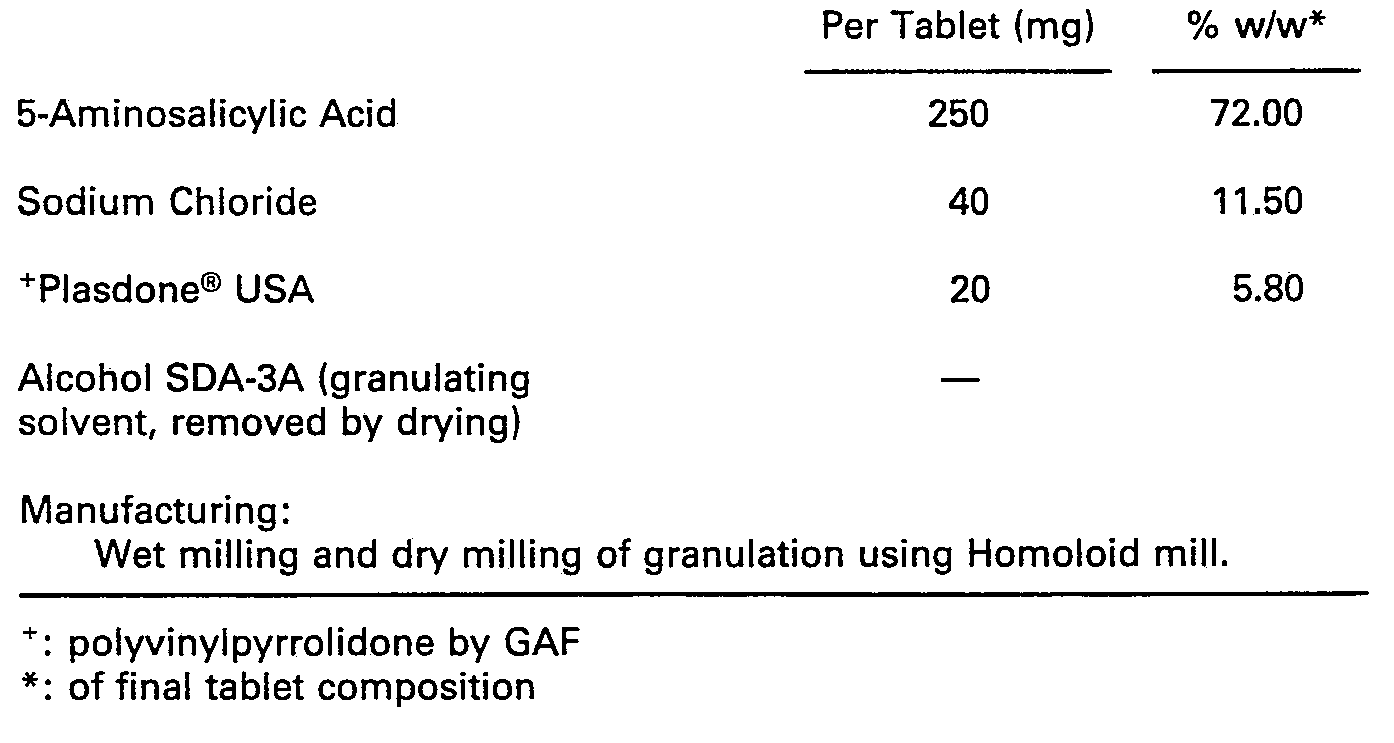
- the 5-ASA is combined with the sodium chloride and mixed for 5 minutes in a ribbon blender.
- the powder blend is milled through a Fitz mill at high speed (1B band) and returned to the ribbon blender.
- Povidone/alcohol solution is added to the powder blend while the mixer is running to form a wet mass.
- the wet mass is passed through a Fitz mill (12.7 mm ( inch), perforated band) with hammers forward at high speed.
- the wet granulation is trayed and dried for 16 hours at 55°C.
- the dried mixture is sized through a Fitz mill (2A band) with knives forward at medium speed.
- the resultant blend is placed in a ribbon blender.
- Lactose, calcium stearate/sodium lauryl sulfate and sodium starch glycolate is passed through a 0.42 mm (40 mesh) screen.
- the screened powders are added to the ribbon blender and mixed for 5 minutes.
- the finished granulation is compressed into 9.5 mm (8") tablets using standard concave tooling.
- the tablets meet the target weight requirements, are about 4.4 mm (0.175 in.) thick, have a hardness of 8-15 kilopounds and a friability of NMT 0.4%.
- Dissolution Medium 900 ml, pH 7.0, phosphate buffer in deaerated water RODI.
- Example 2 The formulation used in Example 2 was optimized as follows using the same procedure:
- Dissolution Rate 0.88 mg/minute (0.35%/min. 100 rpm paddle)
- ingredient (d) is not absolutely necessary for achievement of zero order release by controlled surface erosion. It is, however, necessary for stability requirements.
Landscapes
- Health & Medical Sciences (AREA)
- Public Health (AREA)
- Chemical & Material Sciences (AREA)
- Pharmacology & Pharmacy (AREA)
- Epidemiology (AREA)
- Life Sciences & Earth Sciences (AREA)
- Animal Behavior & Ethology (AREA)
- Medicinal Chemistry (AREA)
- General Health & Medical Sciences (AREA)
- Veterinary Medicine (AREA)
- Medicinal Preparation (AREA)
- Acyclic And Carbocyclic Compounds In Medicinal Compositions (AREA)
- Pharmaceuticals Containing Other Organic And Inorganic Compounds (AREA)
- Medicines That Contain Protein Lipid Enzymes And Other Medicines (AREA)
- Electroplating Methods And Accessories (AREA)
- Mechanical Treatment Of Semiconductor (AREA)
- Sliding Valves (AREA)
Abstract
Description
- This application is related to U.S. Patents 4,361,545 and 4,264,573, the former being a continuation-in- part of the latter.
- The present invention relates to solid pharmaceutical formulations whereby, upon oral administration, the active ingredients are released with a selectable, usually slow, zero order rate.
- Various techniques are known for formulating active ingredients to selectively control the resultant release rate of the drug, e.g., via sustained release, slow release, fast release, etc.
- It is important for any pharmaceutical formulation technique to provide the capability of preselecting a desired release rate which can be tailored to the unique characteristics of each drug. For example, many formulations exist which permit selection of very slow release rates, i.e., sustained release formulations. (See, e.g., U.S. Pat. No. 3,641,236 based upon glycerol fatty acid esters and U.S. Pat. No. 3,950,508 based upon alkyl celluloses and inert powders such as talc, which, in combination with other ingredients, produce a gradual disaggregation of the sustained release tablet.) These can often cause toxicity and other side effects due to an inordinately long presence of the drug in the body. Thus, methods of preselecting somewhat faster release rates, i.e., slow release rates - midway between fast and sustained rates - are needed.
- Moreover, as Zaffaroni has suggested (Therapeutic Implications of Controlled Drug Delivery, Future Trends in Therapeutics, Ed. F. C. McMahon, Mount Kisco, N.Y., Futura Publishing, 1978, pp. 143160), an ideal drug delivery system would allow a constant amount of drug to be absorbed per unit of time (zero-order kinetics). Thus, serum concentrations would not fluctuate under steady-state conditions. Weinberger et al., The New England Journal of Medicine, Vol. 299, No. 16, Oct. 19, 1978, pp. 852-857, have stated: "Modern technology related to controlled oral delivery systems should be applied to theophylline in an attempt to approximate zero-order absorption so that the continuous stabilizing effect of this drug on the airways can be maintained in the most effective, convenient and risk-free manner." Similar sentiments have been echoed by many pharmaceutical researchers in recognizing the preference for and importance of zero order release rates for many drugs. See, e.g., U.S. Pat. No. 3,965,255. Nevertheless, zero order release has rarely been achieved; there is no available technique by which a selected drug can be systematically formulated to provide zero order release kinetics in vitro or in vivo.
- Furthermore, many formulations result in a bioavailability curve having a high concentration peak at the beginning of release with a subsequent tailing off at longer times. Such concentration peaks are generally undesirable since they can lead to toxicity and/or other adverse side effects. Additionally, they significantly limit the freedom to increase the unit dosage of administration. Such an increased dosage would correspondingly increase the peak concentration. Under such circumstances, it is not possible to decrease the frequency of administration by increasing the unit dosage. This is a significant disadvantage in view of the well established correlation between the likelihood that a patient will fail to take doses of his medication and the required frequency of administration. Zero order release would attenuate this adverse effect by regulating the amount of active ingredient released in vivo per unit of time.
- As can be seen, in most instances, it is desirable to achieve a relatively slow, zero order release rate of medication. This precise rate should be easily selectable so that the resultant in vivo absorption is desirably controlled and the bioavailability of the drug is maximized.
- Accordingly, it is an object of this invention to provide slow release pharmaceutical formulations the amounts of whose ingredients can be readily adjusted to provide in vivo, zero order release for the active ingredient(s).
- It is another object of this invention to provide such pharmaceutical formulations by which the release rate and release curve shape can be controlled in order to maximize in vivo bioavailability of the active ingredient and/or minimize side effects.
- It is still another object of this invention to provide such formulations which can be reproducibly manufactured by conventional pharmaceutical methodology.
- It is yet another object of this invention to provide such formulations which are based on the principle of controlled surface erosion and represent a significant modification and expansion of the formulations of U.S. Pat. No. 4,361,545.
- It is a further object of this invention to provide such formulations comprising, as active ingredient, 5-aminosalicylic acid (5-ASA).
- Upon further study of the specification and appended claims, further objects and advantages of this invention will become apparent to those skilled in the art.
- These objects have been attained by providing a solid, orally administrable pharmaceutical tablet composition from which the active ingredient has a slow, zero order release rate attained without layers, beads or enteric materials and without relatively insoluble polymers, waxes or gums when administered orally, said tablet being compressed to a hardness of 5-20 kg, and being shaped so as to permit tablet erosion and penetration control, comprising an homogeneous, granulated mixture of:
- (a) an effective amount in the range of 10-90 wt.% of a pharmacologically active compound having a water solubility (20°C) of less than 1/500 to 1/1000 (w/w);
- (b) 1-40 wt.% of a surface uniformity controlling compound which is pharmaceutically acceptable in oral compositions and has a water solubility (20°C) of 1/1-1/40 (w/w);
- (c) 2-20 wt.% of an erosion controlling compound which is pharmaceutically acceptable in oral compositions and has a water solubility of 1/1-1/10 (w/w);
- (d) an amount in the range of 0.05-1.0 wt.%, of a surface activator which is a disintegrating agent for pharmaceutical compositions at which amount the compound is ineffective as a disintegrating agent;
- (e) 0.1-2.0 wt.% of a surfactant which is pharmaceutically acceptable in oral compositions, and, as necessary for tablet manufacturing purposes;
- (f) 1-20 wt.% of a binder which is pharmaceutically acceptable in oral compositions; or
- (g) 0.5-5.0 wt.% of a die wall lubricant which is pharmaceutically acceptable in oral compositions;
- In another aspect such a composition and an enteric coating may be combined whereby the onset of the release of the drug is delayed until the composition reaches a desired point in the gastrointestinal tract, e.g., when the active agent is 5-ASA.
- In one aspect, this invention provides a significant expansion of the applicability of the controlled surface erosion principles of U.S. Pat. No. 4,361,545 in formulating pharmacologically active compounds for zero order release. It has now been found that drugs of a solubility in the low range of less than 1/500 to 1/1000 can be formulated according to the details thoroughly described in U.S. Pat. No. 4,361,545. This is a surprising and unexpected result since, heretofore, it was thought that this formulation technique was inapplicable to drugs having a solubility less than 1/500 (w/w).
- The following will summarize only a portion of the details of US-A-4 361 545, for purposes of clarity. Examples relating to this new range are also included.
- Any drug of appropriate solubility can be formulated in accordance with this invention. Especially suitable are those for which there exists a specific reason for achieving zero order release and/or other release curve shape effects, such as minimizing peak serum levels. For example, such drugs include antibiotics, cardiovascular agents, analgesics, antipyretics, antiinfectives, antacids, gastrointestinal medications, steroids, CNS stimulants, psychopharmacologic drugs, antineoplastic and immunosuppressive drugs, antihistaminics, vitamins, essential minerals, sympathomimetic and parasympatho- mimetic drugs, antitussives, diuretics, sedatives, hypnotics, antiepileptics, decongestants, antiasthmatics, etc. (Lithium formulations are the subject of the claims of U.S. Pat. No. 4,264,573 mentioned above, and are excluded from the claims of this application.)
- In general, the amount of the active ingredient will be 10-90% by weight of the tablet, or higher, e.g., 30-90%, typically 50-90%. The drug should have a solubility in water (20°C.) of <1/500 to -1/1000, e.g. <1/500 to 1/800, 1/560-1/1000, or about 1/800 w/w. In general, the half-life of the drug will not be a factor since the formulation of this invention does not produce sustained release but rather slow, controlled release.
- In addition to its role as a medicament, the active ingredient also affects the precise release rate which is obtained, primarily by contributing towards penetration control and cohesion because of its solubility.
- Ingredient (b) is termed the "surface controller" and functions primarily as a surface uniformity control agent during dissolution and erosion. The selection of a particular agent is not especially critical as long as it is a pharmaceutically acceptable excipient which is of the proper water solubility and compatible with oral tablet manufacturing. Preferably, the agent should have a water solubility (20°C.) of 1 weight part in 1 weight part to 1 weight part in 40 weight parts; e.g., 1/1-1/20 w/w. Typically the solubility is to 1/30 w/w. It is usually employed in amounts of 1-40% by weight of the final tablet, typically 3-30 wt.%.
- Suitable pharmaceutical excipients useful as surface controllers include the generally preferred inorganic compounds such as the chloride, sulfate and phosphate salts of potassium, sodium and magnesium as well as the calcium citrate, phosphate, lactate, gluconate and succinate salts. Suitable organic compounds for use as the surface uniformity control agent include pharmaceutically acceptable mono-saccharides and di-saccharides and the corresponding polyhydroxy alcohols, for example, glucose, fructose, lactose, dextrose, xylose, galactose, sucrose, maltose, sorbitol, mannitol and xylitol. Other candidates include natural amino acids and organic carboxylic or sulfonic acids.
- Ingredient (c) is termed the "erosion controller" and serves as the primary erosion rate controlling agent. Consequently, this ingredient generally has a high water solubility, e.g., 1 weight part in 1 weight part to 1 weight part in 10 weight parts, e.g., 1/1-1/5 w/w, typically 1/1 to 1/5 w/w. Suitable such agents also include pharmaceutically acceptable mono- and di-saccharides and the corresponding polyhydroxy, i.e., polyhydric alcohols, natural amino acids, and organic carboxylic or sulfonic acids, all of which in general should be suitable for dry mixing with the active granulations or powders. For example, such agents include sorbitol, mannitol, xylitol, lactose, glucose, xylose, galactose, maltose, sucrose, dextrose, fructose, etc. The amount of this ingredient is selected, inter alia, in accordance with the desired rate of dissolution erosion and generally is in the range of 2-20% based on the weight of the final tablet, e.g., 0.1-50, typically 3-10 wt.%, e.t., 5-10 wt%.
- Ingredient (d) of the inventive composition is termed the "surface activator". Per se, these are fully conventional disintegration agents employed in oral pharmaceutical tablets. However, they are employed in amounts at which they are ineffectual as disintegrating agents. Of course, since the formulations of this invention are to provide slow release, effective amounts of these ingredients would be incompatible. In fact, effective amounts would destroy the controlled erosion phenomenon.
- Instead of the conventional disintegrating effect, in the heretofore never used low amounts, these disintegrating agents serve primarily to stabilize the controlled erosion phenomenon over long term storage of the solid compositions. To some degree, they also affect the finally achieved erosion rate, and correspondingly, the release rate. This is probably accomplished through penetration control effects. In other words, without these low amounts of the surface activator, the zero order nature of the release rate of the solid compositions could be accomplished but could not be stably maintained over the long storage periods required in the pharmaceutical field, e.g., 2-5 years, typically 3 years. As can be seen, this is a necessary ingredient in the commercial pharmaceutical tablets of this invention.
- Such conventional disintegrating agents include starch and starch derivatives, wood and cotton cellulose derivatives of the microcrystalline or crosslinked types or other polymeric materials etc. which are conventional disintegrants; see, e.g., Shangraw, et. al., Pharmaceutical Technology, October, 1980, pp. 49-57 whose disclosure is incorporated by reference herein. These surface activators are employed in low, disintegrant ineffective but surface activator effective concentrations of 0.05-1.0 wt.%, typically 0.05-0.5 wt.%.
- Ingredient (e) is a surface active agent which is also pharmaceutically acceptable and fully conventional for use in oral tablets. This ingredient provides wettability for any hydrophobic components such as the stearates and also affects medium penetration and surface erosion to some extent. Suitable such conventional surfactants include sodium lauryl sulfate, magnesium lauryl sulfate, dioctyl sodium sulfosuccinate, triethanolamine, polyoxyethylene sorbitan, poloxalkol derivatives and quaternary ammonium salts. In general, the surfactants have hydrophile-lipophile balance ratios (HLB) of above 12. Surface active agents are generally included in the composition in amounts of 0.1-2% by weight of the final tablet, typically 0.15-1.0 wt.%.
- Under ideal circumstances, ingredients (a)-(e) would be sufficient to achieve all purposes of this invention including zero order release rates for the active ingredient in accordance with the controlled erosion phenomenon. Such five component formulations, however, will be rare since almost all active ingredients require additional excipients to satisfy the demands of the tablet manufacturing steps. Such tableting ingredients include the familiar binders and dye wall lubricants, i.e., ingredients (f) and (g) mentioned above.
- Ingredient (f) of the pharmaceutical composition of this invention is a fully conventional pharmaceutically acceptable binder for oral tablets. These are normally employed to aid in the formation of granules during the granulation step(s), to modify the compression characteristics during the compression steps, or to aid during other conventional tablet forming processes. As mentioned, the compositions of this invention achieve slow release at zero order using only the relatively soluble ingredients discussed above. Binders, e.g., gums, waxes, relatively insoluble polymers, etc., previously needed to achieve such slow release rates in conventional sustained release compositions and many other slow release compositions, are obviated. These ingredients are employed only where desirable, or necessary for tableting purposes, per se.
- Suitable such fully conventional pharmaceutical binders include povidone (polyvinylpyrrolidone), polyvinylalcohol, polyethyleneglycol, sucrose, lactose, gelatin, starch paste, acacia, tragacanth, etc.
- In general, when present, the binders are included in the inventive pharmaceutical composition in amounts of 1-20% by weight, of the final tablet, typically 1-5 wt.%. When binders are absent, the composition of this invention will be inherently compressable and/or granulatable, e.g., by the slugging technique or by the addition of a subsequently evaporatable, activating solvent such as water, alcohol, acetone, etc. In addition to the primary binding effect of this ingredient, wettability control and penetration control will sometimes be affected to some degree by its inclusion, depending, of course, on the specific characteristics of the particular binder employed.
- Ingredient (g) is a fully conventional, pharmaceutically acceptable die wall lubricant for inclusion in oral tablets. This ingredient is required in order to facilitate the ejection of the tablet from the die after the compression step by lubrication of the tableting tool. Suitable such conventional die wall lubricants include the stearate salts such as calcium, magnesium, and zinc, as well as stearic acid, mineral oil, vegetable oil derivatives, polyethylene glycols, talc, etc. In general, 0.5-5% by weight of the final tablet of this ingredient is included, i.e., amounts in which these ingredients function as die wall lubricants, typically 1-4 wt.%.
- Ingredients (e) and (g) may also be added to the composition in conventionally combined form. Such combinations are commercially available and are provided as a homogeneous mixture of the two ingredients prepared by spray drying or other techniques. Such commercially available combined lubricants and surface active systems include Stear-o-wet C and Stear-o-wet M.
- Very often, an active ingredient is dosed in high concentrations. Typical such high dosage drugs include lithium, theophylline, quinidine sulfate, etc. Such drugs are dispensed in unit dosages from 50-500 mg, for example. For other high dosage drugs, unit dosages are as high as 1000 or 1500 mg. Such dosages are quite readily compatible with the pharmaceutical composition of this invention as defined above. However, it is often desired to formulate drugs in dosage ranges of less than 50 mg, e.g., 1-<50 mg per tablet yet still retain conventionally sized tablets. In such situations, ingredient (h) can be incorporated into the tablet replacing a corresponding amount of the active ingredient per se. In this way, slow release base formulations for the more potent type of drugs can be prepared at low dosages.
- Since excipients (h) are used to replace active ingredient (a), they should have the same solubility properties, e.g., water solubilities (20°C) of <1/500 to 1/1000, e.g. <1/500 to 1/800, 1/560-1/1000, or about 1/ 800 w/w. The amount of this innocuous bulking excipient, i.e., inert filler, is to be chosen depending upon the desired dosage of the active ingredient as well as on the other factors discussed above with respect to the active ingredient per se. Generally, the amount of ingredient (h) is 1-80% by weight of the finally produced tablet, depending on the desired tablet size.
- Such innocuous bulking excipients (fillers) are fully conventional and include the pharmaceutically acceptable excipients for oral tablets such as inorganic salts, both mineral and mineral organic, carbohydrates, proteins, emulsifiable fats and the like. Specific examples include calcium salts, such as the lactate, gluconate, glycerylphosphate, citrate, phosphate monobasic and dibasic, succinate, sulfate and tartrate, as well as the same salts of aluminum and magnesium. Typical such carbohydrates include the conventional mono- and disaccharides as well as the corresponding polyhydric alcohols.
- Manufacture of the formulations is in accordance with the details given in the mentioned U.S. Pat. Nos. 4,361,545 and 4,264,573. As mentioned therein, coatings can be used on the formulations of this invention to tailor the onset of drug release for a given purpose, e.g., to delay it until the formulation reaches a desired location of the gastrointestinal tract, e.g., enteric coatings which enable bypassing of the stomach and initiation of release in the small intestine. The manufacture, design and compositions of such coatings are fully conventional, e.g., as disclosed in Porter et al, "The Permeability of Enteric Coatings and the Dissolution Rates of Coated Tablets", J. Pharm. Pharmacol. 1982: 35:58; Remington's Pharmaceutical Sciences, Ed. Osol et al, e.g., 1689-1691, 14th Ed., Mack Publishing Co. (1970); Porter, "Tablet Coating", Drug & Cosmetic Industry, June 1981, 44-51, 86-94; Luce, "Cellulose Acetate Phthalate: A Versatile Enteric Coating", Pharmaceutical Technology, June 1977; as well as, data sheets provided with many commercial products such as, Eudragite-L, EudragitO-L (Aqueous Dispersion), Eudragit°-S (all by Rohm and Haas, Germany); PVAP, OPADRY (all by Colorcon, Inc., West Point, Pa.). As mentioned, these coatings are not expected to achieve the desired release rate per se - controlled surface erosion accomplishes that. They merely serve as time delays for onset of the release mechanism of this invention.
- Drugs in the new solubility range defined in this invention include 5-aminosalicyclic acid (5-ASA) which is useful, e.g., to treat ulcerative colitis and Crohn's disease. (See, e.g., Rasmussen et al, Gastroentology 1982:83: 1962-70. It is particularly desirable to employ an enteric coating in conjunction with 5-ASA to delay the onset of release of the drug to the small intestine and/or large intestine.* Other drugs in the new solubility range include oxypertine, allobarbitone, allylbarbituric acid, 4-aminosalicyclic acid, amisometradine, carbimazole, cyclobarbitone, salicylic acid, saliclamide, carphenazine maleate, cocaine, dextrothyroxine sodium, metharbital, etc.
- Without further elaboration, it is believed that one skilled in the art can, using the preceding description, utilize the present invention to its fullest extent. The following preferred specific embodiments are, therefore, to be construed as merely illustrative, and not limitative of the remainder of the disclosure in any way whatsoever. In the following examples, all temperatures are set forth uncorrected in degrees Celsius; unless otherwise indicated, all parts and percentages are by weight.
- * 5-ASA must be delivered to the site of mucosal inflammation to be effective.
-

- The sodium chloride is milled through a Whistler mill using a small slotted screen. The 5-ASA is combined with the sodium chloride and mixed for 5 minutes in a ribbon blender. The powder blend is milled through a Fitz mill at high speed (1B band) and returned to the ribbon blender. Povidone/alcohol solution is added to the powder blend while the mixer is running to form a wet mass. The wet mass is passed through a Fitz mill (12.7 mm (

- 100 kg of compressed tablets is placed into an Accela-Cota@ pan and warmed to about 40°C. exhaust temperature. 5 kg of OpadryO Enteric (Colorcon, Inc.) is dispersed in an alcohol (SDA-3A)-water mixture (composition of alcohol/water is 25.5 kg and 2.8 kg respectively). This solution is spray coated on tablets using an air-atomization system as follows: 2 spray guns at 35 psi each set to deliver about 60 g/minute, maintaining an exhaust temperature of 35―45°C. The coated tablets are dried in the Accela-Cota pan for 1 hour at 35―45°C. The tablets are polished in the pan using 1 gram of powdered Carnauba Wax.
- Batch Size: 5000 tablets
-
- Flow: Very good
- Tapped Bulk Density: 0.56 gram/ml
- Chromatographic Purity Test:
- Objective: To detect any interaction between 5-Aminosalicylic Acid and Alcohol SDA-3A (methyl or ethyl ester of 5-ASA).
- Rf
- 5-ASA 0.26
- No other foreign spot on the TLC plate.
- Using the base granulation of 5-ASA from Example A and the procedure of Example 1, controlled surface erosion ingredients were added. The formulations are shown below.

-

-
- Dissolution Procedure:
- Dissolution Apparatus: USP Method II, (Paddle)
- Paddle Rotation Speed: 100 rpm
- Dissolution Medium: 900 ml, pH 7.0, phosphate buffer in deaerated water RODI.

- The formulation used in Example 2 was optimized as follows using the same procedure:

-

-
- Hardness: 13.2 KP
- Friability: 0.08%
- Wt. Variation: Passes (±1 % of avg. wt.)
- Average Tablet Wt. = 347.6 mg
- 5-ASA SR Tablet 250 mg
- Dissolution Procedure: As in Example 2.

- T50% = 86.3 minutes
- Dissolution Rate: 1.43 mg/minute
- Correlation Coefficient (R) = 0.9998 (excellent linearity)
- 200 tablets were prepared in a continuation of the work performed in Examples 2 and 3 using the same procedures.

-
- Flow: Very good
- Compressibility: Very good
- Compressed on rotary tablet press using 9.5 mm (e") standard concave tooling both upper and lower plain.
- Average Tablet Wt.: 345 mg
- Hardness: 10 KP (8-11 KP)
- Thickness: 4.47 mm (0.176")
- Friability: 0.10%
- Dissolution Test Procedure: USP dissolution apparatus II (paddle method), 100 rpm, pH 7.0, phosphate buffer in deaerated RODI water, 900 ml.

- Tso% = 131.9 minutes
- Dissolution Rate: 0.88 mg/minute (0.35%/min. 100 rpm paddle)
- Correlation Coefficient (R) = 0.998 (excellent linearity)
- This example demonstrates that ingredient (d) is not absolutely necessary for achievement of zero order release by controlled surface erosion. It is, however, necessary for stability requirements.
- 1000 tablets of the following composition were prepared using the procedures of Example 1.

-
- Flow: Very good
- Compressibility: Very good
- Compressed on rotary tablet press using iff standard concave tooling, both upper and lower plain.
- Hardness: 10 KP
- Thickness: 4.47 mm (0.176")
- Friability: 0.08%
- Average Tablet Wt.: 344 mg.
- Dissolution Test Procedure: Same as in Example 2.

-
- T50% = 85.9 minutes
- Dissolution Rate: 1.257 mg/minute (0.5%/min. 100 rpm paddle)
- Correlation Coefficient (R) = 0.995 (excellent linearity)
- The preceding examples can be repeated with similar success by substituting the generically or specifically described reactants and/or operating conditions of this invention for those used in the preceding examples.
the pharmacologically active ingredient thus having a slow, zero order release rate when administered orally, and the pharmacologically active compound not being a lithium compound, and not being penny shaped or pancake shaped wherein the ratio of thickness to diameter is too small for erosion and penetration control.
Claims (17)
the pharmacologically active ingredient thus having a slow, zero order release rate when administered orally, and the pharmacologically active compound not being a lithium compound, and not being penny shaped or pancake shaped wherein the ratio of thickness to diameter is too small for erosion and penetration control.
Priority Applications (1)
| Application Number | Priority Date | Filing Date | Title |
|---|---|---|---|
| AT84401152T ATE55900T1 (en) | 1983-07-07 | 1984-06-06 | SOLID PHARMACEUTICAL FORMULATIONS WITH WIDE RANGE VARIABLE ZERO ORDER SLOW RELEASE BY CONTROLLED SURFACE EROSION. |
Applications Claiming Priority (2)
| Application Number | Priority Date | Filing Date | Title |
|---|---|---|---|
| US511605 | 1983-07-07 | ||
| US06/511,605 US4539198A (en) | 1983-07-07 | 1983-07-07 | Solid pharmaceutical formulations for slow, zero order release via controlled surface erosion: expanded range |
Publications (3)
| Publication Number | Publication Date |
|---|---|
| EP0131485A2 EP0131485A2 (en) | 1985-01-16 |
| EP0131485A3 EP0131485A3 (en) | 1986-08-06 |
| EP0131485B1 true EP0131485B1 (en) | 1990-08-29 |
Family
ID=24035636
Family Applications (1)
| Application Number | Title | Priority Date | Filing Date |
|---|---|---|---|
| EP84401152A Expired - Lifetime EP0131485B1 (en) | 1983-07-07 | 1984-06-06 | Solid pharmaceutical formulations for slow, zero order release via controlled surface erosion : expanded range |
Country Status (14)
| Country | Link |
|---|---|
| US (1) | US4539198A (en) |
| EP (1) | EP0131485B1 (en) |
| AT (1) | ATE55900T1 (en) |
| AU (1) | AU561633B2 (en) |
| CA (1) | CA1224417A (en) |
| DE (1) | DE3483072D1 (en) |
| DK (1) | DK162697C (en) |
| ES (1) | ES8600053A1 (en) |
| FI (1) | FI842528A7 (en) |
| IL (1) | IL72089A (en) |
| IT (1) | IT1180193B (en) |
| NO (1) | NO170753C (en) |
| NZ (1) | NZ208393A (en) |
| ZA (1) | ZA845208B (en) |
Families Citing this family (72)
| Publication number | Priority date | Publication date | Assignee | Title |
|---|---|---|---|---|
| US4960765A (en) * | 1980-03-20 | 1990-10-02 | Farmaceutisk Laboratorium Ferring A/S | Pharmaceutical composition and method for the treatment of colitis ulcerosa and Crohn's disease by oral administration |
| WO1981002671A1 (en) * | 1980-03-20 | 1981-10-01 | Ferring Farma Lab | Pharmaceutical composition and method for the treatment of colitis ulcerosa and crohn's disease by oral administration |
| US4690824A (en) * | 1983-07-07 | 1987-09-01 | Redi-Rowell, Inc. | Solid pharmaceutical formulations for slow, zero order release via controlled surface erosion: expanded range |
| GB8322007D0 (en) * | 1983-08-16 | 1983-09-21 | Wellcome Found | Pharmaceutical delivery system |
| USRE33994E (en) * | 1983-08-16 | 1992-07-14 | Burroughs Wellcome Co. | Pharmaceutical delivery system |
| US4751071A (en) * | 1983-12-01 | 1988-06-14 | Alza Corporation | Composition comprising salbutamol |
| US4777049A (en) * | 1983-12-01 | 1988-10-11 | Alza Corporation | Constant release system with pulsed release |
| US4851229A (en) * | 1983-12-01 | 1989-07-25 | Alza Corporation | Composition comprising a therapeutic agent and a modulating agent |
| DE3346571A1 (en) * | 1983-12-23 | 1985-07-04 | Bayer Ag, 5090 Leverkusen | ORAL RETARDED ACETYLSALICYL ACID FORMULATIONS |
| IT1206166B (en) * | 1984-07-26 | 1989-04-14 | Sigma Tau Ind Farmaceuti | DEVICE FOR RELEASING A SUBSTANCE IN A DISSOLUTION FLUID WITH ZERO ORDER KINETICS AND PROCEDURE FOR ITS PREPARATION |
| US4631305A (en) * | 1985-03-22 | 1986-12-23 | The Upjohn Company | Polymeric material as a disintegrant in a compressed tablet |
| JPH0830005B2 (en) * | 1985-09-25 | 1996-03-27 | ゲルゲリイ、ゲルハルト | Disintegrating tablet and manufacturing method thereof |
| US4753801A (en) * | 1985-10-25 | 1988-06-28 | Eli Lilly And Company | Sustained release tablets |
| AU607690B2 (en) * | 1985-12-24 | 1991-03-14 | Marion Laboratories, Inc. | Use of synthetic sulfated saccharides to enhance wound healing |
| US6482516B1 (en) * | 1993-07-20 | 2002-11-19 | Banner Pharmacaps, Inc. | Enrobed tablet |
| MX9300110A (en) * | 1992-01-13 | 1994-07-29 | Gerhard Gergely | PHARMACEUTICAL PREPARATION IN THE FORM OF AN EFFERVESCENCE OR DISINTEGRATION TABLET OR OF AN INSTANT-TYPE GRANULATE AND PROCEDURE FOR ITS PREPARATION. |
| US6080428A (en) | 1993-09-20 | 2000-06-27 | Bova; David J. | Nicotinic acid compositions for treating hyperlipidemia and related methods therefor |
| US6746691B2 (en) | 1993-09-20 | 2004-06-08 | Kos Pharmaceuticals, Inc. | Intermediate release nicotinic acid compositions for treating hyperlipidemia having unique biopharmaceutical characteristics |
| US6818229B1 (en) | 1993-09-20 | 2004-11-16 | Kos Pharmaceuticals, Inc. | Intermediate release nicotinic acid compositions for treating hyperlipidemia |
| US6129930A (en) | 1993-09-20 | 2000-10-10 | Bova; David J. | Methods and sustained release nicotinic acid compositions for treating hyperlipidemia at night |
| US6676967B1 (en) | 1993-09-20 | 2004-01-13 | Kos Pharmaceuticals, Inc. | Methods for reducing flushing in individuals being treated with nicotinic acid for hyperlipidemia |
| US5609883A (en) * | 1994-09-16 | 1997-03-11 | Advanced Technology Pharmaceuticals Corporation | Compressed tablet transitory lubricant system |
| HUP0104606A3 (en) * | 1998-12-18 | 2003-01-28 | Basf Ag | A pharmaceutical mixture comprising a profen |
| US6726929B1 (en) | 1998-12-18 | 2004-04-27 | Basf Aktiengesellschaft | Pharmaceutical mixture comprising a profen |
| US8545880B2 (en) * | 1999-02-26 | 2013-10-01 | Andrx Pharmaceuticals, Llc | Controlled release oral dosage form |
| US6210716B1 (en) | 1999-02-26 | 2001-04-03 | Andrx Pharmaceuticals, Inc. | Controlled release bupropion formulation |
| BR0013719A (en) | 1999-09-02 | 2002-07-23 | Nostrum Pharmaceuticals Inc | Controlled-release oral dosage, suitable for oral administration |
| US6733780B1 (en) | 1999-10-19 | 2004-05-11 | Genzyme Corporation | Direct compression polymer tablet core |
| US9522217B2 (en) | 2000-03-15 | 2016-12-20 | Orbusneich Medical, Inc. | Medical device with coating for capturing genetically-altered cells and methods for using same |
| US8088060B2 (en) | 2000-03-15 | 2012-01-03 | Orbusneich Medical, Inc. | Progenitor endothelial cell capturing with a drug eluting implantable medical device |
| EP1642885B1 (en) | 2000-08-29 | 2009-11-11 | Biocon Limited | Use of a pharmaceutical composition containing a para-aminophenyl acetic acid derivative for treating inflammatory conditions of the gastrointestinal tract |
| CA2359812C (en) * | 2000-11-20 | 2004-02-10 | The Procter & Gamble Company | Pharmaceutical dosage form with multiple coatings for reduced impact of coating fractures |
| US20030032675A1 (en) * | 2001-02-15 | 2003-02-13 | Franz G. Andrew | Manufacture of thyroid hormone tablets having consistent active moiety amounts |
| JP2004525109A (en) * | 2001-02-15 | 2004-08-19 | キング・ファーマシューティカルズ・インコーポレイティッド | Stabilized thyroid hormone pharmaceutical composition and method for producing the same |
| US20030224047A1 (en) * | 2001-02-15 | 2003-12-04 | Franz G. Andrew | Levothyroxine compositions and methods |
| US6555581B1 (en) | 2001-02-15 | 2003-04-29 | Jones Pharma, Inc. | Levothyroxine compositions and methods |
| US20030198667A1 (en) * | 2001-08-10 | 2003-10-23 | Franz Andrew G. | Methods of producing dispersible pharmaceutical compositions |
| US20030198671A1 (en) * | 2001-08-10 | 2003-10-23 | Franz G. Andrew | Levothyroxine compositions having unique plasma AUC properties |
| US20030190349A1 (en) * | 2001-08-10 | 2003-10-09 | Franz G. Andrew | Methods of stabilizing pharmaceutical compositions |
| US20030180353A1 (en) * | 2001-08-10 | 2003-09-25 | Franz G. Andrew | Stabilized pharmaceutical compositions |
| US20030198672A1 (en) * | 2001-08-14 | 2003-10-23 | Franz G. Andrew | Levothyroxine compositions having unique triidothyronine plasma AUC properties |
| US20030203967A1 (en) * | 2001-08-14 | 2003-10-30 | Franz G. Andrew | Levothyroxine compositions having unique Tmax properties |
| US20030195253A1 (en) * | 2001-08-14 | 2003-10-16 | Franz G. Andrew | Unadsorbed levothyroxine pharmaceutical compositions, methods of making and methods of administration |
| US20030199587A1 (en) * | 2001-08-14 | 2003-10-23 | Franz G. Andrew | Levothyroxine compositions having unique Cmax properties |
| US7101569B2 (en) | 2001-08-14 | 2006-09-05 | Franz G Andrew | Methods of administering levothyroxine pharmaceutical compositions |
| US20030199586A1 (en) * | 2001-08-14 | 2003-10-23 | Franz G. Andrew | Unique levothyroxine aqueous materials |
| US8048924B2 (en) | 2001-08-29 | 2011-11-01 | Biocon Limited | Methods and compositions employing 4-aminophenylacetic acid compounds |
| US20040043066A1 (en) * | 2001-10-29 | 2004-03-04 | Franz G. Andrew | Levothyroxine compositions having unique triiodothyronine Tmax properties |
| US6893660B2 (en) * | 2002-11-21 | 2005-05-17 | Andrx Pharmaceuticals, Inc. | Stable pharmaceutical compositions without a stabilizer |
| NZ551836A (en) | 2004-07-02 | 2008-07-31 | Meiji Dairies Corp | Solid milk and method of producing the same |
| HUE028158T2 (en) | 2004-07-07 | 2016-12-28 | Biocon Ltd | Synthesis of azo bonded immunoregulatory compounds |
| BRPI0514827A (en) * | 2004-09-01 | 2008-06-24 | Procter & Gamble | compositions comprising 5-amino-2-hydroxy benzoic acid and reducing sugar |
| US7985418B2 (en) | 2004-11-01 | 2011-07-26 | Genzyme Corporation | Aliphatic amine polymer salts for tableting |
| WO2007027566A2 (en) | 2005-09-02 | 2007-03-08 | Genzyme Corporation | Method for removing phosphate and polymer used therefore |
| CA2622693C (en) | 2005-09-15 | 2015-05-05 | Genzyme Corporation | Sachet formulation for amine polymers |
| US8497258B2 (en) | 2005-11-12 | 2013-07-30 | The Regents Of The University Of California | Viscous budesonide for the treatment of inflammatory diseases of the gastrointestinal tract |
| US20080075785A1 (en) * | 2006-09-22 | 2008-03-27 | San-Laung Chow | Controlled release hydrogel formulation |
| US20110165236A1 (en) * | 2006-09-22 | 2011-07-07 | Biokey, Inc. | Controlled release hydrogel formulation |
| EP2066293A2 (en) | 2006-09-29 | 2009-06-10 | Genzyme Corporation | Amide dendrimer compositions |
| US8163799B2 (en) | 2006-12-14 | 2012-04-24 | Genzyme Corporation | Amido-amine polymer compositions |
| US20090036414A1 (en) * | 2007-08-02 | 2009-02-05 | Mutual Pharmaceutical Company, Inc. | Mesalamine Formulations |
| HUE038452T2 (en) | 2007-11-13 | 2018-10-29 | Meritage Pharma Inc | Compositions for the treatment of gastrointestinal inflammation |
| EP2217215A1 (en) * | 2007-12-14 | 2010-08-18 | Genzyme Corporation | Coated pharmaceutical compositions |
| WO2010026993A1 (en) | 2008-09-03 | 2010-03-11 | 武田薬品工業株式会社 | Method for improving absorbability of preparation, and preparation having improved absorbability |
| WO2010144865A2 (en) | 2009-06-12 | 2010-12-16 | Meritage Pharma, Inc. | Methods for treating gastrointestinal disorders |
| WO2011136376A1 (en) | 2010-04-30 | 2011-11-03 | 武田薬品工業株式会社 | Enteric tablet |
| US8920840B2 (en) | 2010-04-30 | 2014-12-30 | Takeda Pharmaceutical Company Limited | Enteric tablet |
| DE102010033527A1 (en) | 2010-08-05 | 2012-02-09 | Acino Pharma Ag | Quetiapine tablets |
| EP2425826A1 (en) | 2010-09-01 | 2012-03-07 | Disphar International B.V. | Mesalazine tablet having improved dissolution |
| DE102011115690A1 (en) | 2011-10-11 | 2013-04-11 | Acino Pharma Ag | Quetiapine-containing formulations |
| ITUA20162293A1 (en) | 2016-04-05 | 2017-10-05 | Sofar Spa | Process for solid formulations of mesalazine |
| EP3662898A1 (en) * | 2018-12-07 | 2020-06-10 | Tillotts Pharma AG | Solid composition comprising mesalazine |
Family Cites Families (4)
| Publication number | Priority date | Publication date | Assignee | Title |
|---|---|---|---|---|
| US4361545A (en) * | 1979-05-21 | 1982-11-30 | Rowell Laboratories, Inc. | Solid pharmaceutical formulations for slow, zero order release via controlled surface erosion |
| US4264573A (en) * | 1979-05-21 | 1981-04-28 | Rowell Laboratories, Inc. | Pharmaceutical formulation for slow release via controlled surface erosion |
| FR2471186A1 (en) * | 1979-12-10 | 1981-06-19 | Roussel Uclaf | NEW COLIC DELITESCENCE TABLETS AND THEIR PREPARATION PROCESS |
| WO1981002671A1 (en) * | 1980-03-20 | 1981-10-01 | Ferring Farma Lab | Pharmaceutical composition and method for the treatment of colitis ulcerosa and crohn's disease by oral administration |
-
1983
- 1983-07-07 US US06/511,605 patent/US4539198A/en not_active Expired - Lifetime
-
1984
- 1984-05-28 CA CA000455307A patent/CA1224417A/en not_active Expired
- 1984-05-31 AU AU28898/84A patent/AU561633B2/en not_active Ceased
- 1984-06-06 DE DE8484401152T patent/DE3483072D1/en not_active Expired - Fee Related
- 1984-06-06 AT AT84401152T patent/ATE55900T1/en not_active IP Right Cessation
- 1984-06-06 NZ NZ208393A patent/NZ208393A/en unknown
- 1984-06-06 EP EP84401152A patent/EP0131485B1/en not_active Expired - Lifetime
- 1984-06-13 IL IL72089A patent/IL72089A/en not_active IP Right Cessation
- 1984-06-21 FI FI842528A patent/FI842528A7/en not_active Application Discontinuation
- 1984-07-02 IT IT21720/84A patent/IT1180193B/en active
- 1984-07-06 DK DK333884A patent/DK162697C/en not_active IP Right Cessation
- 1984-07-06 NO NO842766A patent/NO170753C/en not_active IP Right Cessation
- 1984-07-06 ZA ZA845208A patent/ZA845208B/en unknown
- 1984-07-06 ES ES534096A patent/ES8600053A1/en not_active Expired
Also Published As
| Publication number | Publication date |
|---|---|
| ES534096A0 (en) | 1985-10-01 |
| ES8600053A1 (en) | 1985-10-01 |
| IL72089A (en) | 1987-09-16 |
| FI842528A0 (en) | 1984-06-21 |
| NO170753B (en) | 1992-08-24 |
| US4539198A (en) | 1985-09-03 |
| DE3483072D1 (en) | 1990-10-04 |
| NO842766L (en) | 1985-01-08 |
| AU2889884A (en) | 1985-01-10 |
| IT8421720A1 (en) | 1986-01-02 |
| EP0131485A2 (en) | 1985-01-16 |
| AU561633B2 (en) | 1987-05-14 |
| ATE55900T1 (en) | 1990-09-15 |
| ZA845208B (en) | 1985-03-27 |
| DK162697B (en) | 1991-12-02 |
| DK333884A (en) | 1985-01-08 |
| DK162697C (en) | 1992-04-21 |
| NO170753C (en) | 1992-12-02 |
| IL72089A0 (en) | 1984-10-31 |
| NZ208393A (en) | 1987-03-31 |
| EP0131485A3 (en) | 1986-08-06 |
| FI842528A7 (en) | 1985-01-08 |
| IT1180193B (en) | 1987-09-23 |
| CA1224417A (en) | 1987-07-21 |
| DK333884D0 (en) | 1984-07-06 |
| IT8421720A0 (en) | 1984-07-02 |
Similar Documents
| Publication | Publication Date | Title |
|---|---|---|
| US4539198A (en) | Solid pharmaceutical formulations for slow, zero order release via controlled surface erosion: expanded range | |
| US4690824A (en) | Solid pharmaceutical formulations for slow, zero order release via controlled surface erosion: expanded range | |
| US4361545A (en) | Solid pharmaceutical formulations for slow, zero order release via controlled surface erosion | |
| US5773025A (en) | Sustained release heterodisperse hydrogel systems--amorphous drugs | |
| EP0305051B1 (en) | Orally sustained-release acetaminophen formulation and process to obtain it | |
| US6136343A (en) | Sustained release heterodisperse hydrogel systems for insoluble drugs | |
| US4264573A (en) | Pharmaceutical formulation for slow release via controlled surface erosion | |
| US4753801A (en) | Sustained release tablets | |
| US5126145A (en) | Controlled release tablet containing water soluble medicament | |
| US4968509A (en) | Oral sustained release acetaminophen formulation and process | |
| KR100463496B1 (en) | Sustained release matrix systems for highly soluble drugs | |
| AU2017203334A1 (en) | Tofacitinib oral sustained release dosage forms | |
| CN101208076B (en) | Controlled release formulations exhibiting an ascending rate of release | |
| EP0456720B1 (en) | High ibuprofen content granulations | |
| JPH0513132B2 (en) | ||
| EP0284849A1 (en) | Sustained release tablets on the basis of high molecular weight hydroxypropylmethylcellulose and a process for their manufacture | |
| EP1397125B1 (en) | Compressible guaifenesin compositions and method for producing them | |
| US6726930B1 (en) | Sustained release heterodisperse hydrogel systems for insoluble drugs | |
| JPH04273816A (en) | Pulse-releasing nucleated tablet | |
| CA1158979A (en) | Solid pharmaceutical formulations for slow zero order release via controlled surface erosion | |
| AU770001B2 (en) | Sustained release heterodisperse hydrogel systems - amorphous drugs | |
| AU2004201845B2 (en) | Sustained Release Heterodisperse Hydrogel Systems - Amorphous Drugs |
Legal Events
| Date | Code | Title | Description |
|---|---|---|---|
| PUAI | Public reference made under article 153(3) epc to a published international application that has entered the european phase |
Free format text: ORIGINAL CODE: 0009012 |
|
| AK | Designated contracting states |
Designated state(s): AT BE CH DE FR GB LI SE |
|
| PUAL | Search report despatched |
Free format text: ORIGINAL CODE: 0009013 |
|
| AK | Designated contracting states |
Kind code of ref document: A3 Designated state(s): AT BE CH DE FR GB LI SE |
|
| 17P | Request for examination filed |
Effective date: 19861031 |
|
| 17Q | First examination report despatched |
Effective date: 19880601 |
|
| GRAA | (expected) grant |
Free format text: ORIGINAL CODE: 0009210 |
|
| AK | Designated contracting states |
Kind code of ref document: B1 Designated state(s): AT BE CH DE FR GB LI SE |
|
| REF | Corresponds to: |
Ref document number: 55900 Country of ref document: AT Date of ref document: 19900915 Kind code of ref document: T |
|
| REF | Corresponds to: |
Ref document number: 3483072 Country of ref document: DE Date of ref document: 19901004 |
|
| ET | Fr: translation filed | ||
| PLBE | No opposition filed within time limit |
Free format text: ORIGINAL CODE: 0009261 |
|
| STAA | Information on the status of an ep patent application or granted ep patent |
Free format text: STATUS: NO OPPOSITION FILED WITHIN TIME LIMIT |
|
| 26N | No opposition filed | ||
| EAL | Se: european patent in force in sweden |
Ref document number: 84401152.8 |
|
| GBPC | Gb: european patent ceased through non-payment of renewal fee |
Effective date: 19980606 |
|
| REG | Reference to a national code |
Ref country code: GB Ref legal event code: 728V |
|
| REG | Reference to a national code |
Ref country code: GB Ref legal event code: 728Y |
|
| PGFP | Annual fee paid to national office [announced via postgrant information from national office to epo] |
Ref country code: GB Payment date: 20000531 Year of fee payment: 17 |
|
| PGFP | Annual fee paid to national office [announced via postgrant information from national office to epo] |
Ref country code: DE Payment date: 20000605 Year of fee payment: 17 |
|
| PGFP | Annual fee paid to national office [announced via postgrant information from national office to epo] |
Ref country code: SE Payment date: 20000606 Year of fee payment: 17 |
|
| PGFP | Annual fee paid to national office [announced via postgrant information from national office to epo] |
Ref country code: FR Payment date: 20000612 Year of fee payment: 17 |
|
| PGFP | Annual fee paid to national office [announced via postgrant information from national office to epo] |
Ref country code: CH Payment date: 20000613 Year of fee payment: 17 Ref country code: AT Payment date: 20000613 Year of fee payment: 17 |
|
| PGFP | Annual fee paid to national office [announced via postgrant information from national office to epo] |
Ref country code: BE Payment date: 20000814 Year of fee payment: 17 |
|
| PG25 | Lapsed in a contracting state [announced via postgrant information from national office to epo] |
Ref country code: GB Free format text: LAPSE BECAUSE OF NON-PAYMENT OF DUE FEES Effective date: 20010606 Ref country code: AT Free format text: LAPSE BECAUSE OF NON-PAYMENT OF DUE FEES Effective date: 20010606 |
|
| PG25 | Lapsed in a contracting state [announced via postgrant information from national office to epo] |
Ref country code: SE Free format text: LAPSE BECAUSE OF NON-PAYMENT OF DUE FEES Effective date: 20010607 |
|
| PG25 | Lapsed in a contracting state [announced via postgrant information from national office to epo] |
Ref country code: LI Free format text: LAPSE BECAUSE OF NON-PAYMENT OF DUE FEES Effective date: 20010630 Ref country code: CH Free format text: LAPSE BECAUSE OF NON-PAYMENT OF DUE FEES Effective date: 20010630 Ref country code: BE Free format text: LAPSE BECAUSE OF NON-PAYMENT OF DUE FEES Effective date: 20010630 |
|
| BERE | Be: lapsed |
Owner name: ROWELL LABORATORIES INC. Effective date: 20010630 |
|
| GBPC | Gb: european patent ceased through non-payment of renewal fee |
Effective date: 20010606 |
|
| EUG | Se: european patent has lapsed |
Ref document number: 84401152.8 |
|
| REG | Reference to a national code |
Ref country code: CH Ref legal event code: PL |
|
| PG25 | Lapsed in a contracting state [announced via postgrant information from national office to epo] |
Ref country code: FR Free format text: LAPSE BECAUSE OF NON-PAYMENT OF DUE FEES Effective date: 20020228 |
|
| PG25 | Lapsed in a contracting state [announced via postgrant information from national office to epo] |
Ref country code: DE Free format text: LAPSE BECAUSE OF NON-PAYMENT OF DUE FEES Effective date: 20020403 |