EP0130700B1 - Polymer dielectric - Google Patents
Polymer dielectric Download PDFInfo
- Publication number
- EP0130700B1 EP0130700B1 EP84303697A EP84303697A EP0130700B1 EP 0130700 B1 EP0130700 B1 EP 0130700B1 EP 84303697 A EP84303697 A EP 84303697A EP 84303697 A EP84303697 A EP 84303697A EP 0130700 B1 EP0130700 B1 EP 0130700B1
- Authority
- EP
- European Patent Office
- Prior art keywords
- dielectric
- mol
- film
- copolymer
- tan
- Prior art date
- Legal status (The legal status is an assumption and is not a legal conclusion. Google has not performed a legal analysis and makes no representation as to the accuracy of the status listed.)
- Expired - Lifetime
Links
Images
Classifications
-
- H—ELECTRICITY
- H01—ELECTRIC ELEMENTS
- H01B—CABLES; CONDUCTORS; INSULATORS; SELECTION OF MATERIALS FOR THEIR CONDUCTIVE, INSULATING OR DIELECTRIC PROPERTIES
- H01B3/00—Insulators or insulating bodies characterised by the insulating materials; Selection of materials for their insulating or dielectric properties
- H01B3/18—Insulators or insulating bodies characterised by the insulating materials; Selection of materials for their insulating or dielectric properties mainly consisting of organic substances
- H01B3/30—Insulators or insulating bodies characterised by the insulating materials; Selection of materials for their insulating or dielectric properties mainly consisting of organic substances plastics; resins; waxes
- H01B3/44—Insulators or insulating bodies characterised by the insulating materials; Selection of materials for their insulating or dielectric properties mainly consisting of organic substances plastics; resins; waxes vinyl resins; acrylic resins
- H01B3/443—Insulators or insulating bodies characterised by the insulating materials; Selection of materials for their insulating or dielectric properties mainly consisting of organic substances plastics; resins; waxes vinyl resins; acrylic resins from vinylhalogenides or other halogenoethylenic compounds
- H01B3/445—Insulators or insulating bodies characterised by the insulating materials; Selection of materials for their insulating or dielectric properties mainly consisting of organic substances plastics; resins; waxes vinyl resins; acrylic resins from vinylhalogenides or other halogenoethylenic compounds from vinylfluorides or other fluoroethylenic compounds
-
- H—ELECTRICITY
- H01—ELECTRIC ELEMENTS
- H01G—CAPACITORS; CAPACITORS, RECTIFIERS, DETECTORS, SWITCHING DEVICES, LIGHT-SENSITIVE OR TEMPERATURE-SENSITIVE DEVICES OF THE ELECTROLYTIC TYPE
- H01G4/00—Fixed capacitors; Processes of their manufacture
- H01G4/002—Details
- H01G4/018—Dielectrics
- H01G4/06—Solid dielectrics
- H01G4/14—Organic dielectrics
- H01G4/18—Organic dielectrics of synthetic material, e.g. derivatives of cellulose
- H01G4/186—Organic dielectrics of synthetic material, e.g. derivatives of cellulose halogenated
-
- Y—GENERAL TAGGING OF NEW TECHNOLOGICAL DEVELOPMENTS; GENERAL TAGGING OF CROSS-SECTIONAL TECHNOLOGIES SPANNING OVER SEVERAL SECTIONS OF THE IPC; TECHNICAL SUBJECTS COVERED BY FORMER USPC CROSS-REFERENCE ART COLLECTIONS [XRACs] AND DIGESTS
- Y10—TECHNICAL SUBJECTS COVERED BY FORMER USPC
- Y10T—TECHNICAL SUBJECTS COVERED BY FORMER US CLASSIFICATION
- Y10T428/00—Stock material or miscellaneous articles
- Y10T428/26—Web or sheet containing structurally defined element or component, the element or component having a specified physical dimension
- Y10T428/261—In terms of molecular thickness or light wave length
-
- Y—GENERAL TAGGING OF NEW TECHNOLOGICAL DEVELOPMENTS; GENERAL TAGGING OF CROSS-SECTIONAL TECHNOLOGIES SPANNING OVER SEVERAL SECTIONS OF THE IPC; TECHNICAL SUBJECTS COVERED BY FORMER USPC CROSS-REFERENCE ART COLLECTIONS [XRACs] AND DIGESTS
- Y10—TECHNICAL SUBJECTS COVERED BY FORMER USPC
- Y10T—TECHNICAL SUBJECTS COVERED BY FORMER US CLASSIFICATION
- Y10T428/00—Stock material or miscellaneous articles
- Y10T428/31504—Composite [nonstructural laminate]
- Y10T428/3154—Of fluorinated addition polymer from unsaturated monomers
-
- Y—GENERAL TAGGING OF NEW TECHNOLOGICAL DEVELOPMENTS; GENERAL TAGGING OF CROSS-SECTIONAL TECHNOLOGIES SPANNING OVER SEVERAL SECTIONS OF THE IPC; TECHNICAL SUBJECTS COVERED BY FORMER USPC CROSS-REFERENCE ART COLLECTIONS [XRACs] AND DIGESTS
- Y10—TECHNICAL SUBJECTS COVERED BY FORMER USPC
- Y10T—TECHNICAL SUBJECTS COVERED BY FORMER US CLASSIFICATION
- Y10T428/00—Stock material or miscellaneous articles
- Y10T428/31504—Composite [nonstructural laminate]
- Y10T428/3154—Of fluorinated addition polymer from unsaturated monomers
- Y10T428/31544—Addition polymer is perhalogenated
Definitions
- the present invention relates to a vinylidene fluoride-based polymer dielectric having a high dielectric constant and a low dielectric dissipation factor combination.
- Polymer dielectrics are widely used, for example, as materials for electric capacitors or condensers mainly of small sizes because they can be easily formed into films.
- Polymer dielectric materials well known heretofore include polyethylenes, polyethylene terephthalates (hereinafter abbreviated as "PET”), polycarbonates, and polystyrenes.
- PET polyethylene terephthalates
- PET polycarbonates
- polystyrenes polystyrenes.
- PET has both a relatively low dissipation factor (hereinafter referred to as "tan ⁇ ") of 0.6 % at 20 °C and 1 kilo-hertz (KHz) and an excellent film-forming property, and is widely used as a useful polymer dielectric material.
- PET has a low tan ⁇ , it also has a small dielectric constant of 3.2 at 20 °C and 1 KHz. Moreover, PET is relatively hygroscopic and therefore has a drawback that its dielectric properties vary according to change in enviromental conditions.
- PVDF polyvinylidene fluoride
- this PVDF has a tan ⁇ of 1.0 % or above which is larger than 0.6 % of PET and is not desirable as a material for an usage requiring small dielectric loss.
- a principal object of the invention is, in view of the above circumstances, to provide a vinylidene fluoride-based polymer dielectric having a low tan ⁇ comparable with that of PET and also having a good shapability or processability, while retaining a dielectric constant higher than that of PET.
- the polymer dielectric of the present invention is provided based on the above knowledge and, more specifically, comprises a copolymer of 20 to 33 mol.% of vinylidene fluoride, 15 to 45 mol.% of ethylene and 30 to 65 mol.% of tetrafluoroethylene, and has a dielectric constant of 4.0 or larger and a dielectric dissipation factor (tan ⁇ ) of 0.8% or less at 20°C and 1 KHz and which is obtainable by a process of suspension polymerization in water or of bulk polymerization, employing a peroxide polymerization initiator or an azo-type polymerization initiator.
- a vinylidene fluoride-ethylenetetrafluoroethylene terpolymer per se has been known as a kind of tetrafluoroethylene-ethylene-fluoroethylene copolymer (as disclosed in Japanese Patent Publication No. 25415/1973).
- the series of copolymers was simply developed as a class of heat-resistant copolymers with good shapability, and the vinylidene fluoride-ethylenetetrafluoroethylene terpolymer as disclosed therein has not been recognized at all as a useful dielectric material.
- the terpolymer satisfying the proportions specified by the present invention is a dielectric material provided with both a high dielectric constant and a low tan ⁇ . Further, when a copolymer is produced through solution polymerization as disclosed in the above publication, the resultant copolymer is caused to have a low molecular weight, has a worse shapability into film and fails to give a lower tan ⁇ as desired (See Comparison Example appearing hereinafter).
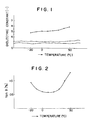
- Figure 1 and Figure 2 are graphs respectively showing the values of dielectric constant and dielectric dissipation factor (tan ⁇ ) plotted versus the varying temperature measured at 30 Hz with respect to a terpolymer film obtained in Example 2 appearing hereinafter.
- the copolymer constituting the dielectric of the invention contains three components, vinylidene fluoride, ethylene and tetrafluoroethylene as indispensable components, and any two of them fail to give the desired properties.
- vinylidene fluoride and ethylene have poor copolymerizability with each other, and a copolymer with a high dielectric constant and low tan ⁇ has not yet been obtained from the combination of these.
- copolymers of vinylidene fluoride and tetrafluoroethylene have been widely known, they are caused to have extremely poor shapability and it is difficult to shape them into films adapted for condenser materials if the content of tetrafluoroethylene is large.
- the resultant vinylidene fluoride-tetrafluoroethylene copolymer will have properties similar to those of PVDF having a high dielectric constant but it is also very difficult to lower the tan ⁇ of the copolylmer.
- a copolymer of ethylene and tetrafluoroethylene is also known as a heat-resistant resin with good shapability and has a low tan ⁇ , it has a small dielectric constant.
- the copolymer If the content of vinylidene fluoride in the product copolymer is less than 20 mol.%, the copolymer is caused to have a dielectric constant below 4.0. In contrast thereto, if the vinylidene fluoride content exceeds 33 mol.%,.the copolymer, while having a large dielectric constant, is caused to have a tan ⁇ of above 0.8 % and fails to give the required dielectric properties in combination.
- the ethylene content is less than 15 mol.%, the contents of vinylidene fluoride and tetrafluoroethylene become relatively larger, whereby the resultant copolymer becomes poor in shapability so that it is difficult to shape it into films, and, moreover the tan ⁇ thereof increases.
- the ethylene content is above 45 %, the copolymerizability of the composition becomes poor, whereby the production of the copolymer becomes difficult.
- the polymer dielectric of the invention comprises three components of vinylidene fluoride, ethylene and tetrafluoroethylene as indispensable components thereof as described above, it can also contain a minor amount, e.g. 5 mol.% or less thereof, of a monomer copolymerizable with the above three components, with the proviso that the resultant copolymer satisfies the required dielectric properties, that is, a dielectric constant of 4.0 or above and a tan ⁇ of 0.8 % or below at 20 °C and 1 KHz.
- Examples of such copolymerizable monomers include propylene, isobutylene, vinyl fluoride, trifluoroethylene, trifluoromonochloroethylene and hexafluoropropylene.
- the copolymer constituting the polymer dielectric of the invention is obtainable by a suspension polymerization process using water as the dispersion medium or a bulk polymerization process, both using as polymerization initiator a peroxide initiator or an azo-type initiator.
- a solution or suspension polymerization using an organic solvent as dispersion medium it is difficult to produce a copolymer having a sufficiently large degree of polymerization, and the resultant copolymer not only is poor in physical properties but also fails to give desired dielectric properties, especially a low tan ⁇ .
- the polymer dielectric of the present invention also has a good shapability and is readily shaped into a dielectric in the form of film or sheet through heat-forming processes.
- heat forming processes for the production of films or sheets known forming processes are generally available, including those using hot presses, extruders or calendering rolls.
- the present invention provides a vinylidene fluoride-ethylenetetrafluoroethylene copolymer of a specific composition, which has a dielectric constant larger than that of PET and a dielectric dissipation factor (tan ⁇ ) substantially equal to that of PET and also is excellent in anti-hygroscopicity, heat resistance and shapability. Accordingly, the dielectric is especially useful as a material for electric condenser films for which a high dielectric constant and a low dielectric loss are required in combination.
- the polymer dielectric of the invention is preferably formed into films each of 1 - 200 microns (micrometres), particularly stretched films each of 1 - 100 microns (micrometers) in thickness. Furthermore, these films may be used as a condenser film laminate composed of a plurality of films stacked in layers. In this case, each film layer should preferably have a thickness of 1 to 50 microns (micrometres).
- the dielectric constants and tan ⁇ represent values obtained by measurement at 20 °C and 1 KHz unless otherwise noted.
- the thus obtained copolymer was a resin excellent in heat resistance and having a melting point of 254 °C and was readily formed into a sheet having a thickness of 150 microns (micrometres) by hot pressing.
- the pressed sheet had dielectric properties as shown below:
- the terpolymer obtained was found to be a useful dielectric material having a large dielectric constant and a relatively small tan ⁇ .
- the terpolymer sheet obtained in Example 1 was stretched in a ratio of 4 times at 100 °C to obtain a film of 70 microns (micrometres) in thickness.
- the stretched film had a dielectric constant of 5.15 and a tan ⁇ of 0.62 % at 20 °C and 1 KHz.
- the variation with temperature of dielectric constant and tan ⁇ of the stretched film was measured at 30 Hz by a rheolograph (mfd. by Toyo Seiki K.K.). The results of the measurement are shown in Figures 1 and 2, respectively.
- the terpolymer of the invention has a small temperature dependence of the dielectric constant and tan ⁇ within a practical temperature range and is found to be a useful dielectric also from this view point.
- Example 2 In a manner similar to that of Example 1, a terpolymer having mole ratios of vinylidene fluoride/ethylene/tetrafluoroethylene of 30/25/45 was produced.
- the thus obtained copolymer had a melting point of 258 °C and showed the following dielectric properties when formed into a pressed film of 75 microns (micrometres) in thickness:
- a terpolymer having the same composition as that of Example 3 was produced through suspension polymerization in a perhalogenated solvent of 1,1,2-trichloro-1,2,2-trifluoroethane. After being fully washed and dried, the copolymer was formed into a pressed film of 75 microns (micrometres) in thickness, which showed the following dielectric properties:
- the thus obtained film not only was fragile and poor in physical properties but also had a large tan ⁇ .
- Example 2 In a manner similar to that of Example 1, a terpolymer having mol.% ratios of vinylidene fluoride/ethylene/tetrafluoroethylene of 45/10/45 was produced.
- the copolymer had a melting point of 271 °C, a fluorine content of 67 mol.% and apparently inferior shapability.
- the copolymer was formed into a sheet of 200 microns (micrometres) thickness, which showed the following dielectric properties:
- a terpolymer having too small an ethylene content not only is poor in shapability but also fails to give the desired dielectric properties because of a large tan ⁇ .
Landscapes
- Engineering & Computer Science (AREA)
- Power Engineering (AREA)
- Physics & Mathematics (AREA)
- Spectroscopy & Molecular Physics (AREA)
- Manufacturing & Machinery (AREA)
- Microelectronics & Electronic Packaging (AREA)
- Organic Insulating Materials (AREA)
- Manufacture Of Macromolecular Shaped Articles (AREA)
- Addition Polymer Or Copolymer, Post-Treatments, Or Chemical Modifications (AREA)
- Fixed Capacitors And Capacitor Manufacturing Machines (AREA)
Description
- The present invention relates to a vinylidene fluoride-based polymer dielectric having a high dielectric constant and a low dielectric dissipation factor combination.
- Polymer dielectrics are widely used, for example, as materials for electric capacitors or condensers mainly of small sizes because they can be easily formed into films. Polymer dielectric materials well known heretofore include polyethylenes, polyethylene terephthalates (hereinafter abbreviated as "PET"), polycarbonates, and polystyrenes. Among these, PET has both a relatively low dissipation factor (hereinafter referred to as "tan δ") of 0.6 % at 20 °C and 1 kilo-hertz (KHz) and an excellent film-forming property, and is widely used as a useful polymer dielectric material.
- However, while PET has a low tan δ, it also has a small dielectric constant of 3.2 at 20 °C and 1 KHz. Moreover, PET is relatively hygroscopic and therefore has a drawback that its dielectric properties vary according to change in enviromental conditions. On the other hand, polyvinylidene fluoride (hereinafter abbreviated as "PVDF") has the highest level of dielectric constant among the synthetic polymers, has an excellent shapability or processability and also has a low hygroscopicity which is an advantageous feature as a dielectric material when compared with PET. However, this PVDF has a tan δ of 1.0 % or above which is larger than 0.6 % of PET and is not desirable as a material for an usage requiring small dielectric loss.
- A principal object of the invention is, in view of the above circumstances, to provide a vinylidene fluoride-based polymer dielectric having a low tan δ comparable with that of PET and also having a good shapability or processability, while retaining a dielectric constant higher than that of PET.
- As a result of our researches, it has been discovered that the above object can be accomplished by a vinylidene fluoride-ethylene-tetrafluoroethylene copolymer formulated in specific component proportions. The polymer dielectric of the present invention is provided based on the above knowledge and, more specifically, comprises a copolymer of 20 to 33 mol.% of vinylidene fluoride, 15 to 45 mol.% of ethylene and 30 to 65 mol.% of tetrafluoroethylene, and has a dielectric constant of 4.0 or larger and a dielectric dissipation factor (tan δ) of 0.8% or less at 20°C and 1 KHz and which is obtainable by a process of suspension polymerization in water or of bulk polymerization, employing a peroxide polymerization initiator or an azo-type polymerization initiator.
- In the meantime, a vinylidene fluoride-ethylenetetrafluoroethylene terpolymer per se has been known as a kind of tetrafluoroethylene-ethylene-fluoroethylene copolymer (as disclosed in Japanese Patent Publication No. 25415/1973). The series of copolymers was simply developed as a class of heat-resistant copolymers with good shapability, and the vinylidene fluoride-ethylenetetrafluoroethylene terpolymer as disclosed therein has not been recognized at all as a useful dielectric material. Especially, it has been first discovered by us that the terpolymer satisfying the proportions specified by the present invention is a dielectric material provided with both a high dielectric constant and a low tan δ. Further, when a copolymer is produced through solution polymerization as disclosed in the above publication, the resultant copolymer is caused to have a low molecular weight, has a worse shapability into film and fails to give a lower tan δ as desired (See Comparison Example appearing hereinafter).
- These and other objects and features of the present invention will be more readily apparent in view of the following detailed description and the accompanying drawings.
- In the drawings:
- Figure 1 and Figure 2 are graphs respectively showing the values of dielectric constant and dielectric dissipation factor (tan δ) plotted versus the varying temperature measured at 30 Hz with respect to a terpolymer film obtained in Example 2 appearing hereinafter.
- The copolymer constituting the dielectric of the invention contains three components, vinylidene fluoride, ethylene and tetrafluoroethylene as indispensable components, and any two of them fail to give the desired properties. Thus, vinylidene fluoride and ethylene have poor copolymerizability with each other, and a copolymer with a high dielectric constant and low tan δ has not yet been obtained from the combination of these. While copolymers of vinylidene fluoride and tetrafluoroethylene have been widely known, they are caused to have extremely poor shapability and it is difficult to shape them into films adapted for condenser materials if the content of tetrafluoroethylene is large. In contrast thereto, if the vinylidene fluoride content is large, the resultant vinylidene fluoride-tetrafluoroethylene copolymer will have properties similar to those of PVDF having a high dielectric constant but it is also very difficult to lower the tan δ of the copolylmer. Further, while a copolymer of ethylene and tetrafluoroethylene is also known as a heat-resistant resin with good shapability and has a low tan δ, it has a small dielectric constant.
- In order to obtain the desired dielectric properties in combination, it is very important to satisfy the compositional proportions among the three components. Thus, only a copolymer having a limited composition of 20 to 33 mol.% of vinylidene fluoride, 15 to 45 mol.% of ethylene and 30 to 65 mol.% of tetrafluoroethylene, is used in the invention.
- If the content of vinylidene fluoride in the product copolymer is less than 20 mol.%, the copolymer is caused to have a dielectric constant below 4.0. In contrast thereto, if the vinylidene fluoride content exceeds 33 mol.%,.the copolymer, while having a large dielectric constant, is caused to have a tan δ of above 0.8 % and fails to give the required dielectric properties in combination.
- When the ethylene content is less than 15 mol.%, the contents of vinylidene fluoride and tetrafluoroethylene become relatively larger, whereby the resultant copolymer becomes poor in shapability so that it is difficult to shape it into films, and, moreover the tan δ thereof increases. In contrast, when the ethylene content is above 45 %, the copolymerizability of the composition becomes poor, whereby the production of the copolymer becomes difficult.
- Next, when the tetrafluoroethylene content is below 30 mol.%, the contents of ethylene and vinylidene fluoride having poor copolymerizability with each other become large, and it is difficult to produce a desired random copolymer. When above 65 mol.%, the product copolymer will have good heat-resistance but have extremely poor shapability, whereby it is difficult to form thin films therefrom.
- While the polymer dielectric of the invention comprises three components of vinylidene fluoride, ethylene and tetrafluoroethylene as indispensable components thereof as described above, it can also contain a minor amount, e.g. 5 mol.% or less thereof, of a monomer copolymerizable with the above three components, with the proviso that the resultant copolymer satisfies the required dielectric properties, that is, a dielectric constant of 4.0 or above and a tan δ of 0.8 % or below at 20 °C and 1 KHz. Examples of such copolymerizable monomers include propylene, isobutylene, vinyl fluoride, trifluoroethylene, trifluoromonochloroethylene and hexafluoropropylene.
- The copolymer constituting the polymer dielectric of the invention is obtainable by a suspension polymerization process using water as the dispersion medium or a bulk polymerization process, both using as polymerization initiator a peroxide initiator or an azo-type initiator. On the contrary, by a solution or suspension polymerization using an organic solvent as dispersion medium, it is difficult to produce a copolymer having a sufficiently large degree of polymerization, and the resultant copolymer not only is poor in physical properties but also fails to give desired dielectric properties, especially a low tan δ.
- The polymer dielectric of the present invention also has a good shapability and is readily shaped into a dielectric in the form of film or sheet through heat-forming processes. As the heat forming processes for the production of films or sheets, known forming processes are generally available, including those using hot presses, extruders or calendering rolls. In order to obtain an especially thin film, it is possible to further subject the thus obtained film or sheet to roll pressing or mono-or multi-axial stretching. Particularly, by the stretching, some improvement in dielectric properties can be attained along with the formation of thin films.
- As has been described hereinabove, the present invention provides a vinylidene fluoride-ethylenetetrafluoroethylene copolymer of a specific composition, which has a dielectric constant larger than that of PET and a dielectric dissipation factor (tan δ) substantially equal to that of PET and also is excellent in anti-hygroscopicity, heat resistance and shapability. Accordingly, the dielectric is especially useful as a material for electric condenser films for which a high dielectric constant and a low dielectric loss are required in combination. When used as a condenser material, the polymer dielectric of the invention is preferably formed into films each of 1 - 200 microns (micrometres), particularly stretched films each of 1 - 100 microns (micrometers) in thickness. Furthermore, these films may be used as a condenser film laminate composed of a plurality of films stacked in layers. In this case, each film layer should preferably have a thickness of 1 to 50 microns (micrometres).
- The present invention will be explained more specifically hereinbelow by referring to actual examples of experiments and comparison examples. In the following description, the dielectric constants and tan δ represent values obtained by measurement at 20 °C and 1 KHz unless otherwise noted.
- Into a 1 liter-autoclave provided with a stirrer were charged 580 g of distilled water, 0.2 g of methyl-cellulose (suspension aid) and 4.0 g of n-propylperoxydicarbonate. After replacement with nitrogen, 48.6 g (25 mol.%) of vinylidene fluoride, 29.8 g (35 mol.% of ethylene) and 121.6 g (40 mol.%) of tetrafluoroethylene were further charged, and the mixture was subjected to polymerization under stirring at 30 °C. When the pressure was lowered to 9 kg/cm² (882 kPa), well degassed distilled water was charged into the system under nitrogen pressure so as not to lower the pressure below 10 kg/cm² (980 kPa), and the polymerization was continued to obtain a terpolymer. Thus, a copolymer having a composition substantially the same as the charged composition was obtained at a yield of above 98 %.
- The thus obtained copolymer was a resin excellent in heat resistance and having a melting point of 254 °C and was readily formed into a sheet having a thickness of 150 microns (micrometres) by hot pressing. The pressed sheet had dielectric properties as shown below:

- Thus, the terpolymer obtained was found to be a useful dielectric material having a large dielectric constant and a relatively small tan δ.
- The terpolymer sheet obtained in Example 1 was stretched in a ratio of 4 times at 100 °C to obtain a film of 70 microns (micrometres) in thickness. Thus, the terpolymer was found to be rich in shapability and readily stretchable. The stretched film had a dielectric constant of 5.15 and a tan δ of 0.62 % at 20 °C and 1 KHz. The variation with temperature of dielectric constant and tan δ of the stretched film was measured at 30 Hz by a rheolograph (mfd. by Toyo Seiki K.K.). The results of the measurement are shown in Figures 1 and 2, respectively.
- Thus, the terpolymer of the invention has a small temperature dependence of the dielectric constant and tan δ within a practical temperature range and is found to be a useful dielectric also from this view point.
- In a manner similar to that of Example 1, a terpolymer having mole ratios of vinylidene fluoride/ethylene/tetrafluoroethylene of 30/25/45 was produced. The thus obtained copolymer had a melting point of 258 °C and showed the following dielectric properties when formed into a pressed film of 75 microns (micrometres) in thickness:
- Dielectric constant (ε′):
- 5.2
- tan δ:
- 0.72 %
- A terpolymer having the same composition as that of Example 3 was produced through suspension polymerization in a perhalogenated solvent of 1,1,2-trichloro-1,2,2-trifluoroethane. After being fully washed and dried, the copolymer was formed into a pressed film of 75 microns (micrometres) in thickness, which showed the following dielectric properties:
- Dielectric constant (ε′):
- 5.3
- tan δ :
- 1.02 %
- The thus obtained film not only was fragile and poor in physical properties but also had a large tan δ.
- In a manner similar to that of Example 1, a terpolymer having mol.% ratios of vinylidene fluoride/ethylene/tetrafluoroethylene of 45/10/45 was produced. The copolymer had a melting point of 271 °C, a fluorine content of 67 mol.% and apparently inferior shapability. The copolymer was formed into a sheet of 200 microns (micrometres) thickness, which showed the following dielectric properties:
- Dielectric constant (ε′):
- 5.2
- tan δ :
- 0.94 %
- Thus, it will be understood that a terpolymer having too small an ethylene content not only is poor in shapability but also fails to give the desired dielectric properties because of a large tan δ.
Claims (7)
- A capacitor dielectric film comprising a fluorine-containing copolymer having a composition of 20 to 33 mol.% of vinylidene fluoride, 15 to 45 mol.% of ethylene and 30 to 65 mol.% of tetrafluoroethylene, and having a dielectric constant of 4.0 or above and a dielectric dissipation factor of 0.8% or below at 20°C and 1 KHz, and which is obtainable by a process of suspension polymerization in water or of bulk polymerization, employing a peroxide polymerization initiator or an azo-type polymerization initiator.
- A capacitor dielectric film as claimed in Claim 1 in which the polymerization initiator used is a peroxide initiator.
- A capacitor dielectric film, as claimed in Claim 1 in which the polymerization initiator used is an azo-type initiator.
- A capacitor dielectric film as claimed in any of Claims 1 to 3, which is in the form of a film having a thickness of 1 to 200 microns (micrometres).
- A capacitor dielectric film as claimed in Claim 4, which is in the form of a stretched film having a thickness of 1 to 100 microns (micrometres).
- A capacitor dielectric comprising a dielectric film laminate having a plurality of dielectric films stacked in layers, each dielectric film comprising a copolymer of 20 to 33 mol.% of vinylidene fluoride, 15 to 45 mol.% of ethylene and 30 to 65 mol.% of tetrafluoethylene, and having a dielectric constant of 4.0 or above and a dielectric dissipation factor of 0.8% or below at 20°C and 1 KHz, and which is obtainable by a process of suspension polymerization in water or of bulk polymerization, employing a peroxide polymerization initiator or an azo-type polymerization initiator.
- A capacitor dielectric as claimed in Claim 6, wherein each film has a thickness of 1 to 50 microns (micrometres).
Applications Claiming Priority (2)
| Application Number | Priority Date | Filing Date | Title |
|---|---|---|---|
| JP98777/83 | 1983-06-04 | ||
| JP58098777A JPS59226409A (en) | 1983-06-04 | 1983-06-04 | Polymer dielectric material |
Publications (2)
| Publication Number | Publication Date |
|---|---|
| EP0130700A1 EP0130700A1 (en) | 1985-01-09 |
| EP0130700B1 true EP0130700B1 (en) | 1995-12-06 |
Family
ID=14228798
Family Applications (1)
| Application Number | Title | Priority Date | Filing Date |
|---|---|---|---|
| EP84303697A Expired - Lifetime EP0130700B1 (en) | 1983-06-04 | 1984-06-01 | Polymer dielectric |
Country Status (4)
| Country | Link |
|---|---|
| US (1) | US4543294A (en) |
| EP (1) | EP0130700B1 (en) |
| JP (1) | JPS59226409A (en) |
| DE (1) | DE3486415T2 (en) |
Families Citing this family (19)
| Publication number | Priority date | Publication date | Assignee | Title |
|---|---|---|---|---|
| US5000547A (en) * | 1981-08-20 | 1991-03-19 | E. I. Du Pont De Nemours And Company | Amorphous copolymers of perfluoro-2,2-dimethyl-1,3-dioxole |
| US4975505A (en) * | 1981-08-20 | 1990-12-04 | E. I. Du Pont De Nemours And Company | Amorphous copolymers of perfluoro-2,2-dimethyl-1,3-dioxole |
| US4977297A (en) * | 1981-08-20 | 1990-12-11 | E. I. Du Pont De Nemours And Company | Amorphous copolymers of perfluoro-2,2-dimethyl-1,3-dioxole |
| US4999248A (en) * | 1981-08-20 | 1991-03-12 | E. I. Du Pont De Nemours And Company | Amorphous copolymers of perfluoro-2,2-dimethyl-1,3-dioxole |
| US4982056A (en) * | 1981-08-20 | 1991-01-01 | E. I. Du Pont De Nemours And Company | Amorphous copolymers of perfluoro-2,2-dimethyl-1,3-dioxide |
| US4977025A (en) * | 1981-08-20 | 1990-12-11 | E. I Du Pont De Nemours And Company | Amorphous copolymers of perfluoro-2,2-dimethyl-1,3-dioxole |
| US5006382A (en) * | 1981-08-20 | 1991-04-09 | E. I. Du Pont De Nemours And Company | Amorphous copolymers of perfluoro-2,2-dimethyl-1,3-dioxole |
| US4977026A (en) * | 1981-08-20 | 1990-12-11 | E. I. Du Pont De Nemours And Company | Amorphous copolymers of perfluoro-2,2-dimethyl-1,3-dioxole |
| US4985308A (en) * | 1981-08-20 | 1991-01-15 | E. I. Du Pont De Nemours And Company | Amorphous copolymers of perfluoro-2,2-dimethyl-1,3-dioxole |
| US4973142A (en) * | 1981-08-20 | 1990-11-27 | E. I. Du Pont De Nemours And Company | Amorphous copolymers of perfluoro-2,2-dimethyl-1,3-dioxole |
| US4977008A (en) * | 1981-08-20 | 1990-12-11 | E. I Du Pont De Nemours And Company | Amorphous copolymers of perfluoro-2,2-dimethyl-1,3-dioxole |
| DE3429884C2 (en) * | 1983-08-16 | 1987-04-16 | Kureha Kagaku Kogyo K.K., Tokio/Tokyo | A piezoelectric polymer film made of a vinylidene fluoride copolymer in the polarized state and use thereof as an electro-mechanical coupling element for ultrasonic measuring transducers |
| US4599678A (en) * | 1985-03-19 | 1986-07-08 | Wertheimer Michael R | Plasma-deposited capacitor dielectrics |
| US4816324A (en) * | 1986-05-14 | 1989-03-28 | Atlantic Richfield Company | Flexible photovoltaic device |
| KR100450534B1 (en) * | 2000-09-15 | 2004-09-30 | 크린에어테크놀로지 주식회사 | High electronic woven fabrics and manufacturing method of same |
| US7189926B2 (en) * | 2004-08-04 | 2007-03-13 | P-Two Industries Inc. | Low voltage differential signal (LVDS) interface flexible flat cable (FFC) and LVDS signal transmission system using the same |
| JP5246256B2 (en) * | 2008-03-19 | 2013-07-24 | ダイキン工業株式会社 | COATING COMPOSITION FOR FORMING HIGH DIELECTRIC FILM AND HIGH DIELECTRIC FILM |
| US20110228442A1 (en) * | 2010-03-16 | 2011-09-22 | Strategic Polymer Sciences, Inc. | Capacitor having high temperature stability, high dielectric constant, low dielectric loss, and low leakage current |
| JP6504251B2 (en) * | 2015-07-17 | 2019-04-24 | ダイキン工業株式会社 | the film |
Family Cites Families (6)
| Publication number | Priority date | Publication date | Assignee | Title |
|---|---|---|---|---|
| US3318850A (en) * | 1963-06-10 | 1967-05-09 | Du Pont | Vinylidene fluoride interpolymers |
| DE2037028C2 (en) * | 1970-07-25 | 1982-07-08 | Hoechst Ag, 6000 Frankfurt | Process for the production of fluorine-containing copolymers |
| DE2132463C2 (en) * | 1970-07-25 | 1982-10-07 | Hoechst Ag, 6000 Frankfurt | Process for the production of fluorine-containing copolymers |
| JPS5950162B2 (en) * | 1977-05-20 | 1984-12-06 | 旭硝子株式会社 | Improved ethylene-tetrafluoroethylene copolymer and method for producing the same |
| JPS56152103A (en) * | 1980-04-24 | 1981-11-25 | Kureha Chemical Ind Co Ltd | Improved dielectric film |
| JPS56162822A (en) * | 1980-05-19 | 1981-12-15 | Kureha Chemical Ind Co Ltd | Condenser |
-
1983
- 1983-06-04 JP JP58098777A patent/JPS59226409A/en active Pending
-
1984
- 1984-05-31 US US06/615,535 patent/US4543294A/en not_active Expired - Lifetime
- 1984-06-01 EP EP84303697A patent/EP0130700B1/en not_active Expired - Lifetime
- 1984-06-01 DE DE3486415T patent/DE3486415T2/en not_active Expired - Fee Related
Also Published As
| Publication number | Publication date |
|---|---|
| JPS59226409A (en) | 1984-12-19 |
| US4543294A (en) | 1985-09-24 |
| DE3486415T2 (en) | 1996-05-15 |
| DE3486415D1 (en) | 1996-01-18 |
| EP0130700A1 (en) | 1985-01-09 |
Similar Documents
| Publication | Publication Date | Title |
|---|---|---|
| US4543294A (en) | Polymer dielectric comprising copolymer of vinylidene fluoride, tetrafluoroethylene and ethylene | |
| JP6864625B2 (en) | Heterogeneous and co-continuous copolymer of vinylidene fluoride | |
| JP5204267B2 (en) | Fluoropolymer barrier material | |
| US4554335A (en) | Dielectric polymer materials | |
| US4173033A (en) | Polymeric dielectric for capacitors and the like consisting essentially of a vinylidene fluoride-trifluoroethylene copolymer | |
| US4298719A (en) | Doubly oriented film of polyvinylidene fluoride | |
| CN113195626B (en) | Resin composition, method for producing resin composition, molded body, and method for producing molded body | |
| JP7251550B2 (en) | Film, film manufacturing method, laminate and packaging material | |
| EP1067146B1 (en) | Synthesis of thermoplastic perhalogenated (co)polymers of chlorotrifluoroethylene | |
| WO1993006158A1 (en) | High barrier pctfe film | |
| EP0927729A1 (en) | Fluorocopolymer and film made therefrom | |
| EP0140546B1 (en) | Stretchend fluorine type film and method for manufacture thereof | |
| EP1213318B1 (en) | Fluororesin film of high mechanical strength | |
| US4577005A (en) | Polymeric dielectric material | |
| JPH0587534B2 (en) | ||
| CN109721892B (en) | Low gel content vinylidene fluoride thermoplastic resin and its preparation method and application | |
| JPS59226410A (en) | Polymer dielectric material | |
| JPS59230208A (en) | Polymer dielectric material | |
| JPS61167527A (en) | Fluorine series polymer oriented film and its manufacture | |
| JPH0334457B2 (en) | ||
| CA1289313C (en) | Dielectric film of a copolymer of vinylidene fluoride and tetrafluoroethylene | |
| US4006211A (en) | Method for improving impact strength in high nitrile polymers by stretching and heat setting | |
| US2956988A (en) | Copolymers of 1, 1-difluoroisobutylene | |
| JPH05170834A (en) | Tetrafluoroethylene copolymer |
Legal Events
| Date | Code | Title | Description |
|---|---|---|---|
| PUAI | Public reference made under article 153(3) epc to a published international application that has entered the european phase |
Free format text: ORIGINAL CODE: 0009012 |
|
| AK | Designated contracting states |
Designated state(s): DE FR GB |
|
| 17P | Request for examination filed |
Effective date: 19841231 |
|
| GRAA | (expected) grant |
Free format text: ORIGINAL CODE: 0009210 |
|
| AK | Designated contracting states |
Kind code of ref document: B1 Designated state(s): DE FR GB |
|
| REF | Corresponds to: |
Ref document number: 3486415 Country of ref document: DE Date of ref document: 19960118 |
|
| ET | Fr: translation filed | ||
| PGFP | Annual fee paid to national office [announced via postgrant information from national office to epo] |
Ref country code: FR Payment date: 19960611 Year of fee payment: 13 |
|
| PGFP | Annual fee paid to national office [announced via postgrant information from national office to epo] |
Ref country code: DE Payment date: 19960612 Year of fee payment: 13 |
|
| PLBE | No opposition filed within time limit |
Free format text: ORIGINAL CODE: 0009261 |
|
| STAA | Information on the status of an ep patent application or granted ep patent |
Free format text: STATUS: NO OPPOSITION FILED WITHIN TIME LIMIT |
|
| 26N | No opposition filed | ||
| PGFP | Annual fee paid to national office [announced via postgrant information from national office to epo] |
Ref country code: GB Payment date: 19970523 Year of fee payment: 14 |
|
| PG25 | Lapsed in a contracting state [announced via postgrant information from national office to epo] |
Ref country code: FR Free format text: LAPSE BECAUSE OF NON-PAYMENT OF DUE FEES Effective date: 19980227 |
|
| PG25 | Lapsed in a contracting state [announced via postgrant information from national office to epo] |
Ref country code: DE Free format text: LAPSE BECAUSE OF NON-PAYMENT OF DUE FEES Effective date: 19980303 |
|
| REG | Reference to a national code |
Ref country code: FR Ref legal event code: ST |
|
| REG | Reference to a national code |
Ref country code: FR Ref legal event code: ST |
|
| PG25 | Lapsed in a contracting state [announced via postgrant information from national office to epo] |
Ref country code: GB Free format text: LAPSE BECAUSE OF NON-PAYMENT OF DUE FEES Effective date: 19980601 |
|
| GBPC | Gb: european patent ceased through non-payment of renewal fee |
Effective date: 19980601 |