EP0129902A1 - Process for the acylation of polyvinyl alcohols, and photopolymerisable and/or photocurable compositions containing these acylated products - Google Patents
Process for the acylation of polyvinyl alcohols, and photopolymerisable and/or photocurable compositions containing these acylated products Download PDFInfo
- Publication number
- EP0129902A1 EP0129902A1 EP84107280A EP84107280A EP0129902A1 EP 0129902 A1 EP0129902 A1 EP 0129902A1 EP 84107280 A EP84107280 A EP 84107280A EP 84107280 A EP84107280 A EP 84107280A EP 0129902 A1 EP0129902 A1 EP 0129902A1
- Authority
- EP
- European Patent Office
- Prior art keywords
- polyvinyl alcohols
- acylation
- polyvinyl
- photopolymerizable
- esterification
- Prior art date
- Legal status (The legal status is an assumption and is not a legal conclusion. Google has not performed a legal analysis and makes no representation as to the accuracy of the status listed.)
- Granted
Links
- 229920002451 polyvinyl alcohol Polymers 0.000 title claims abstract description 92
- 235000019422 polyvinyl alcohol Nutrition 0.000 title claims abstract description 92
- 239000000203 mixture Substances 0.000 title claims abstract description 46
- 238000000034 method Methods 0.000 title claims abstract description 44
- 238000005917 acylation reaction Methods 0.000 title claims abstract description 36
- 230000010933 acylation Effects 0.000 title claims abstract description 35
- 238000005886 esterification reaction Methods 0.000 claims abstract description 19
- 150000001732 carboxylic acid derivatives Chemical class 0.000 claims abstract description 15
- 239000003054 catalyst Substances 0.000 claims abstract description 15
- 230000032050 esterification Effects 0.000 claims abstract description 15
- 239000004372 Polyvinyl alcohol Substances 0.000 claims description 34
- ZMANZCXQSJIPKH-UHFFFAOYSA-N Triethylamine Chemical compound CCN(CC)CC ZMANZCXQSJIPKH-UHFFFAOYSA-N 0.000 claims description 21
- JUJWROOIHBZHMG-UHFFFAOYSA-N Pyridine Chemical compound C1=CC=NC=C1 JUJWROOIHBZHMG-UHFFFAOYSA-N 0.000 claims description 12
- VHYFNPMBLIVWCW-UHFFFAOYSA-N 4-Dimethylaminopyridine Chemical compound CN(C)C1=CC=NC=C1 VHYFNPMBLIVWCW-UHFFFAOYSA-N 0.000 claims description 9
- 125000004432 carbon atom Chemical group C* 0.000 claims description 9
- 229920002689 polyvinyl acetate Polymers 0.000 claims description 8
- 150000001735 carboxylic acids Chemical class 0.000 claims description 7
- 239000011118 polyvinyl acetate Substances 0.000 claims description 6
- UMJSCPRVCHMLSP-UHFFFAOYSA-N pyridine Natural products COC1=CC=CN=C1 UMJSCPRVCHMLSP-UHFFFAOYSA-N 0.000 claims description 6
- RGUKYNXWOWSRET-UHFFFAOYSA-N 4-pyrrolidin-1-ylpyridine Chemical compound C1CCCN1C1=CC=NC=C1 RGUKYNXWOWSRET-UHFFFAOYSA-N 0.000 claims description 5
- 150000001244 carboxylic acid anhydrides Chemical class 0.000 claims description 5
- 150000003512 tertiary amines Chemical class 0.000 claims description 4
- IAYPIBMASNFSPL-UHFFFAOYSA-N Ethylene oxide Chemical group C1CO1 IAYPIBMASNFSPL-UHFFFAOYSA-N 0.000 claims description 3
- 150000008064 anhydrides Chemical class 0.000 claims description 3
- 150000001991 dicarboxylic acids Chemical class 0.000 claims description 3
- 150000002763 monocarboxylic acids Chemical class 0.000 claims description 2
- 150000003222 pyridines Chemical class 0.000 claims description 2
- QTBSBXVTEAMEQO-UHFFFAOYSA-N Acetic acid Chemical group CC(O)=O QTBSBXVTEAMEQO-UHFFFAOYSA-N 0.000 claims 1
- 150000003927 aminopyridines Chemical class 0.000 abstract description 9
- CSCPPACGZOOCGX-UHFFFAOYSA-N Acetone Chemical compound CC(C)=O CSCPPACGZOOCGX-UHFFFAOYSA-N 0.000 description 23
- 239000000047 product Substances 0.000 description 20
- 239000003795 chemical substances by application Substances 0.000 description 19
- YXFVVABEGXRONW-UHFFFAOYSA-N Toluene Chemical compound CC1=CC=CC=C1 YXFVVABEGXRONW-UHFFFAOYSA-N 0.000 description 18
- 238000004519 manufacturing process Methods 0.000 description 11
- 239000007795 chemical reaction product Substances 0.000 description 10
- 239000002270 dispersing agent Substances 0.000 description 10
- 239000012071 phase Substances 0.000 description 10
- XLYOFNOQVPJJNP-UHFFFAOYSA-N water Substances O XLYOFNOQVPJJNP-UHFFFAOYSA-N 0.000 description 10
- NIXOWILDQLNWCW-UHFFFAOYSA-M Acrylate Chemical compound [O-]C(=O)C=C NIXOWILDQLNWCW-UHFFFAOYSA-M 0.000 description 9
- 238000006243 chemical reaction Methods 0.000 description 8
- 229920001577 copolymer Polymers 0.000 description 8
- DCUFMVPCXCSVNP-UHFFFAOYSA-N methacrylic anhydride Chemical compound CC(=C)C(=O)OC(=O)C(C)=C DCUFMVPCXCSVNP-UHFFFAOYSA-N 0.000 description 7
- 229920000642 polymer Polymers 0.000 description 7
- 238000007127 saponification reaction Methods 0.000 description 7
- 239000002904 solvent Substances 0.000 description 7
- YMWUJEATGCHHMB-UHFFFAOYSA-N Dichloromethane Chemical compound ClCCl YMWUJEATGCHHMB-UHFFFAOYSA-N 0.000 description 6
- NIXOWILDQLNWCW-UHFFFAOYSA-N acrylic acid group Chemical group C(C=C)(=O)O NIXOWILDQLNWCW-UHFFFAOYSA-N 0.000 description 6
- -1 aliphatic ketones Chemical class 0.000 description 6
- 238000000576 coating method Methods 0.000 description 6
- 230000000052 comparative effect Effects 0.000 description 6
- 238000002474 experimental method Methods 0.000 description 6
- 239000000463 material Substances 0.000 description 6
- ARJOQCYCJMAIFR-UHFFFAOYSA-N prop-2-enoyl prop-2-enoate Chemical compound C=CC(=O)OC(=O)C=C ARJOQCYCJMAIFR-UHFFFAOYSA-N 0.000 description 6
- NLZUEZXRPGMBCV-UHFFFAOYSA-N Butylhydroxytoluene Chemical compound CC1=CC(C(C)(C)C)=C(O)C(C(C)(C)C)=C1 NLZUEZXRPGMBCV-UHFFFAOYSA-N 0.000 description 5
- 150000001298 alcohols Chemical class 0.000 description 5
- 239000011230 binding agent Substances 0.000 description 5
- 239000012535 impurity Substances 0.000 description 5
- 229920001290 polyvinyl ester Polymers 0.000 description 5
- 230000035484 reaction time Effects 0.000 description 5
- 150000003384 small molecules Chemical class 0.000 description 5
- RTZKZFJDLAIYFH-UHFFFAOYSA-N Diethyl ether Chemical compound CCOCC RTZKZFJDLAIYFH-UHFFFAOYSA-N 0.000 description 4
- VJDDQSBNUHLBTD-GGWOSOGESA-N [(e)-but-2-enoyl] (e)-but-2-enoate Chemical compound C\C=C\C(=O)OC(=O)\C=C\C VJDDQSBNUHLBTD-GGWOSOGESA-N 0.000 description 4
- 150000001875 compounds Chemical class 0.000 description 4
- 125000004185 ester group Chemical group 0.000 description 4
- 125000002887 hydroxy group Chemical group [H]O* 0.000 description 4
- 238000007639 printing Methods 0.000 description 4
- 239000000243 solution Substances 0.000 description 4
- LDHQCZJRKDOVOX-UHFFFAOYSA-N trans-crotonic acid Natural products CC=CC(O)=O LDHQCZJRKDOVOX-UHFFFAOYSA-N 0.000 description 4
- JHPBZFOKBAGZBL-UHFFFAOYSA-N (3-hydroxy-2,2,4-trimethylpentyl) 2-methylprop-2-enoate Chemical group CC(C)C(O)C(C)(C)COC(=O)C(C)=C JHPBZFOKBAGZBL-UHFFFAOYSA-N 0.000 description 3
- ZWEHNKRNPOVVGH-UHFFFAOYSA-N 2-Butanone Chemical compound CCC(C)=O ZWEHNKRNPOVVGH-UHFFFAOYSA-N 0.000 description 3
- WFDIJRYMOXRFFG-UHFFFAOYSA-N Acetic anhydride Chemical compound CC(=O)OC(C)=O WFDIJRYMOXRFFG-UHFFFAOYSA-N 0.000 description 3
- UHOVQNZJYSORNB-UHFFFAOYSA-N Benzene Chemical compound C1=CC=CC=C1 UHOVQNZJYSORNB-UHFFFAOYSA-N 0.000 description 3
- LYCAIKOWRPUZTN-UHFFFAOYSA-N Ethylene glycol Chemical compound OCCO LYCAIKOWRPUZTN-UHFFFAOYSA-N 0.000 description 3
- PEDCQBHIVMGVHV-UHFFFAOYSA-N Glycerine Chemical compound OCC(O)CO PEDCQBHIVMGVHV-UHFFFAOYSA-N 0.000 description 3
- OFOBLEOULBTSOW-UHFFFAOYSA-N Malonic acid Chemical compound OC(=O)CC(O)=O OFOBLEOULBTSOW-UHFFFAOYSA-N 0.000 description 3
- OKKJLVBELUTLKV-UHFFFAOYSA-N Methanol Chemical compound OC OKKJLVBELUTLKV-UHFFFAOYSA-N 0.000 description 3
- 150000004945 aromatic hydrocarbons Chemical class 0.000 description 3
- ISAOCJYIOMOJEB-UHFFFAOYSA-N benzoin Chemical compound C=1C=CC=CC=1C(O)C(=O)C1=CC=CC=C1 ISAOCJYIOMOJEB-UHFFFAOYSA-N 0.000 description 3
- 125000003178 carboxy group Chemical group [H]OC(*)=O 0.000 description 3
- 239000011248 coating agent Substances 0.000 description 3
- 125000000524 functional group Chemical group 0.000 description 3
- 239000003112 inhibitor Substances 0.000 description 3
- 239000000178 monomer Substances 0.000 description 3
- VLKZOEOYAKHREP-UHFFFAOYSA-N n-Hexane Chemical compound CCCCCC VLKZOEOYAKHREP-UHFFFAOYSA-N 0.000 description 3
- 238000007086 side reaction Methods 0.000 description 3
- VJDDQSBNUHLBTD-UHFFFAOYSA-N trans-crotonic acid-anhydride Natural products CC=CC(=O)OC(=O)C=CC VJDDQSBNUHLBTD-UHFFFAOYSA-N 0.000 description 3
- 229920002554 vinyl polymer Polymers 0.000 description 3
- 238000005406 washing Methods 0.000 description 3
- KWVGIHKZDCUPEU-UHFFFAOYSA-N 2,2-dimethoxy-2-phenylacetophenone Chemical compound C=1C=CC=CC=1C(OC)(OC)C(=O)C1=CC=CC=C1 KWVGIHKZDCUPEU-UHFFFAOYSA-N 0.000 description 2
- FALRKNHUBBKYCC-UHFFFAOYSA-N 2-(chloromethyl)pyridine-3-carbonitrile Chemical compound ClCC1=NC=CC=C1C#N FALRKNHUBBKYCC-UHFFFAOYSA-N 0.000 description 2
- HEDRZPFGACZZDS-UHFFFAOYSA-N Chloroform Chemical compound ClC(Cl)Cl HEDRZPFGACZZDS-UHFFFAOYSA-N 0.000 description 2
- VZCYOOQTPOCHFL-OWOJBTEDSA-N Fumaric acid Chemical compound OC(=O)\C=C\C(O)=O VZCYOOQTPOCHFL-OWOJBTEDSA-N 0.000 description 2
- QIGBRXMKCJKVMJ-UHFFFAOYSA-N Hydroquinone Chemical compound OC1=CC=C(O)C=C1 QIGBRXMKCJKVMJ-UHFFFAOYSA-N 0.000 description 2
- CERQOIWHTDAKMF-UHFFFAOYSA-N Methacrylic acid Chemical compound CC(=C)C(O)=O CERQOIWHTDAKMF-UHFFFAOYSA-N 0.000 description 2
- XBDQKXXYIPTUBI-UHFFFAOYSA-N Propionic acid Chemical class CCC(O)=O XBDQKXXYIPTUBI-UHFFFAOYSA-N 0.000 description 2
- 244000028419 Styrax benzoin Species 0.000 description 2
- 235000000126 Styrax benzoin Nutrition 0.000 description 2
- 235000008411 Sumatra benzointree Nutrition 0.000 description 2
- 239000002253 acid Substances 0.000 description 2
- 150000001252 acrylic acid derivatives Chemical class 0.000 description 2
- 239000000654 additive Substances 0.000 description 2
- 229960002130 benzoin Drugs 0.000 description 2
- LDHQCZJRKDOVOX-NSCUHMNNSA-N crotonic acid Chemical compound C\C=C\C(O)=O LDHQCZJRKDOVOX-NSCUHMNNSA-N 0.000 description 2
- 238000001035 drying Methods 0.000 description 2
- 150000002148 esters Chemical class 0.000 description 2
- 238000005530 etching Methods 0.000 description 2
- 238000001914 filtration Methods 0.000 description 2
- 235000019382 gum benzoic Nutrition 0.000 description 2
- 125000002768 hydroxyalkyl group Chemical group 0.000 description 2
- 125000005397 methacrylic acid ester group Chemical group 0.000 description 2
- 238000002156 mixing Methods 0.000 description 2
- 229920002120 photoresistant polymer Polymers 0.000 description 2
- 229920006395 saturated elastomer Polymers 0.000 description 2
- 239000002002 slurry Substances 0.000 description 2
- KDYFGRWQOYBRFD-UHFFFAOYSA-N succinic acid Chemical compound OC(=O)CCC(O)=O KDYFGRWQOYBRFD-UHFFFAOYSA-N 0.000 description 2
- 229940014800 succinic anhydride Drugs 0.000 description 2
- VZGDMQKNWNREIO-UHFFFAOYSA-N tetrachloromethane Chemical compound ClC(Cl)(Cl)Cl VZGDMQKNWNREIO-UHFFFAOYSA-N 0.000 description 2
- VZCYOOQTPOCHFL-UHFFFAOYSA-N trans-butenedioic acid Natural products OC(=O)C=CC(O)=O VZCYOOQTPOCHFL-UHFFFAOYSA-N 0.000 description 2
- ODIGIKRIUKFKHP-UHFFFAOYSA-N (n-propan-2-yloxycarbonylanilino) acetate Chemical compound CC(C)OC(=O)N(OC(C)=O)C1=CC=CC=C1 ODIGIKRIUKFKHP-UHFFFAOYSA-N 0.000 description 1
- UOCLXMDMGBRAIB-UHFFFAOYSA-N 1,1,1-trichloroethane Chemical compound CC(Cl)(Cl)Cl UOCLXMDMGBRAIB-UHFFFAOYSA-N 0.000 description 1
- AOGNACZDZNOTSN-UHFFFAOYSA-N 2,3-dihydroxy-1,2-diphenylpropan-1-one Chemical compound C=1C=CC=CC=1C(O)(CO)C(=O)C1=CC=CC=C1 AOGNACZDZNOTSN-UHFFFAOYSA-N 0.000 description 1
- SMZOUWXMTYCWNB-UHFFFAOYSA-N 2-(2-methoxy-5-methylphenyl)ethanamine Chemical compound COC1=CC=C(C)C=C1CCN SMZOUWXMTYCWNB-UHFFFAOYSA-N 0.000 description 1
- DIVXVZXROTWKIH-UHFFFAOYSA-N 2-hydroxy-1,2-diphenylpropan-1-one Chemical compound C=1C=CC=CC=1C(O)(C)C(=O)C1=CC=CC=C1 DIVXVZXROTWKIH-UHFFFAOYSA-N 0.000 description 1
- OMIGHNLMNHATMP-UHFFFAOYSA-N 2-hydroxyethyl prop-2-enoate Chemical compound OCCOC(=O)C=C OMIGHNLMNHATMP-UHFFFAOYSA-N 0.000 description 1
- XOJWAAUYNWGQAU-UHFFFAOYSA-N 4-(2-methylprop-2-enoyloxy)butyl 2-methylprop-2-enoate Chemical compound CC(=C)C(=O)OCCCCOC(=O)C(C)=C XOJWAAUYNWGQAU-UHFFFAOYSA-N 0.000 description 1
- 239000004970 Chain extender Substances 0.000 description 1
- XDTMQSROBMDMFD-UHFFFAOYSA-N Cyclohexane Chemical compound C1CCCCC1 XDTMQSROBMDMFD-UHFFFAOYSA-N 0.000 description 1
- IMROMDMJAWUWLK-UHFFFAOYSA-N Ethenol Chemical compound OC=C IMROMDMJAWUWLK-UHFFFAOYSA-N 0.000 description 1
- 239000005057 Hexamethylene diisocyanate Substances 0.000 description 1
- 239000005058 Isophorone diisocyanate Substances 0.000 description 1
- CERQOIWHTDAKMF-UHFFFAOYSA-M Methacrylate Chemical compound CC(=C)C([O-])=O CERQOIWHTDAKMF-UHFFFAOYSA-M 0.000 description 1
- NTIZESTWPVYFNL-UHFFFAOYSA-N Methyl isobutyl ketone Chemical compound CC(C)CC(C)=O NTIZESTWPVYFNL-UHFFFAOYSA-N 0.000 description 1
- UIHCLUNTQKBZGK-UHFFFAOYSA-N Methyl isobutyl ketone Natural products CCC(C)C(C)=O UIHCLUNTQKBZGK-UHFFFAOYSA-N 0.000 description 1
- 229920000881 Modified starch Polymers 0.000 description 1
- UBUCNCOMADRQHX-UHFFFAOYSA-N N-Nitrosodiphenylamine Chemical compound C=1C=CC=CC=1N(N=O)C1=CC=CC=C1 UBUCNCOMADRQHX-UHFFFAOYSA-N 0.000 description 1
- 239000006057 Non-nutritive feed additive Substances 0.000 description 1
- CTQNGGLPUBDAKN-UHFFFAOYSA-N O-Xylene Chemical compound CC1=CC=CC=C1C CTQNGGLPUBDAKN-UHFFFAOYSA-N 0.000 description 1
- LGRFSURHDFAFJT-UHFFFAOYSA-N Phthalic anhydride Natural products C1=CC=C2C(=O)OC(=O)C2=C1 LGRFSURHDFAFJT-UHFFFAOYSA-N 0.000 description 1
- XBDQKXXYIPTUBI-UHFFFAOYSA-M Propionate Chemical compound CCC([O-])=O XBDQKXXYIPTUBI-UHFFFAOYSA-M 0.000 description 1
- 229920002472 Starch Polymers 0.000 description 1
- 229910000831 Steel Inorganic materials 0.000 description 1
- ZJCCRDAZUWHFQH-UHFFFAOYSA-N Trimethylolpropane Chemical compound CCC(CO)(CO)CO ZJCCRDAZUWHFQH-UHFFFAOYSA-N 0.000 description 1
- DAKWPKUUDNSNPN-UHFFFAOYSA-N Trimethylolpropane triacrylate Chemical compound C=CC(=O)OCC(CC)(COC(=O)C=C)COC(=O)C=C DAKWPKUUDNSNPN-UHFFFAOYSA-N 0.000 description 1
- 230000002411 adverse Effects 0.000 description 1
- 125000003158 alcohol group Chemical group 0.000 description 1
- 125000001931 aliphatic group Chemical group 0.000 description 1
- 125000003368 amide group Chemical group 0.000 description 1
- 239000007864 aqueous solution Substances 0.000 description 1
- WURBFLDFSFBTLW-UHFFFAOYSA-N benzil Chemical compound C=1C=CC=CC=1C(=O)C(=O)C1=CC=CC=C1 WURBFLDFSFBTLW-UHFFFAOYSA-N 0.000 description 1
- JHIWVOJDXOSYLW-UHFFFAOYSA-N butyl 2,2-difluorocyclopropane-1-carboxylate Chemical compound CCCCOC(=O)C1CC1(F)F JHIWVOJDXOSYLW-UHFFFAOYSA-N 0.000 description 1
- 125000002843 carboxylic acid group Chemical group 0.000 description 1
- 238000006555 catalytic reaction Methods 0.000 description 1
- 239000001913 cellulose Substances 0.000 description 1
- 229920002678 cellulose Polymers 0.000 description 1
- 150000001851 cinnamic acid derivatives Chemical class 0.000 description 1
- 238000004140 cleaning Methods 0.000 description 1
- 239000000470 constituent Substances 0.000 description 1
- 238000011109 contamination Methods 0.000 description 1
- 238000009792 diffusion process Methods 0.000 description 1
- 125000005442 diisocyanate group Chemical group 0.000 description 1
- 125000005594 diketone group Chemical group 0.000 description 1
- VFHVQBAGLAREND-UHFFFAOYSA-N diphenylphosphoryl-(2,4,6-trimethylphenyl)methanone Chemical compound CC1=CC(C)=CC(C)=C1C(=O)P(=O)(C=1C=CC=CC=1)C1=CC=CC=C1 VFHVQBAGLAREND-UHFFFAOYSA-N 0.000 description 1
- 239000000975 dye Substances 0.000 description 1
- 238000005516 engineering process Methods 0.000 description 1
- YQGOJNYOYNNSMM-UHFFFAOYSA-N eosin Chemical compound [Na+].OC(=O)C1=CC=CC=C1C1=C2C=C(Br)C(=O)C(Br)=C2OC2=C(Br)C(O)=C(Br)C=C21 YQGOJNYOYNNSMM-UHFFFAOYSA-N 0.000 description 1
- 150000002170 ethers Chemical class 0.000 description 1
- UHESRSKEBRADOO-UHFFFAOYSA-N ethyl carbamate;prop-2-enoic acid Chemical class OC(=O)C=C.CCOC(N)=O UHESRSKEBRADOO-UHFFFAOYSA-N 0.000 description 1
- 239000000945 filler Substances 0.000 description 1
- 239000001530 fumaric acid Substances 0.000 description 1
- 239000000499 gel Substances 0.000 description 1
- 150000008282 halocarbons Chemical class 0.000 description 1
- RRAMGCGOFNQTLD-UHFFFAOYSA-N hexamethylene diisocyanate Chemical compound O=C=NCCCCCCN=C=O RRAMGCGOFNQTLD-UHFFFAOYSA-N 0.000 description 1
- 239000003999 initiator Substances 0.000 description 1
- NIMLQBUJDJZYEJ-UHFFFAOYSA-N isophorone diisocyanate Chemical compound CC1(C)CC(N=C=O)CC(C)(CN=C=O)C1 NIMLQBUJDJZYEJ-UHFFFAOYSA-N 0.000 description 1
- 239000004922 lacquer Substances 0.000 description 1
- 239000007791 liquid phase Substances 0.000 description 1
- VZCYOOQTPOCHFL-UPHRSURJSA-N maleic acid Chemical compound OC(=O)\C=C/C(O)=O VZCYOOQTPOCHFL-UPHRSURJSA-N 0.000 description 1
- 239000011976 maleic acid Substances 0.000 description 1
- 150000002734 metacrylic acid derivatives Chemical class 0.000 description 1
- 239000002184 metal Substances 0.000 description 1
- 230000004048 modification Effects 0.000 description 1
- 238000012986 modification Methods 0.000 description 1
- 235000019426 modified starch Nutrition 0.000 description 1
- NWVVVBRKAWDGAB-UHFFFAOYSA-N p-methoxyphenol Chemical compound COC1=CC=C(O)C=C1 NWVVVBRKAWDGAB-UHFFFAOYSA-N 0.000 description 1
- 239000003973 paint Substances 0.000 description 1
- 230000000704 physical effect Effects 0.000 description 1
- 239000000049 pigment Substances 0.000 description 1
- 239000004014 plasticizer Substances 0.000 description 1
- 229920000058 polyacrylate Polymers 0.000 description 1
- 229920001515 polyalkylene glycol Polymers 0.000 description 1
- 229920001223 polyethylene glycol Polymers 0.000 description 1
- 229920005596 polymer binder Polymers 0.000 description 1
- 239000002491 polymer binding agent Substances 0.000 description 1
- 238000006116 polymerization reaction Methods 0.000 description 1
- 229920001451 polypropylene glycol Polymers 0.000 description 1
- 229920000036 polyvinylpyrrolidone Polymers 0.000 description 1
- 239000001267 polyvinylpyrrolidone Substances 0.000 description 1
- 235000013855 polyvinylpyrrolidone Nutrition 0.000 description 1
- 239000002244 precipitate Substances 0.000 description 1
- 238000002360 preparation method Methods 0.000 description 1
- WYVAMUWZEOHJOQ-UHFFFAOYSA-N propionic anhydride Chemical compound CCC(=O)OC(=O)CC WYVAMUWZEOHJOQ-UHFFFAOYSA-N 0.000 description 1
- 239000002683 reaction inhibitor Substances 0.000 description 1
- 238000007650 screen-printing Methods 0.000 description 1
- 230000035945 sensitivity Effects 0.000 description 1
- 235000019698 starch Nutrition 0.000 description 1
- 239000008107 starch Substances 0.000 description 1
- 239000010959 steel Substances 0.000 description 1
- 239000000126 substance Substances 0.000 description 1
- 239000000758 substrate Substances 0.000 description 1
- 239000001384 succinic acid Substances 0.000 description 1
- 238000012719 thermal polymerization Methods 0.000 description 1
- DVKJHBMWWAPEIU-UHFFFAOYSA-N toluene 2,4-diisocyanate Chemical compound CC1=CC=C(N=C=O)C=C1N=C=O DVKJHBMWWAPEIU-UHFFFAOYSA-N 0.000 description 1
- 238000010626 work up procedure Methods 0.000 description 1
- 239000008096 xylene Substances 0.000 description 1
Classifications
-
- C—CHEMISTRY; METALLURGY
- C08—ORGANIC MACROMOLECULAR COMPOUNDS; THEIR PREPARATION OR CHEMICAL WORKING-UP; COMPOSITIONS BASED THEREON
- C08F—MACROMOLECULAR COMPOUNDS OBTAINED BY REACTIONS ONLY INVOLVING CARBON-TO-CARBON UNSATURATED BONDS
- C08F8/00—Chemical modification by after-treatment
- C08F8/14—Esterification
-
- C—CHEMISTRY; METALLURGY
- C08—ORGANIC MACROMOLECULAR COMPOUNDS; THEIR PREPARATION OR CHEMICAL WORKING-UP; COMPOSITIONS BASED THEREON
- C08F—MACROMOLECULAR COMPOUNDS OBTAINED BY REACTIONS ONLY INVOLVING CARBON-TO-CARBON UNSATURATED BONDS
- C08F2810/00—Chemical modification of a polymer
- C08F2810/20—Chemical modification of a polymer leading to a crosslinking, either explicitly or inherently
-
- C—CHEMISTRY; METALLURGY
- C08—ORGANIC MACROMOLECULAR COMPOUNDS; THEIR PREPARATION OR CHEMICAL WORKING-UP; COMPOSITIONS BASED THEREON
- C08F—MACROMOLECULAR COMPOUNDS OBTAINED BY REACTIONS ONLY INVOLVING CARBON-TO-CARBON UNSATURATED BONDS
- C08F2810/00—Chemical modification of a polymer
- C08F2810/30—Chemical modification of a polymer leading to the formation or introduction of aliphatic or alicyclic unsaturated groups
Definitions
- the invention relates to an improved process for the acylation of polyvinyl alcohols by esterification of the polyvinyl alcohols with activated carboxylic acid derivatives in the presence of tertiary amines and photopolymerizable and / or photocrosslinkable mixtures which contain polyvinyl alcohols acylated in this way.
- DE-A-31 44 905 proposes the use of polyvinyl alcohol derivatives for the production of improved photosensitive recording materials for the production of printing and relief forms. which have been obtained by reacting polyvinyl alcohol in a heterogeneous phase with a high molar excess of acrylic or methacrylic anhydride.
- polyvinyl alcohols are understood to mean very generally water-soluble or at least dispersible polymers with repeating —CH 2 CH (OH) structural units in the main polymer chain.
- polyvinyl alcohol itself, copolymers of vinyl alcohol and other comonomer units and derivatives, for example ethers and / or esters, of polyvinyl alcohols.
- the known partially hydrolyzed polyvinyl esters of monocarboxylic acids with 2 to 4 carbon atoms especially the partially hydrolyzed polyvinyl acetates or polyvinyl propionates, are suitable as polyvinyl alcohols.
- the degree of saponification of the polyvinyl esters to be used according to the invention is advantageously above 75 mol%, preferably in the range from 80 to 95 mol-X.
- the polyvinyl alcohols also include the modified polyvinyl alcohols or the modified partially saponified polyvinyl esters, such as, for example, the copolymers of polyvinyl alcohol or partially saponified polyvinyl acetate containing ethylene oxide units, these copolymers comprising 10 to 30% by weight, based on the copolymer, of chemically bound ethylene oxide units can contain.
- the OH group content of these copolymers is preferably above 60 mol%, based on the copolymer.
- All activated carboxylic acid derivatives known per se and customary for the esterification of alcohols can be used as acylating agents in the process according to the invention.
- Activated carboxylic acid derivatives which are derived from carboxylic acids having 2 to 12 carbon atoms are particularly suitable.
- the carboxylic anhydrides are preferably used as the acylating agent.
- the carboxylic acid anhydrides can be derived from saturated or unsaturated, mono- or polybasic carboxylic acids. Examples of saturated carboxylic anhydrides are acetic anhydride, propionic anhydride and the like, for example for the reacylation of partially saponified polyvinyl acetates or polyvinyl propionates.
- activated carboxylic acid derivatives for the process according to the invention, in particular with regard to the use of the resulting products in light-sensitive mixtures, are the activated derivatives, in particular the anhydrides, of olefinically unsaturated carboxylic acids having 3 to 10 carbon atoms.
- the process is advantageously carried out in such a way that the degree of acylation of the converted polyvinyl alcohols is between 1 and 12 mol-X, in particular between 2 and 10 mol-X.
- the aminopyridines as catalysts according to the invention, it is possible in comparison to the previously known and customary esterification processes for polyvinyl alcohols to carry out the process according to the invention in such a way that more acylated, that is to say also more functionalized, polyvinyl alcohols are formed without the water solubility of the products being lost goes.
- the acylating agent is used according to the invention in amounts which correspond at most to twice the molar amount for the desired degree of acylation.
- the amount of the acylating agent is preferably such that it corresponds to 1.1 to 1.5 times the molar amount which is necessary for the desired degree of conversion.
- Based on the polyvinyl alcohol used 10 to 100% by weight, preferably 15 to 30% by weight, of acylating agent can be used.
- auxiliary bases in addition to the catalyst mentioned, other tertiary amines, such as pyridine or triethylamine, can also be used as auxiliary bases in an amount of up to 50% by weight, preferably between 5 and 20% by weight, based on the polyvinyl alcohol used .
- the amount of auxiliary base used depends, among other things, on the type of acylating agent. In general, the auxiliary base is used at most in amounts which do not exceed 50 to 60 mol-X of the stoichiometric amount of acid formed. Whether an auxiliary base is used in the process according to the invention also depends on the type of reaction. For example, if you work advantageously in aromatic hydrocarbons, such as Toluene, as a solvent or dispersant, adding these auxiliary bases has no significant advantages.
- the esterification reaction of the polyvinyl alcohol with the acylating agent can be carried out alone, it is preferably carried out in the presence of a solvent or dispersant.
- the reaction of the polyvinyl alcohol with the acylating agent takes place particularly advantageously in the heterogeneous phase by slurrying the polyvinyl alcohol in an aprotic dispersing agent and reacting in this slurry in the presence of the aminopyridines as catalyst with simultaneous vigorous mixing with the acylating agent.
- Lower halogenated hydrocarbons, lower aliphatic ketones and aliphatic, cycloaliphatic and / or aromatic hydrocarbon solvents are particularly suitable as aprotic dispersants.
- Examples of such dispersants are: methylene chloride, chloroform, carbon tetrachloride, trichloroethane; Acetone, methyl ethyl ketone, methyl isobutyl ketone; Hexane, cyclohexane and gasoline fractions.
- Methylene chloride and acetone are very cheap.
- the aromatic hydrocarbon solvents, such as benzene, xylene and preferably toluene, have proven to be particularly advantageous.
- aprotic dispersants that the slurry of polyvinyl alcohol and dispersant contains 30 to 75% by weight, in particular 40 to 65% by weight, of dispersant, based on the sum of polyvinyl alcohol and dispersant.
- olefinically unsaturated activated carboxylic acid derivatives as the acylating agent, it has proven to be advantageous to acylate the polyvinyl alcohol in the presence of customary polymerization inhibitors, such as e.g. Di-tert-butyl-p - cresol.
- the reaction temperature is generally in the range from 10 to 100 ° C. and is preferably kept at 40 to 80 ° C.
- the reaction time which also depends on the desired degree of acylation, is usually between 2 and 40 hours and is in particular 4 to 20 hours.
- the reaction product is worked up and isolated in a manner which is known and customary.
- the insoluble reaction product of the polyvinyl alcohol need only be filtered off, washed and dried. This makes the work-up very easy and cost-saving because the polymer precipitates, e.g. must be carried out during the reaction in solution, and there is also no elaborate cleaning of the solvents before reuse, without the purity and quality of the products being adversely affected.
- the acylation process of polyvinyl alcohols according to the invention is generally suitable for introducing any functional groups into the polyvinyl alcohol by catalyzed esterification with corresponding acid derivatives. This enables a targeted, easily controllable modification of the chemical and physical properties of the polyvinyl alcohols to form very pure products.
- the acylation process according to the invention also allows the introduction of various functional side groups into the polyvinyl alcohol chain in several successive steps. It is also interesting, for example, for analytical purposes as an improvement to the R.L. Adelman and R.C. Ferguson, J. Polymer Sci., Polymer Chem. Ed., Vol. 13, 891 (1975).
- products of constant, reproducible quality are obtained according to the invention, which are characterized, inter alia, by their purity and a particularly low content of absorbing impurities even at high degrees of acylation, they are very advantageously suitable for use in photopolymerizable and / or photocrosslinkable mixtures.
- the composition of such photopolymerizable and / or photocrosslinkable mixtures depends both on the desired application and on the type of acylated polyvinyl alcohol used.
- photopolymerizable and / or photocrosslinkable mixtures which contain acylated polyvinyl alcohols with olefinically unsaturated, photopolymerizable or photocrosslinkable ester groups, such as those formed, for example, in the reaction of the polyvinyl alcohols with activated derivatives of olefinically unsaturated carboxylic acids, in particular acrylic acid anhydride, methacrylic anhydride or crotonic acid anhydride, are very advantageous.
- Photopolymerizable and / or photocrosslinkable mixtures with acylated polyvinyl alcohols with functional groups, in particular free carboxyl groups can contain further, compatible polymeric binders, for example other, unmodified polyvinyl alcohols, other modified polyvinyl alcohols and also polyvinyl alcohols with pendant, olefinically unsaturated, photopolymerizable or photocrosslinkable double bonds; in addition, they generally also contain low molecular weight, i.e.
- the polymers and monomers or oligomers contained in the photopolymerizable and / or photocrosslinkable mixture should be largely compatible with one another.
- Suitable photopolymerizable, ethylenically unsaturated low-molecular compounds which may be present in the photopolymerizable and / or photocrosslinkable mixtures are the monomers and / or oligomers known per se (with a molecular weight of up to 5,000, preferably up to 3,000), which are suitable for photosensitive Mixtures of the type in question are customary and customary and are described, for example, in the literature cited at the beginning.
- Examples of preferred polymerizable ethylenically unsaturated low molecular weight compounds which may contain one or more ethylenically unsaturated double bonds are those with hydroxyl groups, amide groups and / or polyalkylene glycol structural units.
- mono- and polyacrylates and / or methacrylates of mono- or polyhydric low molecular weight alcohols e.g. Hydroxyalkyl (meth) acrylate with 1 to 8 carbon atoms in the alkyl radical, such as e.g. ⁇ -hydroxyethyl (meth) acrylate, ⁇ -hydroxypropyl (meth) acrylate, ethylene glycol di (meth) acrylate, mono- and di- (meth) acrylates of polyethylene glycols or polypropylene glycols with molecular weights up to approx.
- Hydroxyalkyl (meth) acrylate with 1 to 8 carbon atoms in the alkyl radical such as e.g. ⁇ -hydroxyethyl (meth) acrylate, ⁇ -hydroxypropyl (meth) acrylate, ethylene glycol di (meth) acrylate, mono- and di- (meth) acrylates of polyethylene glycols or polypropylene glycols with
- butanediol-1, 4-di (meth) acrylate, 1,1,1-trimethylolpropane tri (meth) acrylate or glycerol di or tri (meth) acrylate are also suitable.
- low molecular weight, prepolymeric urethane acrylates e.g. by reacting hydroxyalkyl (meth) acrylates (e.g. ⁇ -hydroxyethyl (meth) acrylate, B-hydroxypropyl (meth) acrylate), organic diisocyanates (e.g.
- ethylenically unsaturated low molecular weight compounds are used in the photopolymerizable and / or photocrosslinkable mixtures, they are generally present in the mixtures in such amounts that their proportion is 10 to 90% by weight, preferably 30 to 60% by weight, based on the photopolymerizable and / or photocrosslinkable mixture.
- the photopolymerizable and / or photocrosslinkable mixtures according to the invention which can be prepared in the usual way by homogeneously mixing the constituents, for example in solution, are advantageously suitable for the production of coatings, as coating materials, e.g. photopolymerizable lacquers, paints and fillers, for the production of fluorescent layers in color picture tubes, of relief-like coatings, of photoresists for the production of electronic components and printed circuits, for the production of masks and etching resists for use in form etching technology and in particular also for the production of light-sensitive recording materials, in particular for photopolymerizable printing plates for high, low, flat or screen printing.
- coatings as coating materials, e.g. photopolymerizable lacquers, paints and fillers
- fluorescent layers in color picture tubes of relief-like coatings, of photoresists for the production of electronic components and printed circuits
- masks and etching resists for use in form etching technology
- light-sensitive recording materials
- the components of the mixture are advantageously matched to one another in such a way that the photopolymerizable and / or photocrosslinkable mixture as such is water-soluble or at least water-dispersible, so that the light-sensitive recording materials after one imagewise exposure can be washed out with water or aqueous developer solvents.
- a particular advantage of the photopolymerizable and / or photocrosslinkable mixtures according to the invention can also be seen in the fact that, despite the water washability in the unexposed state after photopolymerization or photocrosslinking, they have increased water resistance.
- the invention is illustrated by the following examples. Unless otherwise stated, the parts and percentages given in the examples relate to the weight.
- the molecular weights of the polyvinyl alcohols were determined via the viscosities, measured as a 4% strength by weight aqueous solution at 20 ° C. in a Höppler viscometer. and are given as the number average.
- the comparative experiments were carried out in such a way that the concentration of the polyvinyl alcohol used, based on the entire liquid phase, was kept constant.
- 100 parts of a partially saponified polyvinyl acetate (degree of saponification 82 mol-X, average molecular weight 20,000) were in a mixture of 160 parts of acetone, 25 parts of crude acrylic anhydride, which contained about 5 parts of acrylic acid, 15 parts of triethylamine, 1 part of di-tert-butyl -p - cresol and 1 part of p-pyrrolidinopyridine dispersed and stirred at 60 ° C for 12 hours.
- the insoluble reaction product of the polyvinyl alcohol was then filtered off, washed with acetone and dried.
- the acylated polyvinyl alcohol obtained contained 9 mol% of acrylic ester groups.
- Example 3 The procedure was as in Example 3, but this time the addition of p-dimethylaminopyridine and triethylamine was dispensed with, but the proportion of crotonic anhydride was increased from 25 parts to 50 parts (containing 6 parts of free crotonic acid as an impurity). After a reaction time of 20 hours at 60 ° C., the content of bound crotonic acid ester groups in the polyvinyl alcohol was only 4.5 mol%; the product was no longer soluble in water, but only in a water / methanol mixture (1: 1).
- 100 parts of a partially saponified polyvinyl acetate (degree of saponification 88 mol%, average molecular weight 16,000) were in a mixture of 180 parts of toluene, 20 parts of methacrylic anhydride (containing 5.5 parts of free methacrylic acid as an impurity), 1 part of di-tert-butyl-p -cresol and 1 part of p-dimethylaminopyridine dispersed and stirred at 80 ° C for 8 hours.
- the insoluble reaction product was filtered off, washed with toluene and acetone and dried. It contained 5 mol-X methacrylic ester groups in bound form.
- Example 4 was repeated, but this time without the addition of p-dimethylaminopyridine. However, 20 parts of pyridine were added and the amount of toluene was simultaneously reduced from 180 parts to 160 parts. With the same reaction time as in Example 4, the acylation product of the polyvinyl alcohol obtained had incorporated only 1.2 mol% of methacrylic acid ester groups.
- the procedure was as described in Example 6, but the mixture consisted of 70 parts of the methacrylated polyvinyl alcohol obtained according to Example 2, 15 parts of ⁇ -ilydroxyethyl methacrylate, 15 parts of 1,4-butanediol dimethacrylate, 1.2 parts of benzil dimethyl ketal, 0.1 part of hydroquinone and 0.02 parts of N-nitrosophenylaniline.
- the photopolymerizable layer had properties similar to those described in Example 6.
- Example 6 The repetition of Example 6 using the acylated polyvinyl alcohol prepared according to Example 5 gave a photopolymerizable layer, the washout behavior of which could be controlled via the pH of the washout agent.
Landscapes
- Chemical & Material Sciences (AREA)
- General Chemical & Material Sciences (AREA)
- Health & Medical Sciences (AREA)
- Chemical Kinetics & Catalysis (AREA)
- Medicinal Chemistry (AREA)
- Polymers & Plastics (AREA)
- Organic Chemistry (AREA)
- Addition Polymer Or Copolymer, Post-Treatments, Or Chemical Modifications (AREA)
Abstract
Die Erfindung betrifft ein Verfahren zur Acylierung von Polyvinylalkoholen, bei dem dei Veresterung der Polyvinylalkohole mit aktivierten Carbonsäurederivaten in Gegenwart von Aminopyridinderivaten der allgemeinen Formel (I) <IMAGE> als Katalysator durchgeführt wird, wobei die Reste R¹ und R² jeweils für sich Alkylreste oder gemeinsam einen Alkylenrest darstellen. Die Acylierung erfolgt besonders vorteilhaft in heterogener Phase. Die Erfindung betrifft desweiteren photopolymerisierbare und/oder photovernetzbare Mischungen, die die so hergestellten acylierten Polyvinylalkohole enthalten.The invention relates to a process for the acylation of polyvinyl alcohols, in which the esterification of the polyvinyl alcohols with activated carboxylic acid derivatives in the presence of aminopyridine derivatives of the general formula (I) <IMAGE> is carried out as a catalyst, the radicals R 1 and R 2 each being alkyl radicals or together Represent alkylene radical. The acylation takes place particularly advantageously in the heterogeneous phase. The invention further relates to photopolymerizable and / or photocrosslinkable mixtures which contain the acylated polyvinyl alcohols thus prepared.
Description
Die Erfindung betrifft ein verbessertes Verfahren zur Acylierung von Polyvinylalkoholen durch Veresterung der Polyvinylalkohole mit aktivierten Carbonsäurederivaten in Gegenwart von tertiären Aminen sowie photopolymerisierbare und/oder photovernetzbare Mischungen, die so acylierte Polyvinylalkohole enthalten.The invention relates to an improved process for the acylation of polyvinyl alcohols by esterification of the polyvinyl alcohols with activated carboxylic acid derivatives in the presence of tertiary amines and photopolymerizable and / or photocrosslinkable mixtures which contain polyvinyl alcohols acylated in this way.
Es ist bekannt, Polyvinylalkohole mit aktivierten Carbonsäurederivaten zu verestern (vgl. Houben-Wleyl, Methoden der organischen Chemie, 4. Auflage, Band XIV/2, Seiten 725 bis 728, G. Thieme-Verlag, Stuttgart, 1963). In der GB-PS 834 337 und der DE-A 1 522 359 werden photopolymerisierbare bzw. photovernetzbare Mischungen von Polyvinylalkoholen mit Acryl- und Methacrylestergruppierungen beschrieben. Nach der DE-PS 10 65 621 werden Polyvinylalkohole mit Acryl- bzw. Methacrylsäureanhydrid so verestert, daß höchstens 2 % der Hydroxylgruppen verestert sind, und die resultierenden Produkte zu Gelen polymerisiert. Probleme der Herstellung lichtempfindlicher löslicher Veresterungsprodukte der Polyvinylalkohole beschreibt die US-PS 3 560 465. In der DE-A-31 44 905 wird vorgeschlagen, für die Herstellung von verbesserten lichtempfindlichen Aufzeichnungsmaterialien zur Herstellung von Druck- und Reliefformen Polyvinylalkohol--Derivate zu verwenden, die durch Umsetzung von Polyvinylalkohol in heterogener Phase mit einem hohen molaren Überschuß an Acryl- bzw. Methacrylsäureanhydrid erhalten worden sind.It is known to esterify polyvinyl alcohols with activated carboxylic acid derivatives (cf. Houben-Wleyl, Methods of Organic Chemistry, 4th Edition, Volume XIV / 2, pages 725 to 728, G. Thieme-Verlag, Stuttgart, 1963). GB-PS 834 337 and DE-A 1 522 359 describe photopolymerizable or photocrosslinkable mixtures of polyvinyl alcohols with acrylic and methacrylic ester groups. According to DE-PS 10 65 621, polyvinyl alcohols are esterified with acrylic or methacrylic anhydride so that at most 2% of the hydroxyl groups are esterified, and the resulting products are polymerized to gels. Problems in the production of photosensitive soluble esterification products of the polyvinyl alcohols are described in US Pat. No. 3,560,465. DE-A-31 44 905 proposes the use of polyvinyl alcohol derivatives for the production of improved photosensitive recording materials for the production of printing and relief forms. which have been obtained by reacting polyvinyl alcohol in a heterogeneous phase with a high molar excess of acrylic or methacrylic anhydride.
Die bisher bekannten Verfahren zur Acylierung von Polyvinylalkoholen sind jedoch alle mit zum Teil erheblichen Nachteilen belastet. So sind die Verfahren, die in homogener Phase in Lösung arbeiten, im allgemeinen von Nebenreaktionen begleitet und führen zu Produkten mit einem relativ großen Anteil an Verunreinigungen. Die Verwendung von Pyridin, welches hierbei in den meisten Fällen als Suspendier- und Lösungsmittel zur Anwendung kommt, erfordert einen beachtlichen sicherheitstechnischen Aufwand zur Vermeidung unerwünschter Belästigungen. Die Acylierung von Polyvinylalkohol in heterogener Phase führt im allgemeinen zu niedrigen Ausbeuten und Acylierungsgraden und die Reproduzierbarkeit der Produkteigenschaften ist äußerst schwierig. Die in homogener oder auch heterogener Phase hergestellten Produkte besitzen häufig nicht die Eigenschaften, wie sie für ) den Einsatz in lichtempfindlichen, photopolymerisierbaren oder photovernetzbaren Gemischen wünschenswert sind, und sind daher für diesen Anwendungszweck vielfach in der Praxis nicht brauchbar. Arbeitet man zur Vermeidung dieser Nachteile in heterogener Phase mit einem hohen Überschuß Rss/P an Acylierungsmittel, wie es in der DE-A-31 44 905 vorgeschlagen wird, so sind große Mengen an Ausgangsprodukten notwendig, die die Herstellung entsprechend verteuern.The previously known processes for the acylation of polyvinyl alcohols, however, are all burdened with considerable disadvantages. The processes that work in solution in a homogeneous phase are generally accompanied by side reactions and lead to products with a relatively large proportion of impurities. The use of pyridine, which is used in most cases as a suspending and solvent, requires considerable safety-related effort to avoid undesirable nuisances. The acylation of polyvinyl alcohol in the heterogeneous phase generally leads to low yields and degrees of acylation and the reproducibility of the product properties is extremely difficult. The products produced in a homogeneous or heterogeneous phase often do not have the properties which are desirable for use in photosensitive, photopolymerizable or photocrosslinkable mixtures, and are therefore often unusable in practice for this purpose. To avoid these disadvantages, work in a heterogeneous phase with a large excess Rss / P of acylating agents, as proposed in DE-A-31 44 905, large amounts of starting products are necessary, which make production more expensive.
Aufgabe der vorliegenden Erfindung war es daher, ein verbessertes Verfahren zur Acylierung von Polyvinylalkoholen aufzuzeigen, welches insbesondere einfach durchführbar ist, hohe Acylierungsgrade ermöglicht, hohe Ausbeuten bei der Acylierung liefert, dabei zu sauberen, sehr wenig verunreinigten Produkten führt und bezüglich der Produkteigenschaften sehr gut reproduzierbar durchzuführen ist. Aufgabe der Erfindung war es insbesondere auch, ein Verfahren zur Acylierung von Polyvinylalkoholen aufzu- zeigen, welches zu Produkten führt, die mit Vorteil in lichtempfindlichen, photopolymerisierbaren oder photovernetzbaren Mischungen eingesetzt werden können, wie sie beispielsweise für die Herstellung von Überzügen, Druck- oder Reliefformen, Photoresists etc. verwendet werden.It was therefore an object of the present invention to provide an improved process for the acylation of polyvinyl alcohols which is particularly easy to carry out, enables high degrees of acylation, gives high yields in the acylation, leads to clean, very little contaminated products and is very reproducible with regard to the product properties is to be carried out. The object of the invention, it was also particularly aufzu a method for the acylation of polyvinyl alcohols - show which leads to products that can be advantageously employed in light-sensitive, photopolymerizable or photocrosslinkable mixtures such as for example for the production of coatings, printing or relief forms , Photoresists etc. can be used.
Es wurde nun überraschenderweise gefunden, daß diese Aufgabe durch ein Verfahren zur Acylierung von Polyvinylalkoholen mit aktivierten Carbonsäurederivaten gelöst wird, bei dem die Veresterung in Gegenwart von bestimmten Aminopyridinen als Katalysator durchgeführt wird.It has now surprisingly been found that this object is achieved by a process for the acylation of polyvinyl alcohols with activated carboxylic acid derivatives, in which the esterification is carried out in the presence of certain aminopyridines as a catalyst.
Gegenstand der Erfindung ist demzufolge ein Verfahren zur Acylierung von Polyvinylalkoholen durch Veresterung der Polyvinylalkohole mit aktivierten Carbonsäurederivaten in Gegenwart von tert.-Aminen, welches dadurch gekennzeichnet ist, daß man die Veresterung in Gegenwart von Pyridinderivaten der Formel (I)

Gegenstand der Erfindung sind weiterhin photopolymerisierbare und/oder photovernetzbare Mischungen, enthaltend acylierte Polyvinylalkohole, die nach diesem erfindungsgemäßen Verfahren hergestellt sind.The invention furthermore relates to photopolymerizable and / or photocrosslinkable mixtures comprising acylated polyvinyl alcohols which have been prepared by the process according to the invention.
Die Alkylaminopyridine sind wohl bereits als wirksame Acylierungskatalysatoren bei Veresterungsreaktionen von niedermolekularen Verbindungen bekannt (vgl. DE-A-19 53 954 und G. Höfle, W. Steglich und H. Vorbrüggen, Angewandte Chemie 90, (1978), Seiten 602 bis 615). Es stand für den Fachmann jedoch in keiner Weise zu erwarten, daß die Aminopyridine auch für iie Veresterung von Polyvinylalkoholen mit großem Vorteil als Katalysatoren eingesetzt werden können. Vielmehr mußte man davon ausgehen, daß bei der in heterogener Phase ablaufenden Veresterungsreaktion hochmolekularer Polyvinylalkohole die Hydroxylgruppen der Polyvinylalkohole für das Acylierungsmittel aufgrund sterischer Hinderung und Diffusionshemmnisse schwer zugänglich sind und somit die Ursache für niedrige Acylierungsgrade, unbefriedigende Ausbeuten, schlechte Reproduzierbarkeit etc. in Reaktionshemmnissen liegt, die üblicherweise nicht durch Katalyse beseitigt werden können. Es hat sich aber überraschenderweise gezeigt, daß durch den erfindungsgemäßen Einsatz der Aminopyridine als Katalysatoren bei der Veresterung von Polyvinylalkoholen einfach und leicht auch bei der Reaktion in heterogener Phase hohe Acylierungsgrade und hohe Ausbeuten bei der Acylierung erzielt werden können, wobei die eingesetzte Menge an Acylierungsmittel im Vergleich zu den bekannten Verfahren erheblich reduziert werden kann, störende Nebenreaktionen, die zu Verunreinigungen der Produkte führen, weitgehend unterdrückt werden, ohne daß beispielsweise zuvor eine aufwendige Reinigung des Acylierungsmittels notwendig wäre, und acylierte Polyvinylalkohole mit reproduzierbaren, verbesserten Eigenschaften erhalten werden, die eine große Anwendungsbreite besitzen und sich insbesondere hervorragend für den Einsatz in lichtempfindlichen, photopolymerisierbaren und/ oder photovernetzbaren Mischungen eignen.The alkylaminopyridines are probably already known as effective acylation catalysts in esterification reactions of low molecular weight compounds (cf. DE-A-19 53 954 and G. Höfle, W. Steglich and H. Vorbrüggen, Angewandte Chemie 90, (1978), pages 602 to 615) . However, it was in no way to be expected for the skilled worker that the aminopyridines also for Esterification of polyvinyl alcohols can be used with great advantage as catalysts. Rather, it had to be assumed that in the esterification reaction of high molecular weight polyvinyl alcohols taking place in the heterogeneous phase, the hydroxyl groups of the polyvinyl alcohols are difficult to access for the acylating agent due to steric hindrance and diffusion inhibitors, and thus the cause of low degrees of acylation, unsatisfactory yields, poor reproducibility, etc. lies in reaction inhibitors, etc. which cannot usually be eliminated by catalysis. However, it has surprisingly been found that the use of the aminopyridines as catalysts in the esterification of polyvinyl alcohols in accordance with the invention makes it easy and easy to achieve high degrees of acylation and high yields in the acylation even in the reaction in the heterogeneous phase, the amount of acylating agent used in Compared to the known methods can be significantly reduced, troublesome side reactions that lead to contamination of the products are largely suppressed without, for example, previously having to clean the acylating agent, and acylated polyvinyl alcohols with reproducible, improved properties are obtained that have a large Have a wide range of applications and are particularly suitable for use in light-sensitive, photopolymerizable and / or photocrosslinkable mixtures.
Unter Polyvinylalkoholen werden im Rahmen dieser Erfindung ganz allgemein in Wasser lösliche oder zumindest dispergierbare Polymere mit wiederkehrenden -CH2CH(OH)-Struktureinheiten in der Polymerhauptkette verstanden. Hierzu gehören Polyvinylalkohol selber, Copolymere aus Vinylalkohol- und anderen Comonomer-Einheiten sowie Derivate, z.B. Ether und/oder Ester, von Polyvinylalkoholen. Diesbezüglich sei auf den einschlägigen Stand der Technik verwiesen. Insbesondere kommen als Polyvinylalkohole die bekannten, teilverseiften Polyvinylester von Monocarbonsäuren mit 2 bis 4 Kohlenstoffatomen, vor allem die teilverseiften Polyvinylacetate oder Polyvinylpropionate, in Betracht. Der Verseifungsgrad der erfindungsgemäß einzusetzenden Polyvinylester liegt vorteilhafterweise über 75 Mol-%, vorzugsweise im Bereich von 80 bis 95 Mol-X. Zu den Polyvinylalkoholen sind auch die modifizierten Polyvinylalkohole bzw. die modifizierten teilverseiften Polyvinylester zu rechnen, wie z.B. die Ethylenoxid-Einheiten enthaltenden Copolymeren von Polyvinylalkohol oder teilverseiftem Polyvinylacetat, wobei diese Copolymeren 10 bis 30 Gew.%, bezogen auf das Copolymere, an chemisch gebundenen Ethylenoxideinheiten enthalten können. Der OH-Gruppengehalt dieser Copolymeren liegt vorzugsweise über 60 Mol-%, bezogen auf das Copolymere. Das Molekulargewicht der in dem erfindungsgemäßen Verfahren einzusetzenden Polyvinylalkohole kann in weiten Grenzen variiert werden und liegt vorzugsweise zwischen 15.000 und 100.000, insbesondere zwischen 20.000 und 50.000 (Zahlenmittel). Es können auch Gemische von verschiedenen Polyvinylalkoholen eingesetzt werden.In the context of this invention, polyvinyl alcohols are understood to mean very generally water-soluble or at least dispersible polymers with repeating —CH 2 CH (OH) structural units in the main polymer chain. These include polyvinyl alcohol itself, copolymers of vinyl alcohol and other comonomer units and derivatives, for example ethers and / or esters, of polyvinyl alcohols. In this regard, reference is made to the relevant prior art. In particular, the known partially hydrolyzed polyvinyl esters of monocarboxylic acids with 2 to 4 carbon atoms, especially the partially hydrolyzed polyvinyl acetates or polyvinyl propionates, are suitable as polyvinyl alcohols. The degree of saponification of the polyvinyl esters to be used according to the invention is advantageously above 75 mol%, preferably in the range from 80 to 95 mol-X. The polyvinyl alcohols also include the modified polyvinyl alcohols or the modified partially saponified polyvinyl esters, such as, for example, the copolymers of polyvinyl alcohol or partially saponified polyvinyl acetate containing ethylene oxide units, these copolymers comprising 10 to 30% by weight, based on the copolymer, of chemically bound ethylene oxide units can contain. The OH group content of these copolymers is preferably above 60 mol%, based on the copolymer. The molecular weight of the polyvinyl alcohols to be used in the process according to the invention can be varied within wide limits and is preferably between 15,000 and 100,000, in particular especially between 20,000 and 50,000 (number average). Mixtures of different polyvinyl alcohols can also be used.
Als Acylierungsmittel können in dem erfindungsgemäßen Verfahren alle für die Veresterung von Alkoholen an sich bekannten und üblichen aktivierten Carbonsäurederivate eingesetzt werden. Insbesondere kommen solche aktivierten Carbonsäurederivate in Betracht, die sich von Carbonsäuren mit 2 bis 12 C-Atomen ableiten. Bevorzugt werden als Acylierungsmittel die Carbonsäureanhydride verwendet. Die Carbonsäureanhydride können sich dabei von gesättigten oder ungesättigten, ein- oder mehrbasischen Carbonsäuren ableiten. Beispiele für gesättigte Carbonsäureanhydride sind Acetanhydrid, Propionsäureanhydrid und dergleichen, etwa für die Reacylierung von teilverseiften Polyvinylacetaten oder Polyvinylpropionaten. Bei Einsatz von Dicarbonsäureanhydriden, wie z.B. Bernsteinsäureanhydrid oder Phthalsäureanhydrid, werden Halbester der Dicarbonsäuren erhalten. Auf diese Weise können freie Carbonsäuregruppen in den Polyvinylalkohol eingeführt werden. Ausgehend von entsprechenden aktivierten Carbonsäurederivaten, können die Polyvinylalkohole auf diese Weise auch mit anderen funktionellen, reaktiven Gruppen modifiziert werden. Besonders bevorzugte aktivierte Carbonsäurederivate für das erfindungsgemäße Verfahren, insbesondere im Hinblick auf den Einsatz der resultierenden Produkte in lichtempfindlichen Mischungen, sind die aktivierten Derivate, insbesondere die Anhydride, von olefinisch ungesättigten Carbonsäuren mit 3 bis 10 C-Atomen. Hierzu gehören unter anderem die Derivate der Zimtsäure, Maleinsäure oder Fumarsäure. Mit besonderem Vorteil werden erfindungsgemäß für die Acylierung die Anhydride von CCß-olefinisch ungesättigten Carbonsäuren mit 3 oder 4 C-Atomen verwendet. Hierbei sind insbesondere das Acrylsäureanhydrid und Methacrylsäureanhydrid, aber auch z.B. Crotonsäureanhydrid zu nennen.All activated carboxylic acid derivatives known per se and customary for the esterification of alcohols can be used as acylating agents in the process according to the invention. Activated carboxylic acid derivatives which are derived from carboxylic acids having 2 to 12 carbon atoms are particularly suitable. The carboxylic anhydrides are preferably used as the acylating agent. The carboxylic acid anhydrides can be derived from saturated or unsaturated, mono- or polybasic carboxylic acids. Examples of saturated carboxylic anhydrides are acetic anhydride, propionic anhydride and the like, for example for the reacylation of partially saponified polyvinyl acetates or polyvinyl propionates. When using dicarboxylic acid anhydrides such as succinic anhydride or phthalic anhydride, half esters of the dicarboxylic acids are obtained. In this way, free carboxylic acid groups can be introduced into the polyvinyl alcohol. Starting from corresponding activated carboxylic acid derivatives, the polyvinyl alcohols can also be modified in this way with other functional, reactive groups. Particularly preferred activated carboxylic acid derivatives for the process according to the invention, in particular with regard to the use of the resulting products in light-sensitive mixtures, are the activated derivatives, in particular the anhydrides, of olefinically unsaturated carboxylic acids having 3 to 10 carbon atoms. These include the derivatives of cinnamic acid, maleic acid or fumaric acid. Particularly advantageously, the anhydrides of C C beta-olefinically unsaturated carboxylic acids having 3 or 4 carbon atoms are used according to the invention for the acylation. Acrylic anhydride and methacrylic anhydride are particularly worth mentioning, but also, for example, crotonic anhydride.
Die Menge an eingesetztem Acylierungsmittel richtet sich nach dem gewünschten Acylierungsgrad, wobei der Acylierungsgrad im allgemeinen wiederum von dem gewünschten Anwendungszweck der erhaltenen Produkte abhängt und üblicherweise in weiten Grenzen variiert werden kann. Im allgemeinen wird man bei den teilverseiften Polyvinylestern mit hohen Verseifungsgraden die Reaktion auch zu höheren Acylierungsgraden führen, während bei Einsatz von niedrigverseiften Polyvinylestern der Acylierungsgrad niedriger liegen wird. In einer vorzugsweisen Ausführungsform des erfindungsgemäßen Verfahrens werden die Polyvinylalkohole nur soweit acyliert, daß sie ihre Wasserlöslichkeit noch behalten. Beispielsweise wird bei Einsatz der bevorzugten olefinisch ungesättigten Carbonsäureanhydride das Verfahren vorteilhaft so geführt, daß der Acylierungsgrad der umgesetzten Polyvinylalkohole zwischen 1 und 12 Mol-X, insbesondere zwischen 2 und 10 Mol-X, liegt. Durch den erfindungsgemäßen Einsatz der Aminopyridine als Katalysatoren ist es im Vergleich zu den bisher bekannten und üblichen Veresterungsverfahren für Polyvinylalkohole möglich, das erfindungsgemäße Verfahren so zu führen, daß höher acylierte, d.h. somit auch höher funktionalisierte Polyvinylalkohole entstehen, ohne daß die Wasserlöslichkeit der Produkte dadurch verloren geht. Ein weiterer Vorteil des erfindungsgemäßen Verfahrens ist darin zu sehen, daß Verunreinigungen, die üblicherweise in den Acylierungsmitteln enthalten sind, die Veresterungsreaktion nicht stören und nur in untergeordnetem Maße zu unerwünschten Nebenreaktionen führen. Dadurch resultieren auch bei Einsatz der technisch erhältlichen aktivierten Carbonsäurederivate in dem erfindungsgemäßen Verfahren reine Produkte auch bei möglichen hohen Acylierungsgraden. Im Gegensatz zu dem aus der DE-A-31 44 905 bekannten Verfahren, nach dem die Acylierung der Polyvinylalkohole in heterogener Phase mit einem hohen molaren Überschuß des Acylierungsmittels erfolgen soll, kann das erfindungsgemäße Verfahren mit weitaus geringeren Mengen an Acylierungsmittel durchgeführt werden. Im allgemeinen wird das Acylierungsmittel erfindungsgemäß in solchen Mengen eingesetzt, die maximal der zweifach molaren Menge für den gewünschten Acylierungsgrad entsprechen. Vorzugsweise wird die Menge des Acylierungsmittels so bemessen, daß sie der 1,1- bis 1,5-fachen molaren Menge entspricht, die für den gewünschten Umsetzungsgrad notwendig ist. Bezogen auf den eingesetzten Polyvinylalkohol können so beispielsweise 10 bis 100 Gew.X, bevorzugt 15 bis 30 Gew.%, an Acylierungsmittel eingesetzt werden.The amount of acylating agent used depends on the desired degree of acylation, the degree of acylation generally in turn depending on the desired application of the products obtained and can usually be varied within wide limits. In general, the reaction will also lead to higher degrees of acylation in the case of partially saponified polyvinyl esters with high degrees of saponification, while the degree of acylation will be lower when using low saponified polyvinyl esters. In a preferred embodiment of the process according to the invention, the polyvinyl alcohols are only acylated to such an extent that they still retain their water solubility. For example, when using the preferred olefinically unsaturated carboxylic acid anhydrides, the process is advantageously carried out in such a way that the degree of acylation of the converted polyvinyl alcohols is between 1 and 12 mol-X, in particular between 2 and 10 mol-X. By using the aminopyridines as catalysts according to the invention, it is possible in comparison to the previously known and customary esterification processes for polyvinyl alcohols to carry out the process according to the invention in such a way that more acylated, that is to say also more functionalized, polyvinyl alcohols are formed without the water solubility of the products being lost goes. Another advantage of the process according to the invention can be seen in the fact that impurities which are usually present in the acylating agents do not interfere with the esterification reaction and only to a minor extent lead to undesirable side reactions. This results in pure products even with possible high degrees of acylation when using the commercially available activated carboxylic acid derivatives in the process according to the invention. In contrast to the process known from DE - A-31 44 905, according to which the acylation of the polyvinyl alcohols is to take place in the heterogeneous phase with a large molar excess of the acylating agent, the process according to the invention can be carried out with much smaller amounts of acylating agent. In general, the acylating agent is used according to the invention in amounts which correspond at most to twice the molar amount for the desired degree of acylation. The amount of the acylating agent is preferably such that it corresponds to 1.1 to 1.5 times the molar amount which is necessary for the desired degree of conversion. Based on the polyvinyl alcohol used, 10 to 100% by weight, preferably 15 to 30% by weight, of acylating agent can be used.
Bei den erfindungsgemäß zu verwendenden Katalysatoren handelt es sich um Aminopyridine der allgemeinen Formel (I)
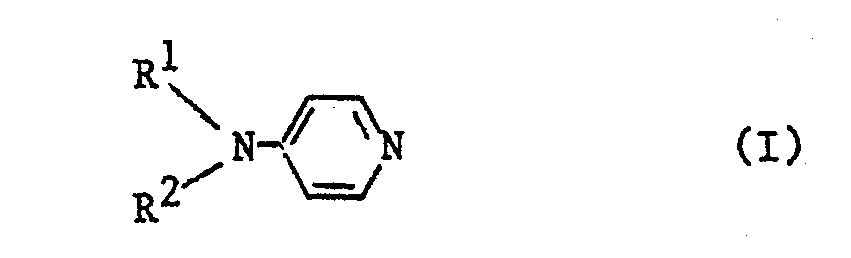
Zusätzlich zu dem genannten Katalysator können in dem erfindungsgemäßen Verfahren noch andere tertiäre Amine, wie beispielsweise Pyridin oder Triethylamin, als Hilfsbasen in einer Menge bis zu 50 Gew.X, vorzugsweise zwischen 5 und 20 Gew.X, bezogen auf den eingesetzten Polyvinylalkohol, mitverwendet werden. Die Menge an eingesetzter Hilfsbase richtet sich dabei unter anderem auch nach der Art des Acylierungsmittels. Im allgemeinen wird die Hilfsbase höchstens in solchen Mengen eingesetzt, die 50 bis 60 Mol-X der stöchiometrischen Menge an gebildeter Säure nicht überschreiten. Ob eine Hilfsbase in dem erfindungsgemäßen Verfahren mitverwendet wird, hängt auch von der Art der Reaktionsführung ab. Arbeitet man beispielsweise vorteilhaft in aromatischen Kohlenwasserstoffen, wie z.B. Toluol, als Lösungs- bzw. Dispergiermittel, so bringt ein Zusatz dieser Hilfsbasen keine nennenswerten Vorteile.In addition to the catalyst mentioned, other tertiary amines, such as pyridine or triethylamine, can also be used as auxiliary bases in an amount of up to 50% by weight, preferably between 5 and 20% by weight, based on the polyvinyl alcohol used . The amount of auxiliary base used depends, among other things, on the type of acylating agent. In general, the auxiliary base is used at most in amounts which do not exceed 50 to 60 mol-X of the stoichiometric amount of acid formed. Whether an auxiliary base is used in the process according to the invention also depends on the type of reaction. For example, if you work advantageously in aromatic hydrocarbons, such as Toluene, as a solvent or dispersant, adding these auxiliary bases has no significant advantages.
Auch wenn die Veresterungsreaktion des Polyvinylalkohols mit dem Acylierungsmittel allein durchgeführt werden kann, wird vorzugsweise in Gegenwart eines Lösungs- oder Dispergiermittels gearbeitet. Besonders vorteilhaft findet die Umsetzung des Polyvinylalkohols mit dem Acylierungsmittel in heterogener Phase statt, indem man den Polyvinylalkohol in einem aprotischen Dispergiermittel aufschlämmt und in dieser Aufschlämmung in Gegenwart der Aminopyridine als Katalysator unter gleichzeitiger kräftiger Durchmischung mit dem Acylierungsmittel umsetzt. Als aprotische Dispergiermittel kommen insbesondere niedere halogenierte Kohlenwasserstoffe, niedere aliphatische Ketone und aliphatische, cycloaliphatische und/oder aromatische Kohlenwasserstoff-Lösungsmittel in Betracht. Als Beispiele für solche Dispergiermittel seien genannt: Methylenchlorid, Chloroform, Tetrachlorkohlenstoff, Trichlorethan; Aceton, Methylethylketon, Methylisobutylketon; Hexan, Cyclohexan und Benzinfraktionen. Sehr günstig sind Methylenchlorid und Aceton. Als besonders vorteilhaft haben sich die aromatischen Kohlenwasserstoff-Lösungsmittel, wie Benzol, Xylol und vorzugsweise Toluol, erwiesen. Es ist zweckmäßig, solche Mengen an aprotischen Dispergiermitteln einzusetzen, daß in der Aufschlämmung aus Polyvinylalkohol und Dispergiermittel 30 bis 75 Gew.%, insbesondere 40 bis 65 Gew.X, an Dispergiermittel, bezogen auf die Summe von Polyvinylalkohol und Dispergiermittel, enthalten sind. Bei Einsatz von olefinisch ungesättigten aktivierten Carbonsäurederivaten als Acylierungsmittel hat es sich als zweckmäßig erwiesen, die Acylierung des Polyvinylalkohols in Gegenwart von üblichen Polymerisationsinhibitoren, wie z.B. Di-tert.-butyl-p--kresol, durchzuführen.Even if the esterification reaction of the polyvinyl alcohol with the acylating agent can be carried out alone, it is preferably carried out in the presence of a solvent or dispersant. The reaction of the polyvinyl alcohol with the acylating agent takes place particularly advantageously in the heterogeneous phase by slurrying the polyvinyl alcohol in an aprotic dispersing agent and reacting in this slurry in the presence of the aminopyridines as catalyst with simultaneous vigorous mixing with the acylating agent. Lower halogenated hydrocarbons, lower aliphatic ketones and aliphatic, cycloaliphatic and / or aromatic hydrocarbon solvents are particularly suitable as aprotic dispersants. Examples of such dispersants are: methylene chloride, chloroform, carbon tetrachloride, trichloroethane; Acetone, methyl ethyl ketone, methyl isobutyl ketone; Hexane, cyclohexane and gasoline fractions. Methylene chloride and acetone are very cheap. The aromatic hydrocarbon solvents, such as benzene, xylene and preferably toluene, have proven to be particularly advantageous. It is expedient to use such amounts of aprotic dispersants that the slurry of polyvinyl alcohol and dispersant contains 30 to 75% by weight, in particular 40 to 65% by weight, of dispersant, based on the sum of polyvinyl alcohol and dispersant. When using olefinically unsaturated activated carboxylic acid derivatives as the acylating agent, it has proven to be advantageous to acylate the polyvinyl alcohol in the presence of customary polymerization inhibitors, such as e.g. Di-tert-butyl-p - cresol.
Die Reaktionstemperatur liegt im allgemeinen im Bereich von 10 bis 100°C und wird vorzugsweise bei 40 bis 80°C gehalten. Die Reaktionszeit, die sich unter anderem auch nach dem gewünschten Acylierungsgrad richtet, liegt üblicherweise zwischen 2 und 40 Stunden und beträgt insbesondere 4 bis 20 Stunden.The reaction temperature is generally in the range from 10 to 100 ° C. and is preferably kept at 40 to 80 ° C. The reaction time, which also depends on the desired degree of acylation, is usually between 2 and 40 hours and is in particular 4 to 20 hours.
Die Aufarbeitung und Isolierung des Reaktionsproduktes erfolgt in an sich bekannter und üblicher Art und Weise. Bei der Durchführung der Acylierungsreaktion in heterogener Phase braucht man das unlösliche Umsetzungsprodukt des Polyvinylalkohols lediglich abzufiltrieren, nachzuwaschen und zu trocknen. Somit gestaltet sich hier die Aufarbeitung sehr einfach und kostensparend, da ein Ausfällen des Polymeren, wie es z.B. bei der Umsetzung in Lösung erfolgen muß, und auch eine aufwendige Reinigung der Lösungsmittel vor der Wiederverwendung entfällt, ohne daß Reinheit und Qualität der Produkte nachteilig beeinflußt werden.The reaction product is worked up and isolated in a manner which is known and customary. When the acylation reaction is carried out in a heterogeneous phase, the insoluble reaction product of the polyvinyl alcohol need only be filtered off, washed and dried. This makes the work-up very easy and cost-saving because the polymer precipitates, e.g. must be carried out during the reaction in solution, and there is also no elaborate cleaning of the solvents before reuse, without the purity and quality of the products being adversely affected.
Das erfindungsgemäße Acylierungsverfahren von Polyvinylalkoholen eignet sich allgemein zur Einführung von beliebigen funktionellen Gruppen in den Polyvinylalkohol durch katalysierte Veresterung mit entsprechenden Säurederivaten. Damit ist eine gezielte, gut kontrollierbare Modifizierung der chemischen und physikalischen Eigenschaften der Polyvinylalkohole unter Bildung sehr reiner Produkte möglich. Das erfindungsgemäße Acylierungsverfahren läßt auch in mehreren, aufeinander folgenden Schritten die Einführung verschiedenartiger funktioneller Seitengruppen in die Polyvinylalkoholkette zu. Interessant ist es beispielsweise auch für analytische Zwecke als Verbesserung der Methode von R.L. Adelman und R.C. Ferguson, J.Polymer Sci., Polymer Chem. Ed., Vol. 13, 891 (1975). Da erfindungsgemäß Produkte konstanter, reproduzierbarer Qualität erhalten werden, die sich unter anderem selbst bei hohen Acylierungsgraden durch ihre Reinheit und einen besonders geringen Gehalt an absorbierenden Verunreinigungen auszeichnen, eignen sie sich mit großem Vorteil für den Einsatz in photopolymerisierbaren und/oder photovernetzbaren Mischungen. Die Zusammensetzung solcher photopolymerisierbaren und/oder photovernetzbaren Gemische hängt sowohl von dem gewünschten Anwendungszweck als auch von der Art des eingesetzten, acylierten Polyvinylalkohols ab.The acylation process of polyvinyl alcohols according to the invention is generally suitable for introducing any functional groups into the polyvinyl alcohol by catalyzed esterification with corresponding acid derivatives. This enables a targeted, easily controllable modification of the chemical and physical properties of the polyvinyl alcohols to form very pure products. The acylation process according to the invention also allows the introduction of various functional side groups into the polyvinyl alcohol chain in several successive steps. It is also interesting, for example, for analytical purposes as an improvement to the R.L. Adelman and R.C. Ferguson, J. Polymer Sci., Polymer Chem. Ed., Vol. 13, 891 (1975). Since products of constant, reproducible quality are obtained according to the invention, which are characterized, inter alia, by their purity and a particularly low content of absorbing impurities even at high degrees of acylation, they are very advantageously suitable for use in photopolymerizable and / or photocrosslinkable mixtures. The composition of such photopolymerizable and / or photocrosslinkable mixtures depends both on the desired application and on the type of acylated polyvinyl alcohol used.
Sehr vorteilhaft sind solche photopolymerisierbaren und/oder photovernetzbaren Mischungen, die acylierte Polyvinylalkohole mit olefinisch ungesättigten, photopolymerisierbaren bzw. photovernetzbaren Estergruppen enthalten, wie sie z.B. bei der Umsetzung der Polyvinylalkohole mit aktivierten Derivaten von olefinisch ungesättigten Carbonsäuren, insbesondere Acrylsäureanhydrid, Methacrylsäureanhydrid oder Crotonsäureanhydrid, entstehen. Derartige Polyvinylalkohol-Derivate mit olefinisch ungesättigten, photopolymerisierbaren bzw. photovernetzbaren Seitengruppen können neben einem geeigneten Photoinitiator sowie üblichen nichtpolymerisierbaren Zusatzstoffen die alleinige wesentliche Komponente der photopolymerisierbaren und/oder photovernetzbaren Mischungen darstellen. Zusätzlich können diese Mischungen aber auch weitere polymere Bindemittel, z.B. andere Polyvinylalkohole ohne olefinische Doppelbindungen, oder andere olefinisch ungesättigte, photopolymerisierbare, insbesondere niedermolekulare Verbindungen, wie z.B. die üblichen photopolymerisierbaren Monomeren und/oder Oligomeren, enthalten. Sind in den photopolymerisierbaren oder photovernetzbaren Mischungen auf Basis von acylierten Polyvinylalkoholen mit olefinisch ungesättigten, photopolymerisierbaren bzw. photovernetzbaren Seitengruppen weitere polymere Bindemittel und/oder weitere photopolymerisierbare, insbesondere niedermolekulare Verbindungen enthalten, so sollen - wie allgemein üblich - diese Bindemittel und photopolymerisierbaren Verbindungen mit dem acylierten Polyvinylalkohol verträglich sein.Those photopolymerizable and / or photocrosslinkable mixtures which contain acylated polyvinyl alcohols with olefinically unsaturated, photopolymerizable or photocrosslinkable ester groups, such as those formed, for example, in the reaction of the polyvinyl alcohols with activated derivatives of olefinically unsaturated carboxylic acids, in particular acrylic acid anhydride, methacrylic anhydride or crotonic acid anhydride, are very advantageous. Such polyvinyl alcohol derivatives with olefinically unsaturated, photopolymerizable or photocrosslinkable side groups can, in addition to a suitable photoinitiator and customary non-polymerizable additives, the sole essential component of the photopolymer representable and / or photocrosslinkable mixtures. In addition, these mixtures can also contain other polymeric binders, for example other polyvinyl alcohols without olefinic double bonds, or other olefinically unsaturated, photopolymerizable, in particular low molecular weight compounds, such as the customary photopolymerizable monomers and / or oligomers. If, in the photopolymerizable or photocrosslinkable mixtures based on acylated polyvinyl alcohols with olefinically unsaturated, photopolymerizable or photocrosslinkable side groups, further polymeric binders and / or further photopolymerizable, in particular low molecular weight compounds are contained, these binders and photopolymerizable compounds with the acylated should - as is generally the case Be compatible with polyvinyl alcohol.
Gemäß einer anderen Ausführungsform können die photopolymerisierbaren und/oder photovernetzbaren Mischungen solche acylierten Polyvinylalkohole enthalten, in welche durch das erfindungsgemäße Acylierungsverfahren andere funktionelle Gruppen eingeführt worden sind. Hierzu gehören beispielsweise die Polyvinylalkohole mit seitenständigen, freien Carboxylgruppen, wie sie bei der Acylierung von Polyvinylalkoholen mit aktivierten Derivaten von Dicarbonsäuren, insbesondere Dicarbonsäureanhydriden, entstehen. Die freien Carboxylgruppen in den Polyvinylalkoholen vermitteln beispielsweise eine verbesserte Haftung der photopolymerisierbaren und/oder photovernetzbaren Mischungen auf metallischen Untergründen. Derartige lichtempfindliche Mischungen eignen sich daher vorteilhaft als Überzugs-, Beschichtungs- oder Resistmaterialien, aber auch für Druckplatten, in denen die lichtempfindliche, reliefbildende Schicht beispielsweise auf einem Metall- oder Stahlträger aufgebracht ist. Photopolymerisierbare und/oder photovernetzbare Mischungen mit acylierten Polyvinylalkoholen mit funktionellen Gruppen, insbesondere freien Carboxylgruppen, können weitere, verträgliche polymere Bindemittel enthalten, beispielsweise andere, unmodifizierte Polyvinylalkohole, andere modifizierte Polyvinylalkohole und auch Polyvinylalkohole mit seitenständigen, olefinisch ungesättigten, photopolymerisierbaren bzw. photovernetzbaren Doppelbindungen; sie enthalten darüber hinaus im allgemeinen auch niedermolekulare, d.h. monomere oder oligomere, olefinisch ungesättigte, photopolymerisierbare Verbindungen. Auch in diesem Fall sollen die in der photopolymerisierbaren und/oder photovernetzbaren Mischung enthaltenen Polymeren und Monomeren bzw. Oligomeren weitgehend miteinander verträglich sein.According to another embodiment, the photopolymerizable and / or photocrosslinkable mixtures can contain those acylated polyvinyl alcohols into which other functional groups have been introduced by the acylation process according to the invention. These include, for example, the polyvinyl alcohols with pendant free carboxyl groups, such as those formed in the acylation of polyvinyl alcohols with activated derivatives of dicarboxylic acids, in particular dicarboxylic acid anhydrides. The free carboxyl groups in the polyvinyl alcohols impart, for example, improved adhesion of the photopolymerizable and / or photocrosslinkable mixtures to metallic substrates. Such photosensitive mixtures are therefore advantageously suitable as coating, coating or resist materials, but also for printing plates in which the photosensitive, relief-forming layer is applied, for example, to a metal or steel support. Photopolymerizable and / or photocrosslinkable mixtures with acylated polyvinyl alcohols with functional groups, in particular free carboxyl groups, can contain further, compatible polymeric binders, for example other, unmodified polyvinyl alcohols, other modified polyvinyl alcohols and also polyvinyl alcohols with pendant, olefinically unsaturated, photopolymerizable or photocrosslinkable double bonds; in addition, they generally also contain low molecular weight, i.e. monomeric or oligomeric, olefinically unsaturated, photopolymerizable compounds. In this case too, the polymers and monomers or oligomers contained in the photopolymerizable and / or photocrosslinkable mixture should be largely compatible with one another.
Als andere Polymerbindemittel, die neben den erfindungsgemäß acylierten Polyvinylalkoholen in den photopolymerisierbaren und/oder photovernetzbaren Mischungen enthalten sein können, kommen beispielsweise in Betracht: nichtmodifizierte Polyvinylalkohole, andere Polyvinylalkohol-Derivate, z.B. oxethylierte Polyvinylalkohole (vgl. z.B. US-PS 4 272 611), Polyvinylpyrrolidon, N-Vinylpyrrolidon-Copolymerisate, z.B. N-Vinylpyrrolidon/Vinylacetat-Copolymerisate, Cellulosederivate, Stärke, Stärkederivate oder Acrylsäurecopolymerisate. Ob und in welchen Mengen diese weiteren polymeren Bindemittel neben den erfindungsgemäß acylierten Polyvinylalkoholen mitverwendet werden, hängt von den angestrebten Eigenschaften und dem Verwendungszweck der photopolymerisierbaren und/oder photovernetzbaren Mischungen ab. Das Verhältnis kann daher in weiten Grenzen schwanken.Other polymer binders which, in addition to the polyvinyl alcohols acylated according to the invention, can be present in the photopolymerizable and / or photocrosslinkable mixtures include, for example, in Consideration: unmodified polyvinyl alcohols, other polyvinyl alcohol derivatives, for example, ethoxylated polyvinyl alcohols (cf., for example, US Pat. No. 4,272,611), polyvinylpyrrolidone, N-vinylpyrrolidone copolymers, for example N-vinylpyrrolidone / vinyl acetate copolymers, cellulose derivatives, starch, starch derivative polymers or acrylic derivatives. Whether and in what amounts these other polymeric binders are used in addition to the polyvinyl alcohols acylated according to the invention depends on the properties sought and the intended use of the photopolymerizable and / or photocrosslinkable mixtures. The ratio can therefore fluctuate within wide limits.
Als photopolymerisierbare, ethylenisch ungesättigte niedermolekulare Verbindungen, die in den photopolymerisierbaren und/oder photovernetzbaren Mischungen enthalten sein können, kommen die an sich bekannten Monomeren und/oder Oligomeren (mit einem Molekulargewicht bis zu 5.000, vorzugsweise bis zu 3.000) in Frage, die für lichtempfindliche Mischungen der in Rede stehenden Art üblich und gebräuchlich und beispielsweise in der eingangs zitierten Literatur beschrieben sind. Als Beispiele bevorzugter polymerisierbarer ethylenisch ungesättigter niedermolekularer Verbindungen, die eine oder auch mehrere ethylenisch ungesättigte Doppelbindungen enthalten können, seien solche mit Hydroxylgruppen, Amidgruppen und/oder Polyalkylenglykol-Struktureinheiten genannt. Hierzu gehören insbesondere Mono- und Polyacrylate und/oder -methacrylate von ein- oder mehrwertigen niedermolekularen Alkoholen, z.B. Hydroxyalkyl(meth)acrylat mit 1 bis 8 Kohlenstoffatomen im Alkylrest, wie z.B. β-Hydroxyethyl-(meth)acrylat, β-Hydroxypropyl-(meth)acrylat, Ethylenglykol-di(meth)acrylat, Mono- und Di-(meth)acrylate von Polyethylenglykolen oder Polypropylenglykolen mit Molekulargewichten bis ca. 500, Butandiol-1,4-di(meth)acrylat, 1,1,1-Trimethylolpropan-tri(meth)acrylat oder Glycerin-di- oder -tri-(meth)-acrylat. Geeignet sind ferner niedermolekulare, präpolymere Urethanacrylate, wie sie z.B. durch Umsetzung von Hydroxyalkyl(meth)acrylaten (z.B. ß-Hydroxyethyl-(meth)acrylat, B-Hydroxypropyl-(meth)acrylat), organischen Diisocyanaten (z.B. Hexamethylendiisocyanat, Toluylendiisocyanat oder Isophorondiisocyanat) sowie gegebenenfalls niedermolekularen aliphatischen Diolen als Kettenverlängerern hergestellt werden können. Werden in den photopolymerisierbaren und/oder photovernetzbaren Mischungen ethylenisch ungesättigte niedermolekulare Verbindungen eingesetzt, so sind sie in den Mischungen im allgemeinen in solchen Mengen enthalten, daß ihr Anteil 10 bis 90 Gew.X, vorzugsweise 30 bis 60 Gew.X, bezogen auf die photopolymerisierbare und/oder photovernetzbare Mischung, beträgt.Suitable photopolymerizable, ethylenically unsaturated low-molecular compounds which may be present in the photopolymerizable and / or photocrosslinkable mixtures are the monomers and / or oligomers known per se (with a molecular weight of up to 5,000, preferably up to 3,000), which are suitable for photosensitive Mixtures of the type in question are customary and customary and are described, for example, in the literature cited at the beginning. Examples of preferred polymerizable ethylenically unsaturated low molecular weight compounds which may contain one or more ethylenically unsaturated double bonds are those with hydroxyl groups, amide groups and / or polyalkylene glycol structural units. These include in particular mono- and polyacrylates and / or methacrylates of mono- or polyhydric low molecular weight alcohols, e.g. Hydroxyalkyl (meth) acrylate with 1 to 8 carbon atoms in the alkyl radical, such as e.g. β-hydroxyethyl (meth) acrylate, β-hydroxypropyl (meth) acrylate, ethylene glycol di (meth) acrylate, mono- and di- (meth) acrylates of polyethylene glycols or polypropylene glycols with molecular weights up to approx. 500, butanediol-1, 4-di (meth) acrylate, 1,1,1-trimethylolpropane tri (meth) acrylate or glycerol di or tri (meth) acrylate. Also suitable are low molecular weight, prepolymeric urethane acrylates, e.g. by reacting hydroxyalkyl (meth) acrylates (e.g. β-hydroxyethyl (meth) acrylate, B-hydroxypropyl (meth) acrylate), organic diisocyanates (e.g. hexamethylene diisocyanate, tolylene diisocyanate or isophorone diisocyanate) and optionally low molecular weight aliphatic diols as chain extenders. If ethylenically unsaturated low molecular weight compounds are used in the photopolymerizable and / or photocrosslinkable mixtures, they are generally present in the mixtures in such amounts that their proportion is 10 to 90% by weight, preferably 30 to 60% by weight, based on the photopolymerizable and / or photocrosslinkable mixture.
Als Photopolymerisationsinitiatoren, die in den photopolymerisierbaren und/oder photovernetzbaren Mischungen im allgemeinen in Mengen von 0,001 bis 10 Gew.X, vorzugsweise von 0,1 bis 5 Gew.X, bezogen auf die photopolymerisierbare und/oder photovernetzbare Mischung, enthalten sind, kommen die für lichtempfindliche Gemische üblichen und an sich bekannten Photoinitiatoren in Betracht, beispielsweise Acyloine und deren Derivate, wie Benzoin, Benzoinalkylether, α-Methylolbenzoin und dessen Ether, α-Methylbenzoin und dessen Ether; vicinale Diketone und deren Derivate, wie z.B. Benzilketale, insbesondere Benzildimethylketal; sowie besonders vorteilhaft Acylphosphinoxid-Verbindungen des Typs, wie sie z.B. in der DE-A-29 09 992 und der DE-A-31 14 341 beschrieben sind. Die photopolymerisierbaren und/oder photovernetzbaren Mischungen können darüber hinaus übliche Zusatz- und/oder Hilfsstoffe in üblichen Mengen enthalten. Hierzu gehören insbesondere thermische Polymerisationsinhibitoren, Farbstoffe, Pigmente, Weichmacher, Verarbeitungshilfsmittel etc.As photopolymerization initiators, which in the photopolymerizable and / or photocrosslinkable mixtures generally in amounts of 0.001 up to 10% by weight, preferably from 0.1 to 5% by weight, based on the photopolymerizable and / or photocrosslinkable mixture, are present, the photoinitiators customary and known per se for light-sensitive mixtures, for example acyloins and their derivatives, such as benzoin, benzoin alkyl ether, α-methylolbenzoin and its ether, α-methylbenzoin and its ether; vicinal diketones and their derivatives, such as benzil ketals, especially benzil dimethyl ketal; and particularly advantageously acylphosphine oxide compounds of the type described, for example, in DE-A-29 09 992 and DE-A-31 14 341. The photopolymerizable and / or photocrosslinkable mixtures can moreover contain customary additives and / or auxiliaries in customary amounts. These include in particular thermal polymerization inhibitors, dyes, pigments, plasticizers, processing aids etc.
Die erfindungsgemäßen, photopolymerisierbaren und/oder photovernetzbaren Mischungen, die in üblicher Weise durch homogenes Vermischen der Bestandteile, beispielsweise in Lösung, hergestellt werden können, eignen sich vorteilhaft für die Herstellung von Überzügen, als Beschichtungsmaterialien, z.B. photopolymerisierbare Lacke, Farben und Spachtelmassen, zur Herstellung von Fluoreszenzschichten in Farbbildröhren, von reliefartig verzierten Überzügen, von Photoresists zur Herstellung von Elektronikbauteilen und gedruckten Schaltungen, zur Herstellung von Masken und Ätzresists zum Einsatz in der Formätztechnik sowie insbesondere auch zur Herstellung von lichtempfindlichen Aufzeichnungsmaterialien, insbesondere für photopolymerisierbare Druckplatten für den Hoch-, Tief-, Flach- oder Siebdruck. Bei der Verwendung der erfindungsgemäßen photopolymerisierbaren und/oder photovernetzbaren Mischungen für die Herstellung von lichtempfindlichen Aufzeichnungsmaterialien werden die Bestandteile der Mischung vorteilhafterweise so aufeinander abgestimmt, daß die photopolymerisierbare und/oder photovernetzbare Mischung als solche wasserlöslich oder zumindest wasserdispergierbar ist, so daß die lichtempfindlichen Aufzeichnungsmaterialien nach einer bildmäßigen Belichtung mit Wasser oder wäßrigen Entwicklerlösungsmitteln ausgewaschen werden können. Ein besonderer Vorteil der erfindungsgemäßen photopolymerisierbaren und/oder photovernetzbaren Mischungen ist auch darin zu sehen, daß sie trotz der Wasserauswaschbarkeit im unbelichteten Zustand nach der Photopolymerisation bzw. Photovernetzung eine erhöhte Wasserfestigkeit aufweisen.The photopolymerizable and / or photocrosslinkable mixtures according to the invention, which can be prepared in the usual way by homogeneously mixing the constituents, for example in solution, are advantageously suitable for the production of coatings, as coating materials, e.g. photopolymerizable lacquers, paints and fillers, for the production of fluorescent layers in color picture tubes, of relief-like coatings, of photoresists for the production of electronic components and printed circuits, for the production of masks and etching resists for use in form etching technology and in particular also for the production of light-sensitive recording materials, in particular for photopolymerizable printing plates for high, low, flat or screen printing. When using the photopolymerizable and / or photocrosslinkable mixtures according to the invention for the production of light-sensitive recording materials, the components of the mixture are advantageously matched to one another in such a way that the photopolymerizable and / or photocrosslinkable mixture as such is water-soluble or at least water-dispersible, so that the light-sensitive recording materials after one imagewise exposure can be washed out with water or aqueous developer solvents. A particular advantage of the photopolymerizable and / or photocrosslinkable mixtures according to the invention can also be seen in the fact that, despite the water washability in the unexposed state after photopolymerization or photocrosslinking, they have increased water resistance.
Die Erfindung wird durch die nachfolgenden Beispiele näher erläutert. Die in den Beispielen genannten Teile und Prozente beziehen sich, sofern nicht anders angegeben, auf das Gewicht. Die Molekulargewichte der Polyvinylalkohole wurden bestimmt über die Viskositäten, gemessen als 4 gewichtsprozentige wäßrige Lösung bei 20°C in einem Höppler-Viskosimeter, und sind als Zahlenmittel angegeben. Die Vergleichsversuche wurden so durchgeführt, daß die Konzentration des eingesetzten Polyvinylalkohols, bezogen auf die gesamte flüssige Phase, konstant gehalten wurde.The invention is illustrated by the following examples. Unless otherwise stated, the parts and percentages given in the examples relate to the weight. The molecular weights of the polyvinyl alcohols were determined via the viscosities, measured as a 4% strength by weight aqueous solution at 20 ° C. in a Höppler viscometer. and are given as the number average. The comparative experiments were carried out in such a way that the concentration of the polyvinyl alcohol used, based on the entire liquid phase, was kept constant.
100 Teile eines teilverseiften Polyvinylacetats (Verseifungsgrad 82 Mol-X, mittleres Molekulargewicht 20.000) wurden in einer Mischung aus 160 Teilen Aceton, 25 Teilen rohem Acrylsäureanhydrid, das ca. 5 Teile Acrylsäure enthielt, 15 Teilen Triethylamin, 1 Teil Di-tert.-butyl-p--kresol und 1 Teil p-Pyrrolidinopyridin dispergiert und 12 Stunden lang bei 60°C gerührt. Danach wurde das unlösliche Umsetzungsprodukt des Polyvinylalkohols abfiltriert, mit Aceton gewaschen und getrocknet. Der erhaltene, acylierte Polyvinylalkohol enthielt 9 Mol-% an Acrylester-Gruppen.100 parts of a partially saponified polyvinyl acetate (degree of saponification 82 mol-X, average molecular weight 20,000) were in a mixture of 160 parts of acetone, 25 parts of crude acrylic anhydride, which contained about 5 parts of acrylic acid, 15 parts of triethylamine, 1 part of di-tert-butyl -p - cresol and 1 part of p-pyrrolidinopyridine dispersed and stirred at 60 ° C for 12 hours. The insoluble reaction product of the polyvinyl alcohol was then filtered off, washed with acetone and dried. The acylated polyvinyl alcohol obtained contained 9 mol% of acrylic ester groups.
Es wurde wie in Beispiel 1 gearbeitet, diesmal jedoch kein Triethylamin und kein p-Pyrrolidinopyridin mitverwendet, dafür jedoch die Menge an Aceton auf 170 Teile erhöht. Trotz einer Reaktionsdauer von 24 Stunden betrug der Gehalt an Acrylestergruppen in dem erhaltenen Umsetzungsprodukt nur 1,5 Mol-X. Das eingesetzte Acrylsäureanhydrid war fast vollständig verbraucht.The procedure was as in Example 1, but this time no triethylamine or p-pyrrolidinopyridine was used, but the amount of acetone was increased to 170 parts. Despite a reaction time of 24 hours, the content of acrylic ester groups in the reaction product obtained was only 1.5 mol-X. The acrylic acid anhydride used was almost completely used up.
100 Teile eines teilverseiften Polyvinylacetats (Verseifungsgrad 88 Mol-X, mittleres Molekulargewicht 25.000) wurden in einer Mischung aus 160 Teilen Aceton, 25 Teilen rohem Methacrylsäureanhydrid, welches 7 7 Teile freie Methacrylsäure als Verunreinigung enthielt, 1 Teil Di-tert.--butyl-p-kresol, 15 Teilen Pyridin und 2 Teilen p-Dimethylaminopyridin dispergiert und 12 Stunden lang bei 60°C gerührt. Das nach Filtration, Waschen mit Aceton und Trocknen erhaltene Acylierungsprodukt des Polyvinylalkohols enthielt 7 Mol-X Methacrylsäureestergruppen eingebaut.100 parts of a partially saponified polyvinyl acetate (degree of saponification 88 mol-X, average molecular weight 25,000) were mixed in a mixture of 160 parts acetone, 25 parts crude methacrylic anhydride, which contained 7 7 parts free methacrylic acid, 1 part di-tert-butyl p-cresol, 15 parts of pyridine and 2 parts of p-dimethylaminopyridine dispersed and stirred at 60 ° C for 12 hours. The acylation product of the polyvinyl alcohol obtained after filtration, washing with acetone and drying contained 7 mol-X methacrylic ester groups.
Es wurde wie in Beispiel 2 gearbeitet, diesmal jedoch auf die Mitverwendung des Pyridins und des p-Dimethylaminopyridins verzichtet, dafür ) jedoch die Menge an Methacrylsäureanhydrid von 25 auf 50 Teile erhöht. Die Menge des als Dispergiermittel eingesetzten Acetons betrug diesmal 140 Teile. Nach einer Reaktionszeit von 25 Stunden bei 60°C betrug der Gehalt an Methacrylsäureestergruppen in dem gewaschenen und getrockneten Umsetzungsprodukt nur 1,7 Mol-%.The procedure was as in Example 2, but this time the pyridine and p-dimethylaminopyridine were not used, but the amount of methacrylic anhydride was increased from 25 to 50 parts. The amount of acetone used as the dispersant this time was 140 parts. After a reaction time of 25 hours at 60 ° C, the Content of methacrylic acid ester groups in the washed and dried reaction product only 1.7 mol%.
100 Teile eines teilverseiften Polyvinylacetats (Verseifungsgrad 88 Mol-%, mittleres Molekulargewicht 50.000) wurden in 160 Teilen Aceton, 25 Teilen Crotonsäureanhydrid, welches 3 Teile freie Crotonsäure als Verunreinigung enthielt, 1 Teil Di-tert.-butyl-p-kresol, 10 Teilen Triethylamin und 1 Teil p-Dimethylaminopyridin dispergiert und 6 Stunden bei 60°C gerührt. Nach Abfiltrieren des Umsetzungsproduktes, Waschen und Trocknen wurde ein Gehalt an 11 Mol-% gebundener Crotonsäureestergruppen in dem Polyvinylalkohol ermittelt. Das Umsetzungsprodukt war nach wie vor gut in Wasser löslich.100 parts of a partially saponified polyvinyl acetate (degree of saponification 88 mol%, average molecular weight 50,000) were dissolved in 160 parts acetone, 25 parts crotonic anhydride, which contained 3 parts free crotonic acid, 1 part di-tert-butyl-p-cresol, 10 parts Triethylamine and 1 part of p-dimethylaminopyridine dispersed and stirred at 60 ° C for 6 hours. After filtering off the reaction product, washing and drying, a content of 11 mol% bound crotonic acid ester groups in the polyvinyl alcohol was determined. The reaction product was still readily soluble in water.
Es wurde wie in Beispiel 3 gearbeitet, diesmal jedoch auf den Zusatz des p-Dimethylaminopyridins und des Triethylamins verzichtet, dafür jedoch der Anteil des Crotonsäureanhydrids von 25 Teilen auf 50 Teile (enthaltend 6 Teile freie Crotonsäure als Verunreinigung) erhöht. Nach einer Reaktionszeit von 20 Stunden bei 60°C betrug der Gehalt an gebundenen Crotonsäureestergruppen im Polyvinylalkohol nur 4,5 Mol-%; das Produkt war nicht mehr in Wasser, sondern nur noch in einem Wasser/Methanol--Gemisch (1:1) löslich.The procedure was as in Example 3, but this time the addition of p-dimethylaminopyridine and triethylamine was dispensed with, but the proportion of crotonic anhydride was increased from 25 parts to 50 parts (containing 6 parts of free crotonic acid as an impurity). After a reaction time of 20 hours at 60 ° C., the content of bound crotonic acid ester groups in the polyvinyl alcohol was only 4.5 mol%; the product was no longer soluble in water, but only in a water / methanol mixture (1: 1).
100 Teile eines teilverseiften Polyvinylacetats (Verseifungsgrad 88 Mol-%, mittleres Molekulargewicht 16.000) wurden in einer Mischung aus 180 Teilen Toluol, 20 Teilen Methacrylsäureanhydrid (enthaltend 5,5 Teile freier Methacrylsäure als Verunreinigung), 1 Teil Di-tert.-butyl-p-kresol und 1 Teil p-Dimethylaminopyridin dispergiert und 8 Stunden lang bei 80°C gerührt. Das unlösliche Reaktionsprodukt wurde abfiltriert, mit Toluol und Aceton gewaschen und getrocknet. Es enthielt in gebundener Form 5 Mol-X Methacrylsäureestergruppen.100 parts of a partially saponified polyvinyl acetate (degree of saponification 88 mol%, average molecular weight 16,000) were in a mixture of 180 parts of toluene, 20 parts of methacrylic anhydride (containing 5.5 parts of free methacrylic acid as an impurity), 1 part of di-tert-butyl-p -cresol and 1 part of p-dimethylaminopyridine dispersed and stirred at 80 ° C for 8 hours. The insoluble reaction product was filtered off, washed with toluene and acetone and dried. It contained 5 mol-X methacrylic ester groups in bound form.
Es wurde wie in Beispiel 1 gearbeitet, diesmal jedoch ohne Zusatz von p-Pyrrolidinopyridin, dafür wurde aber der Anteil des Triethylamins auf 16 Teile erhöht. Das resultierende Umsetzungsprodukt enthielt nur etwa 0,8 Mol-% an Acrylsäureestergruppen eingebaut.The procedure was as in Example 1, but this time without the addition of p-pyrrolidinopyridine, but the proportion of triethylamine was increased to 16 parts. The resulting reaction product contained only about 0.8 mol% of acrylic ester groups incorporated.
Es wurde Beispiel 4 wiederholt, diesmal jedoch auf den Zusatz von p-Dimethylaminopyridin verzichtet. Dafür wurden jedoch 20 Teile Pyridin zugesetzt und die Menge an Toluol gleichzeitig von 180 Teilen auf 160 Teile reduziert. Bei gleicher Reaktionszeit wie in Beispiel 4 hatte das erhaltene Acylierungsprodukt des Polyvinylalkohols nur 1,2 Mol-% an Methacrylsäureestergruppen eingebaut.Example 4 was repeated, but this time without the addition of p-dimethylaminopyridine. However, 20 parts of pyridine were added and the amount of toluene was simultaneously reduced from 180 parts to 160 parts. With the same reaction time as in Example 4, the acylation product of the polyvinyl alcohol obtained had incorporated only 1.2 mol% of methacrylic acid ester groups.
100 Teile eines teilverseiften Polyvinylpropionats (Verseifungsgrad 88 Mol-%, mittleres Molekulargewicht 30.000) wurden in einer Mischung aus 180 Teilen Toluol, 20 Teilen Bernsteinsäureanhydrid und 1 Teil p-Dimethylaminopyridin dispergiert und 8 Stunden lang bei 80°C gerührt. Das erhaltene Umsetzungsprodukt wurde abfiltriert, mit Aceton gewaschen und getrocknet. Es enthielt 9 Mol-X an Bernsteinsäurehalbestergruppen eingebaut.100 parts of a partially saponified polyvinyl propionate (degree of saponification 88 mol%, average molecular weight 30,000) were dispersed in a mixture of 180 parts of toluene, 20 parts of succinic anhydride and 1 part of p-dimethylaminopyridine and stirred at 80 ° C. for 8 hours. The reaction product obtained was filtered off, washed with acetone and dried. It contained 9 mol-X of succinic acid half-ester groups.
50 Teile des gemäß Beispiel 1 hergestellten acrylierten Polyvinylalkohols wurden bei 80°C in 50 Teilen Wasser gelöst und zu dieser Lösung 40 Teile β-Hydroxiethylacrylat, 8 Teile Trimethylolpropantriacrylat, 0,5 Teile 2,4,6-Trimethylbenzoyldiphenylphosphinoxid, 0,2 Teile Hydrochinonmonomethylether und 0,02 Teile Eosin gegeben. Die erhaltene Mischung wurde auf einem Träger zu einer etwa 0,8 mm dicken Schicht geformt und diese getrocknet. Durch bildmäßige Belichtung mit aktinischem Licht (360 na) und Auswaschen der unbelichteten Bereiche der Schicht mit Wasser wurde ein Relief mit ausgezeichneter Schärfe und sehr guter Auswaschbeständigkeit auch feiner Reliefteile erhalten. Die photopolymerisierbare Schicht zeichnete sich durch hohe Lichtempfindlichkeit aus.50 parts of the acrylated polyvinyl alcohol prepared according to Example 1 were dissolved in 50 parts of water at 80 ° C. and 40 parts of β-hydroxyethyl acrylate, 8 parts of trimethylolpropane triacrylate, 0.5 part of 2,4,6-trimethylbenzoyldiphenylphosphine oxide and 0.2 part of hydroquinone monomethyl ether were added to this solution and 0.02 parts of eosin. The resulting mixture was formed on a carrier into an approximately 0.8 mm thick layer and dried. By means of imagewise exposure to actinic light (360 na) and washing out the unexposed areas of the layer with water, a relief was obtained with excellent sharpness and very good washout resistance, even of fine relief parts. The photopolymerizable layer was characterized by high sensitivity to light.
Es wurde wie in Beispiel 6 beschrieben gearbeitet, jedoch bestand die Mischung aus 70 Teilen des nach Beispiel 2 erhaltenen methacrylierten Polyvinylalkohols, 15 Teilen β-Ilydroxyethylmethacrylat, 15 Teilen 1,4-Butandioldimethacrylat, 1,2 Teilen Benzildimethylketal, 0,1 Teilen Hydrochinon und 0,02 Teilen N-Nitrosophenylanilin. Die photopolymerisierbare Schicht hatte ähnlich gute Eigenschaften wie die in Beispiel 6 beschriebene.The procedure was as described in Example 6, but the mixture consisted of 70 parts of the methacrylated polyvinyl alcohol obtained according to Example 2, 15 parts of β-ilydroxyethyl methacrylate, 15 parts of 1,4-butanediol dimethacrylate, 1.2 parts of benzil dimethyl ketal, 0.1 part of hydroquinone and 0.02 parts of N-nitrosophenylaniline. The photopolymerizable layer had properties similar to those described in Example 6.
Die Wiederholung von Beispiel 6 unter Einsatz des gemäß Beispiel 5 hergestellten acylierten Polyvinylalkohols ergab eine photopolymerisierbare Schicht, deren Auswaschverhalten sich über den pH-Wert des Auswaschmittels steuern ließ.The repetition of Example 6 using the acylated polyvinyl alcohol prepared according to Example 5 gave a photopolymerizable layer, the washout behavior of which could be controlled via the pH of the washout agent.
Claims (12)

Applications Claiming Priority (2)
| Application Number | Priority Date | Filing Date | Title |
|---|---|---|---|
| DE19833322993 DE3322993A1 (en) | 1983-06-25 | 1983-06-25 | METHOD FOR ACYLATING POLYVINYL ALCOHOLS AND PHYTOPOLYMERIZABLE AND / OR PHOTO CROSSLINKABLE MIXTURES CONTAINING SO ACYLATED PRODUCTS |
| DE3322993 | 1983-06-25 |
Publications (2)
| Publication Number | Publication Date |
|---|---|
| EP0129902A1 true EP0129902A1 (en) | 1985-01-02 |
| EP0129902B1 EP0129902B1 (en) | 1987-04-01 |
Family
ID=6202439
Family Applications (1)
| Application Number | Title | Priority Date | Filing Date |
|---|---|---|---|
| EP84107280A Expired EP0129902B1 (en) | 1983-06-25 | 1984-06-25 | Process for the acylation of polyvinyl alcohols, and photopolymerisable and/or photocurable compositions containing these acylated products |
Country Status (4)
| Country | Link |
|---|---|
| US (1) | US4540743A (en) |
| EP (1) | EP0129902B1 (en) |
| JP (1) | JPS6013803A (en) |
| DE (2) | DE3322993A1 (en) |
Cited By (2)
| Publication number | Priority date | Publication date | Assignee | Title |
|---|---|---|---|---|
| EP0220507A3 (en) * | 1985-09-27 | 1987-07-15 | Basf Aktiengesellschaft | Process for the manufacture of carboxylic esters of polymers containing hydraulic groups |
| EP0231922A3 (en) * | 1986-02-07 | 1987-11-11 | American Cyanamid Company | Electron beam and x-ray resists |
Families Citing this family (23)
| Publication number | Priority date | Publication date | Assignee | Title |
|---|---|---|---|---|
| DE3541162A1 (en) * | 1985-11-21 | 1987-05-27 | Basf Ag | PHOTO-SENSITIVE RECORDING MATERIALS WITH ELASTOMERIC GRAFT COPOLYMERISAT BINDERS AND RELIEVE THEREOF |
| DE3619608A1 (en) * | 1986-06-11 | 1987-12-17 | Basf Ag | METHOD FOR PRODUCING VINYL CHLORIDE POLYMERISATS |
| DE3843505A1 (en) * | 1988-12-23 | 1990-07-05 | Hoechst Ag | CARBONIC ACID ESTERS OF HYDROXYL GROUP-CONTAINING GRAFT POLYMERS AND METHOD FOR THE PRODUCTION THEREOF |
| US5032451A (en) * | 1989-05-30 | 1991-07-16 | Shell Oil Company | Bisbenzocyclobutene/bisimide compositions |
| US4973636A (en) * | 1989-05-30 | 1990-11-27 | Shell Oil Company | Bisbenzocyclobutene/bisimide compositions |
| US4997977A (en) * | 1989-09-11 | 1991-03-05 | Hoechst Celanese Corp. | Process for the production of esters exhibiting nonlinear optical response |
| DE19824546A1 (en) * | 1998-06-03 | 1999-12-09 | Basf Drucksysteme Gmbh | Production of crosslinkable water-soluble or water-dispersible compositions and radiation-sensitive mixtures obtainable therefrom |
| US6965905B2 (en) * | 2002-12-20 | 2005-11-15 | Sun Microsystems, Inc. | Lock-free, parallel remembered sets |
| US6884849B2 (en) | 2003-02-21 | 2005-04-26 | Owens-Corning Fiberglas Technology, Inc. | Poly alcohol-based binder composition |
| TWI413649B (en) * | 2006-04-12 | 2013-11-01 | Kuraray Co | Dispersion stabilizer |
| JP5042520B2 (en) * | 2006-04-26 | 2012-10-03 | 株式会社クラレ | POLYVINYL ALCOHOL POLYMER AND PROCESS FOR PRODUCING THE SAME |
| JP5374012B2 (en) * | 2006-06-02 | 2013-12-25 | 三井化学東セロ株式会社 | Process for producing unsaturated carboxylic acid-modified vinyl alcohol polymer and gas barrier film or gas barrier laminate using the same |
| EP2154186B1 (en) * | 2007-05-21 | 2019-09-18 | Kuraray Co., Ltd. | Crosslinkable polyvinyl acetal porous powder, method for producing the same, and use of the same |
| TWI525110B (en) | 2014-12-24 | 2016-03-11 | 財團法人工業技術研究院 | Polymer, and pharmaceutical composition employing the same |
| CN104826655A (en) * | 2015-05-08 | 2015-08-12 | 福建农林大学 | Alkylamino pyridine catalyst taking active carbon as carrier and preparation method thereof |
| WO2018133972A1 (en) | 2017-01-20 | 2018-07-26 | Evonik Röhm Gmbh | Glycerol (meth)acrylate carboxylic ester having a long shelf life |
| US11914293B2 (en) | 2017-01-31 | 2024-02-27 | Flint Group Germany Gmbh | Radiatioin-curable mixture containing low-functionalised, partially saponified polyvinyl acetate |
| TWI806932B (en) | 2017-11-29 | 2023-07-01 | 德商可樂麗歐洲有限公司 | Method for the production of functionalized polyvinyl acetate |
| CN112218902B (en) | 2018-04-11 | 2023-05-09 | 株式会社可乐丽 | Polyvinyl alcohol composition, use thereof, and method for producing vinyl resin |
| JP6718033B2 (en) * | 2018-07-05 | 2020-07-08 | 株式会社クラレ | Modified vinyl alcohol polymer, method for producing the same, dispersion stabilizer for suspension polymerization, and method for producing vinyl polymer |
| EP3611155A1 (en) | 2018-08-16 | 2020-02-19 | Evonik Operations GmbH | Preparation of (meth)acrylic acid esters |
| NL2027002B1 (en) | 2020-11-27 | 2022-07-04 | Flint Group Germany Gmbh | Photosensitive composition |
| NL2027003B1 (en) | 2020-11-27 | 2022-07-04 | Flint Group Germany Gmbh | Photosensitive composition |
Citations (4)
| Publication number | Priority date | Publication date | Assignee | Title |
|---|---|---|---|---|
| DE1065621B (en) * | 1970-08-05 | 1959-09-17 | Prag Dr Otto Wichterle | Process for the production of hydrophilic, swollen or strongly swellable molded structures |
| DE2012389A1 (en) * | 1969-04-01 | 1970-10-08 | Eastman Kodak Co., Rochester, N.Y. (V.St.A.) | Process for the preparation of soluble polyvinyl ester ^ |
| DE2632398A1 (en) * | 1976-07-19 | 1978-02-02 | Elfotec Ag | Photoconductive polymer prodn. by acylation of polyvinyl alcohol - with acid chloride giving film-forming property, used in electrophotography |
| EP0079514A2 (en) * | 1981-11-12 | 1983-05-25 | BASF Aktiengesellschaft | Light-sensitive recording material useful in the production of printing and relief forms, and process for the production of printing and relief forms by means of this recording material |
Family Cites Families (6)
| Publication number | Priority date | Publication date | Assignee | Title |
|---|---|---|---|---|
| US2759909A (en) * | 1952-06-18 | 1956-08-21 | Eastman Kodak Co | Process for preparing polyvinyl dicarboxylic acid esters |
| BE560154A (en) * | 1956-08-27 | |||
| US3220960A (en) * | 1960-12-21 | 1965-11-30 | Wichterle Otto | Cross-linked hydrophilic polymers and articles made therefrom |
| GB1090142A (en) * | 1965-02-26 | 1967-11-08 | Agfa Gevaert Nv | Photochemical insolubilisation of polymers |
| DE1958954C3 (en) * | 1969-11-24 | 1978-11-30 | Schering Ag, 1000 Berlin Und 4619 Bergkamen | Process for the esterification of alcohols |
| US4140853A (en) * | 1975-04-18 | 1979-02-20 | Schering Aktiengesellschaft | Process for the preparation of aminopyridines |
-
1983
- 1983-06-25 DE DE19833322993 patent/DE3322993A1/en not_active Withdrawn
-
1984
- 1984-06-25 US US06/624,094 patent/US4540743A/en not_active Expired - Lifetime
- 1984-06-25 DE DE8484107280T patent/DE3462898D1/en not_active Expired
- 1984-06-25 EP EP84107280A patent/EP0129902B1/en not_active Expired
- 1984-06-25 JP JP59129424A patent/JPS6013803A/en active Granted
Patent Citations (4)
| Publication number | Priority date | Publication date | Assignee | Title |
|---|---|---|---|---|
| DE2012389A1 (en) * | 1969-04-01 | 1970-10-08 | Eastman Kodak Co., Rochester, N.Y. (V.St.A.) | Process for the preparation of soluble polyvinyl ester ^ |
| DE1065621B (en) * | 1970-08-05 | 1959-09-17 | Prag Dr Otto Wichterle | Process for the production of hydrophilic, swollen or strongly swellable molded structures |
| DE2632398A1 (en) * | 1976-07-19 | 1978-02-02 | Elfotec Ag | Photoconductive polymer prodn. by acylation of polyvinyl alcohol - with acid chloride giving film-forming property, used in electrophotography |
| EP0079514A2 (en) * | 1981-11-12 | 1983-05-25 | BASF Aktiengesellschaft | Light-sensitive recording material useful in the production of printing and relief forms, and process for the production of printing and relief forms by means of this recording material |
Cited By (2)
| Publication number | Priority date | Publication date | Assignee | Title |
|---|---|---|---|---|
| EP0220507A3 (en) * | 1985-09-27 | 1987-07-15 | Basf Aktiengesellschaft | Process for the manufacture of carboxylic esters of polymers containing hydraulic groups |
| EP0231922A3 (en) * | 1986-02-07 | 1987-11-11 | American Cyanamid Company | Electron beam and x-ray resists |
Also Published As
| Publication number | Publication date |
|---|---|
| JPS6013803A (en) | 1985-01-24 |
| EP0129902B1 (en) | 1987-04-01 |
| DE3462898D1 (en) | 1987-05-07 |
| US4540743A (en) | 1985-09-10 |
| JPH0428001B2 (en) | 1992-05-13 |
| DE3322993A1 (en) | 1985-01-03 |
Similar Documents
| Publication | Publication Date | Title |
|---|---|---|
| EP0129902B1 (en) | Process for the acylation of polyvinyl alcohols, and photopolymerisable and/or photocurable compositions containing these acylated products | |
| EP0079514B1 (en) | Light-sensitive recording material useful in the production of printing and relief forms, and process for the production of printing and relief forms by means of this recording material | |
| EP0291662B1 (en) | Process for the manufacture of branched acrylic copolymer having polymerizable double bonds and their use | |
| DE19964382B4 (en) | Use of a coating composition for producing a non-reflective coating and method of making the coating composition | |
| DE2453428B2 (en) | Photopolymerizable mass | |
| DE69130516T2 (en) | Pigment dispersant | |
| EP0343470A2 (en) | Alkenylphosphonic and alkenylphosphinic-acid esters, their preparation and radiation-curable compositions containing these compounds | |
| DE1768083A1 (en) | Ethylenically unsaturated derivatives of benzophenone and crosslinkable polymers made therefrom | |
| DE1745226A1 (en) | Process for the production of a crosslinkable, photopolymerizable copolymer | |
| DE2614860C3 (en) | Liquid masses curable by the influence of light | |
| EP0129901B1 (en) | Light-sensitive water-developable registration material for producing printing or relief forms, and resists | |
| DE3024368C2 (en) | Coating composition based on an aqueous medium | |
| DE2541133A1 (en) | PHOTOHARDABLE COMPOSITION | |
| DE2012389C3 (en) | Process for the production of photosensitive polyvinyl esters | |
| DE4006097A1 (en) | ETHYLENICALLY UNSATURATED, FLUORINE URETHER DERIVATIVES AND METHOD FOR THE PRODUCTION THEREOF | |
| DE2112718A1 (en) | Hardenable compositions containing a mixture of an unsaturated polyester resin and styrene or vinyl toluene | |
| DE3607250A1 (en) | AQUEOUS COATING COMPOSITION | |
| DE69610570T2 (en) | Radiation-curable polymers and processes for their manufacture | |
| DE69331502T2 (en) | Photopolymerizable components of radiation sensitive compositions | |
| DE3942184A1 (en) | METHOD FOR PRODUCING REACTIVE MICROGEL AND RESIN MATERIAL CONTAINING THE MICROGEL | |
| EP0272549B1 (en) | Light-sensitive mixture with diazonium salt polycondensation products, and light-sensitive registration material prepared therewith | |
| DE2166449A1 (en) | MIXTURE OF POLYMERIZABLE COMPOUNDS | |
| DE2702385C3 (en) | Photosensitive Polymers, A Process For Their Production The Same For The Production Of Cured Products | |
| DE68920665T2 (en) | Coating agent. | |
| DE2341787A1 (en) | NEW REACTIVE POLYMERS |
Legal Events
| Date | Code | Title | Description |
|---|---|---|---|
| PUAI | Public reference made under article 153(3) epc to a published international application that has entered the european phase |
Free format text: ORIGINAL CODE: 0009012 |
|
| AK | Designated contracting states |
Designated state(s): BE DE FR GB IT NL |
|
| 17P | Request for examination filed |
Effective date: 19841113 |
|
| GRAA | (expected) grant |
Free format text: ORIGINAL CODE: 0009210 |
|
| AK | Designated contracting states |
Kind code of ref document: B1 Designated state(s): BE DE FR GB IT NL |
|
| ITF | It: translation for a ep patent filed | ||
| REF | Corresponds to: |
Ref document number: 3462898 Country of ref document: DE Date of ref document: 19870507 |
|
| ET | Fr: translation filed | ||
| PLBE | No opposition filed within time limit |
Free format text: ORIGINAL CODE: 0009261 |
|
| STAA | Information on the status of an ep patent application or granted ep patent |
Free format text: STATUS: NO OPPOSITION FILED WITHIN TIME LIMIT |
|
| 26N | No opposition filed | ||
| R20 | Corrections of a patent specification |
Effective date: 19880708 |
|
| D20 | Corrections of a patent specification (deleted) | ||
| ITTA | It: last paid annual fee | ||
| PGFP | Annual fee paid to national office [announced via postgrant information from national office to epo] |
Ref country code: NL Payment date: 19990531 Year of fee payment: 16 |
|
| PGFP | Annual fee paid to national office [announced via postgrant information from national office to epo] |
Ref country code: BE Payment date: 19990624 Year of fee payment: 16 |
|
| PG25 | Lapsed in a contracting state [announced via postgrant information from national office to epo] |
Ref country code: BE Free format text: LAPSE BECAUSE OF NON-PAYMENT OF DUE FEES Effective date: 20000630 |
|
| BERE | Be: lapsed |
Owner name: BASF A.G. Effective date: 20000630 |
|
| PG25 | Lapsed in a contracting state [announced via postgrant information from national office to epo] |
Ref country code: NL Free format text: LAPSE BECAUSE OF NON-PAYMENT OF DUE FEES Effective date: 20010101 |
|
| NLV4 | Nl: lapsed or anulled due to non-payment of the annual fee |
Effective date: 20010101 |
|
| PGFP | Annual fee paid to national office [announced via postgrant information from national office to epo] |
Ref country code: FR Payment date: 20010515 Year of fee payment: 18 |
|
| PGFP | Annual fee paid to national office [announced via postgrant information from national office to epo] |
Ref country code: GB Payment date: 20010618 Year of fee payment: 18 |
|
| PGFP | Annual fee paid to national office [announced via postgrant information from national office to epo] |
Ref country code: DE Payment date: 20010628 Year of fee payment: 18 |
|
| REG | Reference to a national code |
Ref country code: GB Ref legal event code: IF02 |
|
| PG25 | Lapsed in a contracting state [announced via postgrant information from national office to epo] |
Ref country code: DE Free format text: LAPSE BECAUSE OF THE APPLICANT RENOUNCES Effective date: 20020615 |
|
| PG25 | Lapsed in a contracting state [announced via postgrant information from national office to epo] |
Ref country code: GB Free format text: LAPSE BECAUSE OF NON-PAYMENT OF DUE FEES Effective date: 20020625 |
|
| GBPC | Gb: european patent ceased through non-payment of renewal fee |
Effective date: 20020625 |
|
| PG25 | Lapsed in a contracting state [announced via postgrant information from national office to epo] |
Ref country code: FR Free format text: LAPSE BECAUSE OF NON-PAYMENT OF DUE FEES Effective date: 20030228 |
|
| REG | Reference to a national code |
Ref country code: FR Ref legal event code: ST |