EP0127840B1 - Antiinflammatory analgesic gelled ointments - Google Patents
Antiinflammatory analgesic gelled ointments Download PDFInfo
- Publication number
- EP0127840B1 EP0127840B1 EP84105844A EP84105844A EP0127840B1 EP 0127840 B1 EP0127840 B1 EP 0127840B1 EP 84105844 A EP84105844 A EP 84105844A EP 84105844 A EP84105844 A EP 84105844A EP 0127840 B1 EP0127840 B1 EP 0127840B1
- Authority
- EP
- European Patent Office
- Prior art keywords
- weight
- ointment
- gelled
- water
- biphenylylacetic acid
- Prior art date
- Legal status (The legal status is an assumption and is not a legal conclusion. Google has not performed a legal analysis and makes no representation as to the accuracy of the status listed.)
- Expired
Links
Classifications
-
- A—HUMAN NECESSITIES
- A61—MEDICAL OR VETERINARY SCIENCE; HYGIENE
- A61K—PREPARATIONS FOR MEDICAL, DENTAL OR TOILETRY PURPOSES
- A61K9/00—Medicinal preparations characterised by special physical form
- A61K9/0012—Galenical forms characterised by the site of application
- A61K9/0014—Skin, i.e. galenical aspects of topical compositions
-
- A—HUMAN NECESSITIES
- A61—MEDICAL OR VETERINARY SCIENCE; HYGIENE
- A61K—PREPARATIONS FOR MEDICAL, DENTAL OR TOILETRY PURPOSES
- A61K31/00—Medicinal preparations containing organic active ingredients
- A61K31/185—Acids; Anhydrides, halides or salts thereof, e.g. sulfur acids, imidic, hydrazonic or hydroximic acids
- A61K31/19—Carboxylic acids, e.g. valproic acid
-
- A—HUMAN NECESSITIES
- A61—MEDICAL OR VETERINARY SCIENCE; HYGIENE
- A61P—SPECIFIC THERAPEUTIC ACTIVITY OF CHEMICAL COMPOUNDS OR MEDICINAL PREPARATIONS
- A61P25/00—Drugs for disorders of the nervous system
- A61P25/04—Centrally acting analgesics, e.g. opioids
-
- A—HUMAN NECESSITIES
- A61—MEDICAL OR VETERINARY SCIENCE; HYGIENE
- A61P—SPECIFIC THERAPEUTIC ACTIVITY OF CHEMICAL COMPOUNDS OR MEDICINAL PREPARATIONS
- A61P29/00—Non-central analgesic, antipyretic or antiinflammatory agents, e.g. antirheumatic agents; Non-steroidal antiinflammatory drugs [NSAID]
Definitions
- This invention relates to a novel antiinflammatory analgesic gelled ointment, and more specifically, to an antiinflammatory analgesic gelled ointment containing 4-biphenylylacetic acid as an antiinflammatory analgesic agent, which shows a good skin penetrability of the antiinflammatory analgesic agent and less skin irritation.
- non-steroidal antiinflammatory analgesic agents such as indomethacin, 4-biphenylylacetic acid, ibuprofen and ibufenac are known. These agents, however, have side-effects on the digestive organs, and cannot be orally administered to patients with peptic ulcer.
- indomethacin a typical non-steroidal antiinflammatory analgesic agent, a gelled ointment was developed to decrease such side-effects and gained practical acceptance [see, for example, U.K. Patent Application (GB) 2,023,000A].
- a gelled ointment is an externally applicable drug which has a transparent jelly-like appearance and in which an active agent is substantially completely dissolved in an ointment base. Since gelled ointments generally have greater skin penetrability of the active agent and are less sticky at the applied site than conventional ointments or creams, much work has been done on it in recent years.
- the present inventors made extensive research in order to formulate gelled ointments of 4-biphenylacetic acid. Since 4-biphenylylacetic acid is insoluble or only sparingly soluble in water and various pharmaceutically acceptable solvents, it was unable to give satisfactory gelled ointment forms of good skin penetrability.
- gelled compositions comprising ketoprofen, carboxyvinyl polymers, ethanol, water and diethanolamine with pH's in the range of 5 to 5.5.
- gelled compositions comprising ketoprofen or flurbiprofen, carboxyvinyl polymers, lower alcohols, water and water-soluble amines (triethanolamine or diisopropanolamine) with pH's in the range of 5.5 to 6.5 .
- 4-biphenylylacetic acid is insoluble or only sparingly soluble in water and various pharmaceutically acceptable solvents. If one tries to form a gelled ointment comprising 4-biphenylylacetic acid according to the teachings of the above-mentioned documents, it is not possible to obtain a gelled ointment in which the active compound, namely 4-biphenylylacetic acid, is dissolved.
- active compound 4-biphenylylacetic acid as antiinflammatory analgesic agents
- an ointment base composed of a carboxyvinyl polymer as gelling agent and a mixture of water and a lower alcohol as a solvent
- a water-soluble organic amine is incorporated in the ointment base in an amount much largerthan that required to neutralize the carboxyvinyl polymer, and that the resulting ointment permits very good skin penetration of the active compound and is fully acceptable in practical applications.
- an antiinflammatory analgesic gelled ointment comprising 4-biphenylylacetic acid an antiinflammatory analgesic agent (active compound), a carboxyvinyl polymer, a water-soluble organic amine, a lower alcohol and water and having a pH in the range of from 7.0 to 9.0.
- 4-biphenylylacetic acid used as an active compound in the present invention is expressed by the following formula:
- lower means that a compound or group qualified by this term has not more than 5, preferably not more than 3, carbon atoms.
- the carboxyvinyl polymer used as a gelling agent in the ointments of this invention is a cross-linked acrylic acid polymer known also as carboxypolymethylene. It is a water-soluble vinyl polymer containing carboxyl groups in the molecule and having a molecular weight in the range of 1,000,000 to 3,000,000.
- Japanese Standards of Cosmetic Ingredients 1st edition, Supplement, 1971, edited by the Committee on Japanese Standards of Cosmetic Ingredients, The Central Pharmaceutical Affairs Council, the Ministry of Health and Welfare (published by Yakuji Nippon, Ltd.), pages 58-66, and U.S. Patent No. 2,798,053.
- carboxyvinyl polymer examples include HIVISWAKO-103, 104 and 105 available from Wako Pure Chemicals, Ind. Co., Ltd., Japan, and Carbopol O 934, 940 and 941 available from B. F. Goodrich Chemical Co., U.S.A.
- the carboxyvinyl polymer may be neutralized with a basic substance to adjust the properties of the resulting gel.
- the amount of the carboxyvinyl polymer in the ointment is not strictly fixed, and can be varied over a wide range according to the amounts of the other ingredients.
- it is 0.5 to 5.0% by weight, preferably 0.5 to 3.0% by weight, more preferably 0.5 to 2.0% by weight, based on the weight of the ointment.
- Illustrative of the water-soluble organic amines used in the ointments of the invention are mono(lower alkanol)amines such as monomethanolamine, monoethanolamine, monopropanolamine and monoisopropanolamine; di(lower alkanol)amines such as dimethanolamine, diethanolamine, dipropanolamine, diisopropanolamine, dibutanolamine, diisobutanolamine and di-sec-butanolamine; tri(lower alkanol)amines such as trimethanolamine, triethanolamine, tripropanolamine, triisopropanolamine, tributanolamine, triisobutanolamine and tri-sec-butanolamine; mono(lower alkyl)amines such as methylamine, ethylamine, propylamine and isopropylamine; di(lower alkyl)amines such as dimethylamine, diethylamine, dipropylamine and di
- the characteristic feature of the invention is that the water-soluble organic amine is used in an amount much larger than that required to neutralize the carboxyvinyl polymer. Specifically, it is used in such an amount that the final gelled ointment prepared has a pH in the range of 7.0 to 9.0, preferably 7.0 to 8.0, more preferably 7.3 to 7.8. Conveniently, the amount of the water-soluble amine is 0.5 to 15.0% by weight, preferably 0.5 to 10.0% by weight, more preferably 1.0 to 7.0% by weight, based on the weight of the ointment, although it may vary depending upon the type of the amine, the amounts of the active compound, the carboxyvinyl polymer.
- Examples of the lower alcohol used in the ointments of this invention include methanol, ethanol, propanol, isopropanol, butanol, tert-butanol and amyl alcohol. Of these, methanol, ethanol, propanol and isopropanol are preferred. Ethanol is especially preferred.
- the lower alcohol may be used in an amount of 5.0 to 50.0% by weight, preferably 10.0 to 40.0% by weight, more preferably 20.0 to 40.0% by weight, based on the weight of the ointment.
- the lower alcohol is used as a mixture with water.
- the ratio of the lower alcohol to water is not strictly fixed, and may be widely varied.
- the weight ratio of the lower alcohol to water is from 1:17 to 5:3, preferably from 1:8 to 1:1, more preferably from 2:7 to 1:1.
- the gelled ointment of the invention can be prepared from the ingredients described above by mixing them uniformly with stirring in a manner known perse.
- the ointment of this invention so prepared should be maintained at a pH of 7.0 to 9.0, preferably 7.0 to 8.0, more preferably 7.3 to 7.8, by properly adjusting the amount of the water-soluble organic amine.
- the ointment has a viscosity of 2,000 to 200,000 mPas, preferably 10,000 to 100,000 mPas.
- the gelled ointments provided by this invention are less irritating to the skin and have excellent storage stability, and the active compound therein exhibits very good skin penetration and produces great pharmacological effects. Accordingly, they are very useful in practical applications.
- Example 2 The back of a male rat was dehaired, and one day later, the ointment dedscribed in Example 2 or an ointment containing the active compound suspended therein as a control was applied in an amount of 1 g/ kg to an area of 3 x 4 cm 2 of the dehaired skin by occlusive dressing technique for 4 hours. Then, the concentration of the active compound in the blood was measured [gas-chromatography-mass- spectrometer (GC-MS); detecting sensitivity 20 ng/ml]. The results are shown in Table 2. With the ointment of Example 2 in which the active compound was dissolved, the blood level of the active compound was about 4 to 5 times as high as that obtained with the control ointment in which the active compound was suspended.
- GC-MS gas-chromatography-mass- spectrometer
- the control ointment contained 2 g of 4-biphenylylacetic acid and 98 g of white petrolatum per 100 g thereof and was prepared by melting white petrolatum on a water bath, uniformly dispersing 4-biphenylylacetic acid in it, and mixing them until the mixture solidified.
- Plasma samples were drawn from the vein of the upper arm of each subject a total of seven times, i.e. at 2,4,8,12, 24 and 48 hours. The blood was centrifuged, and the levels of the active compound in the serum obtained were measured by GC-MS (GC: HITACHI Model 367, MS: HITACHI Model M-80; detection limit: 10 ng/ml).
- Gelled ointments (prepared in Examples 1, 2 and 3) containing 1, 2 and 3% by weight, respectively, of 4-biphenylylacetic acid.
- the volume of the left hind paw of each rat was measured, and then 1% carrageenin solution as an inflammation inducing agent was injected subcutaneously in the paw in an amount of 0.1 ml per rat. From three hours before the injection of the inflammation inducing agent to the time of injection, each of the test drugs was applied to the entire left hind paw three times in an amount of 100 mg each time (total 300 mg). After the injection, the volume of the paw was measured every one hour up to 5 hours after the injection. The percent of edema and the percent of inhibition of edema were calculated in accordance with the following equations.
- Gelled ointments prepared in Examples 1, 2 and 3 containing 1, 2 and 3%, respectively, of 4-biphenylylacetic acid.
- 0.6 mg of heat-killed cells of Mycobacterium butyricum suspended in liquid paraffin was injected subcutaneously into the left hind paw of each rat.
- Each of the test drugs was applied to the entire left hind paw twice a day at a three-hour interval in an amount of 100 mg each time (a total of 200 mg in six hours) over a period of 14 days after the injection of the adjuvant. After the lapse of six hours, the drug remaining on the left hind paw was wiped off.
- the symptom of arthritis was determined by measuring the volumes of both hind paws periodically up to the 21st day after the injection of the adjuvant, and calculating the percent edema in accordance with the following equation.
- a gelled ointment containing 3% of 4-biphenylylacetic acid (prepared in Example 3) was used.
- the skin of the back of each rat was incised mesially, and 30 mg of sterilized cotton pellets were implanted beneath the skin on both sides of the mesial line.
- the test drug was applied to the skin (about 10 cm 2 ) where the cotton pellets were implanted twice a day in an amount of 100 mg each time over seven days including the day of operation. On the 8th day, the cotton pellets were taken out, and the dry weight of granuloma growing around the cotton pellets was measured.
- a gelled ointment containing 3% by weight of 4-biphenylylacetic acid, prepared in Example 3 was used.
- a 1 cm 2 gauze coated with the gelled ointment of Example 3 (containing 3% by weight of 4-biphenylylacetic acid) or the gel ointment base was applied to a test site of the rabbits for 24 hours.
- the applied part was covered with a vinyl polymer film, sealed with a tape and then protected by a supporter.
- the skin irritation of the drug was evaluated by the Draize method using erythema, incrustation and edema as indices immediately after wiping off the gelled ointment, and 24 hours, and 48 hours later.
- Example 3 did not show any skin irritation to the rabbits both in the skin intact group and the skin abraded group.
- the gelled ointments prepared in Examples 1 to 3 were subjected to a stability test for 6 months, and the results are shown in Table 11. When stored at 40°C for 6 months, no change was observed in the appearance of the ointments, nor was there a decrease in potency or a change in pH and viscosity.
- HIVISWAKO 104 (a product of Wako Pure Chemicals,Ond.
- HIVISWAKO 104 was swollen in a mixture of 20 g of pure water and ethanol. Separately, diisopropanolamine and 4-biphenylylacetic acid were dissolved in 10 g of pure water. The two solutions were mixed, and the remainder of pure water was added. The mixture was stirred until it became uniform (pH 7.4, viscosity 56000 mPas).
- HIVISWAKO 104 was swollen in a mixture of 20 g of pure water and ethanol. Separately, diisopropanolamine and 4-biphenylylacetic acid were dissolved in 10 g of pure water. The two solutions were mixed, and the remainder of pure water was added. The mixture was stirred until it became uniform (pH 7.5, viscosity 35000 mPas).
- HIVISWAKO 104 was swollen in a mixture of 20 g of pure water and ethanol. Separately, diisopropanolamine and 4-biphenylylacetic acid were dissolved in 10 g of pure water. The two solutions were mixed, and the remainder of pure water was added. The mixture was stirred until it became uniform (pH 7.5, viscosity 28000 mPas).
- HIVISWAKO 104 was swollen in a mixture of 20 g of pure water and isopropanol. Separately, triisopropanolamine and 4-biphenylylacetic acid were dissolved in 10 g of pure water. The mixture was stirred until it became uniform (pH 7.4, viscosity 72000 mPas).
Landscapes
- Health & Medical Sciences (AREA)
- Public Health (AREA)
- Chemical & Material Sciences (AREA)
- Pharmacology & Pharmacy (AREA)
- Life Sciences & Earth Sciences (AREA)
- Animal Behavior & Ethology (AREA)
- Medicinal Chemistry (AREA)
- Veterinary Medicine (AREA)
- General Health & Medical Sciences (AREA)
- Epidemiology (AREA)
- Pain & Pain Management (AREA)
- Organic Chemistry (AREA)
- Dermatology (AREA)
- Chemical Kinetics & Catalysis (AREA)
- General Chemical & Material Sciences (AREA)
- Nuclear Medicine, Radiotherapy & Molecular Imaging (AREA)
- Rheumatology (AREA)
- Engineering & Computer Science (AREA)
- Bioinformatics & Cheminformatics (AREA)
- Biomedical Technology (AREA)
- Neurology (AREA)
- Neurosurgery (AREA)
- Acyclic And Carbocyclic Compounds In Medicinal Compositions (AREA)
- Medicinal Preparation (AREA)
Description
- This invention relates to a novel antiinflammatory analgesic gelled ointment, and more specifically, to an antiinflammatory analgesic gelled ointment containing 4-biphenylylacetic acid as an antiinflammatory analgesic agent, which shows a good skin penetrability of the antiinflammatory analgesic agent and less skin irritation.
- Many non-steroidal antiinflammatory analgesic agents such as indomethacin, 4-biphenylylacetic acid, ibuprofen and ibufenac are known. These agents, however, have side-effects on the digestive organs, and cannot be orally administered to patients with peptic ulcer. Hence, for indomethacin, a typical non-steroidal antiinflammatory analgesic agent, a gelled ointment was developed to decrease such side-effects and gained practical acceptance [see, for example, U.K. Patent Application (GB) 2,023,000A].
- A gelled ointment is an externally applicable drug which has a transparent jelly-like appearance and in which an active agent is substantially completely dissolved in an ointment base. Since gelled ointments generally have greater skin penetrability of the active agent and are less sticky at the applied site than conventional ointments or creams, much work has been done on it in recent years.
- The present inventors made extensive research in order to formulate gelled ointments of 4-biphenylacetic acid. Since 4-biphenylylacetic acid is insoluble or only sparingly soluble in water and various pharmaceutically acceptable solvents, it was unable to give satisfactory gelled ointment forms of good skin penetrability.
- In BE-A-886486 there are disclosed gelled compositions comprising ketoprofen, carboxyvinyl polymers, ethanol, water and diethanolamine with pH's in the range of 5 to 5.5. Furthermore, in FR-A-2 482 456 there are also disclosed gelled compositions comprising ketoprofen or flurbiprofen, carboxyvinyl polymers, lower alcohols, water and water-soluble amines (triethanolamine or diisopropanolamine) with pH's in the range of 5.5 to 6.5 .
- As stated above, 4-biphenylylacetic acid is insoluble or only sparingly soluble in water and various pharmaceutically acceptable solvents. If one tries to form a gelled ointment comprising 4-biphenylylacetic acid according to the teachings of the above-mentioned documents, it is not possible to obtain a gelled ointment in which the active compound, namely 4-biphenylylacetic acid, is dissolved.
- It has now been found that the aforesaid 4-biphenylylacetic acid as antiinflammatory analgesic agents (to be referred to as "active compound") form uniform gelled ointment with an ointment base composed of a carboxyvinyl polymer as gelling agent and a mixture of water and a lower alcohol as a solvent, if a water-soluble organic amine is incorporated in the ointment base in an amount much largerthan that required to neutralize the carboxyvinyl polymer, and that the resulting ointment permits very good skin penetration of the active compound and is fully acceptable in practical applications.
- Thus, according to this invention, there is provided an antiinflammatory analgesic gelled ointment comprising 4-biphenylylacetic acid an antiinflammatory analgesic agent (active compound), a carboxyvinyl polymer, a water-soluble organic amine, a lower alcohol and water and having a pH in the range of from 7.0 to 9.0.
- 4-biphenylylacetic acid used as an active compound in the present invention is expressed by the following formula:
-

- The carboxyvinyl polymer used as a gelling agent in the ointments of this invention is a cross-linked acrylic acid polymer known also as carboxypolymethylene. It is a water-soluble vinyl polymer containing carboxyl groups in the molecule and having a molecular weight in the range of 1,000,000 to 3,000,000. For its properties and other details, reference may be made to "Japanese Standards of Cosmetic Ingredients", 1st edition, Supplement, 1971, edited by the Committee on Japanese Standards of Cosmetic Ingredients, The Central Pharmaceutical Affairs Council, the Ministry of Health and Welfare (published by Yakuji Nippon, Ltd.), pages 58-66, and U.S. Patent No. 2,798,053. Examples of the carboxyvinyl polymer that can be used in this invention are HIVISWAKO-103, 104 and 105 available from Wako Pure Chemicals, Ind. Co., Ltd., Japan, and CarbopolO 934, 940 and 941 available from B. F. Goodrich Chemical Co., U.S.A.
- As required, the carboxyvinyl polymer may be neutralized with a basic substance to adjust the properties of the resulting gel.
- The amount of the carboxyvinyl polymer in the ointment is not strictly fixed, and can be varied over a wide range according to the amounts of the other ingredients. Advantageously, it is 0.5 to 5.0% by weight, preferably 0.5 to 3.0% by weight, more preferably 0.5 to 2.0% by weight, based on the weight of the ointment.
- Illustrative of the water-soluble organic amines used in the ointments of the invention are mono(lower alkanol)amines such as monomethanolamine, monoethanolamine, monopropanolamine and monoisopropanolamine; di(lower alkanol)amines such as dimethanolamine, diethanolamine, dipropanolamine, diisopropanolamine, dibutanolamine, diisobutanolamine and di-sec-butanolamine; tri(lower alkanol)amines such as trimethanolamine, triethanolamine, tripropanolamine, triisopropanolamine, tributanolamine, triisobutanolamine and tri-sec-butanolamine; mono(lower alkyl)amines such as methylamine, ethylamine, propylamine and isopropylamine; di(lower alkyl)amines such as dimethylamine, diethylamine, dipropylamine and diisopropylamine; and tri(lower alkyl)amines such as trimethylamine and triethylamine. Of these, the mono-, di- and tri-(lower alkanol)amines are preferred, and diisopropanolamine is especially preferred. These amines may be used singly or in combination.
- The characteristic feature of the invention is that the water-soluble organic amine is used in an amount much larger than that required to neutralize the carboxyvinyl polymer. Specifically, it is used in such an amount that the final gelled ointment prepared has a pH in the range of 7.0 to 9.0, preferably 7.0 to 8.0, more preferably 7.3 to 7.8. Conveniently, the amount of the water-soluble amine is 0.5 to 15.0% by weight, preferably 0.5 to 10.0% by weight, more preferably 1.0 to 7.0% by weight, based on the weight of the ointment, although it may vary depending upon the type of the amine, the amounts of the active compound, the carboxyvinyl polymer.
- Examples of the lower alcohol used in the ointments of this invention include methanol, ethanol, propanol, isopropanol, butanol, tert-butanol and amyl alcohol. Of these, methanol, ethanol, propanol and isopropanol are preferred. Ethanol is especially preferred.
- The lower alcohol may be used in an amount of 5.0 to 50.0% by weight, preferably 10.0 to 40.0% by weight, more preferably 20.0 to 40.0% by weight, based on the weight of the ointment.
- The lower alcohol is used as a mixture with water. The ratio of the lower alcohol to water is not strictly fixed, and may be widely varied. For example, the weight ratio of the lower alcohol to water is from 1:17 to 5:3, preferably from 1:8 to 1:1, more preferably from 2:7 to 1:1.
- Typical proportions of the ingredients in the ointment of this invention are summarized in Table 1
-

- The gelled ointment of the invention can be prepared from the ingredients described above by mixing them uniformly with stirring in a manner known perse. The ointment of this invention so prepared should be maintained at a pH of 7.0 to 9.0, preferably 7.0 to 8.0, more preferably 7.3 to 7.8, by properly adjusting the amount of the water-soluble organic amine. Desirably, the ointment has a viscosity of 2,000 to 200,000 mPas, preferably 10,000 to 100,000 mPas.
- The gelled ointments provided by this invention are less irritating to the skin and have excellent storage stability, and the active compound therein exhibits very good skin penetration and produces great pharmacological effects. Accordingly, they are very useful in practical applications. These advantages of the ointments of the invention are demonstrated by the following experiments.
- The back of a male rat was dehaired, and one day later, the ointment dedscribed in Example 2 or an ointment containing the active compound suspended therein as a control was applied in an amount of 1 g/ kg to an area of 3 x 4 cm2 of the dehaired skin by occlusive dressing technique for 4 hours. Then, the concentration of the active compound in the blood was measured [gas-chromatography-mass- spectrometer (GC-MS); detecting sensitivity 20 ng/ml]. The results are shown in Table 2. With the ointment of Example 2 in which the active compound was dissolved, the blood level of the active compound was about 4 to 5 times as high as that obtained with the control ointment in which the active compound was suspended. The control ointment contained 2 g of 4-biphenylylacetic acid and 98 g of white petrolatum per 100 g thereof and was prepared by melting white petrolatum on a water bath, uniformly dispersing 4-biphenylylacetic acid in it, and mixing them until the mixture solidified.

- Six healthy male adult subjects (20 to 26 years old) were divided into two groups each consisting of three subjects (groups A and B). To an area of 900 cm2 (30 cm x 30 cm) of the back of each subject 10 g of the gelled ointment obtained in Example 1 (containing 1% of 4-biphenylylacetic acid as the active compound) or the gelled ointment prepared in Example 3 (containing 3% of 4-biphenylylacetic acid as the active compound) were applied for 8 hours by occlusive dressing technique. The levels of the active compound in the serum before and after the application were measured. The tests were performed by a crossover method as shown below. The second application was effected 10 days after the first application.

- Blood was drawn from the vein of the upper arm of each subject a total of seven times, i.e. at 2,4,8,12, 24 and 48 hours. The blood was centrifuged, and the levels of the active compound in the serum obtained were measured by GC-MS (GC: HITACHI Model 367, MS: HITACHI Model M-80; detection limit: 10 ng/ml).
- The results are shown in Table 3. The concentration of 4-biphenylylacetic acid in the serum after single application of the gelled ointment of Examples 1 and 3 reached a peak 24 hours after the application, and the drug was absorbed through the skin in a high concentration.

- Ten-member groups of CRJ-CD(SD)-strain male rats (6 to 7 weeks old) were used.
- Gelled ointments (prepared in Examples 1, 2 and 3) containing 1, 2 and 3% by weight, respectively, of 4-biphenylylacetic acid.
- The volume of the left hind paw of each rat was measured, and then 1% carrageenin solution as an inflammation inducing agent was injected subcutaneously in the paw in an amount of 0.1 ml per rat. From three hours before the injection of the inflammation inducing agent to the time of injection, each of the test drugs was applied to the entire left hind paw three times in an amount of 100 mg each time (total 300 mg). After the injection, the volume of the paw was measured every one hour up to 5 hours after the injection. The percent of edema and the percent of inhibition of edema were calculated in accordance with the following equations.

- Va: the volume of the paw before injection of the inflammation inducing agent.
- V1; the volume of the paw after injection of the inflammation inducing agent at each indicated time.
- Eo: the percent edema (average) of the intact control group at each indicated time,
- Et: The percent edema (average) of each medicated group at each indicated time.
- The results are shown in Table 4. The results suggest that the gelled ointments containing 4-biphenylylacetic acid so applied produced an edema inhibitory effect starting at 1 hour after the injection of the inflammation inducing agent. This effect was dose-dependent, and the gelled ointment containing 3% by weight of 4-biphenylylacetic acid showed a significant edema-inhibitory effect which lasted up to 5 hours after the injection of the inflammation inducing agent.

- Gelled ointments prepared in Examples 1, 2 and 3 containing 1, 2 and 3%, respectively, of 4-biphenylylacetic acid.
- As an adjuvant, 0.6 mg of heat-killed cells of Mycobacterium butyricum suspended in liquid paraffin was injected subcutaneously into the left hind paw of each rat. Each of the test drugs was applied to the entire left hind paw twice a day at a three-hour interval in an amount of 100 mg each time (a total of 200 mg in six hours) over a period of 14 days after the injection of the adjuvant. After the lapse of six hours, the drug remaining on the left hind paw was wiped off. The symptom of arthritis was determined by measuring the volumes of both hind paws periodically up to the 21st day after the injection of the adjuvant, and calculating the percent edema in accordance with the following equation.

- Vo: the volume of the paw before the injection of the adjuvant.
- V,: the volume of the paw at each indicated day after the injection of the adjuvant.
- The results are shown in Tables 5 and 6. The results showed that the edema at the left hind paw into which the adjuvant was injected was markedly inhibited from an early stage by the application of the gelled ointments containing 4-biphenylylacetic acid in various concentrations, and this inhibitory activity was dose-dependent. Furthermore, a significant edema inhibitory action lasted until the 21st day after the injection of the adjuvant, which corresponded to the 7th day after the completion of application of the drug. At the right hind paw into which the adjuvant was not injected, edema was observed on the 11th day, but on the 13th day onward, the inhibitory activity of the drug appeared, and lasted until the 21st day.


- Ten-member groups of CRJ-DC (SD) male rats (6 to 7 weeks old) were used.
- A gelled ointment containing 3% of 4-biphenylylacetic acid (prepared in Example 3) was used.
- Under anesthesia, the skin of the back of each rat was incised mesially, and 30 mg of sterilized cotton pellets were implanted beneath the skin on both sides of the mesial line. The test drug was applied to the skin (about 10 cm2) where the cotton pellets were implanted twice a day in an amount of 100 mg each time over seven days including the day of operation. On the 8th day, the cotton pellets were taken out, and the dry weight of granuloma growing around the cotton pellets was measured.
- The results are shown in Table 7. The application of the gelled ointment containing 3% of 4-biphenylylacetic acid significantly inhibited the formation of granuloma. The percent of inhibition was 18.9%.

- Fourteen-member groups of CRJ-CD (SD)-strain rats (3 to 4 weeks old) were used.
- A gelled ointment containing 3% of 4-biphenylylacetic acid (Example 3).
- 1% Croton oil was applied to the right ear of each rat, and 5 minutes later and 3 hours later, 100 mg of the test drug was applied to the right ear. Six hours after the application of the drug, both ears were cut off under anesthesia, and their weights were measured. The percent of edema was calculated in accordance with the following equation.
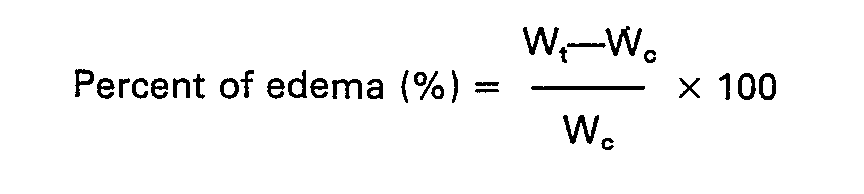
- We: the weight of the left ear to which the edema-inducing agent was not applied,
- Wt: the weight of the right ear to which the edema-inducing agent was applied.
- The results are shown in Table 8. The application of the gelled ointment containing 3% of 4-biphenylacetic acid markedly inhibited the formation of edema of the ear induced by croton oil, and the percent of inhibition was 72.7%.

- Ten-member groups of CRJ-CD (SD) male rats (6 to 7 weeks old) were used.
- A gelled ointment containing 3% by weight of 4-biphenylylacetic acid, prepared in Example 3 was used.
- To both hind paws of each rat was applied 200 mg of the test drug three times at 1-hour intervals. A 20% suspension of beer yeast (0.1 ml) as an inflammation inducing agent was subcutaneously administered to the left hind paw. The pressure pain threshold value was measured 2, 3 and 4 hours after the administration of the inflammation inducing agent.
- The results are shown in Table 9. The test drug showed a significant analgesic action.

- Six male rabbits (Japanese native white strain) were used.
- Intact skin group:
- Dehaired by a hair clipper
- Abraded skin group:
- dehaired by a hair clipper followed by removing horny layer.
- A 1 cm2 gauze coated with the gelled ointment of Example 3 (containing 3% by weight of 4-biphenylylacetic acid) or the gel ointment base was applied to a test site of the rabbits for 24 hours. The applied part was covered with a vinyl polymer film, sealed with a tape and then protected by a supporter. The skin irritation of the drug was evaluated by the Draize method using erythema, incrustation and edema as indices immediately after wiping off the gelled ointment, and 24 hours, and 48 hours later.
- The results are shown in Table 10. The gelled ointment of Example 3 did not show any skin irritation to the rabbits both in the skin intact group and the skin abraded group.

- The gelled ointments prepared in Examples 1 to 3 were subjected to a stability test for 6 months, and the results are shown in Table 11. When stored at 40°C for 6 months, no change was observed in the appearance of the ointments, nor was there a decrease in potency or a change in pH and viscosity.

- The following Examples illustrate the present invention in greater detail.
- All viscosities in these examples were measured at 20°C by means of a E-type viscometer supplied by Tokyo Keiki K.K.
-

- HIVISWAKO 104 was swollen in a mixture of 20 g of pure water and ethanol. Separately, diisopropanolamine and 4-biphenylylacetic acid were dissolved in 10 g of pure water. The two solutions were mixed, and the remainder of pure water was added. The mixture was stirred until it became uniform (pH 7.4, viscosity 56000 mPas).
-

- HIVISWAKO 104 was swollen in a mixture of 20 g of pure water and ethanol. Separately, diisopropanolamine and 4-biphenylylacetic acid were dissolved in 10 g of pure water. The two solutions were mixed, and the remainder of pure water was added. The mixture was stirred until it became uniform (pH 7.5, viscosity 35000 mPas).
-

- HIVISWAKO 104 was swollen in a mixture of 20 g of pure water and ethanol. Separately, diisopropanolamine and 4-biphenylylacetic acid were dissolved in 10 g of pure water. The two solutions were mixed, and the remainder of pure water was added. The mixture was stirred until it became uniform (pH 7.5, viscosity 28000 mPas).
-

- HIVISWAKO 104 was swollen in a mixture of 20 g of pure water and isopropanol. Separately, triisopropanolamine and 4-biphenylylacetic acid were dissolved in 10 g of pure water. The mixture was stirred until it became uniform (pH 7.4, viscosity 72000 mPas).

Claims (11)
Applications Claiming Priority (2)
| Application Number | Priority Date | Filing Date | Title |
|---|---|---|---|
| JP95794/83 | 1983-06-01 | ||
| JP58095794A JPS59222409A (en) | 1983-06-01 | 1983-06-01 | Anti-inflammatory and analgesic gel ointment |
Publications (2)
| Publication Number | Publication Date |
|---|---|
| EP0127840A1 EP0127840A1 (en) | 1984-12-12 |
| EP0127840B1 true EP0127840B1 (en) | 1987-01-07 |
Family
ID=14147349
Family Applications (1)
| Application Number | Title | Priority Date | Filing Date |
|---|---|---|---|
| EP84105844A Expired EP0127840B1 (en) | 1983-06-01 | 1984-05-22 | Antiinflammatory analgesic gelled ointments |
Country Status (6)
| Country | Link |
|---|---|
| US (1) | US4533546A (en) |
| EP (1) | EP0127840B1 (en) |
| JP (1) | JPS59222409A (en) |
| AU (1) | AU564292B2 (en) |
| CA (1) | CA1219217A (en) |
| DE (1) | DE3461890D1 (en) |
Families Citing this family (29)
| Publication number | Priority date | Publication date | Assignee | Title |
|---|---|---|---|---|
| DE3522550A1 (en) * | 1985-06-24 | 1987-01-02 | Klinge Co Chem Pharm Fab | SPRAYABLE PHARMACEUTICAL PREPARATION FOR TOPICAL APPLICATION |
| DE3532562A1 (en) * | 1985-09-12 | 1987-03-12 | Dolorgiet Gmbh & Co Kg | TRANSDERMALLY RESORBABLE, WATER-BASED PREPARATIONS OF ARYLPROPIONIC ACID DERIVATIVES AND METHOD FOR THE PRODUCTION THEREOF |
| US4702916A (en) * | 1985-12-03 | 1987-10-27 | Warner-Lambert Company | Analgesic stick compositions |
| JPH06104624B2 (en) * | 1986-05-07 | 1994-12-21 | 太郎 小木曽 | Transdermal agent |
| EP0266968A3 (en) * | 1986-11-03 | 1988-08-24 | Gérard G. Cohen | Gelled ointment of vasodilating agent |
| US4980375A (en) * | 1987-07-10 | 1990-12-25 | Sterling Drug Inc. | Onset-hastened/enhanced antipyretic response |
| US4868214A (en) * | 1987-11-17 | 1989-09-19 | Analgesic Associates | Onset-hastened/enhanced analgesia |
| GB2217595B (en) * | 1988-04-21 | 1991-11-20 | American Cyanamid Co | Antiinflammatory gel |
| JP2839164B2 (en) * | 1989-12-25 | 1998-12-16 | 帝國製薬株式会社 | Anti-inflammatory analgesic patch |
| US5093133A (en) * | 1990-01-24 | 1992-03-03 | Mcneil-Ppc, Inc. | Method for percutaneous delivery of ibuprofen using hydroalcoholic gel |
| WO1991017740A1 (en) * | 1990-05-18 | 1991-11-28 | Analgesic Associates | Prevention or treatment of sunburn using the s(+) isomer of flurbiprofen |
| US5178879A (en) * | 1992-04-17 | 1993-01-12 | Michael Adekunle | Capsaicin gel |
| US5248494A (en) * | 1992-06-10 | 1993-09-28 | Young Pharmaceuticals Inc. | Method of reducing anthralin induced inflammation and staining |
| PL314036A1 (en) * | 1993-10-20 | 1996-08-05 | Boots Co Plc | Pharmaceutical composition |
| US5807568A (en) * | 1994-12-27 | 1998-09-15 | Mcneil-Ppc, Inc. | Enhanced delivery of topical compositions containing flurbiprofen |
| US5702720A (en) * | 1995-12-22 | 1997-12-30 | Minnesota Mining And Manufacturing Company | Transdermal device for the delivery of flurbiprofen |
| US5976566A (en) * | 1997-08-29 | 1999-11-02 | Macrochem Corporation | Non-steroidal antiinflammtory drug formulations for topical application to the skin |
| JP5300169B2 (en) * | 2002-03-29 | 2013-09-25 | 小林製薬株式会社 | Anti-inflammatory analgesic containing phenylacetic acid derivatives and menthol and method for enhancing anti-inflammatory analgesic action |
| US20070053984A1 (en) * | 2005-03-03 | 2007-03-08 | Monique Spann-Wade | Topical gels compositions |
| WO2008001204A2 (en) * | 2006-06-29 | 2008-01-03 | Antares Pharma Ipl Ag | Transdermal compositions of pramipexole having enhanced permeation properties |
| US20080317684A1 (en) * | 2006-09-06 | 2008-12-25 | Isw Group, Inc. | Topical Compositions |
| US10265265B2 (en) * | 2007-03-15 | 2019-04-23 | Drug Delivery Solutions Limited | Topical composition |
| EP2008651A1 (en) | 2007-06-26 | 2008-12-31 | Drug Delivery Solutions Limited | A bioerodible patch |
| GB201010954D0 (en) | 2010-06-29 | 2010-08-11 | Edko Pazarlama Tanitim Ticaret | Compositions |
| JP5358551B2 (en) * | 2010-12-07 | 2013-12-04 | 小林製薬株式会社 | Anti-inflammatory analgesic containing phenylacetic acid derivatives and menthol and method for enhancing anti-inflammatory analgesic action |
| HRP20191711T1 (en) | 2011-03-14 | 2019-12-13 | Drug Delivery Solutions Ltd | An ophthalmic composition |
| MX365427B (en) | 2011-05-03 | 2019-06-03 | Aponia Laboratories Inc | Transdermal compositions of ibuprofen and methods of use thereof. |
| EP3651753A4 (en) * | 2017-07-11 | 2021-05-05 | University Of Miami | TOPICAL ACETAMINOPHEN FORMULATIONS FOR ITCH RELIEF |
| EP3542788A1 (en) | 2018-03-19 | 2019-09-25 | MC2 Therapeutics Limited | Topical composition comprising calcipotriol and betamethasone dipropionate |
Family Cites Families (6)
| Publication number | Priority date | Publication date | Assignee | Title |
|---|---|---|---|---|
| DK135267A (en) * | 1971-02-25 | |||
| US3784704A (en) * | 1972-10-13 | 1974-01-08 | American Cyanamid Co | Compositions of 4-biphenyl acetic acid and method of use |
| GB2023000B (en) * | 1978-06-17 | 1982-10-13 | Kowa Co | Antinflammatory analgesic gelled ointments |
| IT1124398B (en) * | 1979-12-05 | 1986-05-07 | Menarini Sas | USE OF THE PHARMACEUTICAL FORM ACID-CONTAINING GEL 23 BENZOYLPHENYL PROPIONIC USED IN THERAPY FOR TOPICAL USE |
| DE2949256C2 (en) * | 1979-12-07 | 1983-07-28 | Hoesch Werke Ag, 4600 Dortmund | Electrodynamic sound transducer |
| GB2075837B (en) * | 1980-05-14 | 1984-03-14 | Hisamitsu Pharmaceutical Co | Topical pharmaceutical gel containing anti-inflammatory analgesic agents |
-
1983
- 1983-06-01 JP JP58095794A patent/JPS59222409A/en active Granted
-
1984
- 1984-05-22 DE DE8484105844T patent/DE3461890D1/en not_active Expired
- 1984-05-22 EP EP84105844A patent/EP0127840B1/en not_active Expired
- 1984-05-24 CA CA000455044A patent/CA1219217A/en not_active Expired
- 1984-05-30 AU AU28850/84A patent/AU564292B2/en not_active Expired
- 1984-05-31 US US06/615,531 patent/US4533546A/en not_active Expired - Lifetime
Also Published As
| Publication number | Publication date |
|---|---|
| AU564292B2 (en) | 1987-08-06 |
| CA1219217A (en) | 1987-03-17 |
| AU2885084A (en) | 1984-12-06 |
| JPS59222409A (en) | 1984-12-14 |
| US4533546A (en) | 1985-08-06 |
| JPH0325406B2 (en) | 1991-04-05 |
| DE3461890D1 (en) | 1987-02-12 |
| EP0127840A1 (en) | 1984-12-12 |
Similar Documents
| Publication | Publication Date | Title |
|---|---|---|
| EP0127840B1 (en) | Antiinflammatory analgesic gelled ointments | |
| US5093133A (en) | Method for percutaneous delivery of ibuprofen using hydroalcoholic gel | |
| CA2309688C (en) | Penetration enhancing and irritation reducing systems | |
| CN104428003B (en) | Diclofenac formulations | |
| EP0072462B1 (en) | Pharmaceutical preparations | |
| EP0104037B1 (en) | Antiinflammatory and analgesic gel | |
| JPH03193728A (en) | Antiphlogistic and analgesic patch | |
| EP0101178A2 (en) | Topical anti-inflammatory compositions | |
| SK64599A3 (en) | Substantially homogenous liquid composition capable for percutaneous delivery of active agents and percutaneous delivery system | |
| JPH06104624B2 (en) | Transdermal agent | |
| EP0276561A1 (en) | Pharmaceutical tape compositions | |
| EP0216303B1 (en) | External medication | |
| KR20000049125A (en) | Local anesthetic for external use | |
| US4525348A (en) | Pranoprofen gelled ointment | |
| EP0253879A1 (en) | Topical antiinflammatory compositions | |
| RU2036640C1 (en) | Ointment for treating diseases associated with disorders of keratinization and disintegrity of skin | |
| JPS61165325A (en) | Anti-inflammatory and analgesic gel ointment | |
| RU2093185C1 (en) | Ointment showing antiinflammatory and antiallergic effect | |
| JPH08165244A (en) | Skin disease treatment | |
| EP0143109A1 (en) | Pranoprofen gelled ointment | |
| JPH0242812B2 (en) | ||
| JPS61238723A (en) | Anti-inflammatory, analgesic cream agent | |
| KR20020006555A (en) | External gel preparation containing local anesthetics | |
| KR19980072361A (en) | New soft hydrogel type external preparation and its manufacturing method | |
| HK1074788A1 (en) | Penetration enhancing and irritation reducing systems comprising testosterone |
Legal Events
| Date | Code | Title | Description |
|---|---|---|---|
| PUAI | Public reference made under article 153(3) epc to a published international application that has entered the european phase |
Free format text: ORIGINAL CODE: 0009012 |
|
| AK | Designated contracting states |
Designated state(s): BE CH DE FR GB IT LI LU NL SE |
|
| 17P | Request for examination filed |
Effective date: 19850228 |
|
| GRAA | (expected) grant |
Free format text: ORIGINAL CODE: 0009210 |
|
| ITF | It: translation for a ep patent filed | ||
| AK | Designated contracting states |
Kind code of ref document: B1 Designated state(s): BE CH DE FR GB IT LI LU NL SE |
|
| REF | Corresponds to: |
Ref document number: 3461890 Country of ref document: DE Date of ref document: 19870212 |
|
| ET | Fr: translation filed | ||
| PLBE | No opposition filed within time limit |
Free format text: ORIGINAL CODE: 0009261 |
|
| STAA | Information on the status of an ep patent application or granted ep patent |
Free format text: STATUS: NO OPPOSITION FILED WITHIN TIME LIMIT |
|
| 26N | No opposition filed | ||
| ITTA | It: last paid annual fee | ||
| EPTA | Lu: last paid annual fee | ||
| EAL | Se: european patent in force in sweden |
Ref document number: 84105844.9 |
|
| REG | Reference to a national code |
Ref country code: FR Ref legal event code: CD |
|
| REG | Reference to a national code |
Ref country code: CH Ref legal event code: PFA Free format text: LEDERLE (JAPAN) LTD TRANSFER- WYETH LEDERLE JAPAN LTD. |
|
| NLT1 | Nl: modifications of names registered in virtue of documents presented to the patent office pursuant to art. 16 a, paragraph 1 |
Owner name: WYETH LEDERLE JAPAN, LTD |
|
| REG | Reference to a national code |
Ref country code: GB Ref legal event code: IF02 |
|
| PGFP | Annual fee paid to national office [announced via postgrant information from national office to epo] |
Ref country code: FR Payment date: 20030425 Year of fee payment: 20 |
|
| PGFP | Annual fee paid to national office [announced via postgrant information from national office to epo] |
Ref country code: LU Payment date: 20030502 Year of fee payment: 20 |
|
| PGFP | Annual fee paid to national office [announced via postgrant information from national office to epo] |
Ref country code: SE Payment date: 20030507 Year of fee payment: 20 |
|
| PGFP | Annual fee paid to national office [announced via postgrant information from national office to epo] |
Ref country code: CH Payment date: 20030512 Year of fee payment: 20 |
|
| PGFP | Annual fee paid to national office [announced via postgrant information from national office to epo] |
Ref country code: GB Payment date: 20030519 Year of fee payment: 20 |
|
| PGFP | Annual fee paid to national office [announced via postgrant information from national office to epo] |
Ref country code: BE Payment date: 20030521 Year of fee payment: 20 |
|
| PGFP | Annual fee paid to national office [announced via postgrant information from national office to epo] |
Ref country code: DE Payment date: 20030529 Year of fee payment: 20 |
|
| PGFP | Annual fee paid to national office [announced via postgrant information from national office to epo] |
Ref country code: NL Payment date: 20030530 Year of fee payment: 20 |
|
| PG25 | Lapsed in a contracting state [announced via postgrant information from national office to epo] |
Ref country code: LI Free format text: LAPSE BECAUSE OF EXPIRATION OF PROTECTION Effective date: 20040521 Ref country code: GB Free format text: LAPSE BECAUSE OF EXPIRATION OF PROTECTION Effective date: 20040521 Ref country code: CH Free format text: LAPSE BECAUSE OF EXPIRATION OF PROTECTION Effective date: 20040521 |
|
| PG25 | Lapsed in a contracting state [announced via postgrant information from national office to epo] |
Ref country code: NL Free format text: LAPSE BECAUSE OF EXPIRATION OF PROTECTION Effective date: 20040522 Ref country code: LU Free format text: LAPSE BECAUSE OF NON-PAYMENT OF DUE FEES Effective date: 20040522 |
|
| BE20 | Be: patent expired |
Owner name: *LEDERLE (JAPAN) LTD. Effective date: 20040522 |
|
| REG | Reference to a national code |
Ref country code: CH Ref legal event code: PL |
|
| REG | Reference to a national code |
Ref country code: GB Ref legal event code: PE20 |
|
| EUG | Se: european patent has lapsed | ||
| NLV7 | Nl: ceased due to reaching the maximum lifetime of a patent |
Effective date: 20040522 |