EP0125875B1 - Improvements in or relating to perester compounds - Google Patents
Improvements in or relating to perester compounds Download PDFInfo
- Publication number
- EP0125875B1 EP0125875B1 EP84303110A EP84303110A EP0125875B1 EP 0125875 B1 EP0125875 B1 EP 0125875B1 EP 84303110 A EP84303110 A EP 84303110A EP 84303110 A EP84303110 A EP 84303110A EP 0125875 B1 EP0125875 B1 EP 0125875B1
- Authority
- EP
- European Patent Office
- Prior art keywords
- radical
- nucleus
- alkyl
- equal
- different
- Prior art date
- Legal status (The legal status is an assumption and is not a legal conclusion. Google has not performed a legal analysis and makes no representation as to the accuracy of the status listed.)
- Expired
Links
- 0 **CC1C**C1 Chemical compound **CC1C**C1 0.000 description 57
- JLBJTVDPSNHSKJ-UHFFFAOYSA-N Cc1ccc(C=C)cc1 Chemical compound Cc1ccc(C=C)cc1 JLBJTVDPSNHSKJ-UHFFFAOYSA-N 0.000 description 2
- BHWJMPDCCDMCKC-UHFFFAOYSA-N Cc1ccccc1SC Chemical compound Cc1ccccc1SC BHWJMPDCCDMCKC-UHFFFAOYSA-N 0.000 description 2
- FVEWMZDDSKKMCQ-UHFFFAOYSA-N C=C(CC(CCCC1)=C1N=O)I Chemical compound C=C(CC(CCCC1)=C1N=O)I FVEWMZDDSKKMCQ-UHFFFAOYSA-N 0.000 description 1
- MUNAXBTWAXNLFP-UHFFFAOYSA-N C=C1OC(C=CCC2)=C2N1 Chemical compound C=C1OC(C=CCC2)=C2N1 MUNAXBTWAXNLFP-UHFFFAOYSA-N 0.000 description 1
- CACAVWBWCHYGDG-UHFFFAOYSA-N C=[O]C1=CC([NH+]([NH+](C2)[NH-])[O-])=C2CC1O Chemical compound C=[O]C1=CC([NH+]([NH+](C2)[NH-])[O-])=C2CC1O CACAVWBWCHYGDG-UHFFFAOYSA-N 0.000 description 1
- BUYJYRDTYVWOAW-UHFFFAOYSA-N CC(C=C1)=CCC1I Chemical compound CC(C=C1)=CCC1I BUYJYRDTYVWOAW-UHFFFAOYSA-N 0.000 description 1
- HRBIDOKRMHRFNI-ZHACJKMWSA-N CC(CC(/C=C/[Cl]=[IH](C)C)=O)N[IH](C)=Cc1ccc(C)cc1 Chemical compound CC(CC(/C=C/[Cl]=[IH](C)C)=O)N[IH](C)=Cc1ccc(C)cc1 HRBIDOKRMHRFNI-ZHACJKMWSA-N 0.000 description 1
- FLNGPDOFVTWFJK-ICFOKQHNSA-N CC(CC1)C=CC1/C(/C)=C(/CCCC1=C)\C1=C Chemical compound CC(CC1)C=CC1/C(/C)=C(/CCCC1=C)\C1=C FLNGPDOFVTWFJK-ICFOKQHNSA-N 0.000 description 1
- IEMMBWWQXVXBEU-UHFFFAOYSA-N CC(c1ccc[o]1)=O Chemical compound CC(c1ccc[o]1)=O IEMMBWWQXVXBEU-UHFFFAOYSA-N 0.000 description 1
- BZBZMFDTPGFSIS-JFGQKRPLSA-N CC1(/C=C/C(/C)=C/C=C\O)C=CC(C(c2ccc(C)cc2)=[O-])=CC1 Chemical compound CC1(/C=C/C(/C)=C/C=C\O)C=CC(C(c2ccc(C)cc2)=[O-])=CC1 BZBZMFDTPGFSIS-JFGQKRPLSA-N 0.000 description 1
- XMWINMVFKPHMJB-UHFFFAOYSA-N CC1=CCCC=C1 Chemical compound CC1=CCCC=C1 XMWINMVFKPHMJB-UHFFFAOYSA-N 0.000 description 1
- DOLJQFKKZRPZLS-UHFFFAOYSA-N CC1C(SC(NC)=C)=C(C)CCC1 Chemical compound CC1C(SC(NC)=C)=C(C)CCC1 DOLJQFKKZRPZLS-UHFFFAOYSA-N 0.000 description 1
- UALHKESKDMVGCX-ONEGZZNKSA-N CC1C=CC(/C=C/C)=CC1 Chemical compound CC1C=CC(/C=C/C)=CC1 UALHKESKDMVGCX-ONEGZZNKSA-N 0.000 description 1
- QFZFKXVGQIODJN-UHFFFAOYSA-N CC1C=CC(C)=CC1 Chemical compound CC1C=CC(C)=CC1 QFZFKXVGQIODJN-UHFFFAOYSA-N 0.000 description 1
- QFWBFYXXUSPOPO-FOCLMDBBSA-N CC1C=CC(C/N=C(\CCC2)/CC2=C)CC1 Chemical compound CC1C=CC(C/N=C(\CCC2)/CC2=C)CC1 QFWBFYXXUSPOPO-FOCLMDBBSA-N 0.000 description 1
- ZBVUZJPIVOOKHC-UHFFFAOYSA-N CCC(C(C=CC(C)(C)C1)=C1C(C)c1ccccc1)=O Chemical compound CCC(C(C=CC(C)(C)C1)=C1C(C)c1ccccc1)=O ZBVUZJPIVOOKHC-UHFFFAOYSA-N 0.000 description 1
- BZYMKLGCOJMIBY-UHFFFAOYSA-N CCC1=C(C)C=CCC1 Chemical compound CCC1=C(C)C=CCC1 BZYMKLGCOJMIBY-UHFFFAOYSA-N 0.000 description 1
- LCSNMSBGUMDVRK-UHFFFAOYSA-N CCC1C=CC(C)=CC1 Chemical compound CCC1C=CC(C)=CC1 LCSNMSBGUMDVRK-UHFFFAOYSA-N 0.000 description 1
- SIGURJMINIGWSZ-UHFFFAOYSA-N CCCCN(CCC1)C2C1CC(C#N)=CC2 Chemical compound CCCCN(CCC1)C2C1CC(C#N)=CC2 SIGURJMINIGWSZ-UHFFFAOYSA-N 0.000 description 1
- DTFUMZZBLDWMMZ-UHFFFAOYSA-N CCc(cc1)ccc1C(C=C)=[U] Chemical compound CCc(cc1)ccc1C(C=C)=[U] DTFUMZZBLDWMMZ-UHFFFAOYSA-N 0.000 description 1
- IYZWELRKFVVNMB-UHFFFAOYSA-N COc(cc1I)ccc1S Chemical compound COc(cc1I)ccc1S IYZWELRKFVVNMB-UHFFFAOYSA-N 0.000 description 1
- QFZFKXVGQIODJN-QMMMGPOBSA-N C[C@H]1C=CC(C)=CC1 Chemical compound C[C@H]1C=CC(C)=CC1 QFZFKXVGQIODJN-QMMMGPOBSA-N 0.000 description 1
- KIHPDGGDZZCYBT-ZETCQYMHSA-N C[C@H]1C=CC=C(C)C1 Chemical compound C[C@H]1C=CC=C(C)C1 KIHPDGGDZZCYBT-ZETCQYMHSA-N 0.000 description 1
- UDQQDDCLLWNDMW-UHFFFAOYSA-N C[ClH](C)(N1C(CCC=C2)=C2[Sc]C1)I Chemical compound C[ClH](C)(N1C(CCC=C2)=C2[Sc]C1)I UDQQDDCLLWNDMW-UHFFFAOYSA-N 0.000 description 1
- RZXMPPFPUUCRFN-UHFFFAOYSA-N Cc(cc1)ccc1N Chemical compound Cc(cc1)ccc1N RZXMPPFPUUCRFN-UHFFFAOYSA-N 0.000 description 1
- VKQHZSHPWSDLQA-KGENOOAVSA-N Cc(cc1C(/C2=C\Nc(cc3)ccc3N)c3ccccc3)ccc1C2=O Chemical compound Cc(cc1C(/C2=C\Nc(cc3)ccc3N)c3ccccc3)ccc1C2=O VKQHZSHPWSDLQA-KGENOOAVSA-N 0.000 description 1
- CTQNGGLPUBDAKN-UHFFFAOYSA-N Cc1c(C)cccc1 Chemical compound Cc1c(C)cccc1 CTQNGGLPUBDAKN-UHFFFAOYSA-N 0.000 description 1
- URLKBWYHVLBVBO-UHFFFAOYSA-N Cc1ccc(C)cc1 Chemical compound Cc1ccc(C)cc1 URLKBWYHVLBVBO-UHFFFAOYSA-N 0.000 description 1
- LXUNZSDDXMPKLP-UHFFFAOYSA-N Cc1ccccc1S Chemical compound Cc1ccccc1S LXUNZSDDXMPKLP-UHFFFAOYSA-N 0.000 description 1
Classifications
-
- C—CHEMISTRY; METALLURGY
- C07—ORGANIC CHEMISTRY
- C07D—HETEROCYCLIC COMPOUNDS
- C07D263/00—Heterocyclic compounds containing 1,3-oxazole or hydrogenated 1,3-oxazole rings
- C07D263/52—Heterocyclic compounds containing 1,3-oxazole or hydrogenated 1,3-oxazole rings condensed with carbocyclic rings or ring systems
- C07D263/54—Benzoxazoles; Hydrogenated benzoxazoles
- C07D263/56—Benzoxazoles; Hydrogenated benzoxazoles with only hydrogen atoms, hydrocarbon or substituted hydrocarbon radicals, directly attached in position 2
-
- C—CHEMISTRY; METALLURGY
- C07—ORGANIC CHEMISTRY
- C07C—ACYCLIC OR CARBOCYCLIC COMPOUNDS
- C07C409/00—Peroxy compounds
- C07C409/38—Peroxy compounds the —O—O— group being bound between a >C=O group and a carbon atom, not further substituted by oxygen atoms, i.e. esters of peroxy acids
-
- C—CHEMISTRY; METALLURGY
- C07—ORGANIC CHEMISTRY
- C07C—ACYCLIC OR CARBOCYCLIC COMPOUNDS
- C07C409/00—Peroxy compounds
- C07C409/40—Peroxy compounds containing nitrogen atoms
-
- C—CHEMISTRY; METALLURGY
- C07—ORGANIC CHEMISTRY
- C07C—ACYCLIC OR CARBOCYCLIC COMPOUNDS
- C07C65/00—Compounds having carboxyl groups bound to carbon atoms of six—membered aromatic rings and containing any of the groups OH, O—metal, —CHO, keto, ether, groups, groups, or groups
- C07C65/32—Compounds having carboxyl groups bound to carbon atoms of six—membered aromatic rings and containing any of the groups OH, O—metal, —CHO, keto, ether, groups, groups, or groups containing keto groups
- C07C65/38—Compounds having carboxyl groups bound to carbon atoms of six—membered aromatic rings and containing any of the groups OH, O—metal, —CHO, keto, ether, groups, groups, or groups containing keto groups having unsaturation outside the aromatic rings
-
- C—CHEMISTRY; METALLURGY
- C07—ORGANIC CHEMISTRY
- C07C—ACYCLIC OR CARBOCYCLIC COMPOUNDS
- C07C69/00—Esters of carboxylic acids; Esters of carbonic or haloformic acids
- C07C69/76—Esters of carboxylic acids having a carboxyl group bound to a carbon atom of a six-membered aromatic ring
-
- C—CHEMISTRY; METALLURGY
- C07—ORGANIC CHEMISTRY
- C07D—HETEROCYCLIC COMPOUNDS
- C07D209/00—Heterocyclic compounds containing five-membered rings, condensed with other rings, with one nitrogen atom as the only ring hetero atom
- C07D209/02—Heterocyclic compounds containing five-membered rings, condensed with other rings, with one nitrogen atom as the only ring hetero atom condensed with one carbocyclic ring
- C07D209/04—Indoles; Hydrogenated indoles
- C07D209/10—Indoles; Hydrogenated indoles with substituted hydrocarbon radicals attached to carbon atoms of the hetero ring
- C07D209/12—Radicals substituted by oxygen atoms
-
- C—CHEMISTRY; METALLURGY
- C07—ORGANIC CHEMISTRY
- C07D—HETEROCYCLIC COMPOUNDS
- C07D213/00—Heterocyclic compounds containing six-membered rings, not condensed with other rings, with one nitrogen atom as the only ring hetero atom and three or more double bonds between ring members or between ring members and non-ring members
- C07D213/02—Heterocyclic compounds containing six-membered rings, not condensed with other rings, with one nitrogen atom as the only ring hetero atom and three or more double bonds between ring members or between ring members and non-ring members having three double bonds between ring members or between ring members and non-ring members
- C07D213/04—Heterocyclic compounds containing six-membered rings, not condensed with other rings, with one nitrogen atom as the only ring hetero atom and three or more double bonds between ring members or between ring members and non-ring members having three double bonds between ring members or between ring members and non-ring members having no bond between the ring nitrogen atom and a non-ring member or having only hydrogen or carbon atoms directly attached to the ring nitrogen atom
- C07D213/60—Heterocyclic compounds containing six-membered rings, not condensed with other rings, with one nitrogen atom as the only ring hetero atom and three or more double bonds between ring members or between ring members and non-ring members having three double bonds between ring members or between ring members and non-ring members having no bond between the ring nitrogen atom and a non-ring member or having only hydrogen or carbon atoms directly attached to the ring nitrogen atom with hetero atoms or with carbon atoms having three bonds to hetero atoms with at the most one bond to halogen, e.g. ester or nitrile radicals, directly attached to ring carbon atoms
- C07D213/62—Oxygen or sulfur atoms
- C07D213/63—One oxygen atom
- C07D213/68—One oxygen atom attached in position 4
-
- C—CHEMISTRY; METALLURGY
- C07—ORGANIC CHEMISTRY
- C07D—HETEROCYCLIC COMPOUNDS
- C07D215/00—Heterocyclic compounds containing quinoline or hydrogenated quinoline ring systems
- C07D215/02—Heterocyclic compounds containing quinoline or hydrogenated quinoline ring systems having no bond between the ring nitrogen atom and a non-ring member or having only hydrogen atoms or carbon atoms directly attached to the ring nitrogen atom
- C07D215/12—Heterocyclic compounds containing quinoline or hydrogenated quinoline ring systems having no bond between the ring nitrogen atom and a non-ring member or having only hydrogen atoms or carbon atoms directly attached to the ring nitrogen atom with substituted hydrocarbon radicals attached to ring carbon atoms
- C07D215/14—Radicals substituted by oxygen atoms
-
- C—CHEMISTRY; METALLURGY
- C07—ORGANIC CHEMISTRY
- C07D—HETEROCYCLIC COMPOUNDS
- C07D241/00—Heterocyclic compounds containing 1,4-diazine or hydrogenated 1,4-diazine rings
- C07D241/36—Heterocyclic compounds containing 1,4-diazine or hydrogenated 1,4-diazine rings condensed with carbocyclic rings or ring systems
- C07D241/38—Heterocyclic compounds containing 1,4-diazine or hydrogenated 1,4-diazine rings condensed with carbocyclic rings or ring systems with only hydrogen or carbon atoms directly attached to the ring nitrogen atoms
- C07D241/40—Benzopyrazines
- C07D241/42—Benzopyrazines with only hydrogen atoms, hydrocarbon or substituted hydrocarbon radicals, directly attached to carbon atoms of the hetero ring
-
- C—CHEMISTRY; METALLURGY
- C07—ORGANIC CHEMISTRY
- C07D—HETEROCYCLIC COMPOUNDS
- C07D277/00—Heterocyclic compounds containing 1,3-thiazole or hydrogenated 1,3-thiazole rings
- C07D277/60—Heterocyclic compounds containing 1,3-thiazole or hydrogenated 1,3-thiazole rings condensed with carbocyclic rings or ring systems
- C07D277/62—Benzothiazoles
- C07D277/64—Benzothiazoles with only hydrocarbon or substituted hydrocarbon radicals attached in position 2
-
- C—CHEMISTRY; METALLURGY
- C07—ORGANIC CHEMISTRY
- C07D—HETEROCYCLIC COMPOUNDS
- C07D277/00—Heterocyclic compounds containing 1,3-thiazole or hydrogenated 1,3-thiazole rings
- C07D277/60—Heterocyclic compounds containing 1,3-thiazole or hydrogenated 1,3-thiazole rings condensed with carbocyclic rings or ring systems
- C07D277/84—Naphthothiazoles
-
- C—CHEMISTRY; METALLURGY
- C07—ORGANIC CHEMISTRY
- C07D—HETEROCYCLIC COMPOUNDS
- C07D293/00—Heterocyclic compounds containing rings having nitrogen and selenium or nitrogen and tellurium, with or without oxygen or sulfur atoms, as the ring hetero atoms
- C07D293/02—Heterocyclic compounds containing rings having nitrogen and selenium or nitrogen and tellurium, with or without oxygen or sulfur atoms, as the ring hetero atoms not condensed with other rings
- C07D293/04—Five-membered rings
- C07D293/06—Selenazoles; Hydrogenated selenazoles
-
- C—CHEMISTRY; METALLURGY
- C07—ORGANIC CHEMISTRY
- C07D—HETEROCYCLIC COMPOUNDS
- C07D295/00—Heterocyclic compounds containing polymethylene-imine rings with at least five ring members, 3-azabicyclo [3.2.2] nonane, piperazine, morpholine or thiomorpholine rings, having only hydrogen atoms directly attached to the ring carbon atoms
- C07D295/04—Heterocyclic compounds containing polymethylene-imine rings with at least five ring members, 3-azabicyclo [3.2.2] nonane, piperazine, morpholine or thiomorpholine rings, having only hydrogen atoms directly attached to the ring carbon atoms with substituted hydrocarbon radicals attached to ring nitrogen atoms
- C07D295/12—Heterocyclic compounds containing polymethylene-imine rings with at least five ring members, 3-azabicyclo [3.2.2] nonane, piperazine, morpholine or thiomorpholine rings, having only hydrogen atoms directly attached to the ring carbon atoms with substituted hydrocarbon radicals attached to ring nitrogen atoms substituted by singly or doubly bound nitrogen atoms
- C07D295/135—Heterocyclic compounds containing polymethylene-imine rings with at least five ring members, 3-azabicyclo [3.2.2] nonane, piperazine, morpholine or thiomorpholine rings, having only hydrogen atoms directly attached to the ring carbon atoms with substituted hydrocarbon radicals attached to ring nitrogen atoms substituted by singly or doubly bound nitrogen atoms with the ring nitrogen atoms and the substituent nitrogen atoms separated by carbocyclic rings or by carbon chains interrupted by carbocyclic rings
-
- C—CHEMISTRY; METALLURGY
- C07—ORGANIC CHEMISTRY
- C07D—HETEROCYCLIC COMPOUNDS
- C07D307/00—Heterocyclic compounds containing five-membered rings having one oxygen atom as the only ring hetero atom
- C07D307/02—Heterocyclic compounds containing five-membered rings having one oxygen atom as the only ring hetero atom not condensed with other rings
- C07D307/34—Heterocyclic compounds containing five-membered rings having one oxygen atom as the only ring hetero atom not condensed with other rings having two or three double bonds between ring members or between ring members and non-ring members
- C07D307/38—Heterocyclic compounds containing five-membered rings having one oxygen atom as the only ring hetero atom not condensed with other rings having two or three double bonds between ring members or between ring members and non-ring members with substituted hydrocarbon radicals attached to ring carbon atoms
- C07D307/40—Radicals substituted by oxygen atoms
- C07D307/46—Doubly bound oxygen atoms, or two oxygen atoms singly bound to the same carbon atom
-
- C—CHEMISTRY; METALLURGY
- C07—ORGANIC CHEMISTRY
- C07D—HETEROCYCLIC COMPOUNDS
- C07D307/00—Heterocyclic compounds containing five-membered rings having one oxygen atom as the only ring hetero atom
- C07D307/77—Heterocyclic compounds containing five-membered rings having one oxygen atom as the only ring hetero atom ortho- or peri-condensed with carbocyclic rings or ring systems
- C07D307/78—Benzo [b] furans; Hydrogenated benzo [b] furans
- C07D307/82—Benzo [b] furans; Hydrogenated benzo [b] furans with hetero atoms or with carbon atoms having three bonds to hetero atoms with at the most one bond to halogen, e.g. ester or nitrile radicals, directly attached to carbon atoms of the hetero ring
- C07D307/83—Oxygen atoms
-
- C—CHEMISTRY; METALLURGY
- C07—ORGANIC CHEMISTRY
- C07D—HETEROCYCLIC COMPOUNDS
- C07D309/00—Heterocyclic compounds containing six-membered rings having one oxygen atom as the only ring hetero atom, not condensed with other rings
- C07D309/34—Heterocyclic compounds containing six-membered rings having one oxygen atom as the only ring hetero atom, not condensed with other rings having three or more double bonds between ring members or between ring members and non-ring members
- C07D309/36—Heterocyclic compounds containing six-membered rings having one oxygen atom as the only ring hetero atom, not condensed with other rings having three or more double bonds between ring members or between ring members and non-ring members with oxygen atoms directly attached to ring carbon atoms
-
- C—CHEMISTRY; METALLURGY
- C07—ORGANIC CHEMISTRY
- C07D—HETEROCYCLIC COMPOUNDS
- C07D311/00—Heterocyclic compounds containing six-membered rings having one oxygen atom as the only hetero atom, condensed with other rings
- C07D311/02—Heterocyclic compounds containing six-membered rings having one oxygen atom as the only hetero atom, condensed with other rings ortho- or peri-condensed with carbocyclic rings or ring systems
- C07D311/04—Benzo[b]pyrans, not hydrogenated in the carbocyclic ring
- C07D311/22—Benzo[b]pyrans, not hydrogenated in the carbocyclic ring with oxygen or sulfur atoms directly attached in position 4
- C07D311/26—Benzo[b]pyrans, not hydrogenated in the carbocyclic ring with oxygen or sulfur atoms directly attached in position 4 with aromatic rings attached in position 2 or 3
- C07D311/34—Benzo[b]pyrans, not hydrogenated in the carbocyclic ring with oxygen or sulfur atoms directly attached in position 4 with aromatic rings attached in position 2 or 3 with aromatic rings attached in position 3 only
- C07D311/36—Benzo[b]pyrans, not hydrogenated in the carbocyclic ring with oxygen or sulfur atoms directly attached in position 4 with aromatic rings attached in position 2 or 3 with aromatic rings attached in position 3 only not hydrogenated in the hetero ring, e.g. isoflavones
-
- C—CHEMISTRY; METALLURGY
- C07—ORGANIC CHEMISTRY
- C07D—HETEROCYCLIC COMPOUNDS
- C07D311/00—Heterocyclic compounds containing six-membered rings having one oxygen atom as the only hetero atom, condensed with other rings
- C07D311/02—Heterocyclic compounds containing six-membered rings having one oxygen atom as the only hetero atom, condensed with other rings ortho- or peri-condensed with carbocyclic rings or ring systems
- C07D311/04—Benzo[b]pyrans, not hydrogenated in the carbocyclic ring
- C07D311/42—Benzo[b]pyrans, not hydrogenated in the carbocyclic ring with oxygen or sulfur atoms in positions 2 and 4
- C07D311/56—Benzo[b]pyrans, not hydrogenated in the carbocyclic ring with oxygen or sulfur atoms in positions 2 and 4 without hydrogen atoms in position 3
-
- C—CHEMISTRY; METALLURGY
- C07—ORGANIC CHEMISTRY
- C07D—HETEROCYCLIC COMPOUNDS
- C07D311/00—Heterocyclic compounds containing six-membered rings having one oxygen atom as the only hetero atom, condensed with other rings
- C07D311/02—Heterocyclic compounds containing six-membered rings having one oxygen atom as the only hetero atom, condensed with other rings ortho- or peri-condensed with carbocyclic rings or ring systems
- C07D311/78—Ring systems having three or more relevant rings
- C07D311/80—Dibenzopyrans; Hydrogenated dibenzopyrans
- C07D311/82—Xanthenes
- C07D311/84—Xanthenes with hetero atoms or with carbon atoms having three bonds to hetero atoms with at the most one bond to halogen, e.g. ester or nitrile radicals, directly attached in position 9
- C07D311/86—Oxygen atoms, e.g. xanthones
-
- C—CHEMISTRY; METALLURGY
- C07—ORGANIC CHEMISTRY
- C07D—HETEROCYCLIC COMPOUNDS
- C07D335/00—Heterocyclic compounds containing six-membered rings having one sulfur atom as the only ring hetero atom
- C07D335/02—Heterocyclic compounds containing six-membered rings having one sulfur atom as the only ring hetero atom not condensed with other rings
-
- C—CHEMISTRY; METALLURGY
- C07—ORGANIC CHEMISTRY
- C07D—HETEROCYCLIC COMPOUNDS
- C07D335/00—Heterocyclic compounds containing six-membered rings having one sulfur atom as the only ring hetero atom
- C07D335/04—Heterocyclic compounds containing six-membered rings having one sulfur atom as the only ring hetero atom condensed with carbocyclic rings or ring systems
- C07D335/10—Dibenzothiopyrans; Hydrogenated dibenzothiopyrans
- C07D335/12—Thioxanthenes
- C07D335/14—Thioxanthenes with hetero atoms or with carbon atoms having three bonds to hetero atoms with at the most one bond to halogen, e.g. ester or nitrile radicals, directly attached in position 9
- C07D335/16—Oxygen atoms, e.g. thioxanthones
-
- C—CHEMISTRY; METALLURGY
- C07—ORGANIC CHEMISTRY
- C07D—HETEROCYCLIC COMPOUNDS
- C07D455/00—Heterocyclic compounds containing quinolizine ring systems, e.g. emetine alkaloids, protoberberine; Alkylenedioxy derivatives of dibenzo [a, g] quinolizines, e.g. berberine
- C07D455/03—Heterocyclic compounds containing quinolizine ring systems, e.g. emetine alkaloids, protoberberine; Alkylenedioxy derivatives of dibenzo [a, g] quinolizines, e.g. berberine containing quinolizine ring systems directly condensed with at least one six-membered carbocyclic ring, e.g. protoberberine; Alkylenedioxy derivatives of dibenzo [a, g] quinolizines, e.g. berberine
- C07D455/04—Heterocyclic compounds containing quinolizine ring systems, e.g. emetine alkaloids, protoberberine; Alkylenedioxy derivatives of dibenzo [a, g] quinolizines, e.g. berberine containing quinolizine ring systems directly condensed with at least one six-membered carbocyclic ring, e.g. protoberberine; Alkylenedioxy derivatives of dibenzo [a, g] quinolizines, e.g. berberine containing a quinolizine ring system condensed with only one six-membered carbocyclic ring, e.g. julolidine
-
- G—PHYSICS
- G03—PHOTOGRAPHY; CINEMATOGRAPHY; ANALOGOUS TECHNIQUES USING WAVES OTHER THAN OPTICAL WAVES; ELECTROGRAPHY; HOLOGRAPHY
- G03F—PHOTOMECHANICAL PRODUCTION OF TEXTURED OR PATTERNED SURFACES, e.g. FOR PRINTING, FOR PROCESSING OF SEMICONDUCTOR DEVICES; MATERIALS THEREFOR; ORIGINALS THEREFOR; APPARATUS SPECIALLY ADAPTED THEREFOR
- G03F7/00—Photomechanical, e.g. photolithographic, production of textured or patterned surfaces, e.g. printing surfaces; Materials therefor, e.g. comprising photoresists; Apparatus specially adapted therefor
- G03F7/004—Photosensitive materials
- G03F7/027—Non-macromolecular photopolymerisable compounds having carbon-to-carbon double bonds, e.g. ethylenic compounds
- G03F7/028—Non-macromolecular photopolymerisable compounds having carbon-to-carbon double bonds, e.g. ethylenic compounds with photosensitivity-increasing substances, e.g. photoinitiators
- G03F7/031—Organic compounds not covered by group G03F7/029
-
- C—CHEMISTRY; METALLURGY
- C07—ORGANIC CHEMISTRY
- C07C—ACYCLIC OR CARBOCYCLIC COMPOUNDS
- C07C2601/00—Systems containing only non-condensed rings
- C07C2601/06—Systems containing only non-condensed rings with a five-membered ring
- C07C2601/08—Systems containing only non-condensed rings with a five-membered ring the ring being saturated
-
- C—CHEMISTRY; METALLURGY
- C07—ORGANIC CHEMISTRY
- C07C—ACYCLIC OR CARBOCYCLIC COMPOUNDS
- C07C2601/00—Systems containing only non-condensed rings
- C07C2601/12—Systems containing only non-condensed rings with a six-membered ring
- C07C2601/14—The ring being saturated
-
- C—CHEMISTRY; METALLURGY
- C07—ORGANIC CHEMISTRY
- C07C—ACYCLIC OR CARBOCYCLIC COMPOUNDS
- C07C2602/00—Systems containing two condensed rings
- C07C2602/02—Systems containing two condensed rings the rings having only two atoms in common
- C07C2602/04—One of the condensed rings being a six-membered aromatic ring
- C07C2602/08—One of the condensed rings being a six-membered aromatic ring the other ring being five-membered, e.g. indane
-
- C—CHEMISTRY; METALLURGY
- C07—ORGANIC CHEMISTRY
- C07C—ACYCLIC OR CARBOCYCLIC COMPOUNDS
- C07C2602/00—Systems containing two condensed rings
- C07C2602/02—Systems containing two condensed rings the rings having only two atoms in common
- C07C2602/04—One of the condensed rings being a six-membered aromatic ring
- C07C2602/10—One of the condensed rings being a six-membered aromatic ring the other ring being six-membered, e.g. tetraline
-
- C—CHEMISTRY; METALLURGY
- C07—ORGANIC CHEMISTRY
- C07C—ACYCLIC OR CARBOCYCLIC COMPOUNDS
- C07C2603/00—Systems containing at least three condensed rings
- C07C2603/02—Ortho- or ortho- and peri-condensed systems
- C07C2603/04—Ortho- or ortho- and peri-condensed systems containing three rings
- C07C2603/06—Ortho- or ortho- and peri-condensed systems containing three rings containing at least one ring with less than six ring members
- C07C2603/10—Ortho- or ortho- and peri-condensed systems containing three rings containing at least one ring with less than six ring members containing five-membered rings
- C07C2603/12—Ortho- or ortho- and peri-condensed systems containing three rings containing at least one ring with less than six ring members containing five-membered rings only one five-membered ring
- C07C2603/18—Fluorenes; Hydrogenated fluorenes
-
- C—CHEMISTRY; METALLURGY
- C07—ORGANIC CHEMISTRY
- C07C—ACYCLIC OR CARBOCYCLIC COMPOUNDS
- C07C2603/00—Systems containing at least three condensed rings
- C07C2603/02—Ortho- or ortho- and peri-condensed systems
- C07C2603/04—Ortho- or ortho- and peri-condensed systems containing three rings
- C07C2603/22—Ortho- or ortho- and peri-condensed systems containing three rings containing only six-membered rings
- C07C2603/24—Anthracenes; Hydrogenated anthracenes
-
- C—CHEMISTRY; METALLURGY
- C07—ORGANIC CHEMISTRY
- C07C—ACYCLIC OR CARBOCYCLIC COMPOUNDS
- C07C2603/00—Systems containing at least three condensed rings
- C07C2603/02—Ortho- or ortho- and peri-condensed systems
- C07C2603/04—Ortho- or ortho- and peri-condensed systems containing three rings
- C07C2603/22—Ortho- or ortho- and peri-condensed systems containing three rings containing only six-membered rings
- C07C2603/28—Phenalenes; Hydrogenated phenalenes
Definitions
- This invention relates to perester compounds and is primarily concerned with such compounds which are suitable for causing the polymerisation compounds which are suitable for causing the polymerisation of addition polymerisable compounds on exposure to radiation.
- the cycloalkan(di)one nuclei may contain N, S or 0 as a hetero atom and may carry substituents such as, for example, -OH, alkyl or aryl.
- ring C may be substituted with, for example, an alkyl, alkoxy or N R 6 R 7 where R 6 and R 7 have the meanings specified above.
- the nitrogen containing heterocyclic ring formed by R 15 and R 14 in formula I is preferably quinoline, benzoxazole, benzothiazole, benzoselazole, naphthothiazole, naphthoselazole or benzo-2,3-dihydroindole.
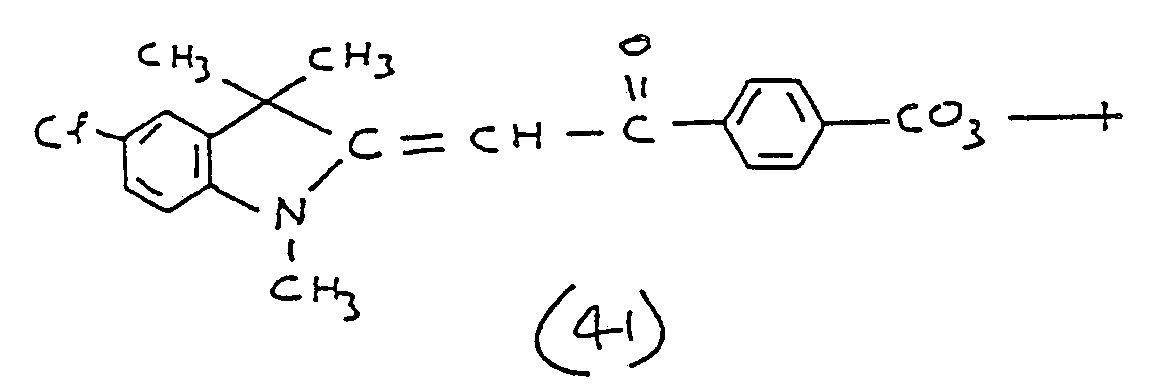
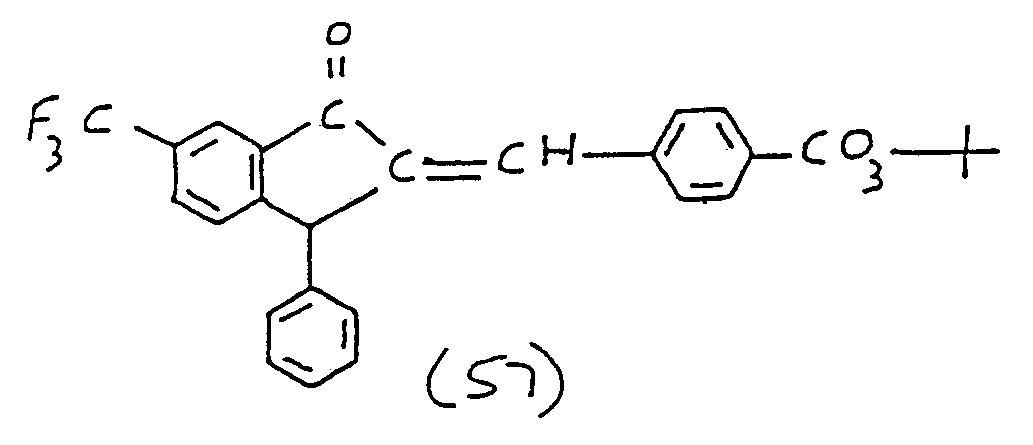
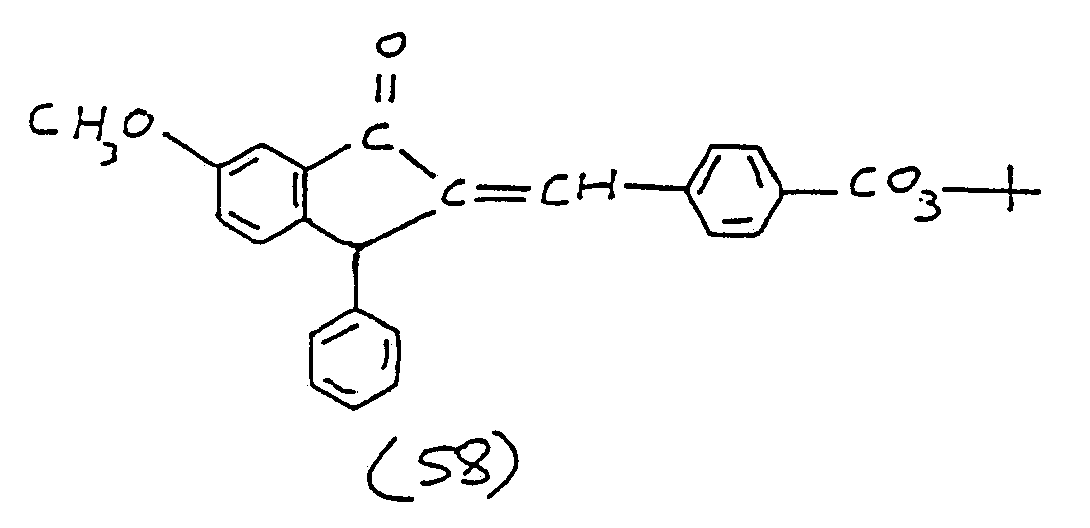
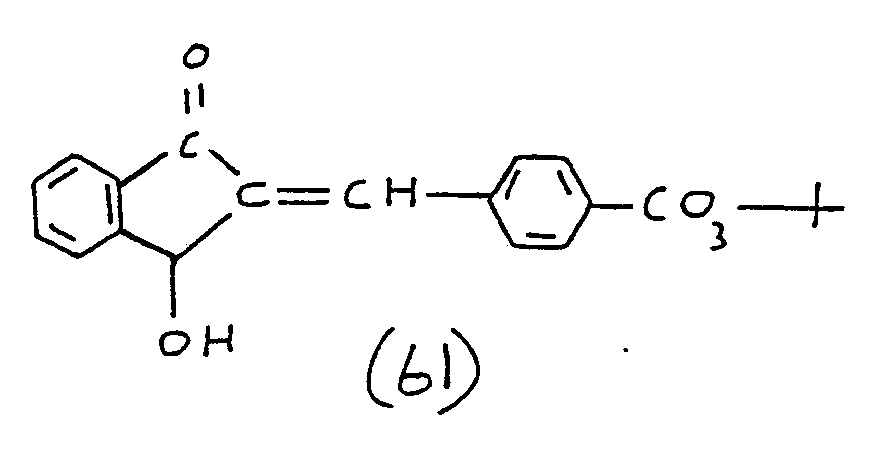
- perester compounds in accordance with the present invention are shown in Formulae 1 to 96.
- Particularly preferred per esters are 2-(4'-t-butyl peroxy carbonylbenzoyl)£methylene-3-methyl benzo thiazoline (Formula 25), 2-(4'-benzoyl-4"-t-butyl peroxy carbonyl benzoyl) methylene-3-methyl naphthothiazoline (Formula 26), 2-(4'-4"-bis-t-butyl peroxy carbonyl benzoyl) methylene-3-methyl benzoselenazoline (Formula 27), 2-(4'-t-butylperoxy carbonyl)benzylidene-indan-1-one (Formula 55), 2-(4'-t-butylperoxycarbonyl) benzylidene-5-diethylaminoindan-1-one (Formula 60), and 4-(4'-p-diethylamino- benzylidene benzo
- the perester compounds may be prepared by conversion of appropriate carboxylic acids by two general methods:-
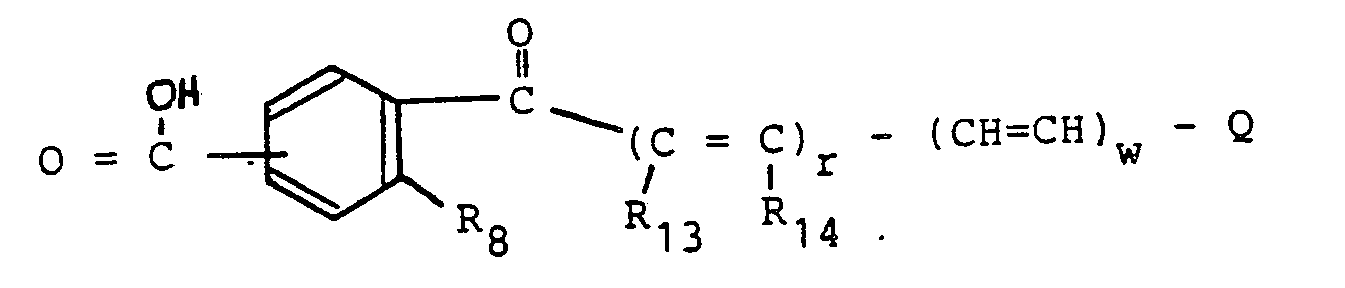
- the carboxylic acids used have the general formula: wherein R o , R io , R, 3 , R i4 , r, w, m, n, Q and V have the aforesaid meanings and they may be prepared as follows:
- Anthroquinone-2-carboxylic acids are prepared by conventional oxidation of corresponding 2-methyl- anthroquinone as described by Whitmore and Carnalon (Journal of the American Chemical Society 958, 51, 1929).
- Suitable acids are available commercially from Aldrich or may be prepared (fluorenone-3-carboxylic acid) by the method described in Kruber (Ber, 1382, 65, 1932).
- Suitable thioxanthone and xanthone carboxylic acid may be prepared by the methods described in GB Patent Specification No. 2 050 378.
- Suitable precursors may be prepared by reacting carboxy aryl ketones with arylaldehydes by the methods described in US Patent Specification 4,162,162.
- the carboxy arylketones may be prepared by the methods described by Allinger and Jones (Journal of Organic Chemistry 70, 27, 1962).
- 1,2-dimethylbenzothiazolium p-toluene sulphonate (3.35 g) was added to the above solution, followed by a solution of triethylamine (2.33 g) in toluene (15 ml) dropwise over a half hour at 10-15 deg. C.
- the reaction mixture was stirred for 2 hours at room temperature and then filtered.
- the filtrates were extracted with dilute hydrochloric acid (approx. 1M), washed with water and dried over anhydrous magnesium sulphate. Solid product was isolated after the removal of excess solvent from the dried extracts on a rotary evaporator. Recrystallization of this material in ether acetate gave (1.4 g), m.p. 160 deg. C (decomp.).
- Suitable carboxylic acid precursors may be prepared by base catalysed.condensation of arylaldehydes with cycloalkanones or aryl ketones as illustrated by the following preparations.
- the perester compounds of the present invention are useful in the production of photopolymerisable compositions comprising the perester compound and a polymerisable compound containing ethylenic unsaturation whose polymerisation is initiated by the perester compound on exposure to radiation.
- Such compositions may also include an optical sensitiser and a polymeric binder and radiation sensitive plates comprising the compositions coated into a substrate and suitable for use in the production of lithographic printing plates form the-subject matter of our copending patent application of even date.
- a solution in ethyl methyl ketone of a photopolymerisable composition comprising:-
- the dried coating was overcoated with poly(vinyl alcohol) to prevent oxygen inhibition.
- the radiation sensitive plate was exposed through a continuous tone Stouffer step-wedge to ultra violet light (2 unit from a Berkey-Ascor printing down frame) and then developed with an aqueous solution containing sodium propanoate, sodiuum benzoate and a surfactant.
- the developed image of the resultant lithographic printing plate had a step-wedge of solid 3, tail 7.
- Example 1 was repeated using the four alternative optical sensitisers listed below and the developed images of the resultant printing plates had the step-wedge readings shown:
- Example 1 was repeated using 3--1'-methoxybenzoyl)-t-butyl perbenzoate as the initiator. Similar results were obtained except that the radiation sensitive plate was more sensitive, producing a solid 5, tail 9 step wedge on development.
- Example 1 was repeated except that the Ethyl Michler's Ketone was replaced by 0.15 parts by weight of 2,6-bis(4'-diethylaminobenzylidene)cyclohexanone as optical sensitiser and the plate was exposed for 20 seconds to light from a xenon arc through a Wratten 45 filter which transmits light in the range 440-540 nm.
- the developed image had a step wedge of solid 5, tail 13. When this sensitiser was omitted from the coating, the resultant plate gave no image when exposed under similar circumstances.
- Example 4 was repeated using t-benzoyl-t-butylpernenzoate as the initiator and the four alternative optical sensitisers listed below.
- the developed images had the step-wedge readings shown:
- a piece of electrochemically grained and anodised aluminium was whirler coated with a solution in ethyl methyl Ketone of a photopolymerisable compostion comprising:-
- Example 1 was repeated twice using an aromatic urethane acrylate (EBECRYL 210) and a polyester acrylate (EBECRYL 810) as the polymerisable compound.
- EBECRYL is a Trade Mark of ucb s.a of Drogenbus, Belgium). Similar results were obtained.
- Example 1 was repeated using radiation sensitive plates made in accordance with Example 1 but with the initiator replaced by compounds 1 to 96.
- the results obtained in each case are shown in the following Table which also indicates the optical sensitiser (if used) and the exposure conditions.
- optical sensitisers indicated in the table are as follows:
- the exposure conditions were:
- the absorbance given is the wavelength of the longest radiation having an absorbance peak.
- Example 1 was repeated except that the amount of the initiator was increased to 0.3 parts by weight.
- the developed image had a step wedge of solid 12, tail 16.
- the dried coating was overcoated with poly(vinyl alcohol) to prevent oxygen inhibition.
- the radiation sensitive plate was exposed through a continuous tone Stouffer step-wedge to ultra violet light (0.03 unit) from a Berkey-Ascor printing down frame and developed with an aqueous solution containing sodium propanoate, sodium benzoate and a surfactant.
- the develped image of the resultant lithographic printing plate had a step-wedge of solid 10 tain 14.
- Example 10 was repeated except that the solution also contained 0.15 parts by weight of Ethyl Michler's ketone as optical sensitiser.
- the developed image had a step-wedge of solid 11 tail 18.
- a piece of grained and anodised aluminium was whirler coated to a weight of 1 g.m.- 2 with a solution in ethyl methyl ketone of a photopolymerisable composition comprising 3 parts by weight of the monomer of Example 10, 1 part by weight of phthaloylated poly(vinyl butyral), and 0.15 parts by weight of the initiator of formula 94.
- the resultant radiation sensitive plate was exposed through a Stouffer step-wedge for 20 seconds to light from a xenon arc through a Wratter 45 filter which transmits light in the range 440-540 nm.
- the developed image of the resultant lithographic printing plate had a step-wedge of solid 9, tail 14.
- Example 13 was repeated except that the radiation sensitive plate was exposed using a Laserite 65R laser exposure unit (EOCOM Corporation) with an Argon ion laser emitting at 488 nm. The exposure energy was 5 mJcm- 2 . After development a step-wedge reading of solid 3, tail 8 was obtained.
- EOCOM Corporation Laserite 65R laser exposure unit
Landscapes
- Organic Chemistry (AREA)
- Chemical & Material Sciences (AREA)
- Physics & Mathematics (AREA)
- Spectroscopy & Molecular Physics (AREA)
- General Physics & Mathematics (AREA)
- Organic Low-Molecular-Weight Compounds And Preparation Thereof (AREA)
- Addition Polymer Or Copolymer, Post-Treatments, Or Chemical Modifications (AREA)
- Gas Separation By Absorption (AREA)
- Heterocyclic Carbon Compounds Containing A Hetero Ring Having Nitrogen And Oxygen As The Only Ring Hetero Atoms (AREA)
- Polymerisation Methods In General (AREA)
- Furan Compounds (AREA)
- Saccharide Compounds (AREA)
- Polymers With Sulfur, Phosphorus Or Metals In The Main Chain (AREA)
- Blow-Moulding Or Thermoforming Of Plastics Or The Like (AREA)
- Separation Of Gases By Adsorption (AREA)
- Electroplating And Plating Baths Therefor (AREA)
- Plural Heterocyclic Compounds (AREA)
- Laminated Bodies (AREA)
- Holo Graphy (AREA)
- Adhesives Or Adhesive Processes (AREA)
Abstract
Description
- This invention relates to perester compounds and is primarily concerned with such compounds which are suitable for causing the polymerisation compounds which are suitable for causing the polymerisation of addition polymerisable compounds on exposure to radiation.
- According to the present invention there is provided a perester compound having
- (a) the general formula I

- R1, R2 and R3, which may be the same or different, represent H, an alkyl radical or an aryl radical;
- r and w, which may be the same or different, equal 0 or 1;
- Q, in the case where r and w both equal zero, represents (1b)
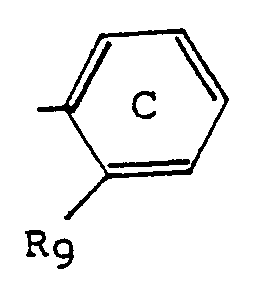
- R8 and Rg, when taken together, represent -0-, -S-, >C=O, -CH- or a single bond;
- Q, in the case where r = 1, R14 represents H, and R8 and R13 together represent the ring members necessary to complete a cycloalkan (di) one nucleus which may include a hetero atom selected from O, S and N and may be fused to a benzenoid nucleus, represents (2b) an aromatic or heterocyclic radical, and
- Q, in the case where w = 0, r = 1, Rs represents H, and R13 reprsents H, acyl, heterocyclyl carbonyl, aroyl or


- (b) the general formula II

- R1' and R3 have the above meanings;
- m and n, which may be the same or different, equal 0 or 1;
- R10 represents H or an alkyl radical; and
- V represents either

- R11 represents H, or an alkyl radical, or, together with R1o, the ring members necessary to complete a cycloalkan(di)one nucleus which may include a hetero atom selected from 0, S and N and may be fused to a benzoid nucleus;
- t, u and s, which may be the same or different equal 0 or 1 provided that m, n, s, t and u are not all equal to 0; and
- G represents

- p equals 0, 1 or 2; and
- R4 represents (1a) an aryl radical (2a) a hetero radical, (3a)

- A represents an aromatic nucleus;
- Z represents O, S or Se; and
- R5 represents H, or an alkyl or phenyl radical;
- (4a) provided that m, n, t, u and p all 0,

- R6 and R7, which may be the same or different, represent H, an alkyl or aryl radical, or an alkyl chain ―(CH2)x,― where x is 2, 3 or 4 covalently bonded to the adjacent ring, or
- (5a) provided that m, n, t, u and p are not all zero, H, an alkyl, alkoxy or phenoxy radical, or N R6 R7 wherein R6 and R7 have the above meanings; or
- (2) taken together with R10' the ring members necessary to complete an cycloalkan(di)one ring nucleus which may include a hetero atom selected from O, S and N and may be fused to a benzenoid or naphthanoid.
- The cycloalkan(di)one nuclei may contain N, S or 0 as a hetero atom and may carry substituents such as, for example, -OH, alkyl or aryl. In formula I, ring C may be substituted with, for example, an alkyl, alkoxy or N R6 R7 where R6 and R7 have the meanings specified above. The nitrogen containing heterocyclic ring formed by R15 and R14 in formula I is preferably quinoline, benzoxazole, benzothiazole, benzoselazole, naphthothiazole, naphthoselazole or benzo-2,3-dihydroindole.
- Specific examples of perester compounds in accordance with the present invention are shown in Formulae 1 to 96. Particularly preferred per esters are 2-(4'-t-butyl peroxy carbonylbenzoyl)£methylene-3-methyl benzo thiazoline (Formula 25), 2-(4'-benzoyl-4"-t-butyl peroxy carbonyl benzoyl) methylene-3-methyl naphthothiazoline (Formula 26), 2-(4'-4"-bis-t-butyl peroxy carbonyl benzoyl) methylene-3-methyl benzoselenazoline (Formula 27), 2-(4'-t-butylperoxy carbonyl)benzylidene-indan-1-one (Formula 55), 2-(4'-t-butylperoxycarbonyl) benzylidene-5-diethylaminoindan-1-one (Formula 60), and 4-(4'-p-diethylamino- benzylidene benzoyl)-t-butylperpenzoate (Formula 94).
- The perester compounds may be prepared by conversion of appropriate carboxylic acids by two general methods:-
- 1) Conversion of the acid to the corresponding acid chloride by rection with thionyl chloride, followed by reaction of the isolated acid chloride with a hydroperoxide in the presence of triethyl-amine at a temperature below 5°C.
- 2) Conversion of the acid to the corresponding imidazolide by reaction with 1,1'-carbonyl- diimidazolide. The imidazolide is then converted to the perester in situ by reaction with a hydroperoxide at a temperature below 5°C.
- The carboxylic acids used have the general formula:


- Anthroquinone-2-carboxylic acids are prepared by conventional oxidation of corresponding 2-methyl- anthroquinone as described by Whitmore and Carnalon (Journal of the American Chemical Society 958, 51, 1929).
- Suitable acids (fluorenone-2- and fluorenone-4-carboxylic acids) are available commercially from Aldrich or may be prepared (fluorenone-3-carboxylic acid) by the method described in Kruber (Ber, 1382, 65, 1932).
- Suitable thioxanthone and xanthone carboxylic acid may be prepared by the methods described in GB Patent Specification No. 2 050 378.
- Suitable precursors may be prepared by reacting carboxy aryl ketones with arylaldehydes by the methods described in US Patent Specification 4,162,162. The carboxy arylketones may be prepared by the methods described by Allinger and Jones (Journal of Organic Chemistry 70, 27, 1962).
- These compounds may be prepared by methods illustrated by the following typical examples:
- To an ice-cooled solution of terephthaloyl chloride (2.33 g) in toluene (60 ml) was added a solution of t-butylhydroperoxide (1.29 g of 80%) and triethylamine (1.22 g) in 1:1 diethylether/toluene (30 ml), dropwise over 1 hour. The temperature of the stirred solution was maintained below 5 deg. C during the addition.
- 1,2-dimethylbenzothiazolium p-toluene sulphonate (3.35 g) was added to the above solution, followed by a solution of triethylamine (2.33 g) in toluene (15 ml) dropwise over a half hour at 10-15 deg. C. The reaction mixture was stirred for 2 hours at room temperature and then filtered. The filtrates were extracted with dilute hydrochloric acid (approx. 1M), washed with water and dried over anhydrous magnesium sulphate. Solid product was isolated after the removal of excess solvent from the dried extracts on a rotary evaporator. Recrystallization of this material in ether acetate gave (1.4 g), m.p. 160 deg. C (decomp.).
- A mixture of 1,2-dimethylbenzo-selenazolium-p-tosylate (1.78 g), BPCBC (2.75 g) and dry pyridine (10 ml) was heated on a steam bath for 2 hours. The resultant mixture was diluted to a volume of 100 ml with toluene, stirred and the solution was separated from a tarry residue which had formed. The toluene solution was washed with water and then dried over magnesium sulphate.
- The product was isolated after the removal of excess solvent from the dried solution on the rotary evaporator. Recrystallisation of this material in ethyl acetate gave a product having a melting point of 120°C (decomposes).
- To a stirred solution of 1,3,3-trimethyl-2-methyleneindoline (3.6 ml) in dry toluene (20 ml) was added, dropwise, a solution of BPCBC (6.1 g) in dry toluene (15 ml). When the addition was complete, the mixture was heated to 60°C and maintained at this temperature for 12 hours before filtering. After cooling to room temperature the toluene solution was extracted with base and washed with water before drying over magnesium sulphate. A red solid was obtained from the toluene solution after removal of solvent on a rotary evaporator. Recrystallisation of this material in chloroform/methanol gave a product having a melting point of 76°C (decomposes).
- Suitable carboxylic acid precursors may be prepared by base catalysed.condensation of arylaldehydes with cycloalkanones or aryl ketones as illustrated by the following preparations.
- Indan-1-one (1.32 g) and 4-carboxylbenzaldehyde (1.50 g) were added to ethanol (15 ml). The resultant mixture was heated to reflux before adding a 10% w/v aqueous solution of sodium hydroxide (15 ml). Refluxing was continued for 1 hour. On cooling, the reaction mixture was drowned out into 1 M hydrochloric acid (25 ml) to yield a white solid which was collected at the pump, washed acid free with water and dried. The yield of product was 2.54 g, m.p. 208-211 dec. C (decomp.).
- 4-Acetylbenzoic acid (1.5 g) and 4-dimethylaminobenzaldehyde (1.38 g) were warmed in 10% aqueous caustic soda (35 ml) until dissolved. The solution was allowed to cool, with stirring. An oil was formed which crystallised to give a red-brown solid (sodium salt) which was filtered off and converted to the acid with warm 1M acetic acid. The product was recrystallised from ethanol and had a melting point of 246-249°C.
- These compounds may be prepared from the triphenyl phsophonium salt of 4-(4'-bromomethyl- benzoyl) methylbenzoate, which may be prepared by the procedure described by Gupta et al (Journal Polymer Science 855 19 1981). The procedures to convert the phosphonium salt through to the final product are illustrated by the following examples.
- To the ice-cooled solution of the triphenylphosphonium salt of 4-{4'-bromomethylbenzoyl) methylbenzoate (17.85 g) in methanol (100 ml) was added, dropwise, a solution, of sodium methoxide (1.62 g) in methanol (40 ml), followed by benzaldehyde (3.3 g). A pink precipitate was formed. Stirring was continued for hour at room temperature before the precipitate was collected and washed. Several further crops were obtained from the filtrates. The product was recrystallised from chloroform.
- To a dispersion of 4-(4'-benzylidenebenzoyl) methyl benzoate (4.07 g) in toluene (120 ml) was added a solution of potassium hydroxide (0.9 g) in methanol (20 ml). The resultant mixture was stirred for 72 hours at room temeprature. The resulting suspension was extracted several times with water and the aqueous portions were combined, filtered and acidified with 1M HZSO4.
- To an ice cooled solution of 4-(4'-benzylidenebenzoyl)-benzoic acid (1.40 g) in THF was added a solution of 1,1'-carbonyldiimidazole (0.7 g) in THF (10 ml), with stirring. After 2 hours, a solution of t-butylhydroperoxide (0.5 g of 80%) in THF (10 ml) was added slowly. Stirring was continued for a further hour at 0°C after which the solution was filtered and the solvent removed. The resulting oil was purified by column chromatography (silica) using dichloromethane as eluant. The resultant colourless oil solidified on overnight refrigeration to give a product having a melting point of 72-76°C.
- The perester compounds of the present invention are useful in the production of photopolymerisable compositions comprising the perester compound and a polymerisable compound containing ethylenic unsaturation whose polymerisation is initiated by the perester compound on exposure to radiation. Such compositions may also include an optical sensitiser and a polymeric binder and radiation sensitive plates comprising the compositions coated into a substrate and suitable for use in the production of lithographic printing plates form the-subject matter of our copending patent application of even date.
- The following Examples illustrate the invention.
- A solution in ethyl methyl ketone of a photopolymerisable composition comprising:-
- 3 parts by weight of the dimethacrylate ester of diglycidyl ether of bisphenol A,
- 1 part by weight of a vinyl acetate/crotonic acid copolymer,
- 0.15 parts by weight 4-(2',4',6'-trimethyl benzoyl)-t-butyl perbenzoate and
- 0.15 parts by weight of Ethyl Michler's Ketone,
- The dried coating was overcoated with poly(vinyl alcohol) to prevent oxygen inhibition.
- The radiation sensitive plate was exposed through a continuous tone Stouffer step-wedge to ultra violet light (2 unit from a Berkey-Ascor printing down frame) and then developed with an aqueous solution containing sodium propanoate, sodiuum benzoate and a surfactant. The developed image of the resultant lithographic printing plate had a step-wedge of solid 3, tail 7.
- When placed on a printing press, the print plate produced many satisfactory copies.
- Example 1 was repeated using the four alternative optical sensitisers listed below and the developed images of the resultant printing plates had the step-wedge readings shown:

- When placed on a printing press, the printing plates produced many satisfactory copies.
- Example 1 was repeated using 3--1'-methoxybenzoyl)-t-butyl perbenzoate as the initiator. Similar results were obtained except that the radiation sensitive plate was more sensitive, producing a solid 5, tail 9 step wedge on development.
- Example 1 was repeated except that the Ethyl Michler's Ketone was replaced by 0.15 parts by weight of 2,6-bis(4'-diethylaminobenzylidene)cyclohexanone as optical sensitiser and the plate was exposed for 20 seconds to light from a xenon arc through a Wratten 45 filter which transmits light in the range 440-540 nm. The developed image had a step wedge of solid 5, tail 13. When this sensitiser was omitted from the coating, the resultant plate gave no image when exposed under similar circumstances.
- Example 4 was repeated using t-benzoyl-t-butylpernenzoate as the initiator and the four alternative optical sensitisers listed below. The developed images had the step-wedge readings shown:

- A piece of electrochemically grained and anodised aluminium was whirler coated with a solution in ethyl methyl Ketone of a photopolymerisable compostion comprising:-
- 3 parts by weight of the dimethacrylate ester of Example 1,
- 0.15 parts by weight of Ethyl Michler's Ketone, and
- 0.15 parts by weight of the perester initiator of Example 1.
- No oxygen inhibiting layer was applied. The resultant radiation sensitive plate was exposed beneath a Stouffer step-wedge on a Laserite 65R laser exposure unit (EOCOM Corporation) with an Argon ion laser emitting at 351.1 nm and 363.8 nm. The exposure energy was 2mJcm-2. After development as in Example 1, a step-wedge reading of solid 2, tail 9 was obtained.
- Example 1 was repeated twice using an aromatic urethane acrylate (EBECRYL 210) and a polyester acrylate (EBECRYL 810) as the polymerisable compound. (EBECRYL is a Trade Mark of ucb s.a of Drogenbus, Belgium). Similar results were obtained.
- To compare the properties of the compounds of formulae 1 to 96, Example 1 was repeated using radiation sensitive plates made in accordance with Example 1 but with the initiator replaced by compounds 1 to 96. The results obtained in each case are shown in the following Table which also indicates the optical sensitiser (if used) and the exposure conditions.
- The optical sensitisers indicated in the table are as follows:
- EMK = Ethyl Michlers Ketone
- BNTZ = 2-Benzoylmethylene-3-methylnaphthothiazoline
- DOCI = 3,3'-Diethy)oxacarbocyanine iodide.
- The exposure conditions were:
- A = unit on Berkey-Ascor frame
- B = 20 seconds to Xe arc through Wratten 45 filter (transmission 440-540 nm)
- C = 20 seconds to Xe arc through Wratten 47 filter (transmission 400-500 nm)
- All the exposures wree made through a Stouffer step-wedge. The absorbance given is the wavelength of the longest radiation having an absorbance peak.


- Example 1 was repeated except that the amount of the initiator was increased to 0.3 parts by weight. The developed image had a step wedge of solid 12, tail 16.
-
- A solution in ethyl methyl ketone of a photopolymerisable composition comprising:-
- 3 parts by weight of the dimethacrylate ester of diglycidyl ether of bisphenol A,
- 1 part by weight of a vinyl acetate/crotonic acid copolymer, and 0.15 pts by weight of the photo initiator of formula (25) was whirler coated onto a sheet of grained and anodised aluminium and dried to form a radiation sensitive plate. The coating weight was 1 g.m.-2.
- The dried coating was overcoated with poly(vinyl alcohol) to prevent oxygen inhibition.
- The radiation sensitive plate was exposed through a continuous tone Stouffer step-wedge to ultra violet light (0.03 unit) from a Berkey-Ascor printing down frame and developed with an aqueous solution containing sodium propanoate, sodium benzoate and a surfactant. The develped image of the resultant lithographic printing plate had a step-wedge of solid 10 tain 14.
- Example 10 was repeated except that the solution also contained 0.15 parts by weight of Ethyl Michler's ketone as optical sensitiser. The developed image had a step-wedge of solid 11 tail 18.
- Examples 10 and 11 were repeated using the photo initiator of formula 26.
- Similar results to those of Examples 10 and 11 were obtained.
- A piece of grained and anodised aluminium was whirler coated to a weight of 1 g.m.-2 with a solution in ethyl methyl ketone of a photopolymerisable composition comprising 3 parts by weight of the monomer of Example 10, 1 part by weight of phthaloylated poly(vinyl butyral), and 0.15 parts by weight of the initiator of formula 94.
- The resultant radiation sensitive plate was exposed through a Stouffer step-wedge for 20 seconds to light from a xenon arc through a Wratter 45 filter which transmits light in the range 440-540 nm. The developed image of the resultant lithographic printing plate had a step-wedge of solid 9, tail 14.
- Example 13 was repeated except that the radiation sensitive plate was exposed using a Laserite 65R laser exposure unit (EOCOM Corporation) with an Argon ion laser emitting at 488 nm. The exposure energy was 5 mJcm-2. After development a step-wedge reading of solid 3, tail 8 was obtained.
-


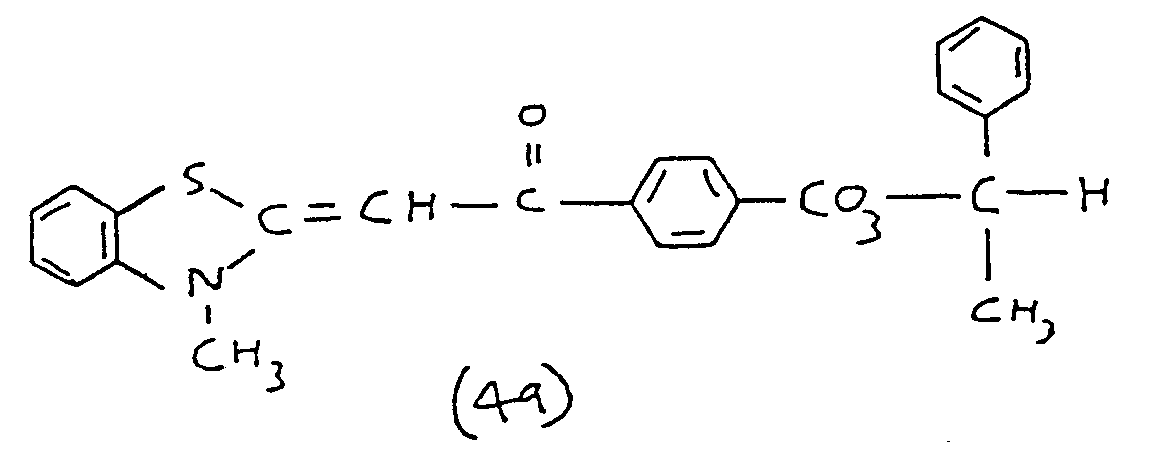


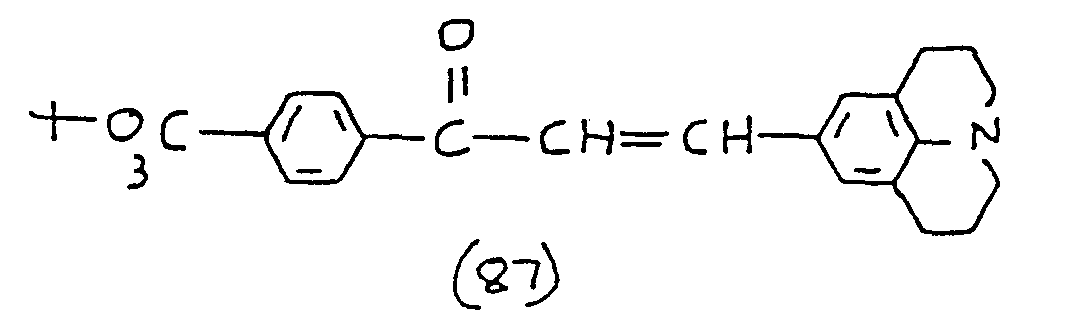


was whirler coated onto a sheet of electrichemically grained and anodised aluminium and dried to form a radiation sensitive plate. The coating weight was 1 g per sq. m.
Claims (3)








Priority Applications (1)
| Application Number | Priority Date | Filing Date | Title |
|---|---|---|---|
| AT84303110T ATE36317T1 (en) | 1983-05-09 | 1984-05-09 | PERESTER CONNECTIONS. |
Applications Claiming Priority (2)
| Application Number | Priority Date | Filing Date | Title |
|---|---|---|---|
| GB8312721 | 1983-05-09 | ||
| GB838312721A GB8312721D0 (en) | 1983-05-09 | 1983-05-09 | Photoinitiators |
Publications (3)
| Publication Number | Publication Date |
|---|---|
| EP0125875A2 EP0125875A2 (en) | 1984-11-21 |
| EP0125875A3 EP0125875A3 (en) | 1985-01-30 |
| EP0125875B1 true EP0125875B1 (en) | 1988-08-10 |
Family
ID=10542418
Family Applications (1)
| Application Number | Title | Priority Date | Filing Date |
|---|---|---|---|
| EP84303110A Expired EP0125875B1 (en) | 1983-05-09 | 1984-05-09 | Improvements in or relating to perester compounds |
Country Status (14)
| Country | Link |
|---|---|
| US (1) | US4946960A (en) |
| EP (1) | EP0125875B1 (en) |
| AT (1) | ATE36317T1 (en) |
| AU (1) | AU574361B2 (en) |
| CA (1) | CA1252782A (en) |
| DE (1) | DE3473267D1 (en) |
| DK (1) | DK227684A (en) |
| ES (1) | ES8607923A1 (en) |
| FI (1) | FI841825L (en) |
| GB (1) | GB8312721D0 (en) |
| IE (1) | IE57368B1 (en) |
| NO (1) | NO169227C (en) |
| NZ (1) | NZ208113A (en) |
| ZA (2) | ZA843469B (en) |
Families Citing this family (13)
| Publication number | Priority date | Publication date | Assignee | Title |
|---|---|---|---|---|
| GB8312721D0 (en) * | 1983-05-09 | 1983-06-15 | Vickers Plc | Photoinitiators |
| IE55632B1 (en) * | 1983-05-09 | 1990-12-05 | Vickers Plc | Improvements in or relating to radiation sensitive plates |
| GB8321813D0 (en) * | 1983-08-12 | 1983-09-14 | Vickers Plc | Radiation sensitive compounds |
| DE3738567A1 (en) * | 1987-03-12 | 1988-09-22 | Merck Patent Gmbh | COREACTIVE PHOTOINITIATORS |
| US5527921A (en) * | 1995-03-21 | 1996-06-18 | Minnesota Mining And Manufacturing Company | Peroxycarboxylic ester initiators derived from nitrogen heterocycles |
| EP1177182B1 (en) * | 1999-05-10 | 2006-11-29 | Ciba SC Holding AG | Novel photoinitiators and their applications |
| CN1378530A (en) * | 1999-10-13 | 2002-11-06 | 阿克佐诺贝尔公司 | Process for preparing peroxides using mixed anhydrides |
| EP1752452A4 (en) * | 2004-06-04 | 2010-07-14 | Astellas Pharma Inc | Propane-1,3-dione derivative or its salt |
| RU2404973C2 (en) * | 2005-03-31 | 2010-11-27 | Астеллас Фарма Инк. | Propane-1,3-dion derivative or salt |
| WO2007059613A1 (en) * | 2005-11-22 | 2007-05-31 | University Of Saskatchewan | Antineoplastic compounds |
| JP6923130B2 (en) * | 2017-08-31 | 2021-08-18 | 学校法人東京理科大学 | A benzophenone derivative having a peroxyester group, a polymerizable composition containing the compound, a cured product thereof, and a method for producing the cured product. |
| JP6995309B2 (en) * | 2017-08-31 | 2022-01-14 | 学校法人東京理科大学 | A polymerizable composition containing a thioxanthone derivative having a peroxyester group, a cured product thereof, and a method for producing the cured product. |
| CN112236420B (en) * | 2018-09-26 | 2023-11-24 | 日油株式会社 | Dialkyl peroxide having thioxanthone skeleton and polymerizable composition containing same |
Family Cites Families (11)
| Publication number | Priority date | Publication date | Assignee | Title |
|---|---|---|---|---|
| GB466097A (en) * | 1935-08-15 | 1937-05-18 | Eastman Kodak Co | Improvements in the manufacture of dyes |
| BE467066A (en) * | 1939-05-09 | |||
| US4129586A (en) * | 1970-12-16 | 1978-12-12 | Pennwalt Corporation | Peroxide free radical initiators containing ultraviolet light stabilizing groups |
| US4026884A (en) * | 1973-07-02 | 1977-05-31 | Eastman Kodak Company | Methyne dyes and photographic elements |
| CA1105758A (en) * | 1976-05-06 | 1981-07-28 | Yoshihiro Hosaka | PHOTOSENSITIVE COMPOSITIONS CONTAINING A COPOLYMER DERIVED FROM A CONJUGATED DIOLEFIN AND AN .alpha. .beta. ETHYLENICALLY UNSATURATED CARBOXYLIC ACID OR ANHYDRIDE |
| US4250244A (en) * | 1977-02-02 | 1981-02-10 | Polaroid Corporation | Thiacyanine betaine blue sensitizing dyes |
| US4416826A (en) * | 1980-10-29 | 1983-11-22 | Neckers Douglas C | Peresters and use thereof |
| SU1062190A1 (en) * | 1982-03-30 | 1983-12-23 | Украинский Научно-Исследовательский Институт Полиграфической Промышленности | Photopolymerizing composition for making photopolymeric printing forms |
| GB8312721D0 (en) * | 1983-05-09 | 1983-06-15 | Vickers Plc | Photoinitiators |
| IE55632B1 (en) * | 1983-05-09 | 1990-12-05 | Vickers Plc | Improvements in or relating to radiation sensitive plates |
| US4604295A (en) * | 1983-12-22 | 1986-08-05 | Loctite Corporation | Visible light absorbing peroxy-esters |
-
1983
- 1983-05-09 GB GB838312721A patent/GB8312721D0/en active Pending
-
1984
- 1984-05-07 IE IE1127/84A patent/IE57368B1/en not_active IP Right Cessation
- 1984-05-07 FI FI841825A patent/FI841825L/en not_active Application Discontinuation
- 1984-05-08 ZA ZA843469A patent/ZA843469B/en unknown
- 1984-05-08 ZA ZA843468A patent/ZA843468B/en unknown
- 1984-05-08 CA CA000453805A patent/CA1252782A/en not_active Expired
- 1984-05-08 DK DK227684A patent/DK227684A/en not_active Application Discontinuation
- 1984-05-09 NZ NZ208113A patent/NZ208113A/en unknown
- 1984-05-09 EP EP84303110A patent/EP0125875B1/en not_active Expired
- 1984-05-09 AU AU27837/84A patent/AU574361B2/en not_active Ceased
- 1984-05-09 DE DE8484303110T patent/DE3473267D1/en not_active Expired
- 1984-05-09 AT AT84303110T patent/ATE36317T1/en not_active IP Right Cessation
- 1984-05-09 ES ES532352A patent/ES8607923A1/en not_active Expired
- 1984-05-09 NO NO841870A patent/NO169227C/en unknown
-
1987
- 1987-10-09 US US07/107,889 patent/US4946960A/en not_active Expired - Fee Related
Also Published As
| Publication number | Publication date |
|---|---|
| ES532352A0 (en) | 1986-06-01 |
| FI841825A7 (en) | 1984-11-10 |
| AU574361B2 (en) | 1988-07-07 |
| ZA843468B (en) | 1985-10-30 |
| EP0125875A3 (en) | 1985-01-30 |
| FI841825L (en) | 1984-11-10 |
| DK227684D0 (en) | 1984-05-08 |
| IE57368B1 (en) | 1992-08-12 |
| ZA843469B (en) | 1984-12-24 |
| IE841127L (en) | 1984-11-09 |
| DK227684A (en) | 1984-11-10 |
| DE3473267D1 (en) | 1988-09-15 |
| ES8607923A1 (en) | 1986-06-01 |
| EP0125875A2 (en) | 1984-11-21 |
| NO169227C (en) | 1992-05-27 |
| NZ208113A (en) | 1987-07-31 |
| GB8312721D0 (en) | 1983-06-15 |
| US4946960A (en) | 1990-08-07 |
| NO841870L (en) | 1984-11-12 |
| ATE36317T1 (en) | 1988-08-15 |
| AU2783784A (en) | 1984-11-15 |
| FI841825A0 (en) | 1984-05-07 |
| CA1252782A (en) | 1989-04-18 |
| NO169227B (en) | 1992-02-17 |
Similar Documents
| Publication | Publication Date | Title |
|---|---|---|
| EP0125140B1 (en) | Improvements in or relating to radiation sensitive plates | |
| US4946960A (en) | Perester compounds | |
| US4250096A (en) | 3- and 4-Azidophthalic acid derivatives | |
| US4212970A (en) | 2-Halomethyl-5-vinyl-1,3,4-oxadiazole compounds | |
| US4385182A (en) | Thioxanthonecarboxylic acids and thioxanthonecarboxylic acid derivatives | |
| HU205104B (en) | Process for producing thioxanthone derivatives and photopolymerizable compositions comprising such compounds | |
| US4752649A (en) | Perester photoinitiators | |
| US4831188A (en) | Perester photoinitiators | |
| US5286867A (en) | Substituted 1-sulfonyloxy-2-pyridones and process for preparing them | |
| US5567827A (en) | 4-Hydroxyphenylthio derivatives, their preparation and their use for the preparation of aminoalkoxyphenylsulphonyl derivatives | |
| GB2075975A (en) | 3,5-disubstituted phthalimides phthalic acids and phthalic anydrides and their use as polymer additives | |
| US5286603A (en) | Radiation sensitive plates | |
| US5391749A (en) | Substituted naphthacene-5,12-diones and their use | |
| EP0733649B1 (en) | Peroxycarboxylic ester photoinitiators derived from nitrogen heterocycles | |
| CA1112246A (en) | Bis-azidophthalic acid derivatives | |
| US5834157A (en) | 2-acylamino-9-arylacridines, process for their preparation and photosensitive mixtures containing them | |
| US4891433A (en) | Process for the preparation of dibenzothiepin derivative | |
| US3812191A (en) | Process for producing developers for silver halide image patterns | |
| JPS644508B2 (en) | ||
| JP3804080B2 (en) | Method for producing triarylamine compound | |
| EP0044009B1 (en) | Process for the preparation of 2-(2,2,2,-trichloro-1-hydroxy-ethyl) phenols | |
| US5004814A (en) | Substituted α-pyrones and process for their preparation | |
| JPH06192259A (en) | Photochromic acridone derivatives, their production and their use | |
| JPH08310999A (en) | Production of 4-halo-1-naphthol compound | |
| JPH072865A (en) | Fluoran compound |
Legal Events
| Date | Code | Title | Description |
|---|---|---|---|
| PUAI | Public reference made under article 153(3) epc to a published international application that has entered the european phase |
Free format text: ORIGINAL CODE: 0009012 |
|
| AK | Designated contracting states |
Designated state(s): AT BE CH DE FR GB IT LI LU NL SE |
|
| PUAL | Search report despatched |
Free format text: ORIGINAL CODE: 0009013 |
|
| AK | Designated contracting states |
Designated state(s): AT BE CH DE FR GB IT LI LU NL SE |
|
| 17P | Request for examination filed |
Effective date: 19850712 |
|
| GRAA | (expected) grant |
Free format text: ORIGINAL CODE: 0009210 |
|
| AK | Designated contracting states |
Kind code of ref document: B1 Designated state(s): AT BE CH DE FR GB IT LI LU NL SE |
|
| REF | Corresponds to: |
Ref document number: 36317 Country of ref document: AT Date of ref document: 19880815 Kind code of ref document: T |
|
| ITF | It: translation for a ep patent filed | ||
| REF | Corresponds to: |
Ref document number: 3473267 Country of ref document: DE Date of ref document: 19880915 |
|
| ET | Fr: translation filed | ||
| PLBE | No opposition filed within time limit |
Free format text: ORIGINAL CODE: 0009261 |
|
| STAA | Information on the status of an ep patent application or granted ep patent |
Free format text: STATUS: NO OPPOSITION FILED WITHIN TIME LIMIT |
|
| 26N | No opposition filed | ||
| REG | Reference to a national code |
Ref country code: FR Ref legal event code: TP |
|
| ITPR | It: changes in ownership of a european patent |
Owner name: TRASFORMAZIONE SOCIETARIA;VICKERS PLC |
|
| REG | Reference to a national code |
Ref country code: FR Ref legal event code: CD |
|
| ITPR | It: changes in ownership of a european patent |
Owner name: CESSIONE;E.I. DU PONT DE NEMOURS AND COMPANY |
|
| NLS | Nl: assignments of ep-patents |
Owner name: E.I. DU PONT DE NEMOURS AND COMPANY TE WILMINGTON, |
|
| REG | Reference to a national code |
Ref country code: GB Ref legal event code: 732 |
|
| PGFP | Annual fee paid to national office [announced via postgrant information from national office to epo] |
Ref country code: AT Payment date: 19920409 Year of fee payment: 9 |
|
| PGFP | Annual fee paid to national office [announced via postgrant information from national office to epo] |
Ref country code: SE Payment date: 19920413 Year of fee payment: 9 |
|
| PGFP | Annual fee paid to national office [announced via postgrant information from national office to epo] |
Ref country code: BE Payment date: 19920415 Year of fee payment: 9 |
|
| PGFP | Annual fee paid to national office [announced via postgrant information from national office to epo] |
Ref country code: CH Payment date: 19920416 Year of fee payment: 9 |
|
| PGFP | Annual fee paid to national office [announced via postgrant information from national office to epo] |
Ref country code: LU Payment date: 19920429 Year of fee payment: 9 |
|
| EPTA | Lu: last paid annual fee | ||
| PG25 | Lapsed in a contracting state [announced via postgrant information from national office to epo] |
Ref country code: LU Free format text: LAPSE BECAUSE OF NON-PAYMENT OF DUE FEES Effective date: 19930509 Ref country code: AT Effective date: 19930509 |
|
| PG25 | Lapsed in a contracting state [announced via postgrant information from national office to epo] |
Ref country code: SE Effective date: 19930510 |
|
| ITTA | It: last paid annual fee | ||
| PG25 | Lapsed in a contracting state [announced via postgrant information from national office to epo] |
Ref country code: LI Effective date: 19930531 Ref country code: CH Effective date: 19930531 Ref country code: BE Effective date: 19930531 |
|
| BERE | Be: lapsed |
Owner name: E.I. DU PONT DE NEMOURS AND CY Effective date: 19930531 |
|
| REG | Reference to a national code |
Ref country code: CH Ref legal event code: PL |
|
| EUG | Se: european patent has lapsed |
Ref document number: 84303110.5 Effective date: 19931210 |
|
| NLS | Nl: assignments of ep-patents |
Owner name: AGFA-GEVAERT NAAMLOZE VENNOOTSCHAP |
|
| REG | Reference to a national code |
Ref country code: GB Ref legal event code: 732E |
|
| REG | Reference to a national code |
Ref country code: FR Ref legal event code: TP |
|
| REG | Reference to a national code |
Ref country code: GB Ref legal event code: 746 Effective date: 19990812 |
|
| REG | Reference to a national code |
Ref country code: FR Ref legal event code: D6 |
|
| PGFP | Annual fee paid to national office [announced via postgrant information from national office to epo] |
Ref country code: FR Payment date: 20000505 Year of fee payment: 17 |
|
| PGFP | Annual fee paid to national office [announced via postgrant information from national office to epo] |
Ref country code: GB Payment date: 20000509 Year of fee payment: 17 |
|
| PGFP | Annual fee paid to national office [announced via postgrant information from national office to epo] |
Ref country code: NL Payment date: 20000516 Year of fee payment: 17 |
|
| PGFP | Annual fee paid to national office [announced via postgrant information from national office to epo] |
Ref country code: DE Payment date: 20000518 Year of fee payment: 17 |
|
| PG25 | Lapsed in a contracting state [announced via postgrant information from national office to epo] |
Ref country code: GB Free format text: LAPSE BECAUSE OF NON-PAYMENT OF DUE FEES Effective date: 20010509 |
|
| PG25 | Lapsed in a contracting state [announced via postgrant information from national office to epo] |
Ref country code: NL Free format text: LAPSE BECAUSE OF NON-PAYMENT OF DUE FEES Effective date: 20011201 |
|
| GBPC | Gb: european patent ceased through non-payment of renewal fee |
Effective date: 20010509 |
|
| PG25 | Lapsed in a contracting state [announced via postgrant information from national office to epo] |
Ref country code: FR Free format text: LAPSE BECAUSE OF NON-PAYMENT OF DUE FEES Effective date: 20020131 |
|
| NLV4 | Nl: lapsed or anulled due to non-payment of the annual fee |
Effective date: 20011201 |
|
| PG25 | Lapsed in a contracting state [announced via postgrant information from national office to epo] |
Ref country code: DE Free format text: LAPSE BECAUSE OF NON-PAYMENT OF DUE FEES Effective date: 20020301 |