EP0124253A2 - Agricultural compositions, methods of preparing agricultural compositions, and methods of using agricultural compositions - Google Patents
Agricultural compositions, methods of preparing agricultural compositions, and methods of using agricultural compositions Download PDFInfo
- Publication number
- EP0124253A2 EP0124253A2 EP84302082A EP84302082A EP0124253A2 EP 0124253 A2 EP0124253 A2 EP 0124253A2 EP 84302082 A EP84302082 A EP 84302082A EP 84302082 A EP84302082 A EP 84302082A EP 0124253 A2 EP0124253 A2 EP 0124253A2
- Authority
- EP
- European Patent Office
- Prior art keywords
- composition
- urea
- polar solvent
- phenyl
- dichloro
- Prior art date
- Legal status (The legal status is an assumption and is not a legal conclusion. Google has not performed a legal analysis and makes no representation as to the accuracy of the status listed.)
- Granted
Links
Classifications
-
- A—HUMAN NECESSITIES
- A01—AGRICULTURE; FORESTRY; ANIMAL HUSBANDRY; HUNTING; TRAPPING; FISHING
- A01N—PRESERVATION OF BODIES OF HUMANS OR ANIMALS OR PLANTS OR PARTS THEREOF; BIOCIDES, e.g. AS DISINFECTANTS, AS PESTICIDES OR AS HERBICIDES; PEST REPELLANTS OR ATTRACTANTS; PLANT GROWTH REGULATORS
- A01N25/00—Biocides, pest repellants or attractants, or plant growth regulators, characterised by their forms, or by their non-active ingredients or by their methods of application, e.g. seed treatment or sequential application; Substances for reducing the noxious effect of the active ingredients to organisms other than pests
- A01N25/02—Biocides, pest repellants or attractants, or plant growth regulators, characterised by their forms, or by their non-active ingredients or by their methods of application, e.g. seed treatment or sequential application; Substances for reducing the noxious effect of the active ingredients to organisms other than pests containing liquids as carriers, diluents or solvents
-
- A—HUMAN NECESSITIES
- A01—AGRICULTURE; FORESTRY; ANIMAL HUSBANDRY; HUNTING; TRAPPING; FISHING
- A01N—PRESERVATION OF BODIES OF HUMANS OR ANIMALS OR PLANTS OR PARTS THEREOF; BIOCIDES, e.g. AS DISINFECTANTS, AS PESTICIDES OR AS HERBICIDES; PEST REPELLANTS OR ATTRACTANTS; PLANT GROWTH REGULATORS
- A01N25/00—Biocides, pest repellants or attractants, or plant growth regulators, characterised by their forms, or by their non-active ingredients or by their methods of application, e.g. seed treatment or sequential application; Substances for reducing the noxious effect of the active ingredients to organisms other than pests
- A01N25/02—Biocides, pest repellants or attractants, or plant growth regulators, characterised by their forms, or by their non-active ingredients or by their methods of application, e.g. seed treatment or sequential application; Substances for reducing the noxious effect of the active ingredients to organisms other than pests containing liquids as carriers, diluents or solvents
- A01N25/04—Dispersions, emulsions, suspoemulsions, suspension concentrates or gels
-
- A—HUMAN NECESSITIES
- A01—AGRICULTURE; FORESTRY; ANIMAL HUSBANDRY; HUNTING; TRAPPING; FISHING
- A01N—PRESERVATION OF BODIES OF HUMANS OR ANIMALS OR PLANTS OR PARTS THEREOF; BIOCIDES, e.g. AS DISINFECTANTS, AS PESTICIDES OR AS HERBICIDES; PEST REPELLANTS OR ATTRACTANTS; PLANT GROWTH REGULATORS
- A01N47/00—Biocides, pest repellants or attractants, or plant growth regulators containing organic compounds containing a carbon atom not being member of a ring and having no bond to a carbon or hydrogen atom, e.g. derivatives of carbonic acid
- A01N47/08—Biocides, pest repellants or attractants, or plant growth regulators containing organic compounds containing a carbon atom not being member of a ring and having no bond to a carbon or hydrogen atom, e.g. derivatives of carbonic acid the carbon atom having one or more single bonds to nitrogen atoms
- A01N47/28—Ureas or thioureas containing the groups >N—CO—N< or >N—CS—N<
- A01N47/34—Ureas or thioureas containing the groups >N—CO—N< or >N—CS—N< containing the groups, e.g. biuret; Thio analogues thereof; Urea-aldehyde condensation products
Definitions
- This invention relates to emulsifiable concentrate formulations, containing agricultural chemicals, in particular pesticides, for example, insecticides, or herbicides.
- a number of pesticidal,(in particular insecticidal and herbicidal) substances are desirably utilised in the form of very small particles, preferably less than 10 microns in diameter, and more preferably less than 5 microns in diameter.
- insecticidal substances are acyl urea (which term as used herein includes acyl thiourea) insect growth regulators, for example diflubenzuron, which are used extensively for the control of the mixed pest population including the many lepidopterous species, and whitefly, which are generally known as the cotton pest complex.
- acyl urea which term as used herein includes acyl thiourea
- insect growth regulators for example diflubenzuron
- whitefly which are generally known as the cotton pest complex.
- Many such compounds are notoriously insoluble in water, and thus, to provide the bulk necessary for efficient field application, must be formulated into some form of dispersion in water.
- acyl urea is suspended in an emulsifiable concentrate, which may contain an additional pesticide component, for example chlorpyrifos.
- an additional pesticide component for example chlorpyrifos.
- Other aqueous suspension concentrates, together with appropriate emulsifiers are also known.
- Such formulations are prepared so as to produce a small particle size for the acyl urea, e.g. less than 5 microns.
- the solubility of the suspended active pesticide in the formulation is the solubility of the suspended active pesticide in the formulation.
- the solubility of the suspended active product in the solvent system should be as low as possible, preferably less than 100ppm (parts per million active product in solvent). Should the solubility be excessive, crystal growth will be observed in the concentrate (known as Ostwald ripening), leading to physical disruption of the suspension concentrate.
- the acyl urea insecticides which are dependent upon a small particle size for optimum biological activity, the need to minimize this Ostwald ripening is very important, and careful choice of solvent systems is necessary. Even in pesticide systems in which particle size is not so important as in the acyl ureas, it is believed that particle sizes of less than 10 microns may be important in providing increased utility, and the same has been found for certain sparingly soluble herbicides.
- acyl ureas when a mixture is required comprising the acyl urea with another pesticide, the solvent system for such suspension concentrate gives solubilities of acyl ureas which are too high for a satisfactory suspension formulation because they give rise to Ostwald ripening, and yet are insufficient to produce conventional emulsifiable concentrates.
- an emulsifiable concentrate composition which composition comprises a miscible combination of a polar solvent and a non-polar solvent,
- the preferred additives are polymeric materials which can be used for shell or matrix formation for example ethyl cellulose and ethyl hydroxyethyl cellulose, for example those sold under the Trade Mark ETHOCEL.
- Preferred ethyl cellulose materials may contain from 2.0 to 2.6 ethoxyl groups per anhydroglucose unit, for example those sold under the Trade Mark ETHOCEL, and having a viscosity of from 3 to 300cp, preferably approximately 10cp (measured as a 5% w/w solution in a mixture of 80:20 toluene: ethanol w/w).
- ETHOCEL containing from 2.25 to 2.58 ethoxy groups per anhydroglucose unit, corresponding to an "ethoxy" content of from 45.0% to 49.5%.
- the polymeric material is preferably incorporated in an amount of from 0.1 to 10%, preferably from 0.1 to 5%, more preferably from 0.5 to 2% by weight of the emulsifiable concentrate composition.
- Suitable materials may include cellulose acetate butyrate (CAB) as an alternative to ethyl cellulose.
- CAB cellulose acetate butyrate
- Methyl cellulose has however been shown to be ineffective, and it is believed that this is due to its preferential solubility in the aqueous phase with respect to the non-polar solvent.
- Suitable polar solvents for use in the concentrate are highly polar solvents such as N-methylpyrrolidone, dimethylformamide, dimethylsulphoxide, isophorone, cyclohexanone and acetone.
- the solvent used must be an effective solvent for the acyl ureas and also for the polymeric additive.
- a sufficient amount of the polar solvent must be employed to maintain the insoluble pesticide and the polymeric material in solution.
- the amount used will therefore vary depending on the nature and amount of those materials, and in particular on the nature and amount of the insoluble pesticide.
- the amount used will fall in the range of from 1 to 80%, more usually from 5 to 40%, preferably from 10 to 25% by weight of the emulsifiable concentrate composition.
- Suitable non-polar solvents are those conventionally used in pesticide formulations and include aromatic solvents such as xylene or mixed napthalene fractions, dioctyl phthallate, chlorinated hydrocarbons, aliphatic solvents such as kerosene, mineral oils, polybutenes, glycol ethers and their mixtures or any other appropriate solvent.
- aromatic solvents such as xylene or mixed napthalene fractions, dioctyl phthallate, chlorinated hydrocarbons, aliphatic solvents such as kerosene, mineral oils, polybutenes, glycol ethers and their mixtures or any other appropriate solvent.
- aliphatic solvents such as kerosene, mineral oils, polybutenes, glycol ethers and their mixtures or any other appropriate solvent.
- the preferred solvent is xylene.
- the non-polar solvent which should be employed, and in general this will amount to the balance of the compositions, sufficient to make the composition up to the desired volume. Generally, the non-polar solvent will amount to from 5 to 90% by weight of the composition.
- the emulsifiers to be used can be chosen from the range of anionic, nonionic and cationic emulsifiers available and well-known to those skilled in the art. Suitable list for, reference may be found in "McCutcheon's Emulsifiers and Detergents" (1981 Edition).
- anionic surfactants are the calcium and amine salts of dodecylbenzene sulphonic acid and sodium diisooctylsulphosuccinate.
- nonionic surfactants are the condensation products of fatty acid esters, fatty alcohols, fatty acid amides or fatty amines with ethylene and/or propylene oxide, alkyl-, alkenyl, or polyaryl- substituted phenols with ethylene and/or propylene oxide, fatty esters of polyhydric alcohol ethers e.g. sorbitan fatty acid esters, condensation products of such esters with ethylene oxide, e.g. polyoxyethylene sorbitan fatty acid esters, block copolymers of ethylene oxide and propylene oxide, ethoxylated lanolin alcohols or ethoxylated lanolin acids.
- a cationic agent include, for instance, an aliphatic mono-, di-or polyamine as an acetate or oleate.
- Anionic/nonionic blends are preferred and are often advantageously chosen as preblended systems for ease of handling, reproducibility and cost effectiveness.
- Such systems are well known to those skilled in the art and include TENSIOFIX BS and CS, ATLOX 4855B and '4851B. (TENSIOFIX and ATLOX are Trade Marks).
- the emulsifier or emulsifier blend is chosen such as to produce on, emulsification of the concentrate an emulsion having a droplet size not exceeding 10 microns, and preferably not exceeding 5 microns.
- the choice of suitable emulsifiers to achieve this is well within the capabilities of one skilled in the art.
- the amount of emulsifier will generally be in the range of from 1 to 50%, preferably from 5 to 20%, more preferably from 7 to 15% by weight of the composition.
- compositions according to the invention are particularly valuable when the compound at most only sparingly soluble in water is an acyl urea, which term, as indicated above, is intended to include acyl thioureas.
- Particularly suitable compounds are compounds of the formula X is Oxygen or Sulphur, and R and R' are each independantly an optionally substituted aromatic or heteroaromatic group, preferably X is Oxygen and R is optionally substituted phenyl or pyridyl, or prizinyl, more preferably, both R and R' are optionally substituted phenyl, although in general any of the known acyl ureas may be employed.
- Particular examples are described in British Patent Specification Nos. 1,324,293; 1,501,607; and 1,575,799; German Patent Specification No. 2,926,480 and in U.S. Patents Nos.
- acyl ureas are:-
- acyl ureas are preferably utilised in an amount of from 0.1 to 20%, more preferably 0.5 to 10%, still more preferably from 1 to 6% by weight of the emulsifiable concentrate composition.
- the amount utilised may be as high as 60% or 70% by weight of the composition.
- compositions according to the invention may preferably comprise one or more additional pesticide components, for example organophosphorus, pyrethroid or carbamate insecticides.
- additional pesticide components for example organophosphorus, pyrethroid or carbamate insecticides.
- one or other of the polar and non-polar solvents may itself have pesticidal properties.
- the non-polar solvent may be a pesticidal compound which is a liquid at normal temperatures such as malathion.
- Suitable additional pesticide components for acyl ureas are any pesticides which fit biologically to control the various pests present in the pest complex.
- pesticides are chlorpyrifos, chlorpyrifos-methyl, cypermethrin, permethrin, lannate, triazophos, acephate, parathion, malathion, sulprofos, mephospholan, mecarbam and phospholan.
- Preferred pesticides are chlorpyrifos, chlorpyrifos - methyl and cypermethrin.
- the amount of the additional pesticide may vary within wide limits depending upon its nature.
- the additional pesticide when used, will be generally from 0.1 to 90%, preferably from 1 to 60%, more preferably from 5 to 50% by weight of the composition.
- compositions of the invention may in addition comprise one or more agronomically acceptable diluents.
- the invention provides emulsifiable concentrates possessing the following advantages:-
- An emulsifiable concentrate formulation was prepared containing 480g/litre chlorpyrifos and 30g/litre 1-[4-(2,2-dichloro-1,1-difluoroethoxy) phenyl]-3-(2-chlorobenzoyl) urea using N-methyl-pyrrolidone as a polar solvent and xylene as non-polar co-solvent.
- the formulation details were as follows.
- ETHOCEL S.10 ethyl cellulose produced by Dow Chemical Company and having a mean viscosity designation of 10cp, measured as a 5% w/w solution in 80:20 w/w toluene:ethanol
- Emulsifiers and molten chlorpyrifos were then added in the proportions given below and xylene to make up to 1 litre (approximately 1120g).
- the amount of Ethocel S.10 was such as to produce a concentration of lOg/litre in the concentrate.
- the emulsifiable concentrate was tested by emulsification in standard hard water (342ppm as CaC0 3 ) at 30°C and the emulsion was allowed to stand for 24 hours.
- the ethyl cellulose had formed a semi-solid matrix within the emulsion droplets to prevent them from coalescing.
- the emulsion droplets thus contained the acyl urea, chlorpyrifos, and xylene in a matrix of ethyl cellulose, the matrix thus preventing crystal growth of the acyl urea through the emulsion oil/water interface.
- the emulsion drop size was of the order 2 - 3 microns showing the acyl urea particle size to be below this figure.
- Example 1 was repeated, except that the ETHOCEL S.10 was omitted.
- the composition was emulsified and allowed to stand, the acyl urea crystallised and fell to the bottom. The crystalline fraction was collected, washed with water and suspended in electrolyte solution. The particle size distribution was then measured with the Coulter Counter Model TA II. (Coulter Counter is a Trade Mark).
- the particles showed a mass median diameter (in microns) of between 8 and 9 microns with more than 60% w/w greater than 5 microns.
- Example 1 was repeated, using a methyl cellulose METHOCEL MC 25 cps grade instead of ethyl cellulose.
- composition was found on dilution in water to exhibit the same properties as the composition of comparative Example 1, and a crystalline precipitate of relatively large particle size was observed. It is believed that the reason for the failure to produce the desired result in this example was due to the preferential solubility of the methyl cellulose in water rather than xylene, which resulted in no protective matrix being formed.
- ETHOCEL S.4 ethyl cellulose having a mean viscosity designation of 4cp, measured as a 5% w/w solution in 80:20 w/w toluene :ethanol
- ETHOCEL S.10 ethyl cellulose having a mean viscosity designation of 4cp, measured as a 5% w/w solution in 80:20 w/w toluene :ethanol
- the emulsifiable concentrate was tested by emulsification in standard hard water (342ppm as CaCO 3 ) at 30°C and the emulsion was allowed to stand for 24 hours.
- An emulsifiable concentrate containing 1-[4-(2,2-dichloro-1,1-difluoroethoxy)phenyl]-3-(2-chlorobenzoyl) urea (30g/litre) and chlorpyrifos (480g/L) was prepared using N-methyl pyrrolidone as a polar solvent and xylene as a non-polar solvent.
- the emulsifiable concentrate was tested by emulsification in standard hard water (342ppm as CaC0 3 ) at 30°C and the emulsion was allowed to stand for 24 hours.
- ETHOCEL HE 10 ethyl cellulose having a mean viscosity designation of 10cp, measured as a 5% w/w solution in 80:20 w/w toluene:ethanol
- the emulsifiable concentrate was tested by emulsification in standard hard water (342ppm as CaC0 3 ) at 30°C and the emulsion was allowed to stand for 24 hours.
- An emulsifiable concentrate was prepared as in Example 3 but employing cellulose acetobutyrate instead of ETHOCEL M.50.
- the emulsifiable concentrate was tested by emulsification in standard hard water (342ppm as CaCO 3 ) at 30°C and the emulsion was allowed to stand for 24 hours.
- Examples 6-8 show different acyl ureas in combination with chlorpyrifos.
- An emulsifiable concentrate containing 1-(4-chlorophenyl)-3-(2,6-difluorobenzoyl) urea (10g/ litre) and chlorpyrifos (480g/litre) was prepared using N-methyl pyrrolidone as a polar solvent and xylene as non-polar solvent.
- An emulsifiable concentrate composition was formulated as in Example 1, using ETHOCEL S.10. This was dissolved in N-methyl pyrrolidone by vigorous stirring and the acyl urea dissolved in the solution. Emulsifiers and molten chlorpyrifos were then added in the proportions given below and xylene to make up to 1 litre (approximately 1115g). The amount of ETHOCEL S.10 was such as,to produce a concentration of lOg/litre in the emulsifiable concentrate:
- the emulsifiable concentrate was tested by emulsification in standard hard water (342ppm as CaC0 3 ) at 30°C and the emulsion was allowed to stand for 24 hours.
- composition was formulated as in Example 6 but replacing the acyl urea of Example 6 with that above.
- Example 6 The composition was formulated as in Example 6 but replacing the acyl urea of Example 6 with that above. Thus, a storage-stable emulsifiable concentrate was produced.
- the emulsifiable concentrate was tested by emulsification in standard hard water (342ppm as CaC0 3 ) at 30°C and the emulsion was allowed to stand for 24 hours.
- ETHOCEL S.10 was dissolved in dimethyl formamide by vigorous stirring and the acyl urea dissolved in the solution. Emulsifiers and molten chlorpyrifos were then added in the proportions given below and xylene to make up to a litre (approximately 1120g). The amount of ETHOCEL S.10 was such as to produce a concentration of lOg/litre in the concentrate:
- the emulsifiable concentrate was tested by emulsification in standard hard water (342ppm as CaC0 3 ) at 30°C and the emulsion was allowed to stand for 24 hours.
- ETHOCEL S.10 was dissolved in dimethylsulphoxide by vigorous stirring and the acyl urea dissolved in the solution. Emulsifiers and molten chlorpyrifos were then added in the proportions given below and xylene to make up to 1 litre (approximately 1120g). The amount of ETHOCEL S.10 was such as to produce a concentration of lOg/litre in the concentrate:
- the emulsifiable concentrate was tested by emulsification in standard hard water (342ppm as CaC0 3 ) at 30°C and the emulsion was allowed to stand for 24 hours.
- ETHOCEL S.10 was dissolved in isophorone by vigorous stirring and the acyl urea dissolved in the solution. Emulsifiers and molten chlorpyrifos were then added in the proportions given below and xylene to make up to 1 litre (approximately 1140g). The amount of ETHOCEL S.10 was such as to produce a concentration of lOg/litre in the concentrate.
- the emulsifiable concentrate was tested by emulsification in standard hard water (342ppm as CaC0 3 ) at 30°C and the emulsion was allowed to stand for 24 hours.
- Example 12 and 13 illustrate use of different pesticides in combination with acyl urea insecticide.
- An emulsifiable concentrate containing 1-[4-(2,2-dichloro-1,1-difluroethoxy)phenyl]-3-(2-chlorobenzoyl) urea (30g/litre) and chlorpyrifos-methyl (480g/litre) was prepared using N-methyl pyrrolidone as a polar solvent and xylene as non-polar solvent.
- ETHOCEL S.10 was dissolved in N-methyl pyrrolidone by vigorous stirring and the acyl urea dissolved in the solution. Emulsifiers and molten chlorpyrifos-methyl were then added in the proportions given and xylene to make up to 1 litre. The amount of ETHOCEL S.10 was such as to produce a concentration of lOg/litre in the concentrate.
- the emulsifiable concentrate was tested by emulsification in standard hard water (342ppm as CaC0 3 ) at 30°C and the emulsion was allowed to stand for 24 hours.
- An emulsifiable concentrate containing 1-[3,5-dichloro-4-(1,1,2,2-tetrafluoroethoxy)phenyl]-3 -(2,6-difluorobenzoyl) urea (30g/litre) and cypermethrin (50g/litre) was prepared using N-methyl pyrrolidone as a polar solvent and xylene as non-polar solvent.
- ETHOCEL S.10 was dissolved in N-methyl pyrrolidone by vigorous stirring and the acyl urea dissolved in the solution. Emulsifiers and cypermethrin were then added in the proportions given below and xylene to make up to 1 litre (approximately 950g). The amount of ETHOCEL S.10 was such as to produce a concentration of lOg/litre in the concentrate:
- the emulsifiable concentrate was tested by emulsification in standard hard water (342ppm as CaC0 3 ) at 30°C and the emulsion was allowed to stand for 24 hours.
- Example 14 illustrates the use of a non-polar solvent other than xylene.
- An emulsifiable concentrate containing 1-[4-(2,2-dichloro-1,1-difluoroethoxy)phenyl]-3-(2-chlorobenzoyl) urea (30g/litre) and chlorpyrifos (480g/litre) was prepared using N-methyl pyrrolidone as a polar solvent and a 1,1,1-trichloroethane/xylene mixture as a non-polar solvent.
- ETHOCEL S.10 was dissolved in N-methyl pyrrolidone by vigorous stirring and the acyl urea dissolved in the, solution. Emulsifiers and molten chlorpyrifos were then added in the proportions given below and 1,1,1-trichloroethane and xylene to make up to 1 litre (approximately 1200g). The amount of ETHOCEL S.10 was such as to produce a concentration of lOg/litre in the concentrate.
- the emulsifiable concentrate was tested by emulsification in standard hard water (342ppm as CaC0 3 ) at 30°C and the emulsion was allowed to stand for 24 hours.
- Examples 15 and 16 illustrate the invention without the addition of a second pesticide to the oil phase.
- An emulsifiable concentrate containing 1-[4-(2,2-dichloro-l.l-difluoroethoxy)phenyl]-3-(2-chlorobenzoyl) urea (50g/litre) was prepared using a combination of cyclohexanone and dimethyl sulphoxide as polar solvents and xylene as non-polar solvent.
- ETHOCEL S.10 was dissolved in cyclohexanone and dimethyl sulphoxide by vigorous stirring and the acyl urea dissolved in the solution. Emulsifiers were added and xylene to make up to 1 litre (approximately 970g). The amount of ETHOCEL S.10 was such as to produce a concentration of 20g/litre in the concentrate:
- the emulsifiable concentrate was tested by emulsification in standard hard water (342ppm as CaCOg) at 30°C and the emulsion was allowed to stand for 24 hours.
- Example 15 was repeated, omitting the ETHOCEL S.10.
- An emulsifiable concentrate containing 1-[3,5-dichloro-4-(1,1,2,2-tetrafluoroethoxy)phenyl]-3-(2,6,difluorbenzoyl) urea (50g/litre) was prepared using a N-methyl pyrrolidone as polar solvent and xylene as non-polar solvent.
- ETHOCEL S.10 was dissolved in N-methyl pyrrolidone by vigorous stirring and the acyl urea dissolved in the solution. Emulsifiers were added and xylene to make up to 1 litre (approximately 950g). The amount of ETHOCEL S.10 was such as to produce a concentration of 20g/litre in the concentrate.
- the emulsifiable concentrate was tested by emulsification in standard hard water (342ppm as CaC0 3 ) at 30°C and the emulsion was allowed to stand for 24 hours.
- Acetic Acid [(4-amino-3,5-dichloro-6-fluoro-2-pyridinyl)oxy]:l-methyl heptyl ester.
- This is a herbicide which is only very sparingly soluble in water, and which has been found to have increased effectiveness when a very small particle size is utilised.
- composition of the concentrate was as follows
- composition was formulated by dissolving the herbicide in a mixture of the dimethyl formamide and xylene, addding the ETHOCEL S.10, and then the remainder of the constitutents.
- the composition was storage stable.
- the emulsifiable concentrate composition was tested by emulsification in standard hard water (342ppm CaC0 3 ) at 30°C and 1% v/v dilution, and allowed to stand for 8 hours. No crystals bigger than the emulsion droplet size (less than 1 micron) were observed.
- Example 17 was repeated, omitting the ETHOCEL S.10.
Landscapes
- Life Sciences & Earth Sciences (AREA)
- Health & Medical Sciences (AREA)
- General Health & Medical Sciences (AREA)
- Dentistry (AREA)
- Plant Pathology (AREA)
- Engineering & Computer Science (AREA)
- Pest Control & Pesticides (AREA)
- Agronomy & Crop Science (AREA)
- Wood Science & Technology (AREA)
- Zoology (AREA)
- Environmental Sciences (AREA)
- Toxicology (AREA)
- Chemical & Material Sciences (AREA)
- Dispersion Chemistry (AREA)
- Agricultural Chemicals And Associated Chemicals (AREA)
Abstract

- a miscible combination of a polar solvent, e.g. methyl pyrrolidone and a non-polar solvent, e. g. xylene,
- an agriculturally effective compound for example an acyl urea, which is at most only sparingly soluble in water, but which is soluble in the combination of polar and non-polar solvents,
- an emulsifier to generate an emulsion having an average droplet size not exceeding 10 microns, and
- a polymeric material e. g. ethyl cellulose, which is soluble in the polar solvent, and adapted to remain within the dispersed phase on emulsification of the concentrate and to form a solid or semi-solid matrix to prevent coalescence of the emulsion particles.
Description
- This invention relates to emulsifiable concentrate formulations, containing agricultural chemicals, in particular pesticides, for example, insecticides, or herbicides.
- A number of pesticidal,(in particular insecticidal and herbicidal) substances are desirably utilised in the form of very small particles, preferably less than 10 microns in diameter, and more preferably less than 5 microns in diameter. Examples of such insecticidal substances are acyl urea (which term as used herein includes acyl thiourea) insect growth regulators, for example diflubenzuron, which are used extensively for the control of the mixed pest population including the many lepidopterous species, and whitefly, which are generally known as the cotton pest complex. Many such compounds are notoriously insoluble in water, and thus, to provide the bulk necessary for efficient field application, must be formulated into some form of dispersion in water.
- Generally the approach adopted with such insoluble compounds in the past has been the formulation of wettable powders, in particular for mixtures of acyl ureas with other insecticides, for example, chlorpyrifos, because of the poor solubility of acyl urea in conventional solvents used in the preparation of emulsifiable concentrates.
- Improvements in formulation technology have resulted in liquid formulations being developed, wherein the acyl urea is suspended in an emulsifiable concentrate, which may contain an additional pesticide component, for example chlorpyrifos. Other aqueous suspension concentrates, together with appropriate emulsifiers are also known. Such formulations are prepared so as to produce a small particle size for the acyl urea, e.g. less than 5 microns.
- One of the limitations on the utility of suspension concentrate formulation is the solubility of the suspended active pesticide in the formulation. In order to ensure that over the period of shelf-life of a product, normally at least two years, the physical performance of the product does not vary, the solubility of the suspended active product in the solvent system should be as low as possible, preferably less than 100ppm (parts per million active product in solvent). Should the solubility be excessive, crystal growth will be observed in the concentrate (known as Ostwald ripening), leading to physical disruption of the suspension concentrate. With products such as the acyl urea insecticides which are dependent upon a small particle size for optimum biological activity, the need to minimize this Ostwald ripening is very important, and careful choice of solvent systems is necessary. Even in pesticide systems in which particle size is not so important as in the acyl ureas, it is believed that particle sizes of less than 10 microns may be important in providing increased utility, and the same has been found for certain sparingly soluble herbicides.
- For some acyl ureas, when a mixture is required comprising the acyl urea with another pesticide, the solvent system for such suspension concentrate gives solubilities of acyl ureas which are too high for a satisfactory suspension formulation because they give rise to Ostwald ripening, and yet are insufficient to produce conventional emulsifiable concentrates.
- The production of effective emulsifiable concentrates from highly water insoluble agricultural compounds, e.g.,the acyl ureas, has in the past been very difficult. Very polar solvents are necessary in addition to the non-polar solvent forming the dispersed phase of the emulsion in order to maintain such compounds in solution in concentrations suitable for shipment and storage. However, when such concentrates are emulsified by addition to water, in preparation for their use, the active compound tends to crystalize from the emulsions produced. This crystallisation tends to produce particles of the active compound having a size larger than that required for optimum biological activity. It is a relatively easy matter to include in an emulsifiable concentrate composition appropriate emulsifiers so that the initial droplet size is within the desired range. However, on dilution, the emulsion particles tend to coalesce, to produce particles of the active compound having an undesirably large size.
- We have now found that if certain additives, which are soluble in the combination of polar and nonsolvents and remain in the dispersed phase on emulsification of the concentrate to form a solid or semi-solid matrix, are formulated into the emulsifiable concentrates of such agricultural compositions it is possible to control the crystal growth of insoluble compounds such as acyl ureas and other agricultural compounds and thereby maintain the particle size of such pesticides at or near the optimum biologically active size.
- According to this invention, there is provided an emulsifiable concentrate composition which composition comprises a miscible combination of a polar solvent and a non-polar solvent,
- an agriculturally effective compound, for example a pesticide such as insecticide or herbicide, which is at most only sparingly soluble in water, but which is soluble in the combination of polar and non-polar solvents,
- at least one emulsifier such as to cause or permit on emulsification of the concentrate with water the formation of an emulsion having an average droplet size not exceeding 10 microns, and
- a polymeric material, which is soluble in the combination of polar and non-polar solvents and adapted to remain within the dispersed phase on emulsification of the concentrate and to form a solid or semi-solid matrix to prevent coalescence of the emulsion particles.
- The preferred additives are polymeric materials which can be used for shell or matrix formation for example ethyl cellulose and ethyl hydroxyethyl cellulose, for example those sold under the Trade Mark ETHOCEL. Preferred ethyl cellulose materials may contain from 2.0 to 2.6 ethoxyl groups per anhydroglucose unit, for example those sold under the Trade Mark ETHOCEL, and having a viscosity of from 3 to 300cp, preferably approximately 10cp (measured as a 5% w/w solution in a mixture of 80:20 toluene: ethanol w/w). Particularly preferred are the products sold under the Trade Mark ETHOCEL containing from 2.25 to 2.58 ethoxy groups per anhydroglucose unit, corresponding to an "ethoxy" content of from 45.0% to 49.5%. The polymeric material is preferably incorporated in an amount of from 0.1 to 10%, preferably from 0.1 to 5%, more preferably from 0.5 to 2% by weight of the emulsifiable concentrate composition.
- The mechanism by which such additives prevent coalescence is believed to be as follows. On initial emulsion formation, droplets are formed of the concentrate material. On standing, the polar solvent migrates into the aqueous phase, decreasing the solubility of both the acyl urea, and the polymeric material. If no-polymeric material is present, microcrystals of the acyl urea form in the liquid droplets and grow as liquid drops coalesce.
- In the presence of the polymeric material, however, a matrix of the polymeric material is formed within or around the droplets, before significant coalescence of the droplets can occur. It is therefore important that the solubility of the polymeric material in the non- polar solvent should be such that matrix formation occurs before substantial crystallisation of the pesticidal material.
- The choice of an appropriate polymeric material may be made bearing in mind the respective solubilities of the material and of the pesticide in the solvents utilised. Suitable materials may include cellulose acetate butyrate (CAB) as an alternative to ethyl cellulose. Methyl cellulose has however been shown to be ineffective, and it is believed that this is due to its preferential solubility in the aqueous phase with respect to the non-polar solvent.
- Suitable polar solvents for use in the concentrate are highly polar solvents such as N-methylpyrrolidone, dimethylformamide, dimethylsulphoxide, isophorone, cyclohexanone and acetone. The solvent used must be an effective solvent for the acyl ureas and also for the polymeric additive.
- A sufficient amount of the polar solvent must be employed to maintain the insoluble pesticide and the polymeric material in solution. The amount used will therefore vary depending on the nature and amount of those materials, and in particular on the nature and amount of the insoluble pesticide.
- Generally, the amount used will fall in the range of from 1 to 80%, more usually from 5 to 40%, preferably from 10 to 25% by weight of the emulsifiable concentrate composition.
- Suitable non-polar solvents are those conventionally used in pesticide formulations and include aromatic solvents such as xylene or mixed napthalene fractions, dioctyl phthallate, chlorinated hydrocarbons, aliphatic solvents such as kerosene, mineral oils, polybutenes, glycol ethers and their mixtures or any other appropriate solvent. The preferred solvent is xylene.
- There is no particular restriction on the amount of the non-polar solvent which should be employed, and in general this will amount to the balance of the compositions, sufficient to make the composition up to the desired volume. Generally, the non-polar solvent will amount to from 5 to 90% by weight of the composition.
- The emulsifiers to be used can be chosen from the range of anionic, nonionic and cationic emulsifiers available and well-known to those skilled in the art. Suitable list for, reference may be found in "McCutcheon's Emulsifiers and Detergents" (1981 Edition). Examples of anionic surfactants are the calcium and amine salts of dodecylbenzene sulphonic acid and sodium diisooctylsulphosuccinate. Examples of nonionic surfactants are the condensation products of fatty acid esters, fatty alcohols, fatty acid amides or fatty amines with ethylene and/or propylene oxide, alkyl-, alkenyl, or polyaryl- substituted phenols with ethylene and/or propylene oxide, fatty esters of polyhydric alcohol ethers e.g. sorbitan fatty acid esters, condensation products of such esters with ethylene oxide, e.g. polyoxyethylene sorbitan fatty acid esters, block copolymers of ethylene oxide and propylene oxide, ethoxylated lanolin alcohols or ethoxylated lanolin acids. Examples of a cationic agent include, for instance, an aliphatic mono-, di-or polyamine as an acetate or oleate.
- Anionic/nonionic blends are preferred and are often advantageously chosen as preblended systems for ease of handling, reproducibility and cost effectiveness. Such systems are well known to those skilled in the art and include TENSIOFIX BS and CS, ATLOX 4855B and '4851B. (TENSIOFIX and ATLOX are Trade Marks).
- The emulsifier or emulsifier blend is chosen such as to produce on, emulsification of the concentrate an emulsion having a droplet size not exceeding 10 microns, and preferably not exceeding 5 microns. The choice of suitable emulsifiers to achieve this is well within the capabilities of one skilled in the art.
- The amount of emulsifier will generally be in the range of from 1 to 50%, preferably from 5 to 20%, more preferably from 7 to 15% by weight of the composition.
- As indicated above, compositions according to the invention are particularly valuable when the compound at most only sparingly soluble in water is an acyl urea, which term, as indicated above, is intended to include acyl thioureas.
- Particularly suitable compounds are compounds of the formula

- In particular, preferred acyl ureas are:-
- (a) 1-[4-(2,2-dichloro-1,1-difluoroethoxy)phenyl]-3-(2-chlorobenzoyl) urea.
- (b) 1-(4-trifluoromethoxyphenyl)-3-(2-chlorobenzoyl) urea.
- (c) 1-(4-chlorophenyl)-3-(2,6-difluorobenzoyl) urea.
- (d) 1-[3,5-dichloro-4-(2-chloro-1,1-difluoroethoxy) phenyl]-3-(2,6-difluorobenzoyl) urea.
- (e) 1-[3,5-dichloro-4-(2,2-dichloro-1,1-difluoro- ethoxy)phenyl]-3-(2-chlorobenzoyl) urea.
- (f) 1-[3,5-dichloro-4-((5-trifluoromethyl)-3-chloro-2-pyridyloxy)-phenyl]-3-(2,6-difluorobenzoyl) urea.
- (g) 1-[3,5-dichloro-4-(1,1,2,2-tetrafluoroethoxy) phenyl]-3-(2,6-difluorobenzoyl) urea.
- The aforesaid acyl ureas are preferably utilised in an amount of from 0.1 to 20%, more preferably 0.5 to 10%, still more preferably from 1 to 6% by weight of the emulsifiable concentrate composition.
- When other somewhat less insoluble pesticides are utilised, for example herbicides as hereinafter exemplified, the amount utilised may be as high as 60% or 70% by weight of the composition.
- The compositions according to the invention may preferably comprise one or more additional pesticide components, for example organophosphorus, pyrethroid or carbamate insecticides. Furthermore, one or other of the polar and non-polar solvents may itself have pesticidal properties. For example, the non-polar solvent may be a pesticidal compound which is a liquid at normal temperatures such as malathion.
- Suitable additional pesticide components for acyl ureas are any pesticides which fit biologically to control the various pests present in the pest complex. Examples of such pesticides are chlorpyrifos, chlorpyrifos-methyl, cypermethrin, permethrin, lannate, triazophos, acephate, parathion, malathion, sulprofos, mephospholan, mecarbam and phospholan.
- Preferred pesticides are chlorpyrifos, chlorpyrifos-methyl and cypermethrin.
- The amount of the additional pesticide may vary within wide limits depending upon its nature. For example, when the additional pesticide is a liquid such as malathion. It will fulfil a function as a non-polar solvent, and thus relatively large amounts may be employed. In general, the amount of the additional pesticide, when used, will be generally from 0.1 to 90%, preferably from 1 to 60%, more preferably from 5 to 50% by weight of the composition.
- The compositions of the invention may in addition comprise one or more agronomically acceptable diluents.
- The invention provides emulsifiable concentrates possessing the following advantages:-
- (i) ease of preparation.
- (ii) control of particle size for optimum biological efficacy.
- (iii) ease of dilution and application under adverse field conditions consistent with normal emulsifiable concentrate advantages.
- The invention is illustrated by the following examples:-
- An emulsifiable concentrate formulation was prepared containing 480g/litre chlorpyrifos and 30g/litre 1-[4-(2,2-dichloro-1,1-difluoroethoxy) phenyl]-3-(2-chlorobenzoyl) urea using N-methyl-pyrrolidone as a polar solvent and xylene as non-polar co-solvent. The formulation details were as follows.
- ETHOCEL S.10 (ethyl cellulose produced by Dow Chemical Company and having a mean viscosity designation of 10cp, measured as a 5% w/w solution in 80:20 w/w toluene:ethanol) was dissolved in N-methyl pyrrolidone by vigorous stirring and the acyl urea was dissolved in the solution. Emulsifiers and molten chlorpyrifos were then added in the proportions given below and xylene to make up to 1 litre (approximately 1120g). The amount of Ethocel S.10 was such as to produce a concentration of lOg/litre in the concentrate.

- Thus, a storage-stable emulsifiable concentrate was produced.
- The emulsifiable concentrate was tested by emulsification in standard hard water (342ppm as CaC03) at 30°C and the emulsion was allowed to stand for 24 hours.
- No crystalline acyl urea could be separated and microscopic examination indicated the presence of no particles with a size greater than that of the emulsion droplets (2 to 3 microns), showing the acyl urea particle size to be below this figure.
- It could therefore be seen that the ethyl cellulose had formed a semi-solid matrix within the emulsion droplets to prevent them from coalescing.
- The emulsion droplets thus contained the acyl urea, chlorpyrifos, and xylene in a matrix of ethyl cellulose, the matrix thus preventing crystal growth of the acyl urea through the emulsion oil/water interface. The emulsion drop size was of the order 2 - 3 microns showing the acyl urea particle size to be below this figure.
- Example 1 was repeated, except that the ETHOCEL S.10 was omitted. When the composition was emulsified and allowed to stand, the acyl urea crystallised and fell to the bottom. The crystalline fraction was collected, washed with water and suspended in electrolyte solution. The particle size distribution was then measured with the Coulter Counter Model TA II. (Coulter Counter is a Trade Mark).
- The particles showed a mass median diameter (in microns) of between 8 and 9 microns with more than 60% w/w greater than 5 microns.
- Example 1 was repeated, using a methyl cellulose METHOCEL MC 25 cps grade instead of ethyl cellulose.
- The composition was found on dilution in water to exhibit the same properties as the composition of comparative Example 1, and a crystalline precipitate of relatively large particle size was observed. It is believed that the reason for the failure to produce the desired result in this example was due to the preferential solubility of the methyl cellulose in water rather than xylene, which resulted in no protective matrix being formed.
- One litre (approximately 1120g) of an emulsifiable concentrate containing l-[4-(2,2-dichloro-l, 1-difluoroethoxy)phenyl]-3-(2-chloro-benzoyl) urea (30g/litre) and chlorpyrifos (480g/litre) was prepared using N-methyl pyrrolidone as a polar solvent and xylene as non-polar solvent.
- The emulsifiable concentrate was formulated as in Example 1 but employing ETHOCEL S.4 (ethyl cellulose having a mean viscosity designation of 4cp, measured as a 5% w/w solution in 80:20 w/w toluene :ethanol) instead of ETHOCEL S.10.
- Thus,a storage-stable emulsifiable concentrate was produced.
- The emulsifiable concentrate was tested by emulsification in standard hard water (342ppm as CaCO3) at 30°C and the emulsion was allowed to stand for 24 hours.
- No crystalline acyl urea could be separated and microscopic examination indicated the presence of no particles with a size greater than that of the emulsion droplets (1 to 3 microns), showing the acyl urea particle size to be below this figure.
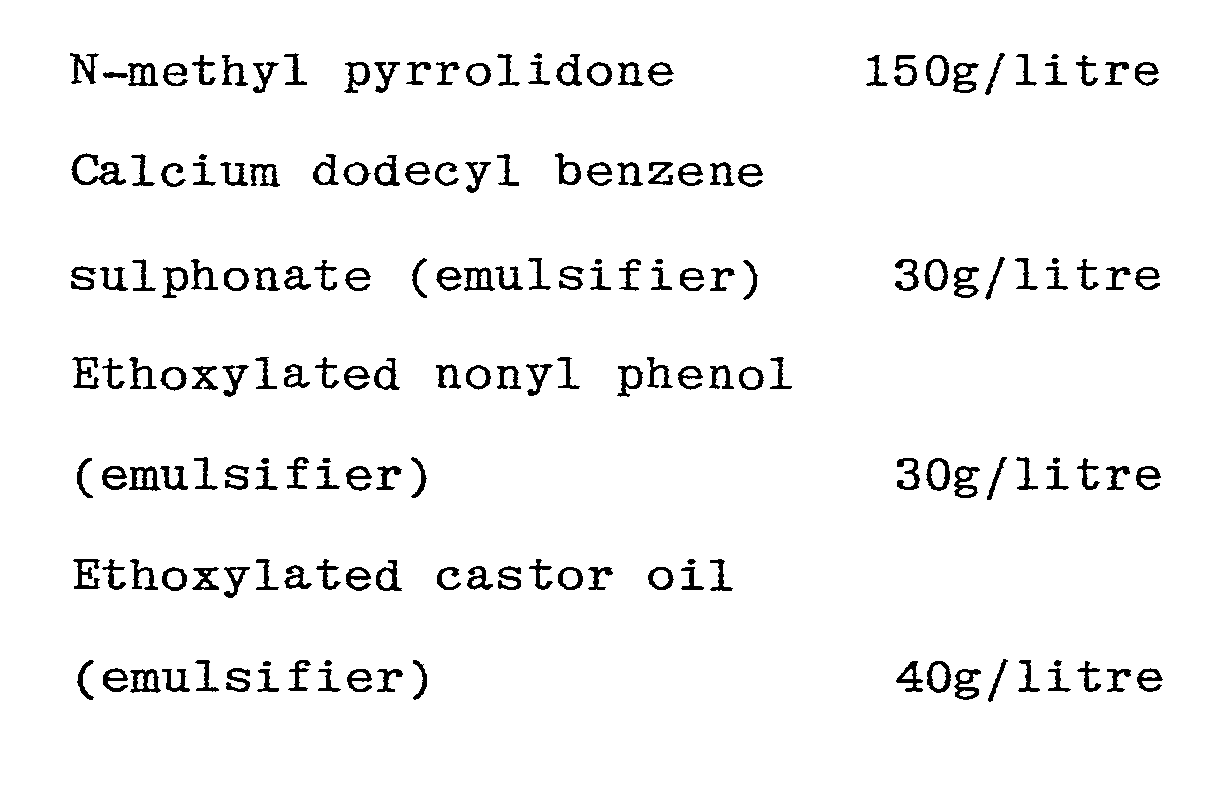
- An emulsifiable concentrate containing 1-[4-(2,2-dichloro-1,1-difluoroethoxy)phenyl]-3-(2-chlorobenzoyl) urea (30g/litre) and chlorpyrifos (480g/L) was prepared using N-methyl pyrrolidone as a polar solvent and xylene as a non-polar solvent.
- The formulation details were as follows:-
- ETHOCEL M.50 (Ethyl cellulose having a mean viscosity designation of .50cp, measured as a 5% w/w solution in 60:40 w/w toluene:ethanol) was dissolved in N-methyl pyrrolidone by vigorous stirring and the acyl urea dissolved in the solution. Emulsifiers and molten chlorpyrifos were then added in the proportions given below and xylene to make up to 1 litre (approximately 1120g). The amount of ETHOCEL M.50 was such as to produce a concentration of lOg/litre in the concentrate.

- Thus, a storage-stable emulsifiable concentrate was produced.
- The emulsifiable concentrate was tested by emulsification in standard hard water (342ppm as CaC03) at 30°C and the emulsion was allowed to stand for 24 hours.
- No crystalline acyl urea could be separated and microscopic examination indicated the presence of no particles with a size greater than that of the emulsion droplets (1 to 3 microns), showing the acyl urea particle size to be below this figure.
- One litre (approximately 1120g) of an emulsifiable concentrate was prepared as in Example 1 but employing ETHOCEL HE 10 (ethyl cellulose having a mean viscosity designation of 10cp, measured as a 5% w/w solution in 80:20 w/w toluene:ethanol) instead of ETHOCEL S.10.
- Thus, a storage-stable emulsifiable concentrate was produced.
- The emulsifiable concentrate was tested by emulsification in standard hard water (342ppm as CaC03) at 30°C and the emulsion was allowed to stand for 24 hours.
- No crystalline acyl urea could be separated and microscopic examination indicated the presence of no particles with a size greater than that of the emulsion droplets (1 to 3 microns), showing the acyl urea particle size to be below this figure.
- An emulsifiable concentrate was prepared as in Example 3 but employing cellulose acetobutyrate instead of ETHOCEL M.50.
- Thus, a storage-table emulsifiable concentrate was produced.
- The emulsifiable concentrate was tested by emulsification in standard hard water (342ppm as CaCO3) at 30°C and the emulsion was allowed to stand for 24 hours.
- No crystalline acyl urea could be separated and microscopic examination indicated the presence of no particles with a size greater than that of the emulsion droplets (1 to 3 microns), showing the acyl urea particle size to be below this figure.
- Examples 6-8 show different acyl ureas in combination with chlorpyrifos.
- An emulsifiable concentrate containing 1-(4-chlorophenyl)-3-(2,6-difluorobenzoyl) urea (10g/ litre) and chlorpyrifos (480g/litre) was prepared using N-methyl pyrrolidone as a polar solvent and xylene as non-polar solvent.
- An emulsifiable concentrate composition was formulated as in Example 1, using ETHOCEL S.10. This was dissolved in N-methyl pyrrolidone by vigorous stirring and the acyl urea dissolved in the solution. Emulsifiers and molten chlorpyrifos were then added in the proportions given below and xylene to make up to 1 litre (approximately 1115g). The amount of ETHOCEL S.10 was such as,to produce a concentration of lOg/litre in the emulsifiable concentrate:


- Thus, a storage-stable emulsifiable concentrate was produced.
- The emulsifiable concentrate was tested by emulsification in standard hard water (342ppm as CaC03) at 30°C and the emulsion was allowed to stand for 24 hours.
- No crystalline acyl urea could be separated and microscopic examination indicated the presence of no particles with a size greater than that of the emulsion droplets (1 to 3 microns), showing the acyl urea particle size to be below this figure.
- One litre (approximately 1118g) of an emulsifiable concentrate containing
- 1-[3,5-dichloroT4-((5-trifluoromethyl)-3-chloro-2-pyr idyloxy)-phenyl]-3-(2,6-difluorobenzoyl) urea (20g/litre) and chlorpyrifos (480g/litre) was prepared using N-methyl pyrrolidone as a polar solvent and xylene as non-polar solvent.
- The composition was formulated as in Example 6 but replacing the acyl urea of Example 6 with that above.
- No crystalline acyl urea could be separated and microscopic examination indicated the presence of no particles with a size greater than that of the emulsion droplets (1 to 3 microns), showing the acyl urea particle sixe to be below this figure.
- One litre (approximately 1120g) of an emulsifiable concentrate containing
1-[3,5-dichloro-4-(1,1,2,2-tetrafluoroethoxy) phenyl] -3-(2,6-difluorobenzoyl) urea (30g/litre) and chloropyrifos (480g/litre) was prepared using N-methyl pyrrolidone as a polar solvent and xylene as non-polar solvent. - The composition was formulated as in Example 6 but replacing the acyl urea of Example 6 with that above. Thus, a storage-stable emulsifiable concentrate was produced.
- The emulsifiable concentrate was tested by emulsification in standard hard water (342ppm as CaC03) at 30°C and the emulsion was allowed to stand for 24 hours.
- No crystalline acyl urea could be separated and microscopic examination indicated the presence of no particles with a size greater than that of the emulsion droplets (1 to 3 microns), showing the acyl urea particle size to be below this figure.
- An emulsifiable concentrate containing 1-[4-(2,2-dichloro-1,1-difluoroethoxy)phenyl]-3-(2-chlorobenzoyl)urea (30g/litre) and chloropyrifos (480g/litre) was prepared using dimethyl formamide as a polar solvent and xylene as non-polar solvent.
- ETHOCEL S.10 was dissolved in dimethyl formamide by vigorous stirring and the acyl urea dissolved in the solution. Emulsifiers and molten chlorpyrifos were then added in the proportions given below and xylene to make up to a litre (approximately 1120g). The amount of ETHOCEL S.10 was such as to produce a concentration of lOg/litre in the concentrate:

- Thus, a storage-stable emulsifiable concentrate was produced.
- The emulsifiable concentrate was tested by emulsification in standard hard water (342ppm as CaC03) at 30°C and the emulsion was allowed to stand for 24 hours.
- No crystalline acyl urea could be separated and microscopic examination indicated the presence of no particles with a size greater than that of the emulsion droplets (1 to 3 microns), showing the acyl urea particle size to be below this figure.
- An emulsifiable concentrate containing 1-[4-(2,2-dichloro-I,I-difluoroethoxy)phenyl]-3-(2-chlorobenzoyl) urea (30g/litre) and chlorpyrifos (480g/litre) was prepared using dimethylsulphoxide as polar solvent and xylene as non-polar solvent.
- ETHOCEL S.10 was dissolved in dimethylsulphoxide by vigorous stirring and the acyl urea dissolved in the solution. Emulsifiers and molten chlorpyrifos were then added in the proportions given below and xylene to make up to 1 litre (approximately 1120g). The amount of ETHOCEL S.10 was such as to produce a concentration of lOg/litre in the concentrate:

- Thus, a storage-stable emulsifiable concentrate was produced.
- The emulsifiable concentrate was tested by emulsification in standard hard water (342ppm as CaC03) at 30°C and the emulsion was allowed to stand for 24 hours.
- No crystalline acyl urea could be separated and microscopic examination indicated the presence of no particles with a size greater than that of the emulsion droplets (1 to 3 microns), showing the acyl urea particle size to be below this figure.
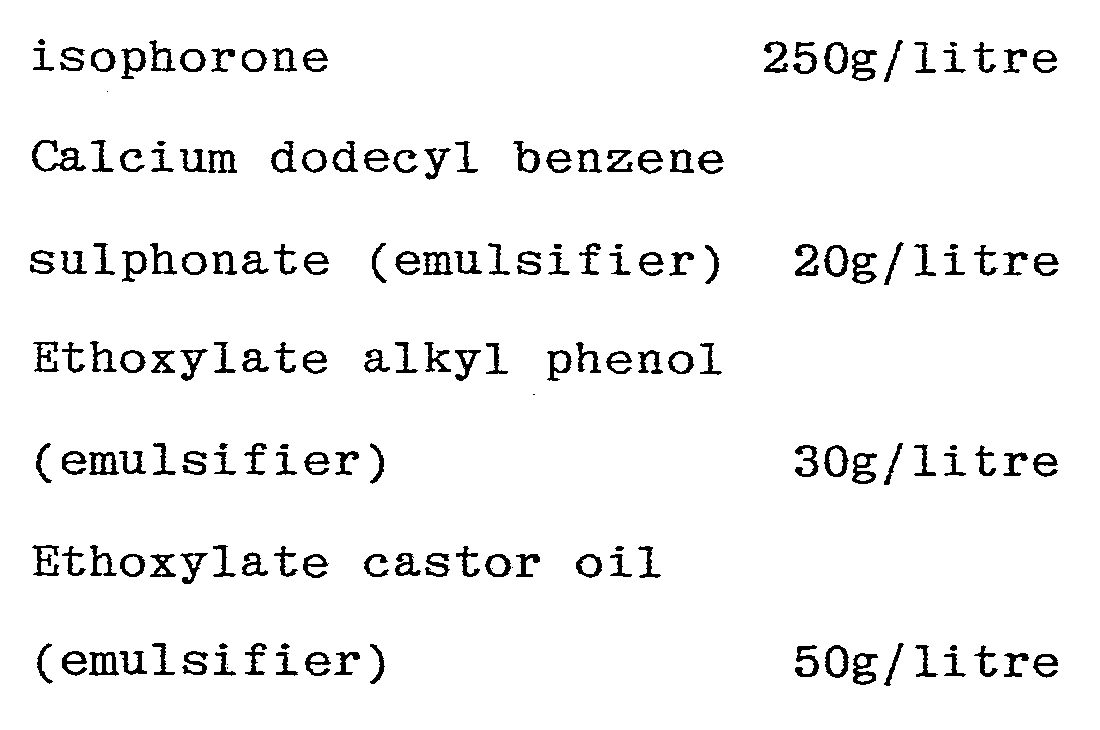
- An emulsifiable concentrate containing 1-[3,5-dichloro-4-(1,1,2,2-tetrafluoroethoxy)phenyl]-3 -(2,6-difluorobenzoyl) urea (30g/litre) and chlorpyrifos (480g/litre) was prepared using isophorone as a polar solvent and xylene as non-polar solvent.
- ETHOCEL S.10 was dissolved in isophorone by vigorous stirring and the acyl urea dissolved in the solution. Emulsifiers and molten chlorpyrifos were then added in the proportions given below and xylene to make up to 1 litre (approximately 1140g). The amount of ETHOCEL S.10 was such as to produce a concentration of lOg/litre in the concentrate.

- Thus, a storage-stable emulsifiable concentrate was produced.
- The emulsifiable concentrate was tested by emulsification in standard hard water (342ppm as CaC03) at 30°C and the emulsion was allowed to stand for 24 hours.
- No crystalline acyl urea could be separated and microscopic examination indicated the presence of no particles with a size greater than that of the emulsion droplets (1 to 3 microns), showing the acyl urea particle size to be below this figure.
- Example 12 and 13 illustrate use of different pesticides in combination with acyl urea insecticide.
- An emulsifiable concentrate containing 1-[4-(2,2-dichloro-1,1-difluroethoxy)phenyl]-3-(2-chlorobenzoyl) urea (30g/litre) and chlorpyrifos-methyl (480g/litre) was prepared using N-methyl pyrrolidone as a polar solvent and xylene as non-polar solvent.
- ETHOCEL S.10 was dissolved in N-methyl pyrrolidone by vigorous stirring and the acyl urea dissolved in the solution. Emulsifiers and molten chlorpyrifos-methyl were then added in the proportions given and xylene to make up to 1 litre. The amount of ETHOCEL S.10 was such as to produce a concentration of lOg/litre in the concentrate.

- Thus, a storage-stable emulsifiable concentrate was produced.
- The emulsifiable concentrate was tested by emulsification in standard hard water (342ppm as CaC03) at 30°C and the emulsion was allowed to stand for 24 hours.
- No crystalline acyl urea could be separated and microscopic examination indicated the presence of no particles with a size greater than that of the emulsion droplets (1 to 3 microns), showing the acyl urea particle size to be below this figure.
- An emulsifiable concentrate containing 1-[3,5-dichloro-4-(1,1,2,2-tetrafluoroethoxy)phenyl]-3 -(2,6-difluorobenzoyl) urea (30g/litre) and cypermethrin (50g/litre) was prepared using N-methyl pyrrolidone as a polar solvent and xylene as non-polar solvent.
- ETHOCEL S.10 was dissolved in N-methyl pyrrolidone by vigorous stirring and the acyl urea dissolved in the solution. Emulsifiers and cypermethrin were then added in the proportions given below and xylene to make up to 1 litre (approximately 950g). The amount of ETHOCEL S.10 was such as to produce a concentration of lOg/litre in the concentrate:

- Thus, a storage-stable emulsifiable concentrate was produced.
- The emulsifiable concentrate was tested by emulsification in standard hard water (342ppm as CaC03) at 30°C and the emulsion was allowed to stand for 24 hours.
- No crystalline acyl urea could be separated and microscopic examination indicated the presence of no particles with a size greater than that of the emulsion droplets (1 to 2 microns), showing the acyl urea particle size to be below this figure.
- Example 14 illustrates the use of a non-polar solvent other than xylene.
- An emulsifiable concentrate containing 1-[4-(2,2-dichloro-1,1-difluoroethoxy)phenyl]-3-(2-chlorobenzoyl) urea (30g/litre) and chlorpyrifos (480g/litre) was prepared using N-methyl pyrrolidone as a polar solvent and a 1,1,1-trichloroethane/xylene mixture as a non-polar solvent.
- ETHOCEL S.10 was dissolved in N-methyl pyrrolidone by vigorous stirring and the acyl urea dissolved in the, solution. Emulsifiers and molten chlorpyrifos were then added in the proportions given below and 1,1,1-trichloroethane and xylene to make up to 1 litre (approximately 1200g). The amount of ETHOCEL S.10 was such as to produce a concentration of lOg/litre in the concentrate.


- Thus, a storage-stable emulsifiable concentrate was produced.
- The emulsifiable concentrate was tested by emulsification in standard hard water (342ppm as CaC03) at 30°C and the emulsion was allowed to stand for 24 hours.
- No crystalline acyl urea could be separated and microscopic examination indicated the presence of no particles with a size greater than that of the emulsion droplets (1 to 3 microns), showing the acyl urea particle size to be below this figure.
- Examples 15 and 16 illustrate the invention without the addition of a second pesticide to the oil phase.
- An emulsifiable concentrate containing 1-[4-(2,2-dichloro-l.l-difluoroethoxy)phenyl]-3-(2-chlorobenzoyl) urea (50g/litre) was prepared using a combination of cyclohexanone and dimethyl sulphoxide as polar solvents and xylene as non-polar solvent.
- ETHOCEL S.10 was dissolved in cyclohexanone and dimethyl sulphoxide by vigorous stirring and the acyl urea dissolved in the solution. Emulsifiers were added and xylene to make up to 1 litre (approximately 970g). The amount of ETHOCEL S.10 was such as to produce a concentration of 20g/litre in the concentrate:

- Thus, a storage-stable emulsifiable concentrate was produced.
- The emulsifiable concentrate was tested by emulsification in standard hard water (342ppm as CaCOg) at 30°C and the emulsion was allowed to stand for 24 hours.
- No crystalline acyl urea could be separated and microscopic examination indicated the presence of no particles with a size greater than that of the emulsion droplets (1 to 3 microns), showing the acyl urea particle size to be below this figure.
- Example 15 was repeated, omitting the ETHOCEL S.10.
- When the concentrate was emulsified and allowed to stand for 24 hours at 30°C, a deposit of crystalline material identified as typical acyl urea crystals was seen. The crystals by microscope examination were estimated to have a particle size of 10 microns or greater.
- An emulsifiable concentrate containing 1-[3,5-dichloro-4-(1,1,2,2-tetrafluoroethoxy)phenyl]-3-(2,6,difluorbenzoyl) urea (50g/litre) was prepared using a N-methyl pyrrolidone as polar solvent and xylene as non-polar solvent.
- ETHOCEL S.10 was dissolved in N-methyl pyrrolidone by vigorous stirring and the acyl urea dissolved in the solution. Emulsifiers were added and xylene to make up to 1 litre (approximately 950g). The amount of ETHOCEL S.10 was such as to produce a concentration of 20g/litre in the concentrate.

- Thus, a storage-stable emulsifiable concentrate was produced.
- The emulsifiable concentrate was tested by emulsification in standard hard water (342ppm as CaC03) at 30°C and the emulsion was allowed to stand for 24 hours.
- No crystalline acyl urea could be separated and microscopic examination indicated the presence of no particles with a size greater than that of the emulsion droplets (1 to 2 microns), showing the acyl urea particle size to be below this figure.
- An emulsifiable concentrate was prepared of Acetic Acid:[(4-amino-3,5-dichloro-6-fluoro-2-pyridinyl)oxy]:l-methyl heptyl ester. This is a herbicide which is only very sparingly soluble in water, and which has been found to have increased effectiveness when a very small particle size is utilised.
- The composition of the concentrate was as follows
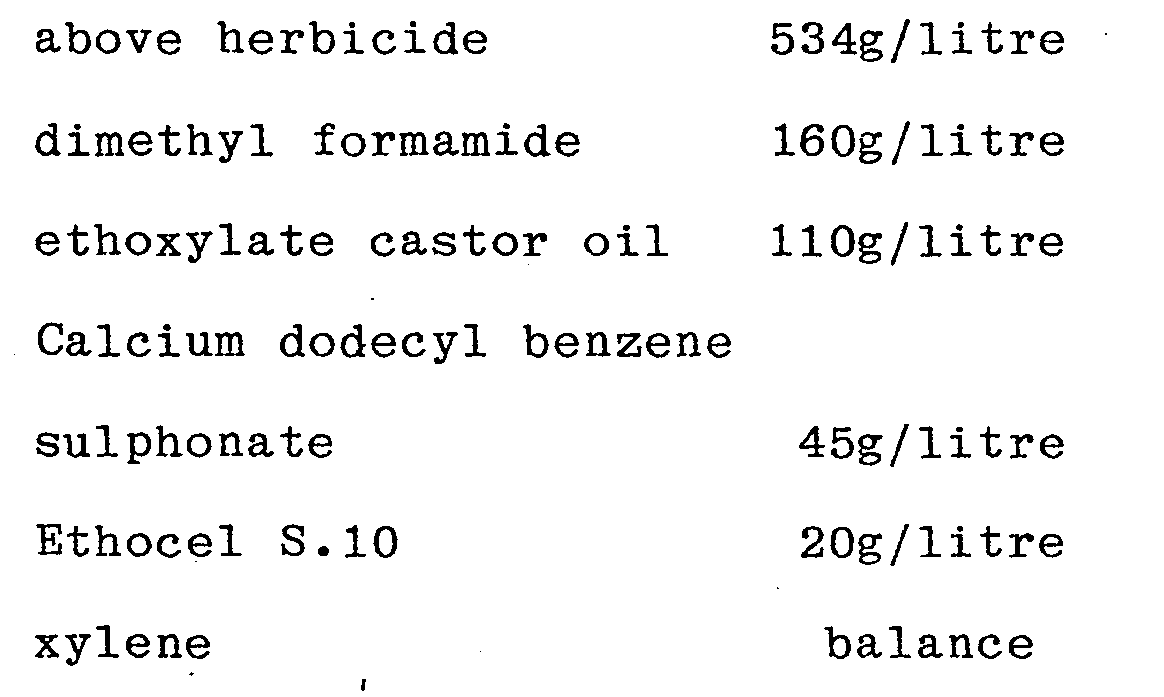
- The composition was formulated by dissolving the herbicide in a mixture of the dimethyl formamide and xylene, addding the ETHOCEL S.10, and then the remainder of the constitutents.The composition was storage stable.
- The emulsifiable concentrate composition was tested by emulsification in standard hard water (342ppm CaC03) at 30°C and 1% v/v dilution, and allowed to stand for 8 hours. No crystals bigger than the emulsion droplet size (less than 1 micron) were observed.
- Example 17 was repeated, omitting the ETHOCEL S.10.
- On emulsification gross crystallisation was observed on microscopic examination.
Claims (23)

Applications Claiming Priority (2)
| Application Number | Priority Date | Filing Date | Title |
|---|---|---|---|
| GB8308749 | 1983-03-30 | ||
| GB838308749A GB8308749D0 (en) | 1983-03-30 | 1983-03-30 | Emulsifiable concentrate formulations of pesticides |
Publications (3)
| Publication Number | Publication Date |
|---|---|
| EP0124253A2 true EP0124253A2 (en) | 1984-11-07 |
| EP0124253A3 EP0124253A3 (en) | 1986-09-03 |
| EP0124253B1 EP0124253B1 (en) | 1990-08-16 |
Family
ID=10540473
Family Applications (1)
| Application Number | Title | Priority Date | Filing Date |
|---|---|---|---|
| EP84302082A Expired - Lifetime EP0124253B1 (en) | 1983-03-30 | 1984-03-27 | Agricultural compositions, methods of preparing agricultural compositions, and methods of using agricultural compositions |
Country Status (18)
| Country | Link |
|---|---|
| EP (1) | EP0124253B1 (en) |
| JP (1) | JPS59184102A (en) |
| KR (1) | KR910007352B1 (en) |
| AU (1) | AU557367B2 (en) |
| BR (1) | BR8401552A (en) |
| CA (1) | CA1242141A (en) |
| DE (1) | DE3482971D1 (en) |
| DK (1) | DK164762C (en) |
| EG (1) | EG18037A (en) |
| ES (1) | ES8702116A1 (en) |
| GB (2) | GB8308749D0 (en) |
| GR (1) | GR79872B (en) |
| IL (1) | IL71214A0 (en) |
| IN (1) | IN160348B (en) |
| NZ (1) | NZ207604A (en) |
| PH (1) | PH20239A (en) |
| TR (1) | TR22586A (en) |
| ZA (1) | ZA842209B (en) |
Cited By (7)
| Publication number | Priority date | Publication date | Assignee | Title |
|---|---|---|---|---|
| WO1989000380A1 (en) * | 1987-07-16 | 1989-01-26 | Chinoin Gyógyszer és Vegyészeti Termékek Gyára Rt. | Plant-protective composition |
| EP0349999A3 (en) * | 1988-07-08 | 1991-04-17 | Dowelanco | Process for preparing highly active water-dispersible pesticides |
| EP0358494A3 (en) * | 1988-09-06 | 1991-08-28 | Dowelanco | Emulsifiable concentrate of a pesticide |
| EP0355759A3 (en) * | 1988-08-22 | 1991-09-04 | BASF Aktiengesellschaft | Plant-protecting agents |
| EP0433909A3 (en) * | 1989-12-18 | 1992-11-25 | Ciba-Geigy Ag | Formulation |
| DE4220161A1 (en) * | 1992-06-19 | 1993-12-23 | Stefes Pflanzenschutz Gmbh | New formulations of active ingredients for plant protection and method of use |
| US5968990A (en) * | 1997-10-14 | 1999-10-19 | Isp Investments Inc. | Water-dilutable, microemulsion concentrate and pour-on formulations thereof |
Families Citing this family (1)
| Publication number | Priority date | Publication date | Assignee | Title |
|---|---|---|---|---|
| US6045816A (en) * | 1998-06-17 | 2000-04-04 | Isp Investments Inc. | Water-based microemulsion of a pyrethroid |
Family Cites Families (2)
| Publication number | Priority date | Publication date | Assignee | Title |
|---|---|---|---|---|
| DE2905122A1 (en) * | 1979-02-10 | 1980-08-14 | Hoechst Ag | HERBICIDAL AGENTS |
| US4431671A (en) * | 1980-12-12 | 1984-02-14 | Ciba-Geigy Corporation | Phenylureas |
-
1983
- 1983-03-30 GB GB838308749A patent/GB8308749D0/en active Pending
-
1984
- 1984-03-09 CA CA000449316A patent/CA1242141A/en not_active Expired
- 1984-03-12 IL IL71214A patent/IL71214A0/en unknown
- 1984-03-23 NZ NZ207604A patent/NZ207604A/en unknown
- 1984-03-26 ZA ZA842209A patent/ZA842209B/en unknown
- 1984-03-26 DK DK168084A patent/DK164762C/en not_active IP Right Cessation
- 1984-03-27 TR TR2312/84A patent/TR22586A/en unknown
- 1984-03-27 GB GB08407894A patent/GB2138681B/en not_active Expired
- 1984-03-27 EP EP84302082A patent/EP0124253B1/en not_active Expired - Lifetime
- 1984-03-27 DE DE8484302082T patent/DE3482971D1/en not_active Expired - Fee Related
- 1984-03-28 ES ES531067A patent/ES8702116A1/en not_active Expired
- 1984-03-28 IN IN203/MAS/84A patent/IN160348B/en unknown
- 1984-03-28 PH PH30455A patent/PH20239A/en unknown
- 1984-03-29 GR GR74264A patent/GR79872B/el unknown
- 1984-03-29 AU AU26223/84A patent/AU557367B2/en not_active Ceased
- 1984-03-30 KR KR1019840001664A patent/KR910007352B1/en not_active Expired
- 1984-03-30 BR BR8401552A patent/BR8401552A/en not_active IP Right Cessation
- 1984-03-30 JP JP59063103A patent/JPS59184102A/en active Granted
- 1984-03-31 EG EG214/84A patent/EG18037A/en active
Cited By (8)
| Publication number | Priority date | Publication date | Assignee | Title |
|---|---|---|---|---|
| WO1989000380A1 (en) * | 1987-07-16 | 1989-01-26 | Chinoin Gyógyszer és Vegyészeti Termékek Gyára Rt. | Plant-protective composition |
| EP0300691A3 (en) * | 1987-07-16 | 1989-02-08 | Chinoin Gyogyszer Es Vegyeszeti Termekek Gyara Rt. | Plant-protective composition |
| EP0349999A3 (en) * | 1988-07-08 | 1991-04-17 | Dowelanco | Process for preparing highly active water-dispersible pesticides |
| EP0355759A3 (en) * | 1988-08-22 | 1991-09-04 | BASF Aktiengesellschaft | Plant-protecting agents |
| EP0358494A3 (en) * | 1988-09-06 | 1991-08-28 | Dowelanco | Emulsifiable concentrate of a pesticide |
| EP0433909A3 (en) * | 1989-12-18 | 1992-11-25 | Ciba-Geigy Ag | Formulation |
| DE4220161A1 (en) * | 1992-06-19 | 1993-12-23 | Stefes Pflanzenschutz Gmbh | New formulations of active ingredients for plant protection and method of use |
| US5968990A (en) * | 1997-10-14 | 1999-10-19 | Isp Investments Inc. | Water-dilutable, microemulsion concentrate and pour-on formulations thereof |
Also Published As
| Publication number | Publication date |
|---|---|
| ZA842209B (en) | 1985-11-27 |
| GB8407894D0 (en) | 1984-05-02 |
| DK168084A (en) | 1984-10-01 |
| IN160348B (en) | 1987-07-04 |
| AU2622384A (en) | 1984-10-04 |
| GR79872B (en) | 1984-10-31 |
| DK164762B (en) | 1992-08-17 |
| BR8401552A (en) | 1984-11-13 |
| JPH0544441B2 (en) | 1993-07-06 |
| JPS59184102A (en) | 1984-10-19 |
| GB2138681A (en) | 1984-10-31 |
| CA1242141A (en) | 1988-09-20 |
| EG18037A (en) | 1991-08-30 |
| PH20239A (en) | 1986-10-10 |
| AU557367B2 (en) | 1986-12-18 |
| NZ207604A (en) | 1987-01-23 |
| DK164762C (en) | 1992-12-28 |
| KR840007807A (en) | 1984-12-11 |
| GB8308749D0 (en) | 1983-05-11 |
| DE3482971D1 (en) | 1990-09-20 |
| EP0124253B1 (en) | 1990-08-16 |
| GB2138681B (en) | 1986-10-01 |
| ES531067A0 (en) | 1987-01-01 |
| ES8702116A1 (en) | 1987-01-01 |
| KR910007352B1 (en) | 1991-09-25 |
| IL71214A0 (en) | 1984-06-29 |
| DK168084D0 (en) | 1984-03-26 |
| TR22586A (en) | 1987-12-07 |
| EP0124253A3 (en) | 1986-09-03 |
Similar Documents
| Publication | Publication Date | Title |
|---|---|---|
| DE60111195T2 (en) | AQUEOUS FORMULATIONS AND METHOD FOR THE PRODUCTION THEREOF | |
| US4997642A (en) | Stable oil-in-water emulsions | |
| US4826863A (en) | Stabilized plant protecting agent suspension | |
| EP0381691B1 (en) | Latex-based agricultural compositions | |
| EP1035771B1 (en) | Surfactant systems for liquid aqueous preparations | |
| US5834006A (en) | Latex-based agricultural compositions | |
| PT589838E (en) | AQUEOUS EMULSES OF PESTICIDES STABLE IN STORAGE | |
| DK175268B1 (en) | Pesticide preparation and method of preparation thereof | |
| DE4013930A1 (en) | LIQUID, CONCENTRATED COMPOSITIONS BASED ON N-PHOSPHONOMETHYLGLYCIN | |
| US6667277B2 (en) | Water dispersible starch based physical form modification of agricultural agents | |
| DE3302648A1 (en) | PLANT PROTECTION AGENT IN THE FORM OF MIXED DISPERSIONS | |
| US5128329A (en) | Stable insecticidal preparations in the form of aqueous emulsion or suspension | |
| HU207197B (en) | Plant protecting solution and aquous suspension containing water insoluble active component | |
| EP0249770A1 (en) | Aqueous suspension concentrate compositions of pendimethalin | |
| EP0124253B1 (en) | Agricultural compositions, methods of preparing agricultural compositions, and methods of using agricultural compositions | |
| DE3009944C2 (en) | Insecticidal oil-in-water emulsion | |
| DE60006687T2 (en) | Stable concentrated pesticide suspension | |
| EP0253682A2 (en) | Suspension-type agrochemical formulation | |
| DE69903524T2 (en) | PESTICIDIC AIDS | |
| EP0499798A1 (en) | Liquid preparations of herbicidal mixtures based on glufosinate | |
| TWI543709B (en) | A novel aqueous suspoemulsion comprising lufenuron and lambda-cyhalothrin | |
| JPS58118501A (en) | Stable oil-in-water dispersion | |
| DE60109408T2 (en) | PROCESS FOR THE PROTECTION OF CULTURAL PLANTS FROM THE PHYTOTOXIC EFFECT OF HERBICIDES THROUGH THE USE OF PHOSPHOROUS ESTERS | |
| US4305750A (en) | Herbicides based on pyridazones | |
| JP4694838B2 (en) | Composition |
Legal Events
| Date | Code | Title | Description |
|---|---|---|---|
| PUAI | Public reference made under article 153(3) epc to a published international application that has entered the european phase |
Free format text: ORIGINAL CODE: 0009012 |
|
| AK | Designated contracting states |
Designated state(s): BE DE FR IT NL SE |
|
| PUAL | Search report despatched |
Free format text: ORIGINAL CODE: 0009013 |
|
| AK | Designated contracting states |
Kind code of ref document: A3 Designated state(s): BE DE FR IT NL SE |
|
| 17P | Request for examination filed |
Effective date: 19861006 |
|
| 17Q | First examination report despatched |
Effective date: 19880531 |
|
| GRAA | (expected) grant |
Free format text: ORIGINAL CODE: 0009210 |
|
| AK | Designated contracting states |
Kind code of ref document: B1 Designated state(s): BE DE FR IT NL SE |
|
| ET | Fr: translation filed | ||
| REF | Corresponds to: |
Ref document number: 3482971 Country of ref document: DE Date of ref document: 19900920 |
|
| ITF | It: translation for a ep patent filed | ||
| ITTA | It: last paid annual fee | ||
| PLBE | No opposition filed within time limit |
Free format text: ORIGINAL CODE: 0009261 |
|
| STAA | Information on the status of an ep patent application or granted ep patent |
Free format text: STATUS: NO OPPOSITION FILED WITHIN TIME LIMIT |
|
| 26N | No opposition filed | ||
| EAL | Se: european patent in force in sweden |
Ref document number: 84302082.7 |
|
| PGFP | Annual fee paid to national office [announced via postgrant information from national office to epo] |
Ref country code: DE Payment date: 19970327 Year of fee payment: 14 |
|
| PGFP | Annual fee paid to national office [announced via postgrant information from national office to epo] |
Ref country code: NL Payment date: 19970331 Year of fee payment: 14 |
|
| PGFP | Annual fee paid to national office [announced via postgrant information from national office to epo] |
Ref country code: SE Payment date: 19971126 Year of fee payment: 15 |
|
| PGFP | Annual fee paid to national office [announced via postgrant information from national office to epo] |
Ref country code: BE Payment date: 19971204 Year of fee payment: 15 |
|
| PG25 | Lapsed in a contracting state [announced via postgrant information from national office to epo] |
Ref country code: NL Free format text: LAPSE BECAUSE OF NON-PAYMENT OF DUE FEES Effective date: 19981001 |
|
| NLV4 | Nl: lapsed or anulled due to non-payment of the annual fee |
Effective date: 19981001 |
|
| PG25 | Lapsed in a contracting state [announced via postgrant information from national office to epo] |
Ref country code: DE Free format text: LAPSE BECAUSE OF NON-PAYMENT OF DUE FEES Effective date: 19981201 |
|
| PGFP | Annual fee paid to national office [announced via postgrant information from national office to epo] |
Ref country code: FR Payment date: 19981215 Year of fee payment: 16 |
|
| PG25 | Lapsed in a contracting state [announced via postgrant information from national office to epo] |
Ref country code: SE Free format text: LAPSE BECAUSE OF NON-PAYMENT OF DUE FEES Effective date: 19990328 |
|
| PG25 | Lapsed in a contracting state [announced via postgrant information from national office to epo] |
Ref country code: BE Free format text: LAPSE BECAUSE OF NON-PAYMENT OF DUE FEES Effective date: 19990331 |
|
| BERE | Be: lapsed |
Owner name: THE DOW CHEMICAL CY Effective date: 19990331 |
|
| EUG | Se: european patent has lapsed |
Ref document number: 84302082.7 |
|
| EUG | Se: european patent has lapsed |
Ref document number: 84302082.7 |
|
| PG25 | Lapsed in a contracting state [announced via postgrant information from national office to epo] |
Ref country code: FR Free format text: LAPSE BECAUSE OF NON-PAYMENT OF DUE FEES Effective date: 20001130 |
|
| REG | Reference to a national code |
Ref country code: FR Ref legal event code: ST |